In this series







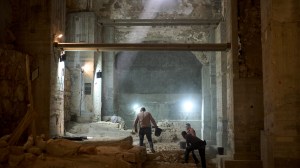


Megiddo, site of the biblical Armageddon and home of the discovery that capped off our top 10 list last year, continued to yield noteworthy discoveries in 2025.
This year’s archaeology stories highlight discoveries that have helped us learn more about the biblical world and the context that gave us the Bible. Some are controversial. Some are serendipitous.
The most important biblical archaeology discoveries of this year may not be known until months or years from now, as archaeologists study their findings in the lab, research them, and publish their reports in scientific journals. This list is the stories we learned about this year.
10. Megiddo Discoveries Linked to King Josiah’s Armageddon
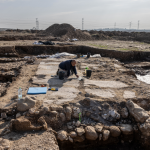
Megiddo, the famous archaeological tel with 20 levels of ancient urban civilization, continues to be the nexus of archaeological discoveries in the Jezreel Valley of northern Israel. The earliest known Christian church was discovered in a nearby prison there, adjacent to a Roman legion camp uncovered in 2013. This year, one of the oldest dateable winepresses ever discovered in Israel was revealed.
A highway salvage and improvement excavation project along Israel’s Highway 66 nearby uncovered many exceptional finds from different periods, including the 5,000-year-old winepress as well as ritual Canaanite cult vessels from 3,300 years ago.
On Tel Megiddo itself, where archeologists found unexpectedly large amounts of Egyptian and Greek pottery in a recently excavated building, research connects the finds to Judean king Josiah’s ill-fated attempt to stop Egyptian pharaoh Necho from coming to the aid of the Assyrians against the Babylonians.
Josiah’s reforms following the reign of the idolatrous king Manasseh are praised in the biblical text: “There was no king like him,” 2 Kings 23:25 says (ESV). But verse 29 reports that this military blocking maneuver ended in his ignominious death at Megiddo.
Necho is believed to have included Greek mercenaries as well as Egyptian soldiers in his army, thus accounting for the strange mixture found by the archaeologists. In the subsequent battle of Carchemish in 605 BC, Necho and the Assyrians were crushed by the Babylonian forces and the Babylonians became the dominant power in the region (Jer. 46).
9. Hasmonean Wall Excavated From Under Herod’s Palace
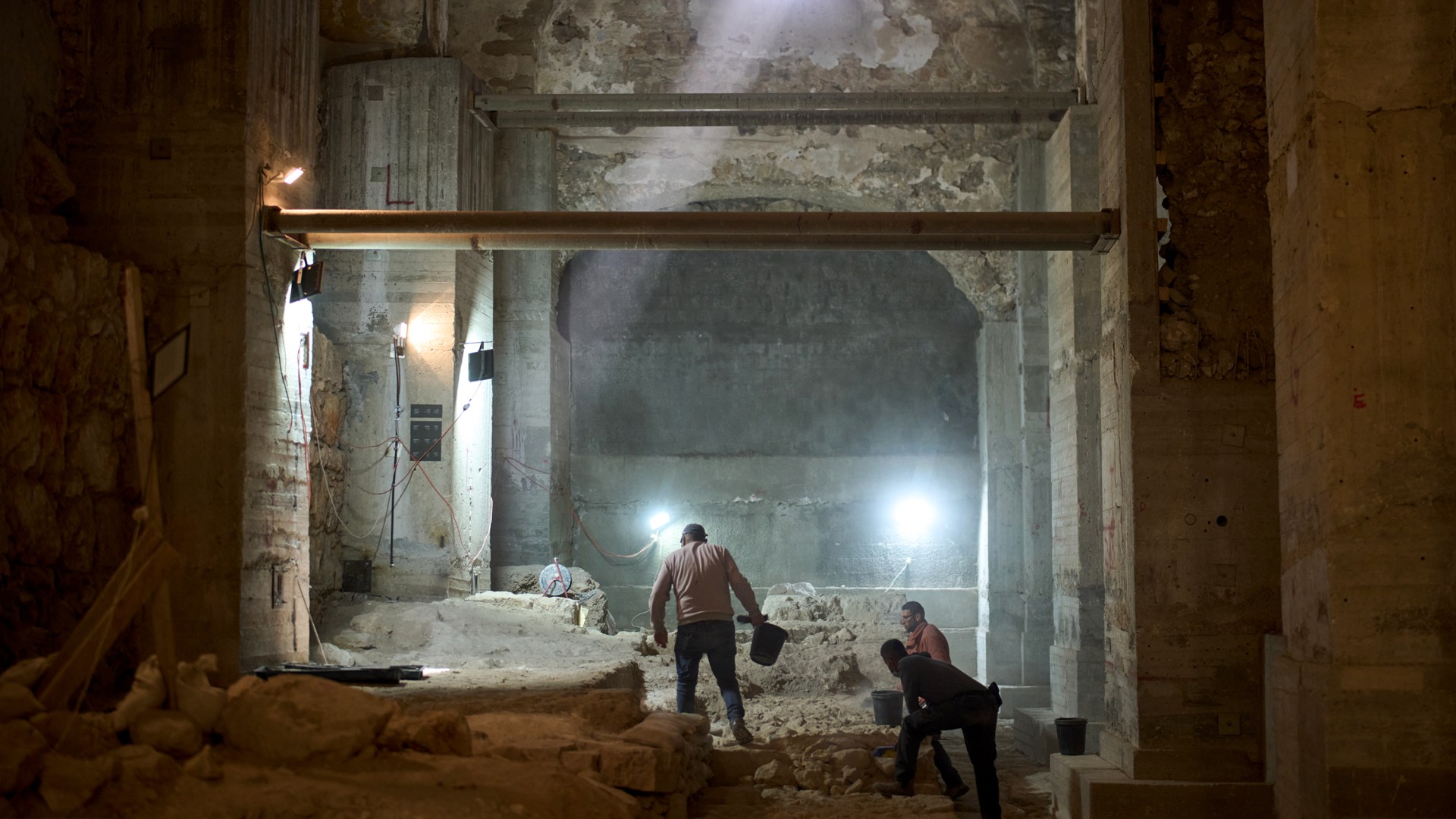
One of the sturdiest walls that ever surrounded Jerusalem, 30 feet tall and 15 feet wide, was apparently dismantled from the inside. But Israeli archaeologists aren’t sure whether King Herod or one of his Hasmonean predecessors did it.
This month, the Israel Antiquities Authority announced results of an excavation next to the Tower of David Jerusalem Museum at Jaffa Gate. One hundred years ago, a British-mandate prison covered the site. Many levels below, 2,000 years ago, Herod built his palace atop the ruins of this Hasmonean wall.
The ancient Jewish historian Josephus reports that the Hasmonean leader John Hyrcanus I was forced to dismantle Jerusalem’s walls as a condition for ending a siege by Antiochus VII Sidetes in 132 BC. Alternatively, the Israeli excavators say that Herod himself could have demonstrated his authority in supplanting the Hasmoneans by taking the wall down to its foundations before rebuilding.
The resulting new wing of the Tower of David Museum is being designed with a transparent floor, so that visitors will be able to see these archaeological remains below.
8. New Roman Roads Map Released
As the apostle Paul so ably demonstrated, the web of well-constructed roads across the Roman Empire facilitated the spread of the Christian gospel. Now, we have a clearer picture of just how far those networks stretched: There’s a new road map.
An international team of researchers combed archaeological reports, modern and ancient maps, historical accounts, satellite images, and other sources to develop a road database with 14,769 road segments. That’s a total of 185,896 miles, “more than seven times the circumference of the Earth,” according to one of the project’s leaders, Tom Brughmans of Aarhus University in Denmark.
As a testament to Roman engineering, a number of the ancient roadways are still in use, now covered by modern asphalt. The database is free and accessible online.
7. Samaria Gets Another Look and Stirs Controversy
Samaria, the capital of the Northern Kingdom of Israel from 880 BC to 722 BC, has been largely off limits to archaeology for the past half century due to its location in the politically sensitive West Bank. An excavation that began this year is directed by the Civil Administration, through which Israel controls civilian affairs in Palestinian areas, rather than the Israel Antiquities Authority.
Already, the project has discovered a stone pavement flanked by decorated columns that connected the heart of the city to the main gate. This street dates to the Herodian or New Testament period when Herod rebuilt the city and named it Sebastia in honor of the Emperor Augustus.
Controversy stirred later in the year when the Civil Administration announced plans to expropriate a 450-acre tract of privately owned Palestinian land to develop the site for a national park. Critics say both the archaeology and the land appropriation violate international law. Israeli authorities say the action was taken due to neglect and destruction at the site.
6. Egypt Nationalizes St. Catharine’s Monastery
Egypt made the stunning announcement in May that it was nationalizing St. Catherine’s Monastery, a sixth-century complex in the Sinai on a site that memorializes the Ten Commandments given to Moses. It is a UNESCO World Heritage site and the oldest monastery still operating as a monastery. The Greek Orthodox monks who live there maintain a library that contains many of the world’s earliest Christian manuscripts.
In October, Greek prime minister Kyriako Mitsotakis announced that negotiations with Egypt had resulted in an agreement that “guarantees the character of the monastery in perpetuity” and will maintain its character as a place of Christian worship. Egypt says its plans for the site included enhancements to serve tourists.
5. Pottery Inscription Details Assyrian Threat to Ancient Jerusalem
A royal communication from the king of Assyria was discovered in 2025, in the form of a one-inch pottery sherd bearing a cuneiform inscription. The inscription says, “Dear King of Judah, send the tribute quickly before the first of Av. If not, the consequences will be severe.”
The clay seal had been attached to a letter or official dispatch and was dated to around 700 BC, a time when the king of Judah, perhaps Hezekiah, was a vassal of Assyria. It’s the only Assyrian inscription ever found in Jerusalem, discovered when refuse from a drainage channel near the Temple Mount was sent for wet sifting.
Though it’s impossible to know for certain, the seal impression could be evidence of Hezekiah’s resistance, as reported in 2 Kings 18:7: “He rebelled against the king of Assyria and did not serve him.” Petrographic analysis revealed that the clay’s mineral composition corresponded to the geology of the Tigris River basin, where Nineveh and other capital cities of Assyria were located.
4. AI Redates Daniel in the Dead Sea Scrolls
Artificial intelligence has bolstered conservative Bible scholars in the debate over the Book of Daniel. The prophecies in Daniel 11 so clearly describe events in the fourth to second centuries BC that liberal scholars maintained it had to have been written much later than the sixth-century-BC lifetime of Daniel.
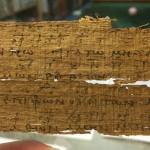
Scholars in the Netherlands submitted some Dead Sea Scroll documents to a special AI model for analysis, and most of them matched previous dating by paleographers. But 4Q114, containing chapters of Daniel that included a description of the Maccabean uprising that began in 167 BC, dated in a range between 230 and 160 BC.
No one believes this is the original text actually written by Daniel. It’s a copy of generations of copies, going back well before the events prophetically described in Daniel 11.
Artificial intelligence is giving historians many new documents to read by speeding up the translations from ancient languages. That also includes, as was announced this year, hundreds of thousands of pieces of medieval Jewish texts recovered from the geniza (storage room for retired documents) of a Cairo synagogue. They have all been digitized but most have not been read or studied yet.
3. Wildfire Reveals Much More of Bethsaida
The loss of digging tools to a wildfire last July was tempered by the revelation of the widespread remains of a Roman-period village that surrounded the excavation at el-Araj, believed to be the site of Bethsaida, hometown of the apostles Peter, Andrew, and Philip.
Archaeologists began work at el-Araj 11 years ago, convinced that Bethsaida was located along the Sea of Galilee shore and not at another site a couple miles away. With the revelation of the wildfire, little doubt remains that el-Araj was, indeed, Bethsaida.
The providential removal of the heavy foliage at the site did not damage the remains of a Byzantine basilica that was being excavated. Three years ago, a mosaic referencing the apostle Peter had been uncovered in the basilica, further evidence for the identity of the site.
Besides being the home of three apostles, the Gospels say that the feeding of the 5,000 and the healing of a blind man took place in Bethsaida. Jesus also castigated Bethsaida, along with Chorazin, for its lack of repentance (Matt. 11:21).
2. Pool of Siloam Uncovered Behind a Dam
Unfazed by the inability to find the other three sides to the Pool of Siloam that matched some stone steps uncovered in 2004, archaeologists kept digging over the past couple of years and discovered the largest dam ever found in Israel, which is also the oldest in Jerusalem. It’s 40 feet high and 26 feet wide.
The dam was built around 800 BC when Joash or perhaps Amaziah reigned as king of Judah. It was designed to collect water from the nearby Gihon Spring as well as floodwaters from the Jerusalem hillside. Climate data from elsewhere in Israel indicates 800 BC was a time of low rainfall interspersed with intense storms, which could cause flooding.
The Pool of Siloam had been thought to have served as a mikvah, for ritual bathing. Jesus told a blind man he healed to wash the dirt and spit out of his eyes at that location (John 9:7). Some archaeologists have now suggested that the depth of the pool may have instead allowed Herod to stage mock naval battles, which were in fashion in the Roman Empire in those days.
1. Gihon Spring Cultic Center Announced
A curious discovery announced early in 2025 rates a closer look, not only for its timing but also for what the announcement didn’t say.
Fifteen years ago, researchers discovered remains from an eight-room cultic center near the Gihon Spring, Jerusalem’s original water source in the Kidron Valley. In the midst of still-standing walls, they found a small olive press and winepress as well as a standing stone, a masseba, to mark a holy spot. It’s the only one ever found in Jerusalem.
The cultic center seemed to have been decommissioned during the eighth century BC, around the time of Hezekiah’s religious reforms described in 2 Kings 18 and 2 Chronicles 19.
Eli Shukron, the director of the excavation, believes that with remains going back to around the 18th century BC, they could possibly link this cultic installation to the reign of Melchizedek.
Melchizedek is a mysterious kingly priest, prefiguring Jesus’ role as Messiah, who shared bread and wine with Abraham (Gen. 14:18). He’s mentioned again in Psalm 110:4 and Hebrews 5–7. The Melchizedek speculation was omitted from the news release in 2025, but Shukron shared his conviction of the connection in several online videos.
Perhaps more importantly, the release also failed to mention any possible connection to the crowning of King Solomon and what it signified.
On a chaotic day near the end of King David’s reign, his son Adonijah tried to assert his claim to the throne. The prophet Nathan and Queen Bathsheba conspired to make sure Solomon was proclaimed king instead. David instructed them: “Have Solomon my son mount my own mule and take him down to Gihon,” where he was crowned. (1 Kings 1:33)
The significance of Gihon was established in a day that came much earlier in David’s reign, however, when he brought the Ark of the Covenant to Jerusalem. Second Samuel 6:17 says he had prepared a tabernacle or tent for the ark, likely in the vicinity of the Gihon spring—and related to this cultic installation that existed for centuries before and after David.
Some people informally refer to this as “temple zero,” in relation to the first temple built later by Solomon and the second temple built in the time of Jesus by Herod the Great.
So why the hush-hush about the two connections? Archaeologists are uncomfortable with the word likely. Untethered, it can lead to wild speculation. However, ancient cities had to be centered around a water source and a worship center of some type. This historical knowledge gives the discovery resonance. Perhaps further evidence to support the discovery is waiting to be dug up.
An official with the City of David Foundation (which controls much of this most ancient part of Jerusalem) indicated that the organization is still trying to figure out how to open up this tiny space to the legions of tourists and pilgrims who would want to see the site where Jerusalem first became a holy city.