News

Gateway Church Founder Robert Morris Pleads Guilty to Child Sex Abuse

The criminal conviction comes decades after the abuse and a year after the survivor shared her account online.

Robert Morris

Former Gateway Church founding pastor Robert Morris

Christianity Today October 2, 2025
Alex Brandon / AP

The former pastor of one of the biggest churches in Texas has pleaded guilty to child sex abuse that took place over 30 years ago.

Robert Morris, the founder of Gateway Church on the outskirts of Dallas, will serve six months in an Oklahoma jail under a ten-year suspended sentence and register as a sex offender. Under the plea deal, Morris will also pay the survivor, Cindy Clemishire, $270,000, according to The Dallas Morning News

Morris is among the highest-profile pastors to face a legal sentence for child sexual abuse, since decades-old cases rarely result in criminal convictions or guilty pleas.   

Morris, 64, pleaded guilty to all five counts in the case, charges of lewd or indecent acts with a child. Law enforcement officers cuffed him and led him out of the Oklahoma courthouse where he was sentenced. 

The crimes took place in the 1980s and came to light in June last year when Clemishire publicly disclosed that Morris had abused her as a 12-year-old. 

The molestation took place over four years, Clemishire told the abuse watchdog blog Wartburg Watch, and took place at her family home in Hominy, Oklahoma, where Morris would stay as a traveling pastor. She said Morris would come into her room and touch her under her clothes, with the molestation eventually escalating to attempted intercourse. Morris was married and in his 20s at the time. 

Morris resigned from Gateway following Clemishire’s disclosure last year, and after an independent investigation, the church removed four elders for knowing his abuse involved a minor. 

Gateway elders initially said they believed the “extramarital relationship” was with a “young lady” and not a 12-year-old, and they said Morris had already undergone restoration. The church later apologized for that characterization. A law firm hired by the church for an independent investigation did not find additional victims. 

At the court hearing, Clemishire told Morris directly that she was “not a young lady, but a child. You committed a crime against me.” NBC News reported from the courtroom that Clemishire’s 82-year-old father was crying. 

One of Morris’s attorneys told the Associated Press that Morris pleaded guilty to bring the legal matter to an end for the sake of him and his family and Clemishire and her family.

“While he believes that he long since accepted responsibility in the eyes of God and that Gateway Church was a manifestation of that acceptance, he readily accepted responsibility in the eyes of the law,” said Bill Mateja.

Clemishire continued in her victim impact statement in court, “Today is a new beginning for me, my family, and friends who have been by my side through this horrendous journey. I leave this courtroom today not as a victim, but a survivor.” 

She added that she hoped that her story would help other victims, to “lift their shame and allow them to speak up. I hope that laws continue to change and new ones are written so children and victims’ rights are better protected.”

Criminal convictions for child sexual abuse are unusual to begin with. The mean age for victims abused as minors to disclose abuse is in their 40s or 50s. When victims typically come forward with their stories decades later, civil penalties might be the only remedy available to them due to statutes of limitation. 

Oklahoma attorney general Gentner Drummond said when an Oklahoma grand jury indicted Morris in March last year that the statute of limitations did not apply to Morris because he was never a resident of Oklahoma. The state’s legal system established during the frontier era was meant to deter people from committing a crime and fleeing the state, he said. 

“This case is all the more despicable because the perpetrator was a pastor who exploited his position of trust and authority,” Drummond said in a statement on Thursday. “The victim in this case has waited far too many years for this day.”

Morris founded Gateway Church in 2000. It grew to tens of thousands of congregants at multiple campuses in the Dallas-Fort Worth area. Gateway produced famous worship leaders like Kari Jobe, and Morris was a spiritual advisor to President Donald Trump in his first term. 

Since Clemishire’s disclosure, Gateway congregants have also filed a lawsuit against Morris and Gateway, alleging the fraudulent use of their tithes. A federal judge recently ruled that that suit can proceed. Clemishire is also pursuing a civil case against the church.

In the months after Morris’s resignation, attendance at Gateway dropped precipitously. That summer in Dallas-area churches a number of megachurch leaders resigned over sexual misconduct. 

This is a breaking news story and will be updated.

Ideas

A Quiet Life Sets Up a Loud Testimony

Excellence and steady faithfulness may win the culture war.

A tiny man next to a huge microphone.
Christianity Today October 2, 2025
Illustration by Elizabeth Kaye / Source Images: Getty, Unsplash

Twenty-one years ago, before social media, an American Airlines pilot went viral for his evangelism strategy. He had just returned from a mission trip with his church to Costa Rica. The trip had made a huge impact on him, and as he taxied the 767 down the runway at LAX, he felt God was trying to tell him something. He picked up the intercom to make his usual announcement to the passengers and then decided to add another message.

“Would all of the Christians on board raise your hands?” In the cabin, the passengers looked around to see if it was a joke. A few people gingerly raised their hands in the air. He continued by encouraging passengers to use this time to talk to the Christians on board about their faith.

But his bold move for God didn’t quite “land” how he had hoped. How would you feel if the pilot of your plane suddenly told you to get ready to meet Jesus? Some on the plane pulled out their phones to call their family members in a panic.

They arrived safely at the airport, and the passengers disembarked with a bizarre story to tell. The zealous pilot, meanwhile, was summoned to see his supervisors.

If you’re anything like me, you admire his courage. But you also might be thinking, There’s no way I could pull a stunt like that and keep my job. You’re probably right. Many Christians wonder what bold, faithful gospel witness looks like in a 21st-century world where religious pluralism is axiomatic. Rabbi Shmuley Boteach, a popular spiritual guru, famously said that calling someone else’s moral or spiritual approach wrong is the equivalent of “spiritual racism.”

Furthermore, Christians increasingly find many of their most cherished beliefs outside the Overton Window of what is considered acceptable public discourse. Sociologist Aaron Renn says that we Christians have now entered a “negative world,” meaning that not only has Christian faith lost its status as a societal foundation but also it is now considered in many places to be an enemy to progress.

What does Christian witness look like in this kind of environment? Is our only recourse culture war, heading to the polls to elect a champion who can regain control of the societal intercoms?

The apostles Peter and Paul give a different, and rather unexpected, answer. They command Christians in exilic environments to “live quietly” (1 Thess. 4:11, ESV). Peter uses the word “honorably” instead of “quietly” in 1 Peter 2:12, but he’s pointing to the same idea. “Live quietly” may seem odd coming from Paul, whose preaching provoked a riot in Ephesus (Acts 19:23–41), or from Peter, who boldly accused his community of killing Christ by wicked hands (Acts 2:23). But as Peter and Paul both explain, the quiet life sets us up for a loud testimony.

The quiet life is not about living invisibly, however. It’s about working for the prosperity of your city and pointing people to Jesus as you do so. Peter and Paul outline five components for “living quietly.” These constitute the daily objective for every Christian, whether we go to work every day teaching third graders or directing the operations of a multinational conglomerate—or piloting a 767. Our life in today’s Babylon, they explain, should be creation-fulfilling, excellence-pursuing, holiness-reflecting, redemption-displaying, and mission-advancing.

First, believers should seek to fulfill the creation mandate through their careers and calling. The initial commission given to us, after all, was not the Great Commission, but the Creation Commission. By developing the world around us and making it a better place to live in, we glorify our Creator. It’s no accident that the first time the concept of being filled with the Spirit is used in the Bible, it’s in relation to a man’s woodworking skills, not his sermons (Ex. 31:1–5). Testimony to Christ begins not with our words but with our jobs (Gen. 1:28; Prov. 22:29).

Second, we pursue excellence in our work. We do so not for status or applause but because our work reflects the excellence of the one we serve. Daniel had an excellent spirit, which manifested itself, he tells us, in both his diligence and his integrity (Dan. 6:4). Even the smallest task, Paul tells us, can become a testimony when done “as working for the Lord” (Col. 3:23).

Third, the quiet life reflects God’s holiness, setting us apart through our purity and integrity. We have an ultimate Master in heaven, Paul tells us, and when we live with fairness and justice even when no one is watching, it points others to his existence (Col. 4:1). Peter tells us to be holy as our Father in heaven is holy, which will make us stand out like bright lights in a dark and depraved world, pointing others to the living God (1 Peter 1:15–16; Phil. 2:14–15).

Fourth, our lives should display redemption. In a broken world, believers put the gospel on display through forgiveness, grace, and radical acts of mercy. Living this way doesn’t mean eschewing a free-market, merit-based economy, but recognizing that behind this economy—superseding it—is an even more fundamental one based on grace. Christians look for ways to inject radical displays of grace as a reflection of the gospel. We see this patterned in Leviticus, where God commanded the Israelites to leave the corners of their fields unharvested so that the poor could glean from them (Lev. 19:9–10). Our kindness and patience point people to the Cross, the ultimate basis of the Christian’s economy (Eph. 4:32).

Finally, our lives should be mission-advancing. As Peter tells us and the life of Daniel illustrates for us, living quietly opens doors to share the gospel boldly and loudly. Our ordinary lives become platforms for extraordinary witness (Dan. 12:3; 1 Pet. 3:15).

These principles are all applications of Jeremiah’s command to the Jewish exiles in his day to settle into Babylon, seek its peace, and help make it a better place to live in (Jer. 29:4–7). Living by these principles provoked at least two Babylonian kings to profess faith in the God of Israel and prompted a gaggle of wise men many years later to leave the regions of Babylon in pursuit of the Christ child.

Daniel and his generation offer a model for Christians seeking to live out bold testimony in an increasingly hostile, “negative” world. Consider: Daniel was so bold and courageous in his Babylon that he ended up in a lion’s den because of it. Yet he was so beloved that the king who threw him in there couldn’t eat or sleep, hoping against hope that he’d make it through the night (Dan. 6:18).

I suspect that the reason King Darius wept outside the lion’s den was not because he missed Daniel’s prophetic rebukes but because Daniel was his friend and he couldn’t imagine Babylon without Daniel. Our communities should be able to say about us, “We may not believe what those crazy people over at that church believe, but thank God they’re here—if not, we’d have to raise our taxes!”

There is a time for clear, prophetic rebuke—even accompanying political advocacy. As Os Guinness said, in a Western democracy, to not contend for God’s laws in the political sphere would be a “failure of citizenship,” because in our system of government, “every American citizen is responsible for every American and the American Republic.” But the tip of our missional spear is the quiet, remarkable, Jeremiah 29:7-fulfilling life.

This kind of life sets us up to offer a loud testimony, a testimony that cannot be marginalized or ignored. As Lesslie Newbigin explained, how we go about our lives and pursue our vocations provides the first dramatic contrast with Babylon.

I saw this kind of life exemplified by my friend Mike, who is the head of neurology at one of the United States’ most prestigious universities. Every year, that university sends him to medical conferences around the world as its representative. Mike finds himself in some of the least evangelized places on the planet, the special guest of communists, Buddhists, and Muslims. He opens every talk by explaining how his experience with the gospel affects his view of medicine. I asked him, “How is your university okay with that? They are, after all, not at all interested in world evangelization. In fact, they’d be downright opposed to it.”

He replied, with a twinkle in his eyes, “Well, I’m the top-ranked neurosurgeon in America. I can say whatever I want.” Mike does his work well and stands before kings because of it (Prov. 22:29). And when he’s there, he points them to King Jesus.

You may not have the same reach as my friend Mike. Or the platform of Paul, Peter, or Daniel. But you have the same tools at your disposal. The good news is, in the kingdom of God, you don’t have to be remarkable to live a remarkable life. You simply have to live the quiet yet counter-cultural life of faith, a faith grounded in the knowledge that we’re citizens of another kingdom with an all-conquering King. A quiet life that proclaims a loud testimony.

J. D. Greear is the pastor of The Summit Church in Raleigh, North Carolina, and the author of many books, including his latest, Everyday Revolutionary: How to Transcend the Culture War and Transform the World

News

Survey: Evangelicals Contradict Their Own Convictions

A new State of Theology report shows consensus around core beliefs but also lots of confusion.

Stained glass window depicting Jesus
Christianity Today October 2, 2025
Evan Jeung / Unsplash

When American evangelicals affirm the Trinity but don’t see the Spirit as a personal being, when they consider Jesus as the sole source of righteousness but insist that people are still inherently good, either not enough churches are teaching sound doctrine or not enough churchgoers are listening.

That’s what Ligonier Ministries had to say about the results of its latest State of Theology survey, conducted in partnership with Lifeway Research.

“Many of the survey answers from evangelicals in 2025 reveal an alarming lack of biblical literacy, as well as a tendency to hold contradictory beliefs without seeming to recognize the incongruity,” the report said.

The survey takes place every two to three years and captures theological stances among US adults and evangelicals in particular. The research defines evangelicals as Christians who report strong beliefs in biblical authority, evangelism, Jesus as their Savior, and the power of the Cross.

It’s no surprise that nearly everyone who agrees on those tenets of faith would also affirm the Trinity (98%), an unchanging God (95%), and the physical resurrection of Christ (98%).

Yet in other survey questions, their responses contradict foundational beliefs in the God of the Bible. Somehow, 28 percent of evangelicals, who all said they “trust in Jesus Christ alone” for salvation, agreed with half the country that Jesus was a great teacher but not God. And despite professing belief in “one true God in three persons,” over half of evangelicals say the Spirit isn’t a personal being.

“The survey seems to indicate that evangelicals, defined in the survey according to a form of the Bebbington Quadrilateral, are confused about the nature of God and his relationship with the world he has created,” said Glenn R. Kreider, professor of theological studies at Dallas Theological Seminary. “It also demonstrates inconsistency in beliefs, even to the point of contradiction.”

Evangelicals, he said, could do a better job synthesizing their beliefs and practicing systematic theological thinking—but that takes training.  

With each State of Theology survey, evangelicals have been prone to agree with beliefs outside of Christian orthodoxy: Around half consistently say people are good by nature and that God accepts the faith of non-Christian religions.

The prevalence of evangelical misunderstandings or inconsistent beliefs has held relatively steady over the past decade and hasn’t climbed significantly. (On most points, the stances of Americans at large haven’t changed much either.)

Theologians see the trends, though troubling, as an opportunity for the church.

“It does not take much wisdom to look at the numbers from the 2025 study and see there is a problem theologically. It does, however, take wisdom to know what the best course of action is after the study,” said Ronni Kurtz, systematic theology professor at Midwestern Baptist Theological Seminary. “In my opinion, the study represents less of a call to hunt heresy and more of a call towards discipleship.”

That’s where theologians, scholars, and professors do see signs of hope. Evangelicals, they say, are taking more interest in studying doctrine, creeds, and systematic theology.

Kreider remembers decades ago, as evangelical students focused in on biblical exegesis and hermeneutics, many didn’t see the value of further theological education.

“I am seeing more and more interest in theology and am encouraged that many recognize that constructive theology needs a foundation of Christian orthodoxy,” he said. “It has been a long time since I have heard students object to the need for systematic and historical theology courses.”

Kurtz, similarly, has seen among pastors a renewed interest in church fathers and centuries-old thinkers, “especially as it relates to those theological topics we call ‘theology proper’—dealing with doctrines like the Trinity and divine attributes.”

For the first time in a decade, a majority of US seminaries saw enrollment growth last year, according to the Association of Theological Schools (ATS), and the trends are particularly strong at the top evangelical seminaries. The number of theology doctorate students is up over 13 percent in the past five years, and non-degree enrollment has spiked by 46 percent. 

Still, even pastor-theologians armed with seminary degrees and deeper study will struggle to disciple evangelicals who don’t see church involvement as a priority.

That’s one shift in the State of Theology that’s held over from the pandemic: 63 percent of Americans and 44 percent of evangelicals say worshiping alone or with family is just as good as going to church. Most Americans and nearly a third of evangelicals (31%) don’t think Christians have an obligation to join a church.

Kurtz cautions against a “how dare they” approach to the theological misunderstandings reflected in the survey results and instead sees the situation as a call to bring fellow believers into a richer, truer understanding of God.

“While there is a place for gatekeeping as it relates to orthodoxy, I am convinced many more would come feast at the banquet that is theology if they simply felt invited,” he said. “I would encourage those who are discouraged by the numbers to invite people into the deeper waters of theological thought but in a way where you truly love your neighbor and want them to ‘come and see’ the beauty that has so transformed you.”

Theology

What Horror Stories Can (and Cannot) Tell Us About the World

Columnist

We want meaning and resolution—and the kind of monster we can defeat.

Claw shadows on a wall.
Christianity Today October 1, 2025
Illustration by Christianity Today / Source Images: Getty

This piece was adapted from Russell Moore’s newsletter. Subscribe here.

When you were a child, did you ever go to the place where your mom or dad worked and get a little glimpse into what their day-to-day life was like when they were away from you? I’ve been trying to imagine today what it would be like to see that my father spent all day not selling Ford cars (as mine did) but making up ways a homicidal clown could lure a child into a sewer grate.

That thought crossed my mind as I read an essay in The New York Times by Joe Hill—son of the world’s most-well-known horror novelist, Stephen King—on the anniversary of the release of King’s famous vampire novel, ’Salem’s Lot. Hill, now also a writer in the same genre, describes what it was like as a seven-year-old to be terrified by the television adaptation of what he then mistakenly called “Salem’s Yacht.” Along the way, he offers his thoughts on why people continue to crave stories that terrify them—whether in books or films or video games or podcasts. He writes,

People believe—want to believe—in a moral universe, a universe that confirms the existence of the human soul, a thing of incalculable worth that can be won or lost. If that heightened moral universe doesn’t exist in reality (I think it does, Richard Dawkins thinks it doesn’t, and you can form your own conclusions) then we will search for it in fiction. We don’t want to flee “’Salem’s Lot.” We want to live there.

Hill goes on to say that the reason we want such stories is because we recognize that there is evil out there and we don’t know what to do with it:

To be human is to find oneself confronted with vast, terrible forces that lack form, that can’t be fought in any literal sense, hand-to-hand, stake to heart. That doesn’t satisfy us. It’s fine if there’s evil, wickedness, cruelty. We just want it to have a point. If we’re in this fight, we want to know there’s an enemy out there—not just bad luck and grinding, impersonal historical forces. More than that, though: Once you give evil a face and fangs, once you give it agency, it becomes possible to imagine a force opposed against it, a light that can drive out shadow.

What Hill points to here is not unique to our cultural moment, a fact seen in his father’s latest project, Hansel and Gretel, which retells the old German fairy tale. Using illustrations completed decades ago by the late children’s author Maurice Sendak (author of Where the Wild Things Are), King attempts to restore the horror of the original story, tamed as it has been by our familiarity with it.

The new version reminds us of what’s most important about the original: Childhood is not merely the idyllic days of play and innocence but also something that sits on the precipice of the terrifying. The tropes in “Hansel and Gretel”—parental abandonment; starvation; being lost in the wilderness; cannibalism; the occult; and perhaps scariest of all, predatory adults masking as kind—are all there.

Sendak is the perfect choice to illustrate this story, because he recognized the root of the problem. Responding to those who thought Where the Wild Things Are was too frightening with its fanged monsters in the dark woods, Sendak argued that children know there are scary things afoot. The way for adults to calm such fears is not lying that such things don’t exist but talking about them. Honest discussions enable children to do what Sendak’s character Max did to tame the wild things: look them straight in the face.

Most seven-year-olds don’t want to see ’Salem’s Lot. That’s where the wild Kings are. But they do like “Hansel and Gretel” or some other iteration of the monster story. And most adults do too—for all the reasons Hill outlined. That ought to say something to us.

C. S. Lewis famously noted that hunger indicates there is such a thing as food. “If I find in myself a desire which no experience in this world can satisfy, the most probable explanation is that I was made for another world,” he wrote. “If none of my earthly pleasures satisfy it, that does not prove that the universe is a fraud. Probably earthly pleasures were never meant to satisfy it, but only to arouse it, to suggest the real thing.”

Maybe we want meaning and resolution—and the kind of horror we can get back into the coffin with a stake in its heart—because we do indeed live in a universe that’s a haunted house. But it’s been claimed by one whose voice causes the spirits to ask, “Have you come to destroy us?” (Mark 1:24). We want the answer to be yes. And it is.

Horror stories tell us half the truth. They tell us the world is both more terrifying and more meaningful than our everyday lives allow us to see. The gospel, though, assumes the horror story and then overcomes it. That’s the difference between the two. One leaves you running from the monster. The other shows you that the monster is around you—and within you—and then gives you everything you need to overcome it. Namely, mercy that is stronger than death.

Russell Moore is editor at-large and columnist at Christianity Today and leads its Public Theology Project.

Culture

Welcome to Youth Ministry! Time to Talk about Anime.

Japanese animation has become a media mainstay among Gen Z. You may not “get” it, but the zoomers at your church sure do.

Anime characters in the clouds.
Christianity Today October 1, 2025
Illustration by Kate Petrik / Source Images: Getty

After winning the gold medal for the 100m in the 2024 Summer Olympics, Team USA sprinter Noah Lyles did a Kamehameha. Over the summer, when Elon Musk introduced chatbots as a new feature to of Grok—the AI element of his social media platform, X—a sexually provocative, anime-inspired “companion” named Ani proved explosively popular. And earlier this year, the L.A. Lakers did a collab with One Piece, with jumbotron branding and animation shown during a game.

If you don’t know what a Kamehameha is, chalked up Ani’s popularity entirely to lust, or were baffled by a major league sports crossover with a Japanese TV show, I want to propose that you’ve missed one of biggest cultural shifts of the past 30 years: the mainstreaming of anime in the West.

These three examples—and I could give you many more—are not niche or fringe moments for younger generations of Americans. They’re signs that we’ve hit a cultural tipping point decades in the making. For Gen Z and younger millennials, anime has become a cultural influence as significant as (and distinct from) movies, television, video games, and music. And if, like me, you work in high school or college ministry, anime is probably already shaping your students’ hearts and minds whether you realize it or not.

That’s not cause for alarm. In fact, I have good news: You’re already prepared to minister to the anime fans under your care, because anime is not as different from more familiar cultural products as it may seem. But you do need to grasp the scope of this cultural shift to serve these students well.

At its most basic, anime refers to a style of Japanese animation. Even if you know very little about it, you probably know the look: big eyes, spikey hair, lots of action. Think Pokémon or Dragon Ball Z, two of the earlier anime shows to come to the West. 

But anime is far more than a genre of film and television. It’s an entire ecosystem of digital media and physical media and physical merchandise and music and clothing and tourism and more. That ecosystem is a $34 billion global industry today and is expected to become a $60 billion industry by 2030. 

Unsurprisingly, given that growth, anime’s popularity is no longer limited to stereotypical audiences (chiefly tech-savvy young men). The NFL and MLB are doing anime collaborations alongside the NBA, and the reception has been positive among sports fans and anime fans alike.

The recent Netflix movie K-Pop Demon Hunters blends anime visual inspiration with American animation and Korean pop music, and it became a global smash hit. Art-house film distributor A24 is bringing China’s anime-influenced animated film Ne-Zha 2 to theaters in the States; it’s the highest-grossing animated movie of all time. And Disney just announced its first official anime, a series based on a lucrative mobile game that puts Disney villains in a Harry Potter-style setting.

For most younger Americans, none of this is news. I was born in 1991, and for many people around my age, the question worth asking is not whether we watched anime as kids but whether we kept watching it into adulthood. And my experience as a youth pastor suggests that for those in Gen Z and younger (anyone born after 1996), the notion of dropping anime as an adult is almost nonsensical. 

For these students, anime is simply a normal part of life, a mainstay of pop culture. It’s reached water-is-wet levels of cultural saturation, much like Friends, Seinfeld, and the original Star Wars trilogy are for Gen X, or The Office for older millennials. As that younger cohort gains economic power, the anime industry is shifting to satisfy their nostalgia and take advantage of their disposable income in a trend similar to that of Disney adults. There’s big money in anime merchandising, and the market is only growing.

Even as a lifelong anime viewer, I struggle to wrap my mind around just how pervasive anime has become. That baseline familiarity has served me well in youth ministry, but thankfully, you don’t need to be an anime fan to understand why younger Christians care about anime and how it’s influencing their lives. Here are three ways to begin.

First, add anime to your list of cultural buckets. When we’re trying to get to know someone, we often work through large cultural buckets—books, movies, TV, sports, video games, and so on—to learn what they like. If you’re talking to someone under 30, add anime to that list. The question will likely elicit a strong opinion even from students who aren’t interested, and once you add this category to your standard introductory small talk, you’ll more organically notice how anime’s import has grown.

Next, ask good questions with genuine interest. If a student is wearing a T-shirt with anime characters on it or makes a reference to an anime as you’re talking (and that’s likely the allusion if you can’t think of what else it could be), ask them about it. Kids love talking about things they enjoy, and they want adults to notice them and their interests. Whowhat, and why questions are great starting points: What show is that? Who is that on your phone case? Why do you like it?

If you didn’t grow up with anime, I realize the style may look childish or unserious: characters with colorful hair, loud and exaggerated displays of strength or emotion, giant robots and other sci-fi or fantasy designs. But it would be a gross mistake to assume that anime is shallow in story and content. On the contrary, a major part of its appeal is the complexity of its narratives, the freshness of its themes, and the sincerity of its storytelling. While much of Western media has declined into endless sequels and soulless reboots, anime is still offering new (or, at least, new to us) ideas and characters.

Moreover, many of its stories are positive and hopeful, appealing to both boys and girls, with clear morality structures that do not confuse good and evil. Where Western media often treats boys and men as dangers to avoid or problems to be solved—Richard Reeves’s Of Boys and Men is eye-opening here—many animes have aspirational male heroes and messages about courage, dedication, sacrifice, persistence, and duty. Anime may have a surface-level weirdness for older Western audiences, but look deeper and you’ll frequently find remarkably virtue-driven storytelling.

Of course, like any media, anime varies widely in quality. Some of it is as shallow as it appears. Some of it is worse than shallow, particularly with animes that oversexualize female characters. The portrayal of women in anime is too large a topic to cover in detail here, but suffice to say the conversation around it resembles similar debates around the portrayal of women in Western media.

If I run into sexual content in the course of asking about a student’s anime interests, my approach is as with other media: I reiterate that God has called us to holiness, to crucify our flesh with its sinful desires in the power of the Spirit, including our lustful fantasies (1 Thess. 4:3). “And if your right hand causes you to stumble, cut it off and throw it away. It is better for you to lose one part of your body than for your whole body to go into hell” (Matt. 5:30).

At the same time—and again, just as with Western media—each anime should be evaluated on an individual basis, and ministry leaders should recognize that students may express enthusiasm for an anime in spite of its objectionable content rather than because of it. Taking a scorched-earth stance to all anime because some of it is grossly sexualized will make good questions and genuine interest impossible.

Third, connect the deeper appeals and aspirations of anime to Christ through the Word. Anyone with long experience in youth ministry knows that pop culture can be a meeting point for deep discipleship. Being a good conversation partner about the stories our students love and why they love them is a ministry skill. In this sense, anime is no different than any other story, and you can submit the questions, ideas, and themes in these stories to examination by the Word.

For example, consider the anime show Death Note, which supplied the character design inspiration for Musk’s chatbot Ani. The main character is a high school student named Light Yagami who discovers a supernatural notebook capable of killing anyone whose name he writes inside. Driven by a strong sense of justice, Light begins using the book to kill scores of people he believes worthy of judgment: politicians, criminals, corrupt businessmen, and more. The wave of unexplainable deaths triggers a panic and a race to find their source, even as many come to think of the unknown killer as a prophetic figure delivering the world from evil.

Death Note is dark and disturbing story. But it also seriously grapples with questions of law, justice, and morality. Its Dostoevsky-esque storytelling has made Death Note one of the most commercially and critically acclaimed animes—and, potentially, an entry point to fruitful conversations with young fans about what it means to be righteous, what to think when the wicked escape justice, and why we long to live in a world where the guilty are punished and the innocent protected. You may have visceral distaste for this media style, but if you’re willing to dig into why a student loves an anime like Death Note, God can use that perseverance for good.

Anime is part of internet culture, and internet culture increasingly is our culture. The church needs mature Christians to be willing to navigate this huge new bucket of media consumption. But even as culture changes, the words of Ecclesiastes are true: There is nothing new under the sun (1:9–10). The way we tell stories may differ, but the stories that captivate our hearts always speak to our deepest need for God.

You may never “get” anime, and that’s okay. But with the patience and courage to learn more about it, obstacles can become opportunities. For the sake of discipling future generations of Christians, we should take every opportunity we can get.

Austin Gravley is the director of youth of Redeemer Christian Church in Amarillo, Texas. He is formerly the social media manager of The Gospel Coalition and executive producer of Mending Division Academy for American Values Coalition. Find Austin through on the What Would Jesus Tech? podcast and his Substack.

Culture
Review

‘One Battle After Another’ Is No Way to Live

Starring Leonardo DiCaprio, the new film from Paul Thomas Anderson plays out the dangers of extremism.

A film still from the movie.
Christianity Today October 1, 2025
Photo Courtesy of Warner Bros. Pictures. © Warner Bros. Pictures.

About a year ago, my Instagram algorithm graced me with a video of British comedian John Cleese describing the advantages of extremism. In true British style, Cleese explains that extremism makes us feel good: “It provides you with enemies. … A great thing about having enemies is that you can pretend that all the badness in the whole world is in the enemies, and all the goodness in the whole world is in you. Attractive, isn’t it?”

This clip came to mind as I watched One Battle After Another, the new film written and directed by Paul Thomas Anderson. (Some spoilers ahead.) Inspired by Thomas Pynchon’s Vineland, it bears many of the ridiculous, hilarious, paranoid elements characteristic of that novelist’s work.

It also contains its fair share of warnings for our time—though it never gets preachy. Instead, One Battle takes a “show, don’t tell” approach to the dangers of our political landscape. It reveals how the allure of belonging and efficiency makes extremism enticing, tempting us to abandon our closest relationships. Ironically, it’s those we claim to be fighting for who often end up suffering the most.

One Battle spends its first half hour establishing the cat-and-mouse dynamic between a violent revolutionary group (the French 75) and the federal government, as well as the fetishized power dynamic of the groups’ respective leaders, Perfidia Beverly Hills (Teyana Taylor) and Captain Sean J. Lockjaw (Sean Penn). From the film’s earliest scenes, these two exist in a sexual dynamic somehow both exploitative and permissive.

“Ghetto” Pat Calhoun (Leonardo DiCaprio)—a less-assuming member of the French 75—also finds himself in an explosive sexual relationship with Perfidia. Together they have a baby, for whom Pat takes on the burden of care. Unable to reconcile her identity as both revolutionary and mother, Perfidia walks out, soon fleeing the country after outing her fellow revolutionaries to Lockjaw. 

Now compromised, the rest of the French 75 must take on new identities and go underground. Assuming the name Bob Ferguson, Pat flees with his daughter, Willa, to the Northern California woods, where he lays low as a paranoid father for the next 16 years.

From there, One Battle skips ahead to “Bob” and his now-teenage daughter (Chase Infiniti) living quiet lives. We get a brief glimpse of their strained but mutually loving relationship before learning the film’s new stakes.

Now a military colonel, Lockjaw is being considered for inclusion in an elite white supremacist group known—in true Pynchon-inspired wackiness—as the Christmas Adventurers Club (complete with “Hail St. Nick” salutes). To be included in this group, Lockjaw’s racism must be unadulterated. Putting his membership at risk are both his past sexual encounters with Perfidia (who is Black) and his suspicion that Willa is actually his daughter. Determined to erase his condemning past, Lockjaw sets out to locate and eliminate Bob and Willa.

This film runs for nearly three hours. It’s difficult to summarize, casting a complex narrative of intersecting storylines and characters. Still, undergirding it all is something consistent: the ever-elusive quest for purity.

Before abandoning her former lover, Perfidia tells Bob that “you and your crumbling male ego will never do this revolution like me.” In her view, Bob’s commitment to raising their daughter is a compromise. When Lockjaw seeks admittance into the Christmas Adventurers Club, its initiators tell him that they are “dedicated to making the world safe and pure.” The myth of purity is part of extremism’s allure. Yet it is also the source of its weakness, its fragility, its absurdity.

It’s the quiet revolution of sensei Sergio (Benicio Del Toro) that suggests another way. He may not be as exciting or effective as the French 75, but he’s certainly more loving and present. Rather than making use of pomp or violence, the sensei is present, peaceable, and resolute—though not passive—in the face of evil. 

Sergio shows us an alternative to our impatient, results-driven politics, where things must change now and where any method—no matter how violent—is suitable to that end. He embodies what Jacques Ellul, the 20th-century French social theorist and resistor against Nazi occupation, describes as the true revolutionary spirit: “There is no need for us to try … to bring peace on earth. Instead, we ourselves must be peaceful. For where the peaceful are, there peace reigns.”

Where Sergio is composed and focused, Bob is frenzied and scattered. Nothing he does ultimately contributes toward his daughter’s rescue, and his drug-addled brain can’t even remember the French 75 passwords he needs to help track her down. When he finally arrives after a long chase, dust settled, he finds that Willa has already saved herself. When she demands that her father confirm his loyalty with yet another password, we see once again how extremism breaks down relationships and sows mistrust—even among family.

One Battle After Another is another great movie from the skilled hands of Anderson, and it delivers a relevant message for our own frenzied time. But it also lacks an eschatology of love. In the movie’s world of revolutions, where one battle follows endlessly after another, there is no in-breaking of hope. At best, there is a dream of a future generation who is able to achieve what this present generation could not.

Christians also acknowledge a certain hopelessness of ever making all things new before Jesus himself comes. Still, we embody an eschatological reality now, made manifest by loving not only our friends, family, and neighbors but also our enemies. 

At no point in One Battle After Another does a character make a sacrifice for an enemy. There are great expressions of love for one’s own or for the innocent—but such limited concern will ensure that no progress is ever made in the pursuit of peace.

It is tempting, for example, to view Lockjaw as only a trope of white supremacy, beyond salvation and better off obliterated from the earth. Such perspectives reveal our own extremism. Lockjaw is insecure, neurotic, and desperate for acceptance. These are cracks in the farce, vulnerable places in the armor.

If we believe people like Lockjaw deserve only rejection and hatred, then we ensure that they will forever remain our enemies. If we would be people of peace, then we must do more than shoot at those who stand across from us. If we truly are to revolutionize the world, we must, like Jesus, be willing to die even for those who return love with hate. 

Dane Rich holds an MATS in biblical languages from Gordon-Conwell Theological Seminary. His writing has also appeared in Mockingbird and Ex Fonte, and he blogs regularly on his Substack.

Culture
Review

Tyler Perry Takes on ‘Ruth and Boaz’

In his new Netflix movie, Ruth is a singer, Boaz has an MBA, and the Tennessee wine flows freely.

A film still from the movie.
Christianity Today October 1, 2025
Perry Well Films 2 / Courtesy of Netflix

If Ruth and Boaz were to meet today and fall in love, what would it look like?

In Tyler Perry’s retelling, up-and-coming singer Ruth relocates to a small town in Tennessee to care for a widow and escape Atlanta’s music scene. There she crosses paths with Boaz (or “Bo”), a wealthy winery owner and former Marine who’s taken two tours in Afghanistan. As is often the case with the biblical Boaz in sermons, Bible studies, and YouTube videos about dating, on-screen, Bo is depicted as the total package: buff, kind, generous, and handsome with an MBA and a former Wall Street career. And as in the biblical version, love conquers in the end.

Netflix’s Ruth & Boaz is the first faith-based film released under a multiyear partnership between the streaming service, Tyler Perry Studios, and Devon Franklin, a Christian minister and motivational speaker based in California. Cowritten by Mike Elliott (Brown Sugar) and Cory Tynan (Play’d), it’s also the latest in a wave of contemporary biblical dramas garnering attention—though this particular adaptation will likely leave audiences wanting more.

Ruth & Boaz begins with Ruth (Serayah McNeill) and Naomi (Phylicia Rashad) meeting in less-than-ideal circumstances. Naomi’s son has brought his mother to see a performance by his new romantic interest, Ruth, who’s a rising star in Atlanta’s hip-hop scene. But at the show, Ruth’s sexually suggestive dances, revealing outfit, and magenta wig are a turnoff for her boyfriend’s mom. Viewers soon find out that Ruth also doesn’t enjoy the songs. But she’s confined by contractual obligations and discouraged from leaving by her friend Breana, the other member of the fictional musical duo 404.

Ruth and Naomi intersect again after tragedy strikes, killing both Naomi’s husband and her son. Having exited her contract with her producer around the same time, Ruth discovers a dark connection between the men’s deaths and her career. Meanwhile, widowed Naomi finds herself in a precarious financial situation, forcing her to move back to her hometown in Tennessee. She’s accompanied—initially against her wishes—by Ruth. Now in a small town, Ruth finds work picking grapes at Boaz’s vineyard.

Rashad’s depiction of the grieving, angry Naomi is the best performance in the roughly 90-minute film, which, like other Tyler Perry movies, plays on various tropes. The young Ruth is portrayed as a closed-off woman who needs to reopen her heart to love. Because of her past experiences, she starts off distrustful of Boaz and his efforts to get close to her. Her resistance lets up as she learns more about his character.

Boaz (Tyler Lepley), perhaps predictably, has no flaws and, frankly, too many accomplishments even compared to the righteous, wealthy biblical character. When the movie’s Ruth asks him at some point why he isn’t married even though he’s nearly 40, he replies that he’s “married to the vineyard,” a family business he began managing after his father died.

For viewers who know Tyler Perry’s work, the film should feel somewhat familiar. There are theatrical romance scenes (a mansion filled with candles for Ruth and Boaz’s first date); extravagant drama (at some point, the winery is set on fire); and some steaminess (women ogling at shirtless Boaz as he works on Naomi’s home).

Much debate has been had about what the Bible means when it says Ruth “uncovered” Boaz’s feet. In the movie, however, Boaz takes off Ruth’s heels to wash her feet before they tread on some grapes to produce wine. Then they kiss. But Ruth, afraid of how her past might affect the burgeoning relationship, dramatically runs out of his house before they can go any further.

The writing in Ruth & Boaz manages to stay clear of any overly liberal Scripture interpretations (for one, the two lovers don’t have sex before they get married). But I did find the film to be too concerned with how to translate the optics of a woman dating her boss to a modern audience.

Similar to the Bible story, Noami encourages the relationship. Ruth, however, is initially hesitant to embrace spending time with the man who hired her. Boaz is interested in Ruth but also stresses that he doesn’t want to “twist her arm” into anything.

For all the effort it takes trying to force an old story into our modern context of HR and sexual consent norms, the film also chooses not to explore some of the biggest plot points of the biblical narrative (such as the relative who was nearer in line to redeem Ruth).

Still, those familiar with the biblical story are rewarded; they will be more likely to draw conclusions about the characters (Breana = Orpah) and the places (Atlanta’s music scene = Moab) than secular audiences. This subtlety rewards a biblically literate audience in a way that’s perhaps surprising considering some of the film’s clichés.

Ruth & Boaz gives a nod to the fact that God worked in the background to arrange the relationship between its two romantic leads. But without the contextual, historical backdrop surrounding marriage, land, and redemption—without, to some extent, the whole drama of the Old and New Testaments—the core of the original story is obscured. The end result? A feel-good movie about two Christians finding love.

Haleluya Hadero is the Black church editor at Christianity Today.

Church Life

To Black Worship Leaders, Gospel vs. Contemporary Worship Is a False Dichotomy

The discussion around Maverick City Music highlights how commercial success and congregational value are two different things.

Stage with lights and a crowd with hands raised. Naomi Raine pictured on screen.
Christianity Today October 1, 2025
Paras Griffin / Getty Images

Since its first album in 2019, Maverick City Music has been both praised and censured for its fusion of contemporary worship music and gospel.

The group took off with songs like “Jireh” and the Grammy-winning album Old Church Basement, collaborations with Elevation Worship that combined improvised vocals and tight choral harmonies from gospel music with the anthemic style of popular contemporary worship hits.

With over 3 million followers on YouTube and its consistent spot on the top of the Billboard Christian charts, fans say Maverick City Music elevates both contemporary worship and gospel genres. But critics worry that the group might allow distinct elements of gospel to become drowned out by the sounds of popular contemporary worship music.

“That fear is rooted in history, in a real erasure,” said worship leader and gospel artist Sarah Benibo. “Some fear that if Maverick City commercializes aspects of gospel, the genre will disappear.” 

Norman Gyamfi, the music executive and marketer who cofounded Maverick City Music, stoked those tensions and fears this summer when he remarked that the group “outstreams the whole gospel industry” and suggested the decline of gospel music is imminent unless more artists start following in Maverick City Music’s footsteps.

In a podcast interview, Gyamfi criticized gospel vocalists for singing “too hard” and pointed out the relative lack of touring opportunities for gospel artists outside of the church circuit.  

At a tumultuous moment in the music industry—artists and executives are trying to figure out how to capture a mass audience in an increasingly fragmented market—even the worship music niche is shaped by interest in profit

But Black musicians and church leaders are cautioning against accepting the economic logic of the music industry as a way of determining which genres have more value to the church. 

“Gyamfi is just doing what good businessmen do—trying to maximize profit,” author and musician Andre Henry wrote in response to Gyamfi’s interview. “But it doesn’t profit gospel music to gain all the white listeners in the world, just to lose its soul.”

From inside Maverick City Music, a collective of mostly Black singers and musicians, the mixed response to their popularity “felt confusing,” said Naomi Raine, a founding member known for her powerful vocals on songs like “He’s in the Room,” “God Will Work It Out,” and “Promises.”

“I think some of it is related to race, but we were also just so different. People don’t always appreciate ‘different,’” Raine told CT. 

“We need all of it,” said Raine, referring to the array of music currently being produced by gospel and contemporary worship artists. “So I get sad and frustrated when I hear comments that put down certain movements or sounds.”

Unlike CCM, Black gospel predates the American recording industry. Its roots in African American spirituals and intersections with blues and jazz make it a distinct musical idiom. 

CCM, on the other hand, is more of an industry than a musical genre. Contemporary worship music (now its own subgenre with its own characteristics and set of standard-bearers) has grown within CCM, adopting popular styles for use in music meant explicitly for congregational use and capitalizing on existing CCM infrastructure like Christian radio. 

The racially divided audiences of gospel and CCM mirror systemic segregation in both the recording industry and in the American church

From the manager’s seat, Gyamfi suggests that one style will inevitably overtake (or at least out-earn) the others when tracked by streaming numbers, touring revenue, and radio play. Pointing to successful worship artists like Chris Tomlin, Gyamfi said that contemporary worship music succeeds in the marketplace because it has met demand; it’s what people want to sing. 

“Churches had stopped singing gospel,” Gyamfi said. “The churches that were growing were singing worship.” 

It is true that in the US, churches seeing the most growth in attendance are megachurches, which are more likely to use popular contemporary worship music by artists like Tomlin, Phil Wickham, Elevation Worship, and Brooke Ligertwood. But services like Christian Copyright Licensing International (CCLI) that track the use of worship music overrepresent predominantly white churches, giving an incomplete picture of musical worship in the US.

Laser-focus on profitability, streaming numbers, and even CCLI charts can obscure the highly localized nature of congregational worship and the diversity of musical practices in American churches. It can also push corporate interests to disinvest from music that has value to faith communities, or pit musicians against one another.

“Art is about borrowing, commingling, and collaboration,” said Benibo, a former member of the gospel trio God’s Chosen and former Willow Creek Community Church campus worship leader. “As a businessperson, you might see this as a zero-sum game, but when we’re talking about worship, we’re not talking zero sum.” 

Dwan Hill, a Grammy-winning producer and founder of The Choir Room, says that the context and culture of a local congregation determines what kind of music will serve the body. And the devaluing of gospel as a participatory musical tradition usually flows from misunderstanding and unfamiliarity. 

“In the Black church, some songs are communal and some songs are individual,” said Hill. “Black churches have testimony services, services that start with someone singing, praying, and telling their story. Then we [the congregation] respond.” 

Hill says that, for those outside the Black church—especially those whose exposure to gospel music has been through media like American Idol—the congregational aspects of gospel might not be immediately apparent. Participation in call-and-response and joining in a spontaneous chorus is a learned skill, one that is learned in community. 

“Runs and complicated chords and percussion are all expressions of a heart pouring out a story,” said Hill. “Sometimes we need someone to sing with heart, soul, and gusto about what God has done to remind us that we need to respond.” 

Eric McAllister, a worship leader and the creator of Sunday Morning Songs, says that Black churches have a different relationship with virtuosic solo singing than most predominantly white churches. 

“Participation, particularly in Black churches, is not limited to singing,” said McAllister. “There can be full-body participation as you listen to and ‘amen’ that soloist. And that doesn’t feel like a betrayal of what the church is gathered to do. Listening can be participation.” 

Hill and McAllister both pointed out that the role of the soloist in the Black church is often to testify to God’s work in their life and to lift up the whole community. Musical showmanship and excellence is part of that. 

“Putting on our ‘Sunday best’ isn’t an expression of ‘look at me,’” said McAllister, connecting the emphasis on musical skill to the practice of dressing up for church. “It’s a way of standing in front of God in the fullness of my dignity.” 

Benibo said, at its best, a rehearsed, impressive musical performance on a Sunday morning is a musical offering that blesses the congregation and leads them to respond in worship. 

“When you bring a musical offering to the body, you have to have worked. When I offer it to the body and to God, I want you to hear that I’ve been practicing, because that’s how much this means to me.”

Differences in performance practices and norms can feed the perception that certain styles of music are fundamentally not congregational. But Geraldine Latty, a worship leader, choir director, and visiting scholar at Baylor University’s Dunn Center for Christian Music Studies, says that genre and musical style do not determine whether a song is congregational. 

“Whether a song is too complex in rhythm or style is entirely subjective,” said Latty. “Usually, it’s not the song that’s the issue, it’s how it’s taught.” 

Latty, who has worked with church and community choirs in the UK and the US for decades, says that the simplest song by Chris Tomlin or an exuberant choral arrangement of a Hezekiah Walker song can be equally participatory for a congregation. 

“The question isn’t ‘Is it too difficult to sing?’ The question is ‘Does it have content I can connect to?’” 

The success of Maverick City Music showed that audiences were excited to hear music that brings gospel sensibility to popular worship music. But their popularity isn’t necessarily a sign that gospel music needs to change or that contemporary worship music is better serving the church. 

“We have to be able to say that Maverick City is doing something new and different,” said Benibo. “We are so afraid that our differences will divide us or that we will end up melting into each other. But if you have a different way of doing this, teach me. And I’ll teach you.” 

Inkwell

Surprised by Questions

To pose a good question—like Sayers, Socrates, and Jesus—is to invite someone into a journey.

Inkwell October 1, 2025
Magdalene Tower

I remember clearly where I was sitting when someone asked me a question that would change the entire direction and purpose of my life.

Ringed in the sunlight pouring through the bay windows overlooking High Street in Oxford, we sat in two chairs tucked into a dorm room in Oriel College. Across the street sat St. Mary’s Church, one of the oldest churches in all of England, resplendent in her architecture. Below, despite the hustle and bustle of traffic and pedestrians on the busy street, time seemed to stand still. The question hung in the air, like the scent of myrrh in a tomb.

You should never underestimate the power of a good question.

Question has at its root the word quest, and indeed, to pose a question is to invite someone into a journey. To answer a question is to embark on an adventure.

I grew up more than a little put off by the Christian faith. Any Christians I knew (or presumed I knew) seemed to be so offensively sure of themselves that I had to battle the urge to roll my eyes whenever one came near. They pronounced and announced. They professed and confessed. They judged and sniffed. They said things like, “here endeth” and “blessed assurance.” You could hear the echo long after turning off the television or leaving the church.

So I was completely blown away when, as an avowed agnostic myself (not quite an atheist, since I couldn’t disprove God), someone I actually admired and thought of as “cool” asked me a question I had never, in my quarter of a century of life, been asked.

He asked, quite simply, “What’s your take on God?”

As someone accustomed to the rush of a North American student life, I felt like a hummingbird that had just hit the glass hard; I was stunned. I had never been invited into a genuine discussion about God. I answered my friend. And the more I answered, the more he asked. (One day, he would ask me another very big question, but that’s another article.)

What amazed me was how sincerely he asked. Not rhetorical questions. Not snide ones. But genuine questions reflecting genuine interest in what I thought. He asked questions like invitations. As Sir Francis Bacon said, “A sudden, bold, and unexpected question doth many times surprise a man, and lay him open.”

Jesus, of course, was a great questioner. Pastor Eric von Atzigen identifies 135 questions Jesus asks in the New Testament. They all strike at the heart of who we are, what we believe, and how we order our loves. Consider the Gospel of Matthew alone, and the progression of the interrogative order:

“Why are you so afraid?” (8:26)
“Do you believe?” (9:28)
“Why did you doubt?” (14:31)
“Who do you say I am?” (16:15)

Where are you? Jesus continues to ask us on our Father’s behalf—echoing God’s first question to mankind in Eden. And we are given the dignity of our own response to the Good News. He knocks and leaves us to open the door.

A question is a hook, a fisher of men and women. How would I answer to this God of questions?

We are asking fewer and fewer questions as we read and learn today. Or perhaps we don’t know what questions to ask. We satiate our minds with so much filler that they seem to no longer hunger for the real thing.

In her preface to The Mind of the Maker, Dorothy Sayers writes:

The education that we have so far succeeded in giving to the bulk of our citizens has produced a generation of mental slatterns. … Particularly in the matter of Christian doctrine, a great part of the nation subsists in an ignorance more barbarous than that of the dark ages, owing to this slatternly habit of illiterate reading.

Illiterate reading for Sayers occurs when “words are understood in a wholly mistaken sense,” when “statements of fact and opinion are misread and distorted in repetition.” The result, particularly when it comes to understanding the Christian faith, is the popular mind’s transformation of it into a “confused jumble of mythological and pathological absurdity.”

Sayers’s concept of illiterate reading caught my attention on many fronts. First and foremost, it struck me as a (hopefully) thoughtful Christian, since Christians cannot help but be the most essential of all bibliophiles, with the Holy Bible as the foundational “word in stone” of our existence. Secondly, after three decades of teaching, I have to agree with Sayers’s observation that “it is common knowledge among school-teachers that a high percentage of examination failures results from ‘not reading the question.’”

As a constant pedagogical refrain, I find I must not only remind adult students how to pay careful attention to the question being asked but also how to respond to that specific question. Upon initial attempts, they either simply regurgitate all the “knowledge” they have crammed into their recent memory in the hope of making a minimum grade, or they respond as though they have not understood what was being asked of them in the first place.

Sayers continues to state how “teachers further complain that they have to spend a great deal of time and energy in teaching University students what questions to ask.” From pure need, I have taught entire courses dedicated to the art of asking a good question. A truly good question. The kind, as Francis Bacon says, that “lays a man open,” or that Jesus employs to turn us back on ourselves, rhetorically, facilitating a conversation between ourselves and our very own soul. 

During my time studying at Oxford, I continued to be surprised by questions. Most learning at Oxford takes place in tutorials, where students gather in small groups to discuss readings and assignments with their professor in an intimate setting. Rather than gathering in a large, anonymous amphitheater or sitting framed in muted squares online, real-life tutorials provide a place for intense discussion. 

In such a group, one is required to take full responsibility for one’s own thoughts or positions. There is no tossing a paper on a random pile that the professor will not even read. In a tutorial, a student is laid bare: If you haven’t done the reading preparation, you are woefully exposed. If you haven’t thought through your argument, your views are vulnerable to being dismantled.

Yet beneath this incredibly intimidating and even frightening experience runs the electric current of an even greater one: the exhilaration of an earnest pursuit of truthWhen we are met with questions and moved to ask questions ourselves, something profound takes place: a shift from pride to humility, from heedlessness to alertness, from indifference to engagement.

The crux of the tutorial system is the ancient art of asking questions. The Socratic method, named for the famous teacher of Plato, involves the teacher leading the student, question by artful question, further up and further in to the heart of a matter—Socrates’s key to examining life and making it worth living. 

This is the model I’ve continued to use in my own teaching pedagogy, and which I see flourishing at the North American campus of New College Franklin, where I now teach. At this small Christian classical school, students are deliberately unplugged during class. Away from devices and dependent solely on their own brains, they engage with their instructor and their peers by asking questions to seek out truth through the inductive and deductive processes. The entire curriculum is based on this intimate, personal method of truth-seeking together.

I have met self-proclaimed irreligious people who have not asked—or refused to ask—questions about doubting wisely, let alone questions about believing wisely. The plague is all the same: a lack of genuine curiosity, a lack of humility at the heart of true truth-seeking. And I have met believers who are afraid to ask questions of their faith—afraid that somehow their faith will be shaken or that they will be judged even for asking.

Yet we see how Jesus himself did not fear such questions. In fact, his refrain “Do not be afraid” would seem to apply to questions—perhaps more than anything. He honors the asking and points us toward the places where the asking leads.

I find myself agreeing yet further with Sayers as she claims, “A third distressing phenomenon is the extreme unwillingness of the average questioner to listen to the answer.” We all know the type of person—the one who listens to something you are vulnerably sharing, but who is only waiting for you to finish your sentence so he can jump in with the sound of his own voice.

Can we enact holy listening instead? The Bible gives us the answer to every conceivable question, yet often, we do not want to hear. The more we develop a robust relationship with God, the more we hearken to his voice in our hearts and trust his work in our lives.

In their choice to turn away from God, Adam and Eve did not respond to the true question being asked of them—they did not practice holy listening. They took the Serpent at his most literal; they took his word over God’s Word. And ever since, the consequent misapprehension has sent generation upon generation tumbling into suffering and, most of all, into fear.

Once I left Oxford to study in the “larger world,” it was now my turn to be surprised not by the questions but by the lack of them. As I taught or interacted at various other campuses, I found myself agreeing with Sayers: We are a culture of complacent readers, even accidental or haphazard readers. We take in information but do not ask for what purpose we are reading. We gloss over, but we do not listen to what the text has to say.

Our reading must model our faith. As followers of Christ, how can we become literate readers? How can we be emboldened to ask the questions that matter and yet also be willing to listen to the answer?

To return once more to Sayers here, she writes, “In the creeds of Christendom, we are confronted with a set of documents which purport to be, not expressions of opinion but statements of fact.” How does this shape our purpose in reading? 

How does asking and answering questions lead us back to God’s Word, its reading and comprehension, and then its application—not as ambiguous maundering but with absolute and teleological purpose? And finally, how can such inquisitive reading be applied to the texts of our own lives?

It is through reading itself that we can come to better know the Father through the written word of the Son by continuously asking how we can know the way: by remaining hungry and thirsty, in mind and spirit, for questions of truth and the wisdom of God.

Carolyn Weber is a professor at New College Franklin and the author of Surprised by Oxford. She lives in the Tennessee countryside with her family and animal menagerie.

Books
Review

Don’t Give Dan Brown the Final Word on the Council of Nicaea

Bryan Litfin rescues popular audiences from common myths about the origins of Trinitarian doctrine.

The book cover on a yellow background.
Christianity Today September 30, 2025
Illustration by Christianity Today / Source Images: Getty, Baker Publishing

Christians aren’t trying to speak in code, but sometimes we can sound like it.

Consider, for instance, the simple matter of the year 2025 being the 1700th anniversary of the Council of Nicaea in 325. Plenty of churches, schools, conferences, and magazines are celebrating by giving special attention to the Nicene Creed this year. Why not? It’s a round-numbered, landmark year and a great way to celebrate.

But if an interested observer happens to ask whether the Nicene Creed comes from the 325 Council of Nicaea, we have some explaining to do. Actually, the creed produced that year was different and shorter. But it’s symbolically important because it started the movement toward the better-known creed recited in churches across the world to this day. (Technically, it’s called the Nicaeno-Constantinopolitan Creed.)

That might sound like misdirection or double talk, but it isn’t. The year 325 and the “Nicene” creed written 56 years later really do belong together, and it all makes good sense, as long as you know the story that goes along with it. And by “story,” I mean a little bit of history and a little bit of theology.

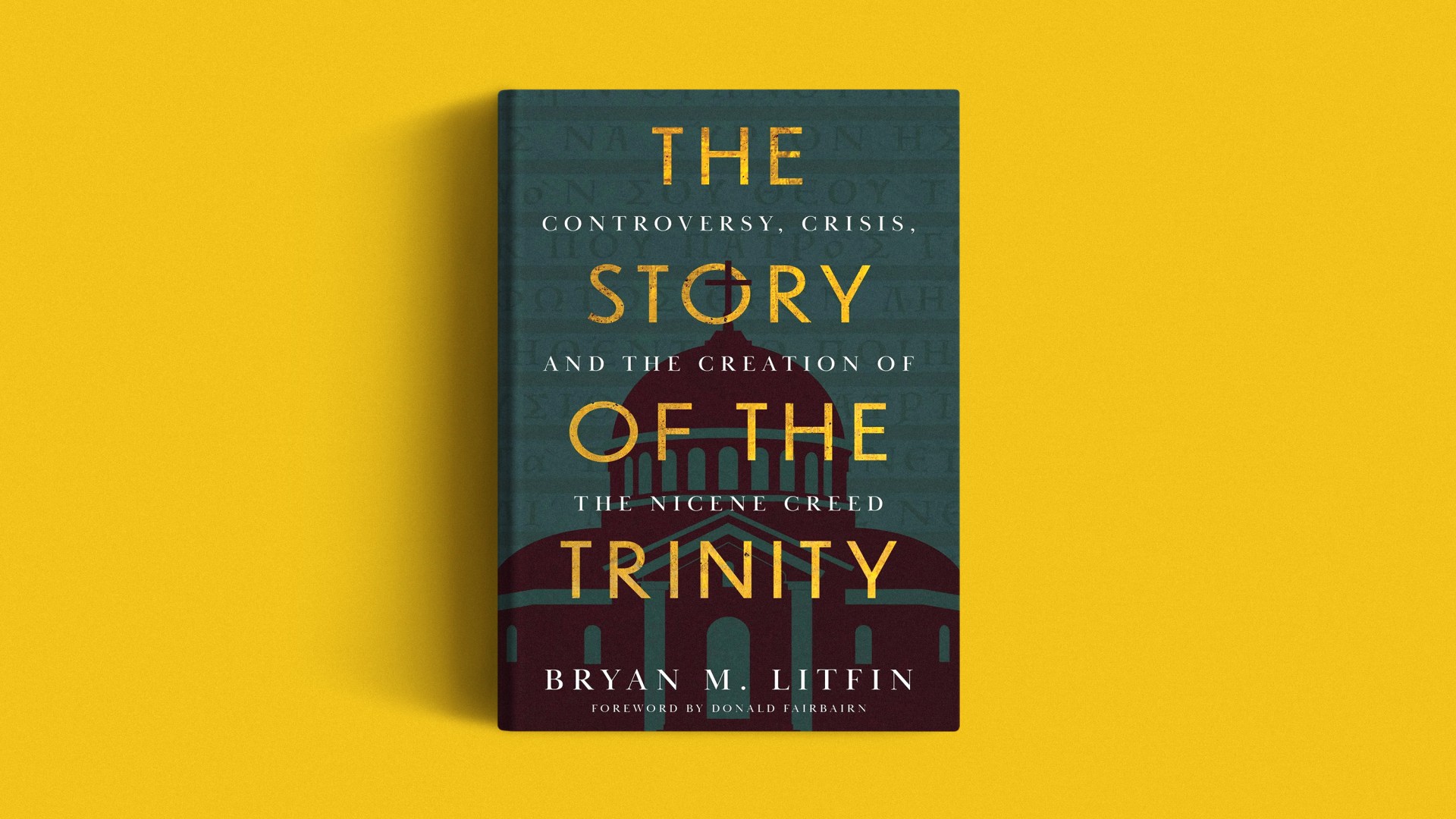
In The Story of the Trinity: Controversy, Crisis, and the Creation of the Nicene Creed, Bryan Litfin cracks the code, leaps the language barrier, and delivers that history and theology. Litfin is a professor at Liberty University’s Rawlings School of Divinity, having previously taught for many years at Moody Bible Institute. Some time ago he began developing an engaging and accessible writing style, which he uses to great effect in this book about Nicaea.

The Story of the Trinity is under 200 pages long and is available in paperback for less than $20, which makes it the kind of nonintimidating object you might actually hand to a friend. But above all, you might recommend the book because of its high readability quotient.

Litfin’s authorial approachability starts with little courtesies, like showing how to pronounce a few hard words, explaining where key terms originated, and gamely admitting that paternity and filiation are “fancy words for fatherhood and sonship.”

His approachability extends to offering analogies for ancient geopolitical tensions in the church. For example, leaders in Roman Palestine and Syria may have defended Arius, who opposed the Nicene position on the Trinity, partly out of rivalry with metropolitan Alexandria. As Litfin writes, this might be like “a pastor today getting kicked out of New York City for what appeared to be conservative ideas. If those elite New Yorkers didn’t like a certain set of doctrines, that might be just enough reason for conservative Christians of Atlanta or Dallas to adopt them with gusto.”

It’s a loose analogy, and it may misfire for some readers. But it serves the purpose of inviting a broad range of readers into an imaginable historical setting, something like our own.

But Litfin’s commitment to readability determines a lot more than just these isolated features. It determines the shape of his whole project. He actively invites the kind of questions ordinary people might ask about Nicaea and its role in formulating the doctrine of the Trinity. In some cases, he channels these questions into chapter titles: Chapter 4, for instance, asks, “Does Yahweh Have a Son?” Chapter 6 poses the question “Maybe Jesus Is the Father?”

Similar thought experiments and queries appear throughout the book. As a theologian, Litfin must know that some of these are bad questions, but as a teacher he recognizes them as starting points for developing a better understanding.

Behind these decisions lies Litfin’s broad and generous sense of the obligations borne by anyone attempting to explain Nicaea at the popular level. It simply won’t do to open the book with some version of “Our story begins in 317,” when controversy first erupted between Arius and Athanasius of Alexandria, the church father known for articulating and defending the doctrine of the Trinity. In fact, readers don’t really enter the fourth century until the book is more than half over.

Up until then, we have not been creeping through the history of Christian doctrine so much as laying deep foundations in biblical theology. We get seven sprightly chapters on Old Testament monotheism, New Testament Christology, and eventually a few major figures like Tertullian and Origen—both Africans, as Litfin points out in an aside. Many of the key players in the early story hail from northern Africa.

Why so much biblical theology? Litfin doesn’t belabor the point, but he has obviously decided that what is at stake in Nicene theology will be compelling only against the backdrop of what the Bible says about God and Christ. The Story of the Trinity is not quite evangelistic, but it won’t risk leaving the foundations of the faith unstated while hurrying on to church history.

In fact, it comes close to offering a straightforward, disarming invitation to the gospel:

Are you ready to begin? Don’t worry; this won’t be a dry theological discourse that’s way over your head. Instead, in a step-by-step fashion, we’ll see how God has gradually revealed himself as a community of persons who eternally love one another, and who pour out their infinite love on the human race. To know God is to be invited into a community of perfect harmony and everlasting life. Who could ask for anything better than that?

Litfin is similarly gentle and patient (“Don’t worry”) with readers who believe in Jesus but aren’t already persuaded about the importance of creeds. The first chapter makes the case. In ten breezy pages, it asks and answers the question “What Is a Creed?,” starting with confessions of faith found in Scripture itself. Eventually, believers find themselves wanting more explicit accounts of how two core confessions—“God is one” and “Jesus is Lord”—go together. Nicaea offers itself as an answer. If theology is faith seeking understanding, creeds are confession seeking coherence and comprehensiveness.
The Story of the Trinity is a sweet chariot that swings low for a general audience. Does it also carry us home to theological precision? Yes, all things considered, it reaches remarkably high. Litfin writes for a popular audience but remains resourceful and responsible. At numerous points he includes stories and details that show he is not simply retailing widely available reports but has done the primary reading himself. He tucks the accounts of early church historians Sozomen and Socrates Scholasticus demurely into the endnotes; he offers quotations from the Theodosian Code, a collection of Roman laws made by its Christian emperors, to show how Roman leaders received the outcome of Nicaea.

The highest art is to conceal artistry, but Litfin slips in some little giveaways that let seasoned scholars know what he knows. One particular issue serves as a litmus test for whether a history of the fourth century is naïvely ignorant or critically credible. That issue is related to rhetoric from Athanasius, who famously taught his readers to label all defections from Nicene orthodoxy as “Arianism,” in reference to his chief opponent. That label certainly points to an important theological distinction, but Athanasius imposed it for decades on teachers who never claimed it for themselves.

Litfin nods to the “Arianism” problem: “Though we’ll use the term in this book for simplicity’s sake, it isn’t a very accurate expression. As it turns out, Arius wasn’t a key player in the decades after the Nicene council condemned him. Not many people wanted to claim his legacy, so he gradually disappeared off the scene.” It’s hard to imagine a defter handling of a historical stumbling point. Litfin makes it look easy.

While The Story of the Trinity doesn’t include original research (since that would be inappropriate for an introduction), it does display independent judgment. Specialists will quibble and gripe; it’s what they do. I winced to see Litfin perpetuate the myth of different “Trinitarianisms” in the Greek East and the Latin West. It’s a hallucination of outdated textbooks, and I doubt Litfin really believes it; he doesn’t let it mangle his reports about the theology of Augustine and of the Cappadocian church fathers, who defended the one Christian doctrine of the Trinity in diverse ways.

But advanced students of Nicaea should keep a sense of perspective about such things. If people ask you for a good, readable first book—in fact an only book—on Nicaea, there is a kind of madness involved in handing them scholarly staples like Lewis Ayres’ Nicaea and its Legacy (2004) or Khaled Anatolios’s Retrieving Nicaea (2011). Why not just send them to find R. P. C. Hason’s thousand-page opus The Search for the Christian Doctrine of God (1988)? Why not tell them to learn Greek and Latin?

On the mean streets of modern life, I regret to inform you that the standard for knowledge about Nicaea has been set by serial fabulist Dan Brown. In the popular mind, the council was either an open democratic vote on whether Jesus is God (“What do you guys think?”) or an imperial power play by the Roman emperor Constantine. Apparently, people think the bishops gathered there invented the New Testament, colluding to suppress other testaments. I kid you not.

Into this present darkness Litfin has lobbed a lightweight light source, a highly readable introduction to Nicaea that helps Christians sound less like they’re talking in code. How great would it be if, when people thought about Nicaea, what came to mind was not The Da Vinci Code but the Theodosian Code? May it be. It is a great blessing to have at hand such a Bible-based, gospel-focused, basic introduction to the Nicene Creed and its theology.

Fred Sanders is professor of theology in the Torrey Honors College at Biola University. His books include The Deep Things of God: How the Trinity Changes Everything.

Apple PodcastsDown ArrowDown ArrowDown Arrowarrow_left_altLeft ArrowLeft ArrowRight ArrowRight ArrowRight Arrowarrow_up_altUp ArrowUp ArrowAvailable at Amazoncaret-downCloseCloseEmailEmailExpandExpandExternalExternalFacebookfacebook-squareGiftGiftGooglegoogleGoogle KeephamburgerInstagraminstagram-squareLinkLinklinkedin-squareListenListenListenChristianity TodayCT Creative Studio Logologo_orgMegaphoneMenuMenupausePinterestPlayPlayPocketPodcastRSSRSSSaveSaveSaveSearchSearchsearchSpotifyStitcherTelegramTable of ContentsTable of Contentstwitter-squareWhatsAppXYouTubeYouTube