Ideas

When Identity Becomes Idolatry

Contributor

Theologies that indulge and center our group identities aren’t faithful. They decenter Christ and belittle our neighbors.

A fingerprint with a golden calf in it.
Christianity Today August 27, 2025
Illustration by Mallory Rentsch Tlapek / Source Images: Getty, WikiMedia Commons

Those who shower us with praise don’t always have our best interests at heart. “Words are easy, like the wind,” as William Shakespeare warned in the final entry of a 20-poem collection, while “faithful friends are hard to find.” Friendship must be tested, he advised, through loss and ill fortune:

He that is thy friend indeed,
He will help thee in thy need:
If thou sorrow, he will weep;
If thou wake, he cannot sleep.

Thus of every grief in heart
He with thee doth bear a part.
These are certain signs to know
Faithful friend from flatt’ring foe. 

This insight closely mirrors the wisdom of Proverbs 29:5, which says, “Those who flatter their neighbors are spreading nets for their feet.” People who seek to manipulate others often start with exaggerated compliments and expressions of admiration. The shady salesman will tell us how smart and well-dressed we are—right before he sells us on a high-interest car loan. We like superlatives, and they can misdirect us away from the truth or blind us to deception.

We’re perhaps most susceptible to manipulation when others make flattering appeals to our group identities. This is why politicians pander to their demographic bases. Our ears itch in pride at hearing how extraordinary we and our people are, and false praise can become a cheap way for leaders to manufacture connection and gain our allegiance.

In a polarized and identity-obsessed society, exalting words about our national identity (“American exceptionalism”), race (“Black is the blueprint”), or gender (“The future is female”) provides a quick ego boost even if the compliments aren’t genuine. Sometimes we feel as if our groups haven’t been heard—and sometimes that’s true. It’s understandable that the affirmation feels good. But what’s beneath this shallow glory?

To be sure, these aspects of our identity are important and acknowledged by God (Rev. 7:9). God has endowed different groups with unique insights and uses us in our skin, in our social locations, and with our differing physical capabilities to serve his ultimate plan.

Look at the story of the Samaritan woman at the well. Jesus breaks with tradition to converse with her, and she becomes one of the first evangelists (John 4:1–24). We can’t fully understand the meaning of this story if we ignore her ethnicity and social and economic plight. We can’t fully comprehend the lesson about Jesus’ grace and transformative ministry if we make her a cultureless and genderless abstraction. Her identity played a meaningful role in God’s message to us.

Identity matters. It’s a significant part of the viewpoint from which we see God. But identity theology can also wrongly lead us into theological error. In other words, Christians don’t have to claim colorblindness, yet neither can we let our identities lure us into exaggerating the importance of our groups to the point of self-exaltation. 

Flattery often plays a role here, for flattery is just as unfaithful in theology as it is in friendship. Theologies that indulge and center our group identities aren’t faithful. They walk us into a trap of identity idolatry that decenters Christ and belittles our neighbors. 

Many of us have come across flattering theologies that actually distance us from the true gospel. For instance, the Christian nationalism of Mike Huckabee so closely intertwines God and America that it’s hard to decipher which of the two Huckabee actually worships. He seems to present America as the unadulterated work of God’s hands. This theology flatters its adherents by giving them a sense of superiority through national identity. It suggests their culture is the standard by which to judge others, misusing and distorting the gospel to whitewash America’s sins and diminish the contributions of outsiders.


And the temptation to center our identities in our theology is no less for groups who’ve historically been demeaned in deep and systemic ways. But it is perhaps more complicated. When your society—including the church—has spent centuries characterizing your people as inherently inferior or particularly immoral before God, the damage is devastating. We must make great, deliberate efforts to repair the community’s collective self-image.

Accordingly, it’s imperative that theologians and church leaders uncover and celebrate how close Jesus is to marginalized people. In the American context, it is good and necessary to highlight the special role women and non-white people play in the Bible and church history. Emphasizing God’s image in and relationship with us can help restore a fractured theological lens and redeem our self-perception. The church need not fear scripturally sound efforts to uplift people who historically have been diminished.

That said, these efforts can overreach and lead to identity idolatry as well. To counter American racism, for instance, the Five Percent Nation movement declared that Black men are gods. And while Christian identity-based theologies don’t claim divinity, they can lead to excessive self-praise or even suggest that God supports what we should rightly understand as sin

When we’re part of a group that has suffered a long history of malicious critique, it can be easy to believe that any critique is malicious. We may begin to defend ourselves more than we defend the gospel. Under sway of identity idolatry, we start asking, “Does it support my identity narrative?” instead of “Is it true?” Some theologians in the womanist tradition, for example, have used identity to undermine the authority of Scripture.

Raising a people’s self-image while maintaining their sense of humility is a delicate balance. Whether through resilience or pride, we can swing from shame to self-righteousness rather quickly. The gospel disallows this overcorrection, because while the image of God dignifies us, recognition of our sin nature must humble us. 

That balance of dignity and humility should turn us away from flattery and toward a more complicated truth. The Christian nationalist must understand that the Christian influence on America’s founding doesn’t mean God approves all our military conquests. Preachers can’t overlook bad theology from people who share their racial heritage. And though some have dishonestly demonized female sexuality, the womanist must avoid reacting by claiming that sexuality is without biblical boundaries. 

I’m not saying Christian nationalism and womanism are moral equivalents, of course. But they can violate the same principle to one extent or another. Identity idolatry can be tempting for any of us, even with the best of intentions. The Bible takes us all to task, chastising oppressive nations, promiscuous and predatory men and women, and bigoted believers alike (Amos 1–5; Gen. 19; Gal. 2:11–13). 

The Samaritan woman’s interaction with Jesus revealed her dignity and value in his kingdom—and the dignity and value of her people too. Jesus used this encounter to declare that, through faith, those who’ve endured generations of degradation can find significance, purpose, and love in him. Their suffering and humility are actually conducive to discipleship (Matt. 5:3). 

But imagine how different the story would have been if she’d claimed some preeminent status with Christ based on Samaritan nationalism—or declared that her sinful domestic situation of living with a man out of wedlock was somehow justified based on her womanhood (John 4:17–18). Jesus made her face her misdeeds while he affirmed her dignity. 

We should be suspicious of any theology that exalts us above measure. All of us are broken, individually and collectively, and some of our inclinations and cultural preferences are sinful. An identity-centered theology might be comfortable, but it will seduce us into self-justification, self-flattery, and conceit rather than compelling us to die to self (Luke 14:27; Rom. 6:6; 8:13). Our identities are no obstacle for the gospel, but neither do they make us immune to rebuke.

Justin Giboney is an ordained minister, an attorney, and the president of And Campaign, a Christian civic organization. He’s the author of the forthcoming book Don’t Let Nobody Turn You Around: How the Black Church’s Public Witness Leads Us out of the Culture War.


Church Life

The Katrina Aid that Beat Out FEMA’s

Wal-Mart, many other companies, and the military came through.

A convoy of Wal-Mart trucks carrying supplies entering New Orleans on September 1, 2005.

A convoy of Wal-Mart trucks carrying supplies entering New Orleans on September 1, 2005.

Christianity Today August 27, 2025
Nicholas Kamm / Staff / Getty

Hurricane Katrina caused a record-setting 1,392 deaths and $200 billion in destruction (in 2025 dollars). Along with the unsung Christian heroes that emerged in the aftermath, two sectors of American enterprise that some reporters disparage acquitted themselves well: big companies and the military.

Wal-Mart made the biggest corporate impact. While Katrina was still classified as a tropical storm on August 23, 2005, six days before it hit New Orleans, Wal-Mart’s emergency operations center in Bentonville, Arkansas, was tracking it. 

Soon, workers were shipping bottled water, flashlights, batteries, tarps, canned tuna, strawberry Pop-Tarts (ready to eat, tastes good), and other items to stores likely to be affected. 

Once Katrina hit, Wal-Mart’s pre-positioned satellite phones and truckloads of water allowed the corporation to deliver supplies faster than any governmental organization. It quickly sent 1,900 trailer loads of emergency supplies to afflicted areas using its network of 126 facilities in the Gulf region. Wal-Mart also allowed managers to make decisions without requiring abundant paperwork.

In Waveland, Mississippi, where floodwaters within the store were two feet deep and refrigerators and shelves were knocked over, a manager had her stepbrother use a bulldozer to clear a path through the debris. She passed around socks, shoes, and dry underwear to barefoot neighbors and wet police officers. She handed out bottled water and sausages that had been stored high and gave insulin and drugs to AIDS patients.

In Jefferson Parish, outside New Orleans, a Wal-Mart employee used a forklift to open the warehouse door to deliver water to stranded elderly residents. The phone bank at the corporation’s Bentonville headquarters, first set up to help displaced employees, soon became the go-to operation for others who had no success with government bureaucracy.

The result was a wave of rave reviews by local officials.

“FEMA executives were there, but they didn’t do anything. They weren’t up and running for four or five days…,” said Jefferson Parish sheriff Harry Lee. “If the federal government would have responded as quickly as Wal-Mart, we could have saved more lives.”

Wal-Mart even helped a New Orleans couple find their newborn child, who had been moved to a Houston neonatal center. 

Lee said FEMA made things worse: When Wal-Mart sent three trailer trucks with water to a FEMA compound, “much to my dismay, FEMA turned them away… They said they didn’t need it.” FEMA officials said they needed written authorization to accept such supplies and didn’t have any. So Wal-Mart distributed the water directly.

Philip Capitano, the mayor of one Jefferson Parish city, Kenner, said Wal-Mart arrived days before FEMA: “The only lifeline in Kenner was the Wal-Mart stores. We didn’t have looting on a mass scale because Wal-Mart showed up with food and water. FEMA needs to take a master class in logistics and mobilization from Wal-Mart.”

Some local broadcast stories starred “Wal-Mart angels,” and a few journalists drew logical lessons from business success. Denver Post columnist David Harsanyi noted that since government failed, “Why is the near-universal solution from pundits and officials to propose more government? Will we ever learn? … Judging by the results of Hurricane Katrina, we’d do ourselves a favor by hiring nongovernmental entities such as Wal-Mart.”

Fortune flared a headline, “The Only Lifeline Was the Wal-Mart” and dubbed Wal-Mart “an operation that could teach FEMA a thing or two.”

Home Depot also reacted like Wal-Mart, although on a smaller scale. It tracked buying patterns after past storms and stocked supplies customers would want. It dispatched generators, flashlights, batteries, and lumber to distribution areas outside where Katrina was expected to hit. Home Depot loaded fifty trucks with supplies in Houston and Tallahassee, Florida, so employees could head to stricken areas as soon as the hurricane passed.

The company was flexible enough to go beyond the usual inventories and have food and diapers available. It also had 500 employees from neighboring states waiting in hotels ready to staff Home Depot stores in case regular workers couldn’t make it or needed extra hands.

“At this point, customers are in shock. They don’t know what to do after a storm, so we have to help them,” said Paul Raines, president of the company’s Southern division. “In the early stages, they’re looking to put a tarp up, get a cover over a window, drain some water, just basically get some shelter. Right now, it’s very immediate—chain saws, generators, water. Roofing shingles and major construction comes a lot later.”

FedEx also responded well, which division head Dave Bronczek said was not surprising. “That’s the nature of our business. We’re used to dealing with crisis.”

Fortune described the company’s style, “At any given moment, somewhere in the world there is a social upheaval, a dangerous storm, a wildcat strike … . FedEx, which earns its money by being dependable, can’t afford a wait-and-see attitude; it moves in advance.”

Before Katrina hit, FedEx positioned 30,000 bags of ice, 30,000 gallons of water, and 85 home generators outside Baton Rouge and Tallahassee. The company also worked with the Red Cross, delivering 500 tons of relief supplies, mostly at no charge; FedEx also keeps at its hubs shipping containers filled with bandages, blankets, and batteries so material can be sent quickly to any disaster site.

While FedEx’s execs knew what was going on from hour to hour, FEMA couldn’t get enough food, water, and ice to Mississippi, with one official complaining in an email, “System appears broken … . There seems to be no way we will get commodities in amounts beyond those indicated below. And it turns out these shortfalls were known much earlier in the day, and we were not informed.’’

Wal-Mart, Home Depot, and FedEx were the big three among companies reacting to Katrina, but many others helped in their own ways. GE put together a team of 50 project engineers with expertise in portable water purification, medical equipment, and energy.

UPS helped FEMA direct people and supplies. Pfizer sent drugs into devastated areas and helped government agencies, hospitals, and retailers establish systems for storing and distributing drugs to evacuees. Georgia Pacific sent paper plates, napkins, and toilet paper.

Cingular was ready with hundreds of emergency generators to power cell towers shut down when electricity failed. Insurers flew in extra personnel and set up hotlines to process claims. Other companies suspended monthly mortgage or car payments. Small businesses also pitched in, with the US Chamber of Commerce’s non-profit Center for Corporate Citizenship becoming a clearinghouse that took calls from and compiled lists of needed supplies. Donor companies avoided tie-ups or duplication by agreeing to fill specific requests.

The armed forces also responded rapidly. Think of a team like the characters played by Mel Gibson and Danny Glover in Lethal Weapon, a madman and an honest cop. Those were the heroes of this battle of New Orleans. Some of the professionals were a bit of both: Coast Guard and Louisiana National Guard helicopter flyers swooped in even before the hurricane winds had subsided, coming in low past twisted power lines.

New Orleans Mayor Ray Nagin had visited the city’s convention center and quickly escaped from what he thought was danger, but the Coast Guard’s top official on the scene, Rear Admiral Bob Duncan, flew in with the first crews.

The Coast Guard used 50 helicopters and hundreds of boats to rescue 24,000 people by its count, including perhaps 4,000 from rooftops, and to move 9,000 of the most vulnerable from hospitals and nursing homes. Barges rescued hundreds of people stranded on broken levees.

Some helicopters flew from the Navy vessel Bataan and from National Guard units. Civilian search-and-rescue teams from out of state soon showed up, as did a volunteer Choppers based at Naval Air Station Pensacola, who elsewhere searched for survivors. When evening came, crews used night-vision goggles to look for the flickering candles, flashlights, or lanterns of survivors. They rescued hundreds, including an elderly man with emphysema who had been trapped in his home for six days.

Most journalists paid little attention to these efforts, but Connecticut Post columnist Peter Urban reported that a single 30-passenger Black Hawk of the Louisiana National Guard on that first Monday brought about 250 people to safety. The unit included 16 other 30-passenger Black Hawks, all stripped of seating to fly similar rescue missions. Some smaller helicopters landed directly on roofs to rescue the stranded, applying power so as not to collapse storm-weakened structures.

One-hundred-foot-long Marine Corps helicopters from North Carolina carried out up to 50 evacuees at a time. Paratroopers from the Army’s 82nd Airborne Division hunted for survivors using inflatable Zodiac craft.

Nearly 100 of the 650 people in Naval Mobile Construction Battalion 7 lost everything they owned, but day after day they headed out to other people’s homes to yank trees off roofs, build tent cities, or rig up water pumps to get dialysis machines running again.

Overall, the Katrina effort was the fastest massive military response to any hurricane ever. The Pentagon committed about 40,000 troops, 150 aircraft, and a dozen ships, including the carrier Truman, the amphibious ships Iwo Jima, Tortuga, Shreveport, and Whidbey Island, and the high-speed catamaran Swift. The one part of the federal government that did function well amid Katrina crisis was the military.

News

US Visa Uncertainty Upends Plans of Chinese Christian Families

Some homeschool and Christian-school students are looking to attend college elsewhere.

A student walking the halls of a school in China.
Christianity Today August 27, 2025
NurPhoto / Contributor / Getty

CT used pseudonyms for all Chinese sources in this article except Jessie Yu, as they fear arrest for their involvement in unregistered house churches and Christian schools.

Zhu Desheng and Wang Pei, who live in a third-tier city in southern China, sacrificed a lot to ensure their son, Peter, received a Christian education.

They decided not to place him into the school system, where he would be exposed to atheistic and Marxist propaganda. Instead, they homeschooled Peter using a mix of curricula from Chinese public schools and homeschool material from the American Christian curriculum publisher Abeka. Neighbors reported Peter for not going to school, so he started staying inside his family’s apartment during the day. Without peers, he felt isolated and lonely.

So the family decided to enroll Peter at an international Christian boarding school in the Philippines. Peter quickly adapted, joining the school’s American football team and running track and field. As he reached his senior year last fall, he applied for several Christian universities in the US, and in April he got accepted to Biola University in California.

Yet in June, as Peter prepared to apply for a student visa for the fall, his father learned that US consulates had suspended visa interviews for Chinese students and visiting scholars.

Suddenly, Peter’s education plan was in upheaval. Scrambling, they began researching colleges in Hong Kong, Singapore, and Germany as backup options.

 “We were in a tough spot, not knowing how God would lead our child,” Zhu reflected.

On June 18, the US State Department resumed visa interviews but introduced expanded social media screenings. Peter tried to make a visa appointment online, yet even when he used a VPN (virtual private network) to jump China’s Great Firewall, the page wouldn’t load. So he turned to the e-commerce site Taobao, where he paid a visa agency 800 yuan ($110 USD) for an appointment at the US Consulate in Guangzhou. After a 15-minute interview with a visa officer on July 2, he received his F-1 visa and is now starting his freshman year at Biola.

The uncertainty surrounding Chinese student visas in the US has affected Christian families who have pulled their children out of the national school system to homeschool or to put them in church-run, unregistered Christian schools. In China, neither of these options is legal, and the government often cracks down on these schools or pushes homeschooling parents to send their kids back to school.

Because most Christian curricula is published in the US, students learn in English and are on track to attend college in the West. Yet geopolitics and China’s economic downturn is forcing families to switch gears and find new solutions, such as sending their kids to schools in Southeast or East Asia.

“These countries or regions are nearby, safe, and relatively inexpensive,” Xiao Fang, a homeschooling mom of three, told CT. “The increasingly tense US-China relations have indeed affected many people’s choices.”

Students all over China were caught off-guard by the Trump administration’s May decision to revoke the visas of Chinese students it believes have “connections to the Chinese Communist Party or studying in critical fields.”

Then the one-month suspension of visa applications caused chaos: Booking a visa interview became nearly impossible without hiring an agent as Peter did. Jessie Yu, an education consultant at an international school in Shanghai, said some students had to travel 750 miles to Beijing or 1,000 miles to Shenyang, where appointments are more accessible.

Yu’s students also noted that they needed to give the US government their social media handles and set their profiles to public. The extra background checks sometimes extended their wait times by up to a month.

“Parents [were] anxious, not knowing when to begin preparations for the next steps—physical exams, purchasing flight tickets—all dependent on having a valid student visa,” Yu said.

Some Christians seeking to study in US seminaries are also having trouble getting their visas. Christina Chen of Shanghai said she submitted her application for a student visa to study at a Reformed seminary before the policy changes and scheduled her visa interview for early May. After a detailed 20-minute interview with the visa officer, she received a notice that she had gone through the interview process, but she never heard back about her visa. Among her peers applying to seminaries, she said half were unable to get visas.

According to Jonathan Sutton, director of International Student Services at Ohio’s Cedarville University, the top reason the US denies F-1 visas to students is because the consular officials suspect they do not “intend to depart the US upon completion of their academic programs.” He noted that other reasons include errors on the application, more than one application submission at a time, or suspicion of fraud.

For the new school year, Cedarville has about 165 F-1 students, 20 percent of whom are from China. None of the university’s Chinese students have had their visas denied in the past two years.

Even before Trump returned to office, Chinese students had begun looking elsewhere for higher education, according to parents CT spoke to. China’s economic downturn caused by the COVID-19 pandemic made the US’s high tuition fees unaffordable. Families started turning to more affordable options in Asia—including Malaysia, Singapore, Korea, Japan, and Hong Kong.

The number of Chinese students studying in the US dropped to 277,400 in 2023 from 372,500 in 2019, the year before the pandemic. In contrast, Chinese students in Japan increased by 6.9 percent in 2024 as compared to 2023, totaling 123,485 students last year. Studying in Japan is cheaper than in the US, and the Japanese government has started initiatives to attract new grads to work in the country.

The decoupling of Chinese students and US colleges is also closing the door for a fruitful ministry. A survey revealed that Protestant Christians had evangelized 92 percent of Chinese students and scholars surveyed at Purdue University, and the number of Chinese students identifying as Protestants quadrupled after they came to study in the US.

For instance, Chen noted that while she was studying for a master’s degree in business in Texas more than a decade ago, Christians from local churches—many of them retired—reached out to her and other international students. Through Bible studies and friendships with church members, Chen realized that Christianity was not mere superstition but the truth, and she accepted Christ. As she started working as a financial analyst, she took Hebrew and exegesis courses at a nearby seminary, solidifying her desire to pursue a degree in theology. After six years studying and working in the US, she moved back to China to serve in the local church.

Yet not all Chinese Christians believe the US should be the end goal for students. Blaze Mi, the former academic director at the only Christian liberal arts college in China, believes that when Christian schools and families set the goal of studying abroad too early, children often lose their connection to local culture and struggle socially. Instead, he encourages students to engage with their communities and serve in local ministries, as well as getting out to explore nature.

A proponent of classical Christian education, Mi helped establish an experimental liberal arts program focused on embodied learning at an unregistered classical Christian school. Students enter the four-year program at 16 or 17, and although they don’t receive a diploma for completing it, Mi believes they receive the equivalent of an undergraduate education. Currently, 13 students are in this program, and most hope to work in the church or teach at church schools in the future.

Owen Huang, dean of an unregistered church school in Shanghai, emphasized that US colleges remain the top choices for his students, including the 30 seniors who will graduate next year. To help them get accepted, Huang’s school added more math and science courses, as he’s found that obtaining student visas for science and engineering colleges in the US is generally easier than getting visas for liberal arts colleges and seminaries. Huang also advises his students to be mindful of their social media presence, steering clear of political commentary.
Yet his primary concern is for students already studying in the US. Many students living alone in a foreign country are lonely and turn social media or gaming for solace. To support them, Huang started a weekly online Bible study for alumni and offers counseling as needed. He visits his graduates in the US to encourage and to pray for them.

To ensure less affluent families can send their kids to their dream colleges, Huang is planning fundraising efforts for university tuition. “I don’t want to waste any child’s talent,” he said.

As Chen continues to wait for her student visa, she is taking online courses at the US seminary that accepted her. She reflected on Psalm 147:5, which says, “Great is our Lord and mighty in power; his understanding has no limit.”

“I believe that God’s plans showcase his wisdom and power, even if, with my limited understanding, I sometimes struggle to grasp them,” she said.

News

How a Baptist from Nazareth Plans to Unite Global Evangelicals

Q&A with Botrus Mansour, the new secretary general of the World Evangelical Alliance.

A headshot of Botrus Mansour.
Christianity Today August 26, 2025
Image courtesy of Botrus Mansour

The World Evangelical Alliance (WEA) appointed Botrus Mansour as the global body’s new secretary general and CEO last week. It is the first time an Arab Christian will lead the WEA, a global organization of national and regional alliances representing 600 million evangelicals.

The role has been open since former secretary general Thomas Schirrmacher resigned due to medical reasons in March last year. Peirong Lin, deputy secretary of the WEA, told CT in April that the organization was seeking a leader who could unite global evangelicals amid wars and political divisions. Meanwhile, the WEA has also faced critiques about its “theological ambiguities” and its collaboration with mainline Protestants and Catholics.

A trained lawyer, Mansour serves as the operational director of Nazareth Baptist School, an elder and cofounder of Local Baptist Church in Nazareth, and CT’s Arabic translator. He has held other leadership positions in churches and parachurch groups, including the Convention of Evangelical Churches in Israel, the Alliance of Evangelical Conventions in Jordan and the Holy Land, Christian Schools in Israel, Advocates International, and the Lausanne Initiative for Reconciliation in Israel-Palestine.

Mansour, who lives in Nazareth, Israel, with his wife and three adult children, believes his background as an Israeli Arab evangelical—a background he described as “a minority in a minority in a minority”—has equipped him with the experience needed to take on this new role in a time of division. He will officially assume the role during the WEA’s General Assembly in October.

CT interviewed Mansour about his upbringing, his work in reconciliation between Arab Christians and Messianic Jews, and his plans to tackle the challenges facing the WEA. This interview has been edited for clarity and length.

Could you tell us about your background?

I was born to a Greek Catholic father and a Greek Orthodox mother. My parents weren’t religious, although my mother graduated from Nazareth Baptist School and became a teacher there. My father only finished 7th grade, but he went on to study Hebrew in a kibbutz and later became the first Arab Palestinian to work for an Israeli Hebrew newspaper, first at HaOlam HaZeh and then for 30 years at Haaretz.

I was born in Nazareth in 1965, but when the Six-Day War broke out two years later, the newspaper told my dad they needed an Arabic-speaking journalist to cover the West Bank and East Jerusalem, so my family moved to Jerusalem.

After four years in Jerusalem, my father got a scholarship to study at the University of Oxford, so we moved to Oxford, where I attended first and second grade. In 1973, we returned to Nazareth, and my mother insisted that my siblings and I attend Nazareth Baptist School, where she had studied and taught.

How did you become a Christian?

When I was 11, my Bible teacher knew that my classmates and I loved to play soccer, so he told us that we could play soccer at the field after school on the condition that we attended the revival meetings at a nearby church. We agreed. That night, the American preacher expounded on how the grace of God was not something you earned but something you received. I went forward during the altar call for the first time. But I was young, so I don’t think I was really committed.

Three years later, a Lebanese American preacher came to preach at another revival meeting. His style was to frighten people into the kingdom: He would tell Hitchcockian stories of people who refused to accept Jesus and then died in an accident. I committed my life to Jesus at that meeting in 1979. From there, I joined my high school’s youth group. There have been ups and downs, but praise God, I’m still walking with the Lord.

After high school, you studied law at the Hebrew University in Jerusalem—where you met your wife, A’bir—and got involved with the student ministry Fellowship of Christian Students in Israel (FCSI). How did befriending people of different backgrounds help you see the importance of Christian reconciliation?

I think it’s unbiblical and impractical to say, “Oh, I’ll just meet with people from my type.” We live in this country where there is this divide, this conflict between Palestinians and Israelis. But at the same time, the body of Christ consists of Arab Palestinians and Messianic Jews and expats who live in the country. One of the good things about FCSI is that it has groups for Arab Christians and for Messianic Jews, as well as joint conferences. They’ve had some conflicts now and then, but in general, it’s a good model of partnership.

Because my dad worked among Jewish people at the newspaper, we had Jews coming into our home growing up. I did not have the suspicion or hostility toward Jews that persists among Arabs because of the ongoing conflict. It was natural for me. We don’t have any other choice but to live together as Arabs and Jews in this country. Among believers, it’s even more important to live this testimony out.

This kind of work isn’t always smooth. In times of war, each group often clings to nationalistic attitudes, and believers also tend to adopt the mindset. You feel the burden and the bitterness even as you enjoy sweet relationships.

In 2016, the Lausanne Initiative for Reconciliation in Israel-Palestine—which you cochaired—hosted a conference that gathered 30 Palestinian Christians and Messianic Jews to write and sign the Larnaca Statement affirming their unity as believers. Do you consider this and other attempts at reconciliation successful?

The Lausanne gathering went well. Some people left saying, “We didn’t go anywhere.” At times, the discussions became a bit difficult and sharp as we argued and discussed the statement. But it was helpful.

In the past, we have held several conferences bringing together Arabs and Jews to talk openly and share our narratives, our dreams, our hopes, and our fears. Sometimes you just fear the other party and think they are monsters. But every person is created in the image of God.

At the end of the day, nobody should feel hurt or take it personally. We’re talking about a difficult issue, so naturally it’s going to be difficult. I love my Palestinian people, and I ache over what’s happening in Gaza, but that doesn’t mean I cannot talk to my Messianic Jewish brother or sister and try to understand their convictions.

How has working on your own country’s divisions helped prepare you for your new role as the head of the WEA?

Living in Israel, the Lord prepared me to love, as well as be sensitive and open to different people. I have Muslim students in my school, as well as Muslim friends and neighbors. I work with other Christians, including those from nonevangelical churches, and with Jews.

The Bible says that perfect love casts out fear (1 John 4:18). If you have the love of Christ, you have the confidence to talk with other people, even if they’re a Muslim or an ultra-Orthodox Jew. That opens the door for us to come closer and understand each other.

As an evangelical, I am a minority among Arab Christians, Arab Christians are a minority among Arabs, and Arabs are a minority in Israel. Each of my identities—evangelical, Christian, Arab, Palestinian—can contradict with the others because of its political, social, and theological implications. But my identity in Christ overcomes them all and brings harmony in the midst of the contradictions. It motivates me to bring peace between people and God, as well as among believers.

What role should the WEA play when there are conflicts between different national alliances, such as Israel and Palestine or Russia and Ukraine?

We must be tolerant in accepting our brothers and sisters who have different views than we do, because we have something greater in common: our faith, our love for Jesus, our love for the Bible, and our desire for people to know Jesus.

Jesus sat with the Samaritan woman at the well—with her baggage and history—and with the tax collectors. If that was how Jesus treated nonbelievers, how much better should we treat fellow believers? Can’t we be a little more open, a little bit more tolerant toward one another on issues that are secondary?

Jesus said people will know you by your love for one another (John 13:35). If we can differ on politics or theology and still love each other, it will be a great testimony for people outside the evangelical camp.

Some evangelicals have disagreed with the WEA’s involvement in interfaith efforts or collaboration with nonevangelical Christian groups. What do you see as the WEA’s role in that work?

Interfaith dialogue is good, but it shouldn’t be the WEA’s focus. The focus should be on working with our regional and national alliances.

It does not harm us to dialogue with Catholics or with the World Council of Churches. This doesn’t mean that we’re becoming like them or they’re becoming like us, but at least we can open a channel to dialogue with them. The same goes with other religious groups.

This is important for evangelicals who live in countries where they are the minority. Interfaith is not a bad word. It doesn’t mean that we’re talking with them in order to become one unified faith. We have different faiths. Our convictions are strong. We believe in the Bible; we believe in Jesus. If we can be a blessing and open channels of cooperation, that’s not a bad thing.

Why is the WEA still relevant today?

It’s the representative of hundreds of millions of evangelicals around the world. With the counsel of many people wiser than me, I will try to bring the voice of the vast majority of evangelicals on issues like religious freedom, sanctity of life, peace, and justice.

The challenges that evangelicals in America or China or Israel or Angola face are very different from each other. I will leave it to the national alliance in every country to identify their challenges and try to face them, but we will encourage them and, if we can, support them.

In countries where evangelicals are minorities, many face religious freedom restrictions. We can help, perhaps by talking with government officials or getting another country’s alliance to help. We can also rally evangelicals around the world to pray.

How can believers be praying for you as you take on this new position?

I would love it if people would pray that I can do the job well. It’s a very sensitive and important role. If I can contribute to helping the church, encouraging the church, and bringing believers, churches, and alliances together, that would be great.

It will include a lot of travel, so pray for my physical health. I will also face a lot of psychological and spiritual pressures.

I want to do the Lord’s will. I can say confidently that he opened this door for me in an amazing way and for a reason that is still unfolding before me. I’d like to do the job that he has put me in in the best way possible in order to further the kingdom.

Pastors

Let the Locals Lead

Native church planters are preaching, evangelizing, and discipling in places foreign missionaries are struggling to reach.

CT Pastors August 26, 2025
Simon Shepheard / Getty

In a gang-controlled neighborhood in El Salvador, there’s one place that even the most feared criminals don’t touch: a small Baptist church established by a local resident. It’s not because the building is fortified. It’s because the pastor is local. He understands the rhythms and rules of the streets. He speaks the language—and the pain—of his people.

Across the globe, from remote Amazonian villages to post-Soviet towns and refugee corridors, local believers are quietly leading some of the most impactful movements in global Christianity. They often go where foreign missionaries cannot and remain where outsiders would not last. Their effectiveness does not come from being sent. It comes from being rooted.

In the United States, an estimated 96 percent of church growth happens from people switching from one congregation to another rather than new believers joining the faith. But in much of the Global South, church growth usually begins with one local believer, one place to gather, and one hard-won relationship. It’s not a matter of marketing strategy; it’s often a matter of survival, transformation, and deep cultural connection.

The importance of indigenous leadership

Juan Romero, once a militant during Uruguay’s armed revolution of the 1970s, later encountered Jesus in a way that reshaped his entire life. Diagnosed with a degenerative disease and given 18 months to live, he instead found strength—both spiritual and physical—through his local church, Nuevo Comienzo. Still in a wheelchair five years later, he has only missed two Sunday services all year.

His decision has affected his whole family. His children now attend church with him. One of them enrolled in Bible school, exploring a call to enter into into ministry. His transformation has become a testimony to others in his community. Neighbors see not just a man changed but one of their own transformed. A former revolutionary turned pillar of the church speaks to them in a way no outsider ever could. That kind of credibility can only come from the inside.

When local leaders are equipped to plant churches not under tents pitched in fields for a season but in permanent buildings, by design, they become long-term centers of community impact, outreach, and discipleship, and places from which the faithful preaching of the gospel can take root and spread. 

Why does this model work so powerfully across different cultures and conditions? In most cases, it can be traced to three realities.

1. Sustainability

Local leaders stay. They aren’t on rotation—they’re already home. Churches planted through foreign teams often rely on external support, and when that support ends, so can the ministry. Indigenous pastors, by contrast, tend to establish churches that endure long after funding fades.

In Colombia, for example, a church in Currulao recently planted a new congregation in a neighboring town—not through an international campaign launched by a global NGO but by believers within the region pooling their resources, building relationships, and simply responding to local need. Families are already attending this budding new church plant. The momentum is homegrown.

2. Cultural wisdom

Indigenous leaders instinctively know not just what to preach but how to preach it in a way that resonates. They possess a profound understanding of the customs, beliefs, and spiritual traditions of their own communities.

In El Salvador, small churches often function as safe havens and in high-risk areas are sometimes the only buildings untouched by gang violence. These exist only because leaders from those neighborhoods knew how to build trust and handle local risks.

Research by the Lausanne Movement confirms what these stories reveal: Local leadership is one of the most critical factors in church vitality across the Global South, especially in contexts where political or cultural hostility limits foreign engagement.

3. Cost-effectiveness

Training and equipping local leaders is far less expensive than deploying full-time missionaries abroad. This means every dollar stretches further, and more can go directly toward tangible discipleship needs—Bibles, training materials, meeting spaces—instead of travel or infrastructure.

The efficiency isn’t only financial. It also accelerates impact. Local leaders are there already; they don’t require visas or language and cultural immersion training. They are embedded from the start.

In Honduras, Milco’s journey from a party-loving teenager to a committed church leader demonstrates the power of an indigenous calling. Drawn away from his Baptist upbringing by music and nightlife, his eventual surrender to God wasn’t the result of foreign missionary work but a divine encounter that spoke to his own experience and context. Today, Milco pastors a church reaching young people chasing the same idols he once loved.

From local roots to global growth

Across cultures and continents, stories like Milco’s are becoming the norm. From East Africa to Southeast Asia, Christian growth is happening most rapidly not where the church is being imported but where it takes root in local soil.

According to Pew Research, by 2060, over 40 percent of the world’s Christians will live in sub-Saharan Africa alone. This shift must be supported by a strategy that prioritizes indigenous capacity rather than just external input.

In Acts, when Paul planted churches, he did not lead from afar. Instead, he appointed elders in each town for each church (Acts 14:23), knowing that these local leaders would shepherd their own communities. This pattern continues from Jerusalem to all Judea and Samaria and to the ends of the earth (Acts 1:8). Christ is faithful to build his church, and he so often does so through local witnesses, rooted in their own cultural soil, speaking in their own native tongue, and carrying the hope of the gospel to their own local streets—for the glory of God and the good of their neighbors.

The next era of global church growth won’t be driven by more missionaries being sent out but by local believers who already live among the people they’re called to reach. They don’t need cultural orientation or translation guides. But they need partnership, investment, and trust. Our responsibility is to steward kingdom resources wisely, and therefore our path is clear: Invest in indigenous partnerships. The call is not to send more but to equip better.

This will lead to stronger connections, more self-sustaining churches, deeper trust, and exponential reach.

Janice Rosser Allen serves as CEO and president of International Cooperating Ministries. She is the author of God in the Crossroads: Signs of Hope, highlighting stories of church growth around the world.

Church Life

Be Honest About Your Motives for Mission Trips

Contributor

Short-term missions are complicated and often done poorly. But with wisdom and transparency, a medical missionary explains, they can be hugely helpful.

A photo of a woman helping a child on the tail of an airplane
Christianity Today August 26, 2025
Illustration by Christianity Today / Source Images: Getty, Unsplash

As a missionary, I am often asked about short-term mission trips: Are they harmful? Can they be better? Were we wrong when we were trying to help?

This kind of question is fairly new. Not so long ago, it was routine for American churches to send a bunch of teenagers to a poorer country to paint a church and play soccer with some local kids. But now many Christians are examining the power differentials in missions and asking—quite appropriately—whether short-term trips make theological, ethical, or practical sense.

Some even argue for doing away with short-term trips altogether, and they have a good point: If you were contacted by a wealthy Korean church that wanted to send a short-term mission trip to your church, what would you tell them? How would you feel if a dozen rich teenagers were to descend on your community and take pictures with the kids in your nursery? What kind of work would you assign to help them feel “useful”?

I’m not quite willing to say all short-term missions must go. Yet here at the end of another summer mission-trip season, I do want to offer a missionary’s perspective on different kinds of short-term missions and how to make yours—if you do them—as functional and faithful as possible.

We’ll start with the ugliest kind of mission trips: the ones that seem for all the world to be designed for Instagram. These trips are mutually exploitative. A church or ministry in the developing world wants wealthy foreigners to visit as a means of attracting local attention and secure overseas donations, and it does this by creating an experience that makes the visitors feel good about themselves. 

This can include (but is hardly limited to) setting up opportunities to take pictures with cute kids living in poverty, creating some kind of make-work project for Western teenagers, or recruiting a bunch of people to claim they’ve given their lives to Christ so that visiting preachers can tally up a big score of “souls saved.” These kinds of trips are becoming rarer as people on both sides of the arrangement become wiser to the damage they do, but they still happen.

To avoid a trip like this, consider questions like these: How much work will your visit be for the people receiving you? Will the visitors do anything truly useful, something locals couldn’t do for themselves with sufficient funding? What will the long-term relationship be between visitors and the receiving ministry? How does the visitors’ work connect to the broader vision of that ministry? Can that work be continued on an ongoing basis, or will it only make things harder for local people in the long run?

For example, consider medical missions, which is my field. It’s relatively simple to do a few life-changing surgeries that don’t require any follow-up and could not happen without out-of-town expertise; these trips are usually worthwhile. But trips in which visiting health professionals simply hand out medicine will generally have little long-term effect and may even discourage people from investing in their local health infrastructure.

Looking at long-term effects is particularly vital when we’re thinking about dependency: Will a short-term trip make the host ministry more or less sustainable? This is a tricky question because different ministries have different needs. For example, most of us expect the pastors of our local churches to be dependent on tithes and offerings for their salaries, even if they take other work to supplement their income. On the other hand, campus ministers who go through Reformed University Fellowship, Cru, or InterVarsity will never be able to feed their families on the donations they collect from the college students to whom they minister. So some ministries can be financially self-sustaining, but many require ongoing funding from people other than those they serve.

Sometimes dependence is appropriate and even permanent, but sometimes it can become malignant. Think of nations that become so used to handouts from wealthier countries that they never build up their own economies. In the same way, something has gone awry if a hosting church learns to rely on foreign donations instead of asking its own congregants to feed local orphans—or if it drops all evangelism projects because the American teenagers will arrive to do them soon enough. 

Speaking of orphans, perhaps the single most problematic aspect of short-term missions is how they tend to engage with orphanages. Christian and secular voices alike have called for an end to orphanages because they are worse for children than family care or foster care—this is why we no longer have orphanages in developed countries. Children in orphanages are often vulnerable to abuse, and many have one or more living parents who only relinquish their children to improve their chances at a decent education. 

Orphanages are popular destinations for short-term trips because the emotional connection visitors form with orphans over a single, intense week often translates into ongoing financial support from afar. Churches should avoid these trips and instead help existing ministries transition to a different model.

So those are the bad trips. What are the good ones? Well, the best short-term mission will task visitors with doing something the receiving ministry can’t do for itself while building that ministry’s capacity to do more on its own in the future. A good mission trip like this should take place in the context of a long-term relationship between visitors and receivers. These trips are still a lot of work for the recipients to organize (especially when language barriers require hiring translators). But done right, the blessings last well after the visitors go home.

In my context of medical missions, this often looks like having doctors come to our hospital to see patients while teaching local health care professionals and bringing in specialized equipment. These visitors both meet immediate needs and pass their skills along to others to make a lasting impact. 

Other ministries use a “training of trainers” model that equips local recipients with skills in church planting, discipleship, or evangelism. They’re then encouraged to train others in turn, making further visits unnecessary.

Good trips can also be opportunities for the receiving teams to take a break from their usual workload, as visitors can shoulder or at least lighten their hospital or church responsibilities for a few weeks. Visitors could offer childcare or other services to allow clergy and other ministry workers to have rest or travel or conference time that wouldn’t otherwise be feasible. Let the local pastor take a much-needed vacation.

Visitors can also multiply extant efforts. For instance, a church may already host trainings for local pastors, but a visiting team of teachers could allow them to work with a larger cohort. In the mission hospital where I work, we teach resuscitation skills to our trainees every year, and we’re extremely blessed by the visitors who come during that time to help us teach and take over rounds at the hospital so we’re free to focus on the courses. 

We also appreciate thoughtful donations, from surgical equipment to comfort foods we can’t get on the mission field. Some visitors do it all: After bringing us big bags of dried cranberries and chocolate chips, a husband operated at the hospital with our residents while his wife assisted with homeschooling the missionary kids and the visiting teens did a little soccer camp. 

They will be less Instagram friendly, but good short-term trips can still serve the very understandable motives that drive the bad trips. They can still bring in funding for ministries in poor countries, still give visiting Christians—especially young people—a cross-cultural experience that may reshape their faith for a lifetime, still spark long-term missionary careers with a vision for lifelong service.

What differentiates the good from the bad is honesty and transparency about your self-interest in the trip and the context of a long-term relationship between visitors and hosts. 

So if you’re going to another country to see firsthand the work of the ministry your church supports, don’t feel as if you need to accomplish something. Just go and build that relationship. See the impact of your giving. 

Or if you want your teenagers to see what poverty is really like and how Christians around the world worship God despite intense adversity, just admit that you want them to have that experience. It can be enormously valuable—though you might not call it a mission trip.

Or if you’re a student or intern who wants to shadow a professional to build your resume or explore what life is like on the mission field, be straightforward about that aim. 

And if you’re part of a receiving ministry, be upfront about how you want people to come so they can pray for you and give to your ministry after they leave. And if your ministry gets locals in the door because they want to gawk at foreigners, be honest with your visitors about how they help your ministry by serving as free advertising.

Short-term mission trips can be good—if you’re well prepared and wisely consider who benefits from the arrangement and how. And beyond this guidance, as you look toward next year’s schedule at your church, know that there are many useful resources for best practices in short-term mission trips, especially for medical missions

Even though my family already lives as missionaries overseas, when my kids are teenagers, I want to ensure they go on a trip. I want them to see some place more remote and difficult than where we live so they too can experience what Christian ministry looks like in a context different from ours. As the body of Christ in a time of rapid communication and transportation, we have more opportunities than ever to encourage and support one another across borders. And we have no excuse not to get it right.

Matthew Loftus lives with his family in Kenya, where he teaches and practices family medicine at a mission hospital. His book Resisting Therapy Culture: The Dangers of Pop Psychology and How the Church Can Respond is forthcoming from InterVarsity Press.

Church Life

Christian Groups Helped Millions After Katrina

When federal aid was slow or nonexistent, volunteers sacrificed to serve.

People in line to get help from a Salvation Army truck.

People line up for free meals provided by the Salvation Army on September 2, 2005 in Gulfport, Mississippi.

Christianity Today August 26, 2025
Daniel J. Barry / Contributor / Getty

Twenty years after Katrina’s landfall on August 29, 2005, the hurricane remains one of the biggest disasters in American history: 1,392 deaths, and damage of about $200 billion (in 2025 dollars).

This will be a week of remembrance in New Orleans. We’ll probably hear a lot about the scope of the loss and the failures in response, including how journalistic credibility suffered damage.

While the Los Angeles Times cited “snipers and armed mobs” terrorizing “seething crowds of refugees” and CNN anchor Paula Zahn spoke of “bands of rapists, going block to block,” none of that was true.

Author Michael Lewis, a longtime New Orleans resident who did what reporters are supposed to do, said he “covered much of the city, along with every inch of the high ground” and checked out specific stories to correct the fictions.

While journalists became hysterical when the category-5 storm hit, many Christian volunteers kept their heads and exercised their hearts.

The work of church groups, rarely on the press call list, often ended up overlooked. Only later did stories emerge like that of Travis Maynard, 66, a Southern Baptist who had survived a massive heart attack and chemotherapy and radiation to treat cancer.

In the hurricane aftermath, he headed up a 24-person crew that served 10,000 or so meals a day, saying, “I’m here to serve. This is my calling.”

Maynard and his helpers were not alone. Thousands of volunteers aided the hundreds of thousands of refugees from Katrina who needed housing, goods, and other help. Ethel Wicker, a 57-year-old evacuee from New Orleans, summarized her experience at one site. ‘‘You just walk in. They have clothing …. And they treat you very well.’’ She compared that with waiting for hours to get food stamps and no help from FEMA.

Hundreds of churches had stories like this one from Gautier Presbyterian Church in Gautier, Mississippi, which helped a disabled veteran after Veterans Affairs did not replace his dentures, eyeglasses, and hearing aid swept away by Katrina. Church volunteers raised money to cover the dentures and pre-paid a Wal-Mart optician’s bill.

When church volunteers spotted an elderly lady living in a tent beside her ruined home, they immediately brought her food, blankets, a generator, a lamp, and an electric heater and then pressed for a long-term solution.

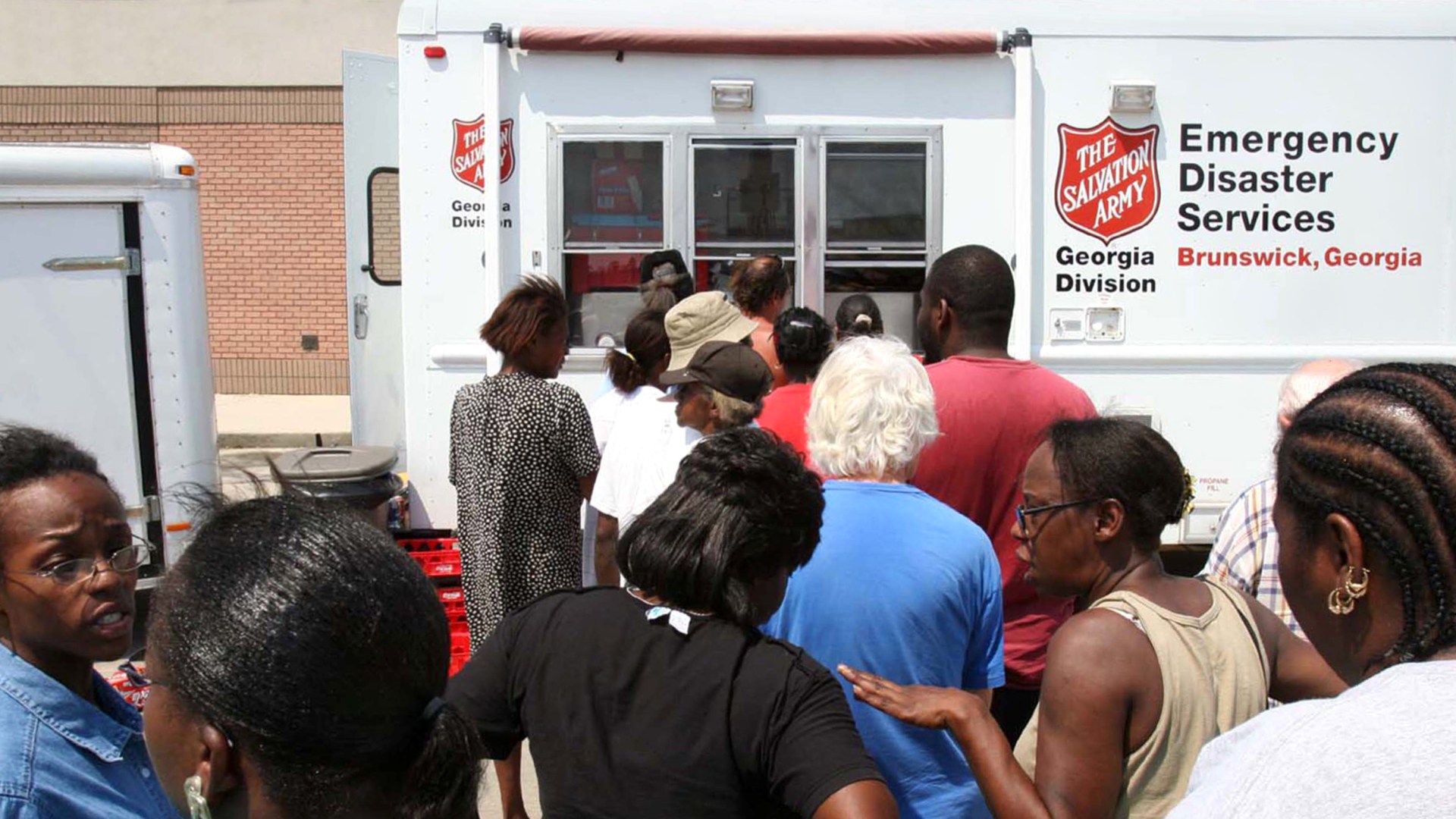
Groups often worked together. In Long Beach, Mississippi, Southern Baptist disaster relief volunteers from Ohio, Iowa, Tennessee, and Kentucky joined the Salvation Army for a mass feeding operation in the parking lot of a tattered Piggly Wiggly. The volunteers in yellow hats worked in mid-90s heat distributing meals in the parking lot or loading Salvation Army canteen trucks. The trucks carried meals to Gulfport and other decimated towns, often sharing gas with the local sheriff’s department.

Thousands of evacuees ended up in Jackson, Mississippi, where First Baptist Church became a shelter for people with special medical needs. Dozens of cots and a handful of hospital beds soon lined the church’s gym, with some among the elderly filling a makeshift clinic run by volunteer nurses and doctors.

One 83-year-old, Thomas Smith, had missed two critical dialysis treatments in New Orleans before he was airlifted to the church, where he said volunteers treated him better than doctors back home.

In Biloxi, Mississippi, Samaritan’s Purse set up at a United Methodist conference center that escaped destruction. One of the volunteers, San Diego firefighter Rusty Thill, sold everything in his apartment when he heard the Katrina news and drove his Chevy truck to the Gulf Coast.

At the home of Linda Ogden and her elderly mother, Thill and other volunteers lay sturdy tarps on their leaking roof, an effort that left Ogden in wonder. “I can’t believe they would help people for free like this,” she said. “I’m so thankful.”

In Gulfport, nearly 10 percent of the congregation of Pass Road Baptist Church lost everything, but the church staged a relief effort that included volunteers from North Carolina preparing and serving meals, and those from Pensacola, Florida, set up a mobile medical clinic.

In Texas, Great Hills Baptist Church and the Southern Baptist Convention coordinated mercy flights by pilots who donated their time and planes to ship provisions to flooded areas. “Load it up, fly it over, and stay long enough to pick up some fuel,” said pilot Derrich Pollock from Austin.

One month after Katrina’s landfall, church efforts gained unusual praise in the New York Times: “A New Meaning for ‘Organized Religion’: It Helps the Needy Quickly.” The September 29 story described how “from sprawling megachurches to tiny congregations, churches across the country have mobilized in response to Hurricane Katrina, offering shelter, conducting clothing drives and serving hot meals to evacuees, many of whom have had difficulty getting help from inundated government agencies.”

Times reporters Michael Luo and Campbell Robertson wrote:

The main hallway of the Florida Boulevard Baptist Church is lined with garbage bags full of clothing. The gymnasium has become a soup kitchen. And a kitchen set up outside churns out several thousand hot meals a day. At River of Praise Church in Tomball, Tex., 150 evacuees from the New Orleans area are camped out on cots in the family activity room, two youth rooms and a conference room.

Big organizations put up big number. The Salvation Army rotated into the disaster area 12,000 employees and 28,000 volunteers on two-week shifts. They distributed 158,000 cleaning kits (broom, bucket, mop, and detergent) and 130,000 boxes of groceries, assisting about 1 million people in all.

Individual church members were also active. Beliefnet told of a person who felt helpless watching Hurricane Katrina coverage on television. “I said a prayer, ‘Lord, I am giving money, but I want to do something personally. Send me someone to help.’ About 15 minutes later my phone rang. My neighbor said, ‘We are helping 75 evacuees who are moving into a camp near Pell City, Alabama. Do you want to help?’”

The result: “My husband and I moved into high gear. We gathered up linens, pillows, blankets, comforters, hair dryers, hot rollers, toiletries, make-up, soap, tools, clothing, 15 pairs of shoes, etc. I am giving Wal-Mart gift certificates to hand out as well. It was such a joy for us to be able to share what God had blessed us with to help someone who had nothing.”

During the week after Katrina, thousands of individuals posted online listings offering help: “I am a licensed bus driver willing to go south to haul those folks out …. I am a house painter …. I am fully licensed, have a truck with all equipment and chemicals, and am willing to go down and help out with any pest control problems …. I’m a building and roofing contractor from upstate New York who will donate my expertise and labor …. I am background-screened and fingerprinted for childcare, willing to take in a few kids or a small family …. I speak fluent Spanish and will contact anyone for anybody.”

Some never carried through on their initial impulse, but many did, including some from among the medical personnel who wrote of their willingness to serve: “I’m a board- certified orthopedic surgeon who is willing to help in a medical capacity …. I am a nurse from Cleveland …. I am a fully licensed general surgery chief resident willing to help immediately …. I am a CPR-certified health care provider.”

Some specialists were willing to be generalists: “Hi—I’m a registered nurse, my boyfriend is a union electrician. Even if you couldn’t use us in our professions, we would be willing to provide any assistance necessary.”

Many people offered housing, and some had their offers accepted: “Can’t get out there myself, but we have a dry, clean living room with space for a small family and their pets …. We only have our hearts and our home to offer, but our home is comfortable and dry! … I am a single mother with a small baby at home. I have an extra room and can house a single parent and/or children. It’s not a lot of space but I can help with meals, clothing, employment, and schooling …. We are licensed, loving foster parents who would be honored to take in a baby/toddler/young child—short or long term.”

Many without special training or available space just offered themselves: “I was down at Ground Zero after 9/11 and can help with any manual labor, rebuilding, medical help, search and rescue, and anything else under the sun …. I cannot offer my apartment for shelter at this time because I have no power/water, and I cannot offer money because I have very little, but I am very able to help out physically …. I have two husky chainsaws, transportation, and complete camping and cooking gear. No PAY required, just a destination and a person who truly needs help.”

Some skeptical journalists did not hide what they had seen. Bill Berkowitz of the Inter-Press Service compared “FEMA’s failure to provide timely assistance to the victims [with how] the faith-based community mobilized quickly. Thousands of vigorous and enthusiastic volunteers who were affiliated with a broad assortment of religious groups stepped up to feed the hungry, shelter the homeless, and serve the needy in countless ways.”

An atheist writing in Britain’s British Guardian Weekly commented two weeks after Katrina that he had seen how Christians “are the people most likely to take the risks and make the sacrifices involved in helping others…. men and women who, like me, cannot accept the mysteries and the miracles, do not go out with the Salvation Army at night.”

Marvin Olasky is Christianity Today’s executive editor for news and global and the author of The Politics of Disaster: Katrina, Big Government, And a New Strategy for Future Crises.

Books
Review

The Bible Is About Jesus—but Not Jesus Without His Bride

Jonathan Linebaugh’s pastoral, accessible invitation to Scripture is rightly focused on Christ but uncertain in its audience and too quiet about the church.

Jesus cut out of lace
Christianity Today August 26, 2025
Illustration by Christianity Today / Source Images: Unsplash

If the Bible is the most-published book in world history, books about the Bible sometimes feel like a close second. That’s not a bad thing. I’ve written a couple of them myself and may have more in me. Books about the Bible are vital because they point us back to the sacred text, showing us how to read it, what it’s about, or (perhaps) how we’ve gone wrong in understanding it. For this reason, ever more Bible books are far from redundant; I’d go so far as to say they’re necessary.

As the closing verse of John’s gospel says, “There are also many other things which Jesus did; were every one of them to be written, I suppose that the world itself could not contain the books that would be written” (21:25, RSV throughout). In a sense, books about the Bible are just these books that burst the world’s limits: Christians will keep on writing and reading them until the Lord’s return. Why? Because books about the Bible are always interpretations of the Bible. And in the words of Protestant theologian Gerhard Ebeling, “Church history is the history of the exposition of Scripture.”

Into the church’s ever-expanding library of Bible books, Jonathan Linebaugh has contributed another: The Well That Washes What It Shows: An Invitation to Holy Scripture. Linebaugh is a professor at Beeson Divinity School in Birmingham, and his scholarship has focused both on the New Testament, especially Paul’s letters, and on Reformation approaches to law, grace, and Scripture.

But this book is not a scholarly monograph. It’s a slim, accessible volume written for laypeople as well as pastors. As Linebaugh explains, it’s “an introduction to Holy Scripture that hopes to be an invitation to Holy Scripture.” The book simultaneously explains what the Bible is and narrates the story the Bible tells. 

The tone isn’t dispassionate or professorial. Linebaugh is a preacher, and his model is Martin Luther: “Whatever page or portion of Scripture Luther is preaching from, he is preaching and pointing to Jesus Christ.” That’s because “all of Holy Scripture … both speaks about Jesus and is Jesus speaking.”

Here’s how that works: When Jesus speaks, he gives himself. So when we hear the voice of Jesus in the human words of the Bible, we are right to confess that what we have heard is the Word of God. For Jesus is both God and God’s Word: “In the beginning was the Word, and the Word was with God, and the Word was God” (John 1:1). Prophets and apostles are a vehicle for this one eternal Word.

But even if we acknowledge God’s speech in Scripture, Linebaugh wants us to realize that when we encounter the Bible’s words about Jesus, we are encountering Jesus himself. The Word of the gospel, which Scripture proclaims and to which it testifies, is one and the same Word that brings the living presence of the risen Lord into our midst—into our lives—into our very hearts and minds and bodies. Like Jacob in his wrestling match at the Jabbok river (Gen 32:22–32), we will never walk away from this encounter unchanged.

Besides Luther, Linebaugh’s other inspiration is George Herbert, whose 1633 poem “The Holy Scriptures I” provides the title and driving metaphor of the book. The Bible, Herbert says, is a well that washes what it shows. This two-step operation is sometimes called the two “words” or “works” of God. Through Scripture, God first diagnoses, then heals; first indicts, then pardons; first convicts, then forgives; first binds, then sets free. We cannot be helped if we don’t know our own need—but knowing our need isn’t good enough. We need help beyond ourselves to relieve our pitiful condition.

This is just what the Word of God does. It shows us what we are: miserable sinners bound for death, hopeless and godless and assaulted on every side by dangers visible and invisible. We are anxious, lonely, guilty, and hurting. We are unwell. To say otherwise would be dishonest. This is Scripture’s honesty, a term Linebaugh treasures as a description of God’s work in his Word. It tells us the truth about ourselves, and the truth isn’t pretty.

And yet the Bible goes on to wash what it shows. It washes us sinners clean. In Paul’s words, “Christ loved the church and gave himself up for her, that he might sanctify her, having cleansed her by the washing of water with the word, that he might present the church to himself in splendor, without spot or wrinkle or any such thing, that she might be holy and without blemish” (Eph. 5:25–27). Or as Luther puts the point, “The love of God does not find, but creates, that which is pleasing to it.” God’s love finds us through his Word, and the result is total transformation—from tip to toe.

Such is the flavor of Linebaugh’s writing about Scripture. It is earnest, endearing, unpretentious, and attractive. I can think of more than a few college students in my life who need a taste of it, not least to rinse out the dry and bitter flavor of so much other writing about the Bible.

The book as a whole is simply organized. Following a concise theological introduction (a highlight in itself), Linebaugh introduces the Old Testament in three chapters (Law, Prophets, Psalms) and the New Testament in three as well (Gospels, Paul, Hebrews to Revelation). He then uses Romans as a case study before concluding with a chapter on the ministry of the Word as a comfort to the lost and despairing.

These chapters are a pleasure to read, although seasoned pastors and biblical scholars are unlikely to learn new information from them. The book’s ideal setting and audience is the classroom, I think, whether high school, college, Sunday school, or adult small group.

One of the book’s greatest strengths is its foursquare refusal to dabble in hot-button issues, whether moral, political, or theological. This is not a book about our petty squabbles or partisan divisions. It’s about the book of the gospel, the Holy Scriptures that give us Christ. Our disagreements are important, but they are not the main thing. The main thing is the Lord. Too often our conflicts point us away from the empty tomb in order to clinch a debate. If we have forgotten the Good News, then even when we win, we lose.

Before I raise a critical question or two about Linebaugh’s work, I want to comment on his style. At times his exposition of Scripture is so close to the text’s surface as to be invisible. I trust that this is on purpose. Linebaugh does not avoid repetition but positively revels in it. He never paraphrases or summarizes when he can quote verbatim instead. He rarely turns to illustrations from the world or his own life; his words are, for the most part, tissue thin to the point of transparency. He wants the Word to resound in his words; he wants his words to point, like the finger of John the Baptist, not to himself but to Christ alone.

Given Linebaugh’s readership, this is a wise if delicate decision. It seems he is seeking to train his readers to become readers of Scripture. And the way he does this is by suffusing his own text as much as possible with the text of Scripture. Once you turn the final page, you’ve been conditioned to turn next to the genuine article: Scripture itself.

I call this decision a delicate one because the danger is that readers who do not know Scripture, much less how to read it, will find writing like Linebaugh’s difficult to navigate precisely because so much of it is scriptural quotation. I don’t mean to call the decision into question, only to flag it as a challenge facing us all: How do we write for a postliterate audience largely ignorant of Scripture’s sound and feel on the page? Should we ease them into it or throw them in the deep end? Either way demands a light touch. Linebaugh has one, and I’m confident many beginners will be grateful for it.

Having said that, there was one matter of style that stumped me. In the preface to his 1988 book Disappointment with God, Philip Yancey explains why he chose not to put biblical references “in footnotes or parentheses within the text”—namely, because doing so “creates an awkwardness in reading not unlike listening to someone with a stutter.”

I wish Linebaugh had followed Yancey’s method. There are long sentences and entire paragraphs so filled with parentheses, abbreviations, numbers, colons, and semicolons that my eyes struggled to follow the thread. And this is my day job! I read books like this for a living. I can’t imagine the unnecessary strain for a typical reader, especially one who is new to Scripture. I grant that Linebaugh is following guild standards, but that’s only to shift the problem one level up. All Christian writers for a nonscholarly audience—including publishers and editors, including this very article—need to hash out new standards that think first about readers’ needs and less about precision in citation.

This comment returns us to the implied audience, which is a confusion I faced throughout Linebaugh’s book. On every page it is clear that the book’s audience is laypeople of all ages. Yet the final chapter (nearly 20 pages) is about ministry and appears to be addressed to pastors. This is an odd decision in more than one respect.

First, very little in this book will be news to any pastor I know. Not that pastors couldn’t benefit from it—sometimes the most informed need to be reminded of the basics—but so much of what Linebaugh is doing is milk for beginners, not meat for the mature. So the turn to pastors in the end was befuddling, even jarring.

Second, in Linebaugh’s treatment of Scripture the church is nowhere to be found. For that matter, equally absent are tradition, liturgy, the sacraments, and the Holy Spirit. The result, if I may put it this way, is an account of the Bible and its message that is maximally and perhaps stereotypically Protestant. By this I don’t mean the book is “not Catholic.” I mean that it is so intensely focused on the “solas”—Christ alone, grace alone, faith alone, Scripture alone—that it leaves by the wayside other essential features of the gospel.

For example, in a book about the Bible we get no more than a couple pages on Acts, and even these consist mostly of references to Paul’s ministry and the geographic spread of God’s Word. I was astonished to see Linebaugh summarize both the event of Pentecost and the second chapter of Ephesians without mention of the church, either directly or indirectly. The power of the Word in Linebaugh’s presentation is so Christ-centered that an unsuspecting reader wouldn’t guess the Spirit is crucial to hearing and being changed by it.

Above all, one walks away without any sense that the book of Scripture—which is absolutely the book of Christ, the Word of the gospel, the inspired medium of the Lord’s living address—is also the church’s book, or that this book’s home and habitat is the church’s public worship. Linebaugh has an enviably light touch with historical details, like the exile from Babylon or the cities Paul visited, but he does not mention the history of the texts themselves: authored by leaders and servants of God’s people, edited by them, collected by them, copied by them, preserved by them, translated by them, canonized by them, and much more besides.

These aren’t mere matters of history; they’re theologically significant. The same Spirit who inspired and speaks through these texts superintended every moment in the entire canonical process, from their initial transcription, down through the centuries, all the way to hearing Joshua or Jeremiah from the pulpit last Sunday in one’s mother tongue. And the hands the Spirit used were the hands of the people of God.

In short: no Scripture, no church. But also: no church, no Scripture.

This dynamic is not incidental to the story Scripture tells. That story is indeed universal in scope and minute in impact—cosmic in extent while reaching down to me. But it also has a particular protagonist: the family of Abraham, the elect people of God, whom Christ has opened to the nations. Linebaugh doesn’t avoid talk of Israel. But reading him, you wouldn’t know that the church is Christ’s “body, the fulness of him who fills all in all” (Eph. 1:23) or, in the words of the Shepherd of Hermas, that “for her sake the world was framed.”

The resulting impression is that Scripture’s primary business is to facilitate a one-on-one relationship between individual readers and Jesus. Not for a second do I think Linebaugh believes this or intended to communicate it. But that is what comes across. This unintended effect is part of what makes the final chapter so odd. In place of a chapter on ministry, the book needed a chapter on the church: its traditions of reading (not only Augustine and Luther but also all the fathers and medievals between them, not one of whom Linebaugh cites or references), its sacramental worship, and most of all its life with the Holy Spirit.

Linebaugh is right to say that, through Scripture, “God unveils our need for Jesus; God gives us Jesus.” But this giving is not generic or random; the “us” who receive it are a body, not just individuals. We are not only children of the Father but also together the bride of the Son. In the words of Dei Verbum, through Scripture “God, who spoke of old, uninterruptedly converses with the bride of His beloved Son; and the Holy Spirit, through whom the living voice of the Gospel resounds in the Church, and through her, in the world, leads unto all truth those who believe and makes the word of Christ dwell abundantly in them.”

The Bible is about Jesus—but not Jesus without his bride. Such a story would feature the lover without the beloved, the Lord without his people, the head without the body. 

Jonathan Edwards wrote that God created the world in order “to provide a spouse for his Son Jesus Christ, [who] might enjoy him and on whom he might pour forth his love.” We must therefore always center our telling of the gospel on Christ, and Linebaugh does this beautifully. Having zoomed in on the face of the Lord, however, he has cropped the Lord’s body out of the picture. The Bible doesn’t do that, and neither should books about the Bible.

Brad East is an associate professor of theology at Abilene Christian University. He is the author of four books, including The Church: A Guide to the People of God and Letters to a Future Saint.

Ideas

Gen Z Doesn’t Need a Soft Gospel

Christian leaders can meet our desire for authenticity and stability with a message of Christ’s holiness and grace.

A Bible with a soft cushion texture.
Christianity Today August 26, 2025
Illustration by Elizabeth Kaye / Source Images: Getty

It was fall semester 2024, and I’d managed to claim a table in the normally crowded student center at Taylor University. As I sat studying, a girl slid into the seat across from me and asked if she could join. We lived in the same building, but I didn’t really know her. Still, I said yes. She noticed the sticker on the back of my laptop. It read, “Biblical femininity, not feminism.”

“What is your definition of feminism?” she asked, launching us into a discussion about what the Bible said about gender, the role of women in the church, and the effects of different cultural movements.

Our impromptu conversation wasn’t the only time I’ve had conversations about controversial subjects with my peers. We’ve discussed abortion, immigration, marriage, racism, environmentalism, and more. I’ve discussed eschatology while standing in line for rides at Six Flags.

Generation Z prizes authenticity. We want stability. We’re searching for community. And we’re willing to engage with difficult topics to find them. Most of all, we want a gospel that tells us the whole truth. Gen Z does not need a soft gospel.

Born between 1997 and 2012, zoomers are younger than the internet. Our oldest members barely remember life before smartphones, and the youngest members don’t know a life without social media.

We’re a generation coming of age in a world that does not feel stable. Our public square is online, and we’re used to receiving filtered, edited, and one-sided information. We turn to social media, especially TikTok, to stay up-to-date on the news. We tend to distrust established institutions. Misleading news coverage on politics and social media’s platforming of alternative viewpoints and false information has made Gen Z skeptical. Everything seems fake, and zoomers don’t like it.

Gen Z came of age in a divisive political environment seemingly headed toward violent implosion. We watched as Western culture discarded traditional and natural boundaries around gender and marriage while calling any pushback bigoted. Many of my generation are still scarred by the forced lockdowns of COVID-19 and the anxiety surrounding both the disease and the response to it. And as we look to the future, many of us zoomers are worried we won’t be able to afford the cost of living, especially housing.

And then Gen Z is just lonely. More connected than ever through screens, many 20-somethings don’t have in-person communities they can rely on. For members of a generation whose mental health struggles are well documented, this means they’re suffering alone.

The need for authenticity, stability, and community might be why some members of Gen Z are shifting back toward traditional ideals. They’re aware of the competing thoughts surrounding marriage, gender, and life. Many are disillusioned by mainstream progressive solutions.

Children’s rights advocate Katy Faust summarized it this way: “One reason for Gen Z’s rightward lurch is they’ve tasted and seen how family breakdown has destroyed their lives. They have watched their friends try on every sexual label and still be depressed, anxious, and lonely. They have experienced firsthand the crisis of meaninglessness. They want an alternative.”

Unfortunately, Gen Z has reacted by seesawing back toward secular traditionalism. For example, many young men are increasingly drawn to a type of hypermasculinity popularized by influencers like Andrew Tate. This version of manhood teaches that masculinity is synonymous with physical strength, glorifies the lusts of the flesh, and encourages men to beat down the weak. Young men seem to be drawn to Tate types because they’re an antidote to the culture’s antagonism toward men.

Many young women, too, are drawn to the tradwife trend, which reduces God’s call to an aesthetic caricature, creates unrealistic expectations, and can twist the biblical doctrine of headship into dictatorship. Young women seemingly are drawn to this trend because it counters Western society’s idea that they must “do it all.”

But neither of these things satisfies, because they miss the real source of instability, fakeness, and loneliness. They try to fix the rift in humanity’s relationship with God through our own power.

Gen Z needs an alternative, and the story of the gospel provides it.

When people sugarcoat the gospel in an effort to make it seem nicer, they minimize it. It starts to look like the rest of the hedonistic, postmodern philosophies causing destruction in our culture. For a generation used to wading through edited information, filtering the gospel to make it appear softer makes it sound like another unstable ideology leading to broken loneliness.

Preaching “you’re accepted just the way you are” feels good, but it isn’t fully true. Yes, he will save us just the way we are, but he will not leave us just the way we are (Rom. 5:6–11). When we avoid preaching the seriousness of sin and the consequences of our broken relationship with God, we cheapen Christ’s sacrifice. 

It’s good to speak about God’s love—he is love. But his love is different from the world’s definition of love. It’s actionable (Ps. 136). It doesn’t rejoice in wrongdoing—even popular wrongdoing—but rejoices in the truth (1 Cor. 13:6). It’s sacrificial (John 15:13).

Avoiding the parts of Scripture that are more difficult to preach will only provide people with an incomplete view of God and salvation. It makes it seem as if the gospel doesn’t have real-world impact.

The Bible does indeed address injustice, violence, financial security, and loneliness. Gen Z needs an answer only Scripture can give—but we need to share the whole of Scripture.

For a generation that craves authenticity, the Bible is honest about humanity’s sinful nature (Ps. 51; Rom. 3:23). Old and New Testament authors alike don’t shy away from discussing the often harsh realities of this fallen world. God’s Word is honest about the sole path to salvation (John 14:6; Rom. 10:9–10). Scripture proclaims truth without posturing or editing it first (2 Tim. 3:16–17; Heb. 6:18). It’s authentic. 

Zoomers wants stability? God is a God of order (1 Cor. 14:33). He holds the world in his hands (Ps. 24:1; Matt. 5:45), established right and wrong (Mic. 6:8), punishes evil (Isa. 13:11; Rom. 1:18), and provides for those who seek first his kingdom (Matt. 6:33). He is the cornerstone and the firm foundation (1 Pet. 2:6). He provides stability, and he is stable (Luke 6:46–49).

Gen Z wants community? God promises to never leave nor forsake us (Deut. 31:8; Heb. 13:5). He sends the Helper to be with his followers (John 15:26–17). He loves unconditionally (Rom. 5:8) and won’t let us stay in our messes (1 Thess. 4:3). Christians have a built-in community of believers to do life with (Eph. 2:19). And Christ himself provides community.

We Christians need to share that Christ died for our sin (Isa. 53:5). He experienced the full wrath of a just God against evil (Rom. 3:23–26). God will save anyone, no matter how degenerate a sinner, but he does not leave people the way they are. Freedom in Christ is not a license to keep on sinning (Gal. 5:13). His kindness is meant to lead to repentance (Rom. 2:4). Belief in him is the only way to salvation. Living in sin will result in slavery to sin (Rom. 6). Knowing that Christ is the only way to salvation strips away the mask that obscures the results of prominent cultural ideologies (10:9–10).

There’s a church near me that does a wonderful job preaching Christ’s death and resurrection. But because it only ever preaches those elementary doctrines of Christ (Heb. 6:1), many young adults have left. They want churches that will speak to what is happening in the world around them and that will show them God has a plan for their specific pains. They need to see that these core doctrines—the gospel—connect to their life. A watered-down gospel won’t do that.

Generation Z is open to Jesus but wary of religion. Religion seems fake and disconnected; Jesus seems real.

One of my younger sisters came home from her freshman year at Cedarville excited about Jesus because she realized that her faith is a relationship. Jesus is someone she can spend time with and know better. He isn’t disconnected from what’s happening in the world.

 Now is a perfect time to speak to Generation Z about the whole gospel, even though it’s offensive to the world (1 Pet. 2). My generation needs to know we’re not crazy for wondering why the LGBTQ culture feels wrong. We need to know why living for ourselves makes us feel anxious or depressed.

There’s an understanding among zoomers that the status quo isn’t right, but many are looking for answers in the wrong places. Secular conservatism is just as dangerous as secular liberalism. Without the stability, authenticity, and community Christ brings, nothing will change. Honest discussions with Gen Z, where all of Scripture is embraced—including the parts this world hates—will draw my hungry generation to Christ.

Kenna Hartian is the Habecker fellow at Christianity Today.

News

Died: Chuck Girard, Who Shaped the Sound of the Jesus People

The pioneer of Contemporary Christian Music wrote songs of salvation and worship for a generation of evangelicals.

Chuck Girard obit image
Christianity Today August 25, 2025
Chuck Girard / edits by Christianity Today

Chuck Girard wrote and sang and played from the time he was a kid—rhythm and blues, blue-eyed soul, doo-wop, pop, and even a top-ten radio hit about Honda motorcycles. When he experienced the love of Jesus at age 26, that didn’t change the way he felt about music. 

“I want you to know I still love rock-and-roll music,” Girard wrote in a subsequent song, “but now I have something to say.”

Girard and his band Love Song started to perform what they called “Jesus music” in Southern California in the early 1970s. They became one of the regular groups at pastor Chuck Smith’s Calvary Chapel Costa Mesa, where thousands of young people flocked to hear about God’s love and peace, get baptized in the ocean, and join the “Jesus People movement.” Love Song’s earnest folk rock—with tunes like “Welcome Back,” “Changes,” “Little Country Church,” and “Since I Opened the Door”—became the soundtrack of salvation for a generation.

Girard went on to further shape the sound of American evangelicalism with his work producing the first Maranatha! Music compilation album and solo hits like “Sometimes Alleluia” before turning to worship music in the 1980s. 

Contemporary Christian music (CCM) legends Amy Grant and Michael W. Smith both described his music as life-changing. 

Andrew Erwin, one of the producers of the film Jesus Revolution, said Girard deserved “a standing ovation” for his originality and extensive influence.

“He was one of the true trailblazers of Christian music with Love Song,” Erwin told CCM Magazine. “They were the first of their kind, paving the way for artists like Larry Norman, Keith Green, and so many others who followed. Chuck stood at the very forefront.”

Girard, for his part, said the earthly accolades were nice, but he was looking forward to something greater.

“The real treasure is in Heaven,” he said in 2012, when he was inducted into the Gospel Music Hall of Fame. “I pray that we will all be in Heaven’s Hall of Fame someday and hear the most amazing words we will probably ever hear: ‘Well done, good and faithful servant, enter into the joy of your lord.’”

Girard died at home in Franklin, Tennessee, on August 11 at age 81.

He was born in California on August 27, 1943, one of Clarance Girard and Dorthea Tomany Girard’s four kids and their only son. 

Girard wrote in his autobiography, Rock & Roll Preacher, that his father was an abusive alcoholic. His first memory as a child was trying to get his father to stop hurting his mother. He also had vague recollections of his father taking him to bars and giving him alcohol when he was a toddler.

Girard’s mother was a Catholic who also believed in New Age mysticism and told people’s fortunes. She told Girard that she had had a vision of him as an adult playing piano on a big stage. She enrolled him in lessons when he was 10.

Girard had no interest in music at first. But then he heard the chord progression of “Heart and Soul,” also known as the “doo-wop progression,” and became obsessed.

“I had no other goal in life than to make music,” he said.

In high school in Santa Rosa, California, he and some friends formed a pop group they called The Castells. Girard’s mother gave him $100 to make a demo tape, and The Castells went to Hollywood and landed a record deal. They signed with Era, agreeing to 3.5 cents per record, split between the four boys.

The Castells had a hit in the summer of 1961. The song “Sacred” was the 20th-most-played song on the radio. The following spring, “So This Is Love” rose to 21.

Girard soon found himself sharing stages with some of the biggest acts of the time—Roy Orbison, Jerry Lee Lewis, Bobby Vee, Brenda Lee, The Righteous Brothers—and spending the rest of his time at house parties, drinking without stopping for days.

“I felt like I was floating,” Girard wrote, recalling one binge. “From the day I first got drunk, I attempted to stay in the state of some degree of inebriation as much as I could.”

The Castells floundered and fell apart, but Girard stayed in Los Angeles. He started working with producer Gary Usher, who was close with the Beach Boys and hoped to replicate their success with another band that captured a youth culture fantasy he could package and sell: surfing or hot rods or something.

In 1964, with Girard along for the ride, Usher threw together “The New Sounds of the Silly Surfers” by the Silly Surfers, “The New Sounds of the Weird-Ohs” by the Weird-Ohs, “Hot Rod Hootenanny” by Mr. Gasser and the Weird-Ohs, “Surf Route 101” by the Super Stocks, and “Little Honda” by the Hondells. 

They got lucky with the Hondells, when the group’s paean to Japanese motorbikes, “Little Honda,” charted at No. 9.

Girard was also along for a generational ride. With the rest of the hippies, he discovered marijuana and psychedelic drugs and came to understood his life as a spiritual quest. 

“I believed that I had discovered the key to the secrets of the universe,” Girard wrote in his autobiography. “A dimension of consciousness opened up. … I had no realization of the implications regarding God and the devil.”

He experimented with Eastern philosophies, astrology, the occult, and radical vegetarian diets. At one point, Girard ate only avocados, asparagus, and bananas. 

Rock musician Denny Correll, part of a band called Fifth Cavalry, convinced him that Jesus was at least part of the spiritual answer he was looking for. Backstage at a concert, Correll pressured Girard to declare Jesus his Savior.

“I halfway meant it, but mostly it was to get him off my back,” Girard later wrote. “His fervor was infectious, and he could easily make you believe that what he preached was true.”

The two men and a group of hippie musicians started a commune. They shared everything they owned, did drugs, played music, and talked endlessly about the Bible. One man emerged as the leader and started having revelations that they were supposed to move to Hawaii, where they could live off the land until Jesus returned to establish his millennial kingdom, with New Jerusalem located on the islands.

It didn’t work out. Girard ended up, as he would tell the story later, wet in a cave by himself with a guitar. He returned to the mainland to try to relaunch his career in music. 

He continued to pursue enlightenment through drugs until he had a horrible experience with LSD in Utah. 

“I had no sense of any other living thing in the universe. … There was complete silence,” Girard later wrote. “It frightened me to the core of my being.”

At about the same time, Girard’s new band, Love Song, kept getting invited to Calvary Chapel. Girard, Tommy Coomes, Jay Truax, and Fred Field would pick up hippie hitchhikers. Again and again, the hitchhikers asked them if they’d heard about Calvary Chapel. 

Girard finally decided to check it out for himself. He sat in the back and was overwhelmed by the feeling of Christ’s love. The pastor preached about sin and redemption and how Jesus died for us because we could not get right with God on our own. Girard started crying—deep, heaving sobs. 

“Snot was all over my beard, and tears were all over my face. But, I felt clean!!!” he later wrote. “I had asked, and it had been given to me. I had sought with all my heart and I had found. I had knocked incessantly, and the door had been opened to me.”

Unexpectedly, the other members of Love Song also had born-again experiences at Calvary Chapel. They added another member, John Mueller, and started writing and singing songs about Jesus in 1970. Their music style didn’t change, but now they had “something to say.” 

Love Song become one of the house bands at Calvary Chapel, developing the folk-rock sound of the Jesus People movement.

As a professional musician with the most recording experience, Girard was also brought in to produce the first Maranatha! Music compilation in 1971, which was called “The Everlastin’ Living Jesus Music Concert.” He was not credited but made key decisions about keeping the music simple and evangelistic. 

As Girard told Rolling Stone magazine at the time, the music was meant to glorify God, not the musicians. And he didn’t want the songs to get tripped up in artistic ambiguity. Every song, he said, should present its message in “plain simple language with no deep intellectual vibes. What we’re saying is Jesus, one way. If you want the answer, follow it.”

The Maranatha! Music album was sold to Christian bookstores out of the trunk of a car but sold 160,000 copies and launched a series of compilation albums that defined early CCM. 

Love Song released its own self-titled debut album in 1972 and headlined at Explo ’72, the Christian music festival and evangelistic rally that was promoted as a rejoinder to the hippie movement and its big music festivals, especially Woodstock.

Girard was not the biggest star of the Jesus music scene, but he was very influential. As Songwriter Magazine reported, he “always possessed a rare combination of musicality, heartfelt simplicity, and spiritual conviction,” and “his talent helped bridge secular musicianship with evangelical faith at a pivotal moment in American culture, lending authenticity to what would become a major genre.”

Love Song produced a second album, “Final Touch,” in 1974, and Girard went solo in ’75. The final song on his first album, “Sometimes Alleluia,” became one of his biggest hits. Girard would call it his “first worship song.” 

In the midst of all his success, however, Girard continued to struggle with alcohol addiction. He got to the point where he couldn’t make it a day without consuming alcohol and was drinking vodka in the morning, hoping he could hide the smell.

His wife, Karen, confronted him in 1979 with the help of pastors Chuck Smith and Kenn Gulliksen, whose church would later grow into the Vineyard movement. They sent him to rehab. 

Girard recalled it was a crushing moment when he first sat in a circle of addicts, opened his mouth, and said, “I’m Chuck Girard. I am a backslidden Christian singer, and I’m an alcoholic”—but it was also the beginning of healing. 

After rehab, Girard went to a Vineyard Bible school and studied what Scripture said about music. He grew convicted that he should serve the church and focus his talents on worship more than performance. 

“Music is almost always about worship in the Bible,” he later wrote. “Sometimes it’s warfare, sometimes celebration, all of it brings praise to God.”

He shifted his focus to worship ministry in the 1980s and, according to the obituary written by his family, embraced a “church-centered calling that remained his passion for the rest of his life.”

Girard released his final album in 2024. It is an eclectic collection of songs about pain, uncertainty, and, of course, Jesus. He released it at the same time he was diagnosed with stage IV lung cancer. 

“Here’s what I know,” Girard said. “I was blind but now I see; Jesus is the only answer to life’s problems; the Bible is the truth and can be trusted; surrender yourself to doing it God’s way; build your life on believing the truth and forgiving and being forgiven.”

Girard is survived by his wife, Karen, and their four daughters, Kristin, Alisa, Cherie, and Nikki. Memorial services are planned for The Gate Church in Franklin, Tennessee, on August 26 and at Calvary Chapel Golden Springs in Diamond Bar, California, on September 20. 

Apple PodcastsDown ArrowDown ArrowDown Arrowarrow_left_altLeft ArrowLeft ArrowRight ArrowRight ArrowRight Arrowarrow_up_altUp ArrowUp ArrowAvailable at Amazoncaret-downCloseCloseEmailEmailExpandExpandExternalExternalFacebookfacebook-squareGiftGiftGooglegoogleGoogle KeephamburgerInstagraminstagram-squareLinkLinklinkedin-squareListenListenListenChristianity TodayCT Creative Studio Logologo_orgMegaphoneMenuMenupausePinterestPlayPlayPocketPodcastRSSRSSSaveSaveSaveSearchSearchsearchSpotifyStitcherTelegramTable of ContentsTable of Contentstwitter-squareWhatsAppXYouTubeYouTube