News

Court Rules California Church Members Can’t Sue

An Orange County congregation’s bylaws permitted a controversial split from Vineyard USA.

Pastors Alan and Kathryn Scott respond to a lawsuit alleging fraud and deception.

Pastors Alan and Kathryn Scott respond to a lawsuit alleging fraud and deception.

Christianity Today August 6, 2025
Screengrab / Dwelling Place Anaheim

Key Updates

August 6, 2025

Dwelling Place has members. And it has members. Only the latter are allowed to sue the former Vineyard USA church for suddenly leaving the charismatic denomination, a California appeals court ruled last week. 

The nine people who brought the case to court, alleging the church split was part of a $62 million fraud perpetrated by pastors Alan and Kathryn Scott, do not have legal standing, according to the ruling. The nine attended services, participated in the life of the congregation, and tithed, but they were not on the board of directors. And according to the church bylaws, people who are part of the congregation are only “associate members,” while those on the board are “voting members.”

“Dwelling Place’s bylaws … separate its members into two classes,” Justice Maurice Sanchez wrote. “Appellants contend they are members. But … they are not corporate members within the statutory boundaries.”

Beyond that, according to the unanimous decision, the bylaws give the senior pastor responsibility over “all ecclesiastical decisions,” and the move to take the church out of the Vineyard is protected by the First Amendment.

Carol Wimber-Wong, who started the Anaheim church and the Vineyard movement with her late first husband, John Wimber, did not live to see the court rule against her. She died in January at the age of 87. 

A group representing the other eight plaintiffs, SaveVCFAnaheim, said in a statement on X that they are considering an appeal to the state Supreme Court.

“The mission has never been about courts,” the group said. “SaveVCFAnaheim will not stop until justice is served.”

Dwelling Place declined CT’s request for comment. The lawsuit was not mentioned in the Sunday service. Alan Scott preached on glorifying God and putting God’s glory on display. 

“The price of faith is that sometimes God asks us to do things that others don’t really like,” he said. “The story of God keeps moving and advancing.” 

November 22, 2022

The widow of a legendary Vineyard leader is suing the pastors of a Southern California church for fraud and the alleged misappropriation of $62 million.

Vineyard Anaheim, the “mother church” of the Vineyard movement since it was planted by John Wimber in 1977, left the charismatic denomination without much explanation in March. The current senior pastor, Alan Scott, told the church that the Holy Spirit just led them to split. There were no big disagreements with the national organization, no disputes about direction, and no personal conflicts.

“We don’t really understand why,” Scott said in a recording of a Sunday service obtained by CT. “I wish I really could sit before you today and say, ‘Here are the six reasons,’ ‘Here’s our issues,’ ‘Here are our grievances,’ or whatever. … We don’t always know what’s on the other side of obedience.”

But Carol Wimber-Wong, who cofounded the church with her late husband John Wimber and remained an “active and tithing member” until the church left the Vineyard, has a simpler explanation for what happened. There were not six reasons, she and eight other former members and leaders allege, but 62 million.

The former members claim Alan and Kathryn Scott knew they wanted to leave Vineyard USA but lied about it when applying for the leadership positions at the Anaheim church so they could take control of the $55 million mortgage-free building and $7 million in the bank.

“The Scott Defendants concealed their true intentions,” the lawsuit claims. “Defendant Scotts sought the position as Senior Pastors of Vineyard Anaheim with the deceitful motive of controlling tens of millions of dollars of assets and disassociating with Vineyard USA.”

The former members say that deceit has deprived them “of a church they have long called home” and “caused great emotional and spiritual distress.”

The lawsuit was filed in Orange County, California, Superior Court on November 10. Wimber-Wong is joined in the suit by church members Steve and Nancy Bray, Stephanie Ruppe, and David Edmondson; former pastor Lance Pittluck; and former board members Don Salladin, Joe Gillentine, and James Gillentine.

The pastor and board members all voted to hire the Scotts, who had previously led a Vineyard Church in Northern Ireland, in January 2018. They now regret the decision.

According to the suit, the Scotts weren’t originally interested in the position in Anaheim. After leaving the church in Northern Ireland and coming to the US in part so Kathryn Scott could pursue a career in worship music, they decided they were done with the Vineyard.

“It’s not an environment where we would want to plant our lives or raise our girls,” Alan Scott wrote in an email in May 2017, according to the suit. “We have arrived at the painful conclusion that we won’t be a part of a local Vineyard church in the next part of our journey.”

At about the same time, however, the Scotts casually asked Mike Safford, one of the ministers in the church, about the congregation’s assets. Safford reported that he thought it was just “shop talk,” but his wife was concerned about ulterior motives.

Nine months later, the Scotts did apply for the leadership positions at Vineyard Anaheim. According to the lawsuit, they told Safford, now leading a Vineyard fellowship in Tehachapi, California, that they had changed their minds about the denomination. Even if they still sometimes disagreed with the national leadership, they would “never take Vineyard Anaheim out of the Vineyard movement,” they said. They promised they would “honor the history and Carol Wimber.”

The hiring committee didn’t know the Scotts had said they were leaving the Vineyard but did ask several times about their commitment to the denomination, according to the lawsuit. During the interview process, one person asked about the influence of other theology on Alan Scott’s writing and teaching. He responded he was “Vineyard through and through.”

Another person asked about the couple’s association with other charismatic ministries, including Bethel, an independent megachurch in Redding, California. She recalls receiving the same answer: “Vineyard through and through.”

Joe Gillentine, who chaired the hiring committee, claims the Scotts were specifically asked whether they would separate from the denomination. They said that “leaving the Vineyard was never even a question.”

The answer seemed more ambiguous in retrospect.

The lawsuit claims the Scotts knew they were going to leave the Vineyard and “planned and maneuvered for several years,” before making their move.

“They had no intention of applying for the vacant senior pastor position[s] until learning of the Anaheim Vineyard’s substantial assets,” the lawsuit says. “They misled the Anaheim Vineyard Search Committee and board of directors.”

The Scotts have not yet responded to the legal filing but made a public statement in the Anaheim church, now called the Dwelling Place. They also posted a “family update” online.

“We understand that our disassociation from VUSA has caused strong emotions, but we didn’t expect individuals to attribute evil intent in the hearts of Alan and Kathryn Scott,” a written statement says. “The accusations in the complaint couldn’t be further from the truth.”

The Scotts say they hoped to deal with the disagreement “honorably, relationally, and biblically,” and “avoid a public airing of ecclesiastical issues.”

Whether or not the dispute is an ecclesiastical issue is one of the first things the California court will have to decide. According to the 1871 Watson v. Jones Supreme Court ruling, judges cannot weigh in on “a matter which concerns theological controversy, church discipline, ecclesiastical government, or the conformity of the members of the church to the standards of morals required of them.” This is known as the ecclesiastical abstention doctrine or sometimes the church autonomy doctrine.

The former church members told the California court they believe it does have jurisdiction. “This civil action arises from a secular and nonecclesiastical dispute,” the lawsuit says, involving “the business operations” of the church.

Outside the court, the Anaheim church’s departure from Vineyard has prompted debates among charismatic Christians about accountability, spiritual discernment, and the pastor’s authority. Some Vineyard pastors are moving away from the model of decisive leaders, emphasizing instead the importance of collaboration and consensus. Not everyone likes these and other changes.

“The elephant in the room that nobody has wanted to talk about for years is that … the Vineyard movement has walked away from its original core values and mandate,” wrote Duke Taber, a pastor who left the Vineyard after 10 years and started a church in Nevada with Global Awakening.

Taber said to him it seems like Scotts are returning to the Spirit-led independence that Wimber himself preached and modeled.

“It looks like they have returned to Vineyard values and practice,” he said. “John Wimber talked about the need for the pastor to be autonomous and not board ruled and that a church should not be board controlled.”

The Vineyard denomination, for its part, does not make any legal claim to the Anaheim building or bank account. Vineyard USA is not part of the lawsuit and said in a statement that its only involvement has been to offer pastoral care.

After the Scotts announced the church would be leaving Vineyard to follow the leading of the Holy Spirit, a representative of the denomination’s board of trustees begged them to reconsider. He said their account of God’s guidance was “spiritually implausible” and did not meet the biblical standards for discernment.

Other national leaders criticized the move as well.

“God does speak today!” Rich Nathan, pastor emeritus of Vineyard Columbus, the largest congregation in the movement, wrote on social media. “But whenever a so-called ‘leading’ is obviously self-seeking, fundamentally dishonest, lacking in accountable discernment, demonstrably hurts others and especially when money or power is involved, you can rest assured that it is NOT God who is leading!”

According to Carol Wimber-Wong and the other former members of the church, though, the lawsuit isn’t about ecclesiastical issues and questions of proper spiritual discernment. It’s about fraud, $62 million, negligent misrepresentation in the hiring process, and breach of fiduciary duty.

The first hearing is scheduled for April 28.

Theology

Will TikTok Save Democracy—or Destroy It?

Columnist

The latest cultural shift to a highly visual, quick attention platform is discipling us in ways we need to question.

A person holding a phone with TikTok open in front of an American flag.
Christianity Today August 6, 2025
Illustration by Christianity Today / Source Images: Getty

This piece was adapted from Russell Moore’s newsletter. Subscribe here.

A few years ago, I started hearing more and more people saying, “Twitter is becoming real life.”

What they meant is that the toxic arguments on the social media app were defining a whole era—shaping and forming the way we communicate with each other in everything from school board meetings to presidential Rose Garden briefings to church business discussions.

What if, however, the Twitter era is closing and the next era of American life will be defined by TikTok? Will that be good news or bad?

That question has lodged in my thinking for several weeks now, after I was surprised to hear the case for some good news about the future of American democracy. I was even more surprised to hear the basis for that projection: TikTok.

On a recent episode of The Ezra Klein Show, the New York Times journalist joined up with television commentator Chris Hayes to talk about the victory from earlier this summer of socialist Zohran Mamdani over former governor Andrew Cuomo in the Democratic primary for New York City mayor. The part of the conversation that intrigued me was when the two started making fun of Cuomo’s attempts at TikTok skills.

In fact, the two went far afield of Cuomo and discussed the cringe factor of elected officials and candidates awkwardly trying to do TikTok dances, proving with every attempt just how alien they are to this mode of communication.

What if, Klein and Hayes speculated, the most important thing to notice sociologically about Mamdani’s win is not his socialist economics or his anti-Israel foreign policy but instead the way he won: by seeming to be the first major candidate who seems natively comfortable with communicating through TikTok videos and Instagram reels?

“I don’t want to over–Marshall McLuhan everything and say the medium is always the message, and everybody is shaped by their mediums,” Klein said, “because obviously there are a lot of people on TikTok or in vertical video who are not like Zohran Mamdani or don’t even follow what I’m talking about.”

Still, Klein said, we ought to pay attention to how the evolutions of social media platforms have affected the velocity of “vibe shifts” in American political life. To make his point, Klein pointed out that Barack Obama is bad at Twitter. That is not to say that Obama is inept at communicating through digital technologies. He was—after unsuccessful candidate Howard Dean—perhaps the first to really put those media to work at mobilizing and maintaining a constituency. But Obama is not a creature of Twitter. Klein argued,

But with the rise of the populist right, and to a lesser extent, populist left politics all across the world, all at the same time in this punctuated period, starting in the late 2000s or early 2010s, I believe the single strongest force there was not just immigration, and it wasn’t economics, as you can really see in the data. I think it was the rise of central communications platforms of politics being high-conflict, high-engagement, compressed-text platforms.

“These platforms, they’re about groups,” he said. “They’re about engagement within and then against other groups. They’re about drawing these lines very, very carefully. They create, by nature, a more populist form of politics. Or at least they create a communicative structure of politics where it is easier for outsider populist politicians to thrive.”

One needn’t buy into all of Klein’s argument to see the contours of what he’s describing, even within the church.

To be an excellent preacher or a successful evangelist is a wholly different skill set from gaining “influence” by attracting followers on Twitter, now X, which cannot traffic in deliberation or depth but only in the shock tactics of trolling—finding ever more extreme positions, communicated in ways designed to cause anger or fear. In those cases, one’s “enemies” are just as useful as one’s “friends” in amplifying one’s influence.

That technological era, Klein argues, is coming to a close, ending like the “hope and change will bring us all together” vibe of the emerging Facebook era of the mid-2000s.

“The thing coming after it—when you look at TikTok, when you look at Instagram reels: It’s not that no content is high-conflict political content, but most of it is much more day-in-the-life stuff,” he said. “It’s very highly visual.”

What Klein is noticing in some of the new breed of younger political leaders is that their grammar is not Twitter grammar but TikTok grammar. Hayes conceded, “Yes. Fun, kind of goofy.”

Forget for a moment whether it was good or bad, real or fake. Ask what these politicians are trying to portray—walking up to people on the street and listening to them.

If this becomes the dominant ethos of American politics, would that shape culture? Probably. Would it be something other than curating Twitter rage? Possibly. With less combat coming in the cultural ecosystem and more visual performance, does that mean, necessarily, that it’s good for democracy? No.

Philosopher Antón Barba-Kay, writing in Hedgehog Review, identifies some of the same shifts as Klein, calling this new political environment a “TikTokracy.” In such a culture, democracy is no longer rooted in civic education or rational argument but in who can win the algorithmic war for attention—an extension of the Twitter culture, not a turnaround from it.

For Barba-Kay, this is not just a problem of politics. The loss of the ability to follow sustained arguments—and to persuade with them—cuts at the very thing that makes a democratic republic possible. And that’s before we even start to ask what small group of tech entrepreneurs and international powers, corporations and governments, are controlling the algorithms that seize our attention.

The first step to helping people learn to give attention is to treat them as people who can give attention. Politicians might need to learn how to colonize vertical video, but that’s because politicians are responding to the last cultural shift, to people who were shaped by whatever came immediately before.

The church, though, has a responsibility to shape people for the future—their future and the future of those in their area of influence.

In that sense, the call for the church is not so much to figure out how to speak the grammar of TikTok or of whatever follows it. It’s to realize that our cultural grammars are shaping us, forming us, discipling us, right down to the questions we ask.

We don’t simply need answers for questioning seekers—although we need that. We need forms of mentoring, modeling, and internal culture that are counter-algorithms. We need “Thus saith the Lord,” and we also need what Jesus taught us: “Take heed how you hear” (Luke 8:18, ESV).

Lots of things Jesus said to us are countercultural. One of the hardest, for the years ahead, might be words that some of us skipped right over: “Pay attention.”

Russell Moore is the editor in chief at Christianity Today and leads its Public Theology Project.

Culture

Sing a Song of Death

Aging artists of faith are writing about mortality. For many of them, that’s nothing new.

A cassette tape as a grave
Christianity Today August 6, 2025
Illustration by Mallory Rentsch Tlapek / Source Images: Getty, Unsplash

Last night I dreamt that I was dead,
And when the eulogy was read,
All my friends and family said,
“She really tried her best.”

So begins “Memento Mori,” a song by award-winning Christian artist Carolyn Arends, who has been thinking about death a lot in recent years.

Not just anyone’s death. Her own. Though this isn’t her first lyrical brush with mortality.

“I’ve always been a touch death-obsessed in my music,” said Arends, 57. “As a songwriter, I’m interested in exploring ultimate questions, and in many respects, death is the ultimate ultimate question. If you use the process of writing songs as a way of getting inside the big mysteries, you’re going to end up writing about death sooner than later.”

Arends is hardly alone in that pursuit. Artists of faith have always written songs about mortality. In fact, artistic depictions of the afterlife are almost as old as humankind, as ancient as prehistoric cave paintings.

But this music isn’t that. As contemporary artists age, a topic that was once a far-off notion is now a lot more real—and urgent.

Just ask Randy Stonehill, one of the pioneers of Christian rock, who has been wrestling with some serious health issues lately.

Stonehill, 73, says those challenges “have certainly brought my thoughts about mortality into sharp focus. In my younger years, I felt pretty bulletproof, and death just seemed surreal to me.”

But for Stonehill and many others, death now seems increasingly imminent.

Two songs on Stonehill’s forthcoming album, due sometime in 2026, are as straightforward as it gets. On “One Last Song Before I Say Goodbye,” he croons, “It’s really been a thrill. / I’ll keep doin’ it until / They come to place those pennies on my eyes.”

Another, “The Last Day,” is paired with an especially stark music video. A doctor gently shakes his head no as a heart monitor flatlines; Stonehill wanders through a cemetery. Some lyrics:

On the last day, it just might be tomorrow.
On the last day, no one ever knows.
On the last day, time will never tell you.
On the last day, it’s the restless wind that blows.

On the last day, will you hear the angels singing?
On the last day, will you see beyond your sight?
On the last day, will someone come to greet you?
On the last day, down that corridor of light.

Stonehill isn’t the only one of his contemporaries who has imagined flatlining. In 2014, Bob Bennett was scheduled for open heart surgery—“where they flay you open like a carp,” he said—to replace a defective valve.

“And all of a sudden,” he said, “I’m making a will and thinking, What if this doesn’t go the way I want it to? That’s where I began to face my mortality.”

Bennett, 70, will soon release a new album, Everlasting Day. Always an open book in his songwriting, Bennett is especially vulnerable on the new tune “I’m Still Afraid to Die”:   

I know who promises I will have a place
Forever with him to finally see his face.
I want to be comforted, but no matter how I try,
I worry and I wonder why I’m still afraid to die.

Bennett, who has been wrestling with health concerns in the past year, said, “It’s been surprising and a little shameful to me to realize how threatened my faith and attitude are just by not feeling well.

“We don’t talk about this much in our culture, even in church,” he continued, “but the idea of dying a good death doesn’t get much airtime. I don’t worry about what’s going to happen after I die. I’m worried, What if I don’t rise to the occasion? You have this fantasy that you’re going to go out with your boots on. Well, what if you go out with a whimper instead of a shout?”

However he goes out, Bennett is confident about what awaits him on the other side. The new album’s title track proclaims, “All I know is that Jesus / Is preparing a place / Where I will come home to stay.”

Like Stonehill and Bennett, John Michael Talbot has had some health scares in recent years. About a decade ago, Talbot came close to dying when his blood pressure soared to a potentially lethal 220/110.

He was rushed to a hospital, where he says “something supernatural” happened: Two angels—his guardian angel and the angel of death, one on each side—“escorted me out of the hospital room and allowed me to view paradise.”

“I was in an eternal realm,” he said. “I could see all of my sins, and I could see all of God’s mercy. And it overwhelmed me.”

Talbot said the angels returned him to his bed and doctors got his blood pressure under control with medication. But he’s thought about death a lot since then.

“For a couple years, I thought death was imminent,” said Talbot, now 71. “I’m better now, praise God. But ever since then, I’ve been ready to go.”

His latest album, Late Have I Loved You,shows that readiness. The title track, based on Augustine’s prayer of the same name, reflects a man prepared to meet his Maker:

I have tasted your bread; now I hunger for more.
I drink of your spirit; ever thirst now, my soul.
You touched me so gently; I long now for more.
Late have I loved you, O Lord.

Over the Rhine (OTR), the husband-wife duo of Linford Detweiler and Karin Bergquist, have recorded more than two dozen albums over three and a half decades, full of Holy Ghost–haunted tunes.

Their most recent project, 2024’s Hymn Time in the Land of Abandon, overtly addresses mortality on old standards like “I’ll Fly Away” and “In the Sweet By and By.”

But songs about mortality are nothing new to this couple. Detweiler, 60, said the first song he ever penned for OTR, “Eyes Wide Open” on 1991’s Till We Have Faces, had a reference to death.

“From the very beginning,” he said, “the inevitability of my own death was present in my writing. Johnny Cash said something along the lines of ‘There are only three subjects available to the writer: love, God and death.’ I’ve always tried to write about all three.”

What I’ll Remember Most”—from 2003’s Ohio, recently named one of Paste magazine’s 50 best albums of the 2000s—includes this lyric:

This is what I’ll remember most about dying:
So many moments like ghosts
Slipping through my hands in vain.

Like her husband, Bergquist, 58, often addresses mortality in her own lyrics—perhaps no more poignantly than  on “Wildflower Bouquet” from 2013’s Meet Me at the Edge of the World:

Bury my ashes with the dogs I loved,
My faithful companions from God above.
And ’neath a sycamore we’ll grow strong,
And the roots will bear us away.

I’ll be singing loud and laughing long,
A blaze of glory and an untold song.
So there’s no need for tears, my friend.
Just bring a wildflower bouquet.

Like Over the Rhine, Carolyn Arends has been addressing death since her first album, 1995’s I Can Hear You. “Seize the Day,” her hit single from that project, includes a verse about a bitter old man who grouses, “One day you’re a boy, and the next day you’re dead.”

Her self-described “death obsession” has never dimmed. “The practice of medieval monks greeting each other with memento mori (‘Remember your death’) has intrigued me for a long time,” she said. “This idea of keeping our death before us doesn’t have to be morbid. It can be liberating.”

She had a dream about those monks a few years ago, which prompted “Memento Mori.”

Then a monk entered my dream and started laughing.
That’s when the whole thing turned into Latin.

Memento mori: Remember you will die.
So live the story you want to tell.
Memento mori: You only get one life.
So don’t be sorry; just live it well.

Bob Bennett first wrote about his own mortality in 1991’s “The Place I Am Bound”:

As my father before me and so now I,
Give pause to reflect on the day I will die.
As they lay me down in the cold of the ground,
Remember I am closer to the place I am bound.

His dad died at 72, so now that Bennett is a septuagenarian himself, he’s reflecting on that approaching day a little more frequently.

“As a kid, you know death is coming,” he said. “But there comes a time where it begins to become very personal. You start thinking, How long do I have? It’s a little daunting to start thinking about that kind of math.”

Daunting, but also liberating, as Arends noted. And even inspiring, said Talbot, who leads a monastic community.

“The classical teaching of the monastic tradition is that you should spend time every day meditating on death,” Talbot said. “Some communities actually recommend sitting in front of an open grave, thinking, I could be next.

“Meditating on death every day isn’t morbid. It’s supposed to inspire you to live every day like it’s your last.”

Mark Moring, a former editor at Christianity Today, helps homeless shelters, food banks, and other nonprofits with their fundraising.

News

Cliffe Knechtle Doesn’t Have All the Answers

He’s been engaging students’ faith questions for over 40 years. Thanks to TikTok, millions around the world are listening.

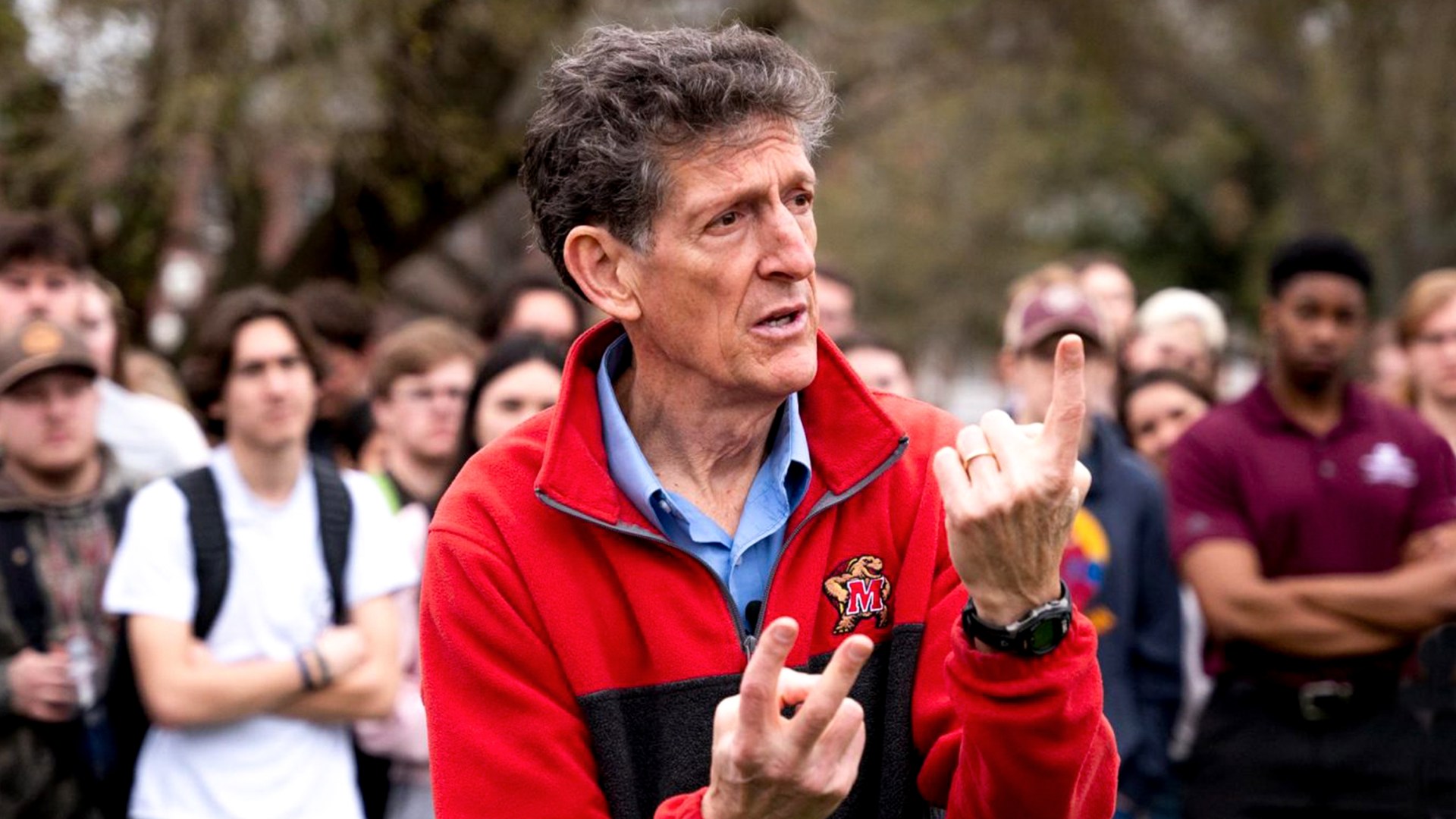
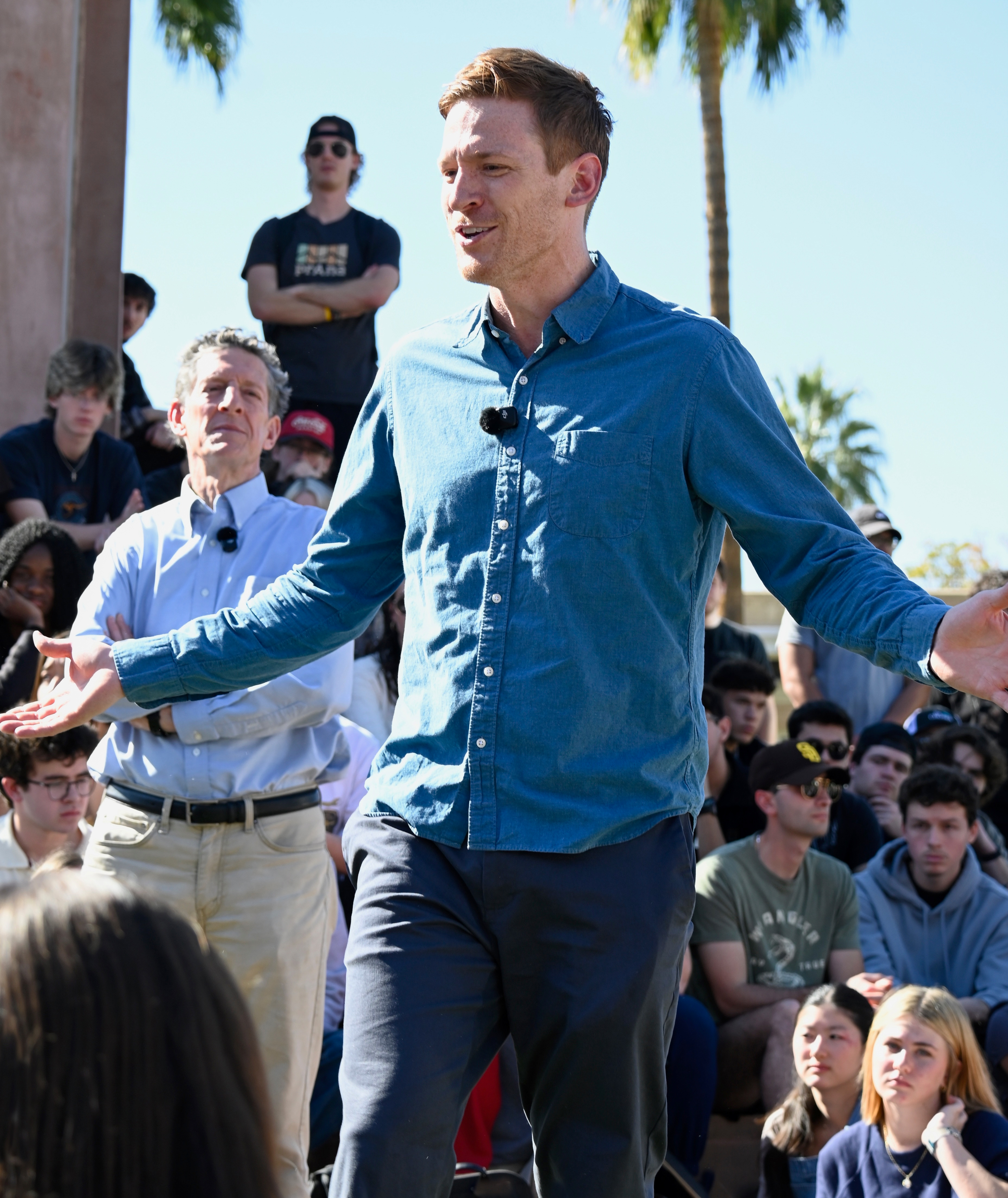
Cliffe Knechtle debating at a college campus

Cliffe Knechtle speaks with college students at Mississipi State University in March 2024.

Christianity Today August 6, 2025
Photo Courtesy of Samuel Hughes / The Reflector

At Grace Community Church in New Canaan, Connecticut, friendly greeters chat with the regulars and newcomers who stream through the doors of the local high school where they meet.

A huddle of visitors also surrounds the senior pastor, listening to him hold court as he puts on his lapel microphone minutes before the service begins in the adjoining auditorium. This group drove over an hour, from the United States Military Academy in West Point, New York, to meet him.

Cliffe Knechtle, the 71-year-old pastor of a typical nondenominational congregation, also has a celebrity-level internet presence. He preaches to hundreds on Sundays, and millions have watched clips on TikTok, Instagram, and YouTube of the open-air campus dialogues that have defined his four decades of ministry.

These social media videos show Knechtle debating hostile challengers or calmly coaching a seeker through a nagging doubt about the Christian faith.

“We’ve seen his videos, but I think the biggest thing for us was just to actually see him in person,” said Markel Johnson, one of the visiting cadets. “We were actually talking to him about coming, possibly, to West Point.”

Visitors like Johnson regularly show up at Grace, coming from as far away as Australia. But while Knechtle draws scores of TikTok pilgrims to New Canaan, he reaches exponentially more people on the internet.

Before his rather sudden takeoff on viral video platforms, Knechtle persevered through a long, relatively obscure slog from one college campus to the next, often with his wife, Sharon, and their three boys in tow. Though much has changed, he insists that one thing has not: Faithfulness, not virality, is the measure of a ministry’s and a minister’s success. 

At 26, Knechtle was frustrated. 

He had joined InterVarsity Christian Fellowship as a staff evangelist soon after graduating from Gordon-Conwell Theological Seminary in Massachusetts in 1979. With the goal of reaching skeptical students, he took trips to colleges, where he would visit dormitories to speak. 

Skeptics rarely showed up, though. It was mostly Christians who wanted to engage. Knechtle wasn’t sure how to change that, but Leighton Ford had an idea. 

A prolific and prestigious evangelist, Ford, 93, has been many things to many people. To Billy Graham, he was a mentee, ministry partner, and brother-in-law. To attendees at mass evangelism events around the world, he was a stirring preacher. And to Knechtle’s father, Emilio, he was a friend.  

Several years earlier, Emilio Knechtle had brought his son to meet Ford and his wife at their home in Charlotte, North Carolina. The Knechtles were visiting nearby Davidson College, where Cliffe would soon enroll. After he moved to campus, the Fords invited him for another visit. Before long, he was spending most weekends in their home. 

Ford became a spiritual father and mentor to Cliffe, so his words to the disheartened young minister held great weight. They were sitting together in Cliffe’s parents’ living room when Ford made a suggestion that would change Knechtle’s life. 

Cliffe Knechtle speaks to students outside HSS at the amphitheater.Photo Courtesy of Ericksen Gomez-Villeda / The Daily Beacon
Cliffe Knechtle speaks to a crowd of students at the University of Tennesee, Knoxville in November 2024.

Ford recounted that on a recent visit to the University of Arizona, he had noticed an open-air preacher delivering a “hellfire and brimstone” message. Students had quickly gathered around. What if Cliffe tried something similar but instead of condemning the listeners to hell, he presented “both the love and the truth of Christ”?

Knechtle remembers his gut reaction: “It’s a crazy idea, but because it’s Leighton Ford telling me, I think I’ll try it.”

He traveled to Fort Lauderdale, Florida, during spring break as part of a project with InterVarsity and started preaching on a crowded beach. Young vacationers hopped off their towels to listen.

“I jettisoned my outline and began to answer their questions, and that’s how we began the dialogue” Knechtle recalled. 

InterVarsity began sending Knechtle to colleges all over the country to hold open-air dialogues. Each visit lasted about a week, and the InterVarsity chapter or another Christian organization on campus cleared the gatherings with school officials.

Knechtle opened each session with a short introduction and then invited onlookers to ask questions. A Christianity Today article from 1981 records that he visited over 30 campuses in the first year of this new ministry, a pace he would maintain for the next decade. 

Those early years were exciting and challenging. Knechtle spoke to plenty of doubting and agnostic young people, many of whom were eager to stump him. Sometimes they did. When that happened, Knechtle began saying (with a slight pause after each word, ticking them off on his fingers for emphasis) what would become a catchphrase: “I. Do. Not. Know.”

“I had to give that answer a lot more often when I started open air than I do today,” Knechtle said. “But I still think even today, it’s one of the best answers I give.”

Knechtle said “I do not know” so often that he says the phrase became his eldest son Robert’s first words. This honesty and vulnerability differentiated Knechtle from the sort of preacher most students expected. Knechtle still drew plenty of hecklers, but many non-Christians appreciated his approach.

Paul Tokunaga saw this dynamic firsthand while a campus minister at Florida State University in the early ’80s. Students there were accustomed to seeing outdoor preachers “shouting and often berating people,” Tokunaga said. The InterVarsity chapter invited Knechtle, hoping he would engage with students constructively while still capturing their attention. 

Students would say, “Hmm, this guy’s a little different,” Tokunaga recalled. “He’s not calling us names, he’s listening to us, and some of what he says makes sense. I think I’ll stick around and see what he’s about.” 

During his first visit to Florida State, Knechtle asked some InterVarsity students to talk about how they came to faith. The next time, Tokunaga worked up his nerve and volunteered to share his story along with the students. To his surprise, Knechtle instead challenged Tokunaga to join him in preaching and answering questions. 

“I just had a heart attack,” Tokunaga remembered. He worried that he didn’t think quickly enough on his feet to give strong answers during a debate, and the thought of engaging with antagonistic hecklers was intimidating. All in all, it sounded like a good opportunity to get embarrassed. Still, Tokunaga decided to try.

Before going before a crowd, Tokunaga preached in his apartment to an audience of one: Knechtle, who offered tips and tried to simulate the environment they would encounter on campus. Later that week, it was time for the real thing. 

“So I went out there,” Tokunaga said. “Cliffe was kind of hanging back. … He was kind of my security blanket. And it went okay. People asked questions, and I think I answered most of them. I don’t know if the answers were any good or not, but I did my best.”

Despite his initial reservations, this experience became a springboard for Tokunaga. He continued to speak and served with InterVarsity for over 40 years, including as a vice president.

As the years rolled by, Knechtle continued his itinerant ministry and developed a following. He was invited to speak in connection with a Billy Graham crusade in Chapel Hill, North Carolina, in 1982 and the Urbana student missions conference in 1984. 

In 1986, InterVarsity Press published Knechtle’s first book, Give Me an Answer That Satisfies My Heart and My Mind: Answers to Your Toughest Questions About Christianity. Still conscious of negative stereotypes, he wrote in the introduction that he hoped the book would “give some degree of credibility and substance to my ministry since open-air preachers do not have the greatest reputations.”

Almost 40 years later, he’s not sure that the book had much of an impact on the way people perceived his work. Today, though, fans from social media bring copies to Knechtle’s events or church for him to autograph. 

Family dynamics eventually forced Knechtle to scale back his travel. His sons were getting older, and the family needed more stability. He accepted a position as an assistant pastor at a church near New Canaan. The open-air dialogues continued but at a reduced pace and eventually under a new ministry called Give Me An Answer.

In the early ’90s, the senior pastor at Knechtle’s church asked if he had ever considered using television to share the campus debates with a wider audience. Doubtful at first, Knechtle again ran the idea by Ford, who encouraged him to seek the counsel of Ben Haden, a Presbyterian pastor with a thriving television ministry. Haden gave advice on how to get started. 

Before long, a small camera crew was accompanying Knechtle on his trips to Austin, Texas, and East Lansing, Michigan, and other college towns in between. A producer edited the footage into half-hour episodes, which aired on local television in Connecticut and other markets. 

Old recordings of Knechtle from the ’90s show him in much the same form that students see on campuses today. He paces back and forth, answering students’ questions, often emphasizing his points with animated gestures or a well-timed pause. He entertains more enigmatic theological or moral questions, but his focus is on introducing people to his “closest friend, Jesus Christ.”  

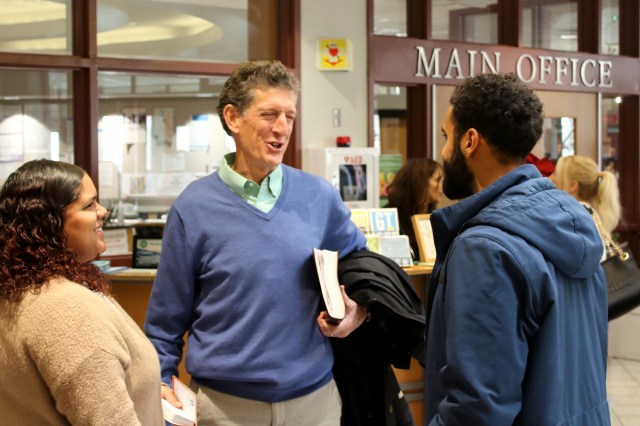
Cliffe Knechtle chats with visitors after a worship service at Grace Community Church in New Canaan, CT on December 8, 2024.Photo by James Thompson
Cliffe Knechtle chats with visitors after a worship service at Grace Community Church in New Canaan, CT on December 8, 2024.

The first time I spoke to Cliffe, I had called his office hoping to schedule an interview. He picked up while I was leaving a message. We exchanged pleasantries for a few moments, and then I suggested we arrange a time for a longer conversation on Zoom.

A pause.

“I’m sorry, brother,” Cliffe said with a hint of embarrassment before explaining that he wasn’t sure he could use the video-conference platform without help. Would I mind just calling his landline instead?

This seems as good a time as any to mention that starting a social media ministry was not Cliffe’s idea. A couple Give Me An Answer board members encouraged Stuart Knechtle, Cliffe’s middle son, who joined the ministry in 2015, to try repurposing content from TV for newer platforms.

Stuart did not have accounts on TikTok or Instagram, and he was unconvinced that the open-air dialogues would find an audience there. Wasn’t TikTok for teenagers with selfie sticks?

“I thought it was silly,” Stuart told CT. Eventually, some contacts sent him studies on how other ministries had grown because of TikTok, and he thought, “All right, let’s give this thing a chance.”

He began posting reels on TikTok in 2020. They showed a few seconds of Cliffe talking or debating with someone on a campus, captioned with an attention-grabbing quote from their discussion.

Most of the videos fell flat, but occasionally one would gain traction—often clips of Cliffe debating broader cultural issues. Stuart used this insight to begin building a following. 

“I tried to have this balance of, okay, here’s where we’re really going to get incredible engagement,” Stuart recalled. “And it’s not overtly gospel. But now in the next post, I’m going to [use a clip focusing on] the gospel so that big audience that you just drew, that’s anti-Christian even, is going to hear the gospel.”

The ministry’s social media accounts grew over several years. They now have over 2 million followers on both TikTok and Instagram (both accounts are under Stuart’s name) and over 880,000 subscribers on YouTube.

Stuart remembers breaking a million followers on TikTok as a turning point. Fan accounts began remixing and reposting their content, making clips into memes or editing them with dramatic music in the background. This helped widen their reach even further.

When I interviewed Cliffe last year, there was still a bit of disbelief in his voice when he talked about the scope of the ministry’s internet presence. He referred to TikTok as a “godless, secular social media platform” but said that “to be able to present the gospel in that environment is just such a privilege.”

TikTok has changed the Knechtles’ reception on campus. Cliffe used to have to wait for crowds to form—once, at Rutgers University, he started preaching to his wife because no one was stopping to listen—and sometimes large gatherings turned against him, even spitting or throwing things at him. One of Stuart’s earliest memories is of Cliffe speaking to an especially antagonistic crowd at the University of California, Berkeley. 

Now, crowds gather before they arrive. On many campuses, especially at universities in the Bible Belt, the questions overwhelmingly come from Christians who have seen the duo online.

Cliffe said he’s grateful for the chance to speak to so many students, but there are challenges to this new reality too. All the positive attention creates an environment where it’s harder to have dialogues with non-Christians.

“If you have a [large group of] students out there and the vast majority of them are followers of Christ, it is not cool to step out and really lambaste me, and I miss that,” Cliffe said. “Those are the folks I want to talk to.” 

For viewers who have watched Cliffe having a fiery exchange with an agnostic undergrad and thought maybe he should dial it back a bit, so has he. On occasion, debates with students have devolved into shouting matches, and Cliffe admits that at times he’s gotten “too upset, too angry,” and “too intense.” He has felt the Holy Spirit convict him of this, in some cases directly after an exchange with a student, and apologized.  

“I’ve had to work hard on growing in patience, and that’s been very, very helpful for me to grow in that area,” he said. 

But he is also convinced that he should give the most robust apologetic of the gospel that he can, even when that means stepping on some toes.

This conviction grew stronger after a conversation years ago with Steve Brown, a Presbyterian minister and author. At an InterVarsity beach-evangelism project in Fort Lauderdale, Cliffe wondered aloud if sometimes it might be better to lose a debate with the long-term goal of not turning the person off from the gospel. Brown immediately rejected this idea.

“Steve looked at me and said, ‘Don’t you ever lose an argument,’” Cliffe remembered. “‘You make sure that you communicate the truth as clearly as you can.’”    

It’s a lesson that Cliffe has passed on to his son. Stuart, in addition to being an assistant pastor at Grace, is also a therapist. In his first open-air dialogue with Cliffe after joining his ministry, Stuart took a laid-back, clinical approach in their conversations with students.

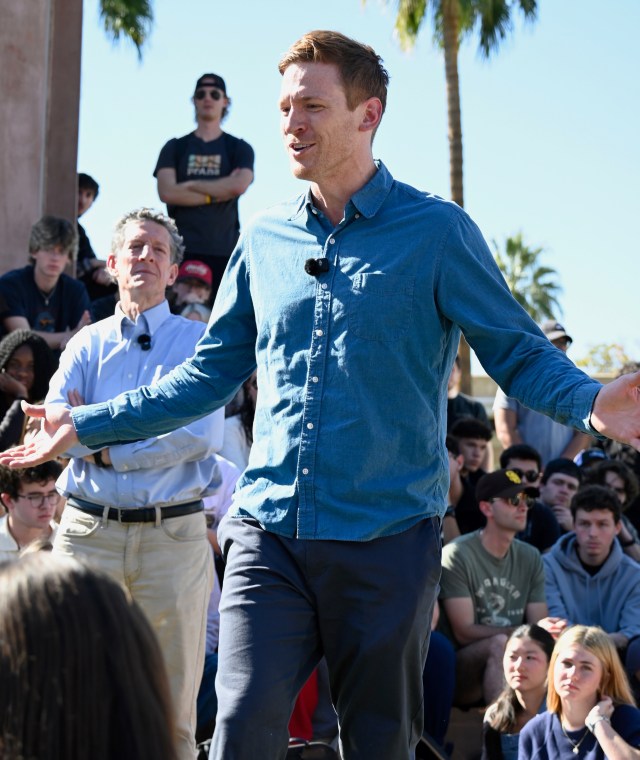
Stuart Knechtle talks with students at Arizona State University in February 2025. Photo Courtesy of Give Me An Answer
Stuart Knechtle talks with students at Arizona State University in February 2025.

Stuart remembers feeling “a little bit defeated” at the end of the day, as not many people had stopped to talk with them and the exchanges they did have hadn’t seemed very productive. Afterward, Cliffe offered some encouragement—and then some feedback: Open-air evangelism is not the time for a “large-group counseling session.”

“I don’t think I’ve ever taken that approach again,” Stuart said. “I do a lot of one-on-one counseling, [but] that style and delivery doesn’t translate well. You still want to speak to the heart and love a person into the kingdom ultimately, but if your delivery and style is too PC, it’s just not going to be effective in that kind of environment.”

Clips from open-air debates are proliferating online, as many ministries and groups have recognized their power to attract viewers and engagement.

Sean McDowell, a professor of apologetics at Biola University and host of the Think Biblically podcast, said that people are drawn to the “inherent drama” of open-air dialogues, and that the format can often help a speaker reach a wider audience.

“Many people are invited to consider spiritual things who might not be on an active search,” McDowell said. “The downside is that many presenters are not able to engage as effectively as Cliffe and often come across as either angry or uninformed. Done well and wisely, I don’t think there’s any considerable downsides of having it as one important element of evangelism. It is one effective way to evangelize. And Cliffe and Stuart are the best.”

The explosion of their digital ministry has netted Cliffe and Stuart invitations to appear in new venues, including some where evangelical pastors are not usually invited. In May 2024, they were on influencer Logan Paul’s Impaulsive podcast.

Paul’s show can be crass and would never be mistaken for a Focus on the Family program. For two-and-a-half hours, though, Paul and cohost Mike Majlak peppered the Knechtles with tough but friendly questions about their faith. The episode has 4.2 million views. 

They received “a little bit of blowback” online, Cliffe said, from Christians who were concerned about them appearing with a controversial figure like Paul, but Cliffe believes most people understand why they want to be in “places where people desperately need the gospel.” 

Much like on a college campus, his goal in settings like Paul’s podcast is “to listen to people, understand where they are, and then help them take the next step closer to Christ.”

There have been invitations to appear in more political spaces as well. Over the years, Cliffe has eschewed wading into that arena directly and often parries political questions with a line about how America is great when it follows Christ and ugly when it does not. He encourages Christians to vote and participate in politics but doesn’t publicly advocate for specific politicians or parties.

In December, he told CT that this approach reflects the priority of his ministry.

“I feel called to build bridges with people who don’t believe in Christ,” he said. “I do not want to unnecessarily alienate anybody. The cross of Christ is offensive enough as it is; the word sin is offensive enough as it is, as is judgment and hell. And we don’t back off from any of that.

“We also don’t back off from the ethical lessons that the Bible teaches us, and those are highly offensive as well. So I do not want to add the political differences to the conversation. Instead, I teach people to read the Bible, apply it to their lives, [and] think through all the different issues.” 

To be sure, he doesn’t hesitate to articulate clear positions on hot-button topics like abortion and sexuality. Yet despite his aversion to supporting specific political parties or candidates, Cliffe has appeared at events hosted by Charlie Kirk, the conservative political activist and MAGA insider.

In some ways, this collaboration makes sense: Kirk is an evangelical Christian, and faith has seemed to take a more prominent role in his work in the past few years. Like Cliffe, he visits college campuses to take questions from students, and clips from these events rack up millions of views on social media.

But the two men offer different takes on how faith and politics should intersect. In conversations with college students, Cliffe is sometimes at pains to convey that following Jesus is not synonymous with a particular political party or persuasion. Kirk puts forward a starkly different view: that a true born-again Christian cannot vote for a Democrat.

Kirk has also pushed American pastors to directly endorse conservative candidates and has said that congregants should leave their churches if their pastors resist becoming explicitly political.

Cliffe noted that he and Stuart appeared with Kirk at a “Believer’s Summit,” not an event directly focused on politics. They have since joined him for another, similar gathering in February. Both events were organized by TPUSA Faith, a church-focused initiative of Kirk’s organization, Turning Point USA. 

“If someone on the other side of the political aisle would invite me to [talk about faith], I would welcome that opportunity and would jump at it immediately,” Knechtle said. “But it was only Charlie Kirk that so far invited us. So I accepted, and we had a great time there.”

The young evangelicals who fill Liberty University’s Vines Center for Convocation gatherings usually give guest speakers a nice round of applause as they take the stage.

This past November, they stood for Cliffe. The ovation lasted almost 30 seconds. When it finally died down, several students in the audience called out at him, like lifelong fans finally seeing their favorite musician in concert. 

He replied with a shy grin, a wave, and a thumbs-up, then launched into his talk: “How do you share your faith? How do you communicate Jesus Christ to people living in the secular culture that we live in today? Three points this morning …”

Why does Cliffe have such a passionate following among young, social media–savvy evangelicals? Getting him to reflect on his “success” or “influence” is a bit difficult, as he seems to automatically deflect recognition toward others: God, for giving his ministry opportunities to reach people in new ways; Stuart, for starting and managing their social media accounts; his church, for being so supportive. From his perspective, he’s just kept plodding in the same direction.

“I got a great compliment last week,” he said, chatting with me in the basement of his Connecticut home while his family gathered upstairs. “A guy said, ‘I’ve watched your old stuff. I listen to you today. You’re the same.’ So the point is, faithfulness is the barometer of success. The message does not change.”

Cliffe sees the process of a person deciding to put their faith in Christ as a “chain with many links.” The open-air conversations, he said, are often a first or middle link rather than the final one.

Through his many, many years of pre-TikTok ministry, he often didn’t get to see much visible fruit from his work (although sometimes he did). Now, hundreds of responses to their social media posts attest to how content from Give Me An Answer has helped many trust in Christ for the first time.

He mentioned the importance of faithfulness several times during our conversation, and I asked if this focus on remaining faithful to his calling is what kept him motivated during more discouraging times in his career.     

“Yes, but that’s no different than today,” he said with sudden intensity. “Now I just have to figure out how I can put the best schedule together to get to the most non-Christians, and that’s exactly what I was asking 44 years ago and 20 years ago. So it really hasn’t changed that much.”

News

Can Anything Good Come of Modern-Day Nazareth?

Local corruption, criminal gangs, and the Israel-Hamas war have left Jesus’ hometown struggling.

A man stands near the altar at the Roman Catholic Basilica of the Annunciation in Nazareth in northern Israel.

A man stands near the altar at the Roman Catholic Basilica of the Annunciation in Nazareth.

Christianity Today August 6, 2025
Nicolas Garcia / Getty

Step into the streets of Nazareth, the famed hometown of Jesus, and the smell of garbage overwhelms the senses. Along the streets, trash is piled high on every corner; the city government can no longer pay for trash trucks. Souvenir shops selling cross necklaces and wooden carvings of the Nativity are closed, and the streets of Nazareth’s Old City empty as the Israel-Hamas war has stopped the flow of Christian tourists to the city.

In the past, Christian residents used to use the motto “Come and See” to entice outsiders to visit the city, based on Philip’s answer to his brother Nathanael when the latter asked “Nazareth! Can anything good come from there?” in John 1:46.

Today, many are reluctant for others to see the city in its current state.

The city’s economy has tanked as the war has devastated its tourism industry. Criminal gangs are running rampant in the city, and the municipal government is facing a severe deficit.

The increase in crime the past several years has led droves of residents, many of them Christians, to move to the adjacent Jewish town of Nof HaGalil (previously called “Nazareth Illit”), which receives generous government support. (Predominantly Arab cities like Nazareth have lower standards of living and receive less government funding than predominantly Jewish cities.) Others are moving to Haifa, which has a mixed Arab and Jewish population with a substantial number of Christians.

“People in Nazareth are weary psychologically from the pressures,” said Azar Ajaj, president of Nazareth Evangelical College and pastor of The Local Baptist Church. Christian groups are also facing high taxes. Yet Ajaj and the remaining Christians in Nazareth feel called to continue ministering and seeking revival in the city Jesus once called home.

Located in northern Israel, Nazareth is the largest Arab city in Israel as well as the most Christian city in the country, as a fourth of its 80,800 residents are Christians. For decades, Nazareth was considered the capital of the Arabs in Israel, with thriving markets, a good school system, several Christian hospitals, and famous attractions for Holy Land tours. Hundreds of thousands of Christian tourists visit the Annunciation Roman Catholic Basilica, which has ruins of (presumably) the house of the holy family; Synagogue Church, where Jesus is believed to have read from Isaiah as recorded in Luke 4; and Nazareth Village, a replica of the city as it would have been in the first century.

Yet in recent years, crime within the Arab community has been on the rise, claiming the lives of more than 150 people so far this year. This includes gang wars as well as gang members shooting owners of local businesses who refuse to pay protection money. Research by the Taub Center found that the murder rate in the Arab Israeli community is the third highest in the developing world.

Meanwhile, only about 11 percent of criminal cases are resolved by the police.

Many blame Israel’s far-right minister of national security, Itamar Ben-Gvir, for not putting an end to the widespread violence among Arabs in Israel. Ben-Gvir has in the past made anti-Arab comments, including saying in 2023 that his right to life outweighs Palestinians’ right to travel freely in  the West Bank.

Nizar Touma, pastor of the Nazarene Church in Nazareth, noted that one of his congregants who worked as a construction contractor moved away after a criminal gang asked him to pay protection money or they would damage his equipment. The man and his family are seeking to move to the US. They are the second family to leave in the past year, a significant loss to a church of 150.

Meanwhile, since Mayor Ali Sallam came into office in 2014, the city’s deficit has grown to 300 million shekels ($88 million USD) due to mismanagement, corruption, and misconduct, according to Sharif Zoabi, head of the opposition leader in the city council. He said that many departments lacked managers and the city kept hundreds of people on its payroll even though they sat at home or worked elsewhere.

Without funds, paychecks to the city’s employees, including trash truck drivers and security guards, stopped in February, so for months trash piled up on the sides of roads. Residents either rented private trucks to transport waste or burned their trash in their backyards.

As a result, Israel’s minster of interior dismissed the elected mayor of Nazareth, dismantled the city council in June, and appointed a committee of government officials headed by Yaakov Efrati, a retired Jewish official who had served as the  general director of the Jerusalem municipality.

In order to fill the city’s empty coffers, the committee demanded that city residents, businesses, and even Christian hospitals and schools pay high taxes. Previously, religious organizations were tax exempt. One school said it had to pay around $250,000 annually, while a Christian hospital said its taxes, which include retroactive payments for the last seven years, total in the millions. The taxes would jeopardize the institution’s existence. Also, several Catholic schools took the committee to court.

“Nazareth municipality’s recent attempt to impose municipal taxes on long-exempt Christian schools is a matter of grave concern,” Farid Jubran, the general director of the Secretariate of Christian Schools in Israel, told CT. “This move undermines the very foundation of Christian education in the city. These schools are not only legally exempt; they are vital to Nazareth’s identity and future, serving thousands of students across communities.”

Touma even received a notice that his church had to pay taxes. When he reached out to the accountant of the municipal committee, the accountant asked Touma to provide evidence that his church was a place of worship, despite the fact that the church had existed for more than a century.

In addition, because Nazareth is in northern Israel, it was a target for missiles last September and October when fighting between Israel and Hezbollah in Lebanon intensified. Then in mid-June, as Israel attacked Iran, Nazareth residents again feared retaliation, running to shelters and safe rooms at the sound of alarms.

“Hearing air raid sirens, the booming sounds of explosions, and realizing you have no control over the situation made me feel a kind of fear,” Ajaj said. “But this very fear drove me to rely on God in faith, remembering that God is above all and that not a single hair from our heads falls without his permission.”

The war has led more and more Nazarenes to move abroad, with Greece and Cyprus being population destinations. A recent Arab Christian transplant to Cyprus told Haaretz that nearly 800 other families have moved to the country, where they have made new lives for themselves running vacation rentals, forming construction firms, establishing factories, or starting restaurants.

Yet the Christians remaining in Nazareth continue to serve. Ajaj noted that since the  beginning of the war, his college’s classes have moved completely online. Students from all over Israel and the world are now joining the lectures. “We will hear sirens, and students will leave their screens and rush with their families to safe rooms,” Ajaj noted.

“A lot of our students are pastors themselves who were overloaded with pastoral responsibilities with their congregants, and our lecturers’ jobs converted to be [to giving]encouragement to these students/pastors,” he added.

Touma says that, while pastoring amid wartime is difficult, he sees sharing the hope of Jesus to his hometown as a pressing obligation. He encourages church members to stay in Nazareth and keep walking in the faith through visiting church members and local residents as well as handing out food coupons to the needy.

“I have learned how to sit at the Master’s feet and receive comfort and strength to carry on,” Touma said. “[I’m] hoping that I can get others to do the same.”

The women’s ministry in Ajaj’s church held a prayer meeting for all the Christian women in the city on Annunciation Day, March 25, which is known locally as Nazareth Day. They focused on Jeremiah 29:7: “Seek the peace and prosperity of the city to which I have carried you into exile. Pray to the Lord for it, because if it prospers, you too will prosper.”

Cautious optimism is in the air with the new committee running the municipality.

“I believe that in his timing, the Lord will bring restoration and a revival in his hometown through dedicated men and women from all ages who love Jesus; are well trained; and have a vision for evangelism, bridge building, and expanding the kingdom,” Ajaj said.

Books
Review

Christian Colleges Shouldn’t Operate Like Businesses

Doing so might help them survive an era of school closures, but at what cost to the mission they profess?

A graduation cap full of money.
Christianity Today August 6, 2025
Illustration by Elizabeth Kaye / Source Images: Getty

Much media attention on higher education focuses on elite institutions, especially the topics of who gets admitted and what opinions students and faculty hold. Elite institutions shape the popular image of a college campus. They also hold disproportionately high endowments (just over 10 percent of America’s colleges and universities have 75 percent of the endowment assets).

But students are far likelier to attend schools outside that 10 percent, which rely on funding from tuition payments rather than ample endowments. These tuition-driven schools are struggling to survive, and institutions of Christian higher education almost always rely on tuition funds.

In Capitalizing on College: How Higher Education Went from Mission Driven to Margin Obsessed, Joshua Travis Brown explores the challenges and choices facing tuition-driven universities, through case studies of eight religious institutions. Brown, an education professor at Johns Hopkins University, chose religious institutions because they represent “the largest group of schools among the tuition-driven institutions,” they often serve underserved populations, and they “possess tenets about money that should seemingly offer leaders motivation to push back on extreme market practices that might undermine their educational mission.”

In sum, these schools are more likely than most to possess an animating mission that puts service above profit. At the same time, however, they are more likely than most to face financial pressure from the current higher-education marketplace.

Capitalizing on College analyzes the economic forces at play and various institutional reactions. Brown highlights decreased financial support for universities from the state, the allocation of government funding per student, and the ways that individual students, rather than communities, increasingly bear the costs of higher education. These changes coincide with a decline in the population of traditional college-aged students. There also happens to be a lot of animosity toward higher education right now.

Schools without large endowments find themselves pressed to increase enrollment, almost at any cost. As one administrator told Brown, “We have to grow, or we’re going to die.” This is the situation facing small Christian colleges across the country.

All eight universities featured in Capitalizing on College have responded to financial challenges with a coherent strategy. Each of these schools “rejected the status quo,” writes Brown, and turned to entrepreneurialism to “pursue nontraditional student enrollment growth.” To understand the various approaches, Brown spent two years conducting 150 interviews, visiting campuses, and doing archival research.

The eight institutions, which he refers to with pseudonyms, granted him extensive access, including confidential interviews with presidents, provosts, and faculty; information about recruiting and admissions; and campus tours. This book offers a strong balance of statistical and broader insights, and it benefits from the inside perspectives shared in interviews.

Capitalizing on College identifies four attempted strategies for surviving collegiate market competition. Some schools chose the “traditional” strategy, emulating the best practices of elite universities, with the goal of raising a university’s profile and increasing its endowment with philanthropy. Others adopted the “pioneer” strategy, showing a willingness to challenge tradition and pursue nontraditional students through multiple campuses. Colleges opting for the “network” strategy attempted many things at once, including new locations, programs, and methods of course delivery, all while emphasizing “the relentless addition” of online and other nontraditional students.

In Brown’s account, the traditional, pioneer, and network strategies all achieved some success. Ultimately, however, they failed to save schools from their financial woes or establish stronger endowments. Each strategy posed challenges to the universities’ missions and values. In the case of the network strategy, modified organizational structures also became a challenge.

In the end, only a fourth option—the “accelerated” strategy—proved successful in dramatically and consistently increasing enrollment and the endowment. Just one of the schools featured in Brown’s case studies pursued this strategy, which involved a rapid ramp-up in online education. In this case, revenue from online students became the school’s dominant funding source, with their ranks eventually outnumbering the residential students ten to one.

Yet the improved financial outlook came with considerable costs. The drastic shift toward online education compelled the university to operate more like a business than an educational institution driven by a distinct mission. The school even outsourced the design of its programs and courses. In some ways, then, the accelerated strategy represents survival, in other ways the opposite. 

One problem facing all tuition-driven schools is the price of the traditional college experience. The physical architecture and in-person classes, the support staff, and the country club–style amenities are expensive. So is the technology a university requires. Schools have found that financial support may come from increasing tuition, admitting more students who will pay full tuition, seeking philanthropic gifts, and instituting online programs that cost less to run, among other avenues of revenue generation.

Such survival strategies might preserve the traditional college experience, at least temporarily. But they threaten a school’s mission. To keep traditional buildings, schools ultimately become nontraditional and operate like for-profit entities. They diversify their products. They hire companies to increase enrollment. They take on loans and issue bonds. The end result can be buildings funded by online students who will never use them, underqualified students saddled with debt, questionable admissions tactics, overworked faculty, weakened relationships with students, and university traditions swept away.

Brown shows, too, that when schools operate like for-profit organizations, they tend to compromise core aspects of their respective missions. For example, the universities that pursued greater prestige downplayed their commitments to serving the disadvantaged and meeting needs in their communities.

Growth itself was destabilizing in many schools. Admitting too many students puts a strain on faculty, staff, and facilities, making it difficult to deliver on promises of small class sizes and personal care. The imperative of constant expansion can devolve into a Sisyphean quest for mere survival. Outsourcing course and curriculum design and de-emphasizing professors can weaken the distinctiveness of Christian higher education.

In each university Brown studied, faculty and administrators experienced burnout and struggled to find purpose in their work. The employee testimonies in his book are often very moving in documenting the effects of institutional drift.

Without asking them explicitly, Capitalizing on College raises several questions: What, ultimately, is Christian higher education about? Do Christian colleges need to function differently from other colleges, financially and otherwise? Can a truly Christian education focus on professional training or outsourced curricula that do little to cultivate a Christian worldview? Like it or not, struggling schools are answering these questions in real time whenever they opt to cut humanities programs, rely on generic online courses, or resort to questionable enrollment tactics. 

Does it have to be this way? In Capitalizing on College, as in so many other accounts of the current crisis in higher education, Brown emphasizes the role of neoliberalism—a term that functions, in academic circles, as a rough stand-in for market capitalism. The argument is not entirely unconvincing, but to reach and convince a broader audience, Brown could do more to define neoliberalism.

Capitalizing on College could also do more to reinforce the distinctions between neoliberalism and other challenges to higher education, including demographic uncertainty and administrative bloat. Although Brown addresses these topics, he could have explored them further. For example, administrative bloat often receives blame for the rising costs of college. Does that charge hold up, or is it more like blaming millennials for splurging on avocado toast (a real expense) rather than saving for a down payment (which might be out of reach for other reasons)? What about the on-campus amenities? Perhaps a pared-down university could be more sustainable.

Whether or not neoliberalism is chiefly to blame, the crisis facing tuition-driven institutions should matter to American Christians. Many people bemoan the drift of elite schools away from their religious roots, but these same people often make little effort to support schools that remain committed to religious distinctives. Bystanders seem to think that schools fail because they fall away from Christian commitments, but evidence suggests that the dangers confronting most tuition-driven schools are economic, not ideological.

The current economic climate threatens the entire ecosystem of Christian higher education. Left solely to market forces, more schools will close—and those that survive will likely drift from their missions in meaningful ways. The shakeup is already here. Will American Christians consciously and conscientiously help influence the outcome?

Prestigious secular institutions routinely receive very large financial gifts, which allow them to maintain endowments, offer reduced tuition, and produce the scholarship that defines academic fields. Those concerned about a Christian presence in those fields could consider funding scholars at Christian institutions, freeing them to produce serious scholarship rather than presiding over a half-dozen online courses. If you worry about the outsize influence of the Ivy League, think about supporting schools outside its orbit. Capitalizing on College does not offer many solutions to the crisis facing tuition-driven institutions, but that does not mean none exist.

Christian higher education has a long association with the ideals of serving the common good and living life for a higher purpose. Brown’s book helpfully illustrates why that connection might be fraying. For anyone interested in conversations around changes in higher education, the purpose of institutions, and the consequences of economic policies and competition, Capitalizing on College is a worthwhile read.

Elizabeth Stice is a professor of history at Palm Beach Atlantic University, where she serves as assistant director of the Frederick M. Supper Honors Program. She is the author of Empire Between the Lines: Imperial Culture in British and French Trench Newspapers of the Great War.

How One Reader Found a Home At Christianity Today

Christianity Today is evidence that there is good thinking within the Church regarding the Bible and how it intersects with our world.”

Emily Barr
Anya Borodii

In February 2022, Christianity Today’s then-public theologian Russell Moore spoke about the intersection of faith and politics at Emily Barr’s church in Nashville. Emily was paying close attention. The political climate had left her feeling isolated from fellow believers and “dumbfounded” to see Christian leaders supporting politicians whose actions seemed to violate “the morals I was raised with as a Christian conservative.” 

Russell’s words and wisdom resonated deeply with Emily. 

“I remember thinking, Okay, there are other Christians out there experiencing what I am,” she said. “I’m not the only one seeing a disconnect.”

After hearing Russell speak, Emily began encountering his work on social media and found his podcast, The Russell Moore Show. She began reading Christianity Today more regularly, grateful for the publication’s coverage of domestic and global issues affecting the church. (Russell became Christianity Today’s editor in chief in August 2022.) 

“It was a slow trickle, accessing all these resources,” she said. “But it started with the influence of Dr. Moore. His perspective helped me understand why I felt disconnected from my community, my tradition, and my politics—my previous politics.”

Emily grew up in a churchgoing family in rural Illinois. She remembers accepting Jesus personally at the age of 7, after her pastor presented a slideshow about a mission trip he had returned from. Her faith deepened from summer camp and Youth for Christ events before she attended Wheaton College, her father’s alma mater. 

Before settling in Brentwood, Tennessee, Emily worked as a missionary art teacher in a Spanish-speaking community in Los Angeles, taught public-school art in the Chicago area, and then moved to Massachusetts to attend Harvard Graduate School of Education. She met her husband at a church in Cambridge, Massachusetts, as she trained teachers in Boston Public Schools.

Now a mother of two teenage girls, Emily has become a consistent Christianity Today reader. In the past year, she’s appreciated CT articles that resonate with different aspects of her everyday life, such as parenting, public education, caregiving for aging parents, and the influence of social media.  

She also listens to CT’s podcast The Bulletin regularly, enjoying its faith-based commentary on current events. “I’m just so thankful that Christians are thinking and talking about stuff that matters and that’s immediately applicable to my daily life,” she said. “CT’s content helps me stay sane and hopeful right now in what seems like a hopelessly polarized country.” 

Emily also appreciated CT’s recent podcast, The Devil and the Deep Blue Sea, an investigative study of the Satanic Panic and how the ensuing hysteria diverted the Church from confronting abuse within its ranks. She drew parallels with the 1980s, 1990s, and the present, feeling both reassured and unsettled by the cyclical history.

The Devil and the Deep Blue Sea definitely put me in a little tunnel,” she said. “I remember those days, that emphasis on outward, moral behavior, and how it backfired. I had a hard time getting out of my car and talking about what we’re going to have for dinner after listening to those episodes.” 

Because of her Midwest roots, experience as a missionary, and career in mostly urban educational contexts, Emily values a conversation that includes the diverse perspectives of Christians around the world. She’s found more of that conversation in Christianity Today’s reporting on the global Church. 

“We ought to be reminded that Christians look and act differently and have different traditions and backgrounds and ideas about how the world works best. And Jesus is enough to bind all of that together,” she said, noting that more than one-third of CT’s readership is from outside of the United States. 

“The extent to which we let our own tribe or our own denomination or our own tiny little corner of the world dictate how we see God’s kingdom limits our ability to really listen to and love our neighbors.”

Emily grieves for the many in her generation who have stopped attending Church because they have grown weary of its politicization. CT has helped keep her from growing overly cynical. 

“Christianity Today doesn’t align with a party,” she said. “They are critical from a theological perspective on things in society that are contrary to the Word of God, but they do it in a way that is accessible, with language that values compassion and different points of view.” 

Emily believes that “loving and winning people to Christ” requires an openness toward them—a characteristic she believes Christianity Today embodies. “CT is thinking about almost every topic in a way that is fruitful and invites conversation,” she said. “It doesn’t shut down. It doesn’t shame other people. It’s like, ‘Come and talk about this with us.’”

Emily and Russell are both local to the Nashville area, and she recently ran into him at the grocery store. 

“I was able to thank him personally for the way his work has encouraged me to ask hard questions, remain hopeful, and love others,” she said. “Christianity Today is evidence that there is good thinking within the Church regarding the Bible and how it intersects with our world. That makes me really happy.”

News

Ethiopia’s Urban-Renewal Project Raises Expectations for Rural Christians

A farmer and witch doctor turned pastor advocate for better roads and improved water access.

A man points to the road that leads to the school.

Top and bottom left: the road that links the TRI school and the village. Top right: A community church in Ethiopia.

Christianity Today August 5, 2025
Illustration by Christianity Today / Source Images: Courtesy of Three Roots International

Pastor at his local congregation. Evangelist to his neighborhood. Community board member. But first, Abebe Woldegiorgis was a witch doctor.

Woldegiorgis hails from the rural outskirts of Bishoftu, a city one hour southeast of Addis Ababa, Ethiopia’s capital, and grew up in his country’s historic Christian denomination, the Ethiopian Orthodox Tewahedo Church. Though many residents followed this tradition, superstition and ritual still dictated aspects of their day-to-day lives. Woldegiorgis once helped enforce these practices, asking that people who brought goats or sheep to slaughter during the community’s annual festival receive blessings. 

Woldegiorgis quit school after fifth grade and supported himself and later his wife and three children by helping with occult sacrifices, following directions of a man he calls “the prophet,” a witch doctor.

“I used to hate evangelical Christians,” said Woldegiorgis. “I tried to kill them.”

Woldegiorgis felt this rage personally at the wedding of the prophet’s son when he gifted the groom inexpensive perfume and the prophet lashed out at him. Wounded, Woldegiorgis got drunk. “You are the Devil,” he told the witch doctor. “I’m going to the Protestants.”

Woldegiorgis’s decision lost him his livelihood and the church community he had known since a priest baptized him as a baby. But it also gave him an overwhelming sense of peace, and he no longer fought his anxiety with alcohol and drugs. He persisted in his new faith, despite the dearth of evangelicals in the area and the requests of Orthodox priests that he not evangelize door-to-door in their communities.

This faith also connected him with Three Roots International (TRI), a ministry that helps locals to organize for community development. Woldegiorgis served on an association for parents and teachers and one for leaders from several villages known as the Community Development Committee (CDC).

Like his fellow leaders and neighbors, Woldegiorgis lives in a compound with multiple shelters. Residents construct homes and barns with tin roofs and wooden frames, filling the gaps with mud. Dozens of bunched-up, thorny acacia branches serve as fences.

Many villagers have painted the inside and outside of their homes. One leader’s living room features kelly-green walls, with gold tinsel snaking around picture frames. But nearly everyone lives without basic infrastructure, including electricity, plumbing, and reliable roads.

Woldegiorgis wants the government to address those needs. He sees this advocacy as tied to his faith, and quotes Nehemiah 2:17: “Jerusalem lies in ruins, and its gates have been burned with fire. Come, let us rebuild the wall of Jerusalem, and we will no longer be in disgrace.”

Bishoftu has been free of the violence that has devastated parts of the country in recent years, but the area struggles with persistent poverty. Last year, the government took a loan from the International Monetary Fund and the World Bank but also devalued its currency, causing the birr to overnight lose 30 percent of its value compared to the US dollar.

Nevertheless, Prime Minister Abiy Ahmed has continued with his ambitious plans to elevate Ethiopia’s image, starting with the country’s capital. Wide sidewalks and protected bike lanes have replaced hundreds of homes and businesses. Tall, elegant streetlights line the road from the city’s airport. White Christmas lights gleam as they spiral around palm trees.

New regulations require buildings along main roads in Addis Ababa to turn on lights at night. The second phase of the corridor project, launched earlier this year, will add dozens of playgrounds, recreational spaces, parking garages, and electric vehicle charging stations.

The government has given Bishoftu similar treatment. In March, it announced plans to construct a new nearby airport. During a recent week, day laborers worked in trenches and operated heavy machinery for several miles along the city’s main roads, adding supports underneath them before pouring concrete.

The area’s crater lakes have made Debre Zeyit (as Bishoftu is also known) a regional tourist attraction, generating numerous roadside stands selling neon-colored swimsuits and plastic floaties.

But few villagers work in the local tourist economy. Instead, those who farm or raise cattle struggle. Inherited land subdivides over generations, leaving families with plots too small to sustain themselves. Those who don’t inherit land hope they can find work in Bishoftu as laborers.

The village isn’t far from the city—for those with options other than walking. Those who can afford Bajajs (what Ethiopians call tuk-tuks) hail them when they see them. But drivers usually can’t find enough customers to justify loitering in rural areas. During the rainy season, which starts in July, the flooded dirt roads are passable only in horse carts.

Woldegiorgis and other community leaders are nervous about the government’s larger aspirations. But they’ve seen the railroad and highway that cross through their region and do want authorities to pay more attention to rural infrastructure.

“People are being displaced,” said Woldegiorgis. “The project’s good impact is negated because people have lost homes.”

One of those will soon be Worku Aboye, 57, an Orthodox Christian who chairs the CDC. Aboye’s house sits where local leaders have committed to install an asphalt road. “These changes are bad for me but good for the next generation,” he said.

The government has sent him a letter saying it will compensate him with other land. Aboye prefers cash. He finished 11th grade before he began raising oxen and eventually made enough money to open a bank account, funds he used to rent a home in Bishoftu.

At age 25 he married his wife, Emebet, only 12, who gave birth to their first child at age 13. Emebet was still attending school and did not intend to marry young, but her brother didn’t believe she would ever marry if she didn’t marry Aboye, whose father was an Orthodox priest. Some said the family would be cursed if the wedding didn’t go through.

Though the couple has stayed married, Aboye said, “I would never advise anyone to do that.” The couple has six children. Their five oldest have left the farm life they grew up in for plumbing, fashion design, and engineering.

Three years ago, someone stole 45 radios from his youngest daughter’s school. Teachers had used the devices to continue classes during the COVID-19 pandemic. Angry about the crime, Aboye decided to join the CDC and now chairs the group of six men and six women (eight Orthodox and four evangelicals) who meet once a month to discuss challenges in their community.

The community nominates members to the CDC, but a government office must approve them. The CDC has no legislative authority but has effectively lobbied the local government to establish a main road in one village and install a bridge.

After trying for two years, Woldegiorgis helped villagers in another community with no well access convince the government to let them use a nearby tankard. The change is transformative: Some residents now have a water spigot on their own property. 

Woldegiorgis, Aboye, and others now hope the government will improve a road linking the TRI school and the village. The rainy season batters the road, carving riverbeds in the dirt. When it erodes, it threatens the school’s perimeter and makes it nearly impossible to truck furniture, curriculum, or other provisions to the campus. School officials had to move the school’s gate after intense rain.

One recent Sunday night before the rainy season, a leader received word that the government would bring steel rollers at 6 a.m. Monday to smooth dirt and sand over the road. But the project abruptly came to a halt that morning when the government and a local union could not agree over who was covering the cost of the materials.

Aboye received a call later that week: Government leaders had miscommunicated about the compensation for the materials. Still, no one has come to finish the project more than a month later.

Seeing residents engaged in their community has heartened a 20-year bureaucrat who works closely with the CDC as a supervisor in Bishoftu’s bureau of education. (CT gave the official anonymity because he was not authorized to speak publicly about his work.) One recent afternoon, he dropped by a local clinic, where the CDC tries to encourage more residents to use its labor-and-delivery and medical-testing services.

In a room with numerous charts hanging on the wall tracking vaccinations paid for by UNICEF or USAID, he reminisced about meeting with the CDC leaders last year to encourage their advocacy. He praised them for their vigilance in looking after their villages and school and having a “sense of ownership.”

The official is excited. He said expectations have gone up: “People everywhere are asking for their rights.” They want to know “how the government is using its resources” to provide electricity, roads, and infrastructure. He hopes people will see his efforts to support their work as an outgrowth of his belief: “The most important way to preach the gospel is through my work. … I want people to find faith in Christ through this.”

Theology

One Holy, Universal, and Apostolic Church—Even Your Weird Denomination

It’s easy to focus on our differences from fellow Christians. But our unity by the Spirit is the deeper reality.

A dove walking on the earth
Christianity Today August 5, 2025
Illustration by Christianity Today / Source Images: Unsplash, Pexels

Even as a child, I had an interest in the divided church. Sunday mornings found my family in a United Methodist church, but on Sunday evenings my parents took me to a nearby charismatic church instead. We began the day with liturgy and the Eucharist and finished it, late into the night, speaking in tongues. And neither gathering seemed strange to me. The contrast nurtured an interest in and appreciation for how Christ’s church grows in 10,000 fields. 

That curiosity stayed with me into adulthood, and since 2020 I’ve found myself in a similarly mixed position: I direct the Baptist Studies Center at one of the most well-known universities associated with the Churches of Christ (CoC). 

I’d been teaching for a Baptist seminary in town, and when it was slated for closure, this new partnership struck me as opportune. For deep insiders to both traditions, however, the pairing seemed nearly impossible: The Churches of Christ and Baptists have enough in common to make them enemies. 

Both are reforming Christian movements, and Alexander Campbell, a Churches of Christ forefather, once attended a Baptist church and called his newspaper the Christian Baptist. But that was long ago, and the denominations have long since diverged over musical worship (the CoC historically do not use instruments in church) and the nature of baptism.

This history of similarity haunts West Texas to this day. It’s not unusual, in many small towns, for the Baptist and Church of Christ congregations to be the only two churches around. Yet physical proximity has not diminished a sense of theological distance, and since I began this work, I’ve heard story after story of painful division: CoC parents forcing their daughters to break up with their Baptist suitors, Baptist churches mocking their a cappella compatriots across town.

As a Baptist newly ensconced in a Church of Christ school, I was shocked to realize how little the Baptist and CoC social networks in Abilene overlapped. I found myself at the intersection of two worlds—so distinct yet with so much in common. I determined I could proceed in one of two ways: begin with comparison, enumerating every difference, or begin with charity and ask what we share and why we share it. 

Comparison and understanding of differences are not wrong, of course. But it seemed to me that if I wanted my position to be more than a pragmatic alliance—a marriage of convenience required in this time of widely declining seminary enrollment—then I must take the charitable road. I must commit (and help my students and colleagues and other fellow Christians commit) to a deliberate ecumenism that does not ignore theological disagreement but far more fundamentally attends to our shared confession of Jesus as Lord, a work which only the Holy Spirit makes possible.

Ours is not the only era interested in ecumenism; my most recent book, published today, details the ecumenical initiatives of the last century, from the wide-ranging World Council of Churches to innumerable lay initiatives and missions partnerships. The 20th century saw hardened institutional postures—which had historically divided Catholic from Orthodox and Protestants from other Protestants—gradually soften into dialogues that grew into new configurations altogether. We entered our faith’s third millennium with new denominational arrangements in Korea, India, the United States, and countries across Africa bringing together long-divided bodies. 

That history does not mean our ecumenical future will be all roses. Just like those past efforts, it will involve disagreement and infighting. But we will see new successes too. Here in West Texas, Baptists and Churches of Christ may never agree in our theologies of baptism, but perhaps we can come to recognize the more important reality that both traditions exist as works of the Holy Spirit. 

To confess that Jesus is Lord is only possible through the Spirit (1 Cor. 12:3). And that means that whatever our errors—for we can’t both be right about baptism—our unity in the Spirit is the deeper and more important reality.

Taking that fact as our starting point won’t resolve the divisions between churches. If the Holy Spirit works in and through church traditions in different places over time, then we should not be surprised to find varying records of theological and cultural development. We can’t expect the Coptic church in Egypt to look like the Roman Catholic Church any more than American evangelical congregations will be identical to Pentecostal churches in Argentina. We read the same Scriptures and confess the same Christ, but history creates deep craters and long memories. 

There is a way of talking about “the work of the Spirit” that drifts off into thin air, referring to anything and everything positive that happens in the world. So let me be more specific. In some of the oldest confessions of the faith, the church is described in terms of four marks, four attributes that signify the work of the Holy Spirit in creating the church: It is one, holy, universal, and apostolic.

“One” refers to unity: There is only one body of Christ. It cannot be divided and should work to mend divisions. “Holy” means the church shares in God’s own holiness and is called to bear it into the world. “Universal,” also translated “catholic,” means that what a church fundamentally teaches is not its own peculiar teaching but core doctrine all churches share in common. And “apostolic” means that a church shares in the teaching and authority that belonged to the apostles.

In any church with these four marks, then, our question should not be whether the Spirit is working but how the Spirit is working in its midst. And we must listen for the answer charitably, asking God to help us see what he is doing in other parts of the body of Christ. 

This presumption that the Spirit is in fact at work also invites us to ask the same question about our own traditions, to ask where we have frustrated the Spirit’s work. Two things can be true at once: that the Spirit gives all churches the same vocation of living into the Spirit’s call and that churches do not yet fully live out that calling to be one, holy, catholic, and apostolic. The Spirit’s unity is also the Spirit’s critique, calling us to look at what we have valued, but also at what we have downplayed or even denied. 

Charitably encountering “strange” churches can only help us here, for very rarely are we the first to raise some question in our faith. More often, other Christians in other times, places, cultures, and traditions have already asked it and sought answers in new strategies of engaging with Scripture, missions, worship, structural authority, and more. 

For instance, liturgical renewal—a concern for the church’s holiness among all the people—has appeared among Catholics, Methodists, Baptists, and Episcopalians. Debates over women’s ordination—a concern about who has apostolic authority—have appeared among the Orthodox, Catholics, Presbyterians, and beyond. A concern for the holiness of the body gave rise to medical missions in some corners of the world and charismatic healing ministries in others. The selfsame work of the Holy Spirit, across the 20th century, would yield new fruit in unexpected places. 

We can’t undo the hard history of division among Christians by confessing the Spirit’s common work. Nor does that confession undo our theological and practical errors. But it gives us a different footing on which to ground the work of unity. 

Just as the Jerusalem church could recognize the Corinthian church or the Galatian churches, so we can be curious and gracious toward fellow Christians in worlds very different from our own. We can ask how the Spirit is moving to mark the new church in old ways, albeit ways which are now still strange to our eyes.

Myles Werntz is the author of Contesting the Body of Christ: Ecclesiology’s Revolutionary Century. He writes at Taking Off and Landing and teaches at Abilene Christian University.

News

Muslim Mob Attacks Christian Youth Retreat

Recent incidents have led to debates over where Indonesian Christians can worship.

An aerial view of the village bordering Gunung Koneng.

An aerial view of a village near Sukabumi where the attack on the villa occured.

Christianity Today August 5, 2025
Anadolu / Contributor / Getty

In late June, 36 Christian students gathered at a spacious white villa in Sukabumi in Indonesia’s West Java for a retreat organized by Indonesian Christian Youth Movement. Ranging from elementary to high school ages, they sang worship songs, listened to sermons, and played games.

Suddenly, on the afternoon of June 27, a mob of about 200 Muslims marched to the home shouting, “Destroy that house!” according to video clips posted on social media. Claiming that the group was unlawfully using the private residence as a religious worship site, they stormed the place, forcing the teachers and children out of the house. The mob damaged the home’s main gate, windows, gazebo, garden, and toilets, according to media reports. They also threw a motorbike into a nearby river.

Rita Muljartono, a leader at the retreat, noted that when the mob arrived, “we were all in shock, and we were trying to calm down and trying to keep the kids calm, and we went out of the room to get into the car.” She recalled in a video she posted on Instagram, “And it happened so fast that the kids couldn’t get their clothes, their bags, their equipment. We just herded them into the car.”

As they evacuated the premises, Muljartono noted all of their cars had been destroyed, as the mob had thrown rocks and broken their windows.

“This incident was really traumatizing for us and for the children in particular, as they experienced it firsthand,” she said in the video. She noted that even after the children returned home, they had trouble sleeping and have been afraid of loud noises.

After the homeowner’s younger brother filed a report on the vandalism, the police detained eight people involved in the destruction of the villa.

Christian groups as well as human rights organizations have decried the attack, noting that Indonesian law does not prohibit Christians from worshiping outside church property. Indonesia has the largest Muslim population of any country in the world, yet its government is secular and based on the principals of Pancasila: a political philosophy of monotheism, civilized humanity, national unity, deliberative democracy, and social justice.

Still, attacks on churches and Christian groups are increasing in Indonesia as government officials question whether to regulate non-church buildings serving as “prayer houses,” or places for Christians to offer prayers, praise, and worship. (The house used for the retreat would be considered a prayer house.)

“Worship like this does not have to be restricted, because it is an inherent right of religious individuals, a human right,” said Darwin Darmawan, general secretary of the Communion of Churches in Indonesia (Persekutuan Gereja-Gereja di Indonesia, PGI). “And in my opinion, as long as it does not interfere [with people around them], neighbors or the community should not prohibit it.”

Tangkil village head Ijang Sehabudin, said that the Sukabumi attack stemmed from information circulating among residents on the morning of the attack. A video stated that young people staying at the home of Maria Veronica Ninna were singing Christian worship songs.

Ijang said he and other local leaders went to the house, asking the retreat organizer to stop the gathering, but the group ignored the request. As they returned to their office to write a formal appeal letter, the mob had already started marching toward the house. “They felt that their environmental rights were being disturbed because this house is legally only a living place, not a place of worship,” Ijang told a local publication. He also said it wasn’t the first time Christians had worshiped in the house.

In a meeting between the homeowner’s brother, Yongki Dien, and local officials after the vandalism, Yongki denied the accusations by local residents that the house was a place of worship. Rather he said they used it for “just gathering and praying normally,” adding that he had coordinated the meetings with his neighbors.

Yongki agreed to stop holding religious activities at the home. The local government will compensate the family with $6,250 for the damages.  

Recent years have seen an increase of religious freedom violations, according to reports from the Setara Institute. In 2024, the group recorded 402 violations—including church closures, vandalism, and mob attacks—compared to 329 the year before. West Java was the province with the highest number of violations in 2024 at 38, as Islamic right-wing groups have a strong influence in local politics.

Securing a building permit to construct church buildings in Indonesia is difficult, as a 2006 law requires churches to secure signatures of approval from 60 Christians and 90 people from another faith. Between then and 2015, more than 1,000 churches closed.

In late July, a group of Muslim men disrupted a Christian gathering and damaged the facilities of a prayer house belonging to Indonesian Faithful Christian Church’s Anugerah Padang congregation in West Sumatra. The attackers threw objects, injuring two children who were attending a service. Earlier that month, hundreds of Muslims in West Java protested the construction of a church building, claiming the church leaders had failed to communicate enough with the community about construction plans. In South Sulawesi, local officials denied a Catholic church a building permit after residents of the village voted against it. The church had waited 45 years for the permit.

The PGI, which represents 104 churches in the country, urged churches to continue worship and not to retaliate against the recent vandalism. Darmawan, the general secretary, said that any churches that gather for worship in buildings that aren’t legally church buildings should try to get the needed permits. Yet he also urged the government to facilitate and expedite the process for churches.

He also calls on congregations to “build good relationships with the surrounding community so that people realize the presence of the church is not a threat to their faith.”

Anis Hidayah, chair of the National Human Rights Commission, deplored the attack on worshipers in Sukabumi.

“This has actually harmed the right to freedom of religion and belief, which is a basic right that is not only regulated in the human rights law but also in the constitution and international conventions on civil and political rights,” Hidayah said.

Questions over permits for religious activities are not an excuse for residents to attack others, she added. She also encouraged different faith communities to engage in dialogue and understand the different styles of worship in other religions. For Muslims, corporate worship takes place in a mosque, which may make it more difficult for them to understand why Christians gather outside the church.

The head of the Indonesia’s Center for Religious Harmony, Muhammad Adib Abdushomad, argued that as a growing number of Christians use non-church buildings as prayer houses, the government needs to regulate them to prevent tensions in the community.

While prayer houses are “a religious expression guaranteed by the constitution,” their purpose as a place of worship “has an impact on the public space,” Abdushomad said in a statement. “So there is wisdom in its implementation and indeed this type of prayer house does not yet have formal procedures that can be used as a reference.”

Yet Christians view requiring permits for prayer houses as an overreach.

“The context in Indonesia: We have regulation that if you want to construct a place of worship, you have to get a permit with many requirements,” said Irma Simanjuntak, who attends an ethnic Batak church in North Sumatra’s Pematangsiantar. “But now the radical community also prohibits worship activity in retreat houses and in our houses.”

Rio Boelan, a member of the Protestant Church in Western Indonesia in Bali, noted that while it’s important to inform local officials if they are holding a retreat, “worship doesn’t require a permit because it’s a human right.”

Meanwhile, Muljartono, the teacher at the Sukabumi retreat, agreed.

“As Christians, we still have to worship,” she said in the video. “It can be anywhere, either at home or in church.”

Apple PodcastsDown ArrowDown ArrowDown Arrowarrow_left_altLeft ArrowLeft ArrowRight ArrowRight ArrowRight Arrowarrow_up_altUp ArrowUp ArrowAvailable at Amazoncaret-downCloseCloseEmailEmailExpandExpandExternalExternalFacebookfacebook-squareGiftGiftGooglegoogleGoogle KeephamburgerInstagraminstagram-squareLinkLinklinkedin-squareListenListenListenChristianity TodayCT Creative Studio Logologo_orgMegaphoneMenuMenupausePinterestPlayPlayPocketPodcastRSSRSSSaveSaveSaveSearchSearchsearchSpotifyStitcherTelegramTable of ContentsTable of Contentstwitter-squareWhatsAppXYouTubeYouTube