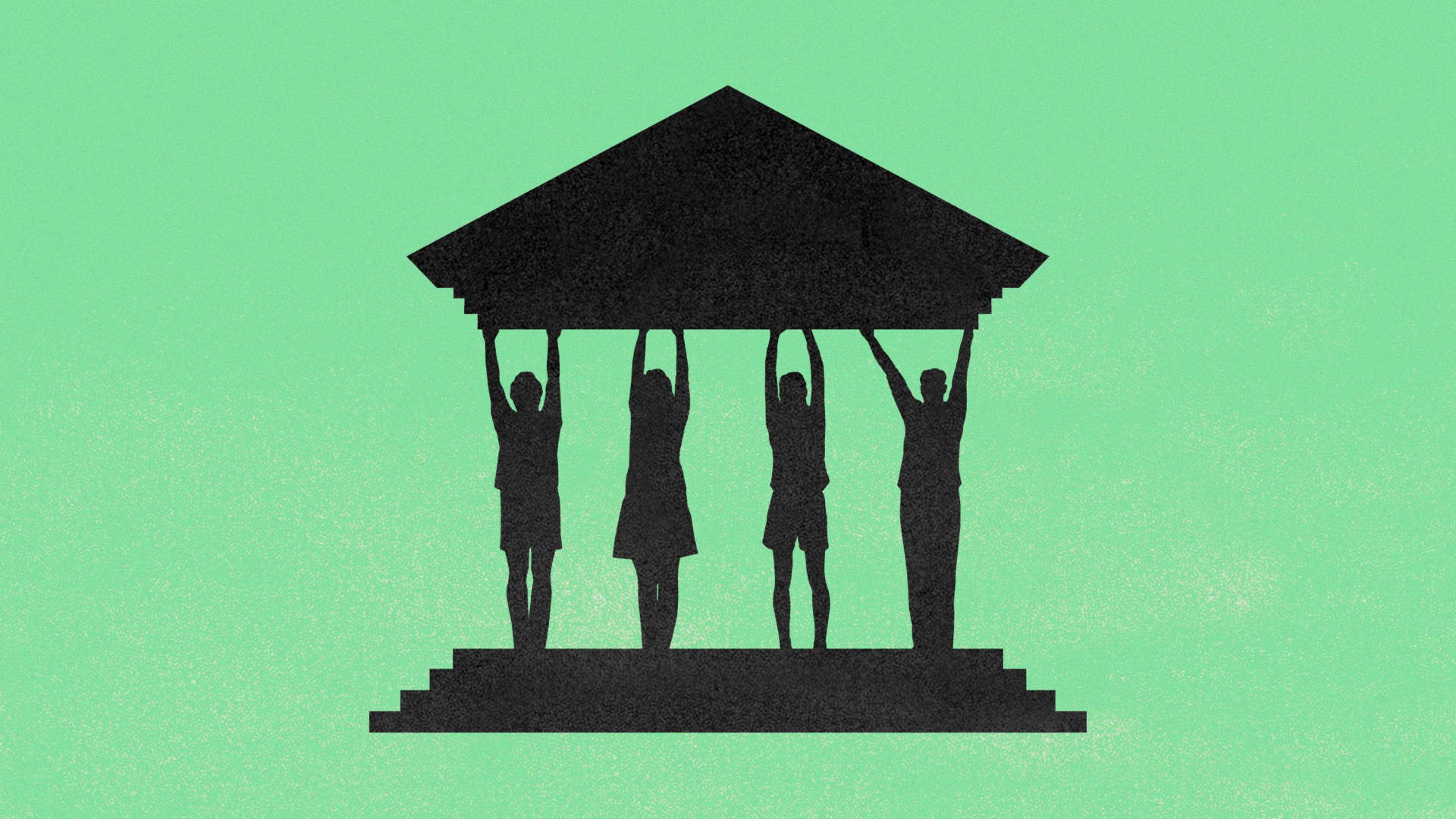
Of the church, Dietrich Bonhoeffer says, we should come to expect everything and nothing: everything because it is Christ’s body on earth and nothing because, even so, it is composed of broken, sinful people.
For all that brokenness, the church is the institutional context in which we come to understand God, ourselves, and the world. But it is not the only institution that shapes us—we are shaped too by marriage, family, our local communities, state and national citizenships, schools, professions, summer camps, athletics, and more. By the same token, the church is not the only institution that disappoints us.
At their best, all these institutions can have lasting, meaningful influence on their members. They can call us to a higher standard of character and orient our lives. But the flip side of that kind of investment is that when things go wrong, the fallout can be immense.
The United States (and the West more broadly) is undergoing a long crisis of confidence in almost all our institutions. For many this includes the church, but it also goes much further. Revelations of sexual abuse by Roman Catholic clergy were shocking decades ago, but now it seems there’s always some major institution in the midst of some horrible scandal.
The result is a vicious cycle: We spot decay in our institutions and so lose faith in them. Once we lose faith, we become less interested in reform and renewal. Decay further proliferates. Now we’re at a nadir of institutional trust, and the higher our hopes for an institution, the worse the disappointment when they’re not met.


Looking beyond church and state, maybe the most conspicuous example of this cycle is the precipitous decline in marriage and birth rates across the developed world. After all, many reason, why chance the calamity of a broken home if you don’t begin with the conviction that family is an institution worth the risk? The rise in family estrangement—of adults going “no contact” with their parents rather than working through mild and mundane offenses—is a related phenomenon.
Jesus told Peter to forgive the brother or sister who sins against him “not seven times, but seventy-seven times” (Matt. 18:21–22). I’ve come to think Christians have some obligation of forgiveness to our institutions, too—some duty of love and sacrifice to preserve and repair these rightfully time-honored ways of organizing and shaping our lives.
Of course, this is easier said than done, as I’ve learned firsthand with my alma mater, Wheaton College, which provided simultaneously the most edifying and disappointing experience of my life.
After transferring to Wheaton from Seattle University at the end of freshman year, I first knew I was in for a culture shock during a get-to-know-you activity in introductory art-survey class. In the style of the poem “Where I’m From,” my classmates began offering paeans to their places of origin. Some common themes quickly emerged: corn fields, private Christian schools, youth groups, and the wry, mildly self-deprecating humor characteristic of Midwestern evangelicals.
I didn’t hear anything that remotely resonated with my own upbringing in secular Seattle. But then, I’d come to Wheaton under different circumstances than most.


For many students, Christian college is the capstone of a childhood centered on spiritual formation. It’s where you go to finish years of initiation into American Christianity. But for me, it was a place to start. I’d come to real faith in young adulthood through spiritual crisis at the conclusion of a long series of painful events. That was how, at the end of my first quarter of college in Seattle—spiraling, unable to save myself, desperate for a change—Wheaton seemed like just the institution I needed.
I don’t regret that choice, but Wheaton could not and did not meet my hopes. The transfer proved to be a difficult adjustment. Yet now, when asked where I’m from, I say that even though I lived in Seattle for 19 years, 4 years was enough to make me identify with Wheaton, Illinois.
Wheaton as an institution challenged and even disappointed me. It was often socially alienating and particularist. Yet it also made me who I am today, and for that I have a deep sense of gratitude—and duty. I love Wheaton, and learning to love Wheaton taught me to better love the church and all the other thick institutions that, while never perfect, give life meaning from generation to generation. It taught me how to commit.
Becoming part of the church universal requires that commitment. This may not always mean staying in the same local congregations, but it does mean loving institutions that will disappoint us and being vulnerable with people as broken as ourselves. The faults of these institutions are real and often serious, sometimes so serious that we are justified in losing trust, maybe even in leaving or shutting the whole thing down.


Yet more often, I think, faults are reparable, and we must repair them if we want to have a society that can be called humane. Where did we ever get the idea that these institutions would somehow maintain themselves? That they would always be there for us, meeting all our hopes, in perfect working order, without repair or forgiveness from us?
The church is unique in its indispensability, but it is not alone among valuable institutions full of broken, sinful people. We must learn to expect institutions to disappoint us without losing appreciation for what they do achieve. Institutions—especially those that facilitate our worship, sanctification, and education—are worth the striving, the hardship, even sometimes the pain. The reality is that when we fail to forgive and to maintain the good institutions that shaped us, we suffer—we are suffering now. It is commitment to these flawed yet essential institutions that makes communal life possible.
James Diddams is the managing editor of Providence: A Journal of Christianity & American Foreign Policy. His website is jamesdiddams.org.