News

World Vision CEO: Foreign Aid Cuts Can’t Be Replaced Overnight

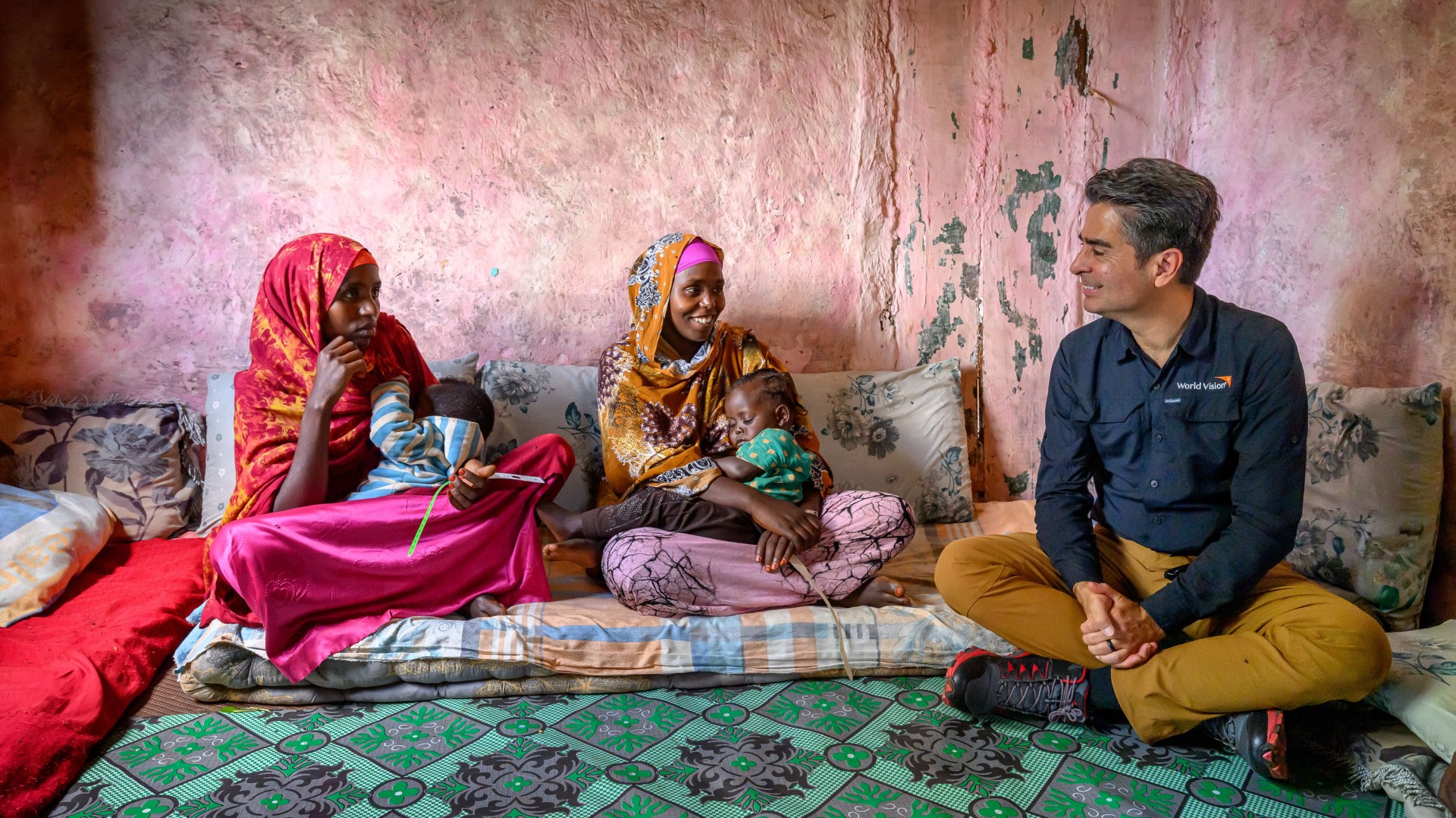
On a recent visit to Ethiopia, aid recipients applauded Edgar Sandoval. “They probably didn’t know that the program was coming to an end,” he said.

World Vision CEO Edgar Sandoval in Ethiopia

Edgar Sandoval in Ethiopia

Christianity Today July 21, 2025
Jon Warren / World Vision

Founded 75 years ago, World Vision has grown into the largest evangelical humanitarian organization in the world. World Vision’s US office, the largest of its many global affiliates, is also one of t­he top recipients of US foreign aid grants.

This year, the Trump administration froze or canceled most projects overseen by the US Agency for International Development (USAID), the now-shuttered humanitarian arm of the federal government. In March, as Christian humanitarian groups met with State Department officials to try to save some programs, leaders from World Vision said the charity might need to lay off as many as 3,000 employees due to the funding cuts.

While other faith-based aid groups have spoken out publicly, World Vision has remained mostly quiet. The foreign aid shutdown came just after World Vision launched an ambitious new goal of reaching 300 million people worldwide through its sponsorship, water, health, and food programs.

In early July, CEO Edgar Sandoval spoke with Andy Olsen, CT’s senior features writer, about World Vision’s staffing cuts and the role of government funding in faith-based aid. The conversation is below, edited for length and clarity.

We are talking a few days after the official closure of USAID. Over the last few years, World Vision has received more than $400 million a year in foreign aid grants—including cash and noncash items like food commodities. That’s roughly a third of your annual revenue. How have government funding cuts and pauses affected your budget?

Even before the USAID cuts, there was already a significant gap in funding. There were more humanitarian needs than available funding. And now with these cuts, depending on what happens next year, it only makes a challenging situation even more challenging.

We have a very diversified portfolio of funding, as you know, and the vast majority is private donations. But the US government is an important part of our portfolio. In 2025 we’re looking at losing about $170 million, which amounts to about 10 percent of our total budget.

Before we heard about the stop-work orders, we had already heard about a desire to review foreign aid. I welcome that wholeheartedly. We should always be looking at getting more efficient and better at what we do. I spent 25 years of my life, before coming to this Christian ministry, in corporate America. We were constantly looking at inefficiencies and getting rid of them. Any well-functioning body has some level of inefficiency.

Now, a lot of this funding is truly lifesaving funding for people who live in the most unimaginably challenging environments and conditions. There are no local markets. There are no infrastructures. These people need a safety net to help them build a life and a livelihood. So when we received stop-work orders, we immediately got to work looking for waivers for some of our programs that were lifesaving. Even though it was challenging and a bit confusing at times, we were able to restore many of the grants that were stopped temporarily.

Can you help me understand how World Vision’s programs break down between privately funded work and government-funded work? Are those funding streams and the programs they support entirely separate? Or are they intertwined in such a way that the impacts of cuts are felt across the organization?

Yes and yes. Our flagship program is our child-sponsorship program. And that is very strong and continues to get stronger over recent years. We also layer other private funding in the communities where we’re doing child sponsorship, to accelerate the impact. What we do with US grants is extend our reach at a massive scale. In some instances, the grants are in the communities where we work with sponsorship, but in many instances they’re not—particularly for humanitarian crises and natural disasters.

What makes these cuts very challenging is that we’re not talking about, call it, one-off programs, like installing a water well or a clinic. We’re talking about massive programs at scale. We’re talking about lifesaving food assistance to 500,000 people, vaccinations to 400,000 people, every month monitoring entire regions for diseases and disease prevention. Replacing that funding doesn’t happen overnight. The vast majority of our funding is donor designated, meaning it was donated for a particular purpose in a particular place for a particular time period. And we honor donor promises. We can’t just unplug and do something else to cover the gap.

Are there programs that World Vision has outright had to cut? Are there communities in the world that last year were receiving support from a World Vision program and now are not?

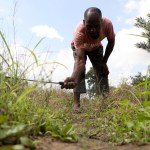
Yes, absolutely. I’ll give you an example. I was in Ethiopia a week and a half ago. What I saw was both encouraging and devastating. I visited one of our warehouses where we store food. This is food that’s been sourced from American farmers—sorghum, peas, et cetera. We were doing one of the last food distributions for that area. It’s an area that’s been going through a very challenging drought. I saw the crops dying because there’s no rain, and this is supposed to be the rainy season. People are working hard, but the rain doesn’t come, and they can’t feed their children.

When I walked into the community for our food distribution, the community just broke out in a big applause. What struck me at the time is, first, they probably didn’t know that the program was coming to an end. But second, they were clapping for America. They know this is from America. They told me, We’re so grateful for America. America has a good heart. Americans are generous. Please tell Americans how much we appreciate them and that they are helping us save our children’s lives.

There is a chance that we may restart in January if we get a reinstatement on the grant. But as of right now, we’re planning to shut it down.

Speaking of food aid, I was reading a statement that Secretary of State Marco Rubio issued on July 1, officially announcing the closure of USAID. He wrote, “Where there was once a rainbow of unidentifiable logos on lifesaving aid, there will now be one recognizable symbol: the American flag. Recipients deserve to know the assistance provided to them is not a handout from an unknown NGO, but an investment from the American people.”

Anyone who’s worked in foreign aid is accustomed to seeing bags of rice or whatnot that are stamped with the American flag and the motto “from the American people.” Do you see evidence to support the critique that aid recipients somehow don’t understand where the aid’s coming from?

The flag is there on every bag. And “from the American people.” I feel proud to represent America when I go out there and see the help that the US government is bringing to these families.

We just want to help people thrive. We think foreign aid—when properly administered like we do through World Vision and many other organizations—it saves lives. It saves lives here in America. It saves lives across the world. It creates resilient communities. It eradicates disease completely, and it creates goodwill. And all of that I think leads to a safer, stronger, more prosperous USA. Whether I put World Vision’s logo or not is not the key priority for us.

World Vision food distribution in Harbo, EthiopiaJon Warren / World Vision
World Vision food distribution in Harbo, Ethiopia

The administration has said that foreign aid needs to advance the nation’s interests, that a key objective of foreign aid is to encourage global political and ideological alignment with the current administration. I don’t think that’s an entirely new way for American presidents to approach aid. I’m curious how a Christian organization like World Vision navigates those kinds of expectations while also managing the more straightforward humanitarian and faith objectives of its programs.

We are a Christian ministry motivated by our faith, following what we believe are God’s wishes for every follower of Jesus Christ, which is to help the poor and the oppressed. We appeal to many different sources of funding. The vast majority are Christian private donors. But we believe God has blessed World Vision with the capabilities to do things at a scale that not many organizations can, Christian or secular. If we can be viewed as a partner of choice to the US government to accomplish that work, to help people lift themselves out of extreme poverty, to live through food emergencies, to have vaccinations so that the children don’t die, we’ll do that.

Once the administration and Congress decide what they’re going to fund, we are just focused on maintaining our status as a partner of choice to implement and to implement with excellence. For instance, World Vision is the number one nonprofit provider of clean water in the world. We’re the number one distributor of the World Food Program. In fact, we distribute more American farming commodities around the world than anybody else. And so that’s what we’re focused on. As part of the knowledge that we’ve gained over the years, we’re advocating for ‘Hey, keep some key programs that the government funds.’

An important point here that I’d like to make is this: Foreign aid is less than 1 percent of the federal budget. The American people know that foreign aid is good. In fact, the vast majority overwhelmingly support keeping the 1 percent. The issue is that most Americans believe that the foreign aid budget is somewhere between 10 and 20 percent of the total budget. But when you actually explain and they understand that it’s 1 percent or less, they overwhelmingly support it.

But to be clear, World Vision staff are not submitting reports to the government outlining how your programs are serving US interests. This is not a thing?

I’m not aware of submitting any reports of that nature. We agree with the government on objectives, on the type of outcomes that we’d like to see, and then we measure those, and we measure those with a lot of discipline and with a lot of work. That’s the only way we’ve been able to earn and maintain our preferred status, not only with the government but with most of our private donors. We do reports for them all the time to make sure that their investment is achieving what we said it would.

That said, I would be very quick to say that all of these things, again, they do help America. For instance, let’s just take the emergency food that I mentioned. That infrastructure supports an estimated 60,000 jobs right here in the US, when you consider the entire supply chain, from the farmers to the trucks that transport farm commodities to the ports.

Can we talk a little bit about layoffs? What the impact has been?

The decision to let go of staff is one of the hardest decisions a leader can make. We don’t make those lightly. It was challenging to have to say goodbye to about 11 percent of our staff here in the US, which is proportional to the 10 percent cuts that we saw. It’s particularly challenging in a ministry like ours where people have been called to do this work.

On the field-staff side, because it’s directly funded by grants, there have been stops and starts as we have reinstated grants. Initially we thought there would be maybe 2,000 or so people that we would have to let go. The actual number has turned out be a lot less. I don’t think we’ve let go even 900 so far, because many other programs were reinstated. But if they go away completely, then we may have to do some more things, particularly on the field side.

I’d like to talk about public perception. As you are well aware, Elon Musk called USAID “a criminal organization” and “one of the biggest sources of fraud in the world.” Secretary Rubio said executives at aid organizations “enjoyed five-star lifestyles funded by American taxpayers, while those they purported to help fell further behind.” The leaders that he’s talking about are people like you. How do you wrestle with that?

Well, I’m not sure they’re talking about me. I can only comment about what I’ve seen in all of my travels to all of the countries. I have seen fully committed Americans who’ve given their entire professional lives to serve their country. They are doing really good work.

Both the statistics and the stories bear that out. Let’s look at what’s happened with foreign aid and with America’s leadership in foreign aid over the years, over the decades. We’ve had 26 million people who are alive today because of PEPFAR, the signature American program against HIV and AIDS. We have 7.8 million children who were born HIV free as a result of that program. The world has eradicated smallpox. We’ve had, I think, more than a 95 percent reduction in polio. Malaria in Africa has been cut by 50 percent. Child mortality has been cut by out whopping 59 percent.

I just came back from Ethiopia, as I mentioned. I spoke to a community leader. This strong man, he broke down and started to tear up as he played back to me the possibility that the food would stop coming to his community. He was very grateful to Americans. He said, “If and when the food leaves, death will come into my community.”

Are we in a moment when World Vision has to sell itself or resell itself to Christians who have grown skeptical of faith-based aid in recent years?

We’re always telling our story and telling the story of what God is doing through World Vision. I don’t know that that’s necessarily “selling” World Vision or “selling” aid to the most vulnerable. I think Americans have incredibly generous hearts. They are very generous. We’re just all bombarded with so many priorities and with so many things, and it is our role to remind people of what God expects of every Christ follower. There are over 2,000 scriptural references to helping the poor and the oppressed. I mean, it couldn’t be more clear.

Have you met recently with members of the administration or senior leaders at the State Department?

We have a lot of engagement with the Hill, with our administrators. I was there back when the cuts began, and I travel regularly also to meet with them. What I would say is that there’s still a level of uncertainty, but I remain hopeful. I believe that our leaders want to do the right thing. They understand lifesaving aid is important, and it is my hope that they will see organizations like World Vision as one of those that they can count on to deliver on their objectives.

How often do you get to the field?

Three times a year or so.

Do you have a favorite place?

Every time I visit a country, it becomes my favorite. I’m just so inspired by the work that our staff does. They’re so committed. They put themselves in the hardest places. They serve their communities. Eighty percent of our staff live in the communities where we serve, and many of them do so at a great personal cost. They leave their families in other cities for months at a time. And when I ask them, “Why do you do this?” it doesn’t matter whether I’m in Africa, Latin America, Asia. Wherever I am, the answer is the same: “Our calling from God to serve our people.”


News

Kenyans Struggle to Find Good Shepherds Online

Internet ministries bring new opportunities and theological challenges for Christians.

An emoji sheep in a green tech maze.
Christianity Today July 21, 2025
Illustration by Elizabeth Kaye / Source Images: Getty, Google

Cameras switch on and monitors come alive as pastor James Mwita steps behind the pulpit and into the camera’s view at St. Peter’s Methodist Church. It’s Sunday morning in a quiet neighborhood in Langata Constituency, Nairobi, Kenya. The hum of a laptop signifies two congregations—one sitting in the pews, the other present behind pixels.

Mwita’s sermons now reach thousands across Kenya and the globe, and other pastors have similar goals. With nearly 72 million mobile devices and over 56 million active mobile data subscriptions for a population of 57 million, Kenya is among the ten most digitally connected countries in Africa. TikTok, YouTube, Facebook, and Instagram have become fertile ground for Christian content.

But this digital revival comes with its own challenges. As the gospel goes viral, questions have arisen about the depth of community and accuracy of doctrine presented on social media.

During the COVID-19 pandemic, churches like Christ Is The Answer Ministries (CITAM)—an English-speaking church in Nairobi—restructured entire ministries to thrive online. The church offers YouTube devotionals and virtual forums attracting Kenya’s youth demographic: 18-to-35-year-olds. In its research the church found that over 20 million youth barely attend church, creating an opportunity to reach young Kenyans digitally.

Meanwhile, TikTok-famous pastors like Victor Kanyari have stirred controversy for earning thousands via livestreams with gimmicks and “indecent content.” Kanyari has earned over 400,000 Kenyan shillings (about $3,090 USD) on TikTok.

Kanyari is a preacher based in Nairobi and the founder of the Salvation Healing Ministry. His ministry operates independently of any denomination, and he has not yet disclosed any formal ordination credentials.

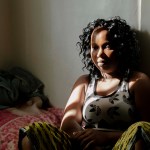
Jeffter Wekesa—another online pastor without public ordination records—runs a fully virtual church from his Nairobi home. He preaches exclusively over YouTube and TikTok. His social media ministry earns between 100,000 and 300,000 Kenyan shillings (about $770–2,320 USD) per month. His teachings from his living room focus on hope amid crisis and revolve around Kenya’s socioeconomic struggles—unemployment and youth unrest.

Mwita said sometimes people online worship in pajamas and forget service times. “They think, ‘I’ll watch it later,’” he explained. “But they rarely do.” He warned that a consumer approach to online church can create a culture of “passive consumption rather than active participation.”

Some online-only ministries have minimal oversight or theological scrutiny. Without accountability from elders and deacons, online preachers risk spreading incomplete or unbalanced theology. Church leaders in Kenya say members must be equipped with doctrine to withstand false teaching.

The 2023 Shakahola Forest incident in Kilifi County, Kenya, exposed how unregulated teachings can lead to catastrophic outcomes. Pastor Paul Nthenge Mackenzie of Good News International Ministries—an apocalyptic, online, fringe church—persuaded followers to retreat into the forest to starve to “meet Jesus.” Over 400 believers, including children, died from starvation, suffocation, and strangulation.

Government investigators confirmed Mackenzie used twisted interpretations of Scripture—preaching against education, medicine, and even national identity systems—as part of a doomsday narrative that encouraged isolation and blind obedience. A forensic psychologist testified that many followers exhibited “empathy delusion,” even assisting in the deaths of their loved ones as an act of faith. 

Other online ministries struggle with distance in emotional matters, especially during moments of grief or counseling sessions. Mwita has used virtual discipleship to keep a British teenager engaged with church and help an American woman through personal crisis, but he recognizes the limitations of online ministry.

“Pastoral care through a screen is not always enough,” Mwita admitted. “You can’t read tears over a livestream.” Many rural members who come to depend on livestreams face unstable internet connections or lack digital devices altogether, further isolating them from church.

Mwita, hoping to build relationships, trains pastoral leaders to follow up with digital attendees, offers personal spiritual support, and guides new Christians through discipleship materials. St. Peter’s also holds Zoom and WhatsApp Bible studies, virtual Q and A forums, and small group prayer meetings.

“We send weekly SMS reminders, devotional PDFs, and WhatsApp videos. We treat our online audience like members, not spectators,” he added. But Mwita warned of spiritual shallowness: “It’s easy to become a consumer rather than a disciple—to scroll instead of seek.”

Mwita’s antidotes: teach about spiritual disciplines, encourage digital detoxes and screen-time balance, and blend online and in-person worship. “Online ministry can transform lives,” he said, “but only if we lead with intention, care, and community. Otherwise, we risk having churches with screens but no souls.”

News

War Interrupts Biblical Archaeology

Israel-Iran conflict stalled excavation efforts, forcing international teams to flee.

Archaeologist doing excavation work in Israel
Christianity Today July 21, 2025
Meahem Kahana/AFP via Getty Images

James R. Strange, professor of New Testament at Samford University, was hoping to excavate a lot of ancient pottery from Jesus’ time at Tel Shikhin, a small village in the Galilee region.

Missiles interrupted his plans.

“We had essentially one week,” Strange told CT. “When Israel launched its offensive into Iran and Iran responded, … that made staying untenable.”

Conflict in the Middle East has once again had the unintended effect of stalling efforts to excavate biblical history. Across Israel, digs were canceled when war broke out in mid-June. Though the war between Israel and Iran lasted only 12 days, it came in the middle of the dig season, when weather conditions and schedules align for archaeological work. 

Scholars and volunteers who had hoped to contribute to our understanding of the world of the Bible found themselves instead ducking into bomb shelters and tracking reports of airport closures. 

Strange was convinced it was time to leave when he had to take cover in a bomb shelter across the street from their Nazareth hotel four times in one night. But then Ben Gurion Airport—the main international airport in Israel—closed. Strange and his team ended up making their way to Jordan and flying home from Amman three days later.

The Associates for Biblical Research team that was excavating Tel Shiloh had an even more circuitous path out of the country. Dig director Scott Stripling called it a “reverse Exodus.” 

The group woke up in a Jerusalem hotel on June 13. News of war and warnings about imminent attacks were consuming the whole country. Stripling decided they should continue with the last day of their archaeological dig anyway. 

“The best thing for us to do was to go to work,” he told CT. “I thought, for the spiritual and mental health of our team in the time of crisis, the best thing they can do is to stay in the routine.”

When it was time to leave, though, things got a bit complicated. Stripling said the team took a bus to Eilat in the south of Israel, crossed the border to Egypt, took another bus across the Sinai Peninsula to Cairo, and then flew back to the United States.

Americans excavating Caesarea Maritima, one of Israel’s most-visited archaeological sites, also went home after just one week of digging.

Some archaeologists did not make it to Israel this year because of the military conflict. Wheaton College professor Daniel Master was planning an excavation at Tel Shimron in the Galilee. Lipscomb University archaeologist Steven Ortiz was going to direct a dig at Khirbet Ether. Both men’s flights were canceled. They hope to return to the field in 2026. 

The excavation at Abel Beth Maacah, a site near the Lebanese border, was put on hold last year because of the fighting between Israel and Hezbollah. Dig codirector Robert Mullins from Azusa Pacific University and archaeologist Cynthia Shafer-Elliott from Baylor University could not go this year either.

“My university is currently not allowing travel to Israel,” Shafer-Elliott said.

However, codirector Nava Panitz-Cohen, from the Institute of Archaeology of the Hebrew University of Jerusalem, will have some of the team back in the field at Abel Beth Maacah later in the summer. 

Panitz-Cohen said the dig will proceed with archaeology students from Israeli universities and the international students who stayed in the country through the conflict.  

Excavations at Hippos, on eastern shore of the Sea of Galilee, and Hazor, nine miles north of the Sea of Galilee, are expected to continue with majority-Israeli teams.

Some archaeology work in Jordan kept going too. The dig at Khirbet Safra, a site overlooking the Dead Sea, its biblical name is unknown, continued uninterrupted. Excavation director Paul Z. Gregor, a professor from Andrews University in Berrien Springs, Michigan, said the archaeologists “were able to complete our season of excavation as planned” before going home at the end of June. 

An excavation planned at Abila, the site of a New Testament city located in northern Jordan, just two miles from the Syrian border, was not as lucky. David Vila, professor at John Brown University, was wrapping up a tour of Jordan with his students and preparing to begin three weeks of excavation of June 16. 

He saw the Jordanian air force scramble jets to shoot down missiles. Then President Donald Trump started talking about the possibility of US involvement in the war, and it seemed like a good time to return to the US.

“The US bombed Iran, it turns out, about one hour after our flight took off,” Vila said.

An unexpected hiatus from excavation isn’t all bad news for archaeology, though. Digging in the dirt is the hard-but-fun part. It’s also just the start of the process. Scholars must study what the excavations have turned up, write about their discoveries, and publish the results in peer-reviewed journals. 

Not getting into the field gives them additional, much-needed time to do the slow work of scholarship. 

James Fraser, director of the W. F. Albright Institute for Archaeological Research in Jerusalem, noted the COVID-19 pandemic, too, forced digging to stop, and that turned out to be a productive time for many archaeologists.

“We’re harvesting the fruit of that now,” he said. “We’ve launched several books here at the Albright over the last several months, all of which would not have come to fruition, I think, without that enforced period.”

Fraser said if archaeologists in Israel are not able to go to their excavations, they are always welcome to come to the Albright, where he has been director since a few days after Hamas launched an attack on Israeli civilians. 

“All researchers, regardless of background, can come and sit in the library,” he said, “discuss their findings, and join in shared pursuit of research excellence.”

Gordon Govier writes about biblical archaeology for Christianity Today, hosts the archaeology radio program The Book and The Spade, and is the editor of Artifax

Correction: A previous version of this article said Strange and his wife took cover in a bomb shelter; she was not in Israel at the time of the attack.

Pastors

What YouTube Can’t Teach Students About Jesus

College students are being catechized by YouTube. Here’s how the church can offer something richer—and more real.

CT Pastors July 18, 2025
Image: urbazon / Getty

“Who (or what) has shaped your faith the most?” 

As a campus minister, I have asked this question to many college students over the years. Lately, I have noticed a shift in their answers. 

Last fall, I sat across from a freshman at Vanderbilt University. We were chatting over tacos when I posed the question. I watched the gears spin in his head. Would it be a church from back home? A great book? An older mentor who discipled him? Maybe his parents? 

He leaned back. 

“YouTube.” 

I stared blankly, trying my best not to show my surprise. 

It hit me: What we were doing—eating lunch alongside one another—discipler and disciplee—might be an entirely new experience for him. In the digital age, disembodied social interactions have become the norm. Ideas are acquired by scrolling and shaped by video consumption. For many students, face-to face discipleship feels foreign. YouTube is not the problem; the problem is the way digital media is reshaping us to prefer a mediated and often passive experience.

But something is lost when discipleship becomes mediated by a screen. What college students need today is embodied discipleship—a way of life that doesn’t simply provide them with answers but captures their imaginations and awakens them to the beauty of life with God in the real world. They need to see that discipleship is not merely about information transfer but spiritual formation—a formation that happens best through physical presence with other saints. 

In this way, embodied discipleship becomes what Tim Keller called “counter-catechesis.” It pushes back against the digital liturgies shaping them each and every day. Pastors and campus ministers have a crucial opportunity to show young people how physical discipleship is a truer and better way.

1. Physical discipleship provides healthy friction.

In 2011, Mark Zuckerburg coined a term that has now become ubiquitous in conversations about digital technology: frictionless. In this frictionless world, my screen demands nothing of me (other than my undivided attention). It is my ever-present companion, and the algorithm always agrees with me, curating my feed to my own self-serving ends.

But for all our efforts to build a world of ease, Christians know that on this side of Genesis 3, much of life is marked by frustration and futility—including the slow and sometimes painful work of our discipleship efforts. Physical discipleship is messy. It’s inconvenient. It disrupts. It demands from us and challenges us. But it’s also more rewarding. 

One way I’ve seen this play out is in the simple act of reading a theology book with students. In an age of waning attention spans, giving extended thought to a physical book is challenging. When I want to walk through a book such as Knowing God by J. I. Packer with a student, I know it’s going to be a challenge. But over and over again, I see the fruit that comes from grappling with the medium of printed text, undistracted by hyperlinks and notifications. Reading side by side—wrestling through paragraphs and chapters, pushing through questions and critiques—we grow, not just in what we know, but also in how we will love and follow Jesus.

This type of spiritual formation doesn’t happen in isolation, and it rarely happens through passive consumption. Watching a YouTube video on your phone can be informative, but it’s not the same as working out truth together, face to face. That’s not to say digital content is useless. I have sent plenty of video clips and podcasts to my students. But the aim is still the same: to come together physically and discuss it together, not to consume it alone.

We shouldn’t view physical presence in our discipleship as a hurdle to overcome. It’s a God-given blessing. The friction that comes from embodied relationships meets a need that ChatGPT cannot. We cannot expect to begin looking more like Jesus without the physical presence of his body in our lives. 

We need the kind of healthy friction that comes with being proximate, visible, and accessible to one another.

This is God’s chosen means of forming us, and the local church is the ideal context in which that happens. In embodied relationships, we risk being exposed and challenged, but there can be no truly Christian formation without it.

2. Physical discipleship makes the gospel compelling.

Positioning college students close to people who embody the beauty and challenge of following Jesus makes the gospel more compelling to them. When pastors and campus ministers invite students into their homes and the ordinary rhythms of their personal lives, the gospel becomes more than a theory or idea—it becomes an embodied reality.

This kind of life-on-life relationship is no trite thing. It’s not of secondary importance. Jesus didn’t think so when he said, “By this everyone will know that you are my disciples, if you love one another” (John 13:35). 

In our college ministry, one of the primary ways we do this is through a monthly event called “Family Dinner.” All students and staff are invited. We open our home and include the kids. It’s loud. It’s chaotic. Drinks spill and conversations are interrupted. But for many college students, stepping into the home of a real family is a respite.

In this environment, they witness the truths of the gospel applied in real time. They see grace extended in a parent’s patience. Generosity in sharing a meal. Joy in the stories exchanged. Forgiveness in how a mess is handled.

These glimpses of the gospel in ordinary life turn abstract ideas into a lived and believable faith. It is one way the gospel becomes credible. 

3. Physical discipleship rejoices and weeps.

From the moment we are born we are wired to see and respond to faces. It has been noted that deciphering human facial expressions form the basis for how we understand people, long before we ever learn to communicate with words. As psychiatrist Curt Thompson notes, “We are all born into the world looking for someone looking for us.”

This innate longing—to be seen, known, and understood—has now been monetized; co-opted by tech companies to collect data on us. Rather than turning toward one another, we turn toward our ever-present screens. In doing so, the now-ubiquitous facial recognition software (“Face ID”) on most smartphones provides a false sense of being seen and “recognized.” 

It is only in physical proximity to one another that we learn the persuasive power of empathetic attentiveness. And empathy, as Nicholas Carr recently noted in an interview with Russell Moore, “requires attentiveness to other people.” You won’t learn to love what you don’t look at.

This is one of the greatest losses in a screen-mediated world: It becomes far too easy to live a lie and forget that we’re interacting with people who are made in the image of God.

In Romans 12, Paul describes what genuine love should look like for a Christian. He says to “rejoice with those who rejoice; mourn with those who mourn” (v. 15).

ChatGPT can’t do that. Google won’t even try.

But, dear pastor, you can. 

When we put down our devices and turn toward one another, we allow ourselves to be seen and known in moments of joy and grief. In doing so, we imitate Jesus himself, who rejoiced at a wedding (John 2:1–11) and wept at a funeral (John 11:33-35)—and did both perfectly. He didn’t disciple from a distance. Neither should we.

4. Physical discipleship helps us love our (actual) neighbor.

One of the temptations of online life is the neglect of the people right in front of us. Heartbreaking stories prove this point to be true both physically and emotionally. In our hyper-connected world, we can begin to develop what Jeffrey Bilbro has described as, “telescopic morality”—when the things happening outside of the physical space we inhabit become more important than the person that is suffering and sitting right next to us. 

As Christians, it is good and right to care deeply about events shaping our world. But if our concern for the global comes at the cost of presence with the local—like a suffering neighbor right beside us—then something has gone wrong.

Embodied discipleship can restore that balance. It teaches us what David Brooks calls “the art of seeing others and making them feel seen, heard, and understood.” When this is done well, we make room for lasting change—the kind that begins right where we find ourselves.

In a culture that prioritizes convenience and ease, physical discipleship is often inconvenient. We cannot swipe, click, or scroll past the physical people right in front of us. But when we neglect embodied discipleship, we fail to display one of the churches most compelling offers in an isolated and lonely world—community and belonging.

In her remarkable book, The Extinction of Experience: Being Human in a Disembodied World, Christine Rosen notes that “mediated life is becoming normal life.” It is in this cultural environment, however, that Christianity offers a better way.

These habits of embodied presence aren’t just helpful—they’re holy. Every act of in-person, face-to-face discipleship stands as a quiet rebellion in a cultural moment where digital life accelerates by the day. It reminds us, the students we walk with, and the world around us that true formation happens in the soil of proximity, vulnerability, and love.

As C.S. Lewis reminds us, “there are no ordinary people.”

For all of its benefits, our technology can never satisfy the longing to see deeply and be deeply seen. 

The gospel of Jesus Christ offers something far better than the screen-mediated life. 

Paul reminds us that one day we will all, “with unveiled face, [behold] the glory of the Lord…” (2 Cor. 3:18, ESV). And we will see “face to face” what we have only been able to see dimly, and we will “know fully, even as [we are] fully known” (1 Cor. 13:12). On that day, all of our longings will be met with unmediated pleasure—not by pixels, but by the person of Christ. 

Until then, embodied discipleship is a preview of what’s to come. A foretaste of glorious coming attractions.A glimpse of life as it was always meant to be.

Dylan Musser is the campus director for the Navigators at Vanderbilt University & a Fellow at the Hendricks Center for Cultural Engagement at Dallas Theological Seminary.

News

Congress Restores PEPFAR Funds in Last Minute Reprieve

The White House tried to the cut the HIV/AIDS relief program by $400 million, but Republicans pushed back.

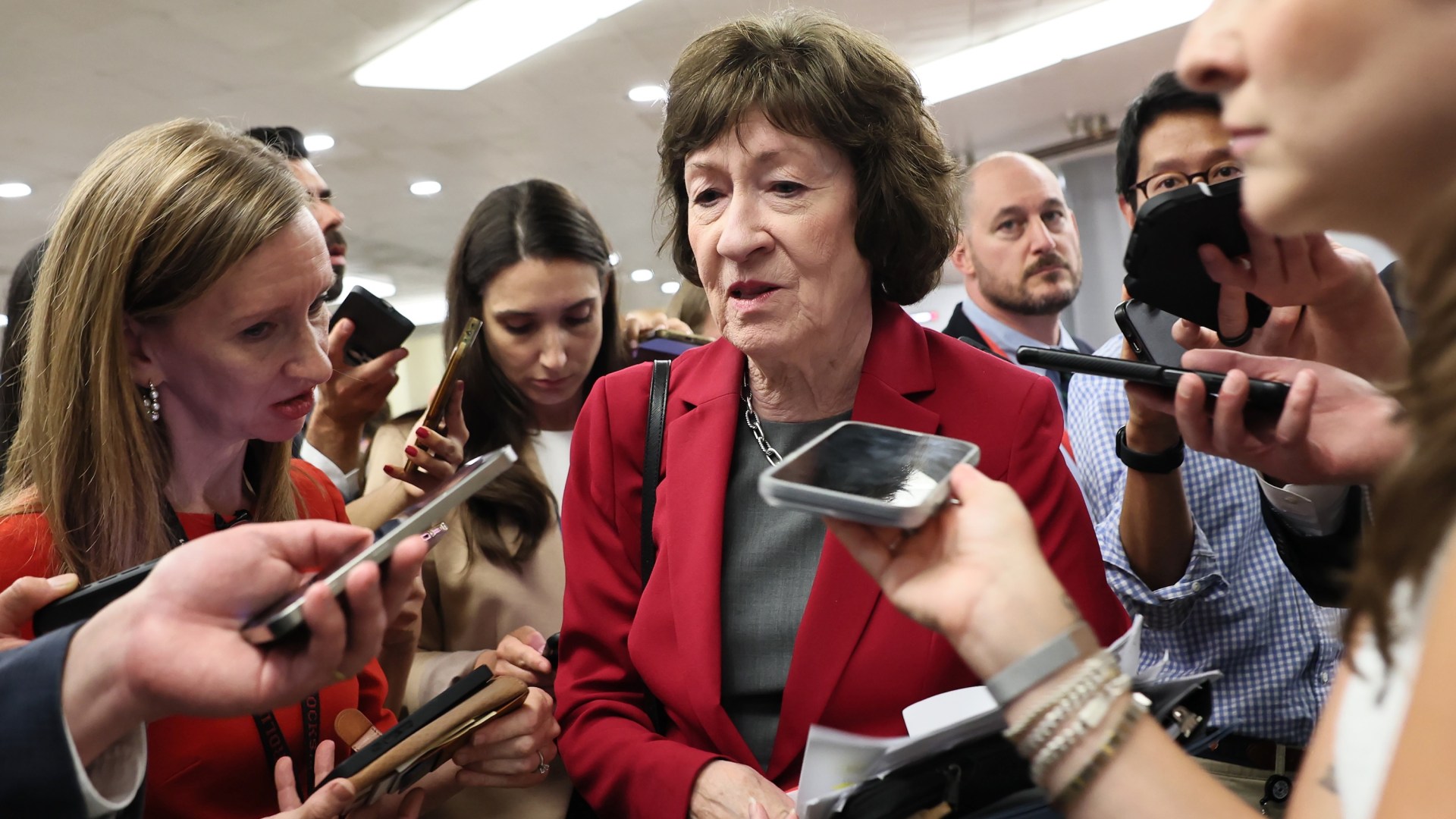
Republican Sen. Susan Collins opposed cuts to PEPFAR in the Republican rescissions package that passed Thursday night.

Republican Sen. Susan Collins opposed cuts to PEPFAR in the Republican rescissions package that passed Thursday night.

Christianity Today July 18, 2025
Michael M. Santiago / Getty Images

The White House wanted cuts to the global HIV/AIDS program PEPFAR, and in a rare pushback, congressional Republicans said no.

After months of advocacy from faith and global-health communities, Congress decided in last minute negotiations this week to restore $400 million in funding to the program.  

PEPFAR was the only foreign aid program to win a reprieve in a package Republican lawmakers designed to pull back previously authorized funding to federal programs, also called rescissions.

The White House had pushed the PEPFAR cuts, with the rescissions package formalizing the Department of Government Efficiency (DOGE)’s targeting of foreign aid earlier this year; about $8 billion of the $9 billion in cuts that Congress passed late Thursday night came from USAID (US Agency for International Development) funding. 

Advocates saw PEPFAR’s reprieve as a symbolic win that the program has bipartisan support going forward. 

“It was a great shot in the arm that the outreach done by the faith community, the advocate community, is really working,” said Catherine Connor, the vice president of public policy at the Elizabeth Glaser Pediatric AIDS Foundation, in an interview with CT. The organization is a major implementer of PEPFAR. 

PEPFAR, or the President’s Emergency Plan for AIDS Relief, is a roughly $6.5 billion program that contracts with some Christian clinics and relief groups and supports about 20 million people on life-saving antiretroviral drugs. It launched in 2003 with bipartisan support and has saved more than 26 million lives around the world.

The biggest slice of PEPFAR’s budget goes to buying antiretroviral drugs and other medical supplies, and organizations implementing PEPFAR on the ground have reported to CT that drug supply disruption has been one of their major issues this year.

Those fighting HIV/AIDS have had a goal of ending the disease as a public health threat by 2030, but the administration’s drastic cuts brought the likelihood of achieving that into question. The Trump administration largely shuttered USAID, which oversees half of PEPFAR’s funding, and the State Department absorbed the agency’s remaining staff and programs.

After the Trump administration proposed the $400 million in cuts to the program, some Republican senators, led by Maine’s Susan Collins, pushed back.

The White House relented.

“PEPFAR will not be impacted by the rescissions,” said White House budget director Russell Vought, who has overseen the slashing of federal agencies, in the Capitol on Wednesday.

Shortly before the White House reversed its position on PEPFAR cuts, Family Research Council’s Tony Perkins published an op-ed supporting the $400 million cuts and pushing the administration to cut further. Perkins wrote that the program had been “co-opted to promote abortion access and LGBT ideology abroad” and that it was funding “pastry cooking for male prostitutes.”

Under the Biden administration, some conservative evangelical groups attacked the program as a “slush fund for abortion,” and national pro-life groups said they would consider votes in favor of PEPFAR’s five-year reauthorization as not pro-life.  

PEPFAR did find violations of US law against abortion funding in one place: Mozambique, where four nurses had performed 21 abortions. It was the first time any abortions in the program had been found in 20 years. The US froze funding to the providers when it discovered the violation.

A recent study published in The Lancet estimated that the overall drastic cuts to USAID, including PEPFAR, would result in 14 million deaths of adults and children in the next five years.

Even with the restoration of PEPFAR funds, “The global health apparatus and the general development platform is being hit hard,” said Connor.

USAID programs that treated tuberculosis, malaria, and malnutrition have been slashed. This week, Republican lawmakers added language to the rescissions package to try to protect some of that care. They circulated an outline, reviewed by CT, about the amended rescissions package promising that it would protect “lifesaving HIV/AIDS, Tuberculosis, Malaria, Maternal and Child Health and Nutrition (including polio)” as well as “U.S. commodity-based food aid.” Food for international malnutrition programs comes from US farmers.

But it’s unclear how those programs are protected, since the $400 million for PEPFAR was the only program specifically saved from the rescissions.

“We’re thankful for the many Christians who have used their voices to advocate for PEPFAR in recent days, making telephone calls and sending emails to their congressional offices,” said Matthew Soerens, vice president of advocacy and policy at World Relief, in a statement. “It’s clear that many Senators’ offices were listening to these constituents’ perspectives, and I’m especially grateful for the leadership of Senate Appropriations Committee Chairwoman Susan Collins.” 

On the ground, cuts have already done damage. But those working on PEPFAR weren’t expecting a win.

Patricia Kamara, the head of the Christian Health Association of Liberia, had gone to congressional offices to lobby for PEPFAR and other global health funding last month. CT spoke to her in Washington at the time, and she was discouraged. Essential drugs have been difficult to obtain in Liberia since the cuts, she said.

The sudden cuts felt like “stabbing in the back,” she said, but Christian facilities would find a way to stay open and serve their patients.

Kamara and others will continue looking for funding wherever they can find it. President Donald Trump’s budget for fiscal year 2026 has proposed deep cuts to PEPFAR and global health, in addition to the rescissions.

“It takes a lot of effort to keep pushing back against the political headwinds,” said Connor. “The good news here is Congress has sent a strong signal this week that they value PEPFAR’s work and they want to continue to support life-saving work.”

News

Who Won in the Supreme Court’s ‘Paxton’ Decision? Kids.

Child looks at smartphone

Maskot / Getty Images

Christianity Today July 18, 2025
Child looks at smartphone

When Ben Williams turned ten, his parents bought him an iPod touch. That’s how his porn addiction began.

Ten was when he started to really notice girls, one of many changes that his family never discussed. Sex, puberty, or crushes didn’t come up in conversation at home or at his church, where both his parents volunteered. He had plenty of questions but no answers, so one night alone in his room, he turned to Google.

After a few weeks of searching images of the human body, he landed in what should have been adults-only spaces.

At first, Williams “didn’t know what I was looking at and didn’t really understand what it was.” He didn’t even know the word pornography the first time he watched it. He felt disgusted and confused but also excited, aroused, and curious to see more.

By the time his parents upgraded him to an iPhone two years later, Williams was viewing pornography compulsively every week, sometimes every night. This secret struggle followed him into adulthood and caused issues in dating, relationships, and his faith.

Williams’s story is hardly unique. The average age of exposure is 12, with more than half of kids reporting the encounter was accidental. Experts expect that the age will trend even younger with more access to devices.

Parents eager to protect their children from pornography have some reinforcements on the way: Last month, the Supreme Court sided with states that require pornography websites to verify users are at least 18. Christians and child welfare advocates celebrated the decision, saying it paves the way for states to implement laws to safeguard children from accessing adult material online.

It’s gotten harder for parents to keep their children from exposure to online pornography as more technology puts kids just a click or a command away from inappropriate content.

“I can make decisions in my household to keep them off smartphones or social media or put filters on our, you know, home device. But if they can still go to school and a child can still pull up Pornhub on their smartphone, that’s a collective problem,” said Clare Morell, who directs the Ethics and Public Policy Center’s Technology and Human Flourishing Project.

In her book The Tech Exit, Morell encourages parents to keep kids and teens off smartphones—an increasingly countercultural position.

In the era of Google, TikTok, and Snapchat, porn-addiction ministries see ages of exposure tick younger, with kids watching clips pulled up on friends’ phones in the lunchroom or on the playground. Williams—now the director of a Christian recovery organization called 423 Next—said many people they work with were first exposed between 6 and 12 years old.

“‘Hey, guys, look what I found,’” Williams said. “You know, a group of six boys just all around the phone watching pornography, that tends to be the most common.”

423 Next uses a model of faith-based community and accountability for those struggling with addiction. Those same factors helped Williams recover from his own addiction in college when he was 20.

“The way I like to think about it is social media—and just broader media at large—had been grooming me my whole life to be prepared for pornography, to have my sexuality weaponized against myself, to view something that is an obvious distortion from God’s design and what is right,” Williams said.

Childhood encounters can lead to a lifelong struggle; his ministry also works with men in their 50s, 60s, or 70s who seek help after someone has discovered their covert porn addictions. 

Unprotected from Porn, a report from Brigham Young University’s Wheatley Institute and the Institute for Family Studies found that “underage pornography use is now the norm, rather than the exception”—a particularly concerning trend as online videos depict increasingly “violent … and deviant” sexual content. 

This is not the first time the judicial system has wrestled with restrictions on porn access, but it is the first time the justices favored the state’s compelling interest in protecting children from obscene online content.

In 2003, the Supreme Court’s Ashcroft v. American Civil Liberties Union struck down a federal bill, the Child Online Protection Act. The court held that the law was unconstitutional for not being narrowly tailored in its attempts to criminalize certain online content. The law imposed a steep fine and 6 months in prison to anyone who, for commercial reasons, posted content online that would be harmful to children, unless they tried to bar their content from minors by requiring a credit card or other “measures that are feasible under available technology.” An earlier decision in 1997, Reno v. American Civil Liberties Union, also sided with adult websites in striking down a section of The Telecommunications Act of 1996 that made it a crime to display “patently offensive” adult material to minors. The justification was that the clause was overbroad and restricted free speech.

“It’s been a fight for as long as there has been a deployed commercial internet,” Wesley Hodges, who directs the Heritage Foundation’s Center for Technology and the Human Person. said. “Access for children to porn [has] simply reached a critical level that would not have been conceived at the time of Reno and Ashcroft, those early decisions, on pornography and obscene material.”

This time, the Supreme Court agreed with a federal appeals court that Texas attorney general Ken Paxton was right to enforce a state law requiring pornography websites to verify visitors’ ages before allowing access. The 6–3 decision, Free Speech Coalition, Inc. v. Paxton, fell along ideological lines. 

Texas’ law, House Bill 1181, passed in 2023, requires websites to use age-verification technology if more than a third of the content on their platforms is “sexual material harmful to minors.” It was initially blocked by a district judge, then allowed to go into effect (with one part of the law struck down), causing some adult websites, like Pornhub, to suspend services in the state. 

In last month’s ruling, Justice Clarence Thomas said that adults “have no First Amendment right to avoid age verification, and the statute can readily be understood as an effort to restrict minors’ access. Any burden experienced by adults is therefore only incidental to the statute’s regulation of activity that is not protected by the First Amendment.”

Thomas described a “compelling” state interest to protect children from sexual material.

Morell said the ruling “really serves to back parents up.” It also brings the digital marketplace more in line with brick-and-mortar stores, which are required to confirm the age of those buying adult magazines or other adult content. 

Currently, 24 states have passed laws requiring some kind of age verification to access pornography online. Many of them are modeled similarly to Texas’ law, though the mechanics on how verification works differ.

“The court’s historic decision will shield other state laws protecting kids online from legal challenges and embolden more states to follow suit,” said Brad Wilcox, one of the authors of the Unprotected from Porn report.

Hodges said the decision rightly recognizes that the technology has changed. Age verification can be done in a cost-effective and privacy-preserving way, he argued.

“Twenty years ago, the users accessing obscene sites, gambling, you name it, would be right to worry that they are susceptible to data breaches,” he said. “Today, that is simply not an inevitability.”

Hodges cautioned that parents shouldn’t see age verification as a fail-safe—“There’s always going to be some way to circumvent [them]”—but it’s a long-overdue step in the right direction.

“More than 20 years in the making and, you know, it’s a decision that parents and pastors have been dreaming about.”

Chris McKenna, founder of the kids tech-safety organization Protect Young Eyes, cautioned that parents in states with age verification should still be vigilant about doing what they can to safeguard their children’s devices and delay giving kids social media and smartphones.

McKenna, a former youth pastor, worked on the Texas bill in 2023 with its original sponsor Angela Paxton, a state senator (who recently filed for divorce from the attorney general Ken Paxton).

McKenna wants Christians to reach out to policymakers at the state and federal level to advocate for similar state laws. “We have our first ruling in two decades from any branch of government,” he said. “We should celebrate that … and we need to keep the gas on.”

Books
Review

Churches, Don’t ‘Accommodate’ Disability. Plan for It.

Including people with mental and physical challenges should be an expectation, not an “extra.”

A woman with headphones and a person in a wheelchair
Christianity Today July 18, 2025
Illustration by Mallory Rentsch Tlapek / Source Images: Unsplash, Pexels

I didn’t grow up in church. But even as an undiagnosed autistic child raised Hindu in the South, I was aware of church culture. I even knew a few popular hymns. Yet I found the idea of church far more confusing than my own family’s religious practices. At the very least, I was certain it would require a level of decoding I couldn’t yet master.

I became a Christian in my early 20s, but even from the inside, the church still confused me. Now, as a parent to autistic children, I find myself helping my children decode some of the same rules I still struggle with. And while we’ve found welcome and community, we’ve also encountered plenty of unintentional barriers: sensory overload, unspoken behavioral expectations, well-meaning volunteers who didn’t quite know what to do with us.

I’ve combed through ministry resource after resource looking for something that will help me better advocate for and meet the needs of a family like mine. While many outline logistical, practical, and safety-related steps, few embody the love of Christ as tenderly as Sandra Peoples’s Accessible Church: A Gospel-Centered Vision for Including People with Disabilities and Their Families.

Peoples, a disability-ministry consultant who grew up with a sister with Down syndrome, is also a parent to an autistic child. Her book is a timely and deeply needed resource for churches seeking more than a manual for ministry logistics. It offers a holistic framework—both theological and practical—for making the church a place where people with disabilities and their families are truly seen, welcomed, and valued. As Peoples demonstrates, the rationale for pursuing accessibility and inclusion lies not in sentiment or social obligation but in the very nature of the gospel.

Accessible Church has a clear foundational premise: Including people with disabilities is not an “extra.” It’s intrinsic to the mission of the church.

Drawing from the doctrine of the imago Dei, Peoples asserts that every person—regardless of ability—is created in God’s image and called to participate in the life of Christ’s body. This foundational truth bestows dignity, value, and purpose on every individual. It teaches us to treat disabilities not as unfortunate deviations but as sovereignly ordained realities, capable of reflecting God’s glory in unique and powerful ways.

Peoples’s writing reflects this conviction—she doesn’t treat disabilities as problems to be solved or obstacles to be managed. Her theological approach is pastoral, not clinical; biblical, not sentimental.

She weaves Scripture throughout the book, from Moses’s speech limitations to Paul’s thorn in the flesh. These aren’t cherry-picked proof texts but part of a broader narrative: Throughout the history of his people, God’s power is revealed through human weakness. The church, if it would reflect Christ, must learn to see beauty and purpose in what the world calls limitation. “As churches,” Peoples suggests, “we may need to lay down our preferences, our traditions, and our reputations for the sake of the gospel.”

The book presents sobering statistics about the relative absence of people with disabilities in our churches, measured against disability rates in our larger communities. Such figures point to a glaring discrepancy between churches’ self-perception as a welcoming environment and the actual experiences of families impacted by disability.

Peoples encourages readers to consider why these families might avoid our congregations. The reasons aren’t that mysterious. Lack of support, physical inaccessibility, behavioral misunderstandings, and theological confusion all play some role. Peoples names these dynamics honestly, without shame or blame, and invites churches to build structures that allow a wider range of people to feel at home rather than merely “accommodated.”

She also clarifies an important matter: Disability is not a monolith. From physical and cognitive disabilities to learning differences, mental health challenges, and trauma histories, the needs—and strengths—of people in this category vary widely. The book offers differentiated strategies that reflect this complexity instead of flattening disability into a single model.

As an autistic adult, I found this nuance deeply affirming. I know what it feels like to sit in a space that was not built for me—where participation requires performance and the unspoken message is “Act normal, and maybe you can stay.” Peoples envisions a better way: a church that aims higher than simply letting people like me attend. A church, in other words, that expects my attendance and plans for it in advance. That mindset shift—from accommodation to anticipation—has the power to transform church culture at its roots.

Accessible Church excels in its practicality. For Peoples, inclusion can’t be reduced to an abstract value or a sentimental gesture. It is a calling that must shape physical environments, volunteer policies, communication structures, and leadership assumptions.

The book outlines four basic models of accessibility in church classrooms and other ministry settings: inclusive environments, which host people with disabilities alongside their peers; specialized environments, which cater to specific cognitive and sensory needs; hybrid models, which allow movement between inclusive and specialized settings; and reverse inclusion programs, which invite a church’s teens and young adults into otherwise specialized spaces for the purpose of fostering relationships. These options offer churches of all sizes flexible starting points based on their resources and context. There is no one-size-fits-all model, and that humility is refreshing.

The book provides a wealth of practical tools grounded in love, not avoidance of liability. The emphasis is clear: Accessibility is about people, not just programs. When churches prioritize safety and belonging, gospel encounters become possible. This is especially true for children who may struggle with communication, emotional regulation, or participation.

“People with disabilities just can’t hide their neediness as easily as the rest of us try to hide ours,” Peoples points out. I’ve spent much of my life trying to mask my own “neediness,” so this truth hit me hard. The church is meant to be a place where we stop hiding. The more we can learn to treat visible vulnerability as a strength, not a liability, the closer we’ll come to Christlikeness.

As a parent, I long for a church where children like mine are seen not as exceptions but as fellow image-bearers with spiritual gifts to offer and discipleship needs to be met.

Peoples rightly emphasizes that disability ministry is a team effort. It’s not the work of one overwhelmed volunteer. It requires pastoral support, leadership buy-in, and a framework for sustainability.

I was especially encouraged by her description of “buddies”—volunteers who support children one-on-one, not as babysitters but as co-ministers. Peoples outlines how to recruit, train, and celebrate these volunteers—reminding readers that inclusion is a joy, not a burden.

Still, I couldn’t help noticing a gap: While the book offers a rich treatment of ministry and support to individuals with disabilities and their caregivers, it says little about adults with disabilities serving as leaders. Peoples cites Erik Carter, director of the Baylor Center for Developmental Disabilities, who has charted five steps in “the evolution of disability ministry”: “ministry apart,” “ministry to,” “ministry among,” “ministry with,” and “ministry by and with people with intellectual disabilities.” But she could have offered more examples of what it looks like when those people take the leadership reins.

Many autistic adults—myself included—are parenting neurodivergent kids, quietly navigating Sunday mornings without being invited to contribute. I’ve had the blessing of being involved in shaping a disability ministry at my home church, but I know this is the exception.

We adults with disabilities carry lived, embodied wisdom about our experiences—about regulation, communication, and sensory needs. And if churches are serious about inclusion, we need to be part of the leadership conversation—not just the care plan.

What sets Accessible Church apart is its unwavering focus on the gospel.

Inclusion is not framed as a charitable outreach, a performative gesture, a political imperative, or a ministry niche. It runs through the very fabric of the gospel. The church cannot fully reflect the body of Christ if it excludes its most vulnerable members.

This is not about extending pity or carving out “special needs ministries” as side projects. This is about ecclesiology. It’s about what we believe the church is. If the body of Christ has many parts, then exclusion is not just unfortunate—it is theologically devastating.

As Peoples observes, “Being an accessible church benefits the church as well as the families who are included.” Families impacted by disability are not burdens. They are co-laborers, image-bearers, and fellow heirs of grace. When we welcome those whose needs are different from ours, we remember our own needs. When we build spaces where difference is not just tolerated but embraced, we begin to look a little more like Christ.

Too many disability stories in the church focus on healing. This book offers a better story—one where grace sits at the table with disability and says, “Stay. You belong here.”

Perhaps your church is just beginning the journey of disability inclusion. Perhaps it’s been walking this path for years. In either case, Accessible Church is an indispensable resource. It will stretch your theology, strengthen your ministry, and maybe, as it did for me, offer healing in places you didn’t expect.

Sunita Kapahi Theiss is a writer, communications consultant, and homeschool parent based in Georgia.

News

In Immigration Court, Christians Show Up to Fill the Back Benches

Some asylum seekers face arrest at their hearings under a new ICE tactic. Now clergy are learning how to be witnesses in those moments.

Federal agents detain a man at immigration court in New York City in July.

Federal agents detain a man at immigration court in New York City in July.

Christianity Today July 18, 2025
Spencer Platt / Getty Images

Early one June morning in downtown Los Angeles, a group of eight people was learning how to observe immigration hearings.

Holding notebooks to write down all their instructions, they were mostly Protestant clergy but also Jews and those of other faiths, all under the tutelage of a local faith-based group called CLUE (Clergy and Laity United for Economic Justice). In recent weeks, more Catholics have signed up for the court-observation training with CLUE, too, according to its director Jennifer Gutierrez.

Ashley Hiestand, a minister from Mount Hollywood United Church of Christ was among the group visiting immigration court for the first time. It was initially intimidating, especially seeing Immigration and Customs Enforcement (ICE) agents in the hallways, but when she learned the process, it felt simpler.

“Our congregants might not know how to plug in in this moment—but this is one way,” she said.

There are 58 immigration courts around the country, most in major cities like New York, Los Angeles, and Miami or near sizable immigration detention centers like Adelanto, which sits about 90 miles northeast of Los Angeles.

The vast majority of those facing deportation now are Christian. 

The public can sit in on immigration hearings. More clergy are starting to observe hearings in big cities since the Trump administration began a new deportation tactic at courts.

In the removal hearings, the Department of Homeland Security (DHS) lawyers will move to dismiss the case. If the judge grants the dismissal, that ends the immigrants’ court cases and makes them eligible for “expedited removal.” That means ICE can arrest them outside the courtrooms and they are subject to deportation.

This process ends most legal remedies available to individuals who successfully obtained legal parole in the US—for example, through the app CBP One—but are now facing deportation because President Donald Trump has canceled many of those asylum programs.

In May, a Queens pastor observing immigration court in New York was arrested, right when ICE first began its tactic of arresting people at their court hearings. Authorities later released him.

Before going into Los Angeles court on this morning, CLUE’s Jennifer Coria, leading the group, emphasized that this was not an attempt at civil disobedience. It was about following rules—observing the court hearings, offering resources to immigrants there, witnessing ICE arrests outside courtrooms, and recording detainees on video as ICE agents load them into vans outside the court.

Observers also might be the only way a detainee without a lawyer can get word to family before being sent to a faraway facility, perhaps in another state. Volunteers offer to connect with an emergency contact if they can.

Coria hadn’t been in the LA courthouse before, but she had been observing immigration court in nearby Orange County and had watched people have their cases dismissed and then ICE arrest them for deportation.

Though CLUE’s Christian volunteers who showed up this day were mostly mainline, evangelicals from Spanish-speaking churches have been coming to CLUE events. 

After going through security, the group walked under the observation of some bored National Guard soldiers in the lobby and to an elevator bank, then up to the executive office for immigration court to find the rooms that would be holding what are called “master calendar” hearings.

In those courts, immigration judges hear multiple cases in a row, and ICE agents linger to arrest people after hearings.

Coria suggested a few people sit in the courtroom and a few sit outside to see what the agents were doing.

Each courtroom functions in its own way, but when two clergy members went into the courtroom to sit in on the hearings, the court clerk came over to ask who they were, and they shared what church they were from.

“The judge on Friday really noticed the clergy was present in the courtroom—he looked at them when he was speaking,” said Coria.

Seven immigrants sat on benches waiting for the judge to call their cases. One was a woman carrying a baby, juggling toys to keep the baby happy. The judge allowed her to stand and bounce the baby during her hearing.

Outside the courtroom, four unidentified men in cargo pants, big watches, and short-sleeve collared shirts gathered, whom CLUE staff guessed to be ICE agents.

Judge Rachel A. Ruane, drinking from a large coffee tumbler at a standing desk, called up several immigrants at a time to hear their cases, a practice reflecting the high caseload of immigration judges. Some of the cases she heard that day involved immigrants who entered the country in 2022 and who would have merit hearings in 2028.

The first three cases she heard were for immigrants without lawyers—the woman with the baby, a young man, and another man who had come all the way from Houston for his hearing. Ruane gave them a sheet listing free legal-aid services: a resource if they wanted representation, she said.

The DHS lawyer motioned to have two of the cases dismissed, which would allow the agents outside to arrest the immigrants.

The judge asked the two immigrants, through a Spanish interpreter, if they agreed with the motion or if they would like to have time to find a lawyer.

Though the dismissal of deportation proceedings could sound like a win for the immigrants, the woman with the baby understood the implications—she began weeping and said in Spanish that she feared persecution if she returned to her country.

To the DHS lawyer the judge said, “I’m holding those motions [to dismiss] in abeyance today.” She said she would give the immigrants time to find lawyers for their next hearing.

After her ruling, the presumed ICE agents left the hall outside the courtroom.

As the immigrants left the courtroom, CLUE clergy intercepted them to ask whether they had legal resources. The volunteers learned lessons for their next court visit: Have a printed resource page in Spanish to hand to people. The immigrants were receptive and chatted briefly.

After one round of cases, the volunteers left and convened outside the court. The woman with the baby on her hip continued talking with one of the clergy members in Spanish. The volunteers asked each other if anyone could give her a ride, but no one had a car seat. So instead they waited with her for someone else to pick her up.

Hiestand, one of the pastors, said the constant immigration raids have felt like “hell” in LA, but showing up felt like the “small next right thing.”  

“You don’t have to know all the things,” she said, but just show up, maybe with a buddy if not an official group. “To bear witness now matters. … I noticed people reacted to our presence there. The folks in court see it; the folks who work at court see it.”

The group discussed a plan to go to LA court weekly, with volunteers in the morning and afternoon.

“The community feels that presence even if ICE isn’t there,” said Coria.

Pastors

Would Jesus Flip Our Tables?

Jesus flipped over what was blocking people from prayer. What needs clearing out in our churches today?

CT Pastors July 17, 2025
Edited illustration by CT Pastors / Source image: ONYXprj (Getty)

One of the most shocking scenes in the New Testament is when Jesus walks into the temple and starts flipping over tables. 

He finds merchants selling animals and exchanging money, turning the place of worship into a marketplace to make men rich. What should be holy ground now buzzes with greed. His response is swift and fierce.

He doesn’t just scold. He drives them out. He flips their tables. 

Yes, this is still Jesus. But not the side of him we often picture, who welcomes children, heals the sick, and eats with sinners. The Prince of Peace. That leaves us asking: Is this the same Jesus we’ve seen throughout the Gospels? Why did he react this way? What made him so indignant?

Jesus used the opportunity to teach those listening: “Is it not written: ‘My house will be called a house of prayer for all nations’? But you have made it ‘a den of robbers’” (Mark 11:17).

Context helps us understand. In the first century, Jerusalem’s temple was divided into three sections: one for Jewish men, another for Jewish women, and a third where Gentiles (non-Jews) were invited to pray and seek God. The money changers and animal sellers were most likely located in the court of the Gentiles—a section designated for foreigners—since that is where currency exchanges were carried out for those who arrived with foreign money.

These travelers had likely journeyed for weeks, maybe months, to offer a prayer in the temple. But when they arrived, they found chaos. They were distracted and diverted by exploitative merchants pushing products, shouting prices, and exchanging money. Instead of encountering a sacred space to pray, they were taken advantage of. The very place meant to help draw them nearer to God had become a barrier to experiencing his power and presence. 

The sacred had been swallowed by the superficial.

That is what provoked Jesus’ righteous anger. A holy space had been hijacked. An obstacle was placed in the path of those seeking the Lord. As R. C. Sproul put it, the merchants “had no business conducting their business in that place and violating God’s design for the Gentiles to pray there.”

That is why Jesus declared, “My house shall be called a house of prayer for all nations.” He was reminding them that God loves all nations. That he is pleased when they come with genuine and repentant hearts. In doing so, he made the temple’s purpose unmistakably clear: to serve as a spiritual bridge for people to connect with God—not a place to lose sight of him.

Today, we no longer gather at a physical temple. Instead, the church—the body of believers around the world—is the living temple of God (1 Cor. 3:16–17; 2 Cor. 6:16). And though the structure has changed, the church still has the same purpose. We are still called to be a bridge. We are still called to help people find their way to Christ. The question is: Are we?

It’s a hard question, but we must ask it. 

Is there anything in us—or in our church buildings—that is impeding people seeking the Lord? 

Have we become more of a barrier than a bridge? 

If Jesus walked into our churches today, would he overturn our tables?

Are we helping people connect with God, or are we just distracting them with noise? 

Has our focus on trivialities  built up obstacles?

Pastor, your job isn’t to mediate access to the sacred. You’re not an Old Testament priest guarding the holy of holies. You are a shepherd. Your responsibility is to guide those who seek the Lord to their own encounter with God. 

As Paul writes in Ephesians 4:11–13: 

Christ himself gave the apostles, the prophets, the evangelists, the pastors and teachers, to equip his people for works of service, so that the body of Christ may be built up until we all reach unity in the faith and in the knowledge of the Son of God…

Our calling is to build up the people of God and to point them to Christ. But what if instead of pointing them to Christ, we point them to ourselves? 

The temptation is common among pastors—to draw people in with our charisma or communication skills, to become the focus rather than the guide. And we have seen the rotten fruit that bears.

We don’t need more case studies of how this pastor-centered culture can wreak havoc on the church. The headlines keep coming in: scandals abound, pastors fall from grace, trust is broken. 

The Western spotlight on celebrity pastors has distorted our vision of pastoral calling. We now risk raising up young leaders who pursue pastoral ministry not because of what the Bible calls them to do, but to be recognized—for the platform, the followers, the promise of a successful career. 

This is not what Jesus had in mind.

When this distorted image of pastoral ministry enters the church, it begins to reshape everything else the church does. Without realizing it, we begin to worry more about marketing than about intercession. We trust more in the reach of social media than in the power of fasting. We rejoice when the churches are full, regardless of whether people are actually being discipled. It starts to feel normal, and we don’t notice how far we’ve drifted. 

With good intentions, many of us have adopted styles, strategies, or services we think define what a “modern” church should look like. We’ve shortened services for convenience. We’ve streamlined the flow and tightened every transition. We craft messages too blunted to penetrate the heart. 

To make room for the next service, we rush people out of the sanctuary, cutting off any possibility of fellowship and community. What should feel like family starts to feel like a forced event. And somewhere in that process, the pastor has stopped smelling like sheep. He’s no longer among the flock but is, instead, surrounded by cameras and lights. 

We’ve traded depth for speed. Surrender for shine.

Pastor, the people in your church don’t need another celebrity to follow, but a pastor to turn to. They need a shepherd. Your calling is not to impress them but to disciple them, ensuring their heart is increasingly shaped in Christ’s image.

A. W. Tozer once diagnosed this very problem:

If the Holy Spirit was withdrawn from the church today, 95 percent of what we do would go on and no one would know the difference. If the Holy Spirit had been withdrawn from the New Testament church, 95 percent of what they did would stop, and everybody would know the difference.

That’s a convicting thought.

What we need is not another upgrade in style or strategy but a genuine reformation and a return to our true calling: to connect people to Christ and to see Christ formed in them. Our Sunday services matter. Good production has value. But these things can never replace the power of the gospel. 

Of course we want our churches to grow. And many pastors dream of one day leading a large, thriving church. But we must be honest with ourselves: What’s driving that desire?

It’s easy to fall into the comparison game. We look at larger churches and wonder, Am I doing something wrong? Why do I have so few followers? Why am I not more relevant? But what if we’re measuring ourselves against the wrong standard? Growth in itself is good, but when driven by insecurity or vanity, it can also be a snare.

Could someone who has never heard of Christ walk into one of our churches, hear a polished three-song concert, experience a seamless production, receive a motivational message, and leave without ever being able to pray and connect with God? Just like foreign visitors in Jesus’ day, is it possible they came seeking God but found only noise and distraction?

God’s heart is for his house to be a place where people can truly encounter him. A place where they can pray, talk to him, confess, worship, ask, and surrender. If our services are so fast, curated, and entertaining that no one has time to do any of that, we have missed the mark entirely.

When Christ returns, he won’t ask you about your follower count. He won’t ask how many people tuned in to your podcast. He won’t care about how many square feet your building had or how many albums your worship team released. He won’t be impressed by the attendance numbers of your Christmas or Easter productions. Whether they were 10, 100, or 10,000, the question will not be about scale—it will be about stewardship. 

He will simply ask: What did you do with the people I entrusted to you? 

The parable of the talents reminds us: God is not moved by our numbers. He’s moved by how faithfully we steward what he’s placed in our hands.

That is our job. It is our calling—as the body of Christ and as pastors—to represent him so clearly, so humbly, that people see Jesus through us without any interruption or distraction. 

We are not the main act. Our ministry dreams are not the point. 

We must remove ourselves from the spotlight and direct all attention to him.

Originally from Paraguay, Sebastián Franz is a pastor at Iglesia de Dios United in Oklahoma City and along with his wife, leads the young adult-oriented ministry and podcast Volviendo a la Esencia (Returning to the Essence).

News

Newsboys Scandals Show Christian Music Has Few Moral Guardrails

Michael Tait’s admissions raise questions about industry accountability.

Michael Tait performs for an audience
Christianity Today July 17, 2025
Stephen J. Cohen/Getty Images

When frontman Michael Tait left the Newsboys suddenly, he wasn’t the first. 

In 1997—long before Tait’s recent departure and subsequent confession—John James abruptly left one of the biggest acts in contemporary Christian music (CCM). 

At the time, the Newsboys said James was returning to Australia to preach. That was not the truth. The truth, as James later said publicly, was that he was getting drunk before noon, spending hundreds of dollars on cocaine, and wrecking his marriage with serial infidelity. He left the Newsboys because he couldn’t hide the disaster of his life anymore. 

When James has talked about this in recent years, he has not blamed the Newsboys or CCM more generally for what he did. He made his own decisions. He is responsible for his moral failures.

At the same time, James raised questions about the industry.

“The industry has the ability to expose defects in your character,” he said in 2024.

And it does little to provide direction or offer meaningful accountability.

In 2007, James told a journalist that no one in Newsboys or the CCM industry tried to stop him from straying from the straight and narrow until it was way too late. He said there were no real moral guardrails. 

“The success, the fame, the money, the screaming girls, the autographs. It’s like, how do you deal with that? How do you process that?” James said. “There wasn’t anyone mentoring or helping me to deal with this, mentally or emotionally. It’s like, you’ve got people that surround you and help you to become successful but no one really mentored us in regards of how to keep our heads in check.”

Tait’s scandal is re-raising questions about corporate culpability. Cory Asbury, known for his song “Reckless Love,” said “everyone knew” something was going on behind the scenes at Newsboys. The band’s lead singer, Adam Agee, said they heard lots of “rumors over the years” but they couldn’t be confirmed.

Performers may face audience backlash (especially in the internet age), but the Christian music industry doesn’t seem to have a reliable way to check artists’ misbehavior. 

There have been inconsistent attempts to create accountability systems for Christian musicians over the years. For example, some bands—including DC Talk and Newsboys—have brought “road pastors” on tour to try to provide spiritual guidance. 

John Cooper, frontman of the veteran Christian rock band Skillet, isn’t convinced that’s effective. 

“If you’re not committed to living in the light, you can just lie,” he told CT. “It’s about the culture of the band.” 

An unusual corporate structure shaped the culture of the Newsboys. Despite the group’s band-centric image and its plural name, the Newsboys operates more like a traveling Broadway show or circus than a typical rock band. The performers are employees or independent contractors. 

“The Newsboys is a brand,” said John J. Thompson, founder of the Christian-music magazine True Tunes. “Wes Campbell created a show, and the show is the priority.” 

Once just the band’s manager, Campbell registered the trademark for the Newsboys in the US in 1994. Since 2009, when founding member Peter Furler left, Campbell has also been sole head of the company. As owner, he has worked to keep the Newsboys going despite major disruptions.

The Newsboys transitioned from James to Furler in 1997, moving Furler up as frontman, and from Furler to Tait in 2009, with Furler literally handing his microphone to Tait during a live performance.  

When Tait stepped down, it didn’t take Campbell long to find a new face for the Newsboys. He brought on another singer, Adam Agee, a CCM veteran who previously played in Christian rock bands Stellar Kart and Audio Adrenaline, which Campbell has also managed since 2012. 

Campbell wrote in a letter to the Gospel Music Association leaked on the internet last week that “each band member has personal accountability procedures in place,” such as a road pastor, a manager, and a traveling companion. Tait joined the band with an “established accountability infrastructure,” the letter says, and those people were responsible to take care of him. 

Campbell has been involved in the management of a roster of other Christian musicians—including Tasha Layton, Cochren & Co., Rhett Walker, and 7eventh Time Down—through a management company he cofounded.

This corporate model can contribute to a group’s longevity, according to True Tunes’s Thompson. He compared the Newsboys to The Imperials, a Southern gospel quartet formed in the early 1960s and still actively performing, retaining its name while frequently changing the roster of performers.

The model allows a single successful band to live in its own ecosystem. Campbell cultivated the Newsboys’ close connections with nonprofits and formed two limited liability companies, Thriving Children Advocates and Thriving Charity Advocates. They function as broker agencies between the Newsboys and nonprofit organizations seeking to sponsor events or promote child-sponsorship programs at concerts. 

Campbell also developed and maintained the brand’s relationships with labels and publishing companies. He oversaw the band’s close affiliation with the God’s Not Dead film franchise, including the group’s appearances in three of the five movies. 

Campbell benefits from the success of the Newsboys’ music on radio and streaming platforms and with church-licensing providers. He holds songwriting credits on over 40 Newsboys songs and publishing rights on others. 

Neither Campbell nor his lawyer returned requests for comment for this article, but Campbell has denied any knowledge of inappropriate behavior by Tait. 

Steve Taylor, former Newsboys producer and songwriter, told CT he believes it “utter nonsense” that Campbell didn’t know what was happening. He said Campbell is involved in every aspect of the Newsboys business.

Taylor said CCM includes many “upright and honest” people, but in his experience, Campbell was “not a trustworthy person or a particularly ethically minded person.”

CT spoke with others within CCM who said they feared speaking out would lose them business or lead to lawsuits. Sheena Hennink, a concert promoter in Canada, said a lawyer representing the Newsboys sent her an intent-to-sue letter in response to an Instagram video she posted explaining why she canceled a series of concerts following Tait’s departure.

While the corporate structure of the Newsboys is unusual, it’s not clear to industry experts that other approaches provide more accountability. CCM historian Leah Payne, who wrote the book God Gave Rock & Roll to You, said some industry attempts to enforce moral standards for Christian musicians have not been successful. 

“A lot of Christian record labels have had morality clauses, but the only real guardrail is the marketplace,” Payne told CT. “The dollar is the governing body.”

If performers’ behavior shocks audiences, they stop buying albums and attending concerts. That’s the most serious check the industry has—the possible damage done to an individual’s reputation and the economic fallout for the label and management. 

Several high-profile CCM artists are calling for industry-wide reform in the wake of the Newsboys scandal. John Cooper, the Skillet frontman, said it may be discouraging for listeners to hear, but the industry doesn’t care whether an artist is a good Christian or even a good person. 

He told CT there’s a temptation to trust people in CCM because they’re Christians or because they’re making faith-oriented music. He’s had to learn through experience that CCM industry professionals aren’t necessarily more principled than their secular counterparts.

“Sometimes you let your guard down when you’re dealing with Christians and assume we’re all dealing with a particular set of principles,” Cooper said. “People are just going to lie and steal and cheat sometimes.” 

With the rising popularity of worship music, more artists are selling themselves as not just performers but worship leaders. Even with performers who pray and lead worship songs during their concerts, Cooper said, it’s not safe to assume that everyone is being transparent or that the persona the audience sees on stage is consistent with the off-stage individual.

Many fans are likely aware of an element of artifice to CCM. Artists project and perform spiritual fervor, night after night, show after show. Christian listeners generally know the figures on stage aren’t perfect, but when fans resonate with the music, they want to believe—or at least hope—that the musicians are earnest people of faith. 

That belief, said Cooper, is what makes it so disappointing when a Christian artist has a public scandal. He does not think CCM is more morally corrupt than the mainstream but about the same. 

“And because it’s not supposed to be the same,” Cooper said, “it feels worse.”

Apple PodcastsDown ArrowDown ArrowDown Arrowarrow_left_altLeft ArrowLeft ArrowRight ArrowRight ArrowRight Arrowarrow_up_altUp ArrowUp ArrowAvailable at Amazoncaret-downCloseCloseEmailEmailExpandExpandExternalExternalFacebookfacebook-squareGiftGiftGooglegoogleGoogle KeephamburgerInstagraminstagram-squareLinkLinklinkedin-squareListenListenListenChristianity TodayCT Creative Studio Logologo_orgMegaphoneMenuMenupausePinterestPlayPlayPocketPodcastRSSRSSSaveSaveSaveSearchSearchsearchSpotifyStitcherTelegramTable of ContentsTable of Contentstwitter-squareWhatsAppXYouTubeYouTube