Ideas

War Changes Everything—and Nothing

A WWII-era C.S. Lewis sermon makes the case for “business as usual,” even when violence rages, as in Ukraine.

An image of London residents in 1940 hiding in an underground station during a Nazi bombing raid and an image of Ukrainians in 2023 hiding in a subway station during Russian missile airstrikes

(Left) 1940, London: Residents sleep on stationary escalators in a London Underground station during Nazi all-night bombing raids. (Right) 2023, Kyiv: People sit on an escalator as they shelter in a subway station during a Russian missile attack.

Edits by CT / Source Images: AP Images, Getty Images

When my friend Dima is kept awake at night, he goes out onto his eighth-floor apartment balcony in Kyiv’s eastern suburbs to pray. In the skies above, wave upon wave of Iranian-made Shahed drones pass overhead—Kyiv’s eastern flank is the most vulnerable to air attacks. With panoramic views of the city, Dima silently watches and prays.

The roar of the drones is considerable. They are nothing like the flimsy, pocket-sized photographers’ gadgets I had envisaged before my visit last September. Shahed drones come in various models, but perhaps the most feared are the large, triangular ones: They are the height of a tall man and resemble miniaturized stealth bombers. Each is packed with explosives, and they arrive in overwhelming numbers. The Ukrainian people must endure aerial bombardment night after night.

Dima works for his local church in outreach and youth ministry and naturally has much there to pray about. But as drones tear across the sky, it is impossible not to pray for equally pressing concerns: for lives to be spared and for drones to be shot down. Surely such aims must take precedence in both life and prayer.

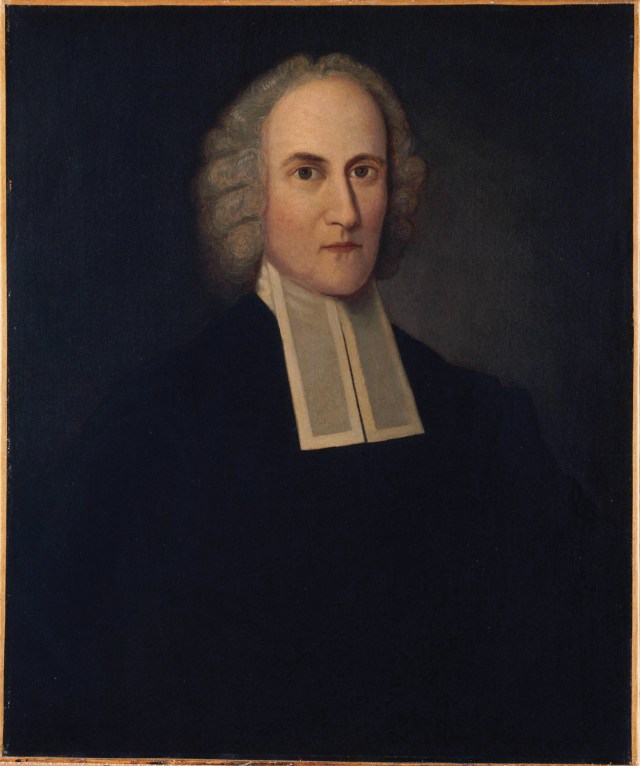
Eighty-six years ago, C. S. Lewis wrestled with similar questions. After Germany refused to back down from its invasion of Poland, Great Britain and France declared war in September 1939. The following month, Lewis, the Oxford literary scholar, found himself preaching a sermon he titled “Learning in War-Time” on the first Sunday of the academic year. He chose to tackle a question that would have troubled everyone present in the congregation that day: How could they continue academic pursuits now that there was “a war on”? Lewis’s response offers wisdom that is remarkably relevant still, not only for the likes of Dima in Ukraine but for us all.

When I first saw the images of hundreds of Russian tanks bearing down on Kyiv in February 2022, the many Ukrainian friends I had come to respect and love quickly came to mind. I had visited the country several times, beginning in 2016, as part of my work for Langham Preaching, a program of Langham Partnership started by John Stott in 2002 to develop grassroots expository preaching movements, now in more than 100 countries. 

I met Sergiy Tymchenko, a Baptist pastor and founding director of Realis (the Research Education and Light Center). He had encountered Stott soon after the Soviet Union’s collapse and, in due course, was named a Langham Scholar to do a PhD in public theology in Britain. 

The very notion of theological engagement with the public square was inconceivable under Communism, and afterward still suspect. So Sergiy’s vision seemed alien to those who, like him, had grown up under the Soviet Union’s antireligious ideology. But he was committed to serving Ukraine’s church and society as various needs arose in those exciting and troubling years. That meant developing counseling training programs, which were almost nonexistent in churches at that time. Since invasion has now traumatized an entire nation, this vision was sadly prescient.

Furthermore, the war has also proved the wisdom of Sergiy’s passionate support for introducing chaplaincies (military, prison, and hospital) into Ukrainian life. These had been inconceivable in a culture forged by decades of Communist atheism.

The primary focus of our collaboration, however, came through Sergiy’s desire to enhance local church ministries across Ukraine. We began seminars in earnest in 2017 in Irpin, near the Realis Center in western Kyiv. 

So when the BBC showed footage of Ukrainian forces’ defensive destruction of an Irpin bridge in 2022, as well as news of the most appalling atrocities in neighboring Bucha, everything suddenly gained horrific proximity for me. 

Lewis knew war from firsthand experience. He matriculated at Oxford in the summer of 1917, knowing his undergraduate studies would be curtailed by the Great War, then in its third year. After volunteering for military service and completing his basic training at Oxford, Lewis was commissioned as a junior officer and plunged into the infamous trenches at the Somme in northern France. He remained there for the next five months until being wounded by friendly fire and invalided out in April 1918.

That conflict left an indelible mark on Lewis and his generation. Lewis was no pacifist even before his Christian conversion, but he did later say he respected, despite disagreeing with, those who genuinely were.

The fact that Lewis volunteered to serve in the war lends his October 1939 sermon a greater moral authority. That address, given at University Church at St Mary the Virgin in Oxford, was published under the title “Learning in War-Time” in The Weight of Glory and Other Addresses

Could the university even justify staying open, Lewis asked? Perhaps it was more sensible to close the humanities’ faculties to assign every resource to the war effort. After all, how on earth might the study of Petrarchan sonnets, J. S. Bach’s masterpieces, or Renaissance portraiture possibly defeat Nazism? Such were the insecurities circulating in many university towns as Lewis ascended St Mary’s grand pulpit. 

Although Lewis did not expound a biblical text, there is no doubt that everything he said was grounded in his Christian faith. But that is not where he began:

A university is a society for the pursuit of learning. … Why should we—indeed how can we—continue to take an interest in these placid occupations when the lives of our friends and the liberties of Europe are in the balance?

I found myself asking a similar question last year, after the UK Foreign Office eased its travel advice for western Ukraine. I was desperate to see friends but anxious not to compound burdens. I had never visited, let alone ministered in, a war zone before. Was it appropriate to be there in any capacity as a noncombatant?

As I reread “Learning in War-Time,” not only did it provide impetus for my two-day preaching workshop and weekend seminar on the importance of the arts in wartime; Lewis’s sermon became the subject of a lecture in its own right.

A key question we must answer is: What has the war changed? Pose that question to any Ukrainian, and the response is, invariably, “Everything!” No doubt those suffering the aftermath of a hurricane, the effects of seismic economic challenges, or communal grief after a mass killing can relate. Those from Ukraine’s east have endured the destruction and occupation of entire communities since Russia’s 2014 annexation of Crimea.

Once the full invasion was launched, millions fled the country to uncertain futures. Whether they left or stayed, nothing could ever be the same again.

During my visit last year, it was certainly a shock for this privileged Brit to experience nightly air-raid sirens for the first time, despite locals appearing to barely acknowledge them.

Reminders of war were pervasive. Highway billboards still advertised the same old stuff—new cellphones or kids’ fashions—but they were now juxtaposed with recruitment posters for regiments or drone squads. Every few miles in Kyiv’s outskirts, soldiers loitered at military checkpoints as the regular commuter traffic flew past; but roadblocks with antitank defenses, affectionately known as Czech hedgehogs, could be retrieved from the roadside and made operational in seconds.

In the center of Kyiv, I was relieved to see how intact the historic districts remained. Sergiy and I made the most of the autumnal sunshine, taking long walks across the magnificent city. We entered a large Baptist church in his neighborhood, one whose history dates to before the Soviet era. Its reverberating foyer contained the usual noticeboards of schedules and study topics. But one wall now presented color photos of roughly 40 men in military fatigues and, at its base, a row of four in stark monochrome: the fallen. All were members of this congregation.

During my 10 days in Ukraine, I did not meet a single person without friends or family at the front. Almost all had lost someone. Everything had changed.

Two women stand amid debris from bomb damage during World War IIAlamy
WWII, London: Two women stand amid debris from bomb damage.
A Ukrainian man stands amid debris in front of a residential apartment complex that was heavily damaged by a Russian attack.Getty
2022, Kyiv: A man stands amid debris in front of a residential apartment complex that was heavily damaged by a Russian attack.

Read against the backdrop of lethal drones and aching grief, Lewis’s sermon makes a startlingly insensitive—and perhaps offensive—point. Lewis insisted that nothing has changed. It is important, he said, “to try to see the present calamity in a true perspective. The war creates no absolutely new situation; it simply aggravates the permanent human situation so that we can no longer ignore it.”

The key to his argument comes from his surprising entry point. After suggesting that the challenge of academia during a war could be considered akin to the proverbial Nero who fiddled while Rome burned, Lewis dared to mention what he called the “crude monosyllable” of hell. His justification was the teaching of the Lord Jesus himself, and his reason was that an eternal perspective is essential to his entire argument.

The reality of divine justice offers the ultimate benchmark for what is of true and lasting value. Neither the Second World War nor the Russian invasion of Ukraine—nor the current horrors in the Middle East—makes the slightest difference to that. That may sound glib to those suffering, yet it does not alter the fact of it. Lewis’s point is simply that eternity has always been life’s ultimate measure, war or no war.

The crucial question, therefore, is not which activities may be justified in wartime but which activities are worth doing at any time. For something to be worth doing, it must have inherent value, whatever the circumstances and despite human mortality. 

This doesn’t mean that wartime doesn’t influence our work and our perspective. “Yet war does do something to death,” Lewis continued. “It forces us to remember it.” This is certainly happening in Ukraine.

Andriy is a Kyiv pastor who was previously a well-known journalist. He regularly visits the frontline and field hospitals as a volunteer chaplain. He was in no doubt of Lewis’s point. Before the war, many people were noncommittal or even resistant to matters of faith. It is entirely different now. Andriy barely has a single conversation with the active or wounded that does not concern eternity and divine justice.

Another friend of mine, Sasha, in Lviv, learned three days before we met that one of his oldest Christian friends had been killed at the front. His grief was intensified by the impending birth of his first child. Quietly agonizing, Sasha said in English, “Just what kind of world are we bringing him into?”

In light of such horrors, not devoting everything to the war effort can seem frivolous at best and obscene at worst. Surely our attitude must be all hands on deck? Maybe not. Lewis’s approach is carefully reasoned, working through a perspective that would seem absurd to nonbelievers but compelling for believers.

Because Christ sacrificed everything for us, it stands to reason that he deserves our everything in response (1 John 3:16). Consequently, only one object is worthy of our total devotion: God himself. Lewis insisted nothing else comes remotely close, be it a career, a family, an academic pursuit, or even a war effort. Lewis illustrated this with the concept of training to become a lifeguard, an inherently good thing to do:
We may have a duty to rescue a drowning man and, perhaps, if we live on a dangerous coast, to learn lifesaving so as to be ready for any drowning man when he turns up. It may be our duty to lose our own lives in saving him. But if anyone devoted himself to lifesaving in the sense of giving it his total attention—so that he thought and spoke of nothing else and demanded the cessation of all other human activities until everyone had learned to swim—he would be a monomaniac. The rescue of drowning men is, then, a duty worth dying for, but not worth living for.

The analogy is apt for Ukrainian forces desperately fighting to defend their country, as well as for any nation or community facing peril on a grand scale. How can we avoid becoming obsessive, especially at perilous times? Lewis’s solution is to ensure we do everything “as working for the Lord” (Col. 3:23). This Pauline principle subverts the old sacred-secular divide by insisting that a life of sacrificial worship embraces far more than just the “holy” or religious parts of life. It is a matter of whole-life discipleship.

Furthermore, as creatures created in God’s image, we long for what is true, beautiful, and good. As Lewis wrote, “An appetite for these things exists in the human mind, and God makes no appetite in vain.” So it is no accident when some seek to plumb the depths of truth, beauty, and goodness. That is inherently worth doing, war or no war.

Now, a country at war faces unique demands. Conscription is perhaps necessary, and it necessarily rips people out of their everyday lives. Lewis was not arguing for the precedence of academic study; his understanding of just war theory would suggest that there are circumstances when it is right to take up arms. He was simply saying that academic study, even study of the humanities, during wartime (albeit for a minority) is a legitimate vocation. If something is justifiable in peacetime from an eternal perspective, it is entirely justifiable in wartime. 

This does not mean everybody will grasp this. I know that my grandfather, ordained to Church of England ministry not far from Oxford in 1940, often encountered incredulity and even hostility after the war years when explaining his lack of military experience.

So it was very moving to chat with a Ukrainian man I’ll call Petro as our Realis seminar closed. He had come at the last minute, despite being a senior energy specialist with responsibility over several power stations in Ukraine’s bitterly contested east. Two days before the seminar, one of his facilities was almost completely destroyed in a Russian attack. He assumed that leaving it would be impossible. On inspection the next morning, however, there was simply nothing he could do to repair it. He looked exhausted and hollowed out when he arrived at the seminar.

After three days, however, Petro seemed a little brighter. “Thank you so much for being willing to come to Ukraine,” he said through Andriy’s interpretation. “We need this. We need to learn more about preaching. We need to learn about what is beautiful in the world. Even now. Especially now. These things matter more than ever.”

I then remember Dima, praying on his balcony as drones fill the skies. Lewis’s perspective must resonate with him as he brings his requests before God. Yes, he prays for war to end. But he also prays for all the things that make life rich and livable, war or no war.

Mark Meynell has been director (Europe and Caribbean) for Langham Preaching since 2014. In 2025, he is focusing his attention on writing and teaching while serving as an associate of Langham Partnership. He writes at markmeynell.net.

Church Life

On Rabbits, Redemption, and the Written Word

President & CEO

A note from CT’s president in our annual books issue.

A rabbit, thistle, and Watership Down
Illustration by Christianity Today / Source Images: Unsplash

One of the books I loved in my youth was Watership Down by Richard Adams. For reasons I could not name at the time, the peculiar tale of a band of rabbits escaping the destruction of their warren and sojourning to a new home captivated my imagination. Inspired in part by Adams’s experiences in World War II, the novel narrates the dangers the rabbits confront along the journey to a prophesied promised land as well as the fight, once they reach it, to defend it from danger.

Later, when I studied abroad in England, a friend asked whether I would join him on a day trip to retrace the rabbits’ journey. I had not known that Watership Down actually exists: It’s an elegant green hill outside Kingsclere in southern England. Adams described places he knew well, places that can still be found, down to the smallest details. So, dog-eared copy of the book in hand, that friend and I spent an enchanting spring day charting the way from the Sandleford Warren to the top of Watership Down. There, to our delight, we found dozens of rabbits peeking out of their holes as the sun set over the downs of Hampshire.

Watership Down became one of the best-selling books of all time and has been adapted into stage plays, animated films, and a streaming series. It deepened my sense of the profound pleasure of reading and its power to transport us to faraway places. It also sharpened my attention for things I had once overlooked—in this case, things close to the earth, berries and thistles and flowers—the kinds of things rabbits would notice.

The issue you hold in your hands is devoted to the magic of books. Books are teleportation devices, time machines, world engines, empathy generators, enliveners of minds, and invigorators of souls. The history of Christianity is, among other things, a history of books, from The City of God to the Summa Theologica to The Imitation of Christ, Foxe’s Book of Martyrs, The Pilgrim’s Progress, Institutes of the Christian Religion, and Mere Christianity. And of course, God chose to bear the story of his relationship with his people and of his incarnation and ministry in the person of Jesus Christ in the Holy Book.

We congratulate the winners of this year’s Book Awards. We hope they capture new hearts and minds for the gospel of Jesus Christ. We hope they point our attention toward things we neglect, refining our vision of what it means to follow Jesus with all our hearts and minds.

Christianity Today remains committed to the written word. We believe in the extraordinary, life-changing power of stories and ideas. That is why we were founded and why we exist today. We all belong to an adventure story—a journey from a broken paradise to a promised land. We all partake in the grand narrative of God’s redemption and restoration of all things. 

And as in Watership Down, the story is one of friendship and fellowship. We are a community on the move. When we lift our heads, we see the destination ahead of us: a high and beautiful place, a home in the sunlight, where we will be one with our Maker and Savior.

The kingdom of God is among us and ahead of us, and it is a real place. One day we will see it in full. As we at Christianity Today move through our One Kingdom Campaign and follow where we believe God is leading, we are grateful to our readers. Thank you for seeking the kingdom together, and we pray you’ll bring those around you to join us in the journey.

Corresponding Issue

Christianity Today

January/February 2025

Culture

Krista Tippett on Wishful Thinking Versus Hope

From Soviet-era Berlin to current-day USA, the longtime radio host shares insights on countering discouragement.

Illustration by Ronan Lynam

On a recent episode of The Bulletin, Christianity Today’s senior director of CT Media, Mike Cosper, spoke with journalist Krista Tippett, who has covered religion and spirituality across traditions on her show On Being for more than 20 years. Their conversation touched on the fraught political climate in the US, the individualism corroding American culture, and how hope and community can offer a pathway to healing. This excerpt has been edited for clarity.

Mike Cosper and Krista TippettIllustration by Ronan Lynam
Mike Cosper and Krista Tippett

Mike Cosper: What I have loved about your work for years now is that you have called us to pay attention to the spiritual undercurrents of our culture. What taught you to stop and pay attention to the spiritual elements of our world?

Krista Tippett: There are so many ways to answer, but I’ll just say that I grew up in a culture and a family where there wasn’t a lot of deep listening and attention.

Sometimes we learn to value things because it’s been modeled for us, and sometimes it’s because of an absence. And it’s a gift when you have this hole that you couldn’t articulate and then you realize what needs to fill it.

In terms of the spiritual aspect, I grew up Southern Baptist in a very religious world, but I’m not sure I would say it was a very spiritual world. When I left home, I was not really turning against religion, but I wasn’t sure what relevance it had for the world I was moving in at that point. Later on, I went to divinity school and I learned to love theology. 

I got interested in politics and ended up spending most of my 20s in divided Berlin. The Cold War was the great geopolitical drama of the ’80s. It was years before I could have articulated it this way, but that place was a fault line of the geopolitical landscape at that time.

What I started to perceive was an absence of attention the spiritual dynamic of the division of the world and these weapons we had pointed at each other. In divided Berlin, you took one city with one people, one language, one culture and split it into two—and gave them two absolutely different competing realities that had missiles pointed at each other. And because I loved people who lived on both sides of that wall, I watched people create lives of dignity, beauty, meaning, and intimacy—or fail to do so.

And it wasn’t about which side of the wall they landed on. It was not the raw materials people were handed but what they did with those raw materials. That brought me back to this primal, original fact of “us.”

Spiritual is a word that I use lightly because it’s pretty vague. But yes, it was that spiritual aspect that the policymakers and the politicians and the people who were moving the missiles around on the map weren’t paying attention to.

I just got fascinated with the question “How do we pay attention both amid and despite what the official, serious ‘political economic world’ is doing around us?” And paying attention to that has served me pretty well, living in this time we inhabit.

MC: In your book Becoming Wise, you say, “Hope … is a choice that becomes a habit that becomes spiritual muscle memory.” And then you go on and describe it as a “renewable resource.” Can you unpack that for us and for this moment in particular?

KT: I think a lot about hope, and these days I mostly just leap and say, “Hope is a muscle.” And what I’m contrasting is, a muscle is different from wishful thinking and it’s different from assuming or believing that things will turn out all right in the end. The way I think about hope is reality-based. It’s not optimism.

I have some role models in this. I think about John Lewis, who talked about hope a lot. It’s almost prophetic—on your podcast, I can use that language, right?—it’s a refusal to accept the way you are told things have to be. It’s a refusal to insist that the world has to be this way. 

And then hope, the muscle, is throwing what we can of our life, our will, our energy, our intelligence, our creativity, our care behind that insistence.

One of the great gifts of my life of conversation has been being in conversation with people who really have shifted the world on its axis in some way. And it is always true in those situations—and really in all human leaps of creativity and innovation and social transformation—that somebody sees a possibility that, almost always in the beginning, other people don’t believe can happen or scoff and sneer at.

So it’s a leap of imagination in the sense that you are insisting on a better possibility. And human beings have done this across time. This is how we move forward. You throw your life behind that possibility.

MC: That foundational idea that hope is a choice, I think, is so important in a time like this, because if I understand who listens to The Bulletin and where they’re coming from, I think we’re mostly dealing with people who feel—to some extent spiritually and to a large extent politically—homeless. Their options don’t represent them well.

And the temptation in that kind of loneliness and isolation is always despair. Or the other temptation is to adopt an ideology that ends up being very radical. How does one choose hope in the midst of a situation like the one where I think most people find themselves these days?

KT: First of all, I want to say that I’m not hopeful about everything. I don’t think that hope is a blanket attitude. For example, I wouldn’t make a general statement that I’m hopeful about our political culture. It’s not a reasonable choice. I know there are people who are working on this. I actually know some, and there’s a very young generation of new politicians coming up who I can get hopeful about. And I also see that they’ve got 20 years before they’re going to be running things. So I think there’s a discernment in this.

I also think politics is not really the realm that I am engaged in or touch. I think of Bryan Stevenson talking about knowing what we’re being called to—how discerning what we want to be in the world and how we want to be in the world has to do with getting proximate. I think there’s something to this—something about what we can see and touch and know.

So when I say hope is reality-based and reasonable, I think it’s meant to be an informed choice, and we’re not all informed about everything. There’s a focus to it. Being hopeful in general is not reasonable right now and not right. That’s not what I’m talking about. That’s not muscular. That’s more in the wishful thinking category.

The other thing I would say that feels really important to me is, I think one of the most corrosive tenets of American culture that has infected all of our other realms, including our religious lives, is this cult of the individual. We’re not even conscious of this. We’ve just been raised to think that it’s all about being an individual. And none of the virtues is meant to be carried alone. That’s not what they’re about. They’re not about being a courageous individual. None of these things is supposed to happen in isolation. 

I say this a lot when I’m talking to young people now, because I actually am having this experience—that these younger generations know in their bodies at a very young age what I think all of us are having to face, which is that whatever we are working for to make this world a better place right now is our work for the rest of our lifetimes.

We’re not given two-year plans or five-year plans or ten-year projects. We are facing these intimate, civilizational—really, species-level—crises. Or callings, to put it more positively. And if that is the case—and it is—none of us is going to be able to feel, to hold onto this hope every day, or hold compassion or courage or love.

One of the things we’re called to do—and really, in doing so, we buck this fiction of individualism that we’ve grown up with—is to surround ourselves with others. We have to surround ourselves with others who are going to be able to hold that hope on the days and the weeks and the years when it is too much for us to ask of ourselves.

That’s also the reality of the time we live in. That’s how I think about it. It’s complicated, and if we leave ourselves alone with this, we will not succeed.

MC: How does that message connect to people who are constantly being sold the opposite of that? Look at our social media culture—the great enforcer of main-character syndrome for everybody. How do we convince people that they’re part of a family and a community and that some deference to that family and community matters?

KT: I don’t have an answer to that, but I think that’s the question. You’ve probably heard me quote Rainer Maria Rilke and Rilke’s idea of living the questions. Rilke said to this young person, “Don’t search for the answers that you couldn’t be given now because you can’t live them yet.” I think what he was saying is, when to rush to an answer would be to deny the gravity of the question, then what we’re called to do is live the question and love the question and hold the question until we can live our way into the answer. One way you could describe our time is it’s just all these vast, aching, open questions.

But this mentality, this individualism, it’s so embedded in us that it’s below the level of consciousness. We have to root out something that we’re not even aware of. I think it starts with having conversations like this and naming it and people kind of waking up.

One of the things I’ve always said on On Being was that in the beginning, it took me a few years of my work to realize that I’m animated by these great questions of meaning, which are the animating questions behind our traditions. What does it mean to be human? How do we want to live, and who will we be to each other? 

And in this century, if you look at every crisis or calling before us, whether it is ecological or racial or economic, that question of who we will be to each other—if we don’t center that, I think we only maybe survive. What we will not do if we don’t center that is flourish as communities, as nations, as a species.

MC: You can kind of reduce that into “Love thy neighbor.”

KT: You can.

MC: And that’s not a bad reduction, you know?

KT: It’s not, and you just tripped onto another favorite topic of mine right now, because that “Love thy neighbor” also is not a feeling. It’s agape. It is love in action.

I also think that we need to rediscover that love is actually not a soft skill but the hardest thing of all. The Beatles were right; it’s what will save us. But only if we bring the intelligence to our public life that we actually possess in our private lives, in our lives of love.

Because in our lives of love, with the most intimate relationships, love is very often what we do in spite of how we feel at this very moment, right? It is very rarely about feeling perfectly understood or perfectly understanding the other person.

The way love works—not as a feeling but as an action—is very often about what we choose not to say right now. In social media, of course, we say everything right now. But we choose not to say things right now because we choose to stay in relationship. 

So if we just “love thy neighbor” as a muscular, reality-based, pragmatic, effective way to be, not just a beautiful way to be, it’s exactly what we need.

MC: I think that’s a great place to land. Thanks for joining us here.

KT: Thank you so much. It was a pleasure.

Krista Tippett is an award-winning  journalist, author, and creator and host of The On Being Project.

Mike Cosper is the senior director of CT Media, host of The Rise and Fall of Mars Hill, and cohost of The Bulletin

Ideas

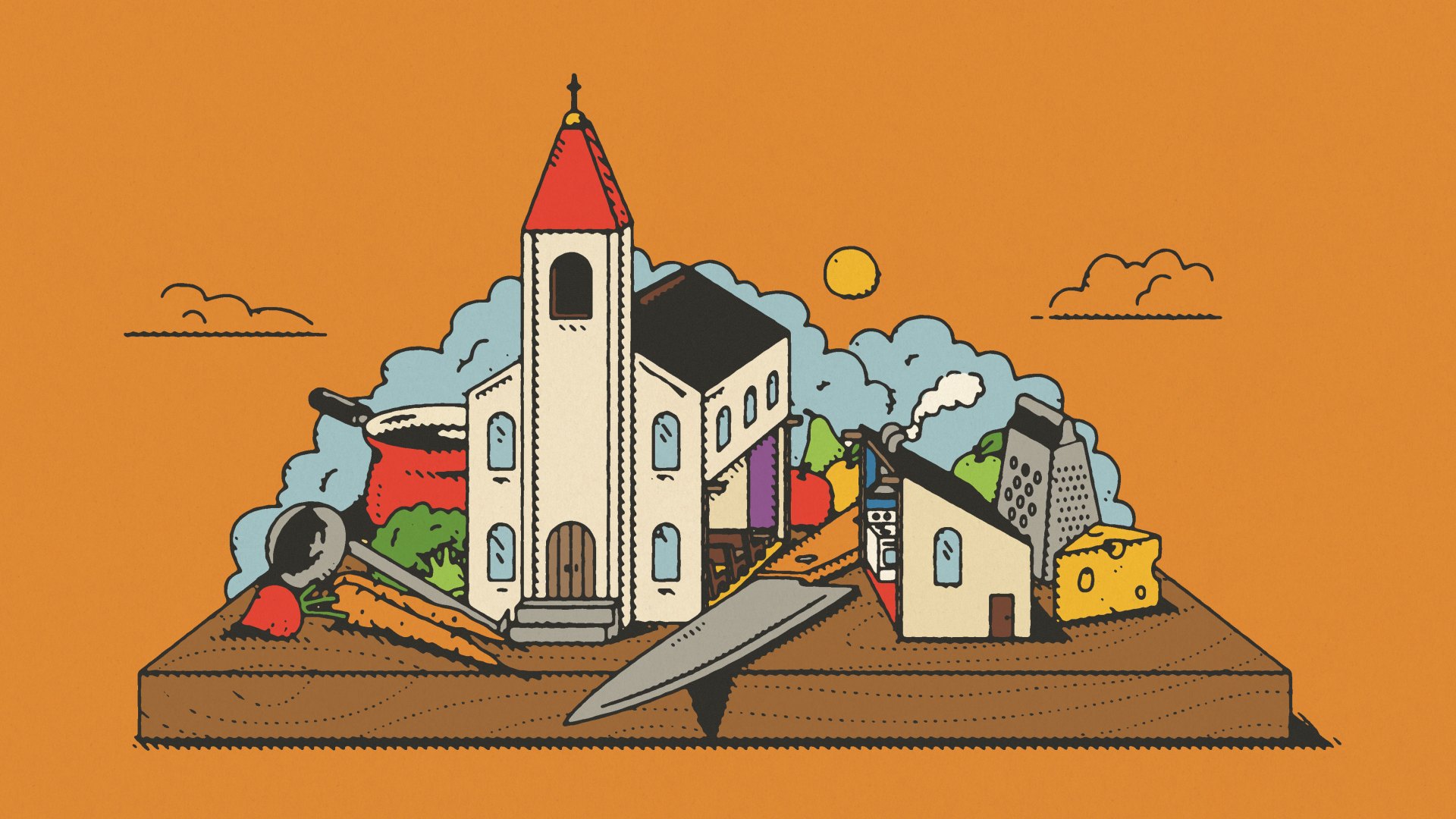
Reading—and Eating—as Communion

Staff Editor

A note from CT’s editorial director of print in our annual books issue.

Illustration by Trevor Shin

Two weeks after America’s COVID-19 shutdowns, a friend of mine gathered ten thoughtful Christian women to read the novel 1984. We called ourselves The Plague Reading Group, focused as we were with placing words from the past around our turbulent present.

Since 2020, when we first met on Zoom, we’ve moved outside and then finally inside. We’ve read dystopian fiction and histories of the fall of empires. Over plates of Korean short ribs and Swedish meatballs, we digest what we’ve read together, sharing our reading over a long table robed in candlelight.  

Books, and a shared desire to understand the times we’re in, brought us together. 

As Christians, we are “people of the Book.” Each Sunday, we read, recite, and are formed and fed by the reading and preaching of God’s Word. The Bible is always a conversation partner to the other books on our nightstands and bookshelves.  

It is our delight, then, to invite you to this feast of words. We’re particularly proud to share our annual CT Book Awards, curated by our senior books editor, Matt Reynolds.

Also in the issue, editor in chief Russell Moore shares how his own book club taught him how to live and die well. Picking up that theme, Jen Wilkin explains how biblical structure illustrates our life arc in “A Life’s Faithful Symmetry.” Mark Meynell shows us how C. S. Lewis’s sermon “Learning in War-Time” relates to ministers in Ukraine today. 

Poet Malcolm Guite guides us into the pleasures of poetry as a vehicle for developing a Christian imagination, vital in our time of division and polarization. Emily Belz reports how churches in New York City are preserving endangered languages. And in Guest Appearances, you’ll read how hope is a muscle from journalist Krista Tippett.

We pray that as you read the stories on these pages, your own muscle of hope will be strengthened to work at connection rather than division, at truth rather than disinformation, at goodness rather than rancor.

Good reading so often goes with good eating, as both are vehicles for communion with God and each other. To whet your appetite for good conversation and good gathering, enjoy my sister-in-law’s recipe for your next book club or dinner. Take up and eat! 

Kerry’s Mustard Braised Pork

Ingredients:

  • A 5–7 pound pork butt roast or similar (bone-in is more tender)
  • 1 bulb of fresh garlic
  • Salt and pepper, to taste
  • Yellow mustard and brown sugar, to taste
  • 1 small can of pineapple juice (may substitute apple juice)

Instructions:

  1. Preheat the oven to 325 degrees Fahrenheit.
  2. Use a knife to make holes in the meat, and insert a whole peeled garlic clove in each hole—about 6 to 8 cloves altogether. Salt and pepper all four sides of the roast (kosher salt is best). Score the fat cap with a knife. 
  3. Warm up a well-greased dutch oven or other casserole dish over medium heat on the stove. Place the roast fat side down first, and then, using tongs to rotate it, brown all four sides, nudging it to keep it from sticking.
  4. With the fat side back on top, spread some mustard and brown sugar on the fat. Pour in some pineapple juice until there is at least an inch of liquid at the bottom of the pan. 
  5. Cover and place in the oven. After an hour, reduce the heat to 275 degrees. 
  6. Cook for 3–4 hours until the meat chunks easily.

This is great to serve alongside boiled potatoes or roasted vegetables. You can thicken the pan gravy with cornstarch and pour it over the meat and vegetables. Serve all together on a platter and bring to the table. Mustard and currant jam make lovely condiments.

Ashley Hales is editorial director for print at Christianity Today.

Corresponding Issue

Christianity Today

January/February, 2018

Theology

Living Like a Monk in the Age of Fast Living

Lessons on intentional living from the modern monastic movement.

A monastery in a city

Illustration by Justin Horstmann

The most tasteful invitation to contemplative prayer I have ever experienced was in a garden next to a charming British mansion. Along a path meandering through flowers and shrubs a series of interactive spaces featuring signs with relevant Scripture passages and instructive prayer prompts—specifically designed to help the visitor process grief after loss.

In this garden, I am encouraged to sit on a bench and imagine a lost loved one in the empty seat next to me. I can sit in a rowboat near a stream and recall the stormy waters I have endured in life. I can pick up a stick from a pile, identify a concern or wound, and release it to God by tossing the stick into the stream. I can even download an app to play meditative music along my journey.

My wife, Cheri, and I visited this Remembering Garden at Waverley Abbey in Surry, England, founded by the Order of the Mustard Seed (OMS) community as part of their 24-7 Prayer initiative. We went there after attending and speaking at the New Monastic Roundtable in Switzerland in 2023, which is a global network of 20 different intentional Christian communities like OMS who are seeking to adapt ancient monastic principles and practices to enrich modern faith and life, including designing sacred public spaces for contemplative prayer. 

I returned home filled with renewed appreciation for these and other fresh expressions of the ongoing new monastic movement. This movement was first introduced 20 years ago by the dreadlocked Shane Claiborne on the cover of Christianity Today. So I was more than surprised when, a few months ago, I heard a leader who runs in some of the same circles say casually, “The new monasticism is dead.”

While it’s true that traditional monasticism is declining in many historic Christian traditions, new monasticism—the contemporary reappropriation of monastic wisdom—is still very much alive. More than that, the movement is gaining a new and growing following among the next generation and is meeting universal human needs that are felt more now than ever.

In our global digital age, many Christians are rediscovering the importance of community, the value of rhythms and routines amid chaotic circumstances, and the need for deeper commitment to spiritual formation. Over the past five years alone, the pandemic, incidents of racial injustice, and the church abuse crisis have led to a wake-up call. We are realizing that it may be worth sacrificing modern comforts and conveniences to live out our highest ideals and potential as God’s people and that we may need to look back in order to go forward.

Some believers have been sensitive to these needs for a long time—people who consider themselves “new monastics” (like me), who are fascinated by the desert elders’ courage to relocate to abandoned places. We are intrigued by the idea of living in a close community and making serious commitments to fundamental values. We wonder if establishing communal rules for life might tame the wild horse of late modern culture and help us better order our lives around the gospel.

Today, this reappropriation is taking the form of devotional apps like Lectio 365, introductory virtual classes on contemplative prayer, repurposed convents in Europe, and prayer spaces in alleyways and financial districts. It looks like Christian university campus houses establishing their own rules of life or communal discipleship programs, and small “colleges” of Christian students attending larger universities. It is happening through globally dispersed organizations like OMS, which takes prospective members through stages of preparation and vow-taking in a digital initiation process modeled after traditional religious orders.

It’s worth noting that the term monasticism is more complex than our present usage suggests. For centuries, religious lawyers have debated distinctions between monks and friars, simple and solemn vows, religious and consecrated life, and so forth. 

Once, when I was presenting a session for the American Academy of Religion conference, one responder simply said of the new monastics, “They are not monastic. They do not make vows of chastity.” End of discussion. It would probably be more appropriate to say we subscribe to “institutes of consecrated life,” but that term is rather obscure. The reason most people still use new monasticism is because it seems fitting for a movement eager to retrieve the practices and sentiments of a radically religious form of life.

Christians who are interested in monastic principles want to take up a distinct lifestyle that will help them mature in Christ. Some of us have found a need to fast, spend time away from social interaction, or meditate on our own sins before God. Like those who compete in the Olympic Games, or consecrated virgins, members of monastic orders go “into strict training”—not to run “aimlessly” but, as the apostle Paul writes, to “strike a blow to my body and make it my slave so that … I myself will not be disqualified for the prize” (1 Cor. 9:24–27).

The technical word for this kind of activity is asceticism, but most talk about it in terms of formation. Author Trevin Wax wrote last year that spiritual formation—defined as “a total reworking of personal habits and spiritual disciplines” out of “allegiance to Jesus as Lord of all life”—is the fourth and most recent wave of influence shaping evangelical churches today. 

Wax is on to something, as many of these next-generation expressions of new monasticism are keenly focused on spiritual formation.

For example, John Mark Comer, the author of the recently popular book Practicing the Way: Be with Jesus. Become like him. Do as he did., has noted a “micro-resurgence” in the common monastic practice of adopting a rule of life as a way to live more intentionally and meaningfully.

Most religious orders are governed by rules of life, which define daily rhythms and devotional routines for the community and its individual members. Such statements usually consist of a clear vision, habits for prayerful self-reflection, and practical ways to maintain accountable relationships and care for one another.

The idea behind this is that we are all being shaped by a rule of life whether we realize it or not. So we can either conform to the social rules our culture sets for us or we can adopt an intentional vision that casts Christ’s lordship over every area of our lives, even in their most mundane aspects.

Such a goal can be accomplished without written rules, of course. I once visited one of the oldest monastic expressions in Christian history: the monastery of St. Antony in Egypt. The order there is not governed by a written rule—they had such well-established patterns that recorded regulations were deemed unnecessary. Nevertheless, for those of us without 1,500 years of accumulated wisdom or an unspoken culture of life, writing down a clear statement of our God-inspired aims can be helpful.

Jared Patrick Boyd, founder of the Order of the Common Life (OCL)—a “missional monastic order reimagining religious vocations for the 21st century”—affirms a communal rule of life that is summarized in four rhythms (bodily labor, prayer, study, and rest) and 12 commitments, including simplicity, hospitality, and service to the church.

Yet Boyd insists these are not merely devotional practices. “You can do spiritual disciplines all day long,” he told me in our interview, “but if it is not toward this particular theological understanding of the shape of the human soul and the work of God, then it does not really fit the tradition.”

OCL currently has five vowed members, but 65 novices are in process and another 45 postulants will begin in 2025. Its goal is training Christians—largely online through virtually dispersed groups—to become “spiritual mothers and fathers” in their own ordinary community settings, forming “evangelists for the love of God” in their churches and places of work.

A notable feature of monastic life, both then and now, is that members see themselves as constituting an alternative community. Both of these words—alternative and community—are crucial for our embodiment of the ancient Christian faith in our disconnected, frenetic lives and communities.

We live in a rapidly changing world, not least because of the technology that we live by, such that both community and alternative become hard to understand, let alone embody. “As we become more affluent, individualistic—we lose our aptitude for community and we do not know how to get it back,” said David Janzen of Reba Place Fellowship, a small but long-standing intentional Christian community.

Too often, spiritual formation is discussed in terms of individual growth in Christ, when that is only a small part of the story. Jesus and the New Testament writers make it clear that the Holy Spirit was given “to us” (Acts 15:8) and that the Christian life is meant to be a communal one (Rom. 12:5). That’s why most of Paul’s letters in the New Testament were written primarily to churches—because God’s plan has always been to prepare a people, a royal priesthood, the body of Christ, reigning with God forever (1 Pet. 2:9). Whether we like it or not, all of us exist in the context of a community—that is the soil in which we are each planted and growing.

Monastic thinking has always held up community as a primary agent, means, and aim of God’s work in our lives. Call it sharing life, koinonia (in Greek), or “thick community,” God intended us all for authentic fellowship. Yet this kind of community certainly doesn’t come about by accident.

Too many admirers of new monastic living “think that it will just happen in community, and it just doesn’t. It takes a tremendous amount of intentionality,” said Boyd of OCL. He told me of a meeting with a few leaders from the Vineyard USA movement in 2012, where they discussed two simple questions: “(1) Is there room in the Vineyard for a monastic expression? (2) If there is room, what might such an expression look like?”

Twelve years later, this expression looks like a charismatic, 21st-century recovery of the monastic ascetical (formation) tradition—for which Boyd’s recent book, Finding Freedom in Constraint: Reimagining Spiritual Disciplines as a Communal Way of Life, is a manifesto. And although the aim of OCL is to train Christians to be on mission in their own communities and is not primarily to start residential communal expressions, they are currently exploring what a 21st-century urban monastery might look like.

But new monasticism is not simply an embodiment of community. It is an expression of alternative community. What does it look like to love the world without losing oneself within it? What does it look like to be distinct from the world without being escapist or leaning too far into Rod Dreher’s Benedict Option of “seced[ing] culturally from the mainstream”? 

Alternative communities today, whether virtual or face-to-face, demand that we define Christian identity in ways that are either cross-cultural, multicultural, or countercultural. They also require conversations about nurturing common life and about learning the balance between caring for one’s family and one’s community. They open up discussions about how we can respect both the introverts and extroverts in our midst and force us to invest in the neglected practice of resolving interpersonal conflict.

Intentional and communal living has also been accompanied by wholesale commitments to practice virtue. Lifelong vows of poverty, chastity, and obedience are meant to combat some of the world’s age-old allures of money, sex, and power—and protect against the threats they pose to relationships within the community. And while modern monastic admirers may not carry on these vows in full, their traditions remain a vital source for inspiration and innovation.

For early Benedictines, a loving distinction from the world meant leaving their families to form semi-isolated cloisters—out of which they could offer charity to those in need. Today, that might look like sharing homes or incomes with others. For second-century virgins and 13th-century Beguines, chastity looked like renouncing the securities of earthly marriage for espousal to Christ. For “vocational singles” today, it may look like embracing celibacy out of reverence for Christ and in service to his kingdom.

We may not share all our income in a residential community, but we can choose to spend less and to share the rest in a common cash-sharing app, funneling funds to invest in local needs. We may not move into a cloister and recite the divine office seven times a day, but we might join a virtual group of partners to pray together daily and share self-examining reflections monthly. 

We may not renounce our employment and income, but we could choose to work part-time and spend the rest of our time serving in our churches or the community. We may not choose absolute obedience to an abbess or abbot, but we might want to explore the problems and possibilities of church authority and structure and invest more deeply in a humble submission to Christ’s body.

The point in all of this is that we must learn to see commitment to these principles as simply taking the next appropriate step in the context of a loving, trusting relationship with God and others.

I dream of future monastics designing tools and spaces for 21st-century communities and individuals that creatively integrate Christian asceticism with new monastic impulses—all with the goal of meeting acute felt needs of our age and culture and facilitating the deep internal work necessary to increase our Christlikeness.

The classic collection of essays edited by The Rutba House, School(s) for Conversion: 12 Marks of a New Monasticism, lists creation care, peacemaking, sharing economic resources, and lament for racial division and active pursuit of just reconciliation as among the top marks of a new monastic way of life. Even though the New Testament speaks explicitly on such issues, these aspects have often been neglected in manuals of spiritual disciplines and formation programs until recently.

For some of us, this might look like healing our loneliness or rejection by family, friends, or society at large. For others, it means acknowledging before God what Howard Thurman calls the “hounds of hell”: our fear, hypocrisy, and hatred. Likewise, many of us need to examine and unpack the invisible racial, patriarchal, ecological, or classist backpacks we are carrying.

One of the first and simplest ways we can do this work is through our prayer life—one of the most familiar marks of monastics. Our prayers are the soil from which the entire flower of monastic life grows. Do we care for the earth and its future? It must be voiced in our prayers. Do we hate the divisions of our time? We lift our lament to the Lord. Do we want to forgive those who have wounded us? We start by airing our grievances to God. This is what prayer rooms and prayer walks are all about.

I also think future new monastics will be invested in deeper and more tangible expressions of worship. The words, structure, and spaces of our gatherings (whether liturgical or charismatic) all proclaim our faith. I long for new monastics to build more chapels and prayer gardens in busy downtowns, in tent cities, or in isolated rural hamlets. This is part of what it means to both demonstrate a commitment to a contemplative life and to offer hospitality to strangers.

As always, the form isn’t nearly as important as the heart behind it. One passion in my own work is to encourage future monastic efforts to lay aside any sense of elitism and offer steps that make “institutes of consecrated life” available and accessible to all—facilitating opportunities to experience “Community 101” via spiritual formation apps, creative sacred spaces, and guided contemplation.

We must remember that retrieving something from the past and bringing it into the present for the sake of a hoped-for future is not a science but an art. And as with any art, we cultivate modern forms of ancient principles by finding our way through the unknown—a process that can take generations.

Yet I am encouraged that we are  well on our way. What I hear again and again in my conversations with leaders and followers alike is that there is a deep longing to live out the life and teachings of Christ more explicitly in our present generation. At its best, this desire is neither an expression of elitism nor an unrealistic expectation for the whole church but is rather a simple longing to make ourselves wholly available to God.

As I sat on the verdant lawn of Waverley Abbey during my visit to the Remembering Garden, I wondered if the Order of the Mustard Seed could truly keep their idyllic vision of a globally dispersed network alive—with a viral prayer app, 34 houses of prayer, 6 residential communities, nearly 1,000 members, and many other aspirations. What if all of it collapses under the pressures of finances, institutionalization, or even ordinary interpersonal conflict? It’s not that I had any secret suspicions about it in particular—I have just seen it happen to community initiatives like it many times before.

Then I remembered the words of Tim Otto from Church of the Sojourners in San Francisco when he spoke at the New Monastic Roundtable: “The church anywhere is always on the verge of failing.” Yet God’s movement in and through his church is always bigger than our perennial failures, and even the gates of hell cannot prevail against it. 

Evan B. Howard is the founder and director of Spirituality Shoppe: A Center for the Study of Christian Spirituality. He is a retired professor from Fuller Theological Seminary; the author of Deep and Wide: Reflections on Socio-Political Engagement, Monasticism(s), and the Christian Life; and a friend of many new monastic communities.

Culture

An Andraé Crouch Song Has Kept Me From Sin

The gospel great earned plenty of awards and accolades. His legacy also had quieter impacts on individual believers like me. 

An image of Andraé Crouch performing.
Christianity Today January 8, 2025
Rob Verhorst / Contributor / Getty

This month marks ten years since the death of singer, songwriter, and pastor Andraé Crouch. He was nominated for 20 Grammy Awards, winning 7, and 4 Dove Awards; his musical career produced hits like “The Blood Will Never Lose Its Power” and his all-time smash “My Tribute (To God be the Glory).” From the time he wrote his first gospel song at the age of 14, he’d lead a life that few Black men born in his time could access.

Many gospel and contemporary Christian music artists today recognize Crouch as the father of modern gospel music. When I asked a few to reflect on his legacy, they sang his praises. Kirk Franklin called him “more than a trailblazer. … His music taught me that worship could be boundless, weaving powerful testimony with unmatched artistry.” Amy Grant described Crouch’s music as an “honest, ongoing conversation with God.” Gospel singer Kierra Sheard said, “Crouch showed us artists that we don’t have to dummy down our creativity or revelation.”

But on this anniversary of Crouch’s death, I’m not just thinking about his impact on the music industry—his work with artists like Stevie Wonder, Madonna, Elvis Presley, and Michael Jackson; his composition for The Color Purple; his arrangements for The Lion King. I’m also thinking about what his legacy has meant to me.

For the first eight years of my life, I grew up in the Greek Orthodox Church, and I can’t remember much music being part of my routine as an altar boy. When my mom made the decision that my sister and I would start attending the big Baptist church down the street, I noticed the songs right away.

One Sunday, Andraé Crouch came to perform, belting out “My Tribute” from a baby grand piano on a platform. As a Black boy in a mostly white church, seeing a person who looked like me was rare. His performance resonated with the audience—and with me. Though I still can’t carry a tune, this was the beginning of my love for worship music.

Crouch was deeply formed by the Black church. His father led a Church of God in Christ congregation, which Crouch’s twin, Sandra, a gospel great in her own right, ultimately took over.

But his music wasn’t just for Black people; it was for all people. I didn’t realize it at the time, but Crouch was breaking barriers by being on the stage at First Baptist Orlando. He helped open the door for others who looked like him to be on the stage.

My family would end up joining First Baptist; in fact, my mom has been a member there for the past 42 years, and it’s now one of the most diverse churches in the country. (She recently told me she wants “The Blood Will Never Lose Its Power” sung at her funeral, when it’s time for her to go home to heaven.)

Last week, on a trip back to Orlando, I walked through the halls of church, recalling some of the places where God has showed up in my life. One of those places was the youth choir room, singing “Jesus Is the Answer” as a middle schooler just trying to fit in. My favorite Crouch song has kept me from sin; it has come to mind when I’ve wanted to go astray. “Jesus Is the Answer” is still my anchor in a world that feels even darker than it was when I was 13.

I’m connected to Andraé Crouch not only through his music but also through a particular believer whose life he impacted. It turns out that my youth worship pastor at First Baptist, Byron Cutrer, had spent some time with Crouch in college, watching him write rhymes on a legal pad as he crafted his songs. As my worship pastor struggled to discern next steps as a student confused about what was next, Crouch offered encouragement: “Be who God wants you to be, and you will do what God wants you to do.”

This quote is now on my wall. Crouch’s ministry flowed through my pastor and in turn flowed through me, teaching me how to worship God. So it is in the church: Legacy is never just Grammys or Dove Awards, public accolades and successes. It’s the quiet work of believers building up fellow believers, words of encouragement and comfort, daily witness.

As we reflect on Crouch’s legacy, I believe that he took his own advice; he was who God wanted him to be. He did what God wanted him to do, paying tribute to the one he knew he was singing to.

Maina Mwaura is a journalist and the author of The Influential Mentor: How The Life and Legacy of Howard Hendricks Equipped and Inspired a Generation of Leaders.

Skeptical Conversations About Converted Skeptics

And other responses to our September/October issue.

Mockup of Christianity Today's September October issue on a dark background and tile floor.
Edits by Abigail Erickson

More secular thinkers are turning to Christianity, wrote Nathan Guy in “Some of Christianity’s Biggest Skeptics Are Becoming Vocal Converts.” He asked, “How do we distinguish between those who have fully accepted the truth and those who have adopted the faith as a sociopolitical tool or cultural accessory?”

Our readers offered answers on social media. “By their fruits, of course,” wrote one person on X. An Instagram user added, “I’m okay with asking, ‘Is their faith merely intellectual?’ as long as we also ask, ‘Is so-and-so’s faith merely prayerful?’ or ‘Is so-and-so’s faith merely experiential?’ We have to stop pretending an intellectual pursuit of God is somehow inferior to any other pursuit of him.”

Other readers questioned these conversions’ significance. “It seems like a lot of the former atheists who are coming over are doing so for the culture war—they prefer ‘traditional’ values,” said a reader on Instagram. Another found it “unlikely that these three individuals [A. N. Wilson, Tom Holland, and Ayaan Hirsi Ali] are examples of a greater trend.” Even if they were, “the validity of theism doesn’t rest on how many people endorse it or find it somehow more appealing than atheism.” Whether or not a few notable converts reflect a broader shift, Christians always ought to be ready to give the reason for the hope that they have.

Kate Lucky, senior editor, engagement & culture

The Uneasy Conscience of Christian Nationalism

If you truly want to be big tent, why not have an article from both sides of the evangelical political spectrum? CT could have just as easily featured an article on “The Uneasy Conscience of the Christian Left” or “The Soul of Evangelicals for Harris.” I canceled my subscription to the Christian Century long ago. I don’t want to cancel my subscription to Christianity Today.

Gene Frost, West Chicago, IL

A Dating App Dilemma at Church

The only thing I would have added to Kevin Antlitz’s response is that maybe this little boy had a mental illness that cannot be helped. What would other parents do in a situation where your child cannot act “normal”? It’s an impossible ask for people who are not familiar with mental illness and the pain and suffering that goes with it.

Claudia Davidson, Bothell, WA

The Soul of MAGA

I am suspicious that Americans’ love of television gave rise to Trump’s current mythos. It seems the most clear motivation is the desire to be seen and heard in a society that his supporters feel has excluded them.

Johnny Nickel, Birmingham, AL

A Vision for Repair

The Catholic church near my home runs a monthly repair café where skilled professionals and gifted amateur craftsmen and craftswomen will fix and repair almost anything, from old vacuum cleaners to laptops. You can sit and enjoy coffee and cake while the work takes place. The youngest repairer is 16; the oldest over 80. But the major issue [in society] is “How do we repair the breaks caused by conflict on social media?” With algorithms giving us views like our own, it’s easy to go down some very deep rabbit holes where the light of reason is never seen.

David Parish, London, UK

Making Space for ‘Yearners’

If you look at a herd of animals, there are animals in the center completely surrounded and protected, and there are animals on the edge. The ones in the center don’t come in contact with what is outside the herd; the ones on the edges do. “Edge people” are the ones evaluating and negotiating those outside and inside the herd. They are in contact with both. Evangelicalism wants them to become insiders. But maybe they are doing and being exactly what they need to do and be. Maybe orthodoxy is the museum of Christianity, and it is absolutely necessary and valuable. But maybe we need other ways of being and thinking too. Luther was a heretic. Jesus was a heretic to many Jews. Yearners implies they would be better off to move to the center of the herd. Maybe not.

Patricia Hunt, Staunton, VA

Calling Is More Than Your Job

I felt Steven Zhou’s response omitted the most relevant question: Should Christians be seeking a vocational calling at all? The idea that God specifically calls each believer to a career (or a spouse, a college, etc.) is not well supported by Scripture and, as Zhou articulates, often leads to disappointment and frustration. Instead of stretching the idea of a vocational call to make it fit reality, we should instead pursue with wisdom the faithfulness in our work to which all believers are called.

Justin Myers, Alexandria, VA

The Man Who Made Global Methodism Possible

While I appreciate that theologically CT has more affinity to the GMC, as a lifelong member of the UMC I would have appreciated at least some representation of the alternative views readily available about the conduct of the WCA and Mr. Boyette during the separation process. There are two sides to the story. Instead, we got a hagiographic depiction of him and the nascent GMC. I recognize that I am not unbiased in this matter, but to anyone truly familiar with all of the difficult back-and-forth during this denominational split, this article was astoundingly biased. The descriptor puff piece seems apt.

Tim Griffy, Richardson, TX

News

A Christian and a Shiite Confront Loss in Lebanon

With many displaced by the war between Israel and Hezbollah, a believer wrestles with the challenge of coexistence.

Children inspect the destroyed buildings after an Israeli attack in Lebanon.

Children inspect the destroyed buildings after an Israeli attack in Lebanon.

Christianity Today January 8, 2025
Anadolu / Getty

In early October, in a Christian village in southern Lebanon, “Samira” (we’re using pseudonyms due to the political situation) decided to water her lemon trees. The autumn winds were dry this season. Rain was less frequent. The frail, hunched-over grandmother filled her bucket and went outside.

Samira’s husband had died two years earlier. Her children had long ago moved away, seeking better opportunities in Beirut, but her daughter owned the house next door and made frequent trips back, recently refurnishing the interior with modern decor. Samira loved the home’s colorful bedspreads in the rooms where her great-grandchildren often stayed.

But such visits were infrequent these days. A year earlier, Hezbollah had entered the Israel-Hamas war in Gaza by shooting missiles into Israel. Israel had pushed back, and the exchange of fire between the Shiite militia and Israel drove thousands from their homes on both sides of the border. And in late September, Israel increased its bombing campaign against suspected Hezbollah sites throughout the country. Nevertheless, Samira had remained, adamant that her Christian village was not a target.

Samira had just begun watering her lemon trees when everything went black. A thunderous peal roared through the village and a blunt force of air shoved her backward. An Israeli rocket had struck a home three houses down. A Shiite family from a neighboring village had rented the vacant house only a few days prior.

When she came to her senses, Samira wiped away the dirt that covered her face. The tree had shielded her from the worst of the blow, and she stumbled back inside over glass shards from her broken windows. She struggled to breathe.

Through a cracked and fallen mirror, Samira realized that white dust coated her head to foot. The impact had knocked her curtains onto the floor and blown her cabinets off the walls, spilling their contents everywhere. After locating a bag of medicine, she went next door. Her son-in-law was in town, unhurt—but the attack had also badly damaged the home. She has since relocated to Beirut.

Meanwhile, the displacement of Shiites from the south has led to interactions that have astounded many Lebanese Christians. “Janette,” a Christian medical professional, visited a government shelter at the public school across from her home in Beirut. The groundskeeper motioned her toward a middle-aged mother wearing a black chador whose husband had just died in the war. Janette approached to offer her condolences but was immediately rebuffed.

“Do not console me—congratulate me,” the widow replied. “My husband is now in heaven, a martyr for his faith. If only my son will be similarly blessed.”

Janette staggered but recovered from her shock to politely end the exchange. She had Muslim friends, including Shiites, in her middle-class and largely secular social circle. Though aware of Hezbollah’s convictions, she had never heard anyone talk this way before. “We have completely different mindsets,” she said. “How can we share a country together?”

Before France assumed mandatory authority over Lebanon after World War I, the Ottoman Empire controlled the area, which was sometimes considered part of Syria. Since Lebanon gained its independence in 1943, the country has navigated civil war and sectarian politics as it managed its religious diversity in pursuit of national identity.

Next on the agenda is the election of a president by the national parliament. By political custom, the head of state must be a Maronite Christian, but Hezbollah-aligned parties have kept the position vacant for over two years, insisting on a candidate agreeable to their agenda. The next parliamentary vote—several have failed previously—is scheduled for January 9.

Christianity Today Receives $5 Million Grant to Support Next Generation Storytelling

FOR IMMEDIATE RELEASE

Contact: Cory Whitehead
Vice President of Mission Advancement
Phone: 630.384.7223
E-mail: cwhitehead@christianitytoday.com

Wheaton, IL, January 7, 2025 — Christianity Today has received a grant of $5 million from Lilly Endowment Inc. through its National Storytelling Initiative on Christian Faith and Life. The grant will support Christianity Today’s Next Generation Storytelling Project through 2028 as part of the ministry’s Next Gen Initiative, one of three strategic initiatives of the nonprofit ministry’s One Kingdom Campaign.

The purpose of the One Kingdom Campaign is to equip Christianity Today to reach younger, more diverse, and more global audiences with a capacious biblical vision of what it means to follow Jesus Christ in our time. The Next Gen Initiative is the portion of the One Kingdom Campaign vision that invests in next-generation storytellers and expands the ministry’s work into new media.

Nicole Martin, Christianity Today’s Chief Operating Officer, says the grant promises to be transformational: “Storytelling is the language of the next generation. It’s also the heartbeat of our mission here at CT. This grant will help us incubate the stories that matter most to younger people and accelerate our core mission. The initiative is not just about us; it’s about helping everyone in our reach know and love the ultimate story of God’s redeeming grace through Jesus Christ.”

CT’s President and CEO, Timothy Dalrymple, adds, “Telling the stories of the church, and reflecting on those stories together, is central to our calling. This grant will enable us to expand our storytelling efforts by and for the next generation.”

Christianity Today received its first gift from Lilly Endowment in 1965 and numerous gifts in the 1970s and 1990s. More recently, in 2016, it received a grant for the development of technology and fundraising infrastructure, called “Creating a Future for Christian Thought Journalism.” Lilly Endowment also supported the production of resources to encourage and support preachers and pastors through sub-brands such as Preaching Today and Church Salary.

The aim of Lilly Endowment’s National Initiative on Christian Faith and Life is to help organizations identify, produce and share with a wide variety of audiences compelling stories that portray the vibrancy and hope of Christian faith and life. Christianity Today is one of 12 organizations from evangelical, Mainline Protestant, and Catholic backgrounds to receive grants through the invitational round of the initiative. Other recipients include media organizations, denominational judicatories, church networks, publishers, educational institutions, congregations, and marketplace ministries. With the completion of the invitational round, Lilly Endowment has opened a competitive round for funding in the same program.

Dalrymple adds, “This storytelling initiative recognizes the importance of lifting up examples of Christian faith that is lived out in beautiful, faithful, self-sacrificial ways. Since this is core to the CT community, we are thrilled to be a part of this storytelling initiative. We look forward to bringing forward more events, more multimedia projects, and more next-generation Christian storytellers as a result of this initiative in 2025 and beyond.”

# # #

About Lilly Endowment Inc.
Lilly Endowment Inc. is an Indianapolis-based private philanthropic foundation created in 1937 by J.K. Lilly, Sr. and his sons Eli and J.K. Jr. through gifts of stock in their pharmaceutical business, Eli Lilly and Company. Although the gifts of stock remain a financial bedrock of the Endowment, it is a separate entity from the company, with a distinct governing board, staff and location. In keeping with the founders’ wishes, the Endowment supports the causes of community development, education and religion and maintains a special commitment to its founders’ hometown, Indianapolis, and home state, Indiana. A primary aim of its grantmaking in religion is to deepen the religious lives of Christians, principally by supporting efforts that enhance congregational vitality and strengthen the leadership of Christian communities. The Endowment values the broad diversity of Christian traditions and endeavors to support them in a wide variety of contexts. The Endowment also seeks to foster public understanding about religion by encouraging fair, accurate and balanced portrayals of the positive and negative effects of religion on the world and lifting up the contributions that people of all faiths make to our greater civic well-being.

# # #

About Christianity Today
Reaching 40 million people across the world annually through a variety of acclaimed and award-winning digital and print media, Christianity Today elevates the stories and ideas of the kingdom of God with a vision of a Church more faithful to Christ and the world more drawn to him. Learn about the next season of ministry for CT through its One Kingdom Campaign at www.seekthekingdom.com.

# #

Culture

A Bible Prof Listens to Taylor Swift

The artist sings about sin, angels, and a stone rolled away, but her Christian imagery doesn’t always land.

An image of Taylor Swift cut out on a blue background, surrounded by cutout angels.
Christianity Today January 7, 2025
Illustration by Elizabeth Kaye / Source Images: Getty

Savvy New Testament readers pay attention when its authors interpret Scripture—the texts that Christians call the “Old Testament.” Why does the author of Hebrews think this passage should be referenced here? Why does Paul use this quotation in a way that seems strange? These questions lead us to deeper appreciation of the Bible’s unity and power.

Although the implications are by no means the same, similar questions can be asked with respect to any artist who references the Christian tradition. Why does this novel include biblical allusions? Why the cruciform figures in this painting? And why is Taylor Swift singing about “rolling the stone” away?

Arguably the most successful artist of our time, Taylor Swift has produced a corpus full of Christian imagery—with mentions of “burning flames or paradise” (“Style,” 1989) and “falling from grace” (“Don’t Blame Me,” Reputation, and “Castles Crumbling,” Speak Now [Taylor’s Version]). In her songs, “what died didn’t stay dead” (“Marjorie,” Evermore); a suitor calls himself a “Good Samaritan” (“The Manuscript, TTPD); “devils roll the dice” and “angels roll their eyes” (“Cruel Summer,” Lover). In “Soon You’ll Get Better” (Lover), reflecting on her parents’ cancer diagnoses, Swift speaks to their medications: “Holy orange bottles, each night I pray to you.”

Swift’s most recent album is no exception. The Tortured Poets Department narrates breaks with friends and significant others—but perhaps also a “break” with organized religion (see, especially, “But Daddy I Love Him”: “God save the most judgmental creeps / Who say they want what’s best for me / Sanctimoniously performing soliloquies I’ll never see”).

In “I Can Fix Him (No Really I Can),” Swift sings, “Come close I’ll show you heaven / If you’ll be an angel all night.” In “loml,” she calls the man she’s speaking to “Holy Ghost.” Her lyrics cite liquor that anoints (“The Albatross”) and demons that need to be exorcized (“The Black Dog”).

One could argue that words like angel and paradise are simply part of our cultural vocabulary, so quotidian as to be spiritually meaningless. Who hasn’t described a particularly excellent dessert (or a great piece of music, for that matter) as “heavenly”?

But even allusions that don’t explicitly or intentionally refer back to a particular Bible story or verse are worth examining. The questions these references raise are worth asking.

For instance: What does it mean that Christian concepts often appear as romantic metaphors in Taylor Swift’s music? Again and again, Swift defines romantic love as “sacred.” “Holy Ground” (Red) is framed around an idea from Exodus 3:5: “And right there where we stood / Was holy ground.” In “Guilty as Sin?” (TTPD), Swift wonders: “What if the way you hold me / Is actually what’s holy?” In “False God” (Lover), Swift finds “religion in [his] lips”; the “altar is [her] hips.” The two lovers “make confessions” and “[beg] for forgiveness” while drinking wine. This Eucharistic reference is more sophisticated than Swift’s other allusions; confession precedes approaching the table. But—and this is a big “but”—her ascension is not to God, but instead to a transcendent moment with her partner.

Like Swift’s prayers to pill bottles, these images may make us uneasy. The idea that sexual gratification offers a glimpse of something “divine” is a distortion of Christian theology. The sense that sex could be the key to fulfillment obscures the path toward joy in communion with God.

But Swift’s reliance on religious imagery here is worth a second look. We say that America is becoming post-Christian—but Swift, at least, seems to think that religious language is still resonant for her listeners. “Holiness” remains one of the most powerful concepts she can access to impress upon us the seriousness of her feelings. She may be mislocating “sacredness,” but sacredness itself, that sense of being set apart, is still a real category for her and for her fans.

So too are the categories of “sin” and “punishment,” those distinctions between heaven and hell, grace and the Fall, that she so often draws upon in her work. In “The Prophecy” (TTPD), for example, she refers to Genesis 3:

And it was written
I got cursed like Eve got bitten
Oh, was it punishment?

Like our foremother Eve, Swift perceives herself as cursed—perhaps even persecuted. Thus, another set of her references, drawn from the Gospels, inspires another question: How does Taylor Swift connect to the story of Jesus?

Elsewhere on TTPD, speaking to a former partner, Swift sings, “I would’ve died for your sins” (“The Smallest Man Who Ever Lived”; see also “False God”). Out of context, this line might seem offensive. How dare Swift imply that she can atone for our transgressions! But her intention isn’t to imply that she’s the Messiah. Her self-sacrifice ends in tragedy, not resurrection. She’s expressing the extent of her devotion, however foolish.

I don’t think Swift has a savior complex. But I do think she identifies with the pain and suffering of Jesus, even seeing herself at the mercy of mobs. From “Castles Crumbling”:

People look at me like I’m a monster
Now they’re screaming at the palace front gates, used to chant my name
Now they’re screaming that they hate me
Never wanted you to hate me

In this possible allusion to the triumphal entry, we hear Swift’s warning: Sure, one day they’re crying out “Hosanna” or belting “Love Story,” but it doesn’t last. “What if I roll the stone away? / They’re gonna crucify me anyway,” she laments on “Guilty as Sin.” She, like Jesus, couldn’t do anything (even perform miracles!)without being criticized.

Similar themes appear in “Cassandra” (TTPD). Swift draws upon the Greek mythology of the titular character, even as her lyrics call to mind the story of the woman (allegedly) caught in adultery: “When the first stone’s thrown, they’re screaming / In the streets, there’s a raging riot.” The accused woman’s story paired with Cassandra’s (who was assaulted and later murdered) converge in a narrative that we know all too well: A gifted woman is disregarded, exploited, then deemed “the problem.” Swift’s decision to reference a story in which Jesus provides hard-won empathy to an abused woman is meaningful. This is good theology; Jesus stands with us in our pain.

Throughout her work, Swift uses the New Testament, and the story of Jesus in particular, to understand her own experiences of public suffering. In this, she provides a model to Christians in their own difficult seasons. We too must “fix our eyes on Jesus” (Heb. 12:2, CEB). That said, “righteous” suffering, as Christians understand it, results from injustice, from a dedication to the gospel. Swift does considerable advocacy work; her music gives language to many in pain. But she is by no means grounding that work in a commitment to God.

This raises one more question: How, then, should Christians interact with the language of our faith that appears in the Corpus Swifticum?

It’s worth remembering that Taylor Swift is writing poetry. She isn’t literally praying to pill bottles. She uses figurative images to communicate what is sacred to her, what merits devotion, what is transcendent and powerful. This is theology in a broad sense—insofar as the concepts of worship and holiness are properly connected with God—though I don’t think Swift is consciously articulating her beliefs through these lyrics. For all that she wears on her sleeve, and in spite of a song like “But Daddy, I Love Him,” that card now stays close to her chest.

Even so, whether she realizes it or not, Swift becomes a biblical interpreter when she engages with the rolled stone and Eve’s punishment, an altar and the Holy Ghost. We have to take seriously the indirect communication that appears in her references. What we see when we take them seriously is that Miss Americana herself often misuses and misapplies Scripture; her lyrics often reflect misunderstandings of God.

Even so, Swift sees many things quite clearly. Many of her songs reflect the value of friendship and the beauty of creation. She calls for justice and offers the oppressed a voice. She gives acceptance to young women battered by harmful messages about their bodies and their societal worth—messages that have too often come from the church.

So to answer Swift’s question, “Who’s afraid of little old me?” Not me. And I encourage you not to be either. No, every Taylor Swift lyric is not holy. But many of her lyrics offer something valuable—not least a glimpse of God from another vantage point.

Madison N. Pierce is an associate professor of New Testament at Western Theological Seminary and the author of Divine Discourse in the Epistle to the Hebrews.

Apple PodcastsDown ArrowDown ArrowDown Arrowarrow_left_altLeft ArrowLeft ArrowRight ArrowRight ArrowRight Arrowarrow_up_altUp ArrowUp ArrowAvailable at Amazoncaret-downCloseCloseEmailEmailExpandExpandExternalExternalFacebookfacebook-squareGiftGiftGooglegoogleGoogle KeephamburgerInstagraminstagram-squareLinkLinklinkedin-squareListenListenListenChristianity TodayCT Creative Studio Logologo_orgMegaphoneMenuMenupausePinterestPlayPlayPocketPodcastRSSRSSSaveSaveSaveSearchSearchsearchSpotifyStitcherTelegramTable of ContentsTable of Contentstwitter-squareWhatsAppXYouTubeYouTube