News
Excerpt

After Hostage Release, Peace Remains Uncertain

Israel and Gaza wait for results of cease-fire agreement.

People waiting for the release of Israeli hostages at Hostage Square in Tel Aviv on October 13, 2025.

People waiting for the release of Israeli hostages at Hostage Square in Tel Aviv on October 13, 2025.

Christianity Today October 15, 2025
Menahem Kahana / Contributor / Getty

Early Monday morning, Hamas released 20 Israeli hostages in the first phase of a fragile cease-fire plan orchestrated by President Donald Trump and leaders of the Arab world. Phase one includes a partial Israeli withdrawal in Gaza and a flood of aid into the region. It also requires Hamas to dismantle and disarm, an aspect of the plan Hamas currently refuses.

Mike Cosper, senior contributor for The Bulletin, sat down with Haviv Rettig Gur of The Free Press to talk about the tenuous nature of the peace. Here is an edited and condensed excerpt of their conversation.

What is the mood among Israelis today?

Overjoyed. We haven’t slept properly. 

There is also tragic relief. Our betrayal of our people is finally over. Because of our history, safety began here in Israel. When Hamas took 251 of our people, we betrayed them deeply. The sense of betrayal has been an overwhelming feeling. The relief is truly palpable. People were weeping in front of the television screens on my street when the news came out. 

Israelis are extraordinarily optimistic about the future. They believe they can withstand their enemies and fight back. Then, you ask: What about Israel’s own political leadership? Optimism and trust crashes in the polls. Seventy percent of Israelis don’t want the war to end immediately, because they don’t trust Netanyahu to be capable of managing it and winning it. There’s this sense of distrust. 

What’s happening now in regions where Hamas has emerged from the tunnels and is resuming a public presence in Gaza?

Hamas has killed many hundreds in Gaza to maintain its rule while it sat in the tunnels. Not a single civilian has been allowed to step foot into that bomb shelter system in the last two years. Now, Hamas gunmen have emerged from these systems and are out in force on the streets with their guns. 

In multiple places, local families and clans independently created order in their territory when Hamas was hiding in tunnels. Hamas is conducting gun battles with those clans now and has issued warnings that it is going to arrest and kill those who criticized them.

We already have seen the disappearances of several dozen critics of Hamas. If you’ve criticized Hamas on social media, they will now come for you. They have announced that they’re going to execute these people. 

There are almost no Christians in Gaza because of Hamas, so very few have died in this war. Under Islamist regimes, Christians flee. In Syria, in the most ancient communities in the world, 80 percent are gone. The rest are keeping their heads down. 

What happens if, after the hostages are home, Hamas does not agree to decommission arms and digs in its heels?

International pressure on Israel not to resume the war will be enormous—real sanctions could be on the line. That would really hurt the Israeli economy. Any Israeli government will think five times before resuming the war. 

The world will also say that all Gaza needs is rebuilding. However, a terrible enemy promises to rebuild its war capabilities to drive Gaza into yet another war. Hamas sought out this war and will seek out another. Their ambitions are the result of 150 years of theological discourse that produced Hamas in a particular stream of Sunni Islam in the Arab world. 

If this occurs, Israel will struggle to get back to the war. The Israeli population is exhausted—in the military and at home—from two years of war. If there are no hostages in Gaza, it’ll be harder for the Israelis to explain a return to war. 

What that means is Hamas will essentially have retaken Gaza, and it’ll be very hard to redevelop Gaza, to rehabilitate. Gaza is a 25-mile territory with 400 miles of tunnels. It’s in every neighborhood. Nobody has ever been as entrenched as Hamas in Gaza. 

If Israel doesn’t return to war, that is an immense relief to Gaza. On the other hand, nobody on earth is willing to fight and die for Hamas to be destroyed. Nobody on earth is willing to die for Gazans. Nobody on earth is willing to die for a future in which Gaza isn’t ruled by Hamas, except Israelis. Gaza will be ruled by Hamas. 

If Hamas isn’t removed, Gaza has no future. That’s true if the Israelis are good people in a bad situation, and it’s true if the Israelis are the evil incarnate on earth. 

I don’t need people to love Israel. It was a terrible, terrible war. There are thousands of dead kids in Gaza. There’s no way there wasn’t a better way to fight this war. That should be the reaction for every war. It certainly should be the reaction for a war of urban warfare. 

This is a terrible, painful war in which the Israelis needed to be very careful; and you can come at them for not being careful. I don’t have any complaints of people who come at the Israelis about the war. However, those who support Hamas are guaranteeing another war. That’s the bottom line.

Listen to the full episode, which released on Tuesday, October 14.

Church Life

Evangelism Isn’t Allowed in Oman. Sharing Is.

A Christian-led interfaith group helps both Muslims and Christians explain the value of their faith.

American Christians and local Muslims eating lunch together in Oman.

American Christians and local Muslims eat lunch together in Oman

Christianity Today October 14, 2025
Image courtesy of Justin Meyers.

In the ancient city of Muscat in the Sultanate of Oman on the northeastern shores of the Arabian Peninsula, several American Christian college students and local Muslims sat cross-legged on an oriental rug around printed passages from the Bible and the Quran. In the traditional Omani reception room lined with plush red mattresses and matching pillows, they discussed the phrase in John chapter 1 “the Word became flesh” and its Islamic parallels.

Two senior leaders—one Christian and one Muslim—guided the proceedings. They instructed the Americans to not place copies of the holy texts on the floor and assured the Omanis that these papers would not be thrown in the trash. Their primary goal that May afternoon was to avoid debating or comparing the texts academically, but rather to engage in a process called “scriptural reasoning.”

Though the concept was developed in the 1990s by Christian, Muslim, and Jewish philosophers, the term scriptural reasoning is a bit of a misnomer. Participants read and reflect on the selected passages with inquisitive curiosity, not logic. The point is self-discovery—and sharing—of one’s personal reasons for faith.

The Christians approach the Bible with love and reverence, describing the message they see within. Muslims do the same with the Quran, and the two groups exchange observations and ask questions, seeking to understand the passages’ meanings from the other side. Both Christians and Muslims listen attentively, free from the burden of convincing the other.

In Oman, where proselytization is illegal, al-Amana Center (AAC) uses exercises like scriptural reasoning to help bridge divides between Muslims and Christians, Arabs and Americans. Leaders said such activities by the current incarnation of the Reformed Church in America’s (RCA) 130-year ministry in Oman, now an independent partner institution, builds trust and mutual respect.

Justin Meyers, executive director of AAC, led the May session of scriptural reasoning. The students came from Hope College, a small Christian school from Michigan, as part of a senior seminar course involving an immersive exploration of Arab and Islamic culture. AAC’s Arabic teacher, Mohammed al-Shuaili, led the Muslim contingent and had already done this exercise dozens of times.

“It becomes hard to tell the Bible and Quran apart,” Shuaili said. “Scriptural reasoning brings people together, to discover the common threads.”

The scriptural reasoning website offers 34 topics—including things like modesty, fasting, and reconciliation—and looks at how passages in the Hebrew Bible, New Testament, and Quran discuss these themes. Shuaili said he especially appreciated its focus on Abraham’s hospitality.

Meyers, an RCA pastor from Grand Rapids, described how Christians get to experience the impact of quranic recitation while Muslims discover the beauty of the biblical text. By creating safe spaces for religious conversation, he said, interfaith relations are strengthened in Oman, the Persian Gulf region, and the world.

Oman’s nearly 5 million people are a diverse mix of Sunni, Shiite, and Ibadi Muslims as well as Christians (4%) and Hindus (5%), mostly from the substantial immigrant community.

While appreciating sincere Muslim engagement with the Bible, many evangelicals may view scriptural reasoning as a step down from evangelism. Shuaili’s response suggests he equates the two religious texts and downplays the differences. In a good-humored comment of commonality, he said he expects to see Meyers in heaven one day, where they can play pickleball together. But at no time, the scriptural reasoning website emphasizes, is anyone called to compromise their faith commitment.

Prior to AAC, Shuaili was a strict and traditional Muslim who would have never interacted with believers of other religions. This indicates the promise of interfaith relations to better integrate communities, but is Christian-Muslim dialogue a proper substitute for the RCA’s once-vibrant missionary heritage?

Open Doors ranks Oman at No. 32 on its World Watch List of nations where it is hardest to be a Christian. (Part 2 of this series discusses why AAC disputes this ranking.) Yet while Open Doors’ annual report praised AAC for “helping to create a more tolerant attitude towards Christians,” it also said that the center is “very much intended to boost Omani diplomatic ties.” With churches monitored and proselytizing illegal in the country, the report said that government support for AAC’s interfaith dialogue helps Oman keep a “friendly face” toward the world. 

The AAC website states it differently. The center began in 1987 when the RCA closed the al-Amana American school in Muscat. At a time when Americans were growing increasingly distrustful and fearful of Islam and the Arab world, the denomination repurposed its building for interfaith activities to better educate American Christians and contribute to peace between East and West. Dozens have come every year since, except during the COVID-19 lockdown.

The RCA first arrived in Oman in 1893 as part of the Arabian Mission that also ministered in modern-day Iraq and Kuwait. Samuel Zwemer, the “Apostle to Islam,” was an early member. Though few Muslims converted, Omanis today still recall with appreciation how later missionaries Sharon Thoms and his son Wells served thousands through their selfless medical care.

But as the region experienced an oil boom, the Omani government nationalized the RCA’s hospital in 1973. Christian institutions, once the only providers around, suffered a double blow: As costs and local competition increased, it became harder to maintain their service. They also suffered personnel shortages, as denominational priorities shifted and fewer members were called to missions.

Meyers came to AAC in 2013 as associate director, seeking to imitate Jesus in his peacemaking convictions. He said other Christians criticized him for not “standing with the truth” by condemning Islam and for not trying to convert his friend Shuaili. Meanwhile, Shuaili faces criticism from his Muslim peers for befriending a pastor and associating with Christians, whom they believe have an “outdated version” of the true faith of Islam.

They pushed forward anyway, primarily with non-Omanis. An Emirati imam in Abu Dhabi protested that scriptural reasoning did not sufficiently honor the Quran, until a senior cleric said he should give it a try. Jewish rabbis have joined as well. A delegation of Nigerian pastors and imams visiting Oman decided to continue meeting after returning home—for a joint meal, not a religious debate.

Shuaili grew up in a village near Nizwa, 90 miles southwest of Muscat. One of the oldest cities in Oman, Nizwa was the home of the founder of Ibadi Islam who aimed to moderate between nascent Sunnis and Shiites. Within this conservative religious ethos, Shuaili ignored video games and devoted himself to quranic study during his teenage years.

Shuaili understands the reluctance of the Emirati cleric to scriptural reasoning. Muslims are trained to repeat the various Islamic interpretations of scholars, not to offer their own reflections on the text. Shuaili was incredibly nervous that he would say something wrong the first time he participated. But over time, combined with teaching Arabic to AAC students, he grew more comfortable meeting the diverse international participants.

“I can earn three times my salary elsewhere,” Shuaili said. “But here my job has meaning.”

Meyers became executive director in 2021 and shortly after appointed Shuaili as associate director. It was the first time AAC had a Muslim in leadership. But he “will never have my job,” Meyers said, as it’s important for AAC to be Christian-led. In Arabic, al-Amana means “sacred trust,” a principle he honors in his attitude toward his RCA forerunners, his local hosts, and his Lord and Savior.

Meyers said that he is public about his faith and seeks to represents Christ in everything he does. By honoring the Omani law against proselytizing, he seeks to respect social peace between religious groups, which he says the law desires to preserve. This enables him to lead activities like scriptural reasoning, explaining the tenets of Christianity to curious Muslims with no implied pressure for anyone to change their religion.  And any Omani who shows further interest in converting he refers to the official churches in Muscat.

Yet Christians should honor the good in Islam, Meyers said, such as trust in Allah’s sovereignty, gratitude for his blessings, and humility in prayer. Meanwhile, Christians should build up a positive understanding of the gospel rather than tear down a rival faith. An earlier Arabian Mission pastor, James Cantine, had a similar opinion, which he wrote about in his 1912 essay “The Nearest Way to the Moslem Heart.” Cantine believed Christians could demonstrate the love of Jesus by building hospitals and schools.

Today, much of the Muslim world no longer needs those services. Peacemaking and interfaith dialogue can be the new vehicles, Meyers believes, and like the RCA missionaries of old, he is keen to bless the Omanis. Prior to COVID, he estimated that 95 percent of AAC activity did not involve local citizens, only expats and immigrants. Today, the organization serves 300 people a year and has increased Omani involvement to about 40 percent. A favorite activity is Interfaith Photovoice, where participants capture religious images and share their meaning.

Meyers and Shuaili visited three Omani universities in the past year, speaking with college officials and attending an intercultural fair. Students in return visited AAC, hanging out with foreign visitors. AAC has also reversed the immersive experience, taking some Omanis to Hope College, where they discovered the joy of barbecue and church potlucks.

Additionally, the center has hosted Omanis at the Muscat-based Protestant Church of Oman. Meyers lectured to local businessmen about the history of al-Amana, who then placed the center on the tourist map of Muscat’s Old City. And Shuaili joined him to assist the Omani Cultural Center in its soon-to-be-released documentary about Thoms and the Arabian Mission.

Author Lewis Scudder writes that the Arabian Mission workers eventually “Arabized,” discovering the sincerity of local people and the sophistication of classical Islamic philosophers. Without giving up the uniqueness of Jesus, they moved away from comparative gospel presentations that pitted Christianity against Islam, which locals only found hurtful.

“We have to first know the Muslim heart and the things he holds dear,” Cantine wrote. “We want to enter into his life and forget the things in which we think our own civilization is superior. … It is only by such a way of self-denial and service that we can get near enough to show forth the things that commend our faith.”

Meyers hopes to build on this legacy to create a staff of equal parts Omani and Christian expats. He said the government allowance to expand their work with local citizens was built on 12 years of trust, and he has no plans to leave. He calls his wife the “saint of the mission,” and his two boys feel at home.

“I came to Oman and said, ‘Peace,’ receiving ‘peace’ in return,” Meyers said, referring to Luke 10:5–6. “They let me stay and speak of my faith.”

Part 2 discusses the foreign Christians Open Doors says Oman does not let stay and how Ibadi Islam sheds light on Omani culture.

News

Good News About Christian Hospitals in Africa

Study author praises staff members who “stay where their presence matters most.”

Surgeons operate in a pediatric ward in Benin.
Christianity Today October 14, 2025
Pascal Deloche/ Godong / Universal Images Group via Getty Images


A new study is shedding light on a rarely researched area: faith-based health care in low-resource settings. 

The study, published in JAMA Surgery, found dramatically lower surgical mortality rates at faith-based hospitals in East, Central, and Southern Africa than at public and private hospitals in the same regions.

The postoperative mortality rate at faith-based hospitals was 57 percent lower than it was at public hospitals and 47 percent lower than at private hospitals.

The study examined more than 100,000 surgical cases across 85 teaching hospitals in those regions of Africa from 2005 to 2020. Two physicians affiliated with Brown University’s medical school and an African surgeon at Tenwek Hospital, a mission hospital in Kenya, led the research. The Brown physicians also work at Tenwek, which serves a low-income population in rural Kenya.

“The point is not to pit sectors against one another,” said Robert Parker, one of the study’s authors from Brown University and Tenwek, in an email to CT. “It is to identify specific practices that save lives and help decision makers and hospital leaders invest in supervision, infection-prevention, early recognition, and critical care capacity where patients need them most. … Especially in rural settings, the need is so great that this is not a competition.”

The study comes at a significant moment for African health. Poorer nations face the headwinds of US aid cuts and the prospect of increased child and maternal mortality. And in the longer term, population growth threatens to outpace the number of African health workers.

On top of that trend, high-income nations have been aggressively recruiting African health workers away from the continent to fill their own gaps. Between 2021 and 2023, Zimbabwe lost 4,000 nurses and doctors—a large percentage of the country’s health workers.

The authors of the study have worked in public, private, and faith-based hospitals between the three of them, Parker said. Initial reactions to the study were mixed, he added, with faith-based colleagues appreciating the recognition of their work and colleagues in public hospitals questioning whether the surgical outcomes in different hospitals were comparable. 

“But as we have talked there has been a shared understanding that all of us are working within difficult systems,” he said. “We are all caring for patients who often present late after long periods of illness.”

Keir Thelander, executive vice president for the Pan-African Academy of Christian Surgeons (also known as PAACS), served for a decade as a surgeon at Bongolo Hospital, a Christian hospital in Gabon.

Thelander said the data shouldn’t be read as a condemnation of public or private hospitals, which face systemic issues like staffing or equipment shortages. But he said the study was evidence that faith-based teaching hospitals are valuable additions to their countries’ health systems overall.

PAACS supports the training of surgeons in Christian hospitals across Africa.

“Not all our graduates stay in faith-based institutions,” Thelander said. “We are overall helping strengthen the surgical systems. We’re all trying to contribute to solving this provision of surgical care. We’re not in competition. We’re on the same team.” 

Public health research has not closely examined faith-based institutions, which often play an outsize role in poor and rural areas of many African nations.

“Somehow, faith-based providers of health and education had disappeared off the policy and evidence map,” researchers wrote in a Lancet article back in 2015 about African health systems. “The slowly emerging evidence on [faith-based health providers] suggests that they are not simply a health systems relic of a bygone missionary era, but still have relevance and a part to play (especially in fragile health systems), even if we still know little about exactly how they function.”

This 2025 surgical study itself noted, “There are limited data about the overall impact of faith-based hospitals on surgical mortality in the region.”

Parker told CT that data at faith-based hospitals is often tough to gather because the facilities are “remote and under-resourced, so data systems have not been the first priority.”

Postoperative mortality in African hospitals is a “systemic issue,” the researchers said in the study, and is “often attributed to factors such as inadequate health care infrastructure, limited access to essential surgical services, and insufficiently trained health care personnel.”

The study controlled for factors like case complexity and removed obstetric and gynecological cases from the data because faith-based hospitals tend to provide more of that care, and those cases had a lower mortality rate.

These outcomes come even as faith-based health centers tend to serve lower-income patients, who often come to the hospital in bad shape and as a last resort.

A survey published in The Lancet in 2015 showed faith-based health providers served the largest percentage of the poorest quintile in the 14 sub-Saharan countries surveyed.

It continues to be the case, Parker said, that faith-based facilities are in remote and under-resourced areas.

“What stands out to me in the data and in daily work is the dedication of staff in faith-based hospitals,” said Parker. “Many could choose easier or more lucrative posts, yet they stay where their presence matters most. They are motivated by professional duty, faith, compassion, and a sense of calling. That spirit shows up in patient care in ways that are hard to quantify, and this analysis suggests it may be making a real difference.”

Ideas

Children Are Born Believers

Research shows that kids are naturally attuned for belief in God. We adults could learn from that.

A mom and her child and a bright glow.
Christianity Today October 13, 2025
Illustration by Kate Petrik / Source Images: Getty

One night while chasing my five-year-old nephew at x0.33 speed—to give him the steady assurance of being faster than me—a branch broke off from an overhead tree and smacked the ground next to him.

He immediately hid behind an oak tree and donned a serious demeanor. I joined him in peering around the side of the trunk.

“Did you hear that?” he asked.

“What was it?”

“I heard a noise.” He paused. “Do you see them?”

“See what?”

The dinosaurs.”

I smiled and said I did. We spent the next 30 minutes crawling and ducking and covering from giant clandestine lizards roaming our Midwestern backyard.

My nephew’s automatic belief that something preternatural had caused the branch to fall wasn’t nonsense; it was actually a byproduct of the way his mind was supposed to work.

Research from cognitive scientist Justin Barrett shows that humans come into the world assuming there’s some kind of supernatural source behind everything. But while dinosaurs might get the credit every now and then, if you press a child, they’re far more likely to credit a divine source. As such, Barrett argues, we’re all more or less “born believers.” And this has a load of implications for us big kids too.

You might think, Well, sure, kids can think anything is real. Santa Claus and the Tooth Fairy, for example. But regardless of how impressionable we think children are, they don’t accept everything they hear. No matter how hard you try to convince them that broccoli tastes good, for example, there’s a high probability they’ll hang on to their skepticism.
So it’s not that kids are merely naïve. It’s more that they’re naturally attuned to believe that things happen for a reason—and their go-to reason is typically related to something divine. This is one of the reasons children perpetually ask, “Why?” They spontaneously interpret events as if they’re a product of divine intelligence. The “Why?” helps piece together their slowly developing puzzle of reality.

If you ask preschoolers if raining is what a cloud “does” or if it’s “what a cloud was made for,” they’ll almost unanimously say the cloud was made for the sake of raining. Kids “view natural phenomena as intentionally designed by a god. Not coincidentally, they therefore view natural objects as existing for a purpose.”

In other words, it’s as if children assume there’s some kind of force out there that designs every little thing in our universe for a specific reason. Developmental psychologist Deborah Keleman thus argues that children are “intuitive theists.” It’s a theism so innate that even kids raised in overtly atheistic homes still tend to assume there’s a divine presence guiding their world.

While many cognitive scientists attribute this natural “God awareness” to evolutionary processes, theologians like John Calvin would insist it comes from the sensus divinitatis (“a sense of deity”). It’s the idea that all humans possess a nagging sense that there is some kind of god out there, and this divine radar holds up surprisingly well across cultures, time, and geography. Atheism is thus actually “not a battle just against culture, but against human nature,” in the words of evolutionary biologist Dominic Johnson.

The more I learned about intuitive theism, the more I realized I could relate. I grew up assuming that God was real and that Jesus was a decent candidate for that God. But I threw those beliefs out the window when I turned 13, mainly because secular musicians swayed me to think Christianity was uncool. Then when I finally did accept Christ at 18, it felt like a return to the wonder of childhood—falling into a serene “second naïveté,” to borrow Paul Ricœur’s famous phrase.

Now, none of this research suggests that kids are born with a salvific comprehension of the Judeo-Christian YHWH, the Father of Jesus from whom the Spirit proceeds (John 15:26). It simply demonstrates that we’re not born atheists—at least, not functional atheists. Instead, atheism is something people are gradually formed toward, thanks to inundation within a culture where the doubting-Thomas mentality is treated as the intellectual standard.

If doubt is the norm, this makes it all the easier for our childlike sense of enchantment to dull as we get older. Many of us gradually replace wonder and mystery with mere logical conclusions to unmeaningful causations. It’s not necessarily a natural evolution; the scholar David Kling says it’s more like slowly unlearning, overriding, and suppressing our “default setting.”

Yet even though we can dull this default quite a bit, it doesn’t turn off completely. Surprisingly, the psychologist Jesse Bering found that even atheistic adults, when faced with events of enormous fortune or misfortune, will implicitly admit that “everything happens for a reason.”

I was skeptical about this anecdote the first time I heard it— probably because I myself have been a bit too conditioned toward the doubting-Thomas mentality. But the more I mulled it over, the more it made sense. When we’re confronted with something disastrous or remarkably fortuitous, it dials down our knee-jerk beliefs about a cold, random universe, even if it’s just momentary. Wonder in any form—positive or negative—can dislodge our stubborn opinions, granting a brief return to childlikeness.

All of this research, of course, brings to mind the way Jesus praised children throughout the Gospels.

And they were bringing children to him that he might touch them, and the disciples rebuked them. But when Jesus saw it, he was indignant and said to them, “Let the children come to me; do not hinder them, for to such belongs the kingdom of God. Truly, I say to you, whoever does not receive the kingdom of God like a child shall not enter it.” And he took them in his arms and blessed them, laying his hands on them (Mark 10:13–16).

I’m sure Jesus wasn’t praising children on account of their flawless ethical sensibilities (spending an afternoon with a two-year-old will unveil this theological truism). Instead, as New Testament scholar William L. Lane notes, Jesus praises the children simply because they unabashedly accept Jesus’ reality without reservation.

Jesus blesses the children not on account of “their virtues, but for what they lack,” argues scholar James R. Edwards. Young kids lack sophistication, self-consciousness, and anxiety over fitting in or aligning with majority opinion. They haven’t developed a sense of self-importance, the desire to feel like the smartest in the room, or the illusion of control over an unpredictable universe.

All to say, Jesus’ praise may have partly been aimed at the way a child’s brain is perfectly poised to shamelessly draw toward the wonder of the kingdom.

Even though adulthood and rationalism and the scientific method might bend us to see the world as less theistically designed, as followers of Jesus we know that these methods can’t unveil the fullness of reality as it really is. Jesus’ invitation to children is an invitation to adults too. It’s an invitation to remove the guardrails that prevent our minds from noticing God behind everything—even a fallen branch.

It’s tempting to assume there’s a loss of spirituality among today’s younger generations. But a recent study from The International Journal for the Psychology of Religion found that“nones” (those who don’t identify with any religion) don’t have any less spiritual longings than those who attend church. They just tend to channel those longings into different avenues, preferring “personalized means of discovery to those offered by traditional religions.”

In other words, the awareness of God, the sensus divinitatis,is alive and well today. The younger generations just might need some help pointing it in the right direction.

And even for those who have been faithfully attending church for years, there’s always a need to fall back into the wonder of a second naïveté—to become and see the world like children once again, reminded of the beauty of life with God in a fresh way.

A few weeks ago, our friends came over and brought their kids. Their family had gotten in a (relatively minor) car crash recently, so I asked their four-year-old about it. “God protected us” is all she volunteered before going back to playing.

I admire that response a lot. I probably would’ve taken a beat to acknowledge the factors like seat belts and airbags that led to their safety before announcing the God conclusion. Maybe I have a lot to learn from her.

Griffin Gooch is a writer, speaker, and professor currently working on his doctorate at the University of Aberdeen. He writes most frequently on Substack.

Ideas

Fighting Fire with Plants

Vegetative buffers taught me how to better respond to issues that so often divide us.

Green plants on a fiery background.
Christianity Today October 13, 2025
Illustration by Elizabeth Kaye / Source Images: Pexels, Unsplash

We were not created to bear the weight of sin in this world. Yet judging by our constant engagement with every breaking news story, we often seem hell-bent on trying.

Virality has become a social virus that has warped our sense of reality. As the flu brings about a fever, this virus has its own set of symptoms: an unquenchable desire to know and respond to stories or to argue about the caricatures of people we create from piecemealed clips and comments. This social sickness spreads in isolation in front of our screens, yet it is highly infectious.

When major breaking news hits, virality feeds on polarization, vengeance, and selfish ambition like oxygen. It is propelled by the winds of racism, xenophobia, self-righteousness, and apathy across the political spectrum.

I need not tell you, dear reader, that even Christians fail to lean on spiritual antibodies that can slow, resist, and destroy this virus. When it spreads, the type of sincere love that marks our faith (Rom. 12:9–20) goes missing. Instead of abhorring evil, many celebrate or downplay it. Satan’s schemes come at us like fiery arrows and find the flesh ready to indulge them (Gal. 5:16–26). The shield of faith the apostle Paul mentions in Ephesians 6:16, meanwhile, has no dings because it’s rarely lifted.

At the beginning of this year, when the headlines focused on the inaugural prayer service at the Washington National Cathedral, I found myself gripped by virality. I texted a friend and lamented that even a value like mercy for refugees and immigrants had become a politicized concept to a large chunk of the country. “We should .. not assume we can appeal to their better nature. Because they may be devoid of one,” I wrote (emphasis added).

But I was wrong—and full of despair. I was so discouraged by the state of my country that I lost sight of my own better nature. My own shield of faith lay on the floor while I spent my time entertaining a gladiator-style, rhetorical culture war. Defeat of an ideological enemy, I thought, was the only path forward.

My friend pointed out I was being tempted to fight fire with fire. And in a way, I was. I often thought of the path forward in the image of backburning, a technique that allows fire crews to stop the spread of wildfires by lighting a controlled blaze ahead of a fire’s path. The strategy is intended to eliminate any vegetation that can fuel the flame.

In my mind, the technique was analogous to the strategies deployed during past movements like the clergy-led Black Freedom Struggle: purposeful, nonviolent, and controlled tactics meant to stop destruction by meeting it head on. But I no longer think this kind of cultural backburning sufficiently captures what was carried out by my ancestors, nor is it what is needed to stop the corrosive cultural wildfires that increasingly animate the United States and other countries.

Recently, I discovered another strategy to fight wildfires: a green firebreak. It doesn’t rely on fire to fight fire, but rather green vegetation—a barrier of plants that are often seen surrounding a field of crops or houses in fire-threatened areas.

Experts will tell you these firebreaks are strategically planted to serve as a preventative and protective boundary against a blaze. If a fire does break out, it can lower the destruction that occurs.

Green firebreaks are effective for a variety of reasons, but one attribute stands above them all: moisture. The water stored inside plants can help quench a flame. And as you might imagine, they are planted preemptively and cultivated before destruction knocks.

As a metaphor for social action, these firebreaks mirror what Howard Thurman, a philosophical mentor to Martin Luther King Jr., calls “the springs of creative thought.”

Thurman was concerned with redirecting our spiritual resources to cultivate communities that can be reservoirs of love, not hatred. He thought about how to become a firebreak, instead of a fire starter, and how to mold a people characterized by life instead of death (Rom. 8:1–11). Ultimately, he pushed his listeners closer to Jesus’ all-encompassing answer to our cycles of decay: “Love your enemies” (Matt. 5:44).  

Our culture needs a contemporary resurgence of this type of work. With the rise of social media, the weight of world’s sins feels like an ever-present reality. We scroll and see horrific episodes—from children murdered in schools to public assassinations to families living in rubble—and then go about our lives.

This pattern can quickly lead to apathy or lure us into waging an endless fight in the flesh. It can be tempting to fight caricatures with caricatures, self-righteousness with self-righteousness, or always be as loud as “the other side”. But fighting fire with fire can “intensify fear,” King once said. As a result, opposing sides get engulfed in a cycle of cultural warfare that continuously stirs up division instead of quenching it.

A better future is possible, but it will only come through life-giving communities and institutions committed to creating cultural green firebreaks.

I have seen this work succeed in the Black church and the Institute of the Black World, a think tank that sought to create community for Black faith leaders and intellectuals during the social turmoil of the late ’60s.

We can glean inspiration and tenacity from former slaves, including my ancestors, who lived in Black freedmen’s towns and “freedom colonies” founded as safe havens. We can also learn endurance from the Southern Christian Leadership Conference, a civil rights organization that believed in nonviolent direct action and played a central role in the Black Freedom Struggle.

But initiatives and communities like these need to be intentionally imagined, cultivated, and sustained. They should also primarily be characterized by what they are for, instead of simply being motivated by what they are against.     

In this way, I can agree with a self-identified Black conservative whom I recently heard express fatigue over complaints about the past. “I don’t wake up every morning and have racism and all of these negative things on my mind,” she said. Neither do I.

Instead, I wake up and choose to till calloused ground, treat barren soil, and cultivate my own community through my research, my relationships, and my work. It’s the reason I can look forward to our future glory with a hope-filled heart (Rom. 8:18–30). I pray you choose a similar path too.

Tryce Prince, a social theorist of race and religion, is the director of the Carl Spain Center on Race Studies & Spiritual Action. He is a contributor to the forthcoming podcast The Good Culture Show and the book Religion Matters: What Sociology Teaches Us About Religion In Our World. Prince writes broadly at First Sunday.

Church Life

Teaching Sunday School on Philippines’ Witchcraft Island

Doris Lantoria grew up on Siquijor island. Now she’s back to tell its youth about Jesus.

An ‘Arise to Christ’ worship gathering.

An ‘Arise to Christ’ worship gathering.

Christianity Today October 13, 2025
Image courtesy of Esther Shin Chuang

Past fragrant mango trees and shacks with clothes hanging on laundry lines stands a canopy made of coconut timber typically used to shade locals waiting for a tuk-tuk or habal-habal (motorcycle taxi). But today, 14 children ages 3 to 12 gather there in 90-degree heat for Sunday school. They sing along as a teacher in his mid-40s strums Bethel Music’s “Goodness of God” on his guitar, accompanied by roosters crowing in the background.

After singing in English and Filipino, the teacher leads them in a short prayer and jumps into a Bible lesson about Jesus feeding the 5,000. The children break out into big grins as the older kids help hand out lunches of green peas, pork, and white rice. The Sunday school has also started adding English and math classes following the Bible lesson.

Every Sunday, the scene repeats in 14 villages in San Juan, a municipality on the island of Siquijor in the Philippines. Doris Ann Lantoria, who grew up in San Juan, started the Sunday schools in 2015 after hearing a sermon in Malaysia on reaching out to children for Jesus. She felt convicted to share the gospel with children in remote areas of Siquijor.

“Wherever children are, we put a Sunday school there,” said the 49-year-old.

Siquijor has a long history of witchcraft and animism, which mixed with Catholicism when the Spanish came to the island in the 18th century. While 94 percent of Siquijor residents identify as Catholic, they also hold on to animist beliefs, including healing potions, mangkukulam (witches), and bolo-bolo healers, who use stones and a glass of water to cure ailments.

Although many mothers and grandmothers attend Mass in Siquijor, they often don’t bring their kids because they are noisy and unable to sit still. Catholic churches in Siquijor only hold Catechism classes for children in the month of May. Lantoria, who grew up attending both Catholic and Protestant churches in San Juan, had never attended Sunday school.

But her Arise to Christ Ministry Sunday schools and Saturday worship nights work to make everyone feel involved, Doris said. “The songs are contemporary, and the sermon is contextualized for their age.”

I first met Lantoria a year ago when she attended an online seminary class I was teaching. At the end of the course, students from all over Malaysia and the Philippines flew into Kuala Lumpur, Malaysia, for a two-day, in-person class. During a lunch break, she described the 17-bed guesthouse and restaurant she runs in the travel destination of Siquijor. Most of her staff members—the chefs, baristas, and cleaners—double as Sunday school teachers and worship leaders in her ministry.

Last June, my family and I traveled to Siquijor by plane and ferry to see Lantoria’s ministry in person. The evening we arrived, a storm had hit the island, and only a few shops had their lights on. (Later we learned that Siquijor often loses power for 18–20 hours a day.) Lantoria welcomed us in the heavy rain, and her staff drove us 20 minutes over the bumpy roads to her guesthouse, Sea View Resort.

Connected to the guesthouse is the open-air Tawhay Resto Café, which served Malaysian, Chinese, and Western cuisine as worship music played. Christian books lined the bookshelves, and Bible verses decorated the windows. Tawhay, which means “relax,” was the first café in the district of San Juan. When Lantoria opened it in 2019, locals doubted anyone would pay 130–150 pesos (about $2.50 USD) for coffee when instant coffee packets cost a fraction of the price. Yet as tourism started booming in Siquijor, visitors came to Tawhay looking for good coffee and an Instagrammable café.

Money from the guesthouse and café supports Arise to Christ Ministry. Last year, the business made enough for her to contribute 5 million pesos ($86,000 USD) to the ministry, which gives high school and college scholarships to 60 students and feeds 400–500 kids weekly. It is also in the process of building a youth worship center.

Born and raised in Siquijor island, Lantoria has deep roots in the area, as her grandfather was the former mayor of San Juan. She grew up regularly accompanying her grandmother to Mass and her grandfather to his church with the United Church of Christ in the Philippines. At the age of 20, Lantoria moved to Malaysia after marrying a Chinese Malaysian (they later divorced) and lived in Kuala Lumpur for 26 years. It was there that she came to faith in Christ through a women’s Bible study and joined a church.

“When I saw one Sunday school in Malaysia, it instantly clicked to me that this is what was needed in Siquijor,” said Lantoria.

From 2015, she started flying back to Siquijor every three months to set up Sunday schools. In 2017, she started giving out scholarships to students unable to afford school fees, including books, uniforms, or food. “Village people are generally poor,” Lantoria said. “What they earn today is food for today.” By 2018, she was flying back every two weeks.

During one of her trips to Siquijor in March 2020, the government shut down the area due to the COVID-19 pandemic, trapping Lantoria on the island for two years. Throughout that time, she discipled the youth and expanded her café and lodging businesses, eventually deciding to stay in Siquijor after the pandemic.

From 2019 to 2023, she taught 12 Bible classes each weekend wherever she could find space: basketball courts, a local’s porch, canopies, or large trees. By 2022, she was exhausted from running from village to village and realized she needed to raise other leaders to teach the classes. She began training the scholarship students, teaching them about Jesus. Several of them started teaching the Sunday schools.

Because many of the new leaders were young in their faith, Lantoria wrote down each lesson for them to repeat verbatim. One Sunday school teacher, 32-year-old Jayce Mae Vios, said that as she taught the students, it “helped me learn what happened in the Bible at the same time.”

Today, Lantoria’s adult and youth leaders teach all but one of the classes.

As the children reached their teen years, Lantoria realized they needed a place to worship. About 90 percent of the young people who attend Arise to Christ come from a Catholic background and would never step into an evangelical church, Lantoria said. So she started a Saturday night worship service for the youth.

When my family and I visited on a humid summer night, more than 150 teens gathered to eat dinner in the half-finished building of Lantoria’s second café. Then they walked to the unfinished worship center to sing and listen to her preach. Halfway through, a downpour halted the worship service, as the center did not yet have a roof or walls. Together with the teens, we ran back to the café. As rain drummed on the metal roof, we continued to worship.

Many of the attendees had attended Lantoria’s Sunday school for years. Lantoria and the teachers built relationships with families as they fed their children, taught them the Bible, and visited their homes. One mom spotted Lantoria as she drove down the road to pick up other young people for the worship night. The mom shouted, “Don’t forget to pick up my child to go to Saturday service!”

Lantoria noted that the teens are eager to attend because San Juan has few activities geared toward youth. Many of them spend their time playing basketball or scrolling on their phones.

Liezel Laranjo, 46, is one of the few adults who attend the worship service. Her children attended Arise to Christ activities and told her what they had learned. Although she grew up Catholic, “it was nice to hear about the word of God” from her children, she said. When Laranjo joined the Sunday school in 2019, she found her faith growing.

She also started attending the Saturday worship service with her children this June. Laranjo said that since Jesus forgave and saved her, she wants to give the “gift of our lives” to him and worship him.

Not only have her children received scholarships through Lantoria’s ministry; her daughter also worked at Tawhay until her recent pregnancy, and Laranjo works at the guesthouse. “The ministry helped my family a lot in ways like provision for food, teaching, and guidance,” she said. “[It] made us whole spiritually and physically.”

Ministering in Siquijor is difficult due to deep roots of witchcraft in the island. Siquijor is known as “Island of Witches” or “Mystic Island” and is seeing a revival of tourists interested in magical healings and potions. It is common to see vendors selling voodoo dolls, sacred stones, and amulets on the streets.

Although the Spanish brought Catholicism to the Philippines in the 16th century, it wasn’t until 200 years later that the Catholic missionaries set foot on Siquijor island.

“Catholicism was supposed to replace the witchcraft and animism, but instead it got mixed with Catholicism,” she said. For instance, on Black Saturday (the day before Easter Sunday), “healers” in Siquijor gather for the annual Healing Festival, where they create a sticky paste they believe can cure ailments. On Palm Sunday, locals spray palm leaves with holy water, then craft them into the shape of a cross or a flower and put them around their houses or boats to ward off evil, Lantoria explained.

But in her Sunday school classes, Lantoria teaches the children that though people used palm leaves to welcome Jesus, they don’t have any special powers. “People seek a faith healer, and they’re told they may have offended [the spirit of a] big tree, like the old acacia or balete tree, and [are] asked to offer a whole chicken, rice, eggs,or Coke,” Lantoria said. “I go against that and tell them to chase the spirit away!”

Deep-seated pagan beliefs and superstition make it difficult to reach the people of Siquijor, said Josephine Bulado Malicay, a Filipina missionary with the Southern Baptist Convention’s International Mission Board (IMB). From 2008 to 2010, she served in Siquijor’s Lazi municipality, where she led Bible studies and took part in door-to-door evangelism.

Her colleague Jess Jennings, who has been based in the Philippines since 1993, said IMB has sent many Filipino and American short-term mission teams to Siquijor and found that some people were responsive to the gospel and willing to study the Bible. Those teams have been able to help locals plant one or two churches on the island, where only 2 percent of the population is evangelical, Jennings said. Yet they don’t think enough Filipinos are willing to go and stay long-term.

“There seems to be fear of the reputation that Siquijor has of witchcraft. And because of some resistance to the gospel, not many are willing to come from outside of Siquijor and stay a long time,” Jennings said. “The harvest is plentiful and seems to be ripe.”

As a businesswoman and a local, Lantoria is an insider in Siquijor. Over the years, she has gained the trust of residents in San Juan. Recently, she started a guitar class that meets every Saturday afternoon. The class is free, although the students need to attend a 45-minute Bible study prior to the guitar lesson. Twice a week, Lantoria disciples young people and leads worship team practices.

Lantoria said that when she started her ministry, her Baptist uncle criticized her for teaching Catholic children, because they were of a “different religion because they pray to saints.” When Lantoria’s uncle converted from Catholicism, he removed all the icons in Lantoria’s Catholic grandmother’s house, saying, “Throw them away, or you will go to hell.” His harsh response made her grandmother uninterested in learning about her eldest son’s new faith.

Lantoria pushed back: “I will stay with the Roman Catholic children because they need to know the truth.” Lantoria said she doesn’t attack Catholics. Although she believes that local Catholics have combined the Bible with local traditions, she said, “I am making their strayed teachings straight, using the Bible.”

“Unlike other pastors, who say, ‘If you pray to saints or if you are Catholic, you will go to hell,’ I don’t do it that way,” she said. “I give [them] Bible passages where it says we are all saints. I don’t condemn them for going to the Roman Catholic Church, but I want to put Jesus back to where he belongs, as number one.”

Correction: An earlier version of this article misstated the relative who criticized Lantoria’s ministry.

Esther Shin Chuang is an award-winning concert pianist, a singer, and the director of the worship program at Malaysia Baptist Theological Seminary. She and her husband are pastors at Georgetown Baptist Church in Penang, Malaysia.

News

Ukrainian Refugees Brought Revival to a Polish Church

The arrivals that transformed one congregation overnight stand to have long-lasting effects on mission in Europe.

A Pentecostal congregation at Ostoja Church in Opole, Poland.

A Pentecostal congregation at Ostoja Church in Opole, Poland.

Christianity Today October 13, 2025
Image courtesy of Ken Chitwood.

The city of Opole is 275 miles from Poland’s eastern border. But Ukraine never feels that far away.

And at Ostoja Church, a Pentecostal congregation that has served the city of 130,000 since 1952, that presence is palpable, particularly during Sunday-morning prayers.

The church’s pastor, Mariusz Muszczyński, said that every Sunday since the beginning of the war, the church has prayed for peace in Ukraine—in Ukrainian and Polish.

“We never skip it,” he said. “It’s become part of who we are.”

It’s not only the church’s prayers that have changed since the war began. The people have as well.

“From one day to the next, our church transformed from a middle-class Polish-descent church into a messy, missional, giving, caring, international community,” Muszczyński told CT. “It revolutionized our church overnight. Three years down the road, we are in a totally different place than we used to be.”

Even before 2022, there were more than 8,000 economic migrants from Ukraine living in Opole, the historic capital of Upper Silesia in Poland’s southwest. But in February of that year, when Russia launched a large-scale invasion of Ukraine, hundreds—and later thousands—arrived seeking shelter and safety. In the first 18 months after the invasion, the Polish government granted temporary protected status to 22,000 people in Opole.

Muszczyński’s church was on the frontlines of dramatic change.

As refugees started to flee west across Poland, he said Ostoja Church was the first organization in the city to receive them. Expecting to help dozens out of the 100 the city planned to resettle, the church received almost 500 refugees in just two days. By the end of the first year, that number increased to 900.

It was a lot for the midsize church to handle. But Muszczyński and church volunteers called everyone they knew in the city: hotel and motel owners, student-dormitory directors, private homeowners, businesspeople, and landlords. Somehow, the pastor said, they were able to place every single person within 24 hours without having to house anyone at the church itself. 

Muszczyński knew the church would change too. The church bought headphones for translations and started working with an Orthodox woman who had moved to Opole before the war to provide simultaneous interpretations during every service. The congregation also started praying for peace.

But beyond the change in logistics and liturgy, it was the change of heart that struck Muszczyński the most.

“It was a totally new season for our congregation,” he said. “From one day to the next, we became a local church with a global outlook, willing to embrace people from different nations.”

Now, three years later, Ostoja welcomes worshipers from 10 other nations: India, Italy, Indonesia, Tunisia, Colombia, El Salvador, Peru, Pakistan, Belarus, and Ukraine. The church provides translations for as many languages as possible, and Muszczyński is working to train up leaders from among the multiple nationalities and languages present.

Ken Chitwood

Ostoja is not alone in this transformation. Across the continent, migrants and refugees have changed the demographics and dynamics of congregations—including many that welcomed Ukrainians and became hubs for humanitarian aid, shelter, and spiritual care.

According to a European Commission report, there were 995,925 beneficiaries of temporary protection from Ukraine in Poland by August 2025, making it the country hosting the second-highest number of such individuals within the European Union. Poland’s figures represent a slight increase of 2,260 people compared to the previous month and are part of an ongoing trend of more people making their way to EU countries as the war escalates amid fraught and frustrated negotiations for a possible peace.

Writing just months after the Russian invasion, Jim Memory, a regional director of Lausanne Europe, described the response from churches across Europe as “extraordinary.” He said the way thousands of churches and Christian families opened their doors to receive Ukrainian refugees—many of them women and children—would not only have an immediate impact but also possibly bear “long-lasting consequences for mission in Europe.”

But Ostoja’s story remains unique, in part because war and displacement are, for better or worse, part of its DNA.

During World War II, Opole (then Oppeln) was part of the German Province of Upper Silesia until its capture by the Soviet Army in January 1945. Following Germany’s defeat, Opole and the surrounding region were placed under Polish administration. The German population was displaced, with millions leaving the city before Polish settlers were brought in from further east, themselves forcibly displaced, to repopulate the city.

Among them was Muszczyński’s family, who arrived from what is now Ukraine. Each family traveled with their own faith, and those who were evangelical or Pentecostal had no place in Opole to meet or worship. Nor did the Soviet authorities allow them to start their own churches. Instead, the Polish government formed a United Evangelical Church (UEC), which comprised various Polish Protestant communities.

This families had to begin the church from scratch, said Muszczyński, accommodating different traditions, cultures, and beliefs along the way. In 1952, Ostoja Church was able to overcome the differences and open its doors for worship—at the former Lutheran chapel in the city’s cemetery.

It was, Muszczyński admitted, always a challenge to maintain the church in such conditions, but it was the church he grew up in, and he learned much from it. “We had evangelicals together, from Pentecostals to Baptists and things in between, staying in one congregation,” he said. “To stay in peace and worship God together, we needed leadership who could bring people together.”

Those lifelong lessons were put to good use in February 2022 when the first refugees from Ukraine arrived. It was, the pastor said, like starting the church anew. But Muszczyński was able to not only quickly rally people together but also raise up leaders who could continue the work and provide support beyond what he alone could give.

Two of those leaders are Yevgeniy Snitsar and Kateryna Duldina. Yevgeniy, as he is known, is the leader of the church’s Ukrainian group, and Duldina spearheads the collection of support and supplies the community sends back to Ukraine.

Duldina said the church assists new arrivals with immigration paperwork, food support, and education and health care logistics. Currently, it is assisting 56 families across Opole. Beyond immediate aid in the city, it also sends upward of 50,000 euros in supplies via transport vans to ministries in Kherson, Donetsk, Zaporizhzhia, and Boryspil, just outside of Kyiv. It sends wheelchairs, toilets for those disabled by the conflict, school supplies, diapers, games, and a whole laundry list of other supplies.

Flipping through pictures of deliveries on her phone, Duldina said, “Every euro is worth it, to see the impact it has on families and friends going through the worst of war.”

Yevgeniy said it may be hard for people far away to understand what is happening in Ukraine, Poland, and elsewhere in Eastern Europe. Even so, he wants people to know that though the war is terribly painful, they have found blessings along the way. Pointing to the Ukrainian group at Ostoja, he said that though their lives have been upended, the change has brought revival to the church and individuals.

“For us, it is clear where God is at work in all of this: right here at this church, through different people all working together for the same goal,” he said.

Asked about the potential for peace and an eventual return to Ukraine—despite mounting uncertainty over the prospect of negotiations between Russian president Vladimir Putin and Ukrainian president Volodymyr Zelensky—Yevgeniy and Duldina said that though they may not know what the future holds, they feel called to continue their work in the face of war.

“Three-and-a-half years is a long time, and there are so many questions in the air right now,” said Duldina. “But because of churches like Ostoja, in all its diversity, we can continue this work for years to come, no matter what the future holds.”

News

China Detains Influential House Church Pastor

Authorities arrested Zion Church’s Pastor Jin “Ezra” Mingri along with dozens of church leaders.

An image of Pastor Jin Mingri of Zion Church.

Pastor Jin Mingri in 2018.

Christianity Today October 11, 2025
Fred Dufour / AFP

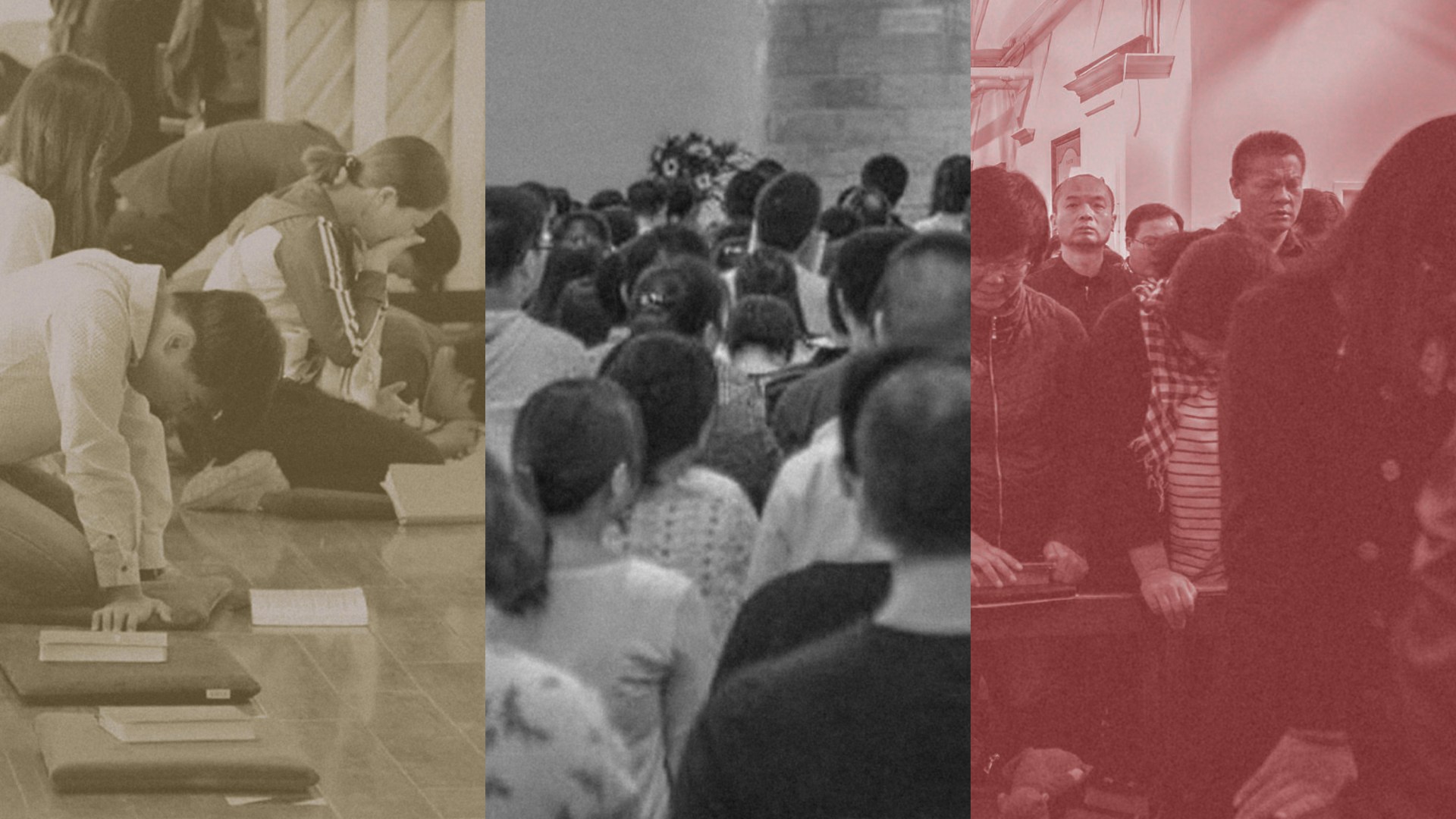
Since Thursday, police have detained nearly 30 pastors and staff members of Zion Church, an influential Chinese house church network, in what many fear is the beginning of a new wave of persecution against Christians in China.

The arrests took place in at least six cities across China. More than 10 officers broke into senior pastor Jin “Ezra” Mingri’s apartment in Beihai, Guangxi province, on Friday and searched his home all night before taking him away in handcuffs, according to the nonprofit ChinaAid. Authorities detained one pastor at the Shenzhen airport. Church members have lost contact with more than a dozen congregants in Beihai and are uncertain whether they’ve also been arrested.

Jin’s daughter, Grace, who lives in Maryland near Washington, DC, first heard about the roundup on Friday morning as she woke up to see her father’s prayer-request letter about Zion pastor Wang Lin’s arrest. Then she received a call from her mom, who also lives in the US, saying she had lost contact with her dad. They later found out he was under arrest in Beihai.

Grace always knew this could happen. In 2018, the government shut down Zion Church’s sanctuary in Beijing. Yet since the pandemic, the church has grown rapidly through its hybrid model of livestreaming services to small groups across the country. Today the church network includes nearly 10,000 people spread across 40 cities. Likely because of this growth, the Chinese government has increasingly targeted the church, breaking up services and detaining pastors and church members—although typically releasing them after several days.   

“I didn’t want to believe this was happening,” she said. She tried to downplay her father’s unavailability, thinking perhaps officials had just invited him to “drink tea” (a euphemism in China for police interrogations). “I did not want to look at what it entailed.”

Jin, an ethnic Korean from northeast China, became a Christian after the Tiananmen Square massacre left him disillusioned about the country’s Communist government. At a local church, he found hope he couldn’t find anywhere else. In 2007, he started Zion Church with fewer than 20 people. A decade later, it was one of the largest unregistered house churches in China, with about 1,500 members and more than 20 pastors. When I visited the church in Beijing in 2018 before the crackdown, the church was meeting on the third floor of an office building with a spacious modern sanctuary and its own coffee shop and Christian bookstore.

The government began threatening to close the church in August 2018 after Jin refused to install security cameras in the sanctuary. Authorities pressured about 100 church members to stop attending. In September, the government officially banned the church, sealing off the church property. Police detained Jin and other leaders for a few hours before releasing them.

This week’s roundup was different, said Sean Long, a Zion pastor pursuing a doctorate in theology at Wheaton College. In a coordinated attack, police in cities around the country carried warrants to detain the leaders and staff. They face charges of “illegal dissemination of religious information via the internet,” Long said.

Yet Long noted that Jin had long anticipated a crackdown. In 2018, even before the church was shut down, Jin sensed persecution coming and sent Long and his family abroad so an arrest of pastors would not leave the church leaderless. Jin’s wife, daughter, and two sons also moved to the US so the government could not use them as leverage.

This year Jin again sensed a storm coming. In one Zoom call with Jin, Long asked what would happen if all Zion’s leaders were arrested. Jin replied, “Hallelujah, because a new wave of revival is coming.” 

The arrests still shocked Long: “It’s a brutal violation of … the Chinese Constitution that grants every Chinese citizen freedom of religious belief.” 

A prayer letter Zion Church released Saturday listed other house churches recently facing persecution: In May, Xi’an police detained pastor Gao Quanfu of Zion’s Light Church for  allegedly “using superstitious activities to undermine the implementation of justice.” In June, authorities imprisoned 10 members of Golden Lampstand Church in Linfen on fraud charges. They sentenced pastor Yang Rongli to 15 years in prison.

With the leaders inside China detained, Long and several other pastors who reside overseas—including in South Korea and Canada—will continue to shepherd Zion Church.

On Sunday, three days after the crackdown began, Zion’s 100 church plants—gatherings that number between 5 and 50 people—will meet for worship as they do every week, Long said. Some groups meet inside living rooms, while other rent out private restaurant rooms. They’ll watch over Zoom as a Zion pastor who resides in South Korea preaches a sermon on the stoning of Stephen (Acts 7:54–60), the first Christian martyr, followed by a short encouragement and benediction by Long. After that, they’ll hold in-person discussions or Bible studies. Some will share a meal together.  

“No suffering, no glory—that’s the most important spiritual DNA of the Chinese house church movement through history,” Long said. “We are willing to pay the price to bear the cost of discipleship.”

Culture

Amazon’s New Streaming Channel Has Both ‘House of David’ and ‘Sherlock’

Major networks have invested in faith-based programming like Wonder Project before. This time seems different.

A still from House of David season 2.
Christianity Today October 10, 2025
Jonathan Prime / Prime Video. © Amazon Content Services LLC

Ten years ago, in the wake of Noah, Exodus: Gods and Kings, and the History Channel’s The Bible miniseries, a couple of major networks tried to cash in on the growing appetite for biblical stories by launching some Scripture-themed TV shows.

NBC got the ball rolling with A.D.: The Bible Continues, a series beginning with the death and resurrection of Jesus. It was canceled after just one season. By that point, ABC had already started shooting Of Kings and Prophets, a series about David, Goliath, and King Saul’s family. When it premiered one year later, it lasted all of two episodes before the network pulled the plug.

Now, a decade later, there is another major series about Jesus and the disciples and another about Saul and David. This time, they’re on streaming platforms, not legacy networks. And they’re both very popular. With the premiere of House of David season 2 last Sunday—one week after The Chosen’s fifth season became available worldwide on its free app—they are both genuine, bona fide, multiseason TV shows.

But there’s more to note here than larger viewership and relative longevity. In both cases, the makers of these shows are using their success to create new infrastructure, with the aim of supporting more Bible-based media in the long term.

The Chosen’s production company, in addition to running its own app and raising funds through the nonprofit Come and See Foundation, is launching a series of “Chosen universe” spinoffs.

And the makers of House of David used the show’s second season to launch a brand-new streaming channel called Wonder Project, named for the “faith and values” production company cofounded two years ago by series creator Jon Erwin and former YouTube and Netflix executive Kelly Merryman Hoogstraten.

The channel—which features a variety of classic films and TV shows as well as new offerings—costs $8.99 per month or $89.99 per year and is currently available through Prime Video. The long-term goal is to make it a direct-to-consumer app.

“We wanted to create a place where there could be some level of independence of this content being made over and over again,” said Erwin, who codirected hit films like I Can Only Imagine and Jesus Revolution before launching Wonder Project.

Erwin, who has worked with a variety of studios since directing October Baby with his brother Andrew in 2011, said the constant moving around (he likens it to musical chairs) and changing corporate structures made it necessary to “build something of our own.”

“So often in dealing with studios—and I love representing Christianity and middle America to many of these studios, and they’re very receptive—but you feel as if you’re building everyone else’s home and they’re all built on sand,” he said. “And whether it’s a regime change or an acquisition or a merger, a lot of times you feel like years of work are gone overnight.

“So the idea of building something that could really last and endure the test of time … was very inspiring to me.”

Erwin said he had the idea for a streaming channel before House of David got the green light. He wanted “an HBO for the faith audience globally,” and he always intended for the dramatic series to serve as a hook.

The first season of House of David, which came out between February and April of this year, paved the way by going out on Prime Video globally, where it was an instant smash and ultimately attracted 44 million viewers worldwide: “More than every movie ticket I’ve ever sold to any movie I’ve ever made,” Erwin said. “It was so cool to see the show blow past any expectations that we had or that Amazon had, just in a matter of days.”

The second season went into production right away. But instead of going to regular Prime Video, it premiered on Wonder Project the same day the channel launched. It is, for now, only available there (which, itself, is only available in the US). The season will become available on Prime Video globally at some point in the future.

In a world where platforms like Angel Studios and Pure Flix already exist—Erwin himself recently finished shooting a George Washington movie for Angel, due in theaters next summer—some might wonder whether the world needs another faith-based streaming platform.

But Wonder Project aims to serve a broader audience by mixing religious titles with more mainstream fare like Sherlock, The Sound of Music, and The Secret Life of Walter Mitty—and it will offer the official, edited-for-TV versions of some movies, which is something no other platform does.

“It’s like, ‘Here’s a bunch of stuff that we think your families will love, because our families love it,’” said Erwin. “We’ve scoured decades of entertainment to pull together a curated library … including many things that you’ve forgotten how much you loved or you didn’t know where to find.”

Some might find it ironic that a family-friendly streaming channel would have House of David as its flagship show, given that the series is full of violence. (The first episode of season 2 is basically one big battle sequence.) There’s plenty of potential in the biblical story for other, more risqué elements too. (Images of David in military garb walking in front of his men with a bag in his hand has some people wondering if the series is going to tackle 1 Samuel 18:27.)

Erwin admits that what is considered appropriate for children will vary from family to family: “My oldest is 16 and our youngest is 8. … There are some brutal parts of the Bible—and the Old Testament, especially—so that can be hard to adapt to film. But my goal in the adaptation is to make the version of the show that I would feel comfortable watching with all my kids.”

“It’s violence in the tradition of the Lord of the Rings movies, not Game of Thrones,” he added. “It’s in that PG-13 space, is the goal.”

The series is coming out amidst an explosion of biblical storytelling on screens both big and small. Mel Gibson is making two movies about the Resurrection. Angel Studios is releasing an animated movie about David in December and a Nativity-themed film called Zero A.D. (starring Jim Caviezel as King Herod) sometime next year.

Fox is producing a three-part series about the women of Genesis called The Faithful. You can find a comedy about Moses called The Promised Land on YouTube. There’s even an R-rated horror movie called The Carpenter’s Son about Joseph, Mary, and Jesus, starring Nicolas Cage and slated for next month.

The two major streaming platforms are getting in on the action too.

Netflix has been a bit more tentative so far. Its offerings include a multifaith documentary series (Testament: The Story of Moses), a thriller based on an apocryphal-gospel-inspired movie they acquired after it was completed (Mary), and a romance that sets the Book of Ruth in modern-day Tennessee (Ruth & Boaz).

Prime Video, on the other hand, has jumped into the genre with both feet, not only producing House of David but also signing an exclusivity deal with The Chosen and coproducing its spinoffs The Chosen Adventures (an animated series launching October 17) and Joseph of Egypt (a live-action miniseries currently being filmed in New Mexico). Amazon MGM, the studio owned by Prime Video’s parent company, will also release two Chosen movies in theaters worldwide in 2027 and 2028.

One remarkable aspect of the biblical media surge is its genre diversity. The Chosen takes its cues from Friday Night Lights and The Wire, House of David borrows from the Lord of the Rings and Marvel movies, and The Promised Land models itself on The Office and Parks and Recreation.

Erwin finds the variety freeing and encouraging. “I’ve often said Christianity is an audience to serve, it’s a cause to champion, it’s a story to be told—it is not a genre, you know?” he said. “I think we have limited ourselves by thinking that … all these things have to look and feel the same. What I love is that there’s this group of filmmakers and we’re all serving the same cause in our own way.”

Beyond House of David, Wonder Project has other projects in the works, including a drama called It’s Not Like That, starring Scott Foley as a widowed pastor who learns to love again; Sarah’s Oil, a true story about a young Black girl who finds oil on her land, to be released in theaters by Amazon MGM on November 7; and The Breadwinner, a comedy starring Nate Bargatze that TriStar Pictures has planned for next March.

Then there’s House of David. Erwin envisioned the series as a trilogy, with three seasons charting the title character’s rise from shepherd to warrior to king, and he’s now working with writers on the final installment, which he hopes to shoot next year. (He’s also thinking of doing a second trilogy about “the back half of David’s life,” but it would “almost be a different show” with a different cast.)

“I’m grateful to be able to tell the story, and I would love to keep telling it,” Erwin said. “I can’t wait to get back for season three.”

Peter T. Chattaway is a film critic with a special interest in Bible movies.

Marvin Olasky Officially Named Editor in Chief

Russell Moore becomes editor at-large and columnist.

A headshot of Marvin Olasky.
Image courtesy of Marvin Olasky / Edits by CT

Christianity Today interim president Thomas Addington officially announced today the appointment of Marvin Olasky as editor in chief. The media company with its magazine flagship is moving into its 70th-year celebration.

Olasky was editor in chief at World magazine from 1994 to 2021. He served as a professor at The University of Texas at Austin from 1983 to 2008. Olasky is the author of 30 books on journalism, American history, abortion, and public policy, including The Tragedy of American Compassion, Prodigal Press, and Compassionate Conservatism. He has served the past 18 months at CT, first as a consultant and then as an executive editor.

Olasky’s move to editor in chief was first referenced publicly in Russell Moore’s “Moore to the Point” newsletter two weeks ago. Moore, who served in the editor in chief role from 2022 to 2025, requested a change to editor at-large and columnist because of the expansion of The Russell Moore Show in audience and time commitment, in addition to his weekly essays, column in each issue, and role as a cohost on The Bulletin, CT’s weekly news and analysis podcast, which has also grown in scope and reach over the last year.

Moore praised Olasky’s experience as “the titanic editor of World” and said, “I would quite often open up an issue with a low whistle and comment, ‘I can’t believe he is courageous enough to take on that.’… I finally convinced Marvin to take the editor in chief parts of this role so I can expand all this writing and speaking without collapsing. I was able to sell it to the powers that be at CT by noting that they could get the best of both of us if they let me have it this way.”

“I have been praying for a year and a half for God to send us a ‘Marvin Olasky type’ to serve with us so that I could focus my attention fully on writing, audio and video content, and speaking,” Moore said. “I remember the moment when I realized it might just be that the ‘Marvin Olasky type’ God was sending us was, well, Marvin Olasky. That seemed almost too perfect to be real.”

“Marvin is respected all over the world not only as one of the most accomplished Christian journalists in American history but also for the way he identifies and cultivates the gifts and callings of others,” Moore said. “Many of the most skilled and recognizable Christian journalists right now, on countless platforms all over the country, were trained by Marvin Olasky.”

“I am thankful to work with Russell Moore and my other colleagues and to follow in the footsteps of Carl F. H. Henry, CT’s first editor in chief when he and Billy Graham started the magazine in 1956,” Olasky said. “We’re celebrating next year its 70th anniversary of attempting to apply biblical thinking to every area of life. We’re now a big tent with global outreach but still faithful to God and not to any political party or movement.”

Addington called Moore and Olasky “evangelical statesmen” and said he was “thrilled” to have both of them, along with the rest of the CT team, working together “to lift up the stories and ideas of the kingdom of God.”

“They communicate the message of Jesus with clarity and continue Christianity Today’s legacy as a strong voice for conservative orthodoxy and the heart transformation of the gospel,” Addington said.

Apple PodcastsDown ArrowDown ArrowDown Arrowarrow_left_altLeft ArrowLeft ArrowRight ArrowRight ArrowRight Arrowarrow_up_altUp ArrowUp ArrowAvailable at Amazoncaret-downCloseCloseEmailEmailExpandExpandExternalExternalFacebookfacebook-squareGiftGiftGooglegoogleGoogle KeephamburgerInstagraminstagram-squareLinkLinklinkedin-squareListenListenListenChristianity TodayCT Creative Studio Logologo_orgMegaphoneMenuMenupausePinterestPlayPlayPocketPodcastRSSRSSSaveSaveSaveSearchSearchsearchSpotifyStitcherTelegramTable of ContentsTable of Contentstwitter-squareWhatsAppXYouTubeYouTube