There’s No One Equation for Educating Christian Kids

God will be faithful to our children, and we can trust him no matter where they go to school.

Christianity Today September 29, 2023
Illustration by Christianity Today / Source Images: Getty

I never intended to homeschool our kids. When we started, it wasn’t for religious reasons. Well, maybe a little. In our rural district, my kindergartner had an hourlong bus ride to school, which meant she was gone from 7 a.m. to 4 p.m., five days a week. It was a good school, and she had a great teacher. But she was so tired when she got home that there was little room for the family discipleship I envisioned I would do.

We decided to try homeschooling—just her and just for a year. But as we prepped our second child for kindergarten, some red flags flew up around his health and learning needs, and we decided that it might be easier to homeschool both that school year. After that, the rhythm of homeschooling just fit with our family. My husband ’s job has seasons of intense hours as well as seasons of more time at home, and we were able to customize our family life around that fluctuation.

People often asked us if we would always homeschool. I’d say we were going “kid by kid, year by year.” Homeschooling felt like a big curve ball God threw our way. I didn’t dare presume I knew what God had for us next.

That’s not to say I came easily to a posture of trust and humility around schooling decisions. I went through my arrogant phase, my exasperated phase, and a phase where I hit my stride. But in education discussions with fellow parents and others in our community, I found that it was often Christians—sometimes even myself—who showed little grace, no matter which side they were defending. I was an arrogant public-school mom, turned an arrogant homeschool mom, turned a humbled let-the-Lord-lead mom. That final phase was hard won, and it’s one I hope to help other parents reach more quickly than I did.

I don’t regret the years I spent homeschooling my kids. I treasure them. But the inability to commit to homeschooling forever caused tension in some of our relationships. When I signed up to tutor in our local homeschool group, I was asked to sign a contract committing to homeschool all my children through high school graduation and declaring my belief that homeschooling was the best educational choice for all families. That seemed presumptuous for me to claim for myself or others. I always amended the contracts in the margins, adding phrases like “God willing.”

Now, 14 years later, our homeschooling journey has ended. Our reasons for stopping were multifaceted. Bit by bit, God prepared our hearts for a change. Our kids are getting older, and we talked to each of them about this shift. We made different choices for different children based on their different needs and wants. The oldest of our six kids is now a sophomore in college. Another is nearing adulthood and enrolled in online school. Two are in public school, and two more attend a private Christian school. Will they stay where they are this year until they graduate? God willing.

One of the things my experience has taught me is that homeschooling is a poor insurance policy for a child’s faith. I’ve witnessed many homeschooled kids who graduate wanting nothing to do with God. “It’s just too hard,” one of them said to me. “God wants me to be perfect all the time, and it’s not that I can’t try to please him anymore; it’s that I no longer care.”

I’ve seen spiritual burnout on the faces of teenagers whose parents want to use God’s law to make superchildren with superfaith but foster a Christless Christianity instead. God is the starting point, but functionally, we try to determine what our children will do and think. We transform Proverbs 22:6—“Start children off on the way they should go, and even when they are old they will not turn from it”—from prudent guidance into mechanistic guarantee.

We subconsciously start to believe that if we parent perfectly, we’ll have perfect children—and homeschooling offers a level of control that other education options can’t match. But this is a formula devoid of the doctrine of sin and redemption. At its root, it’s a sort of salvation through works. It’s devastating—and not only for the children who lose their faith.

I’ve been heartbroken sitting next to a friend who spent years of her life training up her children, only to see a child reject the faith she taught them. In her mind, she did everything right. She kept the standard high. She disciplined well. But the equation didn’t work.

Of course, all parents have their own equations. It’s not exclusive to homeschoolers. My pastor sent his kids to Christian elementary school for a good foundation, then switched to public middle and high schools to expose his children to the world while they could still each night bring doubts and questions to Mom and Dad. Some families find their kids do better in public school, where it’s easier to decipher who’s a Christian and who isn’t and where there may be more opportunities to put faith in action. Others start their kids in public school, then switch to Christian school after realizing their children are tenderhearted and need a more protective environment. Still others have kids with special needs that can’t be properly addressed by small Christian institutions.

Some equations work, and some do not. But the constant in educational success stories, in my observation, isn’t any one equation. It’s that God will be faithful to our children, and we can trust him no matter what comes.

Of course, even having educational choices—being able to decide which equation seems best—is a privilege, and privilege is never required for faith. Quite the opposite: “Blessed are you who are poor, for yours is the kingdom of God,” Jesus taught. “But woe to you who are rich, for you have already received your comfort” (Luke 6:20, 24). And anyway, discipleship isn’t restricted to school hours.

Our ability to raise our children in the faith isn’t dependent on our location, our income, and other material advantages. Great saints have been raised in places where Christianity is illegal. Many deeply faithful Christians never spent a day in school. God is not bound by our educational choices.

Conversely, as a mother who has used all the most common schooling options in America today, I can say without hesitation: No matter what educational path you choose, sin will be there. Even homeschools have bullies. Children fight. Teachers are tired. Discipline is difficult. Even there, Christ is the only Savior, and no schooling choice you can make will let you skip grieving with your child over the brokenness of our world. No level or model of education can bypass our desperate need for a Savior, every hour, every day.

Homeschooling was a rewarding part of our family’s story. But had we not been able to homeschool, sin would still be real, and God would still be faithful.

I’m a Lutheran, and in our tradition’s doctrine of vocation, we don’t look for a one-size-fits-all plan for our lives. Knowing that we are saved on account of the work of Christ and Christ alone, we are free to love and serve our neighbors in many different ways. What that looks like will vary from person to person, family to family, and community to community. This is true of education too. In our vocation as parents, it’s reasonable to look at the education choices in front of us, at our children’s needs, at our own needs as parents, and then pick the best fit.

I’ve learned there are upsides and downsides in every type of education, and that’s okay. My faith isn’t in any educational equation. Equations fail. Nor is my faith in my ability to be the perfect mother. I am not my children’s savior. My faith is in Christ and Christ alone.

Gretchen Ronnevik is the author of Ragged: Spiritual Disciplines for the Spiritually Exhausted and co-host of the Freely Given podcast.

Books
Review

Shannon Harris Wasn’t Content with Being a Purity Culture Stagehand

Her new memoir brings her voice into the story of “I Kissed Dating Goodbye.” It also brings in an entirely different gospel.

Christianity Today September 28, 2023
Illustration by Christianity Today / Source Images: Getty / Unsplash

I read Boy Meets Girl decades ago as an adolescent alongside thousands of other church kids in America. It was the much-anticipated follow-up to Joshua Harris’s now-infamous book, I Kissed Dating Goodbye. As a very young adult, Harris had told us all how to date (or rather, how to court) in a pure way, so that we could all make it to our wedding night as virgins.

The Woman They Wanted: Shattering the Illusion of the Good Christian Wife

Boy Meets Girl was going to tell us how this had all worked out for Josh on a personal level. It also introduced us to Shannon, who I pictured as Josh’s leading lady. Turns out, however, she was more like his backstage help. As Shannon Harris makes clear in her recent book The Woman They Wanted: Shattering the Illusion of the Good Christian Wife, she longed to fulfill her dream of being a singer and actor, but was instead tasked with passing out cake to the cast.

I naively read Boy Meets Girl as a love story. I thought of Joshua and Shannon Harris as an example for all of us kids out there trying to date the “right” way. The book felt like a kind of promise that, if I followed the same rules, I, too, might find my future spouse and live happily ever after.

Decades later, holding Harris’s memoir , I can practically feel the weight of her untold stories in my hands. In it, she finally inserts her own voice into the narrative, giving us an entirely different perspective on the marriage, their ministry, and how being the pastor’s wife of a famous evangelical leader left her “starving” with “nothing left to give.”

Handling ‘heavy bricks’

What turned Harris from being a new, excited Christian into feeling like she had been handed “heavy bricks” by the local church? Those who knew Harris before her conversion, like author Aimee Byrd, describe her as “beautiful, popular, very talented, friendly, and always smiling.” And Harris says of herself, “I was a young, talented woman, full of energy.”

She was the brave, driven kid in school who wanted to play the leading role in Annie—the singer who loved to share her voice. But shortly after her courtship with Joshua began, Shannon was thrown into a new world with a specific code of expectations and rules and a call to abandon her dreams.

She recalls being sat down early in the courtship by Carolyn, the wife of C. J. Mahaney (the lead pastor at Joshua’s church), who told her that marrying Josh would mean surrendering her own ambitions. Mahaney would even introduce her as “the girl who gave up her dreams for the local church.”

For over a decade, she played the role of pastor’s wife—cooking, cleaning, raising children, helping with church worship, and opening up her home. She would also be told what not to wear, how often she could assert her own voice, and where she fit in the hierarchy of church leadership. “There wasn’t any following my heart,” she says, “only follow[ing] the leader.”

She recalls the day Carolyn took her out to the garage to view her freezer, fully stocked with pre-prepared meals for her family and for hosting church members. Harris says that when she saw the rows of frozen chicken Kiev and chocolate mint pies, she knew this wasn’t her idea of “womanhood.” Nevertheless, she obediently conformed to the plan laid out for her, accepting that she would be “watched and monitored” along the way. To survive, Harris says that she tried to fit herself “into the quietest, smallest shell possible.”

Women and ‘worm theology’

As Harris reflects on these years of feeling like unwilling clay in the hands of male church leaders, she concludes that her entire conversion to Christianity was essentially built on “the premise of shame.” Because of this, she felt like she was always trying to make up for her sins. Many women coming out of the purity movement (that Harris’s husband, Joshua, ironically spearheaded) feel the same, that the gospel they heard was, You messed up, so you are forever dirty and guilty, and must live a life of groveling.

We know this isn’t what Scripture teaches, so why is it what so many in the church hear? This question compels us to consider the role of Calvinism in souring Harris on Christianity. She cites Calvinist theology as the reason she now pays her therapist “hundreds of dollars to remind [her that she’s] fabulous.”

The fruit she saw from this particular theological camp was a group of men who touted the doctrine of total depravity but somehow believed they got everything right. “No one else was doing Christianity right enough or hard enough or biblical enough,” Harris writes, “and their unquestionable certainty had grown tiresome.”

I, too, was surrounded by the theology of Calvinism during my formative years in the church. The Young, Restless, and Reformed movement was in full swing by the time I was in college. Harris rightly identifies some of the bad fruit that came out of the movement, such as pride, a de-emphasis on the imago Dei, and a confusing narrative about our worth as human beings. Are we totally depraved or “fearfully and wonderfully made” (Ps. 139:14)?

Harris concludes that, to heal from this theology, we must strive to connect “to our own wisdom, to nature and our bodies, to our own fulfillment in work and pleasure, and to our own ways of being and doing.” And I imagine many readers have underlined that particular sentence in their copies of her book, finding it refreshing to think so positively about themselves and their bodies after years of sermons on our “foolish hearts” and “sinful flesh.”

But what does this really look like in practice?

Sometimes, it might look like bringing your neighbor freshly made bread, just to cheer them up. But other times, it might look like following your own wisdom and seeking your own pleasure, like binging on a sleeve of Oreos while watching porn. Or trolling someone you don’t like online instead of spending time with your kids.

We can and do image God in all sorts of beautiful ways, but without Christ we are sick—sinners in need of salvation.

We are stunning image-bearers of God, and we have inherited Adam’s sin. We are wonderfully made, and we fall short of the glory of God. Both are true and do not war against each other. I think Harris rightly warns us against “worm theology,” but where she falls short is this: If we only emphasize our goodness and deny our sin problem, we lose our need for repentance, which means we lose the gospel, which means we lose Jesus.

Rejecting the Holy Spirit

One morning during her honeymoon, Harris says that Joshua was down with a migraine, so she decided to wander around on her own. Soon she spotted a man in blue jeans and a flannel shirt doing some woodwork through an open door. She writes of that moment, “I couldn’t remember the last time I had seen a man so attractive, and I stood in the doorway a few seconds looking at him.” Then she admitted to herself, “Now there’s a guy I’d like to have sex with.”

This story is set in the context of early worries about her marriage as proof, I suppose, that there was already “trouble in paradise.” But the truth is, if the genders in this story were reversed—if a married man (say, Joshua Harris) was talking about how he stopped and stared at a woman through an open door, thinking about how he wanted to have sex with her during his honeymoon, while his new wife was in bed with a headache—let’s just say that Christian Twitter (sorry, X) would rightfully be in a tizzy.

Instead, many Christian readers of Harris’s book who tweet about how poorly Harris was treated by the church (because she was), and reviewers who write about how we should listen to her story (because we should), say nothing about the fact that Harris offers an entirely different gospel than the gospel of Jesus Christ.

By the end of the book, Harris has sloughed off the entirety of human depravity, calling the original sin that brought Jesus to earth to die for us “brave” and reframing Eve in the Garden of Eden as “a woman who took initiative.”

And while I can respectfully and compassionately listen to Harris’s story and affirm many of her critiques of the modern church, I cannot endorse all her conclusions, especially when she dismisses our need for Christ and chooses herself, rather than the Holy Spirit, as her ultimate guide. In one chapter, Harris explains how she is now learning to trust her own “intuition, inner voice, heart, [and] wisdom.” To understand what she means by this, we might look to the very next chapter, where she labels Eve’s act of eating from the forbidden tree “wisdom,” asking: “What if Eve did exactly right by taking the fruit? What if she was supposed to have wisdom?”

Paul, anticipating our human tendency to abuse Christian freedom as a license to indulge our own flesh, warned the Galatian church that our desires and the Holy Spirit are often in “conflict with each other” (5:17). This means that we cannot always “follow our hearts” and expect that we will naturally choose Christlikeness. We need help. We need the Holy Spirit, the “Helper” whom Jesus left for us when he returned to heaven. To deny this is to reject the very words of Jesus.

Many will respond to Harris’s retreat from the church by asking, “Can you blame her?” After the horrible ways she was treated, why wouldn’t she turn away? When reading stories like Harris’s, we must grapple with the reality that, as Harris points out, her “church experience is sadly representative of many others’ experience.”

We would be foolish and arrogant to dismiss her story just because she admits that she no longer knows if God exists. Many churchgoers, specifically women, are worn out, wounded, and finding more healing in therapy than the church.

Part of this is because the church has told them that they must—like Harris—fit themselves into a tiny box made by men in order to be a good Christian. We can recognize this, pointing to the church and its corrupt leaders, and tweet angrily.

But I think it is also time to soberly consider the ways we might have personally contributed to pushing people out of the church—people like Shannon Harris. People like your friends, who you mock for deconstructing their faith. Maybe everything they have seen and experienced in the church has nothing to do with Jesus, and they’re walking away without ever having seen his face.

Rachel Joy Welcher is an editor at Fathom Magazine. She is the author of Talking Back to Purity Culture: Rediscovering Faithful Christian Sexuality.

Books

The Universe Is Not a Horror Show

We live in a world haunted by sin and suffering. But it’s also one that points us to a glory beyond imagining.

Christianity Today September 28, 2023
Illustration by Mallory Rentsch / Source Images: Unsplash

This piece was adapted from Russell Moore’s newsletter. Subscribe here.

I rarely frequent the app formerly known as Twitter for long enough to be angered by anything, but I was last week.

A friend of mine posted a prayer request for her son, hospitalized for schizophrenia, with which he’s been grappling a long time. Most of the responses were what one would expect—expressions of love and concern.

One, though, was from a Christian man telling my friend that she could solve this problem quite easily: by taking away “secular” TV and music and video games. That response would be repulsive enough, but then I went and looked at some of this person’s other posts.

One of them, from sometime past, warned people about thinking about matters such as the Holocaust. He cited a famous Christian musician who went to Auschwitz and lost his faith in Christ. It’s better to think instead, this man recommended, about things that are lovely and pure.

Even Job’s friends had better counsel. Yes, many people have lost their faith—or never come to it—because they could not reconcile a good God with the atrocities and suffering they see in the world. Think of Dostoevsky’s chilling arguments from the mouth of Ivan Karamazov, for instance. The sort of willed ignorance to grave evil is hardly, though, a Christian response to such questions.

If this posture were just the ramblings of some random person online, I wouldn’t have given it much thought. But the sentiment expressed on that account—albeit crudely and rudely expressed—is one that many people unwittingly take: If I just remain very still and don’t think about what’s lurking out there, it will go away.

A few weeks ago, some friends and I were discussing the Book of Job, having read together Robert Alter’s translation. I mentioned to them something I noted in one of the very first issues of my newsletter: how the Book of Job fired the imagination of a young Stephen King.

King—perhaps the most famous American writer of horror fiction since Lovecraft—said in a 2020 National Public Radio interview with Terri Gross that, growing up in a Methodist church, he was fascinated by how much of what happens in Job takes place “off-stage.” You and I as readers can see the conversation between God and the Adversary about Job’s life, but he cannot.

That reading prompted King to ask whether there is, in fact, an evil outside of us or beyond what we create for ourselves. “The Bible tries to have it both ways,” he said.

As a Christian, I would argue that the Bible tries to have it both ways because it is both ways. There is an evil outside of us—and sometimes we see the repugnant enormity of that evil. We intuitively seem to know this, which is why every culture tells horror stories and attempts to come up with ways to distract us from seeing that horror. We also know there is evil within us—which is why every culture has categories of guilt or shame or injustice or atonement.

But it’s more than just this. The Bible has it both ways in that it speaks in seemingly contradictory ways about the cosmos around us. “God saw everything that he had made, and it was very good,” Genesis tells us (1:31). The apostle John, on the other hand, writes that “the whole world is under the control of the evil one” (1 John 5:19).

Don’t all of us—even those who reject the idea of supernatural revelation—intuitively seem to know that both of these realities are true, and that if we deny either one of them, we are lying to ourselves?

Some Christians dismiss the problem of evil by so emphasizing the decrees of God that they, as I heard one Calvinist pastor put it over 25 years ago, “end up pushing evil all the way back into the heart of God,” directly contradicting that the God we know is revealed in Jesus Christ, “full of grace and truth” (John 1:14). Others—wishing to protect God from charges of injustice—attempt to explain away evil in ways awfully reminiscent of the counselors of Job, the very people that God himself repudiated.

In our group’s discussion of Job, one of our number—a wise Jewish thinker—responded to the critiques of those who have written over the centuries that the book does not provide a satisfactory answer to the problem of evil. He noted that the Book of Job isn’t about the problem of evil; it’s about the limits of human wisdom. God does not respond to Job’s complaints with a syllogism, but with his presence.

Evil is real. Suffering is real. We cannot comprehend it, which is perhaps why it is called “the mystery of iniquity” (2 Thess. 2:7, KJV). The question, though, is whether evil is normal—or if our affections and imaginations are right to signal to us that this is not the way it’s supposed to be.

Novelist John Updike once wrote, “If God does not exist, the world is a horror show.” He admitted that there is ample evidence for the world being a horror show: “landslides and plagues and massacres and falling airplanes and incessant carnivorousness,” not to mention the universality of death.

In the end, Updike was convinced not just of the horrors of the world, however, but of the existence of God:

Yet this and all bad news merits reporting because our general expectation is for good; an instinctive vision of health and peace underlies our horror stories. Existence itself does not feel horrible; it feels like an ecstasy, rather, which we only have to be still to experience. Habit and accustomedness have painted over pure gold with a dull paint that can, however, be scratched away, to reveal the shining under-base. The world is good, our intuition is, confirming its Creator’s appraisal as reported in the first chapter of Genesis.

What Updike says is true. On the flip side, the ultimate goodness of the world and of God cannot mean we disregard the evil. The earth is not only the site of the bygone habitats of Eden and Bethlehem. It is also the site of Golgotha.

The apostle Paul did not tell us that life in Christ would involve tranquil ignorance of the cruelty and horror of the world. As a matter of fact, he told us that creation itself groans, and that, by the Spirit, we also “groan inwardly as we wait eagerly for adoption as sons, the redemption of our bodies” (Rom. 8:23, ESV). Sometimes this is in groanings “too deep for words” (Rom. 8:26). In fact, what the Spirit prompts is itself a scream—a scream of “Abba, Father” (Rom. 8:15).

Jesus does not deny that we walk through the “valley of the shadow of death,” nor does he give us a detailed roadmap and timetable for that journey. He merely tells us that he will be with us.

He does not tell us that there is nothing scary out there. Rather, he says that we will find, ultimately, what’s chasing behind us is goodness and mercy (Ps. 23).

We can’t usually see that, in a world that does indeed often look like a horror story. But, as Paul says, if part of what it means to be conformed to Christ is to hope, “who hopes for what he sees?” (Rom. 8:24).

We live in a world haunted by sin and death and suffering. We live in a world that is a signpost of a glory too great for us to imagine. Both are true. If we forget either, we’ve become a people of something other than the Cross, of someone other than the Christ.

Russell Moore is the editor in chief at Christianity Today and leads its Public Theology Project.

News

German Homeschoolers in US Avoid Deportation

In 2023, the Christian family said their status had been revoked without warning.

Christianity Today Updated 20241028
Courtesy of the Romeike family

Key Updates

October 28, 2024

A year after being ordered to prepare for deportation, a German Christian homeschooling family has been granted extended permission to stay.

The Romeike family fled to the United States in 2012 due to restrictions on education at home in Germany and currently lives in Tennessee.

Immigration and Customs Enforcement (ICE) has given them another year in the country under an order of supervision, while the Home School Legal Defense Association continues to advocate for their permanent legal status.

October 11, 2024

On the deadline for their self-deportation to Germany, the Romeikes were granted a year-long extension to stay in the US.

The Christian homeschooling family met with US Immigration and Customs Enforcement in Knoxville, Tennessee, on Wednesday and signed an order of supervision to delay their deportation.

The Home School Legal Defense Association says it will continue to advocate for their asylum or permanent residency.

September 28, 2023

A Christian family who fled Germany to be able to homeschool their seven children say they now face deportation, 15 years after arriving in the United States and fighting for asylum.

The Romeikes celebrated what their supporters called “an incredible victory that can only be credited to our Almighty God” in 2014, when they were allowed to remain in the US after years of court appeals. Their lawyer said the decision meant the family could “stay without worries in the future.”

Yet earlier this month, Tennessee residents Uwe and Hannelore Romeike said they learned their deferred action status had been revoked during a check-in with immigration officials. They said their family was directed to obtain German passports and to prepare to self-deport by October 11, with no prior warning or explanation for the change.

The Home School Legal Defense Association (HSLDA), an evangelical group that backed the Romeikes when they came to the US, has launched a campaign asking the government to reinstate their deferred action status.

Their four oldest children are now adults, and two have married Americans. The Romeikes continue to homeschool their three youngest, including two daughters born in the US.

“Deportation to Germany will fracture these families, while exposing the Romeikes to renewed persecution in Germany, where homeschooling is still illegal in almost every case,” said HSLDA.

In Bissingen, located outside of Stuttgart, Germany, the Romeikes decided to educate their children at home because they opposed public school curricula (including “sex education, evolution, and fairy tales”) on religious grounds.

Homeschooling is not legal in the country, though enforcement on the ban can vary by district. In 2006, the parents were threatened, fined $9,000, and had three of their kids escorted to school by police when they refused to send them, according to a court brief. They moved to the US in 2008.

Their situation represented an unusual religious asylum case in the US, raising questions around whether homeschooling is a human right and if denying a family the opportunity to homeschool for faith reasons amounted to persecution.

A Tennessee judge initially ruled in the Romeikes’ favor in 2010, but then the family repeatedly lost on appeal. The Sixth Circuit Court of Appeals unanimously denied their asylum claims, saying, “There is a difference between the persecution of a discrete group and the prosecution of those who violate a generally applicable law.”

Their case was denied review by the Supreme Court in 2014, but the following day, the Department of Homeland Security (DHS) decided to let the family stay under an order of supervision and indefinite deferred action.

Deferred action is not a legal immigration status, and it doesn’t offer a pathway to citizenship, so it’s not ideal for people who plan to stay in the country permanently.

“It’s something you want if you feel like you have no other options,” said Lance Conklin, an immigration attorney who specializes in asylum cases. Deferred action, he said, “can be granted for the government for any reason,” most often to people who don’t pose a risk to society and are not a priority for deportation.

It’s usually temporary, and at any time, the government can terminate deferred action and move forward with removing noncitizens from the country. The DACA program—Deferred Action for Childhood Arrivals—is a type of deferred action.

“The tenuous nature of deferred action highlights one of many complexities of the US immigration system,” said Robyn Brown, a lawyer who serves as the director of immigration programs for World Relief.

Brown, speaking about immigration policy in general and not the Romeikes in particular, pointed out that many people cannot obtain permanent legal status through family sponsorship, employer sponsorship, or visas. And “for those seeking hardship-based relief such as asylum, the narrow eligibility requirements can be difficult for applicants to understand and prove, and adjudication can take years,” she said.

The Romeikes don’t want to uproot the lives they’ve built in Morristown, Tennessee.

“We have been here for 15 years, that’s most of the lives of our children. The youngest was three when we came, now she’s 18. The oldest is now 26,” Uwe Romeike told the National Review. “Even for us as parents, in 15 years we have made many, many friends. We’ve been involved in the same church for over a decade. Our home is here in America, in Tennessee.”

Uwe Romeike works as a piano accompanist at Carson-Newman University, a Baptist school in nearby Jefferson City. The Romeikes’ 25-year-old daughter Lydia is a photographer and vlogger with over 60,000 subscribers on YouTube.

“They try to do everything right for the last 15 years, tried to get deferred status, tried to work toward citizenship, and then all of a sudden they’re like, ‘You gotta come back and work toward self-deportation,’ so really pray that that doesn’t happen,” said Lydia’s husband Trace Bates, in a video posted September 16, days after the birth of their first child and the Romeikes’ first grandchild.

“We really do pray that the Lord changes the heart of the people at the ICE department and the people higher up in the government.”

The US congresswoman for East Tennessee has filed a bill on the Romeikes’ behalf, which would allow them a path to citizenship through green card status. It’s been deferred to the House Judiciary Committee and Subcommittee on Immigration, and HSLDA lobbied for support on Capitol Hill this week.

The other hope for the Romeikes lies in the Biden administration, which could direct immigration officials to reinstate their deferred status and call off the directive to self-deport. “The United States executive branch intervened once before to grant the Romeikes a respite,” HSLDA said, “and it has the power to do it again.”

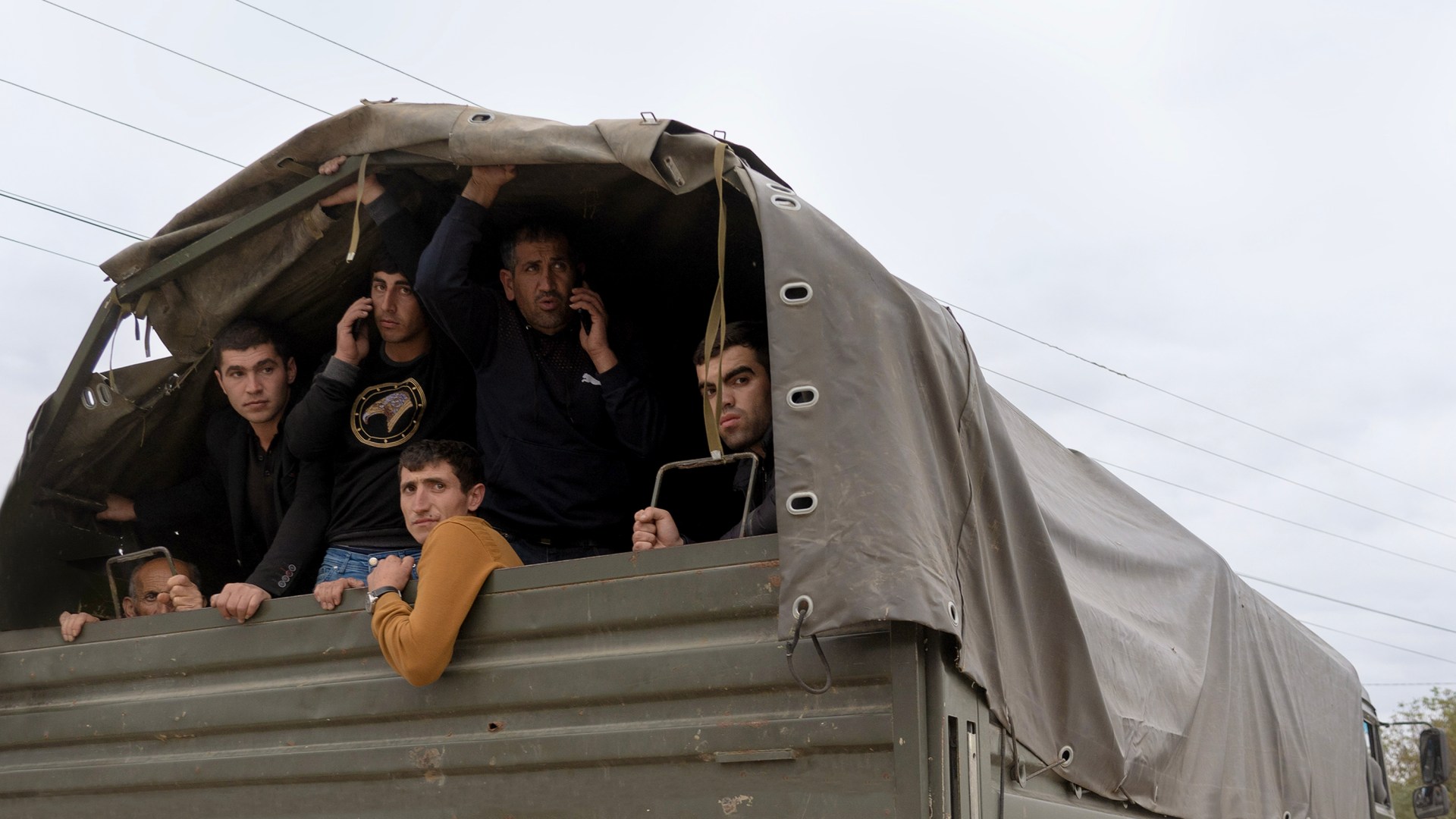
Artsakh Exodus: Armenians Mourn as 100,000 Flee Christian Homeland

Azerbaijani offensive shatters 33-year effort at nation-building, depopulating majority of enclave from fear of genocide. Despite depression, Bible Society leader says, “God will not abandon us.”

Artsakh Armenians evacuate after Azerbaijan seizes control of Nagorno-Karabakh.

Artsakh Armenians evacuate after Azerbaijan seizes control of Nagorno-Karabakh.

Christianity Today September 28, 2023
Astrig Agopian / Stringer / Getty / Edits by CT

Suddenly, more than 80 percent of people in Nagorno-Karabakh have fled.

Last week the unrecognized Armenian republic, called “Artsakh” by its 120,000 residents, suffered an invasion by Azerbaijan, which is recognized internationally as sovereign over the enclave nestled in the Caucasus Mountains.

At least 32 people were killed in the assault that violated a Russian-backed ceasefire, with at least 68 more killed six days later in a suspicious fuel depot explosion.

But more than the death count, fear of genocide is driving people to flee—more than 100,000 as of Saturday evening, according to Armenian officials and the UN [updated Sept. 29]. Though the enclave is home to around 400 holy sites now at risk of erasure, one official stated that 99.9 percent of Artsakh’s Armenians will cross the border to Armenia, the world’s first Christian nation.

The same crossing had been blocked by Azerbaijan since December 2022.

Near-starvation conditions ensued, with humanitarian aid allowed entry one day prior to the Azerbaijani offensive. The Artsakh government issued a decree to dissolve itself as of January 1, ceding control of a territory it declared independent after the fall of the Soviet Union in 1991.

Armenians controlled Nagorno-Karabakh since 1994, after a three-year war resulted in the deaths of 30,000 people, displacing an additional 100,000 in mutual exchange between Armenia and Azerbaijan. Peace talks faltered since then, as they continued to fail after 2020, when a 44-day war resulted in Azerbaijan reclaiming much of the enclave. A further 7,000 were killed before the Russian ceasefire.

Azerbaijan has promised that Armenians in the territory will be integrated as full citizens with equal rights, joining other non-Azeri ethnicities which comprise 8 percent of the population. In the Shiite-majority nation with a substantial Sunni minority, the small Christian community generally reports overall freedom of religion.

The European Parliament and Minority Rights Group, however, have stated that Azerbaijan’s ethnicities suffer discrimination. Artsakh Armenians fear much worse.

Imagine if 80 percent of Hartford, Connecticut, suddenly fled to New York.

The Armenian diaspora is stunned. The Armenian Apostolic Church has declared a worldwide day of prayer for October 1. And on October 5, Europeans for Artsakh has called for a rally in Brussels, to coincide with planned peace talks between the Armenian prime minister and the Azerbaijani president.

Like many, Hrayr Jebejian is at a loss. The general secretary of the Bible Society in the Gulf, also a Lebanese-born Armenian, resides in Kuwait and spoke to CT about his overall state of depression—but also his enduring trust in God.

How has the loss of Artsakh impacted you personally?

I am an Armenian. No matter how objective or balanced I seek to be, there is a lot of emotion. It is depressing. Even as a believer I am trying to pull myself together, so that I can continue to live my everyday life. It is affecting me that much.

I want to work, but I have no motivation. I have friends in Artsakh, I’ve been checking in on them, and they are traumatized. A teacher there told me: How can we stay, when there is a sword over our head?

Did you have hope when humanitarian aid was first allowed in?

I was closely following developments, and all the suffering from the blockade. Thirty thousand kids live there! And international experts said that ethnic cleansing was taking place. I can’t say this outcome wasn’t expected. It was expected.

But it all happened so fast.

From a political perspective, Artsakh had an elected president and parliament. Azerbaijan is a dictatorship, passed from father to son. If you put the Armenians into the middle of that, when they were used to democratic opposition and criticizing the government, it will be very difficult for them.

We don’t know how many people will stay. But there is no trust.

But the ancestral land and ancient monasteries are so important to Armenians. Are there voices calling for them to stay anyway and insist on the promises of equal citizenship?

There is a strong desire to stay. For 33 years, the people of Artsakh believed in, worked for, and built up their homeland. They have a fierce sense of belonging, more than even many Armenians have to Armenia. But if you must choose between life and death, you choose life. Yet life there is no longer promising, anything can happen to those who remain. And that is why the mass exodus is happening.

But is it rather a choice between life and fear of death?

The fear of death is real. Nothing Azerbaijan has done suggests they will be treated with respect. There was a blockade for nine months!

Armenians can fault the international community for not stopping the blockade, or the military invasion. But will the world permit their outright killing? Is the fear that Artsakh will become like Rwanda?

Yes. If for nine months they starved our people, and the world issued empty words, it only serves as encouragement for Azerbaijan to continue the mistreatment. Yes, the international community is insisting on the rights of the Armenians. But can we trust these words, or will they be empty also?

So what now?

We don’t know, and we are depressed. We had a beautiful homeland, and we lost it. But one thing is to insist on proper vocabulary.

The media in the West called the Armenians in Artsakh “separatists.” This is Armenian land, and when it was placed by Stalin under Azerbaijan, it was as an autonomous republic—it was never part of Azerbaijan. And when the Soviet Union collapsed, Artsakh wanted independence, just like all the other republics. Why could Kosovo and other small territories become a nation, but not us?

These were not mercenaries or terrorists, they were the official army of the republic, defending their homeland. We are upset, because history is not being told correctly.

Must the land now be officially surrendered?

What can we do? A small army went up against the huge Azerbaijani military, backed by Turkey, allied to the West.

Given these large powers with an unfriendly history toward Armenia proper, might the loss of Artsakh improve the chances for peace?

That is a good question.

The present Armenian government is trying to achieve a peace deal with Azerbaijan. But what will be the terms? We are very concerned. What kind of peace can you make with a nation that does not believe in peace? Will they respect Armenia’s borders?

Every so often the president of Azerbaijan says that Armenia doesn’t exist, that Armenia is Azerbaijani land. But our history begins 7,000 years before Christ, while Azerbaijan existed only 150 years ago. Are they genuine in making peace? Time will tell.

What are your Christian obligations toward Azerbaijan?

Now is too early to answer this question.

The time will come to think about healing, about coexistence—with justice. And I don’t want to be selfish, but I am praying for Armenia. I cannot stand the pictures of children crying, leaving their homes. The real trauma will start now.

Just as with our earthly fathers, we can have ups and downs with our heavenly Father. This is normal. But he is still our Father. We believe in him, he loves us, and we love him. He is patient with us, he knows our heart, and he will not leave us in the valley of the shadow of death.

What is God asking of Armenians right now?

I know that God will not abandon us. We have lived through many miseries, many massacres. I was born in Lebanon because my father was deported from his homeland in Turkey. Twenty-five members of my family were killed.

But God was with us, throughout.

I believe we will not only continue to live, but also show the world that life comes in contributing to the good of all. Armenians have given much to the world, and this treatment of us is not right. But the smell of oil is stronger than the smell of humanity.

But which will endure in the end: oil or humanity?

I thank God that I am a believer, that I have Jesus in my heart. This gives me hope, even though I am depressed. But I remind myself that Jesus is with me, and he will help me to come out of it.

And with his strength, I will continue to be an advocate for my nation.

History

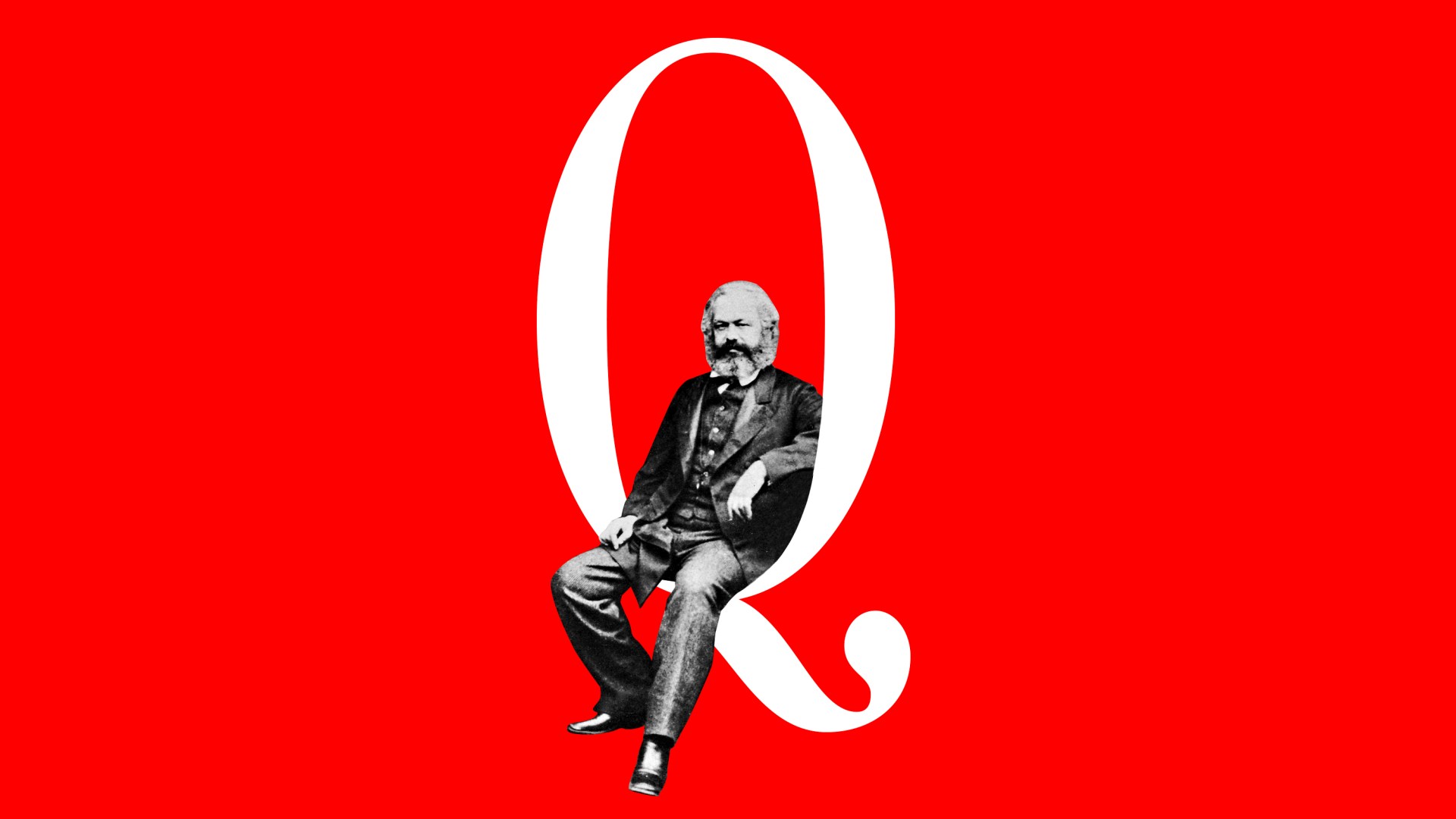
Conspiracist Thinking Is Cultural Marxism

Marx’s view of history powerfully shaped how we think about time and power, but it’s not the Bible’s view.

Karl Marx

Karl Marx

Christianity Today September 28, 2023
Illustration by Mallory Rentsch / Source Images: WikiMedia Commons

It’s been a heck of a month for conspiracy theories. My social media feeds have been inundated by warnings about impending COVID lockdowns and mandates, wild claims about 9/11, supposed revelations of alien corpses, and, after Pennsylvania Sen. John Fetterman (D) debuted a new mustache, a fresh round of speculation that he uses a body double to conceal ongoing health struggles.

Each outlandish story contributes to a broader ethos of conspiracism: a cynical and fearful mindset which frames everything around the assumption that the world is beset by a grand, secret evil and only a few know what’s “really” going on.

Neither conspiracist thinking nor belief in discrete conspiracy theories are anything new. But the social acceptability of such belief does seem to have grown in recent years. Some credit is due to the internet, of course, but I think there’s a much more fundamental source: human search for meaning within our place in history.

We’re living in a time when religion is in decline, social bonds are weakening, and the humanities are devalued. This leaves us with a dwindling canon of stories—shared histories, parables, myths, and folktales—that bind us together and inform a common moral vision. To cope, we’re retreating into ever-narrower interest groups, becoming more suspicious of one another, and searching for stories to make sense of evil, uncertainty, and suffering.

Conspiracism offers just such a story. Regardless of concrete evidence, conspiracy theories can cut through our sense of unease and ambiguity with a grandiose, black-and-white narrative. They flatter true believers that they’re in on a secret and can change the world.

In decades past, we dismissed anyone who indulged in theories about alien encounters, cryptids, or vast government conspiracies as a kook, and that social censure led most people to resist conspiracism’s appeal. But today, with prominent champions like former president Donald Trump and Democratic presidential candidate Robert F. Kennedy Jr., this thinking has gone mainstream.

Conspiracism is often cast as an irrational, pseudo-religious mindset. It’s true that it can fill a hole left by religion and, as former CT contributing editor Ed Stetzer has said, function as a “train that runs on the tracks that religion has already put in place.” But conspiracy theories as we know them are also fundamentally modern constructs, built on rigid logic and a linear view of history that depends on a post-Enlightenment spiritual imagination and is influenced by thinkers like Karl Marx.

A quick sketch of this intellectual lineage should begin with the successes of the Scientific Revolution, which recommended reason as the key to all sorts of social and political mysteries, just as it had unlocked mysteries of the natural world.

Then, in the early 19th century, philosopher Georg Wilhelm Friedrich Hegel proposed that history itself is a discernible process. Over generations, he said, society is progressing toward a utopian horizon, and humans can rationally perceive this pattern. After all, if we can map the courses of the planets and stars, why not the trajectories of nations?

It’s hard to overstate the influence of this idea, both for historians and would-be revolutionaries. Hegel is generally not considered an orthodox Christian, but he identified God as the author of history’s plot. Marx’s version, however, had no room for God at all.

Taking up Hegel’s challenge to uncover the patterns that shape history, Marx argued that class struggle was visible at every inflection point. Treat class struggle like a mathematical constant, he contended, and not only did history make sense, so did the future. Time could be mapped with the rational certainty with which Nicolaus Copernicus and Galileo Galilei had mapped the movements of the planets.

For Marx, though, it wasn’t enough to discern the pattern of history; he wanted to actively accelerate historical progress toward his vision of freedom. “Philosophers have hitherto only interpreted the world in various ways,” Marx said. “The point is to change it.” That included the use of force, which he called the “midwife of every old society pregnant with a new one.”

This idea that humans can discern, then manipulate, the course of history—on our own, without God—has influenced Western political thinking ever since. Other ideologies have swapped race for class or enshrined different economic systems as the path to utopia, but have kept the underlying architecture of certainty, secret knowledge, and a consuming logic that can incorporate every fact or event it encounters.

Conspiracism uses this architecture too. It assumes that conspirators are covertly working to change the world—and that conspiracy theorists can uncover those plots and stop them with a plan of their own.

While conspiracy theories may appear absurd and superstitious, they’re actually a hyper-rationalist way of seeing the world, a demand for simple, causal explanations of encounters with evil and suffering. The conspiracist is hunting for a mathematical constant, something that can both account for the unseen forces that make life feel unstable and promise a utopian ending—even if it’s not Marx’s workers’ paradise.

Ironically, this includes those on the far right who are convinced that only Trump can solve our problems, and the new Christian nationalists awaiting a “Christian prince” to inaugurate a national “city of God.” In this sense, with their simplistic keys to history, ontological certainty, and iron logic, these elements of the modern American Right are every bit the “cultural Marxists” as those they struggle against. Only their premises are different.

And while this style of political ideology is a relatively recent phenomenon, the underlying desire to account for evil and suffering is not. It is the basic instinct of the Book of Job—but Job’s conception of history and humanity is very different from that of Marx and his unlikely heirs.

Job suffers not just uncertainty but tremendous loss. He insists on the injustice of his circumstances and demands his day in court before God, planning not only to defend himself but to put God in the dock for his alleged lack of concern for the suffering of the righteous:

When a scourge brings sudden death,
[God] mocks the despair of the innocent.
When a land falls into the hands of the wicked,
he blindfolds its judges.
If it is not he, then who is it? (Job 9:23–24)

Job’s friends are sure he’s wrong. Clearly, they say, he’s done something to bring this suffering upon himself, because he’s merely a man, and God is a righteous God.

And yet, after God shows up and confronts Job, rejecting his accusations, he doesn’t rebuke Job for speaking as he did. He rebukes Job’s friends for not speaking the truth “as my servant Job has” (42:8).

Somehow, in his outcry, Job has managed to reach for things too great for him to grasp (42:3)—and yet he also speaks the truth. Meanwhile, his friends, insisting on the rationality of the world, have made themselves liars. Their flattened conception of justice and simplistic assumption that they could discern what was happening made them wrong about Job—and wrong about God.

As scholar Stephen Mitchell explains in the introduction to his poetic translation of the book, in Jobs’ friends’ arguments, humanity becomes “‘that vermin, who laps up filth like water,’ and their god is revealed as a Stalinesque tyrant so pure that he ‘mistrusts his angels / and heaven stinks in his nose.’”

“Ultimately,” Mitchell continues, “the dialogue is not about theological positions but human reactions. Afraid of any real contact with Job and his grief, the friends stay locked inside their own minds. The same arguments are recycled again and again, with more and more stridency.”

At its end, the Book of Job preemptively rejects the Marxist impulse behind many modern political ideologies and conspiracy theories. Our attempts to reduce history into simple cause-and-effect stories all shatter before the whirlwind. The point isn’t that God is irrational or lacks a plan for history; it’s that we are limited in our capacity to make sense of what God is doing.

Job wanted to understand evil and suffering, and God revealed that he couldn’t even comprehend an ostrich or a wild donkey (39:13, 5). As the Catholic theologian G. K. Chesterton put it, “Instead of proving to Job that it is an explicable world, [God] insists that it is a much stranger world than Job ever thought it was.”

We aren’t left without consolation, though. We have Job himself as a model of righteousness amid unexplained evil. Job picked a fight with God and demanded God answer his cry for justice. And God, in loving condescension, answered him—by reducing Job to “dust and ashes” (42:6).

At the heart of this encounter is a remarkable grace. What Job longed for, and what his friends offered in their distorted vision of justice, was answers—the very thing God refuses to give. And yet Job seems satisfied, humbled by the gap between what God knows and what he can know. It is a satisfaction that “answers” could never have provided—one found only in the God of the whirlwind who showed a surprising grace when Job was drowning in his tears.

That grace still operates today, of course. While we crave ideologies and conspiracy theories that make sense of a dark world, God still shows up in bewildering ways. Encountering him, even when it lays us low, can satisfy us far more deeply than any well-told story about directing our own destiny.

Mike Cosper is the director of CT Media.

Our Church Lost Three Men to Suicide in Two Years

As a pastor, I’ve learned that the church can play a vital role in helping members with mental health issues.

Christianity Today September 27, 2023
Illustration by Mallory Rentsch / Source Images: Unsplash / Pexels

One morning this past January, I received a distressed call from a woman in our congregation.

She and her husband had been longtime members, seemingly happily married for more than 40 years. Her husband was a successful businessman, and she was a joyful, capable leader who oversaw many different initiatives in our church. They were both delightful people, and so many things about their life seemed idyllic.

But that morning, she was in great distress—she had received an ominous text from her husband that suggested he was about to take his own life.

We panicked, made some calls, and did everything we could to find him. But it was too late. After kissing his wife goodbye that morning and telling her he would see her after she got home from Bible study, he had driven out to a lonely place by the river and taken his life.

Their family was shattered. Our community was shattered. He had no known history of depression or mental illness, and he had not mentioned anything to anyone about a personal struggle. To this day, we do not know why he made this terrible choice.

But he isn’t the only one. In nearly twenty years of pastoral ministry, I have buried three men who died by suicide—and all three of these were in the last 24 months.

You could call this coincidence, but the data suggests otherwise. The Centers for Disease and Control and Prevention reports that suicide rates increased approximately 36 percent between 2000 and 2021 in the United States. Suicide was responsible for about 49,500 deaths last year—the highest number ever recorded.

In fact, suicide was the second-leading cause of death for people ages 25–44 last year. The number of people who think about or attempt suicide is even higher. In 2021, an estimated 12.3 million American adults seriously thought about suicide, 3.5 million planned a suicide attempt, and 1.7 million attempted it. The rate of suicide is highest among middle-aged white men.

Clearly, something about our current cultural moment is making suicide much more prevalent. While I don’t understand all the reasons for it, I do know that in the last few years, I have personally seen more mental health concerns than ever among people in our congregation.

Anxiety, depression, and addiction. Marriages strained and falling apart. Family estrangement and conflict in relationships. And of course, incidents of suicidal ideation, and the act of suicide itself. In conferring with other pastors, I’ve learned my congregation is no anomaly, but simply reflects larger trends across the North American church landscape.

All this has led me to ponder my role as a pastor and the responsibility of the local church in helping address mental health struggles in our congregations. But this is not just a matter of professional interest for me—it is also personal.

Since my early teens, depression and anxiety have been near-constant companions in my life. In my worst moments, thoughts of suicide were oppressive and inescapable. My grandmother died by suicide, so I recognized that part of her own inner darkness was likely in me. Yet in my spiritual worldview, I believed that if I trusted God and his promises deeply enough, I could be happy and whole—and to admit to anyone in my Christian community that I was battling with such dark thoughts seemed out of the question.

This approach got me through high school, college, and early young adulthood, albeit with some dark valleys along the way. But in 2010, as an inexperienced church planter with several young kids and a busy family life, I hit a valley so deep I could not crawl out.

Out of desperation and the prodding of my very resilient wife, I began to see a therapist who helped me untangle the threads of my snarled mind. I learned that my brain, just like my body, needed support and caring intervention. I was referred to a psychiatrist, who diagnosed me with clinical depression and prescribed an SSRI to help regulate my heaviest emotions by increasing levels of serotonin in the brain.

Initially, this felt like a defeat—I felt ashamed that my faith and spiritual habits were not strong enough to grant me the hopeful attitude befitting of a believer. I found a therapist in another city to avoid running into someone I knew. I hid my meds in a bathroom drawer so no one would see them when they visited. I was a pastor, after all—the most ostensibly “spiritually mature” among us—so I could not afford to let others think their spiritual leader needed help beyond the simple gospel.

Yet I slowly grew weary of pretending. This was partly because my own thinking about the gospel and mental health had begun to change. But I also increasingly began to witness the damage caused by a church culture that does not acknowledge mental health struggles as a common battle for many Christians. I saw the harm caused by an unwillingness to face these challenges with the full arsenal of God’s healing potential through the body of Christ.

While there has been a massive shift in the last decade away from the stigmatization of mental illness, many evangelical Christians today still think mental health directly reflects the strength of personal faith. The logic follows that if you’re anxious, depressed, or suicidal, you must not be trusting God enough—and if you seek psychotherapy or medical treatment, you must not be fully relying on God for healing.

When environments create shame for believers who struggle in these ways, it can lead to needless suffering and, in the worst cases, death. So how can we cultivate congregations in which it is not only safe but helpful to talk about our mental health challenges—even the most terrible kinds? Is there a way the local congregation could become not just a supportive community when it comes to mental health struggles, but a preventative community?

First, we need a better theology of personhood. Within American evangelicalism, there is still a perceived conflict between science and spirituality, between the body and the spirit. This faulty approach is called “dualism,” and it has, in the minds of many Christians, severed the vital connection between our spiritual health and our physical, bodily existence.

But the Christian vision of the human being defies material and spiritual dualism. In the biblical story, a person is neither a product of materialist evolutionary forces nor a soul that happens to have a bodily container. Instead, as humans made in the very image of God, we are made to be whole.

Like a beautiful tapestry, our body, mind, and spirit are woven together in a fully integrated personhood. And as such, our care of humans must involve the whole person—attending not just to the spiritual dimensions of a person’s life, but the way our bodies and brains often carry on dark legacies of the sin and trauma from our personal and family histories.

There is hardly a better story to illustrate this than in Luke 8, where Jesus encounters the unhoused, demon-possessed man who calls himself “Legion.”

Evil had decimated the tapestry of this man’s life. He was naked, living in isolation, alienated from family and community, unable to work or meaningfully contribute to society, physically disfigured, and trapped in self-harming behaviors. He was a disintegrated human being, whose personhood had become unraveled physically, spiritually, mentally, psychologically, and socially. The beautiful tapestry of wholeness that was meant to be his life seemed to be nothing more than a pile of tangled threads.

But after his encounter with Jesus, the man is completely changed. Jesus produces a total transformation, weaving the threads of the man’s life back together. Yes, it was a spiritual transformation—but it was so much more. Jesus clothed him, put him in his right mind, and sent him back into his community. Jesus restored this man in every way: physically, psychologically, and socially. Jesus gave this once-broken man his entire life back. Jesus made him whole again.

So, a Christian vision of supporting people in their mental health mirrors this vision of what it means to be human. We serve people toward wholeness—helping them integrate their body, mind, and spirit—by using all the tools God has supplied in his created order.

Yet we need so much more than good theology. For the work of healing to occur, we need relationships of trust and vulnerability. The work of human flourishing must be carried out in a context of community—where people are safely able to name their places of deepest disintegration. If a suffering person can be likened to a struggling plant, the church can provide “good soil” for them to flourish.

But for that to happen, the church can’t just be a Sunday event with good preaching, worship, and programming. It must strive to become a vulnerable community—one in which, to use the words of Dietrich Bonhoeffer, people are not “hypothetical sinners,” but actual strugglers who can name their stumbling journeys out loud to one another.

For the person battling with deep depression, anxiety, or suicidal thoughts, having a community in which mental health struggles are openly named and discussed can be lifesaving. In the last six months, our own church has sought to facilitate these conversations by hosting classes and forums where both practitioners and everyday strugglers can share our stories.

As I and others in our congregation have risked being more open about our interior battles, it has granted people permission to begin naming similar struggles in their own lives. Our vulnerability invites those around us to come out of hiding—to slowly edge their way out of the darkness and ask others where light can be found.

In her poem, “Blessed are you who bear the light,” poet Jan Richardson speaks of bearing light to others who find themselves in darkness—of testifying to the endurance of light amid the unendurable, and its persistence in the midst of shadow and grief.

In the Black church especially, there is a long and strong tradition of public testimony—of brothers and sisters publicly sharing stories of God’s rescue and deliverance in the face of seemingly insurmountable circumstances. Such stories invite others to honestly share about their own needs and obstacles and to look for the ways God might bring provision.

In opening up about our mental health battles and testifying to how God has rescued and delivered us—whether through prayer, exercise, therapy, recovery programs, friendship, meds, or all of the above—we not only create space for people to share their struggles, but we also cultivate communities where hope is on offer to everyone, even those in the darkest places. As Henri Nouwen wrote, “Christian community is the place where we keep the flame of hope alive among us and take it seriously so that it can grow and become stronger in us.”

In that terrible period of crisis in my life, I will never forget how one friend of mine reached out to me with a text. He quoted words from the song “The Cave” by Mumford & Sons: “But I will hold on hope / And I won’t let you choke / On the noose around your neck.” And with that, he said, “I’m here, and you need to be here too. Your brain is telling you otherwise, but that is not the way. Though you may not be able to currently see it, God is with you, God is for you, and there is hope. Let’s do this together.”

I wish I could have had a timely opportunity to say those words to each of the men our church has buried in the last two years. But for now, we entrust them into the kind hands of the risen Lord Jesus, who bears them up into the never-fading dawn. And for us who labor on here, let’s create communities where the darkness we face can be named—where our struggles are carried together, and the many pathways toward wholeness are sown with seeds of hope.

Corey Widmer is lead pastor of Third Church in Richmond, Virginia, and a former church planter with a PhD in theology.

News

Shaken Yet Stirred: Turkish Christians Advise Moroccan Church on Earthquake Aid

From Istanbul to Marrakesh, disaster relief can help Muslim-background believers legitimize their faith. But first, say Turks, the church must be united.

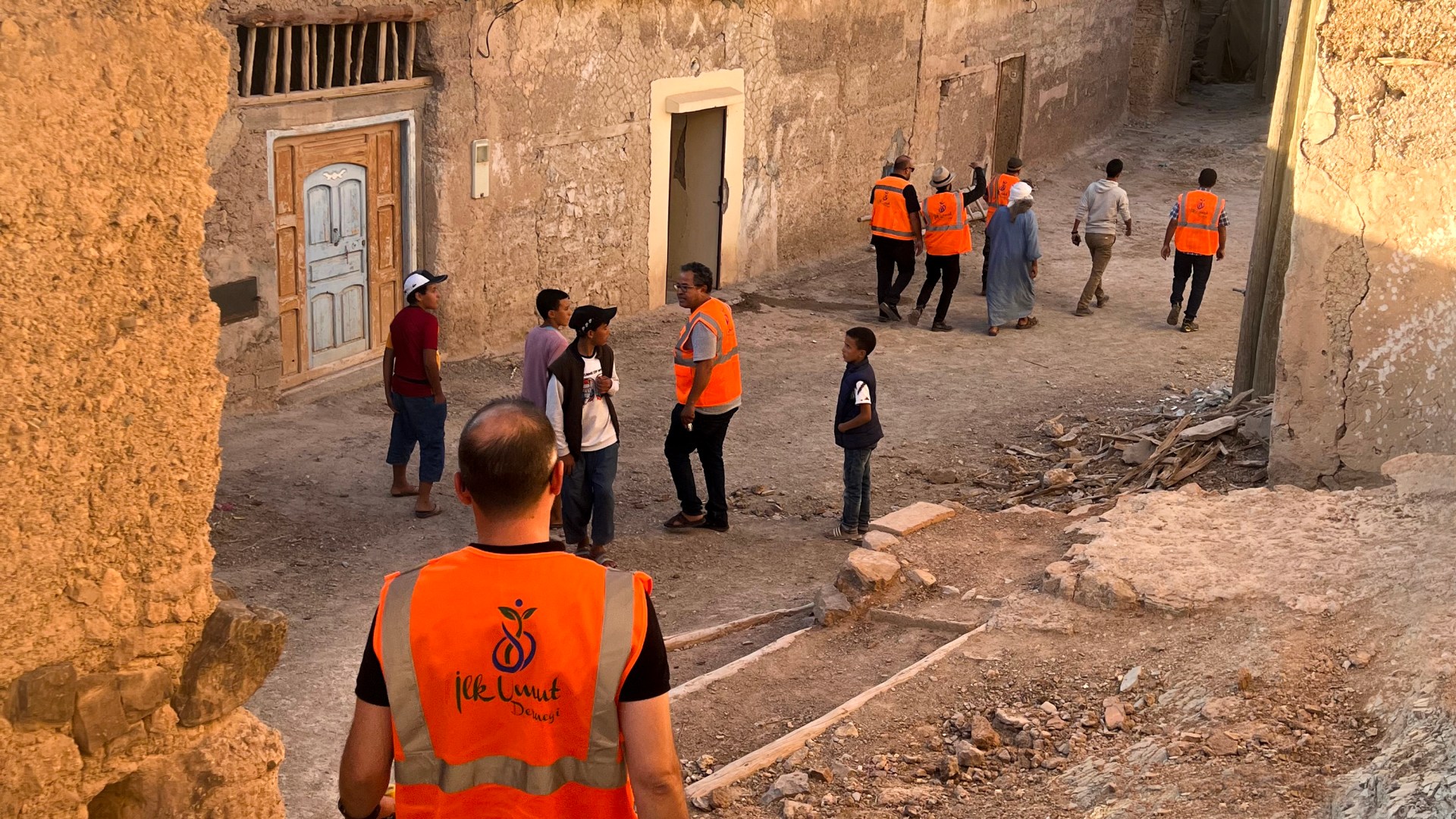
FHA assesses needs in a remote Moroccan village.

FHA assesses needs in a remote Moroccan village.

Christianity Today September 27, 2023
Courtesy of First Hope Association (FHA)

Help for Morocco is coming from Turkey. While humble in scope, the biggest impact may be on the church.

First Hope Association (FHA), a Turkish Christian disaster relief agency that provided aid after the massive earthquake that struck southeast Turkey in February, was granted permission to assist in Morocco after its own devastating quake. A four-person team arrived in Marrakesh last week.

Consistent with its Turkish policy, FHA serves all victims without discrimination, in cooperation with the local church. Connecting with a house church network in southern Morocco, the Turkish believers have distributed $30,000 worth of clothes, blankets, and hygiene kits in four mountain villages not yet reached by other aid.

“Our country has gone through the same hardships and difficulties, so we came to help and support,” said Demokan Kileci, FHA board chairman. “This is an amazing opportunity for God’s church here to show his compassion and love.”

In many ways, the parallels are striking.

Morocco and Turkey are both Muslim-majority nations, and they both have small Protestant communities that largely emerged from an Islamic background. The churches in both nations suffered in their respective earthquakes but also rallied support to aid in overall relief. And while enduring varying degrees of ostracism, the believers’ solidarity with fellow citizens has begun to win each a slowly increasing level of social respect.

“Their expression of love was immediate, without any thought of self,” said Tim Ligon, pastor of Marrakesh International Protestant Church, of the local believers he has partnered with in relief. “They counted no cost but responded with everything they had.”

But there is one major difference between the nations: Morocco does not recognize an indigenous Christian faith, while Turkey affords its people freedom of religion—including religious conversion.

Turkish Christians shared their story of faith to CT in hope that the small believing community in Morocco might profit from their experience. For there is another parallel between the nations that Turkish Protestants have taken significant steps to overcome: a history of internal division.

“The Bible tells us that spiritual power comes in unity,” said Ali Kalkandelen, president of Turkey’s Association of Protestant Churches (TeK). “It won’t be easy, but if Moroccan believers support one another and see the church as one body, the Lord will bless them, and fruit will come.”

Moroccan sources uniformly told CT about their love for Jesus and respect for King Mohammed VI, the Moroccan monarch and head of state. They also would like to see their faith recognized equally alongside Islam and Judaism.

But beyond these shared views, the sources had many different perspectives.

Some spoke of a government that discriminated against them and would not help displaced Christians. Others said the government was helping everyone and generally left the believers alone.

Some said their witness employs the Arabic word for “Lord” to hint at their distinction from Islam. Others said they say “Allah” to connect with normal Muslim use. Some distribute literature; others foreswear it as illegal. Some speak of their Christian faith to the media; others are suspicious of those who make it public.

Some said there was good cooperation between Moroccan churches and that donations should go to local believers working in the field. Others said there was distrust between the churches and that donations should be given through the national bank.

In some sense, each of these perspectives could be true. Experiences differ, as do theology and outlooks on mission. But there are Christians who exaggerate their earthquake and overall ministry for the sake of financial support, said some, while others said there were self-professed “Christians” who were not true believers at all.

To any who would criticize, Jack Wald counseled patience—and self-reflection.

“Foreigners tend to have an idealistic vision of a young church,” said the former pastor of Rabat International Protestant Church in Morocco’s capital, “and overlook the dysfunction of their own church at home.”

Such struggles should not surprise anyone, he said, for the Bible is replete with similar stories. Ananias and Sapphira lied to better their reputation. “Super apostles” in Corinth used their position to make money. And the opponents of Paul used his imprisonment to expand their ministry.

Now retired in America, Wald sees similar ministry-as-business mentalities there.

“The good news is that Jesus has a couple thousand years of experience in knowing how to deal with dysfunction,” said Wald, who spent 22 years in the North African nation. “And in Morocco as elsewhere, he continues to use dysfunctional people to build his kingdom.”

Which is exactly what happened in Turkey, including in earthquake relief.

“They are running around like a chicken with its head cut off,” said Kileci, of the fledgling Moroccan believers’ efforts to help. “We were once like that too.”

Kileci speaks not of the recent earthquake along the Turkey-Syria border, but of the 1999 disaster that killed 17,000 people. The Turkish church was eager then to serve its nation, flailing alongside the rest of the community. But rather than winning social favor, the accusation spread that Protestants were assisting simply to preach the gospel. Vilified, many shrank back.

But not Kileci. As a respected employee in the Turkish defense industry, he had many trusted relationships in both government and civil society. Reaching out to volunteer, he received training from the Turkish Red Crescent and AFAD, the national disaster management agency. Learning the ropes, with additional education and support from Samaritan’s Purse, Kileci was able to legally register FHA in 2014.

Working in partnership with TeK, the FHA was initially not taken seriously. But dedication wins allies, who—especially after their joint and ongoing work in the February earthquake—supported the association in its first international outreach.

“Live your faith through your professional values in the workplace,” Kileci said. “Show society that you are a normal person, raising a family—and yet a Christian.”

Unfortunately, in Morocco, this is the crux of the problem. Sources say that many in the church—like the surrounding society—are poor, without gainful employment. And if a believer’s faith becomes public, even with good marks in school, it may become impossible to find work and get married.

This has led not only to a reticence to engage with wider Christian fellowship, but a reliance on Western sources of support. Some reported it creates a competition for denominational funds alongside theological markers often little understood among the young in faith, dividing the community further.

But spurred by zeal—and perhaps a desire for attention, as some say—a number of Moroccan believers have turned to YouTube.

Turks did the same at a similar stage in the spiritual development of their nation.

While Protestant mission began in Morocco in the late 19th century, it was not until the 1980s that a wider house church movement began to grow. But scattered by repression at a time of feared political instability, it reemerged a decade later. The church is young, with most senior leaders in their 30s.

By comparison, Turkey had Protestant faith through its ethnic minorities, though in much smaller numbers after the massacres and exodus that accompanied the demise of the Ottoman Empire after World War I. Muslim-background churches began in the 1970s, with TeK formed as a representative council in 1987.

Whether through correspondence courses or the internet, both realized seekers needed initial anonymity.

“Media ministry has always been a part of Turkey, and one of the most important,” said Gokhan Talas, founder of Miras Publishing House. “In a situation of persecution, it is an effective way to spread the message.”

Talas became a Christian after reading the Bible online in 2002. He and his wife created Miras in 2011, with a bimonthly magazine as its primary offering. Having now sold thousands of copies, the ministry has expanded to include multilingual and digital content. Other Turks work in radio, satellite television, and social media—sometimes to their peril.

Four years before creating Miras, Talas was the chief witness to the murders at a Christian publishing house in Malatya, which killed two converts from Islam and a German citizen. He said that believers, as citizens of Turkey, have the right to circulate their religious materials—but social and unofficial discrimination creates many obstacles.

These pressures are less today, he said. But publicly Christian ministries can still be subject to closure, frozen bank accounts, and harassment of employees’ families.

“There is freedom,” Talas said. “But there is always risk.”

As there is to the fellowship of believers.

The Turkish church has suffered rivalries in media ministry, as outside denominations sometimes wish to control the powerful medium. Finances have not always been transparent, and links to foreign countries create suspicion in the minds of many ordinary Turks.

Miras has tried to model three solutions: First, to be upfront about where money is received from and where it is spent. Second, to be similarly open to explain the global body of Christ to a suspicious society. And third, to insist on inclusive ministry that represents the entirety of the local church.

While not against theological particulars, Talas said Miras focuses on the essentials and cooperation, a now-common Turkish mentality. Content should be thoroughly biblical but also attractive to Muslim readers looking for new perspectives on the issues of life.

“We live here, share the same problems, but offer society a different vision,” said Talas. “And we also realized: As Christians we are a very small community. We all need each other.”

But this was not all they needed.

A secular state offered significant benefits, said Kalkandelen. But it also nurtured a nationalistic ethos that to be Turkish meant to be Muslim. Christian converts were often not only viewed as apostates but as a security threat—treated in the same vein as Islamist movements seeking power.

Which Recep Erdoğan eventually did, peacefully, elected as prime minister in 2003. Primarily to benefit his allies, Kalkandelen said, the new leadership loosened the security apparatus to give more space to religion.

But the Protestant church benefitted also. TeK took the opportunity to cultivate relationships with open-minded officials and to tell their story to the mainstream press.

Mentalities are slow to change, but they do. After the Malatya murders, a justice ministry official said missionary work was more dangerous than terrorism, wishing it would be made illegal. But Erdogan condemned the killings—later pledging to defend the church—and journalists rallied to defend the rights of Christians.

Allies were needed elsewhere also.

With Turkey aiming for European integration, TeK began publishing a bilingual yearly human rights report in 2009. Its leaders met with international officials, but also with Armenian and Assyrian members of Parliament. And especially helpful was the domestic cultivation of relationships with Orthodox and Catholic clerical leaders.

In 2018, they jointly published a 95-page unified picture of faith.

“It took many years, with great effort—visiting, supporting, and honoring these communities,” said Kalkandelen. “They now speak to the government on our behalf.”

But early on, many Protestants would not even speak to each other.

“There have always been power struggles in the church,” Kalkandelen said. “It has not been easy to keep our unity.”

For some, differing theological perspectives was cause for division. For others, it was personal rivalry. Some had unique church-planting strategies. Others wanted to fundraise in likeminded networks. It is somewhat in our nature, the TeK leader said. Evangelicals tend to be independent individualists.

To their detriment—until forced otherwise.

TeK began to grow in strength as persecution increased in the 1990s and early 2000s, Kalkandelen said. Today, though members are a minority of overall churches, he estimates that, through larger congregations, the association represents about 70 percent of all Turkish Protestants.

Membership fees, though modest, prevent many small churches from joining. So also does the commitment and cost of attending three gatherings per year. Yet having established that TeK will also support any non-member that faces problems with the government, nearly all Christians, he said, are comfortable with their national leadership.

“It is not important to be one church with the same doctrine. But weep, rejoice, and do projects together,” Kalkandelen advised the Moroccan believers. “God gave us favor, and he can give it to you.”

Back in Morocco, there is no bigger project than earthquake relief. FHA is raising funds to stay for a month, and after that, will assess the situation again. Its own ministry is quiet, even as the displaced assume they are Muslims. But as Kileci advised foreigners coming to help Turkey, he now advises his team: Trust the local church to know how and when to witness appropriately.

FHA will return home again. Moroccan believers must continue to serve their nation.

“We share a similar history,” Kileci said. “Disasters bring people together.”

Ideas

AI Has No Place in the Pulpit

Contributor

Technology can serve the church. But it can’t replace the good, frustrating, endless work of ministry.

Christianity Today September 27, 2023
Illustration by Mallory Rentsch / Source Images: Getty

What should ministers do about artificial intelligence? Over the last year or so, we’ve been inundated with breathless stories about ChatGPT and similar programs that eerily mimic, equal, or surpass the voice, language, and powers of the human mind.

Some of us have had fun with them (“Please write a Shakespearean sonnet in celebration of the San Antonio Spurs”); some of us are already seeing them used in the workplace. Those of us who teach young people have been scrambling to rewrite assignments, since AI is basically a perfect cheating machine.

But what about churches? And what about the church’s leaders?

Some have argued that AI is like other technology, a neutral tool that can be used for either good or ill. If the end served is the mission of Christ, then the means of AI is not only justified; it’s a no-brainer.

Moreover, though their footprint is expanding, well-funded, large-staffed megachurches aren’t representative of the average congregation, neither here in the States nor around the world. Most churches are small and under-resourced, their pastors exhausted and stretched thin. As Christian communities continue to crawl out from beneath COVID-19’s long shadow, surely relieving the pressure from ministers’ packed schedules and overflowing commitments is a worthy goal.

And if AI can do that, as a young Taiwanese pastor recently argued in an article reprinted at CT, then why say no to this time-saving, labor-saving technology? It’s not as though ministers forsake other digital tools. They have email and smartphones and Google Calendar. They don’t ride a horse and buggy to the office.

Above all, suppose AI could eliminate the bulk of a minister’s busywork: the inefficient box-checking that saps energy and takes time from pastoral care. Wouldn’t the effect, on balance, be positive? A net win?

In what follows, I’m going to suggest the answer is no. Not because the arguments above are unreasonable; not because all digital technology is evil; not because Christians should be alarmist or apocalyptic about artificial intelligence. You don’t have to believe the sky is falling to decline ChatGPT a role in your ministry. You don’t have to use a dumb phone or live off the grid to agree that some technologies don’t have a place in the life of God’s church.

The first question for ministers regarding any new technology is not how but whether. The difference between the two is important. Christians should never assume in advance that a given technology is suitable for the gospel. Maybe it is, but maybe it isn’t.

It’s not that all technology is guilty until proven innocent. It’s that a verdict either way is required—and verdicts require human judgment. Wisdom, in other words, is necessary for Christian adoption of new tools. Wise discernment is nonnegotiable. And both wisdom and discernment require (among other things) discipline, leadership, patience, and corporate practices of decision-making. No pastor is competent to answer this question alone. It requires the church. And the church takes time.

Next, we should ask an additional question: What are the primary tasks of ministry? The classic answer, laid out most simply by John Calvin but common across Christian tradition, is the service of Word and sacrament. A pastor is called by Christ to preach and teach the gospel, to baptize and administer the Lord’s Supper, to lead Christ’s body to worship him by his Spirit, and to shepherd Christ’s flock through times of plenty and times of lack.

These tasks cannot and should not be replaced by lifeless technology, though technology may be able to aid or mediate some of the work. For example, a sermon recording may be distributed to those not present to hear it. Or consider calling a parishioner by phone: This isn’t a substitute for pastoral care; it’s using a technological medium to facilitate that care.

Even these cases, as obvious as they seem, require prudence. If you only called and never visited hospitals, prisons, or living rooms, you would be shirking your duty. A preacher whose sermons were delivered exclusively in podcast form would be failing to minister to an actual body of believers. Extensions of ministry are just that: They expand or enrich concrete pastoral practice. They are not its substitute.

AI and ChatGPT represent the temptation of substitution rather than extension. They make a tantalizing, almost irresistible offer: They’ll do your work for you. They’ll write the sermon, exegete the passage, draft the lesson plan, and outline the discussion questions while you get to the real work of ministry.

But wait. That can’t be right. We just saw that those very things are the work of ministry. Ministers can’t be freed from writing sermons and preparing lessons. That’s the heart of the job. A preacher who wants to be liberated from preparing to preach sounds like someone who wants to quit altogether. There may be good reasons to quit, but AI isn’t an acceptable workaround. The pastoral vocation is what it is.

Artificial intelligence also fails to serve the ends of preaching and teaching in profound ways. The thing to see at the outset is that study and writing aren’t a mere means to an end—unfortunate but unavoidable. Both entail a crucial spiritual and intellectual process that should not be circumvented.

Pastors are students of God’s Word. They are learners in the school of Christ. He teaches them by the mouths of his servants, the prophets and apostles, who speak through Holy Scripture. There is no shortcut to sitting at their feet. The point—the entire business—of pastoral ministry is this calm, still, patient sitting, waiting, and listening. Every pastor lives according to the model of Mary of Bethany. Strictly speaking, only one thing is necessary for the work of ministry: reclining at the feet Jesus and hanging on his every word (Luke 10:38–42).

In this sense, no one can do your studying for you. I’ll say more below about appropriate forms of learning from professional scholars and commentaries, but that’s not what I have in mind here. What I mean is that studying God’s Word is part of what God has called you to do; it’s more than a means to an end. After all, one of its ends is your own transformation, your own awesome encounter with the living God. That’s why no one can listen to Jesus in your stead. You must listen to Jesus. You must search the Scriptures. This is what it means to serve the church.

The same goes for writing, whether it be a sermon from the pulpit or a lesson in the classroom. Writing is an iterative process. You discover what you will say—indeed, what you think—in the time that writing takes. It’s full of stops and starts, dead-ends and cul-de-sacs, wrong turns and bursts of inspiration. The Spirit is present throughout, albeit discernible often only in retrospect.

Moreover, preaching and teaching are personal acts. When I preach, it is I and no one else speaking. I speak as myself, from the heart and out of my life. God, in his grace, speaks through me—but I remain the medium, the weak and earthen vessel of his holy power. This is just how God wants it; it’s a feature of the gospel, not a bug. Christ wants his heavenly voice to be heard in and through Paul’s voice and Apollos’s voice and Peter’s, and even yours and mine. One may be frail, another eloquent, another bold, another quiet, another professorial, but all these are human voices in every case—distinct, individual, and unique, created and called to speak aloud with one voice the one gospel of the one God for all peoples (Rom. 15:6).

Artificial intelligence shortchanges this marvelous personal intersection. Pastors are the Lord’s co-workers (1 Cor. 3:9). ChatGPT is not. ChatGPT has neither soul nor body, is neither “he” nor “she” but only “it.” It is a thing, not a person. It cannot preach or teach. It does not know the gospel. It has no voice, and certainly no voice God’s people need to hear in public worship. The human voice is alive, gathering and reflecting a lifetime’s worth of embodied response to the call of God. Not so a machine.

At this point, it is worth recalling what ChatGPT is: a “large language model” (LLM). Though it may well mark a milestone in the development of what we call “artificial intelligence,” for now, it is effectively a hyper-fast digital assistant, like Apple’s Siri or Amazon’s Alexa, that performs certain kinds of task for users. It has been “trained” (note the anthropomorphic language we use) on reams of data from the internet as well as various pre-digital sources. Based on that training, it’s capable of producing coherent text that usually fulfills the user’s request. And because the text appears almost instantly and the sources imitated are so numerous—if undisclosed and therefore uncited—the LLM appears human-like, intelligent, even sentient.

It isn’t, though. This is why the most common objection to my argument against AI in ministry—that it’s just a tool, no different in principle than a biblical commentary—doesn’t hold water. There is a world of difference between the two.

For one thing, commentaries and other sermon-writing aids aren’t substitutes for the pastor’s own work. They won’t write your sermon for you (however much we might like that—“N. T. Wright, please draft a 22-minute sermon on Galatians 3”). They offer one perspective, and usually just one of many. They’re guides, not ghostwriters.

For another, just as a preacher has a living voice, so does an author. Calvin’s voice is not Augustine’s is not John Wesley’s is not Karl Barth’s is not Origen’s. Each was (and is) a living soul created by God to see the world and his Word in unique ways, as a gift to the rest of God’s people. We receive their words as the gift they are when we learn from them, inhabiting their perspective on a text or the gospel or our neighbors—if only for a moment.

ChatGPT is neither living nor trustworthy. In truth, it does project a certain slant—its corporate owners will never make a profit if it regularly makes statements widely seen as inappropriate or immoral—but this is only more reason to refuse its use. An AI-generated sermon is the proclamation of a gospel sanitized and approved by Silicon Valley. It is obvious why we should want nothing to do with that.

To proclaim the gospel is to speak a human word about the divine Word become flesh. Ministers preach in and as the flesh they are, which is one and the same flesh that Christ assumed for our sake (Rom. 5:17–21). To repurpose a line from theologian Stanley Hauerwas, pastoral ministry means working with words. More than that, yes, but not less than that. The aim should not be to avoid word work but, with the Spirit’s power, to do it well.

In fact, “well” is too ambiguous. Perhaps ChatGPT writes a “better” sermon than you do, a sermon with better grammar or nicer turns of phrase. What of it? You aren’t called to be a “good” preacher, not in that sense. You’re called to be a faithful preacher. God wants you to preach his Word as the person you are, not to serve as a mouthpiece for a proprietary algorithm.

You aren’t judged by standards of eloquence—that would have disqualified Moses and Paul both! You’re judged according to your submission to Christ’s will and your fidelity to his Word. Intelligence of any kind is not the highest virtue here. The relevant virtues are obedience, honesty, and courage; faith, hope, and love. The fruit of the Spirit blooms in soul and body, not in digital devices.

Nor, it should be added, is reliance on liturgical or other “scripts” a kind of analog shortcut—the best we could do, you might say, before OpenAI came along. When I recite the Apostles’ Creed, I am submitting to the doctrine of the church as led by the Spirit over the centuries. I am not representing the words as my own (as I might by delivering an AI-generated sermon to an unsuspecting congregation); I am not outsourcing my intellect to a machine (as I might by bypassing study with ChatGPT).

The Creed is not a detour but a pathway, its well-worn course trod by countless saints who’ve gone before me. To make their steps and words my own is an act of humility, not a shortcut. It’s a chance to mortify the pride of my flesh, not a chance to save time. It’s a way to offer my heart to Christ’s bride—my mother and teacher—and to be formed by the Spirit into Christ’s own image.

In a word, I imitate the saints (1 Cor. 4:16–17) as they imitate Christ for a simple reason: because they are saints. I want their words to become my words, because their words reliably reflect him. Software does not. It will indeed shape us into its image, but that is an altogether different image than Christ’s.

As all of us (not only the church’s leaders) think about navigating these challenges together, it seems to me that there are two situations in which pastors may find themselves.

The first is that some pastors have come to believe (or are tempted to believe) that all the inglorious inefficiencies of daily ministry are a problem to solve rather than a fact to accept, or even a gift to receive with gratitude.

The second is that some pastors wish they had the kind of time I’ve outlined—but they don’t. They want to read and write and sit at the feet of Christ, but a thousand demands distract them from this all-important work.

In both cases, the remedy is the same: for elders and vestries and other governing boards to help pastors avoid the circumstances that make ChatGPT look like an attractive—or, at least, acceptable—tool for preaching. Pastors, ask for this help. Elders, give your pastors the time needed to study and serve the church in all their fallibility and finitude. Such limits cannot and should not be overcome.

My hope is that pastors will lead their churches in saying no to AI in preaching and teaching. But I hope, too, that churches will show their support of this answer, not least by honoring, compensating, and otherwise creating space for the mundane tasks of pastoral ministry. Shortcuts are less alluring when you have good work to do and enough time to do it.

Brad East is an associate professor of theology at Abilene Christian University.

News
Wire Story

Refugee Resettlement Begins to Rebound After Historic Lows

Still, fewer persecuted Christians have been able to flee to the US.

Christianity Today September 26, 2023
Michael M. Santiago / Getty Images

Fewer Christians fleeing persecution in their native countries have found a safe harbor in the United States in the past half decade, according to a new report from a pair of Christian nonprofits, which cites the effects of the pandemic and the dismantling of US refugee resettlement programs during the Trump administration.

The report, titled “Closed Doors,” found the number of Christians coming to the US from countries named on a prominent persecution watchlist dropped from 32,248 in 2016 to 9,528 in 2022—a decline of 70 percent.

The number of Christian refugees from Myanmar dropped from 7,634 in 2016 to 587 in 2022, while the number of Christian refugees from Iran dropped from 2,086 in 2016 to 112 in 2022. Christian refugees from Eritrea dropped from 1,639 in 2016 to 252 in 2022, while refugees from Iraq dropped from 1,524 to 93 during the same timeframe.

All four countries are among the 50 nations on the annual World Watch List published by Open Doors, an international Christian charity that tracks persecution. The new report was written by Open Doors and World Relief, an evangelical charity that resettles refugees.

“The tragic reality is that many areas of the world simply aren’t safe for Christians, and Christians fleeing persecution need a safe haven in the United States,” according to the report.

The decline in Christian refugees comes at a time when the persecution against Christians is on the rise, said Ryan Brown, CEO of Open Doors.

According to the Watch List released earlier this year, some 360 million Christians face what Open Doors calls “high levels of discrimination and persecution.” That’s up from 260 million reported in a 2020 edition of the “Closed Doors” report. Much of the increase has come in sub-Saharan Africa, he said, driven by political instability and internal conflict in countries like Nigeria.

https://datawrapper.dwcdn.net/zZvb1

“Tragically, that’s the area where we are seeing the most intense violence as it relates to persecution,” said Brown.

According to Brown, many Christians in countries where there is persecution want to stay there, often feeling called to minister in difficult situations. But some are forced to flee.

In 2016, according to the “Closed Doors” report, 32,248 refugees from countries on Open Doors’ World Watch List were resettled in the United States. That number dropped to 11,528 in 2018 and then to 5,390 in 2020.

While persecution is on the rise, both the annual refugee ceiling set by the US president each fall and the total number of refugees resettled yearly in the US have dropped. In 2016, according to the “Closed Doors” report, about 97,000 refugees were resettled. That number declined to just under 23,000 in 2018. Canada, despite having a much smaller population, managed to resettle about 28,000 refugees that year.

“In the calendar year 2020, the US resettled fewer than 10,000 refugees for the first time in the resettlement program’s history,” according to the report.

The lowering of the refugee ceiling began under President Trump, and the sudden drop, exacerbated by the COVID-19 pandemic, dismantled much of the infrastructure needed to resettle refugees, including the work done in the United States by a number of faith-based groups, including World Relief, Church World Service, and HIAS, the latter founded as the Hebrew Immigrant Aid Society.

In 2021, President Biden set the refugee ceiling at 15,000—the lowest since the passage of the 1980 Refugee Act, which sets the parameters for the current refugee resettlement system. That ceiling was later raised to 65,000 after faith groups protested.

This past year, the ceiling was set at 125,000—however, the US only resettled about 60,000 refugees in fiscal year 2023, according to the “Closed Doors” report.

https://datawrapper.dwcdn.net/AjZLY

That shortfall is due in large part to the aftereffects of the pandemic, said Matt Soerens, vice president of advocacy and policy at World Relief. The screening process for refugees, which takes years, was shut down during the pandemic and was slow to restart.

World Relief, which has resettled just over 7,000 people during the past year, including refugees from Afghanistan and Iraqis with Special Immigrant Visas, and the other resettlement agencies closed down offices and laid off staff when the refugee resettlement program shut down. Restarting those offices and adding staff has taken time as the agencies rebuild their domestic infrastructure.

“We are expanding,” he said. “I wish I could have the confidence to expand even more, but it’s very expensive to raise the space and hire staff and then have to lay them all off three years later.”

Calling the resettling of 60,000 refugees a sign of progress, Soerens credits the Biden administration with helping the agencies to rebuild the overseas resettlement infrastructure, but added, “They didn’t start nearly as quickly as we would have liked them to.”

Part of the impetus for the “Closed Doors” report, he said, was to put pressure on the Biden administration to continue that progress.

Soerens said that he hopes in the future, the refugee resettlement program will be more stable. For years, he said, the program enjoyed bipartisan support and was seen as a source of pride for American leaders—and a sign that America was living up to its ideals.

“We’ve had a history of being a refuge for those fleeing persecution for any number of reasons, among them, religious persecution,” he said. “I think that we’re at risk of losing that.”

While the report focuses primarily on Christian refugees, resettlement groups also worry about those from minority faiths, including Jews and Yazidis, who have “largely been shut out of refugee resettlement in recent years,” according to the report.

“As Christians, we believe that all people have the right to religious freedom and that religious minorities of any sort—not just those who share our Christian faith—should be protected,” the report said.

Brown said that some of his fellow Christians may have lost sight of the importance of refugee resettlement, in part because of the current polarization over immigration and the surge of asylum seekers and migrants at the border.

They may not be aware that restricting refugees affects persecuted Christians, he said.

In the 1950s, when Open Doors was founded, the concern was mostly about religious persecution behind the Iron Curtain. The group’s late founder, Andrew van der Bijl, better known as Brother Andrew, spent years smuggling Bibles into Communist countries.

Today, said Brown, persecution continues under authoritarian regimes, but it also happens in countries where there’s internal conflict and strife. And while countries like China have experienced economic prosperity, he said, that prosperity hasn’t been accompanied by the expansion of human rights.

Brown hopes the report will lead Christians to pray and to assist refugees when they arrive in the United States. He also hopes they will support refugee resettlement programs.

“We’d love to see America take its place again on that global stage,” he said, “to be that beacon of freedom and religious liberty.”

Apple PodcastsDown ArrowDown ArrowDown Arrowarrow_left_altLeft ArrowLeft ArrowRight ArrowRight ArrowRight Arrowarrow_up_altUp ArrowUp ArrowAvailable at Amazoncaret-downCloseCloseEmailEmailExpandExpandExternalExternalFacebookfacebook-squareGiftGiftGooglegoogleGoogle KeephamburgerInstagraminstagram-squareLinkLinklinkedin-squareListenListenListenChristianity TodayCT Creative Studio Logologo_orgMegaphoneMenuMenupausePinterestPlayPlayPocketPodcastRSSRSSSaveSaveSaveSearchSearchsearchSpotifyStitcherTelegramTable of ContentsTable of Contentstwitter-squareWhatsAppXYouTubeYouTube