Graham Joins Russian Church Festivities

special report

It was an improbable scenario: an American clergyman preaching an evangelistic sermon in the Soviet Union amid the gilded trappings of a staid Russian Orthodox cathedral; a bearded prelate in golden robes and miter standing approvingly at his side; and Soviet government leaders, Roman Catholic cardinals, and liberal Protestant leaders of the World Council of Churches sprinkled among the thousands fortunate enough to be shoehorned inside.

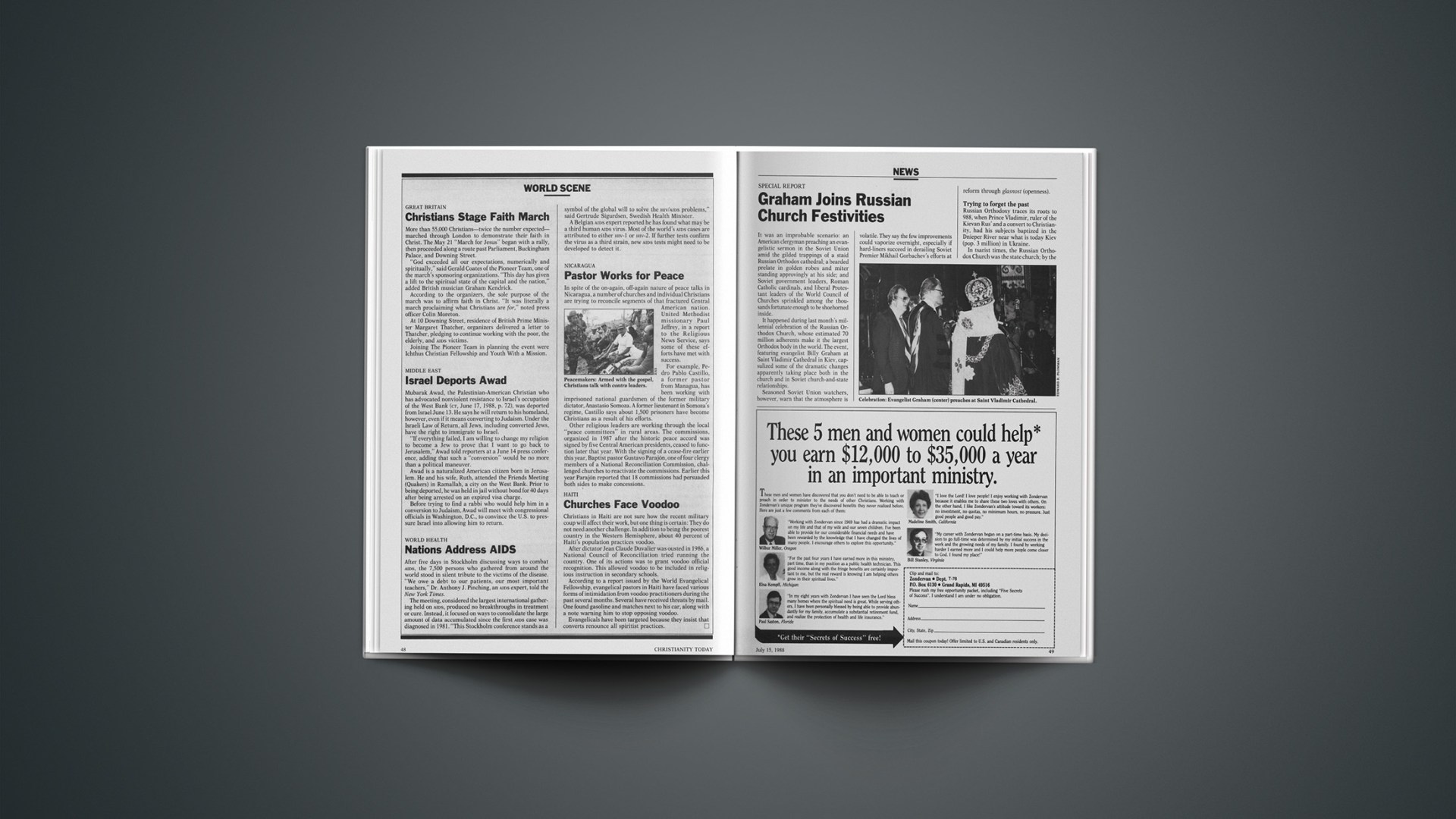
It happened during last month’s millennial celebration of the Russian Orthodox Church, whose estimated 70 million adherents make it the largest Orthodox body in the world. The event, featuring evangelist Billy Graham at Saint Vladimir Cathedral in Kiev, capsulized some of the dramatic changes apparently taking place both in the church and in Soviet church-and-state relationships.

Seasoned Soviet Union watchers, however, warn that the atmosphere is volatile. They say the few improvements could vaporize overnight, especially if hard-liners succeed in derailing Soviet Premier Mikhail Gorbachev’s efforts at reform through glasnost (openness).

Trying To Forget The Past

Russian Orthodoxy traces its roots to 988, when Prince Vladimir, ruler of the Kievan Rus’ and a convert to Christianity, had his subjects baptized in the Dnieper River near what is today Kiev (pop. 3 million) in Ukraine.

In tsarist times, the Russian Orthodox Church was the state church; by the early 1900s it had more than 70,000 parish churches. But heavy persecution followed the Communist revolution of 1917. Thousands of Orthodox clergy and lay leaders were killed or died in labor camps; monasteries, seminaries, and most of the churches were closed. Stalin ordered a reprieve during World War II to gain the support of the church against the Nazis, but Nikita Khrushchev reignited the fires of persecution in 1959. More than half of the remaining 17,000 or so churches were closed.

Under laws passed in 1929, the church still has no legal standing as a separate entity but is divided into parish associations that govern local worship. In legal matters, the church must be represented by the Council for Religious Affairs (CRA,) the government body that regulates churches. The CRA exercises its control through its 100-staff headquarters in Moscow, regional offices, and local “representatives.”

Under Gorbachev, new officials were appointed to lead the CRA’s Moscow headquarters. Churchmen say this is an improvement, but that local representatives continue to pose problems for rural churches.

Reasons To Celebrate

The Orthodox celebrations began last month with a sobor, a church-wide deliberative council (the first since 1971) that brought together 272 ranking clerics from 67 dioceses in the Soviet Union and 9 abroad. Presided over by Patriarch Pimen, the ailing leader of Russian Orthodoxy, it was held at a church complex in Zagorsk, about 50 miles north of Moscow. Among the reports: There are now 6,893 parishes, 60 of them opened this year, with 67,674 priests and 723 deacons. Mention was made of the need for more Bibles, prayer books, and other literature, including church periodicals.

Joining the celebrations were 490 religious leaders and dignitaries from 90 countries. They were invited to attend the sobor’s opening and closing sessions.

An important action was the reinstatement of power to parish priests to administer their work. Previously, they were little more than paid employees of government-controlled parish councils.

Outbursts of applause greeted the June 7 announcement that the Ukrainian government was returning to the church a portion of the Caves, site of Orthodox catacombs in Kiev.

Attracting most press attention were the Roman Catholic delegations, led by ten cardinals, representing both the Vatican and the church. On their agenda were matters involving the welfare of Catholic minorities in the former Baltic states and elsewhere in the Soviet Union, along with the status of nearly 5 million Catholic Uniates in Ukraine, who make up the second-largest denomination in the country but whose existence and activities have been declared illegal. Two of the underground bishops, clad in black robes, and several priests met with Agostino Cardinal Casaroli, the Vatican secretary of state, and other high-ranking Catholics at the Sovetskaya Hotel in Moscow. Sources said the government is amenable to working out something acceptable to Rome, but Orthodox leaders, especially in Ukraine, stiffly resist the notion of legalizing the Eastern-rite Catholics.

An Evangelist In Moscow

Graham, the most prominent evangelical taking part in the celebrations, preached to overflow crowds at Baptist and Orthodox churches in both Moscow and Kiev. The crowd at Saint Vladimir Cathedral, estimated by Orthodox officials at between 12,000 and 15,000, was his largest in three preaching visits to the Soviet Union. Another large crowd greeted him at Yamskaya Street Baptist Church.

The evangelist, who met with high-ranking government officials and controversial church activists alike, told reporters he was pleased by the changes he found since his visits in 1982 and 1984, and he expressed hope for further improvements. Some new policies, including relaxed restrictions on Bibles and other literature imports, were among reforms he had suggested in letters and private meetings with officials in his earlier visits, he said. He added that he is still pressing for greater opportunities for Soviet Baptists, including the right for them to build and operate a seminary.

Helping to fuel the fires of perestroika (restructuring)—and the church cause—are movies like Repentance, produced by filmmaker Tengiz Abuladze of Soviet Georgia. Languishing on censors’ shelves for four years, it was kept alive by video versions circulated discreetly among the nation’s avant-garde. Upon seeing it, Gorbachev ordered it released, and millions have seen the film. It exposes the horrors under Stalin and many past lies, comes close to indicting even the Leninist foundations of Soviet society, and concludes with the suggestion that the answers Soviets are seeking might be found within Christianity and the church.

That is one of the reasons, said several youths in interviews, why growing numbers of young adults have been showing up at church services.

By Edward E. Plowman in Moscow.
Conservatives Rule Southern Baptists

DENOMINATION REPORT

The route to San Antonio from Houston is less than four hours by car, but in terms of Southern Baptist Convention (SBC) history, the journey took a decade.

Beginning with the 1979 SBC meeting in Houston and ending June 14–16 at the so-called second battle of the Alamo in San Antonio, SBC conservatives completed a ten-year campaign to regain control of their 14.7 million-member denomination.

In a contest considered by rival factions in the convention to be a watershed, conservatives got almost everything they wanted. However, their candidate for the SBC presidency, Jerry Vines, a Jacksonville, Florida, pastor, won by one of the narrowest margins in SBC history: 50.5 percent—15,804 votes—over the moderates’ choice, Richard Jackson, a Phoenix, Arizona, pastor, who gained 15,112 votes, or 48.3 percent. It was not a stunning mandate for either side.

Theologically, the candidates were indistinguishable. Both are inerrantists: people who believe the Bible is without error. However, conservatives believe the Bible is without error in matters of science, history, faith, and revelation. Moderates believe the Bible must be understood in the context of its historical setting and the limited world views of its writers.

During the 1970s, conservatives began suspecting the moderate point of view was being taught in certain SBC seminaries. Their alarms helped set attendance records at conventions in recent years, though the turnout of 32,436 messengers in San Antonio was lower than projected. In addition to the moderate-conservative struggle, Baptists went to San Antonio concerned about a drop in baptisms during the previous year and the lowest gain in denominational growth since 1937.

Non-Baptist Baptists?

Next to the presidency, the vote that galled moderates the most was a resolution based on Hebrews 13:17 that put limitations on a classic Protestant concept, “the priesthood of the believer,” which assigns equal authority to clergy and laity. The convention declared that “misunderstanding and abuse” of the doctrine had undermined the authority of pastors over their congregations.

This prompted sharp protests from moderates, who charged it betrayed a principle of the Reformation, which rejected clerical domination by the Roman Catholic Church. Frustrated, 200 moderates marched to the Alamo site, about one block away from the convention center, and tore up copies of the resolution.

“This was the most non-Baptist, most heretical resolution ever adopted by a Southern Baptist Convention,” said Randall Lolley, who last October resigned his presidency of Southeastern Seminary in Wake Forest, North Carolina, because of pressure from conservatives.

“We’re moving more toward where the Catholic has been” said Winfred Moore, moderate leader from Amarillo, Texas. “That wouldn’t sell very well in the panhandle of Texas.”

Like falling dominoes, other conservative resolutions passed one by one:

• The convention approved a 1988–89 budget of $145.6 million, up $5.6 million from this year’s, which included increases for all church agencies except the controversial Baptist Joint Committee on Public Affairs. When conservatives moved to cut $48,000—about 11 percent of the budget—from the Joint Committee, which is a Washington-based church-state watchdog, moderates made a motion to restore the funds plus grant the Joint Committee a 4.25 percent budget increase. The motion failed and the budget was cut. Conservatives have long been unhappy with the Joint Committee because of its refusal to back public-school prayer and because its director, James Dunn, once served on the board of People for the American Way.

• A moderate-backed minority report was defeated that would have substituted a slate of moderate candidates to serve on 20 Southern Baptist seminary and organization boards in place of the more conservative lineup proposed by the Committee on Nominations. Through a succession of conservative presidents beginning in 1979, conservatives have gradually brought this vast network of denominational operations under their control. A slate of 140 mostly conservative trustees was approved in San Antonio.

• Southern Baptists adopted their most stinging condemnation of homosexuality, calling it “a perversion of divine standards” and a “violation of nature and natural affections.” It blamed homosexuality for the spread of AIDS and called it a “deviant behavior [that] has wrought havoc in the lives of millions.”

Deep Divisions

The SBC Peace Committee, set up in 1985 to settle the prolonged denominational conflict, was disbanded in spite of the tensions that still remain. Committee chairman Charles Fuller criticized moderates and conservatives for disregarding the committee’s request to cease politicking.

Texans dominated the convention, beginning the night before the presidential election when a conservative candidate, Ralph Smith of Austin, overwhelmingly defeated his moderate challenger, Paul Powell of Tyler, for the presidency of the Pastor’s Conference. George Bush was to have addressed the pastors, but insiders said he was disinvited by the conservatives for fear of political ramifications. That same night, W. A. Criswell of Dallas, the elder statesman of Baptist conservatives, lashed out at the SBC television special on him aired this spring and said that moderates were liberals in disguise. “However,” he said as moderates seethed, “a skunk by another name still stinks.”

John Bisagno, pastor of the 20,000-member First Baptist Church of Houston, saw little progress coming out of Vines’s election. The SBC, he said, “is divided more than ever. It’s more polarized and entrenched than it’s ever been.” Two months earlier, Bisagno pled for a compromise candidate to be selected as president. This fell on deaf ears because many suspected that Bisagno had himself in mind. “I planted a seed,” Bisagno said. “Maybe it’ll happen later.”

However, minutes after the presidential vote, a grinning Paige Patterson, who is president of the Criswell Center for Biblical Studies in Dallas and a conservative leader, informed reporters that the future looks bright for Southern Baptists. “The course correction has been complete,” he said. “Controversies don’t go on forever.”

Moderates predict the fragmentation will continue, and Winfred Moore says moderates will once again try to topple the conservatives when the SBC meets next year in Las Vegas. Chances are, he said, that a neutral candidate would not do the trick. “My grandfather used to tell me there isn’t anything in the middle of the road cept a yellow line and dead possums.”

By Julia Duin in San Antonio.

North American Scene

gay rights

Gays Force Publisher Out

A newspaper publisher in Dayton, Ohio, was fired recently because he refused to allow his paper to accept advertising from a local homosexual group. The action prompted widespread demonstrations of support for the publisher from the Dayton Christian community.

Dennis Shere, who served as publisher of the Dayton Daily News, had previously banned advertising for escort services, and severely restricted advertising for adult movie theaters. But when homosexuals demonstrated to protest his ban of their advertisement, David E. Easterly, president of Cox Newspapers Chain, decided Shere had gone too far.

“In this case, Dennis discriminated against a group of people,” said Easterly. “He has every right to judge the content of an ad, but we cannot ban certain people from advertising.”

Shere believes homosexual activity is “contrary to the lifestyle God has ordained and society upholds,” and that running the ad would suggest the newspaper promotes unacceptable behavior.

Shere was given the option of remaining as publisher if he would change his position. “My conscience and concern for this community would not allow me to compromise on this issue,” he said.

MEDICAL ETHICS

Doctors Weigh Euthanasia

A recent survey found that Catholic physicians in Colorado are less willing to aid in euthanasia than their Protestant or Jewish colleagues. Among physicians who have cared for patients whom they believed were candidates for euthanasia, 48 percent of Catholic doctors said they would administer a lethal drug in such cases if it were legal, according to a study by the Center for Health Ethics and Policy of the University of Colorado at Denver. Fifty-eight percent of Protestant doctors and 62 percent of Jewish doctors said they would.

Four percent of the 2,218 doctors who responded (all 7,095 Colorado physicians were sent questionnaires) said they have assisted patients in stockpiling lethal doses of medication, aware that it might be used to commit suicide.

“Euthanasia is being practiced by decent professionals and supported by the affected patients,” said Fredrick Adams, an ethicist and one of the study’s researchers. “Yet, it is opposed by large numbers of good people.”

TELEVANGELISM

Fire Levels Tv Station

A Christian television station founded by Pentecostal evangelist Lester Sumrall sustained more than $3 million in damage in a fire last month. Yet within seven hours the South Bend, Indiana, station was back on the air using equipment stored at another church as well as other equipment loaned by local CBS and NBC affiliates.

“We are especially thankful that everyone who was at the studios got out of the building safely and that there were no injuries,” said Steven Sumrall, son of the evangelist and president of LeSEA Broadcasting. Firefighters from 21 companies fought the middle-of-the-night blaze. The elder Sumrall was en route to South Bend from Poland where his ministry is distributing 70 tons of food.

The station’s annual telethon was scheduled to begin the day of the fire. It went on the air as scheduled.

ECUMENISM

No Injuries At “Gathering”

Protestants, Catholics, Orthodox, and evangelicals set aside their differences to meet in Arlington, Texas, for a “Gathering of Christians.” The 1,500 participants explored one another’s worship styles and cultural distinctions in an attempt to break down barriers that have traditionally separated the Christian faith.

“The fact that evangelicals, Roman Catholics, and members of the National Council of Churches’ (NCC) communions are here together is something to celebrate,” said Robert W. Neff, who chaired the special NCC panel that called for the Gathering three years ago.

Expressions of worship in music, dance, and sermons were offered from groups and individuals representing a cross section of Christian belief. Eastern College President Roberta Hestenes reminded participants that “the cross is God’s power for our powerlessness,” while sociologist Anthony Campolo warned against the misuse of power. “Nothing is more dangerous than religious people who exercise power and claim they are doing it for God,” he said.

NCC General Secretary Arie Brouwer commented on Texas as the site for such a gathering: “It was big enough for the Holy Spirit to blow through.”

PEOPLE AND EVENTS

Briefly Noted

Died: Daniel Fuchs, 76, chairman of the board of Chosen People Ministries, formerly the American Board of Missions to the Jews. Fuchs, who served with Chosen People Ministries for over 50 years, helped pioneer the use of mass media to reach Jews with the gospel. Under his leadership, the ministry launched Jews for Jesus.

Olive Bertha Smith, one of the most-celebrated Southern Baptist missionaries, barely five months before her one-hundredth birthday. “Miss Bertha” served for 42 years in China and Taiwan, enduring wars, revolution, imprisonment, and poverty. After retirement in 1958, she began a nearly 30-year career as a speaker and conference leader.

World Scene

GREAT BRITAIN

Christians Stage Faith March

More than 55,000 Christians—twice the number expected—marched through London to demonstrate their faith in Christ. The May 21 “March for Jesus” began with a rally, then proceeded along a route past Parliament, Buckingham Palace, and Downing Street.

“God exceeded all our expectations, numerically and spiritually,” said Gerald Coates of the Pioneer Team, one of the march’s sponsoring organizations. “This day has given a lift to the spiritual state of the capital and the nation,” added British musician Graham Kendrick.

According to the organizers, the sole purpose of the march was to affirm faith in Christ. “It was literally a march proclaiming what Christians are for,” noted press officer Colin Moreton.

At 10 Downing Street, residence of British Prime Minister Margaret Thatcher, organizers delivered a letter to Thatcher, pledging to continue working with the poor, the elderly, and AIDS victims.

Joining The Pioneer Team in planning the event were Ichthus Christian Fellowship and Youth With a Mission.

MIDDLE EAST

Israel Deports Awad

Mubarak Awad, the Palestinian-American Christian who has advocated nonviolent resistance to Israel’s occupation of the West Bank (CT, June 17, 1988, p. 72), was deported from Israel June 13. He says he will return to his homeland, however, even if it means converting to Judaism. Under the Israeli Law of Return, all Jews, including converted Jews, have the right to immigrate to Israel.

“If everything failed, I am willing to change my religion to become a Jew to prove that I want to go back to Jerusalem,” Awad told reporters at a June 14 press conference, adding that such a “conversion” would be no more than a political maneuver.

Awad is a naturalized American citizen born in Jerusalem. He and his wife, Ruth, attended the Friends Meeting (Quakers) in Ramallah, a city on the West Bank. Prior to being deported, he was held in jail without bond for 40 days after being arrested on an expired visa charge.

Before trying to find a rabbi who would help him in a conversion to Judaism, Awad will meet with congressional officials in Washington, D.C., to convince the U.S. to pressure Israel into allowing him to return.

WORLD HEALTH

Nations Address Aids

After five days in Stockholm discussing ways to combat AIDS, the 7,500 persons who gathered from around the world stood in silent tribute to the victims of the disease. “We owe a debt to our patients, our most important teachers,” Dr. Anthony J. Pinching, an AIDS expert, told the New York Times.

The meeting, considered the largest international gathering held on AIDS, produced no breakthroughs in treatment or cure. Instead, it focused on ways to consolidate the large amount of data accumulated since the first AIDS case was diagnosed in 1981. “This Stockholm conference stands as a symbol of the global will to solve the HIV/AIDS problems,” said Gertrude Sigurdsen, Swedish Health Minister.

A Belgian AIDS expert reported he has found what may be a third human AIDS virus. Most of the world’s AIDS cases are attributed to either HIV-1 or HIV-2. If further tests confirm the virus as a third strain, new AIDS tests might need to be developed to detect it.

NICARAGUA

Pastor Works For Peace

In spite of the on-again, off-again nature of peace talks in Nicaragua, a number of churches and individual Christians are trying to reconcile segments of that fractured Central American nation. United Methodist missionary Paul Jeffrey, in a report to the Religious News Service, says some of these efforts have met with success.

For example, Pedro Pablo Castillo, a former pastor from Managua, has been working with imprisoned national guardsmen of the former military dictator, Anastasio Somoza. A former lieutenant in Somoza’s regime, Castillo says about 1,500 prisoners have become Christians as a result of his efforts.

Other religious leaders are working through the local “peace committees” in rural areas. The commissions, organized in 1987 after the historic peace accord was signed by five Central American presidents, ceased to function later that year. With the signing of a cease-fire earlier this year, Baptist pastor Gustavo Parajón, one of four clergy members of a National Reconciliation Commission, challenged churches to reactivate the commissions. Earlier this year Parajón reported that 18 commissions had persuaded both sides to make concessions.

HAITI

Churches Face Voodoo

Christians in Haiti are not sure how the recent military coup will affect their work, but one thing is certain: They do not need another challenge. In addition to being the poorest country in the Western Hemisphere, about 40 percent of Haiti’s population practices voodoo.

After dictator Jean Claude Duvalier was ousted in 1986, a National Council of Reconciliation tried running the country. One of its actions was to grant voodoo official recognition. This allowed voodoo to be included in religious instruction in secondary schools.

According to a report issued by the World Evangelical Fellowship, evangelical pastors in Haiti have faced various forms of intimidation from voodoo practitioners during the past several months. Several have received threats by mail. One found gasoline and matches next to his car, along with a note warning him to stop opposing voodoo.

Evangelicals have been targeted because they insist that converts renounce all spiritist practices.

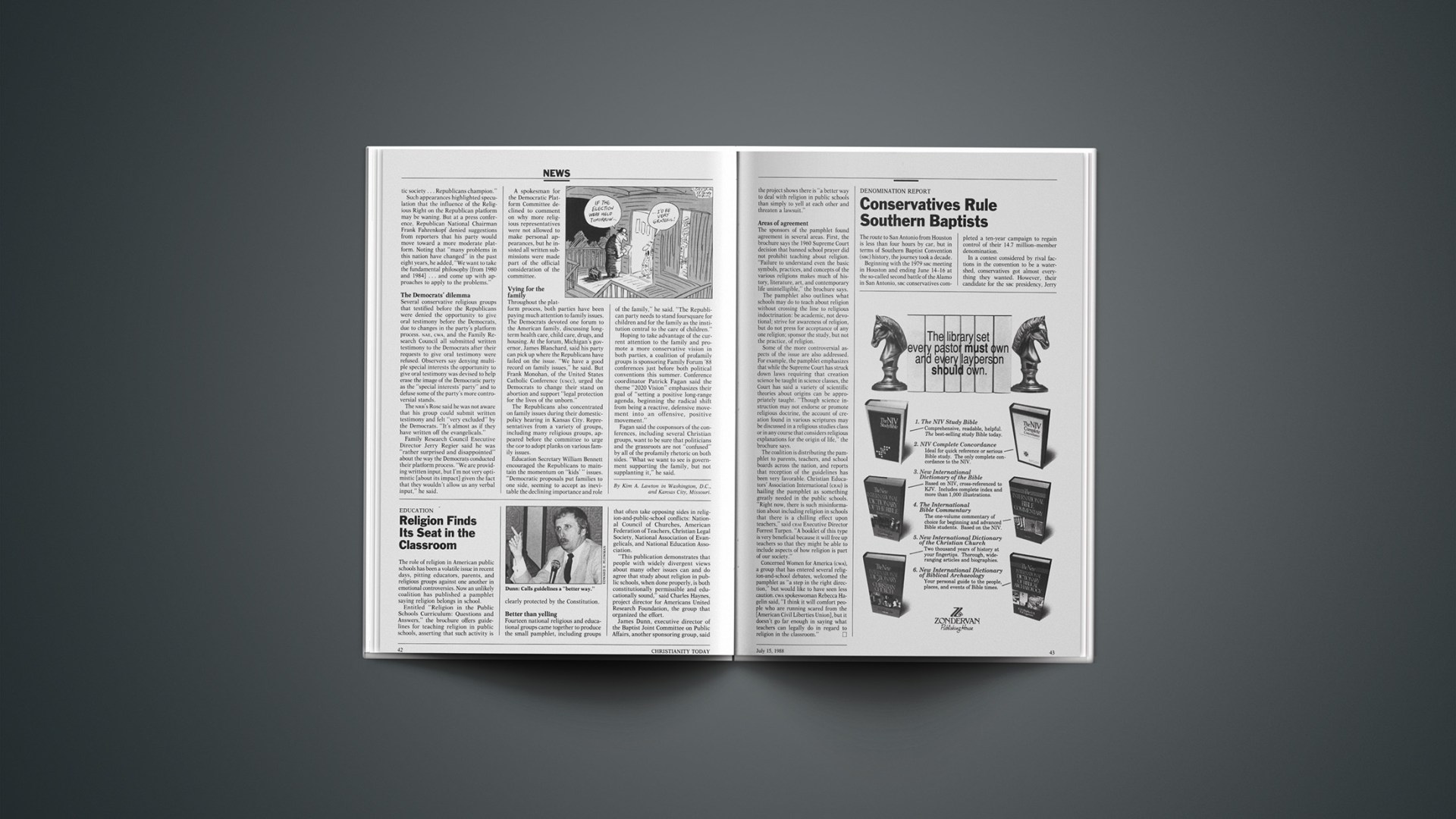
Religion Finds Its Seat in the Classroom

EDUCATION

The role of religion in American public schools has been a volatile issue in recent days, pitting educators, parents, and religious groups against one another in emotional controversies. Now an unlikely coalition has published a pamphlet saying religion belongs in school.

Entitled “Religion in the Public Schools Curriculum: Questions and Answers,” the brochure offers guidelines for teaching religion in public schools, asserting that such activity is clearly protected by the Constitution.

Better Than Yelling

Fourteen national religious and educational groups came together to produce the small pamphlet, including groups that often take opposing sides in religion-and-public-school conflicts: National Council of Churches, American Federation of Teachers, Christian Legal Society, National Association of Evangelicals, and National Education Association.

“This publication demonstrates that people with widely divergent views about many other issues can and do agree that study about religion in public schools, when done properly, is both constitutionally permissible and educationally sound,” said Charles Haynes, project director for Americans United Research Foundation, the group that organized the effort.

James Dunn, executive director of the Baptist Joint Committee on Public Affairs, another sponsoring group, said the project shows there is “a better way to deal with religion in public schools than simply to yell at each other and threaten a lawsuit.”

Areas Of Agreement

The sponsors of the pamphlet found agreement in several areas. First, the brochure says the 1960 Supreme Court decision that banned school prayer did not prohibit teaching about religion. “Failure to understand even the basic symbols, practices, and concepts of the various religions makes much of history, literature, art, and contemporary life unintelligible,” the brochure says.

The pamphlet also outlines what schools may do to teach about religion without crossing the line to religious indoctrination: be academic, not devotional; strive for awareness of religion, but do not press for acceptance of any one religion; sponsor the study, but not the practice, of religion.

Some of the more controversial aspects of the issue are also addressed. For example, the pamphlet emphasizes that while the Supreme Court has struck down laws requiring that creation science be taught in science classes, the Court has said a variety of scientific theories about origins can be appropriately taught. “Though science instruction may not endorse or promote religious doctrine, the account of creation found in various scriptures may be discussed in a religious studies class or in any course that considers religious explanations for the origin of life,” the brochure says.

The coalition is distributing the pamphlet to parents, teachers, and school boards across the nation, and reports that reception of the guidelines has been very favorable. Christian Educators’ Association International (CEAI) is hailing the pamphlet as something greatly needed in the public schools. “Right now, there is such misinformation about including religion in schools that there is a chilling effect upon teachers,” said CEAI Executive Director Forrest Turpen. “A booklet of this type is very beneficial because it will free up teachers so that they might be able to include aspects of how religion is part of our society.”

Concerned Women for America (CWA,) a group that has entered several religion-and-school debates, welcomed the pamphlet as “a step in the right direction,” but would like to have seen less caution, CWA spokeswoman Rebecca Hagelin said, “I think it will comfort people who are running scared from the [American Civil Liberties Union], but it doesn’t go far enough in saying what teachers can legally do in regard to religion in the classroom.”

Religious Groups Push Platform Agenda

NATIONAL ELECTIONS

This month, Democrats meeting in Atlanta will hammer out the platform that will carry them into the November elections. And Republicans will get their chance next month when they meet for their convention in New Orleans. Recalling their strength in the 1980 and 1984 campaigns, Christians from a variety of perspectives have been attempting to get both parties to consider their platform concerns.

The Republican Connection

Representatives of several Christian groups testified at a Republican-sponsored platform-committee hearing in Kansas City, Missouri, last month. Robert Dugan, director of the National Association of Evangelicals’ Washington Office on Public Affairs, highlighted six principles his group would like to see incorporated into platform planks: the retention of religious liberty in this nation, recognition of God in public life, the protection of life as sacred, the provision of justice for all, restoration of traditional values to education and legislation, and the preservation of the traditional family.

Similar themes were stressed in testimony by Jerry Falwell, chairman of the Moral Majority; Chicago television executive Jerry Rose, representing the National Religious Broadcasters (NRB;) and Elizabeth Kepley of Concerned Women for America (CWA.)

Testimony was also offered from groups that want the Republicans to move away from their conservative positions of the past two elections. Randall Moody of Republicans for Choice urged the party to “eliminate” platform planks supporting a constitutional ban on abortion.

For the first time, Republicans took the testimony of an official representative of the homosexual community. John Thomas of the Human Rights Campaign Fund urged the GOP to “recognize [the gay community] as part of the pluralistic society … Republicans champion.”

Such appearances highlighted speculation that the influence of the Religious Right on the Republican platform may be waning. But at a press conference, Republican National Chairman Frank Fahrenkopf denied suggestions from reporters that his party would move toward a more moderate platform. Noting that “many problems in this nation have changed” in the past eight years, he added, “We want to take the fundamental philosophy [from 1980 and 1984] … and come up with approaches to apply to the problems.”

The Democrats’ Dilemma

Several conservative religious groups that testified before the Republicans were denied the opportunity to give oral testimony before the Democrats, due to changes in the party’s platform process, NAE, CWA, and the Family Research Council all submitted written testimony to the Democrats after their requests to give oral testimony were refused. Observers say denying multiple special interests the opportunity to give oral testimony was devised to help erase the image of the Democratic party as the “special interests’ party” and to defuse some of the party’s more controversial stands.

The NRB’s Rose said he was not aware that his group could submit written testimony and felt “very excluded” by the Democrats. “It’s almost as if they have written off the evangelicals.”

Family Research Council Executive Director Jerry Regier said he was “rather surprised and disappointed” about the way the Democrats conducted their platform process. “We are providing written input, but I’m not very optimistic [about its impact] given the fact that they wouldn’t allow us any verbal input,” he said.

A spokesman for the Democratic Platform Committee declined to comment on why more religious representatives were not allowed to make personal appearances, but he insisted all written submissions were made part of the official consideration of the committee.

Vying For The Family

Throughout the platform process, both parties have been paying much attention to family issues. The Democrats devoted one forum to the American family, discussing long-term health care, child care, drugs, and housing. At the forum, Michigan’s governor, James Blanchard, said his party can pick up where the Republicans have failed on the issue. “We have a good record on family issues,” he said. But Frank Monohan, of the United States Catholic Conference (USCC), urged the Democrats to change their stand on abortion and support “legal protection for the lives of the unborn.”

The Republicans also concentrated on family issues during their domestic-policy hearing in Kansas City. Representatives from a variety of groups, including many religious groups, appeared before the committee to urge the GOP to adopt planks on various family issues.

Education Secretary William Bennett encouraged the Republicans to maintain the momentum on “kids’ ” issues. “Democratic proposals put families to one side, seeming to accept as inevitable the declining importance and role of the family,” he said. “The Republican party needs to stand foursquare for children and for the family as the institution central to the care of children.”

Hoping to take advantage of the current attention to the family and promote a more conservative vision in both parties, a coalition of profamily groups is sponsoring Family Forum 88 conferences just before both political conventions this summer. Conference coordinator Patrick Fagan said the theme “2020 Vision” emphasizes their goal of “setting a positive long-range agenda, beginning the radical shift from being a reactive, defensive movement into an offensive, positive movement.”

Fagan said the cosponsors of the conferences, including several Christian groups, want to be sure that politicians and the grassroots are not “confused” by all of the profamily rhetoric on both sides. “What we want to see is government supporting the family, but not supplanting it,” he said.

By Kim A. Lawton in Washington, D.C., and Kansas City, Missouri.

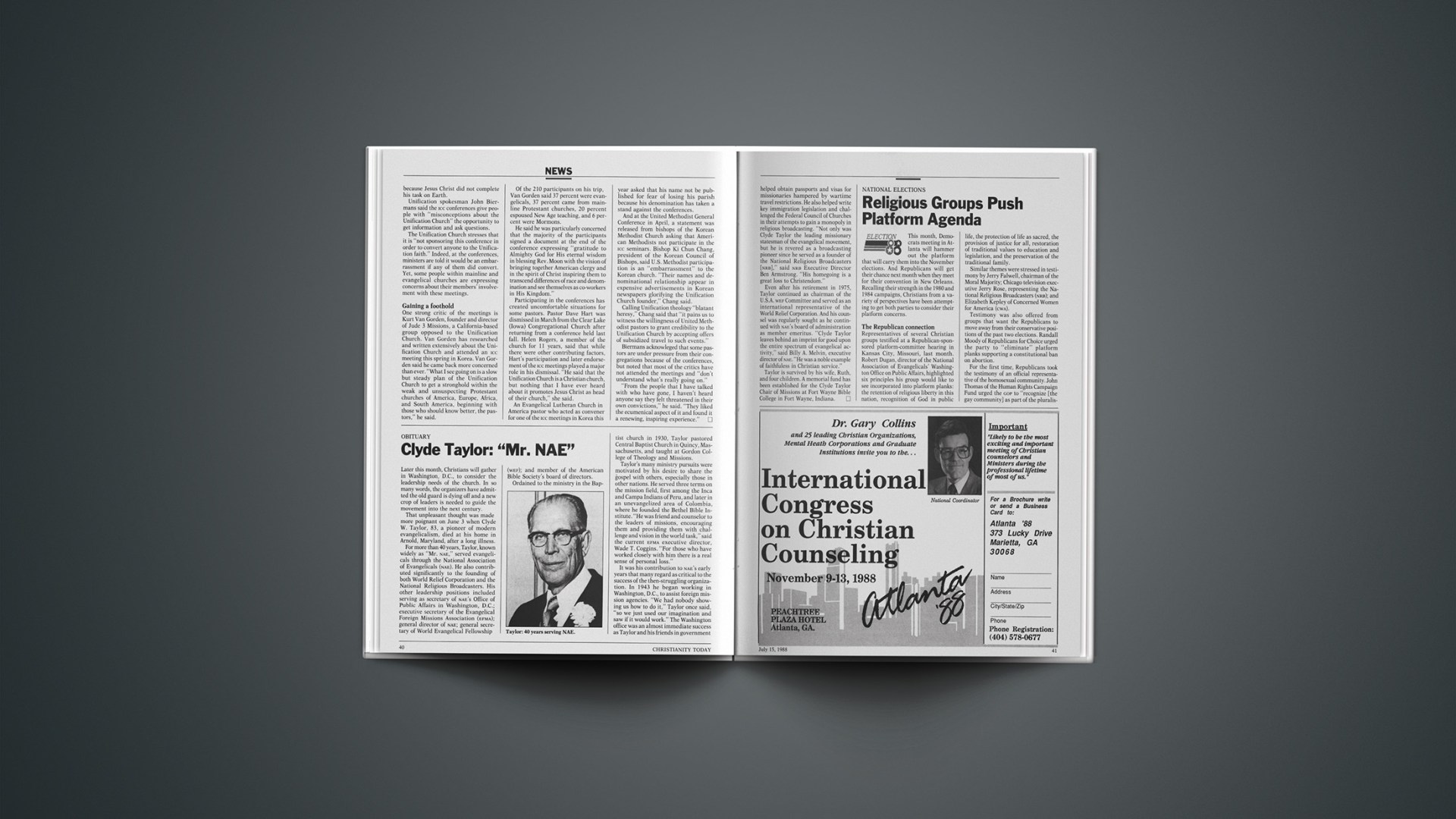
Clyde Taylor: “Mr. NAE”

OBITUARY

Later this month, Christians will gather in Washington, D.C., to consider the leadership needs of the church. In so many words, the organizers have admitted the old guard is dying off and a new crop of leaders is needed to guide the movement into the next century.

That unpleasant thought was made more poignant on June 3 when Clyde W. Taylor, 83, a pioneer of modern evangelicalism, died at his home in Arnold, Maryland, after a long illness.

For more than 40 years, Taylor, known widely as “Mr. NAE,” served evangelicals through the National Association of Evangelicals (NAE). He also contributed significantly to the founding of both World Relief Corporation and the National Religious Broadcasters. His other leadership positions included serving as secretary of NAE’s Office of Public Affairs in Washington, D.C.; executive secretary of the Evangelical Foreign Missions Association (EFMA); general director of NAE; general secretary of World Evangelical Fellowship (WEF); and member of the American Bible Society’s board of directors.

Ordained to the ministry in the Baptist church in 1930, Taylor pastored Central Baptist Church in Quincy, Massachusetts, and taught at Gordon College of Theology and Missions.

Taylor’s many ministry pursuits were motivated by his desire to share the gospel with others, especially those in other nations. He served three terms on the mission field, first among the Inca and Campa Indians of Peru, and later in an unevangelized area of Colombia, where he founded the Bethel Bible Institute. “He was friend and counselor to the leaders of missions, encouraging them and providing them with challenge and vision in the world task,” said the current EFMA executive director, Wade T. Coggins. “For those who have worked closely with him there is a real sense of personal loss.”

It was his contribution to NAE’S early years that many regard as critical to the success of the then-struggling organization. In 1943 he began working in Washington, D.C., to assist foreign mission agencies. “We had nobody showing us how to do it,” Taylor once said, “so we just used our imagination and saw if it would work.” The Washington office was an almost immediate success as Taylor and his friends in government helped obtain passports and visas for missionaries hampered by wartime travel restrictions. He also helped write key immigration legislation and challenged the Federal Council of Churches in their attempts to gain a monopoly in religious broadcasting. “Not only was Clyde Taylor the leading missionary statesman of the evangelical movement, but he is revered as a broadcasting pioneer since he served as a founder of the National Religious Broadcasters [NRB],” said NRB Executive Director Ben Armstrong. “His homegoing is a great loss to Christendom.”

Even after his retirement in 1975, Taylor continued as chairman of the U.S.A. WEF Committee and served as an international representative of the World Relief Corporation. And his counsel was regularly sought as he continued with NAE’S board of administration as member emeritus. “Clyde Taylor leaves behind an imprint for good upon the entire spectrum of evangelical activity,” said Billy A. Melvin, executive director of NAE. “He was a noble example of faithfuless in Christian service.”

Taylor is survived by his wife, Ruth, and four children. A memorial fund has been established for the Clyde Taylor Chair of Missions at Fort Wayne Bible College in Fort Wayne, Indiana.

Why All Those Pastors Went to Korea

ecumenism

For the past three years, the Unification Church has taken nearly 7,000 American pastors on subsidized informational trips to South Korea and Japan to “learn more about the Unification Church.” Unification officials, who will begin inviting pastors from other nations, say the purpose of the trips is not to recruit new members, but to advance Christian unity. Yet, some Christians are raising questions about these “Interdenominational Conferences for Clergy” (ICC).

Since April 1985, the Unification Church has been sponsoring ICC meetings in South Korea and Japan called the “American Christian Ministers’ Conference on Unificationism: Rev. Moon and Korea in the Providence of God.” A promotional video produced by the church says these conferences are “the fulfillment of a dream” that Unification founder Sun Myung Moon had many years ago. Conference director Levy Daugherty said the idea is based on the account in 1 Kings 19:18 where God tells Elijah that there are 7,000 in Israel who have not bowed to Baal. Next, Daugherty says, the church will concentrate on bringing 7,000 pastors from Europe, Africa, and South America.

Pastors, their spouses, and other religious workers are guests of the Unification Church for either eight or twelve days. Some participants receive all-expenses-paid trips, and others pay their own airfare—approximately $740.

Sightseeing And Theology

The conferences include a mixture of sightseeing tours and lectures about the Unification Church background and theology. According to a conference agenda and trip participants, the eight-day Korea conferences include visits to Moon’s home and early church in Seoul, a local Unification church service, a trip to the demilitarized zone between North and South Korea, and a day trip to the city of Pusan.

In Pusan, the participants visit a small museum in the city where Moon built his first church. There they see “The Rock of Tears,” where the Unification Church says Moon spent his early days “learning the heart of God for his suffering children.” A special prayer service is held at the rock, and the video says “many [pastors] have had very deep spiritual experiences” there.

The lecture series deals intensively with Unification beliefs as stated in “The Divine Principle,” the official doctrinal text of the Unification Church. Among the topics addressed are the principles of Creation, the fall of humankind, the mission of the Messiah, Jesus, God’s plan for salvation, and the second coming of Christ.

Several Unification beliefs in these areas have been troubling for many mainline and evangelical Christians. In 1977, The National Council of Churches denied a petition for membership from the Unification Church, saying its doctrines were “incompatible with Christian teaching and belief.” In earlier publications, Moon has taught that a second messiah will be born in Korea because Jesus Christ did not complete his task on Earth.

Unification spokesman John Biermans said the ICC conferences give people with misconceptions about the Unification Church” the opportunity to get information and ask questions.

The Unification Church stresses that it is “not sponsoring this conference in order to convert anyone to the Unification faith.” Indeed, at the conferences, ministers are told it would be an embarrassment if any of them did convert. Yet, some people within mainline and evangelical churches are expressing concerns about their members’ involvement with these meetings.

Gaining A Foothold

One strong critic of the meetings is Kurt Van Gorden, founder and director of Jude 3 Missions, a California-based group opposed to the Unification Church. Van Gorden has researched and written extensively about the Unification Church and attended an ICC meeting this spring in Korea. Van Gorden said he came back more concerned than ever. “What I see going on is a slow but steady plan of the Unification Church to get a stronghold within the weak and unsuspecting Protestant churches of America, Europe, Africa, and South America, beginning with those who should know better, the pastors,” he said.

Of the 210 participants on his trip, Van Gorden said 37 percent were evangelicals, 37 percent came from mainline Protestant churches, 20 percent espoused New Age teaching, and 6 percent were Mormons.

He said he was particularly concerned that the majority of the participants signed a document at the end of the conference expressing “gratitude to Almighty God for His eternal wisdom in blessing Rev. Moon with the vision of bringing together American clergy and in the spirit of Christ inspiring them to transcend differences of race and denomination and see themselves as co-workers in His Kingdom.”

Participating in the conferences has created uncomfortable situations for some pastors. Pastor Dave Hart was dismissed in March from the Clear Lake (Iowa) Congregational Church after returning from a conference held last fall. Helen Rogers, a member of the church for 11 years, said that while there were other contributing factors, Hart’s participation and later endorsement of the ICC meetings played a major role in his dismissal. “He said that the Unification Church is a Christian church, but nothing that I have ever heard about it promotes Jesus Christ as head of their church,” she said.

An Evangelical Lutheran Church in America pastor who acted as convener for one of the ICC meetings in Korea this year asked that his name not be published for fear of losing his parish because his denomination has taken a stand against the conferences.

And at the United Methodist General Conference in April, a statement was released from bishops of the Korean Methodist Church asking that American Methodists not participate in the ICC seminars. Bishop Ki Chun Chang, president of the Korean Council of Bishops, said U.S. Methodist participation is an “embarrassment” to the Korean church. “Their names and denominational relationship appear in expensive advertisements in Korean newspapers glorifying the Unification Church founder,” Chang said.

Calling Unification theology “blatant heresy,” Chang said that “it pains us to witness the willingness of United Methodist pastors to grant credibility to the Unification Church by accepting offers of subsidized travel to such events.”

Biermans acknowleged that some pastors are under pressure from their congregations because of the conferences, but noted that most of the critics have not attended the meetings and “don’t understand what’s really going on.”

“From the people that I have talked with who have gone, I haven’t heard anyone say they felt threatened in their own convictions,” he said. “They liked the ecumenical aspect of it and found it a renewing, inspiring experience.”

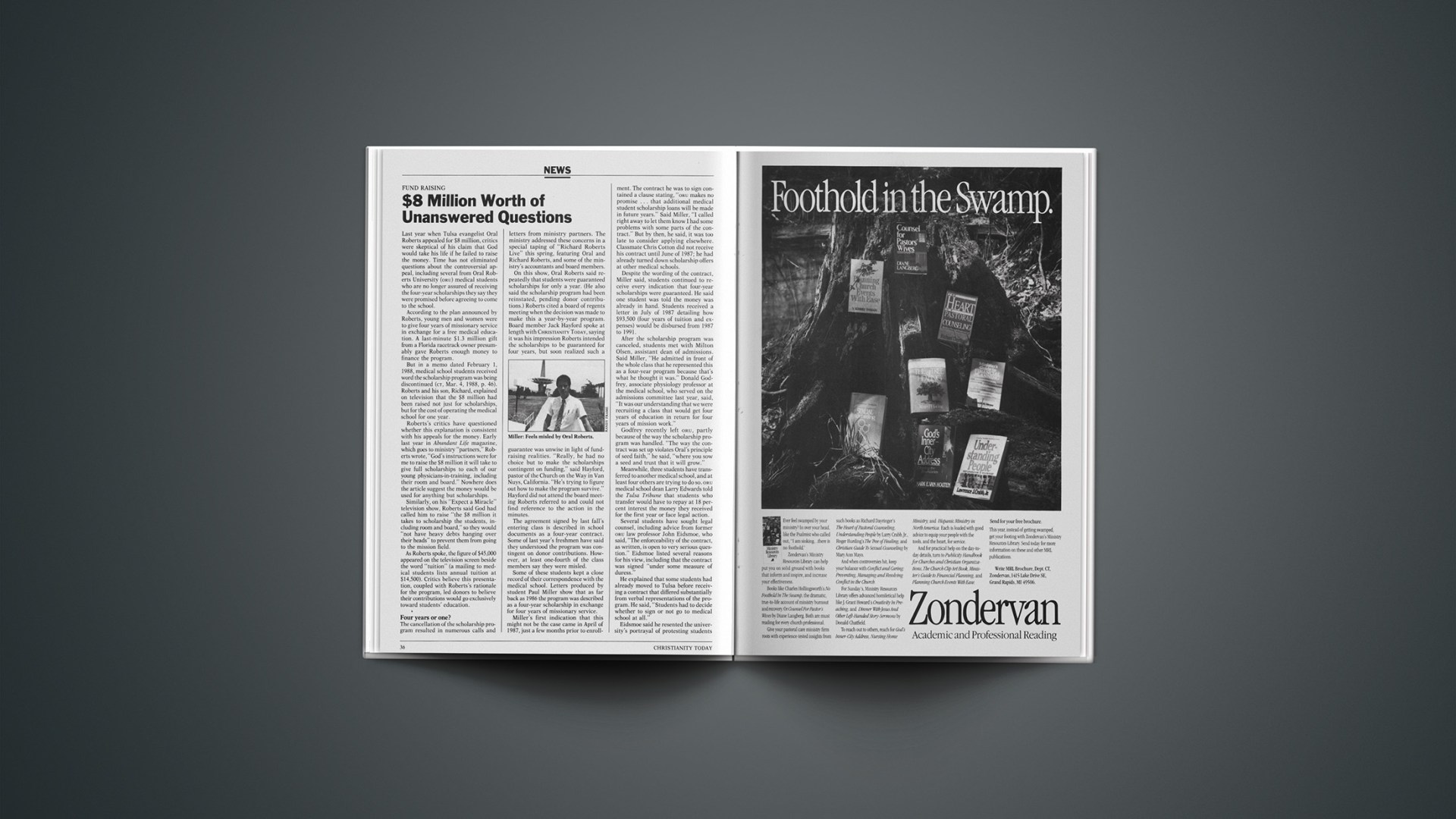
$8 Million Worth of Unanswered Questions

FUND RAISING

Last year when Tulsa evangelist Oral Roberts appealed for $8 million, critics were skeptical of his claim that God would take his life if he failed to raise the money. Time has not eliminated questions about the controversial appeal, including several from Oral Roberts University (ORU) medical students who are no longer assured of receiving the four-year scholarships they say they were promised before agreeing to come to the school.

According to the plan announced by Roberts, young men and women were to give four years of missionary service in exchange for a free medical education. A last-minute $1.3 million gift from a Florida racetrack owner presumably gave Roberts enough money to finance the program.

But in a memo dated February 1, 1988, medical school students received word the scholarship program was being discontinued (CT, Mar. 4, 1988, p. 46). Roberts and his son, Richard, explained on television that the $8 million had been raised not just for scholarships, but for the cost of operating the medical school for one year.

Roberts’s critics have questioned whether this explanation is consistent with his appeals for the money. Early last year in Abundant Life magazine, which goes to ministry “partners,” Roberts wrote, “God’s instructions were for me to raise the $8 million it will take to give full scholarships to each of our young physicians-in-training, including their room and board.” Nowhere does the article suggest the money would be used for anything but scholarships.

Similarly, on his “Expect a Miracle” television show, Roberts said God had called him to raise “the $8 million it takes to scholarship the students, including room and board,” so they would “not have heavy debts hanging over their heads” to prevent them from going to the mission field.

As Roberts spoke, the figure of $45,000 appeared on the television screen beside the word “tuition” (a mailing to medical students lists annual tuition at $14,500). Critics believe this presentation, coupled with Roberts’s rationale for the program, led donors to believe their contributions would go exclusively toward students’ education.

Four Years Or One?

The cancellation of the scholarship program resulted in numerous calls and letters from ministry partners. The ministry addressed these concerns in a special taping of “Richard Roberts Live” this spring, featuring Oral and Richard Roberts, and some of the ministry’s accountants and board members.

On this show, Oral Roberts said repeatedly that students were guaranteed scholarships for only a year. (He also said the scholarship program had been reinstated, pending donor contributions.) Roberts cited a board of regents meeting when the decision was made to make this a year-by-year program. Board member Jack Hayford spoke at length with CHRISTIANITY TODAY, saying it was his impression Roberts intended the scholarships to be guaranteed for four years, but soon realized such a guarantee was unwise in light of fund-raising realities. “Really, he had no choice but to make the scholarships contingent on funding,” said Hayford, pastor of the Church on the Way in Van Nuys, California. “He’s trying to figure out how to make the program survive.” Hayford did not attend the board meeting Roberts referred to and could not find reference to the action in the minutes.

The agreement signed by last fall’s entering class is described in school documents as a four-year contract. Some of last year’s freshmen have said they understood the program was contingent on donor contributions. However, at least one-fourth of the class members say they were misled.

Some of these students kept a close record of their correspondence with the medical school. Letters produced by student Paul Miller show that as far back as 1986 the program was described as a four-year scholarship in exchange for four years of missionary service.

Miller’s first indication that this might not be the case came in April of 1987, just a few months prior to enrollment. The contract he was to sign contained a clause stating, “ORU makes no promise … that additional medical student scholarship loans will be made in future years.” Said Miller, “I called right away to let them know I had some problems with some parts of the contract.” But by then, he said, it was too late to consider applying elsewhere. Classmate Chris Cotton did not receive his contract until June of 1987; he had already turned down scholarship offers at other medical schools.

Despite the wording of the contract, Miller said, students continued to receive every indication that four-year scholarships were guaranteed. He said one student was told the money was already in hand. Students received a letter in July of 1987 detailing how $93,500 (four years of tuition and expenses) would be disbursed from 1987 to 1991.

After the scholarship program was canceled, students met with Milton Olsen, assistant dean of admissions. Said Miller, “He admitted in front of the whole class that he represented this as a four-year program because that’s what he thought it was.” Donald Godfrey, associate physiology professor at the medical school, who served on the admissions committee last year, said, “It was our understanding that we were recruiting a class that would get four years of education in return for four years of mission work.”

Godfrey recently left ORU, partly because of the way the scholarship program was handled. “The way the contract was set up violates Oral’s principle of seed faith,” he said, “where you sow a seed and trust that it will grow.”

Meanwhile, three students have transferred to another medical school, and at least four others are trying to do so. ORU medical school dean Larry Edwards told the Tulsa Tribune that students who transfer would have to repay at 18 percent interest the money they received for the first year or face legal action.

Several students have sought legal counsel, including advice from former ORU law professor John Eidsmoe, who said, “The enforceability of the contract, as written, is open to very serious question.” Eidsmoe listed several reasons for his view, including that the contract was signed “under some measure of duress.”

He explained that some students had already moved to Tulsa before receiving a contract that differed substantially from verbal representations of the program. He said, “Students had to decide whether to sign or not go to medical school at all.”

Eidsmoe said he resented the university’s portrayal of protesting students “as crybabies who just want a free ride.” He said, “These are sincere, dedicated Christians who are excited about medical missions. All they want is for the agreement they made to be carried out.”

How The Money Was Spent

Confusion over the scholarship program has led some to question whether the $8 million was actually raised, as Roberts reported, and if so, how it was spent. According to freshman class vice-president Donald Eagle, medical school dean Edwards met with class officers following the cancellation of scholarships. Eagle said, “He told us that only $2 million came in labeled for medical school missions, and he wasn’t about to ask where the rest was.”

On “Richard Roberts Live,” Mark Swadener, the ministry’s chief financial officer, said the “funds that were raised were used for scholarships.” Yet Edwards was quoted in the Tulsa Tribune as saying that $2.4 million was spent on student scholarships, $4.75 million for salaries of professors and support staff, $750,000 for research, and $700,000 to support the medical missions program overseas. Despite repeated requests from CHRISTIANITY TODAY, officials at ORU declined to be interviewed about the $8 million.

In addition to the $8.4 million Roberts claimed to have raised, the medical school received tuition from students not on scholarship and some grant money.

Godfrey said he had trouble understanding how all this could have been spent on the medical school. With his departure, the faculty of the physiology department—one of five departments in the two-year basic-science program—is reduced to two, down from ten just a few years ago. Godfrey said medical equipment is wearing out and, like faculty, not being replaced.

Such reductions in the medical school add to growing concerns that the ORU empire is fading. Other indications include the cutting back of television programming to cable only and the failed attempt earlier this year to sell the City of Faith Hospital, which in the last decade has consumed millions of ministry dollars.

Although Roberts said the scholarship program will continue if funds come in, students have been advised to apply for loans.

Godfrey says he does not question Roberts’s motives and that he believes Roberts has been used by God. Some students agree, but feel this has not been indicated by the way they have been treated.

By Randy Frame in Tulsa.

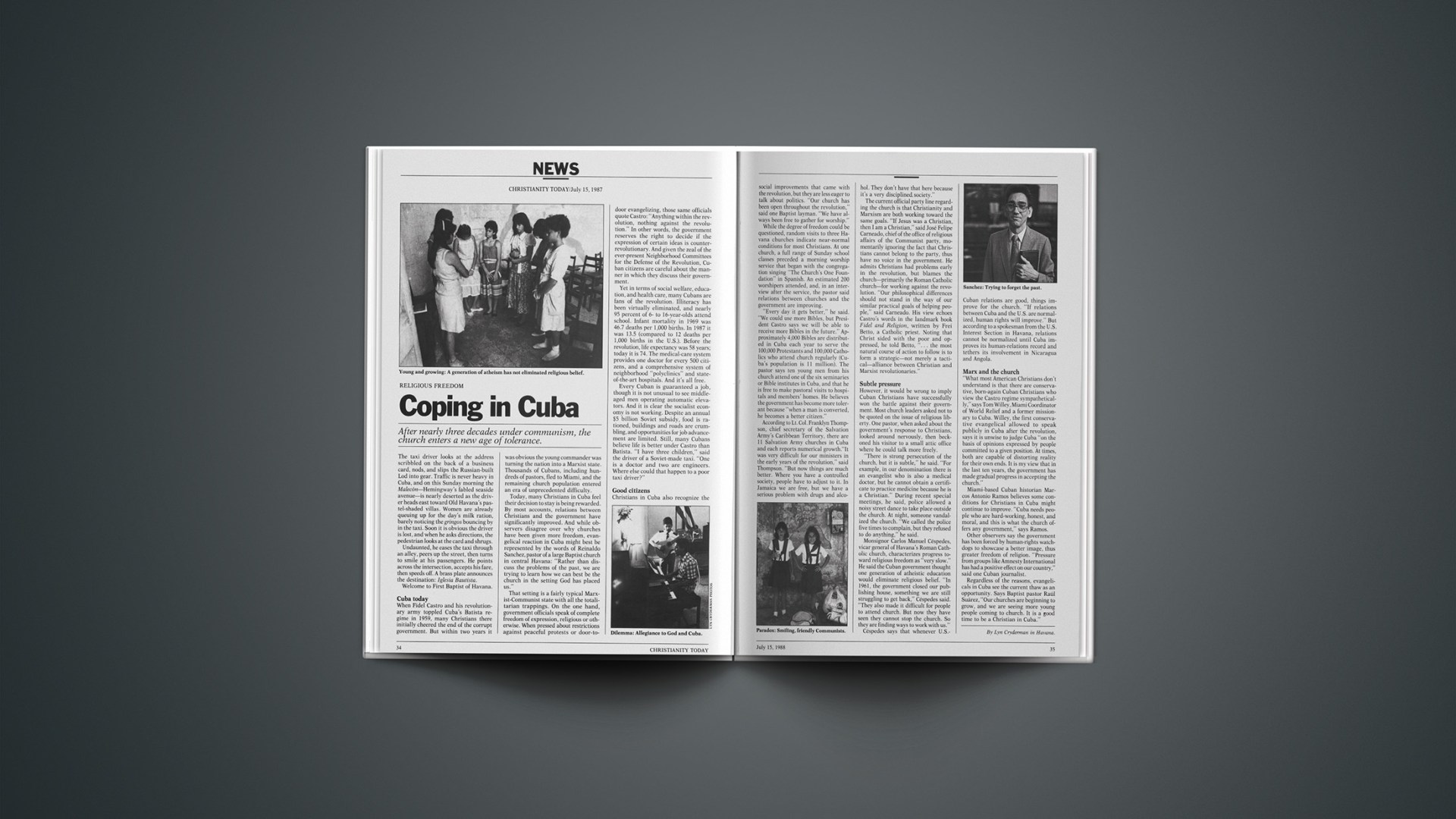
Coping in Cuba

NEWS

RELIGIOUS FREEDOM

After nearly three decades under communism, the church enters a new age of tolerance.

The taxi driver looks at the address scribbled on the back of a business card, nods, and slips the Russian-built Lod into gear. Traffic is never heavy in Cuba, and on this Sunday morning the Malecón—Hemingway’s fabled seaside avenue—is nearly deserted as the driver heads east toward Old Havana’s pastel-shaded villas. Women are already queuing up for the day’s milk ration, barely noticing the gringos bouncing by in the taxi. Soon it is obvious the driver is lost, and when he asks directions, the pedestrian looks at the card and shrugs.

Undaunted, he eases the taxi through an alley, peers up the street, then turns to smile at his passengers. He points across the intersection, accepts his fare, then speeds off. A brass plate announces the destination: Iglesia Bautista.

Welcome to First Baptist of Havana.

Cuba Today

When Fidel Castro and his revolutionary army toppled Cuba’s Batista regime in 1959, many Christians there initially cheered the end of the corrupt government. But within two years it was obvious the young commander was turning the nation into a Marxist state. Thousands of Cubans, including hundreds of pastors, fled to Miami, and the remaining church population entered an era of unprecedented difficulty.

Today, many Christians in Cuba feel their decision to stay is being rewarded. By most accounts, relations between Christians and the government have significantly improved. And while observers disagree over why churches have been given more freedom, evangelical reaction in Cuba might best be represented by the words of Reinaldo Sanchez, pastor of a large Baptist church in central Havana: “Rather than discuss the problems of the past, we are trying to learn how we can best be the church in the setting God has placed us.”

That setting is a fairly typical Marxist-Communist state with all the totalitarian trappings. On the one hand, government officials speak of complete freedom of expression, religious or otherwise. When pressed about restrictions against peaceful protests or door-to-door evangelizing, those same officials quote Castro: “Anything within the revolution, nothing against the revolution.” In other words, the government reserves the right to decide if the expression of certain ideas is counterrevolutionary. And given the zeal of the ever-present Neighborhood Committees for the Defense of the Revolution, Cuban citizens are careful about the manner in which they discuss their government.

Yet in terms of social welfare, education, and health care, many Cubans are fans of the revolution. Illiteracy has been virtually eliminated, and nearly 95 percent of 6-to 16-year-olds attend school. Infant mortality in 1969 was 46.7 deaths per 1,000 births. In 1987 it was 13.5 (compared to 12 deaths per 1,000 births in the U.S.). Before the revolution, life expectancy was 58 years; today it is 74. The medical-care system provides one doctor for every 500 citizens, and a comprehensive system of neighborhood “polyclinics” and state-of-the-art hospitals. And it’s all free.

Every Cuban is guaranteed a job, though it is not unusual to see middle-aged men operating automatic elevators. And it is clear the socialist economy is not working. Despite an annual $5 billion Soviet subsidy, food is rationed, buildings and roads are crumbling, and opportunities for job advancement are limited. Still, many Cubans believe life is better under Castro than Batista. “I have three children,” said the driver of a Soviet-made taxi. “One is a doctor and two are engineers. Where else could that happen to a poor taxi driver?”

Good Citizens

Christians in Cuba also recognize the social improvements that came with the revolution, but they are less eager to talk about politics. “Our church has been open throughout the revolution,” said one Baptist layman. “We have always been free to gather for worship.”

While the degree of freedom could be questioned, random visits to three Havana churches indicate near-normal conditions for most Christians. At one church, a full range of Sunday school classes preceded a morning worship service that began with the congregation singing “The Church’s One Foundation” in Spanish. An estimated 200 worshipers attended, and, in an interview after the service, the pastor said relations between churches and the government are improving.

“Every day it gets better,” he said. “We could use more Bibles, but President Castro says we will be able to receive more Bibles in the future.” Approximately 4,000 Bibles are distributed in Cuba each year to serve the 100,000 Protestants and 100,000 Catholics who attend church regularly (Cuba’s population is 11 million). The pastor says ten young men from his church attend one of the six seminaries or Bible institutes in Cuba, and that he is free to make pastoral visits to hospitals and members’ homes. He believes the government has become more tolerant because “when a man is converted, he becomes a better citizen.”

According to Lt. Col. Franklyn Thompson, chief secretary of the Salvation Army’s Caribbean Territory, there are 11 Salvation Army churches in Cuba and each reports numerical growth. “It was very difficult for our ministers in the early years of the revolution,” said Thompson. “But now things are much better. Where you have a controlled society, people have to adjust to it. In Jamaica we are free, but we have a serious problem with drugs and alcohol. They don’t have that here because it’s a very disciplined, society.”

The current official party line regarding the church is that Christianity and Marxism are both working toward the same goals. “If Jesus was a Christian, then I am a Christian,” said José Felipe Carneado, chief of the office of religious affairs of the Communist party, momentarily ignoring the fact that Christians cannot belong to the party, thus have no voice in the government. He admits Christians had problems early in the revolution, but blames the church—primarily the Roman Catholic church—for working against the revolution. “Our philosophical differences should not stand in the way of our similar practical goals of helping people,” said Carneado. His view echoes Castro’s words in the landmark book Fidel and Religion, written by Frei Betto, a Catholic priest. Noting that Christ sided with the poor and oppressed, he told Betto, “… the most natural course of action to follow is to form a strategic—not merely a tactical—alliance between Christian and Marxist revolutionaries.”

Subtle Pressure

However, it would be wrong to imply Cuban Christians have successfully won the battle against their government. Most church leaders asked not to be quoted on the issue of religious liberty. One pastor, when asked about the government’s response to Christians, looked around nervously, then beckoned his visitor to a small attic office where he could talk more freely.

“There is strong persecution of the church, but it is subtle,” he said. “For example, in our denomination there is an evangelist who is also a medical doctor, but he cannot obtain a certificate to practice medicine because he is a Christian.” During recent special meetings, he said, police allowed a noisy street dance to take place outside the church. At night, someone vandalized the church. “We called the police five times to complain, but they refused to do anything,” he said.

Monsignor Carlos Manuel Céspedes, vicar general of Havana’s Roman Catholic church, characterizes progress toward religious freedom as “very slow.” He said the Cuban government thought one generation of atheistic education would eliminate religious belief. “In 1961, the government closed our publishing house, something we are still struggling to get back,” Céspedes said. “They also made it difficult for people to attend church. But now they have seen they cannot stop the church. So they are finding ways to work with us.”

Céspedes says that whenever U.S. Cuban relations are good, things improve for the church. “If relations between Cuba and the U.S. are normalized, human rights will improve.” But according to a spokesman from the U.S. Interest Section in Havana, relations cannot be normalized until Cuba improves its human-relations record and tethers its involvement in Nicaragua and Angola.

Marx And The Church

“What most American Christians don’t understand is that there are conservative, born-again Cuban Christians who view the Castro regime sympathetically,” says Tom Willey, Miami Coordinator of World Relief and a former missionary to Cuba. Willey, the first conservative evangelical allowed to speak publicly in Cuba after the revolution, says it is unwise to judge Cuba “on the basis of opinions expressed by people committed to a given position. At times, both are capable of distorting reality for their own ends. It is my view that in the last ten years, the government has made gradual progress in accepting the church.”

Miami-based Cuban historian Marcos Antonio Ramos believes some conditions for Christians in Cuba might continue to improve. “Cuba needs people who are hard-working, honest, and moral, and this is what the church offers any government,” says Ramos.

Other observers say the government has been forced by human-rights watchdogs to showcase a better image, thus greater freedom of religion. “Pressure from groups like Amnesty International has had a positive effect on our country,” said one Cuban journalist.

Regardless of the reasons, evangelicals in Cuba see the current thaw as an opportunity. Says Baptist pastor Raúl Súarez, “Our churches are beginning to grow, and we are seeing more young people coming to church. It is a good time to be a Christian in Cuba.”

By Lyn Cryderman in Havana.

Classic & Contemporary Excerpts from July 15, 1988

Classic and contemporary excerpts.

“Cool” addicts

Everybody knows that TV is mostly false and stupid, that almost no one pays that much attention to it—and yet it’s on for over seven hours a day in the average household, and it sells innumerable products. In other words, TV manages to do its job even as it only yammers in the background, despised by those who keep it going. TV begins by offering us a beautiful hallucination of diversity, but it is finally like a drug whose high is only the conviction that its user is too cool to be addicted.

—Mark Crispin in Watching Television, quoted in Harper’s (Nov. 1986)

Let them eat bread

The question of bread for myself is a material question, but the question of bread for my neighbours, for everybody, is a spiritual and a religious question.… Christians ought to be permeated with a sense of the religious importance of the elementary daily needs of people, the vast masses of people, and not to despise these needs from a sense of exalted spirituality.

—Nicolai Berdyaev in Origin of Russian Communism

Choice, not destiny

Grief refuses to flee the past just because it is gone and things have now changed.… Consider when we lose our innocence—when we discover that we can injure and have injured others, that the slate of our lives is not clean. Suddenly we realize that we must travel into the future carrying not just any past, but our particular past, a past that cannot be changed. Whatever freedom means, we are not free to undo this past. The freedom comes in how we relate this past to our future. We can drown ourselves in regret, lose ourselves in nostalgia, or cling to these old injuries and losses. But if we do, it is our choice, not our destiny.

—John C. Raines in The Christian Century (Oct. 15, 1986)

Our Father’s children?

The fruits of the Holy Spirit are, it seems to me, largely fruits of sustained interaction with God. Just as a child picks up traits more or less simply by dwelling in the presence of her parent, so the Christian develops tenderheartedness, compassion, humility, forgiveness, joy, and hope through “the fellowship of the Holy Spirit”—that is, by dwelling in the presence of God the Father and Jesus Christ his Son. And this means, to a very large extent, living in a community of serious believers.

—Robert C. Roberts in The Reformed Journal (Feb. 1987)

Ministry begins at home

Our Lord did not say to His disciples: “I have had a most successful time on earth. I have addressed thousands of people and been the means of their salvation; now you go and do the same kind of thing.” He said: “If I then, your Lord and Master, have washed your feet, ye also ought to wash one another’s feet.” We try to get out of it by washing the feet of those who are not of our own set. We will wash the heathen’s feet, the feet in the slums; but fancy washing my brother’s feet! My wife’s! My husband’s! The feet of the minister of my church! Our Lord said “one another’s feet.”

—Oswald Chambers in The Love of God

Would Jesus a BMW?

Nothing is more controversial than to be a follower of Jesus Christ. Nothing is more dangerous than to live out the will of God in today’s contemporary world. It changes your monetary’ lifestyle.

… Let me put it quite simply: If Jesus had $40,000 and knew the kids who are suffering and dying in Haiti, what kind of car would he buy?

—Tony Campolo in U (April/May 1988)

Broken faith

My break with faith occurred in me as it did and still does among people of our social and cultural type. As I see it, in most cases, it happens like this: People live as everyone lives, but they all live according to principles that not only have nothing to do with the teachings of faith, but for the most part, are contrary to them. The teachings of faith have no place in life and never come into play in the relations among people; they simply play no role in living life itself. The teachings of faith are left to some other realm, separated from life and independent of it. If one should encounter them, then it is only as some superficial phenomenon that has no connection with life.

—Leo Tolstoy in Confessions

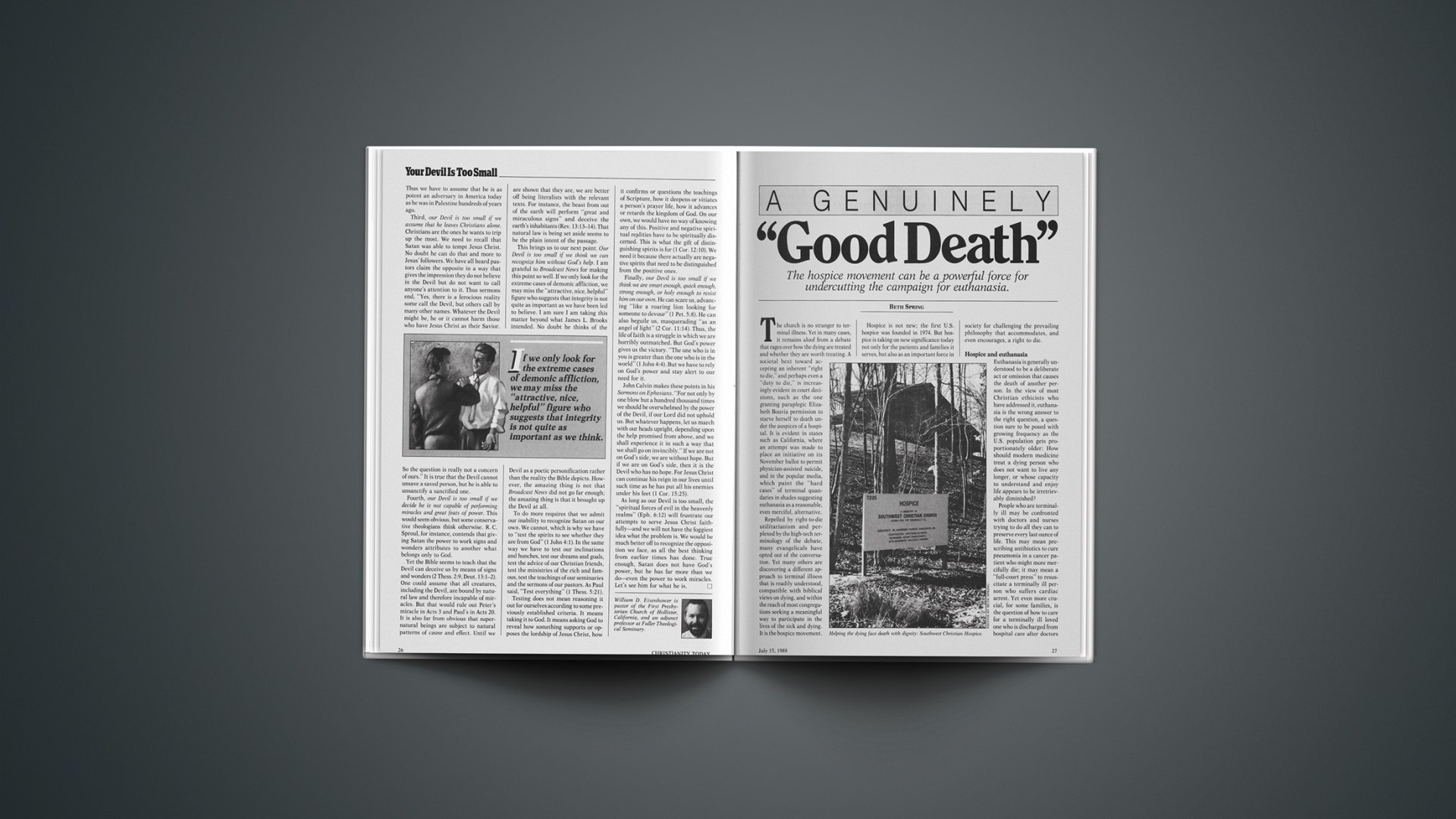
A Genuinely “Good Death”

The hospice movement can be a powerful force for undercutting the campaign for euthanasia.

The church is no stranger to terminal illness. Yet in many cases, it remains aloof from a debate that rages over how the dying are treated and whether they are worth treating. A societal bent toward accepting an inherent “right to die,” and perhaps even a “duty to die,” is increasingly evident in court decisions, such as the one granting paraplegic Elizabeth Bouvia permission to starve herself to death under the auspices of a hospital. It is evident in states such as California, where an attempt was made to place an initiative on its November ballot to permit physician-assisted suicide, and in the popular media, which paint the “hard cases” of terminal quandaries in shades suggesting euthanasia as a reasonable, even merciful, alternative.

Repelled by right-to-die utilitarianism and perplexed by the high-tech terminology of the debate, many evangelicals have opted out of the conversation. Yet many others are discovering a different approach to terminal illness that is readily understood, compatible with biblical views on dying, and within the reach of most congregations seeking a meaningful way to participate in the lives of the sick and dying. It is the hospice movement.

Hospice is not new; the first U.S. hospice was founded in 1974. But hospice is taking on new significance today not only for the patients and families it serves, but also as an important force in society for challenging the prevailing philosophy that accommodates, and even encourages, a right to die.

Hospice And Euthanasia

Euthanasia is generally understood to be a deliberate act or omission that causes the death of another person. In the view of most Christian ethicists who have addressed it, euthanasia is the wrong answer to the right question, a question sure to be posed with growing frequency as the U.S. population gets proportionately older: How should modern medicine treat a dying person who does not want to live any longer, or whose capacity to understand and enjoy life appears to be irretrievably diminished?

People who are terminally ill may be confronted with doctors and nurses trying to do all they can to preserve every last ounce of life. This may mean prescribing antibiotics to cure pneumonia in a cancer patient who might more mercifully die; it may mean a “full-court press” to resuscitate a terminally ill person who suffers cardiac arrest. Yet even more crucial, for some families, is the question of how to care for a terminally ill loved one who is discharged from hospital care after doctors determine there is nothing more they can do. The question becomes all the more urgent, to many observers, because of skyrocketing costs for quality medical care, a scarcity of insurance coverage or federal benefits for custodial care, and the threat posed by aids to the resources of America’s health-care facilities.

Hospice has an answer, based upon a philosophy of caring for the dying that recognizes the inevitability of death, respects the patient’s wishes for treatment or nontreatment, and offers physical, emotional, and spiritual comfort to enable a terminally ill person and his or her family to make the most of the time that remains. With a few exceptions, it rejects euthanasia as being incompatible with its purposes.

The founder of the modern hospice movement, British physician Cicely Saunders (see below), believes legalized euthanasia would undermine the very basis of trust in which medical practice is rooted. She has written, “I believe that to make voluntary euthanasia or assisted suicide lawful would be an irresponsible act, hindering help, pressuring the vulnerable, and abrogating our true respect and responsibility to the frail, the old, and the dying.”

Coping With The Truth Together

Perhaps because of the prominent figure of Elizabeth Kübler-Ross, hospice’s roots are often thought to be humanistic, with little regard for a Christian understanding of life and death. But the founder of the hospice movement, Cicely Saunders, is a devout Anglican. Largely because of her, a bias against euthanasia is evident in the beginnings of the modern hospice movement.

In 1947, Saunders was making her hospital rounds as a social worker in England. She met a man from Warsaw who did not yet know he was dying. Saunders knew, and she eventually told him. She recalls, “The foundation of Saint Christopher’s is how we coped with that truth together.” What the patient needed most, she discerned, was not state-of-the art medical treatment. She has written, “David needed peace from distress to sort out who he was, to find how he could gather the scattered fragments of what looked an unfulfilled life somehow into a whole at its ending.”

Saunders’s intense interest in meeting the needs of the terminally ill led her to become a physician. She is widely recognized today for her pioneering work to control the pain of terminal cancer patients. And she continues to administer Saint Christopher’s in London, the first modern hospice.

By Beth Spring.

In its early days, hospice was associated with some questionable trends and ideas, such as Elisabeth Kübler-Ross’s spiritualism. Christian hospice workers admit they now face a challenge from the New Age movement. In particular, programs that are expressly nonsectarian may find their staff members influenced by books and seminars theorizing on out-of-body experiences and communication with spirits. Darlene Kloeppel, a social worker who directs bereavement care for Southwest Christian Hospice (near Atlanta), has worked at three other hospices. She has observed New Age inroads in hospice circles. “It’s growing everywhere, not just in hospice. The hospice movement has always encouraged personal growth, spiritual growth, and alternatives to traditional ways of doing things. New Age thought has crept into that, as well as [into] things like life after death experiences. Those sorts of things have always been openly discussed and workshops offered to hospice personnel.” Because of Southwest’s explicitly Christian outlook, Kloeppel said, New Age thought has no bearing there.

Although some hospices may be infected by the New Age movement, with respect to the more and more pressing issue of euthanasia, evangelicals have a potential ally in the hospice movement. As American Roman Catholic nun Anne Munley puts it, “As far as hospice is concerned, legalization of euthanasia would be nothing more than a cheap, expedient solution to the problem of terminal care at the expense of the patient’s best welfare.… Rather than being a ‘foot in the door’ for euthanasia, the hospice movement can be a powerful force for undercutting a movement for active euthanasia.”

How Hospice Works

On a wooded hill south of Atlanta, Southwest Christian Hospice welcomed an elderly cancer patient last year. William Paul Robinson, afflicted with prostate cancer at age 88, had been discharged from hospital care one month before he entered the hospice. When the doctors prepared to release him from the hospital, they asked his son, Hewlett, how he intended to provide for his dying father. Hewlett, who lived next door to his parents, was prepared to accept the challenge of providing home-based care.

But, as he recalls, “I did it for a month and I found I had taken on more than I bargained for. I was at my wit’s end.” Hewlett, an only child, hired a visiting nurse to come in three times a week. Meanwhile, as the cancer spread and his father’s condition deteriorated, Hewlett changed the bedding three times each day and bathed his father. His wife prepared meals for both her in-laws. Calls came in the middle of the night, and within days the task became exhausting.

A neighbor told them about Southwest Christian Hospice, and the family agreed to admit William Paul. “He resented it for a couple of days, and we had to calm him down,” Hewlett Robinson says. His father quickly began appreciating the care he was receiving. “There are so many people praying for me,” he told his son. And the nurses expertly turned, changed, and bathed him so his extreme sensitivity to touch did not bother him as much. He remained at the hospice for two months and two weeks before he died. Placing him there rather than keeping him at home “saved my life,” Hewlett Robinson says.

Southwest Christian Hospice is unique because it is fully funded by nearby Southwest Christian Church, an independent congregation affiliated with the independent Christian Churches and Churches of Christ. Minister Jim Dyer, who has served Southwest since 1956, started the hospice after observing a Catholic home for terminally ill cancer patients. Initial skepticism—from his own congregation and the Atlanta health-care community—has given way over the years since 1984 to enthusiastic support and a cadre of 65 church volunteers who visit patients, provide clerical support, and clean the eight-bed facility.

Dyer explains the spiritual basis of their involvement: “The hospice program grew out of a consciousness that we need to grapple with the time of death itself as Christians. Do we really believe what we say we do? Can we face it with dignity and understanding and loving comfort for each other? That was the philosophical background for our involvement in it.”

Twenty-five percent of the church’s annual budget maintains the hospice program (in 1987 the total was $373,000). Because of the church’s support, Southwest charges no patient fee. It accepts patients of any or no religious background, and it has served as a refuge for families who run out of money to pay for terminal health care.

The way in which Southwest is financed and staffed is unique, but it resembles other hospice programs in providing a team approach to patient care. Hospice nurses, social workers, clergy, and volunteers, as well as family members and the patient’s own doctor, meet together to determine what needs to be provided. Patients given hospice care generally have a life expectancy of six months or less, and approximately 95 percent of them have cancer.

Hospice care holds out several promises to its patients. First, their personal wishes regarding treatment will be respected. If they have determined not to receive further chemotherapy, for example, no one will try to persuade them otherwise. Second, attention to the patients’ physical needs will concentrate on pain control. The key, according to hospice medical personnel, lies in preventing pain from occurring rather than relieving it on demand. Emotional and spiritual support are available to assist patients in coming to terms with their illness. Patients are assured that they will not die alone, and family and hospice staff wait with those who are near death. And up to one year of bereavement counseling is provided for family members after a death occurs.

An overarching goal, according to hospice personnel, is to concentrate on providing a patient with all the “quality of life” possible. Sometimes this term, which is used extensively by right-to-die advocates, leads to confusion. Families who believe a hospice will assist their loved one in dying are firmly told that euthanasia has no place in hospice care.

Peggy Beckman, a nurse at Hospice of Northern Virginia in Arlington, has an answer that resolutely resists death as an easy way out. If a family inquires about assisted suicide or lethal injections, Beckman says, “The first thing we have to let them know up front is that that is not something we can help them accomplish. Some families have the idea hospice is a place that will help people die. We have to clear up those misconceptions. What I have found, when I have had to deal with this personally, is that most of it comes down to fear of what patients are going to suffer. If you reassure them you are here to see that they do not suffer, it helps.” Northern Virginia Hospice has seen only four patients out of many thousands commit suicide in its ten years of operation.

Hospice In The United States

In the United States, there are approximately 1,700 hospice programs, according to the National Hospice Organization. Most offer assistance for families, such as the Robinsons, who are caring for a terminally ill loved one at home. In addition, many programs offer inpatient care at or adjacent to a hospital. And some, including Southwest Christian and Northern Virginia, have freestanding inpatient facilities.

At an inpatient unit, the sterile, high-tech, scrubbed-white feel of a hospital is entirely absent. It has the ambiance instead of a country inn, with spacious sitting rooms and kitchens where family members might prepare a special treat for a patient. At Hospice of Northern Virginia one afternoon, an elderly cancer patient was wheeled out of his room for a change of scene. A visitor arrived with a white toy poodle, eager to leap into his old friend’s lap. Throughout the building, attractive watercolors decorate the walls. A meditation room is equipped with an altar, chairs, and a wide selection of devotional reading material.

Weekly staff discussions about patient needs illustrate how the priorities of hospice care depart from traditional medical concerns. An AIDS patient, newly baptized by the hospice chaplain, wants to get in touch with other Christians. Concerns are raised about a deceased patient’s sister who refused to visit the funeral home. One patient, a former top executive, had vented his anger and discomfort at two team members. The team agrees to order a more comfortable adjustable bed for his home.

Integrating Medical And Spiritual Care

All the components of hospice care add up to a whole that reveals a markedly different attitude toward death and dying. While the right-to-die movement, and increasingly the rest of society, tends to use terms such as “hopelessly” ill or “incompetent,” hospice personnel are careful to avoid suggesting that a patient’s life has irretrievably lost its meaning.

Roberta Paige, a nurse in Portsmouth, Virginia, who founded the first hospice program based in a U.S. hospital, explains how hospice care can affirm a seemingly worthless life: “A retarded patient who lived alone in a single room looked at me and said, ‘I look like a monster, don’t I?’ I winced, because he was very unpleasant to look at; the whites of his eyes were red. I knew, though, that this was a patient who desperately needed love and acceptance. Love took the form of the chaplain going to his room and making nutritious, appetizing meals. Love meant taking him for a ride in a wheelchair to other parts of the hospital so he could listen to some piano music or attend a tea party. The hospice team and the hospital staff became his family. His memorial service was held in the hospital’s chapel.”

For Christians involved in hospice care, attending the needs of the dying offers a unique opportunity for minis try. According to chaplain Jeanne Brenneis, at Hospice of Northern Virginia, affirming a relationship with God may be a terminal patient’s most important task. An AIDS patient provided a case in point. He is the son of a Baptist clergyman and a Methodist, and he had never been baptized. He decided, during the course of his illness, that God was calling him to a visible sign of commitment through baptism. Brenneis recalls, “In early September I baptized him right here in the inpatient unit. His sister and brother-in-law came here for it, as well as his mother, home-care nurse, and social worker.

“He is more at peace, he has repented, and he feels washed and clean. He would love to belong to a church, but he cannot go out.”

Brenneis often hears the despairing refrain, “I just wish it were over. I’m tired of this.” She reminds patients of the good things in life that remain for them to enjoy. “I pray with people regularly, giving thanks for this day and for all the signs of God’s love in it. In my counseling, I try to nudge people to see that even in the despair of knowing that their life is ending, there are bright spots—very bright spots. There are relationships they are not finished with, children and grandchildren. We try to help people be fully alive while they are dying—to the very end.”

Southwest Christian Hospice takes a similar approach. It calls itself “the hospice of hope,” and claims 1 Thessalonians 4:13 as its theme Scripture: “Brothers, we do not want you to be ignorant about those who fall asleep, or to grieve like the rest of men, who have no hope” (NIV.)

Patients at Southwest who desire spiritual care may call on their own church’s minister for visits and support, or they may turn to one of Southwest Christian Church’s six ministers. Each of the six is assigned one day of the week to be on call for hospice care. Dyer, the church’s senior minister, visits once or twice a week and does volunteer work at the hospice on Friday afternoons.

The value of hospice care for family members came home to Dyer when his father died. He suffered a stroke the day before his ninetieth birthday, and within three weeks, doctors found he had brain cancer. He stayed in the hospital for two months, then asked to be moved to Southwest’s inpatient unit. “He had lived across the street from it, he saw it being built, and it was a part of his life,” Dyer recalls.

“He lived here for about a week-and-a-half, and my brother and I were able to be sitting beside him holding his hand when he breathed his last breath and went to be with the Lord. The support we were given by the people here and the love shared with us vindicated all we are doing here.” Dyer was contacted, as all next-of-kin are, for bereavement care. At first he resisted, thinking, “I do that all the time.” But he discovered he needed it as much, if not more, than anyone else.

Not giving up on a patient, even one who appears to have given up on himself, is a hallmark of hospice care. Paige remembers a “very angry young man” she met. “My initial contact with him was when he threw a urinal across the room. He hated the hospital and was angry about his diagnosis. He had severe pain and learned that he was sterile because of chemotherapy and could not father any children. He then became paralyzed from the waist down.

“The hospice team controlled his pain and arranged for him to give a guitar concert to the staff. On steaming hot days, the chaplain would visit him in his apartment, bringing the patient’s favorite flavor of ice cream. The patient received a lot of love, and in the process learned something about Jesus. He made Jesus Lord of his life and spent his last days praying for his roommates in the hospital, rejoicing when they seemed to be getting better. He was and remains an inspiration to me of what the Spirit of God can do in and through a person.”

Challenges Facing Hospice Care

The hospice movement, in the last decade, has come of age as a legitimate and even essential part of the larger health-care system. More and more, patients come to hospice programs out of necessity rather than ideological commitment to its particular view of death and dying, nurse Peggy Beckman says. Patients are discharged from hospitals more swiftly now, and decisions to forgo treatment are becoming more routine.

AIDS confronts the hospice movement, as well as the rest of society, with perhaps its greatest medical challenge. Most of the terminally ill cared for by hospices, so far, have been elderly. Assisting AIDS patients, most of whom are young, to find meaning and fulfillment in the life that remains may present hospice staff members with a new and daunting task. But the ways in which they accomplish their goals among people afflicted with AIDS may teach the rest of us—including the church—how to respond compassionately and appropriately to a major health crisis.

Another challenge to hospice organizers and advocates involves the extent to which the movement may become a vehicle for rendering the right-to-die debate virtually irrelevant in society. Cicely Saunders has long taught that the hospice movement should cast itself in this role. In a 1980 article, she wrote, “When someone asks for euthanasia or turns to suicide, I believe in almost every case someone, or society as a whole, has failed that person. To suggest that such an act should be legalized is to offer a negative and dangerous answer to problems which should be solved by better means.”

The difficulty confronting the hospice movement is the growing persuasiveness of the right-to-die movement and its attempts to embrace hospice as part of itself. Many right-to-die activists pay scant attention to hospice, dismissing it as a solution for only a very few terminal cancer patients. At the same time, Hemlock Society founder Derek Humphry (who advocates legalizing assisted suicide) paints the movement as being compatible with euthanasia. He writes, “Put bluntly, hospice makes the best of a bad job and they do so with great skill and love. The euthanasia movement supports their work.… We do not feel there is any cross purpose between euthanasia and hospice; both are appropriate to different people, with different values.” Promoters of voluntary suicide and active euthanasia emphasize individual choice and autonomy, but they concede that “… almost all euthanasists would probably resist the idea of dying in a hospice.” The difference between the two movements appears to originate in different spiritual orientations. Humphry and coauthor Ann Wickett note in their book, The Right to Die (Harper & Row), that hospice workers who are religiously motivated are much more likely to oppose euthanasia.

The Church And Hospice

Those who work with dying and elderly persons often say the church is the best institutional friend these people have. The recently published Hospice Resource Manual for Local Churches (Pilgrim Press) encourages congregations to understand how well suited they are for this sort of ministry. “The church is responsible for whether its members are prepared to die and for how they die,” editor John W. Abbott writes. “The church is responsible for any degree of spiritual pain felt by those who are part of its family.”

Hospital visitation, ministry to members confined to their homes, and special concern for congregants who are ill mark the ministries of practically every church. These aspects of church life resemble hospice care, and can in fact become part of ongoing hospice programs. Janice Weaver, who directs Southwest Christian Hospice, has written an article encouraging churches to become involved in the hospice movement. She notes that Southwest’s 900-member congregation enables the church to run an entire program by itself. But she writes, “The size of a congregation is a secondary consideration to the starting of a hospice program. The desire to serve is vital.” She suggests that smaller churches pool their resources in order to assist an ongoing hospice program or begin one of their own.

By serving the needs of the dying, the church does indeed enter the larger debate over the right to die. It does so with an eloquence that shrugs off high-tech language and convoluted situation ethics. Without drawing much attention to itself, the hospice movement has been modeling an approach that is compatible with biblical attitudes on death and dying. It discerns a critical distinction drawn by U.S. Surgeon General C. Everett Koop, who advocates giving patients “all the life to which they are entitled” while not “prolonging the act of dying.” Koop says the right-to-die camp has it backwards: “The quality of life we talk so much about is nowhere as important as in the reflection those decisions make in the quality of our own lives.”

A contributing editor of this magazine, Beth Spring is the author, with Ed Larson, of the recently published Euthanasia: Spiritual, Medical, and Legal Issues in Terminal Health Care (Multnomah).

Apple PodcastsDown ArrowDown ArrowDown Arrowarrow_left_altLeft ArrowLeft ArrowRight ArrowRight ArrowRight Arrowarrow_up_altUp ArrowUp ArrowAvailable at Amazoncaret-downCloseCloseEmailEmailExpandExpandExternalExternalFacebookfacebook-squareGiftGiftGooglegoogleGoogle KeephamburgerInstagraminstagram-squareLinkLinklinkedin-squareListenListenListenChristianity TodayCT Creative Studio Logologo_orgMegaphoneMenuMenupausePinterestPlayPlayPocketPodcastRSSRSSSaveSaveSaveSearchSearchsearchSpotifyStitcherTelegramTable of ContentsTable of Contentstwitter-squareWhatsAppXYouTubeYouTube