Book Briefs: February 2, 1968

The Answer To Irrationalism

Set Forth Your Case, by Clark Pinnock (Craig, 1967, 94 pp., $1.50), is reviewed, by Robert L. Cleath, assistant editor,CHRISTIANITY TODAY.

Many men of our day, bound by the strait jacket of antisupernatural thought, are coming to believe that life is absurd. In a desperate quest to find meaning and satisfaction, they are retreating into the catacombs of subjective irrationalism. To show contemporaries that irrationalism and despair need not plague men and that the Gospel of Christ offers a sure hope based on substantial evidence, Clark Pinnock has written this brief, scintillating apologetic work, Set Forth Your Case.

This thirty-year-old theologian from New Orleans Baptist Seminary considers apologetics—the defense of the truthfulness of the Christian religion—an indispensable tool for evangelism. Its intent, he claims, is “not to coerce people to accept the Christian faith but to make it possible for them to do so intelligently. The data we possess about the gospel is sufficient to make it sensible for the non-Christian to begin his search for the ultimate clue with Christianity.” Although he is aware that without the convicting and illuminating action of the Holy Spirit even the soundest apologetic has no power to make a man a Christian, Pinnock rests his case on the historical events and biblical revelation that provide a rational basis for Christianity. He refuses to surrender the belief that “the heart cannot delight in what the mind rejects as false.”

Pinnock presents his apologetic against the backdrop of current humanistic philosophy and theology. He claims that modern theology has sold out to a philosophical irrationalism that separates the “lower story” of reason, fact, and history from the “upper story” of intuition, faith, and conjecture. The Bible is placed in the lower story while the non-verbal “work of God” occupies the upper story, where “encounter with God” takes place. Meaning is found apart from fact. The subject who has faith becomes more important than the object of his faith. Ambiguous and solipsistic, modern theology turns away from evidences, claims Pinnock, and thus destroys the vital means of challenging the non-Christian to believe in Jesus Christ.

Evangelical Christians, for whom the personal experience of grace is a reality, are cautioned by Pinnock not to allow the subjective validating process of the new liberalism to become the basis for establishing the truthfulness of the Gospel. He states, “The uniqueness of the Christian message is not found at the point of experience at all but in the incarnation datum.” Biblical faith is not a leap in the dark but a response motivated by the revealed promises of God. Pinnock recognizes the necessary role that spiritual experience plays in personal verification: “Apart from the work of the Spirit the gospel itself could only be truth on ice, cold and fruitless.” But he maintains that the deep joy yielded by the Gospel is related to its truthfulness.

Presenting his positive case for Christianity, Pinnock discusses topics crucial for today: the historical reliability of the New Testament; the identity, claims, and miracles of Jesus Christ; evidences for the resurrection; the indispensability of the propositional revelation of Scripture to sound theology; the knowledge of God; the mythology of evolution; and the need for well-trained, articulate apologists to invade all of human culture. His discussions of these topics are too brief. Yet his lines of argument and selective evidence ignite the mind and make one realize that his arguments merit serious consideration by all truth-seekers.

Pinnock advances his position on key topics in full view of competing contemporary views. Before considering Christ’s identity, he sets forth the reasons why the old and new “quests for the historical Jesus” have failed. The old quest rightly used inductive methodology but failed because it limited Jesus strictly to his human proportions. The new quest’s fallacy is that it retains a naturalistic bias and rejects the inductive procedure. Resting his case on New Testament evidence, Pinnock asserts that Jesus is readily approachable. The evidence shows him to be the Messiah, human and divine. Pinnock refers to Jesus’ personal claims, his authority, his miracles, and his work of redemption. He argues that the evidence obligates men to acknowledge Jesus either as a criminal megalomaniac or as the Messiah he claimed to be.

The young Baptist theologian sees the bodily resurrection of Christ as central to the integrity of the Saviour and the Gospel. He considers current thought that bases knowledge of the resurrection strictly on “immediate” experience as a departure from the apostolic proclamation that pointed both to historical evidence and spiritual awareness. Succinctly and effectively he recites evidence for the resurrection: the empty tomb, the conduct of Christ’s opponents and apostles, the appearances, the subsequent ministry of the Church. He concludes, “The resurrection stands within the realm of historical factuality.”

The brevity with which Pinnock has treated his themes precludes recognition of this work as a landmark volume in apologetics. Yet he has enunciated the approach needed for a generation that is rebelling against sham. His bare-knuckles challenge of current leading theological ideas will be cheered by people who possess but cannot adequately articulate a disdain for the irrational aberrations sweeping through the ecclesiastical intelligentsia. His forthright, well-reasoned advocacy of the historic Christian position will provoke the uncommitted to consider the claims of the Gospel. And the committed who absorb Pinnock’s arguments will be better able to set forth their case for Christ. His selective bibliography will point readers toward a deeper study of apologetics than this short, easily read book allows.

Christians need to heed Pinnock’s insistence that the Gospel be presented in a rationally compelling manner. He states: “The notion that nobody is ever converted to Christ by argument is a foolish platitude.” He is right. In our intellect-oriented age that is fast succumbing to irrational philosophies, Spirit-filled Christians must be equipped with sound arguments based on biblical revelation and historical evidence in order to register a powerful witness for Jesus Christ. Laymen would do well to study the case set forth by Pinnock. Those who do are bound to become more effective Christian persuaders.

Kirk, Buckley, And The ‘Wasp Mafia’

The Conservative Tradition in America, by Allen Guttmann (Oxford, 1967, 214 pp., $6), is reviewed by Harry R. Butman, editor, “The Congregationalist,” and pastor, Congregational Church of the Messiah, Los Angeles, California.

Although few pastors will be able to appreciate fully the glittering expertise with which Dr. Guttmann handles a host of obscure political theorists, many will thank him for coming up with an acceptable definition of “conservative.” When, in Through the Looking Glass, Humpty Dumpty scornfully informed Alice that when he used a word, “it means precisely what I choose it to mean, neither more nor less,” he set the pattern for the use many moderns make of “conservative” and its companion term, “liberal.”

Not so Dr. Guttmann. To him, “conservatism” and “liberalism” describe two different attitudes toward change. The conservative sets high value on a society that is orderly, disciplined, and hierarchical, with a strong sense of the past. This is a definition that many ministers who call themselves conservatives can gladly accept.

My daughter once said to me, “Father, the trouble with you is that you think American society came to its flower on Martha’s Vineyard in the 1890s.” With conservatism in this sense Guttmann has a measure of sympathy, and he states its case with scholarship and literary grace.

But though the author esteems conservatism as a political philosophy, and a philosophy that has powerfully influenced important American authors, one gets the impression that he wouldn’t have a real live conservative around the house. Russell Kirk is his bête noire, and he reserves his darkest and most deft pejoratives for Kirk’s The Conservative Mind. His estimate of William Buckley is somewhat less than fair to that literate and witty voice of conservatism. The list of “good” and “bad” categories on page 161 is closer to caricature than one expects to find in a serious book, and the quotation of Norman Mailer’s ugly summary of those who voted for Barry Goldwater as “a Wasp Mafia” is at the best ungenerous.

But the book has provocative chapters. The one on the military establishment points out, with documentation, that, far from being reactionaries, generals on the whole have been close to the liberal position. A fresh and fascinating aspect of the book is its description of the influence of conservative thought on American literature; with broad scope and skill Guttmann shows how poets and novelists have been moved by the conservative attitude toward the past.

Although he is essentially critical of conservatism, the author recognizes its strength: “… there is … a joy in continuity as well as in inauguration. There is a pride in preservation as well as in creation.” And he epigrammatically concludes, “Socialism with a sense of the past is the name of my desire.”

Pike’S Apologia

If This Be Heresy, by James A. Pike (Harper & Row, 1967, 205 pp., $4.95), and The Bishop Pike Affair, by William Stringfellow and Anthony Towne (Harper & Row, 1967, 266 pp., $4.95, paper, $2.25), are reviewed by Peter R. Doyle, rector, St. James Episcopal Church, Leesburg, Virginia.

Bishop Pike’s If This Be Heresy cannot in any sense be considered a serious addition to constructive Christian theology. It is, however, his latest assertion of the real basis of his own beliefs: experience—experience taken in the widest sense, experience that is open to any and all “truth” that may be proffered it from all the investigations of the human spirit. Beginning with a detailed exegesis of each word of the book’s title and continuing through chapters called “Qualm and Quest,” “The Authority Crisis,” “Bases for Belief,” “Facts—Faith,” “The Style of Life,” “Life After Death,” and “God,” Pike proceeds (1) to discredit bases of faith professed in standard Christian teaching and (2) to establish the new basis that is nourished by the modern sciences and humanities.

Reading For Perspective

CHRISTIANITY TODAY’S REVIEW EDITORS CALL ATTENTION TO THESE NEW TITLES:

A Second Touch, by Keith Miller (Word, $3.50). Those who profited from Miller’s The Taste of New Wine will like its sequel: an extremely personal and disturbingly candid approach to honest and creative Christian living.

A Question of Conscience, by Charles Davis (Harper & Row, $6.95). A brilliant English priest-theologian sensitively but forthrightly gives his personal, theological, and ecclesiastical reasons for leaving Roman Catholicism.

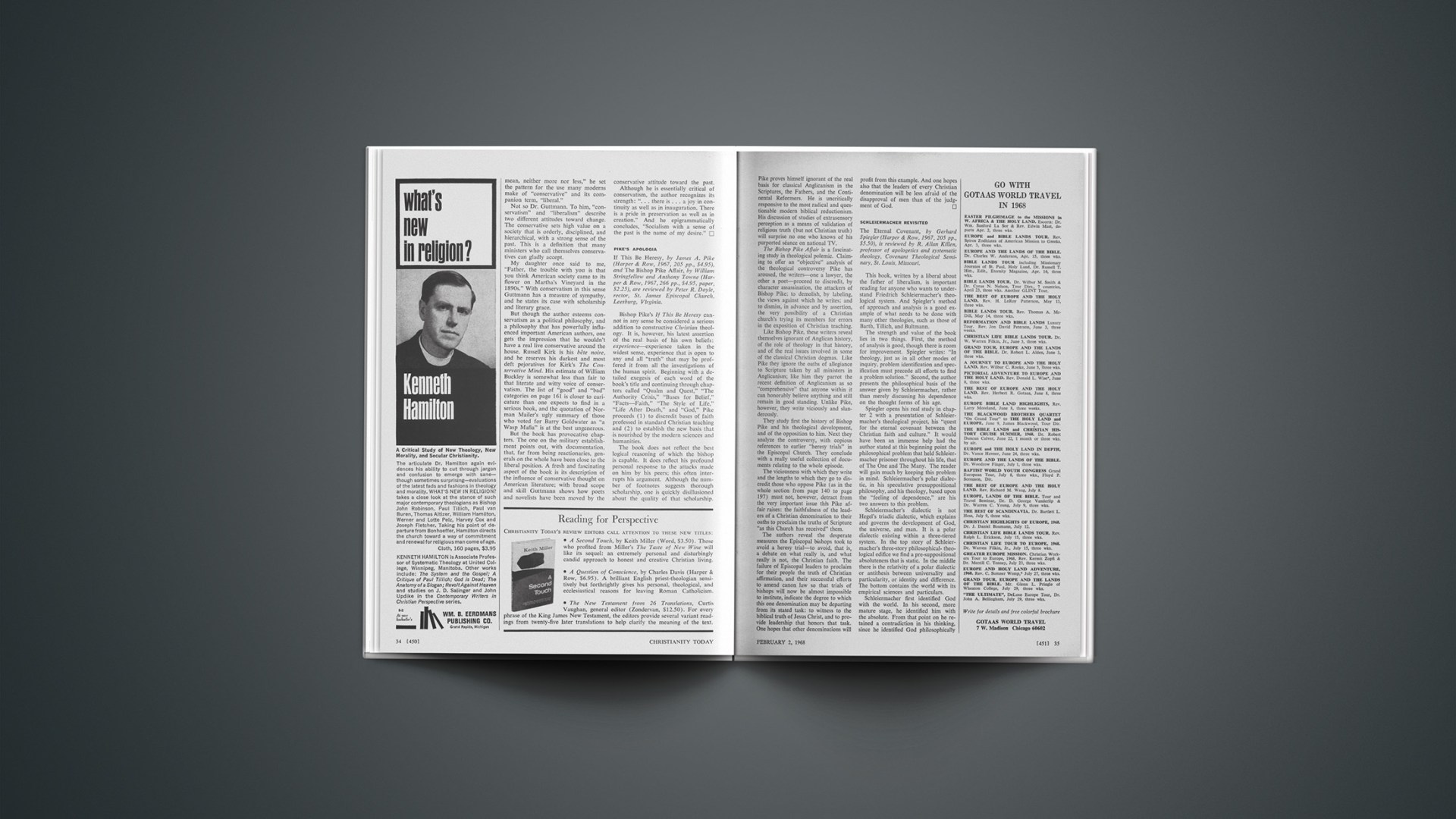
The New Testament from 26 Translations, Curtis Vaughan, general editor (Zondervan, $12.50). For every phrase of the King James New Testament, the editors provide several variant readings from twenty-five later translations to help clarify the meaning of the text.

The book does not reflect the best logical reasoning of which the bishop is capable. It does reflect his profound personal response to the attacks made on him by his peers; this often interrupts his argument. Although the number of footnotes suggests thorough scholarship, one is quickly disillusioned about the quality of that scholarship. Pike proves himself ignorant of the real basis for classical Anglicanism in the Scriptures, the Fathers, and the Continental Reformers. He is uncritically responsive to the most radical and questionable modern biblical reductionism. His discussion of studies of extrasensory perception as a means of validation of religious truth (but not Christian truth) will surprise no one who knows of his purported séance on national TV.

The Bishop Pike Affair is a fascinating study in theological polemic. Claiming to offer an “objective” analysis of the theological controversy Pike has aroused, the writers—one a lawyer, the other a poet—proceed to discredit, by character assassination, the attackers of Bishop Pike; to demolish, by labeling, the views against which he writes; and to dismiss, in advance and by assertion, the very possibility of a Christian church’s trying its members for errors in the exposition of Christian teaching.

Like Bishop Pike, these writers reveal themselves ignorant of Anglican history, of the role of theology in that history, and of the real issues involved in some of the classical Christian dogmas. Like Pike they ignore the oaths of allegiance to Scripture taken by all ministers in Anglicanism; like him they parrot the recent definition of Anglicanism as so “comprehensive” that anyone within it can honorably believe anything and still remain in good standing. Unlike Pike, however, they write viciously and slanderously.

They study first the history of Bishop Pike and his theological development, and of the opposition to him. Next they analyze the controversy, with copious references to earlier “heresy trials” in the Episcopal Church. They conclude with a really useful collection of documents relating to the whole episode.

The viciousness with which they write and the lengths to which they go to discredit those who oppose Pike (as in the whole section from page 140 to page 197) must not, however, detract from the very important issue this Pike affair raises: the faithfulness of the leaders of a Christian denomination to their oaths to proclaim the truths of Scripture “as this Church has received” them.

The authors reveal the desperate measures the Episcopal bishops took to avoid a heresy trial—to avoid, that is, a debate on what really is, and what really is not, the Christian faith. The failure of Episcopal leaders to proclaim for their people the truth of Christian affirmation, and their successful efforts to amend canon law so that trials of bishops will now be almost impossible to institute, indicate the degree to which this one denomination may be departing from its stated task: to witness to the biblical truth of Jesus Christ, and to provide leadership that honors that task. One hopes that other denominations will profit from this example. And one hopes also that the leaders of every Christian denomination will be less afraid of the disapproval of men than of the judgment of God.

Schleiermacher Revisited

The Eternal Covenant, by Gerhard Spiegler (Harper & Row, 1967, 205 pp., $5.50), is reviewed by R. Allan Killen, professor of apologetics and systematic theology, Covenant Theological Seminary, St. Louis, Missouri.

This book, written by a liberal about the father of liberalism, is important reading for anyone who wants to understand Friedrich Schleiermacher’s theological system. And Spiegler’s method of approach and analysis is a good example of what needs to be done with many other theologies, such as those of Barth, Tillich, and Bultmann.

The strength and value of the book lies in two things. First, the method of analysis is good, though there is room for improvement. Spiegler writes: “In theology, just as in all other modes of inquiry, problem identification and specification must precede all efforts to find a problem solution.” Second, the author presents the philosophical basis of the answer given by Schleiermacher, rather than merely discussing his dependence on the thought forms of his age.

Spiegler opens his real study in chapter 2 with a presentation of Schleiermacher’s theological project, his “quest for the eternal covenant between the Christian faith and culture.” It would have been an immense help had the author stated at this beginning point the philosophical problem that held Schleiermacher prisoner throughout his life, that of The One and The Many. The reader will gain much by keeping this problem in mind. Schleiermacher’s polar dialectic, in his speculative presuppositional philosophy, and his theology, based upon the “feeling of dependence,” are his two answers to this problem.

Schleiermacher’s dialectic is not Hegel’s triadic dialectic, which explains and governs the development of God, the universe, and man. It is a polar dialectic existing within a three-tiered system. In the top story of Schleiermacher’s three-story philosophical-theological edifice we find a pre-suppositional absoluteness that is static. In the middle there is the relativity of a polar dialectic or antithesis between universality and particularity, or identity and difference. The bottom contains the world with its empirical sciences and particulars.

Schleiermacher first identified God with the world. In his second, more mature stage, he identified him with the absolute. From that point on he retained a contradiction in his thinking, since he identified God philosophically with the absolute—which separated him entirely from the world—but theologically with Jesus Christ and the Holy Spirit, as the presence of God in the Church. Spiegler says that he should have identified God with the second story; then he could have admitted that universals and particulars exist in tension in both God and the world. In Schleiermacher’s philosophy, God is absolutely other and as good as dead. But one who reads his theology finds that he is alive!

The explanation of the tensional polar dialectic present in the second story of Schleiermacher’s system—and also in existence—throws much light upon the presence of the ontological elements of individualization and participation, form and dynamics, destiny and freedom, in Paul Tillich’s theology. The “theological project” of the eternal covenant between Christian faith and culture reveals the origin of Tillich’s view of “The Theology of Culture.”

Denuding A Vital Concept

Messianic Theology and Christian Faith, by George A. Riggan (Westminster, 1967, 208 pp., $6), is reviewed by Charles Lee Feinberg, Talbot Theological Seminary, La Mirada, California.

This important volume contains lectures delivered by George A. Riggan, Riley Professor of Systematic Theology at Hartford Seminary Foundation, to Protestant chaplains in the Far East, and then to groups of laymen and college students in this country. His subject is the historical meaning of the fact that one was called the Messiah and, by implication, the significance of being a Christian.

Riggan moves ably from the messianic kingship in ancient Israel and in Hebrew prophecy, through the beginnings of ecclesiastical messianism and apocalyptic messianism, to New Testament messianism. He first explores the meaning of the term “messiah,” finding that it does not move away from its etymological meaning of “anointed one.” At the beginning it was used to denote the ruling king in Israel. After the exile in Babylon, royal messianism was replaced by priestly messianism. Only with the advent of apocalypticism did messianism come to signify a supernatural and preexistent person through whom God would bring in his eternal kingdom in another world.

When Riggan comes to New Testament messianism, he finds he cannot apply to Jesus the four messianic titles—Christos, Son of Man, Servant of God, Son of God. Why? Because they all emanate from a post-Easter theology, he says, in which the minimal facts of the Gospel were reconstructed by the community of the faithful. Riggan’s final emphasis is that somehow in the life and work of Jesus there is a release of therapeutic energies that can have meaning for us today. His thinking always converges on “the time being.”

I find myself in disagreement with Riggan’s basic postulate, that the messiah concept was at the beginning related only to the anointed king. That it was so used, and even of Gentiles like Cyrus, there is no denying. But surely the Old Testament makes it clear that the technical and eschatological use of the term did not await the rise of apocalypticism or the appearance of the canonical Daniel or the non-canonical Enoch and related works. To denude the term of this vital element is to do harm to the entire discussion.

Furthermore, Riggan seriously overuses the idea of Israel’s borrowing from her neighbors; one is left with the impression that practically nothing was original in Israel. The author constantly questions Old Testament sources, but not on the basis of better evidence. He feels that the descriptions of many events are based on a distortion of facts. Throughout he shows an anti-supernatural bias. He takes great liberties in interpreting Scriptures; for example, can one legitimately accuse Jeremiah of “delusions of grandeur” and “theological megalomania”? Ill-founded criticism is seen in such verdicts as his denial of historicity of the man Daniel and of the authenticity of the greater part of the Synoptic contribution. Somehow, he nevertheless claims, the theologies about Jesus release healing energies that are of great benefit to us today. It is well and good to interpret Second Corinthians 5:19 as “God is the reintegration of fragmented human existence”—but how, Dr. Riggan, how?

Where Parents Go Wrong

Parents on Trial, by David Wilkerson with Claire Cox (Hawthorn, 1967, 188 pp., $4.95), is reviewed by Paul Rader, director, Reality Evangelism, Minneapolis, Minnesota.

Why did our child go wrong? Where did we fail? What should we do? These questions plague many parents. Parents on Trial, by Teen Challenge founder David Wilkerson, is one of the sources of practical answers. No mere survey or digest of answers and formulas, the book is based on the experiences, hopes, and heartbreaks of the author’s ministry to teen-age gangs in New York slums.

Wilkerson warns his reader, “You will not like everything you read. Much of it is not very pretty, and some may be shocking.” But the stark fact remains: “Delinquency and drug addiction can strike any home.” Why kids go wrong or right is the responsibility of the parents, says Wilkerson, because “every word and deed is a fiber woven into the character of a child, which ultimately determines how that child fits into the fabric of society.” The evidences of what he calls “potluck parents” are seen, he says, in our jails, street gangs, and mental hospitals, in the rising rates of drug addiction, illegitimacy, alcoholism, divorce, and homosexuality.

Accounts of actual cases illustrate twelve readable chapters: “Six Dead”; “But I Was a Good Mother”; “Why Some Kids Have Given Up on Parents”; “The ‘Hidden’ Delinquents”; “Part-time Parents”; “Like Father Like Son”; “Danger Ahead—Watch the Signs!”; “Homosexuality Starts at Home”; “The ‘Other Half of Illegitimacy”; “God Is for Squares”; “Life Without Father—Exceptions to the Rule”; and “They Are Your Kids, Wrong—Or Right.”

Worth rereading and remembering are his lists of “Ten Ways to Produce a Delinquent,” six factors that contribute to drug addiction, warning signs of drug addiction, and the causes of homosexuality. The scriptural passages he discusses should be studied prayerfully.

Wilkerson’s conclusions are hopeful: “The course of a child’s life can be favorably influenced by parents of any educational or economic standing if they are not afraid to work at being good parents.… Devoted, dedicated, hard-working mothers and fathers can weigh the balance in favor of decency and the building of moral character.”

For parents, this book should be required reading. Others who would do well to read it are ministers, teachers, social workers, judges, policemen, lawyers—and also children. It is both disturbing and encouraging, critical and helpful, shocking and hopeful.

Twice Hanged In Effigy

William Anderson Scott, No Ordinary Man, by Clifford Merrill Drury (Arthur H. Clark, 1967, 352 pp., $6.50), is reviewed by Ilion T. Jones, professor emeritus of practical theology, San Francisco Theological Seminary, San Francisco, California.

This is biography at its best. Its author is a distinguished teacher of church history who is a master at portraying important personages of the past within the social and intellectual currents of their day, and making them and the issues in which they were involved come to life again.

The subject of this study is a colorful Presbyterian minister of the Civil War period who held pastorates in New Orleans, New York City, and San Francisco. He became personally involved in nearly all the stirring issues of those difficult days, and his positive, advanced, often unpopular positions resulted in many tense situations in his churches and in the cities where he lived. Twice in San Francisco he was hanged in effigy.

But his strong Christian character carried him through these unpleasant experiences, and he managed to hold the respect and affection of the great majority of the people. He was given the highest office in his denomination, the moderatorship of the Presbyterian General Assembly. He left as a legacy to the future a college, a theological seminary (now San Francisco Theological Seminary), a journal of religion of some importance, and an outstanding example of ability, efficiency, courage, and integrity.

Dr. Drury is right. William Anderson Scott was “no ordinary man.”

The Highest Aspiration

Make Love Your Aim, by Eugenia Price (Zondervan, 1967, 191 pp., $3.95), is reviewed by Margaret Johnston Hess, minister’s wife and Bible class teacher, Livonia, Michigan.

This is one of those delightful books that agree with what you already think but push it a little bit further. Most of the ideas you could have figured out yourself if you’d stopped to think—but the author did stop to think, and there it is all set down for you, neatly, logically, practically.

Miss Price explains the framework of her discussion—that God is love, and all love is of God. At one point she seems to be backing off the liberal end of things theologically, until she briskly supports her thesis with chapter and verse from First John. Her interpretations of Scripture are fresh and unfettered by ordinary conservative thought-patterns, yet wholly legitimate. Some are like a breath of fresh air in a closed room.

“We show love, true love, when we concern ourselves first and always with the way the other person feels—not with how that other person is making us feel,” she says. Love is what keeps utter personal freedom in check. “God is love and love is man’s deepest need, and therefore when man meets God, man’s deepest need is met.” “We can only learn of love as we learn of God.”

Love-giving is even more important than love-getting. We can learn to love—by practicing. True love frees rather than binds. The love that is God-love is thinking and acting toward other human beings in terms of their own good.

This book is less personal, more objective than some of Miss Price’s earlier books. It is practical, easy to read, and fast moving. For the person who feels he knows all about love, it effectively articulates what usually is in the realm of intuition. For having trouble with love, it could be an invaluable gift, pointing the way to Christ through our need to love and be loved.

Book Briefs

Jesus, edited by Hugh Anderson (Prentice-Hall, 1967, 182 pp., $4.95). A sampler of 19th and 20th century views of Jesus based on different approaches to the Gospels. Includes writings by Bornkamm, Goguel, Renan, Strauss, Schweitzer, Harnack, Bultmann, and others.

Paul and the Agon Motif, by Victor C. Pfitzner (Brill, 1967, 232 pp., 28 guilders). A scholarly study of Paul’s use of the athletic metaphor, a traditional concept perhaps adopted from its use in Hellenistic synagogues.

Instrument of Thy Peace, by Alan Paton (Seabury Press, 1968, 124 pp., $3.50). The author of Cry, the Beloved Country has written a book “for sinners, for those who with all their hearts wish to be better, purer, less selfish, more useful” based on the prayer of St. Francis of Assisi.

Religion and Modern Man, by John B. Magee (Harper & Row, 1967, 510 pp., $8). A stimulating, objective college textbook that introduces the student to live religious options in the world today.

The Two Swords, by Donald E. Boles (Iowa State University, 1967, 831 pp., $10.95). A comprehensive study of the debate over religion in the schools in which the significant court cases and reaction to them are considered.

On Judaism, by Martin Buber (Schocken Books, 1967, 242 pp., $5.95). Addresses by the perceptive Jewish scholar from two periods 1909–1918 and 1939–1951. He calls upon Jews to “await the voice of God whether it comes out of the storm or out of the stillness that follows it.”

Selected Writings of Martin Luther, edited by Theodore G. Tappert (Fortress, 1967, 4 vols., 484 pp., 408 pp., 483 pp. and 403 pp., $2.95 ea.). This four-volume library of important selections from Luther’s writings, arranged chronologically, is a good buy for students of Reformation theology.

Answers To Eutychus Iii’S Quiz

(1) Homer A. Rodeheaver; trombone. (2) Father Divine. (3) Human government. (4) Harry Emerson Fosdick. (5) A stone commemorating God’s help (1 Sam. 7:12). (6) Father Charles Coughlin. (7) Aimee Semple McPherson. (8) William Randolph Hearst. (9) By the Bible concordance they used: Strong’s for the strong; Young’s for the young; Cruden’s for the crude. (10) Oral Roberts; by placing their hands on the radio or TV; to obtain healing.
Ideas

Philosophers and the Faith

A major publication project enlisting 500 scholars inevitably holds importance for the academic world. When it takes the form of The Encyclopedia of Philosophy (Paul Edwards, editor; Macmillan, 1967, eight volumes, 4,300 pp., $219.50), its bearing on religious concerns is apparent. And a five-million-word work spanning the history of philosophy and dealing with its major themes in the context of contemporary concern is sure to carry weight among college and university students.

The publishers claim that this is the most comprehensive philosophical reference work published in any language. Although the project is rather modest when compared to the broader Hastings’ Encyclopedia of Religion and Ethics (1908), its full presentation of philosophical concepts and theories marks a noteworthy advance over the brief definitions and essays characteristic of Baldwin’s Dictionary of Psychology and Philosophy (1901). It includes 900 articles on individual thinkers, and many contemporary names and themes appear. Some essays run the length of short books. Plato and Bertrand Russell each get more than 20,000 words, and an article on psychology runs 25,000 words. The 35,000-word entry on the history of semantics discusses linguistic theories with an eye on the current debate. A 65,000-word article on “Logic, History of” combines the efforts of a dozen writers.

Although the Christian religion is anchored in special revelation, it does not—at least in evangelical circles—assert a “ghetto” epistemology; rather, it presses a truth-claim upon all men. And what respected philosophers say, on the other hand, influences the philosophy of religion and leaves a mark upon theological discussion. What, then, does this new effort promise for the dialogue between theologians and philosophers?

A reviewer could hardly be expected to read all 1,450 articles before venturing a judgment on the work. He must be content with fair sampling, from within the special interests of his field. In our case, an appraisal must concentrate on the overall stance of the essays toward religious realities, and in particular toward the historic Christian faith.

At very least, the encyclopedia makes accessible a great deal of useful material about the currents of recent philosophy, and its biographical listings are often of considerable help. Not only the essays on our century’s philosophers but also those on its theologians, including Barth, Brunner, Bultmann, and Niebuhr, tend to run longer than those in Encyclopaedia Britannica and are worthy entries.

But how acceptable are the essays on the Christian religion and its bearing on philosophical concerns? The essay on “Christianity” by John Hick notes that the body of Christian doctrine differs from philosophical systems by “its essential relation to and dependence on particular historical events and experiences” (2/105). “Christianity … begins with particular, nonrecurrent historical events that are regarded as revelatory and on the basis of which Christian faith makes certain limited statements about the ultimate nature and structure of reality.” Although the facts of faith that are said to define mainstream Christianity leave in doubt an ontological Trinity, the historical fall of Adam, the bodily resurrection of Christ, and a final judgment of mankind, the essay itemizes the following minimal postulates: “the reality of God and the propriety of speaking to him in a threefold manner …; the divine creation of the universe; human sinfulness; divine incarnation in the person of Jesus, the Christ; his reconciliation of man to God; his founding of the Christian church and the continuing operation of his Spirit within it; and an eventual end to human history and the fulfillment of God’s purpose for his creation.” The origin of the Christian Church is traced to the resurrection-faith more than to the resurrection-fact, heaven is translated existentially, and universal salvation regarded as a possibility. Hick sunders Christian belief into two levels, a primal level consisting of direct reports of experience and a secondary level consisting of theological interpretation—an approach that dismisses the biblical interpretation of events as supernaturally given. The unique biblical events are “seen by faith as revelatory of God.” The essay on “Revelation” (7/189), also by Hick, concedes that the view of propositional divine revelation was virtually axiomatic a century ago and still remains the majority position. But it is uncritically asserted to be a post-biblical view, and a commitment to natural theology is held to be integral to it. The view of revelation promulgated by twentieth-century neo-Protestant theologians is said to be non-propositional.

Whatever disappointment evangelical scholars will feel at this overview will be moderated, however, by the recognition that in the context of the encyclopedia as a whole, the Christian view might have been set forth by a radical critic. For one will not find here adequate representation of contemporary scholars who champion historic Christianity with philosophical competence. The Amsterdam scholar H. Dooyeweerd gets a passing name-mention, though the essay on Dutch philosophy concedes that only the Calvinist “philosophy of the idea of Law” has remained immune to the phenomenological and existential dominance of philosophical fortunes in the Netherlands. C. S. Lewis is mentioned in an essay on immortality and a tangential reference in an essay on religion and science. Evangelical scholars like Gordon H. Clark, Alvin Plantinga, W. Harry Jellema, Cornelius Van Til, and Edward John Carnell, who have been engaged at the frontiers of theological-philosophical debate, are wholly ignored.

This leads on to the question of objectivity in the handling of faith-and-reason concerns. Any encyclopedia will reflect largely the dominant view of its times, and in many parts of the American academic world today the climate of thought is either overtly or implicitly naturalistic. The problems that contemporary postulations raise for traditional views will, therefore, find prominent expression. But the neglect of alternative perspectives, and the setting of Christian positions almost exclusively in the context of modern criticism, will give a propagandistic character to a reference work. This encyclopedia is not free from such a bias.

The editor, Paul Edwards, concedes that the project reflects somewhat the editorial decisions of one raised in the Anglo-Saxon empirical and analytical tradition; that is a rather mild acknowledgment. Major essays (“Atheism,” “Life, Meaning and Value of,” “My Death,” and “Why?”) are from Edwards’s perspective, and there is a running concern to overcome any notion that atheists are moral outlaws (1/175, 7/156). It is amusing to find Edwards wrestling with Billy Graham and the Devil and coming up with a refutation that Graham can still explain on his own approach, that of a revelational interpretation of human unbelief.

On the whole the encyclopedia is professionally first rate; its academic standard is high. It does contain a great deal of naturalism and thus gives added publicity to the secularism and paganism of much American scholarship. But then, professional philosophies today seldom discuss ideas of revelation and the supernatural, even in the mood of Barth and Brunner.

Not a few topics could have been assigned to other philosophers of good standing and equal competence who would have done more justice to orthodox Christianity. There is no article on the “Supernatural” or “Transcendent.” In the essay on “Metaphysics, History of” Roger Hancock tells us that the analytical philosophers are making “the most original and important contributions to metaphysics” in the English-speaking world at present (5/299), and he apparently thinks that the case for rational metaphysics can now be ignored. Edwards supplies some of the ablest criticisms of existential metaphysics and of speculative ontologies like Paul Tillich’s that abandon rational knowledge of ultimate reality, and Frederick Ferré in an essay on “Analogy in Theology” points to the difficulties of nonunivocal theology; but neither notes the interest of evangelical theology in rational divine revelation and conceptual knowledge of God. Space allotments sometimes seem artificial, except as reflections of special interests. Wilhelm Reich, the Austrian psychiatrist and critic of traditional norms of sexual conduct, gets three times the space given Hans Reichenbach. Renan, who rejected the supernatural, gets generous coverage, and Bertrand Russell, who gets a page and a quarter in Encyclopaedia Britannica, gets twenty-two pages here.

There is a tendency to reflect the modern case for Christianity in terms of a reliance on analogical, existential, and linguistic theology. Evangelical scholars along with the naturalists escort these views to a skeptical outcome, but rational theism remains as an alternative. However, in view of secular theologians’ eager appeal to the “scientific method” as a reason for abandoning the case for the supernatural, it is noteworthy that this major encyclopedia devotes only four pages to “Scientific Method,” with an essay that begins on a skeptical note about the possibility of a prescriptive methodology for science in general one concludes that “many people expect too much of the scientific method as a guide in their personal lives.” Moreover, the essay on “Metaphysics” by W. H. Walsh includes some pointed criticisms of linguistic and analytic philosophy. But the essay on “God, Concepts of” by H. P. Owen (3/344) leaves an impression that divine transcendence as affirmed by Christianity requires a rejection of univocal knowledge of God, and its overview of divine attributes and of issues bearing on the objective existence and existential reality of God is hurried.

On “Psychology” we read that there has been “notable progress toward a policy of coexistence” between philosophers and psychologists, and that “here and there some progress toward cooperation has been made.” The essay on “Rebirth” says: “See ‘Reincarnation.’ ” The essay on “Reason,” whether intentionally or not, gives the impression that the true friend of reason is not the philosopher who pitches reason’s claims high but those—including psychoanalysts—who dissent from rationalism as a philosophical doctrine.

The encyclopedia does not wholly succeed in its attempt to make philosophical subjects intelligible to the ordinary reader, but this is as often due to the subject matter as to the handling. For the serious student in philosophy it is an important reference tool, and those churchmen determined to relate Christianity effectively to the modern world cannot afford to neglect its perspectives. It will at times disappoint the technician interested in serious interaction at theology-philosophy frontiers (the essay on “Love,” for example, surely needs supplementation in view of the extended recent discussions of eros and agape.) Yet it captures the mood of an influential segment of contemporary philosophers with deep doubts about the reality of the supernatural, of whose questions the informed churchman will want to be aware, and it expounds the perennial issues of philosophy through contributions from scholars of outstanding reputations. But if the basic commitments of philosophy concern the nature and modes of knowledge, and if these determine what is philosophically problematic and how intelligibility is maintained, then a truly encyclopedic work ought not so fully to ignore the contributions of a host of capable Christian scholars to philosophical discussion.

To hear some Christians talk about modern versions of the Scriptures, one would think that the slightest mistranslation or paraphrase could sweep away God’s Word in its entirety.

First it was the Revised Standard Version, that “perversion” of Scripture, as one writer put it, whose “evident purpose is to deny inspiration, rob Jesus of his deity, and reduce him to a mere man.” Now it is the American Bible Society’s Today’s English Version (Good News for Modern Man), whose press run has already passed five million copies. Critics say the omission of the word “blood” in Colossians 1:14 and 20 and in Revelation 1:5 minimizes the Atonement; what they overlook is that in the first verse “blood” does not occur even in the Greek (here the King James Version is in error) and that the new translation may actually make the text more understandable to many readers. Good News for Modern Man reads “through his death” rather than “through his blood.”

None of these remarks is intended to deny the need for accurate translations. Bible-believing Christians have long recognized that divine revelation is given in verbal and propositional form; hence no effort should be spared to achieve a sound text and reliable versions. Nor dare we minimize the real harm that can be done by an improper translation or paraphrase.

In some cases, recent versions deliberately obfuscate the text. It is hard to see, for instance, how the translation of Genesis 12:3c by the RSV—“and by you all the families of the earth will bless themselves”—does anything but destroy the meaning of the passage. For although the reflective rather than the passive voice is a legitimate rendering of the Hebrew niphil, the spiritual import of the promise certainly calls for an emphasis upon that blessing which will come from the hand of God through Abraham’s seed—“in thee shall all families of the earth be blessed.” The reference is to a promised redeemer rather than to a blessing formula.

Similarly, the careful scholar cannot condone the imposition of a preconceived idea upon passages that speak of the ekklesia (“church” or “congregation”) in the New English Bible. The NEB reserves the translation “church” for the ekklesia in Jerusalem and refers to all other ekklesiae, those founded by the apostles throughout the Roman world, as “congregations.” Here the translation is clearly influenced by ecumenical concerns.

No one should doubt that translations are fallible, as these examples clearly indicate. Yet believers must not lose sight of the fact that “scripture cannot be broken” (John 10:35), that “not an iota, not a dot, will pass from the law until all is accomplished” (Matt. 5:18). They must always keep in view the spiritual dynamic and abiding character of God’s irrepressible Word. “All flesh is like grass and all its glory like the flower of grass. The grass withers, and the flower falls, but the word of the Lord abides for ever” (1 Pet. 1:24, 25).

Several facts help to put the issues in proper perspective. First, there has probably never been a translation that has not met with some objection, often legitimate. And part of the reason is that no translation has ever been perfect. Church historians will note that even the King James Version met with considerable rejection in its day, particularly among those, such as the American Pilgrims, who preferred the more “conservative” Geneva version of 1560. It was many years before the intrinsic merits of the version of 1611 established it as the great Bible of the English-speaking world.

Second, it must never be forgotten that Scripture is the best interpreter of Scripture and that the Bible itself tends to correct deviant translations. An excellent case in point is the rendering of Isaiah 7:14 in the RSV. Here the translators have shied away from the word “virgin,” choosing the more general of two possible meanings of the Hebrew word—“a young woman shall conceive and bear a Son, and shall call his name Immanuel.” But the New Testament quotes the verse again in such obvious reference to the virgin birth of Jesus Christ that all misunderstanding is inevitably corrected—“Behold, a virgin shall conceive and bear a son …” (Matt. 1:23, RSV).

Third, it is also true that some verses in Scripture have never been well translated and that, for this reason as for others, the task of producing new translations must go on. In Second Timothy 3:16, for instance, the Greek word theopneustos has never been correctly translated by any English version, with the possible exception of the Amplified Bible, which includes the correct meaning along with others.

In this verse the New Testament speaks of the Old Testament, noting that “all Scripture is inspired by God.” Now the English phrase “is inspired by” (RSV) or “is given by inspiration of” (KJV) translates the one word theopneustos. And this word, as B. B. Warfield pointed out at the beginning of this century, “very distinctly does not mean inspired of God.” It means “God-breathed.” Paul taught that the Scriptures are the direct result of the breathing-out of God. Much as God created man by breathing into him so that he became a living soul, so also did God breathe out the Scriptures so that they became a living revelation. Warfield writes, “The Greek term has nothing to say of inspiring or of inspiration: it speaks only of a ‘spiring’ or ‘spiration.’ What it says of Scripture is, not that it is ‘breathed into by God’ or that it is the product of the Divine ‘inbreathing’ into its human authors, but that it is breathed out by God, ‘God-breathed,’ the product of the creative breath of God (The Inspiration and Authority of Scripture, p. 133).

Recognizing the imperfection of all translations and looking forward to the needs of a new generation, evangelical linguists and those who have literary sensitivities would do well to pool their resources to produce a great new version, even if it takes many years. In this task they would be assisted by much preliminary work that has already been done, such as the improved Greek text under the auspices of the American Bible Society.

Finally, it must also be argued that the effectiveness of the Word of God lies, not solely in the fact of its divine origin, though that is of primary importance, but also in the fact that the living God speaks through its pages. “We have received not the spirit of the world, but the Spirit which is from God, that we might understand the gifts bestowed on us by God. And we impart this in words not taught by human wisdom but taught by the Spirit, interpreting spiritual truths to those who possess the Spirit” (1 Cor. 2:12, 13). J. I. Packer writes, “Without the Spirit’s help there can be no grasp of the message of Scripture, no conviction of the truth of Scripture, and no faith in the God of Scripture” (“Fundamentalism” and the Word of God, p. 112). That all three of these occur in the reading of Scripture is stirring evidence of God’s supernatural power operating through the reading of the book.

In the midst of the confusing proliferation of translations and in the face of the errors that doubtless accompany them, Christians should be confident that Scripture provides its own defense. The success of God’s gracious activity in history does not depend upon our defense of it, and neither does the power and efficacy of the Word. Scripture bears witness to Scripture. And the Spirit of God acting in Scripture has never ceased to claim men for God and to redirect their destiny.

It was a section of the thirteenth chapter of Romans that changed the life of St. Augustine as he turned to the Bible in the garden of a friend’s estate near Milan. Luther tells how in meditating upon the Scripture he felt himself to be “reborn,” and relates how Romans 1:17 became for him “a gate to heaven.” Wesley’s meditation upon Scripture led to his conversion in the little meeting in Aldersgate.

So it has been in all ages, for whenever the Word of God is faithfully preached and studied it never fails to do its transforming work in the hearts of men and women. It is despised and rejected by some. It is overlooked by many. But still it works, asserting its astonishing claims and drawing men to Jesus Christ as its focal point and author. Luther wrote, “We must make a great difference between God’s Word and the word of man. A man’s word is a little sound, that flies into the air, and soon vanishes; but the Word of God is greater than heaven and earth, yea, greater than death and hell, for it forms part of the power of God, and endures everlastingly.”

SEVEN MINUTES TO MIDNIGHT?

Is the world drawing closer to the midnight of nuclear holocaust? The editors of the Bulletin of the Atomic Scientists believe it is. On the cover of their January issue they moved forward the hands on the doomsday clock to seven minutes to midnight—five minutes closer than its previous setting in 1963 and the first move forward (rather than backward) since 1953. Only twice before had the hands been set closer: at three minutes to midnight in 1949, when Russia exploded its first bomb, and at two minutes to midnight in 1953, when both the Soviet Union and the United States produced hydrogen bombs.

Bulletin editor Dr. Eugene Rabinowitch said the latest movement was necessitated by the “dismal world record” of the past five years, during which nations have been “drifting back to pre-atomic pursuits of their narrow national interests, with power politics again replacing attempts to build a stable, peaceful world.” As evidence of deteriorating conditions he noted the development of atomic weapons by France and Red China, the Arab-Israeli and Indo-Pakistani wars, escalation of the Viet Nam war, and competition between America and Russia to produce an anti-ballistic-missile.

For over twenty years the world has been haunted by the fear of a holocaust far worse than Hiroshima that would shatter the civilized world. Profound awareness of this horrible possibility has led to restraint in the use of American military power in Viet Nam and elsewhere. President Johnson and Secretary Rusk have continued the search of their predecessors for a feasible international program of nuclear-arms control.

Despite their conscientious efforts, the proliferation of nuclear weapons and increase of nationalism throughout the world in the past five years have heightened global dangers. No longer can world tensions be understood strictly in terms of a stand-off between America and the Soviet Union. Two other nuclear-club members are beginning to flex their muscles. The bellicose policies of Mao Tse-tung and the grandiose maneuvers of Charles de Gaulle show that new power bases are emerging in the Far East and western Europe. The grievous war in Viet Nam and the touchy stalemate in the Middle East could easily explode into global conflict. Israeli intelligence recently reported that Russia has replaced the weapons lost by the Arabs in the six-day war and sent 3,500 technicians to Egypt to rebuild the Arab bloc so that they will, by Israeli estimates, be prepared for war in six months. The land of Israel could be the scene of great war in our generation.

Threatening though the world situation is, those who believe the Bible are confident that God will not permit man to bring on a cataclysmic destruction of civilization. The day will surely come, however, when in God’s sovereignty the world will experience the fire of judgment. This will occur when Jesus Christ returns “in flaming fire taking vengeance on them that know not God, and that obey not the gospel of our Lord Jesus Christ” (2 Thess. 1:8).

The clock is ticking. The hands are moving toward the midnight hour. The Bulletin of the Atomic Scientists warns men of nuclear doomsday. The Bible warns men of a greater doom—the judgment of Almighty God. It calls them to prepare for that hour by trusting in Jesus Christ, so that his coming will mean not wrath but salvation.

UNITARIAN ISM IN FLUX

Unitarianism is a religious philosophy “on the wing” with built-in expectations of theological change. No official statement of belief is binding upon adherents.

Last September the Rev. Duncan Howlett of All Souls Church (Unitarian), Washington, D. C., discontinued use of the Lord’s Prayer. Last month he announced he had abandoned prayer entirely. Although he surrendered belief in a personal God some years ago, he thereafter fashioned his weekly pulpit intercession to the “Spirit of Truth.” But he now asks, “How can you pray to truth?” Since he now believes God “is not an entity … to which it is meaningful to pray,” he will henceforth substitute an “aspiration.”

Dr. Howlett should be commended for consistency. If applied further, the same principle will require him also to abandon any claim that All Souls is a church rather than an ethical society or meeting house, and to forfeit the presumption of Christian identity.

The Unitarian Universalist Association, with headquarters in Boston, lists 700 churches with a legal membership of 140,000 in the United States. According to one estimate, about 60 per cent of the Unitarian clergy are now theists while 40 per cent are naturalists. Early Unitarians like Channing and Priestley accepted the validity of revelation and believed in miracle, including Jesus Christ’s resurrection from the dead. But though they insisted on the supernaturalness of his works, they denied the supernaturalness of his being. Of Unitarian theists today, perhaps no more than 10 per cent, or 6 in 100 overall, believe that Jesus Christ performed supernatural works.

No durable framework of conviction can be built on unstable belief, and the Unitarian escape to subjective religious experience is no abiding place for a theology at odds with itself. The distance from Channing to Howlett is great, but except by an act of will even Howlett cannot stop where he prefers to. Abandonment of the God and Father of Jesus Christ, and of the Lord’s Prayer, leads outside the church, and to greater reverence for non-Christian religious leaders than for Jesus Christ.

THE SELF-ASSERTING SOCIAL-ACTION CURIA

In an incisive review of Paul Ramsey’s Who Speaks for the Church? in the Reporter (January 11 issue), a specialist in international affairs who is now a Brookings Institution research scholar echoes the deep dismay of many Protestant lay leaders over current NCC-WCC political entanglements. With an analytical eye on the 1966 Geneva and 1967 Detroit conferences on church and society, Dr. Ernest W. Lefever, three years an international-affairs specialist on the NCC executive staff, declares that the “militant words” of the Detroit conference disappointed many top policymakers in Washington as well as other Protestant laymen. Lefever notes that even many Protestants who since World War II have looked approvingly upon the churches’ growing interest in social questions are passing an adverse judgment. They are, he says, “shocked by the sweeping condemnations of the Federal government, the apparent confusion between coercion under law and lawless violence.”

Lefever identifies Ramsey’s chief target as “the Protestant ecumenical establishment, a group of perhaps two hundred denominational and council secretaries of social-action and overseas missions, their executive staff colleagues, professors of ethics, and other church leaders concerned chiefly with social questions.” The cohesive likemindedness of the self-perpetuating “social-action curia” is doubly remarkable in view of the diversity of American Protestantism and its emphasis on representative leadership.

Another Ramsey target is the bureaucratic process whereby this small, unrepresentative minority appears to speak for the whole of Protestantism.

Lefever hails Ramsey’s book as “already a landmark” in the debate over the Church and politics, but he holds out little hope that it will have a sobering effect upon the ecumenical establishment: “With the present activist mood of the Protestant establishment, there seems little chance that much of Ramsey’s advice will be heeded.”

The Protestant world, given Geneva 1966 and Detroit 1967, will be tempted to view Uppsala 1968 as a final test of ecumenical responsibility and responsiveness.

BOB JONES, SR.

Bob Jones, Sr., who died January 16, helped to shepherd conservative Protestantism from the turmoil of the 1920s until its resurgence after World War II. His charming, folksy style made him the outstanding evangelist between Billy Sunday and Billy Graham. Jones saw the need for Christian higher education and built the largest, best-equipped institution of its kind in the world. He also had the courage to stand for his convictions against theological drift of his day. Along with the good side of fundamentalism-faithfulness to Bible proclamation—Jones exemplified its limitations. He opposed conservatives with strategy different from his own, imposed needless restrictions on students, and lacked breadth theologically and socially—particularly in his unbiblical opposition to full opportunity for Negroes. Yet he was faithful in proclaiming the good news of individual redemption. Millions heard, and countless thousands believed.

A New Heart

No scientific achievement has attracted more interest in our day than the transplanting of a human heart. No doubt in future years we will see persons walking around whose blood is sent coursing through their bodies by the heart of another person. Probably such transplants will always be rare, however, for the right combination of donor and recipient will always be hard to achieve, technical problems will always be great, and the body’s tendency to reject foreign tissue will continue.

Not surprisingly, recent interest has centered on the physical aspects of this remarkable operation. If we shift our thoughts to the spiritual condition of the human heart (the mind, soul, and spirit, the entire emotional nature), we are confronted with truths of eternal import that God has revealed.

The Bible gives us the diagnosis of mankind’s condition, and it is depressing. “The heart is deceitful above all things, and desperately corrupt; who can understand it?” (Jer. 17:9). Jesus tells us the symptoms of this condition: “Out of the heart come evil thoughts, murder, adultery, fornication, theft, false witness, slander” (Matt. 15:19).

If we are willing to face up to the truth, we know that these evil things lurk within our own hearts. The crime, violence, discord, and sorrow of life are the result of depravity in the human heart.

The divine laboratory is uncomfortably clear in its diagnosis. “I the LORD search the mind and try the heart” (Jer. 17:10a). This gives no comfort to those who would like to hide their condition from him.

God’s procedures are different from man’s. “The LORD sees not as man sees; man looks on the outward appearance, but the LORD looks on the heart” (1 Sam. 16:7).

One of man’s greatest follies is trying to cover up his sins in God’s presence. “Would not God discover this? For he knows the secrets of the heart” (Ps. 44:21). This offers little comfort to the hypocrite. “Every way of a man is right in his own eyes, but the LORD weighs the heart” (Prov. 21:2).

Many laboratory procedures call for the evaluation of findings according to a norm. This is also true in the divine laboratory. We read Jesus’ words, “You are those who justify yourselves before men, but God knows your hearts; for what is exalted among men is an abomination in the sight of God” (Luke 16:15).

One of the functions of the Bible is to enable us to experience God’s diagnostic methods in relation to our own hearts. “The word of God is living and active, sharper than any two-edged sword, piercing to the division of soul and spirit, of joints and marrow, and discerning the thoughts and intentions of the heart. And before him no creature is hidden, but all are open and laid bare to the eyes of him with whom we have to do” (Heb. 4:12, 13). Frightening? To those who reject the diagnosis, yes. But for those who accept the cure, it brings joy and peace!

Looking down the ages, the Apostle John tells us of God’s ultimate revelation: “All the churches shall know that I am he who searches mind and heart, and I will give to each of you as your works deserve” (Rev. 2:23).

The unregenerate heart is the sindominated heart, continuing in its waywardness. “As for those whose heart goes after their detestable things and their abominations, I will requite their deeds upon their own heads, says the Lord GOD” (Ezek. 11:21).

The Bible makes clear the condition of the unregenerate heart, and at the same time it tells plainly how cure can be effected. Let’s be objective and honest about it. The disease is spiritual; it goes down to the depths of man’s rebellion against God. Therefore, the cure is supernatural—a work of God, a work of transformation.

What Christ offers is not a healed heart but a new heart. His work is one of creation, not medication. David sensed this when he prayed, “Create in me a clean heart, O God, and put a new and right spirit within me” (Ps. 51:10). Paul speaks of it also: “… put on the new nature, which is being renewed in knowledge after the image of its creator” (Col. 3:10). Our Lord tells us “Truly, truly, I say to you, unless one is born anew, he cannot see the kingdom of God” (John 3:3).

What is involved is a divine operation in which the Physician not only does the work but also supplies the transplant. He promises, “I will give them one heart, and put a new spirit in them; I will take away the stony heart out of their flesh and give them a heart of flesh” (Ezek. 11:19).

For those who refuse the operation there is no comfort: “Therefore I will judge you, O house of Israel, every one according to his ways, says the Lord GOD. Repent and turn from all your transgressions, lest iniquity be your ruin. Cast away from you all the transgressions which you have committed against me, and get yourselves a new heart and a new spirit! Why will you die, O house of Israel? For I have no pleasure in the death of anyone, says the Lord GOD, so turn, and live” (Ezek. 18:30–32).

This creation of a new heart is a work of the Holy Spirit; “that which is born of the flesh is flesh, and that which is born of the Spirit is spirit” (John 3:6). We are told by Paul that “real circumcision is a matter of the heart, spiritual and not literal” (Rom. 2:29b). He further says: “Put off your old nature which belongs to your former manner of life and is corrupt through deceitful lusts, and be renewed in the spirit of your minds, and put on the new nature, created after the likeness of God in true righteousness and holiness” (Eph. 4:22–24).

As the human body tends to reject tissue from another person, so we by nature are set to reject a new heart in Christ. It is the Holy Spirit who gives the enabling power. The Apostle Paul says, “Now we have received not the spirit of the world, but the Spirit which is from God, that we might understand the gifts bestowed on us by God”; and then he goes on to show why many reject God and the things of the Spirit: “The unspiritual man does not receive the gifts of the Spirit of God, for they are folly to him, and he is unable to understand them because they are spiritually discerned” (1 Cor. 2:12, 14).

This rejection process can be mutual; for ultimately we may be rejected by God: “By your hard and impenitent heart you are storing up wrath for yourself on the day of wrath when God’s righteous judgment will be revealed” (Rom. 2:5).

This offer of a new heart comes from the grace and mercy of a loving God. He offers us everything; all we need do is accept. All that is necessary is that we realize our sinfulness, confess it, and repent of it, with faith in the One who carries out the work of regeneration.

A new heart. Every person in the world needs one—and can have one.

Vigorous Upsurge in Religious Books

Every fancier of religions reading cannot help being elated by the vigorous upsurge these days in the publication of religious books. The offerings of the past year spanned the spectrum from obtuse, radical theological tomes to popular, practical devotional aids. Our crop of Choice Evangelical Books for 1967 (see page 12) is clearly superior to that of 1966. If the books scheduled to appear this spring live up to publishers’ expectations, we should be in for an even more stimulating season of reading.

In the controversial field of theology, the bleat goes on. New volumes by such well-known writers as Paul Tillich, John A. T. Robinson, Wolfhart Pannenberg, Albert Outler, Kyle Haselden, John Macquarrie, Paul van Buren, Roger Shinn, Hans Küng, and Edward Schillebeeckx may bring about wool gathering in some readers’ minds but probably will produce some solid food for thought. On the conservative side, new works by G. C. Berkouwer, Kenneth Hamilton, Jacob Jocz, and Samuel Mikolaski show promise of advancing evangelical theology.

Books that evangelical readers should especially watch for include The Pattern of New Testament Truth by George Ladd, The Social Conscience of the Evangelical by Sherwood Wirt, Volume V of Kittel’s Theological Dictionary of the New Testament, What’s New in Religion? by Kenneth Hamilton, The New Testament by Oscar Cullmann, Who Shall Ascend? by Elisabeth Elliot, The New Evangelical Theology by Millard Erickson, and Studies in the Fourth Gospel by Leon Morris.

For well-heeled Bible connoisseurs who have yearned for a Latin Vulgate version illustrated by Salvador Dali, the Italian firm of Rizoli Editore is publishing an exquisite five-volume “Ad Personam” edition (limited to ninety-nine copies) with a top price of $17,500. At this price, one original Dali and 104 reproductions are included. The least expensive “deluxe” edition, with kairas goat-leather binding and color plates, will be sold to 1,499 people for $1,800. A medium-priced “grand deluxe” set in morocco leather will include a gold mold of Dali’s hand and be offered to 199 buyers at $2,700. The first volume of the Dali Bible recently reached America; the other four will be ready by Easter, 1969.

The following list of books selected from publishers’ reports and arranged by categories shows that the outlook is good for the new book season. Volumes publishers consider most significant in their new religious lines are indicated by an asterisk (*).

AESTHETICS, ARCHITECTURE, MUSICBROADMAN: A Window on the Mountain by W. and W. Pearce. DOUBLEDAY: Byzantine and Medieval Music by R. Goldron. EERDMANS: Hymns and the Faith by E. Routley. HARVARD: The Theory of the Avant-Garde by Poggioli. HOLT, RINEHART AND WINSTON: To Build a Church by J. E. Morse. OXFORD: Signs and Symbols in Christian Art by G. Ferguson. SEABURY: The Seccular Use of Church Buildings by J. G. Davies. STANDARD: Favorite Hymns of Praise.UNITED CHURCH PRESS: FOCUS: Building for Christian Education by M. C. Widber.

APOLOGETICS, PHILOSOPHY, SCIENCEBAKER: Man in God’s Milieu by B. Kruithof and Symposium on Creation by D. W. Patten. BETHANY FELLOWSHIP: After Its Kind by B. C. Nelson. BIBLICAL RESEARCH PRESS: *Science and Christian Faith by W. H. Davis. CHRISTOPHER: *Royce and Hocking—American Idealists by D. S. Robinson. DOUBLEDAY: Man-Made Morals by W. H. Marnell. GOSPEL LIGHT: Who Says? and It All Depends, both by F. Ridenour. HARPER & Row: What Is Called Thinking? by M. Heidegger, A Dynamic Psychology of Religion by P. Pruyser, and Kierkegaard on Christ and Christian Coherence by P. Sponheim. HOLT, RINEHART AND WINSTON: Peasant of the Garonne by J. Maritain and Jewish Philosophy in Modern Times by N. Rotenstreich. LIPPINCOTT: Commitments and Consequences by P. B. May. MACMILLAN: The Christian-Marxist Dialogue by Oestreicher. PAULIST: Science and Faith in the Twenty-first Century by D. Brophy. PRINCETON: Kierkegaard and Radical Discipleship by V. Eller. SCRIBNERS: Prophecy in a Technocratic Era by A. van Leeuwen. UNIVERSITY OF CHICAGO: God the Creator by R. C. Neville. WESTMINSTER: Living Without God by D. O. Woodyard, The ABC’s of Christian Faith by J. D. Smart, and Prayer in the Secular City by D. Rhymes. WORLD: Christian Faith and the Space Age by J. G. Williams. ZONDERVAN: *God, the Atom, and the Universe by J. Reid.

ARCHAEOLOGYWORLD: The World of the Bible by A. Jirku. ZONDERVAN: Archaeology and the Ancient Testament by J. L. Kelso.

BIBLICAL STUDIES, GENERALABINGDON: Young Readers Bible by H. M. Bullock and E. C. Peterson, and Strange Facts About the Bible by W. Garrison. FUNK AND WAGNALLS: Questions and Answers About the Bible by G. Stimpson. MACMILLAN: The Macmillan Bible Atlas by Aharoni and Avi-Yonah.SHEED AND WARD: Wellsprings of Scripture by J. M. Ford.

BIBLICAL STUDIES, OLD TESTAMENTABINGDON: Rebellion in the Wilderness by G. W. Coats. BAKER: The United Kingdom by C. Pfeiffer and The Book of Micah by T. M. Bennett. CONCORDIA: I and II Samuel by R. Behrke and Jeremiah and Lamentations by N, Habel.DOUBLEDAY: Essays on Old Testament History and Religion by A. Alt, Psalms II by M. Dahood and Isaiah II by J. L. McKenzie.GOSPEL LIGHT: Wisdom by H. S. Vigeveno and Sword and Trowel by J. D. Murch. JOHN KNOX: Theocracy and Eschatology by O. Plöger and Personalities Around David by H. Rolston. MACMILLAN: The Relevance of the Prophets by Scott. Paulist: How Does the Christian Confront the Old Testament? by P. Benoit et al.PRENTICE-HALL: The World of the Restoration by J. M. Myers. REGNERY: The Wisdom of the Psalms by R. Guardini. SEABURY: The Knowledge of God in Ancient Israel by R. C. Denton. TYNDALE: *Living Lessons of Life and Love: Ruth, Esther, Job, Ecclesiastes, and Song of Solomon paraphrased by K. Taylor. WESTMINSTER: The Old Testament Understanding of God by J. S. Chesnut. ZONDERVAN: Israel and the Nations in Prophecy by R. De Haan.

BIBLICAL STUDIES, NEW TESTAMENTABINGDON: Theology and Ethics in Paul by V. P. Furnish. ASSOCIATION: The Cotton Patch Version of Paul’s Epistles by C. Jordan. BAKER: Epistle to the Galatians by W. Hendriksen. CONCORDIA: Romans by M. Franzmann. EERDMANS: The Pattern of New Testament Truth by G. Ladd, Jesus and the Twelve by R. Meye, Studies in the Fourth Gospel by L. Morris, and In the Holy Land by Robinson and Winward. HARPER & Row: The First Epistle to the Corinthians by C. K. Barrett and History and Theology in the Fourth Gospel by J. L. Martyn. SEABURY: St. Luke by G. B. Caird and St. Mark by D. E. Nineham. SHEED AND WARD: The Spiritual Journey of St. Paul by L. Cerfaux. WESTMINSTER: Jesus and the Power of Satan by J. Kallas and The New Testament by O. Cullmann. WORLD: The Holy Spirit in the Acts of the Apostles by J. H. E. Hull.ZONDERVAN: Faith That Works by J. L. Bird, Living in Hope of Eternal Life by P. Patterson, and A Hebrew Christian Looks at Romans by S. C. Mills.

BIOGRAPHYABINGDON: *A Song of Ascents by E. S. Jones. CONCORDIA: Life in Two Worlds by L. Spitz. DOUBLEDAY: The Secular Saint by A. Brockway. EERDMANS: Spurgeon: Heir of the Puritans by E. W. Bacon and The Burning Heart by A. S. Wood. LOIZEAUX: *Jerry McAuley and His Mission by A. Bonner and Angola Beloved by T. E. Wilson. OXFORD: Harnack and Troeltsch by W. Pauck and Saint Patrick by R. P. C. Hanson. PRENTICE-HALL: *Todd by D. Melton.REVELL: This Is My Story, This Is My Song by J. Hines and No Man Walks Alone by F. Ellis. SEABURY: Dying We Live by H. Gollwitzer et al.WORLD: Jesus: Man and Master by M. C. Morrison.

CHURCH HISTORYAUGSBURG: The Maturing of American Lutheranism by H. T. Neve and B. A. Johnson and Lutherans in Concert by F. K. Wentz. BAKER: From the Rock to the Gates of Hell by A. W. Blackwood. CONCORDIA: History of Theology by G. Hagglund. DOUBLEDAY: The Puritan Revolution: A Documentary History.HARVARD: The Tragic Week by I. Ullman, Isaac Backus on Church,State, and Calvinism by Backus, and John Cotton on the Churches of New England by J. Cotton. HOLT, RINEHART AND WINSTON: *The Progress of the Protestant by J. Haverstick. JUDSON: The Beginnings of Our Religion by E. M. Baxter. MACMILLAN: Those Dutch Catholics by Van Der Plas.

DEVOTIONALABINGDON: A Devotional Anthology of the Early Church by G. Harkness. BROADMAN: With God in the Garden by J. E. Mead. CONCORDIA: Great Prayers by H. Huxhold, Off-Key Praises by J. Strietelmeier and Give Your Life a Lift by H. Gockel. EERDMANS: The Crisis of Piety by D. Bloesch. HARPER& Row: Discover the Power Within You by E. Butterworth. JUDSON: *There’s Always More by E. S. Whitehouse. LIPPINCOTT: Just as I Am by E. Price and Notes for Living by R. I. Lindquist. MACMILLAN: *Love, Love at the End by Berrigan. REVELL: It Is Toward Evening by V. Havner. TYNDALE: Life Is Tremendous! by C. E. Jones and Teenage Devotions for Campers by K. Taylor. UNITED CHURCH PRESS: Tune In by H. C. Ahrens.

DRAMA, FICTION, POETRYAUGSBURG: Cross Words and Lenten Chancel Dramas, both by W. A. Poovey. BAKER: The Shape of a Song by M. Brown and Poems of Protest and Faith by C. Miller. BROADMAN: Brother Fred Chicken, Superpastor by R. Milham. DOUBLEDAY: The Road to Bithynia by F. G. Slaughter. EERDMANS: YOU! Jonah! by T. Carlisle and Contemporary Writers in Christian Perspective by R. Jellema. JOHN KNOX: The Map of Clay by J. Clemo. REVELL: The Many Faces of Love by L. Fiedler. UNITED CHURCH PRESS: Best Church Plays by A. Johnson and Wheels in the Air by W. T. Joyner. WORLD: The God Game by K. Olsson. YALE: The Old English “Advent” by R. B. Burlin and From Shadowy Types to Truth by W. G. Madsen. ZONDERVAN: Voice of the Morning by A. L. Wilson and To Life Anew by C. Hunter.

ECUMENICS, INTER-FAITH DIALOGUEAUGSBURG: Protestant Agreement on the Lord’s Supper by E. M. Skibbe. BROADMAN: Neighbors Yet Strangers by A. J. Jones. FUNK AND WAGNALLS: *Ecumenism or New Reformation? by T. Molnar and What the Jews Believe by P. S. Bernstein. JOHN KNOX: *The New Day by W. J. Boney and L. E. Molumby and Ad Limina Apostolorum: An Appraisal of Vatican II by K. Barth. PAULIST: Progress and Decline in the History of Church Renewal edited by R. Aubert, The Pastoral Constitution on the Church in the Modern World by G. Baum and D. R. Campion. REGNERY: The Historical Road of Anglicanism by C. E. Simcox. SEABURY: *The Anglican Eucharist in Ecumenical Perspective by E. F. Echlin. SHEED AND WARD: *The Underground Church by M. Boyd and Paths to Unity by R. E. Modras. UNIVERSITY OF CHICAGO: *The Impact of the Church Upon Its Culture by J. Brauer and *The Dialogue Between Theology and Psychology by P. Homans. WESTMINSTER: Introducing Contemporary Catholicism by T. Westow.WORLD: In Search of Meaning by C. H. Voss.

ETHICAL, SOCIAL, ECONOMIC, CULTURAL STUDIESABINGDON: Tomorrow’s Church by W. A. Holmes and Dialogue in Medicine and Theology by D. White. ASSOCIATION: Treat Me Cool, Lord by C. F. Burke. BROADMAN: *Morality and the Mass Media by K. Haselden and The Radiant You by M. Caldwell. DOUBLEDAY: Out of the Whirlwind by A. H. Friedlander. EERDMANS: Death and Contemporary Man by C. G. Carlozzi. FRIENDSHIP: Why Black Power? by J. Barndt. FUNK AND WAGNALLS: Bible and Sword by B. Tuchman. GOSPEL LIGHT: HOW to Succeed in Family Living by C. M. Narramore and *Inside Jerusalem by A. T. Olson. HARPER & Row: Religious Issues in American History by E. S. Gaustad and On Being Responsible by J. M. Gustafson and J. T. Laney. HAWTHORN: *Family Planning in an Exploding Population by J. O’Brien. HERALD: *Vietnam: Who Cares? by A. Beechy. JOHN KNOX: Reflections on Protest by B. Douglass and What’s Right? by C. E. Nelson. LIPPINCOTT: The Bible and Flying Saucers by B. H. Downing. OXFORD: Black Power and White Protestants by J. C. Hough. REGNERY: Nightmare in Detroit by V. G. Sauter and B. Hines. REVELL: Hey, Preach—You’re Comin’ Through by D. Wilkerson and Some of My Best Friends Were Addicts by V. Ely. SCRIBNERS: Restless Adventure by R. L. Shinn and The Religious Experience of Mankind by N. Smart. SEABURY: The Edge of the Ghetto by J. Fish et al. and Citizen Power and Social Change by M. Ruoss. SHEED AND WARD: Beyond Birth Control by S. Callahan and Ethics by T. M. Garrett. UNITED CHURCH PRESS: Black and White Together by R. Barbour. UNIVERSITY OF CHICAGO: Prayer in the Public Schools by W. K. Muir. WESTMINSTER: The Situation Ethics Debate by H. Cox.

LITURGY, WORSHIPBAKER: Minister’s Marriage Manual by S. W. Hutton. JUDSON: Manual of Worship by J. E. Skoglund. WESTMINSTER: Sunday by W. Rordorf and Corporate Worship in the Reformed Tradition by J. H. Nichols. WORLD: Sourcebook for Christian Worship by P. S. McElroy.

MISSIONS, EVANGELISM, CHURCH OUTREACHABINGDON: Protestant Crosscurrents in Mission by N. A. Horner. ASSOCIATION: The Free Church Today by A. Rouner and The Holy Spirit in Five Worlds by W. E. Oates. AUGSBURG: *NO Easter for East Germany? by A. C. Currier. BAKER: Tell Every Man by D. Haskin and Advancing the Smaller Local Church by W. C. Mavis. EERDMANS: All Loves Excelling by R. P. Beaver and The Inescapable Calling by K. Strachan. HARPER & Row: *The Secular Congregation by R. A. Raines and A Leopard Tamed by E. Vandevort. JUDSON: The Church in the University by H. Ambrose and Doing the Gospel in South East Asia by R. E. Brown. LIPPINCOTT: Operation Brother’s Brother by C. E. Bryant. UNITED CHURCH PRESS: Creative Ministries by D. F. Marshall and *Christian Secularity by G. Fackre. WORD: A Second Touch by K. Miller. ZONDERVAN: Praying Together by R. Rinker.

PASTORAL THEOLOGYABINGDON: Profession: Minister by J. Glasse. BAKER: *Proclaiming the New Testament: Luke by R. Earle, The Preacher’s Heritage, Task and Resources by R. G. Turnbull, and History of Preaching by E. C. Dargan. BETHANY FELLOWSHIP: *Divorce and Remarriage by G. Duty. BROADMAN: Rejoicing on Great Days by C. R. Angell. DOUBLEDAY: Letters to Philip: On How to Treat a Woman by C. Shedd. EERDMANS: Earthly Things by O. Hartman. HARPER & Row: The Seven Worlds of the Minister by G. Kennedy. JUDSON: The Neo-Married by H. Hovde and Preaching According to Plan by G. H. Asquith. LIPPINCOTT: Dreams by J. A. Sanford. MEREDITH: The New Catholic Treasury of Wit and Humor by P. Bussard. PRENTICE-HALL: Referral in Pastoral Counseling by Oglesby and Ministering to Prisoners and Their Families by Kandle and Cassler. TYNDALE: HOW to Be Happy Though Married by T. LaHaye. WESTMINSTER: The Search for Meaning by A. J. Ungersma, The Big Change by R. R. Dolan, From Call to Service by G. E. Whitlock, and Guilt: Theory and Therapy by E. V. Stein. ZONDERVAN: Communication for the Church by R. W. McLaughlin and The Family in Dialogue by A. D. Bell.

RELIGIOUS EDUCATIONAUGSBURG: Clues to the Kingdom by E. H. Hong and The World of Art—The World of Youth by P. A. Schreivogel. BAKER: 100 Bible Games by E. Allen. DOUBLEDAY: What’s the Difference? by L. Cassels. GOSPEL LIGHT: Help! I’m a Camp Counselor by N. H. Wright. HARPER & Row: Religion Goes to School by J. V. Panoch and D. L. Barr. JUDSON: The Drop-Ins by W. Mild and Education for Change by J. Ban. PRENTICE-HALL: Christian Education Where the Learning Is by V. E. Foster. REVELL: Focus on People in Church Education by L. Le Bar.WESTMINSTER: Bible for Children by J. L. Klink.

SERMONSBAKER: Sermons in a Nutshell by J. Ellis and The Treasury of Alexander Whyte by A. Whyte. CONCORDIA: The Invitation of God by A. Koeberle. JUDSON: Sermons from Thanksgiving to Easter by D. A. MacLennan.TRIDENT: Best Sermons by P. Butler.

THEOLOGYABINGDON: The Lord’s Supper by W. Barclay and The Pusher and the Puller by J. E. Carothers. AUGSBURG: When God Speaks by P. A. Quanbeck, The Bible’s Authority Today by R. H. Bryant, and The Death and Resurrection of Christ by N. Söderblom. BETHANY FELLOWSHIP: Speaking in Tongues by L. Christenson and Mystery of Iniquity by F. J. Huegel. DOUBLEDAY: Evolution and Christian Hope by E. Benz. EERDMANS: The Sacraments by G. C. Berkouwer, *What’s New in Religion by K. Hamilton, The Covenant by J. Jocz, By Oath Consigned by M. Kline, The Reality of Faith by H. Kuitert, The Creative Theology of P. T. Forsyth by S. Mikolaski and Union with Christ by L. Smedes. HARPER & Row: In the End God by J. A. T. Robinson and A History of Christian Thought by P. Tillich. HARVARD: *Religion in a Technical Age by S. A. Miller. JOHN KNOX: Between Faith and Unfaith by L. J. Averill, With the Spirit’s Sword by C. A. M. Hall, Flux and Fidelity by K. Haselden, Martin Heidegger by J. Macquarrie, and Ludwig Wittgenstein by D. Hudson. LIPPINCOTT: From the Ashes of Christianity by M. J. Irion. MACMILLAN: Structures of Christian Priesthood by Audet, Contemporary Spirituality by Gleason, New Theology No. 5 by M. Marty and Peerman, Theological Explorations by Van Buren, Theological Ethics by Sellers. OXFORD: Experience and God by J. E. Smith, Documents of the Christian Church by H. Bettenson, and Who Trusts in God by A. C. Outler. PAULIST: The Seven Sacraments by E. Schillebeeckx, Bultmann and Christian Faith by R. Marle, The Christ in Jesus by S. B. Marrow, and Nature, Grace and Religious Development by B. McLaughlin. REVELL: *The New Evangelical Theology by M. Erickson and Gospel of the Life Beyond by H. Lockyer. SHEED AND WARD: The Cosmic Christ by G. A. Maloney, Life in the Spirit by H. Küng, A Priestly People by R. A. Brungs, The Church by H. Küng, and Revelation and Theology by E. Schillebeeckx. TRIDENT: The Struggle of the Unbeliever by J. Kavanaugh. UNITED CHURCH PRESS: The Marrow of Theology by W. Ames. UNIVERSITY OF CHICAGO: Religious Symbols and God by W. Rowe. WESTMINSTER: The Ambiguity of Religion by D. Harned, The Christian Understanding of Atonement by F. W. Dillistone, New Directions in Theology Today by R. L. Shinn, The Shape of the Theological Task by R. T. Voelkel, Spirit of the Living God by D. Moody, *Jesus—God and Man by W. Pannenberg, and God Up There? by D. Cairns.WORLD: Atheism Is Dead by A. Lelyveld, The Shaping of Modern Christian Thought by W. F. Groff and D. E. Miller, The Scope of Theology by D. T. Jenkins, and Basic Readings in Theology by A. D. Galloway. ZONDERVAN: Creation or Evolution by D. C. Spanner.

Eutychus and His Kin: February 2, 1968

Dear Quiz Kids:

The recent radio trivia games (Who was Lamont Cranston?) made me think that you religiophiles might, as a respite from life’s trials, enjoy a quiz on the minutiae of American religion. Your grasp of the grand sweep of great events and major doctrines of the faith may be profound, but the real depth of your religious erudition will be seen in your ability to retrieve the tidbits of info called for by the following questions:

1. Who was Billy Sunday’s song leader during his heyday, and what instrument did he play?

2. George Baker married a blonde and commuted between his several heavens. By what name was this religious figure better known?

3. Name the third dispensation.

4. Who preached the highly publicized 1922 sermon, “Shall the Fundamentalists Win?”

5. You have often sung, “Here I raise mine Ebenezer.” Just what is it you are here raising?

6. What priest from the Shrine of the Little Flower was a frequent critic of FDR on his national radio broadcast?

7. What flamboyant evangelist was thought drowned in the Pacific Ocean in 1926 only to turn up five weeks later in Mexico alleging kidnaping?

8. What publisher is said to have telegraphed his editors: “Puff Graham”?

9. On what basis were ministers formerly categorized as strong, young, or crude?

10. What religious broadcaster invites listeners to establish a “point of contact” with him? How? Why?

If you answer all ten correctly (answers on page 40), you are entitled to a splinter from a chair demolished by Billy Sunday during a sermon in his 1915 Omaha campaign; for nine right, a swatch of skin from a rattlesnake handled by a miracle-worker in the hills of Tennessee to demonstrate his powers; for eight correct, a drop of duck blood like that poured by Father Philip Berrigan on draft files last year. If you score five or less, send in your old Christian Endeavor pin as a proper show of contrition.

EUTYCHUS III

Trivially and convivially,

OF LOVE AND MARRIAGE

I consider “A Minister’s Wife Speaks Out About Sex” by Opal Lincoln Gee (Jan. 5) to be the finest concise statement of the Christian view of marriage I have seen.

J. ROY CLIFFORD

The Tabernacle Baptist Church

Richmond, Va.

LITURGY—MORE OR LESS

Although I have been eagerly awaiting a scholarly evangelical appraisal of the liturgical movement, I was somewhat disappointed with Professor Donald G. Bloesch’s critique, “What’s Wrong with the Liturgical Movement?” (Jan. 5).…

A thoroughgoing critique should be based not on superficial aspects of “high church” worship but on some of the movement’s deeper theological considerations.… Evangelical theologians need to respond to the liturgical movement’s seemingly contradictory secularization of worship on one hand and their formalization of it on the other.…

Dr. Bloesch is not correct when he states that the movement aims to focus attention on the choir rather than the congregation. Many liturgists favor having the choir sing from the rear of the church or even intermingled with the congregation to make singing truly an act of praise and worship by the entire congregation and not just “a mighty good show.” I am grateful, however, for Dr. Bloesch’s other comments concerning singing and the selection of hymns.…

Concerning the Lord’s Supper, evangelical Christians are always justified in re-echoing Luther’s classic labeling of the sacrifice of the Mass as “that dunghill of Popery,” but merely because we reject the idea of a repeated sacrifice or a localized presence; we err greatly when we fail to see that the Lord’s Supper can make a vital contribution to an evangelical worship service.…

What is needed today is a truly evangelical eucharistic theology. We should respond to the liturgical movement not on the basis of externals, but with a positive presentation of what we believe about the Lord’s Supper. Our investigation and critique of their movement should be carried on with a spirit of openness and humility. Perhaps there is something in their dual emphasis on the Word and the sacrament that would enrich evangelical worship.

DEIRDRE B. DAY

Dallas, Tex.

You might want to review the front-page story in the New York Times (Dec. 25) on the Africanization of Christianity. This trend toward cultism has many implications for future missionary efforts—there and in other underdeveloped parts of the world.

There needs to be more serious consideration of how much accepted as normative Christianity (such as the altar call) represents an accommodation with the world or contemporary life styles. Furthermore, these African cults—and some that have appeared in South America—seem to develop out of liturgical excesses in normative Christian groups. Which brings me back to my contention that the need may be for less liturgy rather than more.

BELDEN MENKUS

Bergenfield, N. J.

SPEAKING OF UNITY

I was interested to note the editorial, “The Overlooked Majority Tries Harder” (Jan. 5) … I feel very deeply that we must speak out these days in favor of closer understanding and ties among evangelicals with a view to closer action.

WILLIAM W. CONLEY

Chairman, Department of Missions

St. Paul Bible College

St. Paul, Minn.

Is group action really the answer to the world’s need? Even if that group is wholly united and wholly biblical, how impressed will the world be? Men in Jesus’ day were impressed, not by the fact that crowds followed Christ, but by the works that he wrought.

STEVE GROSECLOSE

Holdrege Assembly of God

Holdrege, Neb.

ANSWERING A LETTER

I was shocked at … the letter of Mr. Alan J. Krauss concerning the cover of November 24 (Eutychus and his kin, Jan. 5).…

I believe the Negro has been grossly subjugated, exploited, and humiliated in America, and I have done and am doing all I can to help him gain equal rights and the respect to which every American is entitled. I am on the board of directors and am the director of publicity for a non-profit organization whose primary aim is to provide scholarships in college education for Negroes. During 1967 I preached in perhaps ten Negro churches, and my message often was, in essence: “I want the will of God done; I want your brotherhood; I want your interests served.”

But I also urge these brethren of mine to refrain from violence, to continue to make Christ their pattern, to educate themselves and their youth, and to take peaceful advantage of the many and sweeping opportunities now available to them.

This is in sharp contrast, of course, to the politics of the “new left” or the “new breed.” These advocates favor violence … estrangement, fragmentation, chaos. Their advocacy will bring disaster, both to the Negro’s hopes and to America. What I advocate will have considerable prospect of bringing fruition to the dream of equality, progress, and a unified nation.

VERNON W. SMITH

Director of Publicity

Foundation for Christian Education

Nashville, Tenn.

I quite agree with [Mr. Krauss] in regard to the word “despicable”.… Why must you generally take such a negative attitude to such an important aspect of the Gospel? Christians have enough trouble without adding to it by such improper caricatures.

WILLIAM HAUB

First Methodist Church

Washington, Mo.

When a conciliar action is taken and its proceedings “leaked” to the press, there seems frequently to be a waiting period in which public reaction is assessed. If this reaction proves to be negative, then the responsible officials of NCC make the (to us) evasive statement that a given conference is speaking to rather than for the churches. If it be true that at the Detroit conference the way was left open to the conclusion that the sniper in the tower might be the agent for righteous action, then it seems to me that the NCC left itself open to all of the rebuke which is implied in the cover cartoon. Somewhere there needs to be a courageous confrontation from a neutral source with the vaguely directed pronouncements of the supposed avant-garde of the council.

HAROLD B. KUHN

Professor of the Philosophy of Religion

Asbury Theological Seminary

Wilmore, Ky.

KEEPING THE PEACE PEACEFULLY

I enjoyed Dr. Laurin’s article, “Significance of the Patriarchal Narratives” (Dec. 22). A lot of jokes have been made about Sarah’s age when she was inducted into the harem of the king of Gerar.… I am told that until a very recent date native African chiefs used to take wives from all the leading families of their neighbors, irrespective of age or ugliness. The poor ladies were really hostages for the good behavior of their tribes. It was a lot cheaper way of insuring peace than a standing army. True, it did not always work as a deterrent, but neither did a standing army. (One hates to suggest that President Johnson and DeGaulle might try keeping a harem, but it would probably work as well as the U.N.) Abraham was a rich man with many servants and some reputation as a warrior. The king of Gerar, finding there was no daughter, decided to seize a sister. That she was ninety years old did not matter; she was to be a pledge that Abraham would be a good boy. What would have happened if Isaac had been born a Philistine prince? Happily God took care of the situation, for Abraham’s sake—and ours. Fillmore, Calif.

O.T. BRYANT

ONE OF A KIND

I appreciate CHRISTIANITY TODAY more than any other magazine that comes to my study. I think this magazine is in a class by itself.

JAMES L. CLEMENTS

Memorial Methodist Church

Lynchburg, Va.

Choice Evangelical Books: 1968

ALTHAUS, PAUL, The Theology of Martin Luther (Fortress, 464 pp., $8). Althaus’s definitive work on Luther’s theology, distributed in English in 1967, treats the Reformer’s thought on twenty-eight topics.

ARMSTRONG, O. K., AND ARMSTRONG, MARJORIE M., The Indomitable Baptists (Doubleday, 392 pp., $5.95). The Armstrongs tell the rollicking story of the individualistic, fervent Baptists with appreciation and candor.

BAVINCK, J. H., The Church Between Temple and Mosque (Eerdmans, 206 pp., $2.65). In this posthumous work Professor Bavinck discusses the uniqueness of Christianity in relation to other religions, the status of man before God as shown in Romans 1, and the point of contact the Church has with adherents of other religions.

BERKHOF, HENDRIKUS, Christ the Meaning of History (John Knox, 224 pp., $5.50). Berkhof asserts that the historical Christ makes possible the understanding of modern history; this is the English edition of a book originally published in the Netherlands.

BROWN, COLIN, Karl Barth and the Christian Message (Inter-Varsity, 163 pp., $1.95). Brown’s assessment of Barth’s major themes, both commends and criticizes the Basel professor for the “Christ-idea” that dominates his theology.

CULLMANN, OSCAR, Salvation in History (Harper, 352 pp., $6.50). This English translation of Cullmann’s 1965 work seeks to show that “salvation-history” is found in all the major books of the New Testament.

GAEBELEIN, FRANK E., editor, A Christianity Today Reader (Meredith, 271 pp., $7.95). The content, scope, and style of CHRISTIANITY TODAY are communicated in this stimulating selection of articles, editorials, news stories, and features from the magazine’s first decade.

HENRY, CARL F. H., Evangelicals at the Brink of Crisis (Word Books, 120 pp., $3.95). Viewing developments in theology, evangelism, ecumenism, and society-at-large, editor Henry considers the next ten years critical for evangelicals.

HENRY, CARL F. H., and MOONEYHAM, W. STANLEY, editors, One Race, One Gospel, One Task, Volumes I and II (World Wide, 319 and 527 pp., $4.95 and $6.95). Illuminating and inspiring addresses and papers from the World Congress on Evangelism provide the biblical basis, theological rationale, contemporary world analysis, and modern strategy for confronting all men with the Gospel.

HOEKSEMA, HERMAN, Reformed Dogmatics (Reformed Free Publishing Association, 917 pp., $14.95). Hoeksema’s summa, a modern statement of Reformed theology (with its insistence on total depravity and amillennialism), attempts to synthesize truth exegeted from Scripture into a systematic whole.

HOWARD, THOMAS, Christ the Tiger (Lippincott, 160 pp., $2.25). A young “conservative-rebel” describes his spiritual pilgrimage through a cozy childhood, broadening college experience, and the graduate student world of belles lettres to a vision of Christ’s splendor.

JOHNSON, JAMES L., Code Name Sebastian (Lippincott, 270 pp., $4.50). In this suspenseful novel, a minister of the Gospel learns the meaning of worldly involvement when he is thrust into an espionage plot in the Negev.

KITCHEN, K. A., Ancient Orient and Old Testament (Inter-Varsity, 191 pp., $3.95). This well-documented book applies the findings of recent Near Eastern studies to certain historical problems of the Old Testament, showing that theologically orthodox views are “much closer to the real facts than is commonly realized.”

KITTEL, GERHARD, editor, Theological Dictionary of the New Testament, Volume IV (Eerdmans, 1,126 pp., $22.50). This fourth volume of the foremost New Testament word-study reference work shines the light of scholarship on vital biblical terms beginning with l, m, and n.

LADD, GEORGE ELDON, The New Testament and Criticism (Eerdmans, 222 pp., $3.95). An evangelical scholar calls for openness without compromise and the use of sound historical-theological methodology in the practice of New Testament criticism.

LEWIS, C. S., Christian Reflections (Eerdmans, 176 pp., $3.95). The brilliant mind, sparkling style, and devout faith of C. S. Lewis serve the cause of truth in fourteen essays pertaining to Christian faith and culture.

LITTLE, PAUL E., Know Why You Believe (Scripture, 96 pp., $1.25). Contending that “Christianity is rational,” Little considers crucial questions of the Christian faith and gives answers that show the sound intellectual basis for evangelical belief.

PETERSEN, WILLIAM J., Another Hand On Mine McGraw-Hill, 228 pp., $5.50). The excited pulsebeat of medical missionary work in Africa is felt as Eternity’s executive editor tells the life story of Dr. Carl K. Becker of the African Inland Mission.

PFEIFFER, CHARLES F., AND VOS, HOWARD F., The Wycliffe Historical Geography of Bible Lands (Moody, 104 pp., $8.95). Students of the Scriptures will highly value this appealing survey of historical, geographical, biblical, and archaeological material pertaining to ten “Bible lands.”

PHILLIPS, J. B., Ring of Truth (Macmillan, 125 pp., $2.95). The noted translator shares the personal discoveries in his scholarly work that lead him to believe that “we have in the New Testament words that bear the hallmark of reality and the ring of truth.”

PINNOCK, CLARK H., Set Forth Your Case (Craig, 94 pp., $1.50). Pinnock’s brief but stimulating attempt to unmask irrational modern theology and present evidences for the biblical Gospel challenges the unbeliever and provides rational ammunition for the Christian witness.

RAMSEY, PAUL, Who Speaks for the Church? (Abingdon, 192 pp., $2.45). Ramsey presents a devastating critique of the practices of ecumenical ethicists who usurp the role of political policy-maker; he directs churchmen to the proper task of attending to the moral and political ethos of our time.

SHOEMAKER, HELEN SMITH, I Stand by the Door (Harper & Row, 220 pp., $4.95). The ministry of the late Samuel Shoemaker—prophet, evangelist, and helper of men—comes alive in this biography by his wife.

TRUEBLOOD, D.ELTON, The Incendiary Fellowship (Harper & Row, 121 pp., $2.50). Trueblood calls the Church to live out its life with an incendiary purpose that will spiritually ignite the world.

TURNBULL, RALPH G., editor, Baker’s Dictionary of Practical Theology (Baker, 469 pp., $8.95). This source-book of knowledge on preaching, homiletics, hermeneutics, evangelism-missions, counseling, administration, stewardship, worship, education, and the role of the pastor will be thought a godsend by many ministers.

A Mediocre Year for New Testament Volumes

Choosing the year’s “top twenty” in the field of New Testament has been difficult, not because of an embarrassment of riches but because of the opposite—a dearth.

Two points about the list call for mention. First, though the intention was to list only books dated 1967, sometimes crossing the Atlantic entails a change of year; a number of American volumes published in 1966 did not reach the British market until the following year. Second, the criteria for selection have been (a) usefulness to the serious student of the New Testament, so that he will want to keep the books at hand for future reference; and (b) originality, a quality that opens a new window on a familiar theme and sets our minds in pursuit of new understanding of the eternal gospel message.

By the most obvious standards—size, extent of coverage, and depth of penetration, as well as usefulness and orginality—pride of place must go to the fourth volume of Kittel’s Theological Dictionary of the New Testament (Eerdmans). This significant thesaurus of biblical learning treats in depth the main New Testament words that have their first letter in lambda, mu, and nu; among these are such vitally important theological terms as word (logos), myth (mythos), and law (nomos). Indeed, a whole range of interest in New Testament matters is covered in this fourth volume, whether of place names (Nazareth), personal names (Moses), or theological concepts (witness: martys). Alert students will need no further encouragement in spite of the high price; this is a case where price and value go together.

Second and third place are shared by two publications that differ in compass but have equal claim to notice. Both are by internationally known writers whose seasoned and well-balanced scholarship is not liable to shoot off at an unpredictable tangent or to be swept along by the swiftly flowing Bultmannian stream. Both books, to be sure, present a viable and (to the evangelical mind) necessary corrective to the post-Bultmannian view, which is often accepted as if there were no alternatives. Oscar Cullmann’s Salvation in History (SCM; Harper & Row) reaffirms and elaborates the thesis of Heilsgeschichte he so lucidly presented in his groundbreaking Christ and Time. This latest work has both a polemic (against the Bultmann school) and an irenic (in dialogue with Roman Catholic scholarship) purpose, and on both accounts it commands our attention. C.F.D. Moule’s slender paperback The Phenomenon of the New Testament (SCM, “Studies in Biblical Theology”) goes right to the heart of the New Testament faith with a spirited, urbane defense of Jesus’ historicity (against both latter-day mythologists and the Bultmannians, who separate the Jesus of history from the Christ of faith) and of the supernatural origins of apostolic Christianity. It admirably complements the collection of essays on the same themes edited by Carl F. H. Henry, published by Eerdmans and now in Britain by the Tyndale Press: Jesus of Nazareth: Saviour and Lord.

A bold and timely attempt to show that evangelical scholarship can be both intellectually respectable and spiritually satisfying is made by George E. Ladd in The New Testament and Criticism (Eerdmans). Indeed, our author claims, the two must go together if we are not to be delivered over to the clutches of either an obscurantism that extolls a blinkered piety or a barren negativism that by analysis, dissection, and systematic doubt leaves the New Testament reader with a theological cadaver. Ladd’s purpose is to show that an evangelical understanding of the Bible as the Word of God written (he has the New Testament chiefly in mind) is not hostile to sober criticism; indeed, an evangelical faith demands a critical methodology in the reconstruction of the historical side of the process of revelation. His clear evaluations of textual, literary, and historical criticism—including some excellent pages on form criticism—are much to the point and ought to be heeded on both sides of the Atlantic.

Sharing much of the same conviction in his positive attitude to the New Testament documents is J. B. Phillips, who, as much grieved as angered by the baneful effects of our modern negative critics, has given us his personal testimony as a skilled practitioner of the art of translation. What sort of impression do the New Testament books make on this man who has spent many years poring over them? The answer comes in The Ring of Truth (Hodder and Stoughton; Macmillan), a moving piece of autobiography that is calculated to settle any whose faith has been unnerved by an unthinking acceptance of our current doubters, whether of the death-of-God camp or of the Bishop of Woolwich’s Honest to God—Exploration into God school.

Three books have posed similar questions that are fundamental to the Christian faith. How much do we know of the Jesus who walked and taught in Galilee? How much do we need to know? Is anything like an objective portrait possible, or is the entire gospel tradition seen today only through the refracting (and so distorting) prism of the early Church? C. K. Barrett (Jesus and the Gospel Tradition, SPCK) takes a fresh look at these matters, arguing from the premise that Jesus “was a genuinely historical figure that was being viewed through the refracting medium of the resurrection faith.” He does not deny altogether that some continuity exists between the Jesus who lived in a pre-Easter situation and the Lord confessed by the Church, for he finds the prospect of suffering and the hope of vindication to be the main strands that bind together much of Jesus’ teaching and activity; but vindication did not come, he says, in the way Jesus envisaged. “He died with the disillusioned avowal that God had forsaken him. But again he was mistaken: God had not forsaken him”—a revolutionary conclusion, recalling Albert Schweitzer’s judgment, and just as questionable as Barrett’s contention that Jesus’ teaching did not, except incidentally, concern himself. What about Matthew 11:25 ff.?

Another assessment of the teaching of Jesus, more radically conceived and executed, is offered by N. Perrin in Rediscovering the Teaching of Jesus (SCM). The title should not awaken too many hopes, for the author by his reductionist technique leaves us with precious little of an authentic nature. Parts of this book are excellent and exciting—his exposition of the parables, for instance—but much is vitiated by a gigantic basic assumption. Often, almost ad nauseam, but with no attempt to justify it, he repeats this presupposition: “The early Church absolutely identified the risen Lord of her experience with the historical Jesus and vice versa.” The sting of this quotation lies in its “vice versa,” for that implies—and the whole book is governed by this implication—that our vision of the historical Jesus is possible only through the refracting and distorting prism of the early Church. We must dissent from this view, and so cast doubt on many of Perrin’s interlocking arguments.

A more serious grappling with history is found in S. G. F. Brandon’s Jesus and the Zealots (Manchester Universty Press). His thorough treatment of the events that led up to the Jewish war of A.D. 66 and the effect of the fall of Jerusalem in A.D. 70 are a valuable part of the book, even if the thesis that finds a Zealot influence in many sections of the Gospels must be taken with caution.

The year 1967 has been a good one for the Son of Man question, with two notable monographs dealing with this enigmatic title on the lips of Jesus. M. D. Hooker confines her attention to Mark, entitling her work The Son of Man in Mark (SPCK; McGill University, Montreal) and comes up with a conservative conclusion in defense of the Son of Man sayings, “which may well go back to Jesus himself.” This conclusion would give writers like Perrin a fit of apoplexy, of course; and it runs counter to the general stream of German New Testament science. Her work concentrates (rightly, I believe) on the background material in Daniel 7, and she sees the pattern of suffering-vindication as the leading motif. Other backgrounds are possible, of course, and it is the merit of Frederick H. Borsch’s study of The Son of Man in Myth and History (SCM; Westminster) that it sifts all the extant material in an effort to find a clue to this title. Some studies of the Son of Man problem may be more original and provocative than this, but surely none can be more exhaustive—it fills 409 pages. Students will welcome the full citation of some material, especially from Near Eastern sources that are not readily accessible. Borsch’s chief point is that Jesus accepted a vocation that linked the First Man of Iranian religion and Adam as the king of paradise in syncretistic Jewish documents, with the servant concept that embraced a great variety of Israel’s saints and prophets. This is a striking combination, which, despite the author’s disclaimer, has Jesus casting about for a destiny to fulfill. Our provisional response must be to recall Occam’s razor: assumptions must not be multiplied unnecessarily. Why go so far afield when Daniel and Isaiah’s Servant passages were close at hand to Jesus?

The Book of Acts too has had its share of attention. Two substantial commentaries, that by J. Munck in the Anchor Bible (Doubleday) and that by R. P. C. Hanson in the New Clarendon Bible (Oxford) have some excellent qualities. Both place a fairly high estimate on the historical worth of the history—at least by radical German and American standards. The fullest discussion of Luke as a historian and theologian is given by E. Earle Ellis’s edition of the Gospel of Luke (Nelson), whose introduction has been justly hailed as the most complete summary of recent Lukan studies. His commentary abounds with incisive and pithy comments. By contrast, Helmut Flender’s St. Luke: Theologian of Redemptive History (SPCK; Fortress) reads like a typical piece of Teutonic research—even in translation. It would be a pity to overlook it on that account, however, for he offers a scheme of analysis of Lukan history that is an alternative to the reigning hypothesis of Hans Conzelmann. Certainly his discovery of a dialectic in Luke’s writings is a fruitful contribution. Turning back to the more elementary and down-to-earth, we take note of J. H. E. Hull’s study of The Holy Spirit in the Acts of the Apostles (Lutterworth; World), which has a message for the pastor and church administrator as well as for the scholar.

The New Testament epistles have been overshadowed in this year’s list. K. Grayston’s commentary on Philippians and Thessalonians (“Cambridge Bible Commentary on the New English Bible”) completes the series and is one of the best, offering some luminous thoughts and helpful exegesis. And that indefatigable commentator W. Hendriksen has finished Ephesians (Baker) in his journey through the whole New Testament.

One general introduction has appeared in the year. Since its author is W. D. Davies, its appearance constitutes an event; and we are not disappointed with this Invitation to the New Testament (Darton, Longman and Todd; Doubleday). Here learning is worn lightly as we are led leisurely and painlessly through the central areas of background and text. It is unrivaled as a primer for the college freshman. Equally meritorious is J. A. Fitzmyer’s Pauline Theology: A Brief Sketch (Prentice-Hall), which packs a great deal into a small paperback and contains many starting points for future study. Its author, a Catholic scholar, is an enthusiastic exegete of Paul. And last on the list is The Prayers of Jesus (Allenson) by J. Jeremias, whose illumination of Jesus’ word Abba is well known. This fuller treatment will not only inform the mind but also teach us how to pray. And isn’t that the true test of any book on the New Testament?

Other 1967 publications that merit mention are: R. Scroggs, The Last Adam (Fortress); F. Mussner, The Historical Jesus in the Gospel of St. John (Herder); four volumes in the “Cambridge Bible Commentary on the New English Bible,” those on Romans (by E. Best), Galatians (W. Neil), Peter and Jude (A. R. C. Leaney), and Hebrews (J. G. Davies) (the volume on Philippians and Thessalonians was mentioned earlier in this article); E. Lohse, History of the Suffering and Death of Jesus Christ (Fortress); R. A. Harrisville, The Miracle of Mark (Fortress); two volumes of Nelson’s Century Bible, that on Ephesians, Philippians, Colossians, and Philemon by G. Johnston, and that on James, Jude, and Second Peter by E. M. Sidebottom; L. Hartman, Prophecy Interpreted: The Formation of Some Jewish Apocalyptic Texts and the Eschatological Discourse, Mark 13 Par. (Lund); R. P. Martin, Carmen Christi: Philippians 2:5–11 in Recent Interpretation and in the Setting of Early Christian Worship (Cambridge); and F. V. Filson, Yesterday: A Study of Hebrews in the Light of Chapter 13 (SCM, “Studies in Biblical Theology”).

Finally, from Darton, Longman and Todd and from Doubleday came the Reader’s Edition of the New Testament in The Jerusalem Bible, a publication well received in all branches of the Christian faith.

Milton D. Hunnex is professor and head of the department of philosophy at Willamette University, Salem, Oregon. He received the B.A. and M.A. degrees from the University of Redlands and the Ph.D. in the Inter-collegiate Program in Graduate Studies, Claremont, California. He is author of “Philosophies and Philosophers.”

New Background Studies Enrich Old Testament Field

Although on the whole 1967 produced fewer Old Testament books than 1966 did, readers who like geography, history, and archaeology enjoyed a great year. Picture-lovers in particular brought home treasures. The greatest let-down was in thorough commentaries, especially in view of 1966’s nine “heavy” English volumes. Form criticism flowered, for what this is worth; and hopes are bright for exegetical releases early in ’68. Here then are twenty top books for the year. Not all are conservative (those that are bear an asterisk *), but all merit mention, as do some also-rans listed with each.

BACKGROUND

1. The Land of the Bible (Westminster) by Y. Aharoni, discusses the sources presently available for a historical geography—sections on the annals of Thothmes III and the Samaritan ostraca are especially fine—and then traces the data from Canaanite to Persian times. Aharoni takes biblical evidence seriously; e.g., his single Sennacherib campaign, with Hezekiah’s accession dated 726. For particular areas, Heinz Skrobucha offers a beautifully illustrated folio on Sinai (Oxford), and Charles F. Pfeiffer presents a handy paperback, *Jerusalem through the Ages (Baker, “Studies in Biblical Archaeology,” 6). Pfeiffer has also surveyed *The Divided Kingdom (fifth in his Baker “Old Testament History” series), though Jonah and Daniel are strangely missing from his discussions of Northern Israelite and exilic prophets.

2. Pfeiffer’s cooperative work with Howard F. Vos, *The Wycliffe Historical Geography of Bible Lands (Moody), surveys Palestine and its surrounding areas from Persia to Italy, with 459 excellent illustrations (almost one per page). Each chapter has a sketch of geography and history, followed by archaeological notes on specific places. Also on Old Testament lands and life are a revised edition of Nelson Glueck’s classic The River Jordan (McGraw-Hill) and W. S. LaSor’s paperback study course on *Daily Life in Bible Times (Standard).

3. The Society for Old Testament Study (British) celebrated its fiftieth anniversary with a splendid volume, Archaeology and Old Testament Study (Oxford), edited by D. Winton Thomas. Monographs on twenty-five Near Eastern sites plus three Palestinian areas were written by European, American, and Israeli experts, often the directors of the very excavations described. Short histories are followed by summaries of significance for Scripture; e.g., the chapter on Egyptian Thebes concentrates on the Middle Kingdom execration texts, so important for Canaanite history. Among the more technical studies, W. F. Albright’s The Proto-Sinaitic Inscriptions and their Decipherment (Harvard Theological Studies, 22) appeared late in 1966; and among the more popular, Allan MacRae’s *Biblical Archaeology (National Foundation for Christian Education) is an advance publication from the second volume of the Encyclopedia of Christianity.

4. Most breath-taking among the pictorials—well worth its $10 tag—is Everyday Life in Bible Times (National Geographic) edited by J. B. Pritchard. Six top scholars (e.g., Kramer, on Ur) dramatize ancient cultures through the eyes of major biblical characters, such as Abraham, Moses (in Egypt), and Paul. Interspersed are travelogues by National Geographic staff writers. William S. Deal upholds scriptural inerrancy and gives concise book surveys in *Baker’s Pictorial Introduction to the Bible. Cecil Northcott’s People of the Bible (Westminster) provides young people with fine colored sketches, along with paraphrases of biblical passages to whose truth the writer seems only partly committed.

5. Among historical studies, D. S. Russell’s The Jews from Alexander to Herod (Oxford) not only is a useful survey by an expert on Old Testament apocalyptic writings and the Qumranic literature but also marks the reappearance of a famous series, the New Clarendon Bible. Appearing too late for 1966 reviews was Giorgio Buccellati’s technical The Amorites of the Ur III Period (Instituto Orientale di Napoli); and in 1967 came Ignatius Hunt’s The World of the Patriarchs (Prentice-Hall’s “Backgrounds to the Bible” series), which is long on archaeology, culture, and Roman Catholic form criticism, but short on biblical historicity.

CONTENT

6. The Old Testament in Syriac According to the Peshitta Version; Sample Ed., Song of Solomon, Tobit, and IV Ezra (Brill, late 1966) may not end up in very many pastors’ libraries, but it is a fine start on this necessary six-year scholarly project. Also on the ancient biblical text are The Dead Sea Psalms Scroll (Cornell University) by J. A. Sanders, a students’ edition of his 1965 Oxford volume, plus a new Psalm fragment; and Ronald J. Williams’s photo-offset Hebrew Syntax, An Outline (University of Toronto), which makes use of Ugaritic and Old Testament syntactical examples but is hampered by terminological innovations, such as “bound-form” (construct) or “fientive” (non-stative).

7. Already on many, many pastoral bookshelves, however, is Kenneth Taylor’s latest biblical rendering, his stimulating *Living Psalms and Proverbs, with the Major Prophets Paraphrased (Tyndale House). Lamentations is included. Psalm 2:12, “Kiss His [note the capital] feet,” may superficially resemble the RSV’s emendation but is really only legitimate interpretation; compare Psalm 110:1, “Jehovah said to my Lord the Messiah.…” Contrast the skepticism in J. H. Scammon’s handling of Psalm 110:5–7 in his Living with the Psalms (Judson)—devotional helps, à la Gunkel, for reading ten selections from the Psalter. Prophets of Salvation (Herder and Herder), by Eugene H. Maly, popularizes certain prophets, e.g., deutero-Isaiah, as related to their historical environments.

8. Also slated for wide use is *The New Scofield Refence Bible (Oxford), edited by E. Schuyler English. The KJV text is modernized; certain introductions have been much improved (e.g., those on Job and Joel), and the Ussher chronology has been up-dated. The format, even to page numbering, stays as close as possible to the old Scofield; and the dispensationalism may be tighter than ever; note, for example: “Peter did not state that Joel’s prophecy [2:28] was fulfilled on the day of Pentecost.” Other biblical handbooks for 1967 include Rolf E. Aaseng’s brief book summaries, *The Sacred Sixty-Six (Augsburg); Lloyd Perry and Robert D. Culver’s enlarged hermeneutical manual, *How to Search the Scriptures (Baker); L. A. T. Van Dooren’s enthusiastic book-by-book sketches for neophytes, Introducing the Old Testament (Zondervan); and John H. Otwell’s I Will Be Your God (Abingdon), which proceeds by literary types, as “Deuteronomic history,” but with unreconstructed liberalism that should horrify even its intended lay readers—for example, “God and the people drew up an agreement called a covenant.” C. Westermann’s Handbook to the Old Testament (Augsburg), despite its handy charts of J and P in Genesis, presents clearer Christian values.

9. Top rating, popular class, goes again to the *Beacon Hill Bible Commentary (Nazarene) for Volume III, Job to Song of Solomon. The discussion of Proverbs, however, seems more ambiguous on biblical authorship than Beacon’s previous volumes; and that on Job is far better in its notes than in its questionable approaches to dates and authenticity. Of similar Wesleyan-Armenian persuasion is *Adam Clark’s Commentary (Baker), the original six volumes of 1832 now effectively abridged into one, over three inches thick, by Ralph Earle. This volume is a far better buy at $ 11.95 than the translation of E. Dhorme’s 1926 Book of Job (Nelson of London) at almost three times this price. At the other extreme, but noteworthy for their helpful analytical charts, are Irving L. Jensen’s modest *Studies in Exodus, *Studies in Leviticus, and *Studies in Numbers and Deuteronomy (Moody).

10 and 11. The following two, both paperbacks, deal with the prophecies that form the two shortest books in the Old Testament. John D. Watts’s *Obadiah: A Critical and Exegetical Commentary (Eerdmans) includes a history of Edom and an analysis of Obadiah’s form and theology. Richard Wolff’s *The Book of Haggai (Baker, “Shield Bible Study Outlines”) is no mere outline, as its sixty pages of commentary on thirty-eight verses may suggest; his treatment of the “desire of nations” and of “Zerubbabel” in 2:23 is especially commendable. Other volumes on the prophets during 1967 were Don W. Hillis’s helpful topical studies on *The Book of Jonah (Baker, “Shield Bible Study Outlines”); David A. Hubbard’s paperback on Hosea, *With Bands of Love (Eerdmans; and Geoffrey R. King’s conversational lectures on *Daniel (Eerdmans) and its true historicity.

CRITICISM

12 and 13. The best analyses of the full Old Testament were R. K. Harrison’s *The Old Testament and Apocrypha: An Introduction (Eerdmans) and Walther Zimmerli’s The Law and the Prophets: a Study of the Meaning of the Old Testament (Harper & Row, Torch-books); the former is a generally conservative and well-documented survey. The latter, an American reproduction, first published in England in 1965, of what is primarily German criticism, surrenders the Old Testament’s literary and historical authenticity, yet seeks to maintain a theological relevance that points toward Christ. Similar to Zimmerli are Daniel Lys, The Meaning of the OldTestament (Abingdon) which asks how a non-propositional Old Testament revelation can show “progress,” and John Bright, The Authority of the Old Testament (Abingdon), which seeks “structure of belief” in the ruins left by skepticism.

14 and 15. Among more specialized studies there are two excellent works. K. A. Kitchen’s *Ancient Orient and Old Testament (Inter-Varsity, late 1966) is a must for every serious Old Testament student, as Part I zeros in on the fallacies of negative criticism, especially over the Pentateuch, and Part II furnishes telling illustrations. Closely related in source and spirit is England’s evangelical annual, the Tyndale Bulletin (Volume 18). Four of this year’s six essays are on the Old Testament, and another is on the New Testament’s use of it. Longest is J. W. Wenham’s defense of “Large Numbers in the Old Testament,” though his appeal to ’eleph for clan rather than thousand in the wilderness census is unconvincing; note also J. P. U. Lilley’s apologetic for the literary unity of Judges. Another collection, less appealing, was Martin Noth’s eleven essays ranging from 1938 to 1958, The Laws of the Pentateuch and Other Studies (Fortress); the first, on Pentateuchal form criticism, takes up nearly half the space. Candidly admitting his dependence upon Noth was the Catholic writer James Plasteras, The God of Exodus (Bruce), who then analyzed the exodus narratives as a recital of faith: creed rather than history.

16. Among other form-critical studies, however, The Ten Commandments in Recent Research (Allenson, “Studies in Biblical Theology,” Series II, 2), by J. J. Stamm and M. E. Andrews, rates selection among the top twenty books of 1967, not so much for its first half, on introduction, with its speculations over the Decalogue’s “pre-Deuteronomic nucleus,” but for its second half, on exegesis—e.g., its favoring, “No other gods in defiance of Me.” More exclusively devoted to those elusive source elements said to underly Israel’s evolving literary traditions were Brevard S. Child’s Isaiah and the Assyrian Crisis (number 3 in the Allenson series mentioned above), ultimately uncertain about Sennacherib’s doings; J. Kenneth Kuntz’s The Self-Revelation of God (Westminster), which expresses the opinion that temple smoke and rams’ horns may have been taken by cultic prophets to indicate the presence and voice of God; and C. Westermann’s Basic Forms of Prophetic Speech (Westminster), in which he postulates an original “messenger’s speech” form, before it was subjected to the baleful effects of transmission.

TEACHINGS

17. Th. C. Vriezen has come up with a fine companion volume to his Old Testament theology (1960) in The Religion of Ancient Israel (Westminster). Structured chronologically (rather than topically as before), it places Israel in its ancient pagan environment, concentrates on its religious life in about 1000 B.C. under David, and then traces subsequent developments. Less objective are Bernhard W. Anderson’s Creation Versus Chaos (Association), which attempts to move from Babylonian myths about the sea, via nineteenth-century Wellhausenism, to a meaning for history; and B. D. Napier’s unusual Come Sweet Death (United Church), which develops certain quoted myths of Genesis by means of poems in the modern mood, including profanity and such crudities as, “Who Wants to Waltz with Yahweh?”

18. Of great significance is the completion in English after thirty-four years, of W. Eichrodt’s Theology of the Old Testament II (Westminster). Here Eichrodt’s covenant-based theology moves on into God’s relationships to the world and to man. Although neo-orthodox in persuasion (e.g., the fall is an “event” but not history) and permeated by Religionsgeschichte (e.g., demons are either an inheritance from the heathen past or late speculation), his detailed analyses remain indispensable to research. Other theological treatments in 1967 are T. B. Maston’s Biblical Ethics (World), a book-by-book survey; and Kornelius Heiko Miskotte’s, When the Gods Are Silent (Harper & Row), on the significance of the Old Testament for today’s secular man.

19. Specifically on the doctrine of God is C. J. Labuschagne’s The Incomparability of Yahweh in the Old Testament (Brill, late 1966; “Pretoria Oriental Series,” V), comparing the Old Testament on God’s infinitude with similar expressions from Mesopotamia, Ugarit, and Egypt. He concludes that the Old Testament is unique and that monotheism is Mosaic in origin. Nelson Glueck’s 1927 dissertation, Hesed in the Bible (Hebrew Union College), is now reissued, with thirty-two pages on recent trends by G. A. Larue—and hesed still means loyalty to the covenant.

20. Finally, Dom Wulston Mork exhibits a fresh style in analyzing flesh, soul, and spirit for his The Biblical Meaning of Man (Bruce). He begins by quoting G. Vos and Berkouwer and ends with applications against secularism and self-denial of the body (this from a Roman Catholic). In between, however, he hesitates to affirm the personality of man’s spirit, though two pages earlier he recognized its coextensiveness with man’s soul. With similarly practical orientation is George A. Riggan, Messianic Theology and Christian Faith (Westminster); but when a systematic theologian derives his exegetical cues from Von Rad (e.g., that Yahwism was a war cult and that Hebrew divine kingship was borrowed from the Canaanites), it’s little wonder that he concludes, “We are Christ to one another.”

Several significant exegetical studies that were promised for 1967 had not yet appeared when this review was written: E. J. Young’s *Isaiah, Volume II (“New International Commentary on the Old Testament”), D. Kidner’s *Genesis (“Tyndale Commentary”), and the *Wesleyan Bible Commentary, Volumes I–III (the Old Testament portion), edited by C. Carter. By now they may be available. So may new Old Testament volumes in the Anchor Bible and the revised New Century Bible, not “*” but still promising.

The Serendipities Of J. B. Phillips

Just over two hundred years ago, in 1754 to be precise, Horace Walpole coined the word “serendipity,” which has now come to be accepted into our language. The word, which is derived from the ancient name for Ceylon, is defined as “the faculty of making happy and unexpected discoveries by accident”.… I must mention some of the “happy and unexpected discoveries” which I made in the translation of the Epistles.

Serendipity: Ephesians 2:4

The first one I will mention, which of course may all the time have been no secret to anybody else, was the expression “rich in mercy.” This struck me as a positive jewel. Just as we might say that a Texas tycoon is “rich in oil,” so Paul writes it as a matter of fact that God is “rich in mercy.” The pagan world was full of fear, and the Christian Gospel set out to replace that fear of the gods or the fates, or even life itself, with love for and trust in God. “Rich in mercy” was good news to the ancient world and it is good news today.

Serendipity: I Peter 5:7

I think the idea of God’s personal care for the individual came upon me with a similar unexpected strength when I came to translate I Peter 5:7, which reads in the Authorized Version, “Casting all your care upon him; for he careth for you.” In one sense it is quite plain that God wants us to bear responsibility; it is a false religion which teaches that God wants us to be permanently immature. But there is a sense in which the conscientious and the imaginative can be overburdened. This familiar text reminded me that such overanxiety can be “off-loaded” onto God, for each one of us is his personal concern.… The word used for “casting” is an almost violent word, conveying the way in which a man at the end of his tether might throw aside an intolerable burden. And the Christian is recommended to throw this humanly insupportable weight upon the only One who can bear it and at the same time to realize that God cares for him intimately as a person. “He careth for you” is hardly strong enough, and I don’t know that I did much better in rendering the words, “You are his personal concern”.… It may seem strange to us, and it may seem an idea quite beyond our little minds to comprehend, but each one of us matters to God.

Serendipity: 1 John 3:2

“Beloved,” wrote John, “now are we the sons of God, and it doth not yet appear what we shall be: but we know that, when he shall appear, we shall be like him; for we shall see him as he is”.… What would normally be sheer effrontery, or even blasphemy, is here written with cool confidence and authority. No one to my knowledge has ever written like these New Testament writers. Yet I was constantly aware that I was dealing not with exhortations or homilies but with letters written to people living in the midst of this world’s business, people who were tempted and tried as we are, blinkered and frustrated and limited just as we are, yet with the same unquenchable flame of hope in their hearts as Christians have today.… It is the authority which stabs the spirit broad awake. Paul and John wrote because they knew. The Christian revelation was not to them a tentative hypothesis, but the truth about God and men, experienced, demonstrated, always alive and powerful in the lives of men. The whole Christian pattern had to be lived against pagan darkness and frequently overt hostility. It required super-human qualities to survive. Of course there were casualties—Demas was not the first nor the last deserter—but the amazing thing to me is that the Christian Gospel took root and flourished in many different, and indeed unlikely, places.

Serendipity: 1 John 3:20

I have kept the best until last. Like many others, I find myself something of a perfectionist, and if we don’t watch ourselves this obsession for the perfect can make us arrogantly critical of other people and, in certain moods, desperately critical of ourselves.… Now John, in his wisdom, points out in inspired words, “If our heart condemn us, God is greater than our heart, and knoweth all things,” This is a gentle but salutary rebuke to our assumption that we know better than God! God, on any showing, is infinitely greater in wisdom and love than we are and, unlike us, knows all the factors involved in human behavior. We are guilty of certain things, and these we must confess with all honesty, and make reparation where possible. But there may be many factors in our lives for which we are not really to blame at all. We did not choose our heredity; we did not choose the bad, indifferent, or excellent way in which we were brought up. This is naturally not to say that every wrong thing we do, or every fear or rage to which we are subject today, is due entirely to heredity, environment, and upbringing. But it certainly does mean that we are in no position to judge ourselves; we simply must leave that to God, who is our Father and “is greater than our heart, and knoweth all things.”

Reproduced with permission of the Macmillan Company from Ring of Truth by J. B. Phillips. Copyright © 1967 by J. B. Phillips.

Milton D. Hunnex is professor and head of the department of philosophy at Willamette University, Salem, Oregon. He received the B.A. and M.A. degrees from the University of Redlands and the Ph.D. in the Inter-collegiate Program in Graduate Studies, Claremont, California. He is author of “Philosophies and Philosophers.”

New Heritage in Church History and Theology

In this survey of recent books in church history, dogmatics, and related fields, twenty works of particular interest or importance are listed first. These are not, of course, the best evangelical books, nor are they necessarily the books that will have the most lasting influence. Not all of them will be equally important for all readers. They were selected according to several criteria, and with an attempt to span the various interrelated areas, though with a special focus this year on the Lutheran Reformation.

1. Luther, Works: Volume 5, Lectures on Genesis (Concordia), and Volume 54, Table Talk (Fortress). Among books published during the year of the 450th Anniversary of the Reformation, it is fitting that these two volumes of the Luther translation should have pride of place. They present us with two different aspects of Luther, the exegete and the conversationalist; in the two roles he is equally engaging and powerful.

2. Luther, Selected Writings, four volumes (Fortress). For those who cannot hope to purchase the full set of Luther in English, here is a useful gathering of some of the more important writings. One does not have to follow Luther blindly to realize that the seeds of future reformation and renewal still lie in his writings.

3. Augsburg Historical Atlas of the Middle Ages and the Reformation (Augsburg). Maps of Europe changed almost as dramatically in the Middle Ages as world maps do today. Here is an invaluable tool for students and others who wish to relate the great movements of church history to their geographical and political settings.

4. C. Bergendoff, The Church of the Lutheran Reformation (Concordia). This concise and readable account of the Lutheran church should correct the idea that the Reformation is simply a movement from Luther via Calvin to Puritanism and the free churches. In view of the numerical strength of both American and worldwide Lutheranism, and its actual and potential influence in the Church today, this book should not be dismissed as irrelevant.

5. B. A. Garrish (ed.), Reformers in Profile (Fortress). To keep the picture in balance, this little collection is a very useful introduction to the many men who contributed to the Reformation. For those who are looking for a readable and authoritative account of the Reformers in handy form, this is as good a work as may be found today.

6. New Catholic Encyclopedia, fifteen volumes (McGraw-Hill). Indissolubly linked with the Reformation is the medieval and modern Roman Catholic Church with its own dogma, practice, and outlook. Here is an up-to-date reference book on Roman Catholicism that readers are not likely to buy—even if they can afford it—but that they will often be glad to consult. It need hardly be said that cool discernment is required in the use of this type of work.

7. K. Rahner, Theological Investigations, IV (Helicon). Karl Rahner is perhaps the outstanding “reforming” theologian of the Roman Catholic Church today. For an understanding of the theological basis of the new movement, its concerns, qualities, weaknesses, and dangers, one can hardly do better than follow him through these volumes. This latest in the series, like the others, is not for the “average” reader (whoever that is). Nevertheless, it calls for serious theological investigation, in view of Rahner’s influence on Roman Catholicism and hence on the Christian world at large.

8. G. C. Berkouwer, The Sacraments (Eerdmans). The evangelical world also has a theologian of stature in Professor Berkouwer of Amsterdam, who has earned respect from Karl Barth on the one side and Roman Catholic writers on the other. This book is the latest addition to his series of dogmatic studies, which might well prove to be the finest orthodox work of the century. As the title shows, he stands in the Reformed tradition; but this should not hinder those not in this tradition from profiting from the series as a whole, or indeed from this volume on the sacraments.

9. K. Barth, Kirchliche Dogmatik, IV, 4 (Fragment) (Evangelischer Verlag). For various reasons Barth had discontinued his Dogmatics, but better health has enabled him to prepare and publish the section from IV, 4 dealing with baptism. This will form an interesting counterpart to Berkouwer, for Barth here makes a final statement on baptism in which he regards his well-known earlier essay as too Reformed. In this work one almost seems to hear Menno Simons himself speaking in the phraseology and with the accents of Karl Barth. More conservative Baptists will have to decide whether to welcome an ally or to fear guilt by association. The English translation (T. and T. Clark) should be ready shortly.

10. H. Hoeksema, Reformed Dogmatics (Reformed Free Publishing). We should not leave the narrower sphere of dogmatics without a reference to this very substantial attempt at a comprehensive theological statement. At a time when flighty faddism threatens to destroy true theology, it is good to have some more solid works. Persevering and judicious reading of this work will probably contribute more to genuine theological education than skimming through the latest pseudo-doctrinal “thrillers.”

11. O. Cullmann, Salvation in History (SCM and Harper & Row). Although this is a biblical study, its scope and implications give it a more general significance. In it Cullmann has provided a definitive statement of his view of the interrelation of salvation and history. Whether or not the thesis commends itself, the work takes us to the heart of modern discussion and indeed of the Christian message itself. The positive insights to be derived from Cullmann outweigh the possible overemphases of the presentation or the minor liberties taken in handling the text.

12. W. Pannenberg, Theology as History (Harper & Row). Mention of Cullmann is a reminder of the influential trend away from the more specialized concept of salvation history. An able proponent of this movement is Pannenberg, whose German treatise on the theme has now been published in English. This book too has implications that make it more than a biblical study. It poses afresh the question of biblical historicity and the relation of Bible history to world history. Like Cullmann’s, this is a demanding but rewarding book.

13. J. B. Phillips, Ring of Truth (Macmillan). More of the stuff of which best-sellers are made is this new book by the noted biblical paraphraser J. B. Phillips. In it Phillips gathers from his intensive acquaintance with Scripture a series of considerations that argue forcefully for its authenticity. There is nothing defensive or petty about this comparatively short work. Phillips has learned authenticity from the Bible itself; he uses ringing tones to proclaim its ring of truth. Readers of all kinds will gain refreshment and insight from the work, and will want to pass it on to others.

14. J. B. Rogers, Scripture in the Westminster Confession (Eerdmans). The question of Scripture is approached from a different angle in this interesting and important survey. Arising out of the confessional wrestlings of the Presbyterians, it considers whether the venerable text of Westminster is accurately represented in the theology of Hodge and Warfield. Is a more neo-orthodox reading of Westminster nearer the mark? Is the Confession of 1967 a true continuation of this tradition? Two basic problems arise: First, the historical problem of a correct understanding; secondly, the dogmatic problem whether Westminster, correctly understood, is right or wrong. Rogers is an able if not entirely impartial. guide to a discussion that is of more than antiquarian interest.

15. C. F. H. Henry and W. S. Mooneyham (eds.), One Race, One Gospel, One Task (World Wide). The Berlin Congress on Evangelism might well turn out to be one of the more significant events of the decade, not only for evangelicalism but for the larger Christian and non-Christian world. It is good, therefore, to have a permanent record of addresses given under the congress theme to present to a wider audience, and thereby to continue and extend the influence of the congress. Although the essays are naturally of unequal value, or of value for different purposes, they contain much that merits the attention of the Christian public.

16. Max Warren, Social History and Christian Mission (SCM). Of many missionary studies, this one seems to deserve special notice because of the way it tackles the interrelation of secular and missionary history, with all that this means for worldwide mission today. Warren’s predominantly British point of view, though an obstacle in some ways, is a gain in others. The perspective is a little different, and Britain was deeply involved in the secular life of many of the areas during the nineteenth and early twentieth centuries. The social background of missionaries themselves is considered also, as is the contribution of missions to the emergence of the new nations. Underlying the discussion is the perennial problem of the Church—how to be in the world and yet not of it, how to be transformed (and transforming) rather than conformed or merely nonconformed.

17. P. Ramsey, Who Speaks for the Church? (Abingdon). The relation of Church to world is also in a sense the theme of this work, though Ramsey speaks specifically about the ecumenical movement and its varied pronouncements. Critically, but not unconstructively, he argues that ecumenical leaders take too much on themselves when they issue pious judgments on matters in which their knowledge is limited, their responsibility (of execution) minimal, and their authority dubious. Those who have had similar misgivings—and they must be legion—will welcome this thoughtful but trenchant statement, though it should not be read merely for the critical material or as a prop for the oversimple equation of another set of political and social judgments with the Gospel.

18. R. G. Turnbull (ed.), Baker’s Dictionary of Practical Theology (Baker). In the field of pastoral theology, the publication of a new Baker’s dictionary is a notable event. This ably prepared work covers the main areas of pastoral life. It provides compendious and authoritative guidance for ministers, seminarians, and church members who want to learn more about what their ministers do and how they can help them. For varied reasons, many parishes might consider buying their pastor a copy.

19. D. H. C. Read, The Pattern of Christ (Scribners). Good sermons do not always make the best books. Dr. Read, however, has a fine touch with the pen as well as the tongue, and this new book contains much that is both well said and worth saying. Particularly striking is the way in which the sermons’ orientation to the center of the Gospel gives them an obvious relevance to contemporary life and needs—there is no need to “make” the Gospel relevant.

20. C. S. Lewis, Christian Reflections (Eerdmans). This posthumous collection of papers (some incomplete) will not disappoint those who have been so much helped by Lewis before. The freshness, artistry, and cogency are all present; topics range from literature and ethics to church music and petitionary prayer. This volume is worth getting for two essays alone, that on “The Poison of Subjectivism” and that on “Modern Theology and Biblical Criticism.” The latter was printed as an article in CHRISTIANITY TODAY (June 9, 1967), and many readers might like to have it, or to pass it on to others, in this more permanent form.

What of other works? In the Lutheran world there is the biography by H. Lilje, Luther and the Reformation (Fortress), and the study of confessional anathema in We Condemn by H. W. Gensichen (Concordia). M. U. Chrisman’s Strasbourg and the Reform (Yale) should also be noted. From a different angle, J. W. Montgomery has two brief volumes of essays entitled Crisis in Lutheran Theology (Baker).

Many useful works have come out in church history, J. Foster’s Men of Vision (SCM) is small but good. O. K. and M. M. Armstrong write on The Indomitable Baptists (Doubleday). C. M. Hopkins discusses The Rise of the Social Gospel in American Protestantism (Yale). B. Shelley gives an account of Evangelicalism in America (Eerdmans). P. A. Lapide has a not unsympathetic analysis of Three Popes and the Jews (Hawthorne). R. B. Spain presents the Southern Baptists At Ease in Zion (1865–1900) (Vanderbilt University). Mention might also be made of H. P. van Dusen’s biography of Dag Hammarskjöld (Harper & Row) and K. S. Latourette’s autobiography, Beyond the Ranges (Eerdmans).

In historical theology, G. E. Spiegler has The Eternal Covenant (Harper & Row)—who would guess that this is on Schleiermacher? No less mystifying is G. W. Glick’s The Reality of Christianity (Harper & Row), i.e., its Wesen according to Harnack. P. Tillich’s Perspectives on 19th and 20th Century Protestant Theology (SCM) offers a good perspective on Tillich.

In theology there is much sound work alongside the flimsy or bizarre stuff. A Reader in Contemporary Theology by J. Bowden and J. Richmond (SCM) is informative. Note should also be taken of D. E. Jenkins’s The Glory of Man and J. Moltmann’s The Theology of Hope (both SCM). The Roman Catholic series Concilium has now reached Volume 23, edited by K. Rahner, and Volume 24, edited by H. Küng (Paulist Press); the themes here are atheism and the sacraments. J. A. T. Robinson still pursues his Explorations into God (SCM), though it might be better to consult the map first.

Ethics is still a dominant theme. J. Macquarrie has an interesting Dictionary of Christian Ethics (SCM). J. A. Pike espouses the new view in You and the New Morality—74 Cases (Harper & Row), but P. Ramsey is more balanced in Deeds and Rules in Christian Ethics (Scribners). There is good historical material in E. L. Long’s Survey of Christian Ethics (Oxford).

The miscellaneous works are varied and fascinating. Both Tillich and Barth have sermons, The Eternal Now (SCM) and Call for God (SCM); there is a moral somewhere in the differences in title, presentation, and congregation. A Roman Catholic cry of protest comes from J. Kavanaugh, A Modern Priest Looks at His Outdated Church (Trident). C. S. Lewis writes with his usual force and elegance in Letters to an American Lady (Eerdmans). D. E. Trueblood issues a stirring call in The Incendiary Fellowship (Harper & Row). Essays on diaconate make up the volume Service in Christ, edited by J. L. McCord and T. H. L. Parker (Eerdmans). Finally, there is a magnificent collection of extracts from great Christian writings in Valiant for Truth, edited by H. W. Coray (Lippincott). Here is a timely reminder that we have a goodly heritage to enjoy, preserve, and extend.

Milton D. Hunnex is professor and head of the department of philosophy at Willamette University, Salem, Oregon. He received the B.A. and M.A. degrees from the University of Redlands and the Ph.D. in the Inter-collegiate Program in Graduate Studies, Claremont, California. He is author of “Philosophies and Philosophers.”

Editor’s Note …

January was specially gratifying in several ways. A $53.03 checkbook balance survived my annual income-tax payment (next year’s surtax will doubtless alter that). And fellow religion editors commented sympathetically and generously on my personal plans for theological research.

Since I made passing mention of death-of-God theologians as among those needing evangelical confrontation, not a few volunteers have worked my telephone overtime with offers of help in showing God alive.

An Arlington, Virginia, cab driver called to say that he is “the Truth,” that he was raised from the dead April 3, 1931, and that he has been conscious of his divinity since 1964. I thought I had escaped that climate when I moved from California, but almost anything can now happen in the Washington area too.

Another to volunteer help in my “search for God” was a stranger who said he had gathered scientific proofs to end all doubt. And a college professor asked that I send him periodic bulletins, as and if such are issued, on the current state of the supernatural world.

With help of this kind, the year ahead should be remarkably interesting, if not fruitful.

Clearer than ever is the fact that evangelical Christians are overdue participants in the modern dialogue. And what is necessarily said at scholarly levels must also be preserved at journalistic frontiers, where many ordinary readers need and seek theological help.

addApple PodcastsDown ArrowDown ArrowDown Arrowarrow_left_altLeft ArrowLeft ArrowRight ArrowRight ArrowRight Arrowarrow_up_altUp ArrowUp ArrowAvailable at Amazoncaret-downCloseCloseellipseEmailEmailExpandExpandExternalExternalFacebookfacebook-squarefolderGiftGiftGooglegoogleGoogle KeephamburgerInstagraminstagram-squareLinkLinklinkedin-squareListenListenListenChristianity TodayCT Creative Studio Logologo_orgMegaphoneMenuMenupausePinterestPlayPlayPocketPodcastprintremoveRSSRSSSaveSavesaveSearchSearchsearchSpotifyStitcherTelegramTable of ContentsTable of Contentstwitter-squareWhatsAppXYouTubeYouTube