Life May Get Harder

In 25 words or less …” That is the I phrase we heard often on returning to the United States after our sojourn in Egypt. Many colleagues and friends wanted to know about the church there. They were interested in longer, detailed accounts, but they also wanted our dominant impressions about the church and its future.

Talking among ourselves, we realized that the following aspects of church life in Egypt struck us more than any others:

The age of the Egyptian church. Egyptian Christians look to a heritage that extends behind them nearly 2,000 years. They are conscious of the fact that Moses and the parents of Jesus walked their land. They care about and are strengthened by history. As one Christian told us, “You Americans look up at a rocket and feel secure. I stand beneath a pyramid and feel secure.”

The surprising residue of colonialism and imperialism. We noted one especially striking aspect about the surrounding Islamic culture. Perhaps responding to centuries of Western (that is, “Christian”) dominance, some Muslims we talked to hardly spoke as if they were part of the country’s majority. They had what seemed to be an undue fear of the power of the Christian minority in their midst. And they credited Christians in the West with much more political influence than we actually possess.

The fervent interest in the Bible. Egyptian Protestants have long taught and read the Bible assiduously. But we were surprised how much the Bible is now prized in Coptic Orthodox circles, with Bible studies encouraging lay people to read the Bible on their own. Egyptian Christians of all stripes place great trust in Scripture. Bookstores are filled with theologically conservative literature. Liberalism is hard to find.

The value of monasticism within the church. Western Protestants tend to understand monasticism as a way of life isolated from the church and the wider world, and to see monks as persons worried only about themselves and God. With the Coptic Orthodox church, in which all bishops are monks, we saw a monasticism that clearly feeds and challenges the wider life of that body. Even Orthodox lay spirituality has a distinct contemplative air. And Egyptian Christians as a rule—Protestants and Catholics included—are more mystically oriented than we Westerners.

The optimism of a church under pressure. Quite frankly, some Christians gave us a discouraging picture of their life in Egypt. We appreciated their candor and realize that their frustrations often present a profound challenge to faith. At the same time, we can only admire their vitality. Many manage to see fundamentalist Islam as an opportunity; they believe it puts off moderate Muslims and ironically opens them to a more serious consideration of religious alternatives such as Christianity.

The Egyptian Christians do not dichotomize evangelism and social responsibility. The Egyptians we talked to evidenced a marked holism in their theology. We did not see evangelism and social concern pitted against one another as they sometimes are in Western theological conversations. This is probably due to an Oriental penchant for holism rather than dichotomy; the immense and undeniable poverty facing Egyptian Christians; and the fact that social work is one of the few doors of witness wide open to them.

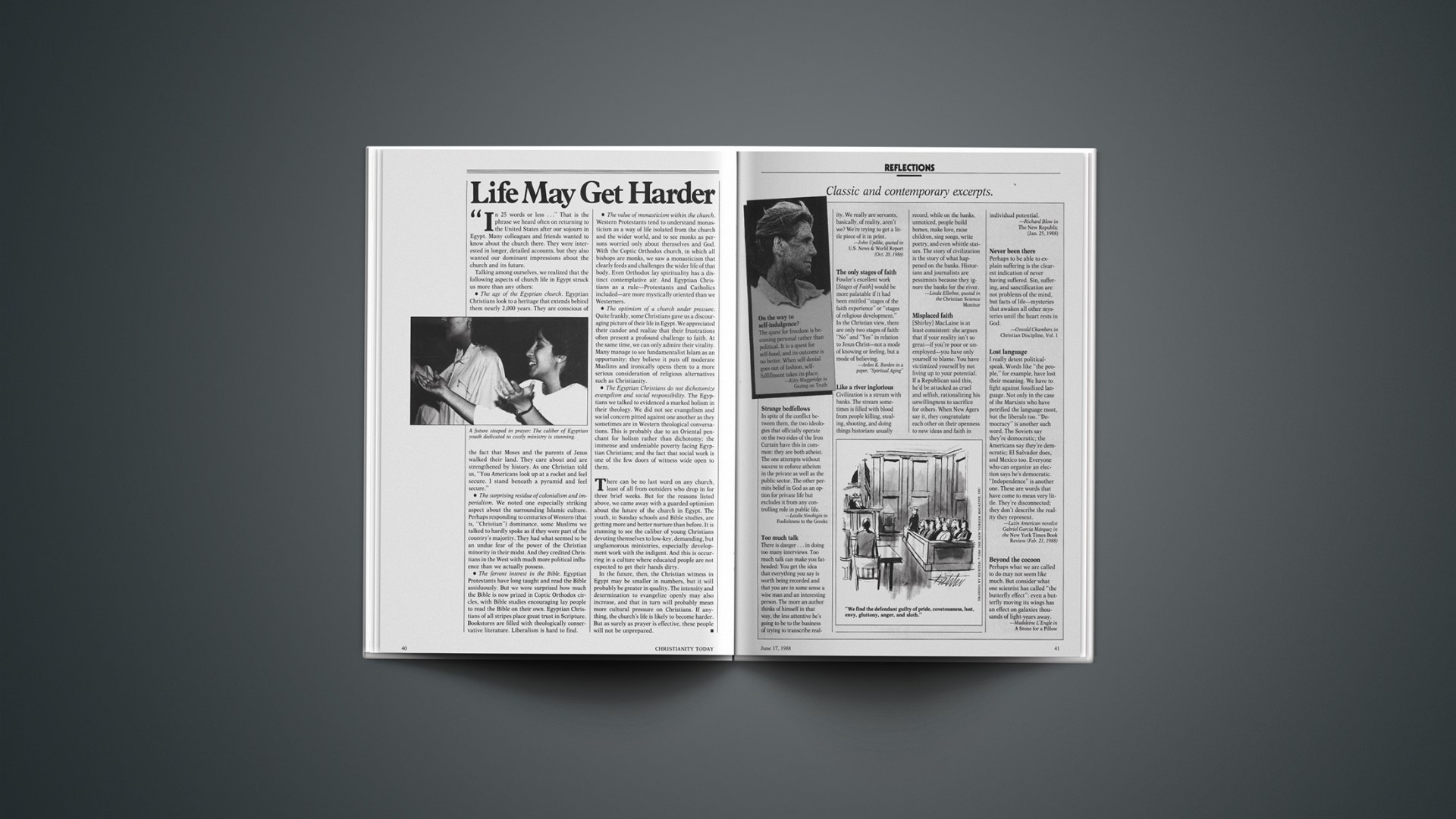
There can be no last word on any church, least of all from outsiders who drop in for three brief weeks. But for the reasons listed above, we came away with a guarded optimism about the future of the church in Egypt. The youth, in Sunday schools and Bible studies, are getting more and better nurture than before. It is stunning to see the caliber of young Christians devoting themselves to low-key, demanding, but unglamorous ministries, especially development work with the indigent. And this is occurring in a culture where educated people are not expected to get their hands dirty.

In the future, then, the Christian witness in Egypt may be smaller in numbers, but it will probably be greater in quality. The intensity and determination to evangelize openly may also increase, and that in turn will probably mean more cultural pressure on Christians. If anything, the church’s life is likely to become harder. But as surely as prayer is effective, these people will not be unprepared.
The Church in Egypt

Confessing Christ in the heart of Islam.

Pressure, oppression, and discrimination may be good for the faith. And total freedom and official blessing may not be good for Christians.

In countries that take a hands-off approach, or where government and church have become cozy, either the gospel is transformed into cheery moralism or the church is consigned to irrelevance.

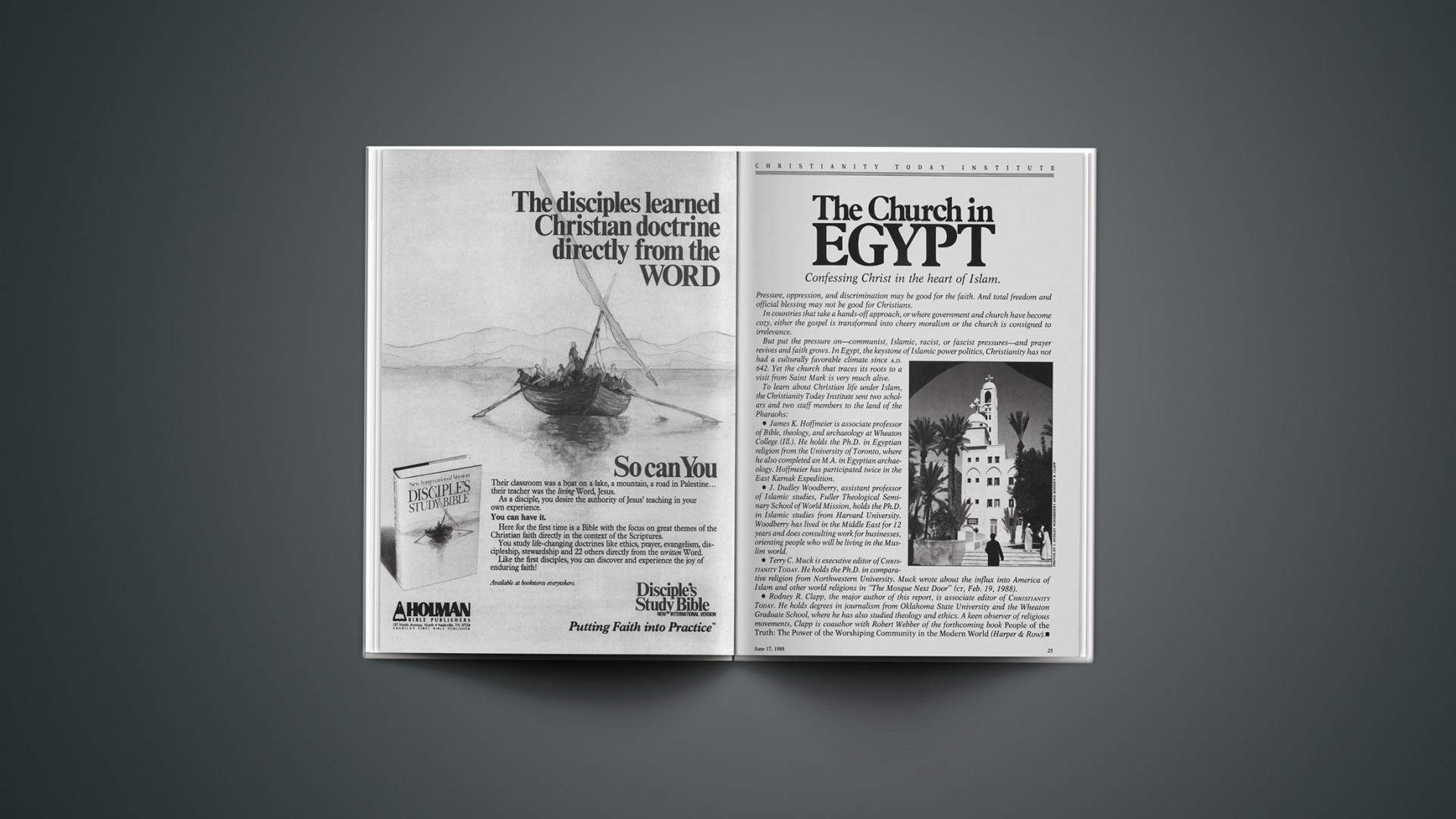
But put the pressure on—communist, Islamic, racist, or fascist pressures—and prayer revives and faith grows. In Egypt, the keystone of Islamic power politics, Christianity has not had a culturally favorable climate since A.D. 642. Yet the church that traces its roots to a visit from Saint Mark is very much alive.

To learn about Christian life under Islam, the Christianity Today Institute sent two scholars and two staff members to the land of the Pharaohs:

James K. Hoffmeier is associate professor of Bible, theology, and archaeology at Wheaton College (Ill.). He holds the Ph.D. in Egyptian religion from the University of Toronto, where he also completed an M.A. in Egyptian archaeology. Hoffmeier has participated twice in the East Karnak Expedition.

J. Dudley Woodberry, assistant professor of Islamic studies, Fuller Theological Seminary School of World Mission, holds the Ph.D. in Islamic studies from Harvard University. Woodberry has lived in the Middle East for 12 years and does consulting work for businesses, orienting people who will be living in the Muslim world.

Terry C. Muck is executive editor of CHRISTIANITY TODAY. He holds the Ph.D. in comparative religion from Northwestern University. Muck wrote about the influx into America of Islam and other world religions in “The Mosque Next Door” (CT, Feb. 19, 1988).

Rodney R. Clapp, the major author of this report, is associate editor of CHRISTIANITY TODAY. He holds degrees in journalism from Oklahoma State University and the Wheaton Graduate School, where he has also studied theology and ethics. A keen observer of religious movements, Clapp is coauthor with Robert Webber of the forthcoming book People of the Truth: The Power of the Worshiping Community in the Modern World (Harper & Row.)

A piano is shoved into a corner, black music stands bunched haphazardly on one side of the room. With 21 students, we sit at small, kidney-shaped desks, listening to the American lecture. Some students have come after working all day at their jobs; others have come after another day of waiting for a government post that has yet to materialize.

Some students are not far beyond their university days; others are approaching middle age. One woman has with her two sons, about ages 10 and 12. Both boys sleep: one with his head against the wall; the other’s head cranes backwards over the top of his chair, with the mouth wide open. He makes a faint sucking sound.

The lecturer is Jack Lorimer, a Presbyterian missionary to Egypt of some 35 years. Lorimer, sixtyish, with a silver mustache, speaks in Arabic. Only a few words are decipherable to an English-speaking listener. But when Lorimer writes on the blackboard, he writes in English rather than Arabic. Names like “Clement” and “Demetrius” appear, and the tempo of the class picks up.

It is no wonder. These students are discussing some pivotal figures in early church history. They are learning about battles against the most pernicious heresies orthodox Christianity confronted, such as Gnosticism and Docetism; and about stupendous intellectual attempts to fit Platonism to Christianity. Most important, they are learning about these things where they happened: in Alexandria of Egypt, their native city.

It is no exaggeration to say that Christianity would be an entirely different religion if Alexandria had never existed. With its famous library, it was a Hellenic intellectual center long before the advent of Christianity. And it was once the premier Jewish center in the world, the site where, more than 150 years before Christ, scholars made the Septuagint, the seminal Greek translation of the Old Testament.

But the strategically situated seaport city was even more crucial to the development of Christian orthodoxy. From it sprung the Alexandrian Catechetical School, guided by the likes of Bishop Demetrius. From it the acidic Clement fought Gnostics and denounced philosophical opponents as “old shoes, worn out except for the tongue.”

The Alexandrian-born Origen followed Demetrius and Clement. His name meant “born of Horus,” but his parents converted to Christianity before or soon after his birth, and Origen grew to be the greatest Christian philosopher before Augustine. Hardly less significant was Athanasius the Great, bishop of Alexandria in the fourth century, who stood “against the world” to defend the full divinity and humanity of Jesus.

The Alexandrian Christian heritage is alive in Alexandria. But the world no longer looks to it for theological guidance. Today’s seminaries are mostly small and unassuming, like the one we are visiting. It is an extension of the Cairo Coptic Evangelical Seminary, and Lorimer makes the three-hour drive from Cairo once a week to teach Alexandrians theology, their theology, in the borrowed music room of an American school.

The door stays open at the back of the room. The cool Mediterranean breeze drifts inside. And midway through the class, out of the dark, so does a nearby chanting. The voice is amplified, smooth, clear, and bell-like; it goes on for a minute or two. Lorimer keeps on lecturing. The students keep on taking notes. They are accustomed to the cries of the muezzin, cries calling to prayer the Islamic faithful, at least 90 percent of the people of Alexandria.

Living Christianly In Islamic Egypt

The Middle Eastern resurgence of Islam is one of the most significant religio-political developments of the 1980s. Muslim extremists have been behind several of the major news stories of the decade: the attempted assassination of Pope John Paul II, the successful assassination of Egyptian President Anwar Sadat, Ayatollah Khomeini’s ascendence to control of Iran, the continuing Iran-Iraq war, and Colonel Qaddafi’s exploits.

Commenting on the strength of the Islamic resurgence, one scholar has noted, “In no Christian country at the present time can religious leaders command the degree of religious belief and the extent of religious participation that remain common in Muslim lands; more to the point, they do not exercise, nor even claim, the kind of political role that in Muslim lands is not only normal but is widely seen as natural.”

The political involvement of Islam seems “natural” to Muslims because Muhammad bound the successful government of society to the successful practice of religion. He expected government itself to lead people in the good Muslim life and to prepare them for the next world.

It would be unfair not to note that many Muslims around the world (among them a good number of the “secularized” faithful) now insist on a separation of faith and government. But the continuing intimacy between religion and the state among conservative Muslims makes Islam the major force to be reckoned with in the Middle East.

In that ferment, Egypt is central. Although steeped in ancient pharaonic and Christian history, it has been Islamic since Muhammad’s followers invaded in the seventh century—the era of Islam’s birth. Today there are stricter Islamic countries—such as Iran and Saudi Arabia—but none that exerts as much regional influence as Egypt. As scholar Daniel Pipes writes, “Egypt is the most important single country for Islamic political action in the twentieth century.”

That is the case for at least five reasons:

• Egypt’s relatively open society, hospitality, and central location attract foreign scholars and journalists. These qualities make Egypt (85 to 90 percent Muslim) a vital link between the Arab and non-Arab worlds.

• Gamal Abdel Nasser, Egypt’s president from 1952 to 1970, broke ties with the Western imperialism hated throughout the Arab countries. Nasser also maintained relative independence from his new ally, the Soviet Union. These moves, plus Nasser’s charisma, captured the allegiance of much of the Arab world, until the disastrous 1967 war with Israel stole his magic. Yet the respect for Egypt he established among Arabs lingers to this day.

• Cairo, Egypt’s largest and capital city, is home to Al-Azhar, the international university of Islam and the oldest continuously operating institution of higher learning in the world.

• The first mass fundamentalist Islamic movment, the Muslim Brotherhood, was founded in Egypt in 1928.

• Egypt’s precarious peace with Israel holds Arab-Israeli power in balance. If Egypt converts to radical Islam, that balance could be destroyed.

Just how much of a threat are radical Muslims to Egypt’s stability, and to the well-being of Christians in that country? A surface survey of recent events might make them appear very threatening. In 1980, the government declared Shari’a, the sacred law of Islam, not merely a main source of civil law, but the main source of civil law. And in 1981, the Institute of Islamic Economics, in line with a strict interpretation of the Qur’an, introduced interest-free banking.

How The Faith Survived

The ubiquitous minarets that dot the skyline of any Egyptian city, coupled with the towering granite obelisks standing in ancient temple precincts, virtually obscure the fact that for many centuries Egypt was a Christian country. Although overshadowed architecturally, that Christian legacy is still alive. How has the Christian faith, so thoroughly extinguished in the rest of North Africa, survived in Egypt? A look at its religious history may help answer this question.

3000–525 B.C. The polytheistic religion of Egypt, with its major deities Ra (the sun), Ptah, Amun, and Osiris, dominates Egypt. Despite several periods in which Egypt is controlled by outsiders (Hyksos 1700–1550, Libyans 945–715, Nubians 715–664, and Assyrians 664), her religious traditions are left intact. In fact, the outsiders for the most part accommodate themselves to Egyptian customs.

525 B.C.–A.D. 395 The Persians, followed by the Greeks and Romans, rule Egypt with little significant change to Egyptian religion—although, as historian Sir Idris Bell has commented, during the Roman era “traditional worship of Egypt was losing some of its vitality.” Into this milieu Christianity is introduced.

A.D. 33 During the feast of Pentecost in Jerusalem, the Holy Spirit comes to inaugurate the church. Peter’s powerful sermon is heard by Egyptians present in Jerusalem (Acts 2:5, 9–11). Perhaps these are the first to take Christianity to Egypt.

A.D. 42 Saint Mark brings the gospel to Egypt, according to the Coptic Orthodox tradition. (This early date seems unlikely in view of Mark’s ambivalence about missionary service in A.D. 46–48, when traveling with Paul in Asia [Acts 13:13]).

A.D. 54 Apollos, the apostle from Alexandria, is found teaching in Ephesus, where he meets Aquila and Priscilla (Acts 18:24–28). His presence in Asia Minor suggests that the Egyptian church was already established in Alexandria.

A.D. 110–125 Christianity is growing in Egypt (as evidenced by a papyrus fragment dated in the early second century, which contains portions of John 18).

A.D. 190 Pantaenus, who a few decades earlier founded the famous catechetical school of Alexandria, dies. (According to Eusebius, he preached the gospel in India.)

A.D. 155–220 Clement of Alexandria, described as the first “Christian scholar,” becomes head of the Alexandrian school at the death of its founder in 190. A number of his works have survived, including “Exhortations to Conversion,” “Paedagogus,” and “Miscellanies.”

A.D. 202 Emperor Septimius Severus begins his persecution against Christians and Jews in Egypt, and an edict prohibiting proselytizing to Christianity is issued. These developments indicate Christianity is making significant inroads in Egypt.

A.D. 185–254 Origen, perhaps the most important figure in early Egyptian Christianity, succeeds his mentor Clement as principal of the Alexandrian school, a post he will hold for 28 years. This intellectual giant produces a number of significant works, including CONTRA CELSUM, a refutation of Celsus’ attack on Christianity. He is also considered to be the father of textual criticism.

A.D. 249–251 The Roman emperor Gaius Decius aims intense persecution at eradicating Christianity. Dionysius, Bishop of Alexandria during this period, describes this persecution and implies that Christianity is “widespread in Egypt.” The consequence of the persecution is the spread of the faith. From 250–300, Christianity is a considerable force in Egypt, though the land remains largely pagan.

A.D. 251–356 Anthony emerges after 20 years as a desert hermit to found Egyptian monasticism.

A.D. 287–346 Pachomius founds communal monasticism. (Egypt’s monastic orders, like those elsewhere, have been largely responsible for preserving the Scriptures. Many of the manuscripts from Egypt’s monastaries were unceremoniously taken to Europe in the past two centuries.)

A.D. 303–305 The persecution of Roman emperor Diocletian is aimed at eradicating the “plague” of Christianity. The suffering is incredible. Nevertheless, Christianity becomes the predominant faith by 330.

A.D. 312 Emperor Constantine converts to Christianity.

A.D. 313 The “Edict of Milan” (issued jointly by Emperors Constantine and Licinius) gives official permission for Christian worship and provides for compensation to Christians for losses incurred in the previous decade.

A.D. 325 Council of Nicea meets to deal with a heresy originating with Alexandrian presbyter Arius, who denies the eternal pre-existence of Christ.

A.D. 296–373 Athanasius, bishop of Alexandria from 328, is the key figure in the debate against Arianism in Egypt.

A.D. 412–444 Cyril of Alexandria is the chief opponent of the Nestorians, who claim that Christ had two natures. Cyril argues for the unity of Christ’s nature, or monophysitism (the position still held in the Coptic Orthodox church). The fifth-century debate is, to a large extent, politically motivated as the Sees of Alexandria, Rome, and Constantinople vie for preeminence. Out of this debate comes the Chalcedonian creed.

A.D. 642 The Arab-Islamic invasion makes Egypt predominantly Islamic. A wealthy, educated minority of Christians survives by paying heavy taxes to their overlords. (There are differing views of the nature of the invasion. Muslims try to play down accounts of brutality, persecution, and forced conversions, while the Coptic Orthodox underscore these.)

There are later periods of persecution under the Caliph el Hakim (996–1021) and by the Turks after 1517. (Our knowledge of Christianity in Egypt until the last century is hazy. It clung to its Coptic—that is, ancient Egyptian—liturgical tradition, while the language of communication was Arabic. Consequently, the church declined in numbers and influence and became ripe for renewal and reformation.)

A.D. 1818 From England come workers of the Church Missionary Society who seek to breathe life into the Coptic Christians, but like Moravian missionaries who preceded them, they have little impact.

A.D. 1854 A few American Presbyterian missionaries come to Egypt. Their success is dramatic, due in large part to their bringing an Arabic translation of the Bible. A kind of Protestant Reformation results. Sunday schools, Bible studies, and biblical preaching attract people from the Orthodox church. (This Protestant denomination, known in Egypt as Ingeli—“gospel” or “evangelical” or Coptic Evangelical—is the largest, having perhaps 130,000 members and adherents.) The efforts of the Presbyterian missionaries lead to an awakening within the Coptic Orthodox church, a counterreformation. The ancient church accepts the “Protestant” Arabic Bible (which it uses to this day) and starts its own Sunday school movement. For this reason, the Coptic Orthodox church becomes far more biblical than other branches of Orthodoxy.

Christianity has survived in Egypt because throughout their history, Egyptian people have been reluctant to change, they have had some of the greatest leaders in church history to guide them, and they remain committed to the Scriptures.

By James K. Hoffmeier

A Radical Islam?

Like so many Third World countries, Egypt is a nation in unrest. With a population of 40 to 50 million persons, Egypt is also the most populous country in the Arab world, and that population is booming—43 percent of all Egyptians are under 15. Its citizens are increasingly crowded off the strip of arable land flanking the Nile, a strip so narrow as to compose less than 3 percent of Egypt’s total land mass. Inevitably, former farmers and fisherfolk migrate to burgeoning cities (Cairo alone is approaching a population of 15 million), which struggle under overburdened economies. The nation’s per capita annual income, as of 1983, was less than $700.

Most Egyptians now consider Nasser’s experiment with socialism a failure. With an open hand of friendship to the United States, Anwar Sadat attempted to restore the economy. He moved toward capitalism and built new political alliances that would take Egypt to a new stage of prosperity. But Sadat’s domestic popularity with conservative Muslims fell disastrously when he initiated peace accords with Israel. He died at the hands of a fringe group, but even upper-class Egyptians bought and repeatedly watched videotapes of the assassination.

Radical Muslims, then, play on the sense that everything except religion has been tried to straighten out Egypt’s political and economic problems. For them, Islam is the answer. Egypt should institute the Shari’a and give its full devotion to the will of Allah as revealed in the Qur’an.

Despite these currents, however, Egypt is far from becoming another Iran. The official political clout of the extremists remains well contained. The National Democratic Party, a non-ideological ruling party, holds 358 of the seats in the People’s Assembly. (Thirty-five others are held by a centrist, business-oriented party, and 65 are divided between socialists and Islamic fundamentalists.) In addition, Shar‘i laws on theft, adultery, usury, apostasy from Islam, and divorce have all been repudiated.

In many ways, observers say, Egypt has come too far into the twentieth century to adopt the fundamentalist agenda. For instance, millions of women now work outside their homes—will they or their husbands want them to return placidly to the narrower roles assigned them by fundamentalists, and lose the income they depend on?

Finally, observers believe the fanatical Muslim threat is lessened because the radicals are divided among themselves. As long as they remain divided they cannot conquer.

The Egyptian religious and political situation, in short, is not moving faster and faster in a single direction, toward monolithic Islam. The dominant current at the moment is a semisecular, semi-Islamic government. The cross current is the radical Islamic movement. Caught in-between are some 8 to 15 million believers in Jesus.

A Day In The Life Of An Egyptian Christian

In Cairo, a drab layer of dust coats everything, from small residential dwellings to 30-story Western-style hotels. In Alexandria, people seem to live on their balconies: some lower baskets on a rope and call to the street grocer for bread, some hang laundry, and some simply chat with their neighbors. In Minya, a city of about 300,000 to the south of Cairo, it is quieter. At the city park the Nile’s currents can be heard lapping at its banks; darkness falls and hungry dogs bark hoarsely in the distance.

But in all these cities, and nearly every other metropolis or burg in Egypt, the muezzin sings out his call to prayer. Five times each day, beginning at 4:30 in the morning, Egyptians hear the words and cadences that become so familiar they seem as eternal as the Nile.

Imagine an Egyptian Christian waking to the sound of the call. It is the first thing in the day, but far from the only thing, to remind him that his faith sets him apart from nine out of ten Egyptians. In his grogginess he wonders if he should prepare for work. But he glances at his calendar and sees that it is Friday, the Islamic holy day. Today is a day of rest. Sunday—his day of worship—is a work day in Egypt.

Sometimes the Christian slips away from his job and into a church, just to worship in the daylight. But he needs his work—high-salaried jobs like his are harder for Christians to procure than their Muslim friends—so most Sunday mornings he stays at his desk, worshiping instead on Saturday nights or Sunday evenings.

At the moment he remembers plans to spend the day with his family. So he sleeps a few more hours, then rises, dresses, and heads out onto the streets. Strict laws limit the building of Christian churches. Presidential permits are required, and some congregations wait years for permission to make small repairs. Churches cannot be built within a specified distance of a mosque, and steeples are not allowed to spear higher than minarets. What the Christian sees, then, at least every few blocks, is a place of prayer for his Islamic neighbors. In contrast, churches are often dwarfed by high-rise apartment buildings, or squeezed inconspicuously between government offices.

As he boards the bus, the Christian must step around Muslim neighbors who have spread prayer rugs on the sidewalk and now kneel, foreheads to the ground, in the direction of Mecca.

Soon he arrives at his parents’ home. He finds his father and younger brothers and sisters in front of the television set. His watch reads 11 A.M., and the day’s programming is just beginning. A bearded sheikh (roughly the Muslim equivalent of a pastor) flashes on the screen. Calmly, he begins to chant, and the corresponding words from the Qur’an appear on the screen. The passage is familiar, one the young Christian studied in his public school.

After visiting his mother in the kitchen, he finds a newspaper and scans the TV listings for the day. His eye catches on an Elvis Presley movie and an intriguing Egyptian serial, “Helmya Nights.” He is too accustomed to notice the five “religious programmes” scheduled on the three national networks through the remainder of the day. When his eye does fall on one of the listed religious programs, he does not have to wonder what religion it will feature.

Except for a few programs at Christmas and Easter, public television is closed to Christian broadcasters, and he wishes, with a returning sense of humiliation and regret, that it was not. A few months ago, he recalls, a Muslim teacher appeared on one of the three stations saying the Christian prophet (Jesus) went to bed with five virgins on one night. Several of his Muslim friends were astonished at Jesus’ immorality. He tried to explain that the parable of ten virgins, though it said the virgins went “into” the bridegroom, did not mean this as the Arabic colloquialism for sexual intercourse. Most of them listened to him, but he thought then about the thousands who saw the broadcast and never heard the correct interpretation of the passage.

He reads the rest of the paper and teases his youngest sister. Appealing odors drift from the kitchen and he realizes his mother is beginning to prepare lunch. It is noon, and another call to prayer sounds outside the window.

Challenges To Faith

Living under such conditions, Egyptian Christians grow hardy; their faith develops tenacious roots. It is not difficult to find examples of men and women who have suffered for what they believe—not martyrdom, but certainly matters worse than inconvenience.

It is a Wednesday night in a town in lower Egypt. Adel Markos (not his real name), an evangelical Christian, is showing us around town. Despite its substantial size, many of the town’s roads are narrow and unpaved. A fine dust, with its pungent odor, fills the air. Donkey-drawn carts jockey with cars and trucks for the right of way. In Cairo, drivers are constantly honking their horns. There pedestrians spill out into the street with a resigned air, giving themselves up to a hurricane of traffic.

But here traffic is thinner, horns are less often employed, and pedestrians are treated as if they have a right to live. Most of them eschew the sidewalks and stride down the streets—true to Egyptian custom, men or women arm in arm with friends of the same sex. The street lamps are a low, incandescent yellow, hollowing out small, warm caves of light for the people who pass beneath them. Vendors, with fires crackling under shish kebabs, wait at various corners.

Adel is a bald-headed, medium-sized man. His deep-set eyes and aquiline nose make him reminiscent of a Hollywood version of Al Capone. But he is soft-spoken, and when he mentions his service in the Egyptian army, he says he was happy he never had to kill a man. Adel’s mission, at the moment, is to take his American visitors to his Coptic Evangelical church.

When Adel arrives at the church, four armed, government guards stand at the gate. Adel explains that there are usually fewer guards, but only a few days before, Muslim fanatics attacked a local Christian organization. Whatever tension lingers does not show on the white-uniformed guards, who languidly smoke and talk.

Just inside the church there is loud, theatrical music. Adel says the children of the church are watching a film. He opens a door: Charlton Heston, his majestic white hair and beard flapping in the wind, is commanding the Red Sea to part as Israel escapes Pharaoh.

We proceed upstairs with Adel, and quickly come across more activity. In a small room, three women sort clothing beneath a dim, uncovered light bulb. (One missionary has earlier told us that many Egyptian Christians regularly go to separate activities at as many as three or four churches. Egyptians have fewer diversions than Americans, he said, and the maintenance of their faith in an unencouraging environment demands Christian community. Adel’s church testifies to the truthfulness of the missionary’s account; it is busy even on a weeknight.)

The church women are volunteers concerned with distributing clothes to the poor. They work standing up, at a simple wooden table. One woman, in a black dress, with black hair and heavy eyelids, appears to be the leader. The others defer to her when questions are asked about their church activities.

Speaking through a translator, she soon warms to her subject. She puts down the garment in her hands and says most of her work with the church is in the education department. She enjoys it because it was her training.

Years ago she was headmistress of a school that housed and taught one thousand girls. But she was accused of shredding the Qur’an, burning it, and then stomping on the ashes in a final fit of contempt. None of this was true, the woman says; she believes she was attacked for being a Christian. Eventually she lost her job. Her story was one others would repeat, with differing details.

The next day, outside town, a friend of Adel’s talks about the difficulty of building or repairing churches in Egypt. “It’s difficult but not impossible,” he says. Often churches ignore or creatively circumvent the Egyptian bureaucracy. He knows of one church that had a broken latrine. After asking permission to repair it and not getting the permission for several weeks, the church simply repaired the latrine.

In another case, Christians were delayed in building a church. Finally they sought permission to build a home. That granted, they began constructing a church. When the walls rose a few yards above the ground, the police realized a church was being built. They posted guards, but only during the day. The church builders continued to work at night, with the police apparently satisfied they were enforcing the letter of the law.

A Church Bright And Strong

The church-building story exemplifies the pluck and determination of Egyptian Christians. Louka Michael (not his real name) is pastor of an urban Coptic Evangelical church. Like many Egyptian pastors, he is strikingly productive. With a church of only 300 regular members, he established a popular ministry to the elderly and a preschool educating 74 students. At a previous church, in a Minya suburb, Louka took notice of the large body of retarded children in Egypt (inbreeding largely accounts for the estimated 3 percent retarded citizens), and started an educational ministry for the mentally handicapped.

Obviously not a man lacking in energy or ambition, Louka nonetheless carries an air of heaviness. His polished coal eyes are soft, tinged by sadness. Wistfully, he speaks of the late 1960s, when Canada and Australia were especially open to Egyptian immigrants, and many Christian friends left the country. “Now we just send them Christmas cards,” he says.

He harbors no illusions about the difficulties of ministry in his homeland. Too many Christians, Louka tells us, are nominally Muslim. They cannot avoid Muslim radio and television. They fast during Ramadan (a central Islamic holiday season) and swear, like Muslims, by invoking the name of the prophet Muhammad. Sometimes, he says, when a Christian dies the family asks a sheikh to read a surah (a chapter from the Qur’an). Louka alludes to estimates that between 10,000 and 15,000 Egyptian Christians convert to Islam each year, often for reasons of money or marriage. (Another Egyptian later presented the mordant formula that Christians convert for love and hate—to marry a Muslim lover, or to take advantage of the more liberal Islamic divorce laws.)

The Cross Within The Crescent

Many pharmacies in Egypt identify themselves by a sign bearing a cross within a crescent—emblems of healing in the Christian and Muslim communities. But the sign is also symbolic of how the two faiths are bound together by what they have in common, and of how they must live together despite their radical differences.

Society and politics

The flag of the Egyptian revolution of 1919 against the British colonizers bore the emblem of the cross within the crescent, for both religious communities shared common aspirations and a common destiny in the land. Yet, the alliance has often been an uneasy one, for each has its own vision of what the society should be—a vision best understood by comparing the teachings of Muhammad and Jesus.

Although there are some significant differences between their teachings, both preached, “Repent, for the kingdom of God is at hand.” And neither was well received in his home town. But here the similarity ends. Muhammad believed that he must rule rather than suffer; so he escaped from Mecca and accepted a job 275 miles north in Medina, where he could begin to build a power base and rule in God’s name. Jesus, on the other hand, chose to suffer rather than rule. After feeding the five thousand, he turned down the chance to become king. He chose instead to die for the world.

Muhammad believed God’s kingdom should be an earthly kingdom, whereas Jesus told Pilate, “My kingship is not of this world” (John 18:36). The Arabian prophet believed force could be used to extend the kingdom and began the conquest of the neighboring tribes, which would later lead to the establishment of the Islamic empire. Jesus, however, refused to use force to build his kingdom. Saying his kingdom was not of this World, Jesus told Peter to sheath his sword when the soldiers came to take Jesus away.

The Arabian prophet also thought God’s kingly rule could be ushered in by applying divine law to all aspects of life. Jesus, on the other hand, saw the limitations of law to change people; so he talked about the need for a transformation from within. It is not enough, he said, to refrain from killing someone; we must not even hate another person in our heart (Matt. 5:21f.). The kingdom of God is like leaven, which transforms from within, not something that can be enforced from without (Matt. 13:33).

What we in North America call “religion” and “politics” overlapped in Muhammad’s understanding. Certainly our Lord expected that our faith would affect all aspects of life, including the political. Yet he distinguished between the two realms, saying, “Render unto Caesar the things that are Caesar’s and unto God the things that are God’s” (Matt. 22:21). Thus, Christians do not experience the Muslims’ urgency to live under a government dominated by their faith.

These divergent visions are reflected in contemporary Egypt. Christians want religion and state separate so they may have freedom and may not, as a minority, be relegated to a second-class status politically. A large segment of the Muslim population desires the same freedom of a more secular state. Yet in recent years Muslim fundamentalists have grown in strength. In 1980 they were able to get the constitution changed to read that religious law is the main source of legislation. Now they are trying to make this claim a reality.

Faith and practice

The Arabic word Islam means “to submit” to God. (Christians, too, are enjoined to submit to him [James 4:7].) For Muslims, this submission includes observing five pillars of the faith. First (like Jews and Christians), they confess the unity of God, and then go further to confess the apostleship of Muhammad. Next, they are to pray five times a day, give alms, and fast during daylight hours in the month of Ramadan. (Forms of these practices are encouraged in Matthew 6:1–18.) Finally, they are to go on the yearly pilgrimage to Mecca once in their lifetime, if possible (just as Jews were to go to Jerusalem three times a year).

Underlying these practices, we note comparable similarities and differences in beliefs. When Muslims call upon God (Allah in Arabic), they mean the one God of whom the Bible speaks. The attributes of God are similar in both religions, but the emphasis and interpretation are sometimes different. Islam emphasizes the sovereignty of God to the extent that he forgives whom he wills and does not forgive whom he does not will, apart from any means of salvation like the Cross.

According to the Qur’an, God is a loving God, but he loves only those who love him, not those who do not (3:31–32). There is nothing here to compare with the unconditional love of God found in the Bible: “In this is love, not that we loved God but that he loved us and sent his Son to be the expiation for our sins” (1 John 4:10); and “But God shows his love for us in that while we were yet sinners Christ died for us” (Rom. 5:8). Muslims reject the Christian understanding of the doctrine of the Trinity, which the Qur’an describes as being made up of Allah, Jesus, and Mary (5:116)—perhaps reflecting the veneration of Mary by Christians in Muhammad’s day.

The Qur’an refers to many people in the Bible: Adam, Noah, Abraham, Moses, David, and John the Baptist, to name a few. Sometimes the stories reflect apocryphal accounts, such as Abraham’s being saved from a fiery furnace (21:58–69; 37:97).

Jesus is always treated with the greatest respect in the Qur’an. But he is said to have been born beside a palm tree and to have spoken from the cradle—stories reminiscent of apocryphal gospels circulating at the time the Qur’an was first recited. Other similarities with our Gospels can be found, even though the same descriptions and titles are often understood differently. Christ was the Word (10:10; cf. John 1:1); he performed miracles (3:49; cf. Luke 7:21–22); and he was sinless (10:10; cf. Heb. 4:15).

Most Muslims believe the Qur’an denies that Christ was crucified (based on 4:157–158), although it merely says that the Jews did not kill him. It may, therefore, intend nothing more than Jesus did when he said to Pilate, “You would have no power over me unless it had been given you from above” (John 19:11). The Christian believes that God’s power was demonstrated not by saving Jesus before he accomplished his work on the cross but by raising him after the work was accomplished.

Muslims believe that people are basically good and are capable of doing God’s will when they know it. The Bible teaches that all people have a bias toward wrong (Eph. 2:3). These contrasting views lead to significantly different understandings of the solution to the problem of human sin. Islam holds that all we need is to know the law of God and receive his forgiveness. The Bible affirms, however, that God’s law is only a tutor, showing us both God’s will and our inability to do it. We need forgiveness, but we also need an acceptable means of forgiveness if God is to remain righteous and yet acquit us. The Bible further declares that, because we have a bias toward evil, we need new life, which results in the transformation of our nature. Nicodemus, a pious follower of the law, was like many Muslims in his reliance on his own efforts. Jesus told him, “You must be born anew” (John 3:7).

Almost every church in Egypt has a mosque nearby. Frequently a cross on the church’s spire is held aloft beside the crescent on the minaret. Thus, when the cry goes out five times a day from the minaret, “Come to salvation,” the church bears its answer: the Cross of Christ.

By J. Dudley Woodberry.

Nor is Louka at peace about the radical Muslims and their prospects for power in Egypt. (Some Christians fear their numbers make up 40 to 50 percent of the nation—most estimates are much lower.) Louka refers to the unending stream of propaganda flowing from radios and televisions. “It goes on and on and on,” he sighs. “You breathe it.”

Yet despite his weariness, Louka himself rejected an opportunity to leave Egypt. After he earned a graduate degree at a prestigious American university, his friends there encouraged him to remain in the United States. He admits he was tempted. But he and his wife had a sense of calling. “That is why we are here,” he tells us in his living room. “Hopefully, we are providing a little more reason for our young people to stay.”

Whatever its effect on young people, Louka’s pastoring does not go unnoticed by the elderly in his church. One old man unburdened himself of the opinion that today’s church leadership is more talented and dedicated than that of earlier times. With a poetry that ennobled the sacrifice of Louka and the other sensitive, struggling pastors like him, he said, “The church here is bright like the sun and strong like a big army.”

A Steely Bishop

Like Louka Michael, Father John Mitri (not his real name), ministering in another urban setting, evidences the strain of pastoring in a land that considers Christianity foreign. Father John has a tall, athletic-looking body that appears out of place in his black cassock. His hair is closely cropped, his eyes unafraid. He agrees with Louka about the harsh outlook for the church in Egypt, but carries his concern differently. Whereas Louka seems tired, nearly resigned, this Roman Catholic priest’s relentless pessimism appears to animate and steel him.

He declares that without the Coptic Orthodox Church, there would be no church in Egypt. The Coptic Orthodox number approximately 7 million. By comparison, he says, there are 70,000 to Catholics, so few that “it is almost not right to call it a church.” (Others put the estimate closer to 150,000.) Stabbing a yellow Bic pen at the air to emphasize his point, Father John speaks of the ridiculousness of bishops strutting in crowns and sacerdotal finery, even though there are hardly any people in their churches.

The chief danger to Egyptian Christianity is not Islam, he claims. It is the church itself. The different denominations refuse to present a unified front, have no integrated plan for the future, and are unsuccessful in living with the poor and experiencing their problems. He also criticizes Catholics and Protestants for insufficiently developing their youth and for neglecting Christian service opportunities for women. Given these inadequacies, he says, Christianity in Egypt could disappear. Father John ends his litany with an impish announcement: “All this is not what you expected to hear. If you want to hear how wonderful things are, go see the archbishop tomorrow.”

But the priest admits there are sparks of hope in the darkness. There are “quiet saints.” There are young people “who say they are simply Christian and don’t worry what church they are in.”

These developments help him endure as a clergyman, Father John says. And there are other reasons. “First of all, my parents were true believers. My father lived to be 85, and every Sunday he went to pray at church. So I love Christ because of my parents.”

Second, he says, “I don’t have a lot in the way of earthly possessions. My car is a 19-year-old Volkswagen. So in my daily life and prayers, I have learned about a life of simplicity.” This simplicity is mirrored in the life of his parishioners. “They are poor families struggling to provide a life for themselves and their children. They manage to face each day with courage and hope. I learn from them.”

And finally, “The fewer sorts of desires a person has—with ambition, money—the more peace he will have. The fact I am a bishop is an accident. I did not seek it.”

That much was believable: the priest hardly sounds like an ensconced denominational bureaucrat. As far as he is concerned, honesty is paramount. Abraham Lincoln inspires him more than any other man “because of his patience and honesty—his honesty first of all with himself. Honesty with one’s self, honesty that refuses hypocrisy—this is what builds the church.”

Father John leans forward and harpoons the air one last time with his Bic. “MGM and Hollywood and space shots may change the way we live, but it’s people like Abraham Lincoln who will change the way we are.”

Egypt And The Iron Curtain

The stories of Louka Michael, Father John, and other Egyptian believers demonstrate the stress of being Christian in Egypt. So do news reports of events such as the 1981 imprisonment, following riots, of 1,536 religious and political activists. Though the large majority of that number were radical Muslims, Coptic Orthodox and evangelicals were arrested as well. Coptic Orthodox Pope Shenouda III was placed under house arrest.

The American and Canadian Coptic Association, and our Egyptian sources, report:

• that hundreds of church-building permits, to be issued by the president, are pending, with some going back more than ten years;

• that in Cairo’s Coptic neighborhood of Old Cairo, 15 historic churches have been taken under government jurisdiction;

• that the Christian periodical El Keraza has been banned;

• that Coptic Orthodox are discriminated against at all levels of government, holding none of the 160 top positions outside the Egyptian cabinet, and are refused positions as province governor, ambassador, university president or college dean, police commissioner, and president of a nationalized company;

• that the government regulates Coptic Orthodox schools and confiscated Coptic Orthodox hospitals while donating money and land to similar Muslim institutions;

• that the state-controlled mass media deny fair access to Coptic Orthodox Christians.

On hearing about imprisonment and other limitations on religious liberty, the Westerner’s reflexive reaction may be to compare such a country to those behind the Iron Curtain. However, while Egyptian Christians certainly suffer from curtailed freedoms, many say the analogy to the Iron Curtain nations is not a good one.

They are sensitive to the government’s position, arguing that it must try to pacify the fundamentalist Muslims. The 1981 riots exemplified the economic and social frustration much of Egypt’s population feels, a frustration that must be contained. And when hundreds of Muslims were arrested, a symbolic number of Christians were also arrested to save the government from accusations that it is anti-Islamic.

Many Muslims despise the connection Egyptian Christians have with the “imperialistic” West. They sometimes imagine a new Crusade is being planned for the retaking of Islamic lands. In addition, Christians are proportionately wealthier and better educated than Muslims. (Until World War II, 75 percent of the country’s schools belonged to the church.) Thus, there are many reasons—some more real than others—for friction between Egypt’s Muslim majority and its Christian minority.

All said, Egyptian Muslims consider Egyptian Christians the best-treated religious minority in the world. Although few Egyptian Christians would agree with the superlative, they say “oppression” is too strong a word for their condition. The more secular their government, the better, they say. Like Sadat before him, President Hosni Mubarak has so far resisted complete Islamization. One Christian observer believes Mubarak aspires to Islam “in its most serene and profound form,” which includes tolerance for other faiths.

On visiting Coptic Orthodox church offices, we were struck by two framed photographs on the wall of most offices. On one side was a picture of Pope Shenouda; on the other, a portrait of a resolute President Mubarak. The inclusion of Mubarak’s likeness on a level with the Pope indicates the careful respect many Egyptian Christians hold for their current government.

Addressing the same Mubarak, a Coptic monastic publication adopts a tone that would match the sentiments of the most ardent American civil religionist: “So now, dear President, you have been chosen by God in the midst of this most difficult era of history in Egypt and in all of the East—chosen to confront a reality in which peoples, interests, sects, and values are in disagreement. By his grace and inspiration God has appointed you not only to reconcile and protect the spiritual interests of our country which is steeped in the proud heritage of Islamic tolerance, but at the same time to bear all the economic, sociological, and cultural burdens. We stand behind you and consider ourselves among the front line soldiers of prayer: our heart is with yours, we are at your disposal …”

Egypt’S Christian Legacy

The Egyptian Christians’ equanimity about a government that has imprisoned its people and even restricted the freedoms of its leaders can be better understood with a view to Egyptian church history. Egyptian Christians possess a long and rich history. Dating to the early second century, it is nearly ten times the age of America’s church history—old enough that, in the words of one historian, it is more an instinct than a tradition or heritage. And it is a history (or an instinct) that includes suffering much worse than what present-day Christians know.

On one October Monday, Pope Shenouda III, elected patriarch of the Coptic Orthodox Church in 1971, speaks with appropriate pride about that heritage. Like all Coptic monks (the pope is chosen from among the bishops, and bishops come from the monasteries), Shenouda wears a full beard; his is a black-and-gray cascade nearly concealing his mouth. He is dressed in papal regalia, including the black, bejeweled cope and the turban-shaped crown of the Coptic Orthodox episcopacy.

Shenouda is, by Coptic tradition, patriarch in the line of Saint Mark, just as the Roman Catholic pope is believed to be in the succession of Saint Peter. Tradition has it that Saint Mark came to Egypt sometime after Christ’s resurrection. His sandal broke as he was walking the streets of Alexandria. He visited a cobbler for repairs, and the cobbler, cutting his finger with an awl, cried out, “Is Theos!” (“O One God!”). The oath was the disciple’s evangelistic cue. He told the cobbler about the redemption of Christ, and from there the gospel spread across Egypt.

There is no historical documentation for this tradition, but biblical scholars observe that Egyptians were present at the feast of Pentecost (Acts 2:10), making it likely the gospel was taken to Egypt within months or years of Christ’s death.

Referring to this ancient heritage, Shenouda claims the Coptic Orthodox have “kept the tradition of the past until now without any change,” and mentions as examples the Wednesday and Friday fasts it continues to observe, the sustained practice of removing one’s shoes before entering the sanctuary, and the church’s unshortened three-to four-hour liturgies.

Included in this heritage, Shenouda says, is Egypt’s role in founding Christian monasticism Saint Anthony (ca. 251–356), was the first Christian monk, the original desert father. Anthony was a hermit; but in the early fourth century, Pachomius, another Egyptian, founded cenobitic or communal monasticism.

No less a part of its heritage was the persecution Egyptian Christianity has known. “The Coptic church,” Shenouda says, “has carried the Cross all its life.” He does not explain his comment, but Coptic historians document the horrendous third-century persecution of Copts by the Roman emperor Diocletian. Egypt suffered the most from this, the worst of all Roman persecutions of Christians, with estimates of Egyptian martyrs running from 144,000 to 800,000. As one ancient writer put it, “If the martyrs of the whole world were put on one arm of the balance and the martyrs of Egypt on the other, the balance would tilt in favor of the Egyptians.” Diocletian’s slaughter was so catastrophic that Copts to this day consider A.D. 284, the year of the tyrant’s ascension to power, as the beginning of their calendar.

Around the year 640 Egyptian Christianity absorbed another shock: the invasion of Muslim Arabs. It survived under succeeding Muslim dynasties—Tulunids, Ikshidids, Ayyubids, and Mamelukes. The fortunes of the church have waxed and waned at different periods, and today, though Pope Shenouda did not say so, its relative numbers are dwindling. But it has known revival in recent decades, being reinvigorated by the Sunday school and Bible study movements, both probably inspired by the Protestant churches introduced by missionaries.

If the Orthodox have benefited from Protestant educational methods, they have not adopted Protestant piety. Like Roman Catholics, they venerate the Virgin Mary and the relics of saints. Yet, true to Pope Shenouda’s claims that they will not depart from the past, they adhere to the universal doctrines of orthodox Christianity.

The rest of the church has not always considered the Copts orthodox. At the fifth-century Council of Chalcedon, the Coptic church separated from the Eastern and Western churches over a question of Christ’s humanity and divinity. The Western church, following Chalcedon, declared Christ one person with a human and a divine nature. The Egyptians were “monophysites,” maintaining that Christ had a single, divine nature. But modern theologians agree that the difference was one of vocabulary, not substance, and no longer consider the Copts heretical.

Concluding his audience with us, Pope Shenouda affirms his orthodoxy by throwing darts at the “new theology” that attacks the veracity of Scripture. Surrounded by Muslims eager to discount the Bible’s authority, Egyptian Christians of all stripes—Orthodox, Catholic, and Protestant—tend to be wary of even conservative biblical criticism. For his part, the Pope has no patience with those who would declare the early chapters of Genesis and the books of Jonah and Job mythological. Nor can he understand a New Testament scholar questioning who wrote the Gospel of John: “How can we benefit in such a doubtful way, guiding people to doubt, not to faith?” Only Egyptian theologians educated in the West are doing such things, he says.

Accordingly, he has some advice for Christians in America. “Take the verses of the Bible for spiritual benefit, not as criticism. Try to grow better and better in the depths of your life.… Work for your eternity, for the kingdom of God, and for the expansion of the gospel.”

The Pope says nothing about the challenges his church faces in a Muslim land. But across the street from his sitting room, visible from its windows, stands the papal cathedral. Its exterior has been finished for years, but rubble and half-dismantled scaffolding litter the inside. Awaiting presidential permission for its completion, the cathedral is mute testimony that the gospel will not expand easily in Egypt.

How Will The Church Fare In The Future?

What are the prospects for Christianity in Egypt? David Barrett’s World Christian Encyclopedia puts the Coptic Orthodox community of 1900 at 6.6 percent of Egypt’s population; in 1970 at 6.2 percent; in 1975 at 6.0 percent; in 1980 at 5.8 percent; and projects 4.8 percent for the year 2000. The Encyclopedia sees the Protestant and Roman Catholic populations holding steady—each at 0.02 percent of the population—into the year 2000. (During our visit, we learned that the numbers on Egyptian Christians are notoriously varied, according to whom you ask. Protestant sources, for instance, said there are twice as many Protestants as Catholics in the country.)

But Egyptian Christians insist such numbers fail to tell the entire story. They, far more than any foreign observers, know the cost of faith in a nation where Christianity is marginal. Yet they have hope because they can point to and participate in ministries clearly touched by the Holy Spirit.

One such ministry is that of Menes Abdul Noor, pastor of the Kasr el-Dubara Church in Cairo. At 57, the wiry Menes has an elastic face that one moment crumples into a frown, the next stretches into a full-toothed smile. He sits talking in the spacious parlor of his parsonage, directly joined to the tall, limestone church sanctuary. As Menes speaks, two or three young men and women drift into the parlor or out of the kitchen. Before disappearing to help them, Menes’s wife, Nadia, explains that the young people seek counseling; often some live with the Noors until their lives are straightened out.

Menes’s church of 600 members (with up to 1,000 regularly attending worship services), others have already told us, is one of the largest Protestant churches in the Middle East. Menes has translated 45 books from English into Arabic, including several of William Barclay’s commentaries and Josh McDowell’s Evidence That Demands a Verdict. He has written commentaries on Ephesians, the three letters of John, the letters of Peter, and the letters to the Thessalonians. He preaches weekly in his church, but also on TransWorld Radio.

Menes claims to be accomplishing so much by virtue of having read a book on time management, hiring secretaries, and leaving most of the household affairs to Nadia. And he confesses that his days usually stretch from seven in the morning until just past midnight.

Others have said Menes’s frenetic ministry is effective. Now he provides some data. The radio sermons elicit about 7,000 letters per month. His books sell rapidly at newsstands; at the Cairo Book Fair, 500 copies of one title sold in 20 minutes. He has become one of the most recognizable “holy men” in the country, well known enough that later, at a restaurant, a waiter inquires of Nadia if her husband is the famous minister—and if so, why isn’t he wearing an ecclesiastical gown. In a fashion typical of both Noors, Nadia turns the occasion into an opportunity to share God’s love, explaining the Protestant split from Catholicism—and clerical garb—at the Reformation, and going from there into a discussion of justification by faith.

Such behavior is typical of Nadia and Menes. He is a bold evangelist who has continued his ministry despite opposition and death threats. He is optimistic, moreover, because Egypt is now seeing the conversion of entire households and villages to Christ. There are now Bible studies in the Coptic Orthodox and Catholic churches. And there are Bibles on the newsstands. All of this, he says, is unprecedented.

Finally, Menes is optimistic because of the faith of Egypt’s next generation. He stresses how important it is to visit a Monday night prayer meeting of young university graduates.

The prayer meeting begins at seven, and by half-past all the chairs in the room, on the second floor of the church, are filled. Still more recent graduates—most of them doctors, engineers, pharmacists, and other professionals—filter into the meeting, setting up chairs on the balcony outside the room’s open doors. The group spends a solid hour in praise, alternating spontaneous songs, silent prayer, and spoken prayer. The singing is spirited, with arms upraised, eyes closed, heads tilted upward.

There is a short talk by a leader, and finally the group of some 150 men and women breaks into smaller prayer cells and, like a grove occupied by cicadas, fills the night air with the hum of their petitions and intercessions.

The meeting ends around half-past nine. Afterwards, we knock on the door of Menes’s house. At the door he suppresses yawns and rubs bloodshot eyes. But soon he recovers his energy and loquacity. After all, he is busy translating a new version of the Bible into Arabic. And there are two-and-a-half hours left in the workday of the man whose name, translated, means “Servant of the Light.”

The Bishop Of Beni Suef

There was another ministry we heard about repeatedly in Egypt, but it is far away from the hubbub of Cairo. Orthodox Bishop Athanasius, admired by Coptic Orthodox and evangelicals alike, is the episcopal head of the rural district of Beni Suef, overseeing 86 churches. The town of Beni Suef, center of the district, is a three or four-hour drive south of Cairo. The road from Cairo to Beni Suef passes fellahin (farmers) hoeing in their fields; men roped to the top of date palms, slicing the yellow-brown fruit out from underneath dusty fronds; women carrying laundry to and from the Nile; and small, blindfolded donkeys ambling in their ceaseless circles at waterwheels.

The landscape beside the Nile is colorful. Corn and other irrigated crops, and groves of tall, stately palms, green the countryside. Children, especially, are dressed in rich reds, lime green, oranges, and yellows. They dash across fields and perch on top of huge bundles of cornstalks lashed to the backs of donkeys. Behind the fields, across the river, white limestone cliffs occasionally ascend, setting the limits of the desert. Rural Egypt avoids the urban air pollution of Cairo (said to be the second-most-polluted city in the world). The sky is wide and blue, although in places the baking of mud bricks darkens the air with thin, black clouds, which late in the day refract sunlight and deepen dusk’s rosy hue.

Unlike rural America, Egypt’s countryside is never free of people. Once on Beni Suef’s narrow streets, of course, the concentration of people thickens, though there are not many motor vehicles. Bishop Athanasius greets us in a large, dark room in his official residence. He is a small man, just over five feet tall, with heavy black-rimmed glasses and tiny hands. The bishop speaks with a pleasant, reedy voice that originates, ventriloquist-like, far down in his throat.

Athanasius, at 64, and a bishop for 25 years, is candid about the difficulties facing the church in Islamic Egypt. Like almost everyone else, he cites the rise of Muslim extremism as the greatest threat to the church. His answer to extremism is simple and pastoral: “I find the solution only in Christian behavior—Christian love, forbearance, Christian witness.”

But does he think the church in Egypt will survive? Bishop Athanasius refuses to accept the question as phrased. “The question is, will the church in Egypt, in the East, and in the West survive?” The Western church faces materialism, decadence, and rampant individualism; the bishop fears it has become “too timid” to face the “overwhelming anti-Christian” ethos of its societies. He insists there is a difference between happiness and affluence (“I am a poor man; I do not have much; but I am happy”) and that Western Christians confuse love with pleasure.

“The trend in modern civilization is to accept man as he is,” Bishop Athanasius says, “and we have degraded Christianity and humanity” by putting aside the Christian hope for a transformed humanity. “To see Christianity survive in the world is to become true Christians once more. It is this true Christianity which has the power to change life and make people really happy.”

The Bishop’S Bible Study

The bishop is one of several leaders in the Coptic church who have come to believe that an essential element of restoring true Christianity is study of the Bible. Accordingly, he conducts a Bible study each Friday evening.

On one Friday, Bishop Athanasius’s church is full at 5:30. There are about 600 men, women, and children in the church, with males seated on the left side of center and females on the right (following ancient Oriental custom). The bishop stands at the front of the nave with an overhead projector and a microphone. Seated directly behind him are a dozen priests and monks, the monks wearing black hoods dotted with yellow crosses. Behind them, in typical Coptic Orthodox custom, is a screen painted (in golds, reds, and blues) with icons of the apostles and Christ. The altar is hidden behind the screen.

The bishop begins the Bible study by announcing the topic: the image of God in humanity. Laying some groundwork in Genesis, he then opens the floor to discussion by asking what it means to be created in the image of God. A man stands and says it means having freedom and humility. Athanasius listens, but then asks, “Where is the reference?” When the man can provide no scriptural citation, the bishop waves his tiny hand and points a finger at another person now standing to speak.

“When God created man he created a working man,” this gentleman says. Before he can say anything more, Athanasius asks, “Where is the reference?” and again his interlocutor is at a loss. With that the bishop summarizes both answers; then, ranging from Genesis to the genealogical accounts of Luke 3, he supplies the scriptural background he considers sorely missing.

The discussion begins once more, and eventually the talk—among simple farmers and fishermen in a nation with an adult illiteracy rate over 50 percent—turns to genetic engineering. There is both openness and suspicion on the part of the people, with the bishop declaring that genetic engineering need not threaten orthodoxy. “There is a great difference between God creating things from nothing and science creating from things already there,” he says. One, then two men, stand to disagree. In the midst of this interchange, a bird enters the church through an open door and flits from one chandelier to another. Engrossed in their study, few people look up, even when it begins chirping.

Here, as in the prayer meeting at Menes’s church or when witnessing the quiet determination of Louka’s ministry, we are impressed with the intensity of faith possessed by Egyptian Christians. In any of these settings, the question “Will the church survive?” becomes less academic. We had sensed that Bishop Athanasius and other Egyptians were impatient with the question. Now we realized that perhaps, for them, such inquiries are more profound than we appreciated. Knowing the costs of faith in ways beyond our experience, they could not answer such questions with mere words: they could reply only with their spirits, wills, flesh, and blood—with the commitment of their entire lives.

Soon the Bible study’s discussion shifts to other attributes of the image of God, including beauty. There is still too much tendency to forget scriptural support of arguments, and at one point the bishop demands, “References! I want references, not just talking.”

Redirecting the study, the bishop lectures on the importance of being “born from the Lord,” since it was only “through Christ that we can return to the first image.” (Outside, a wedding party passes, complete with horns and drums, but again the study is oblivious to distraction.) With that he ranges through Genesis, the Psalms, Hosea, Ezekiel, Job, and Paul’s letters, laying out an understanding of the image of God that in no way suffers from a paucity of biblical foundation.

The study winds down with questions on suffering. To hear these questions is to be reminded again of the dozens of Egyptian Christians we have talked to during the weeks of our visit. The questions summarize what we have learned: that Egyptian believers have learned they cannot avoid suffering, yet they find sustenance in their faith.

On this subject the bishop could be speaking for Louka, for Father John, Menes, Adel, or Pope Shenouda. Suffering, he says, can be a gift for purification. It came “because we had entered into a way marred by Satan” and need to turn from it. And when it is not a gift, it is an unavoidable part of being human—and Christian. “All people suffer,” says the bishop, “but especially the believer, because the world is against him.”

The people listen, intently, to their diminutive but powerful bishop, who had told them before about their Muslim neighbors, “We can’t preach, we can’t evangelize, but we can love,” and who now, ready again to send them back into a world dominated by those neighbors, speaks words true not just to his parish, but to any and every church in Egypt.

He says simply, “Bear and forbear.”

Life Among The Garbage Pickers

Cairo’s teeming streets are covered with cars, trucks—and occasionally, incongruously—donkey-drawn carts. Usually the carts are driven by stoic-faced men and laden with chicken crates, reams of cardboard, rotting food, and other garbage. Often a child or two rides atop the pile, sometimes sleeping, sometimes watching the whirl of traffic.

The carts’ drivers and children are part of Cairo’s infrastructure, the unpaid garbage collectors of Africa’s largest city. They are bound for one or another of the garbage collectors’ villages on the outskirts of Cairo. There they will dump the refuse, sort through it for foodstuffs or any salable items, and discard the rest—in their tin hovel homes, in their streets, in the canals where they bathe.

We visited one such village, a burg of about 2,000 garbage collectors and another 1,500 sheep and cattle herders. The air was filled with the smoke of burning garbage and dust from passing carts. The homes had dirt floors and partial roofs, actually serving as little more than shades. A pack of ducks starkly demonstrated the unsanitary conditions of the village: their white feathers stained and sodden, one or two ducks limping on diseased legs, another with eyes red-rimmed and inflamed.

Living among the garbage collectors are five doctors and nurses, there because of their Christian commitment. Working from 8:30 A.M. to 10 P.M. daily, they are staff members of the Coptic’ Evangelical Organization for Social Services (CEOSS), a remarkable organization with development programs in several major cities and nearly 50 rural villages.

The doctors and nurses at the village, and other CEOSS workers who do not live on site, have taken on a huge assignment. The clinic they operate one day a week is the only medical assistance available within 12 kilometers of the village. They struggle against superstitions. (Many villagers, for instance, still entrust their health to practitioners of magic; some parents will paint a hand on a child’s forehead to ward off the evil eye of the covetous.) CEOSS staff members also work at educating villagers on the importance of hygiene (encouraging them, for example, to wear heavy gloves while sorting garbage).

The myriad CEOSS programs include family planning, literacy education, teenagers’ coffee houses, a children’s club, a home economics program, and loans for everything from sewing machines to small trucks.

CEOSS’S director, Samuel Habib, is president of the Protestant community in Egypt. Because of his wide influence, including close connections with Protestant, Coptic, Catholic, and government leaders, he is only half-jokingly referred to as Egypt’s “Protestant Pope.” His organization is an example of how much dedicated Christians can accomplish—even in a land where evangelization is forbidden.

By Rodney Clapp.

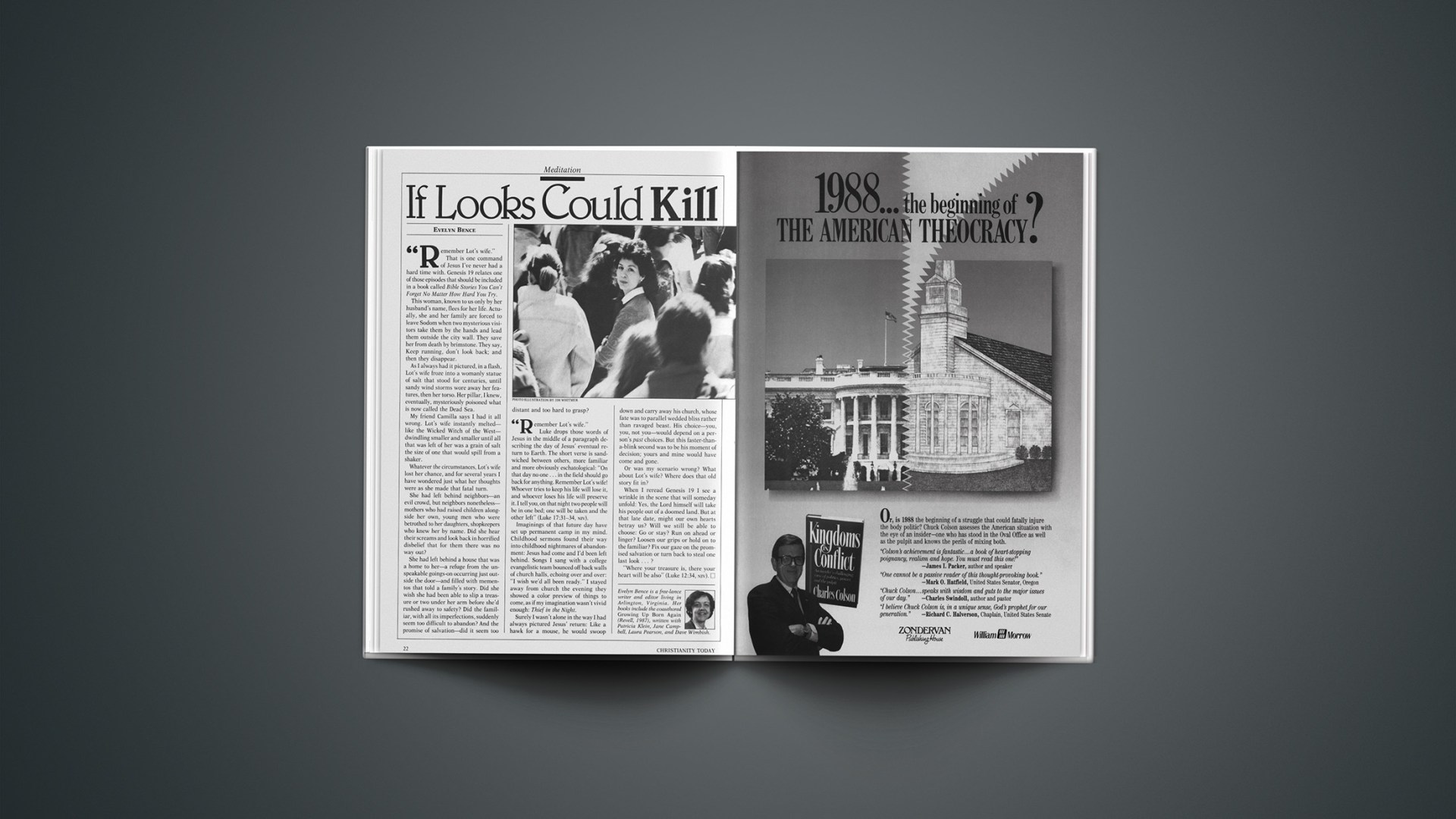
If Looks Could Kill

Remember Lot’s wife.” That is one command of Jesus I’ve never had a hard time with. Genesis 19 relates one of those episodes that should be included in a book called Bible Stories You Can’t Forget No Matter How Hard You Try.

This woman, known to us only by her husband’s name, flees for her life. Actually, she and her family are forced to leave Sodom when two mysterious visitors take them by the hands and lead them outside the city wall. They save her from death by brimstone. They say, Keep running, don’t look back; and then they disappear.

As I always had it pictured, in a flash, Lot’s wife froze into a womanly statue of salt that stood for centuries, until sandy wind storms wore away her features, then her torso. Her pillar, I knew, eventually, mysteriously poisoned what is now called the Dead Sea.

My friend Camilla says I had it all wrong. Lot’s wife instantly melted—like the Wicked Witch of the West-dwindling smaller and smaller until all that was left of her was a grain of salt the size of one that would spill from a shaker.

Whatever the circumstances, Lot’s wife lost her chance, and for several years I have wondered just what her thoughts were as she made that fatal turn.

She had left behind neighbors—an evil crowd, but neighbors nonetheless—mothers who had raised children alongside her own, young men who were betrothed to her daughters, shopkeepers who knew her by name. Did she hear their screams and look back in horrified disbelief that for them there was no way out?

She had left behind a house that was a home to her—a refuge from the unspeakable goings-on occurring just outside the door—and filled with mementos that told a family’s story. Did she wish she had been able to slip a treasure or two under her arm before she’d rushed away to safety? Did the familiar, with all its imperfections, suddenly seem too difficult to abandon? And the promise of salvation—did it seem too distant and too hard to grasp?

Remember Lot’s wife.” Luke drops those words of Jesus in the middle of a paragraph describing the day of Jesus’ eventual return to Earth. The short verse is sandwiched between others, more familiar and more obviously eschatological: “On that day no one … in the field should go back for anything. Remember Lot’s wife! Whoever tries to keep his life will lose it, and whoever loses his life will preserve it. I tell you, on that night two people will be in one bed; one will be taken and the other left” (Luke 17:31–34, NIV).

Imaginings of that future day have set up permanent camp in my mind. Childhood sermons found their way into childhood nightmares of abandonment: Jesus had come and I’d been left behind. Songs I sang with a college evangelistic team bounced off back walls of church halls, echoing over and over: “I wish we’d all been ready.” I stayed away from church the evening they showed a color preview of things to come, as if my imagination wasn’t vivid enough: Thief in the Night.

Surely I wasn’t alone in the way I had always pictured Jesus’ return: Like a hawk for a mouse, he would swoop down and carry away his church, whose fate was to parallel wedded bliss rather than ravaged beast. His choice—you, you, not you—would depend on a person’s past choices. But this faster-than-a-blink second was to be his moment of decision; yours and mine would have come and gone.

Or was my scenario wrong? What about Lot’s wife? Where does that old story fit in?

When I reread Genesis 19 I see a wrinkle in the scene that will someday unfold: Yes, the Lord himself will take his people out of a doomed land. But at that late date, might our own hearts betray us? Will we still be able to choose: Go or stay? Run on ahead or linger? Loosen our grips or hold on to the familiar? Fix our gaze on the promised salvation or turn back to steal one last look …?

“Where your treasure is, there your heart will be also” (Luke 12:34, NIV).

Evelyn Bence is a free-lance writer and editor living in Arlington, Virginia. Her books include the coauthored Growing Up Born Again (Revell, 1987), written with Patricia Klein, Jane Campbell, Laura Pearson, and Dave Wimbish.

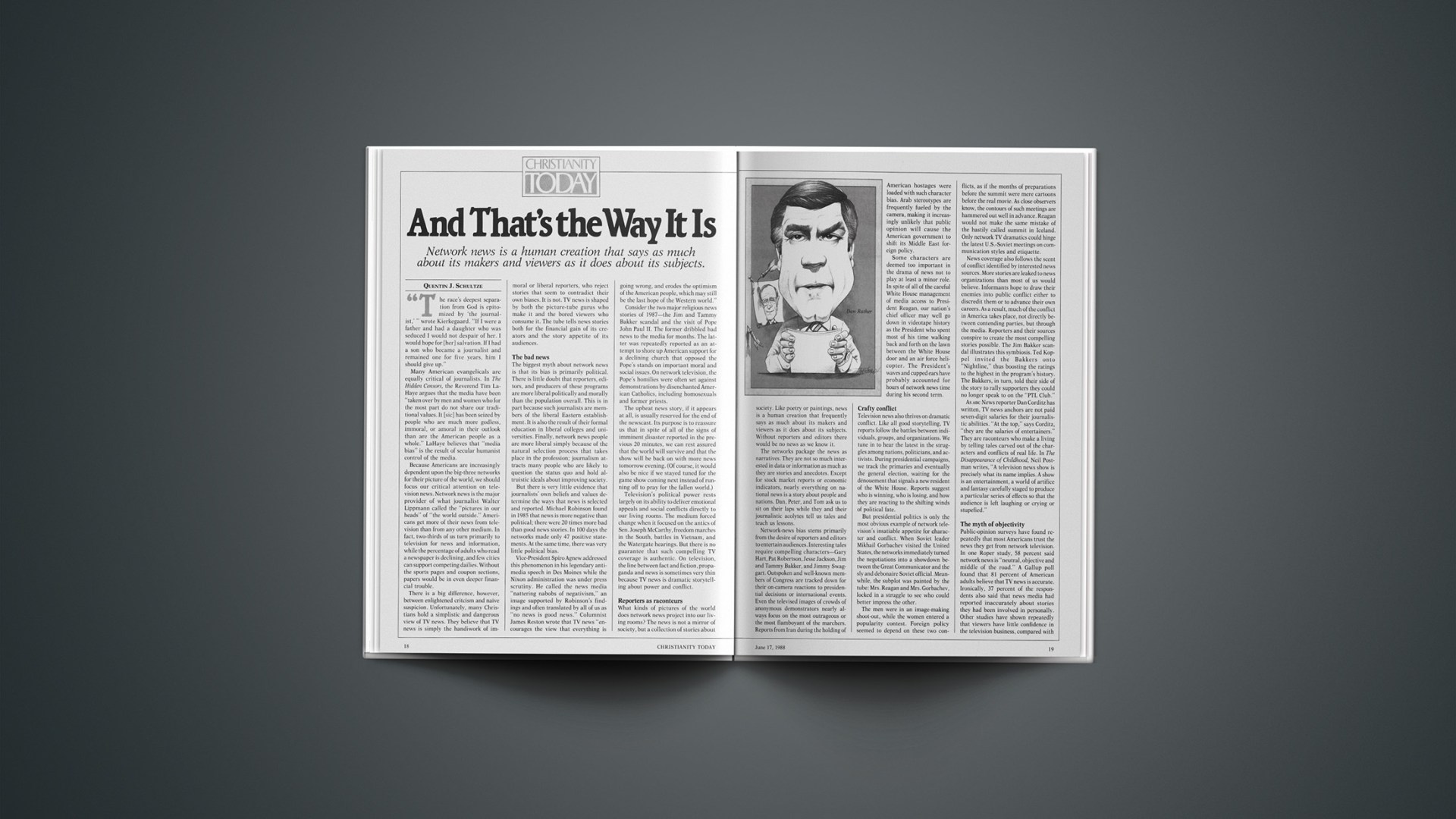
And that’s the Way It Is

The race’s deepest separation from God is epitomized by ‘the journalist,’ ” wrote Kierkegaard. “If I were a father and had a daughter who was seduced I would not despair of her. I would hope for [her] salvation. If I had a son who became a journalist and remained one for five years, him I should give up.”

Many American evangelicals are equally critical of journalists. In The Hidden Censors, the Reverend Tim LaHaye argues that the media have been “taken over by men and women who for the most part do not share our traditional values. It [sic] has been seized by people who are much more godless, immoral, or amoral in their outlook than are the American people as a whole.” LaHaye believes that “media bias” is the result of secular humanist control of the media.

Because Americans are increasingly dependent upon the big-three networks for their picture of the world, we should focus our critical attention on television news. Network news is the major provider of what journalist Walter Lippmann called the “pictures in our heads” of “the world outside.” Americans get more of their news from television than from any other medium. In fact, two-thirds of us turn primarily to television for news and information, while the percentage of adults who read a newspaper is declining, and few cities can support competing dailies. Without the sports pages and coupon sections, papers would be in even deeper financial trouble.

There is a big difference, however, between enlightened critcism and naïve suspicion. Unfortunately, many Christians hold a simplistic and dangerous view of TV news. They believe that TV news is simply the handiwork of immoral or liberal reporters, who reject stories that seem to contradict their own biases. It is not. TV news is shaped by both the picture-tube gurus who make it and the bored viewers who consume it. The tube tells news stories both for the financial gain of its creators and the story appetite of its audiences.

The Bad News

The biggest myth about network news is that its bias is primarily political. There is little doubt that reporters, editors, and producers of these programs are more liberal politically and morally than the population overall. This is in part because such journalists are members of the liberal Eastern establishment. It is also the result of their formal education in liberal colleges and universities. Finally, network news people are more liberal simply because of the natural selection process that takes place in the profession; journalism attracts many people who are likely to question the status quo and hold altruistic ideals about improving society.

But there is very little evidence that journalists’ own beliefs and values determine the ways that news is selected and reported. Michael Robinson found in 1985 that news is more negative than political; there were 20 times more bad than good news stories. In 100 days the networks made only 47 positive statements. At the same time, there was very little political bias.

Vice-President Spiro Agnew addressed this phenomenon in his legendary antimedia speech in Des Moines while the Nixon administration was under press scrutiny. He called the news media “nattering nabobs of negativism,” an image supported by Robinson’s findings and often translated by all of us as “no news is good news.” Columnist James Reston wrote that TV news “encourages the view that everything is going wrong, and erodes the optimism of the American people, which may still be the last hope of the Western world.”

Consider the two major religious news stories of 1987—the Jim and Tammy Bakker scandal and the visit of Pope John Paul II. The former dribbled bad news to the media for months. The latter was repeatedly reported as an attempt to shore up American support for a declining church that opposed the Pope’s stands on important moral and social issues. On network television, the Pope’s homilies were often set against demonstrations by disenchanted American Catholics, including homosexuals and former priests.

The upbeat news story, if it appears at all, is usually reserved for the end of the newscast. Its purpose is to reassure us that in spite of all of the signs of imminent disaster reported in the previous 20 minutes, we can rest assured that the world will survive and that the show will be back on with more news tomorrow evening. (Of course, it would also be nice if we stayed tuned for the game show coming next instead of running off to pray for the fallen world.)

Television’s political power rests largely on its ability to deliver emotional appeals and social conflicts directly to our living rooms. The medium forced change when it focused on the antics of Sen. Joseph McCarthy, freedom marches in the South, battles in Vietnam, and the Watergate hearings. But there is no guarantee that such compelling TV coverage is authentic. On television, the line between fact and fiction, propaganda and news is sometimes very thin because TV news is dramatic storytelling about power and conflict.

Reporters As Raconteurs

What kinds of pictures of the world does network news project into our living rooms? The news is not a mirror of society, but a collection of stories about society. Like poetry or paintings, news is a human creation that frequently says as much about its makers and viewers as it does about its subjects. Without reporters and editors there would be no news as we know it.

The networks package the news as narratives. They are not so much interested in data or information as much as they are stories and anecdotes. Except for stock market reports or economic indicators, nearly everything on national news is a story about people and nations. Dan, Peter, and Tom ask us to sit on their laps while they and their journalistic acolytes tell us tales and teach us lessons.

Network-news bias stems primarily from the desire of reporters and editors to entertain audiences. Interesting tales require compelling characters—Gary Hart, Pat Robertson, Jesse Jackson, Jim and Tammy Bakker, and Jimmy Swaggart. Outspoken and well-known members of Congress are tracked down for their on-camera reactions to presidential decisions or international events. Even the televised images of crowds of anonymous demonstrators nearly always focus on the most outrageous or the most flamboyant of the marchers. Reports from Iran during the holding of American hostages were loaded with such character bias. Arab stereotypes are frequently fueled by the camera, making it increasingly unlikely that public opinion will cause the American government to shift its Middle East foreign policy.

Some characters are deemed too important in the drama of news not to play at least a minor role. In spite of all of the careful White House management of media access to President Reagan, our nation’s chief officer may well go down in videotape history as the President who spent most of his time walking back and forth on the lawn between the White House door and an air force helicopter. The President’s waves and cupped ears have probably accounted for hours of network news time during his second term.

Crafty Conflict

Television news also thrives on dramatic conflict. Like all good storytelling, TV reports follow the battles between individuals, groups, and organizations. We tune in to hear the latest in the struggles among nations, politicians, and activists. During presidential campaigns, we track the primaries and eventually the general election, waiting for the dénouement that signals a new resident of the White House. Reports suggest who is winning, who is losing, and how they are reacting to the shifting winds of political fate.

But presidential politics is only the most obvious example of network television’s insatiable appetite for character and conflict. When Soviet leader Mikhail Gorbachev visited the United States, the networks immediately turned the negotiations into a showdown between the Great Communicator and the sly and debonaire Soviet official. Meanwhile, the subplot was painted by the tube: Mrs. Reagan and Mrs. Gorbachev, locked in a struggle to see who could better impress the other.

The men were in an image-making shoot-out, while the women entered a popularity contest. Foreign policy seemed to depend on these two conflicts, as if the months of preparations before the summit were mere cartoons before the real movie. As close observers know, the contours of such meetings are hammered out well in advance. Reagan would not make the same mistake of the hastily called summit in Iceland. Only network TV dramatics could hinge the latest U.S.-Soviet meetings on communication styles and etiquette.

News coverage also follows the scent of conflict identified by interested news sources. More stories are leaked to news organizations than most of us would believe. Informants hope to draw their enemies into public conflict either to discredit them or to advance their own careers. As a result, much of the conflict in America takes place, not directly between contending parties, but through the media. Reporters and their sources conspire to create the most compelling stories possible. The Jim Bakker scandal illustrates this symbiosis. Ted Koppel invited the Bakkers onto “Nightline,” thus boosting the ratings to the highest in the program’s history. The Bakkers, in turn, told their side of the story to rally supporters they could no longer speak to on the “PTL Club.”

As ABC News reporter Dan Corditz has written, TV news anchors are not paid seven-digit salaries for their journalistic abilities. “At the top,” says Corditz, “they are the salaries of entertainers.” They are raconteurs who make a living by telling tales carved out of the characters and conflicts of real life. In The Disappearance of Childhood, Neil Postman writes, “A television news show is precisely what its name implies. A show is an entertainment, a world of artifice and fantasy carefully staged to produce a particular series of effects so that the audience is left laughing or crying or stupefied.”

The Myth Of Objectivity

Public-opinion surveys have found repeatedly that most Americans trust the news they get from network television. In one Roper study, 58 percent said network news is “neutral, objective and middle of the road.” A Gallup poll found that 81 percent of American adults believe that TV news is accurate. Ironically, 37 percent of the respondents also said that news media had reported inaccurately about stories they had been involved in personally. Other studies have shown repeatedly that viewers have little confidence in the television business, compared with other businesses and institutions in society. Nevertheless, they believe the news. Walter Cronkite was voted the most believable man in America.

For most of us, TV news is objective when we agree with it. As long as the networks do not challenge our prevailing views, they are doing fine. Such attitudes suggest that public-opinion polls tell us nothing about the objectivity of network news and a lot about our own biases.

In fact, objectivity is a meaningless term to describe or evaluate news. Sometimes the word is used to suggest balance, other times fairness, accuracy, or factuality. No two journalists would ever report the same story in precisely the same way. Nor would two editors agree exactly on the importance or significance of thousands of possible stories to report on every day. There is no objective standard of news because news never defines itself. Someone always has to decide what is news.

A few years ago I asked the managing editor of one of the nation’s largest-circulation newspapers what percentage of the copy available to the paper on a given day actually hits the presses. After a five-second pause he said, “Well, at most, 3 percent.” That was a newspaper. Consider the state of network news, where the complete script for a program would easily fit on one page of a newspaper. Add to that all of the videotape or film footage left unused for every newscast. What could objectivity really mean in such an incredible process of distillation?

Yet night after night we see basically the same few stories, often reported from the same perspectives on the three major commercial-network news shows. Moreover, those stories also are reported on the front page of the New York Times. How could this possibly happen so consistently?

News Smarts

The answer is not objectivity, but conventional news wisdom. Over the years editors and reporters have decided what to report and generally how to report it. They have sent correspondents to some places (e.g., the White House), and not to others (e.g., the CIA). They have covered particular meetings (e.g., the Iowa presidential caucuses) while skipping others (e.g., the National Association of Evangelicals). Their coverage of some events has changed significantly even in the last ten years; only a few elections ago few major television reporters and anchors went to Iowa for the caucuses. If one of the networks introduces a new type of coverage, the others will usually follow; none wishes to be beaten in image or, more important, in the ratings.

As a result, much of American society is normally outside the lens of network news. This was true of evangelical Protestantism until the 1980 presidential election when the news media, unable to explain the overwhelming support for Ronald Reagan, searched for political answers in the actions of the Moral Majority, the Religious Roundtable, and other groups. Generally speaking, religious faith is not newsworthy unless it has obvious and easily reported connections to politics or social issues. Richard Neuhaus has appropriately called journalists “religious illiterates.”

But the limits of journalistic “objectivity” do not stop there. American network news is incredibly ethnocentric. As James R. Larson documents in Television’s Window on the World, our TV sets capture little of the scope of international affairs. From 1972 to 1981, 90 percent of all network news covered the U.S., the Soviet Union, or Israel. “This lack of network news attention to the ongoing struggle for social change and development in the Third World,” says Larson, “gives U.S. policymakers broad leeway to ignore, minimize, or postpone consideration of such problems.”

Promoting The Powerful

Modern network news is also tilted toward powerful individuals and institutions. In its day-to-day telling of tales, the news cares little about the weak and disenfranchised. Few New York or Washington correspondents could get to their offices every day without passing street people. Yet how often does what these journalists actually see appear on the nightly network stage? Little is mentioned about prostitutes or alcoholics, about the “unimportant” problems of depression, poverty, and even hopelessness. Instead we see and hear about “officials” in and out of government who are supposedly in charge of nations, states, and municipalities.

Similarly, the simple joys and pleasures of life are missing from the network news. How often do we see acts of kindness, expressions of love, or signs of generosity—except at the end of the “real” news? Thousands of sick and lonely people were visited by friends and pastors, but who really cares? Perhaps hundreds of thousands of Americans asked and were granted forgiveness for minor and major transgressions. Is forgiveness ever a significant news event? Many worshiped and prayed in churches and homes across the land. According to the network news lens of power, these are unimportant events in the life of the nation.

Could it be that the manifestations of power reported on television have little significance in the kingdom of God? Is the latest Washington scandal necessarily more important than the loving acts of Mother Teresa’s thousands of volunteers, the rehabilitation of convicted criminals through Prison Fellowship, or the feeding of the homeless at soup kitchens? Perhaps TV news is a parade of power and pride that masquerades as a mirror of authority and truth. Do we all fool ourselves by believing that people who appear on TV news are actually more intelligent, faithful, or compassionate than others?

Watching The World

In the novel and film Being There, author Jerzy Kosinski describes the emotionless world of a man raised on television instead of human love and nurture. “Chance” never learns how to relate to others and to shape the world around him. In biblical terms, he lacks both dominion and responsibility for creation because he simply assumes that the real world is entirely separate from his own being—just like television programming, which remains the same regardless of whether we watch. He cannot act, but only react; like the ideal television viewer, he sits passively before life, unable to do anything significant except change the channel.

As Richard Neuhaus has written in The Naked Public Square, news gives us the illusion of power. Because it reports on supposedly powerful individuals and institutions, network news generates the false impression that we actually participate in the tales told. In fact, we participate only vicariously in the news. Like Chance, we merely react to the “important” stories at the appointed times. The power displayed on the tube eclipses our own authority as caretakers of creation and brothers and sisters of mercy, justice, and peace.

Of course, there are unusual television news stories that bring people together: a girl trapped inside a well for several days, the assassination of a President, the outrageous taking of innocent hostages by terrorists. However, these stories also suggest the powerlessness of the audience. We might send a get-well card or a gift. But mostly we sit and watch, hoping and praying that good will come out of tragedy. We are largely spectators of a world narrated by the networks.

At the end of Being There, Chance is about to enter politics at the top as a presidential candidate. Politicians and the media have unwittingly conspired to create a convincing public image for a man who lacks any human trait. In real life he is a nobody; on the tube he is a celebrity. Chance fools the public only because he has first fooled the CIA and the media moguls, who cannot find anything on him in their files. He is the only possible candidate without known faults or political liabilities. His authority stems not from what he has accomplished or from political connections, but from his own powerlessness.

In their quest for “the story” behind Chance, the media create a real-life tale of political absurdity. The problem is that the media do not see their own role in propelling Chance into the national political limelight. For them Chance is merely another powerful character worth a news story. The media never realize they gave Chance his authority. As the national storytellers, they created the very story they claimed only to be reporting.

Network news reporters receive their authority from the faithful audiences measured in ratings. But do they really deserve such power to define news? During 1988 many political pundits argued that the presidential campaign was unique because neither the political community nor the news media knew what would happen as the election drama unfolded. Larry Eichel of the Philadelphia Inquirer sees it differently. “The truth is that we never have any idea what is going to happen,” writes Eichel. “What makes the 1988 campaign unique is that this time we know we have no idea of what is going to happen. That awareness of our limitation just may be our saving grace.”

Someone must decide the news, and it is certainly not going to be the viewer, no matter what the ratings suggest. Today network reporters have the authority to tell stories to passive audiences. Like Roman citizens, we wait to see what spectacles will be unleashed for our amusement and entertainment. When the lions are done, we leave the arena and return to what the public media have convinced us are dull lives. Fortunately, tomorrow will usher in new tales created just for our pleasure. And that’s the way it is in a fallen world.

Quentin J. Schutze is professor of communications arts at Calvin College, Grand Rapids, Michigan. He is the author of Television: Manna from Hollywood? (Zondervan).

Ideas

Reckless Spending

The church community is crucial if we are to use our money responsibly.

In a 1987 Gallup Poll of evangelicals, five of the top seven issues considered the “most important problems facing the nation” fell into economic categories. And in a more recent survey of CHRISTIANITY TODAY readers (see p. 50), balanced budgets and budget deficits rank high on a list of concerns voters have heading into November’s election.

Crisis and confusion are the undercurrents of these pervasive concerns. Presidential candidates talk long and hard about remedying them—yet leave a bewildered electorate with little more than vague promises and the now-clichéd call for “financial responsibility.”

But what exactly is financial responsibility, anyway? And whose responsibility is it in the first place? Can good economic sense be discerned in a society whose individual spending habits and checkbook balances add up to fiscal ruin?

In fact, though government is hardly free of blame, the root cause of our economic malfeasance is us. Unless voters are individually called to their economic senses (an almost suicidal move for any would-be president), we cannot expect government or its leaders to lead us corporately into the pathway of financial responsibility. In short, if we really are concerned about finding answers to our current economic problems, we need first to save ourselves from ourselves.

Spending Frenzies

Two well-known consumer enticements underscore just how far we have taken leave of our economic senses.

The first is the lottery. Capitalizing on the universal dream of financial security, 23 states now offer their citizens an assortment of get-rich-quick games, with cash prizes ranging from extra tickets to multiple millions of dollars. And, oh, how the citizenry has responded. In 1985 alone, over $10.2 billion worth of tickets were purchased (over $180 billion if all betting receipts are included). Of course, one might expect the fact that a large percentage of the games’ participants are at or below the poverty level would give state officials pause. Think again. Even as you read this, bigger and better games (at greater odds) are being devised to lure larger chunks of the public’s cash—giving the states’ coffers, and the states’ citizens, what they want. Said one ebullient lottery official recently on the announcement of a new version of her state’s Lotto game: “We really think there’s a game for everyone.”

If there isn’t, that only means, of course, there is more money to be spent on a second passion that is almost out of control: consumer buying. Yuppie spending habits may be the talk of the media, but all Americans seem intent upon growing “another day older and deeper in debt.” And, of course, we are encouraged by advertisers and bank-card promoters to do just that.

Perhaps the most striking manifestation of our “shop til you drop” ethic is the Home Shopping Network and its multiple spin-offs. While only 20 percent of Americans have ever seen any of these mostly cable celebrations of salesmanship, and only half of them have ever bought anything “off the air,” those faithful few are spending in excess of $1.3 billion on everything from cubic zirconia jewelry to nonstick cookware.

“It’s captivating,” according to “Bubblin’ ” Bobbi Ray, one of the four salespersons for HSN’S “Home Shopping Club.” “After a while it becomes addictive—and a lot of that is not necessarily just the merchandise or just our influence. It’s the people themselves. It’s their enthusiasm and excitement that create the frenzy.” Writes media critic Kenneth Clark: “If it is not just a fad, [it] may be the most dynamic industry to emerge in the 1980s and [bring about] a profound change in the way Americans spend their money.”

Bummed And Bored

Unfortunately, reckless spending is a sin no less common in the church than the state, binding the saintly and the secular with a cubic zirconia tie. While evangelicals, as a rule, may shy away from picking weekly winning numbers, they are as subject to consumer passions as the next credit card holder. We have even established our own “consumer markets” to which we can covenant our cash and credit.

The Jim Bakkers are only the most obvious cases in point. There are other “ministries” that ultimately serve no other purpose than to secure a profit and, in so doing, exploit the donor’s already deadened sense of financial responsibility. “[Evangelical Christians] give and give and give with the false assumption that every appeal made in Christ’s name is legitimate,” bemoaned one parachurch leader. “I wish such were the case, but it just isn’t true.”

According to psychologist Gary Stollek of Michigan State University, the people who send money to television evangelists do so for the same reasons others purchase the products featured on home buying programs. They give of their finances so indiscriminately because they suffer from boredom and loneliness.

“Purchasing these products gives them the same sense of belonging,” Stollek says, “a sense of community.” It is a sense, if we read between the lines, that the evangelical donors are evidently not getting from their local churches.

Psychologist Stollek thinks men and women are desperate to make contact with the world, to feel a part of a community whose values give meaning to their own lives—even if that meaning translates to something as shallow as “shop til you drop.”

Community Giving

If Stollek is right, giving people a community to belong to may well be the first step in building a consensus regarding the meaning of financial responsibility. And there is no better institution for moving us toward this much-needed economic understanding than the church.

Although too infrequently heeded, the teachings of the church on money are clear: When our point of reference is service to others, we strip materialism of its mystique and majesty. (It becomes a servant rather than a taskmaster to be served.) And only when we put the physical, emotional, and spiritual needs of others above our own—a modern-day contradiction understood only through the love of Christ for mankind—does a responsible use of our materials even become a possibility.

This is the fiscal vision of the church, and one that must be actively promoted within the context of the body of Christ. Indeed, the church’s real challenge is not so much to reiterate (for the eight-millionth time) the parable of the good steward, or to underscore the importance of the tithe, as it is to breathe new life into these biblical teachings in the context of what it means to be an integral part of a living, loving community: What I do with my money does have an impact on someone else, for good or ill.

It is this relational identity that gives the believer an understanding of what individual fiscal responsibility is all about. And that makes the church as community an economic answer whose time has come.

By Harold B. Smith.

Swaggart’S Worst Enemy

Jimmy Swaggart has no one to fear so much as himself. The fact that he is already back in his television pulpit proves it.

Swaggart’s scandal hurt the church—especially his erstwhile denomination, the Assemblies of God. But the Assemblies has shown itself a Christian body of truthfulness and grit; it is not easy, especially in a nation so given over to flash and cash, to confront one of your denomination’s richest benefactors. The Assemblies did so anyway. And because the Assemblies stuck to the best of its biblical and denominational tradition, we can gladly expect it to heal.

Jimmy Swaggart, on the other hand, is not so certain a candidate for healing. Swaggart’s flouting of the denomination’s discipline is symptomatic of a misguided individualism that infects the entire American church. Swaggart is not the first Christian to leave a church or denomination with specious reasons. Too often, in the spirit of an extreme individualism, the grand Reformation doctrines of sola Scriptura and sola fidei have been turned into pitiful escapes from responsibility and accountability. Each man can now take up his Bible and his faith and use them to his advantage, no matter how transparently self-serving his endeavor.

Cases like Swaggart’s indicate just how much we need to restudy and then take seriously the New Testament doctrine of the church. The New Testament is replete with counsel to look to the good of the church as a body, to seek and respect the judgment of fellow Christians, to check our overpowering human propensity for self-aggrandizement with a concern for other believers (see Phil. 2:1–4).

Church discipline, rightly understood, is not undertaken to humiliate sinners and bolster the smugness of gloating saints. Rather, it is an attempt to heal and reconcile the entire body, including the particular sinner in question. The well-known disciplinary confrontation recommended in Matthew 18, for instance, has as its aim to “win over” the sinning brother (Matt. 18:15). The basic Christian attitude is that as long as one part of the body suffers, the entire body is hindered (1 Cor. 12:26).

Swaggart’s misdeeds were clearly the actions of a troubled man. What he needs now is sustained, long-term spiritual and psychological counseling, set in the context of an encouraging, loving circle of peers. But propelled more by a contemporary spirit of individualism than of biblical community, Swaggart has departed the healing circle.

He has isolated himself from those who could have helped eventually restore his ministry with integrity. Swaggart was too impatient, too friendly with power, too short-sighted to see beyond his immediate desires and goals. Back on camera, he is holding the Bible aloft and shaking it and shouting over it as vigorously as ever. Those who were unsympathetic to the man’s preaching always found it easy to mock. Today the most damaging critic and most hurtful enemy of Jimmy Swaggart is Jimmy Swaggart.

By Rodney Clapp.

Green Bananas Beat Big Macs

Receiving a standing ovation is nothing new to the African Children’s Choir. But offering one is new to the inmates at Chicago’s Cook County Jail. For the 24 Ugandan children, ages ranging from 5 to 14, the inmates made an exception. “Even when the entertainment is amateurish, the inmates are polite,” said Spencer Leak, the prison’s executive director. “But they recognize real talent when they see it.”

The inmates “saw it” in these small African ambassadors. Spontaneously, the men rose, clapping to the beat. They stood—six, seven, eight times—beaming, as songs would end. Hardened hearts crumbled. The children performed some of the numbers in their native African tongue. No matter. Their spirit overpowered their foreign words. The choir ought to visit more jails.

And perhaps, as many who hear this choir believe, there ought to be more jails in Uganda: jails for those responsible for the seemingly random massacres of the 1970s and early 1980s that left tens of thousands of children parentless. Perhaps there should be a jail for those who killed the father of a nine-year-old choir member named Miriam. Soldiers broke into her home and gunned the father down in full view of his family.

Miriam offers her testimony at choir concerts: “My country had many soldiers. Some of them were dangerous. They pointed guns at people and killed them.” She continues, “We are small children, who belong to a different army. We are soldiers in the army of the Lord.”

The other young soldiers tell similar stories of how they lost one or both parents. Their childhood memories are pervaded with guns and blood. “The inmates identify with these children,” said Leak. “Most of the inmates here, if they came out of any home at all, came from a one-parent home. Everyone has a story to tell and wants to tell it.”

It was for children like Miriam that Ray Barnett, a human-rights crusader born in Northern Ireland, formed Ambassadors of Aid in 1984, the organization behind the African Children’s Choir. The first choir left Uganda in September of that year and toured Canada, the U.S., Europe, the United Kingdom, and Holland before returning home early in 1986.

The second choir conducted a similar tour from November 1985 to June 1987. A third choir left Uganda in the autumn of 1986 and returns this year. A fourth arrived in the U.S. in January.

The children sing in churches, schools, and public auditoriums. Proceeds go toward Ambassadors of Aid children’s homes for orphans in Uganda. Currently there are six such homes, housing an average of 25 children.

The money also goes toward the African Outreach Academy, a school that travels with the children. Adult chaperons from Uganda serve as teachers. For the children, learning is almost recreation. Some request a later curfew just to study. They know an education is a privilege, inaccessible to many back home.

“In addition to the formal education,” says Sarah Konde, a teacher who traveled with the second choir, “they learn a lot from their surroundings. Many want to go home and build highways. They want to be doctors, lawyers. And so they work hard.”

Often the children speak in their native tongue. It is part of a careful effort to keep them culturally Ugandan, even though they, like American children, are magnetized by the golden arches of McDonald’s. One way to preserve their culture is to limit their exposure to television. Hosts who provide homes for the children are instructed, “No TV.”

One reason for this is because they take it too seriously. Some of the children, after viewing Chitty-Chitty Bang Bang in Europe, expected to see flying cars when they got to America. But the main reason, says chaperon Paul Sendi, is that “not all TV is right for children.” He adds, after a pause, “Or for adults.” In other words, Ugandans don’t need any more reminders of violence.

The children do not miss television. Says choir director Gary Oliver, “Ugandan children are different from children in the U.S. or in Europe. They are very well disciplined. They seem to have great respect for God and the things of God. Sunday school is not just a requirement. They enjoy it. It’s an important part of their lives.”

Yet the children’s preconcert antics testify that they are somewhat normal after all. A boy tugs on a girl’s dress during breathing exercises. Another pretends to pound on his neighbor’s head to the sound of the drums. They fidget and giggle. “Children,” says Oliver, sternly. And order returns.

That these children are normal is the amazing part of their story, given the tragedy of their brief lives. Says Paul Sendi, “They don’t think of the past. Part of it is that they’re always occupied. There is always something new for them to see or do. But much of it is attributable to what God has done in their lives.”

And what God has done for them, he does through them for others. At one home where some of the children stayed, a father had been out of a job for a long time. The children prayed in simple faith, and soon he got a job. In another home, a marriage was falling apart. The children’s witness provided strength for another try.

Their concerts, too, are testimonies, celebrations. Joyfully, they sway, raising hands, clapping, as they proclaim their message in song: “Jesus Is the Answer,” “He Is Coming Soon,” “He’s Got the Whole World in His Hands.” Inevitably someone will come forward afterward with a request to adopt one of the children. The answer is always no.

“These children belong to Uganda,” says Barnett. “They’re Uganda’s national treasure, the hope of its future.” And so the time comes—as it has for some already—when the children will forgo a Big Mac in favor of the green bananas of their homeland. They know Uganda is where they belong. That country needs these young soldiers for the Lord.

By Randall L. Frame.

Lead! Lead! Lead!

Good leaders are a scarce commodity: That is a modern-day maxim true for both our nation and the church. (Indeed, the bigger the church, the greater the need and, alas, the greater the dearth of potential leaders.)

In this regard, I shall never forget the ringing challenge with which Chuck Swindoll concluded his message to the leaders of my denomination at our annual conference a couple of years ago.

His clarion call: “Lead! Lead! Lead!”

Leadership is a delicate balance of opportunity, natural talents, training (education in the broadest sense), spiritual gifts, and the willingness to take advantage of those opportunities and use those talents and gifts to attain goals—either good or bad—through the common efforts of many.

Leadership, moreover, involves risk taking. No leader bats 1.000 in his or her decision making. The important thing, however, is to stay above .500. That means every realistic leader faces the risk of what most people will reckon to be failure. But when Christians strike out, they don’t need to fear destruction. They possess a safety net in the divine promise of Romans 8:28: God will work out for his ultimate good what all others may deem to be failure.

On occasion, a true leader can also find himself in terrifying isolation. But he is never really alone. He has a God who “sticks closer than a brother.” He can pray to God with assurance that he will be heard, and that the Holy Spirit will grant strength and sustain him along the most trying path.

Good leaders are always servants—and servanthood poses no threat to the Christian’s sense of self-worth and self-respect. In his incarnation God himself presents the Christian with a model of true servant leadership.

It would seem, therefore, that Christians have a “built in” leadership advantage. Why, then, are there not more evangelical leaders?

No doubt there are many possible explanations. But there is one serious handicap to which evangelicals are especially liable. It is their inability to distinguish between compromising convictions and moderating actions.

While it is always wrong to compromise convictions (they are never to be grounded in expediency, but ultimately on the authority of the Word of God and the illumination of his Holy Spirit), in a fallen world we must often be willing to do less than we would like to. It is not always a compromise in conviction to moderate our action so as to work with others to accomplish lesser goods that also need to be done. Unwillingness to moderate our action often means we get nothing done.

One example here will suffice: Evangelicals are almost universally opposed to pornography. But our society fears the loss of freedom of speech and press more than it fears pornography. Hence, strict laws against pornography are difficult to pass and even more difficult to enforce. Yet most Americans are strongly opposed to child pornography—and would gladly unite in stern enforcement of strict laws against it.

Evangelicals, therefore, should concentrate their opposition on child pornography. And every time they speak against child pornography they should speak twice as loudly against infringements of freedom of speech and press. By moderation of our efforts in this way, without any compromise of conviction whatever, we could quickly rid our society of most child pornography—the worst and most dangerous of all forms of pornography.

The evangelical church, our nation, and the society in which we live all desperately need capable leaders in our day. Evangelicals are peculiarly equipped to provide that leadership—leadership of moral integrity, principled wisdom, and solid commitment to minister sacrificially for the good of all. Evangelical leaders must never (and need never) compromise their God-given convictions. But within those convictions, they must be willing to moderate their actions if they would minister effectively in a fallen world.

Letters

Israel at 40

I was pleased to read the editorial “Israel at Forty,” by David Neff [April 22]. Having lived and worked in Jerusalem for seven years, much of that time within a hundred yards of the Church of the Resurrection (Holy Sepulchre), I found particularly apt the illustration of the status quo agreements governing the different church groups using that site for worship. The regulations may seem petty, and the outsider may see them as reflective only of disorder and disunity. But the more one experiences the life and worship in the church, the more the rules become a celebration of diversity and reflection of real differences that cannot be compromised but only held in tension. So also will an eventual Israeli-Palestinian accord have to be seen, and the result accepted, not as a complete peace and reconciliation—but as an agreement to live in tension and tentative recognition of one another’s reality, hoping that future generations may find new ways to co-exist.

JOHN A. LUNDBLAD

King of Kings Lutheran Church

Oceanside, Calif.

The Jews have a historic and legal right to the land. Palestinians have never had a homeland, and until recent events, never sought one. Just to identify a “Palestinian” is fruitless; but if we mean the Arabs in the occupied areas of Israel, the Israelis have treated them better than their brother Arabs who refuse to assimilate them, or to offer them refuge. However, they are quick to use them for cannon fodder in their effort to eradicate the nation of Israel. As long as it is the stated purpose of Arabs to eliminate the Jewish state, justice cannot be served.

A. C. JACOBSON

Central Baptist Church of Joy

Spokane, Wash.

We who are Christians in America should realize we are dealing with Semitic peoples. Both the Arabs and the Jewish people are the descendants of Isaac and Ishmael; we cannot be anti-Semitic unless we are unfair to both sides at once. We should have no guilt trip about the Israelis as we watch the nightly news.

LEON G. JOHNSON

Bath, N.Y.

I cannot believe your editorial. Israel offered Gaza to Egypt after the Six Day War, but Egypt would not accept. Lebanon was the only Arab country to take in Palestinians, and they have destroyed that country. The Jews are not always right, but pat solutions are easier to offer than to put into practice.

ROBERT T. AND JOAN S. DAGGATT

Hemet, Calif.

I would like to raise some questions:

1. If you cast away the biblical interpretation of Israel’s right to the land because it is a “historically late interpretation,” are you willing to do the same with the doctrine of justification by faith?

2. While you lamented the 200 Arab men, women, and children killed at Deir Yassin, why did you fail to mention the historical background that led up to this incident?

3. Neither did you mention the more than 500 PLO terrorist attacks that have left 400 Israelis dead and 2,000 wounded. Why? Nor did you mention the additional 557 PLO terrorist attacks on Israelis and Jews outside of Israel that killed 55 Israelis and 444 non-Israelis. Is this of any concern?

4. Why did you not mention that the PLO constitution calls for complete destruction of Israel, a position the PLO has never repudiated?

5. You fail to deal with the issue that the Jewish people were literally forced out of their homeland over 1,900 years ago. Is this just? If you want Israel to live by your standard of justice, are you willing to live by it, too? Will you press the U.S. government to return large tracts of land taken from the Indian nations of America? Will you and your family move back to Europe so this can happen?

REV. TERRYL DELANEY

Grace Community Baptist

Washingtonville, N.Y.

Not-So-Personal Opinions

In this election year, hardly a day goes by that we don’t hear the results of some opinion poll. Measuring public opinion has become an exacting science.

But really, all this demographic wizardry wouldn’t be necessary if pollsters knew a simple secret thousands of church members have known for years. If you want to get a reliable measurement of people’s thoughts and feelings—if you want to find out what’s really happening—all you have to do is join a prayer chain.

I am the seventh person to be called on my church’s prayer chain, and in a recent week I learned these facts:

• Five out of six members, a full 83.33 percent, felt last Sunday’s special music group was too loud.

• Four of six believe Claire must still be sick, since she wasn’t in church on Sunday, and wasn’t supposed to visit her aunt in Cleveland until next week.

• Half the church (three of six respondents) is upset that choir rehearsal got moved to Tuesday night, because the handbell choir meets that night—and what if somebody wants to do both?

Think of what pollsters could learn if they joined prayer chains! And best of all, they might wind up praying, and in the process they would talk to Someone who, too often, is not asked for his opinion.

EUTYCHUS

The President’s friends

I cannot remain silent in the face of your attack on Attorney General Edwin Meese [“All the President’s Friends,” Editorial, April 22]. What you say about the need to choose public servants for competency rather than ideological purity is fine. But precisely what is (not might be) Meese’s “latest gaffe”? Scripture presumes a man innocent until proven guilty. You don’t apply that standard to Meese.

Meese has done more to help fight such problems as pornography, organized crime, and illegal drug traffic than any other attorney general in recent memory. He has brought important questions about constitutional interpretation to the foreground. He has cooperated with evangelicals. If he is indicted, it will be for “offenses” from which Congress has made its own members immune. And for the record: Ray Donovan was indicted—and acquitted—on charges so flimsy that the judge chewed out the prosecutor.

E. CALVIN BEISNER

Pea Ridge, Ark.

Paul was no psychologist!

James Dobson, like “Christian psychologists” generally in the organized church [“His Father’s Son,” April 22], is successful for the very reason that he avoids biblical and theological precepts in his approach. He thus subtly panders to the multitudes within Christendom who have rejected the Scriptures and sound doctrine in favor of having their ears tickled by the myths and quick fixes of the pseudo-science of psychology. Not one of the Old Testament prophets was a psychologist. Neither was Jesus nor any of his apostles. Paul the apostle was not a psychologist. Whence, do you suppose, does Dobson draw his inspiration?

MURL MING

Mabelvale, Ark.

Disregarding Christian influence?

“Bottom-line Morality” [April 22] is good reading, and I appreciate the insights of Dennis Vogt and Warren Brown. However, it should surely be evident that bottom-line morality is more easily kept by the Christian who sees God’s purpose. Humanistic values do not include God, and persistently preach away from such commitment. The fearful inclination of “Bottom-line’s” rhetoric to shy away from giving Christian influence its proper role in the strength of this nation is an inadvertent step into the humanists’ camp.

J. RUSSELL BURCHAM

Kennett, Mo.

Defending the status quo?

After reading William Willimon’s article [“An Offering of Slogans,” April 22], I felt I had to respond to what appeared to be a thinly disguised defense of the status quo. His claim that justice awaits definition is patently false except in a purely Platonic sense. My six-year-old has a keen sense of justice. “That’s not fair” is a rallying cry of the playground. Without this conceptual ability, we would be unable to treat one another fairly, or attempt to change our world for the better.

Willimon seems to suggest that we should not attempt to change our world at all. He implies that this activity is strictly the domain of God. Not only is this premise absurd, it is unscriptural. How does he explain or justify the role of the church in the abolitionist movement of the last century or any of the other reform movements of history? Were these activities mere human meddling?

GERALDINE LUCE

Groton, N.Y.

Willimon is right to caution us that our zealous and sincere efforts to follow Christ may become ideologically rigid. But that does not seem nearly as great a danger as a church that has no vision for being that alternative community where God’s passion for peace and justice is fully expressed.

EDGAR METZLER

Mennonite Board of Congregational Ministries

Elkhart, Ind.

Ground-breaking AIDS coverage

Your cover story, “AIDS in Africa,” [News, April 8], is a ground-breaking, and most welcomed, recognition of the extraordinary diversity and complexity of the HIV epidemic. Thank you for helping make the African portion of the tragedy far more visible. We Americans are largely unaware of the special devastation of the disease on Central African countries. And the tragedy is compounded by our silence and inaction in being attentive to the special challenges the African experience poses for U.S.-based religious leaders. Your attention to this aspect of the epidemic is timely and powerful.

B. J. STILES

National Leadership Coalition on AIDS

Washington, D.C.

Come on, CT, let’s call a spade a spade! Is it the prostitutes who are the major transmitters, or the people who use prostitutes who are the major transmitters? If no one used prostitutes, they would not be major transmitters.

ELIZABETH DEKAM

Sierra Madre, Calif.

Thank you for your article on AIDS in Africa. Accurate, restrained, and compassionate reporting like this is sorely needed in what is written about the disease, both in Africa and here in North America. As a physician involved in the treatment of patients with AIDS and AIDS-related diseases here in the U.S., and in preparing to become a medical missionary in East Africa, I feel this disease provides a golden opportunity for the church to show compassion to the world. I pray that we evangelicals will not miss this opportunity.

DAVID G. THOMAE, M.D.

Pensacola, Fla.

Three statements in the accompanying article, “Missionaries in Africa Are Not Immune to AIDS,” need clarification. First, a photo caption states that “the fight against other diseases may be spreading AIDS.” What is true is that inadequate techniques of sterilization used by certain persons in campaigns of immunization may be spreading AIDS. Second, you report the Johns Hopkins School of Public Health is aware of six missionaries who apparently tested positive for the AIDS virus. This is without documentation and should be clarified. Third, you report the opinion of an unnamed medical adviser of a mission organization that “hundreds of missionaries may be infected with the [AIDS] virus,” but he then admits that no studies have been done to document this. The opinion is without scientific or statistical justification and needs immediate clarification on your part.

DANIEL E. FOUNTAIN, M.D.

Wheaton College

Wheaton, Ill.

Dr. Fountain is correct in noting that “inadequate techniques of sterilization” in the fight against some diseases may be spreading AIDS. As for formal documentation, our reporter discovered and reported that part of the problem in dealing with AIDS among missionaries is a serious lack of such documentation.

Eds.

If King were alive …

In “What Would He Do Today?” [April 8], David McKenna suggests that if Martin Luther King were alive today he would have a political agenda similar to Jesse Jackson’s. He besmirches King’s name. King was aware of the appeal of communism to oppressed people, but he rejected its empty promises. He was no dupe, no “useful idiot.” He did not embrace thugs like Castro or commend Che Guevara. Nor did he despise Christian civilization and chant with Stanford students: “Hey, hey, ho, ho. Western culture’s got to go.”

MICHAEL BRAY

Ray Brook, N.Y.

I was disappointed in the sparse coverage of the anniversary of Martin Luther King’s assassination. Surely the significance of this anniversary of a Baptist minister who helped our nation start cleansing itself of the sins of discrimination and racism merited more than a page and two-thirds in the News section.

GLENN F. ARNOLD

Wheaton College

Wheaton, Ill.

A new recruiting policy?

Your article “Will Christian Colleges Survive the Dollar Pinch?” [News, April 8] has a comment which puzzles me. What do you mean when you say, “A trend away from separatism—which characterized many evangelical institutions years ago—may open the doors of schools to students who had not previously considered attending a Christian college”? Is this a recruiting policy? Do you mean evangelicals who have recruited from liberal churches either by accepting unsaved students or by minimizing the difference between liberal leadership and evangelical leadership? Or do you mean evangelical colleges are inviting unsaved faculty members and unsaved trustees to their institutions?

JOHN R. DUNKIN

The Master’s College

Newhall, Calif.

No wonder Barrington College went under! All this time everyone, including CT, thought it was in Massachusetts. C’mon, folks! Rhode Island may be the smallest state, but it’s too great a place to be ignored. Barrington, Rhode Island, was the home of Barrington College before its merger with Gordon College.

PHIL MADEIRA

Nashville, Tenn.

Christians who need help

Thank you for “The Mind Doctors” and “The Cross and the Couch” [April 8]. It is time we realized Christians can have mental health problems and that there are professionals who can help. I have been seeking a graduate school that would offer an integration of theology and psychology; to my amazement, I received a lot of flak. Only Fuller Theological Seminary offers this. By and large, there is little offered for those of us who desire to integrate these two disciplines.

RICHARD BRANFORD

Jackson, Tenn.

“The Mind Doctors” only scratched the surface of many facets of our relationship with God and the issues of ministry. Where we stand before God factually (theology) and where we stand before God emotionally (psychology) consume much of our resources. Just as theology cannot be fully understood except as we see God in relationship to man and man in relationship to God, so psychology cannot be fully (accurately) understood except as we see man in relationship to God and God in relationship to man. We may have come a long way in our understanding of these issues, but much ground yet needs to be broken.

REV. FREDERICK C. NOSE

DeWitt Community Church

DeWitt, Mich.

The writers of “The Mind Doctors” said of us that “most of their critique centers on the fringes of psychology—with the fringes thus representing all psychology.” Besides the therapies they list, we critique the following in our book Psychological Way/The Spiritual Way: (Freud); client-centered therapy (Rogers); reality therapy (Glasser); and transactional analysis (Harris). According to a survey we did in cooperation with the Christian Association for Psychological Studies, these have been the most influential therapies in the practices of Christian therapists. Our books, including our recent PsychoHeresy, are criticisms of mainline, not fringe, psychotherapy on the basis that it is not science, is not proven to be effective, and is known to harm. The use of psychotherapy and the underlying psychologies in the church is not justified from either a scientific or biblical point of view. When used, it is always a slam at the sufficiency of the Word of God.

MARTIN AND DEIDRE BOBGAN

EastGate Publishers

Santa Barbara, Calif.

The phrase “all truth is God’s truth” has become a platform for delivering some new truth of God’s not found in the Scriptures. God’s truth is found in the Holy Bible alone. All “truth” is not God’s truth. Any time this deceptive banner appears, it should alert all Christians to what at best can only be man’s truth.

DAVID L. GREENE

Jefferson, Mass.

Of baseball and atonement

I was provoked and enriched by Tim Stafford’s article [‘Baseball and the Atonement,” April 8] as he draws an analogy between the identification process of a sports fan with his team and a believer’s identification with Jesus’ activities on his behalf. However, the analogy never answers all the questions proposed early in his article. How one man’s death can reach across 2,000 years to touch another person is creatively illustrated by his analogy because it deals with the process as it is in the heart and mind of the believer. Yet, how one person can carry another’s sin or how one person’s righteousness can lead to another’s forgiveness is not covered by the analogy because these things deal not with what goes on in the mind and heart of the believer, but in what goes on in the mind, heart, and activity of God. As believers we acknowledge Jesus as both our Christ and God’s Christ. Our atonement was first and primarily God’s atonement. Its efficacy for us exists because God was in Christ working his work for us.

There are two identifications. Stafford deals with our identification with him who gave himself for us; the other is greater and more significant because it is God’s identification with us who had forsaken and even hated him. I doubt Stafford intended to confuse the two, only to illustrate the one. I am indebted to him, for I shall surely “steal” the illustration in a sermon.

THOMAS C. SORENSEN

Aurora, Colo.

Stafford’s article was not only utterly ridiculous as an analogy, but also perilously close to being heretical. Identifying with Jesus, like identifying with the Oakland Athletics, Stafford says, effects vicarious benefits for us. We are not saved, however, by being fans of Jesus. What Stafford says of Jesus could be applied to any other great personality of history and in no way distinguishes Jesus as unique.

RANDALL E. OTTO

Dublin, Pa.

Tea and Soda

For the third time in as many years, the Christianity Today Institute looks at the work and witness of the church in another land.

The decision to make Egypt the institute focus for 1988 came as a result of our desire to see how Christians cope in a land where the majority of “believers” are Muslim. Other Islamic nations such as Saudi Arabia were seriously considered, but Egypt, the educational heart and soul of Islam, seemed the ideal choice.

As in the previous two international reports (South Africa, South Korea), four institute representatives (two academicians, two journalists) were assigned the task of carrying out an extensive interview schedule. Making up that team were: J. Dudley Woodberry, Ph.D. from Harvard in Islamics, and a former missionary to Islamic countries; James Hoffmeier, Egyptologist and Old Testament expert, who grew up in Egypt with missionary parents; CT executive editor Terry Muck; and CT associate editor Rodney Clapp. Among the men and women they interviewed over countless cups of tea and soda (a “given” anytime two or more gather for a discussion in Egypt) were pastors, priests, and a pope.

The combination of months of prior research and the tireless help and counsel of key leaders from within the Egyptian church allowed the institute team to maximize the three weeks spent in such ports of call as Alexandria, Minya, Beni Suef, Deir El Barsha, and, of course, Cairo.

HAROLD B. SMITH, Managing Editor

Cover photo by J. Dudley Woodberry.

So Much for Our “Great Awakening”

Election night, 1980. The Washington Hilton was awash with blue balloons, white streamers, and red-faced evangelicals floating through the ballrooms, sipping ginger ale, and savoring victory. Men and women more accustomed to singing “Nearer My God to Thee” now cheered lustily to “Happy Days Are Here Again.” Between the Moral Majority and Ronald Reagan, revival was on its way to the U.S.; “Welcome to the Great Awakening of the 1980s,” enthused one commentator.

Now, nearly eight years later, the sun is setting on the Reagan years—and on the hopes of once-euphoric evangelicals as well. Despite unprecedented access to the Oval Office, most items on the evangelical social agenda have been either defeated or shelved.

Prayer-in-school advocates have been left with nothing but the dubious comfort of the President’s assurance that “as long as there are math tests, children will pray in schools.” Courts have struck down even modest efforts to gain a moment of silence.

Hopes for a quick reversal of Roe v. Wade were dashed when Judge Robert Bork was chewed up by the pit bulls of the U.S. Senate; a powerful liberal coalition simply outgunned conservative lobbying groups. Though some progress has been made in curbing federal funding, abortions continue at the horrifying rate of 1.5 million per year.

On other fronts, the results have been no less frustrating. The antipornography campaign can claim a study commission, but no legislation. Despite zealous antidrug campaigns, crack and cocaine continue to kill our youth. Government grants subsidizing 7.1 million children a year—nearly one-half born out of wedlock—erode the traditional family, while long-promised welfare reforms languish in the bureaucracy.

The ACLU has bested us on the judicial front. We may have a Christian in the White House, but that does not mean we can hang the Ten Commandments on a classroom wall. The process of expunging Christian symbols from public places—in the name of pluralism—continues unabated in the courts.

Perhaps the most shocking failure of these past eight years has been the near tripling of the national debt. Conservative Christians have been either unwilling or unable to exert the influence needed to restrain our nation’s binge at the public trough—immorally saddling future generations with our debts.

But the real test of political influence is often at the grassroots. And there we have seen an alarming erosion. Recently, Christian groups in Texas aggressively organized to oppose pari-mutuel betting; in Virginia, they united forces to defeat the lottery. In both Bible Belt states the referenda passed overwhelmingly.

Such defeats have sobered many Christian leaders. One conceded, “Ten years ago many of us had the mistaken idea that we could turn the country around quickly.…” In the ultimate symbol of the changing times, Jerry Falwell, shrewd architect of the conservative Christian political resurgence, announced that he was leaving politics to return to his “first love: the pulpit.”

Many attribute the evangelical decline to self-inflicted wounds: excesses like those of the televangelists have soured public attitudes, undoing in a few months all the influence gained in the past decade.

Others note that perhaps there just are not as many evangelicals as once was thought—or if there are, they are far from a monolithic voting bloc, as Pat Robertson has discovered.

Some question whether there ever was a political mandate for the social change we sought. Theologian Elwood McQuaid has argued that the issues that elected Reagan were the economy and inflation; abortion and the Equal Rights Amendment influenced only a tiny minority of voters. The much-bally-hooed “moral revolution” of 1980 was largely the figment of wishful thinking: We made the classic mistake of believing our own propaganda.

But these are only partial explanations. The deeper reason for the evangelical movement’s decline, I believe, lies in its failure from the beginning to grasp a basic truth: It is impossible to effect genuine political reform through legislation without at the same time reforming individual—and eventually national—character.

The great nineteenth-century British statesman William Wilberforce well understood this. At the outset of his campaign for abolition, he wrote in his journal, “God has set before me two great objectives: the abolition of the slave trade and the reformation of manners.” By the latter he meant not table etiquette, but reforms in the widespread attitudes and values by which his countrymen actually lived.

Wilberforce thus worked on both fronts, battling the slave trade for 20 years in Parliament, and at the same time campaigning for grassroots moral reform in decadent British society. He knew that the standards of a people have direct public consequences; thus, real political changes cannot take place unless a nation’s character supports them.

Such standards—keeping the law, respecting human life and dignity, loving one’s family, fighting and if necessary dying for national goals, helping the unfortunate, sacrificing for the common good—all these depend directly on such individual virtues as courage, loyalty, charity, compassion, civility, and duty. Paradoxically, while government depends for its success on these elements of individual character, it is virtually powerless to create them in its citizens.

If we continue to ignore this crucial truth we will continue to be frustrated. And conservative Christians will grow increasingly disillusioned; many, I fear, will pull out of politics and retreat to their cloisters, content with saving souls while the ship of state slowly sinks. That would be a consequence far more devastating than the loss of the Reagan revolution.

Christians belong in the political arena, working for both morality and justice in public policies—but without illusions. There are no quick fixes; politics alone cannot hope to change the character of a nation.

So we must dig in for the long haul—and along with our political activities work for a “reformation of manners.” That means influencing not just voting records on Capitol Hill, but the hearts and minds of people across this nation.

Apple PodcastsDown ArrowDown ArrowDown Arrowarrow_left_altLeft ArrowLeft ArrowRight ArrowRight ArrowRight Arrowarrow_up_altUp ArrowUp ArrowAvailable at Amazoncaret-downCloseCloseEmailEmailExpandExpandExternalExternalFacebookfacebook-squareGiftGiftGooglegoogleGoogle KeephamburgerInstagraminstagram-squareLinkLinklinkedin-squareListenListenListenChristianity TodayCT Creative Studio Logologo_orgMegaphoneMenuMenupausePinterestPlayPlayPocketPodcastRSSRSSSaveSaveSaveSearchSearchsearchSpotifyStitcherTelegramTable of ContentsTable of Contentstwitter-squareWhatsAppXYouTubeYouTube