New Look at Abortion

A woman has a right not to bear a child, and a fetus has a right to be born. When these two rights are seen as being on a collision course, conflict is inevitable. Prestigious leaders representing religion and ethics, law, medicine, and the social sciences disputed, debated, and defended the world’s abortion practices during a three-day International Conference on Abortion held this month in Washington, D. C.

Although the conference, co-sponsored by the Joseph P. Kennedy Jr. Foundation and Harvard Divinity School, appeared heavily loaded with Roman Catholic delegates, many participants favored the desires of the mother over the rights of the fetus. But quite a few, sometimes emotionally, equated abortion with genocide. Some called it murder.

There was little consensus beyond such broad affirmations as “human life deserves special respect,” and “abortion for mere personal convenience is contrary to the principle of the sanctity of life.” Suggestions to curb the “copulation explosion” ranged from “abortion on demand”—suspension of all abortion laws, thus making pregnancy termination a matter of the mother’s private judgment—to perfection of male sterilization methods to prevent unwanted children.

Safe and easily accessible do-it-yourself abortion pills may soon revolutionize society’s approach to abortion, however, and make the legal aspects largely irrelevant. Paul Ramsey, professor of religion at Princeton University, told the gathering that the “M” pill, which Swedish doctors are perfecting, will enable women to make their own decisions about whether to carry or miscarry after conception.

“This is soon going to become a question having nothing to do with the penal code, a practice wholly in the personal or private realm which laws cannot reach,” the soft-spoken professor said in a press conference. In his opinion, the morality of abortion, not its legalization, is the key issue. The churches and synagogues, therefore, should be concerned chiefly with the moral issues of abortion—“not with proposed public policies that would use abortion law reform as an interim solution.”

At present, forty-five states and the District of Columbia approve abortion only when it is required to save a mother’s life. Louisiana forbids abortion for any reason. Colorado, North Carolina, and California recently revised their laws to allow abortion if the mother’s mental or physical health is severely threatened, if the pregnancy was the result of rape or incest, or (in Colorado and North Carolina) if there is a chance that the child may be deformed. Liberalized abortion laws were defeated during the past year in Connecticut, Nevada, Michigan, Iowa, Maryland, New Mexico, New York, Tennessee, Florida, and Maine. Some twenty other states are considering liberalizing their laws.

The only European countries where abortion is legal, virtually free, and readily available are behind the Iron Curtain. In Hungary, for the last fifteen years abortions have exceeded births. Many Roman Catholic countries are influenced by the position of the church, which officially states not only that any attempt to destroy life by abortion is a mortal sin but also that a doctor must save a child’s life in preference to its mother’s.

Dr. Herbert Richardson of the Harvard Divinity School, one of the conference conveners, summarized the ethicists’ closed-session discussions: Human life begins at conception, or at least no later than eight days after conception. Abortion should be performed—if at all—only in exceptional cases. Both theists and non-theists saw human life as qualitatively different from all other earthly life, and therefore worthy of special respect. And theists agreed among themselves that religious affirmations are relevant: God is creator of man and the author of life; man is created in the image of God; man is the steward of the gift of life and not its complete master.

Beyond this, opinion diverged. Some moralists deemed it morally possible to take the life of an unborn child under certain conditions as a “human response to God’s love and his neighbor.” Others held that the fetus has inviolable rights; no individual or society has the right to say which shall live and which shall die. A third group, apparently believing in God’s personal self-revelation, said God is “effectively present” to illumine the mind and strengthen the will when parents must make an agonizing moral decision about an abortion. The ethics spokesmen also avoided equating law and morality and declared, “Not every sin should be made a crime.”

But position papers, prepared for the two days of closed-door sessions, as well as the open, final-day meeting attended by about 1,500 persons, bristled with unanswered nitty-gritty questions, yielded few concrete answers. Several speakers quite frankly acknowledged that differences inherent in a pluralistic society may make the abortion question unresolvable.

Jesuit priest Robert Drinan, dean of the Boston College Law School, opposed the newly adopted easing of abortion laws in North Carolina, charging that the legislation was a ploy to hold down the number of minority persons and reduce the welfare rolls. Whitney Young Jr., executive director of the National Urban League, emphasized that Caucasians account for 97 per cent of the nation’s illegal abortions (variously estimated at 200,000 to 1.2 million a year) because the whites can afford them while the Negroes and Puerto Ricans can’t. And Dr. Christopher Tietze, known as the king of abortion statistics, called estimates of 10,000 to 20,000 American women dying annually from criminal abortions “unmitigated nonsense.” He said 500 is more realistic. And he suggested these would be substantially reduced if the United States would shelve its abortion laws altogether.

The conference, first of its kind, drew seventy-three delegates from Canada, the United States, and four overseas countries. Only six were women. A representative of the National Organization for Women, a group that advocates abortion as a civil right for all women, castigated the convention for being “stacked” against women and in favor of the “reactionary” Roman Catholic viewpoint.

Meanwhile, several women had their day outside the Washington Hilton Hotel, where the conference was held. They carried signs plastered with coat hangers and knitting needles and plumped for availability of legal medical abortions for all women.

Miss Patricia Maginnis, a do-it-yourself abortion teacher from San Francisco, held classes in makeshift quarters of the Washington hippie newspaper, the Washington Free Press. Her supply of printed instructions on self-induced abortion techniques and list of Canadian and Mexican “abortion specialists” quickly ran out when overflow crowds packed the shabby living room. Miss Maginnis, 39, said she has had three abortions, including two self-induced ones that landed her in the hospital.

Arthur Goldberg, U. S. representative to the United Nations, concluded the conference with a speech that advocated human engineering through genetics and chemistry. This, he said, could change man’s makeup and “purge him of his tendencies to deadly aggression, cruelty, false pride, and all the other age-old failings that humanity no longer can afford to indulge.”

But the smattering of evangelicals present could not help wondering whether the world’s social experts will try the only time-proven and God-given method of changing man: conversion through redemptive encounter with Jesus Christ.

If not, where will dramatic breakthroughs such as a once-a-month abortion pill and genetic tinkering lead except to the nightmare of Aldous Huxley’s Brave New World?

RUSSELL CHANDLER

War And Peace

A team of relay runners is carrying a torch for pacifism on a cross-country exhibition scheduled to arrive in Washington, D. C., October 21. The “Hiroshima Peace Torch,” ignited last month in Japan, was blessed by Episcopal Bishop C. Kilmer Myers on the steps of San Francisco’s Grace Cathedral before the eastward sprint. Religious and anti-war groups plan another ceremony when the missile-shaped torch, which carries fragments of U. S. antipersonnel bombs in its base, reaches the capital.

The ketch “Phoenix” was headed toward North Viet Nam this month with a cargo of medical supplies, according to a spokesman for a Quaker group in Philadelphia that is sponsoring the trip. This was the second such voyage in defiance of U. S. law. Several American young people were aboard.

The Free Pacific Association says a poll taken among Roman Catholic priests in the United States shows 87 per cent of them favoring a firm policy by the government to win the war in Viet Nam. Seven thousand were said to have responded to a questionnaire distributed by Catholic Polls, Inc.

Personalia

Industrialist J. Irwin Miller is introduced as a prospect for the 1968 Republican presidential nomination by Esquire magazine. A cover photo and long article plumping Miller, former president of the National Council of Churches, appear in the October issue. The article notes that Miller, a layman of the Disciples of Christ, once pulled out of a big family-financed church to start a new one because the minister “just did not believe in the ecumenical movement.”

Dr. Paul F. Geren was named president of Stetson University, a Southern Baptist institution in De Land, Florida. Geren has held a number of diplomatic posts for the U. S. government and for a time served as deputy director of the Peace Corps. He holds a doctor’s degree in economics from Harvard.

Father James F. Drane, Roman Catholic priest who was suspended because of a newspaper article on birth control, was granted a one-year research fellowship by Yale University. The 37-year-old clergyman from Little Rock, Arkansas, said he would be doing research in “ethics and politics.”

Dr. Bengt Runo Hoffman, formerly associate professor of religion at Concordia College, assumes this month the newly created post of professor of ethics and ecumenics at Lutheran Theological Seminary, Gettysburg, Pennsylvania.

Pittsburgh Theological Seminary (United Presbyterian) has hired two teachers from the Hartford Seminary Foundation: Ford Lewis Battles, a church historian, and Robert S. Paul, onetime associate director of the World Council of Churches’ Ecumenical Institute.

Rabbi Arthur Gilbert, formerly of B’nai B’rith, will teach religion and sociology at Marymount Manhattan College.

N. A. Nissiotis was named an associate general secretary of the World Council of Churches. He is the first Orthodox priest to gain this high rank.

The Rev. John R. Mumaw of Harrisonburg, Virginia, was elected moderator of the Mennonite Church at the denomination’s biennial General Conference in Lansdale, Pennsylvania. The Rev. John M. Drescher of Scottdale, Pennsylvania, editor of the Gospel Herald, was chosen moderator-elect.

Cambridge-trained Michael C. Griffiths will succeed J. Oswald Sanders as general director of Overseas Missionary Fellowship when Sanders retires in 1969. Griffiths has been superintendent of OMF work in Japan.

Deaths

ARMIN G. WENG, 69, for fifteen years the president of Chicago Lutheran Theological Seminary; in Rockford, Illinois.

THOMAS B. LUGG, 77, retired general treaturer of The Methodist Church and general secretary of its Council on World Service and Finance; in Evanston, Illinois.

F. NELSON BLOUNT, 49, founder of Steamtown U. S. A. and a noted evangelical layman; in an aircraft accident near Dublin, New Hampshire.

Miscellany

French President Charles DeGaulle cagily avoided seeing either of the two Roman Catholic cardinals in Poland during his visit there this month. He did meet briefly with Bishop Edmund Nowicki of Gdansk (Danzig) and took Communion at the local cathedral. A young man tried to present a statue of the Virgin Mary to DeGaulle but was taken away by police.

Concern rose over the health of Pope Paul VI as final preparations were made for the opening session of the Synod of Bishops in Rome this week. At midmonth, Vatican sources said a prostate operation was virtually certain after the synod closed next month.

The Orinoco River Mission of Venezuela, an affiliate of the International Foreign Mission Association, reports the discovery of Indian villages believed never to have had contact with the outside world. Missionary Charles Olvey said an aerial survey revealed that the natives did not appear even to have the ax or machete to clear areas for their homes.

The Life Line Center of the Central Methodist Mission in Sydney, Australia, was badly damaged by the second fire there in four years.

Sunday-morning church programs have become ritualized and predictable, say spokesmen for the Western Behavioral Sciences Institute. So, under a grant from the Lilly Foundation, “experiential” worship services will be developed.

A report to the World Council of Churches said its basic annual budget for welfare is $13.3 million and estimated that the world has ten million refugees. Among projects is Action for Food Production, an effort to improve agriculture in India in which the WCC cooperates with Roman Catholics and secular agencies.

The number of baptized Lutherans in the world totals 74,419,334, a slight drop from last year, the Lutheran World Federation reports. East Germany had a significant loss, while Tanzania had the largest increase.
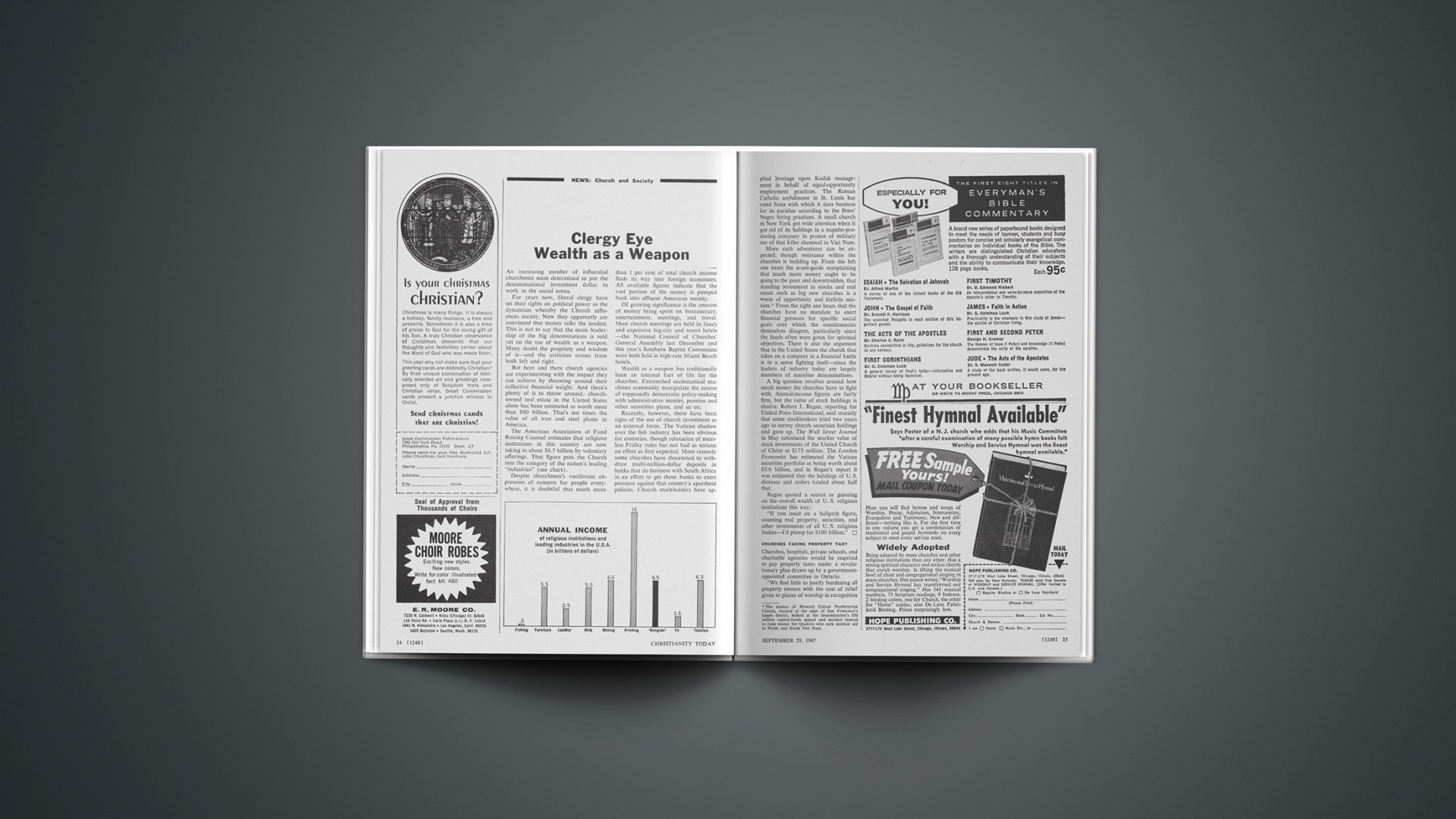
Clergy Eye Wealth as a Weapon

An increasing number of influential churchmen seem determined to put the denominational investment dollar to work in the social arena.

For years now, liberal clergy have set their sights on political power as the dynamism whereby the Church influences society. Now they apparently are convinced that money talks the loudest. This is not to say that the main leadership of the big denominations is sold yet on the use of wealth as a weapon. Many doubt the propriety and wisdom of it—and the criticism comes from both left and right.

But here and there church agencies are experimenting with the impact they can achieve by throwing around their collective financial weight. And there’s plenty of it to throw around: church-owned real estate in the United States alone has been estimated as worth more than $80 billion. That’s ten times the value of all iron and steel plants in America.

The American Association of Fund Raising Counsel estimates that religious institutions in this country are now taking in about $6.5 billion by voluntary offerings. That figure puts the Church into the category of the nation’s leading “industries” (see chart).

Despite churchmen’s vociferous expression of concern for people everywhere, it is doubtful that much more than 1 per cent of total church income finds its way into foreign economies. All available figures indicate that the vast portion of the money is pumped back into affluent American society.

Of growing significance is the amount of money being spent on bureaucracy, entertainment, meetings, and travel. Most church meetings are held in fancy and expensive big-city and resort hotels—the National Council of Churches’ General Assembly last December and this year’s Southern Baptist Convention were both held in high-rate Miami Beach hotels.

Wealth as a weapon has traditionally been an internal fact of life for the churches. Entrenched ecclesiastical machines commonly manipulate the course of supposedly democratic policy-making with administrative monies, pension and other securities plans, and so on.

Recently, however, there have been signs of the use of church investment as an external force. The Vatican shadow over the fish industry has been obvious for centuries, though relaxation of meatless Friday rules has not had as serious an effect as first expected. More recently some churches have threatened to withdraw multi-million-dollar deposits in banks that do business with South Africa in an effort to get those banks to exert pressure against that country’s apartheid policies. Church stockholders have applied leverage upon Kodak management in behalf of equal-opportunity employment practices. The Roman Catholic archdiocese in St. Louis has rated firms with which it does business for its parishes according to the firms’ Negro hiring practices. A small church in New York got wide attention when it got rid of its holdings in a napalm-producing company in protest of military use of that killer chemical in Viet Nam.

More such adventures can be expected, though resistance within the churches is building up. From the left one hears the avant-garde complaining that much more money ought to be going to the poor and downtrodden, that standing investment in stocks and real estate such as big new churches is a waste of opportunity and forfeits mission.* From the right one hears that the churches have no mandate to exert financial pressure for specific social goals over which the constituencies themselves disagree, particularly since the funds often were given for spiritual objectives. There is also the argument that in the United States the church that takes on a company in a financial battle is in a sense fighting itself—since the leaders of industry today are largely members of mainline denominations.

A big question revolves around how much money the churches have to fight with. Annual-income figures are fairly firm, but the value of stock holdings is elusive. Robert J. Regan, reporting for United Press International, said recently that some stockbrokers tried two years ago to survey church securities holdings and gave up. The Wall Street Journal in May calculated the market value of stock investments of the United Church of Christ at $175 million. The London Economist has estimated the Vatican securities portfolio as being worth about $5.6 billion, and in Regan’s report it was estimated that the holdings of U. S. dioceses and orders totaled about half that.

Regan quoted a source as guessing on the overall wealth of U. S. religious institutions this way:

“If you insist on a ballpark figure, counting real property, securities, and other investments of all U. S. religious bodies—I’d plump for $100 billion.”

Churches Facing Property Tax?

Churches, hospitals, private schools, and charitable agencies would be required to pay property taxes under a revolutionary plan drawn up by a government-appointed committee in Ontario.

“We find little to justify burdening all property owners with the cost of relief given to places of worship in recognition of the indirect benefits” they give society generally, the committee said.

The proposal, five years in the making, is the most serious attempt anywhere to tax church real estate, though spokesmen for organized labor reportedly have advocated a similar plan in Pennsylvania. Church tax exemption has been traditional even in countries where church-state separation is maintained and where governments are hostile to religion. Throughout religious history the trend has been the other way: churches have generally been recipients of government funds. In many countries where there is a state church, the citizenry is still taxed to pay for church upkeep and clergy salaries.

Religious leaders in Ontario have, understandably, been generally critical of the five-man committee’s tax plan. At present, all churches and religious-education centers, but not manses and rectories, are tax-exempt.

The co-called Smith report, named after committee chairman Lancelot Smith, suggested a procedure to soften the shock to churches. It recommended assessing church properties at 5 per cent of actual value in the first year of taxation and rising 5 per cent a year for seven years to 35 per cent. The report advocated a review of church taxes at that point and said that eventually they should perhaps be leveled off at “one-half the normal rate” because the indirect benefits that flow to society from such places of worship “justify some measure of relief from local taxation.”

Ontario Premier John Robarts has already said that he can’t see why churches and other places of worship should be exempt from property taxation. He declared last April that because any removal of such restrictions would be an unpopular move, the provincial government (rather than the municipalities) would have to handle it.

A nationwide Royal Commission on Taxation recommended earlier this year that religious organizations should retain their tax-exempt status but should be taxed on their business income and some of their investment income.

Many churchmen have voiced concern for the future prosperity of the churches, particularly those heavily in debt, if a property tax is initiated. The argument against taxation of churches has also been based heavily on the thesis that the power to tax is the power to destroy. Those who counter such a line of reasoning say that if things get so bad that the government wants to destroy churches it can do so in many ways apart from taxes.

In Washington, Americans United for Separation of Church and State has been urging the Internal Revenue Service to impose income taxes on churches to the extent that they are engaged in unrelated business.

The Rev. C. Stanley Lowell, associate director, told an IRS hearing this past summer that “a church which engages in the manufacture of liquor or in the operation of gambling games should have its income from such enterprises taxed.”

In New York, the church-state scene lies under the pall of a proposed new constitution that allows public aid to churches. But it’s not yet law. Attorney General Louis Lefkowitz ruled unconstitutional a grant of $100,000 in state funds to Fordham University, a Jesuit institution, to support a professorship for communications theorist Marshall McLuhan. The grant was part of a state program to attract noted scholars. McLuhan, a Roman Catholic, had already moved his family from Toronto to New York, and Fordham officials had assured him that they would pay if the state reneged.

‘Fairness Doctrine’ Test

The U.S. Supreme Court is being asked—for the first time—to decide whether a broadcaster may be compelled to grant free time to persons attacked over his station. The test case was brought by the Red Lion, Pennsylvania, Broadcasting Company in connection with a “Christian Crusade” broadcast in which the Rev. Billy James Hargis of Tulsa, Oklahoma, criticized Fred Cook of New Jersey, a writer for the Nation magazine. The Federal Communications Commission, in accordance with its “fairness doctrine,” ordered the station to give Cook time to reply.

Ford Grants

The Ford Foundation is giving more than one million dollars to organizations that are either religiously sponsored or religiously initiated. The largest grant, $578,000, goes to the Southern Consumers’ Education Foundation to help develop cooperatives among low-income groups. A $160,000 award goes to the National Council of Churches for its training and self-help housing program for dispossessed farm workers.

Trial Marriage

Local congregations of two merging denominations apparently will be given a year to see whether they like the union.

A joint merger committee of the Presbyterian Church in the U. S. and the Reformed Church in America suggests that all congregations of both be brought into the new church for one year. During the second year a congregation would be allowed to withdraw, with its property. Thereafter, none would be permitted to withdraw. The committee also backed previous proposals for a new confession “without delay” once the Presbyterian Reformed Church in America is organized.

Rhodesia Bars Missionary

The Rhodesian Methodist Conference says the white minority regime of Ian Smith has barred another American missionary from readmittance. He is the Rev. Hunter B. Griffin, currently on furlough.

The Methodist mission board said eighty-one Methodist missionaries are assigned to Southern Rhodesia. No reason was given for the action against Griffin.

Rhodesia’s Methodists are officially opposed to the government’s racial policies.

Sudan Thaw

The Sudan has ended its eleven-year campain against Roman Catholic priests and missionaries, Religious News Service reports. Catholics have been critical of the “Moslem-dominated” Sudan regime for its confiscation of religious schools, expulsion of missionaries, and strict supervision of Christian activities.

The government last year expelled a large group of missionaries from the largely pagan South on charges that they supported a terrorist movement there. But more recently new Prime Minister Sayed Sadiq al-Mahdi wrote Pope Paul VI that Christians and Muslims have a “common interest” in attacking paganism.

Milwaukee

A limping, blister-ridden Roman Catholic priest in the forefront of a militant open-housing marchathon in racially tense Milwaukee vowed: “There’ll be no cooling whatsoever.” Abusive “white power” countermarchers, continued barrages of bricks and bottles, volleys of tear gas, and the specter of a major race riot lent substance to the statement.

The militant, civil-rights firebrand is the Rev. James Groppi, assistant pastor of St. Boniface Church, an integrated parish of 800 in the inner core of the Negro ghetto. Father Groppi, 36, a Milwaukee native of Italian extraction, was arrested four times in one week but continued to lead the protests.

The priest was joined by Negro comedian Dick Gregory in an effort to wring an open-housing ordinance from the city’s common council. Mayor Henry Maier—frequent target of the protesters—called Groppi a “white Uncle Tom” and said that open housing would only accelerate the flight of the middle class to the suburbs, leaving Negroes and impoverished whites in the city itself.

Although some of the daily marches and sit-ins were peaceful, with horseplay and congeniality between crowds in the largely Polish south side and Groppi’s marchers—sometimes numbering in the thousands—the dominant mood was hatred, cunning, and anger. After a “mothers’ march,” 100 militants converged on City Hall and wreaked damage estimated at $3,000 on the mayor’s office. The destructive rampage, allegedly directed by Father Groppi, came on the heels of an impassioned plea by his superior, Milwaukee Archbishop William Cousins, to end future violence “at all costs.” The prelate resisted pressure from screaming white mobs to dismiss Father Groppi, but appeased them by referring the demand to his senate of priests.

Father Groppi, who began slum work while at St. Francis Seminary in Milwaukee, is adviser to the city’s Youth Council of the National Association for the Advancement of Colored People. Another member of the council admitted that Father Groppi has been criticized by the archbishop for “imprudent tactics” but staunchly maintained that the priest has the complete support of the Negro community.

Both the Catholic Interracial Council of Milwaukee and the National Council of Churches have supported the group’s fight for open housing. The Catholic Herald Citizen condemned the “hate-in” enacted on the south side by white mobs. The paper sadly observed that many presumably were Catholics—“human and Christian dropouts … who behaved as if they had fled their humanity.”

Buoyed by promises of national NAACP support, Father Groppi invited black youth to join demonstrations as part of their education instead of attending school. “We’re marching to City Hall and that’s more important than going to third-rate school,” he declared in a rally. School officials noted first-day attendance dipped 2,350 from the previous year.

Gregory, who calls the priest “Ajax, the White Knight,” took over for the minister when he temporarily was sidelined with blisters and a touch of the flu. Having reportedly canceled three months of engagements, the comedian asserted he would stay “as long as they need me.… We’re not just walking for Milwaukee. We’re trying to change the hunkie’s way of life he’s been getting used to for 400 years.”

Prayer meetings, chanting, and singing fortified the marchers’ courage as they sallied into “enemy” territory. Groppi’s group resounded with “Nobody’s Gonna Turn Me Around,” and “I’m Gonna Testify to What the White Man’s Done to Me,” while 500 south-side Polish youths taunted in sing-song polka rhythm: “Ee yi, ee yi, ee yi oh/Father Groppi’s gotta go!”

The peripatetic priest contends that the church’s stake in the movement is nothing less than its own survival. An aide said in an interview: “If the church does not act and act now, it will forfeit its divine mission … to correct social abuses.”

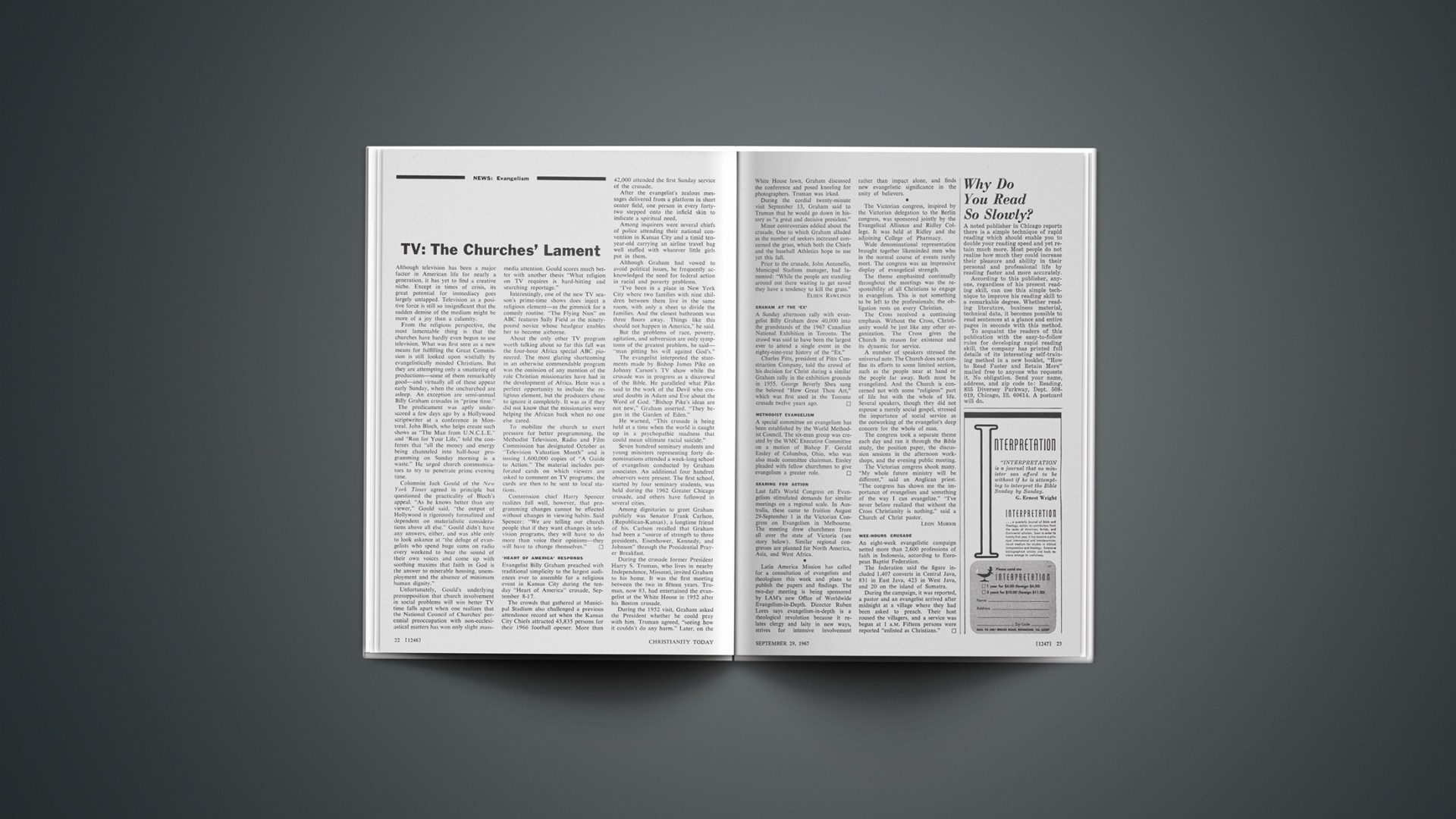
TV: The Churches’ Lament

Although television has been a major factor in American life for nearly a generation, it has yet to find a creative niche. Except in times of crisis, its great potential for immediacy goes largely untapped. Television as a positive force is still so insignificant that the sudden demise of the medium might be more of a joy than a calamity.

From the religious perspective, the most lamentable thing is that the churches have hardly even begun to use television. What was first seen as a new means for fulfilling the Great Commission is still looked upon wistfully by evangelistically minded Christians. But they are attempting only a smattering of productions—some of them remarkably good—and virtually all of these appear early Sunday, when the unchurched are asleep. An exception are semi-annual Billy Graham crusades in “prime time.”

The predicament was aptly underscored a few days ago by a Hollywood scriptwriter at a conference in Montreal. John Bloch, who helps create such shows as “The Man from U.N.C.L.E.” and “Run for Your Life,” told the conferees that “all the money and energy being channeled into half-hour programming on Sunday morning is a waste.” He urged church communicators to try to penetrate prime evening time.

Columnist Jack Gould of the New York Times agreed in principle but questioned the practicality of Bloch’s appeal. “As he knows better than any viewer,” Gould said, “the output of Hollywood is rigorously formalized and dependent on materialistic considerations above all else.” Gould didn’t have any answers, either, and was able only to look askance at “the deluge of evangelists who spend huge sums on radio every weekend to hear the sound of their own voices and come up with soothing maxims that faith in God is the answer to miserable housing, unemployment and the absence of minimum human dignity.”

Unfortunately, Gould’s underlying presupposition that church involvement in social problems will win better TV time falls apart when one realizes that the National Council of Churches’ perennial preoccupation with non-ecclesiastical matters has won only slight massmedia attention. Gould scores much better with another thesis “What religion on TV requires is hard-hitting and searching reportage.”

Interestingly, one of the new TV season’s prime-time shows does inject a religious element—as the gimmick for a comedy routine. “The Flying Nun” on ABC features Sally Field as the ninety-pound novice whose headgear enables her to become airborne.

About the only other TV program worth talking about so far this fall was the four-hour Africa special ABC pioneered. The most glaring shortcoming in an otherwise commendable program was the omission of any mention of the role Christian missionaries have had in the development of Africa. Here was a perfect opportunity to include the religious element, but the producers chose to ignore it completely. It was as if they did not know that the missionaries were helping the African back when no one else cared.

To mobilize the church to exert pressure for better programming, the Methodist Television, Radio and Film Commission has designated October as “Television Valuation Month” and is issuing 1,600,000 copies of “A Guide to Action.” The material includes perforated cards on which viewers are asked to comment on TV programs; the cards are then to be sent to local stations.

Commission chief Harry Spencer realizes full well, however, that programming changes cannot be effected without changes in viewing habits. Said Spencer: “We are telling our church people that if they want changes in television programs, they will have to do more than voice their opinions—they will have to change themselves.”

‘Heart Of America’ Responds

Evangelist Billy Graham preached with traditional simplicity to the largest audiences ever to assemble for a religious event in Kansas City during the ten-day “Heart of America” crusade, September 8–17.

The crowds that gathered at Municipal Stadium also challenged a previous attendance record set when the Kansas City Chiefs attracted 43,835 persons for their 1966 football opener. More than 42,000 attended the first Sunday service of the crusade.

After the evangelist’s zealous messages delivered from a platform in short center field, one person in every forty-two stepped onto the infield skin to indicate a spiritual need.

Among inquirers were several chiefs of police attending their national convention in Kansas City and a timid ten-year-old carrying an airline travel bag well stuffed with whatever little girls put in them.

Although Graham had vowed to avoid political issues, he frequently acknowledged the need for federal action in racial and poverty problems.

“I’ve been in a place in New York City where two families with nine children between them live in the same room, with only a sheet to divide the families. And the closest bathroom was three floors away. Things like this should not happen in America,” he said.

But the problems of race, poverty, agitation, and subversion are only symptoms of the greatest problem, he said—“man pitting his will against God’s.”

The evangelist interpreted the statements made by Bishop James Pike on Johnny Carson’s TV show while the crusade was in progress as a disavowal of the Bible. He paralleled what Pike said to the work of the Devil who created doubts in Adam and Eve about the Word of God. “Bishop Pike’s ideas are not new,” Graham asserted. “They began in the Garden of Eden.”

He warned, “This crusade is being held at a time when the world is caught up in a psychopathic madness that could mean ultimate racial suicide.”

Seven hundred seminary students and young ministers representing forty denominations attended a week-long school of evangelism conducted by Graham associates. An additional four hundred observers were present. The first school, started by four seminary students, was held during the 1962 Greater Chicago crusade, and others have followed in several cities.

Among dignitaries to greet Graham publicly was Senator Frank Carlson, (Republican-Kansas), a longtime friend of his. Carlson recalled that Graham had been a “source of strength to three presidents, Eisenhower, Kennedy, and Johnson” through the Presidential Prayer Breakfast.

During the crusade former President Harry S. Truman, who lives in nearby Independence, Missouri, invited Graham to his home. It was the first meeting between the two in fifteen years. Truman, now 83, had entertained the evangelist at the White House in 1952 after his Boston crusade.

During the 1952 visit, Graham asked the President whether he could pray with him. Truman agreed, “seeing how it couldn’t do any harm.” Later, on the White House lawn, Graham discussed the conference and posed kneeling for photographers. Truman was irked.

During the cordial twenty-minute visit September 13, Graham said to Truman that he would go down in history as “a great and decisive president.”

Minor controversies eddied about the crusade. One to which Graham alluded as the number of seekers increased concerned the grass, which both the Chiefs and the baseball Athletics hope to use yet this fall.

Prior to the crusade, John Antonello, Municipal Stadium manager, had lamented: “While the people are standing around out there waiting to get saved they have a tendency to kill the grass.”

ELDEN RAWLINGS

Graham At The ‘Ex’

A Sunday afternoon rally with evangelist Billy Graham drew 40,000 into the grandstands of the 1967 Canadian National Exhibition in Toronto. The crowd was said to have been the largest ever to attend a single event in the eighty-nine-year history of the “Ex.”

Charles Pitts, president of Pitts Construction Company, told the crowd of his decision for Christ during a similar Graham rally in the exhibition grounds in 1955. George Beverly Shea sang the beloved “How Great Thou Art,” which was first used in the Toronto crusade twelve years ago.

Methodist Evangelism

A special committee on evangelism has been established by the World Methodist Council. The six-man group was created by the WMC Executive Committee on a motion of Bishop F. Gerald Ensley of Columbus, Ohio, who was also made committee chairman. Ensley pleaded with fellow churchmen to give evangelism a greater role.

Gearing For Action

Last fall’s World Congress on Evangelism stimulated demands for similar meetings on a regional scale. In Australia, these came to fruition August 29-September 1 in the Victorian Congress on Evangelism in Melbourne. The meeting drew churchmen from all over the state of Victoria (see story below). Similar regional congresses are planned for North America, Asia, and West Africa.

Latin America Mission has called for a consultation of evangelists and theologians this week and plans to publish the papers and findings. The two-day meeting is being sponsored by LAM’s new Office of Worldwide Evangelism-in-Depth. Director Ruben Lores says evangelism-in-depth is a theological revolution because it relates clergy and laity in new ways, strives for intensive involvement rather than impact alone, and finds new evangelistic significance in the unity of believers.

The Victorian congress, inspired by the Victorian delegation to the Berlin congress, was sponsored jointly by the Evangelical Alliance and Ridley College. It was held at Ridley and the adjoining College of Pharmacy.

Wide denominational representation brought together likeminded men who in the normal course of events rarely meet. The congress was an impressive display of evangelical strength.

The theme emphasized continually throughout the meetings was the responsibility of all Christians to engage in evangelism. This is not something to be left to the professionals; the obligation rests on every Christian.

The Cross received a continuing emphasis. Without the Cross, Christianity would be just like any other organization. The Cross gives the Church its reason for existence and its dynamic for service.

A number of speakers stressed the universal note. The Church does not confine its efforts to some limited section, such as the people near at hand or the people far away. Both must be evangelized. And the Church is concerned not with some “religious” part of life but with the whole of life. Several speakers, though they did not espouse a merely social gospel, stressed the importance of social service as the outworking of the evangelist’s deep concern for the whole of man.

The congress took a separate theme each day and ran it through the Bible study, the position paper, the discussion sessions in the afternoon workshops, and the evening public meeting.

The Victorian congress shook many. “My whole future ministry will be different,” said an Anglican priest. “The congress has shown me the importance of evangelism and something of the way I can evangelize.” “I’ve never before realized that without the Cross Christianity is nothing,” said a Church of Christ pastor.

LEON MORRIS

Wee-Hours Crusade

An eight-week evangelistic campaign netted more than 2,600 professions of faith in Indonesia, according to European Baptist Federation.

The federation said the figure included 1,407 converts in Central Java, 831 in East Java, 423 in West Java, and 20 on the island of Sumatra.

During the campaign, it was reported, a pastor and an evangelist arrived after midnight at a village where they had been asked to preach. Their host roused the villagers, and a service was begun at 1 A.M. Fifteen persons were reported “enlisted as Christians.”

Why Do You Read So Slowly?

A noted publisher in Chicago reports there is a simple technique of rapid reading which should enable you to double your reading speed and yet retain much more. Most people do not realize how much they could increase their pleasure and ability in their personal and professional life by reading faster and more accurately.

According to this publisher, anyone, regardless of his present reading skill, can use this simple technique to improve his reading skill to a remarkable degree. Whether reading literature, business material, technical data, it becomes possible to read sentences at a glance and entire pages in seconds with this method.

To acquaint the readers of this publication with the easy-to-follow rules for developing rapid reading skill, the company has printed full details of its interesting self-training method in a new booklet, “How to Read Faster and Retain More” mailed free to anyone who requests it. No obligation. Send your name, address, and zip code to: Reading, 835 Diversey Parkway, Dept. 508019, Chicago, Ill. 60614. A postcard will do.

Character

Fiber is the tough substance that gives texture and body to plants and trees. From it cloth is spun or woven. And it is fiber that makes trees useful for lumber and other products.

In man, character is the fiber that determines behavior and reaction to the strains and stresses of life. It has been said that a man’s real character is shown by what he does when he is alone, but that is only part of the picture. Whenever temptations come, pressures rise, and decisions have to be made, character or its lack is very evident.

There is a form of good character that is not necessarily based on the Christian ethic. Until the Red take-over in China, there was evident (and there still is, in Chinese communities abroad) a praiseworthy character rooted in respect for family and a sense of family responsibility. No doubt this is why there is so little crime and delinquency in Chinese communities. Obedience to and honor for parents results in law-abiding character.

When the Communists took over China, one of their first objectives was to destroy the age-long sense of family loyalty, and the day came when children’s denunciation of parents was commonplace.

America, which was founded on the Christian ethic, has also experienced a marked decline in character. Now expediency often triumphs over right, and immediate gain is thought by many to justify almost any act. Even among some religious leaders, “situational ethics” has supplanted the absolute of God’s moral law. Never has there been greater need for Christian character than now.

We do not have to look far to find what has largely led to the moral and spiritual decline of American life (which is, of course, a reflection of individual lives). The biblical concept of good and evil has been dimmed or lost, and men no longer have the moral fiber necessary to stand up against the multiplied temptations of today. The faith and conviction that form the basis of character have deteriorated. And the values that make men and nations great are under external attack everywhere. On every hand evil is called good and good evil.

If one has no inner standard of values, why should he oppose what is wrong? If one’s source of reference is no higher than the behavior of others, he can travel to disaster without ever sensing the danger ahead. Without a God-oriented sense of values, there can be no Christian conscience.

Years ago, when I was a medical student in Richmond, I had the privilege of helping in the Seventeenth Street Mission on Sunday afternoons. One day a young Negro boy was arrested and brought into court. When he was asked, “Did you steal that box?,” the little fellow replied: “No sir, Judge, that would be sin.”

The bemused judge asked, “What is sin?” He received the immediate answer, “Sin is any want of conformity unto or transgression of the law of God.” Needless to say, this case was investigated and the honesty of the little boy proved beyond doubt. He had character developed by Christian teaching and a loyalty to what he had been taught.

How tragic that so few young people are learning the foundation of Christian character today! Even in many Sunday schools, the development of a strong sense of right and wrong, of man’s responsibility to God and the teaching of Scripture, is slighted in favor of development of “social consciousness.” The result: anti-social behavior on every hand.

Why are so many people unwilling to “get involved” when others are in trouble, even before their eyes? Because character has been supplanted by selfishness.

Why is there so little righteous indignation against those who are actively destroying the values that made our nation great? Why is there no firm reaction against those who have lost all patriotism and who actively engage in sedition and acts of treason?

Recently a well-known folk-singer was refused the use of an auditorium in Washington because of her encouragement of draftcard-burners and draft-dodgers. The news media made a heroine of her while those who refused the use of their auditorium were held up to ridicule. Could this have been possible without the undermining of the foundations of national conscience by an insidious propaganda that rejects all restraint? “Freedom” has become license, and in that grievous perversion conscienceless men are spelling the doom of a nation.

But there is hope. That hope lies in people who have consciences controlled by the living Christ. One develops such a conscience by becoming thoroughly saturated with the Word of God, by learning to look at the world in the light of God’s holy laws.

Let young people read and reread the Book of Proverbs, for there they will learn the basis for right behavior. Let them receive Christ into their hearts and they will, through the help of the indwelling Spirit, know how to react to temptations and the insidious propaganda of Satan, to which they are constantly subjected.

Young people need to learn of Daniel, whose strong character was reflected in his resolve “not [to] defile himself with the king’s rich food, or with the wine which he drank” (Dan. 1:8); of Timothy, to whom Paul wrote, “Take your share of suffering as a good soldier of Christ Jesus” (2 Tim. 2:3); and of Isaiah, who could say, “The Lord GOD helps me; therefore I have not been confounded; therefore I have set my face like a flint, and I know that I shall not be put to shame” (Isa. 50:7).

One step toward developing a God-oriented conscience in America would be to institute the reading of the Ten Commandments each day in all public schools. God’s moral law, common to the heritage of Jews, Catholics, and Protestants, read without comment, would be a blessing and help to all, particularly those who have never learned the meaning of right and wrong. If attendance at this reading were made optional, even the mouths of avowed atheists would be stopped.

The American heritage is saturated with the recognition of God and our responsibility to him. How can we continue to permit the frittering away of our most precious possession in the name of a “freedom” that is actually bondage to evil?

If we are to regain the character that once made us great, we must have a source of reference—God’s holy law, which enables us to distinguish good from evil. When character is founded on Christ and his Word, men see through the blandishments through which we are being led down the path to oblivion.

Christian character, the fiber that makes men and nations great, is desperately needed today. For a generation there has been a growing tendency to let men set the standards, with disastrous results. We have forgotten that “righteousness exalts a nation, but sin is a reproach to any people” (Prov. 14:34).

Character makes the difference.

L. NELSON BELL

Eutychus and His Kin: September 29, 1967

Dear Enemies Of Lucifer:

To fulfill my pledge to keep you abreast of the follies and phonies found on the religious scene, I recently visited the Church of Satan in San Francisco. Armed with a hefty imaginary inkpot, a la Luther, I attended a black arts lecture given by Anton Szandor LaVey, the cult’s high priest. My meeting with the Mephistophelian-bearded, Yul Brynner-shaven, black-velvet-robed ambassador from the nether regions convinced me, however, that a chuckle was my best protection.

In the black-walled living room of a black Victorian house, LaVey leads ritualistic services, lectures on the black arts, and gives charm courses for witches. Bizarre objects fill the house: a skeleton, a stuffed “werewolf,” an operating table, a tombstone coffee table. Over the fireplace-altar (where a nude reclines during solemn celebrations) hangs the cult’s red medallion, a goathead enclosed in a star at whose five points are Hebrew letters representing biblical names of Satan.

LaVey’s Satan-worshiping cult promotes a message of lust so crass that the appeal to self-indulgence becomes untemptingly banal. He advises his witches to entrap a man by dressing in “modified-prostitute” style, enticing him with a secret aphrodisiac and high-cholesterol food for virility, and hexing him by burning his picture while thinking erotically of him during pre-dawn sleeping hours when his ESP is most receptive. What attracts would-be witches and warlocks most to his lectures ($2.50 admission) is the hope of gaining amazing occult powers. Both the henna-haired lady who introduced herself as Lenore the “head witch” and a former Russian Orthodox seminarian, now a minister of Satan, told me of their belief in sorcery. Among the twenty-five present was a black-clad fifteen-year-old boy, referred to as the first member of Youth for Satan.

Sex symbol Jayne Mansfield, a follower of LaVey until her recent death, had sought his help allegedly to stop harrassment by her boyfriend, attorney Steve Brody. To oblige her, LaVey claims he put a hex on him. Shortly thereafter Brody, along with Miss Mansfield, was killed in an auto accident. LaVey “reluctantly” takes credit for his demise. When I asked about LaVey’s responsibility for Jayne’s death, his beautiful blonde wife replied, “When lightning strikes, sometimes the innocent also are killed.” What careless devils!

Shocking to some, a novelty to others, the Satan cult is just too corny to make it big. Satan himself is too clever and deceptive to bother much with LaVey’s sideshow.

Eutychus III

An adversary of the Adversary,

On Being Likeminded

The article by Reuel Lemmons, “Possibly We Can Get Together” (Sept. 1), makes more sense on the subject of ecumenism than anything else I have seen. By now we agree that there is a great deal of merit in at least talking about the subject, and a great deal has been said pro and con about it. This brief article succinctly provides a pattern which seems to have the basic elements of a successful method.

JOHN A. SCOTT

Church of Christ

Memphis, Tenn.

Possibly the sect that Mr. Lemmons represents could instigate a move back toward Bible unity, if they would begin the move by renouncing a few of their hard-core doctrines, such as salvation by water, the non-biblical name they have attached to the church, their dogged teaching of a “sin you must” religion, and—last but not least—a thing that seems second nature to them, their bent to argue over the most insignificant matters of doctrine and dogma. I’m waiting to see if Mr. Lemmons is really interested in unity of the Church, or if he means only to use his words as a decoy for other Christians, whom he hopes to draw into useless and unprofitable debate.

HERBERT O. FAIN

Yakima, Wash.

Mr. Lemmons’s religious group, which calls itself “The Churches of Christ,” claims to be undenominational. I will not be surprised if they take you to task for referring to them as a “denomination.” But in reality they are the most denominational of the religious groups I know about, divided into numerous warring factions, each claiming to be the exclusive “church of Christ.” On three things they seem to be in agreement: that water baptism by immersion by one of their ministers is absolutely essential to salvation; that instrumental music in worship is sinful; and that all outside their religious communion are apostates and not a part of the body of Christ. Mr. Lemmons’s kind of union, as I see it, would be if all other evangelicals dropped any scriptural interpretation different from the accepted “Church of Christ” viewpoints and accepted the interpretations of his particular group.

T. F. MCNABB

Fort Dix, N. J.

It is obvious that the person who wrote the descriptive paragraph on Reuel Lemmons knows little of the Churches of Christ. It is further plain that this same person either did not read or did not understand the article by Brother Lemmons: “It is perfectly clear to the Bible student that the Lord who gave himself to purchase the Church intended that all his followers be gathered together in one undenominational and undivided body, the Church.”

In view of this, whence the reference to the Churches of Christ as a “denomination” and Reuel Lemmons as a “denominational” evangelist?

TIMOTHY W. DUNN

Austin, Tex.

We are placing so much emphasis on mergers that church members are coming to believe that nothing less than one great, universal, outward church is acceptable to God.…

One cannot be naive enough to believe that further mergers are not forthcoming, but one can continue to wish for leaders and pastors who would rather spend themselves in emphasizing sin, repentance, forgiveness, and a sinless heaven awaiting true believers in Jesus Christ—members of the true Church.

The strength of any denomination is not in its numerical size but in congregations which contain many born-again, individual believers who are completely “sold out” to the greatest King, and the greatest cause, in all the world.

EARL K. BRISSMAN

Moline, Ill.

The Working Church

I am enjoying your panel discussions.…

I would like to add to the discussion “What’s the Sense of Work?” (Sept. 1). The Christian Church, properly conducted, is one of the most proficient production-line operations. But in most cases the minister does most of the producing. In some cases the minister wants it that way. In others there is no other alternative. He has to be the financier, chairman of the church board, and sometimes … may even … be the custodian.

It is really a production-line job and will take the talent of all.

WILLIAM H. BELT

Elyria, Ohio

Not A Speck

We who believe the doctrine espoused by the Reformers are grieved … at the article by Kenneth S. Latourette (“The Influence of the Reformation on World History,” Sept. 1).…

Luther never suggested that the Holy Spirit gives men new hearts in response to their faith. He expressly taught the contrary in the strongest possible terms in his “bondage of the will”.… Reformers uniformly taught that faith is the response of man to the new birth sovereignly wrought by the Holy Spirit.

This is no little fly speck in the salt of Reformation doctrine. The grace of God is the sovereign power by which impotent sinners are saved, and not the impotent wish of a God awaiting the response of man’s sovereign will.

WALTER J. CHANTRY

Grace Baptist Church

Carlisle, Pa.

Can We Retrieve It?

The position taken by Harold H. Lytle (“They Are Taking My Church Away from Me,” Aug. 18) is one that I have longed to see in these times of theological revolution. It is the case of an informed layman who has become outraged with the easygoing drift of the Church today. More and more, our churches are becoming outraged at social injustices, domestic moral problems, and war. While these and other related occurrences are of great importance and demand that Christians take a stand based upon the teaching of the Scriptures, they must not do so by denying, doubting, and degrading the infallible record of the revelation of God, the Holy Bible. If this does occur, and it is now doing so, the problems of sin can never be solved.… When confessions of faith and pulpit preaching, along with classroom teachings in colleges and seminaries across this land, begin to cast doubt upon the reliability of the Bible and upon the divine nature of Jesus Christ, the world is in for some sad days.

ROBERT E. SELF

Harlands Creek Baptist Church

Lexington, Miss.

He represents a great company of Presbyterian elders and laymen who have had no adequate opportunity to express their loyalty to historic Presbyterianism. Too many have simply walked out and left our beloved church.… However, we must hope and pray that men like Harold H. Lytle will stay for the swinging of the pendulum.

CLARENCE A. KIRCHER

First United Presbyterian Church

San Mateo, Calif.

As a “displaced” Presbyterian, I concur with his appraisal of the current status of the Presbyterian Church.

What can now be done to unite those whose persuasion is soundly Reformed and Presbyterian under a common banner once again?

JOHN B. CULVER, JR.

Kenosha, Wis.

It seems to me that by inference Mr. Lytle’s article is more an indictment of the United Presbyterian laymen and the church’s governmental system than of the clergy and other professionals whom he has singled out as the culprits. Is the Presbyterian system of representative government outmoded or is it too complex and cumbersome for meaningful lay participation?…

As a Presbyterian layman for many years, I can remember the constant efforts of dedicated pastors in local churches to get laymen interested in church work and church affairs, to attend presbytery and other important meetings. The United Presbyterian Church boards for years have exerted considerable effort to get lay people involved. The United Presbyterian Men is just one example. Many laymen have responded and have become involved. Mr. Lytle is obviously one who is sincerely interested in his church.…

To me the sad thing is that so many of us laymen have been too busy with other things we consider more important than the church.… A busy minister once answered a busy layman’s question as to how he could find time for the church by quoting Matthew 6:33.

FRANKLIN FINSTHWAIT

Alexandria, Va.

First Step For Peace?

“The Rising Tide of Violence” (Aug. 18) portrayed the dimensions of violence, probed the causes, and suggested a remedy in “personal obligation”.…

Basic to any control of violence-agitation is elimination of slums, not merely relocation of them.

Why cannot the committed Christian take the initiative in agitating for a “notax-improvement” area corresponding to the community ghetto? As soon as land-owners paid taxes only on land rather than on improvements, labor expended in preserving multiple dwellings would be rewarded, laziness in allowing deterioration penalized. City tax loss could be offset by reassessment of land values, owner loss by limited rent-control release. This simple arrangement would mean more work but no less profit and bring about the peace that alone can preserve the community.

MORTON A. HILL, S. J.

New York, N. Y.

Would You Believe …?

All the words I know like astonishing, shocking, unbelievable, and fantastic would express my reaction to “The NCC Elite: A Breakdown of Beliefs” (News, July 21).…

As an international airline captain for twenty-five years, I wonder what kind of accident statistics we would have, and how good business would be, if 66 per cent of the captains would say on the PA system, “Relax and enjoy the flight, ladies and gentlemen, we’ll probably make it. Two-thirds of your crew believe we will get there safely.”

JAMES O. EVANS

Beirut, Lebanon

Israel’S Answer

The Rev. James L. Kelso (News, July 21), threw into one pot a varied assortment of emotional charges.

The one specific complaint refers to damage caused at the Lutheran Hospital in Jerusalem. These buildings were damaged but not destroyed. The hospital was rapidly put back into operation. Throughout the whole nineteen years of the Israel-Jordan armistice agreement, the grounds of the Lutheran Hospital served as a Jordanian army base despite the demilitarized accord governing Mt. Scopus, on whose periphery the hospital is located. On June 5 and 6, 1967, Jordanian army positions in the area of the hospital were the most actively aggressive, continuously shelling residential areas of Jerusalem and inflicting the heaviest losses on Israelis—all this while the hospital was flying Red Cross flags.

It is perfectly clear that the Rev. Mr. Kelso is an Arab partisan. Accordingly, he does not write that it was Jordan which opened fire in Jerusalem on June 5 and not Israel. Three times on that day Israel agreed to a ceasefire, but Jordan continued fighting. Mr. Kelso does not mention that several hundred buildings in Israeli Jerusalem were shelled by the Jordanians on June 5 and 6.

The tragedy of our times, and the wars which have flowed from it, has been the consistent Arab refusal to recognize, accept, and live in peace with the State of Israel. Because of this, there are Arab refugees who live in deplorable conditions, because the Arab governments on whose territory they are have been indifferent to their plight. Because of this also, hundreds of thousands of Jewish refugees fled to Israel from the Arab countries for their safety, and it is a source of great pride to the people of Israel that none of these people leads the miserable life of a refugee today.

Mr. Kelso’s charge that Israel regards Arabs as dogs is incompatible with the facts. Some Arab refugees found their way into Israel in 1948. All were successfully settled years ago, and none of them lives as a refugee today. Israel conducted its military operations with the utmost regard for all civilians. The Arab civilian casualties of the war were numbered only in the tens. Most of the West Bank and the Gaza Strip show no sign whatever that a war even took place there three months ago. If there was indifference to the plight of the Arabs it was Arab indifference: the Jordanian decision to wage war on civilian targets; the Syrian refusal to accept a ceasefire when the war was already over; the cutting by the Egyptians of the water pipeline into Sinai, where their defeated troops thirsted in the desert; and the Egyptian refusal to agree as yet to exchange a handful of Israeli prisoners for more than five thousand Egyptians.

All the evil consequences of the last twenty years of conflict have resulted from Arab enmity for Israel and Arab attempts to destroy Israel. The only hope for the future is peace. The great hope of today is that in the wake of the six-day war we have a real chance of realizing peace. This one great aim, so difficult to achieve and yet so simple and glorious in its promise, requires the dedicated efforts and support of all good men of all religions if we are to escape the tragic mistakes of the past.

BENAD AVITAL

First Secretary

Embassy of Israel

Washington, D. C.

The interpretative appraisal of the Arab-Jewish conflict was surely a refreshing change from the one-sided material that has flowed from far too many pens over the last few months.

SILAS H. JONES

Victory Temple

Klamath Falls, Ore.

The Distortion of New Testament Concepts in Modern Theology

First of Two Parts

Let us briefly sketch our present-day situation. The presently dominant theological tendencies originated in Germany and from here coursed throughout the entire theological world. When we speak of “modern” theology, we now mean primarily the existential theology founded by Bultmann and his disciples, which claims to be today’s only feasible theology because it alone allegedly meets the demands of modern man’s world view.

The seriousness of the situation is seen in the fact that this theology exerts tremendous influence on the younger theologians, increasingly determines preaching and religious instruction, tries to control the religious press, radio, and television, and disseminates a popular kind of academic literature that the non-theologian can understand. No doubt it has a strong sense of mission. It feels called to win the unchurched person to Christian faith, convinced that if he is unburdened of untenable dogmatic concepts he will more easily and willingly find the way to the Gospel. But those who believed this have been gravely disappointed, for this theology is, as someone has said, a “theology of empty churches.” Although it has gained wide attention, it has enjoyed little success. Hardly anyone has through it come to a living faith in Jesus Christ.

It is a heartening sign that the Church of Christ has become newly aware of its task and responsibility, and is determinedly opposing “modern” theology’s reduction and corruption of the Gospel. I mention only the writings of Professor Walter Künneth and Dr. Gerhard Bergmann; the declaration concerning Holy Scripture by the European Alliance; the extremely significant Braunschweig theses of 1966; and above all, the tremendous witness at Dortmund of the No Other Gospel movement and the evangelistic endeavors, attended by thousands upon thousands of people, in which the message of salvation is proclaimed with authority through the power of the Holy Spirit.

It is symptomatic of the present situation that even a widely distributed secular periodical like Der Spiegel should issue a series of articles on “Jesus and the Churches.” The series, which aroused great interest, came to the shocking conclusion that it is no longer possible to speak of a “uniform” theology and message. The concluding verdict was that “the Church is schizophrenic.”

The Role Of Church Leaders

Church leaders have long refrained from taking a clear position. They have finally come forward, however, with a number of very diverse comments; with these they are trying to be mediators. Their main concern is to prevent divisions within the churches. Therefore terms like “erroneous teaching” or “heresy” are avoided; identifying the radical higher-critical groups in theology and in the Church for what they really are is likewise avoided. It is undoubtedly clear to the leaders that there can be no “theological pluralism” in the Church, and that pastors and congregations must be given a clear and consistent answer to the confusing questions of the day. But how can this be done?

Bishop Hanns Lilje of Hanover spoke to this problem in an article that appeared in his publication Sonntagsblatt in 1966 under the title, “Avoiding Coercion and Pressure.” As I see it, his comments at best simply repeat what church officialism is saying. It is contrary to the nature of Protestantism, says Lilje, to set up a teaching authority like that of the Catholic Church. In place of such a powerful tribunal that issues final pronouncements, there should be, indeed, brotherly dialogue between representatives of the “modern” theology and defenders of the erstwhile accepted biblical truths. Accusations should stop; there should be a mutual listening and a joint finding of some way to expedite the message of Christ in a changed world.

But Lilje—and here he differs from many other ecclesiastical leaders—has also drawn attention to the limits of such dialogue; they occur, he says, where the kerygma (the basic content of the Gospel) of the New Testament “levels off” into what is merely human and where theology is changed into anthropology. Above all, dissolution of the biblical concept of God means the end of theology as theo-logos (“a word about God”).

No doubt this is true. But now one must ask what should be done about those who have actually overstepped the limits Lilje set. To this the bishop gives no satisfactory answer. Must not the teaching authority of the Church step in here? The justifiable question arises, moreover: What happens if the “brotherly” conversations lead to no end result? This danger is very real, for the “modern” theologians consider only themselves to be Christians “come of age” and consider their task to be leading the immature church members to that awareness which alone, they say, is tenable today. On the other hand, the credally loyal cannot surrender the truths of the faith that they consider valid, and cannot compromise. The path Lilje recommends offers no real and no final solution.

Dogmas Of The Existentialists

As we go on to survey the characteristic tenets of “modern” theology, let us begin with a few general observations.

1. Existential theology rejects the supernatural declarations of the Bible; they belong to a world view that moderns no longer hold.

2. It removes all the so-called mythological concepts from biblical content as no longer binding upon us.

3. It rejects the divine acts of redemption as the foundation of salvation and instead considers the Word proclaimed today to be the determinative redemptive event for us. Thus God’s revelational activity in history loses its meaning.

4. Preaching’s first task according to this theology, is to bring man to a proper understanding of himself In the experience of faith man gains access to a new, “a-worldly,” and hence “eschatological” existence.

5. The exposition of Holy Scripture that is basic to proclamation—so it is said—comes through existential interpretation; this is the hermeneutic principle that unlocks the true meaning of the biblical text. But since the decisive declarations of the Bible refer to the human—especially the Christian—being, exegesis has the task of interpreting the Bible in this context. “Mythological” concepts and ideas are to be interpreted anew in terms of this basic acknowledgment.

6. The insights gained from exegesis furnish the content of preaching and of religious instruction. According to “modern” theology, this has the advantage of no longer requiring people of our day to accept dogmatic statements that stem from an understanding of the world and of existence long superseded and no longer valid.

There can be no doubt that existential interpretation leads not only to the reduction but also to the corruption of the Gospel. It transfers the center of gravity in theology to anthropology. As a result, existentialism not only does not do justice to the doctrine of God and to Christology but also does not do justice to soteriology and eschatology. If existentialism is carried to its final conclusion, then Christian faith becomes a religion of total immanence.

Where The New Theology Leads

What is the consequence of all this for understanding the basic truths of the Gospel?

1. Who is God?

To this question “modern” theology has given several answers, which, since faith in a supernatural personal God can no longer be maintained, are essentially concerned with demythologizing the New and Old Testament affirmations that have been binding until now. It is possible, we are told, to speak only of the “absolute,” the “highest principle,” the “being,” or the “depth of being.” God can also be regarded as merely the ultimate reference point of our existence, a point that cannot be more closely determined.

A radical “no” toward transcendence is said when we say that God can be found only in “human relations,” in person-to-person encounters. In doing this, theology falls into a fatal dependence upon abstract philosophical concepts and ideas that are incapable of comprehending the being and revelation of God as declared in the Bible. And it also comes suspiciously close to being atheism. The magnitude of this danger was evident in a lecture at the Cologne Kirchentag that spoke of a “Theology after the Death of God.” Still more alarming is the fact that in America a group of theologians are propagating a “Christian atheism,” a “God-less Christianity,” under the slogan “God is dead.” Here the biblical doctrine of salvation is reduced to practically nothing, for the depersonalization of God means that man no longer stands over against a living Thou to whom he can be personally related and to whom he can pray. No longer does he experience a heart- and conscience-moving confrontation of the external and holy God, who directs and pardons him and, as he believes, grants him new life by the power of the Holy Spirit.

Although Helmuth Frey has taken no position on “Christian atheism,” in his very noteworthy treatise published last year, Die Frage nach dem Zeugnis von Jesus Christus heute (The Question of the Witness to JesusChrist Today) he has passed the following verdict upon Tillich’s and Robinson’s teaching about God: here “God moves out of transcendence, out of metaphysical realm, out of objectivity, out of conceptualization, out of a distinctiveness from humanity—into a functional reference, into mere relation. He accommodates himself to the bounds, the frame of immanence. God is present only in encounter, in faith and in human fellowship; in short, he is present only in the divine-human and human-human relationship.”

God “happens.” That is all that “modern” theology knows to say about him. The Bible teaches us, however, that God is from everlasting to everlasting, that he dwells in inapproachable light, that he has made himself known in his Word and in his Son Jesus Christ has revealed himself for the salvation of the world. Where this is no longer believed and confessed, it is only one step further to declare that God is dead.

2. Who is Jesus Christ?

The problem of Christ also stands in the forefront of contemporary discussion, and here too current thinking is highly divided.

AND TO THE CHURCH AT LAODICEA, WRITE …

In Parson A’s stone-steepled church

There’s status, very quo.

The wealthy ones are out in force;

It’s where the best folks go.

At Parson B’s progressive church

All the headlines are dissected;

Though they look at Bibles rarely now

With their own times they’re connected.

At Parson C’s they quote the Book

By verses and by chapters,

But seldom know it means their town;

They do not like adapters.

At Parson D’s they sing off-key,

Sing jarring, thumping songs;

The preacher drones, the organ whines

Though no half-heart belongs.

To every parson’s proudest church

Or humblest little hall

Stern watching angels speak grave words.

Who hears? Who hears at all?

ELVA McALLASTER

Even more than previous New Testament criticism, the methodology of Formgeschichte has intensified the cleavage between the historical Jesus and the Christ of kerygma (apostolic preaching). It begins by acknowledging that the Synoptic records contain testimonies of the faith of the Church. At first this seems to be a very illuminating thought. But it leads to the assumption that in the Gospel we are dealing not only with the eye and ear-witness reports of Jesus’ acts but also, and primarily, with the theology of the Church that took form after Easter. This means, however, that the Gospels give us no unequivocal picture of the life of the Jesus of history. It becomes the task of research, then, to liberate the figure (Gestalt) of Jesus from the later embellishments of the Church.

The question involved, therefore, is: Who really was Jesus of Nazareth and what was his mission? Bultmann, in his book about Jesus, tried to work out an ancient tradition that presents Jesus as a teacher and rabbi who proclaims the Kingdom of God and summons man to total commitment to God. Jesus, however, did not consider himself to be the Messiah. This idea of Bultmann’s was repeated in W. Marxsen’s recently published book, Die Anfänge der Christologie (The Beginnings of Christology). In his later pronouncements Bultmann went so far as to say that the life and ministry of Jesus have no bearing upon faith; only the fact that he came into the world is of actual significance for us. For, as Bultmann argues, “the character of Jesus, the tangible representation of his personality and life, can no longer be known by us.”

Bultmann’s followers did not go quite that far. Yet Ernst Käsemann, who has concerned himself considerably with the question of the historical Jesus, believes it necessary to assert that only a few statements in the Sermon on the Mount, a few statements in his unmasking of Pharisaism, a number of parables, and various scattered gems actually go back to the historical Jesus. Jesus’ teaching, however, as far as we can reconstruct it, manifests the unique sovereignty and majesty of his person and of his appearing.

In his book Jesus of Nazareth Günther Bornkamm expressed himself even more strongly. He acknowledges that through the Synoptic record we see the historical Jesus in all his unmistakable majesty; the purpose of the Gospels, moreover, is not only to proclaim but also to report.

Very revealing also is the major article, “Jesus Christ,” written by Bultmannite Hans Conzelmann, that appears in the latest edition of Religion in Geschichte und Gegenwart. Conzelmann deals thoroughly with the preaching of Jesus but comes to the conclusion that Jesus never claimed to be the Messiah, and that he never designated himself either as the Son of God or as the Son of Man. His self-awareness, says Conzelmann, is not apparent in the “christological titularity; this was first appended to him by the teaching of the Church. We are to see him only as a great teacher and miracle-worker who was filled with strong eschatological convictions and saw himself as the “last herald” before the dawning of God’s Kingdom. Faith in him as the Messiah and as the Son of God was first engendered, assertedly, under the impact of his resurrection appearances.

That this view is untenable is clear; we need not argue the fact. But it is shocking that so-called scholarship should present a picture of Jesus that in no way corresponds to the truth. Surely it is completely unthinkable that the early Church in Palestine and also that in Greece had so many ingenious theologians that by interpretation, reflection, and deliberate formulation, they, as Marxsen insists, created out of the humble Jesus of Nazareth the mighty Christ-figure to whom the present Gospels attest.

“Modern” theology ignores a further crucial factor, namely, the operation of the Holy Spirit in formulating the tradition of the Jesus of history. The New Testment repeatedly emphasizes that the authors of the individual books were inspired by the Holy Ghost in the recording of their work; and no less an authority than John specifically points out that it was the Paraclete, the Holy Ghost, who recalled to those who were eye- and ear-witnesses of the life of Jesus everything that Jesus taught and did; he revealed all the truth to them and “made it clear.” This does not mean, as Bultmann and his students would say, that a new picture of Jesus was created in the period after Easter; it means, rather, that the person of Jesus was understood in its deepest sense. Full comprehension of Jesus is impossible without the operation of the Holy Ghost. The words and deeds of Jesus were proclaimed, therefore, as acts of divine revelation and salvation.

One final thing must be said in this connection. Essential to a complete understanding of Jesus Christ is the metaphysical setting of his existence. He is the eternal Logos who became flesh, and who after the completion of his earthly redemptive work returned to God, at whose right hand he now reigns in that very glory which was his as the only begotten Son of God from before the beginning of time. This is the witness of John’s Gospel, and also of the hymn to Christ in Philippians 2; they do not convey some gnostic myth of a redeemer but rather bring to expression the true and comprehensive significance of Christ and of the Christ-event. According to Colossians 1:14–20, Christ is the firstborn of all creation, the firstborn from the dead, the Saviour of the world, the Lord in whom dwells all the fullness of the Godhead and whose redeeming power encompasses the cosmos.

One has a wrong picture of Jesus, then, if he sees him only as an unusual man who in his lifetime fulfilled a special assignment given by God but whose death was the end of his existence. The statement by extremists of “modern” theology that the historical Jesus is not identical with the Christ of the kerygma has no basis in the New Testament witness to Christ. Above all, we dare not allow Christology to be existentially interpreted and thus dissolved.

3. What significance has the Cross of Christ?

The critical premise that in the Gospels we are dealing with the pre-Christian kerygma that includes relatively few genuine words of Jesus and reliable reports of his deeds (Käsemann) has definite consequences also for the events that led to Jesus’ death, and even for the significance of his death. According to many exegetes, the prophecies of Christ’s passion were not spoken by Jesus but were ascribed to him later. And the words instituting the Lord’s Supper are to be thought of not as coming from Jesus but as a legend that prospered in the cult, that is, as a later addition by the Church (Conzelmann).

If we carefully examine the sources dealing with the last chapter of Jesus’ life, we know very little that is absolutely certain in the true historical sense (G. Bornkamm). The gospel reports of Jesus’ trial before the high priest show so little uniformity that a clear picture of the proceedings is impossible. All that is historically certain, perhaps, is that the Sanhedrin let Jesus be arrested, gave him a brief hearing, then turned him over to the Roman officer so that he could condemn Jesus as a political agitator (Lohse). From one Gospel to another, the scene before Pilate, through the addition of more and more legendary features, becomes a full-fledged drama. Jesus’ death, we are told, is the tragic fate of a great man who became a martyr for the truth he took upon himself to espouse. Bultmann explains further that Jesus suffered the death of a political criminal on the cross “because his ministry was misunderstood as something political.”

Where are we led by this modern reconstruction? (1) We do not know how Jesus understood his death. (2) The gospel narratives give us no clear picture of the death and suffering of Jesus. The historical kernel is encrusted with legends. (3) According to Martin Dibelius, the early Christians in their presentation of Jesus’ agony may also have dipped into the passion chapters of the Old Testament. (4) One must even face the possibility that Jesus “collapsed” (Bultmann).

The conclusion to which radical critical investigation has come is frightening. What is there to proclaim, if Jesus’ death has no redemptive significance? To say that Jesus suffered martyrdom as a witness of the faith helps us about as much as saying that Jesus’ death can be compared to the death of Socrates (Bultmann, Conzelmann). Nor does the insistence of existential theology—that the Cross of Christ becomes salvation to us first in the proclaimed Word—have any meaning if it has no foundation in salvation history. If God was not working for the salvation of the world in Jesus’ death, then the preaching of the Cross is robbed of its distinctive content. The fact of redemption is, therefore, prerequisite to proclamation. God was in Christ, reconciling the world to himself. He gave his son as ransom for the sins of mankind. This, as Künneth stresses, is the great reality of redemption. And this fact is the heart of the salvation message in which the universally valid truth is proclaimed: “The blood of Jesus Christ, God’s Son, cleanses us from all sin.” Only where this is grasped by faith and confessed is the message of the Cross the power of God.

Are Catholic and Protestant Clergy Moving toward Intercommunion?

An analysis of new trends in Eucharistic theology within the Church of Rome

A few years ago the suggestion that Roman Catholic and Protestant clergy might one day have intercommunion would have been thought preposterous by both sides. Today it is not. During the last few years, some developments in the Roman Catholic Church, particularly studies on the Lord’s Supper and on relations with Protestants, have brought about changes in theory and practice that lead one to ask: What next?

As recently as four years ago Roman Catholics were forbidden by canon law to worship with non-Catholics: “By no means is it permitted for the faithful to assist actively in any way whatsoever or to participate in non-Catholic worship” (Codex Juris Canonici, 1258). But the Second Vatican Council gave guarded encouragement to certain forms of common worship:

In certain circumstances, such as in prayer services “for unity” and during ecumenical gatherings, it is allowable, indeed desirable, that Catholics should join with their separated brethren. Such prayers in common are certainly a very effective means of petitioning for the grace of unity, and they are a genuine expression of the ties which even now bind Catholics to their separated brethren. “For where two or three are gathered together for My sake, there am I in the midst of them” (Mt. 18:20). As for common worship, however, it may not be regarded as a means to be used indiscriminately for the restoration of unity among Christians. Such worship depends chiefly on two principles: it should signify the unity of the Church; it should provide a sharing of the means of grace. The fact that it should signify unity generally rules out common worship. Yet the gaining of a needed grace sometimes commends it. [“Decree on Ecumenism,” The Documents of Vatican II, 8].

Four days before the close of the council, the Pope set an example of interfaith worship when he took part in a prayer service with Protestants and Greek Orthodox at one of Rome’s great churches. Joint worship of Roman Catholics and other Christians is no longer news.

But what about intercommunion? To sing, pray, and hear the Word together is one thing; to share the Eucharist is another.

Is it? Some theologians wonder. With the “new look” in the theology of the Mass and the conviction of some theologians on both sides of the ecclesiastical fence that the other’s doctrine might not be so bad after all, the possibility of intercommunion no longer seems remote.

On the Roman Catholic side, there has been in recent years a spate of writings on the Eucharist that sound more like Reformation theology than what most of us have associated with Rome. The old terms are still used, but often the meaning is changed; and there are new terms, too. Paul VI’s encyclical Mysterium Fidei (September 3, 1965), meant particularly as a warning to Dutch theologians, seems not to have slowed them down but rather to have been received as part of the ongoing discussion. The term transubstantiation is used, but transfinalization and transignification—i.e., the idea that the bread and wine have a new finality, a new significance or meaning—continue to be used also. More important, Christ’s presence in the Supper is understood in personal, spiritual categories. The bread remains bread. “The physical reality does not change, otherwise there would no longer be any eucharistic sign,” says Edward Schillebeeckx, one of Rome’s top theologians (“Transubstantiation,” Worship, Vol. 40, p. 337). Kilian McDonnell, a Benedictine whose magnum opus on John Calvin, the Church, and the Eucharist has just been published by Princeton University Press, writes similarly: “Only on condition that the materiality of bread remains can there be a eucharistic reality” (p. 315).

They, and other Roman Catholic theologians, not only interpret the Eucharist in terms more acceptable to Protestant understanding but show positive appreciation for the Protestant celebration of the Holy Supper as well. In doing so they agree with Vatican II, which, though it lamented that separated Christian brethren “have not preserved the genuine and total reality of the eucharistic mystery,” nevertheless conceded that “when they commemorate the Lord’s death and resurrection in the Holy Supper, they profess that it signifies life in communion with Christ and they await His coming in glory” (“Decree on Ecumenism,” 22).

Since the Dutch theologians have been in the center of the Eucharistic debate with Roman Catholicism, it is instructive to hear what they say. Passing over the Jesuit Piet Schoonenberg, whose untranslated Dutch Eucharistic writings caused a considerable stir, we mention the Dominican Edward Schillebeeckx and the Jesuit Frans Jozef van Beeck. Schillebeeckx’s Christ the Sacrament of the Encounter with God laments the focusing of attention after the Council of Trent (1545–63) on the substance of the elements and on the recipient of the sacrament and his dispositions, while the encounter of the Christian with God in Christ received inadequate attention. Schillebeeckx is a personalist, and he interprets the Gospel and the Eucharist accordingly. Wasting no time, he begins his book by saying:

One cannot help remarking that the theology of the manuals does not always make a careful distinction between that unique manner of existence which is peculiar to man, and the mode of being, mere objective “being there,” which is proper to the things of nature. The absence of this distinction, particularly in the treating of grace or of the sacraments, occasionally obscures the simple fact of encounter with God. The intimateness of God’s personal approach to man is often lost in a too severely objective examination of that which forms the living core and centre of religion, the personal communion with the God who gives himself to men [from Christ the Sacrament of the Encounter with God by Eduard Schillebeeckx, O.P., © Sheed and Ward Ltd., 1963, published by Sheed & Ward, Inc., New York; this and the following quotations used by permission].

In the study of the sacraments, the consequence of this tendency towards a purely impersonal, almost mechanical approach was that they were considered chiefly in terms of physical categories. The inclination was to look upon the sacraments as but one more application, although in a special manner, of the general laws of cause and effect. Inevitably, the result of this view was that we appeared to be merely passive recipients of sacramental grace, which seemed to be “put into us” automatically. We do not, however, want to divert ourselves with the defects of the theological works of the last two centuries, but positively and constructively to take up the study of the Church’s sacraments, with the concept of human, personal encounter as the basis of our consideration.

Religion is above all a saving dialogue between man and the living God.

The most interesting part of the book is his struggle with the problem of Protestant sacraments’ seeming to be charismatic, life-giving ordinances, and yet being invalid. Reformed communion is not a true sacrament; yet it has a “positive and Christian significance.” The author feels he must examine this “delicate question closely” in the light of Thomistic principles. Thomas did not deal with this question, since he knew nothing of the Reformation, but he shows that whoever is validly baptized “possesses an inner orientation to the Catholic sacrament of the Eucharist.” Schillebeeckx goes on:

Are Protestants willing, for the sake of ecumenicity and fraternity, to commune after the manner of the Mass?

Furthermore, valid baptism is implicitly a “Eucharist of desire.” Therefore in virtue of their baptism Christians of the Reformation have an inner orientation to the Catholic Eucharist. For the baptism is truly a Catholic sacrament which in consequence incorporates them not into the separated community but into the Catholic Church [p. 192],

Thomas claims that no single grace comes to us except through a desire, at least implicit, for the Eucharist. With this desire, the essential effect of the sacrament is received. Yet it is not necessary that we receive this effect through the real sacramental reception of the Eucharist. A “Eucharist of desire” is enough, and this is necessary for salvation. Evangelical Christians have this, and so in their communion services they really participate in the res sacramenti, or in the effect of the sacrament, though not to the full. The fathers ate manna in the desert and communicated in a spiritual manner, but this eating of the fathers was more than mere spiritual communion. Likewise Protestant communion is more than that. “It is the spiritual reception of the sacrament itself” (p. 193). As Thomas says, “This is not only to eat Christ spiritually but also to partake spiritually of the [true Catholic] sacrament” (ibid.). Schillebeeckx says such a statement has many and far-reaching consequences, for it is impossible to deny that the Protestant rite is truly a figure of the Eucharist, more so than the manna or the Jewish Passover.

It is not merely a foreshadowing, it is a direct commemoration of the Last Supper, even if not in the full ecclesial sense of the word. Some of the fundamental aspects of the Catholic Eucharist are lacking in the Protestant Communion Service, but others are retained in it. And this is sufficient to enable us to apply with even greater right the ancient patristic and scholastic view of non-Catholic sacraments as vestigia Ecclesiae, traces of the true Church of Christ, to the Protestant sacraments [p. 194].

Schillebeeckx takes his position with reservation, aware that the teaching authority of the church may decide otherwise, but he argues that the Protestant Communion is a “quasi-sacramental manifestation of an explicit eucharistic desire which, moreover, implicitly looks forward to the true fruits of the Catholic Eucharist.” Thus in our Supper there is an “intrinsic tendency towards integration into the Catholic Eucharist” (p. 194).

Van Beeck, writing similarly in the Journal of Ecumenical Studies (Winter, 1966), tells of the common current Roman Catholic theological conviction that the celebration of the Lord’s Supper in the Presbyterian church two blocks away is not “nothing.” But if it is not nothing, what is it? Rejecting the categories of valid and invalid as inadequate, he tells of a student who asked Karl Rahner whether a priest would be validly ordained even if in the chain of episcopal consecrations leading up to his ordination there had been an invalid consecration. Rahner’s response was, “One should not think of these things in the manner of an apothecary.” What about the priest, reasons Van Beeck, who learns that he was invalidly ordained after a lifetime of fruitful ministry? Or what about the happy parents who, on the eve of their fiftieth wedding anniversary, discover they were invalidly married? Van Beeck’s response is this: The Roman Catholic Church has a “healthy awareness of the relativity of the notions of validity and invalidity in matters sacramental. Validity is no more (and no less) than the juridical claim to ecclesiastical recognition; it is the finishing touch every normal sacramental celebration needs as its marginal rounding-off” (p. 63). Juridical thinking of the sacraments gets rough treatment from this author, who would have them looked at existentially.

What, then, are the Protestant sacraments? Some Roman Catholic theologians, says Van Beeck, affirm that Protestant sacraments do not celebrate salvation really but only spiritually. Van Beeck rejects this distinction because it assumes that spiritual, as used here, is tantamount to unreal. He shows that this distinction can be traced to scholastic theology, which used physice ambivalently as “real” or “material.” So the spiritual, then, is relegated to the realm of the unreal, or imagination, or metaphor. This led to a material conception of the sacrament at the expense of its value as a sign. Once the choice was put this way, the Reformers opted for “spiritual.” Van Beeck says that if the Protestant sacraments celebrate salvation spiritually, they must be real sacraments (p. 66).

He then draws the consequences of the fact that Vatican II, at its third session, called Protestant communions “churches” and envisioned the whole church as the people of God on its pilgrim way into the future. Since Vatican II, Van Beeck argues, the unity of the church is no longer seen as a “juridically outlined, fixed unity of order; it has also, and pre-eminently, come to be viewed as Christ’s eschatological gift to his perfect community” (p. 70). Protestants, too, are part of this:

The ecumenical mentality provides not just a new political situation among the Churches, but a theological one: it means a conversion to an eschatological view of the Church, putting an end to the exclusive, paradoxical, antithetical situation in which the Churches antagonize each other. The Churches are in good faith, for the differences among the Churches no longer bear the stigma of formal invalidity and heresy [p. 72, n. 87].

Coming to grips with the problem of the “validity” of Protestant sacraments, Van Beeck argues that valid celebration necessitates (1) a church base from which it is administered, (2) proper intentions, and (3) a competent minister. All agree that the first two are met in Protestantism; but what about number three? A history of sacramental practice, writes Van Beeck, shows that the validity of a sacrament has never been one-sidedly linked up with a validly ordained minister. There was always the possibility of the minister extraordinarily. He can administer baptism, confirmation, and even marriage (p. 80), according to canon law. But all the sacraments have been so administered at times, says Van Beeck. The reason for this and for its recognition by the church as valid has been the need, or situation, in the church, and not law (p. 88). The real theological base is the universal priesthood of all believers, which under normal circumstances operates through the recognized ministers but which in emergencies has operated through those deputized by the faithful. Protestants have done this when they have lived in a protracted extraordinary situation. Consequently, he concludes, Protestant sacraments and ministers may be recognized as such by Roman Catholic theology and church order. Dogma and order are essentially provisional. They may never be allowed to tie salvation down to themselves in a univocal way (p. 95). The church is in status viae, and dogma and order are meant only to help her on the way.

Van Beeck criticizes the traditional distinction between joint prayer and the reading of the Word on the one hand and the joint celebration of sacraments on the other:

Prayer and Bible services are all too often permitted “because nothing happens in them,” as if prayer and the Word were not sacramental. On the other hand there is a tendency to view joint celebrations of sacraments as acts of the most perfect communio, which, therefore, would have to be postponed till the day on which official mutual recognition would be achieved. But is not this to forget that the communio in via will never be perfect and that it is also in the nature of a sacrament to be a pledge of salvation? It seems not wholly sound to consider the sacraments so eschatological as to practically deny that they are part of the status viae of the Church [p. 108].

The Protestant response to much of this is: Well and good, but what about the sacrifice of the Mass? Van Beeck suggests that the Roman Catholic “Eucharist as sacrificium Christi” and the Protestant Supper “as sacrifice of praise and thanksgiving carry essentially the same meaning, although viewed from very different doctrinal angles” (p. 109). He does not stand alone; some other Roman Catholic, and Protestant, theologians share his view.

Still there remain a number of unresolved problems. Just what is the nature of the Eucharist? In what manner do Christians feed on Christ? With Rome’s conviction about the infallibility and irreversibility of dogma, allowing for the qualifications made—historical conditionedness of all dogmatic statements, the necessary one-sidedness of all polemical statements, the imperfection of all dogma, and so on—are Protestants finally willing, for the sake of ecumenicity and fraternity, to overlook what their fathers believed to be “a cursed idolatry” (Heidelberg Catechism, Q.80) and commune after the manner of the Mass? Are Roman Catholics likely to forget the anathemas they have heard poured out against Protestant perversion of the “Blessed Sacrament,” and will their leaders allow their people to eat bread and drink grape juice in a typical Protestant setting?

These are only some of the questions that will be asked increasingly with the growth of the spirit of ecumenicity. They will have to be faced in honesty as well as love if there is to be real progress.

Did Success Spoil American Protestantism?

Reflections on church, state, and culture in America

Some decades ago American Protestantism quietly retired from its post as acting chairman of our cultural heritage and assumed a nominal emeritus position. The circumstances of this remarkable event, as well as its exact time, remain obscured in mystery. Some have attributed it to ill health, others to mental disease. Yet by all appearances, the Church at the time of its retirement was at the height of its powers. According to its own reports and the best available statistics, it had just completed a “Great Century” and was well prepared to face the era that lay ahead. Yet when confronted with the challenges of rapidly changing social, moral, intellectual, and scientific standards, American Protestantism courteously stepped down with hardly a protest or an apology.

Today Protestants in America live with the consequences of our emeritus status. The churches we support, and even those we rebuke, are notoriously ineffective. They are, by and large, neither loved nor hated; they are merely patronized and ignored. Confronted with little but the evidence of our weakness, we may well ask, Why?

Although all must concede that a large part of the answer is found in the nearly irresistible secularizing forces in modern culture, few will exempt the Church itself from responsibility. Who or what, then, in the twentieth-century Church should be blamed?

A generation ago the answer seemed simple enough. Theological liberals and fundamentalists characteristically blamed each other. Today, however, we seem to have entered an era of reappraisal. Many of the heirs to each of these traditions now concede some weaknesses within their heritage. The vogue of terms like “neo-orthodoxy,” “neo-liberalism,” “neo-fundamentalism,” and “neo-evangelicalism” presumably indicates a desire to be dissociated from the programs of a generation ago.

Yet we err if we place the blame for the weaknesses of the Church in twentieth-century America primarily on the excesses of liberalism and fundamentalism. These after all developed only after the battle against modern secularism had been all but lost. The ineffectiveness of the Church today is not the result of those emergency measures devised in the midst of crisis. Its cause should instead be sought in the era of Protestant success. Only when we frankly confess to the weaknesses characteristic of American Protestantism even in its most prosperous years are we prepared to devise a renewal program that will be more than an attempt to revive the traditions of a lost cause.

Our self-analysis could focus on any one of several aspects of our heritage. This essay will attempt, not to analyze the complex relationships that have shaped American Protestantism, but only to sketch outlines thematically related to one of the contributing factors—the response to legal disestablishment.

The Protestant Ideal

The Protestants who settled America were not champions of religious freedom. Indeed, except among a few radicals—Roger Williams and William Penn, for example—the dominant attitude of the seventeenth-century settlers was honest bigotry. Nathaniel Ward, the first (and perhaps the last) wit among New England’s Puritan clergymen, epitomized orthodox sentiments when in 1645 he wrote, “He that is willing to tolerate any unsound Opinion, that his owne may also be tolerated, … will for a need hang God’s Bible at the Devill’s girdle.” Anglican Virginia was hardly more “enlightened.” There the standing law of 1612 threatened the death penalty for speaking impiously against the doctrine of the Trinity or the known articles of the Christian faith. Such opinions and laws hardly seemed harsh to transplanted Europeans whose tradition of legal establishment was thirteen centuries old and who lived in an age when nations were commonly torn apart in the quest for religious uniformity. Their deepest religious convictions demanded that church and state be allied in ensuring that their society be unequivocally Christian.

Yet the state-church ideal could not long be maintained in America. The land was too large and the population too scattered for effective controls. More importantly, diversity of beliefs among immigrant groups forced recognition of tolerance as the only feasible path. Reluctantly, then, by the early eighteenth century American Protestants had had to give up their hopes for a state-enforced religious uniformity. In most of the colonies, however, they maintained a modified form of establishment, giving tax support and official sanction to the preferred religion, though granting grudging toleration to dissenters.

This is the background against which separation of church and state in the American Constitution should be seen. When the framers of the First Amendment declared that the new federal government “shall make no law respecting the establishment of religion,” they were recognizing an accomplished fact—that America’s religious diversity made federal control impractical. Protestants acquiesced, but not always out of conviction. Separation of church from state support was something that happened to them, not something they had planned. As Perry Miller has said, “they stumbled into it, they were compelled into it, they accepted it at last because they saw its strategic value” (quoted in Sidney E. Mead, The Lively Experiment [Harper, 1963]; Mead’s book and Winthrop S. Hudson’s American Protestantism [Chicago, 1961] provide documentation and elaboration for many of the arguments of this essay).

Although they accepted official separation of church and state because they had to, few American Protestants gave up the essential aspect of their traditional ideal—that theirs would be a Christian nation. Yet it was now an era of spiritual crisis. The Revolution appeared to have unleashed the forces of Enlightenment skepticism and to have fostered widespread infidelity. With the weapon of state sanction gone, the churches were forced to turn to new strategy. They would Christianize America yet—if not by state coercion, then by evangelical persuasion. (Perry Miller elaborates upon this thesis in “From the Covenant to the Revival,” in Smith and Jamison (eds.), The Shaping of American Religion [Princeton, 1961].) The spearhead of their strategy was the simple gospel preaching and intensive evangelism of the revival. These techniques, having proved effective during the Great Awakenings of the colonial era, seemed ideal weapons with which to face the post-Revolutionary crises of infidelity and disestablishment.

Indeed they were. The American Protestant churches never showed greater sustained vitality than in the first half of the nineteenth century. With all hope of winning America to official state Protestantism now gone, they turned with renewed vigor to their mission of winning men to Christ. As Lyman Beecher, the indomitable general of many of the campaigns of this “Second Great Awakening,” observed when looking back on Connecticut’s disestablishment of 1818, it turned out to be “the best thing that ever happened to the State of Connecticut. It cut the churches loose from dependence on state support. It threw them wholly on their own resources and on God.”

Yet the strategy of the “Second Great Awakening” involved far more than the widespread evangelistic and missionary programs. It was a comprehensive interdenominational campaign to Christianize American society, not only spiritually, but intellectually and morally as well. In the intellectual sphere the churches stood in a strong position, virtually controlling America’s higher education. At mid-century nearly every college in the country still had an evangelical Protestant (usually a clergyman) as its president. As the nation had moved west, Protestant missionary zeal had inspired the founding of numerous new colleges in the frontier communities. Moreover, the Protestant theologians of this era had few intellectual peers, and a vigorous religious press was a formidable part of the nation’s communication system.

Moral reform of the society was to complete the strategy. Militant evangelicals founded scores of “voluntary societies” to aid the denominations in combatting a host of national sins, most notably slavery, intemperance, and Sabbath desecration. When possible, they enlisted governmental support for these campaigns. Having inherited an ideal from the era of national establishment, evangelicals were convinced that the churches should act as moral guardians for the entire society. Not only should Christian ethical standards be maintained among the regenerate; they should be enforced among the unregenerate as well. National social reform, dealing largely with the externals of behavior, thus appeared as an integral part of the evangelical message.

Despite remarkable revivals and respectable intellectual achievements, the most spectacular success of nineteenth-century American Protestants came in this area of national social reform—in the Northern triumph over slavery. Whatever its political causes, the Civil War was to the Protestant churches a Christian crusade. Northern denominations readily adopted resolutions explicitly identifying the cause of the Union with the cause of Christ. The war was God’s judgment on covenant-breakers and sinners, they affirmed. Victory would hasten the millennial return of Christ. His truth was marching on. It was marching, it seemed, under Mead, Sherman, and U. S. Grant. The ideals of church, state, and Northern society were virtually identified.

Identification of Protestantism with Americanism in the Civil War symbolizes both the remarkable success and the great weaknesses of the American churches in the nineteenth century. Their strength was evident in their influence on the culture. By the second half of the century, their effectiveness in shaping the ideals (if not the realities) of the society was perhaps greater than any that official state support could have provided. They set the moral standards for a nation that was notoriously moralistic. At the end of the century, for instance, it hardly seemed incongruous for the President to propose that America should take the Philippines in order to “uplift and Christianize” the Filipinos. “In 1900,” observes Winthrop S. Hudson, “few would have disputed the contention that the United States was a Protestant nation.”

Yet success had its price. In their zeal for national reform, the Protestant denominations had assumed the role of an unofficial American establishment. The cost had been an obscuring of their central message—that men must be redeemed in Christ. Retaining the ideal that the Church should supervise the behavior of the entire society, they increasingly blurred the lines between their message to the regenerate and their message to the unregenerate. Denominational involvements in political affairs, for instance, were indicative of the ambiguity implicit in the churches’ aspirations to act as national moral guardians. By advocating specific legislative measures, the churches inevitably confused their redemptive message with the platforms of American political parties. What’s more, they automatically alienated all those in the population who disagreed with them politically. The Northern denominations’ unqualified endorsements of Republican programs during the Civil War and their general identification with Republicanism throughout the rest of the century were the clearest examples of this confusion. But the legacy of political involvements continued to affect American Protestantism in later eras. The social gospel’s identifications with Progressivism, Prohibitionism, and New Deal Democracy, for example, reflected much the same establishmentarian ideal.

Participation in political programs was, however, symptomatic of a far deeper malady within the successful Protestant establishment of the late nineteenth century. The churches were identifying themselves with the culture. As with all alliances between church and society, the influences worked both ways. While the denominations were successfully acting as moral guardians of the American cultural heritage, they were adopting, no doubt inadvertently, many of the values of American society—particularly the popular moralism of the middle classes. Rather than continuing to challenge the culture with the radical implications of the biblical message, they allowed many of their standards and objectives to appear virtually indistinguishable from those of the “best people” of the secular society. As Sidney E. Mead has observed, “During the second half of the nineteenth century there occurred an ideological amalgamation of this Protestantism with ‘Americanism,’ and … we are still living with some of the results.”

Success had also bred complacency. The methods of the successful programs designed to revive the new nation early in the nineteenth century were continued almost intact, even though industrialization and urbanization were radically changing American life. Successful revivals were still held, but increasingly large segments of the population were left unaffected. Intellectually, “common sense” philosophy designed to meet the challenges of the Enlightenment continued to be the chief bulwark of orthodox apologetics. Only in the moral sphere did the Church appear strong; but its challenge was muffled by its respectability.

The weaknesses of the successful churches became apparent early in the twentieth century as American culture was shaken by the modern cultural, scientific, and intellectual revolutions. The shocks of Darwinism, widespread confidence in the scientific method, higher criticism of Scripture, dynamic philosophies, technological advance, and social reorganization all struck almost simultaneously. Within a generation, from 1900 to 1930, the Protestant cultural establishment collapsed.

The development of theological liberalism and fundamentalism in the face of this impending crisis was symptomatic of the weaknesses inherent in Protestantism’s reliance on the cultural establishment. When the values of the culture changed, the Church was caught in the midst of a seemingly irresolvable dilemma. It could sacrifice either its Biblical message or its cultural relevance. The result was a tendency for American Protestantism to polarize around the two extreme alternatives. Theological liberalism attempted to maintain the churches’ traditional cultural and intellectual relevance, but at the expense of the Gospel. Fundamentalism preserved the Gospel, but often at the expense of relevance.

Despite the basic incompatibility of fundamentalism and liberalism, it is in their similarities that we can best see the characteristic aspects of the American Protestant heritage. The most conspicuous similarity is in their moralism. Of the two, liberalism was by far the more moralistic, defining its gospel almost solely in ethical terms. Yet, as we are all aware, fundamentalism also has been notorious for its moral proscriptions. Often it has also been accused of lacking social concern. But even in this it was not wholly unlike its liberal social-gospel opponents. Few liberals have shown greater zeal for cultural reform than have fundamentalists such as William Jennings Bryan and Carl McIntire. The only difference is that fundamentalism’s social gospel has been defined largely in terms of the nineteenth century, while theological liberalism has moved steadily with the winds of popular twentieth-century political doctrine.

A second common characteristic of liberalism and fundamentalism that also seems typically American was their anti-theological tendencies. Again, liberalism was by far the more anti-theological, often explicitly repudiating all theological constructions. But fundamentalism too had its anti-intellectualist wing that tended to deprecate theological training. In neither movement was this characteristic universal, but in both it was prominent.

Despite a tradition of formidable theologies, American Protestants have always had a tendency to accentuate the practical, activist, and non-intellectual. If we are to believe foreign observers, these same traits have been characteristic of the culture at large; it is hardly surprising, then, that they have affected the churches. Protestantism’s most popular successes in shaping American life have been its practical campaigns for moral suasion. Accordingly, the tendency has been for theological concern, and eventually evangelism itself, to be submerged in fervor for national social reform. Doubtless this is not the sole cause of the weaknesses of the American church, but it does reveal some telling symptoms.

Still The Establishment?

American Protestantism today appears to be recovering from the religious debacle of the era between the world wars. The successors to the liberal tradition now speak increasingly of a gospel that will challenge the culture, repudiating the old social gospel’s confusion of the kingdom and the world. Yet the challenge remains obscured as these same voices call for renewed involvement in political power structures for the purpose of making the nation a better place to live. The American Protestant quest for social relevance (certainly a fine objective, if not the primary one) continues to dominate America’s most respected ecclesiastical councils. The idea still persists that Protestantism is the American establishment and therefore is not essentially in conflict with the best interests of the secular society. The vision of a Protestant America filled with community churches, open to the whole community regardless of creed, remains the prevailing ideal. Indeed there has been something like a theological revival, but certainly not yet a revival of theological relevance. Relevance is still defined in social and moralistic terms. And it is difficult to preach to a culture that it needs to be revolutionized by the Gospel when your practice indicates it can just as well be reformed.

But the conservative successors to the fundamentalist tradition are no less in danger of seeing their recovery revert to a form of Americanism. We too have inherited the ideals of the respectable cultural establishment of the era of Protestant success. We too have our tendencies toward moralism, identification with current political philosophies, and anti-intellectualism. Doubtless there is much in our typically American heritage that is worth preserving, and indeed we must preserve some if we are to communicate to America. But as we do, we must distinguish sharply between that which is characteristically American and that radical challenge which is characteristic of the Word of God.

The problem we as Protestants face today is the same one the Church has faced in every new era. It is the problem of communicating to our culture while not identifying with its values. Two ingredients are especially necessary for such communication today. The first is intellectual relevance. There is no easier or more understandable excuse for today’s American to avoid listening to the challenge of Christ than the prevailing opinion that a biblically grounded Christianity is an intellectual absurdity. To regain an audience we must overcompensate for this with a strenuous promotion of all aspects of evangelical scholarship.

The second and most essential ingredient is genuine Christian love. Love is the foundation of effective communication. It demands an active display of sacrificial concern for all men in all aspects of their existence—socially, morally, and intellectually, as well as religiously. Although American denominations cannot afford to perpetuate the establishmentarian’s confusion of redemptive and political objectives, individual Christians in a democratic society must employ all their political and civil rights, as well as their personal resources, to manifest their self-giving love for all members of their society. To communicate in Christian love, whether intellectually, morally, or religiously, we must be all things to all men. Again, our record is bad and we must overcompensate. By and large conservative American Protestants have been one thing to all men. We have tried to preach the same sermons in the same language to all classes of society the same in 1967 as in 1867. The pious moralisms that appeared so relevant to middle-class America in the Gilded Age are far too often heard to echo in the Great Society. Love would demand as much concern to show the application of the gospel message—both by proclamation and by action—to the changing needs of our audiences as to preserve its integrity. The Gospel is relevant to every aspect of American experience. But until we learn how to communicate it without compromise, we have not witnessed to the love of Christ. We are as sounding brass.

Protestantism’s Birthday: The Importance of 1517

The Protestant Reformation is usually held to date from October 31, 1517, the Eve of All Saints, when Martin Luther, a professor at Wittenberg University in Saxony, Germany, posted on the door of the Castle Church what he called “95 Theses for Disputation … Concerning Penance and Indulgences, in the desire and with the purpose of elucidating the truth.” “If a particular day may be selected as the birthday of the Reformation” said the late Anglican Bishop Herbert H. Henson, “it is perhaps impossible to select any other for the purpose” (Christian Liberty, pp. 104, 105). Why should this strictly academic proceeding—for such it was—of Martin Luther have developed into such a mighty religious upheaval as the Reformation?

The answer lies partly in the explosiveness of the subject with which the theses dealt, partly in the way Luther’s challenge was handled by the church authorities, and partly in the general situation of the church in Luther’s Germany, and indeed throughout Western Europe.

Luther’s theses had to do with indulgences. An indulgence may be described as a draft on the bank of heaven to pay for human sin. The underlying theory was that Jesus and his saints had accumulated a “treasury of merits.” This treasury was at the disposal of the pope, who could draw on it for the benefit of those sinners who were in arrears. Just how much could thus be effected was debatable. The moderate and traditional opinion held that an indulgence could remit only that punishment for sin which the Church had imposed. In 1476, however, Pope Sixtus IV (1471–84) had declared that an indulgence could shorten, and even end, the stay of a departed soul in purgatory. There was also an extreme view that an indulgence could not only remit penalties but could even forgive sin as well. And something like this claim was made for that particular indulgence—it was called a “plenary” one—which provoked Luther’s protest in 1517.

Indulgence seekers had to pay for these benefits, of course, and in earthly coinage at that. In view of what indulgences professed to offer, it is not surprising that they were highly lucrative: indeed, Roland H. Bainton has aptly described them as “the bingo of the sixteenth century.”

The Indulgence of 1517 was first issued by Pope Julius II (1503–13) to finance the rebuilding of St. Peter’s in Rome; and this was continued by the next pope, Leo X (1513–22). A German cleric, Albert of Brandenburg, already bishop of Halberstadt and Magdeburg, in 1514 was elected archbishop of Mainz and primate of Germany. This highly questionable arrangement—which even the Roman Catholic historian of the popes, Ludwig Pastor, considered “a disgraceful affair for all concerned”—had to be confirmed by the pope. This the pontiff agreed to do for a payment of some twenty-four thousand ducats. Albert borrowed the money from the well-known German banking house of Fugger; and to enable him to repay his creditors, the pope allowed him to proclaim the indulgence in the areas of his ecclesiastical jurisdiction and in the territories of his half-brother, the Elector Joachim of Brandenburg, as well.

Half of the proceeds were to go to the pope for his building project in Rome and the other half to Albert and his bankers. The indulgence-hawker for these areas in Germany was a Dominican friar named John Tetzel, who in pushing his sales asserted that “as soon as the money rattles in the box, the soul leaps out of purgatory.”

Tetzel was not allowed to hawk his wares in Saxony, where Luther lived. But he set up his mart just over the border, and a number of Saxons journeyed there to purchase indulgences. This situation provoked Luther to make his protest. His theses denied the ecclesiastical doctrine of the treasury of merits on which the efficacy of indulgences depended; but they asserted that if the pope really had the power to empty purgatory of sinners, he should do so promptly and for nothing! Luther also contended that indulgences were spiritually harmful, since they taught sinners to fear the punishment of their sin and not the sin itself as an offense against God.

Luther’s theses were presented in Latin, the language of academic discourse; but they were quickly translated into German and widely circulated, causing a serious falling off in indulgence sales. Luther had at first no thought of separating himself from the Roman church. But various interviews that he had in 1518 and 1519 with representatives of the pope convinced him that the abuses against which he was protesting were not a mere excrescence of the surface of the body ecclesiastic but a cancer that was eating at its very vitals. He concluded that the papal church had departed from the New Testament doctrine of justification by grace through faith, which he believed to be the basic tenet of the Christian Gospel. And since the Church would not correct its teaching and practice on this matter, no reconciliation between it and Luther was possible. When in 1520 he was formally excommunicated by the pope, he publicly burned the papal bull of excommunication. He had passed the point of no return in his controversy with Rome.

By 1520 Luther had become the focus of widespread discontent and had acquired a following large enough to produce what has become known as “the German drama.” Patriotic Germans resented being governed by an Italian pope and sending so much hard-earned German money to Rome. They wanted a German national church governed by German bishops and independent of the papacy. Scholarly humanists applauded Luther because he appealed to the Scriptures and to Christian antiquity and not to the medieval schoolman. And many devout Christians in Germany and throughout Europe resented the all too prevalent vices of the clergy—such as cupidity and sometimes sexual irregularity—and the corruptions of the church system that they administered. Throughout his duel with the Roman church, Luther was strongly backed up by his ruler, Frederick the Wise, Elector of Saxony, whose protection was invaluable to him both before and after his excommunication in 1520. The opposition of these various groups to the papal church had been growing in Germany for some time prior to 1517; and Luther provided it the leadership necessary to bring about the Protestant Reformation.

In the light of this account, the following statement by the late Anglican church historian Norman Sykes is an accurate explanation for why Luther’s academic protest of 1517 led to the Reformation. Said Dr. Sykes: “That [explanation] which best fits the facts is a recognition of the widespread revulsion from the Church and its system, alike in its theological and its financial expression. The old order in Germany, as in the political sphere in France in 1789, though outwardly imposing and strong, was rotten inwardly, and collapsed before the first sharp impact of revolt. Beneath the controversy about indulgences was concealed on the, religious and theological side a growing persuasion of the reality of justification by faith alone, of the impotence of the human will to work out its own salvation with fear and trembling, of the inefficiency of the system of good works and of the Treasury of Merits proclaimed and administered by the Church, and therefore ultimately a doubt of the necessity of either Church or Sacraments to salvation” (The Crisis of the Reformation, pp. 34, 35). Or as the Roman historian Leon Christiani put it, Luther “set a light to the gunpowder.”

Editor’s Note from September 29, 1967

One highlight of the World Congress on Evangelism came when the Berlin scholar Johannes Schneider weighed modern theology in the scale of apostolic beliefs and found it an empty wind. In this issue the brilliant German commentator (now writing an exposition of John’s Gospel) introduces a two-part essay assessing contemporary theology in the light of scriptural teaching.

This issue is weighted also by the annual index. When librarians and readers convince Readers’ Guide that CHRISTIANITY TODAY should be included in that index, more space in our end-of-volume will be available for essay content.

October 13 will be our anniversary issue and mark the beginning of the magazine’s twelfth year. Likewise it will signal my twelfth year as editor. Life has been full—a decade as a newspaperman and student, a decade of theology teaching in the Midwest, another in the West, and now more than a decade as editor of a religious periodical in Washington. All in all, life on earth does not hold many decades of service, but the great Editor-in-Chief, who is himself the Word, knows all its imponderables.

A number of Canadians will contribute to the Current Religious Thought series in the year ahead. Dr. William Fitch, distinguished minister of Knox Presbyterian Church in Toronto, will be the first, in the up-coming issue.

addApple PodcastsDown ArrowDown ArrowDown Arrowarrow_left_altLeft ArrowLeft ArrowRight ArrowRight ArrowRight Arrowarrow_up_altUp ArrowUp ArrowAvailable at Amazoncaret-downCloseCloseellipseEmailEmailExpandExpandExternalExternalFacebookfacebook-squarefolderGiftGiftGooglegoogleGoogle KeephamburgerInstagraminstagram-squareLinkLinklinkedin-squareListenListenListenChristianity TodayCT Creative Studio Logologo_orgMegaphoneMenuMenupausePinterestPlayPlayPocketPodcastprintremoveRSSRSSSaveSavesaveSearchSearchsearchSpotifyStitcherTelegramTable of ContentsTable of Contentstwitter-squareWhatsAppXYouTubeYouTube