Slaying the Drug-Dealing Dragon

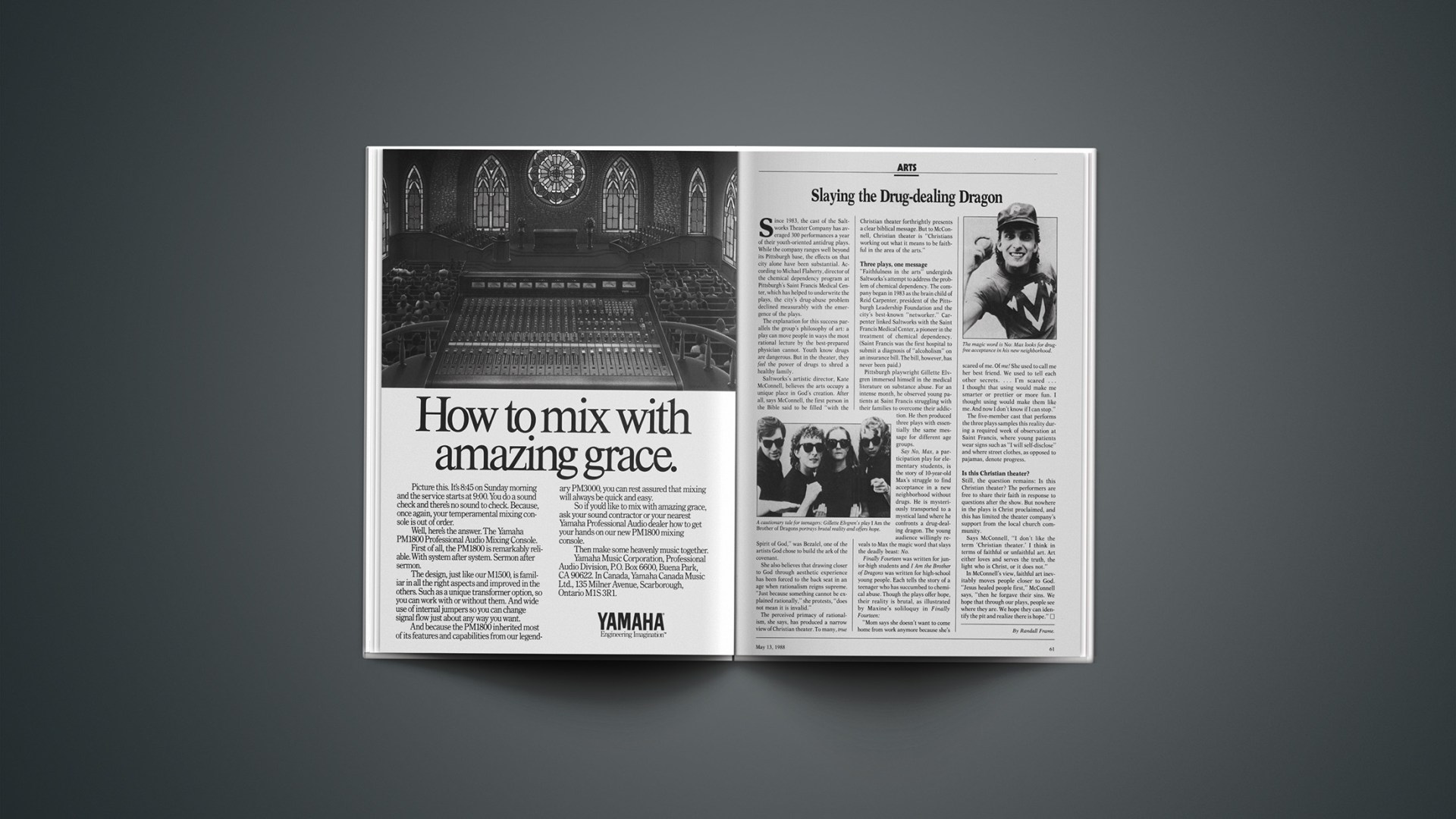
Since 1983, the cast of the Saltworks Theater Company has averaged 300 performances a year of their youth-oriented antidrug plays. While the company ranges well beyond its Pittsburgh base, the effects on that city alone have been substantial. According to Michael Flaherty, director of the chemical dependency program at Pittsburgh’s Saint Francis Medical Center, which has helped to underwrite the plays, the city’s drug-abuse problem declined measurably with the emergence of the plays.

The explanation for this success parallels the group’s philosophy of art: a play can move people in ways the most rational lecture by the best-prepared physician cannot. Youth know drugs are dangerous. But in the theater, they feel the power of drugs to shred a healthy family.

Saltworks’s artistic director, Kate McConnell, believes the arts occupy a unique place in God’s creation. After all, says McConnell, the first person in the Bible said to be filled “with the Spirit of God,” was Bezalel, one of the artists God chose to build the ark of the covenant.

She also believes that drawing closer to God through aesthetic experience has been forced to the back seat in an age when rationalism reigns supreme. “Just because something cannot be explained rationally,” she protests, “does not mean it is invalid.”

The perceived primacy of rationalism, she says, has produced a narrow view of Christian theater. To many, true Christian theater forthrightly presents a clear biblical message. But to McConnell, Christian theater is “Christians working out what it means to be faithful in the area of the arts.”

Three Plays, One Message

“Faithfulness in the arts” undergirds Saltworks’s attempt to address the problem of chemical dependency. The company began in 1983 as the brain child of Reid Carpenter, president of the Pittsburgh Leadership Foundation and the city’s best-known “networker.” Carpenter linked Saltworks with the Saint Francis Medical Center, a pioneer in the treatment of chemical dependency. (Saint Francis was the first hospital to submit a diagnosis of “alcoholism” on an insurance bill. The bill, however, has never been paid.)

Pittsburgh playwright Gillette Elvgren immersed himself in the medical literature on substance abuse. For an intense month, he observed young patients at Saint Francis struggling with their families to overcome their addiction. He then produced three plays with essentially the same message for different age groups.

Say No, Max, a participation play for elementary students, is the story of 10-year-old Max’s struggle to find acceptance in a new neighborhood without drugs. He is mysteriously transported to a mystical land where he confronts a drug-dealing dragon. The young audience willingly reveals to Max the magic word that slays the deadly beast: No.

Finally Fourteen was written for junior-high students and I Am the Brother of Dragons was written for high-school young people. Each tells the story of a teenager who has succumbed to chemical abuse. Though the plays offer hope, their reality is brutal, as illustrated by Maxine’s soliloquy in Finally Fourteen:

“Mom says she doesn’t want to come home from work anymore because she’s scared of me. Of me! She used to call me her best friend. We used to tell each other secrets.… I’m scared … I thought that using would make me smarter or prettier or more fun. I thought using would make them like me. And now I don’t know if I can stop.”

The five-member cast that performs the three plays samples this reality during a required week of observation at Saint Francis, where young patients wear signs such as “I will self-disclose” and where street clothes, as opposed to pajamas, denote progress.

Is This Christian Theater?

Still, the question remains: Is this Christian theater? The performers are free to share their faith in response to questions after the show. But nowhere in the plays is Christ proclaimed, and this has limited the theater company’s support from the local church community.

Says McConnell, “I don’t like the term ‘Christian theater.’ I think in terms of faithful or unfaithful art. Art either loves and serves the truth, the light who is Christ, or it does not.”

In McConnell’s view, faithful art inevitably moves people closer to God. “Jesus healed people first,” McConnell says, “then he forgave their sins. We hope that through our plays, people see where they are. We hope they can identify the pit and realize there is hope.”

By Randall Frame.

The Mystery Of Grace

Hector Babenco’s film Ironweed is, like Christopher Marlowe’s play Faustus, a tale of pride and rejected forgiveness.

Marlowe’s Doctor Faustus made a Satanic pact to receive power and wisdom. When the Devil came to call, friends urged Faustus to repent. But his pride was so great he considered his sins beyond God’s reach. Faustus rejected grace and went to hell.

God’s grace is a mystery: All receive the offer, but only some accept the divine gift. The Father’s chosen ones inevitably come, though sometimes reluctantly.

As in Faustus, pride and grace are key elements in Ironweed, William Kennedy’s adaptation of his Pulitzer Prizewinning novel. Francis Phelan, a bum on the streets of Albany, New York, in 1938, does not make a pact with the Devil, but he has made some fatal errors—fatal to other people. As a boy caught up in the emotions of a teamsters’ strike, he had mortally wounded a scab. As a young father, he had dropped his infant son, who died of a broken neck. Unable to forgive himself, Francis left his family and took to the streets. Now he is haunted by visions of those he has killed.

We join Francis (Jack Nicholson) one cold morning as he sets off to find food, work, and Helen (Meryl Streep), his lover. Helen, a professional singer, has fallen on hard times. We follow them through two pivotal days.

Ironweed is promoted as a love story, and certainly Helen might not have remained alive so long without Francis’s love. They cling to each other as the only remaining bits of meaning in their wasted lives. But love is insufficient to overcome their despair or their enslaving addictions to alcohol.

Francis’s inability to forgive himself drove him from his family. Now he spends much of his time at the local mission where he refuses to respond to the altar call. Like the other bums, he is there for the soup, not the sermon.

Beyond Forgiveness

Francis places himself beyond tangible aspects of grace. On a visit to his family, his wife offers him his old home. But he tells his daughter he is “beyond forgiveness,” and he refuses to consider what a sober family life might mean.

Unlike Francis, Helen is open to grace. She enters a Catholic church and prays before the statue of Saint Joseph. Her confessions is laced with self-justification. “You call them sins. I call them decisions,” she says. Yet somehow, without really understanding grace, Helen receives it. God does not suddenly turn Helen’s life around. But he lays $10 by her knee—money she uses to rent a room where she spends her last hours clean, warm, and listening to the music she loves.

Ironweed is too powerful for casual family viewing. You won’t leave uplifted. This is first-rate American drama, somewhat on the order of Death of a Salesman or The Glass Menagerie. It is more entertaining and palatable than either of those plays, but it is equally incisive.

As Francis rides alone in a boxcar, clutching his bottle of whiskey, a vision appears to him. Sitting on a crate, pouring tea, his wife asks, “What do you need, Francis?” He needs grace—but he asks for a turkev sandwich.

By David Beard, a writer and Christian education director at Trinity Orthodox Presbyterian Church, Bothell, Washington.

Subversive Communication

“IPredict 1990,” the latest album from iconoclastic Christian rocker Steve Taylor, was controversial as soon as it was released. The cover design was mistaken for a tarot card, and the lead song was not understood as satire. Taylor had to telephone 160 Christian bookstores to set the record straight, ct talked to Taylor and asked how he copes with a market that doesn’t understand him.

I grew up in a very conservative church, so I understand the mindset. The problem is that people take things literally. They forget the satirical things Jesus said—like “Take the log out of your own eye before you remove the splinter from your brother’s eye.”

Os Guinness gave a brilliant talk on subversive communication, on how Jesus and the prophets would lead someone one way and then introduce a twist taking another direction—like Nathan telling David a story and then saying, “You are the man.” I hope to carry on that tradition with my music.

Taylor’s lyrics are full of content.

He credits his rational approach to reading Francis Schaeffer and Josh McDowell while a freshman at Biola. At the radical Boulder campus of Colorado University, he put what he had learned to the test.

People in the U.S. no longer have a basic regard for the Bible and what it says. When you’re dealing with people who have contempt for the church, the art forms you use have to be subversive.

Taylor is a conscience for his listeners.

Music is the language of our generation. We listen to musicians where we have stopped listening to politicians and sports figures. Since that’s how it is, music that has something to say can affect the way people think.

Despite his youthful image, Taylor is maturing. We asked the unaskable.

I just turned 30, and I think I should be getting a “real job” sometime. When you look at recording as a career, I believe it will affect the types of things you write; you’re always wondering about commercial acceptance.

I don’t have a contract beyond this record. In six months I can decide if I want to do another record or if it’s time to be a janitor again. I did that while I was a youth pastor and going to school. I actually made more money. So, there is a financial security aspect to falling back on that job. I’m darn good at it.

By David Neff.
Book Briefs: May 13, 1988

Erasing The Missionary Caricature

Errand to the World: American Protestant Thought and Foreign Missions, by William R. Hutchison (University of Chicago, 227 pp.; $24.95, cloth). Reviewed by Tim Stafford.

Beginning in the 1970s, American historians began to pay attention to a long-neglected subject: missions. Sometimes, as Harvard’s William Hutchison reports, they got a surprise when they did. The caricatures of missionaries presented by modern novels and movies had obscured the thoughtful, able, energetic individuals who led the missions movement in the nineteenth and early twentieth centuries.

Why did historians ignore such an important movement for so long? Embarrassment, answers Hutchison. “The problem has been that the missionaries’ stated purposes, while expressive of service and sacrifice, bespoke a supercilious and often demeaning attitude toward religions that the recipient peoples considered integral to their own cultures. The missionaries … have seemed too admirable to be treated as villains, yet too obtrusive and self-righteous to be embraced as heroes.” Their unremovable offense, kind-hearted and intelligent as they might seem, was that they intended to change others’ religion.

Admiring Portrait

Hutchison’s picture of missionaries is largely an admiring one. He acknowledges that, novels like Michener’s Hawaii to the contrary, nineteenth-century missionaries were often the best and rightest of the American educated elite. The “sensitivity that some mission theorists brought to the dilemmas of cultural interaction was more than just enlightened for its time,” he writes. “Often it was enlightened for any time, our own included.”

In fact, many modern issues were anticipated 100 years ago—debates about imposing American culture, fascination with statistics, and tensions between Europeans and Americans. And missionaries generally were critical of the exploitative political and business interests that went with them throughout the world.

For example, Rufus Anderson, senior secretary of the American Board of Commissionaries for Foreign Missions (ABCFM), who Hutchison says dominated American missions in the 1800s, worked tirelessly to persuade missionaries and their boards to proclaim “Christ, not culture.” As soon as local converts could be ordained, he wanted missionaries to pack up and leave.

Such ideas went against the grain of an America that thought of its “Christian culture” as a gift to the world. After Anderson had forced the closing of several mission schools because their purpose seemed to be “civilizing” rather than “evangelizing,” even the New York Times complained. After Anderson was gone, missions returned enthusiastically to the “civilizing” emphasis of schools, hospitals, and agriculture.

Into The Twentieth Century

Hutchison’s history brings us nearly to the present with an account of twentieth-century controversies between evangelical and ecumenical Christians. He recognizes that evangelicals have become the dominant force in missions, largely because leaders in the mainline churches reinterpreted “missions” to mean something earlier Christians would never recognize. They had “effected a decisive break with the past. They had announced, far more distinctly than most of their evangelical counterparts, an unwillingness any longer to work with the rubrics and terminology of the classical era.”

The author makes clear, however, that evangelical missions are not a holdover from the nineteenth century. He credits evangelicals with a genuine concern for building and respecting an indigenous church, and with accepting social action as a partner to evangelism. In the seventies, “an attitude of penitence … modified the triumphalism of a decade earlier.”

Still, Hutchison appears to find the original missionary “offense” troubling: sincere Christian beliefs become a “crusade” to change others’ religion. He seems to vacillate between a wish that this crusade could be humbler and more sensitive to others (as most evangelical missions leaders would say), and a feeling that determination to spread our faith is as inherently offensive to Christ as it is to pluralistic America.

He also fails to consider two important developments: the emergence of a vital worldwide church, and the development of mission agencies within non-Western countries such as South Korea, which heard the gospel from missionaries in the past century. The very existence of these churches is a comment on the effectiveness of the missions movement Hutchison describes. And American mission leaders have received both developments enthusiastically, suggesting they are less interested in American dominance than one might expect from Hutchison’s account.

Evangelicals will not share all of Hutchison’s concerns, but they will feel that they are fairly treated. And most will find, in reading this short, lively book, that they have learned a great deal about their heritage.

What Kind Of God Do You Get From Science?

Cosmic Joy and Local Pain: Musings of a Mystic Scientist, by Harold J. Morowitz (Scribner’s, 303 pp.; $18.95, hardcover). Reviewed by Bill Durbin, Jr., a free-lance writer specializing in issues of science and religion.

Harold Morowitz is a biophysicist with a poet’s heart. Striving to make science accessible and visionary, he compares favorably with other successful popularizers. His latest book is a genuine attempt to “bridge the gulf between religion and science,” to offer a description of God, purpose, and hope by pondering a wide range of scientific knowledge.

To accomplish his task, Morowitz placed himself on an academic’s dream sabbatical: in splendid isolation on a sailboat off the Hawaiian islands. Surrounded by dramatic natural beauty and a personal library—along with just enough mundane goings-on to give his meditations a folksy tone (like loose wires in the engine room and “harbor rats” on the docks)—the scientist shares with us his “spiritual odyssey,” a conceptual search to find “meaning within science.”

The result is a well-arranged tautology. At the outset, Morowitz “goes on record as a pantheist.” He has rejected the personal God of his Jewish heritage in favor of the god of nature described by seventeenth-century philosopher Benedict Spinoza—a boyhood hero for Morowitz. In the end he finds, predictably, god in nature. He confirms thereby an initial hope: “An intuitive feel that these studies will end up with a friendly view of the universe.”

Interconnected Cosmos

In between, the author provides a good deal of basic science, in terms generally accessible to the lay reader: from principles of thermodynamics to the intricacies of molecular biology; from galaxy formation to weather forecasting; tectonic shifts and quantum leaps; photosynthesis and electromagnetism. Morowitz paints a picture of an “exquisitely” unified cosmos of interlocking “geospheres”—lithosphere, atmosphere, hydrosphere, biosphere, and noosphere—which he lyrically compares to the ancient categories of earth, air, water, and fire. His analysis indeed reveals an aweinspiring “interconnectedness” of all things, a “fitness” of the environment, an obvious design in nature.

The physicist finds religion. In the process, he provides the answer to a prevailing question: What kind of god do you get from science? Clearly it is a god of theory, as detached from real life as a musing philosopher on idyllic sabbatical. Ironically, Morowitz recognizes the impersonal character of his personal vision. He attempts to include the “harbor community” in his story. But the nameless sailors, fishermen, tourists, and acquaintances come in and out of his treatise like shadows—as a means to make the technical a bit more palatable, but never a part of his religion of “cosmic joy.”

Inconsistencies

This disjointedness of theory and life characterizes a spate of popular books that now find purpose in evolution, intelligence in the atom, and mysticism in nature. Inconsistencies emerge in these arguments and are evident in Cosmic Joy and Local Pain. While Morowitz warns of the “tentativeness” of all scientific knowledge, he nevertheless concludes that practicing science is equivalent to becoming “partners with god in making the future.” While he warns of the moral dangers of reductionism (of seeing life and man as “nothing but” physical process), he builds an entire natural theology on just such a frame of reference. And a self-effacing style cannot hide an elitism in which the scientist knows best the mind of God.

The book ends with Morowitz literally and figuratively getting stung by a bee, tripping, and skinning his knee. The “local pain” leads him to consider the ethical side of faith. His conclusions here come across as an afterthought and smack of a familiar secular utopianism (“having the power within us to move the local world toward more cosmic joy and less local pain”). The resolution is not likely to satisfy the average reader, to say nothing of the harbor rat. Morowitz leaves his island retreat—to “return from cosmic concerns to the responsibilities ahead”—stung by the philosopher’s desire to reduce religion to science and tripping against an old stone that assumes knowledge is virtue.

Culture Shock

Conflict and Context: Hermeneutics in the Americas, edited by Mark Lau Branson and C. René Padilla (Eerdmans, $13.95, 323 pp.; paper). Reviewed by Larry Sibley, who teaches practical theology at Westminster Theological Seminary in Philadelphia.

How does our cultural setting affect our interpretation of the Bible? What impact does this have on our views of Christ, salvation, and the church? How can we transfer our views helpfully to another culture? Is there danger in allowing for cultural influence on Bible study? What checks and cautions would be helpful?

In November 1983, a multicultural group of 35 pastors, missionaries, and scholars met in Tlayacapan, Mexico, using a mix of theological papers and Bible studies to discuss the interpretation of the Bible in context. The results of their meeting are found in Conflict and Context.

The conference’s deliberate political-economic focus makes this collection constructively disturbing, as it opens our assumptions to needed, challenging examination.

“Toward a Contextual Christology from Latin America,” a presentation by René Padilla, general secretary of the Latin American Theological Fraternity, is a case in point. There is no doubt his views are congruent with classical orthodoxy, yet out of a Latin American context he insists, “Because the Word became flesh, [Christians] cannot but affirm history as the context in which God is fulfilling his redemptive will. The historicity of Jesus leaves no room for a dualism in which the soul is separated from the body, or for a message exclusively concerned with salvation beyond death, or for a church that isolates itself from society to become a ghetto.… One can hardly exaggerate the urgency that questions related to religious oppression and legalism, in justice and poverty, wealth and power have for the mission of the church.…” In short, Christology carries social ethics with it.

Balanced Discussion

The responses to Padilla provide balance. Douglas Webster of Ontario Theological Seminary and Emilio Nuñez of Central American Theological Seminary in Guatemala City are concerned that an emphasis on the historical Jesus who sides with the poor may slide into an easy identification with socialistic liberation theology. Notre Dame’s John Howard Yoder points as a caution against violent change to the example of Jesus as one who loved his enemies.

Padilla’s reply and the subsequent discussion further refine our grasp of the truth.

“The Truly Spiritual in Paul: Biblical Background Paper on 1 Corinthians 2:6–16,” by Aida and William Spencer, asks, “What is a ‘spiritual person’?” The answer (“one who lives out Christ crucified … in imitation …”) is developed both from the passage in question and from an examination of chapters 1–4 of Paul’s letter.

In this passage, spiritual does not mean “immaterial” or “charismatic,” say the Spencers, both of Gordon-Con-well Theological Seminary. Rather, to be spiritual means to serve—Paul’s and Apollos’s word—to preach Christ crucified, or to live “sentenced to death,” weak, in hunger and thirst. Attention is drawn to parallels between Paul’s list of his experiences in 1 Corinthians 4:9–13 and concepts in Jesus’ sermons on the mount and plain. “Paul’s life of suffering in imitation of Christ was his ‘power’,” according to the Spencers.

We must be willing to be thought foolish for the sake of the gospel and for the well-being of others, they say, without denigrating either the material world or spiritual gifts. Paul asserted his right to food and drink and spoke in tongues. But, “living a ‘crucified’ life does entail turning away from a life of excessive wealth and being ready to be despised or thought irrelevant if necessary to promote God’s reign.” Oppressed Christians in whatever culture may be more spiritual than those considered successful because they more nearly imitate Paul and Timothy when they undergo suffering for Jesus.

Readers will find that some participants make concessions to current views of authorship and literary-theological tradition (e.g., three Isaiahs, parts of Exodus formulated during the days of Elijah). However, most of these bones can be trimmed and thrown aside, leaving the theological and social meat developed by the papers. As might be expected, there is divergence of social, political, and economic agendas in the volume. No one could be expected to approve all that is here. But the sorting process is stimulating and keeps one from swallowing anything whole. And all in all Conflict and Context is a useful tool for studying the Bible in context.

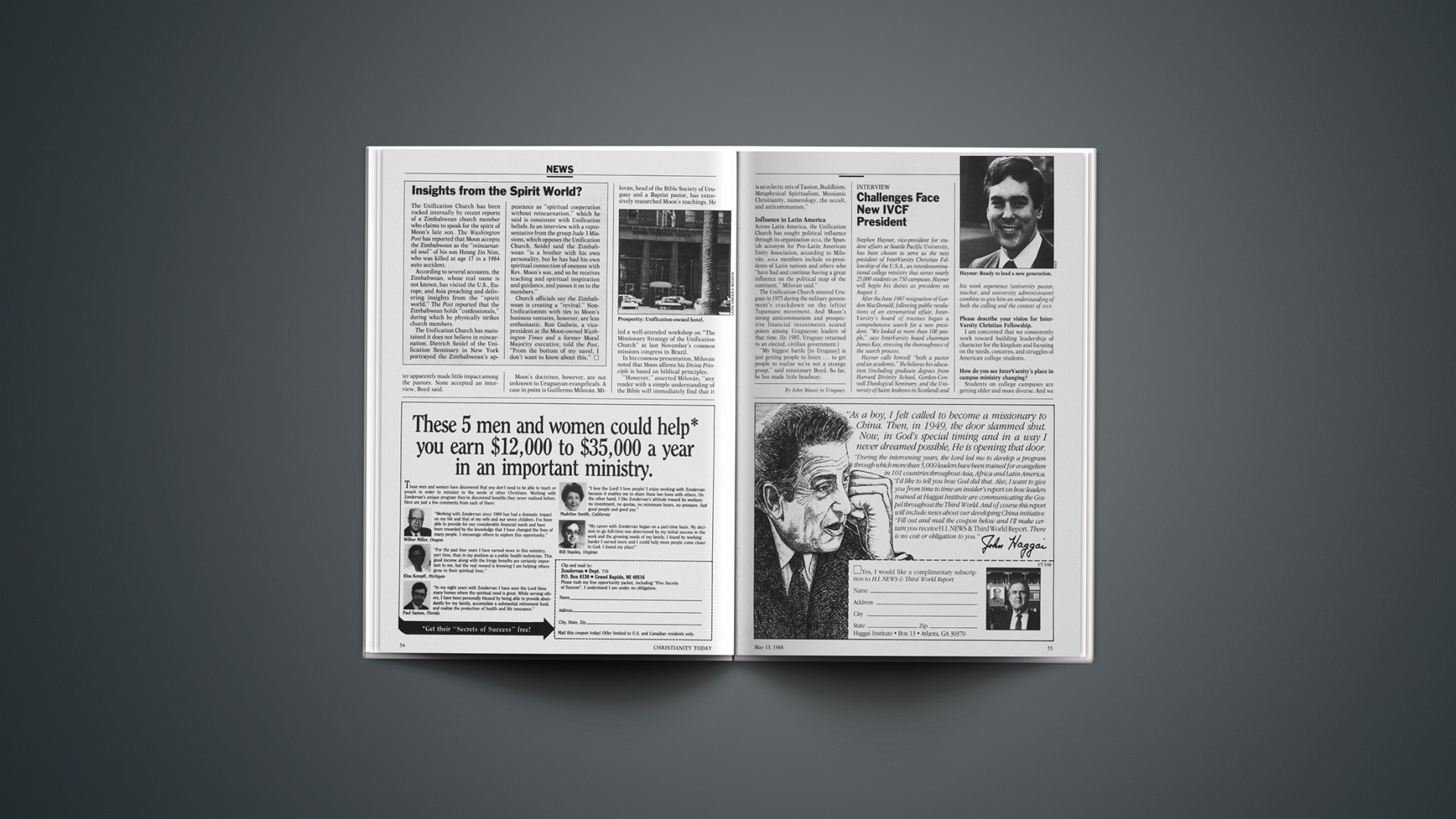
Challenges Face New IVCF President

INTERVIEW

Stephen Hayner, vice-president for student affairs at Seattle Pacific University, has been chosen to serve as the next president of InterVarsity Christian Fellowship of the U.S.A., an interdenominational college ministry that serves nearly 25,000 students on 750 campuses. Hayner will begin his duties as president on August 1.

After the June 1987 resignation of Gordon MacDonald, following public revelations of an extramarital affair, InterVarsity’s board of trustees began a comprehensive search for a new president. “We looked at more than 100 people,” says InterVarsity board chairman James Kay, stressing the thoroughness of the search process.

Hayner calls himself “both a pastor and an academic.” He believes his education (including graduate degrees from Harvard Divinity School, Gordon-Conwell Theological Seminary, and the University of Saint Andrews in Scotland) and his work experience (university pastor, teacher, and university administrator) combine to give him an understanding of both the calling and the context of IVCF.

Please describe your vision for InterVarsity Christian Fellowship.

I am concerned that we consistently work toward building leadership of character for the kingdom and focusing on the needs, concerns, and struggles of American college students.

How do you see InterVarsity’s place in campus ministry changing?

Students on college campuses are getting older and more diverse. And we have to deal with the importance of working with the multiple ethnic groups. We are also dealing with more and more students coming from dysfunctional families, as well as students who are dealing with the cultural baggage they carry—the individualism, relativism, and materialism of our culture—struggling with relational difficulties, problems with relationships, sexual confusion, and so forth.

In light of InterVarsity’s recent history, and recent calls for accountability structures for Christian leaders, how do you plan to protect yourself from pressures and temptations?

I rejoice that I am partnered with a wife who is deeply supportive and has really been a part of my ministry ever since I started in college ministry. She has had a deep sense that this is our ministry, not just mine.

In addition, the InterVarsity board and others at InterVarsity have really committed to walking with us to make sure that my schedule doesn’t get out of hand. And for the last 20 years, I have had a small group of people who consistently know what is happening in my life. I don’t know that I could function in the Christian life without that kind of fellowship.

Among evangelical institutions, InterVarsity has perhaps one of the broader statements on the nature of Scripture. How do you plan to apply doctrinal standards, and particularly the issue of the inerrancy of Scripture, to the selection of campus staff?

I believe strongly that the Bible is the Word of God and that it is the absolute authority for my life. I intend to continue to hold Scripture as the guide for what we do and how we practice our organizational life—as well as make it the standard for the personal lives of the staff. I’m very concerned that we continue to walk forward in a strong, biblical tradition.

At the same time, it’s important that we make sure the subtleties of how people define their view of Scripture don’t end up becoming the thing that divides us. While some would make them the issues of the church, those are not the issues that Scripture makes key to our understanding of what it means to be Christians.

How do you feel about InterVarsity Press publishing controversial books? Does that fit in with a campus ministry perspective?

InterVarsity always needs to be careful that parts of the overall ministry do not do things that will jeopardize the campus ministry. On the other hand, InterVarsity Press has always had a reputation for being one of those publishers that was willing to publish books of conscience. And I hope that it always will. I think that’s a vital ministry to the cause of Christ on college campuses.

One of the biggest opportunities for changing student lives is through the triennial Urbana missions convention. With a change in presidents and IVCF mission directors, what is the future of Urbana?

Urbana has a very positive future. This last Urbana was probably one of the finest that has ever been held. And apart from InterVarsity, there is a resurgence in the university world of interest in missions, concerns about questions of vocation, and learning about what it means to be a world Christian. InterVarsity is already strategizing about Urbana 1990, which will be our fiftieth anniversary. It should be an exciting time.

By David Neff.

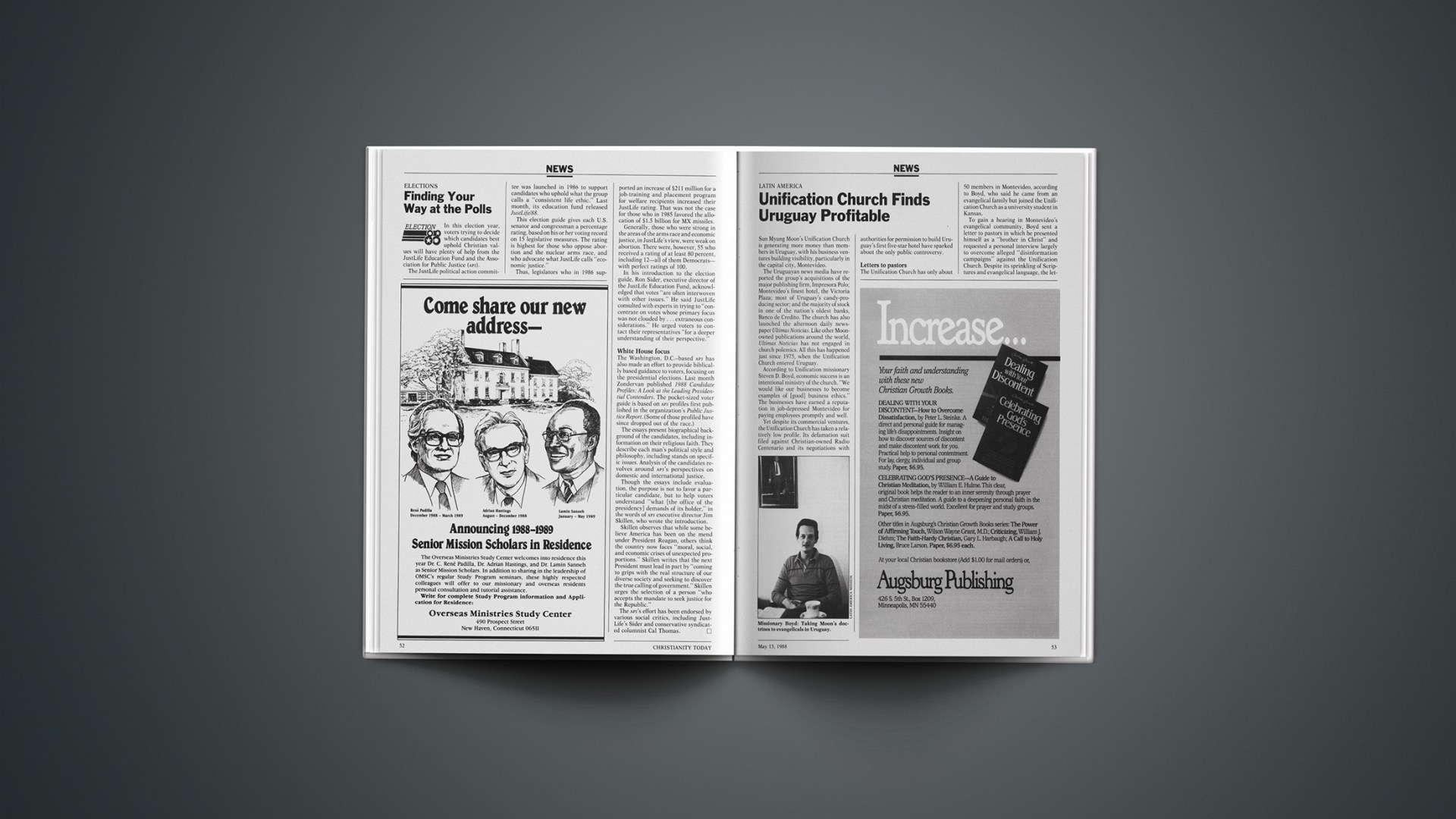
Unification Church Finds Uruguay Profitable

latin america

Sun Myung Moon’s Unification Church is generating more money than members in Uruguay, with his business ventures building visibility, particularly in the capital city, Montevideo.

The Uruguayan news media have reported the group’s acquisitions of the major publishing firm, Impresora Polo; Montevideo’s finest hotel, the Victoria Plaza; most of Uruguay’s candy-producing sector; and the majority of stock in one of the nation’s oldest banks, Banco de Credito. The church has also launched the afternoon daily newspaper Ultimas Noticias. Like other Moon-owned publications around the world, Ultimas Noticias has not engaged in church polemics. All this has happened just since 1975, when the Unification Church entered Uruguay.

According to Unification missionary Steven D. Boyd, economic success is an intentional ministry of the church. “We would like our businesses to become examples of [good] business ethics.” The businesses have earned a reputation in job-depressed Montevideo for paying employees promptly and well.

Yet despite its commercial ventures, the Unification Church has taken a relatively low profile. Its defamation suit filed against Christian-owned Radio Centenario and its negotiations with authorities for permission to build Uruguay’s first five-star hotel have sparked about the only public controversy.

Letters To Pastors

The Unification Church has only about 50 members in Montevideo, according to Boyd, who said he came from an evangelical family but joined the Unification Church as a university student in Kansas.

To gain a hearing in Montevideo’s evangelical community, Boyd sent a letter to pastors in which he presented himself as a “brother in Christ” and requested a personal interview largely to overcome alleged “disinformation campaigns” against the Unification Church. Despite its sprinkling of Scriptures and evangelical language, the let-lován, head of the Bible Society of Uruguay and a Baptist pastor, has extensively researched Moon’s teachings. He led a well-attended workshop on “The Missionary Strategy of the Unification Church” at last November’s COMIBAM missions congress in Brazil.

Insights From The Spirit World?

The Unification Church has been rocked internally by recent reports of a Zimbabwean church member who claims to speak for the spirit of Moon’s late son. The Washington Post has reported that Moon accepts the Zimbabwean as the “reincarnated soul” of his son Heung Jin Nim, who was killed at age 17 in a 1984 auto accident.

According to several accounts, the Zimbabwean, whose real name is not known, has visited the U.S., Europe, and Asia preaching and delivering insights from the “spirit world.” The Post reported that the Zimbabwean holds “confessionals,” during which he physically strikes church members.

The Unification Church has maintained it does not believe in reincarnation. Dietrich Seidel of the Unification Seminary in New York portrayed the Zimbabwean’s appearance as “spiritual cooperation without reincarnation,” which he said is consistent with Unification beliefs. In an interview with a representative from the group Jude 3 Missions, which opposes the Unification Church, Seidel said the Zimbabwean “is a brother with his own personality, but he has had his own spiritual connection of oneness with Rev. Moon’s son, and so he receives teaching and spiritual inspiration and guidance, and passes it on to the members.”

Church officials say the Zimbabwean is creating a “revival.” Non-Unificationists with ties to Moon’s business ventures, however, are less enthusiastic. Ron Godwin, a vice-president at the Moon-owned Washington Times and a former Moral Majority executive, told the Post, “From the bottom of my navel, I don’t want to know about this.”

In his COMIBAM presentation, Milován noted that Moon affirms his Divine Principle is based on biblical principles.

“However,” asserted Milován, “any reader with a simple understanding of the Bible will immediately find that it is an eclectic mix of Taoism, Buddhism, Metaphysical Spiritualism, Messianic Christianity, numerology, the occult, and anticommunism.”

Influence In Latin America

Across Latin America, the Unification Church has sought political influence through its organization AULA, the Spanish acronym for Pro-Latin American Unity Association, according to Milován. AULA members include ex-presidents of Latin nations and others who “have had and continue having a great influence on the political map of the continent,” Milován said.”

The Unification Church entered Uruguay in 1975 during the military government’s crackdown on the leftist Tupamaro movement. And Moon’s strong anticommunism and prospective financial investments scored points among Uruguayan leaders of that time. (In 1985, Uruguay returned to an elected, civilian government.)

“My biggest battle [in Uruguay] is just getting people to listen … to get people to realize we’re not a strange group,” said missionary Boyd. So far, he has made little headway.

By John Maust in Uruguay.

Finding Your Way at the Polls

elections

In this election year, voters trying to decide which candidates best uphold Christian values will have plenty of help from the JustLife Education Fund and the Association for Public Justice (APJ).

The JustLife political action committee was launched in 1986 to support candidates who uphold what the group calls a “consistent life ethic.” Last month, its education fund released JustLife/88.

This election guide gives each U.S. senator and congressman a percentage rating, based on his or her voting record on 15 legislative measures. The rating is highest for those who oppose abortion and the nuclear arms race, and who advocate what JustLife calls “economic justice.”

Thus, legislators who in 1986 supported an increase of $211 million for a job-training and placement program for welfare recipients increased their JustLife rating. That was not the case for those who in 1985 favored the allocation of $1.5 billion for MX missiles.

Generally, those who were strong in the areas of the arms race and economic justice, in JustLife’s view, were weak on abortion. There were, however, 55 who received a rating of at least 80 percent, including 12—all of them Democrats—with perfect ratings of 100.

In his introduction to the election guide, Ron Sider, executive director of the JustLife Education Fund, acknowledged that votes “are often interwoven with other issues.” He said JustLife consulted with experts in trying to “concentrate on votes whose primary focus was not clouded by … extraneous considerations.” He urged voters to contact their representatives “for a deeper understanding of their perspective.”

White House Focus

The Washington, D.C.-based APJ has also made an effort to provide biblically based guidance to voters, focusing on the presidential elections. Last month Zondervan published 1988 Candidate Profiles: A Look at the Leading Presidential Contenders. The pocket-sized voter guide is based on APJ profiles first published in the organization’s Public Justice Report. (Some of those profiled have since dropped out of the race.)

The essays present biographical background of the candidates, including information on their religious faith. They describe each man’s political style and philosophy, including stands on specific issues. Analysis of the candidates revolves around APJ’s perspectives on domestic and international justice.

Though the essays include evaluation, the purpose is not to favor a particular candidate, but to help voters understand “what [the office of the presidency] demands of its holder,” in the words of APJ executive director Jim Skillen, who wrote the introduction.

Skillen observes that while some believe America has been on the mend under President Reagan, others think the country now faces “moral, social, and economic crises of unexpected proportions.” Skillen writes that the next President must lead in part by “coming to grips with the real structure of our diverse society and seeking to discover the true calling of government.” Skillen urges the selection of a person “who accepts the mandate to seek justice for the Republic.”

The APJ’s effort has been endorsed by various social critics, including JustLife’s Sider and conservative syndicated columnist Cal Thomas.

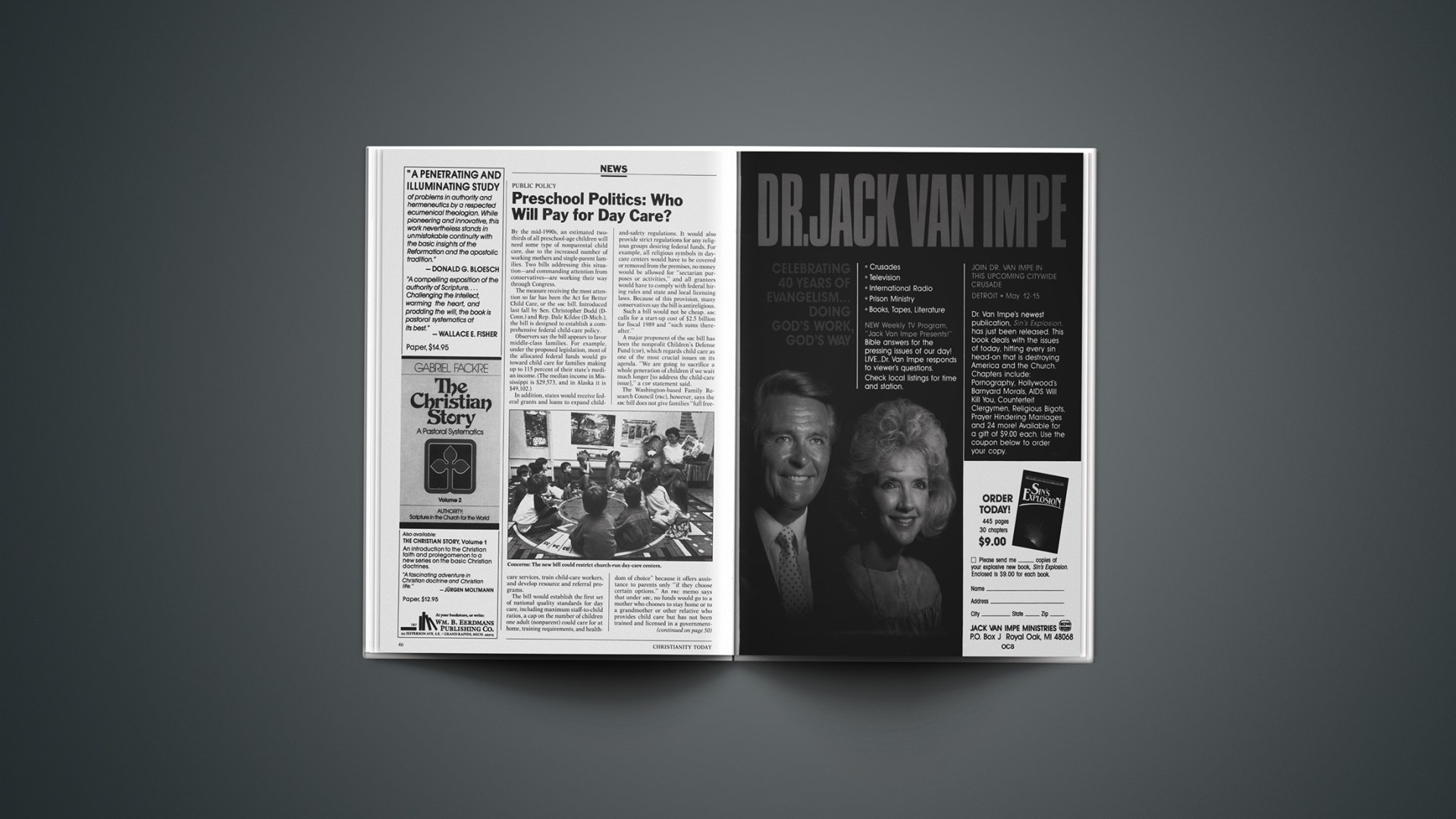
Preschool Politics: Who Will Pay for Day Care?

PUBLIC POLICY

By the mid-1990s, an estimated two-thirds of all preschool-age children will need some type of nonparental child care, due to the increased number of working mothers and single-parent families. Two bills addressing this situation—and commanding attention from conservatives—are working their way through Congress.

The measure receiving the most attention so far has been the Act for Better Child Care, or the ABC bill. Introduced last fall by Sen. Christopher Dodd (D-Conn.) and Rep. Dale Kildee (D-Mich.), the bill is designed to establish a comprehensive federal child-care policy.

Observers say the bill appears to favor middle-class families. For example, under the proposed legislation, most of the allocated federal funds would go toward child care for families making up to 115 percent of their state’s median income. (The median income in Mississippi is $29,573, and in Alaska it is $49,102.)

In addition, states would receive federal grants and loans to expand child-care services, train child-care workers, and develop resource and referral programs.

The bill would establish the first set of national quality standards for day care, including maximum staff-to-child ratios, a cap on the number of children one adult (nonparent) could care for at home, training requirements, and health-and-safety regulations. It would also provide strict regulations for any religious groups desiring federal funds. For example, all religious symbols in day-care centers would have to be covered or removed from the premises, no money would be allowed for “sectarian purposes or activities,” and all grantees would have to comply with federal hiring rules and state and local licensing laws. Because of this provision, many conservatives say the bill is antireligious.

Such a bill would not be cheap, ABC calls for a start-up cost of $2.5 billion for fiscal 1989 and “such sums thereafter.”

A major proponent of the ABC bill has been the nonprofit Children’s Defense Fund (CDF,) which regards child care as one of the most crucial issues on its agenda. “We are going to sacrifice a whole generation of children if we wait much longer [to address the child-care issue],” a CDF statement said.

The Washington-based Family Research Council (FRC,) however, says the ABC bill does not give families “full freedom of choice” because it offers assistance to parents only “if they choose certain options.” An FRC memo says that under ABC, no funds would go to a mother who chooses to stay home or to a grandmother or other relative who provides child care but has not been trained and licensed in a government-approved program. The memo asks, “Why should families which do not benefit from ABC subsidize [via taxes] the child care costs of others—especially when you consider the fact that the median income for a two-parent, single-income family … is considerably less than the median income for two-income families?”

A Republican alternative to the ABC bill was introduced earlier this spring by Sen. Orrin Hatch (R-Utah) and Rep. Nancy Johnson (R-Conn.). Called the Child Care Services Improvement Act, the measure would provide some $300 million annually to expand child-care programs, give tax credits to employers that establish on-site child-care centers, and lower the liability costs for child-care providers. Like ABC, the Hatch-Johnson bill would establish national standards, but it does not have an income limit or strict regulations for religious child-care providers.

This bill has also drawn considerable criticism from some conservatives and profamily groups who fear that any federally subsidized day-care centers will have an unfair advantage over private centers, especially religious ones that voluntarily refuse government money.

Some critics charge that both bills would ultimately increase the overall cost of child care and favor middle-income families rather than the poor. And the FRC points out that the alternative, like the ABC bill, offers no help to “the woman who might prefer to stay at home and raise her own children.” Religious groups, often considered a primary provider of child care, are divided over the issue. The National Council of Churches has taken a strong stance in support of the ABC bill, while the National Association of Evangelicals and the Catholic League for Religious and Civil Rights oppose it as currently written. The Lutheran Church-Missouri Synod has not taken any official positions on the issue, but a spokesperson said the denomination has “real concerns” about ABC’s implications for religious day-care programs.

For its part, the FRC is advocating a third approach: reforming the current tax code so that the child-care tax credit is available to all parents, including stay-at-home mothers and families that have a relative providing child care. Rep. Clyde Holloway (R-La.) has proposed such a bill.

By Kim A. Lawton.

World Scene

mexico

Palau Weathers Media

Evangelist Luis Palau has proclaimed his recent “Festival of the Family” crusades in Mexico successful despite hostile local press coverage. According to the Palau team, the Argentine-born evangelist preached to some 94,000 people and saw more than 6,000 public commitments to Jesus Christ during his nine days of crusade events.

Prior to the crusades, Palau was the target of much media opposition, including press reports that he is financed by the Central Intelligence Agency (CIA). At press conferences in Mexico, Palau dismissed allegations that he has any CIA connections, quipping that if that were the case he could stop spending time on fund raising.

Palau said the negative coverage actually backfired on the media. “The viciousness of the attacks and the saturation that was achieved as a result of the opposition gave us a sweet victory for the gospel of life in Jesus Christ,” he said.

Palau will return to Mexico next month for the Congress ‘88 evangelism conference, cosponsored by the Billy Graham Evangelistic Association and an organization called Conedes.

WORLDWIDE

Religious Intolerance

A report to the United Nations (UN) on religious liberty has found “infringement of freedom of religion or belief being committed in various forms and in practically all regions of the world …”

The second major report of the UN Special Rapporteur on Religious Intolerance specifically cited instances of religious persecution in seven countries: Albania, Bulgaria, Burundi, the Islamic Republic of Iran, Pakistan, Turkey, and the Soviet Union. The report also endorsed the formation of an international convention on religious intolerance.

THE VATICAN

Abortion Policy Protested

The Vatican has gone on record criticizing the Italian courts for allowing a married woman to have an abortion without her husband’s knowledge or approval.

According to an editorial in L’Osservatore Romano, the official Vatican newspaper, “A child which has already been conceived has the right not to be left to the whims of a single parent.” The editorial said, “The weakness of a solitary and unilateral decision is an inadmissible offense to the integrity of the person to be born.”

The editorial was apparently prompted by a recent case in northern Italy where a man sued his wife after she had an abortion without his knowledge.

Pope John Paul II, a staunch supporter of prolife efforts, has long been critical of Italy’s liberal abortion laws. The L’Osservatore Romano echoed his stand, proclaiming that the legislature “does not have the right to claim for the woman a presumed precedence in the decision as to whether or not to bring a child into the world.”

ISRAEL

Children Show The Way

Amidst growing tensions in the Israeli-occupied West Bank (see p. 34), children from a Palestinian Christian school in the region have collected money to help a nearby Muslim village under military curfew.

According to teachers with the Mennonite Central Committee (MCC,) students from the Latin Patriarch School in Zababden collected $1,500 by going door to door for donations.

The money was used to buy rice, sugar, powdered-milk biscuits, and other food. The MCC workers said the food was sent to Muslim families along with the message, “With love, from the children of Zababden to a child in Qabatiyeh.”

SOUTH AFRICA

Confronting Apartheid

Christians in South Africa are increasingly being drawn into their nation’s political battles over apartheid. Last month, a group of more than 40 theologians told President P. W. Botha that churches have a biblical basis for protesting apartheid.

In an open letter published in a Cape Town newspaper, the theologians said that for too long the pleas of the church on behalf of victims of apartheid have gone unheeded, hence the need to “put words into action,” the letter said.

The letter appeared after Anglican Archbishop Desmond Tutu drew criticism from Botha for attempting to organize a march protesting the banning of 17 antiapartheid groups.

The South African president asked Tutu to be a messenger of “the true Christian religion and not of Marxism and Atheism.”

The Dutch Reformed Church, which condemned apartheid in 1986, has joined Botha in criticizing the attempted march and the “political preaching” of some “activist clergymen.”

Meanwhile, earlier this spring some 200 Christians participated in an exchange in which black families stayed with whites in the suburbs of Pretoria and white families stayed with blacks in the black township of Mamelodi. The week-long exchange was sponsored by the interdenominational group Koinonia Southern Africa.

Muslims and Christians Talk instead of Fight

NIGERIA

Muslim attacks on Christians have been a fact of Nigerian life for decades, especially during the past 20 years of rapid church growth. The Evangelical Churches of West Africa (ECWA), which grew out of SIM International, was formed in 1956 with 5,500 members. Today, its 2,300 churches have one million members, with twice that number attending Sunday worship. The denomination is a member of the Christian Association of Nigeria (CAN), which presents a united front to the government on issues concerning Christians.

Just over a year ago, 11 ECWA-affiliated churches were among the 100 destroyed in northern Nigeria in bloody Muslim-Christian riots that saw 25 killed, 61 injured, and 600 arrested. Nigeria’s president, Gen. Ibrahim Babangida, himself a moderate Muslim, declared the riots were masking a coup conspiracy spawned by Muslim fanatics.

But five months later, Nigeria’s military government appointed a 24-member religious advisory council, evenly composed of Christians and Muslims. One of those council members is North American-educated ECWA President Nathaniel Olutimayin. His appointment makes him a logical spokesman for Nigeria’s rapidly growing evangelical movement.

Olutimayin draws on a lifetime of experience in Nigerian evangelical work. Converted through the influence of his uncle, he grew up in a pastor’s home. After studies at Central Baptist and Gordon-Conwell seminaries in Toronto and Boston, respectively, he earned a doctorate at Dallas Theological Seminary. Returning to Nigeria, he was viceprincipal, then principal, at ECWA’s Igbaja Seminary. He was elected ECWA president in the early 1980s.

The council, according to government dictum, “will provide a permanent forum for mutual interaction among the various religious groups as a means of fostering harmony.” Christians and moderate Muslims welcome such a council, but are concerned that tensions will remain. Many can members believe extremist Muslims are engaged in a holy war, in the Islamic jihad tradition. Noting that his government wants to bring harmony to Nigeria’s 100 million people, Olutimayin says “Evangelicals want to play their part in that process.”

By Lloyd Mackey.

For Black Evangelicals, a Silver Anniversary

CELEBRATION

It was in 1969 when Matthew Parker attended his first convention of the National Black Evangelical Association (NBEA). “It was the first time I realized there were other black Christians who called themselves evangelicals,” says Parker, who today serves as associate vice-president of urban academic affairs at William Tyndale College outside Detroit.

To Parker and countless other black Christians, the NBEA has been home when there was no other home to be found. The organization was launched 25 years ago in Pasadena in part because black evangelicals did not feel welcome in white Christian circles (a feeling many say they still have). Neither were they comfortable in traditional black churches, partly because many had been trained in institutions of the white cultural majority.

Last month the NBEA returned to Pasadena to celebrate its history. The organization, through its yearly conventions and other activities, has served as an arena for encouragement and for the exchange of ideas: the seeds of many black Christian ministries were planted and watered in NBEA soil.

The NBEA has also sought to build bridges with Christians in traditional black denominations. Said Ruth Bentley, first vice-president of the NBEA, “There are many blacks who are evangelical, but who don’t use the title.”

“Run, Jesse”

Jesse Jackson’s critics are surfacing as he moves closer to the Oval Office. Some are raising questions about whether Jackson, who has never held public office, would be able to translate his charisma into programs that work. Others have challenged the accuracy of his factual statements and questioned his integrity, given his claim to have cradled a dying Martin Luther King, Jr., a story widely disputed.

Those attending the twenty-fifth annual convention of the National Black Evangelical Association, however, had few reservations about Jackson. There was some talk of an official endorsement, but that did not materialize, NBEA board chairman Clarence Hilliard did write an article titled, “Run, Jesse, Run On!” for the official convention booklet.

The article states that the “hope Jesse represents for all the oppressed is being increasingly validated in primaries all over this land.” Hilliard writes, “It seems that anyone sensitive to God would be aware that He is doing something wonderful through Jesse.”

Black theologian Anthony Evans said at the NBEA meeting that he is bothered that “many black people feel that a black face in an executive political position can change the order of this world.” He stressed that the church, according to the Bible, is “the prime mover in the changing of society.”

“Black evangelicals are in a dilemma,” Evans said. “We are sociologically Democratic, but morally Republican. In my opinion, a vote for Jesse Jackson is a vote for a very immoral platform. But to vote Republican is to vote for a sociologically insensitive platform.”

Evans said that for blacks, Jackson’s candidacy represents “the opportunity of a lifetime. There’s a cultural excitement—it’s there for me, too—about somebody from my race, a race that has been suppressed, running for President.”

Evans said, however, that such feelings must be subservient to biblical revelation. And he cautioned Christians not to allow “politics to divide the body of Christ.”

Despite its positive activities, however, in Pasadena there were indications aplenty that not all is well with the NBEA. In recent years, attendance at annual conventions has dropped well below highs of over 700 in the late 1970s. Those attending the conference spoke of “growth pains,” of past disagreements over what NBEA ought to be: whether, for example, it should be more ambitious in adopting resolutions on social issues. Some, including NBEA President Eddie Lane, spoke of the need for fresh ideas and for young black evangelicals to replace an aging NBEA leadership.

In his candid presidential address, Lane said it was hard for some to celebrate the twenty-fifth anniversary because “there are too many feelings that have never been forgiven.” He continued, “We hug each other like Judas hugged Jesus. We talk formally, but never personally.” Lane urged a more open expression and discussion of differences.

Lane, assistant dean of student services for minority students at Dallas Theological Seminary, spoke also of a continuing need to address the problem of white racism, including in the church. He described incidents in which he has experienced discrimination, stating, “I still can’t go to a white church and speak, unless it’s some kind of special day.”

Black Theology

One highlight of the NBEA’s silver anniversary was the introduction of the Institute on Black Evangelical Thought and Action. Its purpose is to develop an evangelical theology in the context of the black American experience. Plans call for institute seminars to be held in six U.S. cities over the next year.

Theologian William H. Bentley, who has served as chairman of the NBEA’S theology commission, prepared a paper in which he offers a rationale for the institute. In arguing for a black theology, Bentley contends that Western theology, perhaps without always realizing it, has wrongly equated cultural values with biblical values.

Bentley says this has resulted in Western man’s inability “to recognize the right … of other cultures … to receive the gospel as unfettered as possible.” Bentley asserts additionally that Western theology has not successfully dealt with “the monumental perversion of the biblical doctrine of universal humanity.”

In introducing the institute, NBEA board chairman Clarence Hilliard said, “All theologies come out of a cultural context, although not all theologies admit it.” Hilliard said black theology is characterized by a commitment to the “victimized and the marginalized,” a commitment based on a commitment to Jesus Christ.

Lane emphasized that the use of the word black is not intended to be divisive to the body of Christ. “This is not about being racist against racists,” he explained. “We are simply saying there is a legitimate view of Scripture that has grown out of the context in which our ancestors lived, even though they were unable to articulate it, except in songs.”

By Randy Frame in Pasadena.

HHS Says No to Fetal Research

ETHICS

The Reagan administration has forbidden researchers at the National Institutes of Health (NIH) to experiment with tissue from aborted fetuses to treat certain diseases, at least until the ethical and legal issues can be studied by a special committee.

In a letter to NIH Director James Wyngaarden, Assistant Secretary of Health and Human Services (HHS) Robert Windom said the practice of fetal-tissue experiments “raises a number of questions—primarily ethical and legal—that have not been satisfactorily addressed, either within the Public Health Service or within society.”

Windom directed Wyngaarden to create a committee to study the controversies surrounding the use of tissue from aborted fetuses—as well as from miscarriages and stillbirths—in medical experiments.

Windom’s action apparently came in response to an NIH proposal to transplant fetal tissue into the brains of patients with Parkinson’s disease. This kind of procedure was done in Mexico last year, expanding the debate over the experimental use of fetal tissue as treatment for a variety of diseases, including diabetes and leukemia (CT, March 18, 1988, p. 52).

Researchers have long speculated that fetal tissue could be of use in treating many diseases; it grows faster and would likely cause less potential for rejection than adult tissue. Several scientists immediately denounced the administration’s move, charging it will inhibit research that could save thousands of lives.

Prolife Sen. Gordon Humphrey (R-N.H.), however, called the decision “morally right, ethically sound, and about time.” Earlier this year, Humphrey had written to Wyngaarden opposing the NIH proposal to use fetal tissue from aborted babies for treatment of Parkinson’s disease.

Most opponents of fetal-tissue research and transplants believe their battle is just beginning. “The fact that NIH’S work has been knocked out is fine, but the next step, and the important thing, is to make sure that this can’t be commercially exploited,” said social activist Jeremy Rifkin. Rifkin has filed a petition with HHS asking that all fetal tissues and organs be placed under the Organ Transplant Act, which forbids the sale of certain body parts for transplantation.

A group of 24 members of Congress, including Humphrey, has written to HHS Secretary Otis Bowen supporting Rifkin’s petition, HHS has not yet responded to that request.

North American Scene

POLITICS

Falwell: “Free Ollie”

Jerry Falwell has launched a national petition drive to see Marine Lt. Col. Oliver North pardoned for his role in the Iran-contra affair.

North, former National Security Adviser John Poindexter, former Air Force Major Gen. Richard Secord, and businessman Albert Hakim were indicted on criminal charges that included conspiracy, fraud, and theft.

Falwell has urged voting-age viewers of his “Old-Time Gospel Hour” television program to become part of the drive; his goal is five million participants. A toll-free telephone number allows viewers to call in to give permission for their names to be included on the petition. Falwell said President Reagan will receive the petitions, which call for “an immediate and unconditional pardon” for North. “[North] is a true national hero who has put his life on the line over and over again,” Falwell said.

CHURCH AND STATE

Religious Liberty Debated

A vigorous debate about the First Amendment, religious liberty, and the role of religion in American public life was the subject of a national symposium last month at the University of Virginia. Nearly 100 participants with widely diverging views on the relationship between religion and government discussed applications of the religion clauses of the Constitution.

Representatives of Protestant, Catholic, Jewish, and humanist groups, public-policy organizations, and the academic world participated in the discussions. Program chairman James Davison Hunter, from the University of Virginia, said the conference was “successful,” not because any minds were changed, but because people with different—and often adversarial—points of view came together, listened, and left with a better understanding of one another.

The symposium was a project of the Williamsburg Charter Foundation, a nonprofit, nonsectarian group concerned with the religion clauses of the First Amendment. Next month, the foundation, which is recognized by the Commission on the Bicentennial of the U.S. Constitution, will sponsor a “celebration summit” in Williamsburg at which American dignitaries will sign a document reaffirming “freedom of conscience for people of all faiths and no faiths” (CT, March 4, 1988).

BUSINESS

Cigarette Maker Fights Back

RJR Nabisco Inc., a major producer of tobacco products, has fired its advertising agency, Saatchi & Saatchi DFS Compton, apparently as a result of the agency’s no-smoking commercial for Northwest Airlines. Industry observers estimate the agency will lose $70 million to $80 million in annual billings to RJR Nabisco.

Last month, Northwest Airlines banned smoking on all domestic flights (CT, April 22, 1988, p. 40). It aired a television commercial prepared by Saatchi & Saatchi DFS Compton featuring passengers applauding the airline’s decision to become smoke free.

PUBLISHING

Word Spreads

The Christian book and record publishing giant Word, Inc., has decided to move about one-third of its employees, including most of its top executives and its world headquarters, from the small, central Texas city of Waco to the Dallas-Fort Worth Metroplex.

Company executives said they wanted to be closer to the far-reaching Dallas-Fort Worth International Airport. They also said they wanted to take advantage of the burgeoning job market in the Metroplex and to have easier access to the area’s rapidly improving printing and record manufacturing systems. “We felt we needed to leave Waco if we were to continue to grow over the next five to ten years,” said Word president Gary Ingersoll.

Word accounts for between 15 and 20 percent of the market share of Christian books and audio and video cassettes. It accounts for some 60 percent of the market share of record and music products sold through Christian bookstores.

PEOPLE AND EVENTS

Briefly Noted

Ousted: By elders at the Community Chapel and Bible Training Center in suburban Seattle, Donald Barnett, the church’s controversial pastor (CT, Aug. 8, 1986, p. 32). Barnett was voted out for alleged repeated sexual contact with female church members. A court, however, restored his control of the congregation. In late March, elders countered by petitioning the King County Superior Court in Washington to dissolve their corporation.

Named: As the first black Catholic archbishop in the United States, Eugene Antonio Marino, the new archbishop of the Roman Catholic Archdiocese of Atlanta.

As the new president of African Enterprise (AE,) David Montague, who has spent more than a decade as a missionary to Africa, including a period among Kenya’s Massai people, AE is an interdenominational ministry with field offices in seven African nations. Montague will head AE’S U.S. office, located in Pasadena.

As president of Dallas Baptist University, Gary Cook, formerly an administrator at Baylor University in Waco, Texas. He replaces W. Marvin Watson, a former U.S. postmaster general, who resigned last fall.

Appointed: As the first executive director of the lay renewal group Presbyterians for Democracy and Religious Freedom (PDRF,) scholar-clergyman Paul Scotchmer, most recently an adviser to the Seattle-based World Without War Council. Since PDRF was recognized by the Presbyterian Church (USA) in June of 1986, its list of members and supporters has grown from 200 to over 4,000.

Why the Assemblies Dismissed Swaggart

TELEVANGELISM

The denomination decides two million members and integrity are more important than one man.

As he stood sobbing on the platform in his rose-carpeted Family Worship Center, televangelist Jimmy Swaggart was most apologetic towards the Assemblies of God.

“To its thousands and thousands of pastors that are godly … its evangelists … its missionaries … I’ve sinned against you and I’ve brought disgrace, humiliation, and embarrassment upon you,” he said. “I beg your forgiveness.”

Once again the hapless Assemblies of God found itself caught in an unhappy wrangle involving one of its leading evangelists. Tarred for the second time with the brush of a steamy sex scandal, its reputation as a conservative, missions-minded denomination of high integrity has been tarnished in everything from Newsweek to “Nightline.”

Charges Of Favoritism

It was to maintain that integrity that the Assemblies summoned the troops to a Springfield, Missouri, meeting March 28–29. As much as Swaggart’s career, the Assemblies’ credibility was at stake for this important meeting of the general presbytery—the Assemblies’ national board governing its 2.1 million American members.

“It was a quiet, somber meeting, and I don’t think anyone was eager to judge anybody,” said a Houston pastor who was there, South Texas presbyter Earl J. Banning.

He was one of 250 presbyters called in to back up an earlier decision by the 13-member executive presbytery, the top policy-making council of the Assemblies of God. The executive presbytery had ruled that Swaggart deserved a stricter punishment than the three-month silencing period mandated by Swaggart’s immediate superiors in the Louisiana District of the Assemblies of God.

Louisiana assistant superintendent Don Logan of Shreveport, whose decision to side with the executive presbytery’s stance was a minority position on the 19-man Louisiana district board, said it was nigh impossible for Swaggart’s Louisiana brethren to discipline him.

“We’ve been so closely identified with Jimmy Swaggart throughout the years and we’ve felt in some way that we’re part of his ministry,” he said.

Not all Assemblies members were so forgiving, however. Once they heard news reports that Swaggart’s silencing might last a mere three months, hundreds of church members from across the country swamped headquarters with calls, complaining of favoritism.

“Many people have also accused the church of being unforgiving,” says Assemblies spokesperson Juleen Turnage, “but this is not an issue of forgiveness. This is an issue of an organization, a denomination that has high standards of conduct for its ministers.… There’s a difference between forgiveness and restoration to leadership.”

In order to keep their credentials, all Assemblies pastors must sign an annual agreement binding them to the standards and constitution of the denomination. This includes submitting to their terms of discipline, which in the case of sexual sin is a two-year suspension from the ministry and at least an additional one year away from the pulpit, weekly counseling by persons chosen by the denomination, and reports filed monthly with the district and twice yearly with national headquarters.

So it was not surprising the general presbytery dismissed Swaggart from the denomination on April 8 for refusing to bow to the Assemblies’ terms of discipline. (Ordained Assemblies ministers who work for Swaggart’s college or television ministry must either resign or lose their credentials, according to the denomination’s rules.) Swaggart says he will return to the pulpit May 22, Pentecost Sunday, the original deadline set by the Louisiana District.

Prone To Scandal?

The denomination has yet to resolve why its two brightest stars fell into disgrace. Whereas Jim Bakker’s Christian Disneyland-style image was a far departure from the conservative AG mold, Swaggart was vintage Assemblies. A dynamic preacher of preachers, a major contributor ($12 million yearly) to the Assemblies’ foreign missions budget, Swaggart championed the Pentecostal experience. He was a self-appointed reformer in the denomination, taking stands against other Assemblies of God pastors whom he judged guilty of doctrinal deviations or moral indiscretions.

In the first days of the scandal, one popular item at AG headquarters was an article, “Sin in the Church,” written by Swaggart in the August 1987 issue of The Evangelist magazine, a Swaggart ministries publication. The text was sheer irony: Swaggart righteously describing just how fallen pastors should be disciplined, with the provision that fallen clergymen must be removed from their positions of spiritual leadership for at least two years.

That the incident should happen to the Assemblies of God is also ironic: of all evangelical denominations, the Assemblies have one of the most aggressive policies for restoring fallen brethren. In 1987, 75 out of 30,000 U.S. AG clergy went through the denomination’s rehabilitation program, which has been in effect only since 1973, said Turnage. Nevertheless, the sight of two famous AG pastors falling off their pedestals has had an unnerving effect. Pastors around the country found themselves reassuring congregants that all was not lost.

Yet in spite of the brave public front, plenty of soul searching has gone on behind the scenes, says Fuller Theological Seminary professor Russell Spittler, an ordained AG minister and director of the school’s David duPlessis Center for Christian Spirituality. “I’m sorry the Assemblies of God has become famous in this way,” said Spittler. “But I’ve been pleased with the response of the church. This has made us realize there’s more to being a Christian than ‘being saved.’ We’ve been good at conversion and less successful in building a firm character.”

A Sad Situation

Reaction from outside the denomination has been kind. Catholics, a group much maligned by Swaggart, view it as “a sad situation,” said Bob Furlow, director of communications for the Catholic Diocese of Baton Rouge. His bishop, Stanley J. Ott, met with Swaggart after a 1983 article in The Evangelist urged Catholics to leave their church. “We tried to be open with our faith with Jimmy Swaggart,” Furlow said. “I’d hope we’d not only pray for the Rev. Swaggart, but also have compassion for the woman he was with.”

Speaking to one of the country’s largest Southern Baptist congregations, John Bisagno, pastor of Houston’s 20,000-member First Baptist Church, said in February the televangelist scandals did not reflect on the Assemblies of God.

“[That such an incident should happen to] this evangelistic godly missionary denomination, that probably has more missionaries on the foreign field than any group in the world, including Southern Baptists, … does not for a minute suggest that there is anything wrong with the Assemblies of God people,” Bisagno said. “I don’t believe that incidents of immorality or sin among their pastors or their people are any higher than in any denomination in the world.”

Turnage says it is too soon to know how the televangelist fallout will affect church membership.

“The events of the past year are having a purging, cleansing effect on the Assemblies of God,” she said, “with Christians examining themselves and their own lives to see if there are areas where they’re not living up to standards of holiness. The Assemblies of God is a strong denomination and it is much bigger than one or two ministers.”

By Julia Duin.

Apple PodcastsDown ArrowDown ArrowDown Arrowarrow_left_altLeft ArrowLeft ArrowRight ArrowRight ArrowRight Arrowarrow_up_altUp ArrowUp ArrowAvailable at Amazoncaret-downCloseCloseEmailEmailExpandExpandExternalExternalFacebookfacebook-squareGiftGiftGooglegoogleGoogle KeephamburgerInstagraminstagram-squareLinkLinklinkedin-squareListenListenListenChristianity TodayCT Creative Studio Logologo_orgMegaphoneMenuMenupausePinterestPlayPlayPocketPodcastRSSRSSSaveSaveSaveSearchSearchsearchSpotifyStitcherTelegramTable of ContentsTable of Contentstwitter-squareWhatsAppXYouTubeYouTube