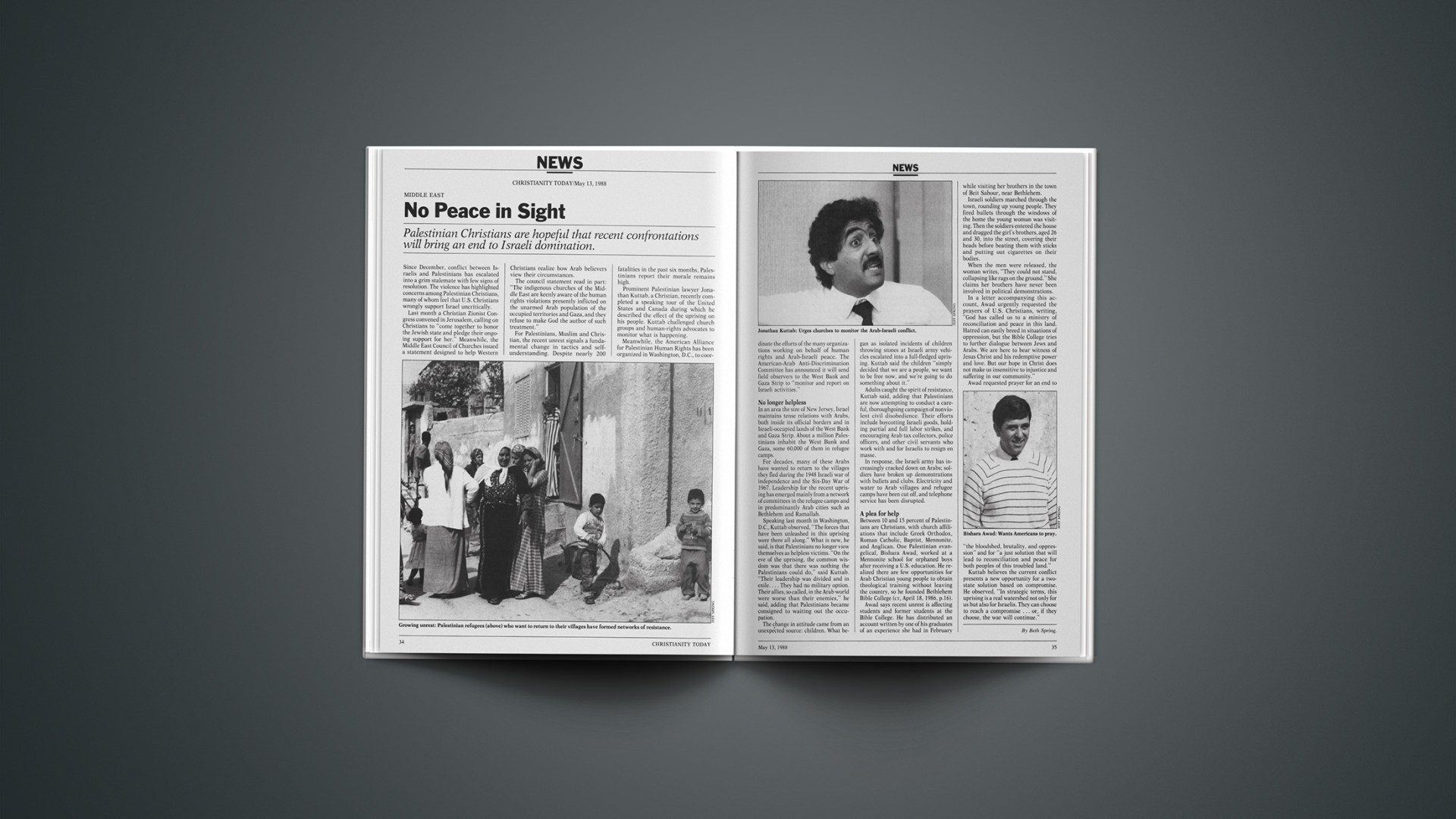
No Peace in Sight

NEWS

MIDDLE EAST

Palestinian Christians are hopeful that recent confrontations will bring an end to Israeli domination.

Since December, conflict between Israelis and Palestinians has escalated into a grim stalemate with few signs of resolution. The violence has highlighted concerns among Palestinian Christians, many of whom feel that U.S. Christians wrongly support Israel uncritically.

Last month a Christian Zionist Congress convened in Jerusalem, calling on Christians to “come together to honor the Jewish state and pledge their ongoing support for her.” Meanwhile, the Middle East Council of Churches issued a statement designed to help Western Christians realize how Arab believers view their circumstances.

The council statement read in part: “The indigenous churches of the Middle East are keenly aware of the human rights violations presently inflicted on the unarmed Arab population of the occupied territories and Gaza, and they refuse to make God the author of such treatment.”

For Palestinians, Muslim and Christian, the recent unrest signals a fundamental change in tactics and self-understanding. Despite nearly 200 fatalities in the past six months, Palestinians report their morale remains high.

Prominent Palestinian lawyer Jonathan Kuttab, a Christian, recently completed a speaking tour of the United States and Canada during which he described the effect of the uprising on his people. Kuttab challenged church groups and human-rights advocates to monitor what is happening.

Meanwhile, the American Alliance for Palestinian Human Rights has been organized in Washington, D.C., to coordinate the efforts of the many organizations working on behalf of human rights and Arab-Israeli peace. The American-Arab Anti-Discrimination Committee has announced it will send field observers to the West Bank and Gaza Strip to “monitor and report on Israeli activities.”

No Longer Helpless

In an area the size of New Jersey, Israel maintains tense relations with Arabs, both inside its official borders and in Israeli-occupied lands of the West Bank and Gaza Strip. About a million Palestinians inhabit the West Bank and Gaza, some 60,000 of them in refugee camps.

For decades, many of these Arabs have wanted to return to the villages they fled during the 1948 Israeli war of independence and the Six-Day War of 1967. Leadership for the recent uprising has emerged mainly from a network of committees in the refugee camps and in predominantly Arab cities such as Bethlehem and Ramallah.

Speaking last month in Washington, D.C., Kuttab observed, “The forces that have been unleashed in this uprising were there all along.” What is new, he said, is that Palestinians no longer view themselves as helpless victims. “On the eve of the uprising, the common wisdom was that there was nothing the Palestinians could do,” said Kuttab. “Their leadership was divided and in exile.… They had no military option. Their allies, so called, in the Arab world were worse than their enemies,” he said, adding that Palestinians became consigned to waiting out the occupation.

The change in attitude came from an unexpected source: children. What began as isolated incidents of children throwing stones at Israeli army vehicles escalated into a full-fledged uprising. Kuttab said the children “simply decided that we are a people, we want to be free now, and we’re going to do something about it.”

Adults caught the spirit of resistance, Kuttab said, adding that Palestinians are now attempting to conduct a careful, thoroughgoing campaign of nonviolent civil disobedience. Their efforts include boycotting Israeli goods, holding partial and full labor strikes, and encouraging Arab tax collectors, police officers, and other civil servants who work with and for Israelis to resign en masse.

In response, the Israeli army has increasingly cracked down on Arabs; soldiers have broken up demonstrations with bullets and clubs. Electricity and water to Arab villages and refugee camps have been cut off, and telephone service has been disrupted.

A Plea For Help

Between 10 and 15 percent of Palestinians are Christians, with church affiliations that include Greek Orthodox, Roman Catholic, Baptist, Mennonite, and Anglican. One Palestinian evangelical, Bishara Awad, worked at a Mennonite school for orphaned boys after receiving a U.S. education. He realized there are few opportunities for Arab Christian young people to obtain theological training without leaving the country, so he founded Bethlehem Bible College (CT, April 18, 1986, p. 16).

Awad says recent unrest is affecting students and former students at the Bible College. He has distributed an account written by one of his graduates of an experience she had in February while visiting her brothers in the town of Beit Sahour, near Bethlehem.

Israeli soldiers marched through the town, rounding up young people. They fired bullets through the windows of the home the young woman was visiting. Then the soldiers entered the house and dragged the girl’s brothers, aged 26 and 30, into the street, covering their heads before beating them with sticks and putting out cigarettes on their bodies.

When the men were released, the woman writes, “They could not stand, collapsing like rags on the ground.” She claims her brothers have never been involved in political demonstrations.

In a letter accompanying this account, Awad urgently requested the prayers of U.S. Christians, writing, “God has called us to a ministry of reconciliation and peace in this land. Hatred can easily breed in situations of oppression, but the Bible College tries to further dialogue between Jews and Arabs. We are here to bear witness of Jesus Christ and his redemptive power and love. But our hope in Christ does not make us insensitive to injustice and suffering in our community.”

Awad requested prayer for an end to “the bloodshed, brutality, and oppression” and for “a just solution that will lead to reconciliation and peace for both peoples of this troubled land.”

Kuttab believes the current conflict presents a new opportunity for a two-state solution based on compromise. He observed, “In strategic terms, this uprising is a real watershed not only for us but also for Israelis. They can choose to reach a compromise … or, if they choose, the war will continue.”

By Beth Spring
Classic & Contemporary Excerpts from May 13, 1988

Classic and contemporary excerpts.

Losing touch

What is largely missing in American life today is a sense of context, of saying or doing anything that is intended or even expected to live beyond the moment. There is no culture in the world that is so obsessed as ours with immediacy. In our journalism, the trivial displaces the momentous because we tend to measure the importance of events by how recently they happened. We have become so obsessed with facts that we have lost all touch with truth.

—Ted Koppel in a speech to the International Radio and Television Society, quoted in Harper’s (Jan. 1986)

The Bible: Force or farce?

I remain unpersuaded that any theological movement can dramatically affect the course of the world while its own leaders undermine the integrity of its charter documents, or while its spokespersons domestically exhaust all their energies in internal defense of those documents. The Bible stands impressively unshaken by the fury of destructive critics, while the nonbelieving world, itself marked for destruction, urgently needs to hear its singular message of salvation.

—Carl F. H. Henry in The Christian Century (Nov. 1980)

Hell: Heat plus humidity

I want to say that the humidity factor has never to my knowledge been taken into account in descriptions of Hell. Your talking eternal fire without no humidity, a Mississippian is gonna think you mean Heaven or Southern California.

—Jack Butler in Jujitsu for Christ: A Novel

Talking too much

Would-be theologians … must be on their guard lest by beginning too soon to preach they rather chatter themselves into Christianity than live themselves into it and find themselves at home there.

—Søren Kierkegaard as recorded in his Journal (July 11, 1838)

Misplaced redwoods

I suppose that the worst thing we can do with our lives is actively pursue wickedness: oppression, rape, hatred—they are hideous. But doing things that don’t matter is nearly as bad. God created us as wonderful beings, capable of loving, caring, growing. And what do we do most of the time? Nothing.

We’re intended to grow into “the measure of the stature of the fullness of Christ.” We’re meant to be like trees planted by rivers of water, like redwoods. We’re intended to treat others as we’d like to be treated ourselves.

But instead we go about our daily routines, rarely asking whether what we’re doing matters. Most of the time, we’re redwoods transplanting ourselves to the desert.

John Alexander in The Other Side (May 1987)

Out of the rabbit holes

Many believers are “rabbit hole” Christians. In the morning they pop out of their safe Christian homes, hold their breath at work, scurry home to their families and then off to their Bible studies, and finally end the day praying for the unbelievers they safely avoided all day.

—Jan Johnson in Moody Monthly (Nov. 1987)

Work never done

The trouble with doing good works is that one can never be said to have done one’s share because some works always need doing and there are never enough people to do them.

—Barbara Pym in An Academic Question

Distracted fans

We’ve lost ourselves in the cult of personality. We seem to have become “fans,” passive spectators of the passing scene. The stars whom we either admire or despise serve as a distraction from the things we should be thinking about, such as our own lives.

—Maureen Howard, interviewed in Sunday (Chicago Tribune magazine, Sept. 7, 1986)

More than hardware

The visionaries of the electronic age have tended to only look at what it is possible for the new Age of Information to bring us, not what the probable outcome will be in a larger social or moral sense … we should remember that technology is not just “hardware.” It cannot be removed from its social context or consequences.

—Stewart Hoover, quoted in Media&Values (Summer/Fall 1987)

Lite Champions

Has heroism become a trivial pursuit?

Nowadays heroes come and go with alarming frequency. Oliver North is a goat one day, a hero the next. And so it is with Gary Hart, Jim and Tammy Bakker, and hordes of other politicians, Christian figures, athletes, and entertainers. Have we reached Andy Warhol’s society of the future when everyone will be famous—but only for 15 minutes?

Americans have always taken heroes seriously, and rightly so. Heroes, whether we are aware of it or not, focus the human imagination and thereby shape the lives and personalities of their admirers. Public heroes also provide coherence at a deep level to the society of which they are a part. This is what makes our present confusion about heroes particularly troubling. How can they exert this influence if they rise and fall, inflate and deflate like soap bubbles on the wind? It is no small thing when the heroes of a society are in disarray, because heroism touches the human spirit deeply at so many levels—the psychological, the sociological, and the theological.

You can see the psychological importance of heroism early in a child’s life. Think of the hats a child puts on—those of the nurse, the fire chief, the soldier. Long before a child is aware of abstract moral rules, he or she has a fertile imagination and wants to be like certain kinds of people and unlike others.

Even as we grow older, we are motivated not just by rules and laws, but by stories, by images of flesh-and-blood people who have lived in a way we find admirable and attractive.

On a social level, we do not need to look far to see the significance that people like Elizabeth I, Washington, Lincoln, Churchill, and Gandhi had for their respective countries. (Of course, on the dark side of heroism, there was Hitler, who was probably the most skilled architect of a hero system in our century.)

In reading theology, I often find Christians speaking as if having heroes is pardonable up through early adolescence, but after that heroism is a negative force, tied inevitably to pride. Not only is this the fruit of a low view of the power of the imagination, but it also shows a theological thinness. The God of the Bible is the God of glory, and we are called to reflect something of this glory in our relationship to him through Christ. Glory and honor are not the featherweight conceptions that our society has made them, but are heavy and solid, rooted in the unchanging character of God for all eternity.

The desire for heroism, properly understood, comes from the need to interact with and reflect the glory of God himself. In this is found true human greatness and excellence, which is focused ultimately in the imitation of Christ (2 Cor. 3:18). At its worst, the heroic harnesses the full force of human vanity, self-deception, and cruelty to become a scourge on the planet. But at its redeemed best, the longing to reach toward heroism is the burning desire to honor God, forgetful of self.

Heroism is not dead in our society, but it has been besieged by two powerful forces: cynicism and trivialization. Together they bring about a crisis of the imagination that has deeply affected our society.

Heroes And Cynics

We are living at a time when the very word hero has come to carry cynical connotations. Many loud and learned voices are claiming there is no such thing as human greatness at all, and there never was. There has been a widespread loss of confidence that meaning for human life can ever be expressed in words. This is obviously devastating, because heroes must be heroic in terms of meanings, values, or standards—without which their heroism would be indistinguishable from villainy or random behavior. If the foundation for meaning is cut away, the human need for heroism will shrivel up in boredom and alienation. Or it will hang in midair, waiting to attach itself to the fragmented, arbitrary, and sometimes fanatical meanings that either individuals will create for themselves, or charismatic leaders will prefabricate for them.

The existentialist Ernest Becker has given an incisive thumbnail sketch of the history of meaning. He points out that for all of known civilization, people have believed in two worlds: one that you could see, and one that was invisible. They lived in the visible world, but they believed in the unseen world, in which lived spirits, hobgoblins, gods, goddesses, and God. The invisible world provided the basis for meaning and value, and hence, for what was heroic. It was the source of cohesion for their society. However, about the middle of the last century, people began to be told that there was no invisible world. It did not exist and never had. They were living a lie.

Becker then looks at what happened to heroism as a result. Once the door to the invisible world was closed and barred, we had to derive a sense of the heroic from the visible, tangible, material world.

He writes in The Birth and Death of Meaning: “People no longer drew their power from the invisible dimension, but from intensive manipulation of very visible Ferraris and other material gadgets. They try to find their whole fulfillment in a sex partner or an endless succession of partners, or in their children.”

Suddenly the theater of heroism has shrunk. There is nothing beyond ourselves to which we correspond except the vast impersonal. Lost is God and the moral and heroic absolutes that made sense under his reign, and with it the idea of distinctive human dignity. The British philosopher C. E. M. Joad put it well: “Although there was scientific basis for saying that man was the highest primate, there was none for placing him outside the animal kingdom in the matter of unique rights; he was only the star performer in the zoo. Suppose, then, someone put him in a cage or made a slave of him; was there any biological or sociological law which said this could not be done?”

Admittedly, we do different tricks than the other animals in the zoo. But unless there is a God in whose image we are made, all our higher ideals for justice, goodness, and beauty are just pretensions, mirages in the consciousness of the human animal. At the philosophical level, there is therefore little confidence in human distinctiveness, let alone heroism.

Freud Confronts Da Vinci

The human sciences have also made a major contribution to cynicism about human greatness, especially as they treat the subjects of motivation and freedom. We are told that human choice is not what it appears to be. If we accept the sophistications of some views of psychology, we know that what appears to be heroic—for example, a man or woman’s act of courage in saving another’s life—is, in fact, a desperate attempt to win the approval of a long-dead parent who had withheld love in the childhood years. What, then, has become of the hero? He or she is transformed in our minds into a neurotic, and with a slight turn of the mind, admiration is changed to pity and condescension.

Psychoanalysis has always been a great equalizer of people. This, of course, puts it at loggerheads with heroism, which by definition gives attention to what is extraordinary. The influence of Freud, although great in psychology and psychiatry, may have been even more pervasive in literature, history, and the arts in general. He set a pattern in his early study of Leonardo da Vinci when he explained that da Vinci’s extraordinary creativity could be accounted for by his repressed homosexual desires. As an “in-closet” homosexual, such psychic energy was built up inside him that it was sublimated into his artistic and engineering accomplishments.

By this psychoanalytic method, any heroic act can be seen to have self-serving, even sordid roots. We are left with our attention fixed on the internal crippling of a person, and we are thoroughly uninspired by that person’s genius.

Space does not allow a survey of the debunking strands in psychology, sociology, history, anthropology, sociobiology, and economics. Despite the many helpful contributions these fields have made, there has been a tendency to see individuals as only products of intrapsychic, socioeconomic, or biological forces beyond their control. These factors eclipse the drama of life—stories with unfolding narratives of agonizing choice and action. In the name of science and under the aura of its authority and sophistication, some of the work in these disciplines simply obscures those things most important and most admirable in human existence.

The Trivialization Of Charles Lindbergh

The second great force besieging heroism today is trivialization. While the acid of cynicism dissolves the very idea of the heroic, the force of trivialization at first seems to be blowing the horn for the heroic. On closer observation, however, we discover trivialization dilutes heroism. It contributes just as much as cynicism to the loss of the heroic. The media are prime culprits. In his landmark work, The Image, Daniel Boorstin complains that we have exchanged heroes for celebrities. While a hero is someone who has done something great or honorable and therefore commands respect, a celebrity is “known for his well-knownness” and is envied for it. He is the “human pseudo-event.”

Trivialization takes two forms. First, true heroes are trivialized. Second, trivial people are inflated to heroic status.

Charles Lindbergh was one of the first heroes to be trivialized by the news media’s power. His flight was extraordinary, but relatively uncomplicated—insufficient to satisfy the public’s hunger for information about him. Therefore, his rise to fame itself became the focus of the news, with all the complications and tragedy that it brought to his life. What the press had made of him was more newsworthy than what he actually did, and hero became celebrity.

More recently, Lenny Skutnik, the man who rescued a woman from the icy Potomac River after the Air Florida plane crash, observed the same thing. After he had appeared on television beside Nancy Reagan at the State of the Union address, he reported that when people would come to him they no longer asked, “Hey, aren’t you the guy who jumped in the river and saved the lady?” but instead, “Hey, aren’t you the guy who was on the State of the Union?”

The second form of trivialization—inflating superficial people to heroic status—is more destructive. It provides us with a new cast of fascinating people each week, and with fame as the central virtue. The National Enquirer is always ready to feed our inquiring minds, and People Weekly magazine to keep us abreast of the most recent divorces and indictments among celebrities. In a recent study of the top ten American heroes, seven were in show business, and most were considered not so much for who they were but for their stage or celluloid images. Much of what is admired actually does not exist except in the form of image. Like the dehydrated desert wanderer, we are navigating by mirages.

This is very serious. Today’s heroism is one of style, not of character, where the important points are driving a Mercedes or BMW, and wearing Calvin Klein or Ralph Lauren fashions. Even in the “serious” world of politics, what seems to matter is physical appearance, an attractive family, and a quotable quip on every current issue. (Of course, for someone who wants to be a celebrity badly enough, that is always possible. All one needs to do is to shoot a famous person.)

Not only are certain individuals trivialized, but heroism itself has become superficial. As long ago as 1959, Earl Blackwell and Cleveland Amory compiled the voluminous Celebrity Register. In it the television comedienne Dagmar was listed beside the Dalai Lama, Anita Ekberg beside Dwight Eisenhower, and Jane Russell beside Bertrand Russell.

As long as fame is the highest value, we cannot make important distinctions between celebrities and true heroes. Could it be that some of our televangelists have pulled God himself into the triviality of America’s consumer culture, where faith is a commodity and theology is lite—all for your entertainment pleasure?

Eating Indiana Jones’S Cake

Although the forces of cynicism and trivialization seem to start off in opposite directions, they in fact feed each other. The more cynical one is, the more life seems to be trivial. The more life seems trivial, the more cynicism is justified. There is a symbiotic relationship between the two, the result of which makes it very difficult to develop a healthy sense of heroism.

The heroism that survives the acid of cynicism and the inflation-deflation cycles of trivialization is apt to be a heroism out of reach of the vast majority of people. This is because there is no modern transcendent source of meaning. As long as heroism is linked to moral character, it can provide a focus of aspiration for common people, for the possibility of moral choice is available to any of us. But much of what passes for high-visibility heroism today is morally neutral. Society can no longer distinguish between right and wrong. Instead, we exalt heroes of beauty, sports, music, and film—those with money and possessions.

If we follow the heroics of Clint Eastwood or James Bond, we will end up dead or in jail. What if (like the vast majority of us) our physical endowments are such that the heroism of beauty or professional sports is simply not an option? Or how many of us can be rock music stars? Wealth and its accouterments may be a little more accessible, but they are still unavailable to most people.

What we have is a heroism that has a different function than it used to have. The hero was once a focal point for aspiration, but this is no longer realistically the case. After initial short-lived aspiration, the modern hero is apt to produce two responses—daydreaming and self-hatred. We daydream about what life would be like if we walked in the shoes of the hero, but we detest ourselves for falling so far short.

Watching a 90-yard touchdown run is inspiring, but for most observers, it inspires only a trip to the kitchen for another can of beer. Likewise, the adoring fans of the rock guitarist are inspired to invest fortunes in records, tapes, posters, and correct clothing, but few get beyond “air guitar” in their own musical accomplishments. As Christopher Lasch has noted, there is a loss of will to emulate another—it takes too much effort. The highest aspiration is to live a hassle-free life, to minimize frustration and maximize stimulation and comfort.

Admiration without aspiration ends ultimately in frustration. My life seems so dull compared to Clint Eastwood’s roles. This turns easily to compensatory heroism: using a hero not to aspire to, but, by a vicarious voyage of identity, to silence the need for aspiration. The compensatory hero does not fire our ideals; he compensates for our lack of ideals. He or she reduces us to obedient little people, because we are without any imaginative moral vision that could call us to break with conformity. This, not true religion, is the opiate of the masses, leaving us easy victims to the seductions of the consumer culture.

As columnist Russell Baker said of Raiders of the Lost Ark, “you want to make sure nobody in the audience thinks you’re an outdated sap who really believes in swashbuckling. So you keep winking at the audience by making the whole thing so preposterous that they’ll know you’re only kidding.” Heroes like Indiana Jones are often held up as proof that true heroism remains. In fact, they are only attempts to have one’s cake and eat it too—to get an imaginative charge out of a story, but still preserve a basic cynicism.

True heroes challenge the excuseladen mediocrity of our lives and open us to new possibilities of what we might be. As such, they are uncomfortable to live with and are often unwanted. If we can debunk or trivialize them, we give ourselves a reprieve from their challenge and from the shame of our shortfall. This reprieve is one of the payoffs of the cynic or, in biblical language, the scoffer. However, there are great losses involved that we are only now beginning to see. C. S. Lewis wrote that “in trying to extirpate shame we have broken down one of the ramparts of the human spirit, madly exulting in the work as the Trojans exulted when they broke their walls and pulled the horse into Troy.”

In a world without heroes, there is no shame, but neither is there glory and honor or a positive moral imagination. Time will tell whether the Trojan horse is already in the city or not. Last year’s Fourth of July edition of Newsweek celebrated everyday heroes from each of the 50 states. It was moving in that they were selected because they were unknown, and they cared in imaginative and costly ways—usually about other people less fortunate than themselves. It is gratifying that these are Newsweek’s heroes, but it is less encouraging when we realize that there are other “heroic virtues” that have left larger footprints on the American imagination. The advertisements within that same magazine predictably show that it is in fact beauty, talent, money, and power that are considered to be the real motivating levers to human action.

Christians have a possibility of pointing to a new way, to a redemption of the imagination. But before we become triumphant, we must concede that our track record in recent times has not been good. Ernest Becker, in Escape from Evil, pointed out that the world, looking for the Christian ideal of heroic sainthood, too often sees a church that “openly subscribes to a commercial-industrial hero system” rather than the excellence of God. The challenge is to show something better in the integrity of our lives, before one another and before God, as we imitate his Son.

Dick Keyes is director of L’Abri Fellowship in South-borough, Massachusetts. Now at work on a book about heroism, he is the author of Beyond Identity (Servant, 1984).

Death Whispers

Intimations of mortality at the Chicago Health Club.

According to Greek mythology, all people on Earth once knew their exact day of death. They all lived with a deep sense of melancholy, for mortality hung like a sword suspended above them. All that changed when Prometheus introduced the gift of fire. New possibilities opened up: now humans could reach beyond themselves to control their destinies. They could strive to be like the gods. As one result, people gradually lost the knowledge of their death day.

Have we lost more? Have we lost, in fact, the sense that we will die at all? Some authors, such as Ernest Becker in The Denial of Death, argue as much. According to Becker, we fill our lives with busyness to avoid thinking about death.

Yet behind the noise of daily life can still be heard rumors we wish to deny. The whispers of death persist. I have heard those whispers, I believe, in three dissimilar places: in a health club, a political action group, and a hospital therapy group. I have even detected the overtones—but only overtones—of theology at each place.

A Temple For The Body

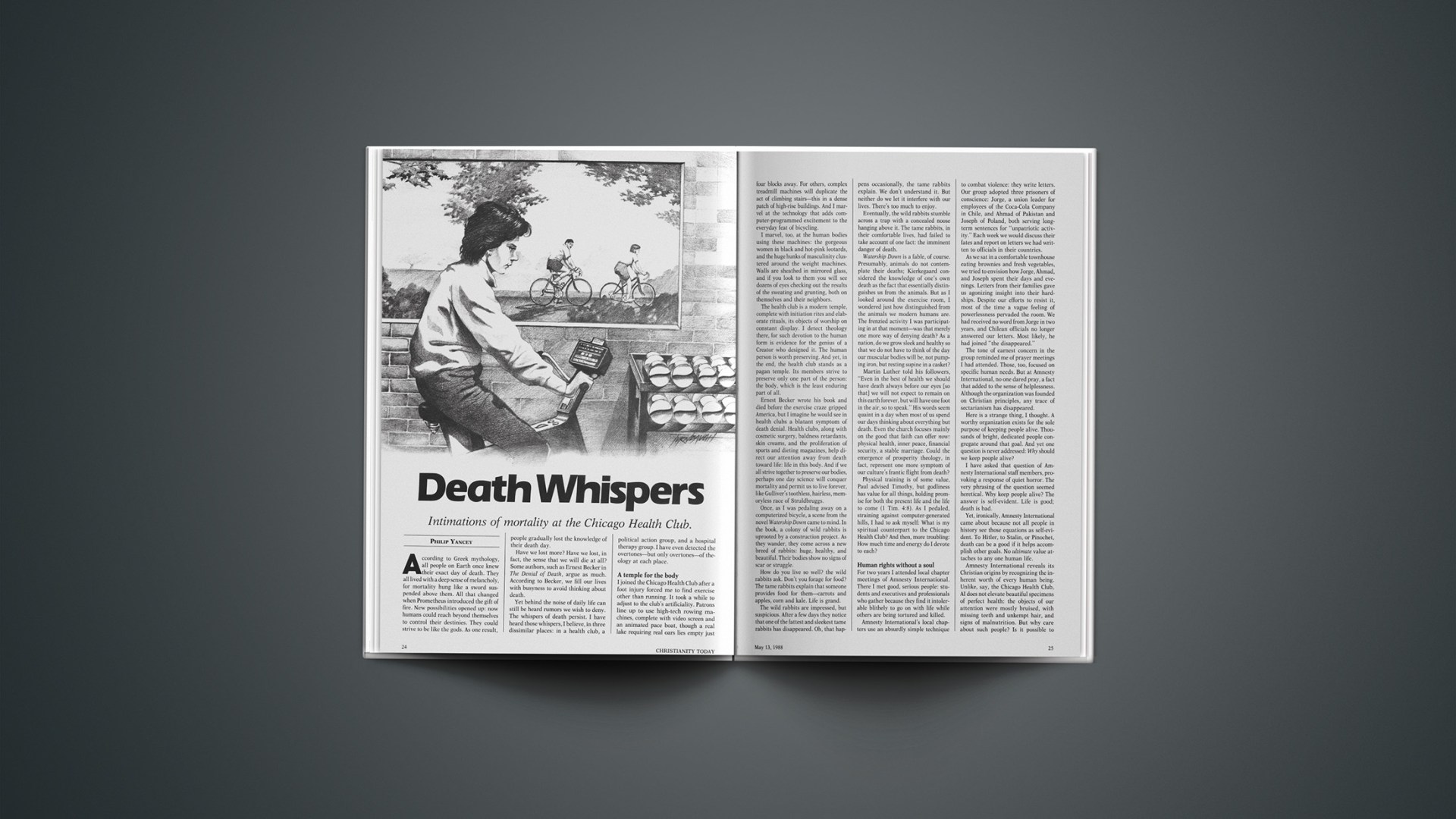
I joined the Chicago Health Club after a foot injury forced me to find exercise other than running. It took a while to adjust to the club’s artificiality. Patrons line up to use high-tech rowing machines, complete with video screen and an animated pace boat, though a real lake requiring real oars lies empty just four blocks away. For others, complex treadmill machines will duplicate the act of climbing stairs—this in a dense patch of high-rise buildings. And I marvel at the technology that adds computer-programmed excitement to the everyday feat of bicycling.

I marvel, too, at the human bodies using these machines: the gorgeous women in black and hot-pink leotards, and the huge hunks of masculinity clustered around the weight machines. Walls are sheathed in mirrored glass, and if you look to them you will see dozens of eyes checking out the results of the sweating and grunting, both on themselves and their neighbors.

The health club is a modern temple, complete with initiation rites and elaborate rituals, its objects of worship on constant display. I detect theology there, for such devotion to the human form is evidence for the genius of a Creator who designed it. The human person is worth preserving. And yet, in the end, the health club stands as a pagan temple. Its members strive to preserve only one part of the person: the body, which is the least enduring part of all.

Ernest Becker wrote his book and died before the exercise craze gripped America, but I imagine he would see in health clubs a blatant symptom of death denial. Health clubs, along with cosmetic surgery, baldness retardants, skin creams, and the proliferation of sports and dieting magazines, help direct our attention away from death toward life: life in this body. And if we all strive together to preserve our bodies, perhaps one day science will conquer mortality and permit us to live forever, like Gulliver’s toothless, hairless, memoryless race of Struldbruggs.

Once, as I was pedaling away on a computerized bicycle, a scene from the novel Watership Down came to mind. In the book, a colony of wild rabbits is uprooted by a construction project. As they wander, they come across a new breed of rabbits: huge, healthy, and beautiful. Their bodies show no signs of scar or struggle.

How do you live so well? the wild rabbits ask. Don’t you forage for food? The tame rabbits explain that someone provides food for them—carrots and apples, corn and kale. Life is grand.

The wild rabbits are impressed, but suspicious. After a few days they notice that one of the fattest and sleekest tame rabbits has disappeared. Oh, that happens occasionally, the tame rabbits explain. We don’t understand it. But neither do we let it interfere with our lives. There’s too much to enjoy.

Eventually, the wild rabbits stumble across a trap with a concealed noose hanging above it. The tame rabbits, in their comfortable lives, had failed to take account of one fact: the imminent danger of death.

Watership Down is a fable, of course. Presumably, animals do not contemplate their deaths; Kierkegaard considered the knowledge of one’s own death as the fact that essentially distinguishes us from the animals. But as I looked around the exercise room, I wondered just how distinguished from the animals we modern humans are. The frenzied activity I was participating in at that moment—was that merely one more way of denying death? As a nation, do we grow sleek and healthy so that we do not have to think of the day our muscular bodies will be, not pumping iron, but resting supine in a casket?

Martin Luther told his followers, “Even in the best of health we should have death always before our eyes [so that] we will not expect to remain on this earth forever, but will have one foot in the air, so to speak.” His words seem quaint in a day when most of us spend our days thinking about everything but death. Even the church focuses mainly on the good that faith can offer now: physical health, inner peace, financial security, a stable marriage. Could the emergence of prosperity theology, in fact, represent one more symptom of our culture’s frantic flight from death?

Physical training is of some value, Paul advised Timothy, but godliness has value for all things, holding promise for both the present life and the life to come (1 Tim. 4:8). As I pedaled, straining against computer-generated hills, I had to ask myself: What is my spiritual counterpart to the Chicago Health Club? And then, more troubling: How much time and energy do I devote to each?

Human Rights Without A Soul

For two years I attended local chapter meetings of Amnesty International. There I met good, serious people: students and executives and professionals who gather because they find it intolerable blithely to go on with life while others are being tortured and killed.

Amnesty International’s local chapters use an absurdly simple technique to combat violence: they write letters. Our group adopted three prisoners of conscience: Jorge, a union leader for employees of the Coca-Cola Company in Chile, and Ahmad of Pakistan and Joseph of Poland, both serving long-term sentences for “unpatriotic activity.” Each week we would discuss their fates and report on letters we had written to officials in their countries.

As we sat in a comfortable townhouse eating brownies and fresh vegetables, we tried to envision how Jorge, Ahmad, and Joseph spent their days and evenings. Letters from their families gave us agonizing insight into their hardships. Despite our efforts to resist it, most of the time a vague feeling of powerlessness pervaded the room. We had received no word from Jorge in two years, and Chilean officials no longer answered our letters. Most likely, he had joined “the disappeared.”

The tone of earnest concern in the group reminded me of prayer meetings I had attended. Those, too, focused on specific human needs. But at Amnesty International, no one dared pray, a fact that added to the sense of helplessness. Although the organization was founded on Christian principles, any trace of sectarianism has disappeared.

Here is a strange thing, I thought. A worthy organization exists for the sole purpose of keeping people alive. Thousands of bright, dedicated people congregate around that goal. And yet one question is never addressed: Why should we keep people alive?

I have asked that question of Amnesty International staff members, provoking a response of quiet horror. The very phrasing of the question seemed heretical. Why keep people alive? The answer is self-evident. Life is good; death is bad.

Yet, ironically, Amnesty International came about because not all people in history see those equations as self-evident. To Hitler, to Stalin, or Pinochet, death can be a good if it helps accomplish other goals. No ultimate value attaches to any one human life.

Amnesty International reveals its Christian origins by recognizing the inherent worth of every human being. Unlike, say, the Chicago Health Club, AI does not elevate beautiful specimens of perfect health: the objects of our attention were mostly bruised, with missing teeth and unkempt hair, and signs of malnutrition. But why care about such people? Is it possible to honor the image of God in a human being if there is no God?

To raise such questions at an Amnesty International meeting is to invite a period of stern and awkward silence. Explanations may follow. “This is not a religious organization.… We cannot deal with such sectarian views.… People have differing opinions.… The important issue is the fate of our prisoners.…”

Three centuries ago, French mathematician Blaise Pascal contemplated some friends who seemed to be avoiding the most important questions of life. Here is how he characterized them:

I know not who put me into the world, nor what the world is, nor what I myself am. I am in terrible ignorance of everything.… All I know is that I must soon die, but what I know least is this very death which I cannot escape.

As I know not whence I come, so I know not whither I go. I know only that, in leaving this world, I fall forever either into annihilation or into the hands of an angry God, without knowing to which of these two states I shall be forever assigned. Such is my state, full of weakness and uncertainty. And from all this I conclude that I ought to spend all the days of my life without caring to inquire into what must happen to me. Perhaps I might find some solution to my doubts, but I will not take the trouble, nor take a step to seek it.

Pascal shook his head in perplexity over people who concerned themselves with trifles or even with important matters, all the while ignoring the most important matter of all.

In our strange society, it seems that the questions most worth asking are the most ignored questions. Pascal lived during the Enlightenment, when thinkers first began to scorn belief in a soul and the afterlife, matters that seemed to them primitive and unsophisticated. Pascal said of such people, “Do they profess to have delighted us by telling us that they hold our soul to be only a little wind and smoke, especially by telling us this in a haughty and self-satisfied tone of voice? Is this a thing to say gaily? Is it not, on the contrary, a thing to say sadly, as the saddest thing in the world?”

I still belong to Amnesty International and contribute money to it. I believe in the cause, but I believe in it for different reasons. Why do strangers such as Ahmad and Joseph and Jorge deserve my time and energy? I can think of only one reason: They bear the sign of ultimate worth, the image of God.

Amnesty International teaches a more advanced theology than the Chicago Health Club. It points past the surface of skin and shape to the inner person. But the organization stops short—for what makes the inner person worth preserving, unless it be a soul? And for that very reason, shouldn’t Christians lead the way in human rights? According to the Book of Genesis, all humans, including Jorge and Ahmad and Joseph, are immortal beings who bear some mark of the Creator.

Facing Death Head-On

Members of the Chicago Health Club do their best to defy or at least forestall death. Amnesty International works diligently to prevent it. But another group I attended faces death head-on.

I was first invited to Make Today Count, a support group for people with life-threatening illnesses, by my neighbor Jim, who had just learned he was dying of cancer. There we met other people, mostly in their thirties, who were battling such diseases as multiple sclerosis, muscular dystrophy, and various kinds of cancer. For each member of the group, all of life had boiled down to two issues: surviving and, failing that, preparing for death.

We sat in a hospital waiting area on garish orange molded plastic chairs (doubtless chosen to make the institution appear more cheerful). We tried to ignore the loudspeaker periodically crackling out an announcement or paging a doctor. The meeting began with each member “checking in.” Jim whispered to me that this was the most depressing part of the meeting, because often someone had died since last month’s meeting. The social worker provided details of the missing member’s last days and the funeral.

The members of Make Today Count confronted death because they had no choice. I had expected a somber mood, but found the opposite. Tears flowed freely, of course, but these people spoke easily about disease and death. Clearly, the group was the one place they could talk openly about such issues.

Nancy showed off a new wig, purchased to cover the baldness caused by chemotherapy. She joked that she had always wanted straight hair, and now her brain tumor had given her an excuse. Steve, a young black man with Hodgkin’s disease, admitted he was terrified of what lay ahead. His fiancee refused to discuss the future with him. How could he break through to her?

Martha talked about death. ALS (“Lou Gehrig’s disease”) had already rendered her legs and arms useless. Now she breathed with great difficulty, and whenever she fell asleep at night there was a danger of death from oxygen deprivation. Martha was 25 years old. “What is it you fear about death?” someone asked. Martha thought a minute, and then said this: “I regret all that I’m going to miss—next year’s big movies, for example, and the election results. And I fear that I will one day be forgotten. That I’ll just disappear, and no one will even miss me.”

More than any other people I had met, members of Make Today Count concentrated on ultimate issues. They, unlike the Chicago Health Clubbers, could not deny death; their bodies bore a memento mori, a reminder of inevitable, premature death. Every day they were, in Augustine’s phrase, “deafened by the clanking chains of mortality.” I wanted to use them as examples for my hedonistic friends, to walk down the street and interrupt parties to announce, “We’re all going to die. I have proof. Just around the corner is a place where you can see it for yourself. Have you thought about death?”

Yet would such awareness change anyone for more than a few minutes? As one of Saul Bellow’s characters puts it, the living speed like birds over the surface of water, and one will dive or plunge but not come up again. But the world goes on, while five thousand people die in America each day.

One night Donna, a member of Make Today Count, told about watching a television program on a public-access station. In the program, Elisabeth Kübler-Ross discussed a boy in Switzerland who was dying of an inoperable brain tumor. Nobody knew how aware the boy was of his condition. Kübler-Ross asked him to draw how he felt. He drew a large, ugly, military tank, and behind the tank, a small house with trees, grass, sunshine, and an open window. In front of the tank, just at the end of the gun barrel, he drew a tiny figure with a red stop sign in his hand.

Donna said that picture captured her feelings precisely. Kübler-Ross had gone on to describe the five stages of grief, culminating in the stage of acceptance. And Donna knew she was supposed to work toward acceptance. But she could never get past the stage of fear. Like the little boy in front of the tank, she saw death as an enemy.

Someone brought up religious faith and belief in an afterlife, but the comment evoked the same response in Make Today Count as it had in Amnesty International: a long silence, a cleared throat, a few rolled eyes. The rest of the evening, the group focused on how Donna could overcome her fears and grow toward the acceptance stage of grief.

I left that meeting with a heavy heart. Our materialistic, undogmatic culture was asking its members to defy their deepest feelings. Donna and the small Swiss boy with the brain tumor had, by sheer primal instinct, struck upon a cornerstone of Christian theology. Death is an enemy, the last enemy to be destroyed. How could members of a group that each month saw families fall apart and bodies deteriorate before their eyes still wish for a spirit of bland acceptance? I could think of only one appropriate response to Donna’s impending death: “Damn you, Death!”

There was another aspect of Christian theology too, the one, most sadly, that Make Today Count would not discuss. The Swiss boy had included his vision of heaven in the background, represented by the grass and trees and the cottage with an open window. And any feeling like “acceptance” would only be appropriate if he truly was going somewhere, somewhere like home.

That is why I consider the doctrine of heaven one of our most neglected doctrines. George MacDonald once wrote a letter to his stepmother on the death of someone close to her. “God would not let [death] be the law of His Universe if it were what it looks to us,” he said. It’s up to us to tell the world what death looks like from the perspective of One who faced it—with fear and dread—but then came back to life.

“I think it is very hard for secular men to die,” said Ernest Becker, as he turned to God in the last months of his life.

Living Under Death’S Shadow

In the Prado Museum in Madrid, there hangs a painting by Hans Baldung (1476–1545) titled The Stages of Life, with Death. On the ground lies a newborn child, resting peacefully. Three pale, elongated figures stand over the child. On the left is a nearly nude woman, the archetype of classical beauty, her skin like alabaster, her figure round and smooth, her hair braided into long strands that cascade down her back. To her right stands an old hag with shriveled, sagging breasts and a sharp, angular face. The hag has her right hand on the beautiful woman’s shoulder and, with a mocking, toothless sneer, is pulling the young woman toward her.

The hag’s left arm is interlocked with that of a third person, a horrid figure straight out of Hieronymous Bosch. Man or woman, you cannot tell. Human features have melted down in a macabre, rotting corpse, with long, slender worms crawling out of its cadaverous belly. The hairless head is nearly a skull. The corpse holds an hourglass.

Hans Baldung’s painting restores, visually, what humanity lost after Prometheus. The beautiful woman has regained the knowledge of the hour of death. Birth, youth, old age—they are all lived out under death’s shadow.

The painting lacks one thing: a vision of a resurrected body, a body more glorious than anyone could paint. It is hard for us to live in awareness of death; it may be even harder to live in awareness of the afterlife. We hope for recreated bodies while inhabiting aged and ailing ones. Charles Williams once admitted that the notion of immortality never seemed to stir his imagination, no matter how hard he tried. “Our experience on earth makes it difficult for us to apprehend a good without a catch in it somewhere,” he said.

Perhaps another way of saying it would be to say that human life is lived out on Holy Saturday. What happened on that next day gives us a bright and startling clue to the riddle of the universe. One man, the Son of God, went before us, to show us the way. But we are mortals, and whispers of death tend to drown out hints of life to come.

The apostle Paul wrote these words to people who, like us, could not imagine a good without a catch in it:

“Though outwardly we are wasting away [despite all our health club attempts to reverse entropy], yet inwardly we are being renewed day by day. For our light and momentary troubles [Light and momentary! Paul’s troubles remind me of the stories of tortured prisoners I hear at Amnesty International] are achieving for us an eternal glory that far outweighs them all. So we fix our eyes not on what is seen, but on what is unseen. For what is seen is temporary, but what is unseen is eternal.…

“For while we are in this tent, we groan [drawn, haggard, chemotherapied faces from Make Today Count come to mind], and are burdened, because we do not wish to be unclothed but to be clothed with our heavenly dwelling, so that what is mortal may be swallowed up by life. Now it is God who has made us for this very purpose and has given us the Spirit as a deposit, guaranteeing what is to come” (2 Cor. 4:16b—18; 5:4–5, NIV).

Yes, we need a renewed awareness of death. But we need far more. We need a faith, in the midst of our groanings, that death is not the last word, but the next to last. What is mortal will be swallowed up by life. One day all whispers of death will fall silent.

That Amazing Grace

Two-hundred-fifty years after Aldersgate, John Wesley’s experience of grace belongs to us all.

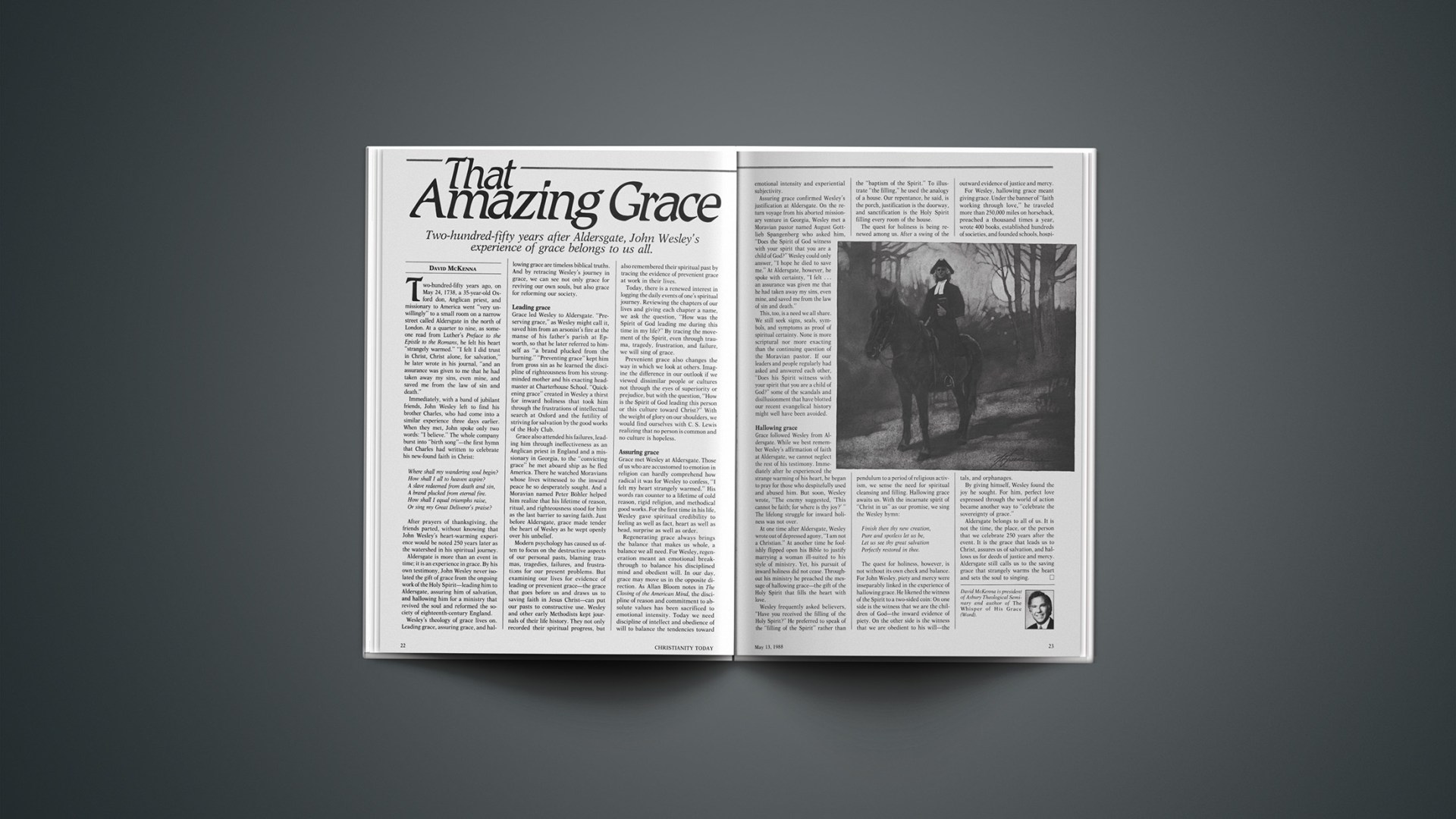
Two-hundred-fifty years ago, on May 24, 1738, a 35-year-old Oxford don, Anglican priest, and missionary to America went “very unwillingly” to a small room on a narrow street called Aldersgate in the north of London. At a quarter to nine, as someone read from Luther’s Preface to the Epistle to the Romans, he felt his heart “strangely warmed.” “I felt I did trust in Christ, Christ alone, for salvation,” he later wrote in his journal, “and an assurance was given to me that he had taken away my sins, even mine, and saved me from the law of sin and death.”

Immediately, with a band of jubilant friends, John Wesley left to find his brother Charles, who had come into a similar experience three days earlier. When they met, John spoke only two words: “I believe.” The whole company burst into “birth song”—the first hymn that Charles had written to celebrate his new-found faith in Christ:

Where shall my wandering soul begin?

How shall I all to heaven aspire?

A slave redeemed from death and sin,

A brand plucked from eternal fire.

How shall I equal triumphs raise,

Or sing my Great Deliverer’s praise?

After prayers of thanksgiving, the friends parted, without knowing that John Wesley’s heart-warming experience would be noted 250 years later as the watershed in his spiritual journey.

Aldersgate is more than an event in time; it is an experience in grace. By his own testimony, John Wesley never isolated the gift of grace from the ongoing work of the Holy Spirit—leading him to Aldersgate, assuring him of salvation, and hallowing him for a ministry that revived the soul and reformed the society of eighteenth-century England.

Wesley’s theology of grace lives on. Leading grace, assuring grace, and hallowing grace are timeless biblical truths. And by retracing Wesley’s journey in grace, we can see not only grace for reviving our own souls, but also grace for reforming our society.

Leading Grace

Grace led Wesley to Aldersgate. “Preserving grace,” as Wesley might call it, saved him from an arsonist’s fire at the manse of his father’s parish at Ep-worth, so that he later referred to himself as “a brand plucked from the burning.” “Preventing grace” kept him from gross sin as he learned the discipline of righteousness from his strong-minded mother and his exacting headmaster at Charterhouse School. “Quickening grace” created in Wesley a thirst for inward holiness that took him through the frustrations of intellectual search at Oxford and the futility of striving for salvation by the good works of the Holy Club.

Grace also attended his failures, leading him through ineffectiveness as an Anglican priest in England and a missionary in Georgia, to the “convicting grace” he met aboard ship as he fled America. There he watched Moravians whose lives witnessed to the inward peace he so desperately sought. And a Moravian named Peter Böhler helped him realize that his lifetime of reason, ritual, and righteousness stood for him as the last barrier to saving faith. Just before Aldersgate, grace made tender the heart of Wesley as he wept openly over his unbelief.

Modern psychology has caused us often to focus on the destructive aspects of our personal pasts, blaming traumas, tragedies, failures, and frustrations for our present problems. But examining our lives for evidence of leading or prevenient grace—the grace that goes before us and draws us to saving faith in Jesus Christ—can put our pasts to constructive use. Wesley and other early Methodists kept journals of their life history. They not only recorded their spiritual progress, but also remembered their spiritual past by tracing the evidence of prevenient grace at work in their lives.

Today, there is a renewed interest in logging the daily events of one’s spiritual journey. Reviewing the chapters of our lives and giving each chapter a name, we ask the question, “How was the Spirit of God leading me during this time in my life?” By tracing the movement of the Spirit, even through trauma, tragedy, frustration, and failure, we will sing of grace.

Prevenient grace also changes the way in which we look at others. Imagine the difference in our outlook if we viewed dissimilar people or cultures not through the eyes of superiority or prejudice, but with the question, “How is the Spirit of God leading this person or this culture toward Christ?” With the weight of glory on our shoulders, we would find ourselves with C. S. Lewis realizing that no person is common and no culture is hopeless.

Assuring Grace

Grace met Wesley at Aldersgate. Those of us who are accustomed to emotion in religion can hardly comprehend how radical it was for Wesley to confess, “I felt my heart strangely warmed.” His words ran counter to a lifetime of cold reason, rigid religion, and methodical good works. For the first time in his life, Wesley gave spiritual credibility to feeling as well as fact, heart as well as head, surprise as well as order.

Regenerating grace always brings the balance that makes us whole, a balance we all need. For Wesley, regeneration meant an emotional breakthrough to balance his disciplined mind and obedient will. In our day, grace may move us in the opposite direction. As Allan Bloom notes in The Closing of the American Mind, the discipline of reason and commitment to absolute values has been sacrificed to emotional intensity. Today we need discipline of intellect and obedience of will to balance the tendencies toward emotional intensity and experiential subjectivity.

Assuring grace confirmed Wesley’s justification at Aldersgate. On the return voyage from his aborted missionary venture in Georgia, Wesley met a Moravian pastor named August Gottlieb Spangenberg who asked him, “Does the Spirit of God witness with your spirit that you are a child of God?” Wesley could only answer, “I hope he died to save me.” At Aldersgate, however, he spoke with certainty, “I felt … an assurance was given me that he had taken away my sins, even mine, and saved me from the law of sin and death.”

This, too, is a need we all share. We still seek signs, seals, symbols, and symptoms as proof of spiritual certainty. None is more scriptural nor more exacting than the continuing question of the Moravian pastor. If our leaders and people regularly had asked and answered each other, “Does his Spirit witness with your spirit that you are a child of God?” some of the scandals and disillusionment that have blotted our recent evangelical history might well have been avoided.

Hallowing Grace

Grace followed Wesley from Aldersgate. While we best remember Wesley’s affirmation of faith at Aldersgate, we cannot neglect the rest of his testimony. Immediately after he experienced the strange warming of his heart, he began to pray for those who despitefully used and abused him. But soon, Wesley wrote, “The enemy suggested, ‘This cannot be faith; for where is thy joy?’ ” The lifelong struggle for inward holiness was not over.

At one time after Aldersgate, Wesley wrote out of depressed agony, “I am not a Christian.” At another time he foolishly flipped open his Bible to justify marrying a woman ill-suited to his style of ministry. Yet, his pursuit of inward holiness did not cease. Throughout his ministry he preached the message of hallowing grace—the gift of the Holy Spirit that fills the heart with love.

Wesley frequently asked believers, “Have you received the filling of the Holy Spirit?” He preferred to speak of the “filling of the Spirit” rather than the “baptism of the Spirit.” To illustrate “the filling,” he used the analogy of a house. Our repentance, he said, is the porch, justification is the doorway, and sanctification is the Holy Spirit filling every room of the house.

The quest for holiness is being renewed among us. After a swing of the pendulum to a period of religious activism, we sense the need for spiritual cleansing and filling. Hallowing grace awaits us. With the incarnate spirit of “Christ in us” as our promise, we sing the Wesley hymn:

Finish then thy new creation,

Pure and spotless let us be,

Let us see thy great salvation

Perfectly restored in thee.

The quest for holiness, however, is not without its own check and balance. For John Wesley, piety and mercy were inseparably linked in the experience of hallowing grace. He likened the witness of the Spirit to a two-sided coin: On one side is the witness that we are the children of God—the inward evidence of piety. On the other side is the witness that we are obedient to his will—the outward evidence of justice and mercy.

For Wesley, hallowing grace meant giving grace. Under the banner of “faith working through love,” he traveled more than 250,000 miles on horseback, preached a thousand times a year, wrote 400 books, established hundreds of societies, and founded schools, hospitals, and orphanages.

By giving himself, Wesley found the joy he sought. For him, perfect love expressed through the world of action became another way to “celebrate the sovereignty of grace.”

Aldersgate belongs to all of us. It is not the time, the place, or the person that we celebrate 250 years after the event. It is the grace that leads us to Christ, assures us of salvation, and hallows us for deeds of justice and mercy. Aldersgate still calls us to the saving grace that strangely warms the heart and sets the soul to singing.

David McKenna is president of Asbury Theological Seminary and author of The Whisper of His Grace (Word).

The Resolve to Resist

Knowing the Lord was with her sustained Nien Cheng in a Red Chinese prison.

“The past is forever with me and I remember it all.” So begins the haunting first chapter of Life and Death in Shanghai, the vivid portrayal of one Chinese woman’s life, imprisonment, torture, and release during Mao Zedong’s brutal Cultural Revolution of the mid-1960s.

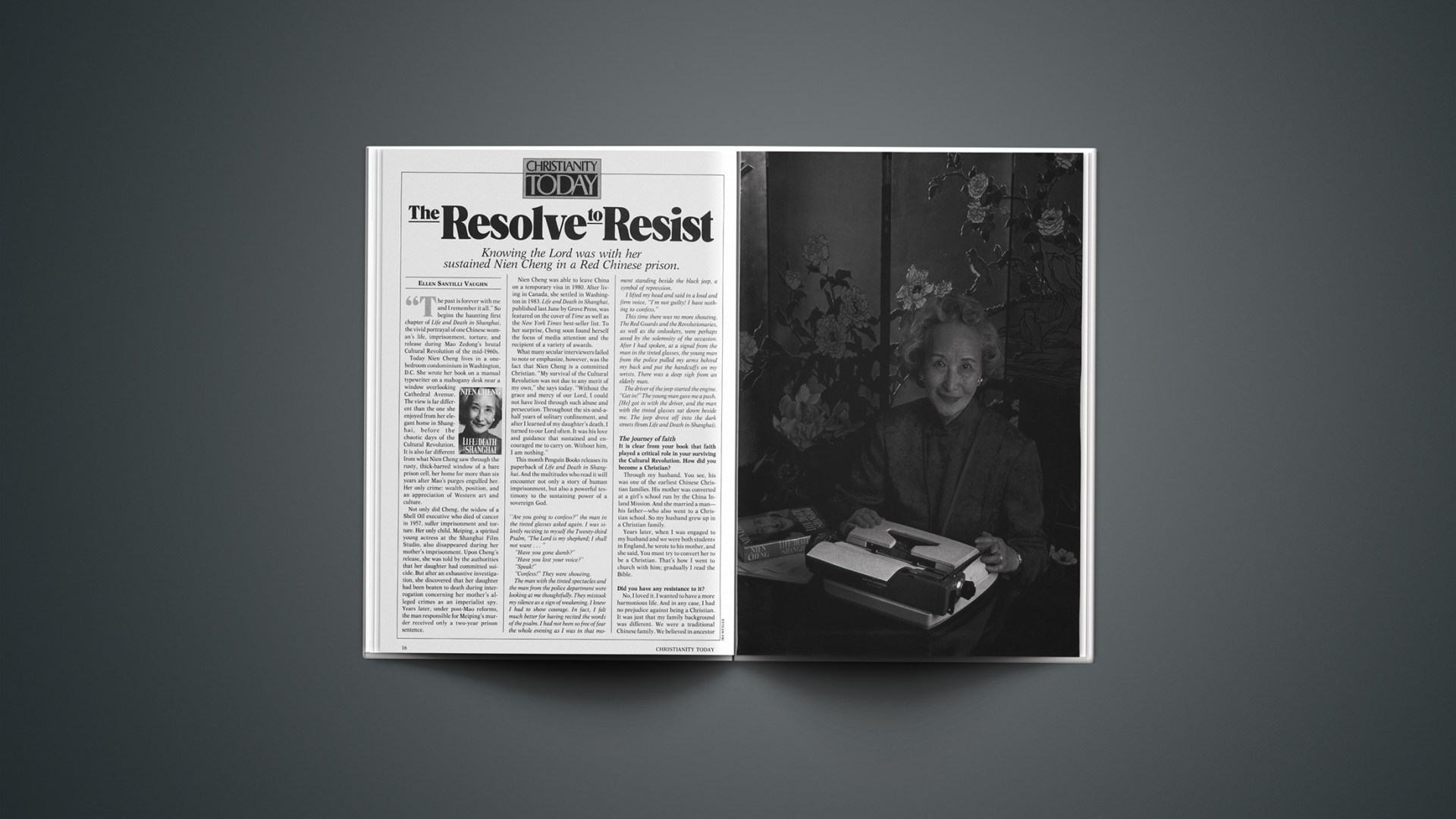
Today Nien Cheng lives in a one-bedroom condominium in Washington, D.C. She wrote her book on a manual typewriter on a mahogany desk near a window overlooking Cathedral Avenue.

The view is far different than the one she enjoyed from her elegant home in Shanghai, before the chaotic days of the Cultural Revolution. It is also far different from what Nien Cheng saw through the rusty, thick-barred window of a bare prison cell, her home for more than six years after Mao’s purges engulfed her. Her only crime: wealth, position, and an appreciation of Western art and culture.

Not only did Cheng, the widow of a Shell Oil executive who died of cancer in 1957, suffer imprisonment and torture. Her only child, Meiping, a spirited young actress at the Shanghai Film Studio, also disappeared during her mother’s imprisonment. Upon Cheng’s release, she was told by the authorities that her daughter had committed suicide. But after an exhaustive investigation, she discovered that her daughter had been beaten to death during interrogation concerning her mother’s alleged crimes as an imperialist spy. Years later, under post-Mao reforms, the man responsible for Meiping’s murder received only a two-year prison sentence.

Nien Cheng was able to leave China on a temporary visa in 1980. After living in Canada, she settled in Washington in 1983. Life and Death in Shanghai, published last June by Grove Press, was featured on the cover of Time as well as the New York Times best-seller list. To her surprise, Cheng soon found herself the focus of media attention and the recipient of a variety of awards.

What many secular interviewers failed to note or emphasize, however, was the fact that Nien Cheng is a committed Christian. “My survival of the Cultural Revolution was not due to any merit of my own,” she says today. “Without the grace and mercy of our Lord, I could not have lived through such abuse and persecution. Throughout the six-and-a-half years of solitary confinement, and after I learned of my daughter’s death, I turned to our Lord often. It was his love and guidance that sustained and encouraged me to carry on. Without him, I am nothing.”

This month Penguin Books releases its paperback of Life and Death in Shanghai. And the multitudes who read it will encounter not only a story of human imprisonment, but also a powerful testimony to the sustaining power of a sovereign God.

Are you going to confess?” the man in the tinted glasses asked again. I was silently reciting to myself the Twenty-third Psalm, “The Lord is my shepherd; I shall not want …”

“Have you gone dumb?”

“Have you lost your voice?”

“Speak!”

“Confess!” They were shouting.

The man with the tinted spectacles and the man from the police department were looking at me thoughtfully. They mistook my silence as a sign of weakening. I knew I had to show courage. In fact, I felt much better for having recited the words of the psalm. I had not been so free of fear the whole evening as I was in that moment standing beside the black jeep, a symbol of repression.

I lifted my head and said in a loud and firm voice, “I’m not guilty! I have nothing to confess.”

This time there was no more shouting. The Red Guards and the Revolutionaries, as well as the onlookers, were perhaps awed by the solemnity of the occasion. After I had spoken, at a signal from the man in the tinted glasses, the young man from the police pulled my arms behind my back and put the handcuffs on my wrists. There was a deep sigh from an elderly man.

The driver of the jeep started the engine. “Get in!” The young man gave me a push. [He] got in with the driver, and the man with the tinted glasses sat down beside me. The jeep drove off into the dark streets (from Life and Death in Shanghai).

The Journey Of Faith

It is clear from your book that faith played a critical role in your surviving the Cultural Revolution. How did you become a Christian?

Through my husband. You see, his was one of the earliest Chinese Christian families. His mother was converted at a girl’s school run by the China Inland Mission. And she married a man—his father—who also went to a Christian school. So my husband grew up in a Christian family.

Years later, when I was engaged to my husband and we were both students in England, he wrote to his mother, and she said, You must try to convert her to be a Christian. That’s how I went to church with him; gradually I read the Bible.

Did you have any resistance to it?

No, I loved it. I wanted to have a more harmonious life. And in any case, I had no prejudice against being a Christian. It was just that my family background was different. We were a traditional Chinese family. We believed in ancestor worship. My father was not interested in religion in any sense, but he didn’t forbid my mother from practicing Buddhism. She was very devout. She used not to eat meat on certain days of the month, and she read the Buddhist scriptures every day. And she always did good deeds.

But I became a Christian, and then, when we returned to China in 1948, my husband received a letter from his mother saying she had no one to live with. Chinese old people always live with their children. So in 1950 we went to North China and brought her to Shanghai to live with us. She lived with us for seven years, until she passed on. During those seven years I was very close to her. I think she exercised a great deal of influence on me.

In your growth as a Christian?

Yes. We used to read the Bible together. She had a copy of the Bible with large characters, because her eyesight was failing. Often I read to her—and I learned from her. She helped me a lot.

Did that discipleship lay the groundwork for the way in which you survived your prison experiences?

It strengthened my resolve to resist, because I didn’t feel alone. The Lord was with me. He sustained me. Sometimes I felt, Oh, I’m so weak, I can’t do it. But then I felt strengthened through prayer. When I lost my daughter, if I had not been a Christian, I think I would have wanted to die. It was very, very difficult.

Did you know you had this strength within you? Before you went to prison you hadn’t been tried in such a way. You had had a very comfortable lifestyle.

I could endure hardship because—let me put it this way—I knew that the Lord was testing me. The Lord wanted to see if I could do it—if I could endure it. So I was compelled to endure it.

Do you question why God allowed you to experience such pain?

I’m the sort of person who has never asked God to tell me what he wants to do or why he wants to do it. I never do that. I think God has his own plan—I can’t see that far or that high. I can see only a little bit. So I obey the will of God. And I accept whatever happens.

I had this attitude long ago. Because, you see, I lived in an environment in China that encouraged people to be atheists. Frequently people would argue with me—Why do you believe in God? Can you see God? Why do good people have to suffer? So I gave it a lot of thought.

And how would you respond to that question? Why do people suffer?

I would have to say we don’t know why. We can’t assume God is like us.

Sometimes young students, my daughter’s friends, would say to me, “Do you think God is cruel? God punishes people.” And I would say that I don’t think God is cruel. God is merciful. People punish themselves. It is not God’s punishment.

It’s when we are face to face with danger, with hardship, with threats to our lives, that we are much stronger in our faith. Also, when I was in prison, I realized I hadn’t been as kind a person as I might have been. I was casual toward other people’s suffering. I’d say, “Oh, I pity them.” But it would pass. Now I understand suffering better.

You can identify with the suffering of others.

Yes, I know what it means to be hungry, to be cold, to be alone with no family. So when I hear about other people or meet somebody in that situation, I want to help. I know what it means to suffer.

A Changing China?

Throughout its long history, China has been a source of mystery and fascination for the West. After years of isolation and domestic upheaval, those in the leadership of China today seem determined to bring what General Secretary Zhao Ziyang has called their “backward” nation forward in an effort to recover from the failures of the past.

Last September’s thirteenth congress of the 46 million-member Chinese Communist party, the first since 1982, had been anticipated as a watershed event for the political and economic future of China. As the “reformers” set their policies at that meeting, it was clear that a long struggle lies ahead in the face of resistance from the more orthodox Marxists within the Communist party. It remains to be seen whether planned reforms will yield viable political, economic, or religious freedoms for the more than one billion Chinese people.

Although I have decided to become a citizen of the United States, I continue to be concerned with the situation in China. I am heartened by the news that unprecedented economic progress has been made since the implementation of Deng Xiaoping’s new economic policy. Often I look back on the wasted years of the Mao Zedong era and the madness of the Cultural Revolution. I feel deeply saddened that so many innocent lives were needlessly sacrificed. I was glad when the Cultural Revolution was officially declared a national catastrophe, but I regret the Communist Party leadership’s inabilityor unwillingness to repudiate Mao’s policy in explicit terms.

From the point of view of the Chinese Communist Party, the greatest casualties of the Cultural Revolution were the Party’s prestige and its ability to govern. When Mao Zedong used the masses (the Red Guards and the Revolutionaries) to destroy the so-called capitalist-roaders in the Party leadership, he forced the Chinese people to witness and to take part in an ugly drama. The prolonged power struggle and the denunciations of one leader after another enabled the Chinese people to stumble upon the truth that the emperor had no clothes. When Mao Zedong died in 1976, the country was in a state of political disintegration. Obviously if the Party was to continue to govern, it must change course.

What kind of leadership will General Secretary Zhao Ziyang provide?

We have to remember two things from Zhao Ziyang’s report at the Chinese Communist party congress. One is the call to collect capital through the issuing of more stocks and bonds. That’s definitely a step toward capitalism. He said people should be allowed to earn money in ways other than direct labor. For instance, he legitimized income from dividends, from a profit. According to orthodox Marxism, that’s a form of exploitation, because you didn’t actually earn it.

Another interesting thing he said was that the power of the party must be exercised in a more indirect way. Hitherto the party secretary was the boss in each organization. Now the party secretary will have only a supervisory role, and the managers will have the real power. The managers are better educated, they are the technocrats; now they will be the ones administering the office, the research institution, the hospital, the shop or factory. The party secretary will have to cooperate.

There are millions of party secretaries on all different levels, right down to the village party secretary, who until now has been the king in his own village. Now he is going to have to let an administrative head run the shop.

It’s going to take a long time to implement this policy because the party secretaries will resist it. There is quite a lot of corruption among them now. When the party secretary’s power is reduced, he will lose all his opportunities. He can’t openly oppose the policy because it’s from Beijing, and he would risk party discipline. So he is going to covertly oppose it.

What is the government reformers’ objective?

No government does things out of charity. For every government, whether democratic or totalitarian, the first consideration is the consolidation of power. If its leaders can’t consolidate their power unless they treat the people well, then they will treat the people well. The Cultural Revolution exposed the weakness of the communist system. So Deng Xiaoping now has to give the people something to win their support.

Do you think in the process that the people of China now will enjoy a little more personal freedom?

Oh, yes; economic freedom. That is, they can now set up a little something for themselves; a little shop or something.

But this brings up another point: In Zhao’s report, he said categorically that China will never tolerate a political system with two parties taking over the government alternately. Another thing China won’t tolerate—even though it is demanded by many Chinese, especially educated Chinese—is the separation of the three powers of government: the administrative, the executive, and the judicial. Unless you have an independent judiciary, you won’t have the guarantee of law. The law is in the hands of the Communist government. And without an independent judiciary, law is under politics. Whoever is in power can change the law.

You’ve got a constitution in America. Nobody can change that. But in China you’ve got this leader; he does it this way. You’ve got another leader; he does it another way. China is a country ruled by the will of a man, not ruled by law.

Unless the Communist government changes, China will never have the guarantee of human rights and all that we enjoy in the United States.

So we mustn’t confuse economic reform with political reform. I don’t think the Communist party will ever voluntarily give the people real political freedom.

Do you think that could ever come in China as a result of these economic reforms?

In, say, 50 years the Chinese people will be much better off through this economic reform. When they don’t have to worry about food, clothing, where they live, or anything like that, then they will demand political freedom.

It depends on whether or not the reform policy is perpetuated after Deng has died.

What about the issue of religious freedom in China?

The Chinese people as a whole are not religious. Before the Communists came, we had only four million Christians. What guided Chinese society was the teachings of Confucius.

He provided the ethical framework?

Yes, because Confucius’ philosophy had very comprehensive rules and regulations governing human behavior and human relationships. For instance, he said that the individual is the basic element of society. Individual, family, state. Individuals belong to a family. Many family units make up the state, to be governed by the Son of Heaven, who is the emperor.

But if he misgoverns, then the mandate from heaven will be withdrawn. So every emperor must strive to govern according to justice, benevolence—but he must never set himself up as a god.

There is a saying that a king is a good king if in his kingdom the poets can write poetry, the ministers can give advice to the king, the young people can think whatever they like, and the old people can grumble about everything they don’t like.

Through these kinds of stories, the Chinese people learned what is good. Good is the freedom of speech: The poet can write anything, the minister is not afraid the king will kill him, and the people have their freedom of expression. If you judge by that standard, Mao Zedong was no good at all.

How did the Communists crack down on the churches?

The Communists came and established their Marxist government. Right away they denounced Confucius and they abolished religion. But they didn’t close all the churches until 1958, when Mao Zedong started the Great Leap Forward campaign.

Today, the Chinese constitution provides for freedom of religion. That sounds good, doesn’t it? Until you see the next line. It also provides for freedom of unbelief. So if you preach or try to convert somebody, you are infringing on his freedom of unbelief. By this one stroke they made it impossible for religions to spread—or even to preach, except in their own churches and temples. So people became very afraid to talk about religious matters or to lend the Bible to somebody.

But now China has over five million Christians. One million more grew when no churches were allowed. Isn’t that marvelous? It’s a miracle, really. Because this one million are mostly young people.

We hear a lot about the underground churches in China. Were you able to be involved?

I didn’t take part in any of that for the simple reason that in the cities it was very difficult. You lived in close proximity with others. You were constantly watched. But in rural areas, in the villages, you could gather together without anybody knowing. Also, the Chinese villages are most often inhabited by people who are related to each other. So even the party official may be a relative—he will just pretend he doesn’t notice.

The most extraordinary thing is that after the Cultural Revolution a lot of Red Guards and Communist party members turned to the Christian religion.

And why is that? Had they seen the emptiness of the Communist philosophy?

Yes. Also, the Red Guards felt guilty.

And were they in turn persecuted for converting?

No. When Deng Xiaoping came into power he immediately restored the churches and temples that the Red Guards had destroyed.

And if Deng Xiaoping is rebuilding the churches, is that for his own purposes? Is he maintaining power by allowing the privilege of worship?

I think he feels no harm in people having religion. Because he is not such a die-hard, orthodox Marxist. I wonder if, deep in his heart, maybe he doesn’t believe in it anymore.

Some Christian commentators believe that if China’s trends toward modernization and reform continue, Christianity may have the opportunity to become one of the leading spiritual forces in Chinese society. Do you think that’s a realistic hope?

The Communist party members won’t allow it.

Do you think the Chinese people as a whole are open to the gospel?

They have experienced what life was like without faith and belief; they are more thirsty for it. I think they are more ready to accept Christian thought than ever before.

The Communists, by criticizing Confucius, broke down traditional belief, which was a blockage that prevented Chinese people from accepting Christianity.

What about the Islamic presence in China?

We have quite a few Muslims in China. They get special treatment because the Communists want to court the Arabs. I think their religion is too fanatical; the Chinese don’t like to be too fanatical. Chinese are more pragmatic.

But their spirit is now wandering; they find that communism doesn’t satisfy; they are thirsty. They are eager to receive Christian things, because the alternatives are less attractive.

Speaking as a Chinese, I think communism is too materialistic. It doesn’t satisfy real spiritual longings. We all have that. We are born with it. We are looking for spiritual satisfaction because we are human beings. Just to have material satisfaction is not enough.

Making Peace With The Past

Nien Cheng’s life today is a busy one. She begins each morning with Chinese exercises in the green gardens of her condominium complex; her days are filled with speaking engagements, interviews, correspondence, reading, and time with friends. Sometimes her life in China seems remote.

Yet pain in one’s past does not merely dissipate of its own accord or deaden with the passage of time. It must be met with purpose and discipline. The same godly determination that carried Nien Cheng through the destruction of her Shanghai home, imprisonment, torture, and the death of her daughter is today the means by which she can make peace with both her past and her present.

Throughout the years of my imprisonment, I had turned to God often and felt His presence. In the drab surroundings of the gray cell, I had known magic moments of transcendence that I had not experienced in the ease and comfort of my normal life. My belief in the ultimate triumph of truth and goodness had been restored and I had renewed courage to fight on. My faith had sustained me in these darkest hours of my life and broughtme safely through privation, sickness, and torture. At the same time, my suffering had strengthened my faith and made me realize that God was always there. It was up to me to come to Him.

Under the watchful eyes of the guards, I could not pray openly in the daytime. The only way I could be certain of being left alone with my prayers was to bend my head over a volume of Mao Zedong’s books while I prayed to God from my tormented heart. As I spoke of my daughter, I relived the precious years from the time of her birth in Canberra, Australia, in 1942 until our forcible separation on the night of September 27, 1966, when I was taken to the struggle meeting and arrested. I felt again and again the joy she had given me at each stage of her growth and knew I was fortunate to have received from God this very special blessing of a daughter. Day after day I prayed. More and more I remembered the days of her living, and less and less I dwelled on the tragedy of her dying.

Gradually peace came to me, and with it a measure of acceptance. But there was something more. While I could no longer cling tenaciously to the hope that I would see her alive and well on the day I walked out of the No. 1 Detention House, I knew there was much I still had to do both before and after my release. My battle was by no means over. It was up to me to find out what had happened to my daughter and, if I could, right the wrong that had been done to her. My life would be bleak without Meiping. But I had to fight on.

Horrible things happened to you. Yet your book has no bitterness in it.

No, I am not bitter.

And you write that Christians are commanded to love their enemies, to forgive. That is a very difficult process.

To forgive the man who killed my daughter is very difficult. Some days, even now, I can’t forgive him. I get all in tears—and then maybe the next day, I get over it. I’m not altogether forgiving yet.

But I don’t feel any grudge against the Red Guards. They were just teenagers. They didn’t really know any better. You see I have scars, here on my wrists, very bad scars. This is where I was handcuffed. Yet I can forgive.

Particularly about my things—it doesn’t matter. What are things, anyway? We come into the world with nothing, and when we die we shall leave everything behind. I am an old lady; I am quite comfortable. So it’s okay. Actually, God has been very kind to me—very loving and merciful. To be able to live in freedom in the last period of my life—I’m very grateful for it.

God has his hand upon you; he is using you very much now, I think, for his purposes.

Do you think so?

You are a very strong testimony of his grace and strength to come through such adversity and not be filled with bitterness—to be peaceful, to have your humor, to be contributing to others.

I get a lot of letters from young people who say that after reading my book they feel they must value their freedom and democracy more. This is so good.

Do you think you’ll ever go back to China?

I don’t want to. There are too many places there that remind me of my daughter. The other night a Chinese girl, a student at American University, came to see me. She was not a bit like my daughter. My daughter was tall. This girl was petite. But I could not sleep at all that night. I kept thinking, If my daughter were alive, what would she be doing? Would she come to America? Would she be married? Would she have children?

No, I can’t go back. If I go back I will see all of the old things, the old friends again, and we will talk about her …

In your book, you describe how when you were in prison, they brought you your daughter’s clothes and her teacup, and then you knew she was gone.

Yes, that was the worst moment. And yet it was through prayer that I began to resolve all that.

Of course, she is with me all the time, in my heart. There is not a moment that passes that I don’t think of her. That’s true.

I’ve got her ashes here. When she was cremated the ashes were put in a box at the crematorium. After I was released from prison, I got my old servant to go and get the box for me. So I had it in my apartment in Shanghai.

But when I was leaving, I was allowed only one suitcase, one carry-on bag, and 20 U.S. dollars. I was at the customs shed for nearly half an hour. Two men searched my suitcase, my bag, even the hems of my clothing, as if I was smuggling something. I had debated whether I should take the ashes. But I didn’t dare. I had asked for a visitor’s visa; and they would have thought, ah, she is never coming back, since she is taking her daughter’s ashes.

But then a young man I knew in China was able to go to Hong Kong. He took my daughter’s ashes, broke the box and put them in a plastic bag, and brought them out for me.

The next thing I must do is dispose of the ashes. I’m old. I’m 73. I’m healthy, but when you reach this age, anything can happen. So I’d like to get it all done. It’s important.

After I become a U.S. citizen, I will go visit my sister in Hawaii. We will hire a boat and get a pastor to go out with us. And I will scatter her ashes into the Pacific Ocean—because the waters of the Pacific touch both China and America. Then it will be done.

I live a full and busy life. Only sometimes I feel a haunting sadness. At dusk, when the day is fading away and my physical energy is at a low ebb, I may find myself depressed and nostalgic. But next morning I invariably wake up with renewed optimism to welcome the day as another God-given opportunity for enlightenment and experience.

Ellen Santilli Vaughn is editorial director for Prison Fellowship Ministries in Reston, Virginia. She collaborated with Charles Colson on his latest book, Kingdoms in Conflict.

Ideas

Too Much of a Good Thing?

Our determination to insure basic civil rights may have become an irrational fetish.

Is it possible to have too much of a good thing? At heart that is the question raised by the Civil Rights Restoration Act (CRRA,) recently passed by Congress despite President Reagan’s veto and a full-court telephone press encouraged by James Dobson’s radio program and Jerry Falwell’s Moral Majority. In this case, the “good thing” is civil rights. The “too much” is the way some church observers fear the law will be used by liberal courts.

There is no argument about the importance of civil rights legislation. Twentieth-century totalitarian governments in the Soviet Union, Germany, Cuba, and much of Africa have amply demonstrated the cruel capacity of mankind toward its own when basic civil rights are ignored. Those experiences, along with our own growing recognition of the rights of minorities, have made us determined to insure adequate civil rights in the United States.

Yet it may be possible that our laudable determination to insure basic civil rights is in danger of becoming an irrational fetish instead of a concern for effective, fair laws. None can argue against basic civil rights as a necessary hallmark of our legal system. Yet if recent legislation is any indication, the United States Congress seems bent on demonstrating the folly of making individual civil rights the god to which all other interests must bow.

The Civil Rights Restoration Act

The most illuminating case of this antiphonal dance between no civil rights and civil rights above all is the Civil Rights Restoration Act. At heart, the CRRA attempts to restore two important features of 1960s civil rights legislation that a Supreme Court decision in 1984 (Grove City College v. Bell) put into question.

First, the Grove City decision said the federal government could not hold an entire institution accountable if one program of that institution failed to follow the dictates of antidiscrimination laws. Drafters of the CRRA say that was a bad decision, and wrote the CRRA with an eye to redress it. Thus, the bill states that if just one program of an institution accepts federal funds, then the entire institution must comply with federal antidiscriminatory hiring policies. For example, this may mean that if a church has a federally funded day-care program for disadvantaged children, then not only must the day-care program follow federal hiring guidelines, but the whole church must also do so—presumably, even in hiring pastoral staff.

(The CRRA allows institutions “controlled by a religious organization” to apply for exemptions. At greatest risk, then, are independent religious organizations and Christian colleges not directly tied to denominations.)

Which brings us to the second important feature of the bill: its reaffirmation of the rights of the disadvantaged in the workplace. In strong language, the bill champions the rights of the physically handicapped, women, and minorities.

On the surface, both goals are good. Who can argue against the importance of protecting the rights of the disabled and disadvantaged? Certainly not Christians concerned with justice and equal economic opportunity.

Yet some recent court decisions have put doubts in the minds of many Christians. If the courts would limit themselves to defining minorities and handicapped to those commonly referred to by those terms—blacks, native Americans, the wheelchair-bound disabled, for example—there would be no question. But the courts have not limited the definitions; they have expanded them. Thus, a Washington, D.C., court recently ruled that homosexuals qualify as a minority in need of legislative protection.

Who decides what groups qualify for special protection, and by what criteria? Do the moral and social status of protected groups make any difference? For example, do transvestites also qualify? How about farmers? Or Presbyterians?

Selfish Rights?

The lack of clarity about what constitutes a minority group is worrisome for two reasons. First, common sense tells us there is a practical limit to how many groups can be thus protected before they start trampling on one another.

It would be wonderful if every person in the United States qualified as a special-interest group specifically protected by individual legislation. But that’s absurd. We all realize there are limits to how many groups can be catered to in special legislation. A democracy, if nothing else, attempts to rule by majority will, with reasonable protection for minority groups. Chaos results if consensus and compromise cannot identify the major interests.

Further, there is a point at which one person’s civil rights takes away from another person’s. In hiring, for example, some standards must apply; otherwise, everyone would be considered equally qualified for every job. Existing civil rights legislation realistically takes these factors into account.

However, when you put civil rights legislation together with the way the federal courts have been defining individual rights, grave questions are raised about the very freedoms courts exist to protect. Ironically, in recent court patterns of decision making, freedoms of such special-interest groups as homosexuals are consistently given precedence over religious concerns. The courts seem determined to minimize the rights of religious citizens, when in fact the religious are one of the few groups our Constitution specifically recognizes as protected.

A Second Problem

But of even deeper concern to religious groups are the theological conflicts such decisions can create. Religious people believe civil rights are important, but they believe God’s commands are more important. When immoral behaviors are condoned and protected by law, God-fearing people have every right to be concerned.

It is ominous that drafters of the CRRA refused to include several simple clauses in the bill that defined protected minorities more precisely and exempted all religious groups from the threatening aspects of this legislation. Nothing of the essential nature of the bill would have been lost by including these clauses. The refusal raises questions about the creeping indifference of the legislators to religiously based concerns.

There is an irony about how one goes about getting civil rights right. On the one hand, civil rights protect the freedom of religious people to hold beliefs and worship freely. Yet on the other hand, it is those same religious beliefs that provide the philosophical foundations for drafting civil rights legislation. When either side of that ironic equation is ignored, the democratic freedom of religion is threatened.

Yes, you can have too much of a good thing if courts are defining the good and impressing that on the commonly accepted morality of grassroots America. The Civil Rights Restoration Act has the potential of doing just that. Only time will tell how the courts use this new legislative hammer. But if recent history is any measure, we have little reason for optimism.

By Terry Muck.

Back To Vietnam

Ten years ago the American people learned of a new kind of refugee, and the church selflessly responded with an outpouring of charity and compassion the sheer scale of which had not been seen since the end of World War II.

The boat people of Southeast Asia were received into thousands of homes and churches in the name of Jesus Christ.

Conservative estimates put the number of refugees resettled by American Catholics, mainline Protestants, and evangelicals at about 825,000—or over 75 percent of the total Southeast Asian population in the United States. Said one proud relief worker: “I wish I could read what church historians will one day say about all this.”

Now, ten years later, a new opportunity to bring physical and spiritual life to the people of Southeast Asia seems to be opening. Only this time, the bigger challenge may prove to be one of public relations more than “simply” the sheer numbers of those in need. Vietnam, the country that helped launch the human flotilla of suffering, is itself suffering. The physical and financial wounds wrought by 20-plus years of war remain unattended. And with no money and a shortfall of professionals, the coming years hold out little hope for any real recovery.

In desperation, Communist Vietnam is looking Westward—particularly to the United States and the American dollar. Writing in the Chicago Tribune, Anne Keegan reports that anti-American graffiti are dissappearing from city streets, and anti-American rhetoric is becoming all but a hush among government officials.

“Vietnamese officials,” writes Keegan, “now want to develop an economic relationship with the United States.”

It will not be easy. Questions regarding POWs and MIAs remain and must be answered; and the on-again, off-again willingness of the Vietnamese government to free its Amerasian population (American fathers, Vietnamese mothers) for resettlement in the United States must finally be resolved. And there is the question of Americans overlooking an agonizing war, one that divided our own country.

Still, there is a widening crack in the diplomatic wall, and the church may soon find itself in a position to offer healing to both of these once-warring nations: for Vietnam, physical healing in the form of health care and education, prosthetics to the thousands of people missing arms and legs as a result of the war, and agricultural education and assistance; for America, emotional healing, further working through an agony that continues its vise grip on our collective conscience; and for both countries, the opportunity for spiritual healing under the firsthand witness of the power of the gospel.

A new chapter is ready to be written on Southeast Asia. And perhaps historians will again find the church playing the leading role.

By Harold B. Smith.

Speaking out: We Must Use Glasnost to Win Freedom for Soviet Christians

On Sunday, December 6, 1987, the day before the Reagan-Gorbachev summit meeting, my wife and I attended the “Freedom Sunday” march in Washington, D.C., to protest the treatment of Soviet Jews. More than 200,000 men, women, and children from all over the United States and Canada gathered at the nation’s capital carrying banners, posters, and pictures of Soviet Jews. It was inspiring to see the dedication of thousands of people and the outpouring of feeling toward the many Soviet Jews seeking their freedom.

The Jewish community has been successful in focusing public and world opinion upon the mistreatment of Soviet Jewry. They continue to fight for their brethren in the Soviet Union, no matter whether U.S.-Soviet relations are in a state of Cold War, détente, or glasnost. Most Christians in the United States, however, have ignored or have been ignorant of the plight of Christians in the Soviet Union.

In spite of the much-touted Soviet policy of glasnost (openness), the simple fact remains that an estimated 4,000 Christians are imprisoned in Siberia or are diagnosed as suffering from “sluggish schizophrenia” and placed in psychiatric hospitals as a result of their actions and beliefs as followers of the Lord Jesus Christ.

Many Western political and religious leaders have stuck their heads in the sand rather than face this situation, perhaps in the hope of furthering delicate U.S.-Soviet relations. Yet the same policy of glasnost has given Western Christians a historic chance to take the offensive, to use the possibilities of a promised openness to fight for freedom for Christians in the Soviet Union.

Example Of Success

The success of the Jewish community in focusing public attention on Jewish dissidents and prisoners of conscience provides an example for us in our battle. “I was arrested and I became a famous name in the West,” says Natan Sharansky, the Jewish dissident who was released last year after a long campaign publicizing his imprisonment. The Christian community in the United States must focus similar attention on Christians in the Soviet Union—and on the persecution taking place there. If we are serious about helping persecuted believers in the Soviet Union, we must take action.

We have many opportunities to help, but the simplest and perhaps most potent is simply to write letters. Can you imagine the impact thousands of letters from Christians in the United States would have on individual Soviet Christians and Soviet political leaders? The correspondence we send to imprisoned Christians will uplift their spirits more than we can imagine. That correspondence will also notify the Soviet authorities that Christians in the United States have not forgotten their Soviet counterparts.

Letter campaigns to Secretary Gorbachev, President Reagan, and the state department, asking them to keep Soviet Christians and religious persecution at the forefront of the U.S.-Soviet dialogue, will contribute immensely toward gaining the freedom of prisoners of faith. But we cannot afford to limit our efforts to the mailbox.

Active And Informed

If we are serious about helping our brothers and sisters in the Soviet Union, we will contact ministry and “watchdog” organizations, such as the U.S.-based Slavic Gospel Association and the Coalition for Solidarity with Christians in the USSR, as well as Keston College in Great Britain, for more information about Soviet Christians and how to help them.

Persistent prayer, multiple petitions, and peaceful demonstrations at the Soviet embassy or at the Soviet mission to the United Nations will all help keep the plight of Soviet Christians in the spotlight, where, as the efforts of the Jewish community have shown, success is often found.

This year marks the the one-thousandth anniversary of the coming of Christianity to parts of what is now the USSR. The years that Christianity has survived in the Soviet Union amidst great political turmoil and change illustrate the deep-rooted faith of its people. Members of government, the religious community, and all Americans interested in human and religious rights have the unique liberty to bring to the attention of the world the plight of Christians in the Soviet Union. On the eve of another Reagan-Gorbachev summit, we must seize this opportunity for all persecuted believers in the Soviet Union.

There is no question Soviet Christians need our help; the only question remaining is, Will we help?

Congressman Frank R. Wolf (R-Va.) serves on the executive committee of the Congressional Human Rights Caucus.

Speaking Out offers responsible Christians a forum. It does not necessarily reflect the opinions of Christianity Today.

That Old Leaking Bucket

Okay. Maybe it really wasn’t very funny, but at the time I was amused. Truthfully, I’m still smiling.

Recently, on a rare foray into the local do-it-yourself building-supply emporium, I encountered Archie Bunker’s twin (or it could have been Ralph Kramden’s). As I approached the checkout counter, “Archie” rammed his cart in line ahead of me. Trailing behind was his mousy spouse.

“Hurry up, youse,” he snapped at her, “and pay for dis.”

Without waiting for his wife to open her purse or for the clerk to ring up the sale, Archie snatched the 60-pound bag of patching plaster from the cart and slung it over his shoulder. Out of the store he charged—spilling out his purchase in a steady stream behind him.

After completing my own small transaction, I followed the white trail of plaster into the parking lot and arrived just in time to see Archie discover he now possessed no more than a third of his original purchase.

Boom! He exploded at “Edith” and all the rest of the world.

Even as I chuckled to myself about Archie’s dribbling sack of plaster, I was reminded of something I had recently read. The purported memoirs of the disciple Thomas are a collection of sayings attributed to Jesus. Portions of the text are familiar teachings closely paralleling the canonical Gospels. In other places the material and style more closely resemble the apochryphal gospels rejected from the Canon as fanciful and spurious. And finally, the text does contain a few sections so unique and attractive that one can easily imagine them to be genuine sayings of Jesus.

In this last category is a parable attributed to Jesus that came to mind as I followed Archie’s plaster trail. As I recall it, Jesus said the kingdom of the Father is like a woman carrying a jar of meal. While she walked on a distant road, the jar “sprung a leak.” The meal streamed out behind her on the road. Taking no note of her loss until she arrived home, she found her jar empty. Thus the kingdom can be lost.

Whether authentic or spurious, this parable does teach us an important lesson about the kingdom of the Father where his will is done. The reign of God—his effective lordship over our lives—is something that indeed can be lost all too easily. In ways of which we are seldom conscious, the example of Christ and the precepts he taught can become increasingly irrelevant to our patterns of behavior and human relationships. Sadly, we can, and often do, allow his reign to drain out of our lives by imperceptible degrees.

Like Archie in the building-supply store, we can become so obsessed with the immediate tasks of the moment that we are oblivious to our loss of God’s presence. We confuse urgency with importance, even in the work of the church. Imposing our agenda and timetable on the kingdom of the Father, we gradually lose his perspective on our lives and fail to discern his purposes for us.

The kingdom can also be lost through our preoccupation with trivialities. For want of a proper sense of proportion, we magnify petty slights and hurts. We rationalize or make light of seemingly small moral flaws, cultivate them in secret, and then suffer surprise when they are finally recognized as grievous sins. We persistently pursue the ephemeral and what lacks enduring value. All of these represent efforts to slip out from under the lordship of Christ: these are probably not deliberate or conscious steps, but they are “rebellion” no less.

In the area of career, too, the kingdom can be lost. Career objectives can be formed without due reference to our stewardship of talents entrusted to us by the Lord. His model of servanthood may be ignored as we are tempted by illicit opportunities to achieve influence and exercise power over others. Excessive self-confidence can leave us trapped in egocentric isolation from criticism or the support of others. Never do we intend deliberately to challenge the lordship of Christ. It just happens.

The bucket sometimes leaks and, like Archie, we may be the last to recognize what has been lost. And so it may be with the rule of God in our hearts and lives.

Letters

Bob Clouse’s Victory

What a precise reflection by Bob Clouse on his heart transplant [“A Little Victory Over Death,” Mar. 18]! I am just a bit surprised, however, at his three theological reasons for favoring transplants. They are excellent and valid—but what about a fourth: God, the Creator, taking a rib from Adam to start a new life with Eve? That seems more difficult than continuing a life!

FRANK A. LAWRENCE

Lancaster, Pa.

I rejoice with Robert Clouse and his new-found “lease on life.” I noted with interest that the cost of the procedure in 1985 was around $100,000. This is fairly typical for cardiac transplantation.

In the article, the point is made that “organ transplantation will increasingly confront us with … tough questions.” Indeed, it already does. In this day of shrinking resources, where human beings across the globe and even in the U.S. are literally starving to death, it is questionable whether spending those amounts of money on one human being is appropriate from a Christian perspective. The amount of money spent on any organ transplantation patient could make a dramatic difference in the health of hundreds, perhaps thousands, of other human beings if it were distributed properly.

We must be careful about our glorified technology. Just because we can do something doesn’t mean we should do something.

JEREMY C. KLEIN, M.D.

Salem, W. Va.

Selling indulgences on TV

Thank you for the March 18 CT Institute section devoted to the subject of television evangelism [“The Great Transmission”]. I am surprised no one has yet drawn the comparison between the unscrupulous activity of some contemporary television evangelists with the practice of selling indulgences in sixteenth-century Europe. Recently, I switched on a religious broadcast. The camera came in close on the evangelist, who seemed to look me right in the eye as he said, “Do you need a miracle in your life? Friend, you can have that miracle by planting a seed today. Plant the seed for your miracle by sending your gift of $100, and let us pray for a miracle in your life.” He could have been John Tetzel raised from the dead selling his indulgences.

What the church needs is a modern-day Luther who will nail his theses to the 19-inch diagonal tube, proclaiming to the world that grace is not by works, nor can it be purchased with our “gifts,” but rather it is a gift from God himself.

LEON L. PINKERMAN

Greenville, S.C.

Pray By The Rules

Conversational prayer, I suppose, is here to stay. But if this spontaneous form is going to be a staple in our church diet, I think we need to do something to avoid some of the misunderstanding and confusion that creeps in when heads are bowed and eyes are closed. Consider a few basic rules:

1. Specify the acceptable length of individual prayers. (The number of minutes of scheduled prayer time divided by the number of participants equals the maximum length of individual prayers.)

2. When two people begin praying simultaneously, the pray-er on the left yields to the pray-er on the right by saying “excuse me” or quietly pretending to cough.

3. Count to 15 between prayers to make sure the previous person is finished (and not just pausing, stumped, or enraptured).

4. Clearly specify who is praying last. The clock chimed 11:00 at our last 7 p.m. prayer meeting before our leader realized that “Don” and “Ron” sound a lot alike—and Don and Ron were each waiting for the other to close the meeting.

There. Adding just a little organizational structure to this otherwise extemporaneous prayer style will help it go a lot more smoothly and predictably. Otherwise, we’ll have to depend solely on—ummm—inspiration to guide our conversational prayer.

EUTYCHUS

Your recent article about my television ministry was correct in that I do not receive any income from our televison or radio ministries, but incorrect in saying I received royalties from my books that are offered on the air. I receive no royalties on any of the thousands of my books given away. Though I could take both a salary and royalties, I chose to do neither so no one could say I was on television for the money I could get out of it. Sad to say, your article is the first to claim I made anything from our television ministry.

D. JAMES KENNEDY

Coral Ridge Presbyterian Church

Fort Lauderdale, Fla.

Your institute left out a question about TV evangelism that interests me. As a Catholic, even I would object if some enterprising young priest were to slip a tape player behind one of the statues in his church, playing a tape: “I love you. Will you pray with me? And will you drop a little extra in the collection basket next Sunday so I could continue to pray for you?” But what is TV evangelism, if not a more sophisticated form of the statue-and-tape-player routine? The evangelist whose image appears on your screen may be dead; what you’re watching is the videotape of his performance in front of a camera that was taped hours, maybe months, ago.

DON SCHENK

Allentown, Pa.

Robert Schuller has indeed “paid his dues,” and a good deal more! His achievements continue to be phenomenal. He clearly understands the people he is trying to reach, and he is doing it better than most. Moreover, behind his message is solid theology and deep commitment to Jesus Christ. Let us celebrate this remarkable man and thank God for what he is doing.

REV. DONALD W. MORGAN

First Church of Christ

Wethersfield, Conn.

Holy mackerel?

Concerning Eutychus [“The First Church of the Fish Stick,” Mar. 18]: There is a dove-shaped church in the state of Washington. And there is a fishshaped church in Massachusetts (fondly known as the Holy Mackerel).

THAYER S. WARSHAW

Andover, Maine

Suspect findings

I am disappointed in the article “Race and the Church: A Progress Report,” by Randall Frame [Mar. 4]. The article reports the results of a survey of approximately 65 CT readers as if it is representative of the magazine’s readership. Putting aside the small sample, the fact that you achieved only a 13 percent response rate with this survey makes the “findings” suspect.

I am a professional market researcher who would find it a compromise of my integrity to report these kinds of data as “findings” to the management of my company. I should add, however, that I find surveys of this kind quite informative and enlightening when I know I can trust the findings; so please don’t stop doing surveys—just be careful.

BOB COHEN

Sparta, N.J.

Black-and-white gospel

Thank God for men of conviction, courage, and vision like Flynn Johnson [“The Gospel in Black and White,” Mar. 4], Raleigh Washington and Glen Kehrein [“Fudge Ripple at the Rock”]. They have boldly chosen the gospel of Christ and the teaching of the Word of God over the gospel of statistical analysis and the teachings of church growth.

Truly these men are the pioneers of the next generation of church leadership. They are building homogeneous churches made up of members of only that chosen race and culture described in 1 Peter 2:9–10. I, too, am privileged to belong to such a church. Those who belong to “homogeneous” ethnic clique churches (white included) do not know what they are missing.

GEORGE H. MITCHELL

San Francisco, Calif.

There is one troubling aspect to the article “Fudge Ripple at the Rock.” Robert Kachur relates how the Rev. Mr. Washington had been in the army, but that due to undisclosed reasons, found himself having to leave “under unjust circumstances.” The paragraph implies he had to leave the service due to racial bigotry on the part of other officers and the army in general.

Since I do not know the circumstances of the case, obviously I cannot comment upon it. However, I would like to comment on Kachur’s inference that significant bigotry and racial prejudice exist in the army. This is simply not the case, and such implications may leave wrongful impressions with some of your readers. I believe the army is at the forefront of eliminating racial prejudice and affording equal opportunity for all.

LT. COL. MARK R. WELCH

U.S. Army Reserve

Albuquerque, N.M.

Barbara Thompson’s interview with Flynn Johnson was excellent. He said, “I believe culturally mixed congregations make a stronger statement to the world about the power of the gospel.” In this he is at odds with the missiology of Ralph Winter and Peter Wagner. But let’s move beyond church-growth debate and pragmatism: Underlying all discussion of racial disharmony is the issue of miscegenation. We are still in need of a biblical exposition on the subject from CT 20 years after the civil rights battle was won.

MICHAEL BRAY

Ray Brook, N.Y.

A confusing doctrine?

Cornelius Plantinga’s article “The Perfect Family” [Mar. 4] leaves the reader as confused as the Trinity doctrine itself is. When Jesus comes back, the Jews are going to recognize Jesus as their Lord (the Jews have always had one Lord—never a trinity), and crown him Lord of Lords, and in that day there will be one Lord and his name one. Where will the Trinity be then? Answer: the same place as it is today—nonexistent.

HAROLD VANGORDON

Upland, Ind.

Real evangelicals!

Just when I was about to think I wasn’t evangelical any more, Eutychus reassures me that I am truly evangelical [“Test Your EQ,” Mar. 4]. My answers to his questions were inerrant.

NANCY A. HARDESTY

Atlanta, Ga.

A clear picture of Islam

I was pleased to read Terry Muck’s article “The Mosque Next Door” [Feb. 19], especially as he endeavored to present a clear picture about the Islamic movement in the U.S. The information provided is very illuminating and should alert our Christian churches and organizations to the impact of this movement on our communities.

SAMUEL SHAHID, EXECUTIVE DIRECTOR

Good News for the Crescent World, Inc.

Fair Haven, N.J.

The percentage of practicing Buddhists in the 10,000-member Vietnamese immigrant community in Chicago—cited as 80 percent—sounds much too high. The majority of Vietnamese are not practicing Buddhists. A province chief I visited in central Vietnam some years ago, in response to the question of what percentage were Buddhists in his province, answered 14 percent.

In our effort to share our Christian faith with these newly arrived people, we should emphasize that while we do not worship dead ancestors, we do respect them. God is the object of our worship through his incarnate Son, a concept readily understood by these responsive people.

REV. SPENCER T. SUTHERLAND

Vietnamese Theological College

Westminster, Calif.

As a teacher of international students, primarily Muslims, I appreciated the article. Having three different religions—Hinduism, Buddhism, and Islam—sitting side by side in a classroom and interacting with my Christianity, is quite challenging. Islam, of the three, is the strongest in the areas of sincerity, desire to convert, respect for laws and Allah, and moral conduct. For a long while, I struggled quietly over how to show a difference.

However, as Muck stated, the distinctive difference is the love that surrounds us and comes through everything we do. “The truth in love” is a powerful element that can soften barriers between Christianity and other religions.

MARILYN SCHULTIES

Newburgh, Ind.

Apple PodcastsDown ArrowDown ArrowDown Arrowarrow_left_altLeft ArrowLeft ArrowRight ArrowRight ArrowRight Arrowarrow_up_altUp ArrowUp ArrowAvailable at Amazoncaret-downCloseCloseEmailEmailExpandExpandExternalExternalFacebookfacebook-squareGiftGiftGooglegoogleGoogle KeephamburgerInstagraminstagram-squareLinkLinklinkedin-squareListenListenListenChristianity TodayCT Creative Studio Logologo_orgMegaphoneMenuMenupausePinterestPlayPlayPocketPodcastRSSRSSSaveSaveSaveSearchSearchsearchSpotifyStitcherTelegramTable of ContentsTable of Contentstwitter-squareWhatsAppXYouTubeYouTube