Classic & Contemporary Excerpts from April 22, 1988

Classic and contemporary excerpts.

When busy is too busy

We need to scrutinize the rush of our activities, because even venerable exertions may be keeping us from becoming and doing what God wants. A packed schedule may be detrimental not only to ourselves, but to those we seek to help.

A few years ago our neighbors were drawn to us, but when we talked to them about the Lord, their response was, “We couldn’t be Christians; we couldn’t live at your pace.” They had been attracted to Christ, but the busyness of our lives had scared them from a commitment.

—Jean Fleming, “How Busy Is Too Busy?” in Decision (March 1988)

Divine partnership

If God did not bless, not one hair, not a solitary wisp of straw, would grow; but there would be an end of everything. At the same time God wants me to take this stand: I would have nothing whatever if I did not plow and sow. God does not want to have success come without work, and yet I am not to achieve it by my work. He does not want me to sit at home, to loaf, to commit matters to God, and to wait till a fried chicken flies into my mouth. That would be tempting God.

—Martin Luther, quoted in

What Luther Says

Limits Of Evil

Evildoing has a threshold magnitude. Yes, a human being hesitates and bobs back and forth between good and evil all his life. He slips, falls back, clambers up, repents, things begin to darken again. But just so long as the threshold of evil-doing is not crossed, the possibility of returning remains, and he himself is still within reach of our help. But when, through the density of evil actions, the result of either their own extreme degree or the absoluteness of his power, he suddenly crosses that threshold, he has left humanity behind, and without, perhaps, the possibility of return.

—Alexander I. Solzhenitsyn in

The Gulag Archipelago

Gumming up the works

We live out interesting paradoxes. We announce blatantly to the world that we have answers to the human sickness. Then we press for lifestyle conformity and doctrinal orthodoxy codified into stale axioms that stifle the very ideas we pronounce as divine. The creative Christian life and thought scares the jee-willingers out of Bible college deans and popes alike. Kenneth Scott Latourette says that once Christianity became legal in the Roman Empire the faithful got doctrinal, conformist, and creedal and sent the Church into 1,000 years of uncertainty.… Martin Luther got the movement unstuck when he rediscovered grace. Then conservatives codified God and liberals deified humans and gummed it up again.

—Lloyd H. Alhem in The Covenant Companion

(Aug. 1986)

Living in heavenly places

If you are a child of God and there is some part of your circumstances which is tearing you, if you are living in the heavenly places you will thank God for the tearing things; if you are not in the heavenly places you cry to God over and over again—“O Lord, remove this thing from me. If only I could live in golden streets and be surrounded with angels, and have the Spirit of God consciously indwelling me all the time and have everything wonderfully sweet, then I think I might be a Christian.” That is not being a Christian.

—Oswald Chambers in

The Love of God

Commodity traders

Jesus, in many ways, has been robbed of his glory and divinity by those who hawk him as if he were a commodity, with Jesus T-shirts and bumper stickers which proclaim such profound theology as “honk twice if you love Jesus.”

Harry E. Farra, “The Closing of the Christian Mind” in Eternity (Jan. 1988)

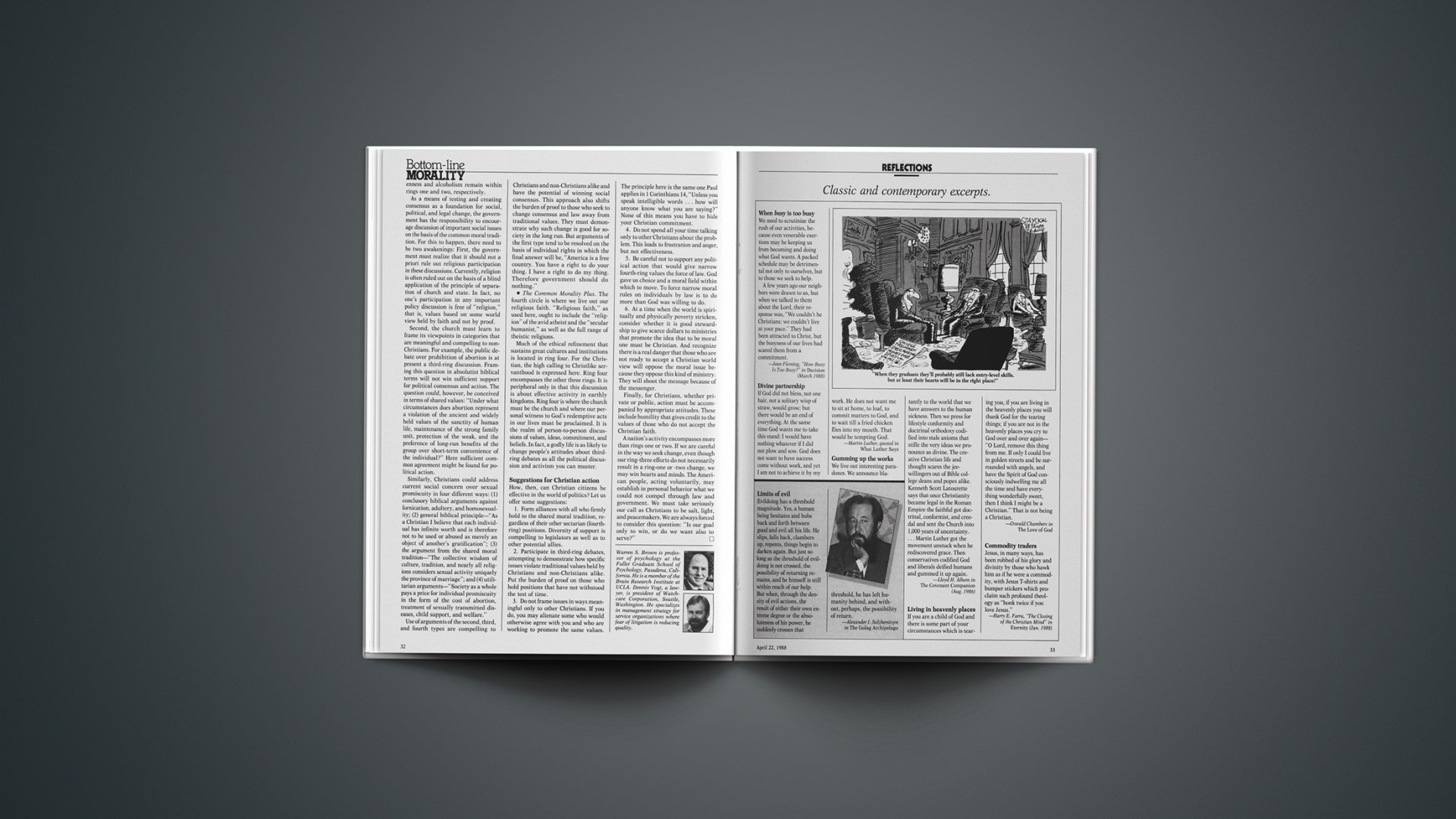
Bottom-Line Morality

Traditional values can form the basis for making common cause with unbelievers.

A non-Christian schoolteacher looks at her neighbor over a cup of coffee. Tears of frustration are in her eyes. “You’re a Christian. Help me understand what these Christian parents want,” she says, referring to a heated meeting over curriculum the previous evening.

The leader of a men’s Bible study asks for volunteers to campaign for “Christian” school board candidates. He speaks with fervor: “We have let secular humanists run our schools and our government too long. It’s time for Christians to get into politics and fight back. America needs to become a Christian country again, before it goes down the tubes.” After an angry campaign, the “Christian” slate wins a majority on the school board and curriculum review is on the agenda.

Christian political involvement is not happening in a comer. Newspapers report that in Washington State the “Religious Right” has taken over the Republican party apparatus. People Weekly, the barometer of celebrity, runs a feature on the big-time TV evangelists. The Reverend Pat Robertson is seriously running for President, and after the Iowa caucuses, nobody is laughing.

In the midst of all this, some Christians are becoming uneasy with this “thundering prophet” confrontational political style. Even Falwell has reassessed his political involvement. But how do individual Christians find their way? As Christians and citizens, it is easy to feel caught in the middle, without good criteria for making choices.

From some of our fellow Christians comes the suggestion that real Christians will always vote for Christian candidates. On the other hand, many non-Christians, like our distraught school teacher, are loving, compassionate, upright, and moral. And one is sometimes left cold by an impression of harshness, lack of humility, and naïveté in many politically active Christians.

Here are some insights we have found useful in this election year.

Traditional Values

There is little in political history or Scripture to support the idea that Christianity has a corner on the moral and social values that will sustain a great nation.

It is not hard to understand how people link loss of Christian influence to loss of national moral fiber, if they take their perspective from watching the evening news over the last three decades. Since the fifties, there has indeed been a decline in the observance of “traditional values” in the United States. We also sense our prosperity and our favored position in the world slipping away. And over this same period, there has been an active and generally successful effort by some to excise religion (by which is nearly always meant the Christian religion) from public life, public education, and public discourse.

Because many Christians believe the decline in Christian influence in public life caused the decline in traditional moral standards and national influence (and prosperity), they conclude that to reverse these trends Christianity must be aggressively re-established in government.

But these people may not appreciate that the traditional values held by Christians are not very different from the values held by our “secular humanist” schoolteacher. Some would chalk it up to the lingering influence of Christian culture on her upbringing. That may be partly true, but it runs deeper.

In The Abolition of Man, C. S. Lewis points out that the “traditional morality” that has been held by all ancient and modern civilizations, East or West, has virtually the same content. Despite some incongruities and exceptions, nearly all widely held religions define what makes a person good and what makes something evil in ways that are remarkably similar to the Judeo-Christian tradition.

Lewis calls this commonly held traditional morality the “Tao,” which means the “Way” in Chinese. In Lewis’s day the term had the advantage of avoiding sectarian prejudices that might be elicited by phrases such as “biblical morality,” “God’s law,” or “general revelation.” And presumably this word also helped his readers stop thinking that traditional morality begins and ends with the Christian tradition. Since Lewis’s time, the importation of Eastern religions into North America makes the word less useful. So we shall use phrases like “the shared moral tradition” or “common morality” to mean the same thing.

Lewis’s examples of the moral precepts that existed in other and ancient cultures strike us with their familiarity. We discover that not only do all cultures have moral strictures against murder, but that familiar notions like the following crop up repeatedly in moral codes: “I have not brought misery upon my fellows. I have not made the beginning of every day laborious in the sight of him who worked for me” (ancient Egyptian). “Slander not” (Babylonian). “Utter not a word by which anyone could be wounded” (Hindu). “Never do to others what you would not like them to do to you” (Chinese).

The familiar moral and ethical concerns continue: “What good man regards any misfortune as no concern of his?” (Roman). “Love thy wife studiously. Gladden her heart all thy life long” (ancient Egyptian). “To care for parents” (Greek list of duties). “Has he approached his neighbor’s wife?” (Babylonian list of sins). “Nature and reason command that nothing uncomely … and nothing lascivious be done or thought” (Roman).

For those steeped in Scripture, the biblical forms of these admonitions will immediately come to mind. Many similar statements could be quoted, covering integrity, chastity, marital fidelity, the unique value of individual human life, charity, the value of work, and love of country. No wonder non-Christians get so upset when Christians assume that only a Christian can be a good moral steward of government.

A Christian View Of Government

Non-Christians have a right to be upset. In fact, Scripture is on their side. Consider the function of government that is stated in Scripture. In particular, consider government’s relationship to promoting moral values.

Jesus clearly said that he did not come to set up an earthly kingdom. “Render unto Caesar the things that are Caesar’s, and unto God the things that are God’s” implies a division of responsibility or function between church and state. In the desert temptations, and then as his followers urged him to set up an earthly kingdom, Jesus insisted that his kingdom was not of this world.

What then is God’s view of government? Paul, in Romans 13, told the early Christians: “Submit … to the governing authorities.… The authorities that exist have been established by God.… For rulers hold no terror for those who do right, but for those who do wrong.… He is God’s servant, an agent of wrath to bring punishment on the wrongdoer. Therefore, it is necessary to submit to the authorities, not only because of possible punishment but also because of conscience” (vv. 1, 3–6, NIV).

Paul was talking about Roman, non-Christian government. But he presumes that government will generally do right; that it is in fact God’s servant to check evil. He also assumes some congruence between what the Roman authority prohibits and encourages, and the conscience of the believer.

How can a Roman government promoting pagan worship be God’s servant? How does God ensure that it or any government does right? How can we confidently form alliances with unbelievers in the moral arena?

The answers to these questions are found in the first two chapters of Romans. Paul points out that God’s “eternal power and divine nature … have been clearly seen, being understood from what has been made, so that men are without excuse.” Later, Paul says that those who ignored the evidence “know God’s righteous decree.…”

Human beings, based on what they see in the created world, come to know right and wrong. Paul says, “Indeed, when Gentiles, who do not have the [Jewish] law, do by nature things required by the law, they are a law for themselves … since they show that the requirements of the law are written on their hearts, their consciences also bearing witness.” Paul is asserting that all human beings know certain fundamental aspects of the law. This is the source of the shared morality, part of God’s common grace to individuals and the human community (i.e., the Tao in Lewis’s terms). As such, it inevitably finds its way into the foundation of all effective and humane social structures. Without it the world would be chaos. It is not propositionally revealed law; it is less than that. But it is sufficient for government. Effective government based on this shared moral wisdom provides an environment within which God’s people and his church are allowed to exercise their earthly mission.

Church And State, Religion And State

The Constitution of the United States started with two simple principles of church-state relations. One was nonestablishment: there would not be a state church. The other was free exercise: the government would not prohibit or interfere with religious belief.

In 1835, when Alexis de Tocqueville published his prescient book Democracy in America, he observed that the success of democratic government in the United States depended on both the specific “separation of church and state” and on government facilitation of religion. The first part of this observation we all recognize, but the second sounds surprising today. He observed in this connection that “despotism may be able to do without faith, but freedom cannot. Religion [is needed] in democratic republics most of all,” because when political controls are loosened (as in a democracy), society will not escape destruction, unless internal moral controls are strengthened. Religion provides this strength.

This does not mean that the government promotes any particular sect. While it is important to individuals whether or not their religions are true, it is not important for government that all citizens profess true religion—only that they should profess some religion that reflects stable and shared values.

There is a difference, of course, between Tocqueville’s America and our own. In his time, the influential people of the nation were largely theistic. In addition, those who did not believe in a theistic explanation of the universe or a revealed morality tacitly recognized that it would not be good for the country to attack the religious impulse of the majority. Tocqueville observed that the nontheists recognized religion as the guarantor of the freedoms they themselves enjoyed.

In our time, the situation is more complex. There is pressure from some, whom Tocqueville and his contemporaries would have defined as “nonreligious,” to make the government “neutral” in the matter of religion. But as their activities look more and more like a coherent program based on a defined set of beliefs, it is beginning to feel like religion to some of the rest of us. The government “neutrality” they seek is not really neutrality but establishment. Metaphysics teaches us that to be “neutral toward religion” is to have adopted a religious stance.

The Christian cannot respond to this trend by entering into a competition for establishment. Tocqueville warns that apart from “influence proper to itself,” religion can be seduced to rely on the artificial strength of laws and governments. But when a religion makes such an alliance, “it sacrifices the future for the present, and by gaining a power to which it has no claim, it risks its legitimate authority … by allying itself with any political power, religion increases its strength over some but forfeits the hope of reigning over all.”

In fact, history teaches us that when the church moves too close to the mechanisms of the state and lives on the basis of state power, sooner or later tyranny rears its head. Examples include the atrocities of the Inquisition and the social and religious intolerance of Calvin’s Geneva.

The Four Rings Of Morality

We have suggested, first, that concepts drawn from the shared morality are the key issues for politics and government; second, that these concepts are not the sole possession of the Christian faith; and third, that there is danger in seeking religious establishment. What does this suggest for Christian action in the political arena? How should Christians act as voters and politicians? How should the state act in relation to morality and religion?

Consider a graphic way to organize the various issues: The values and traditions that make up our moral and religious lives can be considered to reside somewhere within four concentric circles (see figure below).

The Codified Common Morality. The innermost ring contains generally accepted moral and ethical beliefs that can be defined in reasonable rules and laws, which, therefore, the government ought rightly to articulate in its body of laws. This includes laws related to murder, theft, rape, aspects of personal responsibility such as traffic laws, and certain base-line standards regulating such things as marriage, education, and minimum wages.

Considerable discussion has taken place regarding which “sins” should be made “crimes.” We do not suggest a specific answer to this problem. Nor do we mean that all existing laws are an adequate expression of the moral tradition, only that some part of that tradition is and should be prescribed in law.

The Common Civil Morality. The second circle includes aspects of the shared moral tradition that cannot be defined in statutes and regulations, but that should be promoted by government communication and action. Examples of such official persuasiveness are presidential and other official speeches regarding the nation’s values and priorities; tax advantages for giving to charitable and religious organizations; broad-based educational programs for the prevention of disease or drug abuse; recognition of individual merit and achievement; and provision of opportunity for advancement through higher education. Thus, ring two represents areas of moral consensus sufficient to support government in taking positions as to what is good to do and what “noncrimes” should be strongly discouraged.

Since the primary social structure that defines and maintains the shared moral tradition is religion, government (particularly democratic governments) ought, within ring two, to promote and facilitate religion in a broad, pluralistic, nonsectarian way. Our social structure is harmed by fastidious, ACLU-style opposition to religious expression, a pickiness that has been encouraged by our judiciary. In this connection, we might agree with Norman Podesta, president of People for the American Way (a group founded to “counteract” the influence of the Moral Majority). He wrote recently in connection with public education; “Let the textbooks describe the marvelous diversity of religious beliefs that Americans brought to these shores … the extraordinary contributions that religious leaders, religious institutions, and religious people have made—and are making today. But there is no need for the textbooks to promote any one religion.”

Democratic government is an embodiment of shared traditional values. It is in its survival interest to foster and nurture the root source of those values.

The Common Social Morality. This third circle is the area of public debate. It involves issues upon which moral and well-meaning people disagree and that therefore do not yet command sufficient general agreement on the question of its legal implementation to be moved into the inner two rings.

Ring three is an area of important activity for individual Christians and the church. Christians play out part of their social responsibility in public discussion. They must enter the debate on social issues to enrich and enlighten the consensus of ring two and the laws of ring one by a clear statement of values Christians share with the moral traditions of most cultures.

Historically, particular values have moved in and out of the third ring, the church often playing a key role in these social movements. Slavery in the early 1800s was an important third-ring issue that engendered sufficient public debate and that a civil war caused to be moved into ring one. The commercial manufacture and sale of alcohol is an issue that moved into, and then back out of, ring one. While Prohibition has been repealed, in our day public drunkenness and alcoholism remain within rings one and two, respectively.

As a means of testing and creating consensus as a foundation for social, political, and legal change, the government has the responsibility to encourage discussion of important social issues on the basis of the common moral tradition. For this to happen, there need to be two awakenings: First, the government must realize that it should not a priori rule out religious participation in these discussions. Currently, religion is often ruled out on the basis of a blind application of the principle of separation of church and state. In fact, no one’s participation in any important policy discussion is free of “religion,” that is, values based on some world view held by faith and not by proof.

Second, the church must learn to frame its viewpoints in categories that are meaningful and compelling to non-Christians. For example, the public debate over prohibition of abortion is at present a third-ring discussion. Framing this question in absolutist biblical terms will not win sufficient support for political consensus and action. The question could, however, be conceived in terms of shared values: “Under what circumstances does abortion represent a violation of the ancient and widely held values of the sanctity of human life, maintenance of the strong family unit, protection of the weak, and the preference of long-run benefits of the group over short-term convenience of the individual?” Here sufficient common agreement might be found for political action.

Similarly, Christians could address current social concern over sexual promiscuity in four different ways: (1) conclusory biblical arguments against fornication, adultery, and homosexuality; (2) general biblical principle—“As a Christian I believe that each individual has infinite worth and is therefore not to be used or abused as merely an object of another’s gratification”; (3) the argument from the shared moral tradition—“The collective wisdom of culture, tradition, and nearly all religions considers sexual activity uniquely the province of marriage”; and (4) utilitarian arguments—“Society as a whole pays a price for individual promiscuity in the form of the cost of abortion, treatment of sexually transmitted diseases, child support, and welfare.”

Use of arguments of the second, third, and fourth types are compelling to Christians and non-Christians alike and have the potential of winning social consensus. This approach also shifts the burden of proof to those who seek to change consensus and law away from traditional values. They must demonstrate why such change is good for society in the long run. But arguments of the first type tend to be resolved on the basis of individual rights in which the final answer will be, “America is a free country. You have a right to do your thing. I have a right to do my thing. Therefore government should do nothing.”

The Common Morality Plus. The fourth circle is where we live out our religious faith. “Religious faith,” as used here, ought to include the “religion” of the avid atheist and the “secular humanist,” as well as the full range of theistic religions.

Much of the ethical refinement that sustains great cultures and institutions is located in ring four. For the Christian, the high calling to Christlike servanthood is expressed here. Ring four encompasses the other three rings. It is peripheral only in that this discussion is about effective activity in earthly kingdoms. Ring four is where the church must be the church and where our personal witness to God’s redemptive acts in our lives must be proclaimed. It is the realm of person-to-person discussions of values, ideas, commitment, and beliefs. In fact, a godly life is as likely to change people’s attitudes about third-ring debates as all the political discussion and activism you can muster.

Suggestions For Christian Action

How, then, can Christian citizens be effective in the world of politics? Let us offer some suggestions:

1. Form alliances with all who firmly hold to the shared moral tradition, regardless of their other sectarian (fourth-ring) positions. Diversity of support is compelling to legislators as well as to other potential allies.

2. Participate in third-ring debates, attempting to demonstrate how specific issues violate traditional values held by Christians and non-Christians alike. Put the burden of proof on those who hold positions that have not withstood the test of time.

3. Do not frame issues in ways meaningful only to other Christians. If you do, you may alienate some who would otherwise agree with you and who are working to promote the same values.

The principle here is the same one Paul applies in 1 Corinthians 14, “Unless you speak intelligible words … how will anyone know what you are saying?” None of this means you have to hide your Christian commitment.

4. Do not spend all your time talking only to other Christians about the problem. This leads to frustration and anger, but not effectiveness.

5. Be careful not to support any political action that would give narrow fourth-ring values the force of law. God gave us choice and a moral field within which to move. To force narrow moral rules on individuals by law is to do more than God was willing to do.

6. At a time when the world is spiritually and physically poverty stricken, consider whether it is good stewardship to give scarce dollars to ministries that promote the idea that to be moral one must be Christian. And recognize there is a real danger that those who are not ready to accept a Christian world view will oppose the moral issue because they oppose this kind of ministry. They will shoot the message because of the messenger.

Finally, for Christians, whether private or public, action must be accompanied by appropriate attitudes. These include humility that gives credit to the values of those who do not accept the Christian faith.

A nation’s activity encompasses more than rings one or two. If we are careful in the way we seek change, even though our ring-three efforts do not necessarily result in a ring-one or two change, we may win hearts and minds. The American people, acting voluntarily, may establish in personal behavior what we could not compel through law and government. We must take seriously our call as Christians to be salt, light, and peacemakers. We are always forced to consider this question: “Is our goal only to win, or do we want also to serve?”

Warren S. Brown is professor of psychology at the Fuller Graduate School of Psychology, Pasadena, California. He is a member of the Brain Research Institute at UCLA. Dennis Vogt, a lawyer, is president of Watchcare Corporation, Seattle, Washington. He specializes in management strategy for service organizations where fear of litigation is reducing quality.

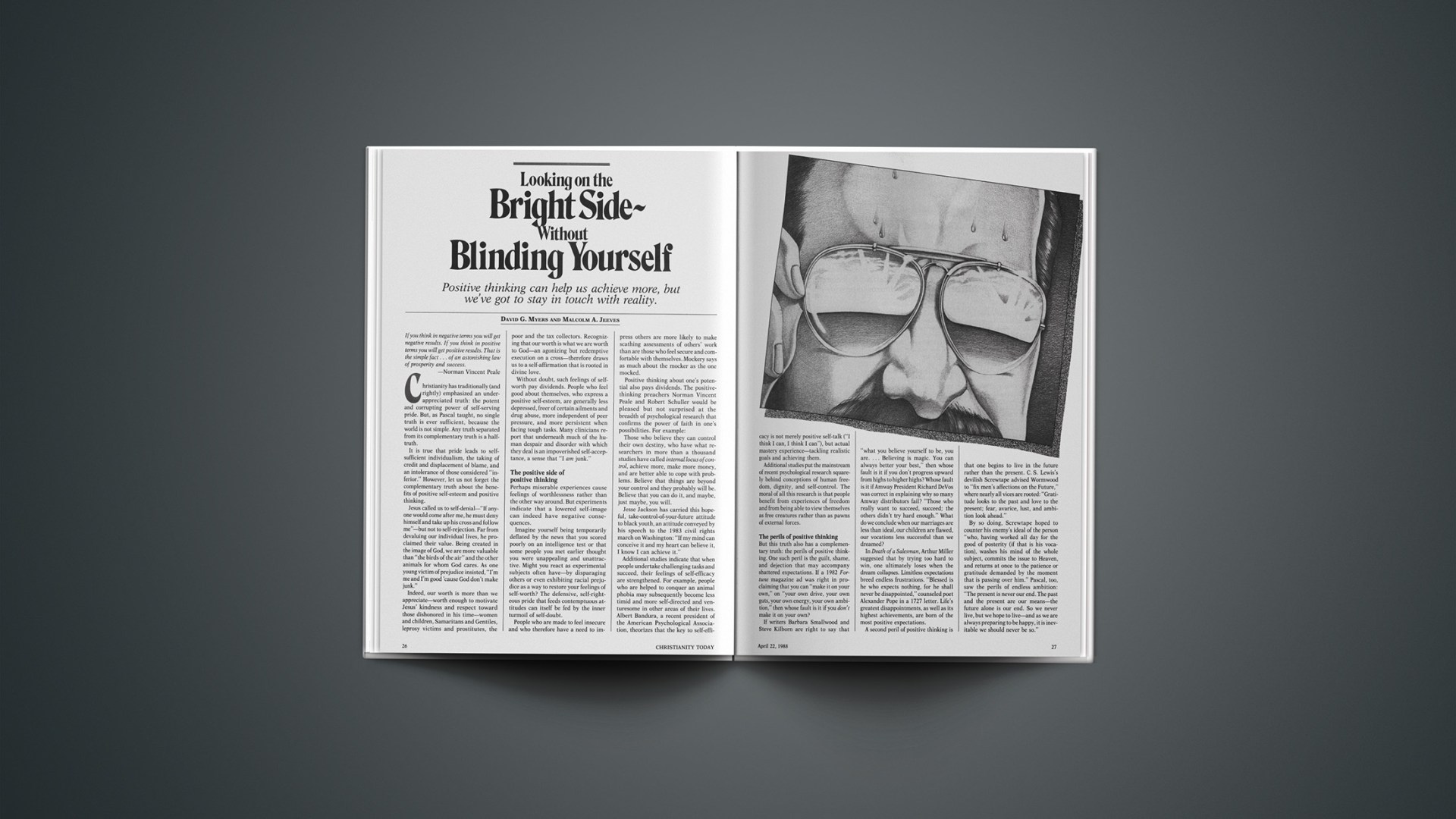
Looking on the Bright Side without Blinding Yourself

Positive thinking can help us achieve more, hut we’ve got to stay in touch with reality.

If you think in negative terms you will get negative results. If you think in positive terms you will get positive results. That is the simple fact … of an astonishing law of prosperity and success.

—Norman Vincent Peale

Christianity has traditionally (and rightly) emphasized an under-appreciated truth: the potent and corrupting power of self-serving pride. But, as Pascal taught, no single truth is ever sufficient, because the world is not simple. Any truth separated from its complementary truth is a half-truth.

It is true that pride leads to self-sufficient individualism, the taking of credit and displacement of blame, and an intolerance of those considered “inferior.” However, let us not forget the complementary truth about the benefits of positive self-esteem and positive thinking.

Jesus called us to self-denial—“If anyone would come after me, he must deny himself and take up his cross and follow me”—but not to self-rejection. Far from devaluing our individual lives, he proclaimed their value. Being created in the image of God, we are more valuable than “the birds of the air” and the other animals for whom God cares. As one young victim of prejudice insisted, “I’m me and I’m good ‘cause God don’t make junk.”

Indeed, our worth is more than we appreciate—worth enough to motivate Jesus’ kindness and respect toward those dishonored in his time—women and children, Samaritans and Gentiles, leprosy victims and prostitutes, the poor and the tax collectors. Recognizing that our worth is what we are worth to God—an agonizing but redemptive execution on a cross—therefore draws us to a self-affirmation that is rooted in divine love.

Without doubt, such feelings of self-worth pay dividends. People who feel good about themselves, who express a positive self-esteem, are generally less depressed, freer of certain ailments and drug abuse, more independent of peer pressure, and more persistent when facing tough tasks. Many clinicians report that underneath much of the human despair and disorder with which they deal is an impoverished self-acceptance, a sense that “I am junk.”

The Positive Side Of Positive Thinking

Perhaps miserable experiences cause feelings of worthlessness rather than the other way around. But experiments indicate that a lowered self-image can indeed have negative consequences.

Imagine yourself being temporarily deflated by the news that you scored poorly on an intelligence test or that some people you met earlier thought you were unappealing and unattractive. Might you react as experimental subjects often have—by disparaging others or even exhibiting racial prejudice as a way to restore your feelings of self-worth? The defensive, self-righteous pride that feeds contemptuous attitudes can itself be fed by the inner turmoil of self-doubt.

People who are made to feel insecure and who therefore have a need to impress others are more likely to make scathing assessments of others’ work than are those who feel secure and comfortable with themselves. Mockery says as much about the mocker as the one mocked.

Positive thinking about one’s potential also pays dividends. The positive-thinking preachers Norman Vincent Peale and Robert Schuller would be pleased but not surprised at the breadth of psychological research that confirms the power of faith in one’s possibilities. For example:

Those who believe they can control their own destiny, who have what researchers in more than a thousand studies have called internal locus of control, achieve more, make more money, and are better able to cope with problems. Believe that things are beyond your control and they probably will be. Believe that you can do it, and maybe, just maybe, you will.

Jesse Jackson has carried this hopeful, take-control-of-your-future attitude to black youth, an attitude conveyed by his speech to the 1983 civil rights march on Washington: “If my mind can conceive it and my heart can believe it, I know I can achieve it.”

Additional studies indicate that when people undertake challenging tasks and succeed, their feelings of self-efficacy are strengthened. For example, people who are helped to conquer an animal phobia may subsequently become less timid and more self-directed and venturesome in other areas of their lives. Albert Bandura, a recent president of the American Psychological Association, theorizes that the key to self-efficacy is not merely positive self-talk (“I think I can, I think I can”), but actual mastery experience—tackling realistic goals and achieving them.

Additional studies put the mainstream of recent psychological research squarely behind conceptions of human freedom, dignity, and self-control. The moral of all this research is that people benefit from experiences of freedom and from being able to view themselves as free creatures rather than as pawns of external forces.

The Perils Of Positive Thinking

But this truth also has a complementary truth: the perils of positive thinking. One such peril is the guilt, shame, and dejection that may accompany shattered expectations. If a 1982 Fortune magazine ad was right in proclaiming that you can “make it on your own,” on “your own drive, your own guts, your own energy, your own ambition,” then whose fault is it if you don’t make it on your own?

If writers Barbara Smallwood and Steve Kilborn are right to say that “what you believe yourself to be, you are.… Believing is magic. You can always better your best,” then whose fault is it if you don’t progress upward from highs to higher highs? Whose fault is it if Amway President Richard DeVos was correct in explaining why so many Amway distributors fail? “Those who really want to succeed, succeed; the others didn’t try hard enough.” What do we conclude when our marriages are less than ideal, our children are flawed, our vocations less successful than we dreamed?

In Death of a Salesman, Arthur Miller suggested that by trying too hard to win, one ultimately loses when the dream collapses. Limitless expectations breed endless frustrations. “Blessed is he who expects nothing, for he shall never be disappointed,” counseled poet Alexander Pope in a 1727 letter. Life’s greatest disappointments, as well as its highest achievements, are born of the most positive expectations.

A second peril of positive thinking is that one begins to live in the future rather than the present. C. S. Lewis’s devilish Screwtape advised Wormwood to “fix men’s affections on the Future,” where nearly all vices are rooted: “Gratitude looks to the past and love to the present; fear, avarice, lust, and ambition look ahead.”

By so doing, Screwtape hoped to counter his enemy’s ideal of the person “who, having worked all day for the good of posterity (if that is his vocation), washes his mind of the whole subject, commits the issue to Heaven, and returns at once to the patience or gratitude demanded by the moment that is passing over him.” Pascal, too, saw the perils of endless ambition: “The present is never our end. The past and the present are our means—the future alone is our end. So we never live, but we hope to live—and as we are always preparing to be happy, it is inevitable we should never be so.”

The third peril of positive thinking is an excessive optimism that leads to complacency about evil. In the face of a worldwide arms race, exploding population, and assaults on the environment, positive thinkers are inclined not to worry. “The pessimists have often been wrong in the past,” they say, “so let’s not trouble ourselves with their negative thinking.”

It was an optimistic we-can-do-it attitude that emboldened Lyndon Johnson to invest our weapons and soldiers in the effort to salvage democracy in South Vietnam. It was positive thinking that gave Jimmy Carter the courage to attempt the rescue of American hostages in Iran. It was possibility thinking that enabled a resolute Ronald Reagan to send troops to Lebanon in hopes of restoring peace, to support the contras’ guerrilla warfare in Nicaragua, to assume that selling weapons of death to Iran would promote moderation and reduce the number of American hostages in Lebanon.

By contrast, experiments indicate that one type of negative thinking—anxiety over contemplated failure—can motivate high achievement. (Think of the students who, fearing they are going to bomb their coming exam, proceed to study furiously and, not surprisingly, get A’s.) To be sure, hopeless despair breeds as much apathy as does naïve optimism. What we therefore need is neither negative nor positive thinking, but realistic thinking—thinking characterized by enough pessimism to trigger concern, enough optimism to provide hope.

In Search Of True Humility

How then can we realize self-denial without self-rejection? Self-affirmation without vain self-love? And what is a genuine Christian humility?

First, we must remember that humility is not self-contempt. To paraphrase C. S. Lewis, humility does not consist in handsome people trying to believe they are ugly and clever people trying to believe they are fools. Ivan Lendl and Martina Navratilova can acknowledge their greatness at tennis without violating the spirit of humility. False modesty regarding one’s gifts can actually lead to pride—pride in one’s better-than-average humility.

Screwtape recognized this possibility in advising Wormwood to catch his prey “at the moment when he is really poor in spirit and smuggle into his mind the gratifying reflection, ‘By jove! I’m being humble,’ and almost immediately pride—pride at his own humility—will appear.”

True humility also is not found by straddling the fence between egotistical vanity and self-hatred. Humility is more like self-forgetfulness. It is flowing with life with minimal self-consciousness, as when we become totally absorbed in a challenging task, an exciting game, or even a life mission. Dancers, athletes, chess players, surgeons, and writers often experience this kind of absorption. With it comes a satisfaction that accompanies the relinquishment of the self-conscious pursuit of happiness.

Dennis Voskuil, a Reformed thinker who has written thoughtfully about Robert Schuller’s positive thinking, states the phenomenon in Christian terms: The refreshing gospel promise is “not that we have been freed by Christ to love ourselves, but that we are free from self-obsession. Not that the cross frees us for the ego trip but that the cross frees us from the ego trip.” This leaves us free to esteem our special talents and, with equal honesty, to esteem our neighbor’s. Both the neighbor’s talents and our own talents are recognized as gifts that, like our height, demand neither vanity nor self-deprecation.

Obviously, true humility is a state not easily attained. C. S. Lewis offered, “If anyone would like to acquire humility, I can, I think, tell him the first step. The first step is to realize that one is proud. And a biggish step, too.” The way to take this first step, continued Lewis, is to glimpse the greatness of God and see oneself in light of it. “He and you are two things of such a kind that if you really get into any kind of touch with him you will, in fact, be humble, feeling the infinite relief of having for once got rid of [the pretensions that have] made you restless and unhappy all your life.” To be self-affirming yet self-forgetful, positive yet realistic, grace-filled and unpretentious—that is the Christian vision of abundant life.

David G. Myers is the John Dirk Werkman Professor of Psychology at Hope College, Holland, Michigan. He has been awarded the Gordon Allport Prize for social psychological research and written for more than two dozen journals and magazines. Cognitive neuroscientist Malcolm A. Jeeves is Foundation Professor of Psychology at the University of Saint Andrews, Scotland. He has written several dozen scientific articles and books on the issues of science and faith. The above article is adapted from Myers’s and Jeeves’s recent book, Psychology Through the Eyes of Faith (Harper & Row).

Essay: An Offering of Slogans

What do we mean When we call for “peace” or “justice”?

As a pastor in good standing in the United Methodist Church, I recently received a packet of materials from the National Council of Churches, The packet was intended to help us celebrate “Peace With Justice Week.” Included was a poster, on which was pictured a globe: a world, held aloft by a half-dozen different-colored hands. It seemed to say that if we can just get white, brown, black hands together, we can uphold the world for peace with justice. The Greeks had Atlas, the Arabs had a turtle, we have the multicolored hands of the NCC. We’ve got the whole world in our hands.

A person who parks her car near mine, a person who speaks much of “justice issues,” and doing “justice ministry,” recently placarded her Volvo with IF YOU WANT PEACE, WORK FOR JUSTICE. Each day I ruminated upon her bumper sticker. Then, on the day I was thinking not about peace with justice, but rather about my next sermon, I read the lectionary text for that day, the song of that old daddy-to-be, Zechariah:

“Blessed be the Lord God of Israel, for he has visited and redeemed his people, … that we, being delivered from our enemies, might serve him without fear, in holiness and righteousness … the day shall dawn upon us from on high to give light to those who sit in darkness and in the shadow of death, to guide our feet into the way of peace” (Luke 1:68, 73–75, 78–79).

I realized that the NCC poster and the peace-with-justice bumper sticker were wrong, dead wrong. Zechariah believed that peace is something God makes—a gift of God, not of our enlightened social policy. What needed doing for those oppressed first-century Jews was so great, so utterly beyond these bounds of human imagination or initiative, that only a visit by God could do it.

According to Luke 1:67–79, peace is not the fruit of our work for justice. Ironically, violence is usually the result of our efforts to make peace. Much violence, and more than a little war, occurs precisely at that moment when we tire of waiting for God to come and at last set out to put things right.

The Supreme Moral Action

Liberation theologians taught me this. Gustavo Gutiérrez notes how conciliatory work is often palliative. What we need, he says, is struggle, confrontation, and partisan engagement. We should take sides for justice. Gutiérrez calls upon his fellow Christians to inseminate liberation movements with a biblical view of peacemaking. But, of course, once one takes sides, once the enemy is clearly identified and injustice is named, it becomes difficult to tell the peacemakers from the war-makers.

Words like “peace,” “justice,” “liberation,” words used with equal dexterity by the established to maintain their power or by the disestablished to get power, are beloved because we can make them mean whatever we want. One reason why contemporary Christians must attach “justice” to “peace” is that we discovered that the mere pronouncement of “peace” was inadequate. Impassioned calls for peace, we learned, can be another means of the powerful protecting the status quo to their own advantage. So by joining “justice” to peace, we are preserved from the charge that we Christians want peace at any cost, peace at the expense of someone else’s justice.

This helps explain why pacifists are accused of being immoral. Pacifists talk about wanting peace, but they don’t seem to be working for justice (i.e., they refuse to be violent or to support those who are). They sit back on the high moral ground and refuse to roll up their sleeves and work for justice. Long before the liberation theologians, Paul Ramsey argued that war can be justice because it has as its ultimate end the creation of that order that will help the state fulfill its sacred obligation to protect the weak and the innocent.

If peace is the fruit of justice and if justice has become the result of violence, we are right to be uneasy about our use of language. “Peace with Justice” has become a popular slogan for us, not because Christians have at last become aware that Jesus really means for us to embody his vision through specific political actions. Rather, IF You WANT PEACE, WORK FOR JUSTICEreflects Christian accommodation to the agenda of ideologies that are not Christian.

It enables us to join in struggles for justice, wherever and whenever we label them as such, without having to qualify our actions by specifically Christian criteria. Our slogan enables us to avoid the worst of all possible contemporary political fates: having Christians relegated to the fringes of society, losing our influence upon the formation of social policy and national strategy, being deemed politically irrelevant by the powers that be.

Long ago, the Hebrew prophets noted that it was not enough to cry, “Peace, peace.” New prophets must tell our generation that it is also inadequate to cry, “Justice, justice.” Contrary to notions prevalent in today’s heavily politicized church, our task is not to be useful within the present scheme of things, but to be faithful. Modern people value power above all else, power to change the world, joining our hands to set things right. But setting things right, in itself, is not the supreme moral action. The supreme moral action, from a peculiarly Christian perspective, is to live and die as Christ.

We are to find our definitions of big words like “peace” and “justice,” not within the boundaries of what is deemed “effective,” nor even from the mouths of those whom we privilege with the name “oppressed.” Our words, our lives, are best defined by the life and death of Jesus. His peculiar story defines the content of “peace” and “justice,” not the other way around.

The Centrality Of The Church

All moral motivations are secondary to the motivation to act the way God acts. In refusing to define peace by current definitions of order or justice by the power arrangements of the majority, followers of Jesus are not being romantic or idealistic, but hard-headedly realistic: This is the way God is, the way God’s world is. We have no idea whether the world will regard our behavior as effective, nor whether our efforts will satisfy the aspirations of the oppressed, nor whether Caesar will approve.

The moral imperatives only make sense within the context of the story of a God who forgives, a God who suffers, a God who blurs our distinctions between friend and foe, oppressed and oppressor; a God who cares for and comes to poor, helpless people like young Mary and old Zechariah. In discussions with liberators, conversations with the establishment, and with the disestablished who would be established, Christians can be expected to see rather peculiar meanings in popular words to which everyone else has definitions. The people who killed both the son of Zechariah and the son of Mary did so for the cause of peace with justice in Judea.

To the extent that we allow secular ideologies, Marxist or any other, to determine the content of our convictions and the shape of our political vision, we forfeit our ability to see the world as it really is—namely, a place where the principalities and powers insist on the freedom to define people, where Caesar co-opts movements for his own purposes, and where Satan masquerades as an angel of light. What if Gutiérrez’s notion of human history as a process of human se/f-liberation is in opposition to the Christian claim that we become free, not by ourselves and our earnest efforts, but only by dealing with the world as Christ dealt with us?

It all sounds well and good that Christians should work with others, even those who do not share our Christian convictions, in the struggle for justice. But “justice” awaits definition. It is no universally understood or defined word. We do the story of Jesus an injustice when we act as if it were nothing peculiar, as if the vision and witness of Jesus could be encapsulated as a struggle for justice. What do we mean when we call for “peace” or “justice”? There is no way to know what Christians mean without reference to a particular Scripture.

To the extent that God’s church allows its imagination to be captured by conventional accounts of peace and justice, we have forfeited our ability to help the oppressed. In our efforts to be politically relevant we have lost our ability to stand against the limits of the present order. We offer the oppressed not justice, but the palliative of utopian dreams, violence, class struggle; and we doom them to the continued resentment of not being as ruthlessly savvy as Caesar in getting what he wants. In lieu of salvation, feed them slogans.

The place to begin a Christian struggle for justice is in telling our stories and singing our songs. These question whether the world even knows what it is talking about when it talks of peace and justice. Rather than get our foot in Caesar’s door by speaking enough like the powerful to be invited to sit on the cabinet, our energies might be better used in the creation of a visible alternative to Caesar’s community. That visible alternative is the church—God’s attempt to create a place of peace and justice where we might be saved from the disasters of our efforts to take matters into our hands.

Here is the advent of that peace “which passeth all understanding”; now is the time for singing of the one who came to us because we could not get together and come to him, the one who comes, “through the tender mercy of our God, … to give light to those who sit in darkness … to guide our feet into the way of peace.”

William H. Willimon is chaplain at Duke University, Durham, North Carolina. His many books include The Service of God: How Worship and Ethics Are Related (Abingdon, 1983) and Preaching About Conflict in the Local Church (Westminster, 1987).

His Father’s Son

The drive behind James Dobson, Jr.

James Dobson, who may well be the most famous psychologist in the world, was born in 1936 in Shreveport, Louisiana, by Caesarian section. The doctor told his mother she might not live through another birth. Thus, the man who counsels millions about family life was raised an only child.

A great-grandfather and a grandfather on his mother’s side had been charter members of the Church of the Nazarene, a holiness denomination with headquarters in the Midwest. A prophecy had come to the great-grandfather that all his family for four generations would belong to the Lord. That prophecy has held true, with interest.

Dobson’s father, James, Sr., had felt a call to preach while in high school. “After months of struggling with it, he came home about three o’clock one afternoon, walking back and forth and praying, and finally made his choice. He turned his face up to God and said, ‘It’s too great a price, I won’t pay it.’ And there was a separation that occurred, as he described it.” The words James Dobson uses to describe this event are clearly his father’s; he heard the story many times as a boy, with the distinction drawn sharply between God’s calling and everything else. After his father went on to art school in Pittsburgh (giving up art was the price “too great to pay”), graduating first in his class, he surrendered his life back to God, sacrificed art, and became an evangelist.

A man more unlike the stereotype of a traveling evangelist would be hard to imagine. He was a quiet, vulnerable, deeply compassionate man. Dobson says that as a child the mere thought of his father could move him to tears. “He would never have been able to write a book, not because he couldn’t write it, but because his assessment of himself was so low he couldn’t have risked putting an idea out there emotionally, with the possibility of having it rejected.”

Nazarenes were a fervent people; Dobson’s cousin, H. B. London, says it was “camp meeting all the time.” Dobson’s father, however, was not particularly demonstrative. He showed no interest in or talent for promoting himself, though his deep sincerity penetrated people. He moved from being pastor to evangelist and back several times, and eventually taught art at a Nazarene college in Bethany, Oklahoma, while he continued preaching whenever he could.

Though evangelism could take Dobson’s father on the road for weeks at a time, in the intervals when he was home he hunted with his son, taught him to play tennis, and as the boy grew older, talked to him about books and ideas as though he were a peer. Dobson’s father read widely. He conveyed a strong sense of godliness. His son says today, “My father was probably deeper than I am, spiritually and maybe intellectually.” You do not have to talk very long to James Dobson, Jr., to learn that his father’s influence is the most powerful in his life.

In many ways, though, Dobson takes after his mother. She was the talker, the doer, the activist. Myrtle Dobson wrapped her life around her two men, and she was intensely proud of her son. The do’s and don’ts of church life were strict, but she gave all the freedom she could. Dobson’s wife, Shirley, remembers that “no matter what Jim said to her, even if she didn’t agree with it, she would never put it down. She would always let him say whatever he wanted to say, and then she would ask questions. She would never give an opinion.”

London, who spent many childhood holidays with the Dobson family, remembers them as open about their emotions, with a tendency toward depression and worry. Their son is, like them, extremely aware of emotions, and the anger, compassion, love, or frustration he feels come through unfiltered to his audience. Yet, says London, who is now his cousin’s pastor at the First Nazarene Church of Pasadena, “Jim is probably the most positive, optimistic, forward-looking person I’ve ever met. He loves what he does. He’s never down. I’ve never seen him down.”

Dobson grew up moving, in and out of small communities in Texas and Oklahoma: thus the slight sweetening of the Southwest in the voice now familiar in so many millions of homes. He graduated from high school in San Bonita, a small town near the Mexican border, and went on to Pasadena College, a Nazarene school in California. (The school has since moved and been renamed Point Loma University.)

You would think that the combination of prophecy, of family example, and of college influence would create an environment in which Dobson almost had to become a preacher. Yet he says he felt no pressure. His parents wisely left the subject alone. Among the Nazarenes, a call to preach was specific and unmistakable direction from God, and Dobson experienced no call. During his freshman year, he walked into the office of a popular professor and announced that he had decided to become a psychologist.

The Influence

Millions know “Doctor Dobson” as a psychologist, but ironically, a great many professional psychologists would not recognize his name. His books sell by the million and deal with the classic psychological ground of family life. But they contain almost no references to the vast amount of psychological literature. Dobson shows little interest in his status among professional psychologists. He resigned from the American Psychological Association some years ago, feeling it was worlds apart from him. (He has, however, retained his links to associations of Christian psychologists.)

Dobson has chosen channels of influence closer to a radio evangelist’s than a psychologist’s. Dobson’s peers are preachers—Swindoll, Falwell, Schuller. Yet Dobson seldom exposits a biblical text (and seldom appeals for funds), and he is deeply committed to avoiding topics that would unnecessarily put off people of different religious or political persuasions. Being a psychologist gives him a platform from which to speak to those who would not listen to a preacher. Jewish, Catholic, and Mormon groups appreciate Dobson’s words on family life.

Fifty million people have reportedly attended Dobson’s eight-part “Focus on the Family” film series. On an average day Dobson receives 6,000 letters at the headquarters of the $42 million (the annual budget) Focus on the Family organization he founded in Southern California. He is heard on more than 1,100 radio stations each day, more than anyone else is heard on, except Paul Harvey. But while Paul Harvey offers news and cracker-barrel philosophy, James Dobson asks his listeners to take action: to change their philosophy of child rearing, to organize against pornography in their communities, to write to Washington. And they do. Few organizations anywhere can mobilize the supporters that Dobson can.

In early 1987, angered that government officials had silenced Health and Human Services official Joanne Gaspar for her antiabortion decisions, Dobson inspired 100,000 letters to the White House. Gaspar was restored to power. Largely because of such public clout, Dobson has developed considerable influence in Washington.

Yet Dobson has escaped the national media attention a Jerry Falwell generates. He limits his public appeals to family-oriented issues (you will not hear him pronounce on Nicaragua, for instance), and he keeps a deliberately low profile. Notes Kay James of the National Right to Life Committee, “Effectiveness is what matters, not being a lightning rod.” She, like many others, rates Dobson’s effectiveness at the top among “profamily” spokesmen.

Dobson is a Reagan fan, though not an entirely uncritical one. He has access to the White House, including the President, and pictures of him with Reagan are prominent features of his office décor. He has spent a substantial portion of the last year in Washington, much of his involvement revolving around governmental panels. He has served on (and sometimes chaired) six during Reagan’s term, dealing with pornography, tax reform, army family life, teenage pregnancy, juvenile justice, and missing and exploited children.

Dobson’s influence in Washington is diluted by other competing voices; in the evangelical parachurch subculture, however, his thunder can drown out other sounds. For example, Focus on the Family is the most powerful organization in the evangelical world at moving books. It chooses two main premiums (books offered for a certain donation) each month, and will generally buy about 30,000 copies of each. Its promotion also stimulates sales in bookstores. Ron Land, vice-president of sales and distribution for Word Books, estimates that a book Focus selects will double its retail sales.

Recently Focus has begun publishing books of its own. Harold Morris was an unknown ex-convict, speaking to high-school assemblies, when a tape of his talk reached Dobson’s desk. Dobson put it on the air and received a high mail response. Morris had a book manuscript that several publishers had turned down. Focus published it as its first book; so far it has sold over 200,000 copies.

Focus on the Family is developing into a formidable institution, and is consciously trying to develop ministries that could outlive Dobson’s personal involvement. In the past year, two magazines have been launched (Clubhouse, for children, and The Citizen, for adults concerned about public affairs), book publishing has begun, while a film department produces videos and films on family-related topics. But, says Ted Engstrom, vice-chairman of the Focus board, “Who can follow after the king? If he’s hit by a truck, the broadcast will last for a year, and that’s it.” Focus on the Family remains James Dobson.

The Character

James Dobson once wrote that, had he been asked to write a theme on himself during adolescence, he would have begun, “I am the number-one tennis player in the high school.” That still says something about James Dobson: He is intensely competitive. Three mornings a week he plays serious basketball. (He switched from tennis to basketball because he liked the camaraderie of team sports.) He does not do it just for his health, either. He loves it. Focus vice-president Peb Jackson, a long-time friend, says that on the busiest day imaginable Dobson can be tempted to throw his agenda down and take off for a “really hot three-on-three game.” Dobson is not the reader his father was; he lacks the time for it. He customarily listens, even while shaving, to books on tape; on occasion he hires readers to record books for him. Dobson is well-informed on many subjects, but he is not the kind of person who longs to spend the day in the library. He likes people and he likes action. He loves sports (especially college basketball or anything the University of Southern California plays). He loves to eat (though never anything with eggs in it). He is the last one to give up and go to bed, the last one to leave church, the last one to cut short a fan who has stopped him on the street. He has an uninhibited, antic sense of humor. Says friend Robert Wolgemuth, “When you spend time with that family, you leave exhausted. It’s like being in a college dorm. They’re in motion all the time.”

But life with James Dobson, for all its activity, humor, and conviviality, is a far cry from a college fraternity. Many call him a workaholic (he hates the label), and he astounds co-workers with his output. He manages to be the hands-on leader of a large, rapidly growing organization, write books, lead a daily half-hour radio program, serve on governmental commissions, and make his presence felt in Washington. And, oh yes, he spends time with his family, and answers his mail. He reads virtually every letter of criticism written to Focus.

He will not cut corners in any of this; he is a meticulous, demanding perfectionist. The great struggle at Focus on the Family since its inception has been to get Dobson to let anything happen without his personal inspection. Lately the organization has grown so large (with 500 employees) that Dobson has been forced to stop scrutinizing every facet. But not very long ago he spent several hours in a busy day discussing with his video team his concerns about a coming film: whether the sound effects on a closing door had enough reverberation; whether a brief opening scene should be shown in color, black and white, or sepia; and whether background music swelled to a climax at the appropriate moment. And the film centered on Harold Morris, not James Dobson.

Friends and co-workers, when asked to describe Dobson, tend to revert to one word: integrity. They mean, among other things, that he is the same at home as he is on the stage. In the studio and out, he is usually an extremely likable person. Dobson is genuinely interested in other people. He can and does converse for hours without mentioning himself or his great successes. He does not drop names. When Dobson credits God for his accomplishments, he appears to mean what he says.

He carries a Dictaphone with him, and H. B. London says that more times than he can count he has heard Dobson dictate a memo to his assistant, Dee Otte, asking her to help with an individual’s financial needs. In his films, it is Dobson’s compassion that makes him such an attractive communicator, far more than his practical formulas for family living.

By integrity, his friends also mean his conscientiousness. Dobson is meticulous in avoiding any appearance of greed or malfeasance. One reason for his insistence on ruling the details is his deathly fear that a mistake, even a subordinate’s mistake, might reflect disfavor on the gospel. In the Focus reception area, and also in his office, sits a prominent hand-lettered sign indicating to all who enter that the attractive furnishings were given by personal donation; no general funds were used. The sign is pure Dobson: He likes things nice, but he has to tell the world that the ministry did not pay for them.

Dobson takes no salary, and pays Focus on the Family a monthly reimbursement for book royalties he reckons were generated by the organization’s publicity. He lives in the same attractive but nonpalatial home he has been in for 16 years—Shirley Dobson has long wanted a pool, but has not gotten one. The Dobsons have a condo at the Mammoth Mountain ski resort, and an eight-year-old Mercedes; but he says he intends not to leave a large estate to his children.

In that respect, he is trying to do a difficult thing: be a world-famous expert on raising children, while bringing going up his own two children (a daughter, Danae, who is in college, and a son, Ryan, who is in high school) like normal people. He tries to keep them out of the limelight, and asked me not to interview them for this article. Other people say they are good kids, though not necessarily perfect kids. Says Shirley Dobson, when asked how raising children has changed her and her husband, “I think we’ve both realized that there’s not enough knowledge in the books. You really have to stay on your knees for your kids. They’re individuals. You can’t pigeonhole them and say this is going to work with every child.

“If we had had two compliant kids, we might have thought that if everybody would raise their kids according to the Dobson philosophy, they wouldn’t be having these problems. But the Lord gave us two children who have minds of their own. We can empathize with other parents who don’t have all the answers.”

There is a puzzling difference between the normally gracious and self-effacing James Dobson and the accusing, domineering character who can surface whenever he feels the quality of his organization is threatened. Many of James Dobson’s friends, though they genuinely love him, seem intimidated by him. “It’s very difficult to confront him,” one told me. “He’s so strong. He thinks so quickly on his feet.” Dobson consequently leaves a trail of bruises. He does not leave a trail of bodies—his friends tend to be old friends, and his closest employees are extremely loyal. Many, though, would echo his old friend and use medical school colleague Mike Williamson: “I realized that the only way we would work together was if I let him be the pilot of the ship. When we went to the airport, he would say, ‘You get the bags, I’ll get the car.’ ”

I asked Dobson about these perceptions, and he spoke passionately about his concern that there be a “stamp of quality” on every facet of his work; he feels responsible to every last donor or letter writer, that each be treated with the utmost graciousness.

But Dobson does not just feel responsible for doing his own work well, he feels responsible for seeing that everyone he works with, even tangentially, matches his own sense of quality. His sense of mission is so big that it swallows everything. An interesting example—interesting just because it is so trivial—is his behavior toward photographers. He will not allow them to shoot from his right side, and will stop in midinterview to insist that they comply with his instructions. Dobson explains this insistence not as a question of wanting to look his best (a personal concern), but a question of quality (a public, morally weighted concern). His friends shrug. “It’s just him.”

Dobson was known for his searing memos even in his medical-school days. He told me that he wrote memos to his parents as a child, protesting when he considered their treatment unfair. The best guess is that he got such traits from being raised an adored only child. One close friend says, “I really love the guy, he’s been terrific to me. He’s loyal, and a tremendously faithful friend. But there is one area in his life that he cannot be aware of: it’s being an only child. You don’t have to share clothes. You don’t have hand-me-downs. You get your own way.”

The encouraging news is that Dobson is learning. Another friend says, “The guy has changed dramatically from where he was five or six years ago. When Focus was in its infancy, if somebody hampered its integrity, he would get so upset it would put the fear into you. Some of his memos could be real tough. He’s not changed his commitment to excellence and integrity, but he’s changed in his personal habits. That’s an inspiring part of our relationship: that a person as powerful and confident as he is can change.” Dobson himself says that he has stopped writing tough memos entirely; he now gives criticism only in person.

It is difficult to imagine entirely separating these driving, dominating qualities from the man: James Dobson did not become famous while wanting only to retreat to his study to think and write. He is driven to communicate his vision of the world—driven primarily, it seems, by his sense of God’s calling, by his father’s and mother’s legacy, and by (what is enmeshed with the first two) his own perfectionism. Whatever he does, he will do well, to God’s glory, in the way he believes is right. He expects—demands—that others do the same.

The Rise To Fame

Dobson’s rise to fame is no fairy tale; people in fairy tales experience dramatic setbacks and overcome terrific opposition. Dobson never has. His career has been a straight line of rising success. He has a sense of having been handed his ministry, perhaps because of the way his parents and other forebears prayed for him and his generation. “Sometimes,” he says, “I feel like one of God’s spoiled children. I have never tasted a lot of difficulty.”

In college, Dobson attracted little attention. He was not outwardly pious, nor active in groups of students who went out to witness to their faith. But neither was he rebellious. He always seemed to know exactly what he wanted to do with his life.

An interview with Clyde Narramore, one of the earliest evangelical psychologists, sealed Dobson’s desire to be a psychologist, and pointed him in the direction of a Ph.D. He arrived at the University of Southern California in 1958 after six months in the army. Dobson took exactly the courses he needed and finished with precisely the number of required units.

Before he finished his doctorate, Dobson took a post at Children’s Hospital of Los Angeles. As a member of the hospital staff, he was appointed to the pediatric faculty of the use medical school when he completed his degree. From the moment when, as a college freshman, he announced his intention of becoming a psychologist, to the day he joined the faculty of a prestigious medical school, Dobson never missed a beat.

At Children’s Hospital, Dobson initiated and oversaw a study of dietary treatment for phenylketonuria, a rare disease that if unchecked leads to severe mental retardation. The $5 million study involved 15 medical centers throughout the U.S. and hundreds of medical personnel. He was a capable researcher, and the study was a success. Dobson published a number of medical journal articles, and eventually coauthored a textbook on pediatric mental retardation.

Professionally, Dobson is something of a hybrid. His training came from the school of psychology (he majored in child development), but he worked with medical doctors, primarily pediatricians. And his work was mainly administering a large research grant; he has had little actual practice as a family psychologist. A reader of his books will note that he draws more from his years of teaching school (a requirement of the educational psychology program he followed) than from professional counseling experiences.

In 1964, still three years from his degree, he began to work at mastering the art of public speaking. He went to any audience that would invite him, taping himself and listening to how he sounded, trying to think about what worked and why. “People expect psychologists to speak and write and be in a public kind of mode, so I set out to learn that.” Perhaps, also, he felt the limitations of his work. He says he enjoyed it, but large medical research programs were a long way from the revivals of his youth. Speaking gave him a chance to talk about something with an immediate, practical impact.

Trying out topics, he found a subject that made audiences buzz: discipline. Eventually he set out to write a book. Dare to Discipline was written, like all Dobson books, with Ticonderoga pencils on yellow paper. To make certain nothing is misplaced, Dobson typically tapes together the pages into a long scroll. (Publishers have given him computers to work on; they end up in someone else’s office.) His friend and colleague Mike Williamson remembers predicting to Dobson, while driving to work in his VW beetle, that the book would sell two million copies. That turned out to be too pessimistic. It has sold three million and is still selling.

Dare to Discipline was published in 1970, when Vietnam War protests reached their height. The book caught the wave of reaction to the excesses of the sixties, and made James Dobson suddenly well known. No one with comparable credentials was speaking up in favor of the old-fashioned virtues of discipline. Dobson’s talks, which had evolved into weekend “Focus on the Family” seminars, soon began attracting invitations coast to coast. He wrote another book, Hide or Seek. His weekend activities grew more prominent than his professional responsibilities at Children’s Hospital. He began to feel that he couldn’t do both. Yet to leave use would mean losing university credentials; and it would mean leaving work that he genuinely enjoyed.

In 1976 he took a year’s leave of absence from Children’s Hospital, devoting the time to speaking and writing. When the year was over he felt he had just begun. But he had promised to return to his old responsibility. When he went to talk to Dr. George Donnell, chief of pediatrics, he had no idea what he would say. But Donnell spoke first. As Dobson tells it, Donnell said, “I’m aware a little bit of what’s happening to you in the publishing field. There is a pediatrician in your old position, but I can easily reassign him. We would like to have you back, but under the circumstances I think it would be unfair of us to insist on that. If you would like to just continue to have a relationship with us on a voluntary basis, you can have your same titles and appointment. We’ll call you when we need you.”

Remembers Dobson, “I cried all the way home.” He felt the Lord had given him direction.

Looking back, it is clear that in that year, 1977, Dobson’s career took off for the moon. At the time, though, acceleration was far from obvious. His weekend seminars were still the main thing: the invitations were pouring in, and bigger auditoriums were necessary. Yet Dobson was increasingly unhappy with what his family seminars were doing to his own family. His two young children needed him at home; so did his wife. He prayed and came to a dramatic conclusion: the Lord wanted him to stop doing seminars altogether. Mac McQuiston, his agent for speaking engagements, remembers the day when Dobson announced this to him. McQuiston immediately knew, with a sinking feeling, that a large part of his business was about to disappear.

Word Publishing, in Waco, Texas, suggested that if Dobson was not going to speak again, perhaps his seminar could be recorded on video. Apparently Dobson was not impressed by the idea; Focus vice-president Peb Jackson remembers him arguing, “Who’s going to sit and watch me talk for seven hours?” However, when Dobson stood up in San Antonio, Texas, for his next-to-last seminar, cameras were rolling. When the last seminar was over, he felt a mixture of relief and regret. He thought his public career had ended.

Instead, of course, it was being pushed into another orbit. The films were to be seen by far more people than could possibly have attended a seminar.

A weekly radio program also began unassumingly in 1977. Jackson remembers meeting with a handful of men to discuss incorporating a nonprofit organization. They had, he says, no idea what the long-range future could be; they simply wanted a legal instrument to receive funds and answer mail from a radio audience. “We wondered whether anybody would bother to write.” They settled on the name that Dobson had been using for his seminars: Focus on the Family.

In the fall of 1977, Dobson’s father received a prophetic message. “Dad was 66, and was beginning to feel he was on the shelf. He prayed for three days and three nights, asking the Lord to extend his brother-in-law’s ministry [he was dying] and also to extend his own [health had sidelined him from preaching]. He was saying, ‘Give us some more years to serve you.’ At the end of three days, the Lord spoke. The Lord didn’t talk to my dad very often, but when he did you’d better listen.

“He told him, I have heard your prayers, I know that you are concerned about my people and my kingdom. I know your compassion, and I’m going to answer your prayers. In fact, you’re going to reach millions of people. But it is not going to be through you. It will be through your son.’ ” James Dobson, Sr., had a massive heart attack the next day, and he died 72 days later.

Other Facets Of Fame

Political involvement came after the radio program and film series. When President Jimmy Carter planned a White House Conference on the Family, Dobson suggested to his radio audience that they nominate him as a representative. His message had been apolitical, but he was increasingly aware of the effect government had on families. Eighty thousand letters flooded in to Washington, and he was duly appointed, one of a small handful of conservatives.

After one session in 1980, James Guy Tucker, who headed the conference, asked Dobson to have a Coke. As Dobson remembers their conversation, Tucker told him, “I’ve been in this city a long time. I did not know until recently that people like you existed on the face of the earth. I had no idea that people with university credentials believed the kind of things you believe. I can tell you this, they’re not represented in this city.”

Extremely anxious not to overpoliticize his message, Dobson keeps the focus of his radio show on helping and encouraging families. His books continue with traditional themes; he has not even written extensively on pornography, though the Attorney General’s Commission on Pornography dominated a full year of his life. Yet he is clearly fascinated with Washington, and has been spending increasing amounts of his personal time there. “You talk about tension, there’s a constant tension for me. I could turn Focus into a full-time issues program. The need is there. But it would change the whole ministry.

“When I go to Washington, I get so frustrated because I hear so much that people ought to know, and I don’t feel I can address it without sacrificing something that God’s called me to do.” He also is frustrated because he feels that conservatives are losing the battle to protect the traditional family from a better-organized, better-funded foe.

Criticisms of James Dobson’s work are hard to find, largely because popular Christian writers and broadcasters, despite their influence, are rarely accorded a thoughtful critique. James Alsdurf, court psychologist for Minnesota’s Hennepin County (Minneapolis), notes that during his Ph.D. training at the Fuller School of Psychology, just down the road from Dobson’s headquarters and the largest evangelical training institution for psychologists, he never heard Dobson’s work evaluated or critiqued.

Alsdurf himself, who deals professionally with many cases of domestic violence, complains that if you look at what is selling in Christian bookstores, “you find that people want short-term answers. The problem is that they don’t work in families. There are no shortcuts. I’m not saying Dobson says there are. But the way he packages his show, you come away with a sense that there are.”

Other concerns come from Christians who wish Dobson’s writings were more directly scriptural. Dobson explains that his first four books were written while he was a faculty member at the usc medical school; each book had to be cleared by a review committee before publication, and he felt he could not be outspokenly Christian. Even since he officially severed ties with use in 1983, Dobson’s books, while more overtly Christian, remain a melange of scriptural principles, traditional American values, and common sense.

Dobson is a generalist and a popularist. That is an American tradition: speaking with authority and without footnotes. Both Alsdurf’s critique, and the critique of those who wish for a more articulated biblical base, are essentially criticisms of that tradition. If Dobson were more qualified in his assertions, if he developed careful biblical and theological arguments, if he marshaled psychological data for his positions, it is doubtful that he would sell millions of books.

His friend Robert Wolgemuth suggests that James Dobson can be best understood not as a counselor, but as a prophet. Dobson has established a remarkable relationship with his listeners and readers—his word is practically gospel—but I doubt it is the particulars of his advice that set him apart from a multitude of other counselors. People listen and are moved not so much by the content as something under the content: Dobson’s concern. If you read the prophets of the Old Testament, a similar quality stands out. Their message is simple, and it tends to repeat itself. But the prophets cared. They were heartbroken over what they saw. Dobson cares about families, and he communicates passionately that they matter.

Wolgemuth says, “I see Jim as a prophet to women. I think he has given Christian women permission to struggle through their role as mothers in the same way that Francis Schaeffer gave Christians permission to think.” Yet Dobson has also been a prophet to men, with a simple message: Your kids and your wife deserve (and need) your attention. He has proclaimed family life as a noble, godly calling.

Considering Dobson’s success, it is interesting to wonder why Christian radio stations are not dominated by psychologists. The answer points to Dobson’s uniqueness. There are Christians who have an equally rigorous academic background, but most are driven by imperatives within their field—scholarship, professionalism. There are Christians who communicate with Dobson’s earthy practicality and driving concern, but few have his kind of credentials.

Unique among major Christian broadcast figures, Dobson has brought a secular vocation to a Christian cause. He has grafted the scientific authority of doctors and psychologists onto the emotive moral force of an evangelist. When you listen to James Dobson, you often come away with a lump in your throat. He communicates with great skill that he cares, and he releases in his hearers their own richly emotional sense of caring—for children, for God and family, for the old, good ways.

Ideas

Israel at Forty

Steps Israelis can take to make their next birthday happier.

Forty years ago, Harry S. Truman dubbed himself with the biblical sobriquet “The New Cyrus” and made the United States the first nation to give official recognition to the State of Israel. This month Israel celebrates its fortieth birthday and toasts its successes. Recognizing the long history of Christian involvement with the Jewish state as well as Israel’s incredible achievements, we extend our best wishes.

Without American Christian support, Israel today would be in a much more difficult situation than it is Coalitions of evangelicals support (and to some extent determine) U.S. foreign policy with respect to Israel. Unfortunately, we have often let our interpretations of prophecy overshadow questions of justice and the goal of peace.

Underdog No Longer

Americans love an underdog. There has been much sympathy for a precarious Jewish state surrounded by hostile nations. Yet Israel—with its swift military victories and pre-emptive strikes—is no longer at a clear disadvantage in the Middle East. And of course, the increased turmoil in the occupied territories of Gaza and the West Bank raises serious questions in many minds. However, several points must be kept in mind.

First, there is no such single entity as “the Palestinians.” Just as Jewish opinion is sharply divided over what to do with the occupied territories, Palestinian goals vary widely. Many moderate Palestinians within Israel have long worked to improve civil rights and decrease racial discrimination. But the current conflict in the occupied territories is the product of fervent nationalism on the part of the Palestinians who are organizing the demonstrations. They are no longer protesting simply to gain rights, but to gain sympathy for a restored Palestinian state.

The problem with nationalism is that it breeds fervor, and not necessarily the spirit of negotiation and compromise. And uncompromising fervor begets violence. The Israelis know this, for their own nation was born in the midst of such nationalistic violence. On April 9, 1948, just weeks before the United Nations declaration that made Israeli statehood possible, members of Zionism’s unofficial militia killed more than two hundred Arab men, women, and children at Deir Yassin, near Jerusalem.

Nationalistic survival has often meant armed struggle. But as the increasingly violent struggle for a Palestinian state proceeds, Americans and Israelis must not forget the civil rights work of more moderate Palestinians. These moderates have imbibed the values of constitutionalism and due process—not important values in much of the Middle East—and their leadership must be acknowledged over the more militant nationalistic voices.

Justice For All

Second, Christians must support policies that further justice and equity. An administrator of the International Christian Embassy in Jerusalem, which focuses Christian support for Israel, made a curious statement. Asked what solution he would look for to the problems of displaced Palestinians, the administrator called it “a tragic situation [with] conflicting individual and civil rights” and stated that “those particular rights are mutually exclusive.” The spokesman said that approaches that seek equity only “perpetuate tragedy.” He claimed his organization’s goal was “to have the moral courage to choose one of those … sets of rights and act on them.”

This view, based on a popular understanding of Israel and Bible prophecy, raises disturbing questions for Christians: Will we support a political goal based on a historically late interpretation of prophecy? (The most popular view that links a restored Jewish state to end-time events originated in the nineteenth century with a member of an anti-Church of England sect.) Or will we pursue goals based on biblical concerns for justice? Clearly, biblical goals of justice are far more solidly established than any particular interpretation of prophecy.

Besides a just settlement for displaced Palestinians, the Israeli justice system should be a matter for Christian Israel-watchers to pray about. In an interview with a Palestinian lawyer, we learned of a shocking Israeli government report released last fall. Over 90 percent of the convictions in Israeli military courts are based not on testimony but on sworn confessions. The clear implication? Torture. Indeed, after the release of the Landau Report, Israel’s internal-security police admitted using torture, but excused their practice on national-security grounds. Military courts often take from civil courts any case they call a security matter. In such a case, a person can be held incommunicado for 16 days before being allowed to see his lawyer.

A country that values both the prophetic tradition and constitutional government—as Israel does—should make justice a high priority.

Compromising For Peace

Third, compromise and partition are classic ingredients of keeping peace in the Holy Land. The Church of the Holy Sepulchre is a microcosm of this approach. The disunity of the Christian church is evident. A few square feet here belong to the Armenian Orthodox; another patch of stone belongs to the Roman Catholics; over there the Greek Orthodox have an altar. And a Muslim family administers the whole place to prevent interchurch squabbles.

Marcel Dubois, chairman of the philosophy department at Hebrew University, who serves on the Vatican commission on relations with the Jews, calls this “an antisacrament,” and “at the same time a sign of contradiction and a focus of unity.”

But, says Dubois, “We must not despair.” The subdivision of holy sites, indeed of the whole of Palestine—and the careful maintenance of those divisions—has been the historic solution to the difficulties of sharing a minuscule piece of real estate valued by the world’s monotheistic peoples. Israel, her Arab neighbors, and her displaced Palestinians must pursue negotiation, compromise, partition, and careful maintenance of historic boundaries, if peace is to be maintained.

New Goals For Israel

In spite of all the criticism, there is much to be lauded. In the past 40 years, Israel has achieved the unbelievable. Irrigation and hard work have made agriculture a profitable enterprise where before there was only sand and rock. The residents of the Old City who used to have streets running with sewage in the rainy season now have clean streets and safe drinking water. The Israelis have created tourist resorts, excavated ancient sites, and created a world-class university.

Much has been accomplished. But moral and spiritual accomplishments will be as important to Israel’s future as agriculture and national security goals.

Like most modern states, Israel was born of violent revolution. But Israel continues to find its security in pre-emptive strikes, secretive military courts, and racial oppression—all in the name of national security. These are not the actions of a truly secure state.

We urge Israel to negotiate a settlement with displaced Palestinians and to take seriously the need for some form of Palestinian self-rule. The silly divisions of the Church of’the Holy Sepulchre provoke a smile—but they preserve the peace.

By David Neff.

All The President’S Friends

About the time a flamboyant Bette Midler was singing “You Got to Have Friends,” the Nixon inner circle of Erlichman, Haldeman, Mitchell, and Dean was orchestrating the Watergate break-in—and giving new meaning to the old phrase: “With friends like these …”

A few years later, Jimmy Carter learned that his chief of staff, Hamilton Jordan, was using cocaine; and that his budget director, Bert Lance, had a clouded financial past.

And now Ronald Reagan finds himself wondering what to do with a beleagured Edwin Meese—the latest embarrassment for an administration that has been plagued by embarrassments (such as former Secretary of the Interior James Watt, former Secretary of Labor Ray Donovan, and former political adviser Lyn Nofziger, to name a few).

Whatever the attorney general’s involvement in the Wedtech scam, this latest gaffe not only raises the usual questions about executive staffing and presidential control, but it begs even deeper questions about voter responsibility for these embarrassing situations that increasingly seem to be more the rule than the exception.

The various conflict-of-interest laws that were an outgrowth of Watergate, and the resulting media concern to be watchdogs of men and women in power, have put Cabinet and Supreme Court nominees and appointments under increasing, albeit sometimes frustrating, scrutiny. On the positive side, this incessant media nitpicking has rediscovered the basic weakness of basing high-level selections solely on ideological purity—an innate political weakness that is consistently exacerbated by the electorate, Left and Right, who picket and write on behalf of ideologues, yet know little about whether or not these same ideologues have the common sense and the moral integrity needed to carry out an administration assignment.

An electorate that plays into this weakness (unwittingly or otherwise) shares in the embarrassment when that weakness is exposed. In the case of the attorney general, for example, his efforts against the pornography industry won wide support from conservative Christians and are surely to be applauded.

But now Meese’s questionable business ethics cannot but cast a pall over those very efforts, not to mention the rest of his conservative agenda, and over all those who support that agenda (including many evangelicals).

There are perhaps two lessons to learn from all of this: First, that administration appointees and staff may indeed be, to our way of thinking, ideologically pure, but that does not, in and of itself, mean we should throw our wholehearted support behind their nomination or continuation in office; and second, that the man we choose to be our next President should possess the wherewithal to understand point one, and select—or dismiss—accordingly.

By Harold B. Smith.

No Monopoly on Generosity

For when the One Great Scorer comes

To write against your name—

He marks—not that you won or lost

But how you played the game.

—Grantland Rice

It’s your turn, Dad,” an 18-year-old son reminds his father. With steely concentration his father flicks the spinner. Four pairs of eyes watch the needle come to rest on the number eight.

The father moves his marker ahead eight spaces on the gaily colored game board. The younger brother announces his fate.

“Burglar strikes! Lose $28,000 if uninsured.”

“That’s okay,” the mother assures her husband. “I’ll pay half.”

The family is playing Generosity—“the giving game.” It has an unusual object. Instead of building hotels on Boardwalk and driving other players into bankruptcy, winning is achieved through sharing. The game is intended to be fun, but also spiritually beneficial. Players, it is hoped, will develop tendencies to think of and respond to the needs of others.

The idea for Generosity was born one evening five years ago when Jared Burkholder, pastor of Parkview Mennonite Brethren Church in Hillsboro, Kansas, and his eight-year-old son, Jonathan, were playing another popular board game. Jared suddenly began to analyze the values the two were forced to adopt in order to compete.

“You had to zap your neighbor,” he says. “You had to try to get rich at your neighbor’s expense. During one play called ‘Revenge’ I thought to myself, ‘This is diametrically opposed to my Christianity.’ ”

Burkholder was also bothered by what he describes as “crass materialism,” the emphasis on “get, get, get.” Something “lit up in my head,” he explains. He wondered if he could design a similar contest format but “plug in Christian values and principles.”

Using his son’s board game as a model, he substituted scriptural options and attitudes in place of the usual slambam tactics. Most of the major ideas for a new kind of game took shape in the next few weeks.

Burkholder drew from his day-to-day experience as a pastor, so some of the game’s situations include the plight of elderly people who need help for housing and medical care. The game also evidences Burkholder’s stint on the mission field in the Dominican Republic. There he operated a program for Americans who would “adopt” needy children in the republic. He delivered funds to the adopted child, took pictures, and translated letters. This experience shows in the game with its many opportunities to adopt children or assist needy people in other lands.

Burkholder’s four children and wife, Charlene, also contributed to the game’s development. Jonathan was a baseball card collector, and a square in Generosity calls on the player to give up a baseball-card collection. Brad had a friend with a pigeon that won an award; now a square reads, “All American Pigeon Wins $5,000.”

After the gathering of ideas came a long process of refinement. The Burkholders’ four children, along with their mother, discussed the game periodically for a year and a half. “We decided the game had to be fun and not boring. Also, we worked hard to avoid religious symbols and pious clichés,” Jared recalls.

A traveler on the Generosity path acquires a vocation, chooses whether to play as a single or get married, and may buy a home and send kids to college. However, misfortune can occur: cancer surgery, crop damage, business failure, loss of a lawsuit, and various accidents. Another key feature is making a will.

Interspersed among the serious events are moments of humor. A player may have to invest in five trained fleas or collect $30,000 by selling toothpicks from a tree struck by lightning.

To start, two to six players receive $4,000 in play money, a “Help Your Neighbor” card, a “Heavenly Treasure Chest” envelope, and a playing pawn. The object is to store up treasure in heaven. Eternal investments can be made by donating money for famine relief in Africa, giving land to needy people, sponsoring a refugee family, and covering hospitalization costs for an injured friend.

The Burkholders intend the game to raise a player’s consciousness about the vast needs of the world. A player cannot isolate himself in his own priorities and winnings. He or she is constantly confronted with the spiritual and material poverty of others.

Originally the Burkholders developed Generosity for their own family. In time, relatives, friends, and church members got a taste. They urged the Burkholders to try to market their invention. Realizing the heavy costs of such an effort, Pastor Burkholder hesitated. At this critical moment, a couple from his congregation, R. J. Tippen and his wife, Mary Ellen, stepped forward to offer much-needed financial backing.

For two years they consulted artists and manufacturers in several attempts to launch the game on their own.

“We were very naïve,” says R. J. “If we had known about all the problems and complications ahead, we would have never done it. But we just kept going after the light at the end of the tunnel. Several times I thought we were dead in the water, but somehow the Lord would lead us on.”

The first 4,000 copies of the game sold out in a short time. J. C. Penney selected Generosity for its 1987 Christmas catalog. The accompanying caption described the subject of the new Christian game as the “real life issues of family, marriage, career and attitudes.”

Encouraged by initial sales and by increasing interest from TV and print media, the two Kansas families have formed their own production company, Sound Principles, which is currently readying several thousand more games.

Ironically, the greatest challenge to the Burkholders’ principles may come from the success of a game developed to promote them. Are the Burkholders and Tippens making big bucks? Not yet, but the potential is there. What if Generosity becomes a smash hit?

Says Jared: “There’s no question we would want to live out those principles in real life even as we act them out in the game.”

By Gary Hardaway, admissions counselor at Tabor College, Hillsboro, Kansas.

Bored to Fears

Lord Emsworth—the amiable creation, from another era, of British humorist P. G. Wodehouse—“was ‘registering’ interest, interest that, he perceived from the first instant, would have to be completely simulated; for instinct told him as Mr. Peters began to talk, that he was about to be bored as he had seldom been bored in his life. We may say what we will against the aristocracy of England … but we cannot deny that in certain crises blood will tell. An English peer of the right sort can be bored nearer to the point where mortification sets in, without showing it, than anyone else in the world.”

No, Lord Emsworth was not listening to a preacher. But I was, and I was yearning for even a drop of Lord Emsworth’s aristocratic blood in my veins. Unlike him, the signs of my boredom (e.g., glazed eyes rereading the bulletin for the eleventh time) were plain to all. Or they would have been, if anyone else in the congregation had been awake.

Why was I bored? The question left me troubled and feeling guilty. Had I become so familiar with the gospel that I had lost any sense of awe and wonder? Am I so much a child of this television generation that I must be constantly entertained? Was I simply tired from traveling to a strange city? No, none of these explained it. I wanted to be there, and I wanted to hear God’s Word.

Was the message at fault? A recent poll said 97 percent of the population of England finds church boring. But the content of this particular pastor’s sermon was biblical, his voice not dull. A homiletics professor might have found a dozen things wrong with the sermon, but I have heard (and paid attention to) far worse.

Was the message too long? I remember Eutychus “sinking into a deep sleep as Paul talked on and on.” My mind recalls times my wife sat diplomatically tapping her watch as I preached on and on, unaware the thread of communication between me and my hearers had broken long ago. But in this particular case, it was well before 12. The preacher in no way had betrayed a “time trust.”

Then it hit me: The preacher himself was bored. Somehow, his words sounded recycled, hollow, shallow. His boredom was real, and it was contagious.

The Bible says little about boredom. Did David get bored herding sheep? Did Paul get bored languishing in prison waiting for Felix to act? Perhaps; but we do not know. Nowhere in the Bible are we promised nonstop excitement. Yes, I am to strive (like Brother Lawrence) to see God’s hand in everything and rejoice in it. But life still has its tedium; we do many things not because they are exciting, but because they are necessary or right. Boredom may be part of the penalty for living in a fallen world.

Boredom is a vacuum in the human spirit that demands to be filled—and thus has great potential for evil. Did boredom lurk in the background of Eden or cause King David to summon Bath sheba? Boredom can be a snare, and idleness is still the Devil’s workshop. Surprisingly, however, boredom can also produce good. It can be a holy restlessness, one of God’s alarms goading us out of complacency or stagnation into creativity and growth. King Solomon’s boredom finally pushed him to the answer he had sought all along: “Fear God and keep his commandments, for this is the whole duty of man” (Eccl. 12:13).

I found myself praying—praying for forgiveness for failing to see beyond the messenger to the message, praying I may never cause people to think Christ is boring, and praying I may never become bored by the gospel’s truth. Then—belatedly—I found myself praying for this one who stood before me. Why was he bored? Did he experience burnout long before it became fashionable? Did he stop reading the day he graduated from seminary? I wish I knew so I could learn from his mistakes.

Someday the old order of things, including boredom, will pass away and Christ will make everything new. But until then, may God give us wisdom to know when our boredom is a danger signal, sent by him to spur us on to deeper love and obedience.

Letters

Whose Sins?

I read with great interest your interview with the Reverend Floyd Johnson [“The Gospel in Black and White,” Mar. 4]. What his church is doing is quite novel, even for today. I took exception, however, to his assertion that the white evangelical church needs to repent of its past support of slavery. It is not fair to speak of support of slavery by the white evangelical church as if it were a unified, cohesive body. Nor is it fair to point fingers at white evangelicals of today and say, “Your ancestors supported slavery. Therefore, you must repent of their sins.” To hold one generation responsible for the sins of another isn’t exactly what I would call justice.

TOM LAWSHAE

Boulder, Colo.

I was pleased to note the extensive treatment of the matter of the largely racially divided church. That concern has been a major point of interest and concern during my lifetime. Perhaps someday we shall agree to associate and strive together as accepted neighbors and friends.

ROBERT STETSON

Rock Island, Ill.

Following to the Cross

Terry Muck’s warnings [Editorial, Mar. 4, “Light in the New Dark Ages”] about apostasy, persecution, and false teachers, along with his call to sacrificial evangelism, relevant theology, and trusting God for miracles today, recall at every point teachings of Jesus unpopular in our time. But he has accurately discerned where America is heading; and Christians should remember that our Lord warned us that if we aren’t willing to follow to the Cross, we shouldn’t follow at all.

CRAIG S. KEENER

Durham, N.C.

Stumbling on truth

Your Speaking Out column in the March 4 issue [“The Press Is Missing the Scoop of the Century”] reveals author David Aikman’s perspicacity. It occurred to me also that these TV commentators, newspaper journalists, and U.S. press people who engage in mutual praise in reality manifest incredible obtuseness. I am reminded of Murphy’s Second Law of Reporting, “Occasionally, a journalist will stumble upon the truth. Invariably, however, he will ignore it, pick himself up and lurch on toward the grand fallacy.” The problem with modern, secular journalists, then, is not humanism, atheism, or hedonism, but it is being “simple Simons.”

REV. BILL SOLOMON

Emmanuel Presbyterian Church

Grover, Mo.

The evangelical community is amassing a base of potential power that dwarfs many other competing interests. A close look at the evangelical communications network should convince even the skeptic of its power: 1,300 radio stations (with one added every 7 days), TV stations (reaching 13 million households, nearly 20 percent of the U.S. viewing public), Christian TV programs on secular stations (a half-billion dollars’ worth of commercial time), and use of TV by thousands of neighborhood Christian churches are all changing the way people perceive the Christian faith and doctrine.

CHRISTINE CROWNER

Saline, Mich.

Erosion of values

Reading reports such as your “Court Ruling Bars Bible Club from School” (News, Mar. 4), prompts me to review past practices and the diversity of present practices regarding the use of public property. As a boy growing up in Idaho and Oregon, I learned early that public property was available to all for reasonable use—first come, first serve—sometimes for a clean-up fee. I continue to be aware of similar “private” uses of public property as well as religious organizations operating in public-school environments, while remaining unaffiliated with the school—merely using available space. We seemed to have a principle of equal access operating in the past; perhaps we still have it in some places—where common sense and fairness are still values. Rulings like the one reported are surely eroding, perhaps displacing, such values.

R. C. ADAMS

Fresno, Calif.

Singles an untapped resource

I am a 28-year-old single Christian, and I feel insulted by William Willimon’s article “Risky Business” [Feb. 19]. Ministers have nerve to criticize today’s single adults when churches are so poorly meeting their needs. Currently 40 percent of the adult U.S. population (over 18) are single; by the year 2000 that number is expected to rise to over 50 percent. Are schools of theology training our ministers how to deal with the special needs and problems of this large percentage of single adults? Single people today need a strong Christian base to help them grow as people, not criticism from the church. If the truth be known, single adults are the churches’ largest untapped resource capable of strong devotion to God and to the church.

ALICE M. ROBINSON

Charleston, S.C.

It is risky business indeed for someone to read an article of this caliber. We learn and accept from the Scriptures that God hates divorce, but nowhere in this article is there even a hint of Christ’s love and his grace. My own family has experienced more divorces than we care to count. But because of the pain and anguish that have besieged them, I find my heart going out to people whose lives have been racked by divorce. This article does nothing to help the process of restoration.

PAMELA PHAIRAS

San Diego, Calif.

The “Quality” Church

One concept to emerge in parenting circles recently is “quality time.” The notion, roughly translated, says to parents: “Don’t feel bad if you don’t spend much time with your children. What counts is not the quantity of time, but the quality of it. A few hours, well spent, make up for many away.”

The argument sounded a little weak to me—until I saw how quality time could revolutionize my church.

I mean, why get together for an hour Sunday morning when five high-quality minutes will do? Think of the roasts that would be spared if church let out at 11:05.

We would start the service with a hymn: the first line of the first verse, that is. And the text for the day would not have to be a full passage, when one verse fragment, intensely read, would suffice.

Then it’s on to the sermon, where the present, time-consuming, three-point message would be easily covered by one high-quality illustration. No time for an invitation, or closing prayer, or fellowship after the service, but our five minutes will have been well spent.

Yes, it takes concentration and dedication to make these five minutes the best they can be, but it’s the only way to produce “quality” Christians—people who live their faith only some of the time, but when they do, they really do.

EUTYCHUS

Viewing the Canon

The CT Institute must be commended for featuring “The Canon: How God Gave His Word to the Church” [Feb. 19], an issue significant for both dogmatic and New Testament studies. The format is attractive, and the sweeping historical view of the problems involved in canonical studies make it ideal for an introduction for college and seminary classes in dogmatical theology on the Scriptures. But a more careful reading was not necessary to indicate that my initial enthusiasm was misplaced.

I have written before about the anti-Lutheran bias and pro-Reformed stance of writers chosen for sections where Lutherans and Reformed simply do not agree. I am speaking solely to the issue of plain, ordinary anti-Lutheran bias. There does come a point where evangelicals and Lutherans have to part company, and it is strange that it must be in the matter of the Scriptures, especially since the Lutheran Church-Missouri Synod has in the last two decades been recognized as most successful among major Protestant denominations in restoring and upholding the traditional beliefs on inspiration and inerrancy.

Most objectionable to Lutherans is the principle, essential to heirs of Calvin, that God speaks directly to believers and not only through his outward Word. Evangelicals and Lutherans hold many things in common and we have been dependent upon each other, especially as we addressed the dismembering critical attacks on the Scriptures. Perhaps you will say that a Lutheran voice should have been included and perhaps this will be remedied in the future.

DAVID P. SCAER

Concordia Theological Seminary

Fort Wayne, Ind.

Getting history straight

Philip Yancey might be a fine writer and a compassionate, concerned Christian, but he is no historian [“How Not to Spell Relief” Feb. 19]. He is incorrect in saying that this “society has survived two centuries without a foreign invasion.” Ask him if he has ever heard of the War of 1812 (somewhat less than two centuries ago), which included the burning of our capital, the assault on Fort McHenry, and the Battle of New Orleans (American territory at that time). I hope his theology is not as sloppy as his history.

REV. LEROY E. MILLER

Orthodox Presbyterian Church

Caney, Kan.

Defining euthanasia

In the February 19 issue there was an article in North American Scene headlined “Bishop Backs Euthanasia.” On close reading, it became clear that the bishop in question was simply stating that it may be morally permissible to allow a comatose person to die. To my understanding, this is different from euthanasia; euthanasia is generally accepted as actively causing someone to die “painlessly,” such as by the administration of narcotics or other medications in such a way as to deliberately cause death. Withholding of treatment is not technically euthanasia according to most accepted definitions.

JEREMY C. KLEIN, M.D.

Salem, W. Va.

Permitting a comatose person to die and the issues of withdrawing nourishment or hydration are, admittedly, weighty issues. But in my opinion, they do not represent euthanasia. In deference to Bishop Gelineau, you should invite him to issue a statement.

REV. DONALD P. SHOEMAKER

Grace Community Church

Seal Beach, Calif.

Letters are welcome. Brevity is preferred, and all letters are subject to condensation. Write to Eutychus, CHRISTIANITY TODAY, 465 Gundersen Drive, Carol Stream, Illinois 60188.

Getting to Know You

While ABC-TV may have made “up close and personal” a standard part of video reporting, senior writer Tim Stafford has made it an editorial distinctive of CHRISTIANITY TODAY. Missions visionary Ralph Winter, church-growth pioneer Donald Mac Gavran, and “signs and wonders” proponent John Wimber have all been profiled by Californian Stafford, giving readers a behind-the-scenes look at individuals whose lives are making an impact on the church of Jesus Christ.

Not surprisingly, then, when staff decided last summer that a profile of psychologist James Dobson was in order, Tim was the unanimous choice to do the investigating and writing.

“I approach these assignments as a way of reestablishing a sense of community,” says Stafford. “Distance and technology have separated us from the many who minister to us. We see them, hear them, read them, but rarely do we know them as individuals.

“I. hope these journalistic pieces help.”

To gain perspective and develop an accurate picture of his editorial “subjects,” Tim not only spends time with these people (both in person and on the phone), but he also talks at length with family members, with friends and associates—and with occasional critics.

“In the case of Jim Dobson,” says Stafford, “it’s clear from everyone I talked with that he has a strong sense of ministry, and has made it a conscious priority.

“It’s also clear, yet little discussed, that he has offered younger Christians a great deal of encouragement by using his secular profession as a platform for ministry.”

HAROLD B. SMITH, Managing Editor

Cover photograph courtesy Mrs. Elizabeth Dobson McGraw. Color tinting by Gary Gnidovic.

Apple PodcastsDown ArrowDown ArrowDown Arrowarrow_left_altLeft ArrowLeft ArrowRight ArrowRight ArrowRight Arrowarrow_up_altUp ArrowUp ArrowAvailable at Amazoncaret-downCloseCloseEmailEmailExpandExpandExternalExternalFacebookfacebook-squareGiftGiftGooglegoogleGoogle KeephamburgerInstagraminstagram-squareLinkLinklinkedin-squareListenListenListenChristianity TodayCT Creative Studio Logologo_orgMegaphoneMenuMenupausePinterestPlayPlayPocketPodcastRSSRSSSaveSaveSaveSearchSearchsearchSpotifyStitcherTelegramTable of ContentsTable of Contentstwitter-squareWhatsAppXYouTubeYouTube