Book Briefs: March 18, 1988

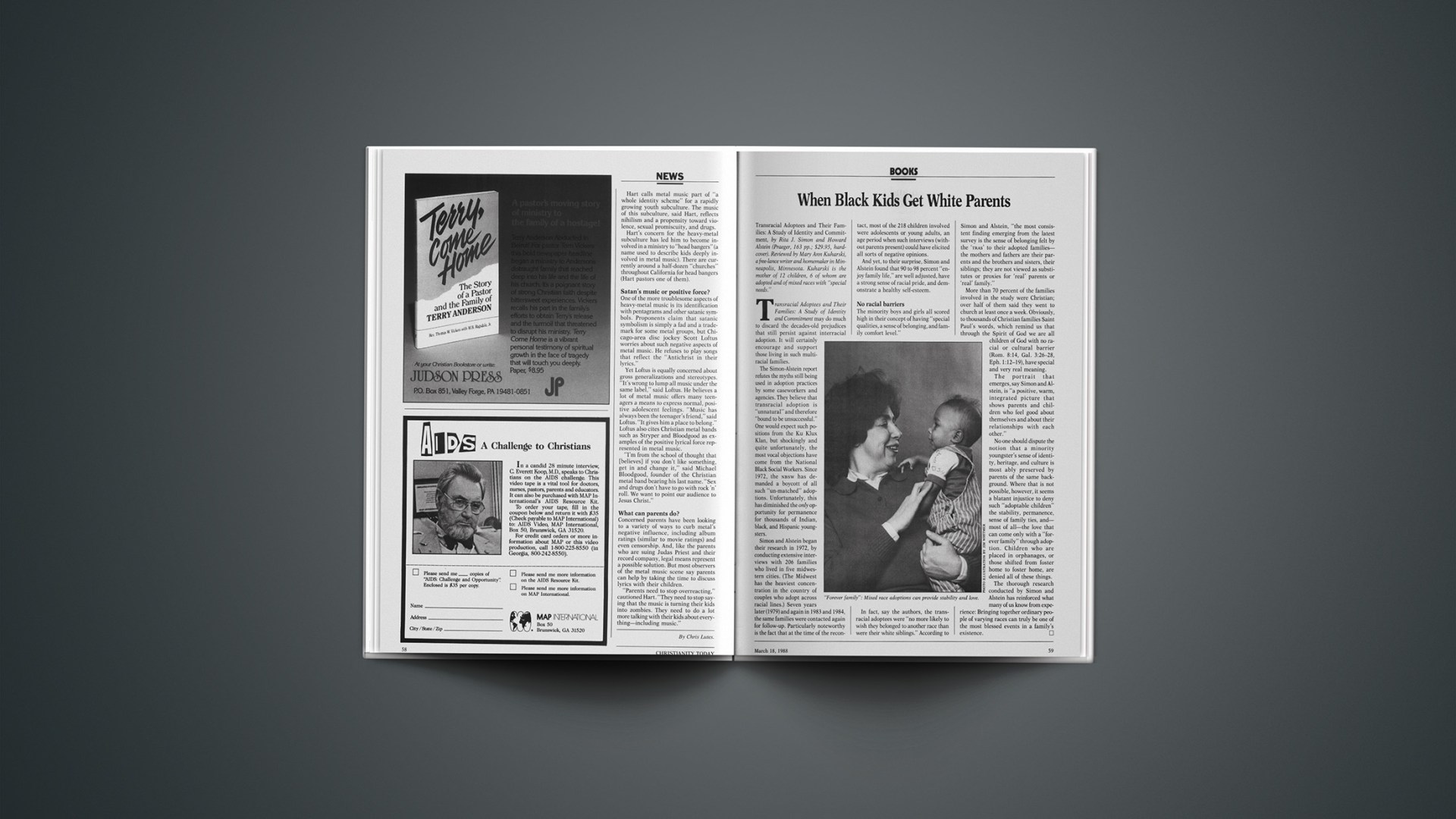
When Black Kids Get White Parents

Transracial Adoptees and Their Families: A Study of Identity and Commitment, by Rita J. Simon and Howard Alstein (Praeger, 163 pp.; $29.95, hardcover). Reviewed by Mary Ann Kuharski, a free-lance writer and homemaker in Minneapolis, Minnesota. Kuharski is the mother of 12 children, 6 of whom are adopted and of mixed races with “special needs.”

Transracial Adoptees and Their Families: A Study of Identity and Commitment may do much to discard the decades-old prejudices that still persist against interracial adoption. It will certainly encourage and support those living in such multiracial families.

The Simon-Alstein report refutes the myths still being used in adoption practices by some caseworkers and agencies. They believe that transracial adoption is “unnatural” and therefore “bound to be unsuccessful.” One would expect such positions from the Ku Klux Klan, but shockingly and quite unfortunately, the most vocal objections have come from the National Black Social Workers. Since 1972, the NBSW has demanded a boycott of all such “un-matched” adoptions. Unfortunately, this has diminished the only opportunity for permanence for thousands of Indian, black, and Hispanic youngsters.

Simon and Alstein began their research in 1972, by conducting extensive interviews with 206 families who lived in five midwestern cities. (The Midwest has the heaviest concentration in the country of couples who adopt across racial lines.) Seven years later (1979) and again in 1983 and 1984, the same families were contacted again for follow-up. Particularly noteworthy is the fact that at the time of the recontact, most of the 218 children involved were adolescents or young adults, an age period when such interviews (without parents present) could have elicited all sorts of negative opinions.

And yet, to their surprise, Simon and Alstein found that 90 to 98 percent “enjoy family life,” are well adjusted, have a strong sense of racial pride, and demonstrate a healthy self-esteem.

No Racial Barriers

The minority boys and girls all scored high in their concept of having “special qualities, a sense of belonging, and family comfort level.”

In fact, say the authors, the transracial adoptees were “no more likely to wish they belonged to another race than were their white siblings.” According to Simon and Alstein, “the most consistent finding emerging from the latest survey is the sense of belonging felt by the ‘TRAS’ to their adopted families—the mothers and fathers are their parents and the brothers and sisters, their siblings; they are not viewed as substitutes or proxies for ‘real’ parents or ‘real’ family.”

More than 70 percent of the families involved in the study were Christian; over half of them said they went to church at least once a week. Obviously, to thousands of Christian families Saint Paul’s words, which remind us that through the Spirit of God we are all children of God with no racial or cultural barrier (Rom. 8:14; Gal. 3:26–28; Eph. 1:12–19), have special and very real meaning.

The portrait that emerges, say Simon and Alstein, is “a positive, warm, integrated picture that shows parents and children who feel good about themselves and about their relationships with each other.”

No one should dispute the notion that a minority youngster’s sense of identity, heritage, and culture is most ably preserved by parents of the same background. Where that is not possible, however, it seems a blatant injustice to deny such “adoptable children” the stability, permanence, sense of family ties, and—most of all—the love that can come only with a “forever family” through adoption. Children who are placed in orphanages, or those shifted from foster home to foster home, are denied all of these things.

The thorough research conducted by Simon and Alstein has reinforced what many of us know from experience: Bringing together ordinary people of varying races can truly be one of the most blessed events in a family’s existence.

Highlighted

Mice In The Cookie Jar

Evangelist Billy Graham has recently written what he considers his most important book to date: Facing Death—and the Life After (Word Books). In the following excerpt, he discusses Christian unity in the life to come.

“In heaven there will be no sectarian worship, no denominational differences, no church creeds. There will be no temple worship, for God and His Son, Jesus Christ, will be the centers of worship (Revelation 21:22). I was brought up as a Presbyterian later became a Baptist. But in later years I have felt that I belong to all churches.

Ruth has remained a strong Presbyterian, but deep in her heart she, too, belongs to all the other churches. We have never had major differences in our theology despite these backgrounds, but many people do get into heated arguments about denominational doctrines.

God did not invent denominations, man did. When we go to His home, He will invite us in, but will not ask us for our church or Sunday school credentials.

Only one question will be asked:

‘What did you do on earth with My Son, Jesus?’ It will make no difference whether we were Catholic or Protestant, Jew or Gentile.

What matters is whether we believe in Him or reject Him. Attending a particular church does not guarantee anyone admission to heaven. Corrie ten Boom used to say, ‘A mouse in a cookie jar isn’t a cookie.’

Women And Children First?

Mothers and Divorce: Legal, Economic, and Social Dilemmas, by Terry Arendell (University of California Press, 320 pp.; $22.50, hardcover); Women and Children Last: The Plight of Poor Women in Affluent America, by Ruth Sidel (Penguin, 236 pp.; $9.95, paper); and For Crying Out Loud: Women and Poverty in the United States, edited by Rochelle Lefkowitz and Ann Withorn (Pilgrim Press, 397 pp.; $12.95, paper). Reviewed by Ruth A. Tucker, a visiting professor of missions at Trinity Evangelical Divinity School, Deerfield, Illinois.

“In one of the richest societies on earth, the daily reality for millions of women—young and old, black and white, divorced, never married, and widowed—is the struggle to secure the barest necessities,” claims the publisher of a recent book on women and poverty.

The publisher does not exaggerate. And the massive problem of the “feminization of poverty” is multiplied many times over by the millions of children who are directly affected by their mothers’ poverty. It is a growing problem that the Christian community dare not ignore. Help in understanding this issue in American culture is available from three recent books.

In Mothers and Divorce, Terry Arendell powerfully challenges the misconception that women and men suffer equally the ill effects of divorce. Arendell investigated the lives of 60 divorced women. She shows that, contrary to popular assumption, the greatest stress associated with divorce is not the psychological effects of adjusting to singleness, but rather economic misfortune. And that problem confronts women many times more frequently than it does men. Arendell cites a 1981 study indicating that after a divorce, women suffer a 73 percent decline in their former living standard, while men enjoy a 42 percent gain.

The most heart-rending aspect of Arendell’s findings relates to the law and its regard for motherhood. The once praised no-fault divorce laws have been devastating to many women. A man can leave his low-salaried or homemaker wife for another woman without having to face the economic consequences of his actions. He generally has sufficient skills, salary, and job security to maintain economic stability, while she is economically vulnerable.

As Arendell writes, “Society’s promise to honor the role of motherhood proved hollow in divorce; the law, which at least theoretically represents society’s values, did not recognize these women’s contributions to family life and gave them no protection for carrying on their mothering activities. It simply left them alone, to cope individually with increased responsibilities.”

Still Waiting For Lifeboats

Women and Children Last opens with a description of the terrifying final minutes on the Titanic—the title is a play on the chivalrous custom of “women and children first.” Women and children were first on the lifeboats on that fateful night, but as Ruth Sidel points out, they were the first and second-class women and children. More than half of the women and children in the third-class steerage section died—some “forcibly kept down below by seamen standing guard.”

Like the poorer women and children on the affluent Titanic, poor women and children are last today in affluent America. “Statistics indicate that the fastest growing population living in poverty today is made up of women and children,” Ruth Sidel notes. Many of these women have been victimized by divorce, domestic violence, and discrimination in the job market. Yet, according to Sidel, there is little sympathy for their plight: “The most serious result of the Reagan administration’s economic policies, particularly the cutbacks in human services, has been the legitimization of the negative attitudes held by many Americans toward the poor.”

The book weaves case studies, current statistics, and history together in telling the story of the feminization of poverty, focusing on such issues as employment, welfare, and day care from both a historical and contemporary perspective. The final chapter is a call for more government action to curtail poverty among women and children.

The Right Of Public Dependence

For those wishing to delve even more deeply into the even impoverished, subject of women and poverty, For Crying Out Loud offers valuable insights from experts in various fields. The editors have sought to show that the problem is complex, and that it does not help simply to sum up the situation with the catch phrase “feminization of poverty.” The book will find critics on virtually every issue it presents, not the least of which is its perspective on welfare.

In the introduction, the editors write, “A major argument contained within this book, then, is that ‘public dependence’ is a right for all citizens and should be treated as such, not as a punitive ‘last resort’ for those poor souls who have failed at ‘independence.’ Many women at all stages of life do, and should, make rational choices to enter the welfare system.”

An important chapter, entitled “Toward the Feminization of Policy,” begins with a statement of fact that illustrates the crying need for changes that will alleviate the worldwide problem of women and poverty: “Throughout history, women have done most of the world’s caregiving work, but this work has rarely entitled them to control over resources in their own right.… The failure to regard care of humans as work has created the ancient trap of poverty for the female householder.”

The Old and New Testaments repeatedly and compassionately address issues related to women, children, and poverty, and the church today must come to terms with the implications of that message in modern society. These books are a helpful start.

The Road Most Sought

The Road to Wholeness, by Laura A. Mathis (Tyndale House, 253 pp.; $6.95, paper). Reviewed by John E. Roe, psychologist in private practice, Scotts Valley, California, and past-president, Christian Association for Psychological Studies, Western Region.

The theoretical underpinnings of The Road to Wholeness set it apart from other books that appear to be as practical yet lack its substance. Dr. Laura Mathis has given us the best of psychological theory in a highly readable style.

Responsibly, the book is not presented as a substitute for professional treatment. Throughout, the benefits of treatment are illustrated in Mathis’s rich and varied case references. And criteria for deciding when professional treatment is needed are suggested to the reader.

In the book’s opening chapter, Mathis uses the notion of “critical tapes” to identify the evaluations of self and others by which we experience our “belongingness, worthiness, and competence.” Critical tapes consist of negative messages, played by ourselves to ourselves, that sabotage self-esteem. As Mathis develops the rationale for low self-esteem, she simultaneously offers preventative help to parents so their children will develop fewer critical tapes.

Mathis is also concerned with forgiving the critical people who helped us write our critical tapes. The book here would have been enhanced by an elaboration of just how one can forgive those critical people who are unrepentant.

Mathis continues with a discussion of the difficulties arising from the failure to develop wholeness. She deals with depression, both as a normal and abnormal condition; guilt; and the healthy management of anger. The book concludes by distinguishing between false notions of self-love and those that lead to wholeness, as well as worship of the Creator of all self.

The depth and scope of this fine book are somewhat obscured by its glib chapter titles, which might lend the impression that this is “just another self-help book.” But it definitely is not. Mathis draws on all of her disciplines—Christian education, theology, and professional psychology—with creativity and thoroughness, and still communicates to the average reader. At times her explanations are so rich they must be read and reread, especially in those chapters that give a theological basis for the foundations of self-esteem.

Mathis states she hopes to “bring healing, freedom, wholeness and joy to the reader.” The Road to Wholeness will do just that for many.
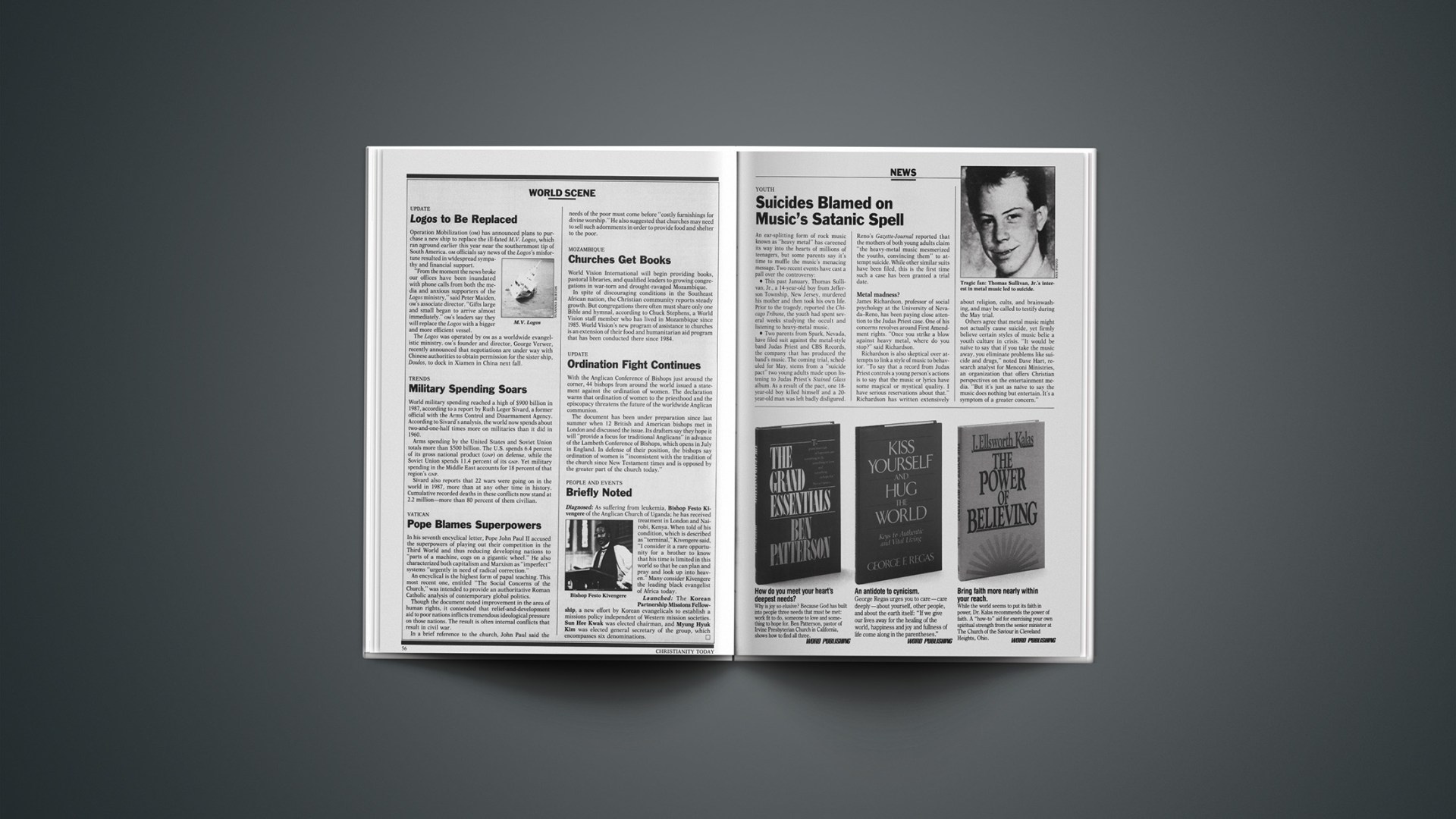
Suicides Blamed on Music’s Satanic Spell

An ear-splitting form of rock music known as “heavy metal” has careened its way into the hearts of millions of teenagers, but some parents say it’s time to muffle the music’s menacing message. Two recent events have cast a pall over the controversy:

  • This past January, Thomas Sullivan, Jr., a 14-year-old boy from Jefferson Township, New Jersey, murdered his mother and then took his own life. Prior to the tragedy, reported the Chicago Tribune, the youth had spent several weeks studying the occult and listening to heavy-metal music.
  • Two parents from Spark, Nevada, have filed suit against the metal-style band Judas Priest and CBS Records, the company that has produced the band’s music. The coming trial, scheduled for May, stems from a “suicide pact” two young adults made upon listening to Judas Priest’s Stained Glass album. As a result of the pact, one 18-year-old boy killed himself and a 20-year-old man was left badly disfigured.

Reno’s Gazette-Journal reported that the mothers of both young adults claim “the heavy-metal music mesmerized the youths, convincing them” to attempt suicide. While other similar suits have been filed, this is the first time such a case has been granted a trial date.

Metal Madness?

James Richardson, professor of social psychology at the University of Nevada-Reno, has been paying close attention to the Judas Priest case. One of his concerns revolves around First Amendment rights. “Once you strike a blow against heavy metal, where do you stop?” said Richardson.

Richardson is also skeptical over attempts to link a style of music to behavior. “To say that a record from Judas Priest controls a young person’s actions is to say that the music or lyrics have some magical or mystical quality. I have serious reservations about that.” Richardson has written extensively about religion, cults, and brainwashing, and may be called to testify during the May trial.

Others agree that metal music might not actually cause suicide, yet firmly believe certain styles of music belie a youth culture in crisis. “It would be naïve to say that if you take the music away, you eliminate problems like suicide and drugs,” noted Dave Hart, research analyst for Menconi Ministries, an organization that offers Christian perspectives on the entertainment media. “But it’s just as naïve to say the music does nothing but entertain. It’s a symptom of a greater concern.”

Hart calls metal music part of “a whole identity scheme” for a rapidly growing youth subculture. The music of this subculture, said Hart, reflects nihilism and a propensity toward violence, sexual promiscuity, and drugs.

Hart’s concern for the heavy-metal subculture has led him to become involved in a ministry to “head bangers” (a name used to describe kids deeply involved in metal music). There are currently around a half-dozen “churches” throughout California for head bangers (Hart pastors one of them).

Satan’s Music Or Positive Force?

One of the more troublesome aspects of heavy-metal music is its identification with pentagrams and other satanic symbols. Proponents claim that satanic symbolism is simply a fad and a trademark for some metal groups, but Chicago-area disc jockey Scott Loftus worries about such negative aspects of metal music. He refuses to play songs that reflect the “Antichrist in their lyrics.”

Yet Loftus is equally concerned about gross generalizations and stereotypes. “It’s wrong to lump all music under the same label,” said Loftus. He believes a lot of metal music offers many teenagers a means to express normal, positive adolescent feelings. “Music has always been the teenager’s friend,” said Loftus. “It gives him a place to belong.” Loftus also cites Christian metal bands such as Stryper and Bloodgood as examples of the positive lyrical force represented in metal music.

“I’m from the school of thought that [believes] if you don’t like something, get in and change it,” said Michael Bloodgood, founder of the Christian metal band bearing his last name. “Sex and drugs don’t have to go with rock n roll. We want to point our audience to Jesus Christ.”

What Can Parents Do?

Concerned parents have been looking to a variety of ways to curb metal’s negative influence, including album ratings (similar to movie ratings) and even censorship. And, like the parents who are suing Judas Priest and their record company, legal means represent a possible solution. But most observers of the metal music scene say parents can help by taking the time to discuss lyrics with their children.

“Parents need to stop overreacting,” cautioned Hart. “They need to stop saying that the music is turning their kids into zombies. They need to do a lot more talking with their kids about everything—including music.”

By Chris Lutes.

Study Shows Church Kids Are Not Waiting

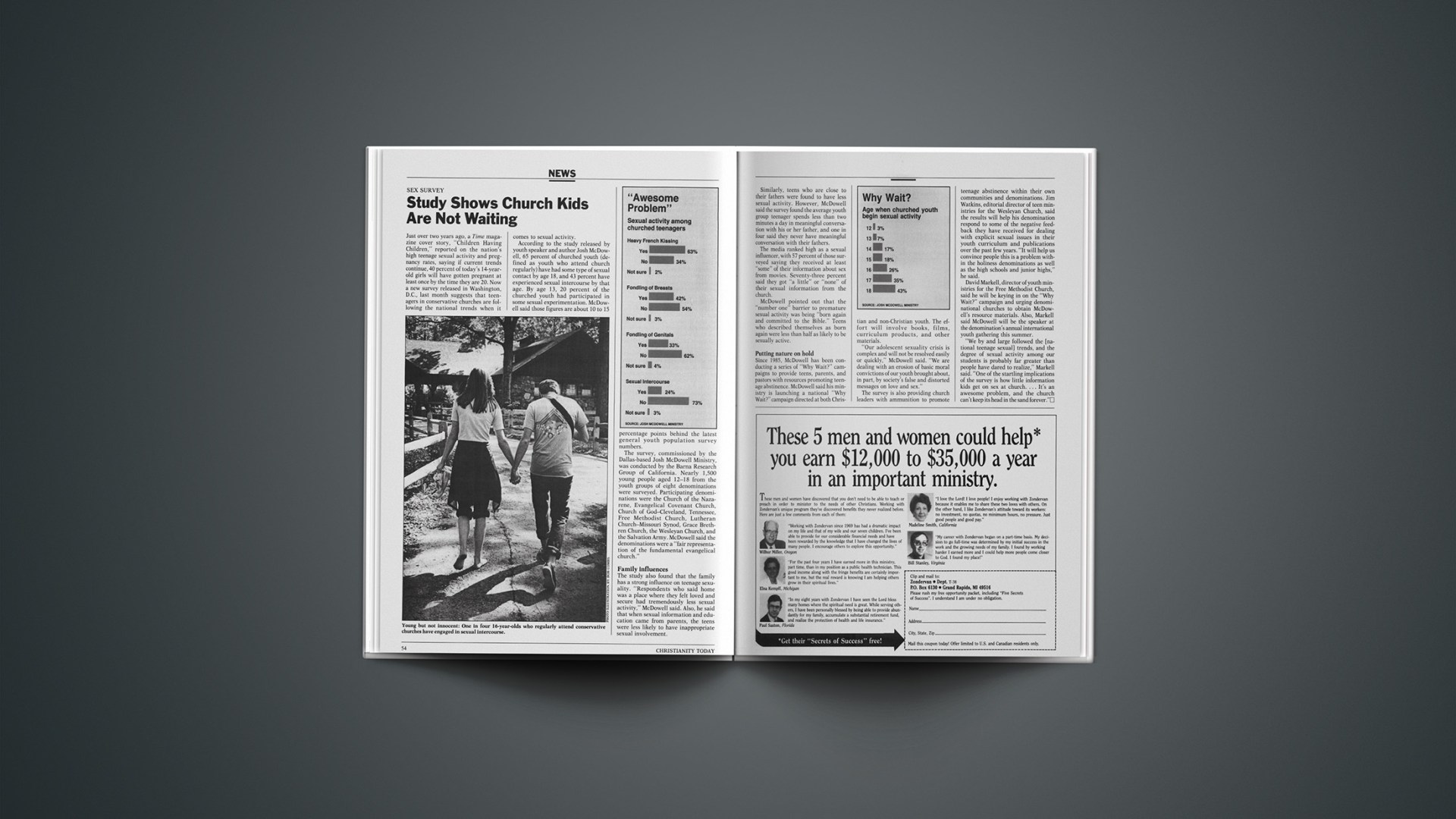
Just over two years ago, a Time magazine cover story, “Children Having Children,” reported on the nation’s high teenage sexual activity and pregnancy rates, saying if current trends continue, 40 percent of today’s 14-year-old girls will have gotten pregnant at least once by the time they are 20. Now a new survey released in Washington, D.C., last month suggests that teenagers in conservative churches are following the national trends when it comes to sexual activity.

According to the study released by youth speaker and author Josh McDowell, 65 percent of churched youth (defined as youth who attend church regularly) have had some type of sexual contact by age 18, and 43 percent have experienced sexual intercourse by that age. By age 13, 20 percent of the churched youth had participated in some sexual experimentation. McDowell said those figures are about 10 to 15 percentage points behind the latest general youth population survey numbers.

The survey, commissioned by the Dallas-based Josh McDowell Ministry, was conducted by the Barna Research Group of California. Nearly 1,500 young people aged 12–18 from the youth groups of eight denominations were surveyed. Participating denominations were the Church of the Nazarene, Evangelical Covenant Church, Church of God—Cleveland, Tennessee, Free Methodist Church, Lutheran Church—Missouri Synod, Grace Brethren Church, the Wesleyan Church, and the Salvation Army. McDowell said the denominations were a “fair representation of the fundamental evangelical church.”

Family Influences

The study also found that the family has a strong influence on teenage sexuality. “Respondents who said home was a place where they felt loved and secure had tremendously less sexual activity,” McDowell said. Also, he said that when sexual information and education came from parents, the teens were less likely to have inappropriate sexual involvement.

Similarly, teens who are close to their fathers were found to have less sexual activity. However, McDowell said the survey found the average youth group teenager spends less than two minutes a day in meaningful conversation with his or her father, and one in four said they never have meaningful conversation with their fathers.

The media ranked high as a sexual influencer, with 57 percent of those surveyed saying they received at least “some” of their information about sex from movies. Seventy-three percent said they got “a little” or “none” of their sexual information from the church.

McDowell pointed out that the “number one” barrier to premature sexual activity was being “born again and committed to the Bible.” Teens who described themselves as born again were less than half as likely to be sexually active.

Putting Nature On Hold

Since 1985, McDowell has been conducting a series of “Why Wait?” campaigns to provide teens, parents, and pastors with resources promoting teenage abstinence. McDowell said his ministry is launching a national “Why Wait?” campaign directed at both Christian and non-Christian youth. The effort will involve books, films, curriculum products, and other materials.

“Our adolescent sexuality crisis is complex and will not be resolved easily or quickly,” McDowell said. “We are dealing with an erosion of basic moral convictions of our youth brought about, in part, by society’s false and distorted messages on love and sex.”

The survey is also providing church leaders with ammunition to promote teenage abstinence within their own communities and denominations. Jim Watkins, editorial director of teen ministries for the Wesleyan Church, said the results will help his denomination respond to some of the negative feedback they have received for dealing with explicit sexual issues in their youth curriculum and publications over the past few years. “It will help us convince people this is a problem within the holiness denominations as well as the high schools and junior highs,” he said.

David Marked, director of youth ministries for the Free Methodist Church, said he will be keying in on the “Why Wait?” campaign and urging denominational churches to obtain McDowell’s resource materials. Also, Markell said McDowell will be the speaker at the denomination’s annual international youth gathering this summer.

“We by and large followed the [national teenage sexual] trends, and the degree of sexual activity among our students is probably far greater than people have dared to realize,” Markell said. “One of the startling implications of the survey is how little information kids get on sex at church.… It’s an awesome problem, and the church can’t keep its head in the sand forever.”

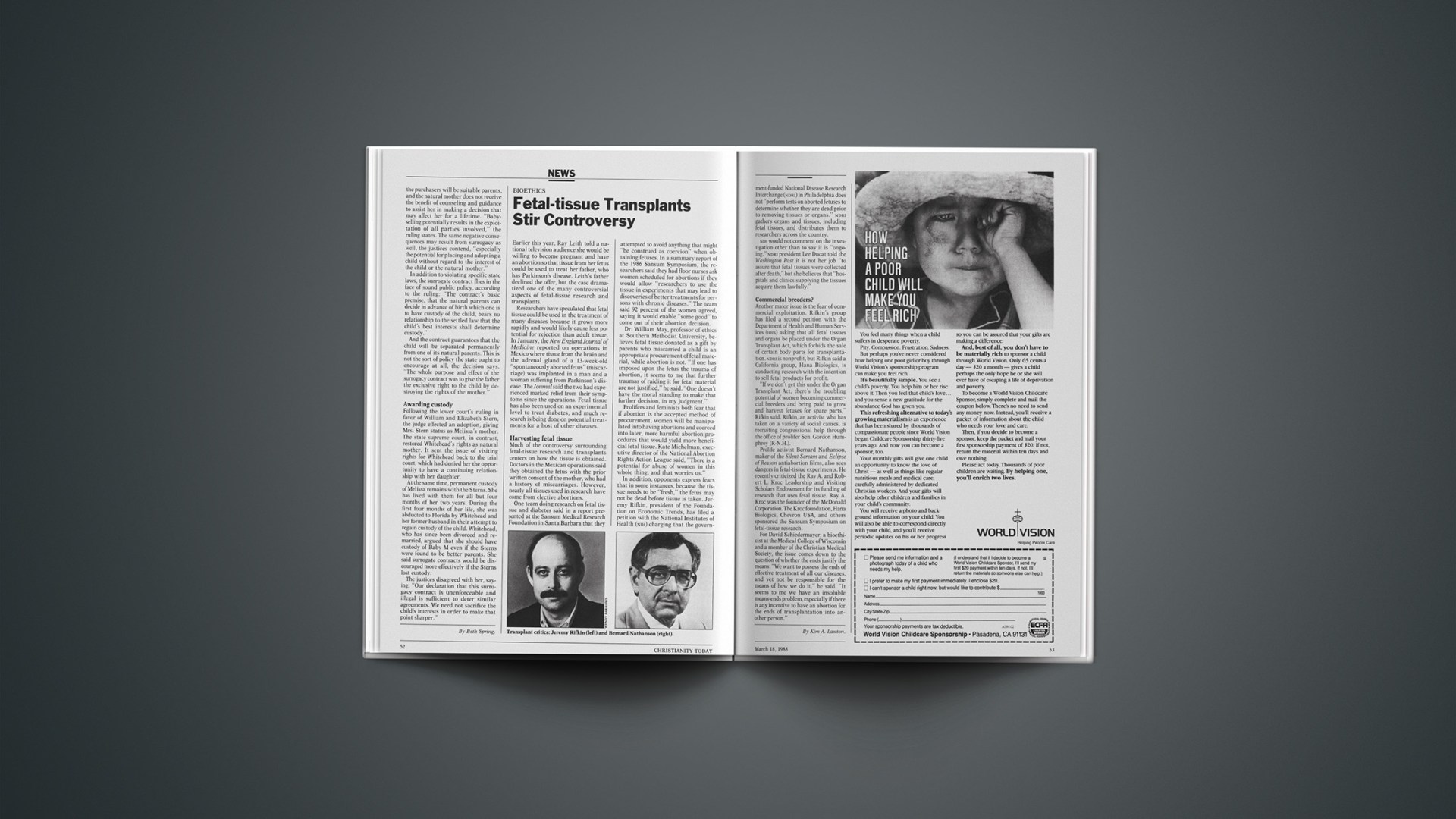
Fetal-Tissue Transplants Stir Controversy

Earlier this year, Ray Leith told a national television audience she would be willing to become pregnant and have an abortion so that tissue from her fetus could be used to treat her father, who has Parkinson’s disease. Leith’s father declined the offer, but the case dramatized one of the many controversial aspects of fetal-tissue research and transplants.

Researchers have speculated that fetal tissue could be used in the treatment of many diseases because it grows more rapidly and would likely cause less potential for rejection than adult tissue. In January, the New England Journal of Medicine reported on operations in Mexico where tissue from the brain and the adrenal gland of a 13-week-old “spontaneously aborted fetus” (miscarriage) was implanted in a man and a woman suffering from Parkinson’s disease. The Journal said the two had experienced marked relief from their symptoms since the operations. Fetal tissue has also been used on an experimental level to treat diabetes, and much research is being done on potential treatments for a host of other diseases.

Harvesting Fetal Tissue

Much of the controversy surrounding fetal-tissue research and transplants centers on how the tissue is obtained. Doctors in the Mexican operations said they obtained the fetus with the prior written consent of the mother, who had a history of miscarriages. However, nearly all tissues used in research have come from elective abortions.

One team doing research on fetal tissue and diabetes said in a report presented at the Sansum Medical Research Foundation in Santa Barbara that they attempted to avoid anything that might “be construed as coercion” when obtaining fetuses. In a summary report of the 1986 Sansum Symposium, the researchers said they had floor nurses ask women scheduled for abortions if they would allow “researchers to use the tissue in experiments that may lead to discoveries of better treatments for persons with chronic diseases.” The team said 92 percent of the women agreed, saying it would enable “some good” to come out of their abortion decision.

Dr. William May, professor of ethics at Southern Methodist University, believes fetal tissue donated as a gift by parents who miscarried a child is an appropriate procurement of fetal material, while abortion is not. “If one has imposed upon the fetus the trauma of abortion, it seems to me that further traumas of raiding it for fetal material are not justified,” he said. “One doesn’t have the moral standing to make that further decision, in my judgment.”

Prolifers and feminists both fear that if abortion is the accepted method of procurement, women will be manipulated into having abortions and coerced into later, more harmful abortion procedures that would yield more beneficial fetal tissue. Kate Michelman, executive director of the National Abortion Rights Action League said, “There is a potential for abuse of women in this whole thing, and that worries us.”

In addition, opponents express fears that in some instances, because the tissue needs to be “fresh,” the fetus may not be dead before tissue is taken. Jeremy Rifkin, president of the Foundation on Economic Trends, has filed a petition with the National Institutes of Health (NIH) charging that the government-funded National Disease Research Interchange (NDRI) in Philadelphia does not “perform tests on aborted fetuses to determine whether they are dead prior to removing tissues or organs.” NDRI gathers organs and tissues, including fetal tissues, and distributes them to researchers across the country.

NIH would not comment on the investigation other than to say it is “ongoing.” NDRI president Lee Ducat told the Washington Post it is not her job “to assure that fetal tissues were collected after death,” but she believes that “hospitals and clinics supplying the tissues acquire them lawfully.”

Commercial Breeders?

Another major issue is the fear of commercial exploitation. Rifkin’s group has filed a second petition with the Department of Health and Human Services (HHS) asking that all fetal tissues and organs be placed under the Organ Transplant Act, which forbids the sale of certain body parts for transplantation. NDRI is nonprofit, but Rifkin said a California group, Hana Biologies, is conducting research with the intention to sell fetal products for profit.

“If we don’t get this under the Organ Transplant Act, there’s the troubling potential of women becoming commercial breeders and being paid to grow and harvest fetuses for spare parts,” Rifkin said. Rifkin, an activist who has taken on a variety of social causes, is recruiting congressional help through the office of prolifer Sen. Gordon Humphrey (R-N.H.).

Prolife activist Bernard Nathanson, maker of the Silent Scream and Eclipse of Reason antiabortion films, also sees dangers in fetal-tissue experiments. He recently criticized the Ray A. and Robert L. Kroc Leadership and Visiting Scholars Endowment for its funding of research that uses fetal tissue. Ray A. Kroc was the founder of the McDonald Corporation. The Kroc foundation, Hana Biologies, Chevron USA, and others sponsored the Sansum Symposium on fetal-tissue research.

For David Schiedermayer, a bioethicist at the Medical College of Wisconsin and a member of the Christian Medical Society, the issue comes down to the question of whether the ends justify the means. “We want to possess the ends of effective treatment of all our diseases, and yet not be responsible for the means of how we do it,” he said. “It seems to me we have an insoluble means-ends problem, especially if there is any incentive to have an abortion for the ends of transplantation into another person.”

By Kim A. Lawton.

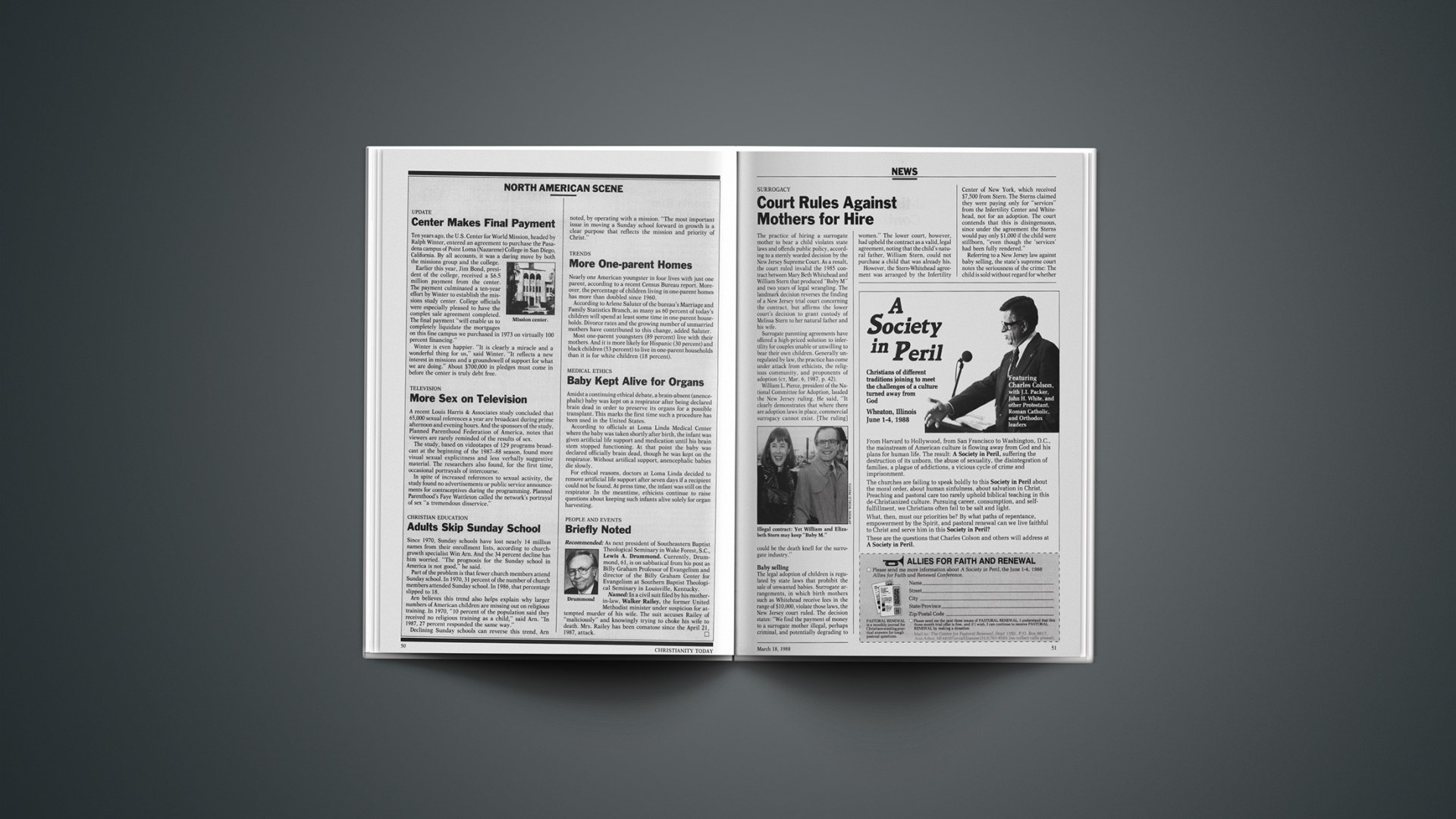
Court Rules against Mothers for Hire

The practice of hiring a surrogate mother to bear a child violates state laws and offends public policy, according to a sternly worded decision by the New Jersey Supreme Court. As a result, the court ruled invalid the 1985 contract between Mary Beth Whitehead and William Stern that produced “Baby M” and two years of legal wrangling. The landmark decision reverses the finding of a New Jersey trial court concerning the contract, but affirms the lower court’s decision to grant custody of Melissa Stern to her natural father and his wife.

Surrogate parenting agreements have offered a high-priced solution to infertility for couples unable or unwilling to bear their own children. Generally unregulated by law, the practice has come under attack from ethicists, the religious community, and proponents of adoption (CT, Mar. 6, 1987, p. 42).

William L. Pierce, president of the National Committee for Adoption, lauded the New Jersey ruling. He said, “It clearly demonstrates that where there are adoption laws in place, commercial surrogacy cannot exist. [The ruling] could be the death knell for the surrogate industry.”

Baby Selling

The legal adoption of children is regulated by state laws that prohibit the sale of unwanted babies. Surrogate arrangements, in which birth mothers such as Whitehead receive fees in the range of $10,000, violate those laws, the New Jersey court ruled. The decision states: “We find the payment of money to a surrogate mother illegal, perhaps criminal, and potentially degrading to women.” The lower court, however, had upheld the contract as a valid, legal agreement, noting that the child’s natural father, William Stern, could not purchase a child that was already his.

However, the Stern-Whitehead agreement was arranged by the Infertility Center of New York, which received $7,500 from Stern. The Sterns claimed they were paying only for “services” from the Infertility Center and Whitehead, not for an adoption. The court contends that this is disingenuous, since under the agreement the Sterns would pay only $1,000 if the child were stillborn, “even though the ‘services’ had been fully rendered.”

Referring to a New Jersey law against baby selling, the state’s supreme court notes the seriousness of the crime: The child is sold without regard for whether the purchasers will be suitable parents, and the natural mother does not receive the benefit of counseling and guidance to assist her in making a decision that may affect her for a lifetime. “Baby-selling potentially results in the exploitation of all parties involved,” the ruling states. The same negative consequences may result from surrogacy as well, the justices contend, “especially the potential for placing and adopting a child without regard to the interest of the child or the natural mother.”

In addition to violating specific state laws, the surrogate contract flies in the face of sound public policy, according to the ruling: “The contract’s basic premise, that the natural parents can decide in advance of birth which one is to have custody of the child, bears no relationship to the settled law that the child’s best interests shall determine custody.”

And the contract guarantees that the child will be separated permanently from one of its natural parents. This is not the sort of policy the state ought to encourage at all, the decision says. “The whole purpose and effect of the surrogacy contract was to give the father the exclusive right to the child by destroying the rights of the mother.”

Awarding Custody

Following the lower court’s ruling in favor of William and Elizabeth Stern, the judge effected an adoption, giving Mrs. Stern status as Melissa’s mother. The state supreme court, in contrast, restored Whitehead’s rights as natural mother. It sent the issue of visiting rights for Whitehead back to the trial court, which had denied her the opportunity to have a continuing relationship with her daughter.

At the same time, permanent custody of Melissa remains with the Sterns. She has lived with them for all but four months of her two years. During the first four months of her life, she was abducted to Florida by Whitehead and her former husband in their attempt to regain custody of the child. Whitehead, who has since been divorced and remarried, argued that she should have custody of Baby M even if the Sterns were found to be better parents. She said surrogate contracts would be discouraged more effectively if the Sterns lost custody.

The justices disagreed with her, saying, “Our declaration that this surrogacy contract is unenforceable and illegal is sufficient to deter similar agreements. We need not sacrifice the child’s interests in order to make that point sharper.”

By Beth Spring.

Parents Run out of Options in Textbook Case

The U.S. Supreme Court has refused to hear an appeal from parents who say their children’s textbooks offended their families’ religious beliefs. The high court’s action reaffirmed a lower court ruling that public schools did not have to excuse children from classes using textbooks the parents found objectionable. The action also ended a lengthy and highly publicized battle that pitted fundamentalist Christian families against the Hawkins County (Tenn.) public school system.

The battle began in 1983, when seven families objected to the Holt, Rinehart & Winston reading series. They cited passages that they believed advanced witchcraft, astrology, pacifism, and feminism.

In October 1986, a federal court sided with the parents. Judge Thomas G. Hull ordered the schools to allow the children to “opt out” of the classes and be taught those courses at home. He also awarded the families more than $50,000 in damages.

However, last August a three-judge appeals panel unanimously overturned Hull’s decision, saying the required reading did not “create an unconstitutional burden” because the students were not required to “affirm or deny a belief” (CT, Oct. 2, 1987, p. 50). In refusing to review the case, the Supreme Court closed the last legal door open to the parents.

People for the American Way (PAW), the liberal lobby group that supported the school system in the case, called the action “a victory for schools and religion.” PAW Chairman John Buchanan said the outcome sends “a clear message to educators, parents, and students about the commitment to pluralism and diversity in our nation’s public schools.”

Concerned Women for America (CWA) spokeswoman Rebecca Hagelin called the Supreme Court’s action a “devastating blow for religious toleration in the classroom.” Hagelin said the Court’s action means “parents have no voice in the public school system” and “the free exercise clause [of the Constitution] does not extend to school children.” CWA had provided legal counsel for the parents. Hagelin said her group believes the ruling is “so coercive” it will prompt the filing of other cases about religious toleration in the public schools that the supreme court may one day hear.

More Trouble on the Broadcast Front

Even before recent revelations of television evangelist Jimmy Swaggart’s sexual misconduct, his empire was in trouble. In a letter to supporters signed by Swaggart and dated February 8, his ministry reported a loss of $200,000 a day “through the previous thirty days” (a total of $4 million). It stated that “if this continues for a few more days, the Jimmy Swaggart Ministries will simply cease to exist.”

The letter continues, “We have investigated every possibility” as to why this is happening. “[Y]ou have to come to the conclusion that Satan wants to destroy this work.”

But last month Swaggart said he had only himself to blame following revelations he had visited a prostitute. It was widely reported that allegations against Swaggart had been brought to officials of the Assemblies of God—in which Swaggart is ordained—by former Assemblies pastor Marvin Gorman. Gorman lost his ministerial credentials in 1986 after Swaggart revealed Gorman had committed adultery.

The church’s executive presbytery, the 13-member body that functions as its board of directors, met on February 18 for more than 11 hours, four of those hours with Swaggart. Top officials of the Louisiana District Presbytery, which was responsible for recommending church discipline, were also present.

It was widely reported that evidence against Swaggart included photographs, apparently taken with a telephoto lens, of Swaggart entering and leaving a New Orleans motel room with a known prostitute. Who took the photos and how they ended up in the hands of Assemblies of God leaders has not been publicly disclosed.

After confessing to sin, Swaggart was ordered by his denomination to undergo a two-year rehabilitation period, during which he will be relieved of his duties as copastor of the Family Worship Center in Baton Rouge. The rehabilitation process, which has come under fire and may be rejected by the executive presbytery, calls for Swaggart to receive weekly counsel from three members of the Louisiana District Presbytery and to submit monthly and quarterly reports to denominational officials. Swaggart was also banned from preaching for three months except to fulfill “present commitments involving foreign governments.”

It appears, however, that the effects of this discipline on Swaggart will be minimal. A source associated with the Family Worship Center said Swaggart “did not perform pastoral duties” and implied that Swaggart’s role there was limited to occasional preaching.

CHRISTIANITY TODAY contacted Jimmy Swaggart Ministries in an effort to determine the extent of his overseas engagements over the next few months and also if and how Swaggart’s television ministry would be affected. But a spokesperson said she was “not at liberty” either to discuss the matter or to refer CHRISTIANITY TODAY to someone who could.

Assemblies of God bylaws state that “indiscretions involving morals” require a rehabilitation period of at least two years. They state, however, that “[c]ertain offenses may not require complete cessation of ministerial activities.”

Critics have questioned whether a three-month ban on preaching is sufficient discipline, especially since it appears Swaggart’s sexual misconduct was not just an isolated incident. One denominational official present at the closed meeting described Swaggart’s sin as “sexual misconduct over a period of years.”

The uncertainty raises questions about whether anyone else on Swaggart’s staff knew about his misconduct and failed to report it. The denomination has made answers difficult to obtain through a statement urging Swaggart and his associates to “resist the requests of those outside the church to respond to questions.” Assemblies of God information secretary Juleen Turnage did say that no one besides Swaggart was a subject of church discipline.

Turnage said that if the church’s executive presbytery affirms the district presbytery’s recommendation, “that would be a precedent. We have never had a minister under discipline for morals charges who has been allowed to preach in less than one year.”

Critics have hinted that Swaggart may receive special treatment because of his ministry’s contributions to Assemblies of God missions, which totalled over $23 million in 1986 and 1987. But Turnage said Swaggart is being treated neither more leniently nor more harshly because of who he is. “The executives will follow the church’s constitution and bylaws very carefully in this case,” she said.

The church’s bylaws state that church discipline is determined in part by “the attitude of the offending minister toward the discipline” and “the manner and thoroughness of his repentance.” A church statement said Swaggart had offered a “detailed confession” and that denominational officials witnessed evidence of “true humility and repentance” on Swaggart’s part.

Swaggart said to his television audience, “I do not plan in any way to whitewash my sin. I do not call it a mistake, a mendacity. I call it sin.”

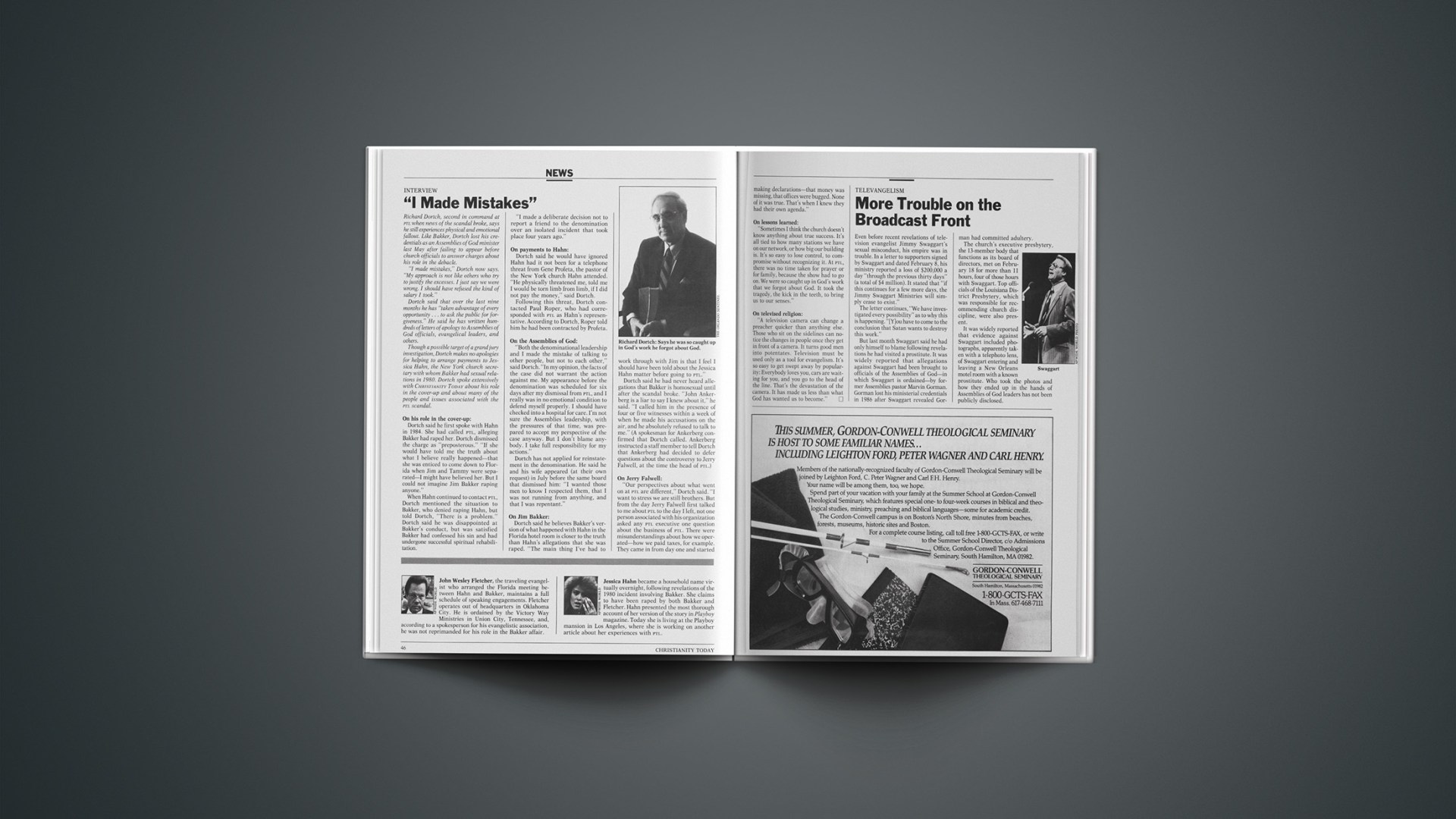
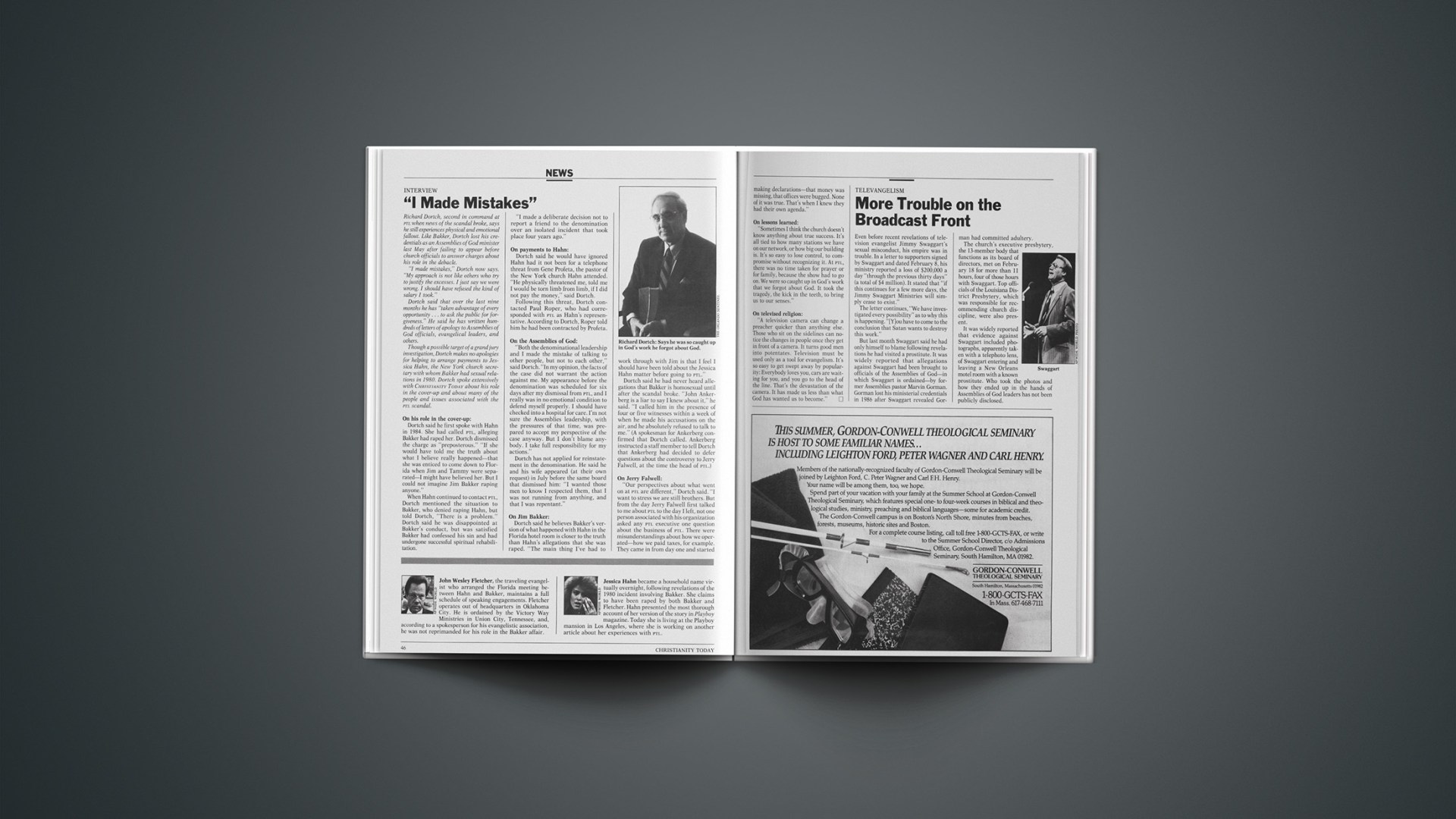
“I Made Mistakes”

Richard Dortch, second in command atPTCwhen news of the scandal broke, says he still experiences physical and emotional fallout. Like Bakker, Dortch lost his credentials as an Assemblies of God minister last May after failing to appear before church officials to answer charges about his role in the debacle.

“I made mistakes,” Dortch now says. “My approach is not like others who try to justify the excesses. I just say we were wrong. I should have refused the kind of salary I took.”

Dortch said that over the last nine months he has “taken advantage of every opportunity … to ask the public for forgiveness.” He said he has written hundreds of letters of apology to Assemblies of God officials, evangelical leaders, and others.

Though a possible target of a grand jury investigation, Dortch makes no apologies for helping to arrange payments to Jessica Hahn, the New York church secretary with whom Bakker had sexual relations in 1980. Dortch spoke extensively with CHRISTIANITY TODAY about his role in the cover-up and about many of the people and issues associated with the PTL scandal.

On his role in the cover-up:

Dortch said he first spoke with Hahn in 1984. She had called PTL, alleging Bakker had raped her. Dortch dismissed the charge as “preposterous.” “If she would have told me the truth about what I believe really happened—that she was enticed to come down to Florida when Jim and Tammy were separated—I might have believed her. But I could not imagine Jim Bakker raping anyone.”

When Hahn continued to contact PTL, Dortch mentioned the situation to Bakker, who denied raping Hahn, but told Dortch, “There is a problem.” Dortch said he was disappointed at Bakker’s conduct, but was satisfied Bakker had confessed his sin and had undergone successful spiritual rehabilitation.

“I made a deliberate decision not to report a friend to the denomination over an isolated incident that took place four years ago.”

On payments to Hahn:

Dortch said he would have ignored Hahn had it not been for a telephone threat from Gene Profeta, the pastor of the New York church Hahn attended. “He physically threatened me, told me I would be torn limb from limb, if I did not pay the money,” said Dortch.

Following this threat, Dortch contacted Paul Roper, who had corresponded with PTL as Hahn’s representative. According to Dortch, Roper told him he had been contracted by Profeta.

On the Assemblies of God:

“Both the denominational leadership and I made the mistake of talking to other people, but not to each other,” said Dortch. “In my opinion, the facts of the case did not warrant the action against me. My appearance before the denomination was scheduled for six days after my dismissal from PTL, and I really was in no emotional condition to defend myself properly. I should have checked into a hospital for care. I’m not sure the Assemblies leadership, with the pressures of that time, was prepared to accept my perspective of the case anyway. But I don’t blame anybody. I take full responsibility for my actions.”

Dortch has not applied for reinstatement in the denomination. He said he and his wife appeared (at their own request) in July before the same board that dismissed him: “I wanted those men to know I respected them, that I was not running from anything, and that I was repentant.”

On Jim Bakker:

Dortch said he believes Bakker’s version of what happened with Hahn in the Florida hotel room is closer to the truth than Hahn’s allegations that she was raped. “The main thing I’ve had to work through with Jim is that I feel I should have been told about the Jessica Hahn matter before going to PTL.”

Dortch said he had never heard allegations that Bakker is homosexual until after the scandal broke. “John Ankerberg is a liar to say I knew about it,” he said. “I called him in the presence of four or five witnesses within a week of when he made his accusations on the air, and he absolutely refused to talk to me.” (A spokesman for Ankerberg confirmed that Dortch called. Ankerberg instructed a staff member to tell Dortch that Ankerberg had decided to defer questions about the controversy to Jerry Falwell, at the time the head of PTL.)

On Jerry Falwell:

“Our perspectives about what went on at PTL are different,” Dortch said. “I want to stress we are still brothers. But from the day Jerry Falwell first talked to me about PTL to the day I left, not one person associated with his organization asked any PTL executive one question about the business of PTL. There were misunderstandings about how we operated—how we paid taxes, for example. They came in from day one and started making declarations—that money was missing, that offices were bugged. None of it was true. That’s when I knew they had their own agenda.”

On lessons learned:

“Sometimes I think the church doesn’t know anything about true success. It’s all tied to how many stations we have on our network, or how big our building is. It’s so easy to lose control, to compromise without recognizing it. At PTL, there was no time taken for prayer or for family, because the show had to go on. We were so caught up in God’s work that we forgot about God. It took the tragedy, the kick in the teeth, to bring us to our senses.”

On televised religion:

“A television camera can change a preacher quicker than anything else. Those who sit on the sidelines can notice the changes in people once they get in front of a camera. It turns good men into potentates. Television must be used only as a tool for evangelism. It’s so easy to get swept away by popularity: Everybody loves you, cars are waiting for you, and you go to the head of the line. That’s the devastation of the camera. It has made us less than what God has wanted us to become.”

John Wesley Fletcher, the traveling evangelist arranged the Florida meeting between Hahn and Bakker, maintains a full schedule of speaking engagements. Fletcher operates out of headquarters in Oklahoma City. He is ordained by the Victory Way Ministries in Union City, Tennessee, and, according to a spokesperson for his evangelistic association, he was not reprimanded for his role in the Bakker affair.

Jessica Hahn became a household name virtually overnight, following revelations of the 1980 incident involving Bakker. She claims to have been raped by both Bakker and Fletcher. Hahn presented the most thorough account of her version of the story in Playboy magazine. Today she is living at the Playboy mansion in Los Angeles, where she is working on another article about her experiences with PTL.

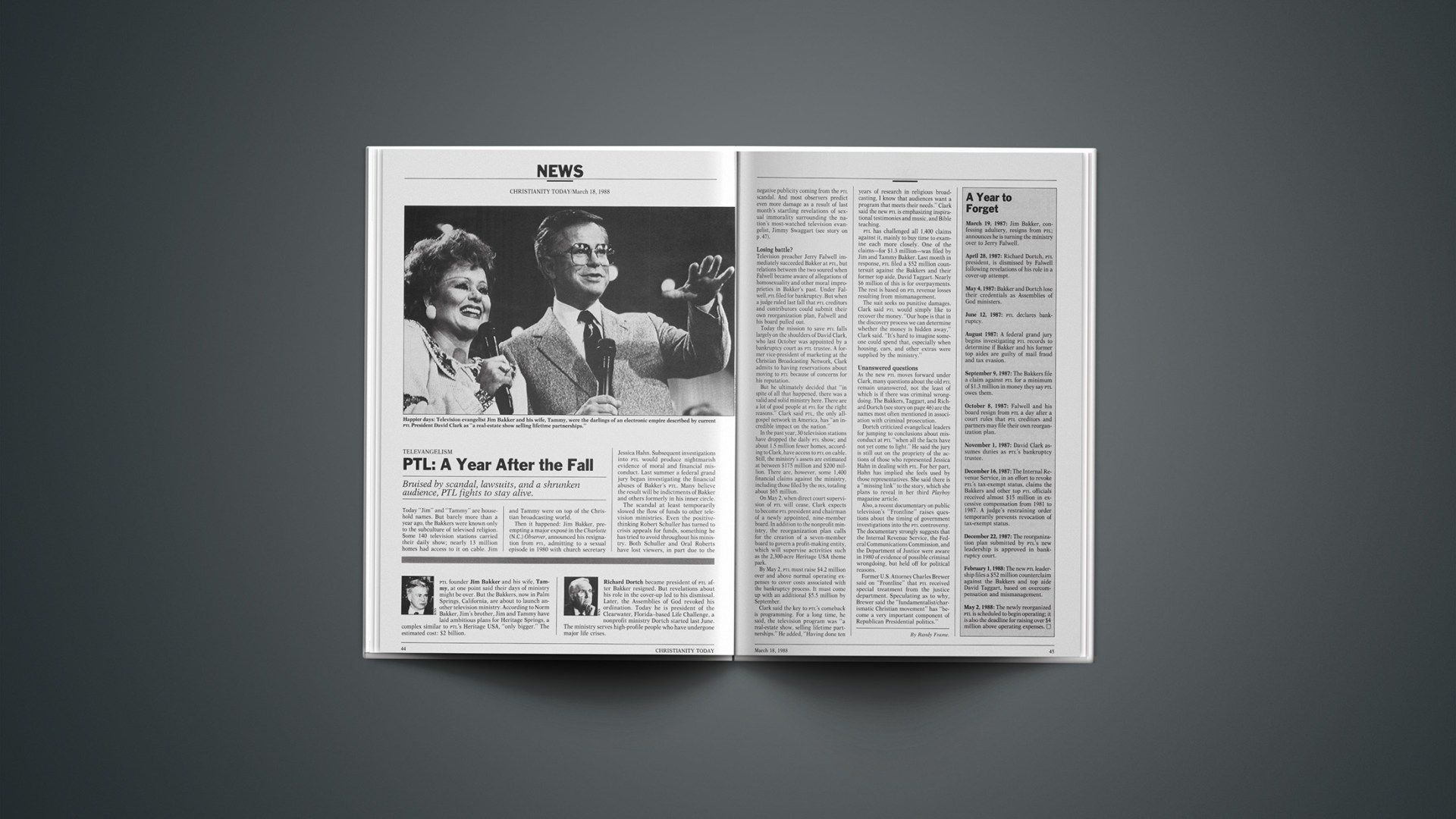
PTL: A Year after the Fall

Bruised by scandal, lawsuits, and a shrunken audience, PTL fights to say alive.

Today “Jim” and “Tammy” are household names. But barely more than a year ago, the Bakkers were known only to the subculture of televised religion. Some 140 television stations carried their daily show; nearly 13 million homes had access to it on cable. Jim and Tammy were on top of the Christian broadcasting world.

Then it happened: Jim Bakker, preempting a major exposé in the Charlotte (N.C.) Observer, announced his resignation from PTL, admitting to a sexual episode in 1980 with church secretary Jessica Hahn. Subsequent investigations into PTL would produce nightmarish evidence of moral and financial misconduct. Last summer a federal grand jury began investigating the financial abuses of Bakker’s PTL. Many believe the result will be indictments of Bakker and others formerly in his inner circle.

The scandal at least temporarily slowed the flow of funds to other television ministries. Even the positive-thinking Robert Schuller has turned to crisis appeals for funds, something he has tried to avoid throughout his ministry. Both Schuller and Oral Roberts have lost viewers, in part due to the negative publicity coming from the PTL scandal. And most observers predict even more damage as a result of last month’s startling revelations of sexual immorality surrounding the nation’s most-watched television evangelist, Jimmy Swaggart (see story on p. 47).

PTL founder Jim Bakker and his wife, Tammy, at one point said their days of ministry might be over. But the Bakkers, now in Palm Springs, California, are about to launch another television ministry. According to Norm Bakker, Jim’s brother, Jim and Tammy have laid ambitious plans for Heritage Springs, a complex similar to PTL’S Heritage USA, “only bigger.” The estimated cost: $2 billion.

Richard Dortch became president of PTL after Bakker resigned. But revelations about his role in the cover-up led to his dismissal. Later, the Assemblies of God revoked his ordination. Today he is president of the Clearwater, Florida-based Life Challenge, a nonprofit ministry Dortch started last June. The ministry serves high-profile people who have undergone major life crises.

Losing Battle?

Television preacher Jerry Falwell immediately succeeded Bakker at PTL, but relations between the two soured when Falwell became aware of allegations of homosexuality and other moral improprieties in Bakker’s past. Under Falwell, PTL filed for bankruptcy. But when a judge ruled last fall that PTL creditors and contributors could submit their own reorganization plan, Falwell and his board pulled out.

Today the mission to save PTL falls largely on the shoulders of David Clark, who last October was appointed by a bankruptcy court as PTL trustee. A former vice-president of marketing at the Christian Broadcasting Network, Clark admits to having reservations about moving to PTL because of concerns for his reputation.

But he ultimately decided that “in spite of all that happened, there was a valid and solid ministry here. There are a lot of good people at PTL for the right reasons.” Clark said PTL, the only allgospel network in America, has “an incredible impact on the nation.”

In the past year, 30 television stations have dropped the daily PTL show; and about 1.5 million fewer homes, according to Clark, have access to PTL on cable. Still, the ministry’s assets are estimated at between $175 million and $200 million. There are, however, some 1,400 financial claims against the ministry, including those filed by the IRS, totaling about $65 million.

On May 2, when direct court supervision of PTL will cease, Clark expects to become PTL president and chairman of a newly appointed, nine-member board. In addition to the nonprofit ministry, the reorganization plan calls for the creation of a seven-member board to govern a profit-making entity, which will supervise activities such as the 2,300-acre Heritage USA theme park.

By May 2, PTL must raise $4.2 million over and above normal operating expenses to cover costs associated with the bankruptcy process. It must come up with an additional $5.5 million by September.

Clark said the key to PTL’S comeback is programming. For a long time, he said, the television program was “a real-estate show, selling lifetime partnerships.” He added, “Having done ten years of research in religious broadcasting, I know that audiences want a program that meets their needs.” Clark said the new PTL is emphasizing inspirational testimonies and music, and Bible teaching.

PTL has challenged all 1,400 claims against it, mainly to buy time to examine each more closely. One of the claims—for $1.3 million—was filed by Jim and Tammy Bakker. Last month in response, PTL filed a $52 million countersuit against the Bakkers and their former top aide, David Taggart. Nearly $6 million of this is for overpayments. The rest is based on PTL revenue losses resulting from mismanagement.

The suit seeks no punitive damages. Clark said PTL would simply like to recover the money. “Our hope is that in the discovery process we can determine whether the money is hidden away,” Clark said. “It’s hard to imagine someone could spend that, especially when housing, cars, and other extras were supplied by the ministry.”

Unanswered Questions

As the new PTL moves forward under Clark, many questions about the old PTL remain unanswered, not the least of which is if there was criminal wrongdoing. The Bakkers, Taggart, and Richard Dortch (see story on page 46) are the names most often mentioned in association with criminal prosecution.

Dortch criticized evangelical leaders for jumping to conclusions about misconduct at PTL “when all the facts have not yet come to light.” He said the jury is still out on the propriety of the actions of those who represented Jessica Hahn in dealing with PTL. For her part, Hahn has implied she feels used by those representatives. She said there is a “missing link” to the story, which she plans to reveal in her third Playboy magazine article.

Also, a recent documentary on public television’s “Frontline” raises questions about the timing of government investigations into the PTL controversy. The documentary strongly suggests that the Internal Revenue Service, the Federal Communications Commission, and the Department of Justice were aware in 1980 of evidence of possible criminal wrongdoing, but held off for political reasons.

Former U.S. Attorney Charles Brewer said on “Frontline” that PTL received special treatment from the justice department. Speculating as to why, Brewer said the “fundamentalist/charismatic Christian movement” has “become a very important component of Republican Presidential politics.”

By Randy Frame.

A Year To Forget

March 19, 1987: Jim Bakker, confessing adultery, resigns from PTL; announces he is turning the ministry over to Jerry Falwell.

April 28, 1987: Richard Dortch, PTL president, is dismissed by Falwell following revelations of his role in a cover-up attempt.

May 4, 1987: Bakker and Dortch lose their credentials as Assemblies of God ministers.

June 12, 1987: PTL declares bankruptcy.

August 1987: A federal grand jury begins investigating PTL records to determine if Bakker and his former top aides are guilty of mail fraud and tax evasion.

September 9, 1987: The Bakkers file a claim against PTL for a minimum of $ 1.3 million in money they say PTL owes them.

October 8, 1987: Falwell and his board resign from PTL a day after a court rules that PTL creditors and partners may file their own reorganization plan.

November 1, 1987: David Clark assumes duties as PTL’S bankruptcy trustee.

December 16, 1987: The Internal Revenue Service, in an effort to revoke PTL’S tax-exempt status, claims the Bakkers and other top PTL officials received almost $15 million in excessive compensation from 1981 to 1987. A judge’s restraining order temporarily prevents revocation of tax-exempt status.

December 22, 1987: The reorganization plan submitted by PTL’S new leadership is approved in bankruptcy court.

February 1, 1988: The new PTL leadership files a $52 million counterclaim against the Bakkers and top aide David Taggart, based on overcompensation and mismanagement.

May 2, 1988: The newly reorganized PTL is scheduled to begin operating; it is also the deadline for raising over $4 million above operating expenses.

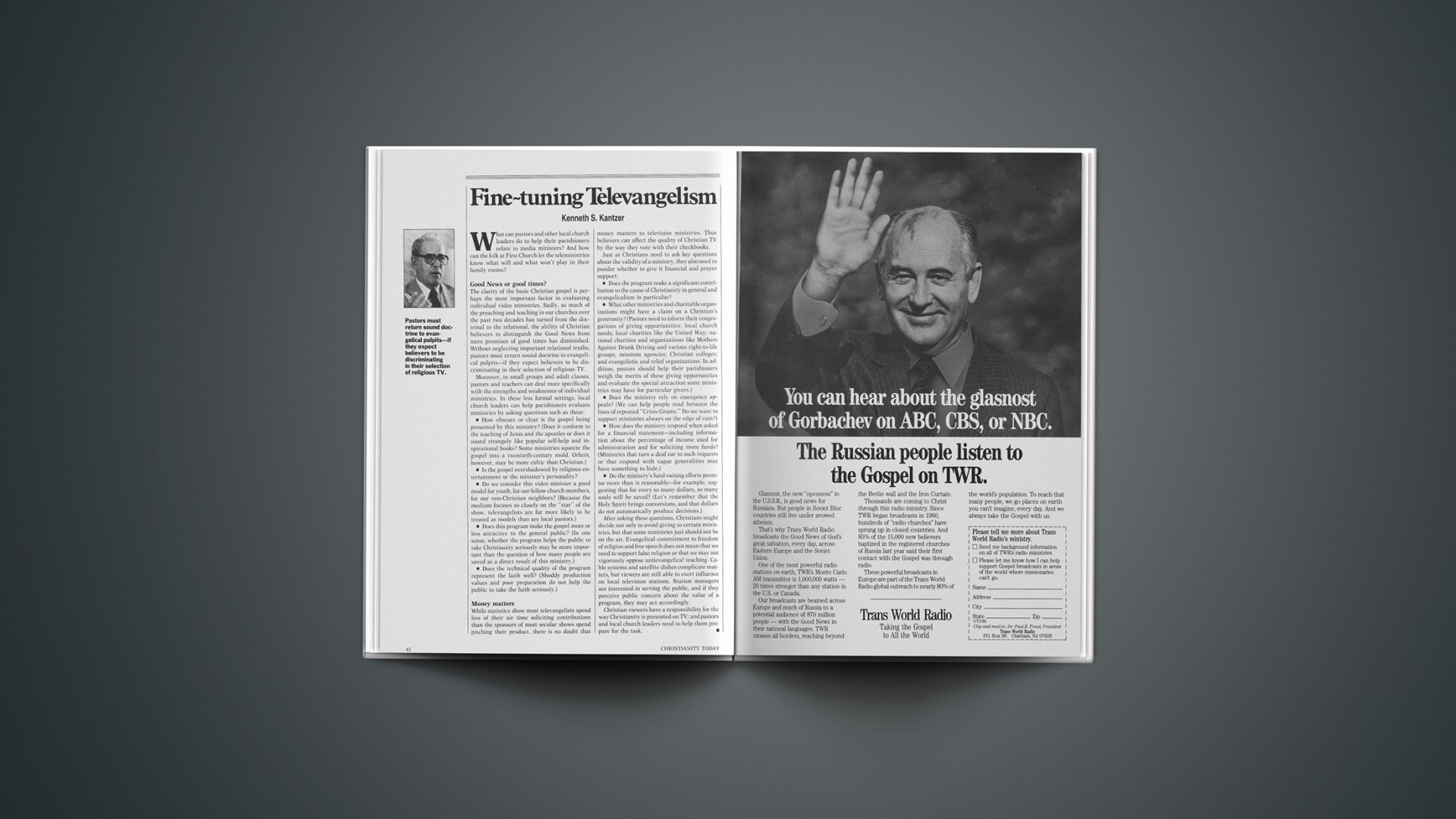
Fine-Tuning Televangelism

What can pastors and other local church leaders do to help their parishioners relate to media ministers? And how can the folk at First Church let the teleministries know what will and what won’t play in their family rooms?

Good News Or Good Times?

The clarity of the basic Christian gospel is perhaps the most important factor in evaluating individual video ministries. Sadly, as much of the preaching and teaching in our churches over the past two decades has turned from the doctrinal to the relational, the ability of Christian believers to distinguish the Good News from mere promises of good times has diminished. Without neglecting important relational truths, pastors must return sound doctrine to evangelical pulpits—if they expect believers to be discriminating in their selection of religious TV.

Moreover, in small groups and adult classes, pastors and teachers can deal more specifically with the strengths and weaknesses of individual ministries. In these less formal settings, local church leaders can help parishioners evaluate ministries by asking questions such as these:

  • How obscure or clear is the gospel being presented by this ministry? (Does it conform to the teaching of Jesus and the apostles or does it sound strangely like popular self-help and inspirational books? Some ministries squeeze the gospel into a twentieth-century mold. Others, however, may be more cultic than Christian.)
  • Is the gospel overshadowed by religious entertainment or the minister’s personality?
  • Do we consider this video minister a good model for youth, for our fellow church members, for our non-Christian neighbors? (Because the medium focuses so closely on the “star” of the show, televangelists are far more likely to be treated as models than are local pastors.)
  • Does this program make the gospel more or less attractive to the general public? (In one sense, whether the program helps the public to take Christianity seriously may be more important than the question of how many people are saved as a direct result of this ministry.)
  • Does the technical quality of the program represent the faith well? (Shoddy production values and poor preparation do not help the public to take the faith seriously.)

Money Matters

While statistics show most televangelists spend less of their air time soliciting contributions than the sponsors of most secular shows spend pitching their product, there is no doubt that money matters to television ministries. Thus believers can affect the quality of Christian TV by the way they vote with their checkbooks.

Just as Christians need to ask key questions about the validity of a ministry, they also need to ponder whether to give it financial and prayer support:

  • Does the program make a significant contribution to the cause of Christianity in general and evangelicalism in particular?
  • What other ministries and charitable organizations might have a claim on a Christian’s generosity? (Pastors need to inform their congregations of giving opportunities: local church needs; local charities like the United Way; national charities and organizations like Mothers Against Drunk Driving and various right-to-life groups; missions agencies; Christian colleges; and evangelistic and relief organizations. In addition, pastors should help their parishioners weigh the merits of these giving opportunities and evaluate the special attraction some ministries may have for particular givers.)
  • Does the ministry rely on emergency appeals? (We can help people read between the lines of repeated “Crisis-Grams.” Do we want to support ministries always on the edge of ruin?)
  • How does the ministry respond when asked for a financial statement—including information about the percentage of income used for administration and for soliciting more funds? (Ministries that turn a deaf ear to such requests or that respond with vague generalities may have something to hide.)
  • Do the ministry’s fund-raising efforts promise more than is reasonable—for example, suggesting that for every so many dollars, so many souls will be saved? (Let’s remember that the Holy Spirit brings conversions, and that dollars do not automatically produce decisions.)

After asking these questions, Christians might decide not only to avoid giving to certain ministries, but that some ministries just should not be on the air. Evangelical commitment to freedom of religion and free speech does not mean that we need to support false religion or that we may not vigorously oppose antievangelical teaching. Cable systems and satellite dishes complicate matters, but viewers are still able to exert influence on local television stations. Station managers are interested in serving the public, and if they perceive public concern about the value of a program, they may act accordingly.

Christian viewers have a responsibility for the way Christianity is presented on TV; and pastors and local church leaders need to help them prepare for the task.

Apple PodcastsDown ArrowDown ArrowDown Arrowarrow_left_altLeft ArrowLeft ArrowRight ArrowRight ArrowRight Arrowarrow_up_altUp ArrowUp ArrowAvailable at Amazoncaret-downCloseCloseEmailEmailExpandExpandExternalExternalFacebookfacebook-squareGiftGiftGooglegoogleGoogle KeephamburgerInstagraminstagram-squareLinkLinklinkedin-squareListenListenListenChristianity TodayCT Creative Studio Logologo_orgMegaphoneMenuMenupausePinterestPlayPlayPocketPodcastRSSRSSSaveSaveSaveSearchSearchsearchSpotifyStitcherTelegramTable of ContentsTable of Contentstwitter-squareWhatsAppXYouTubeYouTube