Eutychus and His Kin: July 21, 1967

Dear Slogan-Lovers:

One of the most sophisticated weapons in our present world war of words is the ubiquitous slogan-button. It comes from the same arsenal of conventional verbal armaments as the bumper sticker, campaign banner, and mimeographed leaflet. But in the service of causes boosted by young radicals, the button is a panic. Consider how the “rads” are using their little lapel-hangers to promote sexual freedom and peace and to express their attitudes toward life.

Champions of the cause of free sex have given birth to these button-slogans: Revive Fertility Rites,” “Candy Is Dandy But Sex Won’t Rot Your Teeth,” Save Water, Shower with a Friend,” and “Chaste Makes Waste.” They also issue warnings: “Apple Pie Makes You Sterile,” “Pornographic Material Can Make You Pregnant,” and “Love Thy Neighbor But Don’t Get Caught.” There are others on this topic, but your blushing penman will let you read those for yourself on somebody’s lapel.

In the cause of unilateral peace the mods have come up with “We Shall Over-kill,” “Support Peace—Or I’ll Kill You,” and “Escalate Minds Not War.” They show little love for the present administration: “Lyndon Johnson Will Go DOWN in History” and “Dean Rusk Uses Polyunsaturated Napalm.”

When it comes to expressing their views on life, they say by button: “I Want to Be What I Was When I Wanted To Be What I Now Am,” or “Neuroses Are Red, Melancholy Is Blue, I’m Schizophrenic, What Are You?,” or “End Poverty, Give Me $10.” They further advise: “Reality Is Good Sometimes for Kicks But Don’t Let It Get You Down,” and “Even Paranoids Have Real Enemies.”

If we evangelicals were to hop on the button-wagon, we might sport such slogans as “Why Be a COCU-nut?”, “Malcolm Boyd Is a Thespian,” “The Christian Century Is Really an Octogenarian,” and “The New Theology Is Hoary Heresy for Hairbrains.” But I doubt if they would be as effective as those good ole “gospel bombs” or Joseph Bayly’s amazing “gospel blimp.”

The button-craze shows no signs of letting up. But if it ever does, the reason may be the proliferation of yet another specimen. It says, “You’re Reading My Button.”

Your buttoned-down buddy,

EUTYCHUS III

Nearing The End

Your editorial, “War Sweeps the Bible Lands” (June 23), was not only thought-provoking but also thoroughly relevant, prophetic, and inspirational to Bible-believers.

You concluded it so impressively with two sentences which gave a hopeful impetus to the Christian’s heart: “The prophetic clock of God is ticking while history moves inexorably toward the final climax. And as that clock ticks, the Christian believer lifts his head high, for he knows that a glorious redemption draws near.”

V. E. ROMAN

First Covenant Church

Los Angeles, Calif.

The editorial is not as concerned with the war as with a flagrant, though brief, denunciation of the United Nations and a hastily assembled comment on the “closing days of the age.” It seems to me that the editorial staff of this magazine should not openly ridicule an organization without providing equal space for its more noteworthy accomplishments in the same area.

DAVE HOLMER

Seattle, Wash.

During the persecution of the Jews by the Nazis in Germany I took a stand as a Christian teacher on the side of the Jews. This led to my internment together with my family. At that time I could not imagine that one day I would have to take a stand on the side of the victims of the nation which should know what suffering means.…

It is gruesome to think that an opportunity to create a new state could not find inspiration from the thought to serve all human beings. For that is the only real justification for the existence of a state. The injustice has inflicted deep wounds, fanned into flame an undiminishing hatred, and alienated the Arab world from the West. This is the cause of the present catastrophe.

What is more, there has been disinterestedness in correcting the injustice.… As a Christian teacher, I am ashamed that ecclesiastical policy which has advanced claims of conscience has remained silent about the plight of the Arabs as it has about the victims in the Soviet empire, China, Tibet, and currently in South Viet Nam.… What is desperately needed immediately is the mobilization of all those who have retained some sense of responsibility and still possess a measure of human dignity.

A. VÖÖBUS

Lutheran School of Theology

Chicago, Ill.

A Modern Witness

Richard Groves’s excellent article, “The Message in Modern Pop Music” (June 23), clearly reveals to all evangelicals one of the most dynamic avenues for reaching youth.…

I’m convinced that a few clever ten-to-thirty-second announcements in the body of a contemporary music show could be a vital witness to youth. This is where the mod listeners are—most of them are not listening to a “churchy” half-hour block early Sunday morning. WORC

JOE KARAS

Worcester, Mass.

Nothing New

It would be well for those who think that Southern Baptists are just now awakening to individual (or corporate) concern for social needs and action because of speeches made in Miami Beach (“The Gospel in a Social Context,” News, June 23) to remember two things:

1. The 1967–68 theme of convention-wide activities spoken to by those speeches is “The Church Fulfilling Its Mission … Through Ministry,” the fourth of five annual themes that began with “Through Proclamation,” “Through Witnesses,” and “Through Education,” and concludes (in ’68–69) with “Through Missions and Evangelism.”

The convention and pre-sessions theme “Mandate to Minister” was keyed to this one facet of the five phases of church mission as we uphold and practice it.

2. As long ago as 1925, Southern Baptists were encouraged individually to seek to make the good news and the resultant change of life affect the society where they lived. In 1947, a major statement on improving personal and corporate attitudes in human relations and on working with other races (particularly Negro) in removing prejudice and securing just and equal rights and privileges was adopted. Time after time since, convention speakers have encouraged this individual involvement. It is our only way within our concept of New Testament church polity to express from the national level our concern that individuals and churches on the local level implement the social implications of the Gospel. This is not a new spirit of social action, only an accented one that many have been quietly fulfilling for years.

PAUL A. MAXEY

Blue Ridge Baptist

Independence, Mo.

Let Us Pray?

Congratulations on the excellent editorial, “Prayer in the Schools” (June 23). This is one of the clearest interpretations of the issue which I have seen in print. It should help to clear the air.

R. EUGENE CROW

Director

Division of Church and

Community Witness

Southern California Baptist Convention

Los Angeles, Calif.

Your statement that the individual citizen continues to be as free to pray or read his Bible in the public school as he always has been is not consistent with the facts. Before 1963 he was free to pause at the beginning of the school day with other students and teachers to read the Bible and pray. Is he now as free as ever to do that? The Supreme Court outlawed the “practices” per se as is clearly stated four times in its decisions.

You state that no amendment is needed to enable citizens to pray voluntarily in the schools because the Supreme Court did not outlaw personal prayer. This implies that personal prayer was the issue, which is completely misleading. Anyone who assumes that the court could outlaw personal prayer is being naïve in the extreme.…

Senator Dirksen has resorted to the only means available for restoring part of the freedom that has been enjoyed during the 175 years in which you so eloquently state the First Amendment demonstrated its value. There is a strange contradiction with those who use the past to argue for the retention of the status quo. The sole objective of SJR-1 is to restore what the status quo had been until an atheist and the Supreme Court got into the act.

FLOYD ROBERTSON

Asst. to the General Director

National Association of Evangelicals

Washington, D. C.

Your clear and logical presentation issues a timely reminder of the necessity of a clear separation of any “church” and state—for the sake of both.

Warning of the subtle (and not-so-subtle) dangers of employing the state as “a vehicle for religious indoctrination,” and offering a positive alternative for “counteracting the growing secularism in modern society,” has forcefully reminded us that the Kingdom of God does not need the help of Caesar (indeed, can do better without it.)

RAYMOND R. NEAL

La Mesa, Calif.

What is needed now is less emphasis on the limitations the court has set and more emphasis on individual prayer which the court would allow. One of my senators, Birch Bayh, has introduced a resolution similar to the one you suggest in your closing paragraph.

JAMES V. PANOCH

Executive Secretary

Religious Instruction Association, Inc.

Fort Wayne, Ind.

Required Reading

Thank you for printing the essay, “Faulting the Bible Critics” (June 9), by C. S. Lewis. This is something I have been waiting to hear for many years. Our teen-age children have read and enjoyed Lewis’s books. You may be sure this article will be required reading for them. And it should be, I think, for every student in our Christian colleges and seminaries.

MRS. C. L. HOYT

Hartville, Ohio

If the lord of the Bultmannites (Rudolf Bultmann himself) was incompetent to criticize the personality of Christ revealed in the literature of the New Testament, what about these papier-mâché images who simply repeat his incompetence?

ALVIN E. HOUSER

Director-Evangelist

National Association of Free Christians

(Christian Churches)

Center, Tex.

In my humble opinion he has missed one “elephant” while looking for his “fern seeds”.…

Any scribe of that day could not have picked up his quill and penned the detailed happenings of those few critical years so pregnant with miraculous events. Only to those whom the Holy Spirit so moved to write those things were they revealed and recalled in such minute detail.

C. K. SCOLES

First Nazarene Church

Pueblo, Colo.

I especially appreciate the segment of C. S. Lewis’s book concerning form criticisms.

I want you to know that “Lutherans Alert” is currently seeking to uphold the doctrine of biblical inerrancy within The American Lutheran Church.…

KENT E. SPAULDING

Editor

Lutherans Alert Magazine

Tacoma, Wash.

About That ‘New Breed’ …

The June 9 article by Eutychus III brought reference to Father Malcolm Boyd (a priest of the Episcopal Church) and to a service (?) in the Washington National Cathedral, which topped a four-day “happening” at St. Stephen and the Incarnation Church in Washington, D. C.

As an Episcopal priest, I might say that we are not happy with this sort of “goings on” any more than you are. The “new breed,” undoubtedly, have been whelped by promiscuous parents.

DWIGHT A. FILKINS

St. Bartholomew’s Church

St. Petersburg, Fla.

Speak For Yourself

I have just read your editorial, “Who Speaks for the Church?” (June 9). You have raised some excellent points.

The Church cannot be identified with any one politico-socio-economic philosophy. Such an identification would rob it of freedom to analyze all sides of a moral question.…

There is, however, one thing that disturbs me about your editorial. You argue for the expression of the individual Christian.… The trouble with this argument is that it is used to shut off the discussion of moral issues in the church.…

If a local church discusses a moral issue and votes to take a stand on that issue, it can exercise far more influence in a community than the scattered voices of individuals.

GEORGE E. MORRIS

Ontario, Calif.

Of Couch And Counsel

It is difficult to communicate the deep blessing received from these pastoral testimonies regarding the infinitely complex area of Christian counseling (“What I’ve Learned in Counseling,” June 9). More than anything else, I was touched by your case selection—for these represent intimate and intricate, yet common problems—and the warm spirit of humility and honesty in which the individual pastors wrote. As a Christian physician who, too, has had to deal with these and similar situations, I can attest to the fact that there is no such thing as an easy solution to most of the personal tragedies brought to us for help. And to approach them in anything other than a humble, self-searching attitude is to do the patient ofttimes irreparable harm, and ultimately to drive him further from the comforting arms of Jesus.

GEORGE R. SIMMS, M.D.

San Bernardino, Calif.

Getting Together

Your editorial, “Somehow, Let’s Get Together!” (June 9), touched on the keenest issue of concern in our evangelical cause.…

The National Holiness Association has stood astride of the various movements in that we have refused to openly oppose the NCC or the ACCC. We have those individuals and groups in the NHA that belong to the NCC. Our position has been that of uniting to give the Wesleyan message of scriptural holiness a hearing. We do, however, officially belong as a group to the NAE and have consistently furnished much of its leadership.…

I believe the NHA constituency are in one accord with the thesis of the editorial.

PAUL L. KINDSCHI

President

National Holiness Association

Marion, Ind.

I am an evangelical who has long since been disturbed at the misunderstandings evangelical leaders have fostered toward the ecumenical movement.… However, I guess the thought never occurred to men of evangelical leadership that we belong where the action is.… If evangelical leaders like you were really interested in doing what needs to be done, you would get into the National Council of Churches before sundown today. Just suppose the 29 million non-aligned evangelicals along with the two-million NAE people joined the council and started getting offices and positions. There could be a great difference felt.

RICHARD M. MORRIS

Bowmansdale-Mount Pleasant

Churches of God

Dillsburg, Pa.

You have most certainly struck the basic issue when you state, “Their common ground is belief in biblical authority and individual spiritual regeneration.” On this basis we have mobilized the active cooperation of 356 different evangelical denominations and missionary societies. After a number of years of this kind of cooperative action, we are deeply convinced that there is enough agreement on basic major issues to make cooperative effort a practical goal.…

It appears to be a definite tragedy that millions of evangelicals in the NCC have no voice. Worse yet—they have no rallying point for effective united action.

JACK MCALISTER

President

World Literature Crusade

North Hollywood, Calif.

I agree that we have some basic doctrines in common, but the things which we believe, which cause us to have numerous denominations, are dictated by the way we are led by the Holy Spirit to understand the Scriptures. The only way to combine all the various groups, then, would be to adopt some lukewarm and non-committal doctrines or creed—such as that proposed by COCU. No thank you.

HENRY M. KLEEMAN JR.

Huntsville, Ala.

Our strategy must be positive, with emphasis upon love of our brethren across denominational lines, with appeal to our need for fellowship, and with the motivation of what we will be able to accomplish together for the Lord rather than what we can oppose together.

ROBERT E. BAXTER

First United Presbyterian Church

Olathe, Kan.

Your editorial is timely and you are right. If leadership can be found it could happen—and soon.

BOB W. BROWN

Trinity Baptist Church

Lexington, Ky.

I wonder if we are really all as bad off as one might think if he considers only how our “common ground is criss-crossed by many fences”.…

True, Reformed Christians have always expressed a longing for visible unity. But they have always had the grace to know that that unity must be grounded on a common adherence to doctrine and a general practice of righteousness. Given that, what more is there?…

The real unity was thoroughly understood by the sixteenth-century divines as well as by the apostles. It was a unity under the headship of the Risen and Ascended and Living Lord Jesus Christ, made operative in this world by his grace alone.…

What is left of the sufficiency of the grace of Christ to those who say we must no longer hold to our denominational allegiances? that Christ is not fully manifest when we keep these differences alive? that we need a central head, a single voice, a national journal?

May I be bold and suggest that we can get together only in the power of preaching this stalwart old evangelical doctrine: Salvation by grace alone.

Maybe we are already more together than you know. Wasn’t there something about Elijah and 7,000 others he didn’t know?

T. ROBERT INGRAM

St. Thomas Episcopal Church

Houston, Tex.

Paul pleads for a unity of the Spirit, not for a unity of the body. On the latter point he simply says, “There is one body.”

W. WILEY RICHARDS

First Baptist Church

Lantana, Fla.

Our love of Christ, the fundamental primacy of God’s infallible word, plus the urgency of the hour to emphasize person-to-person evangelism draws us together, notwithstanding our denominational loyalties and affiliations. The great need is to educate evangelicals to a higher level of facing up to the enemy—sin. The call must cut across denominational lines, not to destroy that which is good, but to encourage to action, reinforce zeal to witness, and consolidate wherever possible the impact of the evangelical witness. At the annual meeting of the American Baptist Convention at Pittsburgh, a vote taken indicated that over 70 per cent of those voting were in favor of evangelical thrust as far as Baptists are concerned. The preponderance of laymen are conservative, but too often leaderless. Many denominational staff members do not seem to be representative in the slightest of hard core followers in the pews.

PAUL E. ALMQUIST

Chairman, Board of Trustees

Eastern Baptist Theological Seminary

Philadelphia, Pa.

Your editorial is long overdue. Now, what can we do? Under your leadership and with the support of the best evangelical men, lay and clerical, in all groups and of all points of view, can there not be a great Evangelical Congress called to “let us get together”?

BEN E. SHELDON

Sixth Presbyterian

Washington, D. C.
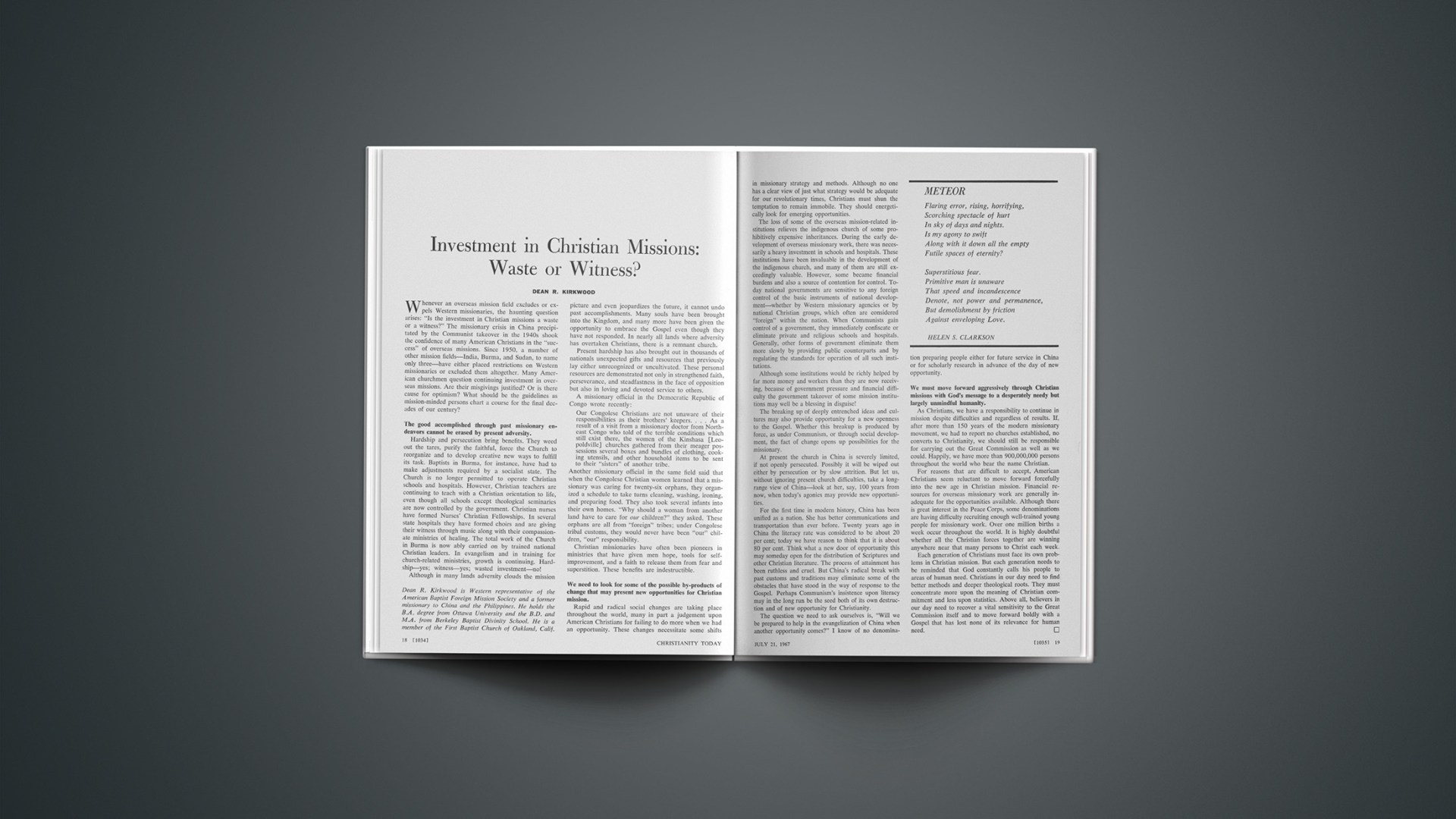
Investment in Christian Missions: Waste or Witness?

Whenever an overseas mission field excludes or expels Western missionaries, the haunting question arises: “Is the investment in Christian missions a waste or a witness?” The missionary crisis in China precipitated by the Communist takeover in the 1940s shook the confidence of many American Christians in the “success” of overseas missions. Since 1950, a number of other mission fields—India, Burma, and Sudan, to name only three—have either placed restrictions on Western missionaries or excluded them altogether. Many American churchmen question continuing investment in overseas missions. Are their misgivings justified? Or is there cause for optimism? What should be the guidelines as mission-minded persons chart a course for the final decades of our century?

The good accomplished through past missionary endeavors cannot be erased by present adversity.

Hardship and persecution bring benefits. They weed out the tares, purify the faithful, force the Church to reorganize and to develop creative new ways to fulfill its task. Baptists in Burma, for instance, have had to make adjustments required by a socialist state. The Church is no longer permitted to operate Christian schools and hospitals. However, Christian teachers are continuing to teach with a Christian orientation to life, even though all schools except theological seminaries are now controlled by the government. Christian nurses have formed Nurses’ Christian Fellowships. In several state hospitals they have formed choirs and are giving their witness through music along with their compassionate ministries of healing. The total work of the Church in Burma is now ably carried on by trained national Christian leaders. In evangelism and in training for church-related ministries, growth is continuing. Hardship—yes; witness—yes; wasted investment—no!

Although in many lands adversity clouds the mission picture and even jeopardizes the future, it cannot undo past accomplishments. Many souls have been brought into the Kingdom, and many more have been given the opportunity to embrace the Gospel even though they have not responded. In nearly all lands where adversity has overtaken Christians, there is a remnant church.

Present hardship has also brought out in thousands of nationals unexpected gifts and resources that previously lay either unrecognized or uncultivated. These personal resources are demonstrated not only in strengthened faith, perseverance, and steadfastness in the face of opposition but also in loving and devoted service to others.

A missionary official in the Democratic Republic of Congo wrote recently:

Our Congolese Christians are not unaware of their responsibilities as their brothers’ keepers.… As a result of a visit from a missionary doctor from North-east Congo who told of the terrible conditions which still exist there, the women of the Kinshasa [Leopoldville] churches gathered from their meager possessions several boxes and bundles of clothing, cooking utensils, and other household items to be sent to their “sisters” of another tribe.

Another missionary official in the same field said that when the Congolese Christian women learned that a missionary was caring for twenty-six orphans, they organized a schedule to take turns cleaning, washing, ironing, and preparing food. They also took several infants into their own homes. “Why should a woman from another land have to care for our children?” they asked. These orphans are all from “foreign” tribes; under Congolese tribal customs, they would never have been “our” children, “our” responsibility.

Christian missionaries have often been pioneers in ministries that have given men hope, tools for self-improvement, and a faith to release them from fear and superstition. These benefits are indestructible.

We need to look for some of the possible by-products of change that may present new opportunities for Christian mission.

Rapid and radical social changes are taking place throughout the world, many in part a judgement upon American Christians for failing to do more when we had an opportunity. These changes necessitate some shifts in missionary strategy and methods. Although no one has a clear view of just what strategy would be adequate for our revolutionary times, Christians must shun the temptation to remain immobile. They should energetically look for emerging opportunities.

The loss of some of the overseas mission-related institutions relieves the indigenous church of some prohibitively expensive inheritances. During the early development of overseas missionary work, there was necessarily a heavy investment in schools and hospitals. These institutions have been invaluable in the development of the indigenous church, and many of them are still exceedingly valuable. However, some became financial burdens and also a source of contention for control. Today national governments are sensitive to any foreign control of the basic instruments of national development—whether by Western missionary agencies or by national Christian groups, which often are considered “foreign” within the nation. When Communists gain control of a government, they immediately confiscate or eliminate private and religious schools and hospitals. Generally, other forms of government eliminate them more slowly by providing public counterparts and by regulating the standards for operation of all such institutions.

Although some institutions would be richly helped by far more money and workers than they are now receiving, because of government pressure and financial difficulty the government takeover of some mission institutions may well be a blessing in disguise!

The breaking up of deeply entrenched ideas and cultures may also provide opportunity for a new openness to the Gospel. Whether this breakup is produced by force, as under Communism, or through social development, the fact of change opens up possibilities for the missionary.

At present the church in China is severely limited, if not openly persecuted. Possibly it will be wiped out either by persecution or by slow attrition. But let us, without ignoring present church difficulties, take a long-range view of China—look at her, say, 100 years from now, when today’s agonies may provide new opportunities.

For the first time in modern history, China has been unified as a nation. She has better communications and transportation than ever before. Twenty years ago in China the literacy rate was considered to be about 20 per cent; today we have reason to think that it is about 80 per cent. Think what a new door of opportunity this may someday open for the distribution of Scriptures and other Christian literature. The process of attainment has been ruthless and cruel. But China’s radical break with past customs and traditions may eliminate some of the obstacles that have stood in the way of response to the Gospel. Perhaps Communism’s insistence upon literacy may in the long run be the seed both of its own destruction and of new opportunity for Christianity.

The question we need to ask ourselves is, “Will we be prepared to help in the evangelization of China when another opportunity comes?” I know of no denomination preparing people either for future service in China or for scholarly research in advance of the day of new opportunity.

METEOR

Flaring error, rising, horrifying,

Scorching spectacle of hurt

In sky of days and nights.

Is my agony to swift

Along with it down all the empty

Futile spaces of eternity?

Superstitious fear.

Primitive man is unaware

That speed and incandescence

Denote, not power and permanence,

But demolishment by friction

Against enveloping Love.

HELEN S. CLARKSON

We must move forward aggressively through Christian missions with God’s message to a desperately needy but largely unmindful humanity.

As Christians, we have a responsibility to continue in mission despite difficulties and regardless of results. If, after more than 150 years of the modern missionary movement, we had to report no churches established, no converts to Christianity, we should still be responsible for carrying out the Great Commission as well as we could. Happily, we have more than 900,000,000 persons throughout the world who bear the name Christian.

For reasons that are difficult to accept, American Christians seem reluctant to move forward forcefully into the new age in Christian mission. Financial resources for overseas missionary work are generally inadequate for the opportunities available. Although there is great interest in the Peace Corps, some denominations are having difficulty recruiting enough well-trained young people for missionary work. Over one million births a week occur throughout the world. It is highly doubtful whether all the Christian forces together are winning anywhere near that many persons to Christ each week.

Each generation of Christians must face its own problems in Christian mission. But each generation needs to be reminded that God constantly calls his people to areas of human need. Christians in our day need to find better methods and deeper theological roots. They must concentrate more upon the meaning of Christian commitment and less upon statistics. Above all, believers in our day need to recover a vital sensitivity to the Great Commission itself and to move forward boldly with a Gospel that has lost none of its relevance for human need.

Assessing Jehovah’s Witnesses

Fifty years ago next month, Joseph Franklin Rutherford became the second president of the Watchtower Society, succeeding Charles Taze Russell. It was during Rutherford’s presidency that the group assumed the name “Jehovah’s Witnesses.”

Jehovah’s Witnesses claim to be following Scripture alone in their teachings and practices, and they accuse all others of following human traditions instead of the Bible. Their glib way of quoting Scripture when they come to the door gives many people the impression that they know the Bible very well.

Do they? Are they faithful to Scripture in their teachings? Let us ask them ten questions, get answers from their own writings, and compare these answers with Scripture.

1. Do Jehovah’s Witnesses use the Bible properly? They claim to take the Bible and the Bible alone as the standard by which to judge religious truth. Let God Be True, the most widely circulated and perhaps best known of their doctrinal books, states clearly that “we shall let God be found true by turning our readers to his imperishable written Word” (1952 ed., p. 18). On another page the authors say, “In this book, our appeal is to the Bible for truth” (p. 9).

That the Witnesses use the Bible and continually appeal to it must be granted. In their publications and in their oral witnessing they constantly quote Scripture. Yet instead of listening to Scripture, they impose upon it their own bizarre theological notions.

a. Their New World Translation is not an objective rendering of the Bible into modern English but a biased translation into which many of the peculiar teachings of the Watchtower Society have been smuggled. An illustration is their well-known mistranslation of John 1:1, in which the clear testimony of this verse to the deity of Christ is nullified: “In [the] beginning the Word was, and the Word was with God, and the Word was a god.”

b. Their method of using Scripture is to find passages that seem to support their views, and ignore those that do not. An example is their attempt to disprove the doctrine of the Trinity in Let God Be True (pp. 102–107). They adduce four passages that trinitarians formerly used as “prooftexts” for the Trinity, two of which would no longer be appealed to by any trinitarian (1 Tim. 3:16 and 1 John 5:7). However, they ignore such crucial passages as the Great Commission (Matt. 28:19) and the Apostolic Benediction (2 Cor. 13:14).

c. They insist that their adherents can understand the Bible only as interpreted by their own leaders. The Watchtower Society, it is claimed, is “the instrument or channel being used by Jehovah to teach his people on earth” (Qualified to be Ministers, p. 318). Jehovah’s Witnesses must therefore accept without question the interpretations of Scripture given in the various Watchtower publications. All Christian groups outside the fold are said to be walking in darkness, no matter how diligently they may be studying the Bible. Can this possibly be said to be listening to God’s Word?

2. Do Jehovah’s Witnesses affirm the Trinity? No, they claim that the doctrine of the Trinity originated with Satan (Let God Be True, p. 101). Jesus Christ is said to have been created by Jehovah, and the Holy Spirit is not a divine Person but “the invisible, active force of Almighty God which moves his servants to do his will” (ibid., p. 108). Their New World Translation never capitalizes the word “spirit” when it refers to the Holy Spirit, and always designates the Holy Spirit as “it” or “which” rather than “he” or “who.” The Witnesses are strict Unitarians: they believe Jehovah exists as a solitary Person.

The Scriptural teaching of the doctrine of the Trinity, however, is clear in specific passages like those previously mentioned (Matt. 28:19; 2 Cor. 13:14) as well as in the teaching of the New Testament as a whole. That the Holy Spirit is a Person and not just an impersonal force is evident from a passage like Ephesians 4:30, “Grieve not the holy Spirit of God, whereby ye are sealed unto the day of redemption.”

3. Do Jehovah’s Witnesses affirm the deity of Christ? They deny it. Jesus Christ, they teach, was neither equal to Jehovah nor co-eternal with Jehovah but was the Father’s first creature. Although he is called the Logos or Word of the Father, this title merely implies that Christ was Jehovah’s spokesman. He is superior to all other creatures, therefore, but never equal to the Father. Indeed before coming to earth the Son was really an angel. He was known in heaven not as Jesus Christ but as Michael; when we read in Jude 9 about Michael the archangel, we are to understand this is a reference to Jesus Christ in his prehuman state (New Heavens and a New Earth, pp. 28–30). In line with their translation of John 1:1 (“and the Word was a god”), Jehovah’s Witnesses grant that the Son was some kind of god. But they emphatically deny his full deity.

It goes without saying, therefore, that they deny the incarnation. What is their view of the birth of Jesus from Mary? God took the “life,” “personality,” or “life pattern” of the Son and transferred it from heaven to the womb of Mary, of whom Jesus was born as a human creature (From Paradise Lost to Paradise Regained, p. 127). Since the Son of God before his birth from Mary was not equal to the Father but only a created angel, Jesus’ birth was clearly not the incarnation of God. While he lived upon earth, Jesus was only a man, nothing more (What Has Religion Done for Mankind?, p. 231). Actually, then, the birth of Jesus meant that Christ ceased existing as an angel (“he laid aside completely his spirit existence,” The Truth Shall Make You Free, p. 246) and began to exist as a man. We may well ask, What continuity is there between the Son’s existence as Michael, the created angel, and his existence as the man Jesus? Were these two not completely different beings?

The Witness view of Christ is a modern revival of the ancient Arian heresy, with certain variations. The fourth-century Arians taught that the Son was a creature who had been called into existence by the Father, and who could therefore in no way be considered equal to the Father. This view was challenged by Athanasius, and many of his arguments against the Arians are applicable to Witness teaching today. The Church decisively rejected the Arian view of Christ at the Council of Nicaea (325), which affirmed that Christ was and is “of one substance with the Father” and anathematized those who asserted that the Son of God had been created. By once more assuming the Arian position on the person of Christ. Jehovah’s Witnesses have separated themselves from historic Christianity. What Athanasius said about the Arians holds true for the Witnesses today: Although they use scriptural language and frequently quote Scripture, their doctrine is thoroughly unscriptural (Discourses Against the Arians, I, 8).

4. Do Jehovah’s Witnesses teach the bodily resurrection of Jesus Christ? All Christians agree that the resurrection of Christ is the keystone of Christianity. As Paul says, “If Christ be not raised, your faith is vain; ye are yet in your sins” (1 Cor. 15:17).

Therefore we must inquire into Watchtower teaching on this matter. Jehovah, it is said, raised Christ from the dead “not as a human Son but as a mighty immortal spirit” (Let God Be True, p. 40). The physical, bodily resurrection of Christ is therefore denied; God raised Christ as a spirit, and the body of Christ was disposed of in some way that is not wholly made clear. The reasoning behind this is as follows: To atone for Adam’s sin, Christ had to sacrifice his human body; this means that he had to renounce it permanently and could not get it back again; and therefore God raised him as a spirit Son (What Has Religion Done for Mankind?, p. 259).

As we reflect on this teaching, we again ask ourselves: What continuity is there in Witness doctrine between the Christ who was raised as a spirit and the Jesus who died on the cross (or on the “torture stake,” as Jehovah’s Witnesses prefer to say)? None. For though Christ was a man while he lived on earth, he is no longer in any sense human after his resurrection but is only a spirit or angel (it is even said that after the resurrection the Son resumed the name Michael). The Witnesses, therefore, cannot really speak of the exaltation of Christ, since the one who is exalted is not the same being as the one who was previously humiliated. Indeed, what Jehovah’s Witnesses really teach is the annihilation of Jesus Christ. When he died, Jesus as a human being was simply blotted out of existence.

The three states of Christ’s existence in Watchtower theology really amount to this: angel—man—angel, with no real continuity between the three. How utterly different this is from the Christology of Scripture! In the Book of Revelation the glorified Christ is heard to say, “… I am the first and the last: I am he that liveth, and was dead; and, behold, I am alive for evermore …” (1:17, 18). According to Witness teaching, however, he who laid down his life at Calvary was not the one who had been the Father’s agent in creation, and is not the one who now rules over the heavenly Kingdom. Really the Witnesses have three Christs, none of whom is equal to Jehovah, and none of whom is the Christ of the Scriptures.

TREASURES OF DARKNESS*: AFTER CATASTROPHE

*Isaiah 45:3

And darkness, darkness, darkness for my heart.

Night-dark, starless, Blindfold-dark. Or blind.

I move in catacombs that stretch and wind,

Unendingly, through utter gloom … I start

Slow steps along a caverned street, where part

Unknown, unmarked, the alleys I must find

And darkness, darkness, darkness.

Yet my mind

Laughs through layered shadows, for I hold a Chart

Braille-legible to finger touch of faith

And One has promised treasures of the dark.

His wealth is vast. When every shadowy wraith

Of this my Stygian hour is gone, what mark,

What treasure found in darkness shall I hold?

My awed and grateful hands shall clasp His gold.

ELVA McALLASTER

5. Do Jehovah’s Witnesses teach the visible return of Christ? No, for a visible return would, of course, be impossible for a being that has only an angelic existence. In fact, Jehovah’s Witnesses say that the return of Christ has already occurred, in 1914. No one saw the return, since it was invisible.

Let us look at this a bit more closely. By a fantastic method of computation, involving an assortment of figures derived with great ingenuity from Luke, Daniel, Revelation, and Ezekiel, the Watchtower leaders have arrived at 1914 as the year when the Kingdom of God was established (Russell had taught earlier that the year was 1874; apparently new light has been received since his day). Jehovah’s Witnesses identify this establishment of the Kingdom of God with the “return” of Jesus Christ, which therefore also occurred in 1914. But this return was not physical or visible, for Christ since his resurrection has had no physical body. In fact, this was not really a return at all, since Christ did not come back to earth at that time but simply began to rule over his Kingdom from heaven. It is granted that between Christ’s ascension and 1914 he was already sitting at God’s right hand (This Means Everlasting Life, p. 220). At the time the Kingdom of God was founded, however, Christ was elevated to the active kingship at God’s right hand (You May Survive Armageddon, p. 100). So the “return” or “second presence” (the Witnesses prefer the latter term) of Christ simply means that Christ exchanged an “ordinary” seat at the Father’s right hand for a throne.

What a far cry this is from the teaching of Scripture on the return of Christ. The Bible says, “Behold, he cometh with the clouds, and every eye shall see him” (Rev. 1:7). But the “return” of Christ that the Witnesses claim, was seen by no one. It was not even a return, strictly speaking, but only the assumption of a throne in heaven!

6. Why do Jehovah’s Witnesses oppose blood transfusions? Occasionally the papers tell about irate Witness fathers standing in doorways with shotguns to prevent doctors from giving blood transfusions to people within. Why do they do this? Because of their absurd literalism in interpreting certain scriptural passages that forbid the eating of blood, such as Leviticus 17:14, “… I said unto the children of Israel, Ye shall eat the blood of no manner of flesh.…” On the basis of texts of this sort Jehovah’s Witnesses assert that blood transfusion is a “feeding upon blood” and is therefore unscriptural (Make Sure of All Things, p. 47).

However, the blood prohibited in the Levitical laws was not human but animal, and what was forbidden was the eating of this blood with the mouth, since God had appointed the blood of animals as a means of making atonement. Scriptural prohibitions against the eating of blood have nothing to do with the infusing of blood into the veins for medicinal purposes. What a pity that people should have to lose their lives because of such a perversion of Scripture teaching.

7. Why do Jehovah’s Witnesses oppose saluting the flag? They believe that all governments are parts of the devil’s visible organization, and, in their opinion, to salute the flag is to ascribe salvation to the nation for which the flag stands, and is therefore an act of idolatry (Let God Be True, pp. 242, 243). Witnesses compare their unwillingness to salute the flag with the refusal of Daniel’s three friends to bow before Nebuchadnezzar’s image. Their refusal to vote in national elections, to hold political office, or to serve in the armed forces is an extension of this view of the demonic nature of all human governments.

Romans 13:1 and similar passages make it clear, however, that governmental powers have been ordained by God and are therefore entitled to our respect, honor, and obedience—unless they command what is clearly contrary to God’s Word. To suggest that saluting a flag “is ascribing salvation” to the nation represented by the flag is so far-fetched that it hardly requires refutation.

8. Do Jehovah’s Witnesses have a biblical view of the Church? The attitude of the Watchtower Society toward the Christian Church is almost unbelievably bigoted. According to their claims, Jehovah’s Witnesses alone are God’s true people; all others are followers of the devil. The “great whore” of Revelation 17 is organized religion, Christian as well as heathen (What Has Religion Done for Mankind?, p. 328). The visible part of the devil’s organization includes not only all the governments of the world but also all its religious systems, particularly apostate Christendom: that is, all of Christendom except for the Watchtower Society and its members (ibid., p. 307). The clergy are said to be the direct visible link between mankind and the invisible demons (The Kingdom Is at Hand, p. 186).

Needless to say, claims like these flatly contradict scriptural teaching about the universality of the Church. Does not Paul speak of the body of Christ with many members? Is it not, in fact, blasphemous to ascribe to Satan the work that God’s Holy Spirit has accomplished in the hearts of his people across the centuries and throughout the world?

There is another respect in which Witness ecclesiology is unscriptural: the division of members into two classes. There is the “anointed class” or 144,000, and, on the other hand, there are the “other sheep” or “great crowd.” The 144,000, who are the spiritually elite, play a leading role in directing Watchtower activities and are destined to spend eternity in heaven without bodies. The “other sheep” will never get to heaven but will be raised with physical bodies and will, if they pass the various millennial tests, spend eternity on the Paradise of the new earth. The people of God are thus split into two diverse groups with two distinct destinies; how opposed this is to the scriptural teaching of the unity of the Church!

9. Do Jehovah’s Witnesses teach the annihilation of the wicked? Their teaching on the future lot of the impenitent is complicated. They deny the existence of hell and teach that “eternal punishment” means reduction to non-existence (Let God Be True, p. 97), but they believe there are various ways in which persons can enter the “state” of annihilation. Certain persons will never be raised from the dead but will remain in the non-existence into which death has plunged them: those who died at the time of the flood, those who will die in the Battle of Armageddon, and others. Individuals raised from the dead during the millennium who do not obey God’s Kingdom will be annihilated before the end of the millennium. Satan, the demons, and those of earth’s millennial inhabitants whom he succeeds in leading astray will be annihilated by fire from heaven. And the possibility always remains that some who are left on the new earth after Satan’s destruction may still have to be annihilated.

The denial of eternal punishment has an understandable appeal to people. But does the Bible teach the annihilation of the wicked? The Book of Revelation, in picturing the final torment of the wicked, tells us that the smoke of their torment goes up for ever and ever (14:11). Certainly this does not describe annihilation!

10. Do Jehovah’s Witnesses teach salvation by grace? Here again we must distinguish between the two classes. Members of the “anointed class” (the 144,000) are selected on the basis of their having met the requirements for membership—that is, for their worthiness. The anointed ones must continue to serve God, faithfully demonstrating their dedication until death (Let God Be True, p. 301). This dedication involves, particularly, faithfulness in witnessing and distributing literature.

The “other sheep” must also dedicate themselves to do God’s will and remain faithful to this dedication. Members of this group are taught that if they stay close to the Watchtower organization, listen attentively to its indoctrination, and go out regularly to distribute literature and make calls, they may be saved at Armageddon (William Schnell, Thirty Years a Watchtower Slave, p. 104). When a Christian asked a Jehovah’s Witness point-blank, “What must I do to be saved?,” he received the reply, “Go out two by two and preach the Gospel.”

Salvation in Witness teaching is not by grace but by works. A man is not saved because Jesus Christ has merited salvation for him; he is saved because of his worthiness, because he remains faithful to Jehovah throughout life and even during the millennium (since after his resurrection he must still continue to pass tests of obedience).

What a denial this is of the central truth of the Reformation: justification by faith! What a perversion of the teaching of Scripture: “By grace are ye saved through faith; and that not of yourself: it is the gift of God” (Eph. 2:8); “Not by works of righteousness which we have done, but according to his mercy he saved us …” (Tit. 3:5).

On all ten of these questions, then, the teachings of Jehovah’s Witnesses are contrary to Scripture. Superficially these people may be impressive with their knowledge of Scripture. But their doctrines are actually a terrible perversion of Scripture. We should not be afraid to meet them on their own ground and to challenge their interpretations of the Scriptures they so glibly quote.

Social Pressures and Church Policy

Confusion, anxiety, turmoil, uncertainty, and soul-searching mark the present mood of church life in Rochester, New York, in the aftermath of the confrontation between FIGHT and the Eastman Kodak Company at Kodak’s annual board meeting in Flemington, New Jersey. Race and job opportunities are not the only issues. Involved also is the future place of the church within American society. The action of the Rochester Area Council of Churches (RACC) in bringing Saul Alinsky’s FIGHT organization to the Flower City and the reaction of some churches and church members in repudiating RACC policy by withholding financial support are a foreshadowing of issues that few communities in the United States will be able to avoid. In the light of the RACC board’s painful reappraisal of the policies that have led to its present financial predicament, the question of social pressure and church policy ought to be of vital concern to Christian leaders and Christian laymen throughout the nation.

Rochester is an affluent and fast-changing city. For several decades people have been attracted to this scientific center by job opportunities and community advantages. More and more people, many from depressed economic areas, have been coming to the city. The large Negro population came in part to work on nearby farms and in orchards. Many migrants remained here because of the city’s liberal relief policies. Some of the adult migrants returned to the South for the winter, leaving their children behind with relatives so they could attend school. Long before the plight of these families became a recognized concern of denominational officials, the changing nature of the inner city and the problems of its churches cried out unheeded for attention.

The official records of Grace Lutheran Church, located in the inner city, attest to the unwillingness of denominational officials to confront the problems of the inner-city church. In 1946 a university president and a synod official recommended that the church either close or merge. Records of city agencies in that same year predicted an exceedingly short slum-free life for the once respectable multi-racial area around the church.

There were indeed great difficulties, but on the whole the predictions proved wrong. Considerable effort and educational promotion extended the active life of this congregation. Radical changes in policy and program were instituted with the sympathetic help of the Rochester Federation of Churches, which later became the RACC. Grace Church was the first Lutheran church in Rochester to welcome a Negro family as members. The father was president of the Rochester chapter of the NAACP at the time of the Rochester “riot” in 1964. His election to Grace’s Church Council took a heavy toll in active church membership, but as a result excellent relations were established with Negro congregations. Grace Church was among the first congregations to contribute from benevolence funds to the work of the RACC. Our church lawyer was the first and only secretary of the controversial Police Review Board now dying for lack of work. A fair percentage of our active church families came to know first-hand the fear of racial hatred.

Under the policies of the old Federation of Churches, board membership was more nearly a cross section of the total Rochester church community than it now is. When, in line with the policy of the National Council of Churches, board members of the new RACC began to be selected or appointed by denominational officials or bodies, representation on the board began to reflect more strongly the affluent suburban churches. In retrospect, we can see that policies that grew out of changes in the selection of the RACC board were among the first steps leading to events that are now of national concern. The experience of the inner-city churches clashed with the growing importance of the suburban churches, and these tensions preceded the RACC’s calling of Mr. Alinsky to do the work many citizens and inner-city churches felt could be done most effectively through local resources and leadership.

No one knows what the present controversy will ultimately mean for the inner-city churches, nor even how long progressively minded inner-city congregations can survive. But at least one thing is certain. The inner-city church does not control its own future. It has not been considered important in the present controversy, and it is now in the unfortunate and unnecessary position of a drowning man crying for help.

The withdrawal of financial support from the RACC by churches and churchmen has forced upon church leaders the belated recognition that the inner city has long been a mission field. The RACC’s calling of Saul Alinsky forced the entire community to consider city problems. Now the RACC’s financial predicament has spotlighted the plight of the inner-city churches.

Those who have never experienced the effect of social upheavals upon the mind and spirit find it easy to judge the reactions of innocent people who have suffered and are still suffering from the Rochester “riot” and the aftermath of events resulting from RACC decisions. Our school teachers and our schools, our industry and its leaders and workers, our courts (especially our judges), our churches and church members—or aspects of community life are now feeling the soul-searing pain involved in accelerated social change. Socially minded real estate brokers in our immediate community are crying, “Why doesn’t someone consult our experience in the attempt to find answers to these complex problems?” Public morale suffers because people directly involved in the problems—the classroom teacher, the community real estate dealer, the policeman on the beat, the minister in the inner-city church, and many others—are not consulted as individuals. Like the child who instinctively knows whether an adult’s interest in him is real or feigned, victims of social pressures are vitally concerned about the motives behind proposals and actions leaders make without consulting them.

The frightening events in Rochester have left behind two tragic consequences: (1) a growing lack of confidence in churches and church leaders, not excluding inner-city ministers whose motivation and actions over the years were hardly open to question; and (2) a growing fear of what the future may hold in view of the reckless threats of members of the FIGHT organization at the Kodak annual meeting in Flemington, New Jersey. Even more important is the apprehensiveness and concern of the courts over recent Supreme Court judgments and their far-reaching effects upon problem-ridden, socially convulsed communities.

Part of the soul-searching on the part of ministers, particularly those working within the city, centers on how long they can physically and mentally stand the pressures that stem from the difference in attitudes and professional experiences between the suburban congregation and the mission-oriented inner-city congregation.

What has most evoked immediate and violent local reaction is FIGHT’s appeal to American churches to “vote” the Kodak stock they may hold in order to register protest against the company’s board of directors. Many discerning ministers from distant places have questioned the wisdom of this procedure. Churchmen must resist efforts to undermine public confidence in the leadership of a responsible American business concern that continues to provide jobs for people of all races, whose experience led to the establishment of the American social security system, whose philanthropy is known world-wide, and whose influence has been vital even to the function and life of the RACC. At the least, Kodak deserves honest scrutiny and careful assessment. So also does the philosophy of churches that are attempting to restructure themselves as agents of social justice.

If it is true that, as some church leaders allege, survival of the Church is linked to the investment of time, talents, and dollars in social change, is it not equally true that responsible knowledge and judgment is required of churches in their stewardship of invested assets that they obtained through the generosity and love of church members? For churches to “vote” their stock in protest against a company that has established an excellent record as an ethically responsible firm undermines confidence in the economic system that has nurtured American life and contributed to the tradition of free churches.

The former Rochester City Comptroller has expressed deep concern that irresponsible action by churches in regard to Kodak stock might have opened a Pandora’s box. What began in one city as church concern over civil rights and other local problems may turn out to be the opening gun in a larger, longer battle that may ultimately destroy confidence in spiritual and moral values and even threaten the future of the church as a creative agent in America’s religious, social, economic, and moral life.

What stance should the churches assume and what actions should they avoid in bringing the Gospel to bear in such times of travail? A good place to begin is to study and restudy our Lord’s temptations, particularly his rejection of earthly power. Christians must also ask whether the objectives of Christian love can be served by the conscious use of fear, frustration, and controversy. For the Church, or those to whom the Church has delegated responsibility for constructive social action, to use these as tools may dull the tools of the Spirit of which Paul speaks so eloquently. Paul’s description of love in the thirteenth chapter of First Corinthians applies to the human situation in the twentieth century as surely as it did in the first.

What other communities ought to avoid can be seen in Rochester’s unfortunate experiences. To base church policy or a cooperative church effort upon one segment of society to the exclusion or neglect of other social segments in similar straits is costly and possibly fatal for future confidence and morale. The loudest condemnation of the actions of the RACC now comes from inner-city citizens of all races.

Certainly other Christians throughout our nation ought to search their souls as we here in Rochester are searching ours. If the time should come when people no longer support religious institutions because of lack of confidence in their leaders, we can be sure that the death of the churches may have been hastened by accidental oversight and by hasty actions based on social pressures. If the churches do not discriminatingly resist social pressures, they are only courting disaster. Public pressures often are agents of hate and fear; love, trust, understanding, and sacrifice are agents of creative tensions.

The Protestant Reformers and the Civil Magistrate

Fourth in a Series on the Church in Politics

‟By the creation of this united church, we shall establish a religio-political body to which no government will dare say: ‘No.’ ” This was the opinion of a leading advocate of church union in Canada in the early twenties, and by 1925 the church-unionists’ lobby in Ottawa had succeeded in having the House of Commons pass a bill forcing all Methodists, Congregationalists, and Presbyterians into the United Church of Canada, whether they wished it or not. Although the bill was eventually modified by the Senate, the church-unionists’ views were not. The use of political pressure has characterized other inclusivist ecclesiastical bodies down through the ages, and the same desire for political power seems to dominate much present-day ecumenical thinking. This point of view flatly contravenes the views of the early Protestant Reformers.

The medieval church had constantly asserted its supremacy over the state, claiming wide political authority. Pope Innocent III (1161–1216) had accepted the feudal submission of a number of monarchs, including the emperor of the Holy Roman Empire and the king of England, and had instigated a sanguinary military crusade against the Albigensian heretics of southern France. Under his leadership the papacy had reached the highest point of its prestige and power, but it remained for Boniface VIII (1235–1303) in his bull Unam Sanctam to state most fully the papal claims to absolute universal sovereignty. Although in its early days the Church may have exerted political influence for many good ends, such as freeing slaves and protecting the poor, when it became influential men often entered the clergy merely to participate in its power, as an end in itself. This was one of the reasons for the increasing worldliness and spiritual decline of the Church.

The Protestant Reformation brought a radical change in this whole situation. Not only did the Reformers preach the biblical doctrines of justification and sanctification; their beliefs reached also to such matters as Christian stewardship, the nature of the Church, and the authority of the civil magistrate. They held very strong and rather revolutionary views, based on Scripture, that placed them in conflict with the church of Rome, which sought to dominate the civil state for its own ends. Thus the Reformation brought about not only a religious but also a political re-formation that helped many rulers in the developing national states to assert their rights against papal claims.

As in all their thinking, the Reformers sought to derive their ideas on matters of church and state from the Old and New Testaments. Both testaments asserted without equivocation that the civil authority was ordained by God just as much as was the priesthood (cf. 1 Sam. 8 and 16). And Paul in Romans 13:1 ff. upheld the same view even with regard to the pagan ruler who sat upon the Roman imperial throne in his day. Furthermore, in the Old Testament, kings such as Josiah and Hezekiah had at times to reform Jewish religious life against the wishes of the religious leaders. There seemed to be ample biblical support for stressing the independence of the civil magistrate from ecclesiastical control.

Another contribution to the Reformers’ views of the relation of Church and civil magistrate was Augustine of Hippo’s City of God. In this work Augustine clearly elaborated the idea that the state held a position very different from that of the Church, and also independent of the Church. Indeed, at times one gains the impression from Augustine that the state was the Kingdom of the Earth and the Church the Kingdom of God, so that the Church could not possibly have any part in the work of the state. The medieval church often interpreted his views as giving it the right to direct the civil magistrate; but to many in the sixteenth century, he seemed to speak more in terms of a clear separation of the functions of the two bodies.

Influenced by these and other writings, the Reformers’ view of the relation of the Church to the civil magistrate had its foundation in the strongly held belief that Jesus Christ is Lord of lords and King of kings. He exercises his lordship on behalf of his people, the Church, and he does so principally through two instruments, the Church and the civil government. Both Church and state are equally Christ’s possessions and derive their particular authority and responsibilities from his sovereign determination (Calvin, Institutes 4:1:1 and 20:4; Compend of Luther’s Theology, H. T. Kerr, ed., p. 216). Only the Anabaptists, who held the state to be established solely for the restraint of sinners, denied the authority of the civil magistrate over Christians and sought to separate themselves from his rule. All the other Protestants accepted this religious and political duality in society.

While the Reformers accepted it, however, they made a clear distinction between the functions, aims, and methods of the Church and those of the state. Christ’s rule in and through the Church has a spiritual objective, the conversion of sinners and the sanctification of the saints. This he accomplishes solely by spiritual means: the preaching of the Word and the administration of the sacraments, which are made effective in men’s hearts by no other means than the action of the Holy Spirit. This is the “power of the keys” that Christ bestowed upon the Church through the apostles before his ascension (Compend …, pp. 123 ff.; Institutes, 4:11:1 ff.). The Church’s objective and means are therefore exclusively spiritual.

This is true even of ecclesiastical discipline, a point on which Calvin comes out more clearly than Luther. When dealing, in the Institutes, with the Church as a means of grace, Calvin points to the importance of the Church’s disciplinary authority and insists that it is only spiritual:

For the holy bishops of the early church never exercised their authority by fines, imprisonments or other civil punishments; but as became them, employed nothing but the word of the Lord. For the severest vengeance, the ultimate punishment of the Church, is excommunication, which is never resorted to without absolute necessity. Now, excommunication requires no external force, but is content with the power of the word of God [Institutes, Allen’s translation, 4:11:5]

That this should be so is only natural, since the Church’s binding and loosing power was bestowed upon it by Christ solely for the spiritual edification and growth of his people.

How different, on the other hand, are the aims and instruments of the state. The work of the state is carried on in this world, for the civil magistrate has the duty and obligation of maintaining peace and equity among men upon earth. As Luther put it:

But the unchristian portion of people require another government, even the civil sword, since they will not be controlled by the word of God.

God has provided for non-Christians a different government outside the Christian estate and God’s kingdom, and has subjected them to the sword, so that even though they would do so, they cannot practice their wickedness, and that, if they do, they may not do it without fear nor in peace and prosperity [Compend …, pp. 216–18].

Calvin agreed wholeheartedly with these words when he stated that the civil government “provides that there may be a public form of religion among Christians and that humanity may be maintained among men” (Institutes 4:20:3). He did not think, however, that the state should lay down laws according to its own will concerning religion and public worship.

By what means is the civil magistrate to fulfill his duties? To this both Luther and Calvin replied: by the sword. They did not mean that the magistrate’s every action is to be violent, but they did insist that he has the right to employ coercive power against wrongdoers for the protection of both Church and state. In so saying, they accepted implicitly Paul’s statements on civil authority in Romans 13, upon which they both commented more than once. They believed that if peace is preserved, equity and justice guaranteed, and blasphemy and heresy prevented, a nation’s material and spiritual prosperity is ensured.

Someone may well point out that by giving the rulers power to preserve the Church from the attacks of blasphemers and heretics, the Reformers were giving them undue influence in the Church. This was true of Ulrich Zwingli, the Protestant leader in Zürich. Luther and Calvin, however, approached the matter from a different angle. While assuming that there would be only one church to a nation, they also held that the rulers would be Christians and so would humble themselves under the religious teachings of the Church (Institutes 4:11:4). They would therefore seek to make Christian principles effective in their rule over a Christian society. The Church, however, has no authority to dictate to the rulers or to determine their policy but must depend upon their application of Christianity according to their own conscience and understanding.

What if the rulers are papists or non-Christians? The Church cannot then depend upon the magistrates’ Christian commitment. Still it must constantly bear its witness to them, even as it does to Christian rulers. But there it must stop. Neither Luther nor Calvin thought that ecclesiastics should hold political office, nor did they accept the idea that the Church could dethrone monarchs or instigate insurrections against even the most oppressive rulers (Compend …, pp. 219 ff.; Institutes 4:11:9). Thus they set their faces firmly against the claims and pretensions of the medieval papacy.

In all of this, Luther, Calvin and their principal followers practiced what they preached. Luther never held any civil office, and Calvin did not become even a citizen of Geneva until 1559, when the town council invited him to do so—after twenty years of residence and work there. If the occasion arose, they spoke out clearly on moral issues or even made suggestions about other matters, such as the treatment of the poor. But they claimed no authority over the civil magistrates. Rather they concentrated on preaching the Gospel, instructing the people, and providing good examples as Christians. Their power and authority were moral and spiritual, nothing else.

After their days conditions changed somewhat, particularly in Germany, where the Lutheran Church tended to fall under the control of the princes. With the Peace of Augsburg (1555), it was finally determined that each ruler should decide the religious affiliation of his subjects. This gave the civil authorities an undue control over the Church. It applied, however, only to Lutherans and Roman Catholics. Calvinists in Holland, France, England, Scotland, and elsewhere with more or less faithfulness followed the Genevan Reformer’s precepts. The Scottish Reformed church strongly opposed the bestowal of political offices on ecclesiastics, and even in New England, concerning which we hear much talk of “theocracy,” the ministers did not hold magisterial office. Thus the Calvinistic tradition has always emphasized the importance of the separation of the functions and authority of the “two governments.”

In estimating the political influence of the Reformation, therefore, one must agree that the Reformation meant the emancipation of the civil magistrate from the overweening ambition of ecclesiastics. Not that it adopted the Machiavellian view that the civil magistrate should govern his actions purely by raisons d’état that had no moral content. The Reformers insisted that the magistrate, acting in his own sphere, was responsible for his action not to the Church or its leaders but solely and directly to Jesus Christ, the Lord of both Church and state. From this truth, which the Reformers brought out for the first time in a thousand years, have flowed many of our present political liberties.

Unfortunately, many present-day ecclesiastical leaders seem to have forgotten these views of Luther, Calvin, and other sixteenth-century Reformers. They fail to see that God has not mixed the two spheres but keeps them carefully separated. The state must not interfere with or try to control the Church, though some are always trying to circumvent this idea. At the same time, the Church cannot dictate to nor seek to control the state. It must content itself with preaching the Gospel and seeking by its moral influence to have Christian principles applied to contemporary problems. In this alone is its authority and in this alone its power.

The Bible and the New Morality

In this panel three scholars discuss the new morality in the light of biblical ethics. They are: Dr. James Daane, director of the Pastoral Doctorate Program at Fuller Theological Seminary in Pasadena, California, and a minister of the Christian Reformed Church; Dr. John Warwick Montgomery, chairman of the Department of Church History at Trinity Evangelical Divinity School in Deerfield, Illinois, and a minister of the Lutheran Church-Missouri Synod; and Dr. Leon Morris, canon of St. Paul’s Cathedral (Anglican) in Melbourne, Australia, where he is also principal of Ridley College. Moderator of the discussion is Editor Carl F. H. Henry ofCHRISTIANITY TODAY.This is one of a filmed series of thirteen half-hour panels prepared for public-service television presentation and for use by church and college discussion groups. The series, “God and Man in the Twentieth Century,” was produced by Educational Communication Association (P.O. Box 114, Indianapolis, Indiana 46204) under a Lilly Endowment grant.

Henry: Shouldn’t we expect morals or ethics to change, just as transportation does, so that what was good enough for our grandparents or godparents isn’t necessarily good enough for us? After all, is the old morality good just because it’s old? Or is the new morality rather immorality? And shouldn’t one’s moral decisions, after all, be one’s personal decisions?

Montgomery: I’m not very happy with this analogy between transportation and morality. It makes me think of the comparison between an elephant and a tube of toothpaste: neither one can ride a bicycle. It’s possible to compare any two things, but the question is, Is there any legitimate basis for the comparison? It looks to me as if in the New Testament the Christian morality is not a traditional morality. It’s set over against traditionalism. Jesus is constantly striking against the religious leaders of his day who obscured absolute truth through tradition. For him absolute truth is the most contemporaneous thing in the world, and therefore his morality is the most exciting kind of guidance for life.

Henry: That’s an important point, I think, that the New Testament morality is not simply a traditional morality.

Morris: I think we have to be very careful in talking about the new morality because the expression can be used in more ways than one. For some people the new morality is simply an out. They want an easy way in life, and they use the new morality as an excuse for letting down the floodgates and doing the things they want to do that deep down they know are wrong. But for other people the new morality is a very serious attempt to think through problems of ethics and to give to men of this day an approach which will be validly based. They think that the old traditional basing is quite in error. They would feel that traditionally the Bible stands as the standard, and they just don’t like that. Now this new morality poses the whole problem of where we find our standards. Are we to regard the Bible as simply giving us some nice thoughts of men of antiquity, or is it the very revelation of the living God himself?

Daane: I suspect that we can answer the question about change in morality by saying that moral responses change with the changing of the times. But the references, the objective moral standards, the Ten Commandments, if you will, by reference to which these acts are moral or immoral, do not change.

Henry: Well, let’s take a look at the new morality, or situational ethics, or existential ethics, as it’s sometimes called. We know that it rejects fixed moral principles and that it reduces everything, as it were, to love. As the Anglican Bishop John Robinson would say, in Honest to God, love and do as you please. After all, didn’t Jesus of Nazareth say that love is the new and great commandment?

Morris: Yes, but didn’t he also say that he came not to destroy the law but to fulfill it? It’s just too easy, in my judgment, to say that Jesus taught an ethic of love and then to put a full stop. He did teach love, but he also had a very high place for law. Take the Sermon on the Mount. You get a kind of refrain running through that: “You have heard that it was said to them of old time … but I say unto you.…” But all the time what Jesus does is to reinforce what had been said in old times. He never does away with it. For instance, he takes the commandment, “Thou shalt not commit adultery,” and he doesn’t say, “Let’s do away with that and from now on anybody who wants to can commit adultery.” Rather, he says “Whoever looks on a woman to lust after her has committed adultery in his heart.” You see, he takes the law and says: This is a good commandment; it ought to be kept, but it ought to be taken further. I think you will find that right through the teaching of Jesus there runs this emphasis on righteousness, on justice, as well as on love. Now, I’m not suggesting that we should take love lightly, but we ought to keep these things in balance.

Henry: You think it’s an oversimplification to reduce the whole of biblical morality to love?

Morris: Oh, yes.

Montgomery: Yes, Jesus places a great deal of stress on the combination of love and the keeping of commandments. For example, he says, “If you love me, keep my commandments.” There is quite a contrast between this and the vagueness of the so-called new morality or situational ethics. Canon Rhymes—and Joseph Fletcher maintains much the same position—holds that one acts simply in order to bring about maximum wholeness in the other person, or to bring about the greatest benefits for a group. This just begs the question. What is maximum wholeness? What is the greatest benefit? Psychoanalysis, it seems to me, has shown in the twentieth century that people are really not aware of the degree to which selfishness strikes them in their actions. You know, the statement is made that a psychiatrist and a coal miner have a good deal in common. The psychiatrist goes down deeper, stays down longer, and comes up dirtier. He comes up with more evidence of the selfishness that operates in human life. In order to deal with the problem of selfishness, it’s necessary to have external objective standards by which our selfishness can be brought into the light.

Henry: Well, are you saying that the new morality is pervaded by a certain vagueness? That love as the new morality states it is quite ambiguous and lacking in content and direction?

Montgomery: Yes, very definitely. Love is a motive. It doesn’t in itself define the nature of the obligations.

Daane: It seems to me that you can put the matter this way. The new morality runs into difficulty when it appeals to love and when it appeals to Jesus without any specific biblical context. You spoke of wholeness a moment ago. Many of these Christocentric theologians appeal to Jesus to find out what a whole, new man would do in this area of sex and they run into a dead-end street, because Jesus didn’t happen to get married or court girls. Right at this point the attempt to separate Jesus and love from the total situation of the Bible makes the new morality run into something highly abstract and even blank.

Henry: What do you mean by a Christocentric ethic in contrast to a biblical ethic?

Daane: Well, I mean the people that appeal not specifically to the Bible but to Jesus and to the fact that Jesus says you have to love. Now in the area of love you can’t look to Jesus and looking at him alone find out how you ought to court your girl, because he set no example at this point. That’s what I mean by determining an ethic in terms of Jesus alone, apart from the Bible.

Montgomery: Is there any Jesus apart from the Bible? What kind of Jesus are they talking about? This is what bothers me. It looks to me as if one either obtains one’s portrait of Jesus and his ethic from the primary documents or develops this out of one’s self. One spins a Jesus out of one’s own self, as the spider spins …

Daane: Well, particularly in the area of sex, because no one has spun it out for you.

Henry: The term Jesus or Christ becomes a philosophical abstraction rather than anything really identifiable in terms of the historical Jesus.

Daane: Well, he isn’t a norm, I would say, at this point. Jesus by himself apart from the biblical context cannot be taken for a norm in the area of sexuality simply because he did not get married and raise a family or so far as we know practice sexuality of any kind.

Henry: Now, the new morality rejects fixed moral principles and concentrates, as you know, on immediate relationships between persons, and it finds in love alone the only fixed content of morality. Well, how does Christian ethics, authentically Christian ethics, differ from this? What difference does it make by way of contrast if one makes a moral choice in the authentically biblical tradition?

Morris: The point we’ve already made is that Jesus insisted on justice, on righteousness, as well as on love. Jesus said, “If you love me, keep my commandments.” You can parallel this in all sorts of ways. He kept telling people that if they wanted to follow him they would have to take up their cross day by day and follow him. This stands for an attitude of following in the steps of Jesus, doing the things he would have people do. He kept insisting that people must do righteousness, do justice, as well as do love. I think we get the New Testament quite wrong if we omit that particular emphasis.

Montgomery: Yes, and he never allowed the situation to determine the ethical involvement. He didn’t maintain an attitude of ethical relativity. This is the main difficulty, as far as I can see, with the new morality, that it allows the situation to determine the ethical principles and thereby really leaves the situation without ethical principles. For example, take the differences in morality one encounters in various cultural situations. I presume that among cannibals it’s a basic ethical principle to clean your plate. But I doubt very much that Jesus would have appreciated this kind of approach.

Daane: It seems to me that the distinction between the biblical morality and the so-called new morality at this point is that in biblical thought love is defined for you in precepts, in commandments, in moral imperatives. The heart of Christianity, after all, is that God so loved the world that he gave his Son. So the revelation of the essence of Christianity is the love of God, which means that we have to be told what love is. Now, in the new morality you decide what love is in the heat of the moment, maybe in the back seat of the car, in the moment of uncontrolled or well-nigh uncontrolled passion.

Montgomery: Which isn’t easy.

Daane: And now the Bible comes to you and tells you that this is love and that is love, but it doesn’t let you decide in every given situation or in any given situation just what is an act of love or is not. Hence, from the biblical point of view homosexuality is ruled out as one possible expression of love.

Henry: Let’s take the given moral situation in modern times. As I recall, the Kinsey Report projects—and one always has certain doubts about the reliability of statistical samplings—but at any rate it projects that almost half of the American college women have sexual relationships before marriage. And the American Family Service says—I presume also on the basis of a projection from a statistical sampling—that one in five brides is now pregnant at the time of marriage. Now that brings to mind a passage that would bear on this from Bishop Robinson’s Honest to God. I quote: “Nothing can of itself be labeled as wrong. Sex relations before marriage or divorce may be wrong ninety-nine cases, or even one hundred cases, out of one hundred, but they are not intrinsically so, for the only intrinsic evil is lack of love.” Now, I submit that if Bishop Robinson’s abandonment of fixed moral principles is right, his figures are capable of a complete inversion so that premarital intercourse and divorce might be right on his presuppositions a hundred times out of a hundred rather than one out of a hundred. What about the consequences of an unprincipled morality?

Morris: I think that if you have that kind of morality you are shot to pieces. Once you admit the possibility of an exception you can no longer have a morality that’s worth having, because, human nature being what it is, every one of us believes that the exception applies in his own particular case. The rule is for somebody else, the exception is for me. And the dikes are unleashed and the floods come in. A moment ago Dr. Daane was talking about what might happen in the back of a car. If you’ve got two teen-age kids in the back of a car and they’ve got in their minds firmly the idea that there can be exceptions in this matter of sex morals …

Henry: Because they love each other so much.

Morris: Exactly. They see themselves as different from other people. Nobody ever had to put up with the difficulties we have to put up with. Nobody ever loved as we love. So that there is just nothing to hold them. But where they have a firm grasp on great principles of morality, then they can say immediately, “This is wrong,” and they know where they are. It seems to me that one great weakness in the new morality is that it fails to give clear guidance to people who need clear guidance.

Henry: It’s interesting that here in the District of Columbia a couple of years ago a student at one of the local universities killed a coed because he loved her so much. This was his report to the police—a very interesting story.

Daane: Now on the basis of the new morality this could not be judged bad. Right?

Henry: Well, in Bishop Robinson’s Christian Morals Today, a later publication, after the storm over his earlier work, the bishop backtracks a bit. He says in regard to premarital sex relationships that there is a bonding element between sex and marriage which is so firm that one might almost invariably say that premarital sex is wrong. My point is that if the bishop is here saying that in this one situation, premarital sex, there is an objective principle that controls sex in all situations and places, he has introduced the very sort of principle he said was illicit and illegitimate to begin with. You cannot have both a principled ethic and an unprincipled ethic jumbled side by side. You’ve got to have one or the other, and I don’t think you can play Bishop Robinson’s tune on Gabriel’s horn.

Morris: It’s difficult. In that book he is desperately trying, it would seem to me, to preserve something like the traditional code of morals. You remember that he says that every society must have its net—that some nets are finer than others but that the net has to be woven by society. People then are kept within reasonable bounds. But what he never does, it seems to me, is show why there should be a net and why a net should have its strands in such and such a place. In other words, we’re back at the point I was trying to make a little while ago: The new morality offers no clear guidance for people who have to make an agonizing decision. They are thrown back on their own resources. They may be the exception to the general rule; there is just no way for them to know what is right.

Montgomery: The biblical morality is frequently criticized for not taking into account exceptions, for being simplistic. But it seems to me that exactly the opposite is true. It’s the new morality that is simplistic in thinking that somehow, magically, out of such situations as the teen-agers in the car, you get solutions to problems like this.

Morris: It asks too much of people.

Montgomery: Right. The Christian morality fully recognizes the difficulty of moral decision. Frequently a Christian finds himself in a position in which he must decide that one moral principle must be violated in favor of other moral principles, but he never vindicates himself in this situation. He decides in terms of the lesser of evils or the greater of goods, and this drives him to the Cross to ask forgiveness for the human situation in which this kind of complication and ambiguity exists.

Henry: There is a difference between the exception that is recognized as wicked and sinful and needing repentance and forgiveness and an exception that is tolerated as presumably moral.

Daane: The exceptional ethical situation creates even for Christian morality an exceptional amount of difficulty. But in Christianity there are exceptions. It seems to me that it is very indicative of the new morality that the exceptions, the most-far-out ethical situations, best illustrate its character. It’s the son and mother who alone are left after a nuclear war who then are left with the task of repopulating the race. It’s the mother in a concentration camp who if she gets pregnant with another man can return to her family. These exceptional ethical situations are most indicative and illuminating for the nature of this new morality, which makes the exception the prime thing rather than, as in biblical morality, the reverse. And as to the question why the new morality is attractive …

Henry: What gives it its appeal today?

Daane: It seems to me it is attractive for two reasons. Some people find it an excuse for sexual license. But others find that they warm up to the idea that what is demanded is love, which is certainly true enough; even Christians believe this. It depends, however, upon how you define love. The new morality leaves love undefined; it seems to me that this is one of its basic weaknesses.

Montgomery: Yes. Some people think also that contemporary psychology gives reason for moving in the direction of the new morality. But those who take this view are very much deceived. Psychology has come to the conclusion in recent years that there must be a structure of principle within which the individual operates. Without the structure of principle, the individual gradually comes to the conclusion that no one cares. If one attempts to bring up a child without any structure of principle, the child will keep pressuring to see if anybody out there really loves him to the extent of providing an opportunity for him to move by principle. And this means that if the structures are left out, the child or the adult destroys himself trying to create principle from within.

Daane: Which means that nobody loves to be utterly alone in the universe.

Montgomery: Right. C. S. Lewis has pointed out in his Preface to Paradise Lost that Milton’s greatness came from the fact that he used his genius within a framework and that this is characteristic of great art and literature through the centuries. It’s also characteristic of great morality.

Henry: Well, now, the new morality is not for many people who live by it an articulate view of ethical decision. If the Bible is taken seriously and man is a sinner who needs to be redeemed, isn’t this vagabond morality what people naturally live by? What about the Gentile world that early Christianity faced? Look at the first chapter of Romans.

Morris: I think that’s a very important point, because there are a lot of people today who’ve got the idea that traditional Christianity gives a morality that is good for people who are half inclined to be good anyway. But that doesn’t work in a time like the present, when there is very much license and people are doing all sorts of things they ought not to do. But they overlook altogether the fact that Christianity was born into a world like that. Take, for instance, such a man as Seneca, a great and good philosopher. He went on record as saying that chastity is simply a proof of ugliness. Or again, he says that innocency is not rare; it’s non-existent. This kind of statement could be paralleled again and again from the classical authors of the first century. Into that world Christianity came with its uncompromising demand that people put away altogether what passed for sex ethics in their day. Lecky, the historian of European morals, maintains that chastity was the one new virtue that Christianity brought into the world. Now whether or not you believe the truth of that, the important thing is that Christianity came into a world where it was accepted unquestioningly that continence was an unreasonable demand to make on any man—with the women, of course, it was different.

Henry: Gentlemen, I think we have come—if you’ll excuse me, Dr. Morris—to just about the end of our panel. We have only enough time left for a closing summary statement by each of the panel members.

Daane: I would say that the new morality is in part a concession to the times. Yet one ought to be a bit careful here, remembering what we have just been saying. I notice that most of the professional advocates of the new morality are men who are well on in years. Secondly, I would say that the new morality has an appeal against an excessive amount of legalism found in the whole church tradition. But its great weakness is that it leaves the central thing it demands, namely love, undefined, and it’s up to each individual to define it as he wills. At that point it becomes dangerous.

Montgomery: Ours is a day when concern for social justice has come to the fore to an extent unparalleled in many generations of the past. It seems to me that this is a time of all times when an absolute ethic is a necessity. If we are concerned about people who are disenfranchised, people who are suffering from cultural prejudice, and the like, we had better have a very clean-cut standard of ethics, so that prejudicial attitudes toward these people cannot be justified under any circumstances. This the Christian faith provides. The Christian faith says that there is neither Jew nor Greek, neither bond nor free; we are all one in Jesus Christ. This kind of absolute claim stands regardless of the particular cultural situation.

Henry: Dr. Morris.

Morris: Two things. It seems to me that the new moralists pay insufficient attention to the fact that God has made a revelation of himself in Scripture and that this revelation carries with it great principles which stand back of moral conduct. And the other thing is that this same revelation brings before us the Spirit of God himself, who helps men be the kind of people they ought to be.

Henry: Nothing we have said on this panel is intended to lessen the importance of love. But we have emphasized that love gains its direction from the commandments of God. The Ten Commandments are still the divine standard by which the whole world will be judged. Jesus Christ came to fulfill, not to destroy, the law, and both the Bible and Jesus, its central figure, agree that a holy life is the only wise life, the only strong life, and the only truly happy life. Thank you, gentlemen, for an illuminating and thought-provoking discussion.

God’s Revolutionary Demand

Conversion to Christ means an entirely new dimension of living

The word on the lips of the peoples of the world today is “revolution.” Every few days we read in our newspapers of another revolution somewhere in the world; an old regime has been overthrown and a new regime has taken over. Conversion is a revolution in the life of an individual. The old forces of sin, self-centeredness, and evil are overthrown from their place of supreme power. Jesus Christ is put on the throne.

No one can read the New Testament without recognizing that its message calls for conversion. Jesus said: “Except ye be converted … ye shall not enter into the kingdom of heaven” (Matt. 18:3). Paul encouraged men to “be … reconciled to God” (2 Cor. 5:20) and insisted that God now “commandeth all men everywhere to repent” (Acts 17:30). Paul viewed his office as that of an ambassador for Christ—“as though God did beseech you by us” (2 Cor. 5:20). It was James who said: “Let him know, that he which converteth the sinner from the error of his way shall save a soul from death, and shall hide a multitude of sins” (Jas. 5:20), and Peter taught that we are “born again, not of corruptible seed, but of incorruptible, by the word of God, which liveth and abideth forever” (1 Pet. 1:23).

In reading the New Testament we are confronted with many incidents of men and women who encountered Christ either personally or through hearing the message preached. Something happened to them! None of their experiences were identical, but most of them experienced a change of mind and attitude and entered an entirely new dimension of living.

In my opinion there is no technical terminology for the biblical doctrine of conversion. Many words are used to describe or imply this experience; many biblical stories are used to illustrate it. However, I am convinced, after years of studying Scripture and observing conversions in the lives of thousands, that it is far more than a psychological phenomenon—it is the “turning” of the whole man to God.

I would suggest three elements which in combination I have found most effective in conversion. The first is the use of the Bible. The Bible needs more proclaiming than defending, and when proclaimed its message can be relied upon to bring men to conversion. But it must be preached with a sense of authority. This is not authoritarianism or even dogmatism; it is preaching with utter confidence in the reliability of the kerygma. A. M. Chirgwin observed that the Reformers “wanted everyone to have a chance to read the Bible because they believed profoundly in its converting power.” This could be said of every great era of evangelism. I know of no great forward movements of the Church of Jesus Christ that have not been closely bound up with the message of the Bible.

Recently my attention was called to one of the most thrilling stories I have ever heard about the power of the Word of God. In 1941 an old Tzeltal Indian of southern Mexico approached a young man by the name of Bill Bentley in the village of Bachajon and said: “When I was north I heard of a book that tells about God. Do you know of such a book?” Bill Bentley did. In fact, he had a copy, he said; and if the tribe would permit him to build a house and live among them, he would translate the book into their language.

In the meantime, Bill returned to the United States to marry his fiancée, Mary Anna Slocum. Together they planned to go to Mexico in the fall. But when fall came, Mary Anna returned to Mexico alone. Six days before the wedding Bill had died suddenly, and Mary Anna had requested that the Wycliffe Bible Translators let her carry on his work. When she reached the village of Bachajon, the Indians had been warned against the white missionary, and instead of welcoming her, they threatened her that if she settled among them they would burn her house down. Settling in another part of the tribe, she began patiently to learn the Tzeltal language, translating portions of the Word of God, and compiling a hymnbook in Tzeltal.

Six years passed and Mary Anna was joined by Florence Gerdel, a nurse. They started a clinic to which many Tzeltals came for treatment. Mary Anna had completed the translation of the Gospel of Mark and started on the Book of Acts. A small chapel was built by the Indians who had abandoned their idols for the living Christ.

In the highland village of Corralito, a little nucleus of believers grew from five families to seventy Christians, and they sent for the missionary women to come teach them the Word of God. Mary Anna and Florence went and were warmly welcomed by all seventy, who stood outside their huts and very reverently sang most of the hymns in the Tzeltal hymnbook. In little over a year there were 400 believers. One of the most faithful was the former witch doctor, Thomas, who was among the first to throw his idols away.

By the end of the following year there were over 1,000 believers. Because of the pressure of the crowds, Mary Anna could make little progress in her translation work. Concerned, the Indians freed the president of the congregation to help Mary Anna with the translation while they themselves took turns helping in his cornfield. When unbelieving Indians burned down their new chapel, the Christian Indians knelt in the smoldering ruins and prayed for their enemies. In the months following, many of these enemies were soundly converted to Christ.

By the end of 1958 there were more than 5,000 Tzeltal believers in Corralito, Bachajon, and twenty other villages in the tribe. The New Testament in Tzeltal had been completed.

Mary Anna Slocum and another missionary moved to the Chol tribe, where there was a small group of believers who desperately needed the Word of God in their own language. Others came to help. Indians volunteered to build the much needed airstrip for the mission plane. As the believers multiplied, chapels large and small appeared throughout the area.

When the Chol New Testament was completed, there were over 5,000 believers in that tribe and thirty congregations. One hundred young men had been trained to preach and teach, and a number had learned to do simple medical work. A missionary wrote:

Formerly these Indians were indebted to the Mexican ranchers who lived in the area holding large coffee plantations. They also sold liquor. The Indians, before conversion, were habitual drunkards, in debt to these land-holders. To pay off their debts the land-owners forced them to work on their plantations whenever they needed work. After the Indians became Christians, they stopped their drinking, paid off their debts and began to plant their own coffee plantations. The coffee of the ranchers was left unharvested. As a result, the Mexican ranchers have been forced to sell the land to the Indians and are moving out of the area.

What a tremendous illustration of the power of the Scriptures! I am more convinced than ever that the Scriptures do not need to be defended but proclaimed.

Secondly, there needs to be a clearly defined theology of evangelism—not so much a new theology but a special emphasis upon certain aspects of the theology that has been in the mainstream of the Church throughout its history, both Catholic and Protestant. It is the theology that focuses attention upon the person and work of Christ on behalf of the alienated in every generation, the theology that invites sinful men to be reconciled to God.

Dr. D. T. Niles has written: “No understanding of Christian evangelism is possible without an appreciation of the nature of Christian proclamation. It is not an affirmation of ideals which men must test and practice; it is not an explanation of life and its problems about which men may argue and which in some form they must agree; it is rather the announcement of an event with which men must reckon. ‘God has made Him both Lord and Christ.’ There is a finality about that pronouncement. It is independent of human opinion and human choice.”

Thirdly, there must be an awareness that conversion is a supernatural change brought about by the Holy Spirit, who himself communicates the truth. At every evangelistic conference we hear discussion of “how we can communicate the Gospel to our age.” We must always remember that the Holy Spirit is the communicating agent. Without the work of the Holy Spirit there would be no such thing as conversion. The Scriptures teach that this is a supernatural work of God. It is the Holy Spirit who convicts men of sin. Jesus said: “And when he is come, he will reprove the world of sin, and of righteousness, and of judgment” (John 16:8). It is the Holy Spirit who gives new life. “Not by works of righteousness which we have done, but according to his mercy he saved us, by the washing of regeneration, and renewing of the Holy Ghost” (Titus 3:5).

There is a mystery in one aspect of conversion that I have never been able to fathom, and I have never read a book of theology that satisfies me at this point—the relation between the sovereignty of God and man’s free will. It seems to me that both are taught in the Scriptures and both are involved. Certainly we are ordered to proclaim the Gospel, and man is urged to respond.

However, this one act is not the end of the matter. It is only the beginning! The Scriptures teach that the Holy Spirit comes to indwell each believing heart (1 Cor. 3:16). It is the Holy Spirit who produces the fruit of the Spirit (Gal. 5:22), such as love, joy, peace, longsuffering, gentleness, goodness, faith, meekness, temperance. It is the Holy Spirit who guides us and enlightens us as we study the Scriptures (Luke 12:12). We are told that we can also be “filled” with the Spirit (Eph. 5:18). The missionary expansion of the Church in the early centuries was a result of the Great Commission (Matt. 28:19, 20) and no less of the joyful constraint created in believers’ hearts at Pentecost. They had been filled with the Spirit. This great event was such a transforming experience that they did not need to refer to a prior command for their missionary activities. They were spontaneously moved to proclaim the Gospel.

While there is no doubt that certain persons have a charismatic endowment by the Holy Spirit for evangelism (Eph. 4:11), yet in a sense every Christian is to be an evangelist. In little more than ten years, Paul established churches in four provinces of the empire—Galatia, Macedonia, Achaia, and Asia. Before A.D. 47 there were no churches in these provinces. In A.D. 57 Paul could speak as if his work there was done and could plan extensive tours into the Far West without anxiety lest the churches he had founded perish in his absence for want of his guidance and support. Such speed and thoroughness in the establishment of churches cannot be explained apart from the operation of the Holy Spirit and a sense of responsibility for evangelism by every Christian.

The missionary responsibility was interwoven with the most important offices of the early Church. Each bishop was expected to be an evangelist and to encourage the evangelization of pagans in his own diocese. Some of the renowned missionaries of the post-apostolic period were Gregory Thaumaturgus of Pontus, who became bishop in 240 and carried on successful evangelistic work in his diocese; Gregory the Illuminator of Armenia, under whom a mass conversion took place; Ulfilas, who preached to the Goths; the enthusiastic Martin of Tours; Ambrose of Milan; and Augustine of Hippo. Almost all of these people were converts to Christianity and propagated their newly found faith with a Spirit-filled zeal reminiscent of the apostolic age.

I believe that if our clergy today were filled with the Spirit and out among the people, even on street comers, proclaiming the Gospel in the power of the Holy Spirit, a new day would dawn for the Church. Paul said that in Corinth he did not use clever words or persuasive language. He said: “I determined not to know anything among you, save Jesus Christ, and him crucified” (1 Cor. 2:2). He knew that in the Cross and Resurrection there was power to change an individual and a society.

Conversion is the impact of the kerygma upon the whole man, convincing his intellect, warming his emotions, and causing his will to act with decision! I have no doubt that if every Christian in the world suddenly began proclaiming the Gospel and winning others to an encounter with Jesus Christ, the effect upon our society would be revolutionary.

Editor’s Note from July 21, 1967

Readers of CHRISTIANITY TODAY who shared the vision of an Institute for Advanced Christian Studies can walk taller this week with the good news that this venture will make a modest beginning in 1968 (see editorial, page 26).

Many lonely church workers in the United States are surprised and gratified to discover that evangelicals in this land may number about 40 million. Only their isolation and competition keep them from achieving common evangelistic and spiritual goals, since numerically they constitute the largest religious grouping in American life.

Somewhere I have noted that, were evangelicals each to give only one extra dollar a year to some evangelical venture, they could see dramatic results. Some 800 of our readers posted a dollar to the Institute for Advanced Christian Studies—before there even was an Institute; others still have an opportunity to do so.

Ultimately the institute headquarters could be located in Philadelphia or New York, Boston, Washington, Berkeley, or some Midwestern city such as Ann Arbor. What is needed is a suburban estate or urban center with access to a major university complex and to adequate library research facilities. Such estates are often tax burdens. The dedication of an attractive site to the advancement of the truth of revelation in a secular culture could give bright new power and visibility to evangelical realities.

Will Canada Be Secularized?

Not only creeping republicanism but also creeping secularism is developing in Canada as traditional Christian symbols are dropped from government along with traditional royal ones. The new national flag with a maple leaf as its main symbol has replaced the flag in whose top left corner appeared a Union Jack with its three crosses of St. George, St. Andrew, and St. Patrick. Now parliament has made “O Canada” the national anthem, replacing “God Save the Queen.”

What the exact words of the new national anthem will be is still unknown. A parliamentary committee is working on a revision of a version that has been sung popularly but unofficially for two generations. The desire for revision is due in part to a dislike of the song’s several repetitions of the words, “We stand on guard for thee”:

O Canada, our home and native land,

True patriot love in all thy sons command.

With glowing hearts, we see thee rise,

The True North, strong and free,

And stand on guard, O Canada,

We stand on guard for thee.

O Canada, glorious and free,

We stand on guard, we stand on guard for thee.

O Canada, we stand on guard for thee.

But a more important reason for revision is the present version’s failure to recognize the sovereignty of God in the clear and majestic way “God Save the Queen” did.

If a national anthem is to express the national character truly, and if Canada has not become a secularistic country, it is imperative that its anthem call on citizens to acknowledge their recognition of God as the ultimate ruler of the land.

Certainly the origins of Canadians’ life show this recognition of God as ruler. When in the sixteenth century Jacques Cartier landed on the shores of the Gaspe peninsula to claim the territory for the king of France, he planted a great cross to show that he came not only as a Frenchman but also as a Christian. And when the early British explorer Martin Frobisher came to Canada’s northern shores, the first act of his crew was a communion service conducted by their chaplain, Master Wolfall.

Confederation in 1867 showed the same conviction: both the title, “Dominion,” and the national motto, “From Sea to Sea,” were taken from Psalm 72.

Unless Canadians have now reached a point where the majority recognize no power above the temporal one, their national symbols must manifest this traditional conviction that God is “king of kings, lord of lords, the only ruler of princes.”

Believers in God should not allow themselves to think that this is a trivial matter because “what’s in a name?”—or a flag, or an anthem. The recognition of God’s sovereignty by a nation is one of the most fundamental principles in its political philosophy, and a failure to see that can be the first step toward a totalitarian state.

The late H. Richard Niebuhr contended that belief in God was the basic reason for the establishment in the American constitution of the system of checks and balances that prevents any one branch of government from arrogating undue powers. Some have said that this feature resulted from a theological tradition that stressed original sin and hence did not want to trust any human institution more than was necessary. But Niebuhr argued that the Christian belief in divine sovereignty was the really decisive influence, conscious or unconscious, in the thinking of the framers of the constitution.

Niebuhr’s thesis is cogent, because a belief in original sin is not enough to ensure democracy. Thomas Hobbes, for example, showed in the previous century that a strong awareness of human corruptibility could lead a person to advocate an absolute government as an effective policeman for keeping depraved man in check. Niebuhr was right. Only when people are clearly convinced that above them stands the Almighty God is there a sure way of guarding against inordinate pretensions by governments.

In speaking of “the mandate of heaven,” Walter Lippmann has expressed somewhat the same idea. Democracy, he says, requires belief in a higher sovereignty than the state’s. Historically, human rights have needed the recognition that above the government stands some higher power, such as a personal and sovereign God, or a higher law, such as the natural order. The loss of both convictions by large numbers in the nineteenth century, Lippmann says, prepared the way for the twentieth century’s acquiescence to the total claims of the state.

Christians and others should therefore take seriously the threat posed by the creeping secularism in such traditionally theistic countries as Canada and the United States. What may seem to some as quibbling over words is really a matter of great significance. A romantic idealization of secularity should not be allowed to bring about a naïve submission to what is a danger both to faith and to freedom.

Indonesia: It Sounds like Revival

Although revival is often spoken of glibly, with every little spiritual stir giving rise to speculation of a great awakening, the real thing does occasionally happen. The latest legitimate claim to revival belongs to the 112 million people of Indonesia, where in recent months there has been a historic surge in the Christian churches (see also April 28 issue, p. 42).

“It’s too early to put all the pieces together,” says Dr. Clyde W. Taylor, executive secretary of the Evangelical Foreign Missions Association, “but there can be no doubt that revival has broken out.”

Taylor says the best estimates show at least 200,000 conversions from Islam to Christianity within the last eighteen months. Mission boards are assigning top priority to getting help to the workers in Indonesia, now the world’s fifth-largest country. Nowhere before has there ever been a comparable response from Muslims—missionary experts often regard them as among the hardest people in the world to reach.

Christians in Indonesia are still very much the minority group there, numbering something less than 10 per cent of the total population. But many missions report startling statistics in baptisms and new church members. At the World Congress on Evangelism in Berlin last fall, an Indonesian delegate declared that in one area hundreds of new Christians were virtually standing in line to be baptized.

Taylor says that the revival is showing itself in at least three ways. The first is through the enthusiastic witness of lay people who go out in small bands to evangelize. Some of them are illiterate and must rely on what Scripture they have memorized. These lay witnesses have had their best results among disenchanted ex-Communists who survived the bloody aftermath of the abortive 1965 coup in Indonesia.

According to Taylor, there has also been a tremendous movement among pagans, and thousands are known to have been burning their fetishes and idols.

In addition, there has been an unusually effective cell movement as a result of efforts among the Dutch Reformed, the largest Protestant group in Indonesia. Some older churches, however, are said to be resisting the new movement.

Reports of the awakening now include calls for more Bibles to meet the unusual demand. A number of teams of evangelists are said to be going about fanning the flames of the revival. Healings and other miracles have been reported, as well as all-night prayer meetings and mass confession of sin. All these signs are traditionally associated with genuine revival.

Missions

Radio Lumiere, operated by West Indies Mission, began broadcasting May 17 from a new 240-foot tower located in a mud flat near the Haitian capital of Port-au-Prince. In three days the second-hand diesel that turns the power plant gave out, and technicians had to revert temporarily to an old sixty-foot hurricane-damaged antenna. A 1,000-watt transmitter has been ordered to replace the present 250-watter.

South Viet Nam government approved construction of a “missionary embassy” in Saigon by World Vision. It is to be built across the street from U. S. and British embassies along the prominent boulevard that leads to National Palace gates.

Missionary aviation training facilities of Moody Bible Institute will be moved to Elizabethton, Tennessee. The new site is said to offer better flying conditions than the present airfield, located two miles from Chicago’s O’Hare International Airport.

A health-insurance program for missionaries is being developed by Christian Medical Society. The organization will serve as administrative intermediary between an insurance underwriter and mission boards. Wide participation will allow the underwriter to tailor coverage to the special financial and health-care requirements of missionaries.

A Dalat, South Viet Nam, ceremony marked publication of the New Testament in Koho, language of one of the nation’s largest mountain tribal groups.

Personalia

Hans Küng, much talked about young Roman Catholic theologian in Germany, will be visiting professor at Union Theological Seminary, New York, during the 1967–68 spring semester.

Martin Niemoller, controversial German Protestant churchman and a member of the World Council of Churches’ presidium, is scheduled to be visiting professor at Christian Theological Seminary, Indianapolis, for the second semester of the 1968–69 academic year.

LeRoy Moore, Jr., a Southern Baptist clergyman on the faculty of the Graduate Theological Union, Berkeley, California, will go to teach history at the Hartford Seminary Foundation in Connecticut.

William G. Chalmers was appointed president of the University of Dubuque (United Presbyterian), succeeding the Rev. Gaylord M. Couchman. Chalmers has been an area counselor for the United Presbyterians’ Fifty Million Fund. Couchman will remain at the university as director of church relations.

Dr. Herbert S. Anderson was elected general director of the Conservative Baptist Foreign Mission Society. He is currently a pastor in Portland, Oregon, and has served for three years as president of the Conservative Baptist Association of America. He holds a doctorate in theology from Princeton.

Commissioner Clarence D. Wiseman, 60, has been appointed national commander of the Salvation Army for Canada and Bermuda. Until recently, Wiseman was the head of the Army’s International Training College in London, England. He succeeds Commissioner Edgar Grinsted, who is now on a world tour before retiring in his native England in September.

Two faculty members have resigned at Berkeley Baptist Divinity School. Librarian Robert Hannen moves to Central Baptist Seminary, public-relations head L. Earle Shipley to a fund-raising firm in New York.

Dr. William J. Villaume resigned last month as president of Waterloo (Ontario) Lutheran University. Villaume cited a forthcoming report from a management consultant firm and said he felt “it would be advantageous for the board to be as free as possible from all long-range commitments so that planning for the future may not be hindered.”

Msgr. Vincent A. Yzermans, for three years the director of the United States Catholic Conference’s Bureau of Information, was named editor of Our Sunday Visitor. Educational background of the 41-year-old priest includes graduate study in journalism and communications arts at Notre Dame and Fordham.

Dr. Robert A. Traina became dean of Asbury Theological Seminary. He succeeds Dr. Maurice E. Culver, who plans to return to Southern Rhodesia to resume missionary work under appointment of The Methodist Church. Traina has been professor of English Bible at Asbury.

The Rev. Robert Pierre Johnson was elected general presbyter of the New York City Presbytery, the first Negro ever to be named to the post. Johnson has been pastor of Fifteenth Street Presbyterian Church, Washington, D. C., and is regarded as an expert in inner-city problems.

addApple PodcastsDown ArrowDown ArrowDown Arrowarrow_left_altLeft ArrowLeft ArrowRight ArrowRight ArrowRight Arrowarrow_up_altUp ArrowUp ArrowAvailable at Amazoncaret-downCloseCloseellipseEmailEmailExpandExpandExternalExternalFacebookfacebook-squarefolderGiftGiftGooglegoogleGoogle KeephamburgerInstagraminstagram-squareLinkLinklinkedin-squareListenListenListenChristianity TodayCT Creative Studio Logologo_orgMegaphoneMenuMenupausePinterestPlayPlayPocketPodcastprintremoveRSSRSSSaveSavesaveSearchSearchsearchSpotifyStitcherTelegramTable of ContentsTable of Contentstwitter-squareWhatsAppXYouTubeYouTube