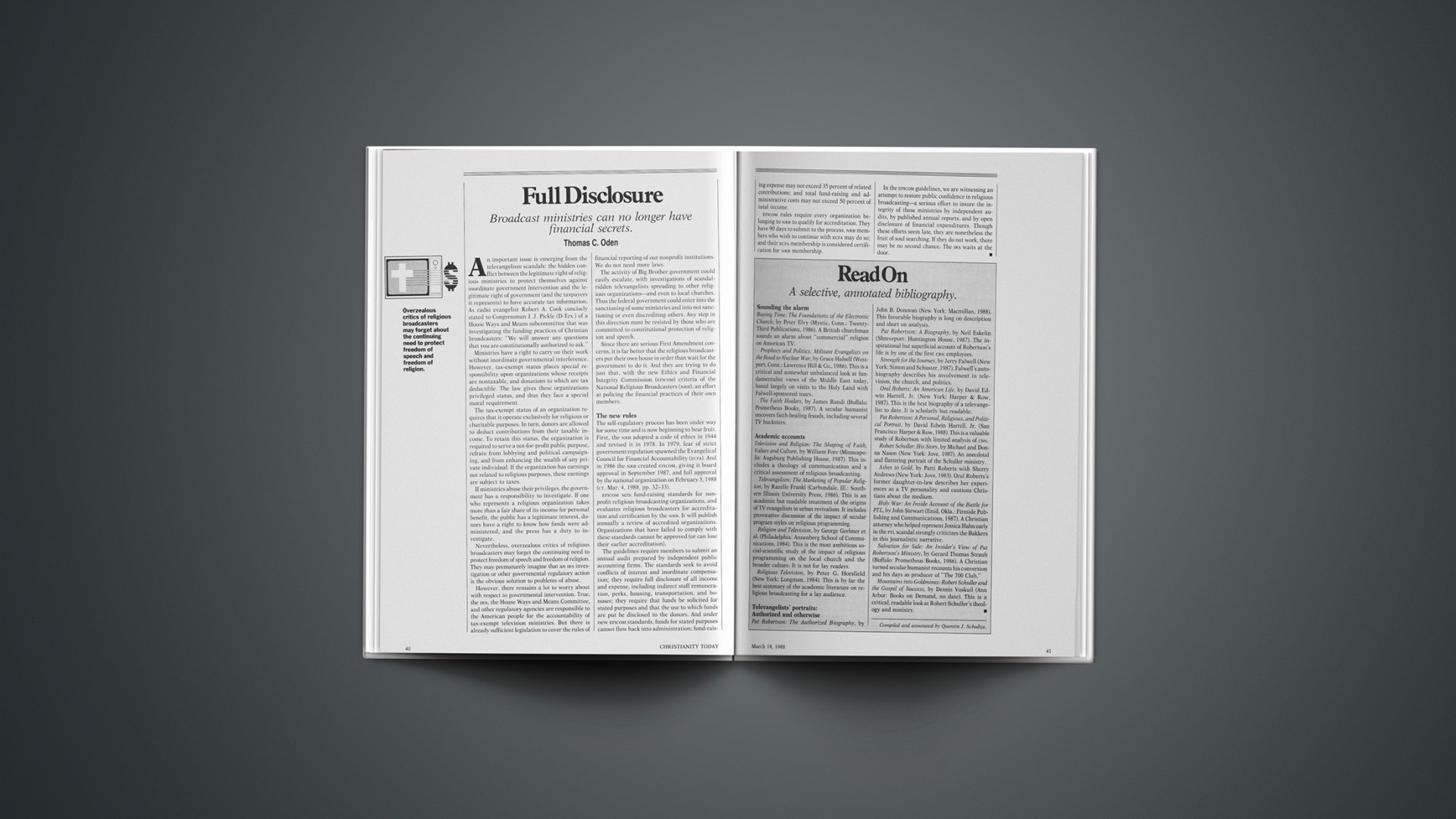
Full Disclosure

Broadcast ministries can no longer have financial secrets.

An important issue is emerging from the televangelism scandals: the hidden conflict between the legitimate right of religious ministries to protect themselves against inordinate government intervention and the legitimate right of government (and the taxpayers it represents) to have accurate tax information. As radio evangelist Robert A. Cook concisely stated to Congressman J. J. Pickle (D-Tex.) of a House Ways and Means subcommittee that was investigating the funding practices of Christian broadcasters: “We will answer any questions that you are constitutionally authorized to ask.”

Ministries have a right to carry on their work without inordinate governmental interference. However, tax-exempt status places special responsibility upon organizations whose receipts are nontaxable, and donations to which are tax deductible. The law gives these organizations privileged status, and thus they face a special moral requirement.

The tax-exempt status of an organization requires that it operate exclusively for religious or charitable purposes. In turn, donors are allowed to deduct contributions from their taxable income. To retain this status, the organization is required to serve a not-for-profit public purpose, refrain from lobbying and political campaigning, and from enhancing the wealth of any private individual. If the organization has earnings not related to religious purposes, these earnings are subject to taxes.

If ministries abuse their privileges, the government has a responsibility to investigate. If one who represents a religious organization takes more than a fair share of its income for personal benefit, the public has a legitimate interest, donors have a right to know how funds were administered, and the press has a duty to investigate.

Nevertheless, overzealous critics of religious broadcasters may forget the continuing need to protect freedom of speech and freedom of religion. They may prematurely imagine that an IRS investigation or other governmental regulatory action is the obvious solution to problems of abuse.

However, there remains a lot to worry about with respect to governmental intervention. True, the IRS, the House Ways and Means Committee, and other regulatory agencies are responsible to the American people for the accountability of tax-exempt television ministries. But there is already sufficient legislation to cover the rules of financial reporting of our nonprofit institutions. We do not need more laws.

The activity of Big Brother government could easily escalate, with investigations of scandal-ridden televangelists spreading to other religious organizations—and even to local churches. Thus the federal government could enter into the sanctioning of some ministries and into not sanctioning or even discrediting others. Any step in this direction must be resisted by those who are committed to constitutional protection of religion and speech.

Since there are serious First Amendment concerns, it is far better that the religious broadcasters put their own house in order than wait for the government to do it. And they are trying to do just that, with the new Ethics and Financial Integrity Commission (EFICOM) criteria of the National Religious Broadcasters (NRB), an effort at policing the financial practices of their own members.

The New Rules

The self-regulatory process has been under way for some time and is now beginning to bear fruit. First, the NRB adopted a code of ethics in 1944 and revised it in 1978. In 1979, fear of strict government regulation spawned the Evangelical Council for Financial Accountability (ECFA). And in 1986 the NRB created EFICOM, giving it board approval in September 1987, and full approval by the national organization on February 3, 1988 (CT, Mar. 4, 1988, pp. 32–33).

EFICOM sets fund-raising standards for nonprofit religious broadcasting organizations, and evaluates religious broadcasters for accreditation and certification by the NRB. It will publish annually a review of accredited organizations. Organizations that have failed to comply with these standards cannot be approved (or can lose their earlier accreditation).

The guidelines require members to submit an annual audit prepared by independent public accounting firms. The standards seek to avoid conflicts of interest and inordinate compensation; they require full disclosure of all income and expense, including indirect staff remuneration, perks, housing, transportation, and bonuses; they require that funds be solicited for stated purposes and that the use to which funds are put be disclosed to the donors. And under new EFICOM standards, funds for stated purposes cannot flow back into administration; fund-raising expense may not exceed 35 percent of related contributions; and total fund-raising and administrative costs may not exceed 50 percent of total income.

EFICOM rules require every organization belonging to NRB to qualify for accreditation. They have 90 days to submit to the process, NRB members who wish to continue with ECFA may do so; and their ECFA membership is considered certification for NRB membership.

In the EFICOM guidelines, we are witnessing an attempt to restore public confidence in religious broadcasting—a serious effort to insure the integrity of these ministries by independent audits, by published annual reports, and by open disclosure of financial expenditures. Though these efforts seem late, they are nonetheless the fruit of soul searching. If they do not work, there may be no second chance. The IRS waits at the door.

Read On

A selective, annotated bibliography.

Sounding The Alarm

Buying Time: The Foundations of the Electronic Church, by Peter Elvy (Mystic, Conn.: Twenty-Third Publications, 1986). A British churchman sounds an alarm about “commercial” religion on American TV.

Prophecy and Politics: Militant Evangelists on the Road to Nuclear War, by Grace Halsell (Westport, Conn.: Lawrence Hill & Co., 1986). This is a critical and somewhat unbalanced look at fundamentalist views of the Middle East today, based largely on visits to the Holy Land with Falwell-sponsored tours.

The Faith Healers, by James Randi (Buffalo: Prometheus Books, 1987). A secular humanist uncovers faith-healing frauds, including several TV hucksters.

Academic Accounts

Television and Religion: The Shaping of Faith, Values and Culture, by William Fore (Minneapolis: Augsburg Publishing House, 1987). This includes a theology of communication and a critical assessment of religious broadcasting.

Televangelism: The Marketing of Popular Religion, by Razelle Frankl (Carbondale, Ill.: Southern Illinois University Press, 1986). This is an academic but readable treatment of the origins of TV evangelism in urban revivalism. It includes provocative discussion of the impact of secular program styles on religious programming.

Religion and Television, by George Gerbner et al. (Philadelphia: Annenberg School of Communications, 1984). This is the most ambitious social-scientific study of the impact of religious programming on the local church and the broader culture. It is not for lay readers.

Religious Television, by Peter G. Horsfield (New York: Longman, 1984). This is by far the best summary of the academic literature on religious broadcasting for a lay audience.

Televangelists’ Portraits: Authorized And Otherwise

Pat Robertson: The Authorized Biography, by John B. Donovan (New York: Macmillan, 1988). This favorable bio Pat Robertson: A Biography, by Neil Eskelin (Shreveport: Huntington House, 1987). The inspirational but superficial account of Robertson’s life is by one of the first CBN employees.

Strength for the Journey, by Jerry Falwell (New York: Simon and Schuster, 1987). Falwell’s autobiography describes his involvement in television, the church, and politics.

Oral Roberts: An American Life, by David Edwin Harrell, Jr. (New York: Harper & Row, 1987). This is the best biography of a televangelist to date. It is scholarly but readable.

Pat Robertson: A Personal, Religious, and Political Portrait, by David Edwin Harrell, Jr. (San Francisco: Harper & Row, 1988). This is a valuable study of Robertson with limited analysis of CBN.

Robert Schuller: His Story, by Michael and Donna Nason (New York: Jove, 1987). An anecdotal and flattering portrait of the Schuller ministry.

Ashes to Gold, by Patti Roberts with Sherry Andrews (New York: Jove, 1983). Oral Roberts’s former daughter-in-law describes her experiences as a TV personality and cautions Christians about the medium.

Holy War: An Inside Account of the Battle for PTL, by John Stewart (Enid, Okla.: Fireside Publishing and Communications, 1987). A Christian attorney who helped represent Jessica Hahn early in the PTL scandal strongly criticizes the Bakkers in this journalistic narrative.

Salvation for Sale: An Insider’s View of Pat Robertson’s Ministry, by Gerard Thomas Straub (Buffalo: Prometheus Books, 1986). A Christian turned secular humanist recounts his conversion and his days as producer of “The 700 Club.”

Mountains into Goldmines: Robert Schuller and the Gospel of Success, by Dennis Voskuil (Ann Arbor: Books on Demand, no date). This is a critical, readable look at Robert Schuller’s theology and ministry.

Compiled and annotated by Quentin J. Schultze
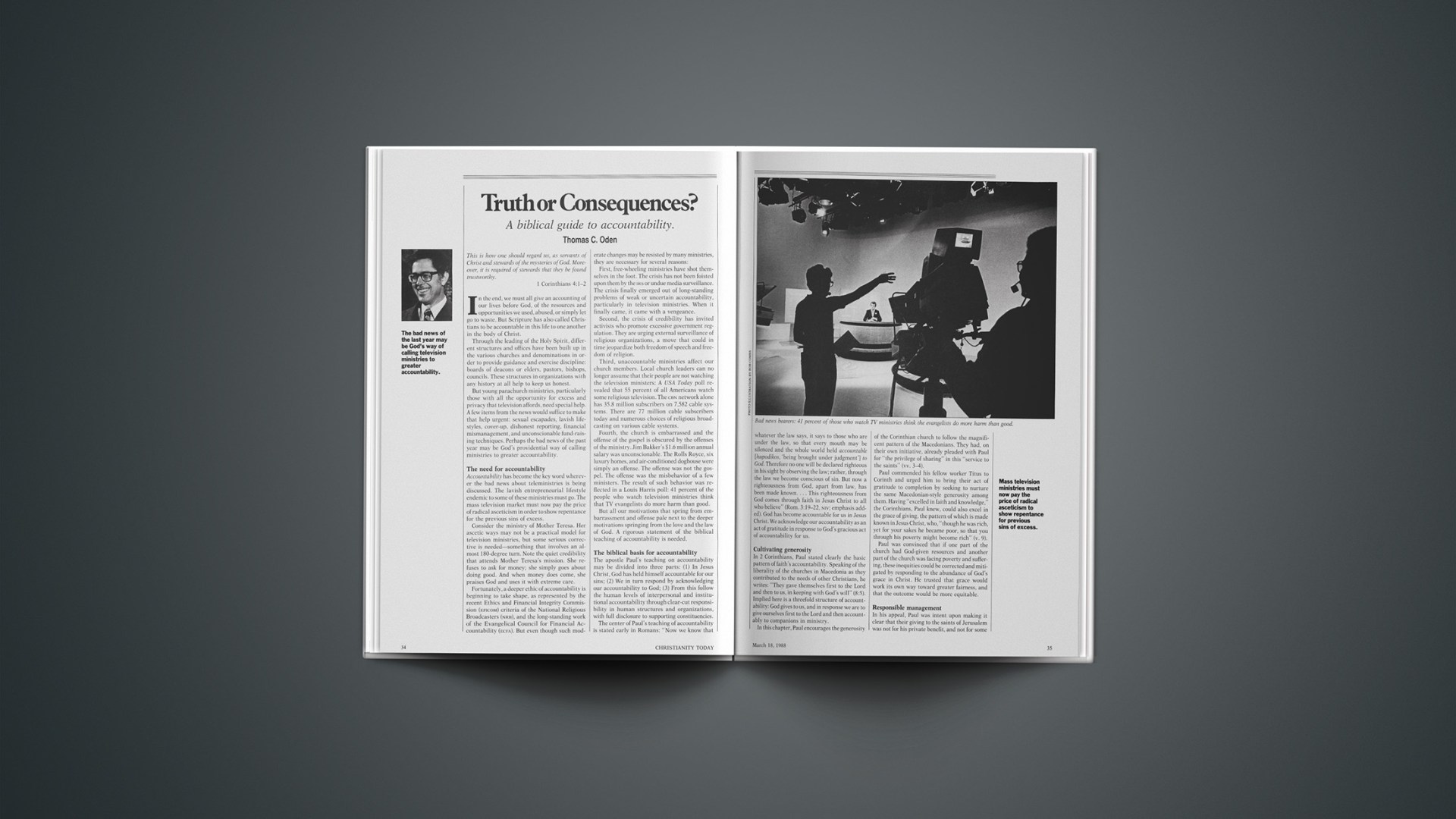
Truth or Consequences?

A biblical guide to accountability.

This is how one should regard us, as servants of Christ and stewards of the mysteries of God. Moreover, it is required of stewards that they be found trustworthy.

1 Corinthians 4:1–2

In the end, we must all give an accounting of our lives before God, of the resources and opportunities we used, abused, or simply let go to waste. But Scripture has also called Christians to be accountable in this life to one another in the body of Christ.

Through the leading of the Holy Spirit, different structures and offices have been built up in the various churches and denominations in order to provide guidance and exercise discipline: boards of deacons or elders, pastors, bishops, councils. These structures in organizations with any history at all help to keep us honest.

But young parachurch ministries, particularly those with all the opportunity for excess and privacy that television affords, need special help. A few items from the news would suffice to make that help urgent: sexual escapades, lavish lifestyles, cover-up, dishonest reporting, financial mismanagement, and unconscionable fund-raising techniques. Perhaps the bad news of the past year may be God’s providential way of calling ministries to greater accountability.

The Need For Accountability

Accountability has become the key word wherever the bad news about teleministries is being discussed. The lavish entrepreneurial lifestyle endemic to some of these ministries must go. The mass television market must now pay the price of radical asceticism in order to show repentance for the previous sins of excess.

Consider the ministry of Mother Teresa. Her ascetic ways may not be a practical model for television ministries, but some serious corrective is needed—something that involves an almost 180-degree turn. Note the quiet credibility that attends Mother Teresa’s mission. She refuses to ask for money; she simply goes about doing good. And when money does come, she praises God and uses it with extreme care.

Fortunately, a deeper ethic of accountability is beginning to take shape, as represented by the recent Ethics and Financial Integrity Commission (EFICOM) criteria of the National Religious Broadcasters (NRB), and the long-standing work of the Evangelical Council for Financial Accountability (ECFA). But even though such moderate changes may be resisted by many ministries, they are necessary for several reasons:

First, free-wheeling ministries have shot themselves in the foot. The crisis has not been foisted upon them by the IRS or undue media surveillance. The crisis finally emerged out of long-standing problems of weak or uncertain accountability, particularly in television ministries. When it finally came, it came with a vengeance.

Second, the crisis of credibility has invited activists who promote excessive government regulation. They are urging external surveillance of religious organizations, a move that could in time jeopardize both freedom of speech and freedom of religion.

Third, unaccountable ministries affect our church members. Local church leaders can no longer assume that their people are not watching the television ministers: A USA Today poll revealed that 55 percent of all Americans watch some religious television. The CBN network alone has 35.8 million subscribers on 7,582 cable systems. There are 77 million cable subscribers today and numerous choices of religious broadcasting on various cable systems.

Fourth, the church is embarrassed and the offense of the gospel is obscured by the offenses of the ministry. Jim Bakker’s $ 1.6 million annual salary was unconscionable. The Rolls Royce, six luxury homes, and air-conditioned doghouse were simply an offense. The offense was not the gospel. The offense was the misbehavior of a few ministers. The result of such behavior was reflected in a Louis Harris poll: 41 percent of the people who watch television ministries think that TV evangelists do more harm than good.

But all our motivations that spring from embarrassment and offense pale next to the deeper motivations springing from the love and the law of God. A rigorous statement of the biblical teaching of accountability is needed.

The Biblical Basis For Accountability

The apostle Paul’s teaching on accountability may be divided into three parts: (1) In Jesus Christ, God has held himself accountable for our sins; (2) We in turn respond by acknowledging our accountability to God; (3) From this follow the human levels of interpersonal and institutional accountability through clear-cut responsibility in human structures and organizations, with full disclosure to supporting constituencies.

The center of Paul’s teaching of accountability is stated early in Romans: “Now we know that whatever the law says, it says to those who are under the law, so that every mouth may be silenced and the whole world held accountable [hupodikos, ‘being brought under judgment’] to God. Therefore no one will be declared righteous in his sight by observing the law; rather, through the law we become conscious of sin. But now a righteousness from God, apart from law, has been made known.… This righteousness from God comes through faith in Jesus Christ to all who believe” (Rom. 3:19–22, NIV; emphasis added). God has become accountable for us in Jesus Christ. We acknowledge our accountability as an act of gratitude in response to God’s gracious act of accountability for us.

Cultivating Generosity

In 2 Corinthians, Paul stated clearly the basic pattern of faith’s accountability. Speaking of the liberality of the churches in Macedonia as they contributed to the needs of other Christians, he writes: “They gave themselves first to the Lord and then to us, in keeping with God’s will” (8:5). Implied here is a threefold structure of accountability: God gives to us, and in response we are to give ourselves first to the Lord and then accountably to companions in ministry.

In this chapter, Paul encourages the generosity of the Corinthian church to follow the magnificent pattern of the Macedonians. They had, on their own initiative, already pleaded with Paul for “the privilege of sharing” in this “service to the saints” (vv. 3–4).

Paul commended his fellow worker Titus to Corinth and urged him to bring their act of gratitude to completion by seeking to nurture the same Macedonian-style generosity among them. Having “excelled in faith and knowledge,” the Corinthians, Paul knew, could also excel in the grace of giving, the pattern of which is made known in Jesus Christ, who, “though he was rich, yet for your sakes he became poor, so that you through his poverty might become rich” (v. 9).

Paul was convinced that if one part of the church had God-given resources and another part of the church was facing poverty and suffering, these inequities could be corrected and mitigated by responding to the abundance of God’s grace in Christ. He trusted that grace would work its own way toward greater fairness, and that the outcome would be more equitable.

Responsible Management

In his appeal, Paul was intent upon making it clear that their giving to the saints of Jerusalem was not for his private benefit, and not for some hidden purpose. The purpose was fully disclosed, and the procedures for administration clarified.

Paul commended Titus as one who had already established a relationship of trust with the Corinthians, had previously managed the collection of funds, and had been chosen by the churches to carry out this work of offering. It is in this context that Paul says, “We want to avoid any criticism in the way that we administer this liberal gift, for we are taking pains to do what is right not only in the eyes of the Lord but also in the eyes of men” (vv. 20–21). This is the key text of Christian financial accountability. It involved a painstaking task of administration that sought every possible means to avoid allegations of unfairness. It sought to be accountable not only to God but also in the eyes of human companions and sharers in the mission.

John Chrysostom in commenting upon this passage says that Paul took every step possible to make sure that all involved would be cleared of suspicion, that persons were chosen by due process on good credentials, and that there were several persons involved in the transmission of funds, to avoid the charge of a concentration of power in the hands of only one person who could more possibly deceive. Chrysostom noted that Paul “does everything and resorts to every expedient so as not to leave a shadow even to those who might be desirous in any way of suspecting something wrong.” For “the large amount of money is enough to afford suspicion to the evil minded, had we not offered that security” (Corinthian Homilies, NPNF 2 XII, 364–5).

There is in some ministries a tendency to regard risk as a virtue in itself, and to assume that God is blessing a ministry only if it is risk taking. Calvin, however, pointed out that Paul “prudently shunned dangers, and used great care not to furnish any wicked person with a handle against him. And, certainly, nothing is more apt to give rise to unfavorable surmises than the management of public money” (Commentaries, 20, 2 Cor., 301–2).

When ministries seek resources for their mission from among the faithful, a special covenant of sacred, mutual trust is entered into before God between donors and ministers. Thus these ministries are implicitly promising that their use of these resources will follow high standards of integrity.

The mutual responsibility of donor to ministry and ministry to donor, discussed in 2 Corinthians 8, remains a crucial question today. Donors have a right and a responsibility to ask for accurate information about how their money is being used. Recipients of donor monies have a responsibility to report accurately all relevant matters, including salaries and how they are administered.

Telling The Whole Truth

Contrasting with the example of Paul and Titus is the story of Ananias and Sapphira in Acts 5:1–10—a stunning tale of cover-up and financial self-interest. It reveals the disastrous consequences of heeding the alluring voice of money rather than the promises of the gospel. The narrative follows immediately after Pentecost as testimony of divine judgment on deception and fraud discovered within the earliest Christian community.

The primary offense of Ananias and Sapphira was nondisclosure. They had sold a piece of land, taken a portion of the price and laid it at the apostles’ feet. All well and good; but they deceptively withheld part of the proceeds. Their offense was that they falsely claimed to have given the entire proceeds of the sale to the community’s fund (see Acts 4:32–37). Their offense was not a lie outwardly told, but one silently enacted, which Peter penetrated. In response, Peter pointed out that they had not lied merely to human beings, but to God. Ananias fell down and died, and his wife, who repeated her husband’s falsehood, died also.

This was a highly disturbing event: “Great fear seized the whole church and all who heard about these events” (v. 11). Yet the Spirit worked within this anxiety to enable the believing community to grow toward greater responsiveness and accountability.

Stewards Of Grace

In his sermon on “The Spirit of Bondage and of Adoption,” John Wesley distinguished between natural, legal, and evangelical existence: Natural man is self-satisfied in his natural moral competencies; legal man grows increasingly uptight about his moral deficits, and thereby more prepared to hear the gospel of forgiveness; evangelical man enters into a life of faith that lives out the gospel of justification by grace through faith.

Under pressure of crisis fund raising, there is a tendency among television ministries to sell out and reinforce the prejudices and illusions of natural man, using the gospel to reinforce the health-wealth syndrome, to promise natural man increased prosperity if he will support the ministry. The result is that these ministries do not really help persons enter into moral seriousness about their own human condition and do not really proclaim the gospel of forgiveness and responsiveness to grace.

Under the bright lights of a television studio, the gospel of forgiveness too often becomes antinomian pabulum. Grace is auctioned cheap. The television setting has the capacity to administer cheap grace at a faster rate than anything else. Because of its direct access to the homes and hearts of viewers, only television can say, “You’re forgiven,” millions of times in a millisecond—and without any hint of nurture or follow-up or accountability relationship or community of worship.

Hence, the theological problem inherent in television ministry is that it often fails to proclaim the offense of the gospel, while at the same time it reinforces illusions native to our natural, fallen, human existence, not moving moral awareness deeper into confession and repentance. The principle of accountability demands more than financial responsibility of TV preachers. It demands that they exercise a moral stewardship of their viewers as well.

Ministers were early regarded under the metaphor of stewardship, as stewards of God over the church (Titus 1:5; see also 1 Cor. 4:1–2). A steward is a manager (superintendent, administrator) of another’s household, property, or goods. In Jesus’ parables, steward is used of an employee who supervises a household or lands in the employer’s absence, called to be a resourceful manager of his master’s possessions (Luke 12:42–44). Bishops and elders were called stewards because they were expected to have the same qualities of integrity in management of the Christian community and its resources that a good manager of a household or treasurer of an organization would have. Today we call it accountability.

Paul regarded himself as a steward of Christ, “as one entrusted with the secret things of God” (1 Cor. 4:1). He instructed a younger associate in ministry to make sure that he was one “who correctly handles the word of truth” (2 Tim. 2:15). Describing his own sense of stewardship, Paul wrote: “Now it is required that those who have been given a trust must prove faithful” (1 Cor. 4:2). In ministry, having been given a trust, one must demonstrate faithfulness not by words alone but by sustained actions. Just having a good conscience inwardly is not in itself sufficient, for Paul wrote: “My conscience is clear but that does make me innocent. It is the Lord who judges me” (1 Cor. 4:4). All this is placed in an end-time context in which finally God “will bring to light what is hidden in darkness and he will expose the motives of men’s hearts” (vs. 5).

Thus, those who solicit funds to support a ministry are ultimately accountable to the one in whose name solicitation is made: Jesus Christ. Yet one cannot evade accountability to persons on the basis of the claim that one is being accountable primarily to God in Christ. For Paul’s teaching is that he is also accountable to human companions, to the Christian community that indirectly is being represented in the solicitation, as well as to those the project seeks to serve, and to donors who are making an investment of valued resources in a particular ministry—all of whom are themselves accountable before God for responding liberally to his gifts.

Is Television Just Too Big?

The best scale of accountability in discipling ministries is the small local congregation, not masses of people at a distance. Richard Baxter wisely wrote in The Reformed Pastor: “Though a minister is an officer in the Church universal, yet is he in a special manner the overseer of that particular church which is committed to his charge.” He argued that “flocks must ordinarily be no greater than we are capable of overseeing.”

Baxter envisioned a locally grounded, focused ministry in which “the diocese had been no greater than the elders or bishops could oversee and rule, so that they might have taken heed to all the flock,” and in which “pastors had been multiplied as churches increased, and the number of overseers been proportioned to the number of souls, that they might not have let the work be undone, while they assumed the empty titles, and undertook impossibilities!”

It is clearly easier to keep local churches accountable than to strictly monitor ministries of national and even international scope. The local church functions with a local structure of accountability (a constituted church order, a board, a palpable congregation) that has to be faced again and again. But in parachurch ministries, there is much less clarity about where accountability lies and what it means. It is regrettable that parachurch ministries have not learned more from traditional forms of church governance about accountability.

Ultimately, every televangelist needs a Nathan, or if not a Nathan, at least a court jester. Some who work near those who have highly influencial roles in governance need to have the gifts of wit and admonition. They must be able to give critical counsel to a leader who is constantly getting mostly positive responses. Charismatic qualities that often attach to highly public roles of ministry work against straightforward, honest feedback, accelerating the tendency of persons to give positive responses.

As University of Alabama historian David Edwin Harrell notes in his new biography of Pat Robertson, “A certain degree of authoritarianism goes with the territory when a leader gets his directions from God, but debate was also blunted by the sheer force of Robertson’s personality. Tim Robertson acknowledged that the biggest problem his father faced was getting good advice.… One of the weaknesses of a Christian organization, observed Tim Robertson, was that people were not willing to ‘fight it out.’ Meekness was a Christian virtue, as was personal kindness, but they were traits that could dampen the needed give-and-take in high-level meetings. Honest confrontation was sometimes sacrificed out of Christian courtesy, usually to the detriment of the ministry.”

A leader then is constantly tempted to imagine that everything is wonderful. The leader needs not sycophants, but someone to challenge critically.

Jesus capped his parable of the shrewd manager (Luke 16:1–13) with this penetrating question: “So if you have not been trustworthy in handling worldly wealth, who will trust you with true riches?” (Luke 16:11). Just such accountability is being called for today. The church can no longer afford the luxury of the pretense of nonaccountability. The psalmist chided those who imagine that God “won’t call me to account” (Ps. 10:13). Ministries that have ignored the warning: “Be sure your sins will find you out” (Num. 32:23), are finding that it is being vindicated sooner rather than later.

The Players:

Jerry Falwell Is Not Just Another Baptist Minister

In some ways, Jerry Falwell hasn’t changed much since he first took to the air with a local television station in 1956. Then, as now, he declared, “Lynchburg is my parish.”

Yet even though Falwell stepped down as chairman of the beleaguered PTL television network to devote more time to pastoral work at his Thomas Road Baptist Church, his parish spreads far beyond the hills of Lynchburg. When he speaks in front of the camera, more than 610,000 households in 169 markets across the country tune in to listen. And, of course, they do more than listen. When he passes the electronic offering plate via “The Old-Time Gospel Hour,” it collects more money from people in Los Angeles than from any other market in the nation. Reported income from the weekly hour-long telecast was $91 million last year.

That Jerry Falwell is not just another Baptist preacher is further driven home by the armed security guards escorting visitors inside the unmarked building that is home to his electronic empire. When he is finally cornered in his office somewhere deep within the mysterious edifice, there is more than a trace of regret in his voice as he reflects on his rise from local preacher to national celebrity. Consider a simple pastoral function such as the hospital call. “I’ve tried sneaking up a back stairwell after hours and going directly to the room of one of my members, but then somebody hears your voice and when you walk out the door you find a crowd.”

Such trials, Falwell acknowledges, are largely his own doing. “I had the idea I could visit every place in the world in five years,” he said, referring to the popularity that came with television. “I should have stayed home and put more emphasis on the local church.”

What else would he have done differently? “I would have attended seminary.” Falwell considers himself largely self-educated, having earned a degree from Baptist Bible College that is “about a notch below a B.A.… If I had spent four or five more years in school and started my ministry later, I would have accomplished more by now than I have.”

Instead of staying home and emphasizing his church, Falwell expanded the television ministry, admitting such ministries need projects beyond the usual preaching of the gospel. “If preaching the gospel and getting people saved is television’s only reason for being, it’s not enough.” To Falwell, TV is a means to a host of ends: “Television is a recruiting arm for Liberty University and a motivational tool for pastors. It is a means of telling pregnant girls there is an alternative better than abortion. Television has allowed me an opportunity to speak out on the moral and social issues of our nation.”

It has also placed him in the company of others whose sermons bounce off satellites, and he speaks out just as strongly about them as he does about moral issues. “I think the media are derelict in not exposing the Bob Tiltons, the Ernest Angleys, or the Kenneth Copelands. Instead, they go after people like me, Billy Graham, or Jim Kennedy.”

Yet Falwell welcomes the attention. “I can’t say I have enjoyed the scrutiny I’ve received in the press, but it has helped us. Actually, with two exceptions—Ken Woodward of Newsweek and one of our local reporters—the secular media have been extremely fair.”

Falwell acknowledges the need for accountability watchdogs like the Evangelical Council for Financial Accountability (ECFA), though he currently is not a member of it. His organization found responding to every little charge was “counterproductive.” But he plans to conform to the National Religious Broadcasters’ new ethical standards. “Remember, PTL belonged to ECFA and that didn’t stop them. If a person is determined to self-destruct, there’s little you can do to stop him. He will do what he wants to do until the authorities catch him.”

The Players:

Jim Kennedy’S Humble Empire

Jim Kennedy is not a televangelist and he almost has the papers to prove it. “In the Presbyterian church we have a special ordination for evangelists, and that is something I don’t have,” says Kennedy. True, he is the head of an evangelistic organization, Evangelism Explosion (EE), and each week at least 484,000 television sets are tuned in to his broadcast. But the former dance-school instructor would prefer not to be lumped in with some of his colleagues who have exploited television for personal profit.

“Had I known in 1978 what I know now, I might not have gotten into television. Even then, though, I was hearing rumors about some television ministers being in it for the money. So I decided from the beginning that I would accept no salary, no honoraria from radio or television.”

He has apparently held to that decision. In ten years of beaming sermons from his Coral Ridge Presbyterian Church in Fort Lauderdale, he has not received any income from the $12 million annual budget of the television program (though he receives royalties from his books, which are offered on the air). To further fight the image of a prime-time preacher fleecing his flock, Kennedy lives in the church’s parsonage (built for $74,000), drives a Mercury his congregation gave him three years ago, and limits his on-air appeals for contributions to about 20 seconds per broadcast.

Kennedy’s empire has a humble—almost dowdy—feel to it. It is built around a church that has a tower typical of megaministries. But the interior walls are unpainted concrete block, and the young men scurrying with television cameras remind you of the kids who always volunteered to run the movie projector in science class. His personal office is tucked into a cul de sac alongside the sanctuary, and after preaching he joins his wife in the foyer to greet worshipers.

If the intended effect of such careful attention to plain appearances was to assure followers he would never misuse their donations, it has also discouraged national media attention: “After the Jim Bakker story broke, a reporter from the Washington Post called and asked if she could come down and look at our financial records. I said ‘sure’ and that’s the last I heard from her.”

So who makes certain things are on the up and up with Coral Ridge Ministries (CRM)? Like Robert Schuller, Kennedy places a lot of the burden of accountability on his denomination, the Presbyterian Church of America. Unlike Schuller’s television ministry, the board of CRM is commissioned by the session, a group of 60 elders of the church, which in turn is accountable to the general assembly of the denomination.

On paper, it sounds fine, yet potential problems exist. As chairman of the board of CRM, Kennedy personally selects board members. And though he has never appointed a family member or relative to his board, one could accurately describe board members as Kennedy fans. “I could ask them for a six-figure salary for my services to CRM and they would give it to me,” Kennedy admits.

Other than occasional chiding from the local newspaper for not giving more money to Fort Lauderdale’s poor, Kennedy has received little financial scrutiny. Until recently, CRM did not belong to the Evangelical Council for Financial Accountability because they “thought that was for organizations that didn’t belong to a denomination.” He has kept a long-standing policy of letting any donor see his ministry’s financial statements, yet he recognizes there is little stopping him from building a personal fortune through television.

“Anybody who wants to be dishonest can embezzle money. No system of accountability, as much as they are needed, can totally keep a person from wrongdoing. What it boils down to is personal honesty and integrity.”

Good News for the Disenfranchised

Rarely do I watch Christian television programs. When I do, I get angry and embarrassed. I feel like I am watching “Begging for Dollars” or “Top My Testimony.” But I do pastor people whose lives have been changed by the gospel so imperfectly presented by many television evangelists. Their lives temper my generalized judgments and display the sovereignty of God.

Standing near me in the baptistry, she testified how her spiritual pilgrimage had led her from an antievangelical church to a ladies’ Bible study to praying to receive Christ with the host of “The 700 Club.” It was neither Pat Robertson’s theology nor his politics but the power of the Holy Spirit drawing her to believe that she, too, could know Christ.

At a luncheon, a businessman unsympathetic to evangelicalism startled me after I finished speaking apologetically about the recent TV scandals. “My mother-in-law left all her jewels to this TV evangelist,” he said. “The family was very angry. I told them—she did the right thing. For more than 15 years, the family seldom visited her, and her church never did. She looked forward every day to her hour with this TV evangelist. That was her time of inspiration. She had hope, joy, and was not afraid to die. He earned his pay!”

They lived together in the city far from our suburban church. Unmarried. Bisexual. Promiscuous. Addicted to alcohol and drugs. He visited our church at the invitation of a friend. She refused to attend. He accepted Christ. She did not. They separated over his desire for a changed life. Two years passed—I met them again. Married. Soon to be new parents. Free from addiction and immorality. Alone she had listened soberly to a TV evangelist preaching in a perspiring rage. Every sin he named she had committed. She prayed to the Christ who receives sinners, convinced that he would accept her. Their lives will never be the same.

At 82, she visited our church for the first time. “I want to be baptized,” she said trembling. We talked. “Have you ever been baptized?” I asked. “Why, no, Pastor! I’m not even saved. But I want to be.” In asking her how she became interested in becoming a Christian, she told me about the TV evangelist whose name she could not remember, who urged his audience to find a nearby church where someone could help them grow as Christians. She prayed for such a church. She drove through the neighborhood until she saw our building. That night I had the joy of watching her receive the Christ she sought. At 94, she still inspires everyone she meets with her vibrant faith.

Franchising Salvation

Ever since God first chose people to be his, those people have sought for some way to franchise salvation. Seldom have “the chosen” accepted taking the Good News outside traditional forums.

Yet the Good News really belongs to the disenfranchised. The blind beggar, the leper, the harlots, the fishermen, the tax collector, the demoniacs, the centurion, the common people, and the Gentiles—all heard the Good News outside the local franchise.

We make noble talk about reaching the unevangelized in America, but we are quite selective about the sinners we minister to. We like our sinners clean and acculturated to the importance of our style and traditions.

But a large and growing oral communication culture exists in America, and it does not fit nicely into our pews. Its members respond best to communications media that are narrative, oral, contemporary, and visual. They are suspicious of our traditions, for we resemble the Judaizers in our attempts to convert them. We regard their culture as secular and ours as so spiritual. Television is a natural entry point for the gospel into their lives. It gives them a private opportunity to hear the gospel.

An excellent case exists for convicting Christian television of many abuses. An even better case exists for indicting the church on those same charges. Merchandising, marketing, fund raising, immorality, fraud, and heresy have found great homes in Christian publishing, parachurch ministries, mission ministries, and the local church itself.

Those who mismanage funds with sinister motives have always existed in the church. They even existed right under the nose of Jesus Christ in the Twelve. We would do well to study how he illustrated that the sovereignty of God cannot be thwarted by such perversion. He is the Lord of the whole harvest, of both tares and wheat.

I do not intend to become a Christian TV groupie. But neither will I discount the place of television ministry. I know there are devoted men and women of God in broadcast ministries. I also know that the gospel—and neither the messenger nor the medium—is “the power of God for salvation to everyone who believes.”

The Great Transmission

Can Christianity survive a 19-inch (diagonal-measure) gospel?

“Worse theology may surface only with the help of better technology.” Thus Drew University theologian Thomas Oden recently addressed the influence of television on gospel communication. Oden considers television technology a “gift of God, but … subject to abuse.” It is morally neutral but seriously limited in its ability to communicate the gospel.

Others believe that television technology is inherently opposed to gospel communication.

And what of the problems that plague all forms of gospel communication, but are multiplied by the tremendous scale of broadcasting? Local churches and evangelistic organizations all struggle with fund-raising ethics, public relations problems, evangelistic follow-up and disciple-making, and the temptations of power and vanity. Does mass communication merely magnify these? Or does it create problems and temptations all its own?

The Christianity Today Institute decided to explore the problems of televangelism and the special responsibilities of religious broadcasters through the eyes of a communications expert, two theologians, a pastor, and a journalist:

  • Quentin J. Schultze addresses the question of how television as a medium contributes to and exacerbates the problems of religious communication. Schultze is chair of the Department of Communications Arts and Sciences, Calvin College, Grand Rapids, Michigan. He is the author of Television: Manna from Hollywood? (Zondervan).
  • Thomas C. Oden provides a biblical study of the ethical issues facing anyone who has the opportunity to raise, and the responsibility to handle, large sums of money for the work of the ministry. Oden is Henry Anson Buttz Proffessor of Theology at Drew University, Madison, New Jersey. He is the author of Conscience and Dividends: Church and the Multinationals (Ethics and Public Policy), The Living God (Harper & Row), and the newly published Doctrinal Standards in the Wesleyan Tradition (Zondervan).
  • Steve Wright records a parish minister’s reaction to the electronic church and the evangelistic harvest his church has reaped. Wright is senior pastor of Wesleyan Community Church, Oak Lawn, Illinois.
  • CT news editor Lyn Cryderman visited the headquarters of Jerry Falwell, Robert Schuller, D. James Kennedy, and others in order to interview televangelists on their own turf.
  • CT Institute dean Kenneth S. Kantzer concludes this report with insights for local pastors and church leaders. Kantzer is chancellor of Trinity College and professor emeritus of Trinity Evangelical Divinity School, Deerfield, Illinois.

Must TV distort the gospel?

Classic & Contemporary Excerpts from March 18, 1988

Real generosity

Let us hide away our charity—yes, hide it even from ourselves. Give so often and so much as a matter of course, that you no more take note that you have helped the poor than that you have eaten your regular meals. Do your alms without even whispering to yourself, “How generous I am!” Do not thus attempt to reward yourself. Leave the matter with God, who never fails to see, to record, and to reward.… This is the bread, which eaten by stealth, is sweeter than the banquets of kings. How can I indulge myself today with this delightful luxury?

—C. H. Spurgeon in Faith’s Checkbook

All end in the cross

Suffering is the heritage of the bad, of the penitent, and of the Son of God. Each one ends in the cross. The bad thief is crucified, the penitent thief is crucified, and the Son of God is crucified. By these signs we know the widespread heritage of suffering.

Oswald Chambers in Christian Discipline

Real Cross Bearing

To deny self does not mean to deny things. It means to give yourself wholly to Christ and share in His shame and death. To take up a cross does not mean to carry burdens or have problems. I once met a lady who told me her asthma was the cross she had to bear! To take up the cross means to identify with Christ in His rejection, shame, suffering, and death.

—Warren W. Wiersbe in A Time to Be Renewed

Hollywood’s influence, our responsibility

Even if we personally avoid the movie industry’s products, those products will have an ongoing impact on both the dreams and the fears of our culture. However uncomfortable we may be with what movies represent, we will be influenced by them because we are surrounded by their impact. If you doubt it, consider what you read on the backs of breakfast cereal boxes, the toys your grandchild wants for Christmas, the music taught in schools, and the televised versions of movies that fill some of your own evenings.… Is it not a Christian responsibility to study the cinema and to use it to advantage?

John Stapert in The Church Herald (Sept. 18, 1987)

The ages of ministry

When I turned 30 I wanted to build a large church. At 40 I wanted to learn how to preach. But at 50 I want to know God deeply.

Truman Dollar in Fundamentalist Journal (Nov. 1987)

No loose strings

We must face the fact that many today are notoriously careless in their living. This attitude finds its way into the church. We have liberty, we have money, we live in comparative luxury. As a result, discipline practically has disappeared.

What would a violin solo sound like if the strings on the musician’s instrument were all hanging loose, not stretched tight, not “disciplined”?

—A. W. Tozer in Men Who Met God

Loving people or targets?

You make us feel that you want to do good to us, but you don’t make us feel that you need us.

—an Indian Christian, quoted by Daniel Fleming in Whither Bound in Missions?

A holy truism

It is a common temptation of Satan to make us give up the reading of the Word and prayer when our enjoyment is gone; as if it were of no use to read the Scriptures when we do not enjoy them, and as if it were no use to pray when we have no spirit of prayer. The truth is that, in order to enjoy the Word, we ought to continue to read it, and the way to obtain a spirit of prayer is to continue praying. The less we read the Word of God, the less we desire to read it, and the less we pray, the less we desire to pray.

—George Müller in A Narrative of Some of the Lord’s Dealings with George Müller

Dare to Be a Micaiah

The dissenting prophet can help us meet our acute shortage of moral courage.

Today’s world suffers from a lack of moral courage. By that I do not mean physical bravery or sacrificial heroism. Admirable as these kinds of behavior undoubtedly are, they must not be confused with moral courage. Rambo, for example, is an adventurer of cold-blooded fearlessness. But he is not a model of moral courage.

To understand what I have in mind, consider the confrontation recorded in 1 Kings 22. It is the only time the prophet Micaiah appears on the biblical stage.

King Ahab of Israel and King Jehoshaphat of Judah have agreed to a united attack on Ramoth-Gilead. Their plan has been enthusiastically endorsed by Ahab’s entire religious establishment—his hired sycophants who are supposedly God’s spokesmen. But Jehoshaphat is evidently suspicious of such uncritical unanimity. He asks if there is perhaps a dissident opinion. Reluctantly, therefore, Ahab summons God’s nonconformist servant, Micaiah. They stand face to face, King Ahab and prophet Micaiah.

Common sense, caution, and compromise would seem to be the policy for Micaiah to follow. Ahab, after all, is the king whom Elijah has denounced as the troubler of Israel because he has “deserted Jehovah and gone after the Baals.” Ahab is the king who coveted Naboth’s vineyard and tolerated murder in order to confiscate property to which he was not entitled. Ahab is the king who epitomizes evil. According to 1 Kings 21:25 there has never been a man so willing to sell himself and do what is wrong in the eyes of the Lord. Ahab had no scruples about liquidating people who dared to oppose him.

So, Micaiah, why risk martyrdom for the sake of refusing to endorse a military expedition on which this incarnation of wickedness has set his heart? Why arouse the wrath of a headstrong, ruthless tyrant who already hates you? Why play the role of a fearless fool who stands alone against all these others, maybe these hundreds of state-certified prophets? They are God’s official representatives, aren’t they, members of the ordained clergy? Why, then, venture to lift your solo voice against this unanimous chorus?

You do it for a single reason: You have been commissioned by God to speak his word. He has sovereignly told you his mind, his purpose, his truth. Thus faith, obedience, and loyalty suffuse your soul with moral courage and spiritual strength. You ignore the sudden trembling of your knees, the palpitation of your heart, the tremor of your voice. You deliver your unwelcome message and are hauled off to jail, there, unless God delivers you, to await a cruel execution.

Profiles In Moral Courage

What, then, is moral courage, a courage that will nerve you and me to be Micaiah-like disciples of Jesus Christ in our time? Suppose I define by example.

Example one: In 1966 Mark Hatfield (now U.S. senator) was governor of Oregon. He adamantly opposed the Vietnam War, and had from its inception. Despite the unpopularity and the hostility his convictions elicited, he refused to soft-pedal his criticism of our involvement in that tragic country. President Lyndon Johnson, himself under pressure, sought from every conceivable source the endorsement of our continued military involvement. So when all the American governors held a conference that July in Los Angeles, the president asked that they go on record publicly as approving his policy.

At that time some of the former opponents of the Vietnam expedition had become its supporters. Feeling in our divided country was at a fever pitch. So influential politicians urged Hatfield, “Don’t rat on America.” They argued that it was his patriotic duty to get lost for a few minutes when the hour for taking the poll of the governors arrived.

One by one, under the glare of television cameras, they voted. Yes, yes, yes: 49 yeses. When it came Hatfield’s turn, knowing that his public career was at stake, he quietly voted no. Whatever we may think about the rightness of his position, we must applaud his moral courage, a Micaiah-like courage that reflected ethical conviction rooted in deep faith.

Example two: Pastor Kaj Munk was the spiritual dynamo who generated resistance against the Nazis when, in the 1940s, Hitler annexed Denmark. A Micaiah-like hero, Munk spoke out fearlessly. He said to his fellow ministers in those turbulent days, “We stand as a temple of the holy God. All others have their obligations to this or that. We alone have our obligation to the truth.” He also said, “When justice or injustice is at stake, then we must never ask whether it is worth it. For then the devil always wins. On these issues it is always worthwhile to fight.” And finally, “What we as the church lack is most assuredly not psychology or literature; we lack a holy rage.”

I am afraid the church lacks holy rage still. There is too little blazing anger, ignited by the awareness of justice prostrate in the street and often prostituted in the courts. There is complacency about the blight of lying and deceit spread across the world, the ravaging and destroying of planet Earth, the senseless killing of God’s image bearers by fanatical terrorism and warring governments, and the starvation of little children while the tables of the rich groan with delicacies.

Moral courage! That, Munk boldly insisted, was what was lacking. And in January 1944, the Nazis dragged him out into a field and riddled his body with bullets. He possessed moral courage, the courage that will nerve you and me to be Micaiah-like disciples in our time.

The Steep Ascent

Some of us have no problem acquiring moral courage. We seem to possess it genetically, by God’s sovereign endowment. We come into the world with a propensity to be emotionally and volitionally strong. But others of us are wretched candidates for withstanding hostility, misunderstanding, and criticism, to say nothing of heroic martyrdom. What can we do, then?

We must not only work to develop unshakable convictions, but we must study the lives of biblical characters like Micaiah and those witnesses of the faith eulogized in Hebrews 11. We must keep company biographically with those confessors of the faith of whom we sing:

They climbed the steep ascent of heav’n

Through peril, toil, and pain;

O God, to us may grace be giv’n

To follow in their train!

We must, above all, be in continual fellowship with Jesus Christ, who steadfastly set his face to go up to Jerusalem and to Calvary, resolutely affirming in view of the Cross, “The cup my Father gives me to drink, shall I not drink it?”

Assume then, that, never perfectly fearless, we do acquire a measure of moral and spiritual courage. What will its exercise require? Bear in mind that irrational fanaticism can be mistaken for moral courage. So too can insensitive pugnacity, carnal stubbornness, and egocentric conceit. Thus for its exercise, Micaiah-like courage requires discernment. Not every doctrinal dispute is weighted with eternal consequences. Not every church issue is necessarily an issue that involves the glory of God. No servant of Jesus Christ should take Don Quixote as his model and gallantly do battle with windmills misperceived as wicked giants. Discernment is required.

Humility is also required. I may cast myself in the role of a prophet or a martyr, imagining that I am an Elijah standing alone against the priests of Baal, when in truth I am merely a misguided controversialist—for example, defending the King James Version as the only heaven-endorsed translation of God’s Word. Courtesy is likewise required, a refusal to engage in sarcastic name calling or contemptuous judging of one’s opponents and questioning their motives. We must never forget that our blessed Lord—as Peter reminds us—when reviled, reviled not again.

And prayer is always required, prayer that out of weakness we may be made strong, that the Holy Spirit may pour his power into our minds and hearts and wills in our times of testing and crisis. Discernment, humility, courtesy, and prayer—these are required for the exercise of godly, moral courage.

The simple words Sunday school children sing about another prophet sum up the awesome challenge of a Micaiah-like discipleship:

Dare to be a Daniel,

Dare to stand alone!

Dare to have a purpose firm!

Dare to make it known!

In daring to be like Daniel, dare to be like Micaiah.

Vernon Grounds is the former president of Conservative Baptist Theological Seminary. His books include The Reason for our Hope, Evangelicalism and Social Responsibility, and Emotional Problems and the Gospel.

A Little Victory over Death

Reflections on organ transplants by a man whose heart once beat in another man’s chest.

Modern medical technology presents Christians with many questions. The fact that they are not only ethical, but profoundly personal and spiritual questions as well, came home to Robert Clouse three years ago when he elected to undergo a heart transplant. Clouse, professor of history at Indiana State University (Terre Haute, Ind.), is perhaps best known among evangelicals as editor of The Meaning of the Millennium (InterVarsity Press, 1977).

The following account was written with associate editor Rodney Clapp, who researched ethical concerns surrounding the transplant issue.

I wear a surgical mask in public. Some children, more candid than polite, stare at me. Once in a while one asks his embarrassed parent if I’m likely to hurt anybody. My wife, Bonnidell, joshes me: She says I must be careful not to wander into an unfamiliar bank with the mask on. But I feel a bit ornery now and then, so someday I may.

Other than the papery, yellow tissue across my mouth and nose, which I wear because of my increased susceptibility to infection, I don’t look so different. Due to the prescribed drugs I’m taking, my face is rounder than it once was. I’m a little hairier and no longer balding. But only my long-time friends would notice.

What is really different is underneath, unseen, quietly ticking. My heart is not the same one I was born with and that pumped blood through my body until I was a 53-year-old man. My new heart is two years old. Or should I say 32? The person who gave it to me was 30 when he died.

The History Of A Dream

Organ-transplant patients unsettle many people. A social-service worker at the hospital where I had my surgery tells me transplant patients have a hard time getting jobs, even job interviews. Potential employers fear these prospective employees may keel over upon hearing a difficult question. Or, as the social-service worker more colorfully puts it, “The interviewers can’t wait to get out of the room because they’re afraid the heart might fall out on their desk.”

I understand the uneasiness. I hardly thought twice about transplants until my life depended on one. Since then, of course, I’ve thought a good deal about them.

As a historian, I cannot avoid viewing the present from the perspective of the past. When I survey the parade of precedents to modern organ transplants, our contemporary uneasiness about transplants loses a little of its edge.

As early as 2000 B.C., surgeons attempted to graft skin from the neck or cheek to repair a mutilated nose, ear, or lip. In the third and fourth centuries A.D., there originated legends about the twin saints Cosmas and Damian. The pair was unusual in the annals of medical history, refusing to accept any fees (they were consequently beheaded). But even more unusual, and historically dubious, is the tradition that Cosmas and Damian amputated a cancerous leg and replaced it with the healthy limb of a person who had died earlier the same day.

The Middle Ages brought accounts, possibly with some basis in fact, of masters whose noses were replaced with those of their slaves. (Legend had it that the slave who sacrificed a nose must scrupulously be kept alive; if he was not, the transplanted nose would shrivel and drop off the master’s face.)

In the sixteenth century one Gasparo Tagliacozzi took nasal transplantation a step further. He reconstructed the nose with a flap of skin from the inner, upper arm of the patient. The arm was put in a cast and held to the face for two or three weeks, allowing the arm skin to affix itself to the face. Afterward Tagliacozzi would cut the skin away from the arm. Since all of this occurred without the benefit of anesthesia, it is little wonder that the procedure was basically unappreciated.

From the eighteenth century forward, medicine made rapid progress: methods of tying up weakened arteries were developed and perfected, along with aseptic (infection-free) surgery, anesthesia, blood and tissue-typing, and other medical advances essential to modern transplant technology.

And in the twentieth century, one step has rapidly followed another, like a toddler learning to walk who hurtles forward faster and faster to retain his balance:

  • In 1913, Dr. Alexis Carrel transplanted a kidney from one cat to another; later he worked with Charles Lindbergh (following Lindbergh’s historic transatlantic flight) to develop a perfusion machine that drenched removed organs in blood and sustained their life.
  • In 1954, Boston doctors successfully transplanted a kidney from one twin brother to another.
  • In 1960, Sir Peter Brian Medawar won the Nobel Prize for his study of organ rejection, pinpointing parts of the immune system that attack transplanted tissue.
  • In 1963, a Paris physician saved a man dying of leukemia with a total replacement of bone marrow; the year also marked the first successful liver transplant.
  • In 1966, a Minnesota doctor successfully transplanted a kidney and pancreas into a 32-year-old woman.
  • And in 1967, the South African surgeon Christian Barnard made history with the performance of the first human-to-human heart transplant (animal-to-human transplants were previously attempted).

Organ transplants are not yet commonplace. But in 1986 there were 8,800 kidney transplants (nearly twice the number in 1981), 1,300 heart transplants (three times the number in 1984), and 924 liver transplants (double the number in 1984). Survival rates have also briskly risen: 90 percent of kidney transplant patients now survive more than a year, as do 85 percent of heart-transplant patients and 65 percent of liver-transplant patients.

But these are just statistics. The fact is that each number represents a person: a man who has a family, a woman with friends and neighbors who call her by name, a child with a dog that greets her home from school. Each number represents a person who in an earlier time would certainly have died prematurely, but who today has a second chance. I am one of them. And I am grateful.

A Radical Step

In the 1983–84 school year I was visiting professor of evangelical Christianity at Juniata College, in Huntingdon, Pennsylvania. When I went to Juniata, I had been teaching at Indiana State for 21 years, and Bonnidell had been teaching educational psychology there for 17 years. We were excited about a change of place and pace.

The Pennsylvania fall was everything we could have expected. Juniata’s campus stands on steep, tree-blanketed hills. Walking to classrooms, glancing out the window while I lectured, hiking with Bonnidell in the evenings, I saw the foliage exploding in reds, oranges, and yellows. I felt alert and peppy, with nature rioting around me and the brisk air stirring my lungs.

Of course, fall has another side. Those beautiful leaves are not releasing their grip and drifting to the ground simply so poets can rhapsodize. Fall is a season of death. I never thought about that at the time.

But gradually Bonnidell and I realized something was wrong. First I couldn’t climb the hills without losing my breath. Soon I had to sit down to reserve enough energy to teach an entire period. Often I could not summon the strength to carry groceries inside the house. Trying to sleep, I would wake up short of breath. When Bonnidell hugged me, she heard rasping and gurgling noises inside my chest.

Finally, I visited a doctor. He told me I probably had a heart problem. But I knew most heart problems were caused by arterial constriction, which meant accompanying chest pains. And I had no pains; I just couldn’t breathe. I dismissed the small-town doctor’s diagnosis, but took his advice to have it checked out back in Indiana.

Over the Thanksgiving holidays, I consulted with our family physician in Terre Haute. He heard a description of my symptoms, took x-rays, and sent me immediately to a specialist in Indianapolis. On Thanksgiving Day, sitting in a hospital, I learned I had congestive cardiomyopathy.

Cardiomyopathy often is caused by an enigmatic virus that settles in the left heart muscle and deteriorates it. No one knows where the virus comes from or who is likely to catch it. But as a result of it, my heart was enlarged to two-and-one-half times its normal size. The amount of blood pumped into the aorta was diminished; that explained why I was so weak. And the right ventricle continued to pump blood into the pulmonary circulation; that explained why I had so much trouble catching my breath.

Neither Bonnidell nor I had spent much time in hospitals. I hadn’t even had a physical for 20 years. On top of that, I’m basically an optimist. We were told cardiomyopathy could not be conclusively treated: About one-third of its victims get better, one-third stay the same, and one-third get worse. So we took the huge doses of medicine the specialist prescribed and headed home, certain I would recover.

During the next year and a half, I spent most of my days on the couch. I could no longer climb stairs or lift anything weightier than a couple of books. I lectured sitting down. The doctors juggled drugs, trying to steady the condition. But it was out of control, headed downhill and gaining speed.

On the weekend of Memorial Day, 1985, I gained 30 pounds with water retention. My ankles and legs were swollen, my abdomen bulged tight as a drumskin. By this time I was tired of the entire, drawn-out struggle. I felt near death. Bonnidell later told me the life had left my eyes.

Then my cardiologist, who had earlier suggested a heart transplant, began to urge it in earnest. It seemed such a radical step that Bonnidell and I had not pursued it before. Now I found myself alone during long nights in a hospital room, praying and thinking.

Lonely Nights, Anxious Thoughts

Before and since those lonely nights in the hospital, I have given much thought to the ethics of organ transplantation. Most of my friends have supported my decision to have the transplant, but some have challenged it. One acquaintance told me he could not believe that I, a devout Christian, did not choose simply to die.

The issue revolves around our understanding of the whole person. For Christians, a person is not merely a disembodied soul or a soulless body: a person is a unity of both—an ensouled body or an embodied soul, as it has often been put. Moreover, our bodies (through skin, eyes, ears, noses) allow us to perceive God’s creation, to express ourselves to God and to other persons. And our bodies will themselves be resurrected.

But what does it do to the person—an embodied soul—if some body parts are replaced with those of another person?

In one sense, we have long been interchanging bodily parts and using artificial parts—to the point that we now do so without a second thought. Many of us wear glasses or dentures, for example, and do not consider it a moral issue when an amputee straps on a prosthetic leg. We donate blood and, when necessary, gratefully receive transfusions.

In fact, this unity of body and soul—the person—constantly shifts and changes. I change internally by reading different books, making new friends, or visiting a strange culture. Yet I continue to think of myself as the same person I was before I read those books, made those friends, or visited that country.

Similarly, my body is forever changing. Every seven years its entire cellular structure is revolutionized. My fingernails and toenails replace themselves. I lose hairs and grow new ones. My blood sugar content fluctuates. My stomach and intestinal contents are different after each meal or even each aspirin.

With soul and body, there is both change and consistency. We are persons who develop, but we each develop along lines consistent with our former personhood. The outlines of the body and soul demonstrate a basic continuity between what they were yesterday and what they will be tomorrow. Even at a twenty-fifth high school reunion we see similarities in the inner lives of our former classmates and the persons they are today. “Ah,” we say, “the same old Jack: still a card.” And we recognize (at least after introductions) the bodies of these old friends.

So it is, I think, that if a child’s tonsils or appendix were removed, no one would regard her as a lesser person than she was before the surgery. Nor do we look on a pregnant woman as a new and odd creature, although she carries within her a second heart, a second pair of kidneys, and other organs—all with a genetic makeup dissimilar to her own. Even the transplant of a mundane organ such as the kidney does not give most people second thoughts. But somehow the heart is different.

I suspect this is the case because the heart is noticeable. The kidney, the liver, and other unsung organs are the coal miners of the body, working unseen and unheard, little respected, and likely to be neglected. Not so the heart. With attention, we can sense its presence. It pounds against our rib cage to protest overexertion or fright. If the liver begins to fail, we won’t know until related problems are apparent. But if the heart drops its tempo, we head for the clinic straightaway.

The heart is also one of the body’s most glamorous organs. It, not the bladder, is what we write songs about and draw on valentines. And in the Bible, the heart is the symbolic center of body and soul. When persons harden their hearts, they have rejected God. They accept God with pure hearts, and are called to love God with all their hearts.

The heart’s conspicuousness and symbolic significance make it the organ that has most profoundly caused people to stop and think about the rightness or wrongness of organ transplants. As Christian ethicist Paul Ramsey puts it, we find ourselves musing, “What is man now that his heart has been reduced to a replaceable muscle?”

Yet we have known for a long time that feelings and the will do not literally reside there. The heart symbolically stands for the whole person, and the whole person remains even if he or she has altered some convictions or even the physical organ we call “heart.”

A new “replaceable muscle” beats in my chest. But I believe I love God with the same heart—that is, my consistent but developing core self—I did when I confessed Jesus as Lord 39 years ago.

Three Theological Considerations

So, alone in my hospital room and since, I have not found good reason to oppose organ transplants in general, and a heart transplant in particular. But I not only thought in my hospital room; I prayed. I won’t pretend to have come up with a neat, systematic answer during those anxious nights in Indianapolis. But meditating on it since, I can see that I was moved in favor of organ donation and transplantation by three strong theological rationale.

First, the “cultural mandate” of Genesis 1:28: “God blessed them and said to them, ‘Be fruitful and increase in number; fill the earth and subdue it” (NIV). Many theologians have understood this command to mean that humanity should explore, cultivate, and develop the resources of the Earth. They extend the mandate to include human existence, one aspect of God’s creation. As Anthony Hoekema writes, “Man is called by God to develop all the potentialities found in nature and in humankind as a whole. He must seek to develop not only agriculture, horticulture, and animal husbandry, but also science, technology, and art.” If Hoekema interprets fairly, organ transplantation is a legitimate extension of humanity’s mandate, the exercise of God-given creativity in the cultivation of natural potentials. We should oppose it no more than some of our ancestors should have opposed anesthesiology, saying God flatly willed men and women to suffer in surgery.

Second, organ donation and transplantation is highly Christian because Christians regard death as an enemy. In Paul’s words, it is the “last enemy” (1 Cor. 15:26). Although life is not the ultimate good—not in itself “sacred”—the biblical bias is emphatically on the side of life. The Bible tells us to “choose life” (Deut. 30:19), and that Jesus came so we might have eternal life (John 3:16). It is a deeply Christian deed, then, to stand against death wherever and whenever we can. Of course, Jesus alone gained the final, conclusive victory over death. But our little victories imitate his great victory in a significant provisional sense.

And third, organ transplantation echoes the example of Jesus Christ and his victory on the cross in another sense. He saved us from sin and death, after all, by offering up his body. Celebrating the Last Supper, we remember that we live because he gave his body and his blood. The Cross is the symbol of his self-giving, and when we choose to follow him we are called to make his Cross our own. There are few more dramatic ways we can give to someone else, in the spirit of that Cross, than to share our body and our blood.

Waiting For The Real Thing

However ethical I may have thought organ transplants to be, it was not an easy decision to go ahead with the operation. I knew I might well not survive the surgery. The medication required to avoid organ rejection after the surgery would have dangerous side effects, such as an increased likelihood of cancer. And the entire procedure in 1985 was costly—around $100,000. We certainly did not have the funds for it. (Today, heart-transplant costs average about $50,000. Uncomplicated cases average $30,000, comparable to the cost of heart-bypass surgery.) I learned that insurance companies had been sporadic in helping to pay for transplants, and I did not want Bonnidell saddled with an impossible debt.

Which was exactly what I told Dr. Harold Halbrook, the chief transplant surgeon at Indianapolis’s Methodist Hospital. Looking back, I think it a wonder that Halbrook did not leave me to die. But Methodist Hospital is unusual in the amount of funds it expends on patients who cannot pay, and Halbrook said he would only expect me to make an earnest effort to get my insurance company to handle the bill. On that basis, I agreed to be a candidate for a transplant.

I say “candidate” because the simple need for an organ does not guarantee your name will go on the waiting lists. There are psychological tests to be considered, as well as the condition of the rest of your body. It must be determined that you have no additional organ-system failure, infection, or malignancy—any of these factors might prevent long-term survival. And psychological stability is essential for enduring the stress of waiting for a donor, as well as complying with the post-transplant routine of medicine, diet, and exercise.

Maybe since my wife is an educational psychologist, I take the psychological concerns seriously. There have been cases of men getting worried and depressed after they learned they were carrying a heart transplanted from a woman. Bigoted people have worried they might be receiving a heart from a person of another race. And doctors have reported some patients wondering if the donor “had Jesus in his heart.” Emotional problems, of course, hardly increase the chances of survival for the transplant patient.

After interviews and extensive physical evaluations, I was accepted into the program. Then I rented a beeper, to wear day and night. Because an extracted heart will remain viable for only four hours, I had to be at Methodist Hospital, 70 miles from Terre Haute, within 90 minutes of my summons. If I could not make it, I was to stop and telephone the hospital, at which point a helicopter would be sent to pick me up.

The whole affair, then, had an air of extreme drama about it. For six tense weeks in the spring and summer of 1985, Bonnidell and I waited. My friends were alarmed at how weak I was becoming. Medicines turned my skin gray. Doctors told me my heart was circulating only eight cubic centimeters of blood with each beat; 50 is normal. One physician said he had never seen a man on his feet with so little blood flowing.

I was cold—most of the blood in my body, circulating so feebly, left the extremities to gather around and sustain the vital organs. In addition, my digestive system and bowels stopped functioning almost entirely. Whether or not I would survive until a new heart was available was very much an open question.

The beeper sounded false alarms twice. Once it was merely signalling a dead battery. It went off a second time when I was getting ready for bed. Sitting on the edge of my bed, I nervously dialed the hospital, only to learn that someone had called a wrong number. Bonnidell and I tried to fall asleep peacefully, knowing we were facing at least another day of waiting.

At last, on July 8, the beep was the real thing. When I called the Methodist Hospital hotline, an encouraging voice asked, “Dr. Clouse, how would you like a new heart?”

A Bramble Patch Of Questions

I know little about the young man who gave me a new heart. I only know that, on a summer day in 1985, something happened in Buffalo, New York, and a man was killed. He had a strong heart. Its tissue type was close to mine. He had formerly agreed to donate his organs, or his family agreed on his behalf after his death. Telephone calls were made; computer banks were searched. My name came up. And while I was driving from Terre Haute to Indianapolis, my new heart was airborne, winging halfway across the country.

I can’t say that they were prominently on my mind at the time, but the entire process raises a bramble patch of very pointed questions.

The first is the question of the death of the donor. The determination of death is no longer so simple a matter as placing a mirror under a person’s nostrils. Machines can now keep a body breathing and blood circulating for days (though not indefinitely), even when the brain is irreparably damaged and the body will never again breathe and circulate blood on its own. Hence the introduction of the notion of “brain death.”

The fear, of course, is that an organ donor will be pronounced brain dead prematurely, for the sake of an organ recipient. Many people who consider signing an organ-donor card admit to wondering, “What if I have an accident and it gets touchy? Will the doctors give up earlier when they know I’m an organ donor? Will they declare me brain dead when I’m not really dead, and remove a vital organ for a transplant?”

That fear is allayed when we understand exactly what brain death is. It is not a “persistent vegetative state” where only part of the brain is destroyed, but the incapacitation of the entire brain. Catholic ethicist John Dedek puts it well: “A flat EEG is not in itself the decisive element. No one is to be declared dead who still has the potency of spontaneous respiration. But one who has no hope of ever recovering the power of spontaneous respiration because of irreversible destruction of the brain is no longer a living being, even though his heart and lung functions are being mechanically maintained.”

Brain death, then, is not a word play enabling venal physicians to remove organs prematurely. It is the result of the necessary recognition that medical machinery can now preserve, as Paul Ramsey remarks, “the vitality of specific organs of an unburied corpse.”

The physicians struggle as valiantly as ever against death, whether or not the patient is a prospective organ donor. I have seen and heard my doctors, who have performed dozens of transplants, curse motorcycles as “murder cycles” and stalk away from the emergency room in depressed resignation. (Significantly, hospitals guard against even a hint of deaths prematurely declared; for example, doctors attending a potential organ recipient are never the same ones attending a possible organ donor.)

There is a second, and related, question: the question of organ procurement. The current U.S. policy for procuring organs is “express consent”: No organs are taken for transplantation unless the donor (or the donor’s family) has expressly donated them. Some ethicists and physicians, bemoaning the severe shortage of organs available for transplant, have argued for a policy of “presumed consent.” Under such a policy, organs could be taken for transplantation automatically, unless the deceased or the deceased’s family expressly forbid it. (This policy is already in effect in Denmark, France, Israel, Italy, Spain, and other countries.)

I personally favor express consent. Presumed consent smacks of statist coercion. It makes organ donation a matter of “societal taking” rather than “personal giving.” And in a way it weakens the case for organ transplants. It creates the impression that we cannot offer people persuasive reasons to donate their organs voluntarily.

The third question arising from the process that granted me a new heart is the question of allocation—how to determine who gets the scarce organs that are available. A fairly complicated set of criteria has developed. It includes the potential recipient’s age, emotional stability, physical condition, nearness to death, and tissue type. Most ethicists have argued, and rightly so, against making one’s estimated social worth a determining factor. We should also strictly prohibit any commercialization of the transplant process (though some have actually suggested organ donations might be used as partial payment of hospital bills or estate taxes).

As the system now stands, relatively wealthy people are more likely to receive transplants, since only they can afford them. (Although we can make allocation more just by altering insurance, Medicare, and other policies in a direction that would make transplants widely affordable.) However, laying aside the criteria determining the likelihood of survival, allocation should basically be a matter of first come, first served. In dealing with scarce resources, that is the way of a democracy. And as for the kingdom of God—there a poor man is no less valuable than a rich one.

Organ transplantation will increasingly confront us with these and other tough questions. For example, there is some pressure to introduce a new definition of death—“cognitive death”—for those in a persistent vegetative state. And some doctors favor exploiting the organs of anencephalic infants.

I cannot rest comfortably with such proposals. But as they are more intensely debated, it will be important to keep them separate from the legitimacy of organ transplants in general—just as we regard driving automobiles to be perfectly moral, even though they can be used to run down pedestrians or rob banks.

A Surgery Observed

Heart transplants, as I’ve said, are getting more and more common. But not too many people in Terre Haute, Indiana, have had them. So a local television station wanted to tape the surgery and televise parts of it. Since Bonnidell and I are educators, we agreed.

Only within the last year did I find it in myself to watch the videotape. On the tape I see myself reclining, in a blue gown, on a hospital bed. My thinning hair has fallen back off my forehead. Some of it rests across the white pillow. The camera does not capture my anxiety, really, or my weakness. But I do look tired. The reporter asks how I am feeling, then the top of a microphone appears in front of my face. With a wan, slightly raspy voice, I say that I am ready, that I am a little worried, but that “I have a lot of confidence in the surgeon.” I am a little self-conscious about this being on television, but I add, “And in God.”

Then follows several feet of tape depicting the preparation of the medical team. Eventually the camera catches me on a gurney, being wheeled through the halls. The gurney breaches and is engulfed by swinging doors. Bonnidell lingers behind, watching me disappear. She is not bent, but stands tall and confident. The reporter stops to offer a few encouraging words. Bonnidell smiles, but keeps glancing at the doors.

The scene changes, and we are in the middle of the operation. The camera gazes in wonder at all the equipment: tubes, pumps, panoplies of surgical instruments, monitors. My face, of course, is not visible. All that can be seen of me is a cavity in my chest, with several hands rummaging in it.

Soon the new heart is carried in, borne past the high-tech pumps and monitors in an ordinary picnic cooler. Watching now, I almost expect a surgeon to drop his instruments and exclaim, “Here’re the hot dogs!” Instead, someone removes the top and draws out the new organ, the one that today pounds inside my chest. It is in a plastic bag, dripping the cool solution that surrounded it. A nurse extracts the heart from the bag. It has a yellow cast in the lights.

The nurse holds the old heart, so large she must cradle it with both hands. The pitiful, faithful thing still quivers a little, reminding me of a marathon runner who has run past exhaustion and, lifted off the ground by those who assist him, uselessly churns his legs in the air.

Someone cups the new heart in the palm of one hand. It is membranous, slick, and, I imagine now with the pride of ownership, sleek. It is only 30 years old, and ready to take on a new challenge. It takes a stab at a few beats even as they sew it into my body.

Life After Transplant

It comes as a surprise to many people that, with most transplants, the surgery is far from the most tricky part. A heart transplant, for example, is technically a simpler operation than a heart bypass. In a transplant, the surgeon need only reconnect the large and manageable aortae; in a bypass the surgeon works with much smaller veins.

What has stymied and frustrated successful transplants is the body’s immune system, which attacks the alien tissue of the new organ. Dr. Frances Moore, a Harvard surgeon, compared the process to trying to make a ship without a bottom float with a cargo of cork. The ship will float if you can get the cargo in. The sensitive part is keeping it afloat until the cork is loaded.

Similarly, physicians caring for transplant patients must suppress the immune system enough that the new organ won’t be rejected, but not so much that the patient succumbs to a stray infection. The greatest advance in immunosuppression, so far, is the 1980 development of Cyclosporine.

Cyclosporine takes less of a scattergun approach than other immunosuppressive drugs, which basically depress the entire immune system. It targets T cells, the particular components of the immune system that attack alien tissue.

But Cyclosporine is only a piece of my daily regimen as an organ transplant recipient. Each day I take Tenormin and Apresoline to stabilize my blood pressure; Lasix, a diuretic; Persantine and Ascriptin, blood thinners thought to prevent or reduce chronic rejection as a result of coronary artery disease; Prednisone and Imuran (like Cyclosporine, immunosuppressants); and various ordinary medicines to settle a stomach that balks at being made into a portable pharmacy. My lifestyle must also include strict attention to health indicators. So every morning I weigh myself, take my pulse, temperature, and blood pressure. And three times a week I exercise by walking or bicycling.

My depressed immune system is why I wear a mask and frighten little kids. It is also why I got a terrible case of shingles, an ordeal more painful than the heart surgery and subsequent recovery; and why I have caught serious flu viruses—once a fever made my teeth chatter so severely that a filling cracked.

There are other prices an organ transplant recipient must pay. I have a strict diet to follow, and my life depends on it literally and immediately. Some of the drugs I take increase my chances of cancer or other health problems. And I may die at any time. My transplanted heart is not as predictable as a healthy, original organ.

But ask me if it was worth it and I don’t have to think about the answer. I preach every Sunday at the First (Grace) Brethren Church in nearby Clay City, Indiana. I’m finishing books and articles that otherwise would have remained unwritten. I’m still in the classroom—in fact, I was able not to miss a single semester—serving my life’s calling, with students I enjoy tremendously. (Shortly after the transplant, women students were showering me with sympathy kisses. “That’s all right,” Bonnidell said. “You look so beat up they know you’re harmless.”)

Another chance at work, though, isn’t the half of it. Getting out of bed in the morning is special. Every once in a while I pull off the shelf a book that’s been waiting a long time, crack it open, and realize: I almost didn’t get to read this one. I’m praying more intensely and learning about the spiritual qualities that truly matter—love, joy, patience, peace, and compassion. I’m more concerned with helping people out now, buying a gift for a friend or slipping money to someone in need. Out driving, I stop for a family on bicycles, mother and dad and little boys filing ragtag through the crosswalk. I revel in it.

The biomedical advances of the past two or three decades have given us all plenty of ethical headaches. But I’m here to tell you headaches are not the only things they bring.

Robert G. Clouse is editor, with his wife, Bonnidell, of the forthcoming Women in Christian Ministry: Four Views (InterVarsity).

Prolonging Life to Promote Life

Can the church condone transplanting organs from babies born without brains?

Should the lives of anencephalic newborns be prolonged so their organs can be donated to other infants?

Late last year, a California couple learned that their unborn child was anencephalic—missing most of its brain. Hoping to bring good out of their personal tragedy, Brenda and Michael Winner found a hospital that, after delivery, would tend to their child in such a way that its organs could be donated to another infant.

Anencephalics, in the words of one ethicist, “represent the nadir of handicapped infants.” Many are stillborn, and most who are not die within a week.

The anencephalic has no forehead. A mass of brain tissue, capped by a membrane, tops its shortened head. Its eyeballs usually bulge, and sometimes its ears touch the shoulders.

Both cerebral hemispheres are absent, meaning the child has no potential for conceptualization, memory, or communication with other human beings. It basically possesses only a brain stem, the “primitive” part of the brain accounting for reflexive actions such as breathing and the beating of the heart. At the same time, anencephalics who are born alive cry, swallow, and vomit like other infants. They grasp objects and react to pain.

In the end, the Winner baby was stillborn and the ethical questions surrounding their particular situation rendered moot. Yet the hard questions remain.

The church, like the rest of society, has to face the ethical dilemmas presented by anencephalics and transplantation, and it ought to consider them on its own terms. Christians are people who risk their lives on the truth of God’s kingdom, revealed in the life of Jesus Christ. So whatever the wider society’s decisions, the church needs to ask: How do we treat the anencephalic in such a way that our words and actions point to the kingdom?

On The Church’s Terms

The large majority of physicians and medical ethicists firmly—and rightly—oppose prematurely ending the anencephalic’s life in order to use its organs. But this issue has a twist. Given the ordinary “comfort care” treatment of nourishment and warmth until their death, anencephalics do not meet current brain death criteria until severe asphyxia has occurred. Organs cannot be taken until brain death criteria are met; but severe asphyxia damages the organs beyond usefulness. The only way to make use of the anencephalic’s organs, then, is to put it on a respirator, maintain its breathing until brain death is determined, and then donate its organs if a recipient is available.

Thus the dilemma. Should the anencephalic be kept alive merely to donate its organs? Or is this exploiting an unfortunate, helpless human being, making it the means to our own questionable ends?

Some would neatly avoid the moral quandaries by declaring that the anencephalic infant, since he or she has no potential for communicating or relating on a personal level, is not a person: It is only persons that we should treat as ends in themselves. Therefore, it is not wrong to prolong the anencephalic baby’s life in order to provide organs that will help another infant.

But the church can never be comfortable with so simple a dismissal of the anencephalic’s personhood. Christians insist that persons, whatever else they are, are a complement of soul and body, to be resurrected as a whole: “What is sown in the earth as a perishable thing is raised imperishable” (1 Cor. 15:42, NEB). Since the anencephalic indisputably possesses a human body, Christians will have due caution about declaring that it cannot be a person.

Are there, then, sufficient reasons to treat the anencephalic as a means to the end of better health for another infant? There are at least two reasons we should consider the matter further. First, God’s kingdom calls us to care for the weak and helpless. Concerns for the poor, the sick, the orphaned and widowed, run throughout the Old Testament. Jesus ministered primarily to the same group of people, and said, “How blest are you in need; the kingdom of God is yours” (Luke 6:20). Certainly the anencephalic is among the weakest of the weak, the most needful of the needy. But we must also consider infants in need of donated organs. They, too, are needy—if they were not, there would be no call for the use of the anencephalic’s organs.

Second, God’s kingdom calls us to promote life, not merely guard it. Christians are not concerned with mere survival, but with the good life formed in discipleship. “Choose life,” the Israelites are told (Deut. 30:15–16), and working actively for the wholeness of life may mean we cannot uncritically accept the flaws of life as we know it at the moment, but we must seriously consider the possible benefits each medical innovation presents. If some babies will live a richer, longer life after receiving organs from anencephalics, this in itself is an argument for thinking long and hard about prolonging the anencephalic’s life to do such transplants.

Precedents And Tragedy

There are precedents for using one person as a means to health for another. The bodies of brain-dead mothers, for instance, have been sustained until the fetus reached an age of viability. In such cases, the dignity of the person being “used as a means” is being respected. The mother would want her child to live: If she could consciously choose to stay on a respirator in order to give the baby life, she would surely do so. In expecting as much of the mother, we respect her capacity to give and to care for others.

Is it possible that parents of an anencephalic might expect (and respect) the same in their child? It may be, in fact, that this child, said to be incapable of relating to others, can enter into relationship in one poignant and significant way: by having its organs shared.

But such talk must be tentative. It is open to abuse and rationalization. There are many specific questions to be answered before the use of the anencephalic’s organs should be promoted. Does the anencephalic suffer significant pain during the artificial continuation of its life? How long can its life be decently prolonged? Does prolonging its life to transplant its organs help or hinder the parents in recovering from their grief? How long will infant organ recipients live, and how much are their lives enhanced? And can society be educated to understand the importance of such life-enhancing transplants? These and other concerns will further shape and sharpen the debate over the anencephalic and its organs.

There are no entirely comfortable answers and probably never will be. But that is part of another call of the people who seek to witness to God’s kingdom. To live after the pattern of a crucified Savior means confronting the agony of the world, never denying the continuing reality of tragedies such as anencephaly, and choices that can, at best, only slightly lessen the resulting pain.

By Rodney Clapp.

Ideas

The Death of Fellowship

Evangelicals have heard it often enough to repeat it in their sleep: “The first sign of creeping liberalism in the church is a softness on the inerrancy of Scripture.” Evangelicals have come to regard inerrancy as the gatekeeper that holds liberal doctrines at bay. Rightly so.

As Harold Lindsell noted in The Battle for the Bible, “Down the road, whether it takes five or fifty years, any institution that departs from belief in an inerrant Scripture will likewise depart from other fundamentals of the faith.”

History generally lends credence to this view. Examples abound of orthodox Christian schools slowly losing their distinctive—and this can often be traced to an increasingly low view of Scripture.

Which prompts us to ask the complementary question: If softness on inerrancy is the certain symptom of latitudinarism and liberalism-to-come, what is the dead giveaway of a move toward unhealthy religious rigidity?

We raise the question not out of some abstract, ivory-tower fascination, but because rigidity can lead to unhealthy consequences. Consider just two of several possible examples:

  • Many observers would agree that if evangelicals and fundamentalists could agree on a compromise abortion bill, abortion on demand would have already been removed from the law books;
  • Many observers suggest that if we could agree on a common missions strategy, we could more efficiently and effectively preach the gospel worldwide.

No, it is as important to identify the roots of rigidity as it is to identify the roots of liberalism.

And we suggest that the cause of rigidity is an inadequate doctrine of Christian fellowship. Fellowship in the New Testament basically means sharing and self-sacrifice with other believers. It transcends petty doctrinal differences. It goes beyond worship style. As New Testament scholar J. R. McRay has noted, “Fellowship in the early church was not based on uniformity of thought and practice, except where limits of immorality or rejection of the confession of Christ were involved.” Fellowship is true acceptance of others who claim Christ as Lord. When fellowship in an institution is underplayed, unscriptural divisiveness will not be far behind.

Just as anti-inerrantists fail to take into consideration the special nature of God’s revelation in the Scriptures, anti-fellowshippers fail to take into account the special nature of original sin. None of us has an adequate platform on which to stand to evaluate purity objectively. We are all sinners saved by grace.

So, we write creeds and enforce them; we solicit and use the counsel of men of good repute; we apply as best we can the directives of Scripture. But in the end, we are told not to judge lest we be judged. And the dictates of Christian charity and humility tell us that if we are to err it is to be on the side of too much fellowship rather than too little.

By Terry Muck.

Keeping L.A. Law

Robert Vernon, assistant chief of police of the Los Angeles Police Department, orders 6,000 police officers onto L.A. streets every day. He tells officers to mobilize battering rams during drug busts, to guard visiting dignitaries, including the Pope and the President, and “to protect and to serve” (the LAPD motto) the public. He relishes being on the scene, making crucial command decisions.

Such decisions can be risky, and although Vernon stands six feet, three inches tall and weighs 210 pounds, he realizes he is not in control of touchy situations. Speaking about his police work in general, he says, “Honesty and integrity are the only things I have going for me. If I can maintain my integrity, I can get by.” Vernon remembers one crisp winter afternoon when, in a football stadium, of all places, his integrity was put to a difficult test.

Chief Vernon should have known some of the football fans would be in a mood to party—and to fight—when the game ended. Vernon was among 88,000 fans who had cheered the Los Angeles Raiders to a 30–14 victory over the Seattle Seahawks in an American Football Conference title game. The Raiders were going to the Super Bowl! The contest had been intensely physical, with three scuffles in the first three minutes and a Raiders’ penalty for roughing the kicker. A couple of days earlier one Raider linebacker predicted the team would win using their three P’s strategy: “pointing, pushing, and punching.” He had been an accurate prophet.

As the game ended, thousands of delirious fans rushed the L.A. Coliseum field to tear down the goal posts. A private security force composed of burly ex-football players could not stop them. But they tried, pushing and throwing punches. Their actions only incited the crowd.

“That got the fans really mad,” Vernon recalls. “They not only got the goal posts, but they decided they were going to teach these guys a lesson. So they began putting the boots to the private security guys. We had to call out our troops to rescue them.”

Chief Vernon was off duty that day, enjoying the game with his 24-year-old son, Bob, Jr. He saw the fans pouring onto the field, but figured the ex-football guards would let the fans have the goal posts. Father and son walked to the car, unaware of the melee. Twenty minutes later the distress call crackled over Vernon’s radio outside the stadium: “Officer needs help.”

“Did you hear that, Dad? Let’s go help him.”

They ran back to the Coliseum, where the celebration had turned into a war. At the foot of the stands, Chief Vernon saw two officers pressed against a chain-link fence. More than 100 angry fans surrounded the two policemen.

The crowd had thrown beer on the officers and challenged the two to arrest them. The police had finally arrested two men, and the enraged crowd decided to rescue their handcuffed friends.

“The officers were trying to resist,” Vernon says. “Now there was a free-for-all, and those officers could have been killed. A mob can do weird things—things that no individual would ever think of doing.”

For a moment, Vernon thought strongly about leaving the scene. Thoughts of compromise gripped him: No one knows you’re a cop. No one even knows you’re here on the field. You are off duty. You’ve got a son with you. He’s not armed.

“All kinds of thoughts went through my mind,” Vernon says. “Rationalizing thoughts of keeping quiet. I’m ashamed to admit that [I had those thoughts] … but I was frightened.”

Instead of turning, though, Vernon stepped between the crowd and the besieged officers, as did his son. Vernon began talking as fast as he could. “Now you guys, you don’t want to go to jail. You don’t want a record, do you?” The assistant police chief began pointing at individuals, trying to break the mob psychology. “Sir, I know you don’t have a criminal record, and neither do you.”

“Are you a cop?” someone asked. “Yes sir, I am, and I’ve got a gun right here, too.” The mob mood cooled temporarily, but later rekindled. One fan shouted from the pack: “Come on, let’s get them! They can’t possibly take us all on.”

“For a few minutes we went round and round,” Vernon says. “I could see the temperature rise and fall. Fortunately, God was with us. Something caused them to settle down. And they turned around. They not only left, but they let us take the prisoners that the officers had arrested.”

The temptation to flee the scene taught Vernon an important lesson about standing for one’s convictions, a lesson he often tells Christian audiences. “[Christians need to] take a public stand with God, no matter what the cost. We [also] need to take a stand for our faith and have the courage to say, ‘I’m a Christian.’ If we are to have revival in this nation, that’s what Christians will have to do.”

Vernon, 53, keeps in shape for his duties as operations director by running three-and-one-half miles most days and lifting weights at the Police Academy gym. His sandy blond hair has thinned little during 34 years of police work. Though Vernon usually works just with his deputy chiefs and commanders, once a month he sits in on detective meetings or rides in a police squad car with a beat officer, to “be at the scene of the action.”

As director of operations, he processes paperwork and speaks to business groups and city councilmen about police policies. But the officers and the public are his main concern and ministry.

Vernon is one of six police chaplains in the LAPD. When he finishes work at 5 P.M., officers can find Vernon waiting in his office to offer spiritual counsel. During his weekends he is a teaching elder at large at Grace Community Church in Sun Valley, California, speaking at youth conferences and churches nationwide.

For Vernon, integrity is crucial in all aspects of police work, whether in the field, behind a desk, or speaking to the city council. He refuses to misrepresent the truth before the city council, “even if it hurts my interests. Several members have told me, ‘We don’t always agree with you, but at least we know we can trust what you say.’ ”

So the same words apply again: “Honesty and integrity are the only things I have going for me.” For this Christian and police officer, that seems to be plenty.

By James Vincent, assistant professor of communications at Moody Bible Institute.

Apple PodcastsDown ArrowDown ArrowDown Arrowarrow_left_altLeft ArrowLeft ArrowRight ArrowRight ArrowRight Arrowarrow_up_altUp ArrowUp ArrowAvailable at Amazoncaret-downCloseCloseEmailEmailExpandExpandExternalExternalFacebookfacebook-squareGiftGiftGooglegoogleGoogle KeephamburgerInstagraminstagram-squareLinkLinklinkedin-squareListenListenListenChristianity TodayCT Creative Studio Logologo_orgMegaphoneMenuMenupausePinterestPlayPlayPocketPodcastRSSRSSSaveSaveSaveSearchSearchsearchSpotifyStitcherTelegramTable of ContentsTable of Contentstwitter-squareWhatsAppXYouTubeYouTube