ORU Says Scholarship Plan Too Costly

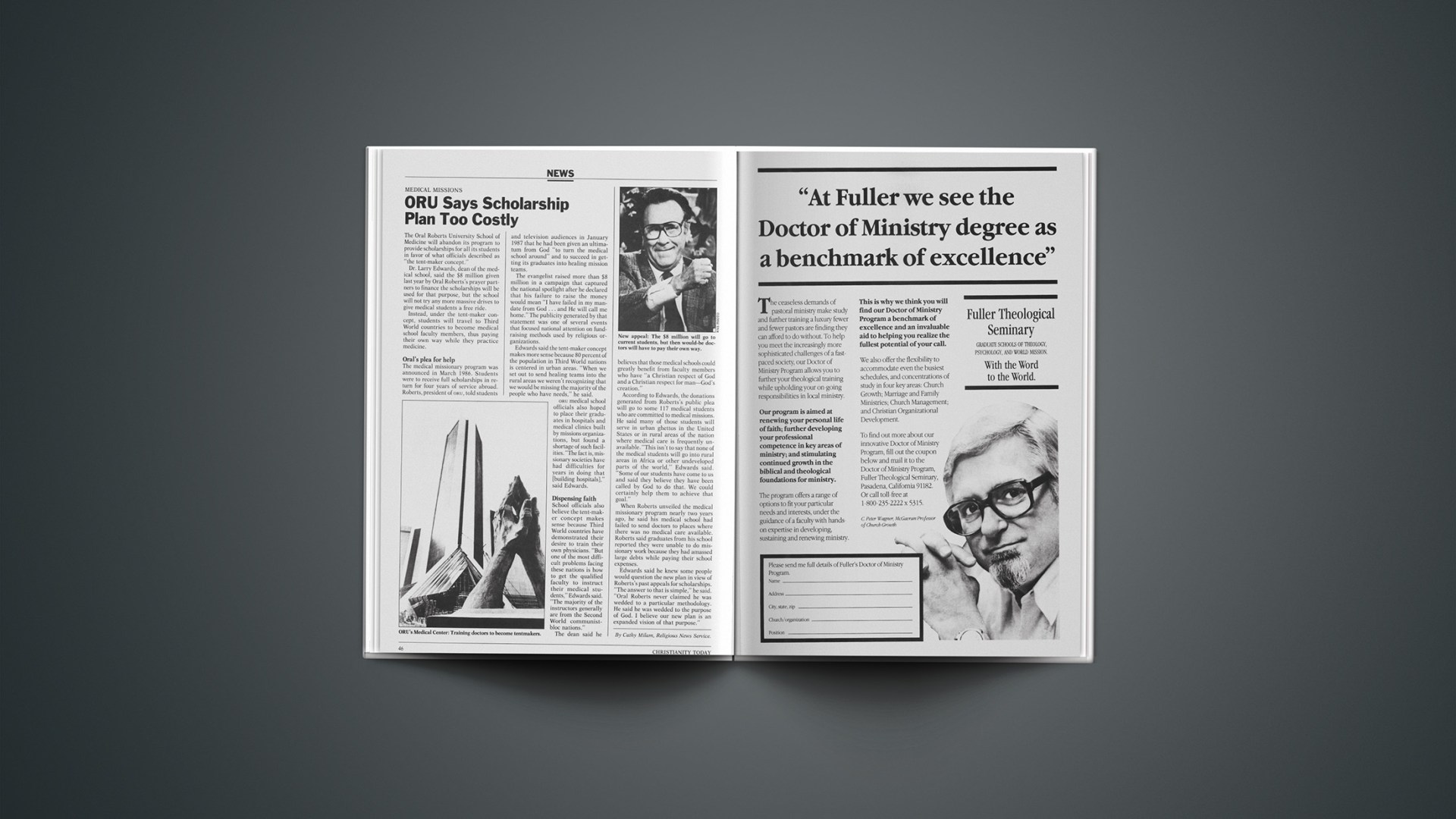
The Oral Roberts University School of Medicine will abandon its program to provide scholarships for all its students in favor of what officials described as “the tent-maker concept.”

Dr. Larry Edwards, dean of the medical school, said the $8 million given last year by Oral Roberts’s prayer partners to finance the scholarships will be used for that purpose, but the school will not try any more massive drives to give medical students a free ride.

Instead, under the tent-maker concept, students will travel to Third World countries to become medical school faculty members, thus paying their own way while they practice medicine.

Oral’s Plea For Help

The medical missionary program was announced in March 1986. Students were to receive full scholarships in return for four years of service abroad. Roberts, president of ORU, told students and television audiences in January 1987 that he had been given an ultimatum from God “to turn the medical school around” and to succeed in getting its graduates into healing mission teams.

The evangelist raised more than $8 million in a campaign that captured the national spotlight after he declared that his failure to raise the money would mean “I have failed in my mandate from God … and He will call me home.” The publicity generated by that statement was one of several events that focused national attention on fund-raising methods used by religious organizations.

Edwards said the tent-maker concept makes more sense because 80 percent of the population in Third World nations is centered in urban areas. “When we set out to send healing teams into the rural areas we weren’t recognizing that we would be missing the majority of the people who have needs,” he said.

ORU medical school officials also hoped to place their graduates in hospitals and medical clinics built by missions organizations, but found a shortage of such facilities. “The fact is, missionary societies have had difficulties for years in doing that [building hospitals],” said Edwards.

Dispensing Faith

School officials also believe the tent-maker concept makes sense because Third World countries have demonstrated their desire to train their own physicians. “But one of the most difficult problems facing these nations is how to get the qualified faculty to instruct their medical students,” Edwards said. “The majority of the instructors generally are from the Second World communist-bloc nations.”

The dean said he believes that those medical schools could greatly benefit from faculty members who have “a Christian respect of God and a Christian respect for man—God’s creation.”

According to Edwards, the donations generated from Roberts’s public plea will go to some 117 medical students who are committed to medical missions. He said many of those students will serve in urban ghettos in the United States or in rural areas of the nation where medical care is frequently unavailable. “This isn’t to say that none of the medical students will go into rural areas in Africa or other undeveloped parts of the world,” Edwards said. “Some of our students have come to us and said they believe they have been called by God to do that. We could certainly help them to achieve that goal.”

When Roberts unveiled the medical missionary program nearly two years ago, he said his medical school had failed to send doctors to places where there was no medical care available. Roberts said graduates from his school reported they were unable to do missionary work because they had amassed large debts while paying their school expenses.

Edwards said he knew some people would question the new plan in view of Roberts’s past appeals for scholarships. “The answer to that is simple,” he said. “Oral Roberts never claimed he was wedded to a particular methodology. He said he was wedded to the purpose of God. I believe our new plan is an expanded vision of that purpose.”

By Cathy Milam, Religious News Service.
Quebec Protestants Take Stock of Recent Progress

The fastest church growth in North America has reportedly been taking place among the French-speaking people in Quebec, according to William Phillips, secretary of the Fellowship Baptist French Canada Mission Board. “Because it’s a first-generation movement, there is a zeal for evangelism.”

Although some say the church in Quebec is experiencing “phenomenal growth—just like the Book of Acts all over again,” other church leaders caution that it would be an overstatement to describe the current situation as large-scale revival.

Pierre Bergeron of the Pentecostal Assemblies of Canada states that his organization, the fastest-growing Protestant denomination in Quebec, “sees an opportunity to preach the gospel like never before.” Of the estimated 30,000 evangelicals in Quebec, about one-third are Pentecostal. An equivalent number are members of the Fellowship of Evangelical Baptists, while the remainder represent the Union of French Baptist Churches in Canada, Plymouth Brethren, Christian and Missionary Alliance, and other smaller denominations.

Although 88 percent of Quebec’s 6.7 million population claim Roman Catholic religious affiliation, many are nonpracticing. French-speaking evangelical congregations are primarily composed of former nominal Catholics, with the average age being 30.

Until recently, Pentecostals and Fellowship Baptists were each establishing one new church every month. According to Fellowship Baptist spokesman Phillips, “The major factor in church growth has been the one-on-one witness of new believers to friends and family. Most of our French-speaking churches have developed two or three branch works by the time they’re five years old, and most of our pastors are recruited from within the churches.”

“Graveyard Of Evangelicals”

Even the provincial capital, Quebec City, nicknamed “the graveyard of evangelicals” due to past failures to penetrate this Catholic stronghold, now has thriving churches with aggressive outreach programs.

“Quebec is a lot like California, filled with people selling new religions,” observes John Gilmour, general secretary of the Union of French Baptist Churches in Canada. “We have many home-grown sects and cults, such as ‘The Knights of the Emerald’ and ‘The Gospel of the Year 2000.’ ”

Although the number of evangelicals in Quebec has tripled since 1970, some feel the pace is still too slow. “The church is just not keeping up with urban growth or cultural and demographic changes,” says Timothy Ernst of Christian Direction, an interdenominational mission that assists local churches in developing lay ministry skills. “For example, Montreal has a large contingent of ethnic peoples, including 20,000 Vietnamese, who are not being effectively reached.”

The New Evangelicals

The fact that evangelical churches in Quebec must cope with growing pains is remarkable, given the history of Protestantism there. In the 1940s and early 1950s, the situation in Quebec was unlike any other in North America.

Missionaries were arrested and jailed for activities such as door-to-door visitation, distributing Bibles, and holding open-air meetings. “At that time, to be French was to be Catholic, and anything to upset that balance was considered subversive to the state,” Phillips recalls. Eventually, adverse publicity across Canada pressured the provincial government to stop interfering in Protestant evangelistic efforts.

The “quiet revolution” of the sixties and seventies is another key factor in current spiritual renewal. In one generation, the Roman Catholic Church’s power declined dramatically as Quebec society became secularized. The radical transformation from an intensely religious world view to a humanistic one left a spiritual void. While interest in the occult, Eastern religions, and New Age mysticism escalated, so did personal Bible reading. Evangelical campus ministries recruited many converts among young Quebecers looking for a cause to join, including ex-radical separatists (proponents of political autonomy for Quebec).

“You must remember that evangelicalism and crusade evangelism are both relatively new phenomena in Quebec culture,” explains Walter De Sousa, a Quebec-born associate evangelist with Barry Moore Ministries. “It is still revolutionary to see 1,500 Francophones crowded into the arena, hearing the gospel in their own language.”

By Wendy Elaine Nelles.

Scholars View Gospel through Cultural Lens

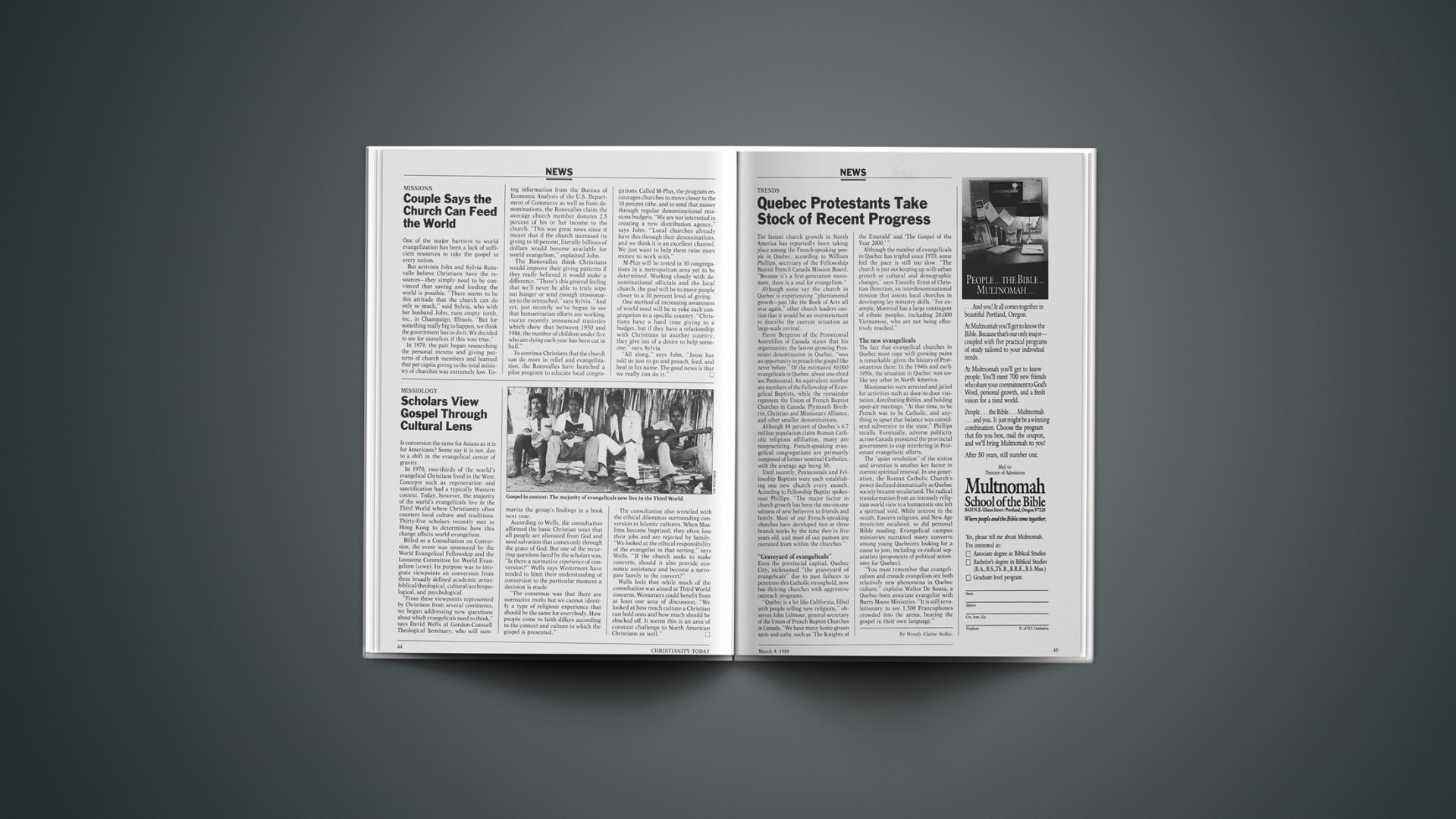
Is conversion the same for Asians as it is for Americans? Some say it is not, due to a shift in the evangelical center of gravity.

In 1970, two-thirds of the world’s evangelical Christians lived in the West. Concepts such as regeneration and sanctification had a typically Western context. Today, however, the majority of the world’s evangelicals live in the Third World where Christianity often counters local culture and traditions. Thirty-five scholars recently met in Hong Kong to determine how this change affects world evangelism.

Billed as a Consultation on Conversion, the event was sponsored by the World Evangelical Fellowship and the Lausanne Committee for World Evangelism (LCWE). Its purpose was to integrate viewpoints on conversion from three broadly defined academic areas: biblical/theological, cultural/anthropological, and psychological.

“From these viewpoints represented by Christians from several continents, we began addressing new questions about which evangelicals need to think,” says David Wells of Gordon-Conwell Theological Seminary, who will summarize the group’s findings in a book next year.

According to Wells, the consultation affirmed the basic Christian tenet that all people are alienated from God and need salvation that comes only through the grace of God. But one of the recurring questions faced by the scholars was, “Is there a normative experience of conversion?” Wells says Westerners have tended to limit their understanding of conversion to the particular moment a decision is made.

“The consensus was that there are normative truths but we cannot identify a type of religious experience that should be the same for everybody. How people come to faith differs according to the context and culture in which the gospel is presented.”

The consultation also wrestled with the ethical dilemmas surrounding conversion in Islamic cultures. When Muslims become baptized, they often lose their jobs and are rejected by family. “We looked at the ethical responsibility of the evangelist in that setting,” says Wells. “If the church seeks to make converts, should it also provide economic assistance and become a surrogate family to the convert?”

Wells feels that while much of the consultation was aimed at Third World concerns, Westerners could benefit from at least one area of discussion. “We looked at how much culture a Christian can hold onto and how much should be shucked off. It seems this is an area of constant challenge to North American Christians as well.”

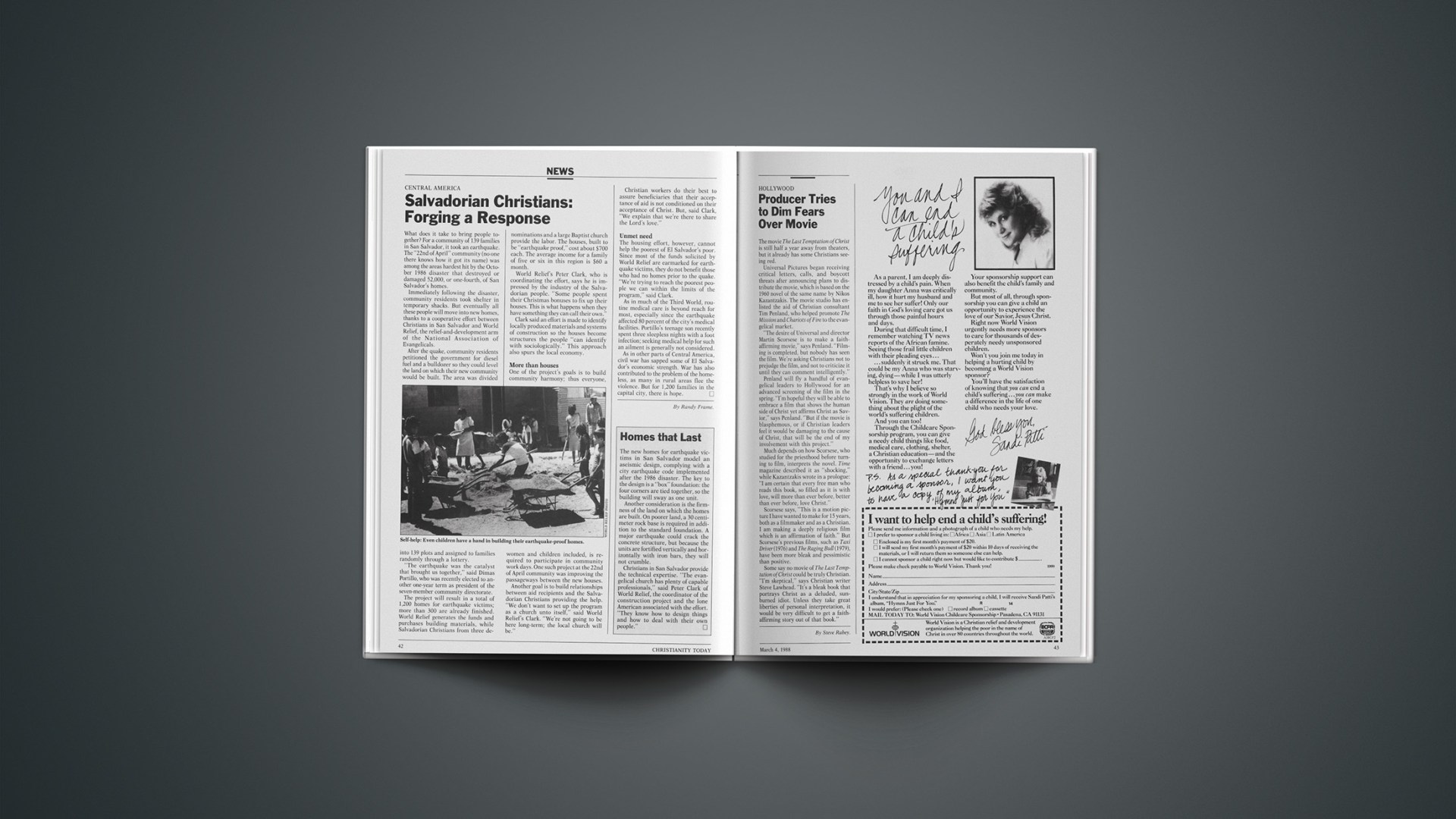
Couple Says the Church Can Feed the World

One of the major barriers to world evangelization has been a lack of sufficient resources to take the gospel to every nation.

But activists John and Sylvia Ronsvalle believe Christians have the resources—they simply need to be convinced that saving and feeding the world is possible. “There seems to be this attitude that the church can do only so much,” said Sylvia, who with her husband John, runs empty tomb, inc., in Champaign, Illinois. “But for something really big to happen, we think the government has to do it. We decided to see for ourselves if this was true.”

In 1979, the pair began researching the personal income and giving patterns of church members and learned that per capita giving to the total ministry of churches was extremely low. Using information from the Bureau of Economic Analysis of the U.S. Department of Commerce as well as from denominations, the Ronsvalles claim the average church member donates 2.5 percent of his or her income to the church. “This was great news since it meant that if the church increased its giving to 10 percent, literally billions of dollars would become available for world evangelism,” explained John.

The Ronsvalles think Christians would improve their giving patterns if they really believed it would make a difference. “There’s this general feeling that we’ll never be able to truly wipe out hunger or send enough missionaries to the unreached,” says Sylvia. “And yet, just recently we’ve begun to see that humanitarian efforts are working. UNICEF recently announced statistics which show that between 1950 and 1986, the number of children under five who are dying each year has been cut in half.”

To convince Christians that the church can do more in relief and evangelization, the Ronsvalles have launched a pilot program to educate local congregations. Called M-Plus, the program encourages churches to move closer to the 10 percent tithe, and to send that money through regular denominational missions budgets. “We are not interested in creating a new distribution agency,” says John. “Local churches already have this through their denominations, and we think it is an excellent channel. We just want to help them raise more money to work with.”

M-Plus will be tested in 30 congregations in a metropolitan area yet to be determined. Working closely with denominational officials and the local church, the goal will be to move people closer to a 10 percent level of giving.

One method of increasing awareness of world need will be to yoke each congregation to a specific country. “Christians have a hard time giving to a budget, but if they have a relationship with Christians in another country, they give out of a desire to help someone,” says Sylvia.

“All along,” says John, “Jesus has told us just to go and preach, feed, and heal in his name. The good news is that we really can do it.”

Producer Tries to Dim Fears over Movie

The movie The Last Temptation of Christ is still half a year away from theaters, but it already has some Christians seeing red.

Universal Pictures began receiving critical letters, calls, and boycott threats after announcing plans to distribute the movie, which is based on the 1960 novel of the same name by Nikos Kazantzakis. The movie studio has enlisted the aid of Christian consultant Tim Penland, who helped promote The M ission and Chariots of Fire to the evangelical market.

“The desire of Universal and director Martin Scorsese is to make a faith-affirming movie,” says Penland. “Filming is completed, but nobody has seen the film. We’re asking Christians not to prejudge the film, and not to criticize it until they can comment intelligently.”

Penland will fly a handful of evangelical leaders to Hollywood for an advanced screening of the film in the spring. “I’m hopeful they will be able to embrace a film that shows the human side of Christ yet affirms Christ as Savior,” says Penland. “But if the movie is blasphemous, or if Christian leaders feel it would be damaging to the cause of Christ, that will be the end of my involvement with this project.”

Much depends on how Scorsese, who studied for the priesthood before turning to film, interprets the novel. Time magazine described it as “shocking,” while Kazantzakis wrote in a prologue: “I am certain that every free man who reads this book, so filled as it is with love, will more than ever before, better than ever before, love Christ.”

Scorsese says, “This is a motion picture I have wanted to make for 15 years, both as a filmmaker and as a Christian. I am making a deeply religious film which is an affirmation of faith.” But Scorsese’s previous films, such as Taxi Driver (1976) and The Raging Bull (1979), have been more bleak and pessimistic than positive.

Some say no movie of The Last Temptation of Christ could be truly Christian. “I’m skeptical,” says Christian writer Steve Lawhead. “It’s a bleak book that portrays Christ as a deluded, sunburned idiot. Unless they take great liberties of personal interpretation, it would be very difficult to get a faith-affirming story out of that book.”

By Steve Rabey.

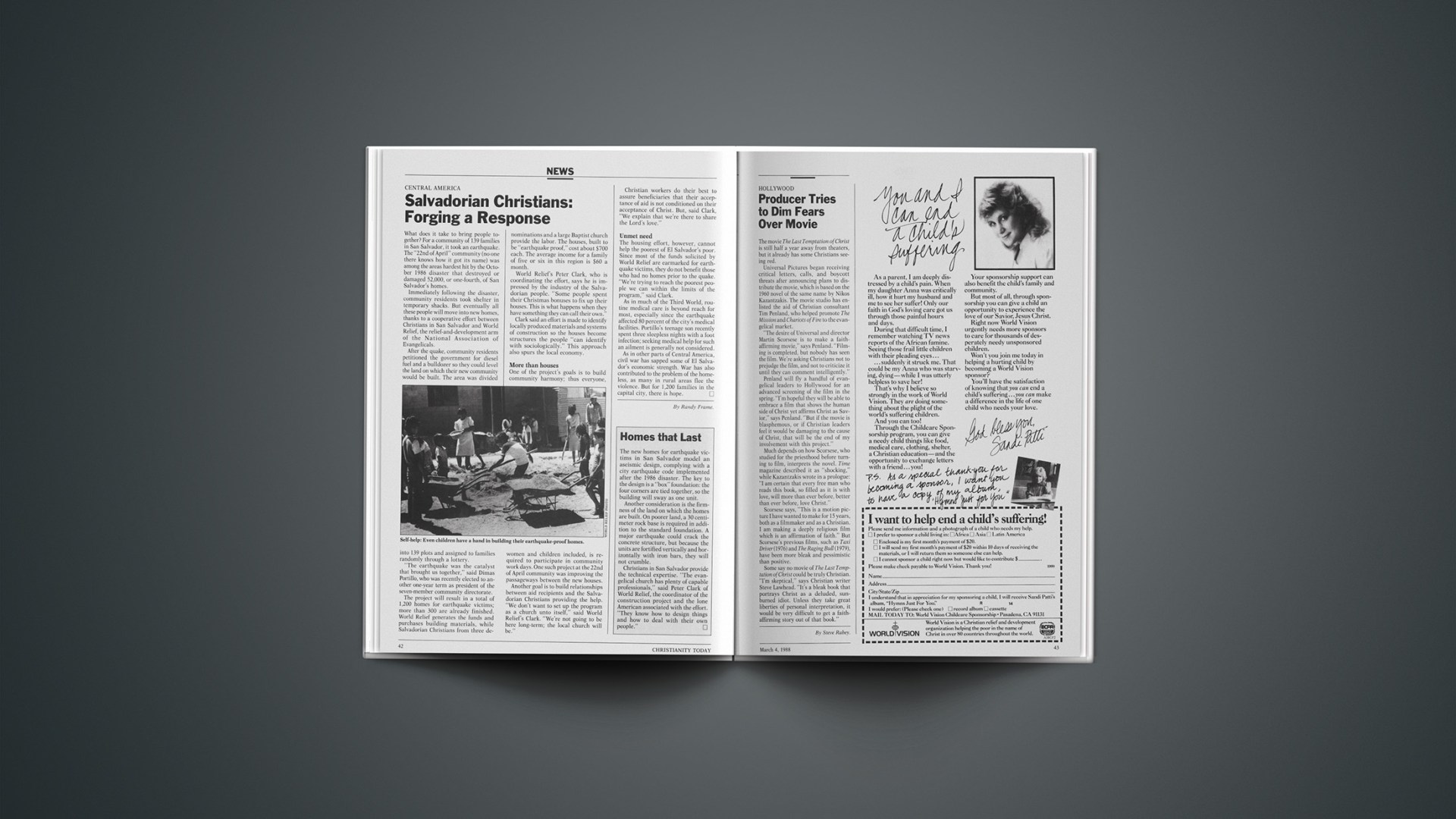
Salvadorian Christians: Forging a Response

What does it take to bring people together? For a community of 139 families in San Salvador, it took an earthquake. The “22nd of April” community (no one there knows how it got its name) was among the areas hardest hit by the October 1986 disaster that destroyed or damaged 52,000, or one-fourth, of San Salvador’s homes.

Immediately following the disaster, community residents took shelter in temporary shacks. But eventually all these people will move into new homes, thanks to a cooperative effort between Christians in San Salvador and World Relief, the relief-and-development arm of the National Association of Evangelicals.

After the quake, community residents petitioned the government for diesel fuel and a bulldozer so they could level the land on which their new community would be built. The area was divided into 139 plots and assigned to families randomly through a lottery.

“The earthquake was the catalyst that brought us together,” said Dimas Portillo, who was recently elected to another one-year term as president of the seven-member community directorate.

The project will result in a total of 1,200 homes for earthquake victims; more than 300 are already finished. World Relief generates the funds and purchases building materials, while Salvadorian Christians from three denominations and a large Baptist church provide the labor. The houses, built to be “earthquake proof,” cost about $700 each. The average income for a family of five or six in this region is $60 a month.

World Relief’s Peter Clark, who is coordinating the effort, says he is impressed by the industry of the Salvadorian people. “Some people spent their Christmas bonuses to fix up their houses. This is what happens when they have something they can call their own.”

Clark said an effort is made to identify locally produced materials and systems of construction so the houses become structures the people “can identify with sociologically.” This approach also spurs the local economy.

More Than Houses

One of the project’s goals is to build community harmony; thus everyone, women and children included, is required to participate in community work days. One such project at the 22nd of April community was improving the passageways between the new houses.

Another goal is to build relationships between aid recipients and the Salvadorian Christians providing the help. “We don’t want to set up the program as a church unto itself,” said World Relief’s Clark. “We’re not going to be here long-term; the local church will be.”

Christian workers do their best to assure beneficiaries that their acceptance of aid is not conditioned on their acceptance of Christ. But, said Clark, “We explain that we’re there to share the Lord’s love.”

Unmet Need

The housing effort, however, cannot help the poorest of El Salvador’s poor. Since most of the funds solicited by World Relief are earmarked for earthquake victims, they do not benefit those who had no homes prior to the quake. “We’re trying to reach the poorest people we can within the limits of the program,” said Clark.

As in much of the Third World, routine medical care is beyond reach for most, especially since the earthquake affected 80 percent of the city’s medical facilities. Portillo’s teenage son recently spent three sleepless nights with a foot infection; seeking medical help for such an ailment is generally not considered.

As in other parts of Central America, civil war has sapped some of El Salvador’s economic strength. War has also contributed to the problem of the homeless, as many in rural areas flee the violence. But for 1,200 families in the capital city, there is hope.

By Randy Frame.

Homes That Last

The new homes for earthquake victims in San Salvador model an aseismic design, complying with a city earthquake code implemented after the 1986 disaster. The key to the design is a “box” foundation; the four corners are tied together, so the building will sway as one unit.

Another consideration is the firmness of the land on which the homes are built. On poorer land, a 30 centimeter rock base is required in addition to the standard foundation. A major earthquake could crack the concrete structure, but because the units are fortified vertically and horizontally with iron bars, they will not crumble.

Christians in San Salvador provide the technical expertise. “The evangelical church has plenty of capable professionals,” said Peter Clark of World Relief, the coordinator of the construction project and the lone American associated with the effort. “They know how to design things and how to deal with their own people.”

Court Ruling Bars Bible Club from School

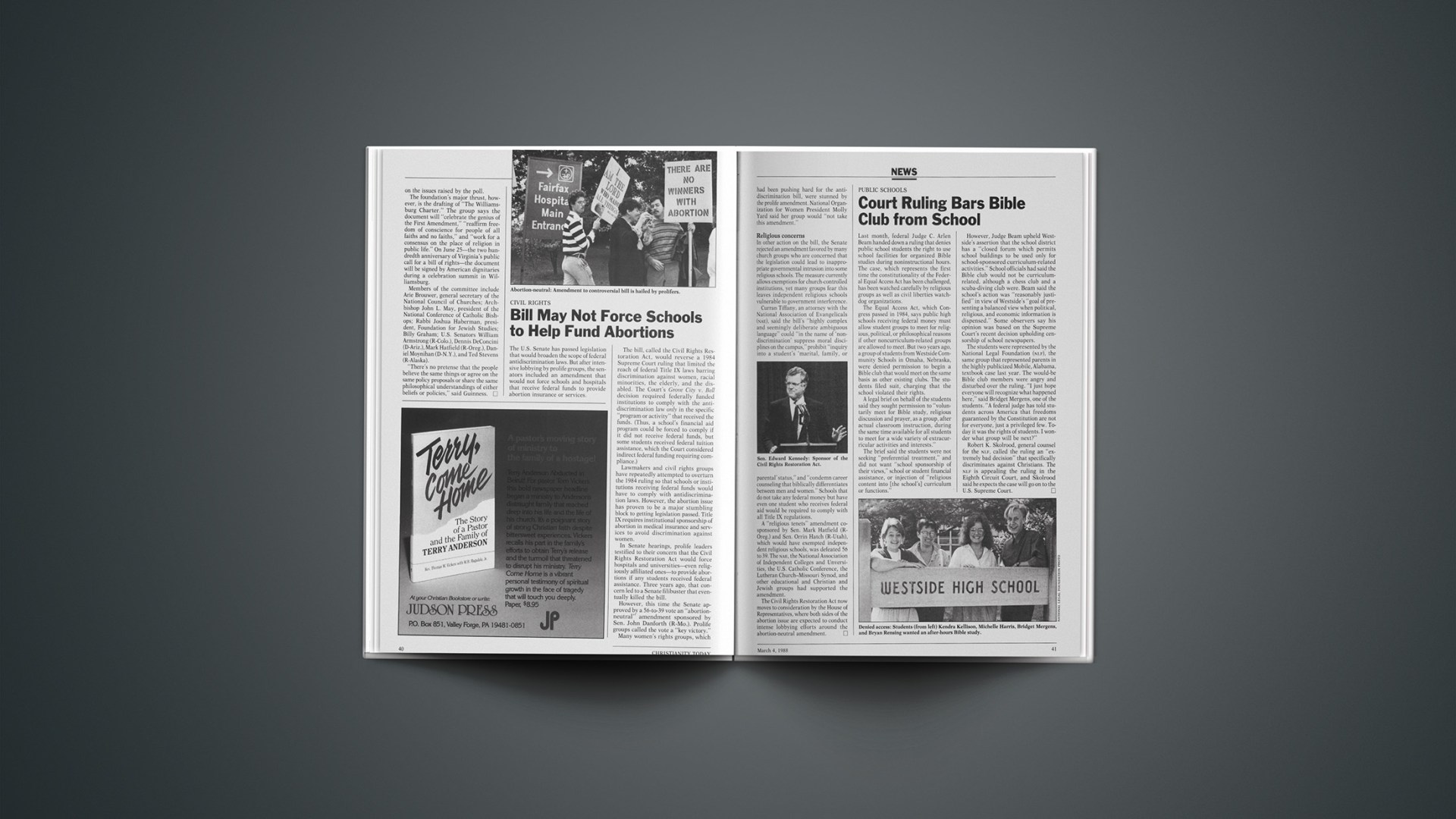
Last month, federal Judge C. Arlen Beam handed down a ruling that denies public school students the right to use school facilities for organized Bible studies during noninstructional hours. The case, which represents the first time the constitutionality of the Federal Equal Access Act has been challenged, has been watched carefully by religious groups as well as civil liberties watchdog organizations.

The Equal Access Act, which Congress passed in 1984, says public high schools receiving federal money must allow student groups to meet for religious, political, or philosophical reasons if other noncurriculum-related groups are allowed to meet. But two years ago, a group of students from Westside Community Schools in Omaha, Nebraska, were denied permission to begin a Bible club that would meet on the same basis as other existing clubs. The students filed suit, charging that the school violated their rights.

A legal brief on behalf of the students said they sought permission to “voluntarily meet for Bible study, religious discussion and prayer, as a group, after actual classroom instruction, during the same time available for all students to meet for a wide variety of extracurricular activities and interests.”

The brief said the students were not seeking “preferential treatment,” and did not want “school sponsorship of their views,” school or student financial assistance, or injection of “religious content into [the school’s] curriculum or functions.”

However, Judge Beam upheld Westside’s assertion that the school district has a “closed forum which permits school buildings to be used only for school-sponsored curriculum-related activities.” School officials had said the Bible club would not be curriculum-related, although a chess club and a scuba-diving club were. Beam said the school’s action was “reasonably justified” in view of Westside’s “goal of presenting a balanced view when political, religious, and economic information is dispensed.” Some observers say his opinion was based on the Supreme Court’s recent decision upholding censorship of school newspapers.

The students were represented by the National Legal Foundation (NLF), the same group that represented parents in the highly publicized Mobile, Alabama, textbook case last year. The would-be Bible club members were angry and disturbed over the ruling. “I just hope everyone will recognize what happened here,” said Bridget Mergens, one of the students. “A federal judge has told students across America that freedoms guaranteed by the Constitution are not for everyone, just a privileged few. Today it was the rights of students. I wonder what group will be next?”

Robert K. Skolrood, general counsel for the NLF, called the ruling an “extremely bad decision” that specifically discriminates against Christians. The NLF is appealing the ruling in the Eighth Circuit Court, and Skolrood said he expects the case will go on to the U.S. Supreme Court.

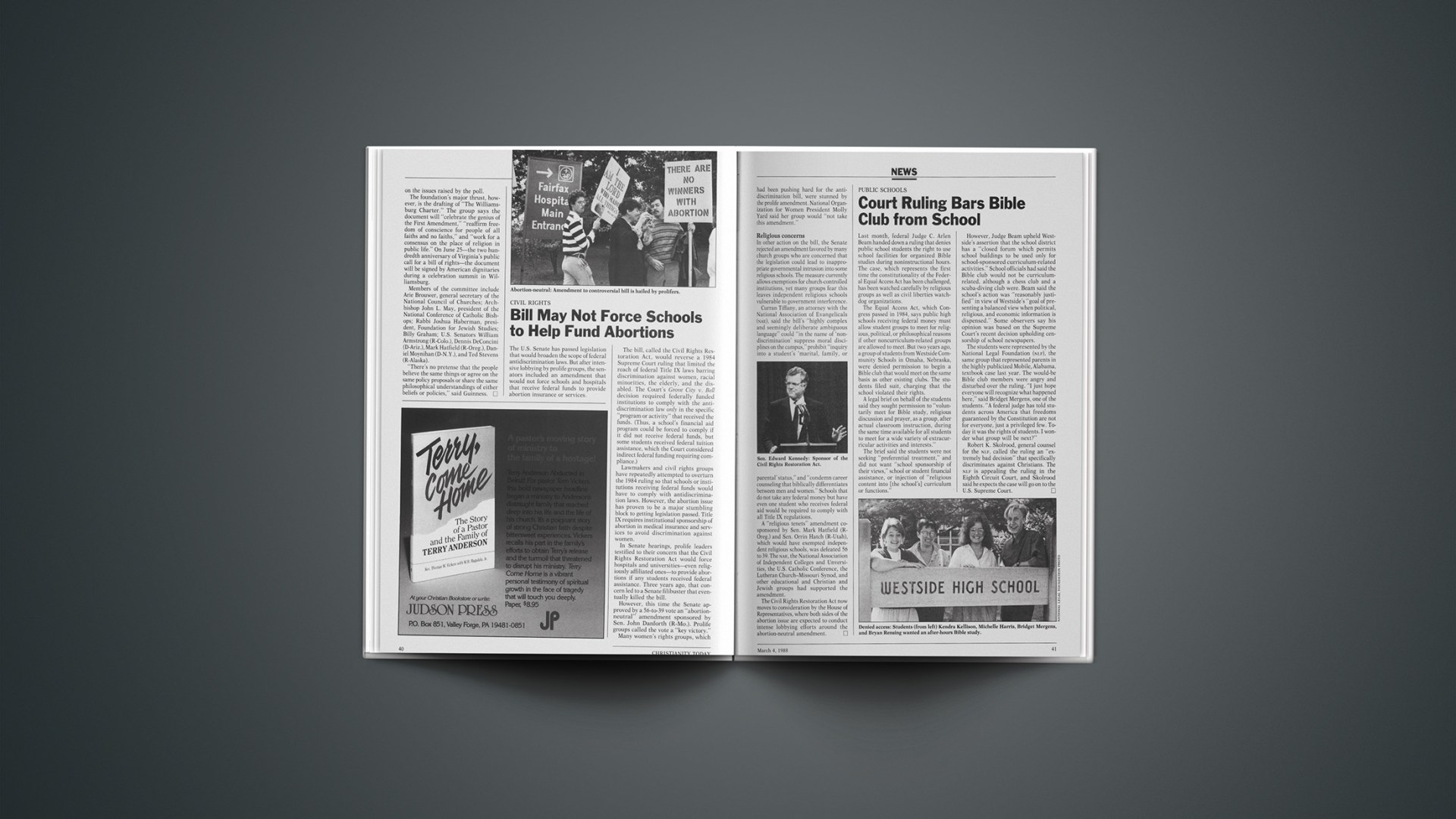
Bill May Not Force Schools to Help Fund Abortions

The U.S. Senate has passed legislation that would broaden the scope of federal antidiscrimination laws. But after intensive lobbying by prolife groups, the senators included an amendment that would not force schools and hospitals that receive federal funds to provide abortion insurance or services.

The bill, called the Civil Rights Restoration Act, would reverse a 1984 Supreme Court ruling that limited the reach of federal Title IX laws barring discrimination against women, racial minorities, the elderly, and the disabled. The Court’s Grove City v. Bell decision required federally funded institutions to comply with the antidiscrimination law only in the specific “program or activity” that received the funds. (Thus, a school’s financial aid program could be forced to comply if it did not receive federal funds, but some students received federal tuition assistance, which the Court considered indirect federal funding requiring compliance.)

Lawmakers and civil rights groups have repeatedly attempted to overturn the 1984 ruling so that schools or institutions receiving federal funds would have to comply with antidiscrimination laws. However, the abortion issue has proven to be a major stumbling block to getting legislation passed. Title IX requires institutional sponsorship of abortion in medical insurance and services to avoid discrimination against women.

In Senate hearings, prolife leaders testified to their concern that the Civil Rights Restoration Act would force hospitals and universities—even religiously affiliated ones—to provide abortions if any students received federal assistance. Three years ago, that concern led to a Senate filibuster that eventually killed the bill.

However, this time the Senate approved by a 56-to-39 vote an “abortion-neutral” amendment sponsored by Sen. John Danforth (R-Mo.). Prolife groups called the vote a “key victory.”

Many women’s rights groups, which had been pushing hard for the antidiscrimination bill, were stunned by the prolife amendment. National Organization for Women President Molly Yard said her group would “not take this amendment.”

Religious Concerns

In other action on the bill, the Senate rejected an amendment favored by many church groups who are concerned that the legislation could lead to inappropriate governmental intrusion into some religious schools. The measure currently allows exemptions for church-controlled institutions, yet many groups fear this leaves independent religious schools vulnerable to government interference.

Curran Tiffany, an attorney with the National Association of Evangelicals (NAE), said the bill’s “highly complex and seemingly deliberate ambiguous language” could “in the name of ‘non-discrimination’ suppress moral disciplines on the campus,” prohibit “inquiry into a student’s ‘marital, family, or parental’ status,” and “condemn career counseling that biblically differentiates between men and women.” Schools that do not take any federal money but have even one student who receives federal aid would be required to comply with all Title IX regulations.

A “religious tenets” amendment cosponsored by Sen. Mark Hatfield (R-Oreg.) and Sen. Orrin Hatch (R-Utah), which would have exempted independent religious schools, was defeated 56 to 39. The NAE, the National Association of Independent Colleges and Unversities, the U.S. Catholic Conference, the Lutheran Church-Missouri Synod, and other educational and Christian and Jewish groups had supported the amendment.

The Civil Rights Restoration Act now moves to consideration by the House of Representatives, where both sides of the abortion issue are expected to conduct intense lobbying efforts around the abortion-neutral amendment.

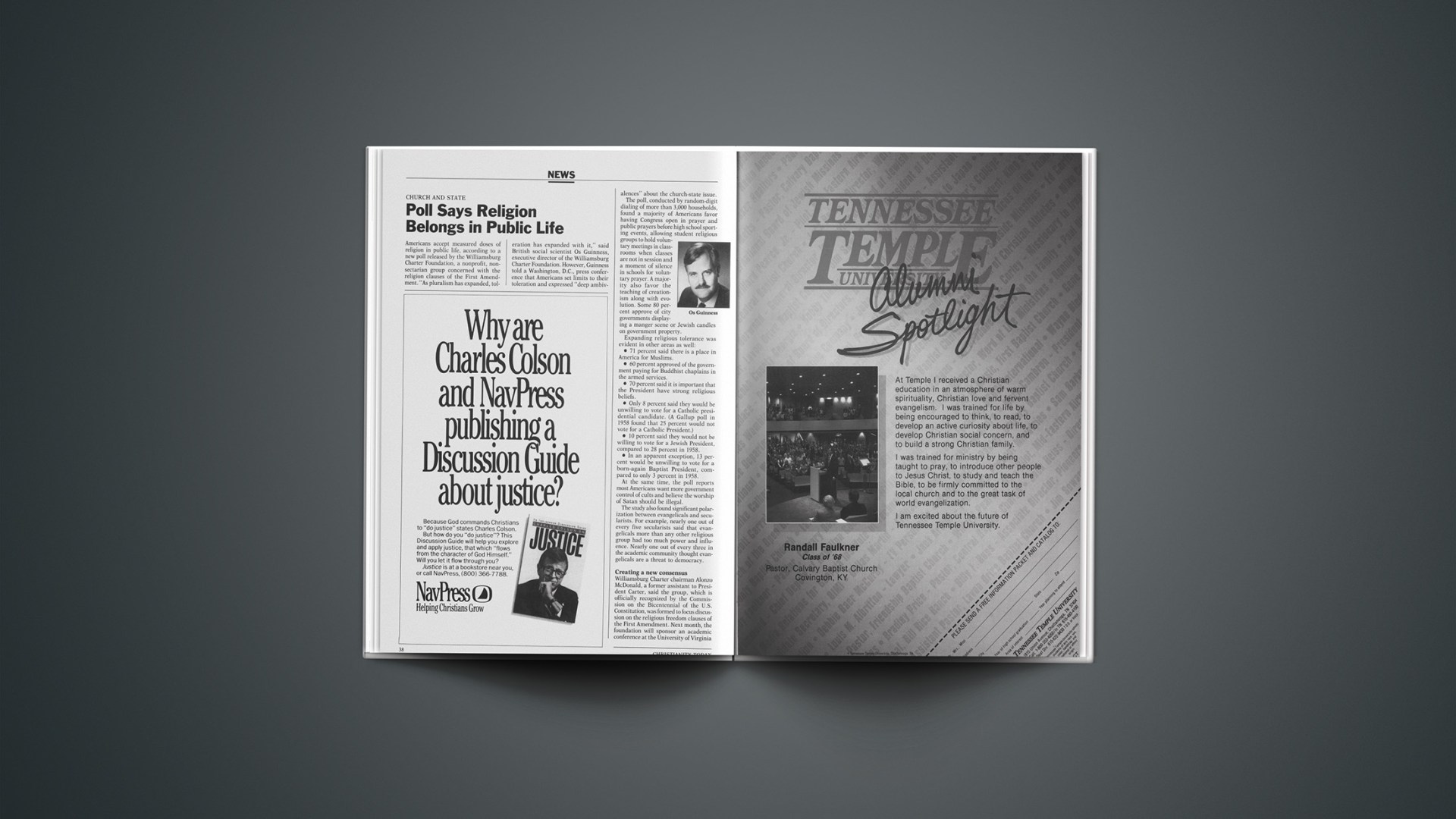
Poll Says Religion Belongs in Public Life

Americans accept measured doses of religion in public life, according to a new poll released by the Williamsburg Charter Foundation, a nonprofit, nonsectarian group concerned with the religion clauses of the First Amendment. “As pluralism has expanded, toleration has expanded with it,” said British social scientist Os Guinness, executive director of the Williamsburg Charter Foundation. However, Guinness told a Washington, D.C., press conference that Americans set limits to their toleration and expressed “deep ambivalences” about the church-state issue.

The poll, conducted by random-digit dialing of more than 3,000 households, found a majority of Americans favor having Congress open in prayer and public prayers before high school sporting events, allowing student religious groups to hold voluntary meetings in classrooms when classes are not in session and a moment of silence in schools for voluntary prayer. A majority also favor the teaching of creationism along with evolution. Some 80 percent approve of city governments displaying a manger scene or Jewish candles on government property.

Expanding religious tolerance was evident in other areas as well:

  • 71 percent said there is a place in America for Muslims.
  • 60 percent approved of the government paying for Buddhist chaplains in the armed services.
  • 70 percent said it is important that the President have strong religious beliefs.
  • Only 8 percent said they would be unwilling to vote for a Catholic presidential candidate. (A Gallup poll in 1958 found that 25 percent would not vote for a Catholic President.)
  • 10 percent said they would not be willing to vote for a Jewish President, compared to 28 percent in 1958.
  • In an apparent exception, 13 percent would be unwilling to vote for a born-again Baptist President, compared to only 3 percent in 1958.

At the same time, the poll reports most Americans want more government control of cults and believe the worship of Satan should be illegal.

The study also found significant polarization between evangelicals and secularists. For example, nearly one out of every five secularists said that evangelicals more than any other religious group had too much power and influence. Nearly one out of every three in the academic community thought evangelicals are a threat to democracy.

Creating A New Consensus

Williamsburg Charter chairman Alonzo McDonald, a former assistant to President Carter, said the group, which is officially recognized by the Commission on the Bicentennial of the U.S. Constitution, was formed to focus discussion on the religious freedom clauses of the First Amendment. Next month, the foundation will sponsor an academic conference at the University of Virginia on the issues raised by the poll.

The foundation’s major thrust, however, is the drafting of “The Williamsburg Charter.” The group says the document will “celebrate the genius of the First Amendment,” “reaffirm freedom of conscience for people of all faiths and no faiths,” and “work for a consensus on the place of religion in public life.” On June 25—the two hundredth anniversary of Virginia’s public call for a bill of rights—the document will be signed by American dignitaries during a celebration summit in Williamsburg.

Members of the committee include Arie Brouwer, general secretary of the National Council of Churches; Archbishop John L. May, president of the National Conference of Catholic Bishops; Rabbi Joshua Haberman, president, Foundation for Jewish Studies; Billy Graham; U.S. Senators William Armstrong (R-Colo.), Dennis DeConcini (D-Ariz.), Mark Hatfield (R-Oreg.), Daniel Moynihan (D-N.Y.), and Ted Stevens (R-Alaska).

“There’s no pretense that the people believe the same things or agree on the same policy proposals or share the same philosophical understandings of either beliefs or policies,” said Guinness.

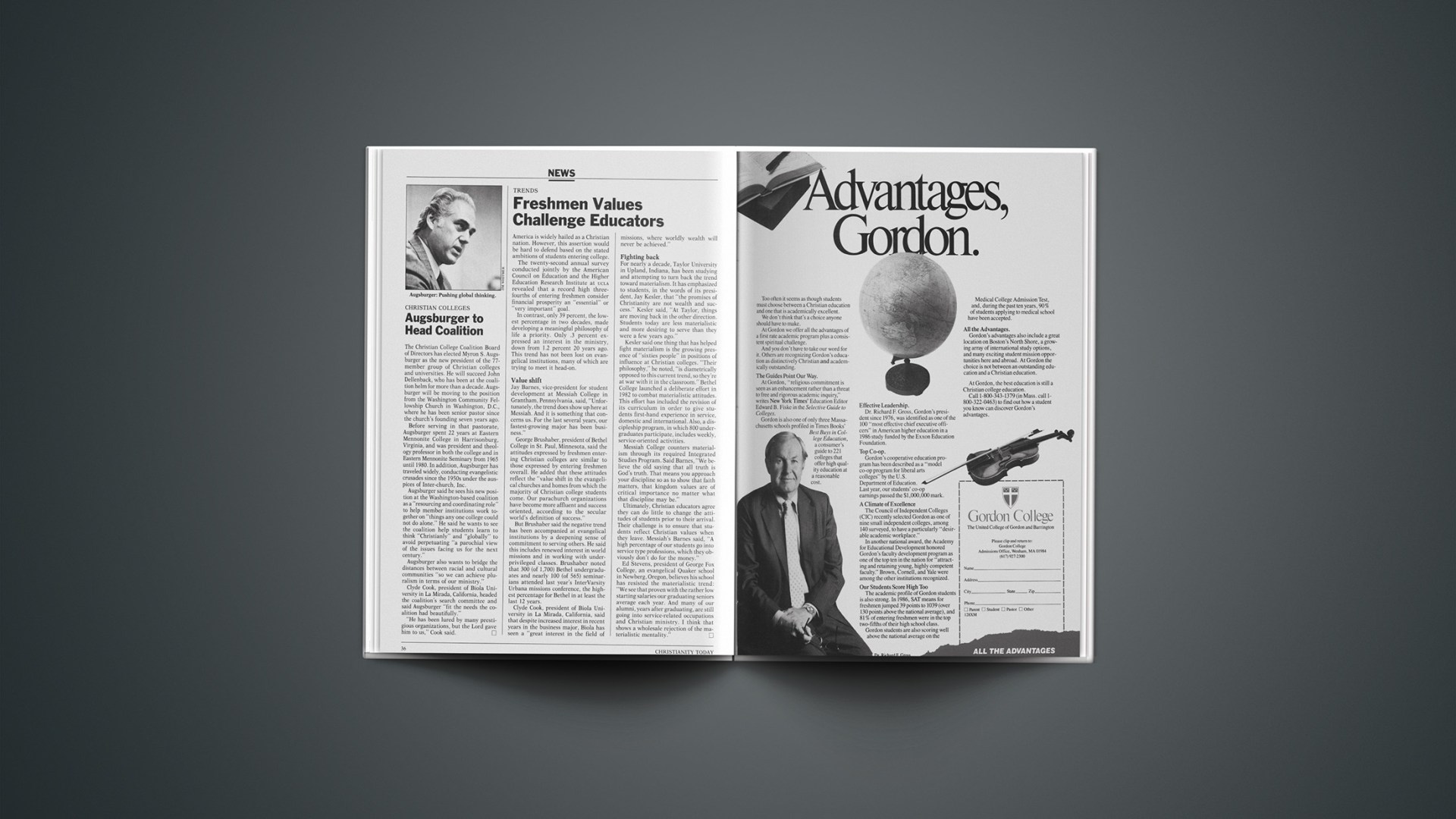
Freshmen Values Challenge Educators

America is widely hailed as a Christian nation. However, this assertion would be hard to defend based on the stated ambitions of students entering college.

The twenty-second annual survey conducted jointly by the American Council on Education and the Higher Education Research Institute at UCLA revealed that a record high three-fourths of entering freshmen consider financial prosperity an “essential” or “very important” goal.

In contrast, only 39 percent, the lowest percentage in two decades, made developing a meaningful philosophy of life a priority. Only .3 percent expressed an interest in the ministry, down from 1.2 percent 20 years ago. This trend has not been lost on evangelical institutions, many of which are trying to meet it head-on.

Value Shift

Jay Barnes, vice-president for student development at Messiah College in Grantham, Pennsylvania, said, “Unfortunately, the trend does show up here at Messiah. And it is something that concerns us. For the last several years, our fastest-growing major has been business.”

George Brushaber, president of Bethel College in St. Paul, Minnesota, said the attitudes expressed by freshmen entering Christian colleges are similar to those expressed by entering freshmen overall. He added that these attitudes reflect the “value shift in the evangelical churches and homes from which the majority of Christian college students come. Our parachurch organizations have become more affluent and success oriented, according to the secular world’s definition of success.”

But Brushaber said the negative trend has been accompanied at evangelical institutions by a deepening sense of commitment to serving others. He said this includes renewed interest in world missions and in working with underprivileged classes. Brushaber noted that 300 (of 1,700) Bethel undergraduates and nearly 100 (of 565) seminarians attended last year’s InterVarsity Urbana missions conference, the highest percentage for Bethel in at least the last 12 years.

Clyde Cook, president of Biola University in La Mirada, California, said that despite increased interest in recent years in the business major, Biola has seen a “great interest in the field of missions, where worldly wealth will never be achieved.”

Fighting Back

For nearly a decade, Taylor University in Upland, Indiana, has been studying and attempting to turn back the trend toward materialism. It has emphasized to students, in the words of its president, Jay Kesler, that “the promises of Christianity are not wealth and success.” Kesler said, “At Taylor, things are moving back in the other direction. Students today are less materialistic and more desiring to serve than they were a few years ago.”

Kesler said one thing that has helped fight materialism is the growing presence of “sixties people” in positions of influence at Christian colleges. “Their philosophy,” he noted, “is diametrically opposed to this current trend, so they’re at war with it in the classroom.” Bethel College launched a deliberate effort in 1982 to combat materialistic attitudes. This effort has included the revision of its curriculum in order to give students first-hand experience in service, domestic and international. Also, a discipleship program, in which 800 undergraduates participate, includes weekly, service-oriented activities.

Messiah College counters materialism through its required Integrated Studies Program. Said Barnes, “We believe the old saying that all truth is God’s truth. That means you approach your discipline so as to show that faith matters, that kingdom values are of critical importance no matter what that discipline may be.”

Ultimately, Christian educators agree they can do little to change the attitudes of students prior to their arrival. Their challenge is to ensure that students reflect Christian values when they leave. Messiah’s Barnes said, “A high percentage of our students go into service type professions, which they obviously don’t do for the money.”

Ed Stevens, president of George Fox College, an evangelical Quaker school in Newberg, Oregon, believes his school has resisted the materialistic trend: “We see that proven with the rather low starting salaries our graduating seniors average each year. And many of our alumni, years after graduating, are still going into service-related occupations and Christian ministry. I think that shows a wholesale rejection of the materialistic mentality.”

Apple PodcastsDown ArrowDown ArrowDown Arrowarrow_left_altLeft ArrowLeft ArrowRight ArrowRight ArrowRight Arrowarrow_up_altUp ArrowUp ArrowAvailable at Amazoncaret-downCloseCloseEmailEmailExpandExpandExternalExternalFacebookfacebook-squareGiftGiftGooglegoogleGoogle KeephamburgerInstagraminstagram-squareLinkLinklinkedin-squareListenListenListenChristianity TodayCT Creative Studio Logologo_orgMegaphoneMenuMenupausePinterestPlayPlayPocketPodcastRSSRSSSaveSaveSaveSearchSearchsearchSpotifyStitcherTelegramTable of ContentsTable of Contentstwitter-squareWhatsAppXYouTubeYouTube