The Press Is Missing the Scoop of the Century

The failure to observe at all—not to mention to analyze and explain—the rise of evangelical Christianity in the U.S. (or around the world, for that matter) over two decades must constitute one of the great modern blind spots of the American journalistic mind. It is a failure sadly paralleled by the inability of Western reporters during the same period to grasp the scope of the Khomeiniist Islamic revival, or the dangerous reverberations of a renascent Islam even among Muslim communities not belonging to the minority Shi’ite sect dominant in Iran.

In a vague effort to push the concept of a large, grassroots American evangelical community out of sight and mind, much of the news media have resorted to the safe old standby term for people of religious conviction: “fundamentalists.” The word, with its connotation of fanaticism, has the useful effort of consigning evangelicals to the category of the unreportable.

Kept In The Dark

This media blindness to religious faith at home and abroad has had all sorts of unpleasant consequences, and not just among American evangelical Christians who have had to endure the many prejudices—born of ignorance—that swoop around the public marketplace. Americans as a whole have been shortchanged by those whose job it is to report and analyze events around the world. They have been kept in the dark about one of the great stories of the century: the emergence of a growing, perhaps mortal, competition among the world’s great religions (secular and otherwise) for the ultimate loyalties of mankind.

Why has the U.S. press failed so conspicuously to do justice to this phenomenon? An ordinary explanation would be ignorance. But that ignorance is at least partly willful. Surveys of the U.S. public media have confirmed one astounding fact: reporters tend to be overwhelmingly secular in their world view, they tend not to respect religious faith in general, and, for the most part, they espouse a system of values inherently hostile to the traditional Western values handed down in the Bible.

In a well-known survey of 216 leading U.S. journalists, conducted in 1981 by sociologists S. Robert Lichter and Stanley Rothman, 54 percent of the respondents thought adultery was not wrong, 75 percent considered homosexuality an acceptable lifestyle, 86 percent seldom or never went to church or synagogue, and 90 percent thought abortion was an inherent right of women. If those figures are frightening for Christians, they are likely to be even more skewed away from traditional values today than they were six years ago.

Open Hostility?

Of course, the recent string of scandals and internecine squabbles within the evangelical community has not made the task of reporting sympathetically (or even fairly) about it any easier. In fact, U.S. news organizations have at times displayed open hostility toward any Christian organization with a high profile and explicit evangelical position. Apparently lacking any degree of discernment—a requisite skill for journalists—they regularly tar much of Christendom with the opprobrium earned by only a small part of it.

In so doing, some journalists have departed from a principle of their professional code of ethics: keeping personal likes and dislikes out of the business of reporting. Moreover, they have departed from a more important principle as well: curiosity about life, with enough open-mindedness to ask a lot of questions. In theory, that is what journalists are supposed to do.

Redeeming The Media

Is there a Christian solution to this? Yes, there is. But if it is simple, it is not easy. For years, Christians have been content to drift along with the changing fashions of the general public’s trendy whims. They have been confident there is not too much difference between Christian and non-Christian standards and behavior in private life and society.

That confidence is utterly misplaced in today’s climate. If God’s people are not to be completely swamped by the evolution of much of modern culture into barbarism and neopaganism, then they must fashion the instruments of their own cultural expression, including their news media, for themselves. Otherwise, they will be unable to discern the sign of the times.

This refashioning includes reinventing journalism, and applying to it the biblical standards evangelical Christians demand of their own and other Christians’ private lives. Little by little, in such outstanding places as CBN University’s journalism program, or in the communications program of Youth With a Mission, this is being done.

But until journalism as a whole has been significantly redeemed from its present worldiness, one of the great stories of the millennium—how more people than ever are finding Christ—is going to be lost to the world.

By David Aikman, a correspondent for Time magazine, currently covering the U.S. State Department.

SPEAKING OUT offers responsible Christians a forum. It does not necessarily reflect the views of CHRISTIANITY TODAY.
What Happened in 586 B.C.?

Most school people seem to think faculty meetings are a bore. I don’t. I’ve always considered attendance to be a pleasant duty. In fact, I have probably built up some sort of attendance record over my 48 years as a teacher.

At one of our better meetings here at Trinity recently, Prof. Gordon Palmer gave a review of the much talked-about book by E. D. Hirsch, Jr., Cultural Literacy: What Every American Needs to Know (Houghton Mifflin, 1987).

Like a host of other writers during the last decade, Hirsch decries the steady downward trend of grade school and high school achievement scores in spite of the fact that tests themselves have been revised to make them easier for our increasingly illiterate youngsters. Even more devastating is the fact that the very best students of today are scoring dramatically lower than their counterparts a decade ago.

As bad as this is, however, it gets worse. Hirsch’s deepest concern is what he calls cultural illiteracy: a lack of the “basic information needed to thrive in the modern world.” He writes, “Only by piling up specific, communally shared information can children learn to participate in complex cooperative activities with other members of their community.”

And effective communication, as Hirsch demonstrates over and over again, requires not just an ability to read and understand words, but a body of information that serves as a hermeneutical context for words. We not only need to know, but we need to know what others know. Shared information is the key. And this is just what our youngsters are not getting in school.

Hirsch insists we must begin early in the educational process. By the fourth grade, it is already far too late: We have lost the advantage of younger children’s ability to memorize data.

Several things occurred to me as I read and reflected upon Hirsch’s work. Professor Palmer himself pointed out the first: We need a Christian list comparable to Hirsch’s American cultural list. (In the appendix, Hirsch lists approximately 5,000 terms—names, events, dates—that he believes should serve as a guide for refilling the information vacuum created by our schools.)

Every church statistician or Christian educator I know laments the fact that knowledge about religion, the Bible, and Christianity has fallen off. This is certainly true for the general public, but unfortunately it is true for evangelical Christians as well.

In a recent Gallup poll, the vast majority of Americans indicated their belief that the Ten Commandments are valid today and that someday every human will have to answer to God for his or her obedience or disobedience to these commandments. Yet hardly anyone knew what these commandments are. Most could not name even five.

What do we need on a Christian list that provides our young people with sufficient information so they can understand the Bible and what Christianity is all about? Just for starters: the Ten Commandments, a half-dozen favorite psalms, the Beatitudes, the Lord’s Prayer, John 3:1–18, the Love Chapter (1 Cor. 13), a hundred or so select verses on Christian doctrine and ethics, and the Westminster Catechism thrown in for good measure. And for dates: 1400 B.C., 1000 B.C., 722 B.C., 586 B.C., 400 B.C.; A.D. 30, 70, 1054, and 1517. (I’ll leave it up to you to figure out their significance.)

But then a dreadful thought grabbed me: Hirsch’s exhaustive list is what people don’t know. How impoverished we are in seeking to communicate our biblical faith to the world. Every time I hear a radio or television sermon, I find myself wondering how much of this non-Christians understand. What does a reference to “the blood” communicate to them? What meaning do they have for law, sin, grace, regeneration, righteousness, and the basic vocabulary of Christian faith?

Francis Schaeffer used to speak of “pre-evangelism.” Maybe this is what he meant. We can’t wait to preach the gospel until the educational level of our society is raised to Hirsch’s standards. But neither can we ignore it.

KENNETH S. KANTZER

Letters

It’s Balance That Is Needed

What Philip Yancey saw in that October gay-rights march [“We Have No Right to Scorn,” Jan. 15] was the two extremes we evangelicals should seek to avoid: morality without sensitivity and sensitivity without morality. Jesus’ response to the woman caught in the act of adultery shows the right balance—“Neither do I condemn you” and “Go now and leave your life of sin.” Let’s just be sure we’re not “turned off” to morality because it’s voiced harshly by self-righteous people, or “turned on” to the compromising positions of others because they exhibit sensitivity. It is the proper wedding of morality and sensitivity that makes us respond in a manner that is truly Christian.

REV. BOB PARKS

Mission Hills Baptist Church

Littleton, Colo.

Having read over and over the story of Jesus and the woman taken in adultery as an example of how we (Christians and/or straights) should approach the gay community, let me make these points: (1) I would not have been among those “Christian protesters” nor do I condone their behavior; (2) I do not want gays persecuted, prosecuted, or discriminated against for conduct between consenting adults; (3) I want government and health organizations to push for medical research and do all possible to help those suffering from AIDS; (4) I will gladly stand before God’s altar in any church alongside any gay and ask God’s forgiveness for the sins we each have committed.

But after making those points clear, I want to point out that I cannot say to a gay that I forgive him/her, because first, the sin is not against me but against God and his/her partners. Second, to be forgiven by God we must acknowledge our sin and ask forgiveness; these people will not do that because they will not accept the fact that they are committing a sin. You who quote that story never comment on the last phrase, “… leave your life of sin.” None of the gay marchers accept that teaching.

SHIRLEY FLEENER

Manhattan, Kans.

The issue is not so much whether Christian mission mandates the offer of saving grace to the morally deviant AIDS victim. That is readily acknowledged, of course. What is deficient in Yancey’s article is the seeming lack of awareness as to the ever-present endeavor of moral and spiritual deviance to confuse. The singing of “Jesus Loves You …” does not represent a valid expression of gospel proclamation or intent any more than the Philippian psychic’s pronouncements (Acts 16:17) represented a call to truth.

The infusion of truth and elevated rhetoric into the promotion of evil is one of the oldest ploys for the obscuring of the divine mandates of righteousness and biblical compliance.

REV. BURL RATZSCH

First Baptist Church

Akron, Iowa

I would suggest that not only is there “no right to scorn,” there is every reason for repentance. While the general evangelical community may not be yelling slogans at gay civil rights protests, they continue to dismiss alternative positions on homosexuality and the Bible as mere liberal relativism. Whether yelling slogans at a parade or from the more dignified platform of the pulpit, evangelicals’ preoccupation with moral decency and antigay rhetoric may well have jeopardized an evangelical witness to the gospel itself.

TIM PHILLIPS

Evangelicals Concerned

Chicago Region

Western Springs, Ill.

Electronic witness

I enjoyed “The Wireless Gospel” [Jan. 15]. Radio and television are good ways to spread the gospel; many will listen to television preachers who would never go to church. I was “born again” by reading my Bible and listening to TV preachers. The problem is that the authentic and the counterfeit preach side by side.

ELSIE GRAHAM

Olmito, Tex.

Surely your picture of Paul Rader in action on the cover was more fascinating to me than to most of your readers. It brought back memories of the late Ivan Panin’s stories about Rader and his brother Lyell, a noted chemist. Mr. Panin could have said about Paul Rader as he did once after a stay with brother Lyell in New York: “He’s a steam engine in breeches.” Thank you for your story about “The Wireless Gospel.”

J. S. BENTLEY

Bible Numerics

Niagara Falls, Ont., Canada

Test Your Eq

I always thought the people in my church were evangelicals. After all, we believe in the traditional doctrines. But then I asked some church friends if they’d caught Dobson’s show on Thursday. “Who’s Dobson?” they asked, with all seriousness When some others thought “Joni and Friends” was a puppet show, I knew our church’s evangelical standing was in grave danger.

So I devised a test that accurately determines a person’s EQ (Evangelical Quotient). Just five questions will reveal if you and your friends are truly evangelical.

1. Which of the following is not an evangelical institution? (YFC/BGEA/IVCF/ACLU). Chuck Swindoll’s “Insight for Living.”

2. Which of these colors cannot be found in the Wordless Book? (red/gold/blue/black).

3. The correct zip code for Wheaton, Illinois, is: (21795/45450/60187/92013).

4. Aslan is: (an Old Testament patriarch/an Asian missions agency/a figure in C. S. Lewis’s Narnia Chronicles/an early New Testament manuscript).

5. In the song, “The B-I-B-L-E,” the second line is: (“It helps me, Lord, to see”/“Its truth will set me free”/“Yes, that’s the Book for me”).

If you missed three or more, it’s not too late. Pray, fast, and listen daily to Chuck Swindoll’s “Insight for Living.”

Eutychus

Bring on Pentecost!

Re: “Great Commission Deadline” (Jan. 15): Lack of data is a problem in thinking about the Great Commission, but there is an even greater problem with our North American skepticism about available data. Our cynical, secular culture has trained us to disbelieve that God is doing great things in faraway places. Evidence the statement in your article that “we could have a Pentecost every day with 3,000 saved in China,” and “it would take 900 years before all of China would be saved.” There is ample evidence that church growth in China far surpasses a Pentecost every day. In fact, there may be a Pentecost every three hours now taking place in China—and without the planning or foresight of Western mission agencies. What might God do if we really put our resources to the task? The problem is, if God did it, would anyone believe it?

REV. DENNIS M. MULDER

World Home Bible League

South Holland, Ill.

Real ecumenicity?

Terry Muck’s assessment of the Moral Majority as “a model of ecumenicity of the best sort” [“Home to Lynchburg,” Jan. 15] mistakes the working of a political pressure group using religious vocabulary for a true joining of believers in a common cause for faith. By this standard it could be said that the great ecumenical event of history was the one that brought together such diverse groups as Pharisees, Sadducees, and Romans for the common cause of dealing with the national threat of Jesus of Nazareth. Each could claim a motivation of patriotism and piety while, ironically, ignoring and abusing the real issue of faith in their midst.

REV. JAMES N. FOSTER

The Reformed Churches of Currytown and Sprakers

Sprakers, N.Y.

Lewis: Appreciation or depreciation?

J. I. Packer’s column “What Lewis Was and Wasn’t [Jan. 15] is a skillful endeavor to discredit Lewis without accountability. While his final sentence serves as a disclaimer, Packer manages within ten concise paragraphs to raise the just-right bothersome questions to a highly refined evangelical conscience concerning Lewis’s skill as a debater and author, the vitality of his conversion, his theology, the motive for his orthodoxy, and his choices in lifestyle and intimates.

Having read a considerable amount of Lewis’s writings, I recognize the validity of some of Packer’s statements. I am left to question, however, Packer’s motives. Is it to warn a vulnerable readership of the dangers of a mortal Lewis? Or is it to discredit a strong man whose “catholic” (non-Roman!) views might undermine certain of the author’s cherished positions? I wonder.

Granting Lewis his fair share of flaws and inconsistencies, Packer’s column seems more a depreciation than an appreciation of the man who elicited from him the conclusion: “Thank you, Mr. Lewis, for being you. I wouldn’t have missed you for the world.”

MIRIAM HUFFMAN ROCKNESS

Lake Wales, Fla.

Doctrinal parameters

James Hitchcock is to be commended for his article “Boundary Markers for Belief” (Jan. 15), but his discussion of John Henry Newman’s doctrine of development is misleading. While the Essay on the Development of Christian Doctrine was completed (just barely) before Newman’s formal conversion to Rome, it can be argued that he converted to Rome—that is, he mentally assented to the claims of that church—well before the work was even completed. Indeed, it was probably the act of writing the book that led to his formal conversion.

Hitchcock rightly summarizes two of Newman’s conclusions: that every doctrinal development must be contained “at least in embryo” in Scripture, and that no such development may “negate authentic earlier doctrine.” But these two conclusions forced Newman to still another conclusion that Hitchcock overlooks: If certain well-developed doctrines are outgrowths of ideas that are contained in Scripture in embryonic form only, then someone must determine which fully developed doctrines are proper products of the embryo and which are mutants. Newman concluded that the Church, and ultimately the Pope, must be the final judge of doctrinal issues. This belief left him little option but to convert formally, and it later led him to acquiese to Pius IV’s claim of papal infallibility.

Whatever the mechanics of doctrinal development, evangelicals must reaffirm that Scripture alone is the final arbiter of doctrine. Our reasonings about doctrine must be continually measured against, and supported by, the Word of God.

DAVID W. CARMICHAEL

White Plains, N.Y.

I would like to take issue with one point of Professor Hitchcock’s otherwise fine article. He asks for a balance between personal experience and a faith based upon doctrinal orthodoxy that can be dead and barren. While there can be no argument that dead and barren lives can be found associated with any doctrinal stance, however rigorous, I fear he was implying that the more theological we become, the more “nitpicking” we become and the less we resort to a simple biblical faith.

I hope Hitchcock is not saying this. It would be like saying we have to balance out our commitment to God with commitment to the world. If we are mandated to teach the teachings of Jesus to the world and to obey them ourselves, then we are also mandated to meditate upon them that we might know them, thus being good theologians.

DANIEL MANN

Brooklyn, N.Y.

Precise language

I appreciated David Wells’s essay on euphemistic language [“How to Avoid Offensive Language While Saying Absolutely Nothing,” Jan. 15], but his opening salvo, specifically regarding “drug abuse,” is off target. “Abuse implies that there is a proper use,” he says, and there is obviously no “proper use of pot, crack, angel dust, and heroin.” True enough; but what about tranquilizers, pain medication, and other prescription drugs (to say nothing of over-the-counter drugs)? They have their proper and even essential uses, but the abuse of such drugs is a major part of the overall drug problem.

Even with regard to “recreational drugs,” however—and there is a target!—dropping the word “abuse” would leave us worse off, not better. Grammatically, “drug abuse” means abusing drugs, but in practice it also reminds us what those substances do to our bodies. Let’s not give up that impact for mere precision of language.

REV. JOHN M. SALMON

Westminster Church

Piqua, Ohio

Wells’s point that we often use words to obfuscate, rather than communicate, is well taken, but I would like to take issue with his statement “Secularism assumes there is no moral or transcendent order related to what we do and before which we are accountable.” Many ethical secularists do recognize an impersonal “natural order” and unreservedly acknowledge a “reap what you sow,” cause-and-effect moral order. Catholicism and liberal Protestantism are better prepared to defend a moral social order without appealing to distinctively Christian theological beliefs in a pluralistic society than Orthodox Protestantism, since they recognize the valid, though less explicit, revelation of divine order inherent in natural theology and law spoken of by some psalmists and by Paul in Romans 1.

True, the self-interested moralism this conviction engenders falls far short of our gospel ethic of self-sacrificial love; but it can certainly provide the basis for a healthy, well-ordered society and, in fact, did so in our own culture until an excessively subjective individualism, not secularism, produced a widespread denial of normative ethics.

CAROL A. DWORKOWSKI

Annapolis, Md.

I thought Wells was fighting straw enemies. We talk about “drug and alcohol abuse” because it’s an accurate way to discuss the issue. We talk about fetuses because that’s what they are. The use of the word “lifestyle” reflects our pluralistic culture. And should we always call sexual sin by name? Did Jesus say to the woman caught in adultery, “You are an adulterer”? (Granted, he didn’t talk about her “lifestyle” either!) I believe some of the motive behind the “sexual preference” language is grace. That grace might really be motivated by the compassion of Jesus.

LYNNE M. BAAB

Seattle, Wash.

“Polling” Our Readers

With “Super Tuesday” less than a week away, we thought it might be good to remind the weary voter/CT reader that polls and surveys are not the sole property of political pundits.

Six times each year a random sample of CT readers is surveyed to determine which features in a particular issue were read—and which were not—and why. In turn, we use the survey results to sharpen future editorial (and graphic) foci with an eye to meeting reader needs better.

For example, we know our readers are concerned about the role of faith in political activism and decision making—thus the practical importance of articles like Carl Henry’s “Private Sins, Public Office” (p. 28). We also know CT readers are concerned about the great doctrines of the faith—their biblical framework, and the challenges invariably threatening them—thus the spiritual importance of articles like Cornelius Plantinga’s article on the Trinity, “The Perfect Family” (p. 24).

Apart from the data collected from these six surveys, additional research projects focused specifically on readers’ social/theological attitudes have told us what you think about the role of women in the church, human sexuality, and, as described in this issue, race relations.

And thus we have our cover story on black and white relations in the church, beginning with a report on the findings of a survey developed last summer with the help of research assistant Hope Grant, associate editor Rodney Clapp, and associate news editor Randy Frame.

HAROLD B. SMITH, Managing Editor

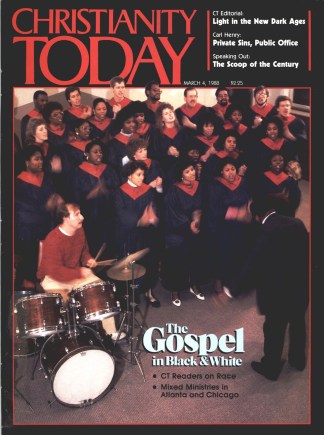
Cover: The black-and-white choir at Rock of Our Salvation Evangelical Free Church in Chicago; Jim Whitmer, photographer.

How Not to Spell Relief

The German pastor/theologian Helmut Thielicke once observed about American Christians: “They have an inadequate theology of suffering.”

Who could disagree? How could we expect a theology of suffering to emerge from a society that has survived two centuries without a foreign invasion, solves all meteorological discomfort with “climate control,” and prescribes a pill for every twinge of pain?

At least part of our difficulty may come from how we read the Bible. I have found at least five biblical approaches to suffering, and if we focus on one of these approaches exclusively, we risk not only an inadequate, but a heretical, theology of suffering. Because they appear progressively through Scripture, I call these five approaches the Hardship Stages.

Stage 1: A person living right should never suffer. We experience this stage, often dubbed the “prosperity gospel,” almost as a reflex. A 30-foot golf putt rims the cup but does not fall: “You must not be living right!” A Christian leader comes down with cancer: “How could this happen to such a saint?”

We should at least acknowledge that similar sentiments do appear in the Bible, especially in the Book of Proverbs, which implies that right living will earn its reward in this life. And consider the sweeping promise of Psalm 1:3 to the righteous man: “Whatever he does prospers.”

You would have to go back to Exodus and Deuteronomy to understand the source of this theology. In his covenant with the Israelites, God guaranteed prosperity if the people would follow him faithfully. But the Israelites broke the terms of that covenant, and a book like the Psalms reveals the Jews’ anguished adjustment to new realities. Almost a third of the psalms show a “righteous” author struggling with the failure of prosperity theology.

Stage 2: Good people do endure hardships, but they will always find relief. Many of the “hardship psalms” take on an insistent tone of self-defense. The author seems to believe, “If I can just convince God of my righteousness, then God will surely deliver me.”

I have come to see such “self-righteous” psalms (which may grate on the ears of those raised on “Amazing Grace”) as psalms of preparation. They help an entire nation understand that sometimes righteous people do suffer, and sometimes they do not get delivered. In that sense, these psalms are truly messianic: they prepare the way for Jesus, a perfect man who, as Hebrews says, “offered up prayers and petitions with loud cries and tears to the one who could save him from death.” But Jesus was not saved from death.

Hebrews also records a list of faithful persons through the centuries. Some received miraculous deliverance: Isaac, Joseph, Moses, Rahab, Gideon, David. But others were tortured and chained, stoned and sawed in two. This latter group went about in sheepskins and goatskins, destitute, persecuted, and mistreated, wandering in deserts and mountains, and in caves and holes in the ground. The author makes this blunt assessment: “These were all commended for their faith, yet none of them received what had been promised.”

Stage 3: All things work together for good. That famous phrase appears in Romans 8, and is often distorted. Some people think it means “Only good things will happen to those who love God.” Ironically, Paul meant just the opposite. In the remainder of the chapter, he defines what kind of “things” he is talking about: trouble, hardship, persecution, famine, nakedness, danger, the sword. Paul endured all those things, and in the end succumbed to them. He was not “delivered.” Yet, he insists, “in all these things we are more than conquerors”; no amount of hardship can separate us from the love of God.

Paul found a neat way to resolve the contradictions raised by the first two hardship stages. Hardship is part of the human condition, and no one can claim an exemption. But for those who love God, the condition is temporary. One day the “groaning” creation will be liberated, and all hardship will be abolished. We have a timing problem, Paul says. Just wait: God’s miracle of transforming Bad Friday into Easter Sunday will be enlarged to cosmic scale.

Stage 4: Faithful people may be called to suffer. The Book of 1 Peter introduces this new twist on hardship. Far from stage 1, where the righteous expect an immunity to suffering, this theology assumes that those following “in His steps” will, like Christ, suffer unjustly. History bears out Peter’s words. According to tradition, 11 of 12 apostles died martyrs’ deaths, and the spilled blood of such martyrs became the seed for the church’s growth.

Stage 5: Holy indifference. The apostle Paul reached this exalted state, as expressed in such a passage as Philippians 1. Paul can hardly decide whether it is better to die and be with Christ or to stay awhile and continue his ministry. Clearly, prison is desirable: he lists many good results from that hardship. Wealth, poverty, comfort, suffering, acceptance, rejection, even death or life—none of these circumstances mattered much to Paul. Only one thing mattered ultimately: the surpassing goal of exalting Christ. And that goal could be accomplished in any set of circumstances.

It bothers some people, I know, to list a series of biblical “stages” without a tidy formula resolving them into a grand scheme. For those people, I simply recommend contemplating stage 1 in the light of stage 5. Curiously, Paul’s advanced state of holy indifference to pain puts him right back in stage 1. For Paul, a person living right did not suffer—not in any ultimate sense, at least. Rather, suffering offered a way to participate in “the fellowship of Christ’s sufferings.” And God prospered all the events of Paul’s life by using pain, like pleasure, as one of the tools to advance his kingdom.

I have met few people who have attained the lofty state of stage 5, which may confirm Helmut Thielicke’s comment about America. How can a nation so singularly blessed be expected to master such advanced faith? We must turn instead to the Christians in El Salvador, or South Africa, or North Korea, or Iran, for a lesson in the advanced school of suffering. Alas, it seems we devote more time and energy debating the possibilities of stage 1—or at least yearning for those “good old days” when America won all its wars and the stock market soared.

Charismatics Shake Hands with Activists

What do charismatics and evangelical social activists have in common? Forty Christian leaders representing both camps met last month in Sierra Madre, California, to find out.

Historically, these groups have represented divergent perspectives on the priorities mandated by the Christian faith. But the paper “Words, Works, and Wonders: The Power and Justice of the Kingdom of God,” which came out of the meeting, affirms that the constituencies share “a commitment to the Bible as our authority and inspiration and to the Holy Spirit as our guide, convictor, and empowerer.” Moreover, the paper notes that some attending the conference came because they are seeking “a deeper experience of the Holy Spirit in their social action ministries,” while others attended because of a “growing conviction that the Holy Spirit … has a heart for the whole world and especially the poor.”

Michael Harper, director of an Anglican charismatic renewal organization in the United Kingdom, and Ronald Sider, executive director of Evangelicals for Social Action, coordinated the conference, at which all six continents were represented.

Sider characterized the meeting as the beginning of a dialogue. He said charismatics and social activists have a lot to learn from each other. “We evangelical social activists can learn to be open to the presence, the guidance, and the power of the Holy Spirit,” he said.

The paper acknowledges that questions remain, including “How do we relate the call to suffer redemptively and the call to attain victory over evil?” The only specific proposal to emerge from the meeting was to continue the dialogue. The planning committee was asked to arrange a second meeting with additional participants for sometime within the next two years.

Boston Church of Christ Grows amid Controversy

The Boston Church of Christ, home base for more than 3,000 worshipers, and New England’s fastest-growing congregation, is the focus of a controversy that reaches across the country.

Last year, the Christian Chronicle, a Churches of Christ newspaper published in Oklahoma, labeled the Boston congregation divisive, authoritarian, and “dangerous.” Detractors cite excessive demands on members’ time; isolation of church members from family and most outside friends; heavy pressure to succeed in evangelism; and a one-on-one discipleship program that one Churches of Christ periodical called “a glorified snitch system.”

Supporters point to the Boston congregation’s ethnic integration (77 nationalities are represented); to marriages saved and psychological crises ended; and above all, to the congregation’s commitment to evangelism. Commented church-growth specialist Donald McGavran of Fuller Theological Seminary: “All the branches of the universal church in America could look at this [congregation] and see what they can use.”

The rapid growth of the Boston Church of Christ began in 1979 when evangelist Kip McKean was hired by a suburban congregation with fewer than 100 members. By December 1980, Sunday attendance exceeded 250. Today, more than 3,300 people worship weekly at the Boston Garden, home to the Boston Bruins and Celtics. In addition, more than 1,300 were baptized in 1986 at churches planted by the Boston congregation on five continents since 1982.

The heart of the church’s outreach program is evangelistic Bible studies, more than 300 of which are hosted weekly within a 40-mile radius of Boston. McGavran cites those, as well as the use of house churches and rented worship space instead of a mortgaged building, as keys to the church’s growth.

Points Of Disagreement

The Boston Church of Christ is part of the nondenominational Churches of Christ, one of the groups produced by a nineteenth-century attempt to restore New Testament Christianity to the American church. The Boston church differs from most Churches of Christ congregations, however, in that it is part of a movement known as Multiplying Ministries, developed by Chuck Lucas at the Crossroads Church of Christ in Gainesville, Florida. Many of the more than 13,000 Churches of Christ outside that movement say the Boston church’s methods diverge from Churches of Christ traditions of freedom of conscience and congregational autonomy.

Other controversies focus on theology and methodology. Key among the theological objections is the Boston church’s claim to be virtually the only channel of salvation. While leaders acknowledge that some outside their congregation are saved, they believe baptism is necessary for salvation and teach a narrow definition of what constitutes valid baptism. As a result, the church rebaptizes even people who were baptized in other Churches of Christ.

The primary objection to methodology centers on the authority the congregation holds over its members and the guilt resulting from its heavy demands. Each member is assigned to a discipling partner with whom he or she is expected to have daily contact. Discipling partners provide advice on every aspect of a member’s life, from daily schedules to the duration of kisses on a date. College students are discouraged from going home for the summer unless there is a strong Churches of Christ congregation in that community. And former members report they were urged not to take even four-day trips away from Boston.

Living in “total commitment [to Christ means] you’re always babysitting for the [children of church] leaders, serving the brothers and sisters … pushing for people to go to church or to Bible talks or church functions,” said former member Karen Gray, a senior at Wellesley College. “And then you’re sinning because you didn’t get enough sleep. You’re always guilty.”

World Evangelization

The Boston church’s ambitious world evangelization plan involves planting churches in key foreign cities, with daughter churches expected to plant other congregations. The influence of the Boston Church of Christ already extends to six continents.

Some have questioned whether the Boston church can maintain its momentum. The congregation’s dropout rate has risen dramatically as the number of baptisms has grown. The church claimed a 90 percent retention rate in 1980. But a review of its records from May 1980 to December 1986 shows that 32.5 percent of the members who have not moved away from the area have quit.

“When you get white hot, I don’t know where you go after that,” commented Robert Randolph, a member of the tiny Church of Christ in nearby Brookline, Massachusetts. “After a while, even the faithful begin to notice it’s hype.”

Responds evangelist McKean, of the Boston church: “If places are not growing, I’m 100 percent sure God is not with them.… This is the condemnation some churches feel. This church is growing; they’re not.”

In interviews, former members of the Boston Church of Christ gave a variety of reasons for leaving. “Most of the people who leave do so because they can’t take the pressure any more … and they’re so burned out they don’t want to have anything to do with any other group either,” said Philip Owen, an Indianapolis engineer who was recruited while a student at the Massachusetts Institute of Technology.

To join the Boston Church of Christ is to find “instant family, instant friends,” said Kecia Henderson, a member of the church for four years. But because church members are strongly encouraged to socialize only with other members and with evangelistic prospects, she said, leaving the church means facing the prospect of leaving your friends behind.

Moreover, because the church teaches that few, if any, outside its number are saved, people who leave the church often believe they have turned their backs on God, said former member Gary Idleburg. “A lot of people end up wallowing in debauchery because they never made the separation in their mind between the church and God.”

By Carlene B. Hill, in Boston.

Coalition Chief Reflects on Status of Christian Colleges

Christian College Coalition President John Dellenback will step down this year after a decade at the helm of that evangelical higher education association. In addition to his work with the coalition, Dellenback has served in a number of capacities, including four terms as congressman from Oregon, director of the U.S. Peace Corps, and member of the U.S. Secretary of State’s Advisory Committee on South Africa. He was recently elected chairman of the board of World Vision U.S. CHRISTIANITY TODAY asked Dellenback to reflect on his time at the coalition.

What have been some of the most meaningful aspects of your time at the coalition?

The thing that immediately jumps to my mind is the membership. Out of the 77 colleges and universities that are part of this team effort, we have 28 different denominations represented, and we have another 10 or 11 schools that are interdenominational or nondenominational. To me, that says that within the evangelical world we do not have to split off and build walls that separate us from each other. We can get a broad group of widespread representation working together; and when we come together, we deal with what ties us together—Christ—and not the things that could be used to separate us.

What coalition accomplishments are you most pleased with?

Most of the people who teach in Christian colleges got their master’s degrees and doctorates at secular schools. They enter the classroom—where they are using basically secular textbooks—and are told: “Now be sure, when you teach the subject, you include the relevance of Christ.” But no one has trained them for this, and they have very little in the way of literature that helps them do it. So a major thrust for the coalition has been to work with the colleges as they strive to make their faculties, their administrations, and everything else show Christ throughout all areas.

We have done that with meetings where we’ve gathered chaplains, or athletic coaches, or professors, or administrators to share with each other. We’ve had workshops and national conferences where faculty come from their own institutions and meet women and men who are doing similar things on other campuses.

In addition to that, we are publishing a series of supplemental textbooks. The first book out is Psychology Through the Eyes of Faith. We also are working on Biology Through the Eyes of Faith, Literature Through the Eyes of Faith, and Business Through the Eyes of Faith.

What advantages does the Christian college offer students?

These are all liberal arts institutions, and their task is to help young people learn how humanity has come to its present stage. But that’s only part of it. The special calling of the Christian college is to say that Christ is relevant to everything that we do.

The Christian college can show students that faith is like the vertebrae of the skeleton; it doesn’t separate us from the world, but it gives us the strength and the foundation to go out and function wherever we are. I hope our schools can more and more bring forth young people with that kind of faith. Also, I hope they can help students know there are certain values that should characterize their lives.

What kind of values?

If I had to pick three, I would say it should be impossible for a young person to come out of one of our schools without having had the concepts of service, stewardship, and love inculcated. The students are key because the structure of the coalition doesn’t mean anything unless it’s serving the colleges, and the colleges don’t mean anything unless they’re equipping young people.

Prolifers Mark 15-Year Battle for Unborn

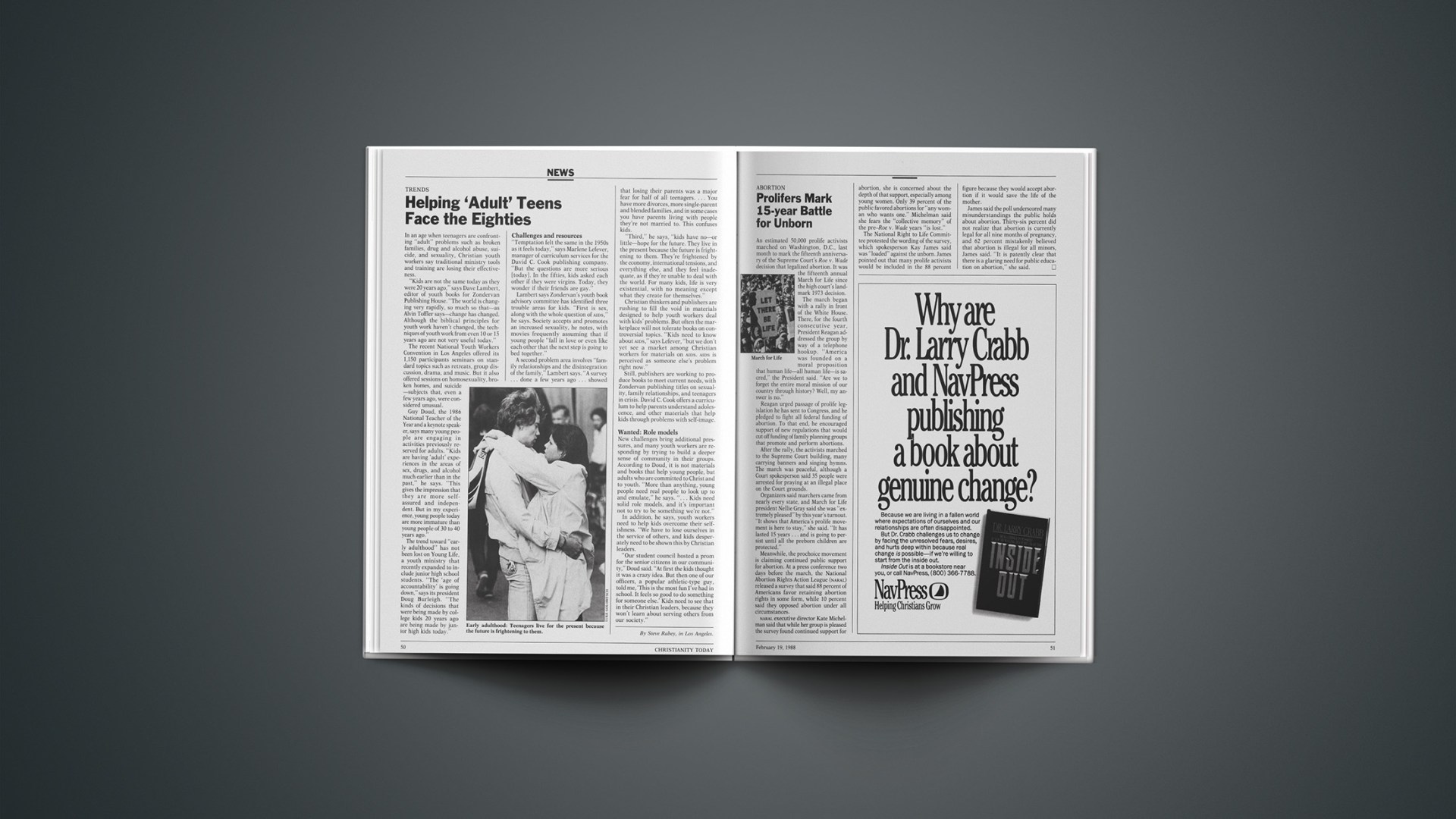
An estimated 50,000 prolife activists marched on Washington, D.C., last month to mark the fifteenth anniversary of the Supreme Court’s Roe v. Wade decision that legalized abortion. It was the fifteenth annual March for Life since the high court’s landmark 1973 decision.

The march began with a rally in front of the White House. There, for the fourth consecutive year, President Reagan addressed the group by way of a telephone hookup. “America was founded on a moral proposition that human life—all human life—is sacred,” the President said. “Are we to forget the entire moral mission of our country through history? Well, my answer is no.”

Reagan urged passage of prolife legislation he has sent to Congress, and he pledged to fight all federal funding of abortion. To that end, he encouraged support of new regulations that would cut off funding of family planning groups that promote and perform abortions.

After the rally, the activists marched to the Supreme Court building, many carrying banners and singing hymns. The march was peaceful, although a Court spokesperson said 35 people were arrested for praying at an illegal place on the Court grounds.

Organizers said marchers came from nearly every state, and March for Life president Nellie Gray said she was “extremely pleased” by this year’s turnout. “It shows that America’s prolife movement is here to stay,” she said. “It has lasted 15 years … and is going to persist until all the preborn children are protected.”

Meanwhile, the prochoice movement is claiming continued public support for abortion. At a press conference two days before the march, the National Abortion Rights Action League (NARAL) released a survey that said 88 percent of Americans favor retaining abortion rights in some form, while 10 percent said they opposed abortion under all circumstances.

NARAL executive director Kate Michelman said that while her group is pleased the survey found continued support for abortion, she is concerned about the depth of that support, especially among young women. Only 39 percent of the public favored abortions for “any woman who wants one.” Michelman said she fears the “collective memory” of the pre-Roe v. Wade years “is lost.”

The National Right to Life Committee protested the wording of the survey, which spokesperson Kay James said was “loaded” against the unborn. James pointed out that many prolife activists would be included in the 88 percent figure because they would accept abortion if it would save the life of the mother.

James said the poll underscored many misunderstandings the public holds about abortion. Thirty-six percent did not realize that abortion is currently legal for all nine months of pregnancy, and 62 percent mistakenly believed that abortion is illegal for all minors, James said. “It is patently clear that there is a glaring need for public education on abortion,” she said.

Helping ‘Adult’ Teens Face the Eighties

In an age when teenagers are confronting “adult” problems such as broken families, drug and alcohol abuse, suicide, and sexuality, Christian youth workers say traditional ministry tools and training are losing their effectiveness.

“Kids are not the same today as they were 20 years ago,” says Dave Lambert, editor of youth books for Zondervan Publishing House. “The world is changing very rapidly, so much so that—as Alvin Toffler says—change has changed. Although the biblical principles for youth work haven’t changed, the techniques of youth work from even 10 or 15 years ago are not very useful today.”

The recent National Youth Workers Convention in Los Angeles offered its 1,150 participants seminars on standard topics such as retreats, group discussion, drama, and music. But it also offered sessions on homosexuality, broken homes, and suicide—subjects that, even a few years ago, were considered unusual.

Guy Doud, the 1986 National Teacher of the Year and a keynote speaker, says many young people are engaging in activities previously reserved for adults. “Kids are having ‘adult’ experiences in the areas of sex, drugs, and alcohol much earlier than in the past,” he says. “This gives the impression that they are more self-assured and independent. But in my experience, young people today are more immature than young people of 30 to 40 years ago.”

The trend toward “early adulthood” has not been lost on Young Life, a youth ministry that recently expanded to include junior high school students. “The ‘age of accountability’ is going down,” says its president Doug Burleigh. “The kinds of decisions that were being made by college kids 20 years ago are being made by junior high kids today.”

Challenges And Resources

“Temptation felt the same in the 1950s as it feels today,” says Marlene Lefever, manager of curriculum services for the David C. Cook publishing company. “But the questions are more serious [today]. In the fifties, kids asked each other if they were virgins. Today, they wonder if their friends are gay.”

Lambert says Zondervan’s youth book advisory committee has identified three trouble areas for kids. “First is sex, along with the whole question of AIDS,” he says. Society accepts and promotes an increased sexuality, he notes, with movies frequently assuming that if young people “fall in love or even like each other that the next step is going to bed together.”

A second problem area involves “family relationships and the disintegration of the family,” Lambert says. “A survey … done a few years ago … showed that losing their parents was a major fear for half of all teenagers.… You have more divorces, more single-parent and blended families, and in some cases you have parents living with people they’re not married to. This confuses kids.

“Third,” he says, “kids have no—or little—hope for the future. They live in the present because the future is frightening to them. They’re frightened by the economy, international tensions, and everything else, and they feel inadequate, as if they’re unable to deal with the world. For many kids, life is very existential, with no meaning except what they create for themselves.”

Christian thinkers and publishers are rushing to fill the void in materials designed to help youth workers deal with kids’ problems. But often the marketplace will not tolerate books on controversial topics. “Kids need to know about AIDS,” says Lefever, “but we don’t yet see a market among Christian workers for materials on AIDS, AIDS is perceived as someone else’s problem right now.”

Still, publishers are working to produce books to meet current needs, with Zondervan publishing titles on sexuality, family relationships, and teenagers in crisis. David C. Cook offers a curriculum to help parents understand adolescence, and other materials that help kids through problems with self-image.

Wanted: Role Models

New challenges bring additional pressures, and many youth workers are responding by trying to build a deeper sense of community in their groups. According to Doud, it is not materials and books that help young people, but adults who are committed to Christ and to youth. “More than anything, young people need real people to look up to and emulate,” he says. “… Kids need solid role models, and it’s important not to try to be something we’re not.”

In addition, he says, youth workers need to help kids overcome their selfishness. “We have to lose ourselves in the service of others, and kids desperately need to be shown this by Christian leaders.

“Our student council hosted a prom for the senior citizens in our community,” Doud said. “At first the kids thought it was a crazy idea. But then one of our officers, a popular athletic-type guy, told me, ‘This is the most fun I’ve had in school. It feels so good to do something for someone else.’ Kids need to see that in their Christian leaders, because they won’t learn about serving others from our society.”

By Steve Rabey, in Los Angeles

Apple PodcastsDown ArrowDown ArrowDown Arrowarrow_left_altLeft ArrowLeft ArrowRight ArrowRight ArrowRight Arrowarrow_up_altUp ArrowUp ArrowAvailable at Amazoncaret-downCloseCloseEmailEmailExpandExpandExternalExternalFacebookfacebook-squareGiftGiftGooglegoogleGoogle KeephamburgerInstagraminstagram-squareLinkLinklinkedin-squareListenListenListenChristianity TodayCT Creative Studio Logologo_orgMegaphoneMenuMenupausePinterestPlayPlayPocketPodcastRSSRSSSaveSaveSaveSearchSearchsearchSpotifyStitcherTelegramTable of ContentsTable of Contentstwitter-squareWhatsAppXYouTubeYouTube