World Scene from February 19, 1988

IRAN

Khomeini Snubs Qur’An

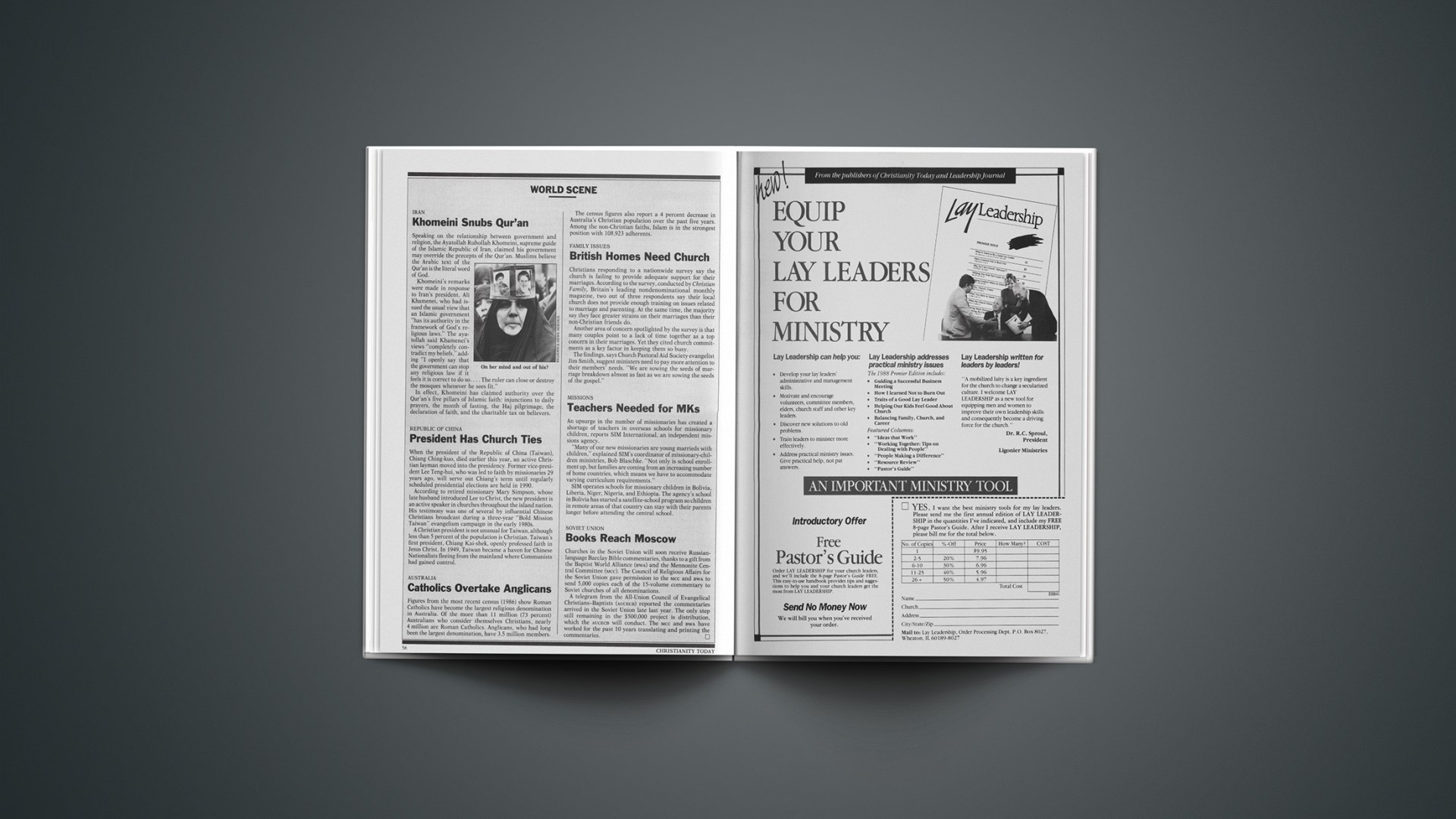
Speaking on the relationship between government and religion, the Ayatollah Ruhollah Khomeini, supreme guide of the Islamic Republic of Iran, claimed his government may override the precepts of the Qur’an. Muslims believe the Arabic text of the Qur’an is the literal word of God.

Khomeini’s remarks were made in response to Iran’s president, Ali Khamenei, who had issued the usual view that an Islamic government “has its authority in the framework of God’s religious laws.” The ayatollah said Khamenei’s views “completely contradict my beliefs,” adding “I openly say that the government can stop any religious law if it feels it is correct to do so.… The ruler can close or destroy the mosques whenever he sees fit.”

In effect, Khomeini has claimed authority over the Qur’an’s five pillars of Islamic faith: injunctions to daily prayers, the month of fasting, the Haj pilgrimage, the declaration of faith, and the charitable tax on believers.

REPUBLIC OF CHINA

President Has Church Ties

When the president of the Republic of China (Taiwan), Chiang Ching-kuo, died earlier this year, an active Christian layman moved into the presidency. Former vice-president Lee Teng-hui, who was led to faith by missionaries 29 years ago, will serve out Chiang’s term until regularly scheduled presidential elections are held in 1990.

According to retired missionary Mary Simpson, whose late husband introduced Lee to Christ, the new president is an active speaker in churches throughout the island nation. His testimony was one of several by influential Chinese Christians broadcast during a three-year “Bold Mission Taiwan” evangelism campaign in the early 1980s.

A Christian president is not unusual for Taiwan, although less than 5 percent of the population is Christian. Taiwan’s first president, Chiang Kai-shek, openly professed faith in Jesus Christ. In 1949, Taiwan became a haven for Chinese Nationalists fleeing from the mainland where Communists had gained control.

AUSTRALIA

Catholics Overtake Anglicans

Figures from the most recent census (1986) show Roman Catholics have become the largest religious denomination in Australia. Of the more than 11 million (73 percent) Australians who consider themselves Christians, nearly 4 million are Roman Catholics. Anglicans, who had long been the largest denomination, have 3.5 million members.

The census figures also report a 4 percent decrease in Australia’s Christian population over the past five years. Among the non-Christian faiths, Islam is in the strongest position with 108,923 adherents.

FAMILY ISSUES

British Homes Need Church

Christians responding to a nationwide survey say the church is failing to provide adequate support for their marriages. According to the survey, conducted by Christian Family, Britain’s leading nondenominational monthly magazine, two out of three respondents say their local church does not provide enough training on issues related to marriage and parenting. At the same time, the majority say they face greater strains on their marriages than their non-Christian friends do.

Another area of concern spotlighted by the survey is that many couples point to a lack of time together as a top concern in their marriages. Yet they cited church commitments as a key factor in keeping them so busy.

The findings, says Church Pastoral Aid Society evangelist Jim Smith, suggest ministers need to pay more attention to their members’ needs. “We are sowing the seeds of marriage breakdown almost as fast as we are sowing the seeds of the gospel.”

MISSION

Teachers Needed For Mks

An upsurge in the number of missionaries has created a shortage of teachers in overseas schools for missionary children, reports SIM International, an independent missions agency.

“Many of our new missionaries are young marrieds with children,” explained SIM’s coordinator of missionary-children ministries, Bob Blaschke. “Not only is school enrollment up, but families are coming from an increasing number of home countries, which means we have to accommodate varying curriculum requirements.”

SIM operates schools for missionary children in Bolivia, Liberia, Niger, Nigeria, and Ethiopia. The agency’s school in Bolivia has started a satellite-school program so children in remote areas of that country can stay with their parents longer before attending the central school.

SOVIET UNION

Books Reach Moscow

Churches in the Soviet Union will soon receive Russian-language Barclay Bible commentaries, thanks to a gift from the Baptist World Alliance (BWA) and the Mennonite Central Committee (MCC). The Council of Religious Affairs for the Soviet Union gave permission to the MCC and BWA to send 5,000 copies each of the 15-volume commentary to Soviet churches of all denominations.

A telegram from the All-Union Council of Evangelical Christians-Baptists (AUCECB) reported the commentaries arrived in the Soviet Union late last year. The only step still remaining in the $500,000 project is distribution, which the AUCECB will conduct. The MCC and BWA have worked for the past 10 years translating and printing the commentaries.
Ideas

One Small Step

The euphoria of President Reagan’s summit meeting with Soviet leader Mikhail Gorbachev is long past. It is in the cold light of day that Congress now considers ratification of the INF missile reduction treaty.

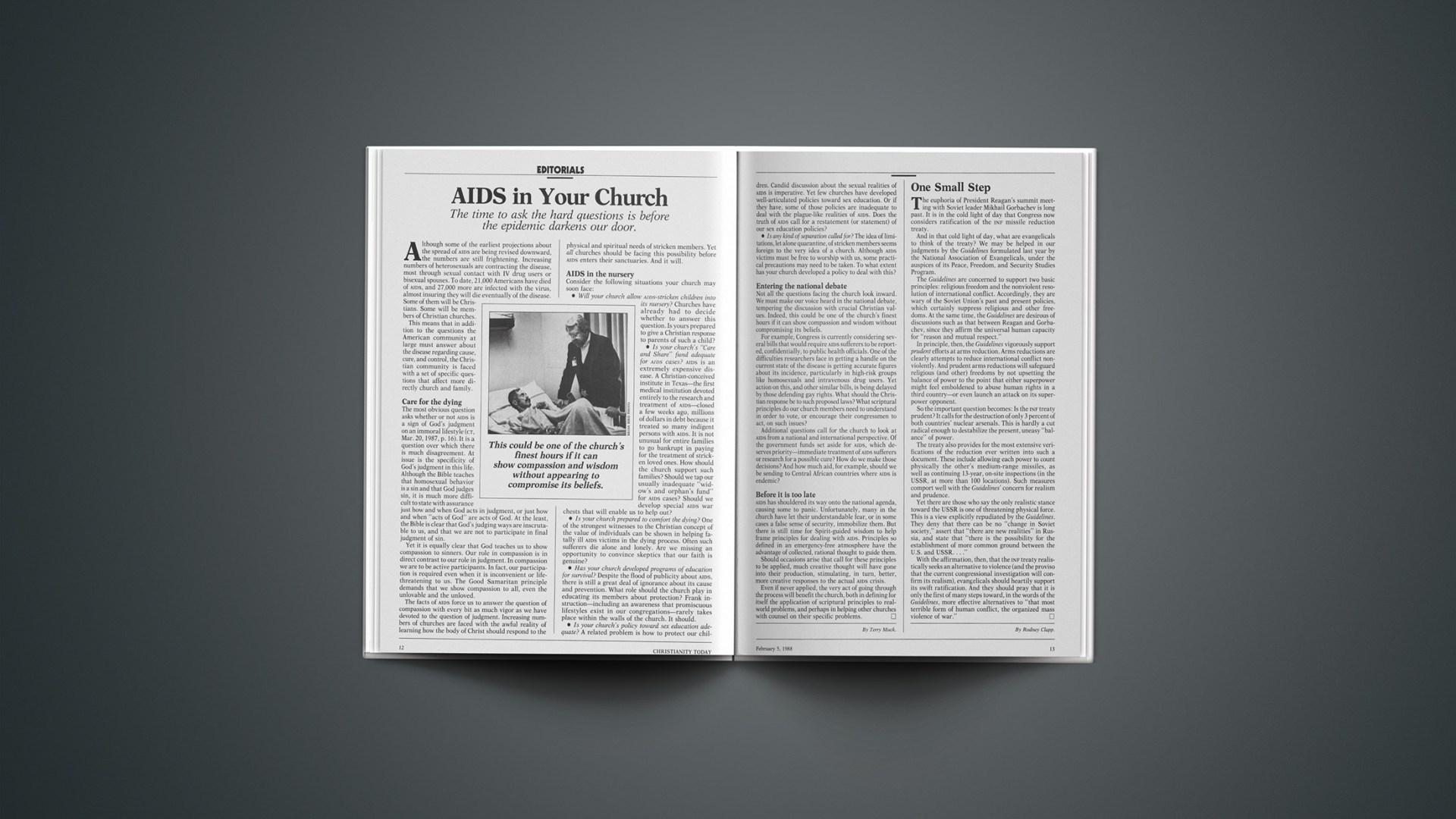
And in that cold light of day, what are evangelicals to think of the treaty? We may be helped in our judgments by the Guidelines formulated last year by the National Association of Evangelicals, under the auspices of its Peace, Freedom, and Security Studies Program.

The Guidelines are concerned to support two basic principles: religious freedom and the nonviolent resolution of international conflict. Accordingly, they are wary of the Soviet Union’s past and present policies, which certainly suppress religious and other freedoms. At the same time, the Guidelines are desirous of discussions such as that between Reagan and Gorbachev, since they affirm the universal human capacity for “reason and mutual respect.”

In principle, then, the Guidelines vigorously support prudent efforts at arms reduction. Arms reductions are clearly attempts to reduce international conflict non-violently. And prudent arms reductions will safeguard religious (and other) freedoms by not upsetting the balance of power to the point that either superpower might feel emboldened to abuse human rights in a third country—or even launch an attack on its superpower opponent.

So the important question becomes: Is the INF treaty prudent? It calls for the destruction of only 3 percent of both countries’ nuclear arsenals. This is hardly a cut radical enough to destabilize the present, uneasy “balance” of power.

The treaty also provides for the most extensive verifications of the reduction ever written into such a document. These include allowing each power to count physically the other’s medium-range missiles, as well as continuing 13-year, on-site inspections (in the USSR, at more than 100 locations). Such measures comport well with the Guidelines’ concern for realism and prudence.

Yet there are those who say the only realistic stance toward the USSR is one of threatening physical force. This is a view explicitly repudiated by the Guidelines. They deny that there can be no “change in Soviet society,” assert that “there are new realities” in Russia, and state that “there is the possibility for the establishment of more common ground between the U.S. and USSR.…”

With the affirmation, then, that the INF treaty realistically seeks an alternative to violence (and the proviso that the current congressional investigation will confirm its realism), evangelicals should heartily support its swift ratification. And they should pray that it is only the first of many steps toward, in the words of the Guidelines, more effective alternatives to “that most terrible form of human conflict, the organized mass violence of war.”

By Rodney Clapp.

North American Scene from February 5, 1988

TRENDS

Churchgoers Knock Religion

Results of a nationwide survey on spirituality taken by Better Homes and Gardens magazine found that most who responded participate in organized religion, but many feel religious organizations fall short in meeting the spiritual needs of their members.

More than 80,000 readers of the magazine, which has a circulation of over eight million, responded to a questionnaire, the results of which were printed in the January issue. Commenting on the results, the editors said that “perhaps the most consistently expressed sentiment was one thanking us for printing the survey, for acknowledging the spiritual side of our readers’ lives.”

According to the survey report, many respondents “are bothered by religious organizations that fail to recognize the real-life needs of members.” Fifty-nine percent thought organized religions were “sensitive to the spiritual needs of today’s families,” while 35 percent thought they were not.

A number of readers made a distinction between personal spirituality and commitment to a religious institution. Wrote one respondent, “Religion is going through the motions, while faith and trust in God is an experience of the heart.”

BROADCASTING

“No Plea” Christian Tv?

A coalition of Protestant, Catholic, and Orthodox traditions, as well as Jewish and evangelical groups, plans to launch a 24-hour religious cable television network. Vision Interfaith Satellite Network (VISN) will begin providing religion-and value-oriented programming in mid-1988, according to David Ochoa, the network’s chief executive officer.

Denominations and faith groups involved in this venture include the Salvation Army; Seventh-day Adventist Church; Mennonite Church; Episcopal Church; Lutheran Church-Missouri Synod; United Methodist Church; Presbyterian Church U.S.A.; and the Roman Catholic Church. Organizers hope to provide an alternative to current religious programming by providing values-oriented lifestyle shows and issue-related films, as well as opportunities for denominations to produce programs. Moreover, VISN will not allow funds to be raised on the air.

The proposed network is a program service of the National Interfaith Cable Coalition.

POVERTY

Families Hit The Streets

Children and their parents now make up one-third of the homeless in 26 American cities, and most of those seeking emergency food are families, according to a study released by the U.S. Conference of Mayors.

Overall, the demand for shelter jumped by 21 percent from 1986 to 1987. Kansas City, Missouri, led the surveyed cities with a 44 percent increase in requests for shelter, while the city of Louisville, Kentucky, reported no change. Nearly one-quarter of the nationwide demand for shelter goes unmet, the study reported.

Church-sponsored urban missions are also noticing the increase of homeless families and children. “We are currently assisting two women with children who have no place to live,” says Lisa Blackwood, administrative coordinator for the Olive Branch, Chicago’s oldest continually operating urban mission. “One of our guests is a woman who until recently lived with her two-year old son in a car.”

The survey found that single men make up 49 percent of the homeless; families with children, 33 percent, single women, 14 percent; and unaccompanied youths, about 4 percent.

INSURANCE

Millions In Aids Claims

American life and health insurers paid out an estimated $292 million in claims arising from AIDS in 1986, according to results from a survey by the American Council of Life Insurance (ACLI) and the Health Insurance Association of America (HIAA).

Said ACLI President Richard S. Schweiker, “The amount of claims is increasing each year.” The average AIDS-related claim was $30,500 for individual life insurance, and $27,300 for group life policies. In contrast, the non-AIDS-related death claim was $7,300 for individual life; $13,800 for group life.

“The 1986 claims represent just the tip of the iceberg in measuring the impact that this disease will have on our industry,” notes Schweiker.

SALVATION ARMY

One Of The Best Charities

Fortune magazine has named the Salvation Army one of America’s best-run charities. The army was one of the four charitable organizations that exceeded the standards created by the Fortune article.

“The army probably does a better job with the poor than anyone else,” said management consultant Peter Drucker. Of each dollar the organization receives, 86 cents goes to the needy. One reason: low salaries. Married Salvation Army officers with 45 years of service, for instance, get only about $12,500 a year per couple.

PEOPLE AND EVENTS

Briefly Noted

Resigned : As president of Northern Baptist Theological Seminary, William R. Myers, effective no later than September 23, 1988, when the Lombard (Ill.) school ends its seventy-fifth anniversary celebration.

Died: “Pistol” Pete Maravich, basketball sensation at Louisiana State University and later elected to the National Basketball Association’s Hall of Fame, while playing in a pickup basketball game with Dr. James Dobson. Troubled throughout his career with alcohol abuse, Maravich became a Christian after retiring from basketball.

Recognized : The Buddhist Churches of America as an endorsing agency to certify qualifications for clergy for U.S. military chaplaincies. This action by the Department of Defense paves the way for Buddhist ministers to join Christian and Jewish clerics as chaplains in the armed forces.

World Scene from February 45, 1988

CHINA

Chinese Print Own Bibles

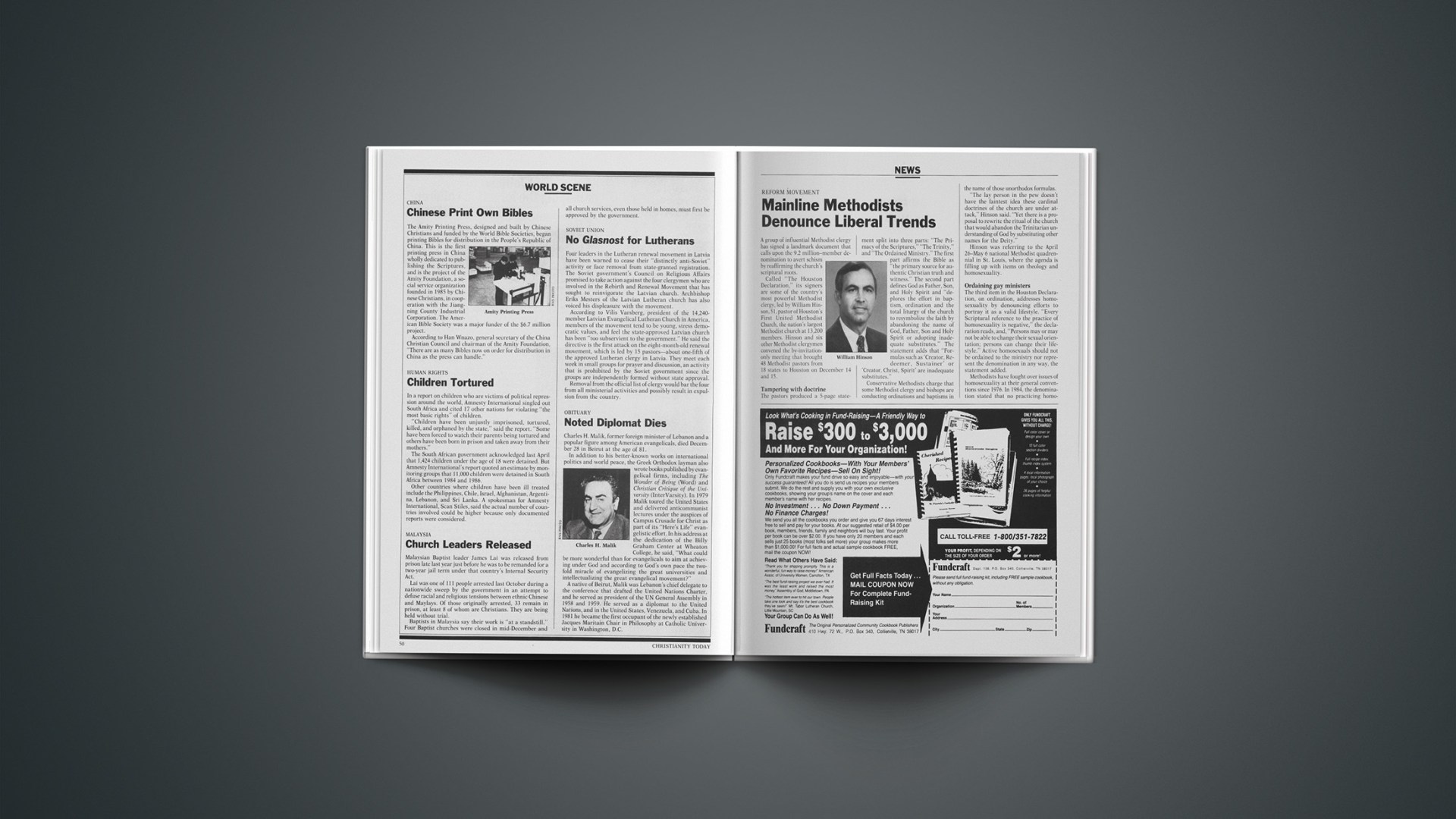
The Amity Printing Press, designed and built by Chinese Christians and funded by the World Bible Societies, began printing Bibles for distribution in the People’s Republic of China. This is the first printing press in China wholly dedicated to publishing the Scriptures, and is the project of the Amity Foundation, a social service organization founded in 1985 by Chinese Christians, in cooperation with the Jiangning County Industrial Corporation. The American Bible Society was a major funder of the $6.7 million project.

According to Han Wnazo, general secretary of the China Christian Council and chairman of the Amity Foundation, “There are as many Bibles now on order for distribution in China as the press can handle.”

HUMAN RIGHTS

Children Tortured

In a report on children who are victims of political repression around the world, Amnesty International singled out South Africa and cited 17 other nations for violating “the most basic rights” of children.

“Children have been unjustly imprisoned, tortured, killed, and orphaned by the state,” said the report. “Some have been forced to watch their parents being tortured and others have been born in prison and taken away from their mothers.”

The South African government acknowledged last April that 1,424 children under the age of 18 were detained. But Amnesty International’s report quoted an estimate by monitoring groups that 11,000 children were detained in South Africa between 1984 and 1986.

Other countries where children have been ill treated include the Philippines, Chile, Israel, Afghanistan, Argentina, Lebanon, and Sri Lanka. A spokesman for Amnesty International, Scan Stiles, said the actual number of countries involved could be higher because only documented reports were considered.

MALAYSIA

Church Leaders Released

Malaysian Baptist leader James Lai was released from prison late last year just before he was to be remanded for a two-year jail term under that country’s Internal Security Act.

Lai was one of 111 people arrested last October during a nationwide sweep by the government in an attempt to defuse racial and religious tensions between ethnic Chinese and Maylays. Of those originally arrested, 33 remain in prison, at least 8 of whom are Christians. They are being held without trial.

Baptists in Malaysia say their work is “at a standstill.” Four Baptist churches were closed in mid-December and all church services, even those held in homes, must first be approved by the government.

SOVIET UNION

No Glasnost For Lutherans

Four leaders in the Lutheran renewal movement in Latvia have been warned to cease their “distinctly anti-Soviet” activity or face removal from state-granted registration. The Soviet government’s Council on Religious Affairs promised to take action against the four clergymen who are involved in the Rebirth and Renewal Movement that has sought to reinvigorate the Latvian church. Archbishop Eriks Mesters of the Latvian Lutheran church has also voiced his displeasure with the movement.

According to Vilis Varsberg, president of the 14,240-member Latvian Evangelical Lutheran Church in America, members of the movement tend to be young, stress democratic values, and feel the state-approved Latvian church has been “too subservient to the government.” He said the directive is the first attack on the eight-month-old renewal movement, which is led by 15 pastors—about one-fifth of the approved Lutheran clergy in Latvia. They meet each week in small groups for prayer and discussion, an activity that is prohibited by the Soviet government since the groups are independently formed without state approval.

Removal from the official list of clergy would bar the four from all ministerial activities and possibly result in expulsion from the country.

OBITUARY

Noted Diplomat Dies

Charles H. Malik, former foreign minister of Lebanon and a popular figure among American evangelicals, died December 28 in Beirut at the age of 81.

In addition to his better-known works on international politics and world peace, the Greek Orthodox layman also wrote books published by evangelical firms, including The Wonder of Being (Word) and Christian Critique of the University (InterVarsity). In 1979 Malik toured the United States and delivered anticommunist lectures under the auspices of Campus Crusade for Christ as part of its “Here’s Life” evangelistic effort. In his address at the dedication of the Billy Graham Center at Wheaton College, he said, “What could be more wonderful than for evangelicals to aim at achieving under God and according to God’s own pace the twofold miracle of evangelizing the great universities and intellectualizing the great evangelical movement?”

A native of Beirut, Malik was Lebanon’s chief delegate to the conference that drafted the United Nations Charter, and he served as president of the UN General Assembly in 1958 and 1959. He served as a diplomat to the United Nations, and in the United States, Venezuela, and Cuba. In 1981 he became the first occupant of the newly established Jacques Maritain Chair in Philosophy at Catholic University in Washington, D.C.

James Johnson’s Sebastian: A Heroic Legacy

What Christian fictional character has been nearly fried in the Negev, frozen at the North Pole, blown up at the Berlin Wall, depth-bombed by the U.S. in the waters off Cuba, and shelled by Soviets after a howling sou’wester off the coast of Australia? The answer, of course, is Raymond Sebastian, the clergy-spy hero of six suspense novels.

Sebastian’s creator, the Reverend James Leonard Johnson, died on June 25, 1987, a month that marked both the twentieth anniversary of Code Name Sebastian—the first such adventure—and the publication date of Trackless Seas (Crossway)—the final one.

Johnson’s life was as much an adventure as his creation’s. Returning from military service, he came to faith in Christ through the brother of a service buddy. He plunged into theological training, went to Nigeria as a missionary with his wife, Rosemary, to edit African Challenge—the premier Christian magazine in Africa at that time—and served as a pastor. His contribution to both missionary and Christian literature was immeasurable.

A man who threw himself with passion into everything he did, Johnson wrote 16 books, headed a literary agency, served as director of Evangelical Literature Overseas, established the graduate communications department at Wheaton College (Ill.), and most recently was associate director of resource development for World Relief.

In the character of Sebastian, Johnson fleshes out an evangelical adaptation of the theology of Dietrich Bonhoeffer. A namby-pamby workaday minister, Sebastian is sent to tour the Holy Land by his despairing church after his wife’s death in an automobile accident. Crashing in the Negev, he meets the ferocious God of Israel, who changes him into an active, not merely vocal, servant to the desperate and the hurting.

Suspicion of empty words plays a strong part in all of Johnson’s novels (including his story of missionary fliers, The Death of Kings). Always the main character is thrown into an environment of deprivation—the jungle, the desert, the Arctic, the ocean, the bombed-out ruins of East Berlin. There, stripped of comfort and eventually of physical strength, the protagonist and his comrades must confront God in a Saint John of the Cross-like experience of sensory and spiritual deprivation. Then God forges a Christian community out of Sebastian and his acquaintances and makes it the present help in trouble—often at a great cost of life, and always with the cost of comfort.

Jim Johnson has left us a delightful legacy, the illustrated promise that all of us, if we rely on the powerful living God, can be turned from weak-kneed losers, pushed around by the the world, into more than conquerors.

By William David Spencer, pastor of encouragement of Pilgrim Church of Beverly/ Salem, Massachusetts, and a teacher at Gordon-Conwell Theological Seminary.

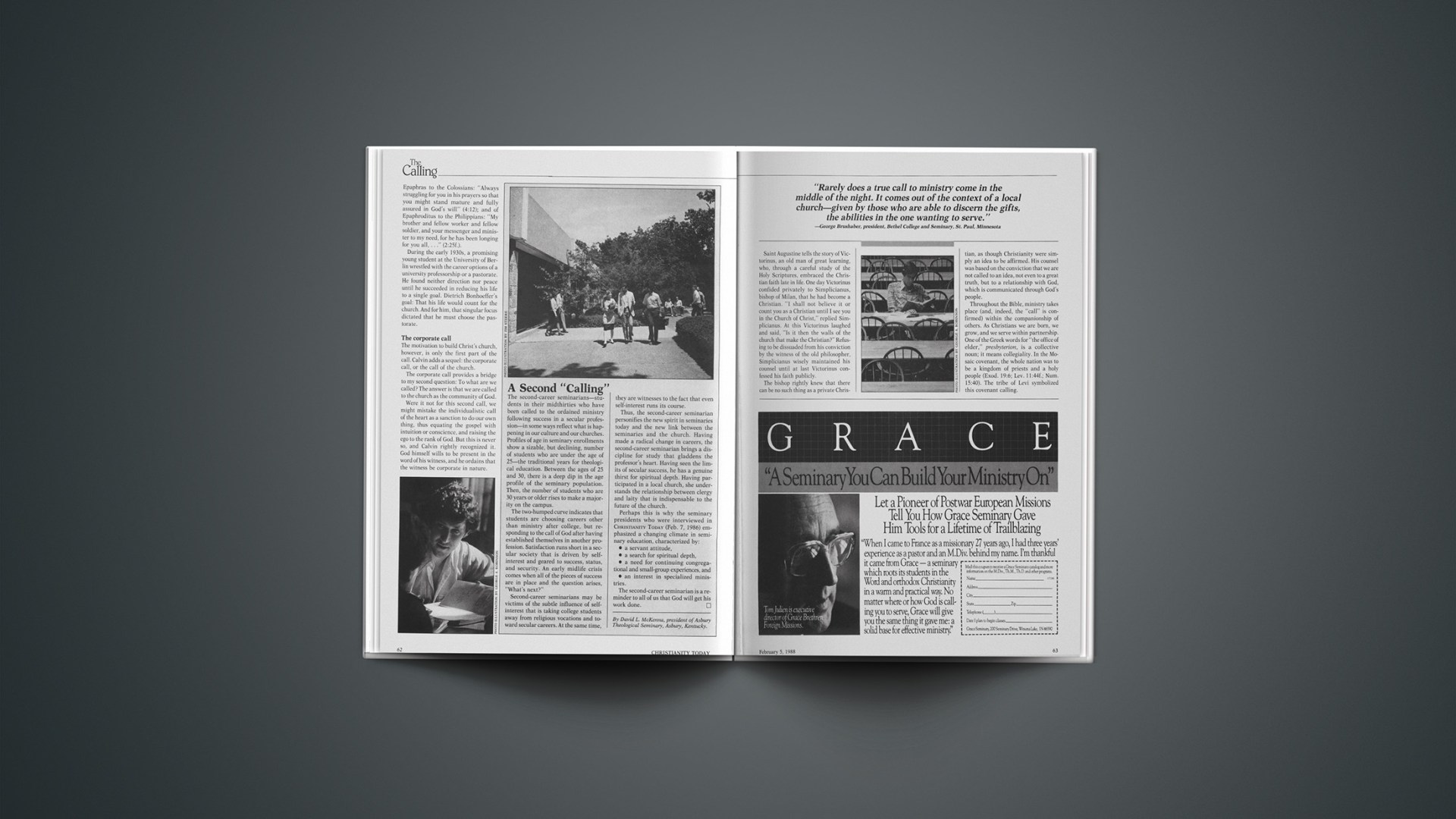
A Second “Calling”

The second-career seminarians—students in their midthirties who have been called to the ordained ministry following success in a secular profession—in some ways reflect what is happening in our culture and our churches. Profiles of age in seminary enrollments show a sizable, but declining, number of students who are under the age of 25—the traditional years for theological education. Between the ages of 25 and 30, there is a deep dip in the age profile of the seminary population. Then, the number of students who are 30 years or older rises to make a majority on the campus.

The two-humped curve indicates that students are choosing careers other than ministry after college, but responding to the call of God after having established themselves in another profession. Satisfaction runs short in a secular society that is driven by self-interest and geared to success, status, and security. An early midlife crisis comes when all of the pieces of success are in place and the question arises, “What’s next?”

Second-career seminarians may be victims of the subtle influence of self-interest that is taking college students away from religious vocations and toward secular careers. At the same time, they are witness to the fact that even self-interest runs its course.

Thus, the second-career seminarian personifies the new spirit in seminaries today and the new link between the seminaries and the church. Having made a radical change in careers seminarian brings a discipline for study that gladdens the professor’s heart. Having seen the limits of secular success, he has a genuine thirst for spiritual depth. Having participated in a local church, she understands the relationship between clergy and laity that is indispensable to the future of the church.

Perhaps this is why the seminary presidents who were interviewed in Christianity Today (Feb. 7, 1986) emphasized a changing climate in seminary education, characterized by:

  • a servant attitude,
  • a search for spiritual depth,
  • a need for continuing congregational and small-group experiences, and
  • an interest in specialized ministries.

The second-career seminarian is a reminder to all of us that God will get his work done.

By David L. McKenna, president of Asbury Theological Seminary, Asbury, Kentucky.

The Disney Credo

Two years ago, when I wrote a column assailing the Easter Bunny, I was flooded with letters denouncing me as a grinch. Having sufficiently recovered, I now feel bold enough to challenge an icon even more dear to American sensibilities: Mickey Mouse.

Last summer I made my first pilgrimage to Walt Disney World. Patty and I spent three days being towed from Fantasy Land to Tomorrow Land and back again by our six-year-old grandson. Charlie sported a “Goofy” hat, complete with ears and buck teeth; I narrowly escaped being forced to wear a pair of Mickey Mouse ears emblazoned in gold across the back with “Chuck.”

But on to the cause of my distress. Certainly I have no desire to assault America’s favorite playground, a dazzling showcase of creativity and imagination. But as our days there unfolded, I was struck by two observations.

First, no one around me—and there were lots of people around me—seemed happy. Fathers who had probably saved all year to afford transportation, lodging, food, and entry tickets spent a good deal of time arguing with their spouses, yanking tired children through interminable lines, and surreptitiously checking their watches to see how long until closing time.

Granted, it was August in central Florida: hot, muggy, and with every foot of park space filled with sweaty fellow tourists. But the crowds seemed to be rushing from amusement to amusement, feverishly checking off attractions seen against those still to be seen. One flushed mother mopped her child’s sticky face while barking at her husband, “Awright! Now how many more to go?”

Driven in the pursuit of pleasure, they were miserable.

Watching the unsmiling crowds, I was reminded of a young woman profiled in Psychology Today. Counseled to give up the endless round of parties, drugs, sex, and alcohol that was driving her into despair, she gasped to her psychiatrist: “You mean I don’t have to do everything I want to do?”

On this point, of course, the wonderful world of Disney is but a mirror of the world at large, which tends to exhaust itself on the mistaken notion that multiplying pleasures produces happiness.

My second observation was even more troubling. After a day of Mr. Toad, Tiki Tiki birds, and “It’s a Small World” relentlessly ringing in my ears, I was ready for the wonders of Epcot Center, Disney’s tribute to humanity’s accomplishments.

Inside Epcot’s famed “Spaceship Earth,” we were treated to the history of human civilization. Before our eyes, man discovered the wheel, Rome fell, the printing press was invented. It was uplifting, exhilarating—except that this selective presentation omitted any reference to man’s spiritual history. Christianity, Judaism, Islam, the world’s three major religions, were ignored completely, barring one quick mention of monks who passed written history down for generations to follow.

Other exhibits were similarly selective. Energy, we were told, originated from “the pure radiance of the sun, giving rise to the first stirrings of life—microscopic plants.” I asked a spokesperson if this meant all life came from the sun. “Oh, we’re just concentrating on energy here,” he explained. “The Living Seas exhibit deals more with the origins of life in general.”

I resolutely made my way to the Living Seas building. The theater darkened; I watched as the molten Earth was incubated by the sun and then spawned volcanos, which yielded vapors, clouds, and condensation. A sprinkling of rain, then torrents. “The Deluge,” intoned the narrator. Thus the seas were born, and in them, life itself—“tiny, single-cell plants—plankton—capturing the energy of the sun …” This “seems to say life on Earth began in the ocean,” a spokesperson asserted as I winced. “But,” he added quickly, “[the filmmakers] aren’t committing themselves. They don’t like to do anything controversial—especially if there aren’t a lot of facts to back it up.”

Further exhibits on technology, transportation, and science sparkled with human ability to conquer any frontier. Yet the person of the world of Epcot is evidently a two-dimensional being, for nowhere in Disney’s grand tributes to mind, body, and science is there to be found even a passing reference to the human spirit.

It is a curious omission. Is it realistic—or even intellectually honest—to present humanity and the world apart from the great dynamic of history, which is at root spiritual? How does one understand the tragedies of the twentieth century, for example, without examining our greatest dilemma, knowing our own nature?

Yet I pressed on in my exploration, even to the point of waiting an hour and a half to get into “Captain EO.” For the uninformed, “Captain EO” is the 3-D fantasy featuring pop star Michael Jackson as a crusader against the wiles of an evil queen, personified as a spider. Patty and I prayed we would see no one we knew as we donned purple 3-D glasses and the special-effects movie began. Charlie squirmed with delight between us.

And there I realized that Disney World’s humanistic paradise is not without its own messiah: Michael Jackson, dressed in white, who by the power of his music supernaturally transforms both the evil spider and her henchmen into agents of light.

Far be it from me to denigrate Michael Jackson, that androgynous boy-girl-child-man who recently issued this oddly messianic statement of his mission: “I was sent forth for the world, for the children. But have mercy, for I’ve been bleeding for a long time now.”

Jackson’s Epcot performance and the breathtaking special effects were marvelous entertainment for all the kids, myself included. But “Captain EO” capped off my visit to the world of Disney. I’ll return in a few years, when I’ve recovered and my next grandchild has come of age. And I’ll enjoy it, as she will.

But we will do so, I pray, with no illusions. The Magic Kingdom, glorious as it is, is but a toy that mirrors this broken world. It ignores, even obscures, the ultimate reality—the enduring kingdom where God, not humankind, reigns.

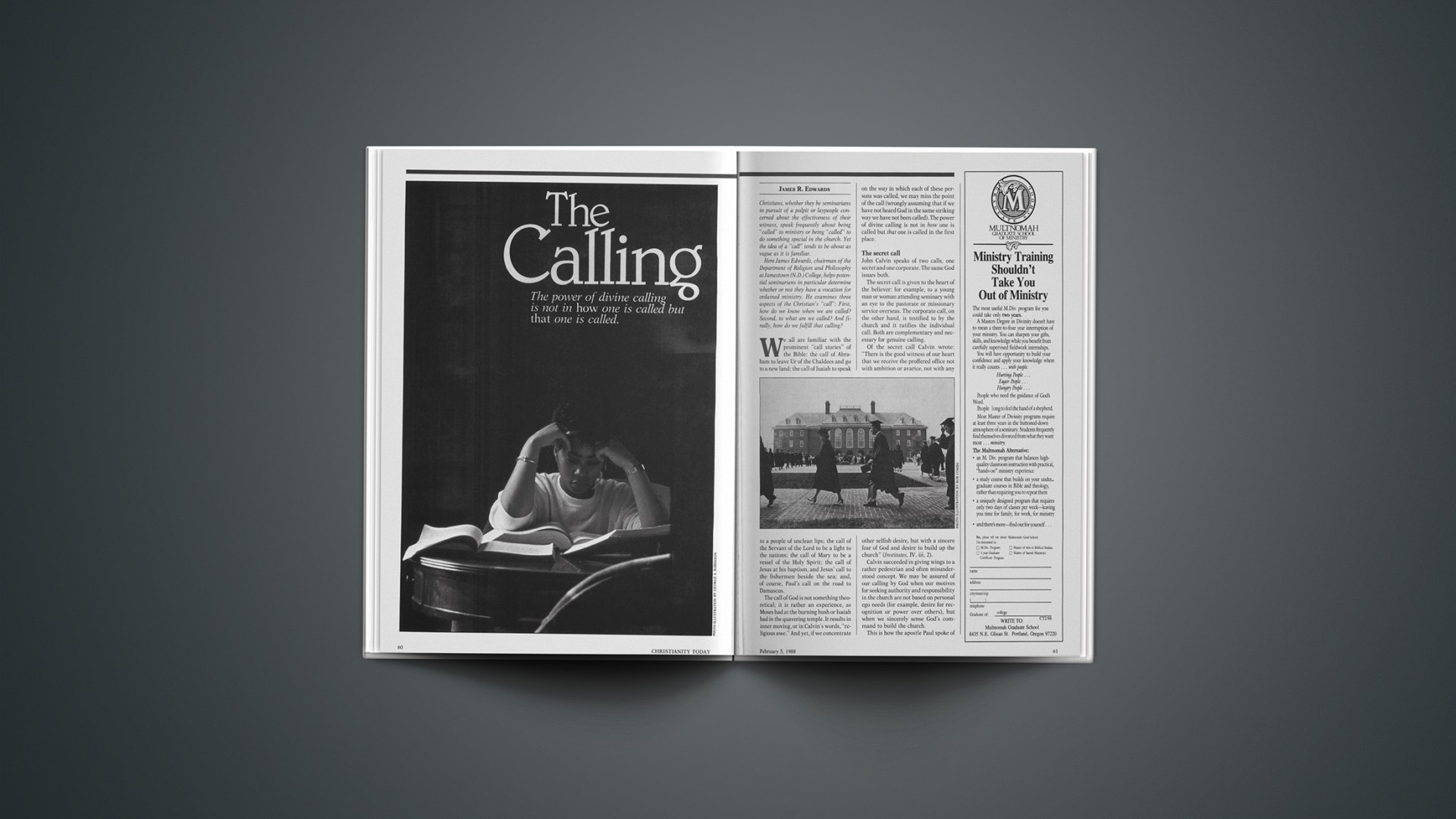
The Calling

The power of divine calling is not in how one is called but that one is called.

Christians, whether they be seminarians in pursuit of a pulpit or laypeople concerned about the effectiveness of their witness, speak frequently about being “called” to ministry or being “called” to do something special in the church. Yet the idea of a “call” tends to be about as vague as it is familiar.

Here James Edwards, chairman of the Department of Religion and Philosophy at Jamestown (N.D.) College, helps potential seminarians in particular determine whether or not they have a vocation for ordained ministry. He examines three aspects of the Christian’s “call”: First, how do we know when we are called? Second, to what are we called? And finally, how do we fulfill that calling?

We all are familiar with the prominent “call stories” of the Bible: the call of Abraham to leave Ur of the Chaldees and go to a new land; the call of Isaiah to speak to a people of unclean lips; the call of the Servant of the Lord to be a light to the nations; the call of Mary to be a vessel of the Holy Spirit; the call of Jesus at his baptism, and Jesus’ call to the fishermen beside the sea; and, of course, Paul’s call on the road to Damascus.

The call of God is not something theoretical; it is rather an experience, as Moses had at the burning bush or Isaiah had in the quavering temple. It results in inner moving, or in Calvin’s words, “religious awe.” And yet, if we concentrate on the way in which each of these persons was called, we may miss the point of the call (wrongly assuming that if we have not heard God in the same striking way we have not been called). The power of divine calling is not in how one is called but that one is called in the first place.

The Secret Call

John Calvin speaks of two calls, one secret and one corporate. The same God issues both.

The secret call is given to the heart of the believer: for example, to a young man or woman attending seminary with an eye to the pastorate or missionary service overseas. The corporate call, on the other hand, is testified to by the church and it ratifies the individual call. Both are complementary and necessary for genuine calling.

Of the secret call Calvin wrote: “There is the good witness of our heart that we receive the proffered office not with ambition or avarice, not with any other selfish desire, but with a sincere fear of God and desire to build up the church” (Institutes, IV, iii, 2).

Calvin succeeded in giving wings to a rather pedestrian and often misunderstood concept. We may be assured of our calling by God when our motives for seeking authority and responsibility in the church are not based on personal ego needs (for example, desire for recognition or power over others), but when we sincerely sense God’s command to build the church.

This is how the apostle Paul spoke of Epaphras to the Colossians: “Always struggling for you in his prayers so that you might stand mature and fully assured in God’s will” (4:12); and of Epaphroditus to the Philippians: “My brother and fellow worker and fellow soldier, and your messenger and minister to my need, for he has been longing for you all, …” (2:25f.).

During the early 1930s, a promising young student at the University of Berlin wrestled with the career options of a university professorship or a pastorate. He found neither direction nor peace until he succeeded in reducing his life to a single goal. Dietrich Bonhoeffer’s goal: That his life would count for the church. And for him, that singular focus dictated that he must choose the pastorate.

The Corporate Call

The motivation to build Christ’s church, however, is only the first part of the call. Calvin adds a sequel: the corporate call, or the call of the church.

The corporate call provides a bridge to my second question: To what are we called? The answer is that we are called to the church as the community of God.

Were it not for this second call, we might mistake the individualistic call of the heart as a sanction to do our own thing, thus equating the gospel with intuition or conscience, and raising the ego to the rank of God. But this is never so, and Calvin rightly recognized it. God himself wills to be present in the word of his witness, and he ordains that the witness be corporate in nature.

Saint Augustine tells the story of Victorinus, an old man of great learning, who, through a careful study of the Holy Scriptures, embraced the Christian faith late in life. One day Victorinus confided privately to Simplicianus, bishop of Milan, that he had become a Christian. “I shall not believe it or count you as a Christian until I see you in the Church of Christ,” replied Simplicianus. At this Victorinus laughed and said, “Is it then the walls of the church that make the Christian?” Refusing to be dissuaded from his conviction by the witness of the old philosopher, Simplicianus wisely maintained his counsel until at last Victorinus confessed his faith publicly.

“Rarely does a true call to ministry come in the middle of the night. It comes out of the context of a local church—given by those who are able to discern the gifts, the abilities in the one wanting to serve.”

—George Brushaber, president, Bethel College and Seminary, St. Paul, Minnesota

The bishop rightly knew that there can be no such thing as a private Christian, as though Christianity were simply an idea to be affirmed. His counsel was based on the conviction that we are not called to an idea, not even to a great truth, but to a relationship with God, which is communicated through God’s people.

Throughout the Bible, ministry takes place (and, indeed, the “call” is confirmed) within the companionship of others. As Christians we are born, we grow, and we serve within partnership. One of the Greek words for “the office of elder,” presbyterion, is a collective noun; it means collegiality. In the Mosaic covenant, the whole nation was to be a kingdom of priests and a holy people (Exod. 19:6; Lev. 11:44f.; Num. 15:40). The tribe of Levi symbolized this covenant calling.

Unlike the Old Testament, however, where the Levitical priesthood became the mediator of the covenant, the New Testament recognizes a freedom for calling and service. New ministries arise, such as elders and deacons, and new gifts for ministry, such as evangelism and administration, find their place. The ministry of the Word is entrusted not just to a tribe or profession, but to the church as a whole.

Luther said that all baptized Christians were potential priests and popes. Bonhoeffer went further and said that we are actually Christ to each other. And Helmut Thielicke put it this way: “No one can assume office without consent of the whole church, and no one serves except as a representative of it.”

In the fourth chapter of 2 Corinthians, Paul speaks about ministry in terms of “earthen vessels” (v. 7). Ministry is neither reserved for special professions nor special occasions. It is as common and essential for the church as everyday kitchenware is for the family.

An early martyr of the church, Saint Laurence, bore witness to this truth when he was ordered by a prefect of the Emperor Valerian to produce the church’s wealth or be killed. Laurence thereupon went out and gathered together the epileptics, blind, lame, poor, and leprous, and, having brought them before the prefect, pointed to them and said, “These are the treasures of the church.”

The Call To Serve

We know, then, that we have been called when we have a sincere desire to build Christ’s church. Furthermore, our call is ratified by the church so that we may minister within community. Finally, in answer to the third question, we fulfill the call of God through service.

We hear a lot about ministry as service. Therefore, rather than restating what others have already said, I want to present an image that exemplifies what the servant posture means. The image comes from a true account of an American who was imprisoned in Soviet Russia’s Gulag for 45 years. It is told by Victor Herman in his autobiography, Coming Out of the Ice.

Herman recounts his first imprisonment. It was in Cell 39, a space five-and-a-half feet wide and ten feet long with a boarded up window at the far end. Along each wall were two benches on which 16 men sat. Closest to the door was a round vat called a Parasha, a latrine that was emptied once every ten days.

Existence in Cell 39 was statuesque torture. The stench from the Parasha was choking. The men were forbidden to talk or move. From dawn to darkness they were forced to sit silent and motionless and stare at a hole in the cell door. At night they lay on the cold stone floor like eggs in a carton. Every inch of space was occupied; the slightest movement to relieve an ache was purchased at a cell mate’s expense.

After only 24 hours, Herman was on the verge of madness. He doubtless would have gone mad had he not sensed that one of the cellmates was looking out for the others, thus preserving a morsel of dignity in this cataleptic nightmare. The cellmate was known simply as “the Elder” and he sat closest to the Parasha, where the stench was strongest, and nearest to the door, which exposed him to the senseless blows of the guards.

The Elder did two things every day. He counted out 16 bowls of soup as they came through the feeding hole in the cell door to insure that no one received less than his share. He also allowed no one to begin eating until all had been served. His second task was to give a signal twice each night for the men to change sleeping positions. This prevented unbearable cramping come morning. Herman knew nothing more about the Elder, but his role in Cell 39 restrained 16 men from erupting in a mad dogfight for food, space, and air.

Cell 39 will remain a model of Christian service for me for a long time. It tells me that in every situation in life, no matter how plain or grim, there is need for a servant-leader. But it tells something more: Only the person who sits closest to the Parasha, as it were, and who is most exposed to the blows of the system, can claim authority to lead and serve. The authority of a servant stands in inverse proportion to his claims for himself.

In addressing the church at Corinth, Paul said, “God is faithful through whom you were called into community with his Son Jesus Christ our Lord” (1 Cor. 1:9). All Christians, not just ministers, are called by God. They are called to fellowship with Jesus Christ. Fellowship with Christ, however, takes place not in a concept, slogan, or program, but in a fellowship of believers. There God has deposited his treasures—for Laurence, the sick and the poor; for Herman, the service of the Elder—to shame the wise and strong and bring forth justice, holiness, and redemption.

James R. Edwards is associate professor of religion and chairman, Department of Religion and Philosophy, at Jamestown (N.D.) College. He has written Commentary on the Epistle to the Romans (Community Bible Study, 1984).

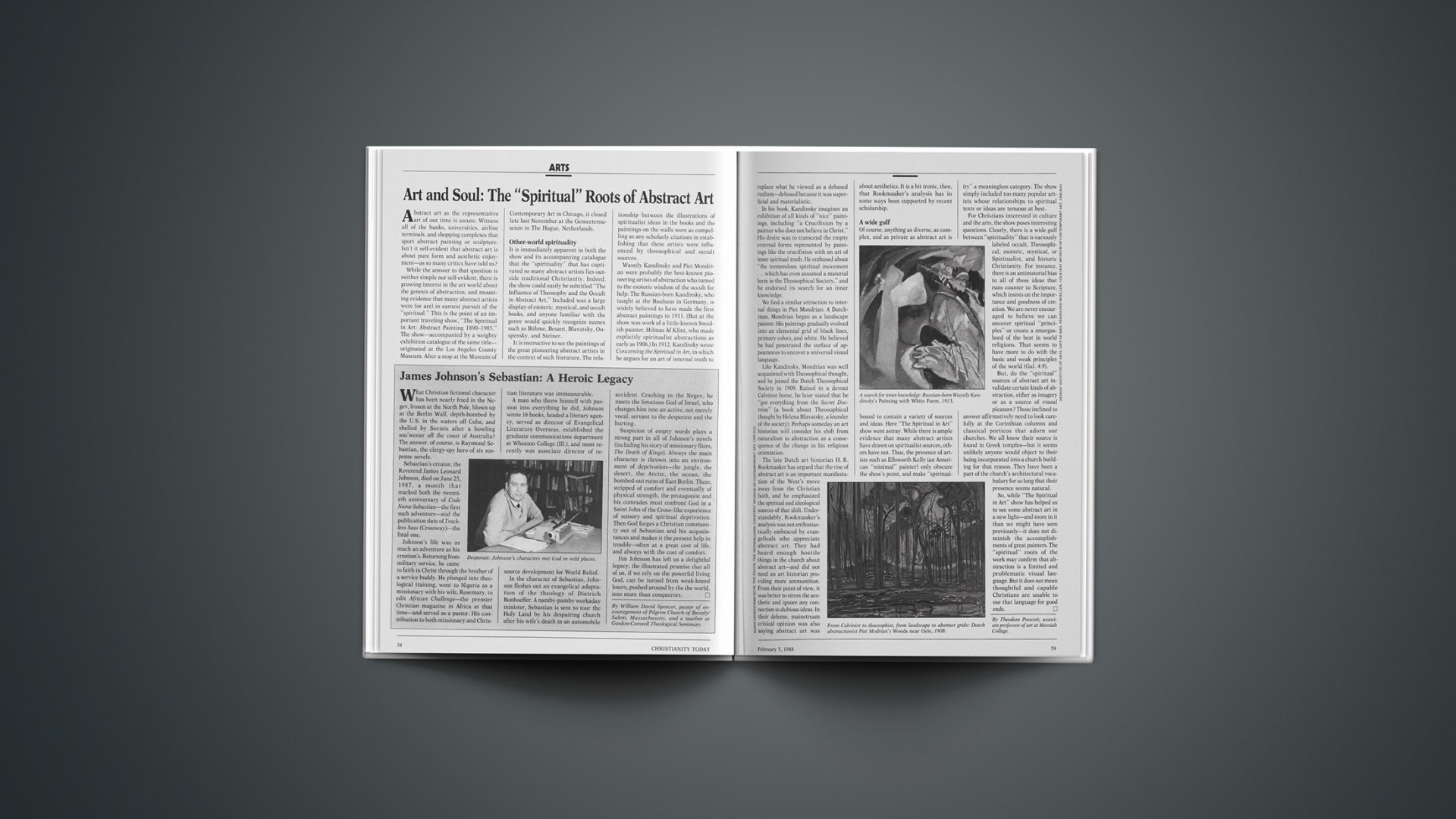
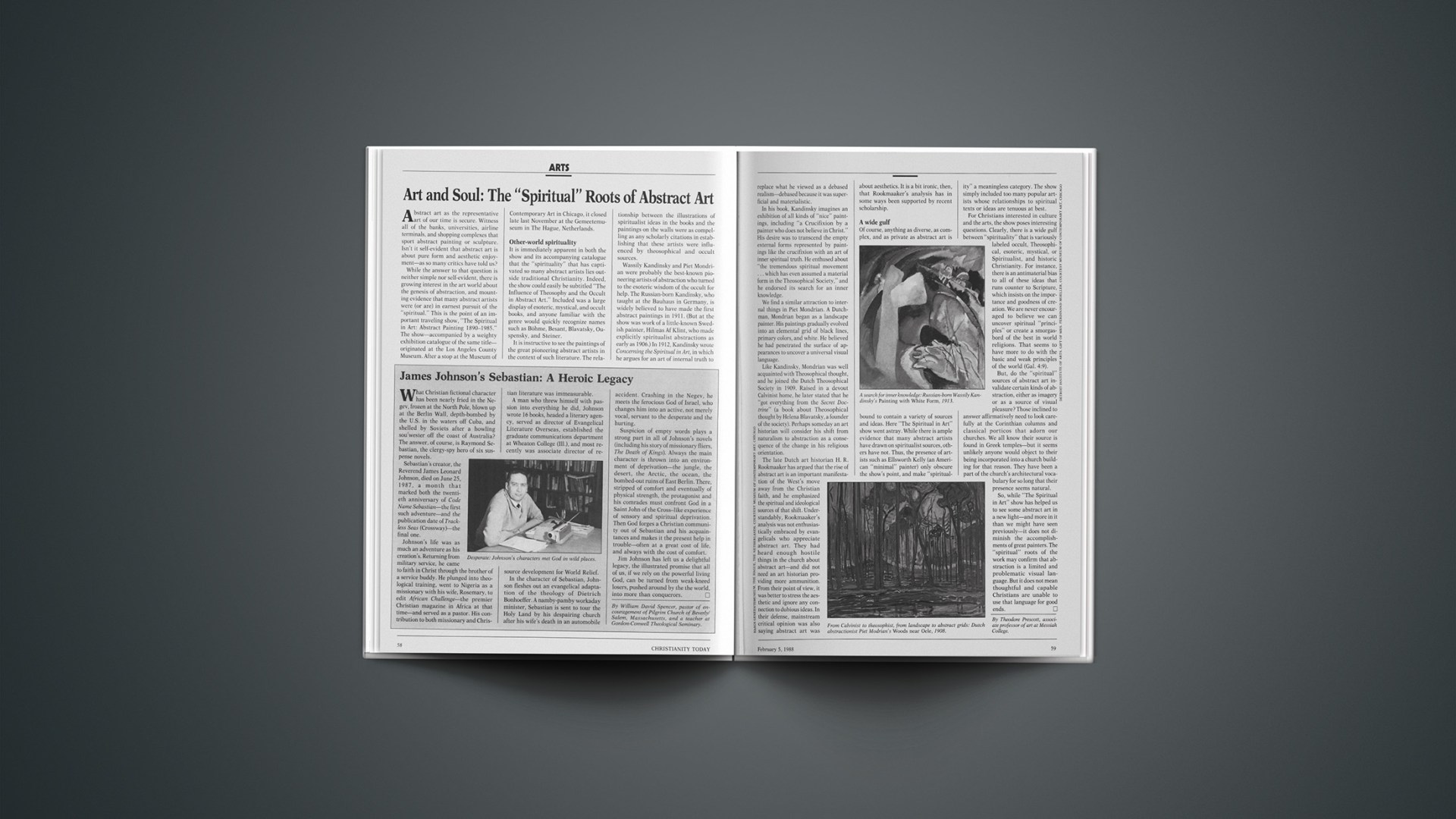
Art and Soul: The “Spiritual” Roots of Abstract Art

Abstract art as the representative art of our time is secure. Witness all of the banks, universities, airline terminals, and shopping complexes that sport abstract painting or sculpture. Isn’t it self-evident that abstract art is about pure form and aesthetic enjoyment—as so many critics have told us?

While the answer to that question is neither simple nor self-evident, there is growing interest in the art world about the genesis of abstraction, and mounting evidence that many abstract artists were (or are) in earnest pursuit of the “spiritual.” This is the point of an important traveling show, “The Spiritual in Art: Abstract Painting 1890–1985.” The show—accompanied by a weighty exhibition catalogue of the same title—originated at the Los Angeles County Museum. After a stop at the Museum of Contemporary Art in Chicago, it closed late last November at the Gemeetemuseum in The Hague, Netherlands.

Other-World Spirituality

It is immediately apparent in both the show and its accompanying catalogue that the “spirituality” that has captivated so many abstract artists lies outside traditional Christianity. Indeed, the show could easily be subtitled “The Influence of Theosophy and the Occult in Abstract Art.” Included was a large display of esoteric, mystical, and occult books, and anyone familiar with the genre would quickly recognize names such as Böhme, Besant, Blavatsky, Ouspensky, and Steiner.

It is instructive to see the paintings of the great pioneering abstract artists in the context of such literature. The relationship between the illustrations of spiritualist ideas in the books and the paintings on the walls were as compelling as any scholarly citations in establishing that these artists were influenced by theosophical and occult sources.

Wassily Kandinsky and Piet Mondrian were probably the best-known pioneering artists of abstraction who turned to the esoteric wisdom of the occult for help. The Russian-born Kandinsky, who taught at the Bauhaus in Germany, is widely believed to have made the first abstract paintings in 1911. (But at the show was work of a little-known Swedish painter, Hilmas Af Klint, who made explicitly spiritualist abstractions as early as 1906.) In 1912, Kandinsky wrote Concerning the Spiritual in Art, in which he argues for an art of internal truth to replace what he viewed as a debased realism—debased because it was superficial and materialistic.

In his book, Kandinsky imagines an exhibition of all kinds of “nice” paintings, including “a Crucifixion by a painter who does not believe in Christ.” His desire was to transcend the empty external forms represented by paintings like the crucifixion with an art of inner spiritual truth. He enthused about “the tremendous spiritual movement … which has even assumed a material form in the Theosophical Society,” and he endorsed its search for an inner knowledge.

We find a similar attraction to internal things in Piet Mondrian. A Dutchman, Mondrian began as a landscape painter. His paintings gradually evolved into an elemental grid of black lines, primary colors, and white. He believed he had penetrated the surface of appearances to uncover a universal visual language.

Like Kandinsky, Mondrian was well acquainted with Theosophical thought, and he joined the Dutch Theosophical Society in 1909. Raised in a devout Calvinist home, he later stated that he “got everything from the Secret Doctrine” (a book about Theosophical thought by Helena Blavatsky, a founder of the society). Perhaps someday an art historian will consider his shift from naturalism to abstraction as a consequence of the change in his religious orientation.

The late Dutch art historian H. R. Rookmaaker has argued that the rise of abstract art is an important manifestation of the West’s move away from the Christian faith, and he emphasized the spiritual and ideological sources of that shift. Understandably, Rookmaaker’s analysis was not enthusiastically embraced by evangelicals who appreciate abstract art. They had heard enough hostile things in the church about abstract art—and did not need an art historian providing more ammunition. From their point of view, it was better to stress the aesthetic and ignore any connection to dubious ideas. In their defense, mainstream critical opinion was also saying abstract art was about aesthetics. It is a bit ironic, then, that Rookmaaker’s analysis has in some ways been supported by recent scholarship.

A Wide Gulf

Of course, anything as diverse, as complex, and as private as abstract art is bound to contain a variety of sources and ideas. Here “The Spiritual in Art” show went astray. While there is ample evidence that many abstract artists have drawn on spiritualist sources, others have not. Thus, the presence of artists such as Ellsworth Kelly (an American “minimal” painter) only obscure the show’s point, and make “spirituality” a meaningless category. The show simply included too many popular artists whose relationships to spiritual texts or ideas are tenuous at best.

For Christians interested in culture and the arts, the show poses interesting questions. Clearly, there is a wide gulf between “spirituality” that is variously labeled occult, Theosophical, esoteric, mystical, or Spiritualist, and historic Christianity. For instance, there is an antimaterial bias to all of these ideas that runs counter to Scripture, which insists on the importance and goodness of creation. We are never encouraged to believe we can uncover spiritual “principles” or create a smorgasbord of the best in world religions. That seems to have more to do with the basic and weak principles of the world (Gal. 4:9).

But, do the “spiritual” sources of abstract art invalidate certain kinds of abstraction, either as imagery or as a source of visual pleasure? Those inclined to answer affirmatively need to look carefully at the Corinthian columns and classical porticos that adorn our churches. We all know their source is found in Greek temples—but it seems unlikely anyone would object to their being incorporated into a church building for that reason. They have been a part of the church’s architectural vocabulary for so long that their presence seems natural.

So, while “The Spiritual in Art” show has helped us to see some abstract art in a new light—and more in it than we might have seen previously—it does not diminish the accomplishments of great painters. The “spiritual” roots of the work may confirm that abstraction is a limited and problematic visual language. But it does not mean thoughtful and capable Christians are unable to use that language for good ends.

By Theodore Prescott, associate professor of art at Messiah College.

Book Briefs: February 5, 1988

Daring To Be Eccentric

Confidence: How to Succeed at Being Yourself, by Alan Loy McGinnis (Augsburg, 189 pp.; $4.50, paper). Reviewed by David Neff.

Loy McGinnis writes strange self-help books. Most motivational, be-your-own-shrink tomes promise the moon and deliver disappointment. But McGinnis’s content, belying the cover ballyhoo, strikes a cautious common-sensical note that actually makes self-improvement sound within reach.

McGinnis, who also wrote The Friendship Factor and Bringing Out the Best in People, is codirector of the Valley Counseling Center in Glendale, California, and a Presbyterian minister. He is a conservative spirit. Words like balance and middle ground crop up in this book, as McGinnis cautions readers not to expect too much of themselves or life—and encourages them not to settle for too little, either. Another motivational writer might make this material far more exciting, but McGinnis’s mundane believability builds confidence.

“Dare to be a little eccentric,” writes McGinnis, advice based on the fact that our self-confidence is often bound up with what others think of us. We spend far too much energy playing to an ever-present audience. That is, of course, a crummy way to live. (It really may even be rather conceited to believe that other people pay that much attention to our clothes and cars, our wit and wisdom.) McGinnis pairs Romans 12:2 (“Be not conformed …”) with the words of Henry Bayard Swope: “I cannot give you the formula for success but I can give you the formula for failure, which is: Try to please everybody.” We must therefore ground our confidence in our abilities rather than other people’s expectations.

The doctor wishes most of his clients could attain to greater self-confidence. But he also recognizes that we can have too much confidence—theologians would call it pride, he reminds us. For this reason, McGinnis frames the book front and back with cautionary speeches tagged, “Self-Confidence Without Self-Worship.” Building on our Lord’s teaching about the two great commandments (love to God and love to neighbor), McGinnis asserts that “there are to be two anchors to our self-assurance: worship and compassion.” Indeed, it seems that for McGinnis, no tonic is so salutary for the self-concept as a nip of self-giving service.

Christianity Today Talks To Alan Loy Mcginnis

Do you think we can have too much self-confidence?

We certainly can. The essence of pride is to try to usurp the place of God—and in much of the psychological literature, I encounter an encouragement to believe that we’re wonderful in every way, and that if well just believe hard enough we can do anything.

The fact is that we’re not wonderful in every way. To simply tell people to love themselves is not enough because there are parts of ourselves we don’t want to love and that we shouldn’t love. There are parts that we should correct and change.

How should we relate to our dark side?

We need to remodel it, but we can never remodel all of it. The paradox is that we are unable to remodel it until we acknowledge it. A lot of Christians are so afraid of their dark side that they put a lot of psychic energy into holding it at arm’s length, so that they never get a grasp of what it is that needs to be remodeled.

Much of the progress of coming to self-confidence is facing the truth about ourselves. There is something about looking the dark side squarely in the eye that causes it to lose some of its power over us. The only emotion that can hurt is the unacknowledged emotion.

You don’t promise very much in your books, do you?

One of the problems with self-help books is that it is easy to overstate the case. You make people feel worse instead of better, especially if you paint the picture that you can have oodles of friends and be ecstatically happy simply by having the right attitudes.

I find this many times within Christian circles when we depict the rewards of conversion such that some sincere Christians think they must not have been really converted or that they are doing something terribly wrong because they’re not ecstatically happy. We have done them a disservice.

I used to keep thinking that I would be happy when I got one more degree or when I got a particular job or when I got financial security. But every time I reached a goal, I was so disappointed—the victory was so empty. Finally I realized that I will never hit some plateau of happiness in this world. In fact, I won’t ever have a day of unmitigated happiness, because happiness seems to come in bits and pieces. I never have a day, though, when God does not offer me moments of reward and fulfillment and happiness; and my task is to savor those as they come.

What Everybody Used To Know

Cultural Literacy: What Every American Needs to Know, by E. D. Hirsch, Jr. (Houghton-Mifjlin, 251 pp.; $16.95, cloth). Reviewed by Ross Pavlac, a Chicago-based writer and computer systems analyst.

On a recent Focus on the Family broadcast, Dr. James Dobson said AIDS might become “the new Black Plague.” To Dobson’s astonishment, letters poured in accusing him of racist slurs. The complaints were numerous enough that Dobson had to take additional air time to explain his reference to the bubonic plague that ravaged Europe and Asia in the fourteenth century.

Dobson had assumed that his listeners were aware of the terrible disease that killed large portions of the population during the Middle Ages. But he was wrong, and ended up confusing listeners rather than informing them.

E. D. Hirsch, Jr., would call this an example of cultural illiteracy. In Cultural Literacy, he contends that “communication between strangers requires an estimate of how much relevant information can be taken for granted in the other person.”

According to Hirsch, there is a shared body of information among literate people in a given culture at a given time, and people who do not share that information are at a disadvantage. This is important to Christians who want to be equipped for public action on important issues—particularly the fierce battles over how to educate our children.

He is not asking us all to earn multiple Ph.D.’s. Rather, “what counts is our ability to grasp the general shape of what we are reading and to tie it to what we already know. If we need details, we rely on the writer or speaker to develop them.”

Hirsch believes a state of cultural literacy existed in the past—but does not now: “We cannot assume that young people today know things that were known in the past by almost every literate person in the culture.”

Who is to blame for the rise of cultural illiteracy? Hirsch points to “Jean Jacques Rousseau, who believed that we should … not impose adult ideas upon [children] before they can truly understand them.” Rousseau’s ideas were expanded upon by John Dewey, “the writer who has most deeply affected American education theory and practice.”

In an interview, Wheaton College (Ill.) philosopher Arthur Holmes commented, “The ‘relevance jag’ of the 1960s, along with an excessive job orientation on the part of many parents and students, plus today’s video obsession, have combined to deprive us all of that common heritage of learning which transmits beliefs and values from one generation to another—and makes intelligent discourse possible.” Holmes says, “Cultural Literacy calls us back to reading, and to an education designed to establish the common culture we lack.”

Ultimate Trivial Pursuit

Cultural literacy very much relates to conventional reading and writing literacy; indeed, Hirsch insists they are intertwined. More than helping Americans to engage in public discourse, he feels that cultural literacy is one key to solving the problem of helping children from disadvantaged backgrounds learn to read and write. These children “miss central implications and associations because they don’t possess the background knowledge to put [reading texts] in context.”

To help educators (and curious laypeople), Hirsch offers a starting point in what must be the ultimate Trivial Pursuit question list: 5,000 terms and names that he and other authorities feel that average late-twentieth-century Americans should know by the time they complete high school. And yes, it includes dozens of direct and indirect biblical references; and yes, Black Death is on the list.

In a sense, Hirsch’s list is politically and culturally neutral. It doesn’t matter whether you are for or against polygamy or Marxism; but he believes you must know what they are. Curricula embedding cultural literacy could be liberal, conservative, or anywhere in-between.

Hirsch rejects both narrow vocational education and strict core curricula. Fast-changing technology makes specific training quickly obsolete; it is better to learn how to cope with change. And rigid core curricula lack imagination.

He acknowledges the danger of his list being used to encourage students to memorize and quickly forget, but that danger is not a consequence of the list so much as a challenge to educators to teach the material in an effective way.

He would agree with his critics that mere knowledge of facts does not constitute literacy; he would insist, however, that in a given culture at a given time there is a set of facts without which one is illiterate.

Cultural Literacy And Social Change

That is also the answer Hirsch has for critics who feel his selection of terms is racist, not allowing for ethnic individuality and a movement toward social equality. “In fact the traditional forms of literate culture are precisely the most effective instruments for political and social change,” he asserts. “All political discourse at the national level must use the stable forms of the language and its associated culture.… To withhold traditional culture from the school curriculum … in the name of progressive ideas is in fact an unprogressive action that helps preserve the political and economic status quo.”

David Horner, president of North Park (Ill.) College agrees: “I am not unappreciative of the contemporary insight that popular history needs to be balanced by the history of invisible people and silent voices (e.g., women and blacks). But I agree with Hirsch that the agenda of social reform is weakened by ignorance of our cultural inheritance.”

And Horner believes it is important for Christian educators within the Christian subculture to apply Hirsch’s basic analysis to our specific situation: “Christians can readily assent to the importance of a common body of data for preserving a spiritual heritage. The retelling of the acts of God is fundamental for us as a Christian community, just as a cultural heritage can only be passed on on the basis of common knowledge.”

Cultural Literacy should be read by Christian educators and teachers, parents involved in home schooling, and anyone concerned about having a well-rounded background.

The List

An Excerpt

Here are a few terms from E. D. Hirsch’s famous 5,000-item list: “What Literate Americans Know.” How many can you identify?

Dacha

Dachau

Daedalus

Daley, Mayor

Dali, Salvador

Dallas, Texas

Damascus

Damn the torpedoes, Full speed ahead.

damn with faint praise

Damocles’ sword

Daniel in the lions’ den

danke schön

Dante

Danton

Danube River

Dark Ages

dark horse

Darrow, Clarence

Darwin, Charles

David (image)

David and Goliath

David Copperfield (title)

Davis, Jefferson

Hopeful Realism

Tranquillitas Ordinis, by George Weigel (Oxford, 489 pp.; $27.50, hardcover). Reviewed by Mark R. Amstutz, professor and chairman, Department of Political Science, Wheaton College (Ill.).

Recently the National Association of Evangelicals adopted a set of guidelines for the church’s discussion on the problem of peace and freedom in the world. Such documents show that American evangelicals now desire to promote peace and justice internationally. However, if they want to be successful, they will pay attention to the many issues so cogently raised and discussed by George Weigel in this new book.

Weigel is a young, increasingly recognized Catholic scholar. Here he argues that the major Christian political responsibility is to promote tranquillitas ordinis—“a dynamic peace of rightly ordered political community.”

Weigel’s central thesis is that contemporary American Catholic leaders have abandoned the classical tradition of political thought, a “moderate realism” based on the thought of Augustine and Thomas Aquinas. Weigel thinks the Catholic political heritage is neither pessimistic nor utopian. Rather, it is a hopeful realism rooted in the recognition that people are sinners and also “a spark struck from the creativity of the Godhead.” His aim is to recapture and develop that classical legacy.

Weigel believes the moral framework for assessing American national security issues should consider at least eight fundamental questions. These include: assumptions about human nature, the meaning of peace, the permissibility and method of intervention, the legitimacy of military force, the legitimacy of the existing world system, the nature of transnational obligations, the nature of the Soviet Union, and the nature of the United States.

Weigel suspects Catholic political thought has abandoned the traditional heritage of Catholic political ethics because American Catholic leaders have increasingly accepted neo-isolationism and overreacted against anticommunism. He also laments skepticism about the merits of the American democratic experiment.

Weigel argues that the debate over the U.S. Vietnam policy was the occasion for the virtual abandonment of the classic tradition of political ethics. In addition, he traces the abandonment of the tradition in two other areas: nuclear weapons and the political turmoil in Central America.

Weigel’s study is making waves in political science circles. Students of Catholic theology and political thought will undoubtedly debate several of Weigel’s theses, just as they will question whether his assessment of the 1983 bishops’ pastoral letter on peace demonstrates a sufficient appreciation of the radical discontinuity between conventional and nuclear weapons. But whatever the outcome of these discussions, this study skillfully addresses basic issues about the role of Christian ethics in the quest for a just world order.

Chapters that will be of special interest to evangelicals include those dealing with the tradition of moderate realism, the thought of John Courtney Murray (an influential Jesuit theologian who died in 1967), the major themes of the Catholic political heritage, and the role of the church in promoting world peace.

Apple PodcastsDown ArrowDown ArrowDown Arrowarrow_left_altLeft ArrowLeft ArrowRight ArrowRight ArrowRight Arrowarrow_up_altUp ArrowUp ArrowAvailable at Amazoncaret-downCloseCloseEmailEmailExpandExpandExternalExternalFacebookfacebook-squareGiftGiftGooglegoogleGoogle KeephamburgerInstagraminstagram-squareLinkLinklinkedin-squareListenListenListenChristianity TodayCT Creative Studio Logologo_orgMegaphoneMenuMenupausePinterestPlayPlayPocketPodcastRSSRSSSaveSaveSaveSearchSearchsearchSpotifyStitcherTelegramTable of ContentsTable of Contentstwitter-squareWhatsAppXYouTubeYouTube