Couple Duels in Iowa Race

Preparation for this week’s Iowa caucuses has put members of one Christian family in different political camps. U.S. Rep. Tom Tauke (R-Iowa) is cochairman of George Bush’s Iowa campaign, while his wife, Beverly Hubble Tauke, is cochairing Robert Dole’s campaign in Iowa.

Tom, a Catholic active in congressional Bible studies, says he decided to work for Bush because of the vice president’s “character, his experience, and his philosophical approach to government.… Bush’s life is a study in commitment to family and public service, and I admire that.”

Meanwhile, Beverly, a graduate of Wheaton (Ill.) Graduate School, said she backs Dole because he is “committed to my values but also a gifted legislator and a policy maker who can effectively relate to Democrats and Republicans alike.”

Tom emphasized that he and Beverly discuss politics a great deal, but out of loyalty to their respective candidates they don’t say much about the individual campaigns. And while their loyalties differ, the Taukes agree that involvement in presidential politics has not weakened their marriage.

“Actually, we have had a wonderful time with it,” Tom says.

The Taukes’ 15 month-old son, Joseph, has been courted by both camps. Early in the campaign, Tom bought Joseph a T-shirt proclaiming “Babies for Bush” on the front, and “I still love you, Mom” on the back. Beverly has considered retaliating with a poster-sized photo of Joseph being held by Dole.

When the joking subsides, however, the Taukes take their political activities seriously. “I think it is so important that there be an understanding within the Christian community that it’s a very healthy thing for evangelicals to be involved to some extent in the political process across the board,” said Beverly. “… All these candidates [from both parties] are going to have influence in society in the years to come, and it’s important that they all have supporters and advisers who have a commitment to Jesus Christ.”
Logos Struck, Cargo Lost

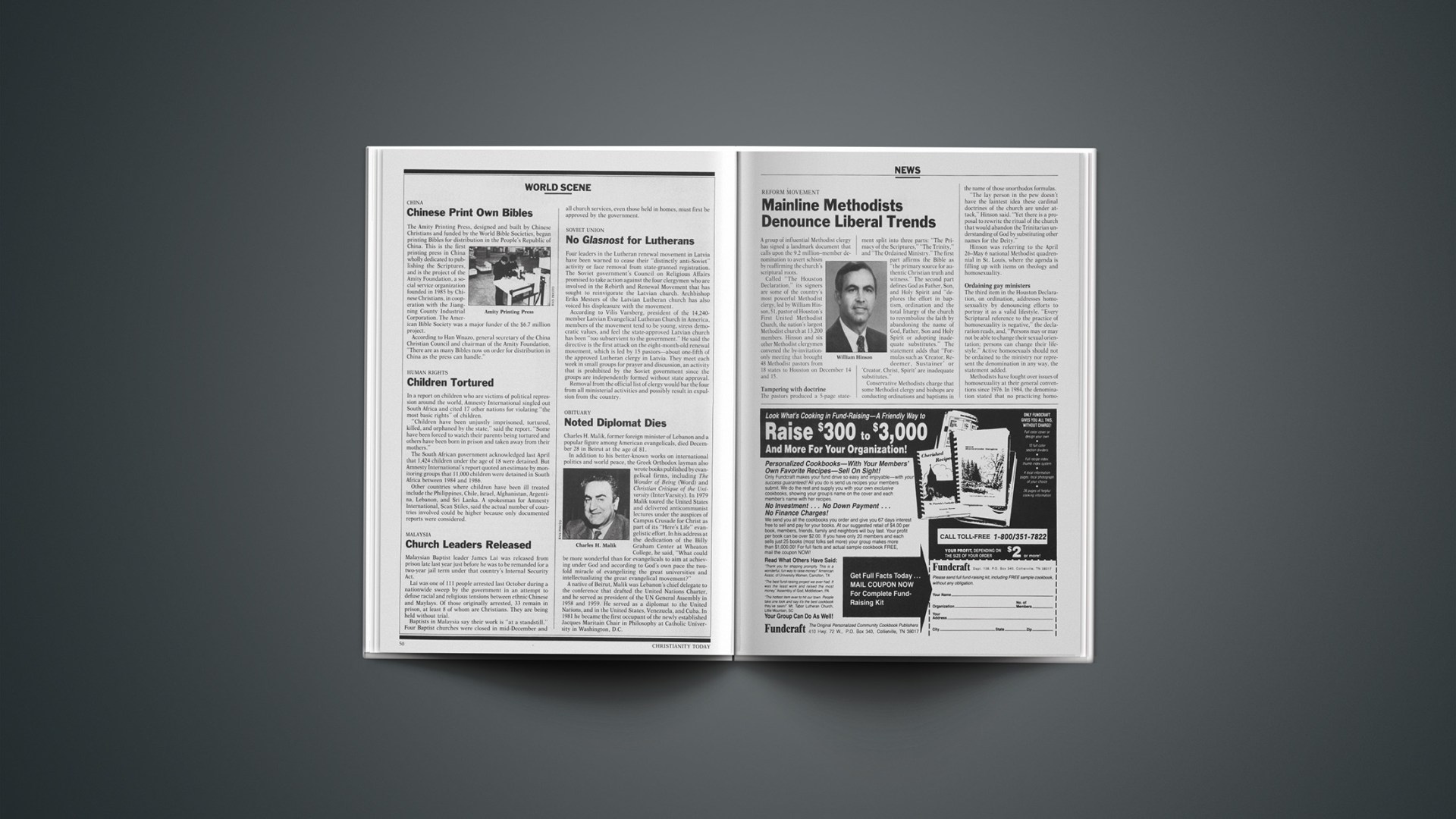
After 17 years of itinerating evangelism to 402 ports in 107 countries, the cargo ship M.V. Logos was swamped in the treacherous Beagle Channel off Tierra del Fuego at the southernmost tip of Argentina.

Despite a roaring sea and sleet-covered decks, all six lifeboats safely evacuated the Operation Mobilization (OM) family of 141 people from 27 countries. Chilean navy vessels answered the ship’s distress call, and eventually the survivors were taken to Punta Arenas where local Christians offered food and shelter.

The 2,300-ton Logos, commissioned by OM in 1971, had just finished a tour of Chilean ports and was headed for Puerto Madryn. Capt. Jonathan Stewart had relinquished the helm to a local Argentinian pilot to guide the ship through the channel when it struck a rock and began taking on water.

“The people were amazingly calm,” said Peter Conlan, program director for Logos and its sister ship, M.V. Doulos. Those who had served on the Logos previously said lifeboat drills were a regular part of the ship’s routine.

Total cargo loss was estimated to be $700,000, including $125,000 worth of books, OM officials say the Logos probably will be sold for scrap and replaced with another vessel.

The Logos typically visited ports where the OM team distributed literature, ministered to Christians, and held evangelistic services. It was the means of reaching over seven million people, including some in places such as China, Lebanon, and Nicaragua.

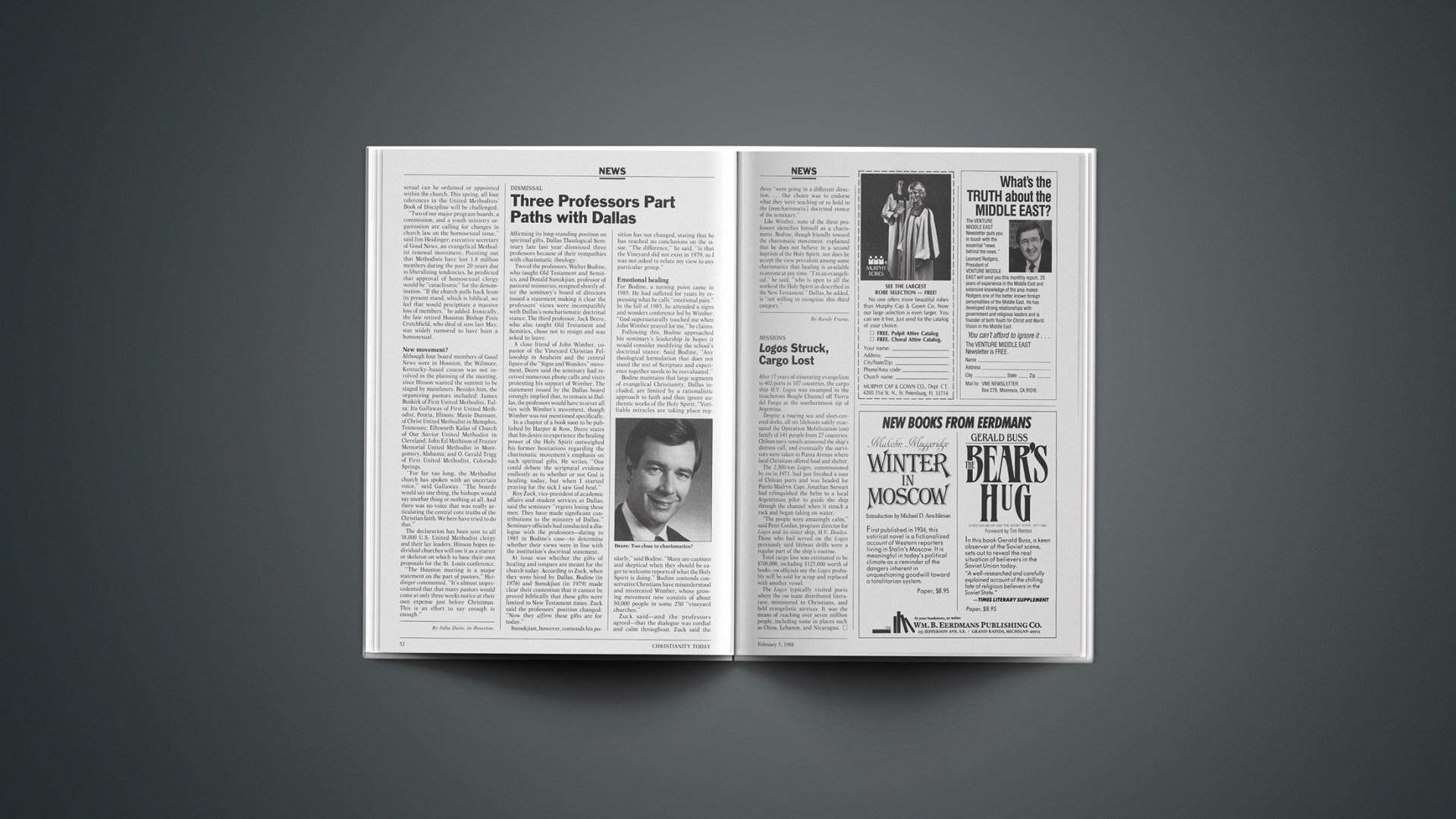
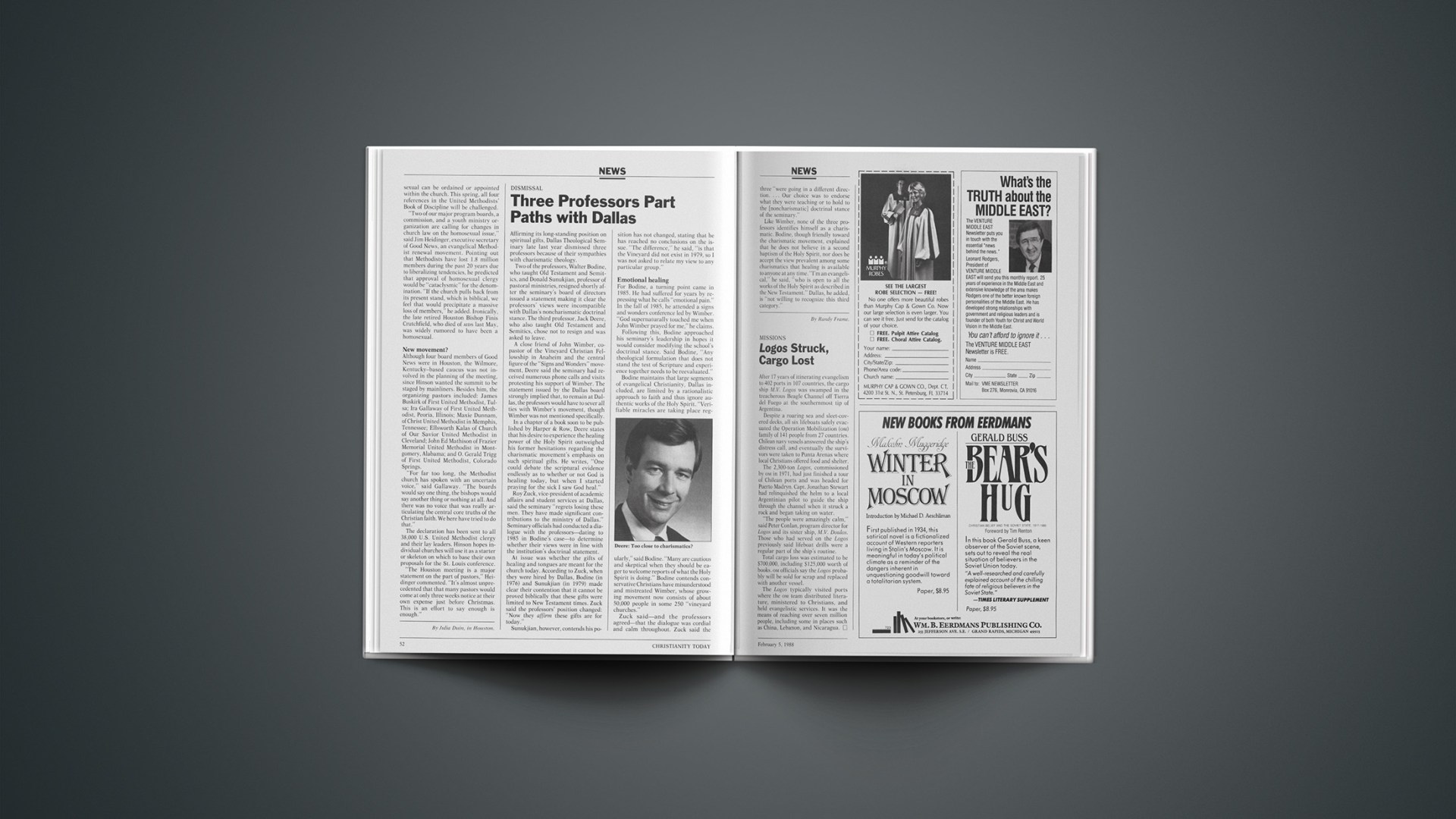
Three Professors Part Paths with Dallas

Affirming its long-standing position on spiritual gifts, Dallas Theological Seminary late last year dismissed three professors because of their sympathies with charismatic theology.

Two of the professors, Walter Bodine, who taught Old Testament and Semitics, and Donald Sunukjian, professor of pastoral ministries, resigned shortly after the seminary’s board of directors issued a statement making it clear the professors’ views were incompatible with Dallas’s noncharismatic doctrinal stance. The third professor, Jack Deere, who also taught Old Testament and Semitics, chose not to resign and was asked to leave.

A close friend of John Wimber, copastor of the Vineyard Christian Fellowship in Anaheim and the central figure of the “Signs and Wonders” movement, Deere said the seminary had received numerous phone calls and visits protesting his support of Wimber. The statement issued by the Dallas board strongly implied that, to remain at Dallas, the professors would have to sever all ties with Wimber’s movement, though Wimber was not mentioned specifically.

In a chapter of a book soon to be published by Harper & Row, Deere states that his desire to experience the healing power of the Holy Spirit outweighed his former hesitations regarding the charismatic movement’s emphasis on such spiritual gifts. He writes, “One could debate the scriptural evidence endlessly as to whether or not God is healing today, but when I started praying for the sick I saw God heal.”

Roy Zuck, vice-president of academic affairs and student services at Dallas, said the seminary “regrets losing these men. They have made significant contributions to the ministry of Dallas.” Seminary officials had conducted a dialogue with the professors—dating to 1985 in Bodine’s case—to determine whether their views were in line with the institution’s doctrinal statement.

At issue was whether the gifts of healing and tongues are meant for the church today. According to Zuck, when they were hired by Dallas, Bodine (in 1976) and Sunukjian (in 1979) made clear their contention that it cannot be proved biblically that these gifts were limited to New Testament times. Zuck said the professors’ position changed: “Now they affirm these gifts are for today.”

Sunukjian, however, contends his position has not changed, stating that he has reached no conclusions on the issue. “The difference,” he said, “is that the Vineyard did not exist in 1979, so I was not asked to relate my view to any particular group.”

Emotional Healing

For Bodine, a turning point came in 1985. He had suffered for years by repressing what he calls “emotional pain.” In the fall of 1985, he attended a signs and wonders conference led by Wimber. “God supernaturally touched me when John Wimber prayed for me,” he claims.

Following this, Bodine approached his seminary’s leadership in hopes it would consider modifying the school’s doctrinal stance. Said Bodine, “Any theological formulation that does not stand the test of Scripture and experience together needs to be reevaluated.”

Bodine maintains that large segments of evangelical Christianity, Dallas included, are limited by a rationalistic approach to faith and thus ignore authentic works of the Holy Spirit. “Verifiable miracles are taking place regularly,” said Bodine. “Many are cautious and skeptical when they should be eager to welcome reports of what the Holy Spirit is doing.” Bodine contends conservative Christians have misunderstood and mistreated Wimber, whose growing movement now consists of about 50,000 people in some 250 “vineyard churches.”

Zuck said—and the professors agreed—that the dialogue was cordial and calm throughout. Zuck said the three “were going in a different direction.… Our choice was to endorse what they were teaching or to hold to the [noncharismatic] doctrinal stance of the seminary.”

Like Wimber, none of the three professors identifies himself as a charismatic. Bodine, though friendly toward the charismatic movement, explained that he does not believe in a second baptism of the Holy Spirit, nor does he accept the view prevalent among some charismatics that healing is available to anyone at any time. “I’m an evangelical,” he said, “who is open to all the works of the Holy Spirit as described in the New Testament.” Dallas, he added, is “not willing to recognize this third category.”

By Randy Frame.

Mainline Methodists Denounce Liberal Trends

A group of influential Methodist clergy has signed a landmark document that calls upon the 9.2 million-member denomination to avert schism by reaffirming the church’s scriptural roots.

Called “The Houston Declaration,” its signers are some of the country’s most powerful Methodist clergy, led by William Hinson, 51, pastor of Houston’s First United Methodist Church, the nation’s largest Methodist church at 13,200 members. Hinson and six other Methodist clergymen convened the by-invitation-only meeting that brought 48 Methodist pastors from 18 states to Houston on December 14 and 15.

Tampering With Doctrine

The pastors produced a 5-page statement split into three parts: “The Primacy of the Scriptures,” “The Trinity,” and “The Ordained Ministry.” The first part affirms the Bible as “the primary source for authentic Christian truth and witness.” The second part defines God as Father, Son, and Holy Spirit and “deplores the effort in baptism, ordination and the total liturgy of the church to resymbolize the faith by abandoning the name of God, Father, Son and Holy Spirit or adopting inadequate substitutes.” The statement adds that “Formulas such as ‘Creator, Redeemer, Sustainer’ or ‘Creator, Christ, Spirit’ are inadequate substitutes.”

Conservative Methodists charge that some Methodist clergy and bishops are conducting ordinations and baptisms in the name of those unorthodox formulas.

“The lay person in the pew doesn’t have the faintest idea these cardinal doctrines of the church are under attack,” Hinson said. “Yet there is a proposal to rewrite the ritual of the church that would abandon the Trinitarian understanding of God by substituting other names for the Deity.”

Hinson was referring to the April 26-May 6 national Methodist quadrennial in St. Louis, where the agenda is filling up with items on theology and homosexuality.

Ordaining Gay Ministers

The third item in the Houston Declaration, on ordination, addresses homosexuality by denouncing efforts to portray it as a valid lifestyle. “Every Scriptural reference to the practice of homosexuality is negative,” the declaration reads, and, “Persons may or may not be able to change their sexual orientation; persons can change their lifestyle.” Active homosexuals should not be ordained to the ministry nor represent the denomination in any way, the statement added.

Methodists have fought over issues of homosexuality at their general conventions since 1976. In 1984, the denomination stated that no practicing homosexual can be ordained or appointed within the church. This spring, all four references in the United Methodists’ Book of Discipline will be challenged.

“Two of our major program boards, a commission, and a youth ministry organization are calling for changes in church law on the homosexual issue,” said Jim Heidinger, executive secretary of Good News, an evangelical Methodist renewal movement. Pointing out that Methodists have lost 1.8 million members during the past 20 years due to liberalizing tendencies, he predicted that approval of homosexual clergy would be “cataclysmic” for the denomination. “If the church pulls back from its present stand, which is biblical, we feel that would precipitate a massive loss of members,” he added. Ironically, the late retired Houston Bishop Finis Crutchfield, who died of AIDS last May, was widely rumored to have been a homosexual.

New Movement?

Although four board members of Good News were in Houston, the Wilmore, Kentucky-based caucus was not involved in the planning of the meeting, since Hinson wanted the summit to be staged by mainliners. Besides him, the organizing pastors included: James Buskirk of First United Methodist, Tulsa; Ira Gallaway of First United Methodist, Peoria, Illinois; Maxie Dunnam, of Christ United Methodist in Memphis, Tennessee; Ellsworth Kalas of Church of Our Savior United Methodist in Cleveland; John Ed Mathison of Frazier Memorial United Methodist in Montgomery, Alabama; and O. Gerald Trigg of First United Methodist, Colorado Springs.

“For far too long, the Methodist church has spoken with an uncertain voice,” said Gallaway. “The boards would say one thing, the bishops would say another thing or nothing at all. And there was no voice that was really articulating the central core truths of the Christian faith. We here have tried to do that.”

The declaration has been sent to all 38,000 U.S. United Methodist clergy and their lay leaders. Hinson hopes individual churches will use it as a starter or skeleton on which to base their own proposals for the St. Louis conference.

“The Houston meeting is a major statement on the part of pastors,” Heidinger commented. “It’s almost unprecedented that that many pastors would come at only three weeks notice at their own expense just before Christmas. This is an effort to say enough is enough.”

By Julia Duin, in Houston.

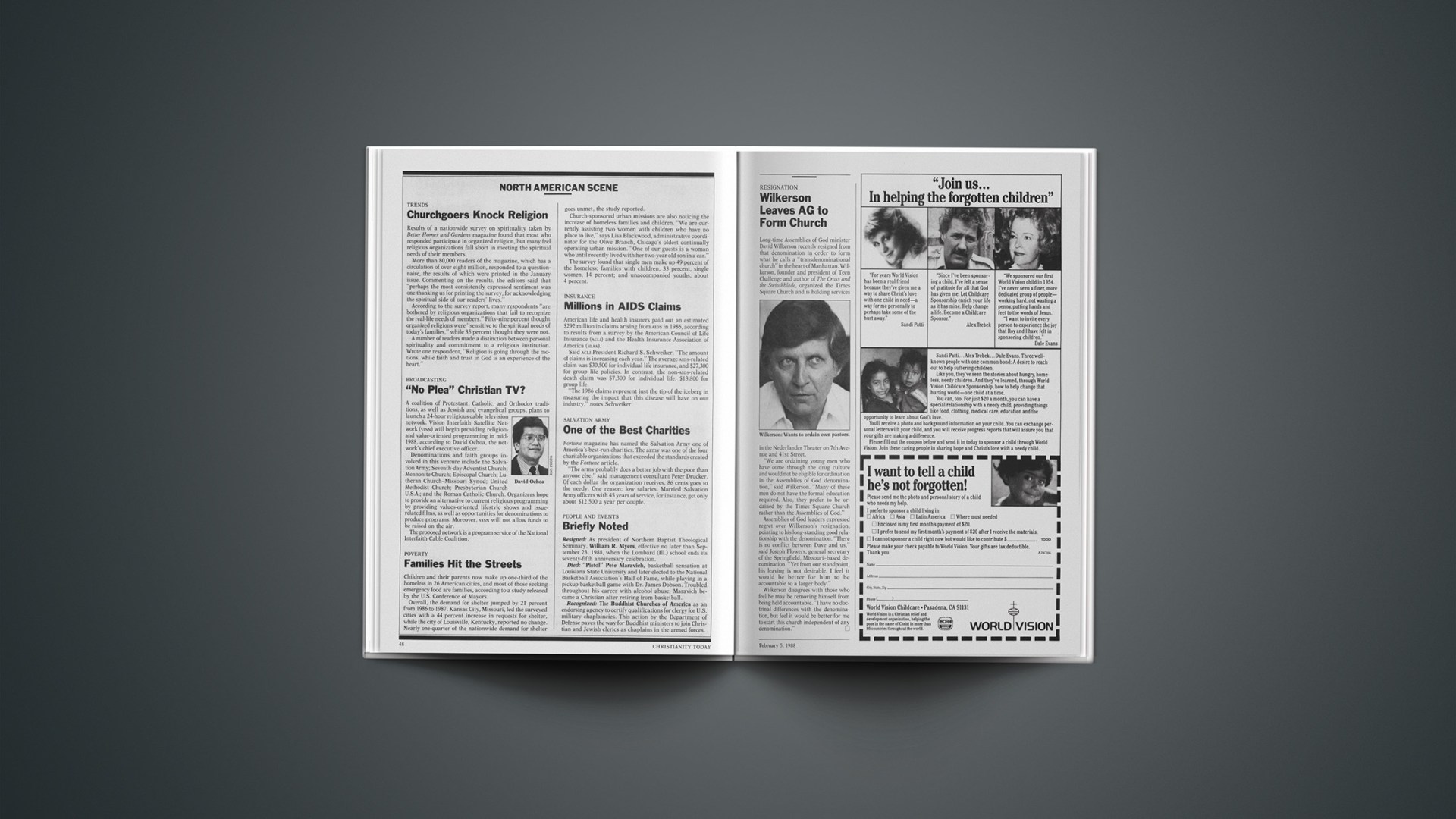
Wilkerson Leaves AG to Form Church

Long-time Assemblies of God minister David Wilkerson recently resigned from that denomination in order to form what he calls a “transdenominational church” in the heart of Manhattan. Wilkerson, founder and president of Teen Challenge and author of The Cross and the Switchblade, organized the Times Square Church and is holding services in the Nederlander Theater on 7th Avenue and 41st Street.

“We are ordaining young men who have come through the drug culture and would not be eligible for ordination in the Assemblies of God denomination,” said Wilkerson. “Many of these men do not have the formal education required. Also, they prefer to be ordained by the Times Square Church rather than the Assemblies of God.”

Assemblies of God leaders expressed regret over Wilkerson’s resignation, pointing to his long-standing good relationship with the denomination. “There is no conflict between Dave and us,” said Joseph Flowers, general secretary of the Springfield, Missouri-based denomination. “Yet from our standpoint, his leaving is not desirable. I feel it would be better for him to be accountable to a larger body.”

Wilkerson disagrees with those who feel he may be removing himself from being held accountable. “I have no doctrinal differences with the denomination, but feel it would be better for me to start this church independent of any denomination.”

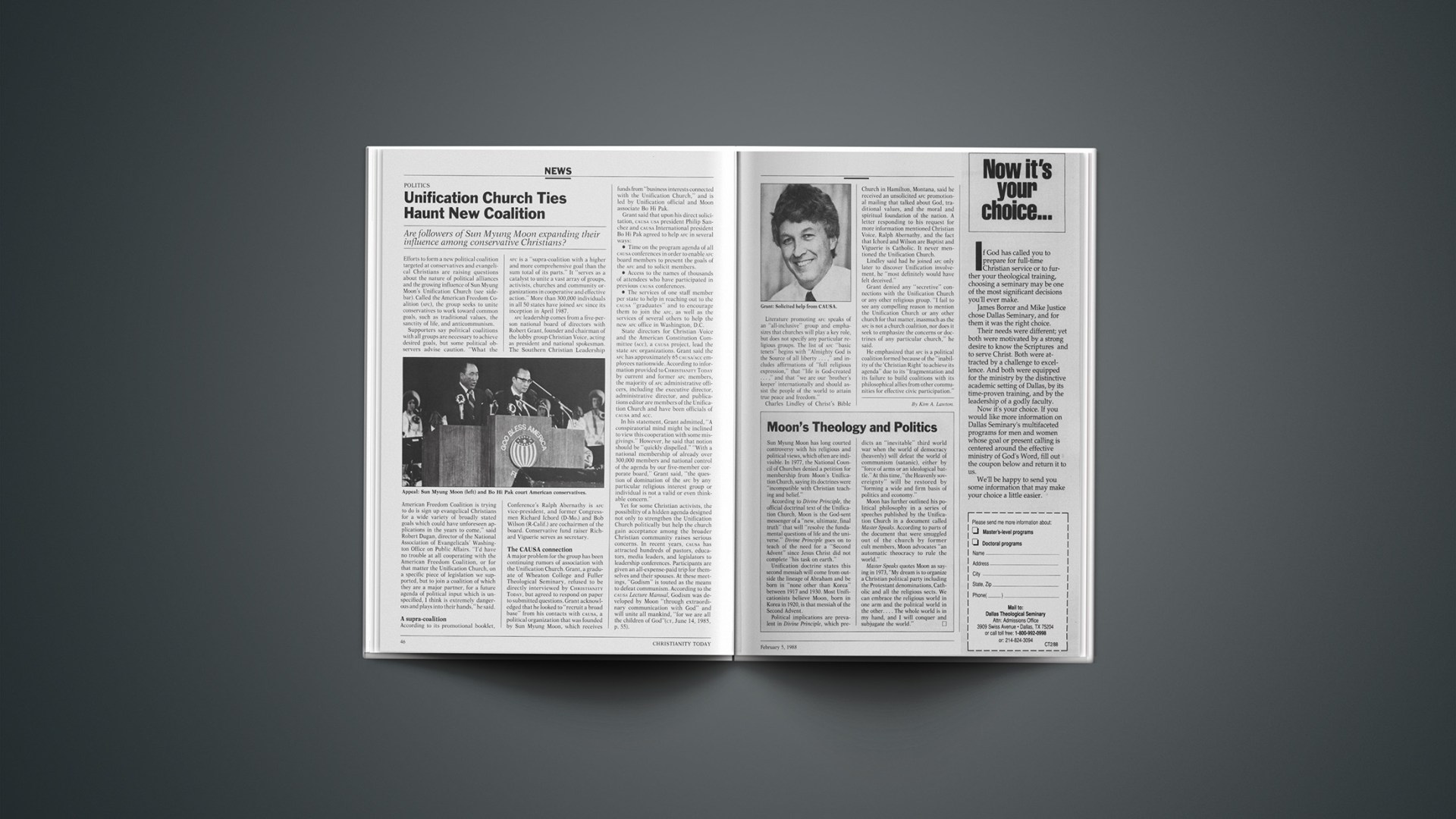
Unification Church Ties Haunt New Coalition

Are followers of Sun Myung Moon expanding their influence among conservative Christians?

Efforts to form a new political coalition targeted at conservatives and evangelical Christians are raising questions about the nature of political alliances and the growing influence of Sun Myung Moon’s Unification Church (see sidebar). Called the American Freedom Coalition (AFC), the group seeks to unite conservatives to work toward common goals, such as traditional values, the sanctity of life, and anticommunism.

Supporters say political coalitions with all groups are necessary to achieve desired goals, but some political observers advise caution. “What the American Freedom Coalition is trying to do is sign up evangelical Christians for a wide variety of broadly stated goals which could have unforeseen applications in the years to come,” said Robert Dugan, director of the National Association of Evangelicals’ Washington Office on Public Affairs. “I’d have no trouble at all cooperating with the American Freedom Coalition, or for that matter the Unification Church, on a specific piece of legislation we supported, but to join a coalition of which they are a major partner, for a future agenda of political input which is unspecified, I think is extremely dangerous and plays into their hands,” he said.

A Supra-Coalition

According to its promotional booklet, AFC is a “supra-coalition with a higher and more comprehensive goal than the sum total of its parts.” It “serves as a catalyst to unite a vast array of groups, activists, churches and community organizations in cooperative and effective action.” More than 300,000 individuals in all 50 states have joined AFC since its inception in April 1987.

AFC leadership comes from a five-person national board of directors with Robert Grant, founder and chairman of the lobby group Christian Voice, acting as president and national spokesman. The Southern Christian Leadership Conference’s Ralph Abernathy is AFC vice-president, and former Congressmen Richard Ichord (D-Mo.) and Bob Wilson (R-Calif.) are cochairmen of the board. Conservative fund raiser Richard Viguerie serves as secretary.

The Causa Connection

A major problem for the group has been continuing rumors of association with the Unification Church. Grant, a graduate of Wheaton College and Fuller Theological Seminary, refused to be directly interviewed by Christianity Today, but agreed to respond on paper to submitted questions. Grant acknowledged that he looked to “recruit a broad base” from his contacts with CAUSA, a political organization that was founded by Sun Myung Moon, which receives funds from “business interests connected with the Unification Church,” and is led by Unification official and Moon associate Bo Hi Pak.

Grant said that upon his direct solicitation, CAUSA USA president Philip Sanchez and CAUSA International president Bo Hi Pak agreed to help AFC in several ways:

  • Time on the program agenda of all CAUSA conferences in order to enable AFC board members to present the goals of the AFC and to solicit members.
  • Access to the names of thousands of attendees who have participated in previous CAUSA conferences.
  • The services of one staff member per state to help in reaching out to the CAUSA “graduates” and to encourage them to join the AFC, as well as the services of several others to help the new AFC office in Washington, D.C.

State directors for Christian Voice and the American Constitution Committee (ACC), a CAUSA project, lead the state AFC organizations. Grant said the AFC has approximately 65 CAUSA/ACC employees nationwide. According to information provided to CHRISTIANITY TODAY by current and former AFC members, the majority of AFC administrative officers, including the executive director, administrative director, and publications editor are members of the Unification Church and have been officials of CAUSA and ACC.

In his statement, Grant admitted, “A conspiratorial mind might be inclined to view this cooperation with some misgivings.” However, he said that notion should be “quickly dispelled.” “With a national membership of already over 300,000 members and national control of the agenda by our five-member corporate board,” Grant said, “the question of domination of the AFC by any particular religious interest group or individual is not a valid or even thinkable concern.”

Yet for some Christian activists, the possibility of a hidden agenda designed not only to strengthen the Unification Church politically but help the church gain acceptance among the broader Christian community raises serious concerns. In recent years, CAUSA has attracted hundreds of pastors, educators, media leaders, and legislators to leadership conferences. Participants are given an all-expense-paid trip for themselves and their spouses. At these meetings, “Godism” is touted as the means to defeat communism. According to the CAUSA Lecture Manual, Godism was developed by Moon “through extraordinary communication with God” and will unite all mankind, “for we are all the children of God” (CT, June 14, 1985, p. 55).

Literature promoting AFC speaks of an “all-inclusive” group and emphasizes that churches will play a key role, but does not specify any particular religious groups. The list of AFC “basic tenets” begins with “Almighty God is the Source of all liberty …,” and includes affirmations of “full religious expression,” that “life is God-created …,” and that “we are our ‘brother’s keeper’ internationally and should assist the people of the world to attain true peace and freedom.”

Charles Lindley of Christ’s Bible Church in Hamilton, Montana, said he received an unsolicited AFC promotional mailing that talked about God, traditional values, and the moral and spiritual foundation of the nation. A letter responding to his request for more information mentioned Christian Voice, Ralph Abernathy, and the fact that Ichord and Wilson are Baptist and Viguerie is Catholic. It never mentioned the Unification Church.

Lindley said had he joined AFC only later to discover Unification involvement, he “most definitely would have felt deceived.”

Grant denied any “secretive” connections with the Unification Church or any other religious group. “I fail to see any compelling reason to mention the Unification Church or any other church for that matter, inasmuch as the AFC is not a church coalition, nor does it seek to emphasize the concerns or doctrines of any particular church,” he said.

He emphasized that AFC is a political coalition formed because of the “inability of the ‘Christian Right’ to achieve its agenda” due to its “fragmentation and its failure to build coalitions with its philosophical allies from other communities for effective civic participation.”

By Kim A. Lawton.

Moon’s Theology And Politics

Sun Myung Moon has long courted controversy with his religious and political views, which often are indivisible. In 1977, the National Council of Churches denied a petition for membership from Moon’s Unification Church, saying its doctrines were “incompatible with Christian teaching and belief.”

According to Divine Principle, the official doctrinal text of the Unification Church, Moon is the God-sent messenger of a “new, ultimate, final truth” that will “resolve the fundamental questions of life and the universe.” Divine Principle goes on to teach of the need for a “Second Advent” since Jesus Christ did not complete “his task on earth.”

Unification doctrine states this second messiah will come from outside the lineage of Abraham and be born in “none other than Korea” between 1917 and 1930. Most Unificationists believe Moon, born in Korea in 1920, is that messiah of the Second Advent.

Political implications are prevalent in Divine Principle, which predicts an “inevitable” third world war when the world of democracy (heavenly) will defeat the world of communism (satanic), either by “force of arms or an ideological battle.” At this time, “the Heavenly sovereignty” will be restored by “forming a wide and firm basis of politics and economy.”

Moon has further outlined his political philosophy in a series of speeches published by the Unification Church in a document called Master Speaks. According to parts of the document that were smuggled out of the church by former cult members, Moon advocates “an automatic theocracy to rule the world.”

Master Speaks quotes Moon as saying in 1973, “My dream is to organize a Christian political party including the Protestant denominations, Catholic and all the religious sects. We can embrace the religious world in one arm and the political world in the other.… The whole world is in my hand, and I will conquer and subjugate the world.”

Gospel at Work in the Midst of Violence

Christians in Sri Lanka make up less than 1 percent of their island nation’s population. Yet they have played significant roles in mediating the country’s racial conflicts over the past three decades.

After the 1983 racially motivated exchange of massacres between the Sinhalese, who make up 71 percent of Sri Lanka’s population, and the minority Tamil race, several evangelicals played leading roles in peace and justice efforts. Today Reggie Ebenezer, a pastor and the general secretary of the Lanka Evangelical Alliance Development Service, leads a government effort to get supplies to civilians in northern Sri Lanka, victims of a war being waged by rebel Tamil groups.

Ajith Fernando, national director of Youth for Christ in Sri Lanka, says Christians enjoy such influence because “we are the only group with people from both [Sinhalese and Tamil] races.” Yet Fernando admits racial tension exists even among Christians. “Racism is one of the last things the process of sanctification touches,” he says.

A History Of Racism

Tamil-Sinhalese conflict long predates the violence of 1983. Earlier this century, a disproportionate number of Tamils rose to prominence in society. Beginning in 1956, the Sinhalese-dominated government sought to bring about balance, resulting in discrimination against Tamils.

The current Sri Lankan government admits Tamils have been mistreated. But leaders say Tamils have been unrealistic in demanding change, and have resorted too quickly to terrorism. Estimates of the number of Tamils to have died in the fighting in recent months range from 3,000 to 6,000, according to Fernando. The overwhelming majority, he adds, are civilians.

Forced Conversions

The history of Protestant Christianity in Sri Lanka, known as Ceylon prior to 1972, is likewise an inglorious one. It includes forced conversions to Christianity and the granting of special privileges to Christians. Prior to 1956, many embraced Christianity merely to gain access to good jobs. Many of these returned to Buddhism in the late 1950s, when Buddhism became identified with nationalism. According to Fernando, the Protestant church then became a breeding ground for syncretism and liberalism.

Unlike most of the world, Sri Lanka has defied the trend toward urbanization; some 70 percent of its population is rural. And although only 600 of the 25,000 villages have a Christian presence, Fernando believes Sri Lanka is more receptive to the gospel than at any time in this century. Evangelistic enthusiasm is especially high among the youth.

Despite his optimism, Fernando faults Sri Lanka’s evangelicals for being “ignorant and unconcerned about justice,” and cites the rise of liberation theology in the Third World as “a judgment on the church.” He is concerned about young Christians who are returning to liberation theology “because the evangelical church had nothing to offer them.”

Continued violence has caused an exodus of wealthy Christians, but Fernando believes this could be a blessing because in Sri Lanka the poor have more credibility. To many Sri Lankan Christians, ministry means regularly risking their lives. “What has helped us keep our sanity,” said Fernando, “is the truth of the sovereignty of God. Because God is sovereign, the only thing we have to fear is disobedience.”

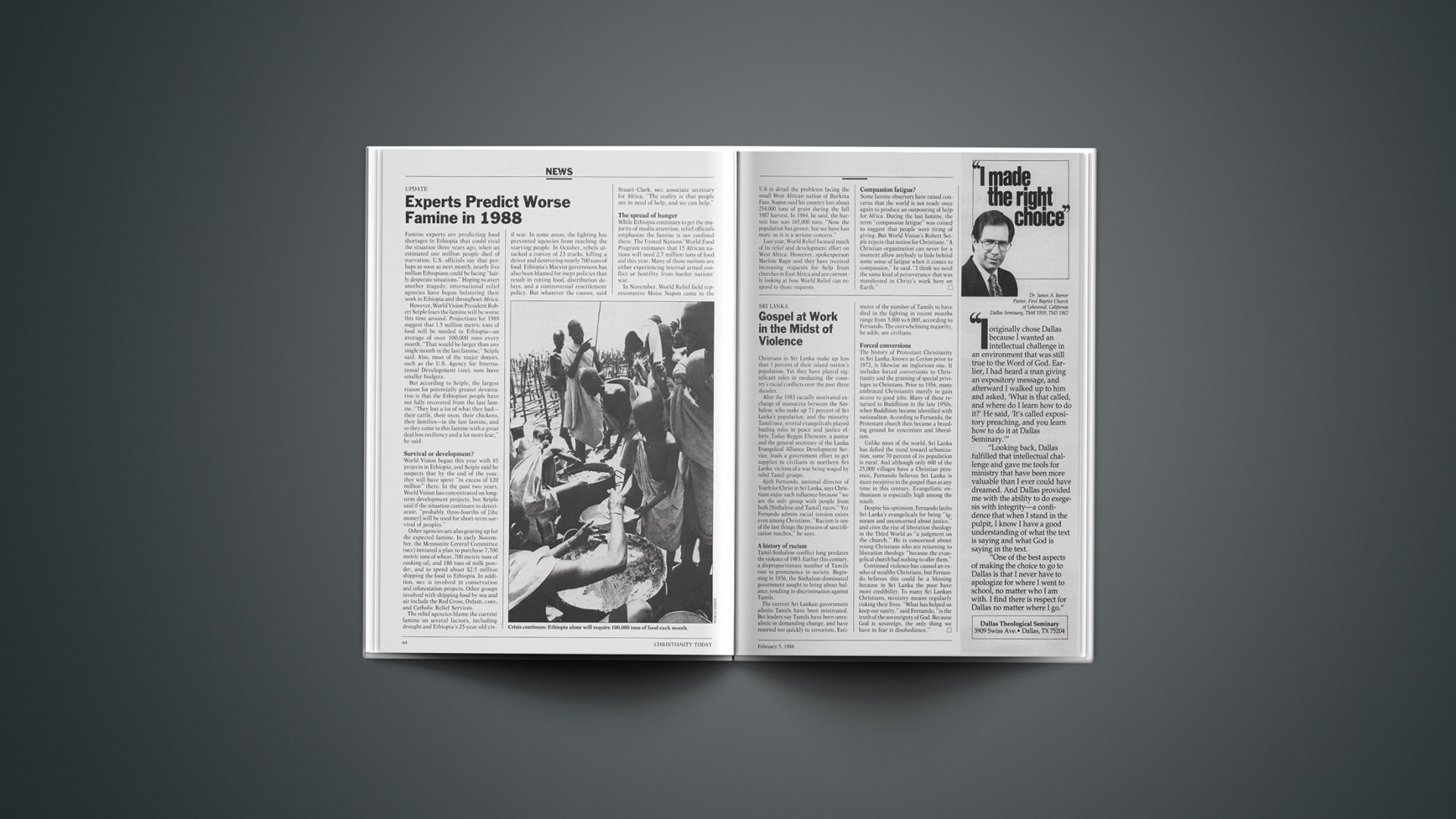
Experts Predict Worse Famine in 1988

Famine experts are predicting food shortages in Ethiopia that could rival the situation three years ago, when an estimated one million people died of starvation. U.S. officials say that perhaps as soon as next month, nearly five million Ethiopians could be facing “fairly desperate situations.” Hoping to avert another tragedy, international relief agencies have begun bolstering their work in Ethiopia and throughout Africa.

However, World Vision President Robert Seiple fears the famine will be worse this time around. Projections for 1988 suggest that 1.5 million metric tons of food will be needed in Ethiopia—an average of over 100,000 tons every month. “That would be larger than any single month in the last famine,” Seiple said. Also, most of the major donors, such as the U.S. Agency for International Development (AID), now have smaller budgets.

But according to Seiple, the largest reason for potentially greater devastation is that the Ethiopian people have not fully recovered from the last famine. “They lost a lot of what they had—their cattle, their oxen, their chickens, their families—in the last famine, and so they come to this famine with a great deal less resiliency and a lot more fear,” he said.

Survival Or Development?

World Vision began this year with 85 projects in Ethiopia, and Seiple said he suspects that by the end of the year, they will have spent “in excess of $20 million” there. In the past two years, World Vision has concentrated on long-term development projects, but Seiple said if the situation continues to deteriorate, “probably three-fourths of [the money] will be used for short-term survival of peoples.”

Other agencies are also gearing up for the expected famine. In early November, the Mennonite Central Committee (MCC) initiated a plan to purchase 7,700 metric tons of wheat, 700 metric tons of cooking oil, and 180 tons of milk powder, and to spend about $2.5 million shipping the food to Ethiopia. In addition, MCC is involved in conservation and reforestation projects. Other groups involved with shipping food by sea and air include the Red Cross, Oxfam, CARE, and Catholic Relief Services.

The relief agencies blame the current famine on several factors, including drought and Ethiopia’s 25-year old civil war. In some areas, the fighting has prevented agencies from reaching the starving people. In October, rebels attacked a convoy of 23 trucks, killing a driver and destroying nearly 700 tons of food. Ethiopia’s Marxist government has also been blamed for inept policies that result in rotting food, distribution delays, and a controversial resettlement policy. But whatever the causes, said Stuart Clark, MCC associate secretary for Africa, “The reality is that people are in need of help, and we can help.”

The Spread Of Hunger

While Ethiopia continues to get the majority of media attention, relief officials emphasize the famine is not confined there. The United Nations’ World Food Program estimates that 15 African nations will need 2.7 million tons of food aid this year. Many of those nations are either experiencing internal armed conflict or hostility from border nations’ war.

In November, World Relief field representative Moise Napon came to the U.S to detail the problems facing the small West African nation of Burkina Faso. Napon said his country lost about 254,000 tons of grain during the fall 1987 harvest. In 1984, he said, the harvest loss was 165,000 tons. “Now the population has grown, but we have lost more, so it is a serious concern.”

Last year, World Relief focused much of its relief and development effort on West Africa. However, spokesperson Marlene Rapp said they have received increasing requests for help from churches in East Africa and are currently looking at how World Relief can respond to those requests.

Compassion Fatigue?

Some famine observers have raised concerns that the world is not ready once again to produce an outpouring of help for Africa. During the last famine, the term “compassion fatigue” was coined to suggest that people were tiring of giving. But World Vision’s Robert Seiple rejects that notion for Christians. “A Christian organization can never for a moment allow anybody to hide behind some sense of fatigue when it comes to compassion,” he said. “I think we need the same kind of perseverance that was manifested in Christ’s work here on Earth.”

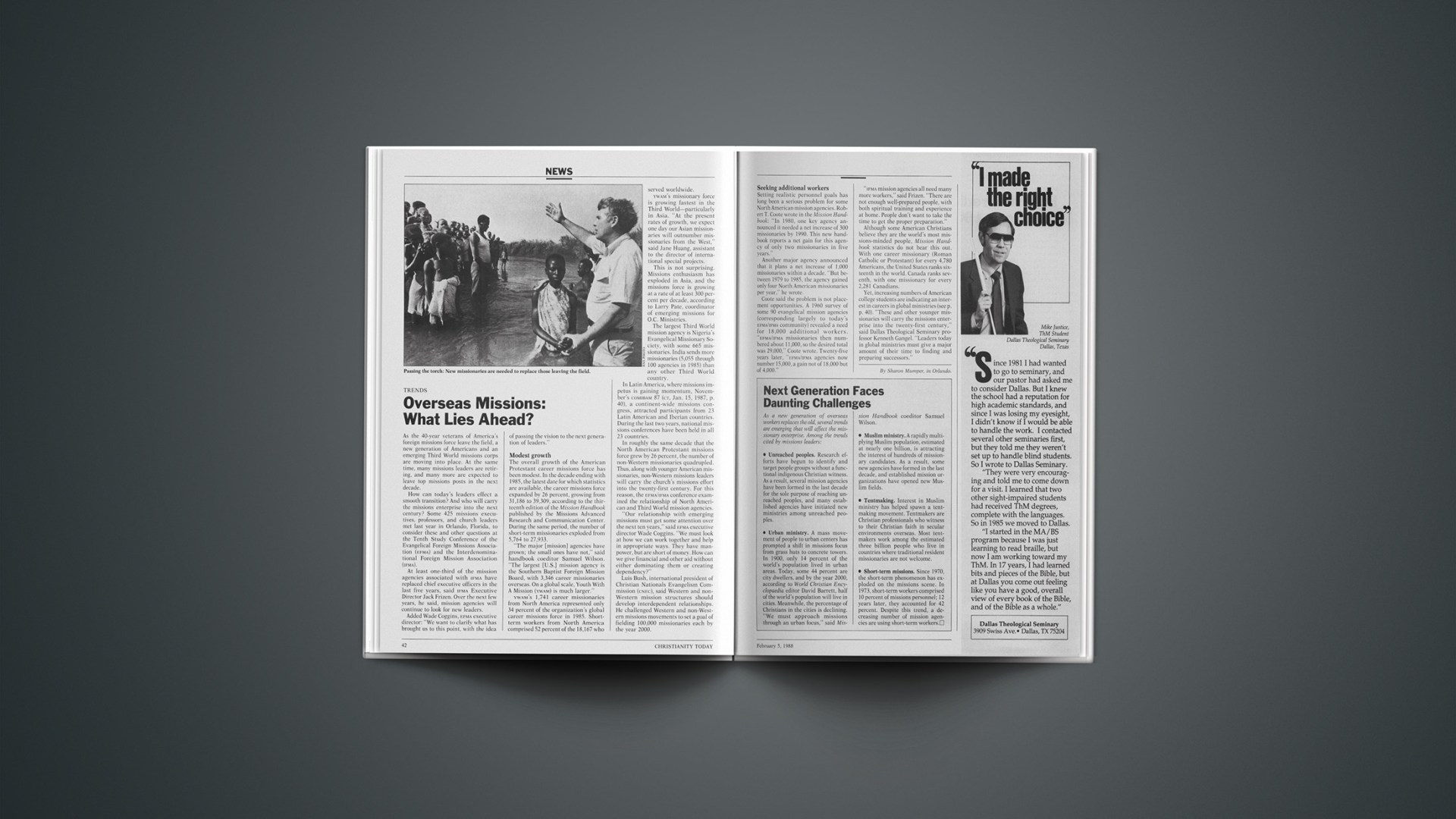
Overseas Missions: What Lies Ahead?

As the 40-year veterans of America’s foreign missions force leave the field, a new generation of Americans and an emerging Third World missions corps are moving into place. At the same time, many missions leaders are retiring, and many more are expected to leave top missions posts in the next decade.

How can today’s leaders effect a smooth transition? And who will carry the missions enterprise into the next century? Some 425 missions executives, professors, and church leaders met last year in Orlando, Florida, to consider these and other questions at the Tenth Study Conference of the Evangelical Foreign Missions Association (EFMA) and the Interdenominational Foreign Mission Association (IFMA).

At least one-third of the mission agencies associated with IFMA have replaced chief executive officers in the last five years, said IFMA Executive Director Jack Frizen. Over the next few years, he said, mission agencies will continue to look for new leaders.

Added Wade Coggins, EFMA executive director: “We want to clarify what has brought us to this point, with the idea of passing the vision to the next generation of leaders.”

Modest Growth

The overall growth of the American Protestant career missions force has been modest. In the decade ending with 1985, the latest date for which statistics are available, the career missions force expanded by 26 percent, growing from 31,186 to 39,309, according to the thirteenth edition of the Mission Handbook published by the Missions Advanced Research and Communication Center. During the same period, the number of short-term missionaries exploded from 5,764 to 27,933.

“The major [mission] agencies have grown; the small ones have not,” said handbook coeditor Samuel Wilson. “The largest [U.S.] mission agency is the Southern Baptist Foreign Mission Board, with 3,346 career missionaries overseas. On a global scale, Youth With A Mission (YWAM) is much larger.”

YWAM’S 1,741 career missionaries from North America represented only 34 percent of the organization’s global career missions force in 1985. Short-term workers from North America comprised 52 percent of the 18,167 who served worldwide.

YWAM’S missionary force is growing fastest in the Third World—particularly in Asia. “At the present rates of growth, we expect one day our Asian missionaries will outnumber missionaries from the West,” said Jane Huang, assistant to the director of international special projects.

This is not surprising. Missions enthusiasm has exploded in Asia, and the missions force is growing at a rate of at least 300 percent per decade, according to Larry Pate, coordinator of emerging missions for O.C. Ministries.

The largest Third World mission agency is Nigeria’s Evangelical Missionary Society, with some 665 missionaries. India sends more missionaries (5,055 through 100 agencies in 1985) than any other Third World country.

In Latin America, where missions impetus is gaining momentum, November’s COMIBAM 87 (CT, Jan. 15, 1987, p. 40), a continent-wide missions congress, attracted participants from 23 Latin American and Iberian countries. During the last two years, national missions conferences have been held in all 23 countries.

In roughly the same decade that the North American Protestant missions force grew by 26 percent, the number of non-Western missionaries quadrupled. Thus, along with younger American missionaries, non-Western missions leaders will carry the church’s missions effort into the twenty-first century. For this reason, the EFMA/IFMA conference examined the relationship of North American and Third World mission agencies.

“Our relationship with emerging missions must get some attention over the next ten years,” said EFMA executive director Wade Coggins. “We must look at how we can work together and help in appropriate ways. They have manpower, but are short of money. How can we give financial and other aid without either dominating them or creating dependency?”

Luis Bush, international president of Christian Nationals Evangelism Commission (CNEC), said Western and non-Western mission structures should develop interdependent relationships. He challenged Western and non-Western missions movements to set a goal of fielding 100,000 missionaries each by the year 2000.

Seeking Additional Workers

Setting realistic personnel goals has long been a serious problem for some North American mission agencies. Robert T. Coote wrote in the Mission Handbook: “In 1980, one key agency announced it needed a net increase of 300 missionaries by 1990. This new handbook reports a net gain for this agency of only two missionaries in five years.”

Another major agency announced that it plans a net increase of l,000 missionaries within a decade. “But between 1979 to 1985, the agency gained only four North American missionaries per year,” he wrote.

Coote said the problem is not placement opportunities. A 1960 survey of some 90 evangelical mission agencies (corresponding largely to today’s EFMA/IFMA community) revealed a need for 18,000 additional workers. “EFMA/IFMA missionaries then numbered about 11,000, so the desired total was 29,000,” Coote wrote. Twenty-five years later, “EFMA/IFMA agencies now number 15,000, a gain not of 18,000 but of 4,000.”

“IFMA mission agencies all need many more workers,” said Frizen. “There are not enough well-prepared people, with both spiritual training and experience at home. People don’t want to take the time to get the proper preparation.”

Although some American Christians believe they are the world’s most missions-minded people, Mission Handbook statistics do not bear this out. With one career missionary (Roman Catholic or Protestant) for every 4,780 Americans, the United States ranks sixteenth in the world. Canada ranks seventh, with one missionary for every 2,281 Canadians.

Yet, increasing numbers of American college students are indicating an interest in careers in global ministries (see p. p. 40). “These and other younger missionaries will carry the missions enterprise into the twenty-first century,” said Dallas Theological Seminary professor Kenneth Gangel. “Leaders today in global ministries must give a major amount of their time to finding and preparing successors.”

By Sharon Mumper, in Orlando.

Next Generation Faces Daunting Challenges

As a new generation of overseas workers replaces the old, several trends are emerging that will affect the missionary enterprise. Among the trends cited by missions leaders:

  • Unreached peoples. Research efforts have begun to identify and target people groups without a functional indigenous Christian witness. As a result, several mission agencies have been formed in the last decade for the sole purpose of reaching unreached peoples, and many established agencies have initiated new ministries among unreached peoples.
  • Urban ministry. A mass movement of people to urban centers has prompted a shift in missions focus from grass huts to concrete towers. In 1900, only 14 percent of the world’s population lived in urban areas. Today, some 44 percent are city dwellers, and by the year 2000, according to World Christian Encyclopaedia editor David Barrett, half of the world’s population will live in cities. Meanwhile, the percentage of Christians in the cities is declining. “We must approach missions through an urban focus,” said Mission Handbook coeditor Samuel Wilson.
  • Muslim ministry. A rapidly multiplying Muslim population, estimated at nearly one billion, is attracting the interest of hundreds of missionary candidates. As a result, some new agencies have formed in the last decade, and established mission organizations have opened new Muslim fields.
  • Tentmaking. Interest in Muslim ministry has helped spawn a tentmaking movement. Tentmakers are Christian professionals who witness to their Christian faith in secular environments overseas. Most tentmakers work among the estimated three billion people who live in countries where traditional resident missionaries are not welcome.
  • Short-term missions. Since 1970, the short-term phenomenon has exploded on the missions scene. In 1973, short-term workers comprised 10 percent of missions personnel; 12 years later, they accounted for 42 percent. Despite this trend, a decreasing number of mission agencies are using short-term workers.

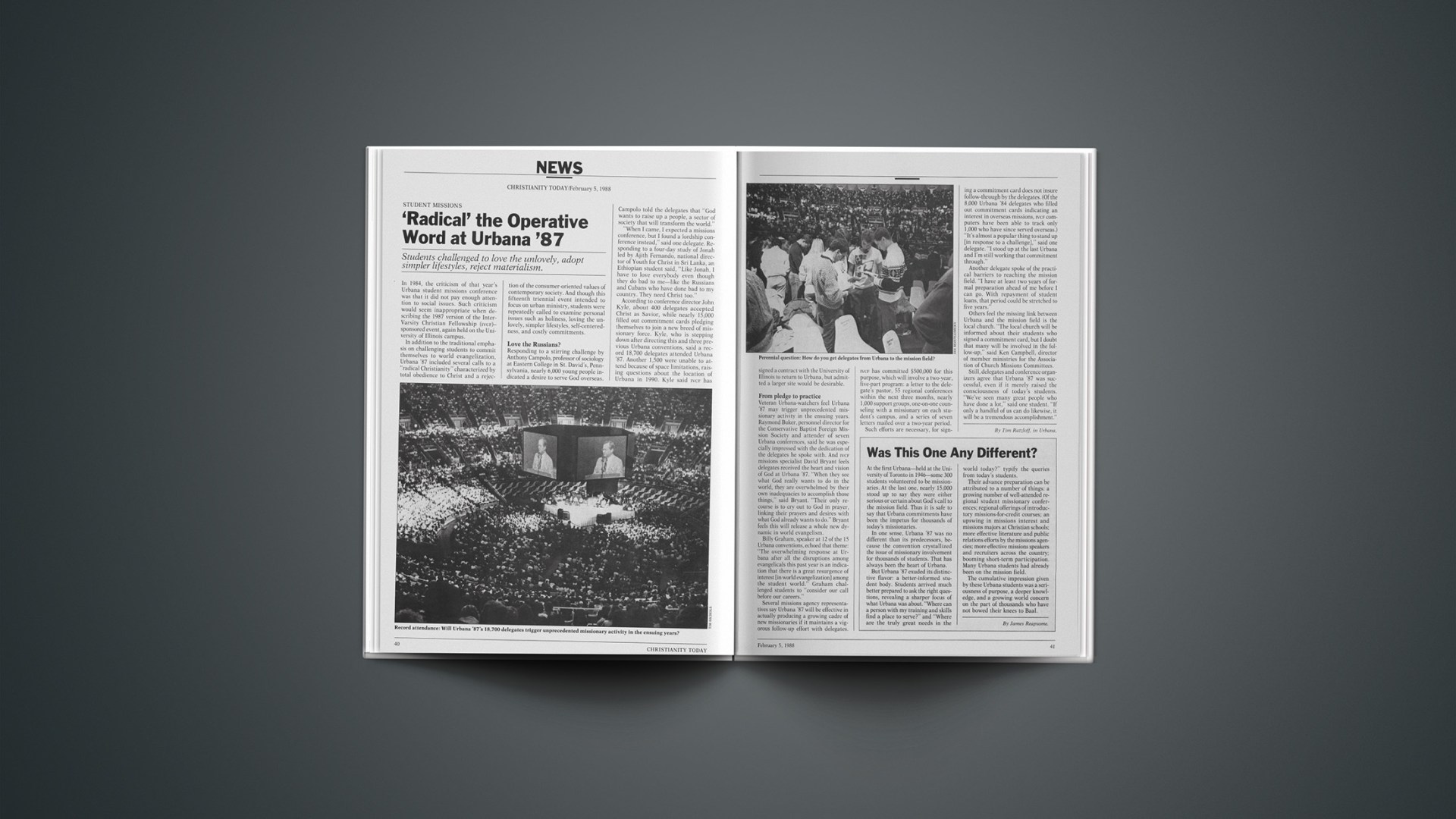
‘Radical’ the Operative Word at Urbana ‘87

Students challenged to love the unlovely, adopt simpler lifestyles, reject materialism.

In 1984, the criticism of that year’s Urbana student missions conference was that it did not pay enough attention to social issues. Such criticism would seem inappropriate when describing the 1987 version of the InterVarsity Christian Fellowship (IVCF)-sponsored event, again held on the University of Illinois campus.

In addition to the traditional emphasis on challenging students to commit themselves to world evangelization, Urbana ‘87 included several calls to a “radical Christianity” characterized by total obedience to Christ and a rejection of the consumer-oriented values of contemporary society. And though this fifteenth triennial event intended to focus on urban ministry, students were repeatedly called to examine personal issues such as holiness, loving the unlovely, simpler lifestyles, self-centeredness, and costly commitments.

Love The Russians?

Responding to a stirring challenge by Anthony Campolo, professor of sociology at Eastern College in St. David’s, Pennsylvania, nearly 6,000 young people indicated a desire to serve God overseas. Campolo told the delegates that “God wants to raise up a people, a sector of society that will transform the world.”

“When I came, I expected a missions conference, but I found a lordship conference instead,” said one delegate. Responding to a four-day study of Jonah led by Ajith Fernando, national director of Youth for Christ in Sri Lanka, an Ethiopian student said, “Like Jonah, I have to love everybody even though they do bad to me—like the Russians and Cubans who have done bad to my country. They need Christ too.”

According to conference director John Kyle, about 400 delegates accepted Christ as Savior, while nearly 15,000 filled out commitment cards pledging themselves to join a new breed of missionary force. Kyle, who is stepping down after directing this and three previous Urbana conventions, said a record 18,700 delegates attended Urbana ‘87. Another 1,500 were unable to attend because of space limitations, raising questions about the location of Urbana in 1990. Kyle said IVCF has signed a contract with the University of Illinois to return to Urbana, but admitted a larger site would be desirable.

From Pledge To Practice

Veteran Urbana-watchers feel Urbana ‘87 may trigger unprecedented missionary activity in the ensuing years. Raymond Buker, personnel director for the Conservative Baptist Foreign Mission Society and attender of seven Urbana conferences, said he was especially impressed with the dedication of the delegates he spoke with. And IVCF missions specialist David Bryant feels delegates received the heart and vision of God at Urbana ‘87. “When they see what God really wants to do in the world, they are overwhelmed by their own inadequacies to accomplish those things,” said Bryant. “Their only recourse is to cry out to God in prayer, linking their prayers and desires with what God already wants to do.” Bryant feels this will release a whole new dynamic in world evangelism.

Billy Graham, speaker at 12 of the 15 Urbana conventions, echoed that theme: “The overwhelming response at Urbana after all the disruptions among evangelicals this past year is an indication that there is a great resurgence of interest [in world evangelization] among the student world.” Graham challenged students to “consider our call before our careers.”

Several missions agency representatives say Urbana ‘87 will be effective in actually producing a growing cadre of new missionaries if it maintains a vigorous follow-up effort with delegates. IVCF has committed $500,000 for this purpose, which will involve a two-year, five-part program: a letter to the delegate’s pastor, 55 regional conferences within the next three months, nearly 1,000 support groups, one-on-one counseling with a missionary on each student’s campus, and a series of seven letters mailed over a two-year period.

Such efforts are necessary, for signing a commitment card does not insure follow-through by the delegates. (Of the 8.000 Urbana 84 delegates who filled out commitment cards indicating an interest in overseas missions, IVCF computers have been able to track only 1.000 who have since served overseas.) “It’s almost a popular thing to stand up [in response to a challenge],” said one delegate. “I stood up at the last Urbana and I’m still working that commitment through.”

Another delegate spoke of the practical barriers to reaching the mission field. “I have at least two years of formal preparation ahead of me before I can go. With repayment of student loans, that period could be stretched to five years.”

Others feel the missing link between Urbana and the mission field is the local church. “The local church will be informed about their students who signed a commitment card, but I doubt that many will be involved in the follow-up,” said Ken Campbell, director of member ministries for the Association of Church Missions Committees.

Still, delegates and conference organizers agree that Urbana 87 was successful, even if it merely raised the consciousness of today’s students. “We’ve seen many great people who have done a lot,” said one student. “If only a handful of us can do likewise, it will be a tremendous accomplishment.”

By Tim Ratzloff, in Urbana.

Was This One Any Different?

At the first Urbana—held at the University of Toronto in 1946—some 300 students volunteered to be missionaries. At the last one, nearly 15,000 stood up to say they were either serious or certain about God’s call to the mission field. Thus it is safe to say that Urbana commitments have been the impetus for thousands of today’s missionaries.

In one sense, Urbana 87 was no different than its predecessors, because the convention crystallized the issue of missionary involvement for thousands of students. That has always been the heart of Urbana.

But Urbana 87 exuded its distinctive flavor: a better-informed student body. Students arrived much better prepared to ask the right questions, revealing a sharper focus of what Urbana was about. “Where can a person with my training and skills find a place to serve?” and “Where are the truly great needs in the world today?” typify the queries from today’s students.

Their advance preparation can be attributed to a number of things: a growing number of well-attended regional student missionary conferences; regional offerings of introductory missions-for-credit courses; an upswing in missions interest and missions majors at Christian schools; more effective literature and public relations efforts by the missions agencies; more effective missions speakers and recruiters across the country; booming short-term participation. Many Urbana students had already been on the mission field.

The cumulative impression given by these Urbana students was a seriousness of purpose, a deeper knowledge, and a growing world concern on the part of thousands who have not bowed their knees to Baal.

By James Reapsome.

Apple PodcastsDown ArrowDown ArrowDown Arrowarrow_left_altLeft ArrowLeft ArrowRight ArrowRight ArrowRight Arrowarrow_up_altUp ArrowUp ArrowAvailable at Amazoncaret-downCloseCloseEmailEmailExpandExpandExternalExternalFacebookfacebook-squareGiftGiftGooglegoogleGoogle KeephamburgerInstagraminstagram-squareLinkLinklinkedin-squareListenListenListenChristianity TodayCT Creative Studio Logologo_orgMegaphoneMenuMenupausePinterestPlayPlayPocketPodcastRSSRSSSaveSaveSaveSearchSearchsearchSpotifyStitcherTelegramTable of ContentsTable of Contentstwitter-squareWhatsAppXYouTubeYouTube