Religious Groups Are Not Taking Sides on High Court Nominee

Major religious and prolife organizations have decided not to take a public stand on Anthony Kennedy, President Reagan’s third nominee to fill the vacant seat on the U.S. Supreme Court. Kennedy, a federal appeals court judge for more than a decade, has been spared much of the controversy that greeted previous high court nominees Douglas Ginsburg and Robert Bork.

Prolife groups that supported Bork are reacting cautiously to Kennedy. The Christian Action Council has decided neither to endorse nor oppose Kennedy, according to outgoing executive director Curt Young. The National Right to Life Committee (NRLC) is “pleased by [Kennedy’s] commitment to judicial restraint,” said Douglas Johnson, the organization’s legislative director. However, at press time, the NRLC had not taken an official position on the nomination.

Likewise, the National Association of Evangelicals (NAE) is not likely to take a position on the Kennedy nomination, according to Forest Montgomery, counsel to the NAE Office on Public Affairs. This fall, the NAE spoke out for the first time on a Supreme Court nomination when it endorsed Bork. Part of the reason for that action, Montgomery said, was “in response to the coalition of the some 180 to 200 groups that were combatting the Bork nomination. We don’t see the same divisiveness in the nomination of Kennedy.”

The National Council of Churches (NCC), which opposed Bork based on the fear that he would not “advance the effective protection of the full rights of all citizens,” has also refrained from taking a position on Kennedy. However, an NCC statement said the organization will be “watching … [the process] closely.”

Some proponents of abortion, such as the National Organization for Women, are opposing Kennedy. But to date, they have not launched the intensive efforts that characterized their successful fight against Bork.

Observers say this is because Kennedy is considered less conservative than his predecessors and is still largely an “unknown factor.” Although the judge has issued nearly 500 opinions, he has not written or publicly discussed issues outside of his judicial opinions. And legal experts say most of his rulings were narrowly confined to the cases under consideration, rather than ones that set a broader precedent.

“I think he’s been grooming for a Supreme Court appointment for many years,” one Court observer told Christianity Today. “He’s very political in his background … and has been playing the game of keeping his own values close to his vest and rendering very narrow judgments in moderate tones. The question is, what are we going to find when he’s no longer in the position of playing … judicial politics and begins to write [opinions] more forthrightly?”

Other Court Action

Meanwhile, the eight-member Supreme Court is working through its fall judicial agenda. Last month, the justices refused on procedural grounds to decide the constitutionality of a New Jersey law that required schools to have a daily moment of silence for “quiet and private contemplation and introspection.”

The Court’s action, which did not set a national precedent, left intact a lower-court ruling that held the law unconstitutional. In 1985, a federal appellate court said the New Jersey law violated the separation of church and state by facilitating prayer, even though the statute does not mention prayer.

In 1985, the Court struck down an Alabama moment-of-silence law that, unlike the New Jersey statute, specifically mentioned “meditation or voluntary prayer.” About 25 states have moment-of-silence laws on the books.

In another case, the Court heard oral arguments in Jerry Falwell’s lawsuit against Hustler magazine for a parody alleging that he had a drunken, incestuous affair with his mother. Falwell’s attorney, calling the parody “repulsive and loathsome,” argued that it is not protected by the First Amendment. Hustler’s attorney said the parody was an expression of constitutionally protected free speech and urged the Court not to allow the case to diminish the press’s First Amendment rights.

In a third case, the high court announced it will consider the extent to which churches can engage in political activities while still maintaining their tax-exempt status. The Roman Catholic Church’s tax-exempt status was challenged by an organization known as Abortion Rights Mobilization, which has argued that the church violated federal law by attempting to influence public policy on abortion.

And in a decision that underscores the importance of the vacant Supreme Court seat, the justices deadlocked four-to-four over an Illinois law regulating a minor’s access to abortion. The law would have required unmarried women under 18 to inform both parents and wait 24 hours before getting an abortion—or obtain a judge’s permission to bypass those requirements.

The tie vote, which sets no national precedent, affirms a lower court decision that struck down the 24-hour waiting period and said the judicial-bypass provision could not be considered until the Illinois Supreme Court issued rules concerning how the provision would be carried out.

Can the Prolife Movement Succeed?

After 15 years of fighting legalized abortion, prolife leaders regroup for the long haul.

It was 15 years ago this month that the U.S. Supreme Court, in Roe v. Wade, said women have a constitutional right to abortion. The ruling has been bitterly contested ever since, and as a new year gets under way, abortion remains one of the most emotionally charged, divisive issues confronting the nation.

While clashes continue in Congress, state legislatures, and the courts, increased levels of citizen activism and new technological advances have expanded the scope of the prolife movement. And despite the fact that abortion is still legal, prolife leaders say their movement has matured and gained a position of influence in public policy matters.

A Movement’s Changes

Roe v. Wade set into motion a national movement that has undergone a number of changes. In the 1970s, most prolife activities were carried out by Catholics. Now, according to Jack Willke, president of the National Right to Life Committee (NRLC), that is changing. A Catholic himself, Willke cites “an awakening from its slumber of literally millions of deeply committed Protestant folk.… This is no longer a Catholic movement. This is very much ecumenical, [almost] to the point of being a Protestant Christian movement.”

In addition, the divisions that plagued the prolife movement in the 1970s over allowable exceptions to a proposed ban on abortion and methods for achieving change have subsided. A few activists, like March for Life president Nellie Gray, still insist that the movement should support nothing short of a complete ban on abortion. But according to NRLC legislative director Douglas Johnson, “Divisions within the movement have not been a major hurdle for several years.” Johnson added that most “mainstream” groups have agreed to support legislation with only a narrowly defined exception to save the life of the mother.

Another major change has been in the general outlook of the prolife groups. The “halcyon early days of hope, anticipation, and noncompromise that said we will get a single human life amendment” have given way to a new realism, said Willke.

Curt Young, outgoing executive director of the Christian Action Council (CAC), said he believes the prolife movement is only now beginning to understand the magnitude of its work. “The monumental nature of the moral task that we face is something that was very, very hard to see 10 and 15 years ago,” he said.

Some activists have become bitter about the Reagan administration’s failure to make the sweeping prolife changes they had hoped for. “It has been a reinforcement that our loyalties must never lie with politicians or parties,” said Judie Brown, president of American Life League.

Legal Battles

In the 1970s and early 1980s, with little hope the Supreme Court would reverse Roe v. Wade, prolife groups pushed for a constitutional amendment to protect the life of the unborn or a federal law that would challenge legalized abortion. But despite numerous attempts, those tactics failed. Therefore, while not abandoning the push for a human life amendment, legislative efforts have moved into other areas.

Within the Roe constraint, the most evident prolife gains have been in curtailing federal funds for abortion. In 1976 Congress passed the Hyde Amendment, which prohibits the government from paying for abortions except when the life of the mother is endangered. In 1984, the policy was extended to prohibit the federal government from funding international family-planning groups that promote abortion overseas.

The NRLC’S Johnson said the prolife movement has also prevented legislative extensions of Roe v. Wade. As an example, Johnson cited the failure of the Equal Rights Amendment, which he said would have had “far-reaching abortion implications.” Similarly, the Civil Rights Restoration Act remains stalled with the U.S. Senate divided over the issue of whether the bill should require nonprofit, religiously affiliated colleges and health institutions to provide abortions.

The retirement of Supreme Court Justice Lewis Powell last June gave the prolife movement new hope the Court might alter its commitment to the Roe ruling. In the high court’s most recent abortion ruling in 1986, four justices called for a reconsideration of Roe v. Wade. Abortion advocates and opponents alike say the person appointed to fill the vacant seat could represent the swing vote for a reconsideration—and possibly an overturning—of the abortion ruling.

Citizen Activism

While legislative and judicial battles drag on, more and more abortion opponents are participating in “direct action” efforts. On the weekend after Thanksgiving, 210 people were arrested at a sit-in that blocked the entrance of an abortion clinic near Philadelphia. The nonviolent demonstration was considered a success because clients were prevented from entering the clinic, and at least one woman changed her mind about having an abortion.

“This type of activity needs to be done because it’s showing that we’re willing to take that extra step … to block the access to these killing chambers,” said protest spokesman Gary Leber. “It is more in line with our rhetoric that abortion is murder.”

The November effort was considered “field training” for a bigger event planned for the first week in May, in which organizers say thousands of people from across the country will participate in a series of sit-ins blocking abortion clinics in New York City.

In another protest, thousands of prolifers are expected to come to Washington, D.C., January 22 for the fifteenth annual March for Life. “The prolife movement as exemplified by these marchers shows that we are not going away until we have gained a constitutional protection for the paramount right to life of each born and preborn human being,” said march organizer Nellie Gray.

Less noticed are the growing numbers of protests being conducted at the local level. The CAC sponsors “Pastors’ Protests” outside local hospitals that perform abortions. State and local groups, as well as individuals, organize marches at government offices, abortion clinics, and abortionists’ homes; and some prolifers provide “sidewalk counseling” to women entering the clinics. Some of these efforts have drawn fire for intimidating women and resorting to such tactics as displaying bloody dolls or actual fetuses. Several cases are pending in courts across the country seeking to limit antiabortion picketing.

New Battle Fronts

Advances in technology and the expansion of abortion services have prompted new approaches in the prolife effort. Among them:

  • Some groups have protested the drug RU 486, fearing it could be used as a “do-it-yourself” abortion pill. RU 486, manufactured in France, has been kept out of the United States, largely because of prolife efforts.
  • Ethical questions are being raised about the use of aborted fetal tissue for medical research and transplants.
  • In many states, the issue of how fetal remains are disposed of after abortions has become a major prolife concern.
  • Opposition to school-based health clinics that distribute contraceptives and provide abortion counseling to minors is emerging as a key prolife issue.
  • More than 3,000 counseling centers across the country help women who are considering abortion. Prochoice groups have accused some of the centers of using deceptive techniques to “coerce women to continue their pregnancies.” But most of the counseling centers, including the CAC’S Crisis Pregnancy Centers, are committed to employing “moral principles” in providing physical and spiritual support for pregnant women.
  • In an effort to apply a “consistent prolife ethic” to public policy debates, a political action committee called Just Life addresses poverty issues and the nuclear arms race along with the abortion question.

However, most leaders in the prolife movement believe the biggest battle in the next few decades will be fought over euthanasia. Because of recent court decisions and actions in state legislatures liberalizing euthanasia regulations, many fear it is becoming the abortion issue of the 1990s.

“I hope the Christian community is better prepared to deal with the euthanasia philosophy than we were with abortion,” said Tom Glessner, the CAC’S incoming executive director. “We let the abortion philosophy sneak up on us.…”

Virtually all prolife leaders agree that the key to winning on any front is swaying public opinion. Several prolife groups have planned aggressive public-education campaigns this year. The CAC is calling May “Abortion Information Month” and will target undecided people with details about abortion and the psychological complications women suffer through Post-abortion Syndrome.

Despite the discouragements and disappointments of the past 15 years, most in the prolife movement say they are committed for the long term. Even if Roe is overturned by the Supreme Court and the legality of abortion is left to each state, Glessner said, “we still would have a whole lot of work to do—maybe even more than we’re doing now.”

By Kim A. Lawton.

Some Key Players

Hundreds of prolife groups emerged after the Supreme Court legalized abortion. Most have specialized their involvement, either by focusing on only one aspect of the antiabortion battle or by representing a specific segment of the American population.

The National Right to Life Committee, the Christian Action Council (CAC), the American Life League, and other groups lobby members of Congress and provide educational services at the grassroots. The CAC also provides a support ministry for women through its Crisis Pregnancy Centers. Other groups that concentrate on women include Women Exploited by Abortion, American Victims of Abortion, Open Arms, Sav-A-Baby, and Alternatives to Abortion International.

Americans United for Life focuses on seeing change come through legislation and court rulings. Others, such as March for Life and the Prolife Direct Action Project, try to effect change through public protests and demonstrations.

Prolife groups have also been formed to represent various segments of the population, such as Feminists for Life and Black Americans for Life; and professions, such as Nurses for Life, the National Association of Prolife Obstetricians and Gynecologists, and Veterinarians for Life.

Religious groups are represented as well, including Presbyterians Prolife, Lutherans for Life, the National Organization of Episcopalians for Life, and Choose Life, a Jewish organization.

Classic & Contemporary Excerpts from January 15, 1988

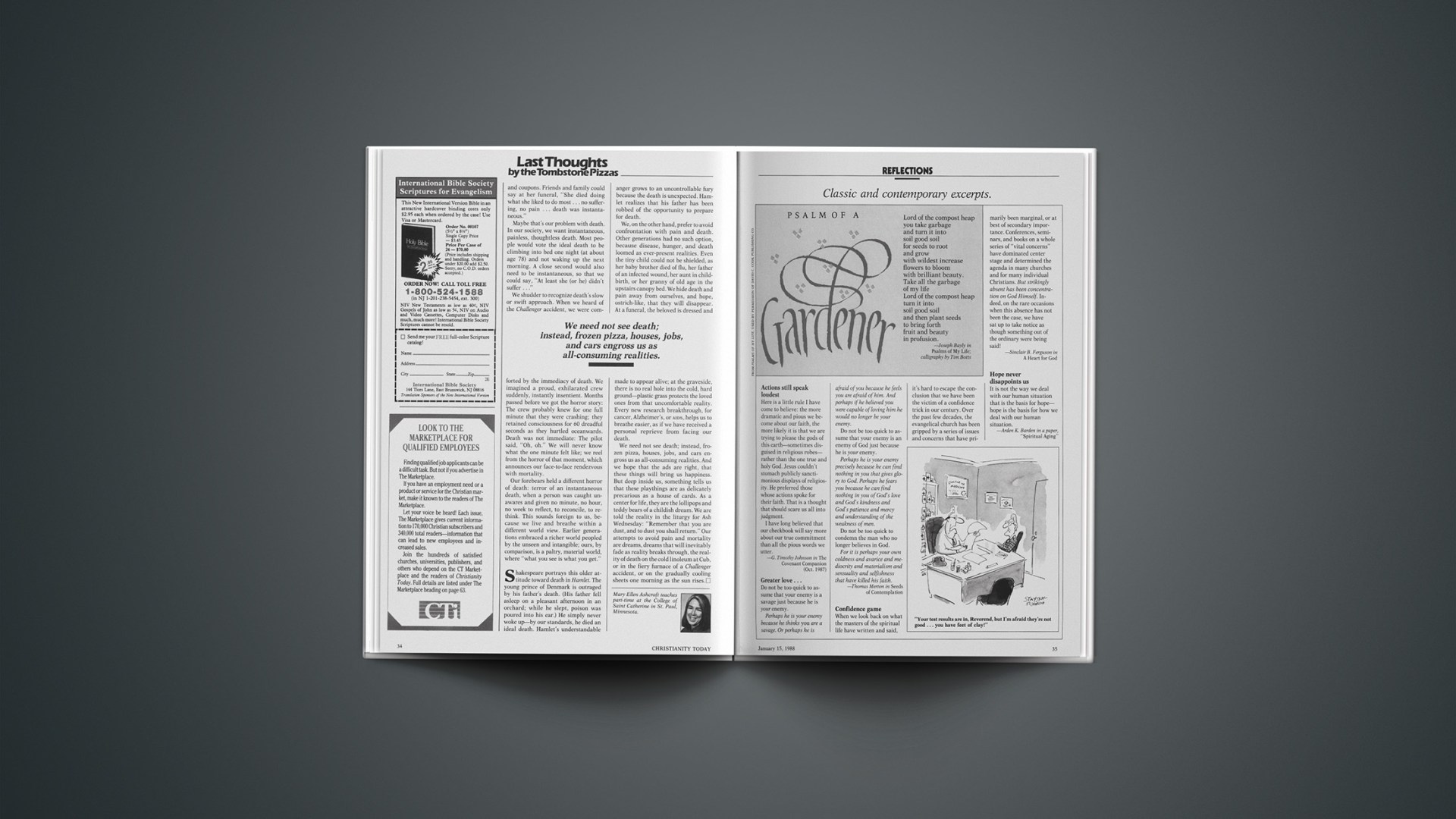
Psalm Of A Gardener

Lord of the compost heap

you take garbage

and turn it into

soil good soil

for seeds to root

and grow

with wildest increase

flowers to bloom

with brilliant beauty.

Take all the garbage

of my life

Lord of the compost heap

turn it into

soil good soil

and then plant seeds

to bring forth

fruit and beauty

in profusion.

—Joseph Bayly in Psalms of My Life; calligraphy by Tim Botts

Actions still speak loudest

Here is a little rule I have come to believe: the more dramatic and pious we become about our faith, the more likely it is that we are trying to please the gods of this earth—sometimes disguised in religious robes—rather than the one true and holy God. Jesus couldn’t stomach publicly sanctimonious displays of religiosity. He preferred those whose actions spoke for their faith. That is a thought that should scare us all into judgment.

I have long believed that our checkbook will say more about our true commitment than all the pious words we utter.

G. Timothy Johnson in The Covenant Companion (Oct. 1987)

Greater love …

Do not be too quick to assume that your enemy is a savage just because he is your enemy.

Perhaps he is your enemy because he thinks you are a savage. Or perhaps he is afraid of you because he feels you are afraid of him. And perhaps if he believed you were capable of loving him he would no longer be your enemy.

Do not be too quick to assume that your enemy is an enemy of God just because he is your enemy.

Perhaps he is your enemy precisely because he can find nothing in you that gives glory to God. Perhaps he fears you because he can find nothing in you of God’s love and God’s kindness and God’s patience and mercy and understanding of the weakness of men.

Do not be too quick to condemn the man who no longer believes in God.

For it is perhaps your own coldness and avarice and mediocrity and materialism and sensuality and selfishness that have killed his faith.

—Thomas Merton in Seeds of Contemplation

Confidence game

When we look back on what the masters of the spiritual life have written and said, it’s hard to escape the conclusion that we have been the victim of a confidence trick in our century. Over the past few decades, the evangelical church has been gripped by a series of issues and concerns that have primarily been marginal, or at best of secondary importance. Conferences, seminars, and books on a whole series of “vital concerns” have dominated center stage and determined the agenda in many churches and for many individual Christians. But strikingly absent has been concentration on God Himself. Indeed, on the rare occasions when this absence has not been the case, we have sat up to take notice as though something out of the ordinary were being said!

—Sinclair B. Ferguson in A Heart for God

Hope never disappoints us

It is not the way we deal with our human situation that is the basis for hope—hope is the basis for how we deal with our human situation.

—Arden K. Barden in a paper, “Spiritual Aging”

Last Thoughts by the Tombstone Pizzas

I heaved my shopping cart past Plexiglass containers of peanuts, almonds, and pecans, and swung toward frozen foods. I felt self-righteous; I always do when I gird my loins for a trip to Cub. All of us Cub shoppers smile smugly: we recognize our superiority for saving those pennies—patiently unloading cream cheese and orange juice and broccoli at the check-out, buzzing them down the conveyor belt, bagging them and hauling them to the car. I half expect someone to stop me (between the two sets of sliding doors where the hundreds of carts are jammed together) and perform a little ceremony, knighting me for my splendid service to family and country, saving pennies, nickles, and dimes.

I maneuvered around a heavyset woman, who was parked near frozen pizzas, head bent over a gray plastic coupon box that hooked over the cart’s red handle. A coupon shopper like her really deserves recognition: She had clipped and sorted and actually found her coupons to bring to the supermarket, and might even manage to buy the product that corresponded with the fine print on the coupon. I rolled on a few feet, halting in front of the frozen peas. Green Giant or Birds Eye?

Then I heard a sharp whine and a body hit the floor. I spun round to see the coupon sorter sprawled by her cart. A man dashed over from dairy products, loosened her collar, and felt for her pulse. I ran down the aisle searching frantically for a green Cub apron. “Quick, quick,” I shouted. “A lady’s collapsed by the pizzas! Phone 911.” The green apron raced for the phone. Voices buzzed:

“What happened?”

“Someone’s collapsed.”

“Is she all right?”

I walked back slowly to frozen foods where a small crowd was gathering.

We waited a few minutes until the paramedics elbowed in, efficient and breezy. Their heads clustered above the tattered gray coat and aqua polyester trousers that looked so undignified spreading from her bulky body on the beige linoleum. One paramedic lifted his head, glancing quickly at the other, his eyes speaking “too late.” The message passed through the group.

“Out of the way, out of the way,” he ordered, avoiding the eyes of the crowd, embarrassed by failure. They heaved the large bundle onto the stretcher, rolling the beige blanket from the feet over the head. The four men, like pall bearers in navy uniforms, carried her solemnly down the aisle past displays of Lemon Pledge and stacks of red, orange, and green Shasta cans.

I stepped back to my cart. How could I buy peas when death had broken, lightning-like, into Cub Foods? Should we all take off our shoes, or stand silent, heads bowed, for 60 seconds?

Even as I pondered her cart, full of bargains, an uncomfortable-looking employee strolled up to it, desperately trying to look casual. He nervously put his hands where her hands had just been and wheeled the cart away.

The next wave of shoppers, who were sorting lettuce and choosing onions across the store, would not know that someone had just died there. The beige linoleum and the frozen pizzas looked just the same as before. That bothered me—not so much that it happened, but that it was so quickly erased. None of us want to be reminded of death, of our mortality. We want to pretend that if we eat reasonably good food and visit the doctor occasionally, we’ll live forever.

Was she ready to die? There, in front of frozen pizzas, her last thoughts must have been, “The Red Baron 11-inch is $2.98, and the 10-inch Tombstone is $2.75, but I’ve got a coupon if I can find it here …,” and then Bumph! One instant she was toying with one of life’s most trivial decisions, and the next, she was jerked out of time.

This woman had no opportunity for reconciliation with a daughter-in-law she may have despised, no chance to show courage as the doctor announced cancer, no moments to reflect on issues that loom larger than pizza, pennies, and coupons. Friends and family could say at her funeral, “She died doing what she liked to do most … no suffering, no pain … death was instantaneous.”

Maybe that’s our problem with death. In our society, we want instantaneous, painless, thoughtless death. Most people would vote the ideal death to be climbing into bed one night (at about age 78) and not waking up the next morning. A close second would also need to be instantaneous, so that we could say, “At least she (or he) didn’t suffer …”

We shudder to recognize death’s slow or swift approach. When we heard of the Challenger accident, we were comforted by the immediacy of death. We imagined a proud, exhilarated crew suddenly, instantly insentient. Months passed before we got the horror story: The crew probably knew for one full minute that they were crashing; they retained consciousness for 60 dreadful seconds as they hurtled oceanwards. Death was not immediate: The pilot said, “Oh, oh.” We will never know what the one minute felt like; we reel from the horror of that moment, which announces our face-to-face rendezvous with mortality.

Our forebears held a different horror of death: terror of an instantaneous death, when a person was caught unawares and given no minute, no hour, no week to reflect, to reconcile, to rethink. This sounds foreign to us, because we live and breathe within a different world view. Earlier generations embraced a richer world peopled by the unseen and intangible; ours, by comparison, is a paltry, material world, where “what you see is what you get.”

Shakespeare portrays this older attitude toward death in Hamlet. The young prince of Denmark is outraged by his father’s death. (His father fell asleep on a pleasant afternoon in an orchard; while he slept, poison was poured into his ear.) He simply never woke up—by our standards, he died an ideal death. Hamlet’s understandable anger grows to an uncontrollable fury because the death is unexpected. Hamlet realizes that his father has been robbed of the opportunity to prepare for death.

We, on the other hand, prefer to avoid confrontation with pain and death. Other generations had no such option, because disease, hunger, and death loomed as ever-present realities. Even the tiny child could not be shielded, as her baby brother died of flu, her father of an infected wound, her aunt in childbirth, or her granny of old age in the upstairs canopy bed. We hide death and pain away from ourselves, and hope, ostrich-like, that they will disappear. At a funeral, the beloved is dressed and made to appear alive; at the graveside, there is no real hole into the cold, hard ground—plastic grass protects the loved ones from that uncomfortable reality. Every new research breakthrough, for cancer, Alzheimer’s, or AIDS, helps us to breathe easier, as if we have received a personal reprieve from facing our death.

We need not see death; instead, frozen pizza, houses, jobs, and cars engross us as all-consuming realities. And we hope that the ads are right, that these things will bring us happiness. But deep inside us, something tells us that these playthings are as delicately precarious as a house of cards. As a center for life, they are the lollipops and teddy bears of a childish dream. We are told the reality in the liturgy for Ash Wednesday: “Remember that you are dust, and to dust you shall return.” Our attempts to avoid pain and mortality are dreams, dreams that will inevitably fade as reality breaks through, the reality of death on the cold linoleum at Cub, or in the fiery furnace of a Challenger accident, or on the gradually cooling sheets one morning as the sun rises.

Mary Ellen Ashcroft teaches part-time at the College of Saint Catherine in St. Paul, Minnesota.

Boundary Markers for Belief

We can stretch our understanding of the gospel, knowing we have reliable standards by which to measure our efforts.

CHRISTIANITY TODAY has always been concerned with “pumping truth” (J. I. Packer’s colorful phrase), conveying in a responsible yet readable manner the important teachings of Christianity, even as we examine current trends in the church and the world. To start off this year’s collection of doctrinal articles, we asked Saint Louis University historian James Hitchcock to reflect on the question, “Why doctrine?”

God’s revelation to mankind is Jesus Christ, and acceptance of that revelation consists of nothing else but full and complete faith in Christ.

Virtually all Christian groups agree on that. And because of that agreement, it seems to many people unfortunate that those same groups proceed to disagree, often vehemently, over interpretations of the faith.

Both ecumenical Christians and bemused non-Christians often ask why it is not simply enough to accept Jesus as Lord. After all, faith in Christ manifests itself in ways that do not require interpretation: Christians are supposed to be distinguishable by their service and love, for which no particular theology seems to be necessary. And we can engage wholeheartedly in prayer and worship—even if we are completely uneducated.

For many people, therefore, doctrine—in the sense of explicit creedal statements which believers are expected to accept—seems at best superfluous, at worst divisive and unnecessarily complicating. “Doctrine divides; service unites” is a familiar contemporary ecumenical slogan.

A Deeper, More Holy Life

Properly understood, however, doctrines are not merely complicated abstractions. An understanding of the Trinity, for example, should deepen one’s prayer life and further reveal the richness of God’s love. And an understanding of the theology of the sacraments should make one live the life of grace more fully and consciously.

Moreover, doctrine can lead us not only into deeper spirituality, but also into higher morality. Unfortunately, nowhere in contemporary Christianity is doctrine more ignored, or more controverted, than here. Centuries of Christian history have shown that it is not enough simply to say, “Obey the commandments,” or “Love your neighbor as yourself.” People have been capable of the most widely varying, and mutually contradictory, interpretations of those exhortations. In order for its moral teachings to be more than platitudinous, the church has to be able to say with some specificity what are and what are not right actions, and why.

But just as faith that rests primarily on personal experience can become overly subjective and hence distorted (as with people eager to see the hand of God in everything that makes them feel good), so faith based on doctrinal orthodoxy can be dead and barren (as with believers whose zeal for theological accuracy becomes a kind of nitpicking metaphysical etiquette). But in both cases the fault, obviously, lies in distortion and excess.

In The Beginning

Students of world religions point out that Christianity from the beginning has placed greater emphasis on doctrine than any other major faith. Apparently some Eastern religions contain no doctrine at all. This suggests that Christianity’s historical penchant for developing doctrine is no mere accident.

Indeed, the New Testament already embodies abstract doctrinal statements. Although the complexities of doctrine are sometimes contrasted with the simplicities of biblical faith, the first chapter of John and nearly the entire Letter to the Romans—to cite two examples—are already highly theological.

Formal doctrine served two distinct purposes in the early church: It was a way of explaining the faith to educated nonbelievers (the first chapter of John does this), and it was a way for educated Christians to explain their faith to themselves. Thus, doctrine developed in the early church not because Christians were getting farther away from the gospel, but because they sought to understand it more fully.

For example, the New Testament does not speak of the Trinity. But Jesus talks repeatedly about the Father to whom he will return and the Spirit whom the Father will send. Inevitably Christians sought to understand the relationship between Father, Son, and Spirit. In doing so, they formulated doctrines, and already in the second century the church was distinguishing between true and false doctrines and declaring certain doctrines essential for Christians to believe. To have done otherwise would in effect have meant a refusal to think about the meaning of faith.

Homey Parables And Metaphysical Flights

Perhaps the most telling argument against doctrine is that the infinite cannot be encompassed within the finite—the eternal truth of God cannot be reduced to a verbal formula comprehensible to the human mind. This awareness is itself part of the patrimony of Christian doctrine. However, this is no more an argument against doctrine as such than it is against the Incarnation.

To argue that doctrine pollutes divine revelation simply because it makes use of human categories is to ignore a key aspect of Scripture: The homey themes of Jesus’ parables build on the natural knowledge of human beings no less than do the metaphysical flights of John’s logos theology.

Of course, no doctrine can exhaust the truth it seeks to express. Because they are human formulations, doctrines can never be considered final and definitive. But at a minimum, doctrines establish boundary markers for belief—warning signs to tell us when we stray too close to danger. For example, the teaching of the Council of Nicea (A.D. 325) keeps us from denying the fullness of God’s self-revelation in Christ by moving too far in the direction of Arianism (the heretical teaching that Christ was not coequal and coeternal with the Father). Likewise, the markers set up at Chalcedon (A.D. 451) keep us from making light of the reality of the Incarnation by warning us away from Monophysitism (the heresy that Christ had only one nature, and that one divine).

All doctrine involves some use of human philosophy. But if the philosophy is not explicit, it will be implicit, and a merely implicit philosophy is likely to fall into unrecognized errors. Economist John Maynard Keynes dismissed those “hardheaded” businessmen who pride themselves on espousing no economic theory by saying that they are, unknown to themselves, “followers of some long dead scribbler.” All people, even the least educated, have some implicit picture of the universe, into which they translate their faith. All things considered, it is better that that picture be explicit and conscious.

In adapting philosophical ideas to the exposition of the gospel, theologians have always had to make adjustments in the philosophy itself. (Thus Thomas Aquinas discarded Aristotle’s idea that the universe is eternal.) When a system of theology becomes too closely wedded to a particular philosophical school it becomes rigid and runs a high risk of distorting the gospel.

But, when a particular philosophical system has been carefully harmonized with Christian belief over a long period of time, the marriage between the two is not easily broken. The chief theological struggle in contemporary Roman Catholicism is precisely over how to express the truths of the faith in ways that are not necessarily Aristotelian. Unfortunately, in making the attempt, some theologians seem to have lost crucial elements of the faith itself.

No Last Word

Certainly, no Christian can assume that any human thinker ever has the last word. In working with the dominant philosophy of a particular age, theologians run the risk of binding the gospel to a system of thought that will in time become at least partially outmoded, as one philosophical school succeeds another, or the insights of one age seem inadequate to the questions of a different era.

John Henry Newman’s Essay on the Development of Christian Doctrine (written before he converted to Rome) remains the seminal work on the question how the doctrines of the church can change to meet the demands of succeeding ages, while at the same time remain faithful to the gospel once delivered to the saints. Newman concluded that every doctrinal development must be contained, at least in embryo, in the gospel and that every development must be compatible with earlier ones.

There is no implicit reason why doctrine should not change, in the sense of developing in accord with the changing perceptions of each age. Different periods of history tend to emphasize different aspects of Christian belief (for example, God’s wrath in one time, his mercy in another).

But it is necessary that no development negate authentic earlier doctrine. (Thus, properly understood, God’s wrath and his mercy are not contradictory.)

One of the main functions of doctrine is to preserve the comprehensiveness of Christian belief through the vicissitudes of historical change. Thus an age that finds itself drawn to the helpless, suffering Jesus on the cross is reminded, as it recites the Nicene Creed, that that same Jesus was the eternally begotten Son of the Father.

Properly understood then, doctrine does not inhibit theological development but is precisely that which makes responsible development possible. Modern believers can stretch their understanding of the gospel, secure in the knowledge that in the historic creeds they have reliable standards by which to measure the fidelity of their own efforts.

The great historic creeds, especially the Nicene Creed, have shown themselves enduring beyond all question in serving this purpose. In theory, it is possible to imagine a new creed cast in very different terms from that of Nicea, yet equally faithful to the gospel. In practice, such an achievement seems beyond the theological minds of this age. Even the great Catholic theologians of the Middle Ages, or the great Protestant thinkers of the sixteenth century, for the most part never thought they could replace the great early classic formulations.

For, if all doctrine is indeed embodied in the linguistic and philosophical clothing of a particular historical age, it is also, at its core, God’s own unchanging truth. In all authentic doctrinal statements, this continues to shine forth powerfully, across all the ages.

James Hitchcock is professor of history, Saint Louis University, and author of What Is Secular Humanism? (Servant).

Great Commission Deadline

Is the year 2000 a reasonable goal or an improbable dream?

Spurred on by the millennial spirit, independent missions strategists in the West have launched a multitude of plans to conquer the world for Christ within the next 12 years. Like a cruise missile locked on its target, they have zeroed in on the world’s unreached billions.

But is reaching the world by 2000 a realistic goal, or is it just a clever device for recruiting more missionaries and keeping the support monies coming?

CT asked Jim Reapsome, executive director of Evangelical Missions Information Service, to survey mission executives and missiologists for their responses.

Can the world be reached by the year 2000?

It is an intriguing question not easily answered. And its difficulty begins with the very word reached. What does it mean in the context of the Great Commission? For some, people who have had a chance to hear the gospel are “reached”; for others, it means the unbelievers who have turned to faith in Jesus Christ and are part of a church.

In launching “New Life 2000,” Campus Crusade’s Bill Bright used a common understanding of “reach.” “We prayerfully anticipate that at least one billion people will receive Jesus as Lord and Savior by the year 2000,” he said.

Technically, however, “reaching” has nothing to do with response. “Reaching is really an indication of the quality and extent of the effort to evangelize, not of discipling and church planting,” explained Patrick Johnstone of WEC International in England and compiler of the authoritative balance sheet of world missions, “Operation World.”

But that narrow definition has been broadened by others to include not only massive evangelistic efforts by radio, television, films, and literature, but also the making of disciples and the establishing of churches.

Some agencies that have set bold goals for 2000 are carrying out the biblical mandate to preach the gospel to every person. Others have set more measurable goals: like establishing at least one church within each ethnolinguistic group—in obedience to Christ’s command to make disciples.

Therefore, if you ask the telling agencies if reaching the world by 2000 is a realistic goal, you get a resounding yes. But if you talk to someone like Richard Winchell, general director of The Evangelical Alliance Mission (TEAM), a multifaceted agency, the answer is no. “There are far too many people swelling the world’s population for us to have any kind of hope like that,” Winchell said. “Eighty-five million people a year is the increase, not to mention those that are still lost. If the population of China would stand still, and we could have a ‘Pentecost’ every day with 3,000 saved in China, it would take 900 years before all China would be saved.”

Richard Sollis, of New Tribes Mission in Sanford, Florida, looks at the current rate of church-planting progress and agrees that the 2000 deadline is unrealistic; but “when our Lord decides to rattle the bones of his church—possibly through persecution—we may indeed finally see believers with his message scattered everywhere.”

Jim Montgomery, whose agency—Dawn Ministries, San Jose, California—seeks to mobilize churches for church planting on a nationwide basis, said he is “almost alarmed at the speed and intensity with which leaders embrace this concept.” He admits that “to plant, say, another 5 million churches in the right places all over the world in the next 12 years is an enormous task.” However, he believes that the resources—and the willingness—are available to reach the world by 2000, “by filling it with committed cells of believers.

Southern Baptist research consultant David Barrett, g editor of World Christian Encyclopedia, takes the broad view of “reached” as giving people an understandable hearing of the gospel. Even so, he projects that at the church’s present rate of evangelizing the world, 16.6 percent will still be unevangelized by the year 2000.

Four Challenges

Indeed, population growth is but one of a number of hurdles independent mission executives and missiologists pinpointed when discussing with CT the completion of the Great Commission by the year 2000. Among other challenges noted were:

  • The church’s lagging commitment to world missions.
  • Problems within mission agencies.
  • Religious and political opposition.
  • The high cost of missions.

Challenge 1: The church’s “commitment.” Ron Cline, president of HCJB World Radio, one of four missionary radio stations behind “The World By 2000” project, pointedly raised the issue of church commitment: “Will the church stay with us until the year 2000?” he asked. “Or, will it become interested in something else? Will it send people and finances, and support us with prayer? Or are we alone in our commitment to the lost of the world?”

A rousing battle cry thundered from WEC’s Patrick Johnstone: “Where is the church’s concept of militancy? Where is God’s mighty army, its members wearing the badge of suffering? Where is our exultant determination to take the world by storm for our King?”

The world won’t be won, he claims, so long as the church’s structure, terminology, and theological education have a “built-in bias to produce static hierarchies, buildings, and a comfortable lifestyle for its members.”

This means it is harder to find people “totally committed to the will of God, regardless of the cost,” noted Ian Hay, general director of SIM International. Hay questioned whether churches are “producing the kind of people who can meet the spiritual challenge” of the times.

Reaching the world by 2000 will demand the church’s total mobilization; but Richard Sollis, of New Tribes, claimed that few churches take the task of world evangelization seriously enough “to make it the program of the church, rather than a program of the church.” He sees confusion and error in establishing church priorities. “By insufficient vision, discipleship, and obedience, the church has bottle-necked the flow of personnel and resources needed to do the job,” he said.

In a nutshell, apathetic Christians are the biggest hurdle to overcome.

Challenge 2: Problems from within. Independent mission agencies themselves appear to be handcuffed by a number of serious obstacles. Among them:

  • Dependence on Western mission structures, which stymie development of partnerships with mission agencies and churches in other countries.
  • Failure to cooperate. Ron Cline fears continued “competition with one another, while great groups of lost people go without the gospel.”
  • Fear of change. This management weakness leads to an unwillingness to look at new strategies and makes decision making in the home office or overseas extremely difficult.
  • Waste and duplication. WEC’s Patrick Johnstone attributes this obstacle to “organizational isolationism,” which he graphically describes in terms that are usually reserved for the world’s corporate structures: “empire building, jockeying for power and position, jealous guarding of funding structures and supporting constituencies.”

Challenge 3; Religious and political opposition. The hurdle familiar to most laypeople—religious and political opposition—was surprisingly not a big concern of the mission executives and missiologists surveyed. They agreed with Denver Seminary’s Ralph Covell that our “problems are more internal than external.” However, trouble erupts, according to Ian Hay, “when a mission society enters territory that has long been Satan’s domain.”

David Hesselgrave, missiologist at Trinity Evangelical Divinity School, succinctly articulated these external troubles as “totalitarianism, anticonversion efforts, closed and partially closed countries, martyrdoms, the resurgence of non-Christian religions and world views, and demonic activity.”

Research consultant David Barrett estimates that the average annual rate of martyrdoms will jump to 500,000 by the year 2000 from the present 335,000. In the International Bulletin of Missionary Research (Jan. 1987), he writes: “This century’s biggest killer has proved to be civil terror. Since 1900, 119 million innocent citizens have been tortured, shot, slaughtered, killed, or otherwise executed by their own governments. The great majority have been Christians. As a ‘sign from God,’ this appalling statistic warns us about the escalating conflict between church and state, and hence our future prospects in global mission.”

Challenge 4: The high cost of missions. Although more than $1.3 billion was given to North American Protestant mission agencies in 1985, some experts fear a financial shortfall will preclude their reaching the world by 2000. Trinity’s Hesselgrave observed that “affluence has a way of numbing mission concern.” He claims that, when adjusted for inflation, overall missions giving is not increasing as much as the cost of missions.

When it comes to world evangelization, Hesselgrave fears that “more attention and funding devoted to keeping missionaries equipped and well cared for” will have a damaging effect on the effort to reach the unreached.

So Why The Date Setting?

What is the point, then, in rallying the independent mission agencies and the churches to try to finish the Great Commission by the year 2000? Simply answered, both need a good dose of goal-oriented revitalization.

“Unless we have something to aim at, we won’t hit it,” said SIM’s Hay. “In 1910, our forebears sought to reach the world in their generation. Did they do it? No. But they stimulated an army of missionaries. The fact that the church is a worldwide reality today stems from the work of God’s Spirit through his people as a result of that kind of vision.”

Despite the hurdles, leaders see 1988 as a propitious time to move ahead. With people and money at their disposal, the time is ripe. “Today is a day of great opportunity, unparalleled in the history of the church,” said John Bendor-Samuel, executive vice-president of Wycliffe Bible Translators International, Dallas, Texas. “It is hard to project a better time for world evangelization in the more distant future,” said Trinity’s David Hesselgrave.

And although he thinks that “reach the world by 2000” campaigns “reflect a rather simplistic view of the gospel and what it means to become a follower of Jesus Christ,” Denver Seminary’s Ralph Covell sees value in setting goals. “Why not be more realistic and say that we want to reach 300 unreached groups by 2000? This comes out to about 15 a year. This would be hard enough.”

Full Speed Ahead—Regardless

Thus, whether or not the churches are up to providing the people and the money needed over the next 12 years, mission agencies are not standing still.

Hesselgrave sees some agencies “changing too much and too often, following now this end-all strategy and now that one.” But overall, “most missions are much more sensitive to the need for effective strategies than has been the case in the past.”

They are consequently moving toward partnership overseas and cooperation at home. “God is raising up a dedicated army of witnesses in other countries,” said SIM’s Ian Hay. Asians have become part of his mission, Africans are on the way.

Projects are either already under way, or are on the drawing boards for joint efforts to disciple whole nations in 13 countries, with 12 different parachurch groups taking the leadership.

Interdependence seems to be the word in vogue,” says John Bendor-Samuel. “The go-it-alone attitude has been abandoned. There is very real hope for a relationship that recognizes the mutual needs, skills, and resources of all.”

The broadcasters are working together. “We have admitted that we are not alone and we cannot do the job by ourselves,” said HCJB’s Ron Cline. “We are working at trusting one another and not questioning motives.”

Two major tactical moves are urban church planting and “tentmaker” witness, whereby Christian professionals pursue their careers in countries that do not permit traditional missionaries. “We are working in 25 so-called world-class cities,” said team’s Richard Winched. “We don’t represent the hope for the entire city, but we will roll up our sleeves and do what we can.”

The number of opportunities for witnessing teachers, doctors, engineers, and so on in restricted-access countries is mounting—more than there are people to fill them. More and more agencies are cultivating this ministry as a supplement to their other work. Some of them offer counseling and training to professionals before they leave. No one sees this as a cure-all, but rather as one more tool to reach the unreached.

Researcher Barrett called for more research, cooperation, and planning. “The biggest hurdle of all is the ignorance of one part of the Christian world of another part. Nobody knows the whole picture.”

To make a start in that direction, the Southern Baptists convened a meeting of 20 missions leaders last September. In addition to calling for the churches to pray and fast during Pentecost each year from now until the year 2000, these leaders created an ad hoc research group, headed by World Vision’s Ed Dayton, to find out if a common data base of unreached groups could be established.

Barrett said he hopes to complete an analysis of the data and have it published late this year. Asking all agencies to contribute information, he said his files would be open until June.

Seeing the approach of the end of the century, and taking stock of both their resources and the magnitude of the task, independent agencies have taken on a new zeal to get the job done. Not only are they sharpening their focus on the unreached world, they are also throwing down the gauntlet to the churches.

“We have asked the Lord first to keep us continually challenged with the task of world evangelism, and then to use us to present a bold and uncompromising challenge to the churches,” said New Tribes’ Richard Sollis.

If “reach the world by 2000” campaigns help them to do that, then the efforts will lead not only to the multiplication of conversions and churches, but also to an explosion of missions interest, prayer, and giving among the rank-and-file at home.

A former managing editor of Christianity Today magazine, Jim Reapsome is executive director of Evangelical Missions Information Service, Wheaton, Illinois.

Happy 2000Th Birthday

According to missions researcher David Barrett: “Of history’s 300 distinct plans to complete world evangelization, those referring to A.D. 2000 have numbered at least 70. Fifty of these plans are still alive today.”

Included among those plans (and the agencies sponsoring each) are the following:

  • To provide every person the chance to hear the gospel on the radio in a language they can understand (Far East Broadcasting Co., HCJB World Radio, Trans World Radio, ELWA [SIM International]).
  • To fulfill the Great Commission in Europe (Operation Mobilization).
  • To mobilize churches in every country to disciple the unreached (Dawn Ministries).
  • To reach all of Asia (Asian Outreach).
  • To reach every home (Every Home for Christ).
  • To help tell every person in every country that there is new life available in Jesus Christ (New Life 2000, Campus Crusade for Christ).

By James Reapsome.

“You Speak English?”

In addition to the major challenges of lagging commitment, rising costs, internal struggles, and religious and political opposition, the mission executives and missiologists surveyed also listed some other “strategic hurdles” confronting their agencies as they work to complete the Great Commission.

  • A poor grasp of communications principles. Ralph Covell, missiologist at Denver Seminary, credits mission agencies for using radio, literature, television, and films—all of them major components in “reach the world by 2000” campaigns. But he wonders if we have learned how to make the gospel intelligible to people who have radically different world views. “Technology,” said Covell, “is at the periphery of communication.”
  • A lack of necessary data. Mission agencies are looking for ways to overcome the basic hurdle of identifying the people who still need to be reached. “Without hard data, the dream of reaching the world for Christ becomes nothing more than that—a dream,” said Jim Montgomery, president of Dawn Ministries. Part of the data bottleneck is due to lack of precise agreement about what constitutes an unreached area or group. When lists have been published, mission agencies on the scene have said, “No, that’s not right. We do have churches in such and such a tribe.” Another hindrance is that various agencies compile their own lists, according to their specific goals.
  • Language barriers. John Bendor-Samuel, executive vice-president of Wycliffe Bible Translators, pointed out that “millions of men and women are denied access to the knowledge of Jesus Christ because it has never been communicated to them in a language which they really grasp.”
  • Lack of unified church-planting goals. Whatever methods mission agencies use to reach the world by 2000, it is clear that the agencies and the existing churches in Africa, Asia, Europe, and Latin America must work together toward commonly accepted goals. With the Lausanne Committee for World Evangelization planning its next gathering for 1989, some mission leaders suggest that this would be the best forum for agreeing on goals.

Among other strategic roadblocks, New Tribes’ Richard Sollis cited:

  • Packing too many missionaries in some places and neglecting some others;
  • Western-style methods that call for people to make decisions “without the missionary-evangelist first laying the essential biblical foundations”;
  • Failure to see the difference between people’s “felt” needs and their primary spiritual need;
  • Not making pioneer church-planting work “the number one priority.”

By James Reapsome.

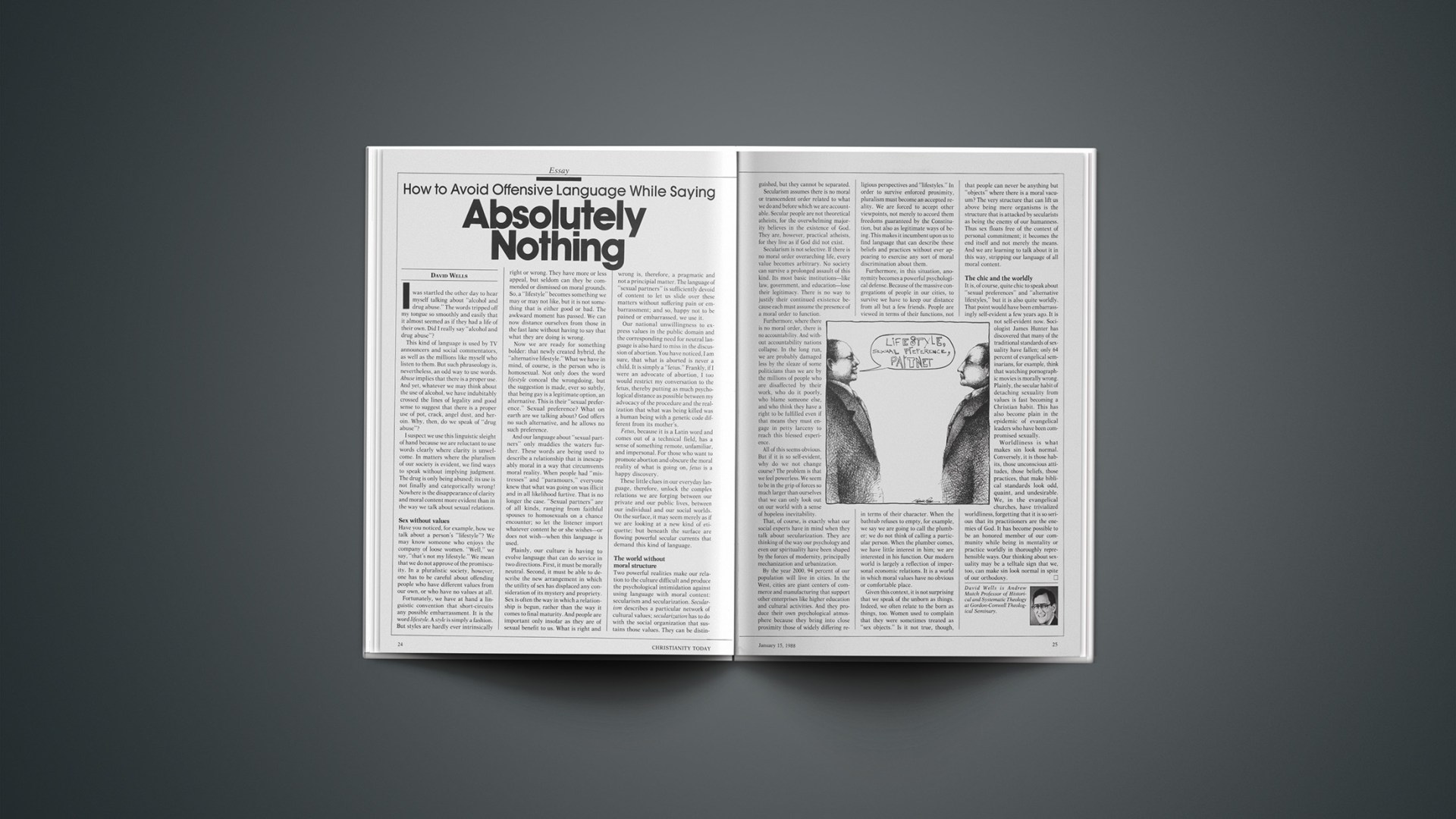
How to Avoid Offensive Language While Saying Absolutely Nothing

I was startled the other day to hear myself talking about “alcohol and drug abuse.” The words tripped off my tongue so smoothly and easily that it almost seemed as if they had a life of their own. Did I really say “alcohol and drug abuse”?

This kind of language is used by TV announcers and social commentators, as well as the millions like myself who listen to them. But such phraseology is, nevertheless, an odd way to use words. Abuse implies that there is a proper use. And yet, whatever we may think about the use of alcohol, we have indubitably crossed the lines of legality and good sense to suggest that there is a proper use of pot, crack, angel dust, and heroin. Why, then, do we speak of “drug abuse”?

I suspect we use this linguistic sleight of hand because we are reluctant to use words clearly where clarity is unwelcome. In matters where the pluralism of our society is evident, we find ways to speak without implying judgment. The drug is only being abused; its use is not finally and categorically wrong! Nowhere is the disappearance of clarity and moral content more evident than in the way we talk about sexual relations.

Sex Without Values

Have you noticed, for example, how we talk about a person’s “lifestyle”? We may know someone who enjoys the company of loose women. “Well,” we say, “that’s not my lifestyle.” We mean that we do not approve of the promiscuity. In a pluralistic society, however, one has to be careful about offending people who have different values from our own, or who have no values at all.

Fortunately, we have at hand a linguistic convention that short-circuits any possible embarrassment. It is the word lifestyle. A style is simply a fashion. But styles are hardly ever intrinsically right or wrong. They have more or less appeal, but seldom can they be commended or dismissed on moral grounds. So, a “lifestyle” becomes something we may or may not like, but it is not something that is either good or bad. The awkward moment has passed. We can now distance ourselves from those in the fast lane without having to say that what they are doing is wrong.

Now we are ready for something bolder: that newly created hybrid, the “alternative lifestyle.” What we have in mind, of course, is the person who is homosexual. Not only does the word lifestyle conceal the wrongdoing, but the suggestion is made, ever so subtly, that being gay is a legitimate option, an alternative. This is their “sexual preference.” Sexual preference? What on earth are we talking about? God offers no such alternative, and he allows no such preference.

And our language about “sexual partners” only muddies the waters further. These words are being used to describe a relationship that is inescapably moral in a way that circumvents moral reality. When people had “mistresses” and “paramours,” everyone knew that what was going on was illicit and in all likelihood furtive. That is no longer the case. “Sexual partners” are of all kinds, ranging from faithful spouses to homosexuals on a chance encounter; so let the listener import whatever content he or she wishes—or does not wish—when this language is used.

Plainly, our culture is having to evolve language that can do service in two directions. First, it must be morally neutral. Second, it must be able to describe the new arrangement in which the utility of sex has displaced any consideration of its mystery and propriety. Sex is often the way in which a relationship is begun, rather than the way it comes to final maturity. And people are important only insofar as they are of sexual benefit to us. What is right and wrong is, therefore, a pragmatic and not a principial matter. The language of “sexual partners” is sufficiently devoid of content to let us slide over these matters without suffering pain or embarrassment; and so, happy not to be pained or embarrassed, we use it.

Our national unwillingness to express values in the public domain and the corresponding need for neutral language is also hard to miss in the discussion of abortion. You have noticed, I am sure, that what is aborted is never a child. It is simply a “fetus.” Frankly, if I were an advocate of abortion, I too would restrict my conversation to the fetus, thereby putting as much psychological distance as possible between my advocacy of the procedure and the realization that what was being killed was a human being with a genetic code different from its mother’s.

Fetus, because it is a Latin word and comes out of a technical field, has a sense of something remote, unfamiliar, and impersonal. For those who want to promote abortion and obscure the moral reality of what is going on, fetus is a happy discovery.

These little clues in our everyday language, therefore, unlock the complex relations we are forging between our private and our public lives, between our individual and our social worlds. On the surface, it may seem merely as if we are looking at a new kind of etiquette; but beneath the surface are flowing powerful secular currents that demand this kind of language.

The World Without Moral Structure

Two powerful realities make our relation to the culture difficult and produce the psychological intimidation against using language with moral content: secularism and secularization. Secularism describes a particular network of cultural values; secularization has to do with the social organization that sustains those values. They can be distinguished, but they cannot be separated.

Secularism assumes there is no moral or transcendent order related to what we do and before which we are accountable. Secular people are not theoretical atheists, for the overwhelming majority believes in the existence of God. They are, however, practical atheists, for they live as if God did not exist.

Secularism is not selective. If there is no moral order overarching life, every value becomes arbitrary. No society can survive a prolonged assault of this kind. Its most basic institutions—like law, government, and education—lose their legitimacy. There is no way to justify their continued existence because each must assume the presence of a moral order to function.

Furthermore, where there is no moral order, there is no accountability. And without accountability nations collapse. In the long run, we are probably damaged less by the sleaze of some politicians than we are by the millions of people who are disaffected by their work, who do it poorly, who blame someone else, and who think they have a right to be fulfilled even if that means they must engage in petty larceny to reach this blessed experience.

All of this seems obvious. But if it is so self-evident, why do we not change course? The problem is that we feel powerless. We seem to be in the grip of forces so much larger than ourselves that we can only look out on our world with a sense of hopeless inevitability.

That, of course, is exactly what our social experts have in mind when they talk about secularization. They are thinking of the way our psychology and even our spirituality have been shaped by the forces of modernity, principally mechanization and urbanization.

By the year 2000, 94 percent of our population will live in cities. In the West, cities are giant centers of commerce and manufacturing that support other enterprises like higher education and cultural activities. And they produce their own psychological atmosphere because they bring into close proximity those of widely differing religious perspectives and “lifestyles.” In order to survive enforced proximity, pluralism must become an accepted reality. We are forced to accept other viewpoints, not merely to accord them freedoms guaranteed by the Constitution, but also as legitimate ways of being. This makes it incumbent upon us to find language that can describe these beliefs and practices without ever appearing to exercise any sort of moral discrimination about them.

Furthermore, in this situation, anonymity becomes a powerful psychological defense. Because of the massive congregations of people in our cities, to survive we have to keep our distance from all but a few friends. People are viewed in terms of their functions, not in terms of their character. When the bathtub refuses to empty, for example, we say we are going to call the plumber; we do not think of calling a particular person. When the plumber comes, we have little interest in him; we are interested in his function. Our modern world is largely a reflection of impersonal economic relations. It is a world in which moral values have no obvious or comfortable place.

Given this context, it is not surprising that we speak of the unborn as things. Indeed, we often relate to the born as things, too. Women used to complain that they were sometimes treated as “sex objects.” Is it not true, though, that people can never be anything but “objects” where there is a moral vacuum? The very structure that can lift us above being mere organisms is the structure that is attacked by secularists as being the enemy of our humanness. Thus sex floats free of the context of personal commitment; it becomes the end itself and not merely the means. And we are learning to talk about it in this way, stripping our language of all moral content.

The Chic And The Worldly

It is, of course, quite chic to speak about “sexual preferences” and “alternative lifestyles,” but it is also quite worldly. That point would have been embarrassingly self-evident a few years ago. It is not self-evident now. Sociologist James Hunter has discovered that many of the traditional standards of sexuality have fallen; only 64 percent of evangelical seminarians, for example, think that watching pornographic movies is morally wrong. Plainly, the secular habit of detaching sexuality from values is fast becoming a Christian habit. This has also become plain in the epidemic of evangelical leaders who have been compromised sexually.

Worldliness is what makes sin look normal. Conversely, it is those habits, those unconscious attitudes, those beliefs, those practices, that make biblical standards look odd, quaint, and undesirable. We, in the evangelical churches, have trivialized worldliness, forgetting that it is so serious that its practitioners are the enemies of God. It has become possible to be an honored member of our community while being in mentality or practice worldly in thoroughly reprehensible ways. Our thinking about sexuality may be a telltale sign that we, too, can make sin look normal in spite of our orthodoxy.

David Wells is Andrew Mutch Professor of Historical and Systematic Theology at Gordon-Conwell Theological Seminary.

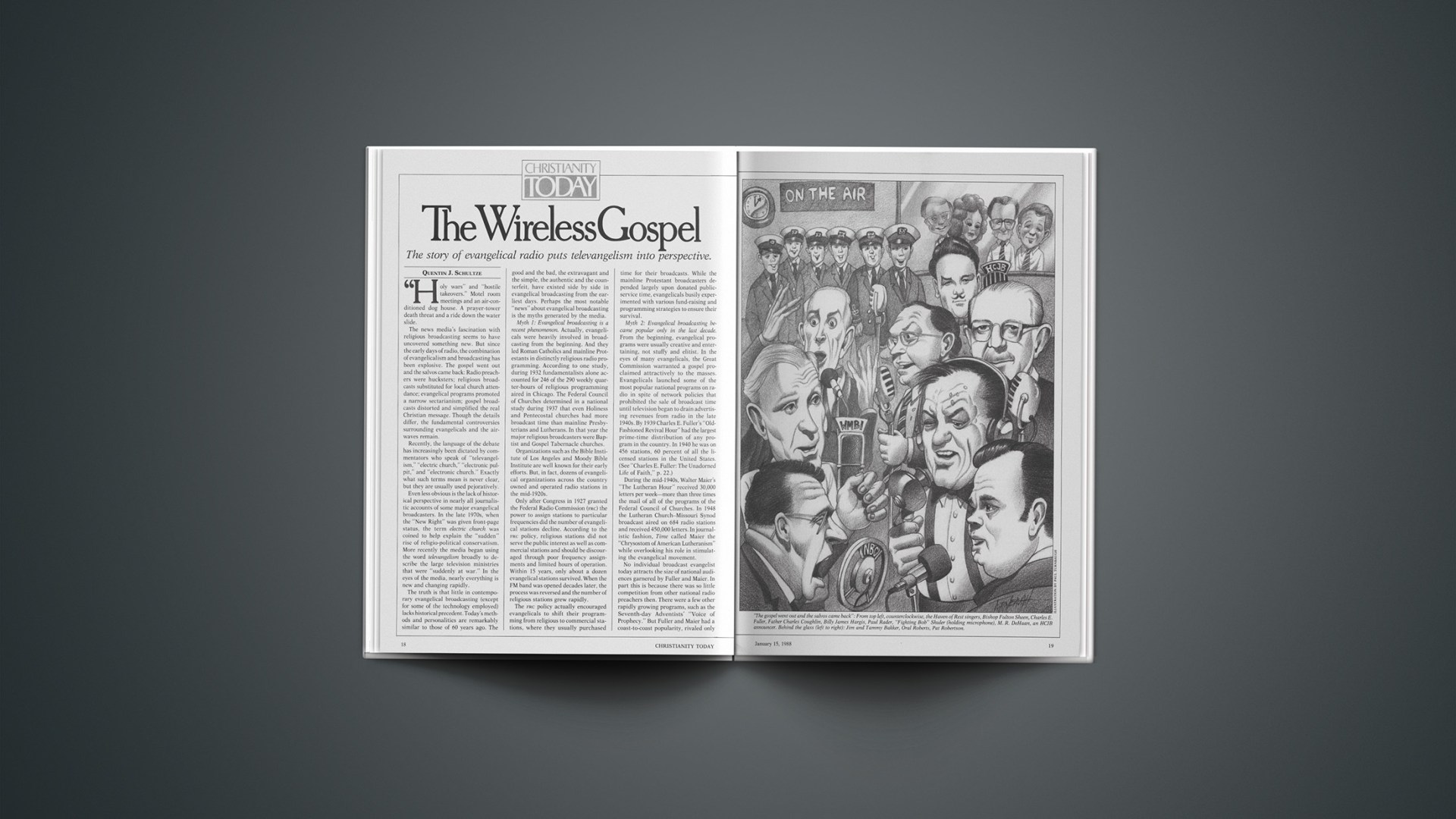
The Wireless Gospel

The story of evangelical radio puts televangelism into perspective.

“Holy wars” and “hostile takeovers.” Motel room meetings and an air-conditioned dog house. A prayer-tower death threat and a ride down the water slide.

The news media’s fascination with religious broadcasting seems to have uncovered something new. But since the early days of radio, the combination of evangelicalism and broadcasting has been explosive. The gospel went out and the salvos came back: Radio preachers were hucksters; religious broadcasts substituted for local church attendance; evangelical programs promoted a narrow sectarianism; gospel broadcasts distorted and simplified the real Christian message. Though the details differ, the fundamental controversies surrounding evangelicals and the airwaves remain.

Recently, the language of the debate has increasingly been dictated by commentators who speak of “televangelism,” “electric church,” “electronic pulpit,” and “electronic church.” Exactly what such terms mean is never clear, but they are usually used pejoratively.

Even less obvious is the lack of historical perspective in nearly all journalistic accounts of some major evangelical broadcasters. In the late 1970s, when the “New Right” was given front-page status, the term electric church was coined to help explain the “sudden” rise of religio-political conservatism. More recently the media began using the word televangelism broadly to describe the large television ministries that were “suddenly at war.” In the eyes of the media, nearly everything is new and changing rapidly.

The truth is that little in contemporary evangelical broadcasting (except for some of the technology employed) lacks historical precedent. Today’s methods and personalities are remarkably similar to those of 60 years ago. The good and the bad, the extravagant and the simple, the authentic and the counterfeit, have existed side by side in evangelical broadcasting from the earliest days. Perhaps the most notable “news” about evangelical broadcasting is the myths generated by the media.

Myth 1: Evangelical broadcasting is a recent phenomenon. Actually, evangelicals were heavily involved in broadcasting from the beginning. And they led Roman Catholics and mainline Protestants in distinctly religious radio programming. According to one study, during 1932 fundamentalists alone accounted for 246 of the 290 weekly quarter-hours of religious programming aired in Chicago. The Federal Council of Churches determined in a national study during 1937 that even Holiness and Pentecostal churches had more broadcast time than mainline Presbyterians and Lutherans. In that year the major religious broadcasters were Baptist and Gospel Tabernacle churches.

Organizations such as the Bible Institute of Los Angeles and Moody Bible Institute are well known for their early efforts. But, in fact, dozens of evangelical organizations across the country owned and operated radio stations in the mid-1920s.

Only after Congress in 1927 granted the Federal Radio Commission (FRC) the power to assign stations to particular frequencies did the number of evangelical stations decline. According to the FRC policy, religious stations did not serve the public interest as well as commercial stations and should be discouraged through poor frequency assignments and limited hours of operation. Within 15 years, only about a dozen evangelical stations survived. When the FM band was opened decades later, the process was reversed and the number of religious stations grew rapidly.

The FRC policy actually encouraged evangelicals to shift their programming from religious to commercial stations, where they usually purchased time for their broadcasts. While the mainline Protestant broadcasters depended largely upon donated public-service time, evangelicals busily experimented with various fund-raising and programming strategies to ensure their survival.

Myth 2: Evangelical broadcasting became popular only in the last decade. From the beginning, evangelical programs were usually creative and entertaining, not stuffy and elitist. In the eyes of many evangelicals, the Great Commission warranted a gospel proclaimed attractively to the masses. Evangelicals launched some of the most popular national programs on radio in spite of network policies that prohibited the sale of broadcast time until television began to drain advertising revenues from radio in the late 1940s. By 1939 Charles E. Fuller’s “Old-Fashioned Revival Hour” had the largest prime-time distribution of any program in the country. In 1940 he was on 456 stations, 60 percent of all the licensed stations in the United States. (See “Charles E. Fuller: The Unadorned Life of Faith,” p. 22.)

During the mid-1940s, Walter Maier’s “The Lutheran Hour” received 30,000 letters per week—more than three times the mail of all of the programs of the Federal Council of Churches. In 1948 the Lutheran Church-Missouri Synod broadcast aired on 684 radio stations and received 450,000 letters. In journalistic fashion, Time called Maier the “Chrysostom of American Lutheranism” while overlooking his role in stimulating the evangelical movement.

No individual broadcast evangelist today attracts the size of national audiences garnered by Fuller and Maier. In part this is because there was so little competition from other national radio preachers then. There were a few other rapidly growing programs, such as the Seventh-day Adventists’ “Voice of Prophecy.” But Fuller and Maier had a coast-to-coast popularity, rivaled only by the short-lived, prime-time homilies of Bishop Fulton Sheen on television in the 1950s and perhaps the controversial Father Coughlin in the 1930s.

Myth 3: The total audience for evangelical broadcasts has increased enormously in recent years. In fact, there is no evidence that a greater percentage of the population today watches or listens to evangelical broadcasts than at any time in the last 50 years. However, the number of religious radio and television stations has increased dramatically in the past decade. There are now over 1,000 radio and about 200 television stations with religious formats. Most of the programming on these stations is broadly evangelical.

Both secular media and some religious broadcasters have created the impression that evangelical programs are sweeping the land and attracting enormous audiences. While such rhetoric makes for interesting news stories and encourages potential donors to contribute, it has no basis in research. Most broadcasts and stations require a fairly small but loyal following of regular contributors to survive.

The only exception is the daily “700 Club.” About 19 percent of American homes tune in at least once during February, the major viewing period surveyed by ratings services. However, because of the talk-show format of the program, it is likely that a significant percentage of such monthly audience figures consists of people scanning the channels to see what is available. The daily audience is very small compared with prime-time network broadcasts. All other religious broadcasts have much smaller audiences—even the daily programs of PTL and Jimmy Swaggart.

Myth 4: The power of televangelism threatens to destroy the local church. In the 1920s, long before the development of television, the news media frequently said the same thing about radio. The press spoke of the “radio church” that might supplant the local congregation, and some ministers actually attempted to establish “ethereal congregations.” In 1926, the Reverend Howard Hough, an Advent Christian pastor from Portland, Maine, resigned his pastorate in order to form the First Radio Parish of Portland. Clergy and others representing nine denominations were present in the broadcast studio for the dedicatory service. For the most part, efforts like Hough’s were dismal failures.

History shows a dynamic relationship between evangelical broadcasting and local congregations. Instead of one driving out the other, they adjusted to each other; where possible, each took advantage of the other, so that neither was the same afterward.

On the one hand, various broadcast ministries have developed programming for particular markets of believers; out of this philosophy they create gift packages and direct-mail appeals designed to reach specified church groups. Programming is compatible with the sensibilities, tastes, and beliefs of the church market. For example, over the years the programs of Oral Roberts have reflected different target audiences associated with churches, from old-fashioned Pentecostal to a broader, Holiness-inspired evangelicalism.

On the other hand, local churches have sometimes adjusted to the changing content of religious broadcasting. Local worship styles and philosophies have undoubtedly been influenced by broadcast revivals and religious entertainment. Perhaps even some of the expectations of pastors and congregations today are born out of the role models and rituals emanating from the tube.

The membership gains of neo-Pentecostal churches, for example, are clearly related to the efforts of particular broadcast ministries from that tradition. Especially active on the airwaves have been ministers from the Assemblies of God, including Jimmy Swaggart. In recent years, about half of the ten highest-rated weekly religious broadcasts were based in this tradition. It might be that neo-Pentecostal and charismatic styles of worship simply make for interesting and entertaining television. If so, the medium indeed affects the gospel message by favoring the programming from particular theological and cultural traditions.

Instead of destroying the local church, evangelical broadcasting is changing its character, for good and bad. Church and television compete, but not on the simple basis of attendance and financial contributions. They compete over style and substance, liturgy and theology, action and expectation. The question is not whether the church will succumb to the power of broadcast religion, but what vision of Christian community we wish to cultivate in the local church.

Myth 5: Evangelical broadcasting is creating a powerful conservative political movement in America. The secular media love this myth because it lends itself so well to interesting news stories loaded with animated characters and sinister plots. Since the 1980 presidential election, reporters have hovered like carrion birds around the programming and news releases of broadcast evangelists who politicize the gospel message.

Religious broadcasting has always had its champions of conservative ideology. In the 1920s “Fighting Bob” Shuler of Los Angeles lost his station license in part because of sermons directed at public officials (see “The Other Bob Shuler: Protector of Public Morals,” page 21). During the next decade, Father Coughlin was silenced by Catholic prelates only after generating an enormous audience for his attacks on the Roosevelt administration. And Billy James Hargis, a pioneer in religious direct-mail fund raising, joined a host of other anticommunist preachers on the airwaves in the 1950s.

Throughout the history of religious broadcasting, evangelicals have supported a wide spectrum of programs, only a minority of which were heavily political. Evangelicals have strongly preferred devotional, instructive, and entertaining broadcasts to politicized ones. Even the more subtle political messages were usually within the context of Bible-study programs and worship services to which viewers turned for inspiration and edification rather than ideological guidance. Research documents that today few viewers or listeners tune to evangelical programs specifically for political ideas.

The fact that evangelicalism, broadly defined, includes a wide spectrum of political orientations is overlooked by the press in favor of simplistic stereotypes. Evangelicals are more conservative overall than the general population, but they hardly represent a political movement. They are largely unorganized politically, and much of their faith is private—not linked to social or political action. Pat Robertson is only the latest to attempt to mobilize evangelicals politically, and he has found, as others before him, that the religious mosaic of evangelicalism also represents great political diversity.

Certainly evangelical broadcasting has influenced American politics. But that influence may be less a result of organized evangelical political involvement than it is of media attention to particular evangelical programs and organizations. Jerry Falwell and others have convinced the media (particularly the Eastern media establishment) that they have political power largely in the form of mailing lists, contributors, and audiences. As a result, the news now includes the “Religious Right” as a character in the nation’s political dramas. Nevertheless, evangelicals are not part of any unified political movement, and many of them are not conservative.

Myth 6: Most evangelical broadcasters preach a “health and wealth” gospel that distorts historic Christianity. It is time that the church face the fact that broadcasting is indeed a vehicle for propagating counterfeit gospels, including the “health and wealth” variety. But this is nothing new, and it is hardly true of evangelical broadcasting alone; one need only consider most commercial messages.

This myth results from the limited scope of modern news reporting, which focuses excessively on personality and event. Journalists stay tuned to the major television evangelists because of their colorful personalities and outrageous statements. Just as the newspaper reports the one driver killed in an accident, not the thousands who safely made it home, the electronic media focus on the most ostentatious and outrageous broadcast preachers, not on the thousands of lesser-known honest local radio and television programs.

From its earliest days, evangelical radio had both national leaders and community pastors. While the lure of celebrity has always tempted broadcasters to abandon the historic faith in favor of a self-styled message, most evangelical preachers have not succumbed. Usually it has been the independent ministers, with no accountability to a church or denomination, who have perverted the gospel. One need only listen to many local evangelical broadcasters in order to hear and see unpretentious presentations of the gospel.

Myth 7: The latest communications technologies give media preachers unparalleled power. The news media rely on this myth to trump up alarm about the rising power of media evangelists to conform the world to their alleged theocratic designs. Meanwhile, some major evangelical broadcasters use the myth to win the hearts and pocketbooks of the faithful. In both cases, the latest technologies are seen as unstoppable forces for either good or bad.

The truth is that modern communications media are more efficient, but not necessarily more effective. Satellites, for example, enable broadcasters to transmit messages over greater distances in record times. Once the message is delivered, however, there is no assurance that it will be understood, let alone accepted and acted upon. The media and evangelical broadcasters alike often confuse transmission with communication. More than that, they frequently trade audience impact for audience size, as if the sheer numbers guarantee a broadcast’s effectiveness.

It is becoming increasingly clear that religious communication is one of the most difficult kinds of communication. Evangelicals should be the first to realize, because of their long missionary experience, that media evangelism is both cross cultural and cross religious. They should put as much effort into shaping the message as they do into appropriating the latest technology. At present this is not the case: Millions of dollars are spent transmitting benign messages, as if a modern-day miracle will mysteriously communicate the gospel directly to the hearts of all unbelievers who happen upon a program. Some are converted, and more are edified. But these results are typically in the face of a lack of attention to spiritual and cultural conditions among those being evangelized.

Studies show unquestionably that friendship is still the most effective method of evangelism. This does not mean that electronic media should never be used to proclaim the gospel, but that evangelicals should not let the apparent power of technology distract them from the important role of local churches in supporting friendship evangelism. Ironically, broadcast evangelism represents a potential threat to the communication of the gospel when it gives the impression to the laity that the Word should be shared only by a small cadre of high-tech professionals. The extent of church growth and the effectiveness of evangelism are far more related to the quality of face-to-face communication than to the amount of mass communication.

Explosive Combination

Looking back over the centuries, it is clear that a combination of evangelical fervor and media sophistication has always been explosive. Whether it was oral storytelling, script, the printing press, or the electromagnetic spectrum, visionary believers used the newest communications media to challenge the spiritual status quo and to reaffirm historic Christianity. Others were tempted by these media, establishing their own personality cults and proclaiming self-conceived religious truths.

Public controversy is a predictable consequence of evangelical broadcasting, just as it is an expected result of living the Christian life in a fallen world. Nevertheless, we must admit that evangelical use of the media has sometimes been lamentable. After all, the church has its own, stricter standards and expectations—or it should.

Evangelical broadcasting must never sell its soul: authenticity is its first mandate. The secular media will still report controversy, but if the Christian witness is genuine, in the long run it will be more effective than the mudslinging. This side of heaven, evangelicals and the airwaves are partners in controversy.

Quentin J. Schultze is professor of communications arts and sciences, Calvin College, and author of Television: Manna from Hollywood?

The Other Bob Shuler: Protector Of Public Morals

American Mercury once described Bob Shuler as “hotter news than murder—he has built up the greatest political and social power ever wielded by a man of God since the days of Savonarola in Florence.” Hyperbole aside, in the late 1920s and early 1930s, “Fighting Bob” operated the most controversial religious radio station of all time. Politicians feared him, criminals avoided him, policemen hated him, newspapers deplored him, and many ministers criticized him. But the public loved him, turning Shuler into a folk hero.

After a short career as a university pastor in Austin, the 40-year-old Methodist minister moved his ministry to Los Angeles in 1920. Within three months, the flamboyant Shuler made the front page of the paper for the first of many times. He exposed a party where a thousand people “celebrating the coming of our Lord” allegedly were “engaged in a drunken carousal, with hugging, kissing in drunken fashion, women displaying their nakedness brazenly.” Nearly 500 articles about Shuler appeared in the Los Angeles Times alone between 1927 and 1933; many of them included Shuler’s charges of municipal corruption and religious hypocrisy.

After “Fighting Bob” exposed drunkenness by the police chief, who was subsequently fired, membership in Shuler’s Trinity Methodist Church soared to 6,000. Soon Shuler’s church was given a radio station by a wealthy widow, and the “preacher who breaks police chiefs,” as he was known in the local media, expanded his muckraking pulpit to the airwaves. KGEF (Keep God Ever First) began broadcasting in late 1926 from a studio in Shuler’s study.

Listeners from Canada to Mexico tuned in to hear Shuler’s demands for “civic righteousness and for the extension of Christ’s kingdom on earth.” In 1929 his broadcasts were instrumental in electing a reform mayor who immediately fired the police chief—the second police scalp for “Fighting Bob.” One writer described Shuler as “a political preacher who has become dictator not only of the morals and manners but the politics of the community.”

Creative fund-raising techniques soon followed. “I know a man listening in,” Shuler told listeners. “If he does not give a hundred dollars I will go on the air next Tuesday night and tell what I know about him.” Many hundreds of dollars were raised.

The contentious preacher’s battle with the federal government began in 1930 when numerous citizens protested Shuler’s programs to the Federal Radio Commission (FRC). Especially troubling to some listeners were Shuler’s attacks on William Randolph Hearst, the public schools, the chamber of commerce, the Presbyterian and Roman Catholic churches, Jews, and even auto clubs. Apparently Shuler saw himself increasingly as the self-appointed protector of public morals and religious truth.

In 1931 the FRC scheduled one of the first hearings ever conducted on the renewal of a broadcast license. As in the past, “Fighting Bob” took the new battle to the airwaves, attacking the FRC and threatening to take his case to the Supreme Court of the United States. Meanwhile, dozens of people testified on Shuler’s behalf. The FRC’S report included more than 2,300 pages of transcripts from Shuler’s broadcasts and another 1,000 pages of exhibits. Shuler lost the radio license, in part because he erroneously alleged that a Roman Catholic on the FRC board was out to get him; there were no Catholics. The Los Angeles Express ran the headline: U.S. WILL GAG SHULER.

Not to miss an opportunity for publicity, Shuler held four funerals for KGEF. Ten thousand people came to Trinity Methodist Church on a Sunday afternoon, according to Shuler’s newsletter, to “honor a fallen soldier who for five years had fought the battle of public decency.” In the casket was a microphone “slain by the administration … and the government it sought to serve.” The event raised $3,495.

By Quentin J. Schultze.

Charles E. Fuller: The Unadorned Life Of Faith

No radio preacher better illustrates the long-standing popularity of evangelical broadcasting than Charles E. Fuller. He started inauspiciously with two Bible lessons weekly on KJS, the early station of the Bible Institute of Los Angeles. In 1934 Fuller expanded his potential audience by purchasing evening time for his weekly “Heart to Heart Talk” on 50,000-watt KNX, the “Voice of Hollywood.” Within a few years the program was so popular, and the financial support from listeners so encouraging, that Fuller bought time for the renamed “Radio Revival Hour” on the Mutual Network, and continued syndicating it to independent stations across the country.

By 1939 Fuller’s program had the largest prime-time distribution of any radio show in the country. In 1940 he was on 456 American stations (60% of all U.S. stations) with the “Old-Fashioned Revival Hour.” Fuller paid about $ 1.6 million for time on Mutual alone in 1944, and his weekly audience was estimated by popular media at 20 million.

Although such early audience estimates are likely quite inaccurate, Fuller’s program probably had a greater audience than any of the weekly television evangelists on the airwaves today. Jimmy Swaggart, who leads the weekly religious broadcast ratings, has a broadcast audience of about 2 million. Even if his satellite and cable television audiences include an additional million viewers, Swaggart’s popularity is a far cry from Fuller’s.

Why was Fuller’s broadcast so popular? Obviously he had much less competition from other national evangelists than do today’s television and radio preachers. Still, the “Old-Fashioned Revival Hour” had a special appeal cultivated by the unpretentious nature of the man. During the same decades that Hollywood learned how to glamorize personalities, Fuller preached the gospel simply and directly. His program represented the life of faith unadorned by the trappings of consumer economy and Hollywood culture. The show was indeed “old-fashioned,” with a simple biblical exposition, a few familiar songs, and the reading of letters from viewers. By today’s standards the program would appear to lack the histrionics necessary for success.

By Quentin J. Schultze

Ideas

Home to Lynchburg

Assessing Jerry Falwell after Moral Majority and the PTL.

Jerry Falwell’s announcement that he is leaving the Moral Majority came as no particular surprise. Yet coupled with his recent severing of ties with Jim Bakker’s scandal-ridden PTL ministry, Falwell’s announcement takes on greater significance. Although he will not be totally removed from the political scene (what pastor or college chancellor can?), his withdrawal from the Moral Majority and PTL provides an opportunity to assess his accomplishments with each.

The Moral Majority

If simply getting the dust to fly were the criterion by which a movement like the Moral Majority can be graded, Falwell would get straight As. He has accomplished everything leaders of great movements have done: he mobilized the masses, used the media masterfully, and made enemies galore.

But just getting the dust to fly by having the guts to state an opinion honestly and uncompromisingly should not be the standard by which Christians judge movements. We demand that goals be worthwhile, means honorable, and motivations selfless. Yet, even measured against those goals, Falwell gets better than passing grades.

To be sure, the Moral Majority has not been a perfect model of Christian political involvement. Even though it disavowed being a strictly fundamentalist Protestant movement (it also includes Catholics, Jews, and anyone else concerned about the issues it supports), the vast majority of its supporters have been fundamentalist Protestants. Questions have also been raised about fund raising and partisan politics, some of which even now demand fuller answers:

  • Are the Moral Majority’s accountability structures adequate to supervise the financing of such an enterprise? Indications point to Falwell making all major decisions. Should one person have that kind of control, given the massive amounts of money involved?
  • Why has the Moral Majority allowed itself to become virtually identified with the Republican party? Falwell has seemed, at times, nothing more than a political bellwether for the current administration, too eagerly flying trial balloons on South Africa, Israel, and defense spending. Not all Christians, even grassroots, conservative Christians, agree on how to solve those problems. The Moral Majority’s potential for conscientious comment on these value-laden issues has been made somewhat sluggish by the necessities of partisan politics. Thus, it has occasionally been forced to trade ethical force for power and influence. Perhaps that is an inevitable result of getting involved in the political process. But it has a number of Christians less eager to endorse wholeheartedly the Moral Majority’s efforts, even though many of its causes are right on target.
  • Should an organization of this scale even exist? Since most of the money needed to do the work of the Moral Majority comes from small donations, are local-church contributions diminished in any way? The Moral Majority’s protestations notwithstanding, most people regard it as simply an extension of Falwell’s overall ministry, a church in political clothing. Does that put it in competition with smaller, more personalized ministries?

On balance, though, the Moral Majority has done what it intended to do: give grassroots conservatives a voice. And it mobilized two million of these voters, giving them a chance to fight the encroaching relativism of our culture.

Perhaps Falwell’s greatest accomplishment, however, was getting Protestants, Catholics, and Jews to work together on common causes. The Moral Majority is a coalition of groups that heretofore had let theological differences stand in the way of coordinated activity on shared concerns like abortion and pornography. It stands as a model of ecumenicity of the best sort—an agreement to work together on issues without trying simply to gloss over theological differences.

That such a foray into the dangerous waters of ecumenical action should come from a fundamentalist pastor is remarkable. It took laudable courage for Falwell to disavow the strict separatism of his roots. Having the courage to speak prophetically is usually associated with someone espousing extremely divisive opinions rather than someone looking for the common ground that our Judeo-Christian heritage provides, and then working together with all who will support such action. Rarely is enough credit given to such consensus builders.

PTL

No case illustrates this better than Falwell’s audacious attempt to short-circuit Jim and Tammy Bakker’s commitment to self-destruction at Heritage Village. By placing himself squarely between the fundamentalist and Pentecostal camps, Falwell opened himself to public vilification by the Pentecostals, and to the risk of further alienating the strict separatists in his own camp who had never quite adjusted to the Moral Majority’s philosophy. It was a courageous position, yet one consistent with the scripturally mandated goal of unity in the body of Christ.

The space between one Christian’s truth and another Christian’s truth is a no man’s land, dangerous even if one continually shouts the agreed-upon truths of Scripture. We need some people willing to live life between the shifting tectonic plates of modern denominationalism—people willing to forge brave new alliances while resisting both uncharitable fanaticism and unfaithful liberalism. Falwell was willing to do that, and he paid a price for his effort.

The extent of the price is still to be determined. The “Old-Time Gospel Hour,” Falwell’s television ministry, recently announced that 50 stations were being dropped. Whether due to the more general public suspicion about television evangelism (all the major televangelists report cutbacks and reduced viewer support) or a realigning of Falwell’s audience in particular, it is too soon to tell.

What Jerry Learned

The lesson of Falwell’s PTL and Moral Majority involvement is a good one. We simply cannot make progress in discipleship and evangelism by being timid and withdrawn, by hardening positions that need less to be frozen than to be melted and recast. The world is a constantly shifting place. It demands the very best from the whole church, not just little pockets of isolated firefighters. Through the Moral Majority and his PTL adventure, Jerry Falwell has added a piece to the puzzle of how we can evangelize the bewilderingly diverse world we live in.

Perhaps Falwell himself evaluates his PTL experience best. Regarding the task, he felt progress was made: “We brought some semblance of order out of chaos.” But he also recognizes the personal effect on him: “By training, Baptists distrust Pentecostals. As time went on, we came to love and respect one another. I’ll never again be as tough on Pentecostal issues as I have been in the past.”

Add one more good thing. Jerry Falwell is not leaving PTL and cutting back on his Moral Majority involvement to start a new, bigger, better organization. He returns to the local church pastorate. That in itself gives us a clue to Falwell’s priorities. It also is a shot in the arm to all of us who think the local church will play a crucial role in fighting the secularism of the twenty-first century.

By Terry Muck.

The Penniless Gourmets

“Dollars? Dollars?” A money changer thrusts a wad of bills toward the foreigner with the camera around his neck. Other vendors shove forward, offering lottery tickets, nail clippers, gaudy puppets on a string, and wind-up plastic scuba divers that kick inanely across a dish of water. Every hawker in Lima, Peru, must hang out on this eight-block pedestrian mall, the Jiron de la Union.

Some parts of the Jiron resemble a zoo more than a street. Kittens and puppies, some only weeks old, mew and whine on the corner devoted to the pet trade. Nearby, a comically dressed monkey, plied by quarters, is busily pulling fortune cards. And farther on, the crowd parts a little, giving wide berth to a man holding a stick high in the air; from the bottom end of the stick dangles a mangy-looking mongoose. The mongoose is eyeing a cleverly segmented wooden snake that another vendor is causing to slither along the pavement.

On the Jiron de la Union, anything goes. Many Lima residents won’t risk the street: they warn solemnly of thieves who pick pockets and snatch gold chains and watches. Everyone has a horror story, and you think of that as the bodies press against you. Hide your camera. Keep hands in pockets, grasping money. Look over your shoulder every few seconds.

Abruptly you turn off the street of chaos onto a quiet side street, free of beggars and merchants. The change is startling: no rock music blasting from open shops, no odor of food from sidewalk grills. You see a door, with a simple brass plaque announcing “Agua Viva,” or “Living Water.”

The door opens onto a beautiful colonial courtyard, vintage 1820, in a high-ceilinged room trimmed with mahogany. Everywhere, green plants reach toward skylights. The only sound is the calm murmur of water in a fountain. Standing still, you can sense your blood pressure, pulse, and adrenaline subsiding to normal levels. A beautiful woman, smiling, rustles across the room in a batik sarong to greet you. Her Spanish is lined with a melodious French accent.

Soon you are seated, studying a menu, checking the more difficult words against a traveler’s dictionary. Hearts of palm salad or avocado? The fresh trout in herb sauce or grilled sea bass? Or perhaps Tournedos à la Mexicain with tomato and mushroom? Or lamb, or filet of beef? “Remember to leave room for dessert,” your host says. “They have exquisite chocolate mousse and ice cream meringues.”

Waitresses glide in and out of the room, each in native costume. They come from five continents to work at Agua Viva, you are told. Finally, after you place your order, the manager of the restaurant arrives to answer your questions. She is a petite Frenchwoman named Sister Marie, with neat red hair and alert blue eyes. The waitresses are Christians, she explains—not nuns, exactly, but an order of committed lay workers serving under the umbrella of the Catholic church.

The movement traces back to a priest named Marcel Roussel who, in 1949, began work amid the poverty and despair of postwar France. Roussel was overwhelmed by how many people the church never touched: none of the prostitutes he passed each day on the streets of Paris, for example, dared enter a church, and yet if he stopped to converse they often expressed deep needs. Father Roussel concluded that the church could not merely wait, but rather must actively pursue people of need, especially in the workplace. Had not Jesus served as a carpenter, and Paul as a tentmaker? “Everywhere,” concluded Roussel, “in prisons, hotels, and work sites, we can help re-establish a dialogue with God.”

Roussel recruited a group of young women known as Missionary Workers for just that purpose. At first they took jobs in factories and came together only for prayer and study. But within a few years Roussel envisioned a restaurant where the Missionary Workers could live as a family, worshiping together and pooling their energies in a common endeavor that “would shine as a light to the world.” The first such restaurant, Eau Vive, opened in Belgium in 1960. Its success soon led to others in Saigon, Buenos Aires, Burkina Faso (formerly Upper Volta, in Africa), New Caledonia, Rome, Manila, and then the Agua Viva in Lima, Peru.

It took two years for the Missionary Workers in Peru to clean the former colonial palace—once used as a printing plant and then abandoned for 25 years—and restore it to its former grandeur. Today, Agua Viva attracts the wealthy and powerful of Lima (including a group of senators who meet monthly for Bible study). Only a few clues announce to the visitor the restaurant’s spiritual intent. The inside cover of the menu proclaims “Jesus lives! For this we are happy.” And each evening at 10:30 the waitresses appear together to sing a vesper hymn for their patrons.

Besides these clues, says Sister Marie, the work itself should stand as a witness. “Don’t ask us how our prayer life is going; look at our food. Is your plate clean and artfully arranged? Does your server treat you with kindness and love? Do you experience serenity here? If so, then we are serving God.” A visitor mentions Brother Lawrence, and Sister Marie beams. Yes, that’s the idea, she says. The workers cook, wait on tables, scrub floors, worship, all to the glory of God.

But the Missionary Workers have introduced a modern twist to the Brother Lawrence style: they proffer gourmet meals in order to serve the poor of Lima. Later that day, 50 other people, not the rich and powerful this time, but mothers from the slums of Lima, will fill the same elegant room. The Missionary Workers lead training classes on basic hygiene, child rearing, and physical and spiritual health. And once off duty in the restuarant, all staff members devote themselves to the poor, carrying out social programs that are financed by profits from the restaurant.

In some countries, the Missionary Workers focus their energy on jails and hospitals. In Peru, they concentrate on struggling families in the slums. Each “waitress” works regularly with 200 poor people in the barrios. Some of Agua Viva’s patrons know of the outreach programs, some do not. The Missionary Workers rarely talk about their work unless asked. But sample comments in a guest book show that their peculiar two-edged mission is having an impact:

“I thank the Missionary Workers for being a living reminder of simplicity and joy in the heart of Christianity. Thank you for having helped me cross to the side of Salvation.”

“Continue to make us thirst for this Living Water whose transparent brilliance shines out through your faces.”

“You are a most eloquent living evidence for nonbelievers. You are a gift of God; the Holy Spirit breathes here. Through good cooking, God is transmitted too. Thank you for your ray of sunshine in a cloudy sky.”

An American visitor, fully informed of the Missionary Workers’ rare ability to minister both to rich and poor, came up with a more mundane conclusion after a lavish five-course luncheon. Stepping out of the serenity of Agua Viva, back into the cacophony of downtown Lima, he patted his stomach and said, “At last, a guilt-free gourmet meal!”

By Philip Yancey.

Apple PodcastsDown ArrowDown ArrowDown Arrowarrow_left_altLeft ArrowLeft ArrowRight ArrowRight ArrowRight Arrowarrow_up_altUp ArrowUp ArrowAvailable at Amazoncaret-downCloseCloseEmailEmailExpandExpandExternalExternalFacebookfacebook-squareGiftGiftGooglegoogleGoogle KeephamburgerInstagraminstagram-squareLinkLinklinkedin-squareListenListenListenChristianity TodayCT Creative Studio Logologo_orgMegaphoneMenuMenupausePinterestPlayPlayPocketPodcastRSSRSSSaveSaveSaveSearchSearchsearchSpotifyStitcherTelegramTable of ContentsTable of Contentstwitter-squareWhatsAppXYouTubeYouTube