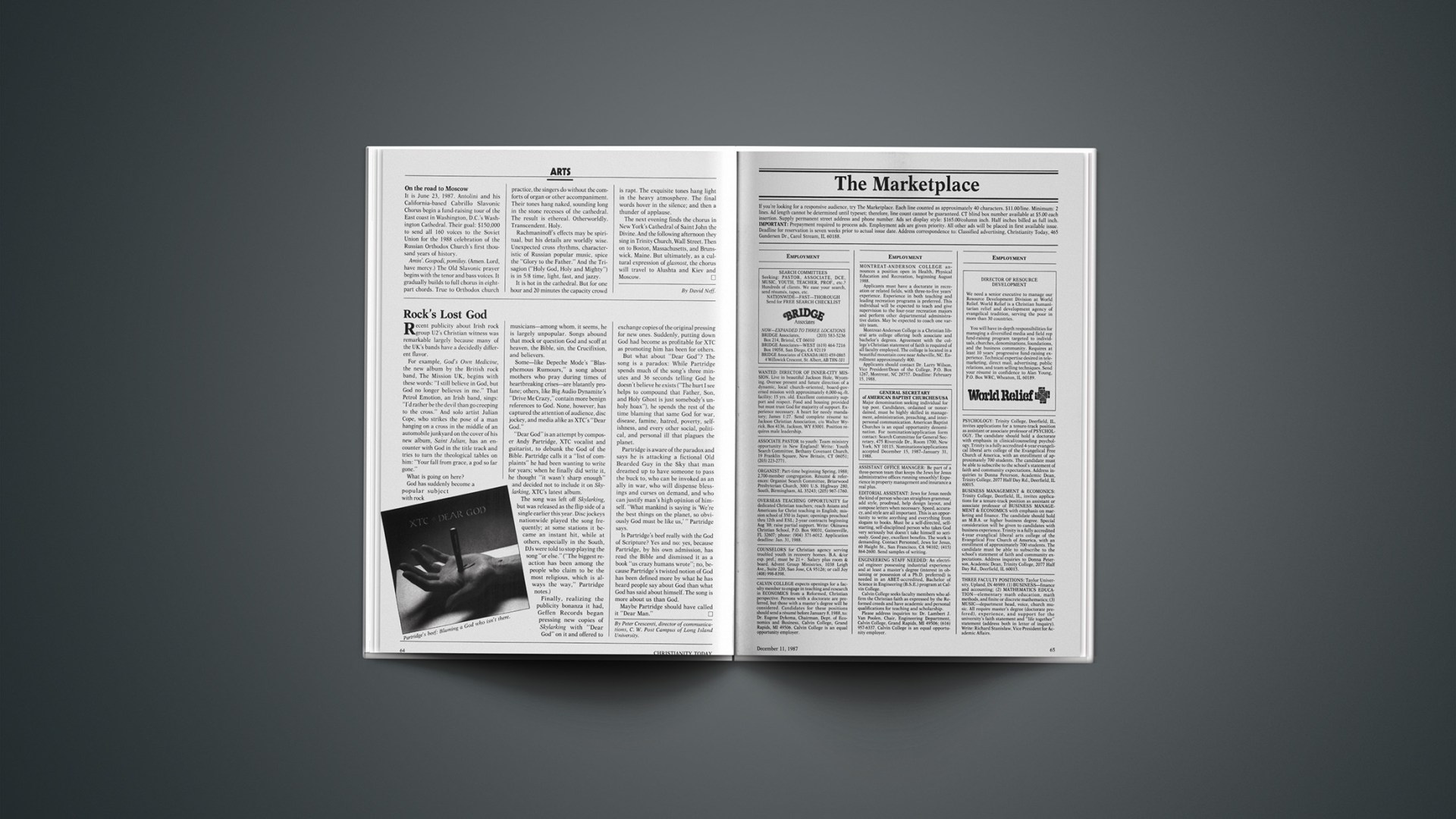
Rock’s Lost God

Recent publicity about Irish rock group U2’s Christian witness was remarkable largely because many of the UK’s bands have a decidedly different flavor.

For example, God’s Own Medicine, the new album by the British rock band, The Mission UK, begins with these words: “I still believe in God, but God no longer believes in me.” That Petrol Emotion, an Irish band, sings: “I’d rather be the devil than go creeping to the cross.” And solo artist Julian Cope, who strikes the pose of a man hanging on a cross in the middle of an automobile junkyard on the cover of his new album, Saint Julian, has an encounter with God in the title track and tries to turn the theological tables on him: “Your fall from grace, a god so far gone.”

What is going on here?

God has suddenly become a popular subject with rock musicians—among whom, it seems, he is largely unpopular. Songs abound that mock or question God and scoff at heaven, the Bible, sin, the Crucifixion, and believers.

Some—like Depeche Mode’s “Blasphemous Rumours,” a song about mothers who pray during times of heartbreaking crises—are blatantly profane; others, like Big Audio Dynamite’s “Drive Me Crazy,” contain more benign references to God. None, however, has captured the attention of audience, disc jockey, and media alike as XTC’s “Dear God.”

“Dear God” is an attempt by composer Andy Partridge, XTC vocalist and guitarist, to debunk the God of the Bible. Partridge calls it a “list of complaints” he had been wanting to write for years; when he finally did write it, he thought “it wasn’t sharp enough” and decided not to include it on Skylarking, XTC’s latest album.

The song was left off Skylarking, but was released as the flip side of a single earlier this year. Disc jockeys nationwide played the song frequently; at some stations it became an instant hit, while at others, especially in the South, DJs were told to stop playing the song “or else.” (“The biggest reaction has been among the people who claim to be the most religious, which is always the way,” Partridge notes.)

Finally, realizing the publicity bonanza it had, Geffen Records began pressing new copies of Skylarking with “Dear God” on it and offered to exchange copies of the original pressing for new ones. Suddenly, putting down God had become as profitable for XTC as promoting him has been for others.

But what about “Dear God”? The song is a paradox: While Partridge spends much of the song’s three minutes and 36 seconds telling God he doesn’t believe he exists (“The hurt I see helps to compound that Father, Son, and Holy Ghost is just somebody’s unholy hoax”), he spends the rest of the time blaming that same God for war, disease, famine, hatred, poverty, selfishness, and every other social, political, and personal ill that plagues the planet.

Partridge is aware of the paradox and says he is attacking a fictional Old Bearded Guy in the Sky that man dreamed up to have someone to pass the buck to, who can be invoked as an ally in war, who will dispense blessings and curses on demand, and who can justify man’s high opinion of himself. “What mankind is saying is ‘We’re the best things on the planet, so obviously God must be like us,’ ” Partridge says.

Is Partridge’s beef really with the God of Scripture? Yes and no: yes, because Partridge, by his own admission, has read the Bible and dismissed it as a book “us crazy humans wrote”; no, because Partridge’s twisted notion of God has been defined more by what he has heard people say about God than what God has said about himself. The song is more about us than God.

Maybe Partridge should have called it “Dear Man.”

By Peter Crescenti, director of communications, C. W. Post Campus of Long Island University.

The Celebrity Illusion

What can I do about it? I’m just an ordinary person.”

That is the despairing refrain I often hear in response to problems ranging from world hunger to crime. Most people simply feel impotent when it comes to big issues.

Considering what we hear from politicians and the media, this widespread attitude is not surprising. We have been conditioned to believe that all problems must have a government solution—or that one must be famous before one can make any significant impact on society.

This political/celebrity illusion has become the dominant myth of our times. And few have embraced it with more enthusiasm than the Christian community. We seem to think we need a big parachurch organization or a well-known celebrity in order to accomplish anything for the kingdom of God. As a result, the church has elevated popular pastors, ministry leaders, and televangelists to the dubious pedestal of fame—only to watch many topple in the winds of power, influence, and adulation. All the while, “ordinary” Christians feel more and more frustrated.

One reason I enjoy going to the Third World regularly is that this paralyzing myth does not hold sway there. In the face of human needs and social problems, Christians cannot count on government, since it is far more likely to persecute than listen to the church; there are few parachuch organizations at work; and there are no Christian celebrities. So these “poor, deprived” Christians have no alternative but to go ahead and do what needs doing. And that turns out to be just what the Bible commands.

A friend of mine from Madagascar provides an example. Pascal, a university professor, was thrown into prison after a Marxist coup. There he became a Christian.

After his release he started a small import/export company. But he was drawn back to his prison to preach the gospel. During one such visit in early 1986, he stopped in shock as he passed the infirmary: there were more than 50 corpses piled on the veranda, naked except for I.D. tags between their toes.

Pascal went to the nurse, asking if there had been an epidemic. Of sorts, he was told. Prisoners were dying by the dozens—of malnutrition.

Pascal left the prison in tears. His church was too poor to help feed the starving inmates, and there were no big relief agencies around. So he began to do what he could, cooking meals in his own small kitchen. Today Pascal and his wife continue to cook—and without the benefit of a government agency or Christian organization, they are making the difference between life and death for 700 prisoners.

Of all people, Christians should know better than to buy into the illusion that change comes only through Congress or celebrity campaigns. God has always used the humble both to confound the wisdom of this world and to accomplish his purposes. Much of the Bible was, after all, written by the powerless—prisoners, exiles, and part-time shepherds who were prophets.

God continues today to turn the world’s expectations upside-down, using ordinary Christians to make the difference. One experience in particular brought that point home to me.

Following the National Prayer Breakfast, I took a group of supporters to Maryland’s Jessup institution where a Prison Fellowship in-prison seminar was in progress. We were welcomed by the bright lights of TV cameras. Reporters scribbled notes while officials greeted us warmly; the governor had even issued a proclamation for the occasion.

By the time we got to the prison chapel, it was on the verge of exploding with the excitement of more than 125 inmates and dozens of PF volunteers. Wintley Phipps, a well-known gospel singer who had sung only the day before for President Reagan, was with us. When Wintley let loose in that cinder-block chapel, the walls shook.

Then my colleague Herman Heade, who was converted in a solitary-confinement cell during a seven-year prison term, gave his testimony. He was dramatic and convicting.

The excitement continued as I then challenged the men to accept Christ. When the time came to leave, we could barely make our way through the crowd. Inmates pressed around, hugging us and weeping. It would be hard to find a more powerful church service anywhere.

The next day our seminar instructor was relieved to find all the inmates had returned for the seminar’s final session. He had thought the last day might be anticlimactic.

At the closing meeting, a tall inmate stood to speak. “I really appreciated Chuck Colson’s message,” he told the group, “and Wintley Phipps’s singing stirred me beyond words. Herman’s testimony reached me right where I was at.

“Frankly, though, those things really didn’t impress me so much as what happened after all the celebrities and TV cameras left: the ladies among the volunteers went into the dining hall, with all the noise and confusion, and sat at the table to have a meal with us. That’s what really got to me,” he concluded, his voice choked.

What was the witness of Christ at the Maryland prison? Certainly Wintley’s singing and Herman’s testimony and my sermon were appreciated. But the most powerful message came from the volunteers—ordinary people whose names never appear in the headlines—who went into the dingy dining hall to share a prison meal with the inmates.

In spite of the myth of our times, it does not take celebrities or institutions to make a difference. The improbable way God builds his kingdom is through those who follow his example of sacrifice—as Pascal and those unknown volunteers at Jessup prison prove so beautifully.

This is an appropriate time of year to be thinking about these things, for they explain a great deal about Christ’s life and ministry. After all, his royal birth was marked not by pomp and power, but by the wonder of peasants who glimpsed his hidden glory. He came to serve, not to be served, to reach out to the lowly, the suffering, the weak, and the oppressed. He surrounded himself with ordinary people, whose lives he utterly transformed. And in turn, the world has been changed by their witness of his power.

Rachmaninoff’s Lost Chords

In 1983, choral conductor Anthony Antolini was laid up with a bad knee. While his wife and child hiked the countryside near his Maine summer home, he sat nursing his aches and reading a biography of Sergei Rachmaninoff.

In the back of the book, Antolini perused a catalog of the Russian composer’s works where he found a choral piece listed he had never heard of: The Liturgy of Saint John Chrysostom. Antolini, a Russian scholar, knew the Chrysostom liturgy was commonly used in the Russian Orthodox Church. But this particular musical setting was unfamiliar. Could he get a copy?

Music stores in New York City assured him he had the wrong composer. The staff at the Library of Congress had never heard of it either. It seemed like a dead end.

Then some California friends suggested a course that led to the music librarian at Saint Vladimir’s Seminary in Crestwood, New York. There Antolini found photocopies of part books for the Liturgy. Rachmaninoff’s notes were there—but not in usable form. Each book contained the notes for only one of the eight voice parts for which Rachmaninoff had written. There was no complete score and no context to help American singers unfamiliar with the Russian practice of giving each singer only his or her own notes.

Yet every note was there. If he could borrow the part books to photocopy them, he could reconstruct the score.

The answer was no. Saint Vladimir’s music librarian was less than enthusiastic about sharing this treasure. But perhaps, he suggested to Antolini, the librarian at Saint Tikhon’s Monastery in South Canaan, Pennsylvania, would be willing to let him use the original part books from which the Saint Vladimir photocopies had been made.

Antolini rang up Fr. Theodore Heckman at Saint Tikhon’s. Would he allow one of Antolini’s students to photocopy the part books?

Antolini’s heart sank when Heckman told him Saint Tikhon’s was 65 miles from the nearest photocopier. But he arranged for the student to drive to Scranton to copy Rachmaninoff’s lost chords. Heckman proved to be generous indeed—surprising Antolini’s student by driving the 65 miles and copying the books at his own expense.

Meanwhile, back at the Library of Congress, staff had not forgotten the case of the missing Rachmaninoff. Rummaging through uncatalogued music, a librarian discovered an early microfilm of the complete score. Alas, the film was blurry, with both notes and words at many points illegible. Still, the librarian called Antolini about the discovery.

Blurred pages? Send a copy anyway, said Antolini. And the Library of Congress did. For the entire summer of 1985, Antolini labored, copying the score, filling in the blurred sections from the part books, and transliterating the Slavonic words from their Cyrillic characters.

Twenty-Five Kopecks After Church

Sergei Rachmaninoff was the son of an alcoholic wastrel who spent the family’s substance on horse races and other frivolities. When he was 11, Sergei’s grandmother took him in to shield him from evil influences—and took him to church to straighten him out.

Rachmaninoff later recalled: “Being only a young greenhorn, I took less interest in God and religious worship than in the singing, which was of unrivaled beauty.… I usually took pains to find room underneath the gallery and never missed a single note. Thanks to my good memory, I also remembered most of what I heard. This turned into capital—literally—by sitting down at the piano when I came home, and playing all I had heard. For this performance my grandmother never failed to reward me with 25 kopecks.” When Rachmaninoff was 37, he wrote a setting of the most common liturgy used in the Russian Orthodox Church—the Liturgy of Saint John Chrysostom. But his work was doomed to rejection. Too much modernism, said the hierarchy. By modernism, they meant the music was too daring for a church that prided itself on not changing any part of the worship without compelling reason. The gospel never changes, they reasoned, so why should the music? Their music had been handed down, often by oral tradition, for centuries. What made this fellow think he could compose a setting out of thin air?

That was the second part of Rachmaninoff’s problem. He gave the church a piece of musical impressionism that felt like the original at places, but that did not incorporate any of the traditional melodies Orthodox churchgoers loved. Liturgical music de novo was something unthinkable in the Orthodox world.

Rachmaninoff learned from rejection: His 1915 Vespers quotes significantly from traditional church melodies. And in Moscow, Rachmaninoff’s Liturgy is now accepted. Although designed for concert more than worship, it is sung each year on Saint Sergius’s day (the young greenhorn’s name day) in the Church of the Consolation of All Who Sorrow in Ordynke Road.

On The Road To Moscow

It is June 23, 1987. Antolini and his California-based Cabrillo Slavonic Chorus begin a fund-raising tour of the East coast in Washington, D.C.’s Washington Cathedral. Their goal: $150,000 to send all 160 voices to the Soviet Union for the 1988 celebration of the Russian Orthodox Church’s first thousand years of history.

Amin’. Gospodi, pomiluy. (Amen. Lord, have mercy.) The Old Slavonic prayer begins with the tenor and bass voices. It gradually builds to full chorus in eight-part chords. True to Orthodox church practice, the singers do without the comforts of organ or other accompaniment. Their tones hang naked, sounding long in the stone recesses of the cathedral. The result is ethereal. Otherworldly. Transcendent. Holy.

Rachmaninoff’s effects may be spiritual, but his details are worldly wise. Unexpected cross rhythms, characteristic of Russian popular music, spice the “Glory to the Father.” And the Trisagion (“Holy God, Holy and Mighty”) is in 5/8 time, light, fast, and jazzy.

It is hot in the cathedral. But for one hour and 20 minutes the capacity crowd is rapt. The exquisite tones hang light in the heavy atmosphere. The final words hover in the silence; and then a thunder of applause.

The next evening finds the chorus in New York’s Cathedral of Saint John the Divine. And the following afternoon they sing in Trinity Church, Wall Street. Then on to Boston, Massachusetts, and Brunswick, Maine. But ultimately, as a cultural expression of glasnost, the chorus will travel to Alushta and Kiev and Moscow.

By David Neff.

Book Briefs: December 11, 1987

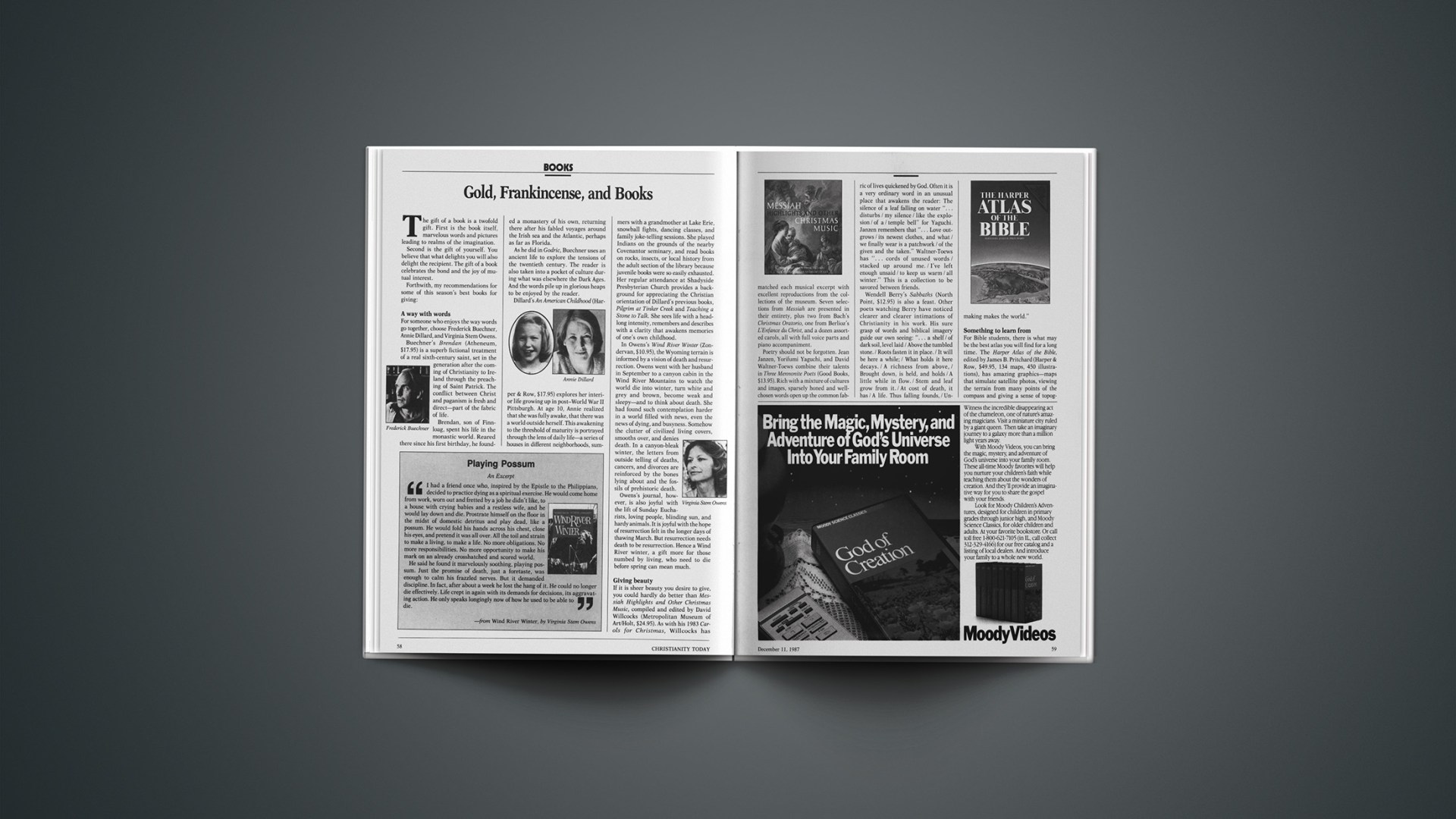
Gold, Frankincense, And Books

The gift of a book is a twofold gift. First is the book itself, marvelous words and pictures leading to realms of the imagination.

Second is the gift of yourself. You believe that what delights you will also delight the recipient. The gift of a book celebrates the bond and the joy of mutual interest.

Forthwith, my recommendations for some of this season’s best books for giving:

A Way With Words

For someone who enjoys the way words go together, choose Frederick Buechner, Annie Dillard, and Virginia Stem Owens.

Buechner’s Brendan (Atheneum, $17.95) is a superb fictional treatment of a real sixth-century saint, set in the generation after the coming of Christianity to Ireland through the preaching of Saint Patrick. The conflict between Christ and paganism is fresh and direct—part of the fabric of life.

Brendan, son of Finnloag, spent his life in the monastic world. Reared there since his first birthday, he founded a monastery of his own, returning there after his fabled voyages around the Irish sea and the Atlantic, perhaps as far as Florida.

Playing Possum

An Excerpt

“I had a friend once who, inspired by the Epistle to the Philippians, I decided to practice dying as a spiritual exercise. He would come home from work, worn out and fretted by a job he didn’t like, to a house with crying babies and a restless wife, and he would lay down and die. Prostrate himself on the floor in the midst of domestic detritus and play dead, like a possum. He would fold his hands across his chest, close his eyes, and pretend it was all over. All the toil and strain to make a living, to make a life. No more obligations. No more responsibilities. No more opportunity to make his mark on an already crosshatched and scored world.

He said he found it marvelously soothing, playing possum. Just the promise of death, just a foretaste, was enough to calm his frazzled nerves. But it demanded discipline. In fact, after about a week he lost the hang of it. He could no longer die effectively. Life crept in again with its demands for decisions, its aggravating action. He only speaks longingly now of how he used to be able to die.”

from Wind River Winter, by Virginia Stem Owens

As he did in Godric, Buechner uses an ancient life to explore the tensions of the twentieth century. The reader is also taken into a pocket of culture during what was elsewhere the Dark Ages. And the words pile up in glorious heaps to be enjoyed by the reader.

Dillard’s An American Childhood (Harper & Row, $17.95) explores her interior life growing up in post-World War II Pittsburgh. At age 10, Annie realized that she was fully awake, that there was a world outside herself. This awakening to the threshold of maturity is portrayed through the lens of daily life—a series of houses in different neighborhoods, summers with a grandmother at Lake Erie, snowball fights, dancing classes, and family joke-telling sessions. She played Indians on the grounds of the nearby Covenantor seminary, and read books on rocks, insects, or local history from the adult section of the library because juvenile books were so easily exhausted. Her regular attendance at Shadyside Presbyterian Church provides a background for appreciating the Christian orientation of Dillard’s previous books, Pilgrim at Tinker Creek and Teaching a Stone to Talk. She sees life with a headlong intensity, remembers and describes with a clarity that awakens memories of one’s own childhood.

In Owens’s Wind River Winter (Zondervan, $10.95), the Wyoming terrain is informed by a vision of death and resurrection. Owens went with her husband in September to a canyon cabin in the Wind River Mountains to watch the world die into winter, turn white and grey and brown, become weak and sleepy—and to think about death. She had found such contemplation harder in a world filled with news, even the news of dying, and busyness. Somehow the clutter of civilized living covers, smooths over, and denies death. In a canyon-bleak winter, the letters from outside telling of deaths, cancers, and divorces are reinforced by the bones lying about and the fossils of prehistoric death.

Owens’s journal, however, is also joyful with the lift of Sunday Eucharists, loving people, blinding sun, and hardy animals. It is joyful with the hope of resurrection felt in the longer days of thawing March. But resurrection needs death to be resurrection. Hence a Wind River winter, a gift more for those numbed by living, who need to die before spring can mean much.

Giving Beauty

If it is sheer beauty you desire to give, you could hardly do better than Messiah Highlights and Other Christmas Music, compiled and edited by David Willcocks (Metropolitan Museum of Art/Holt, $24.95). As with his 1983 Carols for Christmas, Willcocks has matched each musical excerpt with excellent reproductions from the collections of the museum. Seven selections from Messiah are presented in their entirety, plus two from Bach’s Christmas Oratorio, one from Berlioz’s L’Enfance du Christ, and a dozen assorted carols, all with full voice parts and piano accompaniment.

Poetry should not be forgotten. Jean Janzen, Yorifumi Yaguchi, and David Waltner-Toews combine their talents in Three Mennonite Poets (Good Books, $13.95). Rich with a mixture of cultures and images, sparsely honed and well-chosen words open up the common fabric of lives quickened by God. Often it is a very ordinary word in an unusual place that awakens the reader: The silence of a leaf falling on water “… disturbs / my silence / like the explosion / of a / temple bell” for Yaguchi. Janzen remembers that “… Love outgrows / its newest clothes, and what / we finally wear is a patchwork / of the given and the taken.” Waltner-Toews has “… cords of unused words / stacked up around me. / I’ve left enough unsaid / to keep us warm / all winter.” This is a collection to be savored between friends.

Wendell Berry’s Sabbaths (North Point, $12.95) is also a feast. Other poets watching Berry have noticed clearer and clearer intimations of Christianity in his work. His sure grasp of words and biblical imagery guide our own seeing: “… a shelf / of dark soil, level laid / Above the tumbled stone. / Roots fasten it in place. / It will be here a while; / What holds it here decays. / A richness from above, / Brought down, is held, and holds / A little while in flow. / Stem and leaf grow from it. / At cost of death, it has / A life. Thus falling founds, / Unmaking makes the world.”

Something To Learn From

For Bible students, there is what may be the best atlas you will find for a long time. The Harper Atlas of the Bible, edited by James B. Pritchard (Harper & Row, $49.95, 134 maps, 450 illustrations), has amazing graphics—maps that simulate satellite photos, viewing the terrain from many points of the compass and giving a sense of topography—surrounded by photos of archaeological finds and contemporary scenes. This is a highly visual, full-color atlas, with the written text rarely taking more than half the page—just enough to give the historical framework.

And the Eerdmans Bible Dictionary, edited by Allen C. Myers (Eerdmans, $29.95), has nearly 5,000 entries to tell you about the people, places, things, books, and ideas of the Bible. Based on the Dutch Bijbelse Encyclopedic (Kok, 1975), the dictionary has been extensively updated by a team of 55 editors, translators, and contributors. Occasional photos and line drawings, plus 12 pages of color maps, illustrate the 1,100-page text.

History buffs will enjoy the Atlas of the Christian Church, edited by Henry Chadwick and Gillian Evans (Facts on File, $40.00). The editors are joined by nine other scholars to provide a good balance of text, 42 maps, and 302 illustrations (usually by artists from the period being described). The Atlas is organized in three segments (up to A.D. 500, 500–1500, and since 1500) and includes 26 special essays, a chronological table, a bibliography, and a gazetteer.

For a close look at Augustine of Hippo, converted 1,600 years ago, give your friend The Restless Heart, by Michael Marshall, with photographs by Charles Bewick (Eerdmans, $19.95). The book is the result of a tour of cities where Augustine lived and worked. The popular biography draws on the Confessions and uses historical, geographical, and cultural information to provide a well-rounded account of a decisive figure in the early church. Nearly 60 pictures of modern landscapes, ancient ruins, and art provide an added dimension.

A Child’S Delight

God’s flurry of questions to Job form the basis for Who’s a Friend of the Water-Spurting Whale?, by Sanna Anderson Baker, hand lettered and illustrated by Tomie dePaola (Cook, $7.95). Baker’s choice of questions and her sparse wording are just enough to awaken wonder at God’s greatness. And the simple forms and subtle colors of dePaola’s art provide a fitting vehicle for nurturing awareness of God’s glory. Because the book shows effectively, it does not need to explain. For children or grandchildren ages four through seven, and the adults who read to them, this is a treat.

If your children caught the excitement of the Constitution’s bicentennial this year, We The People, by Peter Spier (Doubleday, $13.95), will expand their perceptions and delight them at the same time. Both text (sparing) and color illustrations (profuse, more than 300 in all) are by Spier. Beginning with an endpaper map of the United States in 1787 and a four-page narrative, he uses a mixture of “then and now” water colors to illustrate the preamble sentence. The book teems with life and variety; with generations of people enjoying a more perfect union, justice, tranquility, defense, welfare, and liberty.

By Larry Sibley, who teaches practical theology at Westminster Seminary in Philadelphia. Sibley formerly managed Logos Bookstores in Cleveland, Ohio; and Nashua, New Hampshire.

Read It Through Tears

Lament for a Son, by Nicholas Wolterstorff (Eerdmans, 1987, 111 pp.; $6.95, paper). Reviewed by Paul W. Nisly, chairman of the Language, Literature, and Fine Arts Department, Messiah College, Grantham, Pennsylvania. Shortly after he wrote this review, Professor Nisly’s 21-year-old daughter was killed in a collision with a tractor trailer.

At the funeral service for my beautiful, nine-month-old nephew who had appeared healthy only hours before his death, someone spoke words of comfort: “God obviously needed him more than we did, so he took him home to himself.”

On another occasion, when my sister’s back was broken in a vehicular accident and life itself was uncertain, my brother-in-law, a minister, received scores of letters of encouragement and comfort. The verse most often quoted was Romans 8:28, “And we know that all things work together for good …” I grow weak with hearing such comfort.

Nicholas Wolterstorff, philosopher, professor, author of scholarly volumes, writes here a lament for his son Eric, killed in a mountain-climbing accident when he was only 25. Wolterstorff writes as a father—deeply, honestly, personally—avoiding the easy answers, refusing to accept superficial pieties. He resists saying. It’s okay because we know Eric was a Christian and this accident was God’s will. Or, Death is simply a part of life; sooner or later, we must all go through this stage too. Or, Really, I wouldn’t want him back; he’s so much better off now.

No, Wolterstorff faces the myriad questions that crowd the windows of his consciousness, questions that have no convincing answers. “To the most agonized question I have ever asked, I do not know the answer. I do not know why God would watch him fall. I do not know why God would watch me wounded. I cannot even guess.”

Nevemess

Refusing to hide, Wolterstorff stares death in the face: Death is physical, death is unique, death is an enemy. And death is final: “It’s the nevemess that is so painful. Never again to be here with us—never to sit with us, never to laugh with us, never to cry with us, never to embrace us as he leaves for school, never to see his brothers and sister marry.”

A father confronting his incredible loss, Wolterstorff grieves, laments. “Sorrow,” he writes, “is no longer the islands but the sea.” In his sorrow, he values those who offer love and comfort. “But please: Don’t say it’s not really so bad. Because it is.” For, in a deep sense, each must grieve alone. Wolterstorff cannot finally share his sorrow with us—or even his family. Nor can we enter completely into his—or anyone else’s. Life is a mystery. So is death. And love.

Ultimately, Wolterstorff sees in the Creator God of the universe not one who explains our suffering, but one who shares it with us. “God is not only the God of the sufferers but the God who suffers. The pain and fallenness of humanity have entered into his heart.”

For the gift of this personal meditation, the Christian community should offer profound gratitude. Perhaps once or twice a year—in a good year—one reads a book so compelling, so essential, that one wishes to advise all friends, “Here, please read this book. It’s wonderful.” Simple and profound, Lament for a Son is such a book. How long will it take to read this lament? An hour maybe, if you are a good reader. But if you read it through tears—as I did—it will take considerably longer.

In Good Hands

An Excerpt

“Elements of the gospel which I had always thought would console did not. They did something else, something important, but not that. It did not console me to be reminded of the hope of resurrection. If I had forgotten that hope, then it would indeed have brought light into my life to be reminded of it. But I did not think of death as a bottomless pit. I did not grieve as one who has no hope. Yet Eric is gone, here and now he is gone; now I cannot talk with him, now I cannot see him, now I cannot hug him, now I cannot hear of his plans for the future. That is my sorrow. A friend said, ‘Remember, he’s in good hands.’ I was deeply moved. But that reality does not put Eric back in my hands now. That’s my grief. For that grief, what consolation can there be other” than having him back?”

from Lament for a Son, by Nicholas Wolterstorff

Trying to Close Some Obscenity Law Loopholes

The Reagan Administration has taken another step in its war against pornography. Last month, the President sent long-awaited legislation to Congress to combat child pornography and obscenity.

“This administration is putting the purveyors of illegal obscenity and child pornography on notice: Your industry’s days are numbered,” Reagan told about 200 antipornography activists gathered at the White House.

The bill, known as the Child Protection and Obscenity Enforcement Act of 1987, seeks to update existing laws. The bill would remove loopholes and other weaknesses that have made it possible for pornographers to use computers, cable television, video cassettes, and the telephone system to expand their business. Specifically, Reagan’s bill would:

  • Prohibit the use of computers in child pornography. This is an attempt to break the computerized network that links child molesters, pedophiles, and collectors of child pornography.
  • Make it illegal to buy or sell children to produce child pornography.
  • Amend the Racketeer Influenced and Corrupt Organizations statute to include child-pornography offenses. This provision would impose fines and jail sentences on pornographers, while allowing prosecutors to confiscate their profits.
  • Make it illegal for a retailer to receive, possess, sell, or distribute obscene material transported over state lines.
  • Allow the government to use wiretaps when investigating obscenity cases.
  • Make the transmission of obscene messages through “dial-a-porn” telephone services a felony.
  • Prohibit the transmission of obscenity over cable-or subscription-television systems.

Some observers say Reagan may have a difficult time overcoming opposition from groups that argue the bill amounts to censorship. But antipornography activists welcomed the initiative. William D. Swindell, head of Citizens for Decency through Law, called the bill “a great first step.” And Jerry Kirk, president of the National Coalition Against Pornography, praised Reagan for “putting his commitment into action.”

By John H. DeDakis.

Celebrating Christmas in Public Schools

Each year around this time, Jordan Lorence receives a flurry of telephone calls from parents whose children attend public schools.

He says the alarmed callers have a similar story: A parent objects when the school choir sings Christmas carols, and civil liberties lawyers challenge the activity. “… The school officials freak out and censor all the religious songs,” says Lorence, a legal counsel to Concerned Women for America (CWA,) a conservative Christian activist organization.

This Christmas season, CWA is spearheading a campaign to support activities such as caroling and displaying nativity scenes in public schools. The organization is distributing a booklet titled Christmas in the Public Schools, which describes what CWA says are constitutional ways to observe the holidays in public schools.

Critics charge that activists like Lorence are less interested in constitutionality than in getting religion into public schools through the back door. Barry Lynn, a spokesman for the American Civil Liberties Union (ACLU,) said his organization will oppose CWA’S efforts as a threat to the constitutional separation of church and state.

Season Of Ill Will?

Conflict between church and state has become a predictable feature of the season. Disputes extend beyond schools to other public places where symbols of Christ’s birth appear. At issue is the First Amendment ban on any government establishment of religion.

In August, a federal appeals court ruled that the City of Chicago could not continue to erect a crèche at City Hall. The court said the presence of the crèche on public property represented a government endorsement of Christianity.

But some of the most emotional disputes center on public schools. CWA contends that school officials, under pressure from militant church-state separationists, have wrongly barred such practices as exchanging Christmas cards and singing religious songs. CWA says a public-school teacher in Florida ordered an eighth-grade student to tear up a picture of the nativity that she had made for an art contest.

The organization is trying to combat such incidents, telling parents the U.S. Constitution does not prohibit crèche displays in schools and student gatherings held to “celebrate the birth of Christ.” CWA cites a federal appeals court ruling that permitted the study and performance of religious songs, such as Christmas carols. The court said such activities do not violate the Constitution if their purpose is education, and not religious indoctrination. Pointing to a 1984 Supreme Court ruling that allowed the city of Pawtucket, Rhode Island, to sponsor a crèche displayed on private property, CWA says public-school nativity scenes may be erected for educational purposes.

Last year, the Seminole County, Florida, school district backed off its ban against exchanging Christmas cards after CWA filed a lawsuit against the prohibition. And Lorence said at least one school district—in Harrisburg, Pennsylvania—has dropped its policy against singing Christmas carols, in response to CWA’S booklet regarding holiday observances in public schools.

Saying most of these issues have yet to be settled by the Supreme Court, the ACLU’S Lynn argues that Christmas carols have no place in public schools. “When you have Christmas carols, you have sung prayers—explicit religious messages put to music,” he says. (In the early 1960s, the Supreme Court banned organized prayer in public schools.) Lynn also takes exception to the CWA booklet, saying it “seems designed more to propagate the faith than to explain the law.”

But Lorence insists that is not the case. “We’re not trying to get religion into the schools,” he says. “We’re trying to help schools and parents avoid the censorship that’s going on.”

By William Bole.

Catholic Bishops Address Protestant Fundamentalism

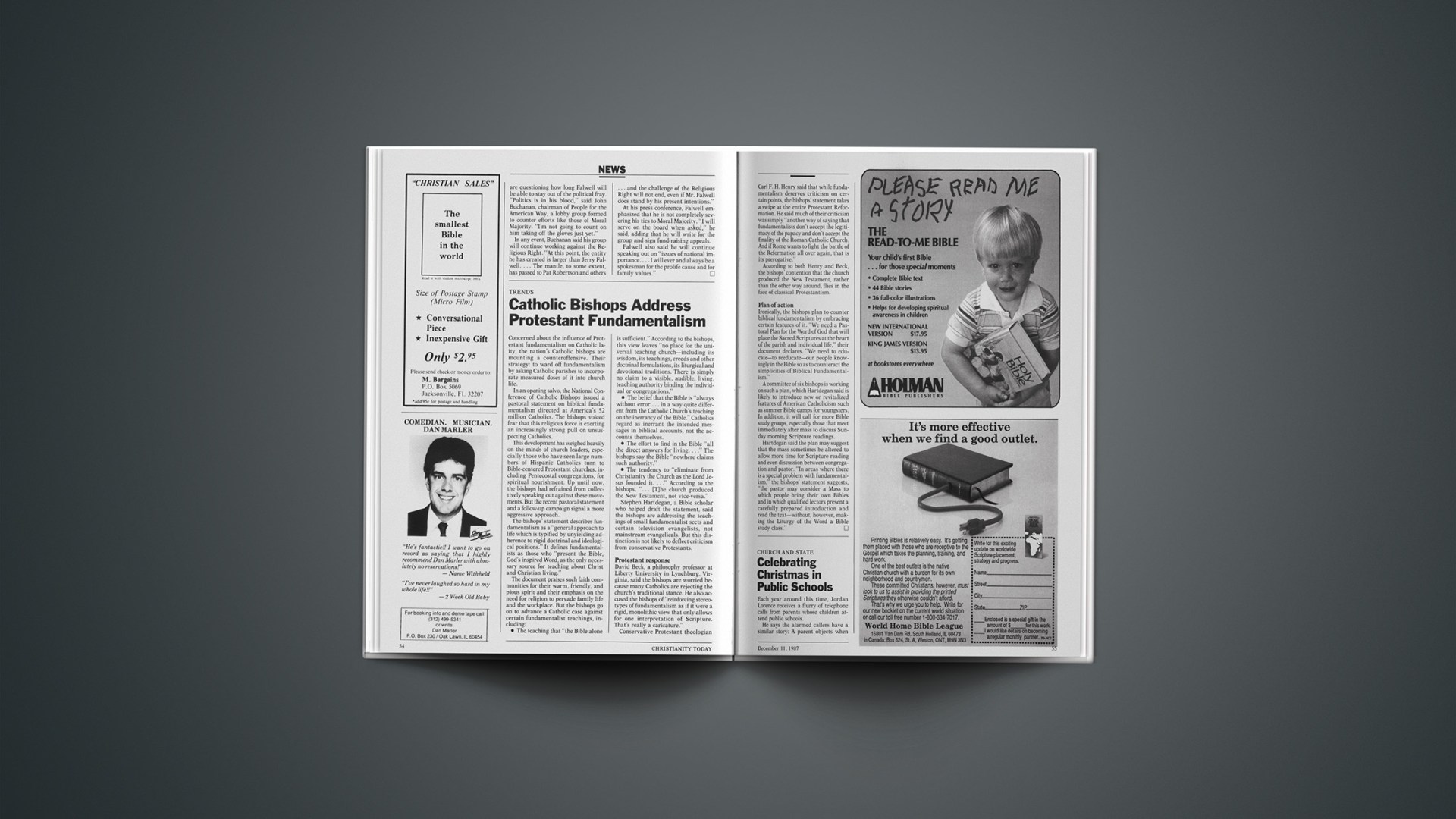
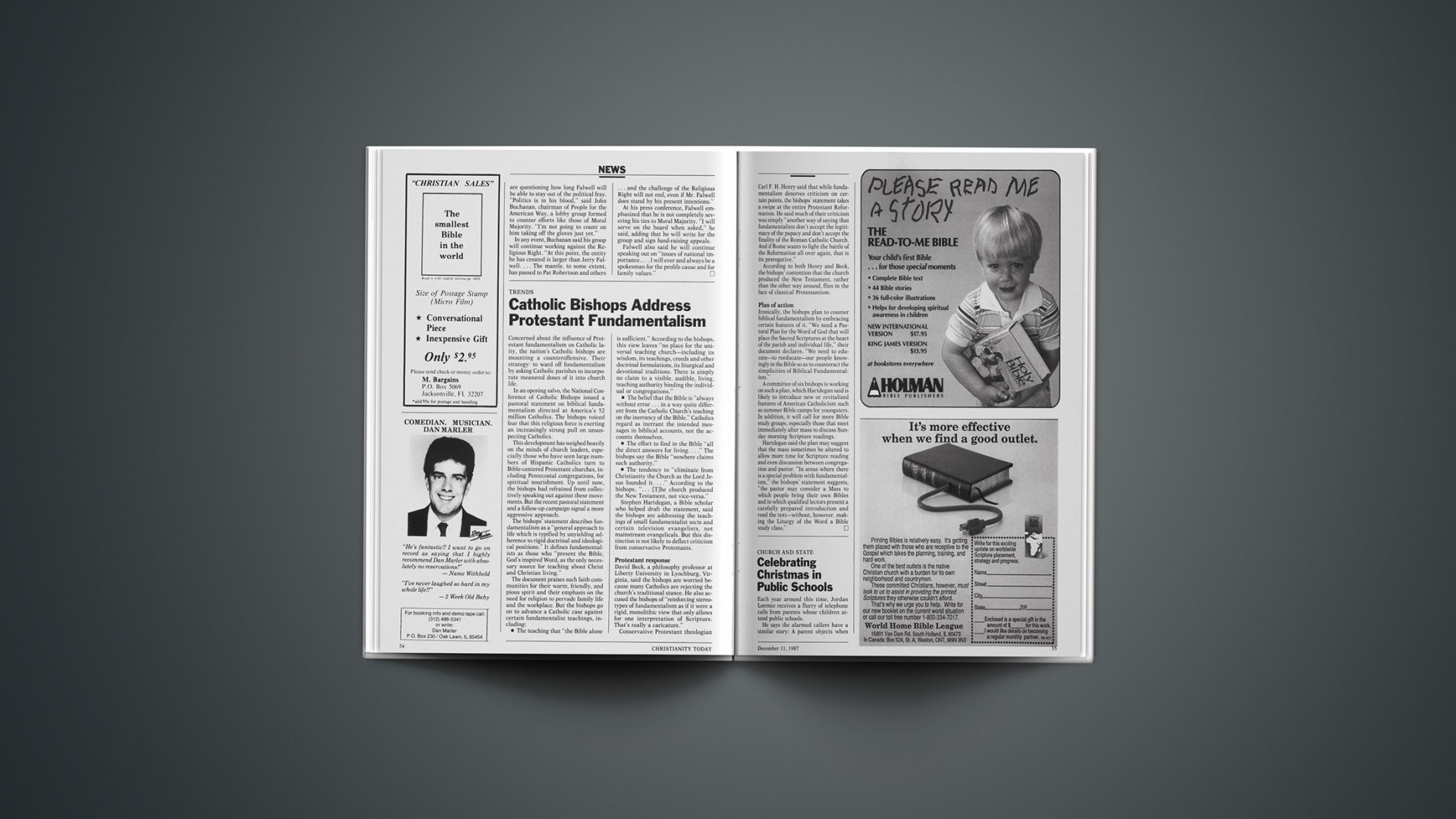
Concerned about the influence of Protestant fundamentalism on Catholic laity, the nation’s Catholic bishops are mounting a counteroffensive. Their strategy: to ward off fundamentalism by asking Catholic parishes to incorporate measured doses of it into church life.

In an opening salvo, the National Conference of Catholic Bishops issued a pastoral statement on biblical fundamentalism directed at America’s 52 million Catholics. The bishops voiced fear that this religious force is exerting an increasingly strong pull on unsuspecting Catholics.

This development has weighed heavily on the minds of church leaders, especially those who have seen large numbers of Hispanic Catholics turn to Bible-centered Protestant churches, including Pentecostal congregations, for spiritual nourishment. Up until now, the bishops had refrained from collectively speaking out against these movements. But the recent pastoral statement and a follow-up campaign signal a more aggressive approach.

The bishops’ statement describes fundamentalism as a “general approach to life which is typified by unyielding adherence to rigid doctrinal and ideological positions.” It defines fundamentalists as those who “present the Bible, God’s inspired Word, as the only necessary source for teaching about Christ and Christian living.”

The document praises such faith communities for their warm, friendly, and pious spirit and their emphasis on the need for religion to pervade family life and the workplace. But the bishops go on to advance a Catholic case against certain fundamentalist teachings, including:

• The teaching that “the Bible alone is sufficient.” According to the bishops, this view leaves “no place for the universal teaching church—including its wisdom, its teachings, creeds and other doctrinal formulations, its liturgical and devotional traditions. There is simply no claim to a visible, audible, living, teaching authority binding the individual or congregations.”

  • The belief that the Bible is “always without error … in a way quite different from the Catholic Church’s teaching on the inerrancy of the Bible.” Catholics regard as inerrant the intended messages in biblical accounts, not the accounts themselves.
  • The effort to find in the Bible “all the direct answers for living.…” The bishops say the Bible “nowhere claims such authority.”
  • The tendency to “eliminate from Christianity the Church as the Lord Jesus founded it.…” According to the bishops, “… [T]he church produced the New Testament, not vice-versa.”

Stephen Hartdegan, a Bible scholar who helped draft the statement, said the bishops are addressing the teachings of small fundamentalist sects and certain television evangelists, not mainstream evangelicals. But this distinction is not likely to deflect criticism from conservative Protestants.

Protestant Response

David Beck, a philosophy professor at Liberty University in Lynchburg, Virginia, said the bishops are worried because many Catholics are rejecting the church’s traditional stance. He also accused the bishops of “reinforcing stereotypes of fundamentalism as if it were a rigid, monolithic view that only allows for one interpretation of Scripture. That’s really a caricature.”

Conservative Protestant theologian Carl F. H. Henry said that while fundamentalism deserves criticism on certain points, the bishops’ statement takes a swipe at the entire Protestant Reformation. He said much of their criticism was simply “another way of saying that fundamentalists don’t accept the legitimacy of the papacy and don’t accept the finality of the Roman Catholic Church. And if Rome wants to fight the battle of the Reformation all over again, that is its prerogative.”

According to both Henry and Beck, the bishops’ contention that the church produced the New Testament, rather than the other way around, flies in the face of classical Protestantism.

Plan Of Action

Ironically, the bishops plan to counter biblical fundamentalism by embracing certain features of it. “We need a Pastoral Plan for the Word of God that will place the Sacred Scriptures at the heart of the parish and individual life,” their document declares. “We need to educate—to reeducate—our people knowingly in the Bible so as to counteract the simplicities of Biblical Fundamentalism.”

A committee of six bishops is working on such a plan, which Hartdegan said is likely to introduce new or revitalized features of American Catholicism such as summer Bible camps for youngsters. In addition, it will call for more Bible study groups, especially those that meet immediately after mass to discuss Sunday morning Scripture readings.

Hartdegan said the plan may suggest that the mass sometimes be altered to allow more time for Scripture reading and even discussion between congregation and pastor. “In areas where there is a special problem with fundamentalism,” the bishops’ statement suggests, “the pastor may consider a Mass to which people bring their own Bibles and in which qualified lectors present a carefully prepared introduction and read the text—without, however, making the Liturgy of the Word a Bible study class.”

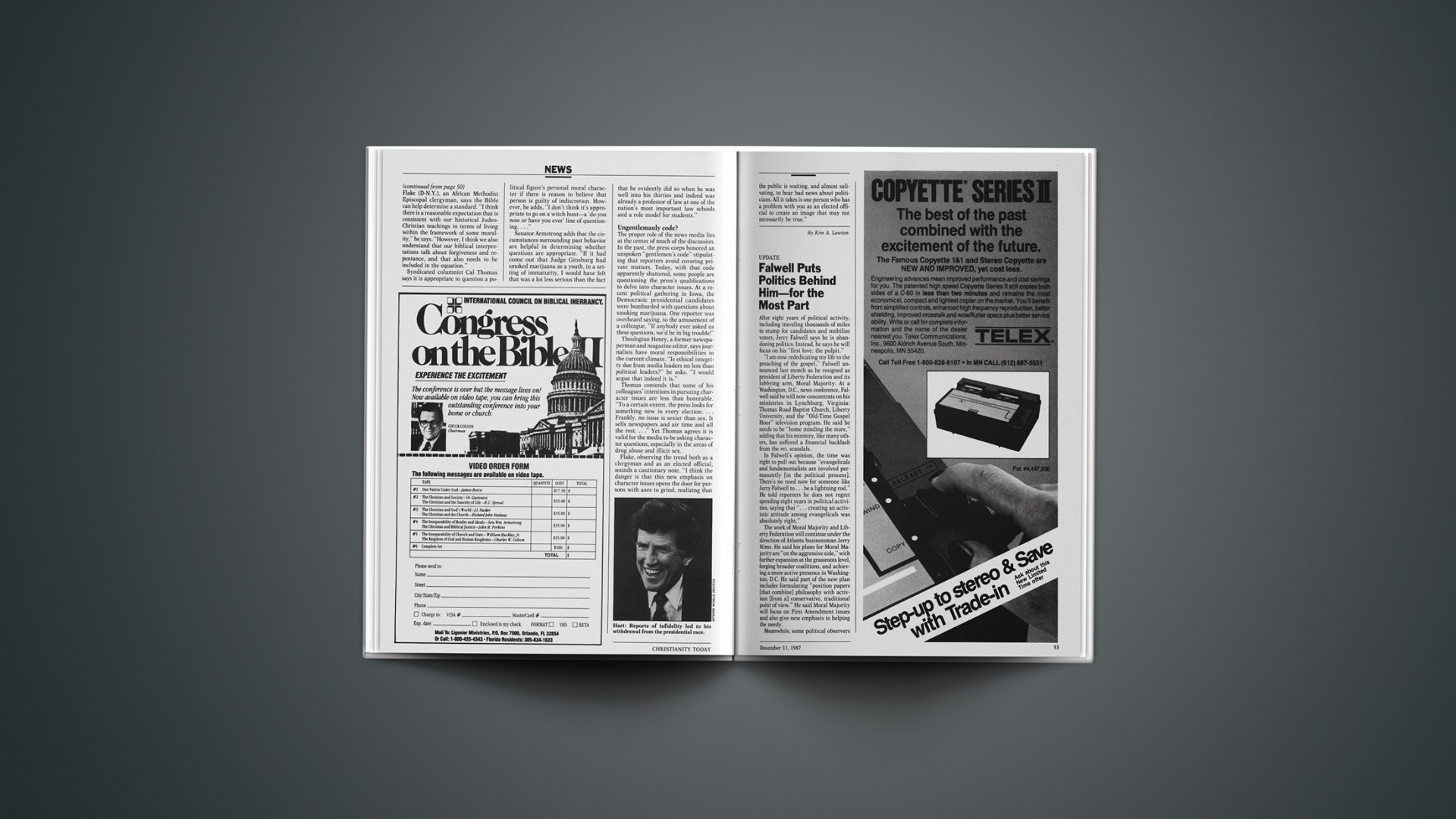
Falwell Puts Politics behind Him—For the Most Part

After eight years of political activity, including traveling thousands of miles to stump for candidates and mobilize voters, Jerry Falwell says he is abandoning politics. Instead, he says he will focus on his “first love: the pulpit.”

“I am now rededicating my life to the preaching of the gospel,” Falwell announced last month as he resigned as president of Liberty Federation and its lobbying arm, Moral Majority. At a Washington, D.C., news conference, Falwell said he will now concentrate on his ministries in Lynchburg, Virginia: Thomas Road Baptist Church, Liberty University, and the “Old-Time Gospel Hour” television program. He said he needs to be “home minding the store,” adding that his ministry, like many others, has suffered a financial backlash from the PTL scandals.

In Falwell’s opinion, the time was right to pull out because “evangelicals and fundamentalists are involved permanently [in the political process]. There’s no need now for someone like Jerry Falwell to … be a lightning rod.” He told reporters he does not regret spending eight years in political activities, saying that “… creating an activistic attitude among evangelicals was absolutely right.”

The work of Moral Majority and Liberty Federation will continue under the direction of Atlanta businessman Jerry Nims. He said his plans for Moral Majority are “on the aggressive side,” with further expansion at the grassroots level, forging broader coalitions, and achieving a more active presence in Washington, D.C. He said part of the new plan includes formulating “position papers [that combine] philosophy with activism [from a] conservative, traditional point of view.” He said Moral Majority will focus on First Amendment issues and also give new emphasis to helping the needy.

Meanwhile, some political observers are questioning how long Falwell will be able to stay out of the political fray. “Politics is in his blood,” said John Buchanan, chairman of People for the American Way, a lobby group formed to counter efforts like those of Moral Majority. “I’m not going to count on him taking off the gloves just yet.”

In any event, Buchanan said his group will continue working against the Religious Right. “At this point, the entity he has created is larger than Jerry Falwell.… The mantle, to some extent, has passed to Pat Robertson and others … and the challenge of the Religious Right will not end, even if Mr. Falwell does stand by his present intentions.”

At his press conference, Falwell emphasized that he is not completely severing his ties to Moral Majority. “I will serve on the board when asked,” he said, adding that he will write for the group and sign fund-raising appeals.

Falwell also said he will continue speaking out on “issues of national importance.… I will ever and always be a spokesman for the prolife cause and for family values.”

Former Diplomat Becomes Head of U.S. Institute of Peace

The idea of establishing a national peace institute got a boost in 1783 from President George Washington. But it was only in 1984—after nearly 150 previous congressional attempts to create such an agency had failed—that the U.S. Institute of Peace was approved.

The institute has been active since April 1986. And last month, Samuel Lewis, the former U.S. ambassador to Israel, became the agency’s new president.

The Peace Institute is a federally funded, nonprofit agency created to promote “scholarship, education, training, and the dissemination of information about the peaceful management of international conflicts.” In its fall report, the agency says it is ready to work toward becoming “an important and respected force in achieving a more peaceful world.”

Studying Peace

The institute divides its activities into three categories: grants to finance peace studies and projects; a fellowship program to research peace issues; and a series of special institute projects. Since its founding, the institute has approved more than 50 grants totaling about $1.7 million.

Lewis said he would like to see the agency begin teaching American diplomats “better techniques for being peacemakers and mediators.” Lewis served as assistant secretary of state in the Ford administration, and as ambassador to Israel in the Carter and Reagan administrations. He is credited with playing a key role in Arab-Israeli negotiations, including the Camp David Accords.

“I felt during those [diplomatic] experiences that we had a lot to learn about how we play our role,” he said. “… The institute is a unique and exciting new institution which can help to fill some of that gap.”

A delicate diplomatic task for the institute itself is maintaining a nonpartisan image. Conservatives within the Reagan administration were not enthusiastic about the agency’s establishment, viewing it as a “left-of-center liberal cause.” Many liberals initially expressed concern about the conservative backgrounds of some of the presidentially appointed board members and the presence of ex-officio members such as former Defense Secretary Caspar Weinberger. So far, however, the institute has managed to avoid being cast in any particular ideological mold.

Religious Support

In the 1970s, several religious groups urged Congress to approve the agency.

Christian College Coalition president John Dellenback served on the congressional commission that recommended the institute. Said Dellenback: “I earnestly hope Congress will continue to fund [the institute], realizing it has brought into being a small child that needs time to grow to take its place as a constructive, strong instrument to help bring about peace in the world.”

Two clergymen serve on the institute’s 15-member board of directors: Sidney Lovett, president of Advisors Unlimited in New Hampshire, and Richard John Neuhaus, director of the Center on Religion and Society in New York. Neuhaus said he believes the institute will “encourage a more intense and more reflective involvement by churches and church-related institutions in the whole discussion of war and peace.”

Skeptics continue to doubt whether the institute will bring about any concrete moves toward peace. But Lewis disagrees.

“It is certainly true that the Institute of Peace is not going to bring universal peace to the world,” he said. “… I’m afraid that from the earliest years of biblical history, violent conflict between nations and within nations has been the norm, and I don’t suppose that unless man’s nature changes it’s likely to be eradicated. But I do think … we can help to bring a less conflict-ridden world by learning better about how conflict is contained, managed, and sometimes eliminated.”

Remembering Other Christian Leaders

The church lost many other servants this year. Among them:

Kurt E. Koch, 73, a German Christian widely regarded as a top authority on the occult, author of 36 books, and lecturer at more than 100 universities and seminaries in some 65 countries, died January 25 in Aglasterhausen, West Germany.

David J. du Plessis, 81, widely known as “Mr. Pentecost,” died of cancer in Pasadena, California, on February 2. A native of South Africa and a naturalized U.S. citizen, du Plessis was considered by many the foremost spokesman for the Pentecostal movement. An Assemblies of God minister, du Plessis was the organizing secretary of the World Pentecostal Fellowship (now the World Pentecostal Conference). He spent his later years at Fuller Theological Seminary, where the David du Plessis Center for Christian Spirituality was established in 1985.

Edwin C. Clarke, 73, former president of Geneva College in Beaver Falls, Pennsylvania, died February 17 following an extended illness. Clarke joined the Geneva College faculty in 1937 as an economics instructor. In the following years, he served as assistant professor of economics, chairman of the Department of Economics and Business Administration, and vice-president for development. He was named president in 1956, a post he held until he retired in 1980.

Carl Armerding, 97, professor emeritus of Bible and theology at Wheaton (Ill.) College, died March 28 in Hayward, California. The oldest of ten children of German immigrants, Armerding became a Christian at the age of 15. He served as a Plymouth Brethren missionary in British Honduras (Belize), the Bahamas, the United States, and Canada. He later taught at Dallas Theological Seminary and was on the extension staff of Moody Bible Institute. His son, Hudson, served as president of Wheaton College from 1965 to 1982.

Baroness Maria Augusta von Trapp, 82, the former Austrian governess whose life story formed the basis of the musical The Sound of Music, died of heart failure in Morrisville, Vermont, on March 28. After deciding not to become a Catholic nun, she married Baron Georg von Trapp in 1927, and in 1942 they moved to Vermont with the baron’s seven children. Mrs. von Trapp was active in Catholic mission work after her husband died in 1947.

Christian philosopher Cornelius Van Til, 91, professor emeritus of apologetics at Westminster Theological Seminary in Philadelphia, died April 17 following a lengthy illness. Born in the Netherlands, Van Til emigrated to the United States with his family when he was 10. Although he held degrees from Calvin College, Princeton Theological Seminary, and Princeton University, Van Til said studying “was not easy.… Having grown up on the farm, I was used to weeding onions and carrots and cabbages. It was hard to adjust to classroom work.…” He pastored a Christian Reformed congregation and taught at Princeton seminary before joining the Westminster seminary faculty in 1929.

J. Edwin Orr, 73, president of the Los Angeles-based Oxford Association for Research in Revival, professor emeritus of the history of awakenings at Fuller Theological Seminary, and a recognized authority on revival and spiritual awakenings, died of a heart attack on April 22 in Asheville, North Carolina.

Lt. Gen. William K. Harrison (U.S. Army, ret.), president emeritus of Officers’ Christian Fellowship, died May 25 in Bryn Mawr, Pennsylvania, at the age of 91. After retiring from the U.S. Army in 1957, Harrison served as chairman of the board of Dallas Theological Seminary and as a contributing editor of CHRISTIANITY TODAY. A 1917 graduate of the U.S. Military Academy, Harrison became the most highly decorated soldier in the 30th Infantry Division during World War II. He served as chief of reparations in postwar Japan under Gen. Douglas MacArthur, and later was chief United Nations delegate to the armistice negotiations that led to a cease-fire in the Korean War.

Peter Deyneka, Sr., 89, a Russian-born immigrant who founded the Slavic Gospel Association, cofounded the Russian Bible Institute, and pioneered evangelistic radio broadcasts into the Soviet Union, died July 26 in Wheaton, Illinois.

P. Kenneth Gieser, 78, a former medical missionary who helped found the Christian Medical Society and Christian Service Brigade, died August 1 in Speculator, New York. Gieser and his late wife, Catharine, served as medical missionaries in China from 1934 through 1940. They returned to the United States in 1941 for health reasons. Gieser later accepted short-term missionary assignments, serving at eye hospitals in Nigeria and West Pakistan. He also served on the boards of Wheaton (Ill.) College, The Evangelical Alliance Mission, MAP International, InterVarsity Christian Fellowship, the Billy Graham Evangelistic Association, and Christianity Today, Incorporated.

J. Stratton “Strat” Shufelt, 77, former minister of music at Chicago’s Moody Church and a song evangelist who worked with Billy Graham in a number of his early Youth for Christ crusades in Europe, died September 19 in Muskegon, Michigan.

Wendell P. Loveless, 95, station manager for Moody Bible Institute’s radio station WMBI from the 1920s to the 1940s, died October 3 in Honolulu, Hawaii. Asked last year about his years at WMBI, Loveless said, “When I started, my secretary and I were the radio department.… When I left, about 160 people were taking part in the radio programming.”

Everett S. Graffam, 72, head of World Relief from 1967 to 1978 and recipient of the National Association of Evangelicals’ Layman of the Year award in 1974, died October 20 in Fort Myers, Florida. Under Graffam’s leadership, World Relief’s annual budget grew from $108,000 to $1.5 million.

Theologian Orlando Enrique Costas, 45, academic dean of Andover Newton Theological School, died November 5 in Newton Centre, Massachusetts, of stomach cancer. Costas pastored churches in his native Puerto Rico and in the United States and served as a missionary to Costa Rica. He was a visiting professor at Texas Christian University, Fuller Theological Seminary, Gordon-Conwell Theological Seminary, and Union Theological Seminary in Richmond, Virginia. He also taught missiology and directed Hispanic studies and ministries at Eastern Baptist Theological Seminary.

Apple PodcastsDown ArrowDown ArrowDown Arrowarrow_left_altLeft ArrowLeft ArrowRight ArrowRight ArrowRight Arrowarrow_up_altUp ArrowUp ArrowAvailable at Amazoncaret-downCloseCloseEmailEmailExpandExpandExternalExternalFacebookfacebook-squareGiftGiftGooglegoogleGoogle KeephamburgerInstagraminstagram-squareLinkLinklinkedin-squareListenListenListenChristianity TodayCT Creative Studio Logologo_orgMegaphoneMenuMenupausePinterestPlayPlayPocketPodcastRSSRSSSaveSaveSaveSearchSearchsearchSpotifyStitcherTelegramTable of ContentsTable of Contentstwitter-squareWhatsAppXYouTubeYouTube