Rumors of Peace

The ‘war’ in the nation’s largest Protestant denomination is over, but tensions remain.

Over the last decade, Southern Baptists have made little effort to disguise their civil war.

Moderates in the 14.6 million-member Southern Baptist Convention (SBC) have accused conservatives of waging a battle for political control. Conservatives say their political efforts are necessary due to growing liberalism in the SBC, reflected, they say, by the teachings and writings of some Southern Baptist seminary professors.

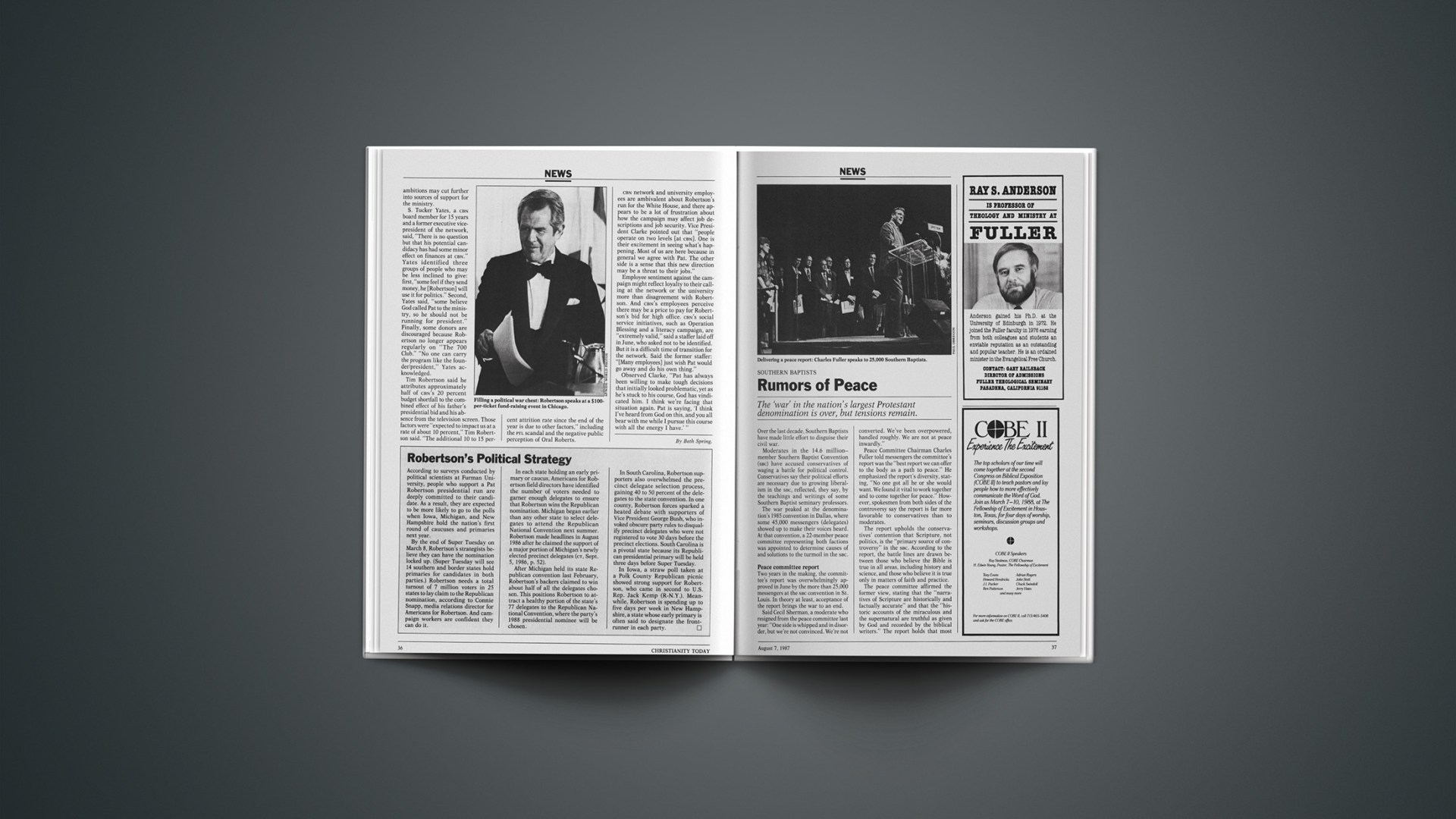
The war peaked at the denomination’s 1985 convention in Dallas, where some 45,000 messengers (delegates) showed up to make their voices heard. At that convention, a 22-member peace committee representing both factions was appointed to determine causes of and solutions to the turmoil in the SBC.

Peace Committee Report

Two years in the making, the committee’s report was overwhelmingly approved in June by the more than 25,000 messengers at the SBC convention in St. Louis. In theory at least, acceptance of the report brings the war to an end.

Said Cecil Sherman, a moderate who resigned from the peace committee last year: “One side is whipped and in disorder, but we’re not convinced. We’re not converted. We’ve been overpowered, handled roughly. We are not at peace inwardly.”

Peace Committee Chairman Charles Fuller told messengers the committee’s report was the “best report we can offer to the body as a path to peace.” He emphasized the report’s diversity, stating, “No one got all he or she would want. We found it vital to work together and to come together for peace.” However, spokesmen from both sides of the controversy say the report is far more favorable to conservatives than to moderates.

The report upholds the conservatives’ contention that Scripture, not politics, is the “primary source of controversy” in the SBC. According to the report, the battle lines are drawn between those who believe the Bible is true in all areas, including history and science, and those who believe it is true only in matters of faith and practice.

The peace committee affirmed the former view, stating that the “narratives of Scripture are historically and factually accurate” and that the “historic accounts of the miraculous and the supernatural are truthful as given by God and recorded by the biblical writers.” The report holds that most Southern Baptists believe Adam and Eve “were real persons” and that the “named authors did indeed write the biblical books attributed to them by those books.”

Although the report maintains that diversity in the SBC “should not create hostility … [or] stand in the way of genuine cooperation,” moderate leaders spoke of defeat and exile within their own denomination. “You have been disenfranchised,” said James Slatton, addressing his moderate colleagues. Slatton, the recognized leader of SBC moderates, said acceptance of the report represents a fundamental change in the SBC, from unity based on a common task (evangelizing the world) to an attempt at unity based on a creed (the inerrancy of Scripture).

Sherman predicted that those with a moderate point of view will now “go into a sullen quiet.… [The] people we have defended no longer care to be defended.” He said he was referring to SBC seminary presidents, who he believes have caved in to conservative pressure.

Moderate Winfred Moore resigned from the peace committee shortly after its report was adopted. He said he objected to the report’s recommendation that the committee’s life be extended up to three years to “observe response.” Moore expressed concern that the panel would become a “police committee” to “monitor or judge the work of our institutions and agencies.…”

The report’s critics are concerned primarily about the recommendation that trustees “determine the theological positions of the seminary administrators and faculty members” in order to “guide them in renewing their determination to [uphold Southern Baptist beliefs].” Some feel this is a call for ruthless housecleaning. But SBC President Adrian Rogers, elected to a third term at the St. Louis convention, said conservative leadership “does not have a firing mentality.”

Presidential Election

Another indication of the conservatives’ victory was the relative ease (by a 60-to 40-percent margin) with which Rogers, a conservative incumbent, won the SBC presidency. This marked the ninth consecutive win for conservatives. The SBC president has substantial power to determine who controls the SBC’S 24 national entities, including its seminaries.

Moderates allege that Rogers has exercised his appointive powers to favor those who share his view of inerrancy. However, stating that conservatives “are not interested in forcing our views” on anyone, Rogers said his appointments “represent who Southern Baptists are.” According to Rogers, the landmark 1963 Baptist Faith and Message statement upholds Scripture as inerrant in all areas. “I could not hold my head up as president of the Southern Baptist Convention,” he said, “if I were to nominate anybody outside that statement.”

Slatton said that for moderate presidential candidate Richard Jackson to have received 40 percent of the vote in a year when there is “discouragement in the ranks” indicates the moderate wing is more substantial than conservatives claim. Slatton maintains also that attendance at recent SBC yearly meetings has not accurately represented the conservative-moderate balance in the denomination. According to research by an independent group, Slatton said, more Southern Baptists would rather be called “liberal,” “progressive,” or “moderate,” than “conservative” or “fundamentalist.”

Other Actions

Other highlights of this year’s SBC meeting include the following:

• Messengers passed 15 resolutions, including one on integrity in stewardship that deplores the recent “tragic revelations of embarrassing misconduct” and mishandling of funds. Although three Southern Baptists now serve on PTL’S reorganized board, the resolution notes that the scandal-plagued ministry is not connected to the SBC.

Messengers also passed resolutions making ministry to homeless children a priority, affirming “full-time homemakers,” and calling for obedience to “God’s laws of chastity” as a “major step toward curtailing the threat of AIDS.” The AIDS resolution urges “Christlike compassion in dealing with the hurting victims of AIDS and their families.”

• Former SBC president Jimmy Draper, along with Southern Baptist laymen Ed McAteer and Sam Moore, hosted a reception for presidential hopeful Pat Robertson. The meeting was apparently held to break down barriers that may be limiting Southern Baptist support for Robertson (see related story on p. 34).

• Evangelist Bailey Smith made no apologies for the remark he made in 1980 while SBC president that God does not hear the prayers of Jews. In a speech to Southern Baptist evangelists, Smith said he loves the Jewish people, but that “unless they repent and get born again, they are in trouble.”

By Randy Frame, in St. Louis.

CANADA

Saying No To The Death Penalty

A decisive vote in Canada’s House of Commons against restoring the death penalty has led a Christian leader to call for reforming the entire criminal justice system.

“Now that the capital punishment debate is behind us,” said Ian Stanley, executive director of Prison Fellowship Canada, “Parliament must give attention to the really urgent business of overhaul of the whole criminal justice system.

“The recent debate [over capital punishment] was precipitated by general dissatisfaction with the way the system works,” Stanley said. “It is imperative that Christians come forward with positive proposals.”

A coalition of mainline Protestant and Catholic church leaders figured prominently in the effort opposing capital punishment. However, among evangelicals, only 24 percent opposed imposition of the death penalty under any circumstances, according to a poll published by Faith Today magazine. The remaining 76 percent supported the death penalty—some with qualifications.

Capital punishment has been a festering issue since 1976 when it was abolished by Canada’s Parliament. Although polls indicated widespread public support for reinstating the death penalty, politicians resisted attempts to raise the issue in Parliament.

During the 1984 election campaign, however, Progressive Conservative leader Brian Mulroney promised that, if elected, he would put the issue to a vote in the House of Commons. Although Mulroney said he was personally opposed to capital punishment, in February he permitted the introduction of a motion that would have reinstated the death penalty. When a vote was taken earlier this summer, legislators rejected the motion 148 to 127.

By Leslie K. Tarr.

Will Pat Run?

Robertson’s Christian television network faces the fallout from his possible presidential bid.

Pat Robertson is expected to announce next month that he will run for President. His decision, which is contingent on collecting the signatures of 3 million supporters, is redirecting the course of grassroots politics in several states and spurring hard decisions at the Christian Broadcasting Network (CBN), which he founded.

Announcing a $25 million budget cut and layoffs of 470 CBN employees in June, Robertson placed the primary blame on damage done to evangelical credibility by Oral Roberts’s fund-raising tactics and the ongoing PTL scandal. However, some CBN officials acknowledge the financial setbacks are due, in part, to Robertson’s political ambitions and his absence as host of the network’s flagship program, “The 700 Club.”

While CBN suffers from a drop in financial support, preparations for Robertson’s anticipated political campaign have netted a healthy $7 million in contributions, more than any other candidate except Vice President George Bush. In several states, his committee to test the political waters, Americans for Robertson, is attracting scores of newcomers to Republican party politics. Despite the healthy cash flow and new political enthusiasm, Robertson campaign organizers are scrambling to collect the 3 million signatures he has said would be his signal to run. Last September, Robertson announced: “If by September 17, 1987, one year from today, 3 million registered voters have signed petitions telling me that they will pray, that they will work, that they will give toward my election, then I will run as a candidate for the nomination of the Republican Party for the office of President of the United States of America.”

Robertson left no doubt about his own sense of direction. In a letter following last year’s announcement, he wrote, “I have made this decision in response to the clear and distinct prompting of the Lord’s Spirit.… I know this is His will for my life.”

A Slow Petition Drive

Nine months after his announcement, Robertson was only about one-third of the way toward his petition goal. “We did not anticipate it being such a detailed and huge administrative task,” said Connie Snapp, media relations director for Americans for Robertson. In June, Americans for Robertson recruited volunteers in several states to solicit supporters by telephone. And Robertson appeared to revise his criteria for making a decision to run. He told reporters in Arizona he would announce for the presidency “if I have 3 million petitions or [other commitments from] people who will support a candidacy by me.…”

In North Carolina, Robertson organizer Carl Horn explained, phone bank volunteers are calling people listed in church directories. They ask, “May I add your name to the list of people telling Pat to go for it by agreeing to support his candidacy?” If the answer is yes, the supporter is asked to name a party affiliation and indicate whether he or she will work for the campaign or donate money to it. Horn said 50 to 80 percent of the people contacted by phone say yes. By mid-June, the North Carolina effort had collected a total of 12,000 names—with some signing petitions and others promising their support over the telephone. The goal, Horn said, was 50,000 by the end of July, requiring nearly 1,000 positive responses per day if telephoning is done six days each week.

Snapp said each supporter identified by telephone is sent a petition card and asked to return it with a signature. In this way, she said, the phone commitments will adhere to the criteria Robertson set out in 1986. At the end of June, Snapp said the national office of Americans for Robertson had approximately 1 million signed petitions in hand and an additional 1 million “pledged” from volunteers. One of the volunteers, Robert Weiner, founder and president of Maranatha Campus Ministries, promised to gather 1 million signatures. Weiner is pursuing the petition drive on his own time, contacting Christian leaders and using word of mouth.

A direct-mail fund raiser who consulted with an independent expenditure campaign for Robertson has questioned the change in tactics by Americans for Robertson. Noting how difficult it will be to gather the needed signatures before a September announcement, W. Shepherd Smith, Jr., of Herndon, Virginia, said he feared Robertson organizers could tally telephone assents before they are backed up on paper.

“In the political/religious environment which exists today, it is imperative that Pat be able to pass the litmus test of close scrutiny on the issue of integrity,” said Smith. “If he said last September that having 3 million registered voters sign petitions was a condition for announcing his candidacy, then he must have those signatures in order to run. Certainly that was the primary basis upon which we raised money.”

Smith said his own direct-mail effort for Robertson attracted far more negative responses than he expected. He said an overall 13 percent response from 400,000 names was split, with 8 percent positive and 5 percent negative. Smith observed that the percentage of negative mail is high, indicating “a significant number of people out there don’t want him to run.”

This appears to be true particularly in evangelical circles. Snapp acknowledged, “It’s our own base of people who think he can’t win.”

Who Supports Pat?

Most of Robertson’s support is drawn from a narrow segment of the Christian community with little previous experience in politics. In a variety of polls measuring the relative strength of Republican presidential contenders, Republican voters have indicated Robertson is the candidate they would be least likely to support.

But his political persuasiveness and the depth of his followers’ commitment may counterbalance the negatives. A survey of people who contribute money to Republican candidates, conducted by Furman University political scientists James L. Guth and John C. Green, offers a profile of the Robertson backer. People who donate to Robertson, they found, “differ from other Republicans primarily in the scope and militance of their conservatism.”

A majority of Robertson donors give top priority to social issues, while other Republican supporters tend to be most concerned about economic issues. Concern about pornography, school prayer, abortion, and drug law enforcement characterizes the Robertson contributors, Guth and Green say. At the same time, they are deeply concerned about economic issues.

Guth and Green point out that Robertson donors are religiously distinct as well. They report, “A plurality belong to charismatic churches, especially the rapidly growing Assemblies of God. Others come from more moderate evangelical groups such as Baptists. Very few are members of fundamentalist [churches] or conservative mainline denominations.”

In the long run, the researchers say, “The Robertson campaign may be the first step in blending conservative Christians into the right wing of the Republican party.”

Ministry Repercussions

The impact of Robertson’s political activities on his television ministry are expected to be far-reaching. Because of a potential conflict of interest, CBN News may not be allowed to cover some aspects of the 1988 campaign. And once Robertson officially declares, he cannot appear on the air unless equal time is provided to other candidates. Added to that are the financial repercussions.

CBN officials are facing the fact that no matter what happens on the political front, life at the network and CBN University will never again be the same. “Regardless of what Dad does with his political campaign—regardless of whether he runs or doesn’t run—he’s never, ever, ever going to go back to being Pat Robertson, host of a 5-day-a-week Christian television program,” said Robertson’s 33-year-old son, Tim, who is president of CBN. “This is one thing people have not gotten through their minds. He’s going on to do some different things. For those of us who make decisions around here about where we’re going in the future, this has been a very important point of demarcation.”

“The 700 Club,” in particular, is scheduled for major changes beginning early this fall. Tim Robertson explained that direct ministry will be emphasized instead of issues. “That’s what the viewers seem to want,” he said.

In addition, CBN has started an ambitious radio network project, CBN Vice President for Marketing David Clarke sees it as “a significant and important way to reach people we are not reaching with ‘The 700 Club.’ It’s a way to use resources that are already in place.”

New television programming at CBN will depend on the generosity of the network’s viewers. A serious drop in donations has already precipitated layoffs and budget cuts, and there is concern that Robertson’s presidential ambitions may cut further into sources of support for the ministry.

S. Tucker Yates, a CBN board member for 15 years and a former executive vice-president of the network, said, “There is no question but that his potential candidacy has had some minor effect on finances at CBN.” Yates identified three groups of people who may be less inclined to give: first, “some feel if they send money, he [Robertson] will use it for politics.” Second, Yates said, “some believe God called Pat to the ministry, so he should not be running for president.” Finally, some donors are discouraged because Robertson no longer appears regularly on “The 700 Club.” “No one can carry the program like the founder/president,” Yates acknowledged.

Tim Robertson said he attributes approximately half of CBN’S 20 percent budget shortfall to the combined effect of his father’s presidential bid and his absence from the television screen. Those factors were “expected to impact us at a rate of about 10 percent,” Tim Robertson said. “The additional 10 to 15 percent attrition rate since the end of the year is due to other factors,” including the PTL scandal and the negative public perception of Oral Roberts.

CBN network and university employees are ambivalent about Robertson’s run for the White House, and there appears to be a lot of frustration about how the campaign may affect job descriptions and job security. Vice President Clarke pointed out that “people operate on two levels [at CBN]. One is their excitement in seeing what’s happening. Most of us are here because in general we agree with Pat. The other side is a sense that this new direction may be a threat to their jobs.”

Employee sentiment against the campaign might reflect loyalty to their calling at the network or the university more than disagreement with Robertson. And CBN’S employees perceive there may be a price to pay for Robertson’s bid for high office. CBN’S social service initiatives, such as Operation Blessing and a literacy campaign, are “extremely valid,” said a staffer laid off in June, who asked not to be identified. But it is a difficult time of transition for the network. Said the former staffer: “[Many employees] just wish Pat would go away and do his own thing.”

Observed Clarke, “Pat has always been willing to make tough decisions that initially looked problematic, yet as he’s stuck to his course, God has vindicated him. I think we’re facing that situation again. Pat is saying, ‘I think I’ve heard from God on this, and you all bear with me while I pursue this course with all the energy I have.’ ”

By Beth Spring.

Robertson’s Political Strategy

According to surveys conducted by political scientists at Furman University, people who support a Pat Robertson presidential run are deeply committed to their candidate. As a result, they are expected to be more likely to go to the polls when Iowa, Michigan, and New Hampshire hold the nation’s first round of caucuses and primaries next year.

By the end of Super Tuesday on March 8, Robertson’s strategists believe they can have the nomination locked up. (Super Tuesday will see 14 southern and border states hold primaries for candidates in both parties.) Robertson needs a total turnout of 7 million voters in 25 states to lay claim to the Republican nomination, according to Connie Snapp, media relations director for Americans for Robertson. And campaign workers are confident they can do it.

In each state holding an early primary or caucus, Americans for Robertson field directors have identified the number of voters needed to garner enough delegates to ensure that Robertson wins the Republican nomination. Michigan began earlier than any other state to select delegates to attend the Republican National Convention next summer. Robertson made headlines in August 1986 after he claimed the support of a major portion of Michigan’s newly elected precinct delegates (CT, Sept. 5, 1986, p. 52).

After Michigan held its state Republican convention last February, Robertson’s backers claimed to win about half of all the delegates chosen. This positions Robertson to attract a healthy portion of the state’s 77 delegates to the Republican National Convention, where the party’s 1988 presidential nominee will be chosen.

In South Carolina, Robertson supporters also overwhelmed the precinct delegate selection process, gaining 40 to 50 percent of the delegates to the state convention. In one county, Robertson forces sparked a heated debate with supporters of Vice President George Bush, who invoked obscure party rules to disqualify precinct delegates who were not registered to vote 30 days before the precinct elections. South Carolina is a pivotal state because its Republican presidential primary will be held three days before Super Tuesday.

In Iowa, a straw poll taken at a Polk County Republican picnic showed strong support for Robertson, who came in second to U.S. Rep. Jack Kemp (R-N.Y.). Meanwhile, Robertson is spending up to five days per week in New Hampshire, a state whose early primary is often said to designate the frontrunner in each party.

Classic & Contemporary Excerpts from August 07, 1987

The sands of time

If I cast my eyes before me, what an infinite space in which I do not exist! And if I look behind me, what a terrible procession of years in which I do not exist, and how little space I occupy in this vast abyss of time!

Bossuet, Sermon sur la mort,

quoted by Philippe Aries in

The Hour of Our Death

One foot in the air

Even in the best of health we should have death always before our eyes [so that] we will not expect to remain on this earth forever, but will have one foot in the air, so to speak.

Martin Luther, quoted

by Philippe Aries in

The Hour of Our Death

Faith plus works?

Among the remembered prayers of the very wise and holy St. Thomas More is this: “The things, good Lord, that we pray for, give us the grace to labor for.” A good example of somebody who understood this is a little girl whom Leslie Weatherhead mentioned in one of his early books. She was much troubled by the fact that her older brother trapped rabbits, and she had begged him in vain to stop. One night her mother heard her praying: “Dear God, please stop Tommy from trapping rabbits. Please don’t let them get trapped. They can’t. They won’t! Amen.” Her mother, troubled and perplexed, asked, “Darling, how can you be so sure that God won’t let the rabbits be trapped?” The blessed child calmly replied: “Because I jumped on the traps and sprung them!” Ex ore infantium. When I tell this story in sermons I see smiles. It is a charming story—but not a cute one. It is a paradigm of Christian praying.

Carroll E. Simcox in

The Christian Century

(Mar. 4, 1987)

Searching for compromise

[Worldly] compromise is so hard to find. It is not an issue that you easily identify, fight, picket, or bomb. It’s slippery. It’s illusive. It conceals itself in the highest places and wraps its evil tentacles around the most bedrock truth. It disguises itself with much good intention and, when uncovered, it excuses itself repeatedly with helpless cries of fatalism.

Compromise is primarily a heart issue and this is what makes it so hard to find. How do you examine the heart?

John Fischer in

Contemporary Christian Music

(Feb. 1987)

A rule of gold—or iron?

[George Bernard] Shaw’s old and recognized philosophy was … in brief, that conservative ideals were bad, not because they were conservative, but because they were ideals. Every ideal prevented men from judging justly the particular case; every moral generalization oppressed the individual; the golden rule was there was no golden rule.

The saying that “the golden rule is that there is no golden rule,” can, indeed, be simply answered by being turned around. That there is no golden rule is itself a golden rule, or rather it is much worse than a golden rule. It is an iron rule; a fetter on the first movement of man.

G. K. Chesterton in Heretics

Christianity’S Rhythm

It seems to me that the Christian life, when properly lived, is a rhythmic alternation between turning toward God in worship and running toward the world in love and with a passion for justice, between congregation and dispersal, liturgy and labor, worship and work, adoration and obedience.

Nicholas Wolterstorff in The

Reformed Journal (Dec. 1986)

The mystery of God

I think there are two very heartening things about our day. First, we are all admitting we need some answers. That in itself is encouraging.

We are asking. We are seeking. We are knocking. Because of our training or background or personality or a combination of these and other things, we ask in different ways. But we are asking.

But it also is true that just as surely as we are looking in different ways, answers are coming to us in a diversity which reflects the mystery of God himself. The wonderful thing is that he is making certain that we are receiving and that we are finding and that doors are being opened to us.

Bob Benson in

See You at the House

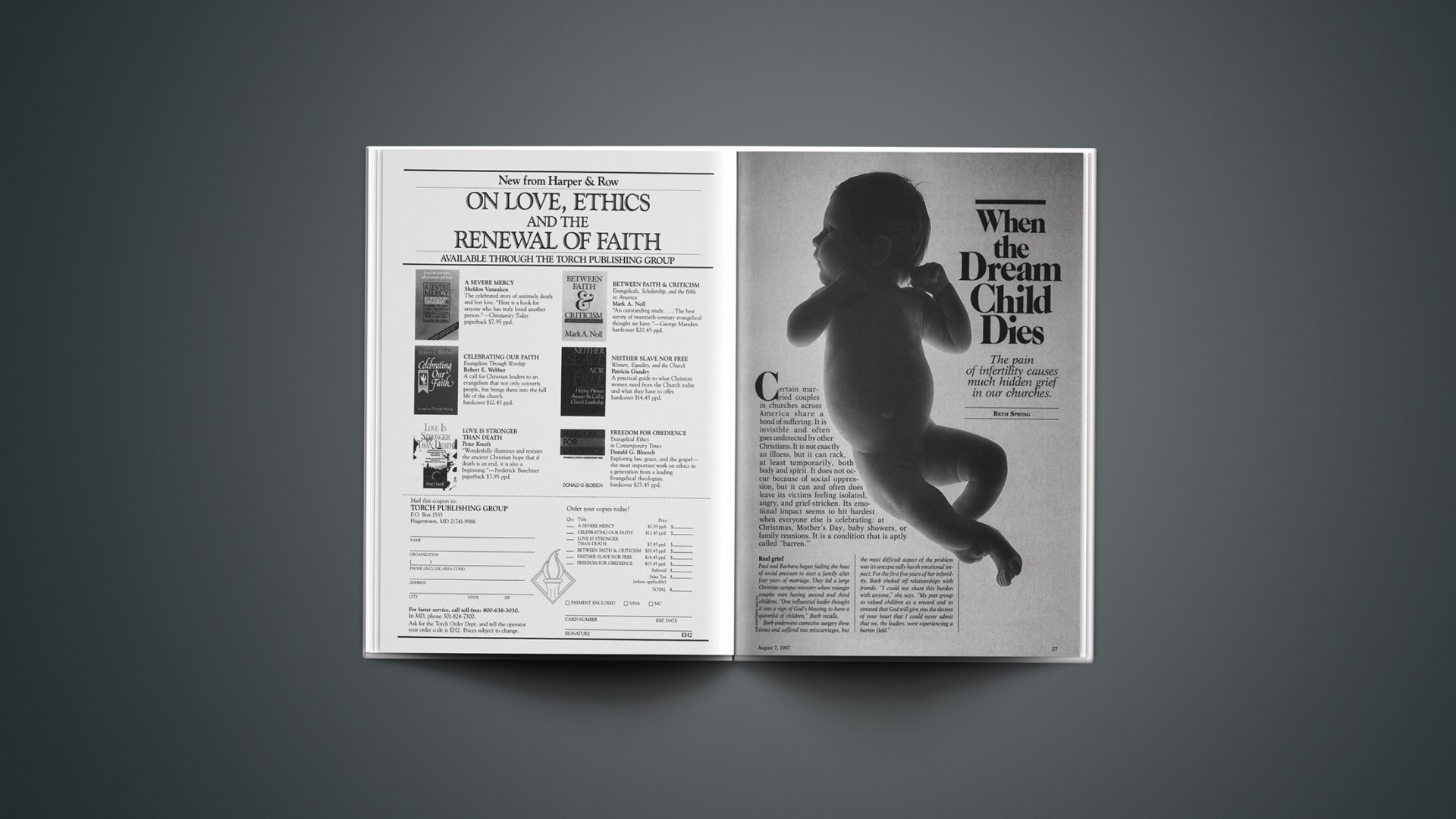
When the Dream Child Dies

The pain of infertility causes much hidden grief in our churches.

Certain married couples in churches across America share a bond of suffering. It is invisible and often goes undetected by other Christians. It is not exactly an illness, but it can rack, at least temporarily, both body and spirit. It does not occur because of social oppression, but it can and often does leave its victims feeling isolated, angry, and grief-stricken. Its emotional impact seems to hit hardest when everyone else is celebrating: at Christmas, Mother’s Day, baby showers, or family reunions. It is a condition that is aptly called “barren.”

Real Grief

Paul and Barbara began feeling the heat of social pressure to start a family after four years of marriage. They led a large Christian campus ministry where younger couples were having second and third children. “One influential leader thought it was a sign of God’s blessing to have a quiverful of children,” Barb recalls.

Barb underwent corrective surgery three times and suffered two miscarriages, but the most difficult aspect of the problem was its unexpectedly harsh emotional impact. For the first five years of her infertility, Barb choked off relationships with friends. “I could not share this burden with anyone,” she says. “My peer group so valued children as a reward and so stressed that God will give you the desires of your heart that I could never admit that we, the leaders, were experiencing a barren field.”

Paul maintained more personal equanimity, but experienced strain on their marriage. “There were times when I felt I could not tolerate another tirade on the baby situation,” he remembers. Their bottled-up emotions burst at inappropriate moments, such as a Christmas gathering with Barb’s parents, younger brother, his wife, and their toddler. Seeing a child’s delight at Christmas ruined the holiday for Barb. She told her mother, “I’m never coming home again.”

Incidents like this leave the infertile wondering whether they are losing their grip on reality. The couple actually grieves, although no one has died. They may want to put an end to intrusive medical procedures, yet they cling to the hope that maybe they will get pregnant—next time. Exploring positive alternatives to biological childbearing may seem as impossible to them as searching for an alternative to breathing air. Yet avoiding alternatives and harboring unrealistic fantasies create mounting frustration and stagnation in their lives.

People who are childless not by choice confront a double-barreled emotional challenge that is simultaneously a crisis (every 28 days) and a chronic condition (as months and years go by). Therapists have developed models of infertility that resemble the well-known stages of acceptance of death and dying. These include surprise, denial, isolation, anger, guilt, depression, and grief. Some believe it is necessary for the infertile to adapt to their condition in the same way people who become chronically ill learn to cope. Others liken it to the sorrow and uncertainty a family experiences over a soldier missing in action.

The death of a couple’s dream child surely hurts less than miscarriage, stillbirth, or a tragic childhood death, but it is a sustained and hidden hurt. All too often, the emotional impact of not being able to reproduce is compounded by flippant or insensitive reactions from friends and relatives. “Just relax” are two words the infertile wish they could banish from the language, because that bromide is prescribed so often. Relaxing is not a cure for infertility. Other well-meaning souls tell childless couples, “Adopt—then you’ll get pregnant” or, “Take a long vacation.” The prayer life of the infertile may be called into question by those who inadvertently model themselves after Job’s would-be comforters.

A common presupposition of Christians who marry is that they will raise a family together. This is strongly reinforced at church, to the point where an infertile couple may seriously question whether their marriage has any purpose or fulfillment without children. While it is true that a Christian couple should remain open to the possibility of children, unless they feel strongly called to a pursuit that precludes child rearing, more thorough church teaching on marriage could clarify the issue.

A pastor would readily advise a doctor’s visit to a person with a tumor or broken bone; because so many cases of infertility have identifiable physical causes, he should not hesitate to do the same in this instance. Unfortunately, because of the mysteries surrounding conception, a common reaction among Christians is to focus entirely on spiritual solutions. “God can work miracles,” one church leader told an infertile woman. Like clouds without rain (Jude 12), those are empty words indeed.

Barbara Eck Menning, founder of a national infertility support organization called RESOLVE, points out that having children is often a major life goal. If that goal is blocked for an extended period of time, a serious developmental crisis can result, making the couple feel like perpetual adolescents. Linda, a 32-year-old, confirms this. “A major concern and source of frustration for us has been the tendency to short-circuit our plans, thinking that ‘surely by then I’ll be pregnant.’ I have not wanted to become so wrapped up in a career that I close the door to motherhood, but that mindset just spills over into an excuse for not doing anything well.”

Most couples report that the wife has a greater personal struggle because she is the one missing out on the physical experience of childbearing. She may have grown up with the expectation that becoming a mother would be the main source of her own self-identification and fulfillment. Whether or not she is physically responsible for the infertility, she may assign blame to herself. Janet, the mother of two adopted children in Kansas, said, “At first, I feared Barry regretted marrying me, but he reassured me all the time that this was not true.” Men frequently say their feelings about infertility go unexpressed, while they concentrate on addressing their wives’ emotional needs.

Understanding Infertility

Carol and Dan were married in 1983, when both of them were approaching their midthirties, and they intended to start a family right away. After several months with no conception, they visited a doctor. Dan had three semen analyses done before a diagnosis was confirmed: male sterility, due to a congenital condition leaving Dan without any sperm. As he struggled to comprehend the doctor’s pronouncement, Carol flew into action, contacting adoption agencies and collecting application forms.

The bleak prospect of long waiting lists cooled Carol’s frenzy, and she began considering artificial insemination with sperm from a donor. “I was not 100 percent comfortable with it,” she says, “but it was the only medical option for us. One of my great sorrows will be to miss the experience of pregnancy.”

Dan opposed the idea. He could not tolerate the thought of friends and family congratulating them over an event in which he had no part. “I felt as if I’d be the only loser,” he says. “And what would we tell the child? As long as there are other people around who know the child was conceived by a donor, it is deceitful to raise that child without telling him of his true parentage.”

Because of Dan’s reservations, they abandoned that possibility. Their difficulties were heightened by the fact that infertility was indisputably linked to one partner. Carol explains, “When one mate has a definite problem, the other one tries to go easy on him, to spare him. Sometimes I felt I really could not share my sadness or frustration. That has been the hardest part for me. I have had to learn how to allow him to help me through this.”

A couple is usually considered infertile if no conception occurs after one year of unprotected intercourse. If the woman has never been pregnant, the condition is known as primary infertility. If the couple is unable to conceive after one or more successful pregnancies, it is called secondary infertility. The term sterile is used if one partner has a diagnosed, irreversible physical condition, as in Dan’s case, that prevents the couple from producing a fertilized egg.

Physicians estimate that as many as one out of every six couples in the United States struggle, at one time or another, with infertility. In a church with 200 members, approximately 15 couples could be suffering in silence over involuntary childlessness.

The fertility rate, or the number of births that occur for every 1,000 women of childbearing age, appears to be on a long-term decline in the United States. There are a number of reasons for this: More couples are getting married in their late twenties and thirties, childbearing is being postponed while women work outside the home, and the use of certain contraceptives can impair fertility. The increasing incidence of sexually transmitted disease is one of the fastest-growing causes of infertility.

Women reach their peak of fertility at around age 24. Fertility declines slowly after age 25 and rapidly after age 30. Infertility is widely considered a “female problem,” but in an estimated 30 percent of the cases, the trouble is with the male. Another 30 percent are traceable to the female, and most of the remaining 40 percent result from a combination of factors. Between 5 and 10 percent remain undiagnosed.

The treatment of infertility is a rapidly expanding medical specialty that presents childless couples with a bewildering array of choices. Usually, the wife is instructed to take her temperature each morning upon waking and chart the results. In this way, the couple may predict with more certainty when an egg may be fertilized. This subtle intrusion into a couple’s most intimate moments is just the beginning.

Semen analyses are performed, and a regimen of other tests measure physiological compatibility, hormone levels, and a host of variables that affect conception. Before long, the couple’s sex life becomes something other than an expression of mutual love; it is a regulated, prescribed antidote to the condition that besets them.

If surgery or drug therapy is not the solution, an ever-expanding range of technical alternatives is available, including artificial insemination, in vitro fertilization, and high-risk options such as contracting with a surrogate mother.

How Churches Are Helping

At Menlo Park (Calif.) Presbyterian Church, monthly support-group meetings for eight childless couples have continued for over a year following a series of classes on infertility. Cynthia Lovewell, a registered nurse who experienced infertility herself, developed and coordinated the six-week series along with LeRoy Heinrichs, an infertility specialist and member of the Menlo Park church.

A curriculum filled with outlines and worksheets for the class invited active participation from couples who attended. They were asked, at an initial informational meeting, how long they have been searching for a resolution to infertility, how members of their families are reacting, and whether they are considering adoption.

Weekly discussions of different aspects of infertility followed, led by church members or staff with expertise in the field. The sessions covered “Problems in Reproduction,” “The Emotional Aspects of Infertility,” potentially helpful medical interventions, the results of choices infertile couples make, the spiritual dimensions of infertility, and an overview of adoption choices. Couples were urged to write answers to two take-home questions: “What are you doing to help yourself during this stressful time?” and “List all the resources available to you that could possibly assist you in your present situation.”

Husbands and wives also were encouraged to keep a notebook or journal chronicling every appointment, treatment, or suggestion they received. They were challenged to spell out exactly their current plan of action. Provocative questions about God’s timing and the spiritual lessons of denial were posed, as well as practical details about pursuing adoption. One year after the spring 1986 class, three of the original eight couples were expecting babies and one was pursuing adoption. The other four continue toward resolving their infertility within the supporting network of a caring Christian community.

Sensitivity on the part of a pastor and heightened awareness throughout a congregation are two ingredients that speed the emotional healing of the infertile. Often, the single most helpful act on the part of a church leader consists of simply introducing the infertile to one another. They begin to realize, finally, that they are not alone. For both couples mentioned earlier, support from fellow believers helped them stabilize their feelings and sustain their commitment to each other and to the Lord.

After Carol and Dan had received their diagnosis of irreversible male sterility, they began meeting with a group of infertile couples at their church. Carol, unable to articulate her grief, left the room in tears month after month, but she continued to come. “The news was just so fresh,” she recalls. “I knew I needed support, but at the same time, the meetings made the problem all too real.”

Their pastor spoke to the group one month about the Bible’s perspective on marriage and family. Afterward, Carol and Dan prayed with him in the church sanctuary. “Having someone acknowledge that our infertility is a genuine problem was so important,” Carol pointed out. Together, she and Dan reached a decision to pursue adoption possibilities, after Carol learned from others in the group that “adoption is a way of having a family, not a Tylenol for the grief of infertility.” Less than one year later, they brought home a newborn boy, adopted through a Christian adoption agency in their state.

The day-to-day trauma of infertility is difficult, and it can be compounded by certain events and holidays in Christian circles. A pastor’s special sensitivity on these occasions can make the difference between a couple opting out of church fellowship and remaining vitally involved. Key occasions are Mother’s Day, infant baptisms or dedications, and child-centered holidays such as Christmas. One church inaugurated an Abraham and Sarah fund at Thanksgiving, inviting couples who were thankful for the gift of children to contribute to a fund to assist the infertile with adoption expenses.

Heightened sensitivity on the part of pastors and church leaders will filter down to the congregation at large and help eliminate unthinking comments challenging the faith or anxiety level of the childless. And the pastor who gains rapport with the childless may find them an invaluable resource for church duties that harried parents cannot handle.

Infertile couples are not the only ones who benefit from church initiatives designed to encourage them. A spirit of compassion and sensitivity is fostered when the pastor acknowledges the pain of childlessness, and members of a congregation may grow closer as they learn to share ongoing sorrow as well as joy. Adoption or foster care can become an area of opportunity for ministry, even among couples who are not infertile. And the church gains enthusiastic, active members as it reaches out to childless couples verging on disillusionment.

For Paul and Barb, resolution came after ten difficult years. “I finally felt something die within me,” Barb says. “What died was the burning desire and drive to have children. Maybe it was the acceptance point some refer to in the steps of grieving. I felt a new sense of purpose and a renewed relationship with God. I discovered what I should have known all along—that he does not work in response to my desires and wants. He works according to his will.”

Paul and Barb remain child-free, but they have filled the void they so feared in their lives. Together, they run a retreat center in rural Ohio for former members of religious cults. Barb works at a center for mentally retarded adults, and counts it a special blessing when the people she works with call her “Mommy.”

For Barb, in particular, the support of Christian friends was critically important in keeping her grounded in Scripture and in touch with the community of believers. Infertility, she says, “created a spiritual havoc of re-evaluating our faith, our relationship with the Lord, and how prayer works.” She now sees that “those times of spiritual dryness were all a part of purifying us and making us into the kind of people God wants us to be.”

This article is adapted from the recently published book entitled The Infertile Couple, by Beth Spring (David C. Cook).

The Alternatives To Infertility

Years ago, childless couples could adopt a baby through a public social service agency free of charge, and in less time than it would take to carry a pregnancy to term. Today, that public agency may have a waiting list of up to seven years long. Couples who turn to private agencies discover they must wait an average of one to two years for placement, and pay a fee averaging $6,500, according to the National Committee for Adoption.

At the same time, clinics offering high-tech alternatives for the infertile are flourishing. How can concerned Christian leaders assist infertile couples through the maze? There are several basic options infertile couples may consider, and each one raises ethical and economic questions.

1. Artificial Insemination by Husband (AIH). Insemination in a doctor’s office is often recommended when a man’s sperm count is low, and and it offers approximately a 20 percent chance of pregnancy. Protestant ethicists generally approve AIH, while Catholic teaching opposes it because it separates intercourse from procreation.

2. Artificial Insemination by Donor (AID). This technique is the same as AIH, but sperm from an anonymous donor is used. Catholic teaching opposes AID, and Protestants tend to view it with caution. It introduces a “third party” into the marriage bond, critics point out. Most AID parents do not tell their children how they were conceived. AID would also permit single women to opt for childbearing.

3. In Vitro Fertilization (IVF). The wife is given hormones to stimulate the production of more than one egg. The eggs are harvested and then mixed, in a laboratory, with sperm from either the husband or a donor. Eggs that become fertilized are placed in the woman’s uterus. Ethical questions about IVF include its costliness (more than $5,000 each time), the waste of extra fertilized eggs (or “pre-embryos”), and the likelihood of experimentation on laboratory-grown embryos.

4. Embryo Transfer. The husband’s sperm is used to artificially inseminate a “donor” woman, and the resulting embryo is washed from her uterus and implanted into the infertile wife. This is a highly experimental technique that is not generally available because of the risks to both the donor woman and the embryo.

5. Surrogate Motherhood. The case of Baby M in New Jersey has crystallized a heated public debate over the use of legal contracts to retain surrogate mothers. As Mary Beth Whitehead, the New Jersey surrogate, discovered, a contract cannot reckon with maternal bonding and a change of heart.

6. Adoption. Despite an extremely short supply of healthy American infants, adoption remains a preferred alternative for many infertile couples. Ethically, it is far different from surrogate motherhood, because the conception of the child is not premeditated. Also, the birth mother has the legal right, after the baby is born, to change her mind.

7. Remaining Child-free. In the whirl of activity and anxiety over infertility, a couple may lose sight of an obvious solution: adapting to life without children. Difficult questions about God’s purpose for marriage need to be addressed, and clear church teaching on the worth of marriage partners—despite their infertility—would help.

By Beth Spring.

Gray Matters

Paul’s statements about stumbling blocks and weaker brethren have triggered much discussion—and dissension.

Espousing nuclear disarmament; listening to rock music (“Christian” or otherwise); supporting public schools; attending movies at the mall cinema. What do these apparently unrelated items have in common? Each is a “gray area” under debate in some contemporary Christian community.

Gray areas are anything but novel. The early church at Rome was fractured by two prominent controversies: arguments about diet and arguments about holy days. The so-called weaker brothers favored a vegetarian diet, while the “stronger” believers boasted that any food was right to eat (Rom. 14:2). Similarly, the weaker brothers revered certain days more than others, while the stronger ones considered every day equally important (or, perhaps, equally unimportant).

Today, most Christians dismiss these controversies as irrelevant. In their place, however, some have substituted controversies over contemporary music, dress and hair styles, and (I hear of at least one European fellowship) the drinking of Coca-Cola. But before we move quickly to cast our votes on these controversies (or to judge our fellow Christians), it is worth noting two things:

First, in Scripture, “weak” does not necessarily mean “bad,” and “strong” does not necessarily mean “good.” In another context, Paul admitted, “For we are glad when we are weak and ye are strong” (2 Cor 13:9). Perhaps the best translation for “weak” would be “dependent,” that is, dependent on the structure provided by regulations.

Second, after explaining both sides of the diets-and-days controversies, Paul neither condemns nor condones the beliefs of either the strong or the weak. While we, along with first-century believers, want to know the right choice in every situation, the apostle seems more interested in other things: the unity of the church as well as the viability of individual preferences and convictions in the body.

We can be sure that similar controversies will exist until the Lord returns. But if the contemporary church is to cope effectively with these differences of opinion, it must learn from the experience of the early church recorded in Romans 14 and 1 Corinthians 8. These two chapters give us the wisdom we need to face three tragic failures.

Alternatives

The first failure we must face is our failure to teach alternatives within the faith.

Consider four basic positions that are usually offered as “alternatives” in a discussion of a “gray area.” (I will use, as an example, the choices many of us face when subscribing to cable television and bringing into our homes material that may be more questionable than the Disney Channel. If you have your mind made up about that one, just substitute the more arcane controversy over Coca-Cola.)

First comes the mature participant, the one who says, “I have a clear conscience about having a mixture of good and bad programming coming into my home. I believe I can make good choices while avoiding a superior attitude toward other believers who do not share my conviction.”

Second is the mature nonparticipant. This person says, “I do not have a clear conscience about subscribing to these cable channels. I do not trust my own self-control. However, I try not to condemn those who permit it.”

Third is the immature participant, the one who says, “I watch any cable TV movie that I please. The church does not have the authority to tell me what not to do.”

Fourth comes the immature nonparticipant. This person says, “I don’t watch any movies on TV. In fact, no true Christian would ever bring such material into his home.”

From Romans 14, we can see that only the two viewpoints we’ve labeled “mature” are alternatives for the believer. Unfortunately, it is often the dominant rule of the immature positions that threatens personal freedom and retards maturation among believers. The church must assist its members in comprehending the broad range of acceptable options, encouraging “divergent learning” (considering all viable options) in the place of “convergent learning” (accepting only limited, predetermined responses).

The early church father Gregory Thaumaturgus recounts his own training under Origen: “No subject was forbidden us, nothing hidden or inaccessible. We were allowed to become acquainted with every doctrine, barbarian or Greek, with things spiritual and secular, divine and human, traversing with all confidence and investigating the whole circuit of knowledge, and satisfying ourselves with full enjoyment of all pleasure of the soul.”

While these church fathers distinguished between truth and error, they made a point of investigating everything. We must also, for the spirit that investigates never becomes unduly narrow, while the soul that seeks only safe answers fast becomes pinched and primly pious.

Our spiritual forefathers learned the secret of implementing the maxim “All truth is God’s truth.” To emulate their example, we must strike a balance in two areas:

First, we must maintain a tension between “investigation” and “experimentation.” On the one hand, believers do not need to experience drunkenness to know it is sinful. In grayer areas, however, some experimentation is warranted.

Second, there is a tension between acknowledging the boundaries of one’s personal convictions and adjusting those beliefs—either more rigidly or loosely—in light of other believers’ convictions (a balance between the “individual” and the “corporate”). For instance, I knew a woman who was convicted about reading a popular news magazine because of its consistently liberal world view, which often conflicted with her Christian standards and values. She refrained from reading this literature until she discovered her pastor subscribed to it. Encouraged by his example, she once again attempted to read the weekly publication, only to experience further conviction. In time she realized that the solution to her dilemma was not to dismiss her commendable desire to be informed about world events, but to substitute for her present reading a more conservative news publication.

Convictions

The second failure with which we must deal is our failure to encourage personal convictions. The philosophical tendencies of our society encourage personal decisions, but often without reference to the question of truth. It’s a matter of “what works for you.” Without getting lost in this existential morass, Christians must learn to ask, “Given all the options within the boundaries of faith, what do I believe?” This challenge requires a commitment to help others make faith choices.

Making personal choices is never easy, for there is the constant temptation to mimic blindly someone else’s beliefs. “I follow what my pastor preaches” and “I observe what my parents taught me” are not adequate responses for the mature believer, since these attitudes betray a failure to analyze the why and how of personal convictions.

What does the apostle say about making personal faith choices? Four significant themes can be cited from Romans 14.

First, Paul says, “Let every man be fully persuaded in his own mind” (v. 5b). The root word for fully persuaded suggests literally a container filled to the brim, and metaphorically a person thoroughly convinced. Paul employs the same word to describe Abraham’s faith in God’s promises (Rom. 4:19–21).

Second, Paul makes an explosive statement: What may be appropriate for one person may be totally inappropriate for another. Situational ethics? No, but Paul realized (like Jesus in Mark 7) that evil is in people, not so much in things. So he writes, “I know and am persuaded in the Lord Jesus that nothing is unclean in itself” (Rom. 14:14a). Yet the author adds, “But it is unclean for any one who thinks it is unclean” (v. 14b). This seeming contradiction was resolved in Paul’s mind when each believer exercised his God-given freedom in discerning the limits of his own conscience.

The third theme Paul raises is the blessedness of the person who is fully convinced in his belief: “Happy is he who has no reason to judge himself for what he approves” (v. 22b). “Happy” (as makarios is rendered in the King James and Revised Standard versions) is an unfortunately narrow translation, since Paul’s phraseology (“Blessed is he who …”) is typical of the way the Jewish wisdom tradition spoke of the objects of God’s favor and their resulting well-being. Elsewhere Paul uses the same word to speak of those who have their sins forgiven and those who endure temptation (hardly a “happy” situation). For Paul, then, the person who is fully convinced and acts on his convictions is the one who finds God’s favor and experiences well-being.

Finally, Paul claims that the person who has doubts about a “gray area,” but who participates anyway, is actually condemning himself (v. 23a).

I knew a young man (I’ll call him Steve) who was an extraordinarily talented musician. After his conversion, several of us from the congregation regularly encouraged Steve to adapt some of his contemporary music for our church services. Steve routinely balked at the invitations. But one day this new convert gave in to our requests. In the lobby following the evening service in which Steve contributed his skills, I noticed he was despondent. From the dialogue that ensued, I learned that Steve was not so much offended by the contemporary music per se, but by the sinful practices that had accompanied it in his previous lifestyle. We had selfishly and unwittingly pushed this young Christian to a point of self-condemnation by denying the significance of his own convictions before God.

The critical feature of Paul’s statement in Romans 14 is not that the person has sinned through his overt behavior (in this case, eating meat), but from his lack of conviction that it is good to act this way. He did not act on his own faith, but on the faith of another. It was surrogate faith. Or it was unstable faith, as James wrote (using the same word for doubting), “He who doubts is like a wave of the sea that is driven and tossed by the wind” (1:6b).

For Paul, a person is either possessed by a settled faith or by fluctuating doubts. Sin is not in things (like food or days), but in people. Sin is not only in overt actions (for some acts are indeed harmful), but in lack of conviction, as he writes, “For whatever does not proceed from faith is sin” (Rom. 14:23).

Thus the church must emphasize to its members the importance of making personal faith choices. And the cultivation of decision-making skills must be a substantial part of the educating process.

Responsibility

The third failure is the failure to couple freedom with responsibility. Unrestricted freedom leads to anarchy and irresponsibility. In Romans 14, the apostle describes two kinds of restrictions: duties based on our relationship to God and duties imposed by our responsibility to others.

Part of our duty to God is to avoid usurping his roles. Thus, Paul writes, we must respect God’s action in four areas: First, regardless of a believer’s choice with respect to a given gray area, “God hath received him” (v. 3b). Next, all believers are ultimately responsible to God—not to one another. Paul asks, “Who art thou that judgest another man’s servant?” (v. 4a). We are to mind our own business, and let God mind his. Third, God will assist each believer in standing up for his own convictions (v. 4b). Finally, it is Christ himself who is Lord of the church (v. 9). We must let him rule it.

Paul also asks us to respect other believers in four ways: First, just as God has accepted all of his children (regardless of their stands on gray areas), believers must also accept one another (v. 1). We must deliberately learn to trust other believers, especially those who select ethical positions that differ from ours. That is the positive attitude to which Paul calls us. Next comes the command to abandon a negative attitude: believers must stop judging those who have alternative convictions (vv. 3, 13a). Third, Christians must give the benefit of the doubt to fellow believers (vv. 6–7). No believer should be so presumptuous as to think he is the only one dedicated to the work of the Lord. Rather, he must believe that people on both sides of gray issues take their stands in service to their Lord. Finally, Paul stresses the need for a Christian to avoid becoming a “stumbling block” (vv. 15–21).

Paul’s statements about stumbling blocks have triggered much discussion. “What constitutes a legitimate example of a stumbling block?” we want to know. In the two critical passages, Romans 14 and 1 Corinthians 8, we find five critical components that combine to form a stumbling-block chain of events:

Component 1: The stronger believer performs an activity that may be ethically questionable for others, but is permissible for him (see 1 Cor. 8:3–8).

Component 2: The weaker brother observes the stronger one participating in this activity, which he himself does not have a clear conscience to indulge in (1 Cor. 8:10a).

Component 3: Desiring the same freedom, the weaker brother follows the lead of his stronger counterpart (1 Cor. 8:10b).

Component 4: Because the weaker brother has not acted upon his own conviction (but upon the conviction of his stronger model), his conscience is “wounded” and he becomes “grieved” (1 Cor. 8:12; Rom. 14:15). The word translated “grieved” is the same word used to describe the disciples’ reaction when they heard Jesus say he would be betrayed by one of them (Matt 26:22). And the same word described Jesus’ own experience in Gethsemane (Matt. 26:37). Clearly, the stumbling-block sequence is more than a superficial difference of opinion. It involves a severe emotional disturbance on the part of the weaker Christian.

Component 5: The stronger believer is informed (probably by the weaker Christian) that he is responsible for the condition grieving his brother.

Only when all five components are present is a stronger believer becoming a stumbling block to the weaker one. And in these cases, there are two obligations. The weaker is obligated to let the stronger know how the questionable behavior is affecting him. And the stronger has the obligation to curtail his liberty for the sake of the weaker one’s conscience.

Pursuing Peace

In ancient Rome and Corinth, interpersonal differences obscured people’s vision of the big goal God had set for them—the need to value and promote harmonious relationships in the body of Christ. Concerns over diet and holy days made them forget the importance of church unity and their responsibilities to maturing believers. It would be sad indeed if we—who have the benefit of apostolic wisdom—let petty controversies cause us to miss the big issues.

Jesus said that the world would know his followers by their love for one another. Exercising love today certainly means educating believers about the breadth of options; it certainly means encouraging believers to come to personal convictions; and, without doubt, it means letting our respect for God and our respect for fellow believers limit our personal freedom. Exercising love this way will help us reclaim “unity in diversity” and enhance our witness to a watching world.

Ronald T. Habermas is associate professor of educational ministries, Liberty University, Lynchburg, Virginia.

Cover Story

Choices in Plague Time

Within a few years, every American will know someone with AIDS. This physician has already faced the dilemmas.

In plague time, physicians learn firsthand the scale of an epidemic’s tragedy and horror. Less than ten years ago, I walked into the room of James, a young man my age who had a disease researchers were just beginning to call AIDS. Although AIDS appeared to be an infectious disease, the organisms that caused the disease and their method of spreading were still unknown.

I wondered if I might catch AIDS from James; I knew if I did I would die, for it was obvious that whatever caused James’s disease was one of the most virulent organisms I had ever read about or encountered. James’s system of defense against infection was being destroyed. He suffered from weight loss, fever, chronic diarrhea, and multiple infections.

Despite aggressive treatment, James died. Halfway through his hospitalization, when another terminally ill patient with AIDS was admitted to the ward, and then another, it was obvious that AIDS was more than a syndrome. It was a plague, a deadly epidemic disease. I went home every night like an ancient plague doctor, looking in the mirror with wonder because I had somehow escaped the pestilence.

This first encounter with AIDS forced me to make some difficult choices. They are choices we will each soon have to make, because AIDS is no longer confined to a case here or there; AIDS is an epidemic. The choices are really as old as plague itself. They are the choices of the ancient plague doctor and the enraged and baffled medieval citizenry. When finally confronted by plague, we can each choose to desert, to persecute, or to care.

Desertion

In the plague times of the Middle Ages, many Christians—including physicians and clergy—deserted the cities and their poor and dying inhabitants. And in the plague of 1665, historians note, most of the wealthy citizens and almost all of the physicians fled London. Nearly 70,000 of the 400,000 citizens died. And because of the mass exodus of physicians, official records indicate there were only 13 doctors to care for the more than 200,000 Londoners who remained in the city. (These doctors were on the public payrolls; we do not know how many private physicians continued to practice, but it seems likely there were very few.)

German and Italian physicians who remained to care for plague patients wore a distinctive outfit, complete with a beak filled with sweet-smelling substances to combat the stench of buboes and decaying bodies.

Desertion has also characterized some physicians’ responses to AIDS patients. Several physicians have stated publicly that they will refuse to treat them. Some families and some communities where AIDS patients live have been reluctant to care for them; and due to the high cost of care, and their inability to work, many AIDS patients have become impoverished. AIDS is increasingly becoming a disease of the urban poor and minorities. And while many physicians find AIDS “interesting,” the bulk of actual AIDS care falls on interns and residents in overburdened public hospitals.

As a medical resident, I trained in one such hospital. Like the plague doctors, I was under contractual obligations to care for AIDS patients, and I cannot claim an uncoerced willingness to treat patients like James. Like the Italian and German plague doctors, when we would go to see James, we would dress the part—gowns, masks, and gloves—and walk stiffly into his room. Our coats held no power of treatment, and no ability to cure. When James was dying, I sat at his bedside, the ragged tail of my coat trailing down to the floor; just so the medieval doctors must have sat by their patients’ bedsides.

The Consequences Of Desertion

The loss of the clergy, the physicians, the merchants, and their families, combined with the severity of the plague, resulted in the near-total collapse of medieval society. Disorder and violence were the rule; famine was common. Malnourishment resulted in diminished immunologic resistance, which made people more susceptible to plague.

The consequences of deserting AIDS patients are similar. In Central Africa, where one of ten people are infected with the AIDS virus, AIDS seems destined to disrupt societies that are already compromised by poverty, malnutrition, and other diseases. In America, while the situation is far less serious, our spiritual, physical, and financial desertion of AIDS patients may also result in a worsening of the plague.

Persecution

Saint Augustine, in The City of God, points to the tendency during plague time to assign blame and persecute the scapegoats. Robert Crawfurd, in Plague and Pestilence in Literature and Art, provides a frightening picture of the process:

“Amid all the panic of the Black Death, persecution of the Jews broke out with even greater ferocity than during the Crusades in the twelfth century. Some victim was needed to appease the maddened populace: so the Jews were accused of poisoning the wells, and even of infecting the air. Circumstantial accounts were circulated throughout Europe of secret operations directed from Toledo. The concoction of poisons from spiders, owls, and other supposed venomous animals was described.”

In Milan in 1630, two men—a barber-surgeon and the commissioner of health—were accused of spreading the plague by means of deadly ointments. The senate decreed that their flesh should be torn with red-hot pincers, their right hands cut off, their bones broken, and that they be put on the wheel for six hours, then burnt at the stake.

While such extreme reactions are unthinkable today, homosexuals and other groups at risk for AIDS have been accused of creating or importing the epidemic—not by using spiders and owls, but perhaps by way of Haiti or via contact with African green monkeys. There is no scientific evidence to confirm either of these vague, rumored accusations.

Groups at risk for AIDS have perceived mandatory AIDS testing as a form of persecution, and rightly so. There is ample evidence that upon learning one is an AIDS carrier, society will use modern means to persecute that individual. Those who test positive for the antibody will have difficulty obtaining jobs and buying insurance. As our indignant populace searches for scapegoats, the homosexual and the foreigner are the first ones we blame. Other AIDS patients—spouses, children, hemophiliacs—are considered more “innocent.”

Moves to quarantine all individuals who are AIDS antibody-positive actually arise from a persecution model. While the isolation of certain individuals who are knowingly spreading AIDS to multiple partners may be necessary, how exactly would we isolate the two million people who test positive for AIDS antibodies? How would we find them all? What about the false-positive tests, which are more likely than true-positive tests when the overall population has a low incidence of the disease? Where would we put all the antibody-positive people and how would we keep them from having sex?

The Consequences Of Persecution

In Toledo, where the Jews were persecuted as well poisoners, their accusers deceived themselves so thoroughly that Crawfurd tells us, “In many places the springs and wells were sealed, so that no one might use them, and the inhabitants of many cities had to rely on rain and river water.”

Besides sealing off their own water, the persecutors wreaked havoc on their own system of medical care, since many physicians were Jewish. Society was disrupted, public health measures were blocked, and the plague was made worse.

The consequences of modern persecution of homosexuals, drug abusers, prostitutes, and other “blameworthy victims” of AIDS are analogous: traditional public-health efforts to contain AIDS may well be hampered by fear of persecution. While actual cases of AIDS must be reported, there is currently no way to find and warn sexual contacts of AIDS patients or antibody-positive persons. This is not the public-health practice with other sexually transmitted diseases (STDS). The law requires that other STDS (such as syphilis) be reported to officials and that contacts be notified.

However, the lack of treatment for AIDS, its long incubation period of seven years (perhaps much longer), the large number of asymptomatic carriers, the high possibility of false-positive tests, and other factors create unique medical problems for reporting and tracing AIDS contacts. Mandatory contact tracing has been vetoed by the Centers for Disease Control for these medical reasons. Therefore, the prevention of future spread depends on the cooperation of risk groups whose fear of persecution will make such cooperation more difficult.

The choices to desert and persecute have similar consequences. The plague is likely to spread. Those who are at risk of plague may become disenfranchised. The persecuted groups, who could offer critical help and assistance during the plague, may be forced to flee or even to resist plague-control measures that unfairly single them out.

Compassion

Throughout history, there were notable and noble exceptions to desertion and persecution: Pope Clement VI extended his personal protection to the Jews at Avignon; the Emperor Charles IV did the same in Bohemia; King Casimir the Great, in a story that resonates with that of the Book of Esther, heard the pleas of a Jewish woman and granted sanctuary to Jews in Poland.

Some professionals went about their duties rather than deserting or persecuting the victims. William Boghurst, an apothecary, remained to care for patients during a severe plague in England. He deplored the desertion of those who could help attend the plague victims, and wrote that every man who is a professional must take the benefits and responsibilities together. Ministers must preach, captains must fight, physicians must attend to the sick.

In the eighteenth century, some Christians also chose duty and responsibility. During one of the first major plagues in the New World—a 1793 epidemic of yellow fever in Philadelphia—most of the citizens and physicians fled the city. Benjamin Rush, a Christian, remained, giving as his reason the duty to care for his patients even at the jeopardy of his own life.

Those of us who cared for AIDS patients in the beginning, when we didn’t know the method of transmission, did so at the perceived peril of our lives. Nurses, nurse’s aides, physicians, and other health-care workers were confronted with this choice back in the early 1980s, and most chose to stay and care for AIDS patients. As of this writing, nine health-care workers have been infected with AIDS by the blood of AIDS patients. The risk to health-care personnel is small compared to ancient plague doctors, but it is real.

The Consequences Of Compassion

Helping the victimized and caring for plague victims did not immediately eliminate the plague or prevent future epidemics. In the few plagues in which compassion was extended to the victims, the societies experienced less deterioration than they would have otherwise. The people did not lose all faith in the professions and institutions, including the church.

The consequences of compassion for AIDS victims and potential victims would also be positive in the long run. Knowing we will care for them instead of deserting or persecuting them, persons with AIDS will be more receptive to prevention strategies and more compliant with voluntary testing programs and even contact tracing. Blaming the victim results in embittered and uncooperative victims. Persecuting certain groups results in the loss of their vitally needed assistance.

Avoiding the assignment of blame makes sense in diseases that are truly plagues. After all, one of the future victims may be someone we know and love dearly. Will we not then want others to see him or her as a sufferer rather than a culprit? Did not someone hang on the cross, as victim, so that we would no longer need other victims, and have only ourselves to blame?

Every culture needs help in plague time, and Christians who understand compassion are in a unique position to help. America has not faced any major epidemic since influenza in the early 1900s and polio in the 1950s, and our citizenry is frightened, naive, and ill equipped to handle AIDS. The worldly sophistication our culture has so carefully cultivated comes up empty in the plague time.

The future of the AIDS plague will force us to make choices. Many may become increasingly enraged and baffled by the plague, and some may push for organized methods of desertion or persecution. In a dark world, where the plague “full swift goes by,” Christians are called to be salt and light, to model compassion, and to take risks. We seek to be like him who touched lepers and prostitutes, who took the blame, who bears the stigma.

Clinical Notes Of A Former Pharisee

As a clinician, I know that AIDS is a complex, ongoing problem that will not be eradicated even by maximal use of latex barriers and other stopgaps. AIDS has a foothold in every population group—including heterosexuals, children, and the elderly.

Understanding AIDS, in the end, requires knowing someone with the disease. The lessons I learned from caring for James are still the most meaningful:

AIDS is a disease that affects the entire body, and like other diseases gains entrance at a vulnerable area. At first I tried to dismiss James’s disease as somehow different from other diseases because he acquired AIDS through promiscuous homosexual activity. But as I saw what AIDS did to him clinically—causing him to lose a third of his body weight, destroying his immune system, infiltrating his brain—I realized that AIDS is like other diseases. Human beings will get it because human beings are in contact with one another and are vulnerable to disease. Human beings will get AIDS just like they contracted polio or influenza, leprosy or syphilis, tuberculosis or bubonic plague—from one another. When this plague passes, another will come, with different initials and with a different mode of transmission; but as long as there are people, there will be diseases and plagues.

AIDS is a disease that appeals to Pharisees. One of my first thoughts, when I began taking care of James, was to thank God that I was not like him. And then I remembered the moral Jesus added at the end of the parable of the Pharisee and the publican: “Every one that exalteth himself shall be abased; and he that humbleth himself shall be exalted” (Luke 18:14).

When we begin by despising others in our hearts—by thinking ourselves righteous in comparison to them—we prove Jesus’ words true. I began my treatment of James with the attitude of a Pharisee, thanking God that I was “not as other men”; I tried to see his disease as somehow different from other diseases; I did not consider the possibility that this stigmatized man had repented and had been forgiven while I was yet in my sins. In my heart, I approved of his suffering and inevitable death.

I count all these sins equal to his—no, much greater, according to Jesus. I have been able to repent, and to change my mind about AIDS and AIDS patients. I feel the struggle of plague time within me, and realize the parallels between AIDS and other plagues. Then I remember the story of the Pharisee and the tax collector, the one about the self-righteous plague doctor and the homosexual AIDS patient.

David L. Schiedermayer is visiting scholar and fellow at the Center for Clinical Medical Ethics, Pritzker School of Medicine, the University of Chicago. This paper is expanded from a convocation address presented at Judson College (Elgin, Ill.). The opinions expressed are the author’s and do not necessarily represent those of the institutions with which he is affiliated.

Cover Story

High-Risk Ministry

AIDS, the new plague, will increasingly draw on the compassion of our churches. Here are four that have learned how to respond.

AIDS is hitting epidemic proportions: Between 1 and 3 million apparently healthy persons in the United States are AIDS carriers. Another estimated 100,000 to 300,000 show signs of AIDS Related Complex (ARC), a milder immune deficiency with symptoms including fatigue, weight loss, fevers, chills, diarrhea, and swollen lymph glands. (Depending on the body’s response to the virus, someone with ARC might either go back to the healthy carrier stage or might develop a case of AIDS.) And, according to the Centers for Disease Control (CDC), as of June 1, over 35,000 adults have developed the full-blown disease and 58 percent of them are now dead. The number of new AIDS cases in the U.S. doubles every 16 to 18 months.

Because a cure is not expected in the near future, the projections for 1991 are grim: 270,000 cumulative cases of AIDS, 55 percent of whom will have died of the disease—54,000 in 1991 alone. And some officials at the CDC feel that these are conservative figures.

According to experts, within the next five years nearly every person in the U.S. will know someone with AIDS. Harold Ivan Smith, executive director of Tear Catchers, a national ministry “devoted to training sympathetic sufferers,” brings this point home:

I was speaking on AIDS at a large church in Texas, and people felt it had little relevance to them. By coincidence, a funeral service was being conducted in the chapel next to us for a missionary’s son who had contracted AIDS. ‘Are you aware of what is going on next door?’ I asked. As I told them, the sanctuary was deathly quiet. Some of these persons with AIDS are beginning to be names and faces from our churches.

Because AIDS is still a relatively new phenomenon, few churches, businesses, schools, or government agencies know how to respond. Fear of the unknown and judgmental attitudes have prompted too many firings and suspensions as well as too much shunning and condemnation. Unfortunately, the news media have given wide coverage to the chorus of voices declaring AIDS to be God’s judgment on homosexuals. Getting very little or no coverage are those Christians who have ministered Jesus’ love and compassion to those dying of the new plague.

These are their stories.

“Our ministry to those with AIDS walked through the door one day in 1984 when Jerome, a 32-year-old man, came into my office and asked if I would bury him,” says Ted Karpf, rector of the Episcopal Church of Saint Thomas the Apostle in Dallas, Texas. “He explained that because he had AIDS, three churches had refused his request.”

Jerome soon found himself immersed in a community that loved and accepted him—giving him hope and taking away his desire to kill himself, which, unbeknownst to Karpf, was what he had planned for the weekend he met the Episcopal rector.

Twenty people from the congregation organized themselves to take care of Jerome, cooking, cleaning, and shopping—as well as praying and sharing his emotional ups and downs.

But trouble loomed ahead. As the news media gave greater coverage to the AIDS crisis, several in the congregation began to fear they might catch the disease from Jerome.

“The first issue that emerged was the Communion chalice,” says Karpf. “People would nervously ask, ‘Are we in danger?’ ” Karpf called the CDC in Atlanta. They told him that though the virus had been found in saliva there had been no reported incidents of contagion through sharing utensils, plates, or Communion cups. In fact, Jerome was the one with the most to fear. Because his immune system was so weak, someone’s flu could translate into a deadly pneumonia for him. “It was Jerome who was risking his life every Sunday,” says Karpf, “not the others.”

By midsummer 1985, fear of AIDS was breaking out across the U.S. “This time people wanted me to ask Jerome to leave,” Karpf says. “Then they wanted anybody in the congregation who was gay or in one of the high-risk groups to leave.”

Karpf said no.

By the end of the summer, two-thirds of Saint Thomas’s 150 members had left. Karpf, however, was not bitter. “I did understand their fears.”

With his congregation down to 50 members and church income down by two-thirds, Karpf had his moments of doubt. “My wife asked me, ‘Are you sure you know what you’re doing?’ I answered her, ‘No, I’m not sure. All I know is that a man asked us to keep faith with him. How can I tell him no?’ ”

The church had to start over. They made a public statement that those with AIDS were welcome. And they came. This was not easy for the members who stayed. “They’ve had to work through their feelings,” says Karpf.

Jerome helped them in this process. “He had said to us, ‘Don’t judge me—I’m living under my own judgment. What I need is for you to walk with me as much as you can.’ ” Because the congregation kept faith with him, Jerome came to faith. “Not because it was demanded of him,” explains Karpf, “but because people went the distance with him—they had risked a lot.”

Jerome’s last day in church was the day the church was reconstituted and he became an official member. “As the church was coming out of its ashes, Jerome was there with a 106-degree fever,” Karpf remembers, “wheezing and gasping for breath.”

Thirty-eight days later Jerome was dead. And the church grieved. Not only for Jerome, but also for the parish as they knew it. Everything about the church had changed.

Today 200 people worship at Saint Thomas the Apostle. It has also become a center from which ministry to people with AIDS flows, with six organizations operating from there. Karpf also helped create the Dallas AIDS Interfaith Network, which now includes 80 clergy from many different denominations. The Reverend Scott Allen, a Southern Baptist minister, heads the network.

Every Sunday three or four people with different aspects of the disease worship and partake of the sacraments at Saint Thomas. They will soon join the 30 from the congregation who have died of AIDS in the last 12 months.

These deaths take their toll on the church and on Karpf. But they have seen the mercy and grace of God as they have never seen it before. Says Karpf, “We’ve got a covenant to keep—to love our neighbors as ourselves.”

Fear has caused many Christians to shun those with AIDS. But those already involved hope that this will change soon.

Says Tear Catchers’ Harold Ivan Smith, “This is an incredible hour for the church to be the church. People are dying lonely and desperate for eternal hope and care during their last days on earth. The church is in a unique position to minister to them because of our belief in healing (whether physical or eternal), our belief in comforting, and our understanding of grace. It’s time to spend less time on judgment and more time on ministry. We are, as Surgeon General Koop says, ‘fighting a disease, not people.’ ”

Two years ago, when Daniel G. Moreschi, a professional hospital planner for American Medical International, was considering the claims of Christ, some Christians told him that if he turned over his life to Christ he would have to give up his fight against AIDS. “Fortunately, I had good, long talks with two Pentecostal Christians who convinced me that if I gave my life to the Lord, not only would I not have to give up my fight against AIDS, but he would bless my ministry to those with AIDS even more.”

And so it was. Just a few weeks after he became a Christian, Moreschi woke up at 2:00 A.M. with the architectural plan for an AIDS hospital worked out in his head. A year and a half later, with Moreschi as the director of development, the University of Texas-affiliated Institute for Immunological Disorders was opened. It was the only research/treatment facility in the world devoted entirely to fighting AIDS (CT, Mar. 6, 1987, p. 52).

Not only has Moreschi immersed himself in encouraging the scientific battle against AIDS, he has also gotten personally involved by sharing his faith with those who have AIDS. He has counseled by phone over 150 people with AIDS from across the country.

“At first I met a lot of opposition from the institute staff when they found out I was a born-again Christian,” he remembers. “ ‘We are right smack in the middle of the Bible Belt,’ they told me, ‘and we haven’t seen much love from the churches. So don’t you tell us about love.’ ”

But Moreschi gained their trust. “I let them know that though I was a Christian, I was not there to proselytize. Professionally, we were there to support those who have AIDS regardless of the choices they’ve made.” Over the months, they saw him stand by his word.

But Moreschi’s belief in God continues to guide his life daily. “During my personal time, I share the gospel with whoever is open,” he explains. “And my faith keeps me strong in the face of a national tragedy. In one month, we had 33 deaths at the hospital—11 in one week. This is a horrible war.”

“But I really feel that we’re part of a big plan.” And Moreschi’s part of this plan is to befriend people such as Howard, a 24-year-old homosexual diagnosed with a severe case of ARC.

Howard remembers when he realized he might have the virus. “I was in San Francisco, and my former lover, with whom I had unresolved conflict, told me he had gotten AIDS 12 months earlier. When I asked him why he hadn’t told me while we were living together so that I could lessen my chances of getting AIDS, he said angrily, ‘Because you deserved it!’ ”

“Stunned, I walked slowly back to the hotel where I was living. Rage and fear welled up within me. My cries and my pounding on the walls attracted the attention of my neighbors, who came by to inquire if I was okay. I stayed in my room for a week.”

After returning to Houston, where his mother and Christian sister lived, Howard tested positive for the AIDS antibody. His sister immediately referred him to Moreschi, who went to her church.

Since Howard had no money, no job, and no transportation, Moreschi picked him up every day and brought him to the institute, where Howard served as a volunteer. Moreschi remembers: “Other Christians would ask me, ‘Well, is he coming to church? Is he a Christian? If not, why are you spending so much time with him?’ But I was there to minister to Howard regardless of what he decided.

“I told him, ‘Howard, I’m going to be your friend. Whether you come to God is between you and him. But I don’t want to look at you in the casket and know that I haven’t done everything I can to show you God’s love.’ ”

Five weeks later, Howard asked Moreschi, “You have church tonight, don’t you? Can I come?”

He’s been coming often ever since. “I’ve never encountered a more loving atmosphere,” says Howard. “The Sunday worship at the Royalwood Pentecostal Church is overwhelming—love just flows through that building.” He also has high praise for Moreschi, who is now vice-president of Pacifica Care International. “Dan is really something special. He’s the one person in the world I can trust. I’ve called him at 3 A.M. and cried, and he’s prayed for me. He has shown me that it’s okay to open up about the things that are inside of me. This love has made me realize I have to make a decision about my faith. I feel God pulling at my heart. Not a day goes by that I don’t feel God’s touch.”

But Howard is not ready to choose Christ. “I realize that if I commit myself to him I have to make God my priority. But I still have some things to deal with: my sickness and my yearning for the homosexual lifestyle—I don’t feel ready to give that up. The temptations are too strong now. I’m scared to try to leave it and to fall right back into it. But I really believe that it’s a matter of time before I commit myself fully to him.”

Ministering to those with AIDS does not come easily, “AIDS touches on issues so important to us: mortality, sexuality, fear, and compassion,” explains Fr. Carl Meirose, executive director of the ecumenical AIDS Pastoral Care Network in Chicago. When an AIDS patient painfully asked Jonathan Hunter of Santa Monica, California’s AIDS Resource Ministry, “Why don’t people visit me?” he answered, “Because when they look at you they see their own death.

“I have had to deal with my own paranoia,” says Pastor Dennis Sawyer, of Chicago’s inner-city Philadelphia Church; “I know as much as there is to know about AIDS due to all the ministries our church is getting involved in, but little fears still crop up about sharing utensils or pillows with someone with AIDS.

“Obstacles aside, we still have to respond to Jesus’ call to minister to those who are considered the outcasts of society,” says Dr. Alan Wright, an infectious diseases specialist at the Mayo Clinic in Rochester, Minnesota. “It is clear that Christ, with his ministry among lepers, prostitutes, and demon-possessed people, never discriminated based on disease, sexuality, or action.”

“I’ve never seen such devoted friends in my life,” the father of a dying AIDS patient told the members of the AIDS Resource Ministry [ARM]. From the time David was diagnosed with AIDS in the summer of 1985, ARM was there for him.

ARM is an outreach of Desert Stream, a ministry to help homosexuals come out of the gay lifestyle, and part of the Vineyard Christian Fellowship in Santa Monica, California. ARM had its beginnings when eight concerned Christians, including David, met together for a year to seek—through prayer and educating themselves about the disease—God’s direction on how to minister to those with AIDS.

Ministering, to David, was to teach the people a lot and help prepare them for their extensive ministry, which currently includes 20 volunteers, a case manager, a training program, and an intercessors group to support in prayer those doing the hands-on ministry. Since ARM began, about 10 of those they have been ministering to have died, and all had accepted or recommited their lives to Christ.

When David became too weak to live alone he moved in with Mark, one of the ARM volunteers. The garage sale they organized for him became a party that brought the ARM group and David closer. Mark helped him with diet, made him meals, took him places.

As the disease advanced, David’s mind started to give way. He would wander in and out of reality, almost getting hit by a car once. And because he would also get paranoid in the apartment, he had to be watched constantly.

The ARM folk prayed for and with David daily. After a particularly powerful time of prayer, his symptoms were reduced dramatically over a period of a week. “We thought we had licked it,” says Carol Lovlin, a close friend. But it wasn’t to be.

Four weeks before David’s death, his father flew out from Florida to be with him. David had been experiencing much inner healing through the counseling and prayers of those in the Vineyard. His father’s visit would prove to be a time of reconciliation.

For his whole life, David had been estranged from his dad. It had been two years since he had last seen his father. And even that had been a brief and uncomfortable time. But while in California, David’s father slept in his room every night. His dad also received support and counseling from the ARM team.

David began feeling better and returned to Florida with his dad for two weeks. During that time, they did a lot of things together, working on the house, painting, and cutting wood. “Because David’s mental state was like that of a little boy, he and his father were able, in a sense, to relive the childhood relationship they should have had, but didn’t,” says Jonathan Hunter, who directs the ARM program.

When David had a relapse, they flew back to California. “They both came back changed,” says Lovlin. David’s father even said he was willing to sell his own home if he had to to take care of his son. “I’m so happy I had that time with David,” his father said.

The ARM folks rejoiced at the healing between David and his father. They also felt that their prayers for physical healing contributed to the peacefulness of David’s death. “He looked so good when he died,” says Lovlin. For those who’ve seen the ravages of the disease, that’s a miracle.

Though 74 percent of the cases today are homosexuals and bisexual men, and 17 percent are IV drug abusers, heterosexual cases are increasing rapidly. In March 1986 about 2 percent of the recorded cases were heterosexual. Today the number is 4 percent; in 1991 it is expected to be over 6 percent or more.

AIDS is not a gay disease,” says the Mayo Clinic’s Alan Wright. “Not only may the wives and sexual contacts of bisexual men or former homosexuals get AIDS, but adolescents with multiple sexual contacts will also be at risk of contracting AIDS.” Because of the high level of promiscuity among teenagers, they may be the next group to be hit hard by the disease.

Also in the nongay, non-drug addict category are the over 500 babies born with AIDS and the over 700 transfusion recipients of contaminated blood. Over 90 percent of all hemophiliacs have a positive AIDS antibody test. (Those in the last two groups got the vims before the nation’s blood supply was screened for AIDS antibodies.)

Jessica Hazard and her twin sister, Rebeka, were born 12 weeks premature in 1984. During one of many transfusions, Jessica received some AIDS-contaminated blood that caused her to develop ARC, which was diagnosed when she was 20 months old. Jessica was Minnesota’s first pediatric AIDS case.

At first Jessica’s parents, Dwight and Dorothy, tried to keep it a secret—at the recommendation of the doctors. But the strain of bearing the burden alone convinced them to risk telling their church family. Apprehensively, they met with their pastor, Jim Cook of Oak Grove Presbyterian Church.

After they told him, Cook immediately set into motion a plan of action to inform the church. “Jessica’s illness happened soon after Ryan White’s ordeal of being barred from attending school in Indiana,” says Cook. “And as a church, we wanted to show there were other ways for people to react.”

He first sent out a letter to the entire congregation informing them of Jessica’s condition and their need to support the family. Then he set up a series of AIDS education sessions staffed by medical experts, so that from the onset fears about the baby’s condition and the risks to the other children could be dealt with.

The Hazards’ risk paid off. The members of Oak Grove’s congregation of 1,500 rallied around Jessica and her family. They gave money, cooked meals, held Jessica during Sunday morning worship, and babysat the Hazards’ other two children. “If we had accepted everyone’s offer to babysit our kids, we wouldn’t have seen them till they were 18,” says Dorothy Hazard.

The first and only real point of tension came when, in order to comply with Minnesota’s state health regulations—and also give the congregation time to understand the disease—Jessica was barred from the nursery. Wrote Cook in an AIDS update to the congregation: “As soon as possible, our prudent and conservative policy of withholding nursery care from [Jessica] will be reversed.”

Jessica never saw the inside of the nursery again. She died on October 14, 1986, without ever having talked or walked.

At the press conference after Jessica’s death, the Hazards were asked if they would sue the hospital. They said no. A few months later they explained why: “Without Christ, we would have been bitter and seeking retribution. And we were told we had a good chance to win a suit. But because we experienced so much of God’s grace for us through our church, we felt no desire to crucify anyone.”

Outside the church after Jessica’s memorial service, several people released a multicolored cloud of 500 balloons as an expression of hope and celebration.

As they watched the balloons disappear into the distance, a banner made by a ninth grader hung in the quiet sanctuary. It read, “Love grows here.”

Andrés Tapia is assistant editor of InterVarsity Christian Fellowship’s U Magazine (formerly HIS). His report on aids in HIS won him a 1987 Higher Goals Award from the Evangelical Press Association.

Suffering Faith

“We need the person with AIDS to minister to us as much, if not more, than they need us,” Rev. Carl Meirose, executive director of Chicago’s AIDS Pastoral Care Network, points out. “To see their faith in the midst of tremendous suffering, especially because of their young age, is wonderful to behold.”

The voices of two Christians who have AIDS embody the truth of Meirose’s statement. Let them speak:

• Vietnam veteran Jim Jackson, 38, is a Christian who has AIDS. During the last three months he has had continued bouts with chills, headaches, 101-degree temperatures, fatigue, and severe weight loss.

“Which is better?,” he asks. “Experiencing physical healing and facing more years of the torment of sexual temptation? Or dying and being with Jesus? In a way—and I know this sounds crazy—I’m thankful for the disease. It has drawn me closer to the Lord.

“I’ve had a lot of things to deal with: the guilt of maybe having passed on AIDS to someone else; fear of how those in the church are going to react; anger toward myself for doing drugs and being promiscuous; anger at whoever gave it to me.

“But I really can’t blame anyone else but myself. I’m reaping my own judgment now. I hope people will be able to see faith in action in my death.” In the meantime, Jim continues to share his faith with the people he comes in contact with.

• Wayne Shirley also loved to share his faith. Six months after becoming a Christian and leaving the gay lifestyle, he was diagnosed as having AIDS. But his joy during his stay at the hospital affected the whole ward at San Francisco General Hospital. “We’ve never experienced anything like this before,” they said of Wayne. “Whenever we walked into his room there was such peace. We knew God was there,” non-Christians said. His roommate became a Christian and was baptized. And at Wayne’s death, half the staff on his ward showed up. “I’m so excited about where I’m going,” he said a few minutes before he died.

By Andrés Tapia.

How Churches Can Get Involved

If a church wants to get involved in ministry to those with AIDS, here are a few guidelines from those already doing it.

Educate the congregation. “Our biggest pastoral weapon is education,” says Father Carl Meirose of Chicago’s AIDS Pastoral Care Network. Education helps people in the congregation sort out fact from hysterical rumor and allows them to be more effective and compassionate.

The Red Cross’s films were recommended by several who minister to AIDS patients, as long as the films are supplemented with a Christian perspective after viewing. The surgeon general’s report can also be obtained by calling 1-800-342-AIDS or writing AIDS, P.O. Box 14252, Washington, D.C. 20044.

Develop a church policy statement. The nursery, the serving and cooking of food, premarital counseling requirements, the Communion cup, confidentiality, and the baptismal tank all become issues when people consider having those with AIDS in their churches. Involving congregation members in drafting the policy, as did Pastor Dennis Sawyer at the Philadelphia Church in Chicago, works best. Wording should convey both compassion for those with AIDS and an understanding that the fear of AIDS is great.

Provide practical help. Since a person with AIDS often tires easily, simple tasks such as cleaning or cooking become a challenge. Another important area of need is short-or long-term housing, since many of those with AIDS are destitute due to unemployment and/or being dropped by their health insurance carrier when they are facing steep medical bills.

Provide care for the care givers. In Hinsdale, Illinois, Common Ground’s AIDS ministry group dissolved after the deaths of the first five AIDS patients they were ministering to. The volunteers were so devastated by the deaths that they were not able to continue. In Santa Monica, California, Jonathan Hunter’s AIDS Resource Ministry (ARM) provides a variety of support services to its volunteers—including people who pray for them, time off, and training in ministering to the dying. They have also found that going in twos to visit the AIDS patient is less draining for the volunteers.

Pray with and for the person withAIDS. Like many terminally ill patients, those with AIDS may be open to talk and pray about faith, God, and the afterlife. Other items for prayer are emotional and physical healing, the need for more volunteers, a change in society’s view of those with AIDS, and a cure for the disease.

Minister compassionately and sensitively. “If we cannot set aside moral judgment, we must remove ourselves from this area of ministry,” said Sid Mohn at a clergy seminar at Thorek Hospital in Chicago. Father Meirose adds, “The phrases we use are important. Say ‘person with AIDS’ rather than ‘AIDS victim’ and ‘living with AIDS’ instead of ‘dying with AIDS.’ ” He also warns about getting on someone’s case about his or her lifestyle: “At the deathbed of someone dying of emphysema you don’t talk about all the cigarettes he smoked.”

Minister to the family. Many families of those with AIDS have found themselves abandoned by friends who have found out about their son’s or daughter’s condition. These parents usually also have to deal with the double whammy of finding out their son is gay and that he’s dying. Ministering to the patient’s close friends also raises difficult pastoral issues.

Define the church’s view of homosexuality. Disagreement among Christians abounds on different aspects of this issue. While evangelicals agree that homosexual activity is sinful, there is nothing approaching consensus on questions such as “Can a homosexual orientation be changed?” or “Is homosexuality a psychiatric disorder?” To avoid much pain and confusion, those who want to minister to persons with AIDS should resolve their theology and philosophy about homosexuality before starting.

Ultimately, what does ministry to those with AIDS require? One Chicago man with AIDS answered, “A hug once in awhile would be nice.”

By Andrés Tapia.

Ideas

Decadence American Style

Whatever happened to our concern for the common good?

It comes as no surprise to see so many pastors and church leaders still quoting from the book Habits of the Heart: Individualism and Commitment in American Life. Author Robert N. Bellah and his four researchers say things that most evangelicals would agree with: Our society is committed to an individualistic ethic and is basically selfish in its lifestyle. This erodes our sense of community, weakens the structure of society, and will eventually destroy our social and political freedom. And the only remedy is a return to fundamental biblical values and the republican virtues that dominated America at its beginning.

The Demise Of Social Morality

Though some in the academic community have challenged both the research and conclusions reached by Bellah and his colleagues more than two years ago, the evidence presented in the book is convincing. Beyond that, even the most casual observer must admit that Americans are less committed to basic biblical values and standards of social morality than they have been in previous decades. Thoughtful citizens are concerned because convictions of social responsibility for the good of the community are essential to the preservation of a healthy society.

America once had such a consensus, but that sense of community responsibility has given way to a spirit of individualism. American citizens have become “private” citizens, and concern for others is limited to what value that has for each individual. Even religion is “privatized,” and its role is determined by what it contributes to the individual. According to Bellah, if American society is to regain its former health, the biblical and early republican virtues of community responsibility must be restored to the pristine vigor they possessed two centuries ago.

Where Bellah falters is in his failure to explain how a pluralistic, democratic society may regain its sense of community responsibility. He credits biblical religion for providing this motivation in the early history of our nation. But in the course of the nineteenth century, conservative Christianity lost its hold on the American people. Basic biblical and civic values were left without their nourishing roots and soon withered. Neither liberal Protestantism nor secular humanistic philosophies have proved capable of sustaining such a moral commitment to the community. Even as these movements generated a concern for others, it was always on individualistic terms: What does this mean for the good of the individual?

Bellah and his associates present a forthright exhortation to Americans to adopt a different—a new, yet old—set of values. They urge their fellow citizens to turn from their focus on self-seeking to a commitment—a religious commitment, if you will—of responsibility for the common good. But how do we accomplish this?

Community Regained

The Christian community is in a unique position to respond to this challenge. The highest calling of a Christian is the command to introduce others to the God who comes to meet us in Jesus Christ. Here man finds forgiveness and the resources to live the Christian life characterized by service to others.

We can also help others find the basis for a meaningful public philosophy—a rational basis for just those moral values that Bellah says are essential for the welfare of society. We can affirm the biblical message that all humans are created in the image of God and worthy of his personal sacrifice. He holds each of us personally accountable for our concern for others. Moreover, he has trusted us with the care of nonhuman life and with the responsible use of the Earth’s resources. One day we must stand before the judgment seat of Christ and answer for our actions. This is the church’s role in God’s redemptive purpose for mankind—countering the bleak individualistic attitude of secular society with the biblical admonition of accountability to God and one another.

Yet we live in a pluralistic society. What about the majority who will not turn to the Savior? Do we wash our hands of them?

No. As biblical Christians we are citizens of two kingdoms: first, the kingdom of God, and second, a kingdom of this world. Each lays its demands upon us, and God holds us responsible for both.

Moreover, as Christians, we are responsible for our brothers and sisters. We are our brother’s keeper, with a responsibility to seek his or her good and to strive for justice and a noble society. As Christians, therefore, we seek laws that are just and good for an ordered society. We begin with that most fundamental of all political values: religious freedom. We cannot, and we ought not, force on society what as a body politic it does not want. Many laws that would be good for a society if adopted willingly become bad for a society when forced upon them. That is why a nation’s laws can be no better than the people within that land. Nonetheless, we must actively seek a consensus for laws we know to be good and that ought to be legislated for the good of humankind.

The Limits Of Law

Some divine laws, however, are good but ought not to be legislated by human governments. For example, we should not try to force on society all Old Testament laws—not even its civil laws. God revealed them to Israel as his messianic community. No modern nation is a divinely covenanted society with a particular messianic role to perform in world history. Israel was such a community. It was also a nation embedded in a particular culture at a specific time and place in human history. We can learn from its revealed laws, but we cannot translate them automatically into just laws for our nation today. Not only do we live in a far different culture; we are not God’s covenanted people with their messianic role to play in human history.

It is even more important that we do not seek to enforce personal beliefs, especially with regard to the proper worship of God. The value of religious beliefs and worship is only present when they are voluntary. For example, we do not legislate the acknowledgment of God, belief in Christ, attendance at religious services, or participation in religious rites as a mandatory requirement for citizens. Similarly, we ought not to require the pledge of allegiance with its words “under God.” That does not necessarily mean we eliminate that phrase from our pledge of allegiance or that we remove “In God We Trust” from our coins. But we ought not to require the 4 percent of American citizens who are atheists to repeat the pledge under threat of losing their civil rights. Religious responses must be rendered to God. They must not be required by Caesar.

Bellah and his associates have done our nation and, especially, the evangelical community a great boon. They have sharpened our insights into the fundamental sickness that has gripped American society. They have suggested a valid, though partial, remedy. And they have forced us to think through what it means to be a Christian citizen in a pluralistic society.

If there is healing for the habit of individualism, it will come from Christians who truly care for the world in which they live.

By Kenneth S. Kantzer, a CT senior editor.

Talking Drums and Juju Joy

Just south of Chicago’s Little Saigon, cars almost floated through water pooled in the streets after a day’s heavy rain. Drenched pedestrians on their way to or from one world or another sheltered under doorways and dashed inside well-lighted storefronts. From the sidewalk the tops of buildings blurred behind mist.

Inside the Institute of Cultural Affairs, people shook off their umbrellas and found seats, eager for the show to begin. “To our guests we want to say we are sorry for the delay,” said a handsome Nigerian host. “You know it has been raining.” He motioned to his side where the lights followed a man, wearing a loose, striped tunic, as he walked on stage to his drum set.

The drummer put down a steady beat that brought a second band member to the Roto-toms: rhythm two. Band member number three shook a gourdlike ball as large as his head. His white teeth shone as he laughed. Then two more musicians capered in and bowed to the audience. They took up electric guitars and picked steady, interlocking riffs. Already the crowd was dry and alive.

In strode the masters of the talking drums—the traditional tribal instrument that, when held under the arm of a skilled player and pounded with a curved stick, can speak over one thousand different meanings.

Each succeeding costume was more elaborate than the last, with embroidery, batik patterns, shells. There were more guitarists, bowing and blowing kisses, dancers and singers, each with a different hat, some with scarified faces, four cuts per cheek. A steel guitarist laid a melody over the top of it all, the accretive energy reaching an electrifying pitch, then winding down as one of the Inter-Reformers, resplendent in a headdress, stepped up to the microphone: “May I present to you, ladies and gentlemen, Chief Commander Ebenezer Obey!”

Before Chief Obey could bound to the center of the stage and begin to sing, people had jumped to their feet to welcome him.

What you have here is juju music, a Nigerian pop blend of jazz, calypso, reggae, gospel, and Yoruba tribal elements. You have a Third World superstar who is also, maybe unexpectedly, a man who is on fire with a message of salvation through Jesus Christ. Those in the room who understood his lyrics could not keep still. The rest, young Chicagoans with an ear for a new beat, could not help noticing his hands from song to song raised above his head, his finger pointing up toward heaven.

The Chief

As the 19-member Inter-Reformers Band prepared for the night’s concert, Africa’s answer to Michael Jackson took time out for an interview. “Chief Commander Ebenezer Obey is my name. I have been a star for over 20 years. With over 100 albums to my credit—19 gold, one platinum—I have tasted the best of everything the world has to offer: success, fame, riches. What I want to say is, only when you know Christ will you be filled up so there is no void.”

“My version of juju music I call the miliki sound,” Obey said. “It means music of happiness or joy, and comes from the Yoruba tradition.”

Juju, which began in the 1930s, used a guitar, talking drums, and percussion added by the audience pounding whatever bottles or cans were handy. Obey determined to modernize the sound by adding more electric guitars (drawing in a Western pop influence), even more drums, and the steel guitar.

He spoke about his early experience in the church choir, then his continued involvement as the Methodist school band leader. That influence he sees as positive not only musically, but spiritually. “But,” he said, “it’s not just the church that does it; when Christ comes to meet you, then you know him. You know the truth and the truth makes you free. Salvation is of the Lord.”

A Nigerian pastor now studying at Trinity Evangelical Divinity School in Deerfield, Illinois, remembers Obey’s conversion after a large evangelistic crusade in the capital city of Lagos. “Not only did Obey publicly confess Christ so that the media began labeling him ‘born again,’ but he built a church in the city where he was saved.” Now Obey is invited all over the country to take part in evangelistic crusades. He owns a recording studio where he produces his own work and that of other Christian recording artists.

His popularity does not seem to have been tarnished by a changed emphasis in his lyrics. In the 1970s his fans dubbed him “Commander.” The “Chief” title is both hereditary and honorary; that is, he inherited the title from his father and was awarded it by Nigeria’s council of chiefs for contributing to the progress of the state. And on his extensive North American tour last year, his reputation as one of the most exciting figures on the international music scene was confirmed from New York City to the New Orleans Jazz Festival.

While his first U.S. concerts catered to elite Nigerian expatriates—still a lively part of his audience, since the American release of Juju Jubilee (on Shanachie Records)—the crowd has become a more eclectic set of music aficionados. “Everybody still loves me for the music I’m playing,” Obey said before going to dress for the show.

Funny, how even the best of what he does contains a common variety of natural man and new creature. “The worst man today can become the best man tomorrow,” he said, “if he is in Christ.” A well-established pride gives way to a growing faith: The chief both takes and gives credit, as mixed in nature as the music he plays.

The Sound

It has variously been described as a “celebratory crossfire of percussion, guitars, and voices,” and “an electrification of traditional Yoruba rhythms, hymns, high life, and Western popular music,” though it has little to do with any of that list, really, juju being its own astonishing thing. Those used to ascertaining moral status from rhythms may wish to avoid it. But those interested in a sampling of juju may catch Chief Obey and his entourage as they tour the United States again this month. What Obey calls happy music, he and 19 other musicians build with rapid, high energy, toward paroxysm, the whole group frantic as bees.

They dance and play wildly, yet an intricate footwork is established that each picks up until a pattern is set and woven around Obey. In his scarlet costume, emblazoned with a gold map of Africa, he raises a wand of white feathers that instantaneously cuts off the noise and leaves the room in a static hush—only to begin layering again.

A friend of Obey’s, watching amid the audience, shouts to a friend, “The words translate literally, ‘If the wall does not crack and leave a hole in it, it is almost impossible for a rat to enter.’ ” Later he comments, “This one’s about the interdependency of husband and wife, the need for good communication in marriage.” The songs’ messages, sometimes spiritual and sometimes political, are gentler than the beat.

Obey’s concern right now is that the church around the world unite in an effort to control drug abuse. He has seen too many casualties and damaged lives, and places this above his worry about nuclear destruction or other contemporary crises. What he wants to offer in his music is a positive alternative. “Knowing about the work of God,” he says, “we must confess him to others so they can know.”

On the wall behind the band, lights play over a huge plastic globe sliced in half and hung on a black backdrop. White continents and turquoise seas float above the drum set. As Obey wails his message, this time in English—“What God has put together, let no man put asunder”—he sways and taps his feet, his shoulders rising and dropping, antic with this life, and with anticipation of the life to come.

By Susan Bergman, a writer living in Lake Forest, Illinois.

Napping through the Revolution

Historians have a way of taking a few centuries, lumping them together, and assigning them a unique role in the human story: the Iron Age, the World of the Prophets, the Maccabean Period, the Dark Ages, the Renaissance, the Enlightenment, the Atomic Age, and, of course, the Space Age. Each has its own identifying marks. And it is as if, had you been there at the right time, you could have seen the transition of one age into the next.

But does anybody recognize such changes when they occur? Or do we always sleep through our revolutions? Could it be that history is swinging on its hinges even now?

Recently I thought I heard a hinge creak while deep in The Living God by Tom Oden. The book is itself a bit of history—for the first time in almost a century (94 years, I believe), a Methodist has projected a serious (multi-volume) systematic theology.

Professor Oden counts himself a postmodern orthodox theologian. Now, orthodoxy is a concept I feel I have some hold on. The word speaks of a long and continuous line that transcends the transitions of time. But postmodern orthodoxy versus just plain orthodoxy?

“We have already witnessed in the third quarter of the twentieth century the precipitous deterioration [there go those hinges!] of social process under the tutelage of autonomous individualism, narcissistic hedonism, and naturalistic reductionism, all of which have been key features of modern consciousness,” writes Oden. “Postmodern consciousness is characterized by the hunger for means of social stabilization, continuity, parenting, intergenerational tradition, maintenance, and freedom from the repressions of modernity. Postmodern orthodoxy is Christian teaching that, having passed through a deep engagement in the assumptions of modernity, has rediscovered the vitality of the ancient ecumenical tradition.”

I, too, have lived through the period of which he speaks. Before that “third quarter of the twentieth century” we had our media preachers. Harry Emerson Fosdick reigned supreme. Union Theological Seminary was the name to conjure with in theological circles. The National Council of Churches was flexing its muscles and Consultation on Church Union was our religious dream. “Mainline denominations” held the center. Strident fundamentalism could associate the beast, the false prophet, and Antichrist with Rome. The charismatic movement was confined to storefronts. And creationism in the public mind represented an inferior stage, now transcended, in human intellectual evolution.

But Fosdick has been replaced by Graham, Robertson, Swaggart, and Schuller. Few bright young students dream of acceptance at Union. The NCC and COCU are known only to a few. Charismatics are almost at home in the “mainline churches” and even a cathedral or two. Fundamentalists march in the streets arm in arm with Roman fellow believers in common cause. And creationism is back in the news after its day in the highest court in the land.

But is modernity a thing of the past? That’s tough on those of us who wanted so much to be “in” and “with it,” and who felt that with modernity we had “arrived.” It was as if it were our future. And now it takes its place among the wrecks of time?

Before I could get too sad, I remembered there was something awfully lonely about “autonomous individualism, narcissistic hedonism, and naturalistic reductionism”—existentially lonely! And it does not mean much to arrive if there is no one there to meet you.

Then I remembered the words of one old, wise man:

“The nations rage, the kingdoms totter; he utters his voice, the earth melts.… Come, behold the works of the Lord, how he has wrought desolations in the earth … he breaks the bow, and shatters the spear, he burns the chariots with fire! ‘Be still and know that I am God. I am exalted among the nations, I am exalted in the earth!’ ” (Ps. 46:6, 8–10).

Perhaps that was not a hinge I heard after all, but a Voice. In which case, I had better be listening.

Apple PodcastsDown ArrowDown ArrowDown Arrowarrow_left_altLeft ArrowLeft ArrowRight ArrowRight ArrowRight Arrowarrow_up_altUp ArrowUp ArrowAvailable at Amazoncaret-downCloseCloseEmailEmailExpandExpandExternalExternalFacebookfacebook-squareGiftGiftGooglegoogleGoogle KeephamburgerInstagraminstagram-squareLinkLinklinkedin-squareListenListenListenChristianity TodayCT Creative Studio Logologo_orgMegaphoneMenuMenupausePinterestPlayPlayPocketPodcastRSSRSSSaveSaveSaveSearchSearchsearchSpotifyStitcherTelegramTable of ContentsTable of Contentstwitter-squareWhatsAppXYouTubeYouTube