The Favorite Romps Home

It was a question of keep-’em-guessing-to-the-end in the appointment of the World Council of Churches’ new general secretary. The Geneva headquarters staff were not talking when the Central Committee met last month to make the decision. But this was not merely a reflection of their discretion—they simply did not know. Later, speculation kept returning to one name, but no one could quite discount the possibility that a dark horse might dart ahead at the last minute. The unhappy case of an earlier executive committee nominee had not been forgotten (see Feb. 4 issue, p. 54).

Such was the position when the Central Committee in closed session carried out final deliberations. The scene outside was no less remarkable as an impressive array of newsmen and photographers awaited the outcome, while the galleries were crammed with staff who had forsaken their desks to find out who the new boss would be.

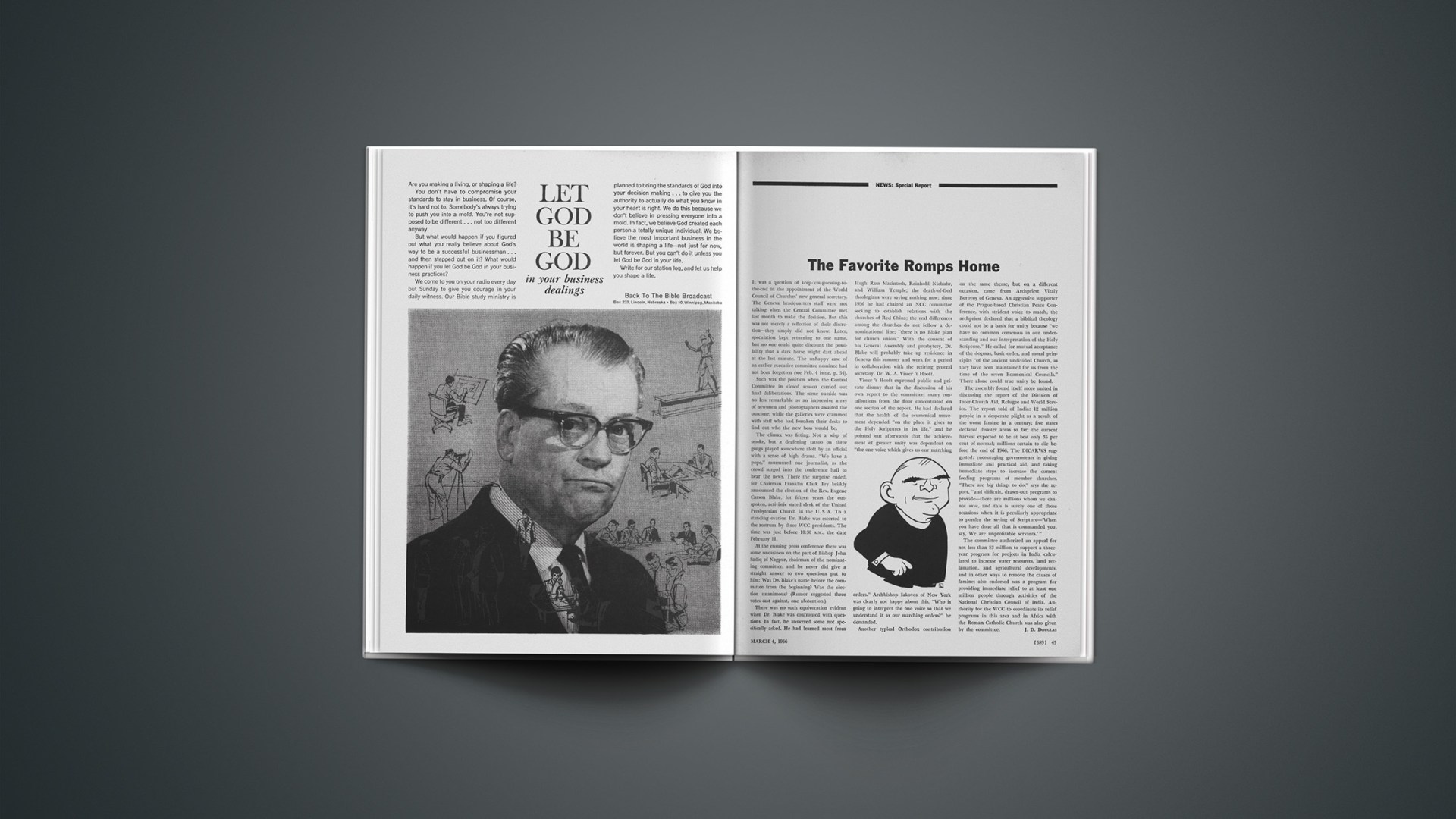
The climax was fitting. Not a wisp of smoke, but a deafening tattoo on three gongs played somewhere aloft by an official with a sense of high drama. “We have a pope,” murmured one journalist, as the crowd surged into the conference hall to hear the news. There the surprise ended, for Chairman Franklin Clark Fry briskly announced the election of the Rev. Eugene Carson Blake, for fifteen years the outspoken, activistic stated clerk of the United Presbyterian Church in the U. S. A. To a standing ovation Dr. Blake was escorted to the rostrum by three WCC presidents. The time was just before 10:30 A.M., the date February 11.

At the ensuing press conference there was some uneasiness on the part of Bishop John Sadiq of Nagpur, chairman of the nominating committee, and he never did give a straight answer to two questions put to him: Was Dr. Blake’s name before the committee from the beginning? Was the election unanimous? (Rumor suggested three votes cast against, one abstention.)

There was no such equivocation evident when Dr. Blake was confronted with questions. In fact, he answered some not specifically asked. He had learned most from Hugh Ross Macintosh, Reinhold Niebuhr, and William Temple; the death-of-God theologians were saying nothing new; since 1956 he had chaired an NCC committee seeking to establish relations with the churches of Red China; the real differences among the churches do not follow a denominational line; “there is no Blake plan for church union.” With the consent of his General Assembly and presbytery, Dr. Blake will probably take up residence in Geneva this summer and work for a period in collaboration with the retiring general secretary, Dr. W. A. Visser’t Hooft.

Visser’t Hooft expressed public and private dismay that in the discussion of his own report to the committee, many contributions from the floor concentrated on one section of the report. He had declared that the health of the ecumenical movement depended “on the place it gives to the Holy Scriptures in its life,” and he pointed out afterwards that the achievement of greater unity was dependent on “the one voice which gives us our marching orders.” Archbishop Iakovos of New York was clearly not happy about this. “Who is going to interpret the one voice so that we understand it as our marching orders?” he demanded.

Another typical Orthodox contribution on the same theme, but on a different occasion, came from Archpriest Vitaly Borovoy of Geneva. An aggressive supporter of the Prague-based Christian Peace Conference, with strident voice to match, the archpriest declared that a biblical theology could not be a basis for unity because “we have no common consensus in our understanding and our interpretation of the Holy Scripture.” He called for mutual acceptance of the dogmas, basic order, and moral principles “of the ancient undivided Church, as they have been maintained for us from the time of the seven Ecumenical Councils.” There alone could true unity be found.

The assembly found itself more united in discussing the report of tire Division of Inter-Church Aid, Refugee and World Service. The report told of India: 12 million people in a desperate plight as a result of the worst famine in a century; five states declared disaster areas so far; the current harvest expected to be at best only 35 per cent of normal; millions certain to die before the end of 1966. The DICARWS suggested: encouraging governments in giving immediate and practical aid, and taking immediate steps to increase the current feeding programs of member churches. “There are big things to do,” says the report, “and difficult, drawn-out programs to provide—there are millions whom we cannot save, and this is surely one of those occasions when it is peculiarly appropriate to ponder the saying of Scripture—‘When you have done all that is commanded you, say, We are unprofitable servants.’ ”

The committee authorized an appeal for not less than $3 million to support a three-year program for projects in India calculated to increase water resources, land reclamation, and agricultural developments, and in other ways to remove the causes of famine; also endorsed was a program for providing immediate relief to at least one million people through activities of the National Christian Council of India. Authority for the WCC to coordinate its relief programs in this area and in Africa with the Roman Catholic Church was also given by the committee.

World Council And The World

After electing Dr. Eugene Carson Blake its new leader, the World Council of Churches’ Central Committee turned its attention to the tangled East-West situation and came up with ten resolutions likely to be the talk of the church world for months (sec editorial, page 31).

The policy-making body called on the United States to stop bombing North Viet Nam, and on North Viet Nam to stop its military infiltration of the South. It asked a seat for the Viet Cong at negotiations, questioned America’s foreign policy of “containment,” and urged that Red China be brought “into the world community of nations.” presumably including the U.N.

The resolutions had been promoted by Orthodox spokesmen from the Soviet Bloc. They went far beyond the current peace offensive of Pope Paul and reflected views expressed by Blake at the National Council of Churches board meeting last December.

Immediately after his WCC election, Blake declared that “whatever victory” the United States might achieve in Viet Nam “will have a racial stigma.” He said that “basically the more successful the U. S. policy seeking victory in Viet Nam, the greater will be the disaster in the long run.”

In America, a high policy adviser to President Johnson countered that Communism isn’t color-blind and that tyranny and aggression don’t respect racial lines. He cited an incident last month in which the Viet Cong blew up three buses, killing fifty-four innocent farmers. The White House view is that the United States has a duty to stop aggression, regardless of the color of the aggressor.

The President told an educators’ convention in Atlantic City February 16, “Observers are not invited when the Viet Cong murder the mother of an officer in the Army of Viet Nam as reprisal against her son—or torture and dismember the master of a local school. But people who hate war ought not ignore this strategy of terror.”

On internal matters, Central Committee Chairman Franklin Clark Fry caused a stir by resigning that post, which he had held since 1954, following Blake’s election. Fry said publicly that it would be “abnormal” and “undesirable” to have Americans in the two top jobs, but rumors from the secret committee session indicated it had more to do with Fry’s longtime differences with Blake on major policy matters. The committee refused to accept the resignation.

The WCC added a second vice-chairman, Dr. J. Russell Chandran, principal of United Theological College, Bangalore, India. A Negro Methodist from the West Indies, the Rev. Philip Potter, became the first person from the mission churches to head WCC’s World Mission and Evangelism Division. Archpriest Vitaly Borovoy was named to the Faith and Order Department, becoming the first Russian Orthodox staffer in the WCC. The department’s new director is Dr. Lukas Vischer, who replaces the Rev. Patrick Rodger, the Scot who last year failed to get final approval as the new general secretary.

Vischer and Nikos A. Nissiotis presented meticulous reports on Vatican II, at which they were official WCC observers. Vischer said the council “brought to shame some hopes which were too small.” He said the WCC and Roman Catholicism now “stand beside each other” without knowing “how the ecumenical movement, which is one, can be expressed as one.”

Despite the ecumenical atmosphere, a Sunday communion service was held in which only Orthodox churchmen were allowed to partake. A second service of Reformed vintage was open to all those whose churches approved. The Central Committee maintained a pregnant silence on this vexing matter of intercommunion.

Several WCC departments reported interest in conservative evangelicals outside the organization and seemingly found not all of them are aggressive, incorrigible, or obscurantist. The Division of Ecumenical Action listed three major areas of difference: spiritual versus organizational emphasis, church involvement in social causes, and standards of personal holiness. But it said “questions like the nature of biblical authority were not raised in any great detail,” perhaps because of the courtesy of those evangelicals it consulted.

The WCC raised its membership to 217 communions by accepting four churches with 720,000 members: Orthodox Church in Czechoslovakia, United Church of Zambia, Malagasy Lutheran Church, and Episcopal Church of Brazil.

Evangelical Fellowship In Africa

While giraffe and lion stalked the game plains below, 189 evangelicals from twenty-one African countries and Madagascar met in a Kenya highlands country lodge to establish their first continent-wide fellowship. A 50-year-old Nigerian, the Rev. David Ishola Olatayo, was elected president of the group, to be officially known as the Association of Evangelicals of Africa and Madagascar.

“Our churches are coming under increasing pressure from liberal ecumenists,” said Olatayo, who is also president of the Nigeria Evangelical Fellowship. “We must stand together to bear witness to our faith, which rests upon the infallibility of the Word of God, and to help one another in these days of urgent spiritual need.”

The nine-day conference began January 29 in response to a call from the Africa Working Committee, a joint project of the American-based Interdenominational Foreign Mission Association and the Evangelical Foreign Missions Association. On the fifth day, the Rev. Aaron Gamede, vice-chairman of the Bantu Evangelical Church of Swaziland, moved that the conference form a continent-wide fellowship, and the entire body of delegates stood to give unanimous affirmation. The formative constitution stressed united evangelical action in evangelism, maintenance of doctrinal purity, relief work, and provision of “representation before governments or other agencies when necessary.” A membership clause states that “no member may at the same time be affiliated with the World Council of Churches, or its associated organizations.”

The Rev. Kenneth Downing, an American who has headed the Africa Evangelical Office at Nairobi, was named general secretary of the new association.

During a series of reports on African countries, delegates were reminded of unsettled conditions. Churches in Angola and Rwanda could not send delegates because of the uncertainty of being allowed to return, and the fear of separating fathers from their families in areas of danger. A Rhodesian delegate was on the last international flight out of his country. One mission leader had to return to Nigeria because of a coup there.

Creation of the new group reflects a continuing trend among evangelicals around the world toward closer cooperation. In addition to the Africa-wide association, there are now national evangelical fellowships in Sierra Leone, Upper Volta, Ivory Coast, Mali, Rhodesia, Zambia, Congo, Senegal, Tchad, Malawi, Nigeria, and Ethiopia.

Last November, a new “Fellowship of Asian Evangelicals” was formed at a Tokyo meeting attended by persons from nine countries. The stated purpose was “fellowship, defense, confirmation and furtherance of the Gospel in Asia.” Dr. Timothy Dzao, evangelist from Hong Kong, was named president. The group promises a measure of additional evangelical cooperation in the Orient, though its scope does not approach that of the new African group.

Prayer For The President

Lyndon Johnson says prayer and faith in God are the “greatness of this nation and the strength of its President.” He spoke after a hard-hitting spiritual appeal (see editorial, page 30) from evangelist Billy Graham, whom Johnson called “one of the great speakers and leaders of our time.”

The occasion was last month’s Presidential Prayer Breakfast, the fourteenth of an annual series, attended by two Supreme Court justices, four Cabinet members, and hundreds of other of other dignitaries.

The President quoted Isaiah’s “they that wait upon the Lord shall renew their strength” and added, “I believe that with all my heart.” He said he is sustained not only by his own prayers but also by those of “hundreds of Americans who daily give a little encouragement to mine.”

The weight of decision-making showed in the President’s face as he said that history teaches us many things but hasn’t shown “how to bear without pain the sending of our young men into battle.”

Mindful of such pressures as the Viet Nam war, the Rev. Richard C. Halverson—a Presbyterian minister in the capital who leads the breakfast-sponsoring International Christian Leadership—prayed for God’s guidance for the President “in the lonely hours when the final decision is his alone.” He also asked God to forgive America for its “presumption” of accepting material wealth “as if we did it alone.”

Vatican: Bans Persist

Pope Paul VI announced last month that he would reorganize a special Vatican commission on birth control in order to “hasten its work.” The commission was established in June, 1964, to aid the church in arriving at an up-to-date pronouncement on birth control. Presumably because of differences among its members, the commission has thus far made no official recommendations.

The Pope’s plan to reorganize the group was revealed in remarks made to a delegation of Italian women. Some observers felt his talk was a clear indication that he favored retention of the church’s ban on artificial contraception.

In other action, Paul VI relaxed the Vatican’s ancient fasting rules. Roman Catholics still are required, generally speaking, to avoid eating meat on Fridays. But under an apostolic constitution that was to go into effect on Ash Wednesday, Lenten fast days are reduced from forty to two. Also, national hierarchies are permitted to lift the meatless Friday rule if it is replaced by other forms of penance and charities. This exception was said to be made in the interests of poorer countries, where abstinence and fast would be added sacrifice for already underfed people. All children under fourteen have been released from the meatless Friday obligation (the age was previously seven).

A number of additional innovations are evident in the 1966 edition of the Vatican Yearbook. Among them is the abolition of a curia office that judged writing for the Vatican’s index of forbidden books. The index did not die with the office, but some see the change as a step in that direction.

Mcintire At The Capitol

Dr. Carl McIntire, president of the International Council of Christian Churches, led a protest rally on the steps of the Pennsylvania State Capitol last month. An estimated four to five thousand persons attended in Harrisburg (see photo at left). McIntire demanded that the state House of Representatives repeal a resolution of censure it had adopted against him last December 17.

At issue was what the legislature called McIntire’s “operational control” of radio station WXUR in Media, Pennsylvania. The resolution questioned whether he “exercises the degree of social and public responsibility which the law demands of a broadcast licensee.”

McIntire denied that the station is under his “operational control.” The stock of the corporation is owned by Faith Theological Seminary, which McIntire serves as board chairman. He says he has never been to the station.

Ecumenical Ins And Outs

Just after the American Baptist Convention’s council voted to stay out of the Consultation on Church Union (see Feb. 18 issue, page 42), the 1.25-million member African Methodist Episcopal Church signed up to become the seventh COCU member.

Meanwhile, another Negro denomination, the Progressive National Baptist Convention, voted to become the sixth group to join the North American wing of the Baptist World Alliance.

Dissent with the ABC’s decision is developing. In Buffalo, a thirty-seven-church association vowed to raise the COCU issue again at the ABC’s May meeting.

Religion And Reportage

Like a smoldering pile of old magazines, church-sponsored news coverage is gradually diminishing. It is a forgotten problem of the ecclesiastical world. In recent weeks, however, a few protesting voices have been raised, and top churchmen may be induced to ponder whether to save the charred pieces or watch them turn to ashes.

The vast majority of North America’s religious periodicals are, in the technical sense, “house organs.” They are financially underwritten by, and therefore subject to, the dominant policies of denominations or other religious organizations. Broad religious news coverage yields to institutional puffery, or to the unoffending humdrum of inspirational sermons and starry-eyed ecumenical apologetics. Occasionally a publication attempts to break the bonds of conformity, but the fatality rate for such adventurers is high. And if they don’t die, they usually fall into a conformity of their own.

Veteran Lutheran spokesman Erik Modean points to this long-dormant problem in a newsletter of the Religious Newswriters Association, composed of religion editors from North America’s largest daily newspapers. Modean, considered the best of church publicists by many secular newsmen, takes sharp issue with no less an authority than Professor Roland Wolseley of Syracuse University’s School of Journalism, well-known expert on religious journals.

Wolseley maintains that the religious press is ahead of the secular press in presenting many of the vital issues of the day. He says “church publications of this country are not so timid as the secular press” in offering “better and more intelligent and intensive coverage of religious news and ideas.”

In a tart rejoinder, Modean asks what periodicals Wolseley reads “and what standards does he use to evaluate their contents? Of the 170 publications listed in the latest directory of the Associated Church Press, 90 are monthlies, 25 semi-monthlies or bi-weeklies, and 15 bi-monthlies or quarterlies. Only 40—and most of these are small, obscure periodicals—are weeklies, and what news they publish is devoted almost exclusively to their own denominations.”

“The sad fact is,” Modean declares, “that there is little religious news, either ‘soft’ or ‘hard’ in today’s church press. As production costs mount and reader interest wanes, more and more periodicals have changed from weeklies to bi-weeklies or monthlies, with a sharp reduction in the space allotted to news. And even that’s so old by the time it’s printed that it can hardly be called news.”

Wolseley, however, is not so blind to the propaganda rationale of ecclesiastical journalism as Modean’s criticism might suggest. In his 451-page Understanding Magazines, published a few weeks ago by Iowa State University Press, Wolseley declares:

“Since the latter part of the eighteenth century, religious magazines have been the core of the churches’ efforts to interpret themselves to their constituencies.”

Wolseley notes that despite wholesale all-member subscription plans through which church people get publications whether they want them or not, the interpretations reach relatively few. He says that “except for leaders, like Presbyterian Life (1,100,000), Awake (3,000,000), The Watchtower (4,000,000), The Upper Room (3,000,000), Together (900,000), and Catholic Digest (700,000), denominational publications have moderate circulations.”

Another problem is church-oriented journalism’s failure to draw a clean line between newsman and publicist, as is done in secular journalism. One ecumenical journal, for instance, has had as its longtime “news correspondent” in a major U. S. city the publicity chief of a large denomination. To the secular world, this is ethical heresy. Writing a promotional item is automatic grounds for terminating accreditation from groups such as those covering the Capitol.

Secular journalism also has its Achilles’ heel. Its presupposition that the only independent publications are those that exist for financial profit falters when one considers that these must cater to the reader and the advertiser. Not even the most daring news media can afford to carry material that consistently alienates reader and advertiser.

The only other alternative is to let government subsidize the press. In a democracy, that is the worst course of all.

Modean offers no encouraging prospect. He concludes that “what’s needed … are news magazines issued weekly, but we’re realistic enough not to confuse need with demand.”
Book Briefs: March 4, 1966

Conclusions By Fiat

The Son of Man in the Synoptic Tradition, by Heinz Eduard Tödt (Westminster, 1965, 366 pp., $8.50), is reviewed by George Eldon Ladd, professor of New Testament exegesis and theology, Fuller Theological Seminary, Pasadena, California.

According to the Gospels, Jesus’ favorite designation for himself and his mission was “Son of Man.” Oscar Cullmann in his important study in Christology suggests that this term is the key to understanding the New Testament picture of Christ. The Gospels show Jesus to be the heavenly Son of Man who will preside in judgment at the end of the age and will vindicate his disciples. Before he fulfills this eschatological role, the Son of Man has appeared in humility among men to serve, and finally to suffer and die.

After a detailed analysis of these three groups of sayings as they are found in the several strata of the Synoptic Gospels (Mark, Q, Matthew, and Luke), Tödt concludes that they do not represent the historical facts of Jesus’ ministry but embody history that has undergone radical transformation. Tödt believes that Jesus used the term but that he always spoke of the Son of Man in the third person and by it designated some future eschatological figure, not himself. Jesus believed that the world was shortly to end; and in view of this, he had the authority and the mission of gathering a group of disciples around himself in an intimate fellowship. At the end of the world, the heavenly Son of Man would confirm this fellowship and would vindicate before God the fellowship the disciples had experienced with Jesus.

When Jesus died, says Tödt, this fellowship was ruptured; but the Resurrection restored it. Through the Resurrection, the disciples believed that Jesus was exalted to heaven and that the eschatological Son of Man whose imminent coming Jesus had proclaimed would be Jesus himself. Then, having identified Jesus with the heavenly Son of Man, the early Palestinian community placed the term “Son of Man” on his lips in sayings about his ministering among men, and his suffering and dying. “In spite of the conflict with the whole tradition, the community designated Jesus as the one who acts on earth with full authority by the name Son of Man because Jesus himself had correlated the guarantee of the Son of Man with his own earthly activity” (p. 295). Although differing in numerous details, the conclusion is similar to that of Bultmann and also that of Bornkamm, under whom Tödt did this research for a Heidelberg doctorate in 1956.

Tödt’s basic proof that the Son of Man sayings about serving and suffering are not authentic is the assertion that they cannot be. The combination of ideas of a heavenly, apocalyptic Son of Man and a serving, suffering Son of Man by Jesus is impossible. “An interpretation which assumed that Jesus in the parousia sayings spoke of the Son of Man as of a transcendent figure, whilst he formulated other sayings in which the Son of Man was devoid of all traditional attributes and conceived according to Jesus’ own activity on earth, would face an unsurmountable difficulty” (p. 125). The authenticity of such sayings as Matthew 8:20 and 11:19 is “disproved by their dissimilarity from the authentic parousia sayings of the Son of Man …” (ibid.). The main body of the study is enlarged by seven excursuses, including a refutation of Oscar Cullmann’s treatment of the same theme.

This is the work that projected Tödt into prominence in the German theological world; he is now a professor at Heidelberg. The bulk of the work is detailed exegesis of the Son of Man sayings. The style is heavy, and unfortunately the translation—always a difficult matter—renders the work even more difficult. In numerous places, the German is more intelligible than the English.

This kind of “advanced” criticism involves historical probabilities and the critic’s judgment about what could or could not have been possible. The basic historical issue is not difficult to grasp. The Son of Man in Judaism is a heavenly apocalyptic figure (Daniel 7, Enoch); but in the Gospels, the Son of Man is both a heavenly figure and a serving, suffering man. Somewhere in Christian origins, a creative synthesis of a heavenly and an earthly figure took place. Did this synthesis occur in the creativity of the mind of Jesus, or in the corporate consciousness of the early Palestinian Christian community?

In the mind of the reviewer, in spite of Tödt’s learned arguments, the probability rests with Jesus rather than with the Church. The fact that weighs most heavily in this direction is that we lack evidence that the early Church ever called Jesus by the title “Son of Man.” The term is not used by Paul or in the other New Testament epistles; in Acts it appears only on the lips of Stephen at the moment of death (Acts 7:56). And in all four Gospels, the title is found only on Jesus’ lips; neither his disciples, nor the people, nor the evangelists call him Son of Man. Although Tödt meets this argument head on in Excursus V, his arguments on this point are not convincing. The contradiction in two sentences is more than apparent: “Hence we cannot assume otherwise than that the designation Son of Man was current in the primitive Palestinian community …” (p. 325); “but even in this post-Easter application only Jesus himself was allowed to utter the name Son of Man” (p. 327).

Although Tödt has some telling criticisms of Cullmann’s involved historical reconstruction to explain the preservation of this term, he has not satisfactorily refuted the position that the form of our gospel tradition reflects the consciousness of the early Church that “Son of Man” was a title used only by Jesus of himself.

GEORGE ELDON LADD

No Slick Answers

Let’s Discuss, by J. Hills Cotterill (Scripture Union, 1965, 198 pp., 17s. 6d.), is reviewed by Kenneth T. Jarvis, minister, Winchmore Hill Baptist Church, London, England.

Have you ever groaned inwardly over those difficult questions young people persistently ask? If so, here is a volume to help you. It consists of group discussion material written by an author well qualified by training and experience to deal with young people. Mrs. Cotterill was for several years head of the religious instruction department at one of London’s schools and is now a senior lecturer in divinity and religious education and a youth leader.

The book contains twenty-four topics arranged around the general theme of the Ten Commandments, and its subjects include: “Sunday—a day of don’ts?,” “Is work a necessary evil?,” “Mercy killing,” and “Boy meets girl.” The author likens the material in each topic to a packaged commodity in a self-service store, containing two compartments. The first deals with preparation for the leader and contains general comments on the kind of problems the group may have, an examination of relevant biblical material, and a list of useful books and booklets. The second deals with presentation and gives advice on several ways of leading into the topic, questions that might arise, excellent verbal and visual illustrations, and a summary.

The book does not attempt to give slick answers to teenagers’ questions and problems, but it does face them fairly and squarely. Its material is a mixture of sound common sense and equally sound biblical scholarship. Typical of the author’s approach is a sentence in her first chapter: “Every commandment given by God to man requires comprehension, exploration in depth, then action.”

KENNETH T. JARVIS

A Tribute

Philosophy and Christianity: Philosophical Essays Dedicated to Dr. Herman Dooyeweerd, a symposium (J. H. Kok and North-Holland Publishing Co., 1965, 162 pp., $12), is reviewed by William Young, assistant professor of philosophy, University of Rhode Island, Kingston.

These twenty-nine articles contributed by Protestant, Roman Catholic, and humanist scholars in the fields of philosophy, law, and medical anthropology are an appropriate tribute to Professor Herman Dooyeweerd on his seventieth birthday. Fifteen contributions are in English, the rest in German or French. Richard Kroner strikes a keynote by observing that Dooyeweerd has realized that we can no longer philosophize without considering the question of the relation between philosophy and Christianity. Articles by members of Dooyeweerd’s school, aside from H. G. Stoker’s independent contribution on “Outlines of a Deontology of Scientific Method,” include “le Temps” by J. P. A. Mekkes, “Vom Nutzen und Nachteil einer philosophischen Ethik” by A. Varga von Kibéd, “A Key to the Enigmas of the World?” by P. E. Hughes, “Dooyeweerd’s Contribution to the Historiography of Philosophy” by C. G. Seerveld, “Einige Bemerkungen zum Grundmotif von Natur and Freiheit in Werk Camus’, Jaspers’ und Freuds” by K. J. Popma, “Hauriou and Dooyeweerd” by J. D. Dengerink, and “The Impact of Herman Dooyeweerd’s Christian Philosophy upon Present Day Biological Thought” by J. J. Duyvené de Wit.

Some of the authors honor Dooyeweerd by serious criticism of certain of his major themes. C. A. Van Peursen examines the “meaning” in Dooyeweerd’s thought and questions the doctrine of “states of affairs … the same for every philosopher.” V. Brümmer also addresses himself to the problem of the antithesis between Christian and non-Christian philosophy, methodically reducing the area of essential difference to a class of value-judgments. J. J. Louet Feisser criticizes Dooyeweerd’s critique of Kant’s critical philosophy, rejecting the charge of a fundamental antinomy between natural causality and freedom in Kant’s system and attacking Dooyeweerd’s appeal to “states of affairs in reality” independent of the human subject. A. G. M. Van Melsen, while agreeing with Dooyeweerd that the scientific method as such is based on certain philosophical presuppositions, yet insists that the unanimity within science itself suggests at least a certain relative autonomy. Van Melsen argues for a universal interdependence of theory and praxis, concluding that the internal development of science has had repercussions upon the initial theoretical attitude and even on its religious ground-motives.

Other interesting philosophical contributions not discussing Dooyeweerd’s views are P. A. Verburg’s “Delosis and Clarity,” K. Kuypers’s “Die Frage nach dem Sinn der Geschichte,” J. F. Glastra van Loon’s “Self-defeating Utterances and the Conditionality of Truth,” and “Christian Philosophy in Clement of Alexandria” by Robbers. S. J. H. Kelsen, who was criticized formerly by Dooyeweerd for reducing legal theory to logic, in his article “Law and Logic” swings to the irrationalist extreme of denying that the logical principle of contradiction is applicable to juridical norms. The section on medical anthropology contains articles of interest by W. K. Van Dijk, A. Schlemmer, and A. L. Janse de Jonge.

As is not unprecedented for a volume printed in the Netherlands, typographical mistakes in the English abound (e.g., “cleary,” p. 22; “thougt,” p. 160; “empirial,” p. 161; “frome,” p. 164; “emperical,” “alle,” p. 214; omission of the apostrophe in “Dooyeweerds,” pp. 161, 434, 435).

There is included a helpful bibliography of English, French, and German publications by Dooyeweerd as well as his Dutch publications 1961–1964, and a brief list of some works dealing with Dooyeweerd’s thought.

This handsomely prepared volume gives expression both to the incisive depth of Dooyeweerd’s critical thinking and to the amazingly wide range of his interests. It ought to be read by all who are seriously concerned with the implications of Christianity for philosophy and the special fields of human thought and activity.

WILLIAM YOUNG

Splenetics

The Intemperate Professor and Other Cultural Splenetics, by Russell Kirk (Louisiana State University Press, 1965, 163 pp., $5), is reviewed by Carl F. H. Henry, editor,CHRISTIANITY TODAY.

Russell Kirk’s essays and lectures make good reading on a winter night. They provide an enjoyable window on conservative thought at its best. Dr. Kirk has lectured on more than 200 American campuses, and he has the intellectual vigor, literary power, and delightful humor to deal in force with such subjects as academic freedom, professorial principle, educational reform, scientism and liberal learning, and morals and culture. A man of letters who is at home in the long history of ideas, he is also a discerning scholar who knows how to raise the right questions about some of the doubtful dogmas of the day.

“He who admits no fear of God is really a post-Christian man; for at the heart of Judaism and Christianity lies a holy dread” (p. 74). Kirk recalls how he shared the requirement of the fear of God as the beginning of wisdom with a group of scholars discussing conditions for arriving at scientific truth. “Some gentlemen took this for indecent levity; others, unable to convince themselves that anyone could mean this literally, groped for the presumptive allegorical or symbolical meaning behind my words. But two or three churchgoers in the gathering were not displeased. They were given to passing the collection plate and to looking upon the church as a means to social reform.… ‘Oh no,’ they murmured, ‘not the fear of God. You mean the love of God, don’t you?’ … Theirs was a thoroughly permissive God the Father, properly instructed by Freud.”

CARL F. H. HENRY

In A Hundred Ways

The New Testament: Its Background, Growth, and Content, by Bruce Manning Metzger (Abingdon, 1965, 288 pp., $4.75), is reviewed by Clark H. Pinnock, assistant professor of New Testament, New Orleans Baptist Theological Seminary, New Orleans, Louisiana.

Every press turning out religious books these days seems to be attempting to provide a complete set of aids to Bible study, and there are many admirable textbooks that introduce the student to the New Testament. But this time, Abingdon has succeeded better than most of its competitors. For Professor Metzger has written a lucid, concise, and exciting volume that serves this purpose brilliantly. His aim was to “present a balanced account that represents the consensus of present-day New Testament scholarship.” In so doing, he reveals the intelligent conservative viewpoint he holds, one that bypasses current destructive fads and features a healthy acceptance of the historical integrity of all the New Testament material. It is a book of basic background information showing balanced judgment and careful, accurate exegesis.

The work falls into three parts: a readable, uncontroversial account of New Testament backgrounds (fifty pages), a perceptive exposition of the life and ministry of Jesus (ninety pages), and a description of the apostolic age and its literature that shows great confidence in the accuracy of Scripture (one hundred pages).

A sampling of his opinions on various issues will illuminate his critical and theological stance. Dr. Metzger adduces the normal arguments for the priority of Mark but lacks confidence in Streeter’s more elaborate four-document hypothesis. Form criticism, he believes, has shown how some modification took place in adapting Jesus’ words and works to new settings, but Metzger insists that these changes were very slight. In his account of the ministry of Jesus, the author readily accepts the chronology of John. In his view, Jesus may have twice cleansed the temple in righteous indignation. Two features of John—the raising of Lazarus and the discourses with the disciples—Metzger relates without a trace of skepticism. For him the bodily resurrection of Jesus was a literal event, the empty tomb a historical fact. He takes pains to point out that Jesus did not teach the “universal fatherhood of God,” and that the Master entertained and taught a very precise and exalted conception of his own person. In a hundred ways, Professor Metzger shows a reverent, believing approach to the Scripture and supports it with excellent proofs. Only with Second Peter does he adopt a position (literary pseudepigraphy) incompatible with biblical infallibility. His treatment of Revelation is perhaps unnecessarily restricted to its historical setting, but after all this is a matter of hermeneutics, not inspiration.

This author is committed to historic Christianity and is quite prepared to stand for supernaturalism where the text requires it. His work is an admirable textbook for college survey courses and for general use.

CLARK H. PINNOCK

The Canon

The Formation of the New Testament, by Robert M. Grant (Harper and Row, 1965, 194 pp., $4), is reviewed by David H. Wallace, professor of biblical theology, California Baptist Theological Seminary, Covina, California.

The title of the book is not a precise indicator of its contents, for at first glance it appears to retrace the steps of primitive event, oral tradition, documentary development, and finally the emergence of the canon, somewhat in the manner of C. F. D. Moule’s The Birth of the New Testament. However, Grant’s concern is not with the pre-literary stage of the New Testament but rather with the development of the canon of the New Testament itself. Therefore he begins with a discussion of the Scriptures of the earliest Church, the Old Testament, and follows this with a review of the Old Testament canon in Judaism and Christianity. He shows that even among Jews in the first and second centuries the Old Testament canon was in a fluid state.

The balance of the book is given to a careful analysis of the growth of the idea of a New Testament canon within the first three centuries of the Church. Professor Grant is entirely at home with patristic materials and calls up witness after witness to speak to the standing of the New Testament documents in the post-apostolic Church. He points out that at Alexandria the New Testament first began to be regarded as “Scripture” (p. 124). By the end of the second century the basic collection of New Testament documents was completed, with the exception of the Catholic Epistles, which existed under an uncertain reputation. Irenaeus was the first theologian of the Church to declare a fourfold gospel tradition, for up to this time no fixed idea existed about the number of Gospels, a fact that Tatian exploited. An anonymous author writing against the Montanists in 192 was apparently the first to equate the “New Testament” with the specific collection of documents that today bears that name. In the end, the New Testament secured consent by the “Great Church” (p. 185) as to its limits around the sixth century. It is noteworthy that this consensus was achieved without a clearly articulated screening method; canonicity was ascribed on the basis of correct tradition about Jesus Christ and apostolic authorship, although even this latter criterion was not applied in the case of Hebrews.

Grant justifies yet another book on this theme on two considerations: the evidences afforded by the Gnostic documents unearthed in Egypt, and the reassessment of the role of tradition today. Despite the intensely historical character of this study, the author affirms that “divine initiative” is integral with the historical process of the emergence of the New Testament (pp. 185 f.), which is the Church’s credentials concerning its own existence and nature. Perhaps the book should be read in conjunction with Oscar Cullmann’s essay on tradition (paradosis) and its role in the formulation of the canon. Grant’s book ends with the sixth century, but in fact the “problem” of the canon of Scripture is still both theoretically and practically unresolved, as the Council of Trent and modern discussion about the inclusion of the Apocrypha illustrate.

DAVID H. WALLACE

Book Briefs

A Short History of the Ancient Near East, by Siegfried J. Schwantes (Baker, 1965, 191 pp., $4.95). A concise, serviceable history. This book won for the author the twenty-fifth-anniversary Baker Book House award.

The Bible Speaks, Volume I, by Hella Taubes, translated by Lolla Bloch (Soncino Press [London], distributed by Books, Inc., 1965, 70 pp., $3.50). A very fine Bible story book marked by loyalty to the Scriptures. With excellent illustrations, a few in color.

Power for Today, compiled by Norman E. Nygaard (Zondervan, 1965, 384 pp., $3.95). A devotional guide for every day of the year, by a host of authors, clerical and lay.

Earnestly Contending for the Faith, by John R. Rice (Sword of the Lord, 1965, 361 pp., $3.50). This is an unusual book. The red, white, and blue cover carries a picture of the author that suggests he is surprised to be there, and the table of contents contains more surprises. Inside the book the author wields “the sword of the Lord,” chiefly against evangelicals, with a finesse reminiscent of Samson.

Perspectives in Evolution, by Robert T. Francoeur (Helicon, 1965, 300 pp., $5.95). A popular (don’t push this word too hard) presentation of the view that time is linear and all things are in a movement of evolution. The Roman Catholic author is a student and admirer of Teilhard de Chardin.

The Apostolic Fathers: A New Translation and Commentary, Volume II: First and Second Clement, by Robert M. Grant and Holt H. Graham (Nelson, 1965, 138 pp., $4).

Psychiatry and Pastoral Care, by Edgar Draper (Prentice-Hall, 1965, 138 pp., $2.95). A general discussion.

No Greater Love, by Wyn Blair Sutphin (John Knox, 1965, 71 pp., $2). The meaning of the Cross in dramatic language.

The Cross of Jesus Christ as a Doctor Sees It, by P. A. Satralker (Carlton Press, 1965, 139 pp., $2.75). A doctor looks at some of the strange physiological aspects of Christ’s death. Interesting and enlightening.

Racism and the Christian Understanding of Man, by George D. Kelsey (Scribners, 1965, 178 pp., $4.50). A provocative study.

Natural Law: A Theological Investigation, by Josef Fuchs, S. J. (Sheed and Ward, 1965, 193 pp., $4.50). A Roman Catholic approach to natural law from the basis of Christian theology.

Christian Seed in Western Soil: Pacific School of Religion Through a Century, by Harland E. Hogue (Pacific School of Religion, 1965, 276 pp., $4.75).

Show Me Thy Glory, by Sarah Anne Jepson (Moody, 1965, 576 pp., $3.95). Brief evangelical devotionals that have something to say.

The Genesis Octapla: Eight English Versions of Genesis in the Tyndale-King James Tradition, edited by Luther A. Weigle (Nelson, 1965, 301 pp., $12.50).

Biblical Backgrounds, by J. McKee Adams, revised by Joseph A. Callaway (Broadman, 1965, 231 pp., $6.50). Long a useful book, now extensively revised.

Social Philosophy, by Martin G. Plattel (Duquesne University, 1965, 346 pp., $7.95). Lectures that develop the theme “existence is co-existence” and discuss such things as the state, work, justice. For the serious student.

A Short History of Greece: From Early Times to 1964, by W. A. Heurtley et al. (Cambridge, 1965, 202 pp., $3.95). A very readable introduction to Greek history.

A History of Christian Thought, Volume I, by Otto W. Heick (Fortress, 1965, 509 pp., $8.75). A competent, factual, and lucid presentation of the history of Christian dogma, but one that lacks a theological engagement and struggle with the issues involved.

Between Sundays, by Richard C. Halverson (Zondervan, 1965, 160 pp., $2.95). Concise, down-to-earth religious essays that show the meaning of Christianity for every man, in any place, any day of the week. Around-the-clock Christianity.

Paperbacks

Sometimes I Feel Like a Blob, by Ethel Barrett (Regal Books, 1965, 190 pp., $1). Speaks religious sense to teen-agers, relating Christian truths to their problems. The first of a new line of paperbacks by Gospel Light Publications.

When a Teen Falls in Love and Build a Happy Home with Discipline, by Henry R. Brandt (Scripture Press, 1965, 34 pp. each, $.50 each). From the “Building a Christian Home” series.

How Not to Kill Your Husband, by Kenneth C. Hutchin (Hawthorn, 1965, 284 pp., $1.75). Advice to women on how to keep their men alive. First published in 1962.

How to Save Time in the Ministry, by Leslie B. Flynn (Broadman, 1966, 95 pp., $1.50). Example: get up at four in the morning and pray while you shave.

The Cross and the Creed: The Seven Last Words in Light of the Third Article of the Creed, by David Belgum (Augsburg, 1966, 95 pp., $1.95). Spiritual wisdom in simple language.

The Upper Room Disciplines, 1966, edited by Sulon G. Ferree (Upper Room, 1965, 375 pp., $1).

No Easy Salvation, by R. E. Glaze, Jr. (Broadman, 1966, 71 pp., $1.25).

Crossroads of Lent: Sermons for the Lenten Season, by Robert L. Anderson (Augsburg, 1966, 104 pp., $1.95). Good.

The Unsilent South: Prophetic Preaching in Racial Crisis, edited by Donald W. Shriver, Jr. (John Knox, 1965, 169 pp., $2.25). Southern sermons (most shortened) on race problems, with date and place preached.

Revivalism in America, by William Warren Sweet (Abingdon, 1965, 192 pp., $1.50). First published in 1944.

The Morality of Law, by Lon L. Fuller (Yale University, 1965, 202 pp., $1.45). Storrs Lectures on jurisprudence, Yale Law School, 1963.

Taking Stock: Help for Daily Living, by Theodore S. Smylie (John Knox, 1965, 128 pp., $1.75). Short meditations—very good.

The Archeology of World Religions (three volumes), by Jack Finegan (Princeton University, 1965, 600 pp., $7.95). Extensive coverage, lucid writing. A small library on the non-Christian world religions. First printed in 1952.

The Mediator: A Study of the Central Doctrine of the Christian Faith, by Emil Brunner (Westminster, 1965, 624 pp., $3.25). One of Brunner’s most important works.

Thirty Psalmists: Personalities of the Psalter, by Fleming James, edited by R. Lansing Hicks (Seabury, 1965, 252 pp., $1.95). Scholarly studies that reflect Hermann Gunkel’s study of the Psalms. First published in 1938.

The Pastoral Ministry of Church Officers, by Charlie W. Shedd (John Knox, 1965, 72 pp., $1.25). A provocative booklet that every elder and deacon in the church should read. It might make them work twice as hard.

The Minister’s Workshop: The Metropolitan Pulpit

“Read to refill the wells of inspiration,” advises a leading minister who even took a suitcase full of books on his honeymoon

For twenty-nine years I have preached from three to five different sermons every week from the pulpit of Park Street Church, located in the geographical center of Boston. In some seasons, such as Holy Week, I preach as many as eight different sermons in one week. Three messages weekly are on radio, and one other is on television. Then there is also a Friday night Bible lecture.

The responsibility of preaching the Gospel in this intellectual center of 130,000 students in over twenty institutions of higher learning has never lost its challenge or joy. Hundreds of visitors are found in the congregations every Sunday morning and evening, many of them students. Since much of Boston thought is hostile to evangelical Christianity, the pressure of preparation for this preaching is intensified.

Recently a member of a prominent political family of Boston and of another branch of the faith stopped in at the office to ask for a copy of a sermon. The interview revealed that this person had been listening to my sermons for years but had never contacted the church before. One never knows to whom he is preaching.

My work is my life and my life is my work. I cannot preach about a truth I have not experienced by way of present possession or expectant hope. Hence every occurrence in the family, in devotions, in academic pursuits, in relaxation, in travel, and in occasional reading is preparation for preaching. A man’s preaching will rise no higher than the spiritual level of his own experience. Thus I seek “the anointing of the Holy One” upon my thought and action as the fountainhead of conviction in preaching.

The year begins with the summer reading or travel. On my honeymoon to Europe one suitcase was filled with books. I go nowhere without at least a briefcase filled with books for long-term and short-term study. Many summers are spent at Hill-winds, our home in the White Mountains. There I read to refill the wells of inspiration. There I meditate, take inventory, pray, and seek a new filling of God’s Spirit. There I begin to plan the program for the year of preaching.

The fall opens with evening evangelistic sermons, in which I bear in mind the influx of students. These sermons handle the great texts and truths of Scripture that point toward a decision. Once we have a large group attached to the services, I move into doctrinal sermons, giving series on such topics as Christ, the Holy Spirit, the creed, the deeper life, and the steps of salvation. Next I lighten the menu with a series of biographical sermons (for which the Bible is inexhaustible), sometimes preaching a series on the life of one biblical character. Then comes Lent, with its opportunity for exploiting the great redemptive themes. After Easter, I find that topical or polemic sermons will sustain interest at the evening services. I always use series of messages.

The morning sermons in my ministry have always been expository. Here is the richest field of material for a long ministry and for the fullest instruction of the people. I choose a book of the Bible, read it over in the Greek and many times in the English, outline it, and then take each subdivision for a sermon. The sermon must be a unit that stands alone, for visitors will hear only one message. I spend the most time on my outline, so that it is logical, alliterative, parallelistic, and easy to remember. Then I list all thoughts that come to me on the text or subject, using the analogy of Scripture. The next step is to consult critical commentaries to be sure my interpretation is correct. Then I find out what material I have in my file and book index for supporting information or illustration. If necessary, as a final step, I use practical commentaries. When all this is finished, I dictate the message so as to be able to express myself carefully and well.

As I write this, I have just finished three years of preaching on Sunday mornings on the Gospel of Matthew. Nevertheless, I do not hesitate to interrupt an expository series at any time for an occasional sermon when it is appropriate. One must not get into bondage.

I seriously try to take Monday as a day of rest. At least, I get exercise and change. By Monday night I begin some general reading. Tuesday morning brings the routine work of correspondence, bulletin material, administrative direction. As soon as possible, I get at my evening sermon; this must be finished by noon on Wednesday. Wednesday afternoon is given to interviews and administration. Thursday morning I give a television address and record a twenty-minute exposition on the Sunday school lesson to be broadcast on Sunday. Thursday afternoon I begin preparing my Sunday sermon. Friday I spend on the Friday night Bible lecture, plus interviews. Saturday morning I return to my Sunday morning sermon and work at it till it is finished, however late that may be. If time remains on Saturday afternoon, I call on my people, as I do in evenings not taken up with meetings of church groups.

The advantage of this order for the week is that I unload my sermons in the inverse order of preparation: the Friday lecture first, the Sunday morning sermon (last prepared) second, and the Sunday evening sermon last. In this way I can preach without notes, a practice I have maintained for thirty-five years. This means that I must firmly keep Saturday evenings free for studying the sermon outlines and memorizing quotations.

The great objective of preaching is to be a vehicle of the Word of God, to be the means of conversion, of edification, of exhortation, and of instruction. Every talent and ability should be dedicated to this end. When people hear us preach, they should catch their breath in holy awe and say, as the people did of Jesus, “Whence hath this man this wisdom?” All of this goes back to the spiritual life of the preacher.

I keep a prayer list. I put everything—every decision to be made, every responsibility, every journey, every problem, every undertaking—on this list. I pray over them daily. I find that to have prayed well is to have studied well. Much of my preaching direction comes through my praying.—THE REV. HAROLD JOHN OCKENGA, Park Street (Congregational) Church, Boston, Mass.

The Church and Social Problems

“If the Church descends to promoting socialism, it will become as short-lived as our secular organizations.”

There is little about poverty that I do not understand from personal experience, and my sympathies are with suffering people. Indeed, I have spent a good part of my life trying to help the unfortunate.

There are those who would have the Church make pronouncements and take positions on social, political, and economic questions. They cannot possibly be more interested than I am in relieving poverty and lifting the burden of misery from the backs of men. We agree on goals. We divide sharply on the best way of making progress toward them.

Church bodies should not make pronouncements in these areas. Nor should they assume that all people who are really Christians must take a certain view of current problems. To do so will divide the Church.

It is a great mistake for the minister, speaking from his pulpit, to take a position on controversial economic, social, and political problems. Of course, he should discharge his duty as a citizen in these matters, and he has the same secular means that are available to the rest of us.

Equally honest and devoted Christian men and women will disagree about tariffs, monetary policy, agricultural problems, federal subsidies to schools, housing, relief, foreign aid, and many other problems. Consecrated Christians just do not agree as to the will of God in the solution of these problems. If the Church undertakes to speak ex cathedra concerning them, it will divide its membership.

Jesus commanded us to go into all the world and preach the Gospel to every creature. He did not command us to go into the world and organize a peace corps or civil-disobedience demonstrations. He did not resort to law or coercion as a means of improving society.

I am not saying that these social, economic, and political questions are not important. They are important, and every Christian should be concerned; but our concern and action should be expressed through secular organizations and not through the churches.

We need to get our hearts right through the worship of God and then mobilize our secular organizations to take the required action for the improvement of society. The Church is not the proper instrument. If we attempt to use it for that purpose, we shall destroy it.

When spiritual rebirth takes place through repentance, forgiveness of one’s sins and growth in grace is continued through persistent worship of God. The high ethical standards we find in Christ become the ruling principles of our lives. Reborn men and women go out and remake society.

I am just as much interested in meeting social needs and solving economic problems as the socialists, but I insist that we must not try to do it by changing our churches into social-action agencies. They must not climb down from the spiritual plane to take sides on controversial questions of economics and politics.

Jesus said if he were lifted up, he would draw all men unto him. He did not say that he would draw a majority and then coerce the others. When the rich young ruler was not ready to surrender his life and possessions to the will of Christ, Jesus might have said to his disciples, “The young man does not know what is good for him, so draw up a law that will dispossess him of the greater part of his wealth and we will use it properly.”

If the Church descends to promoting socialism, it will become as short-lived as our secular organizations. To remain permanent, it must be a divine institution proclaiming eternal spiritual principles.

A company of people were listening to Jesus and one said to him, “Master, speak to my brother, that he divide the inheritance with me.” Jesus replied, “Man, who made me a judge or a divider over you?” Then Jesus said to the people, “Take heed, and beware of covetousness” (Luke 12:13–15a).

Naturally this does not mean that we should not be good trustees for God both with our time and with our means. It is the duty of our ministers and church leaders to inculcate in all of us a sense of trusteeship. On the other hand, if Jesus refused to be a “judge or a divider over you,” it would seem altogether out of place for the Church to assume those roles.

The proponents of the so-called social gospel say, “How can a Christian ignore the great need?” He can’t. He will do his utmost to bring about improvement, but he will do this as a Christian citizen and not by seeking to make a wrongful use of a sacred divine institution established by Jesus Christ for the purpose of operating permanently in the spiritual world.

Our liberal friends often speak contemptuously of pious people. They say individual piety counts for little and has no bearing on great sociological issues. They are wrong. If the Church had fulfilled its mission, had taught the people to worship God and respect his moral law summarized in the Ten Commandments, our present seemingly insoluble problems would not exist. The only cure is to improve the character of individuals, to regenerate people one by one; that is, to promulgate the personal piety which the welfare staters ridicule.

When John Calvin went to Geneva, it was one of the most depraved cities in Europe. He constantly reminded his ministers to concentrate on proclaiming the spiritual message of the Church. This was done, and within a few years Geneva became one of the most wholesome and best-governed cities in Europe. Today the Church has taken the opposite direction, and we hear little about personal piety.

Recently I heard a liberal Christian leader speak of the “dedicated, high-principled young men who surrounded Castro in his move for social justice in Cuba.” Shocking! But this is what happens when religious leaders place their faith in material movements and reforms.

Nothing but faith in God can cause a man to overcome his temptation and to be honest, truthful, and just in all his dealings. When the Church places its faith in coercive governmental action, it is bound to be defeated. Government can control people and drive them, but it cannot regenerate their hearts. Without the latter, there is no internal, redeeming self-help through the renewal of a right spirit within man. Until this change takes place, the best we will have is a coercive society and discipline through police action. In the end, it means a master-and-slave relationship.

Salvation for society awaits the rebirth of its individual components. We shall never overcome the woes of mankind until we pray with the Psalmist, “Create in me a clean heart, O God; and renew a right spirit within me” (Ps. 51:10).

Faith in God puts courage, compassion, and determination into the hearts of men. These are the qualities that conquer poverty and solve other social problems. It is the business of the Church to mobilize spiritual power. By doing so, it can solve our perplexing social and economic ills; but if it deserts its true function, the Church will meet with tragic failure.

When secular organizations advocate measures that are proved wrong, no great damage is done, for they are of a temporary nature and may be supplanted by others that are able more accurately to interpret the will of the people. But when our one permanent divine institution deserts its commission to preach the Gospel, it and the world suffer irreparable damage.

The Church now advocates many of the measures of the welfare state. In so doing, it violates and tears down the very moral laws of God it is supposed to champion, teach, and proclaim.

We have in this country divided ourselves into a vast number of pressure groups with lobbies in every statehouse as well as the Capitol. We want the wealth of others and strive to see how much of it we can obtain for ourselves. We have become a nation of coveters.

The Church has too often failed in its mission of proclaiming the Gospel and devoted its time to the impossible task of trying to divide the wealth and redistribute it among the people. A Church which continues to do that cannot prosper and cannot for long retain the confidence, respect, and love of its people.

Much of our church leadership is advocating socialism for our country. The appeasement and wasteful foreign-aid program it urges for friend and foe alike are recognized by a large part of our church membership as threatening the solvency and even the very life of our country. If our church leadership continues to pontificate in this realm, it will greatly injure the Church. Even though it might give the right advice, it would still divide the Church, for there are many who do not agree that this is the proper function of the Church.

The Church must recover its mighty influence over individual lives. It must point the way to salvation from sin and thus achieve a happy, prosperous, and self-governing free society. The alternative leads us only deeper into socialism with its accumulating misery and despair.—HOWARD E. KERSHNER, in Christian Economics.

A Reading List on Evangelism

Background study for the World Congress on Evangelism in Berlin

Looking toward the World Congress on Evangelism, to be held in Berlin next fall, CHRISTIANITY TODAY presents representative reading lists on the subject of evangelism prepared by three men in different areas of evangelical ministry. The first list comes from Kenneth L. Chafin, professor of evangelism at the Southern Baptist Theological Seminary, Louisville, Kentucky. The second list was prepared by the Reverend Stacey E. Woods, general secretary of the International Fellowship of Evangelical Students; works already mentioned by Professor Chafin are not repeated. The third list is from President David A. Hubbard of Fuller Theological Seminary, Pasadena, California, and likewise excludes books already mentioned by Professor Chafin.

I

GENERAL

GREEN, BRYAN S.: The Practice of Evangelism. Hodder and Stoughton, 1951.

JOWETT, JOHN HENRY: The Passion for Souls. Revell, 1905.

STEWART, JAMES S.: Thine Is the Kingdom. Saint Andrew Press, 1956.

SWEAZEY, GEORGE E.: Effective Evangelism. Harper and Brothers, 1953.

WALKER, ALAN: The Whole Gospel for the Whole World. Abingdon, 1957.

PARISH PROGRAM

ALLAN, TOM: The Face of My Parish. Harper and Brothers, and SCM, 1957.

BLACKWOOD, ANDREW W.: Evangelism in the Home Church. Abingdon-Cokesbury, 1942.

SHORT, ROY HUNTER: Evangelism Through the Local Church. Abingdon, 1956.

PASTORAL COUNSELING

CALKINS, RAYMOND: How Jesus Dealt with Men. Abingdon-Cokesbury, 1942.

DALLOFF, EUGENE D.: The Romance of Doorbells. Judson, 1951.

JEFFERSON, CHARLES EDWARD: The Minister as Shepherd. Thomas Y. Crowell Company, 1912.

MACARTNEY, CLARENCE: Great Interviews of Jesus. Abingdon-Cokesbury, 1944.

SOUTHARD, SAMUEL: Pastoral Evangelism. Broadman, 1962.

PERSONAL

EVANS, WILLIAM: Personal Soul Winning. Bible Institute Colportage Association, 1910.

STONE, JOHN TIMOTHY: Winning Men. Revell, 1946.

TORREY, R. A.: How to Bring Men to Christ. Revell, 1893.

TRUMBULL, CHARLES G.: Taking Men Alive. YMCA Press, 1907.

PREACHING

JEFFERSON, CHARLES EDWARD: The Minister as Prophet. Thomas Y. Crowell Company, 1905.

SHORT, ROY H.: Evangelistic Preaching. The Methodist Church, General Board of Evangelism, 1946.

WHITESELL, FARIS D.: Sixty-five Ways to Give Evangelistic Invitations. Zondervan, 1945.

SPIRITUAL LIFE AND EVANGELISM

BONAR, HORATIUS: Words to Winners of Souls. American Tract Society, n.d.

BOUNDS, E. M.: Power Through Prayer. Marshall, Morgan and Scott, 1960.

FREER, H. W., and HALL, FRANCIS B.: Two or Three Together. Harper and Brothers, 1954.

VISITATION EVANGELISM

ARCHIBALD, ARTHUR C.: New Testament Evangelism. Judson, 1947.

BRYAN, DAWSON CHARLES: A Workable Plan of Evangelism. Abingdon-Cokesbury, 1945.

HILTNER, SEWARD: How to Make an Evangelistic Call. Department of Evangelism, Federal Council of Churches of Christ in America, 1946.

II

ALLEN, ROLAND: Missionary MethodsSt. Paul’s or Ours? Eerdmans, 1962.

ALLEN, ROLAND: The Spontaneous Expansion of the Church. Eerdmans, 1962.

CHAFER, LOUIS SPERRY: True Evangelism. Zondervan, 1964.

COLQUHOUN, FRANK: Christ’s Ambassadors. Hodder and Stoughton, 1965.

GREEN, MICHAEL: The Meaning of Salvation. Hodder and Stoughton, 1965.

KUIPER, R. B.: God-Centered Evangelism. Baker, 1961.

STOTT, JOHN R. W.: Motives and Methods in Evangelism. Inter-Varsity Press, 1962.

WINTER, DAVID: The Old Faith in a New World. Hodder and Stoughton, 1965.

WOOD, MAURICE: Like a Mighty Army. Marshall, Morgan and Scott, 1955.

III

BARCLAY, WILLIAM: Turning to God: A Study of Conversion in the Book of Acts and Today. Westminster, 1964.

BARLOW, WALTER: God So Loved. Revell, 1952.

BATES, SEARLE M., and PAUCK, WILHELM: The Prospects of Christianity Throughout the World. Scribners, 1964.

BAYLY, JOSEPH: The Gospel Blimp. Windward Press, 1960.

BROWN, STANLEY C.: Evangelism in the Early Church. Eerdmans, 1963.

COLEMAN, ROBERT E.: The Master Plan of Evangelism. Christian Outreach, 1963.

GRAHAM, BILLY: World Aflame. Doubleday, 1965.

MCGAVRAN, DONALD A., et al.: Church Growth and Christian Mission. Harper and Row, 1965. MARSHALL, PETER: John Doe Disciple. McGraw-Hill, 1963.

NEILL, STEPHEN: A History of Christian Missions. Eerdmans, 1964.

NEWBIGIN, LESSLIE, et al.: Decisive Hour for the Christian Mission. SCM Press, 1960.

PACKER, J. I.: Evangelism and the Sovereignty of God. Inter-Varsity Press, 1961.

RAINES, ROBERT A.: New Life in the Church. Harper and Row, 1961.

RINKER, ROSALIND: You Can Witness with Confidence. Zondervan, 1962.

SEAMANDS, JOHN T.: The Supreme Task of the Church. Eerdmans, 1964.

SHIPPEY, FREDERICK A.: Protestantism in Suburban Life. Abingdon, 1964.

SHOEMAKER, SAMUEL M.: Beginning Your Ministry. Harper and Row, 1963.

STRACHAN, KENNETH: Evangelism in Depth. Moody, 1961. TRUEBLOOD, ELTON: The Company of the Committed. Harper and Row, 1961.

WEBBER, GEORGE W.: God’s Colony in Man’s World. Abingdon, 1960.

WINTER, GIBSON: The Suburban Captivity of the Churches. Macmillan, 1962.

World Council Finds a New Spokesman

Is Dr. Blake moving from the most powerful post in American Presbyterianism to an influential role in what may fast become a Protestant-Orthodox curia?

The election of Dr. Eugene Carson Blake as head of the World Council of Churches, following Dr. W. A. Visser ’t Hooft’s eighteen-year term, is highly significant.

To the most powerful ecumenical post outside the Roman Catholic realm, the WCC has elevated not only a prominent American churchman but one skilled in the use of ecclesiastical power for advancing ecumenical aims. After accepting his election as “a call from God,” Dr. Blake directed his first words in his new office to the World Council’s unity moves toward the Roman Catholic Church. His responsible role will confer on him much of the same public visibility for his words and deeds as the Pope possesses, although his personal authority is interpreted quite differently from the Pope’s.

The selection of Dr. Blake gives American ecumenical Christianity special distinction (last year’s effort to name Dr. Patrick Rodger, a Scottish Anglican of evangelical sympathies, was suddenly set aside) and also honors a churchman whose patterns of procedure are well known. For Dr. Blake made the office of stated clerk in the United Presbyterian Church in the U. S. A. one of the most directive agencies in that denomination, and exerted decisive influence upon the leadership and emphasis of its seminaries and other institutions. His leadership has created serious denominational tensions, and some Presbyterians even hoped that his gifts might be deployed elsewhere. The move raises speculations about what kind of successor Presbyterians will name, and whether the office of stated clerk can once again be dissociated from all directive authority. In that post Dr. Blake was associated with two bold ecumenical moves that currently appear abortive. One was the 1960 Blake-Pike plan for merger of American Protestant churches, most recently bypassed by leaders of the American Baptist Convention. The other was the proposed “Confession of 1967,” which is running into increasing demands for revision or abandonment within the United Presbyterian Church. (In relation to this document, however, Dr. Blake remained in the background, and it is not fully certain to what extent he approved it.)

Dr. Blake believes in repentance and evangelical conversion. Although his theological views are considered broadly Reformed, in ecumenical planning they seem not to be determinative. He has actively promoted direct ecclesiastical involvement in political pressures and has encouraged clerical participation in political demonstrations. Shortly after assuming his new post, he released a provocative statement declaring that United States military victory in Viet Nam would create more problems than it would solve. He contended that “the bombing of a less developed nation of colored people by a large, rich, white one” carries a racial stigma. What special sources of military information Dr. Blake has that are not available to those in high government circles we do not know, but we suspect that the failure of a nation—white or black, large or small, rich or poor—to take a firm stand against Communist aggression would carry not only a racial stigma but an ideological one.

Dr. Blake has stepped from what he made the most powerful post in American Presbyterianism to an influential role in what may fast become a Protestant-Orthodox curia. It is an office that could make the man, but could also unmake the Church because of the high perils of ecclesiastical and theological adventurism. Dr. Blake needs the earnest and continuing prayers of all God’s people, for institutional Christianity has already made too many mistakes in our century to take the future for granted.

A Prayer For Moral Courage

“It is my prayer today,” said Evangelist Billy Graham at the fourteenth annual Presidential Prayer Breakfast in Washington, sponsored by International Christian Leadership, “that we will recover moral courage in this country.… A spiritual awakening must sweep our country from coast to coast like a prairie fire.”

Seldom have lines from the “Battle Hymn of the Republic” (“He is sifting out the hearts of men …”) seemed as fitting as they did when the 1,500 participants united in prayer with President Johnson and other political dignitaries. They asked for divine guidance and courage in a time when, as Graham put it, “history is about to reach an impasse and men are on a collision course.”

The evangelist warned against a superficial view of human nature that seeks a new humanity through merely external changes. “The people of Jesus’ day did not know, as he did, the deep-seated evil within human nature. They did not know how deeply fixed were the roots of pride, greed, selfishness, and lust in human society.… Their understanding of evil in the world was shallow and superficial.… It is the same tragic mistake being made by many well-meaning people today who have only a superficial knowledge of the Bible.… We will only delude ourselves if we try to be more optimistic than Christ. The basic problem facing our world is not just social inequity, lack of education, or even physical hunger. We are finding that highly educated and well-fed people have greeds, hate, passions, and lust that are not eliminated by any known process of education. The roots of sin in our hearts are extremely deep … and only the fire of the Lord can burn them out.”

Petal Plucking

The beauty of a rose is destroyed as one plucks away its petals to see the source of its fragrance. Similarly, the Church, if it continues its introspective analyses, may soon impair its usefulness.

Not for a moment do we imply that the Church should remain static. Although its message must not change, methods and organization may call for repeated revision. During recent years, however, churchmen have become so involved in endless reappraisals that much valuable time needed for the real work of the Church has been spent in talking about what might be done. One major denomination is making a study of the nature and message of evangelism. Another is seeking to centralize power in the church.

If soldiers do not know until they are engaged in battle what their goals are and what tactics they are to use, they are in danger of losing the war.

Surely the Church should know its calling. If a church does not know what evangelism is, there is something radically wrong. If it does not know the imperativeness of home and world missions, it is twenty centuries behind the times.

What is needed is a return to those convictions that have been the mainspring of the Church in the past, convictions about its nature and mission, the full integrity and authority of the Scriptures, life and death, and, above all, the person and work of the Lord Jesus Christ.

Re-examinations have their place, but they are useless unless built on the sure Foundation.

The W.C.C. And Viet Nam

Diplomats will soon gather in Geneva for disarmament conferences. There the World Council of Churches maintains its headquarters, and there the council’s 100-member Central Committee has just adopted a strong ten-point resolution on the Viet Nam war in the name of its member churches.

Irrespective of its position, the resolution itself continues the WCC practice of making controversial pronouncements on specific political and military policies. Dr. Paul Ramsey, Princeton University professor of Christian ethics, has noted that unlike American Protestant ecumenism, the Roman Catholic pope holds that “judgment of political questions and temporal interests” lies outside his competence, and that he has consistently distinguished his appeals for peace from “pacifism, which ignores relative rights and duties in the conflict in question.”

In its latest pronouncement, the WCC “advises” the United States not only to stop bombing North Viet Nam and to announce a future withdrawal of its troops under international peacekeeping machinery but also to “modify its policy of containment of Communism.” The council called on North Viet Nam to stop infiltrating South Viet Nam, and said both sides should recognize the futility of military action as a solution to the problems.

Let it be said, to the credit of President Johnson, and almost everyone else, that no person of good will really wants war. America wants peace and is forced to use war to secure it. It is precisely at this point that the WCC pronouncement is simplistic and naive. The council fails to see that American intervention in World War II and in Viet Nam occurred after war had begun, and that America’s aim in each instance was to bring peace and freedom to enslaved people. Had there been no Communist aggression in Viet Nam, America would not be involved in the present conflict. And America can get out of that country the minute those who really started the war stop it.

Money Can Ruin

The prevailing assumption that the lavish use of money can cure the world’s ills is a delusion. A wag has said of money, “… but it helps.” And this is true. But the world’s problems go far deeper than the economic level; money alone may injure as much as help. Unless money is used in a way that protects the obligation of the individual to work for himself and to practice thrift, it becomes a curse for all concerned.

With some happy exceptions, the history of the United States government’s economic aid to needy nations is not encouraging. Not only have billions of dollars been used for political purposes: great sums have also been diverted into private coffers in the absence of necessary supervision.

The Church has been called to witness to the One who spoke of himself as the “Bread of Life,” and who said, “Whosoever drinketh of the water that I shall give shall never thirst.” Material aid alone cannot solve the world’s problems. The Church must proclaim to all men the unsearchable riches found only in Jesus Christ.

New Ethical Frontiers

This season the NCC’s television series on “Frontiers of Faith” (NBC) is devoted to Christian ethics. It may be hoped that this Sunday program will give viewers an authentic scriptural perspective on the wilderness of contemporary life.

The new morality is having an erosive effect on inherited Christian values. It is high tragedy that some churchmen sympathize not only with the removers of all objective ethical restraints but also with those who would destroy the supernatural God of the Bible. We hope “Frontiers of Faith” viewers will find in ecumenical Protestantism’s privileged television programming an illuminating exposition of the Christian alternative.

The introductory sketch by Donald Grey Barnhouse, Jr., son of the late Bible expositor, indicated that subsequent programs would deal less in generalities. As for the introduction, it seemed to us rather timid and somewhat repetitious, and neither spiritually exciting nor logically compelling.

Mr. Barnhouse offered three observations: (1) Christian ethics is not a set of rules or a series of commands but rather a declaration of news and an invitation. (But since the New Testament affirms the commandments of God, traditional evangelical ethics has held that the whole counsel of God includes both the Law and the Gospel.) (2) Christian ethics is not the attempt to substitute one Book for another but a glimpse of the living God—a good Father. (But the Protestant Reformers did insist on a uniquely inspired, authoritative Bible.) (3) The answer to the question of what God is like was supremely given by the life of Jesus Christ, particularly in suffering love as illustrated by his death. (Since Mr. Barnhouse earlier dismissed any God who “threatens to burn us, if we don’t do what he wants,” we were disappointed that at this point he spoke of the death of Christ only as exemplary and not as substitutionary as well.)

Drinking Is Not For The Skies

Among several proposals being pressed by the American Council on Alcohol Problems, two are especially significant. Pointing to figures from the Federal Aviation Agency that show drinking involved in one-third of all deaths from crashes of private aircraft, the council urges the FAA to require that breath-testing devices be installed in all airports, and that before flying all private aircraft pilots use such a device; any person registering over 0.03 per cent of alcohol in his blood would then be prohibited from flying, on penalty of losing his license for a reasonable time. This procedure, it is claimed would reduce by 80 to 95 per cent the fatalities caused by crashes in which drinking is involved.

Another recommendation concerns the serving of liquor to passengers on commercial airlines. Contending that pilots and stewardesses oppose this practice, the council says that in an emergency passengers even mildly under the influence of alcohol could not respond to instructions with adequate speed and efficiency. It also points out the danger posed by passengers who board aircraft after having had a few drinks and, when they have more drinks aloft, become troublesome. The council urges commercial airlines to stop serving alcoholic beverages on flights. And it suggests further that until this is done, airlines treat all first-class passengers alike by giving to those who refuse the drinks offered them on a flight a credit slip for the value of the drinks, to be used in the purchase of plane tickets.

These proposals make sense. Vast as the skies are, they are simply not big enough for even one drinking pilot. The scandal of the highways is the drinking driver, with his potential for snuffing out the lives of several human beings. But how much more grim is the prospect of a drinking private pilot, with his potential for killing scores of persons through collision in the skies or a crash into a populated area? The air is free, but not for drinking pilots or intoxicated passengers.

Half Below Twenty-Six

Humanity—at least in the United States—is younger than ever. Because of the population explosion, half of those who live in the United States are less than twenty-six years old. Business, aware of this, is focusing its attention on where the market is. To appeal to youth, advertising has become youthful. Young people sell cars, furniture, soaps, and shampoos to the young, while oldsters sell remedies for stomach upset, stiff joints, and tired blood to the old.

The challenge and responsibility of a nation half of whose people are under twenty-six is tremendous. The older generation’s task of passing on its cultural values and moral and spiritual ideals must now be done by a minority. There is more to do, and there are fewer to do it. And the task must be performed, moreover, in a national mood more teen-age than mature.

The Church must also read this sign of our times and be alert to the new shape of its responsibilities arising from this radical change in the nation’s composition. The population explosion has vastly increased the number of people to whom the Gospel must be brought and the Church’s spiritual heritage conveyed. The Church must be as wise as modern business in reaching almost a hundred million young people. If stiff joints and tired blood keep it from finding new ways of approach, the Church will fail tragically at a time when most of humanity is in the springtime of life.

Comity And The Evangel

A former American Baptist church has become a morgue. When this church in upstate New York was disbanded, a recently organized Southern Baptist congregation, convinced that evangelism could do what ecumenism could not do, tried to rent, lease, or buy the vacated premises. “Not a chance,” they were told, because ecumenical comity agreements ruled it out.

The building was subsequently rented to a mortuary, which now stores dead bodies there during the winter months, when burials must be postponed.

It may have been progress in the struggle for ecumenical comity. But we wonder what some of the dead—stored in a church where the evangel is excluded—would say if given half a chance. Perhaps they would report that a little less comity and a little more Gospel would bring life to a local church, to the ecumenical cause, and to those who have a destiny in eternity.

Ideas

The Pursuit of Novelty

A challenge to disciples of modernity to indicate their own criterion of the success or truth of their theories

Of the ancient Athenians it was said that they spent their time in telling or hearing about new things. They “had an obsession for any novelty,” as Phillips puts it, “and would spend their whole time talking about or listening to anything new” (Acts 17:21). In the words of the New English Bible, “the Athenians in general and the foreigners there had no time for anything but talking or hearing about the latest novelty.”

The Apostle Paul dramatically captured this interest by proclaiming “Jesus and the resurrection.” He countered the Athenians’ ignorance of the Living God by unveiling the risen Redeemer who will judge the whole world. By proclaiming the one true God, he served notice of brief survival on their tenuous confidence in the unknown god, the new-fangled speculative divinities, and the popular idols.

Today a cadre of churchmen and seminarians are infected by this pagan passion for novelty. The new theology, the new morality, the new evangelism, new forms and structures—these are becoming bywords in ecumenical circles, while the historic Gospel is demeaned, revised, or largely ignored. The idolatrous fashions of the ancient Athenians stirred Paul to indignation, but these modern Athenians see signs of ecumenical openmindedness in the promotion of the newest fads while the faith given once-for-all is sidetracked or submerged. While Paul’s key word was “repentance,” theirs is “relevance.” They seem blithely unaware that a religion specially styled to the man of the 1960s is likely to be old hat in the 70s. Even bishops espousing a theology as up-to-date as the frug are likely to find it as dated as the square dance before very long.

Bishop Pike’s newest theology is borrowed from the late Paul Tillich, mediated by Bishop John A. T. Robinson (Honest to God—to the new “God,” of course), and tolerated by many ecumenists, particularly those who think American Protestantism’s greatest boon would be denominational restructuring according to the Blake-Pike vision rather than ideological purification.

In announcing this merger plan, Dr. Blake assumed special divine sanction: “Led, I pray, by the Holy Spirit, I propose.…”

But if Dr. Pike’s revised doctrine is right, the divine source of such inspiration remains in doubt—since God is assertedly no longer a person. Harvard Divinity School aimed to revitalize American Protestantism at grass roots, but the theological monstrosity fabricated by Paul Tillich has now overpowered the most outspoken bishop in America. If he accepts Tillich’s dogma, Dr. Pike denies the existence of God as a separate entity distinguishable from the world, and opposes the historic Christian view of a personal Creator. This new theology of God-is-not-quite-dead-yet (but well on the way) atrophies the personal supernatural Creator into “the ground of all being.”

Some will argue that the Blake-Pike plan should be judged not on the basis of the stupidity of theological concessions but on its own merits. Others will point out that, weighed on its own merits, it has already been overhauled by the Consultation on Church Union. Not only biblical theology, however, but much more is offensive to the new look in ecclesiastical merger. Bishop Reuben H. Mueller, the present National Council of Churches president, stresses that he is theologically conservative, and many ecumenical spokesmen rightly insist that the ecumenical constituency should not be caricatured as a group comprised solely by those who reject historic Christian doctrines. While nobody has estimated the number of those in the NCC whose views are theologically conservative, they are doubtless a very sizable group. If they are a majority, as some observers believe, they are not only woefully under-represented but often ignored in the ecumenical power structures. And if they are a minority, they supply a striking contrast to other minorities with which ecumenical leaders urge “identification” and whose cause they champion as a matter of justice.

The intolerant modernists see deeper than the tolerant traditionalists in their show of prejudice, for they are projecting religious theories incompatible with the historic Christian faith. When President Mueller stresses, as he does, that the membership of the NCC represents “a wide theological spectrum,” he is engaging in understatement. But when he emphasizes that an important responsibility in administration is “to hold these wide viewpoints in proper tension so that we can behave ourselves like Christians in all attitudes and circumstances,” he mirrors the basic flaws of ecumenical conglomeration—its lack of any sense of indignation in the presence of unbelief and its idolatry of merger.

If the old theology is an evident embarrassment to modern Athenians, so too is the old evangelism (which presupposes the biblical evangel). Colin Williams, an associate secretary of the NCC Division of Christian Life and Mission, told more than 100 American Baptist Convention ministers that evangelist Billy Graham represents “a danger to the Kingdom of God” and “misleads people”; Graham, he said, “misunderstands the Gospel.” A Methodist sympathetic to the Blake-Pike proposal, Williams not only deplored traditional evangelism but also rebuked Baptists for their reluctance to unite with “one large church body with a limited form of episcopacy” that would confer more power on church leaders than does congregational independence.

If the restructured Protestantism anticipated by Bishop Pike would publicly glory in the repudiation of basic Christian doctrine, Dr. Williams envisions a new Protestantism that would repudiate evangelism in the tradition of Wesley and Moody and Graham.

The “new gospel” proclaimed by many vocal church spokesmen today switches from personal salvation to social structures. Despite the fact that the old-style social gospel is intellectually indefensible (Barth’s theological tomes and the perverse course of world history have exposed its shallow utopianism), this secular concoction continues to live under the new mask of “the ministry of reconciliation.” Through a subtle shift, reconciliation is detached from its historic stress on the relation of persons to God. Instead, emphasis now falls on reconciliation of groups, community structures, social configurations. This social view produces a downgrading of personal evangelism, evangelistic preaching and meetings, and foreign missions. “Mission” replaces missions, and the “new and broader” understanding seeks to transform, if not ultimately to displace, evangelism in the traditional Christian sense.

If the new social gospel aims to replace evangelism, the “new morality” proposes to revise the evangelical understanding of the life of purity. By removing all objective restraints, and by detaching spiritual experience from supernatural theology, the new theories propose to invigorate the moral life by the enthronement of unstructured agape (eros?). These modern impuritans tell us it might even be possible to love God and neighbor while violating the commandments of God. For the first time we have churchmen who champion the possibility of enlightened theft or deceit or fornication.

Proponents of a new theology, or a new morality, or a new mission may become so addicted to novelty that they cease to be authentic representatives of the Christian faith. Though such spokesmen be ecumenical leaders, prominent ministers, or even bishops, they are not on that account representative Christians. Not a single denomination has historically embraced the theological novelties of Bishop Pike in a creedal affirmation. He is not a representative voice, however much he would like to restructure contemporary Protestantism to his preferences. Nor are other far-out churchmen. But the indifference and tolerance of those who have a voice and influence for the truth but fail to exercise it encourages these new churchmen in their efforts to impose alien ideas and ideals upon the churches. The church history of twentieth-century Protestantism may in fact be tellingly written not only from the standpoint of the vocal minority but also from that of a silent majority, who “stood by consenting” to the dilution of evangelical faith.

The modern apostles of novelty are preoccupied with asking questions; some of them remind us that one day we shall all stand before him who knew how to ask questions. But they forget that he has given answers also—definitive answers. And we ask these disciples of modernity to answer one short question. (Even a bishop is supposed not only to raise questions but to supply some answers.)

We do not ask what scriptural authority the revisionists offer, for they are obviously no longer concerned about biblical credibility. Here is what we ask—of Bishop Pike, Bishop Robinson, Professor Altizer, and all others who conform their views to a secular, empirical age: What criterion will you give us to test the truth and success of your theories?

Surely not special divine revelation? Surely not another “word of God”? Surely not the common consensus of humanity? Surely not unanimity of support by intellectuals? Surely not …?

Or the number of evangelistic converts? Since the faddists rule out interest in a religion of “the remnant,” they apparently want a “popular” theology. If Christianity is not to lose out “to all but a tiny religious remnant,” writes Bishop Robinson, there must be a “radical recasting” of “the most fundamental categories of our theology—of God, of the supernatural, and of religion itself” (Honest to God, p. 7).

In speaking for “those who feel compelled above all to be honest wherever it may lead them” (ibid., p. 9), Bishop Robinson attaches the quality of honesty to those who reject the biblical view of God and implicitly detaches it from “those whose basic recipe is the mixture as before.” Those of us who are honestly reluctant to switch theological loyalties ask for an honest answer: What criterion do the faddists offer by which men in our time can judge the success and truth of their views?

Priorities First!

Dr. bulkley’s letter, found on page 22 of this issue, calls for an attempt to clarify certain issues.

The question of “individual conversion and the changing of social structures as appropriate ways by which the Church is called upon to function in her task of serving Christ in the world” is not one of “alternatives” but one of priorities. The social structures of society can never be adequately changed until the hearts of men are changed. It is not the clothes people wear, or the food they eat, or the houses they live in that is of primary concern for the Church. Rather, it is the inner man and his relationship to God.

The Church has a high and holy calling, to proclaim the message of redemption in Christ. If she does not fulfill it, no one will. If she gives priority to social action, she might possibly succeed in eliminating every social, economic, and political injustice; but she would then find that men were still lost sinners without knowledge of the Saviour.

At issue is the nature and mission of the Church. Is she called, as Dr. Bulkley implies, to be God’s instrument “in the development of a world in which freedom and justice, peace and brotherhood, are to be genuinely characteristic of human relationships”? Such a shift in social values and behavior is indeed desirable. Yet the fact remains that the Church is called to witness to redemption of sinners through faith in Christ. The Church is a spiritual organism in the midst of a secular society, and the desired changes can take place only as the Spirit of God changes the hearts of men.

The risen Lord, commissioning the newly converted Paul to service, said: “I send you to open their eyes, that they may turn from darkness to light and from the power of Satan to God, that they may receive forgiveness of sins and a place among those who are sanctified by faith in me” (Acts 26:18, RSV). There were desperate social needs in the day of the Apostle Paul, but there were more desperate needs of the heart.

That the redeemed should show evidence of the transforming power of Jesus Christ in social and interpersonal relationships is indisputable; “faith without works is dead.” But Christianity must not be equated with any particular demand for social action. Of late, civil rights has been the main social concern. A few years ago it was pacifism. And there now is emerging a new social concept, the eradication of poverty. These are not the Gospel, nor are they doctrines of the Christian faith.

As for Dr. Bulkley’s rather cavalier description of a conversion experience: unquestionably there are those who equate their own salvation experience with things they “give up.” This kind of negative Christianity is only too common. But it is also a fact that a man may be engaged in numerous activities for making the world a better place in which to live and also “be the same old sinner.” “Giving up drinking or smoking or playing golf on Sunday” no more makes a man a Christian than does the participation in social activities, such as the Selma-Montgomery march. (I have heard participation in such activities described as “redemptive acts.”)

Unless social action shows clearly that it is motivated by faith in the Lord Jesus Christ and done in his name, it is secular and not Christian. But compassion for man’s welfare and a Christian witness can and should be combined if the Church is involved. I know, for I was engaged in social work as a medical missionary in China for twenty-five years, and the Gospel had top priority.

The willingness, even urgent desire of some social planners to make use of the power of government to force change in attitudes is not, I believe, the Christian approach to a difficult problem. Caesar cannot make Christians or change hearts.

The Church is in the world to proclaim the Gospel to others who need to be redeemed. There is grave danger that the pressure of some to make the Church “relevant” by engaging in social engineering, economics, and politics can make her irrelevant in the very area where she is most needed. Her competence and calling are, or should be, in the things of the Spirit.

In our Lord’s story of the prodigal son, it would seem that the wayward boy’s primary need was to “come to himself” and return to his father with a confession of his unworthiness and need. This can well be termed a “conversion experience,” and it was the key to his rehabilitation.

The primary emphasis now evident in some areas of the Church indicates that there are those who do not regard mankind’s—the “prodigal’s,” if you will—spiritual state as of vital importance to the Church. Apparently these persons will be content if they can make the erring son happy, comfortable, and prosperous in the “far country”; they do not feel that they must bring him back to his Father through the redeeming work of Jesus Christ.

I shall be accused of lacking social concern. I do not; no Christian should. But if the Church’s primary concern is not spiritual, she fails in her mission. This is not a matter of “alternatives” but of priorities, and unless the sequence is kept clear we shall fail all along the line.

In most of the major denominations, there is taking place a thorough reappraisal of the function of the Church. Even more important, we believe, would be an appraisal of the message of the Church. Too many hungry sinners rise from their church pews still feeling unfed; they have heard about various secular issues and social programs, but the needs of their souls have been neglected.

Slowly but surely the concept of the Christian minister is being changed. Instead of a man who concentrates on spiritual matters, he is becoming one whose primary focus is on secular affairs—to the great loss of the Church and the confusion of an already confused world.

At the same time, many Christians feel that the spiritual nature of the Church is being subverted to secondary ends. They rightly feel that it is their duty to wield their individual influence for righteousness, but they see ecclesiastical leaders assuming secular leadership and using the name of the Church to further their own concepts for the social order.

With all my heart I agree with Dr. Bulkley’s affirmation in the second paragraph of his letter, that it is the grace of God which must lay hold on a man’s heart to remake and renew his heart.

But we are confronted on every hand by the Church’s becoming a pressure organization for social changes, all of which are blueprinted to follow a particular concept of righteousness. And churchmen do not hesitate to solicit the forces of secular government to accomplish these ends.

A good physician will not be content with treating symptoms. He looks for the cause of the disease. The Church should do no less.

Eutychus and His Kin: March 4, 1966

Party Words and Party Line

You Can Say That Again

It was E. Stanley Jones who said some years ago, “Christianity is a very wordy religion.” This could well be a very telling criticism. I don’t know exactly what can be done about the problem, though, since Christianity does depend on words for the proclamation that is at the very center of its task.

More serious than the number of words we have to use, however, is the way we use them. One of the debates now surrounding the new Presbyterian confession concerns the question whether the old words of the old confession are still useful in this day and age. On the other hand, there is voiced the criticism that even in the new confession all is not too clear. So there may be some old words that need to have their content refurbished and some new ones that don’t carry the message. This wordy religion of ours can play all kinds of tricks on us before we get complete understanding.

A few days ago I sat in a committee meeting in which most of the members were quite anxious, as some committee members are these days, to use nothing but the latest words. The only trouble is that the latest words are beginning to take on a patina all their own.

I took the trouble to copy down sixty-two terms in one committee meeting. I won’t afflict you with all of them, but I am sure you will delight in the new-old familiarity of a representative few. Enjoy with me our committee meeting: articulated, hopefully, readiness, target group, orientation (in all its variants), dimension, contextual, viable, dialogue, power structure, position papers, meaningfulness, spelled out, rubric, area, shared, ground rules, challenge, shared perceptions, frame of reference, drag out on the table—and so on far into the night.

It seemed to me that my new role is to inform you so that I may elicit responses in terms of precluding the option. And now I think it is about time to finalize this amorphous reference.

EUTYCHUS II

The Party Line

To insist, as you do (“Millennium Tomorrow,” Editorials, Feb. 4 issue), that churchmen, to be true to their calling or responsibilities, must do nothing more than espouse the official line is exactly the kind of thinking that permitted a Hitler to rise to power.…

EMMER ENGBERG

Gustavus Adolphus College

St. Peter, Minn.

• Espousing “the official line” (as found in some recent ecclesiastical pronouncements) is precisely what we have encouraged churchmen to avoid in the Viet Nam question, lest they encourage Communist aggression.—ED.

As You Like It

May I say how deeply I appreciate Christianity Today. It has given me a wider horizon of evangelical thought from men of God whose zeal in defending the faith is most heartening.

R. T. GRAY

East Finchley Baptist Church

London, England

Responsibility

The editorial on evangelism (Jan. 21 issue) is one of the best articles on our responsibility in today’s world that I have ever read.

JOHN EDMUND HAGGAI

Key to Life Broadcast

Atlanta, Ga.

Of Books And Choices

The inclusion of J. Jeremias’s The Central Message of the New Testament among “Choice Evangelical Books of 1965” (Feb. 4 issue) is unfortunate because it is misleading to evangelicals and misrepresents Professor Jeremias’s own position.

Beside the fact that the attitude reflected throughout this volume toward the origin, character, and authority of the New Testament text is unacceptable to many evangelicals, divergences of an even more fundamental character are present. For instance, the argument that Jesus viewed his death as having sacrificial character is supported in part by the allegation that he was mistaken about the nature of his own burial and the fate of some of his disciples (p. 44). That this notion of a fallible Jesus has undermining and even destructive consequences for evangelical Christology and soteriology hardly needs to be said.

Neither a limited amount of private conversation with Professor Jeremias during my student days in Göttingen nor a careful reading of many of his writings has given me any indication that he is or cares to be considered an “evangelical” in the sense in which that word is employed in American church life.

Evangelicals have made and will continue to make appreciative use of Professor Jeremias’s writings. They are thankful for his careful philological studies and the judicious and sober manner in which he customarily deals with the text. But they truly profit from his work only when they keep in mind that his position—including his opposition to Bultmann—is something other than evangelical.

RICHARD B. GAFFIN, JR.

Instructor in New Testament

Westminster Theological Seminary

Philadelphia, Pa.

Your Book Review section for January 21 contained an excellent report of Professor John Macmurray’s Search for Reality in Religion, together with most appreciative references to the religious experience of its author.…

JOHN PITTS

Calvary United Presbyterian

Pompano Beach, Fla.

Against Book-Club Banning

Re your advertisement for the Conservative Book Club (Jan. 7 issue) and the unjust criticisms leveled against it by some of your readers (Feb. 4 issue) …: The Book Club has offered books from such reputable publishers as Random House, Macmillan, Van Nostrand, McGraw-Hill, Harper and Row, and Holt, Rinehart and Winston. Its current selections are Marguerite Higgins’s Our Vietnam Nightmare and Oleg Penkovskiy’s The Penkovskiy Papers (a current best seller nationwide).

As a Christian and a conservative, I feel that it is no disgrace to belong to the club.…

WILLIAM L. BROWN

Ypsilanti, Mich.

Even if there were something undesirable about the Conservative Book Club, their advertisement proved only that they and CHRISTIANITY TODAY are in agreement regarding advertising, not necessarily politics.

The … club is not “a front for the John Birch Society” as claimed. Being a JBS member, I think I’d know if it were.…

WILLIAM A. REDMOND

East Taunton, Mass.

I was very disturbed when I saw two letters from readers objecting to the full-page advertisement.… Personally I felt that you acted rightly in accepting this advertisement.…

Let me add that I am well pleased with CHRISTIANITY TODAY. I admire your sane and scholarly outlook, combined with your faithfulness to the Word of God, and find your magazine both helpful and inspiring.

WALTER C. JOHNSON

Hanover, Mass.

Not Either/Or

Editorials and articles in CHRISTIANITY TODAY frequently address themselves to the alternatives of individual conversion and the changing of social structures as appropriate ways by which the Church is called upon to function in her task of serving Christ in the world—always to the detriment of the latter. Is it not possible to raise the question seriously as to whether or not these are really alternatives? May it not be that, if we are to be his instruments in the development of a world in which freedom and justice, peace and brotherhood, are to be genuinely characteristic of human relationships, we stand in need both of persons who are individually committed to Jesus Christ, acknowledging him as Lord and Saviour, and of laws and social structures which will support rather than frustrate this goal? Why is it necessary to stress either at the expense of the other?

For my part, at any rate, the fact that I am personally involved by vocation in that part of the Church’s mission which does seek to have some impact upon the structures of society certainly does not make it impossible for me to recognize that personal commitment to Christ and the changing of men’s hearts is fundamental. Laws and social structures can and do make a vast difference in how men act toward each other, but they cannot, save obliquely, transform men’s inner motivations and attitudes. They can make a man treat his brother with a greater degree of justice, but they cannot make a man love his brother and respect him. Only an event that transpires deep within his inner being can do that, an event in which the grace of God lays hold upon him and remakes and renews his life. So far as I am concerned, there is no argument about that.

But the trouble is that so much that passes as profound conversion and change of life, so much that goes by the name of “giving one’s life to Christ” or “being born again,” just doesn’t seem to ring true, just doesn’t seem to bring forth the fruit one ought to have the right to expect of it. To be sure, the man who claims to have undergone this experience very likely now attends church more frequently and stands ready to pray and testify in public—which is very good, but scarcely evidence of a life which is now lived not for self but for Christ and others. Or he may give up drinking or smoking or playing golf on Sunday. Or he may begin tithing and bearing witness to his conviction that tithing realty pays. Or he may become a more faithful husband and a more loving father and a more useful neighbor. Even though it may sound as though I am doing so, I am not really meaning to belittle any of this. I am only trying to make it clear that all of this and much more is just a beginning and that much of it is pretty peripheral, at that. “Unless your righteousness exceeds the righteousness of the scribes and Pharisees”—and of the conventional Christian, too—“you will never enter the kingdom of heaven.”

A man can do all of these things and still remain in very significant and central ways the same old sinner. The prosperous business man can be “saved” and still keep tight hold on all the prejudices and presuppositions dictated by the supposed self-interest of his particular economic class. The happy suburban dweller can become a Christian as a result of an evangelistic campaign and still put what he conceives to be the maintenance of property values in his neighborhood above the achievement of justice for his Negro brethren who would like to purchase homes there on the same basis as do those whose skin is white. The patriotic American can give his life to Christ and still lack any sensitivity to the feelings and aspirations and deprivations of the vast millions of men and women and boys and girls who live in Asia and Africa. More splendid, well-meaning people than we can possibly count will express their Christian faith and life through deeds of kindliness and service to their fellow men without recognizing that there are vast numbers of other persons whose needs can be met only if the structures of society are so changed that the meeting of these needs comes to be the usual rather than the unusual thing to happen—and without further recognizing that, before kindness can really speak to men’s souls, they have to experience the sort of justice which acknowledges their dignity and worth as persons.

What I am ultimately trying to say is that, if a man’s heart is so changed that he comes to love his neighbor as himself, and if he begins to comprehend the meaning of that love, he will come to see that his neighbor, wherever he may be across the world, can find the sort of life to which justice entitles him only through the changing of social structures. It does little good to find one man a job if the structures of our economic life—even in the midst of abundance—result in a constant figure of unemployment which is in the millions. It does little good to help one Negro family find a home outside the ghetto if the whole structure of our real estate industry and local politics is fashioned in such a way as to close almost every door outside the ghetto to almost every other Negro family. It does little good to do very much for anybody if we are unable to create the structures for the world which will serve to prevent the outbreak of nuclear war. That is to say, even the kindest and worthiest of motives are not enough to make unnecessary the elimination of those structures of society which frustrate the achievement of justice and the substitution for them of structures which will make the achievement of justice more likely.

And there is no evidence that the kindest and worthiest motives are what emerge from what we label the conversion experience. All too frequently it is all too clear that what emerge are the old self-regarding and self-seeking and self-satisfied motives intensified and deepened by now being identified with God’s will and purpose. It isn’t that personal commitment is not desperately needed and at the very heart of the Christian life. It is rather that so much of what passes for it is almost totally superficial, and this remains true, even though there may be a good deal of emotion and feeling accompanying it and even though there may also be some change in the habit patterns characterizing one’s life.

There is no more striking example of what I am talking about than the current civil rights situation. People all over the country had for many decades been “giving their hearts to Christ,” and probably a larger proportion of them had been doing so in the South than anywhere else. But these same white American Christians who allegedly had been well saved were hard at the business of maintaining social institutions all over the country, and especially in the South where their concentration was so marked, which relegated millions of their fellow American Christians whose skins happened to be a bit darker to a sort of second-class citizenship which disgraced this country before the world and which was a denial of all of the human concern that Christ’s coming was all about. These darker-skinned, American Christians were kept out of the white churches and schools and neighborhoods (unless they came in as servants). They were denied the right to vote, the equal protection of the law, the equal opportunity for employment in accordance with their capacities. To be sure, they were often treated kindly as individuals; but it was a patronizing sort of kindness whose every manifestation was based on the presupposition that these were inferior beings and that their altogether wiser white neighbors knew what was really best for them and could be trusted to make their major decisions for them. There is no need to say more of this. The facts are well known and indisputable, and the facts were perpetrated by good Christians who were sure that all that was needed was for men’s hearts to be right—and that, since they had given their hearts to Christ, obviously they were right.

For ninety years following Emancipation, the Negroes, North and South, waited for justice to come to pass through the change of men’s hearts. Men’s hearts allegedly were changed, but it didn’t make any difference to the Negroes. Whites acted toward them just about as they had acted before that change took place. Only when the Supreme Court decision of 1954 opened the door to hope for the Negro and other decisions followed and legislation like the Civil Rights Act of 1964 was passed, only then did things begin to change—only when obsolete and unjust social structures were challenged, and men no longer waited for something to happen in men’s hearts to make the difference. Then the civil rights movement, from Montgomery to Selma and beyond, took hold, and the old structures of prejudice and segregation and injustice began to totter. The Negro still has a long way to go, but now he is on his way—not because men’s hearts have changed, but because judicial interpretations and laws and sit-ins and freedom rides and demonstrations have put new hope in the minds and lives of men who previously had borne with injustice hopelessly. And the sad and bitter truth is that the roadblocks have been put in his way, and the law of the land has been frustrated again and again, and justice has continued to be denied, by these same white American Christians who are in church every Sunday and who are supposed to be new men in Christ Jesus.

Now it is a hundred years and more since Emancipation. I, for one, can conceive of no possible justification for expecting the Negro to wait one moment longer for justice to come from the changing of white hearts. That process has had its chance, and it has abysmally failed. Now the only possibility is to fashion and enforce laws which require men to do justly to their Negro brethren however they may feel in their hearts. Perhaps their hearts will eventually change just front force of the habit of acting justly.

Civil rights is but one dramatic illustration of the point I am seeking to make. There could be many more. Nothing I have said negates the importance of valid commitment to Christ and change in the human heart. But it does insist that that commitment and that change must be real, so real that they transform whole constellations of attitudes and make them ready to be just. And it further insists that the doing of justice cannot wait for all men to come to that sort of commitment but rather requires the alteration of social structures here and now.

ROBERT D. BULKLEY

Secretary Board of Christian Education

Office of Church and Society

United Presbyterian Church in the U. S. A.

Philadelphia, Pa.

• A reply to Dr. Bulkley’s letter will be found in “A Layman and His Faith” (see page 26).—ED.

Wise and Foolish Words

What to do when the minister discovers that churchgoers remember little more than the sermon illustrations

A pastor who grew weary of the usual Sunday morning “That was a good sermon” comments determined to find out just how effective all his “good” sermons were. He began to ask his people questions, such as which part of the sermon they particularly found helpful, or which part they remembered best. He was horrified to discover that the majority could remember nothing at all except a few incidental illustrations!

His problem is the problem of every preacher of the Gospel. We are all acutely aware of the difficulty of effective communication, a difficulty that is by no means a modern one. Paul noted that he had been sent to preach, but “not with wisdom of words, lest the cross of Christ should be made of none effect” (1 Cor. 1:17).

And here we find a clue to the perennial problem of communication. It is quite possible, as Paul says, that the chasm between the pulpit and the pew has been created by the words of the preacher rather than the hardness or blindness of the congregation. Reflecting upon some of the sermons that I have heard and read and preached, I find this to be not only a possibility but an actuality. In many ways the modern preacher is tempted to rely upon the wisdom of his words, only to find that such wise words become foolish and of no effect upon his hearers.

There are, first, the overly elegant. A good figure of speech, like a sharpened spade, can enable the user to dig deeper and faster. But it can be overdone. I have a copy of a sermon that I heard delivered to a group of ministers. In it there are such phrases as “asbestine, fear-filled negativists”; “history’s epileptic time clock”; and “hanging by a neurotic, emotional thread.” The entire message was peppered with similar elegant, and often bewildering, word combinations. I remember showing the sermon to a member of our church, a man with a master’s degree in education. We puzzled and debated for some time over the meaning that was intended, finally agreeing that the message was a striking and elegant achievement but quite ambiguous and perplexing.

It is not difficult for most preachers to overwhelm their congregations. Usually the preacher has had a certain amount of specialized education; often he is a man of superior intelligence. He will usually be speaking to at least a few people who have little formal education. It is imperative, therefore, that he keep in mind the counsel of Denney: “No man can give at one and the same time the impression that he himself is clever and that Jesus Christ is mighty to save.”

Secondly, there are the overly psychological sermons. A sermon preached in a large Eastern church included such ideas as the “quest for identity,” the risks involved in “self-declaration,” and our “involvement in the anxieties of living.” After reading the sermon carefully, I was able to capture the basic meaning. But what of those who were not able to give it careful study, who needed to understand it by hearing? I doubt that one person in an average hundred could have followed the thought.

The training in pastoral psychology that the modern preacher receives should not blind him to the fact that, even for the average college graduate, the thought patterns of psychology and psychiatry are not familiar ground. You may easily overwhelm your congregation with your psychological acumen, but will you bring them face to face with the living Christ?

Thirdly, there are the overly simplified sermons. I once sat under a preacher who used the same phrases and ideas so frequently that he began to apologize for them himself! An evangelist once said, “It’s the old, old story. You’ve heard it so many times before, but it’s still the wonderful Gospel.” I wondered whether he was proclaiming or apologizing.

The peril of depending upon the wisdom of human words does not excuse the preacher from striving to make the most effective use of the language. The story is an old one indeed, but it can be expressed in limitless ways. If the minds of the congregation are to be kept focused upon Christ rather than the Sunday roast, it is imperative that the preacher labor to retell the old, old story, sparing no efforts to capture the immensity of grace in human words, and drawing forth freshness from the well of his own experience and growth.

Fourthly, there are the overly egocentric sermons. While it is true that the preacher will always be working around the hub of his own experience, he must beware lest he find himself proclaiming his own frustrations rather than the riches of God’s grace. Somehow he must separate himself from the irritations and problems that he encounters throughout the week and concentrate wholly upon the truths of the Gospel as found in the Bible.

Otherwise he may find himself mistaking a chip on his shoulder for fire in his bones. A pastor stood up on Mother’s Day, looked at his congregation, and said: “I guess I’m supposed to say something nice about mothers today. But the way I feel about women today, it’ll be hard to say anything.” Problems with women in churches go back to the days when Euodias and Syntyche were at odds at Philippi. The wise preacher, however, will proclaim his Lord rather than advertise his personal problems.

Fifthly, there is the overly theoretical sermon. Ours is a pragmatic age. Whether the sermon is topical or expository, devotional or doctrinal, it will not penetrate the hearts of the congregation unless it can be shown to be practical. A man should never be left at the end of a sermon with the attitude, “Well, so what?” He ought always to be faced with a decision.

At some point, the sermon must intersect the problems, the aspirations, or the interests of the hearer. Some years ago the newspapers proclaimed that President Truman had announced that the national deficit would be seven billion dollars less than anticipated. On a back page of one newspaper, there was a story about three boys who had made a splint for a dog with a broken leg. A survey revealed that 44 per cent of the women readers remembered the dog story but only 8 per cent recalled the President’s announcement.

Finally, there is the overly equivocal sermon. The temper of the age is symbolized by a Methodist church that had on its outdoor signboard a message urging attendance at the nearby Presbyterian church. There is almost a fear of dogmatism, a reluctance to preach in the spirit of “Thus saith the Lord” that borders on inanity.

A pastor in a large church of a total-abstinence denomination preached a sermon entitled “To drink or not to drink.” Afterwards a young woman remarked: “I’m still not sure whether he thinks we ought to or ought not to.”

Years ago Mark Twain revealed, in characteristic fashion, the absurdity of being overly equivocal. His editor had cautioned him to state only facts, and those that he could verify by personal knowledge. When he was sent to cover an important social event, he turned in the following: “A woman giving the name of Mrs. James Jones who is reported to be one of the society leaders in the city gave what is reported to be a party yesterday to a number of alleged ladies. The hostess claims to be the wife of a reputed attorney.”

God has chosen to save the world by means of the foolishness of preaching. Preaching is the utilization of words. Words that leave the hearers awed but perplexed, words that fail to capture the imagination, words that reflect the preacher’s personal frustrations, words that lack practical application, and words that hesitate in uncertainty will fall into that chasm that ever threatens to separate the pulpit from the pew. May our words be worthy of the “exceeding riches of his grace.”

I’D Do It Again

Every now and then someone says to me, “Pastor, if you had the opportunity to choose your vocation again, would you choose the gospel ministry?” And my answer always is, “Yes, even after twenty-five years in the ministry, I’d do it again.”

There are several reasons for my answer. I am sure that no profession offers so many opportunities for service, so many challenges, so many burdens to be lifted, so many sorrowing people to be comforted, so many eager youth to train, so many souls to be led to Christ, as does the gospel ministry.

No other profession requires so much hard work for such meager earnings, so much self-sacrifice often for such little appreciation, as does the gospel ministry.

Therefore, I say these things to my questioner: The ministry is the one profession you should never enter unless you are “called,” the one vocation you should never remain in unless you succeed, the one life-work you can never be content with unless you give more than you receive, and the only job in which your fellow man is your master, Christ your senior partner, your conscience, through the Spirit, often your only guide, and God your constant strength and stay.

The gospel ministry is humbling yet ennobling, tiring yet invigorating, discouraging yet more often encouraging, depressing yet exalting, filled with both distressing and glorious experiences. You will never be the same again after you prepare for and enter the ministry, and you will never want to be the same.

Your fellow men will use you, the Church will praise you, your Lord will bless you, and your Heavenly Father will reward you in his kingdom.

Yes, even after twenty-five years, I’d do it again!—THE REV. LESTER MILTON UTZ, Gloria Dei Lutheran Church, Holmes Beach, Florida.

addApple PodcastsDown ArrowDown ArrowDown Arrowarrow_left_altLeft ArrowLeft ArrowRight ArrowRight ArrowRight Arrowarrow_up_altUp ArrowUp ArrowAvailable at Amazoncaret-downCloseCloseellipseEmailEmailExpandExpandExternalExternalFacebookfacebook-squarefolderGiftGiftGooglegoogleGoogle KeephamburgerInstagraminstagram-squareLinkLinklinkedin-squareListenListenListenChristianity TodayCT Creative Studio Logologo_orgMegaphoneMenuMenupausePinterestPlayPlayPocketPodcastprintremoveRSSRSSSaveSavesaveSearchSearchsearchSpotifyStitcherTelegramTable of ContentsTable of Contentstwitter-squareWhatsAppXYouTubeYouTube