Letters

Love and Procreation

Stanley J. Grenz’s article, “What Is Sex For?” [June 12], is, on the whole, sympathetic to positions taken in the recent Vatican document on respect for human life in its origins. But he seems seriously to misunderstand the teaching of the Catholic Church. My wife and I are “beyond the childbearing years,” but the church in no way holds that we must abstain from the marital act, nor teaches that couples seeking to be responsible in the regulation of conception must forgo this beautiful expression of married love. It does teach that the procreative and unitive meanings of the marital act are, by the will of God, inseparably connected and not necessary for the marital act to be good and holy and symbolic of the union between Christ and his church.

When human life comes through the marital act, it is as a “gift” from God crowning the act and giving permanent embodiment to it. But when life comes outside it as a result of artificial insemination, even when the sperm are from the husband, the child is the end product of a process managed and carried out by persons other than the spouses. Human beings are to be “begotten” in an act of marital love, not “made” by technological procedures.

WILLIAM E. MAY

The Catholic University of America

Washington, D.C.

Grenz’s rejection of the Roman Catholic position leads to automatic rejection of the premise on which the position is based—the “inseparable connection … between the two meanings of the conjugal act: the unitive meaning and the procreative meaning.” This premise is not exclusively Roman Catholic, but is the historic Christian position.

The present state of our society suggests that the sundering of the two meanings of sex leads to an increasing emphasis on sex as an end in itself, with all its ugly consequences, particularly abortion on demand.

REV. W. FRANCIS B. MAGUIRE

Church of the Good Shepherd

Bonita, Calif.

For Grenz to cite 1 Corinthians 7:3–5 as a proof text for the use of artificial contraception methods is a curiosity, since in the first century, both pagan and Christian had to live with the inextricable connection between the “unitive meaning” and the “procreative meaning” of sexual union.

BRO. MICHAEL PARKER, O.S.B.

St. Andrew’s Priory

Valyermo, Calif.

Beyond abusive rhetoric

Most of the American press presents the abortion issue as having but two sides—sharply divided against each other and frequently expressible in only the most vituperative language or violent behavior. Father James Burtchaell [“In a Family Way,” June 12] has stated my own views better than I have ever been able to state them, has given me a broader view of what my own Christian perspective must be, and has helped me rethink my use of the language of this debate.

R. C. ADAMS

Fresno, Calif.

Burtchaell represents a belief not shared by most Americans—that a human fetus is an immortal soul from the moment of physical conception. But personhood is not a physical or biological achievement; it is a spiritual endowment given us by God. Just when that is given is not surely known by any of us; but the great majority of Jews, Protestants, and even many Roman Catholics believe human personhood is not given until the “breath of life” is breathed into us at birth (Gen. 2:7) and each becomes “a living soul.” The accusation against mothers, doctors, and others of “killing babies” and taking human life in abortion is simply not true and ought not to be given credence.

J. E. SMITH

Minneapolis, Minn.

That God allows freedom of choice is hardly “unfortunate.” There are people who are prochoice but antiabortion from a moral standpoint. Their position can only be explained when understood in the bigger picture of what God allows as true freedom of choice in his kingdom: it includes the opportunity for his creation to reject him outright. The issue is not whether it’s right or wrong to kill an unborn fetus, but if it’s right to coerce someone’s conscience when God himself doesn’t do that.

R. D. RICE, M.D.

Placerville, Calif.

In light of the fact that at least half of the world’s people are barely existing in deepening misery, and even some 20 percent of Americans survive below the the possibility that continuing to have children may actually be sinful?

REV. HARVEY LESTER SPERRY

Farmville, Va.

A Man For All Seasons

I’m not one whose feelings are easily hurt. But since my picture began appearing with this column, some of you have written—rather callously, I’m afraid—about my looks. Some say I look like Mark Twain on a bad day. Others say I look like a frustrated college professor, or an unfavorite uncle.

Well, whatever you think of my looks, they’re versatile. And to prove it, I’ve asked John Lawing, my combination hairdresser-wardrobe manager-makeup artist, to render me in three new outfits. For those of you who think I’m not hip, there’s the Punk Eutychus. For those who think I look curmudgeonly and uncreative, there’s the Bohemian Eutychus. And for those who think I’m not tough, there’s Marshal Euty Dillon.

That ought to do it. I expect no more comments from the balcony. Unless you’re a Hollywood agent.

EUTYCHUS

Let the church care for the poor

I believe it is a solid Christian belief that all people, except those sick or disabled, should work for a living and not be on the welfare rolls. Stephen Monsma’s article “Should the Poor Earn Their Keep?” [June 12] stresses blacks who are on the public dole; but what about whites who make up about 67 percent of those on welfare? The vast majority that I see on welfare are white, and not only a disgrace to fellow whites, but also to Christianity. Is it not a moral responsibility for the Christian church to take care of its own?

ROBERT READ

Bryson City, N.C.

I believe there is a problem with the use Monsma and others have made of Jesus’ admonition recorded in Matthew 25. It is not true the “brethren” of Matthew 25 are the poor and afflicted in a general sense. They are, rather, Christ’s disciples who are about to be sent into a hostile world. The term “brother” is used consistently in Matthew to refer to the disciples and, when seen in this light, it makes much more sense in the context of the chapter.

CHARLES ANDERSON

Lookout Mountain, Ga.

Simon’s scriptural politics

Monsma’s article includes an interview with Sen. Paul Simon [“Work over Welfare,” June 12], who is portrayed as a Christian whose views on welfare reform are influenced by Scripture. But as Simon has maintained a 100 percent proabortion voting record during his years in Congress, I submit that his scriptural basis for his politics is rather selective. Perhaps he could reflect on Psalm 139:13–16 and Exodus 20:13.

GERI SULLIVAN

Renton, Wash.

Don’t expect effective welfare reform soon. Not in this generation—or the next. The patient has become addicted to the pain-killer narcotic. Society and the doctor have become addicted to the patient’s addiction. When the church, society in general, the federal government, and the needy are ready for the church to reassume her God-given responsibility to care for the needy, then Simon will see effective welfare reform.

ROY R. NEWMAN

Crawfordsville, Ind.

Inerrant views of inerrancy?

Randy Frame’s article about the Southern Baptist Inerrancy Conference [“Battle on the Bible,” June 12] is a case of how improper use of language obscures a clear understanding of issues. Over a year ago the Peace Committee established by Southern Baptists to resolve the controversy began to use the terms “moderate-conservative” and “fundamentalist-conservative” to identify the two sides. Frame’s identification of them as “moderate” and “conservative” demonstrates that he has succumbed to the tendency of fundamentalists who use the word “liberal” indiscriminately to mean “anyone who is left of me.” This further demonstrates the problems that occur when orthodoxy is determined by use of a word like “inerrancy.” Everyone has his own definition; the term “liberal inerrantist” is itself an oxymoron. Is one really a liberal just because he does not see the fundamentalist’s view of inerrancy as itself inerrant?

STEVEN E. EUBANKS

Fort Worth, Tex.

Clark Pinnock is wrong: Article XIII of the International Council on Biblical Inerrancy’s 1979 statement on inerrancy could not, as he claimed, be subscribed to by “liberal inerrantists.” The statement speaks of “complete truthfulness of the Bible” in accord with the biblical concept of “truth and error,” as defined in the official ICBI commentary:

By biblical standards of truth and error is meant the view used both in the Bible and in everyday life, viz., a correspondence view of truth. This … article is directed toward those who would redefine truth to relate merely to redemptive intent, the purely personal or the like, rather than to mean that which corresponds with reality.

This is precisely what Pinnock and the others who hold the “liberal” view do not accept. Furthermore, the ICBI statement on hermeneutics could not accommodate Robert Gundry’s view that denies the factual historical nature of whole sections of Matthew. Since Pinnock was not at either ICBI meeting, he is no doubt unaware that Gundry’s view was explicitly mentioned as one excluded by Article XIII. Any twisting of the meaning of the framers of these statements so as to accommodate a more liberal view is flatly wrong.

NORMAN L. GEISLER

Dallas Theological Seminary

Dallas, Tex.

You attribute to J. I. Packer the statement that one could “still genuinely uphold the lordship of Christ” and not accept Adam and Eve as historical people. I couldn’t believe what I read. This is double talk.

REV. HOWARD E. DIAL

Berachah Church

Fayetteville, Ga.

Tangled terminology

I’d like to correct an error in the article “Renewal Leaders Issue a Call to Biblical Morality” [News, June 12]. The Episcopal Diocese of Newark (N.J.) did not approve the study on human sexuality presented to its annual convention. The delegates voted to receive the report for study in the parishes of the diocese. The committee that presented the report has been charged with monitoring and supporting this study process. It is probable that resolutions representing many points of view will be brought before the Diocesan Convention in January 1988. The report will not be approved or rejected until then.

ALAN BRUCE SMITH

Church of St. Andrew & Holy

Communion

South Orange, N.J.

Frank’s venomous ink

I was amazed to read reviewer Tim Stafford’s comment that Douglas Frank’s Less Than Conquerers: How Evangelicals Entered the Twentieth Century never betrays a mean spirit [Books, June 12]. The book I read was printed in venom rather than ink. For Frank, the final proof of an evangelical leader’s abdication of social responsibility is opposition to socialism and/or support for—horrors!—entrepreneurial capitalism. Personally, I tremble to claim such insight into the interior motivations of men.

DOUGLAS LLOYD MCINTOSH

Beverly Hills, Calif.

Showing prejudice?

In the article on religion in mainland China [“The Church the Gang of Four Built,” May 15] you omitted all significant mention of the estimated 200,000 Roman Catholics, to say nothing of the Russian Orthodox, Anglicans, or Lutherans. Has CT “excommunicated” them?

REV. G. D. WIEBE

Hayward, Calif.
The “Neighbor” with AIDS

Within the next five years, nearly every man and woman in America will personally know someone with AIDS.

Researching the facts for this issue’s first article, “High-Risk Ministry,” led author Andrés Tapia to that sobering conclusion, which tells us what we would just as soon not know—that this “new plague” is everyone’s problem. And that everyone should be concerned. Already, that statement rings eerily true to those involved in the development of this month’s cover stories.

Not so surprisingly, the three physicians—all Christians—who assisted the editors in understanding AIDS, are eyewitnesses of the damage the disease can do. Dr. David Schiedermayer of the University of Chicago’s Center for Clinical Medical Ethics, wrote the article “Choices in Plague Time” out of his personal struggles with feelings about patients with AIDS. Dr. Allan Wright of the Mayo Clinic carefully checked the latest statistics and offered perspective on the disease’s increase; and Sioux Falls physician Wendell Hoffman, in his review of the book The AIDS Cover-Up (to appear next month), helped us separate fact from fantasy.

But these health professionals are not the only ones who know the disease.

Photographer Bill Youngblood, whose work illustrates this month’s cover, felt emotional tugs in accepting this assignment following the AIDS-related death of a man in his church.

And Tapia, who is assistant editor of U (formerly HIS) magazine, has, in writing about AIDS over the past two years, looked intimately into the emotional and spiritual lives of many whose deaths make up the plague’s human toll.

For each of these Christians, the closeness of AIDS poses the challenge of compassion. Thus CT here looks at those in God’s family willing to meet that challenge, whatever the cost.

HAROLD SMITH, Managing Editor

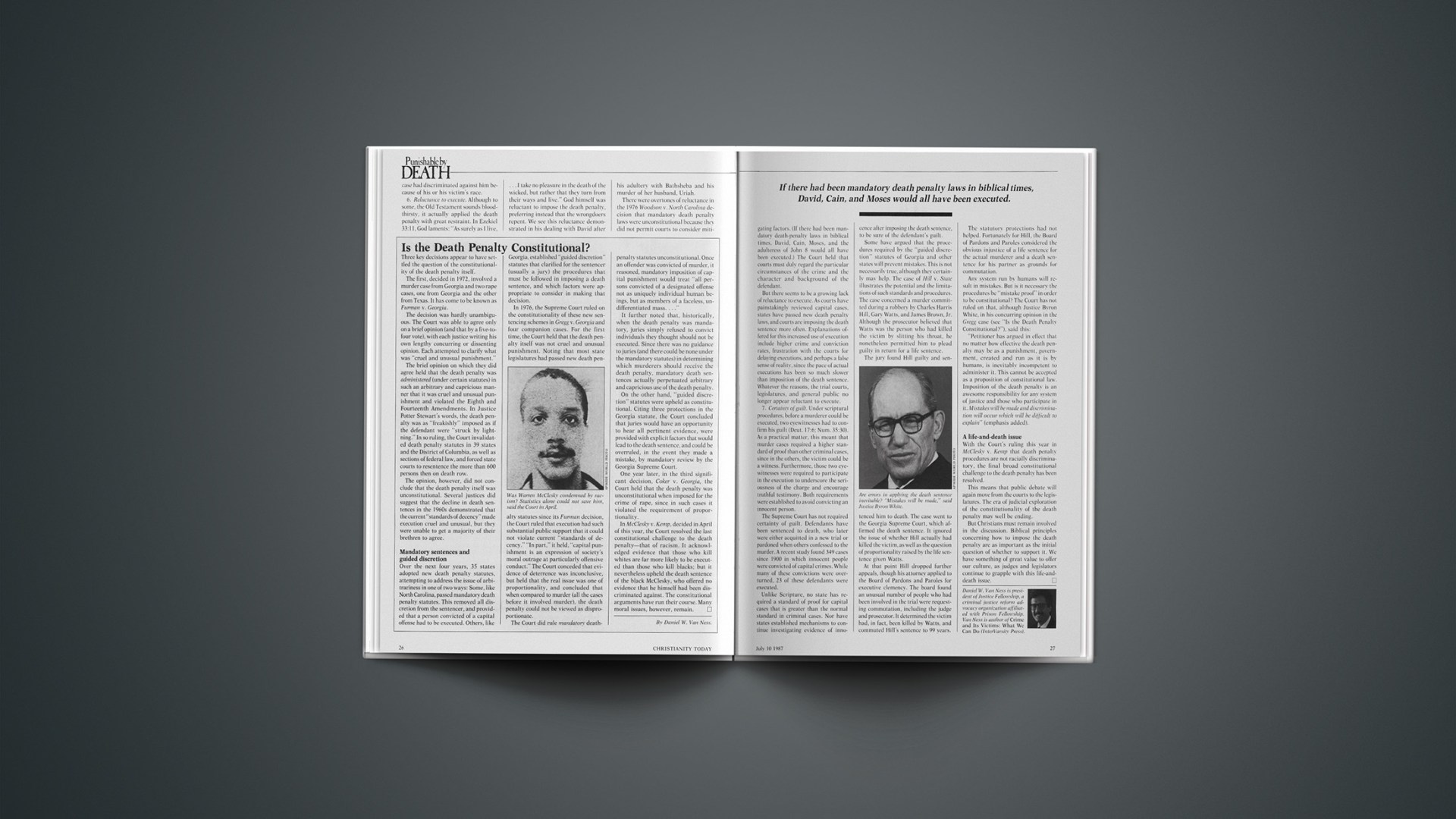
Is the Death Penalty Constitutional?

Three key decisions appear to have settled the question of the constitutionality of the death penalty itself.

The first, decided in 1972, involved a murder case from Georgia and two rape cases, one from Georgia and the other from Texas. It has come to be known as Furman v. Georgia.

The decision was hardly unambiguous. The Court was able to agree only on a brief opinion (and that by a five-to-four vote), with each justice writing his own lengthy concurring or dissenting opinion. Each attempted to clarify what was “cruel and unusual punishment.”

The brief opinion on which they did agree held that the death penalty was administered (under certain statutes) in such an arbitrary and capricious manner that it was cruel and unusual punishment and violated the Eighth and Fourteenth Amendments. In Justice Potter Stewart’s words, the death penalty was as “freakishly” imposed as if the defendant were “struck by lightning.” In so ruling, the Court invalidated death penalty statutes in 39 states and the District of Columbia, as well as sections of federal law, and forced state courts to resentence the more than 600 persons then on death row.

The opinion, however, did not conclude that the death penalty itself was unconstitutional. Several justices did suggest that the decline in death sentences in the 1960s demonstrated that the current “standards of decency” made execution cruel and unusual, but they were unable to get a majority of their brethren to agree.

Mandatory sentences and guided discretion

Over the next four years, 35 states adopted new death penalty statutes, attempting to address the issue of arbitrariness in one of two ways: Some, like North Carolina, passed mandatory death penalty statutes. This removed all discretion from the sentencer, and provided that a person convicted of a capital offense had to be executed. Others, like Georgia, established “guided discretion” statutes that clarified for the sentencer (usually a jury) the procedures that must be followed in imposing a death sentence, and which factors were appropriate to consider in making that decision.

In 1976, the Supreme Court ruled on the constitutionality of these new sentencing schemes in Gregg v. Georgia and four companion cases. For the first time, the Court held that the death penalty itself was not cruel and unusual punishment. Noting that most state legislatures had passed new death penalty statutes since its Furman decision, the Court ruled that execution had such substantial public support that it could not violate current “standards of decency.” “In part,” it held, “capital punishment is an expression of society’s moral outrage at particularly offensive conduct.” The Court conceded that evidence of deterrence was inconclusive, but held that the real issue was one of proportionality, and concluded that when compared to murder (all the cases before it involved murder), the death penalty could not be viewed as disproportionate.

The Court did rule mandatory death-penalty statutes unconstitutional. Once an offender was convicted of murder, it reasoned, mandatory imposition of capital punishment would treat “all persons convicted of a designated offense not as uniquely individual human beings, but as members of a faceless, undifferentiated mass.…”

It further noted that, historically, when the death penalty was mandatory, juries simply refused to convict individuals they thought should not be executed. Since there was no guidance to juries (and there could be none under the mandatory statutes) in determining which murderers should receive the death penalty, mandatory death sentences actually perpetuated arbitrary and capricious use of the death penalty.

On the other hand, “guided discretion” statutes were upheld as constitutional. Citing three protections in the Georgia statute, the Court concluded that juries would have an opportunity to hear all pertinent evidence, were provided with explicit factors that would lead to the death sentence, and could be overruled, in the event they made a mistake, by mandatory review by the Georgia Supreme Court.

One year later, in the third significant decision, Coker v. Georgia, the Court held that the death penalty was unconstitutional when imposed for the crime of rape, since in such cases it violated the requirement of proportionality.

In McClesky v. Kemp, decided in April of this year, the Court resolved the last constitutional challenge to the death penalty—that of racism. It acknowledged evidence that those who kill whites are far more likely to be executed than those who kill blacks; but it nevertheless upheld the death sentence of the black McClesky, who offered no evidence that he himself had been discriminated against. The constitutional arguments have run their course. Many moral issues, however, remain.

By Daniel W. Van Ness.

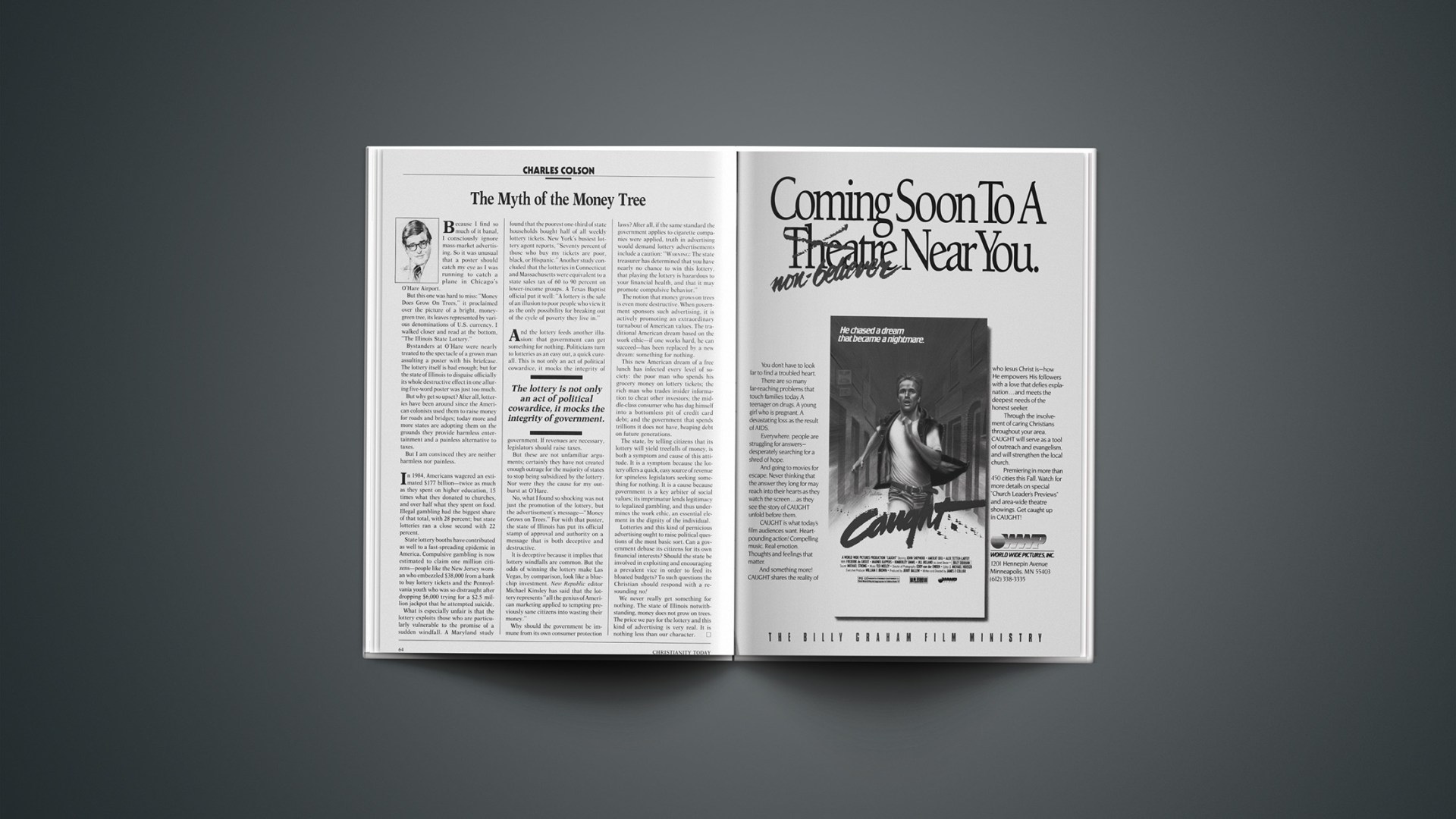
The Myth of the Money Tree

Because I find so much of it banal, I consciously ignore mass-market advertising. So it was unusual that a poster should catch my eye as I was running to catch a plane in Chicago’s O’Hare Airport.

But this one was hard to miss: “Money Does Grow On Trees,” it proclaimed over the picture of a bright, money-green tree, its leaves represented by various denominations of U.S. currency. I walked closer and read at the bottom, “The Illinois State Lottery.”

Bystanders at O’Hare were nearly treated to the spectacle of a grown man assulting a poster with his briefcase. The lottery itself is bad enough; but for the state of Illinois to disguise officially its whole destructive effect in one alluring five-word poster was just too much.

But why get so upset? After all, lotteries have been around since the American colonists used them to raise money for roads and bridges; today more and more states are adopting them on the grounds they provide harmless entertainment and a painless alternative to taxes.

But I am convinced they are neither harmless nor painless.

In 1984, Americans wagered an estimated $177 billion—twice as much as they spent on higher education, 15 times what they donated to churches, and over half what they spent on food. Illegal gambling had the biggest share of that total, with 28 percent; but state lotteries ran a close second with 22 percent.

State lottery booths have contributed as well to a fast-spreading epidemic in America. Compulsive gambling is now estimated to claim one million citizens—people like the New Jersey woman who embezzled $38,000 from a bank to buy lottery tickets and the Pennsylvania youth who was so distraught after dropping $6,000 trying for a $2.5 million jackpot that he attempted suicide.

What is especially unfair is that the lottery exploits those who are particularly vulnerable to the promise of a sudden windfall. A Maryland study found that the poorest one-third of state households bought half of all weekly lottery tickets. New York’s busiest lottery agent reports, “Seventy percent of those who buy my tickets are poor, black, or Hispanic.” Another study concluded that the lotteries in Connecticut and Massachusetts were equivalent to a state sales tax of 60 to 90 percent on lower-income groups. A Texas Baptist official put it well: “A lottery is the sale of an illusion to poor people who view it as the only possibility for breaking out of the cycle of poverty they live in.”

And the lottery feeds another illusion: that government can get something for nothing. Politicians turn to lotteries as an easy out, a quick cure-all. This is not only an act of political cowardice, it mocks the integrity of government. If revenues are necessary, legislators should raise taxes.

But these are not unfamiliar arguments; certainly they have not created enough outrage for the majority of states to stop being subsidized by the lottery. Nor were they the cause for my outburst at O’Hare.

No, what I found so shocking was not just the promotion of the lottery, but the advertisement’s message—“Money Grows on Trees.” For with that poster, the state of Illinois has put its official stamp of approval and authority on a message that is both deceptive and destructive.

It is deceptive because it implies that lottery windfalls are common. But the odds of winning the lottery make Las Vegas, by comparison, look like a blue-chip investment. New Republic editor Michael Kinsley has said that the lottery represents “all the genius of American marketing applied to tempting previously sane citizens into wasting their money”

Why should the government be immune from its own consumer protection laws? After all, if the same standard the government applies to cigarette companies were applied, truth in advertising would demand lottery advertisements include a caution: “WARNING: The state treasurer has determined that you have nearly no chance to win this lottery, that playing the lottery is hazardous to your financial health, and that it may promote compulsive behavior.”

The notion that money grows on trees is even more destructive. When government sponsors such advertising, it is actively promoting an extraordinary turnabout of American values. The traditional American dream based on the work ethic—if one works hard, he can succeed—has been replaced by a new dream: something for nothing.

This new American dream of a free lunch has infected every level of society: the poor man who spends his grocery money on lottery tickets; the rich man who trades insider information to cheat other investors; the middle-class consumer who has dug himself into a bottomless pit of credit card debt; and the government that spends trillions it does not have, heaping debt on future generations.

The state, by telling citizens that its lottery will yield treefulls of money, is both a symptom and cause of this attitude. It is a symptom because the lottery offers a quick, easy source of revenue for spineless legislators seeking something for nothing. It is a cause because government is a key arbiter of social values; its imprimatur lends legitimacy to legalized gambling, and thus undermines the work ethic, an essential element in the dignity of the individual.

Lotteries and this kind of pernicious advertising ought to raise political questions of the most basic sort. Can a government debase its citizens for its own financial interests? Should the state be involved in exploiting and encouraging a prevalent vice in order to feed its bloated budgets? To such questions the Christian should respond with a resounding no!

We never really get something for nothing. The state of Illinois notwithstanding, money does not grow on trees. The price we pay for the lottery and this kind of advertising is very real. It is nothing less than our character.

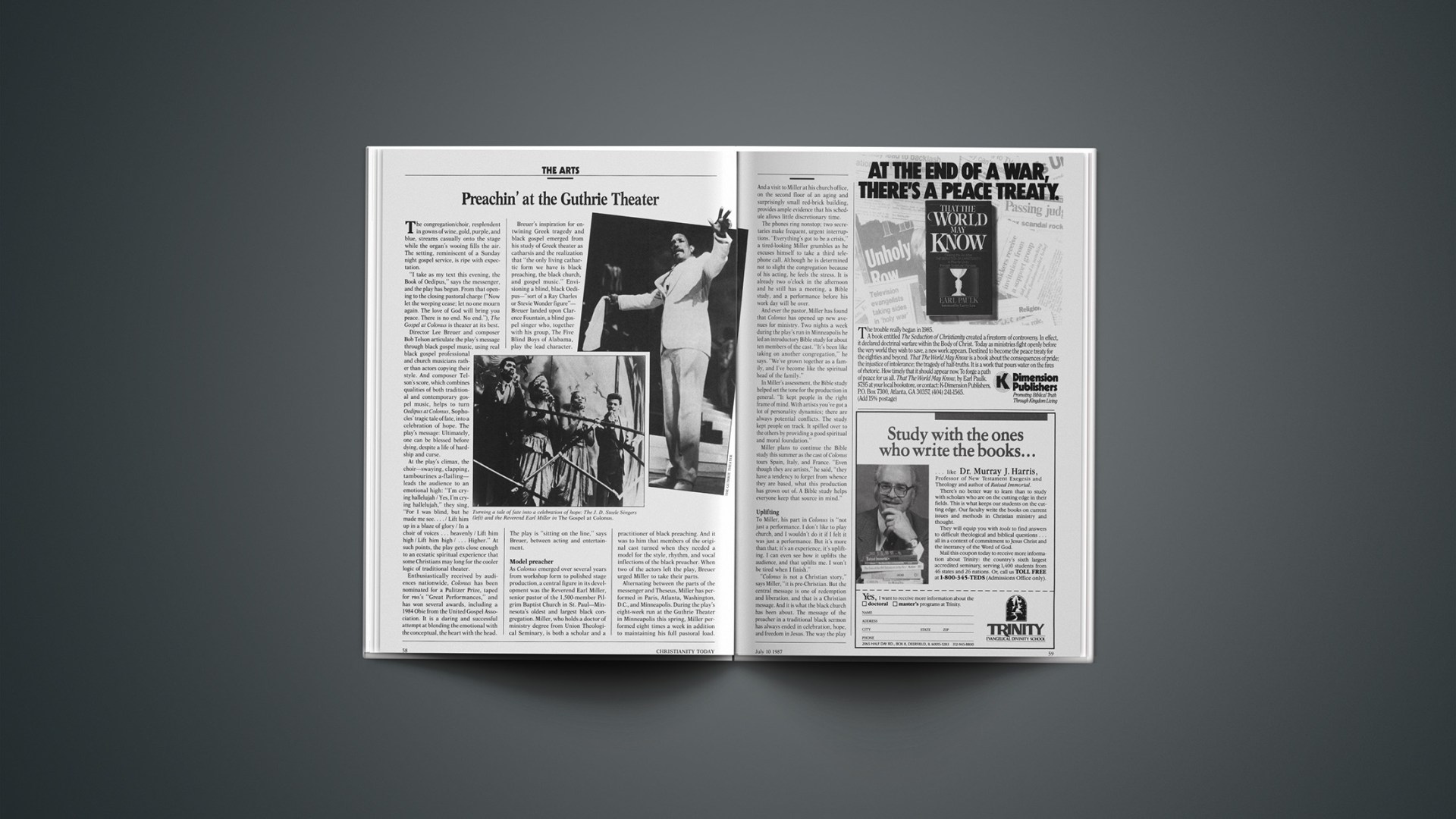
Preachin’ at the Guthrie Theatre

The congregation/choir, resplendent in gowns of wine, gold, purple, and blue, streams casually onto the stage while the organ’s wooing fills the air. The setting, reminiscent of a Sunday night gospel service, is ripe with expectation.

“I take as my text this evening, the Book of Oedipus,” says the messenger, and the play has begun. From that opening to the closing pastoral charge (“Now let the weeping cease; let no one mourn again. The love of God will bring you peace. There is no end. No end.”), The Gospel at Colonus is theater at its best.

Director Lee Breuer and composer Bob Telson articulate the play’s message through black gospel music, using real black gospel professional and church musicians rather than actors copying their style. And composer Telson’s score, which combines qualities of both traditional and contemporary gospel music, helps to turn Oedipus at Colonus, Sophocles’ tragic tale of fate, into a celebration of hope. The play’s message: Ultimately, one can be blessed before dying, despite a life of hardship and curse.

At the play’s climax, the choir—swaying, clapping, tambourines a-flailing—leads the audience to an emotional high: “I’m crying hallelujah / Yes, I’m crying hallelujah,” they sing, “For I was blind, but he made me see.… / Lift him up in a blaze of glory / In a choir of voices … heavenly / Lift him high / Lift him high / … Higher.” At such points, the play gets close enough to an ecstatic spiritual experience that some Christians may long for the cooler logic of traditional theater.

Enthusiastically received by audiences nationwide, Colonus has been nominated for a Pulitzer Prize, taped for PBS’s “Great Performances,” and has won several awards, including a 1984 Obie from the United Gospel Association. It is a daring and successful attempt at blending the emotional with the conceptual, the heart with the head.

Breuer’s inspiration for entwining Greek tragedy and black gospel emerged from his study of Greek theater as catharsis and the realization that “the only living cathartic form we have is black preaching, the black church, and gospel music.” Envisioning a blind, black Oedipus—“sort of a Ray Charles or Stevie Wonder figure”—Breuer landed upon Clarence Fountain, a blind gospel singer who, together with his group, The Five Blind Boys of Alabama, play the lead character. The play is “sitting on the line,” says Breuer, between acting and entertainment.

Model Preacher

As Colonus emerged over several years from workshop form to polished stage production, a central figure in its development was the Reverend Earl Miller, senior pastor of the 1,500-member Pilgrim Baptist Church in St. Paul—Minnesota’s oldest and largest black congregation. Miller, who holds a doctor of ministry degree from Union Theological Seminary, is both a scholar and a practitioner of black preaching. And it was to him that members of the original cast turned when they needed a model for the style, rhythm, and vocal inflections of the black preacher. When two of the actors left the play, Breuer urged Miller to take their parts.

Alternating between the parts of the messenger and Theseus, Miller has performed in Paris, Atlanta, Washington, D.C., and Minneapolis. During the play’s eight-week run at the Guthrie Theater in Minneapolis this spring, Miller performed eight times a week in addition to maintaining his full pastoral load. And a visit to Miller at his church office, on the second floor of an aging and surprisingly small red-brick building, provides ample evidence that his schedule allows little discretionary time.

The phones ring nonstop; two secretaries make frequent, urgent interruptions. “Everything’s got to be a crisis,” a tired-looking Miller grumbles as he excuses himself to take a third telephone call. Although he is determined not to slight the congregation because of his acting, he feels the stress. It is already two o’clock in the afternoon and he still has a meeting, a Bible study, and a performance before his work day will be over.

And ever the pastor, Miller has found that Colonus has opened up new avenues for ministry. Two nights a week during the play’s run in Minneapolis he led an introductory Bible study for about ten members of the cast. “It’s been like taking on another congregation,” he says. “We’ve grown together as a family, and I’ve become like the spiritual head of the family.”

In Miller’s assessment, the Bible study helped set the tone for the production in general. “It kept people in the right frame of mind. With artists you’ve got a lot of personality dynamics; there are always potential conflicts. The study kept people on track. It spilled over to the others by providing a good spiritual and moral foundation.”

Miller plans to continue the Bible study this summer as the cast of Colonus tours Spain, Italy, and France. “Even though they are artists,” he said, “they have a tendency to forget from whence they are based, what this production has grown out of. A Bible study helps everyone keep that source in mind.”

Uplifting

To Miller, his part in Colonus is “not just a performance. I don’t like to play church, and I wouldn’t do it if I felt it was just a performance. But it’s more than that; it’s an experience, it’s uplifting. I can even see how it uplifts the audience, and that uplifts me. I won’t be tired when I finish.”

“Colonus is not a Christian story,” says Miller, “it is pre-Christian. But the central message is one of redemption and liberation, and that is a Christian message. And it is what the black church has been about. The message of the preacher in a traditional black sermon has always ended in celebration, hope, and freedom in Jesus. The way the play ends is the way our worship ends.”

Furthermore, he continues, the play is particularly relevant to the black experience through its exploration of fate and destiny. “The Old Testament talks about the casting of lots, which determined a person’s destiny. Oedipus’s lot was already cast; he had no choice. As slaves, black people in this country were oppressed … like Oedipus. Our lots were cast. But the play tells us that whatever your lot, there is ultimately redemption.”

Master Storyteller

A high-school music teacher and church musician before going into the ministry, Miller acknowledges that performing is in his blood. Nonetheless, he did not seek out acting, nor does he plan to continue pursuing it as an avocation. He does, however, find the merger of his dual roles as pastor and actor to be natural.

In a lecture on black preaching, delivered at the Yale School of Drama in 1986, Miller noted that “the black preacher must be a master storyteller. Black preaching, like black religion, is wholistic. It engages the whole person. The black preacher has to get outside of himself, or, in church language, let the spirit take control. In order for the people to judge the preacher’s calling to the ministry authentic, at some point in the sermon he has to lose his cool, because he isn’t supposed to be in charge anyway.”

Miller contends that while white preaching has emerged as formal, logical, and organized, black preaching has broken “all the rules of form and organization. The black religious experience is not just a meeting of the mind. It is a meeting of the whole being. It is not just an intellectual meeting. It is an encounter with the living God.”

By Phyllis Alsdurf, former editor of Family Life Today, and coauthor with her husband, Jim, a court psychologist, of a forthcoming book on wife abuse in Christian homes.

Book Briefs: July 10, 1987

Liberation Theology’s Curious Contradiction

Will It Liberate? Questions About Liberation Theology, by Michael Novak (Paulist Press, 307 pp.; $14.95, hardcover). Reviewed by Clark H. Pinnock, professor of systematic theology, McMaster Divinity College.

In his latest book, Michael Novak, a Catholic neoconservative scholar of magnificent erudition, asks whether the Christian rhetoric of liberation actually liberates the poor. He concludes that it usually does not. Evangelicals planning to climb aboard the liberation theology bandwagon had better face up to the evidence Novak mounts—because if they do not listen, they may repeat all the egregious mistakes the Left has been making for years.

Novak has addressed the question “Will it liberate?” before. He did so in The Spirit of Democratic Capitalism (1982) and in Freedom With Justice (1984), as well as in books he has edited. The question he is raising is a most awkward one for theologians of liberation, since they themselves keep stressing the importance of “praxis” and yet, from a practical economic standpoint, are on the shakiest of ground. They talk incessantly about their “preferential option for the poor” and then opt for some form of socialism that does not in reality lift up the poor and make them prosper.

Novak is right to focus on this curious contradiction, and he does so with tremendous expertise in economic theory and history. The depth of his critique is so fair and profound that the book may mark a turning point in the whole debate.

Operating At A High Level

The book itself contains some material published already, which worried me at first. But I soon discovered that two-thirds of it is new research, and all of it hangs together in support of its stated theme. Liberation theologians like Enrique Dussel, Leonardo Boff, and Juan Luis Segundo have indeed produced some intellectually and theologically profound work, but I think any fair reader will have to agree that Novak is also operating at this same very high level and is making points that, although they will be detested by partisans of the Left, will not be ignored by the honest among them.

Novak contends that socialist revolutions will not change anything in Latin America. It is already “socialist”—that is, feudal and crushed by the political sector. Liberationist strategies have no chance of liberating the poor, who do need help desperately. Novak asks the liberationists to wake up to the promise of “the capitalist revolution” (to borrow Peter Berger’s recent designation). Latin America needs a burst of liberty that would free up initiative and inventiveness, the keys to prosperity.

Novak is an exciting writer to read, a breath of fresh air on a topic usually so turgid, abstract, and guilt-laden. As one who made the same journey in his life as Novak has, from the utopian Left to democratic capitalism, I welcome this book with enthusiasm. It is the best critique of liberation theology I have seen. I hope it represents the first stages of a liberation theology that really does offer liberation.

Christianity Today Talks To Michael Novak

On whether Calvinists are responsible for the cultural conditions leading to capitalism:

The Calvinists were an important part of the breakthrough, both of political democracy and of capitalism. But they weren’t the only part. In fact, some scholars point out that Calvinist parts of Europe were for a longer period retarded economically and came late to the capitalist system.

What does seem to be the case is that the early pioneers of the new economy, who were independent people who owned their own homes and built their own small industries, were sometimes Calvinist, sometimes Jewish, and sometimes Catholic.

In all cases, they were fleeing from control by the empire, the king, and the established church—in many places Roman Catholic, but not in all. And it was these common characteristics that led them to cry out, “City air breathes free,” meaning that in the free cities of Europe they won political and economic freedom. In that mix, the role of Calvinists has been blown out of proportion.

But on the other side of the ledger, it is also true that Catholicism had already been thriving on European soil for 1,800 years before democracy and capitalism. So it had grown up with much of its imagery colored by the world of the aristocracy, the peasants, the clergy, the military, and the rulers.

Observers in the eighteenth century noted that in the Americas there were two experiments—one in Latin America and one in North America. The experiment in Latin America was imitating what had happened in the Holy Roman empire, and more or less continuing the aristocratic patterns of the past. They imitated these patterns even to the point of looking down on commercial activity, as aristocrats were wont to do. It was too sweaty and vulgar for them.

But I would say that attitude is more conspicuously Latin than Catholic. Why? Because the Catholics of Flanders, the Netherlands, Belgium, France, and northern Italy were often pioneers among the early capitalists. The Catholic church, being large and various, went in both directions, aristocratic and capitalist.

On how liberation theology will develop in the next several years:

The logic of history will lead liberation theologians increasingly in the direction of recreating in their own way the liberal society; that is, a society recognizing the abiding sinfulness of human beings and trying to check unchecked power at every turn. It will lead to increasing respect for democracy in politics, for checks upon state power in the economy, and for checks of one portion of economic power against another portion of economic power, which it has been the task of capitalism to pioneer. And it will lead to pluralism—intellectual, literary, and religious liberty.

On how fans of liberation theology do not really take it seriously:

My difficulty with North American supporters of liberation theology is that they don’t engage in much intellectual give and take. Most of the people who write about liberation theology from North America tend to be very favorable to it. They take the role of being expositors and don’t often make obvious criticisms, as they would with other theologies. So it’s mostly one-way speaking: Latin Americans pronouncing, North Americans adoring.

This North American shortage of real analysis is finally patronizing. Serious adults argue with one another. The only way you sharpen your ideas is by 30 other people telling you you are wrong. Then you have to go back and rethink why you think you are right and how you can meet their arguments. What we’ve lacked in the debate between the two hemispheres is that kind of mature give and take, taking one another seriously, sympathizing with one another’s aims.

I look forward to the day when we have a genuine theology of the Western Hemisphere, when there is such a powerful, friendly argument among and between Latin Americans and North Americans that we really do represent to the Old World what is new about the New World, and mutually discover ways of thinking about the world that it’s our vocation under Providence to explore. There will be a theology of the Americas; but if it is to come, it must come the way every other theology has come about in the past, through disputation and argument. One person can’t do it alone. You need a community of theologians, none of whom agree with anybody else, to achieve eventual common understanding.

On what it will take for Latin America’s quasi-feudal culture to be transformed to the point where capital will be available for the small entrepreneur with a bright idea:

Necessity and example. Necessity because there are about 70 million Latin Americans now under the age of 15 who will be entering the job market from now until the end of the century. At the end of the century, surely there will be fewer jobs in agriculture than there now are. The multinational corporations and the large, mostly state-directed corporations of Latin America employ a relatively small proportion of all persons employed in that region.

So where are the new jobs to come from? Employment must be found not only for these 70 million, but for all those who are now unemployed and underemployed in Latin America. The greatest engine of employment in the United States and elsewhere is small business. Businesses employing 50 persons or fewer account for about 80 percent of our job growth in the last 20 years, and we have created about 31 million new jobs since the 1970s. Often in Latin America one hears businessmen referred to as parasites or cockroaches. But necessity will oblige Latin Americans to turn to the world of small business.

Then there is example. There are several countries in East Asia which in 1939 were far poorer than any country in Latin America. But look now at Korea, Taiwan, Hong Kong, and Singapore—once desperately poor places that have in a generation multiplied their per capita income not once, not twice, but something like five times over.

So if you want to break dependency and see rapid development, particularly for the people at the bottom of the ladder, there are models in the world for learning how to do that. Most of them have proceeded by way of generating enormous economic activism and enterprise at the bottom of the economic ladder. They do this by opening up markets, making it easy for poor people to incorporate, and easy for poor people to be able to obtain credit (since before you can sell you have to borrow in order to produce things).

On the value of free association, which he believes is reinforced by capitalism:

There are two forms of community. One form is the natural community that comes from blood and kinship; and the other is formed by voluntary choice or, in religious terms, by faith commitment. One hears the Word of God and responds to it and enters into a covenant with God. Translated into political systems, this means a higher emphasis than ever before on those communities which are formed by covenant, by contract, by consent. Hence the power of the idea that governments are formed by the consent of the governed. This led as well to the federal principle that there are forms of community that are entered into voluntarily, respecting the integrity of the component communities, but still forging a very powerful union.

I’m afraid that many social thinkers when they discuss community have in view only the village life of the premodern world in which people lived together in the same village for hundreds of years, shared the same faith, the same horizons, knew one another’s families, and had intimate feelings of unity. Many sociologists, sensing the breakup of that kind of community, despair of community without recognizing that there is altogether modern sense of unity that is even more potent, but different.

It does not have the same characteristics, but it is marvelously potent in forming a powerful social life. It springs, as Tocqueville called it, from the principle of association. By that he meant that human beings do not live as solitary individuals alone; they accomplish most human projects through cooperating with others. Through associating themselves willingly and freely with others to the extent that they want to, they don’t form many total communities, but belong to many different communities. Think of all the communities and associations in the world that you belong to, none of which own you totally, but every one of which nourishes you.

Americans live a thoroughly social life, and it’s a terrible mistake (a mistake that I think Robert Bellah and his colleagues are guilty of in Habits of the Heart) to link community to older forms and to miss the thick associational structure and texture of actual American life as it is lived. You can’t get out a magazine without a lot of people working together. You can’t produce a television program, a movie, a hit record, or run a cookie store without having people willing to work different shifts and do all the things necessary. There’s almost nothing you can accomplish in contemporary life without working with others.

That’s why Americans deeply love team sports. We respond to baseball, football, and basketball precisely because they show people working under very high intensity as a team. We enjoy achieving the full possibilities of the team, taking up for one another in the inevitable weaknesses of each. And we enjoy adjusting to one another, working in unison and with an incredible precision of timing and spirit.

We are not rugged individualists. We love our solitude—going fishing, hiking in the mountains, being alone—but one reason we like it is because we hardly ever have it. Most of the time we are with other people.

On the true “moral majority” and the need to build political economies for sinners:

There is no point in building a political economy for saints—there are too few of them. The only moral majority that actually exists is composed of sinners, and if you want to build a political economy that will work, and work for 200 years, you have to build it for sinners. That is why our founders designed in so many checks and balances. They never dreamt of creating a new man, in the sense of saintly or angelic creatures who have never walked the earth before. They dreamt of a set of institutions that would diminish the worst that people could do and enhance the creativity that they could bring forth even if they were sinners. And that’s why Hannah Arendt speaks of the American Revolution as the realistic revolution and of the French Revolution and some others as utopian. The realistic ones are the ones that work.

By David Neff.

Good Intentions Are Not Enough

Poverty and Wealth: The Christian Debate Over Capitalism, by Ronald Nash (Crossway Books, 216 pp.; $8.95, paperback); and The Capitalist Revolution: Fifty Propositions About Prosperity, Equality, and Liberty, by Peter Berger (Basic Books, 262 pp.; $17.95, hardcover). Reviewed by Doug Bandow, a syndicated columnist and senior fellow of the Cato Institute.

Believing Christians are usually nothing if not well intentioned: indeed, how could it be otherwise for those claiming to follow Jesus? But good intentions are not enough. “Suppose a brother or sister is without clothes and daily food,” explains the Book of James. “If one of you says to him, ‘Go, I wish you well; keep warm and well fed,’ but does nothing about his physical needs, what good is it?”

Much Christian political activism today, particularly on the Left, is infused with such a disregard for consequences. While advocating counterproductive government policies may not exhibit the same callous neglect decried by James, the practical effect on the poor and disadvantaged is no different. Explains Ronald Nash in Poverty and Wealth: “When good intentions are not wedded to sound theory, especially sound economic theory, good intentions can often result in actions that produce consequences directly opposite to those we planned.”

Nash’s book is an excellent primer on economics, a wonderfully clear discussion of the “dismal science” that should be required reading for every seminarian. Nash, a professor of philosophy and religion at Western Kentucky University, does not seek to prove capitalism to be uniquely Christian—“there is no such thing as revealed economics,” he contends, for “trying to deduce a system of economics from the Bible” is “as muddle-headed as an attempt to deduce a theory of the solar system from the Bible.” Instead, Nash looks at how free-market and socialist systems work in practice, comparing the results with biblical norms of justice.

Nash makes the case that capitalism is more consistent with Christian ethics than socialism. First, he shows that market economies are far more productive. As a result, the poor and disadvantaged are almost invariably better off under capitalism.

In fact, this point is almost impossible to contest today, given economic experience around the world. “Advanced industrial capitalism,” states Boston University sociologist Peter Berger in The Capitalist Revolution, “has generated, and continues to generate, the highest material standard of living for large masses of people in human history.”

Nor is the free market’s success limited to the West. Berger explores the case of East Asia, where Japan, Taiwan, Hong Kong, Singapore, and South Korea have all achieved enormous material progress by relying on market-oriented policies.

Socialism Untried?

The second major argument for capitalism is that it generally produces a freer society. “One of the great ironies of Christian socialism,” Nash says, “is that its proponents in effect demand that the state get out its weapons and force people to fulfill the demands of Christian love.” Religious leftists “would like us to believe that there is a form of socialism, not yet tried anywhere on earth, where the central ideas are cooperation and community and where coercion and dictatorship are precluded,” adds Nash, but “socialism epitomizes the violent means of exchange.”

In contrast, argues Berger, capitalism “provides the context within which personal liberties can thrive and institutions fostering these liberties, including the bourgeois family and organized religion, can function without pervasive state controls.” Capitalism also promotes democracy: As Berger points out, only countries with a protected private economic sector are democratic. Every totalitarian state, in contrast, firmly controls its economy.

Both authors, though skeptical about government economic intervention, believe that religious values are necessary to undergird the market system. Berger views churches as providing “communal solidarity” to help balance capitalism’s “anonymous aspects of individual autonomy.”

And Nash concludes his book by emphasizing an issue too often lost in the traditional Enlightenment-based defense of free markets: “a capitalism that is cut loose from traditional values is a capitalism that is headed for trouble.” It is the Judeo-Christian moral principles that once grounded Western society that also made the marke system so successful; as values like honesty, diligence, and a refusal to seek official privileges have waned, the market system has inevitably given way to statism.

“Let all friends of a market system pay heed,” warns Nash, “capitalism needs Christianity.”

Faith Healers: Moving toward the Mainstream?

“I lay hands on you by direction of the Head of the church, Jesus Christ, and in obedience to the Law of Contact and Transmission. The contact of my hands transmits God’s healing power.… There it is! There it is!… It’ll heal you if you mix faith with it.…”

With these words Kenneth Hagin moved down the healing line that formed after each evening service during his Pittsburgh Faith Crusade earlier this year. Now in his fifty-third year of preaching, Hagin remains active as a traveling preacher, writer, and teacher (at his 1,500-student Rhema Bible Training Center in Tulsa, Okla.). He is generally regarded as the dean of the increasingly popular “faith movement.”

Hagin proclaims a message of health and prosperity through positive faith. His homespun humor, gentle demeanor, and strong emphasis on Christian unity give no hint of the controversy that has surrounded the faith movement. Neither do they tell of the crossroads the movement is approaching, as Christians—especially charismatics—assess whether to accept it or oppose it.

Healing For All?

Hagin and his colleagues in the movement—including Kenneth Copeland and Jerry Savelle in Fort Worth, and Fred Price in Los Angeles—have long faced criticism for teaching that physical healing is available to anyone who has enough faith. Though the faith teachers allow for the use of medicine, they consider divine healing and perfect health both preferable and attainable.

But critics accuse faith teachers of unbiblical dogmatism and a lack of compassion for the sick. Author and artist Joni Eareckson Tada, a quadriplegic, cited in a recent fund-raising letter for her ministry “the insensitive nature of health-wealth theology,” which leaves disabled persons “nearly shipwrecked.”

Charles Farah, theology professor at Oral Roberts University and a critic of the faith movement, is optimistic about its future. “The movement is buying into Oral’s contention that prayer and medicine must go together,” he said. “That’s a good sign, because it will save the lives of a lot of babies and adults who will get to the hospital on time.”

In an interview with CHRISTIANITY TODAY, Hagin allowed that “there’s always an element of mystery” in the area of healing. Recalling one instance when he wondered why a relative had to die, Hagin said the Lord directed him to Deuteronomy 29:29 (“The secret things belong to the Lord our God”) and told him, “If I’d wanted you to know why, I would have told you.”

Asked about his message’s potentially harmful effect on those not healed, Hagin replied, “We don’t ever want to put a guilt trip on anyone.” However, he stressed that his main purpose is to take the message of the availability of healing to as many people as possible.

Indications Of A Truce

One sign of a truce between the faith movement and other charismatics is Copeland’s selection as one of the plenary speakers at the giant North American Congress on the Holy Spirit and World Evangelization to be held in New Orleans this month. Vinson Synan, director of the conference, said no one on the planning committee objected to inviting Copeland.

Like Farah, Synan feels the controversy over the faith teachers is beginning to subside. He noted with approval Copeland’s vigorous support of world missions.

Farah said he sees the same focus emerging from Hagin’s ministry, although Farah blames prosperity preaching for the charismatic movement’s inability to produce long-term missionaries: “If [people are] concerned about upward mobility, missions isn’t a good field to choose.”

During his Pittsburgh crusade, Hagin described the work of his school’s graduates on six continents. One such graduate has built in just eight years a church of 8,000 members—5,000 of them white, and 3,000 black—in South Africa.

In North America, the faith movement appears to be institutionalizing, as signified by its participation in structures such as Oral Roberts’s Charismatic Bible Ministries organization. Sociologist Margaret Poloma of the University of Akron, author of a book on the charismatic movement, views this as a positive sign, observing, “There’s nothing like institutionalization to balance things out.”

New Battles

But even as some of the old battles are resolved, a new one has arisen over the faith teachers’ doctrine that Jesus underwent “spiritual death” along with physical death, that he suffered in hell for three days before being “born again” in the Resurrection.

Author Judith Matta of Fullerton, California, charges that some faith teachers use this doctrine heretically, to put redeemed humanity on a level with Jesus. “If Jesus is a born-again man and is now exalted at the right hand of God, then you and I who are also born-again are equal with this God,” Matta writes in the forthcoming second edition of her book, The Born-Again Jesus of the Word-Faith Teaching. According to Matta, the foundation of the movement’s teaching is “to make themselves equal with God and be in control of their circumstances and lives.”

Theologian Farah and Rob Bowman of the Christian Research Institute (CRI) in San Juan Capistrano, California, share this concern. Bowman said CRI classifies the faith movement as “aberrational,” a term the institute uses for groups that “affirm the basic essentials of the faith, then make statements that seriously compromise this position.”

Among the leading faith teachers, Bowman said, Copeland is in the most serious error. “He seems to regard God as finite,” Bowman asserted, quoting Copeland’s reference Bible, which at one point states that Adam’s body and God’s were “exactly the same size.”

Bowman is critical also of the unwillingness of some faith teachers to enter dialogue with other Christians. “They say they don’t want to come into controversy, but they are the controversy,” he said. “They are teaching false doctrine, and the church needs to hold them accountable for it.” Bowman praised faith teacher Fred Price, who, after meeting with CRI, agreed to stop saying humans are “gods.”

Hagin said he has never been asked to enter any dialogue. He said he would be open to the idea, though arrangements would have to be made a year in advance because of his full schedule.

In the meantime, this mild-mannered father of the faith movement pursues his own course, imparting the key truths for which he is known—confident faith, victorious living, and continual dependence on the Word of God—while seeking to avoid dissension. He quips, “You can disagree without being disagreeable.”

By Bruce Barron.

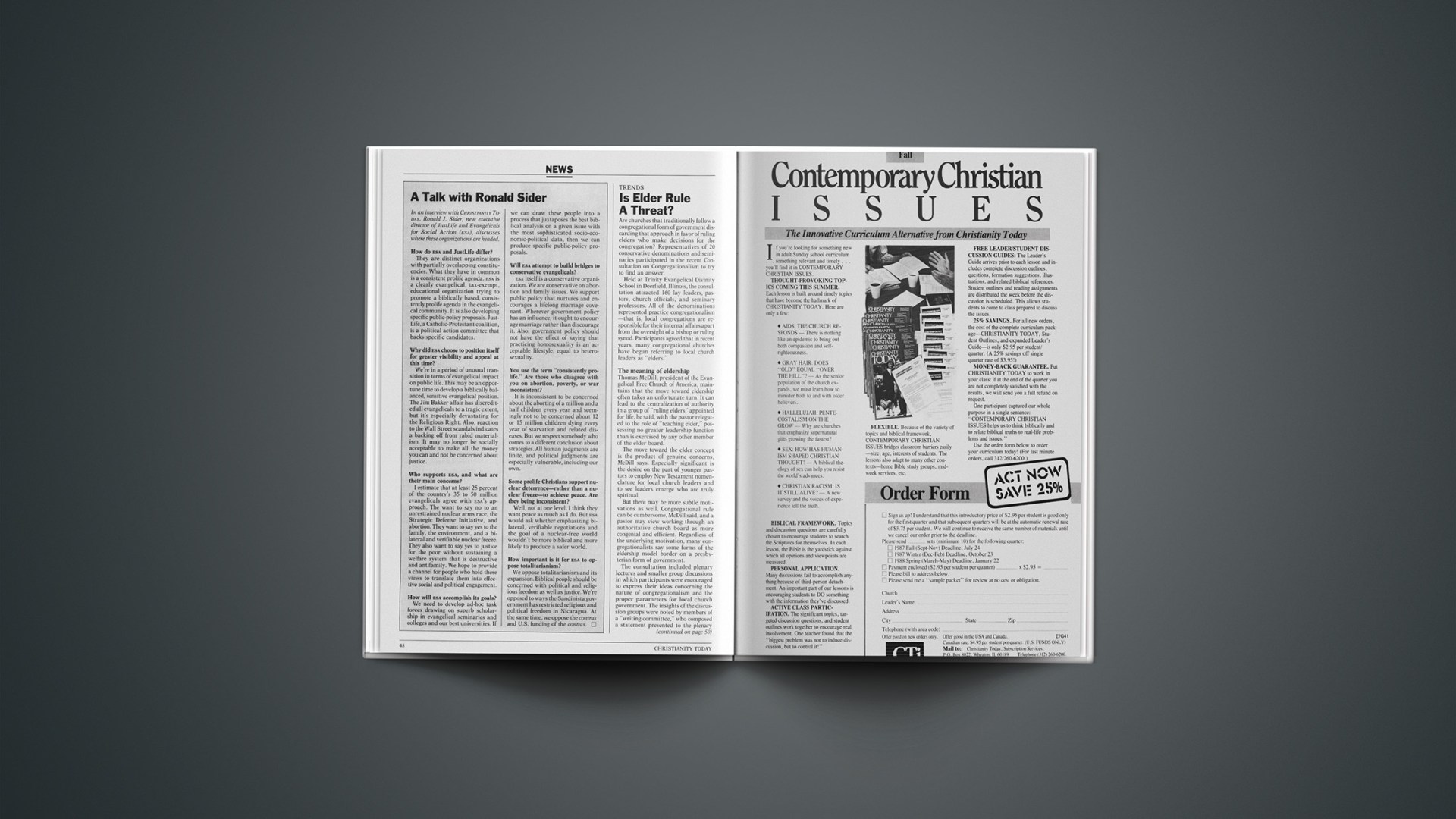
Is Elder Rule a Threat?

Are churches that traditionally follow a congregational form of government discarding that approach in favor of ruling elders who make decisions for the congregation? Representatives of 20 conservative denominations and seminaries participated in the recent Consultation on Congregationalism to try to find an answer.

Held at Trinity Evangelical Divinity School in Deerfield, Illinois, the consultation attracted 160 lay leaders, pastors, church officials, and seminary professors. All of the denominations represented practice Congregationalism—that is, local congregations are responsible for their internal affairs apart from the oversight of a bishop or ruling synod. Participants agreed that in recent years, many congregational churches have begun referring to local church leaders as “elders.”

The Meaning Of Eldership

Thomas McDill, president of the Evangelical Free Church of America, maintains that the move toward eldership often takes an unfortunate turn. It can lead to the centralization of authority in a group of “ruling elders” appointed for life, he said, with the pastor relegated to the role of “teaching elder,” possessing no greater leadership function than is exercised by any other member of the elder board.

The move toward the elder concept is the product of genuine concerns, McDill says. Especially significant is the desire on the part of younger pastors to employ New Testament nomenclature for local church leaders and to see leaders emerge who are truly spiritual.

But there may be more subtle motivations as well. Congregational rule can be cumbersome, McDill said, and a pastor may view working through an authoritative church board as more congenial and efficient. Regardless of the underlying motivation, many congregationalists say some forms of the eldership model border on a presbyterian form of government.

The consultation included plenary lectures and smaller group discussions in which participants were encouraged to express their ideas concerning the nature of Congregationalism and the proper parameters for local church government. The insights of the discussion groups were noted by members of a “writing committee,” who composed a statement presented to the plenary gathering on the final morning.

Disagreement concerning the biblical model for local church leadership was evident among the plenary speakers. Grant Osborne, associate professor of New Testament at Trinity Evangelical Divinity School, argued for the traditional model of a single ordained leader for each congregation, based on the rootage of modern local churches in the “house churches” of the New Testament era. The plural use of the term “elder” in the New Testament, often cited in support of the necessity for a number of leaders in each local church, is to be understood as operative on the broader community level, Osborne maintained.

In contrast, Earl Radmacher, president of Western Conservative Baptist Seminary, argued that “multiple leadership was the norm in the early church.” And John Hedegaard, director of home ministries for the Missionary Church, approached the subject from a more sociological and practical perspective. Size, more than denominational affiliation, determines church organizational structures, he said. As a congregation grows, he said, it tends to modify its form of government until a quasi board of directors is developed to monitor the life of the large church.

Conclusions

The statement presented at the end of the consultation reflected both the consensus and the tensions that pervaded the meeting. The statement defined Congregationalism as a form of church government in which authority and responsibility for ministry reside in the entire local church membership.

The document was careful not to suggest that only this form of government can appeal to biblical precedence. But it affirmed the values emphasized by congregationalism, especially the concern for the free movement of the Holy Spirit and the involvement of all members in the life of the church.

It also limited the “clearly defined offices” in the New Testament to elder/bishop and deacon, a conclusion that appears to question the threefold office structure of other traditions. The statement left room for the use of “elder” nomenclature, but denied that “a self-perpetuating board of elders … best fulfills the congregational form of government.”

By Stanley J. Grenz, in Deerfield, Illinois.

With the Religious Right in Disarray, Two Groups Consider New Opportunities

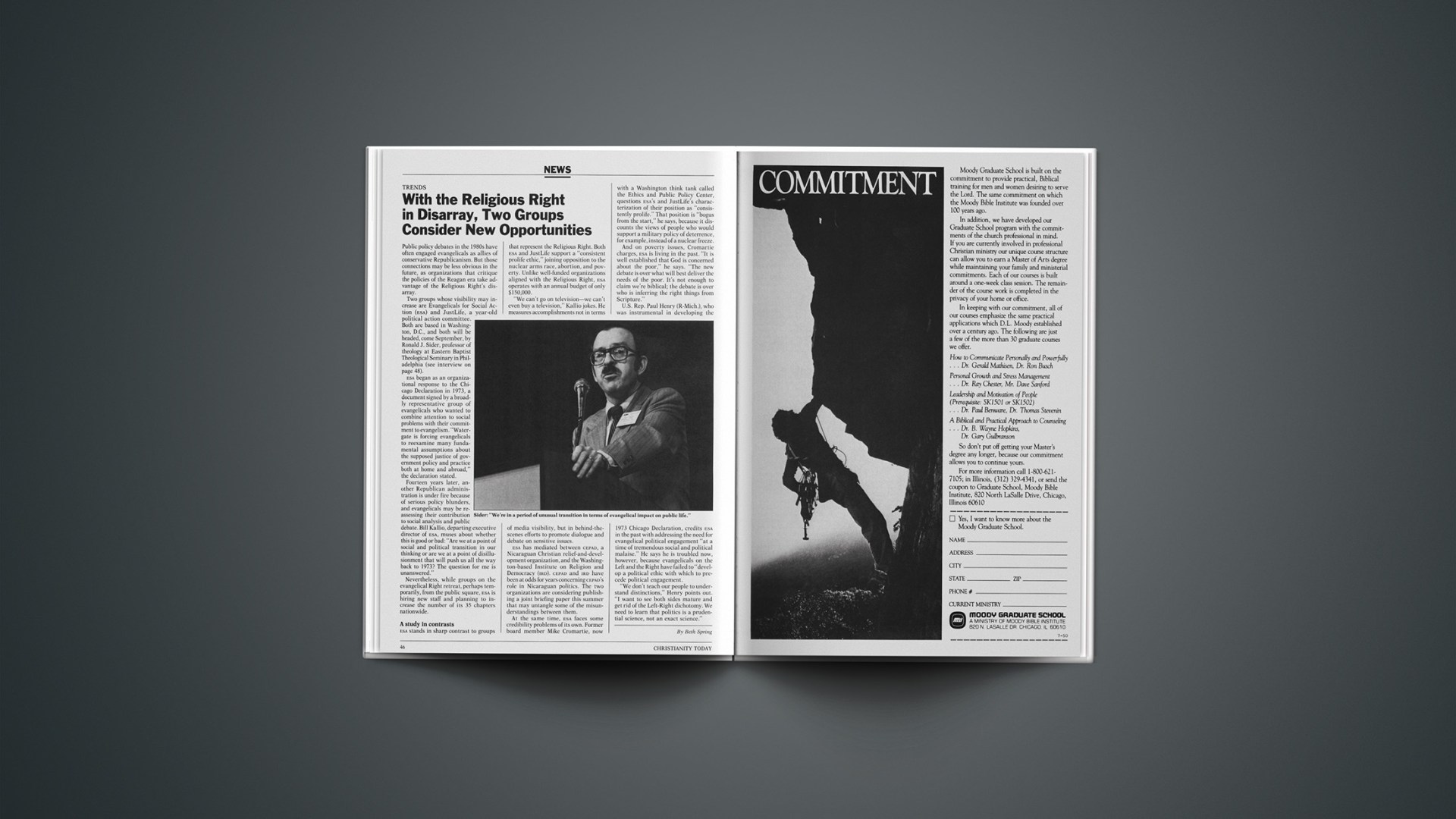
Public policy debates in the 1980s have often engaged evangelicals as allies of conservative Republicanism. But those connections may be less obvious in the future, as organizations that critique the policies of the Reagan era take advantage of the Religious Right’s disarray.

Two groups whose visibility may increase are Evangelicals for Social Action (ESA) and JustLife, a year-old political action committee. Both are based in Washington, D.C., and both will be headed, come September, by Ronald J. Sider, professor of theology at Eastern Baptist Theological Seminary in Philadelphia (see interview on page 48).

ESA began as an organizational response to the Chicago Declaration in 1973, a document signed by a broadly representative group of evangelicals who wanted to combine attention to social problems with their commitment to evangelism. “Watergate is forcing evangelicals to reexamine many fundamental assumptions about the supposed justice of government policy and practice both at home and abroad,” the declaration stated.

Fourteen years later, another Republican administration is under fire because of serious policy blunders, and evangelicals may be reassessing their contribution to social analysis and public debate. Bill Kallio, departing executive director of ESA, muses about whether this is good or bad: “Are we at a point of social and political transition in our thinking or are we at a point of disillusionment that will push us all the way back to 1973? The question for me is unanswered.”

Nevertheless, while groups on the evangelical Right retreat, perhaps temporarily, from the public square, ESA is hiring new staff and planning to increase the number of its 35 chapters nationwide.

A Study In Contrasts

ESA stands in sharp contrast to groups that represent the Religious Right. Both ESA and JustLife support a “consistent prolife ethic,” joining opposition to the nuclear arms race, abortion, and poverty. Unlike well-funded organizations aligned with the Religious Right, ESA operates with an annual budget of only $150,000.

“We can’t go on television—we can’t even buy a television,” Kallio jokes. He measures accomplishments not in terms of media visibility, but in behind-the-scenes efforts to promote dialogue and debate on sensitive issues.

ESA has mediated between CEPAD, a Nicaraguan Christian relief-and-development organization, and the Washington-based Institute on Religion and Democracy (IRD). CEPAD and IRD have been at odds for years concerning CEPAD’s role in Nicaraguan politics. The two organizations are considering publishing a joint briefing paper this summer that may untangle some of the misunderstandings between them.

At the same time, ESA faces some credibility problems of its own. Former board member Mike Cromartie, now with a Washington think tank called the Ethics and Public Policy Center, questions ESA’s and JustLife’s characterization of their position as “consistently prolife.” That position is “bogus from the start,” he says, because it discounts the views of people who would support a military policy of deterrence, for example, instead of a nuclear freeze.

And on poverty issues, Cromartie charges, ESA is living in the past. “It is well established that God is concerned about the poor,” he says. “The new debate is over what will best deliver the needs of the poor. It’s not enough to claim we’re biblical; the debate is over who is inferring the right things from Scripture.”

U.S. Rep. Paul Henry (R-Mich.), who was instrumental in developing the 1973 Chicago Declaration, credits ESA in the past with addressing the need for evangelical political engagement “at a time of tremendous social and political malaise.” He says he is troubled now, however, because evangelicals on the Left and the Right have failed to “develop a political ethic with which to precede political engagement.

“We don’t teach our people to understand distinctions,” Henry points out. “I want to see both sides mature and get rid of the Left-Right dichotomy. We need to learn that politics is a prudential science, not an exact science.”

By Beth Spring

Nigeria: Did Muslims Plan Religious Violence?

An uneasy calm has settled over the plateau states of northern Nigeria. It was in that region last March that week-long religious riots left at least 25 people dead, 152 churches and four mosques burned, and a large number of businesses, homes, and vehicles destroyed (CT, April 17, 1987, p. 43).

At first, it was thought the violence was sparked by uncomplimentary statements about the Quran made at a Christian meeting held at a teachers’ college. But four months after the turmoil took place, evidence suggests that the rioting was not a spontaneous reaction. Rather, it may have been a planned attack against things militant Muslims see as corrupting Islam.

The targets included churches and homes of Christians, as well as hotels, bars, and restaurants associated with alcohol and prostitution, vices outlawed by Islam. Most of those businesses were operated by less devout Muslims and others who moved into the area from southern Nigeria.

Several observers said the rioters must have known their targets in advance in order to miss, to a large degree, homes and businesses owned by Muslims from the North. A source in Nigeria said there is evidence that many involved in the initial rioting in Kafanchan were outsiders brought in by bus. In other cities—Zaria, Kaduna, Kano, Funtua, Kankia, and Katsina—mobs of local residents roamed the streets, burning churches, homes, businesses, and occasionally, people who got in the way.

When army troops and police finally responded to the situation with orders to “shoot on sight,” hundreds of rioters, ages 9 to 14, were arrested. Many told police they were paid the equivalent of $1.25 and given gasoline and matches to burn certain targets. Some have led authorities to the homes of influential Muslims who they say hired them.

The Christian community in Zaria was especially devastated, with only two churches left standing. Among the 72 destroyed were Catholic, Baptist, Anglican, Pentecostal, and the Evangelical Church of West Africa. Homes used as Christian meeting places were also burned. In Funtua, nearly all the homes owned by Muslims from southern Nigeria were destroyed. The only church and hotel that escaped destruction were situated next to the homes of Muslims from the North.

Christians have been uneasy since January 1986, when President Ibrahim Babangida, a Muslim, secretly enrolled Nigeria in the Organization of Islamic Conference, a group dedicated to the furtherance of Islam. Muslims represent about half of Nigeria’s 90 million people and live primarily in the North. Extremist groups have pressured Babangida to establish a Muslim state. But he recently said: “This country has no state religion, but will continue to provide an umbrella under which all religions can thrive.” Christians presently make up about 34 percent of the population.

The government has said it will punish those responsible for the religious violence. It set up a panel to investigate the incidents, and some $5 million has been promised to help rebuild churches that were burned.

Said Assemblies of God missionary John York: “If Christians react … positively [to the strife], if we move in compassion rather than retaliation, … then out of these ashes things are going to grow.”

Apple PodcastsDown ArrowDown ArrowDown Arrowarrow_left_altLeft ArrowLeft ArrowRight ArrowRight ArrowRight Arrowarrow_up_altUp ArrowUp ArrowAvailable at Amazoncaret-downCloseCloseEmailEmailExpandExpandExternalExternalFacebookfacebook-squareGiftGiftGooglegoogleGoogle KeephamburgerInstagraminstagram-squareLinkLinklinkedin-squareListenListenListenChristianity TodayCT Creative Studio Logologo_orgMegaphoneMenuMenupausePinterestPlayPlayPocketPodcastRSSRSSSaveSaveSaveSearchSearchsearchSpotifyStitcherTelegramTable of ContentsTable of Contentstwitter-squareWhatsAppXYouTubeYouTube