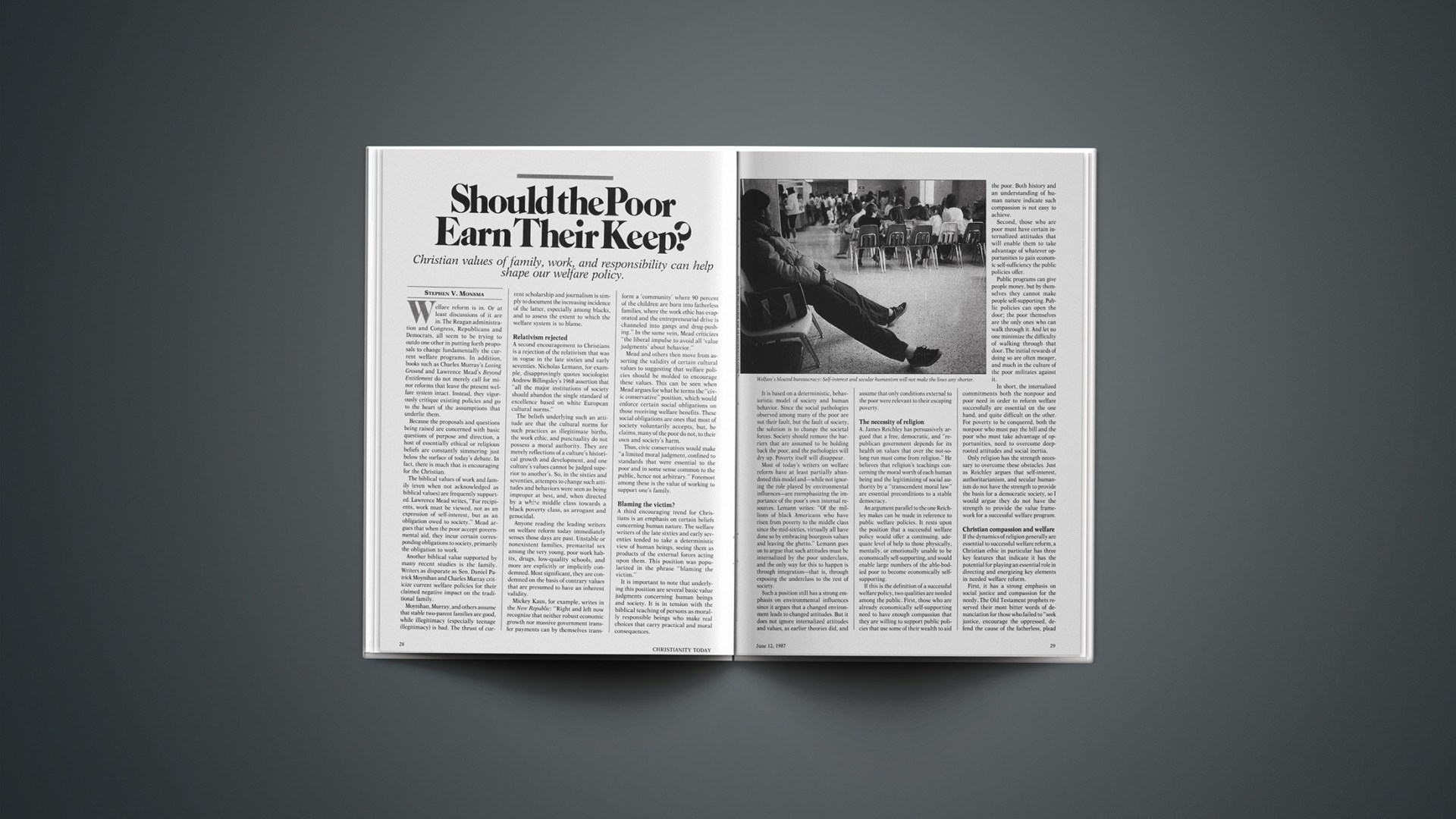

Should the Poor Earn Their Keep?

Christian values of family, work, and responsibility can help shape our welfare policy.

Welfare reform is in. Or at least discussions of it are in. The Reagan administration and Congress, Republicans and Democrats, all seem to be trying to outdo one other in putting forth proposals to change fundamentally the current welfare programs. In addition, books such as Charles Murray’s Losing Ground and Lawrence Mead’s Beyond Entitlement do not merely call for minor reforms that leave the present welfare system intact. Instead, they vigorously critique existing policies and go to the heart of the assumptions that underlie them.

Because the proposals and questions being raised are concerned with basic questions of purpose and direction, a host of essentially ethical or religious beliefs are constantly simmering just below the surface of today’s debate. In fact, there is much that is encouraging for the Christian.

The biblical values of work and family (even when not acknowledged as biblical values) are frequently supported. Lawrence Mead writes, “For recipients, work must be viewed, not as an expression of self-interest, but as an obligation owed to society.” Mead argues that when the poor accept governmental aid, they incur certain corresponding obligations to society, primarily the obligation to work.

Another biblical value supported by many recent studies is the family. Writers as disparate as Sen. Daniel Patrick Moynihan and Charles Murray criticize current welfare policies for their claimed negative impact on the traditional family.

Moynihan, Murray, and others assume that stable two-parent families are good, while illegitimacy (especially teenage illegitimacy) is bad. The thrust of current scholarship and journalism is simply to document the increasing incidence of the latter, especially among blacks, and to assess the extent to which the welfare system is to blame.

Relativism Rejected

A second encouragement to Christians is a rejection of the relativism that was in vogue in the late sixties and early seventies. Nicholas Lemann, for example, disapprovingly quotes sociologist Andrew Billingsley’s 1968 assertion that “all the major institutions of society should abandon the single standard of excellence based on white European cultural norms.”

The beliefs underlying such an attitude are that the cultural norms for such practices as illegitimate births, the work ethic, and punctuality do not possess a moral authority. They are merely reflections of a culture’s historical growth and development, and one culture’s values cannot be judged superior to another’s. So, in the sixties and seventies, attempts to change such attitudes and behaviors were seen as being improper at best, and, when directed by a white middle class towards a black poverty class, as arrogant and genocidal.

Anyone reading the leading writers on welfare reform today immediately senses those days are past. Unstable or nonexistent families, premarital sex among the very young, poor work habits, drugs, low-quality schools, and more are explicitly or implicitly condemned. Most significant, they are condemned on the basis of contrary values that are presumed to have an inherent validity.

Mickey Kaus, for example, writes in the New Republic: “Right and left now recognize that neither robust economic growth nor massive government transfer payments can by themselves transform a ‘community’ where 90 percent of the children are born into fatherless families, where the work ethic has evaporated and the entrepreneurial drive is channeled into gangs and drug-pushing.” In the same vein, Mead criticizes “the liberal impulse to avoid all ‘value judgments’ about behavior.”

Mead and others then move from asserting the validity of certain cultural values to suggesting that welfare policies should be molded to encourage these values. This can be seen when Mead argues for what he terms the “civic conservative” position, which would enforce certain social obligations on those receiving welfare benefits. These social obligations are ones that most of society voluntarily accepts, but, he claims, many of the poor do not, to their own and society’s harm.

Thus, civic conservatives would make “a limited moral judgment, confined to standards that were essential to the poor and in some sense common to the public, hence not arbitrary.” Foremost among these is the value of working to support one’s family.

Blaming The Victim?

A third encouraging trend for Christians is an emphasis on certain beliefs concerning human nature. The welfare writers of the late sixties and early seventies tended to take a deterministic view of human beings, seeing them as products of the external forces acting upon them. This position was popularized in the phrase “blaming the victim.”

It is important to note that underlying this position are several basic value judgments concerning human beings and society. It is in tension with the biblical teaching of persons as morally responsible beings who make real choices that carry practical and moral consequences.

It is based on a deterministic, behavioristic model of society and human behavior. Since the social pathologies observed among many of the poor are not their fault, but the fault of society, the solution is to change the societal forces. Society should remove the barriers that are assumed to be holding back the poor, and the pathologies will dry up. Poverty itself will disappear.

Most of today’s writers on welfare reform have at least partially abandoned this model and—while not ignoring the role played by environmental influences—are reemphasizing the importance of the poor’s own internal resources. Lemann writes: “Of the millions of black Americans who have risen from poverty to the middle class since the mid-sixties, virtually all have done so by embracing bourgeois values and leaving the ghetto.” Lemann goes on to argue that such attitudes must be internalized by the poor underclass, and the only way for this to happen is through integration—that is, through exposing the underclass to the rest of society.

Such a position still has a strong emphasis on environmental influences since it argues that a changed environment leads to changed attitudes. But it does not ignore internalized attitudes and values, as earlier theories did, and assume that only conditions external to the poor were relevant to their escaping poverty.

The Necessity Of Religion

A. James Reichley has persuasively argued that a free, democratic, and “republican government depends for its health on values that over the not-so-long run must come from religion.” He believes that religion’s teachings concerning the moral worth of each human being and the legitimizing of social authority by a “transcendent moral law” are essential preconditions to a stable democracy.

An argument parallel to the one Reichley makes can be made in reference to public welfare policies. It rests upon the position that a successful welfare policy would offer a continuing, adequate level of help to those physically, mentally, or emotionally unable to be economically self-supporting, and would enable large numbers of the able-bodied poor to become economically self-supporting.

If this is the definition of a successful welfare policy, two qualities are needed among the public. First, those who are already economically self-supporting need to have enough compassion that they are willing to support public policies that use some of their wealth to aid the poor. Both history and an understanding of human nature indicate such compassion is not easy to achieve.

Second, those who are poor must have certain internalized attitudes that will enable them to take advantage of whatever opportunities to gain economic self-sufficiency the public policies offer.

Public programs can give people money, but by themselves they cannot make people self-supporting. Public policies can open the door; the poor themselves are the only ones who can walk through it. And let no one minimize the difficulty of walking through that door. The initial rewards of doing so are often meager, and much in the culture of the poor militates against it.

In short, the internalized commitments both the nonpoor and poor need in order to reform welfare successfully are essential on the one hand, and quite difficult on the other. For poverty to be conquered, both the nonpoor who must pay the bill and the poor who must take advantage of opportunities, need to overcome deep-rooted attitudes and social inertia.

Only religion has the strength necessary to overcome these obstacles. Just as Reichley argues that self-interest, authoritarianism, and secular humanism do not have the strength to provide the basis for a democratic society, so I would argue they do not have the strength to provide the value framework for a successful welfare program.

Christian Compassion And Welfare

If the dynamics of religion generally are essential to successful welfare reform, a Christian ethic in particular has three key features that indicate it has the potential for playing an essential role in directing and energizing key elements in needed welfare reform.

First, it has a strong emphasis on social justice and compassion for the needy. The Old Testament prophets reserved their most bitter words of denunciation for those who failed to “seek justice, encourage the oppressed, defend the cause of the fatherless, plead the case of the widow” (Isa. 1:17). Jesus Christ promised a punishment of eternal fire for those who failed to clothe the naked and feed the hungry (see Matt. 25:31–46).

Second, Christianity has a strong emphasis on the mutual responsibilities of husbands and wives, the duty of work to support one’s self and one’s dependents, and the obligations of those in positions of authority. (See Eph. 5:21–33; 2 Thess. 3:6–14; 1 Peter 5:1–5; and Rom. 13:6–7.)

All of these are values that are crucial to strong social structures.

Third, underlying and energizing these first two features of a Christian ethic is a very strong sense of personal responsibility. The norms of the first two features mentioned above are not theoretical or abstract points, but are personal, guiding, everyday obligations to the Christian

Specific Policies

There are large numbers of individuals and families receiving public welfare aid today who have a very low potential for ever becoming economically self-supporting due to severe physical, emotional, or mental limitations. These will require continuing help from society, help that a biblical ethic of caring and compassion for the poor would mandate.

Even those who have the potential to become self-supporting often require education and training, drug rehabilitation, day care for their children, transportation, and other such help. Again, governmental or private institutions are needed; so is a strong sense of caring and compassion.

It is exactly this sense of caring and compassion towards the “fatherless and widows” that a Christian ethic teaches. But Christianity, as we just saw, does not stop here. It also insists on the very sort of responsibility needed by the poor if they are to take advantage of whatever opportunities can be created by reform efforts.

This does not mean public policy either can or should try to impose a Christian ethic where none exists. Yet reality suggests that to a significant degree welfare reform’s chances of success rest upon the existence of such an ethic. Therefore, those chances increase to the extent it does not hinder or run counter to, but seeks to work with and encourage, such an ethic.

Given this perspective, what are the specific public policies that will lead to a successful welfare reform program?

The first is to encourage the formation (or maintenance) of institutions that make use of or foster basic Christian ethical norms. The institution that serves as the clearest example of what I have in mind here is the inner-city parochial school. Success stories of nonpublic, usually Catholic, inner-city schools abound—stories of such schools imposing order, discipline, involvement of families, and other values.

Additional private and public social agencies emphasizing self-help, discipline, and other such values also need to be encouraged and supported. One thinks of homes for teenage mothers, drug rehabilitation efforts, and neighborhood associations.

Second, for those who are physically and emotionally able, work must be emphasized in the place of, or as a condition of, financial assistance. Work is the way out of poverty; work as a social obligation needs to be required. And it should be required not simply for pragmatic reasons, but as a value to be lived.

As work is emphasized, the sense of caring and compassion among the population that must pay for the antipoverty policies increases. American society tends to support helping those who seek to help themselves, since that type of help is fully in keeping with its strong work ethic. A sense of compassion or caring that the government seeks to use to support programs aimed simply at continuing fiscal assistance—“the dole”—puts the Christian ethic of compassion and the Christian ethic of work on a collision course. Replacing financial grant programs with work, or weaving work fully into grant programs, is the way to use our society’s Christian values to support a strong antipoverty program.

Living It Out

I close by noting that what is suggested here leaves open the perennial question of how large a role government should play in society’s antipoverty efforts. I suspect there is no one right answer. As churches and church-related agencies play a more active role, the role of government can decrease, and vice versa. This is largely a question of tactics, not principle. The important point is the presence of the sense of caring and compassion our Lord commands, a sense of caring and compassion that is lived out in the world actively, incessantly, lovingly, effectively. That is more important than the private or governmental form in which it is expressed.

Stephen V. Monsma is currently director of the office of quality review, the Michigan Department of Social Services. He has served in both the Michigan State House and Senate, and as professor of political science at Calvin College. His books include Pursuing Justice in a Sinful World (Eerdmans, 1984).
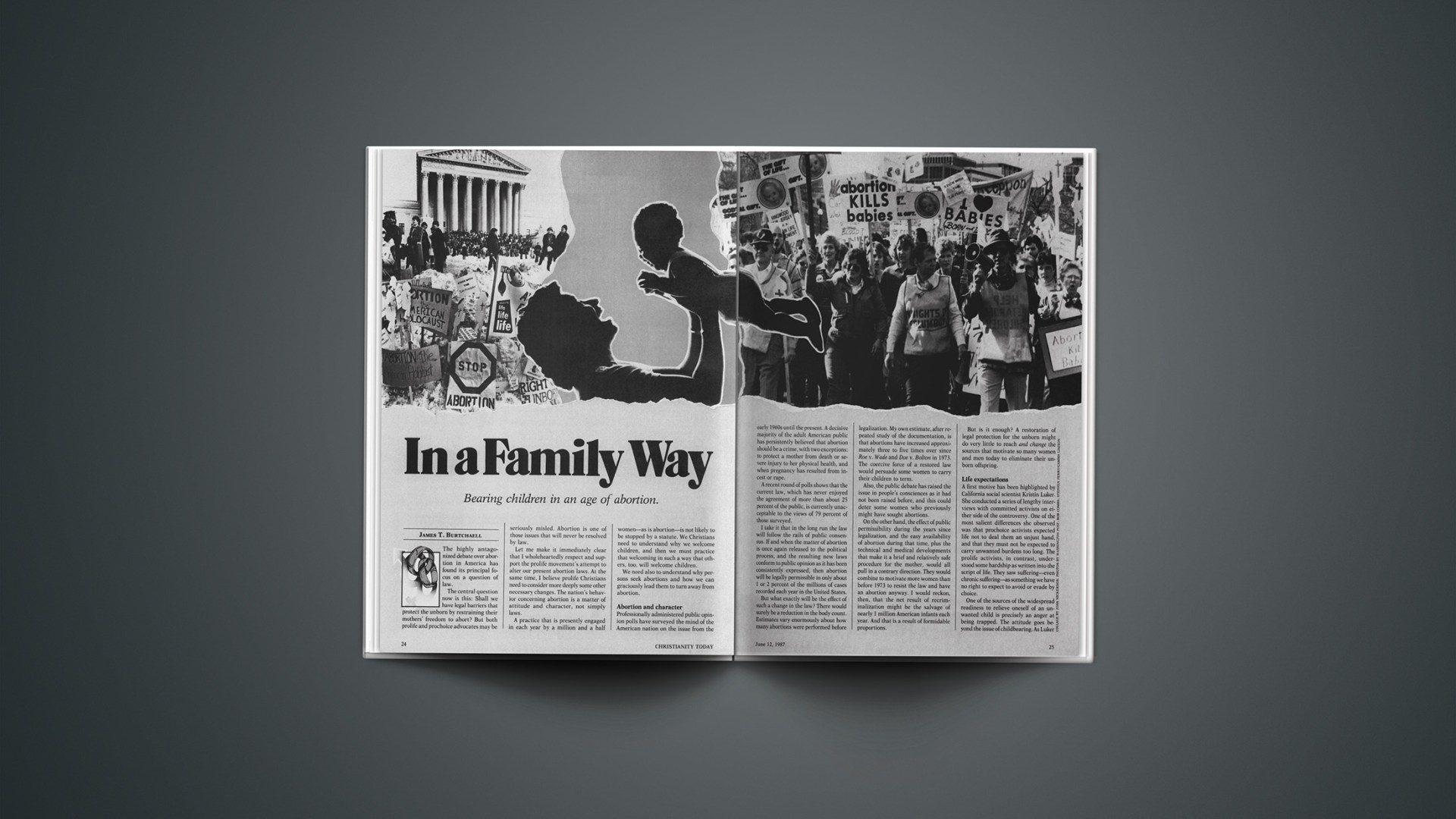

In a Family Way

Bearing children in an age of abortion.

The highly antagonized debate over abortion in America has found its principal focus on a question of law.

The central question now is this: Shall we have legal barriers that protect the unborn by restraining their mothers’ freedom to abort? But both prolife and prochoice advocates may be seriously misled. Abortion is one of those issues that will never be resolved by law.

Let me make it immediately clear that I wholeheartedly respect and support the prolife movement’s attempt to alter our present abortion laws. At the same time, I believe prolife Christians need to consider more deeply some other necessary changes. The nation’s behavior concerning abortion is a matter of attitude and character, not simply laws.

A practice that is presently engaged in each year by a million and a half women—as is abortion—is not likely to be stopped by a statute. We Christians need to understand why we welcome children, and then we must practice that welcoming in such a way that others, too, will welcome children.

We need also to understand why persons seek abortions and how we can graciously lead them to turn away from abortion.

Abortion And Character

Professionally administered public opinion polls have surveyed the mind of the American nation on the issue from the early 1960s until the present. A decisive majority of the adult American public has persistently believed that abortion should be a crime, with two exceptions: to protect a mother from death or severe injury to her physical health, and when pregnancy has resulted from incest or rape.

A recent round of polls shows that the current law, which has never enjoyed the agreement of more than about 25 percent of the public, is currently unacceptable to the views of 79 percent of those surveyed.

I take it that in the long run the law will follow the rails of public consensus. If and when the matter of abortion is once again released to the political process, and the resulting new laws conform to public opinion as it has been consistently expressed, then abortion will be legally permissible in only about 1 or 2 percent of the millions of cases recorded each year in the United States.

But what exactly will be the effect of such a change in the law? There would surely be a reduction in the body count. Estimates vary enormously about how many abortions were performed before legalization. My own estimate, after repeated study of the documentation, is that abortions have increased approximately three to five times over since Roe v. Wade and Doe v. Bolton in 1973. The coercive force of a restored law would persuade some women to carry their children to term.

Also, the public debate has raised the issue in people’s consciences as it had not been raised before, and this could deter some women who previously might have sought abortions.

On the other hand, the effect of public permissibility during the years since legalization, and the easy availability of abortion during that time, plus the technical and medical developments that make it a brief and relatively safe procedure for the mother, would all pull in a contrary direction. They would combine to motivate more women than before 1973 to resist the law and have an abortion anyway. I would reckon, then, that the net result of recriminalization might be the salvage of nearly 1 million American infants each year. And that is a result of formidable proportions.

But is it enough? A restoration of legal protection for the unborn might do very little to reach and change the sources that motivate so many women and men today to eliminate their unborn offspring.

Life Expectations

A first motive has been highlighted by California social scientist Kristin Luker. She conducted a series of lengthy interviews with committed activists on either side of the controversy. One of the most salient differences she observed was that prochoice activists expected life not to deal them an unjust hand, and that they must not be expected to carry unwanted burdens too long. The prolife activists, in contrast, understood some hardship as written into the script of life. They saw suffering—even chronic suffering—as something we have no right to expect to avoid or evade by choice.

One of the sources of the widespread readiness to relieve oneself of an unwanted child is precisely an anger at being trapped. The attitude goes beyond the issue of childbearing. As Luker noted, Americans today tend to believe that suffering is something we should not have to endure, whether it be a migraine headache or Parkinson’s disease or an unsatisfactory school board. We expect, more and more, the right to get our way. It may be no coincidence that the profession we turn to for the surest relief is the same profession that staffs abortion clinics.

Christians should respond in a Christian character to the suggestion that the burdensome—whether those unborn or those near the end of a long life—be eliminated. It is our traditional belief that the more helpless someone is, the more we need to help her. The worst crimes or sins are the ones with the most helpless victims. That, however, is not the perspective of the growing readiness today to terminate the lives of the chronically ill or to extinguish the lives of handicapped infants.

The argument being made consistently for both of these victim groups is that they count for little and that the taxpayer ought to mourn their passing with short sorrow. This is an attitude of soul that the law, by itself, can do little to heal.

Loyalty To Kin

Another motivating attitude associated with the willingness to abort is a readiness to set aside kinship loyalty. The Christian tradition has invited men and women to cleave to one another, for better or for worse, until death. The bond between spouses has been understood as similar to that between parents and children: a tenacious attachment that would forfeit self-satisfaction for the benefit of one’s kinfolk. But many abortion decisions represent a backing away from—and, in quite a few instances, a renunciation of—that kinship bond. A change in the law would do little to touch those sources, those motivations, those deep roots of rejection of the unborn child.

What we need is an insurrection of consciences. We need the startling example of fathers and mothers who nourish their young at high cost. We need a religiously inspired alliance of women and men who know that love of the helpless cannot be coerced but is worthwhile.

Christians believe there is nothing better to do with our lives than to foster life. We are persuaded that we grow precisely by enhancing the growth of others: in particular, those who have most need of us.

Every time you visit a household peopled by children, you are struck by how the children have grown. One is tempted to annoy the children by remarking, “Oh, Rachel, how tall you are!” or “How Bobby has grown!” The fact is, however, that the parents are growing at an even faster rate than the youngsters. We grow by affording growth to others. We have a need to be burdened by people we did not want: boat people, children, ethnic strangers. Our life is drawn out to full measure precisely by having to accommodate ourselves to the uncontrollable needs of others to whom we are committed.

The prochoice movement has echoed the unfortunate priority of our culture: that one always has a right to freedom of choice. The Christian tradition, which fastens its attention more on needs than on choice, finds it amusing that anyone should identify freedom of choice with parenting. What could be a worse warrant for child rearing than an insistence on getting just what you want? What could set you up for a bigger fall than to expect your child to satisfy your roster of hopes? Children exist to destroy hopes—and then to replace them with enhanced hopes.

If the Christian Scriptures set us up for anything, it is that the Lord does not busy himself to provide us with what we want or expect. He does not answer the questions we ask. For our questions, like our hopes, are too puny, too nearsighted. He ignores them and answers larger questions we never thought to ask. He provides us with things beyond our hopes. Often enough these involve our giving our lives to our neighbors, and the neighbors often enough turn out to be the most unexpected and, frankly, unwelcome people.

The attitudes that cause us to be so reluctant to open our lives to risk and jeopardy by welcoming children, who by their nature arrive without our knowing in advance what claims they will put upon us with their needs—these attitudes are what give us life and growth. Children are the quintessential strangers.

Certainly we should struggle to change the nation’s laws on abortion. But we must also invite men and women into the generosity of character that will induce them to offer a sacrificial welcome for children. This is a quality of character without which we may not find it possible to grow out of our native selfishness into love.

Victims Exploiting Victims

Christians have a perspective all their own in which to see a need for a reform of law and an arousal of conscience on behalf of the unborn. For they have grounds for believing that the perpetrators of this crime are themselves its most costly victims. How often it is that some helpless group is savaged by aggressors who have themselves become victims. They are survivors of outrage, and they now seek to relieve their stress and suffering by turning on others who are weaker still: victims exploiting victims.

Who are those who want to close our gates against the impoverished and threatened refugees? They are those groups who have long been trampled underfoot by our economy, and who fear new rivals just as they glimpse for themselves a hope for betterment and security: victims pushing aside victims.

What is the background of parents who abuse and batter their children? Theirs was a childhood of violence, incest, contempt: victims lashing out at victims. And who are aborting their daughters and sons today? They are women and men who are alienated, abused, poor, who are at a loss to manage their own lives or intimacies: victims destroyed, destroying victims.

Hate them—hate any of these victimizes—and you are simply cheering on the cycle of abuse and violence. Suppress your rage well enough to look closely and humanely at drug dealers, at rapists, at pathological prison guards, and you may see it there too: the same pathetic look of the battered spirit, wantonly preying on others.

Women who are desperate or autistic enough to destroy their children are among society’s most abused victims. We owe them every help. But a truly compassionate support could never invite them to assuage their own anger by exterminating those more helpless still. It is by breaking the savage cycle of violence that victimization is laid to rest.

When you grasp the uplifted hand to prevent one injured person from striking out at another, you must do so in love, not in anger, for you are asking that person to absorb suffering rather than pass it on to another. And, to be a peacemaker, you must be as ready to sustain as you are to restrain. This far exceeds the work of law and the warrant of justice. You must be more than just to accept injustice and yet deal out justice.

So, while I shall be a resolute ally of those who advocate the reversal of Wade and Bolton, I would also expect them to be the creators of a far more intelligent and far more profound moral discourse than our country has yet enjoyed, and to transform the level of debate as it is carried on in the public forum.

The law by itself is unable to accomplish what the lawmakers have in mind. A transformation of minds, a somersault of values, is needed. The prospect, for those of us who fear we shall destroy ourselves if we stand by and acquiesce in the extermination of the young, is daunting.

We must support the just and dutiful application of coercive power by those who rule. But our firmest reliance must fasten upon the courageous appeal of those whose duty it is to preach. And it is the duty of all Christians, without exception, to preach a welcome for the helpless.

Fr. James T. Burtchaell is professor of theology at the University of Notre Dame. His books include the acclaimed Rachel Weeping (Harper & Row, 1982) and For Better, For Worse (Paulist Press, 1985). This article is adapted from a speech delivered at a forum sponsored by Americans United for Life.

Justice Without Conscience Is Dead

Consider a few of the grave frustrations that are usually visited upon any conscientious person who accepts responsibility for the formulation and enforcement of the civil law.

The first frustration is that law cannot reach the roots of civil disorder. What drives a serial killer, draws people to abuse their children, or spawns rape—that pathetic and predatory act of violence? We know only that the sanctions of criminal justice cannot remedy those deep troubles within the human character. The law gives access only to symptoms of disorder, not to the sickness. One’s most urgent efforts in the field of criminal law are sandbag levees against the flood, always likely to wash away at the next mighty surge.

A second frustration is that even when effectively enforced, law’s power to deter is so limited. Interestingly, one of the crimes that most often leads to the sentencing of an offender is murder. About 25 percent of all reported murders in the U.S. actually lead to the conviction of an adult offender. The percentages go down from there. The figure for forcible rape is 16 percent; for theft, 6 percent.

For the responsible administrator of the law, it must be disheartening to see that despite responsible effort, one cannot claim these serious crimes are actually being repressed.

A third frustration is peculiar to our form of government: democracy presumes selfishness, yet requires altruism without being able to provide it. We cannot live together in a free community unless we are willing to inconvenience ourselves for the common good. There can be no peace if we merely coexist as aloof strangers, each one out for his or her own survival. There will be times when each of us could not survive without the readiness of our neighbor to extend himself or herself and help us, to sustain us when we falter, to hold us up to standards when we would otherwise defect.

And yet everything about our laws seems to assume that the average citizen cannot be relied on to forfeit much of his or her own convenience if a neighbor is in the lurch. Merely to observe the criminal law one must be possessed of generosity and social responsibility; yet the law, if it has the bite necessary to do much good, cannot assume good will. It relentlessly demands minimal performance, whatever one’s disposition to care for others.

Fourth, and last, the law seems to require religious conviction as its nearest ally, yet in our democratic tradition has turned its back on faith and faith’s commitments. It is only when people’s hearts and minds are touched and they undergo moral conversion that they can find the motivation to observe the law. And the major force for moral conversion is usually the example and the appeal of a religious community.

Take, for instance, the progress of civil rights in our country. There were many legal milestones in our faltering journey towards justice for blacks. But is it not truer to say that the great markers along the road were moral and religious ones? The Quakers and the Christian abolitionists in the early nineteenth century accomplished what Jefferson and Madison had not the nerve to do. Martin Luther King, Jr., had an effect upon the nation that went beyond what Abraham Lincoln achieved. There must be religious people still to come who will bring to fruition the legal changes sponsored by Lyndon Johnson.

Sometimes the conscience moves before the law does. Sometimes the conscience is slow to keep up with the law. But without conscience, justice will never be a plentiful yield from just laws. Law does not produce law’s own purpose, which is peace through justice. For justice is a disposition of character, and the law cannot govern character.

The law will always fail if it is unsustained by the common conscience. But that is no reason for repealing the unsuccessful law, because the law has a further purpose: not to transform people, but to declare and disavow publicly what we commonly believe to be unfair or damaging. Laws are part of our public profession of justice. They are what we, as a people, are willing to promise out loud to one another. You probably cannot tell the moral character of a people by reading their laws. But you can learn something about a people’s character by observing what laws they lack.

By James T. Burtchaell.

What Is Sex For?

The recent Vatican document raises important questions.

On March 10, 1987, the Vatican statement on human reproduction was made public. In a tightly reasoned, logical fashion, its architects apply traditional Roman Catholic understandings of the nature of the human person and of marriage to several crucial ethical issues of the day—abortion and fetal experimentation, artificial fertilization, and legislation in these areas.

Basically, this document voices a necessary caution regarding the advancing technology that threatens respect for the mysteries of human life and procreation. But one point has already generated special interest and controversy: the evaluation of artificial insemination.

The document rightly distinguishes between two types of artificial fertilization: “heterologous” (conception apart from the husband-wife bond) and “homologous” (conception between husband and wife). The magisterium is surely correct in warning against conception outside the marriage bond. This warning is based on a properly high view of marriage: “The fidelity of the spouses in the unity of marriage involves reciprocal respect of their right to become a father and a mother only through each other.”

To this basis could be added the practical problems our society faces when artificial fertilization brings parties other than husband and wife into the procreative process. Cases of children seeking their genetic fathers or mothers, lawsuits surrounding the rights of surrogates, and the problem of disposing of the unwanted embryos from in vitro fertilizations are but the beginning of what could develop in the future. Although the proper Christian response to this may not be the simple categorical rejection proposed by the Vatican, the Catholic hierarchy has done all of us a service by bravely articulating a needed warning in this area.

The Vatican then speaks against the second variety of artificial fertilization, disallowing nearly all types of technological assistance in the procreative process, even when no third party is introduced. At the heart of this condemnation is an affirmation of the “inseparable connection … between the two meanings of the conjugal act: the unitive meaning and the procreative meaning.” Based on this conviction, the document condemns not only artificial birth control (for thereby the sex act can occur without “respect for its openness to creation”) and in vitro fertilization, but also artificial insemination (“the transfer into the genital tracts of a married woman of the sperm previously collected from her husband”). Fertilization through these means, the document maintains, undermines the origin of the human person as the result of “an act of giving,” the fruit of the parent’s love; and it results in the child being “an object of scientific technology.” In other words, “such fertilization entrusts the life and identity of the embryo into the power of doctors and biologists and establishes the domination of technology over the origin and destiny of the human race.”

Here again one must applaud the magisterium for launching a commendable attempt to maintain the mystery of human procreation in the face of the unchallenged intrusion of technology into human life. Yet, the warning against artificial insemination is ill advised. The wholesale rejection of technological assistance in the natural human drive to produce offspring in which the husband’s sperm is implanted into the wife’s body is unwarranted. In fact, the rejection voiced by the Vatican document arises out of a truncated (and therefore damaging) understanding of the sex act within the context of marriage. By insisting that the “unitive meaning” of the sex act, which the document acknowledges, cannot be separated from the “procreative meaning,” the magisterium is maintaining virtually unaltered the antiquated understanding that works to limit sexual activity to procreation.

The document’s understanding of the sex act is truncated, for within the marriage bond sexual activity can carry other equally significant meanings.

First, this act is an expression of the self-giving of the marriage partners. Marriage is intended to be the most intimate human relationship, one in which each person gives freely of his or her self for the sake of the other. This self-giving is to be expressed in the mundane aspects of daily life together. But the highest symbol of one’s willingness to give of oneself freely and totally to one’s spouse and to develop a fully intimate relationship is the sex act. In this act, one gives oneself fully and unashamedly and becomes fully vulnerable and open to the other. In this act, one seeks to please and fulfill the need of the other.

Second, in the context of marriage the sex act is a spiritual metaphor. As an expression of the giving of oneself for the other, this act is a vivid reminder of the self-giving love of Christ for the church. Paul uses marriage metaphorically when instructing the church in Ephesus (Eph. 5:22–33). Husbands are admonished to love their wives as Christ loved the church. The apostle then applies the Genesis statement concerning a man leaving parents to be joined with a wife (Gen. 2:24), which carries implicit sexual overtones, metaphorically to Christ and the church.

The sex act, as a sign of the desire to give of oneself completely, is an appropriate reminder of the spiritual truth that Jesus has given himself completely for his church. The coming together of the marriage partners with the intent to please and satisfy each other in this intensely intimate act speaks of Jesus’ act of total self-giving in living and dying for others. As one’s first desire in the sexual act should be to please the other, so also Jesus sought to meet the ultimate human need for spiritual intimacy with God.

Finally, the sex act may be seen as the “sacrament” of the marriage covenant. This is not to suggest that marriage is a “means of grace.” Rather, sexual intercourse is an outward act that seals and signifies an inward commitment. In marriage the partners enter into a mutual covenant, as they pledge their faithfulness to each another. Their commitment is sealed in the marriage bed; and the continuing practice of the sex act is a repeated reaffirmation of their pledge.

These three aspects of the meaning of the sex act may all exist apart from the procreative intent. In fact, rather than the procreative meaning being central for the unitive meaning (as is implied in the Vatican statement), these aspects of the sex act form the context for procreation. As self-giving love is creative, so the giving of oneself in the marriage act can be procreative within the context of the marital covenant.

The position of the Vatican document is also dangerous. By maintaining the inseparability of the unitive and procreative meanings of the sex act, it fails to see that the latter properly belongs in the context of the three other, more profound meanings. The outworking of the document is an unwholesome, tacit condemnation of marital sexual relations where no “openness to procreation” is possible or intended. This precludes sex for a great many married couples, including those who are seeking to practice responsible family planning or are beyond the childbearing years. In contrast, however, Paul never discourages the practice of sexual relations, except for the purpose of concentrated prayer (1 Cor. 7:3–5).

The position of the Vatican document that underlies its rejection of artificial insemination by husband (AIH,) therefore, is questionable. A fuller understanding of the meaning of the sex act within the marital bond would welcome as God’s gift, and not discourage, technological assistance in procreation—so long as the process employed is not objectionable on other moral grounds (as is the case, for example, with in vitro fertilization), AIH assists in the formation of new life—the natural offspring of the marital union—giving expression to the creative love present in the union of husband and wife.

What does the Vatican document offer childless marriages? Infertile couples are called to find in their situation “an opportunity for sharing in a particular way in the Lord’s cross.…” Such persons are encouraged to adopt or engage in assisting other families. While these commendable suggestions ought to be given careful consideration, they must not be cited as the only options.

For some infertile couples, the desire to experience the joy of being partners with God in the mystery of procreation may be a divinely given impulse, which ought to be facilitated when morally and technologically feasible. By developing the means to implant the husband’s sperm into the wife’s body, modern medical technology has provided hope for some infertile couples that this joy may be realized.

Stanley J. Grenz is associate professor of systematic theology and Christian ethics at North American Baptist Seminary, Sioux Falls, South Dakota. A member of the Baptist Joint Committee on Public Affairs, he recently coedited Christian Freedom: Essays in Honor of Vernon Grounds.

Reconcilable Differences

In marriage, two individuals really can become one.

Attitudes regarding marriage have changed. A recent article in a secular women’s magazine puts the matter in a nutshell: “Not so long ago problems were regarded by both a wife and her mother (to whom she was most likely to go with a marital problem) as natural and normal. (‘I had the same trouble with your father.’) Unhappiness alone was rarely justification for leaving a marriage. (‘He doesn’t drink, he doesn’t beat you, and he brings home his money. What else could you want?’)

“Most modern women, on the other hand, regard happiness as the principal goal of marriage. If they cannot find happiness with a man, they regard divorce as a reasonable alternative.”

Here is a problem: what exactly is “happiness,” “fulfillment,” “realizing one’s potential,” “having a full life”? God and Redbook may agree that marriage is supposed to help us realize our potential, but this will not mean much unless they have the same idea what “potential” is.

The “full life” through marriage can be envisioned according to at least three different models: the self-realization model, the contract model, and the one-flesh model.

Self-Realization

According to this model, the ultimate point of marriage is to bring fulfillment to each of the partners individually. “Fulfillment” here means having interesting and exciting experiences. It means being loved and affirmed. It means having the freedom to “express” oneself, and to “grow,” and to be “creative.”

Reflecting about good reasons for divorce, marriage therapist Albert Ellis voices the self-realization model: “[The husband] may sense … that his wife hinders his and her growth and development by her tyrannical possessiveness. Or he may vaguely feel other qualities about his marriage, of which he is only semi-conscious, that actually constitute excellent reasons for his leaving it.”

In this view, marriage is soil. Its purpose is to help you grow sleek and wonderful, and to make you like yourself very much. If your marriage holds you back and makes you dull and grumpy, then it is time to shake the old depleted soil off your roots and repot yourself. Admittedly, the repotting may shock your system a bit, but it is hoped that in the long run you will be a more “fulfilled” person.

Of course, when the new soil, in its turn, runs out of nutrients, it will be time to start over again.

A paradox sleeps in the bosom of the self-realization model. No love whose primary purpose is individual self-realization can be deeply self-realizing. It is self-thwarting to adopt fulfillment as the purpose of marriage and the criterion of success in it. You can never quite admit to yourself that you are really in this for its health benefits. You have to keep telling yourself you are in love, for otherwise you get only a very inadequate form of fulfillment.

For example, when you are getting repotted there is something you must be careful not to notice too clearly: it is that the present soil, too, may need replacing eventually. If you become too aware of this, it gets hard to suck the nutrients out of the present soil. If you want self-fulfillment from marriage, you need to think of marriage as something greater and more serious than a context for self-fulfillment.

The self-realization model of love is in the air nowadays, and even Christians who notice its incoherence may be influenced by it. We may find ourselves sizing up our marriage by the yardstick of self-fulfillment, and we may even be having thoughts of bailing out when we think our human potential is being stifled.

Marriage here has become a gentle (and sometimes not so gentle) form of mutual exploitation. There is no room for lifelong promises: If you are into marriage for self-realization, it makes no sense to promise to love and cherish your partner in sickness and in health, forsaking all others, until death you do part. If he becomes an invalid, that can put a cramp in the pursuit of your human potential. Or your mate may just become a dull person, or lazy; and then maybe a more exciting person will come along.

This is clearly an area in which the Christian is called to keep unstained from the world. When we find ourselves making individual fulfillment the bottom line for assessing our marriages, we can be sure we have been seduced by spiritual forces contrary to God and ourselves.

Marriage As A Contract

So the Christian wedding service introduces an element that bypasses the self-realization motive. It has the couple vow mutual faithfulness through whatever comes. It is not that you shouldn’t wish for individual self-realization; we would hope that some individual fulfillment is in store for you, and if it can be accomplished consistently with marriage, then so much the better. But the service serves notice: if actualizing your potential is your highest goal, we suggest you look for another way. In marriage you throw in your lot with this person. If he or she frustrates your own growth, you are still committed.

Marriage is not like a business partnership—two people joining together for what they can get from it. It is communion, the formation of a stable personal bond. But to give the bonding some teeth, marriage does have a contractual dimension. When it is working right, this produces a dimension of commitment. Before the congregation the couple declares their intention and takes a solemn vow that they will love each other.

These days many couples write their own wedding services, sometimes from scratch, sometimes by modifying a traditional service. Some of this just personalizes the service. But what often gets left out of customized weddings is a couple’s promise to love one another until death them do part.

This is a symptom of ambivalence; we want to go through the wedding service, all right. We are not content just to live together with our fulfillment in view. We sense there is something unfulfilling about being so casual. We are looking for the deeper bond. But still we are not ready to promise. We know the dangers of commitment and are realistic about the prospects. And so, being realists, we just scratch out the harder promises in the service.

The contract model is more courageous and more realistic about human nature. The writers of those promise-laden wedding services knew something about human fulfillment that seems to have been forgotten by the pushers of self-realization. They knew that if you remove from marriage the element of commitment, with its potential for the sacrifice of the individual’s self-realization, you also deprive it of its power to fulfill those individuals in the way that only the bond of genuine love can do.

One Flesh

But, truth to tell, a nobler reason than any we have mentioned is often given for deleting the promises. Aren’t promises out of place in a love relationship? Isn’t a contract the wrong kind of glue for binding two people in a marriage? Shouldn’t that be a spontaneous, natural, living thing?

Couples today are critical of the highly ethical marriages that seem to have been the norm a generation or so ago. There was a strong sense of marital “duties” and a strong ethic of sexual fidelity. Each was there whenever needed by the other. It was fulfilling enough to contribute their part to the stable and stabilizing social arrangement of marriage. But missing was a sense that Mr. and Mrs. Barnes were in love, that they delighted in one another’s company, that they were real companions to one another.

It is surely in part the desire to avoid this “externalism” in their own marriages that leads many younger couples to adopt the ideology of self-realization. Our argument, however, is that this is the wrong road to take, and that Christianity, with its “one flesh” model, has all along had a deeper understanding of marriage.

It is inadequate to think of marriage as a forum for individual self-realization, and to think of it as merely a covenant to stick it out to the end. The contract view is in some ways nobler than the self-realization view, but both see the parties basically as individuals who come into a more or less external relationship with each other. Both give far too little credit to God’s desire that the couple become a new communion.

Christ loves his church, says Paul, not as a group of people external to himself with whom he has entered into an agreement, but as his own body. And similarly, God intends for a husband to love his wife and a wife her husband, as extensions of themselves. We do not usually have to promise to look out for our own interests in the daily affairs of life. We are deeply enough disposed to do so anyway. In the same way, in Christian marriage the promise to love one another until death us do part ideally becomes superfluous as the bonding between the two grows and deepens.

The illustration of being “one flesh” that most readily comes to mind is the relationship of parent and child. Being a parent extends your vulnerabilities and joys. When the child is sick, you are sickened; when he is threatened, you are threatened to the depths of your being. And similarly, the child’s joy is your own: when your kid hits a homer, it is even better than hitting one yourself.

We all have a vestige of the one-flesh concept of marriage, even if our thinking has been secularized. This comes out when a couple we know well gets a divorce. Unless they have been very obviously alienated from one another, we perceive them as bonded, and so when they divorce, each looks like a sundered, incomplete individual. We say, “Hi Joan. How’s …?” We catch ourselves, and we have an impression that the divorce means not just that Harry is no longer a “part” of Joan’s life, but that this is not quite the old Joan, either. A dimension of her has been amputated. The personality-inheritance of an era in their history takes on an aura of death.

To be one flesh with another person, in Paul’s spiritual sense, is to see that person, quite naturally and without effort, as an extension of yourself. We rarely see this in marriages. It is far more common to see mutual tolerators and coping cohabitors—and, moving toward the less humane—competitors, adversaries, enemies. But every now and then we do see a couple who seem to have become one flesh.

Scenes From A Marriage

To get a clearer view of these three conceptions of marriage, let us take an episode common to the lives of many couples, and see how it would look in each kind of marriage. The partners have different desires regarding a vacation trip. Roger’s idea of the perfect vacation is three weeks in Toronto: one week at a philosophy seminar, one week doing research at the Pontifical Institute, and one week visiting philosopher friends. Marilyn has a different idea: a week and a half in Toronto visiting art galleries and viewing films, and a week and a half at the lake, water skiing and lying on the beach.

Self-realization. Because of the demands of their jobs, Roger and Marilyn do not see much of each other during the normal course of their lives, and so they were hoping this vacation might be an opportunity to “renew acquaintance.” As it became clear that they had different notions of what kind of vacation would fulfill them, they began to see that if they took their vacation together, one or the other would be “stifled.”

But at least their preferences overlap for a week and a half in Toronto, so that during that time they can be “together”—which is to say, in the same city. She can go to the galleries while he is at the seminar or doing research, and they can sleep together. During the other week and a half they go their separate ways. After three weeks, they drive home together.

Contract. Roger and Marilyn are committed to taking their vacation together—not just sleeping in the same hotel room after all-day separation. Their different interests pose a problem, but they are willing to “compromise,” to give and take, to “sacrifice” for one another and for the marriage. Roger doesn’t feel he will be “stifled” if his vacation lacks full intellectual stimulation, and Marilyn does not resent too much a loss of self-fulfillment in missing the art galleries and films and water skiing.

So they compromise: Saturdays are spent at the beach, with Marilyn’s face toward the sun and Roger’s in some dusty tome under the umbrella. They do some cafe-hopping with Roger’s intellectual friends, while Marilyn mostly watches the weirdoes on the street, undistracted by the talk of politics and philosophy that hardly interests her. On Tuesdays, when admission is free, they go to the galleries, where Roger browses dutifully, gritting his teeth only a little, and living in hope of closing time.

One flesh. Like the Roger and Marilyn of the contract version, the couple committed to the one-flesh marriage are bent on taking their vacation together, and they connect this commitment with remembering their vows. But their notion of “together” is richer. Being together does not just mean spending time in the same physical vicinity. Ideally, it means sharing activities that are characteristic of themselves in their unique individualities. It means getting significantly into each other’s lives.

It means embedding their bond in the larger common bond of the kingdom of God, and thinking of the diversity of their activities as under the impetus and limiting of Christ’s will. In this case, Roger’s efforts at being together with Marilyn involve trying to see her not just as an individual with some needs to be met, but as a child of God who in a very special way is an extension of himself. So if she likes galleries and movies, he seriously tries to “get into” going to galleries and movies.

He does this for her sake, but the more she becomes an extension of himself, the more it is for their sake. Her efforts at being “together” with him are not just efforts to resign herself to his love of intellectual pursuits and altruistically to give him room to engage in them. They are efforts to enter into his world, to see things from his perspective, to see and hear with common eyes and ears, to share his interests, joys, and concerns. He seeks to learn art history from her, for instance. She tries to get to know his friends, and to enter, as she can, into their discussion.

Marital Self-Realization

Becoming one flesh does not happen on the wedding day (or night), nor is the process very likely ever to be complete. It is a calling of Christian couples, a destination toward which they ever travel. Even in the best marriages it remains a challenge and a goal for creative efforts. But for those of us on the way, how can we foster our growth as couples, a growth that makes the promises superfluous because it achieves their intention so perfectly?

Paul says, “Be subject to one another out of reverence for Christ” (Eph. 5:21). Subjection to one another can take many forms: learning from one another, honoring the other’s desires even when they conflict with your individual preferences, working alongside the other in an apprentice capacity. But in all cases, this subjection bonds the couple together only if it is a spiritual subjection, an honoring of the other, in his or her individuality, with time, attention, efforts to understand and enjoy. It is an exercise of humility in which you set aside yourself for the moment and become absorbed in the activities, interests, and abilities of your spouse.

For a fully mature bond, this subjection to one another must be mutual. Thus, you learn together, and your capacities and activities intermesh so as to make a co-unity, a single working, playing, thinking, feeling unit that in the deepest sense is a couple—that is, two persons who have been coupled by this common history. Repeated acts of humility toward one another have a powerful bonding effect over the years.

Paul says this subjection to one another is to be “out of reverence for Christ.” The subjection of wife to husband or husband to wife is not to be absolute. One is not to enter into the other’s life in anything that is inconsistent with Christ’s will. So Bonnie and Clyde could never qualify as realizing the Christian “one-flesh” ideal—and less extremely, no couple who are not honoring Christ in their union can have achieved this special kind of human fulfillment.

The communion of “one flesh” is nested in the communion of the church, whose head is Jesus. And this means the new marriage self that will emerge over the years as you submit to one another out of reverence for Christ will be distinctive. Its activities and concerns will be shaped and styled by their larger context, which is the kingdom of Christ.

Even in secular marriages, we sometimes see what a powerful bonding effect it has for a couple to have some common goal that is beyond the narrow context of the marriage—a political cause, a project of art, a business. Christians have such a “common cause”—the greatest and most perfect that can ever be—built into their marriages. The Christian Reformed wedding service says, “The purpose of marriage is the propagation of the human race, the furtherance of the kingdom of God, and the enrichment of the lives of those entering this estate.”

“The enrichment of the lives” of husband and wife has been the subject of this article. If our argument is correct, the fact that the marriage communion is nested in the communion of those seeking God’s kingdom is a very important basis of that enrichment.

The Bible’s vivid metaphor for the marriage bond, that the two become “one flesh,” ought to be the guiding idea for our thinking about marriage. Our selves are brought to realization in and through this most intimate of human bonds. The vows are in the service of this “self-realization” and are really a promise to pursue the “one flesh” goal with all seriousness and concentration. Ideally, the marriage reaches a state of maturity in which the promises are no longer binding—not because what is promised ceases to be incumbent on the couple, but because their own union is so complete that the promises, as bindings, fall down loose around them.

Robert C. Roberts is professor of philosophy and psychological studies at Wheaton (Ill.) College. His wife, Elizabeth, is a homemaker and former teacher.

Ideas

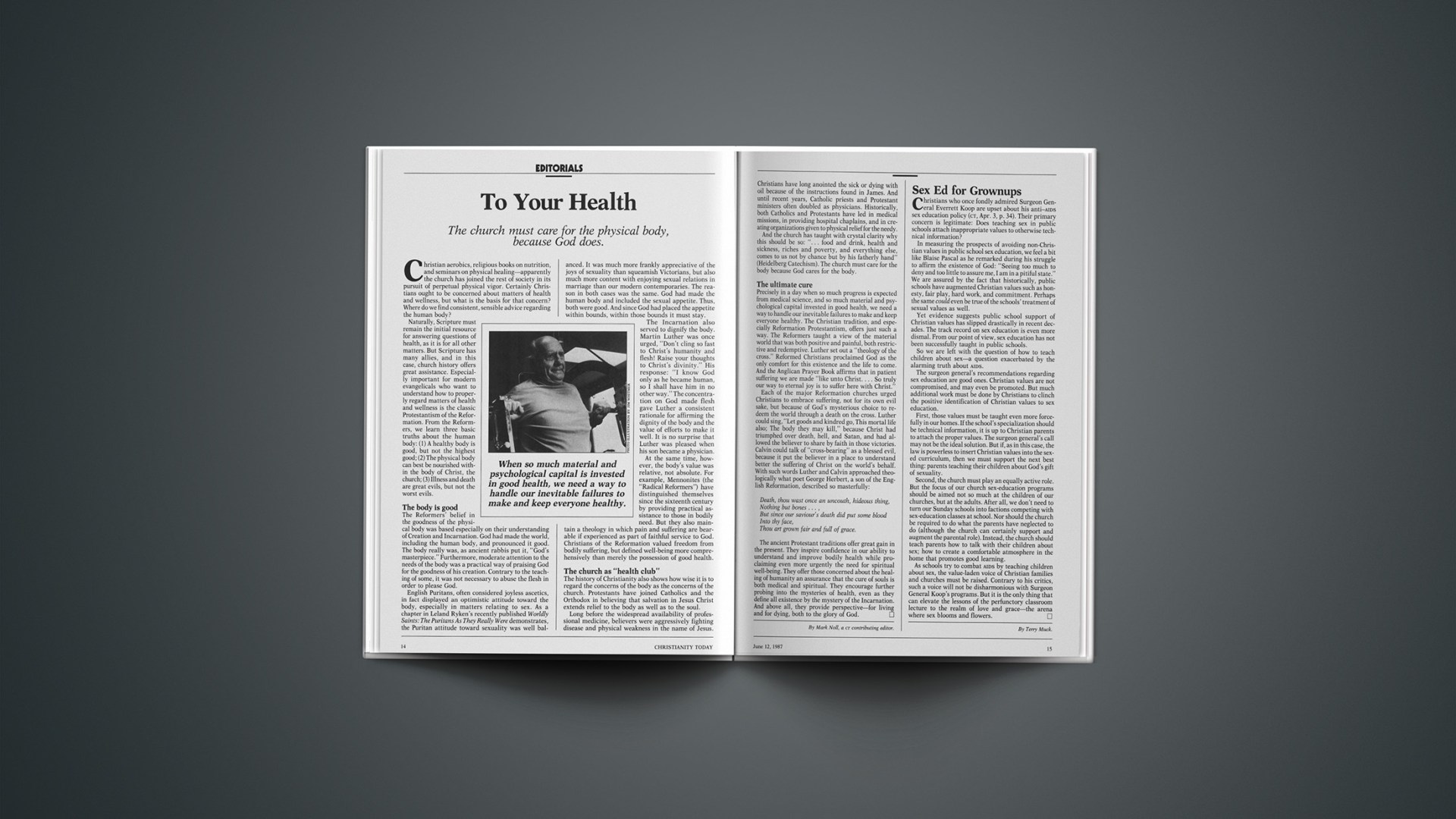
To Your Health

The church must care for the physical body, because God does.

Christian aerobics, religious books on nutrition, and seminars on physical healing—apparently the church has joined the rest of society in its pursuit of perpetual physical vigor. Certainly Christians ought to be concerned about matters of health and wellness, but what is the basis for that concern? Where do we find consistent, sensible advice regarding the human body?

Naturally, Scripture must remain the initial resource for answering questions of health, as it is for all other matters. But Scripture has many allies, and in this case, church history offers great assistance. Especially important for modern evangelicals who want to understand how to properly regard matters of health and wellness is the classic Protestantism of the Reformation. From the Reformers, we learn three basic truths about the human body: (1) A healthy body is good, but not the highest good; (2) The physical body can best be nourished within the body of Christ, the church; (3) Illness and death are great evils, but not the worst evils.

The Body Is Good

The Reformers’ belief in the goodness of the physical body was based especially on their understanding of Creation and Incarnation. God had made the world, including the human body, and pronounced it good. The body really was, as ancient rabbis put it, “God’s masterpiece.” Furthermore, moderate attention to the needs of the body was a practical way of praising God for the goodness of his creation. Contrary to the teaching of some, it was not necessary to abuse the flesh in order to please God.

English Puritans, often considered joyless ascetics, in fact displayed an optimistic attitude toward the body, especially in matters relating to sex. As a chapter in Leland Ryken’s recently published Worldly Saints: The Puritans As They Really Were demonstrates, the Puritan attitude toward sexuality was well balanced. It was much more frankly appreciative of the joys of sexuality than squeamish Victorians, but also much more content with enjoying sexual relations in marriage than our modern contemporaries. The reason in both cases was the same. God had made the human body and included the sexual appetite. Thus, both were good. And since God had placed the appetite within bounds, within those bounds it must stay.

The Incarnation also served to dignify the body. Martin Luther was once urged, “Don’t cling so fast to Christ’s humanity and flesh! Raise your thoughts to Christ’s divinity.” His response: “I know God only as he became human, so I shall have him in no other way.” The concentration on God made flesh gave Luther a consistent rationale for affirming the dignity of the body and the value of efforts to make it well. It is no surprise that Luther was pleased when his son became a physician.

At the same time, however, the body’s value was relative, not absolute. For example, Mennonites (the “Radical Reformers”) have distinguished themselves since the sixteenth century by providing practical assistance to those in bodily need. But they also maintain a theology in which pain and suffering are bearable if experienced as part of faithful service to God. Christians of the Reformation valued freedom from bodily suffering, but defined well-being more comprehensively than merely the possession of good health.

The Church As “Health Club”

The history of Christianity also shows how wise it is to regard the concerns of the body as the concerns of the church. Protestants have joined Catholics and the Orthodox in believing that salvation in Jesus Christ extends relief to the body as well as to the soul.

Long before the widespread availability of professional medicine, believers were aggressively fighting disease and physical weakness in the name of Jesus. Christians have long anointed the sick or dying with oil because of the instructions found in James. And until recent years, Catholic priests and Protestant ministers often doubled as physicians. Historically, both Catholics and Protestants have led in medical missions, in providing hospital chaplains, and in creating organizations given to physical relief for the needy.

And the church has taught with crystal clarity why this should be so: “… food and drink, health and sickness, riches and poverty, and everything else, comes to us not by chance but by his fatherly hand” (Heidelberg Catechism). The church must care for the body because God cares for the body.

The Ultimate Cure

Precisely in a day when so much progress is expected from medical science, and so much material and psychological capital invested in good health, we need a way to handle our inevitable failures to make and keep everyone healthy. The Christian tradition, and especially Reformation Protestantism, offers just such a way. The Reformers taught a view of the material world that was both positive and painful, both restrictive and redemptive. Luther set out a “theology of the cross.” Reformed Christians proclaimed God as the only comfort for this existence and the life to come. And the Anglican Prayer Book affirms that in patient suffering we are made “like unto Christ.… So truly our way to eternal joy is to suffer here with Christ.”

Each of the major Reformation churches urged Christians to embrace suffering, not for its own evil sake, but because of God’s mysterious choice to redeem the world through a death on the cross. Luther could sing, “Let goods and kindred go, This mortal life also; The body they may kill,” because Christ had triumphed over death, hell, and Satan, and had allowed the believer to share by faith in those victories. Calvin could talk of “cross-bearing” as a blessed evil, because it put the believer in a place to understand better the suffering of Christ on the world’s behalf. With such words Luther and Calvin approached theologically what poet George Herbert, a son of the English Reformation, described so masterfully:

Death, thou wast once an uncouth, hideous thing,

Nothing but bones …,

But since our saviour’s death did put some blood

Into thy face,

Thou art grown fair and full of grace.

The ancient Protestant traditions offer great gain in the present. They inspire confidence in our ability to understand and improve bodily health while proclaiming even more urgently the need for spiritual well-being. They offer those concerned about the healing of humanity an assurance that the cure of souls is both medical and spiritual. They encourage further probing into the mysteries of health, even as they define all existence by the mystery of the Incarnation. And above all, they provide perspective—for living and for dying, both to the glory of God.

By Mark Noll, a cr contributing editor.

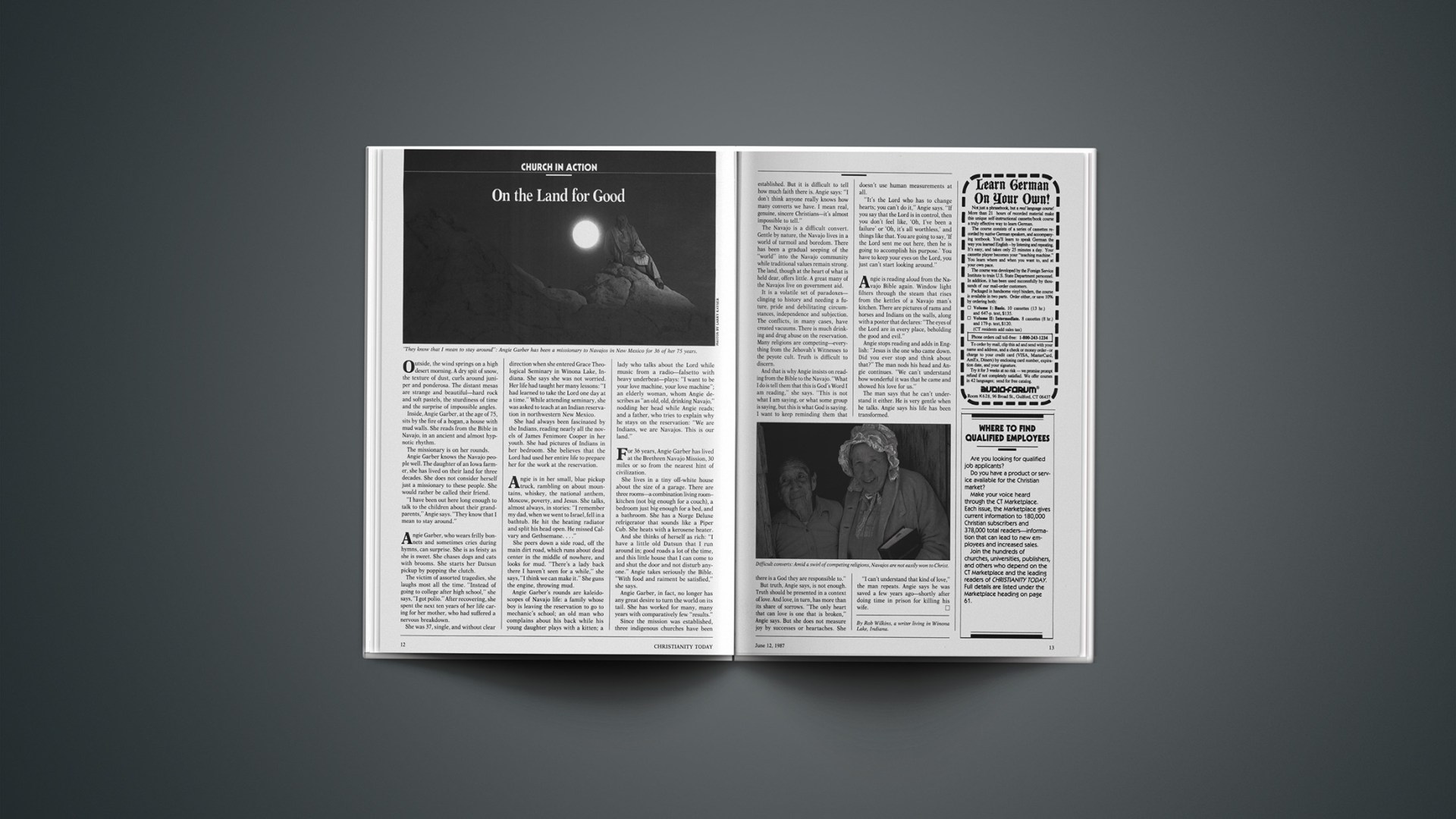
On the Land for Good

Outside, the wind springs on a high desert morning. A dry spit of snow, the texture of dust, curls around juniper and ponderosa. The distant mesas are strange and beautiful—hard rock and soft pastels, the sturdiness of time and the surprise of impossible angles.

Inside, Angie Garber, at the age of 75, sits by the fire of a hogan, a house with mud walls. She reads from the Bible in Navajo, in an ancient and almost hypnotic rhythm.

The missionary is on her rounds.

Angie Garber knows the Navajo people well. The daughter of an Iowa farmer, she has lived on their land for three decades. She does not consider herself just a missionary to these people. She would rather be called their friend.

“I have been out here long enough to talk to the children about their grandparents,” Angie says. “They know that I mean to stay around.”

Angie Garber, who wears frilly bonnets and sometimes cries during hymns, can surprise. She is as feisty as she is sweet. She chases dogs and cats with brooms. She starts her Datsun pickup by popping the clutch.

The victim of assorted tragedies, she laughs most all the time. “Instead of going to college after high school,” she says, “I got polio.” After recovering, she spent the next ten years of her life caring for her mother, who had suffered a nervous breakdown.

She was 37, single, and without clear direction when she entered Grace Theological Seminary in Winona Lake, Indiana. She says she was not worried. Her life had taught her many lessons: “I had learned to take the Lord one day at a time.” While attending seminary, she was asked to teach at an Indian reservation in northwestern New Mexico.

She had always been fascinated by the Indians, reading nearly all the novels of James Fenimore Cooper in her youth. She had pictures of Indians in her bedroom. She believes that the Lord had used her entire life to prepare her for the work at the reservation.

Angie is in her small, blue pickup truck, rambling on about mountains, whiskey, the national anthem, Moscow, poverty, and Jesus. She talks, almost always, in stories: “I remember my dad, when we went to Israel, fell in a bathtub. He hit the heating radiator and split his head open. He missed Calvary and Gethsemane.…”

She peers down a side road, off the main dirt road, which runs about dead center in the middle of nowhere, and looks for mud. “There’s a lady back there I haven’t seen for a while,” she says, “I think we can make it.” She guns the engine, throwing mud.

Angie Garber’s rounds are kaleidoscopes of Navajo life: a family whose boy is leaving the reservation to go to mechanic’s school; an old man who complains about his back while his young daughter plays with a kitten; a lady who talks about the Lord while music from a radio—falsetto with heavy underbeat—plays: “I want to be your love machine, your love machine”; an elderly woman, whom Angie describes as “an old, old, drinking Navajo,” nodding her head while Angie reads; and a father, who tries to explain why he stays on the reservation: “We are Indians, we are Navajos. This is our land.”

For 36 years, Angie Garber has lived at the Brethren Navajo Mission, 30 miles or so from the nearest hint of civilization.

She lives in a tiny off-white house about the size of a garage. There are three rooms—a combination living room-kitchen (not big enough for a couch), a bedroom just big enough for a bed, and a bathroom. She has a Norge Deluxe refrigerator that sounds like a Piper Cub. She heats with a kerosene heater.

And she thinks of herself as rich: “I have a little old Datsun that I run around in; good roads a lot of the time, and this little house that I can come to and shut the door and not disturb anyone.” Angie takes seriously the Bible. “With food and raiment be satisfied,” she says.

Angie Garber, in fact, no longer has any great desire to turn the world on its tail. She has worked for many, many years with comparatively few “results.”

Since the mission was established, three indigenous churches have been established. But it is difficult to tell how much faith there is. Angie says: “I don’t think anyone really knows how many converts we have. I mean real, genuine, sincere Christians—it’s almost impossible to tell.”

The Navajo is a difficult convert. Gentle by nature, the Navajo lives in a world of turmoil and boredom. There has been a gradual seeping of the “world” into the Navajo community while traditional values remain strong. The land, though at the heart of what is held dear, offers little. A great many of the Navajos live on government aid.

It is a volatile set of paradoxes—clinging to history and needing a future, pride and debilitating circumstances, independence and subjection. The conflicts, in many cases, have created vacuums. There is much drinking and drug abuse on the reservation. Many religions are competing—everything from the Jehovah’s Witnesses to the peyote cult. Truth is difficult to discern.

And that is why Angie insists on reading from the Bible to the Navajo. “What I do is tell them that this is God’s Word I am reading,” she says. “This is not what I am saying, or what some group is saying, but this is what God is saying. I want to keep reminding them that there is a God they are responsible to.”

But truth, Angie says, is not enough. Truth should be presented in a context of love. And love, in turn, has more than its share of sorrows. “The only heart that can love is one that is broken,” Angie says. But she does not measure joy by successes or heartaches. She doesn’t use human measurements at all.

“It’s the Lord who has to change hearts; you can’t do it,” Angie says. “If you say that the Lord is in control, then you don’t feel like, ‘Oh, I’ve been a failure’ or ‘Oh, it’s all worthless,’ and things like that. You are going to say, ‘If the Lord sent me out here, then he is going to accomplish his purpose.’ You have to keep your eyes on the Lord, you just can’t start looking around.”

Angie is reading aloud from the Navajo Bible again. Window light filters through the steam that rises from the kettles of a Navajo man’s kitchen. There are pictures of rams and horses and Indians on the walls, along with a poster that declares: “The eyes of the Lord are in every place, beholding the good and evil.”

Angie stops reading and adds in English: “Jesus is the one who came down. Did you ever stop and think about that?” The man nods his head and Angie continues. “We can’t understand how wonderful it was that he came and showed his love for us.”

The man says that he can’t understand it either. He is very gentle when he talks. Angie says his life has been transformed.

“I can’t understand that kind of love,” the man repeats. Angie says he was saved a few years ago—shortly after doing time in prison for killing his wife.

By Rob Wilkins, a writer living in Winona Lake, Indiana.

William Bloomer’s Footprints

Almost 40 years ago, when I was a student pastor, my Aunt Daisy gave me my great-grandfather’s family Bible. This distant relative, William Bloomer, a grain farmer with two sons and two daughters, never made any of the history books, but his obituary of January 1878, pasted in the family-record section of his Bible, speaks volumes of the legacy he left his children and grandchildren—and, yes, his great-grandchildren.

“Many a poor family will miss his kind words and earnest inquiry after their wants, and when their wants were expressed to him, they never left empty-handed … may those who have witnessed the good example he left behind, profit thereby, so that when it comes theirs to die, may it be said of them as it was of him, ‘Well done, thou good and faithful servant, enter thou into the joy of the Lord.’ ”

From what I have heard, it was William Bloomer’s joy in the Lord that prompted his joy of giving. His son, my mother’s father, carried on this same remarkable gift. Their farm home was visited often by the poor who wanted a warm meal—and they always received one.

Later on, my mother also carried on the legacy of William Bloomer, serving her God with “the joy of the giving heart.”

Father’s Day is a good time to ask what most valuable legacy we will bestow upon our sons and daughters. Are we bequeathing a spirit of tense living, a devotion to materialism, an uncertainty about life’s highest priorities? And what is our absenteeism (even in the name of Christian service) saying about our commitment to our families.

As father and grandfather, I am deeply concerned about the legacy I leave. Perhaps we should all be more concerned. And with that in mind, let me help you reflect upon your “fatherness” or “motherness” (my words, not Webster’s) by asking some nettlesome questions:

  • During the last week, how much quality one-on-one time did you spend with each child or grandchild?
  • Have we fathers and mothers spent more time this last week watching television than talking with our children or reading to them?
  • Are we glad when our children leave the room so we can “get our work done”? (They are our work!)
  • When we talk with our children, is it about their concerns or ours?
  • Have we talked with our children this week about the delights of living more than the disciplines of living? Have we inspired and guided them more than we have corrected them?
  • Have we talked with our children this week about the Lord, introduced them to the beauty of his presence, the glory of his creative genius, the delights of his abundant giving?
  • What kind of footprints—role models, if you prefer—have we left for our children to follow? Twenty years from now, will we be pleased that they walked in those footprints? And will those be footprints our children will be pleased for their children to follow?
  • What do we think our children say about us to their friends? If they had to complete this sentence, “I like my father most for …,” what do we think they would say?
  • If we were to sort out priorities for this next week, where would our children fit? What would be ahead of them on the list, and do we think these other things are truly more important than our children?
  • What kind of Christian lives do we want our children to lead? What kind of Christian fatherness or motherness do we want them to pass on to their children? And how much do we think we are contributing to these qualities?

I wish I could put my arm around my great-grandfather William Bloomer today and tell him about the footprints, the fatherness, he bestowed upon his son and granddaughter; and how I, his great-grandson, want to pass that legacy on to my children and grandchildren.

“The joy of the giving heart” flows from “the joy of the Lord”: Well done, good and faithful servant. I’m so glad you had your priorities straight.

V. GILBERT BEERS

Letters

A Fantastic Story!

As a seminary student considering military chaplaincy and a Theological Student Program officer with the U.S. Navy, I was instantly drawn to your April 17 cover story, “Easter on Hill 17. “What a fantastic story! It spoke to me of the need and power of the gospel in even the worst of situations. Thanks to our Lord that he has made it possible to bring the Good News into the horribleness of war and to those asked to wage it.

ENS. GREGORY N. TODD, TSP, USNR-R

Macomb, Ill.

What to do about enemies is the form the question of God is taking in the modern world. “Easter on Hill 17” was a striking example of this. The chaplain’s plaintive thought at the end sums up the church’s historic failure to learn from Jesus what to do about enemies. Looking at a Vietnamese woman cradling the corpse of her loved one on the rain-soaked earth, the chaplain muses, “Easter is for her too, but I don’t know how to tell her.” Didn’t he know, really? Don’t we know, truly?

The church is bumping up hard against the fact that there isn’t any other way to communicate the love of an enemy-loving God than by loving enemies. It is a great opportunity. And a great challenge.

JOHN K. STONER

Mennonite Central Committee

Akron, Pa.

I could hardly believe my eyes when I saw the April issue and the cover story. The article reaches deep into the heart of thousands of Vietnam veterans who searched for life amid death during a decade of Easter Sundays. If the truth be known, it is only Easter that has given hope during the decade following the war for those who see the death in their memory.

SAMUEL A. CREED

Castalian Springs, Tenn.

Always left to be explained is the deep moral question of how a “Christian” soldier can justify taking the life of a person (in war or in peace), especially one who is unprepared to meet his God.

REV. SANFORD G. SHELTER

Johnstown, Pa.

Television’s life view

The satin, scoop-necked temptresses of today’s soaps have given new dimension to the term “boob tube” [“The Never-ending Story,” Apr. 17]. But maybe the biggest boobs are those who watch. If the soap opera genre, as popular art, “reflects something of the people who enjoy it,” and if many among the 30 million daily viewers are Christians, imagine the view of life preachers must counteract each Sunday morning!

NATHAN E. UNSETH

Bloomington, Minn.

Christianity and the Resurrection

Philip Yancey’s insights and cogency are impressive; however, I disagree with his column “The Fragrant Season” [Apr. 17]. His opinion that Tammy Faye Bakker’s remark—“The Christian life is just so great that I think I would become a Christian even if it wasn’t true!”—is wrong because the apostle Paul said his own preaching would be useless except for the resurrection, for that does not begin to exhaust the possible implications of this significant comment spoken in the excitement of that moment. Her comment does not state or imply a conviction that the resurrection isn’t true, only that the Christian life is great in and of itself.

JOHN E. ELKINS

Athens, Ga.

Battling pornography

Kenneth Kantzer’s editorial on pornography [“The Real Sex Ed Battle,” Apr. 17] cuts through a lot of fuzzy thinking. I have known several men whose fathers were purveyors of porn, fathers who did a poor job of concealing their novels and magazines from their preadolescent sons. Exposed to such intriguing literature at an early age, these fellows had abnormal sexual preoccupation for years. Those who shrug off porn as “harmless entertainment” present us with an anomaly: that people with such intellectual sophistication would be so naïve concerning the powers of the imagination and memory.

CHAD OWEN BRAND

Calvary Baptist Church

Brighton, Colo.

Be encouraged, CT readers: Christians, upon being informed about pornography’s true dangers, are mobilizing! Many have broken out of their silence and are standing for righteousness. I am convinced many believers are waiting for “marching orders” from their pastors and church lay leaders and are looking for ways to unite in spite of theological and doctrinal differences.

ROBERT P. HEINRICH

Clean Up Project

St. Paul, Minn.

Free For All

With the overwhelming acceptance of lead-free gasoline, cholesterol-free margarine, and sugar-free drinks, it’s time Christians capitalized on this potent marketing strategy.

Think, for example, of the appeal of “Greek-free” sermons. No awkward renderings of dunamis or unintelligible etymologies of diakonoi. Just plain, straightforward English.

And who wouldn’t show up for a tuna-free potluck? I think that was why the apostles had such strong fellowship.

Christian television shows would shoot up in the Nielsens if they announced “appeal-free broadcasting”—no offers of books or tapes for large donations, no pleas for “letters” (translated “large, unmarked bills”)—just simple proclamation of the gospel.

Any pastor wanting to boost congregational zeal for missions would only have to announce “sunset-free” missionary slide shows. People would show up just to find out what the closing slide will be.

And church worship would take a giant leap forward with introduction-free solos. Imagine this:

A member of the choir steps forward, takes the microphone, and begins to sing the song. No five-minute, rambling sermons with cross-references.

With a marketing strategy like this, it won’t be long until the non-Christian’s path to the gospel is free and clear.

EUTYCHUS

Sanctuary: Ethical issues

Your recent news article on the sanctuary movement [“Charges of Break-ins and Infiltration,” Apr. 17] left many facts still unclear, but it did help me form a clearer picture of the ethical issues involved. If it is true that people’s lives are in danger—whether from persecution or extreme poverty—what is the difference between helping them and hiding escaped slaves or helping Jews flee the Nazi Holocaust? Do Latin Americans have less reason to value their lives or freedom than the rest of us? Can settled, middle-class Americans really understand their plight?

CRAIG S. KEENER

Springfield, Mo.

Setting the record straight

Christiano Brothers is based in Jonesboro, Arkansas, not St. Louis [Special Advertising Section, Apr. 17]. Also, I was credited with a quote by Jim Robinson of White Lion. Just want to keep the records straight.

DAVE CHRISTIANO

Christiano Brothers

Jonesboro, Ark.

Having babies

Thanks for the thoughtful editorial “How Not to Have a Baby” [Apr. 3], To a great extent, it tracked the Vatican’s position on these perplexing ethical questions. Couldn’t the evangelical community work with American Catholics and produce a statement that would act as a guide for all puzzled Christians who are faced with these kinds of decisions?

ELSIE DAVIDSON

Macomb, Ill.

Your editorial fails to address the main biblical Christian argument against surrogate motherhood: that it is technically nothing other than adultery, and therefore forbidden to Christians!

REV. LAURENCE R. WALTON

Exodus Prison Ministries, Inc.

Santa Clara, Calif.

Living in two worlds

I am grateful for your article “Cease-Fire in the Laboratory” [Apr. 3]. I am an academic psychiatrist, not a scientist, but I share many of the feelings of living in two worlds: working in a world that supplies its own reasons for its existence; of reluctance to think reflectively about the philosophical assumptions of psychiatry; and of bemusement when coming under fire from Christians for what they perceive to be conflicts between Christianity and my profession. By and large, my needs may not be very different from other people’s, but the gap (not conflict) in me between my faith and my profession is not one that will be bridged by the church, at least not in the foreseeable future.

L. K. GEORGE HSU, M.D.

University of Pittsburgh

Pittsburgh, Pa.

Why the “cease-fire”? Since I am a scientist, I suggest it is because those interviewed were scientists first rather than Christians first. They viewed the Bible through the eyes of evolution, and not evolution theory through the eyes of Scripture. Let us learn to make our “scientific views” subservient to Scripture. Let us be Christians believing revealed truth (Bible) first, and proposed theories (evolutionary science) second.

DENNIS FREIDEL, PH.D.

Fort Collins, Colo.

It isn’t surprising Stafford interviewed mainly theistic evolutionists, who are happy with their position. If they rarely discuss Christianity and accept the origins dogma taught them, there will be little conflict. Those who do not abide by this either have great difficulty or are no longer found at the university.

MICHAEL J. OARD, M.S.

Great Falls, Mont.

“Pseudo-Christianity”

Bravo to Charles Colson for saying health-and-wealth theology is false theology [“My Cancer and the Good Health Gospel,” Apr. 3], We need more Christian leaders to denounce this pseudo-Christianity.

G. DEWAYNE MEADOWS

Percy, Ill.

While I agree we come to Christ “not because of what he may do to spare us from suffering, but because Christ is truth,” the Bible is bursting with stories of divine healing. Evangelicals seem not only to lack a theology of healing, but a practice of it. Did it ever dawn on Colson that he could ask God to heal him?

REV. RODNEY E. LAYMAN

First Baptist Church

Lindsay, Calif.

Episcopal morality

In your news articles on the Episcopal Church’s “Battle Over Sexual Morals,” [Apr. 3] you have failed to mention the church’s last official statement from the General Convention:

“We reaffirm the tradition teaching of the church on marriage, marital fidelity and sexual chastity as the standard of Christian sexual morality. Candidates for ordination are expected to conform to this standard. Therefore, we believe it isn’t appropriate for this church to ordain a practicing homosexual, or any person who is engaged in heterosexual relations outside of marriage.”

You also misinterpreted the 1985 resolution that was “narrowly defeated.” That resolution stated no one should be “denied access to the selection process” for ordination on the basis of sexual orientation, race, gender, age, or physical handicap.

The Diocese of Newark’s report is receiving far more attention in the church press than serious consideration by Episcopalians, I believe. The mood of the Episcopal Church, as I see it, is decidedly against any change in its current official position on sexual morality.

DAVID E. SUMNER

Knoxville, Tenn.

Keep It Simple

You will notice at the start of Bob and Elizabeth Roberts’s piece on page 16 a stylized, postage-stamp-sized rendering of two wedding rings. This “logo,” used here to tie together graphically our series of articles on marriage, sex, and children, is but the latest “sharp and simple” expression from designer/illustrator Dwight Walles.

“Keeping it simple is the key,” says Walles, who has been called upon by CT to capture the essence of such complicated subjects as universalism and the end times—all in an art form that will be reproduced in the magazine in approximately one square inch.

“Obviously the more abstract the topic, the more difficult it is to convey that topic graphically in one or two images.” Homosexual marriage (Nov. 22, 1985) was a case in point.

“That was a tough one,” remembers Walles. “A controversial topic. Troublesome images. I settled on the idea of using the two interlocking medical symbols for male, with the outline of a face barely visible within the overlapping circles. It’s one of my favorites.”

The medical symbols for both male and female also are significantly represented in Dwight’s most recent CT effort.

“Dealing with clichés is about as difficult as dealing with abstractions,” Walles says. “And wedding rings are a cliché of marriage. That’s why I decided to give each ring a shadow in the form of the male and female symbols. The overall image and three-dimensional feel are a bit offbeat, but immediately recognizable—and interesting to look at.”

In other words, Dwight is ready for the next stamp-sized challenge.

HAROLD SMITH, Managing Editor

Politics Test Korean Church

The phenomenal growth of the church in South Korea has made it the darling of countless church-growth consultants, and a supreme model for aspiring mega-visioned pastors here in the U.S. Where else can you find a local church with over a half-million members? Or a city (Seoul) with five congregations numbering more than 10,000 members?

And yet, all is not well in this burgeoning church, because all is not well in South Korea. The government of Chun Doo Hwan has come under increasing attack for its use of repressive tactics to quiet a growing opposition. Massive student riots calling for an end to the Chun “dictatorship” have become a common occurrence, and talk of Korea becoming another Philippines is increasingly drawing the attention of the Western press.

To both government and opposition leaders, Korea’s churches—especially the mass ministries in Seoul—represent a strong influence and ally for their respective positions. Thus far, however, only certain pockets of the church have chosen to speak out. The balance remain largely silent.

American Christians accustomed to a participatory democracy may not understand this “no comment” approach. But the church in South Korea has yet to define its relationship to a secular government. How it fits in the political scheme of things is an open question—currently an unknown. There is neither a wall of separation nor an open door to the presidential palace.

Many of the republic’s early leaders claimed some church allegiances: Syngman Rhee, for example, was a Methodist (South Korea’s second-largest Protestant denomination), and Po-Sun Yoon a Presbyterian (the largest). Chun, however, claims no such identification. Thus, the convenient (though tenuous) tie linking church to state is nonexistent in the current regime, and the church now perceives itself as without political voice. The fact that the next free elections will not be held until next February only complicates the church’s predicament.

A critical question, then, as the church and nation anticipate those elections is simply how political can the church be and still be the church (sound familiar?)? And when does political outspokenness—including criticism of repeated human-rights violations—stand either to overshadow the call to evangelism so strongly felt by the church, or to compromise the church’s principal role as peacemaker in a tinderbox situation?

The stage is set for what may well be the most critical test the church in Korea has had to face since the demarcation of North and South by the forty-eighth parallel. Pressure on this dynamic church to say, and do, something will most assuredly grow. But so, too, must our own attention and concern. We must begin to look to the Korean church not solely with our minds set on obtaining the secrets of growth, but with our hearts set in prayer for a body of believers confronting a complex situation—a church facing a critical challenge with its future effectiveness on the line.

By Harold Smith.

Apple PodcastsDown ArrowDown ArrowDown Arrowarrow_left_altLeft ArrowLeft ArrowRight ArrowRight ArrowRight Arrowarrow_up_altUp ArrowUp ArrowAvailable at Amazoncaret-downCloseCloseEmailEmailExpandExpandExternalExternalFacebookfacebook-squareGiftGiftGooglegoogleGoogle KeephamburgerInstagraminstagram-squareLinkLinklinkedin-squareListenListenListenChristianity TodayCT Creative Studio Logologo_orgMegaphoneMenuMenupausePinterestPlayPlayPocketPodcastRSSRSSSaveSaveSaveSearchSearchsearchSpotifyStitcherTelegramTable of ContentsTable of Contentstwitter-squareWhatsAppXYouTubeYouTube