Cover Story

A Church Historian Warns: Presbyterians Are Demoting the Bible

Never before has a church refused to bear witness to inspiration.

The one position of the Westminster Confession of Faith which the new Confession of 1967 avowedly and admittedly changes is that on the Bible. In the “Introductory Comment and Analysis” the committee says: “This section is an intended revision of the Westminster doctrine, which rested primarily on a view of inspiration and equated the Biblical canon directly with the Word of God. By contrast, the pre-eminent and primary meaning of the word of God in the Confession of 1967 is the Word of God incarnate. The function of the Bible is to be the instrument of the revelation of the Word in the living church. It is not a witness among others but the witness without parallel, the norm of all other witness. At the same time questions of antiquated cosmology, diverse cultural influences, and the like, may be dealt with by careful scholarship uninhibited by the doctrine of inerrancy which placed the older Reformed theology at odds with advances in historical and scientific studies” (p. 29; all quotations are from the official “Blue Book” of the General Assembly, May, 1965).

This is flatly contrary to the promise of the “Blue Book”: “The proposal for amending the Confession does not entail revision or deletion (except for the deletion of the Westminster Larger Catechism) …” (p. 1). Here is an admitted revision following on the heels of a denial of such a purpose. But still it is to be admired for its candor. We suppose that it was an unintentional oversight that the committee did not mention this one acknowledged revision as it did the one acknowledged deletion. What is far more serious is that the whole mentality of the new Confession is different from that of the old one. Its intention is probably not revision but rejection. But candor has not reached the point of admitting that. The lack of frankness at this point is an advantage as well as disadvantage, however. It results in an ambiguity which, while it covers the probable intention of the committee, also permits adherents of the Westminster Confession of Faith to remain in the church in good conscience. They will be offended by this absence of the very clarity for which the Westminster Confession of Faith has always been justly famous. But whatever heresies may lurk in the shadows of vague language, all of them have not yet dared to come to the light. Through the obfuscations of the new creed the light of truth from the old ones will continue to shine to the glory of God and the comfort of those who still believe what they vowed at their ordination.

Let us first examine the preliminary statement (p. 29) before proceeding to the creedal section on the Bible: “… Westminster doctrine which rested primarily on a view of inspiration and equated the Biblical canon directly with the Word of God.…”

We have no serious quarrel with this statement but will elaborate a little so as to prevent misunderstanding especially by the layman. First, Westminster is not unique in resting its doctrines on a view of Inspiration. Virtually all Christian creeds have done this either expressly or impliedly. (It is one of the notable weaknesses of the new creed that it does not do so.) When we say impliedly, we mean that Inspiration is assumed even when there is no special article on the Bible. Inspiration is a catholic or universal or ecumenical, if you please, and not an exclusively Presbyterian, doctrine. In other words, in its eagerness to be modern the new creed would antiquate the Presbyterian Church by reverting to the time before creeds began. As soon as the church did begin to speak about the Bible it testified to its Inspiration. Never before has a church spoken of the Bible without bearing witness to its Inspiration. So powerful is the pull of the past even on this creed that it cannot get entirely free of this tradition as we shall see when we come to consider its testimony that the Bible is the “normative witness.” Even that word “normative” did not satisfy the Commissioners to the General Assembly of 1965.

Second, while Westminster “equated the Biblical canon directly with the Word of God” this does not imply that it admitted no differences within the Word of God. Obviously, when the Word of God says “And Satan said” that does not mean that God said what Satan said! It means that God said that Satan said it. This is quite another thing. To use a distinction that was acknowledged by the Westminster divines, as well as all other Reformed theologians: the authority of the Bible is complete but it is of two kinds. The Bible has descriptive and normative authority (authentia historica and authentia normalis). Descriptive authority means that everything which the Bible says happened, was spoken, or was thought, did happen, or was spoken, or was thought. It is authentic history however bad the event may have been which the history records. All of the Word of God, according to Westminster, has this descriptive authority or authenticity. Within this Word of God as authentic record is the Word of God as normative or authoritative for faith and practice. When God said, as noted above, that Satan said, we know that Satan so said; but we are not to believe and practice as Satan says. But when the Word of God says that God said, then we know both that God so said and that we are so to believe and so to practice.

We must add, also, that although Westminster equated the Biblical canon directly with the Word of God, as thus explained, this does not deny progress within the normative revelation of God any more than affirming that God is the author of the whole creation is meant to deny that there is a difference between the egg and the chicken which comes from it.

One further and rather technical detail perhaps ought to be added. Westminster did not exactly “equate” the Word of God with the “canon.” It identified the Word of God with the original text of the canonical books. Furthermore, the Word of God is not quite identified with the canon because the canon is the judgment of men about the Word of God and not the Word of God itself. As B. B. Warfield, of old Princeton, who as much as any man since the Westminster standards were formulated shared their mentality, has written: the canon is not an inspired collection of books but a collection of inspired books.

“By contrast, the pre-eminent and primary meaning of the Word of God in the Confession of 1967 is the Word of God incarnate.” … What does this mean? Some will say: The statement simply means that the words of the Biblical writers point to Jesus Christ. What words? Some point away from Christ as truly as others point to him. Reformed theology has shown how to distinguish them, as we indicated above; but in the new creed no such formula is given. We have only the blanket statement: “the pre-eminent and primary meaning of the word of God … is the Word of God incarnate.”

But if we should grant that the words of men in the Bible do in fact point to Christ (directly and indirectly, by inference and affirmation, by what is not, as cue to what is) then what is the difference between this and what the Westminster Confession of Faith teaches? Or, do our new creed writers wish to add slander to neglect when they write: “By contrast” (to the Westminster Confession of Faith!) “the pre-eminent and primary meaning of the word of God in the Confession of 1967 is the Word of God incarnate”? Do they suppose for one moment that our fathers in the faith thought that the Bible as the Word of God had any other pre-eminent and primary meaning than Jesus Christ? “Ye search the Scriptures for they bear witness of me” (John 5:39). 1647 believed this as much as 1967 and in a far more intelligible manner. What it amounts to is this: the new creed is saying nothing or something; if something, it is a slander of our fathers; if nothing, it is an insult to us.

“The function of the Bible is to be the instrument of the revelation of the Word in the living church.” Let us compare this with the classic statement of the Westminster Confession of Faith, Chapter I, Sec. 10: “The Supreme Judge, by which all controversies of religion are to be determined, and all decrees of councils, opinions of ancient writers, doctrines of men, and private spirits, are to be examined and in whose sentence we are to rest, can be no other but the Holy Spirit speaking in the Scripture.” In the Westminster doctrine the Bible is indeed the instrument of the revelation of the Word (Christ) in the living church. But it is a doctrine of the Bible as instrument which we can understand. The Bible was inspired by God and as such has perpetual authority. The Holy Spirit of Christ still works by means of it as the permanent expression of his will by which the church is to be led. Here is a characteristic reaffirmation of the famous Calvinistic principle: the Word and the Spirit; the Word reveals the Spirit and the Spirit illumines the Word. The Word will not be properly received apart from the Spirit and the Spirit does not speak apart from the Word. If our new creedalists meant this we should rejoice; but, alas, nothing is further from their doctrines. We must not forget that they have explicitly rejected the Westminster view of Scripture. What, then, do they mean? This they attempt to explain, first affirmatively, and second negatively, in the two sentences which immediately follow, to which we now turn.

“It is not a witness among others but the witness without parallel, the norm of all other witness.” “It” clearly refers to the Bible, which is the subject of the preceding sentence. Thus the new creedalists are saying here that the Bible is the witness which is the norm of all other witness. Now, a “norm” is a standard by which other of like character are tested. Accordingly, the Bible is the standard or test by which all other witnesses, including, for example, this new creed, are tested for their truthfulness. The Bible, mind you, is the norm of all witness to Christ. The Westminster divines could not express it better. In fact, this is what the Westminster Confession of Faith is expressing. Why then do the new creedalists take exception to Westminster while expressing the same doctrine? The fact seems to be that they are not using the normal meaning of “norm.” Here is an abnormal “norm”; a standard which is not a standard. It is rather embarrassing to say that men are not using language normally and are not saying what they took seven years to formulate. That such is the sorry case is, however, as clear as it is surprising. First, they said, as noted, that their doctrine is other than Westminster. Second, they expressly repudiated the historic doctrine of “inspiration.” Third, they call the Bible “the word of God” in sharp contrast to the “Word of God.” If the Bible is not inspired and is merely the word of men then either men are perfect or a norm of the Word of God is not a norm. The imperfection of men is taught not only in the other creeds left standing in the new program but taught in the “new creed” also (Part I, Sec. I b). So we regrettably say that the new creed is one in which a “norm” is not a “norm” or error is the norm of Truth (the Word of God).

Fourth, the next, the negative, proposition to which we now come explicitly rejects the Bible as “normative” (in any sense).

“At the same time questions of antiquated cosmology, diverse cultural influences, and the like, may be dealt with by careful scholarship uninhibited by the doctrine of inerrancy which placed the older Reformed theology at odds with advances in historical and scientific studies.”

We are certain that every member of the committee which drew up the new creed would agree that the above statement means the following: the new creed, rejecting the doctrine of Inerrancy, leaves its adherents freer to accept historical and scientific studies which contradict the historical and scientific statements of the Bible. This is not, in fact, what this inaccurate, pejorative, disrespectful-to-the-fathers-statement actually says; but since it is undoubtedly what it intended to say, let us address ourselves to the intention and ignore the unhappy form of expression. The upshot of the matter is this: We are being told that the scientifically and historically errant word of God is nonetheless the norm of all witness to the Word of God! The committee shows wisdom in not seeking to illustrate this.

We turn now to the main treatment of the Bible in the creed itself, Part I, Section III b. “The Bible.”

“The one sufficient revelation of God is Jesus Christ, the Word of God incarnate, to whom the Holy Spirit bears witness in many ways. The church has received the Old and New Testaments as the normative witness to this revelation and has recognized them as Holy Scriptures.”

We grant that “the one sufficient revelation of God is Jesus Christ” but why do they not grant that the one sufficient revelation of Jesus Christ is the Bible? Christ did: “… they” (the Scriptures) “bear witness of me” (John 5:39). Paul did: “The saying is sure and worthy of full acceptance, that Christ Jesus came into the world to save sinners” (1 Tim. 1:15; cf. Luke 19:10; Rom. 5–8). What God has joined together (the Word of God incarnate and the Word of God inscripturated), why does the committee attempt to rend asunder?

“… to whom the Holy Spirit bears witness in many ways”: Whatever the word “norm” may mean when applied to the Bible it is here clear that the Bible is not unique. It is not the only revelation of its kind as the church from the beginning (the whole church from the very beginning) has confessed. According to the new confession it is only one among many ways in which the Holy Spirit bears witness to Christ. To be sure it is the “norm” for others which, however, can only differ from it in degree, not kind. It is becoming clear that the Bible is thought of merely as the first and the best of all these witnesses.

But assuming this inadequate view for the sake of argument, how do we know that the Bible is the norm of the rest of the witnesses? Answer: “The church has received” it as such. The Bible claims its own Inspiration some three thousand times but this does not prove it. But the church recognizes the Bible as normative; this does prove it. Rome must be amused to hear such sentiments coming from the children of Calvin. They may well anticipate that it should not be long before these seers find the Holy Spirit bearing witness to the Word of God in the papacy as Romanists have themselves contended for centuries.

“The New Testament is the recorded testimony of apostles to the coming of Jesus Christ and the sending of the Holy Spirit to the church. The Old Testament is received in the church as Holy Scripture which bears witness to God’s faithfulness to Israel and points the way for fulfillment of Iris purpose in the Jew, Jesus of Nazareth. The Old Testament is indispensable to understanding the New, and is not itself fully understood without the New.”

That the New Testament is the recorded testimony of apostles to Jesus Christ is, of course, true. It is also much more than that—it is the recorded testimony of God to the apostles. The most vital thing for us is not that the apostles testify to God but that God testifies to or confirms the apostles. There is a vast difference between an infallible witness to an infallible Christ and a fallible witness to an infallible Christ. If it is a fallible witness it may (fortunately) be generally reliable as historical testimony to the major matters, but not absolutely reliable on all matters.

Here, again, in this paragraph we have the church’s receiving of the Old Testament and the New Testament as the crucial evidence for its authority—an utterly Romish view, as already shown. Here, again, also is the selective, discriminating acceptance of the witness of the Bible. It would seem that the committee is normative for the Bible rather than the Bible, as such, for the committee. That is, the Scripture is received as witness to God’s faithfulness to Israel. But the Scripture also bears witness to God’s rejection of Israel. That witness, nevertheless, seems not to be accepted by the committee, as the Bible teaches it. Hosea, for example, is a favorite Old Testament prophet because of his representation of the longsuffering Yahweh. But what becomes of Hosea when he says: “… I will no more have pity on the house of Israel, to forgive them at all” (1:6)? Paul is supposedly writing Scripture which the church can accept when he says (2 Cor. 5:19): “… God was in Christ reconciling the world to himself, not counting their trespasses against them.…” But the same apostle must be uncanonical when he declares (Rom. 11:22): “Note then the kindness and the severity of God: severity toward those who have fallen, but God’s kindness to you, provided you continue in his kindness; otherwise you too will be cut off.”

As soon as we express gratitude for the enunciation of a sound principle, such as the interdependence of the two Testaments, we must immediately remind ourselves that we are reading something into this document which it does not intend. It does not mean that the New Testament is latent in the Old Testament and the Old Testament patent in the New Testament as this phraseology would normally signify. So to construe it would be to wrench this text of the new creed out of its context. It may be charitable to do so but it would not be true. But if it is not true neither is it charitable, for charity rejoices in the truth (1 Cor. 13:6, AV). And the truth, according to this context, must mean not that the New Testament is latent in the Old Testament but that some of the New Testament is latent in some of the Old Testament. Nor is the Old Testament patent in the New Testament but some of the Old Testament is patent in some of the New Testament. And that “some” in each case is that which the church of the new creedalists deigns to receive.

“God’s word is spoken to his church today where the Scriptures are faithfully preached and attentively read in dependence on the guidance of the Holy Spirit and with readiness to receive their truth and direction.”

Surely this is the form of sound words but its meaning is loaded and all in the wrong direction. Faithfully to read and preach the Bible, according to this committee, is to distinguish between the errant husk and cleave to the inerrant but also indefinable Truth. If this seems to be an impossible task an adequate help is suggested in the Holy Spirit’s guidance. But alas, the Holy Spirit cannot help us either, for we do not know how to recognize his guidance until the committee tells us. If the Holy Spirit guided us into the understanding of inspired Scripture as the Westminster Confession of Faith taught us—this we could understand. Or, if the Spirit led us into an understanding of some definite part of Scripture—this we could understand. But it is only when the Spirit guides us into an understanding in accordance with this or some committee’s understanding that we can rely upon him. Having dispensed with the Inspiration of the Bible we must now look to the inspiration of a committee. We are sure that this committee does not think that it is the only inspired committee. There must be other committees also, alas. If anything is likely to awaken the church to its real danger it will be the realization that once we have done away with Holy Scripture-Holy Spirit, in the vacuum thereby created we must have an infinite series of holy committees!

“The Bible is to be interpreted in the light of its witness to God’s work of reconciliation in Christ. The words of the Scriptures are the words of men, conditioned by the language, thought forms, and literary fashions of the places and times at which they were written. They reflect views of life, history, and the cosmos which were then current, and the understanding of them requires literary and historical scholarship. The variety of such views found in the Bible shows that God has communicated with men in diverse cultural conditions. This gives the church confidence that he will continue to speak to men in a changing world and in every form of human culture.”

The reader will recognize that this has been said before and criticized before. There appears to be no need for repetition. If our earlier words were true then the new creed’s climax is untrue. The important thing for the reader of this and all doctrines, for that matter, is to judge righteous judgment (John 7:24). There is an unrighteous judgment of principles as well as a righteous one, and it may be favorable as well as unfavorable. Some seem to think that we do an injustice to a statement only when we draw unfair, incriminating deductions from it. But we also do an injustice when we draw unfair, exonerating deductions from it. To make a righteous judgment, as commanded by our Lord, is to avoid all unfair judgments whether favorable or unfavorable. Because this is the proposed creed of earnest, serious-minded, hard-working Christian persons we are more likely to be unrighteous in our judgments by being too lenient than by being too strict. But we must avoid both if we would render righteous judgments. We must attempt, as we have here attempted (God being our witness), with malice toward none, free of any desire to find anyone at fault for a word, to ascertain what is meant by the proposed “Confession of 1967.” With one member of the present committee we are personally and fairly intimately acquainted, and we bear him witness that he appears to be one of the most sincere Christians we have ever had the privilege of knowing. It may be that every other committee member is of such calibre. Nevertheless, notwithstanding the possible soundness of the persons who composed it, this creed is anything but sound. We appeal to them no less than all others when we urge them in the name of the Christ whom we all profess to love to rescind this confession before it becomes an indelible blemish on the escutcheon of the church.
Art: Temptation to Sin or Testimony of Grace?

Is art something holy or seductive?

Is art something holy, something seductive, or something else?

In the warm-blooded land of southern Greece long years before Christ, young people gathered in the spring to sing, dance, practice art, and make love somewhat indiscriminately in honor of Dionysus, the god of wine, art, and fertility.

It is a shame that the natural flow of youth and art in the springtime is not captured today in the name of Jesus Christ. Young Christians busy with art should come to know it as a holy business; they should know that they can practice art to show their love to God, to revel in the fact that he is King of the whole earth. Because the Creator has adopted them as his children, they should understand their ability to enjoy his world and should be happy to express this enjoyment in music, colors, shapes, rhythmic writings, and speech. It is time in this affluent society for the body of Christ to get at the downright fun of glorying in artistic gifts God gives his people, to realize that the Christian faith deserves artistic expression, and then to probe trustingly, critically, into the Christian use of art in A.D. 1965.

Believers have long treated art as a devilish temptation. The Church unfortunately began to think it so early in its history. Art, it said in effect, is sensuous, and the sensuous is a seductive road to hell; therefore, stay away from art. Children should not be allowed to play with matches; why should God’s children be permitted to dally with art? What is art good for? Our purpose in life is to believe and become fishers of men, win souls for Christ, sojourning here till we leave for heavenly mansions not built with human hands.

The early Church rightly exposed Caesar’s song-and-dance spectaculars, the Bacchic art festivals, as unworthy of Christian patronage. But it wrongly disparaged art itself through guilt by association. The Church at times suppressed art unless it was turned into a pedagogical instrument (paintings in the church to teach Bible stories to the illiterate) or used to dress up the institutional means of special worship (decorations in the margins of prayer books or trumpet notes on Palm Sunday). In other words, art was sometimes used gingerly, perhaps for a “spiritual” end—but even then, Watch out!

It is easy, of course, to criticize what was wrong. In the beginning the Christians did not have time to write poems or go beyond pictures in the catacombs. Their minds were taken up with formulating confessions against heresy and codifying doctrines to stop civil misunderstandings. However, it is a different matter when Christians piously argue whether art is worth less than other human activities, generally implying with classic pedantry the old error that art is a romantic spasm unfit for Christians, unless it somehow be bent to church worship.

But if the Christian community maintains a prohibitionist or, at best, a permissive conception of art, it has missed a critical area of Christian action and affronted God. If the Church does not like the jazz, painting, and literature of today, what does it expect if it does not encourage its baptized children to produce something Christianly different?

Whenever God-created drives or talents in men are denied meaningful exercise, there is trouble. Man’s glories then become a temptation to sin. Temptation is much more complicated and casual an affair than a scantily clad woman accosting a hungry St. Anthony in a wilderness of stumps, logs, water, and grass. Temptation is always the opportunity for one to satisfy his God-given needs and desires in ways that ignore God’s loving ordinances for the exercise of human abilities.

When God’s adopted children who are especially talented in being sensitive to the wonder of the world and culturally and artistically responsive to it are frustrated by Christian kill-joys (cf. 1 Timothy 4:1–4), then the devil, who covets culture and its human makers, knows how to twist art into temptation to sin. He subtly gets believers with artistic talent so wrapped up in the truly God-created enjoyment of art, especially in reaction to unbiblical prohibitions, that they forget that art itself must be practiced before the face of the holy God and Lord. Disregarding that, the artist becomes tempted to think and act as if his artistic deed had its own right to be and was naturally revelational of God’s Truth rather than being a humanly conditioned response to God’s glory. Unless art is conceived and practiced (albeit subconsciously) as a channel for the Holy Spirit’s witness to others of one’s being a perceptive son of God, it should be forgotten. Otherwise one has made art its own lord and has swallowed the devil’s bait. Unless art is itself a praise response, a hallelujah to God in the world—not churchy moralism, not a forced, derived, lugged-in Christianized witness, but a joyous, ministering hallelujah praise, it will be stillborn—no matter how elegant the music, painting, prose, and poetry may be.

A peculiar thing about art that offends so many serious-minded Christians is its playful, leisurely, imaginative character. If we want art to walk in through the front door of the Christian community rather than to be quietly smuggled in the back door, it must be made plain to the uninitiated that writing, painting, singing, and playing are hard work of a highly talented sort—that their make-believe is not faking, pleasant nonsense, but an excruciatingly careful, symbolical formulation of what the artist knows or supposes the world to be about.

In a famous exchange, Matisse was told by a woman in an art gallery who was looking at one of his curving, twisted black swirls, “I never saw a woman like that.”

THE LIGHT SHINETH IN DARKNESS

From a dark dust of stars

Kindled one, a prick of light.

Burn, small candle star,

Burn in the black night.

In the still, hushed heart

(Dark as a black night)

Shine, Saviour newly-born,

Shine till the heart’s light.

LUCI SHAW

“Madame,” said Matisse, “that is not a woman; it is a painting!”

And his painting was not unreal because it was not a woman, nor was it false and unimportant because it was “exaggerated”; for Matisse discloses and affirms in color the voluptuous viciousness of a wanton that could perhaps be shown no other way.

If adult painters were merely working out some of their subconscious shrieks in colors and if musicians were performing simply because their mothers made them practice the piano early in life, then art would indeed not deserve to be taken seriously by the public. But since art is a man or woman’s modest but intense contribution to his neighbor’s grasp of corners of reality, states of affairs, levels of meaning not often explored but present in creation all the time—caught by him as artist in symbols for the other’s appropriation—what the Christian artist does is significant for building up the body of Christ and speaking to those who will listen.

If we could convey to the skeptical in the Church that the artist stands like a child toward the world—not, to be sure, innocent, not void of moral obligation, but childlike, fresh, open, giving himself to discover, penetrate, and grasp what is out there in creation as well as inside his self-consciousness, wondering for Christ’s sake; if we could make church people see that the artist needs leisure, the kind of leisure college students have near the end of a semester when they work day and night round the clock thrown out the window, not meeting carefully apportioned deadlines but concentratedly busy at a pitch of excitement—if we could convey something of this, then perhaps we could break through to the Christian mentality that understands missions, preaching and teaching, hard work as service to God, but has trouble relaxing in laughter before his throne. There is a lot of laughter, love, Sunday to art rightly understood, features for which Christians are uniquely constituted. Christians can give themselves to the task because their involvement is not artificially manufactured for selfish or pragmatic reasons but is simply a matter of spontaneous thanksgiving because God in his world is so great and merciful.

By Sunday I do not mean a legal holy day bored through with interminable talk, stuffy formalism, and lap lunches, but rather the day of rest God gives us, the God-created leisure, the vacationing celebration men may have and need no less than a six-day week. Sunday is to be a joyful anticipation of the coming resurrection in which believers will blossom, each according to his own talented nature (1 Cor. 15), bringing the glory and honor of the world’s kingdoms fully to Jesus Christ (Rev. 21:24, 26). Art has this innate festive character—not that it is specially holy (that is the companion error to judging it inherently suspect) but that it is a specially tempting occasion for a man in the sense of Psalm 1 to bring forth fruit leisurely ripened to please God.

Because artistic talent is God’s gift to his creatures, we should take seriously the scriptural imperative to develop that talent if we have been blessed with it—to discipline and hone its craft-element, so that when the Lord comes back to see how we have passed the time of day with what he has given us, when he comes to judge our artistic efforts, we can be quietly glad that the five, two, or one talent is doubled. That is the biblical, apocalyptic background to studying, performing, and criticizing one another’s art in a communion of saints.

What is the Church and the believing artist to do with all the modern art that mistakes the world, perverts creation in despair, or, giggling nervously, is empty of praise?

Responsible Christians must make a point of examining such art critically in order to be exactly aware of the culture they are caught in, so that they can be stirred to develop the art of praise.

Believers frequently cut a sorry figure in the contemporary world, because they practice an unbiblical otherworldliness. Recently our college organized a tour for a large group of young Christian artists at the Art Institute of Chicago. We told the director we wanted a tour concerned with the intrinsic relation of art and faith, that we wanted the guides to show us the biblical truth that a man’s final commitment to whatever he holds dear and inviolate necessarily, though subtly, appears in his work.

And the director said, “You mean medieval art, crucifixes, and church symbols?”

“No.”

“Perhaps our Buddhist, Hindu, Oriental religious art treasures?”

“No. Rather, what does, for example, contemporary art say about the world? What does the artist mean with his canvas? Could you explain to us who come from Trinity Christian College what spiritual expression modern art conveys?”

“Oh, yes, but you wouldn’t like it,” he said. “It is not very pleasant, sometimes.”

“But that is what we want!”

In the tour coming out of this conversation (“Contemporary Spiritual Expressions in Art”), we saw some highly articulate vomiting, symbolically expressive anarchy, whimsicality, cursing in art, as well as random playful comments on human foibles and the unutterably pathetic blue canvas of Picasso’s man with a guitar. It became clear to those with eyes to see that contemporary artists have largely turned the world topsy-turvy, that they ask God questions and berate him for not answering, while all the time God is asking, “Do you love me?” and men are not answering. Such perversion does not stop us Christians from learning bits and snatches from these terribly perceptive, acutely gifted, unbelieving artists, because they are bound (if they would communicate) by the laws of God for art in this world—laws they would like to violate! But their godless art, the blank, distorted, dead-end picture of the world they present, is a lie! That is not the way the world is; that is the way the world looks when seen without the Gospel today, without the Good News of Jesus Christ.

The evangelical, Reformational Christian upshot to such a confrontation is not to demand that all become eunuchs for the Kingdom of God (Matt. 19:12) but rather to plead that believers, having seen such art, should go home and exercise their artistic birthright, pained that God does not hear hallelujahs from this planet above the cries of secular disbelief.

While society becomes increasingly secularized, war-torn, and giddy, the artists in Christ’s body should be encouraged by us all to embody—whether in poetry, painting, music, or speech—hope in their sorrows, to show love through their disappointments, to communicate to whoever listens, in an idiom intelligible in A.D. 1965 (and that may mean no major chords, no prim representations, no heroic couplets), that the struggle in the world by those who believe is done joyously for a sure prize, the glory of God we now already share in Jesus Christ.

The direction Christ’s body must take is clearly shown in the Scriptures. As the manifesto of Psalm 150 says:

Hallelujah! Jehovah!

Hallelujah God in his holy place!

Hallelujah him through the heavens which he rules!

Hallelujah God for his sovereignty!

Hallelujah him in the overwhelmingness of his grandeur!

Hallelujah him with the blast of trumpets!

Hallelujah him with harps and bass violins!

Hallelujah him with (bouncing) tambourines and dance!

Hallelujah him with stringed instruments, with flutes,

Hallelujah him with ringing castanets!

Hallelujah him with cymbals crashing joyfully!

Let every thing that has a breath hallelujah Jehovah!

Hallelujah Jehovah!

If a Christ-follower holds Jehovah God as his Lord, then for the sake of his Lord let him sing, play, paint, and write him a hallelujah in the presence of the faithful and of his enemies. Such is the joyful ministry of the Christian artistry we need to be engaged in.

Cover Story

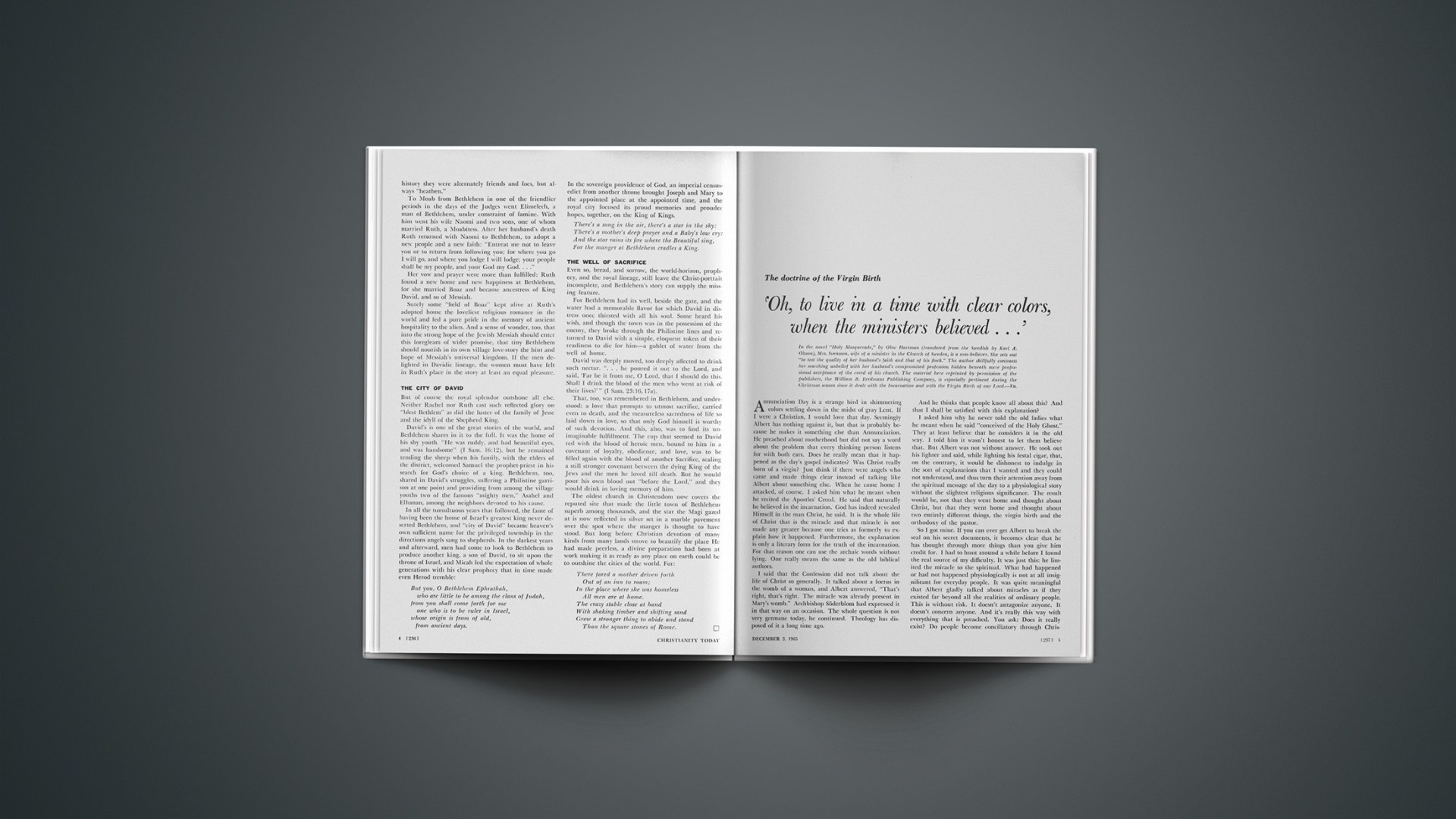
Oh, to Live in a Time with Color Clear, When the Ministers Believed …

The meaning of the Virgin Birth.

In the novel “Holy Masquerade,” by Olov Hartman (translated from the Swedish by Karl A. Olsson), Mrs. Svensson, wife of a minister in the Church of Sweden, is a non-believer. She sets out “to test the quality of her husband’s faith and that of his flock.” The author skillfully contrasts her searching unbelief with her husband’s compromised profession hidden beneath mere professional acceptance of the creed of his church. The material here reprinted by permission of the publishers, the William B. Eerdmans Publishing Company, is especially pertinent during the Christmas season since it deals with the Incarnation and with the Virgin Birth of our Lord.—ED.

Annunciation Day is a strange bird in shimmering colors settling down in the midst of gray Lent. If I were a Christian, I would love that day. Seemingly Albert has nothing against it, but that is probably because he makes it something else than Annunciation. He preached about motherhood but did not say a word about the problem that every thinking person listens for with both ears. Does he really mean that it happened as the day’s gospel indicates? Was Christ really born of a virgin? Just think if there were angels who came and made things clear instead of talking like Albert about something else. When he came home I attacked, of course. I asked him what he meant when he recited the Apostles’ Creed. He said that naturally he believed in the incarnation. God has indeed revealed Himself in the man Christ, he said. It is the whole life of Christ that is the miracle and that miracle is not made any greater because one tries as formerly to explain how it happened. Furthermore, the explanation is only a literary form for the truth of the incarnation. For that reason one can use the archaic words without lying. One really means the same as the old biblical authors.

I said that the Confession did not talk about the life of Christ so generally. It talked about a foetus in the womb of a woman, and Albert answered, “That’s right, that’s right. The miracle was already present in Mary’s womb.” Archbishop Söderblom had expressed it in that way on an occasion. The whole question is not very germane today, he continued. Theology has disposed of it a long time ago.

And he thinks that people know all about this? And that I shall be satisfied with this explanation?

I asked him why he never told the old ladies what he meant when he said “conceived of the Holy Ghost.” They at least believe that he considers it in the old way. I told him it wasn’t honest to let them believe that. But Albert was not without answer. He took out his lighter and said, while lighting his festal cigar, that, on the contrary, it would be dishonest to indulge in the sort of explanations that I wanted and they could not understand, and thus turn their attention away from the spiritual message of the day to a physiological story without the slightest religious significance. The result would be, not that they went home and thought about Christ, but that they went home and thought about two entirely different things, the virgin birth and the orthodoxy of the pastor.

So I got mine. If you can ever get Albert to break the seal on his secret documents, it becomes clear that he has thought through more things than you give him credit for. I had to hunt around a while before I found the real source of my difficulty. It was just this: he limited the miracle to the spiritual. What had happened or had not happened physiologically is not at all insignificant for everyday people. It was quite meaningful that Albert gladly talked about miracles as if they existed far beyond all the realities of ordinary people. This is without risk. It doesn’t antagonize anyone. It doesn’t concern anyone. And it’s really this way with everything that is preached. You ask: Does it really exist? Do people become conciliatory through Christianity? Does it make any difference in business or politics? Does it have any consequences in the psyche of the hypochondriac?

And then I asked, “Would you be different if you were not a Christian?”

Albert said that this was not relevant but his face got red and he spilled ashes on the floor.

But then he counterattacked. He said that I myself believed in the right and the true as if they were eternal verities. In this way I had crossed over into the world of miracles, that is, to that which is beyond time and space. But this faith did not, he said, mean that I believed in divine healings. In fact I limited my belief in miracles much more than he.

I reminded him that I did not belong to the teachers in Israel. I press my lips together during the Confession. I do not preach sermons on the Annunciation; not even on motherhood. I …

“… thank God that I am not like other men,” Albert continued. “Like church women or dissenters or like this minister.”

I was silent. I did not know what to answer. He was right, of course, that in some sense I sit in judgment of him. But I do it to get out of a desperate situation. It is an act of defense. Furthermore, I make no pretension of being anything. I have no Christian symbols on my chest. I do not even pretend to be an honest person even though I should like to be.

But after a while, and then the coffee was ready—the drinking of coffee seems to me in retrospect a ridiculously idyllic frame for this deeply serious conversation—after a while I asked Albert what it was that prevented him from believing in the virgin birth. Wasn’t it quite simply that the dogma is not considered decent among cultured people? The obstacle for him could not be the scientific world-view since he had already disposed of this through his faith in answered prayer—if he now truly believed in this.

I did not wait for his answer. Suddenly it flashed upon me, and I told him that the reason why many ministers doubt in what Gabriel said to Mary and declare it non-essential is a massive, masculine self-sufficiency. They cannot digest the fact that God has restored Eve, since during thousands of years men have blamed her for all transgressions. And anyway it was a costly restoration. But suppose it were true. Suppose it were true that one could become pregnant through a miracle. Suppose it had happened to me.

“Don’t blaspheme,” said Albert.

“You have no right to talk about blasphemy since you don’t believe in it,” I said. “You theologians never want to hear about reality. You claim that it does not mean anything or that you cannot believe in it or that it is blasphemous to air it. But suppose, Albert, that the miracle had taken place here and now in time and space. Suppose it had been I who had become impregnated through a miracle.”

My voice failed me. It was as if a knife had stabbed me when I said it, although I did not give myself time to think why.

“What do you think they should have said at home,” I continued, “if I had been living like her with my mother and father? What would my betrothed have said when he discovered the state of affairs? Not to mention Fru Karlsson with the tongue and all the leering boys at the street corners. To talk about being with child through a miracle—even rather nice people would have shaken their heads and said that it was a fantasy, perhaps a fantasy brought on by lunacy or wild despair, but in any event a fantasy. The world does not believe in miracles. I know that well who am myself a world-ling.

“But I go to the minister. Here comes the woman who carries the Son of God in her womb. She rings the doorbell and asks if Pastor Svensson is at home. And you, Albert, receive her in your office. I am allowed to sit in the hard chair and you sit opposite me in your adjustable chair. If I were a woman student you would offer me a cigarette, but you notice that I am only a backwoods girl from Forsby and that I am already beginning to be heavy-footed. You consider that the statistics on illegitimate birth are rather high for this year. You prepare yourself to deal severely with the father of the child, who is not showing himself responsible.

“But I look at you with confidence and with joy for I feel that you will really understand this, you who are a pastor. I tell you that I have had a visitation by an angel and you think to yourself, Aha! she is a Pentecostal or a peasant. As you sit with your back against your well-ordered filing cabinet, you find a place for me. You put me in folder five: Ecstatics. But you don’t say anything; you pretend to understand for you don’t want to disturb my childish faith with non-essentials.

“And so I tell you the story, that which is beyond all understanding. But you look at me with psychoanalysis in your eyes. You query a little here and there, and by and by you try to worm out of me what are the true facts about my condition. I begin to be frightened. Just think if not even a pastor can understand. But then I remember that I myself couldn’t understand anything when Gabriel said that I was to bear a child through a miracle. And so I try to tell you that it has pleased God to send His Son into the world through my insignificant being. I can’t quite understand this but I assume that you who are a pastor.… With the world as it is, I say, it will probably take a miracle if God is going to become one of us. But you say that if God wills, He can send His Son into the world through a spiritual miracle. The idea behind the two things is really the same. And why do we need miracles when we have theology?

“The last part of this you don’t tell me because you don’t think I would understand, but you give me a nice little speech about motherhood. You say that it is a great responsibility to be a mother. A heavy responsibility, especially in our day. You say that it is important to be worthy of this holy calling. But I get no answers to my question and I find no place of refuge for my secret. I look at your rationalized office, everything gleaming steel and lacquer and varnish and efficient cleverness, and I say to myself, there can’t be any angels in this world of card files and punches and scissors and rulers. How can there be any miracles in the land where the ministers wear shiny black office coats? So my own faith deserts me. It is probably true what the pastor says and I stand up to go.”

I actually got up. I curtsied a little for him and walked a few steps toward the door. It wasn’t theater and it wasn’t insanity. I thought in actuality that I was the Virgin Mary, an incredibly poor and concrete present-day Mary on her way to a social welfare agency. But when I got to the door I felt that the child leaped within me and I thought, “And so at last I am experiencing what it is to be pregnant.” And I was in heaven and hell at the same time. But then the fiction burst and the tear in it went down into the flat reality. I stood leaning against the door lintel and wept so that my whole body shook. And Albert sat pale at the coffee table with cold coffee in his cup. He looked at me terrified and his forehead was sweaty. At last he murmured, “You must understand that I can’t help it; it is impossible for me to believe.” But then everything came to an end for me and I shrieked at him, “But then say it and say it so everybody hears it!”

And I ran away from him up to my bedroom and threw myself on the bed. Why was I in such a turmoil? What does the Virgin Mary mean to me?

I began to understand that the worst thing for a skeptic is not faith but self-evidence. It is terrible to doubt when there is no real faith to doubt in but merely beautiful words. Oh, to live in a time with clear colors, when the ministers believed in angels and devils and atheists were burned at the stake just as if they had been martyrs of the faith.

It Happened at Bethlehem

A village that outshines the world’s cities.

Blest “Bethlem” indeed! In all the spiritual topography of the race, no soil is more sacred, no locality more deeply loved. And none could have been more strangely, more variously appropriate for the birthplace of the Saviour of the world.

Whether it be the original name or a Jewish pun upon some older, pagan designation, Bethlehem—“House of Bread”—fitted well the favored village on a fertile hillside, its fields populous with rich flocks of sheep and goats, its lush valleys clothed with wheat and barley, its terraced slopes of almond and olive, fig and pomegranate, rising to the twin summits above the town. Sheltered among the trees were the famous vineyards that made Bethlehem’s wine more choice than Jerusalem’s, only five miles away. Her farmers had always been men of wealth (Ruth 2:1), and to this day “Beit Lahm” remains a “House of Meat.”

But man does not live by bread alone, nor must he labor only for the meat that perishes. Here, to Bethlehem, in the fullness of time and the hunger of the world, came he who was to be for all men the Bread of life, taking upon him, in innocence and beauty, that flesh which he was to give for the life of the world.

The Grave Of Rachel

And what stirring memories lingered in the atmosphere of the little town; what oft-repeated stories of excitement, tragedy, and triumph made up her history. Some were filled with the pathos of ancient sorrows. For here was shown, from earliest days, a weathered stone monument to a great love and a great loss.

Here Jacob’s beloved Rachel, for whom he served “seven years … and they seemed to him but a few days because of the love he had for her”—here Rachel died, giving birth to Benjamin, whom with her last cry she named “Son of my sorrow.” “She was buried on the way to Ephrath (that is, Bethlehem), and Jacob set up a pillar upon her grave; it is the pillar of Rachel’s tomb, which is there to this day” (Gen. 35:19b, 20, RSV). The anguish of Jacob’s heart still wrings his dying words to Joseph, years afterward: “When I came from Paddan, Rachel to my sorrow died in the land of Canaan on the way … and I buried her there on the way to Ephrath (that is, Bethlehem)” (Gen. 48:7).

This eloquent prefiguring of another who would find in childbirth, and at Bethlehem, that “a sword [would] pierce her own soul also” is strangely moving. But there is more.

For the cry of Rachel echoes down the sorrows of Israel. In startling prevision, as the dreaded Babylonian Exile approached, the prophet Jeremiah saw the long line of captives being led northward from Jerusalem past Rachel’s grave and hearing as they passed the Mother of Israel still weeping for her children:

A voice is heard in Ramah,

Lamentation and bitter weeping.

Rachel is weeping for her children;

she refuses to be comforted for her children,

because they are not [Jer. 31:15].

Although this rests upon another tradition concerning the site of Rachel’s grave, Matthew boldly appropriates it with powerful dramatic effect in picturing the mourning of the mothers of Bethlehem at Herod’s slaughter of the innocents. The quotation is made still more apposite because Jeremiah himself, aged and rejected, captive and helpless, at the very nadir of Israel’s faith and fortunes, was held at Bethlehem before being forcibly carried to his death in Egypt.

It is as though in Bethlehem all the sadness of mankind’s predicament had found expression: personal bereavement and mortality, delayed hope and bitter disappointment, moral conflict and deserved chastisement, national failure and inhuman cruelty, are gathered up in years of travail and tears that herald the coming of him who would bring good tidings to the afflicted and bind up the brokenhearted. There all who “would not be comforted” may find at last the Consolation of Israel—and of the world.

The Home Of Ruth

From Bethlehem’s highest point, 2,550 feet, the land falls steeply eastward to the Dead Sea, and, barely thirty miles away, to the dim outline of the loftier mountains of Moab. As the story of Lot shows, the Moabites were in some sense kin to Israel; through the long history they were alternately friends and foes, but always “heathen.”

To Moab from Bethlehem in one of the friendlier periods in the days of the Judges went Elimelech, a man of Bethlehem, under constraint of famine. With hint went his wife Naomi and two sons, one of whom married Ruth, a Moabitess. After her husband’s death Ruth returned with Naomi to Bethlehem, to adopt a new people and a new faith: “Entreat me not to leave you or to return from following you; for where you go I will go, and where you lodge I will lodge; your people shall be my people, and your God my God.…”

Her vow and prayer were more than fulfilled: Ruth found a new home and new happiness at Bethlehem, for she married Boaz and became ancestress of King David, and so of Messiah.

Surely some “field of Boaz” kept alive at Ruth’s adopted home the loveliest religious romance in the world and fed a pure pride in the memory of ancient hospitality to the alien. And a sense of wonder, too, that into the strong hope of the Jewish Messiah should enter this foregleam of wider promise, that tiny Bethlehem should nourish in its own village love-story the hint and hope of Messiah’s universal kingdom. If the men delighted in Davidic lineage, the women must have felt in Ruth’s place in the story at least an equal pleasure.

The City Of David

But of course the royal splendor outshone all else. Neither Rachel nor Ruth cast such reflected glory on “blest Bethlem” as did the luster of the family of Jesse and the idyll of the Shepherd King.

David’s is one of the great stories of the world, and Bethlehem shares in it to the full. It was the home of his shy youth. “He was ruddy, and had beautiful eyes, and was handsome” (1 Sam. 16:12), but he remained tending the sheep when his family, with the elders of the district, welcomed Samuel the prophet-priest in his search for God’s choice of a king. Bethlehem, too, shared in David’s struggles, suffering a Philistine garrison at one point and providing from among the village youths two of the famous “mighty men,” Asahel and Elhanan, among the neighbors devoted to his cause.

In all the tumultuous years that followed, the fame of having been the home of Israel’s greatest king never deserted Bethlehem, and “city of David” became heaven’s own sufficient name for the privileged township in the directions angels sang to shepherds. In the darkest years and afterward, men had come to look to Bethlehem to produce another king, a son of David, to sit upon the throne of Israel, and Micah fed the expectation of whole generations with his clear prophecy that in time made even Herod tremble:

But you, O Bethlehem Ephrathah,

who are little to be among the clans of Judah,

from you shall come forth for me

one who is to be ruler in Israel,

whose origin is from of old,

from ancient days.

In the sovereign providence of God, an imperial census-edict from another throne brought Joseph and Mary to the appointed place at the appointed time, and the royal city focused its proud memories and prouder hopes, together, on the King of Kings.

There’s a song in the air, there’s a star in the sky:

There’s a mother’s deep prayer and a Baby’s low cry:

And the star rains its fire where the Beautiful sing,

For the manger at Bethlehem cradles a King.

The Well Of Sacrifice

Even so, bread, and sorrow, the world-horizon, prophecy, and the royal lineage, still leave the Christ-portrait incomplete, and Bethlehem’s story can supply the missing feature.

For Bethlehem had its well, beside the gate, and the water had a memorable flavor for which David in distress once thirsted with all his soul. Some heard his wish, and though the town was in the possession of the enemy, they broke through the Philistine lines and returned to David with a simple, eloquent token of their readiness to die for him—a goblet of water from the well of home.

David was deeply moved, too deeply affected to drink such nectar. “… he poured it out to the Lord, and said, ‘Far be it from me, O Lord, that I should do this. Shall I drink the blood of the men who went at risk of their lives?’ ” (1 Sam. 23:16, 17a).

That, too, was remembered in Bethlehem, and understood: a love that prompts to utmost sacrifice, carried even to death, and the measureless sacredness of life so laid down in love, so that only God himself is worthy of such devotion. And this, also, was to find its unimaginable fulfillment. The cup that seemed to David red with the blood of heroic men, bound to him in a covenant of loyalty, obedience, and love, was to be filled again with the blood of another Sacrifice, sealing a still stronger covenant between the dying King of the Jews and the men he loved till death. But he would pour his own blood out “before the Lord,” and they would drink in loving memory of him.

The oldest church in Christendom now covers the reputed site that made the little town of Bethlehem superb among thousands, and the star the Magi gazed at is now reflected in silver set in a marble pavement over the spot where the manger is thought to have stood. But long before Christian devotion of many kinds from many lands strove to beautify the place He had made peerless, a divine preparation had been at work making it as ready as any place on earth could be to outshine the cities of the world. For:

There fared a mother driven forth

Out of an inn to roam;

In the place where she was homeless

All men are at home.

The crazy stable close at hand

With shaking timber and shifting sand

Grew a stronger thing to abide and stand

Than the square stones of Rome.

Editor’s Note from December 03, 1965

Christmas season recalls a memorable experience in Rhodesia a few Decembers ago. To gain a few days of quiet rest, my wife and I flew from Johannesburg to Salisbury without telling a soul. After early breakfast at Meikle’s, I was out for a morning constitutional (an activity so rare as to be worthy of the record) when I had the uneasy feeling that somebody was tracking me. As it turned out, he had been doing just that for almost half an hour.

There was my college classmate Orla Blair, who since Wheaton days (’38) has labored in the African interior as a missionary. That morning he had driven a hundred miles to meet an incoming plane and, having half an hour to spare, had decided to go window-shopping.

“Could you be …,” he finally blurted, after having several times convinced himself against the possibility. Indeed I was—and that night, along with a dozen missionary families, we sang Christmas carols in Africa.

This year our enjoyment of Christmas music will he heightened by CHRISTIANITY TODAY’S recording of four carols of English origin. We were delighted by our advance hearing of the long-playing record specially made by the Don Hustad Carollers as a gift subscription bonus. We’re airmailing one to our Rhodesian friends, in fact, and plan this year to make it part of our Christmas at home in Virginia.

‘Peanuts’ on TV: More than A Christmas Present

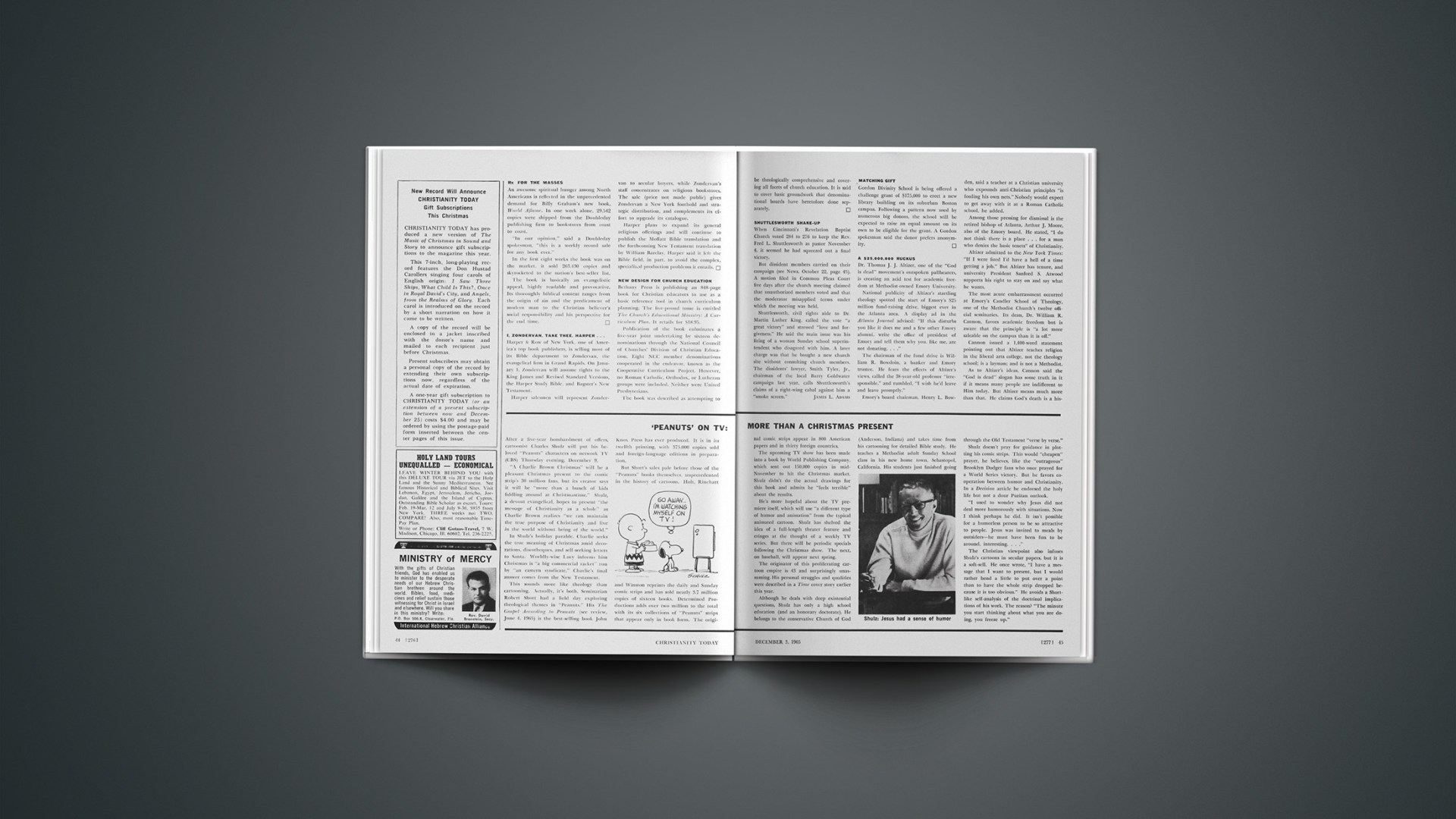
After a five-year bombardment of offers, cartoonist Charles Shulz will put his beloved “Peanuts” characters on network TV (CBS) Thursday evening, December 9.

“A Charlie Brown Christmas” will be a pleasant Christmas present to the comic strip’s 30 million fans, but its creator says it will be “more than a bunch of kids fiddling around at Christmastime.” Shulz, a devout evangelical, hopes to present “the message of Christianity as a whole” as Charlie Brown realizes “we can maintain the true purpose of Christianity and live in the world without being of the world.”

In Shulz’s holiday parable, Charlie seeks the true meaning of Christmas amid decorations, discotheques, and self-seeking letters to Santa. Worldly-wise Lucy informs him Christmas is “a big commercial racket” run by “an eastern syndicate.” Charlie’s final answer comes from the New Testament.

This sounds more like theology than cartooning. Actually, it’s both. Seminarian Robert Short had a field day exploring theological themes in “Peanuts.” His The Gospel According to Peanuts (see review, June 4, 1965) is the best-selling book John Knox Press has ever produced. It is in its twelfth printing, with 375,000 copies sold and foreign-language editions in preparation.

But Short’s sales pale before those of the “Peanuts” books themselves, unprecedented in the history of cartoons. Holt, Rinehart and Winston reprints the daily and Sunday comic strips and has sold nearly 3.7 million copies of sixteen books. Determined Productions adds over two million to the total with its six collections of “Peanuts” strips that appear only in book form. The original comic strips appear in 800 American papers and in thirty foreign countries.

The upcoming TV show has been made into a book by World Publishing Company, which sent out 150,000 copies in mid-November to hit the Christmas market. Shulz didn’t do the actual drawings for this book and admits he “feels terrible” about the results.

He’s more hopeful about the TV premiere itself, which will use “a different type of humor and animation” from the typical animated cartoon. Shulz has shelved the idea of a full-length theater feature and cringes at the thought of a weekly TV series. But there will be periodic specials following the Christmas show. The next, on baseball, will appear next spring.

The originator of this proliferating cartoon empire is 43 and surprisingly unassuming. His personal struggles and qualities were described in a Time cover story earlier this year.

Although he deals with deep existential questions, Shulz has only a high school education (and an honorary doctorate). He belongs to the conservative Church of God (Anderson, Indiana) and takes time from his cartooning for detailed Bible study. He teaches a Methodist adult Sunday School class in his new home town. Sebastopol, California. His students just finished going through the Old Testament “verse by verse.”

Shulz doesn’t pray for guidance in plotting his comic strips. This would “cheapen” prayer, he believes, like the “outrageous” Brooklyn Dodger fans who once prayed for a World Series victory. But he favors cooperation between humor and Christianity. In a Decision article he endorsed the holy life but not a dour Puritan outlook.

“I used to wonder why Jesus did not deal more humorously with situations. Now I think perhaps he did. It isn’t possible for a humorless person to be so attractive to people. Jesus was invited to meals by outsiders—he must have been fun to be around, interesting.…”

The Christian viewpoint also infuses Shulz’s cartoons in secular papers, but it is a soft-sell. He once wrote, “I have a message that I want to present, but I would rather bend a little to put over a point than to have the whole strip dropped because it is too obvious.” He avoids a Short-like self-analysis of the doctrinal implications of his work. The reason? “The minute you start thinking about what you are doing, you freeze up.”

The book was described as attempting to be theologically comprehensive and covering all facets of church education. It is said to cover basic groundwork that denominational boards have heretofore done separately.

Evangelical Burdens

This is a critical time for evangelicals in England. Apart from the dilemma confronting those in all four churches who for theological reasons disagree with the proposed Anglican-Methodist and Congregational-Presbyterian mergers, legislation is pending in the Church of England that undesirably will at once legalize the hitherto illegal and erect further barriers against non-Anglicans who seek occasional communion in a parish church. Here indeed is paradox in an ecumenical age.

But these are not the only reasons for disquiet. The clerical official on Archbishop Ramsey’s own staff at Lambeth Palate who has just announced his conversion to Rome could have found little to dissuade him in the primate’s own ecclesiastical tendencies. Just as his response to his fellow bishop of Woolwich was lamentably weak, Dr. Ramsey’s failure to give the country a clear lead generally in spiritual and moral matters has disappointed many in an age when the British crime rate has risen alarmingly.

The archbishop and his episcopal colleagues not long ago came out strongly in the House of Lords in favor of that section of the Wolfenden Report which would legalize homosexual acts carried out privately by consenting adult males (the government is resisting such legislation). While withholding comment on that vexed issue, one might wish that the hierarchy was prepared to stick out its collective neck on more spiritual occasions also. Lest any imagine, however, that church and state have reversed roles, we should note that Sir Edward Boyle, Minister of Education, two years ago told the House of Commons that he did not regard it as part of his job to prescribe what moral teaching should be given in schools. With the state opting out and the church’s leading trumpet sounding an uncertain note against the new moralists, evangelicals (in common with many decent godless folk) are not unnaturally concerned.

That many of them are at present rethinking their position within their own denominations was apparent at the recent National Assembly of Evangelicals held at Westminster (see “British Evangelicals Map Cooperation,” CHRISTIANITY TODAY, News, October 22). The possible formation of a United Evangelical Church was seriously considered, and the matter referred to a study group. The unrest is not confined to the Church of England (from which several clergymen had previously seceded). A Baptist speaker said: “Our position in the mainstream denominations is becoming untenable”: a Methodist: “We cannot therefore continue forever in the denominations”; a Congregationalist: “Many will have to come out from the denominations.”

In this connection some significant points were made by the Rev. Gilbert W. Kirby, secretary of the Evangelical Alliance and the original moving spirit behind the assembly. “The evangelical is the loyalist in his denomination,” he pointed out. “Our denominations owe their origin to the very things that we hold dear; we want them to continue as they began.… There is good historic evidence for staying in until we are thrown out.” He called for prayer, humility, care, and restraint.

If I may digress for a moment, striking support for this view was given in a new Catholic Truth Society booklet by David Woodard entitled Our Separated Brethren. Speaking of the different parties to be found in the Church of England, Father Woodard declares that it is the modern-day successors of Cranmer, Parker, Grindal, and Whitgift who “must be regarded by us as the party most loyal to the Anglican formularies.” (This I take to be more than a devious divide et impera!) Moreover, he adds about these evangelicals, “they teach the doctrines that agree with their ministry.” That is an eloquent testimony.

Even level-headed men like Gilbert Kirby who know their history and the often bitter fruits of past secession agree that such action may become necessary. All this reflects the tension and strain that current ecumenical maneuverings are imposing on many earnest and devoted men of God. The conference disclosed how deeply they are disturbed, how truly they desire to avoid any open breaks, but how strongly they feel about a situation in which they are convinced that the Gospel itself is being betrayed in the quest for outward unity.

Another cautionary note was rightly struck when the Rev. Paul Rees urged the delegates (there were nearly 1,200 of them) to get their definitions clear and to stop regarding “evangelical” and “ecumenical” as mutually exclusive concepts. The emerging churches of Asia, Africa and Latin America simply would not tolerate the export of Western denominationalism. We should, he urged, be seriously concerned about authentic ecumenicity. He told of an Indian brother he knew who described himself as “an American Dutch Reformed Indian Christian.” We should address ourselves to the living issues of the hour, said Mr. Rees; we are “evangelistically immobilized when we ought to be on the march.”

A major address was given by Dr. J. I. Packer, warden of Latimer House, Oxford, the Anglican evangelical research center. Speaking on “The Idea of Religionless Christianity” (an analysis of the kind of theology found in Honest to God), he said it reminded him of an advertisement put around in his schooldays: “For Sale—A Bladeless Knife Without a Handle.” After tracing the historic roots of the radical movement—“reactionary” he suggested would be a better word—Dr. Packer affirmed that in many ways “Bishop Robinson appears as Christian as Bonhoeffer, while taking up the sub-Christian ideas of Bultmann and Tillich.” When the test question “What think ye of Christ?” is asked of Bultmann and Tillich, he said, the answer is unsatisfactory.

But Dr. Packer is not merely a demolition expert: he had something positive to say on what evangelical response ought to be in this situation. Four points: our faith should be proclaimed as exposition and application of the Word of God; our ethical teaching should be in terms of “keep his commandments”: our evangelism must be forthright, not afraid to label the secular world as an apostate world and emphasizing the doctrines of God the Creator and Lawgiver: and we must trust the Holy Spirit, who is the real answer to the so-called problem of communication.

It would be pointless to pretend that evangelicals in Britain are united doctrinally—the Calvinist-Arminian controversy, for example, is still very much of a live issue—but circumstances are compelling them to get things into true perspective. As Peter Johnston pointed out in his presidential address at Westminster, Wesley preached at Whitfield’s funeral and paid glowing tribute to the God-honoring labors of his brother in Christ. It comes back to fundamentals. That inimitable Victorian, Jerome K. Jerome, evolved the principle when his three men were preparing to embark that they should take with them, not what would be useful, but what they couldn’t do without. It might not be profound theology, but it gets priorities right.

Vatican Inserts Limit on Liberty

The Second Vatican Council moved toward adjournment this month with religious liberty the most far-reaching issue still to be resolved.

On the eve of final voting on the religious liberty declaration, Belgian Bishop Emile de Smedt announced on behalf of the Vatican Secretariat for Promoting Christian Unity that an important new amendment had been introduced. It asserts that all men have the “sacred duty to profess and embrace the Catholic faith insofar as they are able to know it.”

The bishop said there had been no change in the portion of the text upholding the basic contention that all men have the right to believe and worship according to their consciences. He declared, however, that “in keeping with the wishes of many fathers, special care had been taken to declare explicitly that the right to religious liberty does not free either the individual or society from its moral duties toward the true religion.”

That brought groans of disappointment from champions of religious liberty throughout the world who were looking for a clear-cut affirmation. Dr. Stanley I. Stuber, American Baptist guest at the council, charged that the change “takes away freedom of conscience.”

Several other passages in the proposed declaration also came under fire. One said that states should not oblige children to attend schools where anti-religious subject matter is taught. Another warned against state school systems that exclude religious training. Associate Director C. Stanley Lowell of Americans United for Separation of Church and State, just back from Rome, told a rally in Washington’s Constitution Hall that the declaration “specifically exempts all existing concordats between the Vatican and Catholic countries.” He said it falls considerably short of the proposed U. N. Declaration of Human Rights.

Loopholes notwithstanding, the Vatican declaration states as the Catholic position that no person or group can be coerced in matters of religious practice. It says that full religious liberty must be guaranteed to all religious groups in both private and public exercise of their religion, and that it is the function of the state to guarantee these freedoms.

According to Baptist reporter W. Barry Garrett, “the changes in the text consist largely in the addition of a section designed to win the votes of traditionalist bishops who have been reluctant to favor the new position of the Catholic Church.”

The amended declaration went through the council despite 543 conditional “yes” votes, an unusually high number. There were 1,539 unqualified “yes” votes and 65 “no.”

There was still opportunity for changes, but these were supposed to be restricted to minor alterations with no bearing on substance or intent.

Evangelicals had reason to lament the Roman Catholic definition of religious liberty, but many found much to agree with in what the council was preparing to say on Scripture. First reports indicated that the schema on divine revelation, as approved by an overwhelming vote, said quite explicitly that God, for the salvation of men, has written down the truth without any error. The question of the relative importance of Scripture and tradition was said to have been left open. Rules for biblical research were liberalized.

At a special ceremony in St. Peter’s Basilica last month, Pope Paul VI promulgated four decrees and a much-discussed declaration on the church’s relations with other religions. The declaration includes an official Vatican position that Jews are not regarded as collectively guilty of the crucifixion of Christ.

One of the decrees involved prospects of a drastic overhaul of the Roman Curia, the church’s central administration, regarded as ultra-conservative. Another with obvious implications for the United States calls for public subsidies to be “paid out in such a way that parents are truly free to choose according to their conscience the schools they want for their children.” The others had to do with updating monastic life and the process by which men become priests.

Protestant Panorama

Methodism’s supreme court, the Judicial Council, put off for the third time in a year a decision on where ultimate authority lies for regional integration. The council will meet again in December.

The Burma Baptist Convention marked its 100th anniversary at a service of consecration attended by some 4,500. Speakers stressed what Christians can do in a country where Christian schools have been nationalized and where new missionaries are not being admitted.

Trustees of Davidson (North Carolina) College, a Presbyterian school, eliminated a faculty oath that had restricted full faculty tenure to Protestants.

Australia’s two Lutheran churches, which split some 120 years ago, will be reunited. The United Evangelical Lutheran Church gave unanimous approval to a consolidation plan with the Evangelical Church of Australia.

Miscellany

Ecumenical Patriarch Athenagoras, titular head of the world’s 140,000,000 Eastern Orthodox, was reported to be planning a trip to Rome to confer a second time with Pope Paul VI. Their meeting in Jerusalem nearly two years ago was the first face-to-face encounter between a Roman pope and an Orthodox ecumenical patriarch since 1439.

Religious bloc voting is often important in big cities like New York, where one-third of the electorate is Jewish and an even bigger slice is nominally Roman Catholic. But, despite religious bickering in the campaign (see “Fusion and Feuds,” News, November 5 issue), religious blocs did not materialize in the New York mayoralty race. Fusion candidate John Lindsay, an Episcopalian, won over Democratic Abraham Beame, who is Jewish, and conservative William Buckley, a Roman Catholic.

The Right Rev. Horace W. B. Donegan, Episcopal bishop of New York, says his support of civil rights caused many to welsh on pledges toward completion of the Cathedral of St. John the Divine. One man cut a $600,000 gift out of his will.

President Johnson signed a bill to establish a national memorial honoring Roger Williams in Providence, Rhode Island. Williams, a Baptist, was founder of the state and a noted champion of religious liberty.

A group of members of the First Baptist Church in Richmond, Virginia, initiated court action last month to reverse a decision by the church to admit two Nigerian students to membership. The group’s court petition asserts that admission of the pair violated the church constitution.

Thanks For $3 Billion

Each year, the National Council of Churches gets out a report on church contributions in time for Thanksgiving. This time, the churches of America and Canada have at least $3,101,639,604 to be thankful for.

The total is really much more than that. Only forty-one American and six Canadian denominations gave the NCC figures. Among the holdouts were key NCC members—the big Negro denominations and Orthodox communions. Many small evangelical groups outside the NCC also kept their finances to themselves.

All categories of giving in the NCC report were up for 1964. One help was inclusion of gifts from wills for the first time. Foreign missions contributions were up 8.56 per cent.

A survey designed to determine the quality, variety, and extent of religious programming by the nation’s television stations is being conducted by the National Association of Broadcasters. Results will be published in a book, says the NAB’s Television Information Office.

Personalia

Dr. Albert C. Winn was chosen president of Louisville Presbyterian Theological Seminary. He is now professor of doctrinal theology at the seminary.

Dr. Cyril D. Garrett was appointed professor of Christian education at California Baptist Theological Seminary. He has been executive vice-president and dean of Eastern Baptist College.

Dr. George W. Forell, professor of Protestant theology at the University of Iowa, was named acting director of the university’s school of religion.

Dr. David Hyatt was named executive vice-president of the National Conference of Christians and Jews.

Paul G. Elbrecht was elected president of Alabama Lutheran Academy and College.

Dr. Joel Nederhood was appointed radio minister of the Christian Reformed Church, succeeding the late Peter H. Eldersveld.

J. Elliott Stedelbauer was elected chairman of the Christian Business Men’s Committee International.

Dr. G. Barrett Rich III, a Presbyterian clergyman and program director of the Protestant-Orthodox Center at the New York World’s Fair, was named chaplain of the Protestant Chapel at John F. Kennedy International Airport.

Deaths

J. MARCELLUS KIK, 61, associate editor of CHRISTIANITY TODAY for its first three years; in Philadelphia, of cancer (see the editorial on page 32).

BRAVID W. HARRIS, 69, retired Episcopal bishop of Liberia; killed instantly when his car ran off a highway near Fredericksburg, Virginia.

FERDINAND SIGG, 63, Methodist bishop of eight European countries, Algeria, and Tunisia; in Zurich, Switzerland.

RAY FOOTE PURDY, 67, board chairman of Moral Re-Armament in the United States; in Atlanta.

Tillich’s 79-Year Quest

Paul Johannes Tillich’s subjective search for ultimates ended last month. The world-renowned theologian succumbed to a heart ailment in a Chicago hospital at age seventy-nine.

Did he ever define death? Probably not, but he once said it “has become powerful in our time, in individual human beings, in families, in nations.… But death is given no power over love. Love is stronger. It creates something new out of the destruction caused by death.”

If that observation was ambiguous, it was not untypical. Tillich was quoted by many more people than understood him. The terms most associated with his thought—“ground of being,” “the unconditioned,” “ultimate concern”—promise to be part of the language for a long time. (See the editorial on page 30.)

The career of Tillich was rather evenly divided between the Old World and the New. His life in Germany was dramatic. It ranged from chaplain service for four years in the Kaiser’s army and a little-known wartime marriage that ended in divorce, to a confrontation with the Hitler regime in the thirties. By contrast, his life in the United States was quiet and rather colorless, though it was in this period that he gained most of his theological prestige.

He was forty-seven when he came to America, an age when most men are at the height of their careers. He knew only a smattering of English then, but was to write fifteen books in his new language. Perhaps because of this late start, Encyclopaedia Britannica included no article on him until the year of his death.

Tillich was doubtless one of the most influential religious minds of modern times, but that influence is hard to capsulize. He was a philosopher among theologians, a theologian among philosophers. He stressed the need to talk to modern listeners, but most were not equipped to listen.

Tillich was sometimes called “the thinking man’s theologian,” but he had such an influence on society in general that he was chosen to give the main address at Time’s fortieth-anniversary banquet two years ago. In typical style, he told the glittering array that “religion … is the state in which we are grasped by the infinite seriousness of the question of the meaning of our life and our readiness to receive answers and to act according to them.”

Similarly, when asked about the resurgence of religion in America, Tillich said it was reflected not in increasing church membership or in crowds flocking to hear evangelists but in young people who were asking “the right question.”

Tillich was born in Starzeddel, Prussia, the son of a Lutheran minister. He studied at several German universities, including the one at Halle where he received his licentiate in theology. He earned a doctorate in philosophy from the University of Breslau and in 1912 was ordained a minister of the Evangelical Lutheran Church.1In America, Tillich belonged to the Evangelical and Reformed Church, and the subsequent United Church of Christ.

The years as chaplain exposed Tillich to the horrors of war and apparently caused him to remold his theological thought. During these difficult years he married for the first time. A divorce soon followed.

While teaching at the University of Berlin after the war, Tillich met Hannah Werner at an art students’ ball. He married her in 1924, when he was thirty-eight. Both she and his former wife survive him, as do the two children of the second marriage: a daughter, Mrs. Erdmuthe Farris, of New York, and a son, Rene Stephen, of Berkeley. California.

Tillich was exiled from Germany in 1933 because of his outspoken criticism of the Nazis. Years later he told the New York Post, “I had the great honor and luck to be about the first non-Jewish professor to be dismissed from a German university.”

Tillich had a friendship of four decades’ standing with another refugee from Germany, Karl Barth. While the two theologians’ beliefs differed, Tillich claimed there was “underground cooperation between us.”

Another theologian and friend, Reinhold Niebuhr, found a professorial home for Tillich at New York’s Union Theological Seminary, where he spent more than twenty years. In 1955 he was given a special scholar’s status at Harvard Divinity School. Seven years later, he was made John Nuveen professor of theology at the University of Chicago. He was to have left Chicago to join the New School for Social Research in New York in February, 1966.

Tillich was stricken with a heart attack on October 13, and died ten days later. After a simple private funeral service attended by the family and close associates, the body was cremated and the ashes buried in the family plot at East Hampton, Long Island. Tillich willed his brain to the University of Chicago Medical School for study.

Rhodesia: Rumors Of War

In a week during which Christine Keeler was married, Wales beat Russia at soccer, hanging was abolished, and a macabre search went on for more murdered bodies on a Yorkshire moor, the Archbishop of Canterbury stole the British headlines.

Speaking in Aberdeen at a meeting of the British Council of Churches (of which he is president), Dr. Michael Ramsey declared that “as Christians we have to say that it will be right to use force” against the Rhodesian government if it makes a unilateral declaration of independence. The primate drew an analogy with Britain’s obligation to Poland in 1939. He claimed, moreover, to speak for “a large body of Christian opinion.”

The latter is as obvious as the snows of yesteryear if the national dailies faithfully reflect public reaction. Even that pillar of the establishment, The Times, published one morning ten letters on the subject, only one of them supporting Dr. Ramsey (and that with qualifications). One reader remarked, “Last time we used force in answer to a unilateral declaration of independence we were defeated, and the result was the United States of America.”

Only five of twenty-eight diocesan bishops questioned by another paper agreed with the archbishop—a remarkable fact to those acquainted with the Church of England. A Church of Scotland synod that same week declared its unanimous opposition. On the other side, thirty-five members of parliament (one in eighteen) welcomed the speech.

There is no doubt but that the government was acutely embarrassed at a time when delicate negotiations were proceeding, and the Rhodesian government called the statement “inflammatory.”

Three days after Dr. Ramsey’s speech Canterbury Cathedral was desecrated in what might have been a protest against Dr. Ramsey’s stand. The high altar, the marble throne, and the tomb of the Black Prince were sprayed with paint, and tapestries were daubed with the word “Peace.” The next day, similar vandalism occurred at York Cathedral, where Dr. Ramsey was archbishop before coming to Canterbury.

In America, the World Order Conference of the National Council of Churches said Rhodesia should be independent only with effective guarantees of Africans’ part in national life. A majority called for economic sanctions if Rhodesia rebels. Evangelist Billy Graham wired Rhodesian Prime Minister Ian Smith on the eve of his meeting with Britain’s Prime Minister Harold Wilson and said, “Thousands of Christians throughout the world join me in praying that peace will prevail. May God grant you and the leaders of both races in Southern Rhodesia his wisdom in this fateful hour.”

J. D. DOUGLAS

Conservative Kudos For King

The intellectually vibrant Free University of Amsterdam, at age 85, is the foremost conservative Protestant university on the Continent. Last month it celebrated its anniversary with glitter and some breaks with tradition.

Since 1880, the school had granted only thirteen honorary degrees. During the celebration, it quickly added six to the list.

Doctorates have usually gone to Calvinists, but this time one recipient was a liberal Baptist, the Rev. Martin Luther King. However, he was honored for his civil rights achievements, not his theology.

The university also recognized two giants on its own faculty, Drs. Herman Dooyeweerd, 71, and G. C. Berkouwer, 62.

King overslept and missed his flight from England, and was running a fever because of a cold. But when it was over, he said the F.U. visit was one of the most important events of his life.

Some were less than happy that F.U. had become the first conservative Christian college anywhere to honor King. Critics included students from South Africa, bastion of racial segregation, and moderates who think integration must be gradual.

But the independent Protestant daily, Trouw, said F.U.’s stand on civil rights is wholly in line with the wishes of the university’s founder, Abraham Kuyper, who was once Dutch prime minister.

Kuyper led a great movement from the state Dutch Reformed Church, joined the secessionist Reformed Churches of the Netherlands, and founded the university whose name symbolizes its independence from both church and state. At the end of his life, Kuyper expressed dissatisfaction with his group’s limited achievements in social justice.

His separated university now draws nine-tenths of its income from the national government, and its international student body numbers 5,000. It is one of the Netherlands’ two private universities (the other is Catholic).

Dooyeweerd is retiring from the faculty after thirty-nine years. His impact is shown in reactions from Roman Catholics, and in the comment from G. B. Langemeer, professor and prosecutor of the Dutch Supreme Court, who disagrees with Dooyeweerd but calls him Holland’s most original philosopher, not excepting Spinoza.

Berkouwer, like his retiring colleague, has nine children, and this year is his twenty-fifth at F.U. His anniversary attracted most Dutch theological leaders, Catholic as well as Protestant, for his writings have established new points of contact between the two camps. In his remarks, Berkouwer, a contributing editor of CHRISTIANITY TODAY, acknowledged his evolving view of Catholicism but said this does not imply relativism. Karl Barth and Hans Küng wrote special essays on Berkouwer’s work for the anniversary.

Among other persons granted doctorates were Paul C. Hoffman, United Nations specialist in underdeveloped countries, and His Royal Highness Prince Bernhard, who was praised for improving Holland’s economic relations abroad.

The presence of the Dutch royal family and other dignitaries at the anniversary assured front-page coverage in the national press.

BERNARD ZYLSTRA

Two Educators, Two Views

A clash of ideas enlivened the eighth National Conference on Religion in Education, sponsored by the 68-year-old Council for Religion in Independent Schools and held last month at Washington’s Shoreham Hotel.

Two of the main speakers, Dr. Charles Malik of Lebanon, former president of the U. N. General Assembly, and the Rev. William Sloan Coffin, Jr., chaplain of Yale University, presented their contrasting views to about 300 delegates representing America’s leading independent preparatory schools.

After saying that Malik had been one of the heroes of his youth, Coffin referred to Malik’s forthright and detailed confession of his orthodox Christian faith in the opening conference address as “an American Legion and back-to-God” plea. Coffin also said conference seminars on such subjects as “Parental Equivocation and Student Moral Standards” represented preoccupation with “micro-ethics” at the expense of involvement in today’s great social issues.

Malik, who clearly recognized the social dimensions of faith, bore witness to the claims of Christ and asserted that “countless decent people, sane people, responsible people have believed these claims. Genuine theology is the science that humbly tries to explain them and does it by believing them first.… Nothing is more authentic than what we ultimately believe.”

Coffin said the personal appeal in the old biblical terms of commitment of the individual to Christ has no relevance for students today. His was an impassioned advocacy of nonconformity and a religion steeped in the social struggle.

Malik said that to talk about how to communicate is to miss the real problem: “Intelligibility to students is not a criterion of truth.” The divergence of opinion was aptly put in Malik’s retort to a reference by Coffin to his concern for “earthen vessels.” Said Malik, “But I am concerned with the treasure.”

What’S In A Name?

Biblical Seminary in New York will be renamed New York Theological Seminary, if the New York Regents approve. Trustees acted October 1, and a press release twelve days later said the change emphasizes the school’s involvement with New York City.

Another reason cited: the present label implied a Bible institute, rather than a graduate seminary. The board stressed that the school will continue its tradition of intensive Bible study.

There are other changes beside the name. Retirements and more visiting professors in the past two years have altered the faculty greatly. The seminary plans to house MUST, an interchurch urban service training center to be headed by the Rev. George W. Weber of East Harlem Protestant Parish.

Critics of U.S. Policy Win Again in NCC

The Sixth World Order Study Conference appealed for a Red Chinese seat in the United Nations, repeating a stand of the last conference (1958) that sparked a grassroots rebellion against the conference sponsor, the National Council of Churches.

But a nagging new issue has arrived since 1958: Viet Nam. Here, too, World Order countered American foreign policy in calling for an end to bombing of North Viet Nam.

There was anxiety throughout the conference about what would finally be said about Viet Nam. At a session marked by unusually strong disagreements, this issue proved the most divisive.

Dr. Harold Row, a pacifist who went on the NCC study tour of Viet Nam, led those who thought the United States should immediately slop all military operations in Viet Nam. He was opposed vigorously by Harold Stassen, Republican and Baptist leader.

The final compromise statement acknowledged “with repentance” America’s part in the growing war and called on the United States to request immediate negotiations with North and South Viet Nam. Stassen and others were soundly defeated when they tried to make the statement closer to present American policy.

The current rash of demonstrations over Viet Nam led to affirmation of the right of Americans “to appraise, criticize, and endeavor to mold opinion concerning our country’s foreign policy,” A bid to insert “by legal means” after “endeavor” was defeated. Civil disobedience was countenanced, if participants are willing to take the legal consequences of their action.

The Red China statement was significant in the light of that nation’s present belligerence toward the United States and the U. N. The conference also asked for free travel between American and mainland China, sale of food and other non-strategic products to China, cultural exchanges, and negotiations on such issues as disarmament. It asked study of diplomatic recognition.

No report condemned Communism as such, or mentioned its atheism. Both sides were blamed in the United States-Red China rift. Traditional concepts of patriotism were conspicuously absent. In conference terms, it was clear that national self-interest must yield to larger concerns of the community of nations.

In one report “alternatives to Communism” were offered, but nothing concrete was suggested except that the nation should not trust in military power. Originally, this report said a form of Communism might be preferable to anarchy and destruction. This was deleted and the following cryptic statement was inserted:

“Our support for democratic institutions and our anti-communist convictions should not compromise our belief in the right of a people to determine the form of government best suited to its time and needs.”

World Order made no specific judgment on U.S. action in the Dominican Republic, but it recommended strong protest against unilateral intervention. As for Cuba, the conference called for lifting of the travel embargo and sending of funds, food, and material on a people-to-people basis.

The 600 delegates who gathered in St. Louis October 20 to 23 also heard several provocative lectures. Most notable was that by eminent British economist Barbara Ward, who said the gap between rich and poor nations today is greater “now than the gap seventy years ago between a Rockefeller and an unemployed immigrant just landed from Europe.”

Miss Ward, a Roman Catholic, said perhaps “the first and greatest task of the ecumenical movement is to form and unite a Christian conscience” on the obligations of wealth and the rights and needs of the poor. Her theories were sociological, political, and economic, rather than distinctively Christian. She never related these theories to the Christian Gospel but made gratuitous allusions to “self-professedly Christian” nations which should share wealth. The conference heartily endorsed her one concrete suggestion, that rich nations give 1 per cent of their gross national product to social development, through the U. N.

But the study documents overshadowed these speeches and interviews. The topics included not only the Asian crises but a plethora of other issues such as the Connolly amendment; the Selden resolution; South Africa; the U. N. convention on genocide, slavery, forced labor, and women’s rights; and the Manned Orbiting Laboratory.

Unfortunately, there was not nearly enough time in the plenary sessions to deal adequately with the many thorny issues. Many times all discussion was cut off, and amendments were offered without debate. Yet it is doubtful that these stringent measures—necessitated by poor organization—really changed the vote on any issue.

At its heart, the conference was an anomaly. Perhaps because of the 1958 criticism, the St. Louis delegates were most anxious to have it known that World Order spoke only for itself, not for the NCC or its constituent denominations. As one delegate put it, “Whatever happens, don’t blame the NCC.” This contention conforms to the facts, especially when one considers that almost all recommendations were at odds with American policy. But such a position seriously weakens the impact a conference of this kind is calculated to make, and delegates sensed this. Just how seriously is a non-representative conference to be taken?

The conference failed to justify its existence in another respect. Nowhere did it relate its policies to theology, and to the more fundamental mission of the Church to preach the word of reconciliation. In other words, it failed to demonstrate why it, as a delegated conference of a council of churches, should speak on the broad spectrum of political issues under consideration.

Spirit Of St. Louis

Three church groups met the same week as the World Order conference (story above) and beat it to the punch.

The British Council of Churches asked negotiations that include the South Vietnamese rebels; the Methodist Board of Christian Social Concerns asked admission of Red China to the United Nations.

The Viet Nam protest movement in America caused continuing concern about the rights of pacifists and dissenters in general. One hundred New York clergymen upheld the right of protest. The co-ordinator of a peace march to the White House November 27 told a Washington church club that American policy is leading to “a new wave of McCarthyism.”

Dr. Eugene Carson Blake, top United Presbyterian executive, said that Christians increasingly oppose the Viet Nam policy and that repercussions of killing Asians will soon outweigh any advantages.

addApple PodcastsDown ArrowDown ArrowDown Arrowarrow_left_altLeft ArrowLeft ArrowRight ArrowRight ArrowRight Arrowarrow_up_altUp ArrowUp ArrowAvailable at Amazoncaret-downCloseCloseellipseEmailEmailExpandExpandExternalExternalFacebookfacebook-squarefolderGiftGiftGooglegoogleGoogle KeephamburgerInstagraminstagram-squareLinkLinklinkedin-squareListenListenListenChristianity TodayCT Creative Studio Logologo_orgMegaphoneMenuMenupausePinterestPlayPlayPocketPodcastprintremoveRSSRSSSaveSavesaveSearchSearchsearchSpotifyStitcherTelegramTable of ContentsTable of Contentstwitter-squareWhatsAppXYouTubeYouTube