How to Raise a Billion

Funding the enterprise Jesus launched 2,000 years ago has become big business. Raising money for ministries is no longer something done behind the scenes while a ministry focuses on its calling. Fund raising is woven right into the fabric of our response to the Great Commission.

In 1985 (the latest year for which statistics are available), $79,840,000,000 was given to more than 330,000 gift-supported organizations in this country (statistics from the American Association of Fund-Raising Counsel). Of that $79 billion, $37 billion was collected for religious causes.

The philanthropy industry, which handles these funds, now ranks as one of the top ten industries in this country. Obviously, giving a portion of our pay-checks has become a cultural distinctive in North America.

Not surprisingly, evangelicals are significantly represented in this mix. The Evangelical Council for Financial Accountability, a watch-dog organization of evangelical charities, annually receives an account of giving from its 341 member organizations. In 1985, more than $1,578,627,000 came into ECFA’S organizations. Of that amount, $1,163,000,000 was actually distributed for program services. The balance of $415 million was used for management, general expenses, and fund raising.

The billion-and-a-half dollars raised by ECFA organizations does not include income from the major television ministries in this country (Jerry Falwell, Jimmy Swaggart, the PTL Club, and Oral Roberts). Because these organizations do not report their income, no one knows exactly what they raise. It is estimated, however, that at least another half-billion dollars is raised among them each year.

High-tech offering plates

How do Christian organizations get money for ministry? They ask for it. And they ask for it often (weekly or monthly appeals are not uncommon). For each Christian organization, there almost always is a cadre of professionals in a fund-raising department whose sole function is to be sure monies are raised for that organization. And these professionals have an ever-expanding array of techniques to go fishing for donors.

An organization’s mailing list—a cache of names representing a demonstrated interest in the organization—is the primary focus of fund-raising efforts. Computers are de rigueur, providing organizations with the ability to dissect their mailing lists into a dizzying array of segments. Computer-generated letters are personalized with specially tailored references to the individual donor’s giving history.

Great care goes into packaging appeals in a way that will insure the greatest return. Underlining (in blue ink) increases response. Timing appeals to arrive at a certain time of the month helps, too, as does copy on the outside of the envelope, postage stamps rather than printed permits, and certain colors and weights of paper.

The emphasis on the right packaging shows up in the electronic media, too. Television appeals are carefully positioned in the context of the show. The color of tie, shirt, and suit of the evangelist as well as the setting become important. So does the decision when the camera should slowly move in to create a sense of intimacy between the viewer and the evangelist. How often an “800” number appears on the screen, and its size, are crucial decisions in packaging television appeals.

A gift that keeps on giving

Fund raisers today already have their eyes on the future. That is why deferred giving programs have increasingly become a part of fund-raising activity. These programs seek to help many donors provide for their own or their children’s future by helping to disperse assets through a trust that benefits both the donor and the asking organization. Also, by encouraging donors to sign over life assets at the time of death, organizations garner cash for future ministry operations.

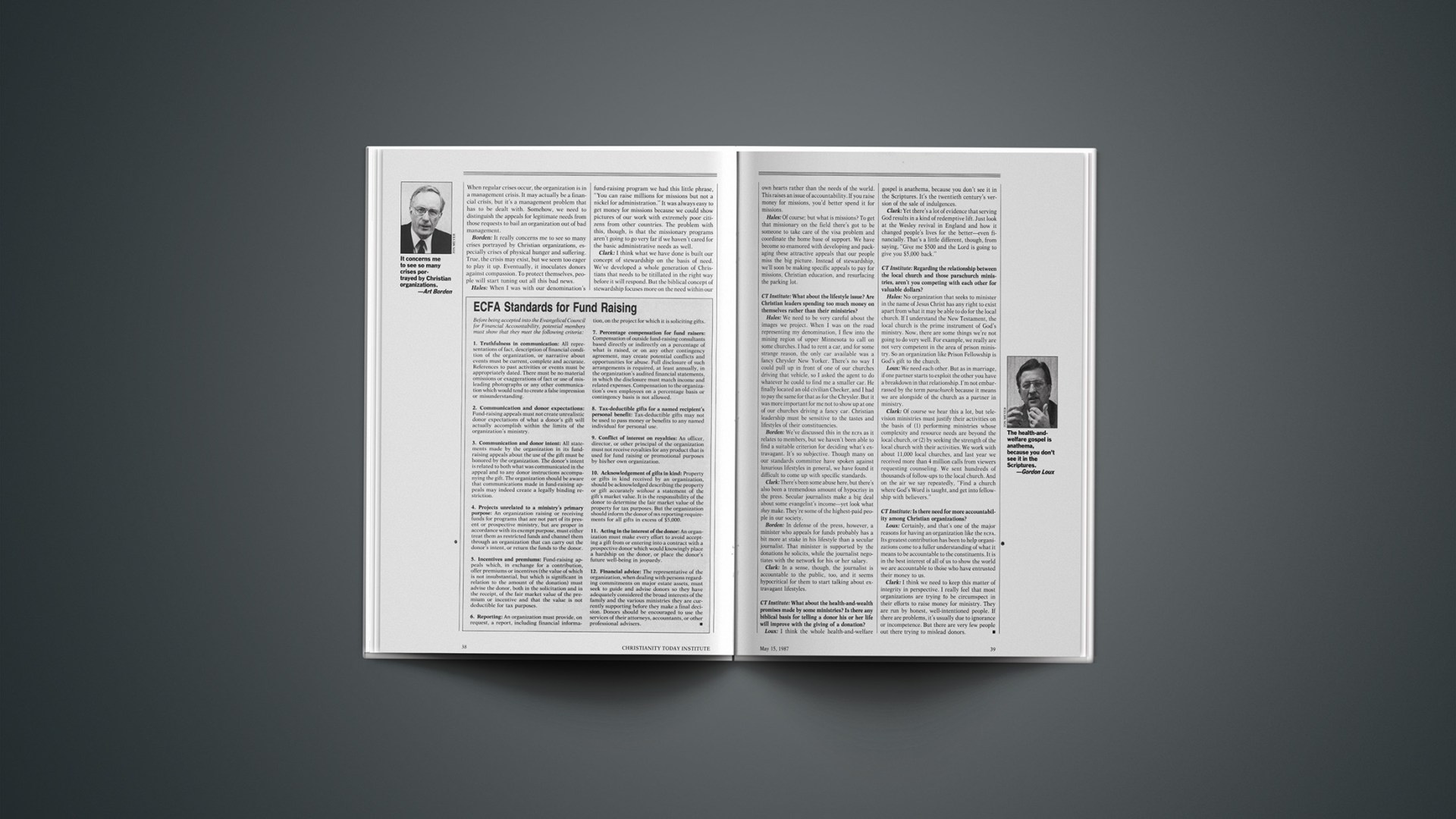
Obviously, the advance of technology has played a large hand in current fund-raising practice. ECFA president Art Borden says technology makes fund raising more efficient, but “the down side is the inundation of appeals.”

One recent example of fund-raising technology is the computerized signature machine. This device allows ministry executives to “hand sign” appeal letters, giving the impression of intimacy.

But such technological advances raise ethical questions for those who ask for funds. The challenge in providing future funds for ministry will be in how well the organization asking for them can merge technology with ethics.

By J. David Schmidt, a consultant to Christian organizations in the areas of marketing, development, and promotion.
ECFA Standards for Fund Raising

Before being accepted into the Evangelical Council for Financial Accountability, potential members must show that they meet the following criteria:

1. Truthfulness in communication: All representations of fact, description of financial condition of the organization, or narrative about events must be current, complete and accurate. References to past activities or events must be appropriately dated. There must be no material omissions or exaggerations of fact or use of misleading photographs or any other communication which would tend to create a false impression or misunderstanding.

2. Communication and donor expectations: Fund-raising appeals must not create unrealistic donor expectations of what a donor’s gift will actually accomplish within the limits of the organization’s ministry.

3. Communication and donor intent: All statements made by the organization in its fund-raising appeals about the use of the gift must be honored by the organization. The donor’s intent is related to both what was communicated in the appeal and to any donor instructions accompanying the gift. The organization should be aware that communications made in fund-raising appeals may indeed create a legally binding restriction.

4. Projects unrelated to a ministry’s primary purpose: An organization raising or receiving funds for programs that are not part of its present or prospective ministry, but are proper in accordance with its exempt purpose, must either treat them as restricted funds and channel them through an organization that can carry out the donor’s intent, or return the funds to the donor.

5. Incentives and premiums: Fund-raising appeals which, in exchange for a contribution, offer premiums or incentives (the value of which is not insubstantial, but which is significant in relation to the amount of the donation) must advise the donor, both in the solicitation and in the receipt, of the fair market value of the premium or incentive and that the value is not deductible for tax purposes.

6. Reporting: An organization must provide, on request, a report, including financial information, on the project for which it is soliciting gifts.

7. Percentage compensation for fund raisers: Compensation of outside fund-raising consultants based directly or indirectly on a percentage of what is raised, or on any other contingency agreement, may create potential conflicts and opportunities for abuse. Full disclosure of such arrangements is required, at least annually, in the organization’s audited financial statements, in which the disclosure must match income and related expenses. Compensation to the organization’s own employees on a percentage basis or contingency basis is not allowed.

8. Tax-deductible gifts for a named recipient’s personal benefit: Tax-deductible gifts may not be used to pass money or benefits to any named individual for personal use.

9. Conflict of interest on royalties: An officer, director, or other principal of the organization must not receive royalties for any product that is used for fund raising or promotional purposes by his/her own organization.

10. Acknowledgement of gifts in kind: Property or gifts in kind received by an organization, should be acknowledged describing the property or gift accurately without a statement of the gift’s market value. It is the responsibility of the donor to determine the fair market value of the property for tax purposes. But the organization should inform the donor of IRS reporting requirements for all gifts in excess of $5,000.

11. Acting in the interest of the donor: An organization must make every effort to avoid accepting a gift from or entering into a contract with a prospective donor which would knowingly place a hardship on the donor, or place the donor’s future well-being in jeopardy.

12. Financial advice: The representative of the organization, when dealing with persons regarding commitments on major estate assets, must seek to guide and advise donors so they have adequately considered the broad interests of the family and the various ministries they are currently supporting before they make a final decision. Donors should be encouraged to use the services of their attorneys, accountants, or other professional advisers.

North American Scene from May 15, 1987

BIOTECHNOLOGY

Patenting Animal Life

The United States has become the first country to allow the patenting of animal life.

The U.S. Patent and Trademark Office announced last month that new forms of animal life created through gene splicing could be patented. Gene splicing involves transplanting genes from different species into the embryos of livestock and other animals. The new policy was opposed by 12 animal welfare groups, including the Humane Society of the United States.

Genetically altered forms of animal life are used primarily in agriculture, where gene splicing quickens the development of traits in cows such as the ability to give more milk or in pigs so they will have less fat. Maryland researchers inserted a human growth hormone gene into pig embryos to make pigs grow faster. And at the University of California at Davis, researchers fused a goat embryo with a sheep embryo to produce an animal they call a “geep.”

The new policy bars the patenting of genetic characteristics in humans. But critics have taken issue with the implications of the policy, which one patent office official acknowledged could eventually lead to commercial protection of new human traits.

“One can infer from this decision that the entire creative process in higher forms of life, including human life, is going to be redirected or controlled to satisfy purely human ends,” said Michael Fox, scientific director of the Humane Society of the United States. “We are not only playing God, we are assuming dominion over God.”

SURROGATE MOTHER

Visiting Rights Reinstated

Mary Beth Whitehead last month regained the right to visit “Baby M,” the daughter she bore under a surrogate mother contract. Visitation rights were reinstated by the New Jersey Supreme Court, which in September will hear Whitehead’s appeal of a lower court ruling that awarded custody of the baby to William Stern, the biological father.

Stern and his wife, Elizabeth, had waged a year-long battle over the surrogate contract they signed with White-head. She had agreed to be artificially inseminated by Stern and to bear the child in exchange for $10,000 (CT, Mar. 6, 1987, p. 42). After she delivered the baby, named Melissa by the Sterns, Whitehead decided she could not part with the child.

New Jersey Superior Court Judge Harvey Sorkow in March upheld the surrogate mother contract. In the ruling, he recommended that legislation be passed “to give our society a sense of definition and direction if the concept is to be allowed to further develop.” His decision was based primarily on the interests of Baby M.

“Melissa needs an end to litigation, she needs to have her parentage fixed, she needs protection from anyone who would threaten her …,” Sorkow wrote. The judge agreed with testimony from witnesses who deemed Whitehead an inadequate parent.

OBITUARY

Carl Armerding Is Dead At 97

Carl Armerding, professor emeritus of Bible and theology at Wheaton (Ill.) College, died March 28 in Hayward, California, at the age of 97.

Armerding was born in Jersey City, New Jersey, the first of ten children of a German immigrant couple. He became a Christian at the age of 15 under the preaching of George MacKenzie, an evangelist and Bible teacher with the Plymouth Brethren.

Armerding served as a Plymouth Brethren missionary in British Honduras (Belize), the Bahamas, the United States, and Canada. He later taught at Dallas Theological Seminary and on the extension staff of Moody Bible Institute. He came to Wheaton College in 1948 as assistant to the president, retiring in 1962. His son, Hudson Armerding, served as president of Wheaton College from 1965 to 1982.

BROADCASTING

Redefining Indecency

The Federal Communications Commission (FCC) last month expanded the definition of indecency in programs broadcast over the public airwaves. The decision came in response to mounting citizen complaints about offensive broadcasts.

The FCC said it would no longer limit its interpretation of indecency to the earlier definition, which specifically barred the use of seven words. The agency said it will now regard as indecent “language or material that depicts or describes, in terms patently offensive as measured by contemporary community standards for the broadcast medium, sexual or excretory activities or organs.” Said FCC chairman Dennis Patrick: “What we are doing is correcting an altogether too narrow interpretation of indecency.”

The FCC sent warning letters to three radio stations, after receiving citizen complaints. It was the first enforcement action taken by the agency against indecent programming since 1976.

PEOPLE AND EVENTS

Briefly Noted

Died : Baroness Maria Augusta von Trapp, 82, the former Austrian governess whose life story formed the basis of the musical The Sound of Music; of heart failure, in Morrisville, Vermont, on March 28. She married Baron Georg von Trapp in 1927, and in 1942 they moved to Vermont with his seven children. Mrs. von Trapp was active in Catholic mission work after her husband died in 1947.

Tabled : A plan to charge sales taxes on certain services provided by churches and other nonprofit groups in Florida (CT, April 3, 1987, p. 42). The proposal, which was scheduled to take effect in July, would have dropped churches and other nonprofit groups from a list of organizations exempt from charging sales taxes.

World Scene from May 15, 1987

GREECE

Church Versus State

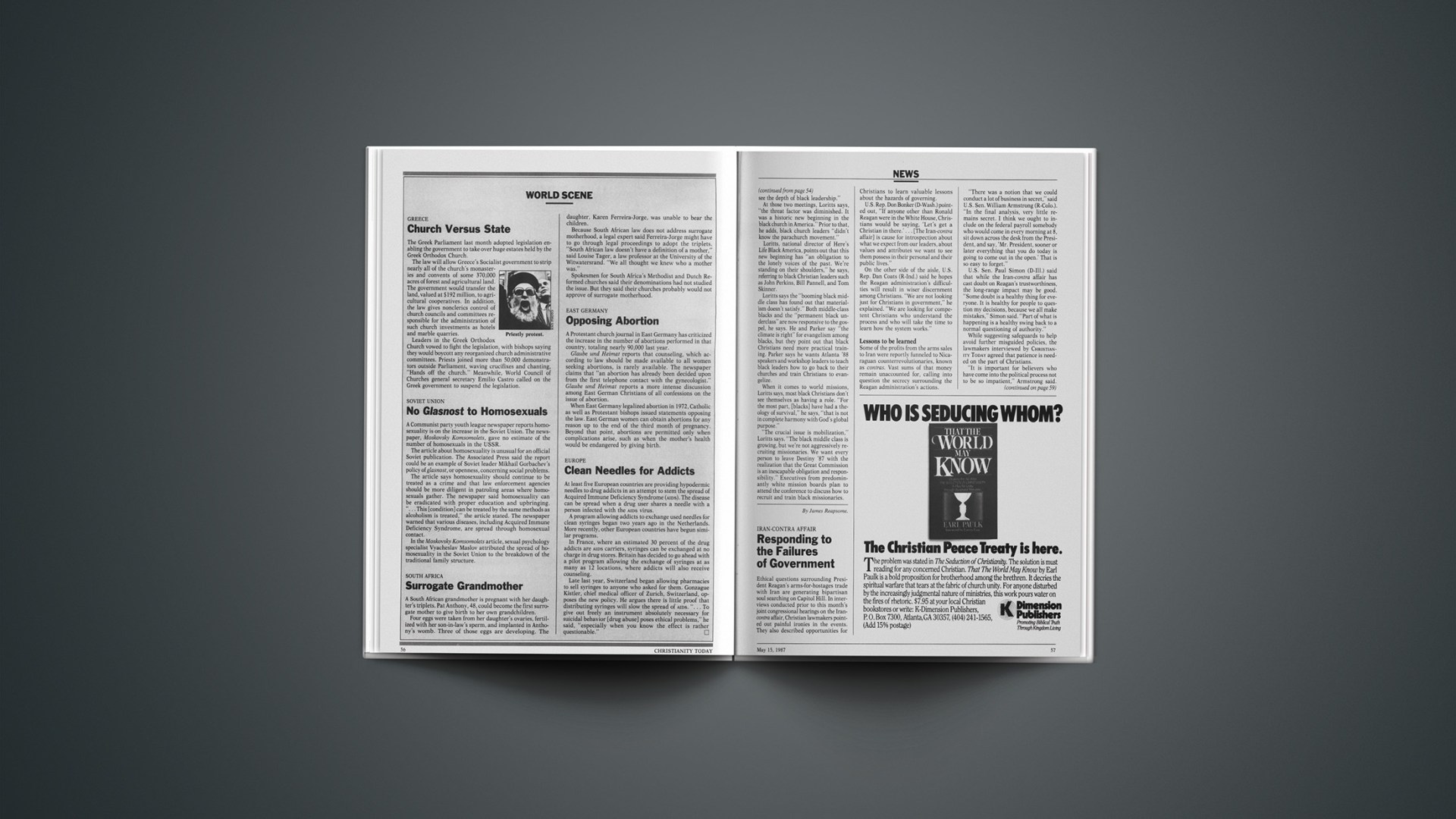
The Greek Parliament last month adopted legislation enabling the government to take over huge estates held by the Greek Orthodox Church.

The law will allow Greece’s Socialist government to strip nearly all of the church’s monasteries and convents of some 370,000 acres of forest and agricultural land. The government would transfer the land, valued at $192 million, to agricultural cooperatives. In addition, the law gives nonclerics control of church councils and committees responsible for the administration of such church investments as hotels and marble quarries.

Leaders in the Greek Orthodox Church vowed to fight the legislation, with bishops saying they would boycott any reorganized church administrative committees. Priests joined more than 50,000 demonstrators outside Parliament, waving crucifixes and chanting, “Hands off the church.” Meanwhile, World Council of Churches general secretary Emilio Castro called on the Greek government to suspend the legislation.

SOVIET UNION

No Glasnost To Homosexuals

A Communist party youth league newspaper reports homosexuality is on the increase in the Soviet Union. The newspaper, Moskovsky Komsomolets, gave no estimate of the number of homosexuals in the USSR.

The article about homosexuality is unusual for an official Soviet publication. The Associated Press said the report could be an example of Soviet leader Mikhail Gorbachev’s policy of glasnost, or openness, concerning social problems.

The article says homosexuality should continue to be treated as a crime and that law enforcement agencies should be more diligent in patroling areas where homosexuals gather. The newspaper said homosexuality can be eradicated with proper education and upbringing. “… This [condition] can be treated by the same methods as alcoholism is treated,” the article stated. The newspaper warned that various diseases, including Acquired Immune Deficiency Syndrome, are spread through homosexual contact.

In the Moskovsky Komsomolets article, sexual psychology specialist Vyacheslav Maslov attributed the spread of homosexuality in the Soviet Union to the breakdown of the traditional family structure.

SOUTH AFRICA

Surrogate Grandmother

A South African grandmother is pregnant with her daughter’s triplets. Pat Anthony, 48, could become the first surrogate mother to give birth to her own grandchildren.

Four eggs were taken from her daughter’s ovaries, fertilized with her son-in-law’s sperm, and implanted in Anthony’s womb. Three of those eggs are developing. The daughter, Karen Ferreira-Jorge, was unable to bear the children.

Because South African law does not address surrogate motherhood, a legal expert said Ferreira-Jorge might have to go through legal proceedings to adopt the triplets. “South African law doesn’t have a definition of a mother,” said Louise Tager, a law professor at the University of the Witwatersrand. “We all thought we knew who a mother was.”

Spokesmen for South Africa’s Methodist and Dutch Reformed churches said their denominations had not studied the issue. But they said their churches probably would not approve of surrogate motherhood.

EAST GERMANY

Opposing Abortion

A Protestant church journal in East Germany has criticized the increase in the number of abortions performed in that country, totaling nearly 90,000 last year.

Glaube und Heimat reports that counseling, which according to law should be made available to all women seeking abortions, is rarely available. The newspaper claims that “an abortion has already been decided upon from the first telephone contact with the gynecologist.” Glaube und Heimat reports a more intense discussion among East German Christians of all confessions on the issue of abortion.

When East Germany legalized abortion in 1972, Catholic as well as Protestant bishops issued statements opposing the law. East German women can obtain abortions for any reason up to the end of the third month of pregnancy. Beyond that point, abortions are permitted only when complications arise, such as when the mother’s health would be endangered by giving birth.

EUROPE

Clean Needles For Addicts

At least five European countries are providing hypodermic needles to drug addicts in an attempt to stem the spread of Acquired Immune Deficiency Syndrome (AIDS). The disease can be spread when a drug user shares a needle with a person infected with the AIDS virus.

A program allowing addicts to exchange used needles for clean syringes began two years ago in the Netherlands. More recently, other European countries have begun similar programs.

In France, where an estimated 30 percent of the drug addicts are AIDS carriers, syringes can be exchanged at no charge in drug stores. Britain has decided to go ahead with a pilot program allowing the exchange of syringes at as many as 12 locations, where addicts will also receive counseling.

Late last year, Switzerland began allowing pharmacies to sell syringes to anyone who asked for them. Gonzague Kistler, chief medical officer of Zurich, Switzerland, opposes the new policy. He argues there is little proof that distributing syringes will slow the spread of AIDS. “… To give out freely an instrument absolutely necessary for suicidal behavior [drug abuse] poses ethical problems,” he said, “especially when you know the effect is rather questionable.”

Only A Glimpse of Grace

The films of writer and director Paul Schrader hold little room for rosy notions of the perfectability of man. The title character in his screenplay for Martin Scorsese’s Taxi Driver is a loner cut off from reality, an isolated misfit whose diet of pornography and gun fantasies transforms him into a psychopathic vigilante. And the distraught, God-fearing father in Hardcore searches the seamy underworld of commercial sex for his daughter who walked away from a Young Calvinist convention to become a prostitute.

In spite of the existential randomness of events in Schrader’s films, his is a world of the fallen man, the original sinner of Calvinist doctrine who sojourns in a latter-day Sodom. But though his vision of man’s sin remains true to his upbringing in the Christian Reformed Church and his education at Calvin College, Schrader’s bleak cinematic vision has until now lacked the other side of the equation—grace and redemption.

Broken People

Schrader’s latest film, Light of Day, moves a step closer to a full-orbed view of the human condition by offering a view of a broken people who are at least susceptible to healing.

Light of Day portrays a modern midwestern family without a center: an ineffectual father, a couch potato who desires nothing more than the oblivion of television, and who winces as his wife tries to “witness” to their daughter who gave birth out of wedlock; a daughter, a bar-band singer who refuses to hear anything about religion; and a son, who tries to bridge the chasm between his well-meaning mother and venomous sister. This son, who (Schrader says) is modeled after himself, loves them both and understands that their belligerence belies a deeper love turned malignant.

As the terminally ill mother approaches death, the prodigal daughter seeks rapprochement, and it is here that Schrader presents us with a glimpse (but only a glimpse) of grace. While father, son, and pastor mill about in the hospital corridor, the daughter hears her mother’s final wishes and tries to complete unfinished business. Her mother’s talk of heaven seems platitudinous.

Finally the daughter tells her mother the secret she has harbored through the years—the identity of her toddler’s father. But in a transcendent moment that captures the meaning of forgiveness, the mother’s heretofore simplistic faith is empowered and we sense a deeper source of grace than anything human.

Light of Day is Schrader’s most Christian film to date. All the characters, including the believing mother, are flawed; and the strength to forgive and be reconciled comes from a higher source. While some Christians will be disappointed that its ambiguous ending lacks the complete reconciliation they might hope for, it is true to the reality of a broken world where God’s abundant grace is accepted a drop at a time.

By Stefan Ulstein, chairman of the English department, Bellevue (Washington) Christian School.

The Fear of Doing Nothing

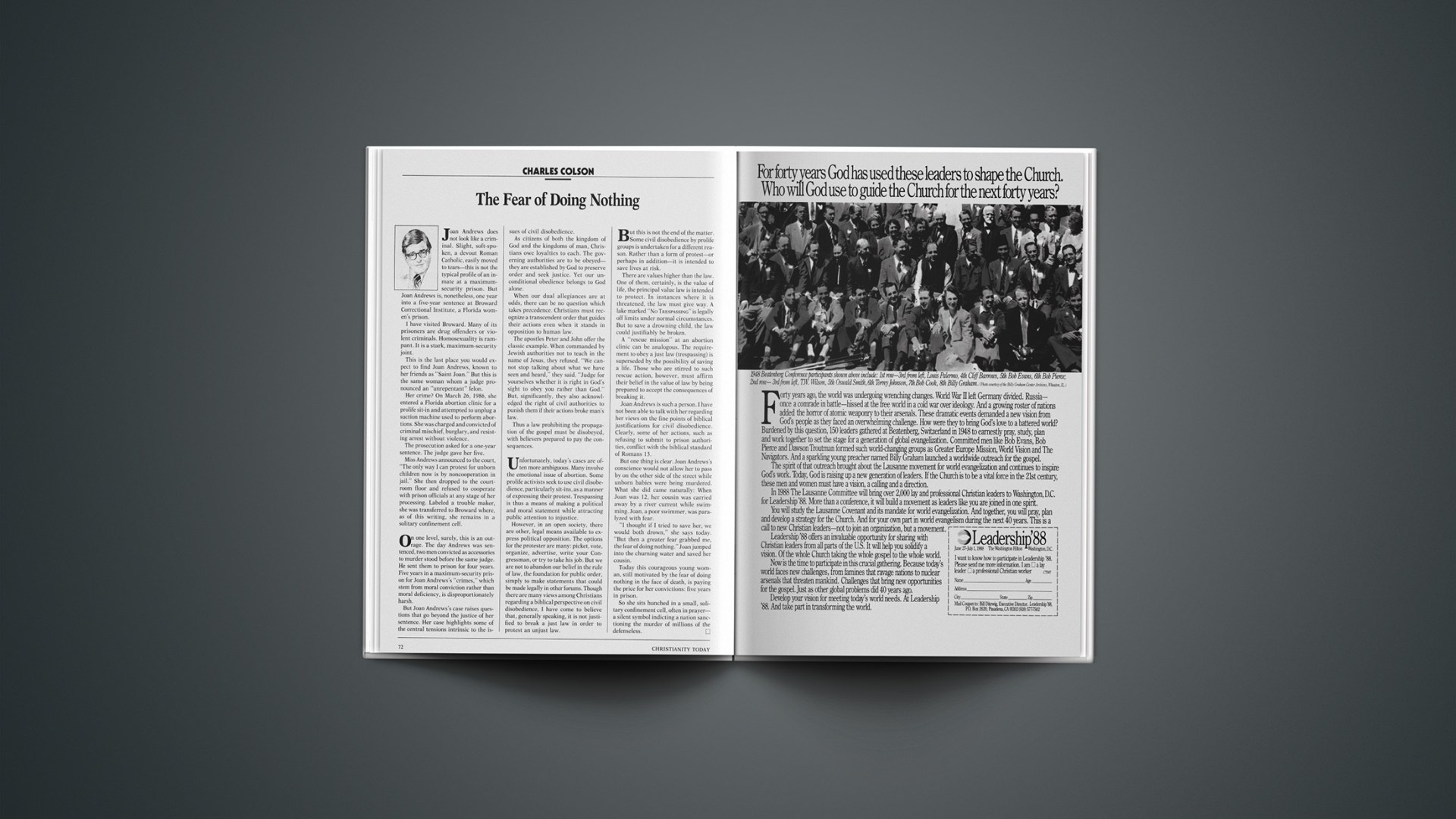
Joan Andrews does not look like a criminal. Slight, soft-spoken, a devout Roman Catholic, easily moved to tears—this is not the typical profile of an inmate at a maximum-security prison. But Joan Andrews is, nonetheless, one year into a five-year sentence at Broward Correctional Institute, a Florida women’s prison.

I have visited Broward. Many of its prisoners are drug offenders or violent criminals. Homosexuality is rampant. It is a stark, maximum-security joint.

This is the last place you would expect to find Joan Andrews, known to her friends as “Saint Joan.” But this is the same woman whom a judge pronounced an “unrepentant” felon.

Her crime? On March 26, 1986, she entered a Florida abortion clinic for a prolife sit-in and attempted to unplug a suction machine used to perform abortions. She was charged and convicted of criminal mischief, burglary, and resisting arrest without violence.

The prosecution asked for a one-year sentence. The judge gave her five.

Miss Andrews announced to the court, “The only way I can protest for unborn children now is by noncooperation in jail.” She then dropped to the courtroom floor and refused to cooperate with prison officials at any stage of her processing. Labeled a trouble maker, she was transferred to Broward where, as of this writing, she remains in a solitary confinement cell.

On one level, surely, this is an outrage. The day Andrews was sentenced, two men convicted as accessories to murder stood before the same judge. He sent them to prison for four years. Five years in a maximum-security prison for Joan Andrews’s “crimes,” which stem from moral conviction rather than moral deficiency, is disproportionately harsh.

But Joan Andrews’s case raises questions that go beyond the justice of her sentence. Her case highlights some of the central tensions intrinsic to the issues of civil disobedience.

As citizens of both the kingdom of God and the kingdoms of man, Christians owe loyalties to each. The governing authorities are to be obeyed—they are established by God to preserve order and seek justice. Yet our unconditional obedience belongs to God alone.

When our dual allegiances are at odds, there can be no question which takes precedence. Christians must recognize a transcendent order that guides their actions even when it stands in opposition to human law.

The apostles Peter and John offer the classic example. When commanded by Jewish authorities not to teach in the name of Jesus, they refused. “We cannot stop talking about what we have seen and heard,” they said. “Judge for yourselves whether it is right in God’s sight to obey you rather than God.” But, significantly, they also acknowledged the right of civil authorities to punish them if their actions broke man’s law.

Thus a law prohibiting the propagation of the gospel must be disobeyed, with believers prepared to pay the consequences.

Unfortunately, today’s cases are often more ambiguous. Many involve the emotional issue of abortion. Some prolife activists seek to use civil disobedience, particularly sit-ins, as a manner of expressing their protest. Trespassing is thus a means of making a political and moral statement while attracting public attention to injustice.

However, in an open society, there are other, legal means available to express political opposition. The options for the protester are many: picket, vote, organize, advertise, write your Congressman, or try to take his job. But we are not to abandon our belief in the rule of law, the foundation for public order, simply to make statements that could be made legally in other forums. Though there are many views among Christians regarding a biblical perspective on civil disobedience, I have come to believe that, generally speaking, it is not justified to break a just law in order to protest an unjust law.

But this is not the end of the matter. Some civil disobedience by prolife groups is undertaken for a different reason. Rather than a form of protest—or perhaps in addition—it is intended to save lives at risk.

There are values higher than the law. One of them, certainly, is the value of life, the principal value law is intended to protect. In instances where it is threatened, the law must give way. A lake marked “NO TRESPASSING” is legally off limits under normal circumstances. But to save a drowning child, the law could justifiably be broken.

A “rescue mission” at an abortion clinic can be analogous. The requirement to obey a just law (trespassing) is superseded by the possibility of saving a life. Those who are stirred to such rescue action, however, must affirm their belief in the value of law by being prepared to accept the consequences of breaking it.

Joan Andrews is such a person. I have not been able to talk with her regarding her views on the fine points of biblical justifications for civil disobedience. Clearly, some of her actions, such as refusing to submit to prison authorities, conflict with the biblical standard of Romans 13.

But one thing is clear. Joan Andrews’s conscience would not allow her to pass by on the other side of the street while unborn babies were being murdered. What she did came naturally: When Joan was 12, her cousin was carried away by a river current while swimming. Joan, a poor swimmer, was paralyzed with fear.

“I thought if I tried to save her, we would both drown,” she says today. “But then a greater fear grabbed me, the fear of doing nothing.” Joan jumped into the churning water and saved her cousin.

Today this courageous young woman, still motivated by the fear of doing nothing in the face of death, is paying the price for her convictions: five years in prison.

So she sits hunched in a small, solitary confinement cell, often in prayer—a silent symbol indicting a nation sanctioning the murder of millions of the defenseless.

The “Good Life” Wasn’t Good Enough

For two decades Christopher Parkening has bowed again and again, classical guitar in hand, to acknowledge storms of applause in the world’s most prestigious concert halls.

On the surface, these scenes have changed little. But seen through the eyes of the young guitar virtuoso, nothing has been the same in the 1980s. For Parkening, making fine art is now a matter of faith and thanksgiving.

As the decade began, he was playing brilliantly on his visits to 90 or so cities each year. The reviews were glowing, but his mind and heart were tired and his spirit dull.

Friends and associates had heard Parkening was planning to take a sabbatical. Few knew the truth: the protege of the legendary guitarist Andres Segovia was ready to call it quits.

“I had played enough concerts to make enough money to buy the things I wanted to live ‘the good life,’ ” he says, a few days before three appearances with the Denver Symphony Orchestra. “My dreams had all come true.… But I felt totally empty. The music I was making didn’t mean anything to me.”

Meanwhile, Back At The Ranch

Parkening and his wife had bought a Montana ranch by a stream in which he could satisfy his love of fly-fishing. Parkening knew he could afford to sit back, perhaps teach a few lessons now and then, and let the years pass.

It wasn’t enough.

Then one day a neighbor leaned over the back fence of the Parkenings’ home in Los Angeles and invited him to visit Grace Community Church in Panorama City. The Reverend John MacArthur’s sermon cut deep. The key questions: Are you a real Christian, or a fake? Is your life yielding fruit for God?

“It’s a cliche, but I saw my life pass before my eyes,” Parkening remembers. “I realized I was only professing to be a Christian. My whole life changed.”

He vowed to find a way for his life to “glorify the Lord.” It seemed easier to do that with the guitar than with a fly-fishing rod.

Parkening has not, however, become an evangelist dressed in a concert tuxedo. He does not interrupt Vivaldi concertos to offer his views on the epistle to the Romans. And don’t look for him on electronic-church broadcasts, or expect to see him record albums of gospel tunes elongated with pseudoclassical workouts.

He believes he has another role to fill: “I feel, frankly, that it is possible to play both secular and sacred music to the glory of the Lord,” he says. “But we exist to glorify our Lord and Savior. That’s the bottom line. If I feel I can’t play a piece of music to the glory of God, then I won’t play it.”

Rave Reviews

Parkening burst onto the music scene in 1968 at the age of 20, after taking up classical guitar as a boy. The soft-spoken Californian’s first albums, “In the Classic Style” and “In the Spanish Style,” were released simultaneously to fine reviews. Segovia, in a quotation that has graced Parkening’s career ever since, called him “a great artist, one of the most brilliant guitarists in the world.”

It is an opinion shared today by a major figure in Christian music, pianist and composer Kurt Kaiser of Word Music, who has long stressed the importance of classical music to the church. But Kaiser adds that Parkening’s importance lies not just in who he is but “what he is and what he stands for.” The guitarist maintains the high standards of a world-class artist while helping set new standards for Christian artists.

Parkening’s goals are, indeed, high. One is to mine the riches of centuries of sacred classical music and to bring this music to the stage and recording studio.

The number of concert works written for the guitar is small, compared with instruments such as the piano or violin. Parkening hopes, following Segovia’s example, to transcribe or commission transcriptions of many works written for other instruments, or even voices. These can then be added to the guitar repertoire.

Parkening pursues this goal with yet another lofty standard in mind—finding music that reveals faith as well as high art: “Obviously, some of the most beautiful music ever written was written to the glory of God. As Bach said, ‘The aim and final reason of all music is none else but the glory of God.’ ”

This viewpoint has been reflected in the guitarist’s most recent albums. A 1986 release, “Pleasures of Their Company,” was recorded with heralded soprano Kathleen Battle. It includes English, Spanish, and Brazilian music and ends with six spirituals (two arranged by Kaiser). It was nominated for a Grammy award as classical album of the year. And Parkening and Battle provided one of the musical interludes in this year’s Grammy awards broadcast.

Before the album with Battle came “Simple Gifts” and a set of works for guitar and chamber orchestra adapted from Bach’s sacred cantatas. These two albums, Parkening stresses, were intended as clear “testimonies” of his new life as a Christian.

“Simple Gifts,” which will soon be re-released by Word, contains a wide spectrum of music making. There is a medley of spirituals, such as “Deep River.” But there is also a technically stunning arrangement of “Evening Prayer” from the opera Hansel and Gretel, which requires Parkening to play music originally written for full orchestra and two sopranos.

For the future, Parkening plans a set of Spanish albums.

“You’re always walking that thin line between music that pleases the purists, yet is music you want to play.… It’s hard to find works that are strictly classical, adaptable to the guitar, and sacred,” he says.

“I want to play hymns and other forms of religious music, yet I don’t want to play gospel music. I want to play music that is ‘classy’ enough for the concert stage. I am part of the classical music tradition. I must use the gift I believe God has given me.”

By Terry Mattingly, religion writer and columnist for the Rocky Mountain News, Denver, Colorado.

Book Briefs: May 15, 1987

One Woman On The Sawdust Trail

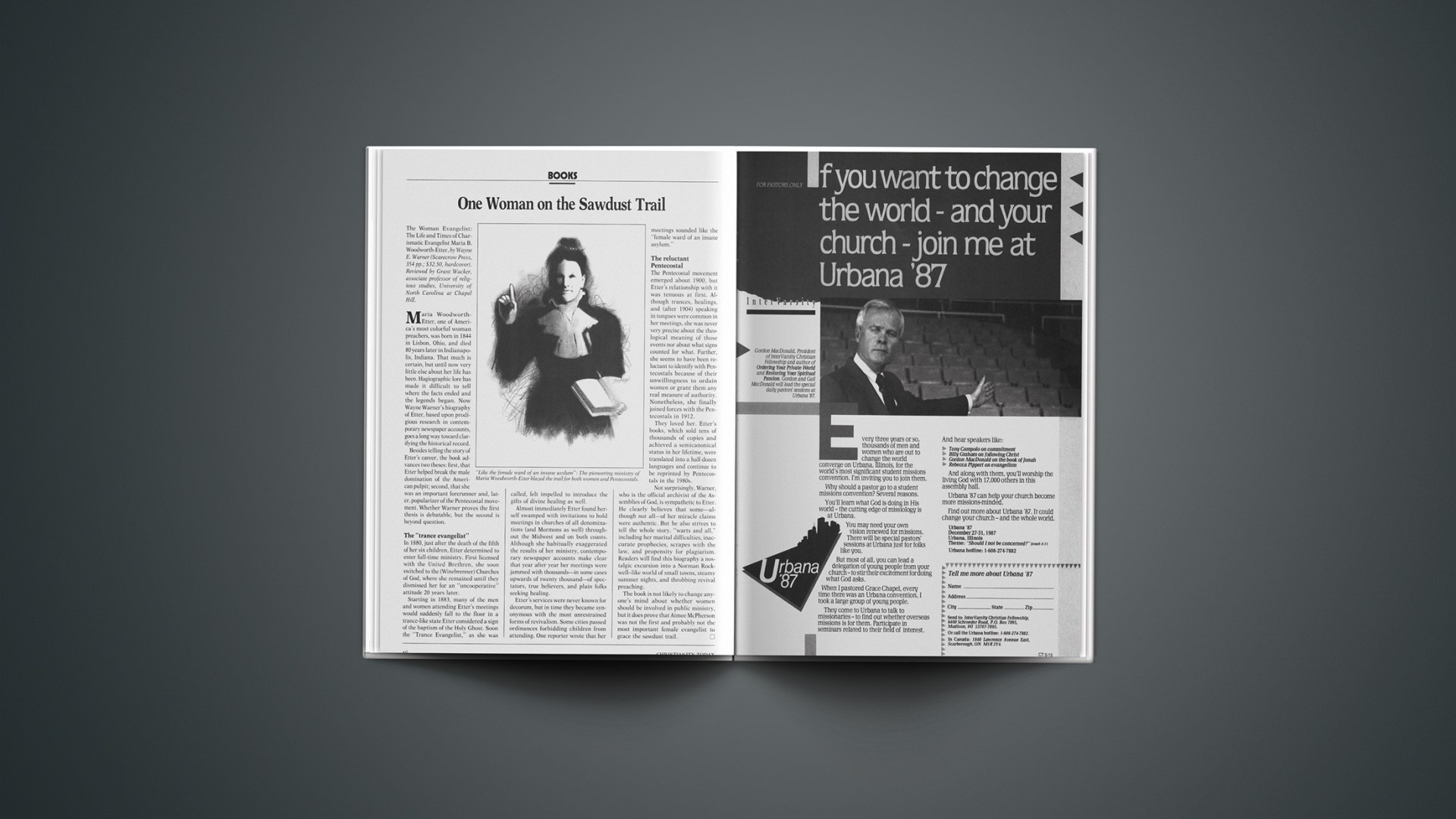
The Woman Evangelist: The Life and Times of Charismatic Evangelist Maria B. Woodworth-Etter, by Wayne E. Warner (Scarecrow Press, 354 pp.; $32.50, hardcover). Reviewed by Grant Wacker, associate professor of religious studies, University of North Carolina at Chapel Hill.

Maria Woodworth-Etter, one of America’s most colorful woman preachers, was born in 1844 in Lisbon, Ohio, and died 80 years later in Indianapolis, Indiana. That much is certain, but until now very little else about her life has been. Hagiographic lore has made it difficult to tell where the facts ended and the legends began. Now Wayne Warner’s biography of Etter, based upon prodigious research in contemporary newspaper accounts, goes a long way toward clarifying the historical record.

Besides telling the story of Etter’s career, the book advances two theses: first, that Etter helped break the male domination of the American pulpit; second, that she was an important forerunner and, later, popularizer of the Pentecostal movement. Whether Warner proves the first thesis is debatable, but the second is beyond question.

The “Trance Evangelist”

In 1880, just after the death of the fifth of her six children, Etter determined to enter full-time ministry. First licensed with the United Brethren, she soon switched to the (Winebrenner) Churches of God, where she remained until they dismissed her for an “uncooperative” attitude 20 years later.

Starting in 1883, many of the men and women attending Etter’s meetings would suddenly fall to the floor in a trance-like state Etter considered a sign of the baptism of the Holy Ghost. Soon the “Trance Evangelist,” as she was called, felt impelled to introduce the gifts of divine healing as well.

Almost immediately Etter found herself swamped with invitations to hold meetings in churches of all denominations (and Mormons as well) throughout the Midwest and on both coasts. Although she habitually exaggerated the results of her ministry, contemporary newspaper accounts make clear that year after year her meetings were jammed with thousands—in some cases upwards of twenty thousand—of spectators, true believers, and plain folks seeking healing.

Etter’s services were never known for decorum, but in time they became synonymous with the most unrestrained forms of revivalism. Some cities passed ordinances forbidding children from attending. One reporter wrote that her meetings sounded like the “female ward of an insane asylum.”

The Reluctant Pentecostal

The Pentecostal movement emerged about 1900, but Etter’s relationship with it was tenuous at first. Although trances, healings, and (after 1904) speaking in tongues were common in her meetings, she was never very precise about the theological meaning of those events nor about what signs counted for what. Further, she seems to have been reluctant to identify with Pentecostals because of their unwillingness to ordain women or grant them any real measure of authority. Nonetheless, she finally joined forces with the Pentecostals in 1912.

They loved her. Etter’s books, which sold tens of thousands of copies and achieved a semicanonical status in her lifetime, were translated into a half-dozen languages and continue to be reprinted by Pentecostals in the 1980s.

Not surprisingly, Warner, who is the official archivist of the Assemblies of God, is sympathetic to Etter. He clearly believes that some—although not all—of her miracle claims were authentic. But he also strives to tell the whole story, “warts and all,” including her marital difficulties, inaccurate prophecies, scrapes with the law, and propensity for plagiarism. Readers will find this biography a nostalgic excursion into a Norman Rockwell-like world of small towns, steamy summer nights, and throbbing revival preaching.

The book is not likely to change anyone’s mind about whether women should be involved in public ministry, but it does prove that Aimee McPherson was not the first and probably not the most important female evangelist to grace the sawdust trail.

The Occasional Journalist

Present Concerns: Essays by C. S. Lewis, edited by Walter Hooper (Harcourt, Brace, Jovanovich, 112 pp.; $14.95, hardcover; $4.95, paper). Reviewed by Lloyd Billingsley, author of A Year for Life.

With Christians of all shades either plunging headlong into politics or being dragged into it kicking and screaming, this latest collection of Lewisiana is both well named and aptly timed. Lewis disliked politics and feared that his works would be interpreted as “anti-Left” propaganda. But he did hold well-defined views on basic political issues, and those views were strongly related to his Christian beliefs.

Present Concerns is drawn from Lewis’s occasional journalism and makes some of this material available for the first time. It will help Christians to explore the links between their faith and their social and political thought.

Democracy, inequality, and the bomb

In the essay “Equality,” for example, Lewis says that most people defend democracy out of a belief in man’s inherent goodness. “I am a democrat,” contends Lewis, “because I believe in the Fall of Man.” The “real reason” for democracy, the author adds, is that “mankind is so fallen that no man can be trusted with unchecked power over his fellows.”

In the selection “Democratic Education,” Lewis points out how beauty, virtue, and truth are not democratic. “Political democracy,” he says, “is doomed if it tries to extend its demand for equality into these higher spheres. Ethical, intellectual, or aesthetic democracy is death.” The notion that “I’m as good as you,” says Lewis, “is the hotbed of Fascism.”

In a similar vein, “Modern Man and His Categories of Thought” cites “Proletarianism,” a vaguely “Marxist” way of looking at the world. Proletarian thinkers believe that “whatever may be wrong with the world, it cannot be themselves.” This has direct application to much of liberation theology.

“On Living in an Atomic Age” is Lewis’s contribution to the ongoing nuclear weapons dialogue. Lewis was convinced that “we think a great deal too much of the atom bomb.” He believes it is a mistake to “exaggerate the novelty of our situation,” citing the plague, Viking raids, cancer, and syphilis. “We were all sentenced to death before the atomic bomb was invented: and quite a high percentage of us were going to die in unpleasant ways.”

“If we are all going to be destroyed by an atomic bomb,” he continues, “let that bomb when it comes find us doing sensible and human things—praying, working, teaching, reading, listening to music, bathing the children, playing tennis, chatting to our friends over a pint and a game of darts—not huddled together like frightened sheep and thinking about bombs. They may break our bodies but need not dominate our minds.”

But heavy themes do not dominate this collection. Other essays deal with such varied themes as English, hedonism, bicycles, and sex in literature. In much of it, Lewis accomplishes his usual feat of delighting and instructing at the same time.

Though he was an occasional practitioner, Lewis had doubts about journalism, especially newspapers. Indeed, he told people to avoid them. One wonders what he would think of a little over 100 pages of his own articles dressed up to look like literature and priced at $14.95.

Such pop anthologizing often falls flat with other authors, but it works with Lewis because of the breadth of his mind, the simplicity of his style, and the clarity of his faith, expressed in such statements as this: “Those who care for something else more than civilization are the only people by whom civilization is at all likely to be preserved. Those who want Heaven most have served Earth best. Those who love Man less than God do most for Man.”

The Perils And Promise Of Technology

Responsible Technology: A Christian Perspective, edited by Stephen V. Monsma (Eerdmans, 252 pp.; $12.95, paper). Reviewed by Stanley J. Grenz, associate professor of systematic theology and Christian ethics, North American Baptist Seminary, Sioux Falls, South Dakota.

The 1980s have witnessed an increasing disillusionment with our technological society, even among secular futurists. In his widely hailed book, Megatrends, John Naisbitt anticipated a movement away from the “forced technology” of the present to a balance between “high tech” and “high touch” in the future society. (A similar but religiously based warning was voiced already in the 1950s by the French social critic, Jacques Ellul, who decried a growing trend toward “standardized culture.”) And a reaction to technology may also be perceived behind certain contemporary movements: “Death with dignity,” for example, is a recapturing of control over one’s own destiny in an era in which even death is determined by technological specialists.

Responsible Technology is an attempt to deal with the problems and promise of modern technology from an avowedly Christian perspective. The book seeks to offer to the current situation a prophetic word, decrying the dangers of “technicism” while avoiding Ellul’s apocalyptic pessimism.

The book’s central thesis is that a stark contrast exists beween technology “done out of love and in response to God’s normative will” (which is the ideal) and the ruthless drive for “a salvation of material prosperity” by means of technological advances (which characterizes fallen society). The authors claim that technology is value-laden and not morally neutral, since technological tools and products are intertwined with their environments. Christians, the authors maintain, are called to harness technology to the service of others and the care of creation.

At the heart of their proposal lies the Calvinist concept of the “cultural mandate”: God has placed human beings “in creation in order to bring the creation to its full development.… to bring to light the treasures the Lord God has stored up in it.”

The book describes normative principles for a “responsible” technology. Three chapters are devoted to the technology’s relationship to science, economics, and the state. The authors propose what should be if the cultural mandate is to be fulfilled and, to this end, call for government regulation of technology.

The book closes with a call to responsible Christian living in a technicist society. Such living requires a “prophetic radicalism” that roots out blind faith in technological advancement. Specific suggestions are offered: through education a network of concerned persons must be developed; the mass media must be reformed, so that they are no longer the agents of the inculcation and celebration of technology; and Christians must engage in renewed lifestyles, transformed by the vision of love and servanthood.

Bold Program, Immense Problem

Responsible Technology is the work of six fellows of the Grand Rapids, Michigan, Calvin Center for Christian Scholarship, three of whom are members of the Calvin College faculty. The editor, Stephen Monsma, is a former state legislator who is currently with the Michigan Department of Social Services. Interaction by the six contributors and reworking by the editor has resulted in a truly joint venture, largely devoid of the spottiness and uneven writing of similar ventures.

This is a much-needed book, pinpointing the technological society as an issue not commonly addressed by the Christian community. And the authors are not afraid to offer a bold program for tackling an immense problem.

At the same time, the book is not without shortcomings. One is the book’s understanding of secularization, which the authors characterize as a continuation of the Fall. They equate secularization with human attempts to establish kingdoms of pride. This thesis, while having some merit, reflects a one-sided and simplified appraisal of secularization. The contributors fail to acknowledge the benefits this process has brought to humankind.

Some readers will object to the “transformationist” theme that pervades the book. This theme, which emphasizes the role of Christians in bringing society into conformity with God’s design, is understandable given the Calvinist basis from which the authors develop their thought. But it seems that they are again guilty of oversimplification when they see only three options for Christians: culture negation, culture accommodation, or honoring of the cultural mandate. Although the contributors acknowledge that Christians constitute a minority influence in society and rightly challenge believers to translate their faith into action in the world, the program smacks of an unrealistic Puritan model of an earlier day.

A final problem lies in the authors’ optimism about the human conscience. Prophetic radicalism includes a recapturing of the “pivotal role of conscience,” for this aspect of personhood is where moral truth is apprehended. This understanding fails to acknowledge fully Paul’s warning that the conscience must be instructed by revelation and can become “seared” through moral abuse. This Pauline pessimism lay behind the Reformers’ distrust of all inherent human capabilities.

These reservations are not intended to minimize the significance of Responsible Technology. The book offers a vision of a society in which all areas of life are brought under the lordship of Christ. Perhaps this vision would be more appropriately grounded in the eschatological kingdom of God, than in the past-oriented cultural mandate. Nevertheless, the vision of shalom, however grounded, forms a pertinent call to action in the present.

Biblical Counterpoint

Music and Ministry: A Biblical Counterpoint, by Calvin M. Johansson (Hendrickson Publishers, 138 pp.; $6.95, paper). Reviewed by Charlotte Kroeker, chair, Division of Fine Arts, Phillips University, Enid, Oklahoma.

Calvin Johansson is a rarity: a trained musician and theologian who speaks articulately about church music. And his book, Music and Ministry: A Biblical Counterpoint, combines theological, musical, philosophical, and pragmatic perspectives unlike any other book on church music.

Johansson begins by examining two commonly held philosophical bases for church music programs: aestheticism (in which art is often elevated to the position of God) and pragmatism (in which the end too often justifies the means).

There is a third philosophical basis, suggests Johansson—a biblical counterpoint. On this foundation, neither art nor methodology can be worshiped.

Johansson defines music in the church as being based on biblical truth, formulated in theological principles. For example, Johannson discusses the doctrine of Creation, concluding that the church has a biblical imperative to be creative. He reflects on the image of God and the responsibility we have to express an accurate image of God in music. Blasphemous images are painted weekly in our musical offerings—when our work is ill prepared, we portray a lazy and slothful God.

Johannson is critical of the church’s musical response to our mass-production industrial society. The church has become an unwitting consumer of mass culture’s musical mediocrity by adapting pop music’s cliches and commercialism to church settings. Johannson calls us to recognize our blind acquiescence and move instead into creativity with artistic integrity.

Practical considerations are also addressed: intellectual and emotional balances in church music; the relationship between faith and delayed gratification (the right music may not always be the music we “like”); doing one’s best (choosing the best musicians for the musical offering); growth and church music education; the importance of music in ministry and worship.

Music and Ministry is different from the practical and descriptive accounts of evangelical church music already available (such as those by Hustad or Lawrence and Ferguson), drawing together ideas from the arts, literature, theology, philosophy, and contemporary culture to give a fresh perspective from which to view church music.

Responding to the Failures of Government

Ethical questions surrounding President Reagan’s arms-for-hostages trade with Iran are generating bipartisan soul searching on Capitol Hill. In interviews conducted prior to this month’s joint congressional hearings on the Iran-contra affair, Christian lawmakers pointed out painful ironies in the events. They also described opportunities for Christians to learn valuable lessons about the hazards of governing.

U.S. Rep. Don Bonker (D-Wash.) pointed out, “If anyone other than Ronald Reagan were in the White House, Christians would be saying, ‘Let’s get a Christian in there.’ … [The Iran-contra affair] is cause for introspection about what we expect from our leaders, about values and attributes we want to see them possess in their personal and their public lives.”

On the other side of the aisle, U.S. Rep. Dan Coats (R-Ind.) said he hopes the Reagan administration’s difficulties will result in wiser discernment among Christians. “We are not looking just for Christians in government,” he explained. “We are looking for competent Christians who understand the process and who will take the time to learn how the system works.”

Lessons To Be Learned

Some of the profits from the arms sales to Iran were reportly funneled to Nicaraguan counterrevolutionaries, known as contras. Vast sums of that money remain unaccounted for, calling into question the secrecy surrounding the Reagan administration’s actions.

“There was a notion that we could conduct a lot of business in secret,” said U.S. Sen. William Armstrong (R-Colo.). “In the final analysis, very little remains secret. I think we ought to include on the federal payroll somebody who would come in every morning at 8, sit down across the desk from the President, and say, ‘Mr. President, sooner or later everything that you do today is going to come out in the open.’ That is so easy to forget.”

U.S. Sen. Paul Simon (D-Ill.) said that while the Iran-contra affair has cast doubt on Reagan’s trustworthiness, the long-range impact may be good. “Some doubt is a healthy thing for everyone. It is healthy for people to question my decisions, because we all make mistakes,” Simon said. “Part of what is happening is a healthy swing back to a normal questioning of authority.”

While suggesting safeguards to help avoid further misguided policies, the lawmakers interviewed by CHRISTIANITY TODAY agreed that patience is needed on the part of Christians.

“It is important for believers who have come into the political process not to be so impatient,” Armstrong said. “This is not an overnight proposition. Christ said ‘Render unto Caesar what is Caesar’s,’ but he did not say everything would work out in four or eight years. There is no reason to think we will ever succeed with all of this, but we do have a tremendous agenda of issues of deep concern to Christians.”

U.S. Sen. Charles Grassley (R-Iowa) said the events surrounding the Iran arms policy call for renewed efforts on the part of elected officials to counteract cynicism at the grassroots. “There have been a lot of changes in the institutions of government to provide more credibility: the Federal Election Commission, the ethics committees, and restrictions on political action committees. Changing the institutions of government may cause people to be a little more cautious and careful, but I think the only way to reestablish credibility and overcome cynicism about government is for the individual himself to set higher standards.”

Simon called for continued political involvement on the part of Christians. “One of the ways we fulfill the command of Matthew 25 [to care for the disadvantaged] is through the world of politics,” he said. “People who have the temerity to call themselves Christians have special responsibilities. It doesn’t mean we automatically have any special insights into what is politically valid, and we can be just as wrong as anybody else. But we do have a responsibility to try to live up to our belief.”

U.S. Rep. Paul Henry (R-Mich.) said a dose of disillusionment may be a good thing if it results in renewed humility and realism among Christians in public life. “There is a terrible danger that Christian activism has developed around the notion of trying to manipulate God rather than being manipulated by him,” he said. “That is not to say Christians should not assert themselves, but they ought to do so in a mature, responsible fashion. Christians need to get over the temptation to assume that the Christian commitment, in and of itself, assures public virtue. It should, but it doesn’t.”

By Beth Spring.

Black Christians Find Unity in Missions and Evangelism

Black church and parachurch leaders are drawing together in a new coalition that augers well for black involvement in overseas missionary service and evangelism among blacks in the United States.

Contributing to this new unity are two conferences to be held in Atlanta. The meetings, known as Destiny ’87 and Atlanta ’88, are expected to attract as many as 1,500 black church leaders, influential laypeople, and students.

In the past, organizational and denominational differences and varied approaches to solving problems of racism caused efforts at church and parachurch cooperation to fall short of black leaders’ expectations. But it appears those differences have been laid aside for the sake of common action in evangelism and mission.

“We’re starting with a vision and a spirit to serve one another,” says Crawford Loritts, chairman of Destiny ’87, a summer conference designed to involve black Christians in missions. Loritts and Matt Parker, chairman of Atlanta ’88, an evangelism conference, say the new spirit among black leaders is a grassroots phenomenon.

Parker sowed the seeds in 1984 when he asked 60 black leaders to meet for a national summit on black church development. “We asked them simply to come and encourage one another and to share resources and skills,” says Parker, associate vice-president of William Tyndale College in Farmington Hills, Michigan.

Two years later, another meeting brought 100 presidents, founders, and directors of Slack ministries together with black church and denominational leaders. Parker says ten white leaders were invited as observers “so they could see the depth of black leadership.”

At those two meetings, Loritts says, “the threat factor was diminished. It was a historic new beginning in the black church in America.” Prior to that, he adds, black church leaders “didn’t know the parachurch movement.”

Loritts, national director of Here’s Life Black America, points out that this new beginning has “an obligation to the lonely voices of the past. We’re standing on their shoulders,” he says, referring to black Christian leaders such as John Perkins, Bill Pannell, and Tom Skinner.

Loritts says the “booming black middle class has found out that materialism doesn’t satisfy.” Both middle-class blacks and the “permanent black underclass” are now responsive to the gospel, he says. He and Parker say “the climate is right” for evangelism among blacks, but they point out that black Christians need more practical training. Parker says he wants Atlanta ’88 speakers and workshop leaders to teach black leaders how to go back to their churches and train Christians to evangelize.

When it comes to world missions, Loritts says, most black Christians don’t see themselves as having a role. “For the most part, [blacks] have had a theology of survival,” he says, “that is not in complete harmony with God’s global purpose.”

“The crucial issue is mobilization,” Loritts says. “The black middle class is growing, but we’re not aggressively recruiting missionaries. We want every person to leave Destiny ’87 with the realization that the Great Commission is an inescapable obligation and responsibility.” Executives from predominantly white mission boards plan to attend the conference to discuss how to recruit and train black missionaries.

By James Reapsome.

Apple PodcastsDown ArrowDown ArrowDown Arrowarrow_left_altLeft ArrowLeft ArrowRight ArrowRight ArrowRight Arrowarrow_up_altUp ArrowUp ArrowAvailable at Amazoncaret-downCloseCloseEmailEmailExpandExpandExternalExternalFacebookfacebook-squareGiftGiftGooglegoogleGoogle KeephamburgerInstagraminstagram-squareLinkLinklinkedin-squareListenListenListenChristianity TodayCT Creative Studio Logologo_orgMegaphoneMenuMenupausePinterestPlayPlayPocketPodcastRSSRSSSaveSaveSaveSearchSearchsearchSpotifyStitcherTelegramTable of ContentsTable of Contentstwitter-squareWhatsAppXYouTubeYouTube