World Scene from April 17, 1987

WORLDWIDE

Greater Access To The Gospel

At least one book of the Bible has been translated into languages spoken by 97 percent of the world’s population, according to the American Bible Society. But the complete Bible has been translated into only 301 languages, with five of those translations having been completed since 1985.

One project has used a computer to translate the New Testament into the Eastern Cakchiquel language, spoken by 100,000 Indians in Guatemala. Don and Joy Iden, members of Wycliffe Bible Translators, had worked for eight years translating the Gospel of Mark. In 1980, they learned about an experimental project known as Computer-Assisted Dialect Adaptation.

Using a version of the New Testament already translated into the Central Cakchiquel language, a computer was programmed to change words from Central Cakchiquel to the related Eastern Cakchiquel language.

“After one year, we had a first draft of our entire New Testament,” said Don Iden. “The computer made the text 80 percent intelligible to the Eastern Cakchiquel people.” The Idens then spent five years refining the text and checking it with native speakers to complete the translation.

MOZAMBIQUE

The Next Ethiopia?

Wracked by an 11-year civil war and a recent drought that have cut agricultural production, Mozambique faces a massive hunger problem. The crisis has led a Lutheran official to compare the situation to the 1984–85 Ethiopian famine.

“Mozambique is best described … as a hidden, brooding, and simmering disaster,” said John Halvorson, associate director of the American Lutheran Church’s world hunger appeal. After visiting the African country recently, Halvorson quoted one Mozambican as saying, “It’s either death in the countryside [due to civil strife] or hunger in the city.”

The Lutheran World Federation has launched a $2 million appeal to provide food and other commodities for many of the 3.5 million people affected by famine and civil war in Mozambique. The United Nations estimates that more than 1 million people have been displaced by the war waged against the country’s Marxist government. Some 260,000 Mozambicans have fled to five neighboring countries in southern Africa.

ASIA

Gender-Selective Abortions

Technology that enables pregnant women to learn the gender of their unborn children is contributing to the intentional abortions of female fetuses in some Asian countries.

South magazine reports that sex testing is a heavily advertised business in India’s major cities. In 1982, three sex-test centers were operating in Bombay. Today they number more than 20. Testing centers are often located near abortion clinics that perform abortions for as little as seven dollars.

Selective abortions have already upset the gender balance in India, which now has 23 million fewer women than men. In South Korea, women are requesting ultrasound scans to determine the sex of their unborn children. Seven large Korean hospitals report that the ratio of girls to boys being born has already been reversed. Births of boys now outnumber girls by 117 to 100. In years past, the ratio was 117 girls to 106 boys.

NIGERIA

Religious Rioting

At least 13 people were killed and more than 50 churches burned during religious riots last month in predominantly Muslim northern Nigeria. The unrest was apparently set off when a Christian preacher made unfavorable remarks about the Quran during a college revival meeting.

The violence spread to at least nine cities, where mobs chanting religious slogans attacked property belonging to Christians. Buses, homes, and churches were destroyed by arson. The Nigerian newspaper The Guardian reported three mosques also were burned.

In Tundun Wada, the offices of the YMCA were burned, and a Sunday school supervisor was burned to death at his church. Baptist Press reported that all eight Baptist churches in Zaria were burned, and six of the Baptist churches in nearby Kaduna were destroyed.

ECUADOR

Ministering To The Homeless

Christian organizations are addressing the housing needs of some of the 75,000 to 100,000 people in northeast Ecuador left homeless by a series of earthquakes.

“In some areas the devastation is immense,” said Frank Boshold, Ecuador field director for World Vision. “While the earthquake itself did not do great harm, landslides blocked rivers, causing severe mudslides, which wiped out villages, roads, and anything else in their path. Some people said they huddled on pinnacles of existing roadways and watched trees, cars, dead bodies, household appliances, and animals wash by in a sea of mud.”

World Vision, the Salvation Army, and HCJB World Radio were among Christian organizations that assisted in relief efforts, including food, medical care, and tents. Boshold noted that the tents provide only a temporary housing solution.

“Once the wicked cold winds begin later this year, more adequate housing will be needed,” he said. He estimated the cost of rebuilding one home would be about $100. The Salvation Army has distributed corrugated building materials to earthquake survivors.

Ideas

The Fragrant Season

Columnist; Contributor

Tammy Faye Bakker stared out from my television screen, her long, dark eyelashes coated with what The Wittenburg Door once cattily described as “industrial strength mascara.” “Ooh!” she gushed, “The Christian life is just so great that I think I would become a Christian even if it wasn’t true!”

She had just been interviewing people with inspiring stories, and yes, Tammy Faye, the Christian life did sound pretty great as described on the air. But although I was touched by her enthusiasm, something about her declaration—“… even if it wasn’t true”—troubled me. It seemed somehow wrong, but I couldn’t put my finger on why.

I finally located the source of my discomfort in 1 Corinthians 15, the Bible’s central chapter on resurrection from the dead. There, the apostle Paul stakes his faith on the truth of Jesus’ resurrection. With remarkable bluntness he argues that if Christ had not been raised, his own preaching would be useless, as would our faith. Furthermore, he continues, except for the resurrection “we are to be pitied more than all men.”

Paul goes on to explain why Christians would deserve pity for clinging to a faith that had no basis in truth. Why endanger ourselves every hour? he asks. For example, it would make no sense for him, Paul, to fight wild beasts in Ephesus for a phantom faith. Hedonism offers a far more appealing life, and Paul candidly proposes that “If the dead are not raised, let us eat and drink, for tomorrow we die.”

(Unlike many television evangelists, Paul seemed to believe that the Christian life brings, not health and wealth, but a measure of suffering. In 2 Timothy 3:12 he writes, “In fact, everyone who wants to live a godly life in Christ Jesus will be persecuted” [NIV].)

Later, long after I saw Tammy Faye on television, I came across yet another intriguing passage in Paul’s writings. Two sentences bring together the upbeat exuberance of Tammy Faye’s guests and the blunt realism of 1 Corinthians 15. Paul wrote the church in Corinth, “For we are to God the aroma of Christ among those who are being saved and those who are perishing. To the one we are the smell of death; to the other, the fragrance of life” (2 Cor. 2:15–16, NIV).

According to Paul, the same fragrance can convey vastly different aromas, depending on the nose. To the unbelieving world our exercise of faith has the redolence of death about it. It intrudes with an unsettling reminder of mortality, and of another world that sits in judgment of this one.

Among unbelievers, personal examples of denial and sacrificial love may provoke begrudging admiration for “the Christian ethic.” But, as Paul said, undiluted hedonism has far more appeal. Think about what attracts a receptive audience in America today: Lee Iacocca, not an inner-city pastor, heads the bestseller lists. And the occasional PBS documentary on a Christian “saint” like Mother Teresa can hardly compete with “Wheel of Fortune” or “Lifestyles of the Rich and Famous.” To the one, we are the smell of death.…

The smell of death hangs like a cloud over Mother Teresa—literally, for it is among the dying she has chosen to serve Christ. Even now she is opening hospices for AIDS patients. The wisdom of the Cross appears foolish to the world, and Paul admitted it would appear foolish to him, too, were it not for an event that occurred two days after the crucifixion.

Believers—those people convinced that the resurrection really happened—gain, so to speak, a new set of olfactory receptors. Beyond the stench of Good Friday they can detect the startling fragrance of new life.

For this reason, and this reason only, the Christian faith is worth pursuing. To expand Paul’s argument, if there is no resurrection, why restrain sexual or even violent urges? Why care about the poor and deformed? Why seek humility and servanthood while others seek ego strokes? Why give money away when you can hoard it? Such a life is to be pitied, not envied. It gives off the aroma of death—to all but those with sanctified noses.

We are approaching the fragrant season, a time of great rejoicing to those of us who live in northern cities. For too long I have walked past dirty snowpiles that serve as traps for dog droppings, litter, and particles of automobile exhaust. Now the ground is growing soft again, and even on vacant lots in Chicago the rich fragrance of earth is breaking free.

Spring is on the way, its approach heralded by a thousand scents. The dense, sweet smell of lilacs will soon grace the grim alley behind my home. In a few months, roses will overtake all other scents there. And then will come the pungent aroma of honeysuckle that never fails to transport me back to boyhood hikes in the Georgia woods.

By no accident, the church calendar, too, is now into a fragrant season; early celebrants of Easter combined remembrance of the earth’s resurrection with that of Christ’s. I think again of Paul’s metaphor of smell: “For we are to God the aroma of Christ among those who are being saved and those who are perishing. To the one we are the smell of death; to the other, the fragrance of life.”

The aroma of death never fully dissipates. We die daily, said Paul, and our acts of self-denial will surely seem morbid, even masochistic, to some. But beyond that fragrance is the springlike scent of new life, and the only path that leads there is the path of the Cross.

A smell, any smell, is a mere hint, a gaseous announcement of something more substantial. And that is why we can be to God the aroma of Christ. Because of Easter, his fragrance becomes ours.

Listen, Christians. Can you hear the sound of laughter from the other side of death? Breathe deeply of a fragrance like no other. Let it fill your lungs this spring, this Easter.

Book Briefs: April 17, 1987

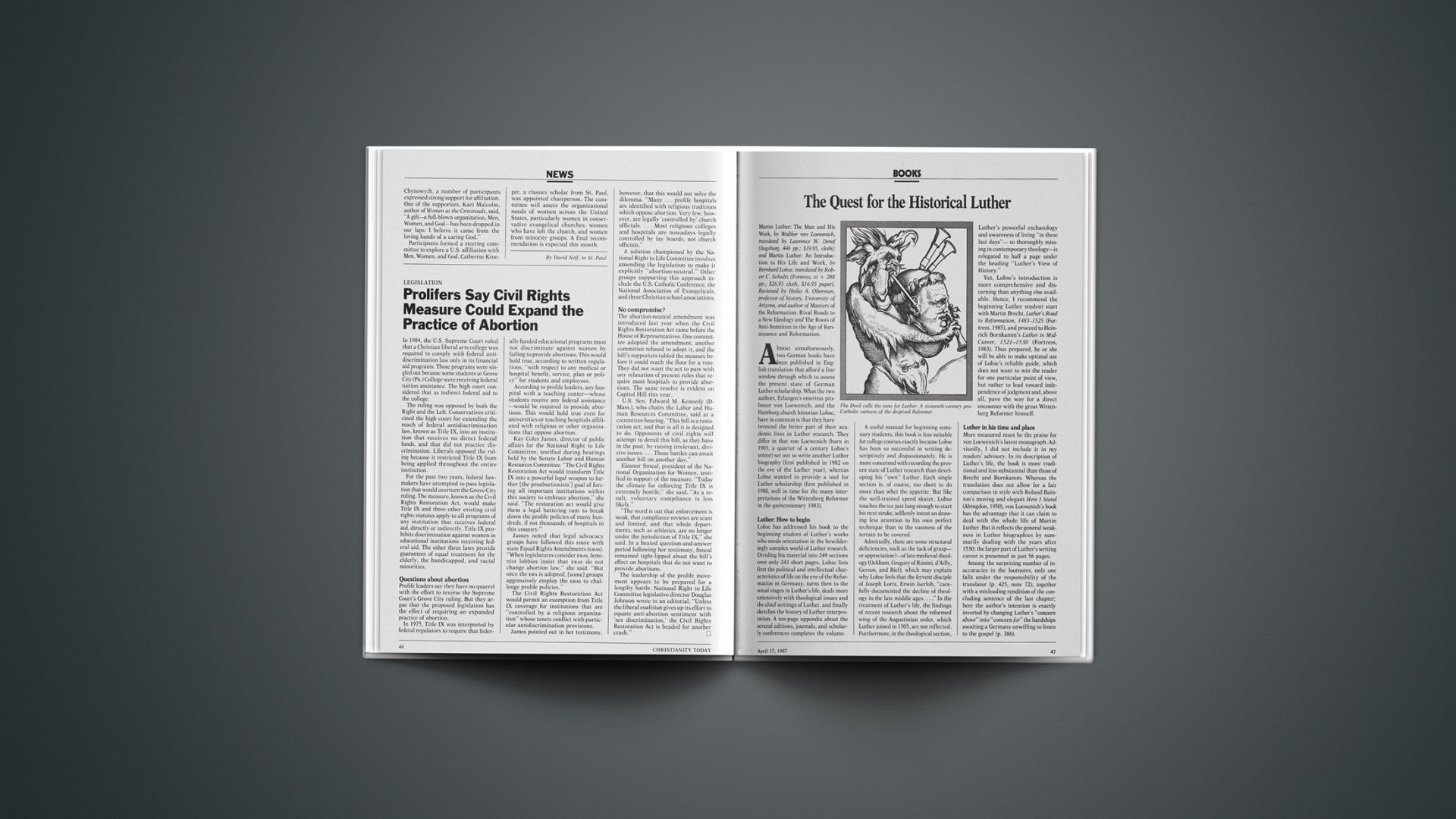
The Quest for the Historical Luther

Martin Luther: The Man and His Work, by Walther von Loewenich, translated by Lawrence W. Denef (Augsburg, 446 pp.; $19.95, cloth); and Martin Luther: An Introduction to His Life and Work, by Bernhard Lohse, translated by Robert C. Schultz (Fortress, xi + 288 pp.; $26.95 cloth, $16.95 paper). Reviewed by Heiko A. Oberman, professor of history, University of Arizona, and author of Masters of the Reformation: Rival Roads to a New Ideology and The Roots of Anti-Semitism in the Age of Renaissance and Reformation.

Almost simultaneously, two German books have been published in English translation that afford a fine window through which to assess the present state of German Luther scholarship. What the two authors, Erlangen’s emeritus professor von Loewenich, and the Hamburg church historian Lohse, have in common is that they have invested the better part of their academic lives in Luther research. They differ in that von Loewenich (born in 1903, a quarter of a century Lohse’s senior) set out to write another Luther biography (first published in 1982 on the eve of the Luther year), whereas Lohse wanted to provide a tool for Luther scholarship (first published in 1980, well in time for the many interpretations of the Wittenberg Reformer in the quincentenary 1983).

Luther: How To Begin

Lohse has addressed his book to the beginning student of Luther’s works who needs orientation in the bewilderingly complex world of Luther research. Dividing his material into 249 sections over only 243 short pages, Lohse lists first the political and intellectual characteristics of life on the eve of the Reformation in Germany, turns then to the usual stages in Luther’s life, deals more extensively with theological issues and the chief writings of Luther, and finally sketches the history of Luther interpretation. A ten-page appendix about the several editions, journals, and scholarly conferences completes the volume.

A useful manual for beginning seminary students, this book is less suitable for college courses exactly because Lohse has been so successful in writing descriptively and dispassionately. He is more concerned with recording the present state of Luther research than developing his “own” Luther. Each single section is, of course, too short to do more than whet the appetite. But like the well-trained speed skater, Lohse touches the ice just long enough to start his next stroke, selflessly intent on drawing less attention to his own perfect technique than to the vastness of the terrain to be covered.

Admittedly, there are some structural deficiencies, such as the lack of grasp—or appreciation?—of late medieval theology (Ockham, Gregory of Rimini, d’Ailly, Gerson, and Biel), which may explain why Lohse feels that the fervent disciple of Joseph Lortz, Erwin Iserloh, “carefully documented the decline of theology in the late middle ages.…” In the treatment of Luther’s life, the findings of recent research about the reformed wing of the Augustinian order, which Luther joined in 1505, are not reflected. Furthermore, in the theological section, Luther’s powerful eschatology and awareness of living “in these last days”—so thoroughly missing in contemporary theology—is relegated to half a page under the heading “Luther’s View of History.”

Yet, Lohse’s introduction is more comprehensive and discerning than anything else available. Hence, I recommend the beginning Luther student start with Martin Brecht, Luther’s Road to Reformation, 1483–1525 (Fortress, 1985), and proceed to Heinrich Bornkamm’s Luther in Mid-Career, 1521–1530 (Fortress, 1983). Thus prepared, he or she will be able to make optimal use of Lohse’s reliable guide, which does not want to win the reader for one particular point of view, but rather to lead toward independence of judgment and, above all, pave the way for a direct encounter with the great Wittenberg Reformer himself.

Luther In His Time And Place

More measured must be the praise for von Loewenich’s latest monograph. Advisedly, I did not include it in my readers’ advisory. In its description of Luther’s life, the book is more traditional and less substantial than those of Brecht and Bornkamm. Whereas the translation does not allow for a fair comparison in style with Roland Bainton’s moving and elegant Here I Stand (Abingdon, 1950), von Loewenich’s book has the advantage that it can claim to deal with the whole life of Martin Luther. But it reflects the general weakness in Luther biographies by summarily dealing with the years after 1530; the larger part of Luther’s writing career is presented in just 56 pages.

Among the surprising number of inaccuracies in the footnotes, only one falls under the responsibility of the translator (p. 425, note 72), together with a misleading rendition of the concluding sentence of the last chapter; here the author’s intention is exactly inverted by changing Luther’s “concern about” into “concern for” the hardships awaiting a Germany unwilling to listen to the gospel (p. 386).

Luther’S God

More problematic and independent of the translation is the author’s evaluation of Luther thought. Two examples must suffice. In the chapter dealing with “The struggle to find a gracious God,” Luther is presented as having fallen for the idea that God “can be angry or forgiving.” At this point von Loewenich balks: “The anthropomorphic elements in his portrayal of God, as well as in the God of the Scriptures, are all too prominent. We can only consider them as pointers to a reality that lies ‘behind’ them. It has become clear to us that all of our statements about God will always be inadequate and approximate. That which we now understand as metaphorical or figurative language, Luther took literally” (p. 75f.). At this point, one must wonder how the Incarnation, as the center of the Christian creed, will survive a thoroughgoing campaign against the presentation of God in human form.

From the historian’s perspective, much more serious is the question of how one can do justice to Luther when a “modern,” purified concept of God, rather than the “impure” while human God of the Scriptures, is made the standard of evaluation. Perhaps the problem can be reduced to the fact that von Loewenich has not seen that Luther’s search for the gracious God has not only a personal but also an institutional dimension: In the admission ceremony to his Augustinian order, the prior has to ask whether the candidate “seeks the merciful God.” A true quest for the historical Luther should pursue the question of whether Luther interpreted the Scriptures correctly in the context of his time and place.

Von Loewenich’s approach leads, of course, to grave problems for his appreciation of the treatise that Luther regarded to be one of his most lasting achievements, namely “On the bondage of the will” (1525). While Lohse cautions his readers that the Lutheran Confessions did not adopt “the more extreme assertions” made by Luther in this work (p. 134), von Loewenich makes his disapproval explicit. He presents Luther’s distinction between the revealed God and the hidden God as if it were the distinction between “the word of God and God himself” (p. 272)—which would have horrified Luther.

Luther insisted on the fact that God revealed himself in his Word; insofar as God is hidden, he is not our concern, since as such he is unknown and unknowable. The hidden God has not “emptied himself” (Phil. 2:7) and is not committed to the Covenant of Grace: he is the unexplainable and unaccountable, blind cosmic force “behind” history and nature. This confusion may explain the author’s philosophical assessment of a theological vision: “Luther was obviously a consequent determinist.” Luther’s discovery that man is either ridden by God or by the Devil is regarded by von Loewenich as an “eruption” that “reduced systematic theology to a pile of rubble” (p. 276). It suffices to add: as intended!

Such criticisms do not come easily to von Loewenich, who obviously loves his Luther but regrets the Reformer did not express himself in more modern categories. There is good reason to wonder, however, whether Luther would not have assailed this kind of “relevant” theology with as much fervor and conviction as he did the scholastic theology of his time. After all, the God that von Loewenich wants to find behind the human forms, Luther unmasked as the hidden God of the philosophers.

“Spiritual evolution”: Modernists, who were “only trying to slave the Bible,” blended Darwin with the emerging kingdom of God.

The Zeitgeist Of Banality?

Modern American Religion, Volume 1: The Irony of It All, 1893–1919, by Martin E. Marty (Univ. of Chicago Press, xi + 386 pp.; $24.95). Reviewed by Mark A. Noll, professor of history, Wheaton College, and coeditor of Voices from the Heart: Four Centuries of American Piety.

The Irony of It All is the first in a projected four-volume series in which Martin Marty, a widely traveled and prolifically published professor at the University of Chicago, sets out to tell the story of American religion throughout the entire twentieth century.

For once at least, the title tells the tale. This history is about religion, not primarily ecclesiastical or theological history. It is greatly concerned with what being in America meant for the subjects of the study. Especially for the period of this volume, stretching from the Parliament of Religions at Chicago’s World’s Fair in 1893 to the collapse of the Interchurch World Movement after World War I, Marty focuses on responses to modernity.

The subtitle sets forth Marty’s thesis. However America’s religious communities aligned themselves with regard to “the modern,” the results were ironic, or different from what they had intended.

By modern Marty means more than simply recent. Rather, the word speaks of the ideas that America’s elite scholars promoted during the period: a belief in progress, a patronizing attitude toward traditional Christianity, and above all, a supreme confidence in the enlightening power of science (both natural and social) to construct a better life.

Cast Of Characters

Having established this standard, Marty divides his actors into five groups. The “modernists” were theological liberals of the old English-speaking denominations who wanted to infuse traditional Christian language with new content from evolutionary cosmologists, idealist philosophers, and the phenomenologists of religious experience. Second, Marty’s “moderns” are six historians, four philosophers, and five social theorists (of whom William James and John Dewey are most important) who exemplified the search for scientific, personally satisfying, but post-Christian values.

A third collection reacted to “the modern” by focusing more directly on their ethnic identities (native Americans, blacks, Jews, non-English Catholics) or by seeking security in denominational structures (Southern Baptists, Lutherans, English-speaking Catholics).

Fourth, “countermodernists” were the theologically conservative Jews, Catholics, dispensationalists, biblical inerrantists, and Pentecostals who resisted the modern age. And a final group, including proponents of therapeutic religion, ecumenicism, the social gospel, and the transcendent character of America, fall into the “transmodern” camp.

Marty dwells at length on the ironies experienced by each of his five groups. Thus, “modernists” tried to make Christianity relevant by adjusting to the new age, but ended mostly with the irrelevancy of themselves. “Countermoderns” claimed to be upholding a traditional Christian faith, but often ended up promoting dramatically new positions. Of these, Marty highlights the new theology of dispensationalism and the new practices of Pentecostalism. Again, “modern” Catholics insisted that their “one true Church” could contribute to American democracy, but in the process came to act more and more like simply an additional denomination among the many.

Intriguing Scheme

In the end, it is not quite certain if Marty pulls it off. To be sure, the book is a virtual abecedary of useful, and sometimes surprising, information on Adventists, Baptists, Catholics, Disciples, Elijah the Destroyer, Federal Council of Churches, Ghost Dance, Higher Criticism, International Missionary Conference, and so on. It is also loaded with telling paraphrases and quotations from the men and women of the period. The best come from the disgruntled Harvard philosopher George Santayana who felt, for instance, that modernist Protestants “were in love with the Zeitgeist of banality.” Marty’s interpretive scheme is unquestionably intriguing, especially as an effort to integrate a very heterogeneous collection of materials.

At the same time, there are problems. Since the story is told thematically, the narrative is jumbled. For example, we see how greatly World War I influenced religious communities, hastening ethnic groups and Catholics into the mainstream, puncturing progressive aspirations, exciting visions of the End. Yet nowhere are the war and its effects treated systematically. In addition, “modernity” and “irony” are elusive concepts. The effort it takes to explain and apply them sometimes detracts from the flow of the book and does not always ring true.

In sum, this is an important chronicle of an important era, and an ambitious effort at systematic interpretation. Not the least of the book’s virtues, however, is the stimulus it provides for others to consider whether “modern” and “irony” are actually the best controlling categories for the period.

Prolifers Say Civil Rights Measure Could Expand the Practice of Abortion

In 1984, the U.S. Supreme Court ruled that a Christian liberal arts college was required to comply with federal antidiscrimination law only in its financial aid programs. Those programs were singled out because some students at Grove City (Pa.) College were receiving federal tuition assistance. The high court considered that as indirect federal aid to the college.

The ruling was opposed by both the Right and the Left. Conservatives criticized the high court for extending the reach of federal antidiscrimination law, known as Title IX, into an institution that receives no direct federal funds, and that did not practice discrimination. Liberals opposed the ruling because it restricted Title IX from being applied throughout the entire institution.

For the past two years, federal lawmakers have attempted to pass legislation that would overturn the Grove City ruling. The measure, known as the Civil Rights Restoration Act, would make Title IX and three other existing civil rights statutes apply to all programs of any institution that receives federal aid, directly or indirectly. Title IX prohibits discrimination against women in educational institutions receiving federal aid. The other three laws provide guarantees of equal treatment for the elderly, the handicapped, and racial minorities.

Questions About Abortion

Prolife leaders say they have no quarrel with the effort to reverse the Supreme Court’s Grove City ruling. But they argue that the proposed legislation has the effect of requiring an expanded practice of abortion.

In 1975, Title IX was interpreted by federal regulators to require that federally funded educational programs must not discriminate against women by failing to provide abortions. This would hold true, according to written regulations, “with respect to any medical or hospital benefit, service, plan or policy” for students and employees.

According to prolife leaders, any hospital with a teaching center—whose students receive any federal assistance—would be required to provide abortions. This would hold true even for universities or teaching hospitals affiliated with religious or other organizations that oppose abortion.

Kay Coles James, director of public affairs for the National Right to Life Committee, testified during hearings held by the Senate Labor and Human Resources Committee. “The Civil Rights Restoration Act would transform Title IX into a powerful legal weapon to further [the proabortionists’] goal of forcing all important institutions within this society to embrace abortion,” she said. “The restoration act would give them a legal battering ram to break down the prolife policies of many hundreds, if not thousands, of hospitals in this country.”

James noted that legal advocacy groups have followed this route with state Equal Rights Amendments (ERAS). “When legislatures consider ERAS, feminist lobbies insist that ERAS do not change abortion law,” she said. “But once the ERA is adopted, [some] groups aggressively employ the ERAS to challenge prolife policies.”

The Civil Rights Restoration Act would permit an exemption from Title IX coverage for institutions that are “controlled by a religious organization” whose tenets conflict with particular antidiscrimination provisions.

James pointed out in her testimony, however, that this would not solve the dilemma. “Many … prolife hospitals are identified with religious traditions which oppose abortion. Very few, however, are legally ‘controlled by’ church officials.… Most religious colleges and hospitals are nowadays legally controlled by lay boards, not church officials.”

A solution championed by the National Right to Life Committee involves amending the legislation to make it explicitly “abortion-neutral.” Other groups supporting this approach include the U.S. Catholic Conference, the National Association of Evangelicals, and three Christian school associations.

No Compromise?

The abortion-neutral amendment was introduced last year when the Civil Rights Restoration Act came before the House of Representatives. One committee adopted the amendment, another committee refused to adopt it, and the bill’s supporters tabled the measure before it could reach the floor for a vote. They did not want the act to pass with any relaxation of present rules that require most hospitals to provide abortions. The same resolve is evident on Capitol Hill this year.

U.S. Sen. Edward M. Kennedy (D-Mass.), who chairs the Labor and Human Resources Committee, said at a committee hearing, “This bill is a restoration act, and that is all it is designed to do. Opponents of civil rights will attempt to derail this bill, as they have in the past, by raising irrelevant, divisive issues.… Those battles can await another bill on another day.”

Eleanor Smeal, president of the National Organization for Women, testified in support of the measure. “Today the climate for enforcing Title IX is extremely hostile,” she said. “As a result, voluntary compliance is less likely.”

“The word is out that enforcement is weak, that compliance reviews are scant and limited, and that whole departments, such as athletics, are no longer under the jurisdiction of Title IX,” she said. In a heated question-and-answer period following her testimony, Smeal remained tight-lipped about the bill’s effect on hospitals that do not want to provide abortions.

The leadership of the prolife movement appears to be prepared for a lengthy battle. National Right to Life Committee legislative director Douglas Johnson wrote in an editorial, “Unless the liberal coalition gives up its effort to equate anti-abortion sentiment with ‘sex discrimination,’ the Civil Rights Restoration Act is headed for another crash.”

Women Explore Formation of Alternative Feminist Group

Christian feminists from across the country met last month in St. Paul, Minnesota, to investigate the need for an alternative to the Evangelical Women’s Caucus (EWC). Plans for the St. Paul meeting began last year, shortly after dissatisfaction developed over EWC resolutions supporting civil rights for gays and lesbians (CT, Oct. 3, 1986, p. 40).

Among those protesting the EWC actions were members of the Minnesota EWC chapter, which seceded from the parent organization February 1. According to Diane Chynoweth, chairperson of the Minnesota group, last month’s conference was organized to explore the possibility of affiliating with Men, Women, and God, an organization under the umbrella of the London Institute for Contemporary Christianity, a study center founded by noted British evangelical John R. W. Stott.

The St. Paul meeting attracted 103 people from 11 states—approximately one-third the number who normally attend an EWC convention. The British organization was represented by philosopher Elaine Storkey, who teaches at the Open University and Oak Hill Theological College in London, and Stott’s London Institute for Contemporary Christianity.

Storkey warned her listeners that American Christians will have a difficult time pursuing both “peace and justice in a patriarchal church.” She attributes this difficulty to the American desire to have everything. “Americans think you can have … materialism and a healthy Christian life at the same time,” she said.

Following Storkey’s presentations, the group discussed affiliating with Men, Women, and God. According to Chynowyth, a number of participants expressed strong support for affiliation. One of the supporters, Kari Malcolm, author of Women at the Crossroads, said, “A gift—a full-blown organization, Men, Women, and God—has been dropped in our laps. I believe it came from the loving hands of a caring God.”

Participants formed a steering committee to explore a U.S. affiliation with Men, Women, and God. Catherine Kroeger, a classics scholar from St. Paul, was appointed chairperson. The committee will assess the organizational needs of women across the United States, particularly women in conservative evangelical churches, women who have left the church, and women from minority groups. A final recommendation is expected this month.

By David Neff, in St. Paul.

Supreme Court Eases Rules on Political Asylum

Deportations of Central Americans to potentially dangerous conditions in their home countries led to the emergence of the church-based sanctuary movement in 1982. Sanctuary workers invite undocumented aliens to live in their churches, where agents of the U.S. Immigration and Naturalization Service (INS) are reluctant to arrest them. Other efforts to aid those who have fled Central America include helping refugees gain political asylum in Canada, where standards for accepting applicants are more lenient.

Political Asylum Debate

Advocacy groups for Central American aliens have argued that the standard applied by the INS for granting political asylum is too strict. Recently the U.S. Supreme Court agreed, ruling six to three that INS must relax its standard.

In the past, the U.S. government denied asylum to those who could not establish a “clear probability” they would be persecuted upon returning home. But the high court said this interpretation violates the intent of the Refugee Act of 1980, which grants asylum to applicants whose fear of persecution is “well-founded.” According to the high court, applicants need not prove it is “more likely than not” they will be persecuted upon returning home.

The Supreme Court’s ruling came in a case in which a Nicaraguan woman said she feared persecution at the hands of that country’s Sandinista government, which the U.S. government opposes. Generally, the sanctuary movement highlights human rights abuses committed by U.S. backed forces, including contra rebels in Nicaragua and government forces in El Salvador and Guatemala. As a result, the INS has charged that the movement’s purpose is more political than humanitarian.

Michael McConnell, of the Chicago Religious Task Force, which plays a coordinating role in the sanctuary movement, opposes U.S. policy in Central America. He calls it the “decisive factor in the continuation of violence” in the region. Those on the other side of the political fence contend that current U.S. policy is necessary to prevent the expansion of Marxism in the Western hemisphere.

Negligible Effect

The Supreme Court ruling is expected to have little effect on the sanctuary movement, which now involves about 400 churches. Observers say the U.S. Attorney General’s office still has the authority to deny asylum, even if applicants meet the criteria set forth by the high court.

“We’re in a wait-and-see situation,” said Ryan Karis of Jubilee Partners, a Corner, Georgia-based Christian group that aids Central American refugees. “The real test is to see how [the ruling] is applied by INS lawyers and judges.”

INS spokesman Duke Austin said the ruling would only slightly increase the number of people granted asylum. “Most of the people who have been denied,” he said, “were not able to establish a reasonable fear [the criterion set by the Supreme Court].” Austin said the greatest effect of the Court’s ruling could be on the INS case load, if substantial numbers of denied applicants reopen their cases.

Though pleased with the high court ruling, McConnell said he expects little to change for fleeing Central Americans. He said the U.S. State Department supplies INS with “ideologically biased” information on human rights abuses in Central America. McConnell cited a General Accounting Office study indicating that applicants fleeing U.S. backed governments have slimmer chances of winning asylum.

By Randy Frame.

Charges of Break-Ins and Infiltration

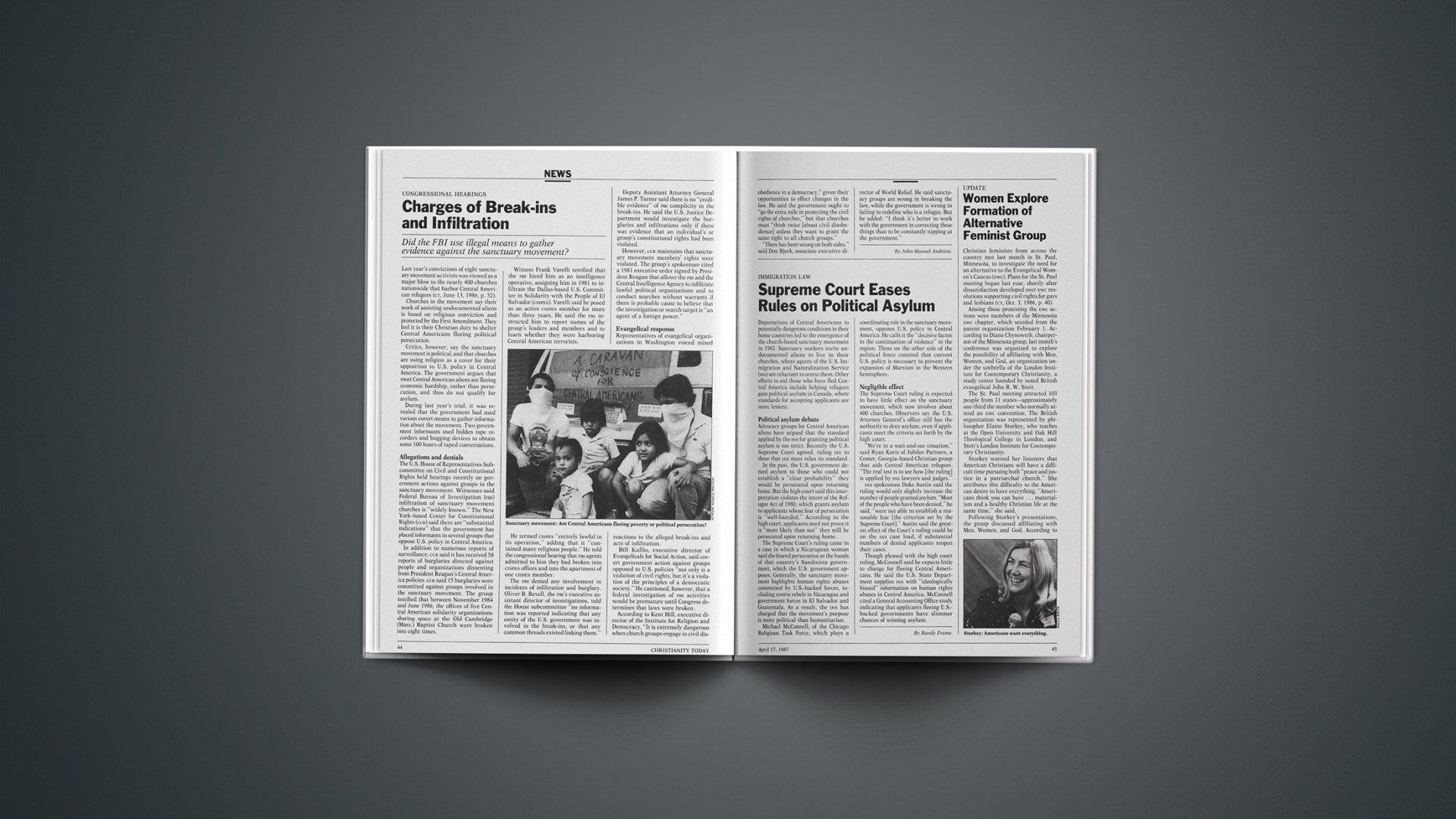
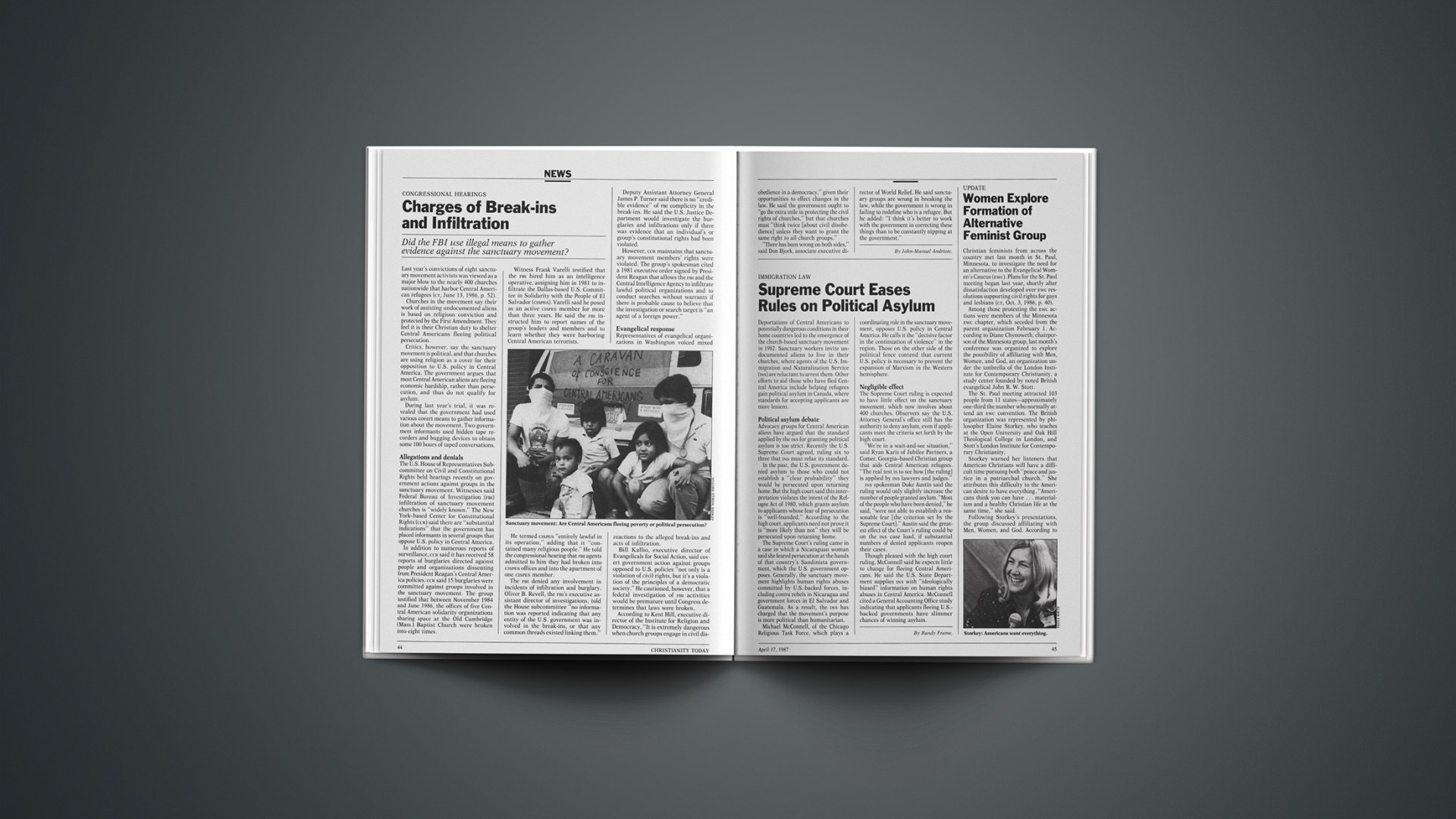
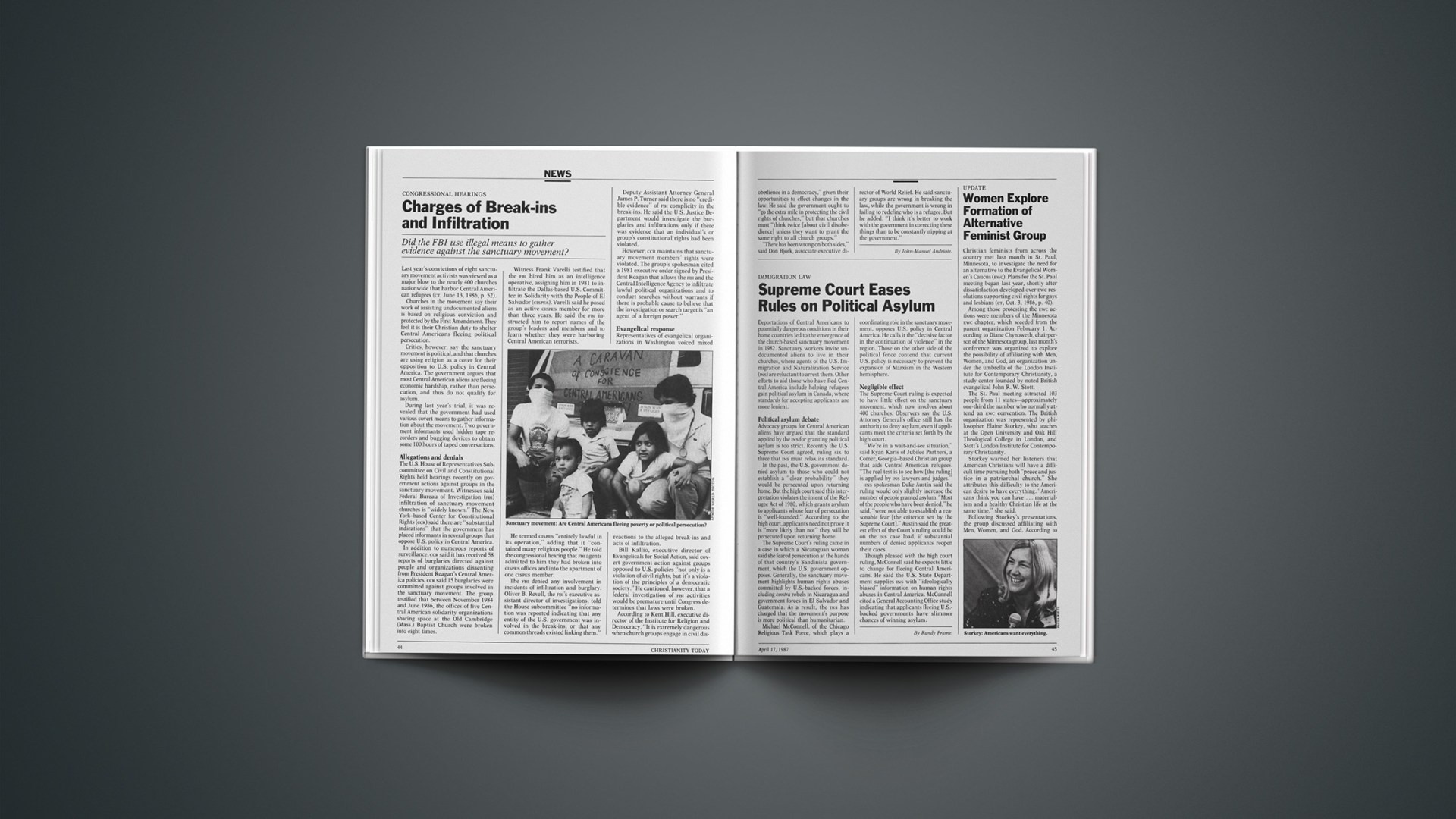
Last year’s convictions of eight sanctuary movement activists was viewed as a major blow to the nearly 400 churches nationwide that harbor Central American refugees (CT, June 13, 1986, p. 52).

Churches in the movement say their work of assisting undocumented aliens is based on religious conviction and protected by the First Amendment. They feel it is their Christian duty to shelter Central Americans fleeing political persecution.

Critics, however, say the sanctuary movement is political, and that churches are using religion as a cover for their opposition to U.S. policy in Central America. The government argues that most Central American aliens are fleeing economic hardship, rather than persecution, and thus do not qualify for asylum.

During last year’s trial, it was revealed that the government had used various covert means to gather information about the movement. Two government informants used hidden tape recorders and bugging devices to obtain some 100 hours of taped conversations.

Allegations And Denials

The U.S. House of Representatives Subcommittee on Civil and Constitutional Rights held hearings recently on government actions against groups in the sanctuary movement. Witnesses said Federal Bureau of Investigation (FBI) infiltration of sanctuary movement churches is “widely known.” The New York-based Center for Constitutional Rights (CCR) said there are “substantial indications” that the government has placed informants in several groups that oppose U.S. policy in Central America.

In addition to numerous reports of surveillance, CCR said it has received 58 reports of burglaries directed against people and organizations dissenting from President Reagan’s Central America policies. CCR said 15 burglaries were committed against groups involved in the sanctuary movement. The group testified that between November 1984 and June 1986, the offices of five Central American solidarity organizations sharing space at the Old Cambridge (Mass.) Baptist Church were broken into eight times.

Witness Frank Varelli testified that the FBI hired him as an intelligence operative, assigning him in 1981 to infiltrate the Dallas-based U.S. Committee in Solidarity with the People of El Salvador (CISPES). Varelli said he posed as an active CISPES member for more than three years. He said the FBI instructed him to report names of the group’s leaders and members and to learn whether they were harboring Central American terrorists.

He termed CISPES “entirely lawful in its operation,” adding that it “contained many religious people.” He told the congressional hearing that FBI agents admitted to him they had broken into CISPES offices and into the apartment of one CISPES member.

The FBI denied any involvement in incidents of infiltration and burglary. Oliver B. Revell, the FBI’S executive assistant director of investigations, told the House subcommittee “no information was reported indicating that any entity of the U.S. government was involved in the break-ins, or that any common threads existed linking them.”

Deputy Assistant Attorney General James P. Turner said there is no “credible evidence” of FBI complicity in the break-ins. He said the U.S. Justice Department would investigate the burglaries and infiltrations only if there was evidence that an individual’s or group’s constitutional rights had been violated.

However, CCR maintains that sanctuary movement members’ rights were violated. The group’s spokesman cited a 1981 executive order signed by President Reagan that allows the FBI and the Central Intelligence Agency to infiltrate lawful political organizations and to conduct searches without warrants if there is probable cause to believe that the investigation or search target is “an agent of a foreign power.”

Evangelical Response

Representatives of evangelical organizations in Washington voiced mixed reactions to the alleged break-ins and acts of infiltration.

Bill Kallio, executive director of Evangelicals for Social Action, said covert government action against groups opposed to U.S. policies “not only is a violation of civil rights, but it’s a violation of the principles of a democratic society.” He cautioned, however, that a federal investigation of FBI activities would be premature until Congress determines that laws were broken.

According to Kent Hill, executive director of the Institute for Religion and Democracy, “It is extremely dangerous when church groups engage in civil disobedience in a democracy,” given their opportunities to effect changes in the law. He said the government ought to “go the extra mile in protecting the civil rights of churches,” but that churches must “think twice [about civil disobedience] unless they want to grant the same right to all church groups.”

“There has been wrong on both sides,” said Don Bjork, associate executive director of World Relief. He said sanctuary groups are wrong in breaking the law, while the government is wrong in failing to redefine who is a refugee. But he added: “I think it’s better to work with the government in correcting these things than to be constantly nipping at the government.”

By John-Manuel Andriote.

Churches Remember U.S. Hostages in Lebanon

While much of the nation’s attention remains focused on the Iran-contra affair, congregations across the country recently turned their thoughts to the eight Americans still being held hostage in war-torn Lebanon.

Terry Anderson, Middle East bureau chief for the Associated Press, has been held for more than two years, longer than any other American hostage. Anderson’s sister, Peggy Say, asked worshipers at First Baptist Church of Washington, D.C., to “send a spiritual message” to her brother and the seven other U.S. citizens being held by Muslim extremists.

Accompanied by her husband, Say participated in a time of prayer and remembrance for the hostages. The Washington, D.C., service was one of many such observances held nationwide last month by congregations affiliated with the American Baptist Churches in the U.S.A.

At a news conference following the service, Say told reporters she fears the arms-for-hostages controversy has diverted the attention of the nation’s leaders from the hostages. “My greatest concern is that officials in Washington have become so caught up in who knew what when,” she said, “that they’ve forgotten what this was all about.”

Say also said she thinks President Reagan is being “unjustly castigated” for the controversy. “The mandate was to do whatever you have to do to get these men out of there,” she explained. “The initiative chosen was debatable, but he did do what the American public wanted.… Those who question whether it was worth it need to talk to the families [of the hostages].”

During the worship service, Say marked the second anniversary of her brother’s kidnaping by vividly describing the harsh conditions Anderson and the other hostages endure. She described windowless rooms with no furniture, locked and guarded doors, and isolation from the outside world. She told of Anderson’s early months of captivity during which he was blindfolded, chained to a wall, and denied contact with his fellow hostages.

“Brought together with his fellow captives two years ago this coming July,” she said, “these men who had suffered such pain and anguish had only one request for their captors—to be allowed to worship their God. Still blindfolded and permitted only to share a brief hug with one another, they exchanged names in a whisper and came together to pray for strength and guidance.” Say indicated that she had obtained this information from one of the released hostages.

Only two of the original seven U.S. hostages—Anderson and Thomas Sutherland—remain captive. William Buckley and Peter Kilburn were killed, and three others—Benjamin Weir, Lawrence Jenco, and David Jacobsen—were released. Meanwhile, six additional Americans have been abducted and are being held hostage, as are at least 18 other foreigners, including Church of England envoy Terry Waite.

After Anderson was kidnaped, his wife gave birth to their daughter, who will be two years old in June. His father and brother have died from cancer. Say said she does not believe Anderson knows about either of those deaths.

By Kathy Paten.

Religious Leaders Respond to the Vatican’s Ban on Artificial Conception

Religious leaders are giving mixed reviews to the Vatican’s recent ban on the use of new reproductive technologies. The landmark statement cites moral and theological reasons for opposing artificial insemination, in vitro fertilization, surrogate parenting, and prenatal diagnosis for the purpose of destroying a malformed fetus.

Theological Reasoning

Titled “Instruction on Respect for Human Life in Its Origin and on the Dignity of Procreation,” the document opposes any attempt to treat infertility apart from sexual intercourse between husband and wife. Many of the principles are drawn from teachings of Pope John Paul II and other sources of official Catholic doctrine. An introduction quotes the Pope as saying these techniques expose mankind “to the temptation to go beyond the limits of a reasonable dominion over nature.”

The document makes it clear that the church does not reject infertility procedures merely because they are artificial. Instead, the doctrine rests on two “fundamental values”: the life of the human being who is created, and the special nature of the way human life is transmitted within marriage.

On the first point, the teaching restates traditional Catholic views on the sanctity of human life “from the moment of conception.” The second concern is defined as well: “Human procreation requires on the part of the spouses responsible collaboration with the fruitful love of God; the gift of human life must be actualized in marriage through the specific and exclusive acts of husband and wife.…”

The instruction draws no moral distinction between methods using donor sperm or eggs and ones that involve only the husband and wife. Many Protestant ethicists, on the other hand, do not object to methods such as artificial insemination of a woman with her husband’s sperm, or even in vitro fertilization using sperm and eggs from a married couple.

What Is Prohibited?

Treatments for infertility and certain medical procedures on embryos and fetuses fall under the Vatican’s blanket condemnation. Among the most widely used treatments for infertility is artificial insemination, in which a sperm sample is injected into a woman by her doctor. In cases where a husband has no sperm or produces defective sperm, a donor’s specimen is used.

However, the Vatican document cites a Catholic affirmation of an “inseparable connection, willed by God and unable to be broken by man on his own initiative, between the two meanings of the conjugal act: the unitive meaning and the procreative meaning.” In other words, sexual union within marriage must necessarily include a constant openness to procreation; and procreation without sexual union severs the two. This is why the Catholic church opposes the use of contraceptives.

In vitro fertilization between husband and wife is unacceptable, the instruction says, because “even if it is considered in the context of ‘de facto’ existing sexual relations, the generation of the human person is objectively deprived of its proper perfection: namely, that of being the result and fruit of a conjugal act.” In vitro fertilization involves harvesting multiple eggs from the woman, and mixing them with the husband’s sperm in a laboratory. Eggs that are fertilized as a result of this process are reintroduced into the woman’s womb; leftover pre-embryos are discarded or frozen for later use.

“Development of the practice of in vitro fertilization has required innumerable fertilizations and destructions of human embryos,” the Vatican document points out. In addition, it states, through these methods “life and death are subjected to the decision of man, who thus sets himself up as the giver of life and death by decree.” Finally, addressing the issue of third-party donors, the instruction notes, “The fidelity of the spouses in the unity of marriage involves reciprocal respect of their right to become a father and mother only through each other.”

Some of the document’s harshest words are reserved for surrogate motherhood. That practice involves a woman outside the marriage being paid to carry a child that belongs genetically to her as well as the husband seeking to have children. According to the Vatican, “Surrogate motherhood represents an objective failure to meet the obligations of maternal love, of conjugal fidelity, and of responsible motherhood; it offends the dignity and the right of the child to be conceived, carried in the womb, brought into the world and brought up by his own parents; it sets up, to the detriment of families, a division between the physical, psychological and moral elements which constitute those families.”

The document expresses sympathy for infertile couples, and charges the community of believers to “shed light upon and support the suffering of those who are unable to fulfill their legitimate aspiration to motherhood and fatherhood.” It recommends that infertile couples discover in their circumstances “an opportunity for sharing in a particular way in the Lord’s Cross, the source of spiritual fruitfulness.”

Reaction

A tremendous diversity of opinion about these issues exists within the Catholic community. Observers say many infertile Catholic couples will not heed the Vatican’s instruction, just as many neglect its teaching against artificial methods of birth control.

Others, however, welcome the document even if they dispute some of its recommendations. Catholic social analyst Michael Novak wrote, in a commentary about the document, that its main thrust “is to defend a human right never before articulated in such detail and clarity: the human right of a child to be born to two married persons through the mutual gift of their bodily and personal love for one another.”

Lutheran theologian Richard John Neuhaus said of the document: “I don’t think it’s the definitive word, but it’s a marvelously good starting point for discussion.” The Vatican’s insistence on not separating procreation from sexual union in marriage seems to be “a limited definition of the act of love,” Neuhaus said. “But one is challenged to ask, if you expand the act of love to separate love from the act of procreation, then where do you draw the line? It has raised a challenge to all of us to be more precise.”

Protestant ethicists tend to hold favorable views on fertility procedures that do not involve a third party. Stanley Hauerwas, ethics professor at Duke University, has opposed research and funding for the development of in vitro techniques. But concerning the application of these techniques to couples confronting infertility, he opts for an ambiguous position. He would support a couple’s choice to pursue in vitro fertilization if both partners are in agreement about it and strongly desire it.

Infertility specialist Joe S. McIlhaney, Jr., is a respected evangelical authority on the subject. In his book, 1250 Health Care Questions Women Ask (Baker), he tends to support the decisions of couples and their doctors in matters of infertility. He writes, “There is, I believe, no stronger stress in a couple’s life than the continued absence of the child that they long to have.… God has made it possible for us to develop new understanding and treatment for the causes of infertility. Those with infertility problems have at their disposal some of the most modern and up-to-date medical care available in any field of medicine.”

McIlhaney serves on a newly appointed ethics commission of the Christian Medical Society, which is preparing a statement evaluating reproductive choices. He said he expects the society’s document to include “major areas of disagreement with the Vatican statement.”

By Beth Spring.

Should Sex Education Teach More than Abstinence?

YES

Dorothy Williams is director of publications for the Search Institute, a research organization based in minneapolis. She has developed sex education curricula for use in churches and public school.

What are the goals of your organization’s sex education programs?

Our materials state seven values—equality, honesty, respect, responsibility, promise keeping, self-control, and social justice. We base recommendations for behavior on those values. Our primary recommendation is abstinence. It’s my personal moral judgment that abstinence is by far the best method.

Then why teach anything else?

There has been a long silence on the part of people with strong moral views. We are dealing with the consequences of people not saying enough about abstinence and responsibility in sexual behavior. Some kids in the public schools are not going to be abstinent. It is unrealistic to expect them to change because abstinence is recommended.

When you describe alternatives to abstinence, aren’t you implying acceptance of those alternatives?

That’s a difficult question, but kids have the right to know there are other methods available. They wonder why married people don’t have one child after another. That’s a logical question. When young people are old enough to ask this question, they are old enough to be told the truth.

A teacher’s function is to help people see and understand truth, not to force-feed it. Teachers must be clear in what they recommend and the reasons behind it. But they can’t stand over kids with clubs and say, “You’ve got to do this.” They are dealing with a variety of kids who come from a wide range of homes and experiences.

Advocates of birth-control education point to problems like teen pregnancy and AIDS. Shouldn’t young people learn that irresponsible behavior can have dire consequences?

For some, the so-called punishment for irresponsible sexual behavior is a life-threatening disease. That punishment is too severe for the crime. I want to protect kids from having their whole lives changed because they parented children they didn’t want; or from having their lives shortened because they contracted a sexually transmitted disease. In addition, these kids are not prepared emotionally for sexual experiences.

Opponents of birth-control education say it has actually increased the number of unwanted pregnancies.

I am always anxious to examine the design of any study in which this claim is made. But I haven’t seen any evidence that teaching birth control increases sexual activity. Kids will engage, or choose not to engage, in sexual behavior whether or not they know about condoms.

What is the best way to handle sex education in schools?

It should not start with physiology, but with values. Also, I am a strong advocate of parental involvement. Parents have a chance to see our curricula before they are taught.

NO

Forrest Turpen is executive director of the Christian Educators Association International, based in Pasadena, California. He has been a public-school educator for 20 years.

How do you respond to critics who say pushing the idea of sexual abstinence has not worked to prevent pregnancy and sexually transmitted diseases?

For the last 20 years American teenagers have heard society’s message of free-wheeling sexuality. But our young people have not heard a well-reasoned analysis of why abstinence is the best way to handle their feelings and sexual desires.

So teaching abstinence can work?

It is the only thing that works. Kids want parameters. They respect teachers and parents who are firm in their convictions and have set limits. I believe most kids would abstain if the standard were set.

Is it right to impose the Judeo-Christian value of chastity on people who subscribe to other value systems?

Virtually all religious traditions in our society teach abstinence in sexual matters. There is only a small group of people who don’t subscribe to any religious values. Even those parents want their children to have the very best. And generally they know that premarital sex can have disastrous psychological effects on young people as they enter into a marriage relationship.

Can’t other methods help reduce problems such as teen pregnancy and the spread of AIDS?

Statistics show that teen pregnancy and sexually transmitted diseases have increased since sex education was started in the 1960s. Short of a committed, monogamous relationship, there is no such thing as absolutely safe sex.

What if it were proved that sex education works?

Ends don’t justify means. God’s Word is clear, and his laws are absolute. I don’t believe he would be honored by an end product achieved at the expense of morality, even if that product looks good and seems to be effective. You have to consider the degradation of society in general that would result from promoting promiscuity.

How should sex education be handled in schools?

Children inevitably receive an education in sex. The question is how. I believe very strongly that parents are ordained of God to be the primary teachers of their children.

I advocate that all sex-education programs be written, or at least reviewed, locally by parents, teachers, and leaders of as many religious faiths as possible. Common goals and understandings are needed. And parents should have the option of not allowing their children to participate.

Theodore Roosevelt said that to educate a child in mind and not in morals is to educate a menace to society. I maintain that all sex-education programs should uphold three essentials for a stable society: premarital chastity, monogamous marriage, and fidelity in marriage. To teach anything else is to do our children a major disservice.

Apple PodcastsDown ArrowDown ArrowDown Arrowarrow_left_altLeft ArrowLeft ArrowRight ArrowRight ArrowRight Arrowarrow_up_altUp ArrowUp ArrowAvailable at Amazoncaret-downCloseCloseEmailEmailExpandExpandExternalExternalFacebookfacebook-squareGiftGiftGooglegoogleGoogle KeephamburgerInstagraminstagram-squareLinkLinklinkedin-squareListenListenListenChristianity TodayCT Creative Studio Logologo_orgMegaphoneMenuMenupausePinterestPlayPlayPocketPodcastRSSRSSSaveSaveSaveSearchSearchsearchSpotifyStitcherTelegramTable of ContentsTable of Contentstwitter-squareWhatsAppXYouTubeYouTube