Treasure for a Queen

“The Most valuable thing this world affords.”

Your gracious Majesty, I present you with this Book, the most valuable thing that this world affords.…” What was this priceless object handed to Queen Elizabeth at her coronation by the Archbishop of Canterbury? What did he give to this woman who owned enormous estates and treasures of diamonds, rubies, gold, and silver? What was it she received gratefully, acknowledging with a nod of her crowned head that she agreed with the prelate’s assessment of the volume? It was the Holy Bible. The Queen knew from her upbringing that the Word contains what no amount of money could buy—the secret of eternal life.

In spite of the Church’s official estimate of the Scriptures, the Queen’s valuation of the Book, and the inspiration and comfort millions of persons find daily in its pages, the Bible has never been more fiercely attacked nor its contents so dogmatically labeled myths and legends than it is today—and much of this from men sworn to be “defenders of the faith.”

We are living in times of incredible scientific achievement. We have penetrated outer space and have split the atom. Therefore, says modern man, we have matured; we do not need God any more. His Word is full of error; we cannot accept it.

No one rejoiced in the accomplishments of science more than Winston Churchill; yet he maintained his belief in the Bible. He declared:

I believe that the most scientific view finds its fullest satisfaction in taking the Bible story literally. I remain unmoved by the tomes of “Professor Gradgrind” or “Dr. Dryasdust.” We may be sure that all these things happened to people not very different from ourselves, and that the impressions they received were faithfully recorded [Thoughts and Adventures, 1932].

John Foster Dulles acknowledged the wonders of science also; yet he too leaned on the Scriptures. He never left on a peace-making mission without seeking strength and guidance from the Word, and a favorite promise of his was: “I can do all things through Christ which strengtheneth me” (Phil. 4:13). Sir Stafford Cripps and Lord Halifax were firm believers in the Bible as the inspired revelation of the Lord. Woodrow Wilson believed in it to such an extent that he wrote a message about its power to purify and guide in the flyleaf of the New Testament he presented to all the American troops in the First World War.

Dr. R. A. Torrey might have been writing for these times when he stated:

The truly wise man is he who always believes the Bible against the opinion of any man, any scientist, any scholar, any council of theologians, any congress of philosophers, or savants. If the Bible says one thing and any body of men say another, the truly wise man will say: This Book is the Word of Him who cannot lie [Daily Meditations, 1963].

Thomas Carlyle, the sage of Chelsea, said:

The Bible is the truest utterance that ever came by alphabetical letters from the soul of man, through which, as through a window divinely opened, all men can look into the stillness of eternity, and discern in glimpses their far-distant long-forgotten home [quoted in Pocket Bible Handbook, by Henry H. Halley, 1946].

Many Presidents apart from Wilson endorsed the divine origin of the Bible. John Quincy Adams insisted that his veneration of the Bible was so great that “the earlier my children begin to read it, the more confident will be my hope that they will prove useful citizens.…” Lincoln reckoned it the “best gift God ever gave to man.” Washington was convinced that it was impossible to govern the world without God and the Bible. The late John F. Kennedy valued its precepts so much that in his inaugural address he quoted a verse that had been a strength to him all through his life: “They that wait upon the Lord shall renew their strength; they shall mount up with wings as eagles; they shall run, and not be weary; and they shall walk, and not faint” (Isa. 40:31).

Those who contemptuously classify the Scriptures with Greek mythology and Grimm’s fairy tales may dismiss lightly the opinions of the great, but what can they do with the internal evidence of the Word itself? The Bible begins with “In the beginning, God …” and ends with “The grace of the Lord Jesus Christ be with you all.…” Between these two points there is an amazing continuity of thought on God, on the sinfulness of man, on the rewards of the righteous and the punishment of the wicked, and on the meaning of life lived for God.

No other holy books—the Upanishads and the Vedas of the Hindus, the Koran of the Muslims, the Granth of the Sikhs, the Tripitaka of the Buddhists, the Avesta of the Zoroastrians, or the Analects of the Confucians—give such an exalted view of God and life as does the Bible. And considering that some thirty-five or forty authors combined to produce the Old and New Testaments, men of all professions—kings, prophets, priests, farmers, fishermen, and a publican—the oneness of purpose running throughout the Book is impressive. Kings and fishermen alike bore consistent witness to a God who hates sin and who has the power to redeem the soul. And in no other books do the authors make such claims as these: “The Lord spoke through me,” “Thus saith the Lord …,” and “God spoke unto me saying.…”

THEY WOULD REMEMBER

He spoke; the wind went dead;

disciples caught their breath.

“Where is your faith?” he said.

Then silence fell like sudden death.

They looked, their faces gray.

How far the great calm lay!

Long after on their stormy ways

they would recall again

the hushing of the hurricane;

and they, remembering, would raise

their heads in sudden, silent praise,

their hearts grown strong and warm!

LON WOODRUM

But while modern man may reject the testimony of a Moses or a Daniel, surely it takes arrogant conceit to scorn the claims of the greatest authority of all, the Lord Jesus Christ. Jesus uncompromisingly endorsed the Scriptures of the Old Testament all through his ministry. He quoted Moses and referred to Abraham, Isaac, and Jacob. In drawing a homely parable from the flowers, he compared their beauty to “Solomon in all his glory.” And he authenticated such a controversial event as Jonah’s three days and three nights inside a great fish, when he compared it to his own impending experience in the tomb.

Christ’s mind and heart were saturated with Scripture. Talking to the two disciples on the way to Emmaus after his resurrection, he taught them out of the Old Testament that he was the Messiah, “beginning at Moses and all the prophets.…” He had no parchments in his hand; yet he was able to quote verbatim all the prophetic statements made about himself by a variety of seers. So convincing were his words that the disciples’ doubts quickly disappeared and a warm glow filled them. “Did not our heart burn within us as he talked with us by the way?” they exclaimed joyously, when relating the incident to “the eleven.”

In his prayer for his disciples just before his arrest and crucifixion, Jesus said something that should settle forever any doubts we might have about the authenticity of the Holy Bible. He prayed: “Sanctify them through thy Word; thy Word is truth.…” Since God cannot lie, we may rest assured that his Word is beyond all question true.

No, the Bible is not “on the way out.” Isaiah’s prophecy finds its fulfillment today: “The grass withereth, the flower fadeth: but the Word of our God shall stand forever.” True, there is much we do not understand in the pages of Scripture, and there is some to accept which takes all our courage. But once we begin to doubt, the enemy comes in like a flood and sweeps away all our defenses. God has seen fit to conceal many things from our view, “but when that which is perfect is come, then that which is in part shall be done away.” Although we now see “through a glass, darkly,” some day we shall know as we are known. In the meantime, we shall continue to step out boldly on the promises of God, finding them just as valid as when they were uttered, just as applicable to twentieth-century Christians as to men of God in the centuries before Christ, or in the early years of the new era. The Christian who has failed to take God at his word and test his promises has missed one of the greatest of joys. Thousands have found with Livingstone that God’s Word is the “word of a gentleman” and that God’s promises can never be broken.

Perhaps one explanation of the skepticism of so many today is that they are looking at the Bible through worldly eyes. “The unspiritual man,” said Paul, “simply cannot accept the matters which the Spirit deals with—they just don’t make sense to him, for, after all, you must be spiritual to see spiritual things” (1 Cor. 2:14, Phillips).

How easy it is to slip into Christian service without a change of heart, without experiencing the miracle Christ spoke of as being “born again.” While one must hesitate to judge individual cases, surely Christ’s words, “By their fruits ye shall know them,” apply to those who are causing terrible confusion to God’s people by destroying confidence in the Scriptures.

Four wonderful words echo and re-echo in the believer’s mind when doubts creep in. They are the words of him who had the mind of God: “Thy word is truth.”
Cover Story

What Is the Bible For?

Too often men approach it like a corps to be dissected.

The authority of the Bible rests on its bearing the imprimatur of Christ, who is our supreme authority. So plain is this that there can be no question of the authority of Christ being dependent on the word of the Bible: it is rather the authority of the Bible that is dependent on the word of Christ. And this is true not only of the authority of the Old Testament. The crucial factor is certainly the authority of the New Testament, because the authority of the Old Testament, seen in the Christian perspective of fulfillment and consummation, stands or falls with the authority of the New Testament.

How, then, is the authority of the New Testament to be established? The answer, already indicated, must be: only by the supremely authoritative word of Christ. And this particular word has been preserved for us in the pages of the New Testament itself.

St. John tells us how, during those sacred hours in the upper room prior to his betrayal and crucifixion, our Lord assured his apostles that after his departure the Holy Spirit, who is the very Spirit of truth, not only would be sent but would actually dwell in them; that he would bear witness to Christ and glorify him, declaring the things of Christ to them; and also that he would bring to their remembrance all that he had taught them (John 14:16, 17, 26; 15:26; 16:13 ff.). This explains the transformation in the apostles after the Day of Pentecost, as seen in the Acts and the Epistles, compared with what they were before Pentecost, as seen in the Gospels. The privileged but uncomprehending years at the feet of Christ were not wasted; what before they had failed to grasp they now understood and expounded with assurance. Their teaching was not their own; it was Christ’s, under the guidance of the Holy Spirit. It is customary to speak of the doctrine of the New Testament as apostolical; but it is something more than this, for, in the true and ultimate analysis, it is dominical: it is the doctrine of the Lord.

These promises of Christ, then, and their Pentecostal fulfillment constitute the veritable charter of the New Testament. The teachings of its pages ring with the voice of the Master himself. Christ continues to instruct his Church through the writings of his apostles, who themselves were under the control of the Holy Spirit. This means inevitably that if the Church is to obey the authority of the Living Word, it must submit itself to the authority of the written Word. This the Church appreciated from the beginning. Hence the careful sifting out of the spurious from the genuine apostolic writings. And hence the most significant development in the history of the post-apostolic Church—namely, the ecumenical acknowledgment of the canon of the New Testament. Far from placing itself above Scripture, the Church thereby placed itself under Scripture, saying in effect: This is the rule and standard to which the faith and conduct of the Church must conform if it is to remain genuinely Christian. The fixing of the canon was of crucial and abiding importance, because it was the acknowledgment of the dominical authenticity of the New Testament. It was a marking out of the boundary lines beyond which the Church was not to wander. As Oscar Cullmann has written:

The fixing of the Christian canon of Scripture signifies precisely that the Church herself at a given moment traced a clear and firm line of demarcation between the period of the apostles and the period of the Church … in other words, between apostolic tradition and ecclesiastical tradition. If this was not the significance of the formation of the canon the event would be meaningless. By establishing the principle of a canon, the Church recognized in this very act that from that moment tradition was no longer a criterion of truth. She drew a line under the apostolic tradition. She declared implicitly that from that moment every subsequent tradition must be submitted to the control of the apostolic tradition. In other terms, she declared: here is the tradition which constituted the Church, which imposed itself on her [“Scripture and Tradition,” Scottish Journal of Theology, VI, 2 (June, 1953), pp. 126 f.].

This being so, it is undoubtedly true, as Emil Brunner has observed, that the fate of the Bible is the fate of Christianity. Christ sternly rebuked the traditionalists of his day for rejecting the commandment of God in order to keep their tradition and thus making void the Word of God (Mark 7:9 ff.). And it has been amply demonstrated in the history of the Church that when the Bible has been lost from sight, overlaid with the traditions of men, Christianity has languished and sunk into ineffectiveness; but when the Bible has been restored to its rightful place, then the Church has recovered its vitality and authority and sense of purpose.

It cannot be too strongly emphasized, however, that the phenomenon of Holy Scripture is a mystery. The temptation at all times is to seek, even with the best of motives, to explain this mystery—which can only have the effect of explaining the mystery away and reducing the phenomenon to a category where it does not belong. The mystery in this case consists in the paradox that a book composed of the writings of human authors can yet at the same time be designated the Word of God. As with every Christian paradox, the truth lies, and only lies, in the retention and combination of its two poles. “Explanation” of the paradox solely in terms of one of its poles is nothing other than rationalization. To dissolve a mystery in this way is not to solve it. But this is what is constantly being done. Either the Bible is explained as entirely the work of God, the human writers being no more than the pens which God used, so to speak, or it is explained as merely the work of men. In either case the “solution” is neatly parceled up in accordance with a particular predisposition, and the mystery of the paradox has been ignored. But nothing has been gained. Indeed, the character of the phenomenon has been violated, and we are confronted, not with a dynamic paradox, but with the static either/or of a contradiction.

It was attempts to explain the mystery of the person of the Incarnate Son, by stressing either the pole of his divinity or the pole of his humanity, that gave rise to the heresies which threatened the survival of the early Church. But the frailty of his body, which was apparent in hunger and fatigue and above all in his sufferings and death on the cross, was not in fact a contradiction of his divine sovereignty. Similarly (though, of course, the analogy does not belong to the realm of ontology), the frailty inherent in Scripture as the word of man does not invalidate it as being truly at the same time the Word of God. Like a body, the Bible in its own particular category of revelation is an organic whole. Every part has its proper place and function, and the removal of a part disturbs the balance and integrity of the whole. Yet all the parts are not equally important. Just as certain parts of the human body, such as the head and heart and lungs, are vital and indispensable, whereas other parts are dispensable in that the body can survive their loss, albeit in a maimed condition; so too some parts of Scripture are vital and indispensable, while others have a humbler function and are relatively dispensable.

There is another phenomenon that is familiar to the Christian experience—namely, that to the eye of unbelief the Bible may be dull and dry-as-dust, or may perhaps be of academic and literary interest, but is not seen as the dynamic and authoritative Word of God. To the eye of faith, however, it comes alive. Suddenly, when a man comes to faith in Christ, the Bible becomes a necessity for him. The book that before he found closed and remote he now studies with eagerness and delight. The explanation is what the Reformers used to call the internal witness of the Holy Spirit: the Spirit of God bearing testimony to the Word of God in the believing heart. The reintegration, in Christ, of the image of God leads at once to a hunger for the Word of God, a strong desire for a knowledge of the things of God, which is the knowledge of absolute truth. This is what Paul is talking about when he says that “no one comprehends the thoughts of God except the Spirit of God” and that as believers “we have received not the spirit of the world, but the Spirit which is from God, that we might understand the gifts bestowed on us by God.” Indeed, through this inner working of the Holy Spirit “we have the mind of Christ” (1 Cor. 2:11 ff.).

Scripture belongs to the Holy Spirit. It is he, the Lord and Life-Giver, who makes real in the hearts of men the redemption procured by Christ, thereby and at the same time authenticating the genuineness of the testimony of the biblical authors; for, as the creed declares, he it is “who spake by the prophets.” Should not the creed be a constant reminder to us that the mystery of Scripture belongs to the realm of faith and therefore is accessible only to faith? I question very much whether it is right for us to propound and defend notions about the mechanics of inspiration. To do so is to transpose the Bible, however unintentionally, from the area of faith to the area of reason, and in this respect to place it under man instead of under God. Just at this point, it seems to me, fundamentalists have developed a somewhat frenetic rationalism of their own and tend, all unwittingly, to conduct their warfare from the same ground as the radicals whom they oppose. Not, however, that the radicals are models of consistency; for, though they are avowedly rationalistic in their approach, yet it is their custom to seek support by quoting passages from the Bible, as though from the authoritative Word of God, when it suits them to do so.

If the Church has placed itself under Scripture, which, as we have seen, is the significance of the acceptance of the canon of Scripture, then it must approve and preserve the teaching of the Bible concerning itself. But if, conversely, theologians and others now wish to supplant the teaching of Scripture with their own ideas and “insights,” they must resist the temptation to use the Bible as a prop for their position.

In academic circles today the Bible is largely a discredited book. To all intents and purposes biblical studies have become a branch of technology, so much so that the electronic computer is the latest authority to make a pronouncement on questions of authenticity and authorship. All too often Scripture is treated anatomically, like a corpse in pickle to be dissected. It has become the preserve of the expert in the laboratory. Warned that trespassing is prohibited, the ordinary man is advised that he is not competent to understand and interpret the meaning of the Bible. This is not to deny the necessity for an analytical approach to the text of Scripture and the immense contribution that contemporary scholarship is making to our knowledge of the semantics and linguistics of the Bible and its historical provenance. What is to be deplored is the loss of the sense of the mystery of Holy Scripture as dynamic and God-given, and therefore vital, and the removal of the Bible from the hands of the ordinary Christian who can make no claims to theological or technological expertise.

This is indeed a grievous loss, and it cannot be viewed with complacency because the survival of a whole way of life is at stake. While we believe that sound biblical exegesis requires both spiritual discernment and historical understanding, we dispute the assertion of some that the modern reader cannot understand, and knows he cannot understand, what the writers of the Bible are saying because his knowledge of the historical background is inadequate. Over and over again in the past, and still today in the present, the experience of any humble man or woman with the spiritual insight of faith proves that through the pages of the Bible, Jeremiah and St. Paul speak the message of God with power and meaning to the believing heart. In other words, apprehension of the message of Scripture requires spiritual insight; it does not wait on the acquisition of historical understanding, much though that is to be prized as an adjunct of spiritual insight.

The message of Scripture is addressed to everyman, and its focus is the person and work of Christ, who came into the world to save sinners (1 Tim. 1:15). No finer or more memorable explanation has been given of the purpose of the Bible than this given by that great master of Holy Scripture, William Tyndale: “The Scripture is that wherewith God draweth us unto Him. The Scriptures sprang out of God, and flow unto Christ, and were given to lead us to Christ. Thou must therefore go along by the Scripture as by a line, until thou come at Christ, which is the way’s end and resting-place” (Works [Parker Society edition, Cambridge, 1848], I, 317).

The sum of the situation is this: Biblical scholarship is not an end in itself; it belongs to the precincts, not to the sanctuary; in isolation, it will never arrive at the heart of the matter. The scholar should be combined with the preacher; the study should never be divorced from the pulpit. Mere scholarship, however able and however worthy it may be, is not creative; seen as a Christian function, it is analytical and subservient. It is in the proclamation of the scriptural message as the Word of the Living God that the creative task of theology finds achievement, and that note of proclamation should inform the theological tome as well as the pronouncement from the pulpit.

If faith is an essential ingredient of that spiritual insight which is able to understand and appropriate the message of the Bible, it is important to emphasize that faith is not something that exists antecedently or in independence. Faith cannot exist or be engendered in a vacuum; for faith is response, and in particular it is response to the message of Scripture. The object of faith is the Christ to whom Scripture bears witness. That is why evangelical proclamation is so indispensable an element in the fulfillment of the creative task of theology. We need, more than ever, to be reminded today, as P. T. Forsyth had to remind his generation, that “the first value of the Bible is not to historical science but to evangelical faith, not to the historian but to the gospeller,” and that the theologian “should first be not a philosopher but a saved man, with eternal life working in him” (Positive Preaching and the Modern Mind [London, 1907], pp. 13, 305).

Since the focal point of the biblical message is the figure of Jesus Christ, the divine Redeemer of the world, the repudiation of the authenticity of the biblical witness leads inevitably to the repudiation of the authenticity of Jesus Christ as Saviour and Lord. This was amply demonstrated by the consequences of the destructive criticism that flourished in Germany during the last century and that today again is being advocated within the Church on a geographical scale far surpassing that of the nineteenth century. The radicals of our century and the last have this in common, that they adopt as a fundamental premise the inadmissibility of the supernatural on the ground that it is unacceptable to the modern mind. The application of this principle to Scripture can result only in the banishment of God from his world and the rejection of such cardinal doctrines of the Christian faith as the deity and the resurrection of Jesus Christ. The radicals of the last century sought to dismiss the authenticity of the New Testament by relegating its writings to the second century, and thereby assigning them to the category of spurious fabrications. That, however, it was the scholarship of these radical critics and their followers which was spurious was proved with devastating conclusiveness by a theologian of such intellectual repute as George Salmon, whose learning and judgment caused him to speak with scorn of the critical speculations and manipulations as “these German dreams retailed as sober truth by sceptical writers in this country, many of whom imagine that it would be a confession of inability to keep pace with the progress of critical science if they ventured to test, by English common sense, the successive schemes by which German aspirants after fame seek to gain a reputation for their ingenuity” (A Historical Introduction to the Study of the Books of the New Testament [London, 1892], p. 15), and by that prince of biblical scholars, Bishop J. B. Lightfoot, who composed his massively erudite work on the apostolic fathers with the express purpose of demonstrating the untenability of the position propounded by the Tübingen radicals. Lightfoot’s attitude is summarized in the preface to his Essays on the Work entitledSupernatural Religion,’ a crushing rejoinder to an anonymous “sceptical writer” of his day, where he says: “I cannot pretend to be indifferent about the veracity of the records which profess to reveal Him, whom I believe to be not only the very Truth, but the very Life.”

It is this same issue, only in an intensified form, with which the Church is confronted today. For the most part, however, the radicals of our age no longer seek to depreciate the New Testament writings as forgeries of a post-apostolic period. Their method, rather, is to contend that the portrait of Jesus and the sayings attributed to him in the New Testament are the products of the imagination or wishful thinking of the early Christians, who, in the years following Calvary, gradually built up an idealized picture of the one who had been their leader and teacher. In determining what portions of the story may be original and authentic, the criteria applied are arbitrary and subjective. The conclusions reached are predetermined by the predilections of each individual. Novelty allied with an abtruse kind of linguistic ingenuity or an inventive historical “reconstruction” is almost always assured of academic applause. The Holy Spirit has been ushered off the stage, and the human spirit dominates the scene. To the degree to which theology affirms the self-adequacy of man, or, in other words, denies man’s creaturely dependence on God and asserts the human spirit in opposition to the Holy Spirit, to that degree it will disallow both the nature and the necessity of Holy Scripture as the Word of God, and to that degree also it will incapacitate itself for its distinctively creative task. For, as we have previously explained, the creative task of theology inheres in the capacity of man as, in the first place, created in the image of God, and now in Christ re-created in that image, to work constructively with and from the given “substance” of the revelation of God’s Word. The affirmation of human self-adequacy is but the repetition of the primeval heresy that man in himself is “as God.” Like all heresy, it is not constructive (though it may wish to be) but subversive of the true nature and capacity of man, entangling him in a web of contradiction and frustration of his own making.

Cover Story

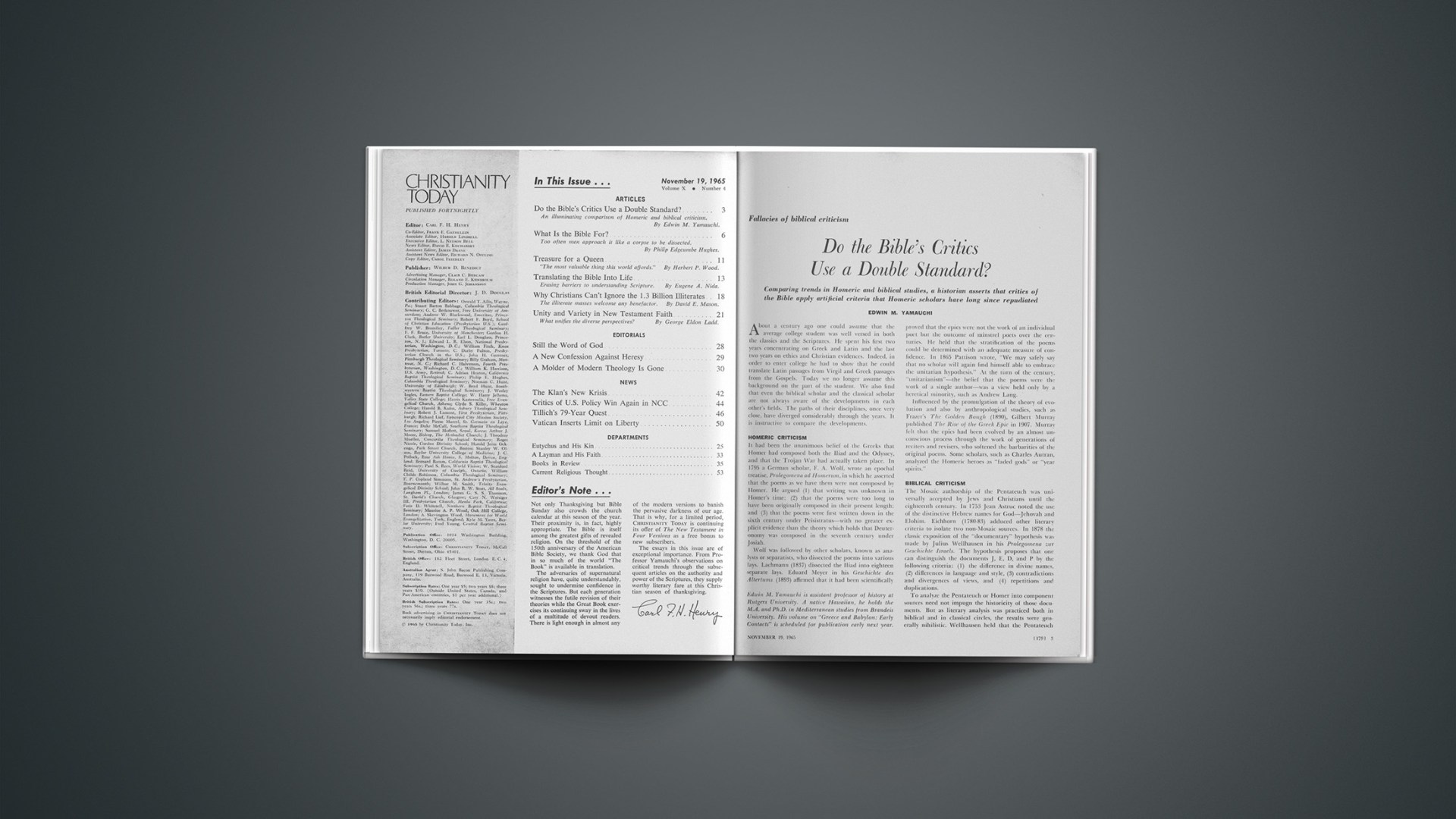
Do the Bible’s Critics Use a Double Standard?

An illuminationg comparison of Homeric and biblical criticism

Comparing trends in Homeric and biblical studies, a historian asserts that critics of the Bible apply artificial criteria that Homeric scholars have long since repudiated

About a century ago one could assume that the average college student was well versed in both the classics and the Scriptures. He spent his first two years concentrating on Greek and Latin and the last two years on ethics and Christian evidences. Indeed, in order to enter college he had to show that he could translate Latin passages from Virgil and Greek passages from the Gospels. Today we no longer assume this background on the part of the student. We also find that even the biblical scholar and the classical scholar are not always aware of the developments in each other’s fields. The paths of their disciplines, once very close, have diverged considerably through the years. It is instructive to compare the developments.

Homeric Criticism

It had been the unanimous belief of the Greeks that Homer had composed both the Iliad and the Odyssey, and that the Trojan War had actually taken place. In 1795 a German scholar, F. A. Wolf, wrote an epochal treatise, Prolegomena ad Homerum, in which he asserted that the poems as we have them were not composed by Homer. He argued (1) that writing was unknown in Homer’s time; (2) that the poems were too long to have been originally composed in their present length; and (3) that the poems were first written down in the sixth century under Peisistratus—with no greater explicit evidence than the theory which holds that Deuteronomy was composed in the seventh century under Josiah.

Wolf was followed by other scholars, known as analysts or separatists, who dissected the poems into various lays. Lachmann (1837) dissected the Iliad into eighteen separate lays. Eduard Meyer in his Geschichte des Altertums (1893) affirmed that it had been scientifically proved that the epics were not the work of an individual poet but the outcome of minstrel poets over the centuries. He held that the stratification of the poems could be determined with an adequate measure of confidence. In 1865 Pattison wrote, “We may safely say that no scholar will again find himself able to embrace the unitarian hypothesis.” At the turn of the century, “unitarianism”—the belief that the poems were the work of a single author—was a view held only by a heretical minority, such as Andrew Lang.

Influenced by the promulgation of the theory of evolution and also by anthropological studies, such as Frazer’s The Golden Bough (1890), Gilbert Murray published The Rise of the Greek Epic in 1907. Murray felt that the epics had been evolved by an almost unconscious process through the work of generations of reciters and revisers, who softened the barbarities of the original poems. Some scholars, such as Charles Autran, analyzed the Homeric heroes as “faded gods” or “year spirits.”

Biblical Criticism

The Mosaic authorship of the Pentateuch was universally accepted by Jews and Christians until the eighteenth century. In 1753 Jean Astruc noted the use of the distinctive Hebrew names for God—Jehovah and Elohim. Eichhorn (1780–83) adduced other literary criteria to isolate two non-Mosaic sources. In 1878 the classic exposition of the “documentary” hypothesis was made by Julius Wellhausen in his Prolegomena zur Geschichte Israels. The hypothesis proposes that one can distinguish the documents J, E, D, and P by the following criteria: (1) the difference in divine names, (2) differences in language and style, (3) contradictions and divergences of views, and (4) repetitions and duplications.

To analyze the Pentateuch or Homer into component sources need not impugn the historicity of those documents. But as literary analysis was practiced both in biblical and in classical circles, the results were generally nihilistic. Wellhausen held that the Pentateuch does not give us any historical information about the patriarchal period, but only data about the later monarchial and post-exilic times during which the documents were prepared. It has likewise been argued that the Greek epics tell us not about the time of the Trojan War but only about the later Ionian period of their composition.

Wellhausen was guided in his reconstruction by a concept of the evolution of Israel’s religion that has long since been abandoned. He held that true monotheism was developed only in the eighth century by the prophets. As in Homeric studies, attempts were made to explain various Old Testament personalities as “faded gods” or “astral deities.”

Homeric Archaeology

For most scholars in the nineteenth century, Greek history began with the First Olympiad in 776 B.C. Homer’s tale of a war with Troy in the thirteenth century B.C. was simply fiction, or at best a legend. It was against this background of skepticism that Aegean archaeology was born with the spectacular excavation of Troy in 1870 by Heinrich Schliemann. Schliemann had a naïve faith that the Trojan War had indeed taken place. After amassing a fortune in Russia and in the United States, he fulfilled his lifelong ambition to excavate Troy. Confounding the skeptics further, he laid bare the rich remains of the civilization at Mycenae on the Greek mainland. In later classical times Mycenae was an unimportant city; Homer had claimed that it was the center of a wealthy civilization. “This too was surely a fable; few believed it.”

Homer had described the sack of Troy. Subsequent excavations at Troy by Carl Blegen of the University of Cincinnati between 1932 and 1938 showed that Troy VIIA (1300–1250 B.C.) was indeed destroyed by fire. Schliemann had mistaken Troy II (2500–2200 B.C.) as Priam’s Troy because of the fabulous gold items found at this level. Homer had spoken of the invaders as Achaeans, i.e., mainland Greeks we now call Mycenaeans. Abundant material evidence, especially pottery, has been found that points to widespread Mycenaean trade throughout the Mediterranean, particularly between 1400 and 1200 B.C. Furthermore, contemporary Hittite documents have been discovered that describe the activities of the Achaeans, called Ahhiyawa, on the west coast of Asia Minor at the time of the Trojan War. In 1952 Michael Ventris, a young British architect, deciphered Linear B, a script used at Knossos on Crete and on mainland Greece from about 1450 to 1150 B.C., as Mycenaean Greek. Among the names found in Linear B are some fifty Homeric names, including the equivalents of Achilles, Ajax, and Hector.

Among the numerous objects in the Homeric epics which were once held to be anachronisms by critics but which have been shown to be authentic, we may simply cite the bronze “breastplate.” Homer constantly refers to the bronze greaves (shinguards) and breastplates (or corslets) of his heroes. Many writers have held that these are references to hoplite armor, which developed after 700 B.C. In 1950 Miss H. L. Lorimer wrote a comprehensive work, Homer and the Monuments, gathering all the archaeological data then available. She wished to delete the lines that mentioned bronze corslets as late interpolations, because no known corslets of that date had been found. Just a decade later in 1960 the Greco-Swedish expedition at Dendra recovered bronze greaves and a bronze corslet of the Mycenaean period.

Biblical Archaeology

Since the first excavation in the Near East in 1842 by Paul-Emile Botta at Nineveh, a great mass of texts and materials has appeared, confirming the authentic nature of the biblical traditions. To take one example, the memory of the Hittites, with the exception of biblical references, was completely lost until late in the nineteenth century, when A. H. Sayce proposed the identification of certain inscriptions in Syria as Hittite. In 1906 Hugo Winckler excavated the Hittite capital of Boghazköy and recovered several thousand Hittite texts, among which was the Hittite Code. Provisions of this code illustrate Genesis 23, which describes the purchase of the cave of Machpelah by Abraham from Ephron the Hittite. Verse 17 makes prominent mention of “all the trees which were on the field,” in accordance with Hittite business practice, which consistently listed the exact number of trees with each sale of land.

Coming from the fifteenth century B.C., the 10,000 texts from the Hurrian (biblical Horite) city of Nuzu in northern Mesopotamia have given us much corroborative information on the patriarchal period. As in the case of Abraham and Eliezer, a childless couple at Nuzu could adopt a servant to look after them and to inherit their goods. If, however, the couple had a child later, they could set aside the adopted party. As in the case of Sarah and Hagar, a barren woman was under the obligation of providing her handmaid to produce a son. And as with Jacob and Esau, the firstborn at Nuzu was allowed to transfer his privileges.

It is an indication of the authentic character of Genesis that whereas chapters 1–36 betray their Mesopotamian background, chapters 37–50 reveal an intimate knowledge of Egypt, including Egyptian loan words, names, titles, and customs. Joseph was not the first Semite sold into slavery in Egypt. In later periods slaves were usually obtained through conquest, but in Joseph’s time slaves were obtained through purchase. The most important source on Semitic slaves in Egypt comes from a papyrus from 1740 B.C., about the time of Joseph. This had been bought by an American, Charles Wilbour, and was given to the Brooklyn Museum some time after his death in 1896. It was not published until 1953—which reminds us that there are still unread texts in museum basements as well as unknown texts in field sites. The papyrus lists the names of almost a hundred slaves from one household, about half of whom are designated “Asiatics,” i.e. Semites, from Palestine. Among the names are biblical names, including Shp-ra, which is the same as Shiphrah, one of the midwives in Exodus 1:15 (a name which Martin Noth, writing in 1928, considered fictional).

Reappraisal In Homeric Studies

In the twentieth century we have seen a return to a more positive appreciation for the historic elements in the Greek epics, and also for the personality of Homer and for the unity of the Homeric poems. Victor Bérard wrote in 1931 (Did Homer Live?, p. 10), “In the last twenty years, we have seen Homer coming into his own again.… I have known the time when the last absurdity for the student of Homer was to believe in the existence of the author whose works he read.”

In 1921 John Scott’s publication of The Unity of Homer marked the turning of the tide in favor of the Homeric authorship. Writing in 1952 (The Poet of the Iliad, p. ix), H. T. Wade-Gery could comment, “My main assumption, that Homer wrote the Iliad substantially as we have it, is now almost fashionable.” Many Homeric scholars today believe not only that the Iliad and the Odyssey are basically unitary, but also that the same poet composed both works. They explain the differences between them by the differences in subject matter and by assuming that the poet composed the Odyssey some years later than the Iliad.

The greatest advance in Homeric studies has been the demonstration by Milman Parry (1930) that the Homeric epics were orally composed. He pointed out the economy of repeated phrases and lines in the epic: in some 28,000 lines there are some 25,000 repeated phrases. This he explained to be the result of the oral poet’s method: he composes as he recites, not from words, but from metrical phrases that he knows by heart. Parry and his disciples further proved their point by going to Yugoslavia and other areas where poets still compose in such a manner. Contrary to Wolf’s conviction, Parry found that an oral poet can compose unified songs as long as the Iliad without any difficulty. The assumption of oral composition explains the inconsistencies in the epics better than the theory of multiple authors and incompetent editors.

After the destruction of the Mycenaean civilization by the Dorians in 1200 B.C., Mycenaean writing (Linear B) apparently disappeared—as far as extant evidence shows. Thus any accurate memory of the Mycenaeans had to be transmitted orally to the time of Homer. Most scholars would place Homer in the eighth century B.C.—the period in which the Greeks borrowed the alphabet from the Phoenicians. They would maintain that the epics were composed orally but that soon afterward they must have been written down to preserve such long poems in their canonical form. Our first extant examples of alphabetic writing from Greece are already in dactylic hexameter—the verse form of the Iliad and the Odyssey.

Reappraisal In Biblical Studies

The twentieth century has also seen a return to a positive appreciation of the historical elements in the biblical traditions. It is true that some brilliant men in other fields do not seem to be aware of these developments. As late as 1944 Bertrand Russell wrote, “The early history of the Israelites cannot be confirmed from any source outside the Old Testament, and it is impossible to know at what point it ceases to be purely legendary” (cited by Harry Orlinsky, Ancient Israel, p. 6). Most biblical archaeologists, however, are now convinced of the substantive, historical accuracy of the biblical traditions. W. F. Albright wrote in 1956 (From the Stone Age to Christianity, p. 2), “Turning to Israel, I defend the substantial historicity of patriarchal tradition.… I have not surrendered a single position with regard to early Israelite monotheism but, on the contrary, consider the Mosaic tradition as even more reliable than I did then [1940–46]” (cf. W. F. Albright, “Toward a More Conservative View,” CHRISTIANITY TODAY, January 18, 1963, pp. 3–5).

Yet with but few exceptions (e.g., Cyrus Gordon, “Higher Critics and Forbidden Fruit,” CHRISTIANITY TODAY, November 23, 1959, pp. 3–6, and Umberto Cassuto, The Documentary Hypothesis) most biblical scholars have not abandoned the documentary hypothesis. The analysis into written documents has been abandoned by a group of Scandinavian scholars (Nyberg, Nielsen, Engnall, and others) for an analysis into various literary forms. These scholars lay great stress on oral tradition in connection with cultic celebrations. Unlike the case of Homeric traditions, the evidence from contemporary Egyptian and Babylonian practices points to the priority of written traditions over oral transmissions. Even lowly workmen at tomb sites at Thebes and mines in Sinai were literate and used writing for both secular and religious purposes.

Conclusions

From our survey of trends in classical and biblical studies we would make three observations:

(1) Artificial criteria of consistency, logic, and style have been imposed upon the ancient documents without an empirical study of contemporary literatures. In Homeric studies this fault has been corrected by a study of Yugoslav and modern Greek poetry, which seems analogous in composition to the ancient epics. Unfortunately very little comparative work has been done in the literary criticism of Egyptian or Mesopotamian texts to guide biblical critics.

If the criteria used to establish the documentary hypothesis were transferred to the study of other Near Eastern literatures, we would see that many of the criteria would not be valid. For example, were we to apply the criterion of different names (and words) as indications of different documents, we would have to postulate multiple authorships for works that are transparently unitary. Even the mixture of dialectal forms can give little certain evidence of authorship. Albright warns against drawing any conclusions from the dialectal mixtures in Homer—a point no less true for biblical texts—by pointing out that both the Babylonians and Egyptians deliberately employed a mixture of dialects in a given document. “Under such circumstances, it is quite impossible to infer anything about authorship from composite language” (“Some Oriental Glosses on the Homeric Problem,” American Journal of Archaeology, Vol. 54, 1950, p. 163). Further empirical studies of Near Eastern literatures are thus needed to provide sound criteria to replace the arbitrary ones of the regnant documentary hypothesis.

When we turn from composition to corroboration, we find that we have more objective controls to guide us. There are, however, limitations involved in the use of such data, which are not always recognized. (2) Time and again a negative construction has been placed on an element in a tradition because there has been no external corroboration for it. This underestimates the fragmentary nature of survivals and the relative paucity of excavations undertaken to recover what has survived. Just a fraction of the works of even the major Greek dramatists has survived. Of more than eighty plays written by Aeschylus, only seven have survived. We have even less from the lyric poets. To my knowledge we have not recovered any musical instruments from Palestine: but this certainly does not prove that Israel did not have such instruments. As a leading archaeologist recently stated, only 2 per cent of the known sites in Palestine have been excavated up to now. One should be very chary about making dogmatic, negative statements from silence.

(3) Finally, there are still critics who, given corroborative archaeological evidence, say that the evidence is not completely convincing. Moses Finley, for example, has recently argued that Troy may well have been destroyed by northerners rather than by Greeks (“The Trojan War,” Journal of Hellenic Studies, Vol. 84, 1964, pp. 1–9; cf. the rebuttal by J. L. Caskey, G. S. Kirk, and D. L. Page on pp. 9–20). Martin Noth has likewise suggested that the Palestinian cities (Bethel, Lachish, Debir) could have been destroyed by the Philistines and not by the Israelites. (cf. John Bright’s criticism of Noth’s skepticism in Early Israel in Recent History Writing, p. 54). To demand, as does Finley, confirmation in writing of the Greek presence at Troy, and to ask for similar, irrefutable proof, as does Noth, is to overestimate the demands that can properly be placed on archaeological evidence—evidence that is circumstantial in nature, often fortuitous in discovery, and always but partial in survival. Finley has argued that “all statements of the order of Professor Blegen’s ‘the traditions of the expedition against Troy must have a basis of historical fact’ are acts of faith not binding on the historian.…” To reject the testimony of the traditions and the corroborative evidences of archaeology for a purely hypothetical reconstruction is to substitute an alternative that demands not only great ingenuity on the part of its sponsor but on the part of others even greater “faith” than to trust the traditions themselves.

Editor’s Note from November 19, 1965

Not only Thanksgiving but Bible Sunday also crowds the church calendar at this season of the year. Their proximity is, in fact, highly appropriate. The Bible is itself among the greatest gifts of revealed religion. On the threshold of the 150th anniversary of the American Bible Society, we thank God that in so much of the world “The Book” is available in translation.

The adversaries of supernatural religion have, quite understandably, sought to undermine confidence in the Scriptures. But each generation witnesses the futile revision of their theories while the Great Book exercises its continuing sway in the lives of a multitude of devout readers. There is light enough in almost any of the modern versions to banish the pervasive darkness of our age. That is why, for a limited period, CHRISTIANITY TODAY is continuing its offer of The New Testament in Four Versions as a free bonus to new subscribers.

The essays in this issue are of exceptional importance. From Professor Yamauchi’s observations on critical trends through the subsequent articles on the authority and power of the Scriptures, they supply worthy literary fare at this Christian season of thanksgiving.

The Scriptures as Creed

By way of Introduction let me say that in the United Presbyterian Church there is considerable discussion all across the United States on the new “Confession of 1967.” This discussion is being pursued on a very high level. Professor Edward A. Dowey, who is chairman of the committee that studied seven years to bring the confession into being, has made himself available for all kinds of church groups and has presented the findings of his committee in a very positive, open, pleasant manner. Polemics has been at a minimum, and the church is making a serious and profitable study of its creedal position.

CHRISTIANITY TODAY is an interdenominational publication, and the interests of one denomination are not necessarily the interests of other Protestant groups in the United States, to say nothing of those in other lands. My justification for here discussing the confession of one denomination in the United States is that what happens in this confession will, I believe, have great influence on other denominations both here and abroad.

A fifteen-member study committee plans to meet with some regularity between now and the next General Assembly, which will be in May, 1966. The purpose of this committee is to review the questions and criticisms in regard to the confession and to be ready to make recommendations in agreement or disagreement with the findings of the original committee at assembly time. What happens at that General Assembly in 1966 will determine the nature of the material on which the Presbyterians will vote at the assembly of 1967.

So far material that has come to the committee of review is beginning to take shape around certain general questions, and it is probable that what will happen between now and next May has been indicated by what has already appeared. Perhaps the most serious study group is one called Presbyterians United for Biblical Confession. More than one thousand ministers are already related to this organization, and their number is growing. A meeting is planned in Chicago in November, and by that time members of the group will be ready to decide either (1) that they oppose the new confession outright; or (2) that they believe it can be revised according to their lights; or (3) that it should proceed to a vote of the presbyteries as it now stands. If the Presbyterians United for Biblical Confession should decide that the proposed confession as it now stands ought to be discarded, they would feel under some duress to offer a substitute. Meanwhile a series of meetings is being held in every possible presbytery. Printed materials are being released and speakers are being made available. The approach of Presbyterians United matches Professor Dowey’s approach with the same good spirit.

One of the repeated questions is this: Though the new confession is supposed to be relevant to our day, and, therefore, clearly expressed in the language of our clay, can it really be said that the confession is clear? I do not believe it can. There is a certain ambiguity of language throughout the confession that seems to be as confusing to the lay men of 1965 as the traditional Westminster Confession supposedly is. Language does, of course, change over the years; but unless a man is schooled in what has been going on in modern theology, he will find it difficult to sort out what the new confession really says and means. The few meetings that I have attended, and on occasion participated in, have illustrated how difficult it is for ministers and laymen, trained theologians and tyros, to agree on the meaning of the confession itself apart from any parallel discussion about the meaning of Westminster.

What needs to be clarified most, however, it seems to me, is the relation between the new confession and the so-called Book of Confessions. By the Book of Confessions is meant that whole body of creedal statements and confessions leading up to and including Westminster which can be looked upon as part of the Reformed tradition. Are we to believe that Westminster, rather than being definitive of the Reformed tradition, is merely one like all those confessions that preceded it? More to the point is this question: Are we to accept the Book of Confessions and the new confession, or are we to accept the Book of Confessions except where changed or corrected by the “Confession of 1967”? When a man calls himself a Presbyterian (theologically), just what does he use to define what he is? Are there any differentia in Presbyterianism? And, if so, do (hey lie in the new confession, or in Westminster as revised by the new confession, or in the whole mass of creeds as revised by the new confession?

Another question rises out of this. Can it be said that in the new confession there is a definite departure from the Reformed tradition? It seems to me that there is, and it rests primarily in three places: (1) the overemphasis on the humanity of Christ as against his deity; (2) the emphasis on reconciliation as the proper center and thrust for our day; and, (3) the description of Scripture as “normative” or “authoritative.”

It is this last note that seems most clearly to change the direction of the thinking of modern Presbyterianism as against its own tradition. The phrase “only infallible rule of faith and practice” is certainly not covered by the word “normative.” Although all can agree that the Word is Jesus Christ, the question does not rest there; it rests on the Bible as the Word giving us authoritative material on Christ as the Word.

The Westminster confession is plain and strong at the very outset of the confession, whereas the new confession has certain ambiguities. Such a truth as reconciliation rests on the authority of Scripture; but when the new confession comes to discuss Scripture, we are treated to a Barthian position of the Word with certain overtones of Bultmann and Tillich. Even though reconciliation rests on Scripture, Scripture itself when it is treated as a topic in the new confession seems to have authority only after one has swept away the inherent weaknesses of the men and the cultures from which it has arisen. A Bible used in this fashion becomes a highly personal existential experience, making it almost impossible for a church as a church to come to general agreement on what it means. Can we, for example, agree on the strong statement of reconciliation when it has become everybody’s game as to what the Scripture means out of which reconciliation arises? If, as the new confession suggests, we need the guidance of authoritative scholars, is the choice of our guides a highly subjective one?

We usually think of a creed or a confession as man-made and therefore subject to constant change. This is why a reformed church must keep reforming its creeds and confessions. Well and good, but one last question. Does the new confession treat the Bible as being itself nothing more than a creed—man-made, shifting according to personalities and cultures, relevant to its own time, and requiring new treatment for a new day? Have we, indeed, made a creed out of the Scriptures?

Will Southern Baptists Hold the Church-State Line?

“The rural Baptist church once sat at a crossroad village and neither the church nor the farmers and villagers who were its members received any aid from the government. Now that little church sits on a fine farm-to-market road paid for by state and federal funds, is lighted by REA electricity subsidized by the federal goverment, probably also has a telephone service similarly subsidized by the federal government, and depends for its support upon the tax-exempt tithe which the farmers derive from the government crop supports and subsidies.”

In these picturesque terms President Abner V. McCall of Baylor University describes the current predicament of Southern Baptists, who traditionally have made up the biggest resistance movement to U. S. government encroachment upon religious affairs. This fall, the question of what federal funds ought to be taken by fifty colleges related to the Southern Baptist Convention has raised what some call the hottest issue for the denomination in a generation. The battle is being waged in state conventions and denominational publications and in special hearings and seminars from Florida to California.

McCall and other key Southern Baptist educators are now pressing for a substantial share of the $5 billion the federal government invests in education annually. But many of the denomination’s pastors and influential editors oppose additional involvement in public funds and regard college aid as a crucial place where the line should be drawn. Southern Baptist Convention officials have not yet taken sides officially but are beginning a comprehensive, two-year study. The findings “will be advisory to the state conventions and to the boards of trustees controlling the schools,” according to an SBC spokesman.

The issue is bound to be intensified by the higher education bill Congress sent to President Johnson October 20. It is a massive affirmation of federal aid to college education.

It includes a dozen forms of aid, such as: direct scholarships for needy students, payments to needy students for part-time work ($129 million next year alone), doubling of authorizations for building college classrooms, library aid, and special federal backing for small, struggling colleges. Most of the latter is expected to go to Negro colleges in the South.

But the Baptist tug-of-war preceded passage of this bill. Helping to precipitate it was Furman University’s acceptance of a $611, 898 federal grant for construction of a science building. That development prompted the General Board of the South Carolina state convention to ask for a two-year moratorium on acceptance of federal grants to Baptist institutions.

In North Carolina, a lawyer member of the state convention’s board wondered whether the convention should “turn loose” some of its seven colleges so they could accept construction funds.

In Georgia, the state convention’s education commission recommended that its institutions flatly refuse federal government grants. The recommendation was issued following four hearings across the state to gather grassroots opinion.

In Mississippi, a Baptist college refused to sign compliance with the Civil Rights Act and lost about $200,000 formerly available as aid to students in federal loans.

In Washington, D. C., last month a showdown came at the ninth annual Baptist Conference on Religious Liberty sponsored by the Baptist Joint Committee on Public Affairs.1One of the speakers was U. S. Commissioner of Education Francis Keppel, who has an eighteen-year-old daughter attending Methodist related Centenary College in Shreveport, Louisiana, where classes open with prayer and six hours of Bible and religion are required. Southern Baptist voices were prominent, and one observer said of the aid question: “There was no doubt about this being the hot spot of the conference.” The final session of the three-day conference brought out intensive feelings, with some participants on the edge of tears.

In widely circulated Southern Baptist state periodicals, the federal aid debate has been most eloquently expressed in articles by college presidents. Dr. G. Earl Guinn of Louisiana College urges rejection of public money: “How we would extricate ourselves from our entanglement seems to be beyond our present knowledge, but this should be our goal.”

In an article that amounts to a rebuttal, five Southern Baptist college presidents led by Baylor’s McCall insist that “there is no way today for Southern Baptists to avoid some outside control of their colleges, If such controls are intolerable to Southern Baptists, they have no alternative but to abandon completely and wholly the field of higher education.”

The five assert that, like it or not, government aid to church-related institutions is a fait accompli: “The hard decision facing Southern Baptist colleges is whether they are going to refuse to accept the return of some of the tax money paid into the public treasury by their own constituents while they stand aside and watch this tax money used to strengthen other institutions supported by other religious denominations.”

The main issue sidestepped by the five, however, is at what point Baptists should resist further deterioration of the line separating church and state.

McCall et al. acknowledge that aid brings influence and control. But they contend that “it is one of the least-used and most ineffective methods of control.” They point to government licensing power as a more formidable example.

Guinn sees much larger issues. “If the separation of church and state device has done much to preserve religious liberty,” he says, “it has also done much to threaten it. Growing secularism, whose philosophical basis is materialism, has been encouraged by the separation of church and state.… A secular mind has developed in a secular state immunized against religion by secular schools. Many believe this could be a greater threat to religious liberty than the breaches in the wall of separation of church and state.”

Guinn adds, “It is very doubtful that federal aid will make the church colleges greater bulwarks against secularism. To accept it will play into the hands of secular forces.… The great need is not tax support but a rebirth of conviction within our churches as to the indispensability of these colleges to the entire Christian enterprise. What our churches lack is not money but awareness of the seriousness of the plight of our colleges, conviction as to their relevance to Christian missions, and the courage to reshuffle budgetary priorities in order to make them secure.”

Protestant Panorama

Boston University’s School of Theology is planning a major restructuring next fall. A 100-credit-hour master’s degree program will replace the present 90-hour bachelor’s degree course. The new program at the Methodist seminary will stress greater involvement in community affairs and city problems, and will integrate relevant materials from social and behavioral sciences.

Presbyterians in Washington, D. C., are planning a six-month pilot school for laymen who will be sent overseas in the normal course of their employment. The aim is to inform them about the religions and cultures they will encounter.

Presbyterian Life attributes its loss of 21,150 subscribers this year partly to crusading on civil rights and other social issues. A spokesman said the church is in a turmoil of debate, criticism, and change. The magazine should survive, however; it still has 1,091,393 subscribers.

Miscellany

A worried World Council of Churches commission appealed for “yet another attempt” to resolve the Rhodesian crisis without a revolt of that colony against Britain. The colonial government wants independence on the current basis: rule by the white minority. Britain insists on reform.

The United Nations Commission on Human Rights is to draw up a draft statement on eliminating religious intolerance for submission to the General Assembly next fall.

The Standing Conference of Orthodox Bishops has accepted an invitation from the National Lutheran Council for theological discussions early in 1966.

Canada’s Christian broadcasters are forming a convention and hope to upgrade the quality of their programs. A multi-faceted core of 123 delegates met in Toronto to discuss problems.

After the Taal Volcano’s tragic eruption in the Philippines, missionaries in the evacuation area went to work as 12,000 refugees thronged aid agencies. The Far East Broadcasting Company helped distribute supplies. Evangelicals at aid centers distributed thousands of copies of the Gospel of John.

A fire at the Johann-Ludwig Schneller School in Lebanon destroyed most of the farm harvest, which would have fed 250 students. The institution is successor to the famed Schneller orphanage, begun in Jerusalem in 1860.

Moody Bible Institute has decided to grant bachelor’s degrees to graduates who study two extra years at approved colleges. This recognizes current patterns: nearly two-thirds of Moody’s recent graduates have gone to other schools to earn their degrees. President William Culbertson noted a growing demand for missionaries and other Christian workers with degrees.

The first chapel at the Rockview (Pennsylvania) Prison opened last month. It was built of sandstone prisoners had cut from a mountainside, faced, and laid. Some 400 men were involved in the eighteen-month project.

Personalia

At age 74, an advisor to the Archbishop of Canterbury has converted to Roman Catholicism. Canon George Edward Brigstocke had lived the past four years at Lambeth Palace, examining papers from ordination candidates.

A dozen Methodist ministers may get saddle-sore, but they’re likely to garner some publicity. The twelve plan to ride horseback from their hometowns to the Methodist bicentennial in Baltimore next April. They’ll preach along the road, in the circuit-rider tradition. Among the recruits is seventy-seven-year-old Sumner L. Martin of Greencastle, Indiana.

Maryland’s Court of Appeals overthrew the murder conviction of Buddhist Lidge Schougurow, because jurors had to swear fidelity “in the presence of Almighty God.” Buddhists believe in a moral force, not a deity, and the court said the defendant wasn’t tried by “peers.”

Deaths

PETER H. EEDERSVELD, 55, speaker on the Christian Reformed Church’s “Back to God Hour” (heard on more than 300 radio stations) since its inception; in Chicago, of a heart attack.

JOHN C. EVANS, 75, Episcopal clergyman and longtime (27 years) religion-education editor of the Chicago Tribune; in Chicago.

HENRY D. SIMS, 70, bishop of the African Methodist Episcopal Church; in Philadelphia.

JOHN WALTER DOBERSTEIN, 59, author, former head of the religion department at Muhlenberg College, and homiletics professor at Lutheran Theological Seminary; in Philadelphia.

JOHN J. GRAVATT, 84, former Episcopal bishop of South Carolina; in Lexington. Virginia.

Episcopalians Search for ‘Revitalization’

With a distressing number of seminary faculties adrift on seas of subjectivity, church officials find it increasingly difficult to recruit new clergy. Even lures of generous scholarships are failing to turn up sufficient applicants.

This problem and others have weighed so heavily upon Episcopal leaders that they have persuaded a group of their wealthy laymen to sponsor a major comprehensive study of theological education in the denomination.

The broad hope, according to the Rt. Rev. John E. Hines, presiding bishop of the Episcopal Church, is that “the study will lead to finding new ways of helping to prepare our clergy for more efficient ministry and our laity for better service in meeting new challenges in a changing world.”

“Theological education—the fundamental training for church leadership—requires revitalization.” said Hines.

Underscoring the significance of the study is the Episcopalians’ enlistment of the best-known educator in their ranks, President Nathan M. Pusey of Harvard, to head a special commission to direct the study. Pusey is generally considered a theological conservative. The study is to cover curriculum and financing of seminaries, periodic retraining periods for parish clergymen, theological training for laymen, and teaching methods. It is expected to take two years.

The sponsor is the Episcopal Church Foundation, an organization of key business people who provide the denomination with special financial support. Foundation directors include Edmond du Pont of Wilmington, Delaware, Harvey S. Firestone, Jr., of Akron, Ohio, and John R. Kimberly, of Neenah, Wisconsin.

Announcement of the study appears in the November issue of the Episcopalian, official denominational organ, which also notes that the clergy in the Episcopal Church in the United States increased from 9,545 in 1963 to 9,789 in 1964, but that the number of clergy in parish work dropped during the same period from 7,130 to 6,490.

Total baptisms also showed a decline, despite an increasing over-all membership.

One article pointed out that the Episcopal Church is the only major communion without a department of evangelism. It suggested that although “everything that is now being done under the leadership of the Executive Council is evangelistic concern,” other communions realize that “what is everybody’s business is nobody’s business.”

How much such concerns will engage the attention of the study commission is anyone’s guess. If rank-and-file church members get any voice, however, a whole parade of radical theologies may become a major issue. In some circles, denominational theologians seem to be playing can-you-top-this heresy game that makes the controversially liberal Bishop James A. Pike look like a fundamentalist.

Until recently, the new morality theologians headed by British Bishop John Robinson had been riding the biggest publicity wave, with their denial of fixed ethics. Now this love-is-decisive camp is being crowded by an interdenominationally elite cadre seeking to revive Nietzsche’s well-worn dirge, “God is dead.”

Such funeral strains are expected to prompt a fresh outcry of protest from laymen upon whose benevolence “Christian atheist” speculators indirectly depend. One leading lay churchman calls their theology “the most blasphemous idea ever perpetrated in the name of Christianity.”

Mutiny In The Diocese

In a Milwaukee showdown between the Roman Catholic diocese and the Negro civil rights movement, several priests and nuns decided against the church hierarchy.

Auxiliary Bishop Roman R. Atkielski, who is running the Milwaukee archdiocese while Archbishop William E. Cousins is in Rome, flatly prohibited fifty of his priests and nuns from setting up “freedom schools” during a public school strike.

Most gave in, but an estimated dozen priests and twenty-five nuns insisted on serving in schools providing education while Negroes boycott public schools they charge are segregated.

The bishop said the rebels faced “ecclesiastical consequences,” which will be up to the archbishop when he gets back from the Vatican Council.

The vice-chairman of the boycott-backing Milwaukee United School Integration Committee is the Rev. James E. Groppi. His parish bowed to the bishop, but on the first day of the boycott Negro children showed up anyway. He ended up leading them in freedom songs and a history lesson. But he and other priests eventually gave in, and the boycott failed after three days.

On October I, twenty-seven priests had signed a statement supporting the boycott because the school board had failed to discuss the situation. The board contends any racial separation in schools results from housing patterns, not school boundaries.

In nearby Chicago, the nation’s biggest fight against “de facto segregation” suffered a severe setback when social idealism bumped into political realities.

The U. S. Office of Education put $32 million in federal aid on ice, for reasons similar to those of the Milwaukee protesters. But the smoothly humming machine of Democratic Mayor Richard J. Daley didn’t like it, and—according to Washington observers—fellow Democrat Lyndon B. Johnson couldn’t sit idly by with a friend in need. In a brisk about-face, the education office released the money. Angry columnists pointed out that the education office had no trouble in applying economic sanctions to Southern schools.

Half of Chicago’s students are Negroes, and civil rights groups claim 90 per cent of these attend segregated schools. Milwaukee is 10 per cent Negro, a low percentage for America’s eleventh-largest city. Of its 148 public schools, 25 enroll 81 per cent of the nonwhite pupils.

Cover Story

Quiet Revolt in Gospel Music

Should a church musician perform what he considers good music or what the people in the pews want?

The musician is the man in the middle. He’s “torn apart,” in the phrase of Don Hustad, who, as a member of Billy Graham’s crusade team, is one of America’s most-heard organists.

There are two extremes, he says: those who judge music only by artistic ideals and those who aim only at the desires of the listener. “The two crowds are at each other’s throats constantly.”

Many music directors face pragmatic pressures: the sort of music they prefer is beyond the singing abilities of their choirs and congregations. Either they do poor music well or they do good music poorly. Besides this, what they consider worshipful may not mean much to the laymen.

Such artistic tensions hit hardest at evangelical churches, which often have small budgets, informal worship, and a tradition of entertainment-styled music. A growing core of trained musicians hopes to educate evangelicals away from their musical past.

Hustad is a leader in a key educational effort, the National Church Music Fellowship. Its program for small evangelical denominations and independent churches and colleges parallels that of mainline denominational efforts. Yet NCMF, which was fourteen years old at its convention last month in New York, predates such groups as the National Fellowship of Methodist Musicians and the Lutheran Society for Worship, Music and the Arts.

Hustad contends that these music societies are part of a renaissance in church music which has been taking place since World War II and which is the most important development in the professional music world. Other evidence: the growth of church music as a fulltime, lifetime vocation; better college courses; more music written and more written about music.

There are some crazy crosscurrents today in religious music. Some Christians seek to regain the lost heritage of ancient music, while others want immediacy with society through such means as current folk music. While evangelicals try to banish the influences of popular music, liturgical churches experiment with jazz in worship.

At the NCMF convention, the style of gospel music common in the constituency got short shrift. These comments from monographs in NCMF’s new publications program reflect the unrest among the leaders:

“Why is the Church so often the haven of the banal and the home of the tawdry?” asks Harold M. Best, music professor at Nyack Missionary College. “By what distorted decree of the human spirit must the glory of Christ be pitifully squeezed into the dry-rotted skins of a withered vocabulary?”

Lee Olson, chairman of Nyack’s sacred music division, contends that “the gospel hymn melodies call too much attention to themselves and not enough to the text.… This humanization of the gospel hymn is only a reflection of the spiritual state of the evangelical church.”

The NCMF president, Alfred E. Lunde of Philadelphia College of Bible, issued a stinging attack on the entertainment cult among gospel music publishers and record companies. Publishers justified this as an economic necessity (see the following story).

The NCMF ran anthem and music essay contests this year but considered none of the entries worthy of an award. This led Houghton College’s Charles H. Finney to remark that many evangelical composers are “technically incompetent … not up to the average of our more liberal friends.…”

Changes are due. Nyack has become the first Bible school with a fully accredited music school. Moody Bible Institute was on the road to professional standards when Hustad left as chairman, reportedly because administrators feared too much of a break with tradition and possible de-emphasis of Scripture courses.

Hustad, who sidesteps comment on that situation, is now advising the blonde, energetic Lunde and his colleagues, who plan on pioneering a five-year music degree with a core of Bible courses at Philadelphia.

Lunde thinks a critical soft spot is ministers’ attitudes. He says he never heard a word about music during four years in seminary. The problem is widespread. An NCMF survey of seminaries accredited by the American Association of Theological Schools showed dozens offer no courses in music.

The NCMF is growing but with 488 members cannot be called strong, and leaders fear they’re not getting through to the local church. Similarly, the Methodist music fellowship has 1,750 members, but there are 39,000 Methodist congregations. At this summer’s convention, a cry went out for a Methodist music leader—if not a fulltime professional—for each congregation.

One of NCMF’s strengths is the variety among its members. Lutheran and Regular Baptist listened with equal interest as an Alliance speaker discussed the importance of liturgical revival.

Music has proved an important ecumenical meeting point. The 2,500-member Lutheran society was one of the first cooperative ventures among the Lutheran Church in America, Missouri Synod, and American Lutheran Church. New President Paul O. Manz of St. Paul said the society plans a series of intensive, one-week courses in various cities this year to help church musicians brush up.

Another seminar for church musicians was held late last month at Louisville’s Southern Baptist Theological Seminary. The Southern Baptists have one of the largest denominational music efforts (see “Revolution in the Choir Loft,” News, March 27, 1964).

Similarly, the Episcopalians’ graduate-level College of Church Musicians in Washington, D. C., sponsored a two-day seminar the same days NCMF met. The college itself is significant, Now beginning its fourth year, it is the only school in America designed for the church organist and choirmaster. The select student body of fifteen includes eight non-Episcopal students.

In all this activity and change, some leading musicians want to preserve a place for the gospel song. One is the young dean of Baltimore’s famous Peabody Conservatory. Ray E. Robinson. Baptist Robinson edits NCMF’s smart new Dimension quarterly. He spent a decade in Youth for Christ music, where he said the programmers’ motive was entertainment, not worship.

The gospel song should have a role in evangelism, he said, and is “appropriate whenever people tell people what the Saviour has done for them, in good taste, as an outgrowth of worship.”

“You draw your own kind,” he concluded. “Christ, presented superficially, attracts superficial people.”

Hustad, who holds a doctorate in church music from Northwestern University, would agree. In his present job he faces these problems head-on. He admits many songs at Graham crusades do not satisfy him artistically, but he gets “vicarious pleasure” from seeing their effect on others.

The big-framed, congenial organist thinks that the “highly specialized” crusade music should he no “measuring stick” for church programming. “It is spiritually unhealthy to dote on my experience with Christ all the time. Me, me, me! We must exalt the excellencies of Christ also.”

But Hustad does not want to see gospel music traditions neglected, as he believes Southern Baptists are doing. “If we believe in a personal experience with God, it has to he expressed,” he said. Though “untutored, in artless words,” the gospel song can be meaningful, as well as being true folk music.

The gospel songs of recent decades, he fears, have sapped emphasis on hymns to such an extent that congregational singing and hymn-writing have suffered. “This is a negative symptom of revivalism,” he said. “When the Church prospers spiritually, there is a great flowering of song.”

Motives For Music Publishers

“We’re not real proud of everything we publish,” confessed a religious music salesman, but his company can’t take a chance on anthems the highbrows want.

“The people in the sticks couldn’t do them, and the people in the audience in the sticks couldn’t appreciate them,” Lorenz’s Eugene McCluskey told members of the National Church Music Federation during a publishers’ panel (see story above). He said Lorenz is in business to sell to the mainstream, not form tastes.

“A brutal business,” lamented his colleague, Robert J. Hughes. He said Lorenz and two other publishers represented at the conference, Hope and Rodeheaver, had bought out other houses that went broke trying to sell what people ought to sing, rather than what they will sing.

Music just for music’s sake is “vanity,” hence “unchristian,” he added. “You can’t tell people how to worship.”

The sales vs. quality debate seethes away, not only in music but also in book publishing and other trades. But some take a different view of economies.

Donald Griffith of Franco Colombo, which publishes mostly contemporary music, asserted: “For music we publish, we must create the demand. It costs very little to publish a twenty-five-cent octavo. The risk is in publicizing it.… We can help to set standards. If we have an experimental number we like, small sales over five years will pay the cost of publishing it.”

Concordia’s E. W. Klammer also took the high road, made easier because his house is part of the Lutheran Church—Missouri Synod. A denominational publisher has a financial cushion if it fails in market competition. This produces some rivalry between church houses and independents. For instance, Lillenas, the Church of the Nazarene publisher, is accused of undercutting independents because it offers anthems at fifteen or twenty cents below what unsubsidized publishers can afford.

Klammer said the starting point in religious music should be “the theology of worship,” not money. He echoed Missouri’s liturgical and historic character in saying music took a “nosedive” after Bach, from which it is still recovering. But he said Concordia is also interested in what men are writing now, since “God is always contemporary.”

“We definitely try to change tastes; not for the sake of change, but for the sake of the Gospel. We publish things we know won’t sell very well.…” He said Concordia favors texts based on the Bible, “not mixed with subjective reactions by the author.”

Wesley Bartlett said Carl Fischer, one of the secular publishing giants, is in business partly to improve public taste, and it consciously prints some popular, low-grade items so it can afford to publish prestige numbers. He advised composers to “have something striking in your music” that will stand out in the mountain of new pieces coming out daily.

Feeling The Draft

Draft-dodging has grown from covert art to organized rebellion during the Viet Nam escalation. The United Church of Christ executive council says the current campaign, which includes public burning of draft cards, subverts the legitimate religious principle of conscientious objection. Groups of sincere religious pacifists fear their cause is being degraded by the come-lately college demonstrators.

The swelling troop commitment overseas has produced a critical need for chaplains. The Pentagon offers no specifics on the number needed, but Army Chief of Chaplains Charles E. Brown, Jr., has asked churches for “several hundred” more new recruits this year.

The Methodist Commission on Chaplains is to double its supply. Normally it provides twenty new chaplains, added to a current Methodist force of 493 on duty.

The National Association of Evangelicals, clearing agency for forty small denominations, has a new quota of ninety, up ten.

After the Fair: Converts and Red Ink

It was the costliest, most-attended fair in history. Some predict it will be the last great fair where industrial giants invest untold millions for elusive publicity gains.

The 51 million who visited the New York World’s Fair were 19 million short of expectations. The general disillusionment and charges of mismanagement dulled the glitter of Flushing Meadow as surely as did widespread pilfering by visitors the last weekend.

On closing day, one group of exhibitors were content with their lot: the religions at this most religious of world’s fairs.

Cardinal Spellman was reluctant to get involved at first, but the Roman Catholic Church scored a smashing box-office coup. It offered, for free, a priceless show: Michelangelo’s world-traveling “Pieta” and other art treasures. The Vatican Pavilion drew half the people who came to the fair. It was second only to General Motors in attendance.

GM’s pavilion cost it $2 per visitor. Although the Vatican had the most expensive religious pavilion, it spent only nineteen cents per head. The posh Christian Science effort cost $1.56 per visitor. The religious pavilions as a whole spent over $13 million to draw 42¼ million people. In Madison Avenue terms, they notched a cost-per-thousand of $315.

The two cults with pavilions at Flushing Meadow, Christian Science and Mormonism, report their experiment in pavilion evangelism paid off in thousands of converts. More modest results were claimed by two Christian evangelistic efforts, Billy Graham’s pavilion and “Sermons from Science.”

The low-budget, low-key Wycliffe Bible Translators presentation gave the fair its foreign missions element. Wycliffe squeezed into the fair after the deadline, and despite some financial strain won unusual notice on TV networks, in the press, and from iconoclastic radio essayist Jean Shepherd.

The four pavilions not backed by a single church depended on donations to break even. Only Billy Graham managed to do it.

The biggest debt was at the Protestant-Orthodox Center, which is behind $250,000, mostly because churches failed to meet pledges.

It is counting on its controversial drawing card, the Parable film, to make up the difference at $35 per showing. Sponsors report more than 5,000 rental requests have come in, nearly half of them from Catholics.

At the fair, the film drew only half a million customers at fifty cents a scat—this despite pre-fair publicity in damnation from fair czar Robert Moses and continued notoriety through a diatribe at the nearby Singer Bowl from youth evangelist Jack Wyrtzen. The free Graham film, twice as long, attracted twice as many customers.

Free shows helped to draw the masses. Location was another key factor. On this score, the Mormon. Protestant-Orthodox, and Billy Graham pavilions had choice sites near the main subway-railroad gate.

Here are the religious results of the fair, as reported by pavilion managers:

BILLY GRAHAM—(Dan Piatt): More than a million saw the film, which called for commitment to Christ. About 5 per cent of the viewers sought counseling, a higher percentage than at most crusades.

Those responding came from fifty-five nations, and follow-up work was often difficult. The usual procedure is to refer the person to a nearby church, but in some cases it was hundreds of miles away. An impressed Catholic priest from Belgium told Piatt he would try to persuade his colleagues to invite Graham for another European crusade.

CHRISTIAN SCIENCE—(Admiral Edward C. Renfro): “The pavilion was one of the finest things the movement has done in many a year. Its effects have been widespread and indeterminable.” The pavilion aimed to explain Christian Science to the outsider, but also succeeded in producing new members (how many, like all membership data, is a state secret).

With the self-assurance typical of his church, Renfro said the pavilion was the “only one which dared mention God and explain who he is, what he is, and what we believe him to be.” The church recently recruited the Protestant pavilion’s Dr. G. B. Rich to praise the beauty of the Christian Science effort in a publicity film.

MORMON—(Bernard P. Brockbank): The pavilion is credited with reaping thousands of converts, more than 1,000 in the New York area alone. The full results can’t be known for years, because it will take that long for Mormon missionaries to contact the backlog of 750,000 persons Brockbank says asked for counseling.

“It changed the attitude toward the church in many parts of the country, especially the Eastern seaboard. They are more tolerant toward the Latter-Day Saints, more ready to make inquiry about us.”

PROTESTANT-ORTHODOX CENTER—(Leonard Moreland): The impact was “excellent,” the attendance higher than expected.

Moreland thought that Parable was provocative but that its symbolism went over the heads of many viewers. One professional fairgoer claims to have seen it 101 times and to have gotten something different out of it each time.

Polls showed Catholics liked the film better than Protestants and Jews liked it more than Catholics. Aside from the film, Moreland questions whether the twenty-two variegated booths at the pavilion did anything more than reinforce the constituencies of their sponsors.

SERMONS FROM SCIENCE—(W. Scott Nyborg): “We are thrilled.… The acceptance by non-Christians was amazing.”

Among the 125,000 who entered the counseling room after the Moody Institute of Science shows, 3,300 indicated decisions for Christ. While most pavilions, and the fair as a whole, drew smaller crowds the second year, “Sermons” audiences were up 35 per cent.

A large corps has contacted decision-makers, in some cases to find Mormons had already dropped by. Many nuns, intrigued by the four-step salvation presentation borrowed from Campus Crusade, asked for copies to present to their Catholic school classes.

VATICAN—(Monsignor John J. Gorman): “It was with some apprehension that the powers-that-be accepted the invitation to the fair. But I’m sure there are no regrets now. We had an opportunity to present the Church, and had good reception from the Protestant, the Jew, and the atheist.…”

WYCLIFFE 2,000 TRIBES—(Francis B. Dawson): “It was definitely worthwhile. We expect it to pay off for ten years or more. We had a chance to meet young folks and counsel them about missions. Many people hadn’t heard about Wycliffe before.” There were some heated discussions with people hostile toward missions, but many left with a different view, Dawson said.

Wycliffe, like most, ended up spending more than it expected, and the gap between cost and gifts for the pavilion is $155,000. All bills have been paid, by shifting funds; but it is the first financial bind of this size Wycliffe has ever been in, and there has been some controversy about it within the organization. The key problem: Wycliffe had planned to charge admission but soon found that if it did this, nobody would come.

Next Stop: Montreal

Flushing Meadow pavilions weren’t even down before eyes roamed to Montreal, site of EXPO ’67.

This next great superfair will feature the most ecumenical pavilion ever, a “Christian Pavilion” offered by Roman Catholics and seven Protestant groups (the latter with 60 per cent of the voting power). No role is currently planned for Orthodox churches.

The man who expects to direct it is Leonard Moreland, 64, lately the associate director of the New York fair’s Protestant-Orthodox Center.

His trim, white moustache nearly bristles in anticipation. “Roman Catholics and Protestants will promote a common purpose for the first time,” he said in his pavilion office during the twilight of Flushing. Moreland nibbled on a 7 P.M. ham sandwich that sufficed for supper. Behind him were charts tracing attendance and, scrawled on the wall, a big black “5” marking days to go.

The trouble in New York, he said, was “a rather abortive feeling of fragmentation … a cacophony of twenty-two exhibits” in contrast to other religious pavilions. Even so, he thinks of New York as a stepping-stone to Montreal, since it was a “pinnacle” in Protestant cooperative efforts.

But when it was over, he said, there was none of the “resurgence” he felt after participating in Billy Graham’s New York crusade.

Moreland predicted the Montreal program “will contain the art and culture of Christianity, and probably a motion picture.” One handicap: the classic Vatican art treasures reportedly won’t be available.

The EXPO umbrella is too wide for some groups, including the Billy Graham Association Moreland praised. It bowed out because it was prohibited from asking for commitments to Christ. But an evangelistic effort at Seattle and New York. “Sermons from Science,” is to reopen at Montreal under the chairmanship of Stanley Mackey.

Christian Science, present at the past two fairs, won’t be at EXPO. Said publicist David Sleeper, “They are presenting Christianity in one voice. We can’t say what our specific message is for mankind.”

Moreland, who is “retired” from Sperry Rand, put in seven long days a week for nearly three years, without pay, at the New York fairsite. But the day after it closed, he hopped a plane for Montreal to help get that show on the road.

Fusion And Feuds

The New York City Presbytery talked it over for an hour, then decided not to endorse John Lindsay for mayor. However, it did everything but. Its election advice, supposed to be read from 119 Presbyterian pulpits, echoed the Fusion candidate’s call for radical change at city hall and urged churches to get “involved” in the campaign.

Young Lindsay has fused Republicans and Liberals in a bold attempt to oust the entrenched Democratic regime and has attracted other ministerial backing. The Rev. Howard Moody of Judson Memorial Church (Baptist-United Church of Christ) is co-chairman of the Democrats for Lindsay movement. Leading Unitarian Dr. Donald S. Harrington said in a recent sermon that New York is a mess, that its citizens should “rise up and demand a decently governed city,” and that the only man who can change things is Lindsay.

But Lindsay could lose the election because of third-party inroads by Conservative candidate William F. Buckley, Jr. Religion became an issue when Lindsay’s Roman Catholic running mate for council president, Dr. Timothy Costello, questioned how good a Catholic Buckley is.

Close on the heels of Pope Paul’s historic trip to New York, Costello said a vote for Buckley November 2 would be anti-Catholic, against church teachings on the United Nations and on treatment of the poor and minority groups.

Costello charged Buckley’s doctrines are a “threat … to peace on earth, to the progress of the nation, the uplifting of our city, and the propagation of the social doctrine of the Catholic Church.” He spoke at Fordham University, from which he has received three degrees.

The deft-tongued Buckley, author of God and Man at Yale and editor of the National Review, replied that he would not “disgrace the Catholic Church by introducing the religions of the other candidates as issues of the campaign.” He also said he would lodge a protest with the Fair Campaign Practices Committee.

“One of the meanings of the Vatican Council is to stress the freedom within the Church, which encompasses men of many political faiths, now as before. If I am a bad Catholic, I shall be punished by Someone I fear far more than the New York Catholic voter.”

But the Catholic voter is worth fearing. He forms the largest religious bloc in a town where election tickets are famous for ethnic “balance.”

The Democratic candidate, Abraham D. Beame, is Jewish, while Lindsay is an Episcopalian. Of the moral issues of the campaign, all three hopefuls agree that crime is a pressing problem for New York.

Both Lindsay and Beame, by far the front-running candidates, have backed legalized off-track betting to help solve the city’s budget headaches. The proposal to give racetrack rakeoffs to the city instead of to bookies has been opposed consistently by the New York State Council of Churches, the Protestant Council of the City of New York, and the most prominent member of Lindsay’s party, Governor Nelson Rockefeller.

Costello’s statement was not the first Fusion bid for Catholic support. In September, Lindsay came out for limited tax assistance to Catholic and other private schools. He said that for now the aid should be carefully meted out to areas with serious overcrowding, to be used for equipment.

Paul’S Visit Revisited

The TV camera settled on a make-believe publicist phoning Pope Paul about the Yankee Stadium mass on the eve of his New York visit:

“… It would be an added attraction if there was an exhibition baseball game beforehand, between the New York Yankees and, in your honor, the St. Louis Cardinals. How does that grab you, Your Holiness?… Exactly. Sort of an ecclesiastical double-header. Now, then, we feel Your Holiness could attract an even larger number of viewers, and, incidentally, win your way into the hearts of every single American, if you would consent to just umpire a few innings of the game.… Why just think: you’d be the first umpire in the history of baseball really and truly infallible.…”

Many of the estimated three million persons who saw this satire on the Canadian Broadcasting Corporation network wondered whether anything was sacred. But the government-owned CBC’s latest quirk of courage enlivened a lackluster election campaign in Canada, where half the population is Roman Catholic.

A Presbyterian member of Parliament, Ralph Cowan, called it an “affront.” The show’s producer said the skit derided the TV industry, not Pope Paul. But the timing was unfortunate: the program followed a showing of the annual “Living Rosary” hour from Toronto, attended by 25,000 of the faithful in another instance of stadium sacrament.

South of the border, the Greek Orthodox archdiocese confirmed Religious News Service’s hunch that the Pope had met under wraps with Archbishop Iakovos in New York. The main topic: purported harrassment of Orthodox believers and Patriarch Athenagoras I in Turkey. Paul reportedly promised support.

Most of the criticism of Paul’s words in the New World focused on his U. N. assault on “artificial” birth control (see CHRISTIANITY TODAY, Oct. 22, 1965).

Blunt E. S. James, retiring editor of the Baptist Standard, was upset at all the free TV network time to cover the Yankee Stadium mass. Senator Claiborne Pell, a Protestant from predominantly Catholic Rhode Island, used the occasion of the visit to call for restudy of America’s policy against diplomatic links with Vatican City.

Cuban Exodus

A new wave of Cuban refugees began flowing into Florida last month, and religious agencies readied plans for relief and resettlement efforts. A mass exodus is expected if the U. S. government completes negotiations with Fidel Castro, who has promised to free thousands of people.

The welcome for the new refugees will not be so warm as that for the Cubans who preceded them to the American haven between 1960 and 1963. So many of that wave—perhaps 420,000—are packed into Miami and other Florida communities that they have burdened schools and hospitals and forced Negro laborers out of unskilled jobs. Even the earlier refugees fear the arrival of the new wave.

Religious leaders are pleading for “Christian compassion.” The Greater Miami Ministerial Association was the first to warn that community feelings were at a dangerous point, and to plead for acceptance of the Cubans. The cause was joined by the Greater Miami Council of Churches and Roman Catholic Bishop Coleman F. Carroll.

The council is ready with “all the practical assistance possible through resettlement, emergency relief, and social services” for the influx. Church World Service reports readiness for help in moving Cubans from Florida to other parts of the nation, and in adjustments necessary after families’ long separation.

Protestants have compiled a backlog of resettlement opportunities; they support a coordinated program for meeting emergency needs in three still-operating refugee centers and in two others that are being reactivated. The Catholic diocese has readied a downtown refugee center with food, medical treatment, and counseling. Nuns will conduct English classes.

ADON TAFT

Billy Graham Convalesces

Ailing evangelist Billy Graham, finding the road to recovery longer than expected, postponed his Houston crusade for a second time. The new dates are November 19–28.

When Graham underwent prostate surgery in early September, the crusade opening was shifted from October 8 to 15. But an infection developed, and physicians ordered him back to bed.

With the longer delay, crusade planners rescheduled a special student service to be telecast to 100 or more colleges and high schools across Texas via an educational channel. Public services will be held nightly in the new Astrodome.

From Switzerland last month came the cheerful news that Graham and his wife had become grandparents for the second time. Their oldest daughter. Virginia Tchvidijian, who is married to a Swiss, gave birth to an 8½-pound girl. The Tchvidijians, who also have a nineteen-month-old son, named the girl Virginia Bergett.

Graham also had encouraging news from London, where a major crusade is scheduled for next June. The Church of England Newspaper, which reflects evangelical views among Anglicans, conducted a poll among its readers and reported an overwhelming majority enthusiastic about the forthcoming crusade. The poll also asked, “Do you believe the Church of England is failing in its evangelistic task?” The result: 573, yes; 54, no.

Book Briefs: November 5, 1965

History With Style

Gospel and Church, by Gustaf Wingren, translated by Ross Mackenzie (Fortress, 1964, 271 pp., $6.25), is reviewed by John Warwick Montgomery, professor and chairman, Division of Church History and History of Christian Thought, Trinity Evangelical Divinity School. Deerfield, Illinois.

Two exceedingly important reasons should impel evangelicals to acquaint themselves in depth with Gustaf Wingren, Anders Nygren’s successor as professor of systematic theology at Lund. First, he gives the sacrosanct giants of contemporary theology the kind of merciless drubbing they deserve for their unbiblical emphases; in this he performs a great service, since the same criticisms expressed by consistent conservatives are either ignored or treated as hopeless obscurantism by the theological establishment. Thus Wingren’s Theology in Conflict, the negative backdrop for his positive construction in Creation and Law, The Living Word, and Gospel and Church, pulled no punches; the Lundensian theology of Nygren was rapped for its philosophical formalism; Barthian neo-orthodoxy was characterized as a system “totally foreign to the Bible” for its refusal to recognize the ontological reality of sin and for its christocentric unitarianism; and Bultmann was hit, unsparingly for his egocentric existentialism. In Creation and Law and Gospel and Church, Cullmann as well receives severe criticism, since his Heilsgeschichte theology “never relates the biblical revelation to the man who hears it.”

In the second place, Wingren offers a strikingly attractive theology of his own—a theology at once biblical and Lutheran in content, yet fully contemporary in treatment. The significance of such an endeavor for English-speaking evangelicals lies chiefly in the fact that the only confessional choices before them so often seem to be the rigid extremes of Arminianism and Calvinism; Wingren points to an option that neither permits anthropocentric works-righteousness nor encourages the hyper-theocentrism from which Barth’s errors sprang. Sensitive evangelical readers of Wingren will be amazed to learn how Lutheran their de facto theology really is!

Wingren’s basic contention, which runs through all four of his volumes, is that modern theology errs by not reading the totality of Scripture as it was intended: first, creation and law; then, Gospel and Church. He roundly condemns Barth’s attempt to reverse the order of law-Gospel to Gospel-law, ant! thereby to absorb all theology into a legalistic Christology. Wingren pleads for a genuinely trinitarian hermeneutic, which he finds rooted in patristic theology (cf. his Man and the Incarnation: A Study in the Biblical Theology of Irenaeus) and in primitive Lutheranism (cf. his Luther on Vocation). The law in Scripture is the starting point for theology, not because it reveals a covenantal polity but because it is a perspicuous expression of the natural law that orders man’s life, condemns him as sinner before God, and drives him to Gospel and Church. As Wingren has argued elsewhere in reference to Calvinistic legalism: “The weakness of the Reformed position undoubtedly lies even today in its difficulties in expressing the inner unity between the gospel and the church” (Stutdia Theologica, XVII [1963], 88). It is this inner unity that Wingren does so much to clarify.

JOHN WARWICK MONTGOMERY

Readable And Relevant

The Reformation (“The Pelican History of the Church,” Volume III), by Owen Chadwick (Eerdmans, 1965, 463 pp., $5.95), is reviewed by Donald J. Bruggink, assistant professor of church history, Western Theological Seminary, Holland, Michigan.

The first thing to strike one about this book is its style! If it is not so baroque as the history of Charles Williams or Ray C. Petry, neither is it the drab parade of basic relations and facts (or even worse, only facts) that characterized too many familiar church history texts. Chadwick’s style has a classic lucidity without being pedantic, austere, or just plain pedestrian. Histories of respectable content are readily available; those that combine such content with an excellent style are far harder to find.

This matter of style is not unimportant, for one finds, even on the post-college level, many people approaching history with severe distaste (born, no doubt, of years of the facts-names-dates-and-places method of teaching history). The least one can do to recapture their interest is to offer an exciting text. Thus the importance of Chadwick’s style. In addition to a faultless command of English prose he is the master of the well-turned phrase (e.g., “the high-minded imprudence of Laud” p. 23) and the succinct description: “Farel was no organizer. The Reformation in Geneva consisted of little but broken statues and more sermons” (p. 82). And his longer descriptions sustain one’s interest: the members of Geneva’s consistory “were pitiless toward merchants who defrauded their clients, denounced short measures, excessive rates of interest, a doctor who exacted high fees, a tailor who overcharged a travelling Englishman.… They attempted to educate the public conscience and somewhat resembled Hebrew prophets, with their courage, their power, and their unpopularity” (p. 86). Even facts are assembled in such a way as to provide an exciting, vivid insight into the times, as, for example, when, discussing the Protestant sermon, Chadwick notes within a few lines the Lutheran city of Rostock, which heard some fifteen hundred different sermons in 1640; Lancelot Andrewes’s epigram “that when he preached twice a day he prated once”; Lutheran funeral sermons that ran for three hours in length; the “humane Melanchthon [who] thought that half an hour was enough” (an opinion also held by Calvin), and “a surviving-hour glass [for pulpit use] which unwaveringly completes its hour in forty-eight minutes” (p. 420).

Because the style of this book makes its reading a pleasure, a word should also be said about its excellent balance and content, although every professional historian will find his favorite segment of history grievously slighted and thus perhaps even a bit distorted. Thus, while Calvin comes off far better than he does in many histories of English origin, yet to see his forte as God’s sovereignty, with the resulting interpretation of predestination under the rubric of Providence, is to move this sovereignty concept from its proper place as a safeguard against the reintroduction of works into his doctrine of grace (a point patently obvious from the position the discussion takes in the Institutes). However, such difficulties are perhaps inevitable in a book that considers the entire Reformation period from 1517 to 1648, and does so in a balanced manner.

The movements of reform under Luther, Zwingli, and Calvin, together with their background, are treated succinctly and well, as is the Reformation in England and the rise of the radicals. While 250 pages have been devoted to this account, another hundred are given to the Counter-Reformation; ignorance of this movement on the part of most Protestants is a factor in their inability to understand the Roman church. The breadth of the book takes in both the Eastern Orthodox Church and the conquistadors in America. To a greater extent than do most authors of general histories, Chadwick has taken cognizance of the importance of ministry and worship; this is so throughout the book, as well as in a special chapter. An excellent bibliography and index are included.

Chadwick’s book is a very live choice for any professor of church history in college or seminary. It is also the kind of book that the casual reader will not only begin but also finish, for it makes history as exciting as the life of Christ’s Church which it rehearses.

DONALD J. BRUGGINK

Can Education Be Christian?

The Search for a Christian Education—Since 1940, by Kendig Brubaker Cully (Westminster, 1965, 205 pp., $4.50), is reviewed by C. Adrian Heaton, president, California Baptist Theological Seminary, Covina, California, and chairman of the Commission on Christian Education of the American Association of Theological Schools.

During the last twenty-five years the changes in theories of Christian education have been more profound than the modifications in practice. This is a major thesis underlying the splendid new volume by Kendig Cully, professor at The Biblical Seminary of New York.

Dr. Cully chooses 1940 as the beginning of a new, expansive period of theorizing in Christian education. In that year, Harrison S. Elliott of Union Seminary in New York published Can Religions Education Be Christian? He raised the basic question whether religious education had to return to “historical formulations of the Christian religion and repudiate the adjustments which had been made under the influence of modern scientific and social developments” (p. 17). Elliott’s answer simply restated the positions of traditional liberalism.

Almost immediately, however, H. Shelton Smith of Duke University published Faith and Nurture. This volume affirmed that responsible Christian education must realign its theological foundations in the light of new emphases in biblical theology and the insights of neo-orthodoxy.

These two volumes opened a new era of search for foundations in Christian education. Dr. Cully now skillfully traces the major books published to help answer Dr. Elliott’s question. He groups the books and authors under eight categories in the next eight chapters. For example, under the heading of “The Continuum” he includes the works of Sophia Fahs, Harry C. Munro, and perhaps L. Harold DeWolf. Reuel Howe and Louis J. Sherrill are listed under “Psychologically-oriented Nurture.” “Education Through Relationship” is expounded by Martin Buber, Randolph Crump Miller, and David R. Hunter. James D. Smart, Iris V. Cully, and D. Campbell Wyckoff are listed under the “Biblical Basis of Nurture.” A chapter dealing with fundamentalism and neo-evangelicalism includes the work of Lois E. LeBar and Frank E. Gaebelein. He has chapters devoted to Roman Catholic writers, to biblical writers, and to those who put an “accent upon the church.”

In the last two sections of his book, Cully reveals some trends that show up in his study and presents an appeal for taking with greater seriousness the “historical dimensions for Christian education.”

The clarity, accuracy, scope, objectivity, and insight with which these many views are covered were impressive to the reviewer, whose own work in Christian education has covered the same period and who has known personally most of the people here treated. The analyses of Howe and Sherrill and the glimpse into Roman Catholic views were especially helpful. This reviewer was also delighted with the overview of the work of Frank E. Gaebelein, co-editor of CHRISTIANITY TODAY. Cully says Gaebelein’s writings “display a high intellectual interest and level of thought obviously designed to interest liberals, neo-orthodox, syncretists, as well as the various types of fundamentalists” (p. 110).

A little of Cully’s bias may be seen in his index, which shows nine references to the Protestant Episcopal Church but none to the Southern Baptist Convention, and none to Southern Baptist religious educators, such as J. M. Price and Gaines S. Dobbins.

C. ADRIAN HEATON

Borrowed—And Trimmed

Worship in the Free Churches, by John E. Skoglund (Judson, 1965, 156 pp., $3.93), is reviewed by Howard G. Hageman, pastor, North Reformed Church, Newark, New Jersey.

The liturgical renewal is now being fully explored by all denominations of classic Reformation tradition, but the attitude of the free churches toward it has been somewhat ambiguous. Many have flatly opposed it, and those in the free church tradition who are sympathetic have been left pretty much without guidance. The result, as Dr. Skoglund humorously describes it in his opening chapter, is often borrowed plumage.

To remedy this situation, the author has produced a basic introduction to the whole concept of liturgical renewal for the free churches. It has been done in a workmanlike way, making good use of reputable and established authorities in the field. If most of the material is neither original nor new, the ease of style with which it is presented makes the book a very acceptable introduction to the field. There is a good historical chapter that primarily uses Justin Martyr and Calvin as illustrative material. The chapter entitled “Principles of Christian Worship” is an excellent digest of the best Protestant liturgical thinking. The proposed order of worship is good, and there are some interesting suggestions about the offertory. Dr. Skoglund concludes his book with sound architectural advice and an introduction to the Christian year, together with a suggested lectionary.

It is with the last item that this reviewer has some difficulty. Not only does Dr. Skoglund’s proposal carry on the fairly meaningless tradition of “Sundays after Trinity” (surely Pentecost is the event from which this section of the Christian year takes its meaning); one wonders also whether he has given enough consideration to the free church tradition, which is not that of a lectionary but one of continuous exposition. It remains for someone to make a real free church contribution at this point by offering suggestions on how this tradition of continuous exposition can be correlated with the major aspects of the Christian year.

A second objection is to the way in which Dr. Skoglund ignores what work has been done with the free church tradition. While there can be no question that Calvin’s liturgy is, as the author indicates, the fons et origo, a study of what the free church tradition did with Calvin, and why, would seem to be a necessary prelude to any consideration of the situation today. Admittedly, material here is scarce; but in addition to some occasional papers of W. D. Maxwell’s there is Horton Davies’s sizable work on the worship of the English Puritans. A more careful use of these as historical background would have made the present work more authoritative.

HOWARD G. HAGEMAN

Reading To Think By

A Handbook of Christian Theologians, edited by Martin E. Marty and Dean G. Peerman (World, 1965, 506 pp., $6), is reviewed by James Daane, assistant editor, CHRISTIANITY TODAY.

It seems to follow from a kind of unnecessary logic that while the best biblical studies are produced by evangelicals, the best historical theological studies are produced by the liberals. This book seems to support such an empirically valid but logically unwarranted thesis. In it, twenty-six major theologians, almost all liberal, are reported on by as many eminent modern theologians, also mostly liberal.

The theological stories are told of such theologians as Schleiermacher, the late Schweitzer, Rauschenbusch, Berdyaev, Aulen, Cullmann, the Niebuhrs, Barth, Brunner, and Bultmann by such contemporary scholars as Macquarrie, Quanbeck, Guthrie, Jenkins, Fletcher, Spinka, and Buri.

The book is divided into three sections: “The Nineteenth Century Traditions,” “Between the Times” (which does not include Barth and Brunner), and “Recent Theological Works.” What is called the “plot” of each of these sections is the movement from “experience” to “empiric” to “existence.” Although this denouement is given, not in the fifth act as in a Shakespearean play, but in the introduction, I am not sure that I catch on even with this assist. Perhaps the plot means to say that each of these three movements of theology moved from religious experience to a concern for history (empirics) to religious existentialism in increasingly constrictive concentric circles.

But in this book the plot is really not “the thing.” What is important is the presentation, after a thumbnail biographical sketch, of the basic structure of the theologies of influential modern theologians. A beginner in theology will find this a good introduction to nineteenth- and twentieth-century theology, and the more advanced theological reader will find it a good means of bringing this theology into focus in his own mind. For both it will be a valuable reference book.

This book is intended as a companion to a volume published in 1958, A Handbook of Christian Theology, which is a theological dictionary of 101 theological terms whose definitions often little resemble the story of the 90 and 9. Yet the Handbook of Christian Theologians is best read without its companion, for he who needs the latter is not ready for the former. But for the man who is able to go it alone, this book is reading to think by.

JAMES DAANE

No Sacrifice Too Great

James Hudson Taylor, by Dr. and Mrs. Howard Taylor (China Inland Mission, 1965, 362 pp., 25s.), and The Fire Burns On, edited by Bishop Frank Houghton (China Inland Mission, 1965, 255 pp., 16s.), are reviewed by Meg. S. Foote, principal, Mount Hermon Missionary Training College, Ealing, London, England.

The publication of an abridged biography of Hudson Taylor and of the new anthology compiled by Bishop Frank Houghton is most relevant in this the centennial year of the China Inland Mission. The former is an essential study book for every missionary in training, throwing a spotlight on basic principles of Christian discipleship and work. No sacrifice was too great for Hudson Taylor. Separation from loved ones, terrible living quarters, poverty, physical suffering to the point of martyrdom—all this and much more was seen not as sacrifice but as a privilege for His sake.

In the passages listed in a most helpful index under headings such as answers to prayer, financial deliverances, and experiences is set forth a childlike, expectant trust that is characterized by implicit faith in the Word of God, has matured through much testing, and has learned to rest in God’s all-sufficient enabling and resources. Hudson Taylor wrote: “I had not then learned to think of God as the one great Circumstance in whom we live and move and have our being, and of all lesser circumstances as necessarily the kindest, wisest, best, because ordered and permitted by Him.”

The need of identification and partnership with national Christians, of teaching converts without shielding them from the cost of total committal to Christ and drawing them into full participation in the work as soon as possible, and of a dependable and adequate supporting base in the homelands—these factors, important for all missionaries to remember, are clearly portrayed in this biography; they were lessons learned the hard way in the early days of the China Inland Mission.

The Fire Burns On is very much a companion volume to the above. The extracts from letters and addresses of well-known members of the CIM set forth in succinct form how the “pattern in the mount” gradually revealed and worked out in the life of Hudson Taylor has been faithfully adhered to through the years. Both books eloquently affirm that “God’s work done in God’s way will never lack God’s supplies.”

MEG. S. FOOTE

Down With Ambiguity

All in Each Place, Towards Re-union in England, edited by J. I. Packer (Marcham Books, 1965, 237 pp., 18s.), is reviewed by Geoffrey S. R. Cox, vicar of Gorsley with Clifford’s Mesne, Gloucestershire, England.

This book is to be welcomed for three reasons: it is the first full-scale evangelical Anglican work to face seriously the question of reunion and has over 200 pages of provocative material by ten Anglican theologians and ministers; every writer dares to ask fundamental questions that need asking but have all too often been thrust into the background; and it is an honest attempt at constructive criticism of present-day theories and practices, primarily as these concern the Anglican-Methodist conversations.

Some supporters of the Anglican-Methodist report give the impression, both by their abruptness with questioners and by the ambiguous way they seek votes of confidence (approval in broadest outline is asked for regardless of the multitude of detailed objections and queries), that they wish first to steamroller this report through and then use it as a basis for all future reunion schemes.

This book, then, could be very important, not because it professes to give all the answers but because it is strongly constructive on biblical and theological lines. The aim of the writers is a united church on the South India pattern, the logic of this simply being that the CSI exists and is both biblical and practical. The method propounded is twofold—active promotion at the local level of church unity by intermingling Christians of different denominations, and a radical questioning of much that is now taken for granted. Matters that seem awkward should be faced and dealt with and not “left for some convenient time.”

GEOFFREY S. R. COX

Book Briefs

Christ’s Word to This Age, by J. Harold Gwynne (Eerdmans, 1964, 145 pp., $3). Essays or sermonettes of substance based on metaphors used by Jesus that impart security and solidity to Christian faith.

The False Prophet: A Fresh Call for an Authentic Pulpit Ministry, by Dwight E. Stevenson (Abingdon, 1965, 144 pp., $2.75). A forthright but non-acrimonious discussion of false prophetism in the modern pulpit.

No Ivory Tower: The Story of the Chicago Theological Seminary, by Arthur Cushman McGiffert, Jr. (The Chicago Theological Seminary, 1965, 324 pp., $5). An account of a well-known seminary, from the days when its code informed students that “gentlemen do not spit upon the floor” to its present position of prestige and religious-sociological concern.

A Piece of Blue Sky, by Darrell E. Berg (Zondervan, 1965, 148 pp., $2.95). An analysis of the triumph and failures of Abraham’s pilgrimage of faith. Good reading.

We Two Alone: Attack and Rescue in the Congo, by Ruth Hege (Nelson, 1965, 192 pp., $3.50). A moving story of two women missionaries’ faith in God while they were caught in violence in the Congo. One died, the other lived to write the story.

Judson Concordance to Hymns, by Thomas B. McDormand and Frederic S. Crossman (Judson. 1965, 375 pp., $7.50). A useful reference book indexing each line of 2,342 hymns by its key word. Enables the user to identify the hymn if he can recall any line of any stanza. The buyer should understand that the hymn itself is not given.

Tzeenah U-Reenah: A Jewish Commentary on the Book of Exodus, by Norman Gore (Vantage, 1965, 258 pp., $5). Written in 1550 by Jacob ben Isaac Ashkenazy, the commentary throws light on Jewish thinking and on the nature of Jewish religious education.

The Children’s Choir, Volume II, by Nancy Poore Tufts (Fortress, 1965, 309 pp., $5.95). A compilation of “Guild Letters” published monthly since 1957 by the Choristers Guild, an organization promoting “Christian Character Through Children’s Choirs.” Theoretical and practical material, based on the extensive experience of the author and many others, that covers everything from the small choir to the large multiple-choir program.

Herald of the Evangel: Sixty Years of American Christianity, edited by Edwin T. Dahlberg (Bethany Press, 1965, 221 pp., $4.95). Essays by such men as the editor, Eugene Carson Blake, Billy Graham, and David C. Read in honor of Jesse Moren Bader, who provided evangelistic leadership in the Federal Council and its successor, the National Council of Churches.

God Is for the Alcoholic, by Jerry G. Dunn (Moody, 1965, 205 pp., $3.95). The author, once an alcoholic, is now director of rehabilitation at the Open Door Mission, Omaha, Nebraska.

Robust in Faith: Men from Cod’s School, by J. Oswald Sanders (Moody, 1965, 219 pp., $3.50). Eighteen good biographical-type essays on seventeen biblical persons. With lots of ideas for sermons.

Philosophical Trends in the Contemporary World, by Michele Federico Sciacca (University of Notre Dame, 1965, 656 pp., $15). A very mature and sophisticated critique grounded in the conviction that philosophy is ultimately concerned with metaphysics and not merely with its own history. For scholars only. Translated from the Italian by Attilio M. Salerno.

Public Speaking Without Pain, by Maurice Forley (David McKay, 1965, 175 pp., $3.95). A complete, step-by-step guide to preparing and delivering effective speeches. Written by the executive director of Toastmasters International. Inc., the world’s largest organization of speechmakers.

A Bible Dictionary for Young Readers, by William N. McElrath, illustrated by Don Fields (Broadman, 1965, 126 pp., $2.95). A happy cross between a dictionary and an encyclopedia.

An Exposition of the Gospel of Matthew, by Herschel H. Hobbs (Baker. 1965, 422 pp., $6.95). A good practical commentary which sees Jesus as King as the theme of Matthew’s Gospel.

The Moral Teaching of the New Testament, by Rudolf Schnackenburg (Herder and Herder, 1965, 392 pp., $7.50). A serious and competent Roman Catholic study. For students only.

A Gift of Prophecy: The Phenomenal Jeane Dixon, by Ruth Montgomery (Morrow. 1965, 182 pp., $4.50). Mrs. Dixon publicly foretold President Kennedy’s assassination and other world-shaking events. These and many fascinating new predictions are documented in this book, one that will make many people wonder. She predicts that by 1999 there “will be peace on earth to all men of good will.” Those who will not be around in 1999 may find comfort in recalling that this occurred 1965 years ago!

Marriage and the Bible, by Ernest White (Broadman, 1965, 149 pp., $3.50). The author’s guidance is only less precarious than his theology.

Paperbacks

The New World of Urban Man, by Constantinos A. Doxiadis and Truman B. Douglass (United Church Press, 1965, 127 pp., $1.60). A theological concern for the city in which the concern is much better than the theology; read for the former, it is good reading.

Immortality and Resurrection, edited by Krister Stendahl (Macmillan, 1965, 149 pp., $1.45). Cullmann’s essay contrasts the Greek “immortality of the soul” with Christianity’s “resurrection of the body,” and Socrates’ calm with Jesus’ tearful approach to death. Further reactions by others; with an introduction by Krister Stendahl. Reading that will put dimensions in preaching.

Jonathan Edwards’ Sermon Outlines and Maclaren’s Sermon Outlines, both selected and edited by Sheldon B. Quincer (Eerdmans, 1964; 164 pp., 151 pp.; $1.65 each), and Matthew Henry’s Sermon Outlines, selected and edited by Sheldon B. Quincer (Eerdmans. 1963. 148 pp., $1.45). Much is lost in reduction.

Dufficulties about Baptism, by Douglas Bannerman (LM Press, 1965, 86 pp., 2s.). Reissue of a book first published in 1898. It aims at answering the questions: What is baptism? and Who should be baptized?, and will help ministers and teachers meet those difficulties about baptism that seem to weigh most with young people.

Race, Heredity, and Civilisation, by W. George (British Publishing Society, 1964, 47 pp., Is. 6d.). Dedicated to a “Just Solution” of the race problem. This solution demands the recognition that the Negro race’s “pool of genes” is made of poorer stuff than that of the white race—a truth, it is urged, that we whites can “disregard only at peril to our posterity.” Apparently the white man’s better pool of genes contributes little to the art of writing. First edition, 1961.

Noah, Elijah and the Fire from Heaven, The Baptism of Jesus, Paul Becomes an Apostle, Jesus and the Cripple, and The Man Born Blind, by J. M. Warbler and Harold Winstone (Macmillan, 1964. 28 pp. each, $.59 each). The text is sound, the art work impressive, and the pictures of God quite horrible.

Doing the Truth: A Summary of Christian Ethics, by James A. Pike (Macmillan, 1965, 178 pp., $1.45). The theory, practices, and motivation of Christian ethics in the spheres of politics, sex, and business. First published in 1961.

The Bible and the Ancient Near East: Essays in Honor of William Foxwell Albright, by G. Ernest Wright (Doubleday, 1965, 542 pp., $1.95). First published in 1961.

Church and State in Luther and Calvin: A Comparative Study, by William A. Mueller (Doubleday, 1965, 187 pp., $.95). First published in 1954.

Descent of the Dove, by Charles Williams (Eerdmans, 1965, 245 pp., $1.95). A short history of the Holy Spirit in the Church, by an author who was a poet, dramatist, literary critic, and scholar. First published in 1939.

addApple PodcastsDown ArrowDown ArrowDown Arrowarrow_left_altLeft ArrowLeft ArrowRight ArrowRight ArrowRight Arrowarrow_up_altUp ArrowUp ArrowAvailable at Amazoncaret-downCloseCloseellipseEmailEmailExpandExpandExternalExternalFacebookfacebook-squarefolderGiftGiftGooglegoogleGoogle KeephamburgerInstagraminstagram-squareLinkLinklinkedin-squareListenListenListenChristianity TodayCT Creative Studio Logologo_orgMegaphoneMenuMenupausePinterestPlayPlayPocketPodcastprintremoveRSSRSSSaveSavesaveSearchSearchsearchSpotifyStitcherTelegramTable of ContentsTable of Contentstwitter-squareWhatsAppXYouTubeYouTube