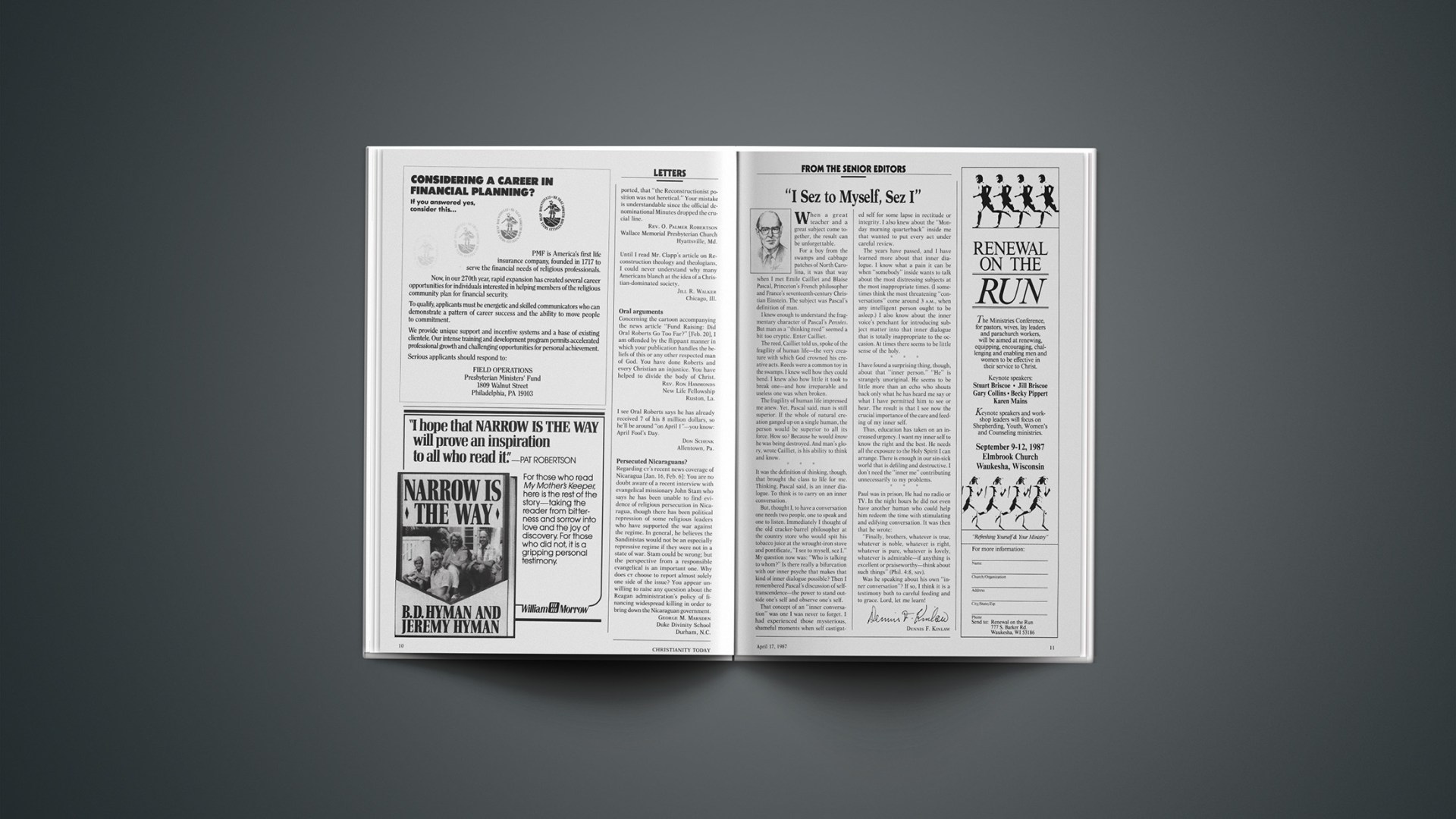
“I Sez to Myself, Sez I”

When a great teacher and a great subject come together, the result can be unforgettable.

For a boy from the swamps and cabbage patches of North Carolina, it was that way when I met Emile Cailliet and Blaise Pascal, Princeton’s French philosopher and France’s seventeenth-century Christian Einstein. The subject was Pascal’s definition of man.

I knew enough to understand the fragmentary character of Pascal’s Pensées. But man as a “thinking reed” seemed a bit too cryptic. Enter Cailliet.

The reed, Cailliet told us, spoke of the fragility of human life—the very creature with which God crowned his creative acts. Reeds were a common toy in the swamps. I knew well how they could bend. I knew also how little it took to break one—and how irreparable and useless one was when broken.

The fragility of human life impressed me anew. Yet, Pascal said, man is still superior. If the whole of natural creation ganged up on a single human, the person would be superior to all its force. How so? Because he would know he was being destroyed. And man’s glory, wrote Cailliet, is his ability to think and know.

It was the definition of thinking, though, that brought the class to life for me. Thinking, Pascal said, is an inner dialogue. To think is to carry on an inner conversation.

But, thought I, to have a conversation one needs two people, one to speak and one to listen. Immediately I thought of the old cracker-barrel philosopher at the country store who would spit his tobacco juice at the wrought-iron stove and pontificate, “I sez to myself, sez I.” My question now was: “Who is talking to whom?” Is there really a bifurcation with our inner psyche that makes that kind of inner dialogue possible? Then I remembered Pascal’s discussion of self-transcendence—the power to stand outside one’s self and observe one’s self.

That concept of an “inner conversation” was one I was never to forget. I had experienced those mysterious, shameful moments when self castigated self for some lapse in rectitude or integrity. I also knew about the “Monday morning quarterback” inside me that wanted to put every act under careful review.

The years have passed, and I have learned more about that inner dialogue. I know what a pain it can be when “somebody” inside wants to talk about the most distressing subjects at the most inappropriate times. (I sometimes think the most threatening “conversations” come around 3 A.M., when any intelligent person ought to be asleep.) I also know about the inner voice’s penchant for introducing subject matter into that inner dialogue that is totally inappropriate to the occasion. At times there seems to be little sense of the holy.

I have found a surprising thing, though, about that “inner person.” “He” is strangely unoriginal. He seems to be little more than an echo who shouts back only what he has heard me say or what I have permitted him to see or hear. The result is that I see now the crucial importance of the care and feeding of my inner self.

Thus, education has taken on an increased urgency. I want my inner self to know the right and the best. He needs all the exposure to the Holy Spirit I can arrange. There is enough in our sin-sick world that is defiling and destructive. I don’t need the “inner me” contributing unnecessarily to my problems.

Paul was in prison, He had no radio or TV. In the night hours he did not even have another human who could help him redeem the time with stimulating and edifying conversation. It was then that he wrote:

“Finally, brothers, whatever is true, whatever is noble, whatever is right, whatever is pure, whatever is lovely, whatever is admirable—if anything is excellent or praiseworthy—think about such things” (Phil. 4:8, NIV).

Was he speaking about his own “inner conversation”? If so, I think it is a testimony both to careful feeding and to grace. Lord, let me learn!

DENNIS F. KINLAW
Letters

A Good Word

Bless you, Wally Metts, for putting in a good word for one of the two endangered species (unborn babies being the other) that do not presently enjoy any special protection under the law [“Home-grown Kids Need a Full-time Mom,” Speaking Out, March 6]. We who struggle to get by on one income to give our children the benefit of a full-time mother are accustomed to the scorn of a secular society; but when we encounter the same mentality in the church, things have gone too far.

LUCY RUDENBORG

Menomonie, Wis.

Right solution, wrong road?

Charles Colson arrived at the right solution but by the wrong road in his column “Lawsuits: The Great American Plague,” [Mar. 6]. Consider this: a list of socially irresponsible manufacturers could go on and on, page after page. If the insurance companies, which basically work for the large manufacturers by selling so-called retro-rated policies, have their way, the responsibility for injurious products will be passed to the user who suffers loss of property, physical injury, or death. The public is better served by having available a place and personnel able to bring the responsible party before the lack of concern and absence of social responsibility.

DONALD L. WHITE, Attorney at Law

Louisville, Ky.

Aborting thousands; keeping one

“What Is the Future for Surrogate Motherhood?” [Mar. 6] was excellent and timely. It was reported in Michigan last year that 73,000 babies were slaughtered by abortion. Now you tell of a fight to keep just one.

DANIEL AUGUSTINE MARQUES

Cheboygen, Mich.

The article states, “Roman Catholics reject artificial insemination by donor under all circumstances.” As a Protestant brought up to be suspicious of Catholicism, I have belatedly come to appreciate its staunch moral positions. We need to sit at the feet of some good Catholic theologians until we again realize God isn’t about to lower the standards of his holiness and morality to fit our “modern” situations.

LAURENCE A. DAVIS

Wichita, Kan.

Small steps are important

Philip Yancey may have spent the afternoon caulking the windows of his home while the abortion of millions and the outrage of South Africa faces us, but his article demonstrates that one man can make a difference [“Caulking While Rome Burns,” Feb. 20]. He gave me fodder for a talk on abortion that I gave in a small town in Canada: he provided the conclusion to a speech I had been working on the day I read his column. The danger facing us all is the lie that because I cannot do something large, it is not worth doing something small.

REV. ANDREW WOLSTENHOLME

First Baptist Church

Pincher Creek, Alberta, Canada

The Bible: No baby bottle

Thank you for admitting there are “Problems Inerrancy Doesn’t Solve” [Feb. 20]. Too many evangelicals fail to face up to the necessity of interpretation. They think the Bible is a baby-bottle of instant truth to be emptied into one’s mouth, forgetting there are parts of it we do not understand or apply to ourselves. The fact is, the Bible is like a prepared and defined pasture in which we graze. It is the sufficient and only source of regulative information for pleasing God, but it is the belief system in our memories that controls our actions. The issue is not only the battle of the Bible, but also the battle of the Faith.

WINN T. BARR

Orange, Calif.

As chairman of the ICBI drafting committee of the “Chicago Statement on Biblical Application,” I was disappointed with your recent article on the conference. Your readers deserve to know what the statement actually said, not one observer’s skewed interpretation of it. When will the press—Christians included—get back to reporting, not creating, news?

NORMAN L. GEISLER

Dallas Theological Seminary

Dallas, Tex.

Midnight Madness

Department stores somehow manage to come up with a different sale to advertise every week of the year. In order to have occasions for these continuous sales, they encourage us to celebrate everything from Ground-hog Day to Flag Day, and invite us to draw the curious conclusion that the appropriate way to honor George Washington on his birthday is to buy bed linens.

It seems to me that Christians could supply these apparently desperate sale-creators with a whole new array of events.

Wouldn’t a Transfiguration White Sale make sense? How about a Rapture Clearance Sale? Why not have a Burning Bush Fire Sale, where “prices are hot but payment terms aren’t at all consuming,” or an Exodus Liquidation Sale where “everything must go”?

A special Noah’s Ark Sale could offer “two for the price of one before the flood of price increases,” and a department store featuring a Zaccheus/Arbor Day Sale could run specials on ladders and short sizes.

Sales like these could be excellent public relations for church history or general biblical awareness, but knowing Madison Avenue’s tendency toward hyperbole, we might get more than we bargained for. How long would it be before all other sales were replaced with one huge Millennium Sale featuring the best prices for a thousand years?

EUTYCHUS

Isolated from poverty?

I was dismayed to read that the executive director of the National Association of Evangelicals was less than supportive of the Catholic bishops’ pastoral on economics [“Mainline Protestants Help U.S. Catholic Bishops Speak Economic Message,” Feb. 20]. When he admonished the bishops to stay out of politics, he is quoting a conservative line I’ve seen for over two years that calls on the bishops to stick to their knitting—to stop meddling in economics. It seems evangelicals who are largely insulated and isolated from the problems of poverty and urbanization have a genius for either ignoring these issues, or deprecating nonevangelicals who get upset about these issues. Strange, isn’t it, that evangelicals could miss the clear evangelical note the Catholic bishops sound in their treatise?

JOHN K. KREIDER, M.D.

Philadelphia, Pa.

While the executive director of the NAE states, “In responding to the needs of the poor, it is not the role of the church leadership to dictate specific public-policy prescriptions …,” we find precisely the opposite stance held by our evangelical leadership when the issue is abortion or sexuality. For example, “specific public-policy prescriptions” (“moral legislation”) are fervently advocated and pressed upon our legislatures.

PHILIP W. GILMAN

Asbury Park, N.J.

Reconstructionists: Valued contributions?

Rodney Clapp’s assessment of Reconstruction dogma [“Democracy as Heresy,” Feb. 20] perhaps needed to be written. Nevertheless, in the process fundamentalists, charismatics, the Religious Right, and Christian conservatives are treated invidiously. It is my impression that these groups are doing work probably perceived by most evangelicals as valued contributions to the church and the world despite some reservations.

ALAN SMITH

Osawatomie, Kan.

Every American interested in preserving the free agency we enjoy should read this article. Coming from a Mormon heritage, I have heard it all before.

ERIC MICHAEL TABELING

Cottonwood, Ariz.

Let me see if I’ve got this straight: Those radical Reconstructionists are dangerous types because (a) they dare to think we can only approach reality presupposing the truthfulness of the Bible, (b) they actually prefer God’s law over traditions made by men, and (c) they actually believe the fields are ripe for harvest and that evangelism blessed by God’s Spirit will be (dare we say it?) successful!

REV. BRUCE A. RAY

Junita Community Church

Kirkland, Wash.

How can R. J. Rushdoony and Gary North ask the rest of us to adhere to the minute details of the Old Testament Law when they do not even speak to each other?

DEBRA A. BELL

Palmyra, Pa.

What is wrong with obeying the Law of God?

MARK MURATA

Kirland, Wash.

I’ve got to say what you left unsaid: “This is sheer madness.”

HOWARD L. COGSWELL

St. John. N.B., Canada

You incorrectly listed Douglas Chismar as a professor of Ashland Theological Seminary when in fact Dr. Chismar is a faculty member and head of the philosophy department at Ashland College. Ashland Theological Seminary is not associated with the Reconstructionist movement and wants that clearly understood.

DR. FREDERICK J. FINKS

Ashland Theological Seminary

Ashland, Ohio

The insert “The Armenian Connection” repeated an oft-heard error regarding the Armenian Church. The Armenian Church never has taught that Christ had only one nature, and that the divine. Such a teaching is attributable to one Eutyches whom the Armenian Church has always condemned as a heretic.

REV. FR. VARTAN KASPARIAN

St. Mary Armenian Apostolic Church

Yettem, Calif.

The Presbyterian Church in America’s general assembly did not decide, as reported, that “the Reconstructionist position was not heretical.” Your mistake is understandable since the official denominational Minutes dropped the crucial line.

REV. O. PALMER ROBERTSON

Wallace Memorial Presbyterian Church

Hyattsville, Md.

Until I read Mr. Clapp’s article on Reconstruction theology and theologians, I could never understand why many Americans blanch at the idea of a Christian-dominated society.

JILL R. WALKER

Chicago, Ill.

Oral arguments

Concerning the cartoon accompanying the news article “Fund Raising: Did Oral Roberts Go Too Far?” [Feb. 20], I am offended by the flippant manner in which your publication handles the beliefs of this or any other respected man of God. You have done Roberts and every Christian an injustice. You have helped to divide the body of Christ.

REV. RON HAMMONDS

New Life Fellowship

Ruston, La.

I see Oral Roberts says he has already received 7 of his 8 million dollars, so he’ll be around “on April 1”—you know: April Fool’s Day.

DON SCHENK

Allentown, Pa.

Persecuted Nicaraguans?

Regarding CT’S recent news coverage of Nicaragua [Jan. 16, Feb. 6]: You are no doubt aware of a recent interview with evangelical missionary John Stam who says he has been unable to find evidence of religious persecution in Nicaragua, though there has been political repression of some religious leaders who have supported the war against the regime. In general, he believes the Sandinistas would not be an especially repressive regime if they were not in a state of war. Stam could be wrong; but the perspective from a responsible evangelical is an important one. Why does CT choose to report almost solely one side of the issue? You appear unwilling to raise any question about the Reagan administration’s policy of financing widespread killing in order to bring down the Nicaraguan government.

GEORGE M. MARSDEN

Duke Divinity School

Durham, N.C.

One in a Thousand

Like most magazines, CHRISTIANITY TODAY has a pretty stringent policy when it comes to unsolicited manuscripts: We rarely use them. We even ask that writers not send them. (Query letters, of course, are always welcome.)

The reason for such a policy is simple. It saves the writer from sending a completed text on a subject that CT may already have handled, is in the process of handling, or is simply not interested in. And it saves our editors time for concentrating on the development of assigned articles scheduled for coming issues.

But no matter how good our intentions (nor how many times we spell that policy out on our masthead), upwards of 700 unsolicited manuscripts are logged by editorial assistant Sue Mole each year, and then passed to editors for their three-to four-week turnaround. That means that in the past three years, some 2,000-plus articles have come in “over the transom.” And of those, only five or six have seen the light of day as a department (like Speaking Out) or an article.

One such “odds beater” is this month’s cover story by Galen Meyer. Actually, “Easter on Hill 17” was at first rejected, only to be read later by another editor who immediately began to champion its publication. And a cover story was born.

As for that stringent manuscript policy, it remains the same: “Unsolicited articles are not accepted.” Usually.

HAROLD SMITH, Managing Editor

Gamma Counter to the Rescue

How an unlikely prop and a resourceful photographer saved our shoot.

Bill Youngblood is a very resourceful photographer—not to mention a skilled one. Our cover photo is a case in point.

Commissioned to capture scientist Robert Messing “in his element” (which happens to be a laboratory in the Department of Neurology at the University of California in San Francisco), Youngblood was all set to photograph flasks full of exotic liquids and Petri dishes growing who knows what. But what he found on the day of the photo session was a discrepancy between the media image of what a lab should look like and the way Messing’s lab actually looked.

“Because of some restrictions, we wound up in a side lab,” Youngblood told CT art director Joan Nickerson. “It reminded me of a high-school biology class: beige walls and black counter tops.”

Fortunately for both Youngblood and Messing, there was also a gamma counter—a decidedly non-high school piece of equipment.

“I decided to take advantage of that curious thing and use it as background. And by adding a red filter, I think we were able to transform the counter—as well as those beige walls—into a scene with some sense of mystery and urgency.”

As for the mystery: What is a gamma counter?

“It evidently monitors bacterial growth in each of the vials you see in the foreground,” Youngblood told us. “But for the record, it’s a great prop.”

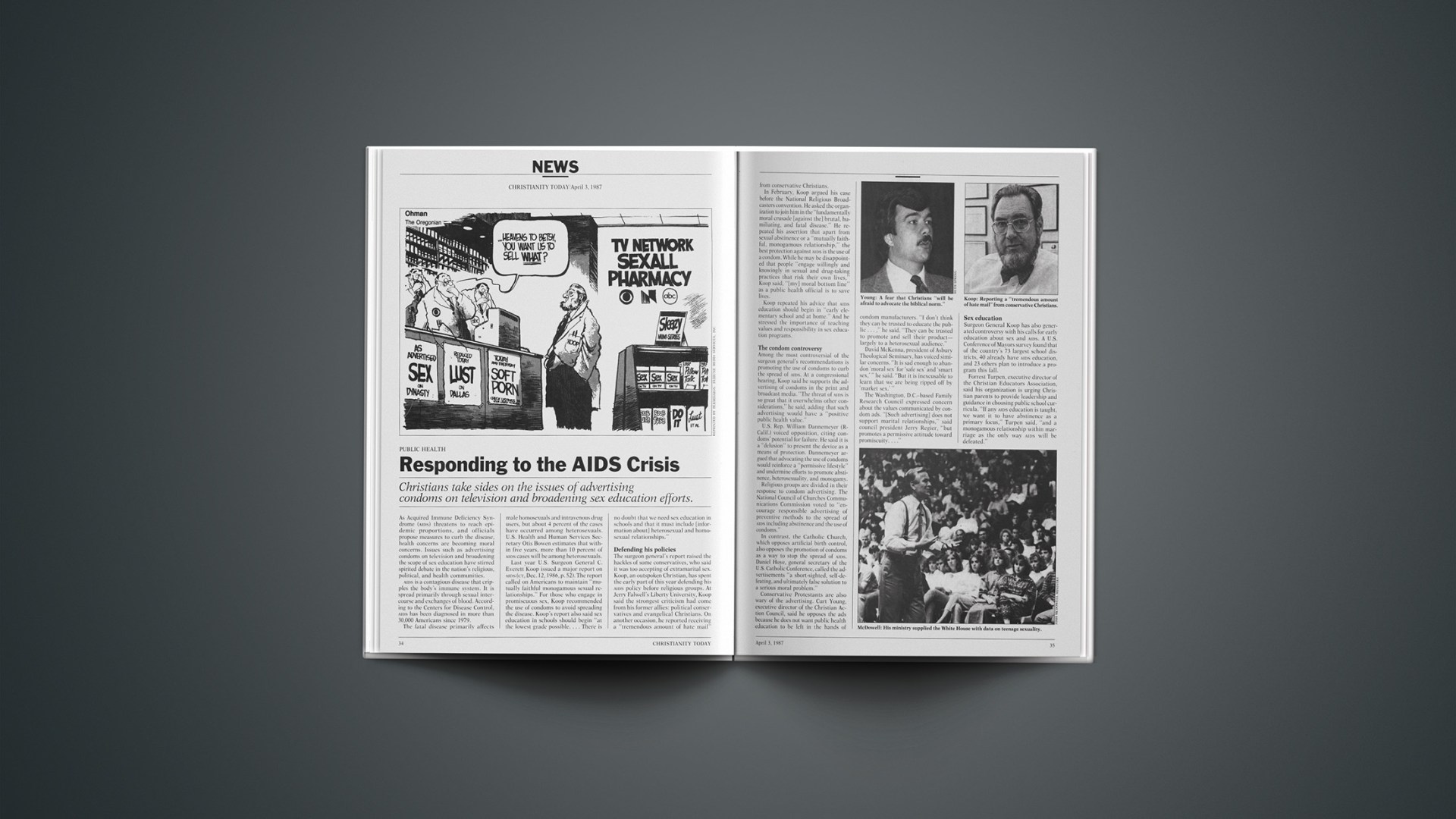
Responding to the AIDS Crisis

“We were frequently very discouraged by the response of many evangelicals.”

As Acquired Immune Deficiency Syndrome (AIDS) threatens to reach epidemic proportions, and officials propose measures to curb the disease, health concerns are becoming moral concerns. Issues such as advertising condoms on television and broadening the scope of sex education have stirred spirited debate in the nation’s religious, political, and health communities.

AIDS is a contagious disease that cripples the body’s immune system. It is spread primarily through sexual intercourse and exchanges of blood. According to the Centers for Disease Control, AIDS has been diagnosed in more than 30,000 Americans since 1979.

The fatal disease primarily affects male homosexuals and intravenous drug users, but about 4 percent of the cases have occurred among heterosexuals. U.S. Health and Human Services Secretary Otis Bowen estimates that within five years, more than 10 percent of AIDS cases will be among heterosexuals.

Last year U.S. Surgeon General C. Everett Koop issued a major report on AIDS (CT, Dec. 12, 1986, p. 52). The report called on Americans to maintain “mutually faithful monogamous sexual relationships.” For those who engage in promiscuous sex, Koop recommended the use of condoms to avoid spreading the disease. Koop’s report also said sex education in schools should begin “at the lowest grade possible.… There is no doubt that we need sex education in schools and that it must include [information about] heterosexual and homosexual relationships.”

Defending His Policies

The surgeon general’s report raised the hackles of some conservatives, who said it was too accepting of extramarital sex. Koop, an outspoken Christian, has spent the early part of this year defending his AIDS policy before religious groups. At Jerry Falwell’s Liberty University, Koop said the strongest criticism had come from his former allies: political conservatives and evangelical Christians. On another occasion, he reported receiving a “tremendous amount of hate mail” from conservative Christians.

In February, Koop argued his case before the National Religious Broadcasters convention. He asked the organization to join him in the “fundamentally moral crusade [against the] brutal, humiliating, and fatal disease.” He repeated his assertion that apart from sexual abstinence or a “mutually faithful, monogamous relationship,” the best protection against AIDS is the use of a condom. While he may be disappointed that people “engage willingly and knowingly in sexual and drug-taking practices that risk their own lives,” Koop said, “[my] moral bottom line” as a public health official is to save lives.

Koop repeated his advice that AIDS education should begin in “early elementary school and at home.” And he stressed the importance of teaching values and responsibility in sex education programs.

The Condom Controversy

Among the most controversial of the surgeon general’s recommendations is promoting the use of condoms to curb the spread of AIDS. At a congressional hearing, Koop said he supports the advertising of condoms in the print and broadcast media. “The threat of AIDS is so great that it overwhelms other considerations,” he said, adding that such advertising would have a “positive public health value.”

U.S. Rep. William Dannemeyer (R-Calif.) voiced opposition, citing condoms’ potential for failure. He said it is a “delusion” to present the device as a means of protection. Dannemeyer argued that advocating the use of condoms would reinforce a “permissive lifestyle” and undermine efforts to promote abstinence, heterosexuality, and monogamy.

Religious groups are divided in their response to condom advertising. The National Council of Churches Communications Commission voted to “encourage responsible advertising of preventive methods to the spread of AIDS including abstinence and the use of condoms.”

In contrast, the Catholic Church, which opposes artificial birth control, also opposes the promotion of condoms as a way to stop the spread of AIDS. Daniel Hoye, general secretary of the U.S. Catholic Conference, called the advertisements “a short-sighted, self-defeating, and ultimately false solution to a serious moral problem.”

Conservative Protestants are also wary of the advertising. Curt Young, executive director of the Christian Action Council, said he opposes the ads because he does not want public health education to be left in the hands of condom manufacturers. “I don’t think they can be trusted to educate the public …,” he said. “They can be trusted to promote and sell their product—largely to a heterosexual audience.”

David McKenna, president of Asbury Theological Seminary, has voiced similar concerns. “It is sad enough to abandon ‘moral sex’ for ‘safe sex’ and ‘smart sex,’ ” he said. “But it is inexcusable to learn that we are being ripped off by ‘market sex.’ ”

The Washington, D.C. based Family Research Council expressed concern about the values communicated by condom ads. “[Such advertising] does not support marital relationships,” said council president Jerry Regier, “but promotes a permissive attitude toward promiscuity.…”

Sex Education

Surgeon General Koop has also generated controversy with his calls for early education about sex and AIDS. A U.S. Conference of Mayors survey found that of the country’s 73 largest school districts, 40 already have AIDS education, and 23 others plan to introduce a program this fall.

Forrest Turpen, executive director of the Christian Educators Association, said his organization is urging Christian parents to provide leadership and guidance in choosing public school curricula. “If any AIDS education is taught, we want it to have abstinence as a primary focus,” Turpen said, “and a monogamous relationship within marriage as the only way AIDS will be defeated.”

The AIDS issue is not expected to have much effect on how Christian schools approach sex education. “Most Christian schools do speak to sex education, but start from a spiritual and moral perspective rather than a technician perspective,” said Jerry Carlson, executive director of the American Association of Christian Schools. He added that since most of the schools are church ministries, sex education is “bound up in the total ministry of the church and the home.” Carlson said AIDS should only serve to “heighten the schools’ sensitivity to teaching spiritual and moral responsibility.”

President Reagan, as well, backs educational efforts that emphasize moral sexual behavior. According to White House sources, the President believes “any information [about AIDS] that might be used in public schools should teach that children should not engage in sex, and [the information] should be used with the consent and involvement of parents.”

Christians Respond

Segments of the religious community are taking steps to address the AIDS crisis. The Christian Life Commission of the Southern Baptist Convention is developing materials designed to interpret the problems of AIDS within a Christian context. The Family Research Council is preparing a survey of sex education curricula that are value-based. The organization plans to release the survey results as a resource for parents.

The Josh McDowell Ministry has been in contact with the surgeon general’s office and the White House as the Reagan Administration develops a framework for addressing public education about AIDS. McDowell supplied the White House with his “Adolescent Sexuality Research Digest,” a compilation of data on teenage sexuality, the consequences of premarital sex, and the factors contributing to increased adolescent sexual activity. McDowell has said he would like to see the promotion of sexual abstinence among youth.

Some are urging that Christians become more outspoken in appealing to society’s moral conscience. The Christian Action Council’s Curt Young said the church is responsible for upholding biblical sexual norms and preaching repentance. “My fear is that evangelicals, with as great a lack of courage as they tend to have in the public arena, will be afraid to advocate the biblical norm because they don’t want to face accusations of moralizing.”

For his part, Koop welcomes the help of Christians. In his speech to the National Religious Broadcasters convention, he spoke of the time when he and the late Francis Schaeffer were touring the country speaking out against abortion. “… We were frequently very discouraged by the response of many evangelicals,” Koop said. “They drew their skirts about them and shunned the issue of abortion. In due time they’ve come around and have become activists in the prolife movement. My plea to you today is not to repeat that slice of history.”

My Cancer and the Good Health Gospel

I had always wondered what it would be like to be told I had a malignant cancer

Coming out of the anesthesia, I first saw the smiling faces of my wife, Patty, and daughter, Emily. “Did they get it all?” I asked. Patty gripped my hand. “Yes.”

“Was it malignant?” I asked.

Emily nodded. “Yes, Daddy—it was cancer. But they got it all, and you’re going to be okay.”

Cancer.

I had always wondered, in secret fear, what it would be like to be told I had a malignant cancer. I thought I would be shattered. But I had prayed for the grace to withstand whatever the doctors found. And, as many have discovered before me, I saw in my confrontation with fear and suffering that there is nothing for which God does not pour out his grace abundantly. I felt total peace—and great thankfulness that a merciful God had brought me to that recovery room.

My stomach problems began last November during a ministry trip to the Philippines. I flew home. My doctor told me that I was badly run down, that I had a bleeding ulcer, and to stay away from airports for awhile. With rest and proper diet, the problem was soon cured.

Just when my stomach seemed fine, I talked with a dear Christian brother, Dr. Joe Bailey of Austin, Texas. Joe urged me, as my own internist had already done, to have a gastroscopy. The idea of inhaling a tube so doctors could view the scenery inside my stomach was not particularly inviting. Besides, the ulcer had already healed. But Joe kept insisting.

So I submitted to the horrors of the gastroscope. The doctor told me, as I had expected, that the ulcer was gone. Then came the unexpected: he had discovered a tumor in my stomach lining.

After weeks of additional tests, experts concluded the growth was benign. There was no reason to hurry to have it removed. Once again Joe Bailey called. “Chuck,” he said in his Texas drawl, “get that thing out, and get it out as quick as you can.”

“I can’t,” I told Joe. “I’m writing a new book. I have ministry commitments, speaking obligations.” But Joe would not be moved. And, since by then I suspected that God was speaking through him, I scheduled the operation for early January.

To everyone’s surprise, the tumor was a low-grade malignancy. Because it was caught early, however, doctors have assured me my prognosis is excellent. If it had gone undetected, the outcome could have been far different. Last fall’s nagging ulcer served as a warning by which God got my attention—and then he used Joe Bailey’s stubborn concern to get me into the hospital.

God’s grace provided not only peace and protection, but new purpose. I had, as some friends know, begun to burn out from too many writing, speaking, and ministry commitments.

But as I lay in my hospital bed, I thought through my real priorities. Had I unconsciously boarded the evangelical treadmill? Trying to do all those worthy things that everybody wanted me to do, had I become beholden to a tyrannical schedule rather than to God’s will? Several weeks tied to hospital tubes is a good time to reflect on the larger perspective of God’s design in our lives.

My suffering provided some fresh insights as well into the health-and-wealth gospel. If God really delivers his people from all pain and illness, as is so often claimed, why was I so sick? Had my faith become weak? Had I fallen from favor?

No, I had always recognized such teaching as false theology. But after four weeks in a maximum-care unit, I came to see it as something else: a presumptuous stumbling block to real evangelism.

During my nightly walks through the hospital corridors, dragging an IV pole behind me, I often met an Indian man whose two-year-old son had had two failed kidney transplants, a brain aneurysm, and was now blind for life.

When the father, a Hindu, discovered I was a Christian, he asked if God would heal his son if he, too, was born again. He said he had heard things like that on television.

As I listened, I realized how arrogant health-and-wealth religion sounds to suffering families: Christians can all be spared suffering, but little Hindu children go blind. One couldn’t blame a Hindu or Muslim or agnostic for resenting, even hating, such a God.

I told my Hindu friend about Jesus. Yes, he may miraculously intervene in our lives. But we come to God not because of what he may do to spare us suffering, but because Christ is truth. What he does promise us is much more—the forgiveness of sin and eternal life. I left the hospital with my friend studying Christian literature, the Bible, and my own account in Born Again. If he becomes a Christian, it won’t be on false pretenses.

I thought often in the hospital of the words of Florida pastor Steve Brown. Steve says that every time a non-Christian gets cancer, God allows a Christian to get cancer as well—so the world can see the difference. I prayed I might be so filled with God’s grace that the world might see the difference.

Steve’s words represent a powerful truth. God does not witness to the world by taking his people out of suffering, but rather by demonstrating his grace through them in the midst of pain.

He allows such weakness to reveal his strength in adversity. His own Son experienced brokenness—and died—that we might be freed from the power of death. But we are promised no freedom from suffering until we are beyond the grave.

Thus, I can only believe that God allowed my cancer for a purpose—just as he allows far more horrific and deadly cancers in fellow Christians every day. We don’t begin to know all the reasons why. But we do know that our suffering and weakness can be an opportunity to witness to the world the amazing grace of God at work through us.

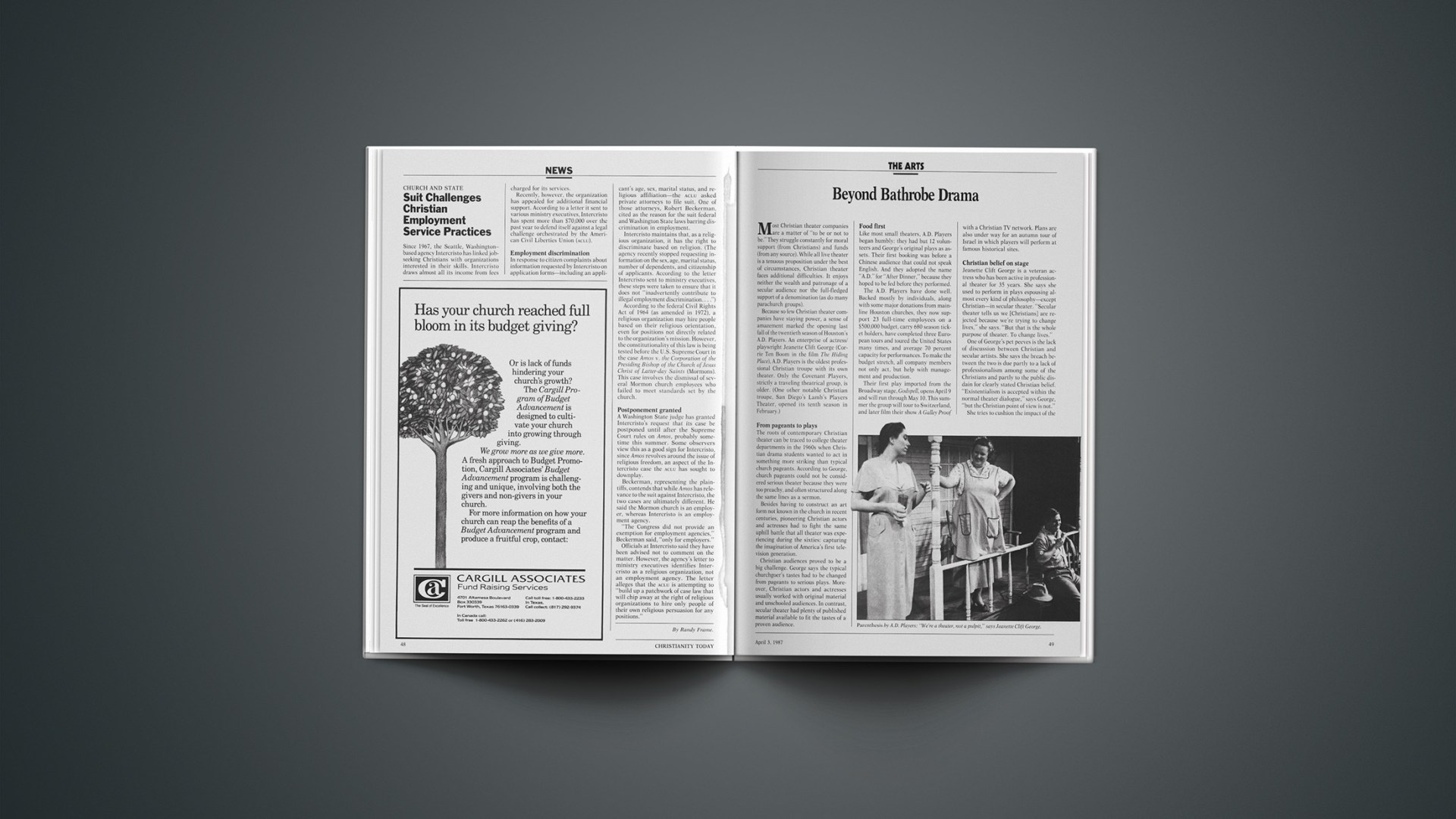
Beyond Bathrobe Drama

Finding a home for Christian artists.

Most Christian theater companies are a matter of “to be or not to be.” They struggle constantly for moral support (from Christians) and funds (from any source). While all live theater is a tenuous proposition under the best of circumstances, Christian theater faces additional difficulties. It enjoys neither the wealth and patronage of a secular audience nor the full-fledged support of a denomination (as do many parachurch groups).

Because so few Christian theater companies have staying power, a sense of amazement marked the opening last fall of the twentieth season of Houston’s A.D. Players. An enterprise of actress/playwright Jeanette Clift George (Corrie Ten Boom in the film The Hiding Place), A.D. Players is the oldest professional Christian troupe with its own theater. Only the Covenant Players, strictly a traveling theatrical group, is older. (One other notable Christian troupe, San Diego’s Lamb’s Players Theater, opened its tenth season in February.)

From Pageants to Plays

The roots of contemporary Christian theater can be traced to college theater departments in the 1960s when Christian drama students wanted to act in something more striking than typical church pageants. According to George, church pageants could not be considered serious theater because they were too preachy, and often structured along the same lines as a sermon.

Besides having to construct an art form not known in the church in recent centuries, pioneering Christian actors and actresses had to fight the same uphill battle that all theater was experiencing during the sixties: capturing the imagination of America’s first television generation.

Christian audiences proved to be a big challenge. George says the typical churchgoer’s tastes had to be changed from pageants to serious plays. Moreover, Christian actors and actresses usually worked with original material and unschooled audiences. In contrast, secular theater had plenty of published material available to fit the tastes of a proven audience.

Food First

Like most small theaters, A.D. Players began humbly: they had but 12 volunteers and George’s original plays as assets. Their first booking was before a Chinese audience that could not speak English. And they adopted the name “A.D.” for “After Dinner,” because they hoped to be fed before they performed.

The A.D. Players have done well. Backed mostly by individuals, along with some major donations from mainline Houston churches, they now support 23 full-time employees on a $500,000 budget, carry 680 season ticket holders, have completed three European tours and toured the United States many times, and average 70 percent capacity for performances. To make the budget stretch, all company members not only act, but help with management and production.

Their first play imported from the Broadway stage, Godspell, opens April 9 and will run through May 10. This summer the group will tour to Switzerland, and later film their show A Galley Proof with a Christian TV network. Plans are also under way for an autumn tour of Israel in which players will perform at famous historical sites.

Christian Belief on Stage

Jeanette Clift George is a veteran actress who has been active in professional theater for 35 years. She says she used to perform in plays espousing almost every kind of philosophy—except Christian—in secular theater. “Secular theater tells us we [Christians] are rejected because we’re trying to change lives,” she says. “But that is the whole purpose of theater. To change lives.”

One of George’s pet peeves is the lack of discussion between Christian and secular artists. She says the breach between the two is due partly to a lack of professionalism among some of the Christians and partly to the public disdain for clearly stated Christian belief. “Existentialism is accepted within the normal theater dialogue,” says George, “but the Christian point of view is not.”

She tries to cushion the impact of the Christian statement by liberally sprinkling comedy throughout her scripts. In A Galley Proof, George includes a Moses with a sand bucket, a Pharoah’s daughter with a Southern accent—“It’s nawt much fu-un being the daw-tuh of Pharaoh,” she complains—and an Aaron who quotes Scripture and platitudes ad nauseum.

“We’re a theater and not a pulpit,” George explains. “I feel that theater can communicate specific principles more easily with humor. One of the saddest things secular theater has done is to degrade laughter. And a lot of our Christian society is ill at ease with laughter. Having a good time might look like we’re pagan.”

Intermission Evangelism

Although she now has 200 volunteers who pray for the company, George says theater still is not universally accepted among Christians. “A lot of churches are a little doubtful of the propriety of entertainment,” she says. “A lot of the church community doesn’t understand how an evening at the theater can be entertaining and edifying. They’re ill at ease. But, if people are concerned evangelicals, they should realize this is a good place to bring people who don’t know the Lord. There’s probably more dialogue in our lobby [during intermissions] than in most church halls.”

The case for Christian theater with integrity is more serious than most realize, George says. Without it, the church has lost a powerful instrument for proclaiming the gospel. “We’re stating reality,” she says. “If we are confined or relegated to the shadows, we are failing our assignment from God, and society has lost our statement.”

Julia Duin is a religion writer at the Houston Chronicle.

Suit Challenges Christian Employment Service Practices

A Washington State judge has ruled on Intercristo’s request.

Since 1967, the Seattle, Washington-based agency Intercristo has linked job-seeking Christians with organizations interested in their skills. Intercristo draws almost all its income from fees charged for its services.

Recently, however, the organization has appealed for additional financial support. According to a letter it sent to various ministry executives, Intercristo has spent more than $70,000 over the past year to defend itself against a legal challenge orchestrated by the American Civil Liberties Union (ACLU).

Employment Discrimination

In response to citizen complaints about information requested by Intercristo on application forms—including an applicant’s age, sex, marital status, and religious affiliation—the ACLU asked private attorneys to file suit. One of those attorneys, Robert Beckerman, cited as the reason for the suit federal and Washington State laws barring discrimination in employment.

Intercristo maintains that, as a religious organization, it has the right to discriminate based on religion. (The agency recently stopped requesting information on the sex, age, marital status, number of dependents, and citizenship of applicants. According to the letter Intercristo sent to ministry executives, these steps were taken to ensure that it does not “inadvertently contribute to illegal employment discrimination.…”)

According to the federal Civil Rights Act of 1964 (as amended in 1972), a religious organization may hire people based on their religious orientation, even for positions not directly related to the organization’s mission. However, the constitutionality of this law is being tested before the U.S. Supreme Court in the case Amos v. the Corporation of the Presiding Bishop of the Church of Jesus Christ of Latter-day Saints (Mormons). This case involves the dismissal of several Mormon church employees who failed to meet standards set by the church.

Postponement Granted

A Washington State judge has granted Intercristo’s request that its case be postponed until after the Supreme Court rules on Amos, probably sometime this summer. Some observers view this as a good sign for Intercristo, since Amos revolves around the issue of religious freedom, an aspect of the Intercristo case the ACLU has sought to downplay.

Beckerman, representing the plaintiffs, contends that while Amos has relevance to the suit against Intercristo, the two cases are ultimately different. He said the Mormon church is an employer, whereas Intercristo is an employment agency.

“The Congress did not provide an exemption for employment agencies,” Beckerman said, “only for employers.”

Officials at Intercristo said they have been advised not to comment on the matter. However, the agency’s letter to ministry executives identifies Intercristo as a religious organization, not an employment agency. The letter alleges that the ACLU is attempting to “build up a patchwork of case law that will chip away at the right of religious organizations to hire only people of their own religious persuasion for any positions.”

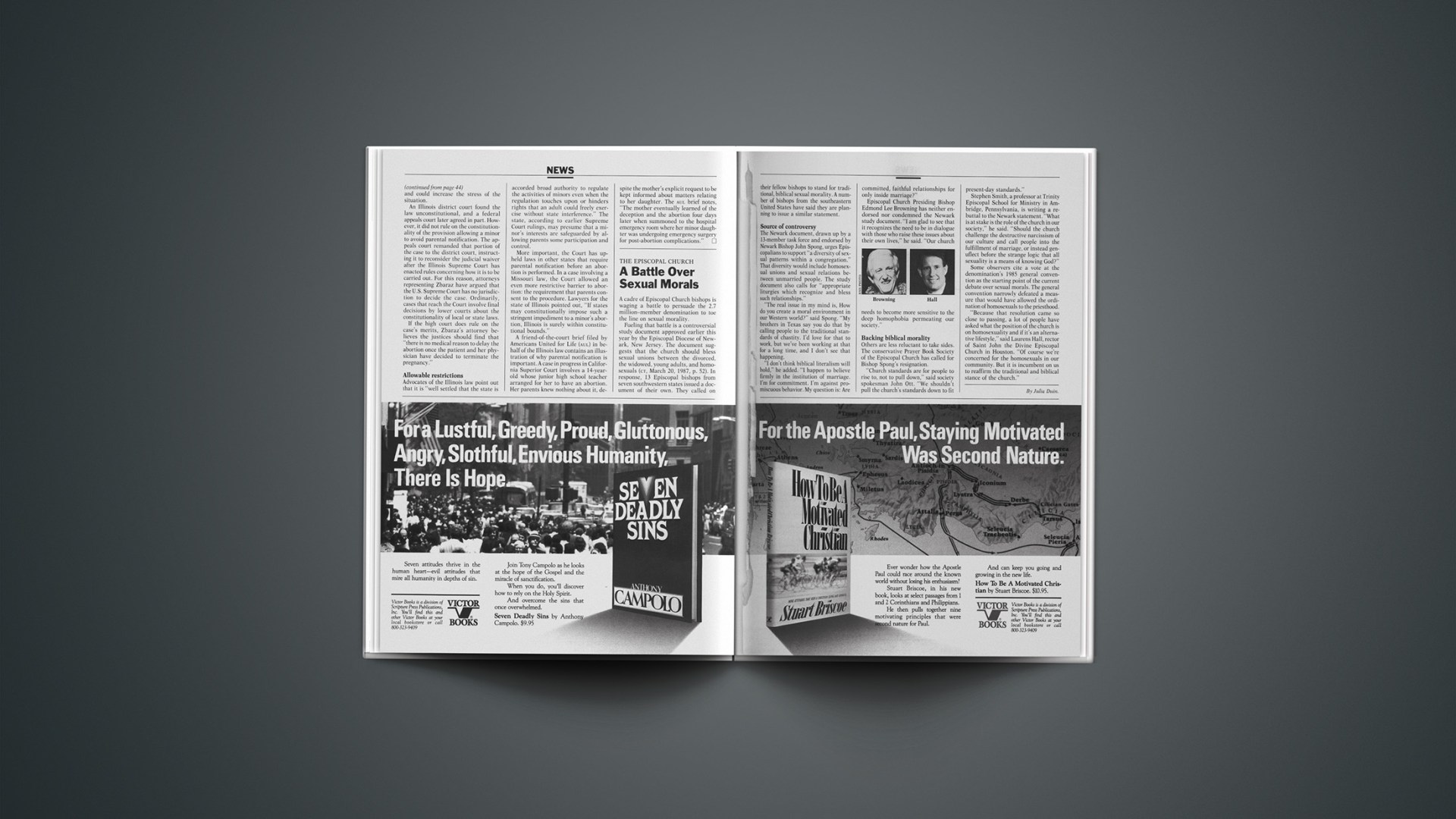
A Battle over Sexual Morals

Are committed, faithful relationships for only inside marriage?

A cadre of Episcopal Church bishops is waging a battle to persuade the 2.7 million-member denomination to toe the line on sexual morality.

Fueling that battle is a controversial study document approved earlier this year by the Episcopal Diocese of Newark, New Jersey. The document suggests that the church should bless sexual unions between the divorced, the widowed, young adults, and homosexuals (CT, March 20, 1987, p. 52). In response, 13 Episcopal bishops from seven southwestern states issued a document of their own. They called on their fellow bishops to stand for traditional, biblical sexual morality. A number of bishops from the southeastern United States have said they are planning to issue a similar statement.

Source of Controversy

The Newark document, drawn up by a 13-member task force and endorsed by Newark Bishop John Spong, urges Episcopalians to support “a diversity of sexual patterns within a congregation.” That diversity would include homosexual unions and sexual relations between unmarried people. The study document also calls for “appropriate liturgies which recognize and bless such relationships.”

“The real issue in my mind is, How do you create a moral environment in our Western world?” said Spong. “My brothers in Texas say you do that by calling people to the traditional standards of chastity. I’d love for that to work, but we’ve been working at that for a long time, and I don’t see that happening.

“I don’t think biblical literalism will hold,” he added. “I happen to believe firmly in the institution of marriage. I’m for commitment. I’m against promiscuous behavior. My question is: Are committed, faithful relationships for only inside marriage?”

Episcopal Church Presiding Bishop Edmond Lee Browning has neither endorsed nor condemned the Newark study document. “I am glad to see that it recognizes the need to be in dialogue with those who raise these issues about their own lives,” he said. “Our church needs to become more sensitive to the deep homophobia permeating our society.”

Backing Biblical Morality

Others are less reluctant to take sides. The conservative Prayer Book Society of the Episcopal Church has called for Bishop Spong’s resignation.

“Church standards are for people to rise to, not to pull down,” said society spokesman John Ott. “We shouldn’t pull the church’s standards down to fit present-day standards.”

Stephen Smith, a professor at Trinity Episcopal School for Ministry in Ambridge, Pennsylvania, is writing a rebuttal to the Newark statement. “What is at stake is the role of the church in our society,” he said. “Should the church challenge the destructive narcissism of our culture and call people into the fulfillment of marriage, or instead genuflect before the strange logic that all sexuality is a means of knowing God?”

Some observers cite a vote at the denomination’s 1985 general convention as the starting point of the current debate over sexual morals. The general convention narrowly defeated a measure that would have allowed the ordination of homosexuals to the priesthood.

“Because that resolution came so close to passing, a lot of people have asked what the position of the church is on homosexuality and if it’s an alternative lifestyle,” said Laurens Hall, rector of Saint John the Divine Episcopal Church in Houston. “Of course we’re concerned for the homosexuals in our community. But it is incumbent on us to reaffirm the traditional and biblical stance of the church.”

Can States Restrict a Minor’s Access to Abortion?

Ruling passed on Hartigan v. Zbaraz

A woman’s right to an abortion has been reaffirmed by U.S. Supreme Court rulings in recent years that have struck down state restrictions on the practice. However, lower courts as well as the high court remain uncertain about restrictions on the rights of unmarried, underage girls. Earlier this month, the Supreme Court heard oral arguments on a state law requiring doctors to notify both parents, and patients to wait 24 hours before an abortion is performed on a minor, unmarried daughter.

The case, known as Hartigan v. Zbaraz, involves an Illinois law enacted in 1983, shortly after the Supreme Court struck down a 24-hour delay required by the city of Akron, Ohio. Akron’s provision for a waiting period applied to adults as well as dependent young women. The Supreme Court may view the Illinois law differently because the waiting period serves a different purpose—it is meant to facilitate discussion between parents and their daughters, rather than to impede abortion. The law requires both parents to receive actual notification of their daughter’s intention to obtain an abortion, but it does not require their consent. The 24-hour waiting period would not begin until both parents are informed.

Parental notification can be avoided if the young woman obtains a court waiver after demonstrating that she is mature enough to make the decision herself or that notification would not be in her best interest. The statute was designed “to protect minors against their own immaturity, to foster and preserve the family structure, and to protect the rights of parents to rear their children,” according to briefs filed on behalf of Neil F. Hartigan, attorney general of Illinois.

Unfair Burden?

David Zbaraz, a physician who challenged the law in court, has maintained that it unfairly burdens the woman seeking an abortion. A required delay “unjustifiably increases the cost of pregnancy termination [and] causes unnecessary and harmful stress,” he has stated. Zbaraz also has said the provision allowing the minor to obtain a court waiver is confusing, could cause the girl to postpone her decision further, and could increase the stress of the situation.

An Illinois district court found the law unconstitutional, and a federal appeals court later agreed in part. However, it did not rule on the constitutionality of the provision allowing a minor to avoid parental notification. The appeals court remanded that portion of the case to the district court, instructing it to reconsider the judicial waiver after the Illinois Supreme Court has enacted rules concerning how it is to be carried out. For this reason, attorneys representing Zbaraz have argued that the U.S. Supreme Court has no jurisdiction to decide the case. Ordinarily, cases that reach the Court involve final decisions by lower courts about the constitutionality of local or state laws.

If the high court does rule on the case’s merits, Zbaraz’s attorney believes the justices should find that “there is no medical reason to delay the abortion once the patient and her physician have decided to terminate the pregnancy.”

Allowable Restrictions

Advocates of the Illinois law point out that it is “well settled that the state is accorded broad authority to regulate the activities of minors even when the regulation touches upon or hinders rights that an adult could freely exercise without state interference.” The state, according to earlier Supreme Court rulings, may presume that a minor’s interests are safeguarded by allowing parents some participation and control.

More important, the Court has upheld laws in other states that require parental notification before an abortion is performed. In a case involving a Missouri law, the Court allowed an even more restrictive barrier to abortion: the requirement that parents consent to the procedure. Lawyers for the state of Illinois pointed out, “If states may constitutionally impose such a stringent impediment to a minor’s abortion, Illinois is surely within constitutional bounds.”

A friend-of-the-court brief filed by Americans United for Life (AUL) in behalf of the Illinois law contains an illustration of why parental notification is important. A case in progress in California Superior Court involves a 14-year-old whose junior high school teacher arranged for her to have an abortion. Her parents knew nothing about it, despite the mother’s explicit request to be kept informed about matters relating to her daughter. The AUL brief notes, “The mother eventually learned of the deception and the abortion four days later when summoned to the hospital emergency room where her minor daughter was undergoing emergency surgery for post-abortion complications.”

Apple PodcastsDown ArrowDown ArrowDown Arrowarrow_left_altLeft ArrowLeft ArrowRight ArrowRight ArrowRight Arrowarrow_up_altUp ArrowUp ArrowAvailable at Amazoncaret-downCloseCloseEmailEmailExpandExpandExternalExternalFacebookfacebook-squareGiftGiftGooglegoogleGoogle KeephamburgerInstagraminstagram-squareLinkLinklinkedin-squareListenListenListenChristianity TodayCT Creative Studio Logologo_orgMegaphoneMenuMenupausePinterestPlayPlayPocketPodcastRSSRSSSaveSaveSaveSearchSearchsearchSpotifyStitcherTelegramTable of ContentsTable of Contentstwitter-squareWhatsAppXYouTubeYouTube