Pastors

IS AMBITION A DIRTY WORD?

I move from the pulpit, and the huge congregation is hushed. Throughout the crowded sanctuary, the people are visibly moved by my sermon . . .

Then I wake up-the dream over-to find I’m still associate pastor of a typical congregation.

Actually, I have a great position; I have plenty of delegated responsibility and the support of the senior pastor. He regularly affirms my ministry. Most of the time I am very content.

But sometimes my position doesn’t seem enough. Deep down, I want to be known as an excellent preacher, an effective innovator, a leader doing great things for the kingdom. Sometimes I feel cramped, longing to be used more prominently.

Many pastors, I’ve found, have that itch to “move up.” Our ambitions vary in detail, but whether as trusted counselor or denominational power, famous evangelist or super preacher, we want to exert influence, to make our mark.

We may secretly want recognition, but we are afraid to talk about it. We fear appearing discontent or snobbish or, worst of all, proud. We who are professionally holy want to avoid the label ambitious.

Ambition is “an eager and sometimes inordinate desire for something; or the desire to distinguish oneself in some way.” It comes from the Roman practice of going around town (ambire) currying votes, a practice unchanged in two thousand years of civil and church politics. In that light, ambition hardly glistens.

We are rightfully leery of those who say the Lord shows his favor only through numerical growth, or who always feel led to bigger and better fields. How odd that so few are called to work with the poor and outcast. How easy to buy into the success standards of our society instead of working for its transformation.

But disdain for worldly success can dull awareness of the God-honoring possibilities in healthy desires. The struggle to grow, to stretch one’s abilities, can reside in ambition; so, too, the drive to make great things happen, to promote change. Best of all, the ambitious include those who strive for excellence, who refuse to settle for a job done merely “OK.”

John F. Kennedy said he wanted to surround himself with ambitious men, “those who possessed the talent to change the world, along with the drive to do it.”

As a youth pastor wanting to involve students with missions, I envisioned taking them on a short-term project to a poor country. If I could expose them to the startling conditions in other countries and the commitment of the missionaries there, I was convinced they would come back changed kids.

But my ambition played a role, too. I wanted to be associated with a successful ministry. My drive to succeed-as a leader but also with a worthwhile project-helped me persevere through the inevitable obstacles. I doubt if I could have convinced the Session or organized the logistics without being fueled by an ambitious mixture of commitment to the cause and personal drive.

Is there a legitimate space within humility for dreams of my future in ministry? Perhaps the drive to succeed is morally neutral. Perhaps ambition, like sexual desire or wealth, bears potential for either benefit or abuse. I see ambition’s benefit when I prepare extra hard to make a class work or when a counselee leaves my office obviously helped. My desire to measure up to ambitious standards does have an effect.

But like all good gifts, our desire for excellence can be warped by the Evil One. I find I must balance the legitimate need for recognition of gifts against the temptation to feed on accolades. God calls us to use our gifts to the greatest extent, but how do I separate God’s call from the rationalizations of unchecked ambition? I am learning.

I’m trying to find checks and balances to the dark side of my ambition. I see places where my ambition is out of line-comparing myself to struggling colleagues, feeling smug after an effective sermon and extrapolating myself into a prestigious pulpit.

I may somehow hide the worst aspects of my ambition from others, but I still have to live with myself. To keep ambition in line, I need to evaluate myself regularly and ruthlessly.

Here are some danger zones I have learned to look for in my ambition checks:

Inadequate family time. Do my loved ones pay the price for my advancement through meager time together, broken dates, or my lack of energy during the time I do spend with them? The people God has put closest to me often suffer first when my ambition gets out of control.

Flawed devotional life. Each of us is spiritually unique; only we know if we are continuing the patterns of devotion that keep us refreshed, equipped, and accountable to God. My temptation, shared by many, is to use Bible study as a tool for me to speak to “them” rather than first using it to deal with me. Too often spiritual disciplines degenerate into a series of technical sessions to prepare me for the “real business” of ministry. When prayers turn into shopping lists, it’s past time to examine my hidden agenda. Am I simply using the practices of spirituality to further my own ambitious interests?

Personality-oriented programming. The ambitious are often identified by churches that rise to their charisma but collapse when they move their personality elsewhere. Am I building my ministry on charm or sheer force of personality?

People with winsome personalities are tempted to use personality ploys to manipulate others. An older pastor once pulled me aside and told me my coup in a committee meeting smelled of manipulation. I had wooed people with charm rather than persuaded them with the merits of my position. Though I felt like crawling out under his office door, I was comforted when he later said he had seen through my trick because he fights against using the same methods every day of his life.

Building monuments instead of people. I recognize the need for enduring structures and programs. Often, however, the ambitious build things and use people, rather than the other way around. The enduring treasure of the kingdom of God is lives touched by Christ. Too often, I am tempted to point to buildings, attendance patterns, impressive programming. Perhaps one measure of pastors ought to be what their flocks look like five years after they’ve left.

The professional milquetoast. I stand in constant danger of losing my prophetic edge. If I hope to please everyone and be well thought of, I must pay the subtle cost of turning from the demands of discipleship. Attention to the needs of the poor and the responsibility of the rich to do justice can harm my career! Am I so held by ambition that I refuse to say or do the things God desires, even if unpopular? Am I being seduced into silence rather than offering God’s alternatives?

Pulpit envy. The negative side of ambition shows most clearly as I gaze at the success of others. I have worried whether I was climbing the ladder quickly enough, especially when I compared myself to others. One politico told me I had to make up for time “lost” in youth ministry. Can I rejoice in the successes of my peers without always wondering if they are getting ahead of me?

The insufferable servant. Am I satisfied with a subordinate, less-noticeable role? On the whole, am I productively content where God has placed me? Perhaps not in this particular setting but at this level of ministry? Much of my ambition is rooted in my fear of being perceived a failure, an also-ran. Could I stay where I am indefinitely and, looking back, feel the Lord had used me successfully? Or does my ego need larger pastures in which to graze?

If you winced more than twice in this checklist, you probably have ambition. But no need to see it as a disease to heal. Instead, think of your drives as wild horses, useful when tamed. The question is: How can we bridle our ambitions for godly service?

I enjoy watching leaders who model Christ’s attitude even in powerful positions. They set out to change the world and the people around them because God has given them vision. Rather than personal aggrandizement or fame, their vision is bigger than themselves. Those successfully dealing with their ambition display the confident humility, not the arrogance, of power.

Hung on the door of an Old Testament professor’s office is a wise suggestion: “Everyone ought to have two rocks in his pocket. One should have written on it, ‘You are the glory of God, for whom the world was created.’ The other should say, ‘You are a child of sin, for whom the Son of God had to die.’ The rocks should be brought out as the appropriate need arises.” Christlike leaders develop the quiet confidence born of both sin and grace.

Likewise, godly leaders become other-centered. One gets Vernon Grounds to speak of himself only with difficulty. One student deliberately tried to get Grounds to talk about himself, but the former president of Denver Seminary always returned the conversation to what God was doing in the life of the student.

My attitude improves greatly as I learn from others who model the joy of being a servant to their superiors. As God tempers my drive with a servant’s attitude, my subordinate position becomes much less binding. When issues like preaching opportunities and job descriptions threaten to stir up dissension, I can express myself freely while affirming that God has entrusted one of his servants to lead me.

As I gain assurance that I am becoming the kind of person God wants-that God’s aspirations for me are being met-I can let go of the compulsion to control, to excel above others. And along the way, I find the servant’s role is an excellent vantage point for learning and growing. Yes, we need to be aware of all our talents and desires, but we can also determine to seek God’s ambitions for us over our personal reputation.

-John Crosby

First Presbyterian Church

Glen Ellyn, Illinois

Copyright © 1986 by the author or Christianity Today/Leadership Journal. Click here for reprint information on Leadership Journal.

We Aren’t the World

Ever since giving to the needy became chic in Hollywood, we’ve been treated to a billion-dollar bonanza of celebrities, benefit records, and sad-eyed Ethiopian children.

It was Band-Aid, the British concert to help starving children, that started the aid bandwagon rolling. Later came Live Aid, a marathon rock concert simulcast from London and Philadelphia.

Thereafter, since aid had become so fashionable, came Fashion Aid, a charity evening of haute couture in London, followed by a Hollywood benefit for Mexican earthquake victims. There was Farm Aid to focus on the plight of American farmers; and an AIDS benefit after Rock Hudson’s death could only be thought of as AIDS aid.

Three more compassion extravaganzas occurred in May. Hands Across America linked a human chain from Los Angeles to New York to raise $100 million for domestic homelessness and hunger.

The Freedom Festival raised money for Vietnam veterans; and then there’s my favorite, Sport Aid, which began with a runner leaving Ethiopia with a torch lighted from a refugee’s campfire. He jogged to several European cities; then this tireless athlete flew to New York, torch in hand (I can’t help wondering about those “no smoking” signs in airplane cabins); there he lighted a flame in Manhattan’s United Nations Plaza, which signaled the start of simultaneous 10-kilometer runs around the world. The plan, said organizer Bob Geldof, mastermind of Live Aid, was to raise money to fight disease and hunger in Africa.

While we all agree that helping starving people is a good thing, this sudden aid frenzy does raise some practical questions.

First, in an industry where publicity is the ticket to success, one may be excused for wondering if celebrity participation in such well-heralded events is altogether altruistic. The “We Are the World” video, which has sold millions of copies, reminds us less of starving children than of the great humanitarianism of its showcase of rock idols. The goals may be worthy, but such slickly publicized charity can only bring to mind biblical warnings against hiring trumpeters—or camera crews—to record one’s good deeds.

We might put aside petty suspicions about motives if only we knew that those in need were being helped. But this raises a second question.

The New Republic reports that while USA for Africa, the organization behind Live Aid, appeals for contributions to help the starving, 55 percent of its money is instead waiting to be spent on “recovery and long-term development projects,” something celebrity efforts may be ill-equipped to pull off.

Of the $92 million raised by Live Aid and Band Aid, Newsweek says only $7 million has gone to emergency relief. Another $6.5 million has been spent on trucks and ships to haul supplies; $20 million has been earmarked for projects like bridges in Chad. The rest sits in bank accounts somewhere.

Unfortunately, there is an apolitical illusion at work in much of the celebrity aid: the belief that government or establishment relief agencies are unnecessary, and all we need is Bruce Springsteen.

But even noncontroversial goals such as feeding the hungry can get bogged down in squabbles over how money and food should be distributed, or stymied at the Marxist-controlled ports of Ethiopia. Let’s not kid ourselves: just because the fans in London or Philadelphia go home satisfied doesn’t mean

My third question concerns the amoral illusion in all this. Consider the highlight of the Live Aid concert, the steamy duet of rock stars Mick Jagger and Tina Turner.

Jagger’s 20-year career includes such dubious hits as “Sympathy for the Devil” and “Between the Sheets.” Tina Turner, clad in black leather for the show, claims a number of prior lives, including a stint as the ancient Egyptian queen Hatshepsut. Their erotic tangle was surely as much an appeal to the lust of the crowd as to help for the hungry.

There seems to be no sense of the incompatibility of noble ends and ignoble means. “A good tree cannot produce bad fruit, nor can a rotten tree produce good fruit,” Jesus said flatly. There is a connection between charity, in the biblical sense, and virtue. If promoting lust is wrong, then we must ask: Can the good of feeding the hungry be accomplished by evil?

Rock promoter Bill Graham says of celebrity aid, “It’s an incredible power, knowing on any given day you can raise a million dollars.” Newsweek observes, “Perhaps that is why Live Aid and Farm Aid were such oddly upbeat exercises in self-congratulation. An industry was celebrating its power. Far from challenging the complacency of an audience, such mega-events reinforce it.… Now, by watching a pop-music telethon and making a donation … fans can enjoy vicariously a sense of moral commitment.”

All this leads to the most dangerous illusion of all: the impression that our celebrity idols discovered the hunger crisis, and now, with their prime-time specials, have solved it.

Jagger, Turner, and company notwithstanding, feeding the hungry did not begin with Live Aid. Organizations like Catholic Relief Services, World Vision, the Salvation Army, and millions of local churches have long been feeding the hungry—without the razzle-dazzle so recently discovered by the rich and famous. Incentives have not been albums and the chance to see celebrities grind up against one another, but obedience to Christ’s commands.

Bob Geldof recently announced that the Band-Aid campaign, its mission accomplished, will close down by December. “It’s like a shooting star,” he enthused.” … [F]or once … absolutely good and absolutely incorruptible came and went and worked.”

I wonder. Shooting stars don’t feed hungry multitudes. The real tragedy of celebrity aid would be if the public believes that the need is over when the curtain comes down in Hollywood.

For the problem of hunger will still be with us—and so will Christ’s command to feed the hungry.

Association of Single Adult Leaders to Open National Headquarters

Statistics show more than 60 million single adults living in the United States, and most of them don’t attend church. Many leaders of church singles ministries, who face the reality of those figures daily, have sensed the need for a national association.

Such an organization, the National Association of Single Adult Leaders (NASAL), celebrated its first year recently with a three-day consortium in Phoenix, Arizona. The invitation-only meeting drew some 100 leaders of single-adult ministries from 17 denominations. The association approved the opening of a national office and the appointment of Timm Jackson as full-time executive director. Jackson, minister to single adults at Grace Community Church in Tempe, Arizona, will open the national office in the Phoenix area. Members pledged more than $27,000 to cover start-up costs.

Single-adult leaders in southern California provided the impetus to develop NASAL. Bill Flanagan, minister with single adults at Saint Andrews Presbyterian Church in Newport Beach, California, guided the organization’s development on a voluntary basis, aided by a national committee and nine regional representatives.

A number of participants at the Phoenix meeting have led singles ministries since the seventies. Many of those early programs were patterned after youth ministries. But it was quickly discovered that churches needed radically different means to minister to single adults.

Today, singles face a multitude of problems, including recovering from divorce and raising children alone, NASAL plans to publish a resource book to address the myriad areas of this growing ministry. The organization also supports annual training sessions in each of seven geographical regions of the country, aimed at providing lay leaders with the skills to make their programs more effective.

CAROL R. THIESSENin Phoenix

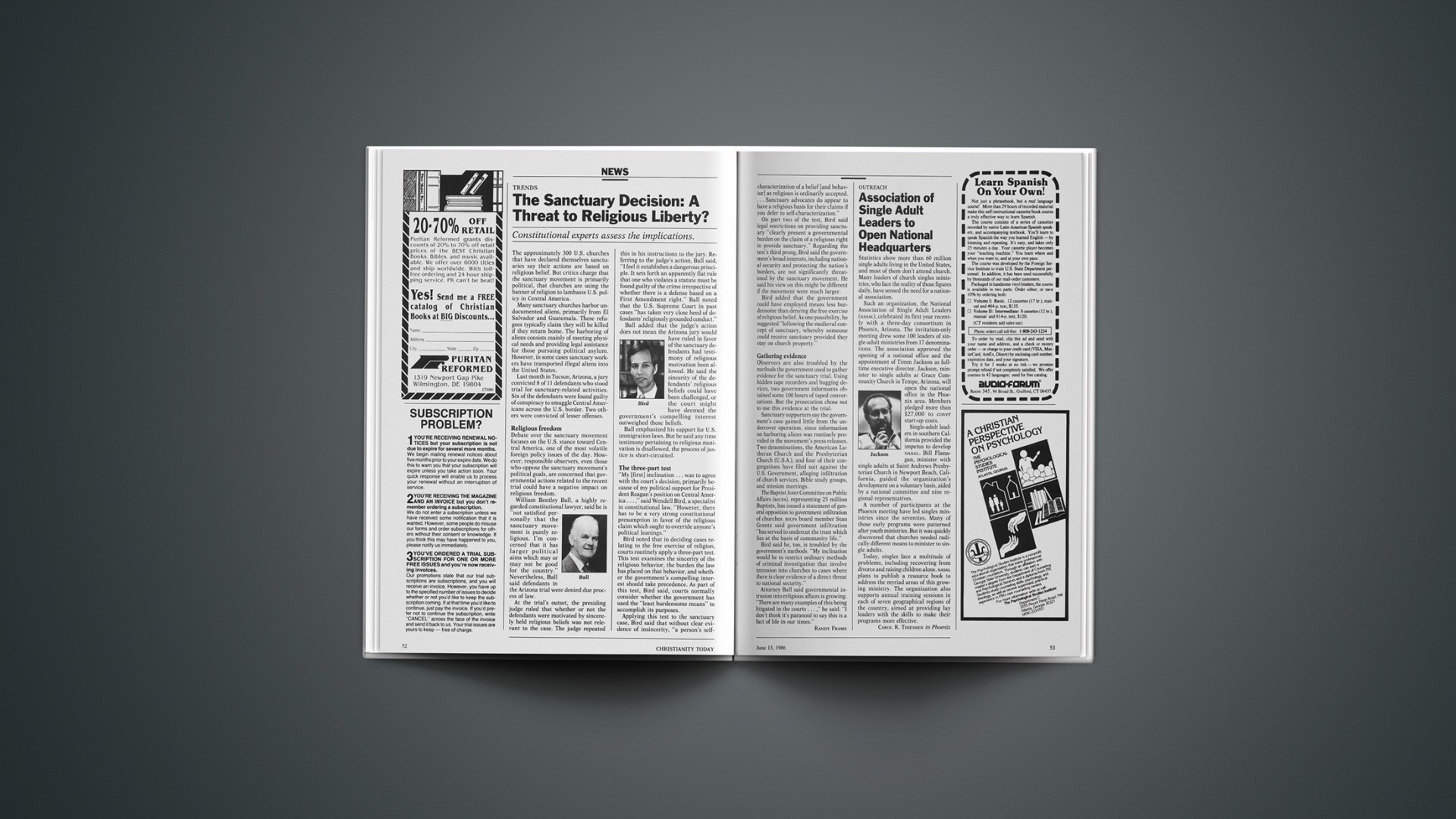
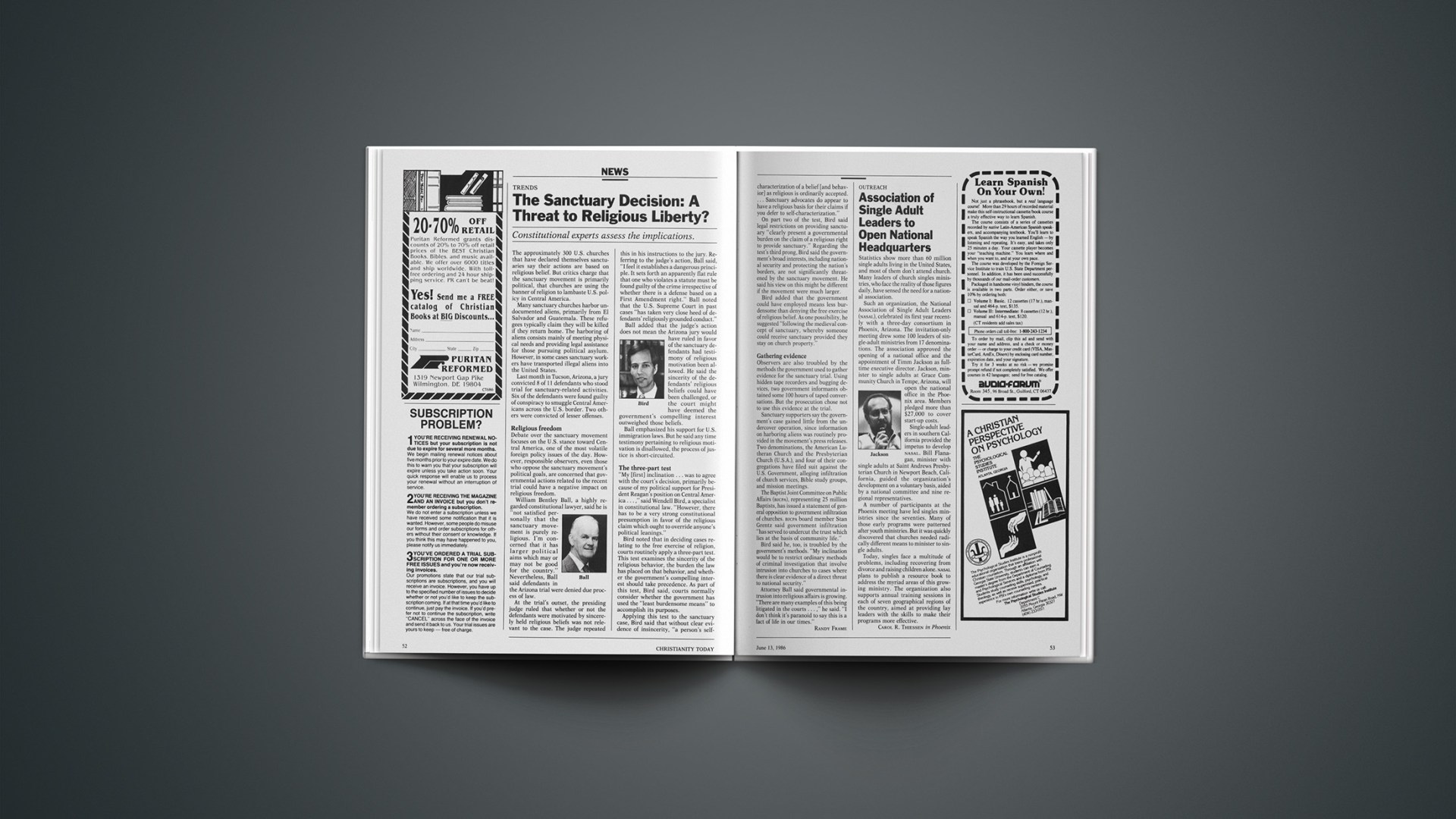
The Sanctuary Decision: A Threat to Religious Liberty?

Constitutional experts assess the implications.

The approximately 300 U.S. churches that have declared themselves sanctuaries say their actions are based on religious belief. But critics charge that the sanctuary movement is primarily political, that churches are using the banner of religion to lambaste U.S. policy in Central America.

Many sanctuary churches harbor undocumented aliens, primarily from El Salvador and Guatemala. These refugees typically claim they will be killed if they return home. The harboring of aliens consists mainly of meeting physical needs and providing legal assistance for those pursuing political asylum. However, in some cases sanctuary workers have transported illegal aliens into the United States.

Last month in Tucson, Arizona, a jury convicted 8 of 11 defendants who stood trial for sanctuary-related activities. Six of the defendants were found guilty of conspiracy to smuggle Central Americans across the U.S. border. Two others were convicted of lesser offenses.

Religious Freedom

Debate over the sanctuary movement focuses on the U.S. stance toward Central America, one of the most volatile foreign policy issues of the day. However, responsible observers, even those who oppose the sanctuary movement’s political goals, are concerned that governmental actions related to the recent trial could have a negative impact on religious freedom.

William Bentley Ball, a highly regarded constitutional lawyer, said he is “not satisfied personally that the sanctuary movement is purely religious. I’m concerned that it has larger political aims which may or may not be good for the country.” Nevertheless, Ball said defendants in the Arizona trial were denied due process of law.

At the trial’s outset, the presiding judge ruled that whether or not the defendants were motivated by sincerely held religious beliefs was not relevant to the case. The judge repeated this in his instructions to the jury. Referring to the judge’s action, Ball said, “I feel it establishes a dangerous principle. It sets forth an apparently flat rule that one who violates a statute must be found guilty of the crime irrespective of whether there is a defense based on a First Amendment right.” Ball noted that the U.S. Supreme Court in past cases “has taken very close heed of defendants’ religiously grounded conduct.”

Ball added that the judge’s action does not mean the Arizona jury would have ruled in favor of the sanctuary defendants had testimony of religious motivation been allowed. He said the sincerity of the defendants’ religious beliefs could have been challenged, or the court might have deemed the government’s compelling interest outweighed those beliefs.

Ball emphasized his support for U.S. immigration laws. But he said any time testimony pertaining to religious motivation is disallowed, the process of justice is short-circuited.

The Three-Part Test

“My [first] inclination … was to agree with the court’s decision, primarily because of my political support for President Reagan’s position on Central America …,” said Wendell Bird, a specialist in constitutional law. “However, there has to be a very strong constitutional presumption in favor of the religious claim which ought to override anyone’s political leanings.”

Bird noted that in deciding cases relating to the free exercise of religion, courts routinely apply a three-part test. This test examines the sincerity of the religious behavior, the burden the law has placed on that behavior, and whether the government’s compelling interest should take precedence. As part of this test, Bird said, courts normally consider whether the government has used the “least burdensome means” to accomplish its purposes.

Applying this test to the sanctuary case, Bird said that without clear evidence of insincerity, “a person’s self-characterization of a belief [and behavior] as religious is ordinarily accepted.… Sanctuary advocates do appear to have a religious basis for their claims if you defer to self-characterization.”

On part two of the test, Bird said legal restrictions on providing sanctuary “clearly present a governmental burden on the claim of a religious right to provide sanctuary.” Regarding the test’s third prong, Bird said the government’s broad interests, including national security and protecting the nation’s borders, are not significantly threatened by the sanctuary movement. He said his view on this might be different if the movement were much larger.

Bird added that the government could have employed means less burdensome than denying the free exercise of religious belief. As one possibility, he suggested “following the medieval concept of sanctuary, whereby someone could receive sanctuary provided they stay on church property.”

Gathering Evidence

Observers are also troubled by the methods the government used to gather evidence for the sanctuary trial. Using hidden tape recorders and bugging devices, two government informants obtained some 100 hours of taped conversations. But the prosecution chose not to use this evidence at the trial.

Sanctuary supporters say the government’s case gained little from the undercover operation, since information on harboring aliens was routinely provided in the movement’s press releases. Two denominations, the American Lutheran Church and the Presbyterian Church (U.S.A.), and four of their congregations have filed suit against the U.S. Government, alleging infiltration of church services, Bible study groups, and mission meetings.

The Baptist Joint Committee on Public Affairs (BJCPA), representing 25 million Baptists, has issued a statement of general opposition to government infiltration of churches, BJCPA board member Stan Grentz said government infiltration “has served to undercut the trust which lies at the basis of community life.”

Bird said he, too, is troubled by the government’s methods. “My inclination would be to restrict ordinary methods of criminal investigation that involve intrusion into churches to cases where there is clear evidence of a direct threat to national security.”

Attorney Ball said governmental intrusion into religious affairs is growing. “There are many examples of this being litigated in the courts …,” he said. “I don’t think it’s paranoid to say this is a fact of life in our times.”

RANDY FRAME

Nonorthodox Sects Report Global Membership Gains

Church leaders say some Third World Christians are being misled by the groups.

Ruth A. Tucker is a visiting professor of mission at Trinity Evangelical Divinity School in Deerfield, Illinois, and author of a biographical history of Christian missions.

On America’s city streets and in its major airport terminals, it is not unusual for passers-by to be accosted by followers of nontraditional religions. But few Americans—including many church members—realize nonorthodox religious sects are busy recruiting followers outside the United States as well.

Claiming to represent true Christianity, these groups are penetrating the world’s burgeoning cities and remote jungle villages with their unorthodox teachings about salvation. While highly evangelistic, they do not hold the cardinal doctrines of the Christian faith, such as the trinity of the Godhead and the deity of Christ. Among the most zealous are three American-born sects: Jehovah’s Witnesses, Mormons, and The Way International.

Pastors and parishioners overseas are often caught in the sects’ snare. A Christian missionary in Martinique has told of “heartbreaking disappointments” caused by the loss of church members to the Jehovah’s Witnesses.

Jehovah’S Witnesses

During the 1970s, Jehovah’s Witnesses recorded a worldwide growth of 45 percent. In January, the organization’s Watchtower magazine reported that missionaries serving in more than 200 countries last year were responsible for 189,800 baptisms. Last year members expended 590,540,205 hours in outreach efforts around the world, including the United States.

The Jehovah’s Witnesses’ growth has been slow in some countries. In Pakistan, some 70,000 hours of recruiting resulted in only six baptisms. And in Morocco, no baptisms were reported after some 20,000 hours of work.

The sect’s recruiting efforts last year were most effective in Latin America. Mexico led other Latin American countries with more than 17,000 baptisms, and Brazil ranked second with more than 14,000. The United States led the world last year with 34,348 Jehovah’s Witnesses’ baptisms.

Italy, a difficult area of ministry for Protestants, is one of the fastest-growing regions for Jehovah’s Witnesses, with more than 10,000 baptisms last year—a 10 percent increase over 1984. Japan recorded a 12 percent increase, with slightly more than 10,000 baptisms last year.

The Jehovah’s Witnesses commission full-time missionaries. However, volunteers carry out most of the sect’s recruiting efforts by spending time each month making contacts door-to-door. The number of those workers reached a peak last year of more than 3 million. Apparently their work paid off: The Jehovah’s Witnesses saw its worldwide membership grow by nearly 7 percent last year.

Mormons

The Mormons, officially known as the Church of Jesus Christ of Latter-day Saints (LDS), maintains the most extensive missionary program of any nonorthodox religious sect. The late LDS president Spencer W. Kimball initiated the accelerated missionary thrust in 1973. During a 12-year period, the number of countries where Mormons were active expanded from 50 to 96. North Americans make up the vast majority of the approximately 30,000 Mormon missionaries. But LDS officials are attempting to increase the number of nationals in the missionary force.

While Mormon missionaries circle the globe in door-to-door proselytizing efforts, translation of the Book of Mormon moves ahead. A December 1985 issue of the LDS’s Church News reported the completion of the seventieth translation, printed in a language spoken on a chain of South Pacific islands. The LDS views the translation and distribution of the Book of Mormon as essential to the spreading of the Mormon faith. In fact, the Australian LDS mission has said it will try to place a copy of the book in every home in the country.

The construction of Mormon temples is another aspect of fully introducing Mormonism to other cultures. Sixteen of the 40 Mormon temples throughout the world were dedicated in the past three years. With a temple in their home country, Mormon converts do not have to travel abroad to participate in ritualistic temple ceremonies. In December, Church News reported that the Manila, Philippines, temple “is running to capacity with 200 to 300 endowments performed daily.…” (Endowments are temple blessings given to “worthy and faithful” Mormons who commit themselves to a higher level of dedication to God.)

The Way International

Founded in 1955 by the late Victor Paul Wierwille, The Way International advocates personal evangelism by lay people, claiming this was the apostle Paul’s method. Many students, military personnel, and professionals go abroad each year to carry The Way’s message of being “born again” via Unitarian doctrine.

The Way Magazine updated the organization’s missionary activity: “From the southern port of Punta Arenas, Chile, to the northern gold fields of Fairbanks, Alaska—from the industrial city of Tokyo, Japan, to the small villages of Zaire, Africa—from the sprawling suburbs of Sydney, Australia, to the streets of Amsterdam—Word Over the World [wow] Ambassadors are living up to their name. Today wow Ambassadors are speaking God’s Word on every continent of the world.”

The Way International does not claim a membership per se. But the movement says more than 160,000 people have graduated from its Power For Abundant Living [PFAL] course that instructs individuals in the sect’s unorthodox doctrine. The Way offers the course in eight languages, including Mandarin Chinese, and is translating it into dozens more.

The Way operates fellowships in all 50 states and in 60 foreign countries. The organization is expanding most rapidly in Zaire, where the number of people graduating from the PFAL course exceeds the number completing the course in the United States. The movement is also growing rapidly in Latin America.

A Christian Response

Despite statistics that indicate rapid expansion of nonorthodox religious sects, some observers argue that the membership figures are exaggerated. They point, for example, to the high attrition rate among Jehovah’s Witnesses. Others note that not all conversions are genuine. Mormon missionaries have been accused of rebaptizing people to enhance membership figures.

Still, unorthodox religious movements are penetrating historic mission fields as never before. In response, a number of Christians have launched efforts to counteract the missionary work of nonorthodox sects.

Wally Tope directs Frontline Ministries, a Pasadena-based organization aimed at evangelizing Mormons and Jehovah’s Witnesses. In 1980, he followed then Mormon president Spencer Kimball as he toured the Far East. Tope later followed the Mormon Tabernacle Choir on its tour through Europe. On both occasions he passed out evangelistic tracts written for Mormons.

More recently in Guatemala, Tope distributed tracts at the official opening of a Mormon temple in Guatemala City, answered questions about Mormonism on a radio program, and arranged for several showings of a film about Mormonism. He works closely with mission boards and national Christians.

Tope is not alone. Ron Carlson, president of the Minneapolis-based Christian Ministries International, travels worldwide giving lectures and seminars on nonorthodox sects. He recently spent a year in the Philippines, serving as a mission specialist on nonorthodox groups. In September 1984, he spearheaded a tract-distribution campaign during the opening of a Mormon temple in Manila.

Evangelist Luis Palau, who regularly conducts campaigns abroad, says members of nonorthodox sects often try to infiltrate his crusade counseling staffs or influence new converts after his campaigns are over.

“In my 20 years of preaching the gospel around the world, I have encountered opposition from cults in every crusade almost without exception,” Palau says. “Cult members have attempted to pose as crusade counselors, and some have gone from house to house telling people they were associated with our crusade.”

Church leaders overseas echo the concern over nonorthodox religious groups. Raphael Etsea, vice-president of Zaire’s Africa Inland Church (AIC), says his country’s Bible schools and seminaries should offer courses to help future Christian leaders deal with the problem. He says too often his people accept at face value what they hear from religious teachers from the West. As a result, groups such as Jehovah’s Witnesses are making inroads.

Kitambo Kysando, an AIC pastor in Beni, Zaire, addresses the problem from his pulpit. In his sermons, he sometimes outlines the beliefs of a particular sect and then contrasts those beliefs with biblical doctrine.

“We desperately need more missionaries who are equipped to deal with the cults,” says Carlson, of Christian Ministries International. “Also, we need to train the new believers in the basic doctrines of the Christian faith, so they are not easily led astray.…”

RUTH A. TUCKER

A Push to Teach Religious Liberty in Public Schools

Americans United for Separation of Church and State has launched a project to teach students about the importance of religious liberty in American history and life. Spokesmen for the group say Americans lack an understanding of religious liberty because public education does not include discussions about the role of religious freedom.

At a Washington, D.C., news conference, Americans United released a report sponsored by its research foundation. Charles C. Haynes, author of the report, analyzed how religious liberty is treated in leading history and civics textbooks. “Given the vitality of religious life in the events of U.S. history,” he said, “it is remarkable how little religion is mentioned [in school materials].” Haynes teaches at Randolph-Macon College in Ashland, Virginia.

Many teachers are confused about U.S. Supreme Court decisions concerning the place of religion in public schools, Haynes said. As a result, teachers tend to gloss over lessons about religious liberty in order to avoid controversy.

Haynes recommended that Americans United develop new curriculum materials and work with other organizations to find new approaches to educate students about religious freedom. He is compiling a resource guide, listing books, articles, and films for classroom use. The guide will be mailed to social studies teachers around the country.

Americans United favors a strict definition of separation between church and state. In the past, the organization’s stand against school prayer and aid to parochial schools has put it at cross purposes with other religious groups. Robert Maddox, Americans United executive director, says the education project is one instance in which his organization can work closely with most other religious groups.

Christian Leaders Intensify Their Efforts against TV Violence

The push to clean up network television has intensified, with religious and political leaders demanding a decrease in violent programming.

A broad coalition called Christian Leaders for Responsible Television (CLRTV) has announced it will closely monitor this year’s fall television season. “If we do not see a 35 percent reduction of sex, profanity, and violence, and an immediate end of anti-Christian bias in programming, we will choose one or more advertisers and ask our constituents for a massive economic boycott,” said CLRTV executive director Donald Wildmon.

CLRTV is made up of about 1,600 leaders, including the heads of some 70 Protestant denominations; more than 100 Catholic bishops; 21 United Methodist bishops; 13 Episcopal bishops; 16 Lutheran bishops; 21 heads of state Southern Baptist conventions; more than 200 Christian broadcasters; and presidents of Christian colleges.

Billy Melvin, chairman of the CLRTV board and executive director of the National Association of Evangelicals, said grassroots concern over the deterioration of television programming abounds. “We believe we have the best chance we’ve ever had to impact the medium,” he said, “to change the face of television programming.”

In April, representatives of CLRTV met with executives from ABC, CBS, and NBC to express their concerns about what they term “the moral pollution” of network television. “There was no indication from any of the networks that they intend to change anything they are doing,” Wildmon said.

CLRTV has also asked program sponsors to cooperate in their effort. The group met with advertising executives in Chicago, urging them to be more responsible in the sponsorship of network programming. Wildmon said CLRTV has alerted sponsors and television networks of its intention to boycott companies that sponsor offending television programs this fall.

“We tried every reasonable approach we could try, and our pleas fell on deaf ears,” Wildmon said. “So now we are saying, ‘If money is the only language that is understood, we will speak the language of money.’ ”

Meanwhile, U.S. Sen. Paul Simon (D-Ill.) has proposed legislation to curb television violence. “We’re seeing too much violence on television for our own mental health, and particularly the mental health of our children,” Simon said at a news conference.

The senator has met with television industry representatives, visited television production facilities, and held congressional hearings on the issue. As a result, he introduced two bills. The first would allow broadcasting companies and trade associations to take joint action against television violence without violating federal antitrust laws. The second bill would direct the Federal Communications Commission to oversee a “definitive study” on television violence and report back to Congress within a year.

During his press conference, Simon referred to studies by the U.S. Surgeon General’s office, the National Institute of Mental Health, the U.S. Attorney General’s office, and the American Academy of Pediatrics, suggesting that television violence can promote aggressive behavior. “Television can appeal to the best or worst in us,” he said. “If we begin placing a little less emphasis on violence to attract viewers, perhaps the industry can begin placing more emphasis on positive influences.”

Baptists Consider Court’s Request to Move Church

The highest court in Israel has asked a Baptist congregation to leave a Jewish area of Jerusalem before it builds a new sanctuary. Israel’s High Court made the request while reviewing a suit filed by the Narkis Street Baptist Church against a district planning commission, which last year refused to issue the church a building permit.

The Narkis Street church has been meeting in a tentlike structure since 1982 when its building was destroyed by arson. The congregation wants to replace its burned-out chapel with a $1 million facility, including a 400-seat auditorium, several classrooms, and office space.

The rebuilding plan was approved by Mayor Teddy Kollek, various municipal agencies, and the Jerusalem city council. But last fall, a district planning commission decided to allow only the building of a structure similar to the congregation’s original 60-seat chapel. The church then filed suit in Israel’s High Court.

Ultra-orthodox Jewish groups have demonstrated against the church’s plan to rebuild. Among other objections, they say the Baptists’ singing disrupts the Narkis Street neighborhood and that their parked cars clog the streets. Pat Hoaldridge, acting chairman of Southern Baptist representatives in Israel, says the High Court’s request for the church to move indicates the judges did not want to risk raising religious tensions further.

“You have to understand the climate in the country at this time,” Hoaldridge says. “The rise of religious feelings regarding what the people would call missionary activity … is playing a part in this case.”

The High Court said it would not rule on the church’s suit against the district planning commission for two months. The delay is designed to give the Narkis Street congregation and the Baptist Convention of Israel time to consider trading the church property for another site in Jerusalem.

Lawyers for the church have recommended that the Baptists move on the condition the church’s building permit will be approved as submitted. At press time, the congregation had not made a decision.

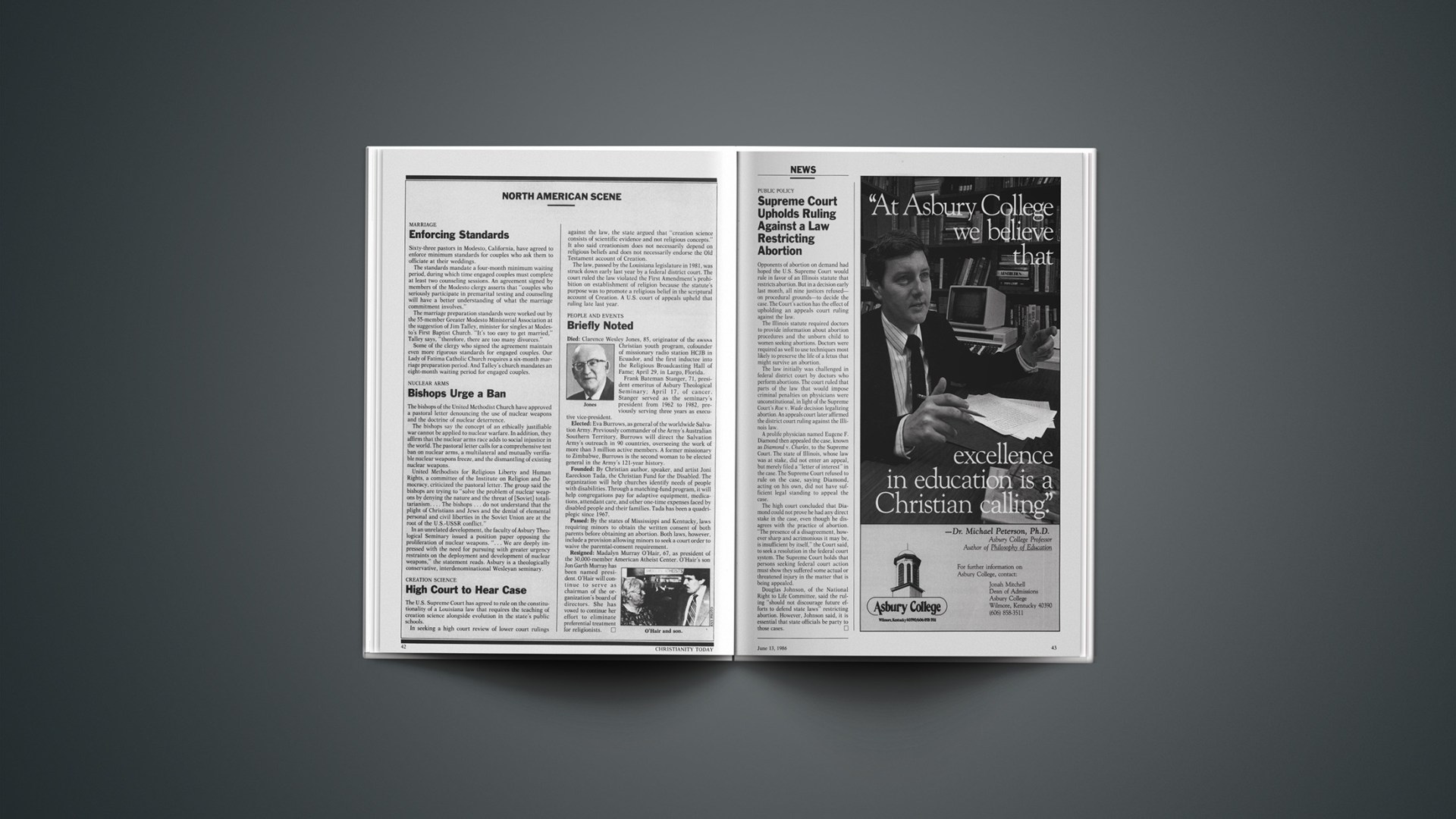
Supreme Court Upholds Ruling against a Law Restricting Abortion

Opponents of abortion on demand had hoped the U.S. Supreme Court would rule in favor of an Illinois statute that restricts abortion. But in a decision early last month, all nine justices refused—on procedural grounds—to decide the case. The Court’s action has the effect of upholding an appeals court ruling against the law.

The Illinois statute required doctors to provide information about abortion procedures and the unborn child to women seeking abortions. Doctors were required as well to use techniques most likely to preserve the life of a fetus that might survive an abortion.

The law initially was challenged in federal district court by doctors who perform abortions. The court ruled that parts of the law that would impose criminal penalties on physicians were unconstitutional, in light of the Supreme Court’s Roe v. Wade decision legalizing abortion. An appeals court later affirmed the district court ruling against the Illinois law.

A prolife physician named Eugene F. Diamond then appealed the case, known as Diamond v. Charles, to the Supreme Court. The state of Illinois, whose law was at stake, did not enter an appeal, but merely filed a “letter of interest” in the case. The Supreme Court refused to rule on the case, saying Diamond, acting on his own, did not have sufficient legal standing to appeal the case.

The high court concluded that Diamond could not prove he had any direct stake in the case, even though he disagrees with the practice of abortion. “The presence of a disagreement, however sharp and acrimonious it may be, is insufficient by itself,” the Court said, to seek a resolution in the federal court system. The Supreme Court holds that persons seeking federal court action must show they suffered some actual or threatened injury in the matter that is being appealed.

Douglas Johnson, of the National Right to Life Committee, said the ruling “should not discourage future efforts to defend state laws” restricting abortion. However, Johnson said, it is essential that state officials be party to those cases.

WORLD SCENE

IRELAND

A Referendum on Divorce

Voters in the Republic of Ireland could decide as early as this month whether to lift a constitutional ban on divorce.

The government announced last month it would introduce legislation to hold a referendum on the divorce ban. The 1937 constitutional provision can be changed only by a majority of the popular vote in a referendum.

Opinion polls indicate as many as 77 percent of the Irish population favor allowing divorce “in certain circumstances.” However, the same polls show only a narrow majority willing to vote for the complete removal of the constitutional prohibition.

If the ban is removed, the government says divorce would be allowed only in cases where a marriage can be shown to have failed and the failure has continued for a period of five years. The Roman Catholic Church, which claims 90 percent of the Irish population, opposes divorce. However, Ireland’s bishops are divided over how actively they should oppose efforts to lift the constitutional ban.

HUNGARY

Churches Help Drug Addicts

Several churches in Hungary are launching drug rehabilitation programs with the government’s permission. Hungarian Christians say the efforts are contributing to the relaxation of tensions between church and state in the communist country.

Baptists in Budapest have established a coffee house that seeks to minister to people with drug and alcohol dependencies. They are also setting up a rehabilitation center about 125 miles from the city. Pentecostal churches are opening a rehabilitation center just outside Budapest. And the Free Christian Church Council is planning to establish treatment facilities.

These developments gained impetus from meetings conducted last year by American evangelist Nicky Cruz. A former drug addict and New York City gang leader, Cruz visited Hungary at the invitation of Hungarian churches.

The nation’s communist government earlier had asked the churches to help combat the growing problem of drug and alcohol dependency among young people.

More than 5,000 people heard Cruz speak at two evangelistic meetings. In addition, physicians and church leaders from five East European nations attended a seminar on drug addiction led by Cruz.

The evangelist stressed the spiritual component in rehabilitation, saying, “Only after they have truly received Christ and are born again will they begin to consider the way they talk, the way they dress, the company they keep, the places they go, the things they do.”

LATIN AMERICA

Opposing WEF Membership

Meeting in Venezuela, delegates to a general assembly of the Confraternity of Evangelicals in Latin America (CONELA) voted against joining the World Evangelical Fellowship (WEF).

CONELA’s executive committee had recommended that the Latin American group join WEF. But a delegation from Mexico led an effort against the proposal, saying WEF needs to make itself better known among Latin American church leaders. While voting against WEF membership, the assembly did accept an invitation to send observers to WEF functions.

After the vote, a CONELA official said most evangelical church leaders in Latin America object to the practices and policies of the World Council of Churches. As a result, he said, they view with suspicion any unknown international and interdenominational agency.

In other action, delegates to the CONELA general assembly approved a declaration that calling it “another gospel [that offers] temporary liberation from physical problems such as poverty and certain political dictatorships.” The declaration calls for renewed evangelism across Latin America and asks both leftist and rightist governments to respect the “personal rights” of individuals.

Delegates elected Virgilio Zapata, general secretary of the Evangelical Alliance of Guatemala, as CONELA’s new president. Outgoing president Marcelino Ortiz of Mexico will continue to serve on the organization’s executive committee. Formed four years ago in Panama, CONELA includes 206 denominations and Christian service agencies.

ROME

Competition from ‘Sects’

The Vatican has released a report recommending changes in Catholic parish life to help stem the loss of members to other religious groups. Chief Vatican spokesman Joaquin Navarro Valls says competition from non-Catholic groups is “one of the major dangers facing the church.”

The 27-page document, titled “Sects or New Religious Movements: A Pastoral Challenge,” says sects have flourished because of “needs and aspirations which are seemingly not being met in the mainline churches.” Non-Catholic religious movements succeed because they provide “human warmth, care and support in small close-knit communities … [and] a style of prayer and preaching closer to the cultural traits and aspirations of the people.

“The challenge of the new religious movements is to stimulate our own renewal for a greater pastoral efficiency,” the report states. The document cites “deficiencies and inadequacies in the actual behavior of the church which can facilitate the success of sects.” And it calls on the Catholic church to consider changes, including the creation of “more fraternal” church structures that are “more adapted to people’s life situations.… Preaching, worship and community prayer should not necessarily be confined to traditional places of worship.”

The document drew from information contained in questionnaires completed by some 75 bishops’ conferences around the world. Luis Eduardo Castano, ecumenical officer for the Latin American Catholic Bishops’ Conference, said the church is concerned about the growth of fundamentalist and charismatic Protestant groups in Latin America.

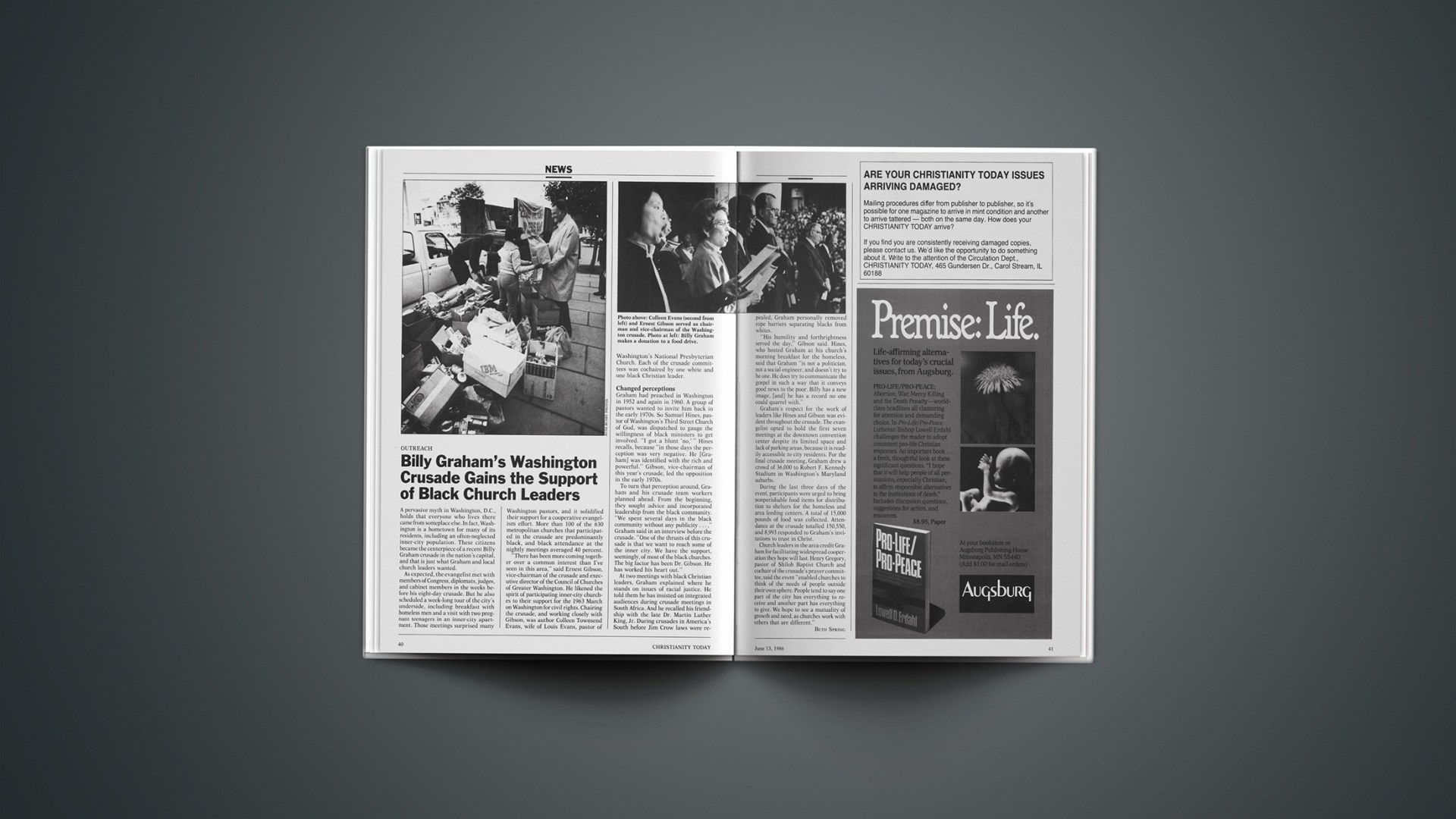
Billy Graham’s Washington Crusade Gains the Support of Black Church Leaders

A pervasive myth in Washington, D.C., holds that everyone who lives there came from someplace else. In fact, Washington is a hometown for many of its residents, including an often-neglected inner-city population. These citizens became the centerpiece of a recent Billy Graham crusade in the nation’s capital, and that is just what Graham and local church leaders wanted.

As expected, the evangelist met with members of Congress, diplomats, judges, and cabinet members in the weeks before his eight-day crusade. But he also scheduled a week-long tour of the city’s underside, including breakfast with homeless men and a visit with two pregnant teenagers in an inner-city apartment. Those meetings surprised many Washington pastors, and it solidified their support for a cooperative evangelism effort. More than 100 of the 630 metropolitan churches that participated in the crusade are predominantly black, and black attendance at the nightly meetings averaged 40 percent.

“There has been more coming together over a common interest than I’ve seen in this area,” said Ernest Gibson, vice-chairman of the crusade and executive director of the Council of Churches of Greater Washington. He likened the spirit of participating inner-city churches to their support for the 1963 March on Washington for civil rights. Chairing the crusade, and working closely with Gibson, was author Colleen Townsend Evans, wife of Louis Evans, pastor of Washington’s National Presbyterian Church. Each of the crusade committees was cochaired by one white and one black Christian leader.

Changed Perceptions

Graham had preached in Washington in 1952 and again in 1960. A group of pastors wanted to invite him back in the early 1970s. So Samuel Hines, pastor of Washington’s Third Street Church of God, was dispatched to gauge the willingness of black ministers to get involved. “I got a blunt ‘no,’ ” Hines recalls, because “in those days the perception was very negative. He [Graham] was identified with the rich and powerful.” Gibson, vice-chairman of this year’s crusade, led the opposition in the early 1970s.

To turn that perception around, Graham and his crusade team workers planned ahead. From the beginning, they sought advice and incorporated leadership from the black community. “We spent several days in the black community without any publicity …,” Graham said in an interview before the crusade. “One of the thrusts of this crusade is that we want to reach some of the inner city. We have the support, seemingly, of most of the black churches. The big factor has been Dr. Gibson. He has worked his heart out.”

At two meetings with black Christian leaders, Graham explained where he stands on issues of racial justice. He told them he has insisted on integrated audiences during crusade meetings in South Africa. And he recalled his friendship with the late Dr. Martin Luther King, Jr. During crusades in America’s South before Jim Crow laws were repealed, Graham personally removed rope barriers separating blacks from whites.

“His humility and forthrightness served the day,” Gibson said. Hines, who hosted Graham at his church’s morning breakfast for the homeless, said that Graham “is not a politician, not a social engineer, and doesn’t try to be one. He does try to communicate the gospel in such a way that it conveys good news to the poor. Billy has a new image, [and] he has a record no one could quarrel with.”

Graham’s respect for the work of leaders like Hines and Gibson was evident throughout the crusade. The evangelist opted to hold the first seven meetings at the downtown convention center despite its limited space and lack of parking areas, because it is readily accessible to city residents. For the final crusade meeting, Graham drew a crowd of 36,000 to Robert F. Kennedy Stadium in Washington’s Maryland suburbs.

During the last three days of the event, participants were urged to bring nonperishable food items for distribution to shelters for the homeless and area feeding centers. A total of 15,000 pounds of food was collected. Attendance at the crusade totalled 150,550, and 8,993 responded to Graham’s invitations to trust in Christ.

Church leaders in the area credit Graham for facilitating widespread cooperation they hope will last. Henry Gregory, pastor of Shiloh Baptist Church and cochair of the crusade’s prayer committee, said the event “enabled churches to think of the needs of people outside their own sphere. People tend to say one part of the city has everything to receive and another part has everything to give. We hope to see a mutuality of growth and need, as churches work with others that are different.”

BETH SPRING

NORTH AMERICAN SCENE

MARRIAGE

Enforcing Standards

Sixty-three pastors in Modesto, California, have agreed to enforce minimum standards for couples who ask them to officiate at their weddings.

The standards mandate a four-month minimum waiting period, during which time engaged couples must complete at least two counseling sessions. An agreement signed by members of the Modesto clergy asserts that “couples who seriously participate in premarital testing and counseling will have a better understanding of what the marriage commitment involves.”

The marriage preparation standards were worked out by the 55-member Greater Modesto Ministerial Association at the suggestion of Jim Talley, minister for singles at Modesto’s First Baptist Church. “It’s too easy to get married,” Talley says, “therefore, there are too many divorces.”

Some of the clergy who signed the agreement maintain even more rigorous standards for engaged couples. Our Lady of Fatima Catholic Church requires a six-month marriage preparation period. And Talley’s church mandates an eight-month waiting period for engaged couples.

NUCLEAR ARMS

Bishops Urge a Ban

The bishops of the United Methodist Church have approved a pastoral letter denouncing the use of nuclear weapons and the doctrine of nuclear deterrence.

The bishops say the concept of an ethically justifiable war cannot be applied to nuclear warfare. In addition, they affirm that the nuclear arms race adds to social injustice in the world. The pastoral letter calls for a comprehensive test ban on nuclear arms, a multilateral and mutually verifiable nuclear weapons freeze, and the dismantling of existing nuclear weapons.

United Methodists for Religious Liberty and Human Rights, a committee of the Institute on Religion and Democracy, criticized the pastoral letter. The group said the bishops are trying to “solve the problem of nuclear weapons by denying the nature and the threat of [Soviet] totalitarianism.… The bishops … do not understand that the plight of Christians and Jews and the denial of elemental personal and civil liberties in the Soviet Union are at the root of the U.S.-USSR conflict.”

In an unrelated development, the faculty of Asbury Theological Seminary issued a position paper opposing the proliferation of nuclear weapons. “… We are deeply impressed with the need for pursuing with greater urgency restraints on the deployment and development of nuclear weapons,” the statement reads. Asbury is a theologically conservative, interdenominational Wesleyan seminary.

CREATION SCIENCE

High Court to Hear Case

The U.S. Supreme Court has agreed to rule on the constitutionality of a Louisiana law that requires the teaching of creation science alongside evolution in the state’s public schools.

In seeking a high court review of lower court rulings against the law, the state argued that “creation science consists of scientific evidence and not religious concepts.” It also said creationism does not necessarily depend on religious beliefs and does not necessarily endorse the Old Testament account of Creation.

The law, passed by the Louisiana legislature in 1981, was struck down early last year by a federal district court. The court ruled the law violated the First Amendment’s prohibition on establishment of religion because the statute’s purpose was to promote a religious belief in the scriptural account of Creation. A U.S. court of appeals upheld that ruling late last year.

PEOPLE AND EVENTS

Briefly Noted

Died: Clarence Wesley Jones, 85, originator of the AWANA Christian youth program, cofounder of missionary radio station HCJB in Ecuador, and the first inductee into the Religious Broadcasting Hall of Fame; April 29, in Largo, Florida.

Frank Bateman Stanger, 71, president emeritus of Asbury Theological Seminary; April 17, of cancer. Stanger served as the seminary’s president from 1962 to 1982, previously serving three years as executive vice-president.

Elected: Eva Burrows, as general of the worldwide Salvation Army. Previously commander of the Army’s Australian Southern Territory, Burrows will direct the Salvation Army’s outreach in 90 countries, overseeing the work of more than 3 million active members. A former missionary to Zimbabwe, Burrows is the second woman to be elected general in the Army’s 121-year history.

Founded: By Christian author, speaker, and artist Joni Eareckson Tada, the Christian Fund for the Disabled. The organization will help churches identify needs of people with disabilities. Through a matching-fund program, it will help congregations pay for adaptive equipment, medications, attendant care, and other one-time expenses faced by disabled people and their families. Tada has been a quadriplegic since 1967.

Passed: By the states of Mississippi and Kentucky, laws requiring minors to obtain the written consent of both parents before obtaining an abortion. Both laws, however, include a provision allowing minors to seek a court order to waive the parental-consent requirement.

Resigned: Madalyn Murray O’Hair, 67, as president of the 30,000-member American Atheist Center. O’Hair’s son Jon Garth Murray has been named president. O’Hair will continue to serve as chairman of the organization’s board of directors. She has vowed to continue her effort to eliminate preferential treatment for religionists.

Apple PodcastsDown ArrowDown ArrowDown Arrowarrow_left_altLeft ArrowLeft ArrowRight ArrowRight ArrowRight Arrowarrow_up_altUp ArrowUp ArrowAvailable at Amazoncaret-downCloseCloseEmailEmailExpandExpandExternalExternalFacebookfacebook-squareGiftGiftGooglegoogleGoogle KeephamburgerInstagraminstagram-squareLinkLinklinkedin-squareListenListenListenChristianity TodayCT Creative Studio Logologo_orgMegaphoneMenuMenupausePinterestPlayPlayPocketPodcastRSSRSSSaveSaveSaveSearchSearchsearchSpotifyStitcherTelegramTable of ContentsTable of Contentstwitter-squareWhatsAppXYouTubeYouTube