Southern Africa: New Discovery Needed

This is the land of Livingstone. Here he fought lions and slavery, made discoveries, and brought the first Light to a darkened continent. Today his explorations would be stopped by rigid boundaries, and he would be a bewildered stranger. Nine countries divide the subcontinent, comparable in area and population with the western half of the United States. They are, with estimated populations: Northern Rhodesia, 2.55 million; Malawi (Nyasaland), 3.6; Southern Rhodesia, 3.9; Swaziland, 0.27; Basutoland, 0.71; Bechuanaland, 0.34 (all six with continuing links of varying kinds with Britain); the Republic of South Africa, 16.0 (which left the British Commonwealth in 1961); Mozambique, 6.6 (a Portuguese possession); and South-West Africa, 0.53 (a territory administered by the Republic of South Africa which denies the United Nations’ claim to trusteeship).

The Republic of South Africa is proposing to erect barbed-wire fences on its boundries, and traffic is checked at an immigration post at the site of Livingstone’s great discovery, the Victoria Falls. A Malawi (Nyasaland) government minister scorned Livingstone as “just a tourist.” Mozambique recently refused to grant a visa to the bishop who heads the American Methodist Conference in Rhodesia.

Geographically as diverse as the western United States, Southern Africa is also politically and socially divided, and fragmentation on racial lines continues. Governmental “color” ranges from all-black in the north of the area concerned (Malawi) to all-white in the south (Republic of South Africa).

Four Major Problems

Few mission fields have such a rich spiritual heritage. This is the land not only of Livingstone but of Robert Moffat, Francois Coillard, James Stewart, Robert Laws, Barnabas Shaw, and F. S. Arnot. Here Andrew Murray lived and wrote books that have blessed the whole Christian world. But despite the past success of missionary work, there are at least four frustrating problems today: racism, isolationism, paternalism, and rapid urbanization. Three are challenges to be met in the Church, the fourth by the Church.

Racism: What are evangelicals to say about the race problems? Most of them tend to dismiss such issues as merely political. A Nyasa Christian commented on “the glorious apathy of evangelicals to race issues,” A Christian convention in Southern Rhodesia uses as its motto, “All One in Christ Jesus,” but excludes Africans lest the whites be outnumbered. Race pervades church issues and has created deep spiritual problems. Many Africans view the church as simply a part of the colonial community. When a former Rhodesian prime minister proposed a convention of non-political bodies, he included churches. African reaction was summed up in a Salisbury daily newspaper in these terms: “They’re all dominated by whites, so we cannot expect anything except that which will safeguard white interests.” Even African ministers commonly regard themselves as in the service of whites, and church-mission relations are described in those terms.

Though South Africa is considered a citadel of racism, its Dutch Reformed Church has a growing evangelical group that is protesting racial division in the Body of Christ. Eleven leading professors and theologians of this denomination condemned the practice of racism by Christians in the dynamic book, Delayed Action. A former moderator of the church was forced to choose between his Dutch Reformed ministerial status and leadership of a Christian institute to further inter-racial cooperation. He chose the latter.

Such courageous action is causing improvement in the situation. A group of Nyasa pastors touring South Africa Dutch Reformed churches were well received. In the Afrikaans university town of Stellenbosch, interracial fellowship over tea is increasing—behavior that would have been unthinkable even five years ago. An all-white audience gave a ten-minute standing ovation to an African choir in Johannesburg after a stirring performance of Handel’s Messiah. Few were unmoved by either the performance or the ovation. Such breaches in the wall of racism do not come easily or quickly. But they are surely coming, though little change is yet evident in independent evangelical groups. Recent events have caused some Roman Catholic leaders to express publicly their dissatisfaction with the present civil policies.

Isolationism: For most evangelicals there is a sharp division between sacred and secular. The almost overwhelming problems of race, African poverty (in South Africa 67 per cent of Africans live below the breadline), immorality (nearly 60 per cent of all African babies are born out of wedlock), and drunkenness are deplored. But they are considered secular, political, and untouchable. This great divorce of secular and sacred is deeply disturbing to the African; traditionally for him there is no such distinction. With genuine perplexity a young Zulu said: “They told us of God and the Bible and how all men were equal and the same before God. But they do not treat us as equals. What can we believe, and what are we to do?”

Albert Luthuli, African Nobel Prize winner, is convinced that the Church must speak on so-called secular issues. “There is a seeming indifference to problems,” he comments, “a running shy of even meeting political leaders. The result is a schism between minister and political leader which harms them both.” Disillusioned by silence, Africans are increasingly indifferent to efforts of white missionaries. Materialism, Communism, nationalism, and traditional animism all seem more relevant. The basic religious desire of the people is met by a never-ending development of new sects. More than 3,000 different sects combining elements of Christianity, animism, and racism can be found in Southern Africa.

Paternalism: “At times we simply stand astonished at the motives causing us to cling to a position of power,” confessed a prominent minister of the Dutch Reformed Church. “Many missionaries in Africa today … would do the Kingdom of God a great service if they placed themselves at the disposal of the indigenous Church in an advisory capacity and accepted its leadership.” What is known as the “Indigenous Church Problem” is still warmly debated. Says the principal of a Bible institute in the republic: “The Church is regarded as a mission field, and one generation of missionaries succeeds another in the task of overseeing it and keeping the work going. It is true that all churches need supervision.… What is wrong is our insistence (by practice) that supervision must be white.” Virtually perpetual white supervision has resulted in a weakening of the Church. It is felt that the African church cannot develop as it should as long as there is an imposed missionary leadership. “The Church is paralyzed through being carried.”

In reaction to paternalism, independent movements are increasing rapidly. Missionaries, including evangelicals, are quietly being excluded in ever-widening circles. It is not our Gospel that Africans resent but our control. It may well be, remarks an American Methodist bishop, “that the best way for us whites to serve the African church is to get out of its way.” Nevertheless, Africans are quick to express their need for missionaries, if it means fellowship and not control. There is a wide conviction that missions without paternalism will be needed for a long time to come and that encouragement is also needed, but in a different way. What the non-whites wanted, said a Roman Catholic archbishop, was not white benevolence but white acceptance.

Urbanization: In 1939 less than 10 per cent of the people lived in cities. Today approximately 30 per cent live in cities, and over 70 per cent of the rural men have left for urban areas. Demographers predict that at least 75 per cent of the population will eventually be urbanized. Statistics do not show the moral and family breakdown that accompanies the shift. The urban masses are rootless; they cannot own land in most cities and are sheltered either in slums or in massive, impersonal housing projects. The African always found his purpose as part of a group, but he is now alone in the crowds. The evangelical is seldom there to help him. The Dutch Reformed Church leader quoted earlier says in this connection: “It would seem as though the churches are standing aloof from this great trek to the cities, not because they lack good will, but because the task seems overwhelming.”

Evangelical Strength

How strong are evangelicals in the face of such difficulties? At least twenty-five strongly evangelical societies work in Southern Africa, though most are numerically small in mission staff and church members. Initially they occupied the neglected, outlying areas. With diminishing evangelicalism in the older groups plus rapid urban growth, these missions needed to move into the mainstream of African life. Few societies have adjusted their work to do so.

But there are bright spots. Many thousands of lives have been transformed by the preaching of Jesus Christ. Evangelical churches are generally full in Swaziland, parts of Northern Rhodesia, and Malawi. Northern Mozambique is experiencing revival that has continued since the expulsion of missionaries. In the Republic of South Africa at least two groups report encouraging progress in urban evangelism, and one Bible college draws its nearly one hundred students both from evangelical bodies and from sects normally outside missionary influence. Underneath the problems it is abundantly evident that there is a general hunger for God.

Last century, when Stanley found him in the heart of Southern Africa, David Livingstone acknowledged: “You have brought me new life.” It is this same new life that is again needed, a view confirmed by the South African historian Edgar Brookes: “Quite literally and simply a personal devotion to God and an unswerving and prompt obedience to His leading is our greatest need.”

Malagasy: Africa’s Emerald Isle

The island Republic of Malagasy is often left off maps of Africa; yet its strategic relation to the continent is illustrated by the title of one of Africa’s power blocs—The Union of Africa and Malagasy.

Known as Madagascar until independence from sixty-five years of French rule came in 1960, Malagasy has a population of 5.6 million on a sub-tropical island of 228,000 square miles (about the size of Texas). Only 50 per cent of the population is of African origin; the remainder is from Indonesian and Arab stock. The people refer to themselves as Asiatics, not Africans. Their main occupation is coffee-growing, and the republic exports 60,000 tons per year.

The mission work of Protestants has been limited on this island where they are substantially outnumbered by Roman Catholics. Today, however, there is growing friendliness between the two, with some clergy meeting in joint study groups. A combined Bible translation committee has been formed.

Half of the population is still pagan, and hundreds of villages along the coast and in the forest belt remain unevangelized. There are also several nomadic tribes that have never been reached. The Norwegian Lutherans plan to open two new pioneer stations this year. The high rate of illiteracy on the island is a major drag on the forward movement of the Church.

While the island of Zanzibar, north along Africa’s eastern coast, has become Africa’s Cuba, Malagasy maintains strong ties with France and the West. She seems more concerned about Communist intrigues than most other members of the Organization for African Unity—a combination of the pro-West Monrovia Group and the pro-East or neutralist Casablanca Group.

In a recent press interview Malagasy’s president, M. Philibert Tsiranana, drew attention to Communist influence on his “doorstep”: “In Somalia, Russia is building a 60-million-dollar military base. Russians and Chinese have gone to Kenya, Tanganyika, and Zanzibar. There are 13,000 Chinese in Madagascar and more are arriving. They are agents of Chinese penetration. The French Army in Madagascar, as well as our own, must become more powerful.”

W. HAROLD FULLER
Eastern Africa: Independence Old and New

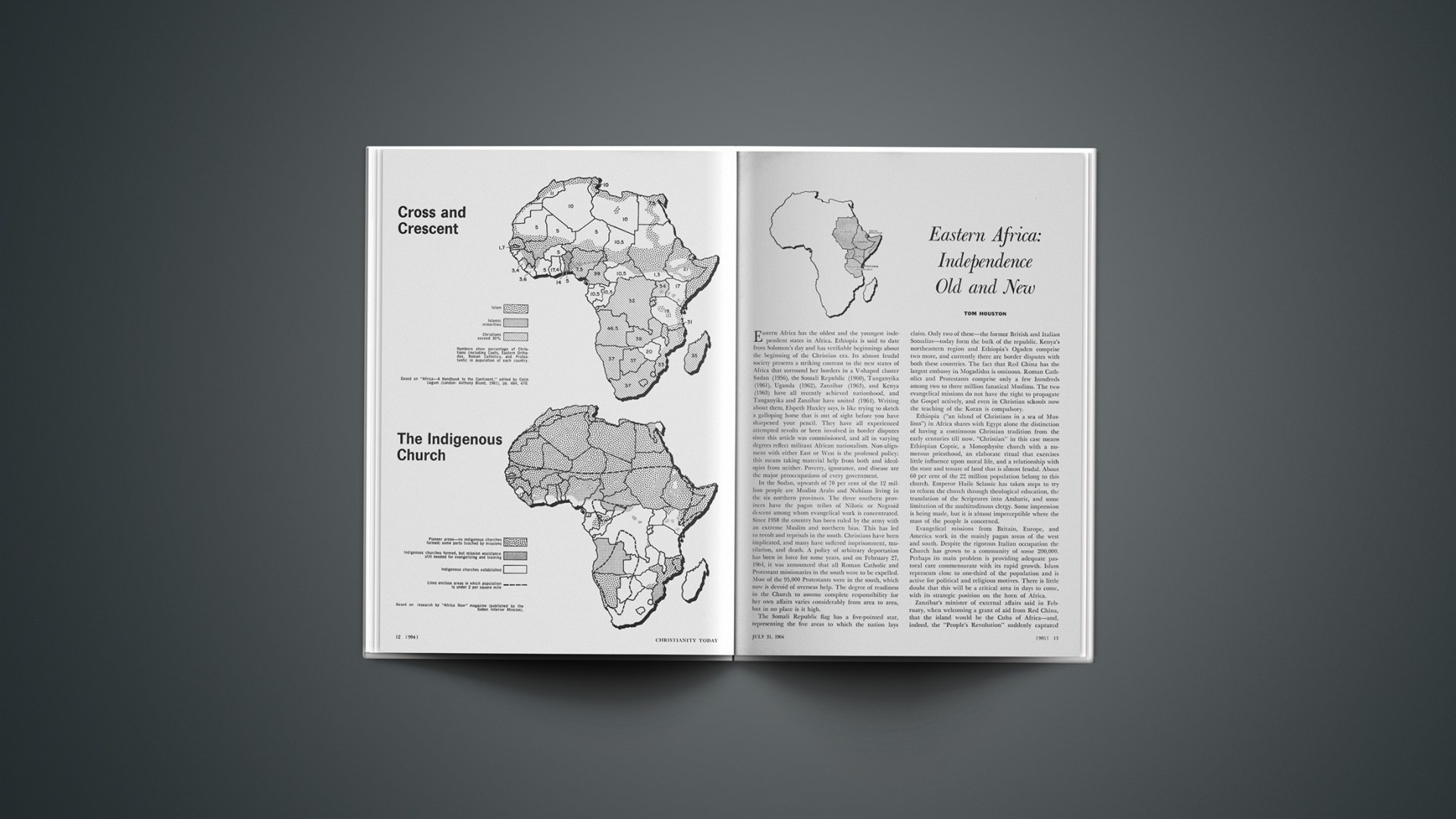
Eastern Africa has the oldest and the youngest independent states in Africa. Ethiopia is said to date from Solomon’s day and has verifiable beginnings about the beginning of the Christian era. Its almost feudal society presents a striking contrast to the new states of Africa that surround her borders in a V-shaped cluster Sudan (1956), the Somali Republic (1960), Tanganyika (1961), Uganda (1962), Zanzibar (1963), and Kenya (1963) have all recently achieved nationhood, and Tanganyika and Zanzibar have united (1964). Writing about them, Elspeth Huxley says, is like trying to sketch a galloping horse that is out of sight before you have sharpened your pencil. They have all experienced attempted revolts or been involved in border disputes since this article was commissioned, and all in varying degrees reflect militant African nationalism. Non-alignment with either East or West is the professed policy; this means taking material help from both and ideologies from neither. Poverty, ignorance, and disease are the major preoccupations of every government.

In the Sudan, upwards of 70 per cent of the 12 million people are Muslim Arabs and Nubians living in the six northern provinces. The three southern provinces have the pagan tribes of Nilotic or Negroid descent among whom evangelical work is concentrated. Since 1958 the country has been ruled by the army with an extreme Muslim and northern bias. This has led to revolt and reprisals in the south. Christians have been implicated, and many have suffered imprisonment, mutilation, and death. A policy of arbitrary deportation has been in force for some years, and on February 27, 1964, it was announced that all Roman Catholic and Protestant missionaries in the south were to be expelled. Most of the 95,000 Protestants were in the south, which now is devoid of overseas help. The degree of readiness in the Church to assume complete responsibility for her own affairs varies considerably from area to area, but in no place is it high.

The Somali Republic flag has a five-pointed star, representing the five areas to which the nation lays claim. Only two of these—the former British and Italian Somalias—today form the bulk of the republic. Kenya’s northeastern region and Ethiopia’s Ogaden comprise two more, and currently there are border disputes with both these countries. The fact that Red China has the largest embassy in Mogadishu is ominous. Roman Catholics and Protestants comprise only a few hundreds among two to three million fanatical Muslims. The two evangelical missions do not have the right to propagate the Gospel actively, and even in Christian schools now the teaching of the Koran is compulsory.

Ethiopia (“an island of Christians in a sea of Muslims”) in Africa shares with Egypt alone the distinction of having a continuous Christian tradition from the early centuries till now. “Christian” in this case means Ethiopian Coptic, a Monophysite church with a numerous priesthood, an elaborate ritual that exercises little influence upon moral life, and a relationship with the state and tenure of land that is almost feudal. About 60 per cent of the 22 million population belong to this church. Emperor Haile Selassie has taken steps to try to reform the church through theological education, the translation of the Scriptures into Amharic, and some limitation of the multitudinous clergy. Some impression is being made, but it is almost imperceptible where the mass of the people is concerned.

Evangelical missions from Britain, Europe, and America work in the mainly pagan areas of the west and south. Despite the rigorous Italian occupation the Church has grown to a community of some 200,000. Perhaps its main problem is providing adequate pastoral care commensurate with its rapid growth. Islam represents close to one-third of the population and is active for political and religious motives. There is little doubt that this will be a critical area in days to come, with its strategic position on the horn of Africa.

Zanzibar’s minister of external affairs said in February, when welcoming a grant of aid from Red China, that the island would be the Cuba of Africa—and, indeed, the “People’s Revolution” suddenly captured the headlines on January 12, 1964. This Muslim island off the coast of Tanganyika and now united with Tanganyika has been under Arab control for centuries, although Arabs are only 6 per cent of the 315,000 population. Only .1 percent are Christian, of the Roman or Anglo-Catholic tradition.

Surge Of Disaffection

Zanzibar’s revolution was quickly followed by a series of abortive army mutinies in Tanganyika, Uganda, and Kenya. This surge of disaffection came as a great shock to these young aspiring countries, underlining the mood of deep disillusionment that is creeping over sections of the population as they discover that independence is not bringing quickly enough all the benefits with which it has long been associated in the minds of the people. Despite herculean efforts by the governments, poverty, ignorance, and disease continue to dominate the lives of the majority. None of these lands is rich in natural resources; yet the stability of the political situation will greatly depend on economic progress.

The problems facing these three countries are largely the problems facing the Church. Their combined population of 26 million is increasing at the rate of 3 per cent annually. Sixty per cent of the population are under twenty-one years of age and 50 per cent under sixteen. In the past the Church has had a major share in education in each country, and it has educated most of the present leaders. Now the rapid expansion of educational facilities and the cessation of special privilege for Christianity in schools combine to challenge the Church to continue to influence school children by the sheer vitality of her own testimony. They present a tremendous call for youth work for which the Church is woefully unprepared, although determined beginnings are being made by most groups. After elementary education, youths flock to the towns to work or, more often, to swell the ranks of the unemployed, and they face the Church with a task in urban evangelism for which its previous rural character has given it no training.

There is danger that the educated classes might be lost to the Church; yet here again there are determined efforts to readjust to a problem that has sprung up almost overnight. Connected with this is the problem of an educated ministry. A recent survey estimated that there were some 6,000 students from all East Africa engaged in post-high-school studies of various kinds. In the four countries only six of these students were known to be preparing for the Protestant ministry. At the same time 600 were training for the Roman Catholic priesthood.

The small university colleges in five of these East African countries have a total student body of not more than 5,000, with perhaps an equal number in colleges overseas. There are evangelical student groups in each college, assisted by evangelicals on the faculty. The first area conference was held in March of this year.

The Roman Catholic membership in East Africa is about 16 per cent of the population, and the combined Protestant membership about 2 per cent. There is still considerable advance by the Roman Catholics, and they have a number of influential people in the leadership of these countries. Islam has its greatest strength in Tanganyika, with an estimated 27 per cent in 1953. In Uganda and Kenya the proportion is 5 per cent or less, and little significant Islamic advance has been reported since 1930. Christian work among Muslims is not extensive and has little success.

The picture of East Africa would be incomplete without reference to the immigrant races. The 380,000 Asians have a commercial influence out of all proportion to their numbers. There has been little impact with the Gospel here. The 90,000 Europeans, though decreasingly involved in administration, have still a significant part to play in development. The largest immigrant communities are in what was “settler” Kenya.

A Strong Tradition

The churches in East Africa have been blessed by having a strong evangelical tradition in every denomination, deriving from the early missionaries and from the widespread influence of the East African Revival in all the major denominations. This revival originated in Uganda in the 1930s in the Anglican church, which is still the only significant non-Roman body there. Revival fires are still burning in Uganda with a maturity and a scriptural foundation more pronounced than elsewhere in East Africa. The 800,000-strong Church of Uganda, pioneered by Hannington and Mackay, has also much nominalism, and there is to some extent a church within a church. This, though predominantly evangelical, is strongly ecumenical in its sympathies.

In Tanganyika, revival came later but profoundly influenced Lutherans, Mennonites, Anglicans, and Moravians, who form the greatest part of the 700,000-member Protestant community. Except for Anglo-Catholics at the coast, these churches and the interdenominational missions are predominantly evangelical. The denominational churches are involved in ecumenical discussions.

Kenya’s 822,000 Protestants present a somewhat different picture. The revival has only touched the denominational churches that have grown from British missionary activity, begun as far back as 1844. Yet there is an even larger number of Christians in the churches founded by evangelical missions (denominational and undenominational) from the United States and Canada that are unaffected by the revival; this is offset, however, by the cooperation among missionaries from all groups through the Christian Council of Kenya. So strong is evangelical anti-ecumenical feeling that the council has never been affiliated with the World Council of Churches.

The Church in East Africa has made a major contribution to the progress of these countries but has by political accident been identified with the colonial power. The position of privilege gone, the Church under its new African leadership is tackling with great dedication and vision the task of carrying forward in the name of its Lord the rapid expansion of the past.

Central Africa: Freedom’s Aftermath

Of the nine countries here discussed, five were formerly under France (Chad, Central African Republic, Cameroon, Republic of the Congo [Brazzaville], and Gabon) and gained autonomy in 1960. Part of the former British trust territory became West Cameroon when federation came in 1961. Three were under Belgium (Republic of the Congo [Leopoldville], Rwanda, and Burundi) and became independent in 1962. All are republics except Burundi, which retains its hereditary monarch. The ninth and the only non-French-speaking member of the group is Angola, dominated and tenaciously retained by Portugal as a colony. Besides French and Portuguese (with English in West Cameroon) there exist hundreds of tribal vernaculars, with Swahili and Hausa spoken in wider areas. Estimated populations in millions are: Chad, 3; C.A.R., 1.3; Cameroon, 4.3; Gabon, 0.5; Congo (Brazza), 0.8; Congo (Leo), 14.8; Angola, 4.5: Rwanda, 2.67; Burundi, 2.2.

Roman Catholics outnumber Protestants in all nine lands (five times as many in Angola, twenty-three times as many in Rwanda and Burundi), and pagans outnumber Catholics except in Gabon. Islam claims over twelve times the number of Christians in Chad and is advancing southward as Muslim traders penetrate Central African commercial centers. Sanction of polygamy, willingness to intermarry locally, indifference to sin, and a smug attitude of religious superiority win converts to Islam.

Roman Catholic missions, traditionally linked with the state, suffered a temporary setback at independence. Evangelicals, on the other hand, having studiously avoided political alignment and having remained neutral in elections, caused the nationals to reaffirm their confidence in the spiritual purpose of evangelical missions. Despite long association with colonial regimes, the Catholic Church now seeks to become the spokesman for nationalism’s cause. Africans have been appointed to major bishoprics in all nine countries. Youth movements, clubs, trade unions, and other activities have been initiated in Rome’s intensive campaign to consolidate its position. Multiplying schools at all levels for both sexes, Rome is regaining ground lost in the transitional period and capturing the youth. The presidents of all these nations except Chad are Roman Catholic.

The current ecumenical temper is reflected in less overt opposition to evangelical witness, and unprecedented friendliness is general. Priests discuss the Scriptures and buy vernacular Bibles and French Bibles and Testaments from evangelical bookstores to distribute among students and clergy. In Kasai (Congo Leo) Catholics are cooperating with Protestants in a joint translation of one version of the Bible.

In Angola the Portuguese government, unjustly blaming Protestants for the uprisings, has expelled numbers of missionaries and refused re-entry visas to others. African pastors and other leaders have been killed.

As well as opening the way for Islam, religious freedom in the new states has involved the rise of dissident splinter groups and independent sects of bizarre doctrines. These beguile the unstable, deceive the uninstructed, and provide face-saving alternatives for backsliders under church discipline. In Kasai, perhaps one-third of the total church membership has been lost to these false religions. Independence has also encouraged re-evaluation of African traditions. Tribal customs, art, music, and heathen beliefs are esteemed as national expression and revived with approval. The witchdoctor is restored to favor; paganism is in resurgence. Even prominent personages use charms; even clever scholars resort to talismans and magic to succeed in difficult examinations. Polygamy is again a status symbol, and there is a breakdown in basic moral values, with prostitution on the increase. Drunkenness is the curse of Central Africa.

African family loyalty extends to include the whole tribe, but little beyond. Tribalism is the obstacle to national unity; inveterate repressed feuds have erupted in fierce and cruel combat. In Rwanda and in Congo’s Kasai this has cost thousands of lives, uprooted families, brought famine and indescribable sufferings.

Communism is not in popular favor in these African states, but its exponents fan racialism in anti-white demonstrations. Communications carried by Russian diplomats from a local Communist in Brazzaville brought about the expulsion of the Soviet embassy’s hundred-strong staff by the Leopoldville government.

Educational Work

The degree of literacy varies greatly in these nine countries. Angola is lowest (1 to 5 per cent), Congo (Leo) highest (42 per cent). Young believers from bush schools operated by evangelical missions eagerly imparted their meager book knowledge to village children and sought to win them for Christ. Literacy enabled converts to read the Scriptures in their own language.

Belgium and Portugal discouraged Protestant schools, classing them as “foreign” and the Roman Catholic as “national.” Curriculum information and subsidies were withheld, though in Congo (Leo) after 1949 Belgium made some financial aid available. However, the general result has been that Protestant candidates are less qualified educationally than Catholics to compete for appointments in government service or to obtain business executive posts. Several Protestant secondary schools in Congo (Leo) and elsewhere have been the vanguard of Protestant education, overcoming nearly insurmountable obstacles to prepare Christian youth for usefulness in their African communities.

States formerly under French rule tend to nationalize education; others plan a limited number of official schools and a larger number of government-subsidized mission schools. Evangelicals now wish to enter the Christian education field. Inter-mission Christian high schools, technical schools, medical training centers, institutions on a university level, and Bible colleges and seminaries are already functioning or are in immediate prospect. Without them, Christian youth eager for education will be directed to Roman Catholic or non-Christian educational establishments.

Angola, Gabon, Congo (Brazza), C.A.R., and Chad have no universities, but one each has been established in Cameroon (518 students), Burundi (85), and Rwanda (50). Congo (Leo) now has three universities: the Catholic Louvanium University near Leopoldville (1,200), the state Official Congo University at Elisabethville (450), and the “Protestant-inspired” University of the Congo at Stanleyville (40) opened in October, 1963. Conservative evangelicals view the latter with hopes and apprehension, for much depends on the appointment of a faculty composed of Christian scholars who believe in the infallible integrity of the Bible and are personally clear in their testimony to the person and work of Christ. Qualified Christians are badly needed to teach in this university, which could contribute inestimably to evangelical witness in Central Africa.

Missionary and Christian African linguists have tackled the tremendous task of translating the Scriptures into African languages. The Bible societies have published the versions and sell them at a fraction of their cost. Already in Congo (Leo) the Bible is available in fourteen different African languages, and comparable progress is reported from other areas. Bookshops are functioning in most major commercial centers, colporteurs are being employed, and the flow of Christian literature is steadily increasing. Inter-mission literature committees in major language areas have virtually eliminated duplication of effort by concerted planning.

CABCO, the Central African Broadcasting Company, Inc., plans to increase its power to reach all of Central Africa. Evangelical programs from Monrovia and Addis Ababa are clearly received in all Central Africa, in French and in the linguae francae. The “Back to the Bible” French gospel tapes are broadcast regularly over five Congo stations.

Through the Congo Protestant Relief Agency, material help in medicines and equipment has been supplied and food distributed for famine relief. The C.P.R.A.’s short-term staffing program for mission hospitals has brought effective relief in many cases, but permanent medical personnel are urgently needed. Missionary doctors are considering the establishment of consolidated medical institutions in strategic central points, with a minimum of four doctors, and a medical training school with a strong spiritual emphasis to equip Christian African students to asssume medical responsibilities.

New Roles For Missionaries

Generally speaking, under the new autonomy missionaries are earnestly desired, not to serve in the paternalistic spirit of earlier days but to take more humble roles as instructors, advisors, counselors, technicians, and skilled artisans. Ministering the Word to believers with increasing capacity for spiritual truths, training African Christian workers, and producing a scriptural African-oriented literature—these could well comprise the missionaries’ task for the next decade.

An alarming note has sounded from one area. Present leaders in the Congo Protestant Council, seeking to advance the ecumenical movement, are aiming at the formation of one Congo church, with central authority vested in the general secretary as the sole avenue of official Protestant approach to the government. This policy will inevitably produce a rift in Congo Protestant testimony. Already in Congo and elsewhere “Evangelical Fellowships” are being formed of Christians who desire to resist tendencies toward visible unity that go beyond the scriptural doctrine of the true existing spiritual oneness of born-again believers as members together of the Body of Christ.

Central Africa has been one of the most fruitful of all mission fields; millions of souls have been won through godly missionaries who brought the Gospel there. The dangers today are different but just as real, the task as overwhelming, barriers as apparently insurmountable. But unchanged is the Gospel and the wonderful omnipotence of him who said “Go ye,” with the assurance that his presence would bear them company.

Western Africa: National Impetus

Christian evangelism first took root in Western Africa when Methodists and Anglicans settled in Sierra Leone in 1804 to evangelize freed slaves returned to that British colony. By 1860 British and Swiss missionaries had opened several other fields among the slave-trade centers along the West Coast. Catholics entered the French-dominated territories, while Protestants became particularly active through the British and German possessions. Evangelical Christian influence made its greatest initial headway in southwestern Nigeria, on the coast of Ghana (then the Gold Coast), and in Liberia.

Some groups later sought to reach interior areas but could give little effective service because of the severity of poverty and disease. Through dedicated perseverance, however, some of these ministries rose to rank among West Africa’s most effective missionary organizations. These initial encounters with the masses of strictly pagan people can well be labeled the evangelization period. But the trekking missionaries were white and were not always discerning in their rejection of traditional customs. They had to face extreme ignorance and resistance to new beliefs.

As converts grew and Christian doctrines were more widely taught, there came the institutionalization period, which gained impetus following World War I. Schools and Bible schools sprang up; hospitals and dispensaries followed. Pagan religions were more uprooted by education and healing than by churches and trekking. As African leadership developed, more opportunity, more authority, and more equal status had to be provided. Observing this trend, most evangelical mission leaders began to implement the nationalization period, and this flourished largely from the end of World War II. The symbol of Christianity is becoming less and less the foreign missionary and more and more the consecrated national leader.

Each of these three stages of advance has been marked by a steady increase in missionaries and in Christian churches and believers. Thousands of pagan communities were reached by the gospel witness, and comparatively few parts of West Africa today remain untouched. Large areas, however, are still without any organized, effective work. The Christian community of all of West Africa (including numerous nominal believers) is only about 2.5 million—3 per cent of a total population of about 73 million. Scores of tribes have yet to be reached with the Gospel; many more have no writing and no Scriptures in their languages. A tremendous shift to the cities in recent years has spotlighted the evangelicals’ weakness in reaching the important urban areas. Great expansion of the reading public has spurred literature efforts, which still lag far behind the need. Expanding higher education calls for more Christian witness among Africa’s leaders of tomorrow. Five years ago Nigeria had only one university; today it has five, with a goal of 10,000-student capacity. More West African students are in overseas centers of learning than in schools in their own lands. Ghana has 4,500 abroad; Nigeria has 9,000 in Britain alone.

Nigeria is not only the largest and most important country in West Africa; it is also the brightest spot for evangelical Christianity. Its population numbers 55 million, about half of all West Africa’s people. It has also more than half the missionary force and trained African workers—2,000 missionaries out of 3,500. In Nigeria the indigenous church is the strongest, the institutional work of missions the most widespread and the most thriving, Christian penetration of the interior the most progressive. Nigeria permits missionary endeavor and supports such aspects as educational work, but in the solid Muslim north some restrictions and difficulties have been encountered. Unlike most African nations, Nigeria has real freedom of the press, and it is the base for the continent’s three Christian magazines with the largest circulation.

Ghana lists a population of more than seven million, but the other countries are smaller in numbers, ranging downward to .25 million. Ghana and Sierra Leone, former British colonies, are reasonably well staffed with missionaries. Ghana’s political climate is highly sensitive today, and foreign missionaries are looked upon by some with critical eyes. Sierra Leone remains completely free to the preaching of Christ. Liberia lists more missionaries per population than any other West African land, but a substantial section of the country is still in need of a transforming Christian thrust. The past century has brought about a shift of the majority from a solid evangelical standard to a more liberal, nominal Christian orientation.

The French-speaking states are woefully weak in evangelical Christian influence. Not one has more than 100 evangelical missionaries, and the total in over eight countries is less than 400. (The former French administration favored Roman Catholics.) Strong groups of Christians are now emerging, however, primarily in the interiors of Ivory Coast and Guinea and in parts of Dahomey, Upper Volta, and Mali. Mission leaders report that they enjoy more freedom and cooperation under the new African governments (apart from Guinea).

The northern area of this bloc is almost completely Muslim. This includes all of Niger, Upper Volta, and Mali, and large sections of Guinea, the Ivory Coast, and Dahomey. Unworked gaps are still large here, with many tribes reluctantly bypassed by evangelicals.

Missions And Schools

Across the whole of West Africa, Protestant missionaries were pioneers of crucial importance in introducing education, and until recent years most schools were run by Christian missions. More higher-level schools are badly needed to follow up young people trained in the great network of mission primary schools. The expanding number of trained African teachers has already released scores of missionaries for other work. Although there are still more than forty West African languages into which the Scriptures have not been translated, some leaders cite as the greatest factor in Christianity’s growth the conspicuous progress made in reaching people in the vernacular. Also assisting the Christian impact is the Liberia-based radio station ELWA, which broadcasts the Gospel over five transmitters in more than forty languages.

While Christianity is steadily gaining ground, contending spiritual forces are also at work. There is a more uninhibited outward manifestation of that paganism which is still the most powerful religious group and controls the majority of West Africans. Worship of pagan gods and ancestors, superstition, sacrifices, and fetishes still abound. Meanwhile Islam permits polygamy, demands little, and provides a religion with continued social acceptance.

Communism has erupted to become a significant threat to Christian work in some places. Its atheistic influence is very small, but its socialistic ideas are popular with many political leaders and followers. The Communist influence has been greatest in Ghana, Guinea, and Mali, and among labor and student groups in other lands.

Roman Catholics have majored primarily in institutional work, building schools and churches, mainly in the coastal areas. Catholic ritual and belief is quite acceptable to many in Africa, for it provides a framework for the African to maintain his mystical communion with the spirit world. But the overall record of accomplishment in West Africa is far behind that of Protestantism. Roman Catholics have not matched the Protestant performance in education, have not contributed much to the development of national leadership, and have largely neglected the interior.

Religious cults are almost everywhere in West Africa. Generally they center around individual, self-made prophets and are more closely related to paganism than to Christianity. Jehovah’s Witnesses have a significant following, but they have clashed with several sensitive governments over failure to salute the flag and sing the national anthem.

‘The Greatest Friends’

These opposing spiritual forces have been hard at work, but the true Church in West Africa has experienced a great period of development in the last fifteen years, largely due to its new consciousness of African responsibility. While the Church is taking on more of an African personality, Christian nationals feel that the presence of foreign missionaries is still necessary and desirable. Although they do not care to keep certain missionaries, Africans realize that missionaries are still helping in many ways—evangelizing, teaching, healing, training, advising. What they do now is, of course, often suggested by national leaders. Eruptions of anti-missionary feeling may spray from racially or politically minded radicals, as well as from an easily excited African press, but the premier of one Nigerian region probably reflects the predominant good will in saying: “When African historians come to write their own account of the adventure of Africa with imperialism, they will write of the missionaries as the greatest friends the African had.” Leaders in other countries have expressed similar appreciation, and earlier this year the president of Liberia awarded high government decorations to several foreign missionaries.

Welcome as these tributes are, the primary reason for the increased response to the Gospel in West Africa is that the African is finding his place in the work of the Gospel. Mission-board awareness of the need for and importance of consecrated, capable national leaders is the outstanding trend today. Whereas Christianity first stimulated the rise of African nationalism, this nationalistic spirit is now greatly affecting Christianity in West Africa. Depending on the response of the Church to the challenge, this could result in unprecedented advance for the Gospel.

Northern Africa: Doors Closed and Closing

The area here conveniently labeled Northern Africa comprises Mauritania (0.78 million people), Spanish Sahara (less than 0.1), Morocco (11.9), Algeria (10.1), Tunisia (4.2), Libya (1.2), and the United Arab Republic (26.6). Spanish Sahara and Mauritania have almost no Christian activity; much is being done in Morocco; Algeria in transition knows much activity but little success in the Church’s testimony; Tunisia has just spoken against Christian propaganda; Libya permits no missionaries per se to enter, and there is no Church; the U.A.R. outlaws any effort on the part of its Christian population to win Muslims.

Morocco has a developing political situation not yet stabilized, and there is great ferment in the minds of the intellectuals. Political parties form, disintegrate, reform. All the conventional missionary methods are used with varying success. The famous Tulloch Memorial Hospital at Tangier has known increased government pressure in the past few years, yet has planned an architectural rejuvenation and has opened an eye clinic. At least ten dispensaries and five missionary schools are run by various societies throughout Morocco. Most teaching is done in Arabic, some in English. Camp and conference programs are used to gather together young people taught in Bible classes throughout the school year and to give the Christian community a sense of unity and common purpose.

Few groups of Christians can be termed churches. The strongest are at Tangier, where nationals are in charge of the leadership, and at Fes. A third group that has been much blessed is in the southern capital, Marrakech, where the Lord has given the gift of ministry to a woman national. Churches made up of European Christians (many other Europeans left at independence) continue in Tangier, Rabat, Casablanca, and Fes. These are making encouraging efforts toward integrating Arab believers in their fellowship, though some animosity remains as an aftermath of Morocco’s struggle to gain independence. A few hundred other European believers are scattered around the country. An English missionary leader states he has seen the baptism of more converts during the past five years than he has known in all his previous experience. While the picture is promising, no one would claim that the most minimal goals have been reached.

In Algeria are a people caught up in post-independence enthusiasm and a government too occupied elsewhere to devote any attention to missionary or church activity. The government accepted the burden (inherited from the French) of providing the salaries of the six Reformed Church pastors, but this church now numbers about 1,000 members and has “given” a number of its buildings to the government in those areas from which Protestants have departed.

The Methodist Church has the most developed work in terms of churches and institutions, located principally at Algiers, Constantine, and in the region of Kabylia. Eighty per cent of the Methodist European membership has gone to France, making adjustment necessary throughout the mission society’s institutions. Yet the work has developed in other directions, with perhaps a stronger emphasis on evangelism. In Kabylia, where Algeria’s large non-Arab minority lives, a new hospital has been established with an American doctor in charge. In Constantine a reading room is being planned to reach that city’s young men and women.

The dozen or so societies working in Algeria all to some extent use the methods of visitation, dispensaries, reading rooms, manual arts classes, literacy campaigns, and schools. In addition, the North Africa Mission has a team in the University of Algiers working among students, has just received authorization to open a commercial bookstore in the capital, and has had a team spearheading an evangelistic advance in Oran for more than a year. The Salvation Army, with a large social service program, continues its classes and services, attended by great numbers of Muslims. A Moody science film showing drew unprecedented crowds of young people and was in some localities sponsored by the local office of the government party. The Evangelical Baptist Missions work largely through the French language; institutional work here has been minimal, but converts have come forth, and plans are being made for an increased summer camp program in the west.

Just before the Mediterranean shore dips sharply southeast, Tunisia is encountered. The smallest and poorest of the North Africa states, it is richest in human resources and constitutes a crossroads between Europe and the Middle East. Due to the numbers of converts and the penetration of the Gospel among the masses through Bible correspondence courses, the authorities refused legal status to the North Africa Mission in 1963. Only workers in professional capacities have been able to remain in their posts. The Methodist Church, because of its more socially oriented program, has not been confronted with any insurmountable opposition up to this time.

Restrictions In Libya

To the east, the sparcely populated land of Libya is enjoying its newfound wealth—oil. As in most Muslim states, the traveler who has been in Israel is not permitted to enter. In the past five years the North Africa Mission has been declared an illegal society in Libya, and its staff had formally to declare themselves disconnected from the mission. Thus the dispensary that continued for some sixty years with a strong evangelistic impact is now carried on without other witnesses than that of the presence of Christians. In Tripoli itself, there are four American churches, permitted to function only on the understanding that no Muslim will enter their doors or be contacted by them. These churches are crowded with American service personnel and oil company staff. Christian nurses from Lebanon work in the city’s hospitals, and some Christian professors have been invited—not always knowingly—to teach in the city’s university. There are only two or three known national brethren. One of the strongest witnesses in Libya is being given by a small number of oil company employees.

The U.A.R. deserves separate consideration, since traditionally it is not part of North Africa. Christian influence in Egypt antedates the Muslim invasion in the eighth century. The Coptic Church numbers from seven to ten million, though the government acknowledges only five million. The United Presbyterian Church has for many years run churches and church schools, hospitals, and dispensary services in Egypt. In Cairo alone there are some 200 churches, the majority of their members drawn from the Coptic community. The largest of these numbers well over 1,000 members. The law of the land forbids any overt attempt to convert Muslims to Christianity.

The Society for the Salvation of Souls is performing a fine service for Christ both within and without the churches in Egypt, seeking to stir up Christians to vital life and witness. Their periodical, one of three distributed internationally by Egyptian churches, suffers from a lack of articles produced by nationals. It has not been unusual to see crowds of three or four thousand persons at their Sunday evening meetings in Cairo. The Egypt General Mission, now the Middle East General Mission, was greatly reduced in numbers after the Suez crisis of 1956 but continues to serve in several villages in Upper Egypt. This work also is principally among Coptic Christians.

Some Common Needs

Summing up, there are several factors common to all these countries. Even after eighty years, conventional missionary activity has not resulted in the formation of churches (the U.A.R. excepted). The nationalistic revolutionary spirit that dominates these lands should act as a stimulant and a challenge to the Christian groups within them. Need is shown for correspondence courses and radio to be given priority in mission strategy. ELWA in Liberia broadcasts daily to North Africa, and Trans World Radio’s broadcast to the Middle East can be heard in Egypt. Correspondence courses have been initiated from Morocco to Egypt with tremendous response; this ministry is continuing from the North Africa Mission station at Marseille, France. A further aim of this station is to provide North Africa with adequate and powerful radio coverage geared to the Muslim mind.

Recent opposition to the work of the Bible Society (begun in North Africa in 1832) has been formidable in Tunis, where its assets have been frozen, its colporteur has been forbidden liberty to distribute the Scriptures, and its shipment of books has been held in the city’s port for more than two years. In fellowship with parallel organizations, the Bible Society in North Africa intends to triple its distribution by the end of 1966.

Roman Catholicism is a minor factor in North Africa today; its only obvious missionary activity is in schools or colleges and professional centers. This is permitted on condition that no religion is introduced, but some observers suspect that secret baptism is being practiced. Seventh-day Adventism works among Muslims in Algeria through correspondence courses, and Jehovah’s Witnesses labor with little success in Morocco, Algeria, and Tunisia. Both these groups find more scope for their type of activity in Egypt.

A strong potential missionary force is the presence of Egyptian and Lebanese teachers in Libya, Algeria, and Morocco. One city has 120 Syrian professors, some of them Christians. In Northern Africa the Church has too long adopted an attitude of submission to government edicts, with little apparent regard to its Christ-given commission. The Send the Light team was a great stimulus in every North Africa country in 1962–63. When the Church can no longer contain within her breast the truths she knows but must dispense them to the waiting Muslim multitudes, the picture of Christianity in these Mediterranean states will undergo a wonderful transformation.

New Evangelical Frontiers

As part of a systematic investigation into the chief factors confronting missionaries in the new Africa, CHRISTIANITY TODAY sent out a detailed questionnaire to evangelicals all over the continent. We are most grateful to the many who replied and thus made possible the following brief survey.

Most respondents report that anti-white feeling is not a strong force in Africa today and is thus not a subject of Communist exploitation. Such feeling is, however, everywhere present to some degree and is particularly noticeable in South Africa and the Congo. About Rhodesia a bishop writes that “though there is still a large fund of good will amongst many Africans toward Europeans, one must admit that amongst the younger people there is a growing anti-white feeling”—and 50 per cent of Africans in 1964 are under twenty-one. This resentment has generally not been carried over into church life, and what incidence it has might reflect the poor spiritual state of those concerned.

Though Africa has 2,080 Peace Corps members (the largest for any continent), respondents note no perceptible impact; over 80 per cent say members have not entered or are unknown to them in their areas.

Many missionaries report a fair degree of political stability, though some admit limited knowledge of the political scene. A notable exception is the Congo, where widespread political unrest continues. Evidence of disillusionment with self-government is observed here and there, and a common reply on this subject is: “At the moment relatively stable, but.…”

Only two countries report Communism strong: South Africa, where it is outlawed, and the Congo. An organized Communist party is rare in Africa. This does not mean the party is inactive; not one of our respondents denies a Communist movement. In Muslim lands and among Christians its atheistic ideology curtails its influence and appeal. One of Communism’s most successful methods has been infiltration among students, especially by scholarships to Communist lands, and more than 60 per cent note this fact. It seems clear that Communism is imperfectly understood by the masses in Africa, and its appeal to the intelligentsia is perhaps more effective. It is here, indeed, that Communism is launching its major attack in Africa today. Trade unions provide another avenue of propaganda. Some governments have censured and banned Communist literature; others have restricted import. Loans and projects (such as the recent building of a technical school in Addis Ababa) have paved the way for official visits of key party members from both Russia and China. Missionaries predict greater influence for Communism in the future “unless economic and political factors improve.” Most agree this should be combated—but not from the pulpit. Limited groups of Christians (it is suggested) should be instructed in what makes Communism a religion and should fight it primarily as a false religion. To do otherwise would lead to misunderstanding: “By taking a position apparently against the East we become West and partisan.” Christians must take positive responsibility on this issue.

A resurgence of paganism is reported by 20 per cent of respondents, but, except in South Africa, this is limited. Pagan beliefs are still held by 90 per cent of the population, however, and even some professing Christians openly practice pagan customs, with more resorting to them at times of domestic crisis. Government officials often appear at pagan festivals, and there is here some identification with nationalism. Only one report speaks of the Church’s compromise in her attitude to these customs, and everywhere a discerning separation based on scriptural principles is found to some extent. Half of the reports mention unevangelized pagan areas, most of them deep in the forest, where “life is very hard for the Western missionary.” Efforts are being made to reach almost all these, though the advance is held up in some cases by lack of pioneers, in others by government restrictions. Yet Africa is on the brink of total evangelization. New areas in Ethiopia are being opened up; conversions have been seen among semi-nomadic tribesmen in Southern Rhodesia; the Banyakas in South-West Congo are being reached for the first time; and in Senegal most of the work in pagan areas has begun in the last nine years.

“The biggest single mission with the best equipment and the largest number of workers.” This report from Malagasy concerning the Roman Catholic Church is applicable also to several other countries in Africa. In some places (Ivory Coast, for example) it holds equal power with Islam, and its impact is felt in nearly all the countries. A more cooperative spirit toward Protestants is noted by 50 per cent of respondents, half of whom describe relations as “friendly.” Only in Senegal and Ivory Coast does the Roman church openly oppose and persecute evangelicals. This is aimed chiefly at converts from her own fold, with special strictures placed on reading the Bible. Signs of a renewal within Catholicism are visible among laity and youth in Togoland, where there has been a “shift toward more biblical thought, though this has not yet found momentum as it has in Europe.” A similar renewal is mentioned from 30 per cent of other countries. Roman Catholicism has been concentrating increasingly on education, an avenue now cut off in some countries through nationalization of schools, as in the Central African Republic and Sierra Leone. Fifty per cent do not believe that Romanism in Africa is an obstacle to the preaching of the Gospel or a threat to Protestant growth. Others argue that its combination of heathen practices and religion (its influence is increasing in fetish areas) and the involvement in politics that brings all Christians under suspicion, are grave stumbling blocks. Church leaders and churches favoring reunion with Rome are reported by 37 per cent of respondents. In Malagasy there are joint study groups and a joint Bible translation committee. The French Reform churches of North Africa, and Anglicans, Methodists, and Congregationalists in West Africa, are all vocal on reunion, but there is evident in some quarters a marked ignorance about the full implications of this. To others the very mention of the Roman Catholic Church is still anathema.

Besides the state churches of Ethiopia (Coptic) and South Africa (Dutch Reformed), six countries have an actual or virtual Roman Catholic state church. Elsewhere, and unofficially, Anglicans, especially in East Africa, might be considered in that category, while in other areas Methodists exercise the greatest influence. In the case of state churches the attitude to minority groups is often described as unhelpful.

More than 50 per cent mention the Scriptures when asked what factors have contributed to evangelical church growth, with special emphasis on Bible schools and vernacular translations. Several spoke of revival as a further factor here. According to 25 per cent, the new political consciousness reverses rather than accelerates church growth. Also cited as barriers are the moral qualities expected of Christians (especially in family life), Islam, illiteracy, and sheer indifference.

Assessment of missionary impact on the continent in the past varies greatly from a curt “negligible” (Morocco) to “the Gospel has brought to all classes liberation from fear” (Malagasy). The fact that pagan areas have been most responsive is inseparable from the common African phenomenon that “most strength is rural.” Cities and urban districts have proved difficult to penetrate and are in some degree neglected. The weakest impact has been among the educated; even those once influenced by Christianity are tending to fall away. Another point here concerns the Church’s general lack of concern for social problems that are breaking Africa’s back. Even in places where there is awareness and concern (as in the Congo) little has been done.

Evangelistic techniques have been largely traditional. Personal visitation is most often cited as successful. Open-air preaching, literature distribution, and tent work are mentioned also. Three countries report that Christian films have been used with profit: in North Africa this has proved one of the best methods. Southern Rhodesia has found a significant approach through agricultural development. Most of the 60 per cent who express the view that their churches have a concern for soul-winning say also that this is usually limited to their own sphere and that there is very little true missionary vision.

National leadership of the Church was rated by the C.A.R. respondent as “lacking in training, insufficient in numbers, and unpredictable in stability,” features found also in other African churches. Pastors are often less well trained than secular workers and so are “blind to problems of strategy, planning, and finance.” Some are advanced in years, and change comes hard. Practically all respondents expressed the need for evangelical unity. The best example of this is probably the Christian Council of Kenya; others exist in Upper Volta and Cameroon. In Nigeria, merger talks are proceeding among Anglicans, Congregationalists, and Methodists. Twenty per cent of respondents said that their areas already had sufficient unity; but in three countries evangelical fellowships are of recent origin, and efforts toward the same end are being made in South Africa and Tanganyika. Nearly all respondents report national church leaders strongest in preaching and witnessing but point out the versatility demanded by the varied tasks of an African pastor. Though all but two respondents felt the leadership training was inadequate, lack of candidates has held up the program in such places as Nigeria and the Congo. Other reasons cited for delay include lack of funds, of qualified men, and of appropriate books in the vernacular. Shortage of candidates in booming Africa is blamed on materialism—“educated youth think in terms of fine salaries,” reports the Upper Volta representative. Nigeria names four national theologians, and Morocco lists three well-known Christian doctors; but 75 per cent of respondents report no national theologians or scholars.

No fewer than seventeen countries stated that Islam is gaining ground, a fact particularly apparent in West Africa. Ten lands report Koranic schools as a means of propagation. In some areas, such as Sudan and Somalia, these are government-sponsored, and Islam is a compulsory subject in all schools. Infiltration into village life, especially through traders, is also common. For further details of Islam in Africa see the separate essay by Dr. Francis Steele (page 19).

Theology

Spotlight on St. Augustine

Out of a massacre with religious overtones was established the first permanent European settlement in what is now continental United States. Today another violent conflict with religious overtones threatens to destroy the nation’s oldest city.

St. Augustine was established by Pedro Menendez de Aviles as a Spanish fort and Catholic village in 1565 to protect Florida from the French as a nation and the Huguenot religion, both represented in the Fort Caroline colony he had just wiped out.

Not quite 400 years later the Southern Christian Leadership Conference was engaged in civil rights demonstrations—some aimed at churches—that fomented violence anew in the “Ancient City,” until recently a quiet little tourist city of Spanish Catholic traditions with a population steadily becoming predominantly Protestant. About a third of the area’s 30,000 residents are Negroes, affiliated, for the most part, with Baptist or African Methodist Episcopal churches.

Business already is off 30 per cent in this, usually the peak, tourist season, and church budgets drawn up this fall will reflect the deep cut in incomes of members.

Ironically, there has been more actual integration in the “Ancient City” than in most other American population centers. While there are two definite Negro sections in St. Augustine, there are eleven major segments where Negroes and whites over the years have lived as neighbors and friends in quite thoroughly mixed circumstances. The Negroes and the whites have their own churches, but it has been customary to see a few Negroes attending (without segregated seating) a service in a white church or a few whites at a Negro church.

Dr. J. E. McKinley, pastor of the large, downtown First Methodist Church and secretary of the local Ministerial Alliance, feels that things were going well until last Holy Week when a group of well-known Northerners came to town and gave national publicity to civil rights demonstrations.

“We have a long way to go, but we were on our way,” he said. Changing a centuries-old way of life can’t be done overnight, he feels, and he is “convinced that continued, aggressive demonstrations will make it extremely difficult to adjust when the civil rights bill passes.”

Agreeing that relations had been cordial is the Rev. Charles D. Dixon, pastor of the St. Paul A.M.E. Church, which has the largest Negro congregation in St. Augustine. But he did not see accomplishments as such a rosy picture. Whites, he feels, have been too slow to hear or act on Negro grievances.

However, like most of the city’s Negro ministers, the Rev. Mr. Dixon is not really in favor of the demonstrations that have put St. Augustine in the nation’s spotlight. “We want freedom, but we think there is a better way to obtain it,” he explained. “I believe that if we have a law, we ought to abide by it. I felt that with the civil rights bill working, it would be the answer to our demands.”

The Negro ministers are in sympathy with the objectives of the demonstrations because they believe that the Bible teaches all men are equal and are of the same blood, and that Negroes ought to feel free to go to any church or anywhere else, whether or not they ever do go. But the ministers question the leadership of the demonstrations, since the local head of the SCLC, Dr. Robert Hayling, a dentist, is a declared atheist who was forced out of the NAACP, has not cooperated with the local churches, and has issued inaccurate and distorted information about the city. Yet there is great respect for the national leadership of Dr. Martin Luther King. The ministers have opened their churches for rallies and conducted prayer services for the demonstrators in an effort to maintain their traditional influence over Negro rights work.

In their own leadership efforts, the Negro ministers had been meeting with the white ministers and had approached the city commission with a plan for setting up a biracial committee for the community. The outbreak of Easter demonstrations ended those negotiations. Demonstrations continued until June 30, when a truce was declared pending the outcome of new talks.

Like most men of the cloth, Msgr. John P. Burns, pastor of the historic Cathedral of St. Augustine, has urged church members to refrain from taking part in the demonstrations or other unrest. And he reminded worshipers from the pulpit that “it is a precept of our Catholic faith that we love all men as our brothers in Christ, and that we treat them with fraternal charity.” He asked them to do all they could “to promote good will and to labor for peace in our community.”

Msgr. Burns noted that he would be happy to work with anyone trying to solve the problem. Other local clergymen have expressed similar desires, and one of the reasons they have resented the work of Dr. King and his group is that he and his representatives had made no effort to contact them in order to try to work out the situation together.

Some Negro church members share fears that racial accomplishments have been destroyed, although they feel the original, local demonstrations may have been necessary to awaken the white leaders to the fact that the city’s Negroes, while appreciative of the good relations between the races in the community, were not completely satisfied with the pace at which they were being granted equal rights.

Some white laymen are confused. One such is James E. Brock, manager of the motel of television notoriety in the racial strife. Many viewers who saw him lose his temper when integrationists jumped into the pool of his motel were unaware of the background. They did not know that Brock, a deacon in the city’s largest (and most segregated) Protestant church, Ancient City Baptist, had urged members of the Florida Hotel and Restaurant Association (which he heads) to desegregate their establishments. When the organization refused, he stated his motel would be the first to comply when the public-accommodations sections of the civil rights bill became law. Viewers also did not know that a near-midnight demonstration at the motel had sent Brock’s 75-year-old mother-in-law, who lives there, to the hospital with a heart attack, or that there had been 169 incidents (by actual count) at his motel before he finally lost his temper.

Such provocative activities of the integrationists are not Christian, in the view of the Rev. W. W. Fountain, pastor of the large, suburban Calvary Baptist Church. “If God doesn’t force himself on you or me, is it Christian to force yourself on others?” he asks.

“If things were normal here and local Negroes came to our church to worship, they would be seated,” he said, “but we won’t seat troublemakers.” He added that he would have joint programs and pulpit exchanges with the Negroes in St. Augustine if the situation were normal. “Present circumstances hinder our normal relations,” he said as he expressed resentment against invading Northern clergymen who, he feels, have done less to solve racial difficulties in their own cities than local ministers have in St. Augustine.

Most of the white churches are split over the situation, and the oldest Protestant church in the city, Trinity Episcopal, is no exception. But the Rev. Charles M. Seymour feels most of the congregation is with him in carrying out his personal conviction and the order of his bishop, the Rt. Rev. Hamilton West, that Negroes be welcomed into the church—as they always have been at Trinity, except on a couple of recent occasions when one or two men at the door turned away Negro visitors without the knowledge or consent of the rector.

Fr. Seymour, a fifteen-year veteran of the pulpit in St. Augustine, feels what was essentially a good racial relationship has been destroyed by “the basic selfishness in man.” Although unnamed, the man in question was obviously Dr. King, who, it was intimated, refused a compromise suggested by the grand jury because it was not exactly what he had asked for.

Nearly everyone—white and Negro—agrees that the situation would be helped considerably if outsiders would get out and leave the natives to work out their own problems. That feeling applies not only to the integrationists but perhaps even more so to the white “red necks” who have congregated in the Ancient City to stage anti-demonstration demonstrations. It is these 200 or so toughs (men and women) who have carried out most of the violence. These belligerent roughnecks apparently have never been touched by any church, in the opinion of Fr. Seymour, back home in rural Florida, Jacksonville, south Georgia, and Alabama, from which they have come at the request of the Ku Klux Klan.

Churchmen of all persuasions and all colors in St. Augustine agree that the problems they now face in the racial strife are difficult. They hope they can again get the situation within the influence of the Church. Most feel that opportunity has been set back at least a generation by what they consider unwarranted and unwanted interference from outsiders. If the answer is Christ, as they all feel it is, then he must be sought by all concerned on both sides.

Reaffirming Loyalty

The incident in which a young parish priest accused his cardinal-archbishop of failure to speak out on racial issues “has been resolved,” according to an announcement made by the Roman Catholic diocese of Los Angeles.

Father William H. DuBay, 29, an assistant at St. Albert the Great Church in Compton, California, was said to have met with James Francis Cardinal McIntyre and reaffirmed his loyalty and obedience.

The announcement by Msgr. Benjamin G. Hawkes, archdiocesan chancellor, said that Father DuBay had gone “on retreat and on vacation. The matter has been concluded. The situation has been resolved.”

In a letter to Pope Paul VI, Father DuBay had claimed Cardinal McIntyre did not regard racial discrimination as a “moral” issue and asked his removal as archbishop (see CHRISTIANITY TODAY, July 3, 1964, p. 39).

Architectural Kudos

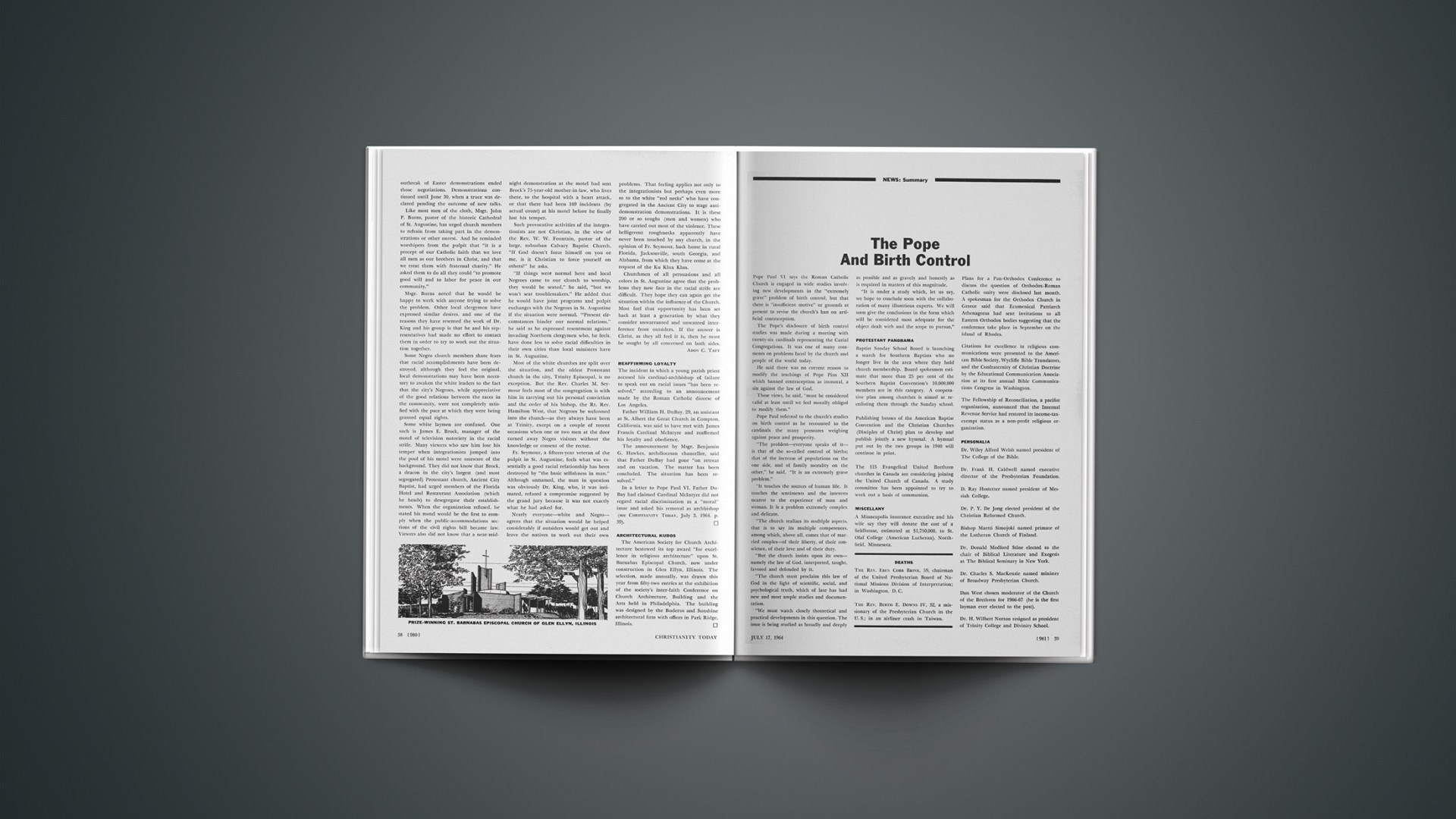
The American Society for Church Architecture bestowed its top award “for excellence in religious architecture” upon St. Barnabas Episcopal Church, now under construction in Glen Ellyn, Illinois. The selection, made annually, was drawn this year from fifty-two entries at the exhibition of the society’s inter-faith Conference on Church Architecture, Building and the Arts held in Philadelphia. The building was designed by the Buderus and Sunshine architectural firm with offices in Park Ridge, Illinois.

Theology

Current Religious Thought: July 17, 1964

It is ironic that each major inventive breakthrough achieved by man is a source of ambivalence and frequently of anxiety to the human race in general, and to the Christian Church in particular. Very frequently the appearance of revolutionary products of human ingenuity finds the race unprepared to use them creatively. While we must recognize that God, in his sovereign pleasure, does permit man to make discoveries that almost overnight alter his way of living, yet in a certain sense man’s inventive genius all too frequently seems to outrun his moral resources.

It is partially true, of course, that necessity is the mother of invention, so that inventions answer to some growing problem that impinges upon the race. The menacing problem of population growth has therefore led to persistent research into the reduction of the human birthrate. Today it seems that medical science is approaching the point at which the control of human reproduction can be effected by means that “cut with the grain” of the human organism. The development and perfection of the oral contraceptive (popularly known as “the Pill”) is upon us. Whether we relish the fact or not, this discovery presents the Christian Church with a challenge at least as great as any that man’s inventive genius has placed upon her for centuries.

While mankind has in general been slow to recognize the problem of population growth, the world has not been caught totally unawares. While it took millennia for the population of the earth to reach the billion mark (by 1830), in 130 years since that time the inhabitants of the earth have trebled in number. Man’s reproductive energy is rapidly outrunning his ability to produce and distribute the food essential for human subsistence.

The crisis in population is due in part to the removal of population controls, particularly during the past century. Inventive genius has vastly decreased infant and maternal mortality, even in lands where medical service has developed slowly. Communicable diseases are rapidly being brought under control. Techniques of occupational safety and legal controls upon work hazards have united in the effort to prolong life.

Traditionally the Christian Church has been perplexed by the question of population growth. Her thrust into the non-Christian world in medical missions has been, to a large measure, responsible for the removal of many “death controls” and thus for a significant increase of population growth. At the same time, the question of artificial family limitation has given her concern, due in part to the fact that the availability of regulative techniques has wide implications for her entire philosophy of marriage.

The Church was faced with similar perplexities by inventions of a sweeping nature in the past. Vaccination against smallpox (which promised to control the Plague, regarded by some as a divine scourge upon especially wicked societies) was resisted as impious. The use of anesthesia, especially in confinement cases, was resisted upon the supposed grounds that it violated Genesis 3:16. More recently, well-meaning clergymen denounced horseless carriages and inveighed against television. The instructive thing is that usually such persons (among them many evangelicals), after a period of denunciation, came quietly to accept the new developments.

In general Protestants have reacted confusedly toward the appearance of means by which the begetting of children can be brought within a rational scheme of things. On one hand, some have adopted a defensive and radically negative stance. Others have given uncritical endorsement to such techniques, in some cases hailing them as a cure-all for human ills. The association of this acceptance with the social gospel has caused some evangelicals to react defensively and emotionally and to adopt postures that have later become an embarrassment to them.

Meanwhile human inventive genius seeks relentlessly for a way to control human conception that is esthetically acceptable and ethically unobjectionable. It seems that an increasing number of sensitive Christians, including many of frankly evangelical belief, feel that the oral contraceptive, when perfected so as to eliminate discomforting side effects, will answer these two requirements.

It is not now clear, however, that evangelical circles are really coming to grips with the question. One could wish that someone with this orientation might write an article as forthright as that by Peter A. Bertocci in the Christian Century (Feb. 26, 1964) entitled “Experimental Sex and the Pill.” Certainly an evangelical treatment of the subject would be far less permissive than that by Dr. Bertocci. At the same time, we would welcome a frank statement, from our perspective, of the biblical understanding of marriage which gives to the words, “the two shall be one flesh,” at least equal significance with the words, “be fruitful, and multiply, and replenish the earth.”

The oral contraceptive has appeared at a time when the human race is ill-prepared to use it constructively, a time marked by lack of personal moral restraint and an artificial emphasis upon sex as an end in itself. The brute fact is that the use of “the Pill” will inevitably include a great deal of abuse by undisciplined members of our society, single and married.

Granting this, what should be the attitude of the evangelical in the matter? At least three courses are open to him. He may adopt an ascetic and aseptic aloofness. He may maintain a negative and defensive posture, fortified by resort to such pathetic irrelevancies as the case of Onan. Or he may take a position of Christian realism, recognizing that nothing can be “uninvented” and that such a major breakthrough as this demands a better quality of living, a better type of men and women. Thus he may seek by every means at his disposal to bring those within his influence to live ethically, rather than merely by the mores and usages of his society.

The Pope and Birth Control

Pope Paul VI says the Roman Catholic Church is engaged in wide studies involving new developments in the “extremely grave” problem of birth control, but that there is “insufficient motive” or grounds at present to revise the church’s ban on artificial contraception.

The Pope’s disclosure of birth control studies was made during a meeting with twenty-six cardinals representing the Curial Congregations. It was one of many comments on problems faced by the church and people of the world today.

He said there was no current reason to modify the teachings of Pope Pius XII which banned contraception as immoral, a sin against the law of God.

These views, he said, “must be considered valid at least until we feel morally obliged to modify them.”

Pope Paul referred to the church’s studies on birth control as he recounted to the cardinals the many pressures weighing against peace and prosperity.

“The problem—everyone speaks of it—is that of the so-called control of births; that of the increase of populations on the one side, and of family morality on the other,” he said. “It is an extremely grave problem.”

“It touches the sources of human life. It touches the sentiments and the interests nearest to the experience of man and woman. It is a problem extremely complex and delicate.

“The church realizes its multiple aspects, that is to say its multiple competences, among which, above all, comes that of married couples—of their liberty, of their conscience, of their love and of their duty.

“But the church insists upon its own—namely the law of God, interpreted, taught, favored and defended by it.

“The church must proclaim this law of God in the light of scientific, social, and psychological truth, which of late has had new and most ample studies and documentation.

“We must watch closely theoretical and practical developments in this question. The issue is being studied as broadly and deeply as possible and as gravely and honestly as is required in matters of this magnitude.

“It is under a study which, let us say, we hope to conclude soon with the collaboration of many illustrious experts. We will soon give the conclusions in the form which will be considered most adequate for the object dealt with and the scope to pursue.”

Protestant Panorama

Baptist Sunday School Board is launching a search for Southern Baptists who no longer live in the area where they hold church membership. Board spokesmen estimate that more than 25 per cent of the Southern Baptist Convention’s 10,000,000 members are in this category. A cooperative plan among churches is aimed at reenlisting them through the Sunday school.

Publishing houses of the American Baptist Convention and the Christian Churches (Disciples of Christ) plan to develop and publish jointly a new hymnal. A hymnal put out by the two groups in 1940 will continue in print.

The 115 Evangelical United Brethren churches in Canada are considering joining the United Church of Canada. A study committee has been appointed to try to work out a basis of communion.

Miscellany

A Minneapolis insurance executive and his wife say they will donate the cost of a fieldhouse, estimated at $1,750,000, to St. Olaf College (American Lutheran), Northfield, Minnesota.

Deaths

THE REV. EBEN COBB BRINK, 59, chairman of the United Presbyterian Board of National Missions Division of Interpretation; in Washington, D. C.

THE REV. BERTIS E. DOWNS IV, 32, a missionary of the Presbyterian Church in the U. S.; in an airliner crash in Taiwan.

Plans for a Pan-Orthodox Conference to discuss the question of Orthodox-Roman Catholic unity were disclosed last month. A spokesman for the Orthodox Church in Greece said that Ecumenical Patriarch Athenagoras had sent invitations to all Eastern Orthodox bodies suggesting that the conference take place in September on the island of Rhodes.

Citations for excellence in religious communications were presented to the American Bible Society, Wycliffe Bible Translators, and the Confraternity of Christian Doctrine by the Educational Communication Association at its first annual Bible Communications Congress in Washington.

The Fellowship of Reconciliation, a pacifist organization, announced that the Internal Revenue Service had restored its income-tax-exempt status as a non-profit religious organization.

Personalia

Dr. Wiley Alfred Welsh named president of The College of the Bible.

Dr. Frank H. Caldwell named executive director of the Presbyterian Foundation.

D. Ray Hostetter named president of Messiah College.

Dr. P. Y. De Jong elected president of the Christian Reformed Church.

Bishop Martti Simojoki named primate of the Lutheran Church of Finland.

Dr. Donald Medford Stine elected to the chair of Biblical Literature and Exegesis at The Biblical Seminary in New York.

Dr. Charles S. MacKenzie named minister of Broadway Presbyterian Church.

Dan West chosen moderator of the Church of the Brethren for 1966–67 (he is the first layman ever elected to the post).

Dr. H. Wilbert Norton resigned as president of Trinity College and Divinity School.

About This Issue: July 17, 1964

One of the nation’s leading Shakespeareans, Roland Mushat Frye, discusses the religious implications of Shakespeare’s plays in an essay written especially for us in this quadricentennial of the great poet’s birth.

Imitation as the basis of art is related to Christian perspective in John C. Cooper’s article (page 11). Bastian Kruithof discusses the problem of secularism (page 13).

Some straight talk on evangelistic methods comes from Carlton L. Myers.

A new interdenominational lay movement to promote and coordinate short-term Christian service abroad is proposed by the Rev. Robert N. Meyers, a Presbyterian minister in Vienna, Virginia (page 8).

addApple PodcastsDown ArrowDown ArrowDown Arrowarrow_left_altLeft ArrowLeft ArrowRight ArrowRight ArrowRight Arrowarrow_up_altUp ArrowUp ArrowAvailable at Amazoncaret-downCloseCloseellipseEmailEmailExpandExpandExternalExternalFacebookfacebook-squarefolderGiftGiftGooglegoogleGoogle KeephamburgerInstagraminstagram-squareLinkLinklinkedin-squareListenListenListenChristianity TodayCT Creative Studio Logologo_orgMegaphoneMenuMenupausePinterestPlayPlayPocketPodcastprintremoveRSSRSSSaveSavesaveSearchSearchsearchSpotifyStitcherTelegramTable of ContentsTable of Contentstwitter-squareWhatsAppXYouTubeYouTube