Taking Stock of the New Christian Right

Author Jeffrey K. Hadden is a professor of sociology at the University of Virginia. He is co-author of Prime Time Preachers (Addison-Wesley), and he is completing work on a second book about the electronic church.

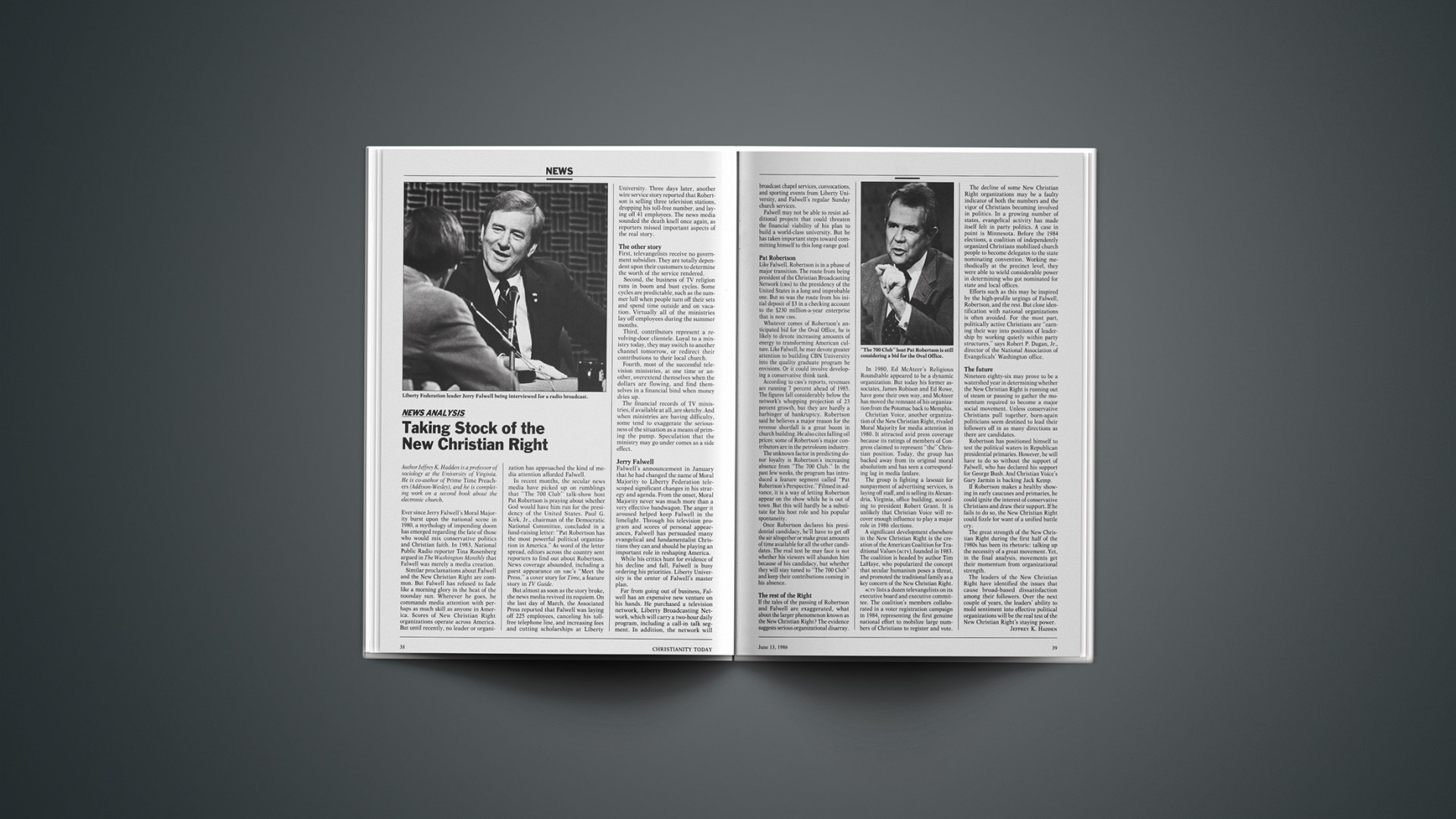
Ever since Jerry Falwell’s Moral Majority burst upon the national scene in 1980, a mythology of impending doom has emerged regarding the fate of those who would mix conservative politics and Christian faith. In 1983, National Public Radio reporter Tina Rosenberg argued in The Washington Monthly that Falwell was merely a media creation.

Similar proclamations about Falwell and the New Christian Right are common. But Falwell has refused to fade like a morning glory in the heat of the noonday sun. Wherever he goes, he commands media attention with perhaps as much skill as anyone in America. Scores of New Christian Right organizations operate across America. But until recently, no leader or organization has approached the kind of media attention afforded Falwell.

In recent months, the secular news media have picked up on rumblings that “The 700 Club” talk-show host Pat Robertson is praying about whether God would have him run for the presidency of the United States. Paul G. Kirk, Jr., chairman of the Democratic National Committee, concluded in a fund-raising letter: “Pat Robertson has the most powerful political organization in America.” As word of the letter spread, editors across the country sent reporters to find out about Robertson. News coverage abounded, including a guest appearance on NBC’s “Meet the Press,” a cover story for Time, a feature story in TV Guide.

But almost as soon as the story broke, the news media revived its requiem. On the last day of March, the Associated Press reported that Falwell was laying off 225 employees, canceling his toll-free telephone line, and increasing fees and cutting scholarships at Liberty University. Three days later, another wire service story reported that Robertson is selling three television stations, dropping his toll-free number, and laying off 41 employees. The news media sounded the death knell once again, as reporters missed important aspects of the real story.

The Other Story

First, televangelists receive no government subsidies. They are totally dependent upon their customers to determine the worth of the service rendered.

Second, the business of TV religion runs in boom and bust cycles. Some cycles are predictable, such as the summer lull when people turn off their sets and spend time outside and on vacation. Virtually all of the ministries lay off employees during the summer months.

Third, contributors represent a revolving-door clientele. Loyal to a ministry today, they may switch to another channel tomorrow, or redirect their contributions to their local church.

Fourth, most of the successful television ministries, at one time or another, overextend themselves when the dollars are flowing, and find themselves in a financial bind when money dries up.

The financial records of TV ministries, if available at all, are sketchy. And when ministries are having difficulty, some tend to exaggerate the seriousness of the situation as a means of priming the pump. Speculation that the ministry may go under comes as a side effect.

Jerry Falwell

Falwell’s announcement in January that he had changed the name of Moral Majority to Liberty Federation telescoped significant changes in his strategy and agenda. From the onset, Moral Majority never was much more than a very effective bandwagon. The anger it aroused helped keep Falwell in the limelight. Through his television program and scores of personal appearances, Falwell has persuaded many evangelical and fundamentalist Christians they can and should be playing an important role in reshaping America.

While his critics hunt for evidence of his decline and fall, Falwell is busy ordering his priorities. Liberty University is the center of Falwell’s master plan.

Far from going out of business, Falwell has an expensive new venture on his hands. He purchased a television network, Liberty Broadcasting Network, which will carry a two-hour daily program, including a call-in talk segment. In addition, the network will broadcast chapel services, convocations, and sporting events from Liberty University, and Falwell’s regular Sunday church services.

Falwell may not be able to resist additional projects that could threaten the financial viability of his plan to build a world-class university. But he has taken important steps toward committing himself to this long-range goal.

Pat Robertson

Like Falwell, Robertson is in a phase of major transition. The route from being president of the Christian Broadcasting Network (CBN) to the presidency of the United States is a long and improbable one. But so was the route from his initial deposit of $3 in a checking account to the $230 million-a-year enterprise that is now CBN.

Whatever comes of Robertson’s anticipated bid for the Oval Office, he is likely to devote increasing amounts of energy to transforming American culture. Like Falwell, he may devote greater attention to building CBN University into the quality graduate program he envisions. Or it could involve developing a conservative think tank.

According to CBN’s reports, revenues are running 7 percent ahead of 1985. The figures fall considerably below the network’s whopping projection of 23 percent growth, but they are hardly a harbinger of bankruptcy. Robertson said he believes a major reason for the revenue shortfall is a great boom in church building. He also cites falling oil prices: some of Robertson’s major contributors are in the petroleum industry.

The unknown factor in predicting donor loyalty is Robertson’s increasing absence from “The 700 Club.” In the past few weeks, the program has introduced a feature segment called “Pat Robertson’s Perspective.” Filmed in advance, it is a way of letting Robertson appear on the show while he is out of town. But this will hardly be a substitute for his host role and his popular spontaneity.

Once Robertson declares his presidential candidacy, he’ll have to get off the air altogether or make great amounts of time available for all the other candidates. The real test he may face is not whether his viewers will abandon him because of his candidacy, but whether they will stay tuned to “The 700 Club” and keep their contributions coming in his absence.

The Rest Of The Right

If the tales of the passing of Robertson and Falwell are exaggerated, what about the larger phenomenon known as the New Christian Right? The evidence suggests serious organizational disarray.

In 1980, Ed McAteer’s Religious Roundtable appeared to be a dynamic organization. But today his former associates, James Robison and Ed Rowe, have gone their own way, and McAteer has moved the remnant of his organization from the Potomac back to Memphis.

Christian Voice, another organization of the New Christian Right, rivaled Moral Majority for media attention in 1980. It attracted avid press coverage because its ratings of members of Congress claimed to represent “the” Christian position. Today, the group has backed away from its original moral absolutism and has seen a corresponding lag in media fanfare.

The group is fighting a lawsuit for nonpayment of advertising services, is laying off staff, and is selling its Alexandria, Virginia, office building, according to president Robert Grant. It is unlikely that Christian Voice will recover enough influence to play a major role in 1986 elections.

A significant development elsewhere in the New Christian Right is the creation of the American Coalition for Traditional Values (ACTV), founded in 1983. The coalition is headed by author Tim LaHaye, who popularized the concept that secular humanism poses a threat, and promoted the traditional family as a key concern of the New Christian Right.

ACTV lists a dozen televangelists on its executive board and executive committee. The coalition’s members collaborated in a voter registration campaign in 1984, representing the first genuine national effort to mobilize large numbers of Christians to register and vote.

The decline of some New Christian Right organizations may be a faulty indicator of both the numbers and the vigor of Christians becoming involved in politics. In a growing number of states, evangelical activity has made itself felt in party politics. A case in point is Minnesota. Before the 1984 elections, a coalition of independently organized Christians mobilized church people to become delegates to the state nominating convention. Working methodically at the precinct level, they were able to wield considerable power in determining who got nominated for state and local offices.

Efforts such as this may be inspired by the high-profile urgings of Falwell, Robertson, and the rest. But close identification with national organizations is often avoided. For the most part, politically active Christians are “earning their way into positions of leadership by working quietly within party structures,” says Robert P. Dugan, Jr., director of the National Association of Evangelicals’ Washington office.

The Future

Nineteen eighty-six may prove to be a watershed year in determining whether the New Christian Right is running out of steam or pausing to gather the momentum required to become a major social movement. Unless conservative Christians pull together, born-again politicians seem destined to lead their followers off in as many directions as there are candidates.

Robertson has positioned himself to test the political waters in Republican presidential primaries. However, he will have to do so without the support of Falwell, who has declared his support for George Bush. And Christian Voice’s Gary Jarmin is backing Jack Kemp.

If Robertson makes a healthy showing in early caucuses and primaries, he could ignite the interest of conservative Christians and draw their support. If he fails to do so, the New Christian Right could fizzle for want of a unified battle cry.

The great strength of the New Christian Right during the first half of the 1980s has been its rhetoric: talking up the necessity of a great movement. Yet, in the final analysis, movements get their momentum from organizational strength.

The leaders of the New Christian Right have identified the issues that cause broad-based dissatisfaction among their followers. Over the next couple of years, the leaders’ ability to mold sentiment into effective political organizations will be the real test of the New Christian Right’s staying power.

JEFFREY K. HADDEN

A New Political Group Will Oppose Abortion, Poverty, and Nuclear Arms

CHRISTIANITY TODAY/June 13, 1986

An organization representing both Protestants and Catholics will endorse candidates who hold a ‘consistent prolife ethic.’

Opposition to abortion, poverty, and the nuclear arms race as a consistent prolife ethic has gained momentum in some church circles. However, that view has not been represented in Washington until recently. This month, a coalition of Protestants and Catholics announced the formation of JustLife, a political action committee (PAC) that will endorse candidates with voting records that are acceptable on all three issues.

A policy statement says JustLife is “rooted in the belief that every person has been created in God’s image.” Because the coalition views the right to life as the most basic of mankind’s God-given rights, it says government “should give first priority to protecting life.”

The group supports “aggressive negotiations with the Soviet Union to end the nuclear arms race and to reach an agreement for verifiable, multilateral disarmament.”

Regarding justice for the poor, JustLife supports “governmental programs that empower the poor to become self-sufficient.” It also favors economic aid programs and trade policies which help “empower the peoples of developing nations to develop strong economies which distribute their fruits to all.…”

In addition, JustLife opposes abortion, except when necessary to save the life of the mother. However, the organization would not insist on legislative solutions that would exclude rape and incest as reasons for abortion. The group supports alternatives for women considering abortion.

JustLife’s officers include president William Leslie, pastor of LaSalle Street Church in Chicago; vice-president Patricia Narciso, a Catholic prolife activist; secretary Ronald Sider of Eastern Baptist Theological Seminary; and treasurer William Kallio, executive director of Evangelicals for Social Action.

The board of directors also includes Arthur Beals of University Presbyterian Church in Seattle; Steve Monsma, a Michigan politician; James Copple, a public school administrator and Nazarene associate pastor in Garden City, Kansas; Neil DeHaan, community development director in Elizabeth, New Jersey; Lon Fendall of George Fox College; Dave Medema, director of a social service agency in Holland, Michigan; Kathleen Hayes, managing editor of The Other Side magazine; Juli Loesch of Feminists for Life; Miriam Adeney of Seattle Pacific University; Scott Rains of Pro-Lifers for Survival; and Daniel Simmons, with Mercy Corps in Portland, Oregon.

A New Type Of Pac

Monsma’s former campaign director, Jack Smalligan, directs JustLife’s Washington office. The idea for a new type of prolife PAC took root after Monsma’s unsuccessful bid for the Michigan State Senate in a special 1985 election. A Democrat, Monsma had a superb antiabortion voting record during his earlier term in the state senate. And Right to Life of Michigan voted to endorse his candidacy last year. As a result, some Republican prolife activists objected vigorously because they wanted their party to remain in control of the Michigan senate.

His experience illustrates what can happen to a candidate who opposes both abortion and the nuclear arms race. JustLife’s first fund-raising letter explains the risk: “The liberals call them conservative and the conservatives call them liberal and the voters are left confused.” Six months after his run for office, Monsma initiated discussions among Christian leaders about an alternative prolife group.

A proposal was circulated over the winter, and a policy statement was drafted in April. “Most Christian-based PACS have identified themselves as prolife,” Smalligan said, “but there has been little searching out of how the prolife view affects other issues.” He would like to see JustLife enlarge the debate over abortion to include issues such as poverty and the arms race. He added that the organization could pressure candidates for office to be consistent on these issues.

JustLife plans to endorse some candidates in November, but it will not contribute money to any campaign until its funding base is set. By 1988, Smalligan said, the group hopes to be in a position to contribute significantly to some campaigns and to assist candidates in reaching Christian voters in their districts by doing some grassroots organizing. JustLife will rate candidates as “acceptable,” “good,” or “excellent” on each of its targeted issues. The organization will not insist that endorsed candidates be Christians, and it will not target candidates for defeat.

Whether the group can establish a firm funding base and identify acceptable candidates remains uncertain. Smalligan claims, however, that preliminary research identified as many as 80 members of the U.S. House of Representatives who would qualify for support. Direct mail appeals for financial contributions begin this month. The 3,300 members of Evangelicals for Social Action will be tapped, as well as a potentially large Catholic constituency. Each board member has pledged to raise at least $1,000 in seed money.

Rethinking The New Right

A number of conservative political groups with offices in Washington have built coalitions based on secular appeals to traditional values. JustLife has a specifically Christian rationale. “What makes it appealing to me is that this group of Christians is willing to make a political statement that grows out of religious commitment,” said board member James Copple. “We accent the resurrection of Jesus Christ because that is life.”

PACS have proliferated in Washington, increasing more than sixfold in the past decade. The Federal Election Commission listed 3,992 of them at the end of 1985.

About one quarter are independent groups like JustLife. They serve as channels of private donations to candidates for office, and may legally contribute up to $5,000 per candidate per election. In addition, they provide assistance by rating candidates, conducting direct-mail campaigns on their behalf, running advertisements, and organizing citizen groups.

JustLife is being organized at a time when conservative organizations with religious roots are going through major changes (see related article by Jeffrey K. Hadden on page 38). Paul Weyrich, considered the founder of the institutional New Right, has authored a significant statement of rethinking. In an essay published in the Washington Post, Weyrich defended “cultural conservatism,” a belief that “America has to look to values if it wants to solve the specific problems that confront it.” The movement must gain philosophical depth beyond what the New Right has achieved, Weyrich wrote, since “it has no issues, in most peoples’ minds, beyond school prayer and abortion.” Likewise, he wrote, the Religious Right needs to adapt by accepting “the fact that some cultural conservatives may not be religious.”

Weyrich says cultural conservatism is as likely to appeal to Democrats as to Republicans. As long as Republican candidates remain focused on economic solutions, rather than solutions rooted in values, Democrats might be more likely to come up with a candidate conservatives could back, he says. The Democratic rank-and-file, Weyrich points out, “is more conservative culturally than the typical upwardly mobile Republican.”

In his early years of mobilizing Christians for political action, Weyrich spoke of “Christianizing America.” Today, as he explores more pluralistic common ground, and as Christians in JustLife stake a political claim based on religious belief, Washington is seeing a growing diversity of Christian opinion on public policy issues.

BETH SPRING

Classic & Contemporary Excerpts from June 13, 1986

Classic and contemporary excerpts

Owning The Name

The title of Christian is a reproach to us if we turn ourselves away from him after whom we are named. The name of Jesus is not to be to us like Allah of the Mohammedans or like a talisman or an amulet worn on the arm as an external badge in the symbol of a profession thought to preserve one from evil by some mysterious and unintelligible potency. Instead we should allow the name of Jesus to be engraved deeply on the heart, written there by the finger of God himself in everlasting characters. It is our sure and undoubted title to present peace and future glory.

—William Wilberforce, Real Christianity

“Outdated” Convictions

Old movies offer some powerful lessons—lessons that our generation could easily miss. Prisoner of Zenda, for example, a movie released in 1937, portrays the intense and genuine love between a princess and a commoner. He pleads for her to run away with him, but by her strength and depth of conviction, she stops him cold, replying, “It is my duty to be here with my people!”

Such a response might have been acceptable in the thirties, but in the eighties an appeal to duty or convictions would be looked upon as unusual and outdated—even by people in the church.

—Bob Mumford, New Wine (March 1986)

Hurrying Away From God

It is said that Dr. Mortimer Adler suddenly left a discussion group at a tea quite disgusted, slamming the door after him. One person, trying to relieve the tension, remarked, “Well, he’s gone.” To this the hostess replied, “No, he isn’t. That’s a closet!” We share the same plight when we attempt to rush from God’s presence. We are confined to ourselves.

—Myron S. Augsburger, When Reason Fails

Making Jesus “Fit”

The only real Jesus is one who is larger than life, who escapes our categories, who eludes our attempts to reduce him to manageable proportions so that we can claim him for our cause. Any Jesus who has been made to fit our formula ceases to be appealing precisely because he is no longer wondrous, mysterious, surprising. We may reduce him to a right-wing Republican conservative or a gun-toting Marxist revolutionary and thus rationalize and justify our own political ideology. But having done so, we are dismayed to discover that whoever we have signed on as an ally is not Jesus. Categorize Jesus and he isn’t Jesus anymore.

—Andrew Greeley’s introduction to Lloyd C. Douglas’s The Robe, paperback edition (New York Times Book Review)

The Root Of All Evil

Radical faith doesn’t mean that we all give up our money and become indigent, but it does mean that we give up the antiquated illusion that money isn’t evil. We must face up to the frightening fact that anything money touches, it corrupts—including us.

Money is evil and, therefore, extremely dangerous. We should be running scared. We should fear money. We constantly need to check and recheck what money is doing to us—have a periodic money check-up. All of us had better start learning how to say no to money because, if we don’t face up to the damage it is causing, we may find ourselves and the institutions we love destroyed by it.

—Mike Yaconelli The Wittenburg Door (April-May 1985)

A More Important Question

G. K. Chesterton once said that if he were a landlord what he would most want to know about his tenants was not their employment nor their income, but their beliefs.

—Eugene Peterson, Earth and Altar

A Christian’S Time Off

Where did we come up with this concept of “spare time,” anyway? Is there any time for which we aren’t accountable to God? Is there any time during which God doesn’t care what you are doing? No Christian has ever had spare time. You may have spare time from labor or necessity, you may stop working and refresh yourself, but no Christian ever had time off from living like a Christian.

—William Law, Christian Perfection, a contemporary version by Marvin D. Hinten

Learning To Pray

“Lord, teach us to pray!” So spoke the disciples to Jesus. In making this request, they confessed that they were not able to pray on their own, that they had to learn to pray. The phrase “learning to pray” sounds strange to us. If the heart does not overflow and begin to pray by itself, we say, it will never “learn” to pray. But it is a dangerous error, surely very widespread among Christians, to think that the heart can pray by itself. For then we confuse wishes, hopes, sighs, laments, rejoicings—all of which the heart can do by itself—with prayer. And we confuse earth and heaven, man and God. Prayer does not mean simply to pour out one’s heart. It means rather to find the way to God and to speak with him, whether the heart is full or empty. No man can do that by himself. For that he needs Jesus Christ.

—James Burtness, Shaping the Future: The Ethics of Dietrich Bonhoeffer

False Religion’S Face

A person may be full of talk about his own [religious] experiences. But often it is more a bad than a good sign. It is like a tree that is full of leaves that seldom bears much fruit. Or it is like a cloud which, although it appears to promise much fullness of rain, is only wind to a dry and thirsty earth.… Strong, false affections are much more likely to declare themselves than true ones. It is the nature of false religion to be showy and visible as it was with the Pharisees.”

—Jonathan Edwards, Religious Affections

Carrying Our Weapon

Prayer is the wall of faith: her arms and missiles against the foe who keeps watch over us on all sides. And, so never walk we unarmed.

Tertullian, On Prayer (The Ante-Nicene Fathers, Vol. III)

Whose Are We?

Why should we not alter to our use, quite humbly and dispassionately, a saying of St. Augustine’s: “Many whom God has, the church does not have; and many whom the church has, God does not have.”

—Karl Rahner, quoted in U.S. Catholic (March 1986)

The Everlasting Journalist

Some authors’ books are buried with their generation.

Others live on, finding new audiences who scratch their heads and scribble in the margins.

The writings of English apologist G. K. Chesterton keep coming back—and in this fiftieth anniversary year of his death, book publishers are making his quotable lines more available than ever. CHRISTIANITY TODAY asked Chesterton scholar Arthur Livingston to introduce this perennial Christian favorite and review the recent revival of Chesterton publishing.

G.K. Chesterton was a man of enormous physical bulk and equally enormous intellectual energy—perhaps a combination of Thomas Aquinas and Samuel Johnson. Just as the rotund Aquinas had been called a dumb ox at the University of Paris, the schoolchild Chesterton was often treated as a dullard. Both Chesterton and Aquinas had an early introspective bent that needed modifying before they would be able to communicate easily.

On the other hand, Chesterton’s good-humored epigrammatical gusto at the service of Christian truth and his obvious relish at defending the faith are much like the “lean and lank” Johnson’s. And for each of these early masters, he wrote a book: perhaps the best introduction to Aquinas for nonspecialists (St. Thomas Aquinas) and an intriguing play that deserves revival (The Judgment of Dr. Johnson).

It is nearly impossible to capsulize the writings of G. K. Chesterton. As one critic put it, “Chesterton is recognized by essayists as one of the greatest of essayists; by poets as a magnificent poet; by humorists as a humorist of tremendous versatility; by philosophers as a profound philosopher; by controversialists as a deadly but lovable master of controversy; by political economists as a man of deep political insights; by novelists as a most able novelist; and by theologians as one who saw, sometimes, far deeper than they are able to see into theological truths.”

Despite such adulation, Chesterton never referred to himself as anything other than a journalist. He was not the ephemeral newspaperman the term conjures, but rather one whose observations of the times are worthy of preservation—a follower in the tradition of Addison and Steele, and a precursor of the Mike Roykos and Russell Bakers of our own day.

Chesterton is often compared to C. S. Lewis. And Lewis acknowledged the influence of Chesterton on his style. Lewis must have meant Chesterton’s bantering tone that makes the reader feel he is meeting It is nearly impossible to capsulize the writings of the man directly and without pretense, despite the abundance of wit.

Lewis’s writing, on the other hand, displays a polished Oxonian tone; whereas Chesterton’s arguments explode in a riot of jokes and paradoxes while always keeping their directness.

Also reviewed in this section:

Reinhold Niebuhr: A Biography, by Richard Wightman Fox

Breaking Faith,by Humberto Belli

Without Child: A Compassionate Look at Infertility,by Martha Stout

The Jesus Connection: To Triumph Over Anti-Semitism,by Leonard C. Yaseen

Who Speaks for God?by Charles Colson

Words For Weapons

Chesterton was reared in an atmosphere of Victorian liberalism. And since he always pursued thoughts to their logical conclusions, as a young man he flirted dangerously with the self-centered philosophy and decadence of the time. Realizing that modernism was bankrupt, he sought relief in the church of his ancestors and became an Anglo-Catholic.

His later conversion from the Church of England to Roman Catholicism at age 48 did little to alter the tenor of his writing, with the exception of a few books on denominational topics. Certain aspects of his work—his overt hostility to Puritanism and the Reformation—may rankle some readers. But on the whole, there has not been a more articulate champion of classic Christian orthodoxy, virtue, and decency than this rotund jouster whose words were his weapons.

What makes Chesterton’s writing addictive is his ability to get to the heart of a topic—without the slightest hedging. For example, he undertook answering such men as Sir George Frazer, who advanced the argument that Christ was merely another mythical example of the great god’s son who died and came back to life in the spring—of the Egyptian Osiris, the Greek Dionysus, or the Nordic Balder. The world is full of such stories, said Fraser, and, by implication, the story of Christ is just another version of this recurring theme.

Characteristically, Chesterton got to the unstated premise of this argument and punctured it: “If the world is made such that a Son of God would come to save the world, is it then surprising that a Patagonian would dream of a son of God coming to save the world?” This example of Chesterton’s apologetic method appeared not in one of his major books, or even in one of the minor ones, but in correspondence for an obscure journal that was not reprinted in toto until this year.

Getting Started

Where, then, does the beginner start? The essence of Chesterton’s thought is probably best captured in three volumes: Heretics (1906), Orthodoxy (1908), and The Everlasting Man (1925). In the first volume, he gently devastates the thought of most of the prevailing thinkers of his day, from George Bernard Shaw and Rudyard Kipling to William Butler Yeats, by following their ideas to their logical—and absurd—conclusions.

After the publication of Heretics, one wag suggested the book could only be taken seriously when Mr. Chesterton offered his own beliefs as an alternative. The result was Orthodoxy. In its pages he does not attempt a systematic defense of Christian truth. Instead, he slowly allows the reader to see what G.K.C. has experienced—that the major arguments against Christianity are plausible reasons for believing in it, and how those objections led him to belief. It is not uncommon to hear of people who begin highlighting passages in Orthodoxy, only to despair as it becomes apparent that—to do it justice—nearly the entire book would need to be underscored.

The Everlasting Man is, in many ways, a response to H. G. Wells’s The Outline of History, a curiously ignorant book, full of cheapjack trendiness that received a great deal of undeserved attention in its day and since—a book whose mischief Chesterton felt he could not ignore.

For all the wit and insight in these three books, the easiest items in the Chesterton pantry for readers to cut their teeth on are the Father Brown stories. Fully 15 years before his conversion to Rome, Chesterton met an unassuming but remarkably brilliant Yorkshire priest. Chesterton offered his opinions on “some rather sordid social questions of vice and crime”—and Father O’Connor promptly refuted them, displaying what Chesterton thought was (for a man of the cloth) a rather profound knowledge of evil.

Chesterton showed his respect for his new friend by generally disguising him as Father Brown—“beating his hat and umbrella shapeless, untidying his clothes, punching his intelligent countenance into a condition of pudding-faced fatuity.” The nearly 50 stories, featuring a plain little priest with extraordinary powers to observe and to reason, are available to American readers as The Penguin Complete Father Brown (1981).

An Excerpt The Everlasting Man

The Idea of Grant Allen

“One of my first journalistic adventures, or misadventures, concerned a comment of Grant Allen, who had written a book about the evolution of the idea of God. I happened to remark that it would be much more interesting if God wrote a book about the evolution of the idea of Grant Allen. And I remember that the editor objected to my remark on the ground that it was blasphemous; which naturally amuses me not a little. For the joke of it was, of course, that it never occurred to him to notice the title of the book itself, which really was blasphemous; for it was, when translated into English, ‘I will show you how this nonsensical notion that there is a God grew up among men.’ My remark was strictly pious and proper; confessing the divine purpose even its most seemingly dark or meaningless manifestations.”

Neglect And Revival

For some reason, Chesterton was nearly forgotten during the generation immediately following him. Perhaps it was the sheer mass of his output. After all, deciding where to begin reading an author of about 100 volumes is perplexing. In addition, his militant, but good-humored, defense of the faith made his name anathema in those stridently anti-Christian circles that dictate literary fashion. It was probably not a case of denominational prejudices. Although I attained four degrees at Roman Catholic universities, I have yet to hear his name mentioned in a Catholic classroom—unless I do so myself. (This is amazing considering the breadth of Chesterton’s achievement and his having been named Defender of the Faith by Pope Pius XI.)

Fortunately, strong signs of a Chesterton revival have become clear since the centenary celebration of his birth in 1974. The number of his titles in print has doubled; a number of anthologies of his work have appeared; and other writers are once again quoting his epigrams.

And now the fiftieth year of his death has occasioned a great deal of Chestertonia being published:

• G. K. Chesterton, edited by P. J. Kavanagh (Ignatius, 1985, 487 pp.; $16.95), is an anthology that contains the largest chunks of his work. The remarkable study of Robert Browning, the first of his full-length books mostly on individual literary figures, is included showing a highly idiosyncratic but illuminating style. (The best of these is probably Charles Dickens: Last of the Great Men.) Kavanagh’s anthology also contains the complete text of G.K.C.’s most-read novel, The Man Who Was Thursday (1908), a type of story that later would be called Kafkaesque (but it was Kafka who must have learned the style from Chesterton since Chesterton’s novel predates Kafka’s writing career).

As I Was Saying, edited by the late Robert Knille (Eerdmans, 1985, 314 pp.; $ 18.95), is the anthology that more fully draws on the complete wealth of Chesterton material, including Dickens, Orthodoxy, The Everlasting Man, St. Thomas Aquinas, and St. Francis of Assisi. And many of G.K.C.’s best essays are reprinted.

• John Coates, lecturer in literature and drama at the University of Hull, has produced what well may be the best study of Chesterton, placing him in the ethos of his time, Chesterton and the Edwardian Cultural Crisis (Hull University Press, 1984, 244 pp.; $18.95).

• A few years ago, Alzina Stone Dale produced the first full-length biography of Chesterton worth mentioning since Maisie Ward’s standard 1943 work. She has now produced an interesting coffee-table book, The Art of G. K. Chesterton (Loyola University Press, 1986, xiv + 114 pp.; $25.00). Chesterton’s first ambition was to be a painter, and he managed to produce illustrations for many books until he died. Dale’s book reproduces a number of Chesterton drawings and places them in the context of his career.

• Ignatius Press has announced the most ambitious Chesterton project possible: the attempt to publish the complete works of Chesterton over an extended period. Fr. Ian Boyd, editor of The Chesterton Review, has undertaken this massive project. The first volume is now available and includes the ubiquitous Orthodoxy, Heretics, and the Blatchford Controversy (1986, $17.95, hardcover; $12.95, softcover).

• For two years the Midwest Chesterton Society has been working on a most daring publishing venture, reprinting all 3,000,000 words Chesterton wrote for his weekly column in the Illustrated London News (1905–36). These essays range over the full gamut of English life and manners of the period. Only a handful of these essays have ever been reprinted. When published late this year, the full set will run to ten volumes of about 600 pages each and cost approximately $300. The cost is prohibitive for the home, but for the first time, readers will have access to all these writings in libraries.

T. S. Eliot noted in his obituary of Chesterton that he “did more than any man in his time … to maintain the existence of the [Christian] minority in the modern world.” Were this his only contribution, his name should be enshrined.

But Chesterton is well worth reading in his own right, and for this all Christians should give at least a few of his writings a chance. He may be found addictive. And above all, he is fun.

Reinhold Niebuhr: A Biography, by Richard Wightman Fox (Pantheon, 1985, 340 pp.; $19.95, cloth). Reviewed by James W. Skillen, executive director, Association for Public Justice.

Some call theologian and ethicist Reinhold Niebuhr (1892–1971) the greatest American Christian social thinker of the twentieth century. That claim may be disputed—depending especially on what one means by “Christian.” But there can be no doubt about Niebuhr’s influence and importance, and Richard Fox’s outstanding biography is must reading for those who want to understand the proper role of Christian social and political action in America today.

Fox gives us a rich portrait of Niebuhr’s life and work from his birth, through his Union Seminary fame, to his death after a decade of emotional and physical illness. Not only does Reinhold Niebuhr come alive to the reader, but the American and international contexts of his life are detailed in fascinating ways.

Readers may be surprised, for example, to find out that Reinhold grew up in a German-speaking family and did not learn English well until his graduate school days. Moreover, the student who becomes acquainted with Niebuhr solely through his books might not know that he was more of a political activist, preacher, and journalist than a scholar.

Especially striking is the careful way Fox details Niebuhr’s struggle with modern liberalism while remaining so thoroughly liberal. This I was a personal issue for Fox himself since he had studied under Robert McAfee Brown and Michael Novak, both of whom had been influenced by Niebuhr, each of whom came to quite different conclusions about the “meaning” of Niebuhr:

Was Niebuhr a theological liberal who became increasingly conservative and “realistic” in his political perspective? Or was he really a socialist who became increasingly more critical of theological liberalism?

First Aid To Hypocrisy

Reinhold’s brother, H. Richard, was one of his best and most loving critics. At one point, Richard complained to Reinhold: “You think of religion as a power—dangerous sometimes, helpful sometimes. That’s liberal. For religion itself religion is no power, but that to which religion is directed, God.… I think the liberal religion is thoroughly bad. It is a first-aid to hypocrisy. It is the exaltation of good will, moral idealism. It worships the God whose qualities are ‘the human qualities to the nth degree,’ and I don’t expect as much help from this religion as you do. It is sentimental and romantic. Has it ever struck you that you read religion through the mystics and ascetics? You scarcely think of Paul, Augustine, Luther, Calvin. You’re speaking of humanistic religion so far as I can see.”

By the time Reinhold had delivered and published his Gifford Lectures, The Nature and Destiny of Man (1939–43), he had, of course, struggled much more intensely with Paul, Augustine, and Calvin. But his later writings were still filled with ambiguity, paradox, and tension. According to Fox, Niebuhr “was a religious modernist devoted to Biblical symbols; a political democrat infatuated with Burkean traditionalism; a skeptical relativist committed like William James to the life of passionate belief and moral struggle. He was a thoroughgoing naturalist despite his contempt for what he called ‘naturalism’: the denial of human ‘spirit,’ the reduction of human nature to its psychic or physiological impulses. He had equal contempt for religious supernaturalism, which he thought voided man’s native capacities and expunged man’s own responsibility for his fate. His stance was naturalistic in the sense that his ultimate appeal in both politics and theology was always to the observed facts of human experience. His starting point was the community of concrete human beings confronted by the paradoxically free yet finite character of their nature.”

For all his speaking, writing, and thinking on the tough issues of the twentieth century, Reinhold Niebuhr was essentially an occasional writer who did not develop a systematic political theory or theology. And none of his work can be considered distinctly biblical—at least in an evangelical or orthodox sense. Biblically rooted political and social thinking cannot ignore Niebuhr, but it must go beyond him and around him in a very self-critical fashion. Fox’s biography is a helpful and enlivening encouragement for such a venture.

Breaking Faith, by Humberto Belli (Crossway, 1985, 271 pp.; $8.95, paper). Reviewed by Ronald Nash, head of the philosophy and religion department at Western Kentucky University and editor of Liberation Theology (Mott Media).

American Christians have a legitimate stake in knowing about the current situation in Nicaragua—its effect on political and religious freedom, and its implications for the church. But they often have trouble knowing whose account to accept. Humberto Belli, the author of Breaking Faith, is no newcomer to Nicaragua or the Sandinistas. He is a native Nicaraguan who, until his Christian conversion in 1977, was a Marxist and a Sandinista supporter. Educated as both a lawyer and a sociologist, he worked as an editorial-page editor of La Prensa, the fiercely independent Nicaraguan newspaper, from 1980 to 1982.

Belli begins his book with a short, insightful history of Nicaragua’s political struggles in this century and of the Sandinista movement. Because of his own personal ties to the movement and his access to Sandinista documents and speeches, he is able to tell his readers how the Sandinistas have always viewed their movement.

From its beginning, Belli says the Sandinista National Liberation Front (FSLN) has been led by a nucleus of hard-core Marxist-Leninists who viewed Castro’s Cuba as a model for the society they wanted to establish in Nicaragua. During the late 1970s, the FSLN presented itself as the major umbrella organization opposing the hated Somoza. But secret Sandinista documents cited by Belli show the FSLN leadership had always anticipated an eventual break with its non-Marxist allies once the fight against Somoza was won. According to Belli, their apparent openness toward democracy and Christianity was a temporary measure to mask their true intentions until they could consolidate their power, establish their Marxist dictatorship, and begin their moves to bring all of Central America into the orbit of Cuba and the USSR.

Religious Repression

But Belli’s book is not a political tract. He writes as a Christian for Christians who are often uninformed about Sandinista abuses of Christians. Believers have been tortured and murdered. And Christian organizations have been denied the right to hold meetings.

Belli calls upon Christians outside of Nicaragua to side with their brothers and sisters and express their outrage when Nicaraguan Christians are beaten, abused, or expelled. Even those Christians who may choose to continue supporting the Sandinistas, Belli argues, should demand that the FSLN respect the freedom and dignity of the churches in Nicaragua.

Since Belli completed his book, the Sandinistas have terminated civil liberties in Nicaragua. Breaking Faith makes it clear that the Sandinistas fully expected to do this in pursuit of their totalitarian objectives. The evident support the Sandinistas themselves have given Belli’s thesis makes it even more important for Christians to read this timely and informative book.

Book Briefs

Without Child: A Compassionate Look at Infertility, by Martha Stout (Zondervan, 1985, 137 pp.; $5.95, paper).

Complete college, marry, wait a few years to get settled, start a family. Most adults expect their lives to unfold, with few variations, in just this way. But for an increasing number of involuntarily infertile couples, the last step in their adult rite-of-passage remains beyond their reach. And Christians who are childless often find the least solace in the church, which Martha Stout describes as “the most pro-naturalist, or pro-birth, and pro-family of our institutions.”

“I can still recall how isolated I felt,” Stout writes of her and her husband’s own infertility. “Except for me, every woman in my weekly Bible study had at least one child. Even the farm animals in the surrounding countryside, whose young trailed bleating behind them, seemed to mock me.”

Stout discovered similar reactions among the dozens of infertile couples she interviewed while researching her book: a sense of surprise, isolation-diminished self-esteem, and confused self-image. After the initial shock and disbelief, there often came waves of anger, a deep sense of loss, and grief. For some Christians the pain was compounded by “the uneasy suspicion that since children are a sign of God’s favor, their absence must be a sign of his judgment or displeasure,” and by the unthinking reactions of others.

(Stout relates one instance of a church meeting in which several people were talking about the number of babies being born in the parish. A man looked directly at one childless couple and stopped the conversation by saying loudly, “Well, what’s the matter with you guys? When are you going to get with it?”)

Pastors and church leaders, as well as infertile couples, would do well to put Stout’s book on their “must read” list. She offers practical information and the combined wisdom of many couples who have moved beyond the pain of childlessness to “deeper places of caring and humility.” If, in response to the comfort the Lord gives us in our sorrow, we become more compassionate people, Stout writes, “we will bear a gift that the Church and the world sorely need.”

The Jesus Connection: To Triumph Over Anti-Semitism, by Leonard C. Yaseen (Crossroad, 1985, 154 pp.; $9.95, cloth).

The connection between L’il Abner and the Gospel of Mark may be summed up in one word: Jewishness. Both the cartoon’s creator and gospel’s author are Jewish, which, according to international consultant and author Leonard Yaseen, places them in a vast network of Jews inextricably woven into the fabric of Christian life.

Yaseen has tackled a difficult task: trying to exorcise the anti-Semitic spirit of centuries in a single book. Yet, fortified by a healthy sense of mission and some well-researched and not commonly known facts, Yaseen has made a significant start.

Refuting the widely taught version of Jesus’ death “at the hands of the Jews,” Yaseen faults both the Romans and the politically motivated Sanhedrin—a hierarchy both the Pharisees and Jesus were intent on reforming. According to Yaseen, Christ’s death resulted from Jewish sentiment for him, instead of against him.

In fact, claims Yaseen, Jesus must be understood through his Jewishness, of which his lineage, his followers, and even his teachings were a part. Christianity was a Jewish sect, grown in the soil of the Pharasaic tradition until, decades later, its Hebrew members were outnumbered by pagan converts. How then, Yaseen wonders, would Christ react to modern anti-Semitism?

Yaseen’s goal is to convince readers that the New Testament is not a replacement of God’s original covenant with his chosen people but, rather, it is an outgrowth of the ancient root of Judaism.

To underscore Jewish-Christian commonality, Yaseen cites the anti-racist teaching of Vatican II, widespread use of Old Testament psalms, interfaith statements by the World Council of Churches, and the contributions of modern Jews themselves, detailed in 95 thumbnail biographies and 142 photographs. This Who’s Who collection of biographies and publicity photos of Jewish talent—Bob Dylan, Joseph Heller, Cary Grant, and more—would perhaps better constitute a separate book. But for the time being, Yaseen has not “withheld good from those who deserve it” (Prov. 3:27).

Who Speaks for God? by Charles Colson (Crossway, 1985, 192 pp.; $6.95, paper).

Charles Colson rouses the faithful in this collection of essays gleaned from his Prison Fellowship newsletter, Jubilee. The essays are exhortive, uplifting, balanced, and full of a compelling prophetic spirit that makes easy theological or political categorization impossible. Just as John the Baptist was neither a conservative nor a liberal and the apostle James was neither a progressive nor of the New Right, Colson’s activist Christianity defies categorization. His nonideological application of the gospel compels us to listen to him.

Colson’s social activism rises, paradoxically, from his conservative epistemology: “… the title of this collection, Who Speaks for God?, reflects my unyielding commitment to the proposition that neither I, nor anyone else, speaks for God except insofar as they speak founded upon His inerrant word.” From this foundation he addresses issues as varied as AIDS and prison reform; balanced budgets and abortion. Grounded in Scripture, Colson avoids the you-can-have-God-in-your-hip-pocket assumption of much pop theology. Of the gospel he says: “The mark isn’t “success,” it’s faithfulness. God calls us, not to success, but to faith—obedience and trust and service—and He bids us to be unconcerned with measuring the merits of our work the way the world does. We are to sow; He will reap as He pleases.”

Colson, who has seen a lot of success and a lot of failure, can bear witness to this way of preaching and doing the gospel.

Book briefs by Kelsey Menehan, Cathy Luchetti, and James Sauer.

Building Faith: How a Child Learns to Love God

Contents

Building Faith

A CT Institute forum on how a child learns to love God.

Fowler on Faith

A theologian discusses his faith development theory.

Tough Questions

What should parents do when a child questions the faith?

Final Thoughts

Dealing with the least Christian segment of our population—our youth.

Introduction

High on the job description for Christian parents is the responsibility to bring their children up “in the training and instruction of the Lord” (Eph. 6:4). As clearly set forth in Scripture, such instruction—formal and spontaneous—is more important than making money, serving the community, or delivering a fine sermon.

The church has long struggled with this mandate. When a false asceticism belittling marriage and family life became popular in the fourth century, a church council was called at Gangra. One of the canons passed at that council read: “It is the office and duty of parents to provide for the bodily care of their children, and also, as far as in them lies, to mold them to the practice of piety. And this care for their children is to be preferred by parents to any private exercises of religion.”

Our problem today is not a false asceticism as much as a false sense of freedom. We make the spiritual training of children subservient to the great desires of self-fulfillment, self-knowledge, and self-advancement—all carried out (in the spiritual realm at least) in the name of Christian freedom and self-worth.

We have done such a thorough job of preaching the freedom of choice, of finding one’s own values, that we neglect the basics of parental guidance—and then wonder why our children neglect our values. As Alan Paton noted in Instrument of Thy Peace, “It is often a matter of the utmost difficulty for older Christians to feel love for young people who appear to have rejected all the values of their elders, and who are unrepentant about it.”

The answer to effectively building the faith of a child is twofold. First, the need for unconditional love remains central. Recounts an old Hasidic story: A father complained to the Baal Shem Tov that his son had forgotten God. “What, Rabbi, shall I do?” The Baal Shem Tov replied. “Love him more than ever.”

Yet unconditional love must have a context. It cannot be treated as an egg set out on the bare limb of a tree. A nest must be built to hold it, to provide a cushion against the buffeting of life. For children, that context is spiritual training and guidance.

What kind of guidance is appropriate? At what age do we teach the truths of Scripture? When can a child make a decision for Christ?

To help provide some principles for answering these questions, the Christianity Today Institute asked its dean, Kenneth Kantzer, to moderate a forum featuring three child developmentalists:

Donald Joy is professor of human development and Christian education at Asbury Theological Seminary in Wilmore, Kentucky;

David Thomas is professor of adult Christian community development at Regis College in Denver, Colorado;

Wes Willis is executive vice-president of Scripture Press in Wheaton, Illinois.

Also interviewed were James Fowler, professor of theology and human development at Emory University in Atlanta, Georgia, and author of Stages of Faith; and Catherine Stonehouse, director of Christian education for the Free Methodist denomination in Winona Lake, Indiana.

Building Faith: How A Child Learns To Love God

Kenneth Kantzer: At what age can a child understand what it means to love God?

Wes Willis: I was thinking about what Donald Barnhouse said when asked that same question. His observation was that you begin teaching a child about God 20 years before he’s born—the emphasis being that the initial instruction about God grows out of the character of the parent. The way I relate to a child, the way I live, the way I practice my personal and spiritual commitments, all of these are going to influence my child’s perception of God and lay the foundation for subsequent, more explicit, cognitive teachings.

David Thomas: We are beginning to understand that even in the womb the child has a sense of being received in either a positive or a negative way.

As to your question of when a child can consciously respond to that love—understand it and all that sort of thing—I see the answer as being not so much a specific time but a growing into. The process of religious development is truly lifelong.

Kantzer: You want to do everything you can to let children know they come into a home where there is strong love and acceptance. But does that give them an unreal picture of the real world?

Donald Joy: There is a picture in the famous book A Child is Born showing a child who has just been born. He looks very unhappy and bewildered. That expression says there’s enough pain in a child’s experience without telling him he has arrived in a world where there is no welcoming party.

God is present in and with his people. And if the communication of God comes through the life of the family, then the family in some way is an expression of the authenticity of God. God is mediated, in that sense, through this intimate “community”.

Willis: In terms of trying to cultivate a biblical relationship with my children from the earliest stages, I should be modeling the acceptance and righteous expectations of God. Even now I pray with my boys regularly when they go to bed. I go in and spend time talking and praying with them. And very rarely do I not remind them verbally that there is nothing they can do to stop me from loving them—try though they might. I can get very unhappy with them. But under no circumstances will I reject them.

When we’re teaching children about God, we can fall into the trap of setting up a dichotomy between God’s love and God’s discipline—as if the two were entirely separate. But nothing could be further from the truth. Discipline is an expression of love. We need to demonstrate unquestioned acceptance, but at the same time uphold standards and expectations of obedience to those standards. If I truly love my children, I will discipline them.

Thomas: I think of the word “discipline” in terms of discipleship and learning, not in terms of controlling and manipulating—which is often its meaning in the secular world.

Kantzer: I use discipline very distinctly from punishment.

Willis: Good distinction. When our children don’t exactly turn out the way we want, we get angry. And sometimes that anger turns into a form of hostility and discipline where we, unfortunately, use whatever resources we have to mold that child into our own image and likeness—including our poor understanding of the Word of God.

Thomas: What we want them to be is so far short of what God potentially has in store for them. What we want them to be should almost be inconsequential. We should ask ourselves, “What does God want for them?”

Willis: Exactly. Which means that the healthy Christian development of a child is tied to the continuing development of the parent or the adult.

Joy: Fathers and mothers, just in the business of doing their parenting, are unwittingly the first curriculum for representing God. When we look at what it means to love God, were not looking at God in only one kind of image, we’re looking at God both transcendent and immanent (distant and near).

The Decision To Follow Christ

Kantzer: Can a five-year-old make a decision for Christ?

Willis: I struggled with that when our first son wanted to accept Christ at age five. We had a baptismal service one Sunday and Mark wanted to know what was going on. I explained baptism in terms of a relationship with Christ, and that it is a public testimony of one’s participation in that relationship. I concluded by saying he would someday have to confront that decision himself. But he promptly said he wanted to do it right then and there. I think he made a very intelligent decision at that point, and has confirmed it later in life. I’m not sure that would be the case for every child, but I think we need to be careful not to move a child away from something that seems to be the leading of the Spirit.

Kantzer: You’re saying you wouldn’t discourage a child, but draw him or her out to see if the decision made is an intelligent one.

Willis: Yes, try to keep it from being meaningless verbalism.

Thomas: In the Roman Catholic tradition there is quite a bit of discussion about the role of confirmation, which, in effect, is the same thing as the age of accountability. Traditionally, we have confirmation in the preteen years. In the last ten years or so, however, with more consideration to the meaning of the liturgical event, we have moved the time back. Currently, each diocese has its own policies, but in general it’s now in the late teen years—very much in line with the concept of making an adult decision. What the churches are doing is mimicking our concept of childhood and adulthood as they are currently understood. Historically, you went right from childhood to adulthood. There was no intermediary period. People married at fairly early ages, and so forth.

Joy: You became a full-time wage earner at 13 or 14.

Thomas: Absolutely. And that, of course, influenced the understanding of human development. Our whole sense of life as a developmental process is relatively new, and a lot of our religious traditions go back to a time when we viewed human nature as being somewhat static.

I think the age of five is always interesting in light of some of the teachings of Aquinas. He argued you could not reach the age of reason until you were seven or so; and a lot of our church law uses age seven as a benchmark for moving into certain practices of required Mass attendance and that sort of thing. It would be very easy for an old-time traditional Catholic to say a five-year-old couldn’t make a decision for Jesus.

Joy: This pushes us to ask where grace is in all of this—and that’s the toughest question theologically to come to any consensus on. That a child belongs to God until he or she is lost is very different from saying that that child is lost until he or she is saved. What I wonder is when justification by faith alone becomes a possibility. That has implied in it an acceptance at the personal level of something that comes from God. It is God’s intervention in my life. It’s not something I do to please my daddy or for the sake of compliance.

I decided I wanted God to save me when I was eight years old because I had lied and had heard that liars went to hell. That was my first decision. But as my understanding of God and Christ grew, I was confronted with periodic reaffirmation or confirmation of that initial decision. I still find myself doing this, because as I gain greater understanding about God, it calls for a reaffirmation or a recommitment of myself. You begin at a point in life—but that’s the beginning of a process, and not the end of it.

Modern Pioneers of Child Development:

Jean Piaget (1896–1980)

Before Piaget, most educators viewed intelligence as the amount of knowledge a person had stored and how fast this knowledge could be learned. They thought intelligence was fixed at birth. Piaget, however, suggested that growth of intelligence takes place in stages, not by degrees, and that it is not a task of “adding more,” but of transformations of the mind—like the change from a caterpillar to a butterfly.

A Swiss psychologist, Piaget spent many hours observing his own children in natural settings and finding that growth takes place in spurts or stages. These stages are “great leaps” followed by times of calm and integration. He described four major stages.

1. Sensorimotor stage (ages 0–2). The infant makes sense of the world primarily through physical observations—by seeing, hearing, and touching.

2. Preoperational stage (approximately ages 2–7). At this stage there is the new capacity to make sense of the world through language and fantasy. Preschoolers learn through intuition rather than through systematic logic, and they have a creative imagination.

3. Concrete operations stage (approximately ages 7–11). The elementary school-age child has the new capacity to use mental logic but is limited to situations that are real and observable.

Children at this stage learn facts easily, are very literal, and see social issues in terms of black and white, right and wrong.

4. Formal operations stage (often 11 and up). In adolescence and adulthood, an important way of making sense of the world is through abstract thinking. Now there is the ability to solve hypothetical problems with logical thinking.

Piaget found that growth is promoted through interaction with other children and with parents. And progress in stage development is motivated or enhanced as the child encounters perplexing situations.

The theories of Piaget provide valuable insights for teaching children about God and the Bible. He would suggest that we encourage young people to struggle with problems rather than give them easy answers. He would also suggest we give children plenty of opportunity to explore for themselves and to interact with other children.

Vignettes by Jim Plueddemann, chair of Christian education and graduate educational ministries at Wheaton College, Illinois.

Kantzer: If we are trying to lead a young child to a decision, does that mean a child has to have an idea of what sin is?

Thomas: I don’t think I have to teach them what sin is.

Joy: They know what broken relationships are.

Thomas: As parents and adults in the community, we need to help children work toward reconciling every damaged relationship with siblings, with classmates, with parents. These are the rehearsals for the ultimate God reconciliation.

Willis: I have seen overt rebellion from two-year-olds who very intentionally do precisely what they know they’re not to do. Now, what we need to do is help them understand there is a reconciliation possible.

Thomas: When I look at this question again about a five-year-old making a decision for Jesus, the answer I come up with is that the five-year-old can make a decision for Jesus—as genuinely, authentically, grace filled, and grace empowered as a five-year-old can. That’s the qualification. But as a six-year-old, a seven-year-old, and on into the future, there will be opportunities to make a decision for Jesus in accordance with that stage. God’s presence is always there. That’s a given in this whole process. The main question is the human capacity to sense, perceive, understand, and respond to that spirit, which is always a spirit inviting to fullness.

Kantzer: Certainly the faith of a five-year-old and the faith of that same child later grow’s in intensity. It grows intellectually. But does it grow in other ways?

Willis: It would grow in terms of a person’s sense of responsibility flowing from that decision. Your first decision, Don, was based on self-preservation.

Thomas: This is where developmental understandings and insights will help us. We don’t have to say the egocentric developmental years are antithetical to faith. Instead, we can say that faith experiences—God experiences—during that developmental stage will be full in a different way.

Joy: And in the mystery of each person’s life, I suspect that if a person comes to an awareness of God even as an adult, there is still that basic, elemental reaction we see in children: I have sinned. I am in a dangerous situation. I need God’s help.

Thomas: I want to come down on the side of the epochal nature of this life-transforming event. It is a beginning, not an ending. I am born again. I am a child of God and can grow as a child of God. There will be many milestones along the way, and the Holy Spirit will lead me to, and hopefully past, each one. There may be a repentance of a different sort at each of these milestones, and there may be growth in my understanding. Certainly God is going to grow in my understanding—but I have started. I have been born into God’s kingdom.

Whose Faith Is It?

Kantzer: You’ve hit on a key point. There is nosuch thing as a genuine faith in Christ that doesn’t include some repentance.

Thomas: It’s really tough for kids to come to that climactic, pivotal event when there has been such careful nurturing in the home. It’s going to be less epochal. It’s not a right-angle turn. It’s a transformation that is more vertical than it is angular.

Willis: That frightens me, because it’s so easy in that setting to absorb and just abide in another person’s—a parent’s—faith.

Joy: I read the Prodigal Son story this morning, and there’s something there developmentally. He came to himself. There was a dawning of that individuation that is an early adult experience. It doesn’t have to be violent. You don’t have to spend your money on prostitutes and end up in pigpens. But everybody’s got to take possession of the self. Until we do, we have nothing to present to God! And very likely, were not ready for that major presentation that says I trust in Christ and Christ alone. This may give us a major Christian education agenda in the church: helping children develop their autonomy. In such a mode, parents become the enablers—they’re in the stands cheering. That’s a dramatic shift away from viewing the family as something you’re always trying to keep everyone in.

A friend of mine tells the story of his daughter who had made a tremendous adult decision regarding a romantic relationship. He wondered how she had been able to break off an engagement all by herself. He later said, half seriously, that it was made possible when she was eight years old. He and his wife had left her in a shoe store with four pairs of shoes. She wanted her parents to make the choice and they said, “Honey, you’ve got to wear them. You make the choice.” They came back every 30 minutes, and after some time the choice was made. My friend said maybe that’s when his daughter began to take charge of her life.

Well, you wish you could enable parents to see the importance of letting kids decide for themselves when the consequences are still under $40.

Willis: Because later, the price goes up.

Fowler on Faith

In 1980 James Fowler, then a Harvard-trained theologian with background in developmental psychology, published Stages of Faith, the result of ten years of research on the developmental path faith takes in human beings. Although very well received by the academic community, Fowler’s definition of faith as “a person’s way of seeing himself or herself in relation to others against a background of shared meaning and purpose” (p. 4) disquieted many conservative Christians who view faith as man’s unique relationship to the biblical God.

Still, Stages of Faith has proved invaluable to child-development specialists, Christian educators, and Sunday school curriculum publishers in shaping materials aimed at young children. Fowler, now teaching at Emory University in Atlanta, spoke with the Christianity Today Institute about his faith-development theory.

In Stages of Faith you note that your definition of faith is broader than what many Christians are used to. What do you mean by faith?

Faith is a relationship of trust in and loyalty to:

• A center(s) of value. For Christians, this is God. For others, it is whatever replaces God as the most important thing in their life. For those of us reared in a biblical tradition, whatever replaces God is idolatrous. But many place their “faith” in such things. Martin Luther recognized this conception of faith. He knew our trust and loyalty make gods of many things: “For where your treasure is, there will your heart be also” (Matt. 6:21).

• The question of power. As finite creatures, we recognize we could die at any time. So the question is, How do we as finite creatures in a dangerous world align ourselves (reconcile ourselves to power) so as to be sustained in life? People have many solutions. Some try to build stock portfolios. Others try to get tenure in an institution.

• A master story. We are story-creating creatures. At either a conscious or unconscious level, we all have a deep story about what life is really about. It’s the way we answer the question, What is the purpose of life? For Christians, this is the gospel story.

What are the stages of faith children go through?

Let me first mention primal faith, not a stage per se, but very important. It is rooted in prenatal time and infancy. The mother’s frame of mind during pregnancy and those who are closest to her have impact on the formation of the child. Thus the mother’s faith and the church as an environment that works with expectant parents is very important. During infancy the child forms a sense of self. The parent’s sense of self and life affects the child; it’s important to celebrate the child in ways that make him or her feel like a child of God at home in the world.

Intuitive-projective faith is the first stage of faith proper. It begins about the time the child learns to speak and use language. It’s the stage when the child’s imagination, perceptions, and feelings govern his or her view of the world. The child is strongly influenced by the stories and images of faith we provide. These stories affirm important truths like the sovereignty of God and love of Jesus Christ. However, if we are over-strict in our presentation of God’s judgment, hell, and eternal punishment, we can terrorize a child.

Mythic-literal faith is the second stage. These children think far more logically and clearly about their experiences and Christian faith. They are beyond sorting out the real from the make-believe, and use biblical story to conserve their own meanings and communicate them to others in the community. The child of four or five will hear stories with appreciation but won’t be able to repeat them to you. But mythic-literal children have developed the ability to take the perspective of others, and thus repeat and tell stories themselves.

Any more on the mythic-literal stage?

These children are also beginning to be concerned about where they belong: I’m a member of this family, I’m a member of this religious community, I go to this school. They want to know the story and lore, the history actually, of their social groups. That’s why it is terribly important to share both biblical stories and the story of our particular family of the Christian tradition.

At both of these first two stages we need to take seriously what we do in worship. The nonverbal dimension affects both the children’s conscious awareness of what’s going on and the unconscious. The attitudes of the adults around them, the prayers, the visual symbols in the sanctuary—a child is incredibly receptive to those factors.

At the third stage, children begin to form their own story?

Yes, a young person at the synthetic-conventional faith stage develops a sense of past, present, and future, and struggles to find the continuity between the self I have been, the self I seem to be, and the self I will become. To do that they must construct a story of their stories. In previous stages they have stories about their experience, but they don’t step back from those stories and reflect on their overall meaning. That seems to be part of what the adolescent is beginning to be involved in.

At what stage does the child begin to understand what God means?

In infancy, actually. Our experiences as infants with our parents give us the material out of which we construct our first images of God. God is not just a projection of our parents. But our parents are our first experience of transcendent power. There is often a great similarity between the sort of feeling image about God that adults carry and their descriptions of their parents.

By four or five we begin to have a mental feeling and representation of God. That doesn’t always take an anthropomorphic shape. A child might say, “God is like the air; he is everywhere.” But they can know that God loves and cares about them.

But pretty soon, God takes on a more anthropomorphic form to begin the mythic-literal stage. He is frequently constructed along the lines of a stern but loving, transcendent human figure. The child constructs a dependable universe in which God rewards the good and punishes the bad. Sometimes we run into what we call 11-year-old atheism when children begin to realize the universe doesn’t always work that way.

What can we do to treat 11-year-old atheism?

Let them overhear us talking about and to God. Then listen to them as they try to make sense out of what they hear.

In Sunday school, it’s important, in the earliest period of childhood, to give gifts to the imagination that convey a powerful sense of God as loving, trustworthy, and dependable. Talk about God as Creator of the world, the God who loves fairness for all people, and a God who cares enough to send us his only Son, Jesus Christ, as a baby. That especially gives us access to the young mind.

When should the question of salvation be raised with a young child?

I think a very young child can have Jesus become a lively participant in his or her life. But to make a once-for-all choice for Jesus requires a vivid image of the alternative—eternal punishment. That creates a dualism in a child’s understanding of the world that we may not have to create quite so early.

Now, I think theologically and strategically there is room for debate about that. Some would say we must prepare our children to live in a world where evil and sin are real. I’m sensitive to that. But I would prefer to leave the dualism to the next stage. I would prefer at the intuitive-projective stage to have a child develop a strong sense of God’s love and grace.

Should all stories of evil and villains and devils be withheld from the child?

The power of biblical stories that represent the demonic, or villains and heroes, can be important for the child at four or five. They give a child a resolution of good and evil by having the good win out. But the tricky thing about biblical stories is that the good, the apparent good, doesn’t always win out. Take the saga of Jacob, the father of Israel. That’s a hard one for preschoolers to come to terms with because of the moral ambiguity in the situation. It’s hard even for mythic-literal children to come to terms with it. They want the good to be rewarded and evil to be punished.

Somewhere toward the end of that period, at 10 or 11, they need to have a real encounter with the ambiguities of biblical history to help see that God is a gracious God whose rain falls on the just and the unjust. It helps them prepare for that 11-year-old atheism we were talking about.

Is it possible for children raised in a Christian home simply to grow into the faith, or is a definite decision necessary?

Both can happen. Many persons do grow up in families where there is no commitment to Christ, and for them the question of conversion becomes terribly important. But children who grow up in communities of faith often experience a gradual formation in the faith so that they never know themselves as not being Christian. But even when that is the case, there come points when children have to be led to recognize how this life orientation differs from alternatives. They must be equipped to see the shape that evil takes to make discriminating judgments and have the strength of character to withstand temptations and moral confusion. So I think it really is a both/and situation.

How would you describe your own faith commitment? Was it a gradual growth process or a definite time of decision?

My father was a Methodist minister in North Carolina, and my mother was a Quaker from Indiana. For me, faith was very much a process of gradual formation, partly because Methodist tradition emphasizes both salvation by grace through faith and sanctification—an ongoing process of growth in grace.

However, I can remember as early as 8 going to a small revival and answering an altar call. This happened again at 15 at a Billy Graham crusade. I was sitting in the top row of the choir, in front of everyone. Reverend Graham got to the climax of the sermon, gave the invitation, and I stood up before 3,000 people, tears streaming down my face. I spent that night walking, crying, and praying, trying to sort out what this meant, and somehow realizing this didn’t finish my business with God. Although I never doubted God’s existence nor his love for me, I had real struggles about how God related to the church and how the church related to Jesus Christ. That lasted through college and much of graduate school, where finally the ministry of a Jesuit spiritual director and the spiritual exercises of Saint Ignatius helped get my Christology straightened out.

What are the most common mistakes parents make in teaching their children about the Christian faith?

One of the most common is excessive moralism. We tend to make faith a should/ought/must business. Usually this is done with the best of intentions. It is a combination of wanting to nurture our children into the faith but not having a great deal of confidence in our ability to do that. So we sometimes overdo it, and our lack of confidence invariably comes across to the children as a lack of confidence in them. They experience it as, “You expect us to be bad.” That’s where allowing children to overhear us articulate our faith and love of God is so much more potent than sitting down and saying, “We’re going to get this straight once and for all.”

Does faith development differ greatly from other kinds of childhood development, such as social, intellectual, and physical?

Not a great deal. Mostly, it is an effort to coordinate what we know is going on in other areas of the child’s development with his or her growth in relation to God. The special contribution of faith-development theory is that it gives us a framework to see the interrelatedness of the social, intellectual, and physical elements. Faith is part of the potential that God gives us in creation; there is a push from the human, developmental side to realize that potential for knowing God. But there is also a luring, a coming to us from God’s side. It’s in the point of meeting that the moving dynamic and drama of faith is carried out.

Kantzer: But is it possible for children raised in a Christian home to simply grow into the faith?

Joy: I have no problem accepting that. My problem is appreciating it. It’s not my experience. If I had to choose between unruffled progressive patterning and what I’ve been through, I would always choose my experience.

Kantzer: Sort of like Augustine. He’s grateful for sin because he now has such a wonderful testimony.

Joy: With me it’s a question of what develops perspective—and it tends to be pain. I look at that, and at the people who have not been stressed and who have not found themselves having to reorganize life—and I can’t appreciate their experience. I celebrate with them, but it’s just a different trajectory. I don’t think it’s invalid.

Kantzer: Wes, do you feel comfortable with that?

Willis: Yes, I do. There is a mystery before which we all stand, and that is the mystery of a person’s relationship with God. And I like the way you put it, Don, when you say, “I can accept it, but I don’t know how to appreciate it.”

Joy: We stress a certain type of religious journey in our leadership, and that becomes a model for everyone else. Then we put these people in the pulpit and there are some people who say, “I know just what you’re talking about.” And that’s wonderful. But there are many others who say it makes no sense, because that’s not their experience.

Thomas: All parents want the best for their kids, and the obvious danger is that we interpret best as it was for us. For those with more than one child, there’s a tremendous temptation to look at who we perceive to be our best child and ask, “Why aren’t the rest of your brothers or sisters like you?” Yet we as parents and co-Christians stand in respectful worship to the mystery of the God-human encounter and its schedule that in some ways is ordained by God. We’re to serve that schedule, assist it, enable it—whatever language we want to use—but we’re not to manipulate it. We have to be reminded of that over and over because we care a lot about our children. The greater and deeper we care, the more we’re tempted to intervene.

Train Up A Child

Kantzer: Can you exegetically unpack the proverb “train up a child”?

Willis: “In the way he should go” probably could be better translated “in accordance with what is appropriate for him.”

Joy: In other words, individuality. But how would you explain “when he is old he won’t depart from it”?

Willis: You are establishing a consistent pattern in the child’s life. But this part of the verse is to be read as wisdom literature. Wisdom literature states probability, not a promise.

Joy: Not an airtight promise. It’s based on observation.

Willis: You go through the entire Book of Proverbs, and that’s basically the way wisdom literature is. Generally speaking, if you rear a child appropriately you can usually expect him to turn out properly. That doesn’t mean there are not exceptions, however.

Kantzer: What are some keys in helping children understand the seriousness of the religious issue without scaring them to death?

Thomas: Our children today are much more aware of death and mortality than I was when I was young. They live in a scary world, and faith gives them an approach for dealing with it.

I know that in some families religion is viewed not so much as life giving as judgment providing—an extension of the parent’s authority and power over the child. Not surprisingly, then, what religion means to a child is judgment and control. If you don’t do this, you are going to hell. That’s not—for me at least—the message of Jesus.

Joy: Every day is sufficient to its own problems. Around our house there’s no unfinished business. That’s part of our daily reconciliation in the face of our mortality.

Thomas: We have a good friend who had an interesting experience with her son when he was right around five years old. He was misbehaving terribly, and she couldn’t figure out why. She finally sat down and started talking to him. Come to find out, he had heard that if you are good, then when you die you will go to be with Jesus in heaven. But what he understood was if you are good you will die—and go to be with Jesus in heaven. He wasn’t ready to die, so he was going to be as bad as possible so he didn’t have to go to heaven and be with Jesus.

Joy: A similar thing happened at a funeral. Talking about the woman who had passed away, the pastor said God needed her in heaven because she was such a good organist. And this little kid said, “I’m not going to get good at anything.”

Willis: Boy, that would really cut down on piano practicing, wouldn’t it?

Kantzer: How do we teach children to hate sin yet love the sinner?

Willis: It’s modeled in our attitude toward those who overtly sin, those who disagree with us, those who cut us off the highway.

Joy: Teaching tenderness toward people and a confrontive attitude toward sin is best done through prayer. This happened in our home. We were youth directors for ten years, and we didn’t spare our sons anything. We recounted the tragedies around the breakfast table in prayer, naming names—and often doing so through tears. Our kids would see these people come and go and know something bad had happened. I think they discriminated between the sin and the sinner. Destructive things had happened, they had consequences that were sometimes irreversible. But these people were important to us.

Thomas: If you discuss things ahead of time, it often helps the child react better to a particular situation. It’s wrong for families to bury their heads in the sand. These things are a part of modern life. We do best if we can give our children good reasons for rejecting sin.

Kantzer: What are some guidelines to follow in shaping the gospel message for children without altering it?

Willis: I’m uncomfortable with the term shaping. If by shaping we mean simplifying, boiling it down to the lowest common denominator, that’s fine. The gift of teaching is the gift of simplicity—simplicity without distortion. The greatest teachers I’ve ever had are those who, after they’ve taught, left me asking the question “Why didn’t I see that myself?”

Kantzer: In other words, we should aim to make things simple so long as we don’t get too simplistic and falsify them.

Willis: Yes, recognizing some of those truths are beyond what some people are prepared to grasp.

Thomas: I think Jesus is a good example here. He taught very simple stories about what the kingdom of God is like. But we know that you can understand those stories on all kinds of levels.

Joy: The most telling thing about Jesus is that he never taught without a parable. So that’s the rule I would use. You don’t begin with doctrine. You don’t use the interpretive material, the wisdom distillations, all the abstracts. You begin by asking how this timeless treasure can be represented for children.

Modern Pioneers of Child Development:

Erik Erikson (1902–)

Plato taught that the education of children should begin before birth, and he described a detailed curriculum for children at different stages of growth. But educators since Plato have often neglected the study of child development.

Erik Erikson has done much to overcome this neglect. He sees human development as a rocky road of crises or conflicts.

Positive resolution of each conflict is essential for subsequent growth and healthy development. He describes eight major turning points in the human life cycle, the first five stage: leading a person through adolescence.

1. The first crisis for infants is the issue of trust. “Is the world dependable?” “Can parents be trusted to provide for physical needs?”

If this crisis is not resolved positively, the infant learns a basic mistrust for the world that results in lifelong developmental lags.

2. When the child learns to walk and talk, a new set of challenges is created. Two-year-olds emerge from almost total dependence to an awareness of newfound independence. “I can do it myself, Daddy becomes a major theme. Children feel a growing sense of autonomy when they are able to accomplish tasks on their own and feel shame when they fail.

3. At about the age of three, children begin to wonder if they will ever measure up to other adults. In their doubts, they begin to identify with and imitate adults. They learn to take initiative. And if they fail they experience guilt.

4. School-age children face the crisis of comparing themselves with other children. At this stage they either gain a deeper sense of mastery and industry or they experience a sense of inferiority.

5. Adolescence brings about a crisis of identity. As teenagers gain a new perspective on themselves, they also develop a new sense of self-consciousness. Unresolved identity at this stage results in role confusion.

Erikson describes developmental stages for the entire life span. His adult stages include conflicts of intimacy versus isolation, generativity versus stagnation, and integrity versus despair.

Parents, pastors, and youth workers can gain insights for promoting spiritual growth through the study of Erikson’s developmental tasks. Scripture does not promise an easy path for spiritual growth. And thus Christian educators can play an important role in helping children resolve the crises in their lives.

Kantzer: Give us an example of boiling something down to its essence and then oversimplifying.

Thomas: Take teaching a child to pray. We are prone to say, “God will answer all of your prayers.” What we’re implying is that God is ultimately disposed to your best interest all the time, without fail. It’s an absolute. And if you don’t get what you want, you’re bad or something. But that is an erroneous conclusion.

The simplicity thing is a complex issue. And the task of the adult is to take the complexity of his or her faith, seek to understand what its simple underlying principle is, and communicate it back to the child—knowing full well the child will experience that principle at his or her level of understanding. The good teacher can say amidst all this complexity, Here is the kernel. And we are not to burden the child with the complexity of the adult. I think that’s another mistake we make. We often think a child has to know and experience and believe everything in the entire deposit of faith. Rather, we should ask ourselves what are the fundamentals, and then how should they be taught to the child at every stage of his or her development.

Willis: Another area we oversimplify is the doctrine of Satan. I believe in Satan, yet I think there are very few children who are actively tempted by Satan. I think of a friend’s child who made the statement, “Satan really tempted me to do that.” Well, she was plain disobedient. It was a clear-cut example of “the Devil made me do it” syndrome.

Kantzer: What are some common mistakes parents make in teaching their children about the Christian faith?

Joy: Ultimately, the faith is something that must be responded to individually. We can train. We can nurture. We can do all of that. But ultimately, they respond.

Kantzer: One mistake, then, is to assume we can do more than we can.

Joy: And forget God’s Holy Spirit works in children as well as in us. Many evangelical churches demean the ministry of the Holy Spirit. We try to manipulate. We try to force. We try to cajole. We try to intimidate—all the while forgetting that it’s God’s Spirit who convinces. Not us.

Thomas: Parents also assume the Spirit works only in formal religion. Moreover, we fail to understand that the Spirit can work through anyone in the family—parents as well as siblings.

Joy: On this last point, if we can listen to our children we can learn something about the mystery of life, about its processes, and about the presence of the Spirit. Listen to their prayers, for example. A person’s prayer life is like a window to his or her soul. If we allow our children the opportunity to express themselves in spontaneous and open ways, it can be a very powerful message for us—if we’re humble enough to listen. Maybe that’s part of this very rich picture of Jesus saying “unless you become like the child.” Unless you see as children see, you won’t see everything there is to see.

Willis: We also make a grave error in trying to take the school model and impose it upon the home. We have done very poorly in most schools in terms of teaching, but that’s the very model we take into our homes. Instruction in the home has to be spontaneous—growing out of life. I am not opposed to specific times for teaching truth, but I think these should be a very small part of the religious training in the home. The family is a laboratory, and it’s the ideal place to teach Christian truths in relationship, in tension, in context, as opposed to the school model where it’s out of context, out of tension, and perhaps terribly distorted.

Modem Pioneers of Child Development:

Lawrence Kohlberg (1927–)

Kohlberg revolutionized the understanding of moral reasoning, theorizing that the way children reason about moral issues develops in stages, based on cognitive ability.

He developed his theory by interviewing young men and posing moral dilemmas. He was interested not so much in their answers to these dilemmas as in the reasons for their answers. And he found that the young men moved through three levels in their moral reasoning.

The first level is self-oriented, and called preconventional. The motivation for choosing right or wrong is based on the physical consequences of the action. When children are motivated by fear of punishment or by a desire for reward, they evidence this first level. Children at this level may picture God as a policeman or as Santa Claus.

The second, or conventional, level of moral reasoning is society oriented. Right or wrong depends on “social convention.” Motivation for “doing the right thing” is to please the peer group or the rules of society. Motivation for Christian living may be based on the need for a feeling of belonging to a caring group.

The third level is postconventional. The motivation for moral reasoning here is based on universal principles of justice rather than self-interest or the rules of society. Kohlberg says the Golden Rule is a good example of this highest level.

Kohlberg feels there are at least two ways to promote higher levels of moral reasoning. First, children move to higher stages when they experience a just, moral community, and second, when they have the opportunity to discuss moral dilemmas. Thus, parents should be encouraged to provide a fair, loving home environment where moral questions can be discussed.

Structured Training: In The Home And Out

Kantzer: What place should formal religious training have in the home?

Willis: In Deuteronomy 6 parents are instructed to love God with all their heart and soul and mind, and to talk about spiritual things when they lie down and when they rise up, at home or in the way. I take “the home or in the way” as more of a spontaneous kind of thing; but the “lying down or rising up” seems to convey an idea of regular training. Still, the predominant emphasis of this passage—verses 7, 8, and 9—is showing truth in our actions, our thought life, and in the atmosphere of our homes.

Therefore, I suggest parents do things that are fun for their children as well as instructive. We found the thing our family enjoyed more than anything else was reading out loud together. We have read the Chronicles of Narnia twice, the Tolkien trilogy, missionary biographies, and, of course, the Bible. We try to do this on a systematic basis. Obviously, we can’t do it every day—and we don’t worry about missing a day. We try to have a lot of variety and do things appropriate to the understanding and development of each child. And we don’t impose an artificial school model on them, but we do it as a natural outgrowth of everyday family life.

Thomas: Also, there is a kind of annual cycle in the family. I think it starts in September with school. Certain events you are all experiencing can become a focal point for prayer, for discussion, and for Scripture reading.

Joy: Holidays provide a beautiful opportunity for this.

Thomas: Sure. The family has a kind of liturgical year all its own revolving around holidays, the seasons, and the realities of everyday life.

Personal Reflections

Kantzer: What do you remember most, positive or negative, about the way you were taught the Christian faith as a child?

Thomas: My father was not overtly religious. His religion was something very private. Our family would pray together at certain times, but Dad would rarely join us. And that was always a big problem for me. But I remember one day walking through the house and just happening to look into my parents’ bedroom. There was my father kneeling alongside the bed praying. You could have knocked me over with a feather! This was a dimension of him I never knew existed.

What I take from that as a general principle is that parents are always on display, always being watched in different ways; and a child will have a pretty good sense of what’s authentic and what’s not. Certain things done because you say, “We have to do it this way,” or “This is the way it’s always been done,” don’t have nearly as much power as the situation where somebody does something totally unexpected. These moments of religious development can’t be planned. They just happen.

Willis: It’s also important for a child to sense the parents’ religion isn’t just a part of what they do for the sake of the child—they do it for their own sake, their own needs.

Joy: I could amplify David’s remembrance. When I was 16, 1 was trusted with the family car to drive some friends to a music festival. I can’t imagine not phoning home to tell my parents my carload wanted to stay for a dance that followed, from 10:00 P.M. until midnight, but phone I didn’t.

After stopping by a local hamburger joint for something to eat, I finally got home around 2:00 A.M. As I tiptoed through the house, I noticed my parents’ bedroom light was on. I could hear voices—they were praying. If they had ever been anxious about me, that anxiety was gone. I heard them praying about my future, my life choices. They were committing me to God in a very special and mature way. I didn’t feel at all put upon.

Kantzer: Would you have been upset if they had been praying that their son not be wayward?

Joy: I have thought about that because a lot of that kind of praying goes on. And it’s a common mistake parents make. Parents anticipate evil. I saw this again in the passage in Luke 2 where Jesus’ parents look for him for three days. Have you ever wondered where they were looking for Jesus? When he was found, Jesus might have said, “I’m exactly where you should have expected me to be.” Had I heard my parents pray in such a way, it might have prompted me to experiment with some bad things.

Thomas: What’s coming up here is the impact of the father on the religious development of the home. Culturally we think the woman is the one who passes on the religious traditions. But we simply can’t isolate it to the man or the woman.

When a man freely, spontaneously, and authentically kneels down before God or prays for the goodness and the richness of his son or daughter, we see a gesture of humility or dependence that probably comes less naturally to a man than a woman.

Willis: That’s exactly where my mind was going. Through my growing up and even into adulthood, I have found it very easy to accept God as omnipotent, omniscient—a transcendent Being. But it’s been much more difficult for me to perceive of a loving, accepting, gracious God. I perceived my father as being aloof, distant, authoritarian; and I never saw any sensitivity or intimacy expressed at all. The intimacy of prayer was foreign to me, because I didn’t have that with my father.

Joy: We see Jesus using the intimate term for father, “Abba.” It’s almost a bringing back of that distant father into the daddy intimacy.

Willis: As a matter of fact, I came to realize that as I see and understand Jesus, I see the father. Jesus said, “If you’ve seen me you’ve seen the father.” Studying the person of Christ and how he related has given me a much better understanding of how I ought to relate to God.

Tough Questions

Dr. Catherine Stonehouse is an educator in charge of Christian education ministries for the Free Methodist Church. In the following, she draws from the pioneering work of Jean Piaget and Lawrence Kohlberg in explaining how to handle difficult Bible passages and a child’s questioning of the faith.

Those “hard-to-teach” Bible stories

Quite often, a child’s favorite Bible stories are those we would choose not to tell because we don’t think they help their view of God. And yet, in a home or church where Christianity is lived, there is no way children can be “protected” from some of the biblical content that is hard to sort through.

God has given each child a system for filtering out a lot of what we adults view as problematic. One of the things that came out of Lawrence Kohlberg’s research in the area of moral development was that people do not comprehend a moral statement or moral reasoning more than one level above where they function. In other words, people at one level of development will hear a person at a higher level talking about something and will think they understand. But what they have actually done is taken that content and made it fit their limited thinking.

Let’s take, for example, a child’s biblical understanding. After reading or hearing a difficult portion of Scripture, a child doesn’t usually ask the kinds of questions an adult might ask if confronted with the same passage. Thus, when a child does raise a question, the parent needs first to understand what he or she is really asking. It’s kind of like the child who asks, “Daddy, where did I come from?” The father thinks, “Oh, dear. This is the time for the sex education.” But after he has told the whole story, the child responds, “No, what I really meant was, What town was I born in?”

When we are dealing with difficult passages of Scripture, we should just let the story unfold. If a child has questions, explore those questions, making sure we’re getting inside the child’s mind and responding to his or her question rather than another question that same portion of Scripture might naturally raise in our own mind.

Questioning faith

One of the elements of developmental psychology most helpful in understanding faith and the child is Jean Piaget’s causes of development: Heredity and maturation, direct experience, social interaction, and something Piaget calls equilibration.

• In connection with heredity and maturation, what Piaget is saying is there are certain things that just cannot be handled until the biological makeup has developed to a certain point. For example, I can’t think abstractly until my brain cells develop more fully. Thus, when we are dealing with faith (or, for that matter, cognitive development or moral reasoning), let’s be patient—and let children be children. Let’s realize there is no great advantage in rushing things. And particularly with young children, let’s not force them into any type of experience or response. Let’s instead present the love of Christ, live the love of Christ, and let our children be a part of the rich fellowship of the church.

• Understanding the love of God will grow out of experiencing that love. And that direct experience comes to children as they experience the life of the family and the church worshiping and talking about God together. Any nuclear family needs the broader context of the family of God. The children need to see the love of God and the grace of God reflected not only through their parents but others in the body of Christ.

Social interaction—question-and-answer, dialogue, talking-things-through—is very important.

We have found that children who are exposed to a wide range of people will develop their moral judgment more rapidly than children who relate to a very narrow circle of people. There is more opportunity to grow and develop as we know more people, as we see them experiencing God, and as we tune in to their ideas.

What the grace of God really does can only be seen in the context of relationships. And the relationships within the home are extremely important, but limited. Children need to see interaction at broader levels with more different kinds of people. This is especially critical in the teen years when kids are establishing their independence. They often can’t “hear” their parents, or listen to what they have to say on certain points. Often another trusted adult can come alongside them and become listener, confidant, and counselor.

The peer group is also a natural influence for this time of transition from dependence to independence. And that’s not bad if it’s a good peer group. Teens need a Christian peer group. During this transition time, the peer influence can keep children committed to Christian values while they work to make those values their own.

• That leads me to what Piaget termed the process of equilibration: the discovery that what I thought was true is different from what somebody else I trust believes is true. I’m faced with a conflict I have to resolve. And I either have to reject the new information and cling to what I thought was true, or adjust my understanding of the world according to this new information.

At this point, we hope we will make strides into new ways of perceiving things: We are willing to make major adjustments in our way of perceiving what is right and what is wrong; in perceiving what God is doing, who he is, and what he requires of us. The role of parents in these times of questioning and inner struggle is to be supportive. A communication that is clear and open, where children know they can have doubts and ask questions, is extremely important.

Parents should not be afraid of questions about faith, but view them as positive signs that their children are ready to gain new ground in their spiritual understanding. Parents should not give pat answers or put their children down for questioning their faith, but they should try to understand the root of the question and guide their children to find satisfying answers. In that way, we can help them move along into new areas of development.

Overlooked “Necessities”

Kantzer: What don’t modern parents know about relating faith to children?

Joy: I suspect they know what they need to know about faith, honesty, integrity, and making their words congruent with their beliefs and practices.

Willis: I would tell them to relax: don’t worry so much about relating faith—live it.

Joy: Yes; and if your behavior in a discipline episode is not congruent with how you really value that child, tell the child. This repentance and congruency ought to characterize the relationship between parent and child.

Willis: It’s much less important for parents to be right than it is for parents to show how to act when they are wrong. If I lose my temper and get mad at my son, I need to apologize to him and show him how you deal with getting mad inappropriately. I’ve sinned. I’ve gotten forgiveness. Now, would you forgive me?

Thomas: One of the things I think is so important—and this is very much in line with an image of God—is that the child understands the parent as consistent and faithful. And that very much ties to Wes’s concept of not doing things in anger. If we let emotions guide our parental reponses, we will be inconsistent. And that confuses our children and creates all kinds of emotional problems. But it also confuses because so much of reality is experienced through the parents’ relationship. It confuses children about the nature of the universe—as to whether this is a trustworthy place or not.

Kantzer: It’s much more self-respecting never to be wrong.

Willis: But children understand our motivation far better than we do.

Thomas: I think parents need to appreciate their children more as gifts of God. They come from God. We don’t own them. In some ways, then, we don’t bear absolute responsibility for their successes or failures.

Willis: The whole concept of stewardship comes into play here. We talk about being a steward of time and money. We are stewards of our children, too. We need to view them as not so much a gift from God but as a trust from God, conserved and used for a period of time.

Joy: How can we practice that so our stewardship does not become ownership?

Willis: One of the things Elaine and I have tried to do with our boys is build meaningful memories. We’re trying to do things the boys will look back on in 20 years and say were good experiences.

Joy: You sound like Peter Drucker. He discriminates between doing things right and doing the right thing.

Willis: It helps bring an awful lot of things into perspective. Do I want to sit here and read the newspaper, or should I go out and watch my sons play soccer? If I think of it in terms of what is going to be most important to my children 20 years from now, things are suddenly brought into perspective. I realize that what I’m doing now is helping build a firm foundation for their future families.

Thomas: Parents also need to be supportive of their children. I was at a game once where a kid struck out with the bases loaded. Right after that happened, the parent was out on the field giving a batting lesson to his son. I said to myself, “This is awful, this is evil. This should never happen. He should be out there supporting his son.”

Willis: The parent had never failed!

Thomas: Obviously. In the family there should be an abundance of forgiveness. I remember somebody saying the home should be a safe place for children to fall. If they are going to fall, let them fall there.

Willis: And they should learn how to get up.

Thomas: And then they can get up. Parents should not place the urgency and demands characteristic of the “outside” world on their children inside the home. We live in a very competitive society. The home should be a place where competition will not be the rule that runs our roost.

Joy: Moreover, we’re so caught up in an age of spiraling affluence that we probably need to underscore the fact that there is no substitute for the parent—a parent who not only lives with the child, but interacts with the child, exercises generosity, fairness, discipline, and all that. To take a second job or feel you’re doing the best thing for your family by increasing your income can be very destructive, especially in the years before 15. Some guys ought to resign their traveling jobs and become a parent who is available.

Kantzer: Instead of teaching them about God, we often teach them about our own values.

Joy: And we are representing God to them. They’re forming their impression of what this God is like from this God-like representative who has been given to them. And you can’t represent God very well when you’re always out of town.

Kantzer: Anything else?

Thomas: Well, good parents will be good parents if they are good to themselves, if they take care of their health and all that sort of thing. Presence is fine, but if you are present as a grouch or someone who is tired or critical or depressed, that’s not good, either. You need to take care of yourself, develop your own social life, intellectual life, spiritual life. All of those then become resources for the children. The better you are for yourself, the better you can be for them.

Final Thoughts

Christian parents say their greatest treasure is their children. We can understand why. A child is a life of infinite and eternal value—placed in our hands to be shaped and protected.

But neither is it any great surprise to realize children are also our greatest worry. George Gallup, Jr., warns us that the youngest adults—those just growing out of their teenage years, often still living in their parental home, and still regarded by most Christian parents as their children—represent the least Christian segment of our population.

They are least likely to believe in a God who cares for them. They are most prone to reject such basic Christian doctrines as the deity of Christ or salvation through faith in him. They are most liable to overthrow fundamental values of honesty, truth telling, sexual faithfulness, and regard for the rights and property of others. And they are far more disposed to disobey the law, to cheat or steal, and to flaunt their liberation from the lifestyle accepted generally by the older society in which they were reared.

Some Christians, though deeply concerned, view this situation with optimism. They remind us there is nothing new under the sun. Young people have always been disposed to sow their wild oats.

Other parents take a dimmer view. Teenage rebellion has always been with us, they agree, but it has never been so deep or widespread. Television and the redefining of the family unit—the single-parent and working-parent home—have changed the basic societal structures that for nearly two millennia have undergirded traditional life.

While the true nature of society’s moral/religious character lies somewhere between these extremes, every Christian parent nevertheless knows it is his or her duty to rear children in the nurture and admonition of the Lord. We are to carefully, diligently instruct them in the moral and ethical teaching of the Bible so that when they are old they will not depart from it.

The older Protestant theologians provide us with some helpful biblical insights at this point. Repentance and regeneration were, for them, lifelong processes. Repentance was a transformation of the whole state of the soul, including, but not limited to, godly sorrow for sin. And regeneration, so the Reformers argued, is the renewal or the rejuvenation of the soul instead of an instantaneous new birth into the family of God. Salvation for them was both instantaneous and a process.

The importance of this for child rearing lies in what it implies regarding obedience to God’s command to train children in the nurture and admonition of the Lord. Child rearing is not simply trying to foster a single act of repentance/faith/conversion/justification/and the New Birth. It is a multi-decade process of shaping the soul of a human person.

But even more important than encouraging a child to form Christian values, and impressing upon his tender mind the basic doctrine of the faith, is instructing him in how to make moral and spiritual decisions. Our task is not to make our children into our own image, but to make them into the image of Christ. That means our goal is not to instruct them precisely in what we know to be the right, but to enable them to become self-instructing persons who make their own decisions in the light of the Word of God. Instruction in what to do is not enough. We must also provide instruction in how to do it. And for this, a child needs not only instruction, but exercise in the practice of making decisions.

From a parent’s point of view, it is usually much easier and invariably much safer to tell a child what he should do than it is to get the child to make his own decisions. But this is to forget the fundamental role of nurture that leads to maturity.

Making decisions is the only way a child becomes mature. In a child’s early years, it is our duty to push him or her into making decisions just as a bird encourages its awkward fledglings to venture into flight. Without being pushed to decisions, the youngster will tend to remain dependent on the parent. His religion will not really be his own, but one simply adopted from that of his parents’. There will come a day when the parents’ decisions are not enough. When asked why it is right for him to do a particular thing, it is appropriate for a 5-year-old to respond, “Because my mama says so.” But a 15-year-old dare not give that response when he is challenged by his peers. If a child does not come to accept values because they are his own, he will, when challenged, reject his parents’ values. In fact, he may, and frequently does, feel that he must reject his parents’ values just to prove his own independence and personhood.

Parents represent God in the life of their children. But it is terribly important that they represent the fundamental attributes of God and not just his divine sovereignty. The essential attribute of God, according to biblical teaching, is not his sovereignty, but his holy love.

Of course, we are very unworthy and inadequate representatives of God’s love and holiness. We must remember we are sinners and must warn our children that part of us does not truly reflect God. An essential part of our representation of the holy love of God depends upon our honesty in recognizing our own sin and shortcomings. Quick and serious repentance is the nearest we can come to the absolute holiness of God. Our children see all too quickly our faults. But when we fail to confess our faults, we add to our daily sins the devastating sin of dishonesty and lack of integrity.

Just as we are wont to think God does not really love us when he fails to give us our childish desires, so our children need strong and sure proof of our unbroken love if we are to picture to them the Hosea-like love of the God of the Bible.

KENNETH S. KANTZER

Dean, Christianity Today Institute

Your God Is Too Middle-Sized: Taming the Omnipotent Is Tricky Business

JOHN G. STACKHOUSE, JR.1John G. Stackhouse, Jr., is a student of church history at the University of Chicago. He has written for several periodicals, including The Reformed Journal.

No religion has ever been greater than its idea of God,” wrote A. W. Tozer. “Worship is pure or base as the worshiper entertains high or low thoughts of God.” Tozer observed that we tend increasingly to resemble our idea of God, so it matters a great deal—in fact, more than anything else—how we think about God.

A few years before Tozer published those words, J. B. Phillips indicted the Christian church with the charge, Your God Is Too Small. Some, according to Phillips, see God as “Meek-and-Mild”; others see him as a “Heavenly Bosom”; and still others see God as a “Resident Policeman” or a “Grand Old Man.” None of these common pictures measures up to the awesome view of God that so enlarged the minds and hearts of biblical believers.

Biblical orthodoxy maintains that God is infinitely beyond human beings in every positive way imaginable—and unimaginable! Yet God has also come so close to us in Christ and in the Holy Spirit that he adopts us into his family and resides personally within us. The “opposites” are combined, a paradox affirmed.

This paradoxical understanding of God, if we give full rein to the Bible’s testimony of it, should burst through the small confines of our minds: a God so far “beyond,” so transcendent; yet a God so very close, so immanent.

Orthodoxy, as G. K. Chesterton has wisely written, frequently combines apparent opposites into paradoxes. Orthodoxy is unlike some kinds of liberalism, reducing God to a mere force within nature. And it is unlike some kinds of neo-orthodox theology, which put God so far beyond human beings that he could hardly be imagined to have anything to do with us at all.

God In “Real Life”

But what is the view of God you and I hold in “real life,” in our day-to-day minds? We clearly do not believe in the completely immanent God of some liberals nor in the utterly transcendent God of some neo-orthodox theologians. But we do not believe in the God of orthodoxy, either. Instead, we play both ends against the middle, taking from each extreme what suits us, and end up with a compromised, convenient view of God: God the Patron.

Consider some examples. Before a trip, we call on our divine Patron to watch over us. But as we drive, we conveniently forget that God really is watching over us, and we break the speed limit. God is close enough to protect, but not close enough to interfere with minor lawbreaking.

Far more serious is the routine of praying to God to bless neighbors or workmates as if that discharges our entire duty to them. We do not hear the still, small voice enlisting us to bless and help them. God, in this instance, provides an easy way to meet obligations to fellow human beings, yet requires little effort or inconvenience.

Most serious, perhaps, is the “cheap grace” gambit Dietrich Bonhoeffer exposed. We quickly call on God’s grace to alleviate guilt feelings when we sin—but God is nicely out of mind when we sin in the first place. This God is not so close when we want to do our taxes. Or when we want to tell our friends the latest gossip, or watch that ignoble TV show or movie, or see our neighbors in need—and do nothing about it. He is a divine Patron: at hand when we need him, far away when we would rather not be bothered.

The God Of Orthodoxy: No Patron

Orthodoxy, on the other hand, says that God is the One who made and owns the universe, including ourselves. He is the One to whom we must devote every helpful action, every pure thought and feeling. Orthodoxy also says God is the One before whom we must answer for every evil action, every sinful thought, and every untamed feeling. That is not exactly God the Patron. The Patron is not a God to fear, to wonder at, to kneel before.

Voltaire remarked that “God created men in his image, and they’ve surely got even with him for it.” Have we created an image of God, an idol, to suit ourselves? The Pharisees missed the blessings of knowing God in Christ because he did not look like what they expected—what they demanded—God in Christ to be like. As spiritual writer Abbé Evely asks us, “Are we quite certain we’ve outgrown that mentality?”

Do we truly believe the paradox of orthodoxy’s fully transcendent and fully immanent God? This proper view of God, pulling at the limits of our imaginations, would provoke us constantly to reflection, to wonder, to worship, to gratitude, to obedience, and to joy.

Have we resolved the central, astounding paradox of Christianity into a tame, drab, lukewarm compromise that fits into our puny world instead of drawing us up into another, grander one?

Is our God too “middle-sized”?

When the Facts Don’t Add up: A Just, Loving, and Powerful God Should Follow Certain Rules, Shouldn’t He?

PHILIP YANCEY

What is man that you make so much of him, that you give him so much attention, that you examine him every morning and test him every moment? Will you never look away from me, or let me alone even for an instant?

—Job 7:17–19, NIV

If you had asked me a few years ago what the book of Job was about, I would have been quick to respond, “Job? Everybody knows what Job is about. It’s the Bible’s most complete treatment of the problem of pain and suffering.”

I refer to Job whenever I write about pain. And without doubt, the bulk of the book (chaps. 3–37) revolves around the theme of suffering. Those middle chapters render no action to speak of, just five prickly men—Job, his three friends, and the mostly silent Elihu—sitting around discussing theories of pain. They are trying to account for the slings and arrows of outrageous fortune that have fallen upon poor Job.

We cannot get enough of Job’s story. Its central motif of undeserved suffering seems peculiarly suited to our own pain-wracked century, an era that has included two world wars, two atom bomb attacks, and more than its share of genocide attempts.

More, the portrait of genial old Job, moaning mournfully while life caves in around him, seems to fit a favorite modern stereotype. Neal Simon borrowed the Job setting for his play, God’s Favorite, as did Archibald MacLeish (J.B.), and Robert Frost before him (“The Masque of Reason”). Recently, novelist Muriel Spark again tried to update the plot of Job in a contemporary setting (The Only Problem).

All of the takeoffs explore the conundrum posed by the original book. Job and his friends agreed that a just, loving, and powerful God ought to follow certain rules on earth. Mainly, he should reward those who do good and punish those who do evil. Job’s suffering, his friends argued, must therefore have come as punishment for some unconfessed sin.

For Job, who knew his own soul, the facts did not add up. And for us, too, they do not add up. We see the face of unexplained suffering wherever we look: the Jews in the Holocaust, famine victims in Africa, Christians in Communist and Moslem prisons. Those who still subscribe to the neat formula of Job’s friends—and there are many, if religious television is any indication—would do well to consider just one sobering fact: the most aggressively Christian continent on Earth, Africa, is also the hungriest. (And, the most aggressively non-Christian region, around the Arabian Sea, is the richest.)

In short, the questions asked so eloquently by Job have not faded away over the centuries. They have grown even louder and shriller.

Yet, despite all the echoes in modern literature, despite my own reliance on Job as I write about pain, despite the fact that all but a few pages of Job focus exclusively on the problem of pain, I am coming to the conclusion that Job is not about the problem of pain at all. Details of suffering serve as the ingredients of the story, the stuff of which it is made, not the central theme. A cake is not “about” eggs, flour, milk, and shortening. It merely uses those ingredients in the process of creating a cake. In the same way, Job is not “about” suffering but merely uses such ingredients in its overall scheme.

Rather, when seen as a whole, Job is a book about faith. It tells the story of one man selected to undergo a staggering test of faith. His trial and response present a message that applies not just to suffering people, but to every person who lives on planet Earth. Most of the time, our visual faculties admit a narrow spectrum of “natural” light; Job temporarily lifts our blinders and reveals the supernatural activity going on behind the scenes.

A Story Within A Story

To understand how the themes of faith and suffering work together in Job, it helps to think of the book as a mystery play, a “whodunit” detective story. We in the audience showed up early for a press conference in which the director explained his work (chaps. 1–2). We know in advance who did what in the play, and we understand that the personal drama on earth has its origin in a cosmic drama in heaven—the contest over Job’s faith. Will he believe in God or deny him?

But then the curtains come down, and when they are raised again we see just the actors on stage. Confined within the play, they have no knowledge of the “omniscient” point of view enjoyed by the audience. Although we know the answer to the “whodunit” questions, the star detective, Job, does not. Obsessed with suffering, he spends his time on stage trying to discover what we viewers already know. He scratches himself with shards of pottery and asks trenchant questions: Why me? What did I do wrong? What is God trying to tell me?

For those of us in the “audience,” Job’s “whodunit” questions should be mere intellectual exercises, for we already know the answers. What has Job done? The answer is easy—he’s done nothing. God himself called Job “blameless and upright, a man who fears God and shuns evil” (2:3). Why is Job suffering? We know in advance that he is not being punished. Far from it—he has been selected as the principal player in a great contest of the heavens. God is using Job to prove to Satan that a human being’s faith can be genuine and selfless, not dependent on God’s good gifts. Job represents the very best of the species.

Because of the glimpse “behind the curtain” afforded in chapters 1 and 2, the author of Job forfeits all elements of narrative tension but one: the question of how Job will respond. In short, it is the question of his faith.

The Contest

It is a testament to the genius of the book—and the reason it has endured as a work of literature—that we can forget chapters 1 and 2 and get swept up in Job’s personal anguish. He struggles with the imponderables of suffering with such force that, for the duration of the book, his questions become our questions. But we must remind ourselves that behind the lofty speeches looms the background setting of those first chapters in which the director explained in advance the nature of the contest.

Some commentators treat chapters 1 and 2 with a tone of mild embarrassment. I get the distinct impression they would like the Book of Job much better if it began with chapter 3. The scene in heaven shows God and Satan involved in—and you can almost see blush marks on the commentary pages—well, something resembling a wager. The two have a kind of bet going, at God’s instigation, a contest in which God has stacked the odds against himself.

Satan’s accusation that Job loves God only because “you have put a hedge around him” stands as an attack on God’s character. It implies that God is unworthy of love in himself; people like Job follow him merely because they are “bribed” to do so. Job’s response when all the props of faith are removed will prove or disprove Satan’s challenge.

The remainder of the book weaves together wonderful strains of dramatic irony, the most prominent being a double-hinged trial of integrity. To Job, God is on trial: How can a loving God treat him so unfairly? All of Job’s legal briefs, however, are contained within the setting of the larger trial set up in chapters 1 and 2, the test of Job’s faith. From our omniscient reader’s viewpoint, we watch for cracks in Job’s integrity as he loses, one by one, everything of meaning and value.

It says something about our modern culture that we find such sympathy for Job’s point of view. C. S. Lewis put his finger on the reason behind our empathetic response in his essay, “God in the Dock”:

“The ancient man approached God (or even the gods) as the accused person approaches his judge. For the modern man the roles are reversed. He is the judge: God is in the dock. He is quite a kindly judge: if God should have a reasonable defence for being the god who permits war, poverty and disease, he is ready to listen to it. The trial may even end in God’s acquittal. But the important thing is that Man is on the Bench and God in the Dock.”

The Book of Job may help us form questions about God, but it fails to give many answers, for a very simple reason: chapters 1 and 2 have clearly shown that, regardless of what Job thinks, God is not on trial in this book. Job is on trial. The point of the book is not suffering—“Where is God when it hurts?”—that’s dealt with in the prologue. The point is faith—Where is Job? How is he responding?

Do human beings truly possess freedom and dignity? Satan challenged God on that count. We have freedom to descend, of course—Adam and all his offspring have proved that. But do we have freedom to ascend, to believe God for no other reason than, well … for no reason at all. Can a person believe even when God appears to him as an enemy? Is that kind of faith even possible?

Or is faith, like everything else, a product of environment and circumstances? These are the questions posed in the Book of Job. In the opening chapters, Satan reveals himself as the first great behaviorist. Job was conditioned to love God, he claims. Take away the rewards, and watch faith crumble. Job, oblivious, is selected for the great contest.

Job’s Friends

In a splendid stroke of dramatic irony, most of the high-sounding (but false) theology in Job comes from the mouths of pious, devout men. Satan makes no further appearances after chapter 2, and he does not need to. Job’s three friends all spout his behaviorist party line. In summary, they say: Those who obey and remain faithful, God rewards. Those who sin, he punishes. Who could deny that? Then they take a further step and argue backwards: Job’s extreme suffering must represent some serious, unconfessed sin. He need only repent and God will pardon and restore him.

Job’s friends get a bad press, and rightly so since in the end they are blasted by God. But their calm, forceful reasoning at times contrasts with Job’s uncontrolled outbursts. I would even surmise that if today we had only Job 3–37, we would judge the three friends as the true heroes of the book. I say that because almost all their arguments are still being sounded in Christian churches.

To truly grasp the prescience and timelessness of the Book of Job, study the arguments of Bildad, Eliphaz, and Zophar in light of common sentiments today. Almost all common responses to people in pain can be traced back to the Book of Job, where they are presented negatively. (Some of their arguments find support in other Scripture and are true in general terms, but could not be rigidly applied to the specific case of Job.)

Does God send suffering as punishment for sins? Ask a hospitalized Christian you know whether he or she has ever heard that suggestion.

I hear the most vigorous assertion of Job’s friends—that God makes good men prosper and evil men stumble—virtually every time I watch religious television. I do not hear much about Job’s kind of faith on those programs: faith that believes God when nothing works the way it is supposed to. Rather, I hear about faith that finds its inevitable reward in the relief of suffering.

At one point, in order to impress the other listeners with his religious authority, Eliphaz appeals to a mysterious vision in which a “spirit” restates Eliphaz’s own line of argument. In the next chapter he hints that Job should turn to God for a miracle (5:8–10).

In short, Job’s friends emerge as self-righteous dogmatists who defend the mysterious ways of God. They are properly scandalized by Job’s outbursts. The very idea of him questioning God, even demanding an audience with him! A modern-day bumper sticker captures their condescending tone succinctly: “If you feel far from God, guess who moved.”

Job

Trapped in the “ingredients” of the drama, Job concerns himself exclusively with the issue of suffering. Of course, he knows nothing of the cosmic contest of faith—knowing such inside information would keep his trial from being fair. As a result, he feels betrayed by God.

How, then, does Job respond? What does his faith look like? His speeches contain some of the most profound expressions of pain, despair, and outrage in all of literature. He wanders just to the edge of blasphemy. The first words in his first speech set the tone for what follows: “May the day of my birth perish, and the night it was said, ‘A boy is born!’ ” (3:2, NIV). (For a sampling of Job’s expressions of anguish, see 3:24, 6:3, 10:21, 14:18–19, 16:9, 19:7, 30:20–27.)

To Job in his misery, God seems a villain who “destroys both the blameless and the wicked” (9:22)—the reverse image of Jesus’ concept of a Father who sends rain on the righteous and the unrighteous (Matt. 5:45). The same bleak fate awaits everyone, whether good or evil: “Side by side they lie in the dust, and worms cover them both” (21:26).

In his final speeches, Job marshals every example of unfairness that he can find in the world. Those of us who know the full story, and rush to the ending, may easily miss the impact of his words of anguish. One does not expect to find the arguments of God’s greatest adversaries—say, Mark Twain’s Letters from the Earth or Bertrand Russell’s Why I Am Not a Christian—bound into the center of the Bible.

Yet, in the end, God praises Job, in marked contrast to his verdict on Job’s pious friends: “I am angry with you [Eliphaz] and your two friends, because you have not spoken of me what is right, as my servant Job has” (42:7). In light of Job’s vitriolic responses, how does he triumph? To put it crudely, how does God “win the wager” on Job’s faith? Why does Job never follow his wife’s advice at the beginning, to “curse God and die”?

Though it is true that he questions God’s fairness and goodness and love, and despairs of his own life, Job refuses to turn his back on God. “Though he slay me, yet will I hope in him,” he defiantly insists (13:15). He may have given up on God’s justice, but he stubbornly refuses to give up on God. At the most unlikely moments of despair, he comes up with brilliant flashes of hope and faith (9:33; 16:19–21).

In desperation, Job settles on one request, and sticks to it until the end. He asks only for a personal explanation from God himself (13:3, 31:35). He wants a day in court, a chance to hear God testify on his own behalf about what surely looks like a gross injustice.

This last request arouses Job’s friends to fury. What right has he, one insignificant human being, to call God into account? How could a “man, who is but a maggot—a son of man, who is only a worm” (25:6) oppose the God of the universe? Job will not back down. To the end, he insists on his right to question God.

Job ultimately passes the test of faith by clinging to belief in God although he has no evidence in support of that belief, and much against it. And he clings to his own human dignity even as it is being assailed on all sides. One might even call Job the first Protestant, in the fullest sense of the word. He takes his stand upon individual faith rather than yielding to pious dogma.

The Finale

Ironically, God appears to Job just as Elihu is explaining why Job has no right to ask for divine intervention. Much has been made about God’s magnificent speech in Job 38–41. I, too, have marveled at the wonderful images from nature, but along with marvel comes a nagging sense of bewilderment. Why does God avoid the very questions that have been tormenting poor Job? His avoidance of the issue of suffering seems shocking after 35 chapters on nothing else.

God’s choice of content leads back to chapters 1 and 2, the “behind the curtain” context. Job and his friends talked about suffering because they were trapped in the “ingredients” of the drama; they could see nothing else. God, of course, knew all along that the real question was the challenge of the original contest: Job’s faith. Would he cling to faith when every self-interested reason for doing so was pulled away? “He will curse you to your face,” Satan had gambled. And he lost. Job’s character held up.

God does have some words of correction for Job, and the message expressed in splendid poetry boils down to this: Until you know a little more about running the physical universe, Job, don’t tell me how to run the moral universe. God criticizes Job for only one thing: his ignorance. Job made his judgments on the basis of incomplete evidence—an insight that those of us in the “audience” had seen all along.

His lecture delivered, God sets about restoring double all that Job had lost. Some people like to dwell on the good-news account of Job’s restored fortunes. They emphasize that Job underwent trials only for a season before again receiving material reward.

True, God did reward Job lavishly. But the thrust of the book convinces me that faith, not rewards, is the main emphasis in Job. I say this carefully, but from God’s viewpoint, Job’s material prosperity was insignificant in comparison with the cosmic issues involved. Oh, pain? I can fix that easily. More children? Camels and oxen? No problem. Those rewards on earth were peripheral to Job in exactly the same sense that they were later peripheral to the apostle Paul, who prayed that “Christ will be exalted in my body, whether by life or by death” (Phil. 1:20).

Faith, Not Pleasure

Because of the unique angle of vision afforded us in Job 1–2, we can see in the saga of Job far more than the exaggerated trials of a sad, old man. Without knowing it, Job played a key role in a cosmic struggle, and his example has much to teach us.

I began this article by saying that I once thought I knew what Job was about: the problem of suffering. Now I realize that what I, and many others, do to the Book of Job is a paradigm of what we do to life in general. We take a book about a battleground of faith and testing and turn it into a book about suffering.

Job’s true crisis was a crisis of faith, not of suffering. And so is ours. All of us at times find ourselves in Joblike circumstances. We will not likely face the extreme disasters that befell Job, but a tragic accident, a terminal illness, or a loss of job may have us shaking our heads and asking ourselves, “Why, me? What does God have against me? Why does he seem so distant?”

At such times we focus too easily on our circumstances—our illnesses, our looks, our poverty, our bad luck—as the enemy. We pray for God to change our circumstances. If only I were beautiful or handsome, we think, then everything would work out. If only I had more money. Or at least a job. If only my sexual desires would somehow change, or at least diminish. Then I could easily believe God. But Job teaches that at the moment when faith is hardest and least likely, then faith is most needed.

When tragedy strikes, we too will be trapped in a limited point of view. We, like Job, will be tempted to blame God and to see him as the enemy. Job had asked God poignantly, “Does it please you to oppress me, to spurn the work of your hands?” (10:3). But the view behind the curtain in chapters 1 and 2 reveals that Job was being exalted, not spurned. God was letting his own reputation ride on the response of a single human being.

At the very moment when Job felt most abandoned, at that moment God was giving him personal, almost microscopic attention. God seemed absent to him; in one sense, God had never been more present.

I hesitate to write this, because it is a hard truth, and one I do not want to acknowledge. But Job convinces me that God is more interested in our faith than in our pleasure. That statement does not fit with the cloying, teddy-bear image of God often preached in evangelical churches. And I would not reach such a conclusion if Job stood alone. But think back to how God allowed some of his other favorite people to be treated.

Abraham had a test of faith surely as severe as Job’s: he himself was called upon to commit the tragedy, to sacrifice the son for whom he had waited many decades. David? One need only read Psalm 22 for an insight into his experience with the silence of God. The pattern is defined in a comment from 2 Chronicles about the favored King Hezekiah: “God left him to test him and to know everything that was in his heart” (2 Chron. 32:31).

Of Cosmic Significance

Why does God permit, even encourage, such tests of faith? Could it possibly matter to God whether one man or one woman accepts or rejects him? Elihu, the last and most mysterious of Job’s comforters, voiced such a question scornfully to Job:

If you sin, how does that affect him?

If your sins are many, what does that do to him?

If you are righteous, what do you give to him,

or what does he receive from your hand?

Your wickedness affects only a man like yourself,

and your righteousness only the sons of men

(35:6–8, NIV)

The opening chapters of Job, however, reveal that God had much at stake in one man’s wickedness or righteousness. Somehow, in a way the book only hints at and does not explain, one person’s faith made a difference. A tiny piece of the history of the universe was at stake.

And that, to me, is the most powerful lesson from the Book of Job. Like Job, we live in ignorance of what is going on “behind the curtains.” Job teaches us that the little history of mankind on this earth—and, astonishingly, my own little history of faith—is enclosed within the drama of the large history of the universe. We are foot soldiers in a spiritual battle of cosmic significance.

For Job, the battleground of faith involved lost possessions, lost family members, lost health. We may face a different struggle: a career failure, a floundering marriage, sexual orientation, a face or body shape that turns people off, not on. Regardless, the message of this book calls for the hard-edged faith that believes, against all odds, that one person’s response of obedience does make a difference.

Job presents the astounding truth that our choices of faith matter not just to us and our own destiny but, amazingly, to God himself and the universe he rules. The Bible gives further hints, only hints, into this mystery:

• A statement by Jesus in Luke 10 that while his followers were out announcing the kingdom of God, “I saw Satan fall like lightning from heaven” (10:18).

• An intriguing whisper in Romans 8 that we on earth will be agents for nature: “The creation waits in eager expectation for the sons of God to be revealed” (8:19).

• This phrase from Ephesians: “His intent was that now, through the church, the manifold wisdom of God should be made known to the rulers and authorities in the heavenly realms (3:10).

• A simple assertion from the apostle Peter that “Even angels long to look into these things” (1 Peter 1:12).

Such veiled hints echo the central message of Job: How we respond matters. By hanging on to the thinnest thread of faith, Job won a crucial victory in God’s grand plan to redeem the earth. In his grace, God has given ordinary men and women the dignity of participating in the redemption of the cosmos.

No one has expressed the pain and unfairness of this world any better than Job. But behind those words of anguish lies a dimly shining truth: Job—and you and I—can, through obedience, join the struggle to reverse that suffering.

The pleasure that Job enjoyed in his old age is a mere foretaste of that which is to come. Job’s doubts were silenced by a vision of God answering him from a whirlwind. Ours, too, will be silenced by revelation, when we see him face to face.

Ideas

There’s a Little Bit of Marcos in All of Us

The real price of all those shoes.

Over the past four months, we have heard a lot about Ferdinand Marcos—the world’s most recognizable political “leper.” He is a man without a country, with no country in sight. Recently the government of St. Vincent and the Grenadines in the West Indies turned down a $65 million offer from Marcos, who had requested haven there.

Marcos was and is most vehemently despised by his own people. His tremendous wealth was salt in the wounds caused by poverty. In this regard, the question of whether he gained his power through corrupt means is irrelevant. He was literally in a class by himself. His aristocratic status rendered him incapable of identifying with his suffering fellow citizens, and this created the wave of bitterness now sweeping over him.

Scorn for Marcos grows as indications of his wealth are uncovered. Among other things, Marcos’s wife, Imelda, left behind at the Malacalang Palace 2,700 pairs of shoes. Referring to this embarrassing fact, Time essayist Lance Morrow asks the appropriate question: Why? It’s nice to be rich, Morrow writes, but “when most people imagine what life would be like after winning the lottery, they do not come up with 5,400 shoes.” (Morrow points out that had Mrs. Marcos changed her shoes three times a day, it would have taken her almost two-and-a-half years to exhaust her supply, assuming she did not buy any more.)

Why, exactly? Marcos was interested in money not for the good and useful things it can buy, but for what wealth symbolizes: power and status. After all, he was well along in years, and apparently suffering from a degenerative disease. Did he ever plan to retire, to relax and take life easy? Had he stepped down voluntarily, he might have been able to spend his remaining years in his homeland in peace and comfort. He might even have been remembered as a hero. But the last thing he wanted was to take life easy. In the final days, he clung to power as a baby clings to a bottle.

We wonder how someone could possibly be so obsessed with power and status. Yet this obsession is not rare. Ferdinand Marcos symbolizes a logical outcome of the strivings of people all over the world to rise above others.

As soon as our children are born, the race begins. How much did yours weigh? Is Lisa walking yet? Is Billy saying any words? Those not born with the killer instinct have it thrust upon them. Anyone taking a trip to a local Little League baseball game this summer can see how much the thrill of sport has been consumed by the compulsion to be the best. These children, with plenty of help from their managers and parents, have often forgotten how to relax and have fun.

In a society where the effort to get ahead and stay ahead is instinctive, it is no wonder our priorites have become so mixed up. We sacrifice the institution of family for “successful” careers without which we could not attain the social status we desire.

And of course, society causes problems for parents whose lot does not fit the mold of what is deemed acceptable. Suppose a child is born mentally or physically disadvantaged. The parents find people maneuvering them to feel embarrassed. Their feelings are rooted in society’s collective judgment of what constitutes status.

Like puppets on a string, we are often controlled by what others think. We derive our status in large part by comparing ourselves to others.

Prof. Herbert Gans, of Columbia University’s Department of Sociology, writes, “In a stratified society, where social mobility is an especially important goal and class boundaries are fuzzy, people need to know quite urgently where they stand.” He adds that the “working class … must find and maintain status distinctions between itself and the poor, much as the aristocracy must find ways of distinguishing itself from the nouveau riche.”

From this perspective, some efforts to help the poor seem woefully ironic. Recording and movie stars are regularly praised for ventures like “We Are the World” and “Hands Across America.” Yet these same people cultivate their image as social demigods, feeding the hunger for status that helps create poverty.

Into a world of people scrambling to set themselves above others, God came in human form, born in a barn among animals. And he taught that those who are greatest among us are servants, not rulers, that those who humble themselves will be exalted. He died as a criminal for all people, regardless of their economic class or social grace.

Even with this example before us, we can be led subtly down the path of Marcos. And we may not even realize it. It is sobering—almost frightening—to consider that what the world saw in Ferdinand Marcos, he did not see in himself.

Do we, too, have blind spots? What does God see in us that we do not see in ourselves? Do we perhaps make unconscious judgments of others based on their clothes, cars, or work? Are we satisfied living in communities that—through tax rates and neighborhood standards—effectively preclude any association with the “lower echelon”? Are we sure people feel welcome in our middle-class churches regardless of where they live or how clean they may be? Or are there some things in life—or some people—who are below us because of the status we have achieved?

If we are willing to sacrifice relationships with other people for the sake of maintaining our status, then the difference between Marcos and us may be one of degree. The alternative path demands an outpouring of contempt on all our pride.

RANDALL FRAME

Watching the news some nights, you might imagine that the AIDS epidemic is a threat to all Americans—indeed, all humans. But keep watching. On another night, the same reporters emphasize that actually AIDS is nearly impossible to contract: we get it only from shared needles or from highly intimate sexual conduct.

One night we are meant to be extremely alarmed at the worst health hazard in modern history. The next night we are reassured that we could hardly catch it if we tried.

One night we are berated for not caring. The next night we are scolded for reacting hysterically.

Behind these apparent contradictions is the fact that we are a divided nation. A lot of Americans think, very sincerely, that a variety of sexual partners and practices is normal. Another lot of Americans think, equally sincerely, that a variety of sexual partners and practices is immoral. Caught in the middle are the medical people who scrupulously avoid ethical questions, but who know too well that a variety of sexual partners and practices is a good way to get very, very sick.

These medical specialists are trying to promote “safe” sex, and are prepared to admit publicly that the only truly “safe” sex is monogamy (described euphemistically in Newsweek as “the single-partner lifestyle”). But they are careful not to sound as though they represent the Moral Majority.

“This is not a question of morality,” says Dr. Walter R. Dowdle of the Center for Disease Control. “It’s just a biological fact.”

Which brings us to our point. Dr. Dowdle’s words imply that if the “single-partner lifestyle” were a question of morality, you would never catch him saying so in a family magazine.

“Narrow” Moralizing

It seems that morality, to a lot of people, connotes narrow-minded, knee-jerk reactions, usually from high-decibel preachers with flashy suits and greased-back hair. And while such preachers are happily harder to find, they live plentifully in the American conscience, especially when morality is the topic. If you want to convince Americans today about the rightness or wrongness of something, don’t talk about morality. Don’t impose your narrow moralizing on a free-thinking populace.

Instead, talk the language they respect. Talk about health. Talk about scientific facts. Talk about learning to like yourself. Talk about money.

But don’t talk about morality.

Dr. Dowdle’s “amoral sensitivity” could have a revolutionary effect not only on how we approach AIDS, but on other areas traditionally dominated by moralizing. Crime, for instance.

Is it possible we have failed to make our streets safe because we talk about crime in moral terms? I envision the following scene:

The mayor of Big City, U.S.A., announces a major educational thrust to reduce the assault rate.

He is at pains to emphasize that he is not questioning anyone’s moral integrity. “We realize that some people are disposed to assault others, and we have no intention of harassing them in any way. This is not a question of morality. It’s just a biological fact that muggers live under tremendous stress. They are a high-risk group in terms of heart failure, liver disease, and concussion. Also, property values fall in their neighborhoods. We’re asking them to be good to themselves—to make an investment in their own health and economic success by not mugging, or at least by reducing the frequency of their mugging.”

One mugger publicly thanks the mayor for his explanation. “When he talked about property values, hey, the light went on. I said to myself, ‘This guy’s talking sense. From now on I’m keeping my gun in my pocket.’ ”

Will such an approach win general approval? Frankly, we have our doubts. We have grown used to thinking in moral terms, even when it means imposing our narrow morality on muggers.

TIM STAFFORD

Clanking and Humming for Jesus

Before the children arrive for worship, the visitors are properly briefed.

Seizures: there may not be any, but there may be two or three. Don’t be alarmed. The “workers” (there are nine volunteer assistants) will take care of them. Then there is David1At the request of state agencies, name of all children have been changed.. He is apt, in greeting, to throw his arms around your neck. The effort to teach him to shake hands is ongoing, but David enjoys hugging.

You also should be aware that a redheaded teenager named Andrea likes glasses, and may try to rip them off your face.

What else? This will be noisier than the typical church service. And once all the children arrive, the teachers and workers will be occupied. Please do not feel ignored.

The worship service for “retarded” children is a ministry of the Medinah (Ill.) Baptist Church. The church provides a room, a specially equipped bus, sound equipment, workers, and Naomi and Cliff Garris.

For 13 years, Naomi and Cliff have conducted worship for these children. Professionals say the couple is unusually gifted in communicating with the handicapped. Neither of the Garrises has a degree in the field, but both have decades of experience in church education.

They began conducting the Medinah ministry as a simple response to a perceived need. “We’ve grown as the work has grown,” says Naomi. “The Lord has given us more and more as we’ve grown, and I’m glad he does it that way.”

Some of the Medinah children live at home with their parents. Others come from “group homes,” which provide special but less-institutionalized care. The largest contingent comes from Marklund Home, located in adjacent Bloomingdale. Marklund cares for “the profoundly retarded, multiple handicapped child.”

Most are nonambulatory. But on any given Sunday morning, 20 to 25 of the home’s 100 children—with much assistance from the Medinah church—eagerly attend Naomi and Cliff’s worship service.

The children’s room has green carpet, yellow cinder block walls, and drop ceilings with fluorescent lights. It looks less like a sanctuary than the classroom it actually is, Mondays through Fridays. But the Garrises are busy in front of the chalkboard. Naomi tests a microphone. Cliff erects a flannel-board.

Workers, meanwhile, arrange beige folding chairs in a two-thirds circle by the room’s walls. The center of the floor is empty, awaiting wheelchairs and their occupants.

The children, the worshipers, begin to arrive. Chris is fascinated that one of the workers wears a yellow shirt, the same color as his. He presses flattened palms against the man’s chest, gingerly, like a dreamer touching to see if it is real. Dee is enamored with a guest, and unreels a string of questions: “Are you married? Do you live together? Do you have a house? What time do you take a bath?” The adult Ron engages another visitor in conversation about a missionary he intends to endow with significant funds.

David enters the room and, true to form, latches onto the first neck in sight. Teacher Naomi sights him and catapults from her chair. She rocks, from one arthritic knee to the other, across the room. She takes the boy’s hand and puts it into the hand of his quarry. “Shake hands, David,” she instructs. He shakes it vigorously, then lunges with the other arm and recaptures the neck. “Shake, David,” says Naomi, but she is already off to attend to another child, and David, moaning joyously, has sprung on the next neck.

Andrea, the redheaded teenager with a penchant for rapid glasses removal, makes her entrance. Naomi holds her specs securely behind her back and bends to kiss Andrea’s forehead. Andrea sits down and slams back and forth in her chair. She has had a bad night, says her guardian: up since 1 o’clock, high and angry.

At ten minutes after 11 the bus from Marklund arrives. Once the Marklund children are situated, Naomi begins with a song. She tells the children to take up their sticks and cymbals and drums, then switches on a tape. There is thumping and clanking and clanging, there is humming and singing and much happy groaning.

Mickey, 31, is one of several persons who have benefitted from Medinah’s ministry. He first came to the church at age 18; he was the height of a 5-year-old. A child of institutions, the only possession he had was a painted rock. He put it in the offering. In the ensuing years he has grown several inches, gotten foster parents—and now holds a job.

• Jan, an autistic child, said her first words several months ago, in this very gathering of the saints.

• Vicki, wheelchair-bound, with an enlarged head, was also unresponsive, until one Sunday when she pointed at the American flag. Now she delights in a weekly game. Each child has a turn at the microphone (those who can’t talk tap it). Vicki, at her turn, always declares: “I love Jesus.” But the second name is different every week. “I love,” Vicki says today, and there is a pause. “—Elbert.” Elbert, a teenage worker, beams. He looks considerably privileged.

After the offering is collected, Cliff Garris comes forward to tell a story. “What is the only book we use for stories?” he asks.

“Bible!” shout Dee and a few other children.

Cliff tells the story of Noah and the ark. He puts Noah and the boat on the flannelboard. During the story, there are shouts, cries, coughing. Phil, a lanky teenager, removes his shoe and peels off a sock. “Put your shoe on,” commands Naomi. Some children titter. “Don’t laugh,” says Naomi. “He just wants attention.”

All the while Cliff never misses a word. He pounds on the chalkboard while describing the importunity of Noah’s neighbors, after the rain started falling. “They knocked on the ark’s door and said, ‘Noah! Noah!’ ” A few children bang their chairs.

As Cliff talks, a worker named Jim sits beside a wordless, tiny girl named Jeanette. She could once walk, but is inexplicably gaining weight. Stuck in a wheelchair, she is withdrawn and unresponsive. Now they are working to “bring her out.” Jim puts his face against hers. He pats her shoulder. He whispers in her ear.

After the story, there are more songs, then another prayer. The morning is over. Sprightly music still playing on the tape recorder, the children are loaded back on the bus. David makes a circuit of the room, swinging from neck to neck. Jeanette, absent of expression, an orange shawl bunched under her chin, rolls by and out beneath the shredding, gray clouds of fall.

Once the bus eases away, Mike begins folding chairs and placing them against the wall. A visitor tries to help. “You don’t have to do that,” Mike says.

“That’s all right,” the visitor answers.

Mike sets a chair aside, straightens, and insists, “You don’t have to do that! It’s my job.” His voice softens. “It’s what I do for Jesus.”

What the Medinah Baptist Church does for Jesus is give these “profoundly retarded” children means with which to worship, and they are profoundly fine worshipers. Hearing them praying and singing, the cymbals crashing in your ears, it is hard to believe these prayers do not rise to heaven faster than those from us dull, satiated, “normal” folk.

There is, of course, no theology to back up such an assertion. But there are the words of one boy, one young saint who praised God at Medinah, who was told that in heaven he would be loosed from his wheelchair, that someday he would most certainly fly.

“Fly? Who wants to fly?” he said. “I’m going to run.”

One Cheer for Carl Sagan

Feeding my love for astronomy recently, I read the following: “Comet Halley,” writes Carl Sagan and Ann Druyan (Discovery, Nov. 1985), “sews the generations together, stitching back through history and forward into epochs to come—binding the human species.”

Halley’s Comet, the authors remind us, will return; we shall see it in 2061—if we survive. But, they contend, “there is a real question of how many humans will be left the next time Comet Halley comes by the earth.” Alas, we humans have the means of our own self-destruction, and there is considerable likelihood that we shall use it. “If we survive until then, our passage to the next apparition of Comet Halley should be easy.” But that “if” looms very large on the human horizon.

Sagan and his co-author conclude their article with a prayer: “We live on a fragile planet, whose thoughtful preservation is essential if our children are to have a future. We are only custodians for a moment of a world that is itself no more than a moment of dust in a universe incomprehensibly vast and old. May we therefore learn to act, before all else, for the species and the planet.”

The prayer of an atheist and secular humanist like Carl Sagan reminded me of the old adage “There are no atheists in foxholes.” But it is only fair to interpret his prayer as poetic license to express the heartfelt yearnings of a soul facing the awful catastrophe hovering over the human race.

Not long ago I listened to a Christian offering a biblical perspective on the likelihood of such a catastrophe. The believer, he argued, need not fear nuclear destruction because the world will not end that way. God is in control, he said, and the Bible predicts that humankind will work its bitter way through the gathering darkness. In the end, God will destroy the wicked and usher in a beautiful world of perfect peace and righteousness.

The implication of his message seemed abundantly clear: We Christians need not worry, and it would be sheer folly to try to do anything about the threat of nuclear holocaust. God has it all planned, and for Christians it is all going to turn out right.

Now I confess there is significant truth in what this fellow said. But the ethical consequences he drew seemed wholly antibiblical. To a person like Carl Sagan, such “logic” sounds like fatalistic optimism. Don’t worry, don’t do anything, simply trust in “pie in the sky by and by.”

And yet Christians are not fatalists. The Bible never permits Christians to rest on their laurels and do nothing about the evils of the world. It commands us to strive for finite earthly and human values, and teaches that God will hold us accountable to be faithful in working to achieve these goals. A cup of cold water is not heaven. But to a man dying of thirst it is crucial.

The Christian guided by biblical revelation knows, of course, that some values are more important than human life. Among these is liberty, especially religious liberty—the right to worship God freely and to instruct our children in the faith.

That is why most Christians cannot espouse an unqualified pacifism or opt for unilateral disarmament. Hence, the Christian must walk in a narrow path that threads its way through dangerous terrain. He is guided by ultimate values that dictate a course seldom easy and often misunderstood.

We repudiate the pessimistic fatalism that destroys any motivation to act. The Christian must battle for peace as strenuously as Sagan, who feels the whole weight of the world on his feeble human shoulders. At the same time, physical survival on planet Earth is not the ultimate value to which Christians give their allegiance.

Faith in Jesus Christ relieves us of no earthly responsibility. Rather, it motivates us to love and serve our fellow humans, while sustaining us by the promises of God.

Apple PodcastsDown ArrowDown ArrowDown Arrowarrow_left_altLeft ArrowLeft ArrowRight ArrowRight ArrowRight Arrowarrow_up_altUp ArrowUp ArrowAvailable at Amazoncaret-downCloseCloseEmailEmailExpandExpandExternalExternalFacebookfacebook-squareGiftGiftGooglegoogleGoogle KeephamburgerInstagraminstagram-squareLinkLinklinkedin-squareListenListenListenChristianity TodayCT Creative Studio Logologo_orgMegaphoneMenuMenupausePinterestPlayPlayPocketPodcastRSSRSSSaveSaveSaveSearchSearchsearchSpotifyStitcherTelegramTable of ContentsTable of Contentstwitter-squareWhatsAppXYouTubeYouTube