Contras vs. Sandinistas: What Should the U.S. Do?

Like everyone else, the church is polarized.

In the debate over Nicaragua, truth seems as elusive as peace between the ruling Sandinistas and counterrevolutionaries (contras) backed by the Reagan administration.

Robert Leiken, a scholar at the Carnegie Endowment for International Peace, visited the Central American nation in February. In testimony to Congress, Leiken, once a Sandinista supporter, said there is “overwhelming evidence of an … intensifying [Sandinista] campaign of intimidation, harassment, coercion, and even assassination against religious groups, opposition parties, the independent press, and trade unions.”

However, Nicaraguan church leader Gustavo Parajon visited Washington last month and, upon hearing Leiken’s comments, said, “He must have visited another country” (see interview on page 38).

Since the Sandinistas toppled dictator Anastasio Somoza in 1979, conflicting reports have plagued U.S. policy makers. As the House of Representatives last month defeated Reagan’s request for $100 million in aid to the contras, lobbying on both sides intensified.

Among those vying for support on Capitol Hill are church leaders from the U.S. and Nicaragua. The church in both countries has figured prominently in the debate. High-ranking Nicaraguan Catholic Cardinal Miguel Obando y Bravo is an outspoken critic of the Sandinistas. And there have been charges of persecution of Protestant groups and individuals, including Jimmy Hassan, director of Campus Crusade for Christ in Nicaragua (CT, Feb. 7, 1986, p. 52).

Not all who oppose the Sandinistas support the contras. But for now, this is the choice the Reagan administration has placed before Congress and the nation. The President has accused the Niccaraguan government of launching “a campaign to subvert and topple its democratic neighbors.” He maintains the contras are “only asking America for the supplies and support to save their own country from communism.”

Yet the President has also said, “We have sought and still seek a negotiated peace and a democratic future in a free Nicaragua.” A last-minute compromise offered last month to the House proposed giving the Sandinistas 90 days to begin to negotiate with opponents or to respect a peace process being pursued by several Latin American countries known as the Contadora group. Nevertheless, some maintain the President’s goal is to topple Nicaragua’s government.

Discordant Views

Virtually all observers say the Sandinistas are running a totalitarian, Marxist state. A Washington Post editorial said “the question is not whether the Sandinistas are Communists of the Cuban or Soviet school. All that is now a given.” It is widely believed the Sandinistas have betrayed the goals of a genuinely democratic movement that ousted Somoza.

Much of the staunchest remaining support for the Sandinistas comes from U.S. mainline Protestant church leadership. A recent meeting of denominational social action leaders and their Washington office representatives, sponsored by IMPACT, a national ecumenical coalition, brought hundreds of lobbyists to Capitol Hill to oppose contra aid.

At an IMPACT press briefing, Robert Tiller of the American Baptist Churches said, “The Sandinistas have gone to great pains to include opposition parties in the development of the constitution there.” He added, “They may have different kinds of social and political goals than we in this country, but it is a mistake of great proportions to characterize them as totalitarian.”

Likewise, portrayals of the Sandinistas’ opponents vary. President Reagan likens the contras to America’s Founding Fathers, calling them freedom fighters. Others claim the contras are a remnant of Somoza’s violent National Guard, fighting an unpopular and doomed battle.

A newspaper advertisement with the signatures of 18 religious leaders alleges the Reagan administration “has been deceiving the public in its quest for military and so-called humanitarian aid to the contras.” It states the administration has covered up “credible reports that the contras are systematically committing human rights atrocities against innocent civilians.”

Among those who signed the ad are Catholic Bishop Thomas Gumbleton of Detroit; Joseph E. Lowery, president of the Southern Christian Leadership Conference; Avery Post, president of the United Church of Christ; Jim Wallis, editor of Sojourners magazine; and Vernon Grounds, who is listed as president of Conservative Baptist Seminary (Grounds is president emeritus at Denver Conservative Baptist Seminary).

CEPAD’s View

Christians in this country hold opposing assessments of the Evangelical Council for Relief and Development (CEPAD) in Nicaragua. A major disagreement is over whether it represents the views and concerns of Nicaraguan evangelicals. Critics ofCEPADmaintain the Sandinistas have used it to achieve their political ends. Gustavo Parajon, a Harvard-trained physician and pastor of First Baptist Church in Managua, is the director of CEPAD. Last month he met with United States congressmen on the eve of a vote on President Reagan’s proposal of aid to contra soldiers. Parajon granted a private interview to CHRISTIANITY TODAY News, which is developing a pro-con debate on the Nicaragua question for a future issue.

Has CEPAD officially opposed U.S. aid to the contras?

No, but denominational leaders in the assembly feel negotiation is the solution. Obviously the United States has legitimate concerns about Latin America. But differences should be resolved by dialogue rather than war.

Why have you said the contras are making life difficult and preventing peace in Nicaragua?

The contras raid Nicaragua from their bases in Honduras and Costa Rica. People in the border areas suffer. If they give food to the contras, they get in trouble with the government army. If they give food to the army, the contras make it difficult for them. Our young people have been drafted; over 7,000 soldiers and civilians have died because of the contra war. Some of our own Baptist Christians have been murdered by contras.

What about Sandinista violations, such as harassment of Catholics and Protestants?

The state of emergency imposed last year has not changed life for the ordinary Nicaraguan. Perhaps political parties were most affected. Recently they have been allowed to resume public activites. In the Catholic church, the only problem is with the Managuan Diocese; Monsignor Obando y Bravo was on a collision course with the government long before the state of emergency. But the government is in dialogue with seven of the ten bishops in the Catholic conference. About seven evangelical pastors and leaders were called in for questioning. Reverend Boanerges Mendoza was there the longest, about 12 hours. Then all of them went home. Later Mendoza and two others were imprisoned. His church and his wife asked if we could do something, and I said we could. The government responded, and they were released.

What are your goals and how are they viewed by the Sandinistas?

Religious freedom is number one on our agenda. We want to make sure we can preach the gospel. We have carried out all our ministries so far. We’ve seen no indication activities will be curtailed. Our evangelical radio station has programs from 6 A.M. to 12 midnight. Many churches broadcast their services.

Do you have any criticisms of your government?

We have had disagreements. We would like to see pluralism and the preservation of human rights. We would also like improvement in the social and economic status of our people.

Jimmy Hassan, director of Campus Crusade for Christ in Nicaragua, said he was detained by the government for preaching the gospel and told that ideology competing with Marxism would not be tolerated (CT, Feb. 7, 1986, p. 52). How do you explain that?

What happened to him is unusual. Many are preaching the gospel and many have come to know the Lord. Recently I baptized 22 new people in my church.

How does the history of U.S.-Nicaragua relations inform the present conflict?

U.S. marines were in and out of our country from 1906 to 1932. They supported governments that would benefit U.S. economic interests; they created Somoza and his national guard. And so the political developments that took place in other Latin American countries could not take place in Nicaragua. When Somoza was ousted, the void was filled by the Sandinistas. With this background, Nicaragua’s social unrest and turmoil are inevitable.

How deeply are the Sandinistas influenced by Soviet and Cuban advisers?

There are advisers from all over the world in Nicaragua, including Americans. Nicaragua is fighting a war financed by the most powerful country in the world. What would any government do? Nicaragua has said it will abide by the Contadora process, which calls for all military advisers to leave. We have encouraged our government to participate in this process because it would limit military armies in Central America and stop cross-border support.

Explain the Contadora process.

It calls for negotiation. It was begun more than three years ago by Mexico, Panama, Venezuela, and Colombia. They were concerned about conflicts in Central America and the U.S. government’s advancement of a military solution. About one year ago, four more countries, including Argentina, Brazil, and Peru, gave their support to the process.

The process presumes the Sandinistas can be molded by the will of the people and the advice of other governments. Reagan maintains the contras represent the people. Might the contras become a legitimate democratic resistance movement?

The Reagan administration formed the contras out of the core of the Somoza army. If you were bombed like I was by Somoza planes financed by your tax dollars you would understand why the contras will not succeed. Mexico is not pro-Communist. Nor Panama, Colombia, or Venezuela. Why would they say, “Let Latin Americans figure out a solution” if they are not concerned about the contras?

One Assessment

U.S. Rep. Paul Henry (R-Mich.) traveled to Nicaragua just before the March vote. He went with a group of congressmen sympathetic to Reagan’s views, but broke away from the group to meet with three people he labeled “representtatives of the religious left,” all of them American missionaries.

Henry said the missionaries were surprised to learn the Sandinistas are regarded as Marxists. “They tended to view the militarization of Nicaragua … as a defense against American-supported interventionism.” Henry said the missionaries regarded reports in the Washington Post and The New Republic as coming from “conservative organs.”

In written reflections, Henry said the missionaries’ assessment “suggested to me either a political naivete, or a strongly left-of-center orientation to the political world.” Henry was troubled by their “starkly contrasting assessment of the factual situation.”

He noted that those he met with work primarily among the dispossessed and that the missionaries are more concerned about achieving social goals than about the political consequences. In addition, he observed, “The information they receive is predominantly filtered through the government-controlled press.”

It is people such as these who are largely responsible for shaping the views of their denominations in the United States and for providing information to delegations of church people who visit Nicaragua.

Skepticism about uncritical reports of Sandinista intentions has fueled the congressional debate. This month the House is expected to debate the issue again, focusing on a Democratic alternative that calls for a delay of aid to the contras and encourages the U.S. government to pursue negotiations.

Meanwhile, in the Senate, Foreign Relations Committee chairman Richard Lugar (R-Ind.) has called for free and fair elections in Nicaragua “monitored by a free press and regional observers.”

Said Lugar, “There are some skeptics who argue that it’s absurd to push for elections in Communist dictatorships.… But why should we accept such constraints? It is apparent that people in Nicaragua … want democracy, that they want elections, and that they are fighting for their very lives to obtain them.”

BETH SPRING
Biblical Exposition: Becoming a Lost Art?

Christian leaders say a lack of good pulpit work is a big reason for society’s moral decline.

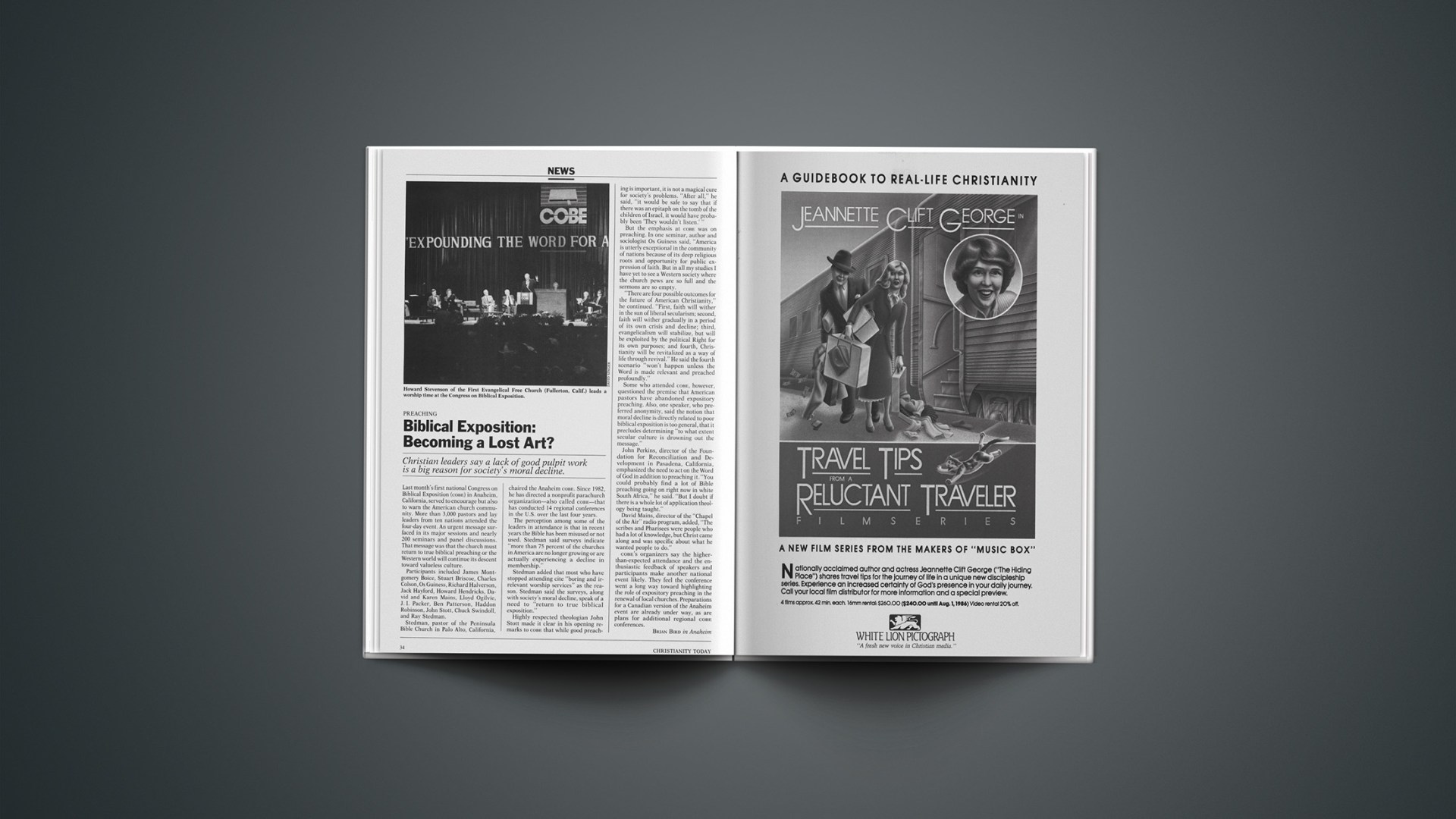
Last month’s first national Congress on Biblical Exposition (COBE) in Anaheim, California, served to encourage but also to warn the American church community. More than 3,000 pastors and lay leaders from ten nations attended the four-day event. An urgent message surfaced in its major sessions and nearly 200 seminars and panel discussions. That message was that the church must return to true biblical preaching or the Western world will continue its descent toward valueless culture.

Participants included James Montgomery Boice, Stuart Briscoe, Charles Colson, Os Guiness, Richard Halverson, Jack Hayford, Howard Hendricks, David and Karen Mains, Lloyd Ogilvie, J. I. Packer, Ben Patterson, Haddon Robinson, John Stott, Chuck Swindoll, and Ray Stedman.

Stedman, pastor of the Peninsula Bible Church in Palo Alto, California, chaired the Anaheim COBE. Since 1982, he has directed a nonprofit parachurch organization—also called COBE—that has conducted 14 regional conferences in the U.S. over the last four years.

The perception among some of the leaders in attendance is that in recent years the Bible has been misused or not used. Stedman said surveys indicate “more than 75 percent of the churches in America are no longer growing or are actually experiencing a decline in membership.”

Stedman added that most who have stopped attending cite “boring and irrelevant worship services” as the reason. Stedman said the surveys, along with society’s moral decline, speak of a need to “return to true biblical exposition.”

Highly respected theologian John Stott made it clear in his opening remarks to COBE that while good preaching is important, it is not a magical cure for society’s problems. “After all,” he said, “it would be safe to say that if there was an epitaph on the tomb of the children of Israel, it would have probably been ‘They wouldn’t listen.’ ”

But the emphasis at COBE was on preaching. In one seminar, author and sociologist Os Guiness said, “America is utterly exceptional in the community of nations because of its deep religious roots and opportunity for public expression of faith. But in all my studies I have yet to see a Western society where the church pews are so full and the sermons are so empty.

“There are four possible outcomes for the future of American Christianity,” he continued. “First, faith will wither in the sun of liberal secularism; second, faith will wither gradually in a period of its own crisis and decline; third, evangelicalism will stabilize, but will be exploited by the political Right for its own purposes; and fourth, Christianity will be revitalized as a way of life through revival.” He said the fourth scenario “won’t happen unless the Word is made relevant and preached profoundly.”

Some who attended COBE, however, questioned the premise that American pastors have abandoned expository preaching. Also, one speaker, who preferred anonymity, said the notion that moral decline is directly related to poor biblical exposition is too general, that it precludes determining “to what extent secular culture is drowning out the message.”

John Perkins, director of the Foundation for Reconciliation and Development in Pasadena, California, emphasized the need to act on the Word of God in addition to preaching it. “You could probably find a lot of Bible preaching going on right now in white South Africa,” he said. “But I doubt if there is a whole lot of application theology being taught.”

David Mains, director of the “Chapel of the Air” radio program, added, “The scribes and Pharisees were people who had a lot of knowledge, but Christ came along and was specific about what he wanted people to do.”

COBE’s organizers say the higher-than-expected attendance and the enthusiastic feedback of speakers and participants make another national event likely. They feel the conference went a long way toward highlighting the role of expository preaching in the renewal of local churches. Preparations for a Canadian version of the Anaheim event are already under way, as are plans for additional regional COBE conferences.

BRIAN BIRDin Anaheim

Putting Satan’s Work into Perspective

Conference speakers say behavior thought to be demonic is usually caused by mental illness.

In 1488 two Dominican priests wrote a book describing how demon possession could be diagnosed and treated. The book, The Witch’s Hammer, was a best seller through its 19 editions over 150 years. The priests prescribed that victims of demon possession be drowned or burned to death.

It is estimated thousands died as a result of the priests’ advice, according to psychiatrist Christian Hageseth, one of several to address a professional seminar called “Satanism and Neo-Paganism.” Hageseth said it is likely that many of these victims were not demon possessed, but suffered from chronic depression or personality disorders.

The seminar, held last month in Berkeley, California, was sponsored by Spiritual Counterfeits Project (SCP) and Evangelical Ministries to New Religions. It was held in conjunction with a similar conference on deception and discernment, tailored for lay people.

Speakers at the two conferences included sociologists, counselors, and researchers who regularly confront the effects of evil, including deception and Satan worship. Theologian J. I. Packer was on hand to provide a theological perspective on evil.

Hageseth and other speakers emphasized that much of what is thought to be supernatural activity is best explained in psychological or physiological terms. “The rate at which people diagnose [demon] possession is inversely proportional to their education in the behavioral sciences,” said Hageseth, only half jokingly.

He lamented, for example, that people are sometimes told they are possessed when the real problem is a biochemical disturbance of the brain that can be treated with drugs. Hageseth said Satan is an “intelligent adversary with agents that work,” adding that “the powers of darkness thrive on ignorance.”

Another speaker, Danny Korem, echoed the same theme on a different level. A magician, Korem produced a variety of “effects,” including “psychokinetic” spoon bending and levitation (for a private audience). But each time he dazzled his onlookers, he assured them the magic had a logical explanation. Many times, Korem said, “Satan deceives us with a lie, not with a real supernatural power.” (See interview on page 32.)

Korem regularly works with law enforcement authorities to investigate perpetrators of fraud. He also seeks to debunk palm readers, psychics, and others who make a profit as a result of claiming supernatural or superhuman powers. He said this job is not easy because people are fascinated by the mystical and most “don’t want to be told that these phenomena are not real powers.”

Trends

The two conferences enabled many “cult watchers” to compare notes and discuss trends. A lot has changed since organizations that study new religious movements began to emerge about two decades ago in response to groups like the Unification Church and the Children of God.

Westmont College sociologist Ronald Enroth said the once-common practice of kidnaping and deprogramming has nearly stopped. Not only do kidnapers face legal liabilities, Enroth said, but many feel deprogramming can do more psychological harm to youths than can a passing experience in a cult group.

James Bjornstad, academic dean at Northeastern Bible College, said cult analysis in the early days consisted mainly of theological evaluation. Today, he said, more analysis is done from a behavioral science perspective.

Another trend cited by Bjornstad is the emergence of groups on the fringe of traditional Christianity. He and other specialists attending the conference said they are frustrated at the public’s perception of their evaluations of Christian fringe groups. “Because we have the reputation of being ‘cult-watchers’,” Enroth said, “whenever we critique a Christian group, people think we’re saying the group is a cult.”

The ambiguity of the term “cult” worked against SCP in a prolonged legal battle with the local church, a battle that ended last year. Local church lawyers maintained SCP had put the local church on the same level as cults such as the one led by Jim Jones. SCP spokesmen, however, maintain they never considered the local church a cult in that sense.

“Especially since Jonestown [where some 900 people died in a 1978 mass suicide],” Enroth said, “the concept of cult has diminished in its usefulness.” He said he would be glad to see the word “cult” dropped from the vocabulary, but added it has become a media term and is “probably here to stay.”

Those who analyze new religious movements say the question “Is this group a cult?” often does not have a definite answer. Thus, they say even thoroughly Christian groups sometimes engage in potentially dangerous, cultlike practices.

Some who gathered in Berkeley served on a committee that evaluated the campus organization Maranatha Christian Church. The committee in 1984 issued a statement that said, among other things, Maranatha “has an authoritarian orientation with potential negative consequences for members (CT, August 10, 1984, p. 38).” Bjornstad, who chaired the committee, said he has since had “friendly contacts” with Maranatha president Bob Weiner. Bjornstad said, however, there are no plans for a formal reassessment of the group.

RANDY FRAMEin Berkeley

Waging War Against Deception

Danny Korem is a world-class magician and producer of documentary films. He also works as an investigator in cooperation with law enforcement authorities. One of his purposes is to expose those attempting to build cult followings by claiming to have supernatural powers. Korem’s film, Psychic Confessions—syndicated last year on commercial television—garnered high Nielsen ratings. The documentary virtually halted appearances of self-proclaimed psychics on television shows like “That’s Incredible.” Korem was a major speaker at last month’s Berkeley conference on deception and discernment, sponsored by Spiritual Counterfeits Project and Evangelical Ministries to New Religions.

What do you try to accomplish through your work?

Today the art of magic is so sophisticated that Houdini would be lost if he were alive. People are extremely vulnerable to all kinds of deception. It’s far more than just sleight of hand. It entails the short-circuiting of the judgmental process. There is very little known on the street about how this happens. I try to communicate these principles on a popular level. My goal is to counter deception. When a person gains a following or gets rich by convincing others he has special powers, that is wrong, and it can also be very dangerous.

Do humans actually possess psychic powers such as extra-sensory perception or psychokinesis [the ability to move objects with the mind]?

If you mean by psychic abilities things the mind can do in and of its own ability, I say it’s not possible. That’s what you find when you investigate case after case after case. Tens of millions of dollars have been spent on research in this area, and there has never been a verifiable demonstration of human psychic power.

What do you say about those who claim to have such powers?

Everything they do can be explained in natural terms largely in accordance with the principles of physics. People are deceived because they don’t know the modus operandi behind the effects that are produced.

What do you believe about the supernatural?

I believe in God. History’s greatest supernatural event is the Resurrection. I have spent lots of time examining this event as I would examine other events that seem to have no natural explanation. Though it took place 2,000 years ago, we have enough information today to convince me it happened. I’ve heard all the best arguments against it, and speaking as one trained in these things, I’ve never heard one that made sense.

In your work, have you ever encountered the supernatural?

Only once, and not directly. A pastor I know dealt with a case of what I think was true demon possession. I might add that I receive scores of calls about alleged demon possession. Most of them involve people who don’t need demons cast out. What they need is counseling or medical treatment.

Some believe that people with supernatural powers get their powers from Satan.

According to Scripture, it is possible for Satan to give people supernatural powers. But I don’t believe he usually works that way. Regardless of whether deception is directly inspired by Satan, it’s still wrong. Since Satan is the father of lies, there is a sense in which all deception is Satanic.

When you speak to Christians, how is your message received?

It takes people some time to grasp the concepts. But overall I find the church very willing to accept that many things we have traditionally thought were real powers are actually conterfeit claims. Some might think this idea would be most unpopular in the Pentecostal community. But I’ve met with many Pentecostal church leaders who are anxious to see these things exposed. In fact, nobody has opposed what I’m trying to do except the “psychics” and others who are perpetrating the fraud.

A Peaceful Transition

CHRISTIANITY TODAY/April 18, 1986

Most of the thousands of Filipinos who formed human barricades between armed opponents were Roman Catholics.

A group of believers has gathered under the banner “KONFES” at Gate 2 of Camp Aguinaldo in the Philippines. Yards away, two Filipino military leaders have holed up after defecting from the Marcos government. The Christians huddle around a radio. It is 5:20 A.M., February 24, and it appears a long-dreaded confrontation is at hand. Three battalions of heavily armed soldiers are a mile away and moving down the street toward the camp.

“The moment of truth,” says one softly. Quickly they assemble and lock arms, forming two lines in front of the gate. Isabelo F. Magalit, pastor of Diliman Bible Church, prays, “We have no courage of our own. We entrust our lives into your loving and mighty arms.”

The feared onslaught never comes. The next day, President Ferdinand Marcos leaves the Philippines after a 20-year reign. A sense of euphoria and amazement grips the Filipino people and, to some extent, the world. A potential civil war has been averted.

The 300 or so who gathered under the KONFES banner in Marcos’s last days were Protestant Christians associated with a citizen organization that monitored the February 7 presidential election. However, most of the people who formed human barricades to prevent armed conflict were Roman Catholics.

The huge proportion of Catholics is not surprising in a country where 85 percent claim allegiance to the Roman Catholic church. Only 3.5 percent in the country are Protestant, and even fewer would say they are evangelical.

Nevertheless, some, including Magalit, were disappointed. “Our contribution was not very large because evangelicals were hesitant to commit themselves.” he said. “[We] have lost some ground because we were not involved.”

The Roman Catholic church figured prominently in the months preceding the election and in the uncertain days that followed. The Catholic presence was especially visible in the final days.

“Catholics are saying their prayers have been answered because they prayed to Mother Mary,” Magalit said. “Mother Mary was very prominent in the barricades. There were statues of Mary, and processions behind Mary. And the nuns and priests were very instrumental in actually stopping tanks.”

Magalit added, “Evangelicals need to catch up on our homework concerning the Christian’s role in nation building. A nation is great only if it is righteous.”

The Diary of a Peaceful Rebel

Isabelo F. Magalit is pastor of the Diliman Bible Church in The Philippines. For three days he was “commander-inchief” of a group of Christians who formed a human barricade at Gate 2 of Camp Aguinaldo. Their goal was to prevent bloodshed between government forces outside the camp and rebel troops inside. Those inside included two former high-ranking officials who had left the government of Ferdinand Marcos. Magalit wrote a brief account of his three nights at the barricade. Excerpts follow:

Sunday evening, February 23

The decision to join the barricades was taken … right after the morning worship service.… We needed to act quickly because on Saturday evening Defense Minister Juan Ponce Enrile and Lieut. Gen. Fidel Ramos announced at a press conference in Camp Aguinaldo that they were quitting the Marcos government, saying that Marcos did not win the election.…

We … proceeded to draw up a list of shifts, for people to sign up.… We all agreed that the civilian buffer was the most effective means for preventing a shooting war from breaking out.…

We reported to the outpost.… The first thing I noticed was the large number of people.… One hundred thousand? Perhaps twice that number. I took courage: surely the Marcos forces would not fire at such a large number of people.…

Our consensus seemed clear, but it was also evident we were all amateurs.… I was appointed Commander-in-Chief, meaning that I was to decide whether we stay or make a break for it.

We could all get killed.… (My wife had said when I left home: “You are responsible for the lives of the church people you bring along.”) I accepted the responsibility but also said to the Lord that the people who stayed all made their choices.

Monday at dawn, February 24

When the radio announced that President Marcos was reported to [be] on the way to Hong Kong, the cheering becomes deafening. There is dancing in the street.…

Monday morning, February 24

What a letdown when I go home to see President Marcos on TV. Our rejoicing was premature. He was still very much around, and in a fighting mood, threatening to wipe out the isolated Ramos and Enrile.…

Monday evening, February 24

People power has kept us safe, but the danger remained real. In spite of the constant reports of defections from the Marcos army to the Enrile/Ramos forces, we all knew that a large-scale attack was still possible.

Tuesday morning, February 25

The all-night shift go home to sleep but the daytime defenders of the barricade are even more numerous. There is a festive air, perhaps because everyone knows there is less danger when it is day.…

Tuesday evening, February 25

I preach at the 8 P.M. service, taking Amos 5:24 as my text. Why are we here?

I ask, and answer my own question by pointing to God’s concern that real religion is not ritual, but right relationships. Right relationship with God, that is righteousness. Right relationship with people, that is justice. The two are … strands of the same thread.…

At 10:30 we hear the news—confirmed by Voice of America [radio]—that Marcos and his family have flown from the palace to Clark Air Base, where two jets were waiting to transport them to the U.S.A.… [We] sing again. All our favorites. We cap it with “The Hallelujah Chorus.” Ambitious, but what better way to express our confidence in God who is Lord of the universe?

Divided

Agustin (Jun) Veneer, Jr., general secretary of the Philippine Council of Evangelical Churches, said that, in retrospect, “it would have been good to have marshaled the evangelical church as a whole … to occupy a highly visible place at the barricades.” He acknowledged the barricades were “a great deterrent to bloodshed.”

Evangelicals were united in judging the election fraudulent. But those attempting to hammer out a united response found themselves at opposite poles.

“Eventually, it was agreed that those who were led by God to do so should go there and form part of the human barricade,” Vencer said. “Other denominations gathered their people in churches and prayed and agonized for the protection of God upon those who went and for the avoidance of bloodshed.”

During the night after the defection of top members of the reform movement of the Philippine armed forces, Radio Veritas, the Roman Catholic station, appealed to Filipinos to take to the streets to form a human barricade around the dissident officials. The Far East Broadcasting Company station in Manila (Protestant) called on Christians to gather in churches and homes to pray.

“One of the most moving scenes was to see churches open up past midnight,” Vencer said. He added it was “amazing how people would pray with tears in their eyes and cry out in agony asking for God’s intervention that no bloodshed would take place. We believe in the power of prayer. They call it ‘people power.’ We call it ‘prayer power.’ ”

Religious Freedom

Because of the prominent role it played in the peaceful transition, the Roman Catholic church is riding a wave of popularity. With a sympathetic and devoutly Catholic president in office, the Catholic church is stronger today than it has been for decades. This has brought to the fore questions about how Protestant churches will be treated.

“To be very frank, there are some anxieties,” Veneer said. “It could create some hardship for the gospel because of a return to the traditionalism of the Catholics. Some people may not be eager to listen to another alternative.”

During the election campaign, new President Corazon Aquino was accused of being manipulated by the Catholic church. “That may be unfair to her,” Veneer said. He added that just before the election, Aquino’s office issued a commitment to observe freedom of religion and worship.

Said Magalit, “The Catholic church is committed—at least in public pronouncements—to respecting religious freedom. We must take them at their word. If there are instances where they go against it, then we must call their attention to it and require them to live up to their word.”

SHARON E. MUMPER

Surviving Leadership in Fast Forward: CT Interviews Inter-Varsity’s Gordon Macdonald

ROBERT M. KACHUR AND DAVID NEFF1Robert Kachur is assistant editor of HIS, Inter-Varsity Christian Fellowship’s magazine for college students.

Gordon MacDonald knows intimately the pressures church and parachurch leaders face. After a dozen years as pastor of Grace Chapel in Lexington, Massachusetts, he is now president of Inter-Varsity Christian Fellowship, serves on the boards of several Christian organizations, and is a prolific author and speaker.

During a layover between connecting flights, we spoke with a very calm MacDonald about how Christian leaders can survive a top-speed world, what followers should (and should not) expect from leaders—and how we can help nurture a much-needed new generation of leaders.

In your speaking and writing you have shared a lot of what the Lord has led you to. What do you think the Lord is teaching you right now?

I’m 46 years of age, and I think the Lord is teaching me to come to grips with my mortality. I think of how many years I have left and how many things I’m not going to get done—about what I can afford to leave undone and what I want to leave behind 20 years from now.

I no longer need to be a footnote in somebody’s church history book. But I do want to close out the next two decades of ministry—if God provides that for me—with a sense of having left a few people behind me who have reached their potential because of me.

I’m out to discover and, hopefully, model a new form of leadership.

My generation has not produced many transforming leaders. Lee Iacocca is a transforming leader; Martin Luther King, Jr., was a transforming leader. But in the evangelical world, where are the new transforming leaders who will leave the times different from when they came?

Why are you so concerned about building leaders?

We have just come through an era of evangelical leadership that came out of World War II. That postwar generation is now retiring, and many organizations do not have able successors within the ranks.

What produced the postwar leaders?

Men who came home from the war were crusade-oriented, and those who became Christians threw themselves into the Lord’s army. The same energy that took a guy into the Philippines now took him back over there to form missionary organizations.

Today we are in a dramatically changing world that requires new kinds of leadership. The next ten years are going to be unlike any in the history of the world—or the church. It is going to be a fight for survival, and only those organizations that are defining leadership, priorities, and visions are going to make it.

What should we be doing to raise up a generation of good leaders?

Organizational programs rarely create leaders. Leaders create leaders. Leaders are mentored. One of the commitments I made when I turned 40 was to give more energy to influencing a few young men and women.

Currently there is a tendency in some Christian circles to create clones rather than leaders. There is very little room in our present evangelical climate for men and women to experiment. They stifle new ideas for fear of being labeled a heretic or having support cut off. Leaders must be molded in situations where they have the freedom to be wrong.

The postwar generation’s leadership model was military: a commander, his troops, and a mission. Is there a relevant leadership model for today?

I suspect it is a business model. I constantly resort to business terminology, while my father used battlefield terminology. We have learned a lot from marketing, sales, and administrative techniques. As long as we don’t reduce the gospel and the kingdom to that, we won’t be in trouble.

When you read Tom Peters’s In Search of Excellence or A Passion for Excellence, you realize that the new business model is servant leadership. Peters is saying things that the Bible said 2,000 years ago: Find the specialness in people, set them free to reach their potential, believe in them, affirm them, rebuke them when necessary, care for them. I’m afraid that sometimes I see Christian ethics practiced in top secular business organizations more than in the church.

What is servant leadership?

Servant leaders recognize that God has given them a stewardship of people. The men and women of Inter-Varsity do not work for me; they work for the Lord. But I’m going to be accountable some day for how they have been treated.

My wife, Gail, and I try to treat the people around us in terms of potential rather than performance. Our affirmations and rebukes are given with a sense of where a person is headed, not where he or she is today.

Servant leadership does not mean, however, that I am a doormat to the people I lead. To bring them to their full potential sometimes means that I must be hard on them—or even reassign or fire them to put them into a position where they are better off.

Right now, you are on the road more than you are home. How do you keep from burning out?

To keep sane, I create little spaces of privacy on the road. When I am on the road my schedule is at the mercy of other people, and inevitably someone crams my calendar 30 to 40 percent more than I anticipated—see this person, speak to this group, go out for supper, stay over at our house.

So I stay in motels and make my room an oasis of privacy, a home away from home where no one else can go. Then I demand time, what I call Sabbath time, every day, to be alone with my wife if she is with me, to worship and pray, to read and catch up with personal matters. At the risk of sounding snobbish, I simply say I am not available in the early hours. Otherwise, each new group of people I meet may make demands without taking into account what went on yesterday or the day before. I have learned to say no to some good things in order to be free for the best.

Have you been able to balance your ministry and your personal life as well as you would like?

Not at all. I have had to make a lot of compromises. But I don’t think they have been bad compromises. When people develop disciplines that are supposed to maintain health, they don’t have to become legalists who fear that if such-and-such doesn’t happen 47 minutes a day, the whole thing is going to fall apart.

During the last year I have drawn upon a reservoir of strength that has been building up for several years.

How were you able to fill that reservoir?

There are periods when you can read more, think more, and develop spiritual disciplines at a greater pace than you are expending spiritual capital. At Grace Chapel, I had the opportunity to amass intellectual and spiritual material.

The first year at Inter-Varsity was done at tremendous psychological and spiritual expense because no day was like any other. I didn’t have the time for Sabbath that I had in the more routine schedule as a pastor. In Massachusetts, Gail and I knew that every Thursday we were going to sabbath. We can’t do that now; so we have to write Sabbaths into the calendar. Frankly, there are some times we have to go ten days without a Sabbath. I have had to accept the reality of the broken routine and coast on a lot of what I built up in the past.

Gail and I have compromised mostly recreation. But I don’t think we have compromised the spiritual disciplines. We try to maintain the Sabbath discipline, and we have made time for each other whether we were on the road or at home. I have tried to keep up with my study of the Scriptures, and I actually do more reading than ever in airplanes and motels. But there is no such thing as a routine day. Each morning I have to figure out the day’s discretionaries and the nonnegotiables.

Some Christian leaders seem to live at breakneck speed all the time? Is that lifestyle okay for them?

More than a year or two of living like this could affect you one of three ways: You could burn out emotionally, start to suffer physically, or—and this is just as dangerous—you could get used to living with a constant adrenalin kick.

Every time you get up to speak, face a crisis, or run for a plane, there is a surge of adrenalin. Seeing how much you can pack into a day becomes exciting, and you can get addicted to that. The adrenalin habit becomes a way of saying, “I am truly important in the kingdom of God.” None of us is that important.

The rest of us make heroes out of those who live this way. We begin to equate top-speed living with godliness and the Spirit’s blessing. We think, Why can’t I be like that? Christian leaders living top-speed lives year after year are very dangerous models. Sooner or later someone is going to pay the price.

What kind of price?

Failure, bad judgment.

Some leaders use people up, constantly taxing the emotional energies of their team. People leave those organizations, having had an exciting phase and then becoming embittered and disillusioned by the constant stress and pressure.

Other leaders just get exhausted and drift into an ineffective numbness. They don’t have any new ideas or new words. They become wed to old ways and can’t change with new realities.

Do the struggles and temptations of living hard and fast weigh more heavily on church or parachurch workers?

The issues are almost always the same. Only the scale changes. Whether the scope of your ministry is 10 or 3,000 miles wide, your lifestyle probably lacks routine and has minimal built-in accountability. As a leader, you are probably the target of lots of praise or lots of criticism. Put all that together and you have the stage set for a life that is saturated with anxiety, stress, adrenalin, excitement, and power—all very seductive things.

How can you keep from falling into that trap?

By building accountability into your life.

The first step is developing personal spiritual disciplines. For many years I have kept a daily journal of what I am doing, why I am doing it, and what the results are. Just forcing it onto paper makes me ask what is going on in my life. Other exercises in personal accounttability include intercession, reading Scripture, and studying biographies of Christians who really did achieve.

Humanly speaking, the greatest accountability is a good marriage with a spouse to whom one listens. When Gail spots fatigue or shallowness in me, I listen carefully. In addition, there have been men and a few women in my life who were not afraid to rebuke me.

As a public figure, you are subject to criticism. What advice would you give other leaders about handling it?

Criticism hurts most when you are young and still trying to establish your identity. When I was in seminary, a lay leader told me, “The main problem in your life that is going to diminish your effectiveness as a leader is hypersensitivity. In every critique, there is a kernel of truth. Find the truth, discard the rest, and get on with it.” I decided to live like that. Every time somebody criticizes me, my first thought is, What is the kernel of truth?

A. W. Tozer wrote: “Whenever you are criticized or opposed, never fight back.” I determined I would never fight back. Rather, I would try to thank people for their criticisms and be smart and courageous enough to ask for more.

A lot of Christian leaders have missed one of God’s greatest gifts by shutting out criticism. Some pastors are so defensive that their wives learn early not to criticize them. My wife is my greatest critic, even though there are moments when I don’t want to hear what she has to say. If I were single, or if my wife weren’t supportive, I would deliberately cultivate a select group of friends to provide the affirmation and rebuke other people got from their spouses. Leaders who aren’t intimate with others tend to turn ideological, become sharp-edged, and split hairs.

The most recent thing I learned about criticism was best put in a book by Gene Edward, A Tale of Three Kings. When Saul threw spears, David ducked. He didn’t throw the spears back, and he pretended that they were never thrown in the first place. If we would stop throwing spears back at people, we would save ourselves a lot of energy that could be put to better use.

Gordon MacDonald’s Private World

In his research, Gordon MacDonald found more than enough books to help him organize his calendar and career. But hardly anyone had addressed the organization of the inner world—the sphere of motives, values, commitments, and divine dialogue. In Ordering Your Private World (Nelson), available as a book or six-part docudrama on film or videocassette, he explains how organizing the private world will result in a manageable exterior.

As president of IVCF, do you feel pressure to live up to your own advice in Ordering Your Private World?

Interestingly enough, I feel almost no pressure. People kid me: “Is the top of your dresser orderly today?” Or they want to see what my car trunk looks like, because I’ve said that cluttered trunks and dressers can be symptoms of a disorderly private life. If someone comes into my office and my desk is momentarily cluttered, that doesn’t bother me. I never wrote Ordering Your Private World to describe a perfect state. The book offers a way of living. Life is not perfect. The Christian experience is a struggle.

When I was a student, I was involved in some ministries where everything was black and white. I have never felt comfortable with the kind of Christianity that pretends everything can be put into a box, that every question can be easily answered, that following formulas will make everything work out. That kind of Christianity is unredemptive and guilt producing. I try to be honest and vulnerable as a writer. I don’t mind telling people I have botched up.

What eventually inspired you to get Ordering Your Private World down on paper?

I was in a large office-supply store one day, and I looked around at all the adults who were browsing. I thought, Why are we here? We didn’t come because we had to buy something. And then it hit me—we were all looking for the latest gadget to organize our lives. Many people feel disorderly and unproductive. As I’ve listened to colleagues talk, I’ve realized that they were full of unrealized wishes and dreams because they didn’t know how to put everything into perspective. I began a study in time budgeting, and the book was born.

Writing Ordering Your Private World helped me understand what things I need to bring into order to be a healthy human being. I’m working on a sequel to it about fatigue—how we get tired, how we perform when we get tired, and how to combat the sense of emptiness and despair that exhausted people often experience.

How are busy clergy and lay people responding to Ordering Your Private World?

None of my other books has gotten response like this one. I average three to five letters a day from people telling me that this is the area where they are hurting the most.

I guess Ordering Your Private World just admits that we all botch things up. People desperately want to know what kind of Christians they are supposed to be and how they can bring order to the top-speed world we live in. I’m burdened about that. I almost chucked the faith years ago because no one told me it was all right to be human. Then I read Keith Miller’s A Taste of New Wine. It was so freeing to read about a man who admitted to struggles, doubts, fears, and hurts.

Could you do for us what Keith Miller did for you? What are your struggles, doubts, and fears?

I have tried very hard to be honest with myself—and my wife has been helpful in never inhaling the kind things that people say about me.

I don’t have to look very far into my heart to see my propensity for evil and to recognize that anything that’s going right in my life today is because of the kindness of God and because of some very kind people who have surrounded me since childhood and committed themselves to making me look good and be effective.

I have decided that I cannot help people if I put a cosmetic on my professional and ministry life that isn’t fair and honest.

I blanch a bit when people compliment me by saying I’m busy. I don’t see myself as busy. I see myself having a propensity for laziness. And I see myself as almost constantly on the edge of disorganizaton. I certainly do not have an instinctive hunger for God. Prayer, study, meditation—all come viciously hard for me; so I’ve surrounded myself with personal support mechanisms and props.

Believe it or not, I’m often pushed to work hard by a fear of laziness. As a child I was a daydreamer who didn’t do well in school. I recognize that I work hard and enjoy the fruit of completing things. But in my most honest moment I will tell you that I do not feel I’ve paid my debt to the kingdom of God.

My greatest fear is fear of meaninglessness. I have to discover meaning in everything I do, and until I find the meaning, what I’m doing brings no joy. But if I know that it has an ultimate purpose, that it somehow converges with kingdom interests, then I can live with large amounts of ambiguity.

Besides offering constructive criticism, then, how can Christians help care for their leaders?

First, followers need to protect their leaders. That means asking on every occasion: Are we demanding too much from this person, or are we asking only for things which he or she is really best suited to give? Sometimes Christians focus so much on the egalitarian concept—that leaders are no better than anybody else—that they forget the leader needs to be free to lead. Leaders have physical, mental, and emotional limits, and need to be kept relatively free from anxieties that sap strength.

Second, Christians must affirm their leaders. Whenever you walk into a new situation, ask two questions: “Who is in charge here?” and “How can I support that person?” Give them your full attention. Ask relevant questions, and let them know if their answers are on target. Hearing third-and fourthhand what people say about your leadership is demoralizing.

What else can followers do?

Billy Graham has enjoyed 40 years or more of incredible leadership. And one of the main human ingredients of his leadership has been the five or ten people, including his wife, Ruth, who have poured themselves into helping him. They have been committed to his leadership.

In contrast, there were men and women who had great leadership opportunities, but the team didn’t support them. Instead, they got jealous of their privileges or fame, sapped them of their strength, and pulled the bricks up from underneath them. Almost always when you see a great enduring leader, you also see great key people—good followers—around him.

Good leadership is an equation of leadership and followership, and if you don’t have one, then the other one doesn’t make it.

Every parachurch ministry has financial crises. How do you keep finances from taking priority over other ministry objectives?

First, there have to be careful controls that don’t allow you to get the organization into deep waters where crisis becomes a way of life. That happens to many entrepreneurial or charismatic leaders. They keep pressing and expanding—sometimes just for the sake of expansion—and they coat it in nice God words so it looks like “faith” and “vision.”

Second, the spiritual disciplines help us constantly re-examine priorities and make sure we know why we are spending time the way we are. If you don’t stop and sabbath enough to reappraise the priorities and schedule, money will always grab your attention. If you stop and look, you can put money in its proper place and delegate the responsibilities.

What have you learned about the relation of the church to parachurch agencies now that you have moved from the parish to a national ministry?

In the 1960s, there was a lot of antipathy between the church and parachurch organizations. But as the 1970s went along, it became clear that both entities really needed each other. The thinking parachurch leader realized that he was in existence to do one basic thing with one kind of people for a limited period of time. The thinking church leader realized that many ministries could be wisely subcontracted to specialists in the parachurch.

I moved over to the parachurch because I wanted to do one basic thing—to give myself to the younger generation in search for new leadership—and to help that leadership develop into a new model that I believe is necessary for the 1990s.

Organizations can stagnate. They become embedded in administrative policies, legalities, and organizational hierarchies. People’s careers become important. More and more time is spent maintaining the organization.

John Gardner writes in his book Self-Renewal about the importance of organizations constantly re-evaluating their vision, sense of purpose, and structure; making sure that nothing except their basic call to exist is nonnegotiable. The church is in business to draw men and women to Jesus Christ and to help them live as mature Christians in this world. Given right ethics, I don’t care how that happens. The only thing that’s sacred is our ultimate objective, to win people to Jesus Christ.

Palestinian Christians: Caught in a War of Two Rights

At a high school in Israel, Arab students gather discarded pieces of colored tile and arrange them into mosaics depicting Bible themes. The mosaics, now decorating a wall below the school library, depict the prophet Elijah being fed by a raven; Christ’s miracle of the loaves and fishes; and the word peace in Arabic, Hebrew, and English.

The fragments of information Western evangelicals use to construct an image of Arabs probably would not form a picture of a student art project with biblical themes. Instead, bits of headlines and news reports form for us a mental mosaic of terrorists, fanatic disciples of Islam, or oil-rich sheiks.

Though concerned with Christian brethren everywhere, evangelicals often forget there is a significant community of Arab Christians within Israel and its occupied territories. They are Greek Orthodox, Catholics, Melkites, and Protestants, together making up less than 10 percent of the Arab population there. Arab Christians trace their spiritual roots back 2,000 years to the time the early church began witnessing to the Gentiles, and they are proud of their long heritage. As a church official in Jerusalem points out, “We know Saint Paul went to Arabia in preparation for his missionary journeys to Europe. So Arabia got the news of Jesus Christ well before Europe did.”

Arabs who are Christians do not all agree on a single approach to the political dilemmas of the Middle East, and they differ in the ways they relate to Jews and to Christians outside their own tradition. Yet there are several common threads that draw them together. They call themselves Palestinians—a term of national identity that is considered invalid by many Israelis. They have a special affinity for Christ’s teachings, particularly his Sermon on the Mount; and they liken their own circumstances to Christ’s ordeal as refugee, outcast, and martyr.

Arab Christians do not disassociate themselves from their Muslim friends and neighbors. They exhibit the same characteristic samed (steadfastness) other Palestinians have developed through three generations of waiting for their social and political status to be resolved. And most of them believe peace is possible if attitudes change on the part of both Jews and Arabs.

The Christian Arab population of Israel is dwindling, as families move away in search of personal security and better opportunities for education and work. Before the State of Israel was established in 1948, there were between 25,000 and 40,000 Christian Arabs in Jerusalem. Now there are fewer than 9,000. In total, there are between 100,000 and 120,000 Arab Christians in Israel and the territories it controls. (These include the West Bank, or Judea and Samaria; the Golan Heights near Syria; and the Gaza Strip near Egypt.)

The steady hemorrhage of Christians from the Arab community has demoralized church leaders there, and it raises a serious question about attitudes of Christians in the West toward these believers. A Melkite priest in Galilee, Father Elias Chacour, said in frustration, “If things happen in Galilee as they did in Ramallah and Jerusalem, where there is almost no Christian community now, why would American Christians come here? To visit the ruins of Christianity? Would you like to follow the footsteps of the Lord without any Christian community here?”

U.S. evangelicals may inadvertently hasten the dismemberment of the Arab Christian community by offering uncritical moral and political support to the State of Israel. Most Christians in Israel, both Arab and Hebrew, accept the evangelical attentiveness to prophecy and empathy with the Jewish construction of a homeland. Few Christians in Israel dispute the existence of the State of Israel. At the same time, they emphasize that American evangelicals must not lose sight of the biblical imperative of justice and compassion for all peoples. Victor Smadja, a leading Hebrew Christian layman in Israel, said, “Jewish believers are very faithful to Israel but not at the expense of being faithful to Christ. The Gentiles make an error in thinking that because of the past, they have to be pro-Israeli. That is sentimentalism, not a healthy Christian attitude.”

Palestinians in Jerusalem and within the pre-1967 borders of the State of Israel can become Israeli citizens, hold jobs, and vote—although Israel’s electoral process of direct proportional representation by party virtually excludes Arabs from being elected to the Knesset. Jerusalem, like Mayor Daley’s Chicago, is a city that works despite its fractious elements. It was a divided city, with the Arab half under Jordanian control, until it was unified under Israeli rule after the Six-Day War of 1967.

On the occupied West Bank of the Jordan River, and on the Gaza Strip, more than one million Arabs live in towns like Bethlehem and Ramallah. About 60,000 of them are in refugee camps run by the United Nations. Many were displaced from their villages in 1948, and have seen their children and grandchildren grow up with no promise of returning to towns they still consider “home.” Until 1967, they, too, were governed by Jordan in the West Bank or by Egypt in Gaza.

The Six-Day War brought the West Bank, Gaza, and East Jerusalem residents under Israeli military rule and into an intractable stalemate. Here Israel faces an excruciating dilemma. It believes Judea and Samaria are God-given lands, and that it needs the West Bank as a military buffer zone. Yet if the West Bank were annexed and its people given full political rights, the Israeli Jews could eventually be outnumbered and the State of Israel would be vulnerable. The present status of military occupation embitters Arab residents and leads, over and over, to violence. The clash of two nationalities claiming the same land is the essence of the “Palestinian problem” that stands in the way of progress toward peace.

Elsewhere, in the pastoral villages of the Galilee, tension between Palestinians and Israeli authorities is more a contest of matching wits and will. The officials are more distant, so Arabs in rural Israel exercise a greater measure of control over their lives and have a degree of self-confidence that is missing in the communities under occupation.

To understand the thoughts, concerns, and aspirations of Arab Christians better, CHRISTIANITY TODAY visited three Palestinian Christians, in three different parts of the Holy Land. They do not agree on everything. But their hopes for peace and stability, built on equal treatment for all, are identical. Most important, they are all faithful to difficult callings from God in their lives—ministering and working in a nation at the center of an apparently intractable political conflict.

Fouad Hodaly And Family (Jerusalem)

The Hodalys, a Palestinian Catholic family, live in a two-room apartment on convent grounds near the Via Dolorosa, or Way of the Cross, in Jerusalem’s Old City. On every available surface, they display pictures of their seven children and four grandchildren. The Arab names they chose for their children all have special meanings. Salim, the oldest, is “healthy.” Samir, who teaches English and religion in a Catholic school, is “friend.” And Mounir, who is a printer like his father, is called “light on the way.” Three other Hodaly sons live in America, and their daughter is in Peru.

Mounir carries a black-and-white photograph of himself as a baby, surrounded by his brothers; Fouad, the father, shows off a picture of his parents with all their grandchildren. It goes without saying that two things matter very much to Palestinian parents: preserving family ties and guaranteeing their children the best educational and employment opportunities possible. Yet, as the Hodalys have discovered, if a family satisfies its goal of providing opportunity for a son or daughter, its desire to stay together is frequently thwarted.

Fouad Hodaly, dressed in khaki work clothes, deliberated over the politics of Palestine. He pointed out that among the Israelis, there are Arab Jews as well as European Jews, so racial differences are not insurmountable. He believes the Israeli government sincerely wants peace, and the process of achieving it requires, most of all, just getting used to one another over time. Eventually, he said, the sort of coexistence that works in Jerusalem could permeate the whole nation.

He believes history is a progression of events of which God is in charge. Looking up verses in a leather-bound Arabic Bible, Fouad referred to Matthew 13. No one except the Lord can separate the “wheat” from the “tares” growing side by side in the confines of Israel and its disputed territories, he said. Arabs and Jews alike harbor both elements in their midst. Fouad observed that the Roman Catholic feast of Christ the King was approaching. “I pray that Christ will rule as king in all our hearts.”

Fouad’s son Mounir is considerably more fatalistic about the future course of events in the Middle East. “It is like a ball on a soccer field,” he said. “It could go this way or that way.” In any event, the Palestinians’ perspective is that of a nonparticipant. They feel sidelined, as forces far greater than they—especially the United States—play a decisive role in Middle East politics.

Like other Palestinians in Jerusalem, the Hodalys experience day-to-day annoyances. They would like to spend Christmas Day in Bethlehem, Fouad said, but they would need a special permit to go there. After a child threw a stone at an Israeli army vehicle by an Old City gate, Salim, the oldest son, was taken to a police station for questioning along with all the other Arabs working and shopping nearby.

Following dinner at home one evening, Salim drove two American visitors to their hotel via the Mount of Olives, stopping to show them Jerusalem by night. An Israeli military jeep pulled up by Salim’s door and a soldier stepped out. Holding his automatic rifle by its barrel, pointed skyward, the soldier peered into Salim’s window and began interrogating him in Hebrew.

“Who are you? Where do you live? Why are you here? Who are these people? Where are they staying? Are they tourists?” Salim answered softly and politely. He told the soldier his guests would return to their hotel in Jerusalem shortly.

The Hodalys are friends of an American evangelical missionary, Rick Van de Water, who came to Israel in 1974. Van de Water emphasizes that many Arab Christians abandon their faith as they face daily pressures. Others have emigrated to the United States, telling Van de Water, “I could not feel at peace in my own home.” Without what he calls a “real, living faith,” Arab Christians are “vulnerable to becoming atheists and Communists.” Even fringe groups that advocate terrorism fill a need for purpose in their lives.

Van de Water’s ministry is dedicated to presenting the gospel as the only alternative to a life of frustration and despair. For families like the Hodalys, that alternative has made a difference.

Bishara Awad (The West Bank)

Bishara Awad, a resident of Bethlehem on the occupied West Bank, is founder and president of Bethlehem Bible College, a training school for Christian young people. Throughout his adolescence and college years, Awad struggled with the full range of emotions Van de Water identified. When war broke out in 1948, Awad was seven years old. His family lived in a neighborhood in Jerusalem that was taken and forcibly evacuated by Israeli soldiers. Etched on Awad’s memory is a gruesome scene he saw played out in his front yard.

Awad’s father stepped out of the house to greet what he thought was a group of friendly soldiers. Without warning, he was shot in his front yard. Awad’s mother dragged him inside, and later buried him behind the house. Awad believes the soldiers were Israelis, but he admits there is no proof. Awad’s family was driven from its home a short time later as the Israelis occupied part of Jerusalem. Awad’s mother kept the family together, sending her seven sons and daughters to an orphanage school while she worked and went to school to learn nursing.

The Awads are Protestant evangelicals, active in a missionary Church of God on the Mount of Olives. When Bishara graduated from high school, he came to the U.S. to attend Dakota Wesleyan College in Mitchell, South Dakota. The events of his childhood continued to haunt him. “You cannot take away your childhood hatred and the memory of the thing that caused you to live without a father all your years,” he said.

When war broke out in 1967, Awad was in Kansas City. He was told he could not come home, except as a visitor. He obtained a temporary visa, and returned to visit his homeland, hoping—somehow—to stay there permanently. He met and married a woman from Gaza, who filed reunion papers for him saying he was a foreigner. His papers were accepted; he was allowed to stay.

He became principal of Hope School in Beit-Jala, founded by the Mennonite Central Committee for junior high and high school orphan boys. That is where his faith in Jesus Christ was reaffirmed, as he poured his energies into shaping young Palestinian lives. “The Lord worked in my life so I could get over this hatred, because I knew the Lord would not use me as long as I had all this hatred.”

Awad realized that there is little opportunity for Arab Christian young people to pursue theological training, and that those who do pursue training enroll in seminaries overseas, often never returning home. In 1979, assisted by two Americans, he began organizing Bethlehem Bible College.

The school, located three blocks from Bethlehem’s Church of the Nativity, offers a three-year program in Bible, Christian education, and music. It has enabled local Arab Christians to move into leadership positions in their churches.

Awad teaches a class on the four Gospels, called “Life and Teachings of Jesus.” He uses Scripture to counsel young men and women who are still ensnared by the hatred he knew as a college student. “They read it for themselves in the Bible—that they are to live the Sermon on the Mount and listen to the authorities. It is extremely difficult, but Jesus lived under the same circumstances that we live under now.”

Circumstances on the West Bank, more than anywhere else in the region, cause Palestinians to say they feel like nonpersons. They drive cars with blue license plates that set them apart from Israeli citizens with yellow plates. At government security checkpoints, Arab drivers are routinely pulled over for questioning.

Heavy-handedness on the part of young, eager Israeli soldiers especially rankles West Bank Arabs. Petty violations, such as a child throwing a stone at an army vehicle, may be cause for an entire school to be shut down or a sudden curfew imposed. Palestinians joke bitterly about it, saying the Israeli army has a plan to disarm Arabs by clearing the West Bank of stones. Nonetheless, putting into practice some of Christ’s “hard sayings” is a daily event at the Bible college.

Awad is also involved in a new initiative to arrange meetings between Arab and Jewish Christians. Some 150 believers were invited to Jerusalem Baptist House for an unprecedented time of fellowship and worship in March, as a result of smaller meetings that have been going on for at least two years.

Award described his experience at the meetings: “The first time you meet with Jewish believers they are still your enemy, but the Lord told us to love our enemies. You can see the tension on both sides, but after several meetings, slowly, you just accept each other and love each other. Both sides have wanted to get together, and it has been eyeopening for both. To have a brother who is Jewish being loved by an Arab—I think this is history in itself.”

Awad’s warm acceptance of Jewish believers stands in sharp contrast to his opinion of Western Christians who support the Israeli government and at the same time neglect the indigenous community of believers there. Christians from abroad who are raising money to rebuild the Jewish Temple of Solomon, on top of a Muslim holy site, are terribly misguided, Awad said. They have no idea what their scheme would mean for the Christian community there: “It would be a catastrophe. The first people who would be killed in a civil war are the Christians—the local people—because Muslim journals report that Christians are initiating this.”

Last year, Awad visited Minnesota, Los Angeles, and Washington, D.C., to raise support for Bethlehem Bible College. As he interacted with evangelicals, he said, “Many were surprised that I am an Arab and a Palestinian. I know I was not welcomed as if I were a Jewish believer or even a Jew who is not a believer.” Awad adds, “I think the church should awaken to the fact that Christ died for all people, regardless of who they are.”

Possessing the Land

A chronology of events in the dispute over Palestine.

63 B.C.–A.D. 73 Palestine ruled by Rome. Jerusalem is destroyed, the second Temple of Solomon demolished. Jews driven into exile throughout the Roman Empire become known as the Diaspora.

A.D.622–637 Islam established. On the ruins of Solomon’s temple, the Mosque of Al-Aqsa and the Dome of the Rock are built.

1100–1250 Crusaders conquer Holy Land. 1400s–1918 Ottoman Turks rule Middle East. 1881 Pogroms in Russia force millions of Jews to move west.

1897 First Zionist Congress, led by Theodor Herzl, meets in Basel, Switzerland; designates Palestine as Jewish homeland. Population of Palestine is less than 10 percent Jewish.

1917 World War I. British Foreign Secretary Lord Balfour promises the World Zionist Organization that Britain supports a homeland in Palestine for the Jews. Arabs are promised autonomous national governments.

1920–48 Britain rules Palestine under an agreement with the League of Nations. Palestine Mandate authorizes World Zionist Organization to organize massive immigration of Jews.

1939–45 World War II. Six million Jews murdered in Holocaust. Jewish population in Palestine increases from 56,000 in 1918 to 445,000 in 1939 to 608,000 in 1946.

1947 Britain turns problem over to United Nations. UN recommends partition of Palestine into two states, Arab and Jewish. Arabs refuse to accept partition.

1948 Israel declares independence. Arab armies enter Palestine. Israel defeats them and seizes all of Palestine. Of the 1.3 million Palestinian Arabs, 726,000 become refugees.

1967 Six-Day War. Israelis crush Arab armies, taking Sinai, Golan Heights, and West Bank; 750,000 refugees flee Israel. Jordan becomes site of Palestinian guerrilla action.

1970–71 Palestinians try to overthrow King Hussein of Jordan. They are defeated and move to Lebanon.

1973 Yom Kippur War begins. Israelis are pushed back in Sinai.

1974–75 Shuttle diplomacy by Henry Kissinger results in some Israeli pullbacks from territory it won in 1967.

1977 Egyptian President Anwar Sadat visits Israel, recognizes Israel as a state, and begins negotiating a peace treaty.

1978 Camp David accords are signed by Sadat, Israeli Prime Minister Menachem Begin, and U.S. President Jimmy Carter.

1982 Israel invades Lebanon, routs Palestinian Liberation Organization armies.

1985 Israel pulls out of Lebanon. Radical anti-Zionist groups attack ticket counters of El Al, the Israeli airline, in Rome and Vienna.

Sources: Ronald Stockton, professor of political science, University of Michigan (Dearborn,); and the United Nations.

How Israelis View the Palestinians

Describing what Israelis think about Palestinians is like trying to define an American position on tax reform. Something ought to be done, everyone agrees, but both the means and the end result are subject to vigorous debate.

At one end of a very complex spectrum, Rabbi Meir Kahane asserts that all Palestinians must be routed from “greater Israel.” At the other end are Jewish intellectuals and peace activists who advocate establishing a Palestinian state—even at the expense of keeping secure borders. An Israeli political analyst, Dr. Naomi Chazan of Hebrew University, says the Palestinian problem has been at the center of more heated confrontation in Israel over the past five years than at any other time.

“It is impossible for Israelis to come to grips with themselves today unless they come to grips with the Palestinians,” Chazan said. At a public policy meeting of the American Enterprise Institute in Washington, D.C., she presented five ways Israelis view Palestinians.

Chazan began with the racist perspective of Meir Kahane, a former U.S. citizen, and a member of the Israeli parliament, the Knesset. In Kahane’s view, Chazan said, Palestinian history is dismissed or homogenized into general Arab history, which is viewed as uniformly threatening to the basis of Israeli survival. The land must be controlled by Jews, in this view, even if Israel has to sacrifice its commitment to democracy in the process. Palestinians must be expelled, Kahane says. His following is a small but vocal minority, and his views appeal primarily to urban, unemployed youth.

A related view is termed the “stereotypical” perspective. Israelis who see the Palestinians as inferior and dangerous, in this view, would opt not to expel them but to have a different set of laws apply to them. They see the Palestinian situation as being no fault of Israeli policies or leadership, but a development of Arab indifference and ignorance.

A third, centrist position, takes an aloof, detached view of the Palestinians. It views them as refugees, who are in their predicament mainly because they refused the offer of partitioned land in 1948. The solution to the Palestinian problem, these Israelis say, is functional separation with symbolic self-determination for the Palestinians.

A widely held view among Israeli intellectuals is “reluctant understanding,” Chazan said. From this perspective, Palestinians are viewed first as victims and second as people with legitimate hopes for self-determination. Here, responsibility is placed at Israel’s doorstep for the condition and status of Palestinians. Israelis of this persuasion believe their government’s policies have bred a serious nationalist movement.

Finally, a small left-wing minority identifies closely with the Palestinians, viewing them as having an undeniable right to self-determination no matter what the consequences for the Jewish state. “The plight of the Palestinians is an outcome first and foremost of Israeli government policies” in this view. These people have lost their Zionist identity and have very little political support.

Chazan pointed out that none of the perspectives she defined promote coexistence. Instead, they involve varying degrees of separation and different methods of maintaining it. However, she said, “Israeli moderates did not look for Palestinian contacts five years ago; now they seek them out avidly.” Even though this is generating confusion and confrontation among Israelis, she said, it indicates a new desire to come to grips with a problem that will not go away on its own.

BETH SPRING

Elias Chacour (Galilee)

The tiny Arab village of Ibillin, a half-hour drive from the Sea of Galilee, is a cluster of low, sand-colored buildings on the sides of two hills facing one another. Fr. Elias Chacour, parish priest for Ibillin’s Catholics and two Anglican families, scribbled on the back of an envelope as his lawyer dictated a letter to the Israeli Ministry of Education. The letter spells out Chacour’s objection to Israeli policies that are hindering a dental hygiene training program he started at Prophet Elias High School (named for the biblical prophet).

Chacour founded the high school for Palestinian young people in the area, and he is particularly keen on offering vocational training that will lead to jobs. The dental hygiene program was challenged by Israeli authorities every step of the way, he said, as he arranged for teachers and equipment. Finally, he was told he would have to pay $ 1,000 each year for every student who planned on doing a required internship. Chacour, determined to “make a scandal in Jerusalem” over the issue, accepted those terms so the program could get under way. With his lawyer, he will pursue legal means to get what he considers fair treatment for his students. This sort of struggle is all in a day’s work for Chacour.

At Prophet Elias High School, 550 Palestinian students learn science, history, English, Hebrew, Arabic, and take a mandatory course in Zionism, following a curriculum designed by the Israeli ministry of education. Vocational electives include electronics and computer programming. (He purchased laboratory equipment with royalties from his autobiography, Blood Brothers, he said [Chosen Books, 1984].) More than half of the school’s students are girls, and 65 percent are Muslim.

Chacour built the school illegally, he said, because Israeli authorities would not grant him a permit. Working 12 to 14 hours a day himself, with village parents who volunteered to work under constant threat of arrest, Chacour completed the school in nine months.

He was motivated, he said, by the fact that parents in Ibillin had to send their children away to school and usually could afford to let only one son receive an education. When the building was completed, Chacour was arrested and taken to court, where he serenely told the judge, “Yes, my school is illegally built. If you destroy it, I will have to go to America and Europe to beg for money to rebuild a school destroyed by Israeli authorities.” (Later he admits: “I am known to be a troublesome boy.”)

He was released, but still received no permit. He piped water in illegally, bought a generator for electricity, and dragged a heavy extension cord from floor to floor to plug in projectors and other equipment. The school had no telephone service, so Chacour used a mobile phone unit based in his home.

Chacour battles not only with Israel’s ministry of education, but within his own soul as well. “I have a very complex identity. I am a Palestinian, I am a Christian, an Arab, and an Israeli citizen. These four sides of my identity are at war with each other. I am living with continual tension because I do not want to cherish one side more or less than the other. When an Arab is killed by an Israeli soldier, I suffer twice, because the Arab might be my relative and the Jew my friend. If you ask me who is wrong and who is right, I will tell you I think this conflict is a war of two rights. Both [Jews and Palestinians] have suffered atrocities in the diaspora and at home.”

It is particularly frustrating for him to stand by and watch many of his high school graduates get rejection notices from Jewish universities. Chacour said Palestinians apply to Western schools, but cannot afford to attend them. “Then they apply to the Eastern bloc and get full scholarships. I cannot stop them. I can’t tell them, ‘Stay illiterate, don’t go.’ ” Palestinians who study in Soviet satellite countries inevitably return with political views that are sympathetic to communism. “This is one of the major points of fear for us in the future,” Chacour said.

Chacour is a Melkite Christian, ordained in an ancient church that rejected Gnostic heresy and held to the orthodoxy of the apostles during the church’s first centuries. They are in communion with the Roman Catholic church. Chacour is captivated by the Sermon on the Mount, and he refers to Jesus as “the Man from Galilee.” He frequently speaks to groups of Americans visiting Israel, telling them, “We try to represent the Man from Galilee, Jesus Christ, the risen Lord. We like to repeat to our children, not Roman Catholic dogma or World Council of Churches dogma, but the parables that were said around this lake. I learned them from my mother.”

That is his basis for working toward reconciliation with Jewish Israelis. “I’m very grateful to this Man from Galilee, since he is risen, because there is no more distinction, no more privilege for man over woman or lord against slave. I do not accept arguments that Christians or Jews use to convince me that my home is not mine because it has been given to somebody else. My religion is not a religion of a people or a religion of race. It is very important for me as a Palestinian to remind you that there is no righteous nation on earth, and there is no dirty nation.”

What he longs for and scraps for is a chance to build his country as an equal participant in a democratic Israeli society. “That is what the churches should say, what you people from overseas should say: That this country needs to be built by Jews and Palestinians alike. Even if [the Israelis] know all your secrets and have all your weapons, they will not win. My heart will not be conquered with weapons. They have to conquer my heart by disarming themselves and disarming my fears.”

Classic & Contemporary Excerpts from April 18, 1986

No Respecter Of Committees

It’s always a constant consolation to me to realize that although God created man and woman there is no recorded testimony that he created committees. For this alone we worship him.

—John V. Chervokas, How to Keep God Alive from 9 to 5

Pain And Pleasure

Delaying gratification is a process of scheduling the pain and pleasure of life in such a way as to enhance the pleasure by meeting and experiencing the pain first and getting it over with. It is the only decent way to live.

M. Scott Peck, The Road Less Traveled

Timetables And Creativity

The creative urge and inspiration cannot fit into some mechanical schedule. Creative people who do original work do not go out on strike and carry banners against themselves: “I am unfair to myself. I want shorter working hours and more pay.” I don’t care what creative, inventive, or research project anyone is in, when ideas flow and inspiration comes, there is no possibility of fitting it into a prearranged “slot.” It is like trying to pack a box or a trunk with too much, so that strings, shirttails, socks, belts, a sleeve are all trailing out from the edges of the lid while you are sitting on it trying to squash it in!

—Edith Schaeffer, Forever Music

Backing Into Trouble

Men who live in the past remind me of a toy I’m sure all of you have seen. The toy is a small wooden bird called the “Floogie Bird.” Around the Floogie Bird’s neck is a label reading, “I fly backwards. I don’t care where I’m going. I just want to see where I’ve been.”

—The Words of Harry S. Truman, selected by Robert J. Donovan

Resurrection, Not Bookkeeping

You’re worried about permissiveness—about the way the preaching of grace seems to say it’s okay to do all kinds of terrible things as long as you just walk in afterward and take the free gift of God’s forgiveness.…

While you and I may be worried about seeming to give permission, Jesus apparently wasn’t. He wasn’t afraid of giving the prodigal son a kiss instead of a lecture, a party instead of probation; and he proved that by bringing in the elder brother at the end of the story and having him raise pretty much the same objections you do. He’s angry about the party. He complains that his father is lowering standards and ignoring virtue—that music, dancing, and a fatted calf are, in effect, just so many permissions to break the law. And to that, Jesus has the father say only one thing: “Cut that out! We’re not playing good boys and bad boys any more. Your brother was dead and he’s alive again. The name of the game from now on is resurrection, not bookkeeping.”

—Robert Farrar Capon, Between Noon and Three

Burned Up?

Anger is a fire; it catches, destroys, and consumes. Let us quench it by long-suffering and forbearance. For as red hot iron dipped into water loses its fire, so an angry man falling in with a patient one does no harm to the patient man, but rather benefits him and is himself more thoroughly subdued.

Chrysostom, in Homilies on Hebrews

Heart Over Mind

I look upon myself as a dull person. I take more time than others in understanding some things. But I do not care. There is a limit to man’s progress and intelligence; but the development of the qualities of the heart knows no bounds.

—Mahatma Gandhi, Gandhi

Where God Is

An atheist and a Christian were engaged in an intense public debate. On the blackboard behind the podium the atheist printed in large capital letters, “GOD IS NOWHERE.” When the Christian rose to offer his rebuttal. he rubbed out the w at the beginning of where and added that letter to the preceding word no. Then the statement read, “GOD IS NOW HERE.”

—Vernon Grounds, Radical Commitment

Learning Hard Lessons

Failures aren’t failures if you learn something from them, and anyway you have to expect some failures with any living things because life is uncertain. You can’t predict it. You can’t control it completely. You don’t know what it is going to do.

—Anne Morrow Lindbergh, War Within and Without

Saints In Shoe Leather

A gilt-edged saint is no good, he is abnormal, unfit for daily life, and altogether unlike God. We are here as men and women, not as half-fledged angels, to do the work of the world, and to do it with an infinitely greater power to stand the turmoil because we have been born from above.

—Oswald Chambers, My Utmost for His Highest

The Genesis Of Ugly Behavior

Chaperons, even in their days of glory, were almost never able to enforce morality; what they did was to force immorality to be discreet. This is no small contribution. When a society abandons its ideals just because most people can’t live up to them, behavior gets very ugly indeed.

—Judith Martin, Miss Manners’ Guide to Rearing Perfect Children

Ideas

Getting the Big Picture

How we can know the Bible—and not just Bible trivia.

Today a form of illiteracy abounds that is especially dangerous precisely because it is unrecognized. It is particularly prevalent among those of us who read the Bible regularly, memorize verses, and are committed to the authority of Scripture.

I am referring to our biblical and historical myopia—our nearsightedness. We lack a world view, a vision of the whole.

Our understanding of the Bible—and of church history—is fragmented, and as a result we are susceptible to all manner of enthusiasms. In Paul’s words we are in danger of being “tossed to and fro and carried about with every wind of doctrine” (Eph. 4:14).

The Little Picture

In some ways Christians, of all people, are the most gullible. We hear the latest theory on the end of the world, and just because it is generously sprinkled with Scripture verses (especially from the Book of Revelation) we leap to accept it. Never mind the great historical interpretations of Revelation or the nature of apocalyptic literature: If the new view can be manipulated to fit the present scheme of world events, it must be “biblical.”

Or consider the ease with which we revel in the words of Scripture that proclaim the gracious bounty of God—while at the same time we conveniently ignore Jesus’ harsh critique of wealth. Or think of how quickly we pass by the Bible’s abiding concern for the poor and disinherited in our rush to memorize passages on prosperity and wealth. As a result, we may even arrogantly proclaim that there are biblical grounds to “love Jesus and get rich.”

Biblical myopia was shown in a Christian conference on alcoholism that used as its theme Colossians 2:21: “Touch not; taste not; handle not.” These people were genuine, but they were unaware that Paul was not commending but criticizing such an attitude. The prohibitions were proposed by a non-Christian sect at Colossae, and Paul goes on to say, “These have indeed an appearance of wisdom in promoting rigor of devotion and self-abasement and severity to the body, but they are of no value in checking the indulgence of the flesh” (Col. 2:23).

This problem of biblical myopia is especially acute in our Sunday schools. As we teach Bible stories, we often tack on little morals. But that is what they may remain: Bible stories with little morals. We may never explain how the pieces all fit together, giving a sense of the great flow of holy history. We seldom present a picture of the whole.

We stress experience and ignore doctrine. We stress doctrine and ignore experience. We wrench texts out of their context; we examine the context with such critical precision that we never hear the text. We take bits and pieces of the gospel message and turn them into the whole gospel. And on it goes.

There is a reason why the many games of trivia are the craze today. We value specialization more than integration, detail more than synthesis. We see little need for organic unity, little need to understand things in their entirety. After all, if we know the 1,001 facts of Bible trivia, we know the Bible, don’t we?

Our preaching may contribute to our myopia. Sermons may be a pick-and-choose process, a biblical smorgasbord. But what is the connection to the flow of biblical history or to the great themes of theology? When this problem is coupled with the modern love for reducing the gospel to slogans, we have a singularly dangerous situation.

The Heresy Of The Contemporary

Furthermore, we may be illiterate not just on the great themes of biblical history, but also on those of church history. We may have embraced the heresy of the contemporary: If it is new, it must be better. This mentality was recently epitomized by a bright student of mine. As we were studying the writings of Saint Augustine, he blurted out, “I always thought people back in the past didn’t really think very deeply. And yet here is this guy from the fourth century who is pondering things I have never even thought about.… Wow!”

The attitude of a large number of Christians is this: “There was the first century with Jesus and the apostles, and now there is us, and anything that may have happened in between was probably wrong and certainly has no significance for today.” This is the heresy of the contemporary, and should make us sad because we can learn much from those who have sought to be faithful to God in past centuries. They have so much to teach us about “righteousness and peace and joy in the Holy Spirit” (Rom. 14:17).

Further, nearly every excess or error of today can be found in the past, sometimes many times over. Just to understand the development of many of the great creeds and doctrines—seeing how they interrelate, interact, and correct each other—would assist us in dealing with contemporary problems.

The Way Out

So today we are faced with a biblical and historical nearsightedness that threatens to fragment the Christian fellowship. How can we begin to restore perspective? That question is not answered easily or quickly—it will take our best thinking and our greatest devotion. Here are some ideas I have found helpful in fighting nearsightedness in my own life:

First, we can read the Bible as a whole, looking for the connections and unifying themes. We are seeking to be informed with a biblical world view. Let’s read entire books of the Bible in one sitting. Let’s allow familiar verses to fit naturally into the context of whole chapters (How does Ephesians 2:8–9 fit into Ephesians 2?), and familiar chapters to fit naturally into the context of whole books. Let’s read historical books together and in their historical context. Let’s read all the Gospels, not just those that tickle our fancy. If we will do this with diligence, we can, in time, learn to distinguish big issues from trivial ones so we can stop majoring in minors.

Second, we can offer courses in our churches on the unity of the Bible. For example, we can follow the concept of the covenant from Noah to Abraham to Moses to David and to its culmination in Jesus Christ. We can gaze at God’s great sovereignty all the way from the Creation narrative in Genesis to the new heaven and earth in Revelation. We can marvel at God’s indiscriminate love, which saturates virtually every page of the Bible.

We can learn how to walk with God as we follow the human foibles and triumphs of Abraham, Moses, Jeremiah. They teach us to experience this life of walking and talking, of hearing and obeying. And wise pastors can help us so much by expository preaching that forces us to see how the threads of thought in Scripture interweave to form a seamless robe.

Third, we can learn to appreciate the diversity of approach God’s superintending hand has introduced into Scripture. The systematic logic of Paul is different from the poetic imagination of the psalmist. We do not just pull a wise maxim from Proverbs and give it doctrinal status. We allow Scripture to be what it is, in all its purity and uniqueness.

Surprising Christians—From The Past

We can send our roots deeper into our own denominational tradition. Let’s never kid ourselves: we all read the Bible through a church tradition, but the problem today is that our understanding of that tradition is so shallow that it produces extremely provincial systems of belief. Therefore, let’s learn not only from the gifted and winsome leaders of today but also from the leaders of the past. If you are a Methodist, read John Wesley; if you are a Lutheran, read Martin Luther; if you are a Mennonite, read Menno Simons.

As we do this we will also want to enter the larger debate and learn from the traditions of others. Methodists should also read Luther, and Lutherans, Menno Simons; and everyone should read Augustine! We can learn so much from each other. To an astonishing degree, our theological treasures are borrowable.

We can also study the church’s great professions of faith, from the Apostles’ Creed in the fourth century to the Barmen Declaration in the twentieth. The creeds are a kind of shorthand for the gospel message, and they can be immensely enriching.

And let’s read the lives of the saints. Godliness carries with it a composite likeness, so we can find common threads of devotion in people of vastly different ages and geographies—from Saint Augustine to Saint Jerome, from Julian of Norwich to Catherine of Siena, from John Calvin to John Woolman.

So many wonderful biographies are readily available to us that nothing need stop us from this simple way of experiencing “the communion of the saints.” Remember, we are not trying to amass information; we are immersing ourselves in the devotional literature that cultivates our minds and hearts for spiritual growth. If we read William Law’s A Serious Call to a Devout and Holy Life, let’s be sure that the focus of our study is not a book but the experience of a devout and holy life. We can read such rich and varied works as Augustine’s Confessions, or The Little Flowers of St. Francis, or Bainton’s Here I Stand (on the life of Martin Luther), or the spiritual journals of people like Fox and Wesley and Brainerd, and the great missionaries like William Carey, Mary Slessor, and Hudson Taylor.

As a result, we will have a better sense of the whole. More and more we will be able to see how the elements in the story of God’s great working in human history interrelate. The pieces of a giant jigsaw puzzle begin to come together. To be sure, we will never have all the pieces, and will always view the picture “through a glass darkly,” but what we can see starts to make sense.

How prone we are to spiritual myopia. How easily we embrace the heresy of the contemporary. But if we can enter into dialogue with Scripture and with those faithful to God in the past, then perhaps, just perhaps, we will experience the refreshing balance that is found in the whole counsel of God.

RICHARD J. FOSTER, Contributing Editor

Dr. Foster is associate professor of theology,

Friends University (Wichita, Kan.)

Don’t Ever Read a Good Book

It is surprising how much a few hours spent with the right person can change your thinking—not to mention your life. I know this because it was my privilege to spend several hours alone with A. W. Tozer.

I was Dr. Tozer’s host that day, and part of my responsibility was to chauffeur him to some widely scattered speaking engagements. Those hours spent driving from one lecture to the next are a treasured memory.

Tozer had already influenced me deeply through his books and his editorials. And I had been impressed with his wide knowledge of the Christian classics. So I quizzed him about his reading habits and about the books that had influenced him most.

“Don’t ever read a good book,” he said to my surprise. “You don’t have time. If there is a better book on the subject, for goodness’ sake don’t read the good one!”

He spoke with conviction. His tone was explosive. They were words of wisdom from an older man to a younger man—one for whom he had paternal concern.

Over the years I have reflected on those words, and they have led to some sober self-examination. To this day, they force me to examine why I read what I do.

In every literate circle (and in some not so literate), there are always the popular titles. We refer to books the way some people drop names. To admit in those days that I had not read the latest and the most popular book was downright humiliating. (Those who market books understand this and exploit our vanity.) It then dawned on me that many of my choices were based on the opinions of those around me rather than on my own judgment of a particular book’s worth.

So we waste time, energy, and money on works that have little chance to change us for the better. The world has trapped us again, and I find myself admiring Tozer’s courage.

Tozer ticked off a long list of books that had influenced him. They ran from the devotional classics to significant works on writing style. Many were works whose titles I had never heard. Others were the “oldies” of which I could speak but which I really did not know. I was conscious of how much of my reading hardly merited the description “good”—to say nothing of “best.”

His comments struck home the more deeply as I realized he had never finished high school. I had over five years of classroom study beyond college. Degrees do not assure discrimination.

Then he spoke again. This, too, left its mark. “Kinlaw, there is a difference in having read widely and having read well. I would much rather be well read than widely read. That is why I often reread an old work rather than reach for a new one. If it is a great book, it deserves more than one reading.” Then he talked with warmth of volumes he had read four or five times.

Decades have passed since that conversation. The end of my time is much closer than it was then. And the wisdom of that slight, little man is more poignantly impressive. I know now I will never read all the best. The number I will know with any thoroughness is hauntingly small. That makes me all the more grateful that the Divine Providence permitted me that conversation. My judgment on what is better and best, I am sure, would vary from what Tozer would have chosen. But my criteria for choice in reading were affected that day.

The popular has had less of a tyranny over my taste. Some “oldies” still beckon—even after three or four readings. The quantity of material I cover is not so important. Gaining truth with understanding is what counts.

Letters

The Problem With Worship

Surely there is an error in the title of Franklin Arthur Pyles’s article “What’s Right With Evangelical Worship” [Feb. 21]. In essence, he affirms good preaching and a powerful symbol (immersion). If that is all that is right (alas!), that is precisely the problem.

REV. BRIAN J. WITWER

Aldersgate United Methodist Church

Fort Wayne, Ind.

It is ludicrous to state that preaching is the church’s central act of worship. Preaching instructs, edifies, and challenges, but was never meant to be a substitute for worship. It is in the prayers, songs, and participation at the Lord’s Table that worship occurs—not in the act of listening.

RICK LILLA

Canadensis, Pa.

Pyles freely names Dr. Robert Webber as a “modern liturgical renewal leader,” but doesn’t quote Webber. But Webber does not advocate evangelicals leaving and seeking “a communion in a catholic tradition.” What is sought in Christian worship is a harmonious balance between the Word of God and the Table of the Lord.

WILLIAM M. SCHOENFELD

Director of Music Ministry

D. F. White Memorial

Presbyterian Church

McComb, Miss.

Pyles is right when he writes, “Preaching … must remain the central act of worship.” It is a sad fact, however, that too often we must choose between the solid, faithful preaching of the Word and mediocre, even poor, music, or excellent music and preaching with little substance.

MRS. JAY LESHER

Trevorton, Pa.

Long Overdue

Your editorial on TV violence [“Violence for Fun,” Feb. 21] is long overdue—so long that we may be bringing up the rear guard of public awareness. Nielsen ratings already rank the most violent shows at the bottom of viewer popularity and family shows at the top. Some pundits suggest the phenomenon reflects the cycles of the American palate. Too much violence yields to a taste for “wholesome” viewing and vice versa. When the culture rides the crest, why are the evangelicals always in the trough?

RICHARD PRICE

Campus Crusade for Christ at Texas Christian University

Fort Worth, Tex.

The heartbreaking fact is that not only can we not persuade the world, we have a difficult task of persuading the church. As you state, we ought to focus our efforts on our homes and churches. In the area of violence, I believe we have failed to be salt and light.

MICHAEL SNOW

Gayville, S. Dak.

Catching Up With Mcgavran

You are to be commended for the fine cover story on Donald McGavran [“The Father of Church Growth,” Feb. 21]. CT readers ought to know McGavran’s scholarship has begun to redirect church history away from emphases on doctrinal controversies and heroes of the faith to the spread of the faith and growth of the church: church-growth historiography. Unfortunately, many church history texts still must catch up with McGavran’s pioneering work.

T. D. PROFFITT III

Christian Heritage College El

Cajon, Calif.

Beautiful! Tim Stafford’s article gives honor to whom honor is due. This young 88-year-old missionary giant, by example alone, shames those of us who hope to retire at 62 and play golf until our call to our Father’s house.

DICK HILLIS

Modesto, Calif.

Sorting Through The Confusion

Thank you for the superb article by James R. Edwards on feminist theology [“Does God Really Want to Be Called ‘Father’?” Feb. 21]. It helped me sort through the confusion facing the church. While I have wanted to affirm all that is positive in the feminist Christian discussion (as Edwards does), I somehow could never bring myself to view resymbolization as anything but objectionable. Now I see why the latter is no necessary bedfellow of the former. Thanks, Mr. Edwards, for so well articulating what I was feeling.

STEVE KNAPP

Campbell, Calif.

For every hard-core feminist who militantly insists on creating God in her image, there are five James Edwardses who made her that way with their insistence on a masculine God. Just because Scripture is inspired does not mean we shouldn’t read it from a cultural viewpoint. Nor does Jesus being a man make God masculine any more than Jesus being Jewish makes God a Jew.

GARY P. HARRIS

Fountain Valley, Calif.

Episcopal Renewal

“Leaders Meet to Discuss the Future of the Episcopal Church” [Feb. 21] made interesting reading, but it leaves much to be desired! I have never read a word from Michael Marshall about the impossibility for females to be ordained to the priesthood of God’s One, Holy, Catholic, and Apostolic church. When he unequivocally proclaims that the Episcopal Church is deluding itself in this matter, then I will acknowledge he has something of theological value to say.

THE REV. GERALD L. CLAUDIUS

St. John’s Episcopal Church

Kansas City, Mo.

Spring kept referring to women “priests.” There are no women priests in the Episcopal or any other church. They are to be designated “priestess.” Webster defines a priestess as “a woman who officiates in sacred rites.”

DAVID A. WILLIAMS

Arlington, Va.

Raising Hell

It is disturbing to have you raising hell again [“Do You Believe in Hell?” by Kenneth Kantzer, Feb. 21]. For too many centuries the teaching of this doctrine has defamed our Creator, driven millions away from Christ and redemption, and scared countless others into “accepting Christ” in order to escape the horrors of eternal torture.

FREDERICK H. DISE Farmington, N.Y.

I too believe in hell because I believe in Jesus. I think God created hell because he is love! Most disbelievers in hell vote for extinction as its replacement. But this denigrates both man’s Creator, and man—whom God created in his spiritual image, and loves.

REV. SETH A. PARKER Palm Desert, Calif.

Signs And Wonders

With wonder bordering on incredulity I read your account of Fuller’s cancellation of the course “Signs, Wonders, and Church Growth” [News, Feb. 21]. Did some of the Fuller community really oppose the class because healings took place in the classroom? Was John Wimber really declared unfit to teach because he does not hold an advanced degree? Were lecture notes really rejected because they “had not been tested in scholarly circles?” Wow!

Certainly every school must maintain its doctrinal and scholastic integrity. But I wonder how Fuller would respond to an unschooled preacher and worker of wonders from rural Galilee (especially if he healed in the synagogue—I mean classroom)!

REV. RICK MCKINNISS

Emmaus Baptist Church Northfield, Minn.

Where’S Dad?

Brenda Hunter’s article (“Breaking the Tie That Binds,” Feb. 21) on the dangers of churches providing childcare as a substitute for Mother left out one important family member: Father. The word does not even appear in the article. Her omission may be a sad parable on the small importance some of those arguing for “traditional family values” place on the father’s role.

BRADFORD M. SMITH

Glendora, Calif.

Maybe the church ought to work more on prevention of family dysfunction than on remediation of problems, but the ministry of Christ certainly seems to call for our efforts at remediation. Further, the world will not care what our values are if we are unwilling to minister to their perceived needs.

RONALD S. EXUM

Marriage and Family Therapist

Family Life Consultants

Cortez, Calif.

Compassion, Not Condemnation

Philip Yancey’s “Jogging Past the AIDS Clinic,” [Mar. 7] brought a fresh insight to this issue. As Christians, we cannot bring people into the family of God with condemnation and smugness. We can bring people into God’s family with compassion and love. Certainly we are not to condone homosexuality. But at the same time we are not to choose who is and who is not worthy to be in the family of God. If that were the case most of us wouldn’t get into God’s family.

DANIEL R. LANCE

Wheaton, Ill.

The Feast of the Deadline

Very few religious celebrations can be shared by liturgical and nonliturgical churches. Christmas and Easter are the obvious ones. But Anglicans resist the intrusion of Mother’s Day into the church year, and Baptists have little use for the feast of Saint Perpetua, virgin and martyr.

There is a season, however, that could be observed by all churchgoing Americans. Deadlinetide begins on January 1 and culminates at midnight on April 15, with an act of solemn mailing. I propose we proclaim April 15 “The Feast of the Deadline.”

We can attribute special significance to the season because of the uniquely positive attitude toward taxes and tax gatherers displayed in the Bible readings appointed for the season.

The favorite gospel reading might be Mark 12:17 (“Render to Caesar …”),or possibly Mark 2:16(“Why does he eat with tax gatherers and sinners?”). We might look forward to the millenium with a reading from Esther 2:18 (“[The king] also granted a remission of taxes to the provinces …”).

Think of Deadlinetide’s sermon potential. To begin with, Jesus’ fondness for feasting with tax gatherers is surely one of the strongest arguments for his divinity.

But I won’t go on; you get the idea. Deadlinetide has probably already gained a spot in your heart, if not on your church calendar.

EUTYCHUS

Apple PodcastsDown ArrowDown ArrowDown Arrowarrow_left_altLeft ArrowLeft ArrowRight ArrowRight ArrowRight Arrowarrow_up_altUp ArrowUp ArrowAvailable at Amazoncaret-downCloseCloseEmailEmailExpandExpandExternalExternalFacebookfacebook-squareGiftGiftGooglegoogleGoogle KeephamburgerInstagraminstagram-squareLinkLinklinkedin-squareListenListenListenChristianity TodayCT Creative Studio Logologo_orgMegaphoneMenuMenupausePinterestPlayPlayPocketPodcastRSSRSSSaveSaveSaveSearchSearchsearchSpotifyStitcherTelegramTable of ContentsTable of Contentstwitter-squareWhatsAppXYouTubeYouTube