Christians Take Sides on Proposed Defense System

Is the Strategic Defense Initiative moral?

Church groups are taking positions on the Strategic Defense Initiative (SDI), popularly known as Star Wars. The groups’ actions, ranging from sponsoring a national day of prayer in support of SDI to passing resolutions against it, indicate a dramatic shift away from discussion of a nuclear freeze.

SDI—first proposed by President Reagan in 1983—is a research project designed to test the feasibility of developing methods to destroy attacking missiles in flight before they reach their targets. Some of the proposed methods include chemical and x-ray lasers based in space or on earth; kinetic-energy weapons that destroy warheads by colliding with them; and sophisticated radar and computer devices to command and control strategic defense weapons.

In Support Of Sdi

The Religious Coalition for a Moral Defense Policy, representing 35 conservative religious leaders and organizations, has been formed to support SDI. The group released a declaration saying the current U.S. defense policy of Mutual Assured Destruction [MAD] “is militarily questionable and ultimately immoral.” Under MAD, the United States and the Soviet Union hold each others’ citizens hostage to the threat of instant nuclear retaliation in the event of an attack.

The coalition’s statement praises SDI, saying it “offers the real prospect of providing a morally and perhaps also militarily superior policy.” Signers called on Americans to observe a day of prayer “to seek God’s intercession, guidance and wisdom” so peace talks between the United States and the Soviet Union would mark the beginning of a transition from offensive nuclear weapons to defensive systems.

Participants in the coalition include television preachers Jimmy Swaggart and Jim Bakker; Campus Crusade for Christ president Bill Bright; Liberty Federation leader Jerry Falwell; Tim LaHaye, chairman of the American Coalition for Traditional Values; Ben Armstrong, executive director of the National Religious Broadcasters; Paul Kienel, executive director of the Association of Christian Schools International; the American Catholic Conference; The Catholic Center; and Catholics for a Moral America.

John Kwapisz, of the Center for Peace and Freedom, serves as the coalition’s administrative coordinator. He said current defense alternatives such as “brandishing weapons” and “treaties that don’t work” are morally inferior to SDI. “The Lord told Nehemiah to build a wall to protect the Israelites, rather than make more spears and swords,” he said. “SDI is like that wall.… We cannot place security on a piece of paper signed by militant atheists of a military power that calls for the elimination of God from man’s consciousness. It is only with shared values that you can have a peace that Christ talked about.”

Concerns About Sdi

Denominations that are less enthusiastic about SDI include the United Church of Christ, the United Methodist Church, the Presbyterian Church (U.S.A.), and the Church of the Brethren. Last year the American Friends Service Committee issued a statement titled “We Have No Faith in Star Wars” signed by 37 church leaders, including William Sloane Coffin of Riverside Church in New York City; Bishop Thomas Gumbleton of the Roman Catholic Archdiocese of Detroit; Joseph Lowery of the Southern Christian Leadership Conference; and Jim Wallis of the Sojourners Community.

These groups object to SDI research on the basis of its initial and projected costs. Research alone is estimated at $26 billion, and Reagan has requested that funds for SDI-related research and testing be doubled in next year’s federal budget. This year the U.S. Defense Department will spend $2.7 billion on SDI research, and next year it has requested $4.8 billion. In addition to opposing the cost, church groups say SDI testing and deployment would violate a binding 1972 Anti-Ballistic Missile Treaty. They say SDI is a technological quick fix to the moral problem of nuclear weapons.

“Churches are twisting and turning every way they can to avoid a problem they have had for centuries—how to deal with enemies,” said Ed Snyder of the Friends Committee on National Legislation. “You don’t deal with enemies with technology. You feed them, you love them, and you cooperate with them.”

If research concludes that nonnuclear defensive systems are feasible, they will never remain purely defensive, said United Church of Christ policy advocate James Wenekam. “The cannon was invented as an offensive weapon; armor was invented to defend against attack,” he said. “But when you put the two together, you have a tank, which is an attack vehicle. Likewise, when you put defensive weapons together with offensive weapons, you have something like a sophisticated tank—it can be used to attack.”

U.S. Sen. Sam Nunn (D-Ga.), the Senate’s leading expert on military affairs, has warned that the Reagan administration may be pursuing a dangerous policy by overselling SDI as a means of shielding masses of people from nuclear eradication. In a Cox News Service interview Nunn said, “When you define this as the salvation for mankind, it is much harder to be flexible on it.” Still, he said he favors vigorous research on a limited anti-ballistic defense system designed to protect U.S. missile silos from a Soviet first strike.

Will Sdi Work?

While discussion continues about the morality of SDI, scientists are debating whether the defense system will work. Two leading SDI proponents are physicist Robert Jastrow, founder of NASA’s Institute for Space Studies, and Edward Teller, a senior research fellow at Stanford University who pioneered fission and thermonuclear fusion bombs. In the book How to Make Nuclear Weapons Obsolete (Little, Brown, 1985), Jastrow says current technology would permit simple strategic defense weapons to be in place by the early 1990s. Teller says SDI would lessen the chance of accidental war and would shield the nation from missiles launched by terrorists or hostile governments other than the Soviet Union.

Other respected scientists dispute such claims. Kosta Tsipis, of the Massachusetts Institute of Technology, criticizes Jastrow for omissions and inconsistencies in his argument. Tsipis says decoy weapons could divert SDI defenses and leave targets vulnerable, SDI would not intercept nuclear explosives carried aboard aircraft or smuggled into the country, he says. And the fact that land-based missiles are protected offers scant relief from MAD, Tsipis writes, because submarine-based weapons could still be used in retaliation for a first strike.

A modified approach to SDI is favored by Alex Dragt, professor of physics at the University of Maryland and a member of the Silver Spring (Md.) Christian Reformed Church. He said SDI research should continue, but at 30 percent of its current size and with research conducted only in classified laboratories. That way, excessive U.S. Defense Department spending would be curbed and defense contractors would be forced to concentrate on realistic aspects of the research.

As the research proceeds, Dragt said, “we should keep our mouths shut and not reveal our progress. If we install a defensive system that the Soviets will eventually overwhelm, then we’re worse off than we were before.” He said he believes a device can be built that would lower Soviet capability to launch a first strike, but he cautioned against expecting more than that.

“It is apparent that these devices will not protect population centers but only missile centers,” he said. “Nothing works 100 percent of the time. We saw that with the space shuttle program. SDI is much more adventurous and much more difficult to achieve than the shuttle program, mainly because you can’t simulate a full-scale war to see if it will work.”

SHARON ANDERSON

Is the Strategic Defense Initiative Our Best Hedge against Nuclear War?

President Reagan supports the Strategic Defense Initiative (SDI), saying it is aimed at “eliminating the threat” of nuclear attack. Why do you agree?

President Reagan made the right choice in abandoning the Mutual Assured Destruction (MAD) doctrine in favor of SDI. For 20 years, our country has been committed to MAD, a doctrine through which the United States has chosen not to defend its homeland. Instead, we threatened swift annihilation of any nation attacking our homeland.

The President’s SDI proposal changes that, SDI envisions a future in which nations could live secure in the knowledge that their national security did not rest on the threat of nuclear retaliation but rather on the ability to defend against potential attacks.

How will SDI affect our arms negotiations with the Soviets?

SDI is an incentive, not a deterrent, to arms control negotiations. The two central objectives of arms control negotiations are avoiding nuclear conflict and limiting damage should a nuclear conflict occur, SDI achieves both objectives. For the past two decades, the Soviets have invested heavily in strategic defense research and deployment. In light of the Soviet effort, surely no one can argue that the SDI program will frustrate meaningful arms control reductions. The history of arms control negotiations shows the Soviets are more likely to bargain seriously once they are confronted with actual deployments rather than just research.

Church groups have lined up on both sides of the SDI debate. Those who support SDI say it is morally wrong to rely on MAD.

MAD is an unworkable and immoral policy. To base our entire national security on our ability and willingness to kill civilians is nothing short of macabre. Those who oppose SDI carry the additional burden of finding a practical, realistic alternative to MAD.

Religious leaders who oppose SDI question whether it will remain purely defensive, and they criticize its cost. In your view, are these arguments compelling?

With SDI, President Reagan renewed hope among peace-loving nations that it may be possible to avert the threat of nuclear war. In my opinion, bringing life to this new hope may be the best use of our defense dollar. Funds invested in SDI have already triggered remarkable scientific breakthroughs. These advancements accelerate hope that SDI is not just a dream, but a reality. Some critics say SDI could be misused. Yet I hope these same critics are equally concerned about the Soviet Union’s extensive military space program. At least half of Soviet space activities are militarily related.

Why have you cautioned against the development of SDI?

I have two basic concerns about the President’s claim of using SDI to eliminate the threat of nuclear attack. The first is that SDI cannot completely succeed, and the second is that the costs are astronomical. There are many ways to deliver nuclear warheads other than through space: cruise missiles, bombers, even the back end of a pickup truck. Each of the 9,500 strategic nuclear warheads we have and the 9,000 the Soviets have contain more power than all the bombs of World War II. If even 10 percent of those get through space, and other tactical nuclear warheads are delivered in other ways, that is the end of civilization as we know it.

SDI would cost many times more than the costliest project in the history of humanity, the interstate highway system. We are being asked to develop a system that by its nature can never be tested. It is folly.

Could SDI force the Soviets to the bargaining table?

If the aim of pursuing SDI were to force the Soviets to negotiate, it could be viewed as a brilliant diplomatic ploy. But most of us believe the President is serious, and this complicates our negotiations with the Soviets. Since the Soviets are doing some research on SDI, we have to do some too. But we should make it clear that no violations of existing treaties will take place. I favor research at the present level, but no higher.

Do you agree that our current policy of Mutual Assured Destruction is immoral?

What is morally required is to be the peacemakers Christ talks about, to save lives. People of good conscience will differ on how we get there. Every dollar we spend on weapons development and production that is taken from the poor and needy—or adds to the national deficit—is morally questionable. But an adequate defense is needed in a world of flawed humanity. The real question involves what is “adequate.” The Soviets fear that if SDI is developed, it will be used to protect ourselves and launch a first-strike attack on the Soviet Union. I believe their fears are groundless, but they are real nonetheless.

Why do you believe SDI is too costly?

Former Secretary of Defense James Schlesinger has said a reasonable maximum increase in defense research and development programs is 35 percent a year. We voted $1.4 billion in fiscal year 1985, and more than doubled that to over $3 billion in 1986. Now the Reagan administration is requesting $5.4 billion for 1987. We are bound to be wasting an awful lot of money.

Are Short-Term Volunteers the Way of the Future?

Thousands of Americans are devoting a few months—or a few years—to overseas missions.

Roger Bruce, a family physician from Lincoln, Nebraska, recently spent three months setting up feeding centers in Ethiopia. He previously worked in Kenya and Thailand, and he plans to volunteer for additional overseas relief work.

Bruce is part of a rapidly growing army of short-term missionaries that has served in virtually every nation in the world. The volunteers include agriculturalists, musicians, writers, teachers, construction workers, seamen, doctors, and students.

A Summer Of Service

Young adults make up the largest component of the short-term missions force. In the last few years, thousands of college students have gone overseas on short-term missions projects. And young people returning home from those assignments have a great impact, especially on college campuses.

“Seven years ago we had a handful of people who were concerned about world awareness who got together on a Sunday night to pray,” said Dennis Massaro, director of the Office of Christian Outreach at Wheaton (Ill.) College. “Now, over 250 students gather every Sunday night for a time of worship and emphasis on world awareness.”

Mission leaders say short-term programs serve as prime fields for the cultivation of career missionaries. During the last five years, at least half the missionary candidates accepted by The Evangelical Alliance Mission (TEAM) had short-term missions experience.

In Japan, a short-term program has reaped a major harvest for TEAM. Most of the agency’s 160 missionaries in that country are expected to retire by 1990.

A few years ago, the mission began to send short-term workers to teach English in Japan. “Out of the program we have now seen a steady stream of short-term workers going into career [missionary] work,” said Michael Pocock, TEAM’s international candidate secretary.

However, most of the thousands who go overseas this year on short-term assignments will not become career missionaries. But they will return to the United States with a greater appreciation for the missionary task. Missions leaders say the impact of returning volunteers on American churches is a boon for overseas mission work.

The Movement Mushrooms

The short-term missions movement has gained acceptance only during the last two decades. Previously, mission leaders felt candidates were called only to lifetime commitments.

Fifteen years ago, when TEAM began to send out short-term workers, career missionaries viewed the newcomers with suspicion. “Some felt that there was less than total dedication in people who only wanted to go two years,” Pocock said. “But they saw that short-termers could do many things long-termers were doing. It was watching short-term workers do a good job that converted missions to using them more.”

Today, most major mission agencies use short-term workers to complement their career mission staff. But the most dramatic growth in short-term missions can be seen in agencies formed primarily to send young people for short-term service throughout the world.

One of the largest and oldest of those agencies is the 25-year-old Youth With A Mission (YWAM), which last year deployed 15,000 short-term workers. Begun in the United States, YWAM operates centers in 57 countries. Young people from those countries comprise as much as 80 percent of YWAM’s short-term missions force.

By the late 1970s, the movement was mushrooming. The Mission Handbook, published by the Missions Advanced Research and Communication Center (MARC), reported that in 1979, some 260 agencies had 17,600 people working in short-term service, MARC said short-termers represented 33 percent of the total North American missions force. Researchers working on a new edition of the Mission Handbook say the short-term missions force has grown by roughly 70 percent since 1979.

The Southern Baptist Convention (SBC) reports an even greater increase. In 1979, the SBC was the second-largest user of short-term workers, with 2,867 noncareer missionaries. By 1985, that figure had grown to 6,364.

Factors Behind The Trend

Leaders cite various reasons for the growth of short-term missions.

“Airplanes have replaced ships and have made it feasible for a person’s service to be measured in weeks instead of months or years,” wrote Warren Day in Wherever magazine. He added that “taking a one-year sabbatical or two-year leave of absence is [now] an accepted practice.” Day, candidate director for Africa Inland Mission, also noted that colleges often give credit for summer missions projects.

Another significant trend is the reluctance of many young people to make long-term commitments. “I think the one thing students are afraid of is saying, ‘I will be a missionary in such and such a country for the rest of my life …,’ ” said Massaro. “But if they can go for the summer, then maybe for two years, the possibility of missions becomes a live option.” As the short-term missions movement grows, it is also attracting greater numbers of middle-aged professionals and retired persons. “Many [older] people are at a place where they just want a change,” said Jim Rogers, YWAM’s executive editor of international publications. “They want to be involved in ministry.” Despite the thousands of Americans, both young and old, who depart each year for foreign fields, Rogers said his organization still can’t find enough volunteers.

SHARON E. MUMPER

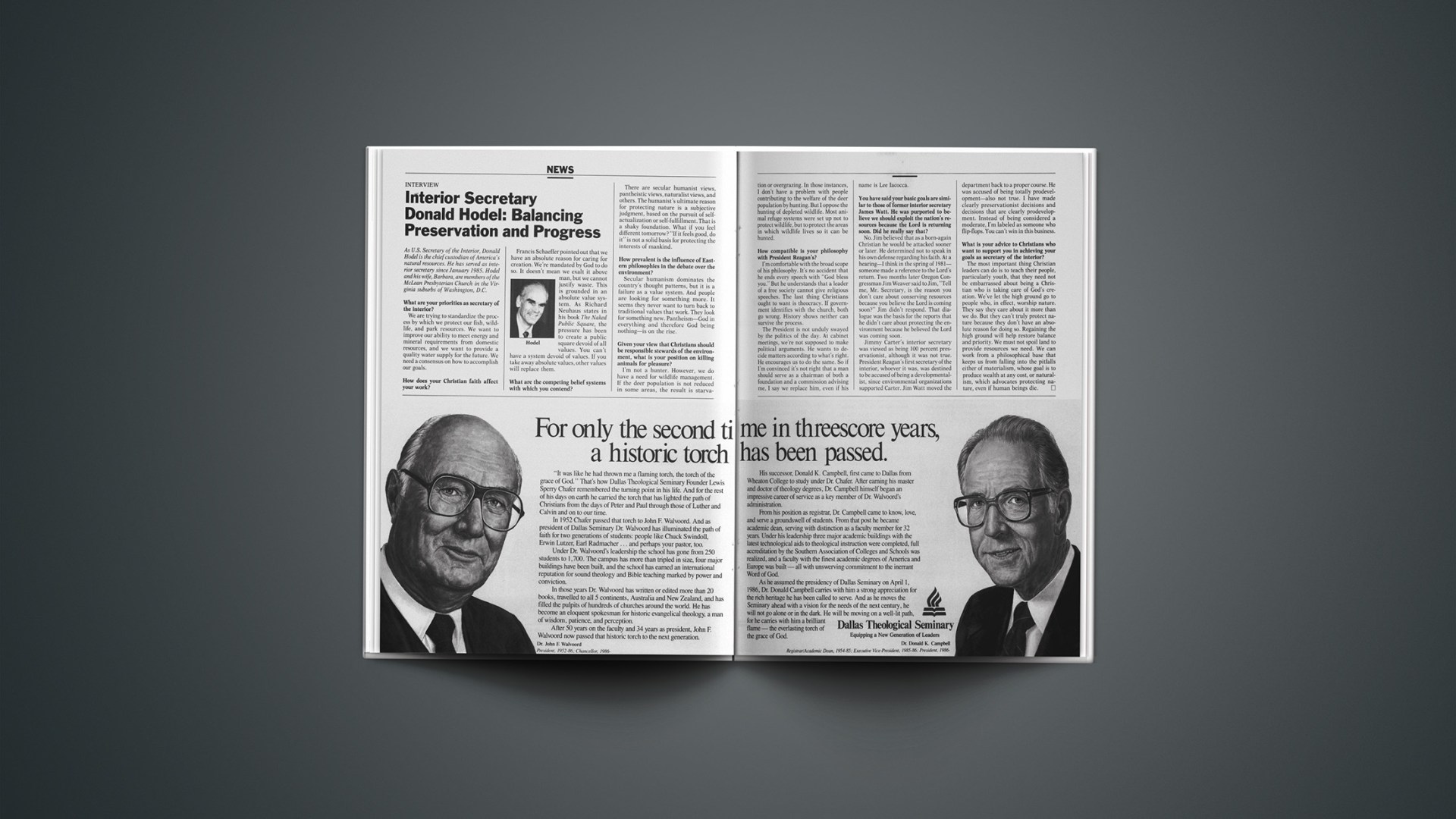
Interior Secretary Donald Hodel: Balancing Preservation and Progress

As U.S. Secretary of the Interior, Donald Hodel is the chief custodian of America’s natural resources. He has served as interior secretary since January 1985. Hodel and his wife, Barbara, are members of the McLean Presbyterian Church in the Virginia suburbs of Washington, D.C.

What are your priorities as secretary of the interior?

We are trying to standardize the process by which we protect our fish, wildlife, and park resources. We want to improve our ability to meet energy and mineral requirements from domestic resources, and we want to provide a quality water supply for the future. We need a consensus on how to accomplish our goals.

How does your Christian faith affect your work?

Francis Schaeffer pointed out that we have an absolute reason for caring for creation. We’re mandated by God to do so. It doesn’t mean we exalt it above man, but we cannot justify waste. This is grounded in an absolute value system. As Richard Neuhaus states in his book The Naked Public Square, the pressure has been to create a public square devoid of all values. You can’t have a system devoid of values. If you take away absolute values, other values will replace them.

What are the competing belief systems with which you contend?

There are secular humanist views, pantheistic views, naturalist views, and others. The humanist’s ultimate reason for protecting nature is a subjective judgment, based on the pursuit of self-actualization or self-fulfillment. That is a shaky foundation. What if you feel different tomorrow? “If it feels good, do it” is not a solid basis for protecting the interests of mankind.

How prevalent is the influence of Eastern philosophies in the debate over the environment?

Secular humanism dominates the country’s thought patterns, but it is a failure as a value system. And people are looking for something more. It seems they never want to turn back to traditional values that work. They look for something new. Pantheism—God in everything and therefore God being nothing—is on the rise.

Given your view that Christians should be responsible stewards of the environment, what is your position on killing animals for pleasure?

I’m not a hunter. However, we do have a need for wildlife management. If the deer population is not reduced in some areas, the result is starvation or overgrazing. In those instances, I don’t have a problem with people contributing to the welfare of the deer population by hunting. But I oppose the hunting of depleted wildlife. Most animal refuge systems were set up not to protect wildlife, but to protect the areas in which wildlife lives so it can be hunted.

How compatible is your philosophy with President Reagan’s?

I’m comfortable with the broad scope of his philosophy. It’s no accident that he ends every speech with “God bless you.” But he understands that a leader of a free society cannot give religious speeches. The last thing Christians ought to want is theocracy. If government identifies with the church, both go wrong. History shows neither can survive the process.

The President is not unduly swayed by the politics of the day. At cabinet meetings, we’re not supposed to make political arguments. He wants to decide matters according to what’s right. He encourages us to do the same. So if I’m convinced it’s not right that a man should serve as a chairman of both a foundation and a commission advising me, I say we replace him, even if his name is Lee Iacocca.

You have said your basic goals are similar to those of former interior secretary James Watt. He was purported to believe we should exploit the nation’s resources because the Lord is returning soon. Did he really say that?

No. Jim believed that as a born-again Christian he would be attacked sooner or later. He determined not to speak in his own defense regarding his faith. At a hearing—I think in the spring of 1981—someone made a reference to the Lord’s return. Two months later Oregon Congressman Jim Weaver said to Jim, “Tell me, Mr. Secretary, is the reason you don’t care about conserving resources because you believe the Lord is coming soon?” Jim didn’t respond. That dialogue was the basis for the reports that he didn’t care about protecting the environment because he believed the Lord was coming soon.

Jimmy Carter’s interior secretary was viewed as being 100 percent preservationist, although it was not true. President Reagan’s first secretary of the interior, whoever it was, was destined to be accused of being a developmentalist, since environmental organizations supported Carter. Jim Watt moved the department back to a proper course. He was accused of being totally prodevelopment—also not true. I have made clearly preservationist decisions and decisions that are clearly prodevelopment. Instead of being considered a moderate, I’m labeled as someone who flip-flops. You can’t win in this business.

What is your advice to Christians who want to support you in achieving your goals as secretary of the interior?

The most important thing Christian leaders can do is to teach their people, particularly youth, that they need not be embarrassed about being a Christian who is taking care of God’s creation. We’ve let the high ground go to people who, in effect, worship nature. They say they care about it more than we do. But they can’t truly protect nature because they don’t have an absolute reason for doing so. Regaining the high ground will help restore balance and priority. We must not spoil land to provide resources we need. We can work from a philosophical base that keeps us from falling into the pitfalls either of materialism, whose goal is to produce wealth at any cost, or naturalism, which advocates protecting nature, even if human beings die.

NORTH AMERICAN SCENE

ACTIVISM

Stores Drop Pornography

Pressure from a citizen’s group in Virginia helped persuade an East Coast drug store chain, Peoples Drug Stores, to stop selling magazines such as Playboy and Penthouse.

Richard Enrico, organizer of Citizens Against Pornography, began the campaign early this year by printing 30,000 flyers listing the names and addresses of corporate executives of Peoples and another drug store chain. “I asked that people write to them, call them once a week, and ask their Bible study members, family, and friends to do the same,” Enrico said.

He met with local pastors, asking them to support his effort from the pulpit and through church newsletters. According to a spokesman for Peoples Drug, the volume of letters complaining about pornographic magazines in the chain’s 810 stores increased, and company officials began considering whether these magazines violated community standards of morality.

Enrico’s effort gained the support of Virginia Gov. Gerald L. Baliles and Washington Redskins coach Joe Gibbs. “Both Republicans and Democrats like the Redskins,” Enrico said, so Gibbs’s support was “better than an endorsement from the President.” The group next plans to target the 7-Eleven convenience store chain.

CANADA

Lesbian Deacons Suspended

Two self-avowed lesbians have been suspended from their duties as deacons in the Anglican Church of Canada.

Joyce Barnett and Allison Kemper, who were already on official leave from Holy Trinity Church in Toronto, were suspended for violating the church’s standard of morality. According to Canadian Press news service, Barnett is pregnant, and the two women have said they are living together. They say they plan to raise the baby as part of their family.

The Anglican Church of Canada does not recognize the union of homosexuals, and it condemns sex outside of marriage and bearing children out of wedlock. In 1979, Canada’s Anglican House of Bishops ruled that homosexual ministers must abstain from sexual activity. In the Anglican Church of Canada, deacons are licensed to conduct various services, including marriage, but they cannot celebrate the Eucharist.

EMPLOYMENT

Ignoring a Court Ruling

A judge in Minneapolis has imposed a $300-per-day fine on a chain of health clubs that favors conservative Christians in its employment policies. Arthur Owens, president of Sports and Health Club, Inc., said he prefers to pay the daily fines rather than change his company’s employment practices.

“It’s well worth $300 a day to be able to seek out people who agree with our goals and values,” Owens said. His chain of seven fitness clubs refuses to hire anyone who is “antagonistic to the gospel.” It also prohibits the employment of anyone “who is openly violating the Word of God or the laws of the state.”

In 1984 a Minnesota administrative law judge found the company in violation of the state’s Human Rights Act, which prohibits discrimination on the basis of religion. When the fitness club chain continued to ignore the judge’s finding, Hennepin County District Court Judge Franklin Knoll found the company in contempt of court and imposed the daily fines. Elizabeth Cutter, a special assistant attorney general, said the Minnesota Human Rights Department might seek another contempt citation if the health club chain continues to pay the daily fines and ignores the court order.

Owens contends that his company’s hiring practices are protected under the First Amendment’s guarantee of free exercise of religion. The Minnesota Supreme Court rejected that argument last year in a 6-to-2 ruling. Owens appealed the ruling to the U.S. Supreme Court. The high court has not indicated whether it will hear the case.

OPINION POLLS

State Aid to Church Schools

Two polls conducted by the Princeton Religion Research Center indicate the American public is evenly divided over the issue of government financial aid to parochial schools.

One of the polls surveyed opinions on the desirability of a constitutional amendment allowing state aid to parochial schools. The other surveyed views on a proposed federal voucher system that would help parents pay tuition costs for children in parochial schools.

On the constitutional amendment, the survey found 45 percent of the respondents in favor, 47 percent opposed, and 8 percent with no opinion. A voucher system was supported by 45 percent of those questioned, opposed by 40 percent, and did not matter to 15 percent.

The poll on vouchers, based on in-person interviews with 1,528 adults, could have a sampling error of up to 3 percent. The survey on the amendment, based on telephone interviews with 1,009 adults, has a possible sampling error of 4 percent.

PEOPLE AND EVENTS

Briefly Noted

Awarded: The Templeton Prize for Progress in Religion to James I. McCord, former president of Princeton Theological Seminary. McCord was recognized for founding the Center of Theological Inquiry, a research center in Princeton, New Jersey. The prize, which carries a cash award of about $250,000, is sponsored by financier John M. Templeton, a Presbyterian elder. The 13 previous winners of the award include Mother Teresa of Calcutta, evangelist Billy Graham, and Russian writer Alexander Solzhenitsyn.

Founded: The International Coalition of Sports Ministers, an umbrella organization including leaders of church and Parachurch sports ministries. The coalition will attempt to promote greater understanding between church and Parachurch ministries, and will cooperate on major efforts such as evangelistic outreach at the 1988 Olympics in Seoul, South Korea. Florida pastor David Burnham was appointed chairman of the organization.

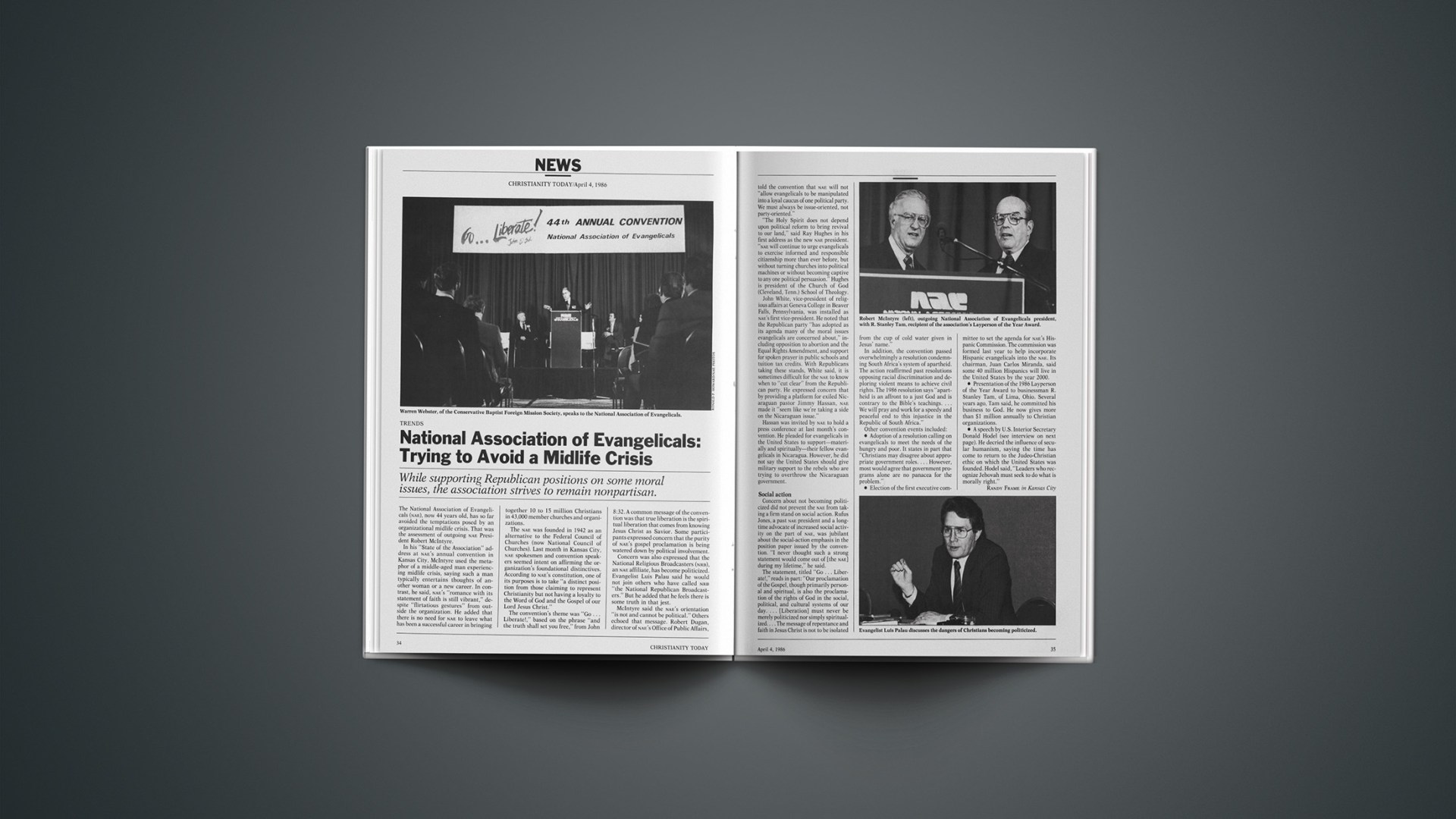
National Association of Evangelicals: Trying to Avoid a Midlife Crisis

While supporting Republican positions on some moral issues, the association strives to remain nonpartisan.

The National Association of Evangelicals (NAE), now 44 years old, has so far avoided the temptations posed by an organizational midlife crisis. That was the assessment of outgoing NAE President Robert McIntyre.

In his “State of the Association” address at NAE’s annual convention in Kansas City, McIntyre used the metaphor of a middle-aged man experiencing midlife crisis, saying such a man typically entertains thoughts of another woman or a new career. In contrast, he said, NAE’s “romance with its statement of faith is still vibrant,” despite “flirtatious gestures” from outside the organization. He added that there is no need for NAE to leave what has been a successful career in bringing together 10 to 15 million Christians in 43,000 member churches and organizations.

The NAE was founded in 1942 as an alternative to the Federal Council of Churches (now National Council of Churches). Last month in Kansas City, NAE spokesmen and convention speakers seemed intent on affirming the organization’s foundational distinctives. According to NAE’s constitution, one of its purposes is to take “a distinct position from those claiming to represent Christianity but not having a loyalty to the Word of God and the Gospel of our Lord Jesus Christ.”

The convention’s theme was “Go … Liberate!,” based on the phrase “and the truth shall set you free,” from John 8:32. A common message of the convention was that true liberation is the spiritual liberation that comes from knowing Jesus Christ as Savior. Some participants expressed concern that the purity of NAE’s gospel proclamation is being watered down by political involvement.

Concern was also expressed that the National Religious Broadcasters (NRB), an NAE affiliate, has become politicized. Evangelist Luis Palau said he would not join others who have called NRB “the National Republican Broadcasters.” But he added that he feels there is some truth in that jest.

McIntyre said the NAE’s orientation “is not and cannot be political.” Others echoed that message. Robert Dugan, director of NAE’s Office of Public Affairs, told the convention that NAE will not “allow evangelicals to be manipulated into a loyal caucus of one political party. We must always be issue-oriented, not party-oriented.”

“The Holy Spirit does not depend upon political reform to bring revival to our land,” said Ray Hughes in his first address as the new NAE president. “NAE will continue to urge evangelicals to exercise informed and responsible citizenship more than ever before, but without turning churches into political machines or without becoming captive to any one political persuasion.” Hughes is president of the Church of God (Cleveland, Tenn.) School of Theology.

John White, vice-president of religious affairs at Geneva College in Beaver Falls, Pennsylvania, was installed as NAE’s first vice-president. He noted that the Republican party “has adopted as its agenda many of the moral issues evangelicals are concerned about,” including opposition to abortion and the Equal Rights Amendment, and support for spoken prayer in public schools and tuition tax credits. With Republicans taking these stands, White said, it is sometimes difficult for the NAE to know when to “cut clear” from the Republican party. He expressed concern that by providing a platform for exiled Nicaraguan pastor Jimmy Hassan, NAE made it “seem like we’re taking a side on the Nicaraguan issue.”

Hassan was invited by NAE to hold a press conference at last month’s convention. He pleaded for evangelicals in the United States to support—materially and spiritually—their fellow evangelicals in Nicaragua. However, he did not say the United States should give military support to the rebels who are trying to overthrow the Nicaraguan government.

Social Action

Concern about not becoming politicized did not prevent the NAE from taking a firm stand on social action. Rufus Jones, a past NAE president and a long-time advocate of increased social activity on the part of NAE, was jubilant about the social-action emphasis in the position paper issued by the convention. “I never thought such a strong statement would come out of [the NAE] during my lifetime,” he said.

The statement, titled “Go … Liberate!,” reads in part: “Our proclamation of the Gospel, though primarily personal and spiritual, is also the proclamation of the rights of God in the social, political, and cultural systems of our day.… [Liberation] must never be merely politicized nor simply spiritualized.… The message of repentance and faith in Jesus Christ is not to be isolated from the cup of cold water given in Jesus’ name.”

In addition, the convention passed overwhelmingly a resolution condemning South Africa’s system of apartheid. The action reaffirmed past resolutions opposing racial discrimination and deploring violent means to achieve civil rights. The 1986 resolution says “apartheid is an affront to a just God and is contrary to the Bible’s teachings.… We will pray and work for a speedy and peaceful end to this injustice in the Republic of South Africa.”

Other convention events included:

• Adoption of a resolution calling on evangelicals to meet the needs of the hungry and poor. It states in part that “Christians may disagree about appropriate government roles.… However, most would agree that government programs alone are no panacea for the problem.”

• Election of the first executive committee to set the agenda for NAE’s Hispanic Commission. The commission was formed last year to help incorporate Hispanic evangelicals into the NAE. Its chairman, Juan Carlos Miranda, said some 40 million Hispanics will live in the United States by the year 2000.

• Presentation of the 1986 Layperson of the Year Award to businessman R. Stanley Tam, of Lima, Ohio. Several years ago, Tam said, he committed his business to God. He now gives more than $1 million annually to Christian organizations.

• A speech by U S. Interior Secretary Donald Hodel (see interview on next page). He decried the influence of secular humanism, saying the time has come to return to the Judeo-Christian ethic on which the United States was founded. Hodel said, “Leaders who recognize Jehovah must seek to do what is morally right.”

RANDY FRAMEin Kansas City

Going Home to the Hidden

The aging Carrie Watts (Geraldine Page) sits in her rocking chair and hums “Softly and Tenderly.” In this opening scene of The Trip to Bountiful, Mrs. Watts hears the invitation, “Come home; come home; ye who are weary, come home,” and plots her return to Bountiful, Texas, and the rural life she once knew—close to the soil and permeated by faith.

Twenty years of urban life—smothered by the closeness of her son’s two-room apartment and persecuted by her daughter-in-law Jessie Mae, a poor but willful priestess at the shrine of 1947 modernity—have nearly destroyed Mrs. Watts.

To Bountiful then she will go. But Bountiful is no more. Neither train nor bus stops there. Determined, Mrs. Watts buys a bus ticket to Harrison, a dusty town 12 miles from her home.

On the bus, Mrs. Watts befriends Thelma (Rebecca De Mornay), a young woman she met in the station. As they talk of worries and hopes, faith comes into play. Mrs. Watts tries to allay Thelma’s fears about her soldier husband, telling Thelma to keep reciting Psalm 91. They sing “Blessed Assurance,” their raucous rendition betraying the energy of faith and tension of fears denied.

Paradise Lost

The tensions in A Trip to Bountiful are stretched taut as a clothesline between the poles of urban modernity and rural memory. On that line, Oscar-winning screenwriter Horton Foote (To Kill a Mockingbird, Tender Mercies) airs his questions: Does society know where it is going? Does it do any good to grasp at the old ways? Where is God when the old ways disintegrate?

Foote offers the thoroughly modern daughter-in-law Jessie Mae (Carlin Glynn) as his vision of where the culture is going: Frustrated by her husband’s illnesses and penury, Jessie Mae uses lipstick, drinks Coca-Cola at the drugstore, and plays jazz on the radio. Hymns make her nervous, she says. Anyway, hymns are going out of style, she tells Mother Watts, who incessantly hums her favorites. This shallow shrew is a bride adorned for her husband, but she is no vision of the holy city.

But as the incarnation of the old ways, Carrie Watts is no dream of Eden. Driven from her paradise, she yearns to return. Her childish postures show her longing for her father and ancestral home. She weeps and shows Thelma her treasured picture of the man she couldn’t marry. “My hands feel the need of dirt,” she confesses as she relishes the memory of rewarding labor.

But the soil is played out. Bountiful is empty. Callie Davis, Carrie’s “girlhood friend,” was the last person in Bountiful. She was buried hours before Mrs. Watts’s return. At the old house, Carrie feels as if her papa and her mama should come out and greet her—but they don’t. Like everyone else in Bountiful, they are dead.Hidden God

One suspects that Mrs. Watts’s papa isn’t the only father that is dead. As she talks about how her papa used to protect the scissortails and the redbirds from hunters, we realize how closely her papa is identified with the heavenly Father whose “eye is on the sparrow.”

Mrs. Watts is indomitable. She draws strength from her faith. But her God is hidden. Frustrated at every turn, she nevertheless exclaims, “Everything seems to be working out today. The Lord’s just with me today, I guess.” Then she muses, “I wonder why he’s not with us every day? Maybe it’s just so when he is with us we appreciate it.” And then: “Perhaps he is with us always and we just don’t notice it.”

The old woman’s son Ludie (John Heard) seems to have surrendered his past to Houston and Jessie Mae. Standing by the front porch of the old home, he protests to his mother, “It doesn’t do any good rememberin’.” But Carrie persists in recreating the family history, and Ludie breaks down. Somehow, finding his past gives him strength to impose a truce on the warring women in his life. It does do good to remember.

Foote tells us it is good to go home. Like Jacob’s return to Beth-El (Gen. 35), appropriating our past can be an act of transformation and reconciliation. Foote’s God remains hidden. But he is there. As in his Tender Mercies, faith is not just part of the furniture, but it is the context in which repentance and reconciliation take place.

Hermann Hesse wrote: “We have to stumble through so much dirt … before we reach home. And we have no one to guide us. Our only guide is our homesickness.” But Horton Foote’s characters have a guide—One who calls softly and tenderly, “Ye who are weary, come home.”

DAVID NEFF

CHRISTIANITY TODAY TALKS TO Horton Foote

Why do you write about ordinary people in ordinary walks of life?

I am attracted to the sense of dignity in the human spirit that, no matter what kind of vicissitudes life throws at people, allows them with grace to meet what comes their way and find the strength to survive.

Your screenplays seem to be optimistic about people being able to change for the better.

I certainly feel there is growth, and people do change; I don’t think we can deny that. Nor can you deny that sometimes people are overwhelmed and defeated. But there is much debate among people who have seen the films about what the nature of the change was.

How would you describe the change?

Some people feel the happiest ending to The Trip to Bountiful would be for Mrs. Watts to die in the house. I don’t agree. I don’t think she’s going to have the easiest life—and neither will her son or daughter-in-law. But all three of them will find they have learned something. And she certainly has achieved a measure of dignity, which is, I suppose, as much as you can ask of life.

Part of your picture of the rural South is conservative religion.

Well, this is a great part of their lives; and, I’m sure, it’s a part of their strength. It permeates the rural South.

In your movies, religion permeated the characters’ lives, and yet, I had a hard time seeing a clear connection between the changes that take place in people and the religious element.

Certainly religion permeates their lives. I don’t see how you can listen to those old hymns and not feel something. And even nonbelievers, you know, love those hymns. I suppose they must get something from them. To me, it’s as much a part of their lives as breathing.

Now there are people like Jessie Mae who think all that is tiresome.

Jessie Mae said at one point that hymns are going out of style. Was she wrong in her prophecy?

Maybe not wrong. A lot of people feel it’s silly to go to church and to pray and to sing hymns. They think it’s tiresome and has no place in modern society.

But you’re not going to change the people who feel different. And they don’t proselytize. The best of them just live it.

You know, a lot of difficulty comes to people in their lives, and you have to ask yourself, What gets them through it? And if you are at all honest, you have to say that you may or may not understand it, but you have to witness to the fact that their religion must sustain them a great deal.

Theology

Opening the Closed Book

Many more would read the Bible if they only knew how.

TIM STAFFORD1Tim Stafford is a free-lance writer living in Santa Rosa, California. He is the author of several books, including Knowing the Face of God: The Search for a Personal Relationship with God (Zondervan, 1985).

Over the past three years, CTi has interviewed young people in evangelical churches to find out how they used the Bible and what they thought of it. The research—part of the development of the NIV Student Bible by CT editor-at-large Philip Yancey and senior writer Tim Stafford—uncovered some disturbing facts. But it also suggested some ways to help all of us become more deeply involved in the world’s best-loved, but often unread Book

Gallup polls have established that the majority of Americans believe in the Bible as God’s inspired Word. But the same polls show that their commitment is vague and impractical: They cannot name four of the Ten Commandments, nor four of Jesus’ disciples. Obviously the Bible they proclaim as inspired is a Bible they do not read.

I used to think this represented those whose “born-again” religion consists mainly of Christmas Eve services. But what we found in our research paralleled Gallup’s results. Young people in the churches surveyed had no qualms about the authority of the Bible. To the contrary, many seemed to have an almost magical view of the Book. While a generation ago young people wanted Bibles with pictures, paperback covers, and modern translations—Bibles that did not “look like” Bibles—the young people interviewed wanted highly traditional Bibles with leather covers, gilt-edged pages, and the words of Jesus in red—Bibles that seemed to convey by their appearance the weight of tradition and authority. These young people had only positive expectations of what they might gain from the Bible. And they believed it offered the words of life. There was only one sticking point: they did not read the Bible. And when they tried, they rarely understood it.

Even I was appalled—and I have worked with young people for the last decade. It seemed to make little difference whether we talked to kids in Christian and Missionary Alliance churches or in evangelical Episcopal churches. Only a very small minority, well under 10 percent, had any regular, voluntary habit of Bible reading. The only exception was with young people attending Christian schools, where Bible reading was mandatory. (Whether this required discipline later becomes a voluntary habit we could not test.)

These young people are our future. If they do not develop the discipline of Bible reading early in life, they will be unlikely to develop it once marriage and children come. We may be breeding an illiterate church. And biblical illiteracy will reproduce itself indefinitely.

Although our research covers only young people, I believe most of the results would be the same with adults. Most churches have not faced the demands of biblical literacy for either age group. Most church leaders speak warmly about the value of a quiet time, but make no real effort to find out how many in their congregation follow their recommendation. Even when pastors stress biblical sermons and Sunday school classes, that once-a-week dose of biblical education is not enough. The Bible is too big a Book for that. Only those who read it daily will gain some mastery of its contents.

The Barriers To The Bible

What keeps evangelicals from reading the Bible? They already believe in its importance. There is no need to convince them of that. We found practical considerations that may not readily occur to pastors, who have known and loved the Bible for so long they have forgotten how it seems to a beginner.

The first barrier is discouragement. Most people are not readers. What books they own are likely to be short and of recent publication, with one exception: a 1,000-page Bible, written thousands of years ago. The Bible is intimidating to most people. They have never read any other 1,000-page book. If they begin reading the Bible without guidance, they are very likely to get stuck, to get discouraged, and to give up.

In a survey done by CAMPUS LIFE, an interesting source of doubt popped up: Many young people doubted their faith because they were unable to read the Bible as they thought they ought to. This was a far more prevalent cause of doubt than the “problem of pain.” Because they believe in the Bible, many evangelical Christians make an attempt to read it every day. But most end the experiment in failure. That breeds a sense of guilt.

Chronically crowded schedules compound the problem. In our interviews with young people, we proposed a reading plan that would give them an overview of the whole Bible. It would require just 15 minutes a day. Most said such a plan would be attractive. Then we asked them what kind of initial commitment to daily reading would be reasonable: A year? Six months? Three months? One month? No one said more than one month. Many suggested two weeks. Young people may find it difficult to make long-range commitments. But I doubt whether adults would do much better. If we are committed to biblical literacy, we must find ways to help lay people have feelings of success, rather than failure, with that 1,000-page book. We must understand what they think they can do—not merely what we think they ought to do.

The second barrier we found was orientation. Here, too, pastors may easily underestimate the problem. The Bible is not only long, it is complicated. Sixty-six books, by many authors, contain poetry, proverbs, history, biography—and long genealogies and lists of laws. The books are out of chronological order. They are divided into two unequal parts, Old and New Testaments. Learning to use this Book effectively is far more difficult than learning to use a thesaurus. But how many churches provide any practical orientation?

The average lay person comes to view the Bible as a gigantic compendium of inspirational messages, mixed in with a large number of incomprehensible, dull passages. We repeatedly heard this comment from young people: “I spend so much time just flipping through the Bible, trying to find something.” Without any guide to finding the “good stuff,” beginning readers are likely to stick to a few “trustworthy” books: the Psalms, the Gospel of John, Romans, Ephesians, and Philippians. The rest of the Bible serves them only when they look up specific verses the pastor quotes.

People who approach this long and complicated Book need to be taught where to start and how to advance in their understanding. They need to be given the confidence that, over time, they can master it. They need to gain an understanding of how it fits together as they gradually dip into its contents. Left to themselves they just get lost.

The third barrier to Bible reading is a lack of basic information. For past generations, Abraham and Isaac were like members of the family, and their world was a familiar environment. It is no longer so. Again, pastors may easily forget just how confusing and irrelevant the Bible can seem. Repeatedly, young people told us: “I can’t understand what all this stuff has to do with me. What do spears and chariots have to do with life?” They appreciated their pastors making the Bible stories relevant by translating them into contemporary language. But they found it very hard to do for themselves. To them, the Bible was the most ancient, obscure Book they had ever read.

Suggested Solutions

Research has shown that the most critical factor in church growth is not technique, but commitment. Vague statements about growth are not enough; genuine commitment to specific goals makes a difference. The same is true of any crusade against biblical illiteracy.

Are we committed to overcoming the barriers? Will we work to see that our church members, from the newest convert to the oldest member of the board, have cultivated the discipline of reading the Bible?

The first step is to find out how much our church members already read the Bible. A confidential survey should be used, because evangelicals want to think of themselves as better Bible readers than they really are. A survey needs to ask, “How many days did you read the Bible in the last week,” as well as, “How often do you ordinarily read the Bible?” You can cross-check their answers by testing Bible knowledge. A representative sample of the congregation can easily be given a simple test to see how much they get out of the Book they say they read.

Whatever the survey results, they will be a benchmark to help you set goals and against which you can evaluate programs.

My research has shown me that churches must do the bulk of the work in encouraging their people to read the Bible. Writers and scholars can provide helpful tools, but only the Christian family meeting to worship as a congregation can provide the motivation and encouragement. Here are suggestions for action:

Use modern versions. Increasing numbers of people find the King James Version painfully hard to understand. They may revere it and its Elizabethan phrasing, but they are likely to read it as often as they read Shakespeare. I talked to two girls who, trapped in this dilemma, were struggling to read the Bible twice: first in the KJV, because it “sounds like the Bible,” and then in a modern version so they could understand what they had just read. Few people will work so hard for very long.

Many pastors and Sunday school teachers recognize this, and so recommend newer versions for beginning Bible readers. But a recommendation is not good enough. Because readers often have a mystical belief in the Bible as a holy object, they want the same “full-strength” Bible their pastor or Sunday school teacher uses. Pastors who want their church members to use an easily understood modern version should consider adopting such a Bible for their public teaching and preaching. We must remember that if we use a difficult translation publicly, our people will try also.

Encourage participation. People will not read the Bible regularly until they have the confidence that they can understand it for themselves. Our research found, again and again, that group Bible studies are the context in which people gain confidence and excitement about the Bible.

Many churches have such small groups. But they could work harder to use the groups as a bridge to daily personal Bible reading. A weekly Bible study should not be an end in itself. A person could participate in some Bible studies for a long time and never cover more than a few books of the New Testament. Bible study groups should consciously help their members develop the discipline of daily Bible reading.

The same could be said of Sunday school. As the Southern Baptists have demonstrated, Sunday school programs are most effective when they do more than offer an intellectual smorgasbord. They work best when members become involved at a social level with their class, so it becomes a point of identification where they find “their kind of people.” Such Sunday school classes, like small group Bible studies, can ask for more than simple attendance. They can ask the group to become committed to reading the Scriptures and encouraging all new members to join in that commitment. Readings can be specified and coordinated with lesson plans. But the key is not curriculum. The key is commitment on the part of leadership—not merely suggesting, but expecting people to read, and finding ways to help them.

Programs such as the Bethel Series and “Walk Thru the Bible” are well designed to give ordinary people confidence in their ability to understand the Bible. They can make a dramatic difference for churches that adopt them. Unfortunately, they require such high commitment that they often reach only a minority of church members. Churches want all their members, ultimately, to read the Bible for themselves. That may require additional programs that require a less rigorous commitment.

Help them succeed. A great many evangelicals associate daily Bible reading with guilt, frustration, and failure. They have fallen too often, and sometimes the church’s unrealistic expectations have helped them fail. If you set an immediate goal that 80 percent of your church members ought to have a 30-minute quiet time every day, you are doomed to defeat. Very few beginners have the will to stick to such a commitment, and when they fail they will be disheartened. It would be far better to launch two-week “experiments” in daily Bible reading, in which the equivalent of one chapter per day was lined out for the whole church to read. Sunday services could be keyed to those passages, and frequent public references made to the experiment. The program could become a regular part of your congregational life, providing an excellent bridge into longer experiments.

Be sure to keep the end in sight. It is just as important to set a date to complete an experiment as it is to get started. People will be far more likely both to start and to finish a commitment if they can always see the goal. Asking for more than one chapter of Bible reading per day, or for any time period of more than a few months, will keep them away in droves.

Yet we ought not to make Bible reading sound easy and entertaining. For the ordinary lay person, it is a difficult spiritual discipline. I was struck in my interviews by how little interest young people had in all the attempts to dress up youth Bibles to make them look like fun. They knew that the Bible was the toughest book they had ever tackled. People are willing to work for something they believe has value. We ought to make clear that we are offering a spiritual discipline that will, if they master it, affect their lives deeply.

Offer helps. A church that takes biblical literacy seriously will recommend and make available simple tools: Bible study booklets, simple commentaries, study Bibles, Bible dictionaries. Very few beginning Bible readers know much about such tools: where to get them, how to use them, how to choose the accessible ones over the theological and exegetical works. How many of your church members own a Bible dictionary? How many have been through a Bible study booklet, and know where to find more? How many know how to use a concordance? Churches should set goals to put these tools in their members’ hands, and teach them to use them.

Use the Bible in worship. Worship services are the central focus of church life, and they shape the ordinary Christian’s idea of what is important. Unfortunately, the Bible does not always rate so highly in public worship as it ought. Many ordinary Christians seem to think of the Bible as a religious Bartlett’s Quotations, and they got that view in church, from watching the ministers demonstrate their knowledge of the Bible by quoting expertly from dozens of different passages.

Pastors are naturally concerned with conveying the truth, and are not always aware of how they are forming their congregations’ views of the Bible. But pastors could take a little extra time to get their congregations to actually open the Bible with them, and to explain the context of the verses they are reading. Gradually, the believers under their care would begin to believe that they could read the Bible for themselves—and read it as books are meant to be read, rather than as a hunting ground for inspiring and familiar lines.

We have every reason to expect success. After all, we are not trying to get church members to read Kant or congressional resolutions. The critical work has already been done: Evangelical church members believe in the Bible. They expect great things from it. They only need help to obtain those great things from an ancient and difficult, though endlessly wonderful, Book. Church leaders need only the energy, the commitment, the skill, to make certain that those under their care work through those difficulties.

If we do not, we will have to live in a church of hearsay faith: a church that rightly believes the things it hears, but does not experience them firsthand. If we do, we can expect a church that is alive through Spirit and Word.

Sunday School and the B-I-B-L-E

The Sunday school is the one educational program that virtually all churches have in common—and a channel that is already set up to communicate biblical knowledge, CT asked Wes Willis, senior vice-president of Scripture Press, how Sunday schools can do a better job of teaching Bible facts and concepts. Dr. Willis is the author of Make Your Teaching Count, a recently released book designed to help lay teachers understand Bible teaching and learn to build the skills to do it.

Overall, how good a job are the evangelical Sunday schools doing of teaching biblical facts and applying them to life?

Not as good as we ought to be doing. Too many of us feel that once we have gotten the kids to repeat back the facts, they know them. We’re not doing it well enough to get people excited about application. In order to do this, we need to provide better resources to help teachers understand what they are doing.

In evangelical Sunday schools, there is a tension at the children’s level between teaching them Bible facts and evangelism. Which is the primary function of the children’s Sunday school?

You really can’t separate the two. If you look at the Great Commission, Christ’s mandate to his followers to make disciples included evangelizing and teaching.

Clearly, you can’t do in-depth education for a person who has not yet accepted Christ. But a lot of instruction that precedes salvation will be applied by the Holy Spirit after a person has become spiritually alive.

Evangelism is a primary element in the late preschool and early elementary grades. Children from church-attending families generally accept Christ between the ages of five and ten. Evangelism in those departments is very important. But teaching Bible facts will give you the best possible forum for a strong evangelistic emphasis.

In the adult Sunday school, the tension is between biblical learning and fellowship. What are some ways to rescue an adult Sunday school class for biblical learning?

The key thing is to recognize that fellowship and learning are not at all contradictory—just as evangelism and education are not contradictory at the younger age.

The better fellowship we have, the better learning will take place—dynamic interaction within an adult class is a critical element in effective learning.

The important thing is not the acquisition of facts nearly as much as answering the “so what” question. How does that apply to life today? If we understand, appreciate, enjoy, and love each other, we’ll be able to get into the “so what” issues.

Older children seem to want to learn less and fellowship more. Adolescents say, I’m learning all week in school. I don’t want to do that on Sunday too. Should you recognize that adolescence is fellowship time and resign yourself to fun and games?

No. Take advantage of that for learning experiences. You have to move away from the fact-giving mode and into the interactive mode of teaching. Rather than looking for powerful visual aids that will wow the students, plan discussions, interactive activity, things that will take advantage of the socialization, and their enjoyment of each other.

Rather than a teacher being used as the information giver, the teacher has to be the coordinator, the explorers’ guide.

There is a real resurgence of desire to know the Bible. Recently someone said to me, “I’m tired of coming to Sunday school and connecting little lines and drawing bumper stickers and doing posters.” He said, “I want to know what the Bible says, and I’m not learning that in Sunday school.”

That is a common reaction among the young people. And adults are saying the same thing.

How important is Scripture memorization?

Bible memorization should be an integral part of any curriculum, particularly at preschool level where children absorb things without even trying. As the students get older, we need to remind them they can memorize—but they need to be challenged to do it.

Scripture memorization provides the building blocks that the Holy Spirit will work with later. As much as possible, we should encourage students to understand what the Scriptures they memorize mean. But they will never fully understand until the moment in their lives that they need those truths. That’s when the Holy Spirit will remind them.

DAVID NEFF

Theology

The Sanctification of Sport: Competition and Compassion

Putting the killer instinct back into its cage.

Shirl Hoffman suggests Christians cannot avoid competing when they walk onto the football field or basketball court. But competition occurs not simply in sports. It occurs in all of life. That leaves every one of us—not only our athletes—with the question: How can we compete Christianly? Robert C. Roberts, professor of philosophy and psychology at Wheaton College, offers the following helpful thoughts.

Saint Paul’s fundamental image of the church is not that of a group of individuals in competition with each other—as for instance our schools and businesses and governments tend to be—but of a single body made up of many members, mutually supporting and supplementing one another, helping one another and praying for one another. There may be a hierarchy of command in the church, but we have from Paul the picture of a society in which the ascendancy of one person over another for the sake of excellence or survival is completely ruled out.

Does this mean that Christians must never run marathons to win, or root for their football team, or try to make their own college the best one in the world? Where there is winning there has to be losing. Is it inconsistent with Christian principles to want to win when that means somebody has to lose?

There are two kinds of competition, which we need to keep clearly distinct. Or to put the matter another way, there are two spirits in which competition can be practiced.

Competition in the spirit of tooth and claw is not sport, even if it takes place in the context of “sports”; it is competition for “survival,” in which the stakes are something like “life and death.” Here the competitor is either an enemy or in imminent danger of shading off into one. The competitors in this kind of “game” know that to lose is to be degraded in some essential sense. I am not thinking only of physical competitions, but also of the subtle, destructive, and unacknowledged one-upmanship that colleagues and family members and fellow students and church members play with one another.

People who are competitive in this way exude a seductive and predatory spirit in which all their activities proclaim an invitation that is hard to resist: “I would like to engage you in a struggle for self-esteem. If I win, you are nothing; if you win, I am nothing. Or to put it more modestly, I shall be more because you are less.”

The other kind of competition is in a playful spirit, and, when perfectly invested with the Holy Spirit, has no undertone of threat to anyone’s self-esteem. However hard the competitors play against each other, there is the enormous plasticity of humor in which loss is ultimately inconsequential, and winning equally so, and the real winner is everybody concerned.

Humor: Key To Competitition

Humor is the key to the spirit of competition I am commending. Most people are not aware how important humor is to Christian spirituality, but Søren Kierkegaard had it right when he called Christianity “the most humorous view of life in world-history.” The Christian is in this world but not of it, his life being hid with Christ in God. His sense of identity and self-worth is not ultimately bound up with successes and achievements and recognition, though he enters with gusto into the activities of this life.

He enters in all right, but with a new objectivity and distance. Christ cuts him loose from the world’s way of reckoning, thus making it possible for him to take a playful attitude toward all contests. The Christian knows that the desire to be admired for being outstanding is really just a tragic perversion of the desire to be loved for being oneself. And so, when the Christian wins the admiration of others, it makes no deep impression on him; and when he loses, it also makes no deep impression. He “laughs off” wins and losses with equal ease.

Healthy competitiveness ultimately perceives the opponent as a fellow, not as an alien, and presupposes something like love. Humor enables this perception by casting the competitor in a human light and putting the priorities in the right order. The ground of our sense of humor is the love of God, which has been lavished on us in Jesus Christ. It liberates us from the spirituality of the jungle by removing from the competitive arena the issue of our survival.

Of course, I am not saying that a Christian sense of humor is easy to achieve; on the contrary, it is exactly as difficult as being a Christian is. Sin and death have a way of clinging to us. This sense of humor is a trait of mature individuals, and like maturity in general, it is found only rarely among Christians. Yet the ideal remains.

Away From Tooth And Claw

What are some ways we can manage competitiveness, so as to foster healthy competition and discourage the spirit of tooth and claw?

Tooth-and-claw competitiveness is a dehumanized way of “focusing” on other people, which typically derives its energy from a desperate concern for self-esteem. So it requires a double-pronged attack: A person needs to find other “terms” in which to focus the world, and needs to be given a different, more adequate locus of self-esteem.

Let us say you are a grade-school teacher, and in the midst of a spelling bee the spirit of tooth-and-claw begins to raise its ugly head. A couple of the children are inflated over their superior performance, and the ones who do poorly are being made the object of mumbled derision. What can you do to help the children—winners and losers alike—reconceptualize this situation in healthier and more playful and loving terms? How about telling a story at this point, of “When I Lost the Most Important Spelling Bee of My Life”? Your story puts the catastrophe of losing a spelling bee in a comic light. You get the children laughing at your folly, with a couple of effects.

Upon the losers it begins to dawn vividly that doing well in a spelling bee is not a matter of life and death. Perhaps even their losing is something they could laugh at! And the winners may be deflated and humanized by their own laughter at you. The teacher (whom students respect) is like them, those aliens, the nerds and dodos! (Could it be that they’re human after all?) Your humor detaches the competition, to some extent, from the issue of self-respect.

It is important that you accomplish this by making yourself, rather than any of them, the object of laughter. By becoming an object of their common laughter, you make yourself a mediator and reconciler, breaking down the dividing wall of hostility between them.

A second strategy for heading off unspiritual competitiveness is that of providing a deeper basis and locus for self-esteem. One who is able to keep a sense of humor about all his competitions signals that winning is not a survival-issue for him. His soul is anchored elsewhere.

The gospel of God’s love is the great and final foundation of any human being’s self-esteem. To the extent that our sense of worth is composed upon any other base, it is in danger of the quakes and floods of circumstance. The other bases, however, stand in varying degrees of analogy to the love of God. Love from other human beings, when it comes close to being unconditional, is a kind of shadow of the love of God, and seems, furthermore, to be a necessary medium through which that love is learned. Innocent creative acts, like carving something beautiful out of wood or singing a song well, are also a natural source of self-respect. On the other end of the spectrum, self-esteem erected upon the foundation of fancy cars and habitations, power over others, lists of accomplishments, a world boxing championship, and the like, is so remote from what true human nature demands as to be downright inhuman.

The Competitor As Child

What can we do to instill in our children a sense of worth that will minimize the seductiveness of tooth-and-claw competition? We can try to enable them to have some experiences that are as closely analogous as possible to experience of the grace of God.

When Jimmy comes home and announces that he is the champion speller in the class, this should be acknowledged matter-of-factly (and certainly not with disapproval), but with no dramatic show of affection. The lavishing of affection and attention on him should be reserved for times when no winning or losing is at issue or in sight. Jimmy should grow up with the implicit sense that you have time for him, that he is important to you. When you hug him (and this should be pretty often), the act should be as unconnected as possible with his good looks, his intelligence, his athletic abilities, and so forth. In general, give the child a strong sense of being loved and approved, but tie this as little as you can to his sense of being a “winner.”

Jimmy may be a champion speller, but when it comes to gym, he consistently places last. Being often humiliated, he “hates” gym. His tendency is to find his sense of worth in connection with the more intellectual activities and simply avoid the athletic whenever he can. If you are a person who places a very high value on athletic prowess, you may have a hard time not feeling disappointed in your boy. In fact, you may even nag him and try to push him—even shame him—into greater accomplishments. If you do these things you are training him for the spirituality of tooth and claw.

No doubt, he will not make his claws out of athletics, but he will look for some way in which to “establish” himself, since he will not feel established in “grace.” It seems to me that the correct strategy is to give Jimmy the sense that you empathize with his humiliations, that you, at any rate, are “with” him in his failures. Thus you reflect, in a dim and distant way, the everlasting arms of the Father of mercies, “who comforts us in all our affliction.”

ROBERT C. ROBERTS1Robert C. Roberts is professor of philosophy and psychological studies at Wheaton (Ill.) College. His latest book is The Strength of a Christian (Westminster, 1984). He is currently at work on a text about the philosophy of virtue.

Theology

The Sanctification of Sport

Can the mind of Christ coexist with the killer instinct?

The Protestant Reformation broadened enormously the scope of Christian worship. Priests were no longer needed as mediators between God and worshipers. Common labor and the creative efforts of the Christian’s hands could become consecrated offerings: praise and thanksgiving, simply on the basis of the spirit and manner in which they were offered. Said Max Weber, “All the world became a cathedral and every believer a priest.”

And so it has continued. Modem evangelicals take to heart Saint Paul’s admonition that everything they do should resound to the glory of God (1 Cor. 10:31). That includes work and play in worldly environments just as surely as hymns and prayers in the sanctuary. Ask good Presbyterians the old catechismal query, “What is the chief end of man?” and they likely will respond, “To glorify God and enjoy him forever.”

Likewise, ask evangelical athletes, “Why do you play sports?” and there is a good chance they will echo the words of former Pittsburgh Pirate Manny Sanguillen: “I just want to glorify God, that’s why I play ball.”

Clearly, the most remarkable mix of sport and religion has been managed at the highest, professional levels of competition. Ecclesio-jock organizations, such as Fellowship of Christian Athletes and Pro Athletes Outreach, flourish. Informal Bible studies for players and their wives are commonplace. Most professional football teams have ad hoc chaplains. Humorist Roy Blount, Jr., claims that so many Christians have invaded big-time football that, when he set out to select an “All-Religious Team” and an “All-Heathen Team,” he couldn’t find enough heathens to field a squad.

This trend among evangelical athletes may be the beginning of a genuine revitalization of religious ritual in sport. But I am not optimistic that it will stimulate a much-needed rethinking of the meaning of sport among the evangelical community in general.

Competition As Worship?

The chances that that will happen are not good, for one very critical reason. In presuming to appropriate sport as a ritualistic medium—games played “to the glory of God”—the Christian athletes confront an inevitable contradiction.

Sport, which celebrates the myth of success, is harnessed to a theology that often stresses the importance of losing. Sport, which symbolizes the morality of self-reliance and teaches the just rewards of hard work, is used to propagate a theology dominated by the radicalism of grace (“The first shall be the last and the last first”). Sport, a microcosm of meritocracy, is used to celebrate a religion that says all are unworthy and undeserving.

In addition, church tradition and the Scriptures quite clearly teach the importance of purity in the actions offered as rituals of worship. The New Testament Christians were just as concerned about the acceptability of their symbolic offerings as the Old Testament priests and prophets were about the purity of their animal sacrifices. Christians would not think of consecrating acts of robbery or murder as worship, nor would they condone worshipers enacting the liturgy while haboring feelings of jealousy, hate, or a thirst for revenge.

Yet anyone close to the sports scene knows that competition, even between the most amiable opponents, often becomes a rite of unholy unction, a sacrament in which aggression is vented, old scores settled, number one taken care of, and where the discourteous act looms as the principal liturgical gesture. Even in contests played in the shadow of church walls—the church league softball or basketball game—tempers can flare and the spiritual graces of compassion and sensitivity can place second to “winning one for good ol’ First Baptist.”

The psychological dimension of competition has always been a touchy subject among evangelicals, most of whom downplay its importance in the competitive process. And they do so for good reason. Any objective appraisal of the competitive process will reveal that it is driven by the spirit of self-promotion. This is not an anomaly or a description of the competitive urge gone berserk. This is the way it has to be.

Self-promotion is the lifeblood of competitive games. Those who would give the game an honest try (and this is widely held to be a spiritual duty of the Christian athlete) must make a sincere effort to win. And within the context of the game, “trying to win” means promoting one’s own (or the team’s) interest at the expense of the opponent’s interest.

In a spirited but frank defense of competition, sailor Stuart Walker avowed that good competitors should “feel no concern for the opinion and feelings of others.…” The lack of concern for the feelings of competitors is useful because it eliminates a distraction. “If you don’t care what the other fellow thinks, you can tack on him wherever you wish.”

God, the Boxer

Boxer Floyd Patterson credited the Lord for helping him flatten Archie Moore to win the heavyweight championship. “I could see his eyes go glassy as he fell back,” said Patterson, “and I knew if he got up again it wouldn’t do him any good. I just hit him and the Lord did the rest.”

Tennis, Anyone?

As a way of underscoring the common sense in Walker’s philosophy, consider a sympathetic tennis player. Constantly worried about the detrimental effects of her serve on her opponent’s performance, and in a gesture of sympathy and good will, she decreases the ball’s velocity and spin, and places it conveniently in the center of the service area. Not only would she win few championships, she would be ridiculed (even by her opponent) as a dangerous subversive, a spoilsport who violated the unwritten contract by not giving the game an honest try.

Just as surely as sympathetic instincts can douse the fires of competition, a cool, calculated insensitivity toward opponents can fan them into a blaze. The so-called killer instinct is widely believed to be indispensable for athletic success. In an analysis of winning and losing attitudes among athletes, sport psychologist Bruce Ogilvie reported: “Almost every truly great athlete we have interviewed during the last four years … has consistently emphasized that in order to be a winner you must retain the killer instinct.”

Some coaches and players do not settle for mere affectlessness; how much better feelings of sympathy can be controlled if opponents are viewed as dangerous enemies. Jimmy Connors’s meteoric rise to the top in professional tennis was accompanied by a brash demeanor that shocked the staid tennis aristocracy. He berated officials, made obscene gestures, and openly chided his opponents. Said Connors: “Maybe my methods aren’t socially acceptable to some, but it’s what I have to do to survive. I don’t go out there to love my enemy, I go out there to squash him.”

Even coaching legend Vince Lombardi saw the need to conjure up “competitive animosity” toward the opponent during the week before the big game. This belief was captured in his oft-quoted remark, “To play this game you must have that fire in you, and nothing stokes that fire like hate.”

There is clinical evidence to show that Vince was not just talking through his helmet. In a study of differences between habitually successful and unsuccessful competitors, Francis Ryan, former psychologist and track coach at Yale, discovered that good competitors viewed their opponents as temporary enemies. But poor competitors, “rather than whipping up their anger to meet the competitive challenge, did everything possible to maintain an atmosphere of friendliness with their opponents.…”

Locker-Room Religion

Athletes have not found it easy to combine Christian spirituality and winning competitiveness. Asked how he blended football with faith, former Cincinnati Bengal Ron Pritchard said, “As far as being challenged physically, I’m probably not at the point where I can turn the other cheek all the time. I’d like to be able to say, ‘Hey, God loves you and I love you, and I’ll see you later.’ But I’m not there yet; but with God’s help, I’ll make it some day.”

Doug Plank, formerly a hard-hitting defensive back for the Chicago Bears, called his athletic and religious life a paradox: “As a Christian I learn to love, but when the whistle blows I have to be tough. You’re always walking a tightrope.” The trick to walking the tightrope (which few seem to have mastered) is to temper competitive enthusiasm with just the right amount of spiritual grace, igniting the necessary competitive fire without marring one’s Christian witness.

This is the plight of evangelical athletes. They want very much to ritualize their performances as acts of worship. Yet they are not entirely sure that sport is worthy of sacred offering, and even less certain about the competitive social dynamic in which it is embedded. The question nags at the subconscious: Is sport a tribute or a temptation, a unique liturgy to symbolize Christian devotion or a close brush with perversity? Is it a “rite” or a “wrong”?

In a desperate attempt to harmonize these clashing elements of ritual, evangelicals have concocted a locker-room religion. It is not so much orthodox evangelicalism as a hodgepodge of biblical truths, worn-out coaching slogans, Old Testament allusions to religious wars, and interpretations of Paul’s metaphors that would drive the most straight-laced theologian to drink.

The most popular doctrine in this locker-room religion is “Total Release Performance,” promulgated throughout the evangelical network by the Institute for Athletic Perfection. “The quality of an athlete’s performance can reveal the quality of his love for God,” says IAP president Wes Neal. The quality most valued is intensity, the same kind of intensity that Jesus had—“His total concentration toward accomplishing his Father’s purpose.”

Total Release Performance (initiates refer to it simply as TRP) has become a familiar watchword for evangelical athletes, a ritual for identifying the faithful. Shouted across lines of scrimmage or whispered in the huddle, TRP is a cosmic energizer, the athletic equivalent of the Pentecostal’s “Praise the Lord” or the Baptist’s “Amen.”

So forcefully has the doctrine behind the motto shaped the beliefs of Christian athletes, they rarely talk about sport as worship without mentioning the critical contingency of total release. Pro footballer Archie Griffin painted crosses on his shoes and wristbands as a reminder that he was playing to glorify Christ and not himself. “All you can ask of yourself is that you give 110 percent. I want to please Christ, and I can’t be happy if I’m giving any less than that,” Griffin said.

Love and intensity of play often are coupled with thankfulness, taking the form of “Praise Performances,” the purpose of which is to “express your love and gratitude to God for who he is and what he has done.” Belting another person around on a football field may seem an odd way to express your love to him or to the Almighty. But in what may be the most puzzling theological conundrum to come out of the movement, former Los Angeles Ram Rich Saul once warned his Christian opponents, “I’m going to hit you guys with all the love I have in me.”

Grahams Of The Gridiron

Another way evangelicals have sought to sanctify competitive sport has been to view it through the finely ground lenses of utilitarianism. They concentrate on the evangelistic potential of sport. In a society that attaches inordinate significance to competitive success, winning in athletics offers a visible platform from which athletes can publicly declare their witness.

Record-setting Walter Payton of the Chicago Bears says, “I realized in my second year that for me, performing well on the field and doing well as a professional football player made little kids look up to me. God enabled me to communicate with them. I found out that this was the way Christ wanted me to spread his message. My professional performance is God’s way of using me to reach out and touch kids and bring them to Christ.”

Turning in stellar individual performances, as Payton consistently does, certainly increases his evangelistic potential. It was raised even higher when the Bears put together a Super Bowl season. As Roger Staubach, reflecting on the Cowboy’s win over Miami in the 1972 Super Bowl, said: “I had promised that it would be for God’s honor and glory, whether we won or lost. Of course the glory was better for God and me since we won, because the victory gave me a greater platform from which to speak.”

But by using sport as a net to catch sinners’ souls, the evangelicals exacerbate rather than assuage the nagging conflicts. When sport is harnessed to the evangelistic enterprise, evangelicals become as much endorsers of the myths reinforced by popular sport (“winning is everything”) as they do of the Christian gospel.

The contradictions notwithstanding, theologizing about sport as religious worship obviously has helped evangelicals come to grips with their involvement in a social institution that enjoys a rather awkward relationship to the Christian gospel. But one has to wonder why they have chosen to organize their worship ritual around evangelism and a rather minor ethical concept (the Christian responsibility to work diligently). This is done while ignoring theological constructs that could more securely link the ritual to Christian theology.

Why, for example, haven’t evangelicals organized the athletic liturgy around the principle of grace, the fundamental Christian doctrine that teaches that humankind was secured by God in an act of unmerited favor? Surely no doctrine lies closer to the heart of historic Christianity. Or why haven’t they considered sport as an expression of the divine spark called play, and ritualized it as a celebration of humanity’s status in the divine order? Where else but at play can we exude what Father Hugo Rahner called “a lightness and freedom of the spirit, an instinctively unerring command of the body, a certain neatness and graceful nimbleness of mind and movement” through which we might “participate in the divine” and achieve “the intuitive imitation and the still earthbound recovery of an original unity [we] once had with the One and the Good.” What a dramatic departure from the meritocratic glorification of human effort that undergirds the doctrine of Total Release Performance.

Pilgrim of Plod

In researching a best-selling book on running, the late Jim Fixx was struck by the way devotees described their commitment to the sport as a “conversion experience.” The wife of one pilgrim of plod told him: “Tom used to be a Methodist; now he’s a runner.”

Glimmers Of A Christian Sport Ethic

It is hard not to be suspicious, not so much of sincere Christian athletes who say they worship through sport, but of a sports establishment which, more than anyone else, seems to benefit when sports are appropriated as religious ritual. In his book Identity and the Sacred, Hans J. Mol noted that social institutions typically sacralize (that is, attribute sacred significance to) beliefs and values regarded as essential for the group’s survival. In the jungles of high-level competition, it is no secret that survival depends on winning, and somehow it seems too happy a coincidence that giving an all-out effort is considered to glorify God but also helps you win championships. Or that winning improves one’s evangelistic potential and moves your team up in the standings.

There is, of course, a way out for evangelicals, a way they can more closely align their athletic rituals to the devotion and beliefs they wish to express. There is a way to cancel (or at least lessen) inherent contradictions between faith and action, belief and liturgy, a way to insure that the seeds of the movement will lead to a reconceptualization of the meaning of sport in the Christian life. This would quite obviously require Christians to build a new sports ethic from the ground up, an ethic that places a premium on the Christian distinctives of submitting ends to means, product to process, quantity to quality, caring for self to caring for others.

Here are a few thoughts—a start, perhaps—about what a Christian sports ethic might look like.

First, we should recognize that against the backdrop of the contemporary sport ethic, sport conduct that has as its basis the Christian ethic is likely to be viewed as irrational. Don’t expect a Christian ethic to fit snugly inside the reigning secular ethic.

Second, we must recognize that sport is, by its very competitive nature, a delicate interpersonal experience. From a human relations standpoint, sport represents a series of catastrophes that are narrowly averted at each point in the game. Only the prudent, the mature, the earnest, the self-controlled and the committed Christian can fully appreciate the true nature of sport.

Third, recognize that there is nothing like one’s play life to make one transparent. Plato once said you can learn a lot more about an individual in an hour of play than in a year of conversation. Be prepared to deal with those character flaws that are brought to the surface during the excitement of the contest. Do not dismiss them as part of the game; they are the true person.

Fourth, recognize that if sport is to be sport at all, the objective of winning must not be de-emphasized. The prospect of winning lies at the very heart of competitive sport. Contests in which the prospects of winning have been forfeited are heartless, pointless encounters that lack purpose and incentive for the participants. The spoilsport who does not try to win is worse than a cheat. The cheat robs the game of its noble spirit; but the spoilsport steals its very heart. At the same time, however, we must be careful not to delude ourselves into thinking that God in any way cares about the outcome. Those who feel that God especially cherishes winners—or that a win somehow glorifies him more than a loss—have theologically reduced God to a spectator who sits on the sidelines caught up in the surprises of the contest.

Finally, although the objective of the contest is to win, the reason for participating far surpasses a concern for the actual outcome. Christians should play for one reason: to celebrate a joyous life, secure in Christ. Sports for the Christian should reflect none of the tension, aggravation, and maliciousness evident in secular sport. More than in any other aspect of his life, the play life of the Christian should be light-hearted; it should be a festive time in which the quality of play is enhanced simply because the game is a tribute to our Heavenly Father. The authentically Christian play attitude is rooted in Christ’s spirit, a spirit that flows from the collective souls of the players and is shared by those who watch. This attitude of play is possible only for those whose lives are secure in Christ, because only those who are secure in Christ can truly be light of heart and truly play.

Hugo Rahner, to mention his fine work again, seizes hold of Zechariah 8:5 as a standard we might use to judge our play. Zechariah 8:5 presents a vision of the coming messianic age, a vision in which the streets of the city are full of boys and girls playing. Playing, Rahner tells us, whether we conceive of it as an activity or a state of mind, is but a feeble and tentative imitation of what is in store for us in the blessed world to come. Think of it! Our play life can be an imitation of our life for all eternity. Would we be happy with our sport for an eternity, or should we begin changing it?

Dinner with Ogres

In the 1973 Fiesta Bowl, Pitt was to face Arizona State. The players were scheduled to attend a pregame steak fry as part of the bowl festivities. Arizona State coach Frank Kush was upset. “You can’t tell the kids that they’re going up against a bunch of ogres, then have them sit across the table from the opponents at a banquet and find out that they’re really pretty nice guys.”

SHIRL J. HOFFMAN1Shirl J. Hoffman is professor and chair of the Department of Physical Education at the University of North Carolina, Greensboro. He is at work on a book, Imaging the Divine: Sport and Play in Christian Experience, to be published by InterVarsity Press.

The Stadium as Cathedral

Play has not always been secularized.

There is evidence that suggests ball games played a role in Easter ceremonies of the Christian church during the twelfth century. At Vienne in the palace of the archbishop, after the formal Easter meal, the archbishop threw out a ball among the parishioners, who promptly engaged themselves in a ceremonial game.

Thus history proves that play can be a fundamental form of religious expression, a way of acting out symbolically what man has found impossible to express verbally.

To the twentieth-century mind, the idea of play and games as worship rituals is almost incredible. Play has been secularized too long. What we find so incredible is that something so frivolous and pleasurable as play could be integrally tied to the serious matter of worship.

Perhaps these early rituals would be more palatable to our postindustrial minds if they resulted in fields being planted or a building being constructed—something of utility and substance produced. Then we might see more clearly the connection with worship. But this would be to misunderstand the nature and spirit of worship.

True worship is unproductive, nonutilitarian. A worshipful attitude is an attitude caught up in adoration and praise and celebration. It seeks nothing. It is, by human standards, a wasteful procedure. “The offering of the best of the herd or the giving up of the first fruits are acts completely antithetical to the principle of [productive activities such as] work and labor,” writes one scholar. Worship is pursued for its own intrinsic benefits.

Worship also is something we engage in voluntarily, a matter of free choice and free will. One cannot be forced to worship in a meaningful way any more than one can be forced to play. There is also a way in which worship transports one to a world that transcends the mundane, profane world that surrounds him. We are able to worship effectively only to the extent that we allow the temporal and spatial limits of the service to bind us, and we “pretend” that the cares and concerns of our work lives have been eliminated.

Worship also exists in our leisure time, the time not allocated for work. German philosopher Josef Pieper contends that leisure is possible and justifiable only in its relation to celebration of divine worship. Leisure, Pieper asserts, is not merely free time, it is a mental and spiritual attitude of “nonbusyness,” of inward calm and peace. It is not only the occasion, but the capacity for steeping oneself in the whole of creation. It is leisure that leads man to accept the reality of creation and thus to celebrate it.

These structural similarities between worship and play may point us in a good direction for reforming sport. The integration of sport and genuine Christianity is possible only when we recognize the potential for sport as a celebrative and worshipful act. (And not simply as a platform for evangelism or the building of character.) Play can be an expression of inner calm, a peace-inaction known only to those who have understandable cause (the grace of God) for celebration.

Sport at its best, in fact, may be open especially to the Christian. Why? Because the Christian is a person who can anticipate eternity, who is somehow poised between gaiety and gravity, who in his playing gains an appreciation of what it means to be in the world but not of the world.

SHIRL HOFFMAN

Ideas

Saving Public Education

“Lowest-common-denominator” education is not the answer

American public schools are under greater attack than at any time in our nation’s history. The charge is simple and direct: American public schools are not educating our youth. Schools started slipping in the depression years, and they have gotten measureably worse almost every year since.

The case against American public education is easy to document. It begins right at the start—in kindergarten and first grade. A 1971 study showed that first-grade “readers published in the 1920’s contained on the average 645 different words. By the 1930’s, this number had dropped to about 460 words.… Analyzing seven basic reader series published between 1960 and 1963, … [researchers discovered that] the total pre-primer vocabulary ranged from a low of 54 to a high of 83 words; primer vocabularies from 113 to 173 words” (Bettelheim and Zelan, On Learning to Read).

Most children at this age already know and use a vocabulary of 4,000 words or more. Even the lowest section of first-graders master well above 2,000 words. Writing a century ago, Anne Sullivan, teacher of Helen Keller, hit it on the nose: “Public education programs seem to be built upon the supposition that every child is a kind of idiot.” If that was true in her day, then in our day we must consider children five times more idiotic than a hundred years ago.

And that is just the beginning of the sad demise of American public education. Almost everyone is passed no matter how poorly he or she does. Absenteeism is rampant. Required foreign language courses have disappeared from the high schools. The average scores made by students on standardized tests have dropped almost every year. Scholastic Aptitude Test composite scores have declined 68 points between 1968 and 1980. The vast majority of students are performing at nowhere near the level their ability scores predict. And in spite of a growing population in the schools, superior students are fewer than in previous decades.

No wonder colleges and universities lament that freshmen cannot read, write, do arithmetic—or think. The U.S. is now at the very bottom among industrialized nations of the world in comparative tests given its high school graduates.

Some evangelicals, like my wife and me, chose to solve the problem by placing our children in private Christian schools. But private education is not a live option for many.

And even if all evangelicals were to educate their children in private Christian schools, they would still be deeply committed to quality public education. We want to live among fellow citizens who are educated. We live in a democracy; and as Jefferson taught us at the beginning of our nation, education is the basis of an effective democracy. It would be an unutterable tragedy for all if America fell into the hands of an uneducated citizenry.

Partial Answers

What can we do to reverse this descending spiral and introduce an educational program that will help to keep us a great nation? In 1981 the U.S. Department of Education created a blue-ribbon commission. After a two-year study, the panel reported its findings in a book entitled A Nation at Risk: The Imperative for Educational Reform. In condemning our present educational system in America, the report is excellent, as far as it goes. It suggests a good many valuable palliatives for our present system:

1. A curriculum of “five new basics,” including four years of high school English, three years of math, three years of science, three years of social studies, one-half year of computer science, and two years of foreign language, together with appropriate courses in the fine arts and vocational studies. That sort of requirement would put starch into the curriculum of every high school in all 50 states.

2. Higher standards, rigidly maintained.

3. Longer school days from our present six hours to a full eight, and a longer school year from our current 180 school days to 220 (as with almost every other industrial nation in the world today).

4. The upgrading of the teaching staff in preparation and performance.

However, these suggestions, though valid, will not turn our educational system into a quality program. Why? Because they do not get at the heart of the problem.

The Basic Flaw

The essential problem, fatally brushed aside without discussion by the panel’s report, is that we are committed to equalitarian education—equal and the same for all normal children from kindergarten through high school, with the same basic goals for all students.

The simple flaw that destroys the effectiveness of the whole system is that—contrary to the way some understand the Declaration of Independence—all men are not created equal. Thomas Jefferson meant that all are equal before the law. Even in a day when the population of the colonies was far more uniform than today, Jefferson had the good sense to know that all humans are not equally educable.

Picture two groups of students sitting in the same classroom and being faced with the same standards. One group have IQs of 80 to 100, and the other of 110 to 140. Can both groups be given a quality education, from K through 12, under these circumstances?

We have criticized our teachers for doing a poor job—while asking them to do an impossible job. The fact is, our public-school teachers, on the whole, have done an astoundingly good job. We say that they have not educated, but that is untrue. They have educated. They have educated millions more students than formerly, though none of them as well.

Look at the figures: In 1889, only 6.7 percent of high-school-age young people attended high school. In 1960 the figure was in the 90th percentile. By 1982 the National Assessment of Educational Progress reported “that conventional illiteracy, the kind of basic reading required in third grade tests, had all but disappeared in the United States” (National Forum, Fall 1985).

But during this same period, as the numbers of those being educated mounted, the average quality of the education dropped below that of almost every other civilized nation.

A Solution

What can we do? We must recognize that all children are not equal—for many reasons. We need separate schools and separate programs with different standards for admittance, and clearly differentiated goals.

Some may say such a recommendation is racist. But it is not racist if we give children, regardless of race, a quality education so they may be able to realize their full potential.

“Undemocratic!” others will cry. But it is not undemocratic to give children the education that is best for them. To give every child exactly the same education is utterly unjust. Long ago John Dewey taught us we should seek for each child the kind of education the wisest and best parents would seek for their own children.

Moreover, the facts about education stand solidly against the charge that separate education and separate curriculums are undemocratic. England, Sweden, Germany, France, Switzerland, and Japan are not undemocratic. In Germany, students are assigned to different schools with different standards and different goals at the end of the fourth or fifth grade. Opportunities are provided for late bloomers who do not show their ability at quite that age level. Japan divides its students even earlier.

To safeguard a just and democratic educational system we need an extraordinary effort to ensure that every child will be able to secure the best possible education he is capable of receiving. That means special care for children from homes that are not fully supportive of education. And since children vary in the rate at which they develop intellectually, it means provision of a second and third chance for late bloomers. Further, we must take care that such a system does not become a sly way to impose bad education on blacks, or on the inner-city poor. We seek an enriching program for each student, with qualified teachers.

True, separate schools and programs will be more expensive. They will be inconvenient. Many students will have to travel farther and longer to school. Some students (together with their parents) will have to face early on that they are slow learners. But it will enable our children to get an education. They will no longer all get the same poor education. Slow learners and those disinclined to work can be assigned to schools with attainable goals better suited to their capabilities. And the abler students can get the education they deserve and the country needs.

Even the excellent suggestions set forth in the report A Nation at Risk will not succeed unless we deal with this root problem. For example, the report insists that at least two years of language and three years of science must be required for high school graduates. At the same time, the report adds that we must “adopt more rigorous and measurable standards of performance,” with standardized tests given to determine if students may advance from one level to the next. In short, our schools should be tougher.

But either the standard must be kept very low or a great share of the students will never graduate from our schools. It is better for those who cannot master calculus to be in a program where it is not required, and where they can work at other useful tasks. Both slow and bright students would profit.

Our nation is, indeed, at risk. But Band-Aids will not cure a broken leg. America must face the facts of life about education. The more diversified our population becomes, the more nonsensical is our present program. We must make the radical organizational changes that will permit us to educate all our citizens to the degree they are educable by standards they can meet and with goals appropriate to each.

The quality of our national life and the education of our children are at stake. We need good garage mechanics, scientists, electricians, computer operators, politicians, and clerks. To provide the same education for all is to deprive our children of the education they really need.

KENNETH S. KANTZER

Apple PodcastsDown ArrowDown ArrowDown Arrowarrow_left_altLeft ArrowLeft ArrowRight ArrowRight ArrowRight Arrowarrow_up_altUp ArrowUp ArrowAvailable at Amazoncaret-downCloseCloseEmailEmailExpandExpandExternalExternalFacebookfacebook-squareGiftGiftGooglegoogleGoogle KeephamburgerInstagraminstagram-squareLinkLinklinkedin-squareListenListenListenChristianity TodayCT Creative Studio Logologo_orgMegaphoneMenuMenupausePinterestPlayPlayPocketPodcastRSSRSSSaveSaveSaveSearchSearchsearchSpotifyStitcherTelegramTable of ContentsTable of Contentstwitter-squareWhatsAppXYouTubeYouTube