We Must Learn to Celebrate Celibacy

In a world searching for the latest and best ways to have sex, virginity has become an embarrassment.

This is to be expected in a society that preaches pleasure, but not in the church where virtue is assumed but not taught. Books abound on sex for married Christians, but little exists (which is not simplistic and insulting to anyone of average intelligence and normal desires) for the unmarried Christian. After all, people reason, what is there to write about abstaining? Sex is seen as a fulfillment; virginity, as a vacuum.

But it had better be more than that, especially for us single women who, Parade magazine claims, outnumber marriageable men by 7.3 million in the United States. And most of the available ones are not in church. So unless we disobey God outright by marrying a non-Christian, let’s face it: many of us will never marry.

I’ve yet to hear this fact bluntly stated at any singles seminar I’ve ever attended. The thought of celibacy frightens us, and we avoid it. Single women store up treasures in a hope chest. Single men squirrel away dollars for a house or condo. Well-meaning friends tell us to believe God for a mate. But God doesn’t promise us that we will ever marry. He promises us himself.

But who is really teaching us how to know this God of immeasureable tenderness and gentleness who can help us, especially at night when many lonely singles experience the claw-down-the-walls variety of sexual temptations? Although God is not afraid to talk to us about sex, most people in the church are. I feel that most married couples presume that singles live some magical, sexless existence. The subject isn’t even brought up until, say, two months after marriage.

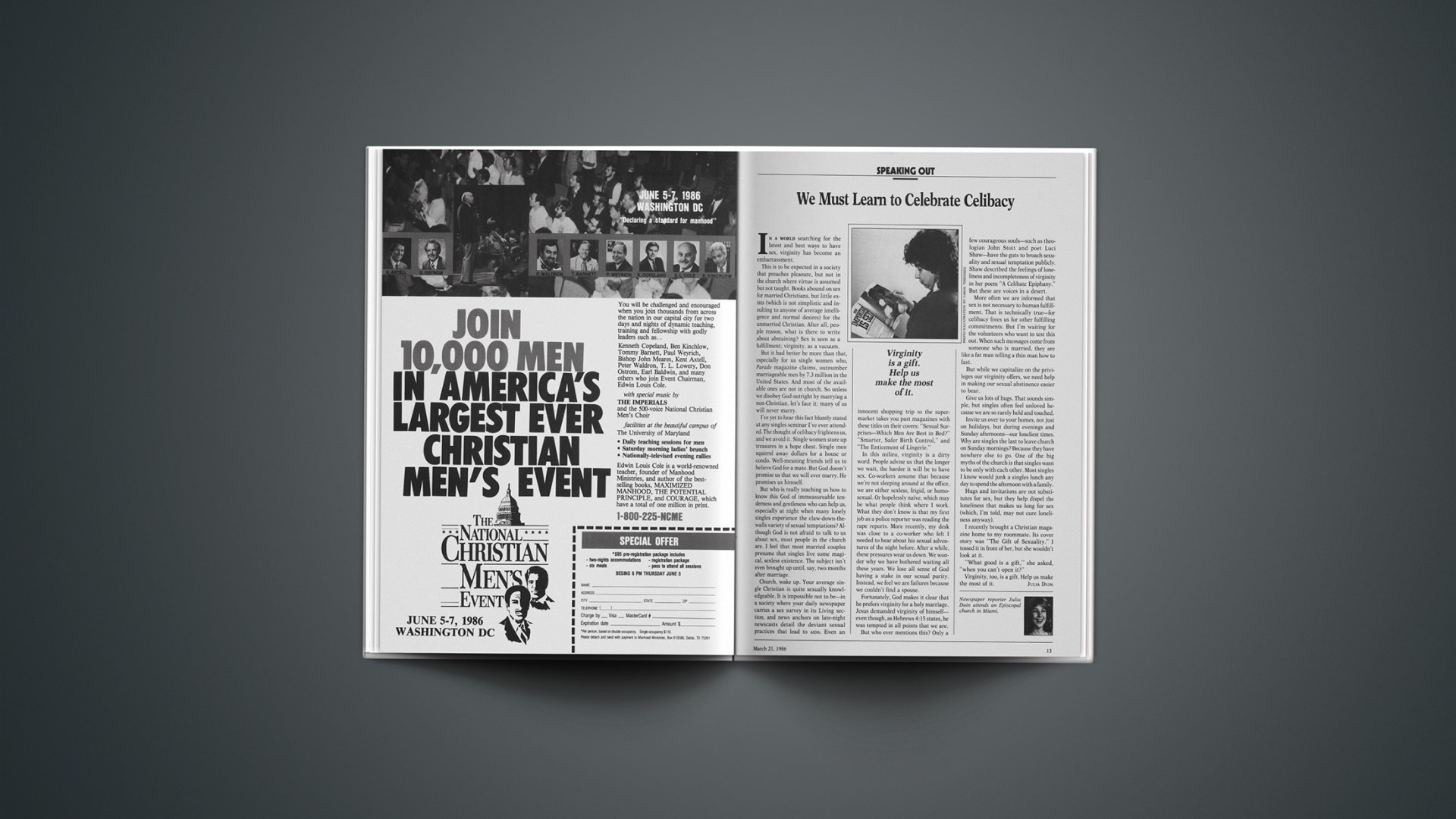
Church, wake up. Your average single Christian is quite sexually knowledgeable. It is impossible not to be—in a society where your daily newspaper carries a sex survey in its Living section, and news anchors on late-night newscasts detail the deviant sexual practices that lead to AIDS. Even an innocent shopping trip to the supermarket takes you past magazines with these titles on their covers: “Sexual Surprises—Which Men Are Best in Bed?” “Smarter, Safer Birth Control,” and “The Enticement of Lingerie.”

In this milieu, virginity is a dirty word. People advise us that the longer we wait, the harder it will be to have sex. Co-workers assume that because we’re not sleeping around at the office, we are either sexless, frigid, or homosexual. Or hopelessly naive, which may be what people think where I work. What they don’t know is that my first job as a police reporter was reading the rape reports. More recently, my desk was close to a co-worker who felt I needed to hear about his sexual adventures of the night before. After a while, these pressures wear us down. We wonder why we have bothered waiting all these years. We lose all sense of God having a stake in our sexual purity. Instead, we feel we are failures because we couldn’t find a spouse.

Fortunately, God makes it clear that he prefers virginity for a holy marriage. Jesus demanded virginity of himself—even though, as Hebrews 4:15 states, he was tempted in all points that we are.

But who ever mentions this? Only a few courageous souls—such as theologian John Stott and poet Luci Shaw—have the guts to broach sexuality and sexual temptation publicly. Shaw described the feelings of loneliness and incompleteness of virginity in her poem “A Celibate Epiphany.” But these are voices in a desert.

More often we are informed that sex is not necessary to human fulfillment. That is technically true—for celibacy frees us for other fulfilling commitments. But I’m waiting for the volunteers who want to test this out. When such messages come from someone who is married, they are like a fat man telling a thin man how to fast.

But while we capitalize on the privileges our virginity offers, we need help in making our sexual abstinence easier to bear.

Give us lots of hugs. That sounds simple, but singles often feel unloved because we are so rarely held and touched.

Invite us over to your homes, not just on holidays, but during evenings and Sunday afternoons—our loneliest times. Why are singles the last to leave church on Sunday mornings? Because they have nowhere else to go. One of the big myths of the church is that singles want to be only with each other. Most singles I know would junk a singles lunch any day to spend the afternoon with a family.

Hugs and invitations are not substitutes for sex, but they help dispel the loneliness that makes us long for sex (which, I’m told, may not cure loneliness anyway).

I recently brought a Christian magazine home to my roommate. Its cover story was “The Gift of Sexuality.” I tossed it in front of her, but she wouldn’t look at it.

“What good is a gift,” she asked, “when you can’t open it?”

Virginity, too, is a gift. Help us make the most of it.

JULIA DUIN1Newspaper reporter Julia Duin attends an Episcopal church in Miami.
Theology

God’s Grace and Brown Lettuce

Ordinary looking. That’s a good description of me. In fact, I must be so ordinary looking that I resemble all sorts of other people. I am always being taken for someone I am not.

The other day my wife, Darleen, sent me to the supermarket for a quart of milk. As soon as I started down the first aisle, a woman with fire in her eyes aimed her cart at me and charged up demanding, “Why are the tomatoes green and the lettuce brown?” (Where is the produce man when you need him?)

This sort of thing happens to me all the time. Just last night, as the mâitre d’ was showing me to my table for dinner, a man reached out and asked me for “more coffee and the check, please.”

I have learned to live with my extraordinarily ordinary looks, but once in a while I do get irritated. Recently, I was sitting in an airport lounge waiting for my plane when I noticed a woman studying me carefully. She eventually came over and asked, “You’re a doctor, aren’t you?”

“Why, yes,” I said, “how could you tell?”

“You look like one,” she replied, and quickly proceeded to describe various aches, pains, and physical complaints.

“Wait a minute,” I protested, “I am a doctor of philosophy and theology. You want a physician with a specialty in internal medicine.”

“You fraud,” she exploded, “You’re not a real doctor.”

Of course, there are periodic advantages to being taken for someone else. Recently I accompanied Bethel College’s hockey team on a road trip to Massachusetts. After living away from Boston for more than a decade, I had forgotten the special privileges accorded the clerical collar. I don’t wear one, but with my black scarf covering my bright new Christmas tie, and wearing my usual dark overcoat and fedora, I instantly became “Father.” I was afforded special parking status. A ticket seller waved me through packed gates. And ladies stood up to offer me their seats on the subway.

Putting aside for a moment my theological reservation about such a view of the ministry, I must admit it was nice being taken for someone I am not. I was treated in ways I did not deserve.

All of which leads me to a lesson relearned in the midst of privileged parking places and complimentary admissions: There is an ultimate and much greater favor that comes to me, although I do not deserve it. God the Father, holy and omnipotent, takes me for someone who is righteous. He confers on me a status I do not merit and did not earn. Again, I benefit because I am treated as if I were someone I am not.

This time, of course, it is no mistake. God planned to take me for someone else before the foundations of the world. He acts in grace, extending his gift to me as if I were somebody who had it coming. And he pronounces me, a sinful man, acquitted because of what Christ has done. God looks at me and sees Christ’s obedience.

Paul wrote that God justifies the ungodly—and that includes me—and my response must be to trust my whole self to him for now and for eternity. This is my response of faith.

It is little wonder that justification by grace through faith without works made little sense to the ethical sensibilities of most Jews and Greeks of the first century. Yet the apostles persisted in their argument that God indeed does choose to treat us as though we are Christ, and not who we really are.

For me, this means I am once again taken for someone else—and the result is a change within me. I am redeemed and renewed.

I become a new person in Christ.

Eutychus and His Kin: March 21, 1986

Does Your Church Rate?

One of the difficult things about going to a new town is deciding which church to visit. How can you tell, simply by a church’s name, whether or not it will fit your style or meet your expectations?

Ever the obliging servants of the public good, a few newspapers have sensed the need. They have church reviewers, right along with their stables of movie, music, and restaurant critics. Some of these reviewers have adopted the “star” rating systems, judging churches on their preaching, friendliness, and music.

But why stop there? Wouldn’t it be great to have a rating system for each portion of the church’s programs? Children’s sermons, of course, would be rated G. Most portions of the youth program, such as hayrides and pizza parties, could be rated PG (although retreats or overnights might be PG-13).

Sermons and assorted lectures would probably benefit from Parental Guidance (PG), excepting G sermons on Christmas and Easter, and an infrequent R rating for marriage seminars or book studies on the Song of Solomon. Using the X rating is unlikely. But there are a few occasions prone to violence, such as church business meetings or softball games.

Of course, it does seem tacky to use “stars” or movie ratings to pick apart a church and its pastor. Then again, critiquing is nothing new. We’ve been doing it for years—usually over Sunday dinner.

EUTYCHUS

Genetic Engineering: No Babel To Researchers

I was deeply distressed by your February 7 cover, which showed men constructing a double helix into the sky and titled, “Genetic Engineering: A Modern Tower of Babel?” That hurts. Think of us, the many dedicated researchers who work very hard to advance medical research. That cover was a slap in the face.

MICHAEL WEST

Baylor College of Medicine

Houston, Tex.

Your readers might be interested in a book, Come, Let Us Play God, by Leroy Augenstein (Harpers Bros., 1969). In the foreword, Dr. Augenstein makes this observation: “We have 10 to 25 years—at most 50—to set up new decision-making apparatus and answer some profound questions which previously we have left to God.”

A good portion of those years have come and gone. The time is upon us.

REV. JAMES M. LOGAN

Tucson, Ariz.

Evangelicals And The Ncc

I was pleased with your interview of Arie Brouwer [“Can Conservatives Find a Home in the National Council of Churches?” News, Feb. 7]. I pray that his call to evangelicals for involvement with NCC may be heeded. I was initially thrown off by the inquisitorial tone of your questions on “Personal Theology.” I admire the way they were answered and the patience with which they appear to have been received. How many people could stand up to such an interrogation?

REV. PIETER BYHOUWER

Hopewell Friends Church

Dana, Ind.

Thank you for your incisive questioning. Although Brouwer slipped and slid around any firm answers regarding world evangelism, the NCC’s propensity for selective justice, and the issues of homosexuality and abortion; and although he was able somehow to blame evangelicals for not spotting the theological changes for the better in the NCC in recent years (I still haven’t spotted them); he did reveal, at least to me, very clearly where he stands. Frankly, I have lots more respect for the old up-front liberalism than the politicized evangelicalism I see here.

Perhaps we were better off when evangelicalism was not so much in vogue.

REV. PAUL B. NULL

Bethel Baptist Church

Aumsville, Oreg.

Brouwer is mistaken when he says the old liberal tradition of the Federal Council of Churches is gone. By his denial of biblical inerrancy and his many other errors, I would say that the old liberalism/modernism our spiritual forefathers fought is alive and well in the person of Mr. Brouwer.

THOMAS M. CHMELOVSKI

Lincoln, Neb.

Evidently when Arie Brouwer states that evangelicals “deal too much with yesterday’s theological issues” he is referring to the day before he was interviewed. Or perhaps he hasn’t read the NCC textbook The New Testament: An Introduction, authored by Perrin and Duling. This text, which is still being used, was revised in 1982. In it the virgin birth, bodily resurrection, and ascension of Jesus are all denied as historical realities. These events are said to be examples of the “needs of myth overcoming history.” I can think of many names for persons who, as professing Christians, deny the bodily resurrection of Jesus Christ—but Trinitarian is not one of them. When the NCC stops printing “yesterday’s” theology, perhaps then evangelicals can stop dealing with “yesterday’s” theological issues.

CRAIG A. WOOD

Indianapolis, Ind.

CT says some evangelicals question the theology of Arie Brouwer because of his social stands, and gives as an example his arrest while protesting apartheid. Does this mean that when the South African majority is finally accorded their rights by the minority that evangelicals will have to admit that they were neutral, if not opposed?

In the recent Martin Luther King celebrations it was abundantly clear that King received very little moral or spiritual support from the evangelical segment of American churches. Who doesn’t acknowledge that fact with remorse and shame?

TED M. BENSON

Colorado Springs, Colo.

I was most struck by Brouwer’s contention that the account of the tower of Babel is a “theological statement” concerning apartheid, implying that it is of little or no historical value.

While racial discrimination in any setting is worthy of censure, a contextual examination of Genesis 9–11 will reveal that this is actually an episode in which a majority segment of the “human community” had chosen to remove itself from under the authority of the Creator. In calling for “true unity,” they named their society the “gate to God” and attempted to establish a one-world government and a wholly unified religious structure—most probably in hopes of self-sufficiently escaping God’s curse on Canaan and subjugating their more “conservative” Shemite counterparts. For this reason God sovereignly and spontaneously confused their one language into many and dispersed them into numerous less-harmful entities.

KEN DURHAM

Dallas, Tex.

The Art Of Self-Beeping

Perhaps a transmitter that would set off the preacher’s beeper is the better solution to the boring sermon (Eutychus, Feb. 7).

LAURIE K. MCBURNEY

Zionsville, Ind.

God The Father And Discipline

William Eisenhower, in “Fearing God” (Feb. 7), portrays God as Creator, Lord, Savior, King—but not once as Father. As one who was raised by a loving and disciplining human father, I do not find myself “wondering: How can I love what I fear?” Hebrews 12 focuses sharply on what the New Testament reaffirms repeatedly: God is our Father, and he disciplines us as sons. What son should not live in healthy fear of his dad’s disciplinary resolve and power, when faced with disobedience?

REV. GREG COLLORD

Richland, Wash.

Try Prayer And Friendship

I’m glad I’m not a member of the “historic” Moody Church, else I’d be afraid to breathe at the wrong time [“Chicago Church Acts Against a Former Member Who Performs Abortions,” Feb. 7].

Demonstrations and ostracizing Dr. Bickham from the church by its members—really! Wouldn’t prayer and friendship, with an extra measure of godly love, do more for him? The church members’ behavior will probably do more to turn Dr. Bickham from God and his people than turn him back to God again.

KAREN POTTERS

Bartlesville, Okla.

Regarding Moody Church picketing an ex-member’s abortion clinic and distributing leaflets protesting his activity in his home neighborhood—why stop there?

Picket the adulterers’ offices and homes too, and be sure to include in the “picketing and distributing” the liars, gluttons, cheats, and deceivers. Maybe a few groups could boycott the gossipers and “empty talkers” (Titus 1). Better yet, picket the whole Moody Church and flood the surrounding neighborhood with leaflets stating that the members are indeed guilty of sins.

ELIZABETH CROZIER

Indianapolis, Ind.

I am disappointed in coverage of the alleged abortionist controversy at Moody Church, as well as the way in which the zealous church members have completely disregarded the reconciliation process outlined in Matthew 18:15–17. Jesus’ purpose was to posit a process of healing in relationships, not a church-wide (or individual, for that matter) lynching party. The church can hardly glorify Christ by public exhibition of a sin of one of the brethren; Jesus commanded reconciliation before any other spiritual business (Matt. 5:23–25).

I can hardly believe that what Moody Church is doing could possibly reconcile their wayward brother back into the fellowship of the brethren. Rather, I fear that Brother Bickham may be gone for good.

REV. WM. DREW MOUNTCASTLE

Portsmouth, Va.

Let God Be The Judge

Nothing in J. I. Packer’s comprehensive “Good Pagans and God’s Kingdom” [Jan. 17] is more profound than the concluding paragraph. We need to be reminded that our job is to witness; God’s job is to determine everyone’s future—believer and nonbeliever alike.

I would like to add one scriptural reference. The only place in the Gospels where Jesus clearly states who will enter the kingdom and who will enter hell (Matt. 25:31–46) is disturbingly clear. Judgment rests on what people did—fed the hungry, visited the sick, and so on. When Jesus says, “You did it unto me,” neither the sheep nor the goats claimed such awareness or intention.

This seems to say that consciously proclaimed faith and obedience to the God of Jesus Christ is not the test; that one can be “in Christ” without knowing it intellectually. This is not universal salvation. The goats went to hell. But the judgment of God is shown to rest on what is in the heart and not the head. We on earth must stay with what we can do: witness. We are totally incapable of judging others. Judgment belongs to God who knows the heart.

D. T. SAMUEL

St. Cloud, Minn.

Why do the proponents of the either/eternal-blessedness/or eternal-conscious-suffering view of the future state assume that the only alternative is universalism? A third view is that of conditional (i.e., noninherent) immortality.

Packer, and all scholarly evangelicals, know this doctrine, its antiquity, and its exponents. Why do they never cite it, even for the purposes of refutation? Can there be a conspiracy of silence where the glory of God, the integrity of Scripture, the Good News of our Lord Jesus Christ, are concerned?

GRACE IRWIN

Toronto, Ont., Canada

“What is the point of asking anyone to change religions, if all religions are Christianity in disguise?” The point is that we do not know and cannot know, and it is sheer arrogance to take a definitive position one way or the other. But what we surely do know is that it is a terrible sin to withhold the “Good News” from our fellow men.

VINCENT G. SPRAGUE

Downey, Calif.

God’S Tools

C. Stephen Evans in “The Blessings of Mental Anguish” [Jan. 17] captured the dilemma of my own ministry. Once, I sought the rod of Moses to change the world around me and eliminate the problems for my congregation. I could not answer their questions of “Why?” when we faced the agony of helplessness in a hopeless world. But then, I sought comfort in God in the midst of agony.

God did not give Moses a rod to change the world. He simply asked Moses, “What is in your hand?” It was the rod God used in the hands of Moses. Today God asks me as he asks all of us, “What is in your hand?” God will use the rod of worship, the rod of fellowship, and the rod of service to the world for Christ’s sake to bring us to the Father.

REV. H. C. REYNOLDS

Star Valley Southern Baptist Church

Payson, Ariz.

For every Charles Haddon Spurgeon and Søren Kirkegaard who have turned depression into sermons and philosophical treatises, there are many, many more Christians whose lives have been destroyed by emotional and psychological turmoil. They can, and should, be cared for whenever possible by competent, loving psychologists. Praise God that they are around and practicing their profession!

I don’t doubt for a minute that God’s strength is made perfect in weakness. Even emotional and psychological weaknesses can be turned over to God. But psychological problems have behavioral manifestations that can badly hurt a ministry, testimony, and credibility among non-Christians. My depression and fears almost destroyed my ministry. I thank God for the firm, loving psychotherapist I am now seeing. I’m not ashamed to say I have been feeling much better—and incidentally, feeling good is not hazardous to my testimony.

NAME WITHHELD

San Juan, Tex.

It is my impression that many Christians are at least implicitly uncomfortable with the psychotherapeutic discipline because it deals primarily with liberating people from troubling authority. Very frequently authority from which the person is liberated is the values of his or her religious upbringing. But isn’t that what is needed some of the time? Where would the Christian church be without the witness of Paul, which followed the experience of liberation he had on the road to Damascus?

It seems care should be taken to direct criticism toward the rampant narcissism of the “therapeutic society” rather than toward its failure to get permission from the church to do the church’s work of healing.

REV. JOHN HARKEY GIBBS

Austin, Tex.

I question whether we need to conclude that Christians should be grateful because some saints suffered their emotional ills prior to the treatment of the “therapeutic age.” Criticizing modern therapy because it lessens our potential for suffering seems akin to lamenting that Salk’s vaccine has reduced our chance to experience physical impairment.

RHONDA H. JACOBSEN

Grantham, Pa.

Militant Perfectionism

In regard to R. C. Sproul’s “Heresies of Holiness” [Jan. 17], Scripture tells us in 1 John 2:1 not to sin, and 1 Peter 4:1–2 plainly says that since Christ suffered in his body, we are to arm ourselves with the same attitude, because he who has suffered in his body is done with sin. Let us all at least consider we can be militant perfectionists rather than add any further to heresies of holiness.

REV. ROBERT L. HENEGHAN

Church of the Nazarene

Redmond, Oreg.

The Ct Institute On Trends

The Christianity Today Institute articles, “Into the Next Century: Trends Facing the Church” [Jan. 17], were excellent. However, I take exception to Mary Stewart Van Leeuwen’s interpretation of working women. In dividing women into “wage-earning” and “full-time homemakers,” she immediately denigrates the work of stay-at-home women. To further add insult, she blithely assumes that the women who offer day care in their homes are not really working since she lumps them into the “full-time homemaker” category. If those women do not earn a wage also, I’ll eat a week’s supply of Bandaids and baby wipes!

SARAH BRECHNER

Winchester, Ky.

Van Leeuwen’s point of view is a thinly veiled feminism, which is a cause of great inner decay within the church, resulting in the external proofs of abortion, broken families, the alienation and institutionalization of our children. I suggest she read the pastoral epistles of 1 Timothy, 2 Timothy, and Titus. Here she will find clearly that the traditional family lifestyle is the biblical one. In addition, men and women have equally important but different callings to leadership within the church.

STEPHEN J. MUNIER

Duluth, Ga.

How timely can you get—the “Trend” series especially! How scary things are, humanly speaking, but how heartening to know that all things are working after the counsel of his will. And one of these days, the One who shall come will come!

REV. ROBERT W. TEAGUE

York, Pa.

In the CT Institute overview “Shifting Denominational Power,” by Norman Shawchuck and Richard Olson, the authors write: “Historically developing denominations have drawn upon the surrounding culture in determining their own ecclesiastical structure.” Also they point out that “Congregational-polity churches are growing” while churches with other forms of government are not. As generalizations go there is a fair amount of truth in these statements, but I find it disconcerting that the matter is left there.

Have we forgotten that the church is not a democracy in the New Testament? Paul’s epistles prescribe a church polity (by elders) that is held to be normative.

DICK FULLER

Sparks, Nev.

Editor’s Note: March 21, 1986

It happens every year: the editorial challenge to present the power of Resurrection Sunday in a fresh and creative way.

That’s why we went to Bob Webber of Wheaton College for this year’s Easter cover story. A professor of theology who has a love affair with church history, Bob has a tendency to draw liberally from the past to display the elements of our faith and worship in a new and exciting light. Says one of his students, CT associate editor Rodney Clapp, “Bob has an ability to take the old—the very old—and make it seem new.”

Determined to do just that, Bob assured Rodney he knew immediately where to find a much-over-looked insight that could breathe new life into today’s Easter celebrations: namely, in the fourth-century diary written by a woman named Egeria, and in his own memories of Montgomeryville Baptist Church—the “venerable stone church of my childhood.” And what he dusts off for our consideration is the drama linking these two disparate communities across the ages: the re-enactment of Easter events.

“Dramatic participation,” says Bob, “has a staying power.” For the young Bob Webber, it was the sunrise re-enactment of Christ’s resurrection. For the believers in fourth-century Jerusalem, it was a week of watching and praying, fasting and feasting.

Worship is something we do, Webber says in his book Worship Is A Verb, not something that is done to us. And in his piece beginning on page 13, he shows us that “reliving the mystery” becomes an outward expression of the power linking past, present, and future to the limitless love of our living Christ.

HAROLD SMITH, Managing Editor

Jogging past the AIDS Clinic

I have yielded to the latest scheme of publishers: books recorded on cassette tape. Now, some of my best “reading” time occurs as I jog, outfitted with Walkman and headphones, along Chicago’s lakefront.

This past winter the city’s dingy streets and rat-gray skies formed a perfect backdrop for one book I listened to: Daniel Defoe’s A Journal of the Plague Year. In meticulous, matter-of-fact prose he described the bubonic plague that afflicted London in 1665.

Defoe wandered the streets of a ghost city. Over 200,000 people had fled London. Those who remained barricaded themselves indoors, terrified of human contact. Tradesmen starved to death for want of work. On main thoroughfares, where before there had been steady streams of traffic, grass grew.

“Sorrow and sadness sat upon every face,” said Defoe. At the peak of the plague, 1,500 to 1,700 people died each day, their bodies collected on carts nightly for burial in huge, open pits. Defoe witnessed gruesome scenes: dead children locked in the permanent grip of their parents’ rigor mortis, living babies sucking in vain at the breasts of just-dead mothers.

As I listened, Defoe’s account took on particular poignancy in view of a modern-day plague that is much in the news. My wife and I live in a neighborhood populated by many gays, and I could not avoid reflecting on the parallels between Defoe’s time and ours as I would jog past a clinic for AIDS patients and dodge lampposts plastered with “AIDS Benefit” posters. In comparison to the Great Plague, the AIDS epidemic has afflicted very small numbers, but it has stirred up a remarkably similar response of hysteria.

In Defoe’s day, it seemed as if God’s judgment was being poured out on the entire planet. Two bright comets appeared in the sky each night—sure signs, said some, of God’s hand behind the plague. Wild-eyed prophets roamed the streets. One cried out, like Jonah to Nineveh, “Yet forty days and London shall be destroyed.” Another walked around naked, balancing a pan of burning charcoal on his head to symbolize God’s wrath.

We have our prophets today as well. Most are well-clothed, however, and they narrow the focal point of God’s judgment down to one particular group: homosexuals, who are disproportionately represented among AIDS sufferers. In some circles I can almost detect a sigh of relief, a satisfaction that at last “they are getting what they deserve.”

The AIDS crisis taps into a mysterious yearning among human beings, a deep-rooted desire that suffering ought to be tied to behavior. A book in my library, Theories of Illness, surveys 139 tribal groups scattered around the world. Of them, 135 hold that illness comes about because of God’s (or the gods’) disapproval.

Virtually alone among all civilizations in history, our modern, secular one questions whether God plays a direct role in such human events as plagues and natural catastrophes. (Even we have our doubts: insurance policies specify certain “acts of God.”) We are confused. Did God single out a town on the slope of a Colombian volcano for judgment? Did he withhold rains from Africa as a sign of his displeasure? No one knows for sure.

But AIDS—ah, there’s a different story. The likelihood of AIDS transmission increases among those who engage in promiscuous sex. For some Christians, AIDS seems to satisfy at last the longing for a clear tie between behavior and suffering as punishment. In a general sense, the tie to promiscuity is clear, in the same way that smoking increases risk of cancer, obesity increases risk of heart disease, and heterosexual promiscuity increases risk of venereal disease. The natural consequences of such behavior include, in many cases, physical suffering. But did God send AIDS as a specific, targeted punishment?

Other Christians are not so sure. They see a grave danger in playing God, or even interpreting history on his behalf. We can too easily come across as cranky or smug, not prophetic. “Vengeance is mine,” God said, and whenever we mortals try to appropriate his vengeance, we tread on dangerous ground. Among the gays in my neighborhood, Christians’ statements about the AIDS crisis have done little to encourage repentance. Judgment without love makes enemies, not converts.

Even the apparent cause-and-effect tie to behavior in AIDS raises troubling questions. What of victims who are not gay, such as a baby born to a mother infected through blood transfusion? Are they tokens of God’s judgment? And if a cure is suddenly found—will that signify an end to God’s punishment? Theologians in Europe expostulated for four centuries about God’s message in the Great Plague; but it only took a little rat poison to silence all those anguished questions.

Reflecting on these two plagues, the scourge of the buboes that killed off one-third of all humanity and the scourge of AIDS that summons up the hysteria of the Middle Ages, I find myself turning to an incident from Jesus’ life recorded in Luke 13:1–5. Some local folk asked him about a contemporary tragedy. Here is his response:

“Do you think that these Galileans were worse sinners than all the other Galileans because they suffered this way? I tell you, no! But unless you repent, you too will all perish. Or those eighteen who died when the tower in Siloam fell on them—do you think they were more guilty than all the others living in Jerusalem? I tell you, no! But unless you repent, you too will all perish” (NIV).

Then Jesus tells a parable about God’s restraining mercy. He implies that we “bystanders” of catastrophe have as much to learn from the event as the victims. What should a plague teach us? Humility, and gratitude that God has so far withheld the judgment all of us deserve. And compassion, the compassion that Jesus displayed for all who mourn and suffer. Finally, catastrophe joins together victim and bystander in a common call to repentance, by reminding us of the brevity of life. It warns us to make ourselves ready in case we are the next victim of a falling tower—or an AIDS virus.

I have yet to find any support in the Bible for an attitude of smugness: Ah, they deserve their punishment; watch them squirm. Indeed, the message of a plague seems directed to survivors as much as to victims. In other words, AIDS has as much meaning for those of us jogging past the clinics as for those suffering inside.

My Children!

We evangelicals pride ourselves on being thoroughly profamily. We defend motherhood as a legitimate career, take stands against divorce, object to sex outside of marriage, protest pornography, and challenge homosexuality. We even include the human fetus in the family circle.

We defend the home turf, taking aim at dangerous trends. But as a result, we have made much more clear what the family is not than what it is.

Now, in theaters across the country, a feature film has made a positive statement about family commitment. I can’t imagine anyone making a more moving statement than Eleni.

Eleni is not a profamily polemic. Based on New York Times reporter Nicholas Gage’s quest to discover how and why his mother died, the film is simply the true story of what one mother was willing to do for her children during the Greek civil war.

When Communist guerrillas overrun Nick’s tiny village in the mountains of northwestern Greece, they decide to export its children (including young Nikola) to Albania and Czechoslovakia. Eleni determines to help her daughters and son escape.

Forced to stay behind, Eleni clutches seven-year-old Nikola for the last time and whispers, “My heart, my blood,” revealing the depth of her passion and what it will cost in the end.

Eleni is falsely accused and tortured. The charge is treason—but her real crime is helping her children escape. After Eleni has been condemned, she is allowed a final visit from a daughter who had been forced into military service. “I thank God I had the joy of being a mother,” Eleni tells her. She takes comfort in the thought of her children eventually being blessed with children of their own. Then, moments before her execution, she cries, “My children!”

Our age is not known for its heroes. We are embarrassed by anyone larger than life. We expose the clay feet of the heroic, and feel relieved to know they were human after all.

But for Nick Gage, Eleni is something of a Christ figure, willing to be consumed by an insane war to give her children a chance to reach America—the Promised Land where waits the father who has been cut off from his family.

In the end, Eleni’s last words redeem her son, allowing Nick to let go of his all-consuming hatred for her killer. Her cry, “My children!” echoes in Nick’s head and keeps him from murder. And those words bring him back to the family that he has neglected in his obsessive quest. He breaks through the isolation caused by his intensely private anger and pain. Embracing his own son and daughter, he determines that he will be able to say “My children!” with the same commitment and passion that Eleni did.

STEVEN MOSLEY1Steven Mosley is a screenwriter living in southern California.

Steven Spielberg’s adaptation of Alice Walker’s Pulitzer Prize-winning novel The Color Purple may be the most misunderstood movie of the year. Some reviewers have called it feminist; others have denounced it as racist. None has seen the central point: God’s grace permeates this world, whether or not we are aware of it. Even the cryptic title is a code word for grace. Near the end of the movie, a character asks if God doesn’t get angry when we “walk by the color purple and don’t even notice?”

The novel is in the form of letters to God, and the movie is able to maintain some of the same flavor. The main character is a poor black girl in rural Georgia. Raped repeatedly by her father, Celie is then sold to a brute of a husband known to her only as Mr.—. Celie is knocked around, her spirit abused, until she is just a shell of a human. But she meets two characters who help her regain her spirit. The strong-willed Sofia marries Mr.—’s son Harpo and marches into Celie’s life. Then Mr.—’s mistress, a soulful blues singer named Shug, moves in. Both help Celie to gain the self-confidence finally to stand up to Mr.—.

The message is that God’s grace is for here and now, not just hereafter. At one point, Celie tells Sofia’s husband to beat her because she won’t grovel. When Sofia confronts Celie, Celie’s answer is, “This life will soon be over. Heaven lasts always.” In the context, the audience clearly sees how lame this answer is.

Many Christians may have trouble seeing God’s mercy amid all this brutality and promiscuity. Could God’s grace still show through?

Yes. Because of the world’s perversity, God sent his only Son to die, the ultimate expression of his grace. And it is through the fallenness of humankind that God chooses to work.

Spielberg should be complimented for transforming the book’s lesbian love scene. The only relationships Celie had known until Shug came along were brutal and unloving. In the movie version (which is not sexually explicit), Shug shows affection toward Celie, and opens a chink in Celie’s emotional armor. The scene is thus important, without being sensational.

Spielberg has made a beautiful addition to the Walker story that shows God’s grace bursting through. Shug is singing a blues tune at Harpo’s juke joint while just up the road, the church choir begins to sing. With brilliant intercutting of scenes, Spielberg neatly fits Shug’s song “I Want You to Listen Up” into the choir’s “God Might Be Tryin’ to Tell You Something.” Shug leads a procession to the church and walks up to the preacher—her father—and says, “See, Daddy, even sinners have souls.”

In the end, all the characters have taken a step toward God, even the brutal Mr.—. Some find the ending unrealistic. But problems still exist, even though the characters have turned around. At least they are pointed in the right direction. What could be a more hopeful portrayal of real life?

TOM NEVEN2Tom Neven, a former editor of the Wheaton College newspaper, will graduate in June with a major in philosophy.

American writer John Updike’s early poem “Seven Stanzas at Easter” describes Christ’s resurrection. And the story “Pigeon Feathers” tells about a boy’s finding faith because of the beauty of a common bird’s plumage. Later novels contain graphic descriptions of sex and rampant adultery. Whatever happened to the faith of John Updike?

The prolific author shows us a world of corrupt people attempting to reach grace, of men believing in God because they feel they must, of goddess-like women unconcerned with spiritual values. In Updike’s books, the middle class dances while America’s morals die, and a Calvinistic God hurls lightning bolts at the church. Updike has named as his main themes “Domestic fierceness within the middle class, sex and death as riddles of the thinking animal, social existence as sacrifice, unexpected pleasures and rewards,” and “corruption as a kind of evolution.” Over these themes broods God and a sense of guilt.

Updike’s latest book of poems, Facing Nature, and the recent story “Made in Heaven” show a man who believes because he cannot stop now:

• The poem “To Ed Sissman” reveals the dichotomy of an ambivalent faith: When Updike’s friend tells him it “would be a comfort to believe,” Updike’s faith is a “rabbit frozen in the headlights” that “scrambled for cover in the roadside brush of gossip.”

• In “Made in Heaven,” Brad, a lukewarm believer, is initially attracted to Jeanette because of her Christianity, and on their wedding night attempts to please her by praying for their marriage. By the end of the story, Jeanette no longer believes in God, and Brad is lonely and disillusioned.

The religious ambivalence in John Updike is on display in his most recent novel, The Witches of Eastwick. The satanic Darryl Van Horne preaches a sermon titled “THIS IS A TERRIBLE CREATION.” After discussing the grossness of the centipede, tapeworm, and tarantula, he says, “Now I ask you, isn’t that pretty terrible? Couldn’t you have done better, given the resources? I sure as he could have.”

But while Updike writes about God’s “mistakes,” he also shows that the alternative is unappealing: Greasy, hairy, and full of spittle, Van Horne preaches in a church where the pastor is an adulterer and where the word “evil” is rarely heard. “I feel that to be a person is to be in a situation of tension,” he has written.

Males And Ministers

Thoughts of theology, morality, and guilt are never far from Updike’s male characters, but his female characters are puzzled by the males’ religious crises. Updike’s males sit passively, waiting for an act of God, while earthbound, unbelieving females make decisions and act. His writings are full of domestic squabbles about religion.

Many of Updike’s characters are ministers—multi-faceted men, sympathetically portrayed. But most of them are unable to find faith. Updike’s males attend church services that are not fully satisfying but are nevetheless important. In the novel Couples, the church burns, and the main character becomes insignificant with this removal of his guilt.

In the Rabbit novels, Harry “Rabbit” Angstrom demonstrates Updike’s theme of “corruption as a kind of evolution.” In Rabbit, Run, Angstrom is a man of guilt, pulling down a windowshade so he cannot see a neighboring church before he commits adultery. By the most recent novel in the trilogy, Rabbit Is Rich, Angstrom’s religious search has boiled down to praying on buses and “Sunday school images.”

Crisis

When in his later twenties, Updike had his own religious crisis, a fear of death. At this time he delved into the works of existentialist Christian writers Søren Kierkegaard and Karl Barth. (He now supplements those thinkers with C. S. Lewis, G. K. Chesterton, and others.)

Updike manifests at least a form of godliness: he attends church once or twice a month, he wrote me, and he keeps up his pledge. “I have attended church services all my life,” he wrote.

Somehow, in this long churchly association, he gained insight on what it means to be born into a world of sin. To Updike, to feel guilt is a kind of morality.

Guilt is one thing. Graphic sexual description is quite another. Why is he so explicit? Updike writes about sexual events, he said, because “our reading life is too short for a writer to be in any way polite … he should be as honest and explicit as we are with ourselves.”

But is Updike a Christian? “I call myself Christian,” he has written, “by defining ‘a Christian’ as ‘a person willing to profess the Apostles’ Creed.’ I am willing … to profess it (which does not mean understand it, or fill its every syllable with the breath of sainthood), because I know of no other combinations of words that gives such life, that so seeks the crux.”

The ambivalence remains.

REBBIE KINSELLA3Rebbie Kinsella, a former campus minister with Chi Alpha, is a data entry operator at Northern Illinois University, Dekalb.

When the Tenors are Flat

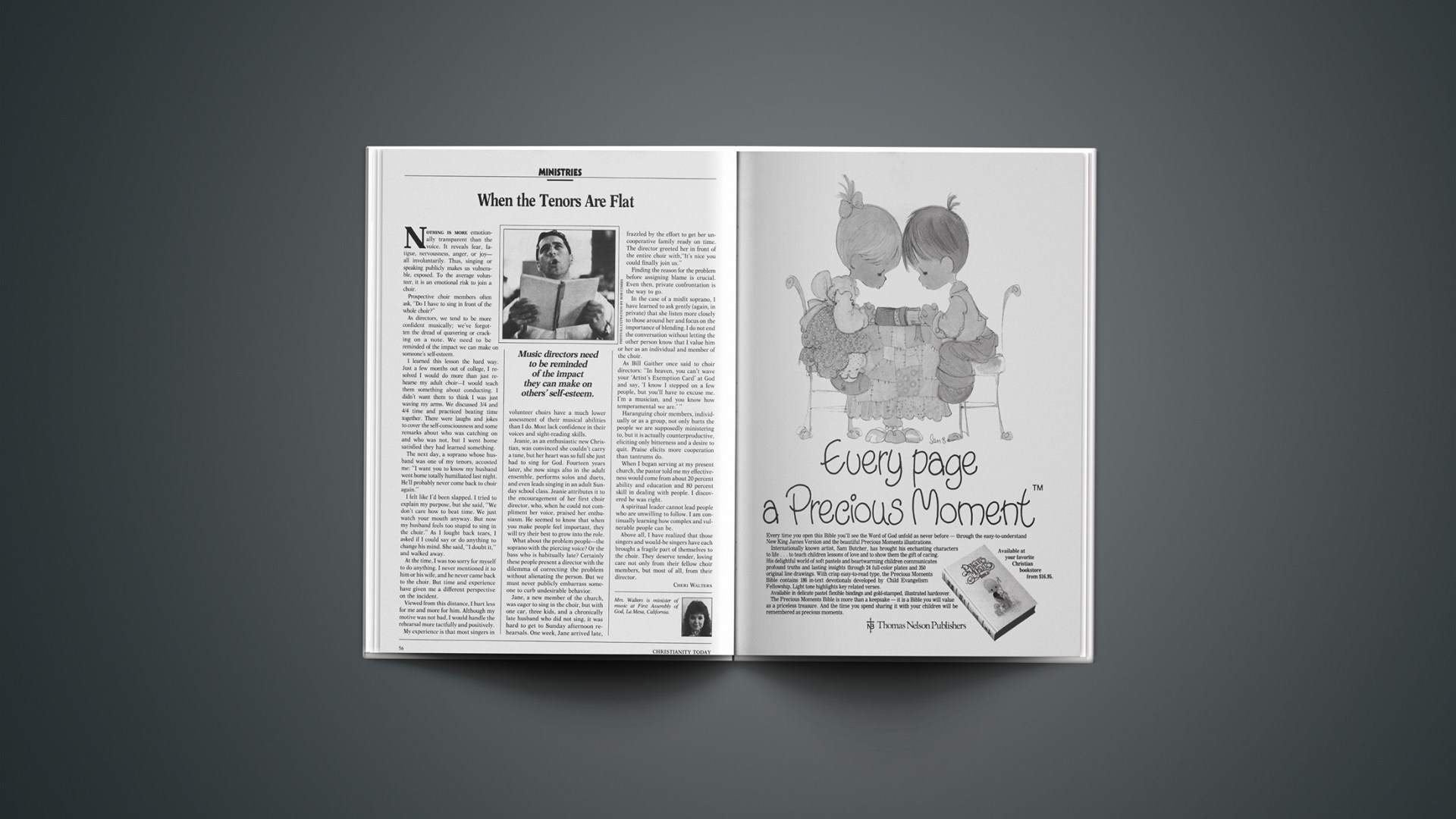
Nothing is more emotionally transparent than the voice. It reveals fear, fatigue, nervousness, anger, or joy—all involuntarily. Thus, singing or speaking publicly makes us vulnerable, exposed. To the average volunteer, it is an emotional risk to join a choir.

Prospective choir members often ask, “Do I have to sing in front of the whole choir?”

As directors, we tend to be more confident musically; we’ve forgotten the dread of quavering or cracking on a note. We need to be reminded of the impact we can make on someone’s self-esteem.

I learned this lesson the hard way. Just a few months out of college, I resolved I would do more than just rehearse my adult choir—I would teach them something about conducting. I didn’t want them to think I was just waving my arms. We discussed 3/4 and 4/4 time and practiced beating time together. There were laughs and jokes to cover the self-consciousness and some remarks about who was catching on and who was not, but I went home satisfied they had learned something.

The next day, a soprano whose husband was one of my tenors, accosted me: “I want you to know my husband went home totally humiliated last night. He’ll probably never come back to choir again.”

I felt like I’d been slapped. I tried to explain my purpose, but she said, “We don’t care how to beat time. We just watch your mouth anyway. But now my husband feels too stupid to sing in the choir.” As I fought back tears, I asked if I could say or do anything to change his mind. She said, “I doubt it,” and walked away.

At the time, I was too sorry for myself to do anything. I never mentioned it to him or his wife, and he never came back to the choir. But time and experience have given me a different perspective on the incident.

Viewed from this distance, I hurt less for me and more for him. Although my motive was not bad, I would handle the rehearsal more tactfully and positively.

My experience is that most singers in volunteer choirs have a much lower assessment of their musical abilities than I do. Most lack confidence in their voices and sight-reading skills.

Jeanie, as an enthusiastic new Christian, was convinced she couldn’t carry a tune, but her heart was so full she just had to sing for God. Fourteen years later, she now sings alto in the adult ensemble, performs solos and duets, and even leads singing in an adult Sunday school class. Jeanie attributes it to the encouragement of her first choir director, who, when he could not compliment her voice, praised her enthusiasm. He seemed to know that when you make people feel important, they will try their best to grow into the role.

What about the problem people—the soprano with the piercing voice? Or the bass who is habitually late? Certainly these people present a director with the dilemma of correcting the problem without alienating the person. But we must never publicly embarrass someone to curb undesirable behavior.

Jane, a new member of the church, was eager to sing in the choir, but with one car, three kids, and a chronically late husband who did not sing, it was hard to get to Sunday afternoon rehearsals. One week, Jane arrived late, frazzled by the effort to get her uncooperative family ready on time. The director greeted her in front of the entire choir with, “It’s nice you could finally join us.”

Finding the reason for the problem before assigning blame is crucial. Even then, private confrontation is the way to go.

In the case of a misfit soprano, I have learned to ask gently (again, in private) that she listen more closely to those around her and focus on the importance of blending. I do not end the conversation without letting the other person know that I value him or her as an individual and member of the choir.

As Bill Gaither once said to choir directors: “In heaven, you can’t wave your ‘Artist’s Exemption Card’ at God and say, ‘I know I stepped on a few people, but you’ll have to excuse me. I’m a musician, and you know how temperamental we are.’ ”

Haranguing choir members, individually or as a group, not only hurts the people we are supposedly ministering to, but it is actually counterproductive, eliciting only bitterness and a desire to quit. Praise elicits more cooperation than tantrums do.

When I began serving at my present church, the pastor told me my effectiveness would come from about 20 percent ability and education and 80 percent skill in dealing with people. I discovered he was right.

A spiritual leader cannot lead people who are unwilling to follow. I am continually learning how complex and vulnerable people can be.

Above all, I have realized that those singers and would-be singers have each brought a fragile part of themselves to the choir. They deserve tender, loving care not only from their fellow choir members, but most of all, from their director.

CHERI WALTERS1Mrs. Walters is minister of music at First Assembly of God, La Mesa, California.

The Founder of Scientology Is Dead at 74

Lafayette Ronald Hubbard once said, “If a man really wants to make a million dollars, the best way would be to start his own religion.” In 1954, he followed that advice, founding the Church of Scientology and making it a multi-million-dollar operation. Better known as L. Ron Hubbard, the recluse died of a stroke January 24 at his ranch near San Luis Obispo, California. He was 74.

Hubbard, who was last seen publicly six years ago, first became known as a science fiction author. He had more than 500 science fiction works published, including the novel Battlefield Earth (1980), a national best seller.

However, Hubbard was best known for starting the controversial Church of Scientology, incorporated in the District of Columbia in 1954. Its teachings are based on theories published in Hubbard’s 1950 book Dianetics: The Modern Science of Mental Health. Hubbard coined the word “dianetics,” which he defined as “through soul.” The book has been published in 11 languages, and the church reports more than seven million copies have been sold.

Hubbard taught that the human race began 74 trillion years ago on the planet Venus, and that in the course of countless reincarnations, humans have accumulated “engrams.” Engrams are best defined as “emotional hangups,” comparable to repressed memories stored in the subconscious.

Sessions with Scientology “auditors” supposedly eliminate engrams. These sessions cost $300 an hour. One man is reported to have spent $250,000 trying in vain to eliminate his engrams. According to the church, only about 30,000 people have reached the engram-free state, known as “clear.”

The church’s history is laced with controversy. In 1983, Hubbard’s third wife, Mary Sue Hubbard, was sentenced to four years in prison. She was one of several church leaders convicted of conspiracy against the U.S. government. In 1984, a federal tax court rescinded the church’s tax-exempt status, claiming the church was a commercial enterprise. Heber C. Jentzsch, president of the Church of Scientology, said this ruling “has only strengthened our determination … to bring about the reform of the Internal Revenue Service, and if necessary, to bring about its dismantling.” Hubbard not only survived all the controversy, but became a millionaire in the process. Scientology attorney Earle Cooley said Hubbard willed “tens of millions of dollars” to the church “after making very generous provision for his surviving wife and certain of his children.”

One offspring unlikely to have been listed as a beneficiary is Hubbard’s eldest son, born L. Ron Hubbard, Jr., but who changed his name to Ronald E. DeWolf in 1972 after having renounced Scientology 13 years earlier. In 1983 DeWolf sought to have his father declared dead and to have Hubbard’s financial assets frozen to prevent exploitation by the church’s leadership (CT, Feb. 18, 1983, p. 30).

In a telephone interview, DeWolf, now a Christian, said he has led several ex-Scientologists to Christ and hopes to lead others “out of the wasteland of Scientology” and into the Christian faith. DeWolf said he is convinced his father was demon possessed. He quoted Hubbard as having said, “I would rather reign in hell than serve in heaven.”

Whereas Hubbard claimed Scientology’s theories were based on 30 years of research, DeWolf maintains they were “written off the top of his head while he was under the influence of drugs.” DeWolf said his father had many mistresses, was plagued by venereal disease, and was deeply involved in the occult.

Well-known people who have identified themselves as Scientologists include actor John Travolta, former National Football League quarterback John Brodie, and convicted killer Charles Manson. Former Scientology officials estimate church assets at more than $300 million and annual income at over $100 million. According to Jentzsch, the church has six million members in 35 countries. However, defectors believe membership peaked at two million about 10 years ago, and that today’s membership may be less than 700,000.

NORTH AMERICAN SCENE

INSTITUTE ON RELIGION AND DEMOCRACY

A New Executive Director

The Institute on Religion and Democracy (IRD) has named Kent Hill to the newly created post of executive director. An associate professor of history at Seattle Pacific University, Hill specializes in East European and Soviet history. He will assume the IRD post in June.

Founded in 1981, the Washington, D.C.-based IRD promotes democratic values and dialogue within the church on foreign policy issues. Recently, it has been at the center of a controversy over church positions on Nicaragua.

Hill, 36, said IRD will maintain a deep commitment to basic Christian values while being broad enough to include mainline Protestants, evangelicals, and Catholics. He said he wants IRD to become a major resource center to assist churches when they consider foreign policy questions. “One of my main concerns with the church is its tendency to be naïve,” he said, “to jump on the bandwagon without enough careful thinking about its proposals.”

He said dialogue between IRD and certain church groups, especially mainline denominations, has broken down in recent years. “It will be my firm commitment … to promote fair and civil discussion within the church world concerning critical foreign policy questions.”

CHURCH-STATE

Aid for a Bible Student

The U.S. Supreme Court has overturned a ruling of the Washington (State) Supreme Court, which cited federal case law in denying vocational aid to a blind student studying for the ministry. However, the high court told the Washington Supreme Court it could apply that state’s stricter ban on aid to sectarian institutions to this case.

In 1979, while a student at Inland Empire School of the Bible in Spokane, Washington, Larry Witters sought assistance under a state vocational rehabilitation law. He was suffering from a progressively deteriorating eye condition. The Washington Commission for the Blind denied his request, as did a state hearings examiner and a state superior court. All cited Washington’s constitution, which specifically forbids the use of public funds to assist individuals pursuing religious studies.

Witters then appealed to the Washington Supreme Court. It also ruled against him, but based its judgment on a 1971 U.S. Supreme Court decision instead of on the state constitution. That 1971 high court ruling established a three-part test for these kinds of cases: a law in question must have a secular purpose, must not have the primary effect of advancing religion, and must not foster excessive government entanglement with religion.

The high court’s recent ruling in favor of Witters was unanimous. It determined that state aid for vocational rehabilitation services was not intended to promote religion, that it did so in this case only incidentally, since Witters chose to study for the ministry. The Court ruled that “no more than a minuscule amount of the aid awarded under the [state aid] program is likely to flow to religious education.”

PLANNED PARENTHOOD

Leader Is Excommunicated

The director of Planned Parenthood of Rhode Island has been excommunicated for what the Roman Catholic Church describes as her involvement in the “sinful termination of life.”

Mary Ann Sorrentino said she still considers herself a Catholic despite her excommunication. “I go to church, and I’m going to continue to go to church,” she said. “… They may tell me I’m out, but it’s really very hard to get between a person and God.”

Salvator R. Matano, vicar for administration in the Providence, Rhode Island, diocese, explained the church action. “Her excommunication is self-inflicted,” he said “… It is a logical consequence of her position [on abortion].” Matano quoted from the church’s Code of Canon Law, which states that “a person who procures a successful abortion incurs an automatic excommunication.” He said the canon also applies to those who assist or cooperate with others in procuring an abortion.

Matano said Sorrentino could return to the church only if she gives up her job at Planned Parenthood, renounces her association with abortion clinics, and petitions church authorities for permission to return to the sacraments.

At a news conference, Sorrentino said she does not plan to give up her job or her support of legalized abortion. Faye Wattleton, national president of Planned Parenthood, called Sorrentino’s excommunication an “act of religious persecution.” But several Rhode Island prolife activists said the action was long overdue.

LOUISIANA

A Battle over Casinos

Religious leaders in Louisiana are speaking out against a proposed state lottery and a move to bring casino gambling to New Orleans. Baptist leaders in Shreveport and Bossier City have adopted resolutions against legalized gambling. Television evangelist Jimmy Swaggart of Baton Rouge and Catholic Archbishop Philip M. Hannan of New Orleans have joined the antigambling effort. At a news conference, Hannan said casinos would bring “evil effects” to Louisiana’s largest city. “Casino gambling, we fear, will have a particularly detrimental effect on family life.”

Said Swaggart: “We are totally and unequivocally opposed to [gambling] in all shapes, forms, and fashions.… [Gov. Edwin Edwards is] dead wrong on this issue.”

Edwards has proposed licensing as many as 15 casinos in New Orleans. He also is pushing for a state lottery. The governor has said casino gambling would help revitalize New Orleans as a tourist city, and that gambling would bolster the state’s sagging treasury. Opponents, however, point to the social costs associated with legalized gambling.

Tom Flynn, spokesman for the New Jersey Casino Control Commission, has seen the negative impact of casino gambling in Atlantic City, New Jersey. Commenting on the Louisiana proposal, he said casino gambling would bring “pimps, prostitutes, muggers, and arsonists” to New Orleans.

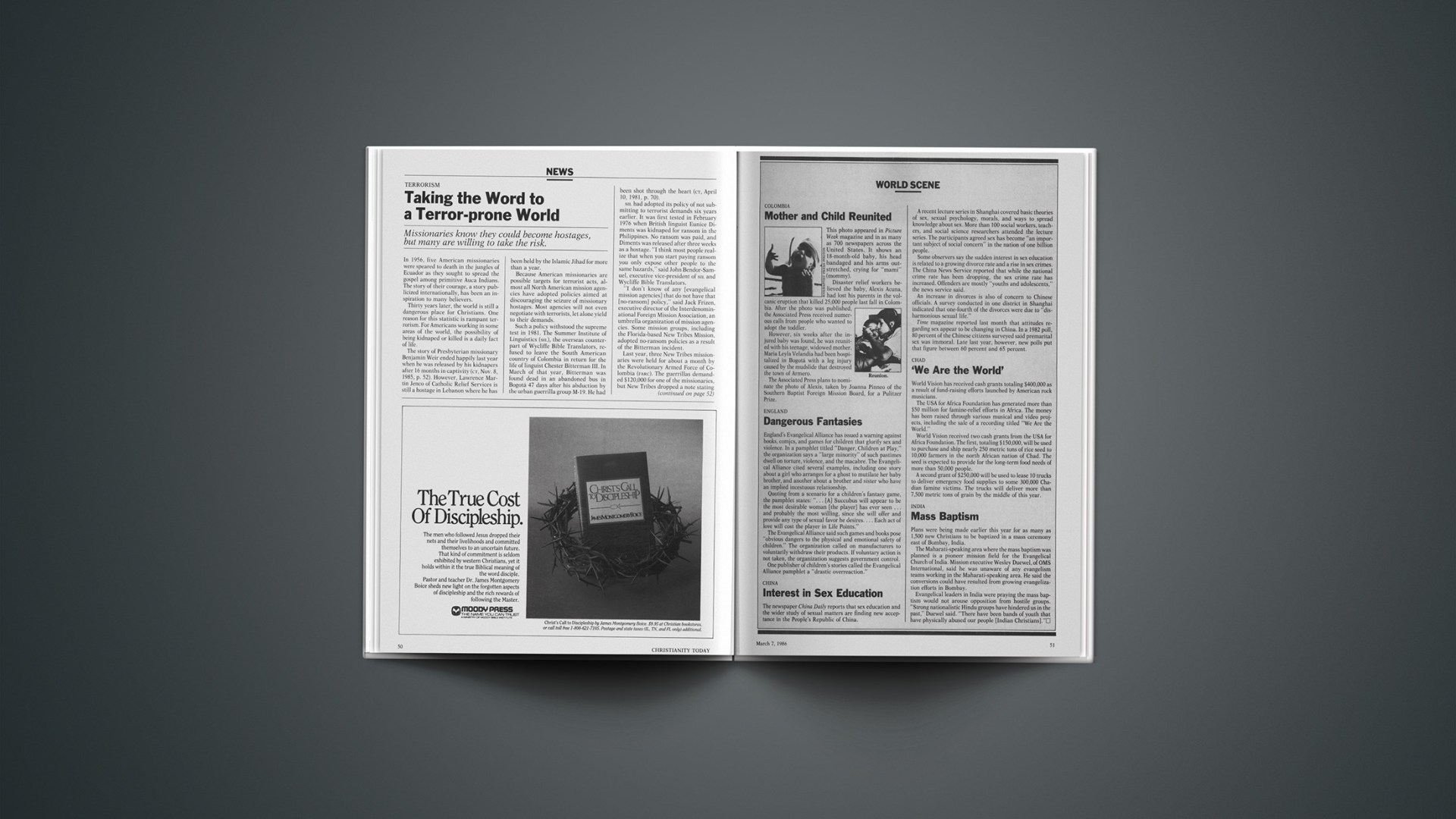
Taking the Word to a Terror-Prone World

Missionaries know they could become hostages, but many are willing to take the risk.

In 1956, five American missionaries were speared to death in the jungles of Ecuador as they sought to spread the gospel among primitive Auca Indians. The story of their courage, a story publicized internationally, has been an inspiration to many believers.

Thirty years later, the world is still a dangerous place for Christians. One reason for this statistic is rampant terrorism. For Americans working in some areas of the world, the possibility of being kidnaped or killed is a daily fact of life.

The story of Presbyterian missionary Benjamin Weir ended happily last year when he was released by his kidnapers after 16 months in captivity (CT, Nov. 8, 1985, p. 52). However, Lawrence Martin Jenco of Catholic Relief Services is still a hostage in Lebanon where he has been held by the Islamic Jihad for more than a year.

Because American missionaries are possible targets for terrorist acts, almost all North American mission agencies have adopted policies aimed at discouraging the seizure of missionary hostages. Most agencies will not even negotiate with terrorists, let alone yield to their demands.

Such a policy withstood the supreme test in 1981. The Summer Institute of Linguistics (SIL), the overseas counterpart of Wycliffe Bible Translators, refused to leave the South American country of Colombia in return for the life of linguist Chester Bitterman III. In March of that year, Bitterman was found dead in an abandoned bus in Bogota 47 days after his abduction by the urban guerrilla group M-19. He had been shot through the heart (CT, April 10, 1981, p. 70).

SIL had adopted its policy of not submitting to terrorist demands six years earlier. It was first tested in February 1976 when British linguist Eunice Diments was kidnaped for ransom in the Philippines. No ransom was paid, and Diments was released after three weeks as a hostage. “I think most people realize that when you start paying ransom you only expose other people to the same hazards,” said John Bendor-Samuel, executive vice-president of SIL and Wycliffe Bible Translators.

“I don’t know of any [evangelical mission agencies] that do not have that [no-ransom] policy,” said Jack Frizen, executive director of the Interdenominational Foreign Mission Association, an umbrella organization of mission agencies. Some mission groups, including the Florida-based New Tribes Mission, adopted no-ransom policies as a result of the Bitterman incident.

Last year, three New Tribes missionaries were held for about a month by the Revolutionary Armed Force of Colombia (FARC). The guerrillas demanded $120,000 for one of the missionaries, but New Tribes dropped a note stating that it would pay nothing. The three were eventually released unharmed.

In another instance in 1983, $ 100,000 was among the ransom demands of the South Sudanese Liberation Front, which was holding four missionaries, three of whom were affiliated with the Africa Committee for the Rehabilitation of the Southern Sudan (ACROSS). Nothing was paid, and Sudanese government commandos freed the missionaries two weeks after they were seized.

Africa Inland Mission (AIM), a founding member of ACROSS, also has a policy against paying ransom for kidnaped missionaries. “All of our people know that and have signed papers stating that [they know],” said Dave Hornberger, director of U.S. Ministries.

Peter Stam, U.S. director for AIM, said giving in to ransom demands is tantamount to paying a bribe. “Once they establish a bribe,” he said, “you’ll never get anywhere without a bribe.”

Catholic Relief Services (CRS) is one organization without a no-ransom rule. CRS representative Beth Griffin said the agency had never faced a hostage situation until the capture of Jenco, the director of CRS’s relief program in Lebanon. Griffin said CRS handles crises as they come. She added, “Having a policy would presume that the people doing this are acting rationally. These people aren’t always rational.”

The Presbyterian Church (U.S.A.) also has no strict policy against paying ransom. In fact, an emergency procedure policy permits missionaries to use church funds to pay ransom. However, Bill Rice, missions spokesman for the church, said it is unlikely that a missionary would spend church monies for ransom without consulting the church’s mission board. Rice said, “In one sense, all the resources of our church are available [to pay ransom], and in another sense we haven’t authorized a dime.”

WORLD SCENE

COLOMBIA

Mother and Child Reunited

This photo appeared in Picture Week magazine and in as many as 700 newspapers across the United States. It shows an 18-month-old baby, his head aandaged and his arms outstretched, crying for “mami” mommy).

Disaster relief workers believed the baby, Alexis Acuna, had lost his parents in the volcanic eruption that killed 25,000 people last fall in Colombia. After the photo was published, the Associated Press received numerous calls from people who wanted to adopt the toddler.

However, six weeks after the injured baby was found, he was reunited with his teenage, widowed mother.

Maria Leyla Velandia had been hospitalized in Bogota with a leg injury caused by the mudslide that destroyed the town of Armero.

The Associated Press plans to nominate the photo of Alexis, taken by Joanna Pinneo of the Southern Baptist Foreign Mission Board, for a Pulitzer Prize.

ENGLAND

Dangerous Fantasies

England’s Evangelical Alliance has issued a warning against books, comics, and games for children that glorify sex and violence. In a pamphlet titled “Danger, Children at Play,” the organization says a “large minority” of such pastimes dwell on torture, violence, and the macabre. The Evangelical Alliance cited several examples, including one story about a girl who arranges for a ghost to mutilate her baby brother, and another about a brother and sister who have an implied incestuous relationship.

Quoting from a scenario for a children’s fantasy game, the pamphlet states: “… [A] Succubus will appear to be the most desirable woman [the player] has ever seen … and probably the most willing, since she will offer and provide any type of sexual favor he desires.… Each act of love will cost the player in Life Points.”

The Evangelical Alliance said such games and books pose “obvious dangers to the physical and emotional safety of children.” The organization called on manufacturers to voluntarily withdraw their products. If voluntary action is not taken, the organization suggests government control.

One publisher of children’s stories called the Evangelical Alliance pamphlet a “drastic overreaction.”

CHINA

Interest in Sex Education

The newspaper China Daily reports that sex education and the wider study of sexual matters are finding new acceptance in the People’s Republic of China.

A recent lecture series in Shanghai covered basic theories of sex, sexual psychology, morals, and ways to spread knowledge about sex. More than 100 social workers, teachers, and social science researchers attended the lecture series. The participants agreed sex has become “an important subject of social concern” in the nation of one billion people.

Some observers say the sudden interest in sex education is related to a growing divorce rate and a rise in sex crimes. The China News Service reported that while the national crime rate has been dropping, the sex crime rate has increased. Offenders are mostly “youths and adolescents,” the news service said.

An increase in divorces is also of concern to Chinese officials. A survey conducted in one district in Shanghai indicated that one-fourth of the divorces were due to “disharmonious sexual life.”

Time magazine reported last month that attitudes regarding sex appear to be changing in China. In a 1982 poll, 80 percent of the Chinese citizens surveyed said premarital sex was immoral. Late last year, however, new polls put that figure between 60 percent and 65 percent.

CHAD

‘We Are the World’

World Vision has received cash grants totaling $400,000 as a result of fund-raising efforts launched by American rock musicians.

The USA for Africa Foundation has generated more than $50 million for famine-relief efforts in Africa. The money has been raised through various musical and video projects, including the sale of a recording titled “We Are the World.”

World Vision received two cash grants from the USA for Africa Foundation. The first, totaling $150,000, will be used to purchase and ship nearly 250 metric tons of rice seed to 10,000 farmers in the north African nation of Chad. The seed is expected to provide for the long-term food needs of more than 50,000 people.

A second grant of $250,000 will be used to lease 10 trucks to deliver emergency food supplies to some 300,000 Chadian famine victims. The trucks will deliver more than 7,500 metric tons of grain by the middle of this year.

INDIA

Mass Baptism

Plans were being made earlier this year for as many as 1,500 new Christians to be baptized in a mass ceremony east of Bombay, India.

The Maharati-speaking area where the mass baptism was planned is a pioneer mission field for the Evangelical Church of India. Mission executive Wesley Duewel, of OMS International, said he was unaware of any evangelism teams working in the Maharati-speaking area. He said the conversions could have resulted from growing evangelization efforts in Bombay.

Evangelical leaders in India were praying the mass baptism would not arouse opposition from hostile groups. “Strong nationalistic Hindu groups have hindered us in the past,” Duewel said. “There have been bands of youth that have physically abused our people [Indian Christians].”

Preparing For Trouble

Beyond trying to protect missionaries by adhering to a no-ransom policy, some mission organizations prepare their missionaries for possible trouble in the field. In 1983, SIL developed a three-day Contingency Preparation Seminar taught year-round in the 50 countries where SIL operates.

The seminar teaches missionaries how to handle hostage situations, including how to react to captors. Bendor-Samuel said missionaries are urged to talk to their captors, to assure them that a missionary presence in their country has nothing to do with financial or political gain.

Similarly, SIM International officials discuss crisis management techniques with missionaries at field conferences. These include suggestions that missionaries, if taken hostage, stand up for themselves instead of being submissive. John Cumbers, assistant to the general director, said this approach is more likely to help hostages gain the respect of their captors.

Missionaries are also encouraged to build relationships with their captors and suggest ideas for solving the captors’ problems. “The early relationship builds the foundation,” Cumbers said. “There’s no advantage in being belligerent.… Time is in favor of the hostage.”

The dangers of the mission field have not seemed to dampen enthusiasm of missionaries and candidates. Chet Bitterman’s wife, Brenda, has remarried and continues to work with SIL. She and her husband, Ken Jackson, conduct orientation sessions for new translators in Papua New Guinea, where they live with their three children, including Bitterman’s two daughters.

The Southern Baptist Foreign Mission Board reports that five new missionaries will go to strife-torn Lebanon this year. This is the highest number of new Southern Baptist missionaries to enter that country in a decade.

IFMA’s Frizen said the number of young people wanting to serve in the hazardous Muslim countries of North Africa and the Middle East is growing. “The emphasis on unreached people and frontiers has challenged our young people to live in a … difficult culture,” he said.

Ken Lloyd, candidate secretary at SIM International, said the mission field has always had its hazards and that the threat of becoming a hostage is simply another danger. “Maybe before it would be malaria, typhoid, diseases, and such,” he said. “I think [terrorism] makes people think a little more seriously about their maturity and commitment.”

MARK POPE

After 20 Years, Vatican II Still Draws Mixed Reviews

Some observers found hints of evangelical faith at the recent Catholic Synod of Bishops.

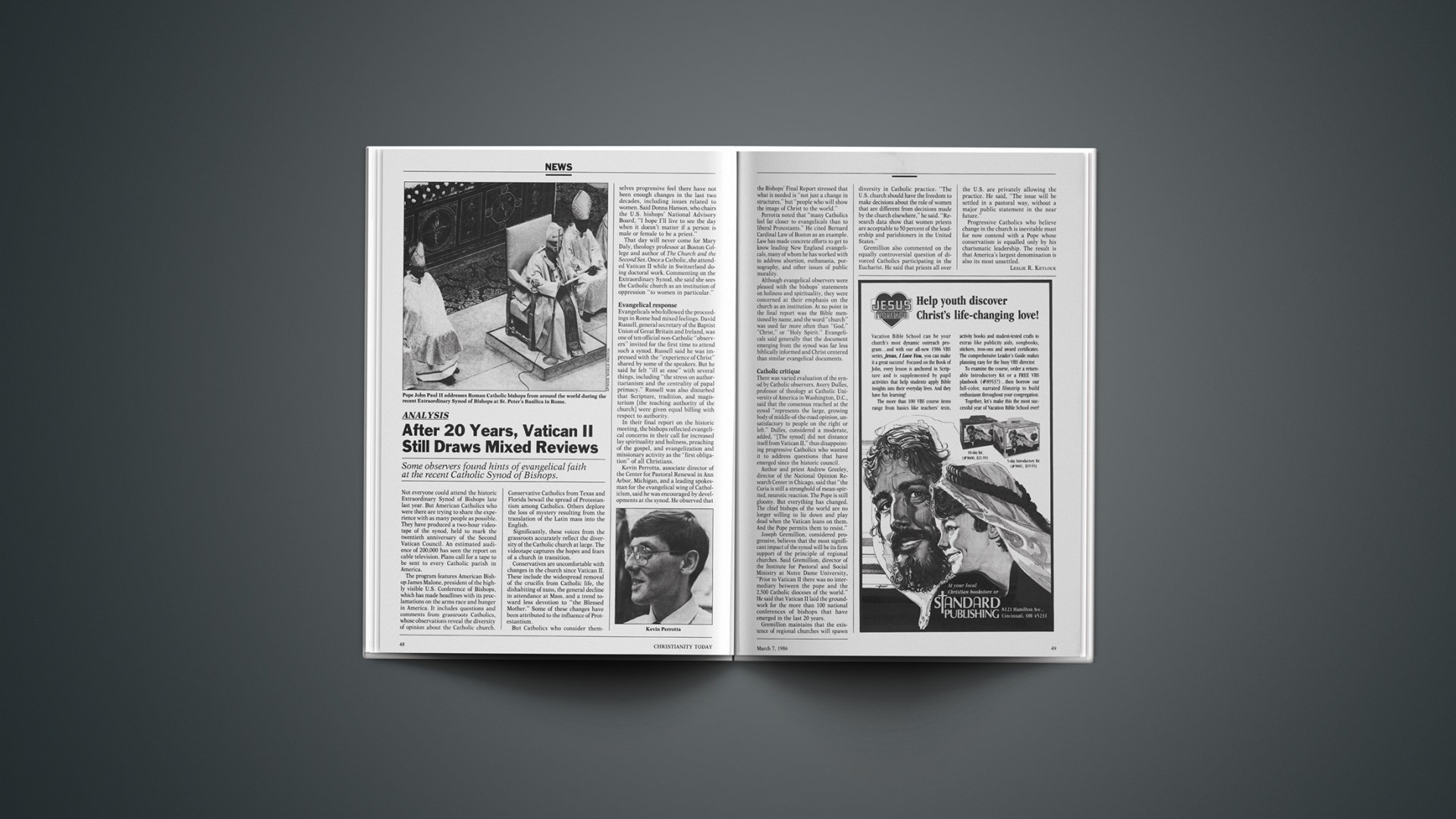
Not everyone could attend the historic Extraordinary Synod of Bishops late last year. But American Catholics who were there are trying to share the experience with as many people as possible. They have produced a two-hour videotape of the synod, held to mark the twentieth anniversary of the Second Vatican Council. An estimated audience of 200,000 has seen the report on cable television. Plans call for a tape to be sent to every Catholic parish in America.

The program features American Bishop James Malone, president of the highly visible U.S. Conference of Bishops, which has made headlines with its proclamations on the arms race and hunger in America. It includes questions and comments from grassroots Catholics, whose observations reveal the diversity of opinion about the Catholic church. Conservative Catholics from Texas and Florida bewail the spread of Protestantism among Catholics. Others deplore the loss of mystery resulting from the translation of the Latin mass into the English.

Significantly, these voices from the grassroots accurately reflect the diversity of the Catholic church at large. The videotape captures the hopes and fears of a church in transition.

Conservatives are uncomfortable with changes in the church since Vatican II. These include the widespread removal of the crucifix from Catholic life, the dishabiting of nuns, the general decline in attendance at Mass, and a trend toward less devotion to “the Blessed Mother.” Some of these changes have been attributed to the influence of Protestantism.

But Catholics who consider themselves progressive feel there have not been enough changes in the last two decades, including issues related to women. Said Donna Hanson, who chairs the U.S. bishops’ National Advisory Board, “I hope I’ll live to see the day when it doesn’t matter if a person is male or female to be a priest.”

That day will never come for Mary Daly, theology professor at Boston College and author of The Church and the Second Sex. Once a Catholic, she attended Vatican II while in Switzerland doing doctoral work. Commenting on the Extraordinary Synod, she said she sees the Catholic church as an institution of oppression “to women in particular.”

Evangelical Response

Evangelicals who followed the proceedings in Rome had mixed feelings. David Russell, general secretary of the Baptist Union of Great Britain and Ireland, was one of ten official non-Catholic “observers” invited for the first time to attend such a synod. Russell said he was impressed with the “experience of Christ” shared by some of the speakers. But he said he felt “ill at ease” with several things, including “the stress on authoritarianism and the centrality of papal primacy.” Russell was also disturbed that Scripture, tradition, and magisterium [the teaching authority of the church] were given equal billing with respect to authority.

In their final report on the historic meeting, the bishops reflected evangelical concerns in their call for increased lay spirituality and holiness, preaching of the gospel, and evangelization and missionary activity as the “first obligation” of all Christians.

Kevin Perrotta, associate director of the Center for Pastoral Renewal in Ann Arbor, Michigan, and a leading spokesman for the evangelical wing of Catholicism, said he was encouraged by developments at the synod. He observed that the Bishops’ Final Report stressed that what is needed is “not just a change in structures,” but “people who will show the image of Christ to the world.”

Perrotta noted that “many Catholics feel far closer to evangelicals than to liberal Protestants.” He cited Bernard Cardinal Law of Boston as an example. Law has made concrete efforts to get to know leading New England evangelicals, many of whom he has worked with to address abortion, euthanasia, pornography, and other issues of public morality.

Although evangelical observers were pleased with the bishops’ statements on holiness and spirituality, they were concerned at their emphasis on the church as an institution. At no point in the final report was the Bible mentioned by name, and the word “church” was used far more often than “God,” “Christ,” or “Holy Spirit.” Evangelicals said generally that the document emerging from the synod was far less biblically informed and Christ centered than similar evangelical documents.

Catholic Critique

There was varied evaluation of the synod by Catholic observers. Avery Dulies, professor of theology at Catholic University of America in Washington, D.C., said that the consensus reached at the synod “represents the large, growing body of middle-of-the-road opinion, unsatisfactory to people on the right or left.” Dulles, considered a moderate, added, “[The synod] did not distance itself from Vatican II,” thus disappointing progressive Catholics who wanted it to address questions that have emerged since the historic council.

Author and priest Andrew Greeley, director of the National Opinion Research Center in Chicago, said that “the Curia is still a stronghold of mean-spirited, neurotic reaction. The Pope is still gloomy. But everything has changed. The chief bishops of the world are no longer willing to lie down and play dead when the Vatican leans on them. And the Pope permits them to resist.”

Joseph Gremillion, considered progressive, believes that the most significant impact of the synod will be its firm support of the principle of regional churches. Said Gremillion, director of the Institute for Pastoral and Social Ministry at Notre Dame University, “Prior to Vatican II there was no intermediary between the pope and the 2,500 Catholic dioceses of the world.” He said that Vatican II laid the groundwork for the more than 100 national conferences of bishops that have emerged in the last 20 years.

Gremillion maintains that the existence of regional churches will spawn diversity in Catholic practice. “The U.S. church should have the freedom to make decisions about the role of women that are different from decisions made by the church elsewhere,” he said. “Research data show that women priests are acceptable to 50 percent of the leadership and parishioners in the United States.”

Gremillion also commented on the equally controversial question of divorced Catholics participating in the Eucharist. He said that priests all over the U.S. are privately allowing the practice. He said, “The issue will be settled in a pastoral way, without a major public statement in the near future.”

Progressive Catholics who believe change in the church is inevitable must for now contend with a Pope whose conservatism is equalled only by his charismatic leadership. The result is that America’s largest denomination is also its most unsettled.

LESLIE R. KEYLOCK

Apple PodcastsDown ArrowDown ArrowDown Arrowarrow_left_altLeft ArrowLeft ArrowRight ArrowRight ArrowRight Arrowarrow_up_altUp ArrowUp ArrowAvailable at Amazoncaret-downCloseCloseEmailEmailExpandExpandExternalExternalFacebookfacebook-squareGiftGiftGooglegoogleGoogle KeephamburgerInstagraminstagram-squareLinkLinklinkedin-squareListenListenListenChristianity TodayCT Creative Studio Logologo_orgMegaphoneMenuMenupausePinterestPlayPlayPocketPodcastRSSRSSSaveSaveSaveSearchSearchsearchSpotifyStitcherTelegramTable of ContentsTable of Contentstwitter-squareWhatsAppXYouTubeYouTube