Books

Book Briefs: April 10, 1964

How Bultmann Set His Course

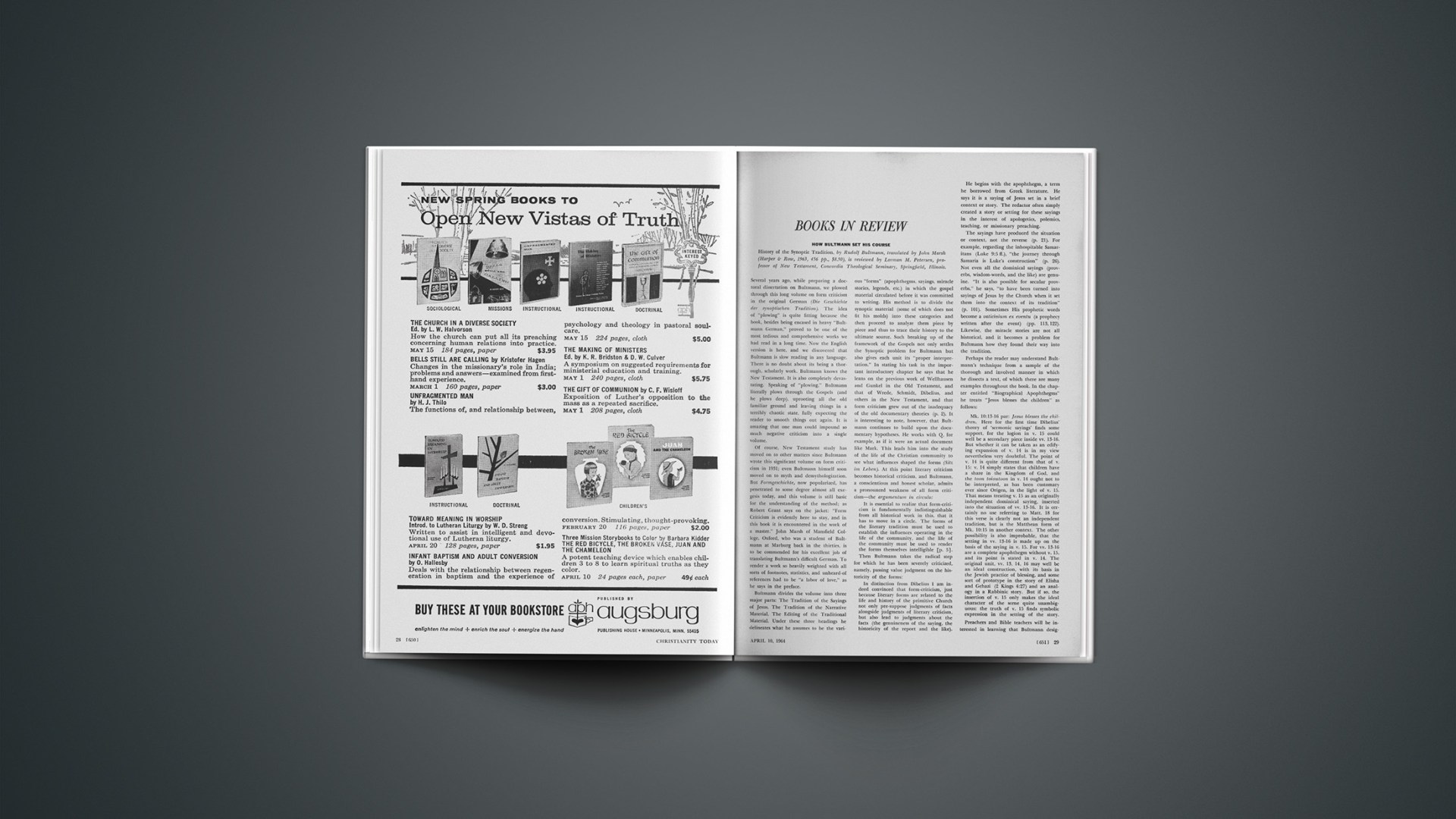
History of the Synoptic Tradition, by Rudolf Bultmann, translated by John Marsh (Harper & Row, 1963, 456 pp., $8.50), is reviewed by Lorman M. Petersen, professor of New Testament, Concordia Theological Seminary, Springfield, Illinois.

Several years ago, while preparing a doctoral dissertation on Bultmann, we plowed through this long volume on form criticism in the original German (Die Geschichte der synoptischen Tradition). The idea of “plowing” is quite fitting because the book, besides being encased in heavy “Bultmann German,” proved to be one of the most tedious and comprehensive works we had read in a long time. Now the English version is here, and we discovered that Bultmann is slow reading in any language. There is no doubt about its being a thorough, scholarly work. Bultmann knows the New Testament. It is also completely devastating. Speaking of “plowing,” Bultmann literally plows through the Gospels (and he plows deep), uprooting all the old familiar ground and leaving things in a terribly chaotic state, fully expecting the reader to smooth things out again. It is amazing that one man could impound so much negative criticism into a single volume.

Of course, New Testament study has moved on to other matters since Bultmann wrote this significant volume on form criticism in 1931; even Bultmann himself soon moved on to myth and demythologization. But Formgeschichte, now popularized, has penetrated to some degree almost all exegesis today, and this volume is still basic for the understanding of the method; as Robert Grant says on the jacket: “Form Criticism is evidently here to stay, and in this book it is encountered in the work of a master.” John Marsh of Mansfield College, Oxford, who was a student of Bultmann at Marburg back in the thirties, is to be commended for his excellent job of translating Bultmann’s difficult German. To render a work so heavily weighted with all sorts of footnotes, statistics, and unheard-of references had to be “a labor of love,” as he says in the preface.

Bultmann divides the volume into three major parts: The Tradition of the Sayings of Jesus, The Tradition of the Narrative Material. The Editing of the Traditional Material. Under these three headings he delineates what he assumes to be the various “forms” (apophthegms, sayings, miracle stories, legends, etc.) in which the gospel material circulated before it was committed to writing. His method is to divide the synoptic material (some of which does not fit his molds) into these categories and then proceed to analyze them piece by piece and thus to trace their history to the ultimate source. Such breaking up of the framework of the Gospels not only settles the Synoptic problem for Bultmann but also gives each unit its “proper interpretation.” In stating his task in the important introductory chapter he says that he leans on the previous work of Wellhausen and Gunkel in the Old Testament, and that of Wrede, Schmidt, Dibelius, and others in the New Testament, and that form criticism grew out of the inadequacy of the old documentary theories (p. 2). It is interesting to note, however, that Bultmann continues to build upon the documentary hypotheses. He works with Q, for example, as if it were an actual document like Mark. This leads him into the study of the life of the Christian community to see what influences shaped the forms (Sitz im Leben). At this point literary criticism becomes historical criticism, and Bultmann, a conscientious and honest scholar, admits a pronounced weakness of all form criticism—the argumentum in circulo:

It is essential to realize that form-criticism is fundamentally indistinguishable from all historical work in this, that it has to move in a circle. The forms of the literary tradition must be used to establish the influences operating in the life of the community, and the life of the community must be used to render the forms themselves intelligible [p. 5]

Then Bultmann takes the radical step for which he has been severely criticized, namely, passing value judgment on the historicity of the forms:

In distinction from Dibelius I am indeed convinced that form-criticism, just because literary forms are related to the life and history of the primitive Church not only pre-suppose judgments of facts alongside judgments of literary criticism, but also lead to judgments about the facts (the genuineness of the saying, the historicity of the report and the like).

He begins with the apophthegm, a term he borrowed from Greek literature. He says it is a saying of Jesus set in a brief context or story. The redactor often simply created a story or setting for these sayings in the interest of apologetics, polemics, teaching, or missionary preaching.

The sayings have produced the situation or context, not the reverse (p. 21). For example, regarding the inhospitable Samaritans (Luke 9:5 ff.), “the journey through Samaria is Luke’s construction” (p. 26). Not even all the dominical sayings (proverbs, wisdom-words, and the like) are genuine. “It is also possible for secular proverbs,” he says, “to have been turned into sayings of Jesus by the Church when it set them into the context of its tradition” (p. 101). Sometimes His prophetic words become a vaticinium ex eventu (a prophecy written after the event) (pp. 113, 122). Likewise, the miracle stories are not all historical, and it becomes a problem for Bultmann how they found their way into the tradition.

Perhaps the reader may understand Bultmann’s technique from a sample of the thorough and involved manner in which he dissects a text, of which there are many examples throughout the book. In the chapter entitled “Biographical Apophthegms” he treats “Jesus blesses the children” as follows:

Mk. 10:13–16 par: Jesus blesses the children. Here for the first time Dibelius’ theory of ‘sermonic sayings’ finds some support, for the logion in v. 15 could well be a secondary piece inside vv. 13–16. But whether it can be taken as an edifying expansion of v. 14 is in my view nevertheless very doubtful. The point of v. 14 is quite different from that of v. 15: v. 14 simply states that children have a share in the Kingdom of God, and the toon toioutoon in v. 14 ought not to be interpreted, as has been customary ever since Origen, in the light of v. 15. That means treating v. 15 as an originally independent dominical saying, inserted into the situation of vv. 13–16. It is certainly no use referring to Matt. 18 for this verse is clearly not an independent tradition, but is the Matthean form of Mk. 10:15 in another context. The other possibility is also improbable, that the setting in vv. 13–16 is made up on the basis of the saying in v. 15. For vv. 13–16 are a complete apophthegm without v. 15, and its point is stated in v. 14. The original unit, vv. 13, 14, 16 may well be an ideal construction, with its basis in the Jewish practice of blessing, and some sort of prototype in the story of Elisha and Gehazi (2 Kings 4:27) and an analogy in a Rabbinic story. But if so, the insertion of v. 15 only makes the ideal character of the scene quite unambiguous: the truth of v. 15 finds symbolic expression in the setting of the story.

Preachers and Bible teachers will be interested in learning that Bultmann designates the familiar narrative material of the Gospels as legendary. He defines a legend as those parts of the tradition which are not miracle stories in the proper sense, and instead of being historical are religious and edifying (p. 244). The Last Supper is a cult legend. The baptism of Jesus may be historical, “but the story as we have it must be classified as legend” (p. 246). The Temptation is a legend which perhaps goes back to the nature myths of the kind that tell of Marduk’s fight with the dragon of Chaos or to the tales of the “Temptation of Holy Men” like those told of Buddha (p. 253). (However, Bultmann shows his exegetical genius by the valuable insights he gives one of the temptations of Jesus.) The Transfiguration was once a resurrection story. The Triumphal Entry and most of the Passion history is legendary. He considers the death of Jesus as probably historical but says “it is strongly disfigured by legend.” The same is true of the Easter narratives (especially the story of the empty tomb) and the infancy narratives.

The reader should pay particular attention to Bultmann’s summary chapter, “Conclusion” (pp. 368 ff.) in which he says that while the gospel tradition had its origin in the primitive Palestinian church, it was shaped by the Hellenistic church. The tradition, in turn, can only be understood in terms of the Christian kerygma, which the Gospels merely illustrated and expanded. He epitomizes his views in the following paragraph, which should be read carefully for all of its implications:

The Christ who is preached is not the historical Jesus, but the Christ of faith and the cult. Hence in the foreground of the preaching of Christ stands the death and resurrection of Jesus Christ as the saving acts which are known by faith and become effective for the believer in Baptism and the Lord’s Supper. Thus the kerygma of Christ is cultic legend and the Gospels are expanded cult legends [p. 370].

Our assessment of Bultmann’s form criticism is mainly negative. One has to be frightfully uncritical to accept what Bultmann offers with so little evidence. It seems to be the old historical criticism in new dress. It is not only a solution of the Synoptic problem but also the dissolution of the Gospels themselves. It is true that we must face the fact that the first Gospel was oral, and form criticism may throw light on the oral period of the Gospel. If there were these pericopes perhaps they take us to the very headwaters of our Gospels; but these findings are prostituted by the radical example of Bultmann. For instance, the form of a story does not tell us whether it is true or false. Bultmann’s method is much more radical than any harmonizations of the Gospels have ever been. He wishes to rewrite the New Testament according to his own assumptions, and the Gospels become a patchwork. He assumes the role of a ghost writer redoing a posthumous novel. His method is not exegesis but geology of the text. Thus we believe that most of the criticism aimed at Bultmann has been justified. It is a very arbitrary method. Those who use form criticism to interpret Scripture should realize this. But perhaps our greatest disappointment in Bultmann is that the origin of the Christian religion takes place on a horizontal plane—never do we hear him speak of the influence of God’s Holy Spirit on the writers of the Gospels. The blessed Gospel is cut off from the dynamic of the Holy Spirit. We must ask, if faith created the Gospels, what created the faith? Thus it was but a stone’s throw for Bultmann to go from radical form criticism to demythologization. But that is another story. We would, however, appeal to pastors and teachers to study this volume and see for themselves. Fortunately, the barrier of the German is now gone, and many more will be able to do this.

LORMAN M. PETERSEN

Good On England

Anatomy of Britain, by Anthony Sampson (Harper & Row, 1962, 662 pp., $7.50), is reviewed by J. D. Douglas, British editorial director, CHRISTIANITY TODAY.

The publishers state that this book will give American readers a clear and penetrating picture of British leaders and institutions. Mr. Sampson, who calls himself “an enquiring journalist,” contradicts his title at the outset when he disclaims any intention of dealing with “the life of the ordinary people.” He is concerned only with the managers. With assurance and professional expertise he runs through such divergent subjects as royalty, advertising, the press, the law, insurance companies, and the much maligned honors system, which underlines that we are not all equal after all. He has one tremendous swipe at Harold Macmillan, who, he asserts, “looks down on people (like Hugh Gaitskell) who have never led a platoon of men into battle …” (p. 324).

American readers of Scottish or Welsh ancestry will quickly discover that, again despite the title, this volume is concerned almost exclusively with England, and that the writer has a quite inordinate preoccupation with Oxford and Cambridge, which seem to worm their way into chapters where they have no right to be. Only once is the English monopoly broken: in the somewhat gossipy chapter on churches, where twenty-eight lines are devoted to the Church of Scotland (nine pages to the Church of England). This is no unmixed blessing, for into this niggardly allocation Mr. Sampson has contrived to cram four major and five minor mistakes.

With true Anglican arrogance he calls the nonconformist churches “sects,” and for some reason finds it necessary to state that “there is no real Methodist aristocracy.” It would have been better had he defined his terms also in describing the present Archbishop of York as an “evangelical”—a designation sure to raise a few quizzical eyebrows. Welshmen will be delighted to learn from the index that universities have somehow sprouted up at Aberystwyth, Bangor, Cardiff, and Swansea. The reviewer wishes to complain that the name of his own university is spelled wrong every time, and to refute the canard that its students wear “multi-coloured gowns.”

Handled carefully, this could be a useful compendium, but he who seeks objectivity here will look in vain; at the end of the day the reader is left in no doubt about Mr. Sampson’s own interests and prejudices.

J. D. DOUGLAS

Light On Apostasy

The Disappearance of God, by J. Hillis Miller (Harvard, 1963, 359 pp., $7.50), is reviewed by Stanley Wiersma, associate professor of English, Calvin College, Grand Rapids, Michigan.

Since the Renaissance, God has been disappearing from the corporate consciousness of Western Man. Professor Miller limits his study to the nineteenth-century phase of God’s disappearance, tracing that phenomenon through the works of five English writers: De Quincey, R. Browning, E. Brontë, Arnold, and Hopkins.

Each of these writers believes in the existence of God, each is impressed with how far away God seems, and each is desperate to establish contact again. De Quincey attempts to establish contact with God’s infinity through total-recall opium experiences, through experience of the predetermined perfection of great musical forms, and through development of a writing style that is intended to be a human equivalent for God’s existence; but memory of lost joy by opium turns out to be painful, music is bound to time and space, and a prose style that reflects eternity becomes simply vapid. Browning keeps shifting his identity from dramatic monologue to dramatic monologue in a desperate attempt to be all mankind, to approach God’s infinity; but becoming all, Browning only becomes less himself. Emily Brontë sees her world as a kennel, for God has left man and man has reverted to bestiality; but even if a person’s union with another person, or with nature, or with God, can temporarily restore his humanity, such unions are not common. The loss of humanity (and divinity) is attributed to specific causes by M. Arnold: industrialism, science, and urbanization. While E. Brontë becomes dramatically violent, Arnold becomes passively despairing; himself a victim of modernity, he demands new, virile poetry but cannot produce it. Of the writers treated only Hopkins comes to be happily familiar with God, immediately after his conversion to Catholicism, but even he falls into the time’s despair in later poems—impatient with his own imperfections, impatient with his isolation from God, and impatient for the final judgment.

Literary students will admire the book’s careful, balanced approach. Dr. Miller avoids the one-sidedness of explicating works out of context on the one hand, and of providing historical background at the expense of explicating works on the other. Allowing that each literary piece has integrity by itself, Professor Miller nevertheless addresses himself primarily in this book to a consistent interpretation of each writer’s whole corpus. Only in terms of a writer’s whole lifetime of development are individual works given intensive explication. By this method Professor Miller again and again illuminates works that “everybody knows.” This reviewer, for instance, will return often to the careful analyses of Brontë’s Wuthering Heights and of Hopkins’s “Pied Beauty.” Professor Miller’s method deserves imitation.

A major value of the book to Christians will be its concrete demonstration that God’s disappearance is accompanied by man’s ignorance or willfulness in looking. God’s disappearance is inevitably man’s failure or refusal to see Him as he has revealed himself.

Clergymen will find the book useful because of its abundant supply of illustrations for various kinds and degrees of apostasy. One does so weary of Henley’s “Invictus.”

STANLEY WIERSMA

Sane And Useful

Three Crucial Decades: Studies in the Book of Acts, by Floyd V. Filson (John Knox, 1963, 118 pp., $3), is reviewed by James P. Martin, associate professor of New Testament, Union Theological Seminary in Virginia, Richmond.

This work by the professor of New Testament at McCormick Seminary, representing the Smyth lectures delivered at Columbia Theological Seminary, is a sane and useful guide to the study of the theology and historical understanding of Luke in the Book of Acts.

The author believes that Acts is indispensable to any consistent and convincing account of the emergence and expansion of apostolic Christianity and is, on the whole, a reliable guide to the history of the primitive Church. The title, Three Crucial Decades, provides a broad framework of a thirty-year period, but it does not describe the essential contents of the book, since the decades are not developed individually or together in any detail. This scheme appears to rest upon Gregory Dix’s use of three decades in his excellent work, Jew and Greek, but the similarity is purely formal.

In the material content of his studies, Dr. Filson treats first the scope, purpose, and impact of the Book of Acts. He is aware of the views of critical scholarship on Acts but does not spend his time debating directly with others; rather, his own purpose is to provide a synthetic result embodying his own critical opinions at many points. The theology of Luke is centered on Resurrection, Ascension (exaltation), and the Spirit. The speeches in Acts are not taped reproductions of what was said but summaries or frameworks of what was generally said. As an outline of Acts, Filson prefers C. H. Turner’s six-fold panel outline, with each panel concluding with a summary of the progress of the Gospel. He does not feel that Acts 1:8 or the Peter-Paul dichotomy provides the key to the structure of the book. He cautions us wisely that outlines do not give proper expression to the important role of the sermon summaries and speeches in the total book. After pointing out the curious amount of space (9½ chapters) given to Paul’s final journey to Rome, Filson concludes (in chapter 5) that this is in the nature of an apology. He emphasizes, furthermore, his opinion that for Luke it was Paul’s preaching, not Peter’s, that effectively established and directly attested the apostolic preaching in Rome. This may be an overdrawn conclusion not easily harmonized with the historical fact that the church at Rome is pre-Pauline (or non-Pauline) in origin.

C. H. Dodd’s work on the apostolic preaching, which has had such an influence in New Testament studies by showing that from the first the Church preached a Gospel of salvation that embodied a high Christology, is discussed at some length in chapter 2. Filson, on the whole, agrees with Dodd, but he disagrees at points. He thinks that Dodd’s distinction of preaching and teaching is not supported by Acts. Acts shows that the apostles taught, argued, disputed, discussed, and so on, and Filson uses this information to correct the Bultmannian over-emphasis on preaching as pure announcement that calls for a decision only and no questions!

Other chapters are devoted to Peter and the Twelve, James and Jewish Christianity, Paul and the Gentile mission. Filson finds no support at all in Acts for any practice of apostolic succession from the Twelve. Paul himself shatters any neat pattern of succession. There is no fixed polity laid down by the Twelve and so planned as to establish a “regular” ministry. “The theme of Acts is that the Spirit guided the church and its existing leaders to take the steps which enabled the church to express its witness and live a life of loyalty to Christ.”

Jewish Christianity is described in a way that does justice to only part of the “Jewishness” of the primitive Church. By restriction of the term to those Christians who included the keeping of the Mosaic law, the theological and historical significance of the origins of the Christian Church within Israel is somewhat reduced, so that traditional Protestant patterns of James vs. Paul are perpetuated. The suggestion (p. 83) that James’s real concern was the protection of Jewish Christians and not the coercion of Gentile Christians deserves to be elaborated. By assuming that James was consistently faithful to the ceremonial law, Filson concludes that, since this faithfulness is not reflected in the Letter of James, this letter is not from James and is therefore of no help in interpreting James. This conclusion will probably be contested. For, assuming that the letter reflects James’s true spiritual concern, one could use it to “correct” an interpretation that does not do justice to James’s interest for the true unity of the Church composed of Jew and Greek. Readers should consult Adolf Schlatter’s The Church in the New Testament Period for another view of James and Jewish Christianity.

This book is a worthwhile addition to literature on Acts and the apostolic Church. It should open up Luke’s historical work for many.

JAMES P. MARTIN

Book Briefs

Free in Obedience, by William Stringfellow (Seabury, 1964, 128 pp., $2.75). In essays that strike sparks, a layman theologizes about the demonic tyrannies in human life and institutions and about the freedom that comes in the Gospel.

The Bible Story Book, by Bethann Van Ness (Broadman, 1963, 672 pp., $4.95). A retelling of the whole biblical narrative in language the eight to twelve-year-old can read, and younger children can understand, marked by fidelity to the Scriptures. Large legible print, with art work and a valuable supplement explaining life in Bible times.

Justus Jonas, Loyal Reformer, by Martin E. Lehmann (Augsburg, 1963, 208 pp., $4). The story of the life and work of a collaborator of Luther who energetically helped shape and extend the cause of the Reformation.

Personalities around Jesus, by William P. Barker (Revell, 1963, 156 pp., $2.95). Fresh thought in sparkling style.

The Infertile Period, by John Marshall (Helicon, 1963, 118 pp., $2.95). All about how a woman can take her temperature, have sexual relations but not pregnancies. Beside the thermometer, she will need the mind of a mathematician and the memory of a computer. Success would seem contingent on a rare combination.

A Reader for Parents: A Selection of Creative Literature about Childhood, selected and edited by the Child Study Association of America, introduction and comment by Anna W. M. Wolf (W. W. Norton, 1963, 463 pp., $8.95).

Personalities around the Cross, by H. H. Hargrove (Baker, 1963, 138 pp., $2.50). Evangelical essays, theologically and organizationally careless.

Christ the Sacrament of the Encounter with God, by Edward Schillebeeckx (Sheed & Ward, 1963, 222 pp., $4.50). A Roman Catholic presents a personalistic interpretation of the sacraments. A translation from the original Dutch, Christus, Sacrament van de Godsontmoeting. For the professional scholar.

The Speaker’s Treasury of 400 Quotable Quotes, compiled by Croft M. Pentz (Zondervan, 1963, 159 pp., $2.95). Just what the title claims; the church school teacher and the man of the pulpit will often find it useful.

The Epistle of Paul to the Ephesians (from “The Tyndale Bible Commentaries”), introduction and commentary by Francis Foulkes (Eerdmans, 1963, 182 pp., $3). A concise, workable tool for laymen, teachers, and ministers.

The Miracles of Golgotha, by Homer H. Boese (Baker, 1963, 143 pp., $2.95). Informative, biblical essays that probe the religious meaning of the miracles surrounding the Cross and the Resurrection.

Christian Faith and Greek Philosophy, by A. H. Armstrong and R. A. Markus (Sheed & Ward, 1960, 162 pp., $3.50). Authors compare, contrast and evaluate those ideas where Christianity and Greek thought confront each other, such as eros, time, knowledge, and the like. Good reading for the student with philosophical curiosity.

Faith Is a Star, by Roland Gammon (E. P. Dutton, 1963, 243 pp., $3.95). The personal religious philosophies and contemporary achievements of prominent Americans of our day—originally expressed on the international radio broadcast, “Master Control.”

Over-Shadowed Journey, by Kazuo Kaneda (Hope Press [Tokyo, Japan], 1964, 159 pp., $2.50). Story of the wartime experiences of a Japanese minister.

Paperbacks

The Social Humanism of Calvin, by André Biéler (John Knox, 1964, 80 pp., $1.50). A short summary of the social ethics of Calvin by a lecturer at the University of Geneva. The reader will see faces of Calvin that sometimes differ from the inherited image.

The Death Penalty in America, edited by Hugo Adam Bedau (Doubleday, 1964, 586 pp., $1.95). Several essays by the author, who opposes the death penalty, plus several by authorities who favor it. A valuable study.

Mental Health and Segregation, by Martin M. Grossack (Springer, 1963, 247 pp., $4). An extensive collection of studies and writings on the effects of racial segregation on Negro mental health.

Constitution on the Sacred Liturgy, by the Second Vatican Council (Liturgical Press, 1963, 64 pp., $.50). A bilingual edition (Latin and English); highly informative for Protestants interested in the liturgical matters brought before the Second Vatican Council.

Persons and Places: The Background of My Life, by George Santayana (Scribner’s, 1964, 262 pp., $1.45).

Moll Ta-iu: “Man of Great Plans,” by Eva M. Moseley (Christian Publications, 1963, 224 pp., $1.50). The biography of Dr. Thomas Moseley, missionary-educator.

Facing Facts in Modern Missions, a symposium (Moody, 1963, 141 pp., $1.75). A discussion of missions in which answers are given to many of the questions currently under discussion within the ecumenical movement and mainline denominations. Profitable reading.

Roman Catholicism and the Bible, by Olivier Beguin (Association, 1963, 95 pp., $1.50). A factual survey of the Bible movement in Roman Catholicism, with detailed information about how the Bible is used in that church in many parts of the world. A valuable study. The author is general secretary of the United Bible Societies.

The Cambridge Greek Testament Commentary: The Gospel According to St. Mark, edited by C. F. D. Moule, commentary by C. E. B. Cranfield (Cambridge, 1963, 494 pp., $2.95). First published in 1959.

Ideas

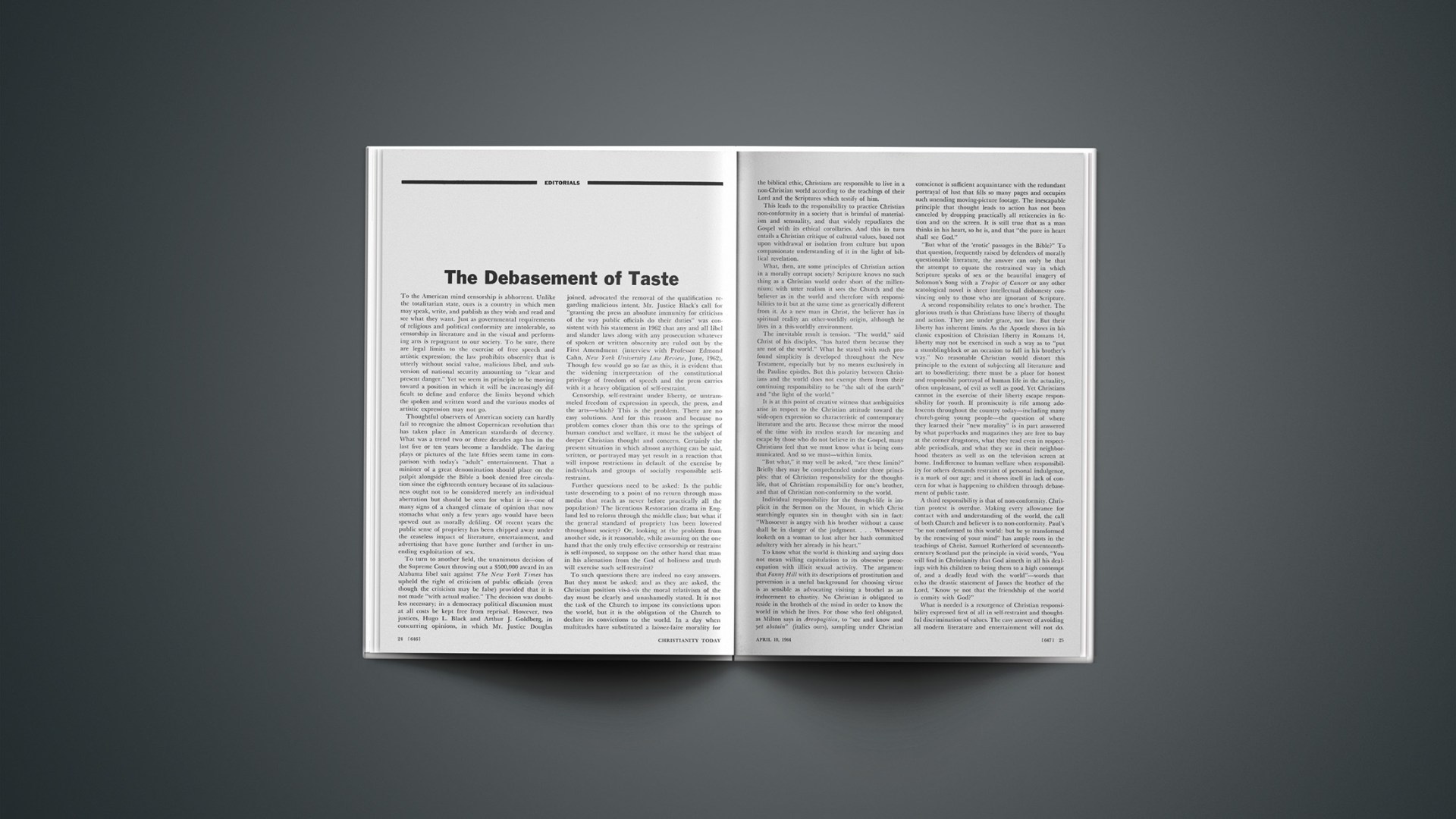
The Debasement of Taste

To the American mind censorship is abhorrent. Unlike the totalitarian state, ours is a country in which men may speak, write, and publish as they wish and read and see what they want. Just as governmental requirements of religious and political conformity are intolerable, so censorship in literature and in the visual and performing arts is repugnant to our society. To be sure, there are legal limits to the exercise of free speech and artistic expression; the law prohibits obscenity that is utterly without social value, malicious libel, and subversion of national security amounting to “clear and present danger.” Yet we seem in principle to be moving toward a position in which it will be increasingly difficult to define and enforce the limits beyond which the spoken and written word and the various modes of artistic expression may not go.

Thoughtful observers of American society can hardly fail to recognize the almost Copernican revolution that has taken place in American standards of decency. What was a trend two or three decades ago has in the last five or ten years become a landslide. The daring plays or pictures of the late fifties seem tame in comparison with today’s “adult” entertainment. That a minister of a great denomination should place on the pulpit alongside the Bible a book denied free circulation since the eighteenth century because of its salaciousness ought not to be considered merely an individual aberration but should be seen for what it is—one of many signs of a changed climate of opinion that now stomachs what only a few years ago would have been spewed out as morally defiling. Of recent years the public sense of propriety has been chipped away under the ceaseless impact of literature, entertainment, and advertising that have gone further and further in unending exploitation of sex.

To turn to another field, the unanimous decision of the Supreme Court throwing out a $500,000 award in an Alabama libel suit against The New York Times has upheld the right of criticism of public officials (even though the criticism may be false) provided that it is not made “with actual malice.” The decision was doubtless necessary; in a democracy political discussion must at all costs be kept free from reprisal. However, two justices, Hugo L. Black and Arthur J. Goldberg, in concurring opinions, in which Mr. Justice Douglas joined, advocated the removal of the qualification regarding malicious intent. Mr. Justice Black’s call for “granting the press an absolute immunity for criticism of the way public officials do their duties” was consistent with his statement in 1962 that any and all libel and slander laws along with any prosecution whatever of spoken or written obscenity are ruled out by the First Amendment (interview with Professor Edmond Cahn, New York University Law Review, June, 1962), Though few would go so far as this, it is evident that the widening interpretation of the constitutional privilege of freedom of speech and the press carries with it a heavy obligation of self-restraint.

Censorship, self-restraint under liberty, or untrammeled freedom of expression in speech, the press, and the arts—which? This is the problem. There are no easy solutions. And for this reason and because no problem comes closer than this one to the springs of human conduct and welfare, it must be the subject of deeper Christian thought and concern. Certainly the present situation in which almost anything can be said, written, or portrayed may yet result in a reaction that will impose restrictions in default of the exercise by individuals and groups of socially responsible self-restraint.

Further questions need to be asked: Is the public taste descending to a point of no return through mass media that reach as never before practically all the population? The licentious Restoration drama in England led to reform through the middle class; but what if the general standard of propriety has been lowered throughout society? Or, looking at the problem from another side, is it reasonable, while assuming on the one hand that the only truly effective censorship or restraint is self-imposed, to suppose on the other hand that man in his alienation from the God of holiness and truth will exercise such self-restraint?

To such questions there are indeed no easy answers. But they must be asked; and as they are asked, the Christian position vis-à-vis the moral relativism of the day must be clearly and unashamedly stated. It is not the task of the Church to impose its convictions upon the world, but it is the obligation of the Church to declare its convictions to the world. In a day when multitudes have substituted a laissez-faire morality for the biblical ethic, Christians are responsible to live in a non-Christian world according to the teachings of their Lord and the Scriptures which testify of him.

This leads to the responsibility to practice Christian non-conformity in a society that is brimful of materialism and sensuality, and that widely repudiates the Gospel with its ethical corollaries. And this in turn entails a Christian critique of cultural values, based not upon withdrawal or isolation from culture but upon compassionate understanding of it in the light of biblical revelation.

What, then, are some principles of Christian action in a morally corrupt society? Scripture knows no such thing as a Christian world order short of the millennium; with utter realism it sees the Church and the believer as in the world and therefore with responsibilities to it but at the same time as generically different from it. As a new man in Christ, the believer has in spiritual reality an other-worldly origin, although he lives in a this-worldly environment.

The inevitable result is tension. “The world,” said Christ of his disciples, “has hated them because they are not of the world.” What he stated with such profound simplicity is developed throughout the New Testament, especially but by no means exclusively in the Pauline epistles. But this polarity between Christians and the world does not exempt them from their continuing responsibility to be “the salt of the earth” and “the light of the world.”

It is at this point of creative witness that ambiguities arise in respect to the Christian attitude toward the wide-open expression so characteristic of contemporary literature and the arts. Because these mirror the mood of the time with its restless search for meaning and escape by those who do not believe in the Gospel, many Christians feel that we must know what is being communicated. And so we must—within limits.

“But what,” it may well be asked, “are these limits?” Briefly they may be comprehended under three principles: that of Christian responsibility for the thought-life, that of Christian responsibility for one’s brother, and that of Christian non-conformity to the world.

Individual responsibility for the thought-life is implicit in the Sermon on the Mount, in which Christ searchingly equates sin in thought with sin in fact: “Whosoever is angry with his brother without a cause shall be in danger of the judgment.… Whosoever looketh on a woman to lust after her hath committed adultery with her already in his heart.”

To know what the world is thinking and saying does not mean willing capitulation to its obsessive preoccupation with illicit sexual activity. The argument that Fanny Hill with its descriptions of prostitution and perversion is a useful background for choosing virtue is as sensible as advocating visiting a brothel as an inducement to chastity. No Christian is obligated to reside in the brothels of the mind in order to know the world in which he lives. For those who feel obligated, as Milton says in Areopagitica, to “see and know and yet abstain” (italics ours), sampling under Christian conscience is sufficient acquaintance with the redundant portrayal of lust that fills so many pages and occupies such unending moving-picture footage. The inescapable principle that thought leads to action has not been canceled by dropping practically all reticencies in fiction and on the screen. It is still true that as a man thinks in his heart, so he is, and that “the pure in heart shall see God.”

“But what of the ‘erotic’ passages in the Bible?” To that question, frequently raised by defenders of morally questionable literature, the answer can only be that the attempt to equate the restrained way in which Scripture speaks of sex or the beautiful imagery of Solomon’s Song with a Tropic of Cancer or any other scatological novel is sheer intellectual dishonesty convincing only to those who are ignorant of Scripture.

A second responsibility relates to one’s brother. The glorious truth is that Christians have liberty of thought and action. They are under grace, not law. But their liberty has inherent limits. As the Apostle shows in his classic exposition of Christian liberty in Romans 14, liberty may not be exercised in such a way as to “put a stumblingblock or an occasion to fall in his brother’s way.” No reasonable Christian would distort this principle to the extent of subjecting all literature and art to bowdlerizing; there must be a place for honest and responsible portrayal of human life in the actuality, often unpleasant, of evil as well as good. Yet Christians cannot in the exercise of their liberty escape responsibility for youth. If promiscuity is rife among adolescents throughout the country today—including many church-going young people—the question of where they learned their “new morality” is in part answered by what paperbacks and magazines they are free to buy at the corner drugstores, what they read even in respectable periodicals, and what they see in their neighborhood theaters as well as on the television screen at home. Indifference to human welfare when responsibility for others demands restraint of personal indulgence, is a mark of our age; and it shows itself in lack of concern for what is happening to children through debasement of public taste.

A third responsibility is that of non-conformity. Christian protest is overdue. Making every allowance for contact with and understanding of the world, the call of both Church and believer is to non-conformity. Paul’s “be not conformed to this world: but be ye transformed by the renewing of your mind” has ample roots in the teachings of Christ. Samuel Rutherford of seventeenth-century Scotland put the principle in vivid words, “You will find in Christianity that God aimeth in all his dealings with his children to bring them to a high contempt of, and a deadly feud with the world”—words that echo the drastic statement of James the brother of the Lord, “Know ye not that the friendship of the world is enmity with God?”

What is needed is a resurgence of Christian responsibility expressed first of all in self-restraint and thoughtful discrimination of values. The easy answer of avoiding all modern literature and entertainment will not do. Not everything the world does is corrupt. Under God’s common grace unbelievers write great novels and plays, paint beautiful canvases, compose fine music, and produce worthy motion pictures. Yet when the world uses its abilities to degrade public morality and debase human life, then Christians are obligated not only to non-conformity but also to open protest.

In The Decline and Fall of the Roman Empire, Edward Gibbon gives as one of the main causes of the growth of the early Church in the decadent empire the pure morality of the Christians, who, by their steadfast non-conformity to the world around them, shone as lights in the darkness and worked as salt in a pagan society. The principle has not changed. Purity for conscience’ sake, goodness out of conviction, self-restraint motivated by love for God and man, have not lost their winsomeness. In this secular society, as in imperial Rome, Christlike living still has its ancient power.

Jerusalem And Times Square

A recent event in New York’s Times Square, modern “crossroads of the world,” seemed but to illustrate a timeless sermon of an ancient preacher in Jerusalem. Last month musty 1904 New York newspapers were removed from a copper box that had sealed them for sixty years in the former Times Tower. Their contents, The New York Times reported, showed that the tenor of the news has changed surprisingly little:

There was trouble in the Far East and in Panama. Commuters on the Erie Railroad complained of congestion. Broadway box-office practices were under fire.

The Brooklyn police were chasing the Mafia, with little success. There were bloody uprisings in Africa. Editorialists were writing about the perils of smoking cigarettes.

Long ago the Preacher said: “Vanity of vanities; all is vanity.… One generation passeth away, and another generation cometh … and there is no new thing under the sun.”

If indeed man is “born unto trouble as the sparks fly upward,” and if indeed his problems seem unending and beyond human solution, let him turn to the enduring New Testament for the answer: “Jesus Christ the same yesterday, and today, and forever.” From him flows eternal grace to meet the recurring temporal need.

The Return Of The Social Gospel?

A theology is being widely propagated in which the death of Christ on the Cross for the sin of the world is construed to mean that every man is already saved from sin, even though he may have no knowledge of this. The resurrection of Christ for man’s justification is construed as meaning that every man is already justified before God, even though he has never heard of the Resurrection. Christ has already saved all men and is thus Lord of all.

The mission task of the Church, according to this theology, is merely to announce the news of what God has already done in Christ for men. The task is not to call men to the decision of faith, but to inform them that they are saved. The Church must inform men that life is not as it seems to be. It must tell the lost that they are not lost, as they thought; that they are not subject to death, as they imagined, but have, unbeknown to them, already come under the decisive power of the Resurrection. Thus the decisive character of the Cross and the Resurrection dissipates the decisive, life-or-death character of faith.

On this understanding of what God actually accomplished in the Cross and Resurrection, this theology proceeds to erase the line of distinction between the Church and the world. The Church is no longer the company of the redeemed, since the world is also redeemed. It is distinguished from the world only in that it knows it is redeemed, and it seeks through Christian missions to bring the world to this same knowledge.

Spokesmen for this theology also deny that there is any distinction at all between the sacred and the secular. The Church is not sacred, the world secular; work is not secular, and prayer sacred or religious. Everything is said to be sacred, and every vocation an essentially religious one. Here too lies the cause of the recent blurring of the distinction between clergy and laymen. The theological basis for regarding the whole span of human life and action as religious and sacred is said to be the Lordship of Christ. Since Christ as Lord of history is active in all of human history, any proper action by anyone in any area of life is regarded as a religious action, as a sacred function of co-laboring with Christ. On this basis it is said that anyone marching in a picket line, or taking part in a civil rights demonstration, is engaging in an act of worship. This, so goes the claim, is to put the altar out of the Church and into the street where it belongs. From this theological perspective stems the claim that social legislation is a fulfilling of Christian mission, and working for better housing a fulfillment of the Great Commission. From this same point of view it can be easily understood that some churchmen urge that the Church’s task is not to preach for the salvation of individual men, but to save the social, political, cultural, and economic structures in which men live, and often suffer. For us to think we can bring souls to Christ is regarded as presumptuous. The Church’s great mission task is said to be that lesser function of saving those organizations and institutions in which we have structured our social life.

One churchman has pressed the trinitarian character of God, and thereupon urges that Christ the Lord of history and the Spirit of God who moves redemptively in history are always first on every mission field. Before the missionary arrives, Christ and his Spirit are there and at work, so that there is no wholly pagan man or wholly pagan situation. On this basis, he urges that the missionary must first listen to the pagan to hear what he has to tell the missionary, before the missionary can speak to him of Christ.

That God has wrought decisively in the Cross and resurrection of Jesus Christ on man’s behalf cannot be denied. Nor can it be denied that Christ is Lord of all history, and that he by his Spirit works in history. Yet all this is not the whole biblical truth, and a theology built on this restricted basis is bound to be profoundly unbiblical and dangerous.

In biblical teaching missionaries are sent to lost men, and sent, not with a message that is merely information about what has happened, but with a message that, by proclaiming Jesus Christ for acceptance and acknowledgment, creates an eschatological moment, a moment in which men stand between heaven and hell in the time of their salvation.

In the preaching of the Gospel, Christ himself confronts men and speaks to them. He summons them to become what they are not: new creatures in Christ. In the critical moment, precipitated by gospel proclamation, the hearer is not merely summoned to accept some new information. He is called to the decision of faith; his whole being is summoned to response. He is called to accept his very life, indeed his new self, from the hand of Christ. And on this biblical view, the Church is not essentially indistinguishable from the world, nor the sacred from the secular. The Church is God’s new creation, which the world is not, just as the Christian is a new creature, the man “in Christ,” which the nonbeliever is not. However difficult theologically it may be to integrate the decisiveness of the Cross and Resurrection with the biblically taught necessity of the decision of faith, in biblical thought the first is not without the second.

The theology that claims that all men are already saved and that nothing decisive remains to be done but to save life’s social structures, and that therefore urges men to get on with the act of worship by putting the altar in the streets, has the earmarks of a returning “social gospel,” this time grounded in neo-orthodoxy’s faulty understanding of the objective and decisive character of God’s redemptive actions in Christ.

Biblical Illiteracy And Public Education

Time has brought to the nation’s attention the biblical illiteracy so widespread today and one man’s effort to do something about it. To assess the effect of Bible-banning in the public schools, English teacher Thayer S. Warshaw of the high school in Newton, Massachusetts, subjected several classes of college-bound seniors and juniors to a Bible quiz. To those appreciative of the integral role the Bible has played in Western culture, the results could be termed stunning:

Several pupils thought that Sodom and Gomorrah were lovers; that the four horsemen appeared on the Acropolis; that the Gospels were written by Matthew, Mary, Luther and John; that Eve was created from an apple; that Jesus was baptized by Moses; that Jezebel was Ahab’s donkey; and that the stories by which Jesus taught were called parodies.

The pupils also fared very poorly when asked to complete familiar biblical quotations. Thus it was no surprise that biblical allusions in secular literature often held no meaning for the youngsters. To correct the situation, Warshaw devised a reading course in the King James Version, emphasis being upon literary influence and not theological implications. As a result, his students’ knowledge of the content of the Bible has been vastly improved.

We salute teacher Warshaw and encourage others to follow in his train. Such methods cannot replace religious teaching of the Bible to be found in varying degrees of effectiveness in the Sunday schools, but a large portion of our youth do not attend Sunday school. And their ignorance of the Bible is no small matter, for following hard on the heels of biblical illiteracy is moral deprivation.

An Income For All

That every American has the right to the guarantee of a sufficient income whether or not he works was the recommendation of what is called the Ad Hoc Committee on the Triple Revolution, in a document sent to President Johnson late in March. The committee is made up of thirty-two educators, writers, economists, and other leaders. According to this group, “the Triple Revolution” requiring drastic adjustments in American society comprises cybernation, the new nuclear weaponry, and the human rights conflict. The call for “an unqualified commitment” of government to give “every individual and every family … an adequate income as a matter of right” is based largely upon the development of cybernation, whereby machines needing very little human direction will be capable of vastly expanding production. But this almost unlimited output is being checked, the committee says, by the present “income-through-jobs link as the only major mechanism for distributing effective demand—for granting the right to consume.” The recommendation did not say how the suggested provision of an adequate income to all would operate.

While the suggestion represents an attempt to face future problems of the American economy, this kind of endeavor may well jeopardize one of the most basic of human rights—that of the individual to achieve fulfillment and dignity through work. Granted the real problems of unemployment resulting from the expansion of automation and cybernation, there must be a better solution than the bestowal of an income on those who will not work, as well as on those who cannot work. (The Apostle’s word, “If any would not work, neither should he eat,” is still relevant.) Certainly the present use of available free time causes one to ask how millions without the stimulus of working for a living would use their total leisure.

In any event, these momentous problems cannot be adequately discussed without reference to certain theological implications, among which the nature of man himself is paramount. Fundamental is the question whether fallen man can safely be placed in an environment that ignores God’s wise and merciful provision that man should eat his bread in the sweat of his face. Well meant though it is, the suggestion of excusing multitudes from earning their living may, if carried out, be a giant step toward dehumanization. Edenic conditions are hazardous for post-Edenic man.

Theology

Where Is Peace?

Man’s desire for peace and his frantic search for formulas and organizations that might further world peace often lead to false hopes.

Too often the peace mentioned in our newspapers and promised by politicians is actually a cruel hoax. Furthermore, as far as many are concerned, the desire for peace is merely a wish to eliminate war so they may continue to live as they please.

The cold war has taught us that an armed truce is not peace, nor is neutrality, while peace at any price is too big a price where righteous principles are at stake. Compromise only postpones, never solves, basic issues.

The Bible makes clear that peace is not a man-willed state of affairs; rather it is a God-conferred blessing on a man’s condition, often without reference to the world as such.

From the Scriptures we learn the varieties of peace that God gives and the sequence in which they come: peace with God, the peace of God, and peace with our fellow men.

That the world demands peace without the Prince of Peace is obvious. Only a minority recognize Christ as the giver of peace; and an even smaller number admit that without him there can be no real or lasting peace, either in the world or in the hearts of individuals.

Peace with God. This peace is a new dimension of living, a work of God’s love and mercy in which are involved regeneration, forgiveness, Christ’s imputed righteousness—all a part of his saving grace through faith on our part. Paul states it clearly in these words: “Therefore, since we are justified by faith, we have peace with God through our Lord Jesus Christ” (Rom. 5:1, RSV).

It seems pleasant to insist there is no separation from God that requires mediating work to bring about peace, but this is not true. There is both open and secret hostility on our part; and there is, for the unregenerate, God’s holy hostility to sin, a hostility that demands judgment and for which he made perfect provision.

Paul further states the case: “For the mind that is set on the flesh is hostile to God; it does not submit to God’s law, indeed it cannot” (Rom. 8:7); while James further defines the need for man’s peace with God: “Unfaithful creatures! Do you not know that friendship with the world is enmity with God? Therefore whosoever wishes to be a friend of the world makes himself an enemy of God” (Jas. 4:4).

Peace with God is a quality he transmits to believers. We read: “He is our peace, who has made us both one, and has broken down the dividing wall of hostility, by abolishing in his flesh the law of commandments and ordinances, that he might create in himself one new man in place of the two, so making peace, and might reconcile us both to God in one body through the cross, thereby bringing the hostility to an end” (Eph. 2:14–16).

Once man has made peace with God he experiences an amazing new kind of peace: The Peace of God. This peace is an inner quality of life derived from His presence in our lives. It is a peace that the world cannot understand, a peace that the world can neither give nor take away. To his troubled disciples our Lord spoke words that continued to be fulfilled for believers in each generation: “Peace I leave with you; my peace I give to you; not as the world gives do I give to you. Let not your hearts be troubled, neither let them be afraid” (John 14:27).

Later he amplified this truth: “I have said this to you, that in me you may have peace. In the world you have tribulation; but be of good cheer, I have overcome the world” (John 16:33).

Isaiah had this same concept of the peace of God: “Thou dost keep him in perfect peace, whose mind is stayed on thee, because he trusts in thee” (Isa. 26:3).

“The effect of righteousness will be peace, and the result of righteousness, quietness and trust for ever” (Isa. 32:17)—this has been demonstrated to Christians again and again.

This peace in the midst of danger has been the comfort and stay of many who otherwise could not have stood the pressures of the moment: “In peace I will both lie down and sleep, for thou alone, O Lord, makest me dwell in safety” (Ps. 4:8).

The Apostle Paul expresses this hope for the Christians in Rome: “May the God of hope fill you with all joy and peace in believing, so that by the power of the Holy Spirit you may abound in hope” (Rom. 15:13).

In every generation there have been false prophets crying, “Peace, peace, when there is no peace,” because the “peace” of which they speak has no reference to peace with God or his peace in the heart.

Peace with our Fellow Men. This peace is more than a new and right relationship with God through Christ; it is more than his peace within; it assumes a horizontal dimension, reaching out to those with whom we have daily contact. How often Christians dishonor the Lord they profess by a lack of love for others! And how important that the peace of God which passeth understanding shall operate where there is misunderstanding!

The writer of the Epistle to the Hebrews states this as a command: “Strive for peace with all men, and for the holiness without which no one will see the Lord” (Heb. 12:14). And Paul wrote the Thessalonian Christians: “Be at peace among yourselves” (1 Thess. 5:13b).

Basic to this aspect of peace is a spirit of forgiveness and love. If we are to exercise such an attitude to others, it must stem from a realization of what Christ has done for us: “For the kingdom of God does not mean food and drink but righteousness and peace and joy in the Holy Spirit; he who thus serves Christ is acceptable to God and approved by men. Let us then pursue what makes for peace and for mutual up-building” (Rom. 14:17–19).

Peace with our fellow men never means condoning evil: “But the wisdom from above is first pure, then peaceable.… And the harvest of righteousness is sown in peace by those who make peace” (Jas. 3:17, 18).

Peace among Christians is maintained by Paul’s admonition: “Do not look on him as an enemy, but warn him as a brother” (2 Thess. 3:15).

It behooves all Christians to think clearly about the meaning of peace. The voices at Babel—“Come, let us build ourselves a city”—have their counterpart today: “Come, let us build a warless world”; but it will not happen that way. God scattered the people of Babel abroad, and he will bring to naught every plan for world peace that ignores the One he has sent to be the Prince of Peace. God has given us the Way: “Rejoice in the Lord always; again I say, Rejoice.… Have no anxiety about anything.… And the peace of God, which passes all understanding, will keep your hearts and your minds in Christ Jesus” (Phil. 4:4–7).

God has a formula for peace, and it is ours for the asking.

Eutychus and His Kin: April 10, 1964

ALL POWER CORRUPTS

My friend Karl had something to do with the opening of a summer camp for some sector of the Church somewhere. They were about to have a dedication service, and he was supposed to give the invocation, which he was prepared to do. He was somewhat put out and subsequently led to meditate thereon when one of the “high officials” came running to him just before the service to say: “Are you ready with an invocation? You know the Superintendent of the Synod himself is here today.” One can see immediately that one’s prayers to Almighty God need a little extra refurbishing if there are any superintendents of synods around.

What I like to hear is the introduction of a man who is going to say the blessing at a big dinner. First of all it is fun to be at the head table, or even in the planning stages for the banquet, and hear discussion of the pros and cons of who ought to be asked. After all, these honors don’t come daily!

Now the banquet hour has arrived, and the chairman announces proudly, “We will be led in our invocation by the Reverend Dr. C. Leroy Bust, District Superintendent of the Hutchinson County Sunday School Association, District Six, and Past Moderator of Ebenezer Presbytery, and former Executive Vice-President of the Humble Rendering Company.” By this time there is more introduction than man. This may all please God and give a good feeling to the audience: it will certainly impress the man who gives the invocation (to ask him to “say the blessing” or “return thanks” would be too pedestrian).

The status symbols of the grand ministry, I suppose, are substitutes for money-making. Since we can’t all be rich, we can make up for it by titles, robes, hats, and letterheads. He that sits in the heavens shall laugh.

EUTYCHUS II

EVANGELISM AND THE ABC

Thank you for reporting the address of Dr. Jitsuo Morikawa at the NCC—DCE meetings in Cincinnati (News, Mar. 13 issue). And thank you for your insightful editorial dealing with Dr. Morikawa’s strange theology. He certainly appears to have abandoned evangelical principles. Your reporting and your editorial should help American Baptists to correct this situation in our Division of Evangelism.

I am sure that American Baptists have no intention of abandoning their social witness and responsibility. But I am also sure that they will have no witness to make unless it is founded on evangelical principles.

FRANCIS E. WHITING

Director

Dept. of Evangelism and Spiritual Life

Michigan Baptist Convention

Lansing, Mich.

Surely you aren’t serious when you imply separation of man into an “individual” being and a “social” being; into “soul” and “body”? I can’t believe that a biblically oriented journal such as yours would get involved in such an unbiblical dichotomy. The obvious message of Scripture is that man is a unity; the whole point of the Incarnation being that God became flesh.…

Morikawa is one of the few men in our time who, like the prophets, are trying to cast the message of personal salvation in a context where grace strikes with full impact on man’s total context. He is one of the few men in positions of executive leadership who want the Gospel to embrace and redeem the whole world and who are not willing that little clubs of ecclesiastical porch-sitters form and hide behind what they think is a biblical conservatism but which is nothing of the kind. They are suppressing, as if it were possible, the sovereignty of God to rule his world and to move mightily to save, and they are rendering themselves close to the brink of hell by being irrelevant.…

NORMAN R. DEPUY

First Baptist

Moorestown, N. J.

• We recognize that man is a social being, for if he were not, he could not be saved by another, namely Christ. And we believe that every Christian is called to bear witness to the Lordship of Christ in all spheres of life. But Dr. Morikawa says more—that salvation of the individual is contingent upon the salvation of the various social structures of life. With this, we are in hearty and profound disagreement.—ED.

As a pastor in the American Baptist Convention I agree wholeheartedly that many of Dr. Morikawa’s programs and theories are not only unscriptural but confusing.

Our failure to grow as a denomination certainly is due in part to Dr. Morikawa’s weird concepts of evangelism.

Fortunately, biblical evangelism or the seeking the salvation of individuals, and not “the evangelization of the structures of society,” is the position of a great majority of pastors in the American Baptist Convention.

STEWART H. SILVER

First Baptist

Seymour, Ind.

SILENT SUPPRESSION

I feel I must write to congratulate you on your article on “South Africa’s Race Dilemma” (News, Jan. 31 issue). I want only to express my appreciation that you managed to present all the principal facts and furthermore, you have got your facts right. It is to be regretted that in the emotionally charged atmosphere in which this subject is discussed, facts also seem to be suppressed.

ERIC HUTCHINGS

Hour of Revival Association

Eastbourne, England

AFTER INDEPENDENCE

Thank you for printing the article by Mr. R. Coggins concerning “Missions and Prejudice” (Jan. 17 issue).…

Being a second-generation missionary as well as having been born on the mission field, I have seen a lot of this. I know a pastor who is willing to, and has, come to Africa to preach Christ. But let a Negro get within a block of his church, and out comes the shotgun.

It behooves American mission boards to think [on] what one of the leaders of an African country which will be shortly receiving independence stated. He said that after independence they are going to look into the parent body of missions in that country and see if in the home churches segregation is practiced. The inference is that this mission might be asked to leave the country.

ERNEST G. JONES

The Assemblies of God Mission

Mzimba, Nyasaland

ON ECUMENICAL NEO-COLONIALISM

My attention has been drawn to your editorial comment (Jan. 17 issue) on “Ecumenism’s Neo-Colonial Compromises,” in which you accuse the World Council of Churches of employing “neo-colonial methods of purchasing ecumenical cooperation.” This general charge is supported by a specific reference to the Theological Education Fund, which is inaccurate and misleading.

It is alleged that the Near East School of Theology “has been exposed to a series of ecclesiastical pressures.…” The editorial then continues: “The Theological Education Fund offered $99,000 to assist in relocating the Near East School of Theology institution nearer the campus of the American University of Beirut.…” In the context of your editorial, this is clearly intended to create the impression that the T.E.F. is attempting to buy cooperation between these two institutions.

The facts are quite otherwise. The Near East School of Theology, which is a union institution, has maintained cooperative relations with the American University for many years. The proposal that the school should move from its present site to the vicinity of the university was made by the Board of Managers of the Near East School of Theology. The Theological Education Fund received a request from the Board of Managers for financial help. The Committee of the Fund (in 1962) declined the request on the following grounds: (a) that the purpose of the T.E.F. is the advancement of theological education; (b) that a change of locale would not, in itself, achieve this purpose: and (c) that the primary need of the N.E.S.T. (in the opinion of the committee) was an improvement in the quality of the teaching and administration of the school. In the light of these comments, the Board of Managers renewed the request in 1963, at the same time outlining plans for the reconstruction of the academic program and the administration of the school. On the basis of these assurances the T.E.F. Committee approved a grant of $99,000. Of this sum $9,000 is to be applied to the purchase of books, and the balance to the cost of relocation. It is difficult to see how this series of events can be construed as an attempt to purchase ecumenical cooperation by neo-colonial or any other methods. The fact is that in this, as in other cases, the Theological Education Fund has declined to use its resources merely to support cooperation, apart from serious plans for the strengthening of the training of the ministry. Moreover, the Theological Education Fund does not “offer” major grants to theological institutions. It responds (as its objectives and resources permit) to requests presented by such institutions, on their own initiative. It is the first policy of the fund to make grants only in support of proposals which have the responsible backing of the institution concerned and the constituency which it serves.

You state that the T.E.F. grant to the Near East School of Theology was made on two conditions, the first being “that $100,000 matching grants be assured by the United Church of Christ and by the Theological Commission of the United Presbyterian Church in the U. S. A.” The facts are that the T.E.F. Committee required “other contributions” amounting to $200,000; and it stipulated that these should be secured by June 30, 1965. There is no reference in the T.E.F.C. resolution as to the source of these contributions. It is not the business of the T.E.F. to tell the N.E.S.T. Board of Managers where to find its resources. It is its business, however, to ensure that its grants are given for undertakings which can, in fact, be carried out. The estimated cost for the relocation of the school in Beirut was $290,000. Towards this the T.E.F. has made an appropriation of $90,000, but the payment of the grant is conditional upon the ability of the school to find the additional resources necessary to implement the proposal.

You state that the second condition attaching to the T.E.F. grant is “that the school’s president (a national) be succeeded by a non-national.” The T.E.F. Committee laid down no such condition. In accordance with established practice, it merely stated that the grant would be available when satisfactory progress had been made in the carrying out of the plans submitted by the Board of Managers of the Near East School of Theology.

I regret, sir, that you did not verify your facts before printing a hearsay account of these matters, which can only cause embarrassment to an institution which, I must assume, you desire to help.

CHARLES W. RANSON

Dir.

The Theological Education Fund

New York and London

• Director Ranson’s factual data about T.E.F. proposals is correct, and CHRISTIANITY TODAY stands corrected in these details. In one respect he misinterprets our editorial, for there is no intention to “create the impression” that T.E.F. was attempting to buy cooperation between A.U.B. and N.E.S.T. CHRISTIANITY TODAY is aware that these two institutions have a history of cooperation.

What is stated in the editorial—and not conceded by Dr. Ranson—is that there were “ecclesiastical pressures” upon the N.E.S.T.; that T.E.F., the United Church Board, and the Presbyterian Commission were involved in these; and that they were directed toward the removal of the national president of the seminary in the interest of a supposed wider and more effective ecumenical service on the part of the seminary. CHRISTIANITY TODAY stands by its claim that there were such pressures, exercised not through written documents but under the surface in more personal ways. The pressure in the N.E.S.T. situation seems to have originated in the United Church Board and moved from there into the Presbyterian Commission, and through an overlapping membership has figured also in T.E.F. projections.

The intention of our editorial was not to discredit the T.E.F. Committee, which performs a useful service in aiding theological education in needy areas. It was rather a word of caution lest the committee undermine its own good work by allowing itself to be used in the manner indicated.—ED.

Your editorial … has just been brought to my attention.…

It seems a bit unfair to lift an example out of context to support your contention. I have been indirectly related with the Near East School of Theology in Beirut as a Fraternal Worker in Syria-Lebanon for the past ten years, and am well acquainted with the personnel and policies of the school.… With considered judgment and wise counsel the Presbyterian Church, U. S. A., officially took the stand to integrate its work into that of the National Evangelical Synod of Syria and Lebanon in the spring of 1959. Five years later there are only two secondary schools, out of ten, remaining under the guidance of “foreign” mission boards, the latest having been nationalized in November, 1963. I believe that it was a judgment of wisdom which prompted the Commission on Ecumenical Mission and Relations of the United Presbyterian Church, U. S. A., to adopt the approach that when a qualified and competent national, equal to, if not superior to, the missionary he was to replace was located, then and only then would the project in question be “nationalized.” Competency, therefore, was not to be judged on the basis of one’s race, creed, or national origin, but on the basis, as it rightly should be, of one’s experience, educational background, and knowledge of program he is to direct.

I am convinced that we now have this caliber of nationals in those institutions which have been “nationalized” over the past ten years. The individual to which you refer in support of your charge of ecumenical suicide is only the acting principle, suggesting that the Board of Directors is not yet ready to pass final judgment.…

W. G. GEPFORD

First Presbyterian Church

Boulder, Colorado

• The devolution noted by Mr. Gepford is the program, at least, of the United Presbyterian Church in the Near East. However, program and practice do not always coincide. CHRISTIANITY TODAY has noted a significant instance in which the commendable policy of devolution was “forgotten” temporarily in the interest of “wider ecumenical concerns.”

Mr. Gepford writes: “The individual to which you refer in support of your charge of ecumenical suicide is only the acting principle (sic), suggesting that the Board of Directors (sic) is not yet ready to pass judgment.” This statement is incorrect. The person in question is definitely the principal of the seminary and has been unanimously supported by his Board of Managers in the field in the face of ecclesiastical pressure to have him removed.—ED.

CHOOSING A CHANNEL

Your warm article on Clyde Taylor (“God’s Handyman in Washington”) in the February 14 issue (News) portrays what a tower of strength this man has been for the evangelical branch of Protestantism.

But there was a disturbing overtone in the piece—the shortage of competent leadership in the ranks of the NAE, the fading image and effectiveness of this organization, the honest doubts of many Protestants as to whether we really any longer need the NAE.

Many of us are not prepared to acknowledge that the National Council of Churches (or its parent WCC) provides the best channels through which to express ourselves and propagate our faith on an interdenominational level. There is too much concrete evidence that there exists in these organizations, from top to bottom, some elements that are fundamentally opposed to what we feel is important and vital.

The statement by a speaker at the recent triennial meeting of the NCC (that the aim of the churches is the “renewal of the social structure” … “not the saving of individual souls”) is hardly conducive to enlisting enthusiasm from evangelicals.

And this statement from a recent meeting of the WCC’s Division of World Mission and Evangelism at Mexico City is hardly the kind to bolster the viewpoint that the liberalism of the 1920s no longer exists. Said the statement: “Evangelism is a misused, misunderstood word. Most people think of it as the conversion of sinners, the more the better. Actually, it’s service. Look, if I take care of a dope addict because the city doesn’t have the facilities for him and because society considers him a criminal, why, I consider this evangelism.”

The argument that statements like these are unrepresentative and untypical is getting a little shopworn.

We wish the NCC warranted our confidence, for a two-Protestant approach to the mammoth problems of our age is something less than desirable. But church history and the Scriptures demonstrate, do they not, that there are some things worse than division.

Which brings the problem into focus. If the NCC and WCC cannot command our confidence, how is the evangelical wing of Protestantism to survive, much less push ahead, unless it be rooted in an institution like the NAE? Or something in its place? Any cause that is to remain healthy over the long pull of the years must be anchored in an organization—such as liberal Protestantism is anchored in the NCC. Thank God for evangelical magazines, such as CHRISTIANITY TODAY. Thank God for evangelical colleges and seminaries. Thank God for evangelical movements such as the Billy Graham Evangelistic Association. But programs cannot flow from editorial staffs or schools or evangelists. Programs flow from organizations, which is why the NAE—or something in its place—is sorely needed.

Leaders and denominations who only give lip service to the NAE and refuse to take its role seriously may some day regret that back in the 1960s when they had a chance to give force to this organization they let it go by the board.

GUNNAR HOGLUND

Youth Director

Baptist General Conference

Chicago, Ill.

AREAS OF CHALLENGE

I have been enjoying your editorials and many of the articles in recent issues … and was especially glad for your current editorial on “Evangelical Writing Today” (Feb. 14 issue) with its note of encouragement and hope that many evangelicals are beginning to take seriously this extremely important medium of communication.

There are still very weak areas, particularly in the field of creative or imaginative writing: fiction, poetry, and drama.…

J. WESLEY INGLES

Professor of English

Eastern Baptist College

St. Davids, Pa.

Theology

Some Biblical Clues to the Synoptic Mystery

Unsolved mysteries bring out the detective in man. Theology has its share of fascinating yet perplexing mysteries, none of which is more acute in the world of contemporary biblical scholarship than the so-called Synoptic problem. A glance at recent issues of almost any theological journal will show how important the problem of the relation between the first three Gospels has become since the advent of a new “quest” for “the historical Jesus” among such disciples of Rudolf Bultmann as Ernst Käsemann, Günther Bornkamm, and Hans Conzelmann.

The aim in this article, however is not to present the most recent views, but rather to look at three clues that lie within the pages of the New Testament itself. Those already versed in the mystery will find little here but the independent reflections of a “detective” who has yet to consult with many of his older and wiser colleagues.

The first clue to be found in the New Testament is the practice of certain Jews in the synagogue at Berea who, in response to the speech of Paul and Silas, “were more liberal-minded than those at Thessalonica: they received the message with great eagerness, studying the scriptures every day to see whether it was as they said” (Acts 17:11, NEB). Not only does this suggest that the Old Testament was read and explained in order to convert Jews to Christ; it also represents one example of the regular practice of primitive Christians (cf. also Peter’s exhortation about selecting Judas’s successor, Acts 1:15–22)—namely, searching the Old Testament for references to Jesus Christ and his Church.

Within any given local church two developments may be surmised: first, the number of references to Christ in the Old Testament would tend to become somewhat standardized in time and favorite verses would become prominent sources for reflection; secondly, various apostolic narrations from the life of Christ would attach themselves to these standardized lists of favorite verses. As Luke tells us elsewhere (Luke 1:1, 2, NEB), many “[accounts] of the events that have happened among us” came to circulate among the various early Christian communities.

The Exodus And The Gospels

Because the exodus from Egypt was for the Jews the most important event of the Old Testament, it may be suggested that these early accounts were based on “traditions” that might very well have been influenced to some extent by the order of the events related to the Exodus. Surely it is not difficult to conjecture that the crossing of the Sea of Reeds might have reminded the original eye witnesses of our Lord’s baptism, the wandering in the desert of his temptation in the wilderness, the account of the bitter waters at Marah of several episodes in Christ’s life in which water plays a prominent role, the miraculous manna and quail on the journey from Elim to Sinai of the bread and fish that fed the multitudes, the Ten Commandments of the Sermon on the Mount, Moses the lawgiver of Christ as the proclaimer of a new Law, and perhaps even the crossing of the Jordan and entry into the promised land of the crucifixion and ascension of our Lord. Such a framework might have existed prior to the composition of the first written accounts of Christ’s words and works. Only gradually did a concern for a more chronological framework appear; and when it did, it would appear to have been superimposed on the existing Old Testament framework. A quick look at the Gospel of Matthew will reveal the validity of this hypothesis.

A second clue to the Synoptic mystery occurs in a well-known passage in the Fourth Gospel. The author frankly confesses that “there were indeed many other signs that Jesus performed in the presence of his disciples, which are not recorded in this book,” and that the basis upon which he selected his contents was not primarily biographical, nor chronological, nor even historical, but “fiducial”: “Those here written have been recorded in order that you may come to believe that Jesus is the Christ, the Son of God, and that through this faith you may possess eternal life by his name” (John 20:30, 31 n., NEB). Thus to John at least the fiducial is really more important than the merely historical. As evangelicals we must beware of conveying the false impression that the Christians of the first century had a nineteenth-or twentieth-century conception of historiography. All four Gospels, in fact, have as their primary function the confirmation and deepening of the kerygmatic witness of the apostles.

This ultimate theological concern of the Evangelists makes more credible our earlier suggestion that some events in Christ’s life were originally fitted to a framework of Old Testament passages rather than to any chronological or sequential pattern, such as a contemporary historian might follow. On the basis of biblical evidence, no evangelical needs to quarrel with the words of F. C. Grant: “Nothing merely biographical or historical has a place here; the book was written ‘out of faith’ and ‘for faith’—i.e., the creation, or the confirmation, of Christian faith is all that matters” (“Mark,” Interpreter’s Bible, VII, 651). However, as F. F. Bruce says, such a conclusion “throws little light on the historicity of any particular incident or utterance” (“Biblical Criticism,” New Bible Dictionary, p. 153). When it is admitted that the primary aim of the Gospels is not a historical account, at the same time it must not be forgotten that historical accuracy as conceived by first-century standards was of tremendous concern to the early Church. At this point we have another clue to our mystery.

For ‘Authentic Knowledge’

The only other Gospel that states its own purpose is Luke. Luke’s famous preface (1:1–4) has much to say about the formation of the Gospels. The author apparently felt that extant accounts of the words and works of Christ were incomplete and lacking in important detail. He also hints that some accounts may have included inauthentic forms. He therefore emphasizes that he “[went] over the whole course of these events,” that he did so “in detail” for the purpose of giving “authentic knowledge” to Theophilus (Luke 1:3, 4, NEB). Thus, despite the fact that the date of the writing of the Synoptic Gospels is some three or four decades removed from most of the events narrated, biblical evidence would seem to suggest that certain exponents of the Formgeschichte method who attribute to the primitive community a high degree of creativity are giving Luke’s words far less emphasis than they deserve.

Karl Ludwig Schmidt, for example, in rejecting the essential historicity of the gospel framework would seem to be denying the very concern of the early Church for authentic knowledge that Luke’s preface reflects. When Bultmann says that “the study of the laws that govern literary transmission can be approached by observing the manner in which the Marcan material was altered by Matthew and Luke” (“The New Approach to the Synoptic Problem,” The Journal of Religion, VI [1926], 345), he would seem to be on solid ground. But when he goes on to suggest that the names given by Matthew and Luke to unidentified characters in Mark are the result of a pious imagination that “paints such details with increasing distinctness” (loc. cit.), we are surely required by objectivity to say that this is only one possible side to the coin of literary law. Equally possible is the conclusion that Matthew and Luke uncovered new information; and that this was actually the case, at least for Luke’s Gospel, would seem to be the prima facie implication of Luke’s preface.

Support From Modern Scholars

Much modern scholarship would seem to warrant and even underline such a view. Although Luke begins his Gospel as a classical Greek historian, we know that his essential conservatism results in a rather literal Greek translation that preserves the Aramaic flavor of the original gospel forms. Moreover, the work of the Scandinavian school at Uppsala, the conclusions of the Albright archaeological school, and the recent discovery of the Dead Sea Scrolls have done much to confirm the great reliability of materials transmitted both orally and in writing. Then, too, the very fact that the Gospels sound as if they are earlier than the Epistles, when in fact they were written later than many of the latter, should make us cautious about overemphasizing the creative role of the community of faith.

In any case, the early Church would appear to have had some concern for completeness, detail, and authenticity by the very fact that it chose Luke’s Gospel for popular use and eventually for its canon, and by the fact that it chose four Gospels only, not more nor less. That Matthew and Luke seem to have used versions of Mark quite similar to the one we now possess would seem to indicate that Mark, recognized as the fullest and most accurate of the early accounts of what was remembered of Christ’s life, came to have a semi-canonical status at a very early date, perhaps even in some Aramaic (oral?) original. The process of increasing completeness, order, and authenticity culminated with Matthew and Luke, whose additions were accepted by the early Church, not because of any pious and legendary accretions but because of the correspondence of their narrations with the facts as remembered by eyewitnesses who were still alive. So when we say that the Gospels are first and foremost Heilsgeschichte, we dare not thereby lose sight of the natural concern of the early Church for an authentic historical account as well.

The term Heilsgeschichte has been translated into English in many ways, none of them really satisfying. Perhaps when applied to the Gospels the word can most accurately be translated “conversion history,” despite the fact that many scholars question the fundamentally evangelistic purpose of the Gospels. This conversion history has undoubtedly been influenced by its evangelistic purpose; therefore we can with real validity look at each pericope of the gospel narrative and ask, “Why did the early Church feel this story would lead to faith in Christ, and how does the purpose influence the way in which the story is told?”

This “life situation” is technically called the Sitz im Leben and has played a large role in contemporary Synoptic study. A young American Roman Catholic scholar has suggested a three-fold distinction to lead to greater precision in discussion. He calls the event as it may have occurred in Christ’s own life, complete with details omitted by the evangelists as unnecessary for their purposes, the Sitz im Leben Jesu; the situation in the early Church that led to the preservation of any given narrative he calls the Sitz im Leben Ecclesiae; and the situation of each pericope within the Gospel as a whole he calls the Sitz im Evangelium (Richard Sneed, Catholic Biblical Quarterly, October, 1962, pp. 365 f). In many cases, admittedly, the three Sitze may be considered coincident on the basis of Luke’s preface.

The Difficulty Of Analysis

That the period of literary development was comparatively short for the Gospels in contrast to the Old Testament, even Bultmann, like Wrede and Wellhausen before him and like other prominent German form critics, of course admits. Therefore he does not deny that the task of literary analysis is extremely difficult, nor that the form critic must exercise great caution. Nevertheless he maintains that the various types of narrative in the Gospels can be identified and their original forms determined on the basis of laws that such stories tend to follow in all literature, and particularly in the Hellenistic literature of the first century.

But as F. F. Bruce points out (loc. cit.), the rather radical conclusions that many form critics reach concerning the historical trustworthiness of the Gospels often appear to be based more on their theological presuppositions than on the Formgeschichte method itself. A Roman Catholic scholar of the Albright school, Frederick L. Moriarty, cautions that “form criticism, in its widest sense, can neither prove nor disprove the historicity of the units it isolates.… As long as form criticism remains faithful to its own principles and methods, it is powerless to evaluate the historical value of the material transmitted by the documents” (“Gerhard von Rad’s Genesis,” The Bible in Current Catholic Thought, p. 38). He quotes Albright, who said in 1939: “The ultimate historicity of a given datum is never conclusively established nor disproved by the literary framework in which it is imbedded; there must be external evidence.”

Bultmann’s scholarship is vast, and we are not here evaluating his system as a whole. But it does seem that with his healthy emphasis on faith as the primary purpose for the writing of a Gospel, there is definitely room for a more frequent coincidence of the Sitz im Leben Ecclesiae and the Sitz im Leben Jesu. “A life-setting of one kind in the early Church does not necessarily exclude an original life-setting in the ministry of Jesus” (F. F. Bruce, loc. cit.). Or to use the words of C. F. D. Moule: “The Synoptic Gospels represent primarily the recognition that a vital element in evangelism is the plain story of what happened in the ministry of Jesus” (“The Intention of the Evangelists,” New Testament Essays, pp. 175 f.).

First-Century Perspective

This is, of course, by no means an exhaustive study of the clues to the Synoptic mystery contained in the pages of the New Testament. For example, no mention has been made of the remarkable insights that come from a study of the three Synoptic Gospels in parallel columns. No student of the Bible can appreciate the complexity or the joy of such biblical studies until he owns a “harmony” of the Gospels and asks himself why there are so many differences in wording and yet such a substantial identity in the three Synoptic narratives of any one event. A great deal may be learned by evangelicals from an application of the methods of form criticism to the various narratives. If each narrative is seen as nearly as possible through the eyes of the first-century believer, new areas of understanding open up, and we can gain some impression of why the individual narrative was so important to the early Christians. A close study of this kind will also unearth a treasure of insight into God’s Word that will otherwise remain buried, to the impoverishment of pastors whose sermons have become only superficially biblical.

Many scholars are convinced that the conclusions reached by form criticism need not be so disruptive and destructive as they appear to be in the hands of such disciples of Bultmann as Reginald H. Fuller, who, in a recent work entitled Interpreting the Miracles, views all the nature miracles of the New Testament as a product of the primitive scientific outlook of the early Christian world rather than as acts performed by Jesus Christ himself essentially as related in the Gospels. “Modern man is prepared to accept the healings of Jesus as due to his power of suggestion; the nature miracles … he can only dismiss as pious legend” (p. 121), Fuller says. Despite Luke’s preface, he claims that Luke’s alterations of Mark’s account of any narrative are “rarely of direct historical value” (p. 24). Many readers of such works as this will feel again and again that a more orthodox solution to the problem is not only equally credible but even more in harmony with the evidence.

In vain, however, will the evangelical student look for mature works on form criticism written by evangelical scholars. All he can do is pray that the Lord of the harvest will some day soon see fit to send into this field of scholarship laborers who are equipped to show the strengths of a more cautious criticism and the weaknesses of extreme radicalism. Unless such laborers are forthcoming from the ranks of orthodox Christians, it is likely that many will assume that the heterodox conclusions of some form critics have carried the day and that evangelical orthodoxy can be maintained only by a sacrifice of intellectual integrity.

Leslie R. Keylock, an alumnus of the University of Alberta (Canada) and of the Wheaton Graduate School of Theology, is a research assistant in religion at the State University of Iowa, where he is a Ph.D. candidate.

Theology

The Depersonalization of God

One of the most apparent—and tragic—paradoxes of our strange, bewildering, and wonderful century is that many of its chief social victories are won at the cost of the identity and value of the individual. This is too commonplace an observation to need, or to deserve, emphasis or expatiation; but it is perhaps one of those truths (like the inevitably disastrous consequences of the population explosion) that, while accepted, are not really believed. Man, indeed, seems to have the capacity to lapse into a strange quiescence when confronted by massive problems, gazing, as it were, with dull eyes and without evasive action at the approach of menacing shadows. “The glories of our blood and state are shadows, not substantial things; there is no armour against fate,” wrote the seventeenth-century dramatist Shirley, merely putting into these particular words a thought common to all ages and civilizations.

Our own time is peculiarly conditioned to accept as irreversible and as unconquerable mass tendencies and alterations, believing, as the majority do, in some kind of mechanistic determinism that sees individual consciousness and will as negligible and often irrelevant factors in the eternal flux of matter. If environment creates consciousness, then the environment produced by clotted masses of humanity crowded on a dwindling planet will presumably eradicate as no longer valid any kind of independent individualism, and will produce in its stead a kind of mass consciousness in which numbers, rather than names, are alone adequate to distinguish one particle from another. Such masses, furthermore, must be governed, as are the molecules of gases, in terms of average tendencies, not individual peculiarities, as determined by the “laws” of behavior.

True, the twentieth century has given rise to disturbing theories about the indeterminacy of even physical laws, and the burden of irrationality hangs heavy on scientist and sociologist alike. But such theories, when embraced with finality, lead rather to a completely negativistic attitude toward the universe as a whole, finding irrationality and meaninglessness to permeate all being, than to a reaffirmation of the significance of individual consciousness. Momentarily, mere biological being seems to present some comfort, but not for long. Eventually will come the question Conrad Aiken puts into the mouth of a character in his novel Blue Voyage: “Who is this William Demarest? this forked radish? this carrier of germs and digester of food? momentary host of the dying seed of man?”

So modern man finds himself encircled by statistics and averages announcing various kinds of victory, and at the same moment feels himself of lessening stature and importance as a person. He finds himself in the predicament of W. H. Auden’s “The Unknown Citizen,” for whom everything had been done that was determined, by statistics, to be beneficial, but about whose personal happiness no one concerned himself. He knows that statistics show each year that a higher percentage of houses have electricity, televisions, refrigerators, and bathtubs; but he wonders if these things really assuage the personal anguish of a long wakeful night. He is told that medical statistics show that fewer and fewer people die of this or that disease, but he knows (as G. B. Shaw once pointed out) that the ultimate statistic is still the same: one out of one dies. He sees vast apartment houses built to replace miserable slums, and he is told that everything has been statistically determined to make optimum contribution to human welfare: square footage per person, temperature range, humidity variation, garbage disposal, recreation areas. But he has a dark suspicion that the building may still house a collection of human beings who are, as individuals, as miserable as before.

None of this, of course, is to denigrate the immeasurable physical benefits earned for us by the tireless probers into the nature of our material environment. It is simply to say, with René DeBos of the Rockefeller Institute for Medical Research: “There is no longer any thoughtful person who believes that the conversion of science into more power, more wealth, or more drugs necessarily adds to health and happiness, or improves the human condition.”

But it is not the dehumanization of man that is my present topic; it is the depersonalization of God. The two phenomena are significantly similar and interrelated, though not necessarily sequential. Ours is a time of great “religiosity,” of much talk about God (or god), of the making of many books, of the utterance of many theories. The goal in religion is similar to that in sociology: the creation of a planetary system in which all divergencies may be statistically smoothed away so that mass problems may permit mass solution. The massiveness of the movement makes the difficult, intransigent fact of personality unacceptable in any new planetary religion.

Hence modern religion tends to be undynamic, like the statistics of a life insurance company. It suggests much about people in the mass, but little about the condition of any individual. The magnificent personal emphasis of the first clause of the Twenty-third Psalm would, indeed, need the retranslation ironically suggested by the new president of Vassar College, Alan Simpson: “The Lord is my external-internal integrative mechanism.” He continues with a restatement of other parts of the psalm: “He motivates me to reorient myself towards a nonsocial object with effective significance. He positions me in a nondecisional situation. He maximizes my adjustment.”

Man And The Personal God

Personal religion, on the other hand, is dynamic because the only “dynamite” in the human condition resides precisely in personality. Just as our relation to another person is utterly unlike that to an idea or to a set of statistics, so is the relation of individual men, as persons, to an infinite, glorious, living, and personal God different from the relation between such things as “man” and “being.” As philosophical terms, these may be perfectly justified for abstract discussions; but they must continue to be the servants, not the eradicators, of personality, either of man or of God.

Happily, of course, man can scarcely hope to eradicate the personality of God even if he decides that he would like to do so. As Chesterton once wrote, speaking as rebellious man,

Thank God the stars are set beyond my power,

If I must travail in a night of wrath;

Thank God my tears will never vex a moth,

Nor any curse of mine cut down a flower.

But man may infinitely increase his own unhappiness if he behaves as if he had, by thinking, eliminated the personality of God from the universe.

In so doing, he will make religion impossible, for one may safely say, I think, that “impersonal religion” is a contradiction in terms—at least as the term “religion” is sensed intuitively by most people. At best, the term “impersonal religion” has only the force of a metaphor, as one says of someone that he is “wedded to his work.” Everyone knows that the difference between that “wedding” and a real one is the difference between reality and fancy, between life and non-life.

One must not, of course, make grand generalizations about “modern” thought and belief; but one cannot read very widely in the vast literature of contemporary theology without sensing a prevalent trend toward the substitution of a mere introspective awareness of “the God thought” for the worship of a living and eternal Person. Or at best there is apparent a revival of deism, with its belief in an original personal God who created all things but who has, with great tact, withdrawn himself from the affairs and even from the knowability of man. Thus is safely removed the need to have any feeling (personal emotion) about God, and there is offered instead the comforting opportunity to respond with intellectual calm to an impersonal First Cause who has left behind him only a set of laws and a supply (adequate, one hopes) of energy. There is nothing so disturbing to serenity as the presence of personality, and the titanic personality of the God of the Bible breathes from every page. The only safe treatment, therefore, for the emotional impact of this God is, in the mind of the world, to close the Book and pretend its God is not there.

To do this, however, requires some kind of rationalization. Among the most popular palliatives, at the moment, is that declaring that man “come of age” can no longer believe in a Person “out there.” If he is not “out there,” runs the implication, but only a part of my own psyche, I can deal with him. And besides, it has a fine ring to declare that man has outgrown a personal God.

There is, of course, nothing new in this concept. Among many other expressions of the same thought is one of some years ago by that excellent writer Miss Pearl Buck. I cannot quote her exact phraseology, but the gist of her assertion was that God is a composite of all the highest of man’s ideals and strivings. Again, here is a comfortable abstraction, a “law” of averages as the law of the behavior of gases under controlled conditions of heat and pressure is a law of averages.

On purely rational grounds (a basis commonly appealed to by the depersonalizers of God), it is difficult to find reason for depriving God of personal attributes. The brevity required by this writing prohibits anything like a fair presentation of this problem; but one may, it seems, fairly ask whether man “come of age” finds in any other aspect of existence that greatness is increased by the absence of personality. Do we not assume personality to be a characteristic of high status rather than a mark of deficiency? We say that electronic computers can almost think, and we thus ascribe to them a degree of importance. Would we not begin to stand in awe of one that began to exhibit traces of a genuine personality—concepts of value, of beauty, of order, of good and evil, of free will? We say of our pets that they sometimes look as if they could almost talk; and to the degree that we attribute to them characteristics of personality, we confer on them a status of importance not shared by inanimate objects. On what grounds does man “come of age” feel that a god deprived of that which men themselves most significantly possess is a greater god? (The question stands quite apart from the sharper one concerning the ultimate origin of personality.) Does the point of view include a logical extension, namely, that man himself will, as he “progresses,” keep diminishing in personality until he approaches the perfection of a non-personal god?

The Mark Of Highest Life

Personality, with its mysterious attributes of purpose, memory, love, beauty, and all the rest, is, on the contrary, the quality that marks the highest mode of existence we know on this planet. If there were intelligent life on other planets, we should call that life high as it exhibited something comparable to personality. How has man “come of age” transcended personality? Indeed, how has man come of age? The condition of our world, with perpetual conflict, with peace achievable only on the basis of common terror, with a recent history of slave camps and genocide and a contemporary condition of widespread hunger, poverty, and confusion—this condition does not seem to present a picture of man finally achieving maturity. If it does, one is inclined to agree with Ogden Nash that progress was a good thing, but it went on too long.

Or, turning from the picture of our planet in large dimensions, do we find that the great men of our time so consistently transcend the great ones of ancient history that we can safely say we have “come of age”?

There is, perhaps, another twist to the arguments presented by the depersonalizers of God: the personality, if any, of an infinite God would by definition be infinite, and hence forever beyond the comprehension of man. Quite true. But the Christian believes in Incarnation. Man cannot reach out and grasp God. But God can reach down and reveal to man that degree of himself which he chooses to reveal. A child cannot comprehend the wholeness of the father, but the father can choose to stoop to the child and reveal to the child true things about himself.

But whatever may be the situation with regard to the rational arguments in this area, one or two things are quite clear. First, without a personal God there is no God at all in any sense generally understood by man. A god with whom we cannot communicate because he lacks our attributes of personality is less than we are, and hence inferior to us. He has become merely an impersonal concept we have ourselves generated, a construct of the ideals of mankind. He is, in short, man-made—an idol.

In the second place, there can be no act of worship (which is surely central to religion) if there is no personal God. One cannot worship an idea, and he should not worship an idol. There is no prayer, for one cannot appeal to a “construct of ideals.” There is only man, alone in the universe, devising philosophies for himself, “ever learning, never coming to a knowledge of the truth.”

For dramatic contrast, we may think of the New Testament narratives. The initial, the continuing, and the lasting impact of Jesus was that of Personality. When he began to teach “hard sayings,” many left off following him, saying, in effect, as the Athenians did to Paul, “We will hear thee again of this matter.” Jesus, looking at the tiny band of disciples remaining, asked, “Will ye also go away?” Peter replied, “Lord, to whom shall we go? Thou hast the words of eternal life.” And Jesus’ command was, “Follow me,” whom they knew only as a person. “Show us the Father, and it sufficeth us,” Philip demanded. “He that hath seen me hath seen the Father,” was the reply.

When the disciples gathered in the Upper Room, weary with the effort to comprehend this strange Being whom they followed, hanging on his every word, fearful of the future, bewildered by the absence of earthly pomp to greet the one who said he was the Eternal Lord—when they gazed into his face, they did not take comfort from a “construct of ideals” there represented. They clung to a Person, a Person who said, “Let not your heart be troubled. Ye believe in God, believe also in me.”

Still valid are the words of the Psalmist: “The Lord is nigh unto all them that call upon him, to all that call upon him in truth.”

Like As The Hart

There is an inner desert

stretching far beyond the fertile intellect,

barren of path

or sign

or presence,

without hope,

a place so desolate

the birds of prayer long since have died

or flown.

Saints who have wandered there

outside of time

make reticent report.

They have been silenced by immensity;

by nights of thunder, lightning, without rain,

parched, fevered, driven

to the Brooks of God.

PORTIA MARTIN

Calvin D. Linton is dean of Columbian College and professor of English literature at George Washington University in the District of Columbia. He holds the A.B. degree from George Washington University and the A.M. and Ph.D. from Johns Hopkins University.

Enforced Christianity?

Someone recently said, “The future of our country depends upon whether we can take the policeman off the street corner and put him in our hearts,” thus unwittingly expressing one of the central doctrines of our Christian faith. For the genius of our Christian religion is this: Its followers are supposed to have an inner motive and power that compels them voluntarily to love, to be just, to live righteously. The Bible sets this forth clearly, in both the Gospels and the Epistles.

Our Lord was charged with being opposed to the Hebrew law. In dealing with this charge in one section of the Sermon on the Mount (Matt. 5), he declared that he came not to abolish the law but to fulfill it. Having said that, he set forth a higher form of righteousness that he expected of his followers, a righteousness that would “exceed,” go beyond, the righteousness of the scribes and Pharisees, and that struck deeper than the law because it went beyond the head to the motives and the thoughts of the heart. Later he stated that both the law and the prophets depend upon two commandments: man is to love God with all his heart, soul, and mind, and to love his neighbor as himself (Matt. 22:36 f). Jesus did not lay down rules for his followers but sought rather to produce followers who would impose rules on themselves. He did not try to coerce the wills or compel the devotion of people. He invited them to follow him cheerfully of their own free will. In short, he summoned them to a voluntary righteousness that is generated by the expulsive and the compulsive power of a great affection.

We commonly speak of one of Jesus’ sayings as “The Golden Rule,” which is not a legalistic rule at all but another way of stating what he had previously said about loving one’s neighbors. In effect it says: “Before anyone asks you to do so, before some authoritative body threatens to pass a law to make you do so, treat your fellow men rightly and generously. Do this voluntarily, of your own initiative and volition, because you want to do it, because to satisfy the promptings of your heart you must do it.”

Paul set forth this same general teaching. In the sixth chapter of Romans he explains that the Christian’s acceptance of Christ by faith is a vital union with him, in which, so to speak, the believer experiences the events through which Christ passed in his death, burial, and resurrection. These events are typified in Christian baptism, in which symbolically the believer descends into, is buried under, and ascends out of the water. Hence Christians, he says, are to think of themselves as “dead to sin and alive to God in Christ Jesus” (v.11, RSV). Once they have gone through this transforming experience they are to live as transformed people. He exhorts them, “Let not sin therefore reign in your mortal bodies.… Do not yield your members to sin as instruments of wickedness, but yield yourselves to God as men who have been brought from death to life, and your members to God as instruments of righteousness. For sin will have no dominion over you, since you are not under law but under grace” (vv. 13, 14).

The word “grace” is unquestionably the most significant single word in the Bible. It is our English word for Hebrew and Greek words that indicate the nature of God out of which proceed his gracious acts of the creation, the preservation, and the redemption of his children. Always these acts grow out of his unmerited love. As soon as a person experiences that grace, it has the singular effect of making him want to be gracious to his fellow men and manifest toward others the kind of love God manifests toward him. Out of sheer gratitude to God for his forgiving, redeeming love in Christ, the Christian is compelled, not by outside pressures but voluntarily, from within the citadel of his being, to be loving, just, and fair.

Later in the letter to the Romans (chap. 13) Paul faced the charge, which Jesus himself faced, that Christians are against the law. He repeated what Jesus tried to make clear, that Christians are under a new, more significant, more inclusive law, the law of love. He pleads with his readers: “Owe no man anything, except to love one another; for he who loves his neighbor has fulfilled the law.… Love does no wrong to a neighbor; therefore love is the fulfilling of the law” (vv. 8, 10). When he wrote to the Corinthians he said, “The love of Christ controls us” (2 Cor. 5:14), and “… you are not your own; you were bought with a price” (1 Cor. 6:19b, 20a). Because of the costly love of God in Christ for him, the Christian is bound to love his fellow men.

New Testament Christians did not undertake crusades to persuade the Roman government to outlaw great human wrongs such as slavery. The reason was not that they were indifferent to those wrongs but that they were engaged in a much more fundamental work. Because they recognized that the roots of all wrongs are in the hearts of men, their efforts were directed toward the regeneration of those hearts. Throughout the Epistles of the New Testament, it is implied that to the degree human hearts can be Christianized so social wrongs can be overcome.

Stones That Grow

In his first letter Peter calls Christians “living stones” (1 Pet. 2:5)—a graphic figure of speech. Real stones are dead, inert, and have to be lifted into place when a house is being erected. But a living stone would be magical. Put in place it would grow the foundation, the wall, or the cornice. If Christians are living stones, then as they are put down anywhere in the social order, they will on their own initiative become the growing edge of a new Christian society.

Moffatt translates Philippians 3:20, “You are a colony of heaven.” The people in Philippi were largely Romans who had moved to Macedonia and had constituted themselves a colony for the purpose of Romanizing Macedonia. Dr. Moffatt, therefore, believes that Paul was really saying to the Christians of Macedonia that they were expected to perform a similar function representing their heavenly King.

Whether or not that is the proper meaning of Paul’s words, it is true that everywhere a Christian is in the social order he is expected to be a living, transforming force for the Christian way of life. Each Christian ought to be able to say to every other Christian, “You do your Christian job where you are; I’ll do my Christian job where I am. I’ll do it without needing a policeman to check up on me, or threaten me with punishment if I don’t do it.”

Today large segments of people in the Christian churches are forgetting or repudiating this fundamental New Testament teaching. This in itself is not new. During Christian history some group has, on one ground or another, theological or otherwise, questioned the value and the validity of practically every type of experience reported in New Testament times: evangelism itself, sudden and radical conversions or second births, strange leadings of Providence, personal communions with a personal God, answers to prayer, and claims to having received the Holy Spirit.

Nor is it unprecedented for the churches to lay aside spiritual means temporarily and engage in a concerted campaign to bring the Kingdom of God to consummation hurriedly by political or other secular means. Witness the zealous effort decades ago to secure passage of the Eighteenth Amendment to the Constitution of the United States and thus revolutionize public morals.

Goodness By Constraint

What is unusual, certainly for the churches in recent times, is for them to discard their traditional spiritual efforts to persuade their members to “be good” voluntarily and embark on a crusade to use their ecclesiastical machinery, resources, and power to force their members to “be good,” and thus hasten the end of injustice in the world.

This is what seems to be happening in the present effort of the churches to bring about racial justice in our country. On the surface, at least, it appears that many of the leaders of our churches have all but lost faith in the power of spiritual means and have decided to put their trust in secular means. By “on the surface” is meant that in their public and official utterances little or nothing is said about spiritual means; these have been pushed into the background. Instead of embarking on an intensive crusade to instruct their members anew as to the meaning of their Christian faith and commitment, to appeal to them “by the mercies of God” to practice in all their social relations what they profess to believe, and to exhort them to engage in dynamic confrontation with the Spirit of God in their souls over racial injustice and all other forms of sin and wrong, the churches are bringing all available external pressures of the organized church upon their members to coerce them to treat all other races fairly.

Evidence to support these statements is abundant. Consider only the recent official statements of two leading denominations (the Episcopal and Presbyterian churches) and of the National Council of Churches on the subject of racial injustice. In Presbyterian Life, November 15, 1963, under the title, “The New Commission on Race: What Exactly was Launched?,” there appeared the manifesto of the Presbyterian Commission on Religion and Race (CORAR) by its executive secretary, Gayraud S. Wilmore. CORAR was set up by the General Assembly of the United Presbyterian Church in 1963.

Dr. Wilmore states that the Presbyterian church has failed to contribute substantially to the solution of the problem of racial injustice in our country. The time has come to put the full weight of the organized church’s “prestige,” “authority,” “power,” and “money” into direct action to achieve concrete results. The distinctive feature of the Presbyterian form of government, its system of graded courts, lends itself to the kind of action he envisages, because the authority given to a commission duly appointed by the highest ecclesiastical court, the General Assembly, can be handed down to all the lower courts (the synods, presbyteries, and sessions of local churches), each of which has authority to require obedience to its directives by all individuals, institutions, and agencies under its jurisdiction.

With the authority of the General Assembly behind the commission he heads, Dr. Wilmore notifies the personnel of all the boards, agencies, institutions, and courts of the church of what methods the commission proposes to use to achieve its objectives. They intend to “investigate” all Presbyterian agencies and organizations as to their racial policies and practices, including their business contracts and investment policies. If necessary, “pressure” will be brought to bear to “correct” these practices and policies. He warns that sooner or later the presbyteries, which actually have all the powers given to bishops in some other denominations, will “examine” the policies of every local congregation and, where necessary, demand that a church “purge” itself of the sin of race discrimination. Aside from the question of this development of presbyteries into “bishops,” it is obvious that this correction of internal practice within the Presbyterian church is to be accomplished chiefly by external pressures rather than by moral suasion and spiritual appeal to the Christian hearts and consciences of its members.

A Catalogue Of Pressures

Among the many specific procedures indicated for correcting what is wrong within the church and without are these: pressures to end discrimination will be applied to banks from which Presbyterian boards and agencies borrow money, to individual Presbyterians who have rental property, and to housing projects undertaken by local churches, demanding that they be unbiased racially in their dealings; Presbyterian women will be encouraged to boycott merchants who practice discrimination; church members will be asked to collaborate with “secular action groups,” to “work with Negro mass movements,” to practice the “symbolic act of civil disobedience against an unjust law,” to bring the influence of the church to bear upon civil governments and legislative bodies, and to recognize openly “the moral use of coercive legislation.” Dr. Wilmore also announces that the commission will make use of the $500,000 now at its disposal and an additional amount of the same size yet to be requested to support, in a number of ways, individuals and organizations working for civil rights—because, as he says, “money talks.”

The Episcopal plan, proposed by the church’s Division of Social Relations and approved by the Bishop and Diocesan Council, as it was presented by Bishop James A. Pike to the Episcopalians of California for their consideration and adoption, was outlined in the San Francisco Chronicle of February 6, 1964. From this is appears that the Episcopal plan to achieve racial justice is of the same general nature and proposes to utilize many of the same methods as the Presbyterian CORAR. There is one notable difference between the two, however. The Episcopal document rightly stresses the need for teaching its members the meaning of the Gospel as it relates to the race problem, while the Presbyterian document contains no significant reference to education.

The plan contains several “directives” and several urgent “appeals” that are equivalent to directives. These deal with the use of the services and facilities of churches, including the sale and rental of property, on an equal basis for all races; the education of members on the many phases of Christian racial equality; and the refusal to deal with any job-discriminating business. This last directive was withdrawn after objections to it were voiced from the floor. Another proposal was that Episcopalians support the Rumford Act, a California law that bans housing discrimination and has been the cause of heated public controversies. This was carried, although objections to it came from the floor. Specifically one objector disliked being told by the church what to do. “This,” he declared, “should be voluntary.”

The statement of the National Council of Churches was adopted at the meeting of its General Assembly in Philadelphia on December 7, 1963, and was shortly thereafter publicized widely in both the secular and the religious press. (A report of this may be found in CHRISTIANITY TODAY, January 3, 1964, pp. 34 ff.) Since the specifications recommended to the member churches of the council have nearly all been incorporated in the Presbyterian plan, they need not be repeated here.

Obviously there has been close cooperation between the National Council and the leaders of Christian churches in planning details of the present nationwide crusade for civil rights. We therefore should not go far astray in assuming that all the leading member churches of the National Council, each in its own way and in accordance with its own form of government, has, or soon will have, a plan for civil rights campaigns similar to those of the Presbyterian and Episcopal churches.

The Pivotal Conviction

The entire racial rights program of the churches appears to be predicated on the conviction that the time has come to make full use of the power inherent in the corporate church as a social institution.

Several pertinent responses to the racial rights crusade of the churches are now in order.

1. The objectives of the churches—to achieve civil rights and justice for every person of whatever color or racial background in every nook and corner of our land—deserve the enthusiastic support of every Christian.

2. Christian citizens, like all other types of citizens in our land, should work for appropriate legislation against racial discrimination. Our nation must have a civil rights bill. Laws have their own distinctive functions—political functions—to perform in every organized society.

3. But the means that the churches as corporate bodies propose to use to reach these goals should be critically scrutinized and evaluated in accordance with the basic tenets of our Christian faith. It would be a fatal error for any Christian church to refuse to hear members who question the validity and prudence of the means it is using to achieve racial justice, or to equate the dissent of its members with disloyalty to the church or with opposition to racial equality itself.

4. In the crusade for racial justice, so little emphasis is laid by the churches on spiritual means and so much on secular means that we should ask whether many churchmen must now be thought of as belonging to that group Jesus referred to as “men of violence,” who are determined to take the Kingdom of God by force (cf. Matt. 11:12). In short, our Christian churches seem to be going secular with a vengeance.

Have we forgotten what the prophet said to Zerubbabel in the name of God, “Not by might, nor by power, but by my Spirit, says the Lord” (Zech. 4:6)? The Kingdom of God cannot be established on earth by human resources alone—not by social engineering, legislation, the use and manipulation of economic power, group pressures, or armies and wars, even though some of these may have important functions to perform in an organized society. The Kingdom of God can be established only by the power of the Spirit of God working upon, within, and through the hearts of men.

5. The distinctive role of the organized church in society is to be the instrument of God whereby human beings may find the inner, spiritual resources and motivations—the moral and ethical convictions, constraints and restraints, and undergirdings—necessary for their striving, each in his own sphere, to become instruments for building a Christian society. The Church, therefore, is engaged in the fundamental spiritual work of the world. If it fails to perform its unique, distinctive work, all other institutions ultimately fail. If it allows itself to become just one more institution among others in society, using primarily secular means, it betrays its divine trust and is disloyal to the people who look to it for aid in finding spiritual resources for living.

6. If and when the Church embarks upon campaigns that necessitate its using primarily legal coercion and economic and group pressures in order to compel its members to treat their fellow men justly, it has already failed in its central purpose: to make Christians who love their fellow men voluntarily, from inner compulsion and desire. Every church member is the extended church in action in the particular spot in the social order where he lives. When he fails, it is not so much the Church’s failing as his failing the Church: his failing to live up to his teaching, his professions, his promises; his failing to maintain his spiritual disciplines.

7. A church-wide campaign that contemplates setting up a group of officials, arming them with ecclesiastical authority and power to punish, and authorizing them to pry into the private practices and personal policies of its members, smacks of ecclesiastical totalitarianism. It is disturbing, to say the least, to discover that major Christian churches are deliberately planning to engage in activities comparable to those of such organizations as bureaus of investigation, offices of district attorneys, and detective agencies. It is also discouraging to find them presuming to purge their members of their sinful ways. Purging is God’s prerogative. And God never coerces human wills or compels human conduct.

8. Many observers have commented on the churches’ launching and carrying on their crusade for racial justice with Pentecostal zeal. But it should be remembered that the zeal at Pentecost was inspired by the Holy Spirit, not for bringing secular pressures upon people, but for proclaiming the Gospel to them, for beseeching them to give the redemptive love of God a chance to change their hearts. The human heart is the perennial target of all the Church’s efforts. Unless the hearts of men can be radically changed, the campaign against racial injustice and all other forms of evil will ultimately fail.

One Evil Forgotten

Hawthorne has a strange tale, “Earth’s Holocaust,” about a time when the inhabitants of earth, “overburdened with an accumulation of wornout trumpery, determined to rid themselves of it by a general bonfire.” All night long a stranger, with cynical smile and haughty air, stood watching them bring things which they considered evil—trashy books, implements of war, liquor, tobacco, and what not—and toss them into the fire. Late in the night the stranger approached and said: “There is one thing that these wiseacres have forgotten to throw into the fire, and without which all the rest of the conflagration is just nothing at all—yes, though they have burnt the earth itself to cinders.” “And what may that be?” someone asked. He replied, “What but the human heart itself: and unless they hit upon some method of purifying that foul cavern, forth from it will reissue all the shapes, or worse ones, which they have taken such a vast deal of trouble to consume to ashes.… Oh, take my word for it, it will be the old world yet.”

The Christian Church has been entrusted with the spiritual means for purifying the heart—the Gospel of God’s redeeming grace in Christ. That Gospel is our “last, best hope” for a better world. To proclaim and explain the Gospel with never flagging zeal; to bring unceasingly all known powers of persuasion to bear upon the minds, the consciences, the wills, and the hearts of men to accept God’s proffered grace, to yield themselves to the power of the Gospel and live by it, and under its inspiration consecrate themselves and their abilities to the job of transforming this earth into God’s Great Society—this is the Church’s fundamental work in the world. All its energies, resources, and organizational machinery should be continuously devoted toward the effectual performance of this task.

Ilion T. Jones is professor emeritus of practical theology at San Francisco Theological Seminary, San Anselmo, California. While in the pastorate he was chairman (1940) of the Social Education and Action Committee of the Presbyterian (U.S.A.) General Assembly. His books include “A Historical Approach to Evangelical Worship” and “Practice and Principles of Preaching.”

Theology

The Ten Commandments

We who are privileged to be alive today have at our disposal a wealth of newly unearthed data that illuminates the Bible. Cuneiform tablets shed light on two of the commandments—the second and tenth—as we shall soon note. Moreover, the text of the Ten Commandments as a whole takes on new meaning as we restudy it with the tools and materials of modern scholarship.

The Ten Commandments were originally addressed to the children of Israel. The opening words—“I am Yahweh, your God, Who brought you from the Land of Egypt, from the house of slaves”—are directed by God to his particular people. The text is a guide to a way of life worthy of his followers.

The purpose of this article is to review the contents of the commandments against a background of collateral evidence so that we may understand more fully how and why the commandments have become relevant not merely for ancient Israel but for mankind throughout the ages.

The commandments are not law in the legal sense. They are beyond law-court legality. We are to obey them, not because there is a penalty for breaking them, but because we love God. It is impossible to impose a legal penalty for coveting; violating the tenth commandment draws no punishment according to the Bible or to any other code. The Ten Commandments do not even allude to any legal punishment for theft, adultery, or murder. The text enjoins obedience on us for the love of God, not for fear of a penalty imposed by a court. It states that while God punishes sins down to the third and fourth generation, he metes out loving-kindness down to thousands of generations “for those that love Me and keep My commandments.” The commandments are thus beyond law in the ordinary sense, and will be practiced by those who love God, because to love God requires the fulfillment of his commandments. The Hebrews did not have to justify the validity of the commandments, as the Greek philosophers had to justify morality and ethics, for reasons to be given below.

The Ten Commandments appear twice, once in Exodus 20 and again in Deuteronomy 5. Some variant wording distinguishes the two versions, but the commandments are the same in both cases. The only significant difference is the reason given for the Sabbath. Exodus stresses that Sabbath observance is required by God’s example; like him, we must labor six days but rest on the seventh. Deuteronomy, on the other hand, reminds Israel that since they once experienced the evils of slavery, they should be careful to give a day of rest to those who work for them.

The first commandment forbids the worship of other gods. Israel had been rescued from slavery by its God, who therefore claims Israel’s sole allegiance: “I am Yahweh, your God, Who brought you from the Land of Egypt, from the house of slaves. You shall have no other gods in addition to Me.” No issue is made about the existence of other gods. The Hebrews in those early times did not seek converts, nor were they concerned about what other nations believed or practiced religiously. They were concerned with living by the rules of conduct required of them by their God.

For some time to come, Israel was to remain envisaged as a city-state: twelve tribes living in a fairly small land with a single national shrine to which everyone was to make pilgrimages, thrice yearly if possible: at the festivals of Tabernacles, Passover, and Pentecost. Israel was not a power to be reckoned with politically or militarily in the world at large until the Empire of David and especially of his son Solomon. It was primarily the internationalism of Solomon’s Age in the tenth century B.C. that paved the way for the spiritual universality of Israel’s immortal prophets starting with the eighth century B.C.

The second commandment forbids the making of images: “You shall not make for yourself any graven image, even any likeness of what is in the heavens above, in the earth beneath, and in the waters under the earth. You shall not bow down to them nor serve them for I, Yahweh your God, am a jealous God, visiting the sin of parents on children down to the third and fourth generations of those that hate Me, but working loving-kindness to the thousands, for those that love Me and keep My commandments.”

Individual Israelites were not above manufacturing their own private gods. Judges 17 relates how a Hebrew named Michah made an idol of silver and proceeded to set up a private family cult around it. To be sure, this was well meant and all in Yahweh’s name (see verses 2, 3, 13); but the fact remains that we have taken an overt step toward breaking with our fathers’ faith when we manufacture a new idol and build our own private cult about it.

The commandments seek to keep the people united by an undivided allegiance to God and his rules of living. Making new gods is a sure way of splitting up a community and of breaking up families as well. If all of us did what Michah did in the chaotic days of the judges, every household would have its own cult; the resultant spiritual chaos would contribute to general chaos in family, national, and world affairs. Most men of good will today rightly feel that the world needs spiritual unity rather than more gods.

The Nuzu Tablet

What we have just said about the second commandment may seem somewhat farfetched if we try to comprehend the biblical text without some external information. After all, the Ten Commandments were worded directly not for us but for a Near Eastern people over three thousand years ago. In our quest for a deeper understanding of the Bible, it is always helpful to gain access to pertinent data from biblical antiquity. The second commandment is now illuminated by a legal document from about 1400 B.C. The document is written in Babylonian on a clay tablet and comes from the town of Nuzu located near the modern Iraqian city of Kirkuk. (Professor E. R. Lacheman’s copy of the tablet is available as text 108 in Volume XIV of the Harvard Semitic Series [Cambridge, Mass., 1950].) It is the last will and testament of a father to his sons. The father commands his sons not to make other gods. Instead he deposits the household idols with his eldest son so that all his sons will be united through the worship of the family gods at the home of the chief heir: “After I die, my sons shall not make gods; my gods I leave with my eldest son.”

The religion of that Nuzu man is not like the religion of Moses. (But it is not unlike the religion of Laban, who had such gods, according to Genesis 31.) The Ten Commandments enjoin upon us the worship of one God; and even he must not be represented iconically. The Nuzu family was both polytheistic and idolatrous. But the Nuzu tablet shows us a danger that was recognized in the Bible world; namely, that making idols is divisive and should therefore be shunned. (We cannot enter into all the implications of idolatry in later times, but it is worth noting that defeated nations, on seeing their idols dragged off or smashed, tended to become demoralized and lose their identity. Assyria, Babylonia, the Seleucids, and Rome could not destroy the Jewish religion partly because God and his people’s allegiance to him were incorporeal and therefore indestructible. The second commandment thus paved the way for the historic survival of Yahwism.) Some of the prophets and the New Testament eschatology envisage the unity of all the nations in peace and in worship. But the Chosen People in the second millennium B.C. did not start out with any ecumenical program for immediate implementation. The structure of society in the Pentateuch is geared, as we have observed, to the requirements of a city-state. Pentateuchal regulations are not designed for a country the size of the United States of America, with its great distances and with a population much too large to assemble in the capital.

The city-state aspect of ancient Israel is not, of course, what made Israel distinctive or great. Other city-states (including Athens and Sparta) also shared the same general structure. What made Israel different and significant was the content of its law that took it out of the religious and moral pattern of all its neighbors. The other nations not only were idolatrous and polytheistic but also made a place (and all too often an honored place) for lax morality and warped ethics. Israel accepted the law that consciously forbade those internationally accepted usages. Nowadays, when biblical teachings are in theory approved (no matter how much they are violated in practice), the Ten Commandments seem self-evident, and it takes less courage to live by them than to flout them. But this was not so for the early Israelites, whose law put them out of step with the world and made them the objects of scorn and hate in pagan antiquity. The Roman historian Tacitus accused the Jews of turning the standards of the world topsy-turvy by inverting the accepted definitions of “sacred” and “impious.” From the standpoint of Mediterranean paganism, Tacitus was not entirely wrong. The Pentateuch (e.g., Leviticus 18:1–5, 30) tells us not to follow the customs of the other nations, because those customs are abominable; but instead to follow God’s laws, which, as we now know, are often in conscious opposition to the laws of Israel’s neighbors.

The third commandment forbids perjury: “You shall not swear by the name of Yahweh your God to a falsehood; for God will not clear anybody who swears by His name to a falsehood.” This commandment, by the way, is not an innovation. It was a widespread view that swearing to a falsehood would incite the god invoked to punish the perjurer. The idea is that when we offend God by misusing his name, he avenges his honor by bringing retribution on us.

The fourth commandment orders us to “remember to keep the Sabbath day holy. Six days you shall labor and do all your work but the seventh day is a Sabbath unto Yahweh your God. (On it) neither you nor your son and daughter, your male or female slave, nor your cattle, nor the resident who is within your gates, shall do any work. For in six days Yahweh made the heavens, the earth and the sea and all that is therein, but He rested on the seventh day. Therefore Yahweh blessed the Sabbath day and sanctified it.”

A Rest Day For All

Other nations divided time into units of seven, but it remained for the Bible to establish the seventh day as a day of rest for the entire community. In the Exodus version which we have just translated, keeping the Sabbath is required by divine example. He labored for six days and rested on the seventh; hence it behooves us to do likewise. The Deuteronomy version, however, stresses the social side. The Israelite was to give his dependents a day of rest for humanitarian reasons: “Neither you nor your son and daughter, your male or female slave, nor your ox, ass or any of your cattle, nor the stranger who is within your gates, shall do any work, so that your male and female slave may rest like you. You shall remember that you were a slave in the Land of Egypt and Yahweh your God brought you out from there with a strong hand and outstretched arm. Therefore Yahweh your God has commanded you to observe the Sabbath day.” Israel’s slavery had conditioned the nation to understand this commandment.

In antiquity slavery existed everywhere, even in Israel. The abolition of slavery lay far ahead in history; but humane treatment of the slave is a divine commandment, and his right to a weekly day of rest is guaranteed by the law. Tyranny can be exercised not only over one’s slaves but also over one’s children, so the commandment protects them, too. It remains to note that the ancient concept of the community embraces domestic animals as well as people. Accordingly, the work animals are to have their day of rest. It is interesting to note that after the Flood, God made his covenant not only with Noah and his sons but also with the animals on the ark (Gen. 9:8–17). To cite only one of many more examples: the slaying of the Egyptian firstborn applied to Egyptian cattle as well as people (Ex. 11:5).

The fifth commandment, to honor parents, is the key to social stability. Without it we run into juvenile delinquency and a general breakdown of law and order. Respect for society must be rooted in respect for parents in the home from early childhood. Israel took this responsibility seriously; Deuteronomy 21:18–21 prescribes the death penalty for incorrigible juvenile delinquents for the express purpose of “wiping out evil from the midst” of the community. We do not know how often, or indeed if ever, this drastic measure was implemented; but we do know that ancient Hebrew society did not spawn whole generations of children who wantonly violated the law and brought disgrace on their parents. No biblical Israelite youth was so delinquent as to come home and slay his parents because they were exercising their parental authority over him and not letting him run his life as he pleased. There is no dearth of crime narrated in the pages of Scripture, but the people who considered respect for parents a divine ordinance did not have any general problem of juvenile delinquency. The commandment reads: “Honor your father and mother in order that your days may be long on the Land that Yahweh your God is about to give you.” Note that the reward is long life in the Promised Land for the virtuous members of God’s particular people. The world as a whole was not yet ready for the Ten Commandments. Many ancient city-states had their own special law codes, but Israel alone had a law that has remained a living force throughout the centuries. Indeed, with the spread of Christianity, it is still widening its influence, whereas the laws of the other ancient nations are objects of study but not guides for living.

The sixth commandment (“You shall not murder”) is not directed against killing in general. Hebrew, like English, has entirely different words for “murder” and “kill.” This commandment does not apply, for example, to capital punishment meted out to criminals under law; nor does it apply to killing the enemy on the battlefield. Murder designates assassination or some other kind of treacherous or criminal manslaughter.

Sins Among The Gods

One might think that the prohibitions against murder, adultery (the seventh commandment), and stealing (the eighth) would be universal, but it is not so. In ancient Sparta, it was getting caught, not stealing, that was reprehensible. In Canaan the natives worshiped the goddess Anath, who, as we know from the Ugaritic poems, had a man murdered to rob him of his bow. (Ugarit was a city-state on the northern coast of Syria. The religious texts found there constituted “the Bible of the Canaanites,” so to speak, around 1400–1200 B.C.) The Homeric Hymn to Hermes glories in telling how that beloved god was a remarkable thief from infancy. And Zeus himself became enamored of married women—like Amphitryon’s wife Alcmene—and impregnated them.

In other words, the Hebrews lived in a world where people revered gods who committed theft, adultery, and murder. In Israel, however, the concept of God left no place for such behavior. Pagan gods—as we know from the religious texts of the pagans themselves—all too often set a sub-human standard for their devotees. In Israel the divine pattern uplifted men. This is why the biblical tradition, in which men are created in the image of God, leads men toward moral perfection by inspiring them to imitate their Maker. We are told, for instance, to follow God’s example by resting on the Sabbath. The perfect example of our righteous and unsinning God made it unnecessary for Hebrew moralists to set up a philosophical system for the good way of life. In Israel right living consisted in conforming to the divine pattern. Conduct was to be in accord with God’s commandments. At a later date the prophets found it unnecessary to justify virtuous living and social perfection, for these followed automatically from the nature of God as the people of Israel understood it.

Another talented people, the Greeks, also aspired to the good life; but they could not do so by emulating their deities. Instead the Greeks had to justify morality and ethics by systematic philosophy, a development the ancient Hebrews did not experience because they had no need for it. Yahweh provides a pattern for the moral man; Zeus does not.

The ninth commandment is, “You shall not bear false witness against the other fellow.” As we shall presently observe, distinguished neighbors of the Hebrews stooped to this crime even though universal agreement held it to be wrong. In Israel, however, it could not go unpunished.

Baal And Covetousness

The tenth commandment often seems enigmatic. How can anyone be found guilty of coveting unless it leads to theft or adultery?—and the latter offenses are punishable as such, regardless of the coveting that led to them. In our society today we expect a degree of coveting on the part of any normal person who wants to get ahead. In fact, a young man who does not aspire to the standard of living of those better off than he is considered ambitionless and as such reprehensible. In any case it seems at first strange that the Ten Commandments prohibit coveting, classifying it with theft, adultery, and murder. “You shall not covet the house of your neighbor, nor covet your neighbor’s wife, his male or female slave, nor his ox or ass, nor anything he has.” The biblical emphasis against coveting is clarified by Ugaritic literature, according to which the pagan god Baal is a god who covets the houses of his fellow gods and then succeeds in getting the best of all houses built for himself. The Bible is to a great extent a reaction against pagan values. Anything honored in pagan religion is likely to be regarded as an abomination in Israel. It is no accident that the very first article we are told not to covet is our neighbor’s house, for Baal coveted just that. Ugaritic literature also tells us that Baal coveted some mythological animals; this is countered by the biblical prohibition against coveting our neighbor’s livestock. The version in Deuteronomy 5 adds the field of our neighbor among the objects we must not covet; we may compare the Ugaritic tablet that tells of Baal’s coveting fields. (I have referred to the specific Ugaritic texts in “A Note on the Tenth Commandment,” The Journal of Bible and Religion 31, 1963, pp. 208, 209.) The emphasis against coveting is now clear from the Ugaritic texts that attribute covetousness to Baal.

The clash between Israelite and local pagan values is illustrated by the ill-starred marriage of Ahab and Jezebel. Ahab was weak vis-à-vis his foreign wife. Each was a product of his own culture. When Ahab wanted Naboth’s vineyard and Naboth refused to sell or trade it, Ahab, though distressed, would not put pressure on Naboth (1 Kings 21). Ahab as a Hebrew was not to covet another’s field, let alone bear false witness, steal, and murder to gain possession of it. Jezebel approached matters differently. She was of Phoenician-Canaanite background and a devotee of Baal. Far from outlawing covetousness, Baal had set the pattern for it. As a result Jezebel could not understand her husband’s scruples, and like her god she proceeded to get the coveted object. She filched the vineyard for Ahab by trumping up a false accusation against Naboth, hiring lying witnesses against him, and having him murdered so that Ahab could confiscate his property. Nowhere could we find a clearer contrast between Israel and the culture that surrounded it. By her native Phoenician standards she was a normal queen who never did anything worse than Baal or Anath. Ahab’s scruples were as incomprehensible to Jezebel as her behavior is to the average Bible reader today.

Once we grasp the values of Canaanite Baalism, we can begin to understand the magnitude and nature of the reaction embodied in Israel’s Yahwism.

Coveting is all too common. It characterizes vulgar people, and while not a punishable offense in itself, it frequently is the prelude to open transgression. The tenth commandment is designed to save us from the dangerous blight of such commonness.

The Ten Commandments are a landmark in human history, because they sum up in a few verses so much of what society and the individual need for a good, orderly, and productive life. All of us should aspire to accomplishing the best we have in us during the six working days of every week. If we were to follow these sacred precepts, we would become as free as possible from the turmoil that results from transgression, and from the dissatisfaction that stems from coveting. We would have a more stable society in which parents and children would be better united in respect and love. We would be more atune to the divine order of things through following the commandments of God.

But the modern man is not content with this. He asks: “How do we know there is a god who revealed these laws? What authority have they? As an intelligent person should I not work out my own code of morality?” And so forth. Once we relinquish our traditional moral absolutes, we succumb to moral relativism. Like the Greeks of old, we must then set about constructing our own system of right and wrong. The end of all such inquiries (if they are successful!) must quite closely approximate the Ten Commandments. But in the process of rediscovering time-honored, tested, and self-evident moral truth, we can fritter away much of our lifetime.

We should all have our appointed tasks. A few of us are philosophers whose professional business it may be to question ethical and moral systems; but most of us are in other walks of life. Our duty to society, to ourselves, and to our God is to live useful lives in our chosen fields and to be good citizens. Relativism in morality and ethics tends to deflect a man from his work and sometimes renders him in need of psychic therapy as well. The man who accepts the Ten Commandments as absolute has a better chance of being released for efficient work during six days, and refreshed on the Sabbath, every week.

Cyrus H. Gordon is professor of Near Eastern studies and chairman of the Department of Mediterranean Studies at Brandeis University. The author of several books, including “The World of the Old Testament” and “Before the Bible,” he belongs to a conservative synagogue. Dr. Gordon may be described as upholding the Jewish tradition that scriptural study is not only an academic pursuit but a sacrament and a way of life.

The Isolationism of Islam

Three hundred Christian missionaries were expelled from the Sudan this month. Their departure emptied the entire southern part of the country of foreign religious workers.

The order from the Sudan government affected 272 Roman Catholic priests and nuns and 28 Protestant missionaries.

Major General Muhammed Ahmed Irwa, internal affairs minister, charged that “this grave step” was “justified” because of the missionaries’ “responsibility” for disorders which had broken out recently in the southern provinces.

In the Sudanese capital of Khartoum, Irwa produced copies of Frontier Call, a periodical of the Verona Fathers Mission published in Cincinnati, and other literature allegedly opposing Sudanese unity. In Cincinnati, Father Olive Branchesi, editor of the publication, denied that it had ever gone into Sudan’s political difficulties.

The internal affairs minister said at a press conference that the expulsions were intended, not to curb the freedom of southern or northern Christians, but to restore the stability and state security of the Sudan. He said that all churches and mission stations in the south will be taken over by Sudanese priests and clergymen, who will have “full freedom to carry out their religious rites.”

Catholic observers, however, labeled the promise that the foreign missionaries would be replaced by native priests as “sheer pretext.” They said that there are only ten or twelve such native priests, far too few to do an adequate work.

Among Protestants, the deportation orders were expected to apply to missionaries serving under the Sudan Interior Mission, the Church Missionary Society, and Missionary Aviation Fellowship. The SIM has had twenty-five missionaries in Sudan; they come from the United States, Australia, and New Zealand. Eight CMS missionaries have been on furlough and are not expected to be able to return. The MAF has had two Britishers and two Canadians in the Sudan with one aircraft.

In taking action against the 300 missionaries, the government climaxed earlier measures which have resulted in similar expulsions over the past two years. Most of the difficulty has been in the south, where most of the country’s Christians live.

In February, 1963, 143 missionary teachers were ordered to leave the country. This followed Vatican charges that Arab political leaders were attempting to extend their influence over the Negro tribes in the southern provinces, where there are some 620,000 Christians, of whom 500,000 are said to be Catholics.

Christian leaders have repeatedly pointed out that since independence was gained in 1956, the predominantly Muslim Arab leaders of the north have sought to “Islamize” the chiefly Negro and pagan south, which has a total population of about 4,000,000.

Recently, the International Commission of Jurists announced in Geneva that Sudan’s government had declined to grant it permission to investigate human rights problems—particularly religious freedom—in that country. The commission, which has consultative status with the United Nations, previously charged that the Sudanese government had followed a policy of forcing Christian missionaries out of the country. Reviewing the ouster of many Protestant and Catholic missionaries, it said the Sudanese government was guilty of ignoring basic tenets of the United Nations Declaration of Human Rights.

Officers of the Commission of the Churches on International Affairs immediately issued a statement expressing regret over the deportations.

Sir Kenneth Grubb, chairman, and Dr. O. Frederick Nolde, director, charged that “evidence against two or three individuals is being used to cast suspicion on many devoted servants of the country and its people.”

Their statement declared that “the Christian church in Sudan will, of course, continue under its able Sudanese leadership, but a serious blow is being struck at the standard of theological education available for the future.”

Some observers note an increasing tendency among Islamic countries to bar Christian missionary effort. Tunisia, long a bright spot in the Muslim world in the minds of missionaries, has also shut the door. So has Somalia. Christian education in the United Arab Republic is becoming ever more difficult under nationalization of schools. Malaysia gained independence without relenting its policy of no Christian witness to the Moslem Malays.

In the United States, meanwhile, an offshoot of Islam was attracting public attention. Cassius Clay, newly crowned heavyweight boxing champion, declared himself a part of the movement of Black Muslims, an American Negro group that is unrecognized by mainstream Islam. Soon after, the deputy chief of the movement, Malcolm X, announced that he was withdrawing from the organization to form a rival party emphasizing “black nationalism as a political concept and form of social action against the oppressors.”

Haitian Outlook

On January 31, two Canadian Jesuit priests landed at Bowen Field, Haiti’s international airport at Port-au-Prince. As a result of a baggage inspection by immigration officers, the Haitian government later in the week expelled all Jesuit personnel and terminated the order’s work, which had been authorized by special agreement in 1958. Identifying the two priests as Father Paul Larame, director of a radio station, and Brother Francois Xavier Ross, an electronics specialist, the Foreign Ministry explained the deportations in an official statement two weeks later in La Nouvelliste, a Port-au-Prince daily. It accused the Jesuits of having brought into the country propaganda material in the form of a “series of articles and writings, defamatory to the Haitian people, their government, and the national institutions,” the ultimate object of which was the overthrow of the constitutional government of President François Duvalier. While rejecting a protest by the Canadian government, the Haitians professed their support for the work of other Roman Catholic orders and priests “in the exercise of their ministry, so long as they do not interfere in the internal politics of Haiti.”

Nothing was said of the Protestant churches, which include Episcopal, Baptist, Mennonite, and Methodist. The latter is the most firmly established; its first missionaries came in 1817 on the invitation of Haiti’s first president, Alexandré Petion. In 1939 the Methodist Church launched a literacy campaign by preparing a phonetic system of spelling with the intention of teaching the people to read Creole (a French patois which is the only language spoken by 85 per cent of Haiti’s four million). In 1960 a school staffed by French-speaking Protestant teachers was opened in the capital, and it now has an enrollment of over 900 students. This number will be more than doubled on the completion of a new development project—a staggering venture of faith (not least from a financial angle) in an unsettled situation. Three months after the school opened, the President, a Roman Catholic, sent his own two children to be educated there; they attended for about two years until violence flared up again in a shooting incident outside the school when five of the children’s escorting party were killed or wounded. The children miraculously escaped unscathed, but all schools were dosed for a time thereafter.

Missionaries are especially encouraged by the extent and enthusiasm of the indigenous church, which has now produced two Haitian ministers (another graduates this year) and a Haitian deaconess, and believes in the efficacy of a 6 A.M. prayer meeting. Last fall, just before the hurricane Flora devastated the country and killed some 6,000 people, eighteen young people came to Haiti from the Swiss Reformed churches. Calling themselves the Gay Companions, they paid their own expenses, will receive no salary during their year in Haiti, and will work under a minister-leader wherever the need is most urgent.

J. D. DOUGLAS

An All-Christian Philippines?

By 1969 every one of the 27,500,000 citizens of the Philippines will become a Christian. This was the qualified prediction of the Rev. Onofre Fonceca, a bishop of the United Church of Christ in the Philippines. The qualification was that beginning this year, every member of the UCCP will win at least one Filipino to Christ. The UCCP is the largest Protestant denomination in the Philippines with 1,026 churches and 910,399 members.

While the bishop’s arithmetic was mainly intended to accentuate the role of the laity in evangelism, his conclusion was viewed as a direct challenge to the entire UCCP constituency for a more dynamic and intensive lay ministry.

If the each-one-win-one effort could be successfully extended to the whole Protestant population, the Philippine archipelago would be completely Christian by 1966. Protestants in the Philippines now number 3,564,667.

Electronic Rescue Operation

Several thousand people in Sydney, Australia, dialed 31–0971 during the last twelve months, and most of them were calling for help. The calls were to the Life Line Centre, founded a year ago this month to reach people in trouble: drug addicts, potential suicides, people with family or social problems, and others.

The man behind this venture is the Rev. Alan Walker, superintendent of the Central Methodist Mission in Sydney, which operates the Centre. Walker, known in Sydney for other unusual ventures, including the Teen-Age Cabaret and the Christian Floor Show, said a year ago that the Centre was designed to “come to grips with the changing emotional, physical, personal, family and spiritual problems of a modern society.”

“For twenty-four hours a day a lifeline will run out to the people along the telephone cables,” he said. “The Centre will say: ‘Help is as close as the telephone.’ ”

“For some reason many people hesitate to turn to neighborhood churches in spiritual need. They will use the more anonymous telephone call to seek spiritual help and counsel.”

His prediction has proved correct. Within the past year, some 12,000 persons were reached through telephone calls and other means.

Last month the mission suffered a crippling setback when its headquarters, which are separate from the Life Line Centre, were destroyed by fire. Rebuilding costs were estimated at a million dollars.

Walker says that the Life Line Centre is designed to be used as a referral point, and that the staff would call in professional help when necessary. The Centre is located in the downtown area, where the suicide rate is said to be the highest and the established church the least effective.

The Life Line movement has been described as “Discipleship in Depth.” “Behind every act of witness and service,” the aim is that “Jesus Christ shall be accepted as Saviour and Lord,” a representative said.

The rallying place for Life Line activities is the Sunday evening service at the Central Methodist Mission, reported to draw the largest Sunday evening congregation in Australia.

“It is here, where Christ is offered and open commitment to Him is sought, that members look expectantly for the conversion of all who have been served through the Life Line Movement,” said a worker.

The mission has an-extensive social service program in Sydney, the largest city in Australia, with a population of over two million. It operates homes and hospitals and has recently established a $50,000 emergency care center for abandoned children. The Life Line Centre cost nearly $88,000 for building and renovation. Besides the 96 counselors, over 200 other volunteers help run the Centre.

It offers a home nursing service, a youth advisory service, a marriage guidance counselor, a chiropody service for aged pensioners, a clothing store, and a two-way radio car for emergencies.

Missing In Action

A converted Jesuit scholar, Don Francisco Lacueva, disappeared from his home in England this month.

The former priest was reported missing following a trip to London on evangelistic work. His wife had expected him to return to their home in Kent the same day. Instead she received a telephone call from a man who said that Don Franciso would not be back. The mysterious caller refused to identify himself.

Inquiries revealed that Don Francisco evidently had gone to London Airport and taken a plane to Paris, where he was picked up in an automobile.

His Protestant friends in England are emphatic that he would never have gone of his own free will. Knowing of his recent evangelistic activities, they tend to place a sinister interpretation on his disappearance.

Don Francisco served for fourteen years as a professor of theology in a Roman Catholic seminary in Spain. He was converted through the witness of a Protestant pastor about two years ago, on the eve of the opening of the Second Vatican Council (see CHRISTIANITY TODAY, October 12, 1962). Most recently he has been serving on the staff of the World Protestant Union.

In an article written several weeks ago, Don Francisco charged that drug and electric shock treatment had been administered to a Spanish Jesuit priest who was showing interest in evangelical doctrine. The article concludes: “The Roman inquisition is not yet only a fad reminiscent of the past. In spite of the ecumenical movement, the practical rule of the Jesuits that ‘the end justifies the means’ is still up to date.”

Theology

Current Religious Thought: March 27, 1964

Little old ladies make good foils for preachers’ stories. There was that little old lady (maybe in tennis shoes) on a guided tour in Westminster Abbey. And there, surrounded by noble and ignoble monuments and competing guides, she asked a ridiculous question. “Tell me,” she demanded a little nervously and therefore a little louder than she had planned, “has anyone been saved in this church lately?” The question shattered things; it hung out there in embarrassed silence. “Anybody saved here lately?” My dear lady, have you noticed the beautiful architecture? Have you no feeling for history? Being “saved” is for the Salvation Army, or maybe sweaty tent meetings; this is a cathedral. But there the question stood.

There are things hidden from the wise yet revealed to babes, and the foolishness of God is wiser than men. Apart from becoming like little children, we cannot even see the Kingdom. I am not sure what all that means. But one gets the notion in theology today that both the questions and the answers are being set up and controlled by the deviously subtle experts, and that the questions people really ask are not being answered.

In a theological seminary where I once was the chairman of the question-and-answer period for a visiting lecturer, the famous guest rephrased every question to suit his theological slant. Finally I became blunt and maybe rude and said, “Why don’t you answer the question the boy asked?” Well, he was dear enough, too: “Because he asked the wrong question, that’s why.” That simple questions can be very puzzling and lead to ambiguity or even mystery I should be the first to admit. But such answers as we know should fit the questions. And if the answers can be given and understood only by a man with an IQ of 185, then we are caught in a religion available only to people who are smart enough to get it.

The desperation in the Church regarding integration is both timely and overdue. A white Christian will accept a Negro as brother and indeed neighbor. But he is very naïve if he expects the other people on the street to act with him without his motive. The man who is saved has to find out how to act like a child of God. Those who deny God may be led to act the same way but from a different premise; they will be acting sociologically and not religiously.

Remember the time in the United Nations when the Arabs and the Jews were at each other’s throats and a good American New England Congregationalist interrupted their wrangling to ask, “Why don’t you people act like Christians?” Well, because they aren’t Christians! Youth conferences are full of instructions about living for young people who haven’t been born yet. “Are you saved?” Don’t confuse the awkwardness of the questioner with the profundity of the question. We shall have to have some Christians before we have a Christian civilization.

All of which leads to the question of authority on such matters. If you want to put a theological faculty in a tizzy, write various professors and ask them a simple question: “Is the Bible true?” They will in most cases do one of three things: (1) not answer your letter; (2) give you an equivocal answer; (3) say that they do not care to be examined by someone improperly informed to ask such a question. So you have a question on salvation and you think the Bible ought to have the answer. But is the Bible true? The great and good Hal Luccock once wrote, as Simeon Stylites in The Christian Century, about the Philippian jailor. “What must I do to be saved?” cried the jailor. “Well,” said Paul, “what do you think?” Maybe such questions are answered by committees or by majorities or, even better, by “What Are Youth Today Saying About Salvation?” Or maybe we need the woman’s viewpoint.

Another little old lady on her deathbed once asked me about the future life and the promise of eternal life. I could only turn to the Bible. I could only turn to the words of Jesus Christ; without the authority of those words I had nothing to say. It did me no good to give her my opinion or even to ask her opinion in the light of her own existential experience.

How, indeed, does one get assurance existentially about something that is yet to happen and is only a matter of promise? Unless there is some assurance from the beyond, it is impossible for us to be able to say anything with any certainty at all. This, it seems to me, has been one of the terrible results of modern criticism. The ordinary person has been taught to be suspicious of the authority of what is said in the Bible. Can he possibly know what is being said with any assurance unless he first consults the experts? Thus in a very subtle way we have taken away their authority.

So here are the simple questions. Are we saved? If so, where shall we find this out? Then, is the Bible true? Is it true enough for one to rest his assurance of eternal felicity on what is said there in the very words of Jesus himself? And unless He says it, who will say it for us?

Hear what Markus Barth, in the recent book Acquittal by Resurrection, has to say about the Resurrection: “Canonical gospels and apostolic writings alike do not attempt to produce any proof of the possibility, rationality or respectability of the resurrection. They do not ask whether or when it may be opportune to speak of it. They are satisfied to tell that Jesus Christ was raised, to add narrative elements or doctrinal statements that explain the power and relevance and to call for repentance and faith.” Again: “The gospels do not ask what can we do with a risen Jesus? Rather they state what he, the resurrected, does and will do for them and all men.… A critical analysis or experimental testing of [the resurrection] was not even attempted. It would have availed them little or nothing at all.” Markus Barth goes on to make the interesting observation that the Resurrection was not something believed by believers but was a real event that made believers out of unbelievers.

Many churches have classes in lay theology. Perhaps the laymen will begin to ask again the plain, simple questions, which theology must learn how to answer.

addApple PodcastsDown ArrowDown ArrowDown Arrowarrow_left_altLeft ArrowLeft ArrowRight ArrowRight ArrowRight Arrowarrow_up_altUp ArrowUp ArrowAvailable at Amazoncaret-downCloseCloseellipseEmailEmailExpandExpandExternalExternalFacebookfacebook-squarefolderGiftGiftGooglegoogleGoogle KeephamburgerInstagraminstagram-squareLinkLinklinkedin-squareListenListenListenChristianity TodayCT Creative Studio Logologo_orgMegaphoneMenuMenupausePinterestPlayPlayPocketPodcastprintremoveRSSRSSSaveSavesaveSearchSearchsearchSpotifyStitcherTelegramTable of ContentsTable of Contentstwitter-squareWhatsAppXYouTubeYouTube