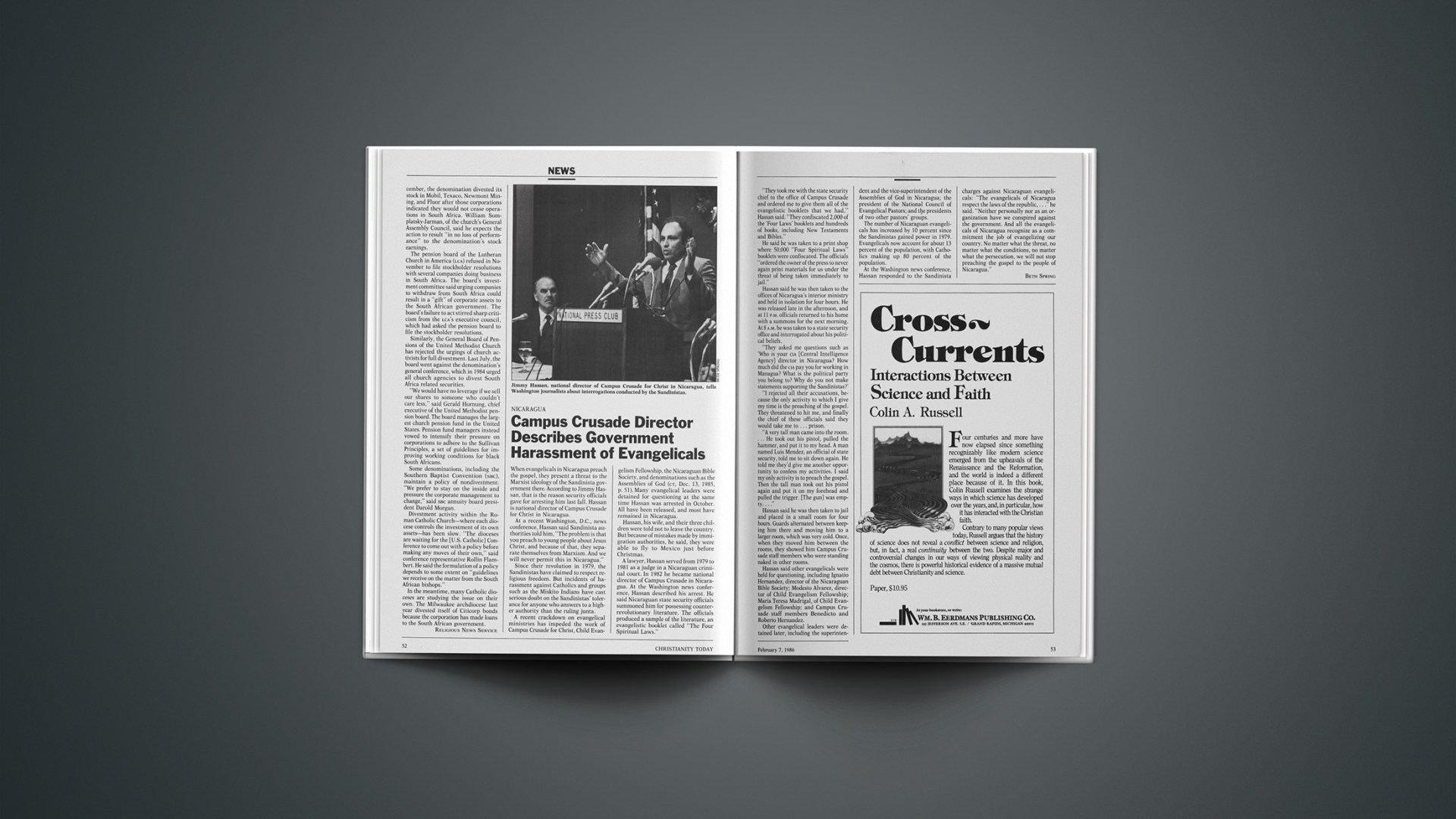
Campus Crusade Director Describes Government Harassment of Evangelicals

When evangelicals in Nicaragua preach the gospel, they present a threat to the Marxist ideology of the Sandinista government there. According to Jimmy Hassan, that is the reason security officials gave for arresting him last fall. Hassan is national director of Campus Crusade for Christ in Nicaragua.

At a recent Washington, D.C., news conference, Hassan said Sandinista authorities told him, “The problem is that you preach to young people about Jesus Christ, and because of that, they separate themselves from Marxism. And we will never permit this in Nicaragua.”

Since their revolution in 1979, the Sandinistas have claimed to respect religious freedom. But incidents of harassment against Catholics and groups such as the Miskito Indians have cast serious doubt on the Sandinistas’ tolerance for anyone who answers to a higher authority than the ruling junta.

A recent crackdown on evangelical ministries has impeded the work of Campus Crusade for Christ, Child Evangelism Fellowship, the Nicaraguan Bible Society, and denominations such as the Assemblies of God (CT, Dec. 13, 1985, p. 51). Many evangelical leaders were detained for questioning at the same time Hassan was arrested in October. All have been released, and most have remained in Nicaragua.

Hassan, his wife, and their three children were told not to leave the country. But because of mistakes made by immigration authorities, he said, they were able to fly to Mexico just before Christmas.

A lawyer, Hassan served from 1979 to 1981 as a judge in a Nicaraguan criminal court. In 1982 he became national director of Campus Crusade in Nicaragua. At the Washington news conference, Hassan described his arrest. He said Nicaraguan state security officials summoned him for possessing counter-revolutionary literature. The officials produced a sample of the literature, an evangelistic booklet called “The Four Spiritual Laws.”

“They took me with the state security chief to the office of Campus Crusade and ordered me to give them all of the evangelistic booklets that we had,” Hassan said. “They confiscated 2,000 of the ‘Four Laws’ booklets and hundreds of books, including New Testaments and Bibles.”

He said he was taken to a print shop where 50,000 “Four Spiritual Laws” booklets were confiscated. The officials “ordered the owner of the press to never again print materials for us under the threat of being taken immediately to jail.”

Hassan said he was then taken to the offices of Nicaragua’s interior ministry and held in isolation for four hours. He was released late in the afternoon, and at 11 P.M. officials returned to his home with a summons for the next morning. At 8 A.M. he was taken to a state security office and interrogated about his political beliefs.

“They asked me questions such as ‘Who is your CIA [Central Intelligence Agency] director in Nicaragua? How much did the CIA pay you for working in Managua? What is the political party you belong to? Why do you not make statements supporting the Sandinistas?’

“I rejected all their accusations, because the only activity to which I give my time is the preaching of the gospel. They threatened to hit me, and finally the chief of these officials said they would take me to … prison.

“A very tall man came into the room.… He took out his pistol, pulled the hammer, and put it to my head. A man named Luis Mendez, an official of state security, told me to sit down again. He told me they’d give me another opportunity to confess my activities. I said my only activity is to preach the gospel. Then the tall man took out his pistol again and put it on my forehead and pulled the trigger. [The gun] was empty.…”

Hassan said he was then taken to jail and placed in a small room for four hours. Guards alternated between keeping him there and moving him to a larger room, which was very cold. Once, when they moved him between the rooms, they showed him Campus Crusade staff members who were standing naked in other rooms.

Hassan said other evangelicals were held for questioning, including Ignatio Hernandez, director of the Nicaraguan Bible Society; Modesto Alvarez, director of Child Evangelism Fellowship; Maria Teresa Madrigal, of Child Evangelism Fellowship; and Campus Crusade staff members Benedicto and Roberto Hernandez.

Other evangelical leaders were detained later, including the superintend dent and the vice-superintendent of the Assemblies of God in Nicaragua; the president of the National Council of Evangelical Pastors; and the presidents of two other pastors’ groups.

The number of Nicaraguan evangelicals has increased by 10 percent since the Sandinistas gained power in 1979. Evangelicals now account for about 13 percent of the population, with Catholics making up 80 percent of the population.

At the Washington news conference, Hassan responded to the Sandinista charges against Nicaraguan evangelicals: “The evangelicals of Nicaragua respect the laws of the republic, …” he said. “Neither personally nor as an organization have we conspired against the government. And all the evangelicals of Nicaragua recognize as a commitment the job of evangelizing our country. No matter what the threat, no matter what the conditions, no matter what the persecution, we will not stop preaching the gospel to the people of Nicaragua.”

WORLD SCENE

INDIA

Mobilizing Missionaries

At a recent missions conference in southern India, participants heard native evangelists from northern India describe beatings they received for preaching the gospel. Still, some 300 pastors and evangelists from the southern state of Kerala volunteered to do pioneer mission work in northern India. Some 800 other pastors pledged to recruit at least one missionary from each of their congregations.

Sponsored by Gospel for Asia, the conference challenged participants to do mission work in northern states where Hindus and Muslims predominate. The 300 volunteers will leave the southern state of Kerala, which is 30 percent Christian in a nation that is 90 percent Hindu.

K. P. Yohannan, president of Gospel for Asia, called the churches in Kerala “the sleeping giant of India.” In the past, young people from Kerala made up a significant portion of the street evangelists working in the northern part of the country. However, Yohannan said, many of Kerala’s young people are accepting jobs in the oil-rich nations of the Middle East, preventing them from doing mission work in northern India.

SOVIET UNION

Crackdown on Alcohol Abuse

The Soviet Union’s Supreme Court has announced a series of penalties for alcohol abuse, making several acts criminal offenses for the first time.

Selling or giving alcohol to minors, illegal brewing, and drinking outdoors will be punished, although specific sentences were not made public. In addition, the court said the state may take children of alcoholics into compulsory care.

The new measures are seen as part of an intensified effort by Soviet leader Mikhail Gorbachev to clamp down on alcohol abuse. The newspaper Komsomolskaya Pravda reported that two members of the Young Communist League’s central committee were dismissed for excessive drinking and other offenses. Soviet citizens consume an average of 30 liters of vodka annually.

CHINA

A Catholic Church Reopened

China’s Patriotic Catholic Association has restored and reopened a nineteenth-century church in Peking that can hold 3,000 people. It was the third Catholic church to be reopened in the capital since 1976. An estimated 30,000 Catholics live in Peking.

City officials approved $300,000 for the reconstruction of the Church of the Savior. Closed since the 1950s, the church was used as a warehouse by Maoist Red Guards during the Cultural Revolution, a period during which Chinese Christians suffered severe persecution.

Some observers say the government is relaxing its attitude toward Catholics. Vatican radio said 51 Catholic churches recently were reopened in China’s Fujian Province alone.

However, China continues to crack down on priests and parishioners suspected of maintaining ties with Rome. The Chinese Catholic Church broke with the Vatican in 1957 under government pressure. The church ordains its own bishops and priests, and still follows pre-Vatican II practices, including the celebration of Mass in Latin. The Chinese government’s Religious Affairs Bureau estimates there are as many as three million Catholics in the country.

WEST GERMANY

Cult Hotline

The Catholic archdiocese in Cologne, West Germany, has set up a telephone hotline to help family members and friends of those influenced by new religious sects. An estimated 30 cults are represented in the city.

Callers often complain that a friend or family member has broken off contact with them after becoming interested in a cult. “We try to get rid of exaggerated fears while at the same time explaining how the sects operate, so that the relatives and friends have some idea of what they’re dealing with,” said a 27-year-old hotline worker.

Followers of Bhagwan Shree Rajneesh, the Indian guru who last year left the United States, have their European headquarters in Cologne. Another cult in the city is reviving worship of pre-Christian Germanic gods. Experts say 80 percent of the cults in Cologne have established bases there in the past ten years.

Wener Hoebsch, cult specialist for the Cologne archdiocese, says established churches have not made themselves attractive to those who grew up without a close church connection. He said it is those people who are attracted to the new religious sects.

AFRICA

Improved Food Outlook

A United Nations official says improved harvests in several African countries have given the continent enough food to feed itself this year.

Bradford Morse, director of the Office for Emergency Operations in Africa, said relief agencies will need more than $500 million to buy that food and transport it to the 19 million Africans still facing starvation. If donor countries contribute grain instead of cash, he said, African farmers will be unable to sell their harvests, weakening their incentive to grow more food.

“There is enough food in Africa to feed Africa,” Morse said. “It would be nonsensical to ship food when food is already available there.” In all, Morse said African countries will need more than $ 1 billion in drought-related assistance this year, compared to $2.9 billion in 1985.

Emergency conditions remain in 6 of the 20 countries affected by the drought, Morse said. Eight other countries still need immediate help. Some countries, like the Sudan, are agriculturally self-sufficient, but they are unable to buy and ship food to devastated regions. The Sudan, Angola, Botswana, Cape Verde, Ethiopia, and Mozambique still face mass starvation. Three million Africans are homeless as a result of the famine.
Churches Take Action against Firms Doing Business with South Africa

Religious groups in the United States are at the head of a movement trying to pressure South Africa to dismantle its system of strict racial segregation. Activists have used marches, sit-ins, and prayer vigils to protest South Africa’s system of apartheid.

Some denominations have taken the protest a step further by moving to divest themselves of stock holdings in corporations that do business with South Africa. The South African Council of Churches requested such action last summer. The council’s resolution—an illegal move under South African law—said divestment would be a “peaceful and effective means” to pressure South Africa to bring about fundamental change in its race laws.

Arguing against divestment, many U.S.-based multinational firms say the U.S. corporate presence in South Africa will hasten the pace of racial change there. However, leaders in the divestment movement say U.S. corporate investment in South Africa helps prop up a morally corrupt government.

Tim Smith, executive director of the Interfaith Center on Corporate Responsibility (ICCR) in New York, said church bodies in that coalition take three basic positions: full and immediate divestment, selective or phased divestment, and approaches such as filing stockholder resolutions. ICCR-member bodies have combined investment assets of nearly $10 billion.

Last summer, the general synod of the United Church of Christ called on the denomination’s agencies to divest within two years stock holdings in companies active in South Africa. The executive boards of the denomination’s home and world mission agencies have moved to divest their holdings in such firms.

Richard Dubie, treasurer of the United Church Board for Homeland Ministries, said the list of corporations active in South Africa is a fluid one that must be monitored constantly. He declined to speculate on how divestment might affect the profits of the mission board’s portfolio.

Several Protestant denominations are taking a more cautious approach. The Presbyterian Church (U.S.A.) General Assembly last year called for a “selective phased divestment” policy. In December, the denomination divested its stock in Mobil, Texaco, Newmont Mining, and Fluor after those corporations indicated they would not cease operations in South Africa. William Somplatsky-Jarman, of the church’s General Assembly Council, said he expects the action to result “in no loss of performance” to the denomination’s stock earnings.

The pension board of the Lutheran Church in America (LCA) refused in November to file stockholder resolutions with several companies doing business in South Africa. The board’s investment committee said urging companies to withdraw from South Africa could result in a “gift” of corporate assets to the South African government. The board’s failure to act stirred sharp criticism from the LCA’s executive council, which had asked the pension board to file the stockholder resolutions.

Similarly, the General Board of Pensions of the United Methodist Church has rejected the urgings of church activists for full divestment. Last July, the board went against the denomination’s general conference, which in 1984 urged all church agencies to divest South Africa related securities.

“We would have no leverage if we sell our shares to someone who couldn’t care less,” said Gerald Hornung, chief executive of the United Methodist pension board. The board manages the largest church pension fund in the United States. Pension fund managers instead vowed to intensify their pressure on corporations to adhere to the Sullivan Principles, a set of guidelines for improving working conditions for black South Africans.

Some denominations, including the Southern Baptist Convention (SBC), maintain a policy of nondivestment. “We prefer to stay on the inside and pressure the corporate management to change,” said SBC annuity board president Darold Morgan.

Divestment activity within the Roman Catholic Church—where each diocese controls the investment of its own assets—has been slow. “The dioceses are waiting for the [U.S. Catholic] Conference to come out with a policy before making any moves of their own,” said conference representative Rollin Flambert. He said the formulation of a policy depends to some extent on “guidelines we receive on the matter from the South African bishops.”

In the meantime, many Catholic dioceses are studying the issue on their own. The Milwaukee archdiocese last year divested itself of Citicorp bonds because the corporation has made loans to the South African government.

RELIGIOUS NEWS SERVICE

James M. Boice Becomes Head of Evangelical Ministries, Inc.

James M. Boice, well-known pastor of Tenth Presbyterian Church in Philadelphia, has replaced William J. Petersen as operational head of Evangelical Ministries, Inc. The organization publishes Eternity magazine and three newsletters.

Petersen had served as editor of Eternity and executive director of Evangelical Ministries since 1975. He joined the organization in 1957 as Eternity’s managing editor. He will continue to serve Evangelical Ministries as a part-time consultant.

Late last year Boice assumed the position of president of Evangelical Ministries. At press time, it had not been determined whether he will also hold the title of editor of Eternity.

Jeff Comment, Evangelical Ministries’ board chairman, could not be reached for a statement. However, several sources close to the organization’s leadership said financial problems led to the change. Eternity, with a circulation slightly under 40,000, has lost money during each of the last five years. Evangelical Ministries is trying to sell its three newsletters, which also have been losing money.

Boice’s ascendancy marks a return of sorts to Evangelical Ministries’ roots. Originally called The Evangelical Foundation, the organization was formed in 1949 as an outgrowth of the ministry of the late Donald Grey Barnhouse, then pastor of Tenth Presbyterian Church and host of “The Bible Study Hour” radio program. Boice, who has pastored Tenth Presbyterian since 1968, has hosted “The Bible Study Hour” since 1969.

Russell T. Hitt, a board member and former executive director of Evangelical Ministries, said Eternity has been a victim of a changing marketplace. “There are a lot of new magazines,” he said, “and some of the old ones have changed. Many of them are doing what only Eternity used to do.” Hitt said the magazine also has been hurt by sharp increases in production costs and postal rates.

In recent years, Eternity has sought to carve out a niche in the marketplace by specializing in comprehensive analysis of contemporary events. Boice said he intends to broaden the magazine’s appeal by including “theologically reflective pieces and expositional articles by writers who are better known.”

Oral Roberts University Gives Its Law School to Cbn University

The board of regents of Oral Roberts University (ORU) has voted to transfer the institution’s A.W. Coburn School of Law to CBN University (CBNU). The law school’s approximately 190,000 volumes are worth an estimated $10 million.

Students in the law school will finish the academic year at ORU in Tulsa, Oklahoma. Many of them are expected to move to Virginia Beach, Virginia, to begin classes at CBNU at the beginning of the 1986–87 school year.

ORU spokesman Rob Nordin said the university decided CBNU, which is exclusively a graduate university, is better equipped to provide a quality program in law. CBNU is seeking a transfer of the school’s provisional accreditation from the American Bar Association. Nordin said all ORU law professors have been invited to apply for teaching positions at CBNU.

This is the second major academic change made by ORU within the past year. Prior to the 1985–86 school year, ORU announced it would close its school of dentistry at the end of the academic year. The early announcement gave underclassmen the opportunity to transfer to other institutions. Nordin said ORU President Oral Roberts had raised money for the dental school by emphasizing the prospects it held for producing health-care missionaries. However, Nordin said, “there was disappointment that few graduates were willing to make that commitment.”

Financial problems in recent years have hampered the ministries that fall under the Oral Roberts umbrella. The problems are largely attributable to the City of Faith medical complex, which has lagged behind projections for breaking even financially (CT, Aug. 10, 1984, p. 46). Nordin said neither the transferring of the law school to CBNU nor the closing of the dental school was carried out for financial reasons. He acknowledged, however, “there is no question the university will recognize a financial savings from these two developments.”

Video Conference Links Christians in 54 Countries

Campus Crusade uses satellite technology to help train hundreds of thousands of conferees.

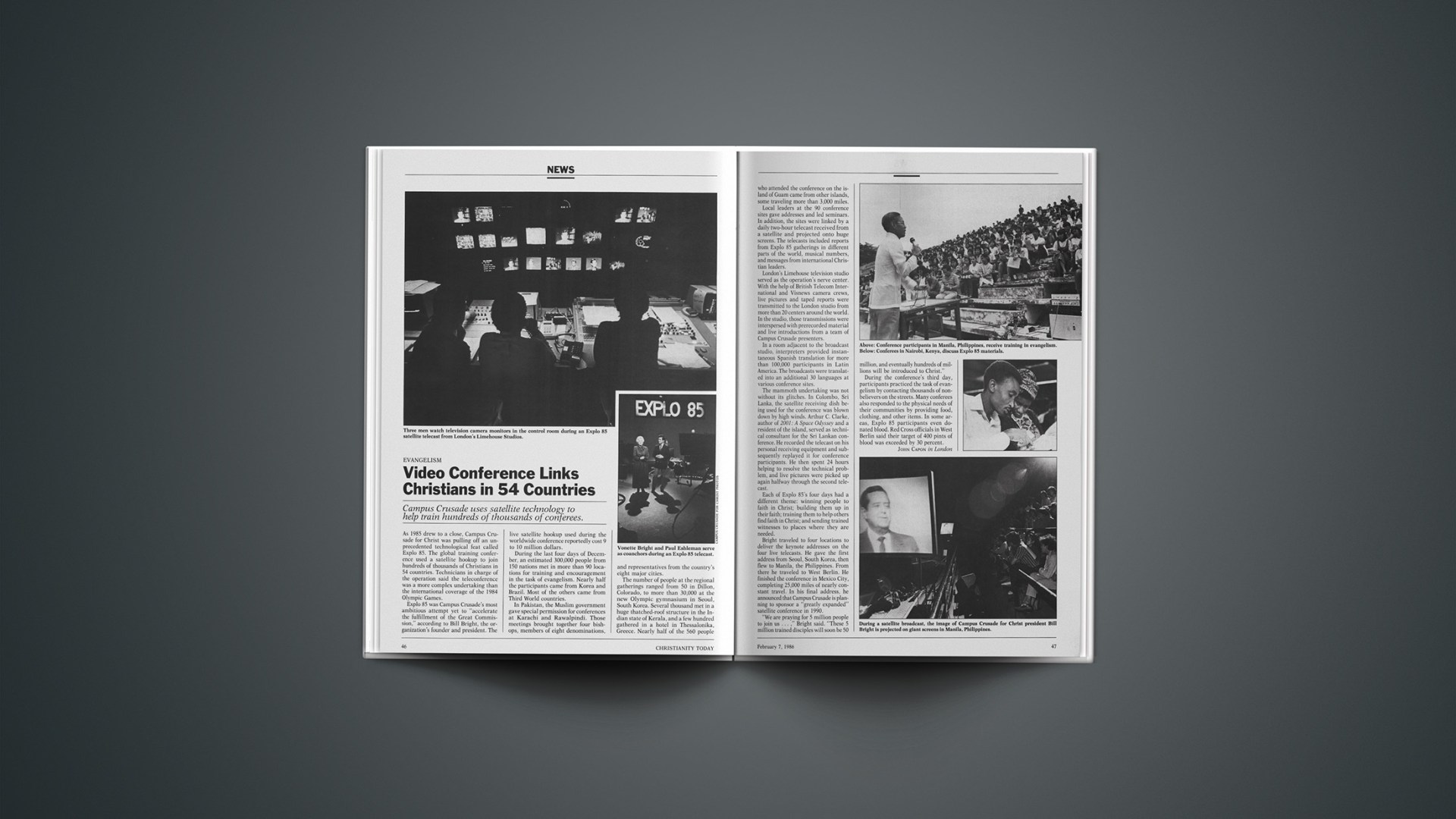
As 1985 drew to a close, Campus Crusade for Christ was pulling off an unprecedented technological feat called Explo 85. The global training conference used a satellite hookup to join hundreds of thousands of Christians in 54 countries. Technicians in charge of the operation said the teleconference was a more complex undertaking than the international coverage of the 1984 Olympic Games.

Explo 85 was Campus Crusade’s most ambitious attempt yet to “accelerate the fulfillment of the Great Commission,” according to Bill Bright, the organization’s founder and president. The live satellite hookup used during the worldwide conference reportedly cost 9 to 10 million dollars.

During the last four days of December, an estimated 300,000 people from 150 nations met in more than 90 locations for training and encouragement in the task of evangelism. Nearly half the participants came from Korea and Brazil. Most of the others came from Third World countries.

In Pakistan, the Muslim government gave special permission for conferences at Karachi and Rawalpindi. Those meetings brought together four bishops, members of eight denominations, and representatives from the country’s eight major cities.

The number of people at the regional gatherings ranged from 50 in Dillon, Colorado, to more than 30,000 at the new Olympic gymnasium in Seoul, South Korea. Several thousand met in a huge thatched-roof structure in the Indian state of Kerala, and a few hundred gathered in a hotel in Thessalonika, Greece. Nearly half of the 560 people who attended the conference on the island of Guam came from other islands, some traveling more than 3,000 miles.

Local leaders at the 90 conference sites gave addresses and led seminars. In addition, the sites were linked by a daily two-hour telecast received from a satellite and projected onto huge screens. The telecasts included reports from Explo 85 gatherings in different parts of the world, musical numbers, and messages from international Christian leaders.

London’s Limehouse television studio served as the operation’s nerve center. With the help of British Telecom International and Visnews camera crews, live pictures and taped reports were transmitted to the London studio from more than 20 centers around the world. In the studio, those transmissions were interspersed with prerecorded material and live introductions from a team of Campus Crusade presenters.

In a room adjacent to the broadcast studio, interpreters provided instantaneous Spanish translation for more than 100,000 participants in Latin America. The broadcasts were translated into an additional 30 languages at various conference sites.

The mammoth undertaking was not without its glitches. In Colombo, Sri Lanka, the satellite receiving dish being used for the conference was blown down by high winds. Arthur C. Clarke, author of 2001: A Space Odyssey and a resident of the island, served as technical consultant for the Sri Lankan conference. He recorded the telecast on his personal receiving equipment and subsequently replayed it for conference participants. He then spent 24 hours helping to resolve the technical problem, and live pictures were picked up again halfway through the second telecast.

Each of Explo 85’s four days had a different theme: winning people to faith in Christ; building them up in their faith; training them to help others find faith in Christ; and sending trained witnesses to places where they are needed.

Bright traveled to four locations to deliver the keynote addresses on the four live telecasts. He gave the first address from Seoul, South Korea, then flew to Manila, the Philippines. From there he traveled to West Berlin. He finished the conference in Mexico City, completing 25,000 miles of nearly constant travel. In his final address, he announced that Campus Crusade is planning to sponsor a “greatly expanded” satellite conference in 1990.

“We are praying for 5 million people to join us …,” Bright said. “These 5 million trained disciples will soon be 50 million, and eventually hundreds of millions will be introduced to Christ.”

During the conference’s third day, participants practiced the task of evangelism by contacting thousands of nonbelievers on the streets. Many conferees also responded to the physical needs of their communities by providing food, clothing, and other items. In some areas, Explo 85 participants even donated blood. Red Cross officials in West Berlin said their target of 400 pints of blood was exceeded by 30 percent.

JOHN CAPONin London

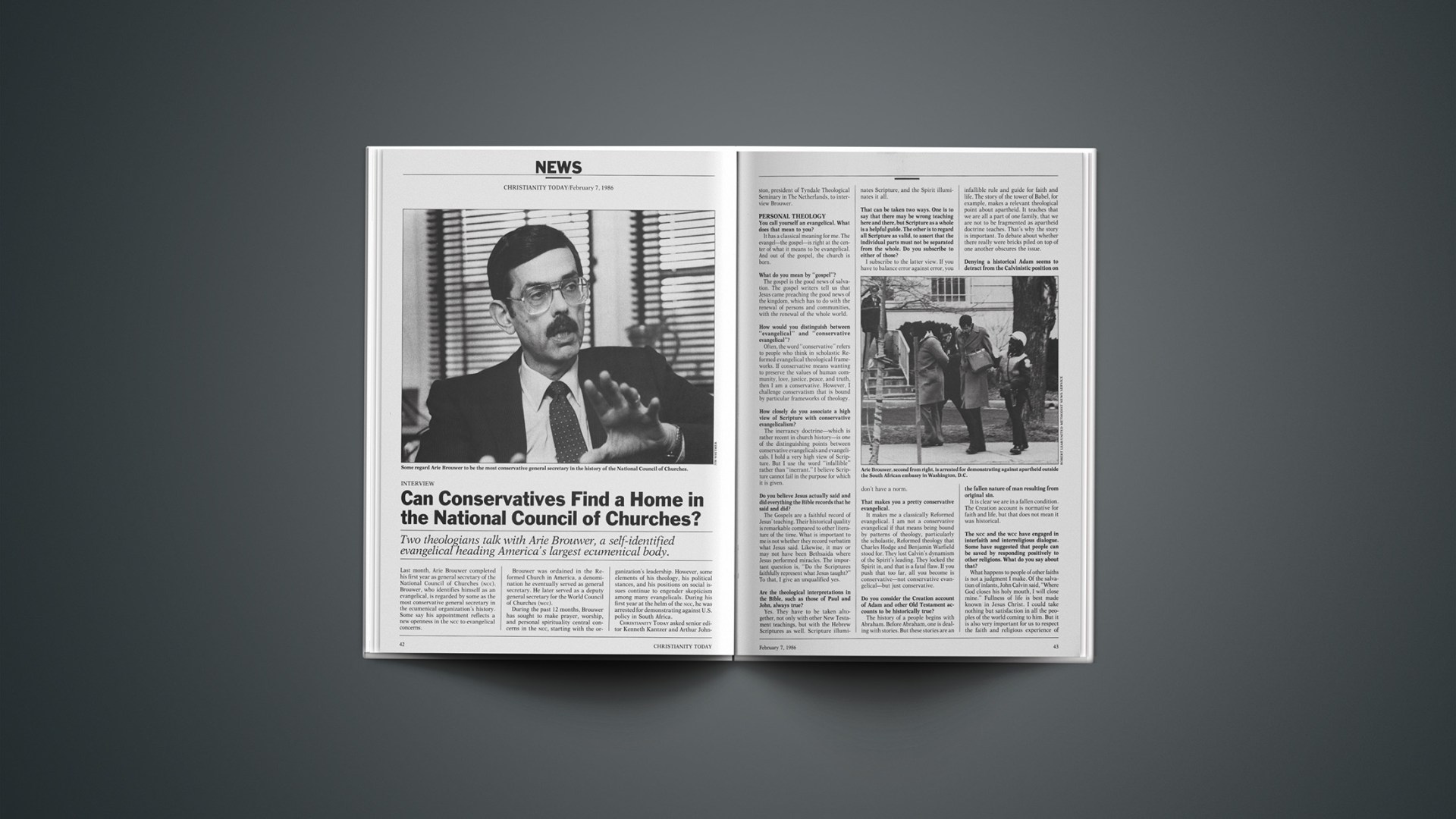
Can Conservatives Find a Home in the National Council of Churches?

Two theologians talk with Arie Brouwer, a self-identified evangelical heading America’s largest ecumenical body.

Last month, Arie Brouwer completed his first year as general secretary of the National Council of Churches (NCC). Brouwer, who identifies himself as an evangelical, is regarded by some as the most conservative general secretary in the ecumenical organization’s history. Some say his appointment reflects a new openness in the NCC to evangelical concerns.

Brouwer was ordained in the Reformed Church in America, a denomination he eventually served as general secretary. He later served as a deputy general secretary for the World Council of Churches (WCC).

During the past 12 months, Brouwer has sought to make prayer, worship, and personal spirituality central concerns in the NCC, starting with the organization’s leadership. However, some elements of his theology, his political stances, and his positions on social issues continue to engender skepticism among many evangelicals. During his first year at the helm of the NCC, he was arrested for demonstrating against U.S. policy in South Africa.

CHRISTIANITY TODAY asked senior editor Kenneth Kantzer and Arthur Johnston, president of Tyndale Theological Seminary in The Netherlands, to interview Brouwer.

Personal Theology

You call yourself an evangelical. What does that mean to you?

It has a classical meaning for me. The evangel—the gospel—is right at the center of what it means to be evangelical. And out of the gospel, the church is born.

What do you mean by “gospel”?

The gospel is the good news of salvation. The gospel writers tell us that Jesus came preaching the good news of the kingdom, which has to do with the renewal of persons and communities, with the renewal of the whole world.

How would you distinguish between “evangelical” and “conservative evangelical”?

Often, the word “conservative” refers to people who think in scholastic Reformed evangelical theological frameworks. If conservative means wanting to preserve the values of human community, love, justice, peace, and truth, then I am a conservative. However, I challenge conservatism that is bound by particular frameworks of theology.

How closely do you associate a high view of Scripture with conservative evangelicalism?

The inerrancy doctrine—which is rather recent in church history—is one of the distinguishing points between conservative evangelicals and evangelicals. I hold a very high view of Scripture. But I use the word “infallible” rather than “inerrant.” I believe Scripture cannot fail in the purpose for which it is given.

Do you believe Jesus actually said and did everything the Bible records that he said and did?

The Gospels are a faithful record of Jesus’ teaching. Their historical quality is remarkable compared to other literature of the time. What is important to me is not whether they record verbatim what Jesus said. Likewise, it may or may not have been Bethsaida where Jesus performed miracles. The important question is, “Do the Scriptures faithfully represent what Jesus taught?” To that, I give an unqualified yes.

Are the theological interpretations in the Bible, such as those of Paul and John, always true?

Yes. They have to be taken altogether, not only with other New Testament teachings, but with the Hebrew Scriptures as well. Scripture illuminates Scripture, and the Spirit illuminates it all.

That can be taken two ways. One is to say that there may be wrong teaching here and there, but Scripture as a whole is a helpful guide. The other is to regard all Scripture as valid, to assert that the individual parts must not be separated from the whole. Do you subscribe to either of those?

I subscribe to the latter view. If you have to balance error against error, you don’t have a norm.

That makes you a pretty conservative evangelical.

It makes me a classically Reformed evangelical. I am not a conservative evangelical if that means being bound by patterns of theology, particularly the scholastic, Reformed theology that Charles Hodge and Benjamin Warfield stood for. They lost Calvin’s dynamism of the Spirit’s leading. They locked the Spirit in, and that is a fatal flaw. If you push that too far, all you become is conservative—not conservative evangelical—but just conservative.

Do you consider the Creation account of Adam and other Old Testament accounts to be historically true?

The history of a people begins with Abraham. Before Abraham, one is dealing with stories. But these stories are an infallible rule and guide for faith and life. The story of the tower of Babel, for example, makes a relevant theological point about apartheid. It teaches that we are all a part of one family, that we are not to be fragmented as apartheid doctrine teaches. That’s why the story is important. To debate about whether there really were bricks piled on top of one another obscures the issue.

Denying a historical Adam seems to detract from the Calvinistic position on the fallen nature of man resulting from original sin.

It is clear we are in a fallen condition. The Creation account is normative for faith and life, but that does not mean it was historical.

The NCC and the WCC have engaged in interfaith and interreligious dialogue. Some have suggested that people can be saved by responding positively to other religions. What do you say about that?

What happens to people of other faiths is not a judgment I make. Of the salvation of infants, John Calvin said, “Where God closes his holy mouth, I will close mine.” Fullness of life is best made known in Jesus Christ. I could take nothing but satisfaction in all the peoples of the world coming to him. But it is also very important for us to respect the faith and religious experience of people in other traditions.

Would you say it is your duty to lead a Muslim to Christ?

Many who make judgments on Muslims have had no firsthand experience with them. Jesus taught us to deal with these things in personal relationships and in community. My first obligation to another person is to acknowledge our mutual humanity. As our relationship develops, I would share what it means to be a Christian, because that’s how my own identity is shaped.

Evangelicalism holds that Jesus—and not Muhammad—is Lord. Do you find that objectionable?

No, my confession is that Jesus is Lord. But the question is, “How do I treat people who do not confess the name of Jesus Christ?” People of other faiths tend not to listen to those who have first made a judgment on them.

Political Views

The kingdom concept is central to your understanding of Scripture. In what way was protesting American policy in El Salvador in 1981 part of the kingdom program?

I prefer to work for reform rather than to protest. That was the first time I had participated in a major demonstration. I led it because I felt the Reagan administration was refusing to hear the witness of the whole religious community related to El Salvador. The administration was perceiving the troubles there as a conflict between the United States and the Soviet Union. But the true issue was economic justice. When our government joins with those who are oppressing people, it is being unfaithful to our own best traditions.

Some feel the NCC’s desire for justice is selective. It opposes oppressive right-wing groups, but rarely takes a position against left-wing governments.

Our first responsibility is to try to influence our own government, especially when it is deeply involved in the problem, as in South Africa. When we make public statements against the Soviet Union, those statements are heard in the USSR as if we are mouthing U.S. policies. That doesn’t help anybody. However, through our U.S./USSR church relations program, we have raised the issue of human rights not only with our Christian friends in the Soviet Union, but also with government leaders there.

In my travels in Eastern Europe, I have heard again and again from people in the churches that the most important thing we can do to stop repression is to ease the tensions between the superpowers. We speak out when we need to on violations of religious freedom and human rights, but we do this within the context of our long-term objectives.

Some say these anti-American statements are used in the Third World to promote Soviet ideology.

You have to look long and hard in the Third World to find people attracted to Soviet ideology. Most embrace the American tradition of freedom, liberty, and justice. People in the Third World want the United States to stand again for freedom and justice as it has for much of the last two centuries. I won’t say the NCC has never made mistakes. Sometimes we have permitted ourselves to be cast into a counterculture role. In the popular mind, that is anti-American. But we are not anti-American. We sometimes critique American society because we love our country.

Social Issues

Is it likely that in the near future the NCC will take a stand on abortion?

There are widely different points of view within the council on abortion, and it’s not on our agenda at the present time. It’s a very important question in society. I don’t think we should rush toward a policy statement.

What about the issue of homosexuality?

That issue arose sharply with the membership application of the Universal Fellowship of Metropolitan Community Churches (UFMCC) in 1983. Their request has been postponed indefinitely. We are in dialogue with the UFMCC on the issues of Christian unity and ecclesiology, biblical interpretation, and human sexuality. The conversations and studies go on because these are fellow human beings who profess to a homosexual orientation, and I do not find it in the gospel that we should cut ourselves off from them.

What is your agenda with respect to your own evangelical convictions?

I came out of an evangelical home in a conservative midwestern community. Those roots are still solidly there, but I have stretched them a long, long way. My pilgrimage has led me to an emphasis on social witness. Spirituality and solidarity are inseparable. I question a spirituality that doesn’t engage itself in the issues of our time. I question also solidarity that is divorced from spirituality, because it degenerates into activism and burnout.

The National Council

Conservative evangelicals have not been warmly receptive of the NCC. Why do you think that is the case?

Their noninvolvement is a loss for evangelicals. Members of the NCC come together on a Trinitarian confession of Christ. We believe that in spite of all our differences, our unity in Christ keeps us together. With the conservative evangelical emphasis on the centrality of Christ, they ought to be with us. It is the NCC’s social advocacy positions that has been the sticking point.

Some evangelicals have trouble believing the NCC really is Trinitarian. Member churches may sign the council’s statement, but some espouse views that don’t even remotely resemble biblical teaching. This comes out in the council’s literature—in study papers and speeches. Do you think we’re wrong on this point?

What speeches or study papers would you point to? Those questions would ordinarily be dealt with in the Commission on Faith and Order, which is solidly Trinitarian. In the 1930s, during the days of the Federal Council of Churches, the old liberal tradition was strong. But today it is gone.

Are you saying the NCC’s theological stance has changed in the last 15 or 20 years?

Yes. There is a danger for evangelicalism to deal too much with yesterday’s theological issues, and that is tragic.

We hear a great deal from NCC representatives about faith, but it often doesn’t seem to be faith in Christ. Where does the council stand on justification by faith?

If this question were brought up at an NCC governing board meeting it would be met with astonishment, because this is our faith. We would respond readily with a formulation that would be affirmed by evangelicals.

I hope conservative evangelicals will not look at the NCC and the member churches through the lenses of past problems we’ve had in relationships. The role of churches in witnessing in the renewal of American society is a job bigger than all of us. Hope for the world depends very much on the course of this country. And the course of this country depends very much on the witness of Christians.

Can Seminaries Adapt to the Student of the ’80s?

Four seminary presidents on “second careers” and a growing partnership with the local church.

“My plea is for an institution which knows how to serve students so effectively that they are enabled to serve the Church that is called by God to serve the world redemptively.”

Thomas Gillespie, President, Princeton Theological Seminary

The servant attitude is gaining momentum in today’s seminaries. No longer content with “just getting out,” the “new” student is intent upon using seminary as an ongoing training ground for a hundred different expressions of practical ministry geared to the local church.

CHRISTIANITY TODAY asked four evangelical seminary presidents to discuss these attitudes and how they are affecting the church-seminary connection. Joining the discussion were David Hubbard of Fuller Theological Seminary, Pasadena, California; Robert Cooley of Gordon-Conwell Theological Seminary, South Hamilton, Massachusetts; George Fuller of Westminster Theological Seminary, Philadelphia; and George Brushaber of Bethel College and Theological Seminary, St. Paul, Minnesota; and CHRISTIANITY TODAY’s senior editor. Helping moderate was managing editor Harold Smith.

Church and seminary: The student connection How would you compare the student of today with the student of 10 years ago?

Robert Cooley: There is a strong trend toward second-career students. These are older professionals coming out of a business, engineering, or science background.

George Fuller: Our typical student—and even that expression is almost meaningless—is probably 32 years old and has two children. The student who comes directly out of college is in the minority. And interestingly enough, the average age of our faculty is just over 40. We can hardly tell the men from the boys.

Innovations

Spiritual Formation

We’re getting people who have been in the church. And they don’t just come and study: they come to be part of the community.

George Fuller

Accused of emphasizing academic training over spiritual formation, several seminaries are now actively seeking a holistic approach to curricula.

• Said Robert K. Johnston, dean of North Park Theological Seminary in Chicago: “We don’t just fit an inductive Bible study into one quarter of a three-year seminary program. Students are involved every quarter of every year in some spiritual activity.” Johnston pointed out that students have a choice of a variety of electives, from personal prayer discipline and marriage enrichment to inductive Bible study and spiritual formation with a spiritual director.

“This is a major new direction in all seminary life, especially in the evangelical wing of the church,” Johnston said. “It teaches the maturing of the person.” He added that studies show that “ministers don’t fail for poor performance so much as for personal qualities that make congregation members think of them as nonministerial.”

• Fuller Theological Seminary’s pathbreaking program in spirituality is under the leadership of Roberta Hestenes with the assistance of Gary Sattler. “We have denominational and special interest prayer groups led by a faculty member from the same denomination or interest group,” Hugh James, who is director of communications at Fuller, explained. “Our Office of Christian Community pulls together all these groups, including prayer groups, spirituality discussion groups, and a group led by John Wimber of Vineyard Ministries on signs and wonders.”

Vignettes by Les Keylock.

Why the second career?

Cooley: I think it’s a reflection of what’s happening in the local church. There’s a greater interest in trained lay ministry. Once a person gets into the 30s and 40s, establishes some economic independence, and begins to take on other value concerns, he or she becomes much more sensitive to the role of the church. And with the guidance of their minister, these same people are pursuing theological education.

Are they pursuing this education to serve the church professionally or to go back to their local churches as trained lay people?

Cooley: Both. Many are coming just to become better informed, better qualified lay ministers within the church; and possibly to work with the pastor who encouraged them to pursue theological training.

Fuller: To a minor degree, we are getting students who are essentially caught up in the change of career syndrome characteristic of much of our society. Our commitment to an institution or a business or a company is two years long and then we’re off to something else. But to a major degree we’re getting people who have been in the church: people who have probably served as deacons or elders or trustees. They may not know a whole lot about the Bible, but they typically identify with the church. They have families. And they don’t just come and study: they come to be part of the community. So it’s the students who are changing the seminaries, and they may be consequently changing the relationship between the seminary and the churches.

George Brushaber: Let me tag on to that for just a moment. Back in the late ‘60s and early 70s, the people coming to seminary were still basically young people out of our churches. They had church-life experiences. Then came the great surge of campus evangelism by the parachurch organizations. One seminary I know of had 80 percent of its student body come to faith through some parachurch ministry either at the secondary school level or at the collegiate level. Now the trend has reversed back to the way it was. The more settled and established persons are coming into seminary with rich church backgrounds.

David Hubbard: I do think that what we’re seeing is a fruit of church renewal. And with that in mind, let me also drop a couple of other things into the “new” student profile.

First, we have a higher percentage of students of Pentecostal or charismatic background coming to our seminaries today: Assemblies of God, Foursquare, Pentecostal Church of God, together with the charismatic students from Presbyterian or Lutheran or Episcopal backgrounds. Some of this represents an educationally upward mobility in those denominations.

Second, today’s student is less motivated by a concern for social justice than was the case in 1975. At Fuller, the period of the mid and late ‘70s was a kind of halcyonian period. While you had a strong piety, a sense of having the Lord reach down and absolutely transform your life, there was also a real concern for justice, peace, and social responsibility: Some of those things we see as part of the wholeness of Christian discipleship. Today, the piety and that strong personal faith that wrenches people out of one career into another are certainly there. But I’m not quite sure we have as much passion at this stage for the social outreach or the political implications of what it means to be Christian.

Are women playing a role in this second-career phenomenon?

Brushaber: Yes. Some of them are women whose children are in high school and who are only now acting on a call they may have felt years before. We are also finding that a number of professional women, and women with academic degrees from the higher education community, are being drawn into ministry as well: part of a growing sense of a presence of God in their lives.

Hubbard: My guess is that evangelical women have a better chance for placement in some point of ministry, whether ordained or not, than if they were hidden away in some mainline school. We have a woman who is an ordained Presbyterian minister who’s tremendously effective. She didn’t come to seminary until she was in her 50s.

Cooley: Our experience is that the women tend to be recent graduates and are entering as a distinct career choice out of a sense of calling. The more mature woman who has a variety of business, professional, and family experiences is adding theological education to other sets of motivations. She is not necessarily pursuing ordination as such.

Brushaber: I think that’s an important distinction. Women are looking for some form of ministry. It’s the ordination question on which many people are in disagreement. And ordination is not a function of a seminary.

Church and seminary: The ministry connection As a result of these “church-grown,” second-career students, is there a greater sense of commitment on the part of seminaries to the local church?

Cooley: I think there is a sense of partnership that’s emerging. What I have found in looking back at history is a closer identification between the seminary and, say, the world of the university. That has all changed.

The issues emerging out of the church are obviously issues of interest to the seminary. Thus a greater partnership is emerging out of the last ten years. This means that faculties and seminarians are finding their identity in being church persons, rather than finding their focus in the professional guild as a professional peer group.

Innovations

Theology After Hours

The 22-year-old just out of college has a less complex agenda than a person who is married, with three children, and a career transition.

George Brushaber

Not many years ago, anyone who wanted to become a pastor or attend seminary for some other Christian vocation had to give up his or her job, sell a home, and move to a campus usually many miles from family and friends.

But all that has changed. Today, the “new” seminarians can keep their jobs and homes and earn a master of divinity degree through any one of a number of different, “odd-hour” programs.

• At Bethel Theological Seminary West (San Diego), for example, there has been a change to longer classes that meet less frequently than the one-hour, three-times-a-week schedule of traditional education. “We have classes that meet two-and-one-half hours once a week for four credits,” said academic dean Clifford Anderson. Classes at Bethel West are scheduled at 8 A.M., 4 P.M., and 7 P.M., so that attorneys, doctors, and other professional people can attend.

• According to dean Ralph Coveil, Denver Conservative Baptist Seminary has moved to “block scheduling” to make seminary education more accessible. “We have about 20 courses that we offer in a three-hour block Mondays, Wednesdays, and Fridays. One pastor flies all the way from Albuquerque on Tuesday and goes back Saturday,” Covell said.

• Similar programs exist at many other seminaries. At Gordon-Conwell Theological Seminary, in the Boston suburb of South Hamilton, the Institute for Evangelism Studies enables students to earn a degree by going to school evenings and Saturdays only. Northern Baptist Theological Seminary, in the Chicago suburb of Lombard, offers an intensive summer program for pastors who want to earn the doctorate of ministry by using vacation time. Dallas Theological Seminary offers classes Tuesday and Thursday evenings. Fuller Theological Seminary’s “Fuller After Five,” an evening and weekend program, offers master’s-level courses to several hundred people in Los Angeles County. And likewise, Bethel Theological Seminary, in St. Paul, sponsors “Theological Studies After Five.”

How has this attitude affected curriculum?

Cooley: The ministry dimension, along with the classical, biblical, theological, historical studies, has added an extracurricular dimension; and that is why I think seminary education can no longer be done in three years. The whole experiential side of theological education—going from field work to field education—has added an intensity in the energy level that was not there before. So one of the challenges facing the seminary from a curricular and a degreed program dimension is how to handle the complexity that ministry has brought to traditional theological education.

Innovations

Lifetime Students

We no longer have to think of completing our ministerial training with the three-, four-, five-year package. We can tell graduates that when future education needs arise, we’ll have a program for them.

David Hubbard

The desire of Christian workers “in the field” to continue to strengthen their theological as well as practical skills has made continuing education an overriding demand on evangelical seminaries.

• Bethel Theological Seminary has developed the only extension seminary fully accredited by the American Association of Theological Schools: Bethel Theological Seminary West. The school has just launched a program of continuing education called the “Lifetime Education Seminary Program.” It allows anyone who has completed a Bethel degree in pastoral studies or Christian education “to register as an auditor in any regularly offered course or seminar without cost” for the remainder of the graduate’s life.

• A half-dozen “units” are offered, each involving ten hours of study, in a continuing education program offered by Dallas Theological Seminary. For starters, the program is not limited in either enrollment or location to Dallas. For example, 64 students are enrolled in the graduate program in Atlanta. Other centers with similar enrollments include Washington, Houston, Cedar Rapids, Columbus, Phoenix, Springrefield, Colorado Springs, and Santa Barbara. Classes are usually held on Friday and Saturday, with special speakers being flown to these centers.

Brushaber: And that developmental dimension comes right at a time when the typical student has multiple agendas. The 22-year-old just out of college has a less complex agenda than a person who is married, with three children, and a career transition.

Cooley: And that only adds to this feeling that three years is not adequate. That student probably needs four or five years just to adjust emotionally to this demand.

Fuller: I would like for us not to pass over lightly Bob’s comment about the four-or five-year seminary program. It’s critical. There’s only so much room in the curriculum. You add a course on counseling young couples, and something’s got to go. And at many institutions, some or all degree programs do not require traditional things like Greek and Hebrew, for example. It’s a tradeoff situation. There’s only limited time, faculty, money.

The demands are great: from accreditors, from churches, from students. “You didn’t teach me how to get along with people, and I’m being thrown out of my church.” This is being thrown back at us by graduates.

Cooley: I think we have to change the teaching/learning system. We’re dealing with older students who have greater motivation at their point of entry. We should, therefore, be able to do more independent teaching and get away from the traditional, group kind of learning experience.

Hubbard: Students today have a desire to work faithfully in the church and to put their training into practice. They have a desire to relate more to individuals than I ever did when I went through seminary. They’re in covenant groups. They’re in prayer breakfasts. They’re doing all kinds of things that are beautiful from the standpoint of Christian nuture and Christian development and relationships. My priority was to get through and get out. Their priority is to milk the experience—however long it takes.

But this milking would seem to be a very positive side.

Hubbard: I view it as very positive. It’s more wear on the carpet for every dollar of tuition, and you end up with a more varied curriculum. It’s also harder to sequence your courses. The management of the enterprise is, therefore, further complicated. But I have to believe that the end result is going to be very positive for the church.

Cooley: Yes, I think students are developing a strong community sense in these self-generated experiences. And, after all, this is what the local church is about. The local church is hurting at this point, and these people are going to bring to it a rich personal experience. They are going to be able to nurture a sterile community into a caring community.

Brushaber: That holistic goal is something we all applaud. And I agree with David. It’s a most difficult thing for those of us who like tidy administrative structures and processes, because these students confound them time and time again. And yet, I sense these men and women are more exciting to teach because they come with a life experience.

Still, I wonder what we are doing in our schools to help faculty cope with this changing profile of students. I think that faculty expectations need somehow to undergo some changes as well. Even our classical education probably needs to be interwoven more with congregational life.

Hubbard: A lot of these people are looking for more specialized forms of programming. So now we’re into more emphasis on marriage and family counseling, more emphasis on singles and youth ministries. And the more we teach skills in ministry, the more labor intensive that is. It’s a lot easier to lecture 150 people than it is to teach individuals how to preach or to counsel or to give effective pastoral care. So you’re into more coaching, more supervision.

With all of that, I find that the affirmation of the need for theological education is also very high. We’re getting that from laity, and one of the things we’ve got to work on is how to prepare laity for the two kinds of tracks we’ve talked about. Some people who come to us as lay people are going to stay lay people, they’re going to stay engineers, nurses, and lawyers—but they want to serve Christ better. However, we’re inclined to treat them as though they’re going to change professions. We give them new professional training rather than fortification and reinforcement to serve Christ in their present professions. So, responding to the number of laity and making sure that our programs are in sync with their needs is a current challenge.

The other thing that’s happened is the rise in continuing education programming. We no longer have to think of completing our ministerial training within the three-, four-, five-year package. We can tell graduates that when future educational needs arise, we’ll have a program for them. The tremendous success of some of the continuing education shows that we are scratching places that itch badly; and we’re not only revamping our understanding of the first time line of theological education, the length in it, but we’re also adding another component.

And that obviously bodes well for the local church.

Hubbard: It does. We don’t do anything at Fuller that’s more uniformly affirmed than our continuing education program. They do get high mileage because the people are so needy and know it. Students, until they have been out in ministry, don’t really understand all that’s needed.

Cooley: I think we need to learn from the therapeutic professions at this point. None of us would go to a medical doctor who did not keep up with his or her profession and specialization. How much more important is this educational updating necessary for those serving the church?

Innovations

Mid-career Education

Were dealing with older students who have greater motivation at their point of entry. We should, therefore, be able to do more independent teaching and get away from the traditional, group kind of learning experience.

Robert Cooley

Several evangelical seminaries offer programs that are directed toward those contemplating a mid-career job change.

• A high proportion of those now enrolled in extension programs in Seattle, San Francisco, Ventura, Orange County (Santa Ana), San Diego, and Phoenix through Fuller Theological Seminary are employed lay people willing to devote a number of years to earning an M.Div. or other graduate degree. “Where some schools hire a local professor who may not share the seminary’s vision, Fuller sends out only its best professors,” Hugh James commented. “The standards are as high as those on Fuller’s main campus.”

• Asbury Theological Seminary in Wilmore, Kentucky, has developed satellite in-service training programs at the D. Min. level. Teaching originates on the main campus and is beamed by satellite to urban centers around the country.

• Trinity Evangelical Divinity School in Deerfield, Illinois, has an extension in Indianapolis with 30 to 35 students enrolled, more than half of whom are contemplating a mid-career job change. Their first taste of seminary is through Friday evening and Saturday classes for one year, after which they will move to the main campus. If the program is successful, similar projects will be started in Minneapolis and the metropolitan New York area.

Church and seminary:

The ethnic connection What about foreign students? What role does this burgeoning group play in seminaries today?

Cooley: The church is indeed pluralistic, but the ethnic minorities constitute a very small percentage of our student body. Our curricular designs do not fully accommodate their historical roots. I do not think, by and large, that our white faculty are necessarily aware of all minority concerns. We have added blacks and Hispanics to our teaching staff, but we do not have sizable people groups within our student body. Our best expression in this area is in terms of urban ministry. Instead of attracting minorities to the campus we have taken the campus to them in inner-city situations. It’s a form of extension education rather than the traditional on-campus education. And it’s having an impact.

Hubbard: I would say with Bob that we always seem to be a little too late and too gringo. We need to tailor our program more to the needs of specialized ethnic groups. Right now we’re tooling up for a Chinese study program at Fuller with several Chinese faculty members, because Chinese evangelical churches are losing about 90 percent of their young people. They cannot cope with the “Chineseness” of the immigrant pastors and so they leave. And yet, they’re not ready to go to our churches because our churches are too Caucasian for them. We’re losing the brightest and best of the Chinese young people by the bushel.

Cooley: We’re dealing with a paradox here. We have struggled well with the concept of missions, its biblical and theological orientations. The internationalization of many of our seminary experiences and programs are well known. I think of Fuller and its school of missions. The cross-cultural motif is there. Yet, when it comes to the ethnic pluralism within North America we are struggling. We don’t know how to claim this at the local congregational level. We don’t know how to deal with this.

Brushaber: We wouldn’t dream of sending someone for overseas service without a good preparation in anthropology and cross-cultural insight. But we think nothing of turning them loose into our multiethnic communities underprepared. If we could go back and discover what it means to minister among immigrant and among minority groups, we could celebrate our roots and at the same time be useful and minister. These great “in-migrations” we’re seeing are fertile ground for evangelism.

Fuller: I think we’re all wrestling with the same kinds of things. We did a survey of the student body in September. A total 35 countries are represented. On our campus, you’d think English is a second language. This cross-cultural and trans-cultural exchange is going to influence the seminary at Westminster. It’s just going to happen. It may be the kind of thing you don’t teach. We don’t have a course on trans-cultural communication. It’s just happening.

Church and seminary: The spiritual connection

Is there a renewed emphasis on spiritual formation among today’s students?

Cooley: I am sensing at Gordon-Conwell a greater attention being given not just the daily worship experience but the whole subject of spirituality. This then relates to the totality of the seminarians’ experience.

Hubbard: This seems to be one of the major differences between my own seminary experience and early days at Fuller and where we are now. We offer so much more opportunity for spiritual nurture and formation, and students are lapping it up: group Bible studies, prayer and support groups. We have a couple hundred students who meet one-on-one with a faculty person or a pastor an hour every two weeks or an hour a month to discuss the spiritual direction of their lives. It’s purely voluntary, and it’s a marvelous thing.

How do you help your students, then, to grow, mature, and wrestle with the needs of the church in such a way that you keep bringing them new angles and new insights?

Hubbard: Part of what a seminary has got to learn is what’s going on in the church and how what we’ve done in the past is working or not working.

If all we did was turn our teachers loose in a classroom for 15 hours a week, we could run a much more efficient program. But the fact is that we see devout scholarship as part of our service to the church. I mean, it’s our people who write textbooks that are used in Christian colleges and Bible institutes. It’s our people who write the textbooks that are used all over the English-reading and -speaking world. It’s important for us to help our constituencies see that whatever they’re paying for the subsidization of the seminaries is like a pebble dropped into a pond. It moves out, not only through the waves of our students, but to the whole next student generation that is being formed spiritually, theologically, and biblically by what the teachers in our seminaries are writing.

Fuller: I think we ought to warn ourselves that we are servants of the church. There is the risk of adopting an ivory tower approach to life with idealistic solutions that have no relation to reality and that are simplistic and destructive.

If we are to serve the church at all appropriately we must be kept in contact with the church. I think that we must maintain close, close contact with the church, with learned laymen whose common sense may be more valuable than much of our learning in seminaries. If we divorce ourselves from that great blessing we run the risk of tragedy and disaster.

Theology

Fearing God

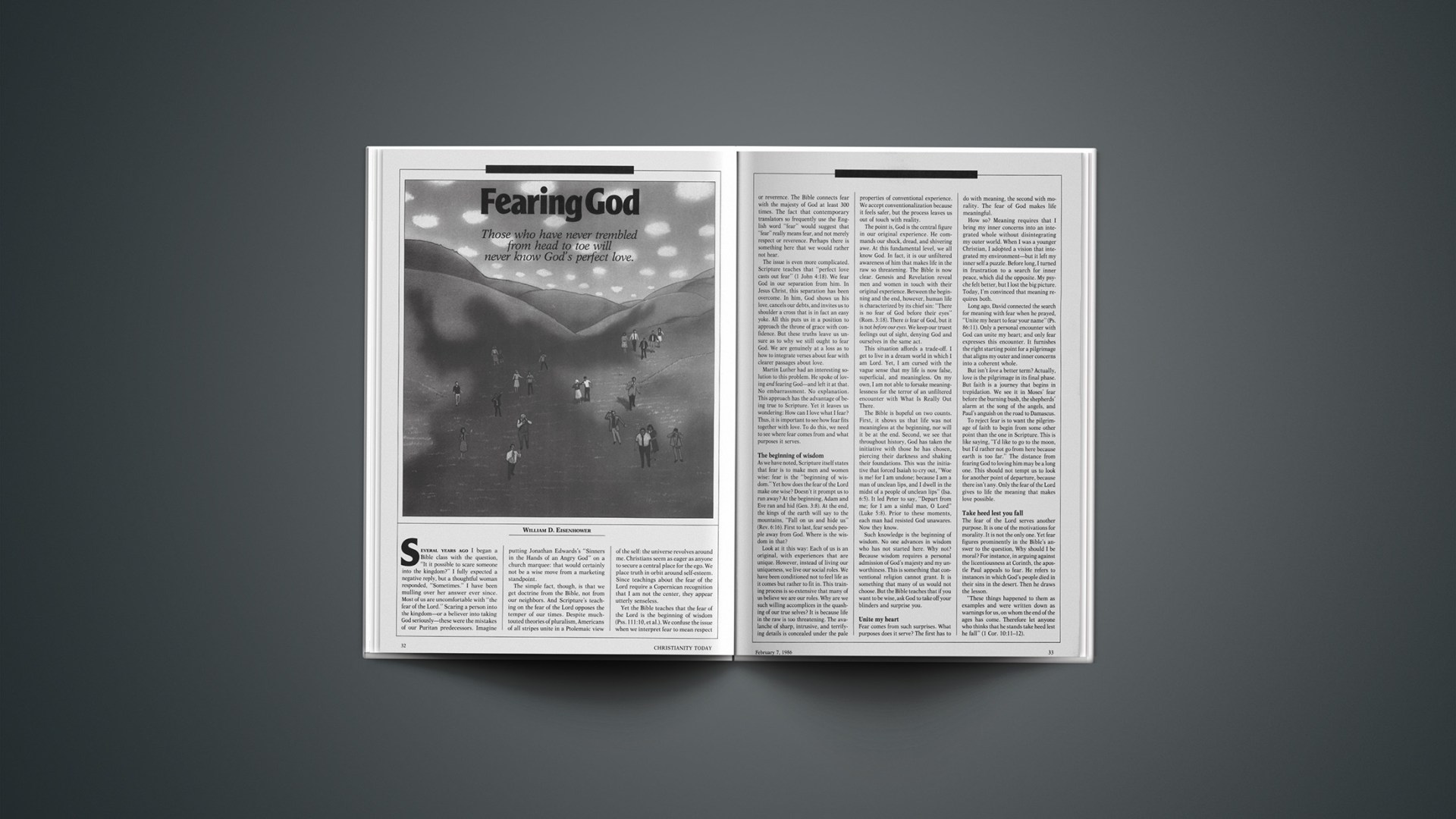
Those who have never trembled from head to toe will never know God’s perfect love.

Several years ago I began a Bible class with the question, “It it possible to scare someone into the kingdom?” I fully expected a negative reply, but a thoughtful woman responded, “Sometimes.” I have been mulling over her answer ever since. Most of us are uncomfortable with “the fear of the Lord.” Scaring a person into the kingdom—or a believer into taking God seriously—these were the mistakes of our Puritan predecessors. Imagine putting Jonathan Edwards’s “Sinners in the Hands of an Angry God” on a church marquee: that would certainly not be a wise move from a marketing standpoint.

The simple fact, though, is that we get doctrine from the Bible, not from our neighbors. And Scripture’s teaching on the fear of the Lord opposes the temper of our times. Despite much-touted theories of pluralism, Americans of all stripes unite in a Ptolemaic view of the self: the universe revolves around me. Christians seem as eager as anyone to secure a central place for the ego. We place truth in orbit around self-esteem. Since teachings about the fear of the Lord require a Copernican recognition that I am not the center, they appear utterly senseless.

Yet the Bible teaches that the fear of the Lord is the beginning of wisdom (Pss. 111:10, et al.). We confuse the issue when we interpret fear to mean respect or reverence. The Bible connects fear with the majesty of God at least 300 times. The fact that contemporary translators so frequently use the English word “fear” would suggest that “fear” really means fear, and not merely respect or reverence. Perhaps there is something here that we would rather not hear.

The issue is even more complicated. Scripture teaches that “perfect love casts out fear” (1 John 4:18). We fear God in our separation from him. In Jesus Christ, this separation has been overcome. In him, God shows us his love, cancels our debts, and invites us to shoulder a cross that is in fact an easy yoke. All this puts us in a position to approach the throne of grace with confidence. But these truths leave us unsure as to why we still ought to fear God. We are genuinely at a loss as to how to integrate verses about fear with clearer passages about love.

Martin Luther had an interesting solution to this problem. He spoke of loving and fearing God—and left it at that. No embarrassment. No explanation. This approach has the advantage of being true to Scripture. Yet it leaves us wondering: How can I love what I fear? Thus, it is important to see how fear fits together with love. To do this, we need to see where fear comes from and what purposes it serves.

The Beginning Of Wisdom

As we have noted, Scripture itself states that fear is to make men and women wise: fear is the “beginning of wisdom.” Yet how does the fear of the Lord make one wise? Doesn’t it prompt us to run away? At the beginning, Adam and Eve ran and hid (Gen. 3:8). At the end, the kings of the earth will say to the mountains, “Fall on us and hide us” (Rev. 6:16). First to last, fear sends people away from God. Where is the wisdom in that?

Look at it this way: Each of us is an original, with experiences that are unique. However, instead of living our uniqueness, we live our social roles. We have been conditioned not to feel life as it comes but rather to fit in. This training process is so extensive that many of us believe we are our roles. Why are we such willing accomplices in the quashing of our true selves? It is because life in the raw is too threatening. The avalanche of sharp, intrusive, and terrifying details is concealed under the pale properties of conventional experience. We accept conventionalization because it feels safer, but the process leaves us out of touch with reality.

The point is, God is the central figure in our original experience. He commands our shock, dread, and shivering awe. At this fundamental level, we all know God. In fact, it is our unfiltered awareness of him that makes life in the raw so threatening. The Bible is now clear. Genesis and Revelation reveal men and women in touch with their original experience. Between the beginning and the end, however, human life is characterized by its chief sin: “There is no fear of God before their eyes” (Rom. 3:18). There is fear of God, but it is not before our eyes. We keep our truest feelings out of sight, denying God and ourselves in the same act.

This situation affords a trade-off. I get to live in a dream world in which I am Lord. Yet, I am cursed with the vague sense that my life is now false, superficial, and meaningless. On my own, I am not able to forsake meaninglessness for the terror of an unfiltered encounter with What Is Really Out There.

The Bible is hopeful on two counts. First, it shows us that life was not meaningless at the beginning, nor will it be at the end. Second, we see that throughout history, God has taken the initiative with those he has chosen, piercing their darkness and shaking their foundations. This was the initiative that forced Isaiah to cry out, “Woe is me! for I am undone; because I am a man of unclean lips, and I dwell in the midst of a people of unclean lips” (Isa. 6:5). It led Peter to say, “Depart from me; for I am a sinful man, O Lord” (Luke 5:8). Prior to these moments, each man had resisted God unawares. Now they know.

Such knowledge is the beginning of wisdom. No one advances in wisdom who has not started here. Why not? Because wisdom requires a personal admission of God’s majesty and my unworthiness. This is something that conventional religion cannot grant. It is something that many of us would not choose. But the Bible teaches that if you want to be wise, ask God to take off your blinders and surprise you.

Unite My Heart

Fear comes from such surprises. What purposes does it serve? The first has to do with meaning, the second with morality. The fear of God makes life meaningful.

How so? Meaning requires that I bring my inner concerns into an integrated whole without disintegrating my outer world. When I was a younger Christian, I adopted a vision that integrated my environment—but it left my inner self a puzzle. Before long, I turned in frustration to a search for inner peace, which did the opposite. My psyche felt better, but I lost the big picture. Today, I’m convinced that meaning requires both.

Long ago, David connected the search for meaning with fear when he prayed, “Unite my heart to fear your name” (Ps. 86:11). Only a personal encounter with God can unite my heart; and only fear expresses this encounter. It furnishes the right starting point for a pilgrimage that aligns my outer and inner concerns into a coherent whole.

But isn’t love a better term? Actually, love is the pilgrimage in its final phase. But faith is a journey that begins in trepidation. We see it in Moses’ fear before the burning bush, the shepherds’ alarm at the song of the angels, and Paul’s anguish on the road to Damascus.

To reject fear is to want the pilgrimage of faith to begin from some other point than the one in Scripture. This is like saying, “I’d like to go to the moon, but I’d rather not go from here because earth is too far.” The distance from fearing God to loving him may be a long one. This should not tempt us to look for another point of departure, because there isn’t any. Only the fear of the Lord gives to life the meaning that makes love possible.

Take Heed Lest You Fall

The fear of the Lord serves another purpose. It is one of the motivations for morality. It is not the only one. Yet fear figures prominently in the Bible’s answer to the question, Why should I be moral? For instance, in arguing against the licentiousness at Corinth, the apostle Paul appeals to fear. He refers to instances in which God’s people died in their sins in the desert. Then he draws the lesson.

“These things happened to them as examples and were written down as warnings for us, on whom the end of the ages has come. Therefore let anyone who thinks that he stands take heed lest he fall” (1 Cor. 10:11–12).

Paul will very soon turn to the importance of agape. Love is the final motivation for obedience. But first he issues a threat. We need to be spurred to the place where love can do its work. How else can we understand the Bible’s many dark passages? In a section much like the earlier one, Paul says, “Do not be arrogant, but be afraid. For if God did not spare the natural branches, he will not spare you either. Consider therefore the kindness and sternness of God” (Rom. 11:20–22, NIV).

Let’s explore what this means. Fear arises when I encounter God. For in this encounter, I do not meet a distant deity with no influence over my life. To the contrary, I meet the one true Power in the universe, the One who controls my destiny—now and forever. And he comes to me with terms. My desire to meet his terms stems in part from my awareness that my life is literally in his hands. “It is a dreadful thing to fall into the hands of the living God” (Heb. 10:31). Scripture does not differentiate between the fear of the Lord and the desire to obey him. They are one and the same.

Throughout history, when Christians have looked to God both in love and in fear, they have attained to their highest level of moral behavior. Who can consider the decline of moral standards today without connecting it with the disappearance of the fear of the Lord? Sermons on love alone will not lift us out of the mire. There is not the slightest bit of evidence that love alone is a sufficient motivation for righteousness—and considerable evidence to the contrary.

The point is that a personal encounter with God will have moral consequences. In my discovery of the Savior who is also my Judge, I discover several reasons to obey him. Fear is one of these.

Fear Not, For Behold!

The Bible reports that confronting God is a dreadful experience. Yet fear does not have the last word. Those who are shaken to the core are told, “Fear not.” We have to conclude that while an unfiltered experience is terrifying, it also brings an unshakable reassurance. We are unsettled from our false securities, but then resettled in the true security of God’s love. Perfect love does indeed cast out fear. Yet the implication is that those who have never trembled from head to toe will never know God’s perfect love. In those who have, however, a fearful heart can be a way of saving oneself for something better.

Unfortunately, many of us presume that the world is the ultimate threat and that God’s function is to offset it. How different this is from the biblical position that God is scarier than the world by far. Recall Jesus’ command, “Do not fear those who kill the body but cannot kill the soul; rather fear him who can destroy both body and soul in hell” (Matt. 10:28).

When we assume that the world is the ultimate threat, we give it unwarranted power, for in truth, the world’s threats are temporary. When we expect God to balance the stress of the world, we reduce him to the world’s equal. We replace his sovereign freedom with an echoing function. Such an echo may answer our loneliness for a time, but it cannot question our decisions.

Too much conventional Christianity worships an echo. Unfortunately, comfort of this sort does not work. Reassurance that is not rooted in the fear of the Lord is cheap reassurance. It may have an outward appearance of godliness, but it has no real power for meaning or righteousness.

The words “Fear not” will never come with power to those who keep to the conventional pattern: threatened by the world; reassured by God. God said as much to Isaiah.

“Do not call conspiracy everything that these people call conspiracy; do not fear what they fear, and do not dread it. The Lord Almighty is the one you are to regard as holy, he is the one you are to fear, he is the one you are to dread” (Isa. 8:12–13, NIV).

Until we recognize how wrong it is to be intimidated by the world, the idea that wisdom begins with a dreadful encounter with God will remain completely unintelligible.

Yet if wisdom starts with fear, it does not end there. As I walk with the Lord, I discover that God poses an ominous threat to my ego, but not to me; that he stands over against my delusions, but not against the truth that sets me free; that he casts me down, but only to lift me up; that he sits in judgment of my sin, but forgives me nevertheless. The fear of the Lord is the beginning of wisdom, but love is its completion.

Even so, those who start with fear need to come back to it repeatedly. Perfect love replaces fear in the perfect believer—and who can claim that status? The same wisdom that shows me the love of God also reveals that I presume upon that love too often. I, for one, need a healthy sense of divine wrath for those times when my love has grown cold.

Martin Luther was right. It is important both to love and to fear God. Just as the Puritan focus on fear alone distorts the life of faith, so does a syrupy emphasis on agape. Surely today’s all-God-wants-is-to-win-your-love sermons are as extreme as the harshest Puritanism. Future generations will no doubt be embarrassed by the way we have confused talk about love with giving it a sure foundation.

The truth is, each of us is like Moses: able to look across to a promised land where love rules, yet still on this side, where love is not perfect, where the flesh needs to be goaded, and where the cares of this world contend with the lure of the world to come. We look across to a future perfection while admitting it is far from us. Wisdom begins—and begins again—when we fall into the hands of the living God. There is fear and trembling here. But our salvation cannot be worked out under any other circumstances.

Theology

Lessons from the Kindergarten of Contemplation

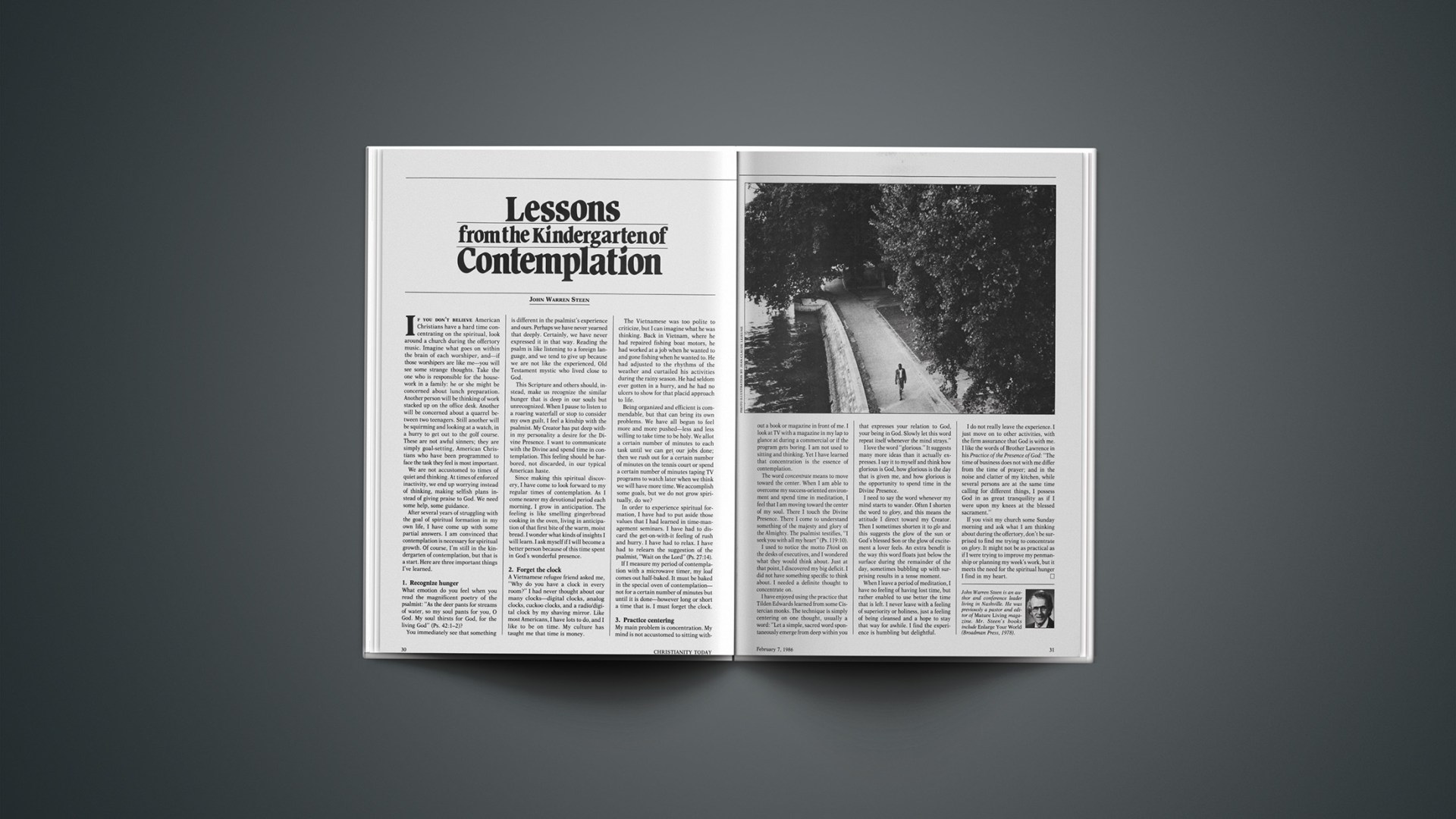
If you don’t believe American Christians have a hard time concentrating on the spiritual, look around a church during the offertory music. Imagine what goes on within the brain of each worshiper, and—if those worshipers are like me—you will see some strange thoughts. Take the one who is responsible for the housework in a family: he or she might be concerned about lunch preparation. Another person will be thinking of work stacked up on the office desk. Another will be concerned about a quarrel between two teenagers. Still another will be squirming and looking at a watch, in a hurry to get out to the golf course. These are not awful sinners; they are simply goal-setting, American Christians who have been programmed to face the task they feel is most important.

We are not accustomed to times of quiet and thinking. At times of enforced inactivity, we end up worrying instead of thinking, making selfish plans instead of giving praise to God. We need some help, some guidance.

After several years of struggling with the goal of spiritual formation in my own life, I have come up with some partial answers. I am convinced that contemplation is necessary for spiritual growth. Of course, I’m still in the kindergarten of contemplation, but that is a start. Here are three important things I’ve learned.

1. Recognize Hunger

What emotion do you feel when you read the magnificent poetry of the psalmist: “As the deer pants for streams of water, so my soul pants for you, O God. My soul thirsts for God, for the living God” (Ps. 42:1–2)?

You immediately see that something is different in the psalmist’s experience and ours. Perhaps we have never yearned that deeply. Certainly, we have never expressed it in that way. Reading the psalm is like listening to a foreign language, and we tend to give up because we are not like the experienced, Old Testament mystic who lived close to God.

This Scripture and others should, instead, make us recognize the similar hunger that is deep in our souls but unrecognized. When I pause to listen to a roaring waterfall or stop to consider my own guilt, I feel a kinship with the psalmist. My Creator has put deep within my personality a desire for the Divine Presence. I want to communicate with the Divine and spend time in contemplation. This feeling should be harbored, not discarded, in our typical American haste.

Since making this spiritual discovery, I have come to look forward to my regular times of contemplation. As I come nearer my devotional period each morning, I grow in anticipation. The feeling is like smelling gingerbread cooking in the oven, living in anticipation of that first bite of the warm, moist bread. I wonder what kinds of insights I will learn. I ask myself if I will become a better person because of this time spent in God’s wonderful presence.

2. Forget The Clock

A Vietnamese refugee friend asked me, “Why do you have a clock in every room?” I had never thought about our many clocks—digital clocks, analog clocks, cuckoo clocks, and a radio/digital clock by my shaving mirror. Like most Americans, I have lots to do, and I like to be on time. My culture has taught me that time is money.

The Vietnamese was too polite to criticize, but I can imagine what he was thinking. Back in Vietnam, where he had repaired fishing boat motors, he had worked at a job when he wanted to and gone fishing when he wanted to. He had adjusted to the rhythms of the weather and curtailed his activities during the rainy season. He had seldom ever gotten in a hurry, and he had no ulcers to show for that placid approach to life.

Being organized and efficient is commendable, but that can bring its own problems. We have all begun to feel more and more pushed—less and less willing to take time to be holy. We allot a certain number of minutes to each task until we can get our jobs done; then we rush out for a certain number of minutes on the tennis court or spend a certain number of minutes taping TV programs to watch later when we think we will have more time. We accomplish some goals, but we do not grow spiritually, do we?

In order to experience spiritual formation, I have had to put aside those values that I had learned in time-management seminars. I have had to discard the get-on-with-it feeling of rush and hurry. I have had to relax. I have had to relearn the suggestion of the psalmist, “Wait on the Lord” (Ps. 27:14).

If I measure my period of contemplation with a microwave timer, my loaf comes out half-baked. It must be baked in the special oven of contemplation—not for a certain number of minutes but until it is done—however long or short a time that is. I must forget the clock.

3. Practice Centering

My main problem is concentration. My mind is not accustomed to sitting without a book or magazine in front of me. I look at TV with a magazine in my lap to glance at during a commercial or if the program gets boring. I am not used to sitting and thinking. Yet I have learned that concentration is the essence of contemplation.

The word concentrate means to move toward the center. When I am able to overcome my success-oriented environment and spend time in meditation, I feel that I am moving toward the center of my soul. There I touch the Divine Presence. There I come to understand something of the majesty and glory of the Almighty. The psalmist testifies, “I seek you with all my heart” (Ps. 119:10).

I used to notice the motto Think on the desks of executives, and I wondered what they would think about. Just at that point, I discovered my big deficit. I did not have something specific to think about. I needed a definite thought to concentrate on.

I have enjoyed using the practice that Tilden Edwards learned from some Cistercian monks. The technique is simply centering on one thought, usually a word: “Let a simple, sacred word spontaneously emerge from deep within you that expresses your relation to God, your being in God. Slowly let this word repeat itself whenever the mind strays.”

I love the word “glorious.” It suggests many more ideas than it actually expresses. I say it to myself and think how glorious is God, how glorious is the day that is given me, and how glorious is the opportunity to spend time in the Divine Presence.

I need to say the word whenever my mind starts to wander. Often I shorten the word to glory, and this means the attitude I direct toward my Creator. Then I sometimes shorten it to glo and this suggests the glow of the sun or God’s blessed Son or the glow of excitement a lover feels. An extra benefit is the way this word floats just below the surface during the remainder of the day, sometimes bubbling up with surprising results in a tense moment.

When I leave a period of meditation, I have no feeling of having lost time, but rather enabled to use better the time that is left. I never leave with a feeling of superiority or holiness, just a feeling of being cleansed and a hope to stay that way for awhile. I find the experience is humbling but delightful.

I do not really leave the experience. I just move on to other activities, with the firm assurance that God is with me. I like the words of Brother Lawrence in his Practice of the Presence of God: “The time of business does not with me differ from the time of prayer; and in the noise and clatter of my kitchen, while several persons are at the same time calling for different things, I possess God in as great tranquility as if I were upon my knees at the blessed sacrament.”

If you visit my church some Sunday morning and ask what I am thinking about during the offertory, don’t be surprised to find me trying to concentrate on glory. It might not be as practical as if I were trying to improve my penmanship or planning my week’s work, but it meets the need for the spiritual hunger I find in my heart.

Genetic Engineering: Promise & Threat

Can we find a firm approach to the powerful new science that tampers with life’s smallest components?

Sometimes uneasy allies, both science and religion seek to improve the lot of mankind. Nevertheless, their conflicting values have often forced them into a showdown.

Now the social and ethical stakes are as high as they have ever been. With even the slightest advances in genetic engineering, such afflictions as cancer, viral diseases, and even certain aspects of the aging process may become curses of the past. Science is carefully unraveling DNA’s double helix, probing and mapping the stuff of life. Yet genetic engineering’s place in society and its boundaries are ill defined. And the religious community has yet to establish a firm equilibrium with the new, powerful science that has dared to tamper with life’s smallest material components.

The genetic engineering debate may well be irreconcilable at the most elemental levels of logic as scientists and moral theologians address each other from different dimensions. But one thing is certain: The ultimate outcome will determine the future shape of humanity.

The New Frontier

Biotechnology swept upon us quickly. Most of the advances in genetic engineering have come about within five years; the last decade nearly encompasses its entire history. In a few short years we have moved from obscure x-ray photographs of bacterial DNA (deoxyribonucleic acid) to methods of precisely trimming, clipping, and changing infinitesimal parts of the genetic code itself.

Already gone is the simplistic notion that the expression of genetic information of all life is the same. Now we know that the mechanism of mammalian and bacterial gene expression differs in radically different ways—which suggests an overt complexity and redundancy of higher life we had never dreamed of before. From the four chemical codes of life common to every life form on earth, we have learned how we can change the process that defines our existence.

On April 25, 1953, James Watson and Francis Crick published a paper that described for the first time the shape of the DNA molecule. For their insight, they won the Nobel prize. They had successfully initiated a biological revolution by describing the smallest units of life.

Watson and Crick had described the DNA molecule as large (for a molecule) and coiled in the shape of a spiral staircase, or double helix. This smallest denominator of life was linked together by only four chemical building blocks whose varied sequence provided a coded blueprint for all life forms on earth from bacteria to humankind. Their discovery, which enabled us to visualize growth and reproduction as a common link between all life, would enable us to change life at its most basic levels.

This understanding of the elemental life processes led to the ultimate development of four methods of altering the normal functions of cell replication. This is accomplished by directly changing or interfering with its DNA. (See “Four Ways to Change the Blueprint.”)

Experiments with human life began in 1970. A physician attempted to introduce the gene for production of the enzyme arginase into patients whose bodies were incapable of normally producing the chemical. Otherwise doomed to death, the patients were injected with a virus capable of producing the enzyme. Some evidence had suggested the virus would invade the patients’ DNA, be destroyed by the patients’ immune system, and leave behind the necessary gene to produce arginase. The experiment’s designer, biochemist-physician Stanford Rogers, was wrong. Though his effort was designed to save lives, his failure brought an avalanche of criticism, and he lost much of his research funding.

A more elaborate experiment was attempted on July 10, 1980, by a team directed by Dr. Martin Cline, then head of hematology and oncology at UCLA, and an Israeli medical group including Dr. Eliezer Rachmilewitz at Jerusalem’s Hadassah Hospital.

Rachmilewitz’s patients were born with a rare but fatal blood disease called beta zero thalassemia. Cline’s treatment consisted of injecting their bone marrow with a purified gene, cloned by recombinant DNA technology, to correct the defect. Cline’s efforts also failed. The subsequent storm of protest forced him to step down from his job. He too lost a great deal of his research funding.

The scientific community was ruling the new science with an unforgiving hand. For the moment, genetic engineering seemed too risky to apply to humans, and only indirectly would we benefit from the new biotechnology. But by the early 1980s, the bacterial production of cheap interferon and human insulin was being carried on by the new genetic engineering companies. By advances in such areas as agriculture and the production of medical products, the last few years have shown the incredible potential of this new technology of life. (See box: “The Genetic Scorecard.”)

The Simple And The Complex

The DNA contained in every human cell is compacted and coiled in 23 pairs of tight bundles called chromosomes. If all the DNA in a single cell were uncoiled, it would stretch out about three meters. And in these three meters of human DNA there are about 5,000,000 genes, of which at least 100,000 define the human form. In every molecule of DNA there is the blueprint for eyes, brain, liver, heart, and bones.

Directly altering an organism by changing its genetic code requires that the gene (or set of instructions) along the DNA coil be modified and that this same set of instructions be changed in every cell of the organism. With single-cell organisms, such as bacteria, that is not too hard to accomplish. But the human organism is 100 trillion times as complicated.

Changing a multicellular organism was first accomplished in 1982 when the Carnegie Institute implanted a foreign gene in a fruit fly. The change was functional and was passed along to subsequent generations. In the Carnegie experiment, red-eye genes were passed to brown-eye flies.

Genetic researchers who first contemplated the problem of directly altering the coding sequence of DNA were faced with problems that were simultaneously simple and complex. The simple part was the exchange of molecules in the DNA to bring about the desired modifications. The complex task would be to locate the right gene and to alter only that part of the code. Although the basic idea was simple, they would be working at the molecular level, beyond the range of any microscope.

The most likely candidate for the pioneer work was a single-cell bacterium. The organism enlisted early was the most common bacterium in the human intestinal tract: Escherichia coli.

E. coli is easy to care for and maintain. And it holds the distinction of being the single most carefully studied organism in history. For this reason, E. coli has been used not only for the majority of the early DNA studies, but its genetically altered forms have been patented as life forms invented by human beings.

Methods of mapping the DNA sequence were developed by clipping off the ends of an uncoiled DNA strand and analyzing and identifying the individual molecules as they were encountered on the strand.

After a gene was mapped, changes were induced in the DNA, altering the sequence by introducing mutagenic chemicals—compounds that increase the frequency of genetic mutations by “scrambling” the DNA sequence. Researchers observed the effects on the microorganism, remapped the gene, thereby learning the functions of specific parts of the DNA code.

Recombinant DNA technology, the most refined process of genetic engineering, came in 1974 when genetic researchers discovered they could clip off a known sequence of the DNA and replace it with DNA from other sources. This form of gene splicing quickly became the most important genetic engineering tool. Science was learning enough to make changes at will without relying on the slower random mutational techniques.

Ultimately, geneticists at CalTech invented two machines that were quantum leaps in genetic engineering research. One machine automatically identified the sequence of cellular amino acids, spelling out the DNA code of the particular gene. Another machine assembled artificial genes piece by piece.

With these advances it became necessary for the scientific community to keep track of the avalanche of mapped genes. In 1982, the Los Alamos National Laboratory set up GenBank, a computerized data base of millions of nucleic acid sequences. That data base soon contained information on hundreds of living species—including parts of man’s genetic constitution. One day, reconstructing these genetic constitutions may consist of connecting a laboratory computer to this massive data base, which in turn would spell out the genetic make-up of interest.

It is only a matter of time until the entire human DNA sequence is catalogued and computerized. With this information, the science of genetic engineering may be able to manipulate the human life form in ways we have not yet even imagined.

Four Ways to Change the Blueprint

Mutagenesis

Genetic mutations are induced by introducing a mutagenic agent that increases the random frequency of changes in genes to a rate many times faster than normal. This is usually fatal to the organism. But in populations sufficiently large, an occasional microorganism survives and successfully passes along the changes to subsequent generations.

Protoplast fusion

The external walls of cells are removed from two types of cells. The genetic materials then combine and mix, causing a natural (but still random) genetic recombination.

Gene amplification

DNA (outside the nucleus, but still inside the cell) is forced to reproduce at a rate 100 or more times faster than the DNA inside the nucleus (typically responsible for cell replication). This causes a greatly amplified production of cellular protein.

Recombinant DNA

The most refined genetic manipulation technique consists of splicing specific codes along the DNA chain, forming a stable combination of information that will produce a specific result and pass this trait on to succeeding generations.

Health Care And Big Business

Genetic engineering established a powerful foothold when the U.S. Supreme Court gave Dr. Ananda Chakrabarty the right to patent a life form he had engineered, a microorganism that would metabolize petroleum and help clean up oil spills.

The result of the Court’s decision was to open the field to commercial enterprise. With big money riding on the right processes, a handful of genetic engineering companies went public and became multimillion-dollar enterprises virtually overnight. Firms with futuristic names—Genentech, Cetus, Lenex, Hybratech, Petrogen—started the race to invent new life forms.

The companies signed nearly every genetic scientist and researcher in the field, creating great concern over this historically unique, apparent conflict of interest between industry and pure science.

Three important medical products came from this new industry in quick succession:

Human interferon, a possible solution to such afflictions as cancer and viral diseases, used to cost a quarter of a million dollars per thousandth of a gram. With newly engineered bacteria that produce human interferon as a metabolic by-product, we can now produce the same amount of interferon for about a nickel.

Human growth hormone, for children whose pituitary glands could not produce enough to help them reach a normal height (hypopituitarism), was formerly produced by extracting the hormone from cadavers. An average child required pituitaries from over 500 cadavers over a 10-year period. Thus they were faced with a life of stunted growth unless they could afford $50,000 to $100,000 worth of treatment. Genentech of San Francisco changed the genetic constitution of E. coli, and now human growth hormone is churned out at affordable prices.

Human insulin, now manufactured by genetically altered bacteria for tens of thousands of diabetics, replaces the beef-and pork-based product against which many patients build up antibodies. In October 1982, the Eli Lilly Company was given permission by the Food and Drug Administration to begin marketing human insulin.

But the genetic engineering industry was not focusing on making medical breakthroughs alone. Industrial microorganisms have been “invented” to mine precious metals from ore through extracellular secretions and leaching. A potato was given the blight-resistant genes of a tomato to become a “pomato.” A sunflower was given the genes of a bean to produce protein. One strain of bacteria was engineered to convert ethylene to ethylene glycol (a constituent of antifreeze), another to change subterranean oil to make it easier to remove. And the University of California at Berkeley recently engineered a strain of bacteria that would protect plants from frost, sparking a controversy over introducing the plant into the environment. In November 1985, the EPA finally okayed its release in a California strawberry field.

On the horizon are genetic wonders that used to be mere science fiction. For example, aging is reflected in the behavior of DNA. In pioneering work, Ronald Hart and Richard Setlow tied the biological clock directly to the repair processes in older cells. And in 1979, Dr. Joan Smith-Sonneborn significantly extended the life span of single-cell paramecium by manipulating specific DNA repair processes.

In order to organize the search for cures for the 3,500 known human genetic disorders, the Human Genetic Mutant Cell Repository was established in Camden, New Jersey. Here frozen cell cultures from afflicted individuals are stored for reference.

And serious thought has been given to storing biological materials from organisms soon to be extinct, from smallpox to mammals, birds, and plants, in frozen storage for future, possible genetic reconstruction of entire organisms.

By 1985, the business of genetic engineering was a billion-dollar industry and growing. Already, medicine, agriculture, and energy were becoming dependent on its products, and the emerging possible future uses were astonishing.

Catching Up with the Revolution

Technological events are getting ahead of our ability to cope with them in traditional moral categories. That is reason enough for a Christian moralist to view the revolution in biotechnology with unease.

Rather than apply moral standards to genetic engineering in general, we must examine the moral implications of each discrete stage in the specific applications of biotechnology to human beings. We will need to give careful thought to such questions as these:

1. Is it permissible to alter humanness at its core, to tamper with our essential humanity? Many people agree that it is right to tamper with some aspects of our humanness, as we do in giving people mechanical hearts. But is there a core of humanity that makes us the special godlike creatures we are—a core that should not be monkeyed with? If so, moralists and theologians must try to specify more exactly what is uniquely human about us.

2. Is it permissible for some people to alter other people’s humanity? It is misleading to talk about humanity recreating itself. Some persons are recreating other persons. The questions are these: Who sets the norms for what other people ought to be? And who has the wisdom and the right to use such power over the destiny of other people?

3. Is it socially responsible to give almost free rein to a biotech industry whose bottom line is profit? While some see the National Institutes of Health’s relaxation as a signal that the dangers are small, NIH’s relaxation may actually be a sign that public guardians are easily seduced by scientific authorities. Laissez-faire human technology needs to be watched carefully.

We need to remember that every good gift from above, including biotechnology, is likely to be turned against us by arrogant people who believe in the irresistible goodness of what they are doing.

By Lewis Smedes, professor of theology and ethics at Fuller Theological Seminary.

Benefit And Peril

The first decade of genetic engineering has passed with little threat to the environment or the public. The somber warnings and tight regulations issued by the National Institutes of Health (NIH) from 1974–76 have been relaxed and their initial fears determined to be unfounded.

The NIH, initially worried about the inadvertent design of a deadly microorganism, strictly regulated the genetic engineering business in its infancy. The industry, however, successfully demonstrated that their organisms were usually so task-specific that they could survive only in carefully controlled conditions. One strain of E. coli, called K-12, which is used widely in genetic research, has been so extensively modified that it is virtually impossible for the organism to survive outside a carefully controlled laboratory environment.

To date, the genetic engineering industry has shown itself to be the harbinger only of good, making medicines and food better and cheaper. We have been left in awe at both the reality and the possibilities.

Yet, like any other human enterprise, genetic engineering has a possibility for malevolence equal to its potential for good. For example, since some genetic diseases strike only members of certain races (sickle cell anemia afflicts only blacks, and Tay-Sachs disease strikes only Jews), it is conceivable that we could copy nature and create an organism to carry out a horrible genocide. If biological warfare is terrible, its genetic equivalent would be unspeakable.

Aside from examples of potential abuse, deeply troubling questions remain over the direction civil genetic engineering may take.

Already, in its first years of existence, genetic screening has been used by a multinational corporation in what amounts to high-tech racism.

One multinational corporation defended its use of genetic screening for sickle cell anemia among black job applicants to prevent susceptible workers from exposure to toxic substances. But such genetic screening could become the ultimate invasion of privacy.

On the visible horizon, genetic engineering could be used in conjunction with gametic engineering, the laboratory manipulation of human germ cells, to create a human being in any desired image. In this seriously discussed (but not yet possible) procedure, a human’s genes would be altered to order. The new genetic information would be passed to a human egg cell in vitro, where a new human would be nourished through the gestation period under theoretically perfect conditions. This procedure could hypothetically produce “super humans” resistant or immune to physical disease, and endowed in advance with superior intelligence.

Part of this procedure is now possible. The more difficult procedures will probably be in reach within our lifetimes.

Dr. Landrum Shettles, a reproductive biologist, has reported nourishing a normally developed, cloned human egg cell to the stage of intrauterine impregnation. Said Shettles, the remaining obstacles to the cloning of human beings are social, not scientific.

The first animal cloned, a frog, was produced by biologists Thomas Briggs and Thomas King in 1952. Nearly three decades later, the first mammals were cloned, mice produced by biologists Karl Illmensee and Peter Hoppe. Yet many still believe that cloning by the transplanting of nuclei of adult mammalian cells, as Shettles claimed, is still impossible. The debate continues.

Genetic prejudice is already being expressed. The famous Nobel Sperm Bank, formally called the Repository for Germinal Choice, in Escondido, California, contains sperm donated by some Nobel laureates for insemination of “acceptable” candidates. The only laureate-donor to identify himself thus far has been Stanford physicist William Shockley, who stirred controversy by claiming that blacks are inherently inferior to whites.

The sperm bank’s clients have already produced children. Los Angeles psychologist Afton Blake bore the second child from the bank. One of Blake’s reasons for using the bank’s services was the genetic legacy she wanted to pass on to her children and subsequent generations.

Society’s Toolbox

Some people think of technology, including genetic technology, as society’s toolbox. A new technology is just a new tool, an option for society to use or not as it sees fit. We will make what we want with it. Indeed, if we master enough tools, we may yet construct utopia. When technology fails, we will search for yet another tool to fix it.

That view of technology is naive and, when applied to genetic engineering, dangerous.

First, although technologies are introduced as options, they can quickly become socially enforced. The automobile was introduced as an option—but try to ride a horse home on the interstate. Genetic counseling was introduced to increase options, but already some are insisting that parents have a duty to be informed and, given certain risks, a duty to avoid childbearing.

Second, although technologies are introduced to make things we want, they seldom satisfy our wants. If we can travel faster by car than horse, we now want faster cars. If we can have a child when we could not have one before, we now want a particular kind of child, say a bright, blond boy. Technology is self-stimulating. It is not only a function of our life together and our values, but it also shapes them. Moral wisdom then would call for some sobriety about our limits and our guilt for demanding too much.

Third, although technology has brought real benefits, the confidence that it will always bring well-being (or that, if it doesn’t, some new technology that can correct the harm) is folly. The fundamental problems in coping with human existence do not permit technological solutions; greed, pride, envy, and ennui are not technical problems awaiting a quick technological fix. They too can conscript technology to their ends. As C. S. Lewis wrote: “What we call Man’s power over nature turns out to be a power exercised by some men over others with Nature as its instrument.”

Gametic intervention is a case in point. We are seizing control of reproduction, gaining power to intervene purposefully in the genetic endowment of our children precisely when we are more confused about parenting than ever. The technologies are introduced to increase our options, to get us what we want—a healthy child. But if parenting is to make parents happy, then genetic engineering will go afoul because we will abort whatever or whomever does not meet our specifications—and we shall still be unhappy. And if parenting is to make children happy, then genetic engineering will still go afoul. The awesome responsibility to minimize the children’s suffering and to maximize their happiness will have a self-stimulating impetus until we have reduced our options to a perfect child or a dead child.

Not all reproductive interventions are immoral; but we will not properly guide or limit such powers until we have a good deal more communal wisdom about parenting than we now possess. I fear for our capacities to learn that wisdom in the rush of public enthusiasm about reproductive technologies.

By Alan Verhey, associate professor of religion at Hope College and coeditor with Stephen Lammers of a forthcoming book of theological reflections on medical ethics (Wm. B. Eerdmans).

Moral Imperatives

The scientific community has historically shown itself to be vigorously self-regulated. Its moral standards are nearly always surprisingly conservative. Renegades and apostates are usually criticized and denounced, their research funds cut quickly. It is hard to find many examples of scientists continually abusing their positions.

Remarks made by Robert Sinsheimer of the California Institute of Technology to the Genetics Society of America illustrate this notion: “To impose any limit upon freedom of inquiry is especially bitter for the scientist whose life is one of inquiry; but science has become too potent.… Rights are not found in nature. Rights are conferred within a human society and for each there is expected a corresponding responsibility.… Science is the major organ of inquiry for a society—and perhaps a society, like an organism, must follow a developmental program in which the genetic information is revealed in an orderly sequence.”

From a Christian perspective, the real dangers of genetic engineering do not seem to emanate from the scientific community, but from the same places as other causes of social concern.

The abuse of genetic engineering will come from two familiar directions: (1) ill-defined or nonexistent norms of acceptable social direction and (2) disguised social principles of accomplishing one goal by way of another.

Thus, genetic engineering stands in the same place as the other powerful technologies of history, from nuclear weapons to wonder drugs: controlled completely by the hand of mankind and the conventional or surreptitious operational rules of society. Whatever good or evil shall come from it will be determined through the underlying social motivations and allowances for excess over which Christians may exercise influence.

The Christian response must be controlled by accurate and thorough knowledge of the field and a sober realization that the morality of many of the issues will not be clear-cut or obvious. Most important, we must understand our value systems and decide that what we can do is not necessarily what we should do.

The Christian input will be only one of many. It must be coordinated if the counsel of all those with moral concerns is to be effective.

The opinions of the poorly informed and emotional have already been discounted. The President’s Commission for the Study of Ethical Problems in Medicine and Biomedical and Behavioral Research (1982) stated, “Genetic engineering has become a target for simplistic slogans that try to capture vague fears.”

The concepts that underlie genetic engineering are far from simple. They are some of the most profound and powerful ideas ever. The promise of genetic engineering lies in the miracles that we have already created and will soon invent from the living code. But the nightmare is real and, ironically, is expressed in the words attributed to DNA codiscoverer Sir Francis Crick by journalist David Rorvik:

“No newborn infant should be declared human until it has passed certain tests regarding its genetic endowment.… If it fails these tests, it forfeits the right to live.”

The evil we face, therefore, is not from the tools of life but from the minds that made them. There is only one certainty: The river that is the knowledge of life has been crossed, and we cannot go back again.

The Mandate to Heal

Christians are committed to the biblical mandates to be stewards over the earth and to heal—mandates which give us a theological basis for science.

Many forms of genetic engineering are intended to meet human need and to alleviate human suffering:

First, attempts to control genetic disease: prenatal and postnatal screening, counseling prospective parents who are at risk of producing a genetically defective child, repairing or replacing defective genes and their products. We support these healing goals in general, since genetic technologies give us unique opportunities to alleviate the personal, familial, and social costs of genetic disease. But cautions are raised by possible abuses: coercive, mandatory screenings; discrimination against those identified as “defective”; coercion of some people not to reproduce; and abortion of fetuses considered less than normal. Concerns also arise from enthusiasts who speak of “controlling our own evolution.” We ought to endorse techniques that will prevent or repair the effects of genetic diseases, while rejecting the idea of genetically creating superior individuals in order to transcend the limitations of our finitude.

Second, recombinantDNAresearch: Worries about creating “killer germs” seem to have subsided, but there is still concern that by reshuffling DNA we are overstepping creaturely bounds. This argument is probably inadequate to justify a ban on such beneficial technologies as producing human growth hormone. There is still room for caution in introducing engineered DNA microbes into the environment.

Third, new reproductive technologies: artificial insemination by donor, artificial insemination by husband, and in vitro fertilization. As a general principle, we should accept those technologies that overcome barriers to the unification of the sperm and egg of a husband and wife, whether by artificial insemination or in vitro fertilization. Using donor sperm or egg is problematic, however, since it introduces a “third party” into the procreative act.

Science is a legitimate human enterprise, not a sacred cow. Christians are aware of the human capacity to overreach, exploit, and abuse even in such a worthwhile enterprise as science. To trust in the self-regulation of the scientific community too heavily would be insufficiently cautious about human nature.

By David B. Fletcher, assistant professor of philosophy at Wheaton College, who is currently working on a book on bioethics from an evangelical perspective.

Apple PodcastsDown ArrowDown ArrowDown Arrowarrow_left_altLeft ArrowLeft ArrowRight ArrowRight ArrowRight Arrowarrow_up_altUp ArrowUp ArrowAvailable at Amazoncaret-downCloseCloseEmailEmailExpandExpandExternalExternalFacebookfacebook-squareGiftGiftGooglegoogleGoogle KeephamburgerInstagraminstagram-squareLinkLinklinkedin-squareListenListenListenChristianity TodayCT Creative Studio Logologo_orgMegaphoneMenuMenupausePinterestPlayPlayPocketPodcastRSSRSSSaveSaveSaveSearchSearchsearchSpotifyStitcherTelegramTable of ContentsTable of Contentstwitter-squareWhatsAppXYouTubeYouTube