Heresies of Holiness

The Fact that We All Sin Can Create an Atmosphere of False Security.

In a review of my bookJohnny Come Home, the reviewer observed that, “The only character in the novel who is holy is … God.”

He was right. No human character can be portrayed with any accuracy unless he or she is painted warts and all. A human being without sin is as rare as an incarnate deity. And that the greatest of saints continue to struggle with sin long after their conversions is axiomatic (except to the most militant perfectionists).

The obvious fact that we all sin can, of course, create an atmosphere of false security among us. Sin being commonplace, we can passively accept the idea that we ought not to be too bothered by it lest we surrender our mental health to a self-deprecating neurosis. Yet in our desire to console ourselves and maintain a good self-image, we may push to the back burner the mandate of God: “Be ye holy, for I am holy” (1 Peter 1:16; cf. Lev. 11:44–45).

A Sure And Certain Remedy

Evangelical Christians stress the fact that justification is by faith alone and that righteousness is found in Christ alone.

Though these assertions are true, it is equally true that the faith that justifies us brings forth fruit in our lives. The slogan of the Reformation was that we are justified by faith alone; but not by a faith that is alone. The moment true faith is present in the heart of the believer, the process of sanctification begins; the Christian is being conformed to the image of Christ. We are becoming holy. And if we are not becoming holy, then Christ is not in us and our profession of faith is empty.

Martin Luther gave the following analogy: When we are justified it is as though a doctor had just administered a sure and certain remedy for a fatal disease. Though the patient would still endure a temporary struggle with the residual effects of the illness, the outcome would no longer be in doubt. The physician pronounces the patient cured even though a rehabilitation process must still be carried out.

So it is with our justification. In Christ God pronounces us just by the imputation of the merits of Christ. Along with that declaration God administers something to us—his Holy Spirit—which begins immediately to bring us to holy living.

Unholy Pursuits Of Holiness

The New Testament contains a ringing paradox with respect to sanctification. The Bible says, “Work out your own salvation with fear and trembling; for God is at work in you, both to will and to work for his good pleasure” (Phil. 2:12b–13). Notice that there are two agents working here. We are called to work, and God promises to work as well. To be sure, our initial regeneration is accomplished by God alone, but our sanctification involves mutual activity.

The two great heresies that have plagued the church on this matter for centuries are the heresies of activism and quietism. These twin distortions are guilty of eliminating one or the other poles of the paradox. In activism, God’s working is swallowed up by human self-righteousness. In quietism, the human struggle is swallowed up by an automatic divine process.

Activism is the creed of the self-righteous person. He has no need of divine assistance to achieve perfection. Grace is held in contempt, a remedy needed only by weak people. The activist can lift himself up by his own bootstraps. His confidence is in himself and his own moral ability. Perhaps the most arrogant statement the activist can make is: “I don’t need Christ.”

The quietist, on the other hand, insults the Holy Spirit by insisting that God is totally responsible for his progress or lack of it. If the quietist still sins, the unspoken assumption is that God has been lacking in his work. The creed of the quietist is, “Let go and let God.” No struggle is necessary; no resistance to temptation is required. It is God’s job, from beginning to end.

God calls us to the pursuit of holiness. The pursuit is to be undertaken with strength and resolution. We are to resist unto blood. To wrestle with powers. To pummel our bodies, rejoicing in the certainty that the Holy Spirit is within us—helping, disposing, convicting, and encouraging.

To the end that we may be holy.
Called to Be Saints—Not Well-Adjusted Sinners

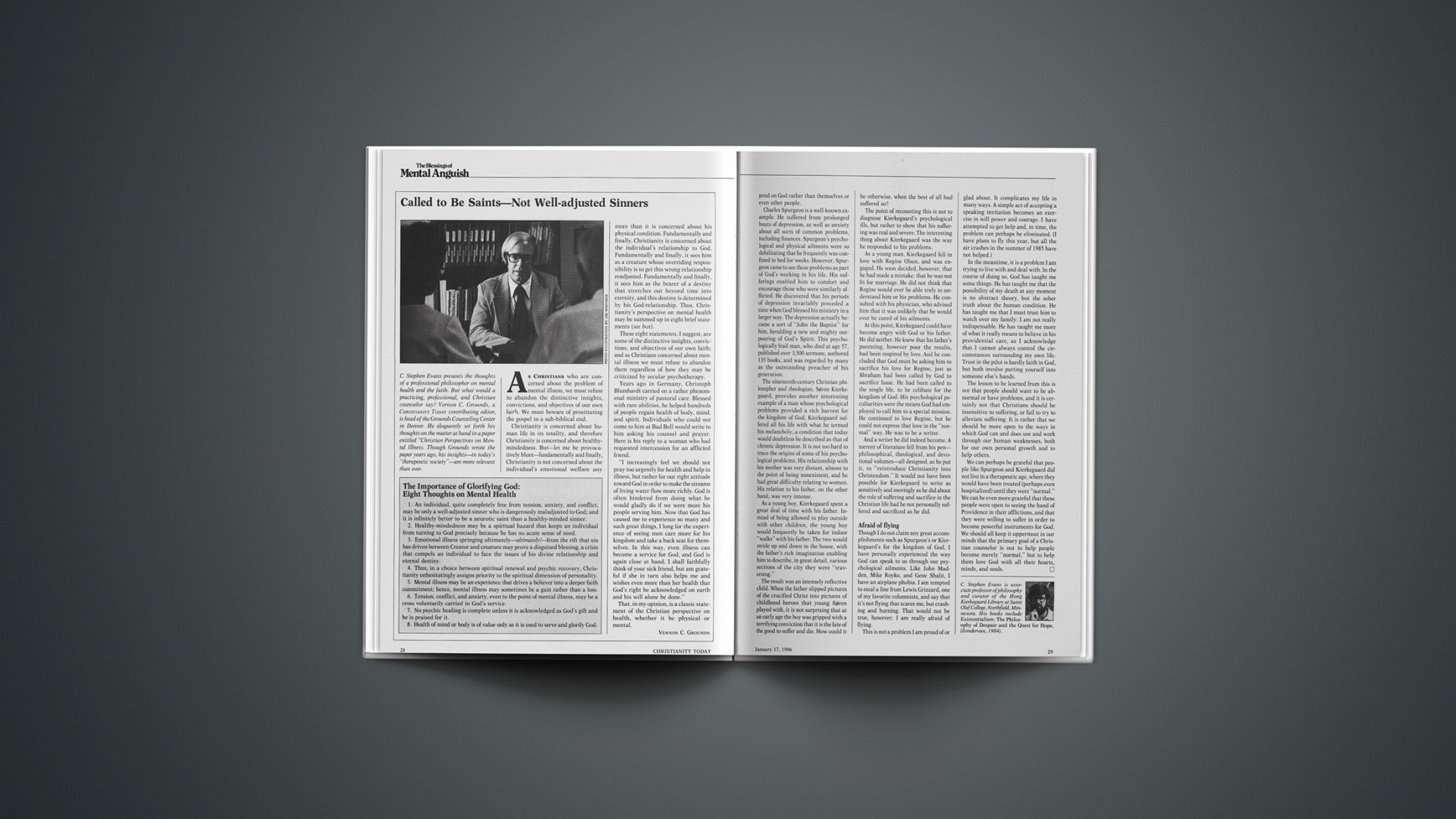
C. Stephen Evans presents the thoughts of a professional philosopher on mental health and the faith. But what would a practicing, professional, and Christian counselor say? Vernon C. Grounds, a CHRISTIANITY TODAY contributing editor, is head of the Grounds Counseling Center in Denver. He eloquently set forth his thoughts on the matter at hand in a paper entitled “Christian Perspectives on Mental Illness. Though Grounds wrote the paper years ago, his insights—in today’s “therapeutic society”—are more relevant than ever.

As Christians who are concerned about the problem of mental illness, we must refuse to abandon the distinctive insights, convictions, and objectives of our own faith. We must beware of prostituting the gospel to a sub-biblical end.

Christianity is concerned about human life in its totality, and therefore Christianity is concerned about healthy-mindedness. But—let me be provocatively blunt—fundamentally and finally, Christianity is not concerned about the individual’s emotional welfare any more than it is concerned about his physical condition. Fundamentally and finally, Christianity is concerned about the individual’s relationship to God. Fundamentally and finally, it sees him as a creature whose overriding responsibility is to get this wrong relationship readjusted. Fundamentally and finally, it sees him as the bearer of a destiny that stretches out beyond time into eternity, and this destiny is determined by his God-relationship. Thus, Christianity’s perspective on mental health may be summed up in eight brief statements (see box).

These eight statements, I suggest, are some of the distinctive insights, convictions, and objectives of our own faith; and as Christians concerned about mental illness we must refuse to abandon them regardless of how they may be criticized by secular psychotherapy.

Years ago in Germany, Christoph Blumhardt carried on a rather phenomenal ministry of pastoral care. Blessed with rare abilities, he helped hundreds of people regain health of body, mind, and spirit. Individuals who could not come to him at Bad Boll would write to him asking his counsel and prayer. Here is his reply to a woman who had requested intercession for an afflicted friend.

“I increasingly feel we should not pray too urgently for health and help in illness, but rather for our right attitude toward God in order to make the streams of living water flow more richly. God is often hindered from doing what he would gladly do if we were more his people serving him. Now that God has caused me to experience so many and such great things, I long for the experience of seeing men care more for his kingdom and take a back seat for themselves. In this way, even illness can become a service for God, and God is again close at hand. I shall faithfully think of your sick friend, but am grateful if she in turn also helps me and wishes even more than her health that God’s right be acknowledged on earth and his will alone be done.”

That, in my opinion, is a classic statement of the Christian perspective on health, whether it be physical or mental.

The Importance of Glorifying God: Eight Thoughts on Mental Health

1. An individual, quite completely free from tension, anxiety, and conflict, may be only a well-adjusted sinner who is dangerously maladjusted to God; and it is infinitely better to be a neurotic saint than a healthy-minded sinner.

2. Healthy-mindedness may be a spiritual hazard that keeps an individual from turning to God precisely because he has no acute sense of need.

3. Emotional illness springing ultimately—ultimately!—from the rift that sin has driven between Creator and creature may prove a disguised blessing, a crisis that compels an individual to face the issues of his divine relationship and eternal destiny.

4. Thus, in a choice between spiritual renewal and psychic recovery, Christianity unhesitatingly assigns priority to the spiritual dimension of personality.

5. Mental illness may be an experience that drives a believer into a deeper faith commitment; hence, mental illness may sometimes be a gain rather than a loss.

6. Tension, conflict, and anxiety, even to the point of mental illness, may be a cross voluntarily carried in God’s service.

7. No psychic healing is complete unless it is acknowledged as God’s gift and he is praised for it.

8. Health of mind or body is of value only as it is used to serve and glorify God.

The Blessings of Mental Anguish

The Goal of the Christian Counselor Is Not to Help People Become Merely “Normal”

We live in a “therapeutic society.”

Does your child have trouble completing his homework? Take him to see a psychologist who works with learning problems. Does your spouse have a problem with alcohol? Persuade him (or her) to enter an alcohol treatment facility, staffed by skilled psychiatrists. Do you yell at your kids too much? See a psychiatric social worker who specializes in family relationships.

Of course, mental health professionals are often very helpful in dealing with such problems. However, some problems are very difficult to treat. Psychological “cures” are not always possible, and they are certainly not always immediate.

The church has not been immune to the tendency to view problems in a therapeutic vein. Though a certain amount of uneasiness persists, the idea of going to a mental health professional for all kinds of problems is now widely accepted, and various kinds of Christian counseling centers have proliferated.

Christian counselors, like their secular counterparts, are often faced with seemingly intractable, chronic problems. It is true that Christian counselors have some unique resources and approaches in such instances. These resources do not guarantee a cure, though; sometimes, in fact, the unique Christian resources do not bear fruit in a cure.

To see this, consider the goals of the Christian counselor. When I speak of counselors here, I do not mean only professional counselors. All of us have the opportunity to be counselors. Parents counsel their children; Sunday school teachers and youth group leaders often provide invaluable counsel; friends counsel friends. So thinking about the goals of Christian counseling is something that ought to concern all Christians, and not simply professional counselors.

The Cure Is Not All

In our therapeutic society, with psychological problems often construed on a medical model, it is tempting to see the one and only goal of counseling as “curing” people, or at least in terms of eliminating problems. And this is very often correct.

When people are suffering, it is proper to try to alleviate the suffering. There is no difference in principle here between suffering that is caused by physical debilities and suffering that has its origins in psychological impairments. You should attempt to help someone who cannot perform adequately at a job because of an irrational fear of being out of doors, just as you should attempt to help someone who could not do a job adequately because of an infection.

There are times, however, when even the expert counselor is at sea. People cannot always be cured, problems cannot always be eliminated. Psychological problems, unlike many physical ailments, tend to be of a chronic or recurring nature. Such problems sometimes are very tenacious and deep-rooted, responding only slowly and gradually, if at all. Many Christians, even with professional help, struggle for years with depression. Others battle mood swings, or phobias, or a painful inability to function in a group situation. What should the goal of the Christian counselor be in this situation?

The Goodness Of Weakness

We may gain some valuable hints from the apostle Paul’s “thorn in the flesh.” He prayed earnestly for God to eliminate his problem, but the answer he received was, “My grace is sufficient for thee; for my strength is made perfect in weakness.” This experience led Paul to accept and even rejoice in his problem: “Most gladly therefore will I rather glory in my infirmities, that the power of Christ may rest upon me.” Paul had learned that “when I am weak, then I am strong” (2 Cor. 12:7–10).

Though there are many theories, we do not really know the nature of Paul’s thorn. It is very probable that his problem was physical in nature. But even if if was physical, it certainly caused great psychological suffering for Paul. Regardless of Paul’s specific problem, what is important is the underlying principle: God sometimes works through our human weaknesses, rather than eliminating those weaknesses. This principle seems just as applicable to psychological weaknesses as it is to physical problems.

This has profound implications for the goals of Christian counseling. It means that there are times when we ought to look at our psychological problems as part of the providential ordering of our lives by God. God’s strength is made perfect in our psychological weaknesses, as well as our physical weaknesses. Therefore, there are times when the proper goal of the Christian counselor is not the elimination of a problem but is helping an individual discover how a problem can be the occasion for spiritual growth.

The individual must learn how to live with the problem and deal with it, not in his own strength, but with the help of God’s grace. Learning to live with a problem in this way can make an individual better suited to accomplish significant tasks for the kingdom of God. Certainly living with a problem in this way can make an individual better suited for participation in that kingdom.

“Odd” Saints

All of us can probably think of Christians who were a little “odd,” and were able to do great things for God in part because of their oddness. They learned better than most what it meant to depend on God rather than themselves or even other people.

Charles Spurgeon is a well-known example. He suffered from prolonged bouts of depression, as well as anxiety about all sorts of common problems, including finances. Spurgeon’s psychological and physical ailments were so debilitating that he frequently was confined to bed for weeks. However, Spurgeon came to see these problems as part of God’s working in his life. His sufferings enabled him to comfort and encourage those who were similarly afflicted. He discovered that his periods of depression invariably preceded a time when God blessed his ministry in a larger way. The depression actually became a sort of “John the Baptist” for him, heralding a new and mighty outpouring of God’s Spirit. This psychologically frail man, who died at age 57, published over 3,500 sermons, authored 135 books, and was regarded by many as the outstanding preacher of his generation.

The nineteenth-century Christian philosopher and theologian, Søren Kierkegaard, provides another interesting example of a man whose psychological problems provided a rich harvest for the kingdom of God. Kierkegaard suffered all his life with what he termed his melancholy, a condition that today would doubtless be described as that of chronic depression. It is not too hard to trace the origins of some of his psychological problems. His relationship with his mother was very distant, almost to the point of being nonexistent, and he had great difficulty relating to women. His relation to his father, on the other hand, was very intense.

As a young boy, Kierkegaard spent a great deal of time with his father. Instead of being allowed to play outside with other children, the young boy would frequently be taken for indoor “walks” with his father. The two would stride up and down in the house, with the father’s rich imagination enabling him to describe, in great detail, various sections of the city they were “traversing.”

The result was an intensely reflective child. When the father slipped pictures of the crucified Christ into pictures of childhood heroes that young Søren played with, it is not surprising that at an early age the boy was gripped with a terrifying conviction that it is the fate of the good to suffer and die. How could it be otherwise, when the best of all had suffered so?

The point of recounting this is not to diagnose Kierkegaard’s psychological ills, but rather to show that his suffering was real and severe. The interesting thing about Kierkegaard was the way he responded to his problems.

As a young man, Kierkegaard fell in love with Regine Olsen, and was engaged. He soon decided, however, that he had made a mistake; that he was not fit for marriage. He did not think that Regine would ever be able truly to understand him or his problems. He consulted with his physician, who advised him that it was unlikely that he would ever be cured of his ailments.

At this point, Kierkegaard could have become angry with God or his father. He did neither. He knew that his father’s parenting, however poor the results, had been inspired by love. And he concluded that God must be asking him to sacrifice his love for Regine, just as Abraham had been called by God to sacrifice Isaac. He had been called to the single life, to be celibate for the kingdom of God. His psychological peculiarities were the means God had employed to call him to a special mission. He continued to love Regine, but he could not express that love in the “normal” way. He was to be a writer.

And a writer he did indeed become. A torrent of literature fell from his pen—philosophical, theological, and devotional volumes—all designed, as he put it, to “reintroduce Christianity into Christendom.” It would not have been possible for Kierkegaard to write as sensitively and movingly as he did about the role of suffering and sacrifice in the Christian life had he not personally suffered and sacrificed as he did.

Afraid Of Flying

Though I do not claim any great accomplishments such as Spurgeon’s or Kierkegaard’s for the kingdom of God, I have personally experienced the way God can speak to us through our psychological ailments. Like John Madden, Mike Royko, and Gene Shalit, I have an airplane phobia. I am tempted to steal a line from Lewis Grizzard, one of my favorite columnists, and say that it’s not flying that scares me, but crashing and burning. That would not be true, however; I am really afraid of flying.

This is not a problem I am proud of or glad about. It complicates my life in many ways. A simple act of accepting a speaking invitation becomes an exercise in will power and courage. I have attempted to get help and, in time, the problem can perhaps be eliminated. (I have plans to fly this year, but all the air crashes in the summer of 1985 have not helped.)

In the meantime, it is a problem I am trying to live with and deal with. In the course of doing so, God has taught me some things. He has taught me that the possibility of my death at any moment is no abstract theory, but the sober truth about the human condition. He has taught me that I must trust him to watch over my family: I am not really indispensable. He has taught me more of what it really means to believe in his providential care, as I acknowledge that I cannot always control the circumstances surrounding my own life. Trust in the pilot is hardly faith in God, but both involve putting yourself into someone else’s hands.

The lesson to be learned from this is not that people should want to be abnormal or have problems, and it is certainly not that Christians should be insensitive to suffering, or fail to try to alleviate suffering. It is rather that we should be more open to the ways in which God can and does use and work through our human weaknesses, both for our own personal growth and to help others.

We can perhaps be grateful that people like Spurgeon and Kierkegaard did not live in a therapeutic age, where they would have been treated (perhaps even hospitalized) until they were “normal.” We can be even more grateful that these people were open to seeing the hand of Providence in their afflictions, and that they were willing to suffer in order to become powerful instruments for God. We should all keep it uppermost in our minds that the primary goal of a Christian counselor is not to help people become merely “normal,” but to help them love God with all their hearts, minds, and souls.

Theology

“Good Pagans” and God’s Kingdom

Sensitive Christians would like to think that no one will be damned—but is that biblical?

Non-Christians regularly object to the teaching that those who have never heard the gospel may be condemned to hell. Many Christians don’t like it either. In fact, universalism—the belief that everyone, sooner or later, will be reconciled to God and saved by him—has in this century quietly become part of the orthodoxy of many Christian thinkers and groups.

But if all people will eventually be saved, why should they sacrifice to become Christians in this life? Why, indeed, should we endure hardship to evangelize them? Theologian J. I. Packer, author of Evangelism and the Sovereignty of God (IVP), takes a careful look at the appeal and the problems of universalism.

The problem of individual human destinies has always pressed hard upon thoughtful Christians who take the Bible seriously, for Scripture affirms these three things:

1. The reality of hell as a state of eternal destructive punishment in which God’s judicial retribution for sin is directly experienced.

2. The certainty of hell for all who choose it by rejecting Jesus Christ and his offer of eternal life.

3. The justice of hell as a fit divine infliction upon humanity for our lawless and cruel deeds.

It was, to be sure, hell-deserving sinners whom Jesus came to save, and all who put their trust in him may know themselves forgiven, justified, and accepted forever—and thus delivered from the wrath to come. But what of those who lack this living faith? Those who are not just hypocrites in the church, about whose destiny Christ is very clear, but “good pagans” who lived before the Incarnation, or who through no fault of their own never heard the Christian message, or who met it only in an incomplete and distorted form? Or what about those who lived in places (modern Albania, for instance) where Christianity was a capital offense, or who suffered from ethnonationalistic or socio-cultural conditioning against the faith, or who were so resentful of Christians for hurting them in one way or another that they were never emotionally free for serious thought about Christian truth? Are they all necessarily lost?

Mixed Answers

To this question Christians have given mixed answers:

• Some have maintained that all unbelievers go to hell because, being sinners like everyone else, they deserve to. The indictment is unanswerable, but is the conclusion inescapable? Not all have thought so.

• A number of Christian thinkers have opened the door a crack—sometimes, indeed, more than a crack—to find a place for “good pagans” in God’s kingdom. The church’s earliest defenders of the faith saw Greek philosophy as a God-taught preparation for the gospel among the Gentiles. They affirmed the salvation of Socrates, Plato, and their ilk through faith in the revelation they received of the preincarnate Word. This view still has its defenders.

• Many have urged the hope of universal salvation of infants through Christ’s Cross—moving on from Augustine’s and Dante’s idea that unbaptized children who died would miss heaven but would be spared the pains of hell.

• The official Roman Catholic view was that there is no salvation outside the Roman communion and apart from its sacramental life. But the Council of Trent’s statement that believers in the truth who, for whatever reason, cannot be baptized may yet be saved through “baptism of desire” (i.e., desire for baptism) has been further developed by Vatican II: “Those who, while guiltlessly ignorant of Christ’s gospel and of his Church, sincerely seek God and are brought by the influence of grace to perform his will as known by the dictates of conscience, can achieve eternal salvation.” The phrase “guiltlessly ignorant” points to ignorance that is invincible—that is, dominant and incurable, yet due wholly to conditioning, not to negligence or ill will or any intention, direct or remote, to disobey God. This notion was originally devised to explain how Protestants could be saved. But it is now used to affirm the possibility of salvation in any religion.

(One Protestant thinker hospitable to this idea was C. S. Lewis: In The Last Battle, Aslan says he views as offered to himself all service sincerely rendered to the false god Tash. Some Catholic theologians base their confidence of universal salvation on this line of thought.)

• Among Protestants, some Arminians hold that grace sufficient for salvation is given to everyone without exception, those who do not hear the gospel no less than those who do, so that everyone’s salvation is in principle possible.

• Some Calvinists have guessed that God regenerates a certain number of unevangelized adults, bringing them to repentance and faith through general revelation alone.

• More recently, Karl Barth taught that in Christ crucified, all mankind was reprobated and condemned, and in Christ risen, all mankind is elected and justified. This has given a great fillip to explicit universalism—a conclusion that Barth himself seems to have avoided only by will power.

(Not all theologians, however, are as strong-willed as Barth. In much of today’s Protestantism, belief in universal salvation, as the fruit and measure of Christ’s redemptive victory, has become the standard view.)

Pressure Points

The problem of the nonbeliever’s destiny is acutely felt at present in the Western churches. There are at least three reasons for this:

Pastorally, pressure is felt because post-Christian pluralism and anti-Christian alternatives are always on our doorstep. We rub shoulders with people of other, ethnic faiths; with people who are “into” cults; with disillusioned ex-Christians; with hostile scientific humanists.

In the mainline churches we find a Pandora’s boxful of mutated, not to say mutilated, Christianities: products of liberal randomness and radical reaction, of hermeneutical indiscipline, and sometimes, one fears, of sheer incompetence. Among evangelicals there remains something of a consensus on essentials, but evangelicals seem to be a quarter or less of the professing Christians in America and the Commonwealth, and outside evangelical circles one hears little more than what Eeyore called a “confused noise.” How much of the faith of the Scriptures, we wonder, do those nurtured amid the confusion ever come to know?

Nor is this all. The public media, the national education systems, and the literary establishments are resolutely secular, which means that men, women, and children—especially children—are being powerfully conditioned against biblical Christianity. What should we say of the nonbelief found among the victims of this ideological juggernaut? They did not create the secular ideology. It created them, molding them to its own sub-Christian shape.

To generous Christian hearts it seems nightmarish that unbelief resulting from the collapse of Christian culture round a person’s head could ruin that person’s soul.

The problem presses. What does the Bible say?

Theologically, pressure is felt because Christianity faces an upsurge of Islam and other great ethnic religions—all of which resent and reject Christianity’s exclusive claim to be final truth from God for all mankind. As the world’s population explodes, the percentage of our race that gives allegiance to Christianity keeps shrinking. This not only makes triumphalism impossible, but it also makes the universal significance of Jesus Christ seem problematical to many.

One response is the claim that Christ may be perceived, or posited, in existing ethnic faiths. In other words, these faiths should be understood as being already in essence what Christianity itself is. This solves the problem of relating Christianity to other faiths by the device of deft definition. But it flies in the face of the fact that the closer one looks at ethnic religions, the more different from Christianity, both in ends proposed and in means to them, they are found to be. It leaves us with a new set of questions:

Should ordinary adherents of ethnic religions (who deny the Trinity, the Incarnation, the Atonement, and salvation by grace through faith whenever these tenets are put to them) be counted as “anonymous Christians”? Though they may be invincibly and therefore excusably ignorant, can we say that they are thus (because of their sincerity) being saved by the Christ whom, if they have heard of him at all, they reject? If so, why evangelize them? What is the point of asking anyone to change religions, if all religions are at bottom Christianity in disguise?

What does a Hindu or Muslim gain by becoming a Christian? Nothing, it seems, that he really did not have before. But shall we then discount the testimony of Hindu and Muslim converts that their conversion was a passage from death to life? Shall we conclude that the old liberal and theosophic notion of all religions climbing the same mountain and meeting at the top is true after all?

The questions press. Again we ask, what does the Bible say?

Strategically, pressure is felt because Protestantism is radically split about mission. Mission is shorthand for the task that the church is sent into the world to do in Christ’s name, for love of God and neighbor. Two views clash as to what mission involves:

One view stands in line with the patristic, counter-Reformation Roman Catholic, and last-century Protestant missionary movements. It urges that the mandate is, first, to evangelize and plant churches; second, to relieve need at all levels, giving visibility and credibility to the good news of the Savior who makes us care for others; and third, to Christianize pagan cultures.

The view of some moderns, however, defines the mission as, first, to seek justice, peace, and prosperity in communities where these are lacking; second, to engage in dialogue with non-Christian religions in order to understand them and show them respect; and third, to nurture Christians and extend the church if time and circumstances permit—which, it is acknowledged, they may not.

The first view has now the Lausanne Covenant as its charter. The second reflects what was put forward by the WCC-sponsored conference at Bangkok on Salvation Today. Which set of priorites is right? What does the Bible say?

Ultimate Optimism

Subordinating evangelism to socio-political concerns makes sense only if universalism is true. The universalist idea that all people will eventually be saved by grace is a comforting belief. It relieves anxiety about the destiny of pagans, atheists, devotees of non-Christian religions, victims of post-Christian secularity—the millions of adults who never hear the gospel and the millions of children who die before they can understand it. All sensitive Christians would like to embrace universalism; it would get us off a very painful hook. Let us see what can be said in its favor.

Modern universalism’s basic idea is not that no one deserves to be damned, but that everyone will eventually be brought in humble gratitude to accept the acceptance with God that Christ’s redemptive death won for them. Though hell is real, it will ultimately have no tenants.

Roman Catholic universalists hold that man’s natural inclination toward goodness and God continues despite the Fall. It is sustained by universal grace and constitutes implicit faith—an openness to God through which Christ and his salvation will in due course, here or hereafter, be received even by Judas (a good test case by which to measure universalist reasoning).

Protestant universalists often say explicitly that those who leave this world in unbelief enter hell, but then exit, having been brought to their senses, encountered Christ, and embraced him while there. The essential claim is that hell does for the faithless what the Roman Catholic purgatory does for believers: it fits them for the enjoyment of heaven.

Universalism is the ultimate optimism of grace, outstripping any form of mainstream Protestantism, Calvinist or Arminian. For universalists, hell is never the ultimate state. It is a stage on the journey home. Through post-mortem encounter with Christ (a second chance for some, a first chance for others), God sovereignly calls and saves everyone out of what the New Testament calls “eternal punishment” and “eternal destruction” (Matt. 25:46; 2 Thess. 1:9, where destruction certainly means, not annihilation, but a state of conscious ruin). No one is finally lost. Hell ends up empty.

Counterarguments

How is this view of hell’s empty landscape supported? No biblical passage unambiguously asserts universal final salvation. Universalism is in fact a theological speculation that discounts the evident meaning of some New Testament passages in favor of what is claimed to be the overall thrust of New Testament thinking: that God’s retributive justice toward men is always a disciplinary expression of redeeming love.

It would be nice to believe that; but Scripture nowhere suggests it when speaking of divine judgment, and the counterarguments seem overwhelmingly cogent:

1. Does not universalism ignore the constant biblical stress on the decisiveness and finality of this life’s decisions for the determining of eternal destiny? Can this emphasis be evaded? Surely not.

2. Does not universalism condemn Christ himself, who warned men to flee hell at all costs, as having been either incompetent (ignorant that all were finally going to be saved) or immoral (knowing but concealing it, so as to bluff people into the kingdom through fear)? Can this dilemma be overcome? Surely not.

3. Does not the universalist idea of sovereign grace saving all nonbelievers after death raise new problems? If God’s ability to bring all humans to faith eventually is posited, why would he not do it in this life in every case where the gospel is known? But if it is beyond God’s power to convert all who know the gospel here, on what grounds can we be sure that he will be able to do it hereafter? Can any universalist’s doctrine of God be made fully coherent? Surely not.

4. Does not the thoughtful Christian conscience reject universalism, just because one cannot apply it to oneself? “I dare not say to myself that if I forfeit the opportunity this life affords I shall ever have another; and therefore I dare not say so to another man,” wrote James Denney. Is there any way around this? Surely not.

Universalism, therefore, will not work. This life’s decisions must be deemed to be in every case decisive. And thus, proclaiming the gospel to our fallen, guilty, and hell-bent fellows must be the first service we owe them in light of their first and basic need. The proclamation must have the priority that the older, the historic catholic, mission strategy gave it.

“I am under obligation both to Greeks and to barbarians … to preach the gospel,” wrote Paul. “For ‘every one who calls upon the name of the Lord will be saved.’ But how are men to call upon him … of whom they have never heard?… Faith comes from what is heard, and what is heard comes by the preaching of Christ” (Rom. 1:14–15, 10:13–14, 17, citing Joel 2:32).

Light for All

But could God, in particular cases, work with and through the light of general revelation—light that comes to every human being—to evoke repentance and faith, and thus to bring about the salvation of some to whom no verbal message about God forgiving sins has ever come?

The question is prompted by Peter’s statement: “In every nation anyone who fears him and does right is acceptable” (Acts 10:35). It is supported by Paul’s assertion: “[God] did not leave himself without witness” (14:17). Add to that his strong declaration of general revelation from God to all mankind in Romans 1:18–2:16. Consider the acknowledgment and worship of Israel’s God by Melchizedek, Jethro, Job, Abimelech, Baalam, Naaman, the sailors in Jonah’s boat, Cyrus, and Nebuchadrezzar. Compare John’s description of the preincarnate Word as “the true light that enlightens every man” (John 1:9; cf. v. 4) with his analysis of the sinner’s judgment as flight from the light, while “he who does what is true comes to the light” (3:19–21). That God will judge us all according to what we have done with the light we were given, and that that is supremely just on his part, I take for granted.

In Christianity and World Religions, Sir Norman Anderson states the question as it relates to non-Christian worshipers: “Might it not be true of the follower of some other religion that the God of all mercy had worked in his heart by his Spirit, bringing him in some measure to realize his sin and need for forgiveness, and enabling him, in his twilight as it were, to throw himself on God’s mercy?”

The answer seems to be yes, it might be true, as it may well have been true for at least some of the Old Testament characters. If ever it is true, such worshipers will learn in heaven that they were saved by Christ’s death and that their hearts were renewed by the Holy Spirit, and they will join the glorified church in endless praise of the sovereign grace of God. Christians since the second century have hoped so, and perhaps Socrates and Plato are in this happy state even now—who knows?

But we have no warrant to expect that God will act thus in any single case where the gospel is not known or understood. Therefore our missionary obligation is not one whit diminished by our entertaining this possibility. Nor will this idea make the anti-Christian thrust and consequent spiritual danger of non-Christian religions seem to us any less than it did before.

If we are wise, we shall not spend much time mulling over this notion. Our job, after all, is to spread the gospel, not to guess what might happen to those to whom it never comes. Dealing with them is God’s business: he is just, and also merciful, and when we learn, as one day we shall, how he has treated them we shall have no cause to complain. Meantime, let us keep before our minds mankind’s universal need of forgiveness and new birth, and the graciousness of the “whosoever will” invitations of the gospel. And let us redouble our efforts to make known the Christ who saves to the uttermost all who come to God by him.

James I. Packer is professor of historical and systematic theology at Regent College in Vancouver, British Columbia, and a senior editor of CHRISTIANITY TODAY. A brief biography of Dr. Packer appears in Christopher Catherwood’s Five Evangelical Leaders (Harold Shaw, 1985).

Ideas

The Battle for Shalom

Can we gain more than a glimpse of peace in 1986?

Thrust into A.D. 1986, we each can profitably ask how we can cooperate with God as we pray, “thy will be done on earth as it is in heaven.”

Sweeping into its holy embrace everything that satisfies his loving heart, God’s will at least demands that in 1986 we recognize the mandate implied in the promise, “Blessed are the peacemakers.” Lying behind that New Testament Greek word for peace is the Hebrew shalom. Whatever else it includes, God’s will is a demand for shalom—shalom on earth, shalom in history, shalom now as well as in eternity.

The word is richer than its common translation, “peace.” Perhaps we should leave it untranslated, as we often do with agape and koinonia. Shalom is an all-inclusive peace, peace between God and men, peace within our soul, peace among neighbors and nations, peace even in nature when lamb and lion lie down together.

Far from being primarily an inward and religious experience, shalom “in its most common use is an emphatically social concept” (von Rad). It is a wholistic state of health and harmony, safety and security, prosperity and piety, justice and joy, well-being and worship, fulfillment and freedom. It spells freedom from poverty, conflict, disease, inequity, and oppression. Where shalom is present, sin and sorrow are absent. Where the sword is at rest, where reconciliation has been completely effected, where righteousness prevails, and where people rejoice together, there shalom reigns. And there, in a society where his will is done, a God-glorifying order of human life prevails.

Psalm 85 beautifully depicts this: “Love and faithfulness meet together; righteousness and peace kiss each other. Faithfulness springs forth from the earth, and righteousness looks down from heaven. The Lord will indeed give what is good, and our land will yield its harvest. Righteousness goes before him and prepares the way for his steps” (NIV).

Rarely in history, even in the history of Israel and Christanity, has that idyllic state of shalom been achieved. Yet here and there across the centuries we catch tantalizing glimpses of it, faintest foreshadowings of that time when by the grace and power of God shalom will become a global reality. Under Solomon the Jewish people enjoyed proleptically a flickering fulfillment of Messiah’s government as sketched in Psalm 72. The righteous sovereign whose justice and compassion were like rain upon the mown grass championed the afflicted and the needy, squelched violence, and changed shalom from far-off vision into temporary fact. William Penn founded a New World colony where at first force and fraud were unknown, a sort of peaceable kingdom in which native Indians and white settlers intermingled tranquilly as brothers and sisters of the same human family. But, unfortunately, these hope-inspiring glimpses of shalom faded like desert mirages.

If we begin 1986 determined to develop into more productive disciples, we need not limit ourselves to any goal less than serving as shalom-makers. Malignant marriages need this healing ministry. So do families fractured by discord, and neighborhoods numbed by smoldering animosities. In offices and factories where strained civility camouflages malice, and in churches that belie the Good News of reconciliation, shalom is the longing of God’s heart, as it is with countries troubled by fierce tensions and periodic violence. The long, sorry list of our planet’s hot spots needs the ministry of those who make shalom. Will we number ourselves among such people?

Impossible Dream?

The mere recital of this overwhelming need tends to induce despair. How can we possibly respond with even microscopic effectiveness to God’s demand for shalom? Our puny efforts seem as futile as fighting a forest fire with a water pistol.

What realistically can we do? We can pray. The least—and maybe the best—service that we can render as shalom-makers is to obey Paul’s directive in 1 Timothy 2.

“I urge, then, first of all, that requests, prayers, intercession, and thanksgiving be made for everyone—for kings and all those in authority, that we may live peaceful and quiet lives in all godliness and holiness. This is good and pleases God our Savior, who wants all men to be saved and to come to a knowledge of the truth” (NIV).

Paul gives priority to prayer. Using a cluster of terms to present its various aspects, he urges us to engage in it first of all. So to relegate prayer to the edge of our busy lives is to disobey a plain apostolic imperative.

And this service is to be performed for the whole human family—especially for the public officials of every government on the globe.

The result? A civic order that reflects the will of God. Paul does not mean to downplay the need for political involvement and courageous reform. No doubt he would have approved the decision of that distinguished scholar and educator, Frank Gaebelein, who felt bound by conscience as a Christian to join the march to Selma in 1955. But Paul concentrates on prayer, highlighting its practice as the indispensable factor in creating a peaceful society characterized by tranquility, justice, and godliness.

The purpose of such prayer is a surprise: it is evangelism. Paul means it in its full-orbed sense of bringing men and women into the redeemed life that is abundant and eternal. Prayer implements God’s passion for our salvation: “The fundamental idea contained in [the word salvation] is the removal of dangers menacing to life and the consequent placing of life in conditions favorable to its free and healthy expansion” (Sanday and Headlam on Romans).

What, then, can we do in 1986 so that God’s will “be done on earth as it is in heaven”? We can pray. We can pray with a concern that earnestly brings to God our own needs together with those of our families, our churches, our missionary friends overseas. We can pray, moreover, with a concern for economic and social issues. We can pray with a concern for those who are the movers and shakers of our world, the policy-making power brokers. We can pray that the Holy Spirit will give them wisdom, compassion, and tenacity. We can pray the words of Saint Francis: “Lord, make me an instrument of thy peace.” We can ask God to empower us with the qualities we request for “kings and all those in authority.” We can pray to become shalom-makers.

Decision

We can. But will we?

Suppose we resolve that in 1986 we will assign to prayer a top-of-the-agenda priority. Suppose that we each dedicate ourselves to a kind of crusade. Suppose that minus flying banners and TV publicity we Christians in the United States join together in a continual ministry of prayer. Many of us in our country are styled “born again” believers; Gallup alleges our number to be in the millions. Suppose we spend no less than five minutes a day in focused intercession for “kings and all those in authority.” Suppose we do this doggedly day after day every day of 1986.

Suppose we spend no less time interceding for public officials than we spend in criticizing them. Certainly “kings and all those in authority” are neither infallible nor sacrosanct. They are mortals, tainted with original sin, subject to ambition and arrogance. They can be stupidly short-sighted and deplorably vindictive, bent on wielding power for their own ends.

But Proverbs assures us that in the mystery of God’s actions with our race, “The king’s heart is in the hand of the Lord; he directs it like a watercourse wherever he pleases” (21:1). So when we pray we can take it for granted that God is working through governmental officials as they form policies. Those power brokers can be his unwitting instruments even though, like their ancient prototype, Cyrus, they may not believe in the true and living God.

And if our faith in an all-controlling Providence falters, we can read Isaiah 45 again and be spurred on to persevere in our intercession. Of that pagan Persian emperor God says, “I will strengthen you, though you have not acknowledged me, so that from the rising of the sun to its setting men may know there is none besides me.”

Suppose that, while recognizing the radically different attitudes that prevail among us regarding national defense and arms control, we nevertheless take the psalmist’s stand: “Some trust in chariots and some in horses, but we trust in the name of our Lord.” Suppose that—whether self-designated evangelicals or fundamentalists or ecumenists—we believe what Paul writes to the Corinthians, and believe it sincerely enough to make his teaching the major resource in our battles for shalom: “Though we live in the world, we do not wage war as the world does. The weapons we fight with are not the weapons of the world. On the contrary, they have divine power to demolish strongholds.”

And what is the most formidable weapon in the Christian’s armament? Prayer. It is the most potent weapon we have for combating the evil powers that war against shalom. Suppose, then, we fight with this weapon, making prayer the dynamic that energizes all our struggles for peace, justice, and freedom. Relying on God who acts in response to prayer, we can exclaim confidently with Jahaziel, “The battle is not yours but God’s” (2 Chron. 20:15).

A hymn by H. F. Chorley concisely voices our aspirations for shalom and our commitment to the task of being shalom-makers:

God the Omnipotent! King, who ordainest

Thunder thy clarion, the lightning thy sword;

Show forth thy pity on high where thou reignest;

Give to us peace in our time, O Lord.

VERNON GROUNDS,1Vernon Grounds is president emeritus of Denver Conservative Baptist Seminary (still teaching ethics and counseling), editor of Inter-Varsity Christian Fellowship’s Theological Students Fellowship Bulletin, and president of Evangelicals for Social Action.CONTRIBUTING EDITOR

Theology

A Look Back to the Future

Some of us are reluctant to take guests into our attics. (And certainly for good reason!) But for the sake of history, let me set ceremony aside and have you look into one very special cluttered corner.

Our attic reminiscence really begins 40 years ago.

I had accepted Christ in February of 1945 in my mother’s childhood church, and shortly thereafter began attending Saturday night rallies in Danville, Illinois, sponsored by a new youth movement called Youth for Christ.

As a result of these energetic programs geared to total commitment, I made my decision to enter the ministry. In the fall of 1946 I began classes at Northern Baptist Theological Seminary. A young farm boy now living in a great metropolitan center like Chicago, I was excited about visiting and experiencing some of the vibrant churches of the time.

Harry Ironside was in his mature years of preaching at Moody Church, and no young seminarian could pass up the opportunity to hear at least a few of his powerful sermons. And the uncompromising mark of Paul Rader was still firm on the Chicago Gospel Tabernacle, although he was no longer pastor.

But it was the Midwest Bible Church, a converted garage on the west side, where I finally decided to settle in. Torrey M. Johnson and Robert A. Cook were pastors.

Torrey was immersed in the Youth for Christ movement he had helped begin two years earlier (see CT, Nov. 8, 1985). And he became president of an organization (YFC) with high-powered rallies extending beyond Chicago, across the United States, and around the world.

Every Saturday night I attended the local rallies, some at Moody Church and some at Orchestra Hall, and discovered a vitality of Christian conviction and witness that had been so lacking in the small denominational church where I had grown up. Looking back, I realize I was one small drop in the parachurch tidal wave that swept across the church in the last half-century.

“Did you have any idea of the impact the movement would have on church leadership?” I asked Torrey as we reminisced about our mutual pasts. “No,” Torrey responded. He simply had a burden for youth, especially rootless servicemen.

We then talked about the spiritual heartbeat of those days, and I felt I was reliving my introduction to vital Christianity.

Which brings me back to my attic. As I find old church bulletins from the Midwest Bible Church and Moody Church, along with assorted Youth for Christ announcements, I am reminded again that it was my friend Evan Welsh who challenged Torrey Johnson, then a freshman football player at Wheaton College, to give his life to the Lord’s service. It was Torrey who challenged Billy Graham to enter the evangelistic ministry. And wherever you go today, you will find someone whom Billy Graham has pointed to Christ.

There are some things in my attic I am glad I kept. They are reminders—my stones of remembrance if you will—telling me that when we are faithful in our work for Christ, one contact may indeed change the world.

They are also a wonderful source of accountability. The message of hope given to me 40 years ago is not mine to keep. It is mine to give.

That is the wonder of our great commission.

What Has Happened to Our Global Vision?

SPEAKING OUT offers responsible Christians a forum. It does not necessarily reflect the views of CHRISTIANITY TODAY.

In Megatrends, John Naisbitt pointed the way to a worldwide economy: Economically independent nations are melting rapidly into interdependence, he said. To ignore this international trading community is to commit commercial suicide.

A recent U.S. News and World Report cover story proclaimed that while some industries are being destroyed by overseas competition, others are “proving it possible to chalk up profits in nose-to-nose contests with foreigners.”

Economic intelligence foresees the inevitability of a global economy. Yet almost ironically, U.S. Christians are becoming isolationist. Big business plows billions of dollars into overseas operations. But as secular society looks outward, evangelical Christians tend toward spiritual introspection.

The current worldwide outlook should open evangelicals’ eyes. Here are four questions to help us as we reassess our mission.

Keeping Pace

First, how will our exploding world hear the gospel?

In the International Bulletin of Missionary Research (Jan. 1985), British en cyclopedist of world mission, David Barrett, reported that Islam and Hinduism are growing at the same rate as world population, but Christianity is slipping slightly behind.

World Concern’s Tom Sine reached the same conclusion. He wrote: “More than two billion people have never heard a witness of the gospel. In many parts of the world, the population is growing faster than the church’s ability to evangelize” (World Christian, July–August 1985).

It cannot be God’s will to feed the fatted church and starve the spiritually malnourished of our world. Pop stars send millions to the starving world, while Christians invest their wealth in buildings and programs.

Reinforcements

Second, who will replace a generation of retiring missionaries?

According to the best research, the growth in missionary personnel is not keeping pace with the population explosion. Lou Barilotti addressed the problem of a shrinking missionary force in the International Journal of Frontier Missions (I/1). By 1994 more than 30,000 missionaries will retire. Only about 5,000 will step into their shoes.

At the conclusion of World War II, between 20,000 and 30,000 missionaries went to every corner of the globe. Now as they conclude their life’s work, their task remains unfinished.

Meanwhile most missionary-sending agencies are desperately calling for more volunteers. For example, the Sudan Interior Mission aims to double its roster from 1,006 to 2,000 by the year 1993. And The Evangelical Alliance Mission is calling for 1,300 new missionaries by 1990.

Ways And Means

Third, who will give to make this missionary advance a reality?

World Christian (July-August 1985) estimated that most Christians give about 2.4 percent of their income to missions. Some denominations designate less than 1 percent of their income for overseas operations.

In the United Kingdom, the situation is worse. Sixty percent of all British missions are in financial trouble. Meager missionary salaries have been sliced in half. There is just not enough money to go around.

In our age of affluence, evangelical churches grow palatial while a pittance is set aside for missions. We are bankrolling an evangelical boom at home and sending nickels and dimes overseas.

First Church

Fourth, how can churches meet the need for missionaries and money?

The answer lies with the evangelical churches. In the Evangelical Missions Quarterly (July 1985), missions pastor Paul Borthwick said: “Many young people get their ‘call’ to missions in Christian college organizations, or at the Urbana missionary conferences. That’s great, but I am chagrined that so few of the church’s best people are selected and called forth by the local church.”

Similar sentiments were put forward by Wood Phillips, missions pastor of Grace Church in Edina, Minnesota: “It is the Holy Spirit who calls the candidate and the church who confirms the call” (Evangelical Missions Quarterly, April 1985).

The Great Omission is the title of a recent book by Columbia Bible College’s missionary-minded president, Robertson McQuilkin. If America’s missionary force is to be renewed and revitalized, we must not look to the great campus ministries, such as Inter-Varsity and Campus Crusade. Neither must we turn to the Christian colleges. The responsibility rests solely with the church, whom McQuilkin calls, “the interested but uncommitted.”

WAYNE DETZLER1Wayne Detzler is assistant professor of mission at Trinity Evangelical Divinity School, Deerfield, Illinois.

Eutychus and His Kin: January 17, 1986

Unlisted Spiritual Gifts

I think the apostle Paul missed a few good bets when he was putting together his list of spiritual gifts.

In our congregation, the gift of procrastination ranks way ahead of such things as prophecy and preaching. Our board of trustees, for example, has managed to postpone repairing the church roof for two years by convincing the congregation that rainwater actually helps weather hardwood floors. Now that’s a gift!

Most evident, too, among our membership is the gift of buck passing. Why didn’t Grandma Goodwin get the customary African violet when she was hospitalized? Because the pastor didn’t notify the deaconesses, because the “Violet Request Form” hadn’t been reprinted, because the mimeograph machine wasn’t working, because the church secretary hadn’t ordered a replacement part, because the line was always busy when she tried to call.

Then there’s the gift of hindsight. (How could Paul have overlooked that one?) With 20/20 rear vision, virtually every member of our congregation can tell you we should have added a Sunday school wing to the church 15 years ago when prices were a fourth of what they are today.

“Procrastination, buck passing, and hindsight, and the greatest of these is …”—on second thought, I think I’ll stick with Paul’s list.

EUTYCHUS

Marriage: Agape Love

John Stott’s excellent article on “Homosexual ‘Marriage’ ” [Nov. 22] may need the contribution agape can bring to it. Not only is heterosexual marriage a true ideal because of the nature of man and our original creation, it is also the only sexual relationship sanctioned by the meaning of love as agape.

The one-flesh love of husband and wife is said to be agape; “God is agape”; and “agape love never fails.” This powerful truth illuminates the darkness in which the homosexual invert finds himself.

ROBERT J. WIELAND

Chula Vista, Calif.

The facts of biology buttress the contention that heterosexuality is prescriptively natural and normal and homosexuality is prescriptively unnatural and abnormal. Those who mistakenly think homosexuality is natural and normal fail to make significant and much-needed distinctions between human beings and animals, between prescriptive and descriptive normality, between (what Emerson termed) “the law for man” and “the law for thing.”

HAVEN BRADFORD GOW

Arlington Heights, Ill.

Stott’s article censuring homosexual “marriage” is disturbing. To me, it is incredibly arrogant to decide on God’s behalf which acts of disobedience he will and will not tolerate in born-again Christians: namely, the supposed disobedience of Stott’s homosexual brothers and sisters in Christ.

REV. HAROLD E. BOWER

Cassadaga, N.Y.

I feel indebted to Mr. Stott for his careful and thorough arguments on both sides of the homosexuality question. He comes refreshingly close to acknowledging homosexual orientation in and of itself as an unchosen fact of life for many Christians and therefore outside the realm of morality. However, I don’t see that Paul’s line of reasoning in Romans 13 supports Stott’s contention that “love needs law to guide it.” I find just the opposite to be true.

Yes, I believe Paul objected to homosexuality, and he also regarded women as inferior and Roman slavery as okay. Why is it so inconceivable for evangelical Christians to see Paul’s vision of the gospel as necessarily limited in scope?

PHILIP R. KELLER

Davis, Calif.

Long-standing Christian abhorrence of homosexuality is heightened by the AIDS problem. Militant demands that Christians accept behavior they hate compounds these strong feelings. Some church leaders who rationalize and condone homosexual behavior add to the confusion. We Christians must struggle with morality while holding the door open to all who will hear Christ’s gospel. Christ died for the sins of all but made a clear call for sinners to repent and leave their sinful baggage behind. When homosexuals deny the sinfulness of their behavior, we are stymied in attempts to reach them.

STEPHEN W. EDMONDSON, M.D.

Atlanta, Ga.

Using The Common Cup

The news item on the abandonment of the common cup by a Lutheran seminary [Nov. 22] included a quote from a layman, which gave the rationale for the seminary’s decision. In the Episcopal Church, competent medical authorities have studied the issue repeatedly. No one has ever traced a case of disease communicated through the common cup.

THE REV. PIERRE WHALON

All Souls’ Episcopal Church

North Versailles, Pa.

Rogerian Good

I read with interest your recent articles responding to Dr. Carl Rogers and his influence in the Christian world [“Carl Rogers’s Quiet Revolution,” Nov. 8]. I fear Dr. Roberts did not read Dr. Rogers’s book to have made such a statement as, to “become … Rogerian is to cut oneself off from a necessary condition for becoming a mature, complete person—that of being responsible to others.” So why is nearly the last third of the book On Becoming a Real Person devoted to relationships, family, educational, even national?

I have become a more mature wife, mother, and friend because of Rogerian therapy. I am grateful for the love or “empathy” I experience because Dr. Rogers shared his abilities. I believe every good gift is from God, and this has been good in my life.

CAROL DAUGHERTY

Fredonia, N.Y.

Thank you for the articles by William Kirk Kilpatrick and Robert C. Roberts. Their clear articulation of the Rogerian psychology and its antithesis of Christianity was timely and very profitable.

DR. H. HILDEBRAND

Caronport, Sask., Canada

I found the articles mean-spirited. I regretted that I had read them—rather like listening to gossip. In contrast, how magnanimous the spirit of Paul Tournier, who speaks warmly and with enthusiasm of the contributions of Freud, Jung, and others to the understanding of human psychology.

MARILYN KANICH

Munster, Ind.

CT has performed a great service in analyzing the seductive and devastating theses of Carl Rogers, the former President of the American Psychological Association.

JOHN A. HOWARD, President

The Rockford Institute

Rockford, Ill.

I was struck by Kilpatrick’s statement that “psychologists have never been able to keep their noses out of religion.” I agree, but I feel that the reverse is also true—that religion has never (at least lately) been able to keep its nose out of psychology.

This is not to say the church should keep her hands off healing broken minds and relationships, but we should recognize and label the difference between Christian faith and psychotherapy. They are not interchangeable. Mixing the two indiscriminately could be a subtle and deadly way to forget the central Christ who calls us not to mental wholeness, but to eternal life.

CARRIE L. CRAWFORD

Leetonia, Ohio

It is incomprehensible to me that Roberts’s article could have been written by a professor of philosophy, and even more so from such a prestigious institution as Wheaton. If I’m going to be forced to choose between “pagan empathy” or “Christian love,” I’ll take empathy every time. I’ve tasted both and there is really no contest.

DONALD U. LONGNECKER

Dunkirk, N.Y.

One spin-off of any self-fulfillment philosophy is the increasing refusal of its adherents to answer honest questions. Apparently “guilt-free” means no obligation to respond to your fellows, only to listen. No need to debate, just wait out your opponent like a smiling, tolerant Buddha.

WILLIAM SCHULER, M.D.

Mendota, Ill.

I don’t understand: on page 23 it is stated that Carl Rogers is 75. So he must have been born in 1910. Then the line under his picture shows him on his honeymoon in 1924. He looks to be more than 12 years old in the picture with his wife.

SHELBY J. LIGHT

Long Beach, Calif.

He was either an early bloomer—or born in 1902, which Who’s Who in America more accurately states.

Eds.

Thirty Years Overdue?

Thank you for the splendid piece on “The Sexual Hazards of Pastoral Care” [Nov. 8]. As a 64-year-old Baptist General Conference former pastor and denominational youth executive, I am seeing some of my peers—only a few, not many, fortunately—fall by the way-side because of this problem. If only you had written this article 30 years ago, and they had read it, perhaps their troubles would not have happened.

GUNNER HOGLUND

Santa Clara, Calif.

A Precious Relationship Lost

“Three Women out of Four” by LaVonne Neff on widows in the church is accurate and timely [Nov. 8]. For the word “widow” you could substitute “divorcee”—for we, too, have grieved deeply the loss of life’s most precious relationship.

RUTH STERLING HOFFMAN

Durham, N.C.

I am a new widow—of a pastor. When a person of our church dies, the family calls the pastor. When the pastor dies, who does the pastor’s wife call? I could think of no one! I had to wait upon the Lord to see whom he would bring in my time of need. It’s rough being a widow.

MARGERY W. CHARLES

Gardner, Mass.

The idea of a widow’s support group in the church must be discussed and plans for it laid before there is one widow to be served. Yet there is a kindred group that is overlooked when the subject comes up: widowers, particularly those with small children. I know, because for six-and-one-half years I was there.

FRED MARKANT, JR.

Ramsey, N.J.

A Kantzer Home Run

Kantzer has hit a homer. His editorial “In Search of Heroes” [Nov. 8] has properly placed the bulk of the responsibility for the loss of integrity in American athletics, not upon the athletes themselves, but upon society as a permissive audience. After all, it was we who made Mary Lou Retton an expert on batteries.

KEVIN HALL

Blaine, Wash.

We have a problem in the athletic world because the attitudes of many Christian leaders discourage Christian young people from getting the proper education and training and entering the field of physical athletics. We must begin training Christian coaches in our colleges who understand physical education and athletics and who can integrate it with a Christian philosophy of education. If “athletes remain the principal role models of young Americans,” we cannot cut off from the Christian academic community the one field of study that can make an impact in this area.

I am one of only three physical education majors on the 55-man travel squad that played my senior season in the Orange Bowl. I am a Christian who believes there is something wrong in the educational system, and I am determined to do something about it and not leave the athletic field and the gym to the rule of Satan.

J. WALTER MILLET, JR.

West, Tex.

Kantzer has a historically inadequate view of sport in the “good old days” as well as an opposing selective perception of the “bad new days.” Has sport changed? Yes and no, but nowhere to the degree he suggests. Sport is a strange mixture of myth and reality, and the reality has a seamy side we would prefer not to notice. Perhaps the only change Kantzer has noted, but inadequately assessed, is that sport in 1985 is less an arena of idealized projection and fantasy within American society than it once was. Our selective memory has played tricks on us again.

JAMES MATHISEN

Wheaton College

Wheaton, Ill.

Redaction Criticism: A Helpful Discussion

Thank you for the CT Institute on redaction criticism [Oct. 18]. I felt the discussion was extremely helpful and balanced. These are issues with which evangelicals must wrestle, and I appreciate your time and energy in helping pastors and other leaders think this one through.

RICHARD J. FOSTER

Friends University

Wichita, Kan.

It concerns me that we have compassed the circle once more. Are the “scholars” again telling the lay Christian he cannot understand the Scriptures without their first digesting it? Are we, then, after two millennia, at terminus ad guem or terminus a quo? God help us have a sense of humor—or must someone redact this too?

JOHN GILLMARTIN

Alta Loma, Calif.

Thanks for including Bob Thomas’s clear, concise, and insightful comments. His view provided at least token balance in an otherwise unanimous approval of evangelical use of redaction criticism.

One is at a loss to understand why this redaction “baby,” conceived and nurtured by liberals, has been mutilated and then adopted by evangelicals. Why did Matthew, Mark, and John need to redact someone else’s material when they were eyewitnesses of the events whose memories were supernaturally activated by the Holy Spirit to recall “all” that Jesus said?

NORMAN L. GEISLER

Dallas Theological Seminary

Dallas, Tex.

Why not a layman’s opinion: How ridiculous can a group of professors get? As the saying goes, “The only reason for the giraffe being what it is, it must have been put together by a committee.” To me, redaction criticism has the same effect as giving a child a knife and telling him to see if he can find what is in his toy drum that makes it go “boom-boom-boom.”

VERNON HOLST

Newell, S.D.

At issue is “biblical inerrancy.” This doctrine necessitates that every line of Scripture have the same level of truth; none can be given any weight greater than any other. Redaction criticism, like form criticism before it, gave greater weight to “the earlier source,” if not directly at least by implication.

Redaction criticism leads to heresy from the fundamentalist, evangelical view. This kind of Christianity, like any authoritarian system, cannot stand heresies.

KENNETH H. BONNELL

Los Angeles, Calif.

Several years ago I “invented” the following definition: The Bible is an imperfect tool in the hands of God to lead us to The Perfect Solution. You see, no matter how perfect the Bible would be, if it did not have in it The Perfect Solution we would still be dead. It seems like a corporate effort, God watching over what really matters versus the writers displaying their own individuality. It makes sense to me.

H. D. SCHMIDT

Pleasant Hill, Calif.

More Babies To Adopt?

In the article “Where Have All the Babies Gone?” [Oct. 18], the premise seemed to be that infertile couples “need” a baby. We may feel that we need many things, including children, but are we willing to accept that infertility may be in God’s will for our lives in much the same way that some are called to be single?

As Christians we must examine our motives in the prolife movement. Do we really believe that abortion must be stopped because we believe in the sanctity of human life created by God, or do we hope that the Roe v. Wade decision will be reversed so there will be more babies to adopt?

JEAN STRATING

Gainesville, Fla.

In the article, Bill Pierce’s comparison of open adoption to open marriage is a blatant misrepresentation of the issue. Closed adoption has not adequately addressed the needs of many people. It has perpetuated unresolved grieving on the birth-parents’ part, and made it difficult for adoptees to be at peace with their adoptive identity when the circumstances surrounding the adoption are shrouded in secrecy and mystery. How much healthier to give the various parties in the adoption the option of openness.

RACHEL BUBLITZ

Christian Adoption and Family Services

Anaheim, Calif.

Evaluating Rock

I found your guilt-by-association article on Amy Grant most disturbing [Oct. 18]. What is this bit of editorializing doing in your “News” section? Who are the “many Christian listeners” who “reacted negatively” to Unguarded? Who defines what “hard-edged” rock is? Such a subjective issue as what constitutes “rock” is difficult to categorize and evaluate.

MICHAEL R. SAIA

Sunland, Calif.

Praise God for young women like Amy Grant. When Amy crossed over the charts, my girls were so excited to be able to tell their friends at public school that this great sound with the beautiful message was one of their favorite Christian artists, and no one could call it boring!

NANCY RODDY

Mt. Pleasant, Pa.

Growing Christian Smugness?

Thank you for the excellent editorial by Cornelius Plantinga [“The Justification of Rock Hudson,” Oct. 18]. His amazing way with words riveted me to my seat as I read, and then reread, the editorial. But most important, in relating this story current in our thinking, he also calls the current furor a nutrient for growing Christian smugness. Keep up the good work—and while you’re at it, have Dr. Plantinga write another editorial soon.

REV. GORDON L. LYLE

United Presbyterian Church

Follansbee, W. Va.

Editor’s Note: January 17, 1986

It was the summer of ’83, and John Naisbitt’s Megatrends was a best-seller. I happened to be on assignment covering a board meeting of the National Association of Evangelicals and found myself with some 20 denominational executives gathered for morning devotions and prayer. Leading our time together was Thomas McDill, president of the Evangelical Free Church of America. His text was Matthew 16:1–4.

From Christ’s discourse on “the signs of the times,” Tom began to challenge each of the leaders present by deftly drawing a series of critical connections between Naisbitt’s trends and the future effectiveness of the church. I sensed that for many there, the importance of that book’s message left America’s corporate offices and, for the first time, entered denominational headquarters.

The need for accurate reading of today’s “signs of the times” prompted the Christianity Today Institute to identify the ten trends (five inside the church, five outside) that are the focal points of the special supplement beginning on page 63. Taken together, we believe they present a clear and exciting challenge for the church as it moves into the twenty-first century.

HAROLD SMITH, Managing Editor

History

Into the desert: the first monks

Some people think that Christian monasticism began in the sixth century with Benedict of Nursia and his Rule of Life. But in fact it goes back far beyond that, to a time before there were monasteries, even before the 'desert fathers' of the third century. Monasticism, as a recognizable and named phenomenon in the church, has no official beginning, no official foundings. It emerged, in several places at once, as a spontaneous development from the various forms of the ascetic life: the tradition of strong self-discipline which had taken shape in the church from the very beginning.

The most striking features of monasticism, the renunciation of marriage and the renunciation of wealth, go back to the New Testament. The apostle Paul recommended celibacy, in his first letter to the Corinthians, on the grounds that 'the unmarried man worries about the things of the Lord and how to please the Lord, but the married man worries about the things of the world and how to please his wife, so he is torn in two'. And this is a theme which is developed in subsequent literature, Fallen mankind is at odds with himself; one of the blessings of redemption is an inner reconciliation, and , for that matter, a reconciliation between body and soul. Redeemed people can become 'single' again. This is almost certainly one of the original meanings of the word 'monk': a monk is a 'single', undivided man, and a 'single', solitary man. A romantic notion developed too, that since we are married to the Lord, there is no room for any other kind of marriage. In particular, if as Paul says the body is the Lord's, it would be wrong to enter into carnal union with anyone else.

Another important strand in early Christian asceticism strand in early Christian asceticism probably goes back to the instructions which Jesus gave to the preachers he sent out to proclaim the kingdom of God, taking no provisions for their journey as they went. By the end of the first century, at least some people seem to have been taking these instructions as covering a whole lifetime of services as apostles. We hear of apostles touring around preaching the gospel, actually forbidden to stay in the same place for more than two days at a time. Their lifestyle would obviously exclude the possibility of any normal home life.

Many of the early Christians expected that Jesus Christ would return to earth in their lifetime, and this provided another reason of opting out of the ordinary practices of human society. Paul had to rebuke some of the Thessalonians for refusing to work on the grounds that they were waiting for the end. But he himself said that, because the end is near, we should either abstain from marriage or, if married, be as if we were not married.

Ready for battle

There was also, from time to time, the threat of martyrdom. Many people, realized that, if it came to the crunch, a radical choice would have to be made between enjoying prosperity in this world and being faithful to Jesus Christ. So being detached from the good things of the world-even renouncing them completely-was seen as a sensible preparation for martyrdom, should the need arise. As the threat of martyrdom receded, ascetic renunciation came to be seen as a kind of substitute for martyrdom. Some people even went so far as to commit suicide as a kind of bid for do-it-yourself martyrdom'.

On a more down-to-earth level, some people were without the comfort of marriage through no choice of their own. From very early on the windows in the church seem to have been recognized as a class of their own, and before long they were joined by virgins who gave up their right to be married, and by celibate men too. In some places, they seem to have become a semi-official body of full-time church workers.

Practices such as these began in a straightforward way, called for by circumstances. But not surprisingly they developed a more ideological interpretation, which in turn led to new practices.

One probably very early idea was that the church is engaged in a Holy War between the forces of God and the forces of Satan, and that therefore the rules for the Holy War apply, which are laid down in Deut. 20 (the newly married are excused military service). The Lord's crack troops must be caught out like that, but must be people who are unafraid and free from the distraction of family and property, so that they can go bravely into battle. The theme of battle against demons is all pervasive in Egyptian monasticism.

Another idea which became prevalent in monasticism for centuries was that of weeping. In the Syriac language, weeping is actually a technical term for monks. This probably grew out of a Jewish practice of undertaking a life of austerity as a token of grief for the fall of the Holy City. Some Christians extended this and saw the ascetic life as a life of sorrow for the sins of the world. This could easily be narrowed down into a life of sorrow for one's own personal sins.

The habit of wandering, presumably begun at first as an apostolic necessity, acquired a new value as a sign of the belief that Christians are pilgrims and sojourners on the earth. And it could be given a sharper edge by the belief that the structures of this world, not least its financial structures, are largely controlled by the devil. So we find some ascetics rejecting civilization entirely. This seems to have combined in some circles with the belief that Jesus restores us to the conditions of the first paradise, and so some ascetics, for example, practiced nudism (like-Adam) and ate only food that was naturally available, rejecting both agriculture and cooking.

Some of the resulting practices were bizarre if not dangerous. And the rejection of the world could easily lead towards a dualistic belief-the material world as such is evil-and away from the orthodox belief, that God created a fundamentally good world. But in principle the ascetics were after something of real value. They sought a way of escaping from the domination of worldly society and the ways in which society defines what it means to be human, so that God's original plan for mankind could be rediscovered.

By the third and fourth centuries, at least some ascetics had become important focal points for a vision of humanity and even of society quite independent of conventional social, political and economic factors. Some monks in fact acquired considerable power precisely because of their position outside society. Not m, political and economic factors. Some monks in fact acquired considerable power precisely because of their position outside society. Not merely were they credited with supernatural powers (which they usually exercised in the interests of the poor, the sick and victims of injustice) but their radical independence enabled them to intervene with great authority even in public affairs of church and state. The holy man became an institution to be reckoned with.

Desert fathers

Publicity, however, carries its own dangers. The pioneers of the monasticism which became the classic model for ever after, the monasticism of the Egyptian desert, seem increasingly to have moved away from the ideal of the public, wonder-working, powerful holy man. Instead they stressed humility. The wonder-working monk surrounded by his devotees came now to be seen as a typical example of vanity. And the plea of usefulness to others came to be regarded with suspicion. When I was young, one monk said, I said to myself that I would do good. But now that I am old, I perceive that I have not on single good deed in me.

The desert fathers' also rejected the ideal of wandering, and adopted the practice of simple manual work, designed to occupy the monk's time and to earn his living. Instead of the entirely uncircumscribed life of (alleged) continual prayer, they recommended a balanced life of prayer and work, with a market emphasis on stability within the cell.

The most famous of the desert fathers is Anthony the Great, often, rather exaggeratedly, called the founding father of monasticism. He retired to the desert in about 285; inspired, according to his biographer, Athanasius, by the texts 'If you would be perfect, go, sell all you have and come follow me', and Take on thought for the morrow. The very schematic account which Athanasisus gave shows how Anthony withdrew progressively further into the desert, and how he disentangled himself from evil. This evil confronted him first of all in the form of the temptation of irrelevant good works, then in the form of lust, then in the form of terrifying demonic emanations which did considerable damage to his body, and finally, helplessly, in the form of grotesque apparitions which could not harm him and which he mocked with hymns and psalms. After a long time on his own he eventually emerged again, and became a teacher. People were amazed to see that he was in perfect health of body and soul. He exhorted his disciples not to be afraid of demons, and not to imagine that virtue is difficult and alien.

In the wake of Anthony, a large number of men and some women too adopted the life of hermits in the desert. Most of them lived in settlements, with churches and priests, and they visited each other for advice and discussion, but in formal and un-programmed ways.

Further south, Pachomius (who died in 346) developed a rather different kind of monasticism, organized in monastic communities, which in time produced fixed monastic rules and government. But in both forms of monasticism the major concern was with the ascetic struggle against the vices, a struggle carried on chiefly on the basis of continual self-awareness. Pay attention to yourself, was a favorite slogan.

By staying in their cells, resisting all distracting thoughts and refusing all religious or spiritual pretentiousness, they hoped to become aware of exactly what was going on (discernment) so that they could escape from the insidious wiles of the demons and from all that is contrary to the true God-given functioning of human life. Their austerities, exaggerated though some of them may seem to the modern reader, were never meant to be an end in themselves; they were meant to provide the conditions within which the monk could discover by experience what a real, redeemed human being is like. In particular their poverty and unprotectedness were meant to make them totally dependent on God. The most disastrous mistake, in their view was to attempt to set up some kind of identity for themselves, some kind of life for themselves apart from God's gift.

Although the desert fathers, at least the more articulate of them, whose words survive, showed a considerable expertise in psychology and were refreshingly down to earth (If you see someone going to heaven by his own self-will grab his leg and pull him down again) they still essentially left the onus of responsibility on the individual monk.

But not everyone is capable of taking this responsibility. We find in later generation of monks much more tendency to regard it as essential for the young monk to have spiritual father, whom he will obey and whose teaching he will follow in everything. And this process led to a blurring of the distinction between cenobites (monks living in community) and the hermits. In the Greek church it became normal for a monk to begin in a monastic community and then move on to being a hermit.

Towards a rule of life

The Egyptian father's insistence on humility and self-knowledge meant that they played down social responsibility;-It is no good ruining your own house in order to build someone else's. In Palestine, Jerome (died 420) distinguished between monks and others on just this basis:- There are two ways of winning a fight. Monastic life is a deliberate running away from the risks of a more involved life. Even missionary activity is shunned: It is a monk's business to weep, not to teach.

Not everyone accepted this. Basil of Caesarea (died 379) reformed monasticism in some parts of Asia Minor (modern Turkey) and turned it into something much more like present-day religious communities devoted to good works. And others followed suit. But this was the exception rather than the norm.

In the churches of the Western Mediterranean, there were several independent developments. Augustine of Hippo (354-430) formed his cathedral clergy into a monastic community, an example taken up later in the Canons Regular. And in Gaul there was a monastic movement, associated chiefly with Martin of Tours (died 397), which was closer to the public holy man rejected in Egypt. But fairly quickly the Egyptian model was introduced, especially by John Cassian (died 435), leading to a more secluded form of monasticism. Cassian's influence made for a monasticism more hidebound by its traditions. He was less prepared to trust individuals, whether as learners or as teachers, preferring a more impersonal tradition, expressed in conventional practices and doctrines.

The process of tidying up went much further with the anonymous author of The Rule of the Master in the early sixth century. His aim was to take away all initiative from his monks and to make as many decisions as possible at the outset once and for all. The monks were supervised the whole day long. It was clearly assumed that any independence allowed to them would simply be abused.

This brings us to the time of the greatly influential Benedict of Nursia. He largely followed the Master, though with a rather less suspicious attitude. He did not snoop on his monks the whole time, but was clearly concerned to regulate their life fairly thoroughly, giving them a balanced diet of prayer, manual labour and readings. His Rule is famous for its equilibrium, but, as he himself recognized, it did not make for the higher adventures of the Christian life. It was a rule for beginners, as he said, and he presumably expected people to progress beyond it as hermits, though this never in fact became normal in Benedictine circles.

The organized monasteries of the West played an important role. They were oases of Christian civilization in a world relapsing into barbarism. And they provided an opportunity for people to escape from the temptations and distractions of life in the world to concentrate on serving God. Yet undoubtedly something had been lost. The earlier monastic adventure of self-discovery, renouncing all security for the sake of the gospel had faded into the background. In its place came something more mundane: an accepted monastic definition of life, with considerable material and spiritual security.

Copyright © 1986 by the author or Christianity Today/Christian History magazine.Click here for reprint information on Christian History.

Apple PodcastsDown ArrowDown ArrowDown Arrowarrow_left_altLeft ArrowLeft ArrowRight ArrowRight ArrowRight Arrowarrow_up_altUp ArrowUp ArrowAvailable at Amazoncaret-downCloseCloseEmailEmailExpandExpandExternalExternalFacebookfacebook-squareGiftGiftGooglegoogleGoogle KeephamburgerInstagraminstagram-squareLinkLinklinkedin-squareListenListenListenChristianity TodayCT Creative Studio Logologo_orgMegaphoneMenuMenupausePinterestPlayPlayPocketPodcastRSSRSSSaveSaveSaveSearchSearchsearchSpotifyStitcherTelegramTable of ContentsTable of Contentstwitter-squareWhatsAppXYouTubeYouTube