Theology

The Manger Is Empty

A Christmas story.

My daughter wept on Christmas Eve. What should I say to the heart of my daughter? How should I comfort her? What should I tell her of tears, who has learned only their strength and perturbation, but knows no words for them?

Her name is Mary, truly. She is very young.

Therefore, she didn’t cry the older, bitter tears of disappointment. She hasn’t experienced the desolation of adults, who try so hard but find so little of spirit in the season, who cry unsatisfied, or merely for weariness.

Neither did she weep the tears of an oversold imagination, as the big-eyed children may. It wasn’t that she dreamed a present too beautiful to be real or expected my love to pay better than my purse. She’s greedy for my touch, is Mary, more than for my presents; and touching—Lord! I have much of that for Mary.

Nor was she sick on Christmas Eve. That were an easier pain for a father to console.

Nor was she hungry for any physical thing.

No, she was hungry for Odessa Williams, that old black lady—for her life. That’s why Mary cried. The child had come suddenly to the limits of the universe, and stood there, and had no other response for what she saw than tears, and then she wept into my breast, and I am her father. And should I be helpless before such tears? Or mute? Oh, what should I say to the heart of my daughter Mary?

This is what happened: It is the custom of our congregation to gather on the Sunday evening before Christmas—adults and youth and children, members of the choir particularly—to go out into the cold December night, and to carol the elderly. A common custom. Little elemental usually comes of it.

We bundle thick against the night wind. Our faces pinch—the white ones pink, the black ones (we are mostly black ones) pale. The kids can hardly walk for all their clothing, but run nonetheless. And then we sing a boisterous noise. Our breath puffs clouds at our lips. The old people smile through their windows and nod to the singing and close their eyes and seem to dream a little of the past. We lift our keys and jangle them to the chorus of “Jingle Bells.” And sometimes, sometimes those sweetest voices among us will sing alone. Young “Dee Dee” will take a descant trip on “Silent Night” that makes the rest of us drop our eyes and wonder at so clear and crystalline a melody; and Tim Moore will set himself free, and us and all the night streets of the city, with “O Holy Night”; he will, with an almighty voice, ride to heaven on the song and then return to earth in the merest murmur, “When Christ was born, when Christ was born”—and we will find the tears freezing on our eyelashes, moved by beauty on a cold, dark, winter’s sidewalk.

But these are good tears, and not the tears of my Mary.

We went, one such Sunday evening, December the twentieth, through a snowless dark, to Saint Mary’s Hospital. We divided ourselves among the wards. We carried our caroling to those members who were patients there. And I, with Mary and Dee Dee and Tim Moore and a handful of the children who sang in the choir, slipped finally into Odessa Williams’s room, to sing to her.

She had a curtain pulled round her bed; therefore, we had to stand right close. And though the light was dim at the bedstead, we could see the old lady’s face. The sight made the children solemn and quiet, quiet. Her brown cheeks had gone to parchment, were sunken, her temples scalloped; her hair and her arms together were most thin, her nails too long, her eyes beclouded. Odessa was dying of cancer.

This was the first time that the children had met her. They gazed, and they waited to be led.

As her pastor, I had been visiting Odessa for years, first in her apartment, then in a nursing home, finally here, a long descent. But her soul belonged fiercely to Grace Church, and she had, at her distance, followed every event of the congregation. She set her jaw (when her teeth were in) to speak of that church; and she worked her gums (when they were not) busily, passionately, when she worried for its future. Because of her wasting disease, she had never appeared among the people; but that did not mean she loved them any less. Simply, they were unaware how much she did love them. Yet Odessa could communicate such a message with sudden speed and indelibly.

So the children, in dim yellow light, were circled round a stranger, were staring at a stranger, delicate, old, and dying, lying on her back.

Odessa, for her part, said nothing. She stared back at them.

“Sing,” I said to the children. “What’s this? Y’all gone munching on your tongues? Sing the same as you always do. Sing for Miz Williams.”

And they did, that wide-eyed ring of children.

One by one they sang the carols everyone knew, though children had no keys to jangle. One by one they relaxed, and their faces melted, and I saw that my Mary’s eyes went bright and sparkled—and she smiled, and she was smiling on Odessa Williams. The children gave the lady an innocent concert, as clean and light as snow.

Odessa, too, began to smile.

For that smile, for the gladness in an old lady’s face, I whispered, “Dee Dee, sing ‘Silent Night’ once more.”

Dear Dee Dee! That child, as dark as the shadows around her, stroked the very air as though it were a chime of glass. (Dee Dee, I love you!) So high she took her crystal voice, so long she held the notes, that the rest of the children unconsciously hummed and harmonized with her, and they began to sway together, and for a moment they lost themselves in the song.

Yet, Odessa found them. Odessa snared those children. Even while they still were singing, Odessa drew them to herself. And then their mouths were singing the hymn, but their eyes were fixed on her.

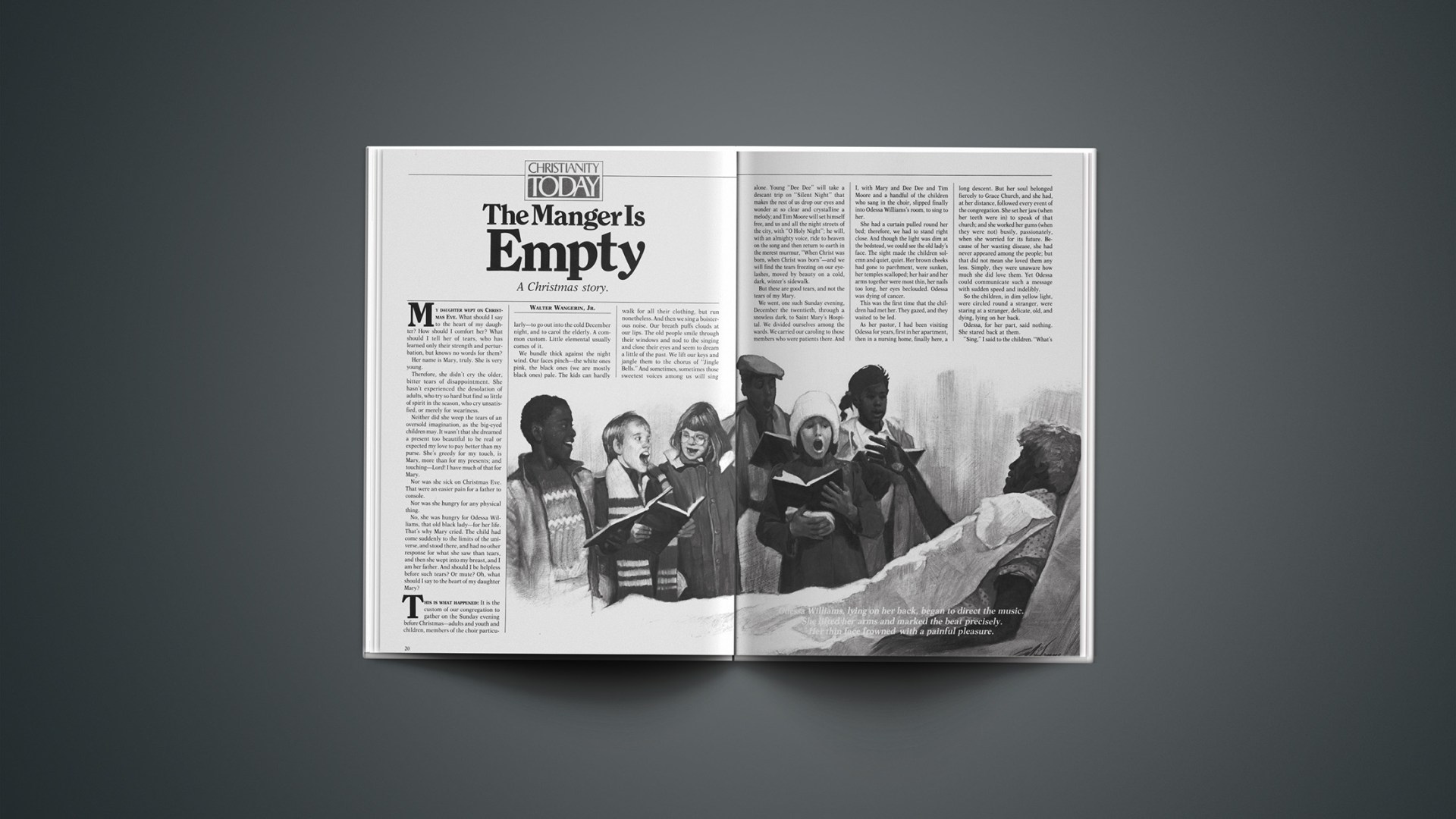
Odessa Williams, lying on her back, began to direct the music.

She lifted her arms and marked the beat precisely; her lank hands virtually shaped the tone of Dee Dee’s descant; and her thin face frowned with a painful pleasure. She pursed her lips as though tasting something celestial and delicious, so the children thought themselves marvelous; and she let another music smoke at her nostrils. The lady took them. The lady carried them. The lady led them meek to the end of their carol and to a perfect silence; and then they stood there round her bed, astonished, each one of them the possession of Odessa Williams, restrained. And waiting.

Oh, what a power of matriarchal authority was here, keenly alive!

Nor did she disappoint them. For she began, in a low and husky voice, to talk. No, Odessa preached.

“Oh, children, you my choir,” she said. “Oh, choir, you my children for sure, every las’ one of you. And listen me.” She caught them one by one with her barbed eyes. “Ain’ no one stand in front of you for goodness, no! You the bes’, babies! You the final best.”

The children gazed at her, and the children believed her absolutely, and my Mary, too, believed what she was hearing, heart and soul.

“Listen me,” Odessa said. “When you sing, wherever you go to sing, whoever’s sittin’ down in front of you when you sing—I’m there with you. I tell you truly: I alluz been with you, I alluz will be. And how can I say such a mackulous thing?” She lowered her voice. Her eyelids drooped a minimal degree. “Why, ‘cause we in Jesus. Babies, babies, we be in Jesus, old ones, young ones, us and you together. Jesus keep us in his bosom, and Jesus, no—he don’t never let us go. Never. Never. Not ever—”

So spoke Odessa in the dim long light. So said the lady with such conviction and with such a determined love for children whom she’d never met till now, but whom she’d followed with her heart, that these same children rolled tears from their wide-open eyes, and they were not ashamed.

They touched the hump of her toes beneath the hospital blankets. Stumpy black fingers, baby affection, and smiles.

And my Mary’s eyes I saw to glisten. The lady had won my daughter. In that holy moment, so close upon the Holy Day, so brief and so lasting at once, Mary came to love Odessa Williams completely. This is the power of a wise love wisely expressed: it can transfigure a heart, suddenly, forever.

But even these tears, shed Sunday evening in the hospital room, are not the tears that wanted my comforting. They are themselves a comfort. No, the tears that I had to speak to were the next my daughter wept. Those, they came on Christmas Eve.

Three days before Christ’s birthday, Odessa died. It was a long time coming. It was quick when it came. She died that Tuesday, the twenty-second of December. On Wednesday her body was in the care of the undertaker. The funeral was set for 11 in the morning, Thursday, the twenty-fourth. There was no alternative; the mortuary would be closed both Friday and the weekend. Throughout these arrangements—while at the same time directing preparations for special seasonal services—I was more pastor than father, more administrator than wise.

Well, it was a frightfully busy, hectic week. This was the very crush of the holidays, after all, and my doubled labor had just been trebled.

Not brutally, but somewhat hastily at lunch on Wednesday I told my children that Miz Williams had died. They were eating soup. This was not an uncommon piece of news for me to bear them: the congregation has its share of the elderly.

Mary, I barely noticed, ceased eating.

I wiped my mouth and rose from the table.

Mary stopped me briefly with a question and a statement. Staring at her soup, she said, “Is it going to snow tomorrow?”

I said, “I don’t know, Mary. How would I know that?”

And she said, “I want to go to the funeral.”

So: she was considering what to wear against the weather. I said, “Fine,” and left.

Thursday came grey and hard and cold and windless. It gave a pewter light. It made no shadow. The sky was sullen, draining color even from the naked trees. I walked to church. How still was all the earth around me—

It is the custom of our congregation, before a funeral, to set the casket immediately in front of the chancel and then to leave it open an hour until the service itself. People move silently up the aisle for a final viewing, singly or else in small groups, strangers to me who look and think and leave again. Near the time appointed for the service, they do not leave, but find seats and wait in silence. I robe ten minutes to the hour. I stand at the back of the church and greet them.

And so it was that I met my Mary at the door. In fact, she was standing outside the door when others pushed in past her.

“Mary?” I said. “Are you coming in?”

She looked at me a moment. “Dad,” she whispered earnestly, as though it were a dreadful secret, “it’s snowing.”

It was. A light powder grew at the roots of the grasses, a darker powder filled the air. The day was too cold for flakes—just a universal sifting of powder that seemed to isolate every living thing.

“Dad,” Mary repeated, gazing at me, and now it was a grievous voice, but what was I supposed to do? “It’s snowing!”

“Come, Mary. We haven’t much time. Come in.”

My daughter and I walked down the aisle to the chancel and the casket, and she was eight years old, then, and I was robed. People sat in the pews like sparrows on telephone wires, huddled under feathers, watching dark-eyed.

Mary slowed and paused at the casket and murmured, “Oh, no.”

Odessa’s eyes were closed, her lips pale; her skin seemed pressed into place, and the bridge of her nose suffered glasses. Had Odessa worn glasses? Yes, she had. But these were perched on her face slightly askew, unnaturally, so that one became sadly, sadly aware of eyeglasses for the first time. What belonged to the old lady any more, and what did not?

These were my speculations.

Mary had her own. She reached out and touched Odessa’s long fingers, crossed waxy at the breast. “Oh, no,” she whispered. The child bent and brushed those fingers with her cheek, then suddenly stood erect again.

“Oh, no,” Mary said, and she looked at me, and she did not blink, but she began to cry. “Dad,” she whispered. “Miz Williams is so cold. Dad,” wept Mary, “but it’s snowing outside—it’s snowing in Miz Williams’ grave!” All at once Mary buried her face in my robes, and I felt the pressure of her forehead and all her grief against my chest—and I was a father again, and my own throat swallowed and my eyes burned.

“Dad,” sobbed Mary. “Dad, Dad, it’s Christmas Eve!”

These were the tears. These were the tears my daughter cried at Christmas. God in heaven, what do I say to tears like these? It is death my Mary met. It’s the end of things, that things have an end, good things, kind and blessed things, things new and rare and precious: that love has an end; that people have an end; that Odessa Williams, the fierce old lady who seized the heart of my Mary and squeezed it and possessed it but four days ago, who was so real in dim light, waving her arms, that she has an end, ended, is gone, is dead.

How do I comfort these tears? What do I say to the heart of my daughter?

Jesus, Jesus, pity me. I said nothing.

I knelt down. I took Mary’s streaming face between my hands. But she so pierced me with the questions in her eyes that I couldn’t look at her, and I gathered her to myself, and I held her tightly, I held her hard, until I’d wrung the sobbing from her body; and I released her.

I watched her go back down the aisle and turn into a pew and sit. It was a silent Mary who went. She sat by her mother, but she asked no questions any more. Why should she, sad Mary, when there were no answers given?

So, the funeral. And so, the sermon.

“But there will be no gloom for her that was in anguish.” Isaiah. “The people who walked in darkness have seen a great light.” Prophecy and truth. “For to us a child is born, to us a son is given”—Christmas. But what were Isaiah and prophecy and all the sustaining truths of the faith to my daughter Mary? Nothing. Odessa had been something to her, but Odessa was dead. The casket was closed. Death was something to her now, and maybe the only thing.

The weather at graveside was grey and cold and snowing. The people stood in coats and shivered.

Mary said not a word nor held her mother’s hand nor looked at me.

Neither was she crying any more.

It is the custom of our family to open our gifts late Christmas Eve. I wondered, that afternoon, whether we oughtn’t vary custom this year, for Mary’s sake. She was still in her gloom and anguish, separated from us all by silence. There must have been a tumult of thought in her brain, but none of it showed on an eight-year-old face made severe. Oh, Mary, what joy will you have in presents, now? How frivolous the ribbons and wrappings would seem to one so thoughtful.

But that private custom of ours depended upon another custom of the congregation: we would not open the gifts until first we’d participated in the children’s Christmas service at church. This service gave me the greatest hesitation, because my Mary was to be the Mary in it, the mother of the infant Jesus. Could she accomplish so public a thing in so private a mood?

I asked her. “Mary, do you think we should get another Mary?

Slowly she shook her head. “No,” she said. “I’m Mary.”

Mary, Mary, so much Mary—but I wish you weren’t sad. I wish I had a word for you. Pastor, father, old and mute. Mary, forgive me, the heart of my daughter. It is not a kind world after all. Not even the holidays can draw a veil across the truth and pretend the happiness that is not there. Mary, bold Mary—“You are Mary,” I said. “I’ll be with you. It’ll be all right.”

We drove to church. The snow lay a loose inch on the ground. It swirled in snow-devils behind the cars ahead of us. It held the grey light of the city near the earth, though this was now nighttime, and dark. Surely, the snow had covered Odessa’s grave as well, a silent, seamless sheet of no warmth whatsoever.

Ah, these should have been my Mary’s thoughts, not mine.

The church sanctuary was full of a yellow light and noise, transfigured utterly from the low, funereal whispers of the morning. People threw back their heads and laughed. Parents chatted. Children darted, making ready for their pageant, each at various stages of dress, caught halfway between this age’s blue jeans and the shepherds’ robes of two millenia ago. Children were breathless. But Mary and I moved through the contumely like sprites, unnoticed and unnoticing. I was filled with her sorrow. She seemed simply empty.

In time the actors found their proper places, and the glad pageant began.

“My soul,” said Mary, both Marys before a little Elizabeth—but she said it so quietly that few could hear and my own heart yearned for her—“magnifies the Lord, and my spirit rejoices in God my Savior—”

And so: the child was surviving. But she was not rejoicing.

The angels came and giggled and sang and left.

A decree went out.

Another song was sung.

And then three moved into the chancel: Joseph and Mary and one other child to carry the manger, a wooden trough filled with old straw and a floppy doll.

The pageant proceeded, but I lost it entirely in watching my daughter.

For Mary began to frown fiercely on the manger in front of her—not at all like the proud and beaming parent she was supposed to portray. At the manger, she was staring, which stood in precisely the same spot where Odessa’s casket had sat that morning; and one was open as the other had been, and each held the figure of a human. Mary frowned so hard at it that I thought she would break into tears again, and my mind raced over things to do when she couldn’t control herself any more.

But Mary did not cry!

While shepherds kept watch over their flocks by night, my Mary played a part that no one had written into the script. The girl reached into the manger and touched the doll, thoughtfully. What are you thinking? Then, as though it were a decision, she took the doll out by its toes and stood up and walked down the chancel steps. Mary, where are you going? I folded my hands on account of her and yearned to hold her, to hide her, to protect her. But she carried the doll away into the darkened sacristy and disappeared. Mary? Mary? In a moment the child emerged again with nothing at all. She returned to the manger quickly, and she knelt down and she gazed upon the empty straw with her palms together like the first Mary, full of adoration. And her face—Mary, my Mary, your face was radiant then!

O Mary, how I love you!

Not quite suddenly there was in the chancel a multitude of the childish host praising God and saying, “Glory to God in the highest!” But Mary knelt unmoved among them, and her eight-year-old face was smiling, and there was the glistening of tears on her cheeks, but they were not unhappy, and the manger, open, empty, seemed the cause of them.

My soul magnifies the Lord! My spirit rejoices in God my Savior, for he has regarded the low estate of his handmaiden. Mary, what do you see? What do you know that your father could not say to the heart of his daughter? Mary, mother of the infant Jesus, teach me too!

She sat beside me in the car when we drove home. A sifting snow made cones below the streetlights. It blew lightly across the windshield and closed us in.

Mary said, “Dad?”

I said, “What.”

She said, “Dad, Jesus wasn’t in the manger. That wasn’t Jesus. That was a doll.” Oh, Mary: all things are struck real for you now, and there is no pretending any more. It was a doll indeed.

So, death reveals realities—

She said, “Jesus, he doesn’t have to be in a manger, does he? He goes back and forth, doesn’t he? He came from heaven, and he was borned here; but when he was done he went back to heaven again, and because he came and went he can be coming and going all the time, right?”

“Right,” I whispered. Teach me, little child. Teach me this Christmas gladness that you know.

“The manger is empty,” Mary said. And then she said, “Dad, Miz Williams’ box is empty, too. We don’t have to worry about the snow.” The next wonder my daughter whispered softly, as though peeping at presents; “It’s only a doll in her box. It’s like a big doll, Dad, and we put it away today. If Jesus can cross, if Jesus can go across, then Miz Williams, she crossed the same way, too, with Jesus—”

And Jesus, no—he don’t never let us go. Never.

“Dad?” said Mary, my Mary, the Mary who could ponder so much in her heart. “Why are you crying?”

Babies, babies, we be in Jesus, old ones, young ones, us and you together. Jesus keep us in his bosom, and Jesus, no—he don’t never let go. Never. Never. Not ever.

“Because I’ve got no other words to say,” I said to Mary. “I haven’t had the words for some time, now.”

“Dad?”

“What.”

“Don’t cry. I can talk for both of us.”

It always was; it always will be; it was in the fullness of time when the Christ child first was born; it was in 1981 when my daughter taught me the times on Christmas Eve; it is in every celebration of Jesus’ crossings back and forth; and it shall be forever—that this is the power of a wise love wisely expressed: it can transfigure the heart, suddenly, forever.
Ideas

Disturbing the Peace

Born this day in the city of David a tough-minded Peacemaker.

Somehow in this world of fear and war, of hate and revenge, the story of the Prince of Peace seems incongruous. What we need is not lowly Jesus, meek and mild, but a Prince of Power and Might. We need what the stricken apostles sought as they stood by the resurrected Jesus on the Mount of Olives. We say, “Will you at this time destroy the wicked powers that dominate the world and terrify us? Will you, right now, usher in the kingdom of perfect peace and righteousness we long for?”

But now as then, our Lord puts us off by declaring that it is not for us to know the time of his return. “You will hear of wars and rumors of wars, but see to it that you are not alarmed. Such things must happen, but the end is still to come” (Matt. 24:6). And so, with hope deferred but not destroyed, we realize that a sovereign God has not decreed a deliverance from the threats of war and destruction and grief and pain and death. That peaceable kingdom will come, but only with Christ’s return at the end of the age. He sends us back into the fearsome cauldron of human struggles. And as loyal and obedient followers of the Prince of Peace, we do not dare withdraw from the front line of the battle.

Strangely, he brings us his peace only when, with it, he also brings us assurance that we shall find no peace in this world. Our Lord came to his own, and his own did not receive him, but rather crucified him. Likewise, this Lamb of God sends his followers back into the world as salt and light. And because the world loves darkness, it rejects the light. When today’s Christian goes about his Master’s business, he must, with saints of former times, be prepared to endure the world’s resentment so vividly and chillingly described in that Christian Hall of Fame, Hebrews 11. On peace in such circumstances Paul wrote to the Philippians, “Do not be anxious about anything, but in everything … present your petitions to God. And the peace of God, which transcends all understanding, will guard your hearts and your minds in Christ Jesus” (4:6–7).

Neither does the world find to its taste the salt that would preserve it. And so it rejects the Christian’s efforts to function as the salt by which moral decay could be prevented.

If Christians should find their boundary lines falling in pleasant places, they will be deeply grateful to God for such surprising mercies. But also they will have to ask themselves whether they have not so succumbed to the world about them that they are no longer swimming Christianly against the current. Perhaps they encounter no resistance because they are merely flowing with the stream.

Even in personal relationships rising from daily contact with others, the Prince of Peace brought a strange toughness to his gospel of peace. Take the Samaritan woman. If I meet a woman who has divorced five husbands and is living unmarried with the sixth, I do not immediately remind her of her marital difficulties. Perhaps a squeaky, tight legalist would prove such a boor; but not I. I might gossip behind her back. But face to face, I would smile coolly and keep my lips tight shut, because I would not love her enough to risk the label “impolite” or “boorish,” or to suffer the embarrassment of a confrontation—however gently it might be brought about. And do I call public figures and powerful leaders hypocrites and crooks? Yes—in the privacy of my own home and the secure fellowship of trusted friends. But not in public. For, you see, I love them less than I love my own freedom from annoyance or harm. They might bring suit, hauling me into public court!

Once I stood three feet from a President of the United States, a man known for his love of power. But did I offer a word of counsel? Not I! I didn’t love him that much. The foolhardiness of the prophet Nathan who stood before King David demands greater love than I can muster.

Our Lord even took a whip and violently drove the moneychangers from the temple because they had no moral or legal right to be there. The real Jesus is the Prince of Peace, and during his short earthly life lived as a man of peace. But it was a tough-minded peace that always sought true peace—with God, with an enlightened conscience, with all men and women of good will. “Blessed are the peacemakers” (Matt. 5:9). Jesus shows at the temple that this involves vigorous action backed by firm resolve. The Prince of Peace was no wimp.

All too often, we Christians seek “peace”—the sticky unloving kind that has as its goal only our own freedom from discomfort or danger. Our Lord is the Prince of Peace, who always seeks the true peace even at the cost of disturbing the peace. And today he asks the same of all who aspire to be his followers.

KENNETH S. KANTZER

We all have ideas about the sights, sounds, and smells of the ideal Christmas. Strangely, many of the elements of my utopian Christmas are captured best in a beer commercial:

Strong, graceful horses stride elegantly along as they pull a carriage over clean, new-fallen snow. Only the peaceful tinkling of their bells breaks the silence at twilight. Beautifully lit evergreens hail the arrival at an isolated, fairy-tale town, far from war and crime.

My imagination extends the scene. The carriage brings gifts—not those that sparkle, but crude ones that incarnate love’s simplicity. Expectant people gather.

And there I am among them. With exuberance we breathe the brisk, pine-scented air. The night chill cannot match our spirits’ warmth. There can be no doubt we are alive.

Here and now it does not matter who among us is strong or weak, beautiful or common. We meet as people—God’s people—celebrating life, joyfully worshiping its Author. Entering a well-lit home we share eggnog and cookies. We join hands and sing. My heart leaps up again and again. I cannot contain my good will.

How sharp the contrast between my idealized Christmas scene and the real scenes of 1985. A man and his wife decide a dying marriage is not worth saving. A homeless and defeated outcast wanders aimlessly down a city street. A child is kidnaped, a woman is raped. An elderly man dies alone in a cold nursing home bed, far from my peaceful little town.

Sometimes I resent these unenviable scenes of life. They do not deserve to belong to a world that gives us horse-drawn carriages and clean snow. They especially seem out of place at Christmas.

A plane crash is always a tragedy. But if it happens at Christmastime it tears our hearts. To assault another person is wrong anytime. But at Christmas it is absolutely perverse. It is like spitting in God’s face.

How like a novel is Christmas: reality—both the good and the bad—is heightened. On most days of the year we wake up and go about our business unaware of how we feel. Not at Christmastime. At Christmas, it is impossible to feel neutral. We either get caught up in the excitement and affectionate warmth, or are overcome by the sadness of not being a part of it all.

A five-year-old child is awake and giggling at 6 A.M. All the joy she is capable of understanding lies wrapped and waiting under the Christmas tree. A young woman receives an engagement ring. An elderly couple eagerly anticipates the long-awaited Christmas reunion with their five children and flocks of grandchildren.

But right next door to someone’s happiness, an unemployed father cannot see joy in his five-year-old’s face. A young, widowed mother must face the awful task of putting gifts under the tree alone. An elderly couple page through a tattered photo album, haunted by the ghost of Christmases past. How ironic that the event that brought peace and joy to the earth is also the harbinger of such paralyzing emotional pain.

We can blot sadness and tragedy from our minds if we choose. But they will not go away, even at Christmas. They are part of the undeniable reality of our world.

We run an obstacle course, weaving in and out of conflict, climbing over tragedy and pain, striving for happiness. Sometimes questions go unanswered and dreams go unfulfilled. Bad things happen to good people. It is hard to make sense of it all.

As I consider again my ideal Christmas scene, I realize I am still a child. The selfishness of childhood has merely reached a different level. My ideal Christmas includes clean snow, warmth, singing, peace, and joy. It has no room for snow splashed with the blood of human suffering. It crowds out nakedness, loneliness, and fear.

How wrong it is to see the unhappy scenes as intrusions, even at Christmas. Instead, they should help us understand what Christmas means. God did not come to a perfect world; he came to one that suffers.

Can we understand the true meaning of Christmas without understanding this suffering? Can we fully experience God’s gift to us without being compelled to give to others?

This is our world, the world we have been given, the world we have made. In it there is happiness and sorrow, deception and truth. But the greatest truth is that God came to earth. That truth is ours to cling to, and to share.

It is the truth that, ex nihilo, creates hope for a troubled marriage or a hungry child. It dries the tears of loneliness, negates the sting of death. It gives the youthful widow strength to place those gifts under the tree and to live on.

Christmas does not deny sorrow its place in the world. But the message of Christmas is that joy is bigger than despair, that peace will outlast turmoil, that love has crushed all the evil, hatred, and pain the world at its worst can muster.

RANDALL L. FRAME

A Message from the Publisher: December 13, 1985

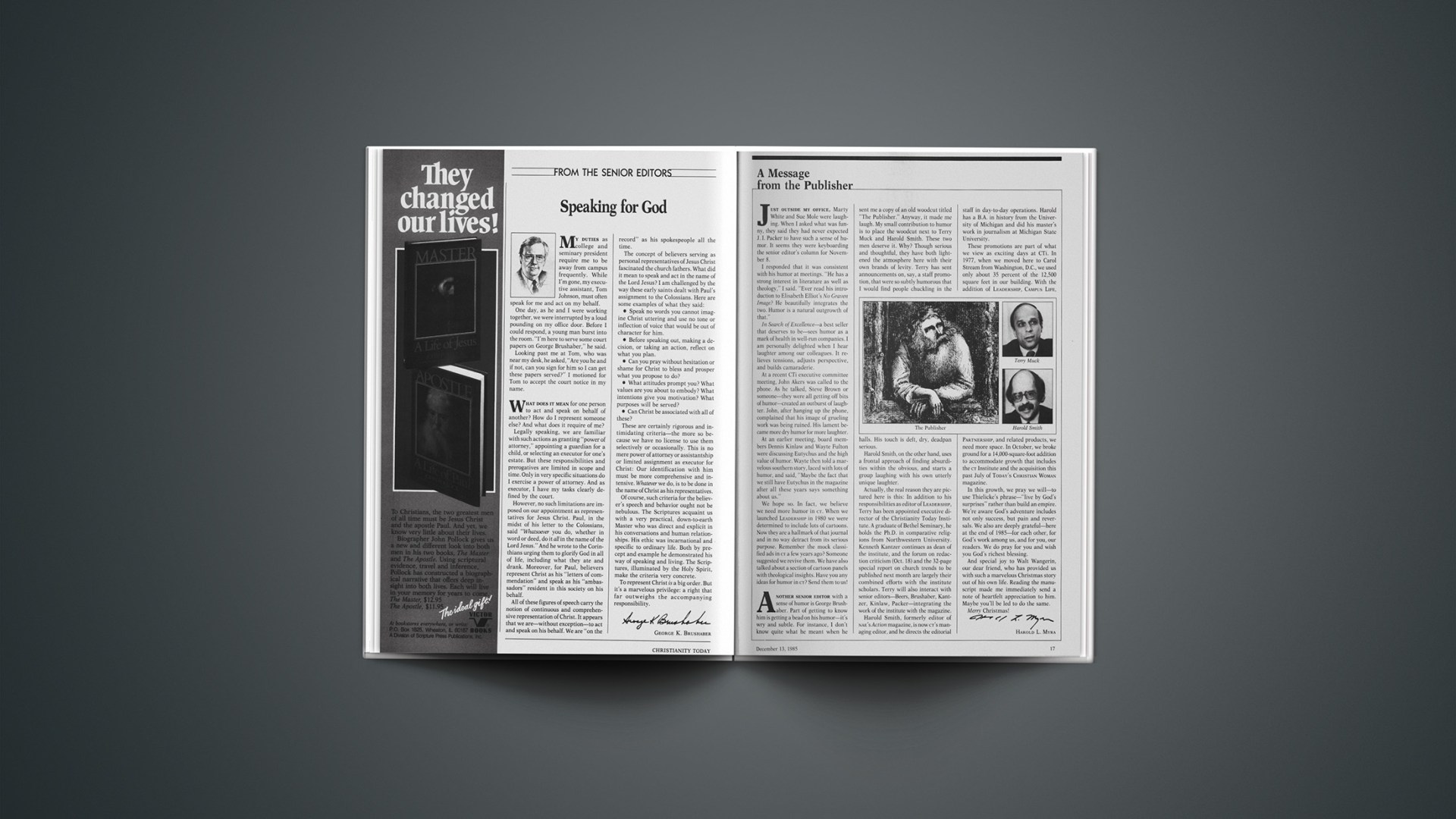
Just outside my office, Marty White and Sue Mole were laughing. When I asked what was funny, they said they had never expected J. I. Packer to have such a sense of humor. It seems they were keyboarding the senior editor’s column for November 8.

I responded that it was consistent with his humor at meetings. “He has a strong interest in literature as well as theology,” I said. “Ever read his introduction to Elisabeth Elliot’s No Graven Image? He beautifully integrates the two. Humor is a natural outgrowth of that.”

In Search of Excellence—a best seller that deserves to be—sees humor as a mark of health in well-run companies. I am personally delighted when I hear laughter among our colleagues. It relieves tensions, adjusts perspective, and builds camaraderie.

At a recent CTi executive committee meeting, John Akers was called to the phone. As he talked, Steve Brown or someone—they were all getting off bits of humor—created an outburst of laughter. John, after hanging up the phone, complained that his image of grueling work was being ruined. His lament became more dry humor for more laughter.

At an earlier meeting, board members Dennis Kinlaw and Wayte Fulton were discussing Eutychus and the high value of humor. Wayte then told a marvelous southern story, laced with lots of humor, and said, “Maybe the fact that we still have Eutychus in the magazine after all these years says something about us.”

We hope so. In fact, we believe we need more humor in CT. When we launched LEADERSHIP in 1980 we were determined to include lots of cartoons. Now they are a hallmark of that journal and in no way detract from its serious purpose. Remember the mock classified ads in CT a few years ago? Someone suggested we revive them. We have also talked about a section of cartoon panels with theological insights. Have you any ideas for humor in CT? Send them to us!

Another senior editor with a sense of humor is George Brushaber. Part of getting to know him is getting a bead on his humor—it’s wry and subtle. For instance, I don’t know quite what he meant when he sent me a copy of an old woodcut titled “The Publisher.” Anyway, it made me laugh. My small contribution to humor is to place the woodcut next to Terry Muck and Harold Smith. These two men deserve it. Why? Though serious and thoughtful, they have both lightened the atmosphere here with their own brands of levity. Terry has sent announcements on, say, a staff promotion, that were so subtly humorous that I would find people chuckling in the halls. His touch is deft, dry, deadpan serious.

Harold Smith, on the other hand, uses a frontal approach of finding absurdities within the obvious, and starts a group laughing with his own utterly unique laughter.

Actually, the real reason they are pictured here is this: In addition to his responsibilities as editor of LEADERSHIP, Terry has been appointed executive director of the Christianity Today Institute. A graduate of Bethel Seminary, he holds the Ph.D. in comparative religions from Northwestern University. Kenneth Kantzer continues as dean of the institute, and the forum on redaction criticism (Oct. 18) and the 32-page special report on church trends to be published next month are largely their combined efforts with the institute scholars. Terry will also interact with senior editors—Beers, Brushaber, Kantzer, Kinlaw, Packer—integrating the work of the institute with the magazine.

Harold Smith, formerly editor of NAE’s Action magazine, is now CT’s managing editor, and he directs the editorial staff in day-to-day operations. Harold has a B.A. in history from the University of Michigan and did his master’s work in journalism at Michigan State University.

These promotions are part of what we view as exciting days at CTi. In 1977, when we moved here to Carol Stream from Washington, D.C., we used only about 35 percent of the 12,500 square feet in our building. With the addition of LEADERSHIP, CAMPUS LIFE, PARTNERSHIP, and related products, we need more space. In October, we broke ground for a 14,000-square-foot addition to accommodate growth that includes the CT Institute and the acquisition this past July of TODAY’S CHRISTIAN WOMAN magazine.

In this growth, we pray we will—to use Thielicke’s phrase—“live by God’s surprises” rather than build an empire. We’re aware God’s adventure includes not only success, but pain and reversals. We also are deeply grateful—here at the end of 1985—for each other, for God’s work among us, and for you, our readers. We do pray for you and wish you God’s richest blessing.

And special joy to Walt Wangerin, our dear friend, who has provided us with such a marvelous Christmas story out of his own life. Reading the manuscript made me immediately send a note of heartfelt appreciation to him. Maybe you’ll be led to do the same.

Merry Christmas!

Speaking for God

My duties as college and seminary president require me to be away from campus frequently. While I’m gone, my executive assistant, Tom Johnson, must often speak for me and act on my behalf.

One day, as he and I were working together, we were interrupted by a loud pounding on my office door. Before I could respond, a young man burst into the room. “I’m here to serve some court papers on George Brushaber,” he said.

Looking past me at Tom, who was near my desk, he asked, “Are you he and if not, can you sign for him so I can get these papers served?” I motioned for Tom to accept the court notice in my name.

What does it mean for one person to act and speak on behalf of another? How do I represent someone else? And what does it require of me?

Legally speaking, we are familiar with such actions as granting “power of attorney,” appointing a guardian for a child, or selecting an executor for one’s estate. But these responsibilities and prerogatives are limited in scope and time. Only in very specific situations do I exercise a power of attorney. And as executor, I have my tasks clearly defined by the court.

However, no such limitations are imposed on our appointment as representatives for Jesus Christ. Paul, in the midst of his letter to the Colossians, said “Whatsoever you do, whether in word or deed, do it all in the name of the Lord Jesus.” And he wrote to the Corinthians urging them to glorify God in all of life, including what they ate and drank. Moreover, for Paul, believers represent Christ as his “letters of commendation” and speak as his “ambassadors” resident in this society on his behalf.

All of these figures of speech carry the notion of continuous and comprehensive representation of Christ. It appears that we are—without exception—to act and speak on his behalf. We are “on the record” as his spokespeople all the time.

The concept of believers serving as personal representatives of Jesus Christ fascinated the church fathers. What did it mean to speak and act in the name of the Lord Jesus? I am challenged by the way these early saints dealt with Paul’s assignment to the Colossians. Here are some examples of what they said:

• Speak no words you cannot imagine Christ uttering and use no tone or inflection of voice that would be out of character for him.

• Before speaking out, making a decision, or taking an action, reflect on what you plan.

• Can you pray without hesitation or shame for Christ to bless and prosper what you propose to do?

• What attitudes prompt you? What values are you about to embody? What intentions give you motivation? What purposes will be served?

• Can Christ be associated with all of these?

These are certainly rigorous and intimidating criteria—the more so because we have no license to use them selectively or occasionally. This is no mere power of attorney or assistantship or limited assignment as executor for Christ: Our identification with him must be more comprehensive and intensive. Whatever we do, is to be done in the name of Christ as his representatives.

Of course, such criteria for the believer’s speech and behavior ought not be nebulous. The Scriptures acquaint us with a very practical, down-to-earth Master who was direct and explicit in his conversations and human relationships. His ethic was incarnational and specific to ordinary life. Both by precept and example he demonstrated his way of speaking and living. The Scriptures, illuminated by the Holy Spirit, make the criteria very concrete.

To represent Christ is a big order. But it’s a marvelous privilege: a right that far outweighs the accompanying responsibility.

Eutychus and His Kin: December 13, 1985

Pastoral Computing

A friend of mine, the Reverend J. Bedrock Toalston, has always spent hours preparing his sermons, using nothing more sophisticated than a dull pencil and a pad of lined paper.

Now, Toalston’s board of deacons is primarily made up of successful businessmen, and it did not escape them that their pastor was slightly behind the times in his methodology.

“What he needs,” said the board chairman, “is a computer. Why, with a good word processor, he’ll be able to compose even better sermons in half the time. It wouldn’t surprise me but what he’d have enough time left over to take on the church cleaning chores.”

“And if we get him a spread sheet program,” chimed in the treasurer, “he could keep track of offerings and the accounts payable in the rest of the time he saves.”

So a computer was purchased. In no time at all, Reverend Toalston learned the difference between bytes and bits, RAM and ROM, log on and log off, floppy disks and hard disks.

The deacons beamed with anticipation when Toalston stepped behind the pulpit on the following Sunday, clutching a flawlessly neat printout.

However, their pastor launched into a recital of dull drivel that was interspersed with references not to the Bible, but to things like “Wordcomp Program 1.2 as revised in January 1983.” And in conclusion, instead of his usual pithy poem, he simply said something about “logging off.” And his face went blank.

An emergency meeting of the board was called immediately after the service. Following brief debate, the deacons voted unanimously to trade in the computer on an electric pencil sharpener.

EUTYCHUS

Colson: A Joy To Anticipate

Can it be that Charles Colson has become the George F. Will of evangelicalism? An every-other-issue basis with his insightful comments is a joy to anticipate.

MIKE WOMACK

Erwin, Tenn.

I wholeheartedly concur with Colson’s thesis that we as a nation are terribly prone to accept the ramblings of our national celebrities as truths [“Jane Fonda’s Farm Policies,” Oct. 18]. I notice, however, that in the attempt to catch the reader’s attention, CT reached into the same basket. The headline was bold with the name of a celebrity, one that has aroused the rancor of many in the past with her politics and “policies.”

REV. CHUCK PHILLIPS

Unity Baptist Church Fayette, Mo.

A Timely Voice

Thanks for Kelsey Menehan’s “Where Have All the Babies Gone?” [Oct. 18]. It is a timely voice when all we hear is the proabortionist’s clamor about the trauma of an “unwanted” pregnancy. It’s high time prolifers made the public aware of the agony of the infertile couple who is forced to play silent witness to the wanton destruction of the child they desperately desire but know they can never have.

CALVIN RICHTER

Wheaton, Ill.

I was appalled at the statement that adoption of a disabled, biracial, or older child is somehow “risky.” That does not square with the facts. I have several friends who, in the past decade, adopted children with skin or eye color different than their own. In each case, the adoption has been a happy, rewarding experience.

STEPHEN W. ANGELL

Nashville, Tenn.

No Need For Evangelism

Harold Brown’s article “Not Enough Children” (Oct. 18) raises some very disturbing misconceptions. First, he miscontexts Genesis 1:28 as a license or directive for modern Christian couples to become baby factories in the face of a world divinely created even in its limited resources. Second, he implies that Christians come into being merely by being born into “Christian” families. This is arch heresy in all evangelical and reformed confessions of faith. If one were automatically to become a Christian through birth, we would have no need for evangelism and evangelicals.

J. D. PATTERSON

Fresno, Calif.

Scripture says be fruitful and multiply, not be faithful and overrun! If Brown thinks we need more Christians in the world, why is he not writing about increasing our mission efforts?

JUDI FAHNESTOCK

Philadelphia, Pa.

It is my personal opinion that one prime reason evangelical Christian couples in the U.S. today do not put sufficient priority on having their own children, and having more than the stereotypical two children, is due to the endemic lack of biblical teaching and preaching about the nature of the covenant God has with his people. I cannot remember an article in your magazine that stresses the centrality of that covenant, and the consequent biblical doctrine of how children are a tangible expression of it.

REV. MARSHALL PIERSON

Church of the Master

Monroeville, Ohio

Gay—Or Not So Gay?

The guest editorial by Cornelius Plantinga was excellent [“The Justification of Rock Hudson,” Oct. 18]. May we in the evangelical community be people of the Book, characterized by holiness because the Bible so instructs, not because of fear of personal illness. May we also be people of compassion toward those who are so sinfully ill.

But why call homosexuals “gay”? They are not gay in any sense of the term. Because my name is in the phone book, I have received many late night “non-gay” phone calls from people on Chicago’s famous North Side. Should not the evangelical community strive for accuracy in language, especially when the secular community has abducted a previously fine name?

REV. ARTHUR EVANS GAY

South Park Church

Park Ridge, Ill.

The deprecatory terminology used in the CT editorial is an injustice, and negatively affects the way this sexual minority can be ministered to. Such words rub salt into the open wounds of homosexual persons who have never experienced Christian healing. You imperil the efforts of Christians who wish to combat AIDS by working in ministries of reconciliation, hope, and a healthy, biblical response to human sexuality that will lead gay people on to new lives.

R. P. ELLENBERGER

Richmond, Ind.

I appreciate Plantinga’s admonishing on self-righteousness. It hit me like a sudden blast of cold water, which tells me I was well on my way to “Christian smugness.”

PAM GALASSO

Westerville, Ohio

The Anti-South Africa Bandwagon

I was disappointed to see CT jump on the anti-South African bandwagon [“The Rationalization of Racism,” Editorial, Oct. 4]. Much of the color-blind media have ignored the fact that while blacks in white-ruled Africa cannot vote, blacks and whites in most of black-ruled Africa cannot vote. I don’t see concert-aid money going to feed starving people in South Africa. Let’s look at the problems of South Africa in context of all of Africa.

MICK LANTIS

Manchester, Mich.

Questionable Tv Programming

Lloyd Billingsley’s “TV: Where the Girls Are Good Looking and the Good Guys Win” [Oct. 4] overlooked a salient point for subscribers of cable-access television services. Regardless of household agreed-upon censorship, the monthly fees are paid to all the participating networks. Thus, a Christian family is in the position of supporting questionable programming.

GILBERT A. WILSON, M.D.

Clovis, N.M.

I question Billingsley’s statement that“entertainment is a legitimate human need,” and his recommendation of “occasional escapism.” What Scripture could conceivably suggest such an idea? The closest I can come is Jesus telling his disciples to “Come to a quiet place and rest.” We see Jesus taking a break by going off alone to pray, not watching “Mork & Mindy.”

REV. DAVE COLES

Koinonia Church

Potsdam, N.Y.

A Romanian Transliteration

Randall L. Frame’s article “The Bible: The Year in Review” (Oct. 4) states, “Moldavian, a Soviet language spoken by three million people, received its first translation of the Bible.” Moldavian is simply the Romanian language. The “translation” just completed by the Stockholm-based institute for Bible translation is not a translation at all: it is the Romanian Bible transliterated in the Cyrillic script (Russian alphabet), which was imposed on three million Romanians when they were incorporated into the Soviet Union.

DR. JOSEPH TON

The Romanian Missionary Society

Wheaton, Ill.

Your article will help reduce the growing confusion surrounding the multiplicity of Bible versions and editions. Supplying impartial information about the Bible is a service we know many will find helpful.

REUBEN H. GUMS

Laymen’s National Bible Committee

New York, N.Y.

I would like to make one clarification about The New International Version Study Bible. This title was mistakenly attributed to a Scofield-Thompson Chain Reference package put out by B. B. Kirkbride Bible Company, one of several publishers who have issued study notes using the NIV translation. The New International Version Study Bible title belongs only to the study Bible just released by Zondervan, the only one prepared by the team of scholars most of whom were the NIV translators.

BRUCE E. RYSKAMP

Zondervan Bible Publishers

Grand Rapids, Mich.

Frame spoke of the joint effort by Tyndale House and CBN to sell “The Book,” and their advertising campaign to make the Bible more accessible. I first heard of “The Book” on TV only as a new readable translation. I found it in a bookstore, vacuum-sealed in plastic, with no mention of its scholarship or origin. Only after paying $9.95, plus tax, was I able to unwrap the paperback book and learn that it was a repackaging of The Living Bible, which I had recently bought in a padded-cover edition for $3.88. I daresay others felt betrayed at the hands of commercialism in the Christian marketplace.

REV. HAL EATON

Young’s Chapel Baptist Church

Mouth of Wilson, Va.

No reference was made to Computer Bibles International, Inc., whose New Testament of the Good News Bible is now on the market on two soft disks (with manual), soon to be followed by the GNB Old Testament and other Bibles.

LEWIS H. MILLER, JR.

Computer Bibles International, Inc.

Greenville, S.C.

I was disappointed that there was no mention of the progress being made to translate the Bible into Bengali, the world’s sixth-largest spoken language. Our mission has been working on a Standard Bengali Common Language translation since 1965. The New Testament was completed in 1977. The Old Testament translation project is about half-completed.

WILLIAM D. BARRICK

Ceres, Calif.

Timely, Insightful

I thought the article “Falwell Raises a Stir by Opposing Sanctions Against South Africa” [Oct. 4] was not only timely, but insightful. I’m tired of reading Christian magazines and watching Christian television where only right-wing opinions are stated. We are a black Christian family and know the issues, and to see continual one-sided reporting is appalling. It is so good to see a Christian magazine at least quoting black pastors, and black people in general.

EDNA W. SWILLEY

San Jose, Calif.

Drunkenness Or Alcoholism?

I was glad to note that “Alcoholism Is Not a Disease” does not necessarily reflect the views of CT. However, I do not consider the author a “responsible Christian,” since this article has the potential of preventing Christian alcoholics from reaching out for help they desperately need. Thomas equates drunkenness and alcoholism as one and the same. He obviously knows little about addiction and the difference between a person making a willful choice to get drunk (drunkenness—sin) and a person who has lost that choice and gets drunk (alcoholism—disease).

BOB BARTOSCH

Whittier, Calif.

I found a much more realistic and informative article, “Dying for a Drink,” in your May 17, 1985, issue.

HELEN VASILIOW

Ridgefield Park, N.J.

I just finished reading the book Dying for a Drink by Anderson Spickard, M.D., and Barbara Thompson. Please print a rebuttal to this awful article by an expert like Dr. Spickard.

JOANNE DYKE

Moscow, Pa.

Spickard and Thompson wrote the article referred to in the preceding letter.

Eds.

A Corner On Orthodoxy

Thank you for the three-part article on the Tony Campolo controversy [Sept. 20]. Why do people who think they have the corner on orthodoxy tend to burn at the stake people who don’t fit into their box? I agree with those in the article who suggest that “theological heresy” is just the smoke screen that hides the real issue—Bill Bright’s discomfort in dealing with the lifestyle issues Tony preaches. Some people are so orthodox they haven’t moved for years. I sense Tony Campolo moving toward Jesus.

REV. MARVIN FRIESEN

First Baptist Church

Kailua, Hawaii

After reading the articles on Campolo I was disgusted that Christians are attacking fellow Christians. I think my cartoon speaks for itself.

DON FRYE

Kansas City, Mo.

Ct Institute’S Redaction Criticism: Readers Respond

As an evangelical who did dissertation work at the University of Aberdeen in the area of redaction criticism, I appreciated your informed discussion on this area [“Redaction Criticism: Is It Worth the Risk?” Oct. 18]. The panel presented the dangers, benefits, and limitations of this critical tool in a balanced fashion. I look forward to seeing you tackle other issues in a similar manner.

DARRELL L. BOCK

Dallas Theological Seminary

Dallas, Tex.

With dozens of topics you might have picked for such extensive treatment by so learned a panel, why waste so much time, energy, printer’s ink, and readers’ patience on a subject that one in a hundred will understand and three in a thousand will care anything about?

REV. EDWARD A. JOHNSON

Batesville, Ind.

Although the five New Testament scholars discussing the question did their best to persuade readers that it is indeed a valid, worthwhile discipline, I am not convinced. I get the uneasy feeling that redaction criticism is nothing more than neo-orthodox existential theology dressed up in fancy clothes.

MRS. MARTIN M. CASSITY

Scroggins, Tex.

I appreciate your informative treatment. I thought Robert Thomas’s analysis to be especially clear and helpful. But the [other] definitions didn’t agree. Thomas gives a more helpful four-point definition touching areas of selectivity, arrangement, modification, and creativity. A natural conclusion is that we should avoid so loose a term. But Scholer says it is accepted terminology in the international scholarly community. Is this not a problem?

As to the Gundry matter, he claimed other methodologies besides redaction criticism. But I urged that he not be judged by any alleged methodology, but by the results to which he came. If a man denies the reality of the wise men, the slaughter of the innocents, and so on, he does not believe the Bible to be true by any normal definition of truth. Gundry is capable and sincere; but his views were judged to be different from those the Evangelical Theological Society was founded to maintain.

R. LAIRD HARRIS

Professor Emeritus Covenant Seminary

Wilmington, Del.

Does not the whole matter of admissibility of redaction criticism turn on whether the process of inspiration can be truly understood on the level that it functioned in those who were used to write the Bible? It seems presumptuous to assume that the motivations and thought processes of those who were inspired of God to write the Scriptures are necessarily similar to those by which we would be moved if we were to try to produce similar compositions.

DAVID L. MOORE

Miami Beach, Fla.

Redaction criticism reminds me of knowing more and more about less and less until you know everything about nothing!

MRS. CORLIE GREY

Merritt Island, Fla.

One of the problems seems to be the use of the term “criticism,” which connotes to most people an attempt to find fault. Textual criticism finds the errors in the biblical texts, enabling us to get closer to the inspired originals. But redaction criticism seems to be looking for “errors” in the editing, calling into question the veracity of those originals. The dangerous presuppositions the forum participants warned of are inherent in the name.

TOM PITTMAN

Manhattan, Kan.

“Men without Chests”

The headline shocks came rapid-fire. There was hardly time to catch one’s breath. First came espionage charges against FBI agent Richard Miller. The unthinkable: for the first time in the bureau’s proud history, an agent betrayed his trust.

Next was the bizarre tale of ex-navy warrant officer John Walker, alleged ringleader of a spy ring that included his half-brother and young sailor son.

Days later, a covert operator for the CIA in Ghana, Sharon Scranage, was indicted on 18 counts of espionage.

Then FBI agents arrested Col. Wayne Gilespie, West Pointer and Vietnam veteran, for selling weapons to Iran.

The spate of cases sent tremors through Washington. Military brass promised a tightening of security, while Congress quickly voted on a capital punishment statute for spies.

The cases brought concern to the country as well. In VFW halls and hard-hat bars, in the churches and living rooms where folks still talk unashamedly about things like patriotism and duty, grief was mixed with anger. It seemed an epidemic was sweeping the very institutions most Americans revere as bastions of our values and liberties. Why?

Most commentators saw the scandals as simply individuals succumbing to age-old temptations. That is certainly plausible in a society that relentlessly pursues power, pleasure, and possessions; and such motives were apparent in each case.

John Walker played James Bond with gusto, dashing about in his plane, sailing his sloop in the company of glamorous women. His arrest crowned his fantasy, as Walker crowed giddily, “I’m a celebrity!”

Greed might have snared Wayne Gilespie. The colonel, a 29-year veteran, was about to retire and enter the arms business. Other retired officers landed cushy jobs with defense contractors, so why shouldn’t he get a head start? After all, only a fool doesn’t take care of himself in our “look out for number one” society.

Or take FBI agent Richard Miller. Father of seven, stuck in a paper-pushing post and unable to meet his mortgage payments, he was no match for a modern Mata Hari, the sultry Russian woman who offered sex and money.

So it was with the CIA’s Sharon Scranage, stationed at a lonely outpost in Ghana, swept off her feet by a businessman who just happened to be a cousin of Ghana’s Marxist leader.

But payoffs and passion don’t tell the whole story. These incidents are symptoms of an insidious cancer that has pervaded the values undergirding our public institutions.

This disease is not confined to the U.S., as recent scandals in Britain and West Germany reveal, but it is part of a general malaise erupting in the West wherever spiritual values are being sapped.

To understand it in the United States, one must return to the mid-60s. Even as John Kennedy’s “Ask not what your country can do for you, but what you can do for your country” rang in our ears, and Green Berets defended our “noble vision” in Southeast Asia, an undercurrent of protest churned. Campus flower children had another vision—easy sex, hard rock, hard drugs, and peace. Peace, no matter what.

Then the “noble vision” bogged down in bloody rice paddies. With 55,000 of their buddies in body bags, the vets returned—not to ticker-tape parades, but to derision. And after Congress cut off aid to the nation they fought to save, the ex-soldiers witnessed the shame of panicked Americans dangling from the skids of overloaded helicopters, the U.S. flag burned in Saigon’s streets.

The point here is not the wisdom or morality of American involvement in Vietnam. But this tragic war left millions disillusioned, and fueled growing discontent with our national purpose.

In the early seventies, the media intensified the assault on authority. Then came Watergate—a breach of trust at the highest levels. Respect for institutions hit new lows. And what began as a campus movement became the age of the anti-hero. Disillusionment replaced the American dream.

In the light of this, should we really be shocked by today’s spy cases? Consider Wayne Gilespie again. Ordered to fight, perhaps to die, in Vietnam, he returned to a nation that taunted its military for committing moral crimes against humanity. No wonder government lost its legitimacy, or that he might decide to rescue something from his career for himself. And since one war is no more moral than the next, why not sell a few arms to Iran?

Such reasoning is the inevitable result of our wholesale evisceration of values. Belief in “self-evident truths,” fixed standards by which right and wrong can be judged, has been replaced. Relativism, long lurking below the surface, emerged as the prevailing philosophy of the “me decade” of the seventies; it reigns still in the yuppieism of the eighties.

We may still give lip service to traditional values, but in practice, the right is whatever is good for me. Emptied of meaning, words like duty and loyalty no longer have the moral force to restrain our passion for self-gratification.

C. S. Lewis did not live to see the America of the eighties. I doubt he’s sorry he missed it. But he foresaw our situation today when he argued in 1943 that mere knowledge of right and wrong is powerless against man’s appetites. Reason must rule the appetites by means of the “spirited element”—learned desires for the good, or “trained emotions,” said Lewis. He likened reason to the head, the appetite to the stomach, and the spirited element—the essential connecting link—to the chest.

Aren’t today’s spy cases merely the consequence of a nation’s loss of its spirited element? This is a sobering question for Christians, who have a special responsibility for a people’s spirituality.

And if we are a nation of men without chests, so to speak, Lewis’s description is all too apt: “We remove the organ and demand the function. We make men without chests and expect of them virtue and enterprise. We laugh at honor and are shocked to find traitors in our midst.”

International: Relations Improve between Church and State in Hungary

The country allows the first evangelistic services on public property since World War II.

During the Stalinist period of the early 1950s, Hungary saw the persecution and arrests of many church leaders, the appointment of atheists to church leadership positions, and the dissolution of church institutions. But conditions today in the East European country are far different. For example:

• Bibles and Christian books are readily available. Four religious bookstores are open in Budapest, most churches operate book tables, and many government bookstores handle Sunday school materials. Religious journalism is thriving, church services are broadcast weekly on state radio, and an American street evangelist is setting up a ministry to troubled young people in Budapest.

• Relations with the Vatican are “normalized.” Some 65 percent of Hungary’s 10.5 million people are at least nominally Roman Catholic.

• The Bible is taught as literature in public schools. Teachers are warned not to use such classes as an occasion to belittle or attack religious belief.

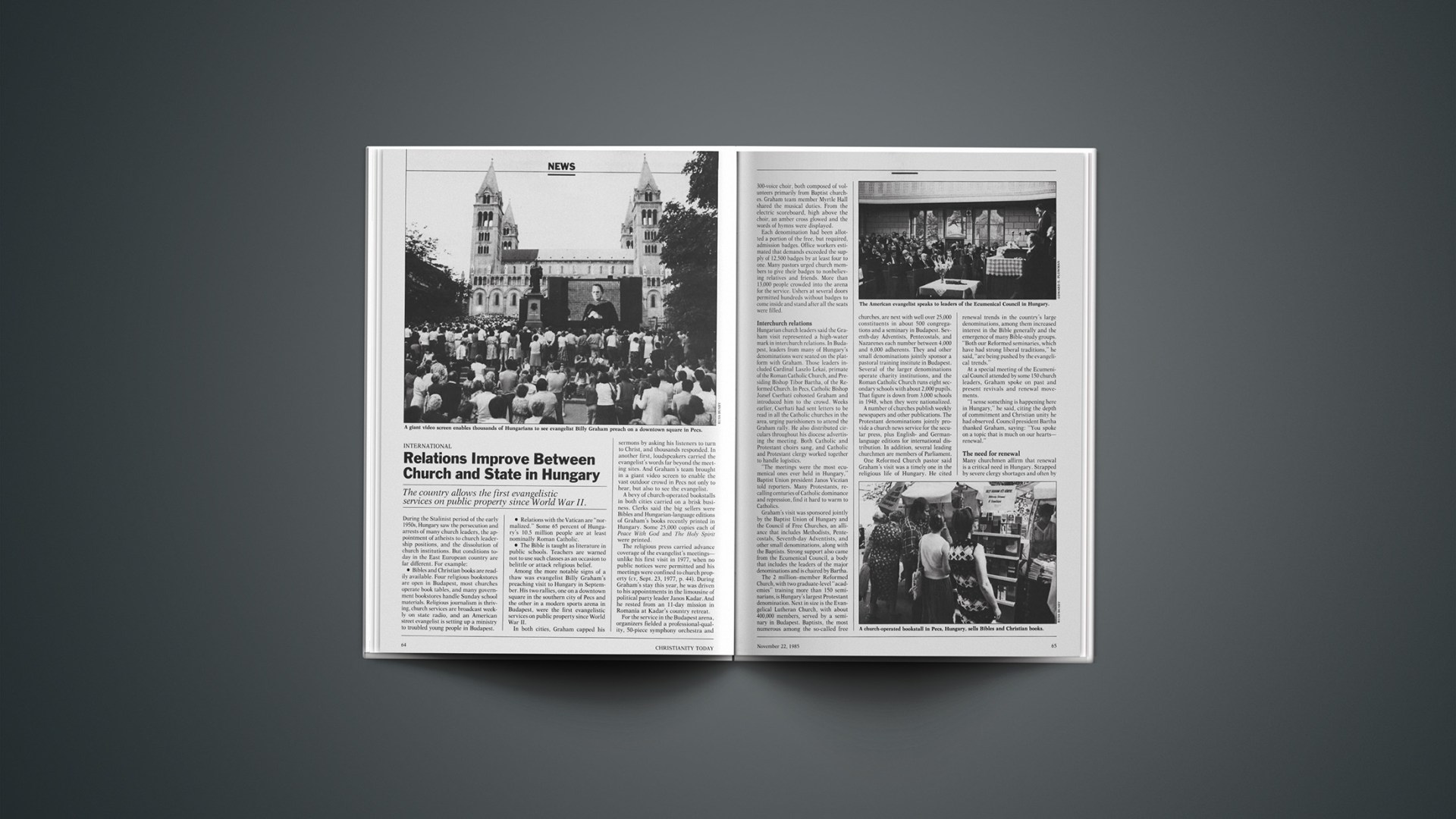
Among the more notable signs of a thaw was evangelist Billy Graham’s preaching visit to Hungary in September. His two rallies, one on a downtown square in the southern city of Pecs and the other in a modern sports arena in Budapest, were the first evangelistic services on public property since World War II.

In both cities, Graham capped his sermons by asking his listeners to turn to Christ, and thousands responded. In another first, loudspeakers carried the evangelist’s words far beyond the meeting sites. And Graham’s team brought in a giant video screen to enable the vast outdoor crowd in Pecs not only to hear, but also to see the evangelist.

A bevy of church-operated bookstalls in both cities carried on a brisk business. Clerks said the big sellers were Bibles and Hungarian-language editions of Graham’s books recently printed in Hungary. Some 25,000 copies each of Peace With God and The Holy Spirit were printed.

The religious press carried advance coverage of the evangelist’s meetings—unlike his first visit in 1977, when no public notices were permitted and his meetings were confined to church property (CT, Sept. 23, 1977, p. 44). During Graham’s stay this year, he was driven to his appointments in the limousine of political party leader Janos Kadar. And he rested from an 11-day mission in Romania at Kadar’s country retreat.

For the service in the Budapest arena, organizers fielded a professional-quality, 50-piece symphony orchestra and 300-voice choir, both composed of volunteers primarily from Baptist churches. Graham team member Myrtle Hall shared the musical duties. From the electric scoreboard, high above the choir, an amber cross glowed and the words of hymns were displayed.

Each denomination had been allotted a portion of the free, but required, admission badges. Office workers estimated that demands exceeded the supply of 12,500 badges by at least four to one. Many pastors urged church members to give their badges to nonbelieving relatives and friends. More than 13,000 people crowded into the arena for the service. Ushers at several doors permitted hundreds without badges to come inside and stand after all the seats were filled.

Interchurch Relations

Hungarian church leaders said the Graham visit represented a high-water mark in interchurch relations. In Budapest, leaders from many of Hungary’s denominations were seated on the platform with Graham. Those leaders included Cardinal Laszlo Lekai, primate of the Roman Catholic Church, and Presiding Bishop Tibor Bartha, of the Reformed Church. In Pecs, Catholic Bishop Jozsef Cserhati cohosted Graham and introduced him to the crowd. Weeks earlier, Cserhati had sent letters to be read in all the Catholic churches in the area, urging parishioners to attend the Graham rally. He also distributed circulars throughout his diocese advertising the meeting. Both Catholic and Protestant choirs sang, and Catholic and Protestant clergy worked together to handle logistics.

“The meetings were the most ecumenical ones ever held in Hungary,” Baptist Union president Janos Viczian told reporters. Many Protestants, recalling centuries of Catholic dominance and repression, find it hard to warm to Catholics.

Graham’s visit was sponsored jointly by the Baptist Union of Hungary and the Council of Free Churches, an alliance that includes Methodists, Pentecostals, Seventh-day Adventists, and other small denominations, along with the Baptists. Strong support also came from the Ecumenical Council, a body that includes the leaders of the major denominations and is chaired by Bartha.

The 2 million-member Reformed Church, with two graduate-level “academies” training more than 150 seminarians, is Hungary’s largest Protestant denomination. Next in size is the Evangelical Lutheran Church, with about 400,000 members, served by a seminary in Budapest. Baptists, the most numerous among the so-called free churches, are next with well over 25,000 constituents in about 500 congregations and a seminary in Budapest. Seventh-day Adventists, Pentecostals, and Nazarenes each number between 4,000 and 6,000 adherents. They and other small denominations jointly sponsor a pastoral training institute in Budapest. Several of the larger denominations operate charity institutions, and the Roman Catholic Church runs eight secondary schools with about 2,000 pupils. That figure is down from 3,000 schools in 1948, when they were nationalized.

A number of churches publish weekly newspapers and other publications. The Protestant denominations jointly provide a church news service for the secular press, plus English- and German-language editions for international distribution. In addition, several leading churchmen are members of Parliament.

One Reformed Church pastor said Graham’s visit was a timely one in the religious life of Hungary. He cited renewal trends in the country’s large denominations, among them increased interest in the Bible generally and the emergence of many Bible-study groups. “Both our Reformed seminaries, which have had strong liberal traditions,” he said, “are being pushed by the evangelical trends.”

At a special meeting of the Ecumenical Council attended by some 150 church leaders, Graham spoke on past and present revivals and renewal movements.

“I sense something is happening here in Hungary,” he said, citing the depth of commitment and Christian unity he had observed. Council president Bartha thanked Graham, saying: “You spoke on a topic that is much on our hearts—renewal.”

The Need For Renewal

Many churchmen affirm that renewal is a critical need in Hungary. Strapped by severe clergy shortages and often by their own narrow outlook and traditions, the churches are struggling with the impact of industrialization and urbanization. Hungary has made great progress economically over the past two decades and is one of the healthiest of the Soviet-bloc countries. But, as in the West, part of the price has been widespread upheaval of home life, splintering of traditional values, and secularization. Divorce is on the increase. Alcoholism, drug use, and delinquency are spreading among the youth. Government studies show that the majority of people who move from villages and rural environs to the cities drop out of church.

In recent years, government officials have been promoting a “partnership” between church and state in addressing social ills. Observers say this accounts in part for the easing of restrictions on the churches. Seminary enrollments are up, and correspondence courses have been introduced to speed up the training of clergy recruits. Small Bible-study and prayer groups flourish despite the lack of official recognition and approval. State television not long ago broadcast a series on the Bible, which a Baptist pastor described as “surprisingly positive.” Western evangelists appear frequently as guest speakers in church pulpits, often without the customary advance approval of the authorities. New York street evangelist Tom Mahairas, a former drug addict, has been invited to work among social dropouts in Budapest.

In the process, the State Office for Church Affairs (SOCA), under the headship of Imre Miklos, has undergone a transformation, SOCA was founded in 1951 to monitor and regulate church activities and leaders. Like its counterparts elsewhere in Eastern Europe, it often had to implement harsh party policies designed to restrict and weaken the churches. However, SOCA today is often found taking a positive role in church matters, mirroring perhaps Kadar’s own philosophy. “Ideological differences,” he says, “need not prevent Christians and Marxists from working together.”

Government and church sources acknowledge that many unresolved issues and tensions remain between church and state. But they seem convinced that the new style of pragmatic compromise, rather than confrontation, is the way to achieve the most progress.

EDWARD E. PLOWMANin Hungary

TELEVISION

Court Ruling Could Hurt Christian Broadcasters

Cable television companies are no longer required to carry local television stations, including religious stations, following a court decision in July. In response, the National Religious Broadcasters, National Association of Broadcasters, and Public Broadcasting System have filed an appeal with the U.S. Supreme Court. They also asked the Federal Communications Commission (FCC) to devise new rules to protect local stations from being dropped arbitrarily from cable program offerings.

The FCC’s “must-carry” rules required cable television companies to include all local stations within a 35-mile radius. That requirement was ruled unconstitutional by the Circuit Court of Appeals in Washington, D.C., since cable managers could not freely choose the stations they offer to subscribers. Broadcasters say the court’s decision is unfair to new stations, ones that broadcast to a small audience, and those with low ratings.

The court ruling “means cable systems can make any decision they want,” said veteran religious broadcaster Jerry Rose. “If they don’t like religious or ethnic programming, they can just leave it off. The FCC and the courts have bowed to big ratings. They are not serving local television needs as they are supposed to be doing.”

If they are shunned by cable companies, small, local stations may be unable to compete for viewers as more families use cable service exclusively. Cable operators argue that they are up against stiff competition themselves—faced with a growing array of entertainment options, such as movies on videocassette tapes. If a station is duplicating programs available on other channels, or attracting few viewers, cable television decision makers want to shop for alternatives.

In Chicago, Rose found his 10-year-old station, WCFC, bumped by U.S. Cable in Waukegan, Illinois. He said many cable subscribers signed up for the service knowing they would receive his channel. After WCFC was dropped, Rose met with U.S. Cable general manager Jim Pearson to request a rethinking of the decision.

Pearson said that he has been receiving letters from subscribers who want WCFC returned to their screens. “We want to show what our subscribers want,” he said. “If we’ve made an error, we’ll put it back on.”

He said Rose’s station was removed because 80 percent of its programming duplicated shows available on national Christian networks carried by U.S. Cable. “We get requests for religious channels all the time,” Pearson said, “and we try to treat them fairly within the scope of subscriber demand. We also get complaints from people saying we have too much religion.” With the must-carry rules lifted, it is up to cable managers like Pearson to select which stations are made available to viewers.

Rose chairs a committee of National Religious Broadcasters members that is pressuring the FCC to consider drafting rules that would satisfy the Circuit Court of Appeals’ concerns, while protecting the interests of small, struggling local broadcasters.

Ralph Haller, deputy chief of the FCC’s policy and rules division, said the commission “will continue looking at the problem and asking questions as to the proper role of must-carry rules.” He said the FCC, which licenses and regulates broadcasters, is interested in assessing must-carry requirements to see if they serve the interests of the public, not in order to placate either broadcasters or cable operators.

MUSIC

Parents Group Wants Labels On Explicit Rock Records

It used to be the thumping rock beat coming from their kids’ bedrooms that worried parents. But a group of mothers in Washington, D.C., claims there is more to fear these days from rock music’s increasingly explicit lyrics.

“The stuff we were dancing to 15 years ago was nothing like this,” says Susan Baker, cofounder of the Parents’ Music Resource Center (PMRC). The organization has launched a national campaign to pressure the recording industry to inform consumers about the messages conveyed in rock music.

“A lot of the songs today encourage alcohol and drug abuse,” Baker says. “There’s a lot of incest, sadomasochism, homosexuality, and Satan worship. And the lyrics are getting bolder and bolder.”

An evangelical Christian, Baker is the wife of U.S. treasury secretary James A. Baker. She started combating explicit rock lyrics after talking with a friend who purchased the album Purple Rain for her daughter. One song on the album refers to a girl masturbating.

“She [the friend] was horrified and so was I,” says Baker, who discovered that lyrics to other songs on the album were even more explicit. “The average teenager listens to this stuff four to six hours a day. They wake up to it, study to it, dance to it, sleep to it. They plug in their earphones and jog to it.”

Baker and other well-connected Washington wives and mothers formed PMRC last spring. She says the organization adopted a secular approach to broaden involvement.

“There has been an awakening in church circles to harmful lyrics and sexual exploitation in rock music,” Baker says, “but it has only been the church groups that are interested. Our thrust is to create a dialogue across the nation, not tackling it only from a religious point of view.”

When PMRC was founded, the organization asked the recording industry to adopt a rating system for record albums, similar to the one used for movies. The Recording Industry Association of America (RIAA), which represents 80 percent of the record companies in the United States, rejected the ratings proposal. But it did agree to a compromise—a generic label saying “Parental Guidance: Explicit Lyrics” to be placed on albums that record companies deem most explicit. Some record companies were concerned that music stores would refuse to stock albums displaying the label. However, by late September, half of the 48 companies represented by RIAA had agreed to the labeling system.

As a result, PMRC is no longer pushing for a rock music ratings system. Instead, it is asking record companies to print the lyrics of songs on the outside of record jackets. The organization also objects to sexually explicit record jackets and certain rock music videos. PMRC’s efforts have raised a storm of opposition from musicians and anticensorship groups.

Earlier this year at a hearing before the Senate Commerce Committee, musicians as diverse as John Denver and Frank Zappa confronted PMRC representatives with their objections. Many opponents say the group’s proposals amount to censorship, but Baker calls such charges “outrageous.”

“Providing information is never censorship,” she says. “Suppressing something is censorship. We’re asking for more exposure. We’re not challenging an artist’s right to write smut. We’re saying that we have rights as parents to protect our children.”

KELSEY MENEHAN

Profile: John Delorean Tells His Own Story

A Christian publisher gives the beleaguered former auto executive a chance to ‘set the record straight.’

“Americans like to see a big guy get knocked off,” says John DeLorean. “But once he’s down and everybody’s got their shoes cleaned off on him, they like to see him rise back up, because he’s become an underdog.”

DeLorean, who rose to international acclaim in the auto industry, says people all across the country are rooting for him. He was accused last year of trafficking in cocaine to save his financially troubled auto company. A California court, however, decided that he did nothing wrong, or if he did, it was because he had been entrapped.

Evangelicals have developed a special interest in the 60-year-old entrepreneur, who claims to have become a Christian while in prison for the cocaine charges. He chose the Zondervan Corporation, a major evangelical publisher, as the vehicle for telling his story. His book, DeLorean, was published in September.

Other publishing houses “made good offers,” he says. “But my Christianity is a critical part of my life. I’m so new in it that I wanted to make sure it would be expressed in a way that would not demean it.”

The evangelical community itself has felt a bit kicked around when some celebrities have viewed Christianity as a means to an end. Thus, the news of DeLorean’s conversion was met with caution. His credibility was damaged when his wife of 12 years, model Christina Ferrare, filed for divorce.

Ferrare’s own conversion story had been widely publicized. But DeLorean later said that while his wife was publicly giving her Christian testimony, she was seeing another man, a man she eventually married. DeLorean has said he was devastated by the breakup of his marriage.

Today, he attends a Bible study at least once a week. On Sundays he attends the Church on the Way in Van Nuys, California, a well-known evangelical church. “I have conversed at length with John personally,” says the church’s pastor, Jack Hayford. “He gives a crystal clear witness of his faith in and commitment to the Lord Jesus Christ.” (In addition, DeLorean serves on the board of the San Diego-based New Start in Life Center, a ministry to the homeless.)

His spiritual journey is recounted in his book. In it, he tells of how he wasted countless hours and thousands of dollars on a New York City spiritualist. The book also reveals some of the man’s sensitivities: He adopted a child as a single parent, and was a voice for minorities at General Motors. (Some of his critics dispute the account of his activities while working for the giant auto maker.)

DeLorean says the major purpose of his book is to tell the story he never told at his trial. He says he was led to believe he was dealing with organized crime figures, and that he had to play along for a time to protect his life and the lives of his family.

DeLorean hopes the book will encourage legislation making it more difficult for the FBI to carry out “sting” operations similar to the one used against him. “What happened to me was absolute facism, and it can happen to anybody,” he says. “America is the center of personal and religious freedom. But America will disappear if we don’t follow the Constitution.”

Some legal problems remain for DeLorean, who has been indicted on charges of defrauding investors in his defunct auto company. He says everything he did was reported to his banks and declared on his income tax and financial statements. “There is a logical, legal explanation for the whole thing,” he says, “which we will give when we get to court.”

To most, DeLorean is either a browbeaten Christian or a smooth-talking opportunist. The latter view is expressed by one of his former business associates, William Haddad, in a book entitled Hard Driving: My Years with John DeLorean.

In response, DeLorean says, “I know what’s in my heart, and he [God] knows what’s in my heart. Nothing else really counts, does it?…

“Foxhole conversions are legitimate,” he continues. “Most of them in the Bible happened that way. When everything you’ve ever wanted is happening, you’re not inclined to reassess your priorities or to examine your spiritual values. When it all falls apart, it makes you take more than an ordinary look.”

WORLD SCENE

ZIMBABWE

A Bishop Quits Politics

United Methodist Bishop Abel T. Muzorewa has resigned the presidency of the United African National Council (UANC), a political party in Zimbabwe. He said he is giving up all political activities to devote full time to his church responsibilities.

In the 1970s, Muzorewa was a leading figure in the nonviolent opposition to the white-minority regime of Rhodesian Prime Minister Ian Smith. The bishop later served as president of the transitional government of Zimbabwe-Rhodesia. In a subsequent election, Robert Mugabe, a Marxist, was elected prime minister of Zimbabwe.

Muzorewa has been a vocal opponent of the Mugabe government. The bishop was arrested in 1983 after charging the government with “oppression” and calling for diplomatic relations between Zimbabwe and Israel. He was held for nearly a year without being formally charged with any offense. In elections held last summer, Muzorewa’s party lost its three seats in Parliament.

The bishop, in a recent letter to Mugabe announcing his resignation as UANC president, wrote: “You have not treated us as the responsible and peaceful opponents we have been for all of these years, but as if we were an outlawed party or enemies.”

MOZAMBIQUE

Church Demolition

One of the largest evangelical churches in Maputo, Mozambique’s capital, was scheduled for demolition earlier this month. Officials in the Marxist country said the church had to be razed to make way for a new road. However, the 1,000-member Baptist congregation—related to Africa Evangelical Fellowship International (AEF)—has not been compensated for the loss of its building.

AEF international director Robert Foster said the church had been warned of the demolition two years ago. The congregation’s request for compensation has been refused, he said, adding that an earlier promise made by authorities to help the church purchase property for relocation has not been fulfilled.

INDIA

Deported Missionaries

Five Roman Catholic missionaries from Holland and Belgium have been ordered to leave India. A government spokesman in the state of Madhya Pradesh said the missionaries were being deported for using “unscrupulous means” to convert members of tribal groups to Christianity. The government of Madhya Pradesh is strongly Hindu.

In the past, both foreign and Indian missionaries working among tribal populations have been charged with “proselytization.” In July, the government deported a Belgian Catholic missionary who had worked in Madhya Pradesh for 37 years.

Meanwhile, Roman Catholic Archbishop Eugene D’Souza said relations between Christians and Hindus in Madhya Pradesh were “soured” by an official commission report that criticized the work of missionaries.

LEBANON

Bombing a Radio Station

The building that houses an American-sponsored Christian radio station has been destroyed by guerrillas in southern Lebanon.

Four attackers shot two guards and attempted to plant explosives at the Voice of Hope radio station. A third guard fired at the attackers, detonating the explosives they were carrying. Three of the attackers were killed, and the building housing the radio station was destroyed.

Voice of Hope was established in 1979 by George Otis, head of an organization in Van Nuys, California, called High Adventure. The station broadcasts inspirational music and preaching. Voice of Hope returned to the air several hours after the bombing with broadcasts originating from a nearby village.

ENGLAND

Teens and the Pill

Britain’s highest court has ruled that doctors can prescribe contraceptives to girls younger than 16 without parental consent.

In a 3-to-2 vote, the House of Lords’ law lords overturned a lower court decision issued last year. The law lords said parents do not have absolute authority over their children, and that laws must keep pace with changing social attitudes.

The court’s ruling was praised by the British Medical Association, the Labor party, and various family planning associations. They said the decision would help control abortion and unwanted teenage pregnancies. But critics, including members of the Conservative party, denounced the ruling as an affront to family values and traditional morality.

BOLIVIA

Finished Work

For the first time in its 51-year history, a major Bible translation ministry has reached its objectives in a country.

Wycliffe Bible Translators and its Summer Institute of Linguistics (SIL) have marked the completion of 30 years of work in Bolivia. The country’s minister of education presented SIL director Perry Priest with the Condor of the Andes Award, Bolivia’s highest honor given to an organization.

Beginning in 1955, Wycliffe translators concentrated on linguistic analysis and applied linguistics for Bolivia’s 24 language groups. The New Testament and some Old Testament passages have been translated into 13 languages. Smaller portions of the Bible were translated into 5 additional languages. Other mission agencies have taken responsibility for the South American nation’s 6 other non-Spanish languages.

Brazil: Mission Agency Accused of Smuggling Jewels

Allegations against a respected aviation ministry damage work among remote groups.

Brazilian federal police are investigating Asas do Socorro, a Missionary Aviation Fellowship (MAF) affiliate based in Anapolis, Brazil. The investigation follows accusations that the organization has smuggled jewels out of Brazil.

A Brazilian government agency has ordered Asas to stop operating within the country, at least until police findings are analyzed. Asas’s 30 missionaries and five airplanes provide relief, transportation, and medical assistance to evangelical missions that work among Brazil’s native Indians. The organization had to ground its aircraft and silence radio communication between airstrips. Most evangelical missions operating in northern Brazil, including Wycliffe Bible Translators, New Tribes Mission, and Unevangelized Fields Mission, have felt the impact of the shutdown.

The events that led to the investigation began last year. In November 1984, Antonio Carlos Alves Calvares, a man with a police record, approached Mark Lewis, 25, the son of an MAF missionary. Calvares asked Lewis to work for him as a courier, transporting gems to private buyers in the United States. Lewis says he knew nothing of Calvares’s past. He told CHRISTIANITY TODAY that he refused the offer, however, because Calvares did not appear to be authorized to export gems. Two months later, Calvares contacted Lewis again.

“He said he had founded an exporting company and that everything would be done legally,” Lewis said. “He convinced me that his business was legitimate, so I agreed to work for him. I made several trips on commercial airliners between Brazil and the U.S. [with] the jewels in my luggage. On every trip I carried with me documents that I believed to be in order.”

In March, U.S. Customs officers at Miami International Airport found more than $1 million worth of gems in Lewis’s luggage. By this time, he had become a bonded U.S. courier, licensed to transport valuable merchandise. The officers allowed Lewis to retain all the gems except for four diamonds, which were held for “insufficient documentation.” Lewis was told that the diamonds could be retrieved by presenting further documentation and by paying duty on the gems.

“Following the incident at customs, I began to sense something was wrong,” Lewis said. “… I called Calvares and told him I was nervous and that, after delivering the gems in the U.S., I would not return to Brazil.”

According to Lewis, Calvares threatened him and his family if he did not return to Brazil. He said Calvares also threatened to destroy the work of Asas by accusing the mission of wrongdoing. Refusing to yield, Lewis took the gems to U.S. Customs officials and told them he was not sure they could legally be sold in the United States.

Subsequent investigations in Brazil revealed that Calvares’s company had issued false documents and that taxes on the gems had not been paid. In September, a U.S. grand jury decided that Lewis and his attorney had enough evidence to open a case against several Americans and Brazilians suspected of involvement in a gem-smuggling ring. Among the suspects is Ibrahim Abi-Ackel, Brazil’s former minister of justice.

Following Lewis’s accusations, Calvares went to the federal police in Anapolis, Brazil, with a few accusations of his own. He produced a receipt issued on Asas letterhead and signed by MAF missionary Paul Lewis, Mark Lewis’s father. The receipt indicated that Calvares had made a sizable donation to the mission. Calvares claimed the donation had been made in semiprecious stones, which were smuggled by Asas into Europe and the United States. Although the evidence was thin, federal police decided to investigate the claims.

“In hopes of finding the slightest hint of wrongdoing, they’re turning everything upside down,” said Asas spokesman Edesio de Oliveira. Calvares did make a donation to the mission, Oliveira said. “… I believe Calvares was deliberately insuring himself against possible problems in the future. He simply was arranging a scapegoat to hold the limelight in case he ever got caught.”

Asas has been ordered to suspend operations in Brazil. The order was issued by FUNAI, an agency of the Brazilian government responsible for the well-being of Brazil’s native Indians. Oliveira said he doubts the legality of the order, but he hesitates to challenge the government agency.

“We depend on a good working relationship with FUNAI,” he said. “… Its anthropologists believe we cause ‘cultural upheaval’ by educating and evangelizing the Indians. To challenge them now might cause them to take strict measures against all missionary activity among Indians.”

In the Brazilian press, Lewis has been portrayed as a smuggler. The press also has implied that all evidence points to Asas’s guilt. In response, Asas has sent letters to many evangelical churches in Brazil, declaring its innocence and asking for prayer.

Officials at MAF headquarters in Redlands, California, have not informed their constituency about the situation.

“Because of the many confusing details surrounding this case, we feel that by attempting to explain the situation we might raise more questions than we could answer,” said Donna Burns, MAF’s director of public relations. “We would like to protect … innocent people from unnecessary attention and speculation.” Nevertheless, MAF has permitted its missionaries in Brazil to inform supporters about the situation.

Although Asas do Socorro was founded by MAF in 1955 and it uses MAF missionary personnel, there are no legally binding ties between the two organizations. Nationalized since 1964, Asas is one of 17 MAF affiliates that employ 300 missionaries in 30 countries.

While the investigation continues, Mark Lewis is living in Kentucky. In Brazil, authorities are awaiting the results of the U.S. investigation before opening their own probes into the affairs of Calvares and former minister of justice Abi-Ackel.

MARK L. CARPENTERin Brazil

Ministry: The Church’s Response to Aids

Is compassion waning in light of a so-called gay disease?

The Kaiser/Permanente Medical Center in Los Angeles first admitted patients with Acquired Immune Deficiency Syndrome (AIDS) about two years ago. At the time, chaplain Robert Bird avoided those patients.

“Homosexuality—and homosexuals—were abhorrent to me,” he says. “But as I read the Bible, I thought, ‘I can’t do this. I can’t just avoid these men if I’m a follower of Christ.’ ”

Bird, an evangelical, now spends much of his time with people who suffer from AIDS. “Their lifestyle is not an issue any more,” he says. “These people are going to die, and I’ve never seen such ugly deaths. In addition to the physical discomfort, they face tremendous psycho-social anguish, and, mostly, they die alone.

“I don’t support the gay movement,” Bird says. “… It’s just that I don’t see Jesus coming in with a set of rules and regulations. He met people at their point of need.” Bird’s position does not reflect the attitude of the Christian community at large, which seems uncertain about how to respond.

When AIDS began to capture headlines a few years ago, fundamentalist preacher Jerry Falwell said it could be God’s judgment on homosexuals. Falwell’s political organization, Moral Majority, lobbied against government-funded research to find a cure for the disease. The organization argued that homosexuals should solve their own problems.

Statistics indicate that the overwhelming majority of people who suffer from AIDS are male homosexuals with numerous sexual partners. However, AIDS is by no means an exclusively “gay disease.” It has also been transmitted through blood transfusions, contaminated hypodermic needles, and heterosexual contact. Even infants have gotten AIDS from their mothers, most likely during pregnancy, or possibly through breast-feeding. There is no known cure for the disease, which destroys the body’s immune system.

An estimated one million Americans carry the AIDS virus but don’t exhibit symptoms. No one can say why some of these people will eventually develop symptoms while others will not. Researchers have been hesitant to make blanket statements about how the disease can and cannot spread. This has generated a degree of hysteria, which the church has not escaped. The Episcopal bishop of California, for example, recently issued a pastoral letter in response to the fears of parishioners that they could get AIDS from drinking Communion wine from a common cup. In his letter, Bishop William Swing said he would not prohibit the use of the common cup. However, he urged “pastoral understanding” for those who choose not to drink from it.

In Los Angeles, a young AIDS victim who became a Christian through Chaplain Bird’s ministry wanted to be baptized by immersion in an evangelical church. However, his request was denied because of fears that the virus would spread in the baptismal water.

Bird says homosexuals generally resent conservative Christians. “The Christian community would like to think that all the homosexuals who have aids are sorry for their sin,” he says. “But that’s just not the case. Very few are saying ‘I really want to change.’ ”

“Evangelicals have come into this issue with a lot more hatred than love,” says Joanne Highley, of L.I.F.E. Ministry, an evangelical ministry to people struggling with homosexuality. Based in New York City, L.I.F.E. is exploring the possibility of launching a ministry to AIDS victims.

Alan Medinger, executive director of Exodus, an umbrella organization of evangelical ministries to homosexuals, says he knows of a Bible study for aids patients at the National Institutes of Health in Bethesda, Maryland. But he says, “There is very little going on in an organized way. Part of it is the church’s natural aversion to homosexuality. I think also that people just don’t know what to do. You just don’t go to a hospital and ask to see the AIDS patients.”

A few churches across the country have held special services for people with AIDS. Some churches have circulated tracts, extending a special welcome to those with the disease. Generally speaking, however, Christian ministry to AIDS sufferers has been limited to organizations that do not regard homosexual behavior as sinful. These include the Universal Fellowship of Metropolitan Community Churches and various gay caucuses in mainline denominations. “Here in New York City,” Highley says, “the only place to turn to is a gay hotline.”

Researcher Harold Ivan Smith, who heads a counseling organization called Tear Catchers, says the evangelical church has lost credibility over the issue. “AIDS researchers are increasingly looking at evangelicals as idiots and bigots,” he says. “The church has to admit that homosexuality exists, not just in the big bad city, but in the church as well. It’s too easy to say, ‘The wages of sin is death.’ We have to find ways to make it easier for prodigal sons to get back into the fold.”

INTERVIEW

Addressing the AIDS Threat

U.S. Surgeon General C. Everett Koop is the chief public health official in America. In an exclusive interview with CHRISTIANITY TODAY, Koop went on record for the first time about Acquired Immune Deficiency Syndrome (AIDS), a disease he calls “a ticking time bomb.” An abridged version of that interview follows.

Are the public’s fears about AIDS warranted?

Yes. The public health threat is considerable. Up to now, the number of AIDS cases has been doubling about every year, and 100 percent of those who have had a diagnosis of AIDS for more than three years are dead. It is a disease we can neither cure nor prevent at the present time.

AIDS can be maintained at its approximate level today if people maintain mutually faithful, monogamous sexual relationships. The difficulty is that with the virus having leapt into the heterosexual community, you never know whether a heterosexual partner might be affected. There are reports of a very high incidence of positive virus tests among prostitutes—another source of contamination within communities.

How contagious is the AIDS virus?

AIDS is an infectious disease, but it is not highly contagious. It’s very hard to get AIDS, and the best evidence of this is the hundreds of health workers who have worked with AIDS patients. None has ever been proven to contract AIDS except by one of two methods: sexual contact or a needle prick that transmitted the virus.

Should children who have contracted AIDS through blood transfusions attend public schools?

On the basis of everything we know, the likelihood of contagion between an AIDS child and a normal child is infinitesimally small. You have to get the virus from body fluids—like tears, saliva, or semen—into the bloodstream of another person to cause infection. That isn’t likely to happen, but it would be possible for one child to bite another child. So we can never say “never.”

What is your role in addressing the AIDS problem?

The surgeon general is obligated to warn the people of this country about things that are dangerous to their health and to advise them of what they can do to promote good health. If this message is being adequately delivered some other way, my obligation is essentially moot. Some people think there is a sinister reason why I have not made public announcements about AIDS, but there is no sinister reason. One of my superiors decided several years ago that he would be the spokesman who would address the AIDS problem. There is no “real story” that isn’t being told. Nothing is being hidden from the public.

Do you view AIDS as a homosexual disease?

No. AIDS is a viral disease that apparently enters the victim through the blood. Several classes of people are most susceptible to it. First, there are those who receive contaminated blood through a transfusion, and we have done our best to eliminate that risk with a screening test. The number of contaminated samples that get through is almost nil.

A second high-risk category includes people who engage in a practice that transfers blood from one person to another—primarily intravenous drug users who pass around the same needle.

The third group is made up of practicing homosexuals. The disease first came to the public’s attention in the promiscuous homosexual community.

Finally, people who receive a blood product prepared from blood that has been contaminated are at risk. However, that problem has been eliminated. The virus is very susceptible to heat, so that low-heat treated blood products are freed of the virus without destroying the efficacy of the product.

Do you plan to shut down bathhouses or take other steps to change the way public facilities are operated in order to control the disease?

I can’t answer that question because the authority to close bathhouses has just been conferred on me as surgeon general.

We would prefer to see the states, rather than the federal government, take whatever action is needed. But I can conceive of certain evidence coming to the fore that might indicate it makes good sense to close bathhouses. It would be much more difficult for many people to pursue promiscuous homosexual activity if such meeting places were closed.

As surgeon general, will you address the moral aspects of AIDS and how it is transmitted?

What I have said about containing AIDS is a public health statement. But it is interpreted by people who don’t like prohibition of a permissive sexual lifestyle as a moral statement.

Some might say you are not moralizing enough.

As a public health officer, I’m not entitled to a moral opinion in a situation like this. But the public health opinion that I give happens to coincide with a moral position of a very large segment of the country.

Because the disease is closely related to behavior Christians consider sinful, will ministering to AIDS victims present a particular challenge to churches?

Many will have difficulty separating what they consider sinful behavior from the consequences of that behavior. It is akin to the way the churches very slowly made an about-face in their attitude toward unmarried, pregnant women. Before the 1970s, churches took a fairly harsh attitude toward unmarried women who got pregnant. There was not much love and compassion extended to them to see them through delivery. As a result of this attitude, one of the pillars of the proabortion movement was born.

In the last decade, however, churches have taken the lead in a compassionate understanding of the plight of a woman who is pregnant and would rather not be—especially those who are not married. The churches’ response has been to provide alternatives to abortion. Now there are more crisis pregnancy centers in the country than there are abortion clinics. Unfortunately, we don’t have a similar opportunity with AIDS, because it is a deadly disease with 100 percent mortality.

Have the Jesus people joined the silent majority?

From its birth in the late 1960s to its heyday in the early 1970s, the Jesus movement swept over the church in a massive, radical swell. To most churchgoers, it looked as if hippies had invaded the holy of holies.

These young people—who were turning to God by the thousands—were different from the traditional parishioner. They had their own ways of dressing, speaking, and singing. Even their approach to religion was different.

The new converts combined Christian hope with revolutionary zeal. Some witnessed miracles and spoke in tongues, while others practiced confrontational tactics as they took to the streets to share their faith. Mass baptisms took place on both the East and the West Coasts. And hundreds participated in marches, carrying banners that proclaimed their new allegiance to Jesus.

As they grew older, however, most of the Jesus people cut their hair, traded their blue jeans for a business suit, and left their communes for single-family houses. With the fading of those outward symbols, many thought the Jesus people were history.

But more than a decade later, the spirit of the Jesus movement is alive in Christian communities across the country. The largest of the residential communities has been in Chicago’s inner city for 12 years. Jesus People USA (JPUSA) is home to 350 adults and 125 children who have given up the American dreams of houses, possessions, and bank accounts.

The community is housed in an old hotel. Most of the members work at an outside job or for one of the organization’s businesses, including Jesus People Moving, Jesus People Carpentry, and Jesus People Graphics. But none of them receives a personal income. All earnings go into a common purse out of which come payments on the group’s property, living expenses, and ministries. Those ministries include music, street drama, publishing, and giving clothing and a free meal to as many as 300 people every afternoon.

“What we’re dealing with here is Acts chapter 2 and Acts chapter 4,” says Glenn Kaiser, one of 10 JPUSA pastors and the leader of Rez Band, the community’s hard-rock quintet. “We’re very close to the poverty level. We buy bulk and share whatever profits there are. We feel a call to this kind of life-style. We feel we can accomplish so much more.”

NORTH AMERICAN SCENE

GALLUP POLL

A Vote of Confidence

A new Gallup poll indicates that Americans have more confidence in organized religion than in any other key institution.

Two-thirds of those surveyed expressed a “great deal” or “quite a lot” of confidence in the church or organized religion. That figure is slightly higher than last year’s measurement. Among 10 key institutions included in the survey, organized labor, television, and big business earned the lowest confidence ratings.

In a separate survey, the Gallup organization found that the public rates members of the clergy highest in “honesty and ethical standards.” More than two-thirds of the public gave the clergy a high approval rating. Pharmacists ranked second, with a 65 percent positive rating.

PROTEST

A Movie about Mary

Thousands of protesters demonstrated outside the U.S. premiere of the film Hail Mary in New York City. The movie, by French director Jean-Luc Godard, opened to similar protests earlier this year in Europe.

Mary, played by actress Myriem Roussel, is depicted as a gasoline station attendant who appears nude in several scenes. Joseph is portrayed as a cab driver.

New York Catholic Archbishop John Cardinal O’Connor denounced the movie from the pulpit of Saint Patrick’s Cathedral. Pope John Paul II has criticized the film, saying it “deeply wounds the religious sentiments of believers.”

Opposition to the movie caused an arm of Columbia Pictures to drop distribution of Hail Mary. However, the movie has been picked up by an independent distributor.

HOLY COMMUNION

No More Common Cup

America’s largest graduate-level Lutheran seminary has discontinued use of the common cup during Holy Communion.

Luther Northwestern Seminary, in St. Paul, Minnesota, took the action after a task force studied the theological and public health aspects of the practice. The seminary, operated jointly by the American Lutheran Church and the Lutheran Church in America, now uses a pouring chalice with individual cups during Holy Communion.

Campus pastor Paul Knutson said the decision was not motivated by fears that wine from a common cup could transmit Acquired Immune Deficiency Syndrome (AIDS). Rather, the task force study was initiated after an article in Lutheran Standard magazine questioned the health aspects of using the common cup. In the article, a retired professor of public health urged congregations to discontinue the practice.

“After even a few communicants have been served from the common cup, the cup becomes heavily contaminated with millions of bacteria and viruses,” wrote George Michaelsen, an American Lutheran Church layman. “… For about a dozen illnesses, the major means of disease transmission is the common drinking cup or glass.”

UNWED COUPLES

Living Together Increases

The number of unmarried men and women who are living together has more than tripled since 1970, according to the U.S. Census Bureau.

Last year, nearly 2 million unmarried couples were living together, compared to 523,000 in 1970, and 1.6 million in 1980. In 60 percent of the unmarried couples counted in 1984, both partners were younger than 35 years of age.

The bureau also found that more Americans postponed marriage in 1984 than at any time since the turn of the century. The median age of newlyweds rose to 25.4 years for men and 23 years for women.

APARTHEID

U.S. Firms Take Action

The heads of ten major American corporations have formed a group to work for an end to apartheid.

The new group, called the U.S. Corporate Council on South Africa, will work with South African business executives in supporting local initiatives that would lead to the dismantling of apartheid. The American companies involved are signers of the Sullivan Principles, an employment code stipulating that black and white workers in South Africa must be treated equally.

American corporations represented in the council include General Motors, the Burroughs Corporation, IBM, Johnson & Johnson, Colgate-Palmolive, and Mobil. All of the corporations involved do business in South Africa.

LAWSUITS

Challenging a Chaplain

In a federal district court, nontheist Paul Kurtz is challenging practices related to the office of U.S. Senate chaplain. Kurtz, editor of Free Inquiry magazine, argued two separate suits last month before Judge Louis F. Oberdorfer.

In the first suit, Kurtz challenged the use of public funds to print the Senate chaplain’s prayers in book form. Kurtz’s attorney, Ronald Lindsay, argued that the publication advances religion, in violation of the First Amendment’s establishment clause.

Defense attorney Sandra Schraibman argued that the book is within the bounds of the Constitution. The publication is secular in purpose, she said, since its primary objective is to make the public aware of what is being said by the Senate chaplain.

In the second suit, Lindsay argued for restricting the Senate chaplain from using language on the Senate floor that disparages the beliefs of nontheists. He also asked the court to grant Kurtz the opportunity to address the Senate and the House of Representatives. In response, Senate legal counsel Michael Davidson said there is no provision under congressional rules for an individual to demand to be heard in either house of Congress.

Although JPUSA is the largest, numerous other residential communities with roots in the Jesus movement continue to minister across the United States. Their work, and the ministries of scores of churches across the country, lead people like Chuck Smith to say the Jesus movement never really ended.

“Those very people who committed their lives to Christ during the Jesus movement are now adults, and as adults they are married and have children,” says Smith, one of the fathers of the movement. “Their lifestyles change, but their commitment to Jesus hasn’t changed.”

Smith’s church, Calvary Chapel in Costa Mesa, California, began ministering to alienated youths in 1969. Today, his church keeps alive some of the practices that were hallmarks of the Jesus movement. Members still use the Pacific Ocean for mass baptisms, and thousands of young people still turn out for the church’s contemporary Christian music concerts.

Indeed, the Jesus movement made a lasting mark on church music. Maranatha! Music, until last summer the music publishing arm of Calvary Chapel, was partly responsible for that musical revolution. Maranatha created worship songs by joining simple melodies to words of Scripture. Its recording artists also helped establish contemporary Christian music, now a multimillion-dollar industry.

In addition to creating new music, the Jesus movement produced leaders for today’s church. Smith says more than 100 young men who were with Calvary Chapel during the Jesus movement are pastoring large churches. One of them, Greg Laurie, came to Calvary Chapel when he was 17 after having gone through the drug culture. Now 33, Laurie is pastor of Harvest Christian Fellowship, a 7,000-member church in Riverside, California.

“I think it would have been hard to reach me through a traditional approach,” Laurie says of his conversion. “… The Jesus movement was an awakening. It was the intervention of God in a culture that had been largely written off by society—a culture that was very unique in what it was thinking and what it was doing.”

As a pastor, Laurie says he benefits from lessons learned during the Jesus movement. “Some 15 years later, I see a culture of young people coming into our church that I personally don’t relate to. I have had to overcome some of the same prejudices that some of the older folks had to overcome when I came into the church with others like myself.”

STEVE RABEY

Can students hold Bible club meetings at school without violating the Constitution?

The nine justices of the U.S. Supreme Court recently showed a lively interest in arguments for and against Bible club meetings in public high schools. Known as Bender v. Williamsport, the case involves a group of Williamsport, Pennsylvania, high school students who were prohibited from holding Bible club meetings during regularly scheduled school activities periods.

If the Supreme Court rules in favor of the students, the decision will affirm the Equal Access Act passed last year by Congress. If the ruling goes against the students, however, it could call into question whether the equal access law maintains the state neutrality toward religion that is required by the U.S. Constitution.

Bender v. Williamsport will be among the most important church-and-state rulings to come out of the Court’s current term. The case’s outcome will be scrutinized for indications of whether the Court is leaning toward greater accommodation of the free expression of religion.

In presenting arguments on behalf of the students, attorney James M. Smart, Jr., pointed out that “the crucial distinction is individual versus state action.… Is the government acting to promote or conduct [the meeting], or are private individuals?”

If school officials began meddling in the content of a student-led meeting, Smart said, they would be guilty of the same “excessive entanglement” that is feared by opponents of equal access.

An attorney with the Christian Legal Society, Smart argued a similar case, Widmar v. Vincent, before the U.S. Supreme Court in 1981.

In the Widmar case, Christian students at the Kansas City campus of the University of Missouri had been denied permission to gather for prayer, worship, and discussions about the Bible on university property. The students won that right when the Supreme Court ruled that public universities must permit student groups to meet on campus without regard for the subject matter being discussed.

The Williamsport students seek to ensure the same rights—during designated activities periods—for high school students across the country. However, their opponents, including the Williamsport school board, say this case is substantially different from the Widmar case.

Attorney John C. Youngman, Jr., a former Williamsport school board member, told the Supreme Court justices that not all high school students would understand that a religious meeting in a classroom was not officially sponsored or supported by school administrators.

His reasoning was challenged by Chief Justice Warren Burger and Associate Justice Byron White. If several students formed a group called “Students Against Taxation,” White asked, “would the public think the views expressed at that meeting were the school’s [views]?” Youngman said that would not be the case.

White asked why a religious club should be viewed differently. Youngman responded: “The perceptions of students at the lower end of the intellectual scale are much more subject to impressionability.” Justice Sandra Day O’Connor suggested that Youngman’s argument would be more persuasive if he applied “an objective test of what a reasonable student would think.”

In presenting the students’ case, Smart was grilled by the justices about whether equal access could be used to push religion on children who are too young to organize their own meeting. “There is some age at which any sort of religious activity may reasonably be interpreted as having been sponsored by the school,” Smart said, “such as kindergarten prayer.”

Smart also was questioned about the potential problem of cults or hate groups meeting at school. He said certain groups would be subject to a “compelling state interest” in keeping them out. An alternative for school officials is to require parental consent for each child’s participation in extracurricular activities.

Charles Fried, acting U.S. solicitor general, spoke on behalf of the Williamsport students. He emphasized the Court’s responsibility to factor last year’s passage of the Equal Access Act into its deliberations.

“Congress concluded that secondary school students are sufficiently mature to make the same distinctions the rest of us make between state endorsement and state neutrality,” he said. The lower court ruling against the Williamsport students “can’t be affirmed without controverting and rejecting the major premise of the Equal Access Act.”

That act became law last year after protracted congressional debate. If the Supreme Court reverses an appeals court decision against the Williamsport students, the principle of equal access in the nation’s high schools will be soundly established.

BETH SPRING

OBITUARY

‘Back To The Bible’ Founder Theodore Epp Is Dead At 78

Theodore H. Epp was not an evangelical celebrity. And those who knew him best say that is the way he wanted it. Epp, who founded the “Back to the Bible Broadcast” in 1939, died October 13 in Lincoln, Nebraska, of heart failure. He was 78.

“He never wanted to be in the limelight,” said Epp’s successor, Warren Wiersbe. “He was most pleased to be able to stay in the background and do his work.” Wiersbe said Epp would not allow his ministry to name a new office building and library in the Philippines the “Theodore H. Epp Building.”

Epp was a father, a pastor, an evangelist, and the author of numerous books, booklets, and magazine articles. Back to the Bible publishes nearly 70 of his titles. A charter member of National Religious Broadcasters, Epp launched “Back to the Bible Broadcast” in an era when religious broadcasting was a barren field.

“He began his ministry to reach people in the churches of Nebraska,” Wiersbe said. “When it began to grow he figured it might expand to include Oklahoma and Kansas. He was the most surprised of anybody that things turned out like they did.” Today, nearly 600 radio stations around the world carry “Back to the Bible.” The organization has offices in eight overseas countries.

J. Allan Petersen of Family Concern, a close friend of Epp’s, likened the broadcaster to a workhorse. Said Petersen: “There are racehorses that are sleek, fast, and showy. But he was a workhorse, a plodder with a great, persistent faith.…”

Apple PodcastsDown ArrowDown ArrowDown Arrowarrow_left_altLeft ArrowLeft ArrowRight ArrowRight ArrowRight Arrowarrow_up_altUp ArrowUp ArrowAvailable at Amazoncaret-downCloseCloseEmailEmailExpandExpandExternalExternalFacebookfacebook-squareGiftGiftGooglegoogleGoogle KeephamburgerInstagraminstagram-squareLinkLinklinkedin-squareListenListenListenChristianity TodayCT Creative Studio Logologo_orgMegaphoneMenuMenupausePinterestPlayPlayPocketPodcastRSSRSSSaveSaveSaveSearchSearchsearchSpotifyStitcherTelegramTable of ContentsTable of Contentstwitter-squareWhatsAppXYouTubeYouTube