Living with Those Who Disagree

Recently some members of my congregation strongly objected when I placed in the narthex an article that said homosexual behavior is sinful. That was only the tip of the iceberg. In further conversations I discovered hostility to my entire pastoral approach. “You don’t understand the personality of our church,” they said. “We stand for openness and freedom, not narrow fundamentalism!”

I realize my situation is somewhat unique. Most pastors are more liberal than their congregations; I’m struggling to share a more conservative perspective with my people. This situation, however, is becoming less unique. Both politically and ecclesiastically, conservatives are gaining power. Seminary students are more conservative than their counterparts a decade ago. Many entering mainline pastorates graduate from evangelical seminaries.

How do we pastor in such situations? I am not suggesting we compromise our convictions, but I have found that discretion and timing are a far more effective strategy than frontal assault. The following reflections apply to anyone who serves in a somewhat alien setting.

Don’t belittle others’ theology. Any intelligent person can caricature beliefs. Most of us have endured such attacks.

In one church, the pastor criticized evangelicals from the pulpit, always managing to pull out the worst examples to illustrate the point: unloving aggressiveness, preaching at people instead of listening, using the Bible and prayer to avoid responsibilities. That irritated me. Not that the criticisms were untrue—I knew the individuals he referred to—but he gave the impression all evangelicals act in uncaring ways.

Perhaps those with whom I disagree deserve criticism, yet I must not create an environment where certain ideas cannot be discussed. To slap someone as a “secular humanist” or a “murderer of the unborn” does exactly that. I may believe another theology is inadequate, but the people influenced by it are certainly not silly or foolish. When I must disagree, I try to criticize ideas not people.

Provide opportunities to disagree. People of opposing views should be invited to express themselves, especially in classes and workshops. If I wait for them to take the initiative, they may not speak up. Eventually they may leave the church without a word—or explode angrily in frustration. It hardly creates a healthy climate.

A simple, “So what do you think of that, Bill?” or “How would you approach this problem, Mary?” will encourage people to talk before hostility festers. This not only eases tensions, it has taught me a great deal.

One member challenged my theology of preaching, saying it was too biblical, too much like a Bible lesson. I said if a sermon wasn’t biblical, it was a lecture; in a way, the sermon is a lesson from the Bible. Neither of us was satisfied. I later concluded he was right in one sense: My sermons contained more exegesis than application. As John Stott says, I spent too much time in Jerusalem and not enough in my home town. Our theologies of preaching may never harmonize, but this man’s perspective enabled me to preach more relevantly.

Listen. Initiating discussion will not help unless I genuinely try to understand and find points of agreement. My response should not be, “You don’t understand me” but “I like what you say in this respect—but I would differ at this point …”

Listening is nothing less than an act of love; it affirms people as they journey in faith. When someone genuinely listens to my opinion, I feel cared for, even if we still disagree, The fact that I have received a genuine hearing inclines me to respect, listen, and stay in communication with that person.

Let others express their theology in action. I don’t think social issues should set the agenda for the church, but I believe we have a social obligation (Matt. 25), and if certain members of the congregation have this calling, why shouldn’t I encourage them to carry it out? I don’t have to agree with everything, but having them work within the church strengthens our witness.

In college I attended a church where the pastor preached what I zealously called “nothing more than baptized modern psychology.” I imagine he considered my friends and me immature and naive. Yet he didn’t fight us when we wanted to organize folk services on Sunday evenings, though the emphasis was more evangelistic than he cared for. His openness kept us in the church.

Share the budget. I may believe evangelism is the top priority of the church, but it is not the only priority. Other priorities emerge as members express their gifts and desires. If I take my parishioners seriously, I must be open to other types of mission giving.

Finally, remember what the church is. A true church is marked by both biblical doctrine and biblical love. Of course we must hold to the Bible’s teaching about God. But orthodoxy in doctrine is not to be joined to heterodoxy in ethics. We please God when we believe his standards of truth—and obey his standards of conduct based on that truth. If we fail to love one another, our theology turns to ashes. I cannot hope to keep everyone happy, but I can keep from alienating people because of my insensitivity.

Mr. Galli is pastor of Grace Presbyterian Church. Sacramento, California.

Theology

The Courage to Say No

Recently I realized that saying “yes” without reflection had become a habit for me. Never did I ask, “Do I have time for this activity?” or “What will I cut out of my present activities in order to add this one to my schedule?” I had passed from being an ordinary member of the human race to a member of that exalted company, the rat race. But I have become more and more convinced that this is not God’s will for my life, and there are negative consequences.

First, the quality of all my work goes down. I begin to do so many things that I skimp a bit on them and do none really well. Thus, I do less than my best at the things God really wants me to do.

Second, I begin to neglect other aspects of life that are also important in God’s sight: regular exercise, for example, or memorizing Scripture, or spending longer times in prayer.

As I reflected on these things, I wondered whether there were passages of Scripture that spoke to the subject of excessive busyness. Several came to mind. “God is not a God of confusion, but of peace” (1 Cor. 14:33) reminds us that God’s own character is not one of disorder, confusion, or chaos. God’s way of acting is characterized by “peace.” Should not our lives also reflect this order, this peace? Should we not more and more reflect God’s lordship over time in our own lives?

Psalm 127:2 reminds us that the reason for our overburdened schedules is often our vanity or pride: “It is in vain that you rise up early and go late to rest, eating the bread of anxious toil; for he gives to his beloved sleep.”

Have we not frequently, in pride, failed to go to bed when we should, not trusting the Lord to take care of what we could not possibly do in the time available to us? We think that it all depends on us, that we alone can accomplish what God wants us to leave to others, or what he wants us to leave until the next day, trusting him to insure that it will be done. Rest and peace are a blessing for those who live righteous lives before the Lord (Psa. 116:7; Prov. 29:17; Isa. 30:15; et al).

When Romans 13:8 says, “Owe no one anything, except to love one another,” it primarily applies to financial or material debt. The present imperative suggests, “Don’t continually be in a state of owing something to someone else.” But I think it is not inappropriate to expand the application of that verse to time as well. Is it not wrong for us to live continually in a state of owing debts of time to others, to live continually in a condition of being obligated for more time than we have to give?

Perhaps the most striking example of Jesus’ own resolute obedience to God in the use of his time is seen in Luke 5:15–16: “Great multitudes were gathering to hear and to be healed of their infirmities. But he was repeatedly withdrawing to the wilderness and praying.” Could anything force Jesus to overfill his schedule, to say yes to too many things, to be kept from doing well exactly what God had sent him to do?

Was Jesus turned aside from his task by an “affirming audience”? (It says that “great crowds” were pressing around him.) Could he have been sidetracked by an appeal to pride? (People must have said, “We need this ministry and you are the only one who can do it.”) Was he able to be turned aside by a false evaluation of his own limitations? (“Sure, I can do a little bit more.”) Or by a desire to make everyone happy so there would be no complaints? Or by the offer of greater pay?

No, none of these things that so easily tempt us could turn Jesus aside from his own task of obedience to his heavenly Father. And it meant that many apparently “urgent” needs, many insistent demands, and many opportunities to do some very good deeds, all went unmet. But he did his Father’s will.

When we are asked, Will you speak to this group? Serve on this committee? Coach this soccer team?—and hundreds of other requests—what will we say? Do we have the courage to say no again and again until we leave the rat race and regain a pattern of life pleasing to our heavenly Father?

Personally, I am trying to catch up. The first step has been to say no continually and repeatedly to any requests for further commitments of time.

Then, I am trying to keep current. It is so much more efficient to handle correspondence and other tasks the day they arrive rather than put them off until “later.” In fact, I think I am busier and more effective than before during my days of work, because I am so encouraged that this busyness is not intruding into other important areas of my life, and I realize that I must continue to work diligently (Col. 3:23) during these work hours in order to protect the other hours of the day for family, health, prayer, and friendships.

The task is not easy. Yet I see much progress. The joy of attaining a more peaceful, more orderly, more responsible life is beginning to be felt.

Should we not also pray for one another, that we will move out of the rat race and into God’s will for our lives?

Wayne Grudem is associate professor of New Testament at Trinity Evangelical Divinity School, Deerfield, Illinois.

Books

Problem Solver

The Billy Graham Christian Worker’s Handbook, by Billy Graham; revised and rewritten by Charles G. Ward (World-Wide Publications, 1984, 270 pp.; $7.95).

Evangelical Christians are quick to articulate the relevance of Scripture to all of life. But when asked to translate that relevance to such specific problems as child abuse, divorce, and spiritual doubt, the majority draw strangely still.

Originally compiled and designed for use by telephone counselors fielding calls generated by Billy Graham’s crusade telecasts, this handbook presents biblical insights and directives on over 50 problem areas characteristic of the human condition. In addition, it offers practical counseling instructions to help effect specific solutions in the lives of those facing these particular needs.

While not claiming to be exhaustive, the Worker’s Handbook is, nevertheless, an excellent resource for professional and lay counselor alike.

Theology

The Devil on Sacred Turf

Pastor, Church & Law, by Richard R. Hammar (Gospel Publishing House, 1983, 447 pp.; $16.95). Reviewed by Case Hoogendoorn, Chicago attorney.

Throughout much of the first 150 years of our country’s history, both federal and state legal structures were extremely hospitable to churches and other religious and charitable organizations. Most legislatures and courts bent over backward to create a zone of almost complete freedom for these institutions.

The last 50 years, however, have brought a very marked change in the legal environment. Although some sincere Christians have perceived this development to be almost diabolical, the increasingly active roles of both state and federal governments in providing for the general well-being of the citizenry has made this development virtually inevitable. Whether under the rubric of state police power, federal taxing power, state and federal regulation of commerce, or general welfare legislation, both the increasing complexity of society and the increasing demand by citizens for governmental services have produced a legal climate in which pastors and churches can be no more exempt from broad regulatory legal structures than can their parishioners.

Although no one should be so naïve as to suggest that all such laws and regulations are desirable or represent sound public policy, a few too many pastors and other Christian leaders have chosen to react to much of this new world of law and regulation as the encroachment of the Devil on sacred turf, rather than as the inevitable interaction of the state and its citizenry.

Attorney Richard R. Hammar has made a valuable contribution to the possibility of an improved understanding of this legal climate with Pastor, Church & Law. This book is a valuable reference work, both for church leaders and for the many attorneys and accountants who so frequently are called upon to provide legal and tax advice, often with no expectation of compensation.

Although the author generally avoids editorial comment—almost to a fault—he does occasionally and appropriately editorialize in several sensitive areas. For example, while discussing the application of the social security system to pastors, he is careful to point out that, while pastors are permitted to file for exemption from the social security system, the request for exemption must be based on genuine religious principles, not on politically or economically motivated conscientious objection.

While further editorializing—to aid pastors in facing the ethical implications of choosing courses of action necessitated by the law—would have been helpful at several points, Hammar does an admirable job of carefully laying out the law in all its detail. He successfully writes for both the lay person and the professional adviser; and the book is very well organized, so its use as a reference work is facilitated.

Hammar’s willingness to devote so much time to a book dealing with material that changes so rapidly is admirable. Because of the ever-changing state of the law and the unique nature of every factual situation to which the law is applied, pastors should use the book as a guide to understanding the general legal framework and not as an alternative to consulting professional advisers on difficult tax or legal questions.

One overlooked topic for the author’s audience is the area of Christian conciliation. Pastors are more and more faced with church members who have become involved in court battles with fellow Christians; and they are notoriously ill equipped to give ethical guidance in such situations. The author, unfortunately, makes only a passing reference to this critical concern in his discussion of church property disputes, where he mentions the apostle Paul’s concern expressed in 1 Corinthians 6 about taking disputes to court. Having seen several pastors and members of their church councils attempt to become involved in arbitrating such disputes—often to the detriment of the church’s ministry to the disputants—this reviewer has become painfully aware of the need for pastors to learn more about the concept of Christian conciliation.

Nevertheless, this book is an invaluable resource for understanding and effectively dealing with the often grim realities of an increasingly litigious society—one that includes the church.

Books

Heart and Soul

The rough-edged faith of America’s Appalachia.

Foxfire 7, edited by Paul Gillespie (Anchor Books, 1982, 510 pp.; $9.95 pb). Reviewed by Daniel Pawley, a regular contributor to CHRISTIANITY TODAY.

As a Northerner who grew up in the South, I must confess to a certain disdain for “unsophisticated” Bible-belt ways. That said, however, I must also confess to an appreciation and admiration for the honesty of Appalachian Christians—those hard mountain folk whose religious simplicity stands anachronistically against today’s Sunday morning sophistication. Thus my fascination with this contemporary freeze-frame of America’s past, the three-year-old Foxfire 7: Ministers, Church Members, Revivals, Baptisms, Shaped-note and Gospel Singing, Faith Healing, Camp Meetings, Footwashing, Snake Handling, and other traditions of mountain religious heritage.

The book, part of an ongoing series looking at forgotten traditions and American life before fast food, depicts a heritage beautiful in its simple ways of faith, yet often “unbeautiful” in its ritualistic crudeness and denominational rivalry. Under “beautiful” come the countless testimonies of the transformed heart, recountings that carry even the most sophisticated of us back to our spiritual beginnings. “I was down under a bench when I was saved,” said the Reverend Ben Cook. “I had to give up everything.… When I was born of the Holy Spirit of God, it shone all over me and through me. It made me love everyone. That’s my beginning.”

Cook, who died in 1979, spent most of his life as a Southern Baptist preacher near Caney Fork, North Carolina. He was pastor of more than 20 churches over five decades, and was at one point a circuit rider. Not known for his timidity, he told the Foxfire staff: “I believe in shouting. I think pride has just almost killed the Spirit of God.… David said, ‘Let them shout from the tops of the mountains.’ I think we’ve got something to shout about if we’re born of the Holy Spirit of God.”

This is raw faith—attractive but not pretty.

The “Call”

Foxfire 7 often touches on the theme of God’s personal call to ministers: a call that begins before birth, according to some of those interviewed. The Reverend Joe Bishop talks about his call this way: “Preachers are not trained into being ministers, although we need all the schooling we can get. God told the old prophet, ‘I called you in your mother’s womb.’ There’re born preachers with a gift, a talent.… A man’s got a natural talent just like singing or anything else.”

According to Bishop, knowing oneself and one’s talents makes for being a good pastor. Over 80 years old, he still speaks as clearly about purpose and fulfillment as he did when he rode the circuits on cold mornings long ago. What provided his greatest joy as a minister? “Seeing people saved,” he says. “Going to them personally, talking with them, praying with them; then watching them live it.”

The editors withhold judgment on denominationalism and such practices as foot washing, faith healing, and snake handling. Their point here is simply to depict these manifestations of belief as they have existed for generations.

An Excerpt

“Lord have mercy; I didn’t decide nothing. I’d rather had my head cut off than to turn out to preach. But one night on that bed right there, I felt my calling. Well, I had blood poison shoot up from my wisdom tooth and run down here and it got to my collar bone. My brother-in-law went after old big Doc Nichols. He came to me and said, ‘Bly, if it would have been thirty minutes later, there wouldn’t have been a doctor in the world that could have saved you.’ But before he got there, it was just as plain to me as—well, it was a calling. God had laid his hand on me and said, ‘Bly, go into the world and warn people of the great wrath of God.’ ”

—Reverend Bly Owens on when he decided to become a preacher.

Thus, we learn about the “Primitive Baptists,” a group that expresses its faith through adherence to the doctrine of predestination; and the Free Will Baptists, who are shown to be as broad as the Primitive Baptists are narrow. They believe that individuals have a free will, the right to accept Christ, and the right to worship. A member clarifies: “There is nobody to dictate or tell you that you’ve got to do this, that, or the other.” However, as might be expected, the Free Will Baptists do not believe in eternal security. “A person can be saved, then live a riotous life, and in the end be lost,” a member adds.

Ecumenism has never been in vogue here, and “family” rivalries are a way of religious life. About denominational rivalry, the editors quote a familiar mountain quip: “We had a revival meetin’ last week and no one was saved. The Baptists down the road had a meeting the same week and, thank God, they didn’t save anybody either.”

In a peculiar but not unfamiliar way, each denomination believes it has correctly interpreted the Scriptures as a basis for its existence. According to a Church of Christ minister: “All of these [denominations] cannot be right. Somebody has got to be wrong, so I will take my stand on the Word of God.… If everyone would go back to the Bible, everyone would be a member of the Body of Christ which is the church. There would be no denominational religions whatsoever. Anywhere.”

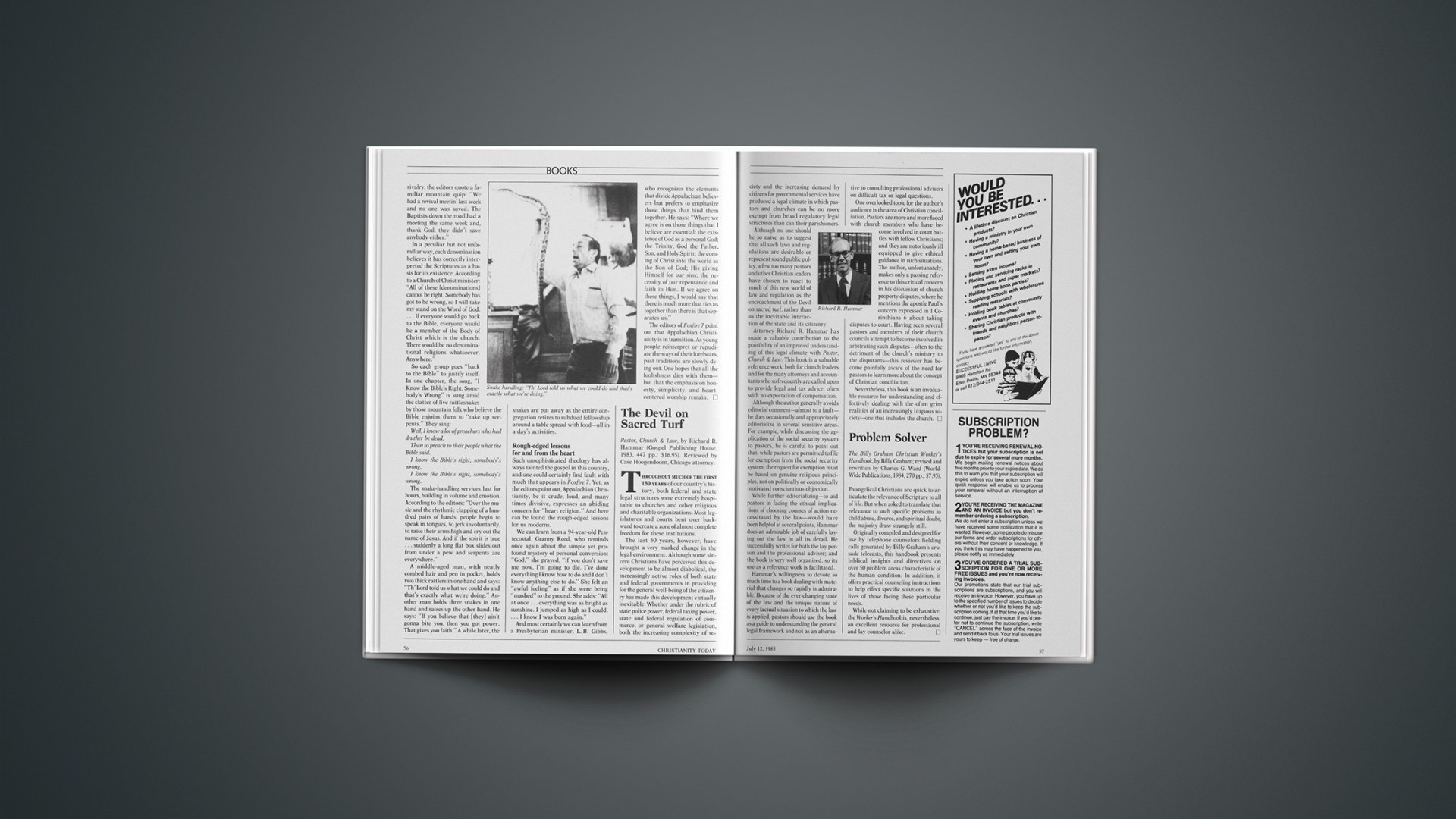
So each group goes “back to the Bible” to justify itself. In one chapter, the song, “I Know the Bible’s Right, Somebody’s Wrong” is sung amid the clatter of live rattlesnakes by those mountain folk who believe the Bible enjoins them to “take up serpents.” They sing:

Well, I know a lot of preachers who had druther be dead,

Than to preach to their people what the Bible said.

I know the Bible’s right, somebody’s wrong,

I know the Bible’s right, somebody’s wrong.

The snake-handling services last for hours, building in volume and emotion. According to the editors: “Over the music and the rhythmic clapping of a hundred pairs of hands, people begin to speak in tongues, to jerk involuntarily, to raise their arms high and cry out the name of Jesus. And if the spirit is true.… suddenly a long flat box slides out from under a pew and serpents are everywhere.”

A middle-aged man, with neatly combed hair and pen in pocket, holds two thick rattlers in one hand and says: “Th’ Lord told us what we could do and that’s exactly what we’re doing.” Another man holds three snakes in one hand and raises up the other hand. He says: “If you believe that [they] ain’t gonna bite you, then you got power. That gives you faith.” A while later, the snakes are put away as the entire congregation retires to subdued fellowship around a table spread with food—all in a day’s activities.

Rough-Edged Lessons For And From The Heart

Such unsophisticated theology has always tainted the gospel in this country, and one could certainly find fault with much that appears in Foxfire 7. Yet, as the editors point out, Appalachian Christianity, be it crude, loud, and many times divisive, expresses an abiding concern for “heart religion.” And here can be found the rough-edged lessons for us moderns.

We can learn from a 94-year-old Pentecostal, Granny Reed, who reminds once again about the simple yet profound mystery of personal conversion: “God,” she prayed, “if you don’t save me now, I’m going to die. I’ve done everything I know how to do and I don’t know anything else to do.” She felt an “awful feeling” as if she were being “mashed” to the ground. She adds: “All at once … everything was as bright as sunshine. I jumped as high as I could.… I know I was born again.”

And most certainly we can learn from a Presbyterian minister, L. B. Gibbs, who recognizes the elements that divide Appalachian believers but prefers to emphasize those things that bind them together. He says: “Where we agree is on those things that I believe are essential: the existence of God as a personal God; the Trinity, God the Father, Son, and Holy Spirit; the coming of Christ into the world as the Son of God; His giving Himself for our sins; the necessity of our repentance and faith in Him. If we agree on these things, I would say that there is much more that ties us together than there is that separates us.”

The editors of Foxfire 7 point out that Appalachian Christianity is in transition. As young people reinterpret or repudiate the ways of their forebears, past traditions are slowly dying out. One hopes that all the foolishness dies with them—but that the emphasis on honesty, simplicity, and heart-centered worship remain.

U.S. Supreme Court Nullifies Alabama School Prayer Law

But a split ruling leaves ‘moment of silence’ statutes intact in 25 states.

A splintered U.S. Supreme Court ruling on silent prayer in public schools provided a forum for several justices to redefine how conflicts between church and state should be resolved. The ruling, Wallace v. Jaffree, struck down an Alabama law that authorized a daily moment of silence for “meditation or voluntary prayer” in public schools.

One of three Alabama laws regarding prayer in schools, it was passed in 1982 to modify an older statute that allowed a moment of silence without specifying what activity should take place during that time. The Supreme Court’s majority reasoned that the added words “or voluntary prayer” prescribed a particular religious practice, thus placing the statute outside the acceptable bounds of government accommodation of religion.

Alabama’s older “moment of silence” law, on the books since 1978, remains intact along with similar statutes in 24 other states. The 1978 Alabama law was not challenged by Ishmael Jaffree, an agnostic who at first filed suit against a third Alabama law that allowed spoken prayer. Jaffree opposed the state of Alabama and his children’s elementary school teachers for leading their classes in spoken prayer. That practice, allowed by a law that actually suggested the wording of a Christian prayer to be used in class, was declared unconstitutional by a lower court. The Supreme Court upheld that ruling last year by declining to consider the case.

Jaffree amended his original complaint against teacher-led prayers to challenge Alabama’s 1982 silent prayer law, which the Supreme Court recently struck down. The high court’s consideration of the fine line between a generic moment of silence and one with specifically Christian overtones illustrates a wide range of opinion on the current court. Four justices—Thurgood Marshall, John Paul Stevens, Harry Blackmun, and William J. Brennan, Jr.—formed the majority, agreeing that the law was a state “endorsement” of prayer activities, inconsistent with the principle of government neutrality toward religion. To reach that conclusion, they used the Court’s traditional “three-part test,” examining whether the Alabama law had a primarily secular purpose, unnecessarily advanced religion, or excessively entangled church and state.

Justices Lewis F. Powell, Jr., and Sandra Day O’Connor concurred with the majority decision, but wrote separate opinions offering a different perspective on how such decisions should be made. The three-part test, based on a 1971 Supreme Court ruling known as Lemon v. Kurtzman, is inconsistently applied, O’Connor wrote, so a more flexible, realistic alternative is needed.

The remaining three justices, Byron White, William H. Rehnquist, and Chief Justice Warren Burger, filed dissenting opinions. Rehnquist called on the court to scrap Lemon v. Kurtzman as a precedent and rely instead on the historical intent of the authors of the U.S. Constitution. Burger, author of the Lemon decision, wrote that the Court’s majority suffered from “a naïve preoccupation with an easy, bright-line approach for addressing constitutional issues.” The three-part test, he said, “did not establish a rigid caliper capable of resolving every Establishment Clause issue, but … sought only to provide ‘signposts.’ ”

Attorney Forest Montgomery, of the National Association of Evangelicals’ Washington, D.C., office, said that in striking down Alabama’s silent prayer statute, “the Court is guilty of overkill.” Adding the words “or voluntary prayer” to the law simply specified one alternative for appropriate activity during a silent moment, Montgomery said. “The answer is not to strike the statute down, but to implement it correctly.”

Montgomery noted that O’Connor’s concurring opinion essentially provides a “blueprint” for any future state laws permitting a moment of silence in public schools. Making it clear that Alabama’s 1978 moment of silence law still stands, O’Connor wrote that the amended 1982 law had the purpose and effect of officially endorsing prayer.

Instead of measuring the law against the traditional three-part test, O’Connor proposed an “endorsement test.” Such a test would not impose the artificial barriers that a search for a “secular purpose” requires.

Secular and religious purposes frequently are entwined in our public policy, O’Connor wrote. “Chaos would ensue if every such statute were invalid under the Establishment Clause. For example, the State could not criminalize murder for fear that it would thereby promote the biblical command against killing.”

An endorsement test, on the other hand, “does not preclude government from acknowledging religion or from taking religion into account in making law and policy,” O’Connor wrote. “It does preclude government from conveying or attempting to convey a message that religion or a particular religious belief is favored or preferred.” Because the Alabama law suggested prayer as the appropriate activity during a moment of silence, she wrote, “candor requires us to admit that this Alabama statute was intended to convey a message of state encouragement and endorsement of religion.”

Rehnquist disagreed with the majority as well with as O’Connor, basing his dissenting opinion on American history. “It would come as much of a shock to those who drafted the Bill of Rights as it will to a large number of thoughtful Americans today to learn that the Constitution, as construed by the majority, prohibits the Alabama Legislature from ‘endorsing’ prayer.” Noting that George Washington proclaimed a day of public thanksgiving and prayer, Rehnquist wrote, “History must judge whether it was the father of this country in 1789, or a majority of the Court today, which has strayed from the meaning of the Establishment Clause.”

International Consultation Calls For A Balanced View Of The Holy Spirit

An international gathering of evangelical workers and scholars has issued a call for the church to shift to a new balance in its perception of the Holy Spirit and his place in the task of evangelization.

Meeting in Oslo, Norway, the nearly 50 participants agreed that dramatic displays of the Holy Spirit’s power should be accepted as a normal part of the Spirit’s role in bringing conviction of sin and repentance to the unsaved. Where these “signs and wonders” already are present, the conferees said, care should be taken not to separate the Spirit’s power from his holiness nor to lay stress on the Holy Spirit apart from the Trinity.

The consensus position issued by the Consultation on the Work of the Holy Spirit and Evangelization was achieved by an open and vigorous airing of issues disputed among evangelicals. The participants, and more than 20 observers, represented both Western and non-Western countries. Charismatic and non-charismatic Christians, as well as ministers and academic theologians, were represented in roughly equal numbers.

The five-day event was cosponsored by the Lausanne Committee for World Evangelization and the World Evangelical Fellowship, the two leadership bodies for evangelicals at the international level. The Norwegian Lausanne Committee coordinated the event. It was hosted by the Home Mission Bible School, founded nearly 80 years ago by Ole Hallesby, the well-known Norwegian pietist.

Participants interacted with preparatory papers in small-group discussions. They critiqued one another’s work in plenary sessions chaired by Australian Anglican Bishop John R. Reid. The process produced broad agreement in the following areas:

• The work and person of the Holy Spirit should not be emphasized in isolation. Although the Spirit has distinct functions, he always acts in concert with the full Godhead. The conferees said this emphasis is essential to counter a “creeping unitarianism” in liberal Christian ranks that seeks to dismiss the Father and the Son. The emphasis also is needed to counter the influences of Eastern mysticism and the Muslim form of monotheism, they said, and to correct imbalances in Christian teaching, preaching, and ministry.

• The gifts of the Holy Spirit and the fruits of the Spirit are of equal importance. Neglect of either or preoccupation with either leads to a stunted expression of the church and its ministry, and to an inadequate understanding of the gospel and its effects. Spiritual gifts, although distributed individually, are for the benefit of the entire church and not to be used selfishly.

• Christ and his atoning work on the cross must retain centrality in the proclamation of the gospel, because the Holy Spirit always points to Christ.

• Evangelizing may be characterized by healings, exorcisms, and words of prophetic insight. These, and speaking in tongues, should be tested and should conform to biblical procedures.

• Holiness is the mark of the presence and impact of the Holy Spirit. The personal holiness of the evangelist and the corporate holiness of the church are integral to Holy Spirit-led evangelization. The power of the Holy Spirit is not a tool to be harnessed in evangelism, the conferees agreed. Rather, it is the evangelist who must be controlled by the Spirit.

HARRY GENET in Oslo

Christian Author Joyce Landorf Will Discontinue Her Radio Program

Popular Christian author Joyce Landorf has decided to discontinue her radio program, “From the Heart of Joyce Landorf.” Since last fall, the show had aired on some 30 radio stations nationwide.

Landorf, who announced on one radio program that she and her husband of 32 years are getting a divorce, also has canceled many of her speaking engagements, according to her spokesman. He added that Landorf would be taking a low profile in the coming months because she “needed time to heal.” He said both Joyce and Dick Landorf have sought counseling.

According to a statement released by Joyce Landorf Ministries, Dick Landorf filed for the divorce. The statement adds that “Joyce will gladly answer questions and grant interviews after the divorce is final. However, until that time, she feels it would be inappropriate to discuss any of her present circumstances.” A spokesman said Landorf is not contesting the divorce, and that it probably would be final in October.

In another development, advertising has been discontinued on the five books that Landorf published through Word Incorporated. According to a statement released by Word, plans for the release of additional Landorf products have been put on hold.

Landorf has published more than 20 books and has more than 5 million copies in print. Since the publication of Irregular People in 1982, she has been one of Word’s five most popular authors. Her other books include His Stubborn Love (Zondervan), Mourning Song (Revell), and He Began With Eve (Word).

New Foundation in China Invites Western Christians to Assist in Social Services

For the first time in nearly 40 years, Christians outside of China are being openly encouraged to send funds, material, and personnel to contribute to the modernization and social welfare of China.

China’s newly formed Amity Foundation is preparing to receive and distribute money and personnel from churches and church-related organizations overseas. The new openness surfaced in December when Bishop Ding Guangxun, president of the China Christian Council, welcomed gifts and personnel from Christians outside China. He stipulated, however, that overseas gifts could not impinge on Chinese national sovereignty, noting that they should not be seen as a “return to the past missionary era.”

Following Ding’s statement, the China Christian Council formed the Amity Foundation to promote health, education, and social service projects in China. Although some money for the foundation is expected to come from Chinese Christians, one of the foundation’s primary responsibilities is to receive funds and personnel from abroad.

In March, it was announced that the Amity Foundation and the United Bible Societies had reached an understanding that could lead to the establishment of a modern printing facility in China under the foundation’s ownership and control. The plant would give priority to the printing of Bibles, New Testaments, and Christian literature. However, it also would be used for printing other materials to be determined by the foundation. Funds for the multimillion dollar project would be arranged by the United Bible Societies in consultation with the foundation.

The Amity Foundation also has arranged to receive 10 to 20 teachers sponsored by church-related institutions in Germany and North America. Three North American teachers will be sponsored by the China Education Exchange, an inter-Mennonite organization that has sponsored exchanges of teachers, agriculturalists, nurses, and doctors working primarily with institutions in China or provincial governments.

Additional teachers from North America will be sponsored by the National Council of Churches. “Some teachers will be ordained pastors,” said Philip Wickeri, the Amity Foundation’s overseas coordinator. “At least two will be a Maryknoll father and a nun.”

Wickeri, who is on loan to the Amity Foundation from the Presbyterian Church (U.S.A.), said all of the teachers will work in the Nanjing area. The foundation will encourage them to be involved in the local Chinese Christian community, he said. The teachers will be supported by block grants given to the Amity Foundation by the sponsoring organizations in the West. The foundation also hopes to receive money from overseas Christians for the direct support of selected Chinese social service institutions.

All 17 members of the foundation’s board of directors are Chinese citizens. Fourteen are Christian leaders, and the others are members of Chinese social service organizations. The board, headed by Bishop Ding, is organized independently of the China Christian Council and the Three-Self Patriotic Movement (TSPM), China’s officially recognized church.

Two cardinal principles of the TSPM are self-support and noninterference from groups outside China. Wickeri said the foundation’s encouragement of overseas assistance does not violate those principles.

“The foundation is a social welfare organization,” he said. “It is not a church organization, and contributions will not go toward the work of evangelism and church building.”

China’s open invitation asking overseas Christians to contribute to the country’s modernization is new. But Christian organizations have been sending teachers, medical personnel, and other professionals to China for more than five years. Wickeri said the Amity Foundation is unique because it is the only group set up by Chinese Christians to coordinate outside funds and personnel.

One observer said China’s economic climate may have affected the decision to form the new foundation. “The Amity Foundation is established under the influence of the government’s urban economic reform, which encourages private groups to go into business or develop joint business ventures,” said Jonathan Chao, director of the Chinese Church Research Center in Hong Kong. By encouraging foreign groups to contribute money for social welfare, he said, much-needed foreign currency is entering China.

Bishop Ding has said that the China Christian Council should be informed of all efforts of overseas Christians to relate to non-Christian enterprises. That requirement “may indicate a desire to have greater control over such activities,” cautioned David Adeney, China Program coordinator for Overseas Missionary Fellowship. Adeney rejoiced, however, in the increased opportunities for Christians to “reveal the presence of Christ through serving the people of China.”

Another China authority, Ralph Covell, academic dean at Denver Conservative Baptist Seminary, rejected the idea that the Amity Foundation or the China Christian Council would control Christian-generated funds and personnel entering China. Instead, he said the foundation provides “an opportunity to relate to the church in China in a non-paternalistic fashion.

“I think it will create a feeling within China that Christian people around the world are interested in helping China,” Covell added, saying such favorable recognition would benefit all Chinese Christians.

WORLD SCENE

Israeli Concern Over Mormons

Several members of the Israeli Knesset have called for an investigation into the construction of a Jerusalem branch of the Mormon-owned Brigham Young University (BYU). One Knesset member raised concerns about Mormon missionary activity. In response, Jerusalem Mayor Teddy Kollek said that during the Mormons’ 18 years in Israel they have not been found to engage in proselytizing efforts. However, several persons who lobbied in the Knesset against the BYU extension disputed that view.

Church Attendance Down In Scotland

More than 83 percent of Scots aged 15 and older no longer attend church, according to a census conducted by the National Bible Society of Scotland and the Missions Advanced Research and Communications Center-Europe. Most Protestant denominations and the Roman Catholic Church experienced declines from 1980 to 1984. The Scottish Episcopal Church was the only major denomination that showed an increase, with attendance up 9 percent.

Catholicism No Longer Italy’S State Religion

The Italian government and the Vatican have ratified a treaty that ends Roman Catholicism’s status as Italy’s state religion. Under the agreement, the government will stop subsidizing Catholic clergy in 1990, and stricter rules governing tax exemptions for religious institutions will be enforced. Mandatory Catholic instruction in Italian public schools will be discontinued, although such courses will be available on an optional basis.

Christians Increase In Israel

Immigration has helped boost Israel’s Christian population by 30 percent during the last ten years, according to recently released census figures. More than 94,000 Christians live in Israel, with some 11,700 living in Jerusalem.

NORTH AMERICAN SCENE

State Bans Gay Foster Parents

The state of Massachusetts has announced a new policy that will prohibit homosexuals from serving as foster parents. The announcement follows a Boston Globe report about the placement of two children with a homosexual couple. In the future, the state will try to place children only in “traditional family settings,” said Philip W. Johnston, head of the Massachusetts Department of Human Services. Gov. Michael Dukakis said the decision was not based on sexual preference but on “what’s in the best interest of the children.”

Bishop Won’T Cooperate With New Mission Society

Illinois United Methodist Bishop Woodie White has refused to appoint a minister to serve as a missionary with the unofficial Mission Society for United Methodists. The society is a missionary sending agency created as an alternative to the official United Methodist Board of Global Ministries. White said that appointing Max Borah to serve with the mission society would violate the “spirit and intent” of an action taken last year by the United Methodist general conference. The general conference affirmed the Board of Global Ministries as the denomination’s “sole sending agency” for missionaries.

Bray Convicted In Abortion Clinic Bombings

Lutheran lay minister Michael D. Bray has been convicted of conspiring to bomb 10 abortion clinics in Maryland, Delaware, Virginia, and Washington, D.C. Bray, who faces up to 20 years in prison, was charged along with Thomas Spinks and Kenneth Shields. Spinks pleaded guilty to conspiracy and malicious destruction charges. Shields was to be tried last month.

Canadian Lutherans Reorganize

Canadian Lutherans affiliated with the Lutheran Church-Missouri Synod have voted to establish an autonomous national organization. The Lutheran Church-Canada will have about 90,000 members. In a separate action, the Canadian division of the Lutheran Church in America and the Evangelical Lutheran Church of Canada merged to form the Evangelical Lutheran Church in Canada. The new denomination has about 210,000 members.

Mormon Founder Linked To Folk Magic

Joseph Smith, founder of the Church of Jesus Christ of Latter-day Saints (Mormon), discussed his use of folk magic in a letter he presumably wrote in 1825. In the letter, released recently by the Mormon church, Smith discussed digging for treasure that was guarded by “some clever spirit.” Mormon officials said the letter does not undermine their faith in Mormonism’s divine origins.

Child Poverty On The Rise

A new study has found an increase in poverty among children in the United States. Conducted by the Congressional Research Service and the Congressional Budget Office, the study found that 13.8 million children came from poor families in 1983, the highest child poverty rate since the mid-1960s. The study found that 46.7 percent of black children and 38.2 percent of Hispanic children lived below the poverty level. Fifty-one percent of poor children lived in families headed by women.

Graham Preaches To 100 Million

Evangelist Billy Graham has become the first person to preach face-to-face to more than 100 million people. From the late 1940s through 1984, attendance at Graham’s crusades totaled 104,390,133, said George M. Wilson, executive vice-president of the Billy Graham Evangelistic Association. The figure is based on official counts by police or stadium officials at Graham’s evangelistic crusades.

Protesters Support Scientologists

An estimated 4,000 Scientologists were joined by representatives of 20 different religious faiths in a series of demonstrations opposing a $39 million settlement against the controversial Church of Scientology. The protesters said the settlement poses a threat to religious freedom, but supporters of the settlement said the issue was fraud. The $39 million was awarded to Julie Christofferson, who said she was defrauded by the Church of Scientology when she did not receive the self-improvement she was promised.

City of Charleston Launches ‘Flight of Mercy’ to Africa

An Episcopal priest challenges Christians to care for their Ethiopian neighbors and for each other.

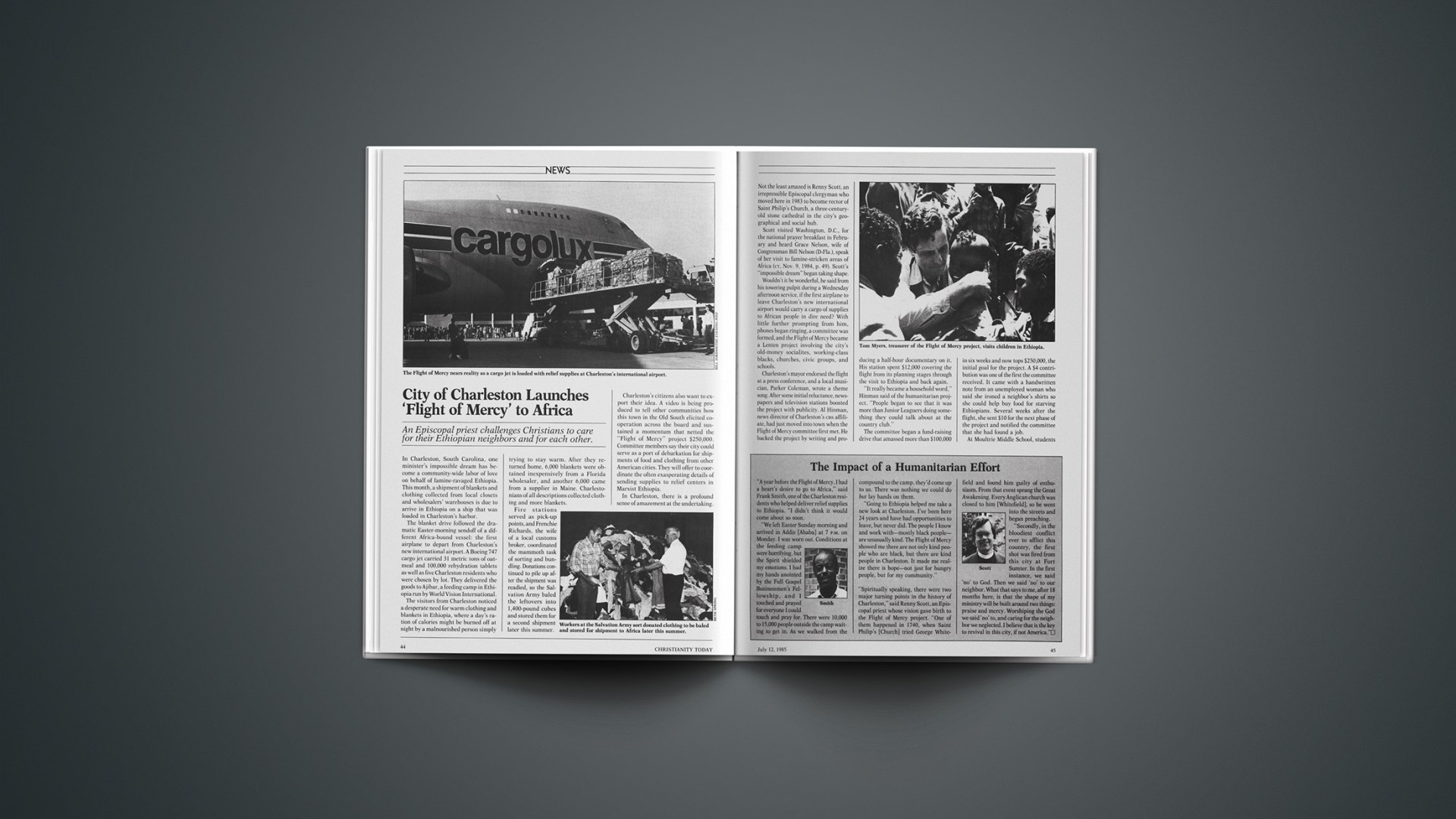
In Charleston, South Carolina, one minister’s impossible dream has become a community-wide labor of love on behalf of famine-ravaged Ethiopia. This month, a shipment of blankets and clothing collected from local closets and wholesalers’ warehouses is due to arrive in Ethiopia on a ship that was loaded in Charleston’s harbor.

The blanket drive followed the dramatic Easter-morning sendoff of a different Africa-bound vessel: the first airplane to depart from Charleston’s new international airport. A Boeing 747 cargo jet carried 31 metric tons of oatmeal and 100,000 rehydration tablets as well as five Charleston residents who were chosen by lot. They delivered the goods to Ajibar, a feeding camp in Ethiopia run by World Vision International.

The visitors from Charleston noticed a desperate need for warm clothing and blankets in Ethiopia, where a day’s ration of calories might be burned off at night by a malnourished person simply trying to stay warm. After they returned home, 6,000 blankets were obtained inexpensively from a Florida wholesaler, and another 6,000 came from a supplier in Maine. Charlestonians of all descriptions collected clothing and more blankets.

Fire stations served as pick-up points, and Frenchie Richards, the wife of a local customs broker, coordinated the mammoth task of sorting and bundling. Donations continued to pile up after the shipment was readied, so the Salvation Army baled the leftovers into 1,400-pound cubes and stored them for a second shipment later this summer.

Charleston’s citizens also want to export their idea. A video is being produced to tell other communities how this town in the Old South elicited cooperation across the board and sustained a momentum that netted the “Flight of Mercy” project $250,000. Committee members say their city could serve as a port of debarkation for shipments of food and clothing from other American cities. They will offer to coordinate the often exasperating details of sending supplies to relief centers in Marxist Ethiopia.

In Charleston, there is a profound sense of amazement at the undertaking. Not the least amazed is Renny Scott, an irrepressible Episcopal clergyman who moved here in 1983 to become rector of Saint Philip’s Church, a three-century-old stone cathedral in the city’s geographical and social hub.

Scott visited Washington, D.C., for the national prayer breakfast in February and heard Grace Nelson, wife of Congressman Bill Nelson (D-Fla.), speak of her visit to famine-stricken areas of Africa (CT, Nov. 9, 1984, p. 49). Scott’s “impossible dream” began taking shape.

Wouldn’t it be wonderful, he said from his towering pulpit during a Wednesday afternoon service, if the first airplane to leave Charleston’s new international airport would carry a cargo of supplies to African people in dire need? With little further prompting from him, phones began ringing, a committee was formed, and the Flight of Mercy became a Lenten project involving the city’s old-money socialites, working-class blacks, churches, civic groups, and schools.

Charleston’s mayor endorsed the flight at a press conference, and a local musician, Parker Coleman, wrote a theme song. After some initial reluctance, newspapers and television stations boosted the project with publicity. Al Hinman, news director of Charleston’s CBS affiliate, had just moved into town when the Flight of Mercy committee first met. He backed the project by writing and producing a half-hour documentary on it. His station spent $12,000 covering the flight from its planning stages through the visit to Ethiopia and back again.

The Impact of a Humanitarian Effort

“A year before the Flight of Mercy, I had a heart’s desire to go to Africa,” said Frank Smith, one of the Charleston residents who helped deliver relief supplies to Ethiopia. “I didn’t think it would come about so soon.

“We left Easter Sunday morning and arrived in Addis [Ababa] at 7 p.m. on Monday. I was worn out. Conditions at the feeding camp were horrifying, but the Spirit shielded my emotions. I had my hands anointed by the Full Gospel Businessmen’s Fellowship, and I touched and prayed for everyone I could touch and pray for. There were 10,000 to 15,000 people outside the camp waiting to get in. As we walked from the compound to the camp, they’d come up to us. There was nothing we could do but lay hands on them.

“Going to Ethiopia helped me take a new look at Charleston. I’ve been here 24 years and have had opportunities to leave, but never did. The people I know and work with—mostly black people—are unusually kind. The Flight of Mercy showed me there are not only kind people who are black, but there are kind people in Charleston. It made me realize there is hope—not just for hungry people, but for my community.”

“Spiritually speaking, there were two major turning points in the history of Charleston,” said Renny Scott, an Episcopal priest whose vision gave birth to the Flight of Mercy project. “One of them happened in 1740, when Saint Philip’s [Church] tried George Whitefield and found him guilty of enthusiasm. From that event sprang the Great Awakening. Every Anglican church was closed to him [Whitefield], so he went into the streets and began preaching.

“Secondly, in the bloodiest conflict ever to afflict this country, the first shot was fired from this city at Fort Sumter. In the first instance, we said ‘no’ to God. Then we said ‘no’ to our neighbor. What that says to me, after 18 months here, is that the shape of my ministry will be built around two things: praise and mercy. Worshiping the God we said ‘no’ to, and caring for the neighbor we neglected. I believe that is the key to revival in this city, if not America.”

“It really became a household word,” Hinman said of the humanitarian project. “People began to see that it was more than Junior Leaguers doing something they could talk about at the country club.”

The committee began a fund-raising drive that amassed more than $100,000 in six weeks and now tops $250,000, the initial goal for the project. A $4 contribution was one of the first the committee received. It came with a handwritten note from an unemployed woman who said she ironed a neighbor’s shirts so she could help buy food for starving Ethiopians. Several weeks after the flight, she sent $10 for the next phase of the project and notified the committee that she had found a job.

At Moultrie Middle School, students amassed $2,100 selling doughnuts. Assistant principal Jeff Erickson said the sale was launched by the school’s sixth-grade teachers. “The kids felt compassion for Ethiopia, and they recognized their own affluence. They were excited about the group effort,” Erickson said. “Once that feeling permeated the school, there was no stopping it.”

Carey Bownds, a third grader at Pepperhill Elementary School, said his bus driver leads the children in singing “We Are the World,” a rock song that has generated money for famine relief.

The Flight of Mercy airlift cost far more than sending supplies by ship, but representatives of World Vision who coordinated the project said the long-range benefit of energizing an entire community weighed heavily in their decision to go ahead with the flight. The flight cost $132,000, while sending a boatload of supplies costs about $45,000.

Paul Samuels, a regional representative for World Vision in Charlotte, North Carolina, said the airlift “fulfilled a growing awareness that we see across the country for people not just to give their money, but for a city to become intimately involved with a project or a village. Now Charleston so identifies with Ajibar that the two have become one in their hearts.”

Criticism leveled at the Flight of Mercy came from people who wondered why resources should be spent abroad rather than at home. “That represents two basic misunderstandings,” Scott told critics. “First, there is nothing comparable in the United States to what is happening in Ethiopia today. Secondly, we are doing an enormous amount in this city now with soup kitchens and shelters. It’s not an either-or option.”

From his pulpit, Scott has captivated a congregation that has doubled in size since he came to Charleston in 1983. To boost the Flight of Mercy, he described his own “mental fantasy of being a dad in Ethiopia and not being able to provide for my wife and children.” Afterward, a parishioner told him, “I’m glad you preach that way because I’ve never thought of them as people before.”

Scott’s impossible dream is a first step, he said, toward sensitizing Christians about poverty and about caring for their neighbor. “I think the long-term implications of it have not yet been realized.”

Vocal Prochoice Activists Launch Nationwide Offensive

Prolife groups fight back in an escalating battle over legalized abortion.

Supporters of legalized abortion have launched a nationwide campaign that is designed to stall the momentum of the prolife movement.

“There is no issue that will be fought by women with greater passion than this,” National Organization for Women (NOW) president Judy Goldsmith told a crowd of abortion proponents at a rally last month. “We will control our bodies and our lives, and we will win.”

The NOW march and rally, targeted against the Roman Catholic bishops, was one of a series of public events planned after the release of The Silent Scream, a film showing ultrasound pictures of a suction abortion. The film has been widely promoted by the prolife movement and the Reagan Administration (CT, April 5, 1985, p. 46).

The National Abortion Rights Action League (NARAL) responded to the film with a program called “Abortion Rights: Silent No More.” The organization collected more than 40,000 letters from women who said they made the right decision in obtaining abortions, NARAL has featured the letters in “Speakout” campaigns across the country.

The letter writers’ stories range from instances of rape and serious health problems to cases of contraceptive failure and women who felt that child bearing would interrupt or ruin their careers. NARAL director Nanette Falkenberg said the letters would help “win the emotional battle” over abortion “as we continue to protect ourselves on the legal front.”

After a NARAL “Speakout” in Washington, D.C., sympathetic members of Congress read several of the letters into the Congressional Record. At the same time, the Planned Parenthood Federation of America ran full-page ads supporting abortion in the Washington Post and in four other metropolitan newspapers. The ads will run in women’s magazines later this year. A Planned Parenthood representative said the group’s Seattle affiliate produced a film that “responded to the inaccuracies” of The Silent Scream.

Bernard Nathanson, the former abortionist who narrated The Silent Scream, has been defending the film’s accuracy. At a press conference sponsored by the National Right to Life Committee, he challenged Planned Parenthood “or other abortion advocates to make their own film of an abortion, showing us what a beneficent act it is for the fetus.”

Appearing with Nathanson were two members of Women Exploited by Abortion (WEBA), a group of women who have had abortions and now try to convince other women not to have them. WEBA founder Patti Haywood-McKinney said her abortion resulted in “intense guilt and grief,” anorexia, and a lengthy stay in a hospital psychiatric unit.

Kay James, public affairs director of the National Right to Life Committee, stressed the “alternatives arm of the prolife movement” as proof that right-to-life activists are concerned about women as well as children. Declaring that 5,500 abortion centers operate in the United States, James said there soon will be enough pregnancy aid centers to match them. She said the aid centers offer services ranging from medical referral and financial assistance to housing and day care.

Undeterred by the prolife response to NARAL, NOW sponsored demonstrations in 14 cities against the Roman Catholic bishops. In Washington, some 500 demonstrators marched past the headquarters of the National Conference of Catholic Bishops and then rallied in a nearby park. “Our bishops do not seek to convince us by internal dialogue and persuasion,” said Frances Kissling, director of Catholics for a Free Choice. “They intend to use the force of civil law to impose their will on us as Catholics and you as citizens.”

Richard Doerflinger, assistant director of the bishops’ Office for Pro-Life Activities, responded to Kissling’s charges. “We don’t coerce,” he said, “we lobby. But everybody lobbies.”

Rally Launches Cross-Country Trek to Protest Abortion

A crowd of close to 20,000 gathered at a busy intersection near the University of California at Los Angeles to kick off a nationwide campaign to call attention to the abortion issue.

The crowd heard several prominent speakers, including a telephone message from President Reagan. The event was sponsored by the Texas-based Americans Against Abortion, an offshoot of Last Days Ministries, which was founded by the late gospel singer Keith Green.

“Abortion is one of the most important issues facing this country today,” Reagan told the crowd. “We need to have the tragedy of Roe v. Wade reversed. And by your actions the conscience of a nation is being reversed. We need to speak for those who can’t speak for themselves. We can give them, the unborn, a voice and a hope.”

The rally included a send-off for two Wisconsin clergymen who embarked on an eight-month, 3,400-mile walk to Washington, D.C. Norman Stone and Jerry Horn, pastors of Valley Christian Center in Appleton, Wisconsin, said they hope their trek to Washington will help prompt federal legislation that will outlaw abortion. Their “Walk America for Life” campaign, sponsored by Americans Against Abortion, will include rallies and concerts across the country. They also will conduct a national petition drive asking the President, Congress, and the U.S. Supreme Court to take action to end abortion on demand.

Accompanying the Walk America for Life team will be the body of an aborted baby girl, which was present at the Los Angeles rally in a small wooden coffin. Stone said he hopes the body will remind onlookers that aborted babies are more than just “fetal tissue.”

Melody Green, director of Americans Against Abortion, implored the audience to “stand against those things that take life away.… We are responsible for this generation; it is not enough anymore to be silent about this issue.”

RICK GRANT in Los Angeles

Sanctity Of Life Issues Brine A Variety Of Demonstrators To Washington, D.C.

A commitment to the sanctity of human life brought some 1,300 Christians to Washington, D.C., for a four-day conference called Peace Pentecost. Before the event was over, 248 participants were arrested in a massive demonstration of civil disobedience at the White House, the State Department, the Soviet embassy, the Supreme Court, the Department of Health and Human Services, and the South African embassy.

Peace Pentecost was sponsored by the Sojourners Community, a group founded by evangelicals committed to peace and justice issues. “This is the first time so many different movements and ministries have met in one place to support one another in forging a consistent prolife ethic,” said Jim Wallis, editor of Sojourners magazine. “We have met to declare that all life is sacred from the beginning of the life cycle to the end. We are praying for unborn fetuses, death-row inmates, young people in South Africa and Nicaragua, families in Afghanistan suffering from the Soviet invasion, and families in America suffering from poverty.”

The first two days of the conference were devoted to presentations and panel discussions. Seminars were held on topics ranging from war-tax resistance to parenting for peace and justice.

“Some of us are here against abortion—others against the death penalty,” said Ed Metzler, national coordinator of New Call to Peacemaking. “All of us are the body of Christ.”

Julie Loesch, founder of Prolifers for Survival, called on members of the prolife and peace movements to cooperate for the sake of perceptible change. “Political movements can make this country go a little to the right or left, but that is not enough when you are heading toward the edge of a cliff,” she said. “The change we need to stop all abortions as well as the production of all nuclear weapons cannot be achieved by liberal or conservative movements. It can only be achieved by people who do not believe in right or left but in right or wrong.”

More than 2,000 people attended a worship service at the Shrine of the Immaculate Conception held the evening before an all-day nonviolence training workshop. In a sermon at that service, Joseph Lowery, president of the Southern Christian Leadership Conference, called those planning to participate in civil disobedience during demonstrations in Washington “the true patriots of this country.”

Moral Majority leader Jerry Falwell disagreed. At a press conference held the afternoon of the demonstrations, he objected to the evangelical label applied to Peace Pentecost. Said Falwell: “Jim Wallis is to evangelicalism what Adolph Hitler was to the Roman Catholic Church.”

“Jerry Falwell is not our enemy,” said Wallis in response. “This movement has no enemies but violence, oppression, and injustice. We are asking Reverend Falwell to join us in promoting a consistent ethic of life for all people which crosses political lines and boundaries.”

SHARON ANDERSONin Washington

Apple PodcastsDown ArrowDown ArrowDown Arrowarrow_left_altLeft ArrowLeft ArrowRight ArrowRight ArrowRight Arrowarrow_up_altUp ArrowUp ArrowAvailable at Amazoncaret-downCloseCloseEmailEmailExpandExpandExternalExternalFacebookfacebook-squareGiftGiftGooglegoogleGoogle KeephamburgerInstagraminstagram-squareLinkLinklinkedin-squareListenListenListenChristianity TodayCT Creative Studio Logologo_orgMegaphoneMenuMenupausePinterestPlayPlayPocketPodcastRSSRSSSaveSaveSaveSearchSearchsearchSpotifyStitcherTelegramTable of ContentsTable of Contentstwitter-squareWhatsAppXYouTubeYouTube