History

C.S. Lewis: Christian History Timeline

Born in Belfast, Ireland November 29, 1898

1905 Moves to “Little Lea.”

1913 Enters Malvern College, England.

1917 April: Begins studies at University College, Oxford.

September: Commissioned as second lieutenant in Somerset Light Infantry.

November: Leaves for front lines.

1918 Wounded in action. Returns to hospital in England.

1919 Returns to University College. Publishes first book, Spirits in Bondage, a small volume of lyric poems, under the name Clive Hamilton.

1925 Elected to a fellowship in English language and literature at Magdalen College, Oxford.

1929 Confesses that “God is God.”

1930 Purchases and moves into The Kilns.

1931 Comes to faith in Christ.

1939 Publishes Out of the Silent Planet, first book of the Space Trilogy.

1940 First weekly meeting of the Inklings. Publishes The Problem of Pain.

1941 Begins a series of radio talks over the BBC.

1942 Publishes The Screwtape Letters.

1945 Publishes The Great Divorce.

1950 Receives first letter from Joy Davidman Gresham. Publishes The Lion, the Witch and the Wardrobe, the first of the Narnian stories. Writes the first of more than 100 letters to “an American lady.”

1952 Meets Joy Davidman Gresham. Publishes Mere Christianity.

1955 Leaves Oxford for professorship of Medieval and Renaissance literature at Magdalen College, Cambridge.

1956 Publishes Till We Have Faces, the book Lewis considers his best fictional work. Publishes The Last Battle, last of the Narnian series.

April: Marries Joy Davidman Gresham in a legal ceremony.

November: Marries Joy in ecclesiastical ceremony at her bedside.

1960 Joy Lewis dies, July 13.

1963 C.S. Lewis dies November 22, 1963 (The same day President John F. Kennedy is assassinated.)

Copyright © 1985 by the author or Christianity Today/Christian History magazine. Click here for reprint information on Christian History.


History

Following that Bright Blur

Embracing the supernatural elements of Christianity while committed to its rationalism, Lewis brought an orthodox view of a transcendent, immanent God to the common man.

In this series

In a 1982 interview in Discipleship Journal, Elisabeth Elliot was asked, “How could a person deepen his theology and become a clearer thinker?” She answered, “Study the Bible. And study C.S. Lewis. People are always saying C.S. Lewis was not a theologian—and Lewis himself would say that—but he was. He covered the whole field of theology in popular, understandable language. The fact that he could put it in simple language is proof to me that he understood it better than many theologians.”

This prescription is helpful. Lewis may not have considered himself a theologian, but his writing on theological subjects has stretched the minds, broadened the hearts, and challenged the thinking of many.

What was the core of C.S. Lewis’s theology? A hint is found in the caption that appeared below his picture on the cover of the September 8, 1947, Time magazine. It simply read, “His heresy: Christianity.” Both in written word and BBC broadcasts, Lewis sought to present historic Christian faith to the common man. Perhaps because his work is imaginative as well as analytical, some have criticized him for softness on issues that modern conservatives consider pivotal, for example, biblical authority. But the cornerstones of his theology are clearly orthodox: he called it “mere Christianity” not to diminish the truth-claims, but to suggest that the truth of God incarnate was so shockingly simple that people of all cultures and pedigrees might be stunned and joyful at its clarity and grace.

The Supernatural

C.S. Lewis was a committed supernaturalist. In his essay “On Ethics” he commented: “I am myself a Christian, and even a dogmatic Christian untinged with modernist reservations and committed to supernaturalism in its full rigor.” Remove the supernatural and the first principles of Christian orthodoxy are gone. Because God is high and holy, every doctrine of Christian faith has a sense of awe and wonder, and the miracles that demonstrate those doctrines are simply the retelling in capital letters of “the same message which nature writes in her crabbed cursive hand,” he wrote. Lewis was fully committed to a Christianity with the supernatural elements intact.

Study of Literature

Lewis’s lifetime study of medieval and renaissance literature helped him understand the importance of written texts as a source of authority. He likened the doctrinal texts of Christian orthodoxy to a series of maps drawn by men of knowledge and legitimized over time. Ministering to RAF pilots during the war, Lewis urged away from the elementary “thrills you and I are likely to get on our own” and toward the grand themes of authority, essential maps “if you want to get further.”

Literary sources also helped him with the insights that truth is one and that good thinking should unify all generations. Authority was weakened by modern emphasis on individual autonomy. Authority rests in the cumulative wisdom of the ages, a demanding jury for all new ideas. Clearly Lewis knew the importance of history; and his theology was bound to the church’s historic statements.

Rationalism

Lewis’s theology was further influenced by his commitment to logic and reason. Truth was not made for man; man was made for truth, and his chief purpose in life was to glorify Him forever. Lewis wrote, “In coming to understand anything we are rejecting the facts as they are for us in favor of the facts as they are. The primary impulse of each is to maintain and aggrandise himself. The secondary impulse is to go out of the self, to correct its provincialism and heal its loneliness.”

If pursuit of truth is like climbing a ladder, Lewis both mastered the steps and turned a floodlight on the ladder itself, illuminating the way so that others not wishing to remain in the lonely darkness of subjectivism might follow.

Illumined Subjectivism

As dark subjectivism was a pitfall, illumined subjectivism—he often called it romanticism—could awaken the desire for truth. Lewis would often refer to this desire as joy. Just as hunger says, “I want food” and thirst says, “I want water,” so informed joy pleads within a man saying, “I want God.” Theology for C.S. Lewis was more than rational activity; it was the very burning of the soul not merely to define and explain God but to know Him, to enjoy Him, and yet to remain constantly in awe of Him. He comments, “This hunger is better than any other fullness; this poverty better than all other wealth.” Lewis not only sought to explain Christianity to others, he also sought to practice it himself. At the heart of this practice was his own personal devotion to God.

A comprehensive presentation of C.S. Lewis’s theology would take a book—perhaps several volumes. Here we can briefly explore two cornerstones of Lewis’s theological thought: the transcendence of God, and the immanence of God.

God’s Transcendence

The idea of God’s transcendence is simply this, God is great. He is omnipresent, infinite and eternal. Though He made the universe, God himself cannot be fully contained in the universe. Where creation leaves off, God goes on and on and on to infinity. In this sense, God is incomprehensible.

Because God is transcendent, mere men, said Lewis, cannot define Him. The infinite cannot be reduced to finite definition. In Letters to Malcolm: Chiefly on Prayer, Lewis refers to God as the “bright blur,” admitting it is not a very good description. “In fact,” he writes, “you cannot have a good description of anything so vague. If the description became good it would become false.” As Walter Elwell has stated, “All theological formulations are, at best, approximate.”

The best theology, then, is theology which makes the best approximations. It is necessary, therefore, to choose language equal to the task, and Lewis urges that the best language for this task is poetic. The language of literature is less limiting, is not concerned merely with quantity (as is scientific language) but with quality. Lewis wrote, “To be incommunicable by scientific language is, so far as I can judge, the normal state of experience.”

The temptation of the theologian is to adopt language that will be suitable to the scientific mind. However, this kind of language only makes faith less credible. Such language may be suitable to the scientific mind, but it certainly cannot describe God. Lewis insisted that propositional statements about God are necessary. The idea of God, to be understood, must take form in our minds and thought, but if we are to understand the meaning of the propositions, we must go to the language of the poet. Much of the Scriptures are written in poetic form.

God’s Immanence

The second cornerstone of Lewis’s orthodoxy is his commitment to the immanence of God. The infinite, eternal, omnipresent God can and does make His presence known. God can be talked about because God has made Himself known to rational creatures capable of reasonable communication. When Lewis was a theist and no more, he thought it was impossible to actually know God personally and intimately. He understood the concept of transcendence, but had not yet balanced it in his thinking with the idea of God’s immanence. He commented that he did not think, at that time, that a person could know God any more than Hamlet could know Shakespeare. Later Lewis came to realize that Hamlet could have known Shakespeare, but it would depend not on Hamlet but on Shakespeare. As the author, he could write himself into the play and make his presence known. Through this analogy, Lewis describes what actually took place in the incarnation. God has made His presence known. Because God has communicated Himself to man, man can know and talk about the immanent God. Lewis wrote, “Christianity is not merely what a man does with his solitude. It is not even what God does with His solitude. It tells of God descending into the coarse publicity of history and there enacting what can—and must—be talked about.”

What a discovery! The mysterious God “brighter and less blurry.” Lewis wrote, “We may ignore, but we can nowhere evade, the presence of God. The world is crowded with Him. He walks everywhere incognito.”

C.S. Lewis has left a rich theological legacy. He has become the theologian for every man, every man who hopes to take bearings on the “bright blur.”

The Rev. Jerry Root is college pastor of College Church in Wheaton, Illinois, and teaches philosophy at College of Dupage

Copyright © 1985 by the author or Christianity Today/Christian History magazine.Click here for reprint information on Christian History.

History

C.S. Lewis: Did You Know? (Part 1)

Little-known Facts about C.S. Lewis

  • As a child, C.S. Lewis entertained himself by writing and illustrating stories about animals and he wrote his first novel at the age of 12.
  • Lewis served in France during World War I and was wounded in action by a bursting shell.
  • The first book Lewis published was a volume of poetry titled “Spirits in Bondage,” for which he used the pseudonym Clive Hamilton.
  • Lewis was a member of the Coalbiters, an Oxford club that read aloud Icelandic sagas and myths in the original language. The club was founded by J.R.R. Tolkien.
  • Due to his preference for male society, Lewis gained a reputation at Oxford as a misogynist and it was rumored that he avoided women whenever possible.
  • Lewis was an atheist from his youth and did not confess Christ until his early thirties.
  • Lewis’s friend J.R.R. Tolkien disliked the Narnian Chronicles, complaining that they were hastily written and unrealistic.
  • Lewis undertook annual walking tours of up to 50 miles through the English countryside, accompanied by his brother and friends.
  • Lewis’s marriage at nearly 60 years of age to a divorced former Communist of Jewish heritage upset many of his friends.
  • The Lewis brothers’ tombstone reads, “Men must endure their going hence,” the Shakespeare quotation on their father’s calendar the day their mother died.
  • J.B. Phillips in his book “The Ring of Truth” claimed that Lewis visited him from beyond the grave on two separate occasions.
  • An animated television special based on Lewis’s “The Lion, The Witch and The Wardrobe” has been viewed by over 35 million people and won an Emmy award.
  • Upon publication of his book “Miracles: A Preliminary Study”’ TIME magazine devoted a cover story to Lewis, Sept. 8, 1947, and marveled at how this scholar would risk the heresy of affirming supernatural Christianity in the midst of academia.

For more factoids on the life of C.S. Lewis, check out part two of this series, from Issue 88 of Christian History magazine.

Copyright © 1985 by the author or Christianity Today/Christian History magazine. Click here for reprint information on Christian History.

Pastors

Choosing the Appropriate Test

Several questions need to be asked in choosing an evaluation test that will measure what you want to know:

1. Am I interested in self-evaluation or evaluation by others? If you want to know what others think, you must ask them, not take a test yourself.

2. What activity or attribute do 1 want to measure? No test measures everything. Most are quite specific. You must isolate what you want to measure (leadership, for example, or spiritual gifts) and then choose an appropriate test.

3. What is the purpose of my assessment? Am I looking for strengths? (If so, take a nonjudgmental test, such as the Myers-Briggs.) Am I looking for weaknesses to improve? (Some tests are quite straightforward in recommending, to the administrators and counselors at least, plans for change.) Am I looking for a test that will tell me how I fit in a certain context?

4. What time frame am I considering? How I feel today may not be a true measure of long-term patterns. Different tests are set up to evaluate different time frames.

5. What do I want to measure myself against? There are at least four different standards: comparative (a select group of people—co-workers, for example), normative (the average of all people "like me"), goal-centered (a task or goal I want to achieve), improvement (how I did on the same test last year).

Terry Muck

Copyright © 1985 by the author or Christianity Today/Leadership Journal.Click here for reprint information on Leadership Journal.

Pastors

PHILIP’S EGG

Once upon a time I had a young friend named Philip. Philip was born with Downs Syndrome. He was a pleasant child — happy, it seemed — but increasingly aware of the difference between himself and other children. Philip went to Sunday school at the Methodist church. His teacher, also a friend of mine, taught the third-grade class with Philip and nine other eight-year-old boys and girls.

You know eight-year-olds. And Philip, with his differences, was not readily accepted. But my teacher friend was creative, and he helped the group of eight-year-olds. They learned, they laughed, they played together. And they really cared about one another, even though eight-year-olds don’t say they care about one another out loud. My teacher friend could see it. He knew it. He also knew that Philip was not really a part of that group. Philip did not choose nor did he want to be different. He just was. And that was just the way things were.

My friend had a marvelous idea for his class the Sunday after Easter last year. You know those things that pantyhose come in — the containers that look like great big eggs — my friend had collected ten of them. The children loved it when he brought them into the room. Each child was to get one. It was a beautiful spring day, and the assignment was for each child to go outside, find a symbol for new life, put it into the egg, and bring it back to the classroom. They would then open and share their new life symbols and surprises one by one.

It was glorious. It was confusing. It was wild. They ran all around the church grounds, gathered their symbols, and returned to the classroom. They put all the eggs on a table, and then the teacher began to open them. All the children stood around the table.

He opened one, and there was a flower, and they ooh-ed and aah-ed. He opened another, and there was a little butterfly. “Beautiful,” the girls all said, since it is hard for eight-year-old boys to say “beautiful.” He opened another, and there was a rock. And as third graders will, some laughed, and some said, “That’s crazy! How’s a rock supposed to be like new life?” But the smart little boy who’d found it spoke up: “That’s mine. And I knew all of you would get flowers and buds and leaves and butterflies and stuff like that. So I got a rock because I wanted to be different. And for me, that’s new life.” They all laughed.

My teacher friend said something to himself about the profundity of eight-year-olds and opened the next one. There was nothing there. The other children, as eight-year-olds will, said, “That’s not fair — that’s stupid! — somebody didn’t do right.”

Then my teacher friend felt a tug on his shirt, and he looked down. Philip was standing beside him. “It’s mine,” Philip said. “It’s mine.”

And the children said, “You don’t ever do things right, Philip. There’s nothing there!”

“I did so do it,” Philip said. “I did do it. It’s empty. The tomb is empty!”

There was silence, a very full silence. And for you people who don’t believe in miracles, I want to tell you that one happened that day last spring. From that time on, it was different. Philip suddenly became a part of that group of eight-year-old children. They took him in. He was set free from the tomb of his differentness.

Philip died last summer. His family had known since the time he was born that he wouldn’t live out a full life span. Many other things had been wrong with his tiny body. And so, late last July, with an infection that most normal children could have quickly shrugged off, Philip died. The mystery simply enveloped him.

At the funeral, nine eight-year-old children marched up to the altar, not with flowers to cover over the stark reality of death. Nine eight-year-olds, with their Sunday school teacher, marched right up to that altar, and laid on it an empty egg — an empty, old, discarded pantyhose egg.

Harry Pritchett, Jr.

Condensed by permission of The St. Luke’s Journal of Theology, School of Theology, The University of the South, Sewanee, TN 37375

Copyright © 1985 by the author or Christianity Today/Leadership Journal. Click here for reprint information on Leadership Journal.

Pastors

HOW TO TALK TO THE UNCHURCHED

Talking to unchurched people about spiritual matters is sometimes uncomfortable. Nervous fidgeting, blank stares, and vague replies seem clues to veiled disinterest. Ever wish the unchurched person was as interested in spiritual life as you are?

I’ve discovered that in many ways they are. Almost everyone has definite spiritual ideas; most have had some sort of religious experience. Some feel close to God and are content with their spiritual beliefs; many are willing to talk about their spiritual lives.

But not if you start with dogma.

I’ve learned that if I lead off with doctrine, people retreat in fear and trembling. They entrench themselves for a battle. In the past my tendency has been to continue to storm their fortifications. It’s not surprising I have not helped many that way.

After several such experiences, I decided I did not know much about the spiritual lives of non-churched people. I’ve spent my life in church; I needed to develop some open-ended questions to draw the unchurched out—and to draw me in.

Many of the questions I’ve found helpful come from the context I find myself in with a person. No one set of questions works in all situations. But some I have found helpful are:

What turns you off about religion?

What do you think God is like?

When have you felt closest to God?

What person has been most influential on your beliefs and values?

The next part of the conversation is most difficult for me—listening to the answers. I listen to understand, not to correct. I listen for feelings, reactions, motivations. I want to understand what a person believes and why. Only then can I ask more questions. After I understand where a person is, I can begin to help identify spiritual needs and determine some direction, but not before.

Once I know a bit about a person’s perspective, I can introduce some corresponding information from the Bible, preferably a story about a biblical person: “A man in the Bible felt just like that. . . .” or “Jesus met a guy with that very question.”

This part of the conversation is not hard for me. I spent years in seminary learning how to talk about the Bible.

Neither is this part hard for the unchurched person—but only because I took time to listen to him at the beginning. He is following his own interests into the gospel, and for me, a pastor, that is a genuine pleasure.

Doug Self

The Church at Redstone

Redstone, Colorado

Copyright © 1985 by the author or Christianity Today/Leadership Journal. Click here for reprint information on Leadership Journal.

Pastors

Portrait of a Shriveled Saint

Seeing myself “keine Gnade,” without grace, haunts me.

Willi Ossa was an artist who worked as a janitor at night in a church on New York's West Side to support his wife and infant daughter. During the day he painted. German by birth, Willi grew up during the war years and then married an American girl, the daughter of an officer in the occupying army. I got to know Willi when I was a theological student working at the same church as an assistant pastor.

Willi liked to talk about religion; I liked to talk about art. We became friends. We got along well together and had long conversations. He decided to paint my portrait. I went to his house on West 92nd Street a couple of afternoons a week on my way to work at the church and sat for thirty minutes or so for my portrait. He never permitted me to see what he was painting. Day after day, week after week, I sat while he painted. One day his wife came into the room and looked at the portrait now nearing completion and exclaimed in outrage, "Krank, krank." I knew just enough German to know that she was saying, "Sick! You paint him to look like a corpse!"

He answered, "Nicht krank, aber keine Gnade"— "he's not sick; that is the way he will look when the compassion is gone, when the mercy gets squeezed out of him."

A few half-understood phrases were enough for me to guess correctly, without seeing the portrait, what Willi was doing. We had often argued late into the night about the Christian faith. He hated the church. He thought Christians were hypocrites—all of them. He made a partial exception for me for friendship's sake. The Christians he had known had all collaborated with and blessed the Nazis. The Christians he had known were responsible for the death camps and the cremation of six million Jews. The Christians he had known had turned his beloved Germany into a pagan war machine. The word Christian was associated in Willi's experience with state church Christians who had been baptized and took communion and played Mozart all the while they led the nation into atrocities on a scale larger than anything the world had yet seen.

His argument was that the church squeezed the spirit and morality out of persons and reduced them to function in a bureaucracy where labels took the place of faces and rules took precedence over relationships. I would argue the other side. He would become vehement. Willi's English was adequate but not fluent; when he got excited he spoke German. "But there is no mercy in the church, keine Gnade, no compassion." He told me that I must never become a pastor. If I became a pastor, in twenty years I would be nothing but a hollow-eyed clerk good for nothing but desk work.

That was what he was painting day by day without my knowing it: a prophetic warning. A portrait not of what I was right then, but of what he was sure I would become if I persisted in the Christian way.

I have the portrait. I keep it in a closet and take it out to look at from time to time. The eyes are flat and empty. The face is gaunt and unhealthy. I was never convinced that what he painted was certain to happen—if I had been, I would not have become a pastor—but I knew it was possible. I knew that before I met Willi Ossa. I knew it from reading Scripture and from looking around me. But his artistic imagination created a portrait that was far more vivid than any verbal warning. The artist shows us what happens before it happens. The artist has eyes to connect the visible and the invisible and the skill to show us complete what we in our inattentive distraction see only in bits and pieces. So I look at that portrait, then look into the mirror and compare.

Eugene H. Peterson

Reprinted by permission from Run With the Horses, IVP, 1983.

Pastors

THE GREATEST GIFT I RECEIVED IN MINISTRY

Our Bennett, Colorado, charge proved to be a surpassing experience. We lived in a tiny parsonage, worshiped in a tiny church, and served a tiny, rural congregation. It was here we met the sickly but saintly Mrs. Rolf, a symbol of all the really good and sacrificial saints we have known through the years,

She was one of four devout parishioners who met with us for prayer each Thursday afternoon at the church, next door to the parsonage. She rarely missed. She came when she was well enough to stand, and soon we learned her story. She lived with her twelve-year-old son who was spending most of his summer herding sheep to buy school clothes for the coming fall. Mrs. Rolfs husband had left her several years earlier for reasons that never seemed clear. She was destitute and received meager relief from the community. If she had been the only member of the congregation, her strong Christian spirit was enough to make those few weeks in our first parish worthwhile.

Before we knew it the summer was gone; our last weekend had come and one more sermon was to be preached. Saturday night the Bennett people planned a going-away party. They brought many practical gifts for the young couple returning to seminary in Philadelphia—kitchen utensils and enough canned goods from the rural membership that would last for many weeks. But Mrs. Rolf was not there.

The next morning the little church was packed for my farewell sermon, but our special friend was missing again. So, shortly after the service, we finished our packing and decided we should package some groceries and drive the old Model A to “String Town,” the poor section where Mrs. Rolf lived.

She answered my knock by a feeble call from her bed. She explained that she was too weak to get up, and regretted not being able to attend our party or the last worship service. She then hinted she was partly relieved because she had no gift to give the minister and his wife. She asked me to pray for her son and I did. Then before I left she said she remembered she did have something to give. Would I promise to take it? Not being able to refuse her I said yes. She told me where to find it, and I nervously moved to the other room.

It wouldn’t be difficult to find as the next room was the only other room in the house. I can see it as clearly today as in that summer of 1940. There was a small table with two chairs, a little potbelly stove and a new lid-lifter she said the relief board had given her the previous week. Her cupboard amounted to three shelves on the far wall; like Mother Hubbard’s cupboard, it was empty. Her gift was on the top ledge, she said. She must be wrong. But, to be sure, I reached to the far right and slowly brought my hand back across the empty board until I quickly knew that she was right. There it was: a twenty-five cent piece.

I took it to her and said I could not accept it. She reminded me of my promise and said, “You must take it. It is all I have to give.” I protested, but I took it. Her last words to me were enough for a lifetime. “Use it as you go back to seminary and prepare to be a good minister of God.” 1 do not know what happened to that twenty-five cents. I only know what happened to me. In many ways that quarter bought a minister. I have never been able to shake off her sacrifice. During the ensuing years we have many times been given large gifts, but nothing has affected me quite like the twenty-five cent piece 1 found on that ledge in a barren cottage in “String Town,” Bennett, Colorado.

L. Doward McBain

Berkeley, California

Copyright © 1985 by the author or Christianity Today/Leadership Journal. Click here for reprint information on Leadership Journal.

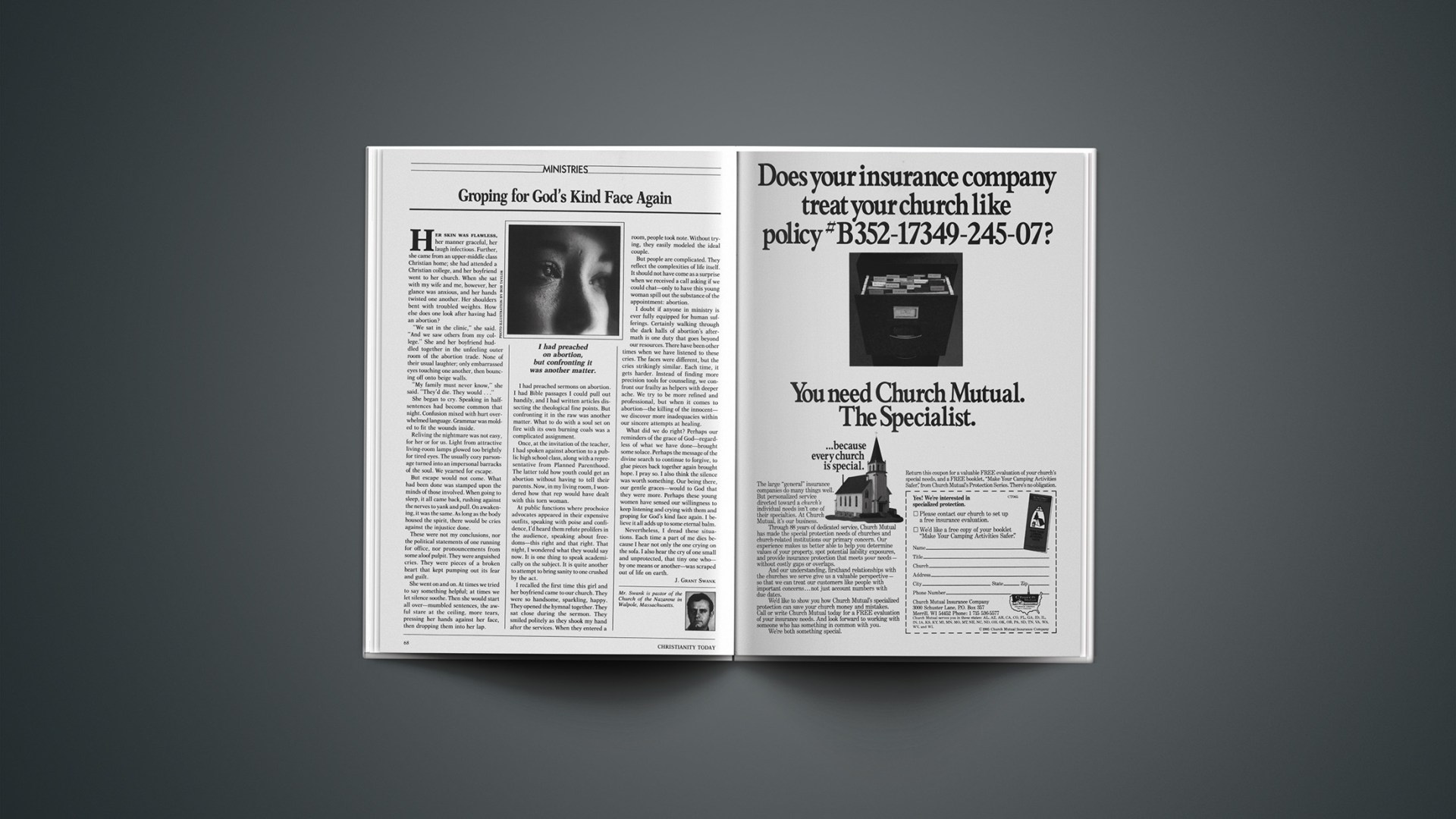
Ministers: Groping for God’s Kind Face Again

Her skin was flawless, her manner graceful, her laugh infectious. Further, she came from an upper-middle class Christian home; she had attended a Christian college, and her boyfriend went to her church. When she sat with my wife and me, however, her glance was anxious, and her hands twisted one another. Her shoulders bent with troubled weights. How else does one look after having had an abortion?

“We sat in the clinic,” she said, “And we saw others from my college.” She and her boyfriend huddled together in the unfeeling outer room of the abortion trade. None of their usual laughter; only embarrassed eyes touching one another, then bouncing off onto beige walls.

“My family must never know,” she said. “They’d die. They would …”

She began to cry. Speaking in half-sentences had become common that night. Confusion mixed with hurt overwhelmed language. Grammar was molded to fit the wounds inside.

Reliving the nightmare was not easy, for her or for us. Light from attractive living-room lamps glowed too brightly for tired eyes. The usually cozy parsonage turned into an impersonal barracks of the soul. We yearned for escape.

But escape would not come. What had been done was stamped upon the minds of those involved. When going to sleep, it all came back, rushing against the nerves to yank and pull. On awakening, it was the same. As long as the body housed the spirit, there would be cries against the injustice done.

These were not my conclusions, nor the political statements of one running for office, nor pronouncements from some aloof pulpit. They were anguished cries. They were pieces of a broken heart that kept pumping out its fear and guilt.

She went on and on. At times we tried to say something helpful; at times we let silence soothe. Then she would start all over—mumbled sentences, the awful stare at the ceiling, more tears, pressing her hands against her face, then dropping them into her lap.

I had preached sermons on abortion. I had Bible passages I could pull out handily, and I had written articles dissecting the theological fine points. But confronting it in the raw was another matter. What to do with a soul set on fire with its own burning coals was a complicated assignment.

Once, at the invitation of the teacher, I had spoken against abortion to a public high school class, along with a representative from Planned Parenthood. The latter told how youth could get an abortion without having to tell their parents. Now, in my living room, I wondered how that rep would have dealt with this torn woman.

At public functions where prochoice advocates appeared in their expensive outfits, speaking with poise and confidence, I’d heard them refute prolifers in the audience, speaking about freedoms—this right and that right. That night, I wondered what they would say now. It is one thing to speak academically on the subject. It is quite another to attempt to bring sanity to one crushed by the act.

I recalled the first time this girl and her boyfriend came to our church. They were so handsome, sparkling, happy. They opened the hymnal together. They sat close during the sermon. They smiled politely as they shook my hand after the services. When they entered a room, people took note. Without trying, they easily modeled the ideal couple.

But people are complicated. They reflect the complexities of life itself. It should not have come as a surprise when we received a call asking if we could chat—only to have this young woman spill out the substance of the appointment: abortion.

I doubt if anyone in ministry is ever fully equipped for human sufferings. Certainly walking through the dark halls of abortion’s aftermath is one duty that goes beyond our resources. There have been other times when we have listened to these cries. The faces were different, but the cries strikingly similar. Each time, it gets harder. Instead of finding more precision tools for counseling, we confront our frailty as helpers with deeper ache. We try to be more refined and professional, but when it comes to abortion—the killing of the innocent—we discover more inadequacies within our sincere attempts at healing.

What did we do right? Perhaps our reminders of the grace of God—regardless of what we have done—brought some solace. Perhaps the message of the divine search to continue to forgive, to glue pieces back together again brought hope. I pray so. I also think the silence was worth something. Our being there, our gentle graces—would to God that they were more. Perhaps these young women have sensed our willingness to keep listening and crying with them and groping for God’s kind face again. I believe it all adds up to some eternal balm.

Nevertheless, I dread these situations. Each time a part of me dies because I hear not only the one crying on the sofa. I also hear the cry of one small and unprotected, that tiny one who—by one means or another—was scraped out of life on earth.

Mr. Swank is pastor of the Church of the Nazarene in Walpole, Massachusetts.

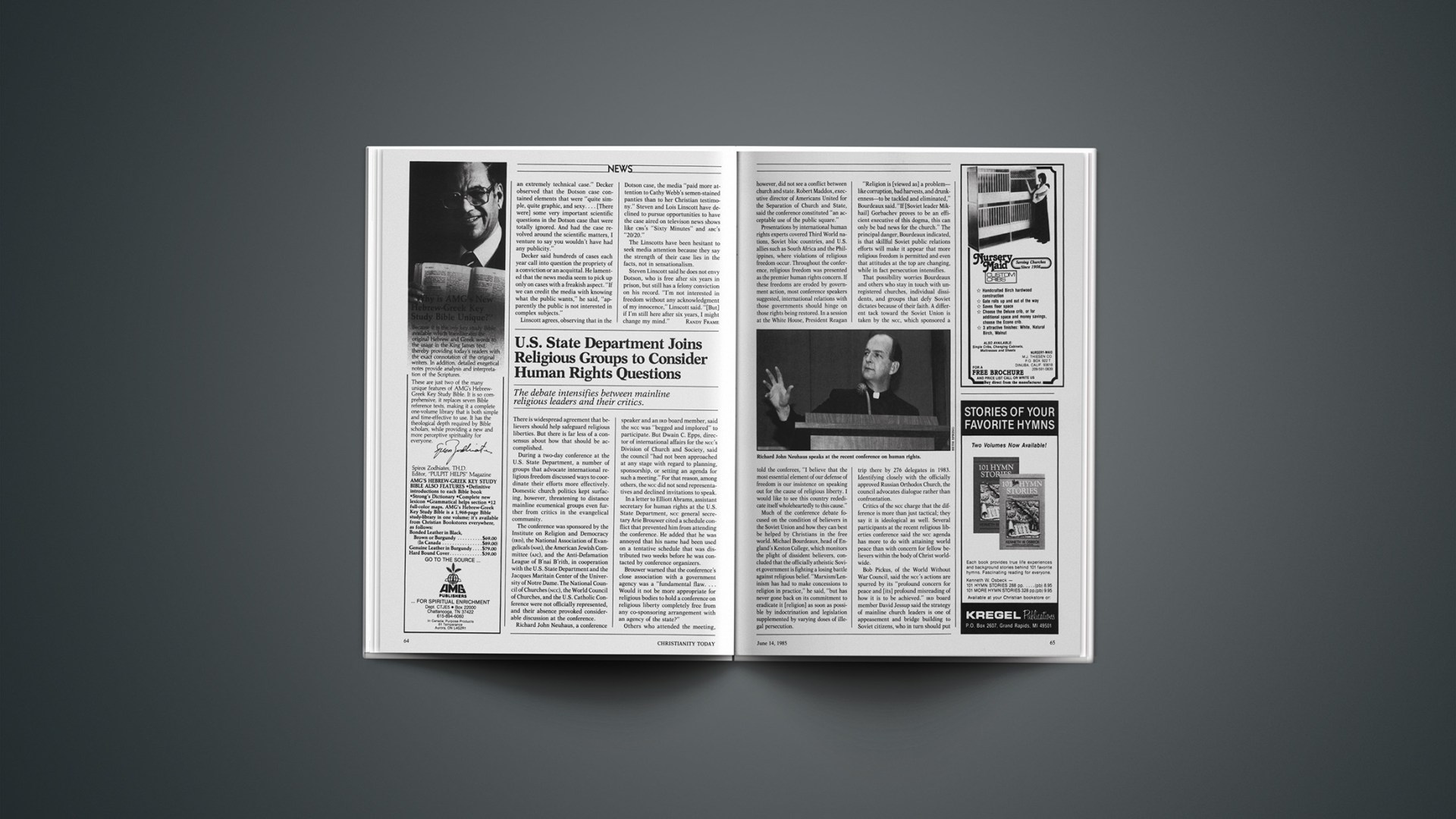
U.S. State Department Joins Religious Groups to Consider Human Rights Questions

The debate intensifies between mainline religious leaders and their critics.

There is widespread agreement that believers should help safeguard religious liberties. But there is far less of a consensus about how that should be accomplished.

During a two-day conference at the U.S. State Department, a number of groups that advocate international religious freedom discussed ways to coordinate their efforts more effectively. Domestic church politics kept surfacing, however, threatening to distance mainline ecumenical groups even further from critics in the evangelical community.

The conference was sponsored by the Institute on Religion and Democracy (IRD), the National Association of Evangelicals (NAE), the American Jewish Committee (AJC), and the Anti-Defamation League of B’nai B’rith, in cooperation with the U.S. State Department and the Jacques Maritain Center of the University of Notre Dame. The National Council of Churches (NCC), the World Council of Churches, and the U.S. Catholic Conference were not officially represented, and their absence provoked considerable discussion at the conference.

Richard John Neuhaus, a conference speaker and an IRD board member, said the NCC was “begged and implored” to participate. But Dwain C. Epps, director of international affairs for the NCC’s Division of Church and Society, said the council “had not been approached at any stage with regard to planning, sponsorship, or setting an agenda for such a meeting.” For that reason, among others, the NCC did not send representatives and declined invitations to speak.

In a letter to Elliott Abrams, assistant secretary for human rights at the U.S. State Department, NCC general secretary Arie Brouwer cited a schedule conflict that prevented him from attending the conference. He added that he was annoyed that his name had been used on a tentative schedule that was distributed two weeks before he was contacted by conference organizers.

Brouwer warned that the conference’s close association with a government agency was a “fundamental flaw.… Would it not be more appropriate for religious bodies to hold a conference on religious liberty completely free from any co-sponsoring arrangement with an agency of the state?”

Others who attended the meeting, however, did not see a conflict between church and state. Robert Maddox, executive director of Americans United for the Separation of Church and State, said the conference constituted “an acceptable use of the public square.”

Presentations by international human rights experts covered Third World nations, Soviet bloc countries, and U.S. allies such as South Africa and the Philippines, where violations of religious freedom occur. Throughout the conference, religious freedom was presented as the premier human rights concern. If these freedoms are eroded by government action, most conference speakers suggested, international relations with those governments should hinge on those rights being restored. In a session at the White House, President Reagan told the conferees, “I believe that the most essential element of our defense of freedom is our insistence on speaking out for the cause of religious liberty. I would like to see this country rededicate itself wholeheartedly to this cause.”

Much of the conference debate focused on the condition of believers in the Soviet Union and how they can best be helped by Christians in the free world. Michael Bourdeaux, head of England’s Keston College, which monitors the plight of dissident believers, concluded that the officially atheistic Soviet government is fighting a losing battle against religious belief. “Marxism/Leninism has had to make concessions to religion in practice,” he said, “but has never gone back on its commitment to eradicate it [religion] as soon as possible by indoctrination and legislation supplemented by varying doses of illegal persecution.

“Religion is [viewed as] a problem—like corruption, bad harvests, and drunkenness—to be tackled and eliminated,” Bourdeaux said. “If [Soviet leader Mikhail] Gorbachev proves to be an efficient executive of this dogma, this can only be bad news for the church.” The principal danger, Bourdeaux indicated, is that skillful Soviet public relations efforts will make it appear that more religious freedom is permitted and even that attitudes at the top are changing, while in fact persecution intensifies.

That possibility worries Bourdeaux and others who stay in touch with unregistered churches, individual dissidents, and groups that defy Soviet dictates because of their faith. A different tack toward the Soviet Union is taken by the NCC, which sponsored a trip there by 276 delegates in 1983. Identifying closely with the officially approved Russian Orthodox Church, the council advocates dialogue rather than confrontation.

Critics of the NCC charge that the difference is more than just tactical; they say it is ideological as well. Several participants at the recent religious liberties conference said the NCC agenda has more to do with attaining world peace than with concern for fellow believers within the body of Christ worldwide.

Bob Pickus, of the World Without War Council, said the NCC’s actions are spurred by its “profound concern for peace and [its] profound misreading of how it is to be achieved.” IRD board member David Jessup said the strategy of mainline church leaders is one of appeasement and bridge building to Soviet citizens, who in turn should put pressure on their government to work for peace. However, he disagreed with that approach.

“Such an argument has a powerful appeal, especially among U.S. churchgoers,” Jessup said. “In reply, we must point out that we have as our ultimate purpose the expansion of religious freedom. Only if churches are truly independent of government can they bring pressure to bear.”

Provost Charles A. Perry, of Washington (Episcopal) Cathedral, was a member of the NCC delegation to the Soviet Union. By expressing “a degree of solidarity” with Russian Orthodox believers and their church hierarchy, he said, the Orthodox church gains notice and standing among Soviet people.

Because there is no underground Orthodox church, Perry said it is in the best interest of Soviet believers for American Christians to “deal with the structures as they exist.” He said he sees two equally important tasks: “lifting up instances of religious persecution and staying in touch with the leadership of the church there,” even if some of its officials are co-opted by the state.

Many participants at the religious liberties conference were eager to agree on a course of action, and Jessup suggested a speakers’ tour of the United States. The NAE and AJC plan to mobilize their local affiliates to organize regional meetings on the issue of religious liberty. Others called for the creation of a U.S. equivalent of Keston College, but Bourdeaux said that is not necessary.

“We need to distribute the information that is already available rather than have a second group do the same research,” he said. Bourdeaux said he has approached 25 U.S. colleges—including Christian schools—and found “just no interest at all” in setting up an information bank on religious freedom issues.

Apple PodcastsDown ArrowDown ArrowDown Arrowarrow_left_altLeft ArrowLeft ArrowRight ArrowRight ArrowRight Arrowarrow_up_altUp ArrowUp ArrowAvailable at Amazoncaret-downCloseCloseEmailEmailExpandExpandExternalExternalFacebookfacebook-squareGiftGiftGooglegoogleGoogle KeephamburgerInstagraminstagram-squareLinkLinklinkedin-squareListenListenListenChristianity TodayCT Creative Studio Logologo_orgMegaphoneMenuMenupausePinterestPlayPlayPocketPodcastRSSRSSSaveSaveSaveSearchSearchsearchSpotifyStitcherTelegramTable of ContentsTable of Contentstwitter-squareWhatsAppXYouTubeYouTube