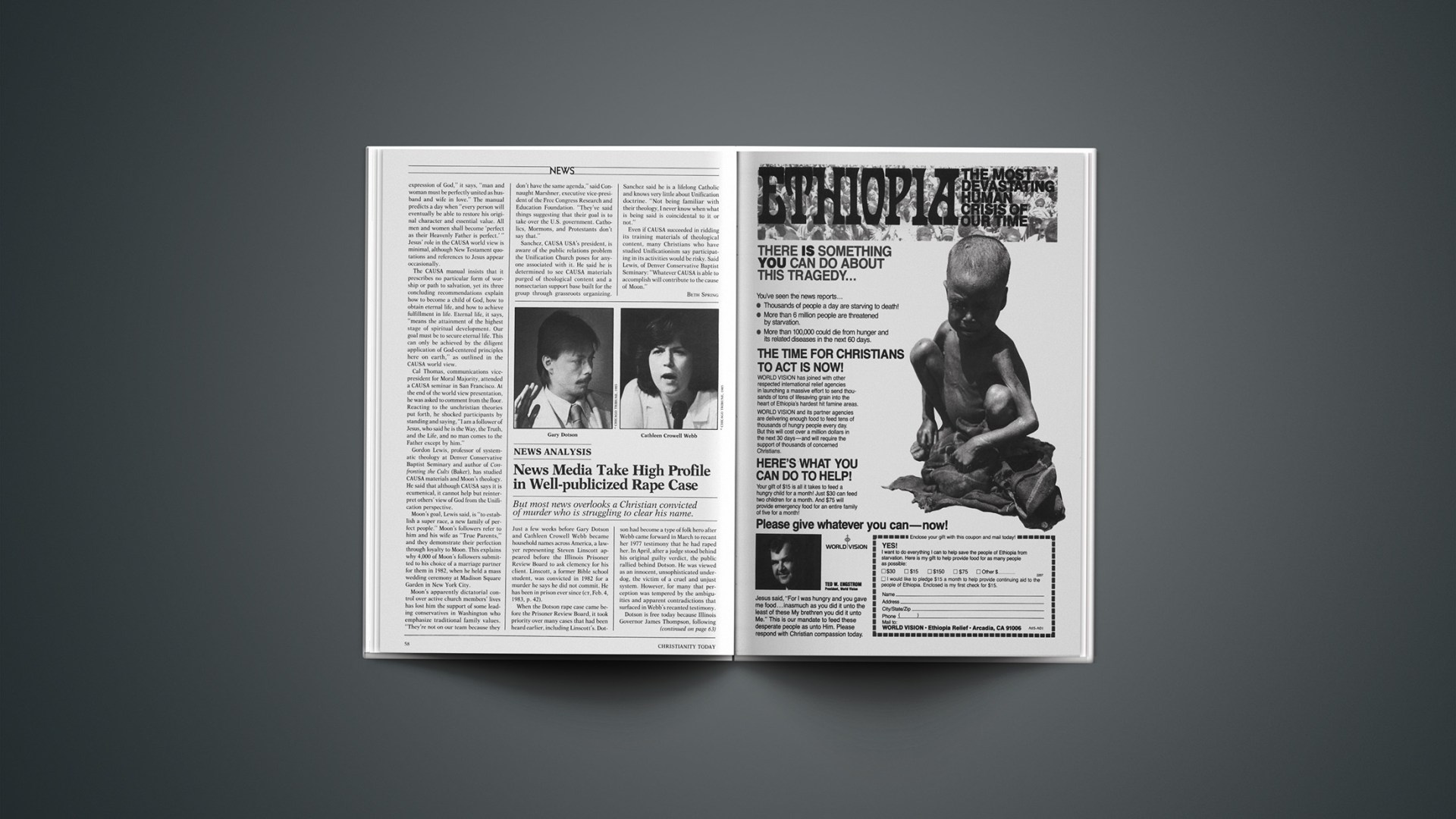
News Media Take High Profile in Well-Publicized Rape Case

But most news overlooks a Christian convicted of murder who is struggling to clear his name.

Just a few weeks before Gary Dotson and Cathleen Crowell Webb became household names across America, a lawyer representing Steven Linscott appeared before the Illinois Prisoner Review Board to ask clemency for his client. Linscott, a former Bible school student, was convicted in 1982 for a murder he says he did not commit. He has been in prison ever since (CT, Feb. 4, 1983, p. 42).

When the Dotson rape case came before the Prisoner Review Board, it took priority over many cases that had been heard earlier, including Linscott’s. Dotson had become a type of folk hero after Webb came forward in March to recant her 1977 testimony that he had raped her. In April, after a judge stood behind his original guilty verdict, the public rallied behind Dotson. He was viewed as an innocent, unsophisticated underdog, the victim of a cruel and unjust system. However, for many that perception was tempered by the ambiguities and apparent contradictions that surfaced in Webb’s recanted testimony.

Dotson is free today because Illinois Governor James Thompson, following a special clemency hearing before the Prisoner Review Board, commuted Dotson’s 25-to 50-year prison sentence. (It is unusual for Thompson to participate in Prisoner Review Board hearings. Normally, the board hears petitions and then makes a recommendation to the governor.)

The Dotson case held a special interest for evangelicals, because Webb cited her Christian conversion in 1981 as her reason for recanting. She said she waited four years before coming forward because at first she “had only a small amount of faith, like a baby.… I had to grow until my faith could overcome my fears … that I would go to jail, that my husband would probably hate my guts.”

In a commencement address at Taylor University, Prison Fellowship chairman Charles Colson cited Webb’s recantation as an example of radical Christian living. After having talked with Webb’s pastor in New Hampshire, Colson maintains that Webb is telling the truth this time around. In his address, Colson said Webb had “demonstrated the fruits of repentance” and that she was “misunderstood probably because the world sees so little of true Christianity.”

Thompson conceded that he was troubled by the absence of a motive for Webb to lie in her recantation. Still, he said, “I don’t believe the testimony … because it was either inherently incredible or flatly contradicted by other witnesses who had no motive at all to lie.”

Although he commuted Dotson’s sentence, the Illinois governor said he was convinced Dotson is guilty. Many criticized Thompson for bowing to public pressure, pressure that was enhanced by extensive news coverage. More than 125 journalists, including national networks and the British Broadcasting Corporation, were present at the clemency hearing. Chicago’s major television stations and a few radio stations provided live coverage of all or major portions of the proceedings.

In contrast, when Linscott’s case came before the same Prisoner Review Board on April 2, it attracted only one reporter. Those on the review board were surprised, and one appeared flattered that the reporter wanted to take pictures. Thompson, of course, was not involved in Linscott’s hearing.

In 1980, Linscott, then a Bible school student in suburban Chicago, was charged with the brutal slaying of 24-year-old Karen Phillips. He was found guilty, and is serving a 40-year sentence at the Centralia (Ill.) Correctional Institute.

Unlike Dotson, Linscott had no history of trouble with the police. His conviction was based on circumstantial forensic evidence and on a dream he had of a violent murder the same night that Phillips, who lived in his neighborhood, was killed. His ordeal began when he told police about the dream. The prosecution later argued that Linscott knew details about the murder that only the real killer could have known.

After the guilty verdict, Linscott retained a new lawyer, Tom Decker, who filed for an appeal. Decker has argued that the prosecuting attorneys manufactured the forensic evidence against his client. He has said also that they mischaracterized the similarities between the dream and the real murder, and the circumstances surrounding Linscott’s disclosure of the dream. So far, there has been no decision on their request for an appeal. Decker said word from the appeals court could be imminent.

In a telephone interview, Linscott said he was amazed at how quickly the justice system moved in the Dotson case. “Most people have to wait three months for the review board to make a recommendation, who knows how long for the governor to make a decision, and then it’s usually negative.”

Linscott’s wife, Lois, said they were not bothered by the priority given to the Dotson case. “It was an unusual case that deserved special attention,” she said. “If the person who killed Karen Phillips came forward to confess, I would certainly expect immediate attention.”

Attorney Decker said that, although there are some sensational elements to the Linscott case, “it will never arouse sustained media attention because it is an extremely technical case.” Decker observed that the Dotson case contained elements that were “quite simple, quite graphic, and sexy.… [There were] some very important scientific questions in the Dotson case that were totally ignored. And had the case revolved around the scientific matters, I venture to say you wouldn’t have had any publicity.”

Decker said hundreds of cases each year call into question the propriety of a conviction or an acquittal. He lamented that the news media seem to pick up only on cases with a freakish aspect. “If we can credit the media with knowing what the public wants,” he said, “apparently the public is not interested in complex subjects.”

Linscott agrees, observing that in the Dotson case, the media “paid more attention to Cathy Webb’s semen-stained panties than to her Christian testimony.” Steven and Lois Linscott have declined to pursue opportunities to have the case aired on televison news shows like CBS’s “Sixty Minutes” and ABC’s “20/20.”

The Linscotts have been hesitant to seek media attention because they say the strength of their case lies in the facts, not in sensationalism.

Steven Linscott said he does not envy Dotson, who is free after six years in prison, but still has a felony conviction on his record. “I’m not interested in freedom without any acknowledgment of my innocence,” Linscott said. “[But] if I’m still here after six years, I might change my mind.”

Sun Myung Moon’s Followers Recruit Christians to Assist in Battle against Communism

Funded by the Unification Church, CAUSA seeks an interfaith effort based on Moon’s theology.

Sun Myung Moon’s Unification Church is conducting a political outreach to evangelical and fundamentalist pastors through CAUSA, an anti-Communist organization with headquarters in New York City. The group’s “ministerial alliance,” headed by Unification pastor Chung Hwan Kwak, is organizing grassroots teams to promote Godism, a philosophy Moon says will defeat communist ideology worldwide.

Pastors are offered all-expense-paid trips to conferences and training seminars; Unification Church members follow up with phone calls and letters; and assurances are made that CAUSA is out to change no one’s religious convictions. But Godism is an intricate “world view” that permeates CAUSA seminar materials and is touted as the sole solution to communism, which is viewed as “God’s emergency of all time.” In essence, Godism is a formula for ushering in the kingdom of God on earth by human effort. CAUSA has attracted a following among some Christians throughout the country, and it has gained at least a temporary hearing among others.

In Washington State, Assemblies of God evangelist Daniel Scalf agreed to become a regional director for CAUSA. In a published CAUSA report about one of its ministerial alliance meetings, Scalf is quoted as saying “I believe that CAUSA has the best material I’ve ever seen on the subject of Marxism-Leninism.”

Reports of Scalf’s work on behalf of CAUSA generated alarm at Assemblies of God headquarters in Springfield, Missouri. The denomination’s executive committee passed a resolution urging pastors to avoid CAUSA. “Contacts made through this group are followed up by Unification workers who use the openings to solicit for converts,” the resolution reads. “The Committee feels our ministers and churches should be discouraged from identification with it.”

David C. MacKenzie, assistant rector at The Falls Church (Episcopal) in Falls Church, Virginia, met with CAUSA representatives twice and was contacted by telephone several times. He said they denied any ties between their organization and the Unification Church. MacKenzie said he finally told them not to contact him again because their presentations were based on Unification theology.

Thomas McDevitt, a Unification pastor and CAUSA’s East Coast regional director, said there are no formal ties between the Unification Church and the anti-Communist organization. When two Baptist pastors raised questions at a CAUSA conference, McDevitt said he told them, “If you can refute communism with your theological views, then that’s fine.” He added, however, that he believes an interfaith effort is essential. “As long as you stay in your fortress of orthodoxy,” he said, “you will be defeated.”

Although it is officially separate from Moon’s church, CAUSA has close links with Unificationism financially and through its personnel. The CAUSA Lecture Manual states, “The history of CAUSA is inseparable from the life and experiences of Reverend Moon.” Bo Hi Pak, president of CAUSA International, and Joe A. Tully, executive director of CAUSA USA, are highly placed Unification officials.

Lori Antolock, an aide to Pak, confirmed that Unification money pays for most CAUSA events and projects. For a recent East Coast regional meeting in Atlanta, CAUSA prepared invitations for 5,400 pastors, offering each one a full scholarship.

CAUSA International, based in New York City, was founded in 1980 and is active in 21 countries. Its affiliate, CAUSA USA, has headquarters in Washington, D.C. Originally, CAUSA was an acronym for Confederation of the Associations for the Unification of the Societies of the Americas. Now, according to CAUSA USA president Phillip V. Sanchez—former U.S. Ambassador to Honduras—the name refers simply to the “cause” of fighting communism. CAUSA USA inaugurated its ministerial alliance last year following a series of rallies held nationwide to protest perceived threats to religious freedom, including Moon’s imprisonment for tax evasion (CT, Sept. 7, 1984, p. 56).

Baptist Pastor Resigns as Head of Religious Freedom Group

Greg Dixon cites the publication of an article by Sun Myung Moon as his reason for leaving.

The Coalition for Religious Freedom, a Washington, D.C., group supported by a number of fundamentalist and evangelical pastors, went to bat last year for Sun Myung Moon when he was convicted of tax fraud. To express his appreciation, Moon offered the group a substantial contribution, estimated at $500,000, to help launch an effort to publicize threats to religious freedom in America.

The coalition produced a videotape, began publishing a monthly newspaper called Religious Freedom Alert, and invited pastors to form local affiliates nationwide. Its president, Greg Dixon, pastor of Indianapolis Baptist Temple, said he was assured that he would have “total control” over the coalition’s published materials, board membership, and philosophy.

Last month, Dixon resigned as president of the Coalition for Religious Freedom. He cited his concern that the organization appeared to be a platform for advancing the views of Moon’s Unification Church. The coalition’s former executive director, Donald Sills, replaced Dixon as president, and Robert Grant of Christian Voice was named chairman of the corporate board.

Specifically, Dixon objected to portions of a lengthy letter written by Moon that were published in the March issue of the coalition’s newspaper. The letter was published under a headline that called Moon a “Prisoner With, And For, A Cause!” The letter portrayed Moon as a Christian pastor called to “promote love and unity in the Body of Christ around the world.” It is an important tool in the Unification Church’s campaign to gain acceptance in American religious life.

If he had known beforehand that Religious Freedom Alert planned to publish Moon’s letter, Dixon said, he would have prohibited it. Publishing the letter “goes beyond the limits of reporting the facts of his [Moon’s] incarceration; and actually allows the [Religious Freedom] Alert to be used as a pulpit for a sermon from Moon,” Dixon wrote in his letter of resignation.

Publication of Moon’s letter made his resignation necessary, Dixon said. “To do anything to directly further what I believe to be false doctrine is not only a sin; but inexcusable,” he wrote in his resignation letter.

“The purpose of the [Religious Freedom] Alert is not to espouse any particular doctrinal position,” Dixon said in a telephone interview. “I feel we’ve been true to that position up until the article on Moon.” Because the article appeared at the same time the Unification Church sent explanatory materials to 300,000 pastors, Dixon said, “it is impossible for me to convince my brethren that the Coalition [for Religious Freedom] does not advance the Unification Church. The only way I can prove my sincerity is to resign, period.”

Kathleen Masters, editor of Religious Freedom Alert, said she decided to print Moon’s letter because “people wanted to know why we supported his case, and I thought, ‘Why not take it from the horse’s mouth?’ The letter is the epitome of what he really believes.”

Dixon and other coalition members say they have experienced no pressure from the Unification Church, but Moon has exercised a subtle influence on the group. News articles published in Religious Freedom Alert come from Religion Today, a news service provided by William F. Willoughby, who is religion editor for the Unification Church-owned Washington Times newspaper. Willoughby is not a follower of Moon, but he portrayed the Unification Church leader sympathetically in a 1984 column in the Coalition for Religious Freedom newspaper. Moon, he wrote, has “quietly championed the arts and things of high cultural and scientific values in this country.” Willoughby’s column said Moon “has won a resounding victory” by awakening America to the precariousness of its religious rights.

Some people listed as members of the Coalition for Religious Freedom executive committee and advisory board say they are unaware of the group’s activities. D. James Kennedy, pastor of Coral Ridge Presbyterian Church in Fort Lauderdale, said he has never attended a coalition meeting and knows nothing about what it does from day to day. “My name is [used by] … literally scores of organizations,” he said.

Ben Armstrong, executive director of National Religious Broadcasters, said he would “have to bow out” of the coalition committee if Unification Church ties exist. Christian author Tim LaHaye, chairman of the coalition’s executive committee, said he has not been active in the coalition since last summer, when he chaired a rally in Washington, D.C., to protest government interference in religious freedom.

Many Christian pastors participated in the rallies because they were organized by members of a Coalition on Religious Freedom, headed by fundamentalist pastors Greg Dixon and Donald Sills. Dixon recently resigned as president of the coalition (see article on p. 56). Funded primarily by business interests and organizations controlled by Moon, the coalition attracted support from conservative Christian circles by championing Baptist pastor Everett Sileven’s battle with Nebraska authorities over licensing a church-run school. There are no direct links between CAUSA and the Coalition for Religious Freedom, although Sills often speaks at CAUSA conferences.

Sills defends the coalition, saying, “Our organization is very simply an independent educational operation. The coalition is not classified as a Christian or even a religious organization so much as it is a First Amendment organization.”

Both the Coalition on Religious Freedom and CAUSA concentrate their efforts on local pastors, organizing meetings and rallies to stir support for causes they say serve the interests of all religious groups. Many who attend the meetings are wary, however, of helping Moon and his church achieve the social acceptance they want.

Richard Bello, a Baptist associate pastor and head of South Carolina Citizens for Morality, attended a five-day, expense-paid CAUSA meeting in Washington, D.C. He said he was troubled by the theological slant behind the anti-communist presentation.

“The first day was introductory, the second [day] had a little more of Godism, and on the third there was no question we were being solicited,” Bello said. “On the fourth we were recruited, and by the fifth day we were either financed or wooed into trying to draw the net in our own communities.” CAUSA officials asked Bello whether a financial contribution would help his ministry. He said he told them $ 150,000 would enable him to buy a motor coach and pursue a teen outreach.

They indicated the money was available, Bello said, and they asked for further information about his ministry. He turned down the offer, left the meeting early, and has not heard from CAUSA since.

Godism, according to the CAUSA Lecture Manual, was developed by Moon as “a winning solution” to communism. “Through extraordinary communication with God, he [Moon] came to see clearly that there is no way we can eliminate communism if we do not confront it with a superior ideology or worldview.” One of its main precepts parallels Unification teaching: “All mankind should be united, for we are all the children of God.”

In his opening remarks in the manual, Pak says CAUSA’s purpose is not to change anyone’s religion. Yet he teaches that “the God of Judaism, Catholicism, Protestantism, Mormonism, Unificationism, and the God of all religions is one and the same.”

The CAUSA material describes communism and says the West has grown increasingly vulnerable to it. Each section concludes with a strong appeal for Godism. Participants are encouraged, however, to “keep their own views” if the Godism presentation conflicts with their own convictions.

In accord with Moon’s primary “theological” work, Divine Principle, the CAUSA world view asserts that God’s intention to create perfect humans was thwarted because Adam and Eve did not produce children until after their fall. In man’s fallen condition, communism has flourished, bringing about “the perfection of evil,” the manual states. “Communism has created the ultimate hell.”

Moon’s Divine Principle teaching states that Jesus, as well as Adam and Eve, failed to do what God desired. Jesus was supposed to marry and bear perfect children, but was killed before accomplishing his mission. Because of this, Moon has said that a “Lord of the Second Advent” must come into the world to provide the physical salvation Jesus could not deliver. This “second” Christ, Moon says, will hail from South Korea. Moon’s followers believe that Moon himself is that messiah.

While the CAUSA material does not spell this out, it expresses a Unification perspective on the primacy of married life. “In order to make the fullest expression of God,” it says, “man and woman must be perfectly united as husband and wife in love.” The manual predicts a day when “every person will eventually be able to restore his original character and essential value. All men and women shall become ‘perfect as their Heavenly Father is perfect.’ ” Jesus’ role in the CAUSA world view is minimal, although New Testament quotations and references to Jesus appear occasionally.

The CAUSA manual insists that it prescribes no particular form of worship or path to salvation, yet its three concluding recommendations explain how to become a child of God, how to obtain eternal life, and how to achieve fulfillment in life. Eternal life, it says, “means the attainment of the highest stage of spiritual development. Our goal must be to secure eternal life. This can only be achieved by the diligent application of God-centered principles here on earth,” as outlined in the CAUSA world view.

Cal Thomas, communications vice-president for Moral Majority, attended a CAUSA seminar in San Francisco. At the end of the world view presentation, he was asked to comment from the floor. Reacting to the unchristian theories put forth, he shocked participants by standing and saying, “I am a follower of Jesus, who said he is the Way, the Truth, and the Life, and no man comes to the Father except by him.”

Gordon Lewis, professor of systematic theology at Denver Conservative Baptist Seminary and author of Confronting the Cults (Baker), has studied CAUSA materials and Moon’s theology. He said that although CAUSA says it is ecumenical, it cannot help but reinterpret others’ view of God from the Unification perspective.

Moon’s goal, Lewis said, is “to establish a super race, a new family of perfect people.” Moon’s followers refer to him and his wife as “True Parents,” and they demonstrate their perfection through loyalty to Moon. This explains why 4,000 of Moon’s followers submitted to his choice of a marriage partner for them in 1982, when he held a mass wedding ceremony at Madison Square Garden in New York City.

Moon’s apparently dictatorial control over active church members’ lives has lost him the support of some leading conservatives in Washington who emphasize traditional family values. “They’re not on our team because they don’t have the same agenda,” said Connaught Marshner, executive vice-president of the Free Congress Research and Education Foundation. “They’ve said things suggesting that their goal is to take over the U.S. government. Catholics, Mormons, and Protestants don’t say that.”

Sanchez, CAUSA USA’s president, is aware of the public relations problem the Unification Church poses for anyone associated with it. He said he is determined to see CAUSA materials purged of theological content and a nonsectarian support base built for the group through grassroots organizing. Sanchez said he is a lifelong Catholic and knows very little about Unification doctrine. “Not being familiar with their theology, I never know when what is being said is coincidental to it or not.”

Even if CAUSA succeeded in ridding its training materials of theological content, many Christians who have studied Unificationism say participating in its activities would be risky. Said Lewis, of Denver Conservative Baptist Seminary: “Whatever CAUSA is able to accomplish will contribute to the cause of Moon.”

Culture

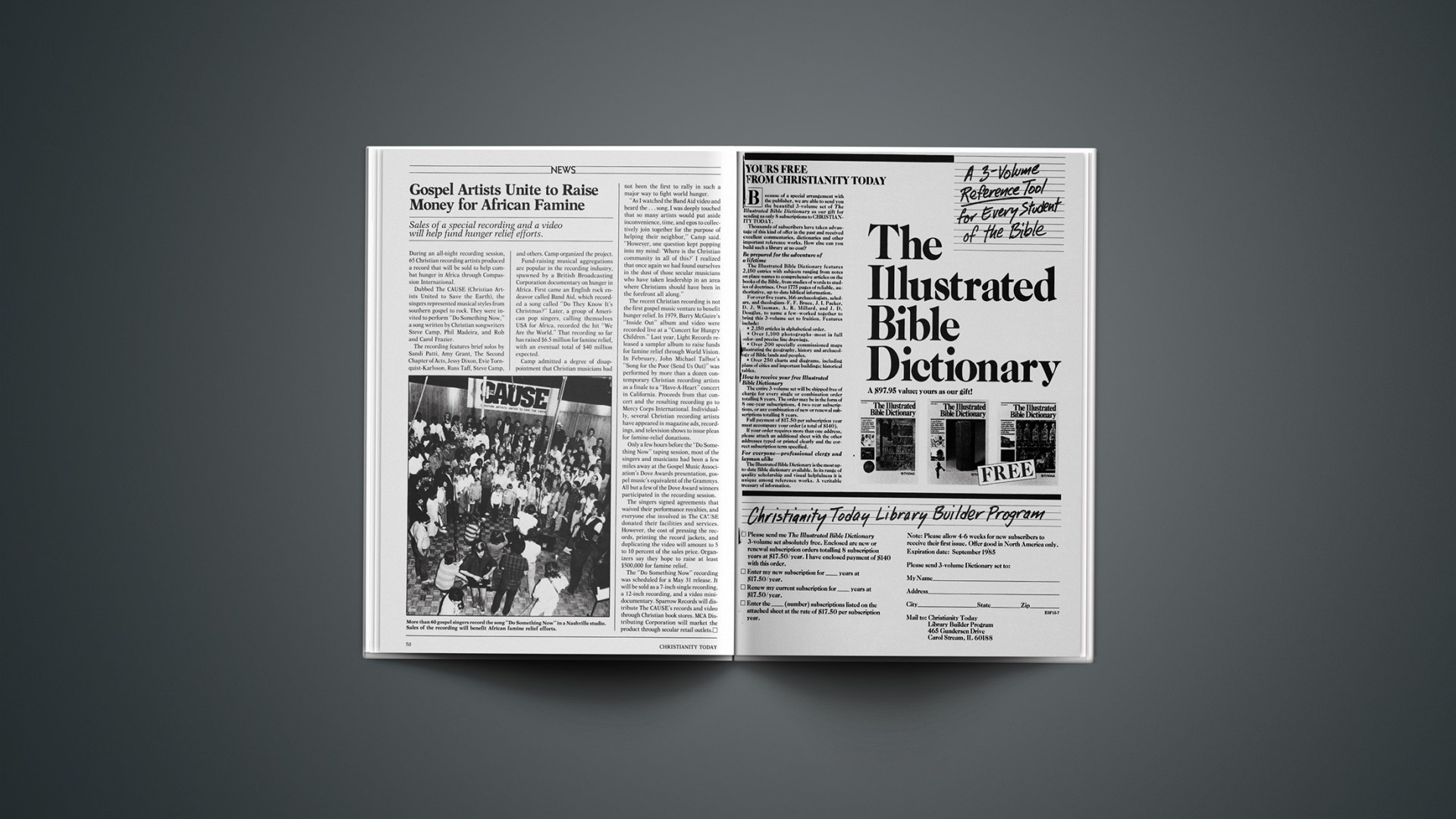
Gospel Artists Unite to Raise Money for African Famine

Sales of a special recording and a video will help fund hunger relief efforts.

During an all-night recording session, 65 Christian recording artists produced a record that will be sold to help combat hunger in Africa through Compassion International.

Dubbed The CAUSE (Christian Artists United to Save the Earth), the singers represented musical styles from southern gospel to rock. They were invited to perform “Do Something Now,” a song written by Christian songwriters Steve Camp, Phil Madeira, and Rob and Carol Frazier.

The recording features brief solos by Sandi Patti, Amy Grant, The Second Chapter of Acts, Jessy Dixon, Evie Tornquist-Karlsson, Russ Taff, Steve Camp, and others. Camp organized the project.

Fund-raising musical aggregations are popular in the recording industry, spawned by a British Broadcasting Corporation documentary on hunger in Africa. First came an English rock endeavor called Band Aid, which recorded a song called “Do They Know It’s Christmas?” Later, a group of American pop singers, calling themselves USA for Africa, recorded the hit “We Are the World.” That recording so far has raised $6.5 million for famine relief, with an eventual total of $40 million expected.

Camp admitted a degree of disappointment that Christian musicians had not been the first to rally in such a major way to fight world hunger.

“As I watched the Band Aid video and heard the … song, I was deeply touched that so many artists would put aside inconvenience, time, and egos to collectively join together for the purpose of helping their neighbor,” Camp said. “However, one question kept popping into my mind: ‘Where is the Christian community in all of this?’ I realized that once again we had found ourselves in the dust of those secular musicians who have taken leadership in an area where Christians should have been in the forefront all along.”

The recent Christian recording is not the first gospel music venture to benefit hunger relief. In 1979, Barry McGuire’s “Inside Out” album and video were recorded live at a “Concert for Hungry Children.” Last year, Light Records released a sampler album to raise funds for famine relief through World Vision. In February, John Michael Talbot’s “Song for the Poor (Send Us Out)” was performed by more than a dozen contemporary Christian recording artists as a finale to a “Have-A-Heart” concert in California. Proceeds from that concert and the resulting recording go to Mercy Corps International. Individually, several Christian recording artists have appeared in magazine ads, recordings, and television shows to issue pleas for famine-relief donations.

Only a few hours before the “Do Something Now” taping session, most of the singers and musicians had been a few miles away at the Gospel Music Association’s Dove Awards presentation, gospel music’s equivalent of the Grammys. All but a few of the Dove Award winners participated in the recording session.

The singers signed agreements that waived their performance royalties, and everyone else involved in The CAUSE donated their facilities and services. However, the cost of pressing the records, printing the record jackets, and duplicating the video will amount to 5 to 10 percent of the sales price. Organizers say they hope to raise at least $500,000 for famine relief.

The “Do Something Now” recording was scheduled for a May 31 release. It will be sold as a 7-inch single recording, a 12-inch recording, and a video mini-documentary. Sparrow Records will distribute The CAUSE’s records and video through Christian book stores. MCA Distributing Corporation will market the product through secular retail outlets.

North American Scene

Four prolife activists have been convicted on charges related to the December bombings of three Florida abortion facilities. The activists attend First Assembly of God Church in Pensacola. Kaye Wiggins and Kathren Simmons face up to five years in prison and $ 10,000 in fines, while Matthew Goldsby and James Simmons face a maximum of 65 years and $70,000 in fines. A U.S. district attorney said that if the defendants committed illegal acts in the name of religion, they were no different than terrorists in Northern Ireland or the Middle East.

Seventh-day Adventist leaders have accepted a study commission’s recommendation calling for no definitive action on the ordination of women. The commission recommended further studies to determine a theological position on the issue. Findings of the study are to be reported no later than the denomination’s 1988 spring meeting, and, eventually, to the 1989 annual council.

The Proctor & Gamble Company has dropped the moon-and-stars trademark from its product packages as a result of rumors tying the symbol to Satan worship. In 1982, the company filed libel suits against six people accused of spreading the rumors. The lawsuits were settled out of court. A Proctor & Gamble spokesman denied that a $60 million decline in profits led to the dropping of the moon-and-stars symbol. The trademark will remain on the company’s letterhead and on its corporate headquarters.

In September, evangelist Billy Graham plans to visit the Soviet-bloc nation of Rumania for the first time. Graham said he has been told to expect “by far the largest audiences ever” compared to his earlier trips to Eastern Europe. Rumanian church officials expect crowds of 25,000 to 40,000 to gather outside churches to hear Graham’s messages over loudspeakers. A trip to Hungary may follow Graham’s two-week Rumanian visit.

A former Wall Street lawyer has founded Fundamentalists Anonymous to assist people who leave fundamentalist groups. Founder Richard Yao said ex-fundamentalists often exhibit the same psychological symptoms as ex-cultists. He said he started the support group to help people work through the guilt and stress that often is associated with leaving a fundamentalist background. Yao said his group is not anti-Christian or antireligious. He said he considers himself “a very religious person,” although he is not active in a “conventional religious institution.”

The U.S. Supreme Court again will consider what limits a state may place on abortion. The dispute, appealed to the high court by the state of Pennsylvania, involves a state law that required minors to obtain parental permission or a court order before obtaining an abortion; required physicians to use abortion procedures designed to preserve the life of a viable fetus; and insured that patients were advised of abortion alternatives. The law was struck down by an appeals court. Two years ago, the U.S. Supreme Court declared unconstitutional a similar ordinance passed in Akron, Ohio.

A federal grand jury has returned a 23-count indictment against a New York City dial-a-porn telephone service. Carlin Communications and four individuals were charged with interstate transportation of obscene matter. The indictment said that in 1983, Utah children from 10 to 16 years of age heard a recorded phone message describing “explicit sexual conduct.”

The Arizona Supreme Court has ruled that a viable fetus is a person. The court said viability occurs when the fetus is capable of “independent, extra-uterine life,” to be determined in the courts on a case-by-case basis. The court said parents of a viable fetus could sue doctors under the state’s wrongful death law.

The Mission Society for United Methodists last month commissioned its first five missionary couples. The society is an unofficial alternative to the United Methodist Board of Global Ministries, which is thought by society members to overemphasize social outreach and liberation theology. At least one minister commissioned by the society faces possible loss of his clergy credentials for accepting an assignment from the society without the approval of his bishop.

Evangelicals Give Out 1.2 Million Evangelistic Papers During Pope’s Visit To Belgium

Just days before Pope John Paul II arrived in Belgium last month, every Catholic bishop in the country received a copy of an eight-page newspaper. The paper addressed issues that often divide Protestants and Catholics.

Produced by the Belgian Evangelical Mission (BEM), the newspaper dealt with such questions as “Who is Jesus’ representative on earth?” and “Which church is the true church of Christ?” The newspaper’s center pages contained a presentation of steps to salvation.

A letter to the Catholic bishops from BEM director Johan Lukasse accompanied the newspapers. “We want to inform you that we have printed 1.2 million gospel papers to be distributed during the visit of Pope John Paul II,” Lukasse wrote. “… You can see that it’s not our purpose to bring discredit or attack against the Pope nor the Roman Catholics.”

One Catholic official said he regarded the effort as insignificant. “There’s nothing pejorative in this, but its impact will be insignificant,” said Canon Wilfred Brieven, private secretary to the Brussels archbishop. “Out of 10 million people there are only 100,000 Protestants, and they are mainly foreigners.”

Indeed, the number of Belgian evangelicals is small, totaling 60,000—about ½ of 1 percent of the population. However, participation in the newspaper distribution effort was significant. Christians from 164 churches, representing 14 denominations, were joined by hundreds of volunteers from Switzerland, Holland, and Germany. The newspapers were placed in nearly half of Belgium’s mailboxes, and were distributed at several of the Pope’s appearances.

However, when a small leftist minority emerged in Ghent, the city’s mayor refused permission for any literature distribution on the day a mass meeting was held on an airfield. The distribution teams instead placed the newspapers in mailboxes throughout the city the day before the Pope’s appearance.

Before John Paul II began his visit, Lukasse explained the reason for the newspaper blitz. “We’re concerned that the masses in Belgium will be talked to as though they were real believers,” he said. “However, the great majority have no personal and living relationship with Jesus Christ.

“We decided that while everyone would be speaking pro and con about his visit, this was the time to do something.… We were not interested in attacking the [Roman Catholic] Church as an institution. We’re interested in individual people who are lost and don’t know Jesus.”

Not all Protestant groups, including the United Protestant Church, Belgium’s oldest and largest Protestant denomination, participated in the project. “We feared confusion,” said M.J. Beuken-horst, chairman of the United Protestant Church general council. “There are many who don’t know the difference between Reformed, Presbyterian, and evangelical. We would [all be labeled] Protestants. Many might feel that we agree with the paper.”

The newspaper offered free gospel literature and follow-up information. World Literature Crusade, known as Every Home Crusade in Belgium, handled the literature follow-up, while individual churches made personal contacts with people.

Most Belgians requesting free literature asked for a brochure titled “A Discussion with Peter, the First Pope,” followed by requests for a Bible.

Lukasse said he believes Pope John Paul II is restoring a unified identity to the Roman Catholic Church after the confusion following the Second Vatican Council (1962–65).

“I feel it’s very clear that he’s trying to go back to the old-fashioned kind of Catholicism,” Lukasse said. “He is reinforcing the teaching of transubstantiation … and calling people back to the adoration of Mary.… We may have another five or ten years of real opportunity to win Catholics to salvation in Christ.”

LORRY LUTZ

A New TV Program Features Well-Known Christian Athletes

The nation’s largest cable television network is broadcasting a weekly show that presents positive role models from the sports world. ESPN, which reaches more than 35 million American homes, is airing the program, hosted by basketball great Julius Erving of the Philadelphia 76ers.

Called “Julius Erving’s Sports Focus,” the show gives well-known athletes a chance to discuss how their faith bears on their profession. The half-hour program debuted earlier this year.

A typical segment includes stories about two or three Christian athletes and examines a sports-related issue, such as drug abuse or recruiting violations. Among the athletes to be profiled are Chicago Bears wide receiver Willie Gault, Olympic skater Rosalynn Sumners, and marathoner Alberto Salazar.

The show is produced by New Focus, Inc., an organization founded last year by Ralph Drollinger, once a standout basketball player at the University of California at Los Angeles. Seven years ago, Drollinger turned down a lucrative offer to join the pro ranks. He opted instead to tour for two years with Campus Crusade for Christ’s Athletes in Action (AIA) basketball team. He did turn pro in 1980 when he became a Dallas Maverick, but a knee injury ended his brief career. Until he founded New Focus, he served as executive producer of AIA’s “Sports Magazine” television program.

Drollinger describes New Focus as a company “committed to producing high moral, high traditional value programming for mass audiences.” Although the featured athletes usually are believers, the show is not overtly evangelistic. Drollinger said the show is intended to entertain. He added that attempts at “hard sell” evangelism probably would not be effective. However, viewers can send for a free issue of Sports Focus magazine, which contains articles that are heavily evangelistic.

Drollinger said “Julius Erving’s Sports Focus” is the result of substantial market analysis. According to research conducted by the Gallup organization, he said, “the body of Christ spends over $500 million a year contributing to television evangelists, who reach only about 6 percent of the population.” Drollinger cited research done by Child Evangelism Fellowship indicating that “90 percent of the decisions made in America for Christ today are made before the age of 18.” Thus, the 15- to 18-year-old age group is the target audience for the new television program.

Erving, who has tallied more than 25,000 points in 14 years of professional basketball, said hosting the show could be the beginning of a new career in broadcasting.

Research done last fall revealed that, among youths aged 15 to 17, Erving was the most admired sports hero among boys, and was second to gymnast Mary Lou Retton among girls. Erving has lent his time and efforts to a variety of charities, including Special Olympics, March of Dimes, and the Lupus Foundation.

California Judge Dismisses Nation’s First ‘Clergy Malpractice’ Suit

A Los Angeles Superior Court judge last month dismissed the nation’s first “clergy malpractice” lawsuit, halfway through a widely publicized trial.

The dismissal by Judge Joseph R. Kalin cleared John F. MacArthur, Jr., senior pastor of Grace Community Church in southern California, and his pastoral staff of charges stemming from the 1979 suicide of a young man they had counseled. The unprecedented case had been in and out of court since 1980. Superior Court Judge Thomas Murphy had dismissed the case in 1981, but last summer an appeals court ordered a trial that began in April (CT, April 19, 1984, p. 60).

The suit was filed and appealed by Marie and Walter J. Nally, parents of Kenneth Nally, the man who killed himself. Their lawyer called on about one-quarter of the 109 witnesses he had lined up to testify against Grace Community Church, but their statements proved unconvincing.

Kalin wrote in his 14-page decision that there is “no compelling reason for the state or this court to interfere with the counseling at Grace Community Church.” Imposing standards on pastors would “open the flood gates to clergy malpractice suits,” the judge wrote, and “the cost to pastors and small churches would have a chilling effect on the freedom of religion.”

MacArthur’s assistant, Jay Letey, issued a statement on behalf of the senior pastor: “We praise the Lord for how it has worked out. We hope pastors throughout the country will feel confident to do counseling and to use Scripture in their counseling.” He said the five-year ordeal has not altered the church’s commitment to biblical counseling.

MacArthur’s attorney, Samuel E. Ericsson of the Christian Legal Society, argued for two hours to persuade Kalin to dismiss the case. Ericsson said he told the judge there was no need to complete the trial because “the plaintiffs have failed to prove their case, and our defendant is protected by the First Amendment.”

Ericsson said the dismissal is good news for all churches. “It closes the door to any future suits seeking to make pastoral counseling accountable to the state,” he said, “and it prevents a legal wedge from being placed between those who need help most and those who stand most ready to help.”

Kenneth Nally was a seminary student who worked part-time at Grace Community Church. He sought counseling there to combat depression. Nally’s parents charged in their lawsuit that their son was advised to pray and read the Bible rather than to seek professional psychiatric help. However, the church did refer Nally to other professionals, and it claimed it never presented suicide as an option—another charge made by the Nallys.

In response to that charge, MacArthur last year issued a statement. “Under no circumstances would it be in the will of God for a person to take his or her own life,” the statement read. “When the young man with whom this lawsuit is concerned took his life, it was certainly not because anyone associated with Grace Church ever taught or ever encouraged him or anyone else to do that.”

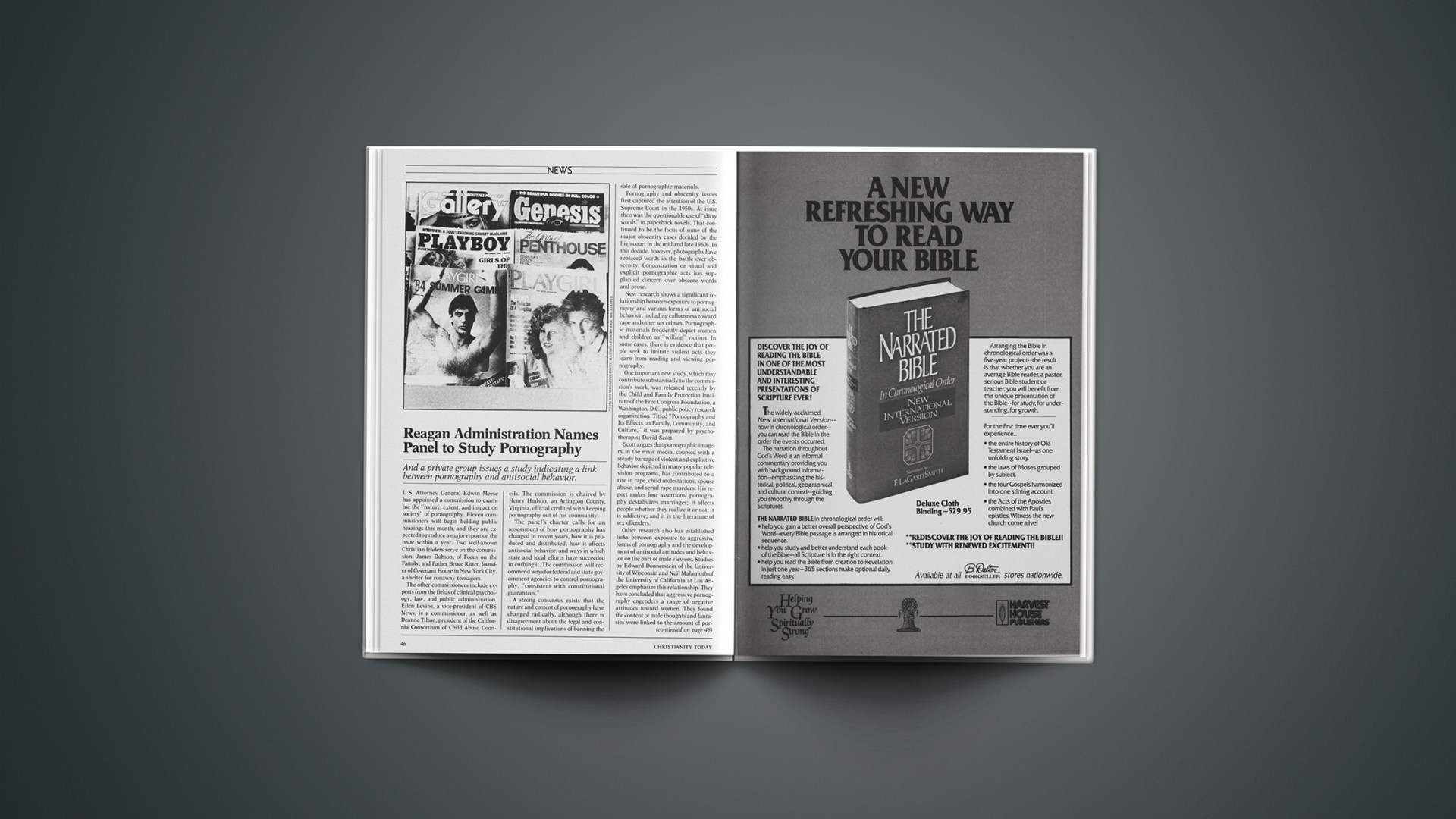
Reagan Administration Names Panel to Study Pornography

And a private group issues a study indicating a link between pornography and antisocial behavior.

U.S. Attorney General Edwin Meese has appointed a commission to examine the “nature, extent, and impact on society” of pornography. Eleven commissioners will begin holding public hearings this month, and they are expected to produce a major report on the issue within a year. Two well-known Christian leaders serve on the commission: James Dobson, of Focus on the Family; and Father Bruce Ritter, founder of Covenant House in New York City, a shelter for runaway teenagers.

The other commissioners include experts from the fields of clinical psychology, law, and public administration. Ellen Levine, a vice-president of CBS News, is a commissioner, as well as Deanne Tilton, president of the California Consortium of Child Abuse Councils. The commission is chaired by Henry Hudson, an Arlington County, Virginia, official credited with keeping pornography out of his community.

The panel’s charter calls for an assessment of how pornography has changed in recent years, how it is produced and distributed, how it affects antisocial behavior, and ways in which state and local efforts have succeeded in curbing it. The commission will recommend ways for federal and state government agencies to control pornography, “consistent with constitutional guarantees.”

A strong consensus exists that the nature and content of pornography have changed radically, although there is disagreement about the legal and constitutional implications of banning the sale of pornographic materials.

Pornography and obscenity issues first captured the attention of the U.S. Supreme Court in the 1950s. At issue then was the questionable use of “dirty words” in paperback novels. That continued to be the focus of some of the major obscenity cases decided by the high court in the mid and late 1960s. In this decade, however, photographs have replaced words in the battle over obscenity. Concentration on visual and explicit pornographic acts has supplanted concern over obscene words and prose.

New research shows a significant relationship between exposure to pornography and various forms of antisocial behavior, including callousness toward rape and other sex crimes. Pornographic materials frequently depict women and children as “willing” victims. In some cases, there is evidence that people seek to imitate violent acts they learn from reading and viewing pornography.

One important new study, which may contribute substantially to the commission’s work, was released recently by the Child and Family Protection Institute of the Free Congress Foundation, a Washington, D.C., public policy research organization. Titled “Pornography and Its Effects on Family, Community, and Culture,” it was prepared by psychotherapist David Scott.

Scott argues that pornographic imagery in the mass media, coupled with a steady barrage of violent and exploitive behavior depicted in many popular television programs, has contributed to a rise in rape, child molestations, spouse abuse, and serial rape murders. His report makes four assertions: pornography destabilizes marriages; it affects people whether they realize it or not; it is addictive; and it is the literature of sex offenders.

Other research also has established links between exposure to aggressive forms of pornography and the development of antisocial attitudes and behavior on the part of male viewers. Studies by Edward Donnerstein of the University of Wisconsin and Neil Malamuth of the University of California at Los Angeles emphasize this relationship. They have concluded that aggressive pornography engenders a range of negative attitudes toward women. They found the content of male thoughts and fantasies were linked to the amount of pornography to which they were exposed.

Scott’s study, however, makes a bolder and more controversial claim. His evidence indicates that repeated exposure—even to nonviolent, soft-core pornography—can produce negative effects. He argues that pornography can adversely affect “normal persons” as well as individuals with a variety of personality disorders.

“Pornographic material decreases sexual satisfaction and contributes to an overall decline in belief in the viability of marriage,” Scott writes. Massive exposure to these materials leads to a devaluation and depreciation of the importance of monogamy, he reports, causing nonmonogamous relationships to be viewed as normal. In addition, he says, pornography whets the appetite for more deviant material, and viewers incorporate what they see into their sexual practices.

Evidence is presented to depict pornography as addictive—forcing the consumer to require greater quantities of more intense material to maintain a level of gratification. Many move from “soft” pornography to the violent and explicit “hard” pornography being made more accessible by the television and film industries, Scott writes.

Perhaps most disturbing are Scott’s conclusions regarding links between pornography and crime. He claims that dangerous offenders, such as rapists and child molesters, incorporate deviant pornographic material into their preparatory stimulation before seeking a victim.

The results of Scott’s research directly contradict conclusions in a 1970 report from a presidential commission on pornography. That commission argued that there was insufficient evidence to show whether pornography causes harm to individuals or society. Pornography might even have a potentially therapeutic and cathartic value for some, the report said. It recommended the repeal of laws controlling pornography for adults.

Critics of the 1970 commission charged that it ignored or suppressed available evidence. Its findings ultimately were rejected by the U.S. Senate and by the U.S. Supreme Court. However, Scott says the mass media did not reject the report, and the general public thus began to accept the commission’s “no-harm” conclusions. The pornography industry has grown to a $7 billion-a-year business.

The Father of Reagan’s Assailant Devotes His Life to Combating Mental Illness

Jack Hinckley talks about mental health issues and his youngest son, John.

In 1981, Jack Hinckley prefaced his tenth annual report to the 1,400 stockholders in the Vanderbilt Oil Company with the words of Proverbs 16:3: “Commit to the Lord whatever you do, and your plans will succeed” (NIV). Indeed, Hinckley’s plans during the previous ten years had flourished.

Beginning in 1971, with a half-dozen shareholders and an investment of $100,000, the Denver-based oil company had grown to a $4 million a year business. But along the way, Hinckley had learned that success could not be measured in dollars and cents. In 1977, after reading such books as Ron Sider’s Rich Christians in an Age of Hunger, Dietrich Bonhoeffer’s The Cost of Discipleship, and C. S. Lewis’s Mere Christianity, Hinckley had given Jesus Christ control of his life. Shortly after, he became involved in such organizations as World Vision, through which he frequently did development work in Third World countries.

It was because of such a trip that on March 30, 1981, Hinckley hurried to finish last-minute business at his office. The next morning he, along with his wife, Jo Ann, planned to travel to Guatemala to develop systems to provide clean water for Indian villages.

But they never made the trip. That day, in Washington, D.C., Hinckley’s youngest son, John, fired six bullets at President Reagan, wounding him and three others. Although Jack Hinckley had been burdened by his son’s erratic behavior, he had never suspected that John was suffering from a mental illness so severe that he would attempt to assassinate the President.

This month, Jack and Jo Ann Hinckley are releasing Breaking Points (Zondervan), a book written with Elizabeth Sherrill. More than a detailed account of the tragic events of four years ago, the book also takes an honest look at the devastating effects of schizophrenia, an illness Jack Hinckley blames for his son’s shocking actions.

Jack Hinckley no longer manages an oil company. Instead, he is president and cofounder (with his wife) of the American Mental Health Fund, a nonprofit organization that seeks to increase public awareness of the prevalence and symptoms of mental illness and to raise money for research. CHRISTIANITY TODAY asked free-lance writer Sharon Anderson to interview Jack Hinckley. An edited version of that interview follows.

How did the church respond after your son’s assassination attempt?

The only local church to respond was Calvary Temple in Denver. Charles Blair, the church’s pastor, called the night of March 30. And he was one of the few people who made a public statement in our defense. Thousands of others sent letters sympathizing with us, but hardly any of them spoke out in public for us or for John.

Were you disappointed that you did not receive wider support from Christians?

No. We were overwhelmed by the correspondence we received from Christians all over the world. Everywhere we have gone to speak about mental illness, the local media have had the impression that most of the mail we received was negative or critical. That is simply not so. Probably not more than 5 percent was negative; the rest was very supportive. And at least three-fourths of the mail came from Christians who supported us.

Were those letters partially responsible for your current involvement in mental health?

Yes. So many were from parents of mentally disturbed children. They showed me how great the need was for mental health awareness and education.

In Breaking Points, you write that part of your involvement in mental illness is because God was leading you in that direction.

Before John’s tragedy, I began to realize that God was calling me to do something other than what I was doing. I had lost interest in my work, in making money, and in obtaining many other things. Every Christian book I read was telling me that my lifestyle was wrong. At the time, I began to think that I was being led to do overseas hunger-relief and water-development work. I had visited several Third World countries in conjunction with World Vision. But full-time relief and development work never seemed to work out.

I asked God several times what I was supposed to do. Then there was John’s tragedy. As soon as the dust settled, I again asked God what I was supposed to do. That’s when it became clear that the Lord wanted me to be involved in addressing the problem of mental illness.

What have you learned about mental illness?

After John’s tragedy, Jo Ann and I began to study mental illness, and we learned a number of staggering statistics. One out of every five adults is suffering from some form of mental illness. One-third of all hospital beds are occupied by the mentally ill. Despite these statistics, the amount of mental health research is disgracefully small. We knew we had to do something.

We learned that none of the organizations involved in mental illness were committed to public education or research. At the suggestion of some of these people, Jo Ann and I formed the American Mental Health Fund in 1983. It is dedicated to education and research.

How much progress have you made?

In mid-April, we received preliminary approval from the Advertising Council of a project which, when formally approved, will help us launch a nationwide educational campaign to bring mental illness out of the closet and remove its oppressive stigma. In the past, the Advertising Council has done campaigns for cancer, heart disease, the Red Cross—even Smokey the Bear.

What difference would education make?

All the difference in the world. Many people, especially Christians, see mental illness as just a weakness or extreme self-centeredness. Many mentally disturbed Christians are told that all they need to do to get better is to “turn your life over to the Lord” or to “stop worrying about yourself all the time,” and other such platitudes. In most cases, this advice is nonsense—even dangerous.

Why is that?

So many fail to recognize that many forms of mental illness are biologic, genetic, the results of chemical imbalances that have nothing to do with one’s attitude toward God. Just as some people are born with a withered arm, some are born with a mental illness. And all the Bible reading and evangelism in the world will not change that situation. Mental illness is a family of disorders involving a whole spectrum of illnesses, from phobias to neuroses through personality disorders to psychoses. The most crippling of all is schizophrenia. All physical illnesses are not the result of personal weakness, so why is mental illness viewed that way? Mental illness is just as real as physical illness.

Most people think mental illness is something that will never strike their family, that it will never strike their neighborhood. The truth is that it strikes one out of every three families.

During your testimony at your son’s trial, you said: “I’m the cause of John’s tragedy. I forced him out at a time when he simply couldn’t cope. I wish to God I could trade places with him right now.” Do you feel partly responsible for John’s illness?

The greatest mistake of my life was forcing John to leave our home three weeks before the assassination attempt. The worst thing you can do to someone suffering from a severe mental illness is to increase stress. Of course, I didn’t know that at the time.

Many expect me to feel deep guilt about John, but I don’t. I don’t feel any more guilt than if he had been born with a birth defect. I honestly feel that Jo Ann and I did the best we could. We didn’t ignore his problem. We took him to several doctors and were following medical advice when we forced him to leave in order to learn independence. If I am guilty of anything, it is ignorance about mental illness. I’m dedicating my life to removing that ignorance from parents as well as doctors.

How do you respond to those who say your son’s insanity defense prevented God’s justice from being done?

They are wrong. God’s justice was done because that is the purpose of the insanity defense. John was mentally ill at the time he shot President Reagan, and he could not control his thoughts or his actions. If critics are seeking vengeance instead of justice, they won’t be satisfied. Furthermore, John didn’t get away with a thing. He is in a maximum security hospital. If anybody thinks that is getting away with something, I invite them to go over to Saint Elizabeth’s Mental Hospital and take a look.

How is John today?

We have noticed improvement in the three years that he has been at Saint Elizabeth’s. He is on medication and is taking several forms of therapy, including family therapy with Jo Ann and me. He is also getting spiritual therapy by attending a chapel service every Sunday morning. We are pleased with the progress.

How can Christians become more educated about mental illness?

They can do three things: If they or a member of their family is suffering from some form of mental illness, we advise them to join an advocacy group such as the Alliance for the Mentally Ill. Second, we recommend that they read four books: Schizophrenia: Straight Talk for Families and Friends, by Maryellen Walsh; Surviving Schizophrenia, by E. Fuller Torrey; You Are Not Alone: Understanding and Dealing with Mental Illness, by Clara Clairborne Park with Leon N. Shapiro, M.D.; and our book, Breaking Points. Last, research is imperative. We need the help of the church to raise money for research.

WORLD SCENE

New British government regulations give magistrates the authority to forcibly hospitalize people with Acquired Immune Deficiency Syndrome (AIDS) if local authorities consider them to be a risk to others. Authorities also may prevent relatives of a person who has died of AIDS from taking possession of the body. AIDS, a disease that attacks the body’s immune system, primarily affects homosexual men. The British health minister said the new government regulations would be used only as a last resort.

Religious rioting in northeastern Nigeria has resulted in more than 100 deaths. It was the fourth serious outbreak of religious violence since 1980. The latest trouble erupted when police tried to arrest the local leader of a Muslim sect called the Maitatsine. The sect violently opposes official authority and does not recognize the leadership of the prophet Muhammad.

About 1,100 Dade County, Florida, jail inmates gave up three meals recently so the money saved could be sent to aid African famine relief. Two inmates came up with the idea and circulated a petition that was approved by local officials. Approximately $2,200 was saved and donated to World Vision. Relief officials estimated that the donated money would feed some 44,000 people for one day.

Allan Boesak has been reaffirmed in his position as vice-president of the South African Council of Churches. Boesak’s denomination, the Dutch Reformed Mission Church, previously had exonerated him of accusations that he had an affair with a former employee of the South African Council of Churches. Boesak is a leading opponent of South Africa’s racial separation policy known as apartheid.

Twenty-four Christians have been arrested in Nepal and accused of illegally spreading the Christian faith. They are free on bond, but they could face prison sentences of up to six years. In Nepal, it is illegal for anyone to convert from Hinduism to Christianity or Islam. But the law is silent with regard to converts from Buddhism. All the Nepalese Christians in this case came from Buddhist backgrounds.

Books

Book Briefs: June 14, 1985

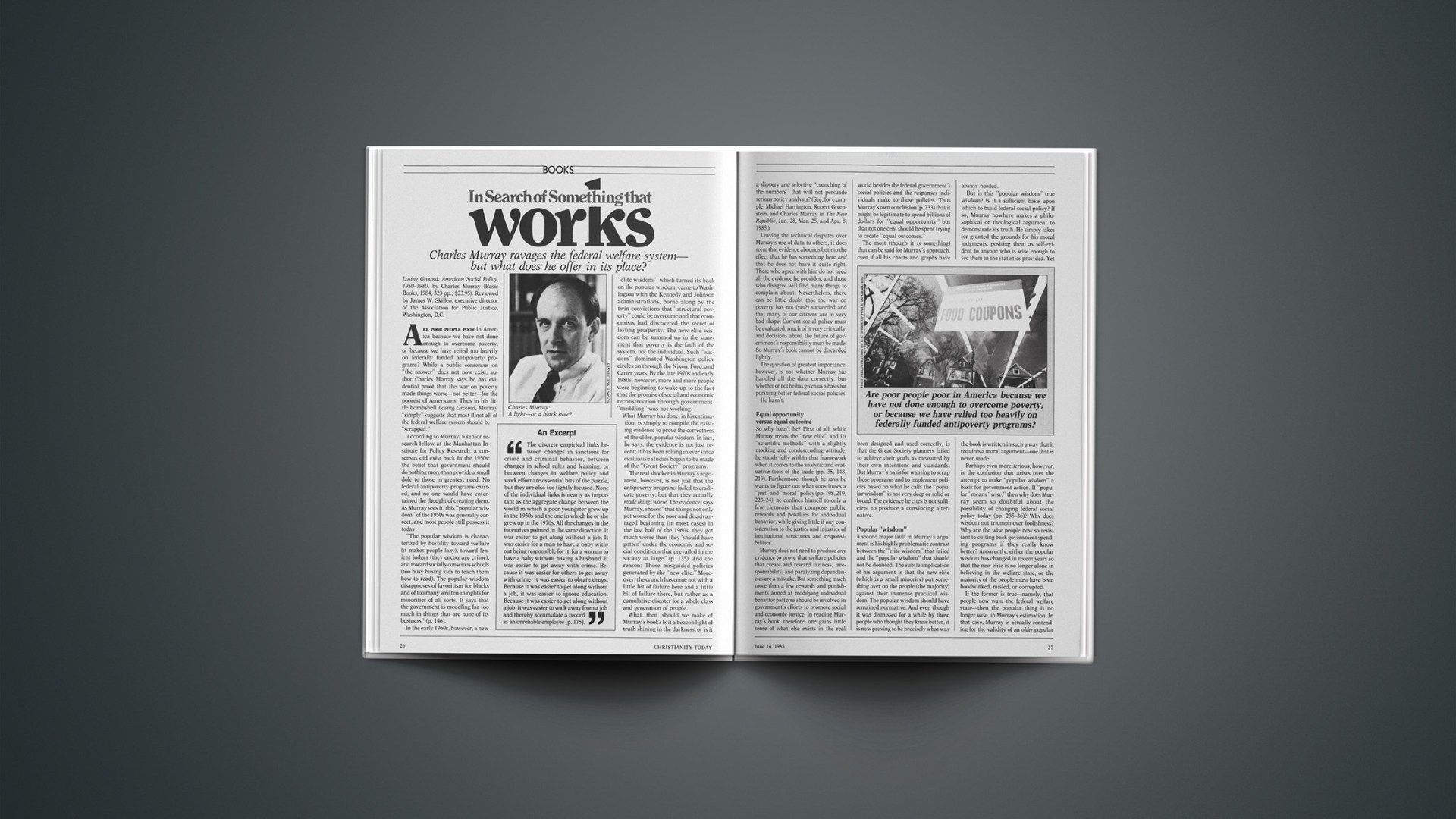
Charles Murray ravages the federal welfare system—but what does he offer in its place?

Losing Ground: American Social Policy, 1950–1980, by Charles Murray (Basic Books, 1984, 323 pp.; $23.95). Reviewed by James W. Skillen, executive director of the Association for Public Justice, Washington, D.C.

Are poor people poor in America because we have not done enough to overcome poverty, or because we have relied too heavily on federally funded antipoverty programs? While a public consensus on “the answer” does not now exist, author Charles Murray says he has evidential proof that the war on poverty made things worse—not better—for the poorest of Americans. Thus in his little bombshell Losing Ground, Murray “simply” suggests that most if not all of the federal welfare system should be “scrapped.”

According to Murray, a senior research fellow at the Manhattan Institute for Policy Research, a consensus did exist back in the 1950s: the belief that government should do nothing more than provide a small dole to those in greatest need. No federal antipoverty programs existed, and no one would have entertained the thought of creating them. As Murray sees it, this “popular wisdom” of the 1950s was generally correct, and most people still possess it today.

“The popular wisdom is characterized by hostility toward welfare (it makes people lazy), toward lenient judges (they encourage crime), and toward socially conscious schools (too busy busing kids to teach them how to read). The popular wisdom disapproves of favoritism for blacks and of too many written-in rights for minorities of all sorts. It says that the government is meddling far too much in things that are none of its business” (p. 146).

In the early 1960s, however, a new “elite wisdom,” which turned its back on the popular wisdom, came to Washington with the Kennedy and Johnson administrations, borne along by the twin convictions that “structural poverty” could be overcome and that economists had discovered the secret of lasting prosperity. The new elite wisdom can be summed up in the statement that poverty is the fault of the system, not the individual. Such “wisdom” dominated Washington policy circles on through the Nixon, Ford, and Carter years. By the late 1970s and early 1980s, however, more and more people were beginning to wake up to the fact that the promise of social and economic reconstruction through government “meddling” was not working.

An Excerpt

“The discrete empirical links between changes in sanctions for crime and criminal behavior, between changes in school rules and learning, or between changes in welfare policy and work effort are essential bits of the puzzle, but they are also too tightly focused. None of the individual links is nearly as important as the aggregate change between the world in which a poor youngster grew up in the 1950s and the one in which he or she grew up in the 1970s. All the changes in the incentives pointed in the same direction. It was easier to get along without a job. It was easier for a man to have a baby without being responsible for it, for a woman to have a baby without having a husband. It was easier to get away with crime. Because it was easier for others to get away with crime, it was easier to obtain drugs. Because it was easier to get along without a job, it was easier to ignore education. Because it was easier to get along without a job, it was easier to walk away from a job and thereby accumulate a record as an unreliable employee [p. 175].”

What Murray has done, in his estimation, is simply to compile the existing evidence to prove the correctness of the older, popular wisdom. In fact, he says, the evidence is not just recent; it has been rolling in ever since evaluative studies began to be made of the “Great Society” programs.

The real shocker in Murray’s argument, however, is not just that the antipoverty programs failed to eradicate poverty, but that they actually made things worse. The evidence, says Murray, shows “that things not only got worse for the poor and disadvantaged beginning (in most cases) in the last half of the 1960s, they got much worse than they ‘should have gotten’ under the economic and social conditions that prevailed in the society at large” (p. 135). And the reason: Those misguided policies generated by the “new elite.” Moreover, the crunch has come not with a little bit of failure here and a little bit of failure there, but rather as a cumulative disaster for a whole class and generation of people.

What, then, should we make of Murray’s book? Is it a beacon light of truth shining in the darkness, or is it a slippery and selective “crunching of the numbers” that will not persuade serious policy analysts? (See, for example, Michael Harrington, Robert Greenstein, and Charles Murray in The New Republic, Jan. 28, Mar. 25, and Apr. 8, 1985.)

Leaving the technical disputes over Murray’s use of data to others, it does seem that evidence abounds both to the effect that he has something here and that he does not have it quite right. Those who agree with him do not need all the evidence he provides, and those who disagree will find many things to complain about. Nevertheless, there can be little doubt that the war on poverty has not (yet?) succeeded and that many of our citizens are in very bad shape. Current social policy must be evaluated, much of it very critically, and decisions about the future of government’s responsibility must be made. So Murray’s book cannot be discarded lightly.

The question of greatest importance, however, is not whether Murray has handled all the data correctly, but whether or not he has given us a basis for pursuing better federal social policies.

He hasn’t.

Equal Opportunity Versus Equal Outcome

So why hasn’t he? First of all, while Murray treats the “new elite” and its “scientific methods” with a slightly mocking and condescending attitude, he stands fully within that framework when it comes to the analytic and evaluative tools of the trade (pp. 35, 148, 219). Furthermore, though he says he wants to figure out what constitutes a “just” and “moral” policy (pp. 198, 219, 223–24), he confines himself to only a few elements that compose public rewards and penalties for individual behavior, while giving little if any consideration to the justice and injustice of institutional structures and responsibilities.

Murray does not need to produce any evidence to prove that welfare policies that create and reward laziness, irresponsibility, and paralyzing dependencies are a mistake. But something much more than a few rewards and punishments aimed at modifying individual behavior patterns should be involved in government’s efforts to promote social and economic justice. In reading Murray’s book, therefore, one gains little sense of what else exists in the real world besides the federal government’s social policies and the responses individuals make to those policies. Thus Murray’s own conclusion (p. 233) that it might be legitimate to spend billions of dollars for “equal opportunity” but that not one cent should be spent trying to create “equal outcomes.”

The most (though it is something) that can be said for Murray’s approach, even if all his charts and graphs have been designed and used correctly, is that the Great Society planners failed to achieve their goals as measured by their own intentions and standards. But Murray’s basis for wanting to scrap those programs and to implement policies based on what he calls the “popular wisdom” is not very deep or solid or broad. The evidence he cites is not sufficient to produce a convincing alternative.

Popular “Wisdom”

A second major fault in Murray’s argument is his highly problematic contrast between the “elite wisdom” that failed and the “popular wisdom” that should not be doubted. The subtle implication of his argument is that the new elite (which is a small minority) put something over on the people (the majority) against their immense practical wisdom. The popular wisdom should have remained normative. And even though it was dismissed for a while by those people who thought they knew better, it is now proving to be precisely what was always needed.

But is this “popular wisdom” true wisdom? Is it a sufficient basis upon which to build federal social policy? If so, Murray nowhere makes a philosophical or theological argument to demonstrate its truth. He simply takes for granted the grounds for his moral judgments, positing them as self-evident to anyone who is wise enough to see them in the statistics provided. Yet the book is written in such a way that it requires a moral argument—one that is never made.

Perhaps even more serious, however, is the confusion that arises over the attempt to make “popular wisdom” a basis for government action. If “popular” means “wise,” then why does Murray seem so doubtful about the possibility of changing federal social policy today (pp. 235–36)? Why does wisdom not triumph over foolishness? Why are the wise people now so resistant to cutting back government spending programs if they really know better? Apparently, either the popular wisdom has changed in recent years so that the new elite is no longer alone in believing in the welfare state, or the majority of the people must have been hoodwinked, misled, or corrupted.

If the former is true—namely, that people now want the federal welfare state—then the popular thing is no longer wise, in Murray’s estimation. In that case, Murray is actually contending for the validity of an older popular wisdom that is no longer so popular. He would, therefore, be campaigning for the right of a new elite (people like himself) to displace the older “new elite” in the circles of federal policy making.

But why should one elite have any more right to make policy than another elite? If Murray’s judgments and approach are correct, then this is not because wisdom is popular (though it might be), but rather because it is right. And since the “rightness” or “correctness” of a particular brand of wisdom has not been demonstrated here, we are left with nothing more than one elite criticizing another elite by using statistics.

If the assumptions about human behavior held by social policy makers are incorrect assumptions, then what we need (and what Christians should be calling for and helping to provide) is a principled argument for the proper role of government in dealing with poverty and oppression, and a political philosophy grounded in a well-developed biblical view of justice.

Losing Ground: No

Charles Murray’s Losing Ground is acclaimed as an empirical study that finally proves that public assistance is not only useless, but harmful to those it is supposed to help. In fact, the empirical aspects of the study are its weakest points. Most important, Murray usually uses the entire black population to represent all impoverished Americans. In reality, less than one-third of the black population is on welfare; nearly seven of every ten people on welfare are white. But the reader looks in vain for data on the poor white group.

In addition, Murray shows that the real purchasing power of those on public assistance increased substantially after 1965. He infers this should have reduced the number of people below the poverty line. But he omits the fact that the rest of society was gaining real purchasing power at the same time. Thus the relative position of the poor in society improved much less than their absolute purchasing power, and economists have long recognized that relative income and consumption play a crucial role in a person’s economic behavior. The motivation to escape poverty is diminished if one’s best efforts to move up the economic ladder are stymied by the advance of everyone else higher up the ladder.

Finally, Murray’s interpretation of the data is marred because he ignores the dramatic social changes affecting young and low-income blacks during the 1960s and 1970s. His data studies are inconclusive at best, and possibly very misleading.

I see the book as an effort to substantiate a world view that includes three principles: Individual autonomy is the highest goal; free markets are as much a part of natural law and creation as, say, gravity, and therefore are not subject to moral analysis any more than the law of gravity; and any collective intervention into these “laws of nature” is counterproductive and inevitably limits freedom.

For Murray, then, it is an a priori belief that a welfare system is unhelpful and probably harmful. For all the numbers in his book, the issue for Murray is not really empirical.

There is an alternative world view that I would argue is more thoroughly biblical. To summarize it in three points: God is glorified in the context of the church, a community, which may mean that individual autonomy must at times be sacrificed; markets are the most efficient allocators of resources, but they should not operate (and do not, in fact) independently of a society’s cultural, legal, and religious values; land, since collective action is inevitable in any system, it is the responsibility of Christians to influence public policy for the good wherever possible.

It is true that good intentions are not sufficient and that guilt is not a desirable motivator. Any welfare program must foster responsibility in recipients and create incentive. It is incumbent on Christians to model care for the unfortunate and to propose better welfare policies. (One example would be the rewarding of administrators for every poor person that is helped off the welfare rolls. Currently the administrative rewards go to those with larger client lists.)

Eliminating all welfare, as Murray suggests, could lead to the higher poverty levels of the pre-1950s, when welfare expenditures were nominal. Indeed, answers are evasive, and all too few Christians have been working at finding them. Perhaps this controversial book, despite its shortcomings, will change that sad fact.

By Jim Halteman, associate professor of economics at Wheaton (Ill.) College.

The Buck Stops Where?

The third and final flaw in Murray’s thesis is his superficial approach in contrasting the new elite’s view of “structural poverty” with what he takes to be the correct view—namely, that individuals are responsible. The new social policies failed, says Murray, because they were rooted in the assumption that the system, not the individual, is at fault.

Believing “the system” is responsible for the condition of America’s poor, the new elite thought it could change the system through federal programs. People would be lifted out of poverty and disadvantage, they thought, by receiving new opportunities in school, in job training, and through direct financial transfers. But look what happened, says Murray. It did not work. The poorest got poorer and a whole new class of disadvantaged people was created.

What does this prove? Murray thinks it proves that the “structuralists” were wrong. Therefore, we must return to the older popular wisdom: the assumption that the individual is responsible and must be held accountable by the government for his or her own behavior.

Murray’s conclusion here is wrong on two counts. First, he does not question whether the “structural reform” people took the correct approach to the structural conditions of poverty. He assumes they took the only course possible, and failed. But, if the Great Society programs did not overcome poverty, could it be because they were based on faulty assumptions about what would be required to make structural changes? Perhaps something quite different from direct income redistribution was (and will be) required; perhaps changes in tax policy and in the very identity and responsibility of industry will be necessary. In other words, perhaps there are other routes to take toward structural reform in the social, political, and economic systems that affect poverty and wealth. The failure of the welfare state to eradicate poverty (thus far) does not prove that a structuralist approach is wrong, but only that the initial war on poverty was apparently insufficient or misdirected.

Second, Murray makes too simple a distinction between the individualist approach and the structuralist approach. If it was unjust or immoral to encourage nonresponsibility via federal antipoverty programs, is it not equally immoral and unjust to presume that poverty and oppression are entirely or primarily a matter of individual initiative? Murray seems to recognize this dilemma when, after proposing to scrap “the entire federal welfare and income-support structure for working-aged persons,” he comes back quickly to say that at least one segment of the “pauperized” population will need the support of local and state services as well as the federal unemployment insurance program (pp. 227–30).

The fact is, poverty and oppression are closely connected with economic, educational, and governmental institutions as well as with the responsibility of individuals. To ignore this, as Murray seems so often to do, is to leave the wrong impression that efforts at structural reform will not work because they have already been tried and found wanting.

We must evaluate current social policy failures in the light of a public philosophy with a public policy that includes the responsibilities of both institutions and individuals. Murray’s behaviorist, individualist, utilitarian, and pragmatic criticism of failed welfare policies contrasted with “popular wisdom” is too little. At best it helps to alert us to a serious problem; but it is not adequate to lead us out of the woods.

Losing Ground: Yes

If Christian Social Activists Read only one book this year, it ought to be Charles Murray’s Losing Ground. Murray’s heavily documented study is only one of a number of recent studies that discuss how well-intended but economically unsound governmental policies have helped poverty become more entrenched in American society. His statistics show how the very War on Poverty programs that were supposed to end poverty have in fact made the plight of the poor worse. Political liberals will not like what Murray says. It not only challenges all of their cherished assumptions about how the poor need the help of a benevolent state, but serves as an indictment of liberal social policy. Murray is right! The War on Poverty programs have made things far worse for the poor in America. As Murray shows, progress in reducing poverty stopped abruptly at the very time when federal spending on social welfare programs began to climb astronomically. In the two decades since the advent of the War on Poverty programs, we have spent over a trillion dollars to relieve poverty, but all we have succeeded in doing is institutionalizing it.

There are many more people currently living below the poverty line than there were prior to the start of the War on Poverty. The poor today suffer from more crime, poorer education, higher illegitimacy rates, and more unemployment—all traceable to the very programs that were supposed to improve their lot. The quality of life among America’s poor is far worse today than before the Great Society programs; the likelihood of the poor escaping from the poverty trap is much less. While our goal was giving the poor more, what we really did was create more poor. We thought we were breaking down barriers that would help the poor escape from poverty, but we only ended up building a poverty trap from which little escape seems likely. Anyone who doubts the truth of these claims needs only to spend a short time in the abject misery of a big-city ghetto.

But what about Murray’s apparently shocking recommendation that we consider stopping all welfare programs? Well, for one thing, I suspect that even if Murray thought this was possible (which he doesn’t), his proposal is more along the lines of a heuristic device. He wants us to set aside the misconceptions that tend to cloud our judgment on such issues and think about what changes the poor themselves would begin to make—changes that could only start them in directions that would eventually improve their lives and those of their children.

Given political realities, what is needed is a total overhaul of the welfare system. Christian economist James Gwartney (Florida State University) has called for at least three reforms: (1) The system should be altered so as to reinforce and not subvert such traditional norms as work, intact families, and childbearing within marriage. (2) The reformed welfare system should give proper recognition to the importance of such voluntary organizations as churches and private charity. (3) Welfare recipients, in Gwartney’s words, “should not be allowed to use children as hostages in order to blackmail society into the acceptance of their income-transfer goals.”

In other words, we need a welfare system that will deal with the disease and not simply work to alleviate the symptoms. The welfare system must stress prevention and rehabilitation. The welfare problem in America does not need more money thrown at it; it just requires more common sense on the part of our legislators.

By Ronald Nash, head of the philosophy and religion department at Western Kentucky University.

To War on Poverty: A Christian Economist on the Bible and State Involvement

What is a scriptural view of the appropriate extent and nature of state-run antipoverty programs? How can the Bible, particularly the Old Testament, give helpful insights on this question? CHRISTIANITY TODAY has excerpted the following four principles from an address by John E. Mulford delivered to the Association of Christian Economists held in Dallas this past December.

1. The state has a legitimate role in meeting the needs of its truly poor. It may either act as an agent requiring an exchange to occur between citizens (as with gleaning, the Sabbatical, and Jubilee) or as a middleman, collecting from some people and distributing to others (as with the third-year tithe). The more complex an economy becomes, the easier it is to have the state act as a middleman dealing in dollars rather than requiring people to coordinate the exchange of goods and services.

2. The state has a responsibility to develop and apply criteria for redistributing income and wealth. In other words, recipients of transfers must have legitimate needs. Whereas in ancient Israel land ownership was the primary factor in determining an individual’s ability to provide for himself, today physical and mental health, education, and vocational skills are necessary.

3. Whenever possible, the needy person should participate in his or her own aid and sustenance. That is, self-help programs should be preferred to pure transfers. Gleaning is a good example. The recipient gathered the food rather than had it delivered.

4. In most cases, poverty should be a temporary aberration rather than a permanent affliction. State programs should help the poor escape from poverty. Interest-free loans and low-cost food were designed to help needy Israelites through tough times. In extreme cases, an Israelite would buy his countryman and treat him as a hired hand. However, the hired hand would be released and given enough supplies to start anew after six years. The implication for today is that training, education, and temporary subsidies are preferable to permanent income transfers.

Causes and cures

These principles for poverty relief require the state to assess the causes of poverty and design programs accordingly In cases where individuals are able but ill equipped or unwilling to work, the state should help educate and train them—but not support them in comfort.

Where oppression or exploitation is the primary cause of poverty, the state should actively enforce laws against exploitation and punish violators. Deceptive advertising and lending practices, contracts involving coercion or incompetence, predatory competition, and unsafe products or work environments are examples of where exploitation often occurs.

Other causes of poverty, such as the sins of previous generations or national disobedience, may fall unevenly on today’s population. As a helper of last resort, the state should be ready to provide temporary disaster relief or long-term care for the needy (orphans, handicapped, mentally ill, etc.).

Some, of course, would disagree with any active state role. A majority of people, however, would probably embrace the general propositions listed here. The differences come about in the assessment of the causes of poverty. Those who favor a very active state see oppression as a major problem. Those who want limited state involvement see unwillingness to work as most prevalent.

Both assessments warrant a caution. For the active state group: Don’t let your desire to help lead you to hinder some people. If you give to a lazy person, you generate a dependency that undermines that person’s worth. Even the New Testament church examined the needs of its members before giving to them (Acts 6; 1 Tim. 5:1–16).

And for those who think most poor people do not want to work: Consider God’s attitude of deep concern toward the poor in the Bible. Although he certainly commands man to work and condemns slothfulness, most biblical references to people who are actually in poverty involve oppression. God’s overall attitude toward the poor, as revealed in Scripture and spanning thousands of years, is one of compassion and protection.

Is our society so much different today that we can justify a much harsher, self-righteous attitude toward the poor?

By John E. Mulford, Graduate School of Business, CBN University, Virginia Beach, Virginia.

A Fallen Warrior

Fear No Evil, by David Watson (Harold Shaw, 1985, 172 pp.; $3.50 pb). Reviewed by Wayne Jacobsen, pastor, The Savior’s Community, Visalia, California.

Five days before David Watson’s departure for Fuller Seminary, a routine physical examination revealed a tumor in his colon—possibly malignant. His doctor wanted him to see a specialist the next day and be ready for surgery immediately.

“That is impossible,” Watson responded, his mind reeling with the 60 lectures he was committed to give over the next five weeks. The doctor is just being cautious, he told himself. I have to go to California. On the way home he stopped to buy a new briefcase for the trip. “A symbol of faith,” he wrote; then he added, “or was it of fear?”

Such mind-jolting honesty and vulnerability are at the heart of Fear No Evil. The trip was cancelled, and though surgery removed the tumor in his colon, it also revealed that cancer had spread to his liver. The diagnosis: inoperable. The prognosis: perhaps a year to live.

Substance Over Form

Watson was a canon in the Anglican church and perhaps the best-known clergyman in England. As a speaker and writer, his passion for church renewal was known worldwide.

Fear No Evil is this man’s story of his last 13 months; and it is a cut well above the standard fare of the ‘suffering saint’ genre. Watson’s mix of honesty and faith takes us to the depth of his pain, but also through it to the joy of triumph. He speaks of his doubts about God’s existence and the dark moments when God seemed “a million miles away and strangely silent to my frightened cries.” But these are put in context as faith prevails over doubt and as God pours out his unfailing love in moments of personal ecstasy.

Though Watson sought healing earnestly, his faith was not affirmed by changed circumstances but rather by his abiding love for the Father. No better commentary could be made of Paul’s words, “Though outwardly we are wasting away, yet inwardly we are being renewed day by day.”

Watson draws us into his struggle, making it our own. When he questions himself on the boundary of actions based on faith and those on fear, we find ourselves pausing to probe our own “symbols of faith” as well.

This is a journal, not a thesis, and it does get tedious at times. Those accustomed to Watson’s tight writing style may be disappointed with form, but not content. Occasionally, thoughts are disjointed and rambling. Sentimental reflections and personal comments break the flow for those of us who don’t know the people involved. Not that any of these aren’t forgiveable under the circumstances. There are times when form must give way to substance—as here when one is never sure which words will be his last.

Willing And Wanting

Fear No Evil tells two tales. The first is a Christian’s view of suffering and impending death. While Watson’s comments on the proverbial questions of suffering bring little new to the discussion, he is at his best when walking his faith through the reality of his desperate circumstances. He rejects suffering as God-induced to purify us, though he shows us how suffering can drive people more soberly to God (and that does purify). He criticizes the notion that God brings suffering to those he trusts the most, “[If true,] I would be quite content with less trust on his part and less suffering on mine.”

His attitude toward death as a believer was aided by words from a friend whose wife had also had cancer, “We discovered the difference between being willing to go to heaven while wanting to stay on earth (for the sake of family, friends, etc.)—and wanting to go to heaven while being willing to stay on earth for others’ sake (which was Paul’s position in Philippians 1). We found great release in Paul’s …” (emphasis Watson’s). And so did Watson, though he found the change of mind a difficult one to make.

For any involved in ministry to afflicted people, Watson gives us a running commentary on which responses from people were helpful and which were not. On the helpful side were brief visits and letters when he was physically weak; times of prayer and worship that brought the presence of the Lord closer; laughter, encouragement to fight on; and even harsh realities. One doctor gently reminded Watson to prepare for his parting if his healing didn’t come: “If your disease progresses, make time for [your family], to say thank you, to ask forgiveness, and to say goodbye.”

Well-intentioned, certainly, but particularly unhelpful were too many visitors, lengthy stories of others’ tragedies, the suggestions of cancer “cures” (which only added pressure to pain), the probing for a “sin that caused the cancer,” and the explanations that he was not healed because he had not confessed it in a certain way.

Why “No”?

The second story is that of a sought healing that never came. As pastor of a congregation that regularly prays for the sick, I found this dimension particularly engrossing. At the outset of his illness, Watson admits that his observance of “faith healers” and his own experiences of praying for the sick had left him disillusioned, skeptical, cautious, and confused about God’s activity in healing. “I have not doubted that God can heal … but it has very much been the exception rather than the rule.”

During his illness, however, Watson sought the Lord for his own healing. Encouraged by the prayers and prophecies of others, Watson was convinced he would be healed. One month before his death he wrote, “I am not clinging to life, though I still believe God can heal and wants to heal.”

John Wimber was one of Watson’s closest friends. He is pastor of The Vineyard in Anaheim, California, a congregation known widely for its ministry of healing. Wimber and a team arrived in London shortly after Watson’s surgery. They prayed for healing and expressed their conviction that he would be healed. Yet, with all the prayers of their congregation and others, the disease progressed unabated.

Why wasn’t he healed? Obviously Watson did not have a chance to probe the question, so I spoke with John Wimber about his part in prayer for Watson’s healing. “If you are praying for the sick, you know you’re not healing them all,” Wimber said. “You’re watching people die in front of your eyes—lovely people, worthy people who ought to live. For some reason known only to God, he doesn’t always do what it seems apparent in Scripture he is committed to doing. And I don’t have an explanation, because God hasn’t given us one in his Word. All I can do is fight the fight, but at the end of the fight, like King David when his son died, I have to get up, take a bath, eat a sandwich, and get ready for the next one.”

Weeks before his death, Watson came to California for prayer. During that time his body swelled with the growing cancer. Wimber described it as the most “agonizing and difficult time I’ve ever been through.” In Wimber’s living room they discussed the healing they sought for and how it seemed to be eluding them. “David, as far as I know, you are a dying man. You exhibit every symptom I know about.”

“Yes, I know that’s true!” Watson responded, and they wept. “John, I want you to promise me that if I die you will not quit praying for the sick and preaching this gospel of the kingdom.”

In his book, I Believe in the Church, Watson describes the church as the army of God, battling in the greatest of all wars. Though we recognize casualties when they fall to the hand of an atheistic government, we forget the Enemy has other munitions in his arsenal. Watson was wounded, not because he was careless or sinful, but because he was in the heat of battle. All the prayers and love the church could muster could not heal the wound, and God saw fit to call him off the front lines until the final battle. We do better to honor God in that reality and Watson’s faith than to question either.

A warrior has fallen and told us his story in the going. Fear No Evil does not conclude the discussion on the place of divine healing today, but it certainly adds to it. Here is a story of hope unanswered, but not of faith destroyed.

No Simple Gift

The Simple Life: Plain Living and High Thinking in American Culture, by David Shi (Oxford Univ. Press, 1985, 332 pp.; $19.95). Reviewed by Dale Suderman, Logos Bookstore, Chicago.

The Shakers sang, “ ’Tis a gift to be simple …” But alas, that gift is both difficult to obtain and to define. It is still, however, central to American life, as David Shi demonstrates in his definitive work.

The Christian attitude toward the simple life is often contradictory. Prosperity is seen as a reward of hard work and a symbol of God’s blessing on both a personal and national scale. But somehow materialism is also seen as sin and a threat to corporate survival. Sometimes we hear both concepts in the same sermon, and wince at the seeming contradiction.

The simple life today is seen as one of three things: personal eccentricity; a carry-over from the “counterculture” of the sixties; or the mark of the true Christian. To make sense of the elusive ideal of simple living, Shi looks at its historic roots in American culture and mythology.

Simplicity Sampler

The American Puritans were determined that their “city as upon a hill,” which combined hard work, personal virtue, and a tightly regulated economy, would not fall victim to lascivious living (as in England). But their attempt to legislate simple living (wages, prices, and lifestyle were severely controlled) broke down. The wealthy chafed at their inability to display prosperity, and the poor felt oppressed under thinly veiled elitist control. Cotton Mather wrote that “religion brought forth prosperity, and the daughter destroyed the mother.”

The Great Awakening was in part an attempt to restore “felt religion and simple living” among the colonists. Revivalists such as George Whitefield not only critiqued the established clergy for formalism and cold-heartedness, but for materialism as well. At least some in the upper class saw the revivalists as breeding “anarchy, leveling and dissolution.”

Similarly, the “holy experiment” of the colonial Quakers in Pennsylvania, who “came to do good in America and ended up doing too well,” broke down. William Penn promoted simplicity while living the life of a merchant prince. The end of Quaker political control of Pennsylvania—made impossible by their inability to reconcile pacifism and the Indian wars—did free them for renewal of simple living on a personal level rather than through political structures.

Both the Quaker and Puritan ideal of a “broad and middle way” combining the simple life with material plenty failed in practice during the colonial period. The ideal was implanted in the American ethos, but never again would it be enforced by the state or a theocracy.

Revolutionary Concepts

A moral minority—ministers, political and religious idealists plus some cranks—continued to appeal to the ideal of simple living, but the wealthy would circumvent it and the poor saw it as a harsh ethic designed to keep them poor.

The Revolutionary War brought a new concept of simple living. The patriotic call to boycott British goods based on an appeal to self-sufficiency and self-sacrifice worked as long as the “sunshine patriots” were able to sell out their warehouses.

The “Republican” ideal, stated most eloquently by Samuel Adams, was a vision of a new nation freed from the “luxury and vice of Britain.” America would be a nation of farmers and small landowners with no ruling elite. The war, then, was a powerful manifestation of “simple life” as a means of social change and protest rather than social control.

But that ideal was short lived. Alexander Hamilton, among others, argued that the power of the new nation was not in “public virtue or agrarian simplicity but in public finance.” The country must have unlimited growth and with it the inevitable development of a wealth class. After all, Hamilton said, “The advantage of character belongs to the wealthy.”

In what admittedly may be an oversimplification, Shi points out that the 1980 Carter-Reagan debates had themes as old as the colonial debate about the nature of America. Carter was a Puritan preacher offering a jeremiad complete with limited economic expectations, conservation, and a corporate spiritual vision. Reagan spoke from the Hamiltonian perspective, promising economic growth and personal morality. And as in the Puritan period, large segments of the rich and the poor saw the option of expansion and growth as more attractive. Many evangelicals saw a Hollywood actor for President and “Gucci culture” as attractive, and the very phrase “Georgia peanut farmer” as a symbol of contempt.

Spiritualized Materialism

Religious idealism was a secondary consideration during the debate over economic development and the nature of the republic following the Revolution. In the end, the moral idealists were the victims of cruel irony—their hopes to “spiritualize materialism ended up materializing the spirit.”

But Christianity continued to influence the issue of simplicity. The nineteenth century saw a “cult of domesticity” in which pious women maintained spiritual values and inculcated them into their children while their husbands worked in the “real” world.

Transcendentalists such as Emerson and Thoreau developed a simple living influenced more by a romantic view of nature than by Christian faith; and the idea that God is somehow more approachable in natural settings than in cities seems almost an inherent part of simple living. (It would be fascinating to examine to what extent the God-found-in-nature idea influences church camping and retreat programs.)

But simple living has not only had a romantic rural base. In the post-Civil War period, an intellectual elite, contemptuous of both the noveau riche and worker protest movements, saw themselves as a saving remnant for the nation. They rediscovered the virtues of summer homes and camping, and supported the developing national park system. But mostly they saw themselves as gentlemen of leisure who did not pursue mammon in order that they might pursue “high thinking.” William James wrote to his brother Henry about the virtues of a summer home. “We have a first-rate hired man, a good cow, nice horse, cook, second girl, etc.” Patrician simplicity may seem odd until one compares it to intellectuals both Christian and non-Christian who may easily fall into a similar Brahmin elitism.

David Shi has written a magnificent book, weaving together disparate themes from American history into a wonderful new web of meaning without either oversimplification or shrillness. Christians, both those struggling for the simple life or contemptuous of it, cannot help but see their own beliefs in a new way if they work through this eloquent and often poetic work.

Wesley’s Many Children

The Future of the Methodist Theological Traditions, edited by M. Douglas Meeks (Abingdon Press, 1985, 224 pp.; $9.95 pb). Reviewed by Paul Bassett, professor of the history of Christianity, and director of the master of divinity program at the Nazarene Theological Seminary in Kansas City, Missouri.

If you are one of those evangelicals who wonders what to make of Methodism (or has simply written it off as theologically whimsical), you really should read this book. It contains the “working-group” reports and major papers of the Seventh Oxford Institute of Methodist Theological Studies, convened at Keble College, Oxford, in midsummer, 1982. These documents do not touch every issue in current Wesleyan theological discussion, but all of them are implicitly there. So in that sense, the book is comprehensive. It is also quite revealing. It can take you into the company of John Wesley’s spiritual progeny and help you hear them ponder, debate, and attempt to understand each other—if not agree.

But, of course, these are Wesley’s children, so regardless of which branch of the family they represent, they all hold it necessary and virtuous to put theology to practical use. You will hear praxis invoked at every turn. And while you may not come away convinced to see it their way (or even gratified), you will come away well informed about the current state of theological affairs among them. And you will have to take them seriously again.

M. Douglas Meeks, editor of the volume, a codirector of the institute, and a teacher at Eden Theological Seminary, St. Louis, presents the lead article under the title given to the entire collection. In a richly heuristic, nicely reasoned way, Meeks inquires about Wesleyan and Methodist theological identity and purpose. He concludes that the tradition can enjoy a healthy and useful future, especially in social reform and ecumenicity, by heeding and creatively appropriating Wesley’s elemental ideas of divine power, freedom, and justice.

Meeks believes that Wesley recast each of these traditional categories, moving them from passive “states” in God, as it were, to active expressions of his very character. At work for and in us, they make us the means of restoring to others their right to inherit true humanity. Through them, we live “in correspondence with Christ” in creative, self-giving, suffering love. Such is the doctrine and experience of “scriptural holiness” as Meeks puts it.

Wesley Repositioned And “Redefined”

Albert Outler, deeply insightful and scintillating as usual, suggests “A New Future for Wesley Studies: An Agenda for ‘Phase III’.” (Phase I—a triumphalist Wesley for triumphalist Wesleyans—and Phase II—a Wesley standing in his own right, for good or ill—remain with us, each with unique assets and liabilities.) But now we need a Wesley “repositioned,” set in his own time and studied in the light of his antecedents. Outler sets out a provisional 12-item agenda for that repositioning, and consequently he lays a foundational groundwork for most of the other papers in the book.

In presenting his agenda, however, Outler develops some interesting corollary themes. Especially significant are his comments on Wesley’s relevance. Four factors give Wesley currency, according to Outler: Wesley’s ability to see and propose alternatives to “the barren polarities generated by centuries of polemics”; Wesley’s belief that God takes the initiative in all Christian experience, social and personal; the capacity of Wesley’s theology to interact without losing its own integrity—in fact, its inherent tendency to do just that; and Wesley’s genius for wedding evangelical conversion and the ethical transformation of society.

For Outler, as for Meeks, this last factor provides the basis for understanding Wesley’s doctrine of scriptural holiness.

Taking Outler to his “outer-left” limits is Elsa Tamez, professor of biblical studies in the Seminario Biblico Latinoamericano, San José, Costa Rica, who presents a liberationist reading of Wesley in “Wesley as Read by the Poor.” Quickly noting the sociopolitical conservatism of Wesley, Tamez still wishes to keep faith with him and be Wesleyan. She appeals, therefore, to a sort of demythologized Wesley, especially when dealing with the doctrines of justification and sanctification. She believes that Wesley’s concern for the poor and for a “social creed” in preference to strict dogma are so fundamental to him that it makes room for her reading.

So, for instance, where Wesley says that sanctification is “renewal in righteousness and true holiness,” Tamez interprets, “… one loves God only if one does his will, and his will is that man should live, that he act in liberty, that he have work, food, shelter, that he celebrate, participate, that his culture be respected—in short, that he recover the image of God.”

Reading intentions is risky business. And one wonders at the process of reading Wesley as a source of eternal truths. Has Tamez reached a valid reading of Wesley by way of a questionable method? How appropriate is it to impose the reader’s context on a writer and say, “There, that’s what really was said”?

Holy Ecumenism

Picking up on Outler’s conviction that an ecumenical impulse is inherent in Wesley and in Methodism—in spite of its own divisions—is Geoffrey Wainwright, professor of systematic theology at Duke. In his “Ecclesial Location and Ecumenical Vocation,” Wainwright masterfully says that at the center of that impulse lies an insistence upon holiness, theoretical and practical. This holiness ecumenism, then, is a uniquely Wesleyan resource for the whole church. Even ecclesiastical order, that Methodist specialty, has no purpose, says Wesley, other than “bringing souls from the power of Satan to God; and to build them up in his fear and love.”

Wainwright, again following Outler, would like to see Methodism become an order within the church universal, offering to it three special “gifts” inherited from Wesley himself: its unique synthesis of “traditional Catholic, classical Protestant and Free Church Protestant concerns”; its “comprehensive drive for holiness”; and its inherently ecumenical outlook. The church itself would be of a federated sort.

There is more to this collection, of course, including pieces on evangelism and the development of faith, each somewhat distinctive in its interpretation and usage of Wesley’s theology. Yet for all its diversity, there is a coherence, and a unifying theme. That theme is not the one suggested by the title, however. Rather, it is “John Wesley, Theological Mentor: Considerations of His Doctrines of Grace and Holiness with an Eye to Application.”

The Muscular Christianity of Eric Liddell

The Olympic runner and missionary on discipleship.

The Olympic runner and missionary on discipleship.

Within a year of his 1924 Olympic success (dramatized in the award-winning film, Chariots of Fire), Eric Liddell—the gold medalist who wouldn’t run on Sundaywent to China as a missionary with the London Missionary Society. There, he taught science at the Anglo-Chinese College in Tientsin and later decided to tackle the more arduous task of rural evangelism, traveling many miles in rugged conditions by foot and bicycle.

Following the Japanese invasion of China and the consequent outbreak of World War II, Liddell was classified as an “enemy national” and sent to the prison camp at Weishien in August of 1943. As one of 1,800 prisoners packed into a facility measuring only 150 by 200 yards, the former national hero played a pivotal role in meeting the camp’s physical and spiritual needs. He organized athletic meets, taught hymns, and ministered from the Word. David J. Michell, who was a child in the Weishien camp, writes: “None of us will ever forget this man who was totally committed to putting God first, a man whose humble life combined muscular Christianity with radiant godliness.”

Just months before liberation, Liddell died of a brain tumor on February 21, 1945.

The following is taken from A Manual of Christian Discipleship, a directive on spiritual living written by Liddell. It is being published for the first time this month—exactly sixty years since Liddell first went to China—by Abingdon Press, under the title The Disciplines of the Christian Life (1985).

The Key To Knowing God

A disciple is a person who knows God personally and learns from Jesus Christ, who most perfectly revealed God. Obedience is the key to knowing God. Obedience to God’s will is the secret of spiritual knowledge and insight. It is not willingness to know, but to do God’s will that brings enlightenment and certainty regarding spiritual truth (see John 7:17).

Ask yourself: If I know something to be true, am I prepared to follow it, even though it is contrary to what I want, to what I have previously held to be true? Will I follow it if it means being laughed at, if it means personal financial loss or some kind of hardship?

Obedience is the secret of being conscious that God guides you personally. If you feel in your heart that you should do something, consider whether it is in line with the character and teaching of Jesus. If it is, obey the impulse; in doing so you will find it was God guiding you.

If you are not guided by God, you will be guided by someone or something else. The Christian who hasn’t the sense of guidance in life is missing something vital. To obey God’s will was like food to Jesus, refreshing his mind, body, and spirit. “My meat is to do the will of him that sent me” (John 4:34). We can have the same experience if we make God’s will the dominant purpose in our lives.

God speaks to people through the moral law. If we break these laws, and excuse ourselves for doing so, the presence and guidance of God lose their reality in our lives: the freedom and radiance of the Christian life depart. Here are four tests of the moral law by which to measure ourselves:

Am I truthful? Are there any conditions under which I will tell a lie? Can I be depended on to tell the truth no matter what the cost?

Am I honest? Can I be trusted in money matters? In my work, even when no one is looking? With other people’s reputations? With myself—or do I rationalize and become self-defensive?

Am I pure? In my habits? In my thought life? In my motives? In my relations with the opposite sex?

Am I selfish? In the demands I make on my family, spouse, or associates? Am I badly balanced, full of moods—cold today and warm tomorrow?

Do I indulge in nerves that spoil my happiness and that of those around me? Am I unrestrained in my pleasures, the kind I enjoy without considering the effect they have on my soul? Am I unrestrained in my work, refusing to take reasonable rest and exercise? Am I unrestrained in small self-indulgences, letting myself become the slave of habits, however harmless they may appear to me?

Let us put ourselves before ourselves and look at ourselves. The bravest moment of a person’s life is the moment when he looks at himself objectively without wincing, without complaining. Self-examination that does not result in action is dangerous. What am I going to do about what I see? The action called for is surrender—of ourselves to God.

What Do I Surrender?

The Negatives. I become convinced that up to the present, with myself in control of my life, I haven’t got anywhere. I see that the life that is joyous, rich, and has a worthwhile goal is the life with Jesus in control. God asks me to surrender my control.

I become convinced that my life is not really controlled by myself but by sin. Its power dominates my life. I do what I loathe afterwards. God asks me to surrender myself to him.

I become conscious that the dominant factor in my life, that by which I make decisions, is not God but something or someone else. It might, for instance, be laziness. God asks surrender of that first place to him so that in the future I will base my actions and reactions on what he desires.

Habits, attitudes, moods, self-indulgences of any kind, which I know are not the best, not in line with the life and teaching of Jesus, are constantly cropping up and causing inhibitions or conflicts in my life. God asks the surrender of these.

Completeness. The more complete that first surrender, the greater the chance of quick and continuous growth in the Christian life. This is not the New Birth. The New Birth should be simultaneous with, or closely following, the act of surrender, but it is not identical with it. The New Birth is the great work God does in us in renewing our natures. Surrender is our part.

Then, we begin to realize there is much more we never dreamed of that needs surrendering. New situations arise, new problems face us, new sacrifices are asked, and we find they are not faced without a struggle. For a time we may hardly be aware of them. Slowly, the conscience detects the leading of God. We do not fully face it because it is inconvenient or uncomfortable. God leads on till we know it means surrender and going forward in the Christian life, or avoidance and finding his guidance less distinct and our Christian life less victorious.

It is helpful to start each day by asking: “Have I surrendered this new day to God, and will I seek and obey the guidance of the Holy Spirit throughout its hours?” Wait until, with the full consent of your will, you can say, “I have; I will.”

How Do I Surrender?

Here it is that we meet difficulties. It is best to discuss this with a minister or friend who is living the kind of Christian life you admire. Here are some suggestions:

1. On your own. Ideally, take what you feel should be surrendered and, in prayer before God, tell him all. Hide nothing; be honest toward it and toward God. Wait on your knees till you know you have God’s forgiveness and your surrender has been accepted.

It is difficult to be honest with yourself, to be sure that you really want to forsake the thing on your mind and conscience. Besides, that might just be a symptom, not the root sin, in which case it often means surrender and fall.

2. With the help of a friend. Many find surrender more satisfactory and complete by first sharing it—talking it over with a friend who understands. This is hard. It strikes at our pride, which is what makes it so difficult. It seems harder to tell someone else than to tell God. Yet it shouldn’t. We often take things to God in such a way that it costs us very little—more in the attitude of justifying our failure than confessing our guilt. Here a true friend can be helpful, bringing up points that need to be surrendered.

3. Focus on forgiveness. When surrender is being made, alone or with another person, the mind should not be focused only on our act, but also on God’s forgiveness. The Cross, and what has been done for us by God, is far greater than anything we are doing. Surrender means the end of the great rebellion of our wills. We capitulate; God can act.

Do not limit God to the smallness of your prejudices. God honors many ways of surrendering. Do not avoid one method because it hurts your pride. You may have to come back to the very method you have been trying to avoid.

Characteristics Of A Disciple

Righteousness and love are the two central pillars of religion, the two attributes of God that are inseparable. They are the two characteristics that God longs to see harmoniously united in every individual. The third indispensable characteristic of a disciple is humility.

Righteousness. Righteousness includes honesty. It always tells the truth. It prefers to tell the truth and suffer than lie and escape punishment. If telling the truth brings another into trouble, it usually prefers to be silent and suffer.

It is honest with money. Small as well as large amounts are safe in its hands. It is especially careful with other people’s or public money.

It is honest with other people’s things. Articles borrowed are returned; money loaned is repaid.

It is honest in business. Full weight is given in selling; goods are not adulterated; the truth about the articles is told.

It is honest in speech. Its “yes” means “yes,” its “no” means “no.” It is honest in work; it works as well whether on its own or supervised.

Righteousness includes justice. It is always just in its dealings with others. The rich and poor, the strong and weak, the powerful and powerless are all treated alike. It never takes advantage of its position but judges according to right and wrong. It never accepts bribes. It never lends money at high interest; it seeks a just price.

Righteousness seeks to be right with God. It reverences God but has no need to fear him, for it is willing to bring all its actions and motives into the light of God’s presence. It seeks first of all to please not people but God.

Righteousness seeks to be right with people. It desires to put aside everything that causes barriers between people. Side [pretension], snobbishness, rudeness, dislikes, revenge, and attitudes that can be put right we are to seek, with all our heart, to put right.

Righteousness seeks to put aside all known sin, failings, weaknesses. It desires, with the whole heart, to put aside all that might hinder its growth in the Christian life; all that limits its usefulness—laziness, anger; all that blurs its vision—pride, jealousy, envy, carelessness of other people’s needs, selfishness; all that weakens its will—wrong habits, decisions made through fear. Do I want righteousness of this kind?

Love. Love is patient with all. It suffers all the weakness, ignorance, errors, and pettiness of the children of God. It suffers all the malice and wickedness of the world—not just for a short time, but to the end.

Love is kind. It is always ready to go out of its way to help. It longs to reduce people’s burdens by willingly and joyfully sharing their sorrows and hardships. It throws out a great offensive of love to break down the barriers that separate people.

Love does not think more highly of itself than it should. It recognizes that every gift and talent comes from God. It boasts of nothing but the goodness of God. Love recognizes the responsibility to use and develop these gifts but not to become proud, arrogant, patronizing, or to give itself airs because of them.

Love is never rude, never willingly offensive. It is polite and courteous.

Love is never irritated. Outward provocations will occur, but love does not yield to these; it triumphs over them. In all trials it looks to Jesus and is more than conqueror in his strength.

Love is never selfish—for praise, popularity, or pity; in the desire for, or use of, money and possessions; never self-centered in thought life, in planning just for itself, its own comfort or convenience; never self-opinionated, seeking to impose its point of view or its plan on others.

Love never broods over wrongs. It does not ponder them so as to magnify them and increase the feeling of revenge. No, it takes them to God in prayer; it surrenders them to him and has the attitude of forgiveness to the person concerned.

Love thinks no evil. It casts out all evil surmisings, all readiness to believe evil. It is frank, open, unsuspicious; as it cannot design, neither does it fear evil.

Love is never glad when others go wrong. Apply this to the person with whom you are competing, your opponent, your enemy. Never be glad when others make a wrong move, an unwise step that is contrary to God’s law and leads to their downfall.

Love rejoices in the truth, even if it means owning oneself to be in the wrong.

Love is always slow to expose; it knows when to be silent. Merciful people do not willingly mention or expose the faults or failings of others. They hate and keep away from all gossip, backbiting, and evil speaking. Before passing on evil about others they first ask themselves: Is it true? Is it loving? Is it necessary? They repeat it only if it seems absolutely necessary.

Love is always eager to believe the best, to put the best construction on everything. Even when the action, motive, and intention are all shown to be evil, love still hopes that the person will repent and come back to bask in God’s loving forgiveness.

Love never fails—for God is love.

Humility. Humility is an indispensable virtue in the New Testament, closely connected with the teaching and example of Jesus.

Humility has no self-conscious pride. It does not shut its eyes to its faults and limitations. It is prepared to recognize and confess how it has fallen short of God’s plan, or disobeyed God’s law or its own conscience. It sees itself in the light of a holy God. It does not compare its life with other people’s lives.

Humility is not afraid to learn new lessons and make new beginnings. It has no mock humility, saying, “I can’t do this,” when all the time it wants to be pressed to do so. Nor does it say, “I can’t,” because it is afraid of loss of face if it fails, or that people will laugh.

Humility is not out to justify its actions; it does not have a defensive attitude toward life.

Humility looks at its sins (self-examination), but also beyond them to the Savior from sin and casts itself upon his mercy. Pride is the great enemy of humility.

Humility looks at its merits, gifts, and talents, but also beyond them to God, the Author of every good and perfect gift, and renders all the glory to God.

Humility is powerful, for it is based on the sense of being absolutely dependent on the grace of God. That is why a good Christian has such a serene and confident spirit. Good Christians aim high and attempt great things—yet without proud looks or thoughts; they are not thinking of themselves, but of God. They have simple, childlike hearts because they depend so much on their heavenly Father.

Humility is not worried about “face.” It is prepared to own a fault, a mistake, make an apology, or make restitution if it has wronged anyone.1Thoughts based on Christian Faith and Practice by A. C. Craig, O. B. Milligan, D. M. Baillie. First published 1932 by the Church of Scotland Committee on the Religious Instruction of Youth. Used by permission of Church of Scotland Department of Education.

My Creed

I believe in God the Father, Almighty, Creator, infinitely holy and loving, who has a plan for the world, a plan for my life, and some daily work for me to do.

I believe in Jesus, the Christ, the Son of God, as Example, Lord, and Savior.

I believe in the Holy Spirit who is able to guide my life so that I may know God’s will; and I am prepared to allow him to guide and control my life.

I believe in God’s law that I should love the Lord my God with all my heart, and with all my soul, and with all my mind, and with all my strength; and my neighbor as myself.

I believe it is God’s will that the whole world should be without any barriers of race, color, class, or anything else that breaks the spirit of fellowship.

To believe means to believe with the mind and heart, to accept, and to act accordingly on that basis.

Theology

Twenty Years after the Death of God Movement

Looking back at a controversy that was destined to die.

Looking back at a controversy that was destined to die.

Atlanta, GAGod, creator of the universe, principal deity of the world’s Jews, ultimate reality of Christians, the most eminent of all divinities, died late yesterday during major surgery undertaken to correct a massive diminishing influence.

Twenty years ago. The time when talk about God’s death moved out of college classrooms and into America’s homes. From the above obituary in Motive, a Methodist student magazine, to the cover story in Time a year later, the press heralded the radical Death of God movement (termed “theothanatology”), catapulting it momentarily into the national spotlight.

Theology suddenly became a source for graffiti on the walls of the New York City subway. International leaders were interviewed for their response to the announcement of the demise of God. One Russian diplomat was quoted as saying, “Good riddance.” Dwight D. Eisenhower was alleged to have said, “Gosh, I didn’t know he was sick.” And the puckish comment attributed to a former U.S. President in Independence, Missouri, was simply, “It’s a——shame!” Said Billy Graham: “That’s funny, I talked to him this morning.”

The 20 years since this acknowledged media event have found significant shifts in theological thinking, with a newfound adherence in and insistence on the traditional tenets of the faith. But what effect has the passage of time had on the ministries of those radical theologians who, according to Time, formed the movement’s nucleus? And are there lessons still to be learned, and warnings to be heeded, that a look back might offer us in 1985?

Regaining Relevance?

Was the Death of God movement a simple fad? Can we explain it simply in terms of a journalistic sham created by Time magazine for its sensational news value? By no means. Though the movement did attract its share of journalistic hooplah, it reflected serious and sober thought from the minds of professional theologians. However, as a media bombshell the Death of God controversy appeared as a de novo explosion—a temporary blip on a radar screen; and then it was over. Actually, the movement was the highly visible tip of a long-enduring iceberg, an iceberg that represented a crisis.

Radical theology takes its name from the Latin word radix: root. It seeks to grapple with root issues in times of crises. The crisis it addresses has several facets, at once cultural, ethical, ecclesiastical, political, historical, and religious. The root problem is that modern man lives in an environment where many human beings experience a profound sense of the absence of God. Where religion flourishes it seems to have little cultural relevance. The historians have declared this the “Post-Christian Era.” There is a cultural sense of the loss of transcendence. Modern men and women feel trapped within the closed walls of “this-sidedness.” There seems to be no access to the eternal or the transcendent. Nature has been demythologized. History has been desupernaturalized; ethics have been de-absolutized.

The church faces a serious crisis of relevance. If, for example, we discover that the traditional categories of Christian religion are no longer credible, what is left for the church to do? If the Incarnation is a myth and the crucifixion of Christ merely a Roman tragedy, what do we do with billions of dollars of church property, thousands of professionally trained clergy, and millions of church members? Do we quietly close the doors of the churches, give pink slips to the clergy, turn over our assets to the United Fund, and apologize to our members, saying, “Sorry, we were wrong. There is no God and the biblical Jesus is a myth”?

This crisis was sharply felt by nineteenth-century liberal theology. Emil Brunner called it a crisis of “unbelief.” What do you do with a confessing community that has lost its faith? Usually two things happen. First, the church finds a new agenda in order to be relevant. Second, the church rewrites its theology to fit the new agenda. This requires a kind of candor found in the bishop of Woolwich’s Honest to God and the boldness articulated in Harvey Cox’s The Secular City.

The Big Three

When the Death of God brand of radical theology is mentioned, four names are immediately brought up: William Hamilton, Thomas Altizer, Paul Van Buren, and Gabriel Vahanian. This inner circle is customarily seen as the core group of theothanatologists. Ironically, they were never banded together as a group and their views were hardly monolithic. It is questionable whether fairness even allows Vahanian membership in the group. The remaining triumvirate came at the crisis of radical theology from quite disparate paths.

William Hamilton. Hamilton (in the 1960s he was a professor at Colgate Rochester Divinity School) once defined radical theologians as “men without God who do not anticipate his return.” He summarized the situation in an essay in Radical Theology and the Death of God:

“What does it mean to say that God is dead? Is this any more than a rather romantic way of pointing to the traditional difficulty of speaking about the holy God in human terms? Is it any more than a warning against all idols, all divinities fashioned out of human need, human ideologies? Does it perhaps not just mean that ‘existence is not an appropriate word to ascribe to God, that therefore he cannot be said to exist, and he is in that sense dead’? It surely means all this, and more.… This is more than the old protest against natural theology or metaphysics; more than the usual assurance that before the holy God all our language gets broken and diffracted into paradox. It is really that we do not know, do not adore, do not possess, do not believe in God.… God is dead. We are not talking about the absence of the experience of God, but about the experience of the absence of God.”

Hamilton’s passion was for human dignity to be found in this world. He had little time for religious preoccupation with an otherworldly piety that ignored present human need. He was critical of theologies that looked to God as a problem solver, a kind of cosmic bellhop who was always on call. Yet he wanted to retain Jesus as a model for radical living, so such a Jesus had to be unwashed and free of mythological trappings. Jesus is not an object of veneration or even of faith, but a “place-to-be.” Jesus becomes a kind of symbol for authentic action. (Hamilton anticipated elements of the theology of hope and of liberation theology.)

Thomas J. J. Altizer. Altizer taught theology at Emory University in the sixties. His early contributions to the Death of God movement were most fascinating. His flamboyant style added sparks to the movement. His thoughts were expressed in almost poetic fashion, with staccato bursts of insight. Some saw his views as a kind of radical eclecticism with a dose of oriental mysticism here, a dash of Hegel there, and a pinch of biblical Christianity mixed in.

Altizer spoke of the death of God as a historical event, linked with Incarnation and Cross. It was a cosmic act of transition within God by which the transcendent God became immanent. To him, there is a sense in which the God-above-us had to die in order for him to become the God-with-us.

Altizer’s views represented a kind of Hegelian kenotic theory. God died in a cosmic act of self-emptying. God dies—but he still “is.” Altizer still spoke of God—but in a new form, a new mode of being, a new kind of action.

Altizer looked to Kierkegaard as the true father of modern theology. What Kierkegaard began was consummated in Nietzsche. Altizer said, somewhat complicatedly:

“The proclamation of the death of God—or, more deeply, the willing of the death of God—is dialectical: a Nosaying to God (the transcendence of Sein) makes possible a Yes-saying to human existence (Dasein, total existence in the here and now). Absolute transcendence is transformed into absolute immanence; being here and now (the post-Christian existential ‘now’) draws into itself all those powers which were once bestowed upon the Beyond. Consequently, Nietzsche’s vision of Eternal Recurrence is the dialectical correlate of his proclamation of the death of God.… Only when God is dead can Being begin in every now” (from the chapter “Theology and the Death of God,” in Radical Theology and the Death of God).

Here salvation is linked both to a cosmic event in the past and a kind of vertical, punctiliar here-and-now experience.

Paul Van Buren. Van Buren, at Temple University in the sixties, chiefly contributed to the Death of God movement by his book The Secular Meaning of the Gospel, published in 1963. His approach leaned heavily on linguistic analysis. His work displayed an acute awareness of the God-talk crisis and left him sharply critical of both Barth and Bultmann. He expressed an indebtedness to Bonhoeffer’s “religionless Christianity.”

Van Buren noted that modern secular man is empirical in his orientation. The crisis of language has left the word “God” either meaningless or misleading. He cited, for example, Anthony Flew’s famous parable that concluded with the assertion that the God-hypothesis had suffered “the death of a thousand qualifications.” Van Buren analyzed traditional theological categories and found them linguistically lacking. He recast the biblical resurrection accounts away from empirical assertions into what he called a “discernment situation.” He writes:

“It seems appropriate to say that a situation of discernment occurred for Peter and the other disciples on Easter, in which, against the background of their memory of Jesus, they suddenly saw Jesus in a new and unexpected way. ‘The light dawned.’ The history of liberal theologians have cast the same basic outlook into different forms, and are still with us. Lacking the biblical view of Christ, they may turn up as one group among the “liberation theologians,” or they may emphasize oriental mysticism, or drugs—or something else. The possibilities are endless.

The Bible presents God as transcendent—high over all, limitless and free. Yet it also says he became incarnate—God the Son took upon himself a flesh-Jesus, which seemed to have been a failure, took on a new importance as the key to the meaning of history. Out of this discernment arose a commitment to the way of life which Jesus had followed” (The Secular Meaning of the Gospel).

Van Buren called for a clarification of Christianity. It has to do, fundamentally, with man and his behavior. Jesus is the ideal model of human freedom and responsibility. His freedom is contagious.

As a movement, the Death of God sensation is over. The serious elements that produced it continue, as theology struggles with issues of contemporary relevance, and with philosophical crises of metaphysics, epistemology, ethics, and history. Radical theology goes on—both in and out of the church. It resulted from nineteenth-century religious liberalism and naturalism, one piece of which the press made into a Death of God “movement.” But other and-blood human nature. Radical theology faces many complex issues, but none are more serious than the supreme crises of faith in both a transcendent God and an objective Incarnation.

Its characteristic way of handling such matters puzzles the conservative: radical theologians insist on attaching unconditional importance to Jesus of Nazareth. But when asked who this Jesus is, they show a tendency to view him in strictly conditional terms, a person bound by time and space. It is hard to see how an earthbound Jesus can, to them, also be the central figure of such limitless importance.

Where are they now?

Two decades have passed since Hamilton, Altizer, and Van Buren had their hour upon the stage. Has the candle been extinguished as in the idiot’s tale?

CHRISTIANITY TODAY asked Arthur Lindsley to contact these men for an update on their lives, their thoughts, their feelings. He was able to speak with all three.

William Hamilton. Hamilton has moved from Colgate Rochester to Portland State University. He currently teaches religious studies, intellectual history, and English literature. His new book, soon to be released, is titled Melville and the Gods.

Hamilton reminisced about the sixties in a sanguine spirit. He said, “It was a lot of fun.” He thinks the press made the “movement”—tying together men who had little or no scholarly contact. Since then, however, Hamilton has maintained a regular dialogue/exchange with Altizer.

The movement was costly to Hamilton’s career. He was urged by his colleagues at Colgate Rochester to leave that institution because of the possible effect of his views on young people entering the ministry. He has broadened his teaching into literature and art.

Hamilton remains concerned about the problems facing modern man. He sees radical theology as having the modest function of reminding people of the danger of religious beliefs. This danger is, he believes, heightened in the hands of right-wing Christianity. Hamilton is concerned about religious intolerance. He said, “The God of monotheism (meaning one God and one truth) ought to be dead.” He recognizes the destructive character of human sinfulness. People violate people. The historical Jesus has much to teach us about this.

Since the sixties, William Hamilton has had to live his life outside the church and seminary. His views forced him to relocate on the periphery of the religious community.

Thomas Altizer. Like Hamilton, Altizer has moved from his position at Emory University, that of teaching theology. Presently he teaches English and religious studies at the State University of New York at Stonybrook. His newest book will bear the title History as Apocalypse, with major chapters on Dante, Milton, Blake, and Joyce.

Altizer is still a Hegelian but sees himself as less sectarian in his view of history than he was. The movement of the sixties was shaped, he observed, by the optimism, consciousness, and awareness of that decade. He sees the contemporary rift between the secular culture and the church as being greater today than then.

For Altizer the lasting value in the Death of God movement is its focus on the relationship of the center of faith to the center of the world.

Paul Van Buren. Van Buren has also moved, leaving Philadelphia’s Temple University. He now lives in Boston. Of the three men interviewed, Van Buren expressed the most significant change of viewpoint. His substantive changes were set forth in the June 17, 1981, issue of the Christian Century. Van Buren’s chief interest now is in systematic theology.

Van Buren studied under Karl Barth. Later he went through what he calls a “positivistic Wittgensteinism phase.” He said that his involvement in the Death of God movement was created out of thin air by the press.

Recently he selected 20 theologians from around the world to go to a Jewish study center in Jerusalem for nine weeks. The focus was on dialogue with Jewish scholars on the subject of Christology. He hopes to complete a systematic theology that focuses on the people of Israel. He said, “When you change your teaching on ‘Who is Israel?’ everything in theology is affected.”

Van Buren acknowledges a continued debt to his mentor, Karl Barth, saying of Barth that he was “a fantastically stimulating teacher.”

Small Gestures

The quiet, pastoral acts are the ones that count.

A freshman in considerable distress came to see me a couple of years ago. She had taken my undergraduate course in the fall semester. Now it was April, and she was ready to quit Harvard College. At first she spoke of the general difficulties she had experienced as a particular young woman—someone who grew up in a factory town, whose father worked on an assembly line, having never finished high school, and whose mother hadn’t either. I tried hard to explain to her that things would change, that she would feel more comfortable with a strange and occasionally forbidding place over time.

I also tried to address the matter of class—a young person’s understandable anxieties as she tried to comprehend and get along, day after day, in a world of wealth and power. “I know,” she told me at one point, “that I’m not the first person who’s poor and who’s managed to get through this school, but I don’t seem to have what it takes.”

Eventually I heard this: “I’ve had some terrible times here. The worst of them is being a cleaning lady for some of these rich guys. They are unbelievably arrogant, and I hate this way of earning money.” As part of her “scholarship package,” she scrubbed the bathrooms of other students. I could certainly agree with her; and had long advocated that all students be required to do such work—lest, yet again, the prerogatives of money assert themselves baldly. “What it comes to,” she pointed out to me, “is that the poor here sweep up after the rich. And they keep talking about a ‘community’ here, and we’re all supposedly part of it.”

Still, I wasn’t convinced that the general situation we had been discussing quite accounted for the mix of agitation and sadness and bitterness to which I felt her giving expression. Finally, just as she seemed ready to go (she had begun to leave her chair), I heard more sobbing, and saw her settle back, now holding on with both hands tight to the armrests.

“Let me tell you what happened,” she began. “I’ve been involved with some political action here. I joined a group that’s trying to help poor people—encourage them to register to vote, try to help them with their problems. In some of the rooms I clean I meet these really snooty people, and while I’m straightening out their messes, I think of the poor people I’ve met here in Cambridge, never mind the ones I’ve known all my life, like my own family and our neighbors.

“There’s one room I clean where I thought I could at least feel a little better—a sort of oasis. The guys in that room write for the Crimson (the college daily newspaper). They’re always saying in their editorials and book reviews how rotten apartheid is in South Africa, or how rotten is our foreign policy.

“One morning I came into that room, and I got to talking with one of those guys. He showed me his latest editorial, and it was wonderful—a real powerful attack on the State Department. The next thing I knew he was asking me all these personal questions, and then he was propositioning me, and then I tried to stop him and get away—well, I had a tough time. He was a real skunk! He had a foul mouth on him. I got out of that room, and ran back to my dorm.

“First I wanted to go home right away. Then I just sulked. The worst of it wasn’t that a guy was putting the make on me; don’t misunderstand. The worst of it was that he was the guy. I felt as if I’d been betrayed. I felt as if you can’t trust anyone around here. I thought to myself: Some people around here talk the best line in America, and everyone thinks they’re the best people in America, or the smartest, anyway (including the professors, who give them A’s); and then they go and act this way, like snotty animals, out to take what they can get, and who cares how someone else feels about it.”

She gradually began to realize how much she had learned—without question, the hard way. She began to realize that being clever, brilliant, even what gets called “well educated” is not to be equated, necessarily, with being considerate, kind, tactful; even plain polite or civil. She began to realize that one’s proclaimed social or political views—however articulately humanitarian—are not always guarantors of one’s everyday behavior. One can write lofty editorials and falter badly in one’s moral life. One can speak big-hearted words, write incisive, thoughtful prose, and be a rather crude, arrogant, smug person in the course of getting through a day.

Character, my father used to tell me, is what you’re like when no one’s watching you—or, I guess, when you forget that others are watching. Dickens, as usual, was shrewd about this sort of irony in our lives, when he used the expression “telescopic philanthropy” to describe what the student quoted above had witnessed: someone whose compassion for far off South Africa’s black people was boundless (and eagerly announced to others through the act of writing) but who could also, near at home, behave toward another person as shamelessly as any South African bureaucrat might contrive to act.

No wonder Jesus spent his short time with us doing everyday acts of charity, offering those small gestures, emphasizing the importance of the concrete deed—the pastoral life. Let us for whom words come easy, and who like to play with ideas and call the attention of others to our words and ideas, beware. Our jeopardy is real and continuing.

Apple PodcastsDown ArrowDown ArrowDown Arrowarrow_left_altLeft ArrowLeft ArrowRight ArrowRight ArrowRight Arrowarrow_up_altUp ArrowUp ArrowAvailable at Amazoncaret-downCloseCloseEmailEmailExpandExpandExternalExternalFacebookfacebook-squareGiftGiftGooglegoogleGoogle KeephamburgerInstagraminstagram-squareLinkLinklinkedin-squareListenListenListenChristianity TodayCT Creative Studio Logologo_orgMegaphoneMenuMenupausePinterestPlayPlayPocketPodcastRSSRSSSaveSaveSaveSearchSearchsearchSpotifyStitcherTelegramTable of ContentsTable of Contentstwitter-squareWhatsAppXYouTubeYouTube