

History

From the Archives: A Day in the Life of William Carey

As described in a letter from Calcutta, quoted in J.B. Middlebrook, William Carey, 1961, p. 64–5.

I rose this morning at a quarter before six, read a chapter in the Hebrew Bible, and spent the time till seven in private addresses to God, and then attended family prayer with the servants in Bengali. While tea was getting ready, I read a little in Persian with a moonshi who was waiting when I left my bedroom; and also before breakfast a portion of the Scripture in Hindustani. The moment breakfast was over, sat down to the translation of the Ramayana from Sanskrit, with a pundit, who was also waiting, and continued this translation till ten o’clock, at which hour I went to College and attended the duties there till between one and two o’clock. When I returned home, I examined a proof-sheet of the Bengali translation of Jeremiah, which took till dinner-time. I always, when down in Calcutta, dine at Mr. Rolt’s which is near. After dinner, translated, with the assistance of the chief pundit of the College, the greatest part of the eighth chapter of Matthew into Sanskrit. This employed me till six o’clock. After six, sat down with a Telinga pundit to learn that language. At seven I began to collect a few previous thoughts into the form of a sermon, and preached at half-past seven. About forty persons present, and among them one of the Puisne Judges of the Sudder Dewany Adawlut. After sermon I got a subscription from him for five hundred rupees towards erecting our new place of worship; he is an exceedingly friendly man. Preaching was over and the congregation gone by nine o’clock. I then sat down and translated the eleventh of Ezekiel into Bengali, and this lasted till near eleven; and now I sit down to write to you.

From William Carey’s “An Enquiry into the Obligations of Christians to Use Means for the Conversion of the Heathens”

As to learning their languages, the same means would be found necessary here as in trade between different nations. In some cases interpreters might be obtained, who might be employed for a time; and where these were not to be found, the missionaries must have patience, and mingle with the people till they have learned so much of their language as to be able to communicate their ideas to them in it. It is well known to require no very extraordinary talents to learn, in the space of a year, or two at most, the language of any people upon earth, so much of it at least as to be able to convey any sentiments we wish to their understandings.

The Missionaries must be men of great piety, prudence, courage, and forbearance; of undoubted orthodoxy in their sentiments, and must enter with all their hearts into the Spirit of their mission; they must be willing to leave all the comforts of life behind them, and to encounter all the hardships of a torrid, or a frigid climate, an uncomfortable manner of living, and every other inconvenience that can attend this undertaking: Clothing, a few knives, powder and shot, fishing tackle, and the articles of husbandry above-mentioned, must be provided for them; and when arrived at the place of their destination, their first business must be to gain some acquaintance with the language of the natives, (for which purpose two would be better than one) and by all lawful means to endeavor to cultivate a friendship with them, and as soon as possible let them know the errand for which they were sent. They must endeavor to convince them that it was their good alone, which induced them to forsake their friends, and all the comforts of their native country. They must be very careful not to resent injuries which may be offered to them, nor to think highly of themselves, so as to despise the poor.

Copyright © 1985 by the author or Christianity Today/Christian History magazine. Click here for reprint information on Christian History.

History

Religious Liberty: An Emotional Issue Still Not Settled

When Baptists set forth a call for religious liberty, they were seeking freedom to hold their religious beliefs as an alternative to the doctrines of the established church. But there was a risk involved. Total freedom of religion could become freedom from religion. For many religious liberty really means the opportunity to choose what form of religion one wants, assuming that biblical Christianity is correct and will in the Providence of God always predominate. It must be asked whether any Christian, most of all the Baptists, could by choice want to live in a society where “secular humanism” is the prevailing world view. A variety of statements by Baptists on religious liberty both historical and contemporary consider the subject area.

Roger Williams

Roger Williams fled Massachusetts and founded Rhode Island colony in pursuit of religious liberty.

It is the will and command of God that, since the coming of his Son, the Lord Jesus, a permission of the most Paganish, Jewish, Turkish, or antichristian consciences and worships be granted to all men in all nations and countries: and they are only to be fought against with that sword which is only, in soul matters, able to conquer: to wit, the sword of God’s Spirit, the Word of God.

God requires not a uniformity of religion to be enacted and enforced in any civil state; which enforced uniformity, sooner or later, is the greatest occasion of civil war, ravishing of conscience, persecution of Christ Jesus in his servants, and of the hypocrisy and destruction of millions of souls.

The permission of other consciences and worships than a state professeth only can, according to God, procure a firm and lasting peace …

Source: (1644) The Bloudy Tenant of Persecution

Thomas Helwys

Thomas Helwys wrote the first defense of religious liberty in the English language in 1612.

Early Baptist leader Thomas Helwys made the first plea in the English language for religious liberty in his book A Short Declaration of the Mistery of Iniquity (1612). Shown below is his handwritten preface to King James from this work.

W.A. Criswell

W. A. Criswell is pastor of First Baptist Church, Dallas, Texas.

Religious liberty consists of the civil magistrate’s comprehending and acknowledging that it has no rightful authority over a man’s soul. A proper understanding of religious liberty requires the civil authority to understand that a man’s religious beliefs are beyond the purview of the state. Consequently, the state authority does not merely tolerate religious beliefs and activity, nor can it grant the right of religious freedom. All that the state can do legitimately is to acknowledge man’s inherent God-given right to worship God in his own way, as well as the right not to worship at all.

One of the great Baptist gifts to the Reformation Heritage is a full awareness that for individual believer priests (I Pet. 2:5,9) to “work out” their “own salvation with fear and trembling” (Phil. 2:12) they must be unhindered by governmental interference. Early in the seventeenth century the great English Baptist, Thomas Helwys, penned the first published plea in the English language for religious liberty in his A Short Declaration of the Mistery of Iniquity when he declared in 1612 that the King of England was a mere man and had no authority over men’s souls “for men’s religion to God is betwixt God and themselves.”

In New England, Roger Williams took up the plea for religious liberty which led to the establishment of a colony, Providence Plantations (later Rhode Island), where men enjoyed complete religious liberty. The Baptist concept of religious liberty was buttressed and fortified by a deep-seated belief in the New Testament, with its lack of church-state entanglement, rather than the Old Testament, as the manual for faith and practice in the New Covenant of Christ and His Church.

The commitment to religious liberty and the consequent belief in the separation of church and state need not, however, imply that religious views should not inform political issues. Religious liberty requires an absolute separation of the institutions of the church and the state. However, the biblical dictums concerning the Christian’s obligation to support civil magistry (Lk. 20:25: Rom. 13:1–7) guarantee the absolute inseparability of religious values and political issues. The Christian not only has the right, but also the duty to bring his or her religious convictions to bear upon the political issues of the day. Religious liberty means freedom for religion, not freedom from exposure to religious activities. To argue that a person’s views are disqualified from the political and social arena because they are based on religious convictions is not state neutrality, but government censorship.

Jerry Falwell

Jerry Falwell is pastor of Thomas Road Baptist Church, Lynchburg, Virginia.

Mixing religion and politics can mean many things. It could mean that one advocates a theocratic state. I certainly do not. Such a merger of religion and politics is as far removed from my position as its opposite, namely, a political system like communism which represses religious thought and expression.

I firmly believe it is a religious duty to be a good citizen. It is one’s duty as a good citizen to participate in politics, but I can be true neither to my country nor to my God if I separate my religious convictions from my political views. If l am to be whole, one with myself and with God, I must infuse my life as a political being with beliefs I learned from the Divine Being. This is not radical, fundamentalist Christian theory. It is the basic belief which first drove the Pilgrims to our shores and later inspired the Founding Fathers to proclaim our independence from Britain “with a firm reliance on the protection of Divine Providence.” It is the notion which infused the antislavery movement of the 19th century, and in which the Reverend Martin Luther King, Jr., took his message of racial harmony.

Why should we not permit moral values to influence our thinking about important contemporary issues? To say that spiritual values or morality are at the heart of our society is not to establish a state religion. Far from it. It is only to say with the Constitution that we guarantee the fundamental right of free exercise for all religions throughout our society…

My position—and I believe it is the position of the majority of Americans today, just as it has been for 200 years—is that it is not only legitimate to advocate basic religious values in the political arena, but it is absolutely essential for the health of our republic that believers participate in the political debate of our days.

Edwin Gaustad

Edwin Gaustad is Professor of History at the University of California, Riverside.

Some recent discussion has suggested that the founding fathers thought they were guaranteeing only a freedom for religion, not a freedom from religion. This is surely true of neither Madison nor Jefferson, nor of Baptists who followed in their train. John Leland, an eighteenth-century Baptist itinerant in Virginia, argued that whether a man believed in one god, twenty gods, or no god was not the concern of the state. Religion is not in any direct way the concern of the state, he further declared. The law should not favor ministers, nor should it penalize them. “The law should be silent about them: protect them as citizens, not as sacred officers, for the civil law knows no sacred officers.”

In the inevitable interaction between the civil and the ecclesiastical estates, what is a legitimate entanglement and what is an excessive or totally inappropriate entanglement? What are the boundaries that must not be overstepped, whether on theological or moral or Constitutional grounds? Supreme Court justices over the years, and especially in the last four decades, have not found easy answers to those questions. Nor have the leaders of virtually all denominations in America found the lines clear and the answers easy. The application of principle is more difficult than the assertion of it.

On theological grounds, the state has no right to be the armed avenger against “false” religion nor the armed defender of “true” religion. On Constitutional grounds, the state has no right to be either religion’s foe or religion’s patron. On theological and moral grounds, the churches have no right to coerce the consciences of others: on theological and moral and constitutional grounds, the churches have every right to organize, propagandize, persuade, influence, lobby and cajole. In between such broad declarations of principle, there is room for much disagreement and discord and litigation and confusion and (in the words of Chief Justice Burger) “play in the joints.”

Gerhard Claas

Gerhard Claas is General Secretary of The Baptist World Alliance.

…Almost every country in Europe guarantees religious liberty in its constitution. There are many countries where freedom of religion is limited to meetings within the walls of registered churches and mosques. Wherever religion is considered to be a private matter, no public meetings or conferences of religious groups are permitted and any kind of propaganda is prohibited.

The so-called Evangelical Free Churches as well as the government of the socialist countries in Eastern Europe always called for total separation of church and state. However, in Europe today, we still have three major or mainline churches—the Catholic Church, the Lutheran Church, and the Orthodox Church. All the other Christians belong to minority churches: they suffer minority complexes, they very often are overlooked or maybe even treated as second class people.

I am speaking as a member of an Evangelical Free Church, that is, the Baptist Church. We are strongly working for a full separation of church and state. We think that the church should never be involved in political affairs. And the same way, the state should never interfere in church activities.

Having said this, I must confess however, that to my understanding there never can be an absolute freedom. Let us turn back to the biblical text and we will discover that there are certain limitations of freedom…

A limitation of freedom is given by the fact of fellowship because the individual is created for community. No one lives alone from the fact that he has a father or a mother. Each comes from the communion from father and mother and is born into the family. Each individual person needs community and fellowship in order to learn to grow and to live. This is already clear when one observes a small child. The child cannot live without any person’s help. Every person is dependent upon another person. Whoever says “person” says at the same time “community”.

Limitations are set by the community. The life of the community is regulated by law and order which I have to accept. Even more, the individual person has not only to integrate into the community, but also has to be a servant of the community he is called “to serve.”

What are we really looking for? Do we want freedom for ourselves? Do we just want to be absolutely independent? Even free of any kind of responsibility? Are we looking for religious liberty because we and our church just want to make our own way? Or do we really seek the welfare of the people? Do we want to help the oppressed—those who suffer oppression and limited possibilities?

Our call for freedom including religious liberty always must have a double goal.

1. The freedom of the individual—so that he can live according to his own conscience and to the glory of God.

2. The freedom of society—so that we can build for the future and serve the people for the welfare of the city.

Stan Hastey

Stan Hastey is Associate Executive Director, Baptist Joint Committee on Public Affairs.

Religious liberty is the theological principle, rooted in Holy Scripture, that every person is made in the image of God and is endowed with a free conscience to make spiritual and moral choices. Because it is a gift of God, religious liberty belongs universally to all God’s children as an elementary human right.

In the United States, the political corollary of religious liberty is the constitutional principle of separation of church and state, a principle adopted by the nation’s founders to insure that neither government nor religion should gain dominance over the other.

Although Baptists cannot claim all the credit for the triumph of religious liberty and separation of church and state in the United States, they played a key role throughout the nearly two-century struggle to enshrine these principles in the nation’s basic documents of freedom.

As Anson Phelps Stokes, perhaps the most renowned church-state historian of this century wrote, “No denomination has its roots more firmly planted in the soil of religious freedom and Church-State separation than the Baptists.” George W. Truett, in an historic address on the subject delivered in 1920 from the steps of the U.S. Capitol, called religious liberty “the supreme contribution” of America to the rest of the world, and declared that “historic justice compels me to say that it was preeminently a Baptist contribution.”

Because religious liberty is the chief contribution Baptists have made to the social teaching of the church and because its continuity is essential to proper church-state relations, each generation of Baptists is obligated to contend for it and to extend it to the next generation.

The chief impediment to religious liberty in our generation is the renewed effort to make of the United States a theocracy rather than the constitutional democracy the founders set in place. With increasing frequency the founders’ church-state views have come under attack, particularly Thomas Jefferson’s conception of separation of church and state. The views of Jefferson and James Madison, father of the Constitution, are now labeled by some of the leaders of the so-called Religious Right as abberations and the notion is advanced that the founders actually sought to establish a kind of holy commonwealth in which, while government would not dominate the church, the church could well dominate the state.

Closely connected to this historical revisionism is the view that America occupies a special role in God’s plan for the ages, that the United States is the successor to the covenant people Israel, that she is God’s own possession among the nations of the world. Although this kind of nationalistic messianism is not new to the contemporary Religious Right, it remains as morally bankrupt today as ever, amounting really to a form of national idolatry.

Copyright © 1985 by the author or Christianity Today/Christian History magazine. Click here for reprint information on Christian History.

History

From the Archives: Worship in John Smyth’s Church

Worship in John Smyth’s church in Amsterdam, c.1611, was described in a letter by Hugh and Anne Bromehead, quoted in H. Wheeler Robinson, Life and Faith of the Baptists, 1946, p. 96.

We begin with a prayer, after read some one of two chapters of the Bible; give the sense thereof and confer upon the same; that done, we lay aside our books and after a solemn prayer made by the first speaker he propoundeth some text out of the Scripture and prophesieth out of the same by the space of one hour or three quarters of an hour. After him standeth up a second speaker and prophesieth out of the said text the like time and space, sometimes more, sometimes less. After him, the third, the fourth, the fifth, etc., as the time will give leave. Then the first speaker concludeth with prayer as he began with prayer, with an exhortation to contribution to the poor, which collection being made is also concluded with prayer. This morning exercise begins at eight of the clock and continueth until twelve of the clock. The like course of exercise is observed in the afternoon from two of the clock unto five or six of the clock. Last of all the execution of the government of the Church is handled.

Copyright © 1985 by the author or Christianity Today/Christian History magazine. Click here for reprint information on Christian History.
History

Baptists Emerge Out of a Century of Testing and Turmoil in the English Church

1509–1547 King Henry VIII

The Pope’s refusal to annul the marriage of Henry and Katherine of Aragon leads to separation of English Church from Rome.

1534 Act of Supremacy declares Henry “… the only supreme head in earth of the Church of England.”

Tyndale’s Bible, the first English translation to be printed, placed in every church.

Henry dissolves monasteries and annexes their revenue to the state. The Ten Articles (1536) include reference to the authority of the Scripture and justification by faith but much of the Roman faith remains, including prayer to departed saints, concepts of purgatory, transubstantiation and celibacy of clergy.

1547–1553 King Edward VI

Changes begun under Henry are realized: images removed from churches, devotional life stressed, marriage of ministers legalized, priests become ministers.

Thomas Cranmer’s prayer books (1547, 1552) provide major theological reforms in worship.

Parliament takes responsibility for Book of Common Prayer and the King issues the official doctrinal position of the Church of England.

1553–1558 Queen Mary

Mary attempts to restore Roman Catholicism to England.

Cranmer and other Reform leaders burned at Oxford.

Exiles from England in Geneva and Strassbourg influenced by Calvinistic Puritanism and other Protestant principles.

1558–1603 Queen Elizabeth

Catholicism again rejected and Romanizing bishops deposed. Cranmer’s Book of Common Prayer reinstated and all clergy required to subscribe to the Thirty Nine Articles of the Church of England.

Puritans emerge among the returned Marian exiles striving to “purify” church life and establish patterns in accord with Scripture. The Puritans seek to reform the church from within along Calvinistic Presbyterian lines.

Another grouping called “Separatists” see no hope of adequate reform for the church from within and separate to set up their own congregations. They call for a believers’ church membership and are the forerunners of the congregationalist style churches. The Separatists are persecuted and some of their leaders hanged in 1593.

1603–1625 King James I

Hopes rise among the Puritans that this Scottish King will introduce Presbyterianism into the English church but James will have none of it declaring “A Scottish Presbytery as well agreeth with the monarch as God and the Devil.”

300 Puritan clergy are ejected from parishes in the opening years of James’ reign.

The first Baptists appear among the Separatists, led by John Smyth and Thomas Helwys.

Copyright © 1985 by the author or Christianity Today/Christian History magazine. Click here for reprint information on Christian History.

History

From the Archives: James R. Graves

An “Old Landmark Baptist” puts it on the line.

Many have trouble defining Baptists and Baptists themselves are not always clear about what they represent. But for James R. Graves there was no ambiguity. Graves was a 19th century author and editor of The Tennessee Baptist.

As Baptists, we are to stand for the supreme authority of the New Testament as our only and suffcient rule of faith and practice. The New Testament, and that alone, as opposed to all human tradition in matters, both of faith and practice, we must claim as containing the distinguishing doctrine of our denomination—a doctrine for which we are called earnestly to contend…

As Baptists, we are to stand for the ordinances of Christ as he enjoined them upon his followers, the same in number, in mode, in order, and in symbolic meaning, unchanged and unchangeable till he come …

As Baptists, we are to stand for a spiritual and regenerated church, and that none shall be received into Christ’s church, or be welcomed to its ordinances, without confessing a personal faith in Christ, and giving credible evidence of piety.

The motto on our banner is:

CHRIST BEFORE THE CHURCH, BLOOD BEFORE WATER …

To protest, and to use all our influence against the recognition, on the part of the Baptists, of human societies as scriptural churches, by affiliation, ministerial or ecclesiastical, or any alliance or co-operation that is susceptible of being apparently or logically construed by our members, or theirs, or the world, into a recognition of their ecclesiastical or ministerial equality with Baptist churches …

To preserve and perpetuate the doctrine of the divine origin and sanctity of the churches of Christ, and the unbroken continuity of Christ’s kingdom, “from the days of John the Baptist until now.” according to the express words of Christ …

To preserve and perpetuate the divine, inalienable, and sole prerogatives of a Christian church—1, to preach the gospel of the Son of God; 2, To select and ordain her own officers; 3, To control absolutely her own ordinances …

To preserve and perpetuate the scriptural design of baptism, and its validity and recognition only when scripturally administered by a gospel church …

To preserve and perpetuate the true design and symbolism of the Lord’s Supper, as a local church ordinance, and for but one purpose—the commemoration of the sacrificial death of Christ—and not as a denominational ordinance, or as an act expressive of our Christian or personal fellowship, and much less of courtesy toward others…

To preserve and perpetuate that primitive fealty and faithfulness to the truth, that shunned not to declare the whole counsel of God, and to teach men to observe all things whatsoever Christ commanded to be believed and obeyed.

Not the belief and advocacy of one or two of these principles, as the marks of the divinely patterned church, but the cordial reception and advocacy of all of them, constitute a full “Old Landmark Baptist.”

Copyright © 1985 by the author or Christianity Today/Christian History magazine. Click here for reprint information on Christian History.

History

The Baptists: Did You Know?

Baptists were at first erroneously called the “Anabaptists” because they called for believer’s baptism. and their enemies wanted to associate them with the behavior of the sixteenth-century Münster radicals.

As of 1985 there are over 45 million Baptists in over 175 groups worldwide. In the United States alone there are over 30 recognized groups claiming the name “Baptist.” Together they form the largest category outside of the Roman Catholics.

One of the reasons why King James I called for a new version of the Bible was to put an end to the use of the Geneva Bible, which the king felt contained translations that led to political criticisms of his authority by the Baptists and Independents!

The first Baptist college was founded at Bristol, England in 1679. Graduates of Bristol helped to found the College of Rhode Island (now Brown University), in 1764, the oldest Baptist college in the United States.

Harvard College president, Henry Dunster, was fired from his position in 1654 and his house confiscated because of his Baptist beliefs!

Baptists do not celebrate the sacraments as many other Christians do. Instead, the two ordinances, the Lord’s Supper and believer’s baptism, are administered. Many Baptists also practice a service of infant dedication but without the use of water.

Most early Baptists preferred to be baptized in “living waters,” that is, water that flows in a river or stream as opposed to water in a pond or baptistry.

In the Baptist tradition each church has a preacher. There are no bishops or superintendents. The leader is bishop, shepherd, elder, and pastor. The congregation calls the leader and may terminate the leader’s services.

Some churches may form groups or clusters for fellowship, service, and/or advice. Baptists call these associations conventions, connections, or fellowships. Such groups have no power over individual congregations.

Baptists helped in the founding of the colony of Liberia. Lott Carey, a Virginia Baptist and a former slave, was the first missionary there. A century and a half later, Liberian president William Tolbert was elected the first Black president of the Baptist World Alliance. He was assassinated in 1982.

It is impossible to generalize about Baptists. Some hold to the doctrine of general atonement; others to a limited view. Some practice open Communion; others closed. Some are ecumenical; others are not. Some ordain ministers; others do not. Some allow musical instruments in worship services; others only singing.

The largest group of Black Christians in the United States are Baptist. In three major groups, Black Baptists total almost 15 million!

Copyright © 1985 by the author or Christianity Today/Christian History magazine. Click here for reprint information on Christian History.

Pastors

WHAT PARENTS OF A HANDICAPPED BABY NEED MOST

As a pastor, I know that the most enjoyable call is a visit to the maternity ward to congratulate new parents. But what happens when news comes that the child has serious handicaps? As a parent of a child with spina bifida, I’ve learned what kinds of ministries are most deeply appreciated. Here’s what a pastor can do—in the first twenty-four hours—to help the hurting family.

1. Be there. Your very presence at the hospital is an important statement of love and concern. The new parents, bombarded with an onrush of doctors, nurses, specialists, and social workers, will appreciate a familiar face. Often immediate surgery will be needed. The pastor’s “ministry of presence” can be powerful.

2. Be ready for varied emotions. The young couple will probably be feeling dozens of emotions at once: joy, sadness, anxiety, guilt, apprehension, confusion, anger. Be ready to absorb those emotions without judgment or analysis. This is a time when listening is a very special gift.

3. Attend to needed celebrations. A child, a beautiful gift from God, has entered the world. Help the couple, and the church, to celebrate that miracle. Make sure all of the “regular” festivities are planned and carried out: the rosebud on the pulpit, flowers to the hospital, showers (if possible). At an appropriate time, speak with the parents about any desire to have the child baptized or dedicated. Don’t avoid the needed celebrations.

4. Don’t forget the grandparents. The birth of a child, especially a handicapped child, affects not just the two parents but the entire family. The pastor aware of the grandparents can help them express the joy and grief they might be feeling.

5. Consider practical needs. The church family, if mobilized, is an excellent resource to help meet practical needs facing the new parents, who are often in an emotional fog. They often need help with food, transportation, or details. The day following Matthew’s birth, my senior pastor arranged to have my car inspection sticker renewed, a practical matter I’d clearly forgotten.

6. Recommend community support groups. It helps to be aware of local groups that might be able to give special empathy to the new parents. The local hospital or March of Dimes can provide addresses and information.

7. Suggest relevant resources. The alert pastor can become aware of available resources that will minister to the young family in their need. One excellent example: Hope for the Families: New Directions for Parents of Persons with Retardation or Other Disabilities by Robert Perske (Abingdon, 1973).

8. Be a catalyst for prayer. Pastors can offer excellent prayer support, not just through their own intercession but by alerting others to pray. My friend John, pastoring at a camp, mobilized 250 junior campers to pray for Matthew. He later drove three hundred miles to tell us about it and to pray with us.

9. Be a continuing friend. Even on that first day, pastors can realize the situation that will call for extended concern, love, and prayer. Making plans for regular follow-up and visitation will assure the family that they will be supported, which goes a long way toward easing the loneliness they feel.

Being aware of the unique needs associated with the birth of a handicapped child can have a strategic and effective ministry to the parents and family— even in the first twenty-four hours. It takes prayer, some preparation—and the courage to face a situation we wish had never happened.

Steve Harris

Sharon, Massachusetts

Copyright © 1985 by the author or Christianity Today/Leadership Journal. Click here for reprint information on Leadership Journal.

Pastors

A Healing Fool

The Gospels depict Jesus as having spent a surprising amount of time healing people. Although, like the author of Job before him, he specifically rejected the theory that sickness was God's way of getting even with sinners (John 9:1-3), he nonetheless seems to have suggested a connection between sickness and sin, almost to have seen sin as a kind of sickness. "Those who are well have no need of a physician, but those who are sick," he said. "I came not to call the righteous but sinners." (Mark 2:17)

This is entirely compatible, of course, with the Hebrew view of man as a psychosomatic unity, an indivisible amalgam of body and soul whereby if either goes wrong, the other is affected. It is significant also that the Greek verb sozo was used in Jesus' day to mean both to save and to heal, and soter could signify either savior or physician.

Ever since the time of Jesus, healing has been part of the Christian tradition. In this century it has usually been associated with religious quackery or the lunatic fringe, but as the psychosomatic dimension of disease has come to be taken more and more seriously by medical science it has regained some of its former respectability. How nice for God to have this support at last.

Jesus is reported to have made the blind see and the lame walk, and over the centuries countless miraculous healings have been claimed in his name. For those who prefer not to believe in them, a number of approaches are possible, among them:

1. The idea of miracles is an offence both to man's reason and to his dignity. Thus, a priori, miracles don't happen.

2. Unless there is objective medical evidence to substantiate the claim that a miraculous healing has happened, you can assume it hasn't.

3. If the medical authorities agree that a healing is inexplicable in terms of present scientific knowledge, you can simply ascribe this to the deficiencies of present scientific knowledge.

4. If an otherwise intelligent and honest human being is convinced, despite all arguments to the contrary, that it is God who has healed him you can assume that his sickness, like its cure, was purely psychological. Whatever that means.

5. The crutches piled high at Lourdes and elsewhere are a monument to human humbug and credulity.

If your approach to this kind of healing is less ideological and more empirical, you can always give it a try. Pray for it. If it's somebody else's healing you're praying for, you can try at the same time laying your hands on him as Jesus sometimes did. If his sickness involves his body as well as his soul, then God may be able to use your inept hands as well as your inept faith to heal him. If you feel like a fool as you are doing this, don't let it throw you. You are a fool of course. … If your prayer isn't answered, this may mean more about you and your prayer than it does about God. Don't try too hard to feel religious, to generate some healing power of your own. Think of yourself rather (if you have to think of yourself at all) as a rather small-gauge, clogged-up pipe that a little of God's power may be able to filter through if you can just stay loose enough. Tell the one you're praying for to stay loose too.

If God doesn't seem to be giving you what you ask, maybe he's giving you something else.

Frederick Buechner

Pawlet, Vermont

Prom Wishful Hunting, Harper and Row Publishers, pages 35-37. 1973 Frederick Buechner- Used by permission.

Copyright © 1985 by the author or Christianity Today/Leadership Journal. Click here for reprint information on Leadership Journal.

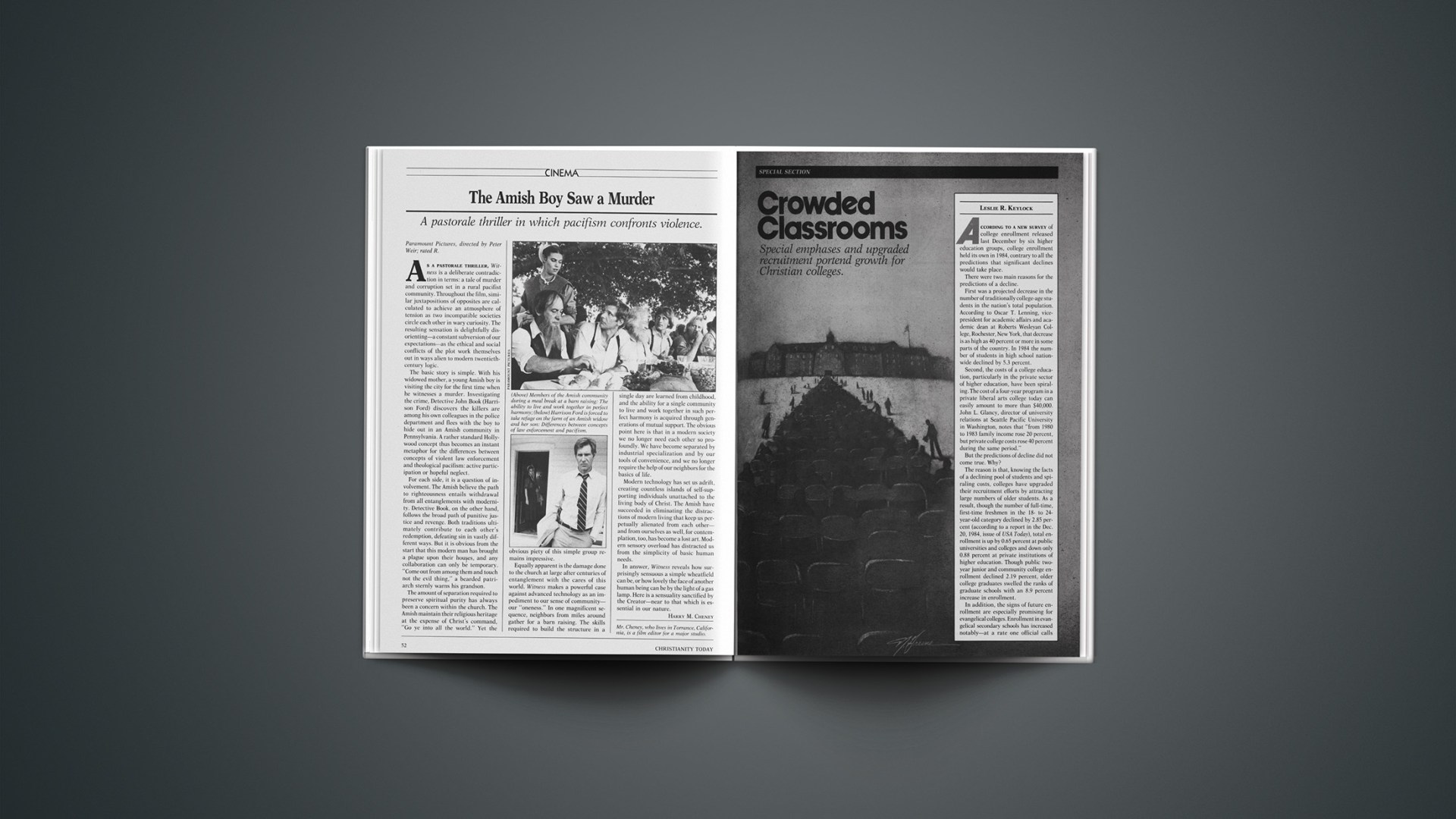
Crowded Classrooms

Special emphases and upgraded recruitment portend growth for Christian colleges.

Special emphases and upgraded recruitment portend growth for Christian colleges.

According to a new survey of college enrollment released last December by six higher education groups, college enrollment held its own in 1984, contrary to all the predictions that significant declines would take place.

There were two main reasons for the predictions of a decline.

First was a projected decrease in the number of traditionally college-age students in the nation’s total population. According to Oscar T. Lenning, vice-president for academic affairs and academic dean at Roberts Wesleyan College, Rochester, New York, that decrease is as high as 40 percent or more in some parts of the country. In 1984 the number of students in high school nationwide declined by 5.3 percent.

Second, the costs of a college education, particularly in the private sector of higher education, have been spiraling. The cost of a four-year program in a private liberal arts college today can easily amount to more than $40,000. John L. Glancy, director of university relations at Seattle Pacific University in Washington, notes that “from 1980 to 1983 family income rose 20 percent, but private college costs rose 40 percent during the same period.”

But the predictions of decline did not come true. Why?

The reason is that, knowing the facts of a declining pool of students and spiraling costs, colleges have upgraded their recruitment efforts by attracting large numbers of older students. As a result, though the number of full-time, first-time freshmen in the 18-to 24-year-old category declined by 2.85 percent (according to a report in the Dec. 20, 1984, issue of USA Today), total enrollment is up by 0.65 percent at public universities and colleges and down only 0.88 percent at private institutions of higher education. Though public two-year junior and community college enrollment declined 2.19 percent, older college graduates swelled the ranks of graduate schools with an 8.9 percent increase in enrollment.

In addition, the signs of future enrollment are especially promising for evangelical colleges. Enrollment in evangelical secondary schools has increased notably—at a rate one official calls “nothing short of phenomenal.”

It is still too soon to say what impact this increasing enrollment will have on future enrollments in evangelical Christian colleges, but all signs are that large numbers of those students will eventually enroll in Christian colleges, thus increasing their student pool.

The Christian College Today And Tomorrow

Ronald G. Johnson, who is vice-president of Malone College, Canton, Ohio, a Christian liberal arts college affiliated with the Evangelical Friends Church-Eastern Region, points out that the evangelical Christian college as we know it is a relatively recent development and largely an American phenomenon. “Many of today’s evangelical Christian colleges can trace their roots to the Bible college movement of late nineteenth-century America or to church or denominational academies,” he notes.

“It is true that many of the oldest private colleges and universities in this country were once Christian and even evangelical, but I would argue that both the circumstances of their founding and the later demise of their Christian emphasis place them in a different category from the evangelical Christian colleges of today,” Johnson says. Today’s evangelical colleges, by and large, have maintained close ties to their supporting denomination or other sponsoring evangelical bodies.

Johnson is also impressed by the numbers of graduates of Christian colleges who are now actively involved in the leadership of the burgeoning evangelical churches of the country. “When I look over the congregations of our churches and see Malone graduates, I am impressed. I once remember counting—during the time of meditation, not during the sermon!—those on the platform and in the choir of Canton First Friends Church who were Malone graduates, faculty, or staff. I was pleasantly surprised to find that more than two-thirds of the folks fell into one of those three categories.”

He sees the strength of evangelical Christian schools in four areas: smallness, mission, integrated instructional program, and an unusually dedicated faculty. Though smallness is not unique to the evangelical college, small classes and increased opportunities for student and faculty interrelationships are a distinct advantage. “For example,” Johnson says, “the chance of becoming a student leader on a campus of 500 is obviously much greater than on a campus of 50,000.”

Even Christians sometimes think that Christian higher education is biased and therefore inhibits freedom of inquiry. That is not so, according to Malone’s vice-president. “A secularist might argue that Christian higher education, with Christ at its center and its belief that all truth is God’s truth, is biased. The fallacy in this argument is that it fails to recognize that everyone, whether he realizes it or not, brings a bias to education. A secular humanist, a Communist, or an agnostic each interprets the world through a particular bias. In a Christian college a student will be introduced to both secular and orthodox Christian thought. It is then the function of students and professors to recognize the secular thought that is Christian and that which is not. In a secular system, essentially only secular thought is explored, and there is no outside reference point by which to evaluate the ideas.”

The buzz words of higher education for the eighties and nineties are “integration of curriculum,” “value added,” and “global awareness.” Because Christian colleges have been working for years to integrate Christian faith and the truth of the various disciplines, Johnson feels, “Christian higher education is in the lead and can show the way.”

Christian College Innovations

How distinctive are evangelical Christian colleges in the United States, and how are they facing the unique problems of the last decade-and-a-half of the twentieth century? The 67 members of the Christian College Coalition, an organization of leading evangelical Christian colleges and universities, were asked about the distinctives and futures of their institutions. Thirty-three academic deans, vice-presidents, or their designated representives replied. Their carefully nuanced answers reveal that the leadership of the evangelical college is in the hands of those whose Christian commitment and administrative expertise have melded in an ideal way.

Distinctives Of Some Leading Evangelical Colleges

The college deans listed a wide variety of distinctives. The following is not intended as a comprehensive catalog but as indication of the diversity among evangelical schools.

Robert Baptista, dean of Trinity College in the northern Chicago suburb of Deerfield, wrote, “My conviction is that you could interchange the college names in most current advertisements for Christian colleges and no one would ever know the difference. I will skip over the usual observations about Trinity College, therefore, and suggest what makes us different.”

One thing that makes Trinity College distinctive is its employment opportunities for students. “Our location in the affluent North Shore of Chicago offers abundant employment opportunities for Trinity students. Each year the students’ employment office receives over 3,500 requests for a wide variety of part-time employment opportunities. I know of no Christian college that has more work opportunities available to students in the surrounding neighborhood.”

Robert B. Fischer, provost and senior vice-president of Biola University, saw the uniqueness of his institution in its total program. “Each baccalaureate program includes a 30-unit program in biblical studies and theology, a general education program, and a major selected from the 24 that are offered. Fourteen master’s degree programs and five doctoral programs are provided. While each single feature of this university may be found in isolation or in some form elsewhere, Biola University is uniquely distinctive in that the entire campus and all of the students are enriched by the full resources of the baccalaureate and postbaccalaureate work of the four schools, the School of Arts, Sciences, and Professions, the School of Intercultural Studies and World Missions, the Rosemead School of Psychology, and the Talbot Theological Seminary and School of Theology.”

Jean B. Kim, academic dean of Eastern College, St. Davids, Pennsylvania, saw that school’s “open evangelicalism” as its distinctive characteristic. “Eastern College has in common with other evangelical schools a firm commitment to the lordship of Christ. We feel that we accept and encourage student and faculty diversity in the expression of this commitment, perhaps to a greater extent than some other evangelical colleges.” This openness is expressed in its doctrinal statement as well. Though all faculty members annually sign a doctrinal statement that includes belief that the Bible is “inspired of God and is of supreme and final authority in faith and life,” non-Baptist faculty members are not required to subscribe to the statement regarding the preference of water baptism.

One of the distinctives of North Park College, Chicago, Illinois, according to vice-president and dean Quentin D. Nelson, is that it “is one of very few evangelical colleges to be located in an urban center, thus being able to take advantage of the rich cultural and educational resources available for its curriculum, as well as abundant clinical sites for nursing, teaching, and other programs such as internships.”

John L. Glancy, director of university relations at Seattle Pacific University, singled out its size as one of its distinctives. “Seattle Pacific is one of the largest evangelical Christian colleges in America. Total undergraduate and graduate enrollment is 2,869. We serve over 18,000 students through the state per year in a continuing education program called SPIRAL, and our summer session is heavily promoted and well attended, with 1984 enrollment at 2,925, eclipsing enrollment for any one quarter during the regular academic year. Graduate and nongraduate degree seekers make up the majority of the students.”

In a day when many liberal arts colleges pride themselves on their refusal to succumb to the call of “vocationalism,” Stanley A. Clark, dean of academic affairs at Tabor College, Hillsboro, Kansas, is proud of the unique twist his institution has given to the question. “We offer a Christian liberal arts perspective on some decidedly vocational programs, such as agriculture, computer science, teacher education, social work, and business/accounting. We have also linked ourselves with top-quality study programs elsewhere, such as environmental biology through the AuSable Trails Institute in Michigan and the American Studies Program in Washington, D.C. Our cooperation with the six-member Associated Colleges of Central Kansas enables us to offer full majors in special education and computer science.”

One of the most interesting replies came from Oscar T. Lenning (vice-president for academic affairs and academic dean at Roberts Wesleyan College, Rochester, New York). During the first year of a new administration, Roberts Wesleyan obtained a large five-year grant from the federal government that allowed it to develop a unique learning center. Other unusual features of the school include a new VAX-750 central computer and sophisticated peripherals solely for instructional use that give the college a “state-of-the-art computing capability.” There is also a new general education program, six new academic majors, a market research capability, an increased donor research and public relations capability (that last spring resulted in an award for promotional excellence for the Council for the Advancement and Support of Education), and an innovative career planning and placement program that now includes an interactive computer information system. In addition, the team introduced a number of other creative pilot projects with the support of an enthusiastic faculty willing to make necessary changes.

As a result, the school has already seen enrollment increase from 600 to 700 students, despite the fact that it has tightened its admissions standards markedly.

Important Religious And Philosophical Beliefs

Several college deans spoke of the theological distinctiveness of their institutions. Don Grant, vice-president of academic affairs at Azusa (Calif.) Pacific University emphasized that “we are a distinctively Christian university, drawing from a rich heritage of Wesleyan, evangelical Christian commitment.

Zenas J. Bicket, academic dean of Evangel College, Springfield, Missouri, noted that the Assemblies of God college “provides a liberal arts education for mainstream Pentecostal youth.” Similarly, Southern California College, Costa Mesa, California, lists its Pentecostal emphasis as a distinctive. “The college is known for its commitment to evangelical theology and charismatic experience,” according to academic dean Lewis Wilson.

John N. Oswalt, president of Asbury College, Asbury, Kentucky, wrote, “Among those colleges that would emphasize Wesleyan-Arminian beliefs with an emphasis upon Christian holiness, Asbury is the only independent school. All others are denominationally affiliated.”

Richard C. Detweiler, president of Eastern Mennonite College and Seminary, Harrisonburg, Virginia, commented that “with roots that reach back into the 450-year-old Mennonite heritage, the college is responsible to the Mennonite church to provide a liberal arts education from an Anabaptist perspective.”

Martha Stout, director of public relations at Gordon College, Wenham, Massachusetts, noted that Gordon was founded as a missionary training institute with a particular burden for the Belgian Congo. Though she admits that the liberal arts college of today has expanded its mission, “Gordon has never lost its moorings; we remain globally aware.”

Problems Facing The Evangelical College In The Future

The academic leaders of these Christian colleges saw a number of problems facing the orthodox Christian institution of higher education in the remaining years of the present century.

John Oswalt of Asbury College commented, “On the one side are the pocketbook issues. Will evangelicals be willing and able to pay for the kind of education in which we have said for many years that we believed fervently? Or will our colleges become upper-middle class and lower-upper class finishing schools? A second issue is whether we will become captive to an upwardly mobile affluent segment of society and lose our capacity to speak to the needs of the age from a clearly biblical perspective. As a whole, evangelicalism today is becoming increasingly blurred on the issue of Scripture and scriptural ethics.”

Don Grant of Azusa Pacific University focused on the pressures to stray from the Christian college’s statement of mission and purpose, and either to cut quality for economic reasons or face the possibility of pricing itself out of existence.

Kenneth W. Shipps, dean of faculty at Barrington (R.I.) College, saw as the central problem “the lack of preparation for incoming students in writing, math, and scriptural understanding.”

Karl E. Keefer, vice-president of academic affairs at Bryan College in Dayton, Tennessee, saw the major issues as how to maintain commitment to an uncompromising allegiance to biblical standards of faith and life in the face of an increasingly secularized society, how to maintain a solid liberal arts curriculum in the face of the trend toward the tyranny of technology, and how to maintain enrollment in the face of demographic decline in the pool of available students.

Richard Gross, president of Gordon College, feels that “though strong colleges like Gordon, Calvin, Wheaton, and Westmont will endure, a number of smaller Christian colleges with declining enrollments will soon fall.” The challenge to the strong colleges, however, is whether they are going to be content with “merely holding abstract philosophic discussions within their academic enclaves,” or whether they will “risk taking public stands on a whole range of pressing social and ethical issues, thereby providing intellectual, moral, and spiritual leadership for our constituents and the larger church.”

A different problem was the focus of the remarks of David G. Ondercin, vice-president of academic affairs at Northwestern College in Roseville, Minnesota. “We need to be ever vigilant in the protection of our rights under the law from the encroachment of federal law and bureaucracy. As an institution we do not accept state or federal monies and therefore enjoy freedoms and benefits many other institutions may not.”

In a similar vein, John L. Glancy of Seattle Pacific University saw government regulations as a major issue facing the Christian school. “Currently we are involved in more than one legal challenge to our policy of reserving the right to hire Christian employees. Should these lawsuits that are being brought about by certain applicants rule in their favor, all Christian organizations, not only Christian colleges, would be affected by the ruling,” Glancy observed.

Oscar Lenning of Roberts Wesleyan College mentioned that though studies show that the liberal arts or general education graduate is more effective and more successful over time than the professionally trained graduate, job supervisors who do the hiring still seem primarily concerned with vocational preparation. “The issue is ‘How can we communicate effectively to companies and those supervisors the results of such studies that point out the shortsightedness of these hiring practices?’ ”

Stanley Clark of Tabor College noted another pressure. “A major issue facing us is competition with community colleges that forces us to consider the extent to which we, too, should become brokers of educational services rather than a legitimate liberal arts college.”

Quo Vadis?

Will these schools, which are representative of hundreds of other Christian colleges all over the nation, survive the challenges of the coming years? No one, of course, can say for certain.

If these leaders and their comrades in constructive administration at similar Christian colleges can continue to offer distinctive programs and creative teaching emphases, if they can keep their Christian convictions from being only on the doctrinal tablets of stone and instead buried deep within the hearts and minds of faculty members and students alike, the Christian college should continue to make a major and increasing impact on American life.

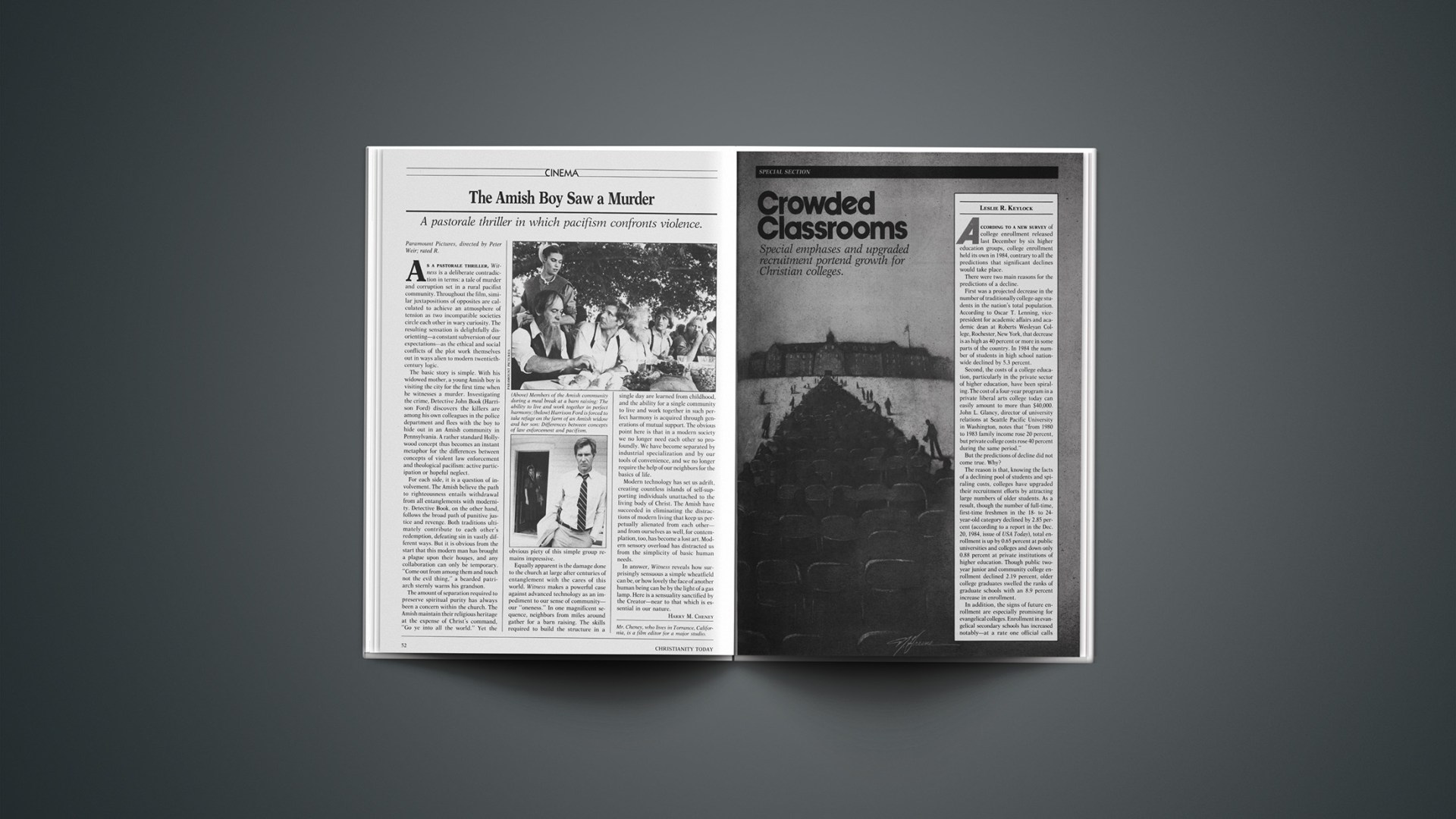
The Amish Boy Saw a Murder

A pastorale thriller in which pacifism confronts violence.

Paramount Pictures, directed by Peter Weir; rated R.

As a pastorale thriller, Witness is a deliberate contradiction in terms: a tale of murder and corruption set in a rural pacifist community. Throughout the film, similar juxtapositions of opposites are calculated to achieve an atmosphere of tension as two incompatible societies circle each other in wary curiosity. The resulting sensation is delightfully disorienting—a constant subversion of our expectations—as the ethical and social conflicts of the plot work themselves out in ways alien to modern twentieth-century logic.

The basic story is simple. With his widowed mother, a young Amish boy is visiting the city for the first time when he witnesses a murder. Investigating the crime, Detective John Book (Harrison Ford) discovers the killers are among his own colleagues in the police department and flees with the boy to hide out in an Amish community in Pennsylvania. A rather standard Hollywood concept thus becomes an instant metaphor for the differences between concepts of violent law enforcement and theological pacifism: active participation or hopeful neglect.

For each side, it is a question of involvement. The Amish believe the path to righteousness entails withdrawal from all entanglements with modernity. Detective Book, on the other hand, follows the broad path of punitive justice and revenge. Both traditions ultimately contribute to each other’s redemption, defeating sin in vastly different ways. But it is obvious from the start that this modern man has brought a plague upon their houses, and any collaboration can only be temporary. “Come out from among them and touch not the evil thing,” a bearded patriarch sternly warns his grandson.

The amount of separation required to preserve spiritual purity has always been a concern within the church. The Amish maintain their religious heritage at the expense of Christ’s command, “Go ye into all the world.” Yet the obvious piety of this simple group remains impressive.

Equally apparent is the damage done to the church at large after centuries of entanglement with the cares of this world. Witness makes a powerful case against advanced technology as an impediment to our sense of community—our “oneness.” In one magnificent sequence, neighbors from miles around gather for a barn raising. The skills required to build the structure in a single day are learned from childhood, and the ability for a single community to live and work together in such perfect harmony is acquired through generations of mutual support. The obvious point here is that in a modern society we no longer need each other so profoundly. We have become separated by industrial specialization and by our tools of convenience, and we no longer require the help of our neighbors for the basics of life.

Modern technology has set us adrift, creating countless islands of self-supporting individuals unattached to the living body of Christ. The Amish have succeeded in eliminating the distractions of modern living that keep us perpetually alienated from each other—and from ourselves as well, for contemplation, too, has become a lost art. Modern sensory overload has distracted us from the simplicity of basic human needs.

In answer, Witness reveals how surprisingly sensuous a simple wheatfield can be, or how lovely the face of another human being can be by the light of a gas lamp. Here is a sensuality sanctified by the Creator—near to that which is essential in our nature.

1 Mr. Cheney, who lives in Torrance, California, is a film editor for a major studio.

Apple PodcastsDown ArrowDown ArrowDown Arrowarrow_left_altLeft ArrowLeft ArrowRight ArrowRight ArrowRight Arrowarrow_up_altUp ArrowUp ArrowAvailable at Amazoncaret-downCloseCloseEmailEmailExpandExpandExternalExternalFacebookfacebook-squareGiftGiftGooglegoogleGoogle KeephamburgerInstagraminstagram-squareLinkLinklinkedin-squareListenListenListenChristianity TodayCT Creative Studio Logologo_orgMegaphoneMenuMenupausePinterestPlayPlayPocketPodcastRSSRSSSaveSaveSaveSearchSearchsearchSpotifyStitcherTelegramTable of ContentsTable of Contentstwitter-squareWhatsAppXYouTubeYouTube