The Bible Controversy in American Catholicism

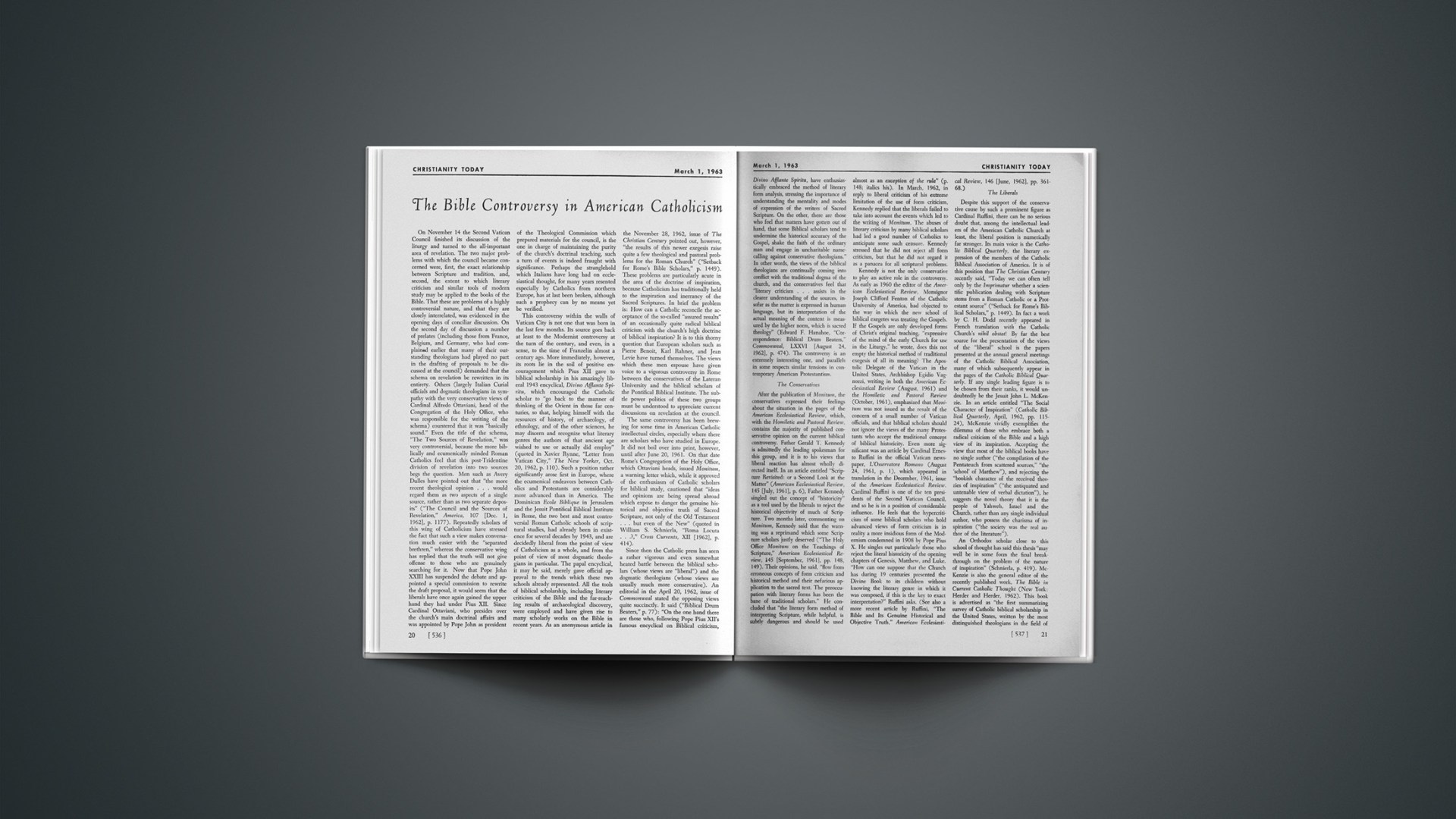
On November 14 the Second Vatican Council finished its discussion of the liturgy and turned to the all-important area of revelation. The two major problems with which the council became concerned were, first, the exact relationship between Scripture and tradition, and, second, the extent to which literary criticism and similar tools of modern study may be applied to the books of the Bible. That these are problems of a highly controversial nature, and that they are closely interrelated, was evidenced in the opening days of conciliar discussion. On the second day of discussion a number of prelates (including those from France, Belgium, and Germany, who had complained earlier that many of their outstanding theologians had played no part in the drafting of proposals to be discussed at the council) demanded that the schema on revelation be rewritten in its entirety. Others (largely Italian Curial officials and dogmatic theologians in sympathy with the very conservative views of Cardinal Alfredo Ottaviani, head of the Congregation of the Holy Office, who was responsible for the writing of the schema) countered that it was “basically sound.” Even the title of the schema, “The Two Sources of Revelation,” was very controversial, because the more biblically and ecumenically minded Roman Catholics feel that this post-Tridentine division of revelation into two sources begs the question. Men such as Avery Dulles have pointed out that “the more recent theological opinion … would regard them as two aspects of a single source, rather than as two separate deposits” (“The Council and the Sources of Revelation,” America, 107 [Dec. 1, 1962], p. 1177). Repeatedly scholars of this wing of Catholicism have stressed the fact that such a view makes conversation much easier with the “separated brethren,” whereas the conservative wing has replied that the truth will not give offense to those who are genuinely searching for it. Now that Pope John XXIII has suspended the debate and appointed a special commission to rewrite the draft proposal, it would seem that the liberals have once again gained the upper hand they had under Pius XII. Since Cardinal Ottaviani, who presides over the church’s main doctrinal affairs and was appointed by Pope John as president of the Theological Commission which prepared materials for the council, is the one in charge of maintaining the purity of the church’s doctrinal teaching, such a turn of events is indeed fraught with significance. Perhaps the stranglehold which Italians have long had on ecclesiastical thought, for many years resented especially by Catholics from northern Europe, has at last been broken, although such a prophecy can by no means yet be verified.

This controversy within the walls of Vatican City is not one that was born in the last few months. Its source goes back at least to the Modernist controversy at the turn of the century, and even, in a sense, to the time of Franzelin almost a century ago. More immediately, however, its roots lie in the soil of positive encouragement which Pius XII gave to biblical scholarship in his amazingly liberal 1943 encyclical, Divino Afflante Spiritu, which encouraged the Catholic scholar to “go back to the manner of thinking of the Orient in those far centuries, so that, helping himself with the resources of history, of archaeology, of ethnology, and of the other sciences, he may discern and recognize what literary genres the authors of that ancient age wished to use or actually did employ” (quoted in Xavier Rynne, “Letter from Vatican City,” The New Yorker, Oct. 20, 1962, p. 110). Such a position rather significantly arose first in Europe, where the ecumenical endeavors between Catholics and Protestants are considerably more advanced than in America. The Dominican Ecole Biblique in Jerusalem and the Jesuit Pontifical Biblical Institute in Rome, the two best and most controversial Roman Catholic schools of scriptural studies, had already been in existence for several decades by 1943, and are decidedly liberal from the point of view of Catholicism as a whole, and from the point of view of most dogmatic theologians in particular. The papal encyclical, it may be said, merely gave official approval to the trends which these two schools already represented. All the tools of biblical scholarship, including literary criticism of the Bible and the far-reaching results of archaeological discovery, were employed and have given rise to many scholarly works on the Bible in recent years. As an anonymous article in the November 28, 1962, issue of The Christian Century pointed out, however, “the results of this newer exegesis raise quite a few theological and pastoral problems for the Roman Church” (“Setback for Rome’s Bible Scholars,” p. 1449). These problems are particularly acute in the area of the doctrine of inspiration, because Catholicism has traditionally held to the inspiration and inerrancy of the Sacred Scriptures. In brief the problem is: How can a Catholic reconcile the acceptance of the so-called “assured results” of an occasionally quite radical biblical criticism with the church’s high doctrine of biblical inspiration? It is to this thorny question that European scholars such as Pierre Benoit, Karl Rahner, and Jean Levie have turned themselves. The views which these men espouse have given voice to a vigorous controversy in Rome between the conservatives of the Lateran University and the biblical scholars of the Pontifical Biblical Institute. The subtle power politics of these two groups must be understood to appreciate current discussions on revelation at the council.

The same controversy has been brewing for some time in American Catholic intellectual circles, especially where there are scholars who have studied in Europe. It did not boil over into print, however, until after June 20, 1961. On that date Rome’s Congregation of the Holy Office, which Ottaviani heads, issued Monitum, a warning letter which, while it approved of the enthusiasm of Catholic scholars for biblical study, cautioned that “ideas and opinions are being spread abroad which expose to danger the genuine historical and objective truth of Sacred Scripture, not only of the Old Testament … but even of the New” (quoted in William S. Schnierla, “Roma Locuta …?,” Cross Currents, XII [1962], p. 414).

Since then the Catholic press has seen a rather vigorous and even somewhat heated battle between the biblical scholars (whose views are “liberal”) and the dogmatic theologians (whose views are usually much more conservative). An editorial in the April 20, 1962, issue of Commonweal stated the opposing views quite succinctly. It said (“Biblical Drum Beaters,” p. 77): “On the one hand there are those who, following Pope Pius XII’s famous encyclical on Biblical criticism, Divino Afflante Spiritu, have enthusiastically embraced the method of literary form analysis, stressing the importance of understanding the mentality and modes of expression of the writers of Sacred Scripture. On the other, there are those who feel that matters have gotten out of hand, that some Biblical scholars tend to undermine the historical accuracy of the Gospel, shake the faith of the ordinary man and engage in uncharitable name-calling against conservative theologians.” In other words, the views of the biblical theologians are continually coming into conflict with the traditional dogma of the church, and the conservatives feel that “literary criticism … assists in the clearer understanding of the sources, insofar as the matter is expressed in human language, but its interpretation of the actual meaning of the content is measured by the higher norm, which is sacred theology” (Edward F. Hanahoe, “Correspondence: Biblical Drum Beaters,” Commonweal, LXXVI [August 24, 1962], p. 474). The controversy is an extremely interesting one, and parallels in some respects similar tensions in contemporary American Protestantism.

The Conservatives

After the publication of Monitum, the conservatives expressed their feelings about the situation in the pages of the American Ecclesiastical Review, which, with the Homiletic and Pastoral Review, contains the majority of published conservative opinion on the current biblical controversy. Father Gerald T. Kennedy is admittedly the leading spokesman for this group, and it is to his views that liberal reaction has almost wholly directed itself. In an article entitled “Scripture Revisited: or a Second Look at the Matter” (American Ecclesiastical Review, 145 [July, 1961], p. 6), Father Kennedy singled out the concept of “historicity” as a tool used by the liberals to reject the historical objectivity of much of Scripture. Two months later, commenting on Monitum, Kennedy said that the warning was a reprimand which some Scripture scholars justly deserved (“The Holy Office Monitum on the Teachings of Scripture,” American Ecclesiastical Review, 145 [September, 1961], pp. 148, 149). Their opinions, he said, “flow from erroneous concepts of form criticism and historical method and their nefarious application to the sacred text. The preoccupation with literary forms has been the bane of traditional scholars.” He concluded that “the literary form method of interpreting Scripture, while helpful, is subtly dangerous and should be used almost as an exception of the rule” (p. 148; italics his). In March, 1962, in reply to liberal criticism of his extreme limitation of the use of form criticism, Kennedy replied that the liberals failed to take into account the events which led to the writing of Monitum. The abuses of literary criticism by many biblical scholars had led a good number of Catholics to anticipate some such censure. Kennedy stressed that he did not reject all form criticism, but that he did not regard it as a panacea for all scriptural problems.

Kennedy is not the only conservative to play an active role in the controversy. As early as 1960 the editor of the American Ecclesiastical Review, Monsignor Joseph Clifford Fenton of the Catholic University of America, had objected to the way in which the new school of biblical exegetes was treating the Gospels. If the Gospels are only developed forms of Christ’s original teaching, “expressive of the mind of the early Church for use in the Liturgy,” he wrote, does this not empty the historical method of traditional exegesis of all its meaning? The Apostolic Delegate of the Vatican in the United States, Archbishop Egidio Vagnozzi, writing in both the American Ecclesiastical Review (August, 1961) and the Homiletic and Pastoral Review (October, 1961), emphasized that Monitum was not issued as the result of the concern of a small number of Vatican officials, and that biblical scholars should not ignore the views of the many Protestants who accept the traditional concept of biblical historicity. Even more significant was an article by Cardinal Ernesto Ruffini in the official Vatican newspaper, L’Osservatore Romano (August 24, 1961, p. 1), which appeared in translation in the December, 1961, issue of the American Ecclesiastical Review. Cardinal Ruffini is one of the ten presidents of the Second Vatican Council, and so he is in a position of considerable influence. He feels that the hypercriticism of some biblical scholars who hold advanced views of form criticism is in reality a more insidious form of the Modernism condemned in 1908 by Pope Pius X. He singles out particularly those who reject the literal historicity of the opening chapters of Genesis, Matthew, and Luke. “How can one suppose that the Church has during 19 centuries presented the Divine Book to its children without knowing the literary genre in which it was composed, if this is the key to exact interpretation?” Ruffini asks. (See also a more recent article by Ruffini, “The Bible and Its Genuine Historical and Objective Truth,” American Ecclesiastical Review, 146 [June, 1962], pp. 361–68.)

The Liberals

Despite this support of the conservative cause by such a prominent figure as Cardinal Ruffini, there can be no serious doubt that, among the intellectual leaders of the American Catholic Church at least, the liberal position is numerically far stronger. Its main voice is the Catholic Biblical Quarterly, the literary expression of the members of the Catholic Biblical Association of America. It is of this position that The Christian Century recently said, “Today we can often tell only by the Imprimatur whether a scientific publication dealing with Scripture stems from a Roman Catholic or a Protestant source” (“Setback for Rome’s Biblical Scholars,” p. 1449). In fact a work by C. H. Dodd recently appeared in French translation with the Catholic Church’s nihil obstat! By far the best source for the presentation of the views of the “liberal” school is the papers presented at the annual general meetings of the Catholic Biblical Association, many of which subsequently appear in the pages of the Catholic Biblical Quarterly. If any single leading figure is to be chosen from their ranks, it would undoubtedly be the Jesuit John L. McKenzie. In an article entitled “The Social Character of Inspiration” (Catholic Biblical Quarterly, April, 1962, pp. 115–24), McKenzie vividly exemplifies the dilemma of those who embrace both a radical criticism of the Bible and a high view of its inspiration. Accepting the view that most of the biblical books have no single author (“the compilation of the Pentateuch from scattered sources,” “the ‘school’ of Matthew”), and rejecting the “bookish character of the received theories of inspiration” (“the antiquated and untenable view of verbal dictation”), he suggests the novel theory that it is the people of Yahweh, Israel and the Church, rather than any single individual author, who possess the charisma of inspiration (“the society was the real author of the literature”).

An Orthodox scholar close to this school of thought has said this thesis “may well be in some form the final breakthrough on the problem of the nature of inspiration” (Schnierla, p. 419). McKenzie is also the general editor of the recently published work, The Bible in Current Catholic Thought (New York: Herder and Herder. 1962). This book is advertised as “the first summarizing survey of Catholic biblical scholarship in the United States, written by the most distinguished theologians in the field of Scripture studies.” It is undoubtedly the most important work for an understanding of the contemporary views of at least the more biblical segment of Catholic thought. Xavier Rynne has pointed out the significance of the fact that McKenzie failed to receive a call to Rome for the purpose of preparing the council agenda, although some 800 men from all over the world including many lesser lights were included (Rynne, p. 102).

There are several men in the ranks of the Catholic Biblical Association, however, who promise to be rivals for McKenzie’s position of intellectual leadership; the most we can do here is to select those we feel to have made the most significant contribution to the controversy and to biblical scholarship thus far. No one else has done as thorough a job of giving a carefully reasoned response to the conservative views of Gerald T. Kennedy as has Patrick W. Skehan. Skehan has attempted to show that Kennedy’s understanding of the Holy Office’s Monitum cannot be reconciled with the express statements of Divino Afflante Spiritu (“Why Leave Out Judith?,” Catholic Biblical Quarterly, XXIV [April, 1962], pp. 147–54). David M. Stanley is a leading Catholic exponent of the form criticism of the New Testament. A summary of his paper “The Genres Littéraires of the Gospels,” presented at the 1961 CBAA meeting at Mount Saint Mary’s Seminary of the West, in Norwood, Ohio, gives his conclusion that “to decry the study of literary forms in Gospel matters amounts to a refusal to discover what God is saying to man” (Catholic Biblical Quarterly, XXIII [October, 1961], p. 477). The two scholars we shall mention next are both members of the editorial board of the projected two-volume Jerome Bible Commentary. The general editor of this work is Raymond E. Brown, whose specialty is the Gospel of John. In a recent article, he concludes that John’s theological presuppositions prevent us from reading his Gospel as mere history. His Old Testament editor is the well-known editor of the Catholic Biblical Quarterly, Roland E. Murphy. Finally we should not omit the former book review editor of this quarterly, F. Bruce Vawter, who recently authored a significant work on the Old Testament prophetical books. In a paper entitled “The Historical Theology of the Gospels” Vawter made the by-now familiar distinction between objective history and “Salvation History.” He emphasized the importance, in studying the Gospels, of differentiating between the historic element (the verifiable fact) and the historical element (the same fact as a meaningful event with saving consequences for man) (reported in the Catholic Biblical Quarterly, XXIII [October, 1961], p. 466). And a few weeks earlier, in the Catholic weekly America, Vawter criticized quite strongly those Catholic newspapers and journals which suggested that Monitum was an overt censure of Catholic biblical scholars (“The Wayward Press,” August 5, 1961, pp. 591, 592).

What significance does this controversy have for Protestants? There can be little doubt that it has proved the longstanding claim of Protestants that the statements of Scripture often bear little resemblance to the dogma of the Roman church. The biblical movement in Catholicism has, however, taken a turn to the left which evangelical scholars can only regret, although the Catholic doctrine of inspiration does temper extremes of critical thought. On the other hand, conservative Protestantism certainly has little kinship with conservative Catholic dogmatic theology. The evangelical by and large does not have the same propensity to preserve the status quo in systematic theology because he takes the sola Scriptura principle seriously. We do not have a traditional dogmatic theology that may not be altered by a more profound study of the Bible. Far more significant is the fact that liberal Catholicism represents a living challenge to our usual assumption that belief in a high view of inspiration is automatic protection against the acceptance of a kind of literary criticism we now reject. Liberal Catholicism also forces us to ask ourselves to what extent we as evangelicals can utilize the insights of form criticism and salvation history, and still be consistently biblical in our concept of inspiration. Our main qualm—one which much biblical scholarship certainly serves to substantiate—is that both liberal Catholics and liberal Protestants so stress the human aspect of Scripture that its divine inspiration is relegated to a position of insignificance. Just as in our doctrine of the Person of Jesus Christ, so in our doctrine of the inspiration of Scripture we desperately need to have a full understanding of the human element and a profound understanding of the divine element. Divino Afflante Spiritu has given rise to two extremes within the Catholic Church, neither of which we as conservative Protestants feel does full justice to the grandeur of the Sacred Book.

LESLIE R. KEYLOCK

Research Assistant in Religion

State University of Iowa

Iowa City, Iowa

Eutychus and His Kin: March 1, 1963

Fasteners

New fasteners have not yet made buttons obsolescent. Even zippers have not closed the gap in the clothing field, and the cocklebur strips favored by some pajama manufacturers have a disadvantage which is apparent to the man who must peel his pajamas off his chest in the morning. Buttons have hung on because they can’t jam and they don’t interlock with your skin.

But the day is coming when only space capsules will be buttoned up, and it will be necessary to play “Button, button, who’s got the button?” with discarded push-buttons.

We won’t lose our buttons, however, until technology has devised a better solution to the fastening problem. We don’t hear so much about the field of articulation, or ligation (or whatever term is used by big joiners), but no doubt the drawing boards have revolutionary new fasteners ready to clinch us.

Fastening is a problem in the Church, too. Jesus warned of the problem of sewing new patches on old wineskins. Not every fastener will serve ecclesiastical connection, and there are junctions it is folly to attempt. Zerubbabel’s reply to a historic merger offer was, “Ye have nothing to do with us in building a house unto our God” (Ezra 4:3).

Church fasteners are not buttons or zippers. Neither are they burrs! The New Testament rather speaks of supporting ligaments in the body of Christ, which receive their strength from the Head (Eph. 4:16). The tie that binds is living and spiritual: the unity of the Church is the work of the Holy Spirit. But the Spirit moves real people to real actions. Church fastening can’t be accomplished with handcuffs, but handclasps serve the purpose, and they are fully as visible.

For the most of my life I have suffered from a torn knee ligament. When the injury is at its painful worst it is no great comfort to be assured that my leg is still part of my body.

The unity of the Church must be functioning unity, and that calls for healed ligaments. Healing is Christ’s work, and we are his members—ligaments in particular.

Ministers For Ministers

I commend you for the excellent issue dated January 18.… I appreciated your articles entitled: “Who is Ministering to Ministers?” by George C. Anderson and “The Church and Psychiatry” by Johannes D. Plekker. I say God bless you for taking the lead in giving the truth about this important part psychology has in the religion and the church of today.

Palm Harbor Methodist Church

Palm Harbor, Fla.

May I say “It’s about time”? It’s about time we took a realistic look at the spiritual needs of pastors. What greater area of need is there, really, than that of feeding those who spend their time and effort and lives in feeding others? The engine of a train may do the work of pulling a hundred people or cars, but without fuel, not only does the engine not move, neither do the people and cars that depend on the engine to get them to their destination.…

I have long felt the need for a man to whom I might go when buffeted by the wiles of Satan and the flesh. How wonderful it would be to know that such a one would pay me occasional visits and help and advise me in my personal and family needs! Some of the most miserable home conditions I have ever encountered have been in evangelical, fundamental, Bible preachers’ homes! They need help! And fast!…

Community Church

Cumming, Iowa

Since the minister really has “nobody to turn to” in those darker moments Brother Anderson writes about (really the minister has no time at his disposal for worship!), why not a “church for the minister”? A group of ministers in a town or a city … could come together, hire their own minister, and learn together through a “worship service” of their own.…

In the larger cities, it would probably have to be a denominational thing. The smaller communities could band together in a true inter-denominational gathering.

Warrenton, Va.

As one who has been involved in the Church all my adult life, I am aware that the minister has many difficult problems and I have always tried to be sympathetic. On the other hand, there are standards for the minister, and I think a man in the ministry who is unwilling to accept them had better find some other field.

… We must face the problems which are ours and solve them. No one else can solve them for us.

President Emeritus

Pikeville College

Pikeville, Ky.

“Who is Ministering to Ministers?” … alerted my mind to a significant by-product of the Larger (or Cooperative) Parish Plan.

Designed originally to provide a more adequate ministry to the small congregations of a given area, the multi-staffed Parish also affords opportunity for ministers to minister to each other in significant ways.

Coordinator

The Jo Daviess Cooperative Parish

Scales Mound, Ill.

The Inn Is Out

In demythologizing Christmas, has Pastor Peterson (Eutychus, Dec. 21 issue) taken a good long look at Luke 2:8, “in the inn”? The word, “kataluma,” is interesting, especially since it is found again in Luke 22:11 in reference to the upper room.

All tradition notwithstanding, I’m afraid that the story of a heartless innkeeper is knocked into a cocked hat. Since that was the city of their fathers, is it too far-fetched to believe that Joseph and Mary stayed at the humble abode of some relative, where a sleeping place was provided for them in a lean-to stable? This is the theory of Lenski. To me this robs the miraculous birth of nothing, but makes it more homey still.…

Good Shepherd Lutheran Church

Sioux Falls, S. Dak.

Shock Envisioned

It will no doubt come as something of a shock to John Vanden Berg (Eutychus, Dec. 21 issue) to learn that there are any number of American citizens who do not care to pay taxes for the particular kind of religious instruction he favors in a school system. Mr. Vanden Berg fails to recognize that what impresses him as being sound, godly instruction and deserving of tax support does not impress millions of others in the same way at all. In a country of pluralistic faith like this one, it is obviously much sounder procedure to have religious instruction of a particular kind supported by those who believe in it. I myself am a Protestant minister but would object to paying taxes for Mr. Vanden Berg’s school.

I note that Mr. Vanden Berg is an official in Citizens for Educational Freedom. I wonder whether the disclosure that the literature for this group is being anonymously written by Jesuits will make any difference to him?

Associate Director

Protestants and Other Americans United

Washington, D. C.

Note The Quote

Under your main heading “Worth Noting” you have a subheading, “Worth Quoting” (News, Dec. 21 issue), and you have a quotation there which appears to be attributed to me.… What you are quoting is actually a quotation which I used from Dr. Margaret Mead. She said those words in an address … at the Triennial Meeting of the Women of the Episcopal Church in Detroit, September, 1961. It has been published by the Episcopal Church under the title, “Women’s Role in Today’s World.”

I think you probably got this from a press release [issued by the WCC—ED.] on a speech which I was said to have delivered at the D.F.M. Assembly at Buck Hill Falls. The whole press release was misleading, for it was based not on my speech but on a paper which I wrote some months before.…

I am sure you will understand that I felt I ought to draw your attention to this and give Margaret Mead the honor due to her!

Div. of World Mission and Evangelism

World Council of Churches

New York, N. Y.

T. S. Eliot And The Manger

The devotees of Mr. T. S. Eliot form not so much a company of the admiring as a cult of the worshipful. It is not surprising, then, to read in your December 7 issue a wholly uncritical commentary on Mr. Eliot’s “Journey of the Magi.” Nor do I imagine that any lay reader’s questioning the merit of the poem is likely to provoke more than further raising of the eyebrows among the cultists; but I cannot resist asking one question, nonetheless, about the poem and about Mr. D. Bruce Lockerbie’s scholia upon it.

The question is this: Do other readers stumble with me at finding the climax of the Magian journey expressed by the rhetorical device of understatement? One treads all the bitter miles as the poet imagines them, diluting the pain in anticipation, only to find at road’s end a neat little self-conscious writer’s trick, so transparently theatric, indeed, as to evoke from Mr. Lockerbie the heady accolade “understatement of all time”; but likely, I should suppose, to impress non-cultists as at least grotesque, if not skirting the blasphemous.

John Calvin remarks that “the heavenly Father chose to appoint the star and the Maji as our guides, to lead directly to his Son.” But Mr. Eliot’s “sophisticated amplification of the familiar Bible story” (this interpretation is Mr. Lockerbie’s) ignores the star altogether, blots out the “exceeding great joy” of the Wise Men (Mr. Lockerbie finds, without visible pain, that this is simply the “one respect” in which “Eliot differs from the story in Matthew’s account”), and finally leads us directly—not to “his Son”—but to a writer’s gambit, timeworn long before the Babe was born.

Like charity, poetic license covers a multitude of sins, and one should not begrudge the poet the full range of his opportunities under so broad a dispensation, but the “Journey of the Magi” suggests to me that the literary world might find better guides to the Manger and its meaning than Mr. T. S. Eliot—and not in this instance only.

Director of the Library

Calvin College and Seminary

Grand Rapids, Mich.

After Laughter, Nears Tears

I couldn’t help laughing—and then I almost cried—when I read the news item “Offense of the Cross” (Dec. 7 issue). Imagine the Post Office Department issuing a special Christmas stamp, but rejecting a design for the same because it “suggested a cross.” They could observe a religious holiday, but could not exhibit a religious symbol! Do you suppose the department has not learned the meaning of Christmas? Or perhaps Christ has been thoroughly enough eradicated from Christmas that it is now a wholly secular “holiday,” free from religious contamination, and safe for our nation to recognize.

Ryegate, Mont.

Art as Incarnation

In a time when the menace of the years is forcing many into an undue emphasis on the sciences, it is well to remind ourselves of the tremendously important place of the creative arts in our total culture. Of course science is also creative. At its best it is man thinking God’s thoughts after him. Science is a way of discovering and expressing the truth about the physical universe in exact formulas, while the arts are ever seeking to express the beauty of truth in enduring forms.

All significant art is an attempt to give form to the chaotic, disorganized elements of experience, and to give a measure of permanence to the evanescent, the fleeting elements of experience. It is the God-like, creative energy of man, shaping a lump of clay and blowing the breath of life into it; turning water to wine; making of things that are seen a glory that never was on land or sea.

Art, like science, is a many-mansioned realm. Although this discussion is based primarily on the verbal arts, it is relevant to the others also, since all the arts are interrelated. The plastic arts exist in space, the musical arts in time, and the verbal arts unite both spheres. We need to remember what we are often tempted to forget, that the verbal or literary arts, like those more obviously sensuous, must appeal to the senses. The Idea must be expressed in words, in concrete terms. The Word must become flesh. This sounds almost self-evident. But how is this done, and what does this mean for the Christian artist? What is his task?

There are for him basically three areas of responsibility.

Responsibility To The Faith

The Christian artist has first a responsibility to his faith. All great art springs out of an inner vision. It is prompted either by a mighty faith or by a deep despair. It arises either from Carlyle’s Everlasting Yea or from his Everlasting No. It can never be the product of indifference. It may grow out of tormenting doubt, but never out of a glib and thoughtless credo. For the Christian, certainly, a glowing and triumphant faith will be his finest inspiration. But doubt, genuine doubt, agony of soul, may also be creative, as in the mighty drama of Job.

It is hardly necessary to point out that the Christian faith has been the fountainhead of the great stream of Western art in all its forms: architecture, sculpture, painting, music, poetry, drama, fiction. To call the roll of Christian artists in all these fields is virtually to call the roll of the greatest artists, men animated by the Incarnation, the central concept of the Christian faith, moved by the Crucifixion, and inspired by the Resurrection.

Dante, in creating his medieval cathedral of song, and later the supreme artists of the Renaissance—Palestrina in music, Michael Angelo in sculpture, Leonardo da Vinci in painting—all worked within the frame of the Roman Catholic faith. With the Reformation came a loosening of dogma and the flowering of a variety of credos, and with this breakdown of the basic unity there grew up a diversity of beliefs, a diversity that brought many values but which contained dangers also.

To some, the Reformation brought a more dynamic, a more real faith, gripping heart and mind. Simply to review the chief names in English literature is to feel the force of the Christian faith in the shaping of great poetry. Spenser’s The Faerie Queene, that massive, complex, and lovely allegory, is informed throughout by Christian thought. And though his greater contemporary, Shakespeare, is not so specific, most of Shakespeare’s serious works are built on the foundation of the Christian view of man’s nature and destiny and of the moral order to which man is responsible.

Beginning in the Elizabethan period, but writing chiefly in the early years of the seventeenth century, there was a group of poets we call the Metaphysical School, and of these one of the most influential in his own time and now in ours was John Donne, Dean of St. Paul’s Cathedral in London. We can still read many of his sermons, but he is now more famous as a poet. One of the most moving of his religious poems is “Good Friday: 1613 Riding Westward.” Within the imagery, within the startling conceits and paradoxes, the deeply felt emotion is conveyed, is incarnate.

Hence is’t that I am carried towards the West

This day, when my soul’s form bends towards the East.

There I should see a Sun, by rising set,

And by that setting endless day beget;

But that Christ on this cross did rise and fall,

Sin had eternally benighted all.

Yet dare I almost be glad I do not see

That spectacle of too much weight for me.

Who sees God’s face, that is self life, must die:

What a death were it then to see God die?

It made His own lieutenant Nature shrink,

It made His footstool crack and the sun wink.

Could I behold those hands which span the Poles,

And tune all spheres at once, pierc’d with those holes?

Could I behold that endless height which is

Zenith to us, and our Antipodes,

The seat of all our souls, if not of His

Made dirt of dust, or that flesh which was worn

By God, for His apparel, ragg’d and torn?

The passionate meditation on the mystery of our Lord’s suffering and humiliation turns into a passionate appeal to Him:

O Saviour, as Thou hang’st upon the tree,

I turn my back to Thee, but to receive

Corrections, till Thy mercies bid Thee leave.

O think me worth Thine anger, punish me,

Burn off my rusts and my deformity;

Restore Thine image so much, by Thy grace,

That Thou may’st know me, and I’ll turn my face.

No one can question the love and gratitude, the awe and adoration out of which the poem arose. The crucifixion of our Lord was to John Donne no theological proposition merely. It was an awesome reality fixed as it were forever against the sky, forcing the most stubborn sinner to his knees.

Along with the voice of Donne we can still hear the voices of Richard Crashaw, and Henry Vaughan, and George Herbert. But a little later, Milton, that great organ-voice of England, arose, alone of Protestant poets worthy to match Dante. John Milton was the most learned poet in all English literature, and he ransacked all the realms of human knowledge to compose his epic on the fall and redemption of man.

In the nineteenth century Wordsworth, Tennyson, and Browning, the greatest poets of the century, arose to bear their witness. In this country during the same period the chief names, aside from Whitman and Emerson, were those of Christian poets—Longfellow, Lowell, Holmes, Whittier, Lanier.

And so even in this our own time the most influential poet is a Christian, T. S. Eliot.

In fiction, too, some of the greatest works are by men of faith. Of these there is none greater than the work of Dostoievski, the Shakespeare of the novel, who in like manner has explored the deepest recesses of the human soul. To gain some idea of the depth and power in the works of this man, particularly in The Brothers Karamazov, it would be well to read a little book about him by the very significant Russian philosopher, Nicholas Berdyaev. In his foreword, this great Christian thinker says of the novelist:

Dostoievski has played a decisive part in my spiritual life. While I was still a youth a slip from him, so to say, was grafted upon me. He stirred and lifted my soul more than any other writer or philosopher has done.… The Legend of the Grand Inquisitor, in particular, made such an impression on my young mind that when I turned to Jesus Christ for the first time I saw him under the appearance that he bears in the Legend.

This tribute by the philosopher Berdyaev is powerful evidence of the profound insights that can be communicated within the art of the novelist. And there could be no clearer demonstration of the creative power of faith, for Dostoievski said of his own experience, “It was not as a child that I learnt to believe in Christ and confess his faith. My Hosanna burst forth from a huge furnace of doubt.” Russia has never raised up a more truly prophetic voice. He foresaw what was coming in the triumph of atheistic materialism in the land he loved, and its implications for the world. How different might be conditions in our time had the Russian people and the Russian intelligentsia given heed to that voice instead of to the deceptive fallacies of Karl Marx.

Thus there is laid upon the Christian artist this first responsibility to ground deeply his knowledge of human life in the divine revelation about man and his relation to God. An insecure and timid faith, or a naïve and unquestioning faith, will never do. Men of little faith can do no mighty work.

Responsibility To Art

Closely allied with this necessity is another responsibility imposed upon the Christian artist. It is his relation to his art. The truly Christian artist must be a committed and intelligent Christian, knowing not only what but Whom he believes. But he must also be an artist. Now this involves another sort of commitment, another type of supreme dedication, not only to God, but to one’s chosen art, to the service of God through one’s art.

Every art has its own unique disciplines, its own almost terrifying demands. The longing for the ideal is merciless. The true artist is never satisfied. We know something of the endless hours of self-denial and self-discipline imposed upon the musician. But so it is also in painting and sculpture. And so it is in the verbal or literary arts.

There has grown up sadly in our time a school of automatism, a product of our neo-romanticism, depending on the inspiration of the moment, like children doing finger paintings, smudging color about on a board until some strange and unexpected arrangement emerges from the mixture. In this activity, there is no painstaking effort, no slow and painful working toward a preconceived idea. But true art is the attempt to give form to the chaotic elements of experience. It is not mere self-expression, not the mere releasing of emotions, the juggling of images. It demands discipline.

The high service of God demands absolute dedication, and in like manner the true artist must be absolutely dedicated to his art. There should be no real conflict between these two masters, for in serving the lower the artist should be serving the higher, indeed serving the higher through the lower. Of course there will be varying degrees of consecration to one’s art, for some may not be able to devote their full time to it. But this very limitation may impose the greater demand for dedication upon the artist. He who is truly devoted to his art will allow nothing finally to crush his desire to fashion out of the unformed stuff of his experience images of beauty and truth and goodness. He can never rest until he has given expression to his moments of high encounter with all lovely things.

But associated with training and discipline must be a proper understanding of art in general, and of the particular art one is seeking to develop as a means of communication. If he is to succeed as an artist, the Christian must recognize the proper methods of art. Art is in a very real sense a sort of incarnation. It is communicating truth or experience to the senses and through the senses.

Here we must recognize a basic distrust some Christians have for the sensory nature of art, as if sensuous and spiritual were antithetic. Sensual and spiritual are opposites, it is true. But most of our experience comes through the senses, and we do not glorify God the Creator and God the Supreme Artist if we do not rejoice in the senses he has given us and the wonder and beauty of all that he has made to appeal to them. We are amphibious creatures, as it were, not yet angelic beings nor yet intended to be.

What is the place of human art in God’s economy? It goes much beyond mere reproduction. It is representation. Perhaps this explains the directions God gave to Moses for the construction of the portable Tabernacle in the wilderness, even in the Hebrews’ primitive and nomadic state. Everything was symbolic. There was beauty indeed, but beauty incarnated meaning.

The symbol is the essence of art. It is art’s means of communicating. A physical object or a concrete word stands for, represents, embodies something non-physical, ideal, spiritual.

Obviously there is a difference between the method of communicating in the Book of the Acts and that in the Book of Revelation. One is a historical account in literal terms; the other is a magnificent prose-poem written in symbols. If one were to attempt to reproduce literally on canvas the word-picture of the risen Lord in the first chapter of Revelation, the result would be ludicrous, for the figures are symbolic, representative; they cannot be literally reproduced.

By this and other means art suggests more than it says. It selects what is most suggestive. It reveals on a number of levels. It teaches by indirection. It is not didactic, directly pointing a moral.

The method of teacher or preacher is quite rightly the direct method of instruction and exhortation. But this is not the method of art. In art truth is revealed by being concealed, as Paul wrote that in Christ, the Revealer of God, are “hid” all the treasures of wisdom and knowledge. The spirit is clothed in flesh. It is revealed by that which conceals it. This is the central paradox of the Incarnation of our Lord, and it is the paradox at the center of all true art.

So the artist must be forever seeking to incarnate, to make real the spiritual in physical terms. This presents enormous difficulties, of course. Milton wrestled with the problem in his mighty epic in which he was seeking to deal with the tragic plight of Man caught in the midst of a vast spiritual conflict of cosmic proportions. In Book V of Paradise Lost the angel Raphael, in trying to explain to Adam the spiritual struggle in which he is involved, expresses his dilemma in terms that can be applied to Milton’s own problem as an artist or to that of any Christian artist:

… how shall I relate

To human sense the invisible exploits

Of warring spirits …

how last unfold

The secrets of another world, perhaps

Not lawful to reveal? Yet for thy good

This is dispensed, and what surmounts the reach

Of human sense I shall delineate so,

By likening spiritual to corporal forms,

As may express them best, though what if Earth

Be but the shadow of Heaven, and things therein

Each to other like, more than on Earth is thought?

There Milton’s Platonism is showing. Earthly reality is but a shadow of heavenly ideality. And there is the artist’s problem.

But this is the task of the artist—to find the symbols, the signs, which will image forth his vision. And for the Christian artist that must be a Christian view of life, of man’s nature and destiny as revealed in the Scriptures and in human history. Of course the Christian artist need not always use a subject specifically religious. He is under no compulsion to be strictly concerned with religious themes in his work, but everything he does must spring out of a total view of reality which is Christian. And everything he creates (or which as appreciative students or critics of the arts we hear or view) must be judged ultimately by the divinely revealed standards, the revelation on the three mounts: the mount of the Law, the mount of the Sermon, and the mount of the Cross.

It is indeed difficult for the Christian artist to combine properly his loyalty to the Faith and his integrity as an artist. Often these conflicting loyalties seem almost irreconcilable, but the masterful success of the greatest artists proves that they are not.

Responsibility To The Times

However, there is a third responsibility imposed upon the Christian artist which makes his task still more difficult: his relation to his time.

So often, it seems, the greatest art is a flowering, an efflorescence of the spirit of its age. It sums up and gives expression to the thought and attitudes, the hopes and fears of the times. It is a contemporary voice, singing, sculpting, painting in a contemporary manner.

And so indeed it must be if it is to speak to its age. It must speak in the contemporary idiom. Romantic escapism and Victorian prudery and prettiness are not going to speak to a realistic age. The Bible was not written for Victorians, for it contains passages of the most shocking realism. But by revealing, it judges. The portrayal of evil is not in itself evil. The intention of the artist determines the morality or the immorality of a work of art.

The artist who would communicate the timeless Word must know his times, must know the life and aspirations, the speech and manners, the idiom and accent of his times. Moses wrote in the idiom of his day, Isaiah in the idiom of his, and our Lord appeared at a point in time, the Eternal breaking into time, taking upon himself the form of a servant, clothed in the likeness of man.

So must Christian art be clothed upon. Does our music sound like feeble echoes of the past? Does our painting merely imitate? Does our architecture copy out the Gothic or the Georgian, preserving in a new age what was once a living symbol? Does our poetry lack passion and power because it cannot feel the troubled pulse of our age, or because we dare not express what we feel? Do our fiction and drama create an unreal world of worthless illusions? It is unlikely that a man divorced from his time can speak to it.

When we consider Milton, we recognize that his masterpiece was written not only for his own time but for future generations. He knew that it would never be popular. But with what magnificent courage he spoke to his times when for twenty years he deferred his desire to write a great epic, spent his days and lost his sight in the service of the state in an effort to bring greater freedom to his countrymen. The Areopagitica, his plea for freedom of the press, is one of the great documents for freedom in the arsenal of free men.

During those years of service to his country, he wrote little poetry—a handful of sonnets, a few of them among the most powerful in English literature. Wordsworth wrote of Milton’s use of the sonnet form that “in his hands the thing became a trumpet.” One sonnet illustrating that sort of trumpet blast is the passionate outcry against the Roman Catholic massacre of Protestants in Piedmont in north Italy. It is one thing to write such a sonnet of social protest. It is another and perhaps higher thing to give as he did £2,000 for the aid of his suffering Christian brethren.

At the opposite pole of the literary scale from this most learned poet was another John: John Bunyan, a contemporary who had almost no formal education, was unschooled, unlettered—which suggests that art is not produced alone by the highly trained. John Bunyan spent twelve years in jail for proclaiming the Gospel. But just as God’s purpose was wrought out in Milton’s long delay so that he could not have written the mighty epic without the noble years of service, so out of those years of imprisonment came the world’s most popular allegory, translated into more languages than any other book except the Bible. No one can read The Pilgrim’s Progress today without recognizing at once how wonderfully this unlettered preacher knew and portrayed the life of his time and how deeply he was involved in the issues of his day.

In contemporary literature there is Alan Paton’s eloquent and moving novel of the tragic situation in South Africa, Cry, the Beloved Country. Here truth is made real, it comes alive, it walks about. Here pity and fear, love and hate, joy and suffering are no longer merely words. Here the principles of social justice and the problems of injustice are no longer abstract.

Alan Paton is a Christian artist involved in one of the great issues of our time. He is not content merely to write about it. In himself he bears the burdens and carries the sorrows of the downtrodden. The beauty and pathos of his singing arise out of passionate conviction and compassionate intensity. He knows the life of which he writes. He knows and loves the people. Not out of bitterness, not out of hatred, not out of fear, but out of love and hope he fashions a thing of beauty to touch the heart as long as men can feel.

Art’s power, then, is to speak to the heart and head simultaneously through the senses and the imagination.

The way of the Christian artist is to clothe the timeless in the timely, to express in contemporary forms the Eternal Word. He will not be swept away by the sensate culture of his time, fractured into a thousand atoms. He will be in it, aware of his age, speaking to it, but also above and beyond it, concerned about embodying living and abiding truths in forms that will be beautiful, even if impermanent.

END

Jesus and His Kingdom

If truth were not more wonderful than fiction, life would be a disappointment. If God were not able to do far more abundantly than all we ask or think, he would be embarrassed by our imagination. In Jesus Christ everything is at once marvelous and natural, eternal and historical, divine and human. His birth was a miracle, but if provision for the Incarnation was not made in the original design of man, then Jesus is irrelevant to our race. So Mary’s child is the first truly natural human being, worthy of the homage of peasants and sages and angels not only because he is divine, but also because he is humanity’s crown. As a boy he was as winsome as he was precocious; as a man he is a carpenter and a king. He lived by faith; to him the religious, the spiritual, and the moral took precedence over the material and temporal; yet his flesh was holy, the organ for the execution of the divine will in the world of matter, so that he did not hesitate to classify his body as the temple of God.

He was never controlled by policy; he was honest, not for profit but for truth. He drove the influential merchants out of the Temple twice. He warned of the hypocrisy of the Pharisees, but refused to pronounce judgments on trifles, which would have suggested distinctions in moral character that did not exist. When a man came to him claiming that his brother had cheated him of his inheritance and asking that Jesus redress the wrong, he replied, “Who made me a ruler or a judge over you?” To him, the two brothers were alike; that is, they both fell short of God’s holiness and of man’s proper character. He was gentle with publicans and sinners, refusing to take action against them which would have classified their sin as worse than the sins of respectability, or would have suggested that mere conventional behavior was a proof of righteousness, or that secret sin, or sins of the mind, were tolerable.

When the Scribes and Pharisees brought him a woman who had been caught in adultery, he said, “Let him without sin among you be the first to throw a stone at her.” He went to dine in the house of Zacchaeus the publican, repudiating the claims of the pillars of society in Jericho to his patronage. Thus he testified that man’s moral sickness is universal—a judgment which even the most enthusiastic humanist will not deny today. He stopped every mouth and showed that the world is guilty before God.

He had no confidence in any social system that ignored the necessity of individual spiritual and moral regeneration. The stated constitutional principle of his governmental philosophy was theocratic, and prescribed that all other good could be realized only by seeking the kingdom and accepting the sovereignty of God, and by receiving his imparted righteousness.

While declaring that mercy was available for the penitent sinner, he accepted the most uncompromising moral law for his own person, and proclaimed it as the criterion of his new society. He came not to set aside Moses’ law but to fulfill it. He declared the look of covetous lust comparable to fornication. He insisted that perfection equal to his Heavenly Father’s was required in humanity. His own claim to the Father’s favor was based on the fact of the duplication of God’s holiness in his own character and conduct as a man. Without compunction, he asserted the claim of moral perfection before his critics, challenging them to convict him of sin. His challenge is still unanswered. Robert Ingersoll, the agnostic, at the end of his life is said to have declared, “I regret ever having said anything derogatory of Jesus Christ.” With this conclusion, practically all respectable critics of religion agree.

His perfection was unmarred by any exhibition or feeling of contempt for sinners and moral weaklings. His criticisms and judgments of others were never supercilious or contemptuous. He loved children and refused to relegate them to a status of unimportance or small consequence. He did not shrink from the touch of the contrite prostitute, and gladly and publicly acknowledged her tearful devotion. Furthermore, he accepted her nomination of him as Lord and ideal personal friend, granting forthwith the forgiveness of her sins.

His refusal to recognize the claim of wealth, social status, or false religious pretension, was free from any taint of socialistic prejudice or bitterness. He treated Nicodemus, the worried Sanhedrinist, with great respect and serious sympathy, and did him the honor of presenting to him the fullest and most profound statement on record of His gospel and God’s love. He gladly accepted the charity of a few well-to-do women who helped feed and clothe him, thoughtfully receiving all favors as the beneficent and unfailing providence of his Heavenly Father. Of his own lowly social antecedents or material poverty he was never either ashamed or proud.

He never devoted his majestic genius of wisdom and ability to any act or program of personal aggrandizement or competitive ambition; rather, he deliberately humbled himself by refusing to be made king, or judge, or priest, living in complete obedience to his calling of servitude to God and his fellowman. He was always unaffected, natural, and spontaneous. He was never theatrical or pompous. Washing the feet of the disciples, facing the power of Pilate, or assailed by sin’s maximum power as he hung naked in agony and blood on a Roman cross, he maintained, without effort, his humility, calm dignity, self-possession, and love for man.

His moral perfection was subjected to the severest possible tests. Satan recognized his claim to holiness and tried to induce him to violate the law of his own humanity by claiming or accepting superhuman privileges. Satan’s theory seems to have been that holiness is native to God alone, and that it cannot be realized or maintained in mankind. So he tried to get Jesus to renounce his humanness in favor of a higher order of existence, suggesting as he did to Eve, “You will be like God.” “Man shall not live by bread alone,” answered Jesus, thus claiming for man and maintaining for himself a life in the flesh which transcends the merely physical, but does not entail the violation of the laws of corporeal existence—a life controlled and nourished by the Word of God, which attains by obedience what independence or rebellion must automatically forfeit.

“Thou shalt not tempt the Lord your God,” he answered to the invitation to test the Father’s faithful care, thereby proving his willingness to abide by the precept, “The just shall live by faith.” “Be gone, Satan,” he commanded, indicating his refusal to accept the suggestion that man’s status as lower than the angels is permanent, or that obedient, patient humanity is unfit to be set over God’s creation, or that effective government must be established by the application of enslaving force.

In Gethsemane he feared a consequence of his prospective murder which would have involved the world, adopted by him as his own, in a cataclysmic and irreversible judgment of destruction. He shrank from a fate which made him man’s ultimate sin. Evidently reassured that the atoning value of his own Person and merit abounded over all the debt incurred by sinful man and that his sacrificed life provided a wholly adequate ransom for a race enslaved by evil, he regained his confidence and composure and with unflinching heroic resolution went to Calvary, without resistance or complaint.

At Calvary, the measured limit of sin’s power and influence was hurled against him in an effort to produce a weakness or flaw in his character. This test only served to evoke the full beauty and power of his unsullied righteousness and love. “When he was reviled, he did not revile in return; when he suffered, he did not threaten; but he trusted to him who judges justly.” His reactions and behavior in death on the cross were the same as those that had characterized and controlled his life: a prayer of forgiveness for his enemies—“Father, forgive!”; compassion, and salvation, today, for the penitent sinner; love for his mother. Aware of his own perfection and certain that he had not personally contributed to the chaos of the world, he dares to ask, “Why hast thou forsaken me?” Bearing the sin of the world in his sinless self and suffering the penalty which sin inevitably produces, because he loved the world and refused to withdraw from it by praying for 12 legions of angels, he asserts, against the weight of the sin of all men, the preponderant value of his own righteousness and obedience. God gave the world up to sin and its penalty, but that penalty exhausted its power when it encountered, in the world, the immovable obstacle to sin and death, the holy Son of Man! So the darkness, otherwise permanent and fatal to all mankind, lifted, because where sin abounded, grace did much more abound; and the forsakenness is explainable by the fact that “God was in Christ, reconciling the world unto himself, not counting their trespasses against them.” So even the cry of dereliction is but an expression of the holiness of Jesus and the indication of the high tide of the Incarnation. “I thirst,” he cried, denoting again the reality of his human frailty and limitations. He began his ministry by choosing to remain hungry rather than change stones to bread; he ends it in a thirst which bespeaks his unswerving loyalty and devotion to the humanity which he had chosen and voluntarily assumed as the law of his being. “It is finished,” he declares, profoundly confident of the adequacy and efficiency of his work. “Father, into thy hands I commit my spirit.” Having withstood all tests and overcome all evil, he offers himself without spot to God, for acceptance as the true burnt offering and the atoning sin offering.

From first to last, an awareness of his moral and spiritual uniqueness and of the solitariness of his character in humanity, together with a full understanding of the solidarity of evil in all the rest of the race, never caused him to despair for other men. Rather, his outlook was basically optimistic and hopeful.

On the other hand, he regarded the individual destiny of unregenerate man as supremely tragic. He taught that to die in one’s sins forever closes the door to the possibility of achieving the supreme goal of life as intended by the Creator: transfiguration from a life of moral unworthiness and physical limitation to a new state of being—spiritual in nature, holy in character, exalted in rank above the angels, and providing free access to, and fellowship with, God. Because of the prospect of this evolution, to him the kingdom of God was the kingdom of heaven rather than a society of this world. He taught that to be lost was to miss all this and to be consigned to a nether world under the condemnation of God. The idea of inequitable punishment or perpetual criminality in the world to come is entirely foreign to his outlook and judicial pronouncements. The extreme parabolic language he uses in describing hell obviously contrasts the blessedness, freedom, and dignity of a heavenly home in the Father’s house, to a destiny which involves the surrender of all hope of attainment of man’s ultimate being as designed by God and which involves the imposition of sanctions necessitated by the unrelieved persistence of the sin principles in human nature. This he regarded as eternal slavery, as contrasted to the freedom of sonship proffered to all who love God.

His optimistic appraisal of the moral and spiritual possibilities latent in individual sinners took into account the futility of mere reformation produced by the limited moral resources of the will of fallen man. He was aware of the fact that behavior patterns could be changed by the exertions of the flesh and the development of the moral or religious conditioned reflex, but rejected such conformity to moral norms of respectability as superficial and temporary, altogether beneath the uncompromising requirements of God, the Eternal Judge. His gospel of salvation was no naïve humanistic hope in evolutionary progress or belief in the perfectability of man through educational or environmental influences. He taught that the holiness which was residual and realized in his own being alone could be brought to individual sinners by the impartation of his own life to those who believed in him. He regarded his life as seminal, originative, a life that could be communicated to other men by organic contact with himself through the operation of the Holy Spirit. He declared that he had life in himself as the Father has life in himself. Except a man be born anew, he cannot see or enter the kingdom of God, he taught Nicodemus.

He undertook, therefore, to establish a kingdom of a new humanity of which he was the Source and King: a kingdom not of this world, accessible to all who have learned of him, believe in him, and love him and his righteousness. He repudiated the status quo: “Behold I make all things new” is his purpose and promise, and St. Paul exults, “If any one is in Christ, he is a new creation!”

The phenomenon of Jesus Christ, his uniqueness and his accomplishments, can be explained only on the basis of the virginity of his mother and the incarnation of God. Presented with these staggering facts, my faith becomes more than admiration of his life and love for his person as portrayed in the indubitably true record of the Bible. It expands into a complete trust in him as Saviour and Lord. That such a commitment on my part should be the sole condition of forgiveness and new life in Christ, as prescribed by a holy and loving God, is recognizable as a just, and practical, and understandable law, devoid of any arbitrary or irrational elements. Any other suggested terms for reconciliation between a holy God and a sinful man contain elements which require that God adjust himself to moral compromise, or which ignore the reality and significance of man’s sin, or both. The terms of the Gospel of Jesus Christ appeal to my conscience, my mind, and my heart. Therefore I am constrained to prostrate myself in contrite awareness of my own infinite unworthiness at the feet of the unseen risen Christ, and in the temerity of a faith which takes God at his word, borrow the classic confession of the once doubting St. Thomas: My Lord and my God!—JAMES HYSLOP, Vice President, Consolidation Coal Company, St. Clairsville, Ohio.

Biblical Faith and History

Historical science came into its maturity in the nineteenth and twentieth centuries. This does not mean that all the problems of a scientific historiography were settled, but at least the historians know what the problems are. Herbert Muller (The Uses of the Past, pp. 35 ff.) and Hans Meyerhoff (The Philosophy of History in our Times, pp. 18 ff.) are forthright in listing them.

Biblical studies have also entered into a period of maturity in reflecting upon the character of biblical history. The pioneers were Cocceius, Bengel, Beck, and von Hofmann. These men saw the raw materials of theology in the great saving and revealing acts of God in Israel, in Christ, and in the Church. These saving acts were not unrelated but formed a history, in fact, a special history, a Holy History. This history is temporally prior to the Scriptures, but the Bible supplies out only authoritative access to it. The Scriptures, in turn, are to be interpreted as the inspired account of this special Holy History (cf. J. C. K. von Hofmann, Interpreting the Bible). This has led to a large acceptance of the Holy History method of interpreting the framework or backbone of Scripture. The most famous example in our times is O. Cullmann’s Christ and Time. K. G. Steck is correct in pointing out that a general method of historical interpretation is to be differentiated from any narrow scheme of Holy History (Die Idee der Heilsgeschichte, p. 10).

The truth is somewhere between a strict theory of Holy History and the view of the post-Reformation theologians who stressed emphatically the revelatory character of Scripture itself. In attempting to do justice to the elements of truth in both these positions, we propose the following theses concerning the relationship of biblical faith and history.

Thesis 1: Biblical history is a mixed history

By biblical history we mean all the events recorded in Scripture. Some of these events fall within, the scope of scientific historiography. Thus the lives of such persons as Pilate, Herod, Felix, Festus, and Agrippa represent materials which can potentially be handled by the methods of scientific historiography.

Some events fall outside the scope of scientific historiography. This is due to the special character of both Old and New Testament history in which God is represented as historical Actor and Agent. Certainly the phrase “God acts in history” is anthropomorphic and complex, but we forego analysis of it at this time. The rules of scientific historiography do not allow for God as Actor and Agent in history, and therefore all events of Scripture which involve God as Actor and Agent are outside the scope of scientific historiography. This ought to be conceded by theologian and historian alike.

In order to be true to the biblical record, this mixed character of history must be confessed. A pious, uncritical faith has no right to supernaturalize all of biblical history and so remove all of it from the historians’ scrutiny. Nor can we use the critical razor of scientific historiography (à la Bultmann) and deny the eventness of all events which represent God as Actor and Agent in history.

Thesis 2: Biblical history is interpreted history

It is conceded by historians that all historical writing is interpretation. Facts and chronicles are not history but data for historians. Biblical history is that history which is written with a divine interpretation. This includes both the events within and those without scientific historiography. Cyrus, as a human figure, is open to the usual methods of the historian. The role of Cyrus as the shepherd of God is known only by divine revelation (Isa. 44:28). Daniel’s four kingdoms have been the proper subject of historians writing on world history. But their role in the preparation for the Messiah and his kingdom is known only from the standpoint of a divine interpretation made known through divine revelation. All aspects of the life of Christ which intersect life in ancient Palestine are open to the scrutiny of scientific historiography. All aspects of the life of Christ which are the product of the Act and Agency of God are known only through divine interpretation.

The eventness of this history must not be evaporated away by existentializing, demythologizing, or mythologizing, or by a plain, unvarnished unbelief of the supernatural. These events have space and time coordinates. Furthermore, we must not grant the eventness of this history and dilute the revealed character of the divine interpretation. Both event and interpretation are hard data, and we do justice to biblical history only as we hold firmly to both. That Jesus Christ was crucified under Pontius Pilate deserves a place in every book on world history. But it is an equally hard datum of biblical history that on the cross he died for the sins of the world. Both the historical death and the revealed interpretation are firm realities of biblical history.

Thesis 3: Biblical history is teleological history

The teleology of biblical history can be seen in its beginning in creation, its continuance in redemption, its end in consummation. The teleology of biblical history may be seen in the relationship of the Old and New Testaments. The Old is the preliminary revelation; the New, the final. The Old is the shadow; the New, the substance. The teleology of biblical history may also be seen in Christ. The Old Testament is the preparation for Christ; the Gospels are the manifestation of Christ; the Epistles are the explanation of Christ; and finally the Revelation is the triumph of Christ.

Being teleological history it is also eschatological history. As soon as we postulate creation we postulate a purpose, and as soon as we postulate a purpose we postulate a goal, an end. As soon as we postulate a redemptive history we postulate a redemptive conclusion. Thus a teleological history is also an eschatological history. Thus biblical history is also a history of hope. There is no hope in the endless repetition of history nor in the endless extension of time (cf. N. Berdyaev, The Beginning and the End). Teleological history with an eschatological end is a history which proffers man a realistic and vital hope.

Teleological history is not “dead history.” It is the history with which God chooses to confront the human race. God acts in the present according to the biblical history of the past. More precisely, the gospel history is the basis of my present saving experience (1 Cor. 15:1 ff.). Redemptive history calls for my believing response, my obedience to this Lord of history, and, further, for my personal involvement in the ongoing of history, particularly in the evangelistic and missionary activity of the Church.

Thesis 4: Biblical history is Christological history

The introduction of sin into the universe introduced the teleology of divine redemption. In spite of the great literary diversity of the Old Testament, its main burden is the redemptive activity of Yahweh for Israel. Thus as a redemptive stream of history it flowed toward Christ. In Christ comes the fullness of the teleology of history as the history of redemption. John Marsh writes some telling lines in affirming that the Christian finds the transcendent clue of history in the life, death, resurrection, and ascension of Jesus Christ (A Hand-book of Theology, p. 109). Karl Löwith, commenting on Augustine’s views of history, says that Augustine saw the meaning of the end and the meaning of the beginning in the central event of the advent of Jesus Christ (Meaning in History, p. 169). Oscar Cullmann, in his famous Christ and Time, says that the remarkable feature of the drama of biblical history is that the climax is in the center of history, in Jesus Christ, and not at the end of history where the climax normally comes in drama.

One of the great contributions of Luke as historiographer is that he not only shows history coming to its climax in Christ (in his Gospel) but also shows how history flows from Christ in his history of the acts of the Risen Lord (in the Book of Acts).

Thesis 5: Biblical history is credible history

The Scriptures have had a remarkable historical confirmation. We, however, as Christians, do not expect confirmation of all statements in the Bible, nor do we expect the scriptural history to be free from all problems.

We would have confirmation of everything in Scripture only if we had parallel records of everything that happened in Scripture. But in view of the ancient origin of the Scriptures it is not proper to expect this kind of total confirmation. Concerning the problems of biblical history we must realize that methods of historiography of the ancient world differ widely from ours. Therefore we have no cause for alarm when we have events recorded which seem strange to us (e.g., the age of some of the ante-diluvians) or a historiography that does not conform to the contemporary scientific historiography.

Von Hofmann (Interpreting the Bible) argues correctly when he says that we don’t have any Holy History unless it has solid historical props underneath it. It was his conviction that in spite of the advance of historical and critical knowledge of the Scriptures, these main props remained unaffected. C. R. North asks whether contemporary man can believe the broad outlines of the biblical interpretation of history, and answers that “the biblical interpretation of history is, at least in the broad outline, right” (Interpreter’s Dictionary of the Bible, II, 611).

But some biblical events (like the resurrection of Christ) are outside any verification by the means of scientific historiography. Wherein is their credibility? First, we accept their credibility because up to a point we can pursue their space-time coordinates. Second, we accept them because they fit into the teleology of Holy History. We make an aesthetic, theological judgment. We see and accept the fitness of the event in the total panorama of redemptive history. Third, we are lead by the Spirit of God into the acceptance of the total corpus of scriptural revelation. Barth, speaking of the credibility of the creation account where there were of course no observers of creation, says that this witness of creation “is received and accepted through the power of the Holy Spirit” (Church Dogmatics, III/1, p. 82).

Thesis 6: Biblical history is a total history

Biblical history includes creation and consummation. But creation and consummation form special problems, as there were no observers of creation and consummation has not occurred. The beginning and the end are integral parts of the biblical history and cannot be sacrificed. Furthermore, the beginning and the end were written within history.

The beginning and the end were written by historical projective techniques. The future, in Scripture, is written by means of the alphabet of apocalyptic symbols. This is most obvious in Daniel and Revelation. Thus the End-Time of biblical history is reproduced for our faith by the use of the alphabet of apocalyptic symbols (which of course in no manner detracts from the eventness of the End-Time).

A pioneer with reference to the creation account was J. Kurtz (Bible and Astronomy, E. T., 1857). He reasoned that just as God enabled the prophet to write of the future by use of his present culture, He could enable him to write of the past by the same means. I attempted to deal with this problem in my work, The Christian View of Science and Scripture. Barth struggles with the same problem and says that the poetic-divinatory use of saga and legend is how God revealed creation to man (Church Dogmatics, III/I, pp. 91 ff.). The creation account is projection in reverse. It is the prophetic looking backward by use of the cultural grid of the prophet.

Thesis 7: Biblical history is culturally conditioned history

Biblical histories were written by men who were not released from their own times and hence used the historiographical methods of their times. The article on “Geschichte” in Die Religion in Geschichte und Gegenwart (third edition, II, 1473 ff.) attempts to sketch out the biblical historiographies of both Testaments. Historical materials form half of the scriptural corpus and reveal a diversity of historiographical approaches. Concerning these diversities of approaches two things may be said: (1) The unifying factor is that of Holy History. In the Old Testament it is the ongoing of Israel before Yahweh’s salvation and judgment, whether written from the so-called Deuteronomic perspective in Samuel or that of the Chronicles. The Gospels may vary much, but they have in common the theme of world redemption in the incarnation of God in Christ and his suffering and resurrection. Thus historiography is totally secondary to the purpose of the historiographer, which was to add another section to the corpus of Holy History. (2) We can expect to find tensions between biblical historiography and contemporary historiography. God did not loose his historians from their cultural bonds. The Bible is not written as if it were done by a doctoral candidate in history. The Gospels, for example, are not scientific, notarial lives of Christ; they are witnessing documents, kerygmatic documents whose purpose is not to satisfy exacting canons of modern scientific historiography but to summon to faith in Jesus Christ. The historiography of the Gospel writers is totally secondary to their purpose to give a gospel of Jesus Christ.

Thesis 8: Biblical history is related to world history

Redemptive history occurs within the wider circle of world history. If the total human race is under the lordship of God, there must be a correlation between biblical history and world history. We have three traces of this in Scripture: (1) The book of Daniel attempts to place the occurrence of the Son of Man and his kingdom within the structure of world history. This means that world history was to unfold so as to fulfill the will of God. Hence it is recorded that Christ came in the fullness of time (Gal. 4:4). (2) The parousia of Christ is represented in the New Testament as the dramatic ending of history as we know it (cf. Rev. 1:7). Thus world history and Holy History come to an intersection in the return of Christ. (3) Revelation 11:15 says that the kingdom of the world becomes the kingdom of our Lord and Christ and he shall reign for ever and ever. Here is world history coming under the lordship of Christ and merging into his messianic history.

How Holy History is related to world history is not a matter of revelation. We know from Romans 9–11 that God is working out his eschatological purposes with Jew, Gentile, and church of God. We know that the Gospel must be preached in all the world before the End comes. We know that now is the day of salvation (2 Cor. 6:2) and that we all live in the today of God’s gracious invitation (Heb. 3:7). But God has not made Christians super-historians. Christians are in no position to sketch out schemes or charts of the ongoing of world history. We live in a firm faith that God is sovereign and that in his time Holy History shall bring to a conclusion world history.

END

The Liberal-Fundamentalist Debate

The liberal-fundamentalist debate of the first half of this century has for all practical purposes reached a stalemate. Yet it appears that the issues will not subside. One’s sympathies may rest with the liberal or with the fundamentalist position, but one can hardly ignore or bypass the debate. It is a part of our history, and the present generation inherits the conflict.

I have felt for a long time that neither party to the debate has presented a biblically adequate definition of the Christian mission. Each has an undeniable strength firmly rooted in God’s Word, but each has also a crippling defect resulting from a truncation of that Word. In articulating its own position, each group has adopted a genuinely biblical principle as its basis but has developed this principle in a manner so distorted as to produce unbiblical conclusions. This distortion arises, it would seem, from the development of antithetical positions, each of which remains largely indifferent to the biblical rootage of the other.

It is to the credit of liberalism that it has preserved and emphasized the truth that responsible participation in human society is a sine qua non of man as man, and therefore most certainly of man as Christian. The liberal definition of man insists that man is man-in-society, man-in-culture, man-in-civilization. The liberal ethic insists, quite properly, that a Christian must be concerned about the affairs of this life, that his faith must involve the giving of the cup of cold water, that his hands must be dirtied in the binding up of wounds, and that this must be true not only on an individual level but also on a corporate level.

This emphasis of liberalism is solidly rooted in God’s command to Adam in Eden: “Be fruitful and multiply, and fill the earth and subdue it; and have dominion over the fish of the sea and over the birds of the air and over every living thing that moves upon the earth.” Never abrogated, and in fact having been reaffirmed after the Fall (cf. Gen. 9:1), this command requires man as man to be engaged in the process of knowing and harnessing the natural forces of his environment.

Whether or not the liberal consciously rooted his theology and action in this divine mandate to mankind, it is nevertheless true that whatever validity his theology and action have is rooted there. The word spoken to Adam, and in him to us all, is indelibly impressed upon the creaturely situation. No one, be he pagan or Christian, Roman or Protestant, liberal or fundamental, can possibly escape the force of God’s mandate. Thus, whether consciously or unconsciously, liberalism has in fact presented, in however improper a focus, the truth of human responsibility for the course of human civilization.

Liberal social ethics have without question taken the lead in attacking the evils of society. Cultural idealism has marked the path of liberalism. The easing of racial tensions, the improvement of housing standards, the abolition of war, the amelioration of suffering, the insistence upon political integrity—all these have characterized the liberalist program.

The Christian world is well aware of the bankruptcy of the liberal ethic. Its political and social philosophy is naïve and impracticable; its mission theory has been proven disastrous by the pragmatic test of historical failure; its reduction of the Gospel to a social message and of the Church to a social institution has worked untold havoc. Yet this ought not to blind us to the element of truth and right which it has attempted, though unsuccessfully, to preserve.

The Fundamentalist Frontiers

Much of what is creditable in fundamentalism is the fruit of faithfulness to a second great commandment of God, namely, the Great Commission: “Go therefore and make disciples of all nations.” Responsive to this mandate, fundamentalists have taken the lead in missionary endeavor among the unconverted. It is no accident that the heroes of such a book as Through Gates of Splendor are fundamentalist rather than liberal missionaries. Nothing but the greatest respect can be had for these dedicated commissioners of Christ. Through their efforts thousands of men and women have been brought into the Kingdom, and the church of Christ has been planted everywhere.

Fundamentalism has taken seriously the fact that mankind lies in the midst of darkness and sin, a fact not confronted realistically by liberalism. It has also considered of utmost importance that there is but one light which can dispel the darkness of man, but one Saviour who can overcome his sin, namely, Jesus Christ.

Contemporary fundamentalism has, however, paid scant attention to the matters which are central to liberalism. Its lack of a relevant social ethic is acknowledged by both friend and foe, and modern fundamentalism has had an uneasy conscience on this matter for some time. There is little recognition that the routine of participation in human civilization is the very arena of obedience to God.

Because the new life in Christ finds little vital expression in the fundamentalist’s workaday world, the fundamentalist’s activity is channeled almost exclusively into non-cultural programs—midweek prayer meetings, personal witnessing, revivals, and similar activities. Human civilization with its social patterns and political institutions is often looked upon as the undisputed domain of the devil. The victory of Jesus Christ is often interpreted almost exclusively in individualistic terms, and the relevance of the Gospel to society is frequently forgotten. It is not surprising, therefore, that fundamentalism has no theology of culture, no ethic embracing the totality of the human endeavor.

Two Great Commands

In sum, it may be said that liberalism derives its strength from an obedience to the Cultural Mandate, but that its failure arises from a non-recognition of the Fall and of the necessity for the vicarious atonement of Christ. On the other hand, fundamentalism derives its vitality from obedience to the Great Commission, but its failures come from a non-recognition of the process of human civilization as the arena within which Christian faith and obedience are demonstrated.

God has given two great commands to man: the first, to replenish the earth and subdue it; the second, to man as redeemed sinner, to disciple the nations. It is liberalism’s glory that it has not relinquished the first. It is fundamentalism’s glory that it has not forgotten the second. But it is to the discredit of both that they have not taken seriously both of the commands. Neither the Cultural Mandate nor the Great Commission is properly obeyed in isolation from the other. Liberalism is right in insisting that the Gospel has meaning for the process of human civilization in history, but wrong in supposing that a Christian society can be established without personal conversion. Fundamentalism is right in insisting upon a conscious personal commitment of faith in the Lord Jesus Christ and in looking for an ultimate fulfillment beyond this life, but wrong in supposing that the present process of human culture is irrelevant, even antagonistic, to Christian calling.

God is one and unchangeable. His word and will likewise are one and unchangeable. For this reason, God’s will for man as expressed in these two commands must also be understood to be in an essential harmony.

From the beginning God has desired of man that he be obedient in culture. Man was created to subdue the earth—in explicit, open, and voluntary obedience to his Creator. The sin of man, in this respect, is the pursual of his inescapable task of subjugating the powers of nature as his own god, refusing obedience to the only true God. He presumes to be the director of his own civilization.

Jesus commanded his Church to disciple the nations, and his intent should be seen in terms of the Cultural Mandate. Individuals must come to Christ as penitent sinners, receiving from him forgiveness and life. This new life must then come to expression within and by means of the everyday activities which contribute to the welfare of society. The faith of the individual in Christ and his obedience to God must be demonstrated, as Christ’s was, in the terms of his cultural pursuit, whether that be carpentry, farming, teaching, law-making, housekeeping, or whatever.

Beyond the individual faith and obedience, wrought by the Holy Spirit, is the progressive leavening of the entire social fabric in which the Church grows. If the foundation of such a society should happen to be pagan, eventually the Gospel will destroy it, producing new foundations harmonious to the will of God. As the number of individual Christians grows, the cumulative effect will also grow.

Liberal mission theory has attempted to saturate pagan society with the Christian spirit without calling for personal conversion. It has failed disastrously. Fundamentalist mission practice has successfully sought individual converts. But it has lacked the follow-through, the compelling vision of whole nations brought into the kingdom of God under the discipline of God’s word. From two points of view the time is ripe for new visions and for new conquests of the missionary enterprise: negatively, because of the liberal-fundamentalist impasse; positively, because the newly emerging, independent nations present a challenge unparalleled in the history of world civilization.

The resources of the Church are great. The power of the Spirit is greater still. Let all Christians see that the goal of Christian missions is, through individual conversions to Jesus Christ, to bring entire nations, in and with their particular cultural forms, under the domination of the Lord. Through obedience to the Great Commission, the Christian church is challenged to produce a race of men obedient to the Cultural Mandate. Only through obedience to his Saviour can man hope to become obedient to his Creator.

END

Review of Current Religious Thought: February 15, 1963

An event of considerable interest in the religious world is the publication of the first of two volumes containing the Registers of the Company of Pastors of Geneva which cover the period of Calvin’s residence in that city. This present volume, in fact, puts in its appearance out of chronological order, for it covers the final years of Calvin’s life, from 1553 to 1564. Next to appear will be the volume covering the earlier years, and the editors (Dr. R. M. Kingdon and Messieurs J.-F. Bergier and Alain Dufour) not only promise a third volume comprising a general introduction, but also express the hope that they may be able to extend the enterprise in yet further volumes which will relate to the years from Calvin’s death to the end of the sixteenth century—years which are less well known but of great significance in the development of the Reformation in Europe. The work is being published, under the supervision of the Rev. J. Marcellus Kik as managing editor, by Librairie E. Droz of Geneva—a publishing house already having to its name a distinguished sequence of works on personages and movements of the fifteenth and sixteenth centuries. The text of these contemporary records is partly in French and partly in Latin, and the writer of this review is preparing an English translation for publication next year.

1553 was the year of the arrest, trial, and condemnation of Michael Servetus, the notorious assailant of the Christian doctrine of the Trinity. As early as 1531, when only 20 years old, he had published his Seven Books concerning the Errors of the Trinity. Subsequently he had studied medicine and practiced as a physician. His work The Restitution of Christianity appeared in 1553, and this same year he was recognized and apprehended in Geneva. The Registers give the written theological disputation that took place between Servetus and the Genevan ministers (the agent of the latter being in effect Calvin). The views of Servetus were tortuous and bizarre, and he was not too scrupulous in his manner of quoting from the patristic authors when claiming support for his aberrations. Despite earnest attempts to persuade him to an orthodox frame of mind, he remained brazen, obdurate, and unrepentant, and on October 27, 1553, he was burnt at the stake by order of the city council of Geneva, with the approval of the churches of Berne, Basle, Zürich, and Schaffhausen as well as the church of Geneva.

Today, quite rightly, we deplore this burning. Enemies of Protestantism have constantly used it as a stick with which to beat the church of the Reformation. But it should be remembered, firstly, that this one incident was a drop in the ocean compared with the cruel tortures and deaths inflicted on a multitude of Protestants, and, secondly, that Servetus would have been burnt by the Roman Catholics with no less alacrity had he been apprehended in one of their states instead of in Protestant Geneva. Servetus was universally condemned as an intolerable heretic, and in those days the penalty for heresy was death. In time the Church learned once again that though heresies may never be tolerated, the heretics who propound them should be disciplined by excommunication but not killed. Today the Church seems all too prone to go to the other extreme by tolerating not only heretics but also their heresies, so that the orthodoxy of the past is looked on by many as the oddity of the present, and sometimes not tolerated.

The perusal of these Registers shows that the tasks and problems of the Church were basically the same then as they are now. We observe the occurrence of a dispute between the ecclesiastical and the civic authorities over the right to excommunicate offensive members. When the state sought to deprive the Church of this right, the ministers declared that “they would choose death rather than consent to the abandonment of so holy and sacred an order, which had for so long been observed in the church.” We find theological tension and rivalry developing between Geneva and the neighboring territory of Berne. We read of a visit of the famous William Farel to Geneva when he stirred up trouble for himself by preaching against the misdemeanors of the youth of the day. His integrity was vindicated, however, and the city treated with honor this man to whom so many of its citizens owed their conversion.

Quaint characters also appear on the scene. In September, 1554, an unnamed Scotsman presented himself before the Company of Pastors, claiming that God had called him to go to all the churches and bring about the settlement of all disputes. He sought to authenticate his claim, we are told, by adducing some quite inappropriate passages of Scripture. The pastors responded that though they were unable to recognize his vocation or to give him letters of commendation, yet they would glorify God if he were used for the benefit of the Church.

We are able to witness, as it were, the care with which appointments to the sacred ministry were made: the choice of men of unblemished character; the emphasis on preaching and pastoral responsibility; the concern for the reverent use of the sacraments and for the proper exercise of discipline. Systematic Christian education was a prominent part of the program of reform, and humanitarian provision was made for the sick, the aged, and orphans.

But while duly concerned with the building up of a strong and healthy Christian society in Geneva, the church there was by no means preoccupied with its own needs. Nothing testifies more eloquently to the spiritual vitality of Calvin’s church than the quite remarkable missionary activity revealed in an almost incidental manner in these records. Over and over again we come across the minutes of men being sent to minister not only to the country villages of the Genevan territory, but to towns and cities throughout France and to the islands off the coast of France, also down to Piedmont in Italy, and even across the seas to far-off Brazil. So much for the calumny, still current, that Calvin’s theology spells the death of evangelism!

Christianity on the Campus

SKEPTICAL GENERATION—I think there is no question that the vital core of this generation is engaged in a spiritual and intellectual temporizing action; essentially and bodily skeptical, it operates behind a mask of attentive compliance in order to preserve pleasures it understands. It lives in a medium of low pressure doubt which would be intolerable to anyone that ever experienced the exhilaration of a conviction.—Professor F. J. KAUFFMAN, the University of Rochester, “Be Careful Young Men—Tomorrow’s Leaders Analyzed by Today’s Teachers,” Nation (March, 1957).

QUEST FOR MEANING—What every young person seeks in college from liberal education—whether or not he has articulated this—is self discovery.… What such a person wants—what we all want—is a meaning that becomes a motivating force in our lives. And when we ask this question, whether we are conscious of it or not, we have begun to think religiously, and have begun to ask of God.—NATHAN M. PUSEY, president of Harvard University, “Religion’s Role in Liberal Education,” Religion and Freedom of Thought (1954).

A ONE-SIDED CURRICULUM—Many students go through four years of college and become fairly well equipped for their particular profession without ever being forced seriously to consider the most basic questions of life. In the busy curriculum, concern for acquiring the “how” of making a living has largely replaced the inquiring “why” of existence and ultimate purpose in life.—CHARLES E. HUMMEL, Campus Christian Witness (1958).

SURVEY OF 25 CAMPUSES—We found no religious revival on the campuses we visited. There was an honest interest in what religion has to offer; on some campuses, administrative officers and chaplains reported an increase in the number attending chapel and church services.… On the other hand, contrary to some accusations, we did not find the college student to be antireligious. We would term it, rather, in many cases a suspension of consideration and a questioning of the traditional approaches to religious belief. Students of all faiths, as well as those with no fixed beliefs, told us again and again that they were uninspired by the usual pattern of religious activity.… We are led to believe that the student response to religion is conditioned heavily by the current strongly relativistic social thought. Many students react against absolutism in any form, and, to them, religion is purely and simply absolutism.—EDWARD D. EDDY, JR., The College Influence on Student Character (1959).

ACADEMIC HOMECOMING—A spate of books by both theologians and educators offers sufficient proof that the mind’s adventure has struck tents in the secular land to seek a better country. Who knows where it may next pitch camp? There are verdicts to which men return and return. Signs appear that education may return to the Biblical faith which has long been its secret home. The Biblical faith in such a journey will not be Biblical faith as the Victorian era construed it, but Biblical faith as education itself has helped newly to interpret it—a faith, illuminated by modern scholarship and rediscovered under the shocks and realities of our apocalyptic time. That faith, twisted by our finite hankerings, may easily become the “indoctrination” against which education rightly raises its barriers; but such indoctrination is now a smaller threat than an arid secularism.—Dr. GEORGE ARTHUR BUTTRICK, professor emeritus, Harvard University, Biblical Thought and the Secular University (1960).

FACULTY ATTITUDE DIVIDED—In American college faculties two points of view, each one persuasive and admirable, will be found among the more responsible scholars. I have in mind now the whole question of religion on the campus.… On the one hand … probably a majority view … is that of an agnostic but devoted concern for learning and the search for truth … for the ideal of a non-divisive pluralism in this quest, for freedom from any kind of pressure or authoritarianism.… The hidden sleeper in this ostensible freedom and tolerance is that wittingly or unwittingly it opens the door wide to positivist indoctrination and dogmatic relativism. In this stand for an untrammeled pursuit of truth, safeguards are set up against authoritarian pressures of all kinds including those of religion but not against equally authoritarian negations. The other admirable position … asks for full recognition, in ways appropriate to today, of the religious heritage of the college or university, and of our society, as a profoundly corrective factor in this same search for truth.… It asks that our vital religious traditions … should have full freedom in the open market of higher education and learning to make their impact and be assessed and criticized like all the other main forces of culture and the intellectual life.… In all areas of college instruction the danger of authoritarian indoctrination should be controlled by policy in appointment and by the intellectual morale of the campus, not by excluding controversial subject matter from the curriculum.—AMOS N. WILDER, “Christianity and the Campus,” New Republic (Dec. 15, 1959).

THE BIBLE IN EDUCATION—We cannot believe that ignorance of the Bible is a suitable hallmark of educated men. A working acquaintance with the two Testaments seems to us so obviously fundamental as not to require argument.—“General Education in School and College,” a committee report by faculty members of Andover, Exeter, Lawrenceville, Harvard, Princeton, and Yale (1952).

LOSS OF ORIGINAL PURPOSE—The purpose of it all [college education], in the words of the Harvard charter of 1650, was “the advancement of all good literature, arts and Sciences” in the framework of eternity: “The maine end … is, to know God and Jesus Christ.” In proclaiming these goals, the charter was speaking not only for Harvard, but, as it turned out, for the old-time college in general.… At the zenith of its power and influence 100 years ago, the single-minded college was, before the end of the 19th century, to lose its position.… The flood that engulfed them came from three main sources: the new western state universities, German scholarship and higher criticism, and the philosophy of evolution.—GEORGE P. SCHMIDT, professor emeritus of history, Rutgers University, “A Century of the Liberal Arts College,” School and Society (May 5, 1962).

Book Briefs: February 15, 1963

Colleges And Institutes On Review

The Bible College Story: Education with Dimension, by S. A. Witmer, Introduction by Merrill C. Tenney (Channel, 1962, 253 pp. with appendix, $3.75), is reviewed by Frank E. Gaebelein, Headmaster of The Stony Brook School, Stony Brook, New York.

Here is the first published full-length treatment of the Bible institute-college movement. Moreover, Dr. Witmer was unusually well qualified to write it. A careful scholar and experienced teacher, he spoke out of years of effective work in Christian education, during which he served as president of Fort Wayne Bible College and, until his death in 1962, as executive secretary of the Accrediting Association of Bible Colleges.

For entirely too long the distinctive contribution of evangelicalism to education through Bible institutes and Bible colleges has been overlooked. Yet the development of the Bible institute-college since the founding of Nyack Missionary College in 1882 and Moody Bible Institute in 1886 has brought to education in the United States and Canada a new genre that occupies a place all its own, quite apart from the liberal arts college on the one hand and the theological seminary on the other hand. As such, and largely through the efforts of Dr. Witmer and other evangelical leaders, the United States Office of Education has recognized the Accrediting Association of Bible Colleges as the one accrediting agency of undergraduate theological education.

The story of the development of the Bible institute and college in America has long needed telling. No group of schools that has influenced the religious life of the country and of the world as widely and deeply as has this group can be overlooked. These schools represent a major force in modern missions both home and foreign, with an important contribution to evangelism. In adult Christian education through evening schools and correspondence courses their influence is great, and they are training a significant number of ministers.

Dr. Witmer has told the story well. From his definition of the Bible institute-college (the cumbersome designation is later in the book shortened to “Bible college”) as “an educational institution whose principal purpose is to prepare students for church vocation or Christian ministries through a program of Biblical and practical education,” to the Appendix with its descriptive list of the Bible institutes and Bible colleges of the United States and Canada, the book is authoritative. Statistical material, reflecting thorough investigation, illustrates the history, philosophy, and outreach of the Bible college.

The 12 chapters of the book find their unifying principle in the subtitle, “Education with Dimension,” the “dimension” being a spiritual one derived from the centrality of Scripture in the life and practice of the Bible institute-college. As Dr. Witmer shows, the spiritual dimension which characterizes these schools is no innovation; on the contrary, it goes back to colonial days and to the very foundations of American education. But whereas the very institutions which were built upon a biblical foundation have long since lost their original Christian dimension, the schools he describes are applying a biblical philosophy to education and are doing this consistently and with awareness of present-day needs.

Dr. Witmer leaves few aspects of his subject untouched. Especially noteworthy are his discussions of the contribution to public education made by Bible colleges in the training of teachers, the vital influence in a time of moral declension of a type of education that takes seriously the moral and spiritual imperatives of the Word of God and that seeks nothing less than the development of Christlike character, and the sound emphasis on practical Christian work that distinguishes these schools. Some of the facts presented are little known. How many educators realize, for example, that correspondence-school education in America was originated at Moody Bible Institute when it first offered its Class Study Programs? And how many, even in the Bible colleges, realize that the Bible institute movement has European roots, as in the Gossner Mission in 1842 and The East London Institute for Home and Foreign Missions in 1872?

Measured against the millions in other areas of education, the 248 Bible institute-colleges in the United States and Canada with their total enrollment of about 25,000 students do not bulk large. Yet no one reading this book can fail to see that their influence is out of all proportion to their size. And it is a growing influence. These schools are here to stay. Therefore, the answer to the question “Is the Bible college necessary?” is simply this: “As long as the Bible is necessary.”

This, then, is a definitive book, essential for a full understanding of education in America. No department of religious education in college or seminary can afford to ignore the information it contains. Dr. Witmer’s presentation is fair and objective. While he writes at times with warmth and persuasiveness, the impression is never that of special pleading. Quite otherwise, there are passages of needed criticism of Bible-college education. Dr. Witmer was too disciplined a thinker to indulge in overstatement. The restraint and accuracy of his presentation lend authority to this volume, which in its field will stand as a landmark.

FRANK E. GAEBELEIN

It’S Just Possible

The Church College in Today’s Culture, by W. O. Doescher (Augsburg, 1963, 127 pp., $2.50), is reviewed by C. Gregg Singer, Professor of History, Catawba College, Salisbury, North Carolina.

The theme of this book—that the church college has a role to play in the shaping of contemporary culture—finds wide support among Christian people. Very few, if any, are disposed to dispute the intimate relationship which should exist between the Christian college and the cultural life of the American people. But the author of this book, a professor of philosophy and dean of the faculty at Capital University in Columbus, Ohio, fails to deal with this theme in the manner it both deserves and demands in such a time as ours. This failure results in part from his describing the task of the Christian college in terms of the contemporary technological revolution, which leads him to evaluate the predicament of modern man from the point of view of a kind of Christian existentialism. (He specifically disavows the existentialist philosophy of Jean Paul Sartre.) Nowhere does he openly state his own reliance upon a Christian existentialism, but this reviewer feels that such an outlook lies at the heart of his argument. He talks of estrangement and the frustrations of modern man and admits that he lives under a sense of guilt, but this estrangement, frustration, and sense of guilt which characterize his life are the result of man’s creatureliness rather than of man’s sinful nature and rebellion against a righteous and holy God.

But an even more fatal weakness in this book is its denial of the supreme and exclusive nature of the biblical revelation. This becomes very evident in the author’s insistence that the Christian is obliged “to hear every word that God speaks and so he must necessarily listen to the word of God spoken in creation”; he takes this line of reasoning to the conclusion that “in the tremendous discoveries of modern science God has granted new insights to this generation which a faithful church must incorporate into her theology” (p. 64). It would thus seem that the evangelical church must listen to science as well as to the Scriptures in the formulation of its creeds. But how long will a church which equates science and the Bible remain evangelical?

Reading for Perspective

CHRISTIANITY TODAY’S REVIEW EDITORS CALL ATTENTION TO THESE NEW TITLES:

Triumphant in Trouble, by Paul S. Rees (Revell, $3). A sensitive but ringing proclamation of the promises, the peace, and the encouragement of the Christian Gospel.

Evangelical Theology: An Introduction, by Karl Barth (Holt, Rinehart and Winston, $4). Popular lectures, including the five given in the United States, showing the task, place, and wonder of theology, and Barth’s hope that America will develop a theology of freedom.

Hurdles to Heaven, by Brian Whitlow (Harper & Row, $3). A dissection of the traditional seven sins and prescriptions for developing the contrary virtues. Done astutely, and with literary brilliance.

This departure from Luther’s insistence on the Scriptures as the sole source of authority for the Church affects the author’s whole outlook on the role of the Christian college in cultural relationships. This shows itself clearly in his assertion that Christian theism is one of the hypotheses that can be held concerning the nature of the universe but “shares its status with many alternatives such as Marxism, Platonism, Evolutionary Naturalism, Pragmatism, Hegelianism” (p. 98). If that Christian theism which must be the frame of reference for Christian educational activity is only one among several possible frames of reference, how can the Church speak with authority to any age? Dr. Doescher is willing to assert the overwhelming balance of probability inherent in the theistic world view of Christianity (p. 99), but this is apparently as far as he will go.

This book is a far cry from that loyalty to the Scriptures which characterized Luther, and its weakness at this point blunts its evangelical thrust to such a degree that it fails to present the role which Christian colleges must play and also fails to offer a sufficiently vigorous Christian theism to support them in their cultural mission. Nothing less than the whole counsel of God is sufficient as a frame of reference for Christian educational activity.

C. GREGG SINGER

A Critical Look

Missions In Crisis, by Eric S. Fife and Arthur F. Glasser (Inter-Varsity Press, 1961, 269 pp., $3.75; paper $2.25), is reviewed by Wade T. Coggins, Assistant Executive Secretary, Evangelical Foreign Missions Association, Washington, D. C.

In Missions In Crisis two young evangelical leaders in missions’ thinking take a hard look at the vital questions facing the Church’s missionary endeavor today. They wrestle with the nature of revolution and its effect on the world in which the Great Commission must be carried out.

The first half of the book is given to a study of pressing external and internal problems confronting the Church. This study is not overly pessimistic but rather is realistic in setting the stage for matters of strategy to be discussed in the second half of the book.

The external forces which challenge the Church are summed up under the title “The Church On The Defensive,” which perhaps sounds more defeatist than the content warrants. Included in this part of the book is a serious study on the nature of nationalism, which is so often mentioned as a problem in missionary work. The authors do not label it “good” or “bad,” but classify at least three types of nationalism in an effort to understand underlying philosophies. They see the terms “self-expressive nationalism,” “self-satisfied nationalism,” and “self-assertive nationalism” as summing up the basic types.

In looking at Communism as a challenger of the Church, the authors insist that to reach the world that is being wooed by Communism “the missionary today must know the communist movement thoroughly. What is the true nature of communism? What is its basic philosophy? What are its attractions? What is its great strength?” (p. 63). They ask further: “But where is communist dogma weak? Like all man-made systems it has glaring inadequacies. What are they?” (p. 64).

A penetrating study of the lessons the Church should learn from the China exodus brings to concrete terms the problems of missions and Communism. The authors feel that “prominent in the postexilic writings of former China missionaries is their profound realization that the deepest lessons learned from God concerned faith and not service” (p. 74).

The reader will be left with some hard questions for which he must seek his own answers, since the authors do not offer any. Here is an example (growing out of the discussion of the China exodus): “Was the whole of God’s purpose confined to that which took place within the walls of local churches or in evangelistic efforts among the unsaved? Did He really endorse the terrible passivity of Christians toward social problems? Was their withdrawal from the harsh realities of the suffering world outside the church walls His good, acceptable, and perfect will?” (pp. 78, 79).

The authors do not overlook the internal tensions of Christendom as reflected in recent writings on missionary strategy. They discuss the development and direction of the ecumenical movement and the concerns expressed by many for its effect on missions.

In the area of strategy considerable emphasis is placed upon reaching the great city populations and the students of the world. Any attempt to set up priorities of those to whom the Gospel should go first has insurmountable problems, but Fife and Glasser make a strong case for the importance of the above-mentioned segments of society.

In this discussion of strategy the closing chapters of the book review some of the strategic programs currently being used in proclaiming the Message effectively.

The book has a modest but well-chosen bibliography.

WADE T. COGGINS

Barth In Focus

Portrait of Karl Barth, by Georges Casalis, translated and introduced by Robert McAfee Brown (Doubleday, 1963, 136 pp., $3.50), is reviewed by James Daane, Editorial Associate, CHRISTIANITY TODAY.

People rarely like their own portraits, but Barth likes this one drawn by Georges Casalis. Closing his ears to “overabundant praises,” Barth credits the author with having “understood my thought” and having “discovered to my joy the same intent which is at the foundation of my own life and work.”

Since Barth recognizes himself and his thought in the book, and since the book makes no attempt to be critical of Barth’s thought, the book is insured against any substantial criticism. Indeed, would it not be highly impolite to criticize a portrait which its subject finds satisfactory?

The book is in fact a valuable portrayal of Barth’s background, his participation in the world in which he lived, and the processes in which his life and thought developed. Here is a concise record of what Barth wrote and how, when, and why, as well as a calendar of his whole authorship defined in reference to the history of his times. For those who have read or intend to read Barth, the book is very helpful in that it puts Barth’s life and writings in their historical perspective. This is no small service for the life of a man who has both lived and written so long and so much. The author himself calls his book a “guidebook.” It is indeed a kind of Barthian Baedeker for the reader who wishes to visit the times and places traversed by Barth’s life and thought.

If I dared venture any criticism it would be that the portrait could have given more of Barth the man, and not so exclusively Barth the theologian. But even such criticism could be countered by the reminder that theology for Barth is so comprehensively sweeping that the whole Barth is Barth the theologian.

Robert McAfee Brown, who translated the book from the French, provides a superbly written introduction, whose literary eloquence more equals the demands of the book’s subject than does the more prosaic style of the book itself.

JAMES DAANE

The First Twenty-Five

Called Unto Holiness, The Story of the Nazarenes: The Formative Years, by Timothy L. Smith (Nazarene Publishing House, 1962, 413 pp., $4.95), is reviewed by Ralph Earle, Professor of New Testament, Nazarene Theological Seminary, Kansas City, Missouri.

The Church of the Nazarene is one of the younger denominations. Born at Pilot Point, Texas, on October 13, 1908, it now numbers over a third of a million members in the United States and Canada, in addition to a large constituency in more than 40 foreign fields. This volume covers the first 25 years of its history.

The author, associate professor of history and education at the University of Minnesota, spent many months in full-time research before beginning to write. He visited every section of the nation in order to get firsthand information from living pioneers and to examine all available archives. The thorough research, extensive documentation (50 pages of notes), and excellent literary style all contribute to the value of the book.

The story begins with the holiness revival of 1858–88. The first of these years is famous for the large daily prayer meetings which “broke out almost spontaneously in New York, Philadelphia, Chicago, and nearly every city and town in the northern states” (p. 11). In the same year William E. Boardman published The Higher Christian Life, which sold some 200,000 copies in the United States and England. Also in that year the leading Baptist evangelist, Dr. A. B. Earle, began to profess and preach “the rest of faith,” as he called it.

It is often assumed that the Church of the Nazarene is a “split-off” from The Methodist Church, because of its strong emphasis on the Wesleyan doctrine of Christian perfection. But Smith points out that among the early leaders—several of whom became general superintendents of the new denomination—were Baptists, Presbyterians, Congregationalists, Friends, and members of other prominent groups.

The author does not gloss over the difficulties faced in molding these many types into a single denomination. Obviously there were critical questions of church order and standards, to say nothing of exact doctrinal formularies. But associations from various parts of the country finally amalgamated.

The first main merger took place in Chicago in 1907, when representatives from New York and New England met with delegates from the Church of the Nazarene in California. The next year the large southern constituency joined, making it a national denomination. In subsequent years other groups in the United States, Canada, and the British Isles became Nazarene.

Dr. Smith (who received the Ph.D. in history from Harvard in 1955) not only presents a wealth of factual data, but also interprets it, with a keen historian’s insight into trends and influences. Probably no previous writer had achieved such a clear perspective of the varying fortunes and misfortunes of the holiness movement of the past 100 years. His work will be welcomed as an important contribution to the understanding of this significant chapter in American church history.

RALPH EARLE

Eternal Greatness

The Greatness of Christ, by John H. Patterson (Victory, 1962, 121 pp., 10s. 6d.), is reviewed by A. R. Millard, Temporary Assistant Keeper, Department of Western Asiatic Antiquities, The British Museum.

Fashions are almost as changeable in theology as in clothes, but some themes are immutable; the cardinal topic treated in this book is as eternal as its Subject. From a description in the first chapter of the meaning of the Fall both to God and to man and the requirements for any reconciliation, the author passes to four different considerations of the great Reconciler. Three evidences of Christ’s greatness are shown in the remaining chapters: the authority of the Kingdom, the confidence of the House of God, and the unity of the Holy City.

The author is lecturer in geography at the University of St. Andrews. His style is simple and lucid, the result of mature experiencing of what he writes. This book should evoke from all who read it the humble and joyful exclamation, “How great Thou art!”

A. R. MILLARD

For ‘Lawmen’

Religion and the Law, Of Church and State and the Supreme Court, by Philip B. Kurland (Aldine, 1962, 127 pp., $3.95), is reviewed by John Feikens, attorney, Detroit, Michigan.

To the reviewer of this book, a lawyer by profession, and hopefully in thought process, it is disconcerting if not downright frustrating to note the many lay experts making uninformed observations on large issues of Constitutional law. Businessmen who would not depreciate a machine for tax purposes without consulting tax counsel are nonetheless readily, and without investigation, making vigorous pronouncements as to legal issues involved in the complex problems of the integration of Negro citizens. There are many who without batting an eye indulge themselves in conversational chest-beating that Chief Justice Warren should be impeached. Similarly, many sincere Christian people rush into the legal arena of church and state relations, apparently feeling that their faith will see them through, that dedication in matters spiritual gives them expertise in such complicated Constitutional questions, that they have “insight” mainly because the matter is, after all, one of religion.

Professor Kurland’s book will get such persons back on high ground and will teach them and all others who desire instruction what the state of the law of church and state and the United States Supreme Court really is.

This work (brief, really) is masterful. It combines superlative analogy and excellent scholarship. It is exhaustive but not tiring—a thorough analysis of fundamental legal principles evolving in this most sensitive area.

The book has wonderfully quotable quotes. For example: “It is the genius of the common law and thus of American Constitutional law that its growth and principles are measured in terms of concrete, factual situations, or at least, with regard to factual situations as concrete a the deficiencies of our adversary system permit them to be.” Again: “My own reading of the cases leads me to the conclusion that aid to parochial schools is non-unconstitutional so long as it takes a non-discriminatory form. I am at least equally convinced that the segregation of school children by religion is an unmitigated evil. As a judge I should have to sustain the constitutionality of such legislation; as a legislator, I should have to vote against its passage.”

His thesis is that “the proper construction of the religion clauses of the first amendment (of the United States Constitution) is that the freedom and separation clauses should be read as a single precept; that government cannot utilize religion as a standard for action or inaction because these clauses prohibit classification in terms of religion either to confer a benefit or to impose a burden,” and that the thesis offered “is meant to provide a starting point for solutions to problems brought before the Court, not a mechanical answer to them.”

Quoting Mr. Justice Brandeis, “We must be ever on guard lest we erect our prejudices into legal principles,” Kurland traces the significant cases decided by the United States Supreme Court so that the reader is enabled to make a judgment “as to what the law is likely to be if the problem of parochial school aid or a similar question comes to the court for decision.”

Thus parents interested in Christian schools and members of school boards and committees working on long-range plans for private religiously oriented education will find great benefit here.

Those in these groups who by social and political action will seek to attain accelerated evolution of the law in favor of their own positions will need this study to plan strategy.

Kurland, it must be said, gives them warning. He writes: “There has been no consistency in the judicial opinions of the court.… The method of weighing Constitutional objectives in order to choose among them affords no guidance for further action except on what Holmes called a ‘pots and pans’ basis.” Nonetheless, the evolving laws as rules are laid out here, and the tacticians, the strategists, and informed citizens must become acquainted with them.

JOHN FEIKENS

Dystopias

From Utopia to Nightmare, by Chad Walsh (Harper & Row, 1962, 191 pp., $4), is reviewed by Arthur F. Holmes, Associate Professor and Director of Philosophy, Wheaton College, Illinois.

From Chad Walsh’s pen has come another fascinating volume of interest and worth to evangelicals. The author presents the results of several years’ work on his theme with the same literary skill that has marked his other writings.

He traces the utopian ideal from Plato’s Republic onwards, and affords the reader a panoramic survey of Plato’s company: Thomas More, Francis Bacon, Campanella, Edward Bellamy, H. G. Wells, and others. But utopianism has waned in this century, and dystopias now take their place: Evelyn Waugh, E. M. Forster, Aldous Huxley, and George Orwell figure large. The author is not content to summarize others, however. He enumerates the recurrent themes of utopia and dystopia; he asks why the latter is now more in favor; he compares the two sets of ideas and adduces related Christian themes.

Of particular interest are the dystopian’s demurrers regarding the goodness of man, his awareness of the tension between material satisfaction and creative individuality, and his pessimism regarding technological societies. For one’s view of society, be it optimistic or pessimistic, rests on one’s view of man, and the redemption of society can hardly be accomplished by any happiness-engineering that fails to restore to man the dignity of God’s children. For a readable survey of literature’s commentary on human optimism and pessimism, this would be hard to excel.

ARTHUR F. HOLMES

Best In Fifty Years

The Greatness That Was Babylon, by H. W. F. Saggs (Hawthorn, 1962, 562 pp., $9.95), is reviewed by Francis Rue Steele, Home Secretary of North Africa Mission, Upper Darby, Pennsylvania.

The Bible is virtually unique among the world’s great religious books in that it records not only ideas about God but also the acts of God in history, acts which affected the lives of real people who lived long ago. In this sense the Revelation of God is closely related to history. It treats of real events that occurred at specific places at definite points of time. For this reason the Bible student has a special interest in the reconstruction of ancient history in Bible lands. Such information throws welcome light on the historic background of the unfolding plan of redemption set forth in Scripture. Mr. Saggs has performed a much needed service in this field for biblical studies; no comparable volume has been published in English during the past half century. Every serious Bible student must have this book in his library.

Here we have a survey of the history of Mesopotamia (the title “Babylon” is misleading) from the first appearance of human cultural remains to the conquest of the Neo-Babylonian Empire by the Persians. And not only political history—frequently described mainly in terms of military campaigns—but economic and cultural history as well are sketched in a style calculated to appeal to the educated non-specialist. Sixty-six plates and fourteen cuts admirably illustrate the text.

Writing a history of Mesopotamia is a formidable task. The very abundance of data, welcome as it is, complicates analysis of the problems resulting from conflicting evidence. We should be all the more grateful to Saggs for his courage and industry. The chapter on the relationship between our present civilization and ancient Mesopotamia based on such items as metrology, mathematics, and law is especially valuable. Research over the past century has pushed back our cultural horizon beyond Greece another thousand years to Mesopotamia. It is helpful to collect this evidence and place it in proper perspective. Conservative Bible scholars will not find all of Sagg’s identifications and explanations acceptable since he is unduly favorable to liberal criticism.

The rather extensive bibliographical notices with which the volume closes will facilitate further study of items of special interest to the reader. But it is to be regretted that footnotes to identify special citations and factual statements are absent. One further glaring omission must be noted; there is only one map in the text (a line cut), and the sketch maps inside the boards are limited in scope. A series of maps depicting the geographical and political development would greatly enhance the usefulness of the book. This oversight should be corrected in a subsequent edition.

FRANCIS RUE STEELE

Paperbacks

Preaching and Congregation, by Jean-Jacques Von Allmen (John Knox, 1962, 67 pp., $1.50). A substantial study of such matters as the miracle of preaching and its place in worship, together with a consideration of preaching as the Reformed contribution to the ecumenical movement.

Saints, Signs and Symbols, by W. Ellwood Post (Morehouse-Barlow, 1962, 80 pp., $.85). Sketches and terse descriptions of religious symbols used in the Church.

The Ministry of the Spirit, Selected Writings of Roland Allen, ed. by David M. Paton (Eerdmans, 1962, 208 pp., $1.65). A very competent discussion of the role of the Holy Spirit in the missionary enterprise, by a man whose stature continues to grow. First American edition.

The Religious Factor, by Gerhard Lenski (Doubleday, 1963, 421 pp., $1.45). A sociological study of the influence of religion on the political, economic, and family life of Protestants, Jews, and Roman Catholics in the city of Detroit. Revised; first printed in 1961.

Anselm: Fides Quaerens Intellectum (Faith in Search of Understanding), by Karl Barth (World, 1962, 173 pp., $1.35). Barth takes the measure of Anselm’s celebrated argument for the existence of God. Important for an understanding of both Anselm and Barth—particularly for the latter’s theological method. For scholars only.

Ploughing in Hope, by Kathleen Callow (Victory Press, 1962, 96 pp., 4s. 6d.). An account in unusual spiritual depth vividly pointing up the problems and rewards of two Wyclilfe Bible translators working among the Indians in Brazil.

The Christian Idea of History, by Donald C. Masters (Waterloo Lutheran University, Waterloo, Ontario, 1962, 37 pp., $1). Brief discussion of many facets of a Christian philosophy of history; delivered as a lecture at Waterloo Lutheran University.

News Worth Noting: February 15, 1963

A METHODIST EXPERIMENT—The Holman Methodist Church of Los Angeles is holding Monday evening services in an effort to reach people who can’t or won’t attend on Sunday mornings. “We have had as few as 17 worshipers, and as many as 100,” says the pastor, Dr. L. L. White. “I do not intend to measure the value by the usual yardstick, the size of attendance. We will measure it by what happens to the people who do come.”

PROTESTANT PANORAMA—Evangelist Billy Graham is reported to have agreed to a second major crusade in Chicago, June 4–13, 1965. Last year’s evangelistic series drew an aggregate of 703,000 persons with nightly meetings in McCormick Place and a closing rally at Soldier Field.

Anglicans plan a major expansion of their ministry in Latin America. Provisions include a “top quality program of theological education in an ecumenical setting.” The thrust was formulated at a four-day consultation in Cuernavaca, Mexico. On hand were 25 leaders of the Church of England, the Church of Canada, the Protestant Episcopal Church of the United States, and the Church of the Province of the West Indies.

The Southern Presbyterian Board of World Missions approved a proposal to give national churches greater control over the denomination’s missionary activities abroad. The recommendation had been made by a consultation on world missionary strategy convened by the board last October in Montreat, North Carolina.

Trans World Radio says its will put into operation on October 1 the world’s most powerful Protestant radio station. The transmitter will be located on the island of Curacao, about 20 miles off the coast of Venezuela. In addition to an initial 250,000-to-500,000 watt short-wave transmitter, an AM transmitter of at least 50,000 watts, and possibly as great as 750,000 watts, is being planned.

A resolution calling for law and order in complying with court or federal mandates on integrating public schools was tabled by the Alabama Episcopal diocese, 110 to 94. The Episcopal bishop of Alabama and his coadjutor were among 11 clergymen in the state signing a statement warning against “hatred and violence” and “inflammatory and rebellious” declarations in connection with the possible desegregation of public schools.

An estimated 10,000 persons filed into Manila’s Plaza Miranda for an evangelistic rally which took the form of a prelude to the Billy Graham crusade scheduled in March. Among the evangelists who spoke were Greg Tingson and Muri Thompson.

MISCELLANY—Plans are being laid in Holland for a joint Roman Catholic-Protestant church building campaign. Proposals under consideration involve many new churches at seaside resorts and other tourist centers. Suggestions have been made to build one or more of these seasonal churches for the use of both Catholics and Protestants.

Construction began on a $10,000,000 brewery “within smelling distance” of Southwestern Baptist Theological Seminary in Fort Worth, Texas. An appeal has been filed with the state Supreme Court asking for a ruling that would allow a local option liquor election in the precinct.

Ecumenical Press Service quotes missionaries who say there is “a ready market” for literature in the Congo. The Bible is said to be a best seller. Archie Graber of the Congo Inland Mission was quoted as saying that “interest in buying the Scriptures is at least double anything I’ve known in my 32 years in Congo.”

The words of the national anthem of Uganda have been modified to invoke the name of God. Instead of “O Uganda, thy people praise thee!” the words will read, “O Uganda, may God protect thee!”

The 275th anniversary of the birthday of Emanuel Swedenborg, Swedish scientist, philosopher, and theologian, was marked in Washington, D. C., by a tribute from the Swedish ambassador to the United States, Gunnar Jarring, who described him as “one of those universal genuises who turn up perhaps once in a century.”

The U. S. Senate observed the 45th anniversary of Ukrainian Independence Day by inviting the Rev. Joseph J. Fedorek, rector of St. Michael’s Ukrainian Catholic Church, Shenandoah, Pennsylvania, to serve as its guest chaplain. The prayer marked the day in 1918 when the Ukraine declared its independence as a nation, a freedom later extinguished through Communist conquest.

Dr. Joost de Blank, Anglican Archbishop of Capetown, South Africa, will preach the closing sermon at the Anglican World Congress in Toronto next summer. It will mark his first trip abroad since he suffered a coronary attack last summer.

Baptism was castigated as a “health menace” and “a senseless and dangerous rite” in the weekly pro-atheist broadcast of Moscow Radio. The Communist commentator said “thousands” of babies died of pneumonia following christening ceremonies and that “weak hearts” and “weak lungs” in adults had been traced to baptism in their early years.

CHRISTIAN EDUCATION—Decatur (Texas) Baptist College, said to be the world’s oldest junior college, has been invited to move to Dallas to form the nucleus of a proposed Baptist university there.

Trustees of Gordon College and Divinity School authorized conversion of the academic calendar to a trimester program. Students will attend three equal periods of 14 weeks each which will enable them to complete undergraduate work in three years.

A group of presidents of private church-related colleges in North Carolina gave general approval to a plan whereby state financial aid would be provided their students. A committee, appointed by the group and headed by Dr. Carlyle Campbell of Meredith College, a Baptist school, will study specific proposals.

PERSONALIA—Dr. Helen Kim, president emeritus of Ewha Women’s University in Seoul, Korea, named to receive the 1963 Upper Room Citation for distinguished contributions to Christian fellowship around the world.

The Rev. J. Martin Bailey appointed editor of United Church Herald, official organ of the United Church of Christ.

The Rev. Philip Crouch named president of Central Bible Institute, ministerial training college of the Assemblies of God.

J. Edward Smith elected executive director of the Pocket Testament League.

WORTH QUOTING—“If I’ve learned anything in the last two years in working on the local level, it is that when the clergy provides leadership, we can move ahead.”—Attorney General Robert F. Kennedy, in an address at the monthly meeting of the Protestant Episcopal Diocese of Washington, D. C.

“Prophetic preaching has been an integral part of the life of the Church at least since the eighth century B.C. Many times it has rescued civilization from the brink of disaster, and I for one am confident that it can do it again.”—Dr. K. Morgan Edwards of the Southern California School of Theology.

“The Church today needs time out to tune up. We are so busy building a bigger orchestra that we cannot stop to tune our instruments. What good is a big orchestra if two-thirds of the members never show up for practice or else are off key when they perform?”—Dr. Vance Havner, in an address to a conference of the Evangelistic Association of New England.

Deaths

WILLIAM CARDINAL GODFREY, 73, Archbishop of Westminster and leader of Britain’s five million Roman Catholics; in London.

DR. ROLAND QUINCHE LEAVELL, 71, president emeritus of New Orleans Baptist Theological Seminary; in Chattanooga, Tennessee.

DR. J. ERNEST RATTENBURY, 92, leader of the opposition to the Methodist union in Britain in the late 1920s and former superintendent of the West London Mission; in London.

PROFESSOR AARON E. KOPF, 36, director of admission at Concordia Theological Seminary; in Springfield, Illinois.

addApple PodcastsDown ArrowDown ArrowDown Arrowarrow_left_altLeft ArrowLeft ArrowRight ArrowRight ArrowRight Arrowarrow_up_altUp ArrowUp ArrowAvailable at Amazoncaret-downCloseCloseellipseEmailEmailExpandExpandExternalExternalFacebookfacebook-squarefolderGiftGiftGooglegoogleGoogle KeephamburgerInstagraminstagram-squareLinkLinklinkedin-squareListenListenListenChristianity TodayCT Creative Studio Logologo_orgMegaphoneMenuMenupausePinterestPlayPlayPocketPodcastprintremoveRSSRSSSaveSavesaveSearchSearchsearchSpotifyStitcherTelegramTable of ContentsTable of Contentstwitter-squareWhatsAppXYouTubeYouTube