The Surgeon General Speaks out on Baby Doe

This baby has taken America by the shoulders and given us a good shake.

This baby has taken America by the shoulders and given us a good shake.

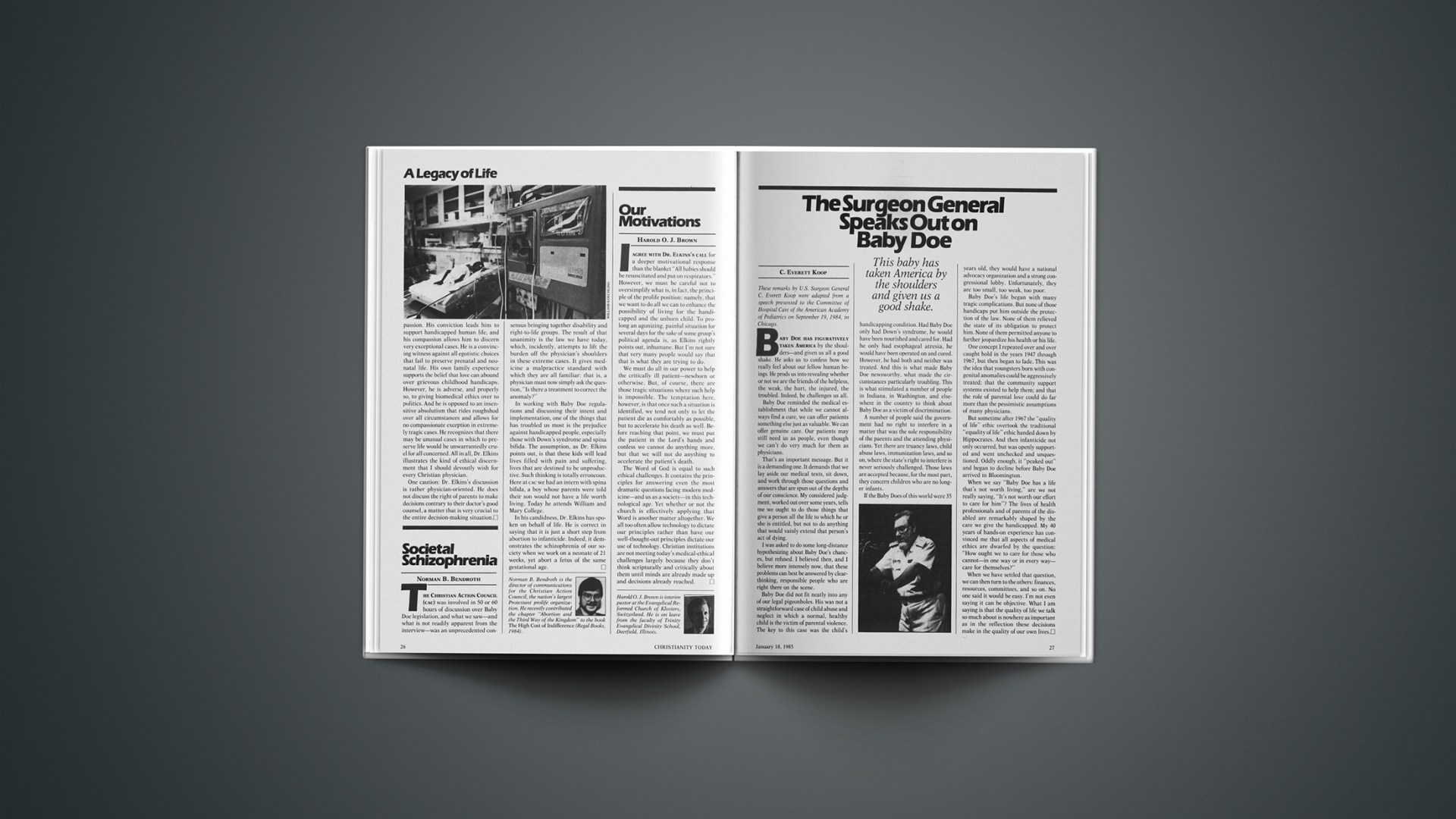
These remarks by U.S. Surgeon General C. Everett Koop were adapted from a speech presented to the Committee of Hospital Care of the American Academy of Pediatrics on September 19, 1984, in Chicago.

Baby Doe has figuratively taken America by the shoulders—and given us all a good shake. He asks us to confess how we really feel about our fellow human beings. He prods us into revealing whether or not we are the friends of the helpless, the weak, the hurt, the injured, the troubled. Indeed, he challenges us all.

Baby Doe reminded the medical establishment that while we cannot always find a cure, we can offer patients something else just as valuable. We can offer genuine care. Our patients may still need us as people, even though we can’t do very much for them as physicians.

That’s an important message. But it is a demanding one. It demands that we lay aside our medical texts, sit down, and work through those questions and answers that are spun out of the depths of our conscience. My considered judgment, worked out over some years, tells me we ought to do those things that give a person all the life to which he or she is entitled, but not to do anything that would vainly extend that person’s act of dying.

I was asked to do some long-distance hypothesizing about Baby Doe’s chances, but refused. I believed then, and I believe more intensely now, that these problems can best be answered by clear-thinking, responsible people who are right there on the scene.

Baby Doe did not fit neatly into any of our legal pigeonholes. His was not a straightforward case of child abuse and neglect in which a normal, healthy child is the victim of parental violence. The key to this case was the child’s handicapping condition. Had Baby Doe only had Down’s syndrome, he would have been nourished and cared for. Had he only had esophageal atresia, he would have been operated on and cured. However, he had both and neither was treated. And this is what made Baby Doe newsworthy, what made the circumstances particularly troubling. This is what stimulated a number of people in Indiana, in Washington, and elsewhere in the country to think about Baby Doe as a victim of discrimination.

A number of people said the government had no right to interfere in a matter that was the sole responsibility of the parents and the attending physicians. Yet there are truancy laws, child abuse laws, immunization laws, and so on, where the state’s right to interfere is never seriously challenged. Those laws are accepted because, for the most part, they concern children who are no longer infants.

If the Baby Does of this world were 35 years old, they would have a national advocacy organization and a strong congressional lobby. Unfortunately, they are too small, too weak, too poor.

Baby Doe’s life began with many tragic complications. But none of those handicaps put him outside the protection of the law. None of them relieved the state of its obligation to protect him. None of them permitted anyone to further jeopardize his health or his life.

One concept I repeated over and over caught hold in the years 1947 through 1967, but then began to fade. This was the idea that youngsters born with congenital anomalies could be aggressively treated; that the community support systems existed to help them; and that the role of parental love could do far more than the pessimistic assumptions of many physicians.

But sometime after 1967 the “quality of life” ethic overtook the traditional “equality of life” ethic handed down by Hippocrates. And then infanticide not only occurred, but was openly supported and went unchecked and unquestioned. Oddly enough, it “peaked out” and began to decline before Baby Doe arrived in Bloomington.

When we say “Baby Doe has a life that’s not worth living,” are we not really saying, “It’s not worth our effort to care for him”? The lives of health professionals and of parents of the disabled are remarkably shaped by the care we give the handicapped. My 40 years of hands-on experience has convinced me that all aspects of medical ethics are dwarfed by the question: “How ought we to care for those who cannot—in one way or in every way—care for themselves?”

When we have settled that question, we can then turn to the others: finances, resources, committees, and so on. No one said it would be easy. I’m not even saying it can be objective. What I am saying is that the quality of life we talk so much about is nowhere as important as in the reflection these decisions make in the quality of our own lives.
Responses to Elkins

CT talked with several individuals to get some of their thinking regarding Baby Doe and his impact on medical and societal ethics and decision making.

I think a Christian response to these mind-boggling ethical problems must be built upon two critical—and biblical—points of view. The first is basic and, thereby, most important. It is that we are obligated to the right of people to live, and out of love for them to promote, support, heal, and preserve their lives whenever possible. We should always be on the side of healing and preserving human life, whether prenatal or neonatal. And we should be relentlessly opposed to any trend that makes our selfish desire for a comfortable life more important than the challenge of caring for handicapped lives.

The second point of view is subordinate to the first. It grows out of the profoundness of moral decision making in a world of tragedy. There are anomalies that stagger our imagination. A fetus that is either missing a brain or has a brain too small to give any promise of genuinely human life is a case in point. To absolutize in these situations is not to rise to the defense of life but to sink to unusual and unwarranted cruelty. I believe that in our decision making we must have a passion for life, but a compassion for the living. There is a need for line drawing, but life does not allow us to draw permanent lines for every situation. We must allow for the exercise of what Saint Paul called “spiritual understanding and wisdom” in those cases where sad and tragic decisions must be made.

As for Dr. Elkins, his medical ethics are born of both conviction and compassion. His conviction leads him to support handicapped human life, and his compassion allows him to discern very exceptional cases. He is a convincing witness against all egotistic choices that fail to preserve prenatal and neonatal life. His own family experience supports the belief that love can abound over grievous childhood handicaps. However, he is adverse, and properly so, to giving biomedical ethics over to politics. And he is opposed to an insensitive absolutism that rides roughshod over all circumstances and allows for no compassionate exception in extremely tragic cases. He recognizes that there may be unusual cases in which to preserve life would be unwarrantedly cruel for all concerned. All in all, Dr. Elkins illustrates the kind of ethical discernment that I should devoutly wish for every Christian physician.

One caution: Dr. Elkins’s discussion is rather physician-oriented. He does not discuss the right of parents to make decisions contrary to their doctor’s good counsel, a matter that is very crucial to the entire decision-making situation.

The Christian Action Council (CAC) was involved in 50 or 60 hours of discussion over Baby Doe legislation, and what we saw—and what is not readily apparent from the interview—was an unprecedented consensus bringing together disability and right-to-life groups. The result of that unanimity is the law we have today, which, incidently, attempts to lift the burden off the physician’s shoulders in these extreme cases. It gives medicine a malpractice standard with which they are all familiar: that is, a physician must now simply ask the question, “Is there a treatment to correct the anomaly?”

In working with Baby Doe regulations and discussing their intent and implementation, one of the things that has troubled us most is the prejudice against handicapped people, especially those with Down’s syndrome and spina bifida. The assumption, as Dr. Elkins points out, is that these kids will lead lives filled with pain and suffering, lives that are destined to be unproductive. Such thinking is totally erroneous. Here at CAC we had an intern with spina bifida, a boy whose parents were told their son would not have a life worth living. Today he attends William and Mary College.

In his candidness, Dr. Elkins has spoken on behalf of life. He is correct in saying that it is just a short step from abortion to infanticide. Indeed, it demonstrates the schizophrenia of our society when we work on a neonate of 21 weeks, yet abort a fetus of the same gestational age.

I agree with Dr. Elkins’s call for a deeper motivational response than the blanket “All babies should be resuscitated and put on respirators.” However, we must be careful not to oversimplify what is, in fact, the principle of the prolife position: namely, that we want to do all we can to enhance the possibility of living for the handicapped and the unborn child. To prolong an agonizing, painful situation for several days for the sake of some group’s political agenda is, as Elkins rightly points out, inhumane. But I’m not sure that very many people would say that that is what they are trying to do.

We must do all in our power to help the critically ill patient—newborn or otherwise. But, of course, there are those tragic situations where such help is impossible. The temptation here, however, is that once such a situation is identified, we tend not only to let the patient die as comfortably as possible, but to accelerate his death as well. Before reaching that point, we must put the patient in the Lord’s hands and confess we cannot do anything more, but that we will not do anything to accelerate the patient’s death.

The Word of God is equal to such ethical challenges. It contains the principles for answering even the most dramatic questions facing modern medicine—and us as a society—in this technological age. Yet whether or not the church is effectively applying that Word is another matter altogether. We all too often allow technology to dictate our principles rather than have our well-thought-out principles dictate our use of technology. Christian institutions are not meeting today’s medical-ethical challenges largely because they don’t think scripturally and critically about them until minds are already made up and decisions already reached.

A Legacy of Life

Physician Thomas Elkins discusses the impact of Baby Doe on abortion, technology, and medicine’s own shifting ethic.

Physician Thomas Elkins discusses the impact of Baby Doe on abortion, technology, and medicine’s own shifting ethic.

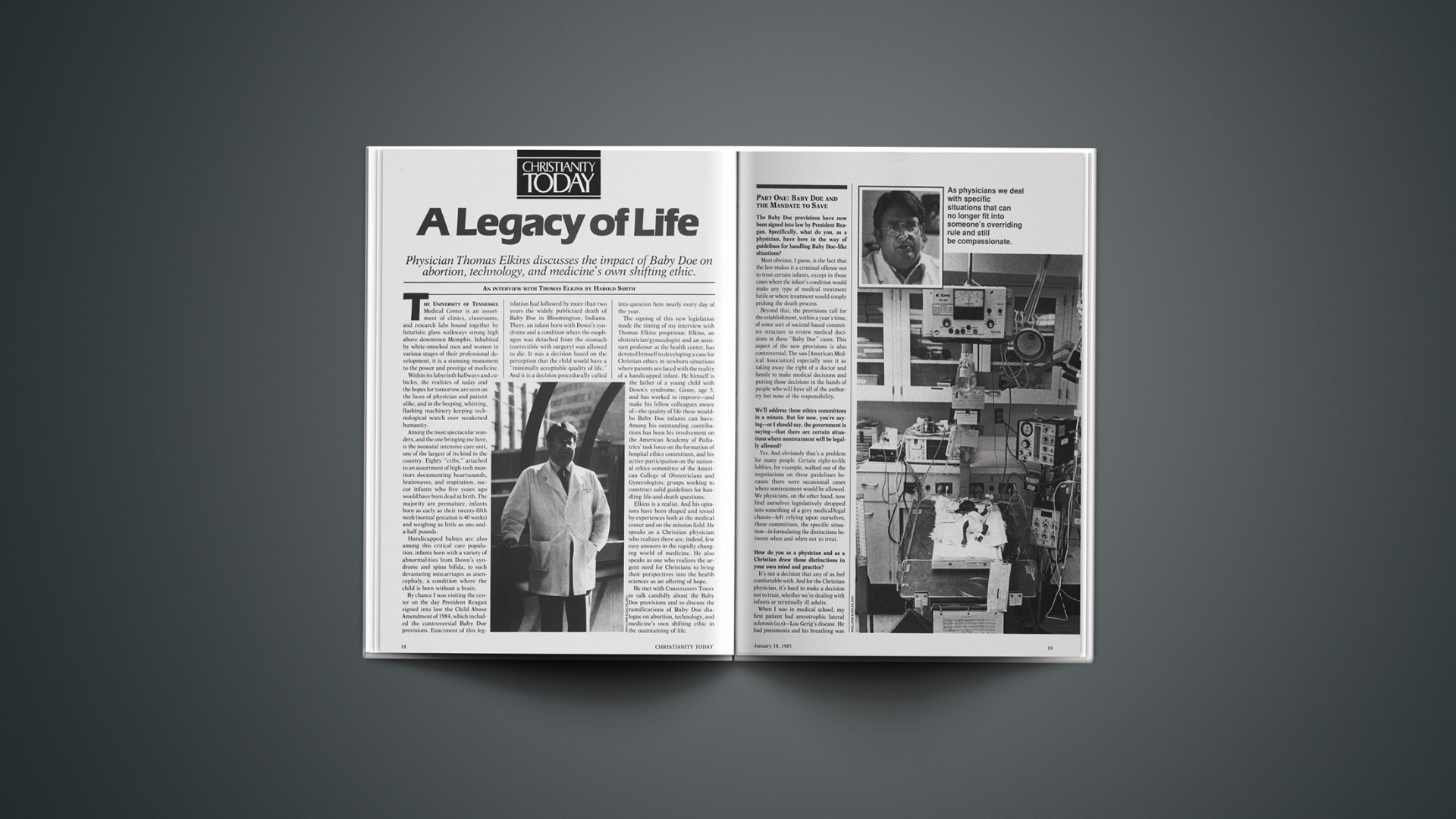
The University of Tennessee Medical Center is an assortment of clinics, classrooms, and research labs bound together by futuristic glass walkways strung high above downtown Memphis. Inhabited by white-smocked men and women in various stages of their professional development, it is a stunning monument to the power and prestige of medicine.

Within its labyrinth hallways and cubicles, the realities of today and the hopes for tomorrow are seen on the faces of physician and patient alike, and in the beeping, whirring, flashing machinery keeping technological watch over weakened humanity.

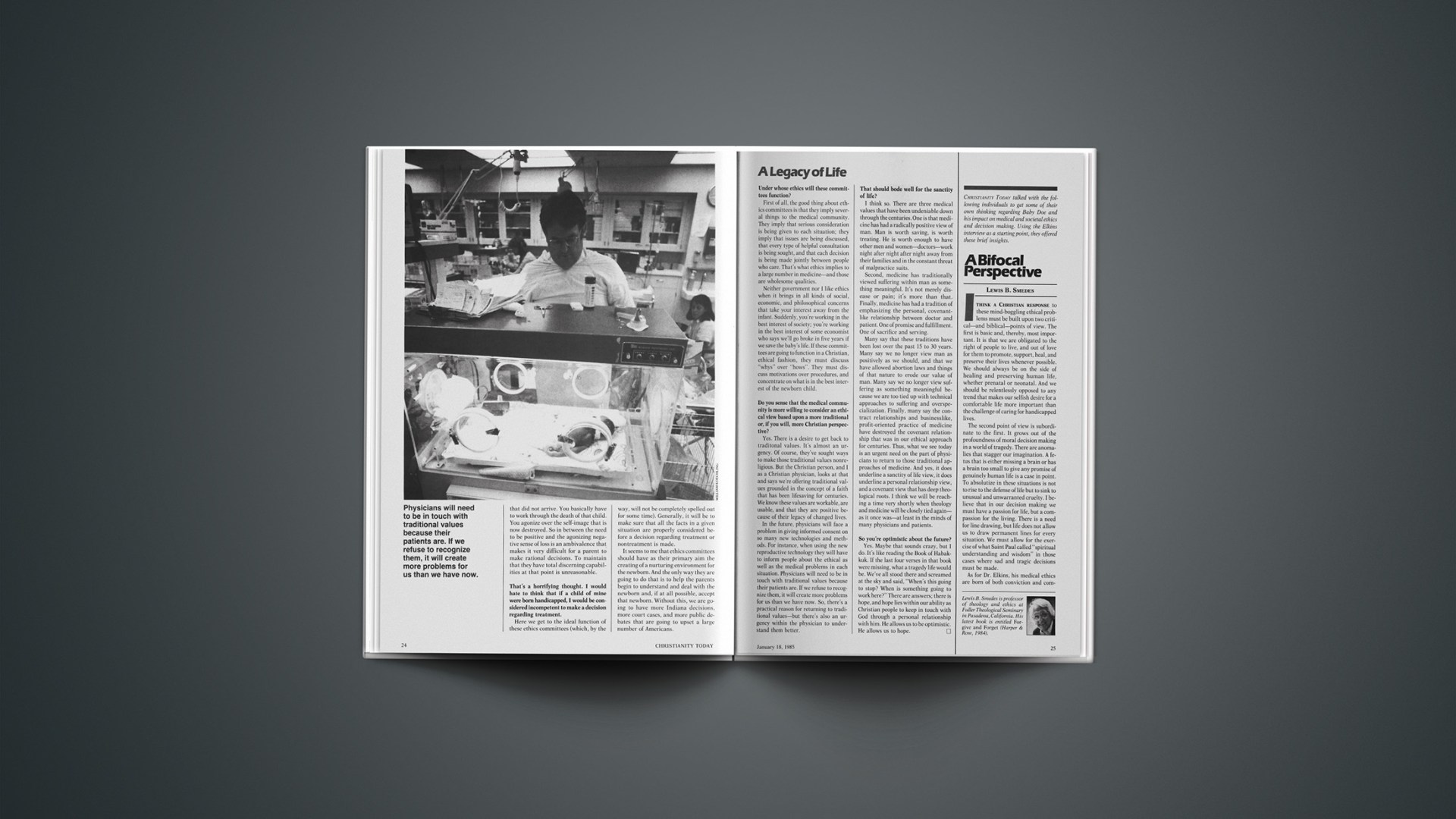
Among the most spectacular wonders, and the one bringing me here, is the neonatal intensive care unit, one of the largest of its kind in the country. Eighty “cribs,” attached to an assortment of high-tech monitors documenting heartsounds, brainwaves, and respiration, succor infants who five years ago would have been dead at birth. The majority are premature, infants born as early as their twenty-fifth week (normal gestation is 40 weeks) and weighing as little as one-and-a-half pounds.

Handicapped babies are also among this critical care population, infants born with a variety of abnormalities from Down’s syndrome and spina bifida, to such devastating miscarriages as anencephaly, a condition where the child is born without a brain.

By chance I was visiting the center on the day President Reagan signed into law the Child Abuse Amendment of 1984, which included the controversial Baby Doe provisions. Enactment of this legislation had followed by more than two years the widely publicized death of Baby Doe in Bloomington, Indiana. There, an infant born with Down’s syndrome and a condition where the esophagus was detached from the stomach (correctible with surgery) was allowed to die. It was a decision based on the perception that the child would have a “minimally acceptable quality of life.” And it is a decision procedurally called into question here nearly every day of the year.

The signing of this new legislation made the timing of my interview with Thomas Elkins propitious. Elkins, an obstetrician/gynecologist and an assistant professor at the health center, has devoted himself to developing a case for Christian ethics in newborn situations where parents are faced with the reality of a handicapped infant. He himself is the father of a young child with Down’s syndrome, Ginny, age 5, and has worked to improve—and make his fellow colleagues aware of—the quality of life these would-be Baby Doe infants can have. Among his outstanding contributions has been his involvement on the American Academy of Pediatrics’ task force on the formation of hospital ethics committees, and his active participation on the national ethics committee of the American College of Obstetricians and Gynecologists, groups working to construct solid guidelines for handling life-and-death questions.

Elkins is a realist. And his opinions have been shaped and tested by experiences both at the medical center and on the mission field. He speaks as a Christian physician who realizes there are, indeed, few easy answers in the rapidly changing world of medicine. He also speaks as one who realizes the urgent need for Christians to bring their perspectives into the health sciences as an offering of hope.

He met with CHRISTIANITY TODAY to talk candidly about the Baby Doe provisions and to discuss the ramifications of Baby Doe dialogue on abortion, technology, and medicine’s own shifting ethic in the maintaining of life.

Part One: Baby Doe And The Mandate To Save

The Baby Doe provisions have now been signed into law by President Reagan. Specifically, what do you, as a physician, have here in the way of guidelines for handling Baby Doe-like situations?

Most obvious, I guess, is the fact that the law makes it a criminal offense not to treat certain infants, except in those cases where the infant’s condition would make any type of medical treatment futile or where treatment would simply prolong the death process.

Beyond that, the provisions call for the establishment, within a year’s time, of some sort of societal-based committee structure to review medical decisions in these “Baby Doe” cases. This aspect of the new provisions is also controversial. The AMA [American Medical Association] especially sees it as taking away the right of a doctor and family to make medical decisions and putting those decisions in the hands of people who will have all of the authority but none of the responsibility.

We’ll address these ethics committees in a minute. But for now, you’re saying—or I should say, the government is saying—that there are certain situations where nontreatment will be legally allowed?

Yes. And obviously that’s a problem for many people. Certain right-to-life lobbies, for example, walked out of the negotiations on these guidelines because there were occasional cases where nontreatment would be allowed. We physicians, on the other hand, now find ourselves legislatively dropped into something of a grey medical/legal chasm—left relying upon ourselves, these committees, the specific situation—in formulating the distinctions between when and when not to treat.

How do you as a physician and as a Christian draw those distinctions in your own mind and practice?

It’s not a decision that any of us feel comfortable with. And for the Christian physician, it’s hard to make a decision not to treat, whether we’re dealing with infants or terminally ill adults.

When I was in medical school, my first patient had amyotrophic lateral sclerosis (ALS)—Lou Gerig’s disease. He had pneumonia and his breathing was labored. It was near the end for him. He wrote us a little note—which makes it different from the nursery—that said, “Do not resuscitate.” That night he had a cardiac arrest. The physicians in charge at that time did not know him and they rushed in to resuscitate and put him on a respirator. He survived the attack. The next day we came in and found out what had happened.

As we stood by the bed of this business executive whose mind was still excellent but whose muscle and organ functions had totally deteriorated over the last three years, he took a piece of paper and, with tears running down his eyes, just put a question mark on it and pointed to the respirator. We as physicians remember those things. We don’t forget them.

If possible, there are times when we will keep a severely handicapped newborn alive for two or three days to allow the family to bond with that infant; to give the family an opportunity to express the love that is essential at any birth; and to give the family the opportunity to express sorrow so that it might be temporal and not come back to haunt them years later. But to prolong an agonizing, painful situation for two, three, or four days for the sake of some group’s political agenda is inhumane. It’s not a loving, compassionate approach toward either the child or the family.

Is that a Christian approach?

I don’t know. Sometimes I wonder. I think it is.

What makes you think it is?

Well, the Sermon on the Mount is a very motivational approach to ethics. Then you move into Colossians 2 and 3, where Paul is talking about do’s and don’ts, and he seems to be saying that ethics is not constant rule making but an understanding of what Christ would have you do in an individual situation. We therefore get to a deeper level than saying, “All babies should be resuscitated and put on respirators.” It becomes a motivational response to individual situations. There will always be an occasional difference in the way you handle one infant from another. And, yes, I think that is within the New Testament ethic as I understand it. But, it does leave a hole for people to be abusive.

After hearing what you’ve just said, a right-to-lifer would say you’ve been abusive toward life.

I know that, and yet I consider myself prolife. It saddens me because I feel that at the base of the right-to-life movement is the same religious understanding I have. I value man because of the value placed in man by God—and because I value God. My love for God through Jesus Christ means I will do everything I can for my fellow man. I think the right-to-lifer feels the same way. I think the distinction comes in our viewpoints. As physicians we deal with specific situations that can no longer fit into someone’s overriding rule and still be compassionate to the neonate or that businessman dying of ALS.

And yet, right-to-life groups are outspoken advocates of the sanctity of life?

Right. But their rhetoric is, at times, too extreme and, consequently, is ignored by many within the medical community. I can’t tell you how upset and angry disability groups were over their attempt to heighten public awareness of Baby Doe situations by putting out Baby Doe candy bars, T-shirts, and license plates. For them to feel that callously about our children really upset us, and we began to realize that their concern was not our children as much as it was an issue. It drove a wedge between disability and right-to-life groups.

Part Two: Baby Doe And The Abortion Question

In his controversial book, Brave New People, D. Gareth Jones describes the fetus as a “potential person.” Many people have a problem with that.

I do too.

Why?

We don’t treat the fetus as a potential person. We have been approaching the fetus as a patient for a long time, especially in the third trimester when it is still a fetus. We can do a lot of things for that fetus that basically elevate it in every way and every sense to personhood. We operate for the benefit of the fetus—we do it every day. We monitor the fetus—we do it every day. We intervene when it appears ill and rush in to save its life. And I mean we rush. It’s a two-minute dash to the C-section room to get out a fetus who has collapsed its cord. It’s a dash for a life we feel is very, very personal. So, to say that the fetus is only a potential human life is to miss some of the quality that we have already placed in it.

What impact has Baby Doe and its resultant legislation had on all this?

As I’ve said, we have already begun to view the fetus more as a patient. Baby Doe legislation enhances that view—makes it more substantive and gives it more backing. What we’re looking at now is a situation where the American public has very vocally said that they want medicine to show positive values toward handicapped newborns. Once we have said positively that we want to support handicapped newborns, critically ill newborns, it’s going to be very difficult to support a handicapped newborn at 25 weeks and yet say we can destroy it in utero one day or one week earlier with an abortion. Complicating this, if you will, is the fact that the fetus has an opportunity to survive much earlier outside the womb. And this, of course, further blurs the whole concept of viability.

Wasn’t viability—or the fetus’s ability to survive outside the mother—a key factor in the Supreme Court decision legalizing abortion in Roe v. Wade?

Right. With our intensive care nursery system now, newborn babies that were repeatedly written off a few years ago are now surviving. A baby of one pound has an opportunity to live today—something unheard of five years ago. And I think technology will soon take us to a point where a baby outside the uterus can be supported at almost any gestational age. That’s going to mean that society will have to deal with a technology challenging its values. It will mean that abortion without a medical reason is going to become more and more problematic for society.

Remember, without a reason to do something, medicine is usually loath to do it; in every operation, we demand conscientious decision making. Then the abortion issue came along and suddenly we said, “Reasons are not necessary. It’s whatever the mother desires. It’s her life, and she can exercise her automony.” That goes against the grain of even the American College of Ob/Gyn and its statements in the seventies about abortion. They demanded that physicians not be technicians, that they continue to have a value system, and that they continue to exercise their reasoning ability on a patient-by-patient basis. This is the second major impact of Baby Doe on the abortion issue. Adult autonomy is no longer viewed as an absolute by a society demanding societal review of certain life-and-death decisions.

Doctors are opposed to performing abortions?

I don’t know if I can speak for all of them. But I do know that many physicians generally are more bothered by social abortions or convenience abortions than almost any other procedure. Still, I must speak frankly and say that they would also be bothered by a sweeping law that never allowed an abortion. I think most physicians, even those of us who would like to see more reasonableness return to the abortion scene, would probably be bothered by that.

I couldn’t do an abortion unless I thought the life of the mother was going to be lost. I’ve been in two situations where we all felt that way very strongly, and we intervened. I have no qualms about it, have no guilt problems with it. I would do it again, given the same situation.

People ask me about rape and incest. I have trouble with it. Is the functional life of a mother going to be lost by giving birth to a child out of rape or incest?

What about the child born without a brain, the anencephalic?

To force a mother to carry that anomaly is almost inhuman. Let me give you an example. I know of a patient who had recurrent anencephalic babies. In those years and in this particular situation, federal funds were cut off for all abortions, therapeutic or otherwise. When she was pregnant with an anencephalic child for the second time, the physicians in charge tried to get an abortion okayed for her at government expense and couldn’t. She had the baby and did everything she could to adjust—even taking the baby home with her to die.

Her third child was also anencephalic. She had wanted an abortion and was almost desperate for it. But again, that was out of the question. She had the child and took the baby home to die. She then spent the next several years in and out of mental institutions. I think there is something of a cruel nature in that. And I think that that is an indicated abortion.

Part Three: Baby Doe And Modern Technology

You said recently that the supportability of amniocentesis—the procedure of extracting amniotic fluid from the mother’s womb—is questionable in light of Baby Doe. What do you mean by that?

It’s a good question because of the technological advances of amniocentesis and prenatal genetics sampling and counseling. As I mentioned earlier, the Baby Doe situation and debate have brought about a new positive attitude toward handicapped newborns. It is really difficult for the obstetrician to have a positive attitude about a handicapped newborn and a thoroughly negative attitude about a handicapped fetus, when there may be only a few days separating the one from the other. So this is a situation where our amniocentesis counseling may need to be altered. And not just our amnio counseling, but counseling done as a result of chorionic villus biopsy as well.

Is that something new?

Yes, it’s something new in our country and, in fact, it hasn’t been approved yet. Basically, it will allow us to determine chromosomal anomalies and a number of other things, all within the first trimester. Of course, the problem here, again, is selectivity. Suddenly we will have a tool that will allow people to select “the right child” all within the first three months of life. They may select out male versus female. Or they might want to select out any number of recognizable disabilities that have nothing to do with mental retardation or even a severe physical handicap. Baby Doe calls all of that into question simply by saying that handicapping conditions cannot be a reason to eliminate life once it is born. It asks pointedly how much concern we really have in our society for “the least of these.”

So counseling becomes a delicate matter?

Yes. Unfortunately, the obstetrics counseling involving amniocentesis has rarely been what I would term appropriate. Most of the counseling is extremely negative. It is usually something that’s overly simplified, like, “When you’re over 35 you have to have amniocentesis.” Many times when a patient refuses amniocentesis, she’ll be asked to reconsider two or three times. You know, “Are you sure you don’t want amnio? You’re 40 years old. You’re a risk. There’s almost one Down’s birth in 20. Are you sure you don’t want amnio?”

It’s negative counseling. And the problem is, our legal system protects such negativism. The physician doesn’t feel free to give both sides of the Down’s syndrome story. If he is ever found guilty of talking someone into having a child with Down’s syndrome, he would also be found medically and legally liable for that child. So the courts have said that if a physician ever coerces or in some way allows a birth to occur that could have been eliminated, and by standards of practice should have been eliminated, then he is medically, legally, and financially liable for that child. And that’s a significant problem to overcome in trying to change any of the counseling methods in the prenatal period for amniocentesis.

How do you feel, then, about amniocentesis?

That’s a hard question. I used to feel good about it. I felt that if there was any way we could prevent the arrival of handicapped newborns, we should do it. That sort of thinking is ingrained in you as a medical student. It’s a given. Well, I have trouble with the basic principle. We look at our own child, Ginny, who has Down’s syndrome, and see our own limitedness. She shows us love even when we, at first, were not totally accepting of her. These kids love us until we begin to love them back. And by loving them, we learn a whole new definition of love—something very akin to grace.

In our country we have been very much aware of physical attributes and their importance in being successful. But with a child like Ginny, we learn that love is deeper. It’s love because of the personal qualities of that child and because of something of the spirit of God that’s within that child—what we term personhood.

So now that we have had Ginny, amniocentesis is somewhat threatening to us. It threatens something of the love that we have learned to express for our child. It’s no longer something I can look at with such lethal abandon. I think it has its place. When it leads us to severe hydrocephalus or anencephaly in the midtrimester, those are essentially untreatable situations; even with current technology. But I have trouble, at this point, with amnio aimed at destroying all handicapped newborns before they are delivered.

So how do you, as a Christian physician, ultimately deal with such technology?

We can go one of three ways. One way is to be so limited in your ethical and moral viewpoints that nothing is allowable, technologically speaking. That’s like ignoring the rain that’s already fallen upstream. You eventually find yourself in the flood you said wouldn’t happen. If you are unable to reasonably discuss what has already occurred, your voice will probably not be heard.

The second way is to take the course medical ethics has been accused of taking over the past 20 years—that is, be so broad, so laissez faire in your viewpoints, that anything is okay and any kind of medical technology is fine. But this, too, is meaningless.

The third way is the challenge facing any Christian wanting to enter the medical fray. We must learn to bring Christian values into the systems that are with us here and now. We can’t go back to the year 1200. The Lord has allowed us to develop the technologies of today, and it is our responsibility to use them in a framework of Christian principles.

Part Four: Baby Doe And Medical Ethics

Earlier you mentioned ethics committees as part of the new Baby Doe provisions. Why are such committees even necessary?

Partly because physicians have not consistently provided accurate counsel regarding the quality of handicapped life, and partly because of the psychodynamics at work in these situations. The overriding impact on the family, in terms of medical decision making, is the problem of ambivalence. You love the newborn because it’s alive and our culture says you love live newborns. There is also that incredible sense of loss of the child you wanted, the child that did not arrive. You basically have to work through the death of that child. You agonize over the self-image that is now destroyed. So in between the need to be positive and the agonizing negative sense of loss is an ambivalence that makes it very difficult for a parent to make rational decisions. To maintain that they have total discerning capabilities at that point is unreasonable.

That’s a horrifying thought. I would hate to think that if a child of mine were born handicapped, I would be considered incompetent to make a decision regarding treatment.

Here we get to the ideal function of these ethics committees (which, by the way, will not be completely spelled out for some time). Generally, it will be to make sure that all the facts in a given situation are properly considered before a decision regarding treatment or nontreatment is made.

It seems to me that ethics committees should have as their primary aim the creating of a nurturing environment for the newborn. And the only way they are going to do that is to help the parents begin to understand and deal with the newborn and, if at all possible, accept that newborn. Without this, we are going to have more Indiana decisions, more court cases, and more public debates that are going to upset a large number of Americans.

Under whose ethics will these committees function?

First of all, the good thing about ethics committees is that they imply several things to the medical community. They imply that serious consideration is being given to each situation; they imply that issues are being discussed, that every type of helpful consultation is being sought, and that each decision is being made jointly between people who care. That’s what ethics implies to a large number in medicine—and those are wholesome qualities.

Neither government nor I like ethics when it brings in all kinds of social, economic, and philosophical concerns that take your interest away from the infant. Suddenly, you’re working in the best interest of society; you’re working in the best interest of some economist who says we’ll go broke in five years if we save the baby’s life. If these committees are going to function in a Christian, ethical fashion, they must discuss “whys” over “hows”. They must discuss motivations over procedures, and concentrate on what is in the best interest of the newborn child.

Do you sense that the medical community is more willing to consider an ethical view based upon a more traditional or, if you will, more Christian perspective?

Yes. There is a desire to get back to traditonal values. It’s almost an urgency. Of course, they’ve sought ways to make those traditional values nonreligious. But the Christian person, and I as a Christian physician, looks at that and says we’re offering traditional values grounded in the concept of a faith that has been lifesaving for centuries. We know these values are workable, are usable, and that they are positive because of their legacy of changed lives.

In the future, physicians will face a problem in giving informed consent on so many new technologies and methods. For instance, when using the new reproductive technology they will have to inform people about the ethical as well as the medical problems in each situation. Physicians will need to be in touch with traditional values because their patients are. If we refuse to recognize them, it will create more problems for us than we have now. So, there’s a practical reason for returning to traditional values—but there’s also an urgency within the physician to understand them better.

That should bode well for the sanctity of life?

I think so. There are three medical values that have been undeniable down through the centuries. One is that medicine has had a radically positive view of man. Man is worth saving, is worth treating. He is worth enough to have other men and women—doctors—work night after night after night away from their families and in the constant threat of malpractice suits.

Second, medicine has traditionally viewed suffering within man as something meaningful. It’s not merely disease or pain; it’s more than that. Finally, medicine has had a tradition of emphasizing the personal, covenant-like relationship between doctor and patient. One of promise and fulfillment. One of sacrifice and serving.

Many say that these traditions have been lost over the past 15 to 30 years. Many say we no longer view man as positively as we should, and that we have allowed abortion laws and things of that nature to erode our value of man. Many say we no longer view suffering as something meaningful because we are too tied up with technical approaches to suffering and overspecialization. Finally, many say the contract relationships and businesslike, profit-oriented practice of medicine have destroyed the covenant relationship that was in our ethical approach for centuries. Thus, what we see today is an urgent need on the part of physicians to return to those traditional approaches of medicine. And yes, it does underline a sanctity of life view, it does underline a personal relationship view, and a covenant view that has deep theological roots. I think we will be reaching a time very shortly when theology and medicine will be closely tied again—as it once was—at least in the minds of many physicians and patients.

So you’re optimistic about the future?

Yes. Maybe that sounds crazy, but I do. It’s like reading the Book of Habakkuk. If the last four verses in that book were missing, what a tragedy life would be. We’ve all stood there and screamed at the sky and said, “When’s this going to stop? When is something going to work here?” There are answers; there is hope, and hope lies within our ability as Christian people to keep in touch with God through a personal relationship with him. He allows us to be optimistic. He allows us to hope.

CHRISTIANITY TODAY talked with the following individuals to get some of their own thinking regarding Baby Doe and his impact on medical and societal ethics and decision making. Using the Elkins interview as a starting point, they offered these brief insights.

Ideas

Beyond 1984: An Evangelical Agenda

1985 MARKS THE MIDPOINT OF THE EIGHTIES, the next-to-last decade of the fabulous twentieth century. What will this new year bring our little planet and our nation? Further, where ought we to direct the energies of the church?

This second question cannot be answered fully without dealing with the first. It is true that God has given his church its marching orders, and in broad perspective they are the same for all times and places. The Great Commission is unequivocal: “Go and make disciples of all nations, baptizing them … and teaching them to obey everything I have commanded you” (Matt. 28:19–20, NIV). Surely, here our Lord is setting a priority for the church as a church. Its first duty is to evangelize and to instruct its members. Without evangelism there is no church. Without instruction a church is ineffective and can be dangerous, working at cross purposes with its Lord. But an informed church is God’s way of bringing his greatest good to the world.

Yet even a church informed by the instruction of the Lord will prove ineffective unless it understands the world it must work in. For example, are the tens of millions of dollars evangelicals spend annually on TV evangelistic programs the wisest use of limited funds? Or would we do better to concentrate on printed material? Or on the outreach of the local church? Or on neighborhood Bible studies?

Again, how important to us is a politically and socially free society (and, therefore, one that is also religiously free)? How does that affect our attitude toward Nicaragua, or the Philippines, or national defense?

We cannot answer such practical questions unless we first understand the world we shall face in the last half of the eighties. Our knowledge, though incomplete, is adequate to influence our agenda significantly.

In recent years, for example, our nation, and probably our planet, have been moving in a conservative direction. The academic world and the elite do not know this yet, and the public media are just beginning to recognize it (they represent the grown-up children of the sixties). Their shrill voices of warning show that they fear it. Their students and children are often a part of it.

This broad social shift is evident in many areas of our culture. It would be foolish to predict how the elections will go in 1988. But one thing is clear: the Democrats will move to the right—nearer the center. The Republicans will remain basically where they are or move farther to the right, away from the center—and, in time, lose elections because of it.

The Supreme Court, by its decisions spread over the last 20 years, has drastically restructured many aspects of the American society. For good or ill, the membership of the Court will almost certainly change during the next four years, becoming more conservative.

Economically, people are gradually realizing that the nation cannot do everything or it will go broke. We face hard choices between funding social programs for the poor, needy, aged, and handicapped, or continuing the military build-up in an increasingly dangerous world.

Religiously, the churches have grown more conservative through the last decade, and that direction will continue into the foreseeable future. A quick glance at the 50 largest seminaries will show why this is so. And if account is taken of new candidates for ordination (eliminating ministers taking refresher courses or advanced degrees, and those theological students not actually entering the ordained ministry), the movement is even more pronounced.

All this is highly significant for evangelicals because any political or social agenda ought to represent the kind of compromise that relates the ideal to the possible. Evangelical goals that were unthinkable 20 years ago now lie within range. And this lays upon all evangelicals a deeper responsibility to exercise wise judgment in setting their agenda for the eighties.

1. OUR HIGHEST PRIORITY must be to reach out evangelistically into the communities of our land through local churches. The greatest problem in our society today is the widespread meaninglessness of life. Nothing else has any value if life as a whole has no meaning. Only the gospel, bringing lost humans into vital relationship with the living God, can give life meaning. Surely, therefore, this must hold the very highest priority on the evangelical agenda.

2. SECOND IN PRIORITY is the strengthening of the family. For a considerable segment of our society, women, in Playboy fashion, are only things to be consumed for entertainment. And child abuse destroys the rights of our young, continuing to gnaw away at family life.

In recent years strains not known to previous generations and, in themselves, not necessarily bad, have struck at the stability of the family. Modern gadgetry, for example, has removed the drudgery of homemaking, but also released women to massive employment in the work force outside the home; the full impact of this has yet to hit us. The family is the building block of both church and society. We must not seek to roll the clock back, but neither dare we permit the demoralization of society by the gradual disintegration of the family. To protect and preserve the family must remain near the top of evangelical priorities for the eighties.

Some will be disturbed, perhaps even angry, that we do not give highest priority to world peace. Others would insist that our first priority must be amendments to outlaw abortion and to reinstate prayer in the schools.

But how many times during the past year have you wept over the tragedy of Afghanistan, or the national debt, or the failure to pass the prayer amendment or the constitutional amendment to outlaw abortions? But you may well have wept over your child or your relationship with your parent or spouse. Most tears are shed over matters that have nothing to do with the kind of government we have or the laws it passes. The truth is, most Americans have a greatly exaggerated sense of the importance of government to bring them a good life. Our highest priorities lie elsewhere.

3. FOR THIRD PLACE ON THE LIST of priorities, however, we would move to the public sphere and name human freedom—political, social, and not least, religious. Under this rubric come many values especially dear to all Americans, not just evangelicals. For example, our most basic political freedom is our constitutional right to life and protection. And this includes the life of the not-yet-born as well as the newly born, and of the severely handicapped and the aged. Free abortions blight our society; prochoice is a singularly malicious euphemism for the right to murder for convenience.

Here evangelicals must set their agenda with great care. An absolutist prohibition of abortion will never secure political acceptance in our pluralistic society, and even many of us evangelicals would deem it undesirable. Evangelicals ought to agree to support any governmental action that would protect unborn children by making free abortions illegal. It may well be possible to outlaw abortions for trifling causes and all abortions beyond the first trimester except to save the life of the mother. The art of compromise is not sinful; it is usually realistic and often thoroughly Christian.

Also high on the evangelical agenda should be the preservation of religious liberty—especially the government protection of our First Amendment right of the free exercise of religion. For half a century now, lawmakers have concentrated on the “no establishment” clause—extending it to religion in general as well as to any particular religion. We evangelicals need to affirm this loud and clear. And we do it not just because we live in a pluralistic society, but in principle, on the ground of our commitment to human freedom and dignity. The God of the Bible does not seek compulsory worship, and all true worship must be free.

But, on the other hand, evangelicals also need to battle for liberty in the “free exercise” of religion. This includes the right of free prayer in the schools (prayers not authorized by any government), the right to free assembly in school for religious interests when free assembly is allowed for other purposes, the right of private schools to determine their own curricula, and the right of parents to provide a Christian education for their children without the handicap of paying twice when secularists can secure a secular education for their children simply by paying taxes. Religious freedom is not really free unless it protects the free exercise of religion, and this ought to be high on the evangelical agenda for the last half of the eighties.

4. FINALLY, WITH NO ATTEMPT TO BE COMPLETE, we add a fourth high priority for our evangelical agenda: peace among the nations. We hear a great deal these days about “Armageddon politics.” Granted, few Christians believe that perfect peace will ever come to pass on this earth short of the Eschaton—the second coming of the Prince of Peace. There is a final judgment when the wrath of God will be poured out upon the evil forces of earth. That is the piece of biblical and Christian truth in “Armageddon” theology. But no Christian worthy of the name confuses his own judgment with the wrath of God, nor would he seek to hasten the awful terror of a world under divine judgment. The Lord of the church commanded his disciples to be peacemakers. Any Christian who has any love for God or neighbor must seek peace. And in our day, especially, Christians must place peace high on their agenda.

Some may argue, mistakenly we think, that unilateral disarmament is the right path to peace. Others, also mistakenly, may argue for an unlimited build-up of conventional and atomic weapons. A strong threat of reprisal, so they say, is the best guarantee of peace. But surely a verifiable reduction of armaments looking to outlaw nuclear weapons would be a better and safer way to reduce international tensions, and so lead toward peace. This is a path most Christians and all lovers of mankind could agree on. We need to set this forth earnestly as an immediate goal of highest priority toward which all evangelicals should work.

Evangelicals represent a minority, but in America they are a large and significant minority. At the moment their influence is increasing. Many, perhaps most, Americans share with evangelicals their love for freedom, justice, and peace. They would follow evangelical leadership that set these priorities for America. As evangelicals, obedient to the Lordship of Christ, we could serve him and them no better in our generation.

Eutychus and His Kin: January 18, 1985

Twelve Months Of Sundays

Pity the preachers who have but 52 Sundays a year to cover the essentials.

First, they must acknowledge the church year, with appropriate sermons for Advent, Christmas, Epiphany, Lent, Easter, and Ascension Sunday.

There is also the civil year, obliging them to mention Valentine’s Day, Saint Patrick’s Day, Presidents’ Day, Father’s Day, Mother’s Day, Memorial Day, Independence Day, Labor Day, and Thanksgiving—not to mention Law and Order Month, Get-Out-the-Vote Week, and National Pickle Week.

Then there are the denominational directives to observe Stewardship Sunday, an annual missions conference, Christian College Sunday, World Hunger Week, Bible Translation Week, and Pension Fund Day.

And depending on its theological stripe, each church has additional expectations.

Solid Rock Separated Saints expect Anti-WCC Sunday, Anti-NCC Sunday, Anti-Evolution Sunday, Anti-Abortion Sunday, Anti-Homosexuality Sunday, Anti-Gun-Control Sunday, Anti-Liberal Sunday, Anti-Moderate Sunday, and Anti-Not-Quite-as-Fundamental-as-We-Are Sunday.

The Church of Earnest Relevance, on the other hand, gets edgy if it doesn’t celebrate WCC Sunday, NCC Sunday, Pro-Choice Sunday, Lettuce-Pickers Sunday, Support-the-Sandinistas Sunday, Gay-Rights Sunday, and I’m-Sure-Glad-We’re-Not-Bigoted-Like-the-Fundies Sunday.

If you preach at a Cathedral of Unlimited Possibilities, you can’t let a year pass without God-Wants-You-in-a-Rolls-Royce Sunday, Where-Is-God-When-Your-Income-Isn’t-Six-Figures Sunday, and Impossible-Is-a-Dirty-Word Sunday.

Wow Before You Bow Churches demand Jocks for Jesus Sunday, Criminals for Christ Sunday, Midgets for Morality, puppets, gospel magic, and a Bust Our Bus Attendance contest.

Pray for our pastors. As you can see, squeezing in the whole counsel of God isn’t easy.

EUTYCHUS

The Hemingway Tragedy

I was disturbed by the recent article, “Ernest Hemingway: Tragedy of an Evangelical Family” [Nov. 23]. I question whether anyone in the family was truly regenerated in the biblical sense of the word! To say they were “religious” because they attended church would have been more accurate than to call them “evangelicals.”

CAROLYN WHEELER

Tucson, Ariz.

The article on Ernest Hemingway was one of the most moving I have ever read. I was moved when I read The Old Man and the Sea several years ago, but didn’t really know why. Over all, the article is sad. It should give us all something to think about.

JASON HOLLOPETER, Th.D.

Selingsgrove, Pa.

Hemingway was deprived of life’s most fundamental gift—the love and acceptance of parents who model the love and acceptance of Christ. It is little wonder he never “discovered” God. But grace might allow us to think that God never deserted Hemingway, even in his wayward suffering and loneliness.

REV. THOMAS P. EGGEBEEN

First Presbyterian Church

Sapulpa, Okla.

The proper place for an evaluation of Hemingway’s life and literary output would have been in the Refiner’s Fire column. To devote page after page to pictures and text describing the life of a troubled and tragic man seems to me to be in wretched taste.

WILMA BOSE MITCHELL

Iowa City, Iowa

Please stop feeding us a diet of movie reviews and human interest stories. Most important, stop these articles of godless men (Gandhi, Hemingway) filled with Christian imagery and language. These men have taken thousands to hell with them through the influence of their lifestyles and writings. They do not need additional exposure in a Christian magazine.

REV. ROY E. ROW

Manchester Christian Church

Manchester, Ky.

Individual Versus National Rights

“What is true for the individual should be true for the nation as well,” writes John A. Bernbaum [“Oh No! Anything but Central America,” Nov. 23], and attacks the “illusion that national self-interest or self-preservation is the primary goal of foreign policy.” How inconsistent Bernbaum’s use of this principle is. He sounds more like a libertarian than a conservative, a moderate, or a liberal. If he wishes to cling to that principle, he should recognize that it makes mincemeat of his own argument. Individuals have the right to protect their own lives, liberties, and properties against agression. If Bernbaum’s “principle” is followed, nations have that right as well.

E. CALVIN BEISNER

Colorado Springs, Colo.

Bernbaum’s article is more than my mind can tolerate. Please cancel my subscription immediately.

PHILLIP E. LATHROP

Huber Heights, Ohio

Evangelizing Jews

From August 1976 to November 1977, I was employed by the Anti-Defamation League of B’nai B’rith in their national headquarters. I can say unequivocally that CT [Nov. 23, “Jewish Leaders Attempt to Fight Effects of Evangelism”] greatly understated the weight of organized opposition by significant elements in the Jewish community against the evangelization of Jews. In my personal experience, it was evident that the ADL and other Jewish organizations were not above using dis-information to discredit Jews for Jesus in the eyes of Jews and Christians as well.

DOUGLAS YEO

Baltimore, Md.

The Gospel In Russia

You irk me. In reporting on the Russian Christian scene, an article is headlined “The Gospel Flourishes in the USSR’s Second Largest City,” [News, Nov. 23]. Without wishing to minimize Protestant believers in Russia, I object to such a statement. The gospel flourished long before any Baptist church was ever in Leningrad; it has been flourishing in Russia since the ninth century. As I leaf through a copy of the Orthodox liturgy, it is safe to say that there is more “Bible” in any Sunday liturgy than was dreamt of in a Baptist service. I dare say that the Russian Orthodox church has provided the Lord with more martyrs in the last 60 years than the church has known in the prior nearly 2000 years. For heaven’s sake, since the magazine calls itself CHRISTIANITYTODAY, please don’t forget that most of Christianity today resides in those of us who share the Catholic tradition.

FATHER WINSTON F. JENSEN

Church of Saint Alban the Martyr

Superior, Wis.

American Methodism

I want to commend you on your choices of authors to write the articles concerning “American Methodism at 200” [Nov. 9]. You provided a balanced picture. Let’s see more input in CT from Wesleyan evangelicals!

REV. J. JASON FRY

First United Methodist Church

Alice, Tex.

I write with considerable consternation about your very negative set of articles about the United Methodist Church. Of the three, Kinlaw’s was the only one that showed any balance and fairness. Keysor’s article reeks of sour grapes. Robb has a political agenda. The least you could have done was offer at least one favorable viewpoint! However, considering your publication’s general distaste for mainline Protestant denominations, I am not surprised.

REV. DALE A. SCHOENING

The United Methodist Church

Knoxville, Iowa

Thank you for the “Methodism” articles. I appreciate Chuck Keysor’s “salute” to those of us who remain. I for one remain because God would have me here. I consider myself one of an army of full-time evangelists. Every time my bishop moves me I am placed down in a ripe evangelistic field. My job is to “make disciples,” not to collect and coddle someone else’s labor.

REV. JOHN M. DUNNACK

Mt. Salem United Methodist Church

Wilmington, Del.

The United Methodist Church with which I am acquainted bears no resemblance to Keysor’s caricature. The 1984 general conference strengthened its standards, yet with a charity as big as the great heart of God. I think the article missed the mark and fell short of being helpful to anyone at all.

REV. STEPHEN C. CONTE

St. Mark’s United Methodist Church

Council Bluffs, Iowa

As a United Methodist pastor and seminary student, I read with great joy the comments your writers made. Like many others, I too have since transferred to a seminary not related to my denomination. But as Robb mentioned, there is cause for hope. The Spirit of God, at least in the local churches, is still very much alive in our denomination.

REV. LLOYD K. KEIBER

Deerfield, Ill.

Of Partisan Politics

I enjoyed your editorial “Partisian Politics: Where Does the Gospel Fit?” [Nov. 9]. I agree that “Today’s polemics can be … overblown.” The scare tactics of some members of the right wing seem to be trying to co-opt the Christian church into the John Birch Society for its political aims. I am tired of seeing these people bend the context both of Scripture and of their opponent’s statements in a frenzied attempt to prove their points.

PAUL E. MOORE

Parsippany, N.J.

I snort at this editorial. It takes a lot of gall to advocate paralysis and circumspection. The Bible is clear. Sin is wrong.

ROBERT ANDREW SCULLY

Poplar Bluff, Mo.

An Unamusing Cartoon?

I was appalled to see an offensive cartoon in your Nov. 9 issue. One just does not make fun of or print cartoons about the crucifixion, the greatest act of love by God for a lost world.

W. H. HEKKERT

Hayward, Calif.

There is nothing at all amusing, even in an ironic or satiric sense, in the crucifixion of the Lord Jesus Christ. I have always found your magazine edifying and interesting, as well as reverent, and therefore write this as much in sorrowful surprise as in shock and outrage.

JOSEPH WEI

Hartford, Conn.

History

The Anabaptists: A Gallery of Factions, Friends and Foes

Swiss Brethren

They were the first generation of Anabaptists—Conrad Grebel (a patrician’s son and Zwingli’s former protege), Felix Manz (a clergyman’s illegitimate son), George Blaurock (middle-aged ex-priest of peasant origins), Simon Stumf (parish priest in rural Hongg), Wilhelm Reublin (middle-aged priest in Witikon who was the first Zurich pastor to marry and to persuade parents to refuse baptism of their child), and Johannes Brötli (priest in rural Zollikon)—to name a few. Stumf, Reublin, and Brötli had achieved reform in their rural parishes through their refusal to send tithes to support Zurich’s clergy while Zwingli was still trying cautiously to institute reforms in the mass in that city. Zwingli’s insistence on the full support of city council frustrated Grebel and Manz, who concluded that the magistrate’s way and Christ’s way were not necessarily the same. Relinquishing their first hope of packing city council with likeminded reformers, they met on 21 January 1525 to discuss and pray about their response to city council’s newest law: that all infants be baptized within eight days of birth. When Blaurock asked Grebel to rebaptize him and then proceeded himself to rebaptize Grebel and others, these brothers in Christ signaled their intention to go a different way and suffer the political consequences of following Christ. Grebel left home and family, sold his books, and became a traveling evangelist working with Manz—first winning followers at Zollikon in what became the first Anabaptist congregation and then later quelling extremism among the rebaptized.

On 5 January 1527, Manz became the first martyr of the Swiss Brethren. Grebel had died of natural causes six months earlier, and Blaurock by 1528 was banished from the Swiss cantons. A popular preacher, Blaurock established many congregations in the Austrian Tyrol until he was caught and burned at the stake near Innsbruck on 6 September 1529. Brötli had met the same fate sometime in the preceding year. Seeking to keep the cause of the common man and the gospel joined, Reublin sought converts in Waldshut and surrounding areas of Austria, baptized Hubmaier and traveled to Strassburg. From there he seems to have led Michael Sattler to the Neckar Valley and been among those gathered at Schleitheim to solidify what by now was a separatist underground movement. Escaping Sattler’s fate of martrydom in May 1527, Reublin made his way to Moravia. He preached a rigorous communalism but was not faithful to it himself, was banned after Jacob Hutter conducted a sober investigation, and lived the last three decades of his life no longer associated with Anabaptists. Like Stumpf, Brötli and Hubmaier, Reublin seems to have held more to a Zwinglian view of the possibility of Christian magistrates and a Christian political system than to the more radical idea of separatist discipleship as held by Grebel, Manz, and Blaurock.

Thomas Müntzer

(1490?–1525) Historians have not found it easy to classify him: Was he an Anabaptist? A wayward disciple of Luther? Forerunner of modern socialism as Marxist scholars and others have claimed? He was the revolutionary spiritual leader of the Peasants’ War of 1525 and a torchbearer in the great wave of religious and social revolution of this time. A student of medieval realism— well read in church history, the German mystics, and the humanistic and Reformation tracts—Müntzer in 1520 received a pastorale in the Saxon city of Zwickau, where he quickly allied himself both with the disenfranchised artisans wanting a role in government and with those council members urging that the city become free of outside ecclesiastical powers. Müntzer combined the anticlerical spirit of the times with his own mysticism. Not in the Scriptures, not in the sacraments, not in the institutional church but rather in the tormented struggle of his soul did a person, according to Müntzer arrive at faith. And one still would not have faith unless God himself gave and taught it. This “experienced faith” placed the believer in a new order, an elect, to whom sooner or later the kingdom of this world would be given in the form of democratic theocracy. Müntzer’s conviction to bring faith to the common man resulted in his 1523 innovations in worship services, including German liturgies, psalms and hymns. When the court of Weimar retaliated by declaring that his pastorale was not official, Müntzer was summoned to give a “trial sermon” to Duke John and his son John Frederick, the latter already convinced of Luther’s version of the Reformation. In this “Sermon to the Princes” Müntzer invited his hearers to flee the inevitable bad combination of ecclesiastical and worldly powers for the “unconquerable Reformation”—the kingdom of Christ on earth. Unsuccessful, Müntzer had to flee Allstedt in August 1524 for Muhlhausen. There he joined the Peasant’s Revolt in the Black Forest. He had become convinced that their cause, especially the confrontation forthcoming at Frankenhausen was the last judgment and that the ensuing conflict would put the common man in direct contact with God. The results of the Frankenhausen battle on 15 May 1525, in which six thousand peasants and six princes met their death, proved Müntzer’s cause wrong. Shortly thereafter he was captured, tortured, and then executed on 27 May. Although the Swiss Brethren took issue with Müntzer’s use of force, they did identify with his insistence that the inner experience of faith affected totally the actions of both the individual and the fabric of society.

Hans Denck

(1500–1527) One of the early leaders of South German Anabaptism, Denck was called the “pope of the Anabaptists” by Strassburg Reformer Martin Bucer. Born in Upper Bavaria of educated, God-fearing burgher parents, Denck from 1517–19 studied Latin, Greek, and Hebrew. He was also well read in the mystical and humanistic texts of the day. In 1523 as headmaster of the renown St. Sebald School in Nuremberg, his mystical-humanistic ideas came under scrutiny of the Lutheran clergy. Consequently, after making hasty provisions for his wife and child, Denck left Nuremberg in 1525 and went to Augsburg. Here he became an Anabaptist and in 1526 baptized Hans Hut, who would become a charismatic Anabaptist evangelist. After a confrontation with Augsburg’s Lutheran ministers Denck moved to Strassburg, where he met Anabaptists of all stripes and engaged in conversations with the city’s Reformers. A man who by his own admission lacked the disposition for dogmatic controversy, Denck left Strassburg in December 1526. Next in Worms, he consulted with Jewish scholars and assisted Ludwig Hatzer in translating the Old Testament Prophets from Hebrew into German.

Published in Worms in April 1527, the Haetzer-Denck All the Prophets went through twenty-one printings in the next seven years, and became a source in the Zwingli and Luther translations of the Old Testament. Denck died of the plague in Basel in November 1527.

Hans Hut

(?–1527) He was the Anabaptist evangelist who began almost all the Anabaptist groups in Austria and Moravia, making more converts in southern Europe than all the other Anabaptist leaders combined. His work rightly earned him the epithet “Apostle of Austria.” As a book peddler, he traveled to Frankenhausen (Thuringia) in hopes of making some sales among Müntzer’s army. There he heard Müntzer preach his fiery sermon that linked the Lord’s second coming with the peasants’ cause, and Hut went up the hill with the peasants against Landgrave Philip. It is the Hut- Müntzer association in this event and Hut’s assistance in getting Müntzer’s “Express Exposee” published that led Bullinger and other Reformers to call Müntzer the “father of Anabaptism.” Disappointedly convinced that the peasants had sought their own glory, not God’s, Hut returned home. When the bodies of Müntzer and Heinrich Pfeiffer, his co-worker, were not buried but left to hang dead on spikes, Hut came to identify them as the two witnesses of Revelation 11:3, whose bodies were to lie unburied for three and a half days. This number, Hut’s own disappointment in the peasants’ rebellion, and an old prophecy made by Albert Gleicheisen let Hut to one conclusion: Christ would return on Pentecost 1528 three and a half years later. On Pentecost 1526 while he was passing through Augsburg, Hut was baptized by Hans Denck. With two years to go before Christ’s return, Hut embarked on a feverish missionary journey, baptizing and using the cross as a sign upon the forehead in order to recruit the 144,000 saints needed for the Christ’s millennial kingdom. Besides increasing converts, Hut’s contribution to Anabaptism was to take issue with Hubmaier over the use of the sword and whether magistrates could be Christians. Hut was captured, and he died on 6 December 1527 of smoke inhalation in his prison cell. As a warning to his followers, Hut’s dead body was tied to a chair and tried, then burned at the stake.

Balthasar Hubmaier

(1480?–1528) As the most able theologian among early Anabaptists, Balthasar Hubmaier easily earned his enemies’ epithet of being the “head and most important of the Anabaptists.” The Council of Trent placed him in the same league with Luther, Zwingli, Calvin, and Schwenckfeld. Educated at the University of Freiberg, Hubmaier learned theology at the feet of one of the keenest Catholic polemicists, Johann Eck, and received his doctorate in the same year as Luther. By 1520 Hubmaier had moved to Waldshut where he began reading the letters of Paul and the writings of Erasmus, Melanchthon, and Luther. “Christ was starting to sprout in me,” he wrote of this period. After participating with Zwingli in the October 1523 disputation on images and the mass, Hubmaier returned to Waldshut determined to change the mass. The Waldshut council supported him in expelling the Catholic priests. Hubmaier’s work did not go unnoticed; with Archduke Ferdinand’s threat to bring his Waldshut subjects forcibly in line, Hubmaier went to Schafflhausen where he penned one of the earliest arguments for religious toleration. When Ferdinand became distracted by a war with France, Hubmaier returned in October 1524 to Waldshut and began immediately to celebrate the mass in German and to remove images and holy objects. Meanwhile, Waldshut was seeking to increase its political power by aligning itself to the insurgent peasant groups, who were soon victorious. On Easter Sunday 1525 Hubmaier and sixty others were rebaptized by Wilhelm Reublin. In the days following, Hubmaier rebaptized 300 others. For a short time Anabaptism as the “state faith” flourished here. And Hubmaier was inspired to write one of the best early arguments for believer’s baptism. By December 1525 with the peasants defeated and Zwingli and Oecolampadius openly opposed to him, Hubmaier fled to Zurich, was arrested there, and temporarily recanted his faith. Meanwhile the Hapsburg troops moved into Waldshut, and the town reconverted to Catholicism. By July 1526 Hubmaier and his wife had made their way to Nicolsburg, where the tolerant prince Leonhard van Liechtenstein himself received baptism at Hubmaier’s hands. Again, Anabaptism as a “state faith” flourished briefly. To encourage his growing flock (according to contemporary accounts 12,000 Anabaptists collected there under Hubmaier’s influence) he published works on Christian living and church discipline. When the fiery preacher Hans Hut came to town, his preaching won disgruntled followers away from Hubmaier’s more moderate approach to the relationship of church and state. In July 1527 King Ferdinand arrested Hubmaier, tried him in Vienna, and had him burned at the stake on 10 March 1528; his wife was drowned in the Danube three days later. Although most other Anabaptist leaders rejected Hubmaier’s plea for a tolerant Christian government and judicious use of the sword, they adopted his arguments for adult baptism, tolerance and free will.

Jacob Hutter

(1500?–1536) A scantily educated hatter, Hutter served only two years as leader in Tyrol and Moravia, yet he managed to unify this group according to the apostolic model of community of goods in Acts 2–5. Consequently, this group became known as the Hutterites and 450 years later are still thriving as Christians living communally against the backdrop of an opposing worldly reality. In 1529 with the martyrdom of Georg Blaurock, Hutter became the leader of Tyrolean Anabaptism at a time when hardly a day passed that Anabaptist matters did not come up in the local councils throughout the region. Burning stakes, crowded prisons, bereft, starving children, and abandoned property were the visual reminders of the test of faith. Hutter travelled to Moravia, hopeful that his flock could emigrate to that region. He returned and began sending Tyroleans there. However, the Moravian Anabaptists were divided and quarreling. Both sides petitioned Hutter to conduct an investigation, which he did. Then in August 1533 he returned to Moravia for the fourth and last time and “cleaned house.” Even though he was never formally ordained to leadership, Hutter brought stability and unity to the brotherhood over the next two years. They began practicing total economic sharing. In reaction to the debacle of Münster King Ferdinand in 1535 ordered that all Anabaptists in Moravia be rooted out. Reluctantly their tolerant lords obeyed, and the Anabaptists had to seek refuge in the caves and forests. Hutter and his wife were hunted down in Tyrol. He was tortured, whipped, immersed in freezing water, doused with brandy and then burned publicly at King Ferdinand’s insistence (and over the protest of local officials) on 25 February 1536.

Ferdinand I

(1503–1564) No other European leader paid such relentless attention to Anabaptism’s suppression—a mission he virtually accomplished in Austria. A staunch Catholic, Ferdinand had the complex problem of keeping “infidel” Turks away from Vienna while repressing the monster of heresy within his realm without alienating the Protestant princes, whose support he needed in order to defend Vienna. Crowned Archduke of Austria in 1521, King of Hungary and King of Bohemia in 1526, and Holy Roman Emperor after his brother Charles V abdicated in 1556, Ferdinand found in the persecution of Anabaptists the perfect action to bring about some cooperation among the diverse groups of his territory. The mandate of 20 August 1527 signalled his intention against all “sectarians and heretics.” Using Hubmaier’s remote connections with the 1525 Peasants’ War, Ferdinand made him one of the first victims. When the trials proved slow, Ferdinand appointed a special commissioner to organize Tauferjager or Anabaptist hunters. The pyres burned everywhere; according to one account 1,000 Anabaptists were burned in the Inn Valley alone from 1527–30. The Imperial Diet of Speyer in 1529 extended the boundaries of persecution to the Holy Roman Empire, where according to the Hutterian Chronicle 2,169 Anabaptists were martyred during Charles’s and Ferdinand’s reigns. Tireless in his efforts, Ferdinand sometimes personally outlined the details of his bloodbath, as in the case of Jacob Hutter. Only in Moravia, where the proudly independent feudal lords found the industrious communitarian Anabaptists too lucrative, did Ferdinand not initially succeed. After temporary repression in 1535, Moravian Anabaptists again found protection and began their “Golden Age” (1550–90). Even the Peace of Augsburg of 1555 which allowed “whose region his religion” did not permit Ferdinand to re-Catholicize because by then he was too distracted by the Turks at his door.

Menno Simons

(1496?–1561) Mennonites, the largest group of Anabaptists today, take their name from him and rightly so, for Menno Simons was able after the Münster horrors of 1535 to salvage the nonresistant, Biblically based Anabaptist vision of a discipled church. Menno Simons’ prolific writings and a life consistent with his beliefs brought courage to the many Flemish, Frisian, and North German Anabaptists who had an immense horror of what had happened at Münster. “For no other foundation can any man lay than that which is laid, which is Jesus Christ” (1 Corinthians 3:11) appeared as Menno Simon’s motto in his writings. In simple language he explained basic doctrines and ethical standards of the “new man” in Christ for the scattered and confused “covenanters” of the Netherlands. His Foundation of the Christian Doctrine of 1539 continues to have its usefulness for Mennonites today. Ordained a priest in 1524 in his native Friesland, Simons did not touch the Scriptures for his first two years for fear that he would be misled, yet a growing doubt that the bread and wine was the body and blood of Christ led him to examine the New Testament. The martyrdom of a Friesland Anabaptist in 1531 drove him to examine the Scriptures on infant baptism. A likeable person and popular priest, Simons did not leave his parish until 1536 after he had already begun preaching the “true repentance” and against the abomination of Münster for nine months. He also married that year. His first tract pointed out the fallacies of Münster and proclaimed that Jesus Christ is the Spiritual David, King of Israel. The congregation, separated from the world, became the community of the reborn. East Friesland, where Melchior Hoffman first introduced Anabaptism, was to be the center of renewal under Simons. From 1536 to 1554 he was a hunted man with a price of 100 Guilders on his head. At least one friend was executed for sheltering him, and the property of another friend confiscated for sheltering his wife and children. He preached and baptized at night. Under the tolerant leadership of Countess Anna of Oldenburg, Menno Simons was called before her superintendent of the East Friesland churches, John a Lasco, who was charged with determining which sects in her domain were heretical. It was the countess in her decree of 1545 who first coined the term “Mennisten.” From 1544 to 1554 Menno Simons traveled throughout the Lower Rhine region of Cologne and Bonn and then to Danzig and Prussia as an evangelist and elder. Questions regarding the application of church discipline occupied his attention in later years, with Simons first taking the middle road “in this sad affliction” and then becoming more rigid. At the conference of South German Anabaptists at Strassburg in 1557, where 50 representatives from Moravia, Switzerland, and Alsace were present, the elders sent a letter to Menno and his co-workers urging them not to go to extremes in matters of the ban and avoidance so that family life was disrupted. Simons responded that the heavenly marriage with Christ was more important than the earthly marriage of man and woman. Menno Simons finally found a home and protection in the province of Holstein, where he died a natural death. To the last, Simons remained very much preoccupied with the protection of the community of disciples and the discipline necessary for its health.

Pilgram Marpeck

(1490?–1556) He was a civil servant and did not live the life of a hounded Anabaptist. From a prosperous prominent family and trained as an engineer, Marpeck in 1525 became magistrate for the silver mines of Rattenberg, his birthplace. In 1528 Marpeck quit his job, left his property and wealth behind, and went to Strassburg where the city hired him to devise more efficient means of transporting wood from the Black Forest and to correct drainage problems. Here he made public his Anabaptism and engaged in conversations with the Reformers. Among the Strassburg “radicals,” Marpeck took a middle stance—on the one hand, between Denck’s mystical approach to Christianity and the more radical spiritualism of Schwenckfeld and Sebastian Franck and on the other hand, the apocalyptic teachings of Melchior Hoffman. Wide respect for his accomplishments as well as his preaching against infant baptism and the oath of allegiance made him a political liability, and he was banished. From 1532–1544, Marpeck moved from place to place. During this time he opposed the Swiss Brethren who were then concerned with the ban and with the particulars of an ascetic way of life. Although Marpeck insisted on church discipleship and separation from the world, like Denck he emphasized the primacy of love. In 1541 he traveled to Moravia to pursue uniting South German Anabaptists with the Moravian Anabaptists, but he concluded they were too divided and authoritarian, and he rejected community of goods on the grounds that it opposed freedom of the Gospel. Deeply burdened with a concern for church unity, he and his followers sought a statement that would represent common areas of belief. A rewriting of Bernard Rothman’s Bekentnisse von bey den Sacramenten was published as the Taufbuchlein in 1542. This confession represents Anabaptist doctrine almost twenty years after its Zurich beginnings and shows its adaptation to the struggles and issues of the time.

Melchior Hoffman

(1495?–1543) He took Anabaptism from South Germany to East Frisia and the Netherlands where it gained mass support. Among his followers Hoffman’s fanciful prophecies sowed a mood of expectancy that made them travel by the thousands to Münster to establish the “kingdom of God” in 1534–35. Later, through the careful work of Menno Simons these militant “Melchiorites” evolved into an Anabaptist group that by 1550 comprised one quarter of the population of the Northem Netherlands. A furrier by trade, Hoffman from 1523 to 1529 was a Lutheran lay missionary in Livonia, Stockholm, Lubeck and Schleswig-Holstein. In Strassburg in 1529 he became an Anabaptist. He took Denck’s idea of universal divine grace, modified Schwenckfeld’s notion of the celestial flesh of Christ, and added the idea held by a small group of “Strassburg prophets” that Christ would return soon. He preached that the world must prepare for this return in which the free imperial cities would defend the true gospel against the emperor, pope, and false teachers.

Although Anabaptists would not bear arms in this struggle, they must pray and build fortifications in anticipation of the peaceful theocracy that would be the final outcome. When Strassburg issued a warrant for his arrest in 1530, Hoffman escaped to East Frisia; here and in Emden he made many converts among unemployed artisans suffering from high food prices. Convinced that the imminent apocalyptic events would begin in Strassburg in 1533, Hoffman resumed there and cheerfully permitted himself to be arrested; there still imprisoned he died ten years later.

Copyright © 1985 by the author or Christianity Today/Christian History magazine. Click here for reprint information on Christian History.

History

A Fire That Spread Anabaptist Beginnings

In this series

“Anabaptist” was the nickname given to a group of Christians in the sixteenth century. It simply meant one who baptizes again. A person could not be called a dirtier name in sixteenth century Christian Europe. By its enemies Anabaptism was regarded as a dangerous movement—a program for violent destruction of Europe’s religious and social institutions. Its practices were regarded as odd and anti-social; its beliefs as devil-inspired heresy. At other times and to other people Anabaptism has been an antique social curiosity, the first true fundamentalist movement, or a Christian movement— tough, resilient, and genuine because it was tied to the land and expressed in hard work and simple frugality. Still others have regarded it as the only consistent Protestantism which overcame the perversions of the church of Rome and brought Protestantism to the goal which Martin Luther, Huldreich Zwingli, and John Calvin did not reach.

Anabaptism was a sixteenth-century religious movement which grew out of the popular and widespread religious and social discontent of that age. Its immediate source was the reform movement of Huldreich Zwingli that had begun in Zurich, Switzerland in 1519. Anabaptism began formally in 1525 and spread with great rapidity into nearly all European countries, but especially in the German and Dutch speaking areas of Central Europe.

It was never a unified movement if by unified we imply a common form of church order and common leadership. That was prevented from happening by the Anabaptist policy of congregational autonomy, by the fierce persecution which made Anabaptism become an underground movement, and by geographical barriers. Considerable differences therefore existed between the various Anabaptist groups in interpretation, theology and church practice. The movement was unified however in certain ways which will become clear.

Like most religious movements of that time— including Lutheran, Reformed, and Anglican, Anabaptism had its share of black sheep. There was the foolishness of biblical literalism from St. Gall. Because the Gospel said that we must become as little children to enter the Kingdom of God, some people literally behaved like children, playing with toys and babbling like babies. There was the apocalyptic lunacy of certain Anabaptists from Thuringia, one of whom claimed to be the Son of God. Most important of all there was the violent terror of the Kingdom of God of Münster when Anabaptists turned to violence and oppression. In this latter event Anabaptists employed tactics of Catholics and Protestants all over Europe for the coercion of people toward a religious faith. These are skeletons in the Mennonite family closet, but they represented a minority that never had much support and which was in fact rejected by the majority of persons in the movement.

Like their contemporaries in other Christian groups, Anabaptists were pretty certain that all other groups would inherit not the kingdom of God but his fierce wrath for their intractable stubbornness in rejecting the truth that they the Anabaptists had found. Their conviction that they were the true church was as unpleasant and as unjustified in them as in others. Anabaptists were internally more splintered than other groups because they were persecuted and refused a unity enforced by the sword.

But the Council had begun to drag its feet. The Council’s hesitation to move ahead was based, not on biblical or doctrinal grounds, but on economic and political considerations. Grebel, Manz, and others had come to believe that obedience to Christ should not be qualified by either prudence or fear. Moreover they had concluded from their study of the New Testament that the name Christian could be applied only to those who truly followed Jesus and not indiscriminately to all who were baptized. Thirdly, they denied that there was any essential difference between a Christian and a non-Christian government in their political roles. Certainly a so-called Christian government would not make a society Christian.

But Zwingli was unable to share these views. A break developed and Grebel, Manz, and several others began to meet by themselves to study the Bible further. Like two Zurich priests—Wilhelm Reublin and Johannes Brötli who a year earlier in 1524 had begun to preach against infant baptism in the villages of Witikon and Zollikon outside Zurich—this little group came to the conclusion that the Bible did not teach baptism of infants. This was the straw that broke the proverbial back! Zwingli and the Council agreed that the Grebel-Manz group must be put in their place. They had become a threat to the unity and peace of Zurich. Council ordered them to conform to the law of baptism and forbade them to meet as a group.

The men who gathered in Manz’s house that winter night were aware of the seriousness of what they were doing. But as the evening wore on they became more and more convinced that they had no choice but to obey God who had led them to their new and dangerous understanding. And then—if the account in the ancient Hutterian Chronicle is accurate—they felt suddenly compelled to take the actual step necessary to give concrete form to their obedience. Amid prayer and the certainty of persecution they baptized one another and in the same moment commissioned each other to build Christ’s church on earth.

This action made missionaries of the small group. In the days following others were baptized, especially some farmers from the nearby village of Zollikon. They continued to meet for Bible study and prayer and also to celebrate the Lord’s Supper. The persecution they had expected set in immediately. A number of the group were arrested and put in prison. After harassment for three or four months by imprisonment and the threat of exile, this first “free” church disintegrated.

The Birth of Anabaptism

Darkness had already fallen on 21 January 1525, when, one by one, a half dozen men could have been seen furtively entering a house in Zurich’s Neustadgasse near the Great Minster. They had reason to be furtive, for they were meeting in violation of a law passed earlier that same day by the City Council prohibiting any assembly by them. The occasion for this meeting behind closed shutters was Bible study and prayer.

Actually group meetings for Bible study were well-known in Zurich. Stimulated by the reformer Huldreich Zwingli, scholars and other interested persons had met frequently since 1520. Zwingli himself had participated. But although some members of these study groups were there that night in January, Zwingli was not.

Major disagreements had arisen between the group represented chiefly by Conrad Grebel and Felix Manz on the one hand and Zwingli on the other, over the role of the City Council in the progress of reform in Zurich. Zwingli had committed himself to letting the Council set the pace. Since he was convinced that the Council was a Christian council, this position was in harmony with his insistence that only Christians could make changes in the church.

From Switzerland to South Germany to Austria to the Netherlands

But the leaders had been busy elsewhere as well. Grebel had preached and baptized in Schaffhausen and St. Gall; George Blaurock, a former monk, went to the Grisons and the Austrian Tyrol. In May 1525, Eboli Bolt became the first Anabaptist martyr. He was burned at the stake for his faith in the canton of Schwyz. A year later Grebel died of the plague away from home, and in January 1527 Manz was publicly executed in Zurich by drowning for the crime of rebaptism.

But by that time, two years after the forming of the first congregation, the movement had spread hundreds of miles beyond its starting point through a unique missionary zeal. By May 1526 there was an Anabaptist assembly in Augsburg under the leadership of the highly gifted Hans Denck. Denck had been expelled from Nuremberg on 21 January 1525 for holding to ideas critical of the Lutheran teaching in that city. Although a restless fugitive from then until his death, Denck exercised a moderating influence on the movement in South Germany with his emphasis on love as the sum of all virtue and his care and reticence in judging others. Denck baptized Hans Hut in the summer of 1526. Hut was one of the most zealous and successful of all Anabaptist missionaries. He founded Anabaptist churches all over Austria. His method was to preach, baptize converts, then immediately appoint other missionaries to be sent out. Although many of these “apostles” were executed, the movement spread rapidly.

Hut’s activities also prompted the rise of communal Anabaptism in Moravia. In 1528 a group of Anabaptists no longer welcome in the domains of the Lords of Liechtenstein decided to combine their resources for a common life of work, discipleship, and worship. Their most important early leader was Jacob Hutter, who for seven years worked to rescue Anabaptists from the terror of Hapsburg persecution in the Tyrol to the safety of Moravia. He was burned at the stake in Innsbruck in 1536. The Hutterian communities thrived under relative toleration and sent successive waves of missionaries as these Anabaptists were called, to many parts of Europe.

Meanwhile Anabaptism had been spreading elsewhere as well. A Lutheran preacher named Melchior Hoffman came to Strassburg in 1529 where he met Anabaptists for the first time. He quickly became one himself. He left Strassburg again the following year, taking his new views northward to the Netherlands and North Germany. Like Hans Hut he was a fiery preacher and baptized many converts. Numerous groups of Melchiorites emerged in the fertile spiritual soil of the Netherlands.

Hoffman had a special interest in the future events of the Second Coming and the Millenium when Christ would reign as King. He was also much occupied with the place of these events and fastened on Strassburg as the New Jerusalem. For this reason he returned there and in 1533 cheerfully went to prison because he believed that his imprisonment would set in motion the sequence of the last events of human history. Instead he died in prison ten years later.

Meanwhile other men had taken over the leadership in the Netherlands. In their hands Hoffman’s speculations about the future and their own role in these events turned into dark tragedy in Münster. The city of Münster in Westphalia had become Lutheran and then, by early 1535, had turned in an Anabaptist direction through the preaching of Bernhard Rothmann. When Anabaptists in Amsterdam learned of this and went to see what was happening there, they announced that Münster, not Strassburg, was the New Jerusalem. Jan Matthis and Jan van Leyden, both unstable extremists, gained control of Münster. Whereas Hoffman had urged his followers to await peaceably God’s Kingdom, Matthis and Leyden taught that force will bring in the Kingdom. They forced people to receive baptism and to join the movement or leave the city.

The developments in the city alarmed the prince-bishop of Münster and he besieged the city. But before the city was sealed off, thousands of Anabaptists from the Netherlands made a hopeful exodus to Münster in expectation of Christ’s triumphant return. Instead, they saw Jan van Leyden crowned as King David ruling with an iron hand and instituting polygamy. In June 1535 the city fell, its inhabitants slaughtered and no apocalypse in sight.

The tragedy became a disaster for Anabaptists. Now their persecutors had what they believed to be ironclad evidence that Anabaptists, with all their insistence on nonviolence, were basically more violent than anyone else. The authorities were convinced that persecution was the only way of containing this potential violence.

But Anabaptists, too, saw Münster as a terrible perversion of the Gospel and resolutely turned away from it. The most important person in the consolidation of nonviolent Anabaptism was the former priest Menno Simons. He helped organize congregations and worked tirelessly for a church order which preserved both love and the integrity of a church composed only of those who had consciously decided to follow Jesus. His congregations were scattered from Amsterdam to Danzig and from Cologne to the North Sea. He continued his work for twenty-five years, most of that time with an imperial price on his head. He died in 1561. Seventeen years later his followers in the Netherlands were granted toleration.

A contemporary of Menno Simons was Pilgram Marpeck, a civil engineer. His area of activity was South Germany and Switzerland where he picked up the work laid down by Hans Denck and Hans Hut. Both of these men had perished in 1527. Marpeck became the acknowledged leader of a group of Anabaptist fellowships in Alsace, Württemberg and Moravia. He was passionately devoted to the unity of the church, and especially distressed that there was a division between South German Anabaptists and the Swiss Brethren, followers of Conrad Grebel. Marpeck objected to their legalistic use of the ban and their tendency to make hasty judgments about the failings of others. His emphasis on the primacy of love and the necessity for patience in the exercise of church discipline reflects the influence of Hans Denck.

In contrast to the Netherlands, however, toleration did not come to South Germany, Switzerland and Moravia for several more centuries. The movement practically disappeared in South Germany, and was completely eradicated in Austria by fire and sword. It survived in Switzerland in small enclaves, but always under restrictions. The Hutterian brotherhood fared relatively well until 1590 after which its way became again the bitter way of the cross. They survived ultimately only by removal to the Ukraine and from there to America.

Walter Klaassen, Ph.D., is a Professor of history at Conrad Grebel College of the University of Waterloo in Waterloo, Ontario

Copyright © 1985 by the author or Christianity Today/Christian History magazine.Click here for reprint information on Christian History.

History

The Anabaptists: Christian History Timeline

A Quarter Century that Lit a Fire…that Spread to All the World!

Erasmus kindled it with his Greek New Testament and translations of the Church’s greatest thinkers. Luther struck the match. From Wittenberg to Zurich, Strassburg, Basel, and Bern the fire swept. It was a fire meant to cleanse the Church of greed and corruption—a fire to restore Christianity. But it did more than that. It changed the map of Europe. It changed lives. Princes gained ground from it; artisans and peasants gained power. It took religion out of the monastery and into the marketplace. It made of Christendom competing factions and gave powers of speech to “even women and simple folk.” It was a fire of ideas that occupied the attention with as much intensity as man’s walk on the moon in this century. To those called heretics (or Anabaptist) it gave the “mark of Christ”—confidence to give one’s own life like a brand to fuel the fire of the “true gospel.”

Reformation World

1516 Erasmus’ edition of Greek New Testament published

1517 Martin Luther posts 95 theses

1517 Erasmus publishes anti-war tract

1518 Luther summoned to Augsburg but refuses to recant

1519 Zwingli becomes People’s priest in Zürich

1520 Luther burns papal bull for his arrest

1521 Carlstadt celebrates first Protestant communion at Wittenburg

1521 Muntzer publishes Prague Manifesto justifying violence in the elect

1522 Luther introduces German liturgy in Wittenburg

1522 Muntzer marries and germanizes services in Allstedt; Zwingli secretly marries

1523 Zwingli holds Zürich disputations

1523 Reformer Martin Bucer arrives in Strassburg; German services introduced

1524 Storm on images in Zürich

1524 Planets align in sign of the Fish; widespread expectation of evil

1524 Carlstadt puts aside priestly vestments to become a “new layman”; declines to baptize infants

1524 Erasmus publishes tract on free will

1525 Luther marries

1526 Erasmus publishes the works of St. Augustine

1527 Urbanus Rhegius publishes anti-Anabaptist “Nikolsburg Articles”

1528 Reformation established in Bern

1529 Reformation becomes official in Basel

1529 Diet of Speyer—Luther’s followers name Protestants

1529 Luther and Zwingli convene at Marburg

1531 Bullinger succeeds Zwingli and publishes first book against Anabaptists

1536 William Tyndale, English reformer, burned at stake

1540 Pope recognizes order of Jesuits; will make them the chief agents of Counter Reformation

1541 John Calvin establishes theocracy in Geneva

1541 John Knox establishes Calvinist Reformation in Scotland

Anabaptists

1521 Hubmaier comes to Waldshut, becomes friend of Zwingli

1522 Stump and Reublin challenge paying of tithes

1523 Hubmaier introduces German services in Waldshut, marries

1523 At Second Zürich Disputation radical followers break with Zwingli

1524 Manz brings Carlstadt’s tracts on infant baptism and Lord’s Supper to Zürich

1524 Swiss Brethren write to Muntzer, Carlstadt, and Luther

1524 Reublin and Brotli refuse to baptize infants

1525 January 17—First Zürich disputation with those opposed to infant baptismJanuary 21—First believer’s baptism in Zürich; Denck banished from Nuremberg for views on Lord’s Supper and living personal faithJanuary 21–29—First Anabaptist congregation of 35 converts established in ZollikonFebruary—First imprisonment of Anabaptists occurs in Zürich; they escapeEaster—Hubmaier establishes Anabaptism as state faithMay—Bolt Eberle executed in Schwyz, becomes first Protestant and first Anabaptist martyrNovember—Third Baptismal Disputation in Zürich held in Grossmünster to accommodate the crowd

1526 Grebel dies

1527 Schleitheim Brotherly Union

1527 Denck and Hatzer publish first German translation of O.T. prophets

1527 Manz drowned in Zürich

1527 Sattler burned in Rottenburg

1527 Denck dies of plague in Basel

1527 Hut dies in Augsburg prison

1528 Hubmaier burned in Vienna

1529 Tyrolean Anabaptists flea homeland for Moravia

1529 Hoffman meets Anabaptists in Strassburg

1529 Blaurock burned in Tyrol

1530 Hoffman baptizes 300 Anabaptists in Emden and sends lay preachers to Netherlands

1530 Confession of Augsburg—Protestant form Schmalkaldic League against Emperor Charles V

1533 Hutter joins Moravian group who become known as Hutterites

1533 Baker Jan Matthijs claims Anabaptist leadership in Amsterdam and sends out 12 disciples in pairs

1533 Hoffman goes to prison in Strassburg to await Second Coming

1534 Jan van Leiden crowned king in Münster

1534 Matthijs moves to Münster; Anabaptists win local election and attempt by force to set up Kingdom of God

1535 Siege of Münster; falls. Persecution begins.

1535 Melchiorite Jan van Geelen storms Amsterdam’s city hall

1536 Jan van Leiden executed; his remains swinging in cage from church serve as reminder into 20th century

1536 Menno Simons breaks with Rome; becomes Anabaptist leader in Netherlands

1539–40 Simons publishes the Foundation Book of Anabaptist faith

1541 Peter Riedeman writes Hutterite Confession of Faith

The Government

1591 Charles V succeeds Maximilian as Holy Roman Emperor

1520 Suleiman I the Magnificent becomes Turkish ruler

1521 German princes back Luther at Diet of Worms

1521 Pope Leo X calls King Henry VIII “Defender of the Faith” for anti-Luther tract

1524 In May peasants’ revolt breaks out in southern Germany

1525 March 6—Peasant’s Twelve Articles drawn up against lords

1525 April 15—Defeat of peasants at Frankenhausen; Müntzer captured and executed

1526 Archduke Ferdinand becomes Margrave of Moravia

1527 Sack of Rome by German troops

1527 Basel orders corporeal punishment and confiscation of property for adult baptism and sheltering Anabaptists

1528 Swabian League authorizes military division of 400 horsemen to scout for Anabaptists

1529 Diet of Speyer restores death penalty for rebaptizing

1529 Turkish siege of Vienna

1534 Henry VIII establishes himself as Supreme Head of Church and Clergy of England

1534 Strassburg decrees that Anabaptists must leave the city

1535 Charles V conquers Tunis and frees 20,000 Christian slaves

1538 Landgrave Philip of Hesse arranges debate between Anabaptists and Bucer; results in Hessian Anabaptists returning to state church and state church deciding to excommunicate immoral Christians

1541 Henry VIII assumes titles of King of Ireland and Head of Irish Church

Copyright © 1985 by the author or Christianity Today/Christian History magazine. Click here for reprint information on Christian History.

History

Anabaptism: Neither Catholic Nor Protestant

This article condensed and edited from the book by the same title. Used by permission.

In this series

What Anabaptists Believed— What Is a Christian

For Anabaptists, as for all other Christians in the sixteenth century, Christian faith had been revealed to men by God. God was the author of it; the mediator of it was Jesus Christ.

By Jesus’ death, which was an expression of the love and mercy of God, sin is removed and man is forgiven. Man’s own merit achieves nothing for he has none before God. Life in Christ is a gift of God’s grace. Jesus Christ is the saviour of man, and man is saved by faith in him.

But to accept him as Saviour is only the beginning of faith. Obedience to Christ the Lord is an integral part. As Hans Denck affirmed in his first public statement:

This obedience must be genuine, that is, that heart, mouth, and deed coincide together. For there can be no true heart where neither mouth nor deed is visible.

Christ’s life served as the model of a God-pleasing life. “Let Christ Jesus with His Spirit and Word be your teacher and example, your way and your mirror.” In thousands of passages in Anabaptist writings, there is a call for a concrete following of the example of Christ.

Anabaptists made a great deal of the new commandment of love in John 13:34; the fulfillment of which was a mark of “genuine faith and true Christianity.” They insisted that the commandment of love was concrete and had to do with specifics in human life and experience. It meant forgiveness for injury, refusal to retaliate, refusal to injure, refusal to coerce. It meant aiding, supporting and defending the needy, comforting the sorrowing, preaching the Gospel to the poor. The commandment to love had content, they believed, usually identified as the ethical injunctions of Jesus and the apostles. And it was not a casual matter; it must be deliberately and consciously fulfilled. It is a commitment that every disciple takes upon himself at baptism, and which he makes regularly every time he shares in the Supper.

Since God gave the commandment to love all men, to live the truth, and to do it in a community, the Anabaptists straightforwardly assumed that it was possible, and that God would give his power and Spirit to those who asked him. They believed that the person who has faith is gradually changed into the holiness of God after the image of Jesus by the action of the Holy Spirit; this sanctification then becomes visible by the life that is lived. Good works are both the consequence and the evidence of being made holy.

Because of their emphasis on Christ-like living, Anabaptists have repeatedly been subject to the charge of legalism. Luther was one of the first. When Anabaptists emphasized that faith is visible and genuine only if expressed in action, Luther saw nothing but a new system of righteousness by works.

The Anabaptists were very sensitive to this charge and regularly replied to and rejected it. As Menno Simons explained:

Because we teach from the mouth of the Lord that if we would enter into life, we must keep the commandments; that the love of God is that we keep his commandments, the preachers call us heaven-stormers and meritmen, saying that we want to be saved by our own merits even though we have always confessed that we cannot be saved by means of anything other than by the merits, intercession, death, and blood of Christ.

Luther emphasized salvation by grace through faith alone. He did not discount good works but rather insisted that they will follow faith even as the good tree bears good fruit. But some of Luther’s statements convinced the Anabaptists that he was not serious about a Christlike life. When he said “Sin bravely,” what were people to think? Many readily concluded that such a statement cancelled out his call for a good life. In reverse, while Luther and others undoubtedly heard Anabaptist assurances of an evangelical position, these assurances were in turn cancelled out by their constant references to “the new law” and the “law of Christ.” Law was for Luther the opposite of Gospel; there could be no joining of the two.

Luther’s concern was to break free of the multitude of things required of the faithful in Roman Christianity to achieve salvation: the prayers, penances, pilgrimages and all that. But many assumed from Luther’s words that works also included moral behaviour, and, therefore, that this too was no longer important. The Protestant insistence that there is no law for the Christian resulted in a popular tendency to assume that Protestantism removed all moral shackles and restraints. Menno Simons complained about the carnal lives of these professing Christians in his Reply to False Accusations:

No drunkard, no avaricious or pompous person, no defiler of women, no cheat or liar, no thief, robber, or shedder of blood (I mean in the conduct of warfare), no curser so great and ungodly but he must be called a Christian. If he but say, I am sorry, then all is ascribed to his weakness and imperfechon and he is admitted to the Lord’s Supper, for, say they, he is saved by grace and not by merits. He remains a member of their church even though he is an impenitent and hardened godless heathen; today as yesterday and tomorrow as today, notwithstanding that the Scriptures so plainly testify that such shall not inherit the kingdom of God.

In contrast, the Anabaptists espoused a radical, uncompromising discipleship.

The Community of Believers

While the decision to become a disciple was an individual step of faith, the new life upon which the disciple entered was communal. Becoming a disciple brought him into the community of those who deliberately resolved to realize, in the present, God’s will for the whole of mankind. Peter Rideman wrote:

The Church of Christ is a lantern of righteousness, in which the light of grace is borne and held before the whole world, that men may also learn to see and know the way of life.

Anabaptists were convinced that the Christian was not capable of being a disciple by himself; rather that he needed the help and understanding of others to walk the steep and narrow way of life.

In a world that applied all its pressures to crush them, the Anabaptists could not be casual about following Christ. Sin had to be dealt with if they were to continue as disciples and the model community. Therefore the church practiced discipline, “Christ’s rule of binding and loosing” found in Matt. 18:15–18. If sin occurred, the one who knew about it was responsible to get rid of it. The provision was that privacy about it be preserved. It could not become the subject of gossip and ignorant judgment. If it could be settled at that level the matter was finished; loosing or forgiveness had taken place. It might, for one reason or another go further, but the same rule of privacy applied for the protection of the one who sinned. Only as a last resort did the community use the ban of excommunication—when clear incompatibility of life and conviction had been established. In that case the one who persisted in disobedience was to be regarded as a heathen and let alone. When that happened the person remained bound or the sin was retained. A sin cannot be forgiven unless it is acknowledged; forgiveness makes possible the liberation of the offender.

Binding and loosing is surely one of the most radical aspects of Anabaptist discipleship for it clearly assumed that the company of Jesus’ disciples—that is the church—forgives and retains sin. This was a continuation of the Catholic belief that the power to forgive sins is actually in the hands of the church under the direct authority of Jesus.

The Anabaptists’ strong commitment to church discipline cannot be dismissed as legalism, for voluntarily accepted discipline is never the equivalent of legalism. A spirit of legalism nevertheless became evident. The Anabaptist way of life required constant attention to the details of Christian discipleship. It is seldom easy to determine whether any given act really does compromise one’s position as a disciple, and people could not always easily decide whether a matter was important or not. Issues were sometimes pressed and made the test of discipleship, and there was a tendency to over-emphasize the seriousness of an offence. The pressure of persecution from outside surely added to the determination not to relax vigilance, and the tendency was strong to err on the side of caution.

The Anabaptist’s dicipleship led them into a new attitude towards property. They all agreed that in the Kingdom of God there could be no “mine” and “thine.” When a person entered the community he put all that he had at the disposal of the brothers. While this did not necessarily involve a common treasury it did mean that no Christian could call his property his own as though it had nothing to do with others. They simply believed that within the community of faith there should be no need. As Balthasar Hubmaier stated:

Everyone should be concerned about the needs of others, so that the hungry might be fed, the thirsty given to drink, and the naked clothed. For we are not lords of our possessions, but stewards and distributors. There is certainly no one who says that another’s goods may be seized and made common; rather, he would gladly give the coat in addition to the shirt.

Personal property was allowed among the Anabaptists—it was not made common, but was treated as such. An exception were the Hutterian Anabaptists in Moravia, where this conviction developed into a complete community of goods involving both production and consumption.

Despite the fact that Zwingli and Melanchthon had both at one time spoken like Anabaptists on the question of private property, they now regarded such convictions as seditious. While Anabaptists expected the new attitude to property to prevail in their own community, and at no time advocated its extension to the whole of society, it nevertheless represented a threat to the stability of society. Had the movement a chance to grow it could most certainly have had major economic consequences. The established authorities were understandably apprehensive.

Baptism

Baptism was to be administered to those who had given evidence of repentance and a changed life, who believed that their sins had been taken away by Christ, and who desired to follow him. In baptism the reborn believer committed himself to a life of obedience in the fellowship with other believers. This was an adult decision, thus baptism was for adults. Baptism signified a changed life by virtue of Christ’s death but by no means in an individualistic sense. Repeatedly Anabaptists insisted that no one was to be baptized without committing himself to the discipline of the community. He thereby declared himself ready to participate in dealing with sin in the community in a redemptive way.

Anabaptists saw infant baptism as a practical inference from the doctrine of original sin, but as having no support in Scripture. Sin, they argued, came into the world with the awakening of the knowledge of good and evil. An infant does not have this knowledge and therefore has no sin. Consequently it needs no baptism for the removal of sin. Statements by Marpeck and Grebel illustrate this position.

When the children grow in the knowledge of good and evil, only then do sin, death, and condemnation come into play. Since the guilt of sin exists in the knowledge of sin, Christ has taken away the sin of the world by his blood, the innocent through the word of promise, the guilty through faith in him. Although innocence contains a root of sin in the manner of flesh, it is still not sin itself.
All children who have not yet come to the discernment of the knowledge of good and evil, are surely saved by the suffering of Christ, the new Adam.

Religious Liberty

At rock bottom in medieval life was the belief that European society was a Christian society, often referred to as the “corpus Christianum.” Since the time of Constantine church and state had been united. The church encompassed all members of society—if not by conviction by coercion. It was recognized that within this larger church there was a true church of the faithful—but no one knew who or where they were. They formed an “invisible church” within Christendom.

In contrast, the Anabaptists viewed the church as the company of those who were consciously committed to Jesus. No one was under any compulsion to join them. And if anyone already in their community could not agree he was not forced to conform against his will but was allowed to leave without restriction. The Anabaptists, along with a few other individuals such as Sebastian Frank and Sebastian Castellio, were the first ones to raise this claim for religious liberty.

Since the Middle Ages it had been accepted practice to put dissenters and unbelievers to death. It was done for their own good, it was argued. It prevented them from falling even further into error; sometimes torture and stake brought them to “repentance.” During the Reformation period Zwingli, Luther and Calvin completely rejected the notion of religious liberty. Catholics and Protestants alike agreed that dissenters had to be dealt with by force if they did not yield to persuasion.

The Anabaptists, however, appealed to their Lord’s command to love all men and their conviction that God’s truth needed no human coercion to be victorious. When persuasion by God’s Word failed, the dissenter ought to be allowed to hold his error without losing his head. With some individual exceptions this was regarded by all in sixteenth century Europe as an invitation to anarchy. Simply by being the visible church in this new way, Anabaptists were setting up a counter-society which, whether they intended it or not, challenged the existing one where church and state were one. From the point of view of the authorities this could not be tolerated. Hence there was fierce and persistent persecution.

The Bible

Anabaptists shared in the reformation claim that the Scriptures were the final authority for the Christian. Along with Protestants they rejected the Catholic teaching which assigned equal validity to Scripture and tradition.

But how were these Scriptures to be correctly interpreted? Anabaptists gave a twofold answer. First, they understood the coming of Jesus to be central, the event in which God revealed himself more clearly and with greater authority than anywhere else. What Jesus said and did as well as the words and actions of his first followers therefore had greater authority than anything or anyone else. They rejected as God’s Word for their day whatever did not agree with the life and doctrine of Christ.

Secondly, Anabaptists agreed with Luther when he insisted that every believer, no matter how humble, had the Holy Spirit and could therefore legitimately interpret Scripture. But they went a step further and held to the old principle that ultimately it is the church that interprets Scripture. It is not the hierarchy as in Catholicism, nor an appointed group of scholar-teachers as in Protestantism, which interprets the Bible, but rather the gathered disciple community. This community struggles with the meaning of Scripture and reaches, where possible, a common understanding of its intent.

What Is Sacred?

Anabaptists rejected totally the notion that specially sanctified persons, places, and things put man in touch with God, thereby rejecting a centuries-long Christian understanding of the sacred. (At this point they clearly followed their teacher Zwingli.) This is demonstrated in their observance of the Lord’s Supper.

In an effort to dissociate themselves completely from the sacramental words of the Catholic Mass, the Anabaptists insisted on the non-sacred function of words. Conrad Grebel wrote that only the words from the Gospels or 1 Corinthians were to be used for the observance of the Supper, with no additions.

There were no sacred things—ordinary bread and drinking vessels were to be used. No place was sacred—Anabaptists gathered in homes, and felt that celebrating the Supper in a church created a false reverence. There were no sacred persons for Anabaptists. All who belong to Christ are saints, and no one is any more sacred than anyone else. Special holy days were also rejected.

Anabaptists frequently spoke of holiness, but in its basic prophetic sense which is personal and ethical in nature. In Jesus God has sanctified all persons, places, things, time, and words that are devoted to him.

In an effort to eliminate the abuses which characterized Catholic practices of their day, Anabaptism did away with emotionally necessary and religiously satisfying ritual, including aesthetics of sound, color, and movement. Conrad Grebel, for example, insisted that singing is contrary to the will of God (though many other Anabaptists clearly did not accept this view). Anabaptism settled for religious forms that were meaningful beyond doubt but unquestionably impoverished.

Conflict with the State

Anabaptist belief and practice came into conflict with the civil government at point after point. Their attitudes toward property, defense of religious liberty, even the refusal to baptize infants, all threatened the established political structures. There are several more areas where this conflict was explicit.

1. They refused to participate in the magistry. This refusal was founded upon the biblical conception of the two orders, the old and the new. The state is the restraining authority in that area which has not accepted the Lordship of Christ, punishing the evil and protecting the good. As the servant of God’s anger, the state carried out its function with the sword.

The other order is that which has willfully and joyfully accepted Christ’s Lordship. Anabaptists knew they belonged to the new order in which radically different ways of acting were the norm. If they were serious about their confession of nonviolence they could not participate in the functions of any state in their time.

But they were also consistent and tried to apply the reverse as well. They called on the magistrate to stay out of the affairs of the new order, the church, denying the state any right to make decisions in the church. It was a radical departure from an assumption practically unquestioned for more than a thousand years.

2. They refused to take oaths. The basic statements on the oath found in the literature simply restate Jesus’ prohibition of swearing any oath at all. The oath is not used by disciples of Jesus since it is designed to ensure that truth is spoken. The disciple speaks the truth as a matter of course since he belongs to the Truth which is Christ.

There was an added dimension to the Anabaptists’ refusal of oaths. Many of them were faced with swearing an oath of allegiance to the state of which they were citizens. Such an oath involved the commitment to bear arms on behalf of that state, and confirmed a view of the function of the state which they could not hold. Considering their refusal of this oath, it is no wonder they were always suspected of sedition.

3. They refused to participate in warfare. Like the refusal to take an oath, this refusal follows directly from the Anabaptist view of the disciple’s relation to the state. Their refusal occurred in a time of constant warfare, territorially and in the Holy Roman Empire. It was also a time when all of Europe feared the aggressiveness of the Ottoman Turks. So when Michael Sattler said he would not fight against the Turks, that was akin to saying today that one would not fight against communism. To a Christian society, refusal to fight meant that one was ready to let the infidels conquer. To Anabaptists, refusal to fight signified a trust in God’s hand in the ultimate consequences of human conflict.

When Anabaptists spoke about refusing to bear arms, they were addressing professing Christians who were fighting professing Christians. They were pointing out a glaring contradiction—confessed allegiance to the prince of Peace and denial of him in action. As Grebel wrote, the “gospel and its adherents are not to be protected by the sword, nor are they thus to protect themselves.” Anabaptists believed that the community of Jesus had resources of strength for its life and work which made the power of governments unnecessary.

Fighting and killing were clearly contrary to the law of love, no matter how much the situation might seem to demand it. Menno Simons wrote:

All Christians are commanded to love their enemies; to do good unto those who abuse and persecute them; to give the mantle when the cloak is taken, the other cheek when one is struck. Tell me, how can a Christian defend scripturally retaliation rebellion, war, striking, slaying, torturing, stealing, robbing and plundering and burning cities, and conquering countries?

In every age there are those who appeal to the necessity of violence in the pursuit of justice. Anabaptists certainly called for justice, but they knew that justice and violence are enemies, and that the attempt to achieve justice with violence was like fighting fire with oil. Instead they simply refused the old powers and institutions the authority which they were claiming over people. They began to live as though the kingdom of God, whose final arrival they anticipated, had already come. They said in their day “the war is over,” and commenced to live in peace.

Anabaptism challenged the oneness of medieval society, in which church and empire, pope and emperor, bishop and king, priest and nobleman were united in their shared responsibility for maintaining wholeness, peace, and order. The Anabaptist response to these prevailing assumptions was a direct consequence of their understanding of the Christian life as discipleship and their view of the church as the company of those who were consciously committed to Jesus.

This is in contrast to the Reformers. While religiously they were clearly and undeniably innovative, socially they were all, to a man, conservative, clinging in some form to the medieval idea of the unity of society. While Zwingli and Luther had, to begin with, made some truly radical noises, they were soon haunted by the very real prospect of the secularization of the state and the dechristianization of society. At that point their conservatism won out. They then consciously and deliberately opposed the trend away from the unitary society which was already beginning to develop.

The Suffering Church

Anabaptists believed that the persecution they faced was not accidental. It was assumed that the community of faith would be a suffering community. Jesus had said this would be true. Further, the New Testament writings all had the shadow of persecution over them. The Anabaptists believed that anyone who was serious about following Christ would be persecuted.

An Anabaptist lived by the rule of Jesus at the price of his own life, thus giving concrete expression to Jesus’ words: “Anyone who wishes to be a follower of mine must leave self behind; he must take up his cross, and come with me.” While the Anabaptist movement was persecuted in an orgy of fire and blood, yet the movement did not compromise its commitment to living by new rules even in the midst of the terrible power of the old. Four centuries ago they knew and lived and died by their “theology of hope” in the resurrection, somehow certain that their faithfulness would be taken up into God’s great peace plan for mankind.

Walter Klaassen, Ph.D., is a Professor of history at Conrad Grebel College of the University of Waterloo in Waterloo, Ontario

Copyright © 1985 by the author or Christianity Today/Christian History magazine.Click here for reprint information on Christian History.

History

The Anabaptists: From the Publisher

With this issue Christian History makes the transition from an “occasional” publication to a regularly scheduled quarterly. This step is taken as a result of the enthusiastic reader response received to the first issues. We sincerely thank you who encouraged us to expand our efforts.

Our hope for this publication is that it will deepen appreciation for your own specific heritage when the subject matter deals directly with your particular tradition and that it will broaden awareness of and respect for the heritage of others when the subject matter represents a background different from your own. Surely the grace and truth of the Lord has not been deposited exclusively or monopolistically within any single denomination or tradition. We have much to learn from each other.

May this issue serve that end in causing Anabaptists to appreciate anew their unique story and in causing those of us not of that lineage to discover new dimensions of faith and commitment from their experience. Perhaps more than any other movement, Anabaptists have been unfairly maligned over the years by other Christian groups. Typically they have been identified with the madness of Müntzer and Münster as if that tragic man and episode defined the movement instead of being unfortunate aberrations that Anabaptists themselves universally disowned and condemned.

As you read through the pages of this edition, consider the observation of Franklin H. Littell of Temple University on the impact of Anabaptism in the sixteenth century and now: “When the Anabaptists refused to repeat the feudal oaths, refused to bear arms, and withdrew from participation in the legally privileged and controlled churches, they struck a radical blow for liberty, conscience and human dignity. Their devotion was directed toward true Christianity rather than social reform, but the secondary consequences of their spiritual emigration were also momentous … While much of the teaching of the Roman Catholic and Protestant theologians of the sixteenth century is today unreal and irrelevant, what the Anabaptists taught about mutual aid, peace, discipline, religious liberty, and lay witness is as fresh and important as it was fifteen generations ago.

The history of Anabaptism contains two sharply contrasting themes. It is splashed with the blood and ashes of martyrs willing to give up their good name, family, home and their lives for what they believed. And it is colored also with industrious families whose peaceful life earned them the not entirely complimentary epithet—“the quiet in the land”

Copyright © 1985 by the author or Christianity Today/Christian History magazine. Click here for reprint information on Christian History.

Apple PodcastsDown ArrowDown ArrowDown Arrowarrow_left_altLeft ArrowLeft ArrowRight ArrowRight ArrowRight Arrowarrow_up_altUp ArrowUp ArrowAvailable at Amazoncaret-downCloseCloseEmailEmailExpandExpandExternalExternalFacebookfacebook-squareGiftGiftGooglegoogleGoogle KeephamburgerInstagraminstagram-squareLinkLinklinkedin-squareListenListenListenChristianity TodayCT Creative Studio Logologo_orgMegaphoneMenuMenupausePinterestPlayPlayPocketPodcastRSSRSSSaveSaveSaveSearchSearchsearchSpotifyStitcherTelegramTable of ContentsTable of Contentstwitter-squareWhatsAppXYouTubeYouTube